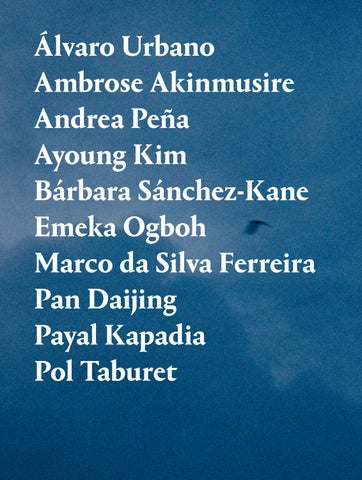
Álvaro Urbano Ambrose Akinmusire Andrea Peña Ayoung Kim Bárbara Sánchez-Kane Emeka Ogboh Marco da Silva Ferreira Pan Daijing Payal Kapadia Pol Taburet 1
2
Established in 2021, the CHANEL Next Prize has become one of the most exciting awards in recent years. Each recipient receives 100,000€ in unrestricted funding, as well as a two-year mentorship and networking programme facilitated by CHANEL’s cultural partners. In a moment when artists everywhere are facing a variety of difficulties, from market contractions to aggressive forms of censorship, this constitutes essential support. The 2026 cohort – all featured in these dedicated pages – comprise a range of international voices, in fields ranging from painting, to filmmaking, choreography to sculpture. They are some of the most extraordinary artists working today, and it is gratifying to see every one of these ten award-winners receive this generous recognition. Most of the cohort have been the subject of coverage in frieze magazine in recent years. Two recent cover artists, Ayoung Kim and Bárbara Sánchez-Kane, are multihyphenate artists who have upended expectations with their genre-defying bodies of work. Ambrose Akinmusire, Pan Daijing, Emeka Ogboh, Pol Taburet and Álvaro Urbano have all been subject to recent profiles and reviews. Three other artists honoured here – Marco da Silva Ferreira, Payal Kapadia and Andrea Peña – were somewhat new to me and to this magazine, but I look forward to frieze’s future coverage of them: Like the other award winners, their clarity of vision – and experimental flair – is mesmerizing. Giving voice to a feeling so many artists experience, Taburet has said: ‘Creating is a necessity. I’ve always had this need to make something with my hands and thoughts.’ The 2026 Next Prize will help support that necessity. What follows in these pages is a demonstrative sample of these artists work and why these ten creatives, living and working around the world, have become some of the most compelling makers in the field of contemporary art and culture. — Andrew Durbin, editor-in-chief, frieze
Álvaro Urbano ‘A ghost exists because there is something unresolved. My work is about these what-if scenarios – an encounter that perhaps never happened, but happens inside my exhibition.’ — Álvaro Urbano
4
Stepping into an environment by Álvaro Urbano is akin to entering a dream in which architectural histories, forgotten relationships and fragments of time have been rearranged according to their own internal logic. Now based in Berlin, Germany, the artist was born in Madrid, Spain in 1983. Urbano, who is formally trained in design and architecture, creates what he calls ‘habitable dioramas’ – immersive environments that borrow from theatre, the built environment and filmmaking. In ‘L’invitation au voyage’ (2021), he meticulously reconstructed the living room of Irish architect and designer Eileen Gray’s villa E-1027 in the South of France, a modernist landmark that was infamously defaced by Le Corbusier,
who painted graphic erotic murals onto the interior without Gray’s permission. Through subtle alterations – including the removal of these paintings – Urbano stages ‘clues of a constructed reality’, transforming the installation into a quiet act of restitution, exposing the gendered power dynamics embedded in architectural history. The fragility of memory is integral to Urbano’s storytelling. After discovering Mexican architect Luis Barragán’s fascination with the Spanish city of Granada and his admiration for the poet Federico García Lorca, the artist created ‘GRANADA, GRANADA’ (2023), a fictional romance between the two men that unfolded across two galleries in different cities in Mexico. Hyperreal plants fashioned from painted metal and drawn from both Lorca’s poetry and Barragán’s gardens emerge from walls and tiles; nearby, a discarded bow tie and necktie lie on the floor, suggesting an unseen encounter. In an interview for Umbigo magazine in 2020, Urbano spoke of his boyhood in Catholic Spain as ‘a world full of representations, spirits, beliefs and ghosts.’ With a background that ignited his imagination and curiosity, Urbano uses fiction as a tool for reopening history’s seemingly settled narratives. — Lola Kramer
5
Ambrose Akinmusire Ambrose Akinmusire
Trumpeter and composer Ambrose Akinmusire may have trained at some of the most prestigious musical institutions in the US, but in a 2024 interview with Jazz Times, he’s careful to also credit the influence of his hometown Bay Area heroes in shaping his playing. He lists off a string of names – among them the drummer E.W. Wainwright, piano player Ed Kelly and trumpeter Khalil Shaheed – all of whom he would regularly play alongside in East Bay jazz clubs while still in high school. Born in 1982, Akinmusire was just 28 when he signed to the fabled Blue Note Records, releasing his critically acclaimed Blue Note debut, When the Heart Emerges Glistening, in 2011, before going on to tour with the Blue Note All-Stars, a band comprising the label’s modern-day greats. In 2015, he featured on Kendrick Lamar’s seminal To Pimp a Butterfly where he laid down tormenting trumpet lines for the track ‘Mortal Man’. In 2020, he released his fifth album with Blue Note, On the Tender Spot of Every Calloused Moment – an ode, and in some ways a farewell, to his hometown of Oakland, California: ravaged by gentrification 6
and tech money and no longer the culturally rich environment he grew up in. Akinmusire describes his most recent offering, honey from a winter stone (2025), on Nonesuch Records as a self-portrait: he frames the album around his own vulnerabilities and the collective struggles of Black men – navigating colourism, erasure and questions of representation. The album earned Akinmusire his fourth Grammy nomination to date. As a jazz musician Akinmusire pays homage to his predecessors – acknowledging the foundations they laid whilst also grappling, both personally and through his music, with the limitations and constraints inherent to the Black experience in the US. Now as an educator, in the role of Director of Jazz at Stanford University he is also able to support the next generation. He says of his output: ‘I’m always considering who I represent – on all levels, in all the roles I play within my various communities. It’s about understanding the weight of those roles and the responsibility that comes with them.’ — Ben Broome
‘I don’t know where ideas come from, but I know that they come from something higher than us. My role as an artist and musician is to deal with all of the human things, so that nothing is stopped by our egos or inabilities.’ — Ambrose Akinmusire
7
Andrea Peña Andrea Peña considers the role of the body in relation to the increasingly digitized and online world in which we live. Born in Colombia in 1990, the choreographer is based in Montreal, Canada, where she founded and directs Andrea Peña & Artists (AP&A). Her work examines, just as an anthropologist might, how representations of bodies on Instagram or TikTok affect the ways in which we inhabit our own bodies in reality. She first turned her attention to portrayals of movement in the pre-internet age, beginning with the Italian renaissance in the 15th century, before moving onto the more ornate and dramatic baroque period. In so doing, the choreographer identified a kind of harmony between then and now, discovering ways in which we mimic the reclining forms of classical art and sculpture when posing for photographs destined for an online audience. If historically the body was positioned so as to declare its gender, Peña’s choreography – in works such as REPLICA (2024) – serves to withhold or obscure gender binaries, with the performers’ movements pointedly 8
blurring traditionally gender-specific mannerisms and body language. Much of Peña’s work is informed by a process of construction and deconstruction. Studying for a master’s degree in industrial design at Montreal’s Concordia University added a new dimension to her choreography, allowing Peña to conceive movement in
conjunction with, rather than separate from, material structures and forms. This logic extended to her 2023 commission for the Venice Biennale entitled BOGOTÁ in which nine dancers moved through immersive built environments where scaffolding and an Olympic-style podium represented the post-industrial ruins of the Colombian capital. Described by the artist as a ‘post-Andean baroque, performative event’, BOGOTÁ contemplated the death and subsequent resurrection of Indigenous Colombian identity as a product of 16th-century Spanish colonization. Across Peña’s choreographic output, she positions the human body itself as inextricable from the systems – colonial, industrial, technological – that humanity appears compelled to advance. — BB
‘The work I do as both a designer and a choreographer is to build alternative universes. These works put the body and design in conversation with each other to make us imagine other possibilities of being human on stage.’ — Andrea Pen�a
9
Ayoung Kim ‘I start with curiosity. I follow the things I see and stick with them. My projects are really about learning and educating myself, rather than figuring out some big, grand thing.’ — Ayoung Kim
10
11
Every time Ayoung Kim’s delivery dancers encounter one another, time slows down. This moment in Delivery Dancer’s Sphere (2022), a video developed amid the rapid expansion of app-based food delivery during the COVID-19 pandemic, encapsulates the concerns that animate Kim’s practice. Combining live-action footage with video game renderings, the work follows a gig worker as she navigates an imaginary version of Seoul, South Korea – Kim’s hometown, where she was born in 1979 – governed by algorithmic logistics. When the rider encounters her double from another possible reality, the rules organizing her world begin to break down. Speaking to Cassie Packard in an article for frieze in 2025, Kim describes her contemporary art practice as ‘transmedia storytelling’. Through video, game engines, performance and AI, she creates sprawling works of speculative fiction in which time itself has become contested terrain. Within her narratives, agency hinges on who controls the systems that organize daily life. In the same conversation, Kim mentions her research into pre-modern calendrical systems from different parts of the world, explaining, ‘I was interested in the culturally diverse ways that people have calculated time and the plural sense of temporality that comes with that.’ In her work, alternative timelines coexist, revealing that time is neither neutral nor something to be taken for granted but rather a 12
structure of power that can be resisted. Inspired in part by the cultclassic animated MTV series Æon Flux (1991–95), Kim’s universe is populated by doppelgangers, delivery riders, double agents and other figures facing unstable realities. In these worlds, glitches are moments where potential futures briefly come into view. But for the artist, technology is neither optimistic nor pessimistic: it is fundamentally plastic. Like the chimeric qualities of Kim’s media and the timelines that inhabit her work, technology is profoundly malleable, and the necessity to shape it for the better is urgent. — LK
13 13
Bárbara Sánchez-Kane At the core of Bárbara Sánchez-Kane’s expansive practice is an interrogation of the power structures that dominate mexicanidad – the philosophical and historical concepts underpinning Mexican identity. Across (but not limited to) sculpture, performance and fashion design, Sánchez-Kane plays with symbols commonly associated with Mexico – the military, the wrestling ring, the church – turning them inside out to render macho hegemony vulnerable and naked. Uniform, as one of the most immediately recognizable emblems of power, is now an archetypal media for Sánchez-Kane who indulges in the undressing and recontextualization of this hallmark of authority, reclaiming the fashion of dominion as her own. Born in 1987 in Mérida, Mexico, Sánchez-Kane first studied industrial engineering before retraining in fashion design and founding her eponymous brand in 2016. ‘Sánchezkaneismo’ – the artist’s April 2022 presentation at Mexico City’s Kurimanzutto gallery – was billed as a two-night presentation of the artist’s newest collection, livestreamed on the gallery’s Instagram. But this was not just 14
any presentation; this was a SánchezKane show. Opera singers stood sentry on the runway while a drone carrying a calla lily surveilled from above and masked luchadores paraded past in rawhide lingerie. The spectacle included a dress fashioned from wrestlers’ masks, bank-logo belt buckles, tribal boots and deconstructed military uniforms. Sánchez-Kane’s garments can, at times, be worn but they’re equally at home installed on the walls of a museum or at the 2024 Venice Biennale, in the Adriano Pedrosa-curated exhibition
‘Foreigners Everywhere’, where she presented a totem of three suspended military uniforms – their cut-out backs revealing red lace lingerie underneath. The worlds of both art and fashion have a categorization fetish – designer, sculptor, couturier, performance artist, tailor – they want their kin neatly packaged and in the pigeonhole to which they belong. As Sánchez-Kane dissolves the hierarchies of her beloved Mexico, so too fall the categories and language which, historically, might have been assigned to her own output. — BB
‘Ideas are borrowed. I’ve always said I’m a bit of an anarchist in the sense that I dream a lot, but I never write down my dreams. It’s the only non-capitalist process we have. Every time I dream and the idea comes back to me it was mine – and if it doesn’t come back to me, it was never mine.’ — Bárbara Sánchez-Kane
15
16
17
Emeka Ogboh ‘I didn’t set out to be a sound artist,’ Emeka Ogboh told Finnish composer and sound artist Ilpo Jauhiainen in an interview in 2014. ‘Lagos made me a sound artist.’ Born in Lagos, Nigeria in 1977, the musician and artist has split his time between the capital of his home country and Berlin, Germany, since 2014. His birthplace has remained a fundamental source of inspiration, informing his polyphonic albums and large-scale audio-visual installations. For Ogboh, listening is never passive: ‘I stopped calling it noise since I started listening to it,’ he explained. To his ears, traffic, hawkers, bus conductors and passing conversations instead became musical compositions. 6°30’33.372”N 3°22’0.66”E (2022), Ogboh’s influential second album and first release on his own label Danfotronics – founded as an imprint for ‘experimental electronics from Nigeria, West Africa, and beyond’ – showcases his ability to tell the stories of a place through ambient multisensory textural qualities. Unfolding over eight tracks incorporating interviews and field recordings made in and around the city’s Ojuelegba bus station (a former historical shrine 18
to Eshu, the Yoruba god of music and confusion), the album’s cogent portrait of this neighbourhood recalls the legendary Fela Kuti’s critique of postcolonial Lagos in his 1975 Afrobeat album Confusion. Our interconnected global landscape becomes a vivid theme in Ogboh’s The Way Heavenly Things are Going (2017), whose title is borrowed from the
1979 Bob Marley classic ‘So Much Trouble in the World’. The work was created for documenta 14 in Athens, Greece. Viewers enter this immersive soundscape to the strains of a traditional polyphonic Greek lament, ‘When I forget, I’m glad’; the only light source comes from real-time stock market ticker LEDs, their numbers scrolling past in blue, green and red overhead. Taking as its starting point the Greek financial crisis, triggered by the Great Recession, Ogboh forges a connection through his chosen song between global economic precarity and the sorrows of exile and the search for a better life. — LK
‘What attracts me to sound is that it’s everywhere. It envelops you, immerses you, transports you. Sound you can always feel, it’s all around you. That immersive nature, the ability to create embodied experiences, to carry you from one place to another – that’s what drew me to it.’ — Emeka Ogboh
19
Marco da Silva Ferreira For self-taught choreographer and dancer Marco da Silva Ferreira, dance is a means of examining how collective identities are formed, preserved and transformed. Across his work, choreography becomes a living record where different strands of music and dance culture collide with contemporary life. In a 2023 interview with Springback magazine da Silva Ferreira explains, ‘Collective identities are sources of belonging and inclusion, but when they become mainstream, they can turn the other way around.’ Da Silva Ferreira, born in Portugal in 1986, explores the tension between cultural preservation and change throughout his practice. While many choreographers foreground individual expression, his works investigate how communities emerge, traditions transform and identities are constructed through shared movement. CARÇACA (2022), shortlisted for Sadler’s Wells’s The Rose International Dance Prize 2025, draws from Portuguese folk dances, street dance and club culture; it evolved from the choreographer’s desire to understand how living 20
traditions become heritage. ‘We attempt to revive the traces of collective identity which new generations start losing, such as food, clothes, music and dance,’ da Silva Ferreira says in the same interview. ‘What do we do when fixed heritages become ethnically questionable? What about new communities? What about new cultural movements?’ Da Silva Ferreira continues to ask questions related to collective belonging. In his recent work, F*cking Future (2025), an ensemble of eight dancers moves from the rigid precision of a unified body towards an ecstatic state of individual release. As the beats per minute steadily increase over the course of the performance, the dancers trace a path from conformity to emancipation. Throughout his practice, da Silva Ferreira returns to a central question: how can cultural forms be preserved without becoming static? Rather than treating identity as something fixed, his choreography presents it as a living process – continually shaped by movement, memory and the communities that sustain it. — LK
‘The place that the body can really occupy seems uncertain. The world is so digitized and creates such a great alienation from what is organic and concrete. I think that returning to the body as concrete matter is essential. For me, it is the basis of the dance I do and the special place that dance can occupy.’ — Marco da Silva Ferreira 21
22
23
Pan Daijing With a background in musical composition and performance, Pan Daijing transcends conventional modes of language and form in pursuit of something that can only be felt rather than seen. Sources of light are, for instance, used sparingly in Daijing’s exhibition making, not to mimic the clubs that shaped her artistic and musical beginnings, but to use its absence as a tool to heighten the senses and command attention. Born in Guiyang, Southwestern China in 1991, and Berlin-based since 2015, the self-taught artist works across painting, sculpture, sound and moving image, all rooted in performance. Cream Cut I and Cream Cut II (both 2024–25) were created during Daijing’s 2024 exhibition, ‘Mute’, at Haus der Kunst in Munich, Germany; performers used chalk to apply the indecipherable marks of automatic writing across two black canvases. Reinstalled at the Walker Art Center in Minneapolis as part of her solo exhibition ‘Sudden Places’ in 2025, the paintings are far removed from their German site of frenzied creation, reexhibited on another continent as artifacts, just as an ancient history museum 24
‘I think one of the most important qualities of an artistic expression is honesty. Honesty towards oneself and what we want to reveal of the world we see as artists. This is the basic manner of what we do as artists.’ — Pan Daijing
might present an object left behind by a civilization we can no longer comprehend. At odds with the material immediacy of the artist’s paintings is the sonic intervention Scale Figures (2023 and 2025), in which the vocals of a conservatorytrained counter-tenor and mezzosoprano trade dominance in an antiphonal pattern. First developed for the Gwangju Biennale in 2023, the work extends into the physical realm: for the inaugural iteration in South Korea and the subsequent outing in Minneapolis, the sonic components are joined by sculptural elements and inkjet prints installed in discreet, undisclosed locations around the exhibition spaces. For the curious visitor a kind of treasure hunt ensues – itself a performance – soundtracked by the omnipresent warbling chorus. The frenetic movements of a oncelive performance are fossilized behind glass in Daijing’s paintings or archived for eternity in sound in works like Scale Figures. This persistent process of transformation reveals performance to be, for Daijing, what clay is for a sculptor: not a genre or even a methodology, but a medium in itself. — BB
25
Payal Kapadia Payal Kapadia’s films move fluidly between fiction and non-fiction, often using formal experimentation to explore the tensions between private desire and public life. Questions of love, migration, caste and gender emerge, not as separate subjects, but as connected forces shaping how people navigate the world. Kapadia was born in 1986 in Mumbai, India. Her debut feature, A Night of Knowing Nothing (2021), won the L’Œil d’Or for Best Documentary Film at the Cannes Film Festival in 2021. The project grew out of the 2015 student protests she witnessed while attending the Film and Television Institute of India in Pune. Constructed from archival material and personal recordings, and anchored by fictitious letters between two film students – former lovers who have ended their intercaste relationship – the film portrays political upheaval through the dreamlike, impassioned yearnings of India’s youth. Throughout Kapadia’s work, love serves as a lens through which larger social realities come into focus. Her films reveal how history 26
is experienced through the quiet hopes, relationships and acts of selfdetermination that define ordinary lives. What is most important, Kapadia emphasized in an interview in 2021 at the Institute of Contemporary Arts in London, ‘is to be able to use the form to raise the questions that you want.’ This philosophy finds its fullest expression in All We Imagine As Light (2024), her first fiction film, which premiered at the 2024 Cannes Film Festival. It tells the story of three migrant women working at the same Mumbai hospital, each forced to navigate distinct gendered and socio-economic challenges within a rapidly changing India where the push for modernization has brought displacement and a surge in sectarian identity. The film won the Grand Prix – the first time this prize was awarded to an Indian filmmaker. This achievement marked the end of a 30-year absence of Indian cinema from the competition and the arrival of a director whose films have consistently turned towards lives, relationships and political realities that exist outside prevailing narratives. — LK
‘Cinema helps me understand the world around me. It’s a way to dig deeper into those questions about the world that you live in. It is about accessing those things which we cannot really define or speak clearly about. Cinema helps to get closer to those.’ — Payal Kapadia 27
Pol Taburet
‘I perceive myself as a kind of narrator or stage director, creating spaces or scenes of theatre. Painting intervenes like a distorting mirror. It’s more subtle, while sculpture is sudden and direct in the material.’ — Pol Taburet
30
Pol Taburet’s paintings often begin the same way: a black ground upon which swathes of colour are applied, carving up the canvas and setting the stage onto which the artist summons his spectral company. Influenced by the occult and mythologies in Creole culture, these human-esque apparitions feel as though they could come and go as they please in Taburet’s constructed realms. Born in Paris, France in 1997 of Guadeloupean and French heritage, Taburet studied painting and ceramics at the École nationale supérieure d’arts de Paris-Cergy, at times avoiding the journey to college by painting in his bedroom in Belleville. It was here that domestic space first began to influence the environs depicted within his paintings, a milieu still present in Taburet’s work today. Reviewing his 2025 solo show at the Schinkel Pavillon in Berlin, Germany for frieze, Brooke Wilson observed how the artist achieves a hallucinatory effect, setting the delicacy of a translucent mist cast across his subjects’ faces against the heavily layered impasto of their clothing and the backdrops, creating an omnipresent friction between
31
32
dissolution and solidity. Similar figures have more recently materialized in bronze, giving weight to their otherwise ethereal presence. Taburet’s sculptural forms share the same transience as those in his paintings – it is as if they have stepped out of the canvas and immediately solidified in space. Taburet’s most recent exhibition at Villa Medici in Rome, Italy, ‘Paranoia as a Method’ (2026), unites sculpture, drawing and painting amongst the unadorned (and sometimes brutal) 20th-century renovations of the villa by its then-director, Polish-French artist Balthus. In Rome, Taburet’s bold primary colours have softened a little, echoing the marble of the city’s fascist architecture, allowing for more chalky and muted expanses to govern the compositions. His figures pass through these mottled voids with their backs turned or peeking out from black portals, haunting the historic walls and gardens. The spectres that once drifted through a Belleville bedroom have a habit of making themselves at home. — BB
33
Writer Biographies Ben Broome is an independent artist, curator and writer. Recent projects include ‘Rooms of Neighbours’ (2026), an exhibition across domestic and communal areas of Clifton Crescent in South London, UK; ‘Ladji Diaby: Who’s Gonna Save The World?’ (2026) at Lafayette Anticipations, Paris, France; and ‘Racheal Crowther: Gebrauchsmusik’ (2025) at Galerie Noah Klink, Berlin, Germany. He has written exhibition texts for artists including Simon Conrad and Zazou Roddam. He lives in London, UK. Lola Kramer is an independent curator and writer. Recent projects include ‘Dorothea Rockburne: The Light Shines in the Darkness and the Darkness Has Not Understood It’ (2024–25) at Bernheim, London; ‘Nancy Holt: Perspectives’ (2023) at Dunkunsthalle, New York, USA; and ‘7 Gardens’, an exhibition across community gardens on the Lower East Side of Manhattan, New York, in 2022. She has written exhibition texts for artists including Julie Beaufils, Aki Goto and Eli Ping. She lives in New York, USA.
Photography Portraits of the winners and artwork details photographed by Jeff Henrikson, commissioned by CHANEL Culture Fund.
Masthead Editor Matthew McLean
Editor-in-Chief, frieze Andrew Durbin
Project Editor Sara Harrison
Director, Frieze Studios Francesca Girelli
Design The Bon Ton
Head of Global Brand Advertising Morenike Graham-Douglas
Proofreader Kirstie Sequitin
Media Sales Assistant Madge Yang
Captions p. 4: Álvaro Urbano © CHANEL / Jeff Henrikson. p. 5: artwork detail © CHANEL / Jeff Henrikson. p. 7: top: Ambrose Akinmusire © CHANEL / Jeff Henrikson; bottom: Ambrose Akinmusire, score from ‘Vartha’, 2014, courtesy of the artist. p. 8: Andrea Peña © CHANEL / Jeff Henrikson. p. 9: left: artwork detail © CHANEL / Jeff Henrikson; right: performance of SACRA, Ballet BC, Vancouver, Canada, 2025; photograph: © Duy Le. p. 10: Ayoung Kim © CHANEL / Jeff Henrikson. pp. 11, 13: video stills from Ayoung Kim, Delivery Dancer’s Sphere, 2022, single-channel video, 25 min, courtesy of the artist. p. 14: Barbára Sánchez-Kane © CHANEL / Jeff Henrikson. p. 15 : Barbára Sánchez-Kane, New Lexicons for Embodiment, 2023. pp. 16–17: Barbára Sánchez-Kane © CHANEL / Jeff Henrikson. p. 18: Emeka Ogboh © CHANEL / Jeff Henrikson. p. 19: installation view from Emeka Ogboh, ‘PLAYBACK – The African Union: 20 to 20,000 Hz’, ifa Galerie Berlin, Germany, 2016; photograph: © Victoria Tomaschko / ifa Galerie Berlin. p. 21: Marco da Silva Ferreira © CHANEL / Jeff Henrikson. pp. 22–23: performance of F*cking Future (2025); photograph: © José Caldeira, courtesy of the artist. p. 24: installation view, ‘Pan Daijing: Done Duet’, Power Station of Art, Shanghai, China, 2021; photograph: © Pan Daijing, courtesy of the artist; p. 25: top: Pan Daijing © CHANEL / Jeff Henrikson. bottom: artwork detail © CHANEL / Jeff Henrikson; p. 27: Payal Kapadia © CHANEL / Jeff Henrikson. pp. 28–29: Film stills from All We Imagine as Light, 2024, courtesy of the artist. p. 31: Pol Taburet © CHANEL / Jeff Henrikson. p. 32: Pol Taburet, That’s that Needle guy!, 2025; photograph: Romain Darnaud, courtesy of the artist and Mendes Wood DM. p. 33: top and bottom: artwork detail © CHANEL / Jeff Henrikson.
35
CHANEL Next Prize The CHANEL Next Prize is a biennial award that recognizes contemporary artists who are redefining their disciplines. Established in 2021 by CHANEL Culture Fund, and now in its third edition, the Next Prize is designed to catalyze innovation by providing recipients with the time and space to realize ambitious new projects. The winners receive 100,000€ in unrestricted funding to accelerate the impact of their work. In addition to the grant, they join a two-year mentorship and networking programme facilitated by cultural partners. Past winners have included artists Tolia Astakhishvili, Precious Okoyomon, Ho Tzu Nyen and Dalton Paula, among others. The Next Prize marks the latest chapter in CHANEL’s long commitment to the arts – a legacy that began with Gabrielle Chanel’s support of avant-garde pioneers, from Salvador Dalí to Jean Cocteau, and honours her desire to be part of what happens next: ce qui va arriver.
36