Friends of the University Library
Newsletter August 2016
Introduction Welcome to the latest edition of the Friends’ Newsletter, which provides an opportunity for us to showcase some of the Library’s activities over the past year, and to highlight some of our successes. When I was asked recently to identify the most enjoyable aspect of my job, I didn’t have to think long before replying: “telling the University’s senior managers how good the Library is”. I’m not at all embarrassed to do so, as the Library’s many achievements are entirely due to the creativity, energy and commitment of colleagues who provide such excellent services for our students, researchers and partners in the community. In many respects 2015-16 has been one of our most successful years ever. In the recent Times Higher Student Experience Survey the Library achieved its highest ever position in any national survey – joint first in the UK. This followed our success in the autumn 2015 International Student Barometer when we were rated second highest amongst 159 participating universities around the world. The Library’s increasing popularity with students is complemented by our engagement with the University’s researchers and the wider community which has resulted in several of the exciting projects you will see described in these pages, including the digitisation of the Trevelyan photograph albums, the Petre Gradual performance, the Gertrude Bell exhibition and the Flambard Poetry Prize.
2
You will also read of the Library’s recent success in being shortlisted for the Times Higher Leadership and Management Award for Outstanding Library of the Year. This accolade is based on our collaborative work with the School of English on the Bloodaxe Books Archive. I am very happy to acknowledge that the project would never have been possible if the Friends of the University Library had not generously provided the initial funds to purchase the archive only a few years ago. So, I’d like to thank you all very much again for your continuing support and generosity. Wayne Connolly University Librarian
3
Contents
4
Library Services News
5
Library Activies and Adventures
16
Information for Friends old and new
27
Contact Details
30
Friends Membership Application Form
31
Library Services News
5
Library arrivals and departures! If we thought the 2014/15 academic year was our busiest ever for recruitment we hadn’t reckoned on 2015/16, which has brought with it a bumper influx of new staff and some exciting service developments. We recruited to 27 new part-time posts including Senior Library Assistants, Library Assistants and Library Attendants in order to staff the Marjorie Robinson Library Rooms which opened its doors on 11 January 2016. Our enthusiastic new team have fast become a valued and integral part of the wider library team, and the new Library Rooms have proved a resounding success amongst students and staff alike. We’ve welcomed a further 21 new faces in a variety of roles across the Service, and said a fond farewell to some long standing colleagues who are now enjoying a more leisurely lifestyle in their retirement; Margaret Savage (Library Attendant for 26 years), Pat Perkins (Secretary for 26 years), Pauline Wandless (Library Assistant for 22 years) and, more recently, Moira Bent (Liaison Librarian for 18 years). 6
Our Special Collections and Archives continue to expand resulting in a recent restructure of the section which saw Ian Johnson appointed to Head of Special Collections and Archives. Also moving on up is Julia Robinson who replaces Moira Bent as Liaison Librarian for SAgE and Amanda Boll who shares the role of Head of Technical Services with Pamela Dodds and, in addition, has been appointed to the new part-time post of Head of Research Publications and Data Management Services, a post created to underpin the increasing role the Library plays in supporting research in the University. With some new exciting projects surfacing we’ve had the opportunity to appoint Terry Charlton to the role of Learning Technologist along with Claire Irving (Learning and Development Officer: Academic Skills Project) and Jessica Salmon (Project
Officer: Metadata and Management Information). Another important aspect of Library recruitment worth mentioning, which the Library prides itself on, is the number of students we are able to support annually through paid employment, including our Student Aides, Student Communications Team, Student Learning Support Team, and the large number of students we employ on a casual basis through Jobs on Campus (JobsOC), an on-campus jobs agency for students of Newcastle University. As well as providing paid work this offers an opportunity for students to gain valuable work experience in support of their future careers. So, another busy but rewarding and successful year on the staffing front and, with new projects on the horizon, there are more exciting times ahead... We wish all of our colleagues and friends, past and present, our very best wishes for the future. Joan Hulme Personnel & Training Co-ordinator
National Student Survey (NSS) and other recent student surveys The NSS is the main indicator used by all universities to measure their performance and relative standing in the view of their final year undergraduate students. This year Newcastle University performed very well again in the main rating of students’ overall satisfaction with their courses (question 22 in the survey). The University’s score of 91% was joint sixth in the UK, and joint first in the Russell Group of research intensive universities. The Library’s satisfaction rating of 93% in the NSS was the highest score achieved by Newcastle University for any of the questions in the survey. Although this a point lower than last year’s score of 94% it still keeps 7
us amongst the top ten university libraries in the country. Across all subject areas, the Library scored 90% and above in 38 of the 45 subjects included in the survey results. Five years ago we achieved 90% in only 20 subjects and our ratings have improved dramatically since that time. Other national surveys which have been carried out in the past few months are the Postgraduate Taught Experience Survey (PTES), and the Postgraduate Research Experience Survey (PRES). In PTES this year the Library achieved a 91% satisfaction rating from Masters students, and in PRES a 90% rating from Research students. This is the first time we have received a 90% rating in all three major surveys. This is an excellent achievement which is a credit to all colleagues who have worked with great commitment to support all our students so well. They obviously appreciate it! Wayne Connolly University Librarian
Stephen Harding recieving the Credo award on behalf of the team
Credo Reference award We were delighted to win our first Credo Reference Award for Information Literacy excellence. The winning project was a 6th form study skills website created by Sara Bird, Gillian Johnston and Stephen Harding. The judges’ comments note that the website: “approaches information literacy skills in a light-touch and engaging way, appropriate to the audience. The fact that it is also being used by university students demonstrates its wide appeal.” The award was presented at the recent LILAC conference in Dublin and Stephen went along to collect the award on the team’s behalf. Jill Taylor-Roe Deputy Librarian
8
THELMA Outstanding Library Team 2016 - we nearly got another one! We were delighted to be shortlisted for another Times Higher Education Leadership and Management Award (THELMA) for Outstanding Library Team. This was the fourth year we have been successful in reaching the shortlist, (in 2011, we won the award for our patron-led ebook service.) This year’s submission focussed on the Library’s input to the Poetics of the Archive; a major AHRC-funded project led by Professor Linda Anderson through which the curated collection of the Bloodaxe Archive was used to inspire new work by poets, film-makers and artists as well as providing a rich resource for students and researchers. From the outset, we were determined that the archive should not exist just as a passive repository, but would provide a testbed for developing new approaches to digital humanities. Uniquely, the process of cataloguing and digitising the collection was approached as a genuinely collaborative activity, where archivists, curators, students and interpreters could each bring
their personal knowledge and experience to bear. This community of practice has ensured that the collection can be approached from a multiplicity of perspectives and access is not constrained by traditional “search and retrieve” archival techniques. The project also offered unique opportunities for students, academics and creative partners to enhance their archival research skills through behind-thescenes engagement with the work of the Library’s Special Collections and Archives team. The result is a Bloodaxe Books Archive now accessible via a visually exciting digital humanities interface which unites the original manuscripts and papers with poems, critical reflections, drawings, collages, films and digital and physical installations created by the writers, scholars and artists who engaged with it. It is a resource which not only supports individual scholarship, but is intended to attract and inspire the 9
wider public to engage with creative practice. Since its official launch in March 2015, the project website has attracted over 12,410 page views from users in the UK and abroad, with over 65% of usage coming from the United States. The enterprise has transformed the University Library’s approach to cataloguing literary archives. It has also acted as a magnet for additional literary archives from publishers and writers which we plan to curate and celebrate in an equally engaging manner. Furthermore, it has enabled us to develop a truly collaborative partnership with the University’s academics, with whom we are already developing plans for further digital humanities projects. Reflecting on the success of The Poetics of the Archive, project leader Professor Linda Anderson observed:
The Poetics of the Archive team
“Library staff did far more than bring their undoubted archival skills and knowledge to the project; they were intellectual and imaginative partners, entering fully into the innovative scope of the project and recognising the potential for the archive to stimulate new creative as well as scholarly adventures. It has been a delight to forge this alliance which has influenced research plans for the future in the School of English…” On the 24th June, the Library team comprising Jill Taylor-Roe, Ian Johnson, Kim Gaiger and our colleague and collaborator Professor Linda Anderson attended the awards ceremony at the Grosvenor Park Hotel in London. We had a lovely evening and although we lost out on the night to a fantastic project by Huddersfield University Library, we are still very proud of our project. Besides, there is always next year! Jill Taylor-Roe Deputy Librarian
10
Marjorie Robinson Library Rooms Success Since it opened on the 11th January 2016 the Marjorie Robinson Library Rooms has had over 114,000 visits by students and staff. Located adjacent to the Civic Centre on Sandyford Road, it houses a variety of digital learning spaces. In transforming a former office building to a 21st century library we have had the opportunity to try out new ideas. Instead of using external designers or architects we chose to consult with students to determine the types of spaces and facilities they would like to see in a modern library building. From the very early stages of the project we ran a series of activities where students and staff were invited to submit ideas and suggestions via postcard, web form or via social media. Library staff also visited a number
of other UK University libraries to learn about their facilities and most importantly how students were choosing to use them. We also trialled a number of different furniture configurations at the Philip Robinson library and procured the style of chairs students preferred. The “Marjorie” is very different from the other University libraries having no print collections and a very modern feel that has been described as being like a “boutique” hotel. It offers a variety of digital learning spaces including over 560 study spaces and 220 computers. Students can choose from a range of different study spaces over three floors of the Library Rooms. The upper floor provides a silent study space, with a separate “living room” where they can quietly read or think. Students have a choice of working on their own devices or at desktop pcs in peace and quiet. 11
The first floor tends to be noisier and is designed for group work. There is a range of different collaborative study spaces including five bookable study rooms with one set up as a board room. We have been also trialling a mobile charging unit which offers a secure and convenient way for customers to leave their mobile devices to charge. A forty-seat Academic Skills Room is located on the ground floor which is being used for information literacy sessions and meetings. The desks have pop-up computers so that the room can be transformed into a computer cluster for training sessions or individual use as required, making maximum use of the space. Also on the ground floor are some specially designed study booths for small group study. The new cafĂŠ EAT@LIBRARYROOMS and the adjacent social learning space with a range of soft furnishings
offers a more relaxed atmosphere. We have designed this space so it can be used for library and learning events. Already we have used the space to host our annual World Book night event which this year was entitled Library Vibes. Much to the delight of students and library staff alike this brought us live music and spoken word performances by local writers, musicians and university staff. The University’s NUTELA group whose membership consists of University staff who have an interest in technology enhanced learning also held their peer award event in this space. Library staff are available throughout its opening 8.30am until midnight during term-time to help students. Many of those working at the Marjorie Robinson Library Rooms were especially recruited but familiar
12
faces from the Philip Robinson Library can also be seen regularly there too as we are ensuring that customer services staff work have opportunities to work at both libraries. Feedback received to date has been very positive. One student has described it as: “an excellent facility, it is great to see the student voice being heard. Ingenious pods, open space and quiet study space”. Whilst another commented: “a wonderful place to spend some comfortable time while studying. Very modern, comfortable and studentorientated.” Early predictions that undergraduates studying science would prefer working in our first “bookless” library, leaving students who generally need more access to our print collections
in the Philip Robinson Library have proved incorrect. Students studying humanities and arts are enjoying its facilities too, with students from all disciplines making use of its services. Analysis of entry data at the new library shows it is proving popular with postgraduate and undergraduate students alike. Suggestions are also being received on how we may develop services and facilities in the future. For example requests have been received from some PhD students to have “reserved” areas as these students particularly appreciate the chance to study on the silent floor. It is something we may consider for the future when OpenLab moves to Science Central and we take over the rest of the building to meet the ever growing demand for library study space and services. The new library has been named “Marjorie Robinson Library Rooms”
13
in honour of Marjorie Robinson who left us a very generous legacy in her will. This benefaction enables us to develop innovative services and enrich the student experience. It has subsequently been agreed by University Council that the Robinson Library will henceforward be known as the “Philip Robinson Library” from 1st July 2016. Philip and his brother Lionel were antiquarian booksellers whose original business premises were in the Grainger Market in Newcastle. A long and enduring connection with the University began in 1924 when the Robinson brothers loaned the University material for an exhibition in King’s Hall. We are proud to be able to honour the generosity of the family through the naming of two of our prominent library buildings. Elizabeth Oddy Head of Learning & Support Services
Marjorie Robinson, with Philip, at the opening of the Robinson Library, 1989
14
Lord Walton 1922-2016
We say a sad goodbye to a University friend It was with sadness that the University Library learned of the death of Lord Walton of Detchant on 21st April at the age of 93. The Walton Library in the faculty of Medical Sciences was named for him in recognition of his achievements. Born in 1922 in Rowlands Gill, he studied medicine at King’s College Newcastle, then part of Durham University, in 1941. Qualifying from a shortened wartime course, Lord Walton graduated with a first-class Honours degree in 1945, and started work at Newcastle’s Royal Victoria Infirmary (RVI). He was called into the army in 1947, eventually becoming Second-inCommand of the Hospital Ship Oxfordshire.
Following completion of his military Service, Lord Walton returned to the RVI as Medical Registrar. It was while studying for his medical doctorate that he found himself inspired by three leading physicians: Professor Fred Nattrass, Professor – later Sir – James Spence and Dr Henry Miller. Lord Walton would later work alongside Professor Nattrass, the pair combining detailed clinical and genetic data, which led to the first major classification of muscular dystrophies. Lord Walton became a consultant neurologist in 1958 and then Professor of Neurology at Newcastle University in 1968. In 1971 he was appointed Dean of Medicine, a position he held for 10 years and in his autobiography The Spice of Life, he described it as the most enjoyable and fruitful decade of his professional career. During this time he became a Knight Bachelor and became Sir John. In addition to these honours, Lord Walton also held a number of senior positions from the 1980s onwards. He was elected as President of the British Medical Association (BMA) from 1980 to 1982, President of the General Medical Council from 1982 to 1989 and President of the Royal Society of Medicine from 1984 to
1986. Throughout his career, he would also hold the positions of President of the Association of British Neurologists (1987–88) and President of the World Federation of Neurology (1989–97), among other titles. It was during his tenure as Warden of Green College from 1983 to 1989 he became Lord John Walton of Detchant. His first speech in the House of Lords focused on the Human Fertilisation and Embryology Bill, which established his reputation in the Lords. He would sit in the House of Lords for over a quarter of a century. Most recently, Lord Walton was involved with the debate surrounding mitochondrial research and the work being led by Professor Sir Douglas Turnbull at Newcastle University. His love for Newcastle and Northumberland were never forgotten and in 1980 he was honoured again when the City of Newcastle upon Tyne, commemorating its 900th anniversary, made him an Honorary Freeman. Erika Gavillet Medical Librarian
15
Library Activities and Adventures
16
Special Collections: A review of the year’s exhibitions Publishing, English Literature, Archaeology and History have all featured in our exhibition programme this year. Bloodaxe Books: Archive on the Edge – this exhibition marked the completion of our first major literary archives project, undertaken in partnership with the School of English Literature, Language and Linguistics. The project was based around the Bloodaxe Press archive, which has been fully catalogued and extensively digitised as part of the project. Bloodaxe was founded by Neil Astley in 1978 and was named after Eric Bloodaxe, the last viking king of an independent Northumbria. The exhibition told the story of how a regionally rooted company grew to become an internationally renowned poetry publisher, whose authors have won virtually every literary prize going, including four Noble Prizes for Literature. Major Miss Bell: Gertrude Bell and the First World War – this exhibition was co-curated by Dr Emma Short from the School of
English Literature, Language and Linguistics. It explored the famous archaeologist and explorer’s war time experiences through her Red Cross work, the development of her role as an advisor to the government on Middle East affairs, and also touched upon her doomed love affair with Lieutenant Colonel Charles Doughtie-Wylie. Dr Short also delivered an engaging Friends talk to accompany the exhibition in December 2015. The Library commemoration of Gertrude Bell was an ideal prequel to The Extraordinary Gertrude Bell, a major exhibition held in the Great North Museum, which the Special Collections team were delighted to contribute to. We were also involved in the research for a documentary film on Gertrude Bell’s life, Letters from Baghdad. The film, which is narrated by Tilda Swinton, goes out on general release next year. Special
17
Collections staff were honoured and delighted to be invited to a special preview screening at the Tyneside Cinema. Rudyard Kipling: The voice of Britain and its Empire - December 2015 marked the 150th anniversary of the birth of Rudyard Kipling, and we felt this important anniversary could not be overlooked. The University Library holds the Pollard-Kipling Collection which is particularly rich in early editions of the author’s work. The collection was purchased for the University Library in 2011, through the generosity of the Friends. Our exhibition drew heavily on the Pollard collection and we were also most grateful for the loan of material from our Friends Peter and Margaret Lewis. Both the exhibition and accompanying talk by Dr Melanie Wood and Sam Petty, reflected the shifting tides of opinion regarding Kipling and his work. 18
Lasting Impressions – our early summer exhibition showcased three major publishing archives: Bloodaxe, Flambard and Iron Press it also highlighted the works of local authors Barry MacSweeney, Jack Common and Sid Chaplin, who all had their work published by one or more of these publishers and whose professional archives we also curate. The exhibition was timed to coincide with the Newcastle Poetry Festival. We’ve expanded our exhibition space this year to include the Marjorie Robinson Library Rooms. Our inaugural offering was entitled Local Heroines: Women of our Archive and celebrated the lives of Gertrude Bell, Marjorie Robinson, Ethel Williams and Molly Trevelyan. Online, our ever popular Treasure of the Month feature celebrated some wonderfully diverse items
Gertrude Bell, Marjorie Robinson, Ethel Williams and Molly Trevelyan
including letters on chicken rearing by George Orwell, the safety lamp wars of Sir Humphrey Davey and George Stephenson, and pieces of Napoleon’s flag. Find out more at: www.ncl.ac.uk/library/pecialcollections/exhibitions/treasure-ofthe-month.php or follow our blog at https://blogs.ncl.ac.uk/speccoll/ Special Collections & Archives Team
Growing Digital: Special Collections Projects Over the last five years, online usage of our Special Collections has quadrupled. This is directly attributable to the innovative and engaging interfaces we have developed to surface and promote our collections to users, both here in the UK and abroad. In addition to the flagship Poetics of the Archive project, which is celebrated on page 9, we have worked on several other
Michael Chaplin at home
digital initiatives this year. Oral Histories – Rachel Hill, our Senior Archives Assistant, has led on a new venture to capture oral histories from the donors and creators of some of our important literary archives, which she has also been cataloguing. We would like to thank Michel Chaplin, President of the Friends, and Peter and Margaret Lewis, creators of the Flambard Press, who have generously given their time to help Rachel in this work. We have several more oral histories in the pipeline, so check the Friends’ website for further news. The Courier Archive – we were delighted to launch the newly created online archive of Newcastle University’s student newspaper at the 2016 Convocation weekend. Over one thousand issues of the paper have been digitised, including the very first issue from 18 November, 1948. Alumni, including several 19
former Courier staff, spent a very happy afternoon browsing through their favourite issues. However, despite our best endeavours, there are still a few issues which have eluded us – so if you happen to have any loitering in your loft or garage, please let us know! Here are the issues we are missing: 1950’s Vol 4 no 4 - published sometime between 11th Dec 1951 (no 3) – 22nd Jan 1952 (no 5) Vol 7 no 2 - published sometime between 14th Oct 1954 (no 1) – 11th Nov 1954 (no 3) 1960’s Vol 13 no 9 – published sometime between 9th Oct 1960 (no 8) -2nd Nov 1960 (no 10) No 19 published on 26th march 1964 and No 84 published on 7th March 1968 1990’s No 937 published on 9th May 1996 Following the success of our Digital Memory Book last year, we secured Heritage Lottery Funding to work with colleagues at Durham University’s Palace Green Library to 20
A family photograph featuring Patrick Austin Murray, kindly sent to us by the Murray family. Patrick, a former student of Armstrong College, died in the Battle of the Somme aged 34).
create an expanded version of our interactive database commemorating the staff and students from Newcastle and Durham who lost their lives in WW1. The Universities at War project led by our archivist Ruth Sheret, has enabled us to harness the talents and enthusiasm of student volunteers from Newcastle University with representatives from schools and communities in our region. They have worked with members of other WW1 centenary projects, interviewed the descendants of those listed on our memorials, and assisted the outreach team with school groups. Thanks to these volunteers, the fallen are no longer simply names on a list and their stories have been brought to life for new generations. And we’re not finished yet! We’re still recruiting willing enthusiasts to help
us fill the few remaining gaps in our database. A new website with maps, educational resources, and links to all our centenary partner projects will go live later in the summer. Serendipity has also played a part in shaping this year’s digital activity. During a joint teaching session between Special Collections and the School of Arts and Cultures, the expert eye of senior music lecturer Dr Magnus Williamson was caught by our Petre Gradual. This 14th Century service book, written on vellum, contains improvised polyphonic pieces that musicologists had previously believed to have gone missing in the 20th century. Given its age and rarity, a decision was made to digitise the Gradual, using Turning the Pages software. On 9th April, Dr Williamson led students in a performance of chant and polyphony from the Gradual at the Church of St John the Baptist. The performance
Ruth Sheret and Gillian Johnston showcasing the Trevelyan Archive
Dr Magnus Williamson with the Petre Gradual
was delivered as part of the Newcastle Early Music Festival and was picked up by the local media. A recording of the performance, together with expert commentary by Dr Williamson will be added to the digital book, which you can see now on the Digital Resources page. Turning the Pages software has also featured in an innovative collaboration between the University Library and The National Trust. Through the good offices of Robin Dower, chairman of the Trustees of the Trevelyan family, the University Library was gifted thirty nine photograph albums which previously belonged to Molly Trevelyan, the wife of Sir Charles Philips Trevelyan. The albums cover the private and public life of this influential family from the 1890s to the 1960s, and constitute a veritable treasure trove, particularly when linked to the family papers, which are also held by the University Library. 21
We are digitising the albums and as part of this process, will record descriptive metadata for every single image. This will not only help academic researchers find what they are looking for, but will also make it easier for colleagues in the National Trust when they are researching exhibitions or responding to visitor queries. We will formally launch the search interface later this year, along with the visual interpretations of the albums. The Library’s Summer exhibition entitled The Road to Wallington, has been curated by Karen Atkinson, and was perfectly complemented by a talk by Lloyd Langley, House and Collections Manager at Wallington, at the Friends AGM, entitled Wallington: Past, present and future. Finally, just to prove we’re still traditionalists at heart, we recently secured funding from the National
22
Manuscripts and Conservation Trust (NMCT) to conserve the North Greenland Expedition Archive. Compiled by Geographer and Explorer Dr Hal Lister, the archive, which comprises written transcripts from the expedition, offers practical insight into the first British exploration of the Greenland Ice Sheet which was carried out during 1952 – 54. The expedition was sponsored by Sir Winston Churchill. The Archive was donated to the Library by the School of Geography, Politics and Sociology. When we examined it, we found that the paper was tightly rolled and brittle. The fragile physical condition, together with the fact that the records had been written in pencil, meant that the rich content of the archive was virtually inaccessible to researchers. The NMCT grant has allowed us to have the papers cleaned, deacidified, flattened, and repackaged by a professional conservator. To
make them even more accessible, they are also being digitised by partners at Woodhorn Museum, with our Geography students standing by to explore and interpret their significance further. If you would like to know more about any of these fascinating projects, please go to: www.ncl.ac.uk/library/ special-collections/digital-resources/. Special Collections & Archives Team
Inspiring Archives: A story of the Civil War in the North East of England An exciting outreach project inspired by some of the unique and distinctive resources in Newcastle University’s Special Collections officially got underway at a launch event held in the Old Library Building. It gave the teachers, librarians, academic staff, students, and representatives from other organisations involved in the project, including English Heritage, the opportunity to hear about the exciting activities that will be taking place over the next year. The project which is led by Sara
Wayne Connolly, Director of Academic Services and University Librarian (right) pictured with John Sadler and Rosie Serdiville from The Time Bandits, a professional team of historical costumed interpreters and re-enactors.
Bird, Education Officer at the Philip Robinson Library, takes its inspiration from the rare Civil War tracts in Special Collections and has been made possible by funding from the Heritage Lottery Fund. Over the course of the project Year 8 children from four local schools - Longbenton Community College, Monkseaton Middle School, Bedlingtonshire Community High School and Benfield School, will work with academic staff and the University Library’s Education Outreach team to explore the story of the English Civil War in the North East of England through the subjects of History, Science, Food Technology, English and Drama. Each school will focus on a different subject and will become experts in their particular area.
23
The students involved in the History strand of the project will learn about the story of Tynemouth during the Civil War, whilst those involved in the Science strand of the project will focus on gunpowder and war wounds. School students studying Food Technology will transcribe and bake recipes from a seventeenth century recipe book, whilst English and Drama students will work with archival material and drama practitioners to write and perform monologues narrating the story of the defection of Henry Lilburne, the governor at Tynemouth Castle. The project will culminate in a Civil War day to be held next summer at Tynemouth Priory where students will showcase their work. There will be a pop-up museum, historical trail, drama performances, historical re-enactments and the chance to sample 17th century afternoon tea. Sara Bird and Gillian Johnston Education Officers
Friends Online The Friends of the University Library have a brand new website with a freshly designed home page and logo. The ‘Welcome’ page lists all of the benefits our Friends can enjoy, as well as a link to our Webstore where Friends can now pay for their membership online. The opening of our ‘About Us’ page features a lovely piece by our current President of the Friends, Michael Chaplin on the importance of the Philip Robinson Library. Users can discover the history of the Friends group and there is also information on the wonderful gifts that the Friends have donated over the years. The ‘Events’ Page includes details about all of our forthcoming events. The ‘News’ section is where we can
24
post photos and write-ups of past events or forthcoming opportunities. And finally, our ‘Publications’ section gives users access to electronic versions of our newsletters. You can find the Friends of the University Library website at friends.ncl.ac.uk. You’ll also find news and events relating to the Friends group appearing on social media through the Special Collections twitter account @ncllibspeccoll. Rachel Hill Senior Archives Assistant
Recent Acquisitions It’s been a bumper year for new acquisitions in Special Collections and Archives. We are extremely grateful to all those who have generously gifted material to the University Library. Here are just a few highlights: Catherine Cookson Archive: - a selection of manuscripts of short stories, poetry and posthumously published novels by Dame Catherine Cookson, presented by Mr Hugo Marshall, Chairman of the Cookson Trust.
Runciman Archive: - additional material relating to Sir Walter Runciman, 1st Baron Runciman ( 1847-1937) and his son Walter Runciman, 1st Viscount Runciman of Doxford (1870-1949) – includes correspondence, diaries and photographs – presented by the Reverend Dr Ann Shukman, Walter Runciman’s granddaughter. Kay Archive: - Professor David Kay was one of the founding fathers of dementia research. His archive comprises publications, professional correspondence, primary research, related material, lists of publications, and other personal notes (1940s 2000s). The archive was presented by Prof Kay’s daughter, Christine Kay. Anderson Collection: – 188 children’s books, covering the period 1877-1995, with the majority of books dating from the mid- to late20th Century from the collection of 25
the late Nigel C Anderson, presented by his widow Mrs Marion Anderson. Arts Council Collection: – 1000 small print press and poetry books presented by Nicholas Baumfield, Senior Relationship Manager, Arts Council England. Furthermore, we were delighted to receive two new archives to add to our expanding Literary Archive Collection – O’ Brien Archive: – includes the working papers for almost all of the published work of the distinguished poet Sean O’Brien. The archive also includes his correspondence and notebooks. Mapanje Archive: - comprises the personal papers of the poet Jack Mapanje, including correspondence, press cuttings books and manuscripts. The O’Brien and Mapanje archives were purchased for the University by the School of English Literature, Language and Linguistics.
Flambard Poetry Prize The prize was established in recognition of the achievements of Flambard Press and its founders Margaret and Peter Lewis. Between 1990 and 2012, Flambard Press published an acclaimed range of poetry and fiction and helped to nurture many emergent and established writers regionally and nationally. It was recognised as one of the finest small independent presses in the UK. When the press closed, Margaret and Peter generously donated the Archive to the Library. In honour of this gift, the Friends of the University Library agreed to sponsor an annual poetry prize. The Flambard Poetry prize is awarded to the best group of 5 poems submitted by an unpublished author. The winner of the 2015 Flambard Poetry prize was Jane Lovell and the runner-up was Patrick Errington.
26
Information for Friends old and new
27
Your Friends of the University Library membership In return for your membership fee, we offer an engaging programme of events including: Lectures and talks on our celebrated rare books and archival holdings, as well as prominent guest speakers Private guided tours of the Library and its collections Access to our exhibitions and exclusive accompanying talks Invitation to the Friends’ Annual General Meeting Updates via the Friends’ newsletter , blog and website Priority announcements of any volunteering opportunities
28
Becoming a member Membership of the Friends is open to anyone with an interest in the Library, and is a fantastic way for our alumni and former staff to stay connected with the institution and its activities. If you would like to become a member of the Friends of the University Library there is an application form on page 31 of this booklet, or you can download a copy of the form from our new website: friends.ncl.ac.uk. You can pay by annual subscription (currently £12 per annum) or you can become a lifetime member for a one-off fee (currently £150).
Events over the last year 2015 Flambard Prize award night November 2015 “Major Miss Bell: Gertrude Bell and the First World War” presented by Dr Emma Short, Research Associate in the School of English Literature, Language and Linguistics December 2015 “Rudyard Kipling: The Voice of Britain and its Empire?” presented by Dr Melanie Wood, Special Collections Librarian and Sam Petty, Special Collections and Archives Assistant April 2016 Wallington: Past, present and future presented by Lloyd Langley July 2016
Current Exhibition
Forthcoming events Paleography Workshop 23rd August 2016 A commemoration of the Centenary of the Battle of the Somme with an exhibition and talk on Thomas Baker Brown and Sir Lawrence Arthur Pattinson. Autumn 2016 Commemoration of the Centenary of the birth of Sid Chaplin September 2016 “Early Expedition to Greenland” a talk by Dr Neil Ross, Lecturer in Physical Geography December 2016 Visit the Friends of the University Library website for full details on all of our events.
Lasting Impressions: Journeys from pen to print through our literary archives
29
Contact Details Friends Membership & Events Enquiries Email: lib-friends@newcastle.ac.uk Telephone: 0191 208 7651 (Joan Hulme)
Special Collections Exhibition & Events Email: lib-speccoll@newcastle.ac.uk Telephone: 0191 208 7112
General Library Enquiries Email: libraryhelp@newcastle.ac.uk Telephone: 0191 208 7662
30
31
University Library Newcastle University Newcastle upon Tyne NE1 7RU United Kingdom Tel: 0191 208 7662 Email: lib-friends@newcastle.ac.uk Web: friends.ncl.ac.uk
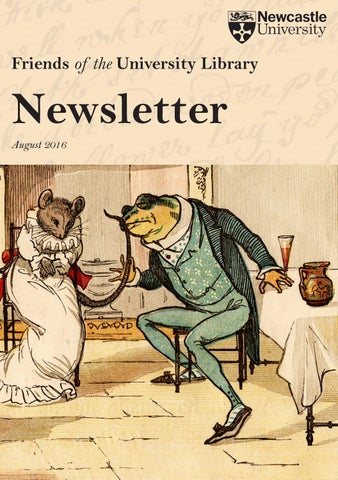
Cover illustration is from “A Frog He Would Go A-Wooing”, a picture book by Randolph Caldecott which can be found in Special Collections’ Chorley (Sarah) Collection.