




Institute for Engaging Leadership in Friends Schools 2024-2026 Graduating Cohort
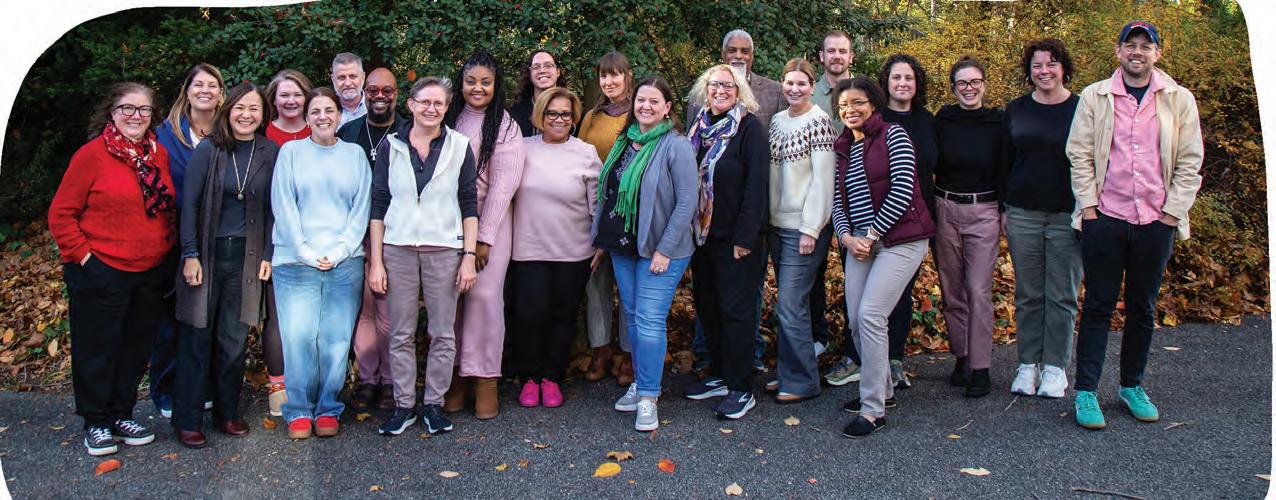
Friends Council is delighted to welcome 18 new alumni—the 2024-2026 graduating cohort of the Institute for Engaging Leadership in Friends Education. They are incisive thinkers who approach complex challenges with both intellectual rigor and deep humanity. Each person’s project stems from a passion rooted in their experience, sparked by their curiosity, and shaped by an equity lens. As a result, their work is deeply relevant and distinctly aligned with Quaker values. The future of the Friends school network is in very good hands.
Friends Council on Education created the Leadership Institute in 2022 as a learning community for Friends school leaders to work collaboratively on strengthening their capacity and skills. The Institute focuses on the unique role of Friends school leadership and the peculiar art of sustaining the Quaker ethos of a Friends school. Institute members conduct action research projects that benefit the network of Friends schools.
A Design Team consisting of several heads of Friends schools and Friends Council board members identified assumptions, goals, and objectives for cohort participants.
There is a current need to increase the pool of strong leaders, with special awareness of the current lack of women and people of color in Friends school headships.
Leadership development is a responsibility of the community of Friends schools and a collaborative leadership development model is very fitting for Friends schools.
To create a strategic network of Friends school leaders working together as a learning community focused on developing capacity and skills for transformational leadership in Friends schools.
To develop a pool of candidates for future Friends school headship and other leadership positions.
To examine the particular joys and challenges of leadership in a Friends school and explore how leadership is different in a Friends school than in non-Friends schools.
To learn and explore a systems-centered approach to school leadership and to practice tools and techniques for systems analysis and managing change.
To design and implement an action research project, engaging in observation and inquiry about Friends school culture, structure, and practice.
To explore the spiritual dimension of leadership by developing the capacity to discern leadings of the spirit and test these leadings through reflective group processes
To engage in structured opportunities to visit, observe and shadow respected leaders in Friends schools within the FCE network.
To engage in an ongoing cycle of deep learning in a collaborative, collegial cohort through critical reflection and feedback for the development of personal mastery.
A donation from a Quaker family foundation funded a pilot program. A major fundraising campaign funded an endowment that contributes to the sustainability of the program significantly. Friends Council remains committed to keeping participation in the Institute at no or low cost.
After 23 years, the Leadership Institute has nearly 200 alumni. More than 25% have become heads of school. Others are serving as leaders in various positions in Friends, other independent schools, or public schools.

is grateful to be the host and facilitator of this thoughtful and inspired professional growth and development within the Friends school network.
Each action research project presented in this booklet is deeply personal to the cohort member. Yet the themes are universal. Every cohort member expresses a strong desire to infuse Quaker principles and practices to transform the effectiveness of a classroom, team, or school. Collaboration underpins every project both in terms of eliciting input from those involved in or affected by the concept and in terms of sharing the results so that others can consider what might be effectively applied in their own school community.
Truth and Inequality

SHARON AHRAM 1
Sustaining Leadership through Heart Work
ANNIE BOGGESS 3
Balancing Inclusion, Capacity, and Excellence: Designing Sustainable Learning Support in an Independent School
SARAH BUXTON 5
Student-Led and Student-Centered DEI work in Quaker Schools
ERICA CHILDS 7
Has Conviction or Proximity to Quakerism Improved Your Quality of Life or Outlook on the World: A Sidwell Friends School Sample
PATRICE COPELAND 9
Learning with Friends: How can professional learning partnerships impact teaching culture?
EVELEEN EATON 11
How do Quaker schools provide purposeful, intentional advisory programming in senior year?
ROBERT GOODMAN 13
“My Kids Go Here”: The Realities of Being a Faculty/Staff Parent
MARYANNE GROFF RAWLINGS 15
Translating Mission: Narrative Stewardship in Independent School Enrollment
EVAN HAINE-ROBERTS 17
Middles in the City: The Evolution of a Living Laboratory
DESIREE HARMON 19
Equity vs. Equality: Rethinking Course Differentiation in Light of Quaker Values
SARAH KELLY 21
Supporting Teachers of Neurodiverse Children in Small Quaker Early Childhood Settings
DONNA LYNCH 23
Progressive Quaker Education in Practice at Princeton Friends School
MELISSA MARINARI 25
The Intersection Between the Revelation of Truth and Justice: Developing an Equity Framework to Dismantle Systemic Racism and Injustice
CARMEN RAYNOR 27
Connection and Intention within Friends Schools
MICHAEL ROACH 29
Building a Collaborative Quaker Youth Leadership Community Across Friends
AMELIA V.B. SHULL 31
At the intersection of accountability and relational connection: What daily discipline practices support the creation of a Restorative Community?
SONJA SPONHEIM 33
Letting Their Lives Speak: Reimagining the Writing Center as a Space for Authentic Student Voice in the Age of AI
MELAINA YOUNG 35
Remembering Irene McHenry: A tribute by FRIENDS COUNCIL ON EDUCATION 37

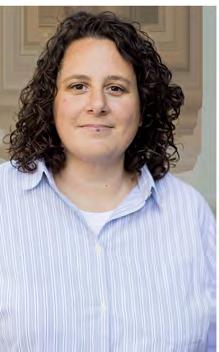

SHARON AHRAM
Senior Project Coordinator & Assistant Director of the Center for Public Purpose William Penn Charter School, Philadelphia, PA
I am the Senior Project Coordinator and an educator at William Penn Charter School. Grounded in Quaker values, my work centers on experiential learning, civic engagement, and meaningful community partnerships. I design programs that invite students to explore identity, responsibility, and purpose while connecting classroom learning to the world beyond campus. I am committed to creating inclusive spaces where students are seen, heard, and challenged to lead with integrity. Through mentorship, collaboration, and reflection, I help young people develop the skills and confidence to engage thoughtfully with their communities.
My love for learning developed largely outside the classroom, through service trips, internships, and community engagement, where I began to understand my identity, interests, and place in the world. Early in my career, I realized I was not alone in learning best through hands-on, real-world experiences. After earning my Master’s in Community-Based Education, I joined Penn Charter to help build the Center for Public Purpose while advising and teaching. Later, I added the roles of Grade Dean and Senior Project Coordinator, shaping my understanding of student learning, leadership, and purpose.
Penn Charter’s Senior Project is a culminating experiential requirement that applies academic skills in real-world contexts. Rooted in Quaker values, it emphasizes reflection, integrity, community engagement, and learning through experience. During the spring semester, seniors pursue full-time, self-directed projects aligned with their passions or future goals, spanning fields from public service and research to the arts, education, healthcare, and entrepreneurship.
Students are expected to take initiative in securing placements, setting goals, and managing their time and responsibilities. Throughout the process, they engage in regular reflection to deepen their learning and consider the broader impact of their work on themselves and others. The project challenges students to step outside the classroom, build meaningful relationships, and navigate complex, authentic environments. The Senior Project concludes with a formal presentation in which students share their learning, growth, and insights with both the school and broader community.
The goal of my action research project was to examine how schools like Penn Charter prepare students for authentic Senior Project experiences. What supports are provided throughout the process? What student outcomes result from this work?
I first developed a set of questions for all interviewees and then identified other Friends schools and local high schools that offer or require a senior project. I also interviewed recent Penn Charter alumni about their Senior Project experiences. Some interview questions for schools were:
■ How are students introduced to the senior project?
■ What guidance or resources help them understand expectations and requirements?
Project Selection & Support
■ How do students typically identify or choose their senior projects?
■ What resources are available to support students in finding placements or shaping project ideas?
Timeline & Logistics
■ What challenges or barriers do students commonly face, and how does the school address them?
Assessment & Outcomes
■ Are there final presentations or assessments?
■ How are projects evaluated or graded?
Over six months, I spoke with individuals in roles similar to mine and with Upper School directors or principals. Several consistent themes emerged, including a shared recognition of the importance of a senior project or experience. Schools emphasized that it is our “duty to provide students with real-world experiences that are authentic and offer academic autonomy.” One colleague summed it up as: “seniors do not need to sit in classrooms during the month of May.” This perspective was reinforced through interviews with recent Penn Charter alumni about their Senior Project experiences.
While there is clear value in the program, one theme raised considerable concern—how students typically identify or choose their senior projects. What emerged was a consistent and troubling pattern: students with greater access to resources and/or strong familial networks were able to secure projects with relative ease. In many cases, these students did not need to network independently or seek out mentors, as connections were already in place through family or existing relationships.
Schools reported that 60–70% of their senior classes secured projects through family members or family connections. The remaining students required direct support from the school to make connections and secure a project. While no school reported difficulty in providing this support—and many noted it as a way to engage alumni or parent/caregiver communities— the pattern revealed a clear inequity in the process. Students without access to networks not only faced additional barriers but also shouldered a heavier burden to secure opportunities. At the same time, students who did not need to network independently missed critical learning opportunities, including
writing professional emails, using research tools to explore and refine interests, engaging in professional conversations, and for some, participating in preliminary interviews.
As an educator deeply committed to equity and guided by Quaker values that affirm the inherent dignity and worth of every individual, this aspect of the Senior Project is unsettling and invites deeper reflection on where inequities may exist within other areas of our curriculum and structures.
Naming, recognizing, and acknowledging this as an issue has led us to revise our Senior Project model. While the disparity between students with access and those without remains a broader societal issue rather than solely a school or curricular concern, we have begun implementing systems designed to reduce these barriers. To address these inequities, all seniors are now required to take a one-quarter Senior Project course focused on skill-building and equitable access. Students develop professional emails and résumés, practice networking, and connect with community partners and alumni during dedicated class time. A curated database of alumni and community partners, along with one-on-one guidance in securing mentors, ensures that access to opportunities does not depend on personal networks or resources.
While this is only the second year of the dedicated Senior Project course, it has already meaningfully enhanced students’ experiences, as reflected in alumni interviews and collected data. Students value the dedicated time to craft résumés, learn LinkedIn, and engage in structured conversations with alumni— experiences that have led to both project placements and ongoing mentorship. While approximately 45% of this year’s seniors relied on their own networks to secure placements, about 10% of that group explored opportunities beyond their immediate networks.
While these efforts did not yield a significant change in placement patterns, students were open to pursuing other opportunities. In a post-assignment survey, several noted and appreciated gaining knowledge of résumé writing and how to utilize LinkedIn effectively. Senior Project seminar has helped address some inequities and there remains ongoing opportunity for further exploration, reflection, and reimagination.
ANNIE BOGGESS
State College Friends School, State College, PA
Born into a family of Quaker educators, I always imagined I would be a teacher someday. That day arrived in 2013 when I was hired to design and teach middle school social studies curricula. This turned out to be one of the greatest joys of my professional life, as I had the support and the space to infuse the Quaker testimonies of equity, integrity, and peacebuilding into a multicultural United States history program. My journey continued in administration, following in my grandparents’ footsteps of building relationships and raising funds to support the mission of Friends education. Ten years after those first abundant days in the classroom, State College Friends School asked me to serve a two-year appointment as interim Head of School. This action research project distills some of the most rewarding moments from that experience.
Background
During our first session of the Institute for Engaging Leadership, I was struck by the decision to dedicate a Heads of School panel discussion to the question of sustaining leadership. Though I had imagined the most urgent skills for us to learn would relate to specific responsibilities—budgeting, hiring, governance—I was relieved to see that others recognized what I had already encountered as perhaps the biggest challenge of my appointment: how the human being in the role of Head of School can sustain themselves through the weight, pace, and intensity of the demands placed upon them. I was inspired to listen to leaders who so intentionally prioritized self-care, from tending to physical and mental health through exercise to setting boundaries to keep home life sacred. I left the safe embrace of Pendle Hill resolved to implement this sage advice—but quickly found myself unable to carve out time and space for many of these practices amidst the pressures that awaited me on campus.
Then, on a bone-chillingly cold, cloudy morning during which I felt frozen in front of a miles-long to-do list, former Head of School Brenda Esch asked me, “What is one thing you could do right now to reconnect with your heart work?” I took this to mean, what is the work that calls out to you, replenishes you, lights you up? I knew instinctively that I had to get into a classroom. I walked down the hall and seated myself in a quiet corner to bear witness to a 2nd/3rd grade writing workshop. As I tuned in to the goings on around me, my inhalations deepened as my exhalations lengthened. My spinning mind slowed. My heartbeat steadied. I wondered, why did conducting a classroom observation bring me such peace? How might my experience of being Head of School change if I prioritized this component of the role? What might I learn from this revelation about how to sustain my own leadership?
I moved through a spiral of internal reflection and external conversation that allowed me to see a shimmering, common thread. My sustenance as Interim Head of School came from the opportunities I had to return to my roots as a teacher: building community, crafting opportunities for engagement and learning, and taking concrete steps towards living into our school’s mission by implementing the Quaker values that ground me. Here are three spaces that connected me to my heart work:
The planning and facilitation of in-service days allowed my creativity, love for our community, and commitment to Friends education to flow into every aspect. The same goals that guided curriculum design for middle schoolers
guided my work with in-service: intentionally creating learning experiences relevant to participants and our shared values; building a sense of community and safety by lifting up each voice; and making tangible the sometimes-intangible Quaker testimonies that animate our mission. Returning to the practice of progressive pedagogy made my teacher heart sing, integrating Quaker practices renewed my spirit, and connecting with colleagues on a human level grounded me in community.
In my service on our Board’s Quaker Life Committee, I prioritized reflecting the Light within each of us, striving to create a safe container in which we could take courageous risks, and advocate for our needs and the needs of others. This ensured that Friends felt seen, known, and valued both by me from my position of leadership and by the institution broadly. As committee members realized their work was more deeply understood and appreciated, their creativity and contributions flourished. Together, we strengthened existing programs and piloted new ones, responding to the real needs expressed by faculty, staff, and families and nurturing Quaker elements across all areas of school life.
As leadership turnover had resulted in inconsistent support for faculty, my teacher heart led me to create an evaluation process with the same attention to transparent expectations, skill-based feedback, and emphasis on the life-long nature of learning that had shaped the student-centered assessments I developed in the classroom. With faculty input, I implemented goal setting by the teacher and by the Head of School; multiple rounds of observation and discussion throughout the year; and a rubric-based evaluation completed not only by the Head of School, but also as a self-assessment by the teacher. My heart soared at the opportunity to engage in the same kind of collaborative approach that I had seen empower students to exercise agency within their own process of growth.
In answering the call to practice education, we may benefit by asking ourselves: Which components of my work give back as much energy as I pour in? Where does my heart find a steady beat? In which moments do I sense my Light glowing brighter? Teaching teams, departments, and school communities might enter into this reflection collectively, envisioning how individual paths towards sustenance may intersect as we journey together.
As we discover elements of our roles that can be named as “heart work,” we will also encounter aspects that do not resonate. How, then, can we amplify the life-giving effects of heart work to sustain us? We can strive to be fully present in moments of heart work, pausing to name gratitude for the opportunity before transitioning to the next task. We can share the good news of heart work well done with our communities, both personal and professional. We can even prioritize tasks we recognize as vital to our sustenance over others that feel more urgent.
My next steps will be to reflect: With the insight I have gained into my heart work, what more can I learn about my identity as a leader? How does this inform my vision of educational leadership and my discernment about future roles in my work and in my community?
SARAH BUXTON Head of Lower and Upper School
Newtown Friends School, Newtown, PA
I am currently the Head of Lower and Upper School at Newtown Friends School, having previously served as Director of Curriculum and in roles including education consultant, literacy coach, and classroom teacher. After moving to Newtown from Brooklyn, New York, I initially felt like a fish out of water. That changed when curiosity led me to attend Meeting for Worship at Newtown Friends Meeting, where I found a deep sense of belonging and my family put down roots. I am the mother of an autistic son, an experience that has profoundly shaped my school leadership and the way I partner with families, particularly when a child is not fitting neatly into traditional expectations. Guided by my own experiences, I bring empathy and trust to this work, always grounded in seeing and nurturing the Light within every child and in cultivating schools where academic excellence and inclusion exist side by side.
As a Quaker educator, I am grounded in the belief that there is that of God in everyone, calling me to nurture the potential in every student. This raises a central question: how can a small, pre-k through 8 Friends school expand learning support while maintaining high academic expectations?
National data underscores the urgency of this question. Between 2016 and 2022, one million additional children aged 3–17 were diagnosed with ADHD. Autism identification increased significantly—from 1 in 150 children in 2000 to 1 in 36 in 2020 to 1 in 31 eight-year-olds in 2022. Special education enrollment has increased, from 6.4 million in 2012–2013 to 7.5 million in 2022–2023, with specific learning disabilities remaining most common.
These trends are reflected in Pennsylvania independent schools. A 2025 PAIS Pulse Report survey of PAIS Heads identified anxiety, executive functioning challenges, learning differences, and social skills as top concerns; 68% of heads reported an increase in the number of students requiring learning support and 77% reported an increase in those needing social-emotional support.
Schools designed specifically for students with learning differences often maintain ratios of one learning specialist for every five students and one counselor for every 42 students. In contrast, schools like mine operate with ratios closer to one specialist for every 126 students and one counselor for every 173 students.
At Newtown Friends School, both applicants and enrolled students diagnosed with learning disabilities, ADHD, and ASD increased. It became clear that our existing structures were not equipped to support students in a consistent and coordinated way. There was no central system for tracking accommodations, communicating with families, or guiding faculty. Responsibility fell to individual teachers in ways that were neither sustainable nor accountable. This began to impact the classroom experience more broadly. When students’ needs required significant individual attention, teachers were stretched to meet the needs of all learners. Like many independent schools, we are mindful of maintaining enrollment. This requires difficult decision making—ensuring we are not
simply retaining students, but also truly able to support them well.
Four years ago, we created the Student Support Team (SST) in response to work in an equity circle focused on neurodiversity. The team included our counselor, literacy specialist, and later an Upper School learning specialist. The SST was a central hub for student support, family communication, and teacher guidance. We communicated its purpose to families, emphasizing collaboration rather than removing responsibility from teachers.
Professional learning around learning disabilities became an early priority. We also partnered with local practitioners to provide training on ADHD, worked with a psychologist to better understand evaluation reports and systems, and partnered with an autism specialist to deepen our understanding of the spectrum—both to strengthen support and to clarify our capacity and limits as a school.
This year, we developed multiple layers of support for students in grades 5 through 8, including executive functioning coaching, SST check-ins, Extended Study Hall, and an Academic Support class, now offered in grades 6 through 8. This program made it possible for students to access our Upper School experience who otherwise might not have been able to do so. It provided the additional structure and support they need to succeed within a challenging academic environment.
Growth in our program highlighted the demand for this work. Our team expanded to include the Head of School and Director of Enrollment Management. Together, we used internal data and a cost analysis of comparable schools to develop a proposal for a fee-based academic support program.
Looking ahead, we are formalizing a three-tiered model of support. Tier 1 centers on strong classroom practices, including differentiation and advisory support. Tier 2 provides targeted interventions such as executive functioning coaching, SST check-ins, and Extended Study Hall. Tier 3 offers more intensive support through Academic Support classes, coordination with evaluators, and individualized coaching for students who need a higher level of structure.
Families have been invited into the program for next year. While the transition to a fee-based model raised initial questions, most responded positively to the
clarity and intentionality. Perhaps the most meaningful outcome is cultural. An autistic eighth grader presented to the Upper School about neurodiversity, and their peers responded with curiosity and respect. A few years ago, this would not have felt possible. Today, our community is more informed, compassionate, and inclusive.
Expanding formal support raises concerns about how it might impact perceptions of academic rigor. Yet in practice, we are already serving students who benefit from more structured systems. Naming this work allows us to do so more responsibly.
The formal launch of the three-tiered system will provide clearer structures for identifying student needs, coordinating support, and communicating expectations with families. We will continue refining placement criteria for Academic Support to ensure these services remain effective and sustainable. Equally important is strengthening communication with families about the scope of support we can realistically provide. Clearly defining both our capacity and our boundaries allows us to support many students well while also recognizing when a different educational setting might be more appropriate.
I return to the question that first guided this work: how can a small, pre-k through 8 Friends school expand learning support while maintaining high academic expectations? We have come to understand that there is no fixed solution, but rather an ongoing process of discernment—seeking what is best for all students while remaining grounded in our shared values.
As we continue this work, we hold fast to the strength of our academic program. All students engage in our core academic curriculum. While we provide learning support, we maintain high expectations for all learners. Success may look different for each student, but our commitment to meaningful challenge and growth remains constant.
My next steps will be to reflect: With the insight I have gained into my heart work, what more can I learn about my identity as a leader? How does this inform my vision of educational leadership and my discernment about future roles in my work and in my community?
ERICA CHILDS
Director of Equity, Justice, Community & Engagement Wilmington Friends School, Wilmington, DE
I stumbled into Quaker education 10 years ago, starting at Wilmington Friends School in the fall of 2016 as an upper school mathematics teacher, and eventually serving as grade dean and faculty sponsor for the Black Student Union. Four years ago, I became the school’s first Director of Equity, Justice, Community, and Engagement. In this role I contribute to aspects of the school that are of utmost importance to me while still sustaining relationships with students, faculty, parents, and alumni. Originally a product of public schools, I found my place in Quaker education—a collection of schools with a shared value system that mirrors my own. I am most inspired by the commitment to justice, equity, and helping students to seek and speak the truth.

Background
In my time at Wilmington Friends, I have seen student commitment and curiosity towards diversity equity and inclusion work ebb and flow. In my role as Director of Equity, Justice, Community, and Engagement, I seek to find ways to sustain and grow student curiosity and interest in areas of identity, justice, equity, and belonging. Additionally, I firmly believe that this work is more relevant and powerful when it is based on student interest and student voice.
Over the past three years I have worked to transform our group of student affinity group leaders into an official leadership team who work together to lead and inform our DEI programming for the entire upper school. For this action research project, I sought to identify structures and practices Quaker schools use to encourage, support, and sustain student diversity leadership.
In my current role, I work to increase and strengthen our affinity/alliance group programming for upper school students. These groups have adult facilitators but are primarily student led and student driven. Collectively, the leaders of these 10 groups form our Upper School Student Diversity Leadership Committee, which has 33 members. In addition to leading their affinity groups, these students are also invited to participate and help plan several events: our annual MLK Day programming, new student diversity orientation, topic-specific DEI related workshops, and programming for our Lower School and Middle School students. Student leaders create and suggest new programming ideas, while also providing feedback for existing programs.
In my four years in this role, this group has grown substantially. Through leadership, they are actively working to create a more welcoming environment for our students. However, there is always more work to be done. How can we better prepare and support these students?
I reached out to DEI directors at five other Quaker schools (Preschool-12, >600 students) to learn more about the structure and support of this work at their school. I chose these schools based on the strength of their DEI programming known from prior awareness or demonstrated by their website. These five schools are located in major metropolitan areas in the Mid-Atlantic. Participants completed a survey to share some initial information
about their DEI office, leadership opportunities for students, and DEI-related student programming. To learn more, surveys were followed by one-on-one conversations.
Often DEI practitioners are teams of one. For these five schools, that is not the case. With one exception, schools had well-staffed DEI teams consisting of one or two DEI coordinators at each division and a full-time DEI director who reports to the head of school. Many had one additional full-time staff member who oversaw DEI programming. Three of the five schools had at least two DEI coordinators in each division.
Each school had well-established affinity groups beginning in either middle or lower school. They also had other opportunities for students to discuss identity, belonging, and culture. Each school also had a clearly defined student diversity leadership group. These student leaders served a common purpose: to be the connection between the student body and school leadership and to assist the DEI team with planning programming. In most instances, these are positions that students have to apply for and these positions are well respected within the community.
The following success factors were identified:
■ Training students. Some leaders engage in training multiple times of the year. Others participate in leadership/social justice classes that are led by a member of the DEI team.
■ Providing students with opportunities to engage in conversation and learning related to identity prior to 11th grade (ex: strong lower and/or middle school affinity groups with curriculum, mandatory courses in 9th or 10th grade related to social justice). This creates a core group of students who have a growing interest and commitment to this work.
■ Building relationships with students, faculty, and parents.
■ Dedicating time for affinity group meetings (outside of the lunch period).
■ Providing affinity groups with a budget.
■ Encouraging younger students to lead rather than solely relying on seniors who are often overworked and stressed.
■ Responding to the needs and interests of the students.
■ Ensuring the work is balanced and joyful.
Several challenges were also noted:
■ Sustaining engagement. Programming strength can fluctuate from year to year based on student interest.
■ Discussing challenges and working towards solutions.
■ Motivating students. Some students are interested in the group because it is advantageous to the college process, but don’t show commitment to the work.
■ Having a small number student leaders, particularly when they tend to be students of color. Some expressed concern that student leadership may pose an undue burden.
■ Trying to keep up with the demand when the number of student groups or programs is large, but the number of faculty willing to help is low.
My conversations with these five administrators were illuminating. My school is currently doing many of the practices that they shared; others might be worth adopting. In the coming year, I plan to continue to work with my colleagues to fine tune our existing practices and strengthen training for student leaders, fundraising, and curriculum for affinity groups. I will also consider the following: What work at the faculty level helps sustain student leadership? How can we encourage students from majority groups to see themselves as leaders in this work as well? Where might schools collaborate in these efforts?

PATRICE COPELAND
Upper School Counselor
Sidwell Friends School, Washington, DC
I am in my fifth year as a mental health counselor at Sidwell Friends School. While I always knew I would work in a helping profession, I never imagined my path would lead me to Quaker education. After years of conducting neuropsychological assessments and working extensively in private practice, I now have the privilege of supporting Upper School students. I coordinate division-wide mental health programming and serve on the Senior Leadership Team.
Outside of school, I enjoy traveling to better understand what people believe—and how they express those beliefs through music and dance. Gratitude as a spiritual practice and music as a form of self-expression continue to shape both my personal and professional life.
Background
From birth, I was raised Baptist Christian. From that upbringing, I gained a moral compass and a deep sense of community. I attended traditional Sunday morning services and other gatherings such as choir rehearsals, Sunday school, and vacation bible school as an outward show of devotion. Through regular meetings, comprising a body of believers, I learned how to navigate the world as a “good Christian.”
Add elements of my African American heritage and southern roots, and the practice is often described as being “into the Church.” Among many African Americans, this is a shared understanding of how one approaches Baptist Christian faith. It is not limited to meetings but also honors the Holy Trinity of the Father, Son, and Holy Spirit while upholding the Ten Commandments.
During my first year of college, it became increasingly difficult to maintain my commitment to the Church. I experienced what I now recognize as spiritual resistance. After significant self-exploration, I decided to let my heart guide me toward my next spiritual anchor without forcing religious practice, I explored several religions before settling on a personal philosophy. It centers on maintaining a moral compass loosely informed by Christian principles, doing good whenever possible, causing no harm, respecting others’ beliefs, and resisting the urge to master intellectually the mysteries of the spiritual world or the afterlife.
Many years later, I found myself working at Sidwell. Soon after, I joined the Friends Council Leadership Institute and visited the sacred grounds of Pendle Hill for the first time. There, I felt compelled to reflect on my proximity to Quakerism, sensing that my presence there was not accidental.
I realized that I quietly considering the ideals of Quaker faith. I began wondering how circumambient the SPICES testimonies had become in my daily life. Was I better off because of them? Had I become a convinced Friend without noticing? Was I living Quaker values beyond my professional role? If so, was this the direction my spiritual evolution had been moving toward all along? How many colleagues wonder the same? What say our students?
I distributed a survey to students and faculty asking whether they belonged to the Religious Society of Friends, and if they were born into the tradition or joined later. Participants were also asked whether being at Sidwell had influenced their spirituality. Did they follow Quaker testimonies regardless of formal religious identity? Has conviction or proximity to Quakerism changed their outlook on the world or improved their quality of life?
In total, 123 Upper School community members responded, including 81 students and 42 faculty or staff. Participants reported varying lengths of time at the school, with many indicating between two and four years. The number of participants with more than twelve years in the community and the number of participants with five to seven years in the community are both twenty-three. Eighteen participants had been in the community for zero to one year.
Only four participants identified as members of the Religious Society of Friends, and three had belonged before joining Sidwell Friends. Roughly half of the participants said that being at the school had inspired them spiritually. Meanwhile, 54.5% reported subscribing to all Quaker testimonies while 43.1% said they followed some but not all. Additionally, 67.5% believed their outlook on the world had changed because of conviction or proximity to Quakerism. Finally, 56.1% believed their quality of life had improved as a result.
What stood out most was that nearly half the community embraced some but not all Quaker testimonies. In a world containing thousands of religions, the idea that so many people within one school community share aspects of Quaker values is striking. It posits that more than half the community shares the belief that there is that of God in everyone. I count myself among them and feel grateful for the grounding that my proximity to Quakerism has provided.
Historically, Black churches have long served not only as houses of worship but also as oases of freedom. Centuries before it was legal, enslaved people from the African diaspora sometimes walked miles in shackles to attend prayer meetings. They sat on crates or wooden boxes and worshiped anyway. It is not lost on me that First Baptist Church in Petersburg, Virginia, roughly sixty miles north of where I grew up, is often recognized as
the oldest Black congregation in the United States. In hindsight, this is perhaps why being “into the Church” in Virginia feels more like heeding a call of your DNA than it does a personal choice.
In 1688, in Germantown, Philadelphia, members of the Religious Society of Friends denounced slavery among their members. After the Revolutionary War, many emancipated people settled in Philadelphia, where the Free African Society emerged. Not far away at Pendle Hill, I began connecting these histories with my own reflections. I recognized my workplace as a place of safety, learning, allyship, inward worship, and promise. I also realized my spiritual journey felt less like escaping Christianity and more like expanding spirituality.
One limitation of the survey is the narrow scope of its questions. I did not ask participants about other religious or spiritual practices. Because of this, I cannot identify which specific testimonies resonate most strongly or determine deeper patterns across students, faculty, and staff.
Before beginning this project, I assumed religion and spirituality were uncomfortable topics within our community, yet the strong response to the survey suggests otherwise. It encouraged me to imagine deeper conversations with colleagues and students about their spiritual beliefs, stories of origin, and overall perspectives on the world. Such dialogue could possibly strengthen empathy and help us better recognize that of God in one another. These discussions could also enrich classroom learning.
EVELEEN EATON
Center for Teaching and Learning Coordinator & Lower School Academic Support Teacher
Sidwell Friends School, Washington, DC
I ground my work in the Quaker principles of reflection, community, and honoring the inner Light in every learner. My early teaching experiences shaped my belief that reflective educators create learning environments that respond to students’ academic, emotional, and social needs. Since joining Sidwell in 2002, being part of a Quaker school community has deepened my commitment to reflective practice and collaborative inquiry. My action research focuses on developing a teacher partnership program in which educators observe, reflect, and learn with and from one another. Through this work, I hope to encourage deeper reflection on teaching practice while reinforcing the importance of listening deeply, seeking multiple perspectives, and fostering collective growth.
Background
My project began several years ago during a meeting of the Head’s Advisory Board (HAB), a group of faculty and staff that meets regularly with the Head of School to discuss all-school matters. We were discussing several topics that ranged from stipends to snow days to the location of faculty bathrooms, when our Head of School asked us to start to think about our group’s mission in a different way. We are meant to be a place where concerns and perspectives from across the school are shared. Also, we can serve as a group that proactively thinks about ways to improve school culture. This conversation began a two-year process where the HAB investigated school life for employees and looked for ways to make it better. We conducted surveys, examined the data, tested ideas, and eventually came up with 23 different “culture experiments” we could test. I was particularly drawn to the idea of “learning from each other” and began focusing on the following three HAB experiments:
■ Shadowing Across Departments: Create a program where faculty and staff can visit different classes and offices, with dedicated time set aside for participation. Make it fun with initiatives like “Coach in the Classroom” days, where athletic staff visit academic classrooms and vice versa, to break down silos.
■ Dedicated Collaboration Time: Explore ways to set aside dedicated days for faculty and staff to work across divisions and departments.
■ More Interactive Professional Development: Shift from lecture-heavy sessions to discussion-based, collaborative formats where faculty and staff can share ideas and problem-solve together.
Around the same time, the Sidwell Friends School Center for Teaching and Learning (CTL)—an interdisciplinary, cross-divisional hub dedicated to improving the art and science of teaching—was also exploring ways to spotlight teaching and learning across the school. The HAB survey indicated that 76% of respondents wanted more intentional opportunities to connect with others outside of their division/department. Lack of time was the biggest barrier to making these visits happen. The CTL decided that one way to give a peek into other learning spaces
was to start asking questions in our newsletter with the hope of building a picture of teaching practice at Sidwell.
The first three questions we asked were:
■ What intentional moves do you make to expand students’ access to meaningful participation?
■ How do you give feedback during the learning process?
■ Share an instructional move you made to shift your lesson plan in order to meet a learner’s need. What did you do and why?
For those initial inquiries:
■ 16 faculty/staff/coaches responded to the question for themselves, their team, or their department.
■ Each newsletter had an average of 41 visitors.
■ Each visitor spent an average time of 1 minute, 11 seconds on the page.
I recognized that this quick glance offered one way to highlight teaching and learning across the school, and I also realized that this format was not reaching or impacting many people. This made me wonder what else could be implemented.
My guiding queries for this work were:
■ What structures or systems are in place that allow faculty to learn from each other?
■ How do we encourage faculty to try new methods/ strategies in their classroom?
■ What systems are in place to help teachers reflect on their practice?
I researched what other schools and universities were doing in their centers for teaching and learning. Many centers have opportunities for teachers to design lessons and units in conjunction with CTL. CTL leaders offer observations and feedback. CTLs offer Professional Learning Communities to examine teaching and learning topics. Based on the HAB survey, responses to our newsletter, and a discussion with our Assistant Head of School, I began to consider what a more structured opportunity for faculty learning might look like at Sidwell.
Building on my research, the Teacher Partnership Program began to take shape. The program will have three cycles during the year with each cycle lasting about three months. During the first cycle, faculty will be matched with a partner. The pair will identify an
area of focus, observe each other, and debrief the observation. The CTL will offer a series of structured protocols for the pairs to use during discussions and observations, which will be introduced during the program orientation. Partnerships will be asked to check in with the CTL at least once during the cycle to reflect on how the program is progressing and to offer suggestions for improving the structure. The whole cohort will meet again at the end of the cycle to reflect on the experience. Cycle 2 will offer different learning opportunities. Based on the areas of focus identified by partnerships in Cycle 1, CTL will host a series of seminars, book clubs, and discussions open to anyone interested in learning, but who might not have the time to devote to a three-month observation partnership. Cycle 3 will offer either another round of partnerships or small group observations.
My research showed that adult learners have unique needs when engaging in professional development. Teaching is often an individual endeavor, yet many educators agree that the most meaningful professional growth comes through reflection and collaboration with peers. Creating intentional space and time for teachers to come together and reflect on an aspect of their practice that matters to them begins to build a community of learners focused not only on subject-area expertise, but also on the art and science of teaching. Grounded in the Quaker practice of reflection, partner observations offer teachers the opportunity to consider how the pedagogical moves they observe might apply in their own contexts. My hope is that introducing this practice to the faculty next fall will provide a meaningful way for faculty to learn from one another, creating a culture in which we share best practices and make space for risk-taking, reflection, and growth.
ROBERT GOODMAN
12th Grade Dean, Physical Education Teacher, and Coach Germantown Friends School, Philadelphia, PA
I was fortunate to find myself at Germantown Friends School after years of working in public school leadership in the UK. Since immersing myself in school life, I am forever appreciative of the mission-led education that is now a part of my family’s life. Through building community at Quaker schools, as a parent, teacher, and coach, I have a deep appreciation for the progressive nature of our curriculum, the shared values that feed our work, and the balance of academic, arts, and athletics that we offer. The sense of community and the shared pursuit of growth for all continues to motivate me as I grow as an educator and leader to better serve our young people. My role as 12th-grade Dean allows me the opportunity to continually reflect on the experience we share with young people who leave their legacy with us and begin their own path.
Advisory programs support students’ social, emotional, and intellectual development through consistent adult guidance and peer groups. Often structured as daily homerooms combined with intentional lessons, these programs foster reflection, student voice, personal growth, and a sense of belonging during academic transitions. This action research project evaluates 12th-grade advisory effectiveness across Quaker schools. Through interviews with school leaders, the research explores the structure, history, and delivery priorities for senior-year programming. Driven by my role as 12th-grade Dean, this project seeks to improve local practice while sharing insights with peer institutions regarding the unique developmental and transitional needs of students in their final year of education.
My action research project centers on interviewing school leaders responsible for the delivery of advisory programming for the senior class. Interviews focused on four main question areas:
1. What’s the structure of the program? Where/when/how-often/with whom?
2. What’s the purpose/vision of the program? How is this developed and by whom?
3. Where do you find success? How does it support seniors most, and how is this measured?
4. What goals do you have for the program? Where and why are you focusing your attention on these areas?
Several shared themes emerged across schools. Most were intentionally designed spaces for students to build relationships with others and find holistic support outside of regular academic pursuits. Advisory was consistently described as a key relational structure with advisors serving as trusted adults and primary points of contact for teachers and families, often for at least three consecutive years. This role was widely viewed as the most effective and valuable aspect of senior advisory, evidencing the importance of consistent trusting relationships in supporting student well-being and belonging.
The research confirms that advisory work is deeply aligned with Quaker values and mission-aligned programming, integrating reflection, community, diversity, equity, and social justice. While the impact of this programming is predominantly positive, many schools are working to improve how these values are articulated, owned, and
sustained in practice. Advisory functions most effectively when understood not merely as a curriculum, but also as a relational and reflective practice. Successes are evident where the advisory programming for seniors has clear outcomes, often tied to milestones such as college transitions or senior projects. Where these elements are less clear, programming risks becoming too reactive and/or uneven across student groups or cohorts.
A recurring tension exists between centrally planned curricula and advisory-led, more informal relational time. Leaders identified a challenge in balancing top-down activities with more reflection and organic community building. Inconsistent delivery was common, with all school leaders identifying a goal to find more equity and coherence in the advisor role. With adult alignment and motivation high, advisory groups at their best are reflective of a school’s mission and can form the basis of effective student support and guidance systems.
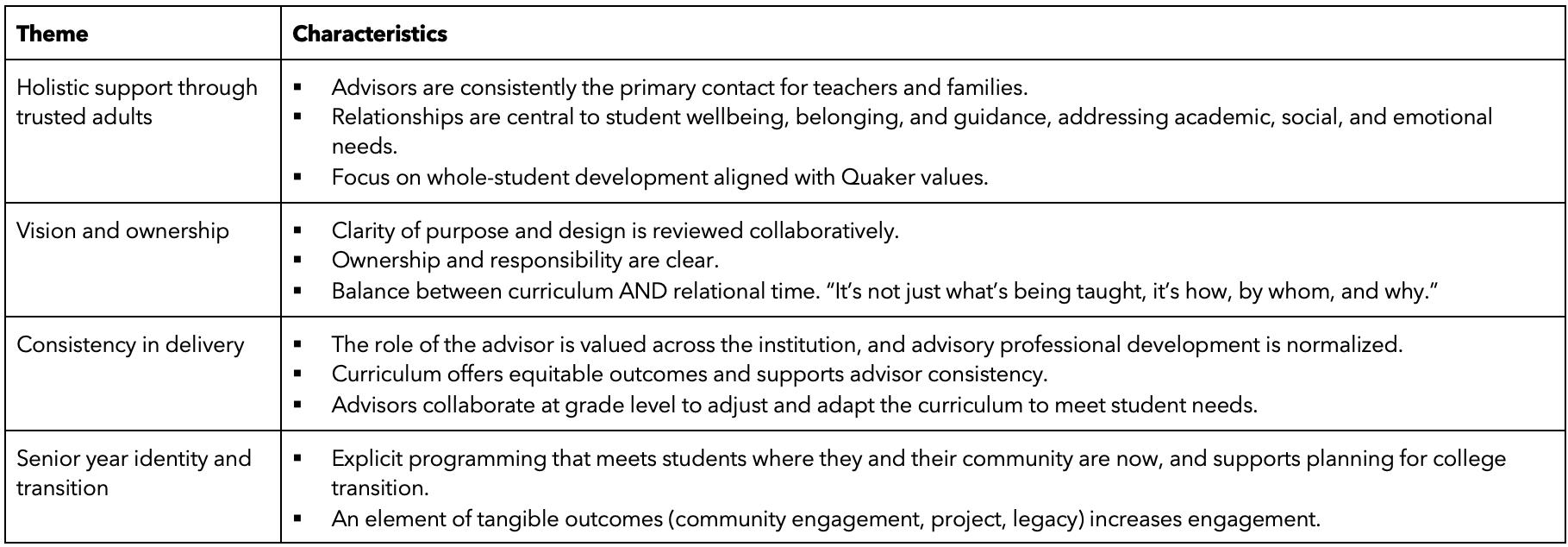
The action research project has reinforced the importance of 12th-grade advisory as a central relational and developmental structure within Quaker schools, providing trusted adult mentorship and a safe space for reflection that aligns with holistic student growth. These relational elements align with Quaker values, highlighting the advisory’s potential to support both academic and social-emotional development and increase belonging amongst the community. Leaders shared that intentional advisory programming could elevate the experience of legacy and community togetherness, bringing significant value even as student focus shifts toward college transitions.
Clarifying vision and ownership at both the leadership and advisor levels is essential to ensure a consistent student advisory experience. The structures and leadership roles vary across Quaker schools. This can create gaps in responsibilities that hinder programs from realizing their full potential. Success is demonstrated when a community of practice for collaboration and/or reflection exists. It can facilitate the sharing of best practices within grade-levels, across grades, and help integrate senior advisory more seamlessly with college counseling. This focus and collaboration should include an element of professional development to reduce advisor variability and increase equity of experience and suitability of the curriculum.
Research themes and leadership insights led to several recommendations. First, clarifying vision and ownership at both program and advisor levels can ensure a coherent, consistent experience. Second, sharing best practices across schools, particularly regarding relationship-building strategies and professional development for adults regarding their advisor role. Third, embedding reflection and senior-focused programming, such as legacy projects or community contributions, can deepen alignment with Quaker values and support students’ identity, purpose, and transition. Finally, ensuring that regular feedback mechanisms exist for advisors, leaders, and students to help programs remain responsive to changing needs and embrace continued innovation and growth.
MARYANNE GROFF RAWLINGS Department Head, Health Education
Germantown
Friends School, Philadelphia, PA
Student well-being has always been at the heart of my work. Guided by Quaker testimonies, I approach every lesson and decision with this commitment in mind. I began my career combining two longtime interests: athletics and health education. My growing commitment to the latter, and the opportunities it gave me to focus more holistically on student wellbeing, led me to become the first chair of a newly created Health Education Department. I currently develop curriculum, teach Health Education courses in the Lower, Middle, and Upper schools, and supervise wonderful department colleagues. In these roles, I create, support, and facilitate a number of division and school-wide initiatives that help students and colleagues navigate today’s challenges, including mindfulness work, DEI facilitation, and the S.E.E.D. program for faculty and staff. I now serve Clerk of the Upper School faculty, a role that has given me a new perspective on Quaker Education.
“MY
Background
Central to many Quaker schools is the community testimony, the guiding tenet that we are collectively and intentionally creating a shared physical, social, and spiritual place where we experience support, cooperation, and connection. For that reason, and many others, faculty and staff with children often elect to have their children attend their school. For many, the thinking is that my child will benefit from the school community I contribute to through my professional work.
Fourteen percent (158) of Germantown Friends School students have a faculty/staff (F/S) parent. There is a long-standing practice of offering best practices to teachers on how to create and support healthy boundaries when addressing a F/S parent about their child. It’s often called the “multiple hats” talk, with the implicit acknowledgement that it is never simple and often challenging. And yet, the realities of wearing multiple hats have not been studied. This project sought to commence a first investigation in the context of my own school.
The focus of my research interviews with ten long-tenured F/S parents and other colleagues was to gather qualitative data on what complexities and conflicts were not being addressed in the school administration’s current guidance. I sought to identify guiding questions for all faculty/staff members on the nuances and multiple intersections of having a large cohort of F/S parents (and in turn their children) as part of a Quaker school community.
During my interviews, colleagues often mentioned the positive aspects of sharing a school community with their child. These included the privilege of knowing the inner workings of the institution, having access to teachers and administrators, ease of attending your child’s school events, and knowing your child’s friends well, amongst others. Many colleagues also spoke about how meaningful it is to teach and support one another’s children.
All interviewees also talked about challenges and complexities. Balancing professional relationships, professional growth, your role as a parent, advocating for your kid, and avoiding hurt relationships is challenging. A few salient themes highlight the challenges and complications.
The children of F/S parents experience the same variety of student circumstances that all students navigate, including academic challenges, mental health struggles, miscommunications, and disciplinary issues. Many F/S parents described approaching administrators or teaching colleagues to advocate for their child as emotionally and professionally complicated. They all described the hand-wringing when deciding how to move forward to find the best possible outcome for their child and to preserve their professional relationships.
Choosing not to communicate might stem from a desire for the child to have a typical school experience. Interviewees described wanting to stay at an appropriate distance. Yet some felt hesitancy to advocate comes at a cost as “parent advocacy is an important element in supporting a struggling student.”
F/S parent interviews also revealed the complex intersection of professional responsibility and holding your parent perspective. Insights gained as parents enable them to see their work in a more comprehensive, student-centered way. At the same time, it can feel challenging to differentiate what is in the best interest of all students. Many felt it was important for the F/S parent to elect to recuse or remove themselves from moments of significant entanglements.
My interviews revealed a widely shared, strong feeling that the administration has an essential supportive role in creating structures that support healthy, student-centered boundaries for everyone involved because it’s a community decision in its impact.
F/S parents I spoke to all shared gratitude for the role of the larger school community in the life of their family, but many reported that they had learned it served them best to keep the greater parent body “at arm’s length.” A number of interviewees reported difficult moments at school or social events where they felt forced into the role of ambassador for the school for non-F/S parents, being asked questions on school decision making that were beyond the scope of their job or were unprofessional. Being “grilled” or encouraged to gossip was not an uncommon experience. The impact
on F/S parents is significant, as some report avoiding socializing with non-F/S parents, thereby missing opportunities to get to know the parents of their child’s classmates.
To build off this research, I seek to create an expanded guide titled Advices Regarding Faculty and Staff Parents. Such a guide could include the following:
■ Recommendations for Administrative Leadership such as create structures for F/S parents’ recusal, particularly in grade-level teaching or advising teams. Support boundaries that do not increase complicated professional and parent hat overlaps.
■ Recommendations for Faculty/Staff Parents such as seek mentorship from a seasoned F/S parent you trust and ask yourself check-in questions when a situation arises.
■ Recommendations for All Colleagues such as consider that a F/S parent coming to you with a parent concern is likely feeling conflicted about coming to you at all. Ask questions and hold the potential complications with care.
■ Recommendations for Greater Parent Community such as recognize that social events are not an appropriate time to ask a F/S parent to put on their “work hat.”
Successful actions to improve support of F/S parents also require parallel support for F/S students. The nature of an intentional community that makes the opportunity to be a F/S parent so rich and joyful is also fraught with unique challenges. My hope is that this research will help us formulate questions for closer investigation of student experiences. What does it feel like to see your parents in the halls when you are hanging out with peers? What happens when your parent invites your English teacher over for a dinner party?
EVAN HAINE-ROBERTS
Director of Enrollment Management
Moorestown Friends School, Moorestown, NJ
Prior to stepping into the admissions office this year, I was the Middle School Director at Moorestown Friends School and an English teacher and advisory leader in other independent schools in New York and Washington, DC. I was drawn to Moorestown Friends and Quaker education because of their ambitious “big-tent” commitment to creating a diverse, ethical community and doing it exceptionally well. As a leader, I am interested in building systems that bring clarity, purpose, and humanity to our work in schools. My background is in literature and creative writing, and so I believe that our best work will be thoughtful, incisive, beautiful, and fun—for our students and for our faculty.
Background
After sixteen years supporting academic programming in independent schools, I transitioned this year into enrollment leadership at Moorestown Friends School. The move coincided with a moment of institutional uncertainty. Like many independent schools, Moorestown Friends faces demographic contraction, increased tuition scrutiny, and a competitive regional landscape. In addition, our admissions office had experienced several years of transition, and we began the year with an entirely new four-person team.
Independent schools are operating in an era of heightened comparison. Families evaluate tuition alongside perceived rigor, student outcomes, and long-term value. Yet mission-driven schools—particularly Friends schools— ground their identity in community, ethical formation, and whole-child education rather than overt, competitive market positioning.
While external forces clearly shape the enrollment landscape, I found myself drawn to a more internal set of questions: Beyond macro trends, how clearly are we articulating our value? How can a Quaker school communicate its mission and impact in a more competitive market?
As I began this work in earnest, I was struck by how much of enrollment leadership centered on storytelling. Internally, we prepared messaging for faculty, presented enrollment updates to senior leadership and the School Committee, and more. Externally, we invited families to events, responded to questions, and built resources to guide the admissions funnel.
I began to see enrollment leadership as analytical storytelling. Borrowing from my background in literature and close reading, I asked a series of questions about the story of Moorestown Friends: Where are our opportunities to tell our story? To whom do we need to tell it? What language and voice best serve it right now? Who else might help articulate it?
Friends education offers profound value, especially at this societal moment: attention to ethical formation, sustained intellectual inquiry, and a deep, expansive sense of community. However, if that story is not intentionally
articulated, that list of legitimate educational qualities can become mushy and general; indistinct abstracts that struggle to resonate. This feels especially true when families are constantly comparing Moorestown Friends to high-performing public schools and lower-cost Catholic/parochial alternatives.
In response to our analysis, the admissions office gradually sharpened its narrative. The best parts of our tours were when we stopped and allowed a classroom, display, or another member of the community to tell their story. How could we make our communications more like that: tangible, visual, excitable, and human?
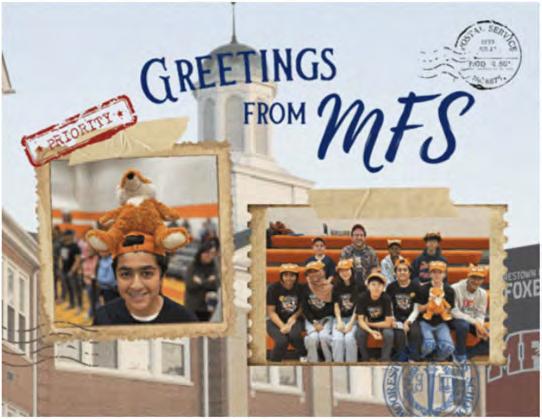
This shift is most clearly seen in our re-enrollment campaign, which was created in collaboration with our marketing and communications team. Postcards from MFS began as our practical approach to reminding families about re-enrollment and contracts. In retrospect, though, it reads more like an attempt to train ourselves to tell the story of the school with greater regularity, specificity, and shared voice.
For two months, on a near-weekly basis, we sent families a message that foregrounded voices within the Moorestown Friends School community talking in authentic terms about its value. Students across divisions described classes that challenged and energized them. Young alumni reflected on what had been most formative in their education. New students named what felt different and compelling compared to prior schools. Parents articulated why they continue to choose Moorestown Friends year after year.
Broader demographic pressures and competitive realities persist, and messaging refinement alone cannot counteract structural shifts. However, it can ensure that when families encounter our school, they receive clarity rather than ambiguity.
This year, we increased the volume and consistency of our communication over prior cycles. At the same time, we challenged ourselves to articulate our value with greater clarity and depth. In that, we sought narrative alignment between institutional belief and institutional expression.
At this stage, lessons are more directional than definitive. Re-enrollment contract returns stand steady at the same rate as previous years, and this
comes despite a slightly larger-than-normal tuition increase and larger required deposits due upon enrollment. While modest, the shift suggests some positive momentum. A fuller picture will emerge once the cycle closes and data can be reviewed more comprehensively.
Perhaps more evident has been the qualitative response within the community. Teachers have expressed appreciation for seeing student narratives that articulate the value of their work in clear terms. Parents have responded positively to communications that move beyond philosophy into lived experience. The tone of the re-enrollment season has felt substantive, cohesive, confident, and fun.
These efforts have reinforced that enrollment leadership, at least for me, is narrative stewardship. When we articulate with specificity, we are not reducing our mission to marketing. We are translating it.
Like any enduring work of literature, however, a school’s story will be translated many times across its life. Context shifts. Audience expectations evolve. Economic and political pressures reshape the questions readers bring. Our responsibility is not to fix a single definitive translation, but to keep the story coherent and legible in changing conditions.
In the years ahead, that will mean studying enrollment and retention patterns across multiple cycles, refining our language for emerging modes of communication, and ensuring that our story is discoverable as search traffic shifts to generative AI models. That work is iterative and requires steady stewardship of both language and lived experience.
DESIREE HARMON
Director of Middle School
Friends Select School, Philadelphia, PA
I am the Director of Middle School at Friends Select School where I have served in leadership roles since 2015. With more than two decades of experience in independent school education, I have worked as a teacher, dean, and administrator. I have co-founded multiple student affinity groups, led social justice initiatives, and presented at conferences through PAIS, ADVIS, and NAIS. I am particularly interested in designing learning experiences that connect students to their communities and expand the boundaries of the classroom. My leadership is grounded in a deep commitment to equity, belonging, and student-centered learning. I am passionate about helping students develop confidence, curiosity, and a strong sense of belonging within their school communities and the cities they inhabit.
Background
One of the rewarding parts of being a middle school director is serving as a thought partner to my colleagues as they transform the spark of an idea into a lived experience for students. At Friends Select School, a Pre-K through 12th-grade Quaker institution, I continually reflect on our program and seek ways to elevate student learning. For me, this process is an act of continuing revelation. Several years ago, our school formalized our commitment to the city by hiring a Director of City Curriculum and adopting the unofficial motto, “In the city and of the city.” What began as a summer “City Grant” for teachers—an invitation to create program extensions beyond our building— soon became a catalyst for a major cultural shift in the middle school. Teachers took the leap, partnering across grade levels, to design our inaugural City Classroom Day on November 22, 2019. Each discipline created an authentic, collaborative learning experience out in the city of Philadelphia for the entire middle school. What began as a single experiment has since evolved into a structural pillar of our middle school’s identity: a permanent City Time Block integrated into our 8-day class cycle.
The program has undergone numerous iterations, including more than twenty variations of our academic schedule, before settling into its current rhythm. One major hurdle was balancing our desire to be in the city with the many competing priorities of the academic schedule. The answer was to shift our perspective. If the city was a priority, it required a dedicated allotment of time. Today, two of our four middle school grades are out in the city every eighth day for a 2.5-hour immersive block. As we have refined the schedule, we have also expanded our scope. Our “classroom” has evolved from traditional museum visits to complex engagements with global perspectives such as hosting international delegations from the World Affairs Council and collaborating with emerging doctors from Rwanda through the Jefferson University Consortium for African Partnerships.
To manage this growth, we developed a comprehensive city curriculum tracking sheet. This tool captures the subject area, the teacher, the city partner—such as the Wagner Free Institute of Science or the Pennsylvania Academy of the Fine Arts—and key pedagogical details. This repository ensures institutional memory for new faculty and allows us to monitor the developmental arc of our partnerships. Most importantly, the tracking sheet includes intentional navigation units for each grade level every September. This scaffolding ensures that students develop a “learned ease” within the urban environment as they progress, transforming Philadelphia from a daunting map into a familiar home.
While these experiences are powerful for students, they also require significant creativity and planning from faculty. Learning design that occurs across multiple locations—first at school and then at the site itself—requires additional layers of planning. Teachers recognize that having autonomy to create meaningful curricular connections for students often demands considerable time and collaboration.
This year, for the 8th-grade capstone trip, we are traveling to Washington, D.C. and have partnered with an outside organization whose staff are teacher educators. Working with this organization has allowed our faculty to share specific details about Friends Select’s curriculum and provide intentional input on learning objectives. In turn, this partnership has created another distinctive learning experience for our students while also reducing some of the additional planning time typically required of teachers.
The impact of this program extends beyond the students; it has also transformed our faculty culture. These shared experiences have sparked deep curiosity and honest conversations among our teachers, modeling the very passion for learning we seek to cultivate in our students. We have begun to present our findings at professional development days and national conferences, positioning Friends Select as a contributor to broader conversations in urban pedagogy.
In keeping with our Quaker roots, we have increasingly integrated community service into our City Time Blocks. Whether packing meals at Manna or serving as stewards of the Historic Fairhill Cemetery, our students are learning that being “of the city” means being in a relationship of mutual care with our neighbors. These authentic experiences help students bridge the gap between ancient history and modern industry, connecting their classroom lessons to the living, breathing pulse of Philadelphia.
Looking ahead, a new avenue might be to move from teacher-led navigation to deep student-designed inquiry. As a Quaker institution, teachers aim to empower middle schoolers to identify their own “leadings” and to bring forth research tracks or social issues they feel called to explore. One possibility would be for 8th graders to propose their own urban
research tracks, moving from “passengers” in the city to “drivers” of their own education. Another possibility would allow students to leverage our historical tracking data. Down this path, students might aim to build multi-year relationships with organizations, allowing them to return to the same sites with increasing levels of responsibility and sophisticated service goals. Yet another possibility: students could continue to expand our program’s reach into a diversity of cultural and religious centers—from Arch Street Meeting House to the Wat Khmer Buddhist Temple—ensuring that our middle schoolers see the “Light” in every corner of our city.
One of the successes of our middle school program is that students do not simply attend school in Philadelphia. The students possess the integrity, empathy, and “learned ease” to navigate, serve, and lead within an urban environment. As our program moves forward, we all remain open to continuing revelation, knowing that the city and our students’ place within it will always have more to teach us.
SARAH KELLY
Upper School Math Teacher and Service Coordinator
Nearly two decades ago, I stumbled upon Quaker education and found a sense of familiarity and comfort in its testimonies. Throughout the years, I’ve had the privilege of learning and growing professionally in various roles. During my tenure at Moorestown Friends School, I held the roles of math teacher, accreditation coordinator, lead advisor, and assistant director of summer programs. I joined the Friends Select School community eight years ago as the Math Department Chair and, a few years later, transitioned to the Service Coordinator role. I continue to teach math, coach three sports, and serve as a lead advisor.
Background
When the action research project was introduced to our cohort, I knew immediately that I wanted to focus on student support in some way. I wasn’t quite sure what that looked like until the end of last school year, when we began discussing differentiated instruction in our community. When I started at Friends Select as the Math Department Chair in 2018, the department offered accelerated math courses in Geometry and Algebra II. These courses enjoyed strong enrollment for many years and allowed students to challenge themselves on a deeper level by moving at a faster pace and exploring more content. Unfortunately, the department made the difficult decision to pause both courses for the 2019-2020 school year due to low enrollment and staffing issues. As fate would have it, our lives turned upside down that school year anyway when the pandemic hit, and we were forced to adjust our curricula as we transitioned to remote learning. In the two years that followed, it made sense for the department to continue the pause on our accelerated courses while we navigated students’ mental health and well-being and supported them through remote and hybrid learning.
During our recent department discussions on differentiated instruction, several questions emerged. Since pausing our accelerated courses, we have engaged in some discussion around the difficulty we face in challenging our strongest thinkers while supporting our developing minds. Geometry and Algebra II are both required courses for graduation, therefore, the ability levels within the classroom are vastly different, and time has always been a finite resource. While differentiated instruction remains a cornerstone of our teaching practice, we collectively noticed a critical gap in our ability to meet student needs across the increasingly wide spectrum of mathematical readiness in our classrooms. These discussions have energized the department to consider bringing back these accelerated courses and look to expanding our offerings in an effort to meet the needs of all of our students.
Given that accelerated courses in mathematics were already in place when I became department chair, I didn’t expect to encounter hesitation when asked to bring these courses back. In a discussion with one of my administrators, however, I learned that some members of the community worried that honors courses did not align with the philosophy of a progressive Quaker education. Distinguishing courses as “honors” or “regular” can create a hierarchy that conflicts with the Quaker principle of equality. This could limit opportunities based on a perceived ability rather than working to recognize the Light in each student. I believe there is also a fear that this type of
structure could potentially reinforce socioeconomic or racial inequities. I decided to explore what other Quaker schools offered in their math departments, and to discern for myself whether true equity in a Quaker school means ensuring each student has access to the level of challenge they need to thrive—which might call for differentiated pathways—or whether equality requires keeping all students together to avoid creating hierarchies that conflict with our values.
In my research of different schools’ websites, I learned that all of the Quaker schools in the Philadelphia and South Jersey regions offer some form of tracked/ honors math courses in their departments. I also had the chance to speak directly with math teachers from three of those schools, and to learn more about the structure of their course offerings, what requirements are needed for their students to gain access to those accelerated courses, and what student support structures they have in place to help support their math programs. I am grateful to the three individuals who took the time to share their experiences with me and to help me think more deeply about the concept of honors courses in a Quaker setting.
As I explored the idea of honors courses at Friends Select, it was helpful to know that every Quaker school in the Philadelphia region already offered tracked math courses. This led me back to the question of equity versus equality. In Quakerism, the testimony of equality emphasizes seeing the Light in everyone and treating all people fairly. It challenges social, economic, and institutional hierarchies, which is where I believe the concerns about tracked courses stem.
After 18 years of teaching mathematics, however, my fear is that by not offering differentiated math courses, we are prioritizing equality over equity. Placing students in math courses where they are constantly lost, frustrated, or falling behind is not equitable. Similarly, holding students back from accelerating through the curriculum at a pace appropriate to their level can stifle growth. Both scenarios are detrimental to a child’s mathematical identity and self-confidence and place a great deal of pressure on the teacher to meet the needs of students with a wide range of abilities in the classroom. I believe there is a way to reframe this conversation and provide flexible pathways that would safeguard against a hierarchical, rigid sorting of students and the assumption of fixed ability.
After many conversations with my department chair and the school’s administration, I am excited that we have been approved to reintroduce Accelerated Geometry and Accelerated Algebra II to our course offerings for the 2026–2027 school year. My goal is to continue working with my department to thoughtfully examine the criteria for accessing these courses and to develop a system that honors a student’s desire to challenge themselves while ensuring we set them up for success in their endeavors. I think it will also be important to explore the language we use as a department to describe these courses in a way that feels authentic and aligned with the Quaker SPICES. Lastly, I would also like to collaborate with my department on a three- to five-year plan to expand our offerings beyond Algebra II.

DONNA LYNCH
Assistant Head of School and Pre-K Teacher
Gwynedd Friends School, Gwynedd, PA
My journey into Quaker education began when my son attended a Quaker preschool. This first exposure was so formative for both of us that I returned to that same school, ten years later, as a lead pre-kindergarten teacher. Over the years, I grew into the position of Curriculum Coordinator, and now I currently serve as the Assistant Head of School, while remaining in the classroom as a pre-k teacher. Holding both roles at the same time has helped me to understand the unique perspectives of teachers, administrators, children, and their families. My commitment to both Quaker Education and early childhood education has deepened while at Gwynedd Friends School. It is a joy to watch young children learn and grow within a Quaker school community.
Background
In recent years, we have seen an increase in the social-emotional, behavioral, developmental, and neurodiverse needs of the young children (ages 2 years old through kindergarten) attending our school. Teachers work hard every day to teach all children and meet their needs, but at times, challenges arise. Schools, in partnership with families, are trying to determine what needs require more specialized support and who will provide that support. In most small, early childhood settings, there is no support team of professionals available. Schools rely on families to seek evaluations and intervention through outside agencies. This process can be very lengthy, and sometimes cost-prohibitive for families, which leaves teachers and administrators doing their best with little to no resources.
I created two surveys—one for teachers and one for administrators—to gain a better understanding of what supports they need. Surveys were sent to 19 Quaker schools with the following profiles:
■ 12 schools had an age range of infant/2 years old to kindergarten.
■ Seven schools had an age range of pre-k to 6th/8th grade.
■ All schools were “small” in size, with 100 or fewer students.
■ Only three schools had a learning support person or reading specialist already on staff.
There were 13 teachers and seven administrators who responded to the survey.
Questions for teachers were:
■ What are the most challenging aspects of supporting a neurodivergent child in your classroom?
■ What positive outcomes have you seen as a result of having a neurodivergent child included in your classroom?
■ What is your comfort level in approaching your administrators when faced with challenges in supporting a neurodivergent child? Do you feel supported or do you feel as though you are “on your own”?
■ What strategies have been most helpful when supporting neurodivergent children in your classroom? What additional supports/resources might be helpful?
Teachers reported that the most challenging aspects were not having in-classroom support for the child from a specialized therapist and balancing the needs of the child with the needs of the rest of the class. In cases when the
child had an evaluation completed or received services from an outside agency, teachers noted difficulties in communication with therapists and families. Teachers are less able to consult with therapists while also trying to lead their class. Families do not always share needed information from evaluations with the school.
Positive outcomes were that having a neurodiverse child in the classroom led to greater empathy among the students and served as a model of inclusion. All teachers reported feeling supported by their administrators when sharing their challenges and concerns.
Teachers already use many different strategies in their classrooms including 1:1 support from other staff members when available, having consistent schedules/ routines in place, using movement/mindfulness breaks to accommodate sensory needs, and collaborating with families and therapists. Additional resources that teachers noted would be helpful were professional development, full-time in-class support, a designated space for sensory breaks and improved communication with families/therapists about student needs.
Questions for administrators were:
■ What is your process for determining the admission and/or support of neurodivergent students? Who is involved in that process?
■ What professional development do you provide for teachers and staff related to supporting neurodivergent children?
■ If there comes a time, after the child has been admitted, that you feel you cannot meet their needs in the current setting, what is your next step? Who is involved in making those determinations or in that process?
■ Does Quakerism have an impact on your decision making related to the first three questions?
All administrators shared that they welcome and admit all children who apply, regardless of diagnosis. They partner with families, teachers, and therapists throughout the admission process to gain a better understanding of the needs involved. Many schools offer yearly professional development. Some schools had not offered any or felt more was needed on an on-going basis. If there comes a time when a child’s needs are greater than the support a school can provide, administrators would have had many conversations with the teacher, family, and support
team before any final decision was made. Quakerism and valuing the Light in each child were strong considerations for some schools. They aligned with the Quaker values of inclusion, equity, and the community testimony.
It is clear that teachers and administrators value children with neurodiverse needs and what they bring to their classrooms and school communities. Teachers utilize many strategies on their own, and collaborate with families and therapists, when they can. Still, limitations still exist such as budget and personnel constraints and lack of specialized intervention.
If equity, as a guiding principle, is embedded in a Quaker school mission, what kinds of structures of support might a school consider? In our small school, we tried some different approaches:
■ Designated a Student Support Point Person—This has helped us with coordinating communication and meetings with families/teachers/agencies, with follow-up about evaluations and IEP paperwork, with observing children when teachers have concerns, and with assisting teachers.
■ Added a Flex Meeting to our Monthly Meeting Rotation—This is a time when we can meet to talk about a specific child’s needs or coordinate larger meetings with everyone who works with that child. With the part-time schedule of our school, having this time set aside each month has been helpful.
Other possible strategies for schools to consider:
■ Consider creative approaches to professional development, such as partnering with other small schools to share the cost of presenters or using non-traditional free resources, such as podcasts related to early childhood and behavior or neurodiversity.
■ Partner with local university teacher education programs to use college students as apprentices who may be able to help in classrooms for a few hours each day/week. This would give the whole class some extra support and allow the lead teacher to focus on the child/children who might benefit from more 1:1 time.
■ Create a strategy resource guide as a living document where teachers can add strategies that have been helpful in their classrooms.
MELISSA MARINARI Director of Teaching and Learning
Princeton Friends School, Princeton, NJ
After decades of teaching in public and other religiously affiliated schools I joined the Princeton Friends School community as a parent, and shortly thereafter joined the faculty as a teacher of Spanish and Social Studies. Today I serve as the school’s Director of Teaching and Learning. Working in a Friends school has allowed me to engage with the true meaning of curriculum as a path, a moving journey that allows learners to listen deeply, communicate authentically, collaborate, and make connections. Through my teaching and leadership, I strive to create connections and curiosity with the goal of making students feel valued and motivated to explore the world around them. I love creating learning experiences that encourage inquiry, reflection, and active participation in addressing real-world issues.
Background
Progressive Education centers experiential, collaborative, and intrinsically-motivated learning. Rooted in the work of John Dewey and other 20th century reformers, it positions teachers as facilitators of inquiry and reflection rather than transmitters of information, and organizes learning around real-world problems, curiosity, and deep understanding rather than short-term performance metrics.
Quaker Education stems from a complementary conviction: that there is “that of God” (Inner Light) in every person, cultivated through worshipful listening, integrity, simplicity, peace, and service. In Friends schools, this belief animates a commitment to educating the whole child (mind, body, and spirit) through reflection, community accountability, and meaningful engagement with the world.
At Princeton Friends School, these traditions have long been mutually reinforcing. The school was founded upon a “growing awareness of the deep similarity between Meeting for Worship and progressive educational practices” (Fremon, 2001). Settling In, Princeton Friends’ form of Meeting for Worship, serves not only as spiritual practice but as a pedagogical metaphor for reflective, student-voiced, communally constructed learning. Progressive pedagogy describes how we approach academic programming and Quaker education grounds why and how we live together while learning.
In September 2024 I stepped into the role of Director of Teaching and Learning during a period of significant institutional transition following COVID-related disruptions, staffing changes, and evolving programmatic structures. In conversations with faculty and parents, I found clarity about our Quaker identity but less shared understanding of what we meant by progressive education in practice. The project explores a central question: To what extent is Princeton Friends still living into its progressive, Quaker educational roots and how might we strengthen that commitment with greater clarity and coherence? This inquiry was motivated by stewardship rather than concern. As both traditions are foundational, I sought to understand where alignment was strong, where it was implicit or uneven, and how shared reflection might help us move forward more intentionally.
This model was grounded in cycles of reflection, intervention, feedback, and revision across the 2024–2025 school year. Data sources included faculty meeting discussions, written reflections, structured feedback, alignment analysis using Section VI of the Quaker Self-Study, and documentation of curriculum practices across divisions.
Initial sessions reviewed the philosophical intersections of progressive and Quaker education and invited faculty to reflect on current classroom practices. Themes that emerged, particularly around coherence, shared language, and
the implicit nature of many Quaker-aligned practices guided subsequent interventions. This included structured faculty dialogues and Curriculum Storyboarding as a planning framework. The spring pilot functioned as both an intervention and a data point, offering evidence of how structural design can either constrain or amplify progressive Quaker commitments. The process remained iterative and collaborative, consistent with both action research methodology and the Quaker practice of continuing revelation.
While Princeton Friends has a strong and evolving curriculum, the research revealed the absence of a transparent, schoolwide process for articulating how the curriculum reflects our progressive and Quaker commitments. If alignment was to move from implicit culture to intentional structure, curriculum design needed attention.
I explored Curriculum Storyboarding, a framework developed by Heidi Hayes Jacobs and Alison Zmuda that approaches curricula as a dynamic learning journey rather than a static scope-and-sequence document. In consultation with them, I adapted the model as a tool that invited teachers to map learning experiences around inquiry, reflection, transfer, and student agency; priorities that closely mirror both progressive pedagogy and Quaker practice.
Drawing on faculty reflections and self-study principles, I also drafted several descriptions of progressive education at Princeton Friends. By April, the faculty collectively settled on this working definition:
At Princeton Friends School, Progressive Education is an experiential, outdoor oriented, and student-centered approach that nurtures curiosity, independent thinking, and responsibility. Rooted in Quaker values, our approach emphasizes hands-on learning, interdisciplinary exploration, and collaboration fostering deep connections between students and their community. Assessment is an ongoing, reflective dialogue between students and teachers that encourages growth, self-awareness and meaningful understanding. Through inquiry-driven projects, real-world problem solving, and a commitment to equity and justice, students develop both academic skill and a moral purpose, preparing them to engage thoughtfully and compassionately in the world.
The most concrete expression of the year’s inquiry emerged in May and June through the pilot of what we now call Minimester. For a defined period, regular schedules were replaced with interdisciplinary, faculty-designed seminars rooted in student interest, outdoor learning, collaboration, and community engagement. Minimester functioned as both intervention and evidence. Faculty described it as an embodiment of progressive Quaker education in practice: inquiry-centered, relational, reflective, and grounded in environmental and communal responsibility. Its success suggested that when structures like time, schedule, and design align with values, institutional identity becomes more visible and coherent.
This action research did not seek to determine whether Princeton Friends is progressive or Quaker. Instead, it asked how faithfully and coherently we are living into that inheritance amid change. Faculty dialogue, engagement with the Quaker Self-Study, curriculum reflection, and the Minimester pilot were moments of collective discernment as well as efforts to reveal where alignment felt strong and where structures obscured intention.
Alignment between progressive pedagogy and Quaker practice must be surfaced, tested, and refined, in community. The working definition, the introduction of Curriculum Storyboarding, and the piloting of Minimester represent steps toward moving discernment from intuition to shared language and from aspiration to structure.
The work ahead includes formalizing a transparent curriculum review cycle grounded in storyboarding and the Quaker Self-Study framework; refining and socializing our working definition to support communication and evaluation; sustaining and studying Minimester as a structural expression of our values; and creating clearer avenues for student voice. Consistent with both action research and Friends practice, this inquiry establishes clearer language and structures through which the community can continue to discern how best to live into its progressive Quaker roots.
Minimester thus confirmed a central finding of the research: alignment is not only philosophical but structural. When systems support progressive methods and Quaker commitments, those commitments become tangible.
CARMEN RAYNOR
Durham Early School Head Teacher
Carolina Friends School, Durham, NC
I came to Carolina Friends School in 1996 filled with a passion for creating a social constructivist classroom, inspired by John Dewey’s democratic classroom, our Quaker philosophy, and the transformational approach of the municipal schools of Reggio Emilia. In 2019, I joined the leadership team as Head Teacher of Durham Early School. I find great joy in leading the staff using the same principles of social constructivism I used in my classroom. I particularly enjoy providing pedagogical support and envisioning what liberatory education means for young children. Through collaborations with colleagues on our leadership team, I strive to live our mission through both practical and aspirational decision making.
A favorite professional pastime is researching conceptual knots—complex ideas and/or problems that are difficult to untangle. Since 2022, I have been working on a complex research project to answer the query:
When considering the intersection between the Quaker belief that truth is continually revealed and antiracist practices, what systems and policies support dismantling structural racism at Carolina Friends School?
As part of my research, I developed a Provisional Equity Framework (PEF) as a concept map for designing equitable systems; systems that require intention, explicit procedures, and continuous feedback loops to assess efficacy. I also devised a companion worksheet for the PEF that guides creation of new policies, procedures, or programming.
We are not a liberated society; systemic inequities, normative cultural pressures, and structural racism exist in every aspect. Equity is not a fixed point. It is a truth that continues to be revealed. The PEF envisions organizational levels used to create the system as three interconnected gears that work in unison, rather than a traditional top-down approach. The levels are defined as:
■ macro—the person/group responsible for the design and oversight of the system
■ meso—the group/s responsible for implementation
■ micro—the individuals who interact with and are affected by the system
The system needs to be consistent, so it’s predictable; transparent, so it’s known; and transferable, so it perseveres when staffing changes occur. It also needs processes for accountability, with designated oversight and timelines;
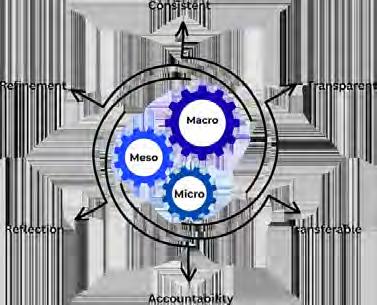
reflection, with established times and methods; and refinement, with an intention towards continuous revelation.
Collective discernment, in the form of feedback loops among the system’s levels, is vital to creating a circular flow. The PEF recognizes that feedback from marginalized identities and from the global majority serves as a vital diagnostic tool for assessing equity.
I had the opportunity to test the PEF when a working group from our school’s leadership team was tasked with refining our job performance feedback form. This system is new at Carolina Friends and includes: self-reflection, supervisor feedback, and discussion. Designing the form to be equitable was a priority. Our working group collected staff feedback to incorporate their perspectives on the form and process. The data and the PEF were used to evaluate the job performance system.
A PEF worksheet guides steps to determine how the job performance system would be consistent, transparent, and transferable, and include processes for accountability, reflection, and refinement. We began by defining the system’s purpose–what we are doing and why. The PEF worksheet includes each system level and considerations for addressing equity at each level. Here are examples of some items.
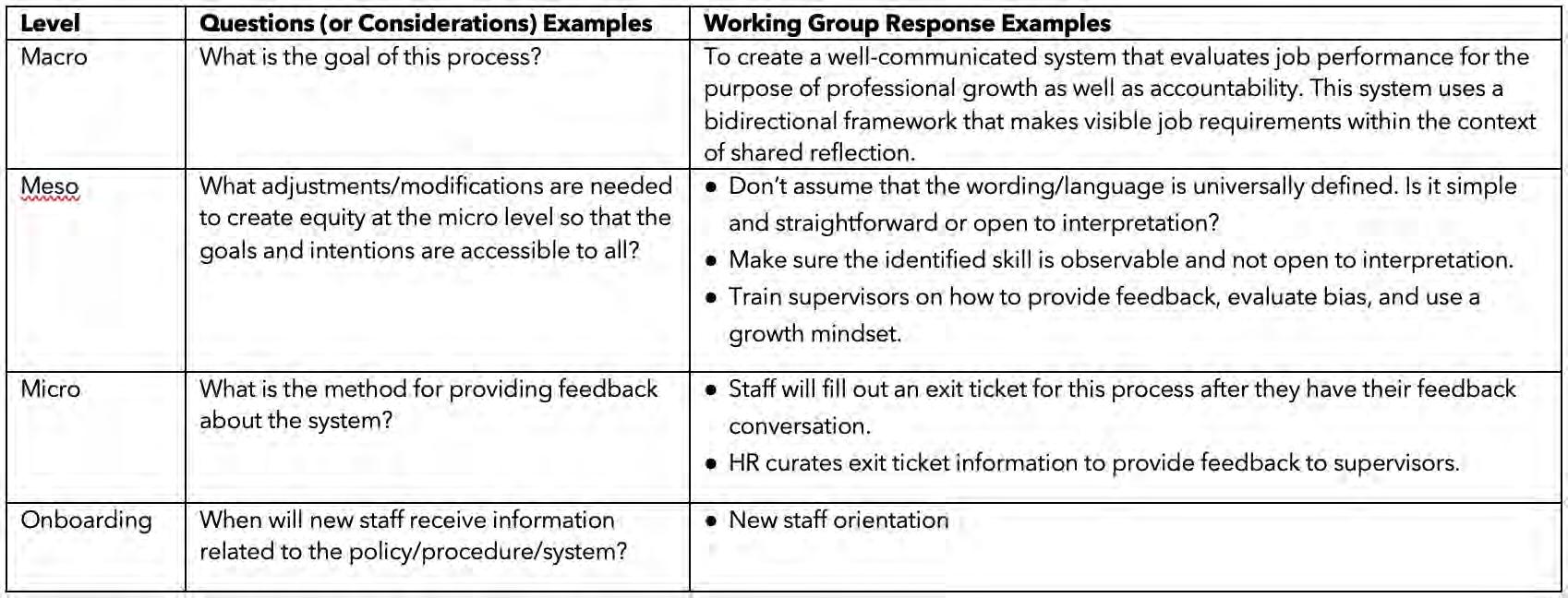
The first reflection from our working group revealed that the equity worksheet helped us attend to the practical aspects of designing the system of staff feedback as well as how the system would be maintained. Systems often emphasize broad ideas while overlooking implementation and long-term maintenance. The equity worksheet helped identify bias in coded language, false objectivity, and evaluation criteria that advantage some staff while disadvantaging others.
Moreover, the worksheet provided guidance on addressing DEIJB considerations at every level. For instance, it included a process for training supervisors to recognize their own bias during job performance reviews. Finally, the worksheet incorporated processes for the revelation of truth by establishing an after-review process to reflect on the effectiveness of the feedback form and meeting with a supervisor. This includes a process for addressing concerns about bias and identifies alternative contacts.
We plan to test the modified job performance form and process with a subset of staff before sharing it more broadly in the 2026-2027 school year. This will also give me data on how well the PEF and the accompanying worksheet worked and what modifications are needed. Afterwards, I will continue to test the PEF with other systems. My goal is to refine the framework so it can be used to build equity into our systems more broadly at Carolina Friends.
MICHAEL ROACH
Diversity, Equity, Inclusion and Belonging Coordinator & Preschool Teacher Westfield Friends School, Cinnaminson, NJ
“Way Opens.” These were some of the first words heard at my new staff orientation in a Quaker school. This notion reverberated for me, describing the way my path led towards teaching. I felt the possibility that exists within Friends schools; the harmony created by marrying Spirit with intentional practice. I found a sense of peace working with young learners and a home within Friends education.
This led me to seek more opportunities and see how “way” continues to open. I discovered my passion for working with teachers, families, and students, finding ways to create a larger impact within communities. At Westfield Friends School I serve as the Diversity, Equity, Inclusion and Belonging Coordinator and a Preschool teacher, which has allowed me to explore this passion and grow as a Friends school leader. The world needs our schools, and I am grateful to help steward possibilities in which “Way Opens.”
Like many independent schools, Westfield Friends School has recently faced a challenging time. We are located just outside Philadelphia, surrounded by a range of public and private education options. We have been examining how to keep our enrollment healthy while meeting community needs, deepening our sense of self, and keeping our foundation rooted in Quaker values.
We have a growing population of diverse students with a range of learning needs. This includes academically exceptional students, students who focus on the arts, and students who might or might not have a diagnosis with a learning plan. Our teachers expressed that they wanted more tools to support this range of needs and we needed ways to keep increasing our enrollment. How do we accomplish this while strengthening our sense of identity as a Friends school? How are others meeting these challenges? These questions informed the way I approached my action research project.
Connection and building our community network seemed to be key in answering such questions. After meeting with teachers and hearing that they would like more support in helping students who display traits related to Autism and Attention Deficit Hyperactivity Disorder, I arranged for the head of Orchard Friends School to meet with us. Orchard Friends is a Quaker-adjacent school that focuses on special education. We learned how they utilize Universal Design for Learning (UDL) strategies and were given tools for creating UDL systems and practices for Westfield students.
Next, we partnered with a professor from Rowan College for a series of workshops to learn more about UDL practices and using Positive Behavior Supports to reach students in new ways. We found the tools from the professor helpful but generalized. In Friends schools, we do more than teach students to work for a reward. In our school’s mission, we state “we seek truth through active, joyful, collaborative inquiry.” We wanted the practices in Westfield to support a deeper level of intention, restoration, and connection. Our teachers adopted more inclusive practices based on these strategies and developed holistic systems for thinking about reinforcement and consequences inside and outside of the classroom. This included establishing a Restorative Practices program.
In January 2025, we grounded ourselves in Quaker history and practice by visiting Arch Street Meeting House, a historic meetinghouse in Philadelphia. We learned how Quaker “giants” of years past thought about considering all voices within their community. We then walked to the African American Museum in Philadelphia to learn how to highlight vital contributions of people of color throughout history and how we can honor underrepresented voices in our classrooms today.
We recognized that we were not the only ones thinking about growing our programs with critical thinking and highlighting diverse representation. We began asking ourselves, “What sets Westfield Friends apart from other schools?” Many of our teachers only know Friends education through Westfield. We are lucky to be located near a geographical treasure chest of resources. Considering how teachers were inspired by the experience of leaving our school grounds for a day of learning at the Arch Street Meetinghouse and the African American Museum, I wanted our staff to see how other schools create a unique culture and meet the needs of their communities.
I planned an in-service day where our teachers visited other schools for inspiration. They split into divisional teams for these visits. The Preschool team went to a high-quality NAEYC-accredited early childhood center. The PreK team went to a school centered on progressive education and a connection to nature. The Lower School team visited Greene Street Friends, another Preschool through 8th Grade school. Our Middle School team visited Germantown Friends School to see how they create a dynamic program that leads to Upper School success.
To prepare, I asked teachers to look at their visiting school’s website and define one goal for their day. While there, I asked them to look for fresh perspectives, things that reinforce what we are already doing, things they might want to bring back with us, and to consider the question “What sets Westfield Friends apart from other schools?” After this day of learning, we discussed our observations and whether or not they accomplished the goal they defined for themselves. We continued to discuss what makes the Westfield experience unique. Following this, we have been leaning more into cross-divisional experiences that bring together our school.
During conversations, a shared topic arose of how these partnering schools care for their teachers and staff. Many educators, including at Westfield, have felt overburdened and exhausted by the turbulent state of the world. As part of our February 2026 In-Service Day, we embraced the theme of connection by bringing in George School’s Director of Diversity, Equity, and Inclusion to lead us in a workshop rooted in wellness, healing, and caring for yourself within a Quaker context. This allowed us to move and breathe together as a community and think about what we want to carry into the rest of the school year together.
We will continue to build on the query of what sets us apart from other schools by examining this question again near the end of the year, with staff sharing what they observed and what ways they have highlighted our school’s unique qualities and needs. I would like to support the connections within Westfield Friends in the future by establishing a Teacher Partnership program. Teachers from different divisions could spend time in other classrooms observing and thinking about how these happenings work together to create the Westfield experience for our students and families.
I hope to schedule another visitation day next year, working with school administrators to find ways to make these visits easier by thinking about the optimal time for scheduling and by partnering teachers with peers that help them see themselves and expand their work.

AMELIA V.B. SHULL Visual Arts Teacher and Advisor
Carolina Friends School, Durham, NC
This action research project was inspired by my volunteer work coordinating the Quaker Youth Leadership Club (QYLC) and organizing Meetings for Worship for the past 12 years; a role that is central to my identity as a mission-based educator. I have coordinated two national QYLC conferences, convening more than 24 Quaker Upper Schools. My primary goal is to keep the Quaker values of integrity and community central to students’ education, emphasizing non-hierarchical leadership and discernment and the role of Quakers in today’s social and environmental justice movements. A former Upper School Quaker Education Coordinator and Adolescent Wellness teacher, I built a curriculum for a Quaker Leadership class and support the Quaker Values Club. I am guided by Design Thinking and my founding of Girls Rock NC (now Youth Rock NC), which is a program for marginalized youth of all identities finding ways to express their unique voices and contribute to problem solving through collaborative, creative outlets.
Coordinating the QYLC involves partnering with students to design meaningful weekly Meetings for Worship, reflect on our school’s mission, and participate in annual conferences. Collaborating with Friends schools nationally and in Canada provides a valuable sense of shared understanding and connection. My own experiences at the national conferences have provided me with a network of Friends school staff who also focus on the Quaker identity of their schools. We communicate regularly through an email list that is not owned or run by an individual. This is a place where we share queries and challenges that we face at our schools, gaining insight from each other’s wisdom. Similarly, through the Engaging Leadership cohort we have a What’s App group chat where we ask questions and keep in touch. The concept behind a student-centered Q-Connect is built on years of thought that a student space, available beyond the scope of the three-day conference, could assist in connection and collaboration.
Each year, students return from the national Quaker Youth Leadership Conference with new perspectives, recognizing they are part of a larger community and forming lifelong connections for justice and peace. After engaging with students and staff for the last 10+ years, I have identified recurring challenges that tend to limit the conference’s reach.
Three Main Concerns:
1. Limited Participation: Only 6 to 8 Upper School students per school can attend due to varying school selection structures and the host school’s capacity to support visitors.
2. Attendance Barriers: Not all Friends Council schools are able to attend. Barriers include high transportation costs (especially for distant schools), a registration fee of $80 to $100 per participant, and the January/ February timing, which can conflict with other school programming.
3. Global Quaker Decline: With the number of Quakers decreasing globally, Friends schools are central places for new generations to learn about Quaker Faith and Practice. However, educational practices for direct Quaker Education are inconsistent across schools. The QYLC is vital for building students’ confidence and identity as part of a larger Quaker educational community.
Two Primary Queries:
1. In what way can a virtual gathering for Quaker School students build stronger ties between schools, and a broader understanding of our own place in a wider Quaker community and identity context?
2. What can we learn about community building and belonging among Quaker School students by prototyping a virtual community?
• Would a virtual prototype engage more students who are interested in leadership development through a Quaker lens?
• How can we be as inclusive as possible so all Friends Council schools have an opportunity to learn from and about each other through a youth network?
• Is there an opportunity for this to spark or support developing a middle school program?
The success of the 2021 virtual QYLC hosted by Friends Select, following the 2020 in-person event at George School, demonstrated the viability of virtual connection for improving accessibility. To address the persistent concerns, I researched youth leadership, virtual teen communities, and current Quaker youth programs, including Friends General Conference, Quaker Religious Education Collaborative, and Pollyanna. After consulting with 2026 QYLC organizers and our own Carolina Friends Quaker Values club, Carolina Friends students developed a questionnaire for the 2026 QYLC attendees. The questionnaire received 130 responses from students and staff across 27 schools.
I am applying the Design Thinking framework to structure the project plan:
1. Empathy: Data was gathered through deep listening to student and staff hopes and concerns.
2. Define: A team of Carolina Friends students met before the 2026 QYLC at Moses Brown to craft the queries and activities for the greater conference community.
3. Ideate: Carolina Friends students presented the questionnaire at the 2026 QYLC. The responses were used to organize to highlight shared reflections, guide next steps, and inform choice of a platform, frequency, and name. Our communications representative at Carolina Friends provided support for virtual student safety and logistics.
4. Prototype: Carolina Friends students in the Quaker Values Club, with the group who attended QYLC, reflected on the data and designed a virtual meetup and structure scheduled for April 2026.
a. Carolina Friends School students host the first month as a prototype.
b. There are three components of the prototype:
i. Q-Connect—a community BAND where students can all join and ask general questions about Quaker identity, practices, and school programs.
ii. Q-Tips—a private Instagram account where schools take over for a month to showcase Quaker practices and programs from their school.
iii. Q-Connect Live—a virtual meetup through Google Meet each month, run by the host school.
5. Test/Reflect: The formats will all be set to private with a shared password and monitoring responsibility that will be held by each school during their host month. Also, because of the school calendar, it’s possible that only about eight schools will be needed to host per year, assuming that hosts will engage from September through May except in December. Students and staff will be asked to discern the benefits and drawbacks of the Carolina Friends prototype, allowing for continuous refinement through a cycle of Design Thinking steps.
We are at the very beginning of this work and shared leadership takes patience. I recognize that new queries may unfold as the program develops. It’s thrilling to recognize how eager students are to connect, while also being honest about the effort required to build a student-centered community project across Friends schools, especially as volunteers. With positive crossschool support and constructive feedback, we hope to craft a platform that gives youth in Friends schools the opportunity to build collective identity and collaboration in a time when Quaker principles can be grounding and centering.
SONJA SPONHEIM Dean of Students & Assistant Head of School Scattergood Friends School, West Branch, IA
I came to Scattergood Friends School seven years ago after working as the Local Coordinator with Quaker Voluntary Service in Minneapolis/St Paul. My daughter wanted to attend Scattergood, and I felt pulled toward Scattergood as well. As a member of Iowa Yearly Meeting (Conservative), which owns the school, I had been intrigued by how Scattergood lives Quaker values. Then and now, I resonate with how the school nurtures the whole person and offers a brave space for students to explore themselves. This Action Research Project explores, on a practical level, one aspect of how we create that holistic space for students.
Background
Schools respond to small behavior problems such as being late to class, missing a work program crew shift, or not turning in homework through their daily discipline systems. When I began my work as Dean of Students at Scattergood Friends School in the late summer of 2019, I became the primary administrator of its daily discipline system, which was called the “The Slip System.” If a student missed a daily expectation, they would receive a “slip.”
“A slip” was associated with a demerit or negative consequence. Students would complain about the “punishment” inflicted on them. They were right that many of the consequences were arbitrary and not connected to either the situation or the relational context. Students reaching a certain number of slips might be assigned an earlier Lights Out in the dorm. Students would say, “Going to bed earlier has nothing to do with what I’m struggling with.” Scattergood is a profoundly relational space, and the “slip system” dampened student morale and interfered with staff-student trust.
In March 2023, my colleague Sadie Kirschenman and I began to revise the system in coordination with the Dean’s Advisory—a student committee who “advises” the Dean on student issues. This committee consists of a half dozen students who meet twice a month with a nonviolent communication and restorative practices trainer. Using the framework provided in The Little Book of Restorative Discipline for Schools: Teaching Responsibility; Creating Caring Climates by Lorraine Stutzman Amstutz and Judy H. Mullet, we examined our daily discipline procedures. This chart shows the continuum of disciplinary responses from arbitrary responses on the left moving toward restorative practices on the right.
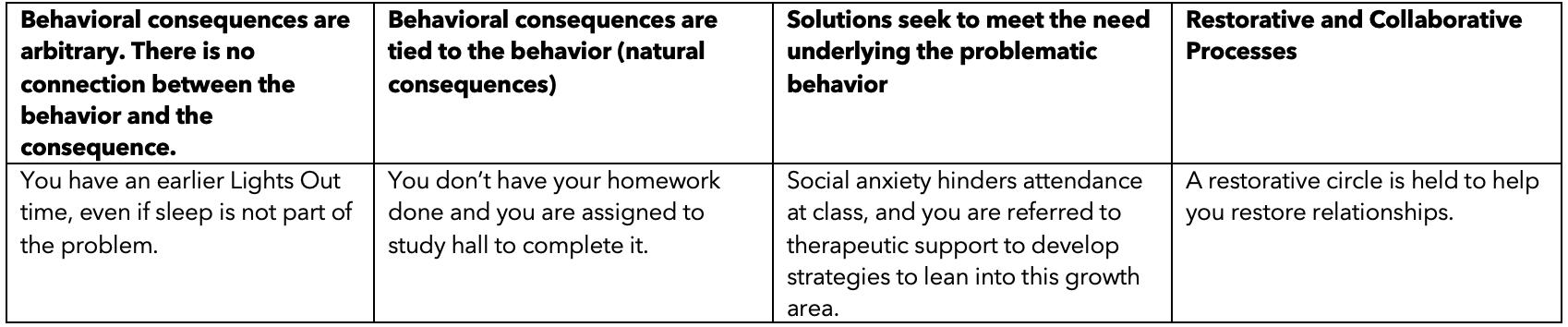
This work was personal. Each student had their own relationship to meeting expectations. Some, due to personality and neurodiversity, found getting to their obligations on time challenging. They felt ashamed of not being able to do it better. Some excelled at meeting expectations; but that came at the cost of putting an outside requirement before their own stress and self-care. Some students were sensitive to others’ assumptions about their choices and their abilities. The group went through an intense process of conflict. Tears, strong words, and apologies led them to mutual perspective taking. Sadie, our restorative practices consultant, and I held space for them through the stages of group formation and watched them emerge as a highly functioning group.
By June 2023, we introduced a revised Daily Discipline System that eliminated arbitrary consequences and shifted our approach toward natural consequences and interventions grounded in an understanding of each student’s needs. The Dean’s Advisory ran feedback sessions for students. Sadie and I worked with the staff. The revised system emphasized relationships as central to a strong learning environment. Interventions focused on small, intentional conversations between the student and the staff member most closely connected to the situation. Advisors played an important role, often creating a holistic, relational space where students could reflect with someone who was curious about their motivations and invested in their growth. The goals were to help students take ownership of their actions and grow in responsibility.
This revision of the daily discipline system at Scattergood has been truly iterative as we have cycled through action, reflection, discernment, and more action. The 2023-2024 school year showed the benefits, including general student buy-in to the school’s response to missed expectations and a wealth of information about students’ needs, hopes, problem behaviors, and motivations.
To support this new framework, in 2024-2025, we provided training for advisors on restorative practices, motivational interviewing, and nonviolent communication. In my role as Dean of Students, I met quarterly with advisors for reflective, relationship-based consultation focusing on the advisor’s personal experience in their professional role.
The implementation of the daily discipline system showed places for growth:
■ The continued use of the word “slip” connoted a behavioral demerit system. Our software program’s utilization of the word “demerit” exacerbated this.
■ Some unease with the role of authority that accompanied having conversations about behavior. Some advisors worried this affected their rapport with advisees.
■ Coming from a place of radical egalitarianism, some advisors found participation in a prescriptive system of any sort coercive.
■ From a neo-Kohlbergian perspective, some of our developmentally younger students were at a stage of moral development where they needed concrete consequences to guide their behavior.
The shift away from arbitrary consequences to natural consequences and relational interventions is at the heart of who we want to be as a school community. In 2025-2026, a group of six staff members began working with an educational psychologist from Iowa’s Department of Education to explore the creation of a Positive Behavioral Intervention System (PBIS). A PBIS system would articulate expected behavior for both students and staff and provide clarity and accountability for the entire community. This would unify the expected standards and interventions of daily discipline for both staff and students and would be tied to the Quaker testimonies. We are also developing tier two PBIS support for the roughly 15% of students who need more explicit skill development to meet daily expectations. In 2026-2027, we will eliminate the word “slip” from the daily expectations system.
As we continue to collectively engage with queries around accountability and relational connection, new ideas and questions will emerge. “What daily discipline practices will support the creation of a restorative community? How does a school’s response to daily expectations create growth and responsibility in students?
MELAINA YOUNG
English Department Head George School, Newtown, PA
Currently, I serve as the English Department Head at George School, where I supervise and mentor faculty, lead curriculum design for grades 9–12, and coordinate writing instruction across courses. I work closely with teachers on course design and assessment, and I support new and experienced faculty through observation, coaching, and collaborative planning. I approach leadership by balancing innovation with respect for institutional tradition, using careful listening, clear decision-making, and shared responsibility to support both faculty growth and student learning. I am particularly interested in helping schools clarify authorship and feedback practices in the context of generative AI.
There are relatively few Student Writing Centers in secondary schools, and when they do exist, they can occupy an uncertain position. They are often viewed primarily as remediation spaces rather than as a central resource for learning. At the same time, schools emphasize writing as essential to critical thinking and student voice across disciplines. The rapid emergence of generative artificial intelligence has further complicated questions of authorship and academic integrity, placing renewed pressure on how schools support student writers. Together, these challenges prompted me to ask: In what ways can we, as a community, support authentic student voice in an age when technology can speak for us?
I initially approached this action research through the idea of creating a Student Writing Manual to clarify shared expectations around writing. However, it became clear that the manual was only one part of a larger inquiry into how students understand and access writing support. Grounded in the Quaker values of integrity and community, this project shifted toward reimagining the Writing Center as a more visible and inclusive space for student writers.
Last year, I became aware that student traffic in the Writing Center had declined significantly, which led me to step into the space as a faculty tutor to better understand how students were experiencing writing support.
I initially wondered whether the decline in use reflected changes in assigned writing, changes in our study hall hours, or the growing presence of generative artificial intelligence and programs such as ChatGPT. Patterns of student use suggested something more complex. When students did visit, they often framed their needs narrowly and sought last-minute feedback rather than a broader conversation about the writing process or developing a writing voice. The fall semester was dominated by support for college essays.
These observations suggested that the issue was not about awareness or availability, but about their perception of the purpose of the Writing Center and relevance to them as writers. Alongside faculty support, the Writing Center also relies on peer mentors, whose presence reinforces its potential as a community space grounded in shared learning and authentic student voice rather than a purely remedial service.
To better understand these patterns, I reviewed Writing Center sign-in data and continued working directly with students. The data revealed that students sought writing support, particularly during high-stakes moments such as college essays and IB assessments. Visits were often brief and purpose-driven, focused on clarifying writing expectations or refining sentence structure rather than sustained engagement with the writing process. At the same time, the data reflected the Writing Center’s interdisciplinary reach, supporting work in English, History, Science, and extended research projects. The data also highlighted the contributions of both faculty tutors and peer mentors equally. Taken together, these patterns suggested that the Writing Center was not irrelevant to students but was narrowly understood.
This led me to reflect on a broader tension between how schools speak about writing and how writing support is structured in practice. Writing is frequently named as central to learning, yet responsibility for writing instruction can be unevenly shared across disciplines or relegated to moments of struggle. The Writing Center risks being positioned as a place students visit only when something has gone wrong, rather than as a generative space for thinking and experimentation.
The emergence of generative AI has intensified these tensions. Questions about authorship and ethical writing practices have become more visible as well as exposed long-standing ambiguities about how much of the writing process is made visible to teachers and where conversations about integrity and voice are meant to take place. The Writing Center holds potential not only as a site of support but also as a space for dialogue where students can discuss writing decisions, tools, and challenges openly, without fear or stigma.
I experimented with targeted, time-bound programming, which invited students into the space through creativity rather than urgency. This included themed drop-in sessions such as a Poetry Write Night with a guest poet trained at the Iowa Writers’ Workshop, an Emily Dickinson–inspired poetry lecture, and a Valentine’s Day love-letter writing event. Rather than offering solutions, these programs functioned as invitations to shape engagement.
I began thinking we needed to reframe the Writing Center less as a service and more as a community space rooted in supporting both creativity and analytical writing. This reframing aligns closely with Quaker values of communal responsibility and integrity. Still, questions of ownership, scope, and purpose have
surfaced alongside moments of resistance. The data revealed the complexity of institutional change and an invitation to see how writing support is shared across departments.
Feedback from colleagues during the IELFS process has also shifted my understanding of the project itself. Others have encouraged me to consider how students and faculty explicitly understand the Writing Center’s purpose. This reframed the work from interpreting data to inviting participation. I began to see leadership in this context as facilitating shared meaning by engaging students in discussing what authentic voice means to them and inviting faculty across disciplines to clarify how writing functions in their courses. The question expanded from how to improve the Writing Center to how a school community collectively defines writing, authorship, and support in an age of AI.
I look forward to engaging in meaningful conversations with colleagues about teaching writing, creating space for students to express their authentic voices, and having a committee develop a student writing manual that can be shared across disciplines.
■ Continued purpose-driven programming that invites creativity and process-based writing.
■ Structured conversations and brief interviews with students and faculty about the Writing Center’s role.
■ Formation of an advisory group (with faculty across disciplines) to help frame questions for a survey and interpret findings about the role of the Writing Center.
■ Conduct of student and faculty surveys about how writing support is understood across disciplines.
■ Creation of a cross-disciplinary Student Writing Manual.
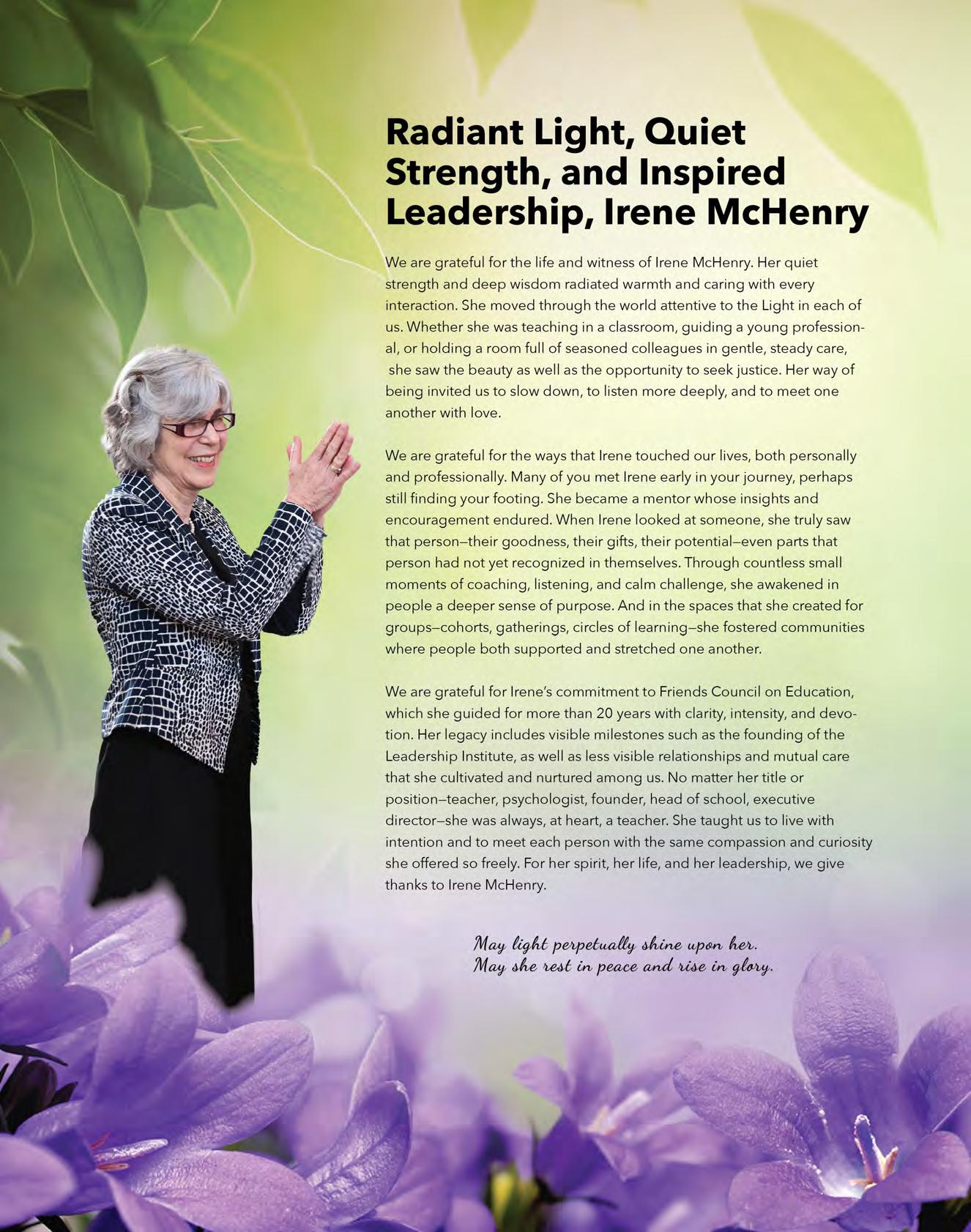
Action research is a dynamic, iterative process in which inquiry, reflective learning, and action are used to deepen understanding and, ultimately, change. The process is cyclic, spiral, and emergent, continually evolving as insight grows. It generally involves participation with those who inhabit the system in which the action research is conducted.
In action research, the true measure of success is learning and change at both the individual and systems levels. An “unfinished” project might actually stimulate ideas for others and be useful in different contexts. Every turn of spirit influences a potential transformation of practice.
Through her work at Friends Council, Irene McHenry was instrumental in shaping the nature and format of the action research project for the Leadership Institute. Today, four people steward cohort members through their own process of creativity and reflective learning (l-r): Shu Shu Costa, Rodney Glasgow, Drew Smith, and Darryl Ford.
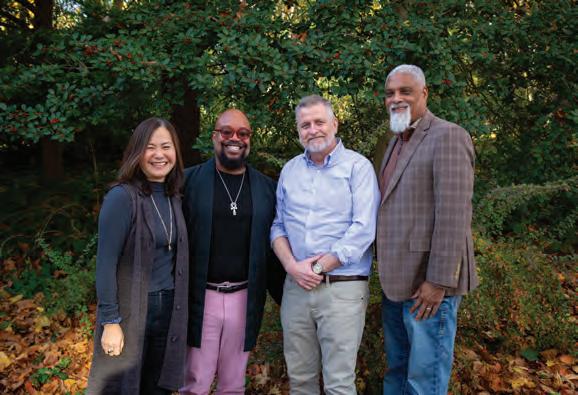


This booklet contains summaries of action research conducted by members of the 2024-2026 cohort of the Institute.
THE NATIONAL ASSOCIATION OF QUAKER SCHOOLS
www.friendscouncil.org www.friendscouncil.net bookstore.friendscouncil.org



www.friendscouncil.org