Patron: Tim Coghlan
Summer 2013
THE RAYMOND & NUTFIELD NEWS
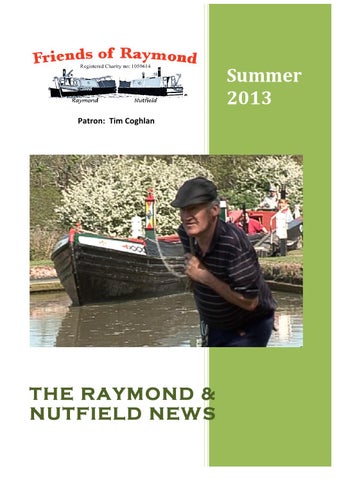
EDITORIAL This Summer season we have two boats to be very proud of – RAYMOND and NUTFIELD are both repainted and resplendent in their matching Blue Line Livery. Unfortunately I nearly caused some scratches when I steered us aground taking us through Milton Keynes a couple of weeks ago! Roger & Diana, our Volunteering Coordinators, plan to hold another boat-handling training course in the coming months - and I will definitely be volunteering. You can find out more about this and other ways to get involved in their latest report. There’s a fully updated contact list below for anyone who would like to get more involved.. In fact, there is quite a theme of “getting involved” in this edition of the newsletter – if you’re not feeling too energetic you can be active via the website. This has also been given a “repaint” and Jeremy has given us full details of how to contribute. And I would add here that I am always delighted to receive articles and pictures for the newsletter…… Unfortunately we have also had some very sad news. Richard Scarff, one of our most active members, has suddenly passed away. If you didn’t know him, that’s his picture on the front cover bowhauling RAYMOND out of a lock. We are all deeply saddened by this and would like to present some reminiscences in tribute in our next edition. If you have memories of Richard, or have any pictures, please share them with us. Jenny Freeman
To Contact us :Main Address: The Friends of Raymond, 11 Lichfield Road, Cricklewood, LONDON, NW2 2RE chair@friendsofraymond.org.uk (Steve Miles) secretary@friendsofraymond.org.uk (Robin Bishop) boats@friendsofraymond.org.uk (Nick Scarcliffe)
treasurer@friendsofraymond.org.uk (Pete Copeland) membership@friendsofraymond.org.uk (Barbara Evans Rees) volunteering@friendsofraymond.org.uk (Diana & Roger Golder) webmaster@friendsofraymond.org.uk (Jeremy Cooper) newsletter@friendsofraymond.org.uk (Jenny Freeman)
WEBSITE:
http://www.friendsofraymond.org.uk
2
MEMBERSHIP REPORT Despite our intermittent summer, The Friends of Raymond show-round-the-boats and the shop teams have been doing sterling work recruiting new members. So a warm welcome to our new members –Rosemary Jones, Peter Wills, Stephen Banks and Elizabeth Ward, Gary Clubb and Kerry Jane Trinder. And thank you too to all our ‘April-renewal’ members who have renewed their membership. Just a reminder to those members who previously renewed in October that you will have the benefit of an extra 6 months membership as a one-off this year -. All membership renewals will be on 6 April 2014. Another thank you to all of the members who have responded to my suggestion in the last newsletter for receiving your newsletters and information via email and on the web. (If you’re reading this online the system has worked!) Please remember to let me know if you change your email address! I wouldn’t want you to miss out. I intend to stick to my promise not to inundate you with emails, so I’ll only send you •
emails which I’ve been asked to forward to you by the Trustees and Officers
•
links to the Newsletters
•
other important information relating to your membership.
[Don’t’ worry if you’re not on email, I’ll be sending you the same information by post.] News about the boats and events will be on the webpage www.friendsofraymond.org.uk where you’ll see on the right hand side “Recent News and Features”. And if you’re into social media, don’t forget to join our Facebook group Narrowboats Raymond and Nutfield. Various photos and events (and the odd comment or two) are posted here. Now it’s your turn - if you have any suggestions about how you would like to receive information and/or what kind of news/information you would like to receive, drop me a line! All thoughts are welcome! Fingers crossed now for a continuing warm summer to show the boats at their best in their bright, new, shiny colours. Barbara Evans Rees Membership Secretary
THE NEW-LOOK WEBSITE
3
Back in May the Friends of Raymond website took on a new-look. While it still has much the same content as the old website, it’s based on a completely different web maintenance system. Up to then the website was run in the “traditional” manner, with me as webmaster being the only person able to update it using the files based on my computer and specialist web-authoring software. But I developed the new site using WordPress.
WORDPRESS WordPress is a free Content Management System which has millions of users: it is “open-source” software which means that users can contribute to its improvement and development – nobody commercially owns WordPress (see http://wordpress.org). Once a site has been set up using WordPress, anyone who is registered as a user on the site can alter the site using just the web browser on their computer. The whole operation is managed entirely on-line!
PAGES & POSTS The site now has two types of content: it has “static” pages like those on the old site: these are listed in the menu bar at the top of the page.
It also has posts: these are like a blog. The posts are what is shown in the “News and Articles” section of the site. Posts are all archived and indexed by month of publication and by Category.
USERS There are several types of “users”. The following are the types relevant to this site: Administrator – somebody who has access to all the administration features within a single site. Editor – somebody who can publish and manage posts including the posts of other users. Author – somebody who can publish and manage their own posts. Contributor – somebody who can write and manage their own posts but cannot publish them.
4
I am currently the only Administrator. If you are already familiar with WordPress (or willing to learn) and would like to share this role, let me know. I envisage that most users will, to begin with, be Contributors – that is writing posts for approval before publication.
Only Members of The Friends of Raymond will usually be registered as users.
WRITING POSTS Writing a post is like using a blog, and a bit like using Facebook. Posts can include images (Contributors can upload images and add them to their posts) and documents like .pdf files (Contributors can upload these and link to them in their posts). A post might consist just of notice that a new document, for example a report of an event, is available, with a link to it.
All posts will have to be approved by an Administrator before publication – the Administrator can sort out any problems a new Contributor might encounter, and reserves the right to sub-edit all posts. If things go well, a Contributor could be promoted to Author then Editor …
WANT TO GET INVOLVED? If you’d like to write a particular post, or become a regular poster, or help administer the site, email me (webmaster@friendsofraymond.org.uk) telling me what you have in mind, and if I think it is appropriate I’ll register you on the site – you might like to suggest a user name and password, and also how you would like your name to appear on your post.
If you would like to post something, but would rather I did it for you, email me the text and any photos.
I hope you like the new look, and would be glad to hear from you with any suggestions or comments (good or bad!). Don’t hesitate to get involved if you want to!
Jeremy Cooper (Webmaster)
5
TREASURER”S REPORT I am currently awaiting up to date bank statements, so the following is a resume. However, I think we have done very well this year so far financially and we are in a good position :th
-
£6053.27
th
-
£ 346.23
Savings Account 28 March 2013 General Account 29 May 2013
We have spent to date: £2776.09 This included the cost from Wyvern Shipping for the repairs to Raymond and Nutfield We have received to date:
-
£3995.28
We have no outstanding bills so we should have - £1219.19 + 346.23 £1565.42 in the general account (+ the £6053.27 in the Savings Account!) Pete Copeland
CREWING AND SHOWS We have just passed the half way mark in our boating season taking Raymond and Nutfield to various events up and down the Grand Union Canal. We have had excellent crews for boat moving and manning the sales stand and doing showrounds. Congratulations must go to the showround team at the Crick Show who were kept very busy for the three days and brought in the highest amount in donations that we have known. However, we cannot relax in our efforts for the remaining events, which are, by the time this reaches you: th
th
th
-
Blisworth - 10 & 11 August, with the return to Braunston on 12 August,
-
Alvecote – 24 , 25 , 26 August. The boat moving will be 2 days either side, i.e. rd th th 22nd, & 23 August, and returning to Braunston on 27 & 28 August.
-
The final event of the year will be the Stoke Bruerne “Village at War” – 14 & 15 th th September, leaving Braunston on 13 and returning on 15 September to Braunston.
-
Our final “event” of the year will be the docking – this year Nutfield – 4 , 5 , & 6 October in Braunston.
th
th
th
th
th
th
th
th
Volunteers are still needed both for the boat moving and the events. It was a struggle to get crews together for the Cosgrove event, so please volunteer. Contact us at rdgolder@aol.com.
6
During this season we have not seen some of our regular volunteers for very understandable reasons, so we need new people to come forward. Please don’t be “put off” by the thought that you will have to give up days to help us – half a day (or a couple of hours) at a show is invaluable and it is great fun. We have new members who have expressed interest in crewing. This is most encouraging! However, whatever previous experience of boat handling you have had, steering Nutfield and Raymond can be an “interesting” experience given Nutfield’s idiosyncratic gears and speed wheel. We, therefore, would like all new crew members to be under the supervision of one of the recognised steerers at first and be prepared to take instruction. We are planning another training weekend in the near future. Roger & Diana Golder
NUTFIELD AND RAYMOND ON TOUR The IWA Northampton Branch Boat Rally, which is held over the early May Bank holiday weekend, is usually the first event in the year that Nutfield and Raymond attend. We were already booked in to attend this event this year, however, shortly before the event was due to take place we were contacted by the organisers who advised us that due to lack of support the event was once again cancelled. The crew members were contacted and a decision was made to take the boats down to Stoke Bruerne instead for the weekend rather than waste a Bank Holiday opportunity to make some money. This resulted in being a good idea. Following on from this event the boats were moved on and moored at Wolverton. th
I joined the boats at Wolverton on Wednesday 15 May from where we started off on their way to Rickmansworth. The crew on this journey were Steve Miles, Nick Scarcliffe, Merv Brookes and Robin Bishop. We reached Slapton on Wednesday and Boxmoor on Thursday. We finally arrived at Rickmansworth mid afternoon on Friday. Many other boats were gathering there for the Rickmansworth Canal Festival that was taking place over the coming weekend. We wound the boats in the winding hole just before Tesco then reversed them to their mooring position alongside the towpath. Nick then started to get them ready for the Festival by polishing all the brassware. The Sales Stand was set up inside the hull of Raymond and operated from here. Our position alongside the towpath resulted in the usual continuous stream of the general public and visitors to the event itself passing by our boats. Quite a lot of them showed an interest in Raymond and came on board to see inside her cabin. As usual at this event there were many ex-working boats present which included President and Kildare. In the nearby Aquadrome in their normal locations many side stalls and a fun fair were set up. There was plenty to see and do together with all the boats attending the Festival. Following on from this event the next move was to start the return journey from Rickmansworth and travel North heading for the Crick Boat Show. The crew on this trip were Nick Scarcliffe, Merv Brookes and Robin Bishop. We left Rickmansworth at 7.15am on Monday 20th May and reached Berkhamsted by the end of the day. Roger Golder joined us for the day at Apsley Lock 67 to assist us with lockwheeling.
7
On Tuesday we picked up Roger Golder on route at Cowroast lock. He spent the day with us and helped us through the locks. Grove Lock was reached by the end of the day. Early on Wednesday morning we met Roger and Diana Golder at Wyvern Shipping at Linslade and they joined us. We later met Mike Bowley, Norman Prior, Chloe and Caroline at Stoke Bruerne lock 20 to assist us up the locks. Stoke Bruerne was our overnight stop on Wednesday. Mike Cooper joined us for the day before we moved off on Thursday morning. The final destination of Crick Marina was reached on Thursday. We spent the end of May Bank Holiday at the Crick Boat Show. Our boats were moored next to each other either side of a pontoon and the sales stand was set up in one of the large marquees. There was a continuous queue of visitors to see inside the cabin of Raymond all day long for all 3 days of this show. The donations in the pots reflected this and together raised over £200. Following on from this event the next move was to start a further return journey but this time from Crick Marina and travel South heading for Wyvern Shipping at Linslade. The reason for this trip was to deliver Raymond for her repainting job. The crew on this journey were Steve Miles, Diana th Golder and Robin Bishop. We left the marina at 7.30am on Tuesday 28 May. Norman Prior and Alan Mills joined us at the top of Watford Locks to assist us down them. Later in the day Nick Scarcliffe joined us at the top of Buckby Locks and then Stoke Bruerne locks to assist us down them. Cosgrove was reached by the end of the day on Tuesday. Mike Cooper joined us again for the day before we moved off on Wednesday morning. We arrived at Wyvern Shipping mid afternoon and dropped both boats off there. th
On 13 June Steve Miles, Mike Freeman and Jeremy Cooper were dropped off by Barbara Evans Rees in her car at Wyvern Shipping at Linslade to move Nutfield back up to Stoke Bruerne. This was in readiness to attend the Stoke Bruerne Gala Weekend and Canal Festival which was being held over the weekend of 15th and 16th June. Nutfield was left in her mooring position for this event. Following on from this event on Sunday evening Nutfield was moved down the Stoke Bruerne flight of locks and moored below them. th
On Wednesday 19 June Steve Miles and Robin Bishop moved Nutfield from Stoke Bruerne down to Linslade to collect Raymond after being painted at Wyvern. The return trip started later that day and got as far as the bottom of the Soulbury 3 locks. Jenny Freeman and Dale Howlett joined us for the day before we moved off on Thursday morning. The remainder of this trip continued and Blisworth was reached by close of play on Thursday. Both boats were left at Blisworth in preparation to support a photographic exhibition which was taking place there over nd th the weekend of 22 & 23rd June. Starting out early in the morning on Monday 24 June the journey began to move the boats back “home” to Braunston marina. The Braunston FMC Boat Rally was the next event in the calendar. This was held on 29th th -30 June at our “home” ground, Braunston Marina. Our boats were moored out on the main line just outside the marina main entrance. This position gave us the opportunity to show off Raymond looking resplendent in her shiny new paint job - which she did in the hot sunny weather over the weekend. The Sales stand was out and located alongside the arm in its usual spot. We did extremely well with takings both on the Saturday and Sunday. Robin Bishop
8
RAYMOND UPDATE You’ll remember in our last newsletter my long screed about the repairs to Raymond’s timbers. Since the spring, things have progressed to something near a state of completion, I am pleased to report! One important job has been replacing and relocating the bilge pumps – to try and keep the stern dry it was necessary to reballast the boat down by the head and fit pumps at the foreend, which has now been done thanks to Nick Scarcliffe. Once the bulkhead at the cabin front has dried out and can be completely sealed, we hope to remove the ballast so that the boat will once again tow on cross-straps the way it should. Pete Boyce had about finished the actual woodwork when the last newsletter was published; we had to attend the first events of the season with an anonymous butty, as James Griffin and the lads at Wyvern Shipping couldn’t take the boat in for its repaint until the beginning of June. Not that that seemed to upset anyone – visitors to the boats and our donations at Stoke Bruerne on the Mayday weekend, at Rickmansworth and then at the Crick Boat Show were well up to expectations. Crick proved to be a very successful new event for us, as reported elsewhere! After Crick, we had to make a run back to Linslade and Wyvern’s boatyard, where we left both boats in their tender care. Not only did they do the usual superb job of repainting Raymond, but even repaired the damaged top stern guards on Nutfield, and gave the cabin a fresh coat of varnish, in time for us to ‘borrow’ our motor boat back for the Stoke Bruerne Gala weekend. And then the following week Raymond was finished too, so we were back to Linslade again to collect it – I think the volunteer lockkeepers at Three Locks were beginning to wonder what we were at! So our first event with our newly-painted butty was the Jim Payler exhibition at Blisworth – a fascinating weekend, and a great success with notable personages from all over the UK coming to see Jim’s photographs, including a number of ex-boatmen and women who were able to add names and details to a lot of the pictures. And while we were there, Brian Mayland was on hand to apply his skills to sign-writing the name on the stern and adding some of the decoration to the new paint job. He came up to Braunston the following week too, where he could get at the other side of the boat to do the same there! So now we have a really pristine butty, resplendent in fresh paint and suitably matching our motor boat for the first time in many years! Some more detailing on the paint needs to be finished yet, and the ash strips which will protect the paint around the stern added. As I write, the boats are at Cosgrove awaiting the trip to Linslade (again!) for their festival at the end of July, and while they are there Mick Betts (the popular local fender-maker and ropeworker) is going to replace the decorative ropework on the rudder for us, working from pictures of the boat in its Blue Line working days. So the next time we are on show, Raymond should be beginning to approach its authentic appearance as it was in the hands of the Brays, and hopefully in a state they would have been proud of! If you can, come along and see for yourselves – there’s a list of upcoming events somewhere in this newsletter! Steve Miles
9
10
Photos courtesy of Steve Miles
11
RAYMOND! The Epitome of Evolved Tradition For some RAYMOND can be seen as the epitome of the traditional narrow boat, with her stern living cabin, working rig, roses and castles decoration and brasswork; and although built as a butty she is little different from the horse drawn boats that preceeded her. But look a little closer and and you will see several features about her that are distinctly late 19th and 20th century in origin, and even post World War II. Stern living cabin When RAYMOND attends rallies visitors are invited to step aboard, and surely the main object of curiosity for many is her living cabin. The traditional arrangement of lockers, cupboards, and bunks is more or less the same as any other ex-working boat, and this layout becomes very familiar to us after time but, how many realise that during much of the 19th century many boats had a slightly different and more claustrophobic cabin. Thomas Monk of Tipton is the man credited with the design of the traditional narrow boat cabin, and whose name is also said to be the origin of the term ‘Monkey Boat’; commonly used on the Southern Grand Junction canal, along the river Thames and around the London area. An article in ‘Canals and Waterways Journal’ of November 1920, written from information supplied by Thomas Monk’s great-grandson, relates the story of this boat builder, canal carrier and packet boat operator. He claimed the living cabin was unknown before Thomas Monk, who was born in 1765, invented it. His early efforts were a mere shelter at the stern, where a man could sleep amongst the hay and corn kept for the boat’s horse, mule or donkey; but later evolved into accommodation for the boatman and his wife. It appears that by the mid-19th century and also 1877, when the Canal Boats Act became law, the cabin furniture aboard a number of craft was more enclosed than we are familiar with today. In particular the cross-bed which had cupboards above the bed-ole on both sides, with access to the bed through a fixed wooden archway the width of the central gangway down the middle of the cabin. In some cases the drop-down flap of the cross-bed, which normally rests on a lip along the right-hand bench when used, was fixed permanently in place too. A view of the cabin interior from the doorway, which appeared on the cover of the ‘The Graphic’ magazine of March 20th 1875, is rare glimpse of one such cabin, and earlier in 1858, John Hollingshead described a similar cabin interior in ‘On The Canal’ in Household Words magazine. These cabin fixtures reduced the cubic air capacity of the interior to well below what was required by the Canal Boats Act, and prompted some canal boat inspectors to demand the cupboard above the bed-ole on the right hand side be removed, or else a prosecution may follow. This early arrangement gave the boatman and his wife a good deal more privacy from their children when in bed, but following the Act any alterations, or when a new cabin was built, their privacy was reduced to a small hinged wooden ‘modesty flap’ fixed to the cabin frame, an anachronistic remnant of earlier days. Only a curtain fixed across the cabin could now protect the parents from their children's attention. At Stoke Works on the Worcester and Birmingham canal in the beginning of January 1879, the first fourteen boats were inspected for what would become the Birmingham Register of Canal Boats, but all failed to comply with the acts due to lack of free air space and the amount of cupboards in their cabins. However, not all boats were compelled to make these alterations to
12
conform with the Act upon their initial registration, much to the annoyance of other canal boat inspectors when these craft ventured into other parts of the canal system. At Wolverhampton a number of visiting boats were inspected and found to be fitted with bed-ole cupboards and fixed cross-beds; and had already been registered elsewhere contrary to the Act. Nonetheless the owners of these boats were subsequently warned about these infringements and ordered to fix them. Not all boats were constructed with the traditional layout of furniture. One example in 1922 was for the Midlands & Coast Canal Carriers Limited of Wolverhampton, who ordered the first of a new type of all steel canal boat, and the first one was fitted up with a different arrangement of cabin furniture. It was described as having a hinged table attached to a bulkhead, two shelves, a stern cupboard and a cross-bed locker. This was an exception though and in general most boats were constructed with the usual familiar traditional arrangement. So it seems the traditional narrow boat cabin we are used to is not exactly that which was constructed for much of the 19th century, and has in part been shaped by Government legislation in the form of the Canal Boats Act, rather than evolving solely to suit the preferences of boaters. Working rig Another aspect of RAYMOND’s traditional features is her working rig, but the general appearance of the working boat has evolved and changed over many decades, and this is apparent with RAYMOND. In the middle to late 19th century a typical horse drawn boat working over the South Midlands region as far south as the Kennet & Avon canal, would have a distinctive curvature to the top plank from the back of the cabin to the deckboard. The middle stand was taller than both the after stand and the box mast, so the gang planks formed a gentle curve peaking at the middle stand, with the forward plank from the mast extended to the forward beam, often to a large block of wood rather than a deckboard. This arrangement changed over time and evolved into a straight and level run of top planks placed over very tall mast and stands, sometimes with a slight downward slope from the aft stand all the way to the deckboard. How this came about is not certain, but a clue could be the increased use of narrow beam steamers operated by several carriers in the latter half of the 19th century. Many were built with tall cabins and engine rooms, and when the top planks were laid from a rather short cabin block on the forward engine room bulkhead to the deckboard, which was a few inches taller than the bulkhead, a level run of top planks was the result. Its not to much to speculate that the butties and horse drawn craft contemporary with these steamers should subsequently adopt a similar rig, but with a profoundly curving aft top plank from the aft stand to a tall cabin block at the back of the cabin. This version lasted for most of the first half of the 20th century with the last boat carrying it being Joe Skinner’s FRIENDSHIP. Several restored craft have adopted this rig for authenticity, notably the horse drawn Shropshire Union Railway and Canal Company fly-boat SATURN, and the former Fellows, Morton and Clayton Limited (FMC) steamer PRESIDENT. Also former steamers, MONARCH and ADMIRAL have a similar rig as has the former Midlands & Coast motor JUBILEE. Even the deep hulled Grand Union Canal Carrying Company (GUCCC) boats originally had a taller deckboard, mast and stands with the top planks resting on a cabin block on both motor boats and butties, although not as high as FMC or some of the coal carrying boats. But after World War II the height of the mast and stands on GUCCC, FMC and other boats were reduced so the height of the gang planks on motors were level with the forward bulkhead of the motor
13
boat’s engine room, and the butty’s mast and stands were correspondingly reduced to match. This may have been due to the change in traffic after the war, when the main cargo was coal. Boats often returned to the collieries running light more and more, and it made life easier to have a lower rig especially for GUCCC boats with deep holds like NUTFIELD. This also affected Barlow boats, and their working rig was reduced after the war too, so by the time RAYMOND was built most craft working the Grand Union were like that. The Bray’s, who operated RAYMOND all her working life, removed the two stands when loaded and merely laid the gang planks over the coal from mast to cabin, which were held fast by tying down her side cloth strings over the planks. This method was used increasingly during the post-war years for both motors and butties, and the Bray’s obviously felt is was best for them. The Whitlock’s working RAYMOND’s sister boat LUCY kept to the older method of rigging the boat with gang planks placed on top of the stands, as they used running blocks to reduce the effort of working a loaded pair through Grand Union locks. Roses and castles decoration Part of the visual appeal of both NUTFIELD and RAYMOND are the roses and castles adorning cabin doors, cabin sides and deckboards, as well as watercans and other items. The possible origin of roses and castles has been written about extensively elsewhere, but its worth pointing out that for most boats it was confined to cabin interiors and doors. On many canals it was carrying companies who owned the majority of boats, whose craft were invariably painted more like road vehicles, and not like the traditional boats some expect to see. Following the coming of railways some canals like the Oxford increasingly had independent boatmen contractors dominating the trade. It was these men and women who had the famous painted boats, but it was well into the 20th century before firms like Samuel Barlow (Tamworth) Limited, S. E. Barlow and a few others adopted this all over decorative style. Owner-steered boats painted in the Edwardian period could have a good deal of intricate paintwork on them, but the amount of the boat actually covered in decorative paint was slightly smaller compared to that on both the Barlow fleets in the 1940’s and 50’s, which by then was simpler but equally attractive. One of RAYMOND’s decorative features is her deckboard painted in bright colours and adorned with roses, but painted deckboards are a 20th century innovation, at least from the available evidence. Two of the first to be photographed before the Great War must be the horse drawn pair ELIZABETH and THREE BROTHERS, owned and operated by Charles Lane of Ansty near Bedworth. ELIZABETH had two landscape panels either side of the central vertical band of lozenges, whilst THREE BROTHERS had two painted crossed flag poles from which hung a Union Jack on one side, and what appears to be the Royal Standard on the other; either side of the band of lozenges. Beneath each flag is a wavy ribbon no doubt written over with the royal motto, which may indicate the date of 1911, the Coronation year of George V. It would be another twenty years or more before many other boatmen had decorated deckboards, and even then nothing like the Lane’s proud and extravagant example. Brasswork Charles Lane was also one of, if not, the first owner-boatman to have polished brass rings fixed around the cabin chimney; another adornment that can be traced back to just before the First World War. Again it was many years before others adopted this feature which became quite common by the end of the Second World War, especially on boats working over the South Midlands region. Initially Charles Lane had two rings fixed to the upper part of the chimney which many others increased to three rings years later. Not to be outdone, a later generation of the
14
Lane family, in the form of owner-boatman Edward Lane, with his motor and butty pair ELIZABETH and CHARLES, had no less than four brass rings around each chimney in the 1930’s. So RAYMOND’s construction and decoration has a long history, evolved over several generations of input from boaters, boat builders and dock painters alike; working on different parts of the canal system. But to me her appearance has a distinctly modern post war look, not as fussy as pre-war craft, just smart, neat, simple and colourful, helped significantly by the bright blue livery of Blue Line Canal Carriers Limited with plain unshadowed cabinside lettering, plus Ron Hough’s distinctive freehand decorative paintwork. © Christopher M. Jones 07.07.2013
Boat profile1. Silhouette of the working rig of an ordinary mid-19th century narrow boat showing the distinctive curvature of the top planks.
Boat profile2. Silhouette of the working rig of an ordinary early to mid 20th century narrow boat showing a taller and straighter arrangement of mast, stands and planks.
Boat profile3. Silhouette of the working rig of an ordinary post World War Two narrow boat showing the reduced height of mast, stands and planks in relation to the cabin and gunwales; just as RAYMOND has them. Next Page: th Cabin Interior. Authors impression of a mid-19 century unfurnished living cabin interior based on th ‘The Graphic’ magazine of March 20 1875, and John Hollingshead’s description in Household Words magazine
15
STOP PRESS! NUTFIELD TO THE RESCUE Attending the Buckingham Canal Society’s annual event at Cosgrove, we were all enjoying a relaxed evening after our fish-and-chip supper when Elizabeth of Glamis, the local trip boat run by Richard Hyde, set off for an evening booking. We saw it pass down through the lock – but then nothing, until a rather disconsolate-looking Richard came back on foot! It transpired that ‘Lizzie’s’ engine had died near the Iron Trunk aqueduct, and they had had to disembark the passengers where they were. It was now quite late, so nothing could be done right away, but the following morning steps were needed to get the stricken boat back to its mooring on the old gravel wharf just above the lock. As the only full-size motor boat on hand, we offered our services, and before the festival opened left Raymond in place on the bank, Nick Scarcliffe and I running the Nutfield down to turn opposite the old wharf at Wolverton. On the way back, we picked ‘Lizzie’ up, breasting her alongside Nutfield and bringing her home, albeit rather ignominiously stern-first. Up through the lock, we left her ‘at home’ on the wharf and dropped Nutfield back through the lock, turning it around and breasting up against Raymond again. Later in the day we learnt that ‘Lizzie’ had suffered an attack of the diesel-bug but was now running again after a drastic clearing-out of the filters, leaving Richard with the unenviable prospect of draining the diesel tanks and cleaning them all out – good luck, mate! It was good to be able to help out in our small way, and maintain the old tradition of the cut when no boatman would leave another in trouble if they could help. Steve Miles
16
The Rescue Party at Work
Photos © Richard Lewis, BCS
17
STRANGE HAPPENINGS AT STOKE BRUERNE! It’s all right, there hasn’t been an invasion of aliens or anything! You’ll have seen from Robin’s report elsewhere that we’ve been to Stoke Bruerne twice already this year – and each time it has been out of the ordinary. The decision to go there for the Mayday Bank Holiday weekend was taken at the last minute – it was only a matter of days beforehand that we learnt of IWA Northampton Branch’s decision to cancel their annual rally. They cited lack of support – we were two of about fifteen boats booked in, nowhere near enough to cover the costs of running the event. So followed a few frantic telephone calls, as we tried to come up with an alternative rather than waste an opportunity, and with the help and support of David Blagrove at Stoke and our own Norman Prior we were offered a mooring near the museum for the weekend. It proved to be a great choice – the weather was good, the crowds came out, and it turned out that the village fete was on at the same time. We did very well, better than we might have hoped to do in Northampton, and we are now on an invitation to do the same thing again next year. With the Northampton Rally looking very doubtful for the next few years, I suspect we will be revisiting Stoke Bruerne for next year’s Mayday! And then came the annual Gala weekend in June. We were booked in, as usual – but Raymond was sitting in the dock at Wyvern Shipping, partly painted. So rather than pull out, we ‘borrowed’ the Nutfield back and brought it up to Stoke, so at least we had a presence at the gala to support the Friends of the Museum. With no opportunity for our ‘show-rounds’, we were reliant upon sales of our memorabilia and so on to raise some funds, which I’m pleased to say we did – enough to cover our costs and even put a bit more into the kitty! Later in the year comes the Village at War weekend, one of my favourite events – mid-September this time, so that they can have a fly-past from the Battle of Britain Flight, whose planes are mothballed for winter maintenance at the end of that month. I’m just hoping that this time we will be able to attend in our normal fashion, with no more hiccups – or will the old adage of things coming in threes upset the applecart somehow? Steve Miles
Grateful thanks to our Patron and Sponsors for their support
18
RICHARD SCARFF
I expect that many of you will by now already have heard that we recently lost one of the Friends of Raymond’s most stalwart and enthusiastic volunteers. Richard had been a member since 2005, and in all that time had been an almost constant figure among our crews, both while boating and at the many and varied events we attended over the years, bringing his own fascination with the history of the canal and our boats to bear on all who met him. While boating, his keenness to practice the traditional techniques of handling a pair of boats always made him a good man to have along, and he was one of our most trusted skippers for the pair. At shows, he was always popular with the members of the public who would come aboard and enjoy his ‘guided tours’ of Raymond’s back cabin. And during our trips, his sense of fun and wide experience of life made him a most agreeable companion to the rest of us who got to spend those times with him. Richard died at home in Bushey in late June; he was just 65, and on the point of retirement. I’m sure that all who knew him are going to miss his company and his laugh – boating on the Nutfield is never going to be quite that same without him, even if his snoring did sometimes keep me awake in the back cabin where he would somehow squeeze his large frame onto the sidebed... We hope to print some further reminiscences of him in the next newsletter – if you have a tale to tell, please send it to our editor, Jenny Freeman. Rest in peace, old friend. Steve Miles Chairman
Front Cover Photograph from video by Jeremy Cooper
19
Photo by Christopher M Jones
Photographer unknown – please let us know!
20