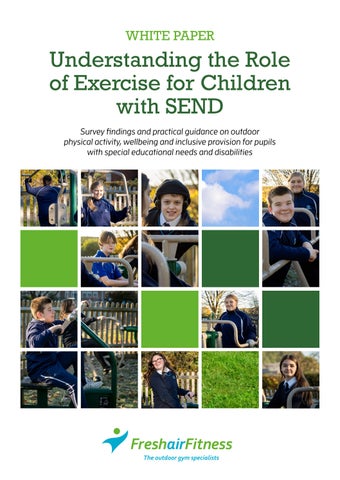
WHITE PAPER
Understanding the Role of Exercise for Children with SEND Survey findings and practical guidance on outdoor physical activity, wellbeing and inclusive provision for pupils with special educational needs and disabilities
Executive Summary This white paper presents the findings of a survey of 15 special educational needs and disabilities (SEND) education professionals across England, exploring the role that outdoor physical activity plays in supporting children with SEND. Respondents included SENCOs, class teachers, teaching assistants, inclusion leads and senior leaders working across mainstream primary schools, special schools and alternative provision. The survey was carried out by outdoor gym equipment specialist Fresh Air Fitness and is supplemented in this paper with independent context on national SEND activity levels, government guidance and published research, alongside a series of blog articles Fresh Air Fitness produced to expand on individual survey questions.
The results show an overwhelming professional consensus that outdoor fitness activity benefits children with SEND. Every respondent (100%) rated outdoor fitness activity as either “very beneficial” or “somewhat beneficial”, with the majority reporting measurable gains in physical health, mental wellbeing, focus and independence. At the same time, the survey highlights persistent barriers to participation, most notably social and emotional challenges, physical coordination or endurance difficulties, and a lack of access to suitable facilities.
Key findings include: • 100% of professionals rated outdoor fitness activity for children with SEND as beneficial, with none selecting “not beneficial” or “unsure”. • 87% observed improved body awareness and 87% observed improved cardiovascular fitness, strength and flexibility as a result of regular physical activity.
• When planning lessons, professionals most valued video demonstrations (60%), instructions on equipment (60%) and user guides for modified exercises (60%).
• 80% identified a lack of access to suitable facilities as a barrier to participation, alongside social/emotional challenges (67%) and difficulty with coordination or endurance (73%).
The paper concludes with practical recommendations for schools, local authorities and equipment providers seeking to build more inclusive, effective outdoor physical activity provision for pupils with SEND.
s
TO CONTENTS
s
• 86% said outdoor physical activity improves focus and concentration, and 80% linked it to reduced stress and anxiety and to better mood regulation.
• When designing physical activity environments, simplicity (“simple solutions that are easy to use”, 33%) and safe, supportive equipment (27%) were rated most important, ahead of variety or non-judgemental atmosphere.
3
Contents
1. Introduction and background
Executive Summary............................................................................................................................................................................
3
1. Introduction and background....................................................................................................................................................
5
2. About this research.......................................................................................................................................................................
5
3. Survey findings..............................................................................................................................................................................
6
3.1 Is outdoor fitness activity beneficial for children with SEND?...........................................................................................
6
3.2 Physical health outcomes......................................................................................................................................................
6
3.3 Mental health and wellbeing outcomes..............................................................................................................................
7
3.4 Barriers to participation.........................................................................................................................................................
8
3.5 What helps professionals plan and run SEND sessions....................................................................................................
9
3.6 Priorities when designing physical activity environments...............................................................................................
10
4. Discussion: What the findings mean for schools and providers.....................................................................................
11
5. Recommendations........................................................................................................................................................................
11
6. Conclusion.......................................................................................................................................................................................
12
About this report..............................................................................................................................................................................
12
Sources referenced..........................................................................................................................................................................
12
Special educational needs and disabilities affect a substantial and growing proportion of the school-age population in England. Recent reporting indicates that just over 1.7 million pupils across England receive SEND support, representing roughly a fifth of all pupils, with numbers continuing to rise year on year, including record levels in some regions. Regular physical activity is recognised as a key contributor to the physical health, mental wellbeing, behaviour, academic performance, social development and emotional regulation of children with SEND. The UK’s Chief Medical Officers specifically recommend that disabled children and young people undertake 120 to 180 minutes of moderate-to-vigorous activity each week, alongside strength and balance activities at least three times a week — broadly equivalent to 20 minutes of activity a day.
Despite this guidance, participation levels remain low. National reporting suggests only around half of children overall meet the recommended 60 minutes of daily activity, and other sector data indicates that close to a third of disabled children do less than 30 minutes of activity a day, a considerably higher proportion than their non-disabled peers. The government’s Inclusion 2028 programme, developed with the Youth Sport Trust, was established specifically to address this gap and improve PE and sport provision for pupils with SEND. Against this backdrop, Fresh Air Fitness — a UK provider of outdoor gym equipment for schools, which has worked with SEND settings since 2007 — surveyed SEND professionals directly to understand their first-hand experience of outdoor exercise and physical activity, the outcomes they observe in pupils, the barriers they encounter, and the practical support they need to plan and deliver effective sessions.
2. About this research The survey, Understanding the Role of Exercise for Children with SEND, was completed by 15 SEND education professionals between September and October 2025. Respondents held a range of roles connected to SEND provision, including SENCOs, class and PE teachers, teaching assistants, inclusion leads, assistant headteachers for inclusion and school administrators with safeguarding or inclusion responsibilities, drawn from primary schools, a special school, an alternative provision setting and preschool provision across England.
TO CONTENTS
s
4
s
The survey comprised six questions covering: the perceived overall benefit of outdoor fitness activity; observed physical health outcomes; observed mental health and wellbeing outcomes; barriers to participation; support needed for lesson planning and delivery; priorities when designing physical activity environments; and respondent contact details for a prize draw. This white paper draws on the closed-question results (Q1–Q6) and the free-text professional commentary submitted alongside them.
5
3. Survey findings
3.3 Mental health and wellbeing outcomes Respondents were also asked how spending time outdoors during physical activity impacts the mental health of children with SEND.
3.1 Is outdoor fitness activity beneficial for children with SEND? Every single respondent — 100% of the 15 professionals surveyed — rated outdoor fitness activities for children with SEND as either “very beneficial” or “somewhat beneficial”. No respondent selected “not beneficial” or “unsure”. This unanimous result establishes a clear baseline: among practitioners working directly with SEND pupils, there is no meaningful debate about whether outdoor physical activity is worthwhile — the open questions are how best to plan, resource and deliver it.
Observed mental health / wellbeing effect
% of respondents
Improves focus and concentration
86%
Reduces stress and anxiety
80%
Helps with mood regulation and emotional expression
80%
Boosts confidence and independence
66%
Source: Survey Question 3 (respondents could select multiple answers; n=15).
3.2 Physical health outcomes Professionals were asked which positive physical effects they had personally observed in children with SEND who engage in consistent physical activity. Observed physical health effect
% of respondents
Better body awareness
87%
Improved cardiovascular health, strength and flexibility
87%
Better sleep quality
80%
Reduced risk of obesity
60%
Improved appetite and digestion
47%
Improved focus and concentration was the most widely observed benefit. Professionals reported that structured indoor environments can heighten anxiety, sensory overload and behavioural difficulty for many SEND pupils, whereas the outdoors offers a flexible, less rigid space that helps children settle, self-regulate and return to the classroom calmer and more able to concentrate.
also reported that outdoor activity boosts confidence and independence, which professionals attributed in part to the absence of a single “right” way to take part outdoors: children can progress at their own pace, take managed physical risks such as climbing or balancing, and build a sense of “I can do this” through small, self-directed successes.
Four in five respondents (80%) linked outdoor activity to reduced stress and anxiety and to improved mood regulation and emotional expression. This aligns with the broader evidence base connecting nature-based activity, such as noticing natural sounds, textures and surroundings, with measurable wellbeing gains, and with UK green social prescribing initiatives that use nature-based activity to support mental health. Two-thirds of respondents
Respondents’ free-text comments reinforced these findings, with one professional describing how connecting with the natural world through outdoor activity supports gut health, immunity and the ability to overcome phobias affecting quality of life, and another noting that outdoor sessions specifically help reduce children’s anxiety about being outdoors in the first place.
Source: Survey Question 2 (respondents could select multiple answers; n=15).
TO CONTENTS
s
6
An equal proportion of respondents observed improvements in cardiovascular fitness, strength and flexibility. Professionals connected core strength gains directly to classroom outcomes, noting that reduced physical fatigue supports better behaviour and concentration during lessons. Given that only around half of children nationally meet daily activity guidelines, and that obesity affects a rising share of pupils by the end of primary school, the 60% of respondents who linked activity to reduced obesity risk, and the 47% who observed improved appetite and digestion, point to physical activity as a practical lever for tackling wider public health pressures within a school setting. Sensory input was also raised by professionals as a distinct benefit, alongside reported gains in social skills and “readiness for learning”.
s
Improved body awareness was the joint-highest rated outcome. Respondents linked this to better coordination, spatial awareness and posture control, which in turn reduces the risk of accidents and supports more confident participation in group activities. Several professionals specifically noted gains in proprioception — the sense of body position — which underpins core strength for handwriting and fine motor tasks such as dressing, cutting and self-care, as well as the ability to cross the midline of the body.
7
3.5 What helps professionals plan and run SEND sessions Respondents were asked what would help them when planning and running physical activity lessons for children with SEND. Support resource
% of respondents
Video demonstrations
60%
Instructions on equipment
60%
User guide with modified exercise information
60%
Printable lesson planners
40%
Access to an app
20%
Source: Survey Question 5 (respondents could select multiple answers; n=15).
Understanding what limits participation is as important as understanding the benefits. Respondents were asked what barriers, if any, they believe prevent children with SEND from taking part in fitness activities in school. Barrier to participation
% of respondents
Lack of access to suitable facilities
80%
Difficulty with physical coordination or endurance
73%
Social or emotional challenges
67%
Lack of trained staff
67%
Financial barriers
33%
Time constraints
27%
Source: Survey Question 4 (respondents could select multiple answers; n=15).
Facilities access was the most commonly cited barrier, ahead of coordination/endurance difficulties and social or emotional challenges. This is consistent with wider sector data showing that psychological barriers are the single biggest obstacle to participation in sport for disabled people generally, even though a large majority say they want to be more active. The professional comments submitted alongside this question added considerable depth, identifying practical and often overlooked obstacles: difficulty with changing for activities, challenges around fuelling or hydrating adequately where disordered eating
TO CONTENTS
s
8
or body image issues are present, fear of being spoken to incorrectly, prior negative experiences such as bullying or school trauma, fatigue linked to hidden disabilities that staff or peers may not anticipate, stigma, a lack of support for parents and carers, and children comparing themselves unfavourably to peers. One respondent also noted that some parents are reluctant to commit to activities after previously paying for classes their child did not fully attend — underlining that barriers extend beyond the school gate into family confidence and finances.
Printable lesson planners, selected by 40% of respondents, were valued for keeping staff attention on pupils rather than on a screen, reducing distraction and supporting the predictable, low-anxiety structure that many SEND pupils respond well to. Access to a dedicated app was the lowest priority (20%), though professionals noted digital tools still have a role, particularly for personalised pacing and repetition. Free-text responses added further nuance, with professionals calling for accessible, low-word, highly visual information; guidance on hypermobility and injury risk; clear explanation of muscle groups worked; realistic expectations about delayed results and muscle fatigue; and adaptable lesson content for pupils with dyspraxia, wheelchair users, visual impairment or balance difficulties. Knowing each child’s specific needs in advance was also raised as fundamental to effective planning.
s
3.4 Barriers to participation
Three resources tied as the top priority, each selected by 60% of respondents: video demonstrations, clear instructions on equipment, and user guides covering modified exercises. This reflects the fact that many SEND learners are visual or kinaesthetic learners who benefit from seeing an exercise performed, being able to rewatch it at their own pace, and having reduced reliance on working memory or verbal instruction. Clear equipment instructions were valued both for safety and to support pupils who prefer to work independently, while modification guides help staff differentiate activities consistently without creating separate resources for every pupil, embedding inclusion into everyday delivery rather than treating it as a bolt-on.
9
Finally, respondents were asked which single factor is most important when planning successful environments for physical activity. Environment design priority
% of respondents
Simple solutions that are easy to use
33%
Safe, supportive equipment
27%
Creating a non-judgemental atmosphere
13%
Solutions that can be modified over time as pupils improve
13%
Variety
7%
Accessibility
0%
Source: Survey Question 6 (single-choice; n=15; remaining 7% selected “Other, please specify”).
Simplicity was the clear top priority. With SEND staff typically managing a wide range of needs within a single session, complex equipment or lengthy instructions become a barrier in themselves; straightforward, intuitive activities let staff spend more time engaging with pupils rather than explaining processes, and reduce the anxiety that comes with not understanding what is expected. Safe, supportive equipment was rated second highest, reflecting the fact that many SEND pupils need additional physical support, stability or reassurance to feel secure enough to explore movement and build coordination over time. Notably, no respondent selected accessibility on its own as the single most important factor, and a non-judgemental atmosphere and equipment that can be adapted as pupils progress were each prioritised by a smaller but consistent group of respondents. Taken together with the free-text comments, this suggests professionals see accessibility as a baseline requirement bound up with simplicity and safety, rather than a separate consideration — reinforcing that inclusion is as much a matter of culture as of equipment, and that pupils develop at different rates and benefit from being able to progress without being excluded or needing a wholly separate lesson plan. Variety was the lowest-ranked single priority, though respondents still recognised its value in maintaining engagement and helping staff identify which activities individual pupils respond to best.
Taken together, the six survey findings tell a consistent story: professionals are unanimous that outdoor exercise benefits children with SEND. The real challenge lies in translating that consensus into consistent, well-resourced, everyday practice, given the barriers professionals report and the specific planning support they say they need.
Three themes cut across all six questions:
Simplicity and clarity reduce barriers on both sides Professionals want simple, easy-to-use equipment and clear, visual, low-word instructions; pupils, in turn, respond better and with less anxiety to activities they can understand quickly. This theme runs from the top-ranked environment priority (simple solutions) through to the top-ranked planning resources (video demonstrations and equipment instructions).
Safety and predictability build the confidence to participate Safe, supportive equipment, a non-judgemental atmosphere and predictable, structured sessions were repeatedly identified as prerequisites for participation, particularly given that social and emotional challenges and coordination or endurance difficulties are among the most common barriers reported.
Facilities and information gaps remain the practical constraint Access to suitable facilities was the single most cited barrier to participation, while modification guides, equipment instructions and video content were the most requested planning resources. This suggests that where schools do invest in accessible, well-documented outdoor equipment, they directly address two of the survey’s largest reported obstacles at once.
5. Recommendations Based on the survey findings, the following practical recommendations are proposed for schools, local authorities, SEND leads and outdoor equipment providers: • Prioritise accessible, all-ability outdoor equipment over highly specialised or complex kit — simplicity and safety were rated more important than variety, and reduce staff time spent on explanation rather than engagement.
• Gather individual pupil needs before sessions are planned, so staff can anticipate hidden fatigue, sensory sensitivities, hypermobility or communication needs rather than adapting reactively.
• Provide modification guides and video demonstrations alongside any new equipment or programme, so that staff can differentiate activities consistently without creating bespoke resources for every pupil.
• Build in structured, regular outdoor activity toward the Chief Medical Officers’ recommended 120–180 minutes of moderate-to-vigorous weekly activity for disabled children, using outdoor gym equipment to help meet strength and balance targets at least three times a week.
• Design outdoor spaces with sensory and emotional safety in mind, not only physical accessibility — for example, offering quieter or more private areas, predictable routines, and options that reduce performance pressure or comparison between pupils.
• Support families as well as pupils, recognising that stigma, cost and prior negative experiences of activity providers can undermine confidence and consistency outside school as well as within it.
TO CONTENTS
s
10
The most detailed free-text response to this question underlined that SEND is a broad, heterogeneous category and that a “one-size-fits-all” approach to environment design is rarely appropriate. This respondent highlighted anxiety reduction as the foundation of a safe environment — including removing mirrors and music, offering private workout spaces, keeping demands and clothing expectations low, and providing individual (not shared) water bottles and snacks — while also stressing that accessibility remains equally important for pupils with physical disabilities.
4. Discussion: What the findings mean for schools and providers
s
3.6 Priorities when designing physical activity environments
11
6. Conclusion This survey of 15 SEND professionals provides a clear, consistent and practitioner-led case for outdoor physical activity as a core part of SEND provision, rather than an optional extra. Every respondent considered outdoor fitness activity beneficial, and large majorities reported concrete gains in physical health, focus, emotional regulation, confidence and independence among the pupils they work with. The findings also make clear that realising these benefits depends on practical support: simple, safe, well-documented equipment; accessible outdoor environments designed around emotional as well as physical safety; and planning resources that help time-pressed staff differentiate confidently for a wide range of needs. Schools, local authorities and providers that address these practical barriers directly are best placed to help children with SEND meet national activity guidelines and experience the full physical, social and emotional benefits of regular outdoor exercise.
About this report This white paper is based on primary survey data collected by Fresh Air Fitness from 15 SEND education professionals across England (Understanding the Role of Exercise for Children with SEND, September–October 2025), together with contextual analysis, national statistics and published research referenced throughout. It draws on and expands the analysis published across Fresh Air Fitness’s blog series on the same survey, covering physical health, mental health, barriers, lesson planning and environment design.
Fresh Air Fitness has designed, manufactured and installed outdoor gym equipment since 2007, working with SEND schools, mainstream education settings, councils, the NHS and other organisations across the UK. Its products are ISO 9001 certified and meet EN1176 and EN16630 safety standards, with a structural warranty of up to 25 years.
Sources referenced • Fresh Air Fitness, “Understanding the Role of Exercise for Children with SEND” survey results (September–October 2025). • Fresh Air Fitness blog: “Successful Physical Activity Planning For SEND” (freshairfitness.co.uk/blog/successful-environments-for-physical-activity) • Fresh Air Fitness blog: “Planning And Running SEND Outdoor Exercise” (freshairfitness.co.uk/blog/planning-send-outdoor-exercise) • Fresh Air Fitness blog: “Outdoor Exercise For SEND Pupils” — mental health (freshairfitness.co.uk/blog/send-exercise-and-mental-health) • Fresh Air Fitness blog: “SEND And Physical Health” (freshairfitness.co.uk/blog/send-exercise-and-physical-health) • Fresh Air Fitness blog: “SEND Pupils And Outdoor Gyms” (freshairfitness.co.uk/blog/send-pupils-and-outdoor-gyms) • UK Chief Medical Officers’ physical activity guidelines for disabled children and young people. • Youth Sport Trust, PE and School Sport: The Annual Report 2025. • Activity Alliance, participation research on disabled people and physical activity. • UK Government, Inclusion 2028 programme (with the Youth Sport Trust). • BBC News reporting on SEND pupil numbers in England.
12
If you have any questions relating to an outdoor gym installation, our team of specialists would be happy to answer them for you.
Call 01483 608860 email sales@freshairfitness.co.uk or visit www.freshairfitness.co.uk