Features
That Separate the Best ERP Solutions from Ordinary Software
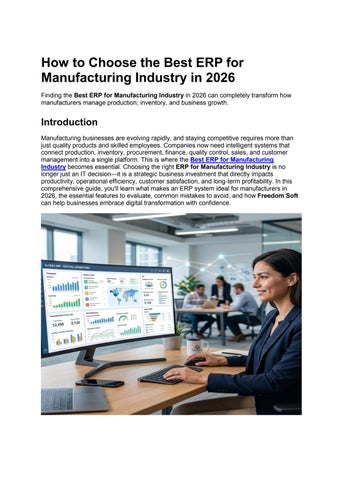
Not every ERP platform is designed specifically for manufacturing operations. While many systems offer basic accounting or inventory management, the Best ERP for Manufacturing Industry includes advanced manufacturing capabilities that support complex production environments. A reliable ERP for Manufacturing Industry should offer production planning, bill of materials management, shop floor control, procurement management, inventory optimization, warehouse management, quality assurance, financial integration, customer relationship management, and detailed business analytics. Automation plays a significant role by reducing manual work, minimizing human errors, and improving operational efficiency. Cloud accessibility, mobile support, AI-powered forecasting, predictive maintenance, and customizable dashboards are also becoming essential features in 2026. Businesses should choose an ERP platform that can scale with future growth, adapt to changing manufacturing processes, and integrate seamlessly with existing business applications. Freedom Soft understands these modern manufacturing requirements and focuses on delivering solutions that simplify complex operations while helping businesses improve productivity and maintain complete operational visibility.
How to Evaluate and Select the Best ERP Partner for Long-Term Growth
Selecting the Best ERP for Manufacturing Industry requires careful planning rather than simply comparing software features. Every manufacturing business has unique workflows, production methods, compliance requirements, and operational goals. Before making a decision, organizations should evaluate their current challenges, identify process gaps, and define measurable business objectives. A dependable ERP for Manufacturing Industry should support future expansion without requiring major system replacements. Vendor experience is equally important because implementation success depends on industry expertise, technical support, employee training, customization capabilities, and continuous product updates. Businesses should also consider user experience, reporting capabilities, cybersecurity, cloud infrastructure, integration flexibility, and implementation methodology. Choosing a trusted technology partner like Freedom Soft ensures organizations receive ongoing guidance throughout implementation, employee onboarding, optimization, and
future system enhancements. Rather than simply purchasing software, manufacturers gain a technology partner committed to long-term operational success and digital transformation.
Essential Benefits Every Manufacturer Should Expect from an ERP Solution
A carefully selected Best ERP for Manufacturing Industry delivers measurable business improvements across every department. Manufacturers should look for solutions that provide both immediate operational gains and long-term strategic advantages.
Centralized business management through one integrated platform.
Improved production planning and scheduling accuracy.
Real-time inventory visibility to reduce stock shortages and overstocking.
Better procurement and supplier management.
Automated financial reporting and accounting processes.
Enhanced quality control and compliance monitoring.
Accurate demand forecasting using real-time business data.
Faster order processing and customer delivery timelines.
Improved employee productivity through workflow automation.
Better business intelligence and executive decision-making with advanced analytics.
A Practical Approach to Choosing the Right ERP Solution
Finding the Best ERP for Manufacturing Industry becomes easier when businesses follow a structured decision-making process instead of rushing implementation.
1. Define your manufacturing goals and operational challenges.
2. Identify the departments that require ERP integration.
3. Create a list of essential manufacturing-specific features.
4. Evaluate scalability for future business growth.
5. Review vendor experience within the manufacturing sector.
6. Request product demonstrations tailored to your workflows.
7. Assess implementation methodology and training support.
8. Verify security, compliance, and cloud capabilities.
9. Gather feedback from end users before final selection.
10. Choose an experienced implementation partner like Freedom Soft to ensure longterm success.
Conclusion
Choosing the Best ERP for Manufacturing Industry in 2026 is one of the smartest investments manufacturers can make to remain competitive in an increasingly digital marketplace. A modern ERP for Manufacturing Industry streamlines production, improves inventory accuracy, enhances collaboration, supports data-driven decision-making, and prepares businesses for future growth. Instead of selecting software based solely on features, manufacturers should evaluate long-term value, scalability, implementation expertise, and ongoing support. Freedom Soft understands the evolving needs of manufacturers and delivers ERP solutions designed to simplify operations, improve productivity, and support sustainable business success. With the right ERP strategy, manufacturing businesses can confidently navigate future challenges while building a stronger, more efficient organization.
Frequently Asked Questions
What is the Best ERP for Manufacturing Industry?
The Best ERP for Manufacturing Industry is a solution that integrates production, inventory, finance, procurement, sales, and quality management into one centralized platform. It helps manufacturers improve efficiency, reduce manual work, and make faster, data-driven decisions.
Why is an ERP for Manufacturing Industry important?
An ERP for Manufacturing Industry improves operational visibility by connecting every department. It streamlines production planning, inventory management, financial reporting, and supply chain operations, helping manufacturers increase productivity while reducing operational costs and process inefficiencies.
What features should manufacturers look for in an ERP?
Manufacturers should prioritize production planning, inventory management, procurement, warehouse management, quality control, financial integration, business analytics, automation, cloud accessibility, reporting tools, scalability, and seamless integration with existing business applications.
Can ERP improve production planning?
Yes. The Best ERP for Manufacturing Industry provides real-time production scheduling, resource allocation, capacity planning, and demand forecasting, enabling manufacturers to optimize workflows, reduce delays, and improve overall production efficiency.
Is cloud ERP suitable for manufacturers?
Cloud-based ERP for Manufacturing Industry solutions offer flexibility, automatic updates, secure remote access, scalability, and reduced infrastructure management, making them an excellent option for manufacturers seeking long-term digital transformation.
How long does ERP implementation usually take?
Implementation timelines vary depending on company size, customization requirements, data migration, and employee training. Proper planning and an experienced implementation partner significantly improve deployment success and reduce project delays.
Can ERP integrate with existing business software?
Yes. Most modern ERP platforms integrate with CRM systems, accounting software, eCommerce platforms, HR systems, warehouse solutions, and third-party applications, creating a unified business ecosystem with centralized data management.
How does ERP improve inventory management?
ERP provides real-time inventory tracking, automated stock updates, demand forecasting, warehouse optimization, and purchase planning. These capabilities reduce stock shortages, excess inventory, and manual inventory management errors.
Why should businesses choose Freedom Soft?
Freedom Soft provides manufacturing-focused ERP solutions with strong implementation support, customization options, ongoing assistance, and scalable technology that helps manufacturers streamline operations, improve productivity, and support long-term business growth.
How often should manufacturers upgrade their ERP system?
Manufacturers should regularly review their ERP capabilities as business requirements evolve. Upgrading ensures access to improved security, automation, analytics, cloud technologies, and advanced manufacturing features that support continuous operational improvement.