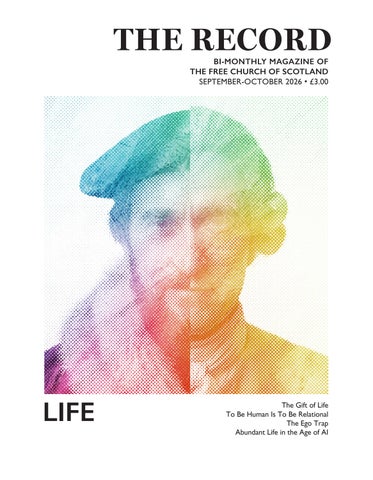
THE RECORD BI-MONTHLY MAGAZINE OF THE FREE CHURCH OF SCOTLAND SEPTEMBER-OCTOBER 2026 • £3.00
LIFE
The Gift of Life To Be Human Is To Be Relational The Ego Trap Abundant Life in the Age of AI
Editor • Angus Mackay editor@freechurch.org
04
Copy Editor • Rebekah Macdonald Mission Director • David Meredith mission@freechurch.org WfM Editor • Catriona Logan Fitch Design & Layout • Fin Macrae @DUFI_Art The Record • ISSN 2042-2970 Publisher • The Record is produced by The Free Church of Scotland Free Church Offices, 15 North Bank Street, The Mound, Edinburgh, EH1 2LS 0131 226 5286 offices@freechurch.org New Subscriptions and Re-Subscribers • The subscription price for The Record for individuals is £30.60 per year. This covers the cost of six editions at £3 + p&p each. Cheques should be payable to the Free Church of Scotland. Please contact the offices for overseas subscription costs.
08 10 20 23
iPhone: Open your camera app and hold the lens above the QR Code, it will automatically detect the link which you can click on to open. Android: Download QR Code Reader from Google Play Store and follow app directions.
FEATURE ARTICLES The Gift of Life Paul Murray To Be Human Is To Be Relational Paul Yeullet The Ego Trap Tom Penman Abundant Life in the Age of AI Cory Brock
07
HOME FRONT David Meredith
13
WOMEN FOR MISSION Catriona Logan Fitch
14
NEWS
26
OBITUARIES Prof John R Mackintosh, Donald R Morrison, Iain George Wilson
29
ADAM'S DIARY I Look to the Hills
31
FOREIGN FIELDS Alina McKenzie
34
BEAUTIFUL INHERITANCE Robin Gray
36
GUEST ARTICLE The Flourishing of Life in a Hostile Environment Callum Macleod
39
BOOK REVIEW Malcolm Maclean
40
FRESH PERSPECTIVES Beth Fraser
Details of the church's activities, latest news and people to contact are all available on the church's website: www.freechurch.org
This QR Code will direct you to the digital version of the magazine on ISSUU.
EDITORIAL Where We Are Going and Why The Editor
www.carbonbalancedprint.com CBP2296
The Free Church of Scotland is a registered charity SC012925 • Women for Mission is a registered charity SC03898
INTRODUCTION
A New Look and a New Team The latest evolution of The Record.
W
elcome to your new look Record. I’m Angus Mackay, your new Editor. I live on the Isle of Lewis with my wife Christina and we have three children — Ruth, David and Hannah. I serve as an elder in Kinloch Free Church and work in the media. After a period of steep decline — if not near extinction — magazines are really bouncing back. I hope that we can surf that wave because it’s vital to the health of the church that it reads and thinks. I’m grateful to be joined in producing the new look magazine by Rebekah Macdonald who has taken on the expanded role of being News Editor as well as Copy Editor, and Dr Malcolm Maclean who will be our new Book Review Editor. You’ll have noticed that the magazine has a stylish new look; that’s a testament to the talent of our graphic designer Fin Macrae who has put a lot of great work into redesigning it. I’m also very excited by the diverse team of writers that have signed up to be a part of the new look Record. We will have voices from right across the Free Church and beyond. In each edition we hope to have four feature articles on the chosen theme. For this first edition the theme is LIFE: Rev Paul Murray writes on The Gift of Life, Rev Paul Yeulett on To Be Human is To Be Relational, Rev Tom Penman on The Ego Trap and Rev Cory Brock on Abundant Life in the Age of AI. In addition to these core articles we hope to have a guest article in each issue, the first being provided by our recently retired Principal Clerk of Assembly, Rev Callum Macleod. Mission Director Rev David Meredith will be keeping us informed on what’s happening within the church and Catriona Logan Fitch will continue to provide updates on the work of WfM. Foreign Fields and Adam’s Diary will add international perspective. I’m delighted too that ETS student Beth Fraser will be providing the voice of youth and that Rev Robin Gray will be mining gems from the past.
2026
Last, but emphatically not least, Rebekah has a vibrant news section for you and our obituaries will continue to honour office bearers who have served among us. Before moving to the editorial, there are people whom I would like to briefly thank both on your behalf and on my own. I would first like to thank on behalf of us all my predecessor, Sarah Robinson. Sarah did a lot of great work and left the operation in very good order. Thanks also to Miriam Montgomery, the former Book Review Editor and those others who have faithfully contributed during Sarah’s time. Their self-sacrifice and service are recorded in a much greater volume. Personally, I’d like to thank my pastor, Rev Paul Murray, and the friends and family who have offered quiet words of encouragement in recent months. Finally, and most importantly, I give thanks to my Lord, without whom I would be nothing and do nothing. (Psalm 18: 31-32) With many blessings, Angus Mackay
Thank you all for your continued support of The Record. We’d love to hear if you have interesting items for the news section. If you do, please email us at editor@freechurch.org
That in all things he might have the pre-eminence Colossians 1:18
03
THE RECORD
EDITORIAL
Where We Are Going and Why Like Issachar, let’s understand the times, so that we’ll know what we should do.
A
s we wind our way through the third decade of the 21st century, the church in the West finds herself in what Dr Carl Trueman has aptly called a Strange New World. We have long been used to a society that rejects aspects of our faith like the incarnation and resurrection, but now we increasingly see around us a rejection of (and sometimes even revulsion for) the wider Christian worldview. That term worldview is useful, because it reminds us that Christianity is more than the gospel of saving grace: it is God’s perfectly ordered system for our whole lives and society. We are privileged to have been born into a country that has been largely defined by that Christian worldview. Our laws, practices, governance and education are historically rooted in Scripture, and we have reaped great benefits from that. More than that, for over 500 years the Christianity that has largely defined how we live has been the Reformed Christianity first codified by John Calvin in Geneva almost 500 years ago. But while the Reformation and the culture it created have dominated Europe for the past half millennium, it hasn’t had the floor entirely to itself. Shortly after the Reformation a philosophical movement emerged that would become known as the Enlightenment and ever since, it has existed beside Christianity and vied with it for influence. So what actually is the broad purpose of the Enlightenment? Like all philosophical movements, the Enlightenment is difficult to define, but the historian Tom Holland has neatly summarised that while the Reformation overthrew the corruption of the medieval church, the
THE RECORD
04
SEP/OCT
EDITORIAL
Enlightenment went much further and aimed to overthrow the Christian faith altogether. Enlightened ideas were initially confined to the salons and artistic circles of Europe’s intellectual elite, but in time they began to find wider acceptance. Over the centuries that followed, Enlightenment men like Hegel, Marx, Darwin and Nietzsche gradually gained greater influence in forming the thought of Europe’s ruling classes. Their ideas helped steer Europe towards the early 20th century and the unfolding of its catastrophe — two wars that would kill tens of millions, and destroy both the continent’s wealth and its place in the world.
“
while the Reformation overthrew the corruption of the medieval church, the Enlightenment went much further and aimed to overthrow the Christian faith altogether.
Rather than perishing with those lost in the World Wars though, the Enlightenment and its ideas have subsequently prospered in the West. In fact, they wield more influence than ever in our society today. In their most aggressive forms, they are seen openly combatting Christian values in government, law, education arts and media. But they can be more pernicious too; sometimes these ideas are found in our society — and even in ourselves — in much subtler forms. So with such a cultural crisis unfolding around us, what is our duty and how should we carry it out? Certainly our duty is to try and understand what is happening and why. That matters so that we know how to defend what we know to be true, but it also matters so that we can properly witness to the society around us and the many lives that need the gospel. But our duty is not only external.
2026
05
THE RECORD
EDITORIAL
“
The church doesn’t exist in a vacuum; it breathes the air around it in every generation. That has probably never been truer than it is right now. Media, and especially social media, has huge influence on how people think. That influence is often insidious, so we need to ask if these ideas are influencing us in how we live our lives too. So our aim for The Record in the coming months and years, as we are spared, is to look in more detail at what’s happening to our society and why. How will we do that? First of all, we need to consider what’s being attacked — things like family, church, community and nationhood. We’ll look at what God’s Word says about these things and why he has purposed them. Secondly, we must examine the ideas that are being used to undermine the Christian worldview and look at how those ideas measure up to Scripture — the ultimate arbiter of every thought and idea. Finally, we’ll consider how the righteous way of God will surely triumph, which is the comfort and joy of the church in every age. So where do we start with it all? Well, for this first edition it seems to make sense to start with the most profound question of all the current strife — what is man? How do we understand what it is to be human? As some of the other writers allude to elsewhere, that current controversy can be traced to the work of the Enlightenment philosopher Jean Jacques Rousseau. Like John Calvin, Rousseau was a Frenchman who made his name in 16th century Geneva. His legacy, however, is very different. His philosophical writings became hugely influential in the development of European political thought, but it’s his later work focusing on man’s internal feelings that matters to us right now. Rousseau came to increasingly define what it was to be human by the inner feelings. To his mind, what you believe you are in your heart is the authentic you. Others would build on his thinking over the centuries, but the work of the man labelled by Dr Trueman as “the other Genevan” can be pointed to as the original wrong turn. He was not alone in writing such things, but his influence was undoubtedly huge. So the articles in this edition of The Record compare Rousseau’s inward-looking view of what it is to be human to the incomparably fuller picture that Scripture paints for us. God offers us no insular and lonely world that focuses on our own hearts and desires; instead, he presents us with a wonderful and multi-faceted life rooted in relationships with himself and others. It’s a life modelled on his own blessed existence and, wonderfully, we are invited into the experience of that. What could be more exciting than that?
So with such a cultural crisis unfolding around us, what is our duty and how should we carry it out?
“
Rousseau came to increasingly define what it was to be human by the inner feelings. To his mind, what you believe you are in your heart is the authentic you.
THE RECORD
06
SEP/OCT
HOME FRONT
The Free Church Is Decentralising BY REV DAVID MEREDITH
H
ere I was at a Saturday morning meeting of church leaders in a local church. I love these things. Bacon rolls, a relaxed atmosphere, yet combined with a deep seriousness about the gospel. Wrapped up in my own mind, I was buzzing with excitement and vision; this was a group of people who clearly “got it”. Then, at coffee, I met him. The older elder uttered words I have never forgotten: ‘Whenever there is a ridiculous idea around here, you can be sure it comes from Edinburgh.’ In fairness to the good man, I don’t think he was getting specifically at me — it was just a mildly expressed rage against the machine. (Or perhaps my EQ is just diminished these days!) This column, however, will be going in a slightly different direction. In the Free Church, “Edinburgh” isn’t just the capital city of Scotland. It’s the home of the Free Church Office and Edinburgh Theological Seminary — the place where, in the old days, many key decisions were made. A previous editor of The Record once remarked that he always knew when committees were sitting because there were new anoraks on the clothes pegs and Volvos in the car park. Times have changed. Decisions are now just as likely to be taken from a comfy chair in Latheronwheel as from EH1. So, what is this different direction? The plan is to network and publicise what our various groups and boards are actually doing. We want to share both news and views on how our collective decisionmaking feeds into our ultimate goal: establishing healthy gospel churches in our communities. Essentially, we want to give you the inside track. Let me start with a general observation. When I attend boards and committees these days, there is a palpable sense of excitement at what God could do through us. Few things on this earth are as invigorating as a group of highly motivated people dreaming about gospel opportunities carried out in God’s power. Collectively, it feels like praying Norman Grubb’s famous morning prayer: ‘Good morning, Lord! What are you up to today? Can I be a part of it? Thank you. Amen.’
2026
The old days were too often marked by division, argument, and frustration as we declined. Don’t misunderstand — there are still issues, but the Lord has granted a wonderful sense of calm urgency. It’s not always fashionable to report good news; human nature often prefers the toxic gas of cynicism over the oxygen of encouragement. Take one brief example: The Mission Board has decided to focus on “discipleship” as a key theme for 2027. Mission isn’t simply about gathering converts; it’s about making disciples. Discipleship is our apprenticeship to Jesus — a lifelong journey of becoming more like him. To what extent do we proclaim an emaciated gospel that is perceived as little more than an enhanced fire protection policy? Life is more than an escape from eternal death; Jesus promises life to the full.
“
Mission isn’t simply about gathering converts; it’s about making disciples. Discipleship is our apprenticeship to Jesus — a lifelong journey of becoming more like him.
No board or committee has the power to bring spiritual life to a person or congregation. We can, however, provoke each other to good works. My hope is that one day, my friend at coffee will see an idea or a video produced by the wider church, turn to a friend and say, ‘Have you seen this?’ What will follow will be an hour long conversation, prayer and hug which reveals that we are walking more in the footsteps of the master. David Meredith is Mission Director for the Free Church. He planted Smithton Church, Inverness where he remained for 30 years before taking up the denominational role.
07
THE RECORD
FEATURE ARTICLE
The Purpose of Life BY REV PAUL MURRAY
What does God want you to do with his amazing gift?
W
made us ‘for his glory.’ (Isaiah 43:7) That is, not to make God more glorious than he is, which would be impossible, but rather to display the glory that he has. It’s this profound truth that the Westminster Shorter Catechism draws from when it answers its first question, ‘Man’s chief end is to glorify God, and to enjoy him forever.’ Humanity has no higher function, no more dignified purpose, than this — to reflect the glory of God.
hat is my purpose in life? Is there real meaning in life? Why am I here? These are questions that every civilisation has asked. Answers range from finding purpose in increased knowledge, better relationships, deeper experiences, devoted religion, or improved material circumstances. Others have argued that purpose is personal to the individual. So John-Paul Sartre wrote that ‘Man is nothing else but what he makes of himself.’ There is no higher purpose or reason for life. Life, purpose, meaning — these are things that we must define for ourselves. He was more blunt when he wrote that ‘It is meaningless that we live, and meaningless that we die.’ Effectively, there is no higher meaning. To his credit, Sartre’s conclusion was consistent with his atheism. Yet and all, it’s a miserable answer, and one that gives little by way of satisfaction to the restless mind and the thirsty soul. The Bible begins to tackle the question of purpose by first explaining to us not why we are here, but how we are here. It tells us that the God who ‘in the beginning created the heavens and the earth’ also said, ‘Let us make man in our image, after our likeness.’ How are we here? We are here because God has gifted us life and continues to preserve that life — it is in him that we ‘live and move and have our being.’ But how does the how question relate to the why question? It relates to it for the simple reason that a creator always creates for a purpose. So, whether it be the baker’s loaf, the artist’s canvas, or the carpenter’s table, each creator has an intended use for their creation. Origin and purpose, arche and telos, are always interconnected. If that is true with human creators, how much more so with the Creator God? God is surely not a less thoughtful Creator than you or I? On the contrary, the Bible teaches that God
THE RECORD
“
whether it be the baker’s loaf, the artist’s canvas, or the carpenter’s table, each creator has an intended use for their creation. Origin and purpose, arche and telos, are always interconnected.
We are not here primarily for pleasure, wealth, power or reputation; not even for relationships with other people. As good as many of these things may be in their own place, to live for them is to dedicate body and soul to a purpose for which they were not designed. This purpose is implied by the fact that God made us ‘in his image.’ He imprinted his own glorious likeness upon humanity. His end goal in making us was to reveal something of his own glorious being — his wisdom, power, holiness, justice, goodness and truth. Herman Bavinck wrote: ‘It is God’s good pleasure to bring the excellences of his triune being into manifestation in his creatures, and so to prepare glory and honour for himself in these creatures.’ 1 This reveals the great privilege of the life that God has given us; it isn’t just any life, but life
08
SEP/OCT
FEATURE ARTICLE
that has been derived from, and patterned upon, his own divine, self-existent life. Of course, sin has greatly marred God’s image in us, but those who are united to Jesus Christ by faith, and indwelt by his Holy Spirit, are being ‘renewed in knowledge according to the image of him that created [them].’ (Colossians 3:10) In other words, God is in the business of restoring his image in his people, that they might increasingly reveal his divine character to the world. But how do we do that? A simple answer would be, by being like him. What is God like? One truth which impacts every other aspect of his being is that God is relational. God’s life is one of fellowship; he is not solitary or lonely, but exists eternally in the communion of Father, Son, and Holy Spirit. It is out of this eternal fellowship that God freely and lovingly communicates himself to creatures, so that they will share in his life and glory. God’s unchanging divine image is relational. It is that relational image that we are being patterned upon – God’s character is the blueprint for our sanctification. Donald Macleod wrote: ‘The fact that we bear the divine image means that we are made for fellowship … The Father, the Son, and the Holy Spirit live in community and fellowship. The same must be true of us.’ 2 As we are being conformed to the image of Christ (Romans 8:29), we are becoming increasingly relational, and as we do so, we increasingly reveal the glory of God. But relational with whom? The Bible gives a two-fold answer. Firstly, God has made us to live in relationship with himself. The Apostle Paul reminds us that all things are not only, ‘of him, and through him’ but ‘to him.’ (Romans 11:36) In other words, we are made for God, for relationship with him. This relationship is defined by love for God, obedience to God, trustful reliance upon God, and a joyful reverence in approaching God. Our duty and privilege in the Christian life is to increasingly live out this relationship and grow in it. We do so, as in our human relationships, by dedicating time to it. The 1 2
Christian grows in God’s presence, adoring him in worship, listening to him in Scripture, and speaking to him in prayer. We grow as we learn to be ‘patient in adversity, and thankful in prosperity.’ (Heidelberg Catechism 28) As we develop our personal relationship with God, we are displaying his glory. Are you looking for purpose in your life? Then spend time with God. But the wonder of the Triune God is that his self-giving love broke out of the Trinity and extended towards fallen humanity. He entered into covenant with sinners, promising to be their God, and they his people. (Exodus 6:7) The great revelation of this self-giving love is the death of Jesus Christ, the Son of God, who ‘loved me and gave himself for me.’ (Galatians 2:20) As we grow in godliness, we are growing relationally, not just towards God, but towards other people. We are learning to live in selfgiving love towards those around us. We seek to do good to all men, and to love even our enemies. Especially, we seek to do good to the household of faith, dedicating ourselves to our brothers and sisters in Christ, delighting ourselves in the Church, and giving ourselves in self-denying service to the body of Christ. In doing this, we are revealing something of God’s own relational, self-giving glory. In loving and serving others, we are glorifying God. Are you looking for purpose in your life? Then spend time loving and serving those around you, particularly fellow believers in the Lord Jesus Christ. When I lived in Edinburgh, my daily walking route to college took me past John Knox’s house on the Royal Mile. There, written on the side of the house in bright gold letters, are the immortal words, ‘Love God above all, and thy neighbour as thyself.’ That is our purpose. That is how we glorify God. Hailing from Ness on the Isle of Lewis, Paul Murray is minister of Kinloch Free Church on his native isle. He is married to Amanda and they have a family of four.
H. Bavinck, Our Reasonable Faith: A Survey of Christian Doctrine, trans. Henry Zylstra, Grand Rapids: Baker Book House, 1977, 169 D. Macleod, Shared Life, London: Scripture Union, 1987, 47
2026
09
THE RECORD
FEATURE ARTICLE
To Be Human Is To Be Relational London-based pastor REV PAUL YEULETT looks at the importance of relationships to our humanity and how that reects the image of God in us.
O
ver forty years ago Fish, the lead singer of the neo-prog band Marillion, sang the following lines in the track Blind Curve, from their highly successful album Misplaced Childhood: I just want to be free, I’m happy to be lonely Can’t you stay away? Just leave me alone with my thoughts
Image by Photoholgic on Unsplash.com
Do you recognise the feeling? I’m happier and better off all on my lonesome. Other people just intrude and interfere, with their own agendas and priorities; to be perfectly frank they get in my way, take up my time, and wear me out. Give me a room of my own, some food and drink of my own, a screen of my own, and Bingo! — that’s my definition of happiness. We have been encouraged to think of ourselves as autonomous and entirely self-sufficient. And it wasn’t the Neo-Prog Eighties or even the Swinging Sixties that first suggested the idea. We can go back to Sigmund Freud (1856-1939) and his theory of the human personality: that the so-called Id, our innermost drive, is directed by the Ego, which takes account of societal interactions, and still more by the Superego, which applies cultural restraints to our behaviour. But all three of these Freudian layers, which together comprise my personality — indeed my very identity — are, at the end of the day, simply me, myself and I. Who am I? I’m defined by no one and nothing but myself. We can go back still further, if you like, to Jean-Jacques Rousseau (1712-88) who taught that we are at our natural best in a solitary state; interaction with so-called civilized society is what corrupts and debases our native, beautiful humanity. The trouble with all this, of course, is that it flies in the face of all honest human experience. The unavoidable reality is that to be human is to be relational. This should not surprise us, because the whole universe is governed by relationships. At the macro level, stars belong to their galaxies, and planets orbit their parent stars. At the micro level, atoms assemble in molecules, and from what we learn — it becomes more mysterious the deeper you probe — the various subatomic particles interact in various, complex relationship patterns. More
THE RECORD
10
SEP/OCT
FEATURE ARTICLE
familiar to us all is the delicate symbiotic relationship which exists between the world’s various ecosystems: the atmosphere, the oceans and the rainforests. The whole of life, the entire biosphere, is a vast network of organic relationships, whether we are thinking about bees collecting their nectar, birds nesting in trees, or even the good bacteria that nestle in our gut, resulting in health benefits that we are only now beginning to appreciate. But when we focus on specifically human relationships we ascend to a far higher plane. Take the words of David in Psalm 27:10. ‘For my father and my mother have forsaken me, but the LORD will take me in.’ For David, or indeed for any soul, to speak of his parents — notice that warm, intimate ‘my’ — is to unlock a thousand-and-one priceless memories and associations. We are all nurtured, trained and shaped by familial influences which long precede our conscious memories.
“
We are all nurtured, trained and shaped by familial influences which long precede our conscious memories It’s not just about family, either. The various worlds of friendship, employment, community, recreation — shall we even throw in politics! — call for celebration. When we throw ourselves into these relationships with gusto, we thrive as human beings and enable others to do so; in fact, we fulfil the commandment to love our neighbour as ourselves. In these post-Covid days of endless screens and social media, we urgently need to hear this message. The exhortation ‘Get out more!’ became a cliché over twenty years ago, but we need it now more than ever. It is being recognised increasingly than human flourishing is not merely a matter of a healthy body and a healthy mind; it is at least as much about healthy human relationships. The flipside of this is that the rupture or cessation of the closest human relationships is the very essence of tragedy. The text of Psalm 27 gives no clue as to why David’s parents have forsaken him, but as we read his words we sense their absence keenly. Stories of orphans — whether Oliver Twist or Harry Potter — wring the human heart. But tragedy arises in other ways: through conflict, alienation, misunderstanding, irresponsibility, severe episodes of mental illness. At some point in life we come to this inevitable conclusion: every family is a dysfunctional family to a greater or lesser extent, and the same is true of friendships, communities, work environments and, if we are being perfectly candid, churches. It is the LORD God who comes to David, in his isolated and bereft circumstances, to ‘take me in’. The language suggests a farmer leaving nothing behind in the field, but gathering all the sheaves safely into the barn; or indeed the shepherd who ranges far and wide to track down that one lost sheep, and bring him home rejoicing.
2026
11
THE RECORD
FEATURE ARTICLE
“
Here is the Covenant God who said at the beginning, ‘Let us make man in our image, in our likeness’, and simultaneously pronounces that ‘It is not good that the man should be alone’ (Genesis 1:26, 2:18). These words, with their immediate and supreme reference to marriage, have wider implications: the man or woman who never marries will nevertheless thrive, and enable others to thrive, as they engage themselves in the full range of human relationships and responsibilities which present themselves. But here is the God who takes his people, ultimately, to himself. He is the ‘father of the fatherless and protector of widows’, who ‘settles the solitary in a home’: his home (Psalm 68:4-5). One of the most famous prayers in all Christian history, outside the Bible itself, is Augustine’s heart-cry: ‘You have made us for yourself, O Lord, and our heart is restless until it rests in you.’ How is this made possible? At the cross of Calvary, Jesus, the Son of David, became the embodiment of Psalm 27:10 in a unique sense. He reached the point of ultimate forsakenness when he cried out, ‘My God, my God, why have you forsaken me?’ (Matthew 27:46; Mark 15:34) He was all alone, alone to the point of utter desolation, on the cross.
He reached the point of ultimate forsakenness when he cried out, ‘My God, my God, why have you forsaken me?’ He was all alone, alone to the point of utter desolation, on the cross. All the Psalms which speak of rejection, horror and appalling loneliness came to their fulfilment at that point. The cross of Calvary is the darkest epitome of all human tragedy. David wrote Psalm 22; David wrote many Psalms that sink into the depths of forsakenness, but only Jesus fully experienced them. But through the forsakenness of Jesus, and only because of that forsakenness, people like you and me can know that we are reconciled, truly ‘taken in’ by the Father who will never leave nor abandon us. What is the ultimate proof that to be human is to be relational? It is that God gave his only Son, and indeed sent his Spirit, in order that the Father and the Son might make their home with us (John 14:23). Think of all the best associations of ‘home’, and then consider just how great, how deep, how warm and tender the love of God is. ‘Surely goodness and mercy shall follow me all the days of my life, and I shall dwell in the house of the LORD forever’ (Psalm 23:6).
Paul Yeulett, originally from Cambridgeshire and then a secondary maths teacher in Tyneside, is Pastor at Grove Chapel in Camberwell, South London, a congregation of the International Presbyterian Church. Paul is an avid fan of history, politics, cricket, astronomy, travel and food of various kinds.
THE RECORD
12
SEP/OCT
WOMEN FOR MISSION
Facilitating Youth Work BY CATRIONA LOGAN FITCH
W
e at Women for Mission are passionate about seeing God’s work flourish in Scotland and abroad. We’re privileged to have witnessed how the Lord is working in our congregations up and down the country and to be involved in supporting the mission field oversees. As with so much in life, funds are needed to make progress. Women for Mission currently manage two funds, which anyone within the Free Church of Scotland can apply for. WfM’s Support a Volunteer Fund gives financial assistance to those volunteering for short-term mission work overseas. We support mission at home in Scotland through our Heart for Home Fund, which offers support to those who wish to show Jesus’ compassion to those around them in their communities. We’ve had a number of applications recently with a particular focus on youth work. We’re so encouraged to be able to help in this way.
experience in the daily lives of missionaries, and to be involved with local churches. Rebecca Tait has gone to work with Operation Mobilisation in Jamaica, where she will be working as a primary teacher on board the Logos Hope ship, teaching the children of other missionaries. “Flourish” Project total We are delighted to announce the fundraising total for our 2025/26 project “Flourish”. With your support, the final fundraising total is an amazing £41,907.35. This total is only possible because of the events and initiatives that churches engage in — all of the quiz nights and soup and pudding events really do add up! Praise God for his provision and we pray that he would bless the organisations supported.
Heart for Home examples: • Buccleuch Free Church in Edinburgh used funding to purchase new toys and playmats for their toddlers’ ministry. • The fund was used by Dornoch Free Church for their weekly outreach group, Enlightening Youth, for P7-S6 ages children. • Fort William and Kilmonivaig Free Church used the funds to support the running of a Family Fun Day. • A new Playstation was purchased for a Teen Cafe Youth Club run by Charleston Community Church.
When Strivings Cease: Women’s Conference We’re excited to have Cathy Steed and Mairi Smith join us as our main speakers at our WfM Conference, held at Smithton Free Church (Inverness) on 12th September. Held every two years, this conference will centre around the theme of rest. The conference will feature talks from our speakers, lunch, a Q&A, stalls and a bookshop. Details of how to book tickets can be found on our website.
Support a Volunteer examples: A group of seven young people led by Luke Davidson travelled to Jimbolia to work with the Blythswood Care Project for three weeks. They supported a children’s summer camp, which involved crafts, games, singing and Bible-based talks. Hannah Fowler undertook a six week visit to Ecuador to work with SIM Mission in Ecuador. This was to work with children and youth, to gain
2026
Catriona Logan Fitch currently lives in Edinburgh, originally from the Isle of Lewis. She works as a graphic designer and is a member of the Women for Mission committee.
13
THE RECORD
NEWS
New Minister for Abbeygreen Church
R
ev Colin Fast was inducted as minister to Abbeygreen Church, Lesmahagow, on Friday 19th June after a threeand-a-half-year vacancy. Rev Jonathan DeGroot led the induction service with Rev Norman Mackay (former Interim Moderator) preaching from Isaiah 6, drawing wisdom from the prophet on how to stay the distance with God in ministry. Following formal proceedings, Abbeygreen Kirk Session led a shorter informal gathering chaired by the recent Interim Moderator, Rev Dr Ben Castaneda. Opportunity was taken to thank the vacancy committee, session clerk, and interim moderators for their diligence before the Fasts were formally and warmly welcomed into the congregation. Presentations were made to Rev Fast, his wife Elise, and their son Abel. After the Abbeygreen Church choir sang a song of great edification Rev Colin Fast with wife Elise and son, Abel and praise, Rev Fast was officially given the chair of the congregation. Before closing the gathering with a psalm of praise and prayer, Rev Fast took the opportunity to thank various people and groups who had been a support and encouragement to him in his journey from Canada into ministry in Scotland. The meeting then closed with a time of fellowship over supper in the church hall. The Sunday morning of induction weekend saw Rev Fast leading the church for the first time in public worship as the minister, wherein he intimated in his sermon from Isaiah 40:6-8 that the ministry and foundation of the church should not be based on men or personalities, but the Word of God alone.
REV NIGEL ANDERSON RETIRES FROM MINISTRY
T
he congregation of Trotternish Free Church met together on Friday 26th June for a farewell lunch and to say thank you to its minister, Rev Nigel Anderson and his wife Janice. Nigel was retiring from the ministry on 30th June having faithfully served the Free Church for 21 years. Nigel began his ministry in Ayr where he served for four years then in Livingston where he served for 13 years. While in the Edinburgh Presbytery he also lectured in the Edinburgh Theological Seminary. Nigel was inducted into the ministry in Trotternish in March 2022. It was a homecoming for Nigel and Janice as, before entering the ministry, Nigel was
THE RECORD
teaching history in Portree High School. Both their daughters, Cathryn and Seona spent their early school years in Portree. The past few years have been difficult for the Trotternish congregation — a number of deaths of faithful members and Nigel has retired earlier than planned. But God is sovereign. ‘And we know that in all things God works for the good of those who love him, who have been called according to his purpose.’ (Romans 8:28) The congregation is seeking God’s blessing as it looks to the future. There is a hope that more people will come to know Jesus, bringing in new people, new members, and growth in the congregation.
14
Rev Nigel Anderson with his wife Janice
SEP/OCT
NEWS
FREE CHURCH LICENCES FIVE MINISTERS
I
n Presbyterian practice, licensing is when a student graduates to become a probationer minister. At this point, he is eligible to be called to a congregation when he is ordained. Both licensing and ordination are the responsibility of a group of local churches known as a Presbytery. Stephen Strong was licensed by the Glasgow and Argyll Presbytery on Tuesday 7 th July. He is pictured here (right) with his wife Hannah, children Noah and Eva and his parents Gordon and Anne. Will Sanders, Simon Attwood and Simon Rehberg were licensed by the Edinburgh & Perth presbytery in June. Scott MacLeod was licensed by the Western Isles Presbytery also in June.
Rev Colin Macleod, Scott Macleod and Rev David Macleod
Will Sanders, Simon Rehberg and Simon Attwood
Scottish Government Proposes Major Changes to Abortion Law
T
he Scottish Government is currently considering major reforms to abortion law following the publication of the Expert Group on the Review of Abortion Law in Scotland. The SNP’s 2026 Holyrood election manifesto committed the party to taking forward a consultation on the Expert Group’s recommendations, making future legislation a real possibility. While no Bill has yet been introduced, the proposals would represent some of the most significant changes to abortion law in Scotland since the Abortion Act 1967. The major recommendation is that abortion should be treated primarily as a healthcare matter rather than a matter of criminal law. In the last year the UK Parliament has removed criminal liability for women ending their own
2026
pregnancies in England and Wales, including outside the existing legal framework. However, the Scottish proposals go significantly further. Whereas the recent changes in England and Wales relate primarily to criminal liability for women acting in relation to their own pregnancies, the Expert Group recommends removing abortionspecific criminal offences more broadly and regulating abortion primarily through healthcare law and professional regulation. At present, abortion law recognises that abortion is unlike most other medical procedures because it intentionally involves the ending of unborn human life. For that reason, the law contains safeguards, certification requirements, gestational limits, reporting obligations, and criminal offences
15
THE RECORD
NEWS
designed to regulate when and how abortion may lawfully take place. The Expert Group proposes removing abortion-specific criminal offences and regulating abortion primarily through healthcare law and professional guidance. Supporters argue that this would modernise an outdated legal framework but the truth is it would remove important legal protections and further diminish society’s recognition of the value of unborn life. As Christians, we believe that every human being is made in the image of God and possesses inherent dignity and worth from conception to natural death. For that reason, the Church has long believed that unborn children deserve legal protection and that society should be especially cautious about removing safeguards designed to protect the most vulnerable. Questions concerning the protection of unborn life therefore deserve careful and serious consideration. We are deeply concerned that these proposals risk permitting abortion up to birth on broad psychological or social grounds. The Free Church of Scotland’s Public Engagement Group recently submitted a substantial response to the Scottish Government’s stakeholder consultation process. Our response raised concerns about decriminalisation, the removal of safeguards before 24 weeks, the weakening of the 24-week limit, conscientious-objection protections, and the treatment of abortion as simply another area of healthcare.
At the same time, our response emphasised the need for compassionate support for women facing crisis pregnancies, protection from coercion and abuse, and practical care for those experiencing difficult circumstances. To read the full overview of the proposal, as outlined by Rev Stephen Allison, and the Free Church’s response, use this QR code:
Amnesty International UK Apologises for Report
A
mnesty International UK has publicly apologised for a report which branded dozens of Christian organisations as “anti-rights”. It has accepted the document, A growing threat: the anti-rights movement in the UK, ‘should never have been published’ and ‘full responsibility for this error rests with Amnesty International UK.’ The report said dozens of Christian charities, gender-critical groups and pro-life organisations were targeting ‘the rights of women and LGBT+ people’. It also singled out Beira’s Place, a service supporting women who have been victims of sexual violence. The document called for the charitable status of these organisations to be reviewed. Christian organisations named in the report included the Catholic Bishops Conference of England and Wales, Evangelical Alliance UK, Christian Medical Fellowship and CARE. Amnesty pledged to undertake a review, after criticism of the document when it was shared in July. In a statement Amnesty said: ‘The briefing was taken down within 48 hours of publication, as soon as management were notified of its existence, was not actively promoted, and will not be republished. We have an ongoing internal investigation into how this briefing came to be published.’ The apology follows calls from 11 of the blacklisted Christian charities to the Charity Commission to defend their right to participate in public debate. In their letter to the regulator, they accused Amnesty of making a ‘lazy generalisation’ in the way it had listed broadly different groups together, and objected to being labelled “anti-rights” when many ‘exist specifically to protect the fundamental freedoms that have formed the bedrock of democratic society for centuries, have deep roots in Christian thought, and are enshrined in international human rights frameworks’.
THE RECORD
16
SEP/OCT
NEWS
WORLD NEWS IN BRIEF INDIA: Recently passed anti-conversion laws in 13 Indian states are being used to persecute Christians with false accusations, arrest and interrogation. In Bharanda, Chhattisgarh, 26 families were evicted from their homes in June after being accused of breaking these laws. Barnabas Aid reports that these families have since been allowed to return, though tensions in the area remain high. Chhattisgarh has also banned house churches, under the guise of maintaining community harmony. Converts from the Hindu faith are at particular risk in India, as Hindu nationalism is on the rise, and as more states pass increasingly strict anti-conversion laws the safety of Christians in the country becomes more precarious.
SUDAN: Christian Solidarity Worldwide has raised concern over recent violence in the Nuba Mountains of Sudan, a region known for religious and ethnic diversity and usually a place of peaceful coexistence. Reverend Adil Idris Jangoul was executed extrajudicially along with six other people after members of an armed faction arrested him at his church residence in the town of Heban on 23rd July. In a related incident, members of the Otoro ethnic group killed at least 10 people and took at least 20 hostages, including children, in an attack on Heban which also occurred on 23rd July. Among the hostages was Reverand Yakoub brahim Tia, the former General Secretary of the Sudanese Church of Christ who is from the Shawaya ethnic group, and six members of his family. All of the hostages were released safely on 28th July following appeals by church ministers from different ethnic groups in the Nuba Mountains. Sudan has been in a state of civil war since 2023, a situation that has compounded an already difficult existence for the country’s Christian minority. Many church buildings have been bombed, taken over and used as bases by militias and radical groups. Christians face intense discrimination everywhere — in courts, the workplace and schools. Sudan is #4 on Open Doors International’s 2026 World Watch List.
IRAN: Christians in Iran are heavily and systemically repressed, as the authorities seek to root out what they see as a threat from the West to undermine their Islamic rule. Military Intelligence has recently classified Christian satellite broadcasters as hostile organisations, and authorities reportedly confiscated houses and property belonging to St Peter Evangelical Church in Tehran in July, forcing families to flee. The European Centre for Law and Justice called on the UN’s Human Rights Council to ‘take concrete steps to address the systematic abuses of religious freedom committed by Iran.’
DATES FOR THE DIARY 12th September
WOMEN FOR MISSION CONFERENCE, Smithton Free Church, Inverness
25th September
OPEN DAY, Edinburgh Theological Seminary
26th September
ANNUAL CONFERENCE, Edinburgh Theological Seminary IN A BIG COUNTRY CONFERENCE, Western Isles
3rd October
BIG FREE RALLY, Smithton Free Church, Inverness
24th October
IN A BIG COUNTRY CONFERENCE, Dingwall NATIONAL DAY OF PRAYER
18th November
2026
17
THE RECORD
NEWS
FREE CHURCH YOUTH CAMPS 2026 REPORT
Y
oung people from across Scotland and further afield enjoyed a busy week of fun, games and learning more about Jesus at Free Church Youth Camps (FCYC) this summer. Twelve camps, across five locations (Oswestry, Arbroath, Barcaple, Renfrew and Kincraig) brought together in excess of 350 young people aged 10 to 18 for an action-packed programme of activities, sports and Bible teaching. From excursions and team challenges to lively worship and evening talks, the camps created a space for friendships to grow and faith to deepen. Over 150 camp leaders and volunteers gave their time to serve at camp this summer. A focus of FCYC is to help campers explore what the Christian faith means for them and how to apply it in everyday life. Many campers return year after year, with some going onto become leaders themselves. FCYC hope the young people will take what they’ve learned back to their schools, churches and communities, and give thanks for everyone who so willingly make camps possible year after
THE RECORD
year: leaders, cooks, drivers, chaperones, and everyone behind the scenes. What some campers said: ‘The best thing about camp was the evening meetings, especially the worship singing.’ ‘The best thing about camp was the leaders.’ ‘It’s a great chance to see your camp friends again and learn more about God.’ ‘Making new friends and new relationship with God.’ Donald A Macleod, Camps Supervisor, said: ‘It was a great encouragement and blessing to see so many young people and leaders come together across the summer. At all camps, young people had opportunities to build friendships, have fun together and, most importantly, hear more about God, his Word and the claim that he makes on their lives. ‘Such an ambitious programme is not without its challenges, but we are thankful for the way these were addressed and overcome by our skilled leadership teams.
18
SEP/OCT
NEWS
‘FCYC are especially grateful to God for the safe travel of so many young people and leaders as they journeyed to and from camp. ‘Above all, we give thanks to God for the commitment, generosity and sacrificial service of so many people throughout the church family. From those involved in leadership and teaching to those working behind the scenes in transport, cooking, administration, fund raising and practical support. We give thanks for them all and the wonderful young people who together make camps such an important part of the church’s work.’ We look forward to seeing as many campers and leaders as possible at the Big Free Rally in Inverness on 3rd October at Smithton Church, Inverness. The lead speakers this year are Rev Matty Guy (Dingwall) and Rev Scott Hamilton (Mearns). For more info and to book please use this QR code:
2026
19
THE RECORD
FEATURE ARTICLE
The Ego Trap BY REV TOM PENMAN
A look at the problems and pitfalls of a life defined by the inner self.
‘Y
THE RECORD
20
SEP/OCT
Image by Mariel Reiser on Unsplash.com
ou do you!’, ‘Stay true to yourself ’. When we hear phrases like these, what thoughts come into our heads? They’re a call to be authentic and express what is really inside. But is that how we should live? Our answer will depend on how we understand ourselves. And this is often shaped by previous generations of thinkers we may never have heard of. One of those thinkers is Jean-Jacques Rousseau, born in Geneva in 1712. Rousseau was many things. A self-taught writer who left school aged twelve. A composer of music and a political theorist whose legacy was claimed by leaders of the French Revolution. The writer of the first modern autobiography. An educational theorist who abandoned his own children at orphanages. And, as Carl Trueman and others have shown, he was a philosopher who presented humans as being defined by their inner life, their feelings and emotions. Rousseau was not the first writer to consider the inner life. However, Rousseau rejected the optimism of his time. Where other 18th Century writers argued that reason could improve society and morality, Rousseau argued that civilisation, science, and literature had instead corrupted it. Rousseau presented humans as inherently good. He proposed that before civilisation arose, humans lived peaceful and solitary lives. As societies developed, inequalities and competition arose. People began to want recognition and behaved differently to get it. They became vain, hypocritical and alienated from themselves. They were not living as they were truly meant to be. Rousseau summed up the effect of this in his famous statement ‘Man is born free and everywhere he is in chains’. Each person is born free but loses that freedom when raised in a society which imposes on them expectations and limitations.
FEATURE ARTICLE
“
It is important to realise that Rousseau was not interested in whether his ideas were historically accurate. They were a thought experiment aiming to understand what a human is so he could judge the society of his own day. He never thought that humanity could return to a pre-civilisational way of life. Instead, he wrote on how things could be improved in his political and educational works. However, if humans are naturally good and society corrupts us, then it implies that our true selves are found apart from society or external influences. Our true selves must be found from within. The academics Benjamin and Jenna Storey have called Rousseau “an apostle of authenticity”. To be true to ourselves, that is, to be authentic, we must trust in our feelings and intuition not what society expects of us. Our truth comes from within. Rousseau wrote his autobiography to show his true inner self to the world, both good and bad. He applied the same approach to religion and argued that truth about God was discovered by looking inwards at our feelings.
...for centuries the description given to sin has been the Latin term “incurvatus in se”, to be curved in on yourself. Rousseau’s ideas can be found throughout the modern West. People do not need to know his name and the details of his argument to repeat his ideas or be shaped by them. For example, Rousseau believed that there was such a thing as human nature and a right way to be a man or a woman. Today, our society has accepted the idea that our true selves are found by looking inward but generally rejects that these will line up with a pre-existing nature. Our inner feelings are accepted as being a true sense of identity so that to refuse to act on them is not just inauthentic but self-repressing. Examples of characters in movies and television throwing off society’s expectations so as to express their “real” selves abound. In the animated movie Mulan, the
2026
21
THE RECORD
FEATURE ARTICLE
“
main character washes off the heavy makeup expected by her family and sings ‘somehow I will show the world what’s inside my heart’. While conservatives have recently criticised Disney for going “woke” (however defined), the company has presented the idea that authenticity comes from within for decades. Even in churches, do we carefully consider what the Bible teaches about worship, or do we accept a certain style of worship because it intuitively “feels right”, whether that is traditional or contemporary?
This does not mean the internal life is unimportant. The greatest commandment, ‘Love the Lord your God with all your heart and with all your soul and with all your mind’ shows that our internal feelings matter. But they are orientated outwards towards the one who is greater than us. The Psalms express the full range of human emotions, but recognise those feelings can be wrong. Psalm 42 acknowledges the heartache of oppression but asks ‘Why are you cast down, O my soul?’, and then gives the challenge to ‘Hope in God’. The Bible goes further and says that in turning away from God, every aspect of human life has been impacted. The human heart is therefore ‘deceitful above all things’ (Jeremiah 17:9) as it has rebelled against truth and beauty. An honest acknowledgement of our internal life may surprise us. In Romans 7, the apostle Paul wrestles with his internal self and the fact that he wants the wrong things. He cries out that he is wretched! (Romans 7:24) No relief is found until he looks beyond himself, at the Saviour who brings his people back to God, and declares ‘Therefore there is no condemnation for those who are in Christ Jesus’. (Romans 8:1) If he stopped with an internal search he would never know joy again. Let’s return to those statements we started with. ‘You do you!’ and ‘Stay true to yourself ’. The ideas of the “apostle of authenticity” are still with us today. Many still assume our feelings show us the truth of what we are. But the Bible has a much better story to tell. Of a good God, who made us for himself. And even after we turn away he sends Jesus to rescue us and bring us back to the rich blessings that are found only in him.
While it is good to be aware of the ideas that have shaped our culture, the Bible offers a strong critique of the search for true self within. While it is good to be aware of the ideas that have shaped our culture, the Bible offers a strong critique of the search for true self within. Fundamentally, it is going in the wrong direction. Humanity is made in ‘God’s image’ (Genesis 1:27), our existence is defined by a relationship with God who is beyond ourselves. This is great news because the Lord is the source of all beauty, blessings, and goodness. David, in the Psalms, can say that in God’s presence is ‘fullness of joy’ and ‘pleasures for evermore’ (Psalm 16). His greatest hope is to ‘to gaze upon the beauty of the Lord’ (Psalm 27) and enjoy that beauty forever. Indeed, the great blessing of the Old Testament is that the Lord ‘make his face shine on you’ (Numbers 6); that is, the Lord will reveal more of himself to you. And the great hope at the end of the Bible is ‘they will see [God’s] face’ (Revelation 22:4), and have uninterrupted knowledge and relationship with God. To turn away from God by looking inwards is to voluntarily turn away from the one who is goodness itself. In fact, for centuries the description given to sin has been the Latin term “incurvatus in se”, to be curved in on yourself.
THE RECORD
Tom Penman is the minister at Cumbernauld Free Church. He is married to Mhairi and they have three children. He came into Reformed theology by reading the Heidelberg Catechism.
22
SEP/OCT
FEATURE ARTICLE
Abundant Life in the Age of AI BY REV DR CORY BROCK
A look at the crucial limitations of a technology sweeping the world before it. whether its own models might have feelings. Meanwhile, the theologians and philosophers, like the average Sunday school child, already know the answer: Claudia is not conscious. Generative AI is an imitation, though a remarkable one. Consciousness is a mystery, but it is so for a reason. The human mind is a gift from God and never an achievement. Humans, according to the logic of the Bible, cannot build something that can become conscious. Selfconsciousness is bestowed upon humanity as a gift given to the ones created in God’s image and only the self-conscious God can award consciousness. There is only one way to get it: to be created. Humans thereby are astonishing creatures: we can receive
“
Only God has the right to say what a human is and is for because only the maker of a thing has the right to define it. God's revelation, grow in his wisdom, and be indwelt by the Spirit Jesus sent at his ascension. We humans can be forgiven our trespasses. A chatbot cannot grow in the wisdom of God; it cannot be forgiven its sins; it cannot be indwelt by the Spirit; it cannot receive the revelation of God. So, who gets to answer Dawkins' questions regarding consciousness? Who should tell the world about the nature of consciousness in all its mystery? Not Silicon Valley, though they are the builders of the large language models that imitate feeling; but not Rome or any other human institution as the primary word either. Only God has the right to declare what a human is and is for because only the maker of a thing has the right to define it. The contemporary technocracy needs this simple dogma: God made us. And, further, only an Absolute Maker (not a corporation) can bestow the sacred gift of consciousness.
R
ichard Dawkins recently spent two days in conversation with an Anthropic chatbot. He called her Claudia. By the end of their conversation, he believed he had been speaking with a conscious entity. He has argued since that while “she” may not know she is conscious, she is. Generative AI has brought timeless questions to the global forefront akin to the eruption of interest in God and society that followed the Industrial Revolution: especially, what is a human, and what is a human for? Pope Leo’s encyclical Magnifica Humanitas recently placed these questions on the desks of Silicon Valley executives. For context, Anthropic has employees whose job it is to ask
2026
23
THE RECORD
FEATURE ARTICLE
“
Historic Protestantism, akin to mere Christianity as C.S. Lewis put it, comes to this moment with the best resources to face it because of its sincere commitment to Scripture alone, to God’s speech. If only God can address our situation with certainty, then it is Scripture to which we must turn. In a revolutionary age such as this one (the age of technocracy), we don't need a new answer. We need the old one: at many times and in many ways, God spoke to our fathers… but in these last days he has spoken by his Son. So, what does God tell us? What is a human, and what is human life for? In brief, a human is a dependent, astonishing creature, made in God's image, created to glorify God and enjoy him forever, to dwell with him in the land of the living, and to reign as his royal steward over creation through work, relationships, and culture-making as God’s sub-creators. We were made to live abundantly. That answer can be said in a breath. It can also be detailed with nuance using the whole sweep of Scripture, because "life" is one of the Bible's oldest and primary concepts. Early in the Bible, God forms us with the breath of life. He plants, in the centre of the garden, a tree of life. Our sin shortens our breath to only a number of days. Our toil under the curse turns life partially bitter instead of comprehensively sweet. We owe life for life, until the carpenter from Nazareth declared, ‘I came that they may have life and have it abundantly’ (John 10:10). That abundant life is nothing other than the restoration of what we were made for: to dwell with God in the land of the living; to reign as his royal stewards over creation; to know the delight of work no longer cursed; to live as one humanity, gloriously diverse, in relationships finally free of pride. And, in every aspect of life, to glorify God and enjoy him forever. For this reason, the work of Jesus has sometimes been called “creation regained.” His grace gives more than sin ever took from us. Grace restores creation. Grace restores humanity to who we were made to be. Generative AI is not all bad. It can build the PowerPoint you don’t want to make. It can sort your disordered notes, draft the dull email, suggest a better way to organise your week, and serve as a research assistant with limits. There is real help in a tool that takes drudgery off a person's plate when we are forced to live on screens and answer too many emails to make a living. But it carries a danger even older than the golden calf: idolatry dressed up in new clothes. The technocracy of an all-encompassing digital life can talk us out of being what we are: human. If we were made to glorify God, to dwell in his presence among his people, to steward our gifts for the good of his world, to grow in love toward a diverse yet unified humanity, and to delight in the abundance of gifts he has given us, generative AI can habitually offer itself as a substitute for nearly everything. Like in Dawkins’ experience, you can have a friend who never grows tired of you, a guru who always has a better answer, alongside a baffling encyclopaedic mind as a research assistant that never sleeps, a fitness and life coach, a free therapist, and all of this on call at 3 a.m. And this is not to mention, one that is far smarter than you and me. It can become, by way of a slow habit that captures us before we know it, a god remade in our image stealing from us the life we were made to live through slow formation. So, we must
His grace gives more than sin ever took from us. Grace restores creation. Grace restores humanity to who we were made to be.
“
We humans can be forgiven our trespasses. A chatbot cannot grow in the wisdom of God; it cannot be forgiven its sins; it cannot be indwelt by the Spirit; it cannot receive the revelation of God.
THE RECORD
24
SEP/OCT
FEATURE ARTICLE
“
remember, AI can do many things but it cannot love us back. It is built by its makers to easily become for the individual user a tower of Babel to cast down a need for God, a little Baal in the pocket, to function like the household idols of the ancient world giving personal access to a god who fixes problems quickly. But, in the long run, it won’t work. If that is the temptation (and what a temptation it is), the answer is not to throw your smartphone in the sea to escape the clutches of Claude. Instead, it’s to recover balance and habit in what we now popularly call the analogue life: a life lived intentionally in unoptimised, embodied, inefficient form in step with spheres God made us to inhabit.
One day we will plant trees, meet friends, and walk into the gathered church in resurrected bodies that no longer ache or forget or die. The Christian charter is to witness to the abundant life that Jesus will one day bring with a habitual, analogue life now. That doesn’t mean becoming a Luddite. An abundant life now (as witness to the not yet) means things like a fresh commitment to going to church in person, de-digitalising worship, cultivating desire for the Lord’s table with its physical signs, eating dinner with friends, walking to a neighbour's door to drop off a gift, talking about Jesus over coffee with a colleague, setting a real table with a potluck for jolly conversation at Sunday lunch, opening a paper Bible day by day (and bringing it with you), and doing some gardening. These are the basics. We need them now more than ever, an obedience to a very old, well-trodden way. Martin Luther was once asked what he would do if he knew Christ were returning tomorrow. He said he would plant an apple tree. He meant it in this way (I think): he would do, on this side of eternity, the very same things he expected to be doing on the other side of New Creation.
2026
One day we will plant trees, meet friends, make meals, and walk into the gathered church in resurrected bodies that no longer ache or forget or die. We will see the face of God in the face of Jesus Christ, at a table, where he breaks bread with his friends. So, what should we do now in an age of digital technocracy? Practise these things. We must today witness to the abundant life that is already ours in Christ but not yet fully revealed. We do so with these small, analogue, unimpressive, inefficient things because the foolishness of God is wiser than the wisdom of Silicon Valley. Cory Brock is minister at St Columba’s Free Church in Edinburgh. He lectures at Edinburgh Theological Seminary part-time. Cory is married to Heather from Tennessee and they have five children.
25
THE RECORD
OBITUARY
Prof John R. McIntosh (1947-2025) BY PROF JOHN ANGUS MACLEOD
P
rofessor John R. McIntosh, former Professor of Church History and Church Principles at Edinburgh Theological Seminary and a past President of the Scottish Church History Society, died on 16th August 2025 in his seventy-ninth year, and was buried at Creich Cemetery. John was born in Grafton, New South Wales, on the 17th of February 1947. He was brought up in the church and professed his faith in Christ in his late teenage years. John’s father, Alvin McIntosh, always referred to Scotland as “The Homeland” and John himself always felt he would reach the homeland. This opportunity came when John was 21 in the form of a scholarship to study History at Oxford University. It was during his time in Oxford that he would meet his wife Anne in Scotland. John’s teaching career began in Kiel School, Dumbarton, and John & Anne married in December 1971. From here, John moved to be Head of History at Dollar Academy, during which time he completed his Masters degree and PhD. Living in Dollar, John was one of two founding Elders of Dunblane Free Church where John and Anne worshipped for many happy years. During their time in Dollar, John and Anne were also blessed with two adopted sons, James and Donald. John sensed a call to the ministry in the early 80s and began studies at the Free Church College in 1988. Following his time at college, John was called to the congregation of Lochgilphead & Lochfyneside where he was ordained and inducted in 1994. He was called by the Poolewe & Aultbea congregation and was inducted to this new charge in 1998. In 2005, John’s teaching and preaching careers came together when he moved to Edinburgh to take up the post of Professor of Church History at the Free Church College where he remained until his retirement in 2017. In many ways, Professor McIntosh was one who was very much at ease. He was a comfortable academic, at ease with peers in his area of expertise, and with colleagues at the Free Church College (subsequently Edinburgh Theological Seminary). He was also a gentle preacher, memorably at ease in preaching, arm on the pulpit and leaning over to share the gospel with those who needed it, and equally at ease in challenging believers to grow in their faith. He was also a distinctly willing shepherd, at ease among the students, never rushing a lecture, never abruptly ending a conversation. John always seemed to have time for people, like his Saviour, with whom he now is. He will be lovingly remembered by those with whom he served and taught. We remember his beloved wife Anne, his sons James & Donald, daughter-inlaw Faith, and his granddaughter Kara-Anne, of whom he was so fond and proud.
THE RECORD
26
SEP/OCT
OBITUARY
Donald R Morrison (1946-2025) BY DONALD A MORRISON
D
onald Roddy Morrison, a much-loved Elder in our congregation, passed away peacefully at home to be with the Lord on Sunday 21st December 2025 aged 79. A beloved husband, father, brother-in-law, uncle, cousin, and friend. He was predeceased by his brother Murdo John in May 2025 and his sister Jessie in October 2025. As a young man DR served in the Royal Artillery with postings in Germany, Malaysia/Borneo and Benbecula, receiving a medal for his active service in Borneo. After his time in the Army he trained as a TV engineer, and worked for the former Stornoway firms of DD Morrison, MacIver & Dart and latterly ND Macleod. In 1978 DR married Etta Campbell from North Dell, Ness. They were blessed with two daughters, Donna and Sandra. DR had a dramatic conversion in 1982. He was very open about his relationship with alcohol but one night on returning from Stornoway he emptied the bottles down the sink after the Lord spoke to him. If he was open about his relationship with alcohol, he was from the moment of his conversion very open about his Saviour, the Lord Jesus, and would encourage every one he met to seek the Lord. DR was a man of prayer and a gifted precenter in Gàidhlig and English. He was a theologian, well versed in the Scriptures and would take services and deliver lectures, first in Cross Church of Scotland where he was an Elder before he joined us in Cross Free Church. He was elected an Elder in Cross Free Church in May 2015. In 1994 he was appointed janitor at Lionel School. There he began to coach the pupils in badminton and swimming. DR was very competitive and this, along with his dedication and training techniques, enabled the pupils to achieve great results at inter-school events and island wide competitions. It was for these services to education and the wider community that he was awarded an MBE in 2005. His most wellknown coaching achievement though was in training Kara Hanlon in Lionel swimming pool in the years before she became an awardwinning international swimmer. We as a Kirk Session, along with many others, lament DR’s passing. We have all lost a true friend who was blessed with abundant spiritual gifts and graces. God has now taken home a good and faithful servant who will be fondly remembered in this parish and in many Christian fellowships. We offer our love and sincere condolences to Etta, DR’s widow, and to their daughters, Donna and Sandra and remember all who have fond memories of Dòmhnall Rodaidh Gheinidh. The sun shall be no more your light by day, nor for brightness shall the moon give you light; but the LORD will be your everlasting light, and your God will be your glory Isaiah 60:19 ESV
2026
27
THE RECORD
OBITUARY
Iain George Wilson (1937-2026) BY REV ALISDAIR MACLEOD
P
aul’s words that we live ‘a peaceful and quiet life in all godliness and holiness’ describe the late Iain Wilson, a long-serving elder in Smithton Church. Whatever his natural temperament, his peaceful, quiet life rested on more. The depth of Iain’s character came from his relationship with his Creator, Saviour and Lord. Iain was the second of five children born to Thomas and Meg Wilson; his sisters being Ishbel, Betty, Kathlyn and Ruth. Family worship made a deep impression on them. Through it, and along with regular attendance at Fortrose Free Church, Scripture Union Camps and Free Church Conferences, Iain learned what a living faith in Jesus looked like. Iain professed his faith at a young age. Farms on the Black Isle, the setting for Iain’s early years, gave him a love for farming, animals and the outdoors that remained throughout his life. Iain worked in agriculture throughout his career. Iain met Edna MacDonald, a district nurse from Avoch, in Fortrose Free Church. They married in 1965 and were blessed with two sons, Alistair and Andrew. Theirs was a model Christian home; their living faith in Jesus was evident in their gentle and gracious Christian characters. They were thrilled when Alistair and Andrew expressed personal faith in Jesus. Theirs was also a welcoming home to Jenny, who would marry Alistair, and to Eilidh, who would marry Andrew. In God’s goodness, grandchildren followed: Rachel, Bethany, and Stephen; Fergus and Iona, with much fun shared with Granda. To see the next generation, great-grandchildren, was a particular joy for Iain. Following their move to Culloden in 1986 and becoming part of Smithton Church, Iain and Edna enthusiastically hosted the weekly prayer meetings in its early years. Having been an elder in Kiltarlity and Kirkhill Free Church, he became an elder in Smithton, serving in that capacity for about three decades, as well as often leading the singing of psalms. Despite being unable to attend in recent years, Iain made sure he joined every service online and kept himself aware of the congregation’s prayer needs. Iain became seriously ill in 2001. In the Lord’s kindness, he was spared for a further 25 years during which time family, friends and congregation had the joy of knowing his sparkling smile, his funny quips, his wisdom, and his love. With Edna’s deteriorating health, they both found a lovely home in the Ballifeary Care Home where they marked their 60th wedding anniversary in October 2025. Iain passed away unexpectedly yet peacefully on 9th April 2026 with family by his side. The hymn, ‘When I survey the wondrous cross’ was playing as he died. To Edna, Alistair and Andrew, and their families, we extend our deepest condolences as we thank God for every memory we have of Iain.
THE RECORD
28
SEP/OCT
ADAM’S DIARY
Dr Adam has served the persecuted church and her refugees for many years. Both his own name and the names of those involved in the these diaries are changed to protect all involved.
I LIFT MY EYES TO THE HILLS F
Image by Greg Shield on Unsplash.com
or the last nearly 40 years, I have been given the honour of serving our Saviour by serving the persecuted church, those whom our Lord characterises as ‘the least of his brothers’ (Matthew 25:31-40). Apart from this calling, I have also been given the blessing of ministering to the refugees across Europe. It is not easy to be a refugee. It requires courage and optimism. The refugee crisis is a worldwide problem. This problem will not be resolved until fundamental changes are made in the governance of the nations and in the way human beings view other human beings and treat them. That will not happen until the government is placed upon the shoulders of the Prince of Peace (Isaiah 9:6-7). In these years, going from one refugee camp to another, I have discovered the living circumstances of asylum seekers in Eastern Europe are heartbreaking. Some of these camps are not fit for animals. There is systematic abuse of refugees in some of these countries. These camps are often infested with ticks and other bugs causing terrible illnesses and skin infections. As a result, many refugees flee from these countries and try to make their way to Western
2026
Europe. While some succeed, others are lost in the wilderness, fall from cliffs, die of exposure, illness, dehydration and starvation. The European Union is fully aware of these conditions and abuses. However, it consistently turns a blind eye to these exploitations and mistreatments on the assumption that they will deter other asylum seekers from coming — but they continue to come. In my work among the refugees, often I have heard extraordinary accounts of God’s intervention on their behalf. I met a young man in the Netherlands, a Christian refugee, who told me that he was a civil engineer in Central Asia. He had been introduced to the Saviour at university by a classmate. After
“
In these years, going from one refugee camp to another, I have discovered the living circumstances of asylum seekers in Eastern Europe are heartbreaking. Some of these camps are not fit for animals. 29
THE RECORD
ADAM’S DIARY
“
right hand. The sun shall not smite you by day, nor the moon by night. The Lord will keep you from all evil; he will keep your life. The Lord will keep your going out and your coming in from this time forth and for evermore.’ Much of the refugee problem in the world is manmade. In the chaos and uncertainty of our world, millions of people are on the move. This migration of humanity is one of the most significant challenges of the 21st century. Some of these men, women and children are refugees as a result of war and conflict. Many are fleeing poverty in lawless, regressive, repressive societies with little hope of change. These nations are ruled by inept, ruthless, violent, and dreadfully corrupt governments who are nothing more than bands of terrorists and thieves terrorising and looting these nations. In these societies, there is no safety, no work, no health care, no education — but there is an abundance of misery and despair. These refugees are fanning out through the world seeking a better life for themselves and a brighter future for their children. They come to the West because they think it is the attainment of all their dreams and aspirations. While they are among us, some of them meet the Saviour of whom they have not heard. They hear this timeless message, the Gospel, and the light of Christ penetrates the darkness of their hearts. And then some of these are sent back by our Lord as his ambassadors into the very darkness out of which they have escaped in order to be his light in the midst of it. This beautiful planet with its incredible diversity, this earth we call our home, is where God has placed us for now. We have the stewardship of it and all the creatures upon it (Psalm 24:1), including human beings made in the image of God (Genesis 1:26-27). If only men believed and followed the teaching and example of our beloved Saviour! If only they heeded the exhortation of Isaiah to the ancient people of God, which is the path of life for all people: ‘O house of Jacob, come and let us walk in the light of the LORD.’ (Isaiah 2:5), then we will no longer have asylum seekers and a refugee problem. Only he, the Prince of Peace, is able to make right all the wrongs in our broken world (Isaiah 2:3-5; 9:5-7; 11:1-9). The Spirit and the bride say come! And let him who hears, say, come! Even so, come, Lord Jesus!
university, he had started his own construction firm and had become successful until one of his disgruntled employees told the local authorities that his boss was a former Muslim who had converted to the Christian faith and had tried to convert him. It was not long before the godless, greedy local Imam and his band of thieves had concocted a plot to swallow up this dear man’s possessions. To reach his evil aim, he had declared the young man to be an apostate worthy of death. According to Islamic law, the belongings of apostates (Muslims who have left Islam) and unbelievers (any non-Muslim who refuses to become Muslim), are wholly kosher to Muslims including their homes, their lands, even their wives and children. After that covetous Mullah’s fatwa, the life of the young man was now in danger. Therefore, one night he fled the country and eventually ended up in a Bulgarian refugee
Much of the refugee problem in the world is man-made. In the chaos and uncertainty of our world, millions of people are on the move. This migration of humanity is one of the most significant challenges of the 21st century. camp. However, the conditions in the camp were so unbearable that he decided to flee westward. As he crossed the border from Bulgaria into Serbia, the Bulgarian border guards from a distance opened fire on him. To avoid death, he had jumped from a cliff into the raging river beneath, but then, at that very moment, a bullet had hit him on the side of his leg. After he had swum to the shore and looked at his leg, he saw that the bullet had penetrated the side pocket of his trousers where he had put his Bible. The bullet had passed through his Bible and stopped on Psalm 121: ‘I lift up my eyes to the hills. From whence does my help come? My help comes from the Lord, who made heaven and earth. He will not let your foot be moved, he who keeps you will not slumber. Behold, he who keeps Israel will neither slumber nor sleep. The Lord is your keeper; the Lord is your shade on your
THE RECORD
30
SEP/OCT
FOREIGN FIELDS
Orphans Grown Up BY ALINA MCKENZIE
Part two of a retired missionary's feature on orphans in India
A
lina McKenzie is a former missionary to Central India and wife of the late Rev Ian J. McKenzie, superintendent of the Free Church mission in Central India. She returned to India in October and November last year with her eldest son, Bruce McKenzie. Their journey took them back to the region where Ian and Alina laboured for many years to make Christ known among the people of Jabalpur and Seoni District in Madhya Pradesh. Part one of her story featured in the April/May edition of The Record. The Men Folk. VINAY had very carefully arranged for us to have two or three nights with each of our orphan family. Church members also very kindly took us from place to place in their cars and provided meals and overnight accommodation. We were very well looked after — in fact, we were thoroughly spoilt! The traffic was hair-raising, but our drivers were very competent, and we travelled prayerfully and safely. We were just in time to be guests at the wedding of SHARAN and Anjali’s older son, Anupam. Sharan was one of the older orphan boys who stayed with us in Jabalpur. His wife, Anjali, is the daughter of the late Seoni pastor, Rev Emmanuel Dayal. They have two sons, Anupam (Shanu) and Avinash (Manu). In the preceding sentence the two names in brackets are the nicknames which the parents give to their children: this is an Indian custom. We had the great pleasure of attending Shanu’s marriage to Priya. The wedding celebrations went on for three days! We met many friends. Manu, the younger son, is mentally very bright but has cerebral palsy. Manu has good English. Sharan has had open heart surgery recently and has now retired from his post of headmaster at a large government school. He was an English teacher. He is an elder in the Seoni Church of North India. His ambition is to bring his family
2026
Sharan and family
to Scotland soon for a visit. The late Sister Heather Beaton (sent by the Presbyterian Church of Eastern Australia, PCEA) took a special interest in Sharan, and he was supported by the St. George’s Congregation in Sydney. We were further privileged to be present at a second wedding: that of the granddaughter of Samuel Masih. Samuel and his twin brother, Daniel, were orphans from a previous generation, whom I knew as colleagues. They were teachers at the Chhapara Mission School. The bride’s name was Marina, and her father is Sanjay who is now the Principal of the Hindi Section of the Chhapara Mission School. The wedding was joyful and included Indian style dancing.
31
THE RECORD
FOREIGN FIELDS
baby lay. The distraught father asked us to take his baby into care. We were glad to do so. Now, after our absence of 41 years, we found Vinod and his family are being blessed by the Lord. He is married to Mariamma who has had difficulties in finding a job as a nurse. Vinod works hard repairing electrical goods, but the work tends to be seasonal (the hot season being busy) and that brings its own difficulties. Vinod was supported by Kinloch Free church in the early days. Their two older sons, Vivian (Veenu) and Anosh (Baba), have completed their studies. Veenu is a software engineer, while Anosh is a sports teacher. Vivian and Anosh are married to two sisters: Monica and Veronica. Both wives are God fearing, and their father is a Pastor. Vivian and Monica have recently had a little boy, while Anosh and Veronica are expecting their first child. Justin, the youngest son, is just starting his college course. He is a very keen footballer. He plays as a forward in the college team. Anosh, the middle brother, is also a keen footballer. He plays in the Chhapara team. Both brothers have won trophies. Vinod’s sons all profess faith in the Lord Jesus. Vinod is an elder in Chhapara Free Church.
Santosh and family
“
My memory of SANTOSH as a little boy is that he always knew how to spend his pocket money wisely, not that they got very much! He is married to Rosemary, and he lives in Chhapara. They have one son, Abhishek (Goldie), who lives with his wife and newborn daughter in Nagpur. I was impressed by Santosh’s remark, ‘I just want to serve the Lord!’ He readily agreed to follow-up on a couple of our visits, and he regularly teaches Bible stories in the Chhapara Mission School. Santosh is an elder in the Chhapara congregation. Dr Anne Urquhart (former medical missionary to India) takes a special interest in him, and the Fortrose/Kiltarlity congregation was also involved in his support.
I was impressed by Santosh’s remark, ‘I just want to serve the Lord!’ He readily agreed to followup on a couple of our visits, and he regularly teaches Bible stories in the Chhapara Mission School.
Vinod and family
The Women Folk. KIRAN has recently retired from nursing. She was the Chief Nursing Superintendent at the Railway Hospital in Bina Junction. She is married to Silas Noel and they have two sons, Vineet and Nigel. They are committed to their local church. I think she was supported by the Killearnan congregation. VIMALA is married to Soloman Singh in
VINOD: I well remember the day, 57 years ago when there was a knock at our door, and a man was standing there with a basket in which a crying
THE RECORD
32
SEP/OCT
FOREIGN FIELDS
Kiran and family
Dehradun. They were both employed in the American Mission there. Vimala was a house mother in their orphanage. We were very sorry not to see Vimala on our recent visit. Her twin sister KAMALA died some years ago, leaving her husband and three daughters, Binty, Ankita and Stuti. They now live in Chhapara in a lovely little home gifted by the church friends in Scotland. The three daughters are all nurses and we enjoyed visiting them. MADHU was born in a buffalo cart enroute to our hospital. Sadly, her mother died and she was taken into our mission care. Madhu was lovingly cared for by Mrs Prakash; in due time she became a teacher. She is still teaching in a government school. She is married to Subodh and they have a teenage daughter, Shireen. Sadly, we mourn the passing of KAMALA and VIJAY from medical conditions and ARUN as a result of a bus accident. His last act was to kindly give up his seat on a bus and move to the front — but it cost him his life. I would like to mention two house servants we had at different times in Chhapara who were both from a Hindu background. Mohan was with us for many years and was a great help. He was from the sweeper caste — but that did not concern us. He is now probably in his 60s and is beginning to show an interest in God’s Word. Santosh is keeping in touch with him and Mohan is regularly attending a new church which is only about two miles from his home. The other former servant is Lakshman, and he is rejoicing in the knowledge of his Lord and Saviour. He loves to sing God’s praise accompanied by musical instruments of his own making. Thank you to all who faithfully prayed for the orphan family, for the late Rev Prakash Kumar and his family, and for all involved.
2026
33
Vimala and Solomon
Madhu, Subodh and Shireen
Kamala's three daughters, L to R: Stuti, Binty, Ankita with their father
THE RECORD
BEAUTIFUL INHERITANCE
Thomas Boston on the State We're In BY REV ROBIN GRAY
Boston’s timeless spiritual classic and its Gospel-centred perspective on human nature.
W
hen we think about what it means to be human, we owe a great debt to the Scottish minister and theologian Thomas Boston, and his seminal work Human Nature in its Fourfold State, first published in 1720. At one time, this book was to be found in every godly home in Scotland, and others besides. The Burns poem “Epistle to James Tennant of Glenconner” attests to the ubiquity of Boston’s works in the bard’s own generation:
within his own breast’, had ‘a life of pure delight’ and would never have died had he not sinned. Who does not pine for such primordial blessedness, and grieve over its tragic loss? Although we will find no person on earth in this state of innocence today, contemplating what we once were helps us to understand God’s original design for humanity, as well as the extent of damage which sin has done to those originally made in his image.
‘My shins, my lane, I there sit roastin’, Perusing Bunyan, Brown, an’ Boston.’
2. THE STATE OF NATURE Boston, having shown us the glorious palace that was a human being before the Fall, then displays the utter ruin it has become, which is made all the more striking by the comparison. Fallen nature is in ‘a state as black and doleful, as the former was glorious.’ Our nature is corrupted, our will is corrupted, our affections, our memories, and indeed our bodies are corrupted. These are indeed sobering truths, but do they cause us to lament for those who are in such a state? They did Boston, who writes,
Scotland today has largely sold its Reformed birthright for a mess of secular pottage, and Boston is a household name no more. Yet his Fourfold State is still in print and prized by not a few believers for its searching treatment of human nature in its various states in relation to God. The Fourfold State is regarded by such not only as a masterpiece of theology but as a spiritual classic. It has warmed and enlarged the hearts of countless believers and been instrumental in the conversion of many. What Boston offers us is an invaluable key to understanding humanity – and it all depends upon what “state” we are in.
‘Well may we lament thy case, O natural man! for it is the saddest case one can be in out of hell. It is time to lament for thee; for thou art dead already, dead while thou livest: thou carriest about with thee a dead soul in a living body; and because thou art dead, thou canst not lament thy own case.’
1. THE STATE OF INNOCENCE Human Nature in its Fourfold State of Primitive Integrity, Entire Depravity, Begun Recovery and Consummate Happiness or Misery, to give the book its full title, begins with the condition of our first parents before the Fall. Boston’s description of the happiness of Adam and Eve in their state of innocence is both beautiful and moving. Original Man was ‘a glorious creature’, ‘the favourite of heaven’, ‘the lord of the world’, had ‘a perfect tranquillity
THE RECORD
In such a state of sin and misery, fallen man is utterly unable to recover himself – nor does he wish to. He is helpless, hopeless, at enmity with God and spiritually dead. If you want to understand why the world is the way it is, Boston’s is a sobering guide to the scripture’s testimony concerning those who are ‘without hope and without God in the world’.
34
SEP/OCT
BEAUTIFUL INHERITANCE
The Fourfold State is more than a book about human nature — it is a book about the gospel, and one of the finest ever written at that. As Principal John Macleod (a leading figure in the Free Church in the first half of the 20th Century) put it:
3. THE STATE OF GRACE Who can make the dead live? Only God. And out of the riches of his sovereign grace, this is just what he does in bringing fallen humans out of their natural state and uniting them to Christ. In this section, Boston first wonderfully expounds the doctrine of the new birth, as a change in every part of the human person:
‘If there is one book that more than any other stands out as representative of the best of our Scottish religious classics it is Human Nature in its Fourfold State.’
‘Man is, in respect of his spiritual state, altogether disjointed by the fall; every faculty of the soul is, as it were, dislocated: in regeneration, the Lord loosens every joint, and sets it right again.’
May a renewed interest in this classic from our rich Reformed heritage help to fuel our zeal for the honour of God, our love to Jesus Christ, and our desire to see souls saved in the present day.
But it is the following section on union with Christ which is arguably the crowning glory of the entire book. Describing the strokes by which a person is cut off from the “old stock” of Adam, believers are then grafted into the Lord Jesus Christ, the true vine. The benefits that flow from union with Christ are concisely yet captivatingly set forth. If we are not ‘lost in wonder, love and praise’ at God’s amazing grace to sinners by the end of this section, something is greatly amiss! 4. THE ETERNAL STATE Perhaps it this part of the book that hits the hardest. We might also suggest that it is the one that sounds strangest to our ears, because we do not hear its solemn tone and earnest urgency echoed from many Scottish pulpits today. The difference between those who are in Christ and those who are not in eternity could not be greater. There is either eternal blessedness or eternal misery. As Boston warns the unconverted person at the close of the final chapter, on Hell,
Image from: A General Account of My Life, by Thomas Boston, A.M., Minister at Simprin, 1699-1707 and at Ettrick, 1707-1732. London: Hodder and Stoughton, 1908.
‘Sin in you is the seed of hell: and, if the guilt and reigning power of it be not removed in time, they will bring you to the second death in eternity. There is no way to get them removed, but by receiving Christ, as he is offered in the gospel, for justification and sanctification: and he is now offered to you with all his salvation’.
2026
Robin Gray is the minister of the Free Church congregation in Gardenstown, Aberdeenshire. He is married to Megan, who works for the Centre for Rural Ministry, and they have a daughter, Jessica.
35
THE RECORD
GUEST ARTICLE
The Flourishing of Life in a Hostile Environment BY REV CALLUM MACLEOD
How do you guard what God has given to you?
W
hat is life? At one level, life refers to our earthly existence. At another level, life is the natural life that we receive from God, and which enables us to have an earthly existence. At a higher level, life is the eternal life which we also receive as a gift from God now, and which sums up our salvation through faith in Jesus Christ. It is this higher level of life, its preciousness of life and its survival in this world, that we reflect on here.
THE REDEMPTION The crisis in the Garden leads to the revelation of God’s plan of redemption. The mission of God is proclaimed in the promise that ‘the seed of the woman will bruise the serpent’s head’ (Genesis 3:15). The scene is set for the redemptive work of
THE RECORD
36
SEP/OCT
Image ©Supachai — stock.adobe.com
THE REVELATION The revelation of the Bible declares that life has its origins in the only true and living God – ‘the Lord God breathed into man’s nostrils the breath of life, and the man became a living creature’ (Genesis 2:7). God created the right environment for this life to flourish, and Adam had the potential to be confirmed forever in this living relationship with God, subject to his obedience to God’s covenant. The revelation of the Bible also declares the presence of evil in the world and the struggle for the survival of a living relationship with God. The Devil entered the paradise of the Garden of Eden; Adam sinned against God; the threat of death in the covenant of works was implemented; Adam and Eve were cast out from the Garden; and the place of communion with God was lost.
GUEST ARTICLE
THE RESPONSIBILITY The reality of the cultural environment in which we live out our Christian faith highlights our need to be alert to the potential impact of the culture on our understanding of all the issues of our salvation and our relationship with God. We are not immune to its influences. Our responsibility is to be on our guard against it, to be counter-cultural, and to let our new-creation life flourish despite it. The following are three of the many areas of our responsibility to counter its potential influences. First, we have a personal responsibility — we must be counter-cultural in our personal lives. The newcreation life flourishes in a life of communion with God. We need to protect this spiritual environment for communion. Developing the metaphor above from David Wells, we must ensure that the “skylight” of the house of our lives is wide open; we keep a clear channel of communication from and with God. Our lives are to be directed, not by what enters our lives from the environment around us, but by ‘every word that comes from the mouth of God’ (Matthew 4:4). We are to build up resistance to the impact of the surrounding culture by putting on the whole armour of God. We must ‘shine as lights in the world, holding fast to the word of life…’ (Philippians 2:15-16); we must ‘pursue righteousness, godliness, faith, love, steadfastness, gentleness, and fight the good fight of the faith’ (1 Timothy 6:12). Secondly, we have a parental responsibility — we must be counter-cultural in the nurturing of our children. Our young people are exposed to the powerful movement of secularisation at the most impressionable stage of life. The state education system is secular by design with little or no space for the Christian worldview. The parallel universe of social media claims a huge amount of their time and attention, leaving
the Lord Jesus. He secured eternal life for us by his self-sacrifice on the cross so that we may have life in all its fulness. ‘God gave us eternal life, and this life is in his Son’ (1 John 5:11). We are a new creation in Christ Jesus, and our life is ‘hidden with Christ in God’ (Colossians 3:3). God’s mission will be accomplished, and the survival of this new-creation life is guaranteed. However, its survival will not be without its challenges and struggles. God declares that he will ‘put enmity between the serpent and the woman, and between his offspring and her offspring’ (Genesis 3:15). This enmity is evident in every generation of the people of God. It is mobilised by false religions, different philosophies, and emerging worldviews. It works sometimes quietly and deceptively; at other times it works like a lion roaring ferociously.
“
God’s mission will be accomplished, and the survival of this new-creation life is guaranteed. However, its survival will not be without its challenges and struggles.
THE REALITY The reality of the present day is that new-creation life is challenged by the confused cultural environment brought about by Enlightened ideas, especially as they are found in secularism. The movement of secularisation is personal, powerful, and pervasive. It seeks to penetrate and permeate every area of life and thought. It influences the assumptions that we make about the nature of reality and has the power to shape how we interpret the whole meaning of life. David Wells captures the impact of the movement of secularisation in the following summary — ‘once, when we lived in the moral world, the repair of human life came through redemption. Now, in our psychological world, repair is self-originated, and it comes in the form of healing. Once we stood before God, now we only stand before each other. Once we lived in a house that had skylights. Now our house has none. All that it has are windows from which we look out onto our world’ (Losing Our Religion, in Ruined Sinners to Reclaim, 817).
2026
37
THE RECORD
GUEST ARTICLE
“
them further exposed to the threat of secularisation. We need to equip them with the supernatural framework to life that the Bible gives to us. We need to give them the words of the Bible so that they can “talk the talk and walk the walk” of newcreation life. We need to catechise and teach in our homes and in our youth work. In Paul’s words, we must ‘bring them up in the discipline and instruction of the Lord’ (Ephesians 6:4). Thirdly, we have a pastoral responsibility — we must be counter-cultural in our preaching. Albert Mohler highlights the potential danger of the movement of secularisation to the Christian faith as follows — ‘But the most important issue in Berger’s analysis is to understand that he saw secularisation, especially in the United States, as allowing for the continuation of religious belief, but with those beliefs largely evacuated of the cognitive content and moral demand understood by previous generations’ (R. Albert Mohler Jr, Preaching to Sinners in a Secular Age, in Ruined Sinners to Reclaim, 901). It is a danger that we cannot ignore. The worship of God and the preaching of the gospel are the key events through which the light and the love of God enter our lives and nourish our faith. In such events, we seek by the Spirit of God to create space for people to encounter the living God, to meet with him face to face and to be transformed (2 Corinthians 3:18). It is in preaching of the gospel that our new-creation life is fed and nourished. We teach the vocabulary of God so that we counteract the cultural drive to redefine the very concepts that are central to our salvation. By doing so, we ensure that our people are not ‘tossed to and fro by the waves and carried about by every wind of doctrine, by human cunning, by craftiness in deceitful schemes’ (Ephesians 4:14). Let us rejoice in the revelation of God’s purposes of redemption. Let us respond to the cultural drive to “put the gods into retirement”, and the drive to strangle the indestructible life that is our salvation, by fulfilling our responsibility to ourselves, to our young people, and to the whole of the Christian community. By doing so, we will honour our Saviour, and we will discover more and more of what St Augustine meant when he said — ‘Oh, God, to know you is life; to serve you is freedom; to praise you is the soul’s joy and delight’.
We are not immune to its influences. (secularisation) Our responsibility is to be on our guard against it, to be counter-cultural, and to let our new-creation life flourish despite it.
“
we must ensure that the “skylight” of the house of our lives is wide open; we keep a clear channel of communication from and with God.
Callum Macleod is the retired Principal Clerk of the General Assembly of the Free Church and former minister of Shawbost. He now lives in Stornoway with his wife Catherine and is currently the interim moderator of the congregation there.
THE RECORD
38
SEP/OCT
BOOK REVIEW
John ‘Rob Roy’ Macgregor (1825-1892) Norman L. Hopkins BY REV DR MALCOLM MACLEAN
A
famous Rob Roy is known for some exploits. The one described in this biography did greater ones and did them for the kingdom of God. The book is not an in-depth biography but is composed of short chapters emphasising his activities as a prominent figure. It is easy to read. John Macgregor was born in 1825 into a military family. His parents were devout Christians, and he became a Christian while young. He then specialised in patent law and was a founder of the Lawyers’ Prayer Union. Macgregor became an enthusiastic evangelist, very concerned about the difficulty the church had in making fruitful contact with men, and he developed means of doing so. He supported the Open Air Mission because it tried to reach the fifty percent of the population that did not attend church. He engaged in apologetic evangelism with those who opposed the gospel, often doing so one-to-one, with the aim of winning them to Christ. John also participated in social attempts to change the lives of young people, including what they read. He was involved with the Ragged School movement which sought to educate children. He took part in attempts to reform young offenders and participated in the formation of Industrial Schools for homeless children. John was a founder member of the Protestant Alliance (as an Anglican he was concerned about the effects of the Oxford Movement and its focus on ritualism). He was also involved with the Palestine Exploration Fund and The British and Foreign Bible Society. Macgregor liked to innovate, and one method concerned a canoe named the Rob Roy on which he sailed on different waterways in Europe and the Middle East. His published accounts of his four journeys were very popular, and he used the proceeds to help the work of some movements he was involved with. John saw his travels as a means of sharing the gospel with as many people as he could. A letter from Spurgeon to another Macgregor went to John by mistake. On discovering the error, Spurgeon sent him another letter and included the comment that ‘It is your own fault that you are so famous.’ That quotation gives us two things to think about. One is the inevitability of being forgotten by later generations (most of us will have never heard of John Macgregor). The other is that it is good while alive to be known as a person who serves God, helps others, and evangelises in suitable ways. One gets the impression from this book that John Macgregor never wasted a moment. In that, he is a challenge to us all, even if we only manage a fraction of what he did. Published by DayOne. Available to buy on eden.co.uk
2026
39
THE RECORD
FRESH PERSPECTIVES
WHAT TO DO WITH THE NEW STUDENT IN YOUR LIFE BY BETH FRASER
A
s September rolls around, we begin to anticipate the start of the university season. For many, this means uprooting and moving to a new city. While this is an exciting time, it can also be very challenging. Often, one of the most difficult things about this move is finding a new church to settle in. The range of options may be overwhelming, and homesickness can make it hard to think of a different church as home. So, how can you support these students who are church-searching? This doesn’t just apply to churches in the city who already have students. Support comes from a variety of places, both from congregations in the city — receiving churches — and congregations whose young people are moving away — sending churches. For those who are sending young people, think about how you can encourage them. Could you reach out to people you know in that city and ask them to look out for this new student? Or maybe you could send the student a card after they’ve moved, and reassure them that they’re being prayed for by their home church. When I moved to Glasgow, I was touched by the kindness of people in my home church, who sent me cards or devotionals. As a new student, it was so comforting to know that people from my home church still prayed and cared for me. As a receiving church, how can you prepare for new students? As much as student events and social activities can help a new person feel settled, nothing can compare to warm hospitality. It can be easy to assume that students are only interested in meeting other students, but this is usually not the case. In my experience, the most welcoming churches are those who make an effort to integrate the students into to the wider church family. For me, one of the best things about settling into my new church was finding my Glasgow “grandparents,” or exploring different parts of the city with a young family. On a church-wide level, regular student lunches in different people’s homes can be a great way of mixing students with the wider congregation. On an individual level, it could just look like sitting next to the new student during the service, or chatting to them over a cup of coffee. There are many places at university for students to meet other students, but there are far fewer places for students to find a family, and make the new city their home.
“
As much as student events and social activities can help a new person feel settled, nothing can compare to warm hospitality.
Beth Fraser is from the Highlands but currently lives in Glasgow, where she attends Crow Road Free Church. She is a 2nd year student at Edinburgh Theological Seminary. She loves a good coffee shop and travelling around Europe.
THE RECORD
40
SEP/OCT