BI-MONTHLY MAGAZINE OF THE FREE CHURCH OF SCOTLAND JUNE-AUGUST 2026 • £3.00
Interim Editor • Sarah Robinson
The Editor, Free Church Offices, 15 North Bank Street, The Mound, Edinburgh, EH1 2LS editor@freechurch.org
Copy Editor • Rebekah Macdonald
Mission News • David Meredith
Free Church Offices, 15 North Bank Street, Edinburgh, EH1 2LS mission@freechurch.org
WfM Editor • Catriona Logan Fitch
Seminary News • William Mackenzie
Edinburgh Theological Seminary, 15 North Bank Street, Edinburgh EH1 2LS offices@ets.ac.uk
Design & Layout • Fin Macrae @DUFI Art www.dufi-art.com
The Record • ISSN 2042-2970
Publisher • The Record is produced by The Free Church of Scotland
Free Church Offices, 15 North Bank Street
The Mound, Edinburgh EH1 2LS 0131 226 5286 offices@freechurch.org
Advertising • Anyone wishing to advertise in The Record should contact the editor.
New Subscriptions and Re-Subscribers • The subscription price for The Record for individuals is £30.60 per year. This covers the cost of six editions at £3 each, plus Postage and Packaging. Cheques should be payable to the Free Church of Scotland. Please contact the offices for overseas subscription costs.
Details of the church's activities, latest news and people to contact are all available on the church's website: www.freechurch.org
This QR Code will direct you to the digital version of the magazine on ISSUU.
iPhone: Open your camera app and hold the lens above the QR Code, it will automatically detect the link which you can click on to open.
Android: Download QR Code Reader from Google Play Store and follow app directions.
The Free Church of Scotland is a registered charity SC012925 • Women for Mission is a registered charity SC03898
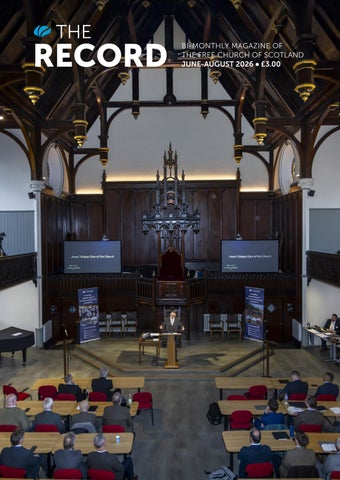
Cover: Photo by Toby Long
WELCOME TO THE JUNE-AUGUST RECORD
Welcome to the june-august edition of the record. This issue brings highlights from the General Assembly of the Free Church of Scotland, held last month.
Be encouraged by the Moderator’s Address, as Rev Calum Iain Macleod reflects on God’s faithfulness through 1 Thessalonians 5:24 and Lamentations 3:22–23. We also hear from retiring Moderator Rev Alasdair Macleod, who spoke on Jesus’ unique care of his church based on Revelation 1. You’ll find updates from the Board of Trustees, Board of Ministry, ETS and the Mission Board. There are fond farewells as Rev Callum Macleod steps down as Principal Clerk and Rev Neil Lachie Macdonald prepares to take up the role.
You may notice this edition covers June–August as change is afoot! Following approval by the General Assembly, Angus Mackay will become editor of The Record. A refreshed new-look edition will launch in September. That September/October issue will be free, with subscription and invoicing dates adjusted accordingly.
As I conclude four years as Interim Editor, I want to thank everyone who has contributed articles and supported The Record. It’s been a real privilege to work with so many dedicated and servant-hearted contributors. An enormous ‘thank you!’ goes to Rebekah Macdonald, copy editor and contributor, and Fin Macrae, designer, for their hard work behind the scenes.
While I’m passing on editorial responsibilities for The Record, I’ll continue in my regular communications role within the Free Church, so do say hello if/when our paths cross!
I’m thankful for God’s faithfulness over the past years, and confident that he will remain faithful in the months and years ahead.
With many blessings, Sarah Robinson
Thank you all for your continued support of The Record. We’d love to hear from you. Please email us at editor@freechurch.org with news or letters. •
That in all things he might have the pre-eminence Colossians 1:18
GENERAL ASSEMBLY NEWS
Opening Session, Moderator's Address, Board of Trustees Report, First Minister of Scotland Visit, Mission Board Report, Board of Ministry Report,Public Engagement Coordinator Report, Edinburgh Theological Seminary, Christian Education Group, Interchurch Relatons Report, Fond Farewells to Principal Clerk, Photos from the Assembly
FREE CHURCH NEWS
WOMEN FOR MISSION
Catriona Logan Fitch
WORLD NEWS
Ukraine, Columbia, USA, DR Congo, Sudan, India
WOMEN OF THE OLD TESTAMENT
Donald Mackay
WOMEN OF THE NEW TESTAMENT
Donald Mackay
OBITUARIES — REV DR DONALD M MACDONALD, REV IAIN BEATON, REV ANDREW M FRASER, MARGARET MACKINNON
THE HOLY CATHOLIC CHURCH, THE COMMUNION OF SAINTS...REVISITING THE APOSTLES' CREED
David J Randall
PAGES FROM ADAM'S DIARY: A MARXIST BECOMES A CHRISTIAN
BOOK REVIEWS
MISSION MATTERS
David Meredith
POST TENEBRAS LUX
Catriona Murray
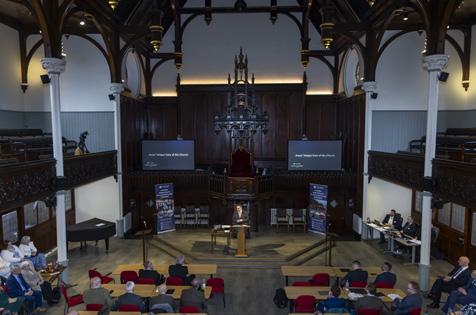
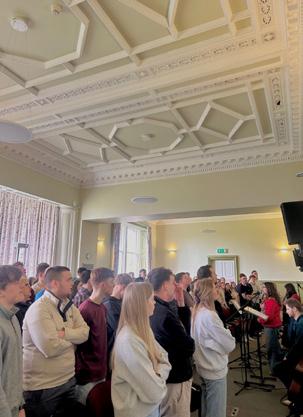
OPENING SESSION –GENERAL ASSEMBLY 2026
‘I turned around to see the voice that was speaking to me. And when I turned I saw seven golden lampstands, and among the lampstands was someone like a son of man, dressed in a robe reaching down to his feet and with a golden sash around his chest.’ (Revelation 1:12-13)
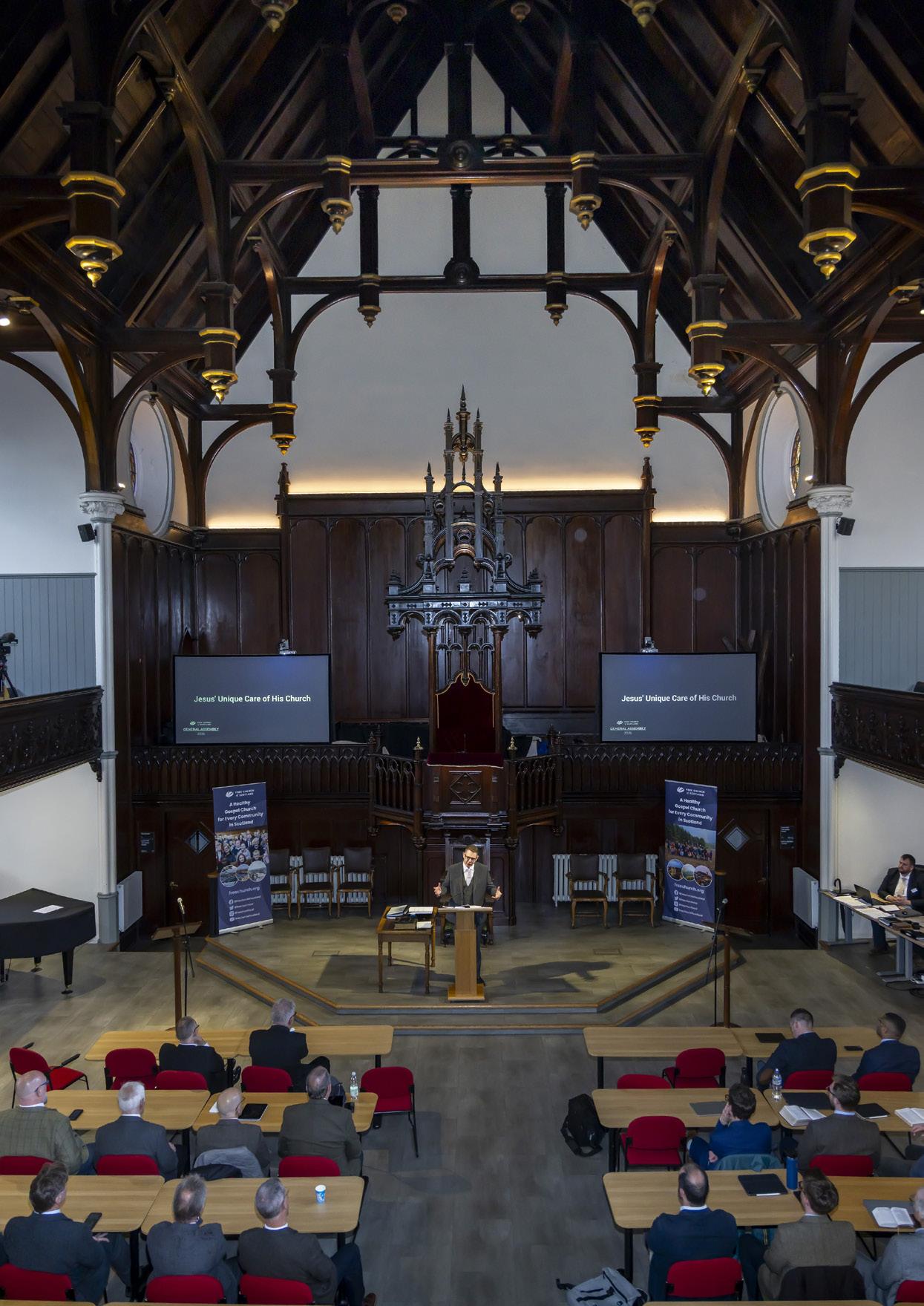
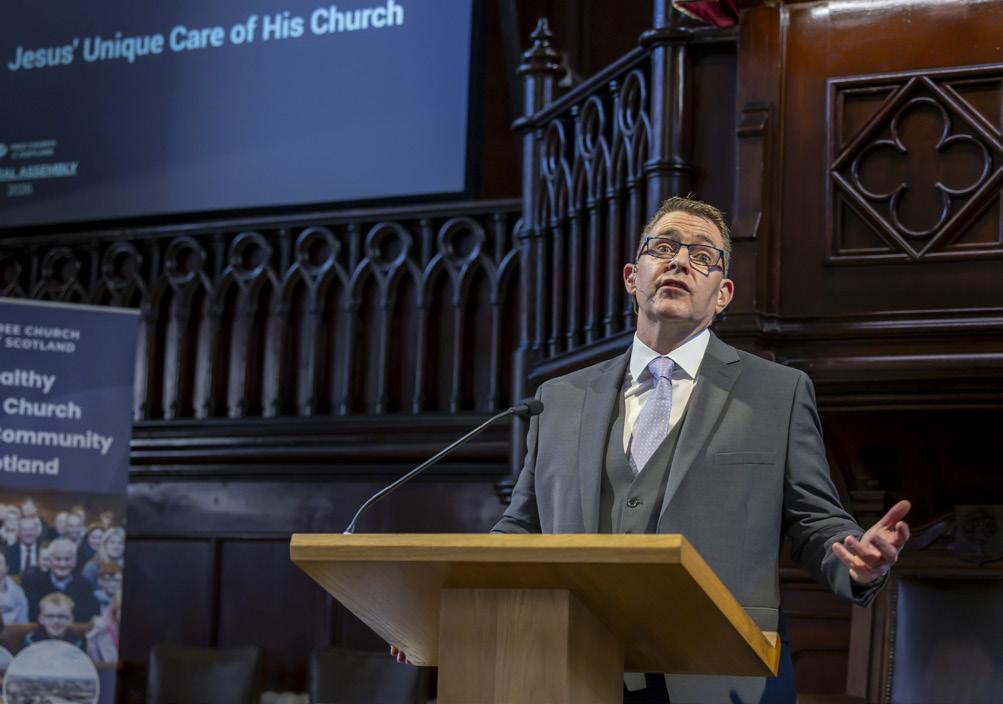
Rev alasdaiR macleod spoke about this piece of scRiptuRe at the opening session of the 2026 geneRal assembly.
The retiring moderator gave a thought-provoking sermon about John’s Vision of Christ in Revelation 1 and 2, looking at the theme of the care of Jesus for his church.
Alasdair said: ‘Jesus has transformed the world that we live in. He is the one who exhibits qualities that we don’t find anywhere else. He is the one who has ultimate strength mixed with compassion. He is one with ultimate power who uses his ultimate power for good. He is truth mixed with gentleness. He is the one who has exalted status yet is willing to become not simply a servant to be humbled in that sense but to go to a cross and die in that position. Who is like the Lord Jesus Christ?’
He said Jesus’ impact has been transformative throughout the world: in education, in healthcare started by Christians, slavery being ended, and with Jesus as the motivation of science being explored and art created. He said: ‘the splendour of who Jesus is balanced in one sense by the ordinary of how he lived.’
Alasdair noted that Jesus knew what it was to experience changeable weather, he knew what it was to hear the music of his day, he knew what it was to experience travel, to work. He would have met introverts and extraverts and would have interacted with young and old people. He said Jesus experienced bereavement, changes in family circumstances and it’s highly likely that he experienced illness.
‘For we do not have a high priest who is unable to empathise with our weaknesses, but we have one who has been tempted in every way, just as we are — yet he did not sin.’ (Hebrews 4: 15)
Alasdair said Jesus has ‘lived this life, and he has lived in this broken world’.
He said Revelation 1 reminds us that someone stood amongst the golden lampstands. ‘That person was Jesus. What John is going to be told here is that Jesus is among his people. The Jesus who promised to be with us, when he sent us with the Great Commission, to the ends of the earth scattering us to make us disciples; he promised to be with us then and he is the same Jesus, who in Matthew 18, promised to be with us as we gather. The Jesus that we are reminded of in Revelation 1 is with the people of God whenever the people of God meet together.’
He said the lampstands are the church of Jesus — the church throughout all the ages. Jesus walks among the lampstands, he walks ‘up and down every aisle in every congregation of the Lord Jesus Christ.’
Alasdair reminded commissioners that Jesus cares about our personal circumstances and he cares deeply about how his people live and how his people love. He sends us out so that we may gather in those, in a gathering, that Revelation goes on to speak about.
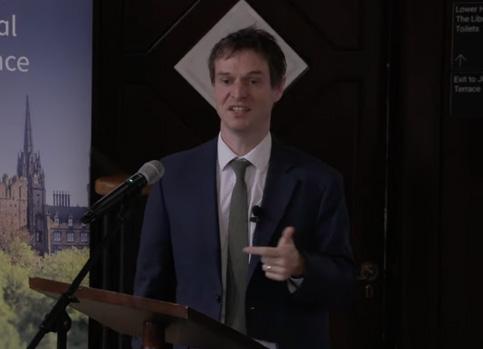
The session continued with items including appointing Rev Calum Iain Macleod as Moderator of the 2026 General Assembly. He was presented with a Bible by Elaine Duncan, Chief Executive of the Scottish Bible Society. •
THE MODERATOR'S ADDRESS
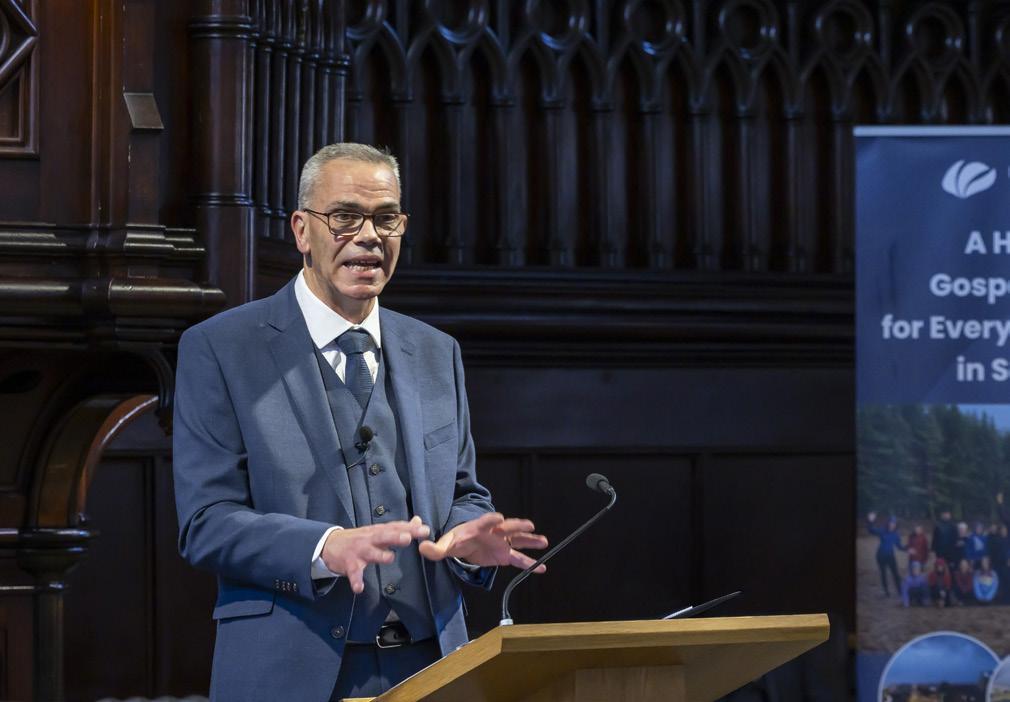
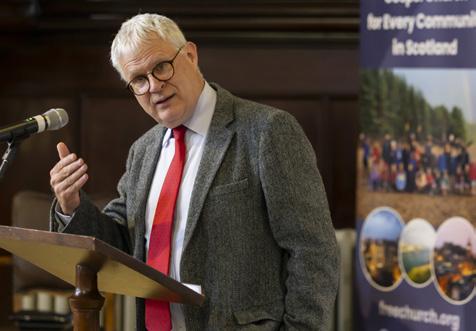
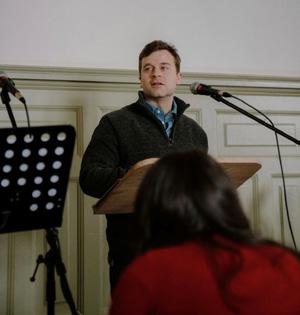
the faithfulness of god Was the theme of Rev calum iain macleod’s modeRatoR’s addRess to the geneRal assembly. He shared that, 28 years ago, when he was contemplating whether to go into Christian ministry, he cried out to God for absolute clarity. He opened his Bible, which fell to 1 Thessalonians 5:24: The one who calls you is faithful, and he will do it.
He said: ‘Today, as I reflect on God’s faithfulness over decades past, I can affirm that the words of 1 Thessalonians 5:24 (from my own personal experience) are trustworthy and true. God is faithful. Can I encourage us all in this moment to press the pause button over our Christian lives and ministries, mission fields and spheres of service, draw breath, and reflect on the faithfulness of God.’
He drew on 1 Thessalonians 5 and Lamentations 3, along with passages throughout scripture that focused on God’s faithfulness in adversity, in discouragement and in uncertainty.
GOD’S FAITHFULNESS IN ADVERSITY
Calum Iain said: ‘For most of us, if not all of us, there are challenging times to recall over the years — in ministry and across the wider landscape of our Christian lives. Times of anxiety and anguish. Times of doubt, discouragement, distress, pain and, perhaps, even trauma. Yet, through every season of adversity, the Lord has been faithful. The God and Father of our Lord Jesus Christ is ever faithful.
‘“Hakuna Matata” is a popular Swahili phrase made famous in the 1994 production of the Disney classic, The Lion King. “It means no worries for the rest of your days” – advocating a problem-free philosophy on life.
‘But not on the Christian life. We do not subscribe to prosperity theology. A trouble-free Christian life without hardship is contrary to the gospel of Jesus Christ. Jesus states plainly that in this world you and I will have trouble (tribulation) – John 16:33. Paul, having been stoned almost to death at Lystra for his Christian witness, reminds the first century church (Acts 14:22) that “we must go through many hardships to enter the kingdom of God.”
‘Hardships, first century Christians in Thessalonica were no strangers to. Paul wrote this letter to encourage young believers to stand firm in “severe suffering” (1:6). He assures them of God’s faithfulness. They are loved and chosen by him. He commends them for their faithfulness to Christ during an intense period of persecution. God’s faithfulness in adversity is a recurring emphasis.’
Calum Iain said today, more than 388 million Christians face high levels of persecution and discrimination for their faith, and for several years, Nigeria has been the most violent place in the world to live if you are a follower of Jesus Christ and faithful to him.
GOD’S FAITHFULNESS IN DISCOURAGEMENT
Calum Iain said: ‘Through the lens of Covenant Theology, we see, clearly, the covenant faithfulness of God. It is a recurring point of emphasis across the entire canvas of Scripture and finds its culmination, completion at Calvary. This is where God’s covenant-keeping faithfulness finds its ultimate fulfilment. All of my covenant breaking failure and guilt he takes and lays it on Christ, my sinless-sin bearer, the one who is the atoning sacrifice for our sins.’
He will be true to his word. He will be with you and I as we serve him. Wherever we are, wherever we go, no matter how perplexing, our Heavenly Father assures us of his abiding presence.
He said the vocabulary of 1 Thessalonians 5:24 (against the backcloth of Joshua 1:9) is compelling. ‘With absolute certainty the Apostle Paul states, God, in his faithfulness, “will do it.”
‘He will be true to his word. He will be with you and I as we serve him. Wherever we are, wherever we go, no matter how perplexing, our Heavenly Father assures us of his abiding presence.’
The eternal God, of covenant faithfulness, is our refuge and underneath are his everlasting arms (Deuteronomy 33:27).
Calum Iain added: ‘Serving the Lord can have its low points. Lower still are his everlasting arms. When we plunge into the depths of despondency — deeper still are his everlasting arms. When we are down — further down are the everlasting arms of sustaining grace. When we are lacking assurance and can no longer stand — this robust declaration of assurance stands firm.’
GOD’S FAITHFULNESS IN UNCERTAINTY
Calum Iain said: ‘In the face of life’s uncertainties, Lamentations 3:22-23 provides us with complete certainty. It is compelling. “Because of the LORD’s great compassion we are not consumed, for his compassions never fail. They are new every morning; great is your faithfulness.”
‘Faithfulness implies solidity, stability, security and safety. Integrated into this Hebrew word is the dynamic of integrity — the kind of integrity associated with a sure and lasting (permanent) foundation. Structural integrity.’
He said: ‘When life’s earth-shattering events hit us in the Christian life we need not fear — because God’s Word tells us that God’s solid foundation stands firm (2 Timothy 2:19). Our Christian lives are established and built upon the solid and enduring foundation of God’s faithfulness. In his covenant faithfulness he has promised never to leave us or forsake us. We may be swayed from side to side, but we are still standing firm.’
Calum Iain concluded his address by saying:
‘Stand with me over this next year as we boldly testify to the faithfulness of God. Stand with me over the coming year as we reach out to a lost world with the steadfast and unfailing love of God in Christ. Stand with me as we honour the legacy of our retiring moderator and continue to proclaim with clarity and conviction the uniqueness of Jesus Christ. Stand with me as we declare with the uncompromising boldness of Acts 4:12 that “salvation is found in no one else, for there is no other name under heaven given to mankind by which we must be saved.”
‘Stand with me as we speak up in support of religious liberty and freedom of speech. For speak out the good news of the gospel we shall and must. “As for us, we cannot help speaking about what we have seen and heard” (Acts 4:20). And finally, stand with me as we hold firmly to the faith we profess and exalt the name of Jesus Christ from the Borders to Bettyhill and everywhere in between, driven by the vision of a “Healthy Gospel Church for Every Community in Scotland.”’ •
2026 GENERAL ASSEMBLY FACT FILE
• •
•
The General Assembly is the highest decision-making body in the Free Church of Scotland and meets for a week in Edinburgh every May to discuss church business and set policy. Normally there are around 80 commissioners, made up of Free Church ministers and elders from different Presbyteries and congregations across Scotland, as well as missionaries from overseas.
Business is chaired by the Moderator, who is appointed for a oneyear term.
Did you know that you can catch up on the recordings of the 2026 General Assembly? Go to freechurch.org/general-assembly or scan the QR code above •
The General Assembly welcomed guests from the Scottish Bible Society, Slavic Gospel Association, United Reformed Churches in North America and Operation Mobilisation (OM).
REPORT OF THE BOARD OF TRUSTEES
HEALTHY GOSPEL CHURCH VISION
The vision of the Free Church is of ‘A Healthy Gospel Church for Every Community in Scotland’. The Board of Trustees has been pursuing that vision as it has worked with Boards and Presbyteries to support the ministry of local congregations. The Board has asked the other Boards to identify their five-year priorities and to develop a strategic plan for promoting gospel health across the denomination.
During the Assembly, commissioners were asked to share in small groups about what is making the greatest difference in their congregations. They shared a host of ideas including opening church buildings up during the week, holding a variety of youth activities, inviting teams from OM to hold mission weeks in their communities and taking part in Engage 2026.
PENSION SCHEME TRANSACTION
Outgoing Chair of the Board of Trustees, Donald Forsyth, said the Pension Scheme Buy-out was completed at the end of April with the old Scheme being completely wound up by the end of June.
OVERALL FINANCE PICTURE 2020-2025
Donald said that over the six-year period since 2020, our spending as a denomination is up by 46 per cent, including ministers’ stipends and mission grants. Central admin costs are up by just 16 per cent* which is largely tracking payroll inflation (a third of the rate that our expenditure has increased) and admin (the direct central office costs) accounts for about 5p in every £1 that we spend. We are doing a lot more today than we were six years ago with relatively less office resource. *Central admin costs include legal fees, running costs, Assembly arrangements etc.
Speaking about the denomination’s income and expenditure, he said: ‘In that time there has been steady income growth and controlled expenditure… The church is in a notably stronger position than it was five/six years ago. The church finances are in quite a strong position. That is something to be thankful to God for — for the generosity of God’s people.’
The Board of Trustees would like to thank congregations and individual members for their efforts to meet remittance levels during 2025. Several congregations experienced higher than anticipated income during the year. Consequently, remittances to central fund were also higher than anticipated. Given the level of surplus for 2025, the Board made a one-off repayment of the extra remittance income to congregations that remitted the full amount during the year.
To conclude, Donald, said: ‘In short your money is being well-spent and I’m thankful to the central office team, to congregations, to each individual member for the discipline and generosity that makes those numbers possible.’
REMITTANCE SYSTEM REVIEW
Commissioners have agreed to delay proposed changes to the Remittance System to allow for further consultation with congregations. The Board of Trustees had proposed changes to the current model due to long-standing concerns about how the system works.
Donald Forsyth, Chair of the Board of Trustees, said the proposal would replace the Admin and Training Levy and the Mission Levy with a single Denominational Assessment. The new assessment would be calculated using a progressive, “income tax”-style model with thresholds and percentages, with the aim of creating a simpler and fairer system. But commissioners raised concerns about what would count as “assessable income” under the new
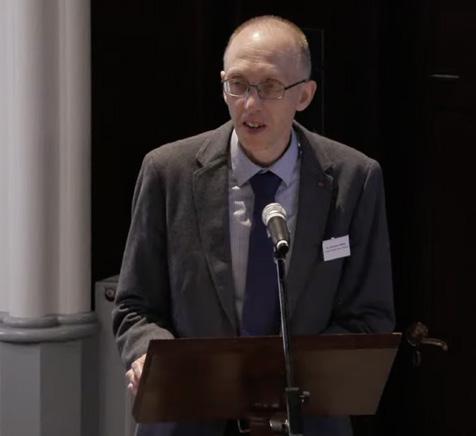
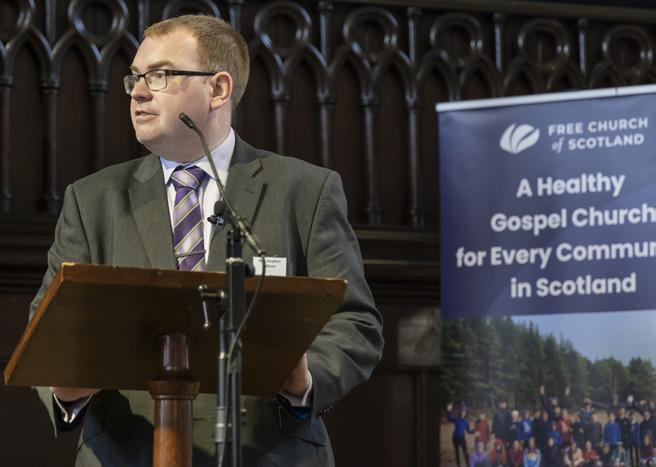
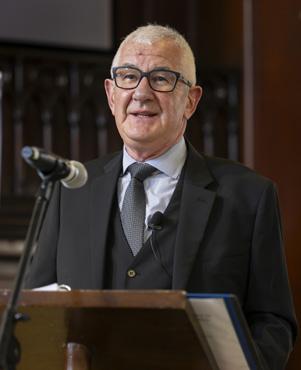
Donald Forsyth, Chair of the Board of Trustees
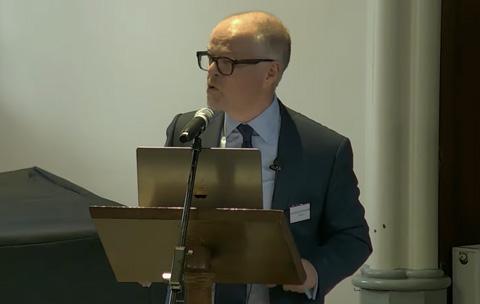
Andrew Giffen, CEO of The Free Church of Scotland
scheme. In particular, concerns were expressed that funds currently restricted for specific purposes — such as staff costs — would no longer be exempt if the proposals were introduced.
Although the Board proposed fourteen exclusions to assessable income, questions remained around how the new system would work across all congregations. Commissioners agreed to delay the proposals to allow the Board of Trustees to carry out further consultation, with findings to be brought back to the 2027 General Assembly.
BOARD ACTIVITY AND PROJECTS
During the year, the Board considered a wide range of matters including vision and strategy, communication, risk management, finance, investments, congregational property, funds and loans, the remittance system, the impact of vacancies on congregations, new legislation and legal matters.
COMPLIANCE GROUP
The Compliance Sub-Group has continued to support congregations in the areas of Safeguarding, Risk Management, Health and Safety, and basic HR information. Several webinars have been offered for Deacons and Line Managers by the Operations Manager and Legal & Compliance Officer
COMMUNICATIONS GROUP
The start of the year saw the launch of Engage 2026, a national prayer initiative, which is a continuation of the Healthy Gospel Church vision. Who is Jesus? has been the theme of communications by the Free Church Moderator. Healthy Church Podcasts have continued and there were further improvements to websites and the sharing of news stories. Highlighting the need for more ministers in the Free Church is a key priority with articles being produced and videos shared from ministers about ministry.
NEW EDITOR APPOINTED FOR THE RECORD MAGAZINE
Commissioners approved Angus Mackay, Elder of Kinloch Free Church, to be the Editor of The Record Given the continued uncertainty around the future of the publication, commissioners agreed that he be appointed as Editor for an initial three-year term.
Interim editor Sarah Robinson is set to step down from the Interim role following the publication of the June-August edition. Lookout for a revamped edition of the magazine being launched in September! The General Assembly thanked Sarah for her service.
CHANGES TO THE CHAIR OF THE BOARD
Donald Forsyth is finishing at this Assembly as Chair of the Board of Trustees. The Board says it is ‘grateful to Mr Forsyth for his wise and capable leadership over the past six years.’
Commissioners approved the appointment of Calum McPhail as the next Chair. He is currently a member of the Board and is the Session Clerk at Lochgilphead & Tarbert Free Church. •
FIRST MINISTER OF SCOTLAND ATTENDS GENERAL ASSEMBLY
john sWinney msp, fiRst ministeR of scotland, attended the opening session of the 2026 geneRal assembly.
He told commissioners: ‘I want to acknowledge the significant contribution that Scottish Christian communities including the Free Church make here at home and abroad. You support some of the most vulnerable and disadvantaged in our society whether through pastoral care, community outreach or practical support. Your efforts not only provide material help but also dignity, compassion and hope in a society that needs an abundance of dignity, compassion and hope. The Scottish
Government deeply values these contributions.’
He thanked Retiring Moderator Rev Alasdair Macleod for his service and contributions this past year and acknowledged Rev Calum Iain Macleod as Moderator-Designate. He also thanked Rev Stephen Allison, Public Engagement Co-ordinator, for his contributions to the Scottish Government’s Faith and Belief Representatives Group.
Outgoing Moderator Mr Macleod said: ‘The two spheres that we represent as State and as Church as we seek to serve our nation; they overlap in so many different ways. We both care deeply about the physical welfare of our nation. We care deeply
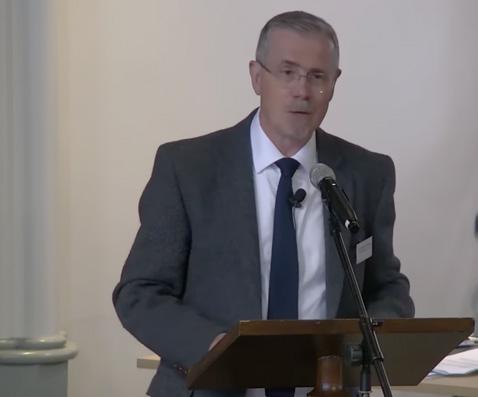
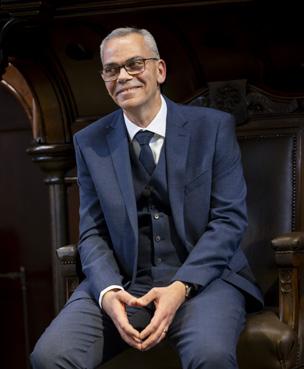
Calum McPhail, new Chair of the Board of Trustees
about those who are trapped in poverty, those who are lonely, those who are faced with anti-social behaviour issues. These are big issues. We both care deeply about the mental health of our nation. Tonight there are far too many people in a cloud of darkness and hopelessness, many trapped in addiction. We care even more deeply for the spiritual welfare of this nation because the Bible makes it clear to us that all of us have a never-dying soul.’
Mr Macleod spoke of the intrigue that people have about Jesus. He spoke about Jesus’ unique power for good, his unique purity, his unique teaching that still shapes us, his unique care for his church and his unique invitation to messed up people. Jesus ‘captures peoples’ attention in a way no-one else does’, he concluded.
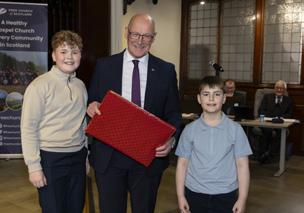
He assured Mr Swinney of the Free Church’s prayerful support for him, for the Scottish Government, and all parliamentarians. During the evening, Mr Swinney was presented with a piece of wall art, and gifts for his wife and son. •
MISSION BOARD REPORT
suppoRting gospel WoRk so that people heaR about jesus is the continued aim of the fRee chuRch’s mission boaRd.
Rev Alasdair Macleod, Chair of the Mission Board, presented a report at the General Assembly. He said: ‘I hope that you are excited about the gospel opportunities today as I am. In the 22 years of ministry in the church and serving as one of the Lord's people, I don't recall a season of interest in the things of Jesus in comparison to what we have just now. It's so remarkably exciting to see what is happening in different parts of the country and beyond…God is doing things.
‘On the Mission Board, even though our remit is wide, we are all about supporting, stimulating gospel work so that people hear about Jesus. That is why we do what we do. That is why the church has given so much of its resources to enable ministry and mission work to operate though the Mission Board so that people hear about Jesus.’
The Board works alongside congregations and encourages people to pray and share stories about God is doing. ‘We want to stimulate prayer because we recognise that our mission work has to be wholly dependent on God. Unless the Lord builds the house, his builders build in vain,’ he said.
People are invited to join in the National Day of Prayer on Wednesday 18th November. Weekly Praying for One Another prayer points are also available (sign up via the Free Church website).
The Mission Board has been encouraged to see congregations and individuals engaging in the Engage 2026 initiative, which encourages people to pray for 10 people. Plans are afoot to focus on
discipleship in 2027, and for discipleship materials for different ages and stages to be made available.
During the Assembly, Rev Tom Muir, Church Planting Director, spoke about church planting within the wider context of the denomination. He said people may know of the Free Church based on personal links with the church, training or Free Church Youth Camps. ‘Wouldn’t it also be great if they knew of the Free Church of Scotland as a place that planted churches. It’s what we do. We start new congregations as we seek to reach people and tell them about the good news of Jesus,’ he said.
‘Healthy gospel churches must have healthy Christians; and healthy Christians not only look within, as we seek by God’s grace to grow in grace and in the love and in the knowledge of the Lord Jesus, but we are also called to look out. A follower of Jesus is called to love their neighbour. Churches that follow Jesus are called to love their neighbourhoods. Surely a denomination that follows Jesus is called to love, serve and seek to reach the people of our country.’
Recent updates include a new building for Galashiels Free Church (see page 22), a church plant in Garioch and a vision to re-plant a church in Wick.
TRAINING AND SUPPORT
Structures remain in place to support church planters in their ministry, including incubator training providing monthly support for planters during the early stages of church planting, and a coaching programme and monthly online peerto-peer planters’ calls that provide opportunities for ministers serving in church plants to meet. The
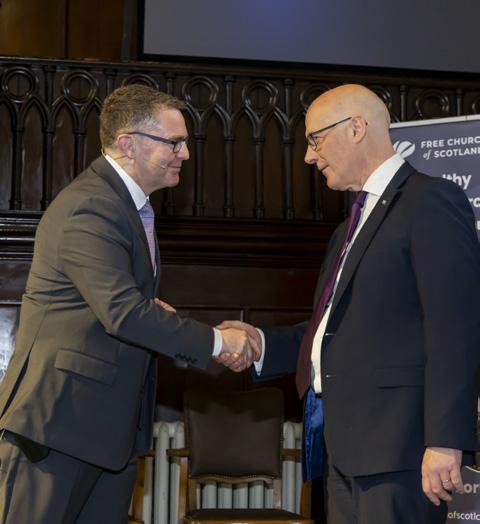
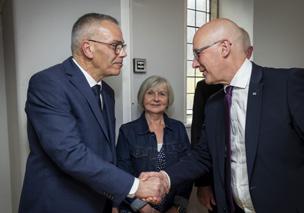
Outgoing moderator Rev Alasdair Macleod and FM John Swinney MSP
Generation Women initiative provides support for church planters’ wives. A 30x30 annual gathering took place last Summer and in November, an overnight retreat was held for church planters and their wives for a time of encouragement and fellowship.
HEALTHWISE25
An extension of the redevelopment track, called Healthwise25, was offered to Kirk Sessions last year. Five congregations took up the offer. The initiative has proved to be positive, but it involves a significant investment of time by all parties.
CENTRE FOR RURAL MINISTRY
The Board is grateful for the work of the Centre for Rural Ministry. It wishes to express its thanks to Rev Ivor MacDonald for his work in this ministry, to Mrs Megan Gray, Administration Worker, and to the development team who facilitate the work of the Centre. The Board looks forward to seeing how the Centre for Rural Ministry continues.
NORTHERN PRESBYTERY UNIONS
The Assembly agreed to unite the congregation of Thurso & North Coast with the congregation of Castletown & Community with one Kirk Session and one Finance Committee, under the name “Thurso & North Coast”. It also agreed to unite the congregation of Martyrs Wick & Keiss with the congregation of Lybster, Bruan, Latheron & Berriedale with one Kirk Session and one Finance Committee, under the name “Wick & Caithness East”.
PRESBYTERY OVERSIGHT VISITS (POVS)
The Assembly agreed to replace POVs with Congregational Health Visits. Presbyteries will carry out a congregational health assessment visits to all congregations within their bounds, every five years.
GEN-Z WORKING GROUP
The Board established a working group to explore how Gen-Z are coming to faith and exploring church within our denomination. The group aims to develop strategies for connecting with, and discipling Gen-Z, considering denominational
response to cultural and social trends affecting young adults, informed by research and providing recommendations to the Youth Committee for further action or support.
EVENTS FOR YOUNG PEOPLE
The Board highlighted continued events including the Youth Conference, Teens Conference and Big Free Rally.
FREE CHURCH YOUTH CAMPS
Rohan Hepburn, Camps Co-ordinator, told commissioners: ‘We are entirely reliant on God, and we want to highlight the ways that God has been faithful to us over the last year. We can see clearly that God has been kind and faithful to us.’
He said around 150 volunteers are volunteering at camps this summer. Twelve camps will be taking place across five locations, with approximately 350 campers attending.
Donald Macleod, Camps Supervisor, highlighted the changes to the booking system to “first come, first served”. He thanked Rohan for all his work and for Alice Ankers who is working with the team on a short-term basis dealing with transport plans.
GLOBAL MISSION
The Board continues to partner with individuals and organisations around the World. Mission partners include Operation Mobilisation (OM); Overseas Missionary Fellowship (OMF); and UFM Worldwide. The Board continues to maintain a valuable partnership with Mission to the World (MtW), fostering international mission collaboration and outreach.
WOMEN FOR MISSION (WFM)
The 2024/25 project Empower raised £55,774 for Kerusso Trust (Malawi), Tumaini Scotland (Tanzania), Manuel and Patricia Reano (Columbia) and the Blythswood Trust (India). The 2025/2026 Flourish project raised funds to support Junction 12, Christ the Saviour Presbyterian Church Krakow, the Mamie Martin Fund and Free Church Youth Camps. (Go to page 24 for details on the 2026/2027 project.) •
Rev David Meredith
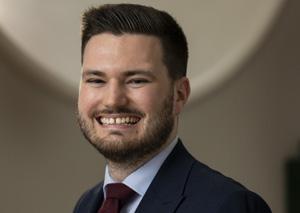
Rohan Hepburn, Free Church Youth Camps Co-ordinator
PUBLIC ENGAGEMENT COORDINATOR’S REPORT
opposing plans at W estminste R and holy R ood to int R oduce assisted suicide has been just some of the W o R k unde R taken by the public engagement g R oup ( peg ) W ith the suppo R t of the R eti R ing mode R ato R , R ev alasdai R macleod , this past yea R .
Ahead of the Stage 3 vote on Liam McArthur MSP’s Assisted Dying for Terminally Ill Adults (Scotland) Bill, Alasdair and the Group worked with other Christian leaders to send a joint letter to all MSPs urging them to vote against the Bill. Signatories included leaders from the Church of Scotland, the Roman Catholic Church, the United Free Church of Scotland, the Salvation Army, the Fellowship of Independent Evangelical Churches and the Apostolic Church.
On the day of the Stage 3 vote, an online prayer meeting was organised for congregations across the denomination.
Rev Stephen Allison, Public Engagement Coordinator, said: ‘We are also encouraged by plans from Marie Curie to bring forward proposals for better palliative care provision in this new parliament and would look to support those provisions. But we are concerned that there are rumours of plans to try to re-introduce assisted suicide proposals in this new parliamentary session. And so, we will continue to work alongside Care Not Killing to oppose any such proposals.
‘We are also deeply concerned by the expert group’s report reviewing abortion law in Scotland. The SNP included in their manifesto a commitment to take forward the recommendations of this group.’
The proposed changes in the Scottish report go significantly further than recent changes in England and Wales. While the Westminster amendment focused mainly on removing criminal penalties for women in relation to their own pregnancies, the Scottish proposals would fully decriminalise abortion for both women and healthcare professionals, regulating abortion through healthcare professional standards rather than criminal law.
Although a 24-week limit would formally remain, abortions up
to that point would no longer require specific legal grounds or the approval of two doctors, effectively introducing abortion on demand up to 24 weeks. Beyond 24 weeks, abortion would be permitted where healthcare professionals judge it “appropriate” in light of medical, psychological, and social circumstances. Given how broadly psychological grounds are already interpreted, and the addition of social grounds, these proposals could in practice permit abortion up to birth in a very wide range of circumstances.
Stephen said the Scottish Government’s civil servants have asked for feedback on the report from stakeholders. PEG has drafted an extensive response, and the Group will respond to any public consultation launched. He described the proposals as ‘utterly horrendous. …May God have mercy on us as a nation.’
Proposals to ban so called conversion practices are also set to be revisited by the Scottish Government, which PEG will also respond to, and the Group is seeking to work with allies including feminist groups in Scotland.
The PEG report, which can be found on the Free Church website, highlights all the work of PEG this past year.
The Group has also sought to develop relationships with political representatives and to work alongside other Christian voices engaging in the public sphere.
All Public Engagement Group responses to Government consultations can be viewed on the Free Church website freechurch.org • Rev Stephen Allison
REPORT OF THE BOARD OF MINISTRY
the haRvest is plentiful, but the labouReRs aRe feW. theRefoRe, pRay eaRnestly to the loRd of the haRvest to send out labouReRs into his haRvest.’ – These are the words Jesus says to his disciples recorded in Luke 10:02.
And it is these words that the Board of Ministry are dwelling on as they seek to spur people on to take up ministry across the denomination.
Rev Paul Clarke, Chair of the Board of Ministry, says the Board continues to ask the Church to pray specifically that the Lord will raise up 200 new ministers for the Free Church by the time we celebrate our 200th birthday in 2043. He also spoke about the need for the multiplication of gospel ministry across Scotland.
Paul said: ‘Some of ministry will only and can only be done by ministers of the church but an awful lot of it will be done by those who aren’t formal, ordained, set aside ministers of the gospel. We believe that every believer is not just a disciple of the Lord Jesus but a disciple maker for the Lord Jesus. We want to do whatever we can to support the equipping of every believer to fulfil their calling as we work in partnership with the Mission Board and with local churches. We also want to equip women’s workers, youth workers and children’s workers. We want to do whatever we can so that there is a multiplication of gospel workers for ministry all over the country.’
At last year’s General Assembly, the Board highlighted three areas of development: foundation level training, training women for ministry and bivocational training.
FOUNDATION LEVEL TRAINING
This year, Rev Ali Sewell spoke about the progress of the foundation level training, saying: ‘It is a programme of church-based training generally in partnership with an external training provider, which sits prior to core training which within our denomination is the Minister-in-Training programme that all our candidates go through.’
He said: ‘Foundation level training is there to help people to consider that call to ministry, to grow in their understanding of what ministry looks like, to look at ministry firsthand and to help them test their own sense of call and have others within the local church help them with that discernment process.’
He said there is a need for ministers within the denomination, and the foundation level training widens the pipeline into pastoral ministry. ‘We would love to encourage congregations, perhaps larger congregations, to consider whether they would be willing, with help if needed, to establish foundation training programmes in their church.’
He also encouraged commissioners to look out for people in their congregations who may benefit from the foundation training programme.
TRAINING WOMEN FOR MINISTRY
Paul gave an update on the training for women’s ministry. He said: ‘As we think about training women, the Free Church is joyfully and happily and confidently and unashamedly complementarian in our theology. And that is precisely why we want to do everything that we can to equip women to understand and teach God’s Word in appropriate contexts within our churches. It’s very much providing a resource for women and churches within our denomination and hopefully beyond who want to benefit from it. It is a great way for suitable women to be better trained for gospel ministry.’
Rev Paul Clarke, Chair of the Board of Ministry
Rev Ali Sewell
“ ”
Some of ministry will only and can only be done by ministers of the church but an awful lot of it will be done by those who aren’t formal, ordained, set aside ministers of the gospel. We believe that every believer is not just a disciple of the Lord Jesus but a disciple maker for the Lord Jesus.
He said some are already working in our churches and want to be upskilled to enrich their theological and biblical understanding, while other may be coming towards the end of foundation training. Many aspects of training will be the same as the Ministers-in-Training programme and there will be some specific modules on equipping women for the work of women teaching other women.
BI-VOCATIONAL MINISTRY/MINISTERS
The Board has been looking into the possibilities of bi-vocational ministry and bi-vocational ministers. Paul said: ‘We want to think as creatively as we can, and we really need to take the temperature of the denomination on this issue after some careful consideration. We really need your help!’
The board is planning to come back to the Assembly next year with firmer plans around this.
10:02 NETWORK
Paul highlighted a new network, established by the Board, called the 10:02 Network (named after Luke 10:02).
He said: ‘We want to call upon the church to continue to pray – both for more ministers but for more ministry within our churches. We want to help all of us to think how we can make the best use of our life. There will be a 10:02 summit looking at what can be done about more ministers and more ministry within our churches, to think and to pray together.’ More details coming soon!
STUDENT TEAM UPDATES
Over the past year the Student Team has worked to ensure that future ministers for the Free Church of Scotland are brought into our training pathway, as well as our current candidates being well supported and developing as they progress through the Minister-in-Training programme. It has been encouraging to see the combined efforts of Training Churches, Presbyteries, Edinburgh Theological Seminary, and the candidates themselves equipping men for ministry with the denomination. The Board is grateful to God for bringing new candidates into the scheme as it continues to prayerfully depend on God to send more workers into the harvest field.
MINISTRY TEAM UPDATES
The Ministry Team works with Presbyteries to ensure that every Minister and ministerial family receive the care and support they need to do their work effectively. Following concerns raised regarding stress-related absence and burnout among ministers, the 2025 General Assembly encouraged the team to further explore concerns about this.
So, in consultation with numerous teams, a draft document entitled ‘Promoting Healthy Gospel Ministry’ was produced, highlighting practice and provision within Free Church structures that promoted the care and well-being of ministers and their families. This has been shared with Presbyteries for comment and feedback. Following feedback, a final version will be presented to every Presbytery with an opportunity for discussion and reflection. It will then serve as a summary statement and guidelines for the Church to work to.
A separate confidential questionnaire directed to ministers who have experienced fatigue, stress, burnout, or extended absence from ministry, has been developed and distributed. Feedback from some Presbyteries indicated that this would provide helpful insight into the ongoing provision and development of pastoral care and support in the ministry.
MENTORING AND GOSPEL COACHING
The importance of effective mentoring and coaching relationships was highlighted as integral to pastoral care and ongoing development. Mentoring remains a longer-term relationship between colleagues, encouraging spiritual growth, accountability, and support. Gospel Coaching offers intentional Gospel conversations addressing relational, personal, missional, and spiritual dimensions of ministry.
LIFELONG TRAINING
The Board’s provision for lifelong training continues to centre on: Character (Christlikeness); Conviction (theological and doctrinal depth), Competence (preaching, pastoring and leadership) and Contemporary thought and culture.
APPLICATIONS FOR MINISTRY
The General Assembly admitted Rev Colin Fast into the ministry of the Free Church of Scotland. •
EDINBURGH THEOLOGICAL SEMINARY BOARD REPORT
Willie mackenzie, chaiR of the ets boaRd, said: ‘the seminaRy boaRd is an impoRtant Responsibility. We have a WondeRful institution. It’s a godly inheritance that we seek to build on, and an inheritance that we are conscious we must not squander. It’s important for the sake of the work of the seminary but also for the work of the denomination and indeed for the wider Church.’
He spoke about the Free Church’s vision for ‘A Healthy Gospel Church for Every Community in Scotland’ and shared how ETS plays a role in that, as many ETS students either go into ministry within the Free Church or outwith the denomination. He said ETS students have ‘a passion for Christ, a passion for theology and a passion for the confession’.
The 2025 General Assembly saw the ETS Board progress four significant strategic steps: they revised the Consolidated Act under which the Board operates, appointed a new role of Director of Training and announced a plan for principal succession. There was also a desire to appoint an Academic Administrator.
Willie updated commissioners on these four areas. Iona Bird has been appointed as Academic Administrator and is a ‘huge blessing’. PrincipalDesignate Rev Dr Thomas Davis has been added to the teaching staff on a part-time basis as the Systematic Theology course organiser. He has been ‘a wonderful addition to the team’. The Consolidated Act has ‘proved its use already’ with information being available in one Act – rather than in multiple legislation. The Director of Training role did not go as planned but there is encouragement as funding was securely externally for the post.
He said one long-term goal of the Board is to focus on Development. The Board is encouraged with the prospect of a new arrangement with Keith Knowlton to begin a part-time role as Strategic Development Lead for the Seminary.
Both Willie Mackenzie and ETS Principal Iver Martin thanked admin and facility staff for their hard work.
They also acknowledged the hard work of Dr Zachary Purvis, who will be returning to the USA in July.
Commissioners were encouraged to make use of ETS and to promote the Saturday Courses and the annual ETS Conference to congregations.
The Assembly heard that ETS has taken out tables at events including the PCA General Assembly in Chattanooga, Reformation Worship Conference, Powder Springs, GA and the Banner of Truth UK Conference to promote the Seminary.
Rev Ciarán Kelleher, from Grace Church Montrose, said ETS is a ‘wonderful place of real promise’ and he encouraged ETS to promote themselves further within the UK.
The reports to the Assembly also highlighted that the ETS Centre for Mission is a core part of Edinburgh Theological Seminary and exists to encourage and support the church, in the UK and throughout the world, to engage in mission, rooted in careful theological reflection and responsible and effective practice.
PRINCIPAL’S REPORT
In a written report to commissioners Principal Rev Iver Martin said the past year has been ‘really encouraging. In Summer 2025, we unexpectedly discovered that our applications were unusually high with student numbers exceeding 100 for the first time ever. Interestingly, this number included more female students than ever before, meaning a different dynamic in the life of ETS. It is not clear whether this is a trend, but it is important to respond by making appropriate provision, not least to the growing need for more female pastoral, youth and administrative workers in our churches.
‘To that end an additional elective module, specifically designed for women workers, has been developed and is currently undergoing validation. We want to make clear that this is not a move towards egalitarianism in the Free Church of Scotland. Rather, it is a recognition
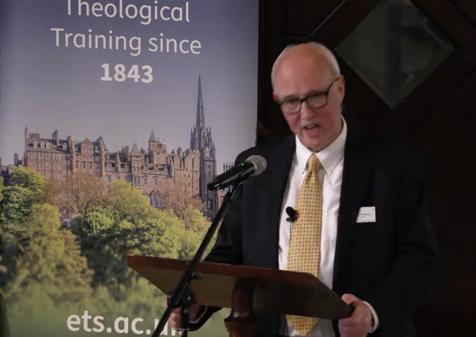
Willie Mackenzie, chair of the ETS Board
Principal of ETS, Rev Iver Martin
that, ultimately, we are all ministers (servants) and we believe that women’s ministry, as directed by scripture, is an important element in our ever more complex congregational life.’
Mairi Macpherson has been appointed to the ETS Senate as an additional member. Mrs MacPherson, currently a PhD student and a recent graduate from ETS, has agreed to be a part-time Lecturer in Missiology and a MTh supervisor.
Iver said that ETS ‘has satisfied the requirements of QAA and can thus assure potential students that the quality of provision we offer is officially recognised and attested’. He said there is also ‘a healthy academic partnership with the University of Glasgow.’
The challenges and opportunities of online resources were also noted.
Iver said that one recurring subject at Senate meetings is the threat which AI poses to ETS. ‘It is one thing for students to avail themselves of the information provided by the internet at one click. But there is a difference between conducting research and asking AI to write an essay,’ he said. ‘The Senate, assisted by contemporary software and University of Glasgow
policies, has continuously updated its AI procedures in the pursuit of academic integrity which is vital to the training of students for ministry.’
ETS has recently taken out a corporate subscription of Perlego, sometimes termed “Netflix for Books”. For a small monthly charge (discounted for ETS students), subscribers can access thousands of online books, giving more online access to all students and thus providing a more equitable resource pool.
Speaking about the wider picture of ETS and the denomination, the ETS report stated: ‘We are conscious of the prayerful and practical support of the Free Church of Scotland throughout all our deliberations. It is a great reassurance to be part of a denominational work, and it is our wish to be a blessing to the Free Church of Scotland, and in addition, the wider church in Scotland and around the world.
‘This year has not been without its challenges: things have not always unfolded as we had hoped, but throughout it all, we have been very conscious of the sustaining grace of our Father in Heaven. As always, he has supplied our needs, and all our plans are subject to the unfolding of his perfect will.’ •
ETS FROM A STUDENT’S
PERSPECTIVE
student Will sandeRs has pRaised edinbuRgh theological seminaRy, saying: ‘it Remains a pRivilege to leaRn in an enviRonment maRked by high academic RigouR. Even more so, we are grateful to study in a Seminary where God and his Word are held in the highest regard. The student body, in all its variety, shares a deep appreciation for the Christ-centred ethos that shapes both academic study and the wider Seminary culture.’
He said this academic year has seen the Seminary become more fully settled into the three-term structure, and the increased range and flexibility of elective modules have been warmly received. ‘Candidates for ministry continue to benefit from aspects of the new system,’ he said, ‘and while some are still adapting to certain elements of the revised structure, there is gratitude for the ongoing support provided to help them balance academic work with the practical demands of ministry preparation.’
Will thanked all staff for their hard work ensuring that the Seminary runs smoothly. He added: ‘Courses are marked by depth, clarity, and a commitment to the Reformed tradition, while consistently pointing students to the person and work of the Lord Jesus Christ. We would especially like to thank the lecturers and guest lecturers who have worked hard to maintain a high standard of teaching despite necessary changes to teaching arrangements at points during the year. These changes have been handled well and with minimal disruption to students.
‘Beyond the classroom, this year has seen encouraging growth in student life. In particular, the large intake of new students has been a great boost to the life of the Seminary, contributing to a lively and engaging environment. There has been a noticeable increase in informal gatherings and student-organised social events. These occasions have helped to strengthen relationships across the Seminary and foster a growing sense of community and collegiality.
‘Alongside this, regular times of coffee and morning worship remain a central and muchvalued part of Seminary life. Meeting together to read God’s Word, pray and sing, continues to provide encouragement and spiritual refreshment in the midst of academic work.’
He concluded that it is the ‘integration of faithful teaching and lived Christian community that makes studying at ETS such a distinctive and valued experience’. •
CHRISTIAN EDUCATION GROUP UPDATE
Rev allan sheaReR, convenoR of the chRistian education gRoup, said: ‘the covenant Responsibility of Raising ouR childRen Rests With paRents, as scRiptuRe diRects fatheRs to Raise theiR childRen in the feaR and nuRtuRe of the loRd. Therefore, any decisions and choices that parents make regarding the education of their children resides with the parents. So whatever decision parents have taken – whether it is to send their children to a Christian school, or to homeschool them or to state school them – that responsibility has been delegated by the parents to that body of people.’
Allan stated the Group is there to support parents in the choices they have made in the education of their children. Over the past 14-16 months, the Group carried out a denominational survey designed to assess the needs, concerns, and experiences of those involved in the education of children across the Free Church.
He gave an overview of three education choices with prayer points, challenges and opportunities.
Christian Schools: He said those involved in Christian schools say there is a need of support from the wider church. He said some of these schools’ struggle with staffing. ‘Can we pray for them?’, he asked.
Home schooling: He said there is a lot of antagonism around this. ‘As churches, can we open our buildings for homeschool co-op groups? This would be a simple way to support homeschooling families.’
Allan asked office bearers if there was a willingness to read up on the choice of homeschooling, and to listen and help where possible.
State schooling: He said: ‘The report is clear that state schooling is not a neutral choice for parents to make. It might be the only choice that parents are able to make because of the situation they find themselves in. But if we are choosing to state school our children then the Christian element of that education is not being provided by the state education system. There are elements but we need to be more intentional as parents if our children are at a state school, and to be openly involved and engaged.’
He said good relationships need to be built and fostered with schools; family worship in the home should take place and he encouraged individuals and congregations to check out the Serve Your Local School website which features ways to support your local school (syls.org.uk). Other support includes encouraging Bible Alive, volunteering at school and serving teachers at InService days.
He said the Church has a role to play in education and stated there is a need for us as a denomination to discuss the education of our children.
The Assembly approved that the Group be continued for another two years under its existing remit to allow it to progress work that has begun. The full report is available in the General Assembly section of the Free Church website freechurch.org •
INTERCHURCH RELATIONS COMMITTEE REPORT
the next global confeRence of the inteRnational confeRence of RefoRmed chuRches (icRc) is scheduled to take place in seoul, south koRea, this octobeR. The Committee appointed Rev Dr Alistair Wilson to attend the Conference as the Church’s voting delegate.
Rev Iver Martin said the Interchurch Relation Committee meets three times a year to answer correspondence from other churches. ‘There is genuine interest from brothers and sisters from various parts of the world in what we are, who we are and how we may communicate better.’
He said it is important to recognise that we are part of the worldwide development and growth of the Church of the Lord Jesus Christ. Due to financial limitations, the committee is unable to attend many
of the assemblies and synods they are invited to, but they respond with grateful thanks.
Iver said: ‘The presence of various delegates at our Assembly is proof that we value the relationships we have with other churches and organisations. It is a vital reminder that we are not the only branch of the Christian Church, and their reports are often a joy and encouragement about what the Lord is doing in various contexts.’
He said although there are formal relationships, it is important that we as a denomination have immediate relations on a local level too: ‘In our small corner, wherever we are, it is likely that we will have contact, and very meaningful contact, even working relationships in various contexts with other branches of the Christian church.’
LOOKING BACK:
The 2025 General Assembly marked the 150th Anniversary of the Church of Central Africa Presbyterian (CCAP) Synod of Livingstonia with addresses from Rev Dr John S. Ross and Rev Neil Longwe. The Committee received a letter of thanks from the Synod accompanied by a Certificate of Recognition awarded to the Free Church.
Rev Iver Martin received an invitation to attend (albeit as Principal of ETS) the recent AMiE conference in Nottingham. AMiE is a group of churches whose aim is to plant evangelical Anglican churches in various parts of England. This was the first invitation of its kind,
gratefully accepted by the Convener who thoroughly enjoyed the fellowship shared with AMiE friends.
LOOKING AHEAD:
Rev David Meredith is set to attend the Presbyterian Church in America (PCA) 53rd General Assembly in Louisville, Kentucky in June.
The Committee appointed Rev Calum I. Macleod to represent the Free Church at the General Assembly of the United Free Church of Scotland in June. He is also set to attend the Triennial National Assembly, organised by the Presbyterian Church of Australia (PCA) in September •
FOND FAREWELLS TO THE PRINCIPAL CLERK
apResentation Was held to maRk the end of Rev callum macleod’s time as pRincipal cleRk of the geneRal assembly. he has passed the baton on to Rev neil lachlan macdonald, Who is set to take up the Role.
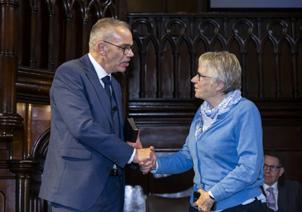
Speeches were given and Callum and his wife Catherine were presented with gifts to acknowledge Callum’s hard work and dedication.
Free Church Moderator, Rev Calum Iain Macleod, said: ‘Our Principal Clerk Callum has been a dedicated and faithful servant of our church community since his ordination some 26 years ago.
‘The portfolio of our Principal Clerk is demanding and time-consuming at the best of times. We all know that church legislation can be complex. Guiding our church courts and congregations through due process is of course to our Principal Clerk’s remit and he has undertaken this mammoth task over the years admirably.’
The Moderator said Callum has carried out this role with ‘competence, calmness and composure of a super reliable Principal Clerk. The Free Church of Scotland is indebted to you for your immense contribution, always undertaken with due diligence and good cheer.’ •
A FEW PRAYER POINTS...
PUBLIC ENGAGEMENT GROUP
Scripture calls us to pray for those in authority (1 Timothy 2:1–2), to honour lawful government (Romans 13:1–7), and yet to obey God rather than men (Acts 5:29). We seek to do all three – with humility, conviction and grace.
MISSION BOARD
The Board encourages the Church to pray that the Lord would raise up men who are called and equipped for the work of church planting in Scotland.
BOARD OF MINISTRY
We hope and pray that the Lord might be pleased to use the 10:02 Network to raise up many more workers for his harvest, in order that ‘the word of the Lord may speed ahead and be honoured’ right across Scotland and beyond (2 Thess 3:1).
FCYC
Thank God for all the volunteers, their safety and skills in working with our young people. Pray for the final logistics and arrangements to come together. Pray campers, leaders and cooks would be blessed by their engagement in camp.
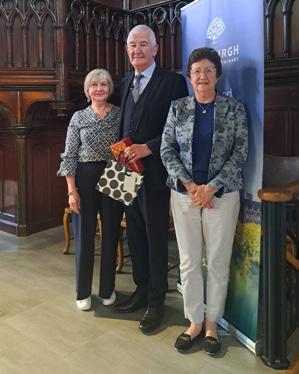
Presentation to Rev Callum and Catherine Macleod by Sharon Fraser, Administrator in the Free Church offices
PHOTOS FROM THE GENERAL ASSEMBLY 2026
All photos here and in Assembly articles courtesy of photographers
Toby Long and Sarah Robinson
FREE CHURCH NEWS
INDUCTION OF REV NATHAN KISH TO OBAN FREE CHURCH
BY REV R D CRANSTON
on satuRday 21st maRch in the eaRly afteRnoon a laRge congRegation gatheRed to WoRship god in oban fRee chuRch in the context of the WondeRful pRovision of god of a neW ministeR –Rev nathan kish.
In many ways it was just another joyous occasion: welcoming a new minister, his wife and family into the church fellowship of Oban and the Isles. Like all these occasions there were many different emotions around. Presbytery were delighted to have a vacancy filled and a new minister into our Presbytery. I, as Interim Moderator for over two years, was delighted to be saying goodbye to a congregation I had come to love and had been privileged to serve. People had gathered from far and wide, members of the linked charge, family, friends, colleagues and fellow students of Nathan to share in this joyous occasion. Nathan for the very first time had the final confirmation that he was indeed called by God to be a Minister of the Gospel. So many happy faces.
Beyond the surface, however, I could not help but reflect on the past three years that I had been involved with this congregation. One great joy of this service was that for the first time since the linkage of Oban Free with congregations in the Isles off the mainland of Oban, members of this linked charge had gathered together in person in joint worship. It meant so much to those folks to have been a full part of the call of Nathan. Through all the formalities and legal requirements of calling a minister it is worth all the effort to see God’s man in place of service, exactly where God intends him to be, called by the people of this newly formed linked charge.
My first engagement with the folks was in my capacity as Convener of the Pastoral Care Group. That committee had the privilege of supporting the previous minister and a dear friend to many, Rev I Morrison, during serious illness and a call home to the Lord.
I reflected how as a denomination we proclaim the Sovereignty of God. Most of the time we do that in positive situations, as we did that Saturday
afternoon, but that was not the only emotion here. I reflected at the service of Ordination that Paul, when he wrote of God’s Sovereignty – ‘And we know that all things work for good to those who love the Lord and are called according to his purpose’ – must have reflected on many different experiences of God’s providence. This promise as we know means God sovereignly uses every circumstance – both “good” and “bad” – to conform believers to the image of his Son, Jesus Christ, and to fulfil his purpose (Romans 8:28). I wonder how many people who first heard or saw this letter, how many of them asked the question ‘all things Paul? Even the death of Stephen?’ we surely want to say yes, all things – but that can be challenging and difficult for those caught up in strange and challenging providences.
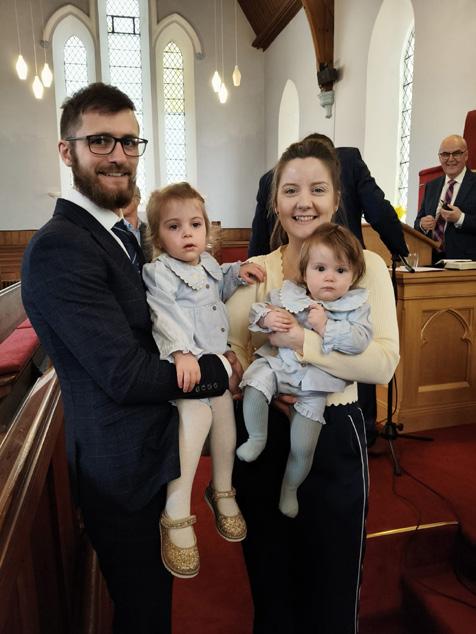
Rev Nathan Kish with his wife, Lauren, and daughters Lydia and Clara
I did also think, however, that when congregations get impatient about how long it’s taking to fill a vacancy, we need to learn not only to trust in God’s provision through the valley as well as on the mountain top but also to trust his perfect timing. We had a long vacancy but not a moment longer than was necessary. God in his sovereign goodness had to give this congregation time to mourn and to deal with their sadness at the loss of a minister who was a much-loved pastor and friend to them and to the community of Oban. Any minister coming into this situation too soon, into a congregation which had faced this kind of loss, would have faced colossal challenges and a colossal wave of grief. So, in God’s good time, the time for mourning and healing having been passed, God provided in his goodness the right man, at the right time, in the right place. And this truth was very evident in our worship.
Oban and the Isles now has a minister. A young man! Paul, as he addressed Timothy, told him ‘do not let anyone despise his youth’. What he didn’t say was that people should forget his youth. A young minister now begins his life of service. He needs time to grow into that ministry and grow with his people in service of that extensive geographical community. We ask God’s richest blessing on this congregation of our church. May God bless him and keep him; may he make his grace to shine upon him and be gracious unto him.’ •
RETIREMENT OF REV IAIN THOMSON FROM GARRABOST FREE CHURCH
the congRegation of gaRRabost fRee chuRch has maRked the RetiRement of Rev iain thomson, afteR oveR five yeaRs as theiR ministeR.
His arrival coincided with a period of restricted activity because of Covid, which prevented us from having the usual post-induction social occasion, so it was good to be able to show our appreciation to Iain and Connie in a social get-together in Main Road Church Hall. Despite the underlying sadness of saying farewell to our pastor, it turned out to be an enjoyable occasion, with approximately 125 people, including Iain and Connie’s family, in attendance.
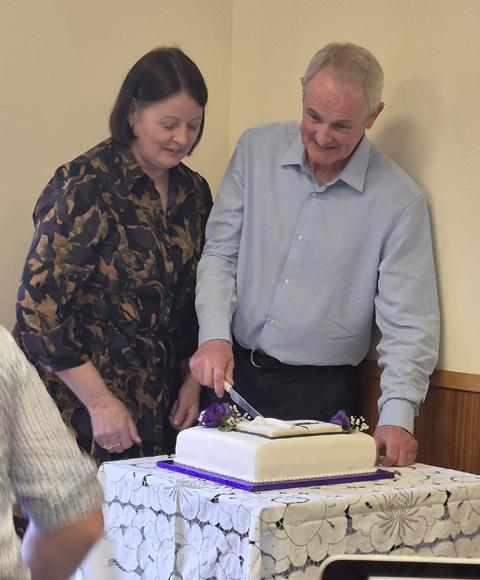
Following prayer by Calum Mackay, and the cutting of the beautifully decorated cake, a sumptuous supper was enjoyed, and the company enjoyed speeches from Rev Roddy J Campbell and from Rev Colin Macleod, old friends of the minister, both with tales to tell from College days. Rev Colin Macleod acted as MC for the evening and his humorous approach contributed to the general light-heartedness of the evening.
Iain and Connie were presented with gifts from the congregation. Mrs Catriona Macdonald of Upper Bayble presented Iain with a generous cheque and a gift voucher for No 10 Retail Warehouse for him to purchase a fishing rod and gear. Mrs Fiona Campbell and grand-daughter Charis Campbell presented Connie with a bouquet of flowers and a gift voucher for Maybury Gardens.
Iain then spoke, in a very fitting address which belied his claim that while he can preach, public speaking is not his forte. As well as thanking the congregation for the gifts, he spoke about his call to the ministry and about his life as a minister, thanking his family for their support and Connie for her work as a minister’s wife and especially for her willingness to bestow hospitality throughout his ministry.
Donald John Macleod spoke on behalf of the congregation, thanking Iain for his work among us as a preacher and for his tireless devotion to pastoral duties. He also thanked all those who had contributed to the success of the evening.
The evening concluded with the singing of Psalm 40, verses 8-11, with Norman Macdonald as precentor, and with a closing prayer by Rev Iain Thomson.
We wish Iain and Connie a long and happy retirement and thank them for their dedication to the congregation during the years of their ministry. •
Rev Iain Thomson and wife Connie
NEW BUILDING FOR GALASHIELS FREE CHURCH
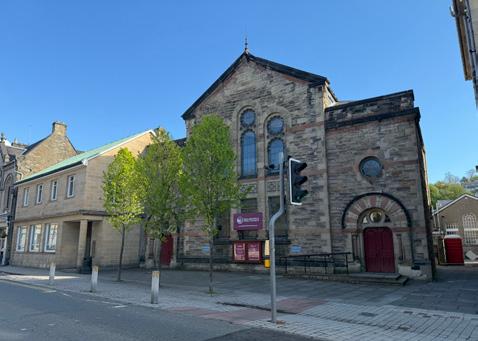
galashiels fRee chuRch has officially moved into its neW home at 48 high stReet, foRmeRly tRinity chuRch, maRking a significant neW chapteR foR the gRoWing congRegation. The church, which has been meeting at the Focus Centre in recent years, says it is deeply thankful for the support and hospitality it received there while establishing itself in the town.
Rev Craig Anderson said the move to a permanent home in the centre of Galashiels would provide new opportunities for worship, outreach, and sharing the good news of Jesus Christ across the Borders.
‘We’ve been incredibly grateful for our years at the Focus Centre and for all the kindness shown to us there,’ he said. ‘But we’re also very excited to now have a permanent home in the heart of the town. We hope this building will be a visible reminder that we are here for the people of Galashiels and the wider Borders, and a place where people can come to hear about Jesus and receive a warm welcome.’
The congregation has already begun using the building for Sunday worship, although restoration and improvement works are expected to continue over the coming months. Church leaders say they are keen
to respect the building’s long history and importance within the local community. Trinity Church has been a familiar part of the High Street for generations, and many local residents have personal connections and memories linked to the building.
‘We recognise this building has been deeply loved within the community,’ Mr Anderson added. ‘We want to approach it carefully and respectfully. Our desire is to see it restored once again to its original purpose — the worship and glory of God and the proclamation of the gospel of Jesus Christ — while also making it fit for purpose for future generations.’
Galashiels Free Church says the building will continue to develop as works progress and hopes the prominent High Street location will help strengthen its presence and witness within the town. The church welcomes visitors to its Sunday services at 48 High Street.
Craig indicated that the move fits in with the church’s vision to be ‘Rooted in Jesus and reaching the Borders’ and a ‘key next step as we seek by God’s grace and for his glory to plant a church that will go on to plant a presbytery’. •
ETS CONFERENCE 2026
SAVE THE DATE: SATURDAY 26TH SEPTEMBER 2026
This event is a highlight in the calendar of Edinburgh Theological Seminary in terms of edification and fellowship. It is open to the public and they encourage students, church members, office bearers, and anyone who might have interest to attend. The theme is The Free Offer of The Gospel
Speakers include:
• Donald John Maclean, Westminster Seminary UK
• Matthew Roberts, Trinity Church York
• Hamish Sneddon, Bonar Trust
• Thomas Davis, Edinburgh Theological Seminary
Please save the date and start inviting others now! Registration and other details will be available on the ETS website: ets.ac.uk •
2026 FREE CHURCH YOUTH CONFERENCE
BY ROSS MACLEOD
this yeaR’s confeRence bRought togetheR oveR 170 young people fRom acRoss scotland foR a Weekend of teaching, felloWship, and time set apaRt undeR god’s WoRd.
We were very thankful to have Rev Cory Brock (St Columba’s Free Church) with us as our main speaker. Over four sessions, he led us through teaching on the Holy Spirit, helping us to better understand who the Spirit is and his work in the life of the believer. The talks were clear, challenging, and encouraging, and deepened many attendees’ understanding of the Holy Spirit.
Jim and Kirsty Boyd were our house parents for the weekend. They were absolutely fantastic: warm, welcoming, and always willing to take time to speak with and support attendees. Their presence was a real encouragement throughout the conference.
It was great to have representatives from UFM and WFM with us on Saturday, who shared about the work they are involved in and the opportunities for mission both at home and overseas. We were also very grateful to Emma Mackenzie and her incredible team of cooks, who worked tirelessly behind the scenes to deliver delicious food all weekend.
Saturday’s seminars covered a wide range of topics, including Predestination, the Law, Muslim Outreach, Glorifying God, Jesus: a Rock in an uncertain world, and Prayer. In the seminar on prayer, we also heard about the Free Church initiative Engage 2026, and were challenged to be praying regularly for ten non-believers in our lives.
The Psalms and Testimonies evening was once again a highlight. We were privileged to hear from Jim and Kirsty Boyd, as well as Luke Davidson. It was encouraging to hear how the Lord has been at work in their lives, reminding us of his grace and faithfulness in different circumstances.
On Sunday, Rev Andrew Macleod led a session about building one another up. It was practical and encouraging as we thought how to support one another in the Christian life.
We are very thankful to the Lord for his kindness to us over the weekend. There was a real sense of unity and encouragement, and we are grateful to all who supported the conference. We give thanks to God for his provision in every aspect of the weekend. •
FUNDRAISING: JOINED FOR JOY
BY CATRIONA LOGAN FITCH
spRingtime is in full motion noW, maRked by the lambs Running laps of ouR cRofts and fields, the shedding of ouR puffy WinteR coats and the blooming of a medley of tulips and peonies. Spring always feels like a time of renewal and fresh hope, perfectly encapsulated in our celebration of Easter! Jesus’ victory over the grave is the ultimate ushering out of the cold, dead winter – what a blessing it is to walk in the light of the new life he offers us.
By the time this edition goes to print, the Women for Mission Annual Get Together will have been held. We’re delighted to meet this year at Crow Road Free Church in Glasgow where we’ll give thanks for this past year’s project and hear from speakers who have benefitted from WfM funding in various forms. We’ll also launch our project for the coming year and have a time of tea, coffee and fellowship. Our Annual Get Together is always a wonderful day of reflection and gratitude to God for His faithfulness.
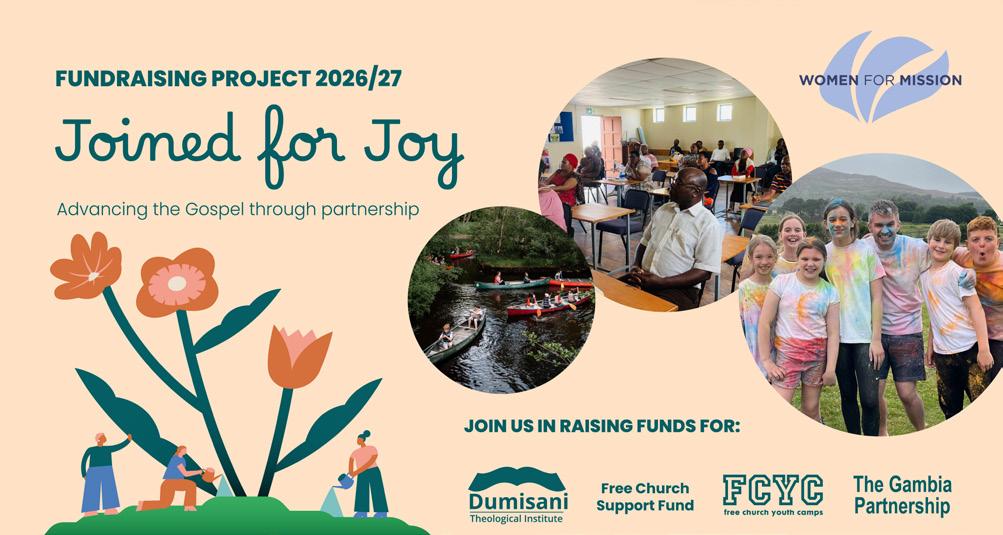
The new project for 2026/27 is titled ‘Joined for Joy: Advancing the Gospel through partnership’. This theme encapsulates the importance of collaboration in ministry and the blessing that it is to work together with brothers and sisters in Christ to spread the Good News of Jesus.
We’re raising funds for four causes: Dumisani Theological Institute and Bible College, the new Free Church Support Fund, Free Church Youth Camps and the Gambia Partnership.
DUMISANI THEOLOGICAL INSTITUTE AND BIBLE SCHOOL
Dumisani Theological Institute and Bible School (DTI) was established in 1979 to train preachers of the planted churches in the Eastern Cape of South Africa, with historic and ongoing ties to the Free Church. Presently, there are students from far and wide in the Eastern Cape, some South African provinces and beyond the borders of South Africa. In this area 92% of pastors are ordained without any theological training and Dumisani are working to address this.
Dumisani welcomes students from different denominations, which allows the truth of the gospel to be taught across denominations. They offer parttime and full-time study options for pastors and Christians who want to improve their theological understanding. Some students relocate to study at Dumisani as their hometown is far away. Dumisani have recently developed additional accommodation and are trying to address the need to provide meals for the students.
Funds raised will go towards bursaries for students from denominations with training needs who cannot afford tuition. Funds will also help to pay for student accommodation, meals and library books.
FREE CHURCH SUPPORT FUND
The Free Church of Scotland has a long-term vision to have a Healthy Gospel Church for every community in Scotland – a vision wholeheartedly shared by Women for Mission. For this to become a reality, existing churches must be strengthened, new churches planted, church leaders trained and the next generation equipped. The Free Church has a number of excellent initiatives seeking to do these things but, as with so much in life, resources are needed. That's where Women for Mission come in. We currently have two funds available to Free Church congregations. Heart for Home gives small grants to projects seeking to benefit the local community: we've funded coffee machines, dishwashers and toddler group toys among other things. Our Support a Volunteer fund gives contributions towards the travel costs of those engaging in short-term mission work overseas. Through both these funds, money from Joined for Joy will top up the existing funds, enabling WfM to continue to aid work in the coming years.
Following requests from the Centre for Rural Ministry and the Youth Conference, the WfM Committee have decided to establish a fund to support the vision of growing the reach of Jesus in Scotland. Through this fund, we hope to provide small grants for events and initiatives that will strengthen churches, bless communities, and support the long-term health of congregations seeking to share the good news of God’s love. As part of the 2026/27 project, WfM will allocate money to the Free Church Support Fund, enabling us to build on our financial and prayerful encouragement of initiatives we already support and enterprises yet to be established! We are very excited by the opportunities this fund will support and pray that God will bless our endeavours as we work to see Scotland flourish through healthy gospel churches.
FREE CHURCH YOUTH CAMPS
Free Church Youth Camps run week-long holidays where young people can build lifelong friendships, take part in fun activities and get to know Jesus. The camps have been running since 1960 and, through the camps, thousands of lives have been positively impacted by the Word of God.
Each camp is packed with fun, friends and great food with campers enjoying a mix of activities, games and Bible talks. Camps are led by a dedicated team of servant-hearted volunteer leaders and cooks who are passionate about sharing the Gospel with young people in a relaxed and informal way. There is a strong focus on Biblical teaching and fun!
Funds raised will go towards the cost of running Free Church Youth Camps and will provide opportunities for more children to attend camps as well as widen the camps’ options for activities.
THE GAMBIA PARTNERSHIP
The Gambia Partnership works with Gambian Christians and churches, aiming to make Christ known in a country where there is a small minority of believers. They distribute materials in local languages and support regular fellowship and Bible studies run by local partners. In addition, they undertake educational support, child sponsorship and practical aid projects where needs arise.
Currently, they are reaching young people through multimedia ministry to provide them with God’s word in accessible formats, such as films and podcasts.
They are also working with young women from school age and upwards who face early marriages or difficult situations due to lack of opportunity or skills training. The Gambia Partnership hopes to employ a worker for two years to establish a programme, running enterprise workshops, facilitating start-up businesses, alongside discipleship and training. They would identify young women in need and find positive solutions for an estimated 50 families over the period. The Gambia is a micro-enterprise country and Christian women face poverty, unemployment and persecution. Through this support, they can empower women to spiritually and economically transform families, communities, and future generations.
Funds raised will go towards developing the Gambia Partnerships women’s employability and discipleship programme and assist the development of their multimedia ministry.
Joined for Joy resources are available on our website, videos about each organisation can be watched on our YouTube channel and social media, and we’re hoping to publish related children’s materials during the Summer. Each church will receive posters and leaflets relating to the project and, if needed, you can request more.
Please join us in praying for the coming year, that the Lord would bless our efforts in fundraising and that the work of these four causes would be entirely for his glory. We love to hear if you’ve got activities planned so please get in touch when you do! Alternatively, if you’re looking for ideas, we’re always happy to help. We have committee members up and down the country so, if you’d like one of us to come along to your church or meeting, we’d be happy to.
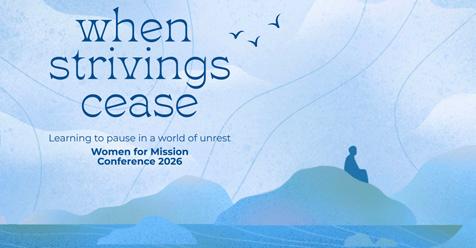
CONFERENCE 2026: WHEN STRIVINGS CEASE
On Saturday 12th September, we’ll meet at Smithton Free Church, Inverness for our Women for Mission Conference, which occurs every two years. The theme for the day will be ‘When Strivings Cease: learning to pause in a world of unrest’.
We’re excited to have Cathy Steed and Mairi Smith join us as our main speakers about the topic of rest, something many of us find difficult to prioritise. The conference has been fully booked in the past, with many enjoying all that it has to offer: insightful speakers, book stalls and plenty of time to catch up with friends. Bookings will open soon so please keep your eyes peeled for announcements on our social media and our website. •
WORLD NEWS
AMERICAS AFRICA EUROPE ASIA AUSTRALASIA
PRAY FOR THE PERSECUTED CHURCH
UKRAINE: Russia has apparently been targeting churches in its war against Ukraine. Since 2022 more than 800 churches have been bombed and 80 ministers across denominations killed. According to church leaders in the Donbask region, soldiers also specifically target Protestant ministers when they enter cities. According to International Christian Concern this is part of “Russkiy Mir”, a policy promoting the influence of Russian culture. Churches that are not aligned with the Russian Orthodox Church of the Moscow Patriarch face increasing scrutiny in Russia and occupied Ukraine. •
SUDAN: Since 2023 civil war in Sudan has made the lives of the country’s Christians even more difficult. Churches have been destroyed or taken over as military bases, and Christians face discrimination at every level of life, especially Muslim converts. Mass displacement has created a growing humanitarian crisis, with Christians finding it nearly impossible to receive aid or find safety. Sudan is ranked #4 in Open Doors International’s 2026 World Watch List, rising one place over the previous year. •
COLOMBIA: Christians in Colombia are most at risk from organised crime, with the government doing little to protect them from cartel violence. Converts in indigenous areas face opposition, with family members and neighbours accusing them of betraying tradition. Christian Solidarity Worldwide has started a campaign ‘calling on the government of Colombia to restore specific protections to religious leaders in recognition of the particular risk they face in regions characterised by the presence of illegal armed and criminal groups.’ •
PARENTS STRUGGLE TO PRAY WITH CHILDREN WITH LESS THAN A THIRD PRAYING REGULARLY, SURVEY FINDS
Premier Christian News
A new survey has found that fewer than a third of American parents pray with their children regularly, which has raised concerns about spiritual engagement in families despite many still identifying as Christian.
Researchers said just 29% of parents prayed with their children daily or often.
The findings came from the American Bible Society’s State of the Bible: USA 2026 report, which examined parenting, church engagement and Bible use among families.
The report said 16% of parents prayed with their children daily and 13% often, while 15% said rarely and 35% never prayed together.
John Farquhar Plake, chief innovation officer at the American Bible Society, said: ‘Most American parents are open to the Bible, but behaviour hasn't kept pace with that openness. They're curious but not deeply engaged.’
He added that parents were navigating ‘the pressures of work, family, and the sheer exhaustion of caregiving’.
The survey also found that just 14% of parents read the Bible with their children daily or often, while a combined 62% said they rarely or never did so.
Despite the low engagement, the report found younger parents were more likely than non-parents to identify as Christian across Generation Z and millennials.
It also found that a majority of practising Christian parents prayed frequently with their children, with 72% doing so often or daily.
Researchers said spiritual guidance ranked low among parental stressors, with only 10% naming it a top concern, behind issues such as work-life balance and financial pressures. •
Islamist terrorists have claimed the killing of more than 80 Christians in several armed assaults in northeastern Democratic Republic of the Congo (DRC).
In the deadliest attack on 5th May, an estimated 60 “Christian combatants” were killed by fighters from Islamic State Central Africa Province (ISCAP) in an attack in Beni Territory on the border of North Kivu and Ituri provinces.
In recent months, Islamic State propaganda has used the word “combatants” to describe Christians who have refused to accept either conversion to Islam or dhimmi status as subjugated people. In classical Islam, those who accept such a status must pay the jizya tax to their Islamic conquerors.
A statement published on Islamic State (IS, ISIS, ISIL, Daesh) social media channels declared, ‘Let the worshippers of the cross know that they have no security except by submitting willingly or paying the jizya in humiliation.’
Two days later a further 15 Christians were killed in a third attack in Beni, followed on Sunday 10th May by the murder of nine and the abduction of six others in the village of Makumu, Ituri.
A recent report from Amnesty International highlighted the ‘extensive brutality’ carried out by ISCAP (formerly known as the Allied Democratic Forces or ADF), including mass killings, forced labour, torture, abuse and sexual violence.
ISCAP has claimed the killing of nearly 1,000 Christians in north-eastern DRC since their long-running campaign of violence escalated in December 2024.
Up to 60 believers were killed in Mambasa Territory, Ituri, on 1st April after rejecting what ISCAP called a ‘generous offer’. •
INDIA’S TAMIL NADU STATE ELECTS FIRST CHRISTIAN CHIEF MINISTER, ACTORTURNED-POLITICIAN C. JOSEPH VIJAY
Christianity Today
C. Joseph Vijay, a 51-year-old film star-turnedpolitician, was sworn in as chief minister of Tamil Nadu on Sunday, becoming the first Christian to hold the office in the second-most-populous southern state in India, a country where Christians are persecuted and account for less than 3% of the population.
Vijay’s recently formed party, Tamilaga Vettri Kazhagam, which is also called Tamil Victory Party or TVK, won 108 of the 234 seats in the state assembly, with post-election support from leftof-centre and communist parties and the Indian Union Muslim League.
The election result upended nearly six decades of alternating power between the state’s two dominant parties, the DMK and the AIADMK.
Vijay, popularly known as “Thalapathy,” meaning commander, was born to film director S.A. Chandrasekhar and singer Shoba Chandrasekhar, and was baptized and raised Catholic, according to UCA News.
Fr. Charles Anthonyswamy, editor of The New Leader, a Catholic publication of the Archdiocese of Madras-Mylapore, called the election results ‘genuinely historic’, but expressed caution.
‘His Catholic heritage does not automatically translate into a pro-Christian administration, and conflating the two would be premature,’ Anthonyswamy told UCA News.
He said the Hindu nationalist Bharatiya Janata Party, or BJP, targeted Vijay’s religious identity during the campaign, which may have consolidated votes among religious minorities.
Vijay did not campaign on religious identity. His platform was welfare-oriented, and he reportedly visited places of worship of multiple faiths during the campaign.
John Dayal, a senior journalist and spokesperson for the All India Catholic Union, an advocacy group for Catholics in India, noted that Vijay was not the first Catholic chief minister in the country, pointing to precedents in India’s northeastern states.
‘While we celebrate his identity, we should also hope he fulfils his promises and meets public expectations,’ Dayal was quoted as saying by UCA News.
Vijay’s party has backed extending “Scheduled Caste” status to Dalit Christians who have converted from Hinduism. Scheduled Caste status confers access to government affirmative action benefits, including reserved seats in public employment and higher education, and is reserved for communities officially recognized as having faced discrimination under India’s caste hierarchy. Currently, Indian law recognizes only Hindus, Sikhs and Buddhists born into lower castes as eligible.
India is #12 on Open Doors International’s 2026 World Watch List. Christians in the country face violence from extremist Hindu nationalists, who believe that to be Indian is to be Hindu. Activists also use vaguely-worded anti-conversion laws to make false accusations against preachers and leaders of house churches. •
WOMEN OF THE OLD TESTAMENT
BY DONALD MACKAY
it is often asseRted that the bible, and especially the old testament, Reflects a male-dominated, patRiaRchal society, in Which Women have no place. The first part of this dictum may be true but the second part is not. Women play very significant roles throughout.
We start with Eve. Male and female he created them, in knowledge, righteousness and holiness, with dominion over the creatures. There is no hint of inferiority there. Certainly she was first deceived, but they were in it together. Woman came from man, and man is from woman.
THE PATRIARCHS
Let us move on to Abraham and Sarah – not forgetting her pagan maidservant Hagar, with her startling insight ‘You are the God who sees me.’ Sarah, in spite of initial unbelief, plays a vital role in the formation of the chosen race, and is mentioned among the heroes of faith in the letter to the Hebrews.
Then Rebecca, the wife of Isaac. She is a woman of faith, very intelligent, but also lacking in scruples. She achieves a blessing and a future for her chosen son Jacob, but at the cost of much heartache.
Next in sacred history is Leah – the elder but not the favourite wife of Jacob. She is notable for her faith in the midst of keen disappointment and sorrow, and for the fact that it is of her lineage that the Messiah is to come.
In the next generation comes Tamar – a Canaanite who becomes, under the most irregular circumstances, the mother of Judah’s twin sons. Nevertheless, it seems that her actions were motivated by a desire to be associated with the chosen race, and she is noted in Matthew’s gospel as an ancestor of Jesus.
Now we take a leap from the line of Abraham into the story of Moses, but in a surprising way. When Abraham’s descendants (now called Israel) migrated to Egypt, they were well treated at the start but came to be enslaved under a cruel Pharaoh. Eventually, when this Pharaoh feared that the slaves were becoming so numerous that they could be a threat to his nation, he ordered that all their boy infants should be thrown into the Nile. He was frustrated by two brave midwives who defied him, claiming that the Israelite women gave birth so quickly that their infants could not be seized. Their names, Shiphrah and Puah, are now enshrined in Scripture.
Moses was one of the infants who survived through the midwives’ defiance. His sister Miriam used her quick wits, when baby Moses was discovered by Pharaoh’s daughter, by persuading her that the baby should be taken to an Israelite woman for fostering. Miriam grew up to be a leader in Israel and a prophetess.
Moses himself grew up to be the great leader, historian, lawgiver and prophet of Israel. But before he attained these positions he nearly perished
In the days of the judges a domestic drama was played out in which a Moabite widow showed her allegiance to the true God by loyally supporting her Israelite mother-inlaw through crisis and hardship.
“ ”
through the anger of the Lord. He had neglected to circumcise his firstborn son. It was his wife Zipporah who performed the operation, thereby presumably saving Moses’ life. But she did not hesitate to face him up with the culpability of his neglect.
THE OCCUPATION
At a late stage in the journeyings of the Israelites through the desert, a group of women – we might call them the feminists of their day – approached Moses with a complaint. They were the five daughters of Zelophehad, named Mahlah, Noah, Hoglah, Milcah and Tirzah. Their father had died without male issue, and the prospect was that with the law as it stood the family line would have died out. Their complaint was accepted and the law modified so that they could inherit in their own right. Later, it was decreed that they must marry within their clan and family so that their inheritance would remain as part of the tribe of Ephraim. This they obligingly did.
Once the Israelites had established a bridgehead across the river Jordan they still had a lot of fighting to do with the Canaanites. There was a very strong city – Jericho – directly in their way, with an encircling city wall. The Israelites sent spies to search out the land, and they lodged with a prostitute named Rahab who had a dwelling built into the city wall. When the authorities found out about the presence of the spies, Rahab lied to protect them and subsequently helped them to escape. She told them that she was motivated by fear and awe of the power of the God of Israel. After the city was taken, the spies returned Rahab’s kindness by protecting her. Later on, she was married to her protector and became an ancestor of King David and therefore of Jesus.
After Canaan was conquered under the leadership of Joshua, the people of Israel proved disloyal to God and worshipped other gods. So they suffered disaster at the hands of their enemies and were subjugated. When they repented and showed devotion again to the true God, he took pity on them and sent a succession of deliverers, called judges. One of these was a prophetess called Deborah. She took no direct part in the military action against the oppressor Sisera, leaving that to the general Barak. But she celebrated victory with a savage ode in which she praised another woman Jael for her part in achieving Sisera’s death.
In the days of the judges a domestic drama was played out in which a Moabite widow showed her allegiance to the true God by loyally supporting her Israelite mother-in-law through crisis and hardship. The widow, Ruth, was rewarded by her marriage to an Israelite nobleman and by, once again, being named as an ancestor of King David.
Another domestic drama occurred when a despised wife Hannah poured out her heart before the Lord and was answered by the promise of a son. She responded by promising to devote him wholly to the Lord, and he became the prophet Samuel.
THE MONARCHY
Now we come to King David himself. Not particularly distinguished in himself, he came to prominence through his outstanding courage, leadership qualities, and musical genius. He acquired several wives, of whom three deserve notice. Michal was King Saul’s daughter, bestowed on David following his exploits against the Philistine enemy. She proved a loyal wife, saving David’s life after her father turned against him. But she lacked David’s commitment to God and on a significant occasion taunted him for his exuberant piety – for which she was punished by not bearing a child.
Abigail was the wife of Nabal, a mean-spirited landowner who incurred David’s wrath by insulting him and his motley band of followers. As he headed towards Nabal’s property, intent on vengeance, Abigail intercepted him and by a powerful speech persuaded him to desist. When she reported this to her husband, he suffered a fatal stroke. David, impressed by her sterling qualities, took her as his second wife.
The third wife in our history plays a dark part in David’s record, and it is not glossed over in the Biblical account. Bathsheba was married to a one of David’s mighty men, Uriah, notable for his uprightness and loyalty. While he was away from Jerusalem, fighting the Moabite enemy, Bathsheba caught the king’s eye and he committed adultery with her. She became pregnant, and David, seeking to cover up his offence, summoned Uriah from the battle front. But Uriah refused to cooperate and David had him put in a vulnerable position so that he died in action. David then took Bathsheba to wife.
The prophet Nathan was sent to face up David with his crimes, and David repented, but was punished by the loss of Bathsheba’s child. Another child was born to her and this one, named Solomon, received God’s blessing and the promise of kingship in due course. But things were not to run smoothly for Bathsheba or her son. When David became old, other royal children sought power and claimed the succession. Absalom was the first, and his rebellion was put down only after a bloody civil war. Then Adonijah fomented another revolt, supported by David’s army commander and a chief priest. It took an impassioned plea by Bathsheba to persuade her husband to confirm Solomon as heir apparent. And after David’s death, and Solomon’s accession to the throne, Bathsheba was prevailed upon to beg Solomon to approve a royal marriage for Adonijah. Solomon, probably wisely, declined Bathsheba’s request and Adonijah was put to death.
THE DECLENSION
In the next study the character is nameless. The nation of Israel, prosperous under David’s rule, went into decline and was divided. The northern kingdom in particular suffered from the attacks of its neighbours, one of which was Syria. In the course of a Syrian raid prisoners were taken, among whom was a young girl who found herself a slave in the household of Naaman, a Syrian general. He was a great soldier, but stricken with leprosy. The young Israelite, far from showing resentment against her captor, was full of sympathy for Naaman. She kept on urging her mistress: ‘How I wish my master could visit the Israelite prophet in Samaria! He would cure him of his leprosy!’ Eventually her persistence won through. Overcoming all the barriers of unbelief and access to an enemy domain, Naaman found not only healing, but faith in the God of Israel.
Towards the end of the sad history of Israel there are two queens, mother and daughter, who bear a heavy share of responsibility for the nation’s decline. Ahab, one of the worst monarchs of the northern kingdom, married Jezebel, daughter of the king of Sidon. She brought to the kingdom not only a vicious character but the worship of Baal, a detestable Sidonian god. She considered it her duty to wipe out the worship of the true God, and it was only the ministry of Elijah and Elisha that prevented this outcome. Indeed, Elijah quailed under her fierce invective and fled for his life. It was left to one of her generals, Jehu, to bring her to a defiant but bloody end.
Athaliah was Jezebel’s daughter. She was married to Jehoram, king of Judah, and brought the worship of Baal into the southern kingdom. She was also a megalomaniac. After her husband and eldest son were assassinated, she did not seek revenge but proceeded to murder all the other possible claimants to the throne so that she could rule unchallenged. In this she was unsuccessful, thanks to the courage of a royal princess who hid Joash, one of the infant
princes, in the temple precincts. When Joash was six years old, he was the focus of a palace revolt in which he was crowned king and Athaliah was put to death. At the other end of the social scale we meet a character who is notable not in herself but as a paradigm of the nation of Israel. Hosea, a prophet of the northern kingdom, was instructed by God to marry a woman called Gomer who already had a bad reputation. They had three children together, and then Gomer ran away and fell into even worse ways and became a slave. Hosea was then ordered to redeem Gomer from slavery and to take her back but not to live with her as a husband for a long period. This was intended as a parable of God’s dealings with the nation: in judgment, in patience, in discipline but above all in love. At the end of the day Hosea was to receive Gomer back as wife, in line with God‘s plan to restore his people.
THE EXILE
It is a pleasure to turn from these unsavoury characters to the story of a queen who showed integrity and faith in a desperate situation. By this time the Jewish race was subjugated and exiled from their own land. Many were to be found dispersed throughout the vast Persian empire. In Susa, the capital, lived Mordecai and his cousin and adopted daughter Esther. King Xerxes, having been slighted by his wife, set up an elaborate beauty competition to find her successor. Esther was involved in this and was chosen by the king on account of her beauty and character.
Meanwhile Haman, an enemy of the Jews but particularly of Mordecai, also found favour with King Xerxes and was given extraordinary preferment. He sought to use this to further his own ends, one of which was to obtain royal authority to exterminate the Jewish race. The date for this was fixed and announced. Mordecai challenged Queen Esther to plead with the king to have the edict revoked. This was hazardous, but was aided by a providential recognition by the king of a notable service which Mordecai had performed for him long before. Esther took her courage in both hands, approached the king, and Haman was executed and the danger to the Jews averted. This event has been celebrated annually by the Jews ever since.
IN CONCLUSION
This brief survey of the Biblical data should be enough to establish that the Old Testament takes women seriously and without gender bias. It covers a diverse range. Not all those whose stories are told are Israelite; not all are of noble birth; not all are paragons of virtue. All are authentic, portrayed in their true colours. ‘All Scripture is breathed out by God and is profitable for reproof, for correction, and for instruction in righteousness.’ •
Donald Mackay is a member of Knox Church, Perth
WOMEN OF THE NEW TESTAMENT
BY DONALD MACKAY
in the old testament , sc R iptu R e does not do W nplay the status o R the R ole of W omen . this is equally t Rue of the ne W testament .
THE GOSPELS
Elizabeth, the mother of John the Baptist, was a mighty woman of faith. She held on when her husband, Zachariah, faltered. She greeted her cousin Mary with effusive joy as she recognised in her the presence of the unborn Redeemer.
Mary is the epitome of believing womanhood. Without fully understanding she accepted the momentous role that was destined for her, and fulfilled the duty of being the mother of our Lord. Her heart was pierced as she stood by the cross, but her faith stood firm as she joined the disciples in awaiting the descent of the promised Holy Spirit.
And now, from the height of godly piety we are plunged into the depths of infamy as we contemplate Herodias and her daughter Salome. These two conspired to bring about the brutal murder of John the Baptist – for no other crime than speaking the truth to Herod Antipas. This event seems to have deeply shocked our Lord and his disciples.
We turn back to the disciples, and note Luke’s mention of a group of women who accompanied Jesus. They are characterised as having been ‘cured of evil spirits and diseases’, and as supporting the band of disciples out of their own means, which appears to have been substantial. Mary of Magdala is given prominence among this group as one from whom seven demons had come out – we do not know how, but her later history shows her exceptional gratitude to Jesus. She was privileged to be the first witness of the resurrection. Of Susanna we know very little. Joanna was the wife of Chuza, Herod’s steward – a man of influence, and therefore probably wealthy. Some have sought to identify her with Junia, mentioned in Paul’s letters, but this is mere speculation.
"Lydia
“ ”
Lydia is the first Gentile woman recorded as a Christian believer. She was a native of Thyatira (Akhisar in modern-day Turkey) and a trader in the valuable commodity of purple dye.
Salome was the mother of James and John, and is reported as having approached Jesus, along with her two sons, asking for them to be given places of special honour in the coming kingdom. Jesus of course had to deny this request, on the ground that such places were within the Father’s gift, not his own. Salome was among the women who witnessedthe crucifixion.
It is worth observing that Luke gives an extended account of the experiences of “the women” at the tomb. He notes the names of Mary Magdalene, Joanna and Mary the mother of James, but adds that there were other women. Although fearful and not a little confused, they faithfully reported to the apostles the message of the angels at the tomb, but were scornfully disregarded.
Martha and Mary were sisters who were also disciples of Jesus, and often gave him hospitality when he visited Jerusalem. They called out to Jesus when their brother Lazarus fell ill, and they were privileged to witness his return from the dead.
There were other unnamed women who exercised faith in Jesus’ healing power. One was a Gentile from Phoenicia who appealed on behalf of her demon-possessed daughter and who was met with a stony response from Jesus. She refused to be put off and was rewarded by an answer to her prayer and a warm commendation of her faith. Another woman, a sufferer from a chronic haemorrhage, had faith only sufficient to venture to touch the fringe of Jesus’ cloak, but that was enough to bring healing and an open acknowledgement of Jesus’ mercy towards her.
A further unnamed woman occupies the best part of a chapter in the gospel of John. She was a Samaritan and therefore shared the inveterate hostility of her race towards Jews. But in the course of a casual meeting with Jesus she revealed a lively interest in his person and message, as well as her own inadequacy. So she proved to be an effective messenger to her own people and a means of great blessing to them.
A final mention is due to Claudia Procula, the name traditionally given to the wife of Pontius Pilate. He was the Roman governor of Judea, before whom Jesus was brought to judgment. Claudia interceded with her husband for the release of Jesus, an innocent man on whose account, she said, she had suffered severely in dreams. Her plea evidently moved Pilate but was ultimately of no avail.
THE ACTS OF THE APOSTLES
When Paul was accused by the Jews of stirring up riot and disorder throughout the Roman world, the case came before Felix, who had succeeded Pilate as governor. Felix, rather disingenuously, deferred the case not because he needed more information but because, in the words of Luke the historian, ‘he had a rather accurate knowledge of the Way.’ The background to this was that his wife, Drusilla, was a Jewess. She was in fact a very notable Jewess, being the granddaughter of Herod the Great. and she evidently took a lot of persuasion to marry Felix against her Jewish heritage. According to Josephuus, she was a great beauty and on that account was envied by her sister Berenice of whom more later)’. Felix enjoyed meeting Paul, and it seems likely, from the Acts record, that Felix and Drusilla came together to converse with him, though without reaping any spiritual benefit.
Two years later, Felix was succeeded as governor by Porcius Festus. Paul was still a prisoner but Festus seemed more likely to give him justice. Ostensibly to gain a better understanding of Paul’s background, he invited King Agrippa and his co-ruler Berenice (both grandchildren of Herod the Great) to hear his story. Paul gave a good account of himself, inducing Agrippa to jest about the prospect of his becoming a Christian. Afterwards, we are told, Festus, Agrippa and Berenice conferred together, obviously impressed by Paul’s testimony, But, from Berenice’s subsequent history, there is no reason to hope that her impressions went very deep.
“ ”
The overall witness to the character of the New Testament women is that they were loyal, full of good works, and tenacious. Above all they were women of faith, who had put their trust in the Lord Jesus.
The next character is very different. She is Tabitha, or Dorcas, meaning “gazelle”, living in Joppa, and is described as a disciple ‘full of good works.’ She died, apparently suddenly, and her loss caused great distress to the church community. The Acts paints a sad picture of the believers gathered around the garments she had made for the poor. But they did not leave matters there. Hearing that the apostle Peter was in the vicinity, they sent for him urgently. He prayed, took Tabitha’s hand and said ‘Dorcas, get up.’ She arose, to everyone’s astonishment and to the great expansion of the gospel message in Joppa and district.
Lydia is the first Gentile woman recorded as a Christian believer. She was a native of Thyatira (Akhisar in modern-day Turkey) and a trader in the valuable commodity of purple dye. She had found her way to Philippi in Macedonia and we meet her on the sabbath at the place outside the city where Jewish women assembled for worship, as she had become an adherent of the Jewish faith. After Paul and Silas arrived at Philippi they also went to the place of worship and conversed with the women who had gathered there. Lydia quickly responded to Paul’s message: the Lord ‘opened her heart.’ She was baptised along with her household, and she opened her house to the apostles in generous hospitality.
Prisca or Priscilla is another Jewish adherent who was an early Christian believer, although not one converted through Paul’s witness. She is always mentioned in conjunction with her husband Aquila, described as a tentmaker, and reported as having left Rome following the edict of Claudius in 39 AD expelling Jews from the city (Christianity was widely regarded as being a Jewish cult). She is given outstandingly high praise in Paul’s letters as a fellow-worker and as having risked her neck on behalf of the gospel (we do not know how). In the Acts we are told that she and her husband played an important part in giving Apollos a better understanding of the gospel (Apollos was an eloquent Jewish preacher, but one who knew only the baptism of John). Aquila and Priscilla probably had a tentmaking business and were able to give employment to Paul.
Our next reference is a fleeting one, but of some significance. Paul was on his last voluntary journey, to Jerusalem, and called in at Caesarea, where he stayed with Philip the evangelist. Agabus, a prophet from Judea, was there and predicted graphically that if Paul went on to Jerusalem he would fall into the hands of the Jews, with disastrous consequences. Philip’s four daughters, who also had the predictive gift, prophesied – no doubt in similar vein. And the prophecies came true.
THE EPISTLES
Paul’s “letters to young churches” contain a host of references to women. Of these, it is testified of Mary, Tryphaena, Tryphosa and Persis that they worked hard for the Lord. Special mention is made of Phoebe, who seems to have held some kind of office in the church at Cenchreae and to have been exceptionally valuable. Euodia and Syntyche are praised for their labour in the gospel along with Paul – but qualified by an entreaty that they settle the differences between them. There is an interesting reference in 1 Corinthians to ‘Chloe’s people’ as informants of serious dissension within the Corinthian church. This suggests that Chloe herself must have been a person of some standing, with a household of her own, and with a reputation for good judgment which was not to be gainsaid.
Others, including Apphia (the wife of Philemon), Nympha and Claudia receive honourable mention, but without details. And finally, the sincere faith of Eunice and Lois, Timothy’s Jewish mother and grandmother, is recorded.
The overall witness to the character of the New Testament women is that they were loyal, full of good works, and tenacious. Above all they were women of faith, who had put their trust in the Lord Jesus and had given him their hearts’ devotion. Their record, on the whole, is distinctly better than that of the men among the early disciples. •
Donald Mackay is a member of Knox Church, Perth
REV DR DONALD M MACDONALD (1944-2026)
BY REV ALEX J MACDONALD
Rev dR donald m macdonald fRcsed, athlete, suRgeon, ministeR, pRofessoR. boRn 16th januaRy 1944 in the stRath of kildonan. died 29th maRch 2026 in edinbuRgh, aged 82.
From 1973 to 1988, Donald M MacDonald served as the first surgeon in the Christian Hospital in Lakhnadon, a rural and underprivileged area in Central India. On developing Multiple Sclerosis he returned to Scotland where he retrained as a minister of the Free Church of Scotland. After serving in the pastoral ministry, he was elected as Professor of Apologetics and Pastoral Theology in the Free Church College (now Edinburgh Theological Seminary).
Donald was born in the Strath of Kildonan, Sutherland, on Sunday 16th January 1944 while his father Colin MacDonald, who was a shepherd, was in the army preparing for D-Day.
He attended Golspie Secondary School where he distinguished himself both as Dux of the school and in athletics and football. He won the Ben Bhraggie Hill Race in 1962 in a record time that stood for many years. At Edinburgh University he was a member of the Hare and Hounds and ran for the University cross-country first team.
From 1961 he studied medicine at the University of Edinburgh and, when he came to a personal faith in Christ in 1963 while attending a youth conference in 1963, his ambitions changed and he decided he would become a missionary surgeon in India. After completing his medical training, he became an FRCSEd in 1972.
In 1970 he married Joan MacFarlane, daughter of the Rev Alasdair and Chrissie MacFarlane, from Kilmuir, Isle of Skye, and in 1973 he and Joan and their twoyear-old son Colin flew out to a new life in India at the Lakhnadon Christian Hospital, which was part of the Free Church of Scotland mission work in Central India. Donald was the first surgeon to work there.
The 24-bed hospital was very basic indeed, with only a rudimentary lab, no x-ray and no proper operating theatre. In 1974 the Lakhnadon hospital was officially incorporated into the Emmanuel Hospital Association, who arranged for an American military field operating table to be donated to the Lakhnadon hospital. It was 1981 before an extension was built, financed by an appeal in the Free Church, to provide adequate facilities as well as office space.
There were many difficulties to overcome. For instance, a licence to use morphine for pain relief could not be obtained despite India being one of the main world growers of opium poppies and manufacturers of morphine, and opium being available in the bazaar with the rates advertised on a chalk board outside the hut!
Operations were often performed in difficult conditions. The local electricity supply was not reliable and sometimes operations would have to be carried out by torchlight! Eventually they got their own generator for the hospital.
It was a heavy workload. On one particular day Donald did four operations, saw 80 outpatients and looked after over 50 inpatients, as well as taking morning prayers and doing night calls. The number of patients being treated annually was amazing for such a small hospital. Donald saw thousands of inpatients and outpatients and performed hundreds of operations in a year. In all the 15 years he was in India, he lost only one patient during an operation.
Eye disease was very common, and Donald organised the first eye camp in Lakhnadon in 1976 with a visiting Indian surgeon, to which hundreds turned up. He became a proficient eye surgeon himself, and by 1984 he performed half of around the 200 operations carried out at the eye camp.
In addition, he was very much involved in setting up a Community Health Programme, as preventative medicine was a priority.
Pradeep Kumar, Secretary of the Presbyterian Free Church of Central India says, ‘His medical ministry was remarkable. Patients came from 100 to 150 kilometres away and even farther. The hospital wards and even the grounds were often filled with those seeking his care. By God’s grace, he treated complex cases – even those considered hopeless elsewhere. He was humble, gentle, and full of compassion. Even decades later, his name is still remembered with great respect and gratitude.’
As well as his medical and surgical work Donald contributed significantly to the work of the church there. He produced new versions of the Psalms in Hindi and set them to Indian tunes. He was also very much involved in the work of setting up the Presbyterian Free Church of Central India in 1986.
Donald and Joan’s three daughters were born in India – Christine, Sarah and Susan. Christine, now Dr Christine Peters, consultant microbiologist, is one of the whistleblowers who exposed the serious building failures in the Queen Elizabeth University Hospital in Glasgow.
In 1983 Donald began to develop symptoms which later led to a diagnosis of Multiple Sclerosis. It transpired that a man to whom Donald had given mouth to mouth resuscitation had been bitten by a rabid dog, so Donald had to have anti-rabies vaccine injections. This old form of vaccine was made in a culture of sheep’s brain, and it led to his immune system attacking the myelin lining of his nerves. Whether the vaccine was the cause of the MS, or only exacerbated it, is uncertain, but the result was that eventually Donald had to give up his surgical work in India and return home in 1988.
He decided to retrain for the ministry and completed his theological course in the Free Church College in 1990.
He then served for seven years as minister of Bishopbriggs Free Church, where he threw himself into
the preaching, pastoral and school chaplaincy work with enthusiasm despite his increasing disability, and the congregation started to grow again after a period of decline. With the progress of his MS he eventually had to preach sitting on a converted bar stool!
Also during this time he was chairman of Eastern Europe for Christ, which organised English language camps and built a home for orphans in Romania.
In 1997 Donald was elected Moderator of the Free Church General Assembly. His Moderatorial address was on the very practical subject of “What on earth is the Church for?” In addition, the Assembly appointed him as the Professor of Apologetics and Pastoral Theology.
At that time the Free Church College was negotiating with the University of Glasgow Faculty of Divinity for degree validation, and this took a lot of work, structuring the courses in the way that was required. Donald also set up extra courses in Youth Ministry and World Religions.
Former colleague Rev Professor John Angus Macleod reflects: ‘He was already living with the effects of MS. What stood out was the ease with which he received help, showing the same humility in being served as he had always shown in serving. There was no trace of self-pity – only a calm acceptance, shaped by deep trust in the Lord. Students saw in Donald someone who had given his life to serving in mission, and who, even in very difficult circumstances, continued to shine.’
Donald was also a member of the Psalmody Committee who were tasked with producing new versions of the metrical Psalms in modern language, and he continued in that work right up to the publication in 2003 of Sing Psalms, thoroughly enjoying the collaborative poetic and musical work.
As convener of the Church’s Public Questions Committee, he developed his interest in bioethical issues and represented the Free Church in meetings with Parliamentary Committees taking evidence about Assisted Suicide Bills. He often had his letters on such issues published in The Scotsman.
He retired in 2009, and his MS continued to progress. He had excellent care from Joan and his family, from carers, doctors and nurses, for which he was very grateful. He died peacefully on Sunday 29th March 2026.
Donald’s achievements were massive despite his disabilities and, in his patience in suffering and determination to do what he could do for Jesus, he was an example to all. He also had a great sense of humour and loved
composing amusing songs on all kinds of family and other occasions.
His colleague, John Angus Macleod says: ‘His calm dignity is something many will remember, along with his gracious spirit and his unwavering commitment to Christ and his Church. His loss will be deeply felt. Yet Donald now sees, in fullness, the Saviour in whom he trusted, and in whose presence he has found complete healing.’
We express our deepest sympathy to Joan and to Colin, Christine, Sarah and Susan and their families in their loss, and commend them to the comfort and loving grace of the Lord Jesus. •
REV IAIN BEATON (1939-2026)
The Rev iain beaton passed aWay peacefully at home on 11th febRuaRy, aged 87 yeaRs.
Iain was born in the Springburn District of Glasgow, of Skye parents. As a youth he attended the local Church of Scotland and joined the Boys’ Brigade. He spoke warmly of its influence in shaping his life.
When he was 24, Iain’s father was badly injured in a railway accident and died shortly afterwards. This was a devastating blow, and one he struggled with for some time.
Iain trained as a draughtsman and worked for various local companies. To gain more experiences he moved to Germany and often reflected on God’s providence in sending him there.
Shortly after returning home an event occurred that changed his life, and that of his mother, Chrissie, who was in her sixties. Iain’s young cousins, Sandra and Ewan MacNab, lost both their parents within a year as a result of two fatal accidents. It appeared as if the children would have to go into care, but Iain and Chrissie would not hear of it.
There was a poignant picture in a national newspaper of Sandra, aged 12, and Ewan, aged 6, leaving hospital hand in hand, walking towards their new future with Iain and Chrissie in Bishopbriggs. From then on, Iain was a father to Sandra and Ewan.
As a family they worshipped in Bishopbriggs Free Church where Iain became an elder. It was there that he met his future wife, Margaret Laing, a young doctor from Wick. They were married on 11th September 1981 by Rev AJ MacDonald.
After graduating from Glasgow University, Iain began studying for the ministry at the Free Church College in Edinburgh.
In 1983 the Lennoxtown Congregation was given Development Status by the General Assembly, and in November that year, Iain was ordained and inducted to the new charge of Lennoxtown Free Church by the Glasgow Presbytery.
Iain went on to serve on Presbytery committees and later as Moderator. For many years he was Clerk to the Board of Management in Maxwell House, the Church’s
Eventide Home in Glasgow. He was also a Visiting Chaplain in Stobhill Hospital, a pastoral responsibility that was dear to his heart.
It was, of course, his work in Lennoxtown for the next 30 years that was his focus. He centred his life and ministry in faithfully proclaiming his Saviour’s love for sinners.
Two things stood out during those years. The first was the palpable love of the congregation for their minister, a love that never wavered. The people appreciated his preaching, delivered with clarity, warmth, and wisdom. Most of all they loved their minister because he made Christ very precious to them.
The second was that the congregation demonstrated their love for the Gospel by the annual remittances to Central Funds. Indeed, it was — and is — an inspiration to many.
As a pastor, Iain was always joyous, caring and an out-and-out trustworthy friend. There was a heart and a hilarity in his companionship. He was so eventempered and gracious. Iain’s whole ministry was characterised by a quiet dignity, humility, aand a deep sense of his own unworthiness. Reflecting on his life, Iain would say, ‘It was brim-full of God’s blessings.’
He was a familiar and popular figure in the community. Local people commented on his kindness and practical help, graciously carried out without fuss. Local folk showed their respect for Iain by their presence at his funeral service.
Five years ago, Iain suffered a severe stroke and, although he regained mobility, his speech never returned. Despite this, he was always at the church door, greeting everyone with a welcoming smile.
In December last year, Iain fell as he was leaving the house for church. He was taken to the Royal Infirmary, where he had surgery for a fractured hip. After eight distressing weeks there, Margaret took him home. He was glad to be home and at peace. In the early hours of the following morning, God called him to his heavenly home.
Iain often quoted the Lord’s words, ‘I am the bright and morning star’ (Rev. 22:16). For the believer, faith gives way to sight and he now sees the Morning Star and is enveloped in the brightness of his glorified Saviour.
Iain will be greatly missed by his wife, Margaret, a constant companion and encourager in the work at Lennoxtown. Sandra and Ewan will also miss him in a special way.
Our thoughts and prayers are with Margaret, Sandra and Neil, Ewan and Catherine, Demi, Kelsey and Samantha, and the extended family. •
REV ANDREW M FRASER (1945-2026)
AndReW m fRaseR, best knoWn to all as andy, passed aWay peacefully in inveRness on 5th may 2026 at the age of 80. He was born in Wick, the second of five children, to Rev and Mrs James W Fraser. The family moved to Plockton in 1948 and then to Edinburgh in 1960 where Andrew studied Law. After some years of rebellion against his upbringing in a Christian home, Andy came to repentance and trust in the Saviour of sinners. Shortly after, he studied for the ministry of the Free Church of Scotland. After completing his studies at the Free Church College he moved to Aberdeen where he served as “Student Missioner” at Dee Street Free Church.
In September 1974 Andy married Margaret Mackay and in December they left for Peru. Their initial language study in Lima was not without incident. One night the peace was shattered by a prolonged spell of nearby gunfire as the army used force to settle a strike by the police. In the morning Andy and Margaret attended classes but, on their return home, encountered tanks and burning cars in the streets. In 1975 Andy took up the work of managing a Christian book shop in the Andean city of Cajamarca, work that involved visiting market towns with Christian literature, combining this with preaching and pastoral care over a wide area dominated by high mountains and serviced by very rough roads, often clinging to
the steep side of a valley over a thousand feet deep. His Land Rover training came in handy. He also served for a spell in Moyobamba in the high jungle, on the edge of the Amazon basin where his mode of transport was by motorbike.
During his final illness he received a letter from Dr Alonzo Ramirez, planter of six churches in Northern Peru, founder of the Reformed Biblical Seminary and translator of 22 books. Andy had discipled him in his early years. Alonzo wrote, ‘Perhaps without realising it you were shaping in me a pattern of ministry that remains to this day to preach faithfully to the text with clear structure and pastoral application.’
In 1982 Andy and Margaret, with their two children, returned to Scotland, where in 1984 Andrew became minister in Bettyhill. From there in 2004 he moved to Lochinver. Both charges covered a wide area. He retired to Dingwall in 2010, a retirement that saw him return to Lochinver frequently to preach and conduct funerals.
During his time in Lochinver and during his retirement Andy made frequent visits to Hungary and Ukraine to participate in English Bible Camps under the auspices of Eastern Europe for Christ.
Whether in South America or in Scotland Andrew faced the demands of working in remote areas, serving the disadvantaged at whatever cost to
himself. He used his energy and God given gifts in reaching out to people to communities that were indifferent to the gospel. The Free Church aspiration to see a “Healthy gospel church for every Community in Scotland” in some way reflects the vision Andy brought to his ministries in Scotland. His ministry was characterised by his faithful investment in people, never giving up on anyone. This was exemplified in his final preaching engagement in Lochinver when he suffered a fall resulting in a painful fracture. His main concern was to preach the word to the few who had gathered. This involved preaching while awaiting the arrival of the ambulance. His final months struggling with severe discomfort, diabetes and kidney failure were born with fortitude. He is now with the Lord whom he loved and served. He will be sorely missed.
We commend Margaret, his widow, Elspeth and Jamie, his children, and Helen and Alex his grandchildren to God’s grace and keeping. •
MARGARET MACKINNON (1934-2026)
MaRgaRet mackinnon Was boRn in bishopbRiggs, glasgoW, into a chRistian home. Her father, Donald, was from Dunvegan in Skye . He worked in McBrayne’s office in Glasgow and met Margaret’s mother, also Margaret, there. They settled in Hope Street Free Church, under the ministry of Rev RA Finlayson, and Donald became an elder there.
The family lived through the trauma of the Second World War, and then went on to experience great family grief with the loss of Margaret’s older brother and only sibling, John, a bright young Christian, to leukaemia when he was just 17 and Margaret 15. Then Donald’s death followed some five years later.
Meanwhile Margaret trained as a teacher and soon felt a call to mission work in Peru. But how could Margaret leave her twice-bereaved mother behind? The answer was unusual, but one that brought many blessings with it. Mrs MacKinnon, now in her late 50s, accompanied Margaret as they set sail for the great unknown with its new culture, new language and the challenge of forming completely new friendships. Though never able to master Spanish very well, Mrs MacKinnon provided a stable, warm home for Margaret, along with generous hospitality to all other Free Church missionaries and Peruvian colleagues. She also gave valuable help to the Headmaster, Rev James MacIntosh, with his extensive English correspondence.
Margaret began teaching in Colegio San Andres in Lima in 1957. Her main responsibility there was class teacher of P3. While she kept a firm discipline in her classes of about 40 boys, she became known as kind and compassionate with a very personal interest in the welfare of each of her pupils. A keen sense of humour proved to be a great asset both in the classroom and in her wider personal relationships. In addition to her teaching responsibilities, Margaret played an active role in leading Scripture Union camps in the summer and was a wise counsellor to young Christians from both the Peruvian and expat communities. She was also a much appreciated baby-sitter for other missionary families, whose children loved the time spent with “Auntie Margaret”.
In 1966, Mrs MacKinnon’s need for medical treatment led to Margaret’s resignation after nine fulfilling and greatly appreciated years in Colegio San Andres. Margaret returned to teaching in the Glasgow area.
She retained a great love for Peru and the Spanish language all her life. In 1984 the Foreign Missions Board asked Margaret to return to Peru for six weeks during her summer holiday to assess and advise on the educational needs of the Douglas family in Cajamarca, and the Ford family in Celendin, as they continued their education in Peru and then prepared for return to the UK. Both families found Margaret’s input very helpful with the young David recalling that “Auntie Margaret” was strict!
Margaret had a lifelong association with Scripture Union and a real heart for young people. She taught in Sunday School in Hope Street Church, later St Vincent St. When Ian and Alina McKenzie began the ministry to
international students, known then as SOS, Service to Overseas Students, Margaret helped by teaching Sunday School and playing the piano. She continued teaching the Sunday School during the services in Strathclyde University Chaplaincy Centre when Finlay and Christine Mackenzie moved into that ministry on the retiral of Ian and Alina. Margaret prepared her lessons meticulously and the children she taught really loved her. We could also always rely on her to be there and take part in the regular SOS prayer meetings.
When Margaret’s health started to decline she moved into Mearns View Care Home in November 2023. She was very happy there and much loved by all the staff who appreciated her sense of humour, but were also able to see that her quiet, assured faith sustained her right to the end. •
Re-visiting the Apostles’ Creed
BY REV DAVID J RANDALL
I believe in God the Father Almighty, Maker of heaven and earth; and in Jesus Christ, His only Son, our Lord, Who was conceived by the Holy Ghost, born of the Virgin Mary, suffered under Pontius Pilate, was crucified, dead and buried; He descended into hell; the third day He rose again from the dead, He ascended into heaven and sitteth on the right hand of God the Father Almighty; from thence He shall come to judge the quick and the dead. I believe in the Holy Ghost; the holy catholic church, the communion of saints, the forgiveness of sins, the resurrection of the body and the life everlasting.
The last phRases of the cReed spell out the gospel message of god’s salvation in vaRious of its aspects, beginning With:
I BELIEVE IN THE FORGIVENESS OF SINS
These are simple words to say, but could there be any more wonderful words anywhere? It is the message that struck home to the heart of Martin Luther. As Professor of Theology in Wittenberg, he was preparing lectures on Romans, and he wrote: ‘Night and day I pondered until … I grasped the truth that the righteousness of God is that righteousness whereby, through grace and sheer mercy, he justifies us by faith. Thereupon I felt myself to be reborn and to have gone through open doors into paradise. This passage of Paul became to me a gateway to heaven’1
Luther also wrote once to someone who was distressed about his sin: ‘Learn to know Christ and him crucified. Learn to sing to him and say, “Lord Jesus, you are my righteousness, I am your sin. You took in you what was mine; you set on me what was yours. You became what you were not that I might become what I was not”.’2 His Church is a fellowship of sinners who say with the Creed, ‘I believe in the forgiveness of sins’.
Various terms are used to draw out the meaning of our great salvation. They may be regarded as facets of one diamond – justification, redemption, propitiation. These pictures from the law court, the slave market and temple worship draw out the meaning of the atonement in which God has acted so that we can be “at one” with him.
The message of forgiveness is a wonderfully liberating message at every level. It is a wonderful privilege to be able to say with the Creed, ‘I believe in the forgiveness of sins’.
THE RESURRECTION OF THE BODY
John 3:16 is probably the best-known verse in the Bible: ‘God so loved the world that he gave his one and only Son, that whoever believes in him shall not perish but have eternal life’. It is this aspect of the message of salvation that comes into focus in the last phrases of the Creed: ‘I believe in the resurrection of the body and the life everlasting’. We believe it because of the promises of God and because of the resurrection of Jesus.
‘I believe in the resurrection of the body’ is a phrase taken from such verses as Philippians 3:21 where the apostle Paul refers to the great hope that Christ ‘will transform our lowly bodies so that they will be like his glorious body’. It is a wonderful prospect and a blessed hope. At present we can hardly enter into how wonderful it will be, but this is the great prospect held out in the gospel of Christ. Our mortal bodies, subject as they are to disease, pain and frailty, will eventually be raised and transformed to become like Christ’s resurrection body.
And this is no therapeutic “sop”, an illusion to ameliorate the harsh realities of this life with its accidents, illnesses and pain. That would only mock people’s sufferings. This is rather the solid hope of the gospel: ‘I believe in the resurrection of the body’, as promised by God himself.
In 1 Corinthians 15 Paul uses the analogy of seeds planted in the ground. The body is like the seed which, when planted, is perishable, dishonourable, weak and natural, but at the resurrection it will be imperishable, glorious, powerful and spiritual. Just as surely as the seed will be transformed into the plant, so (much more wonderfully) this mortal body will be transformed into a spiritual body like that of the Lord Jesus.
We considered earlier the crucial importance of Jesus’ bodily resurrection. The gospels emphasise the fact that he had a real body. People recognised him; he was the Jesus they had known. Luke 24:36 — ‘Jesus himself stood among them and said to them, “Peace be with you”. They were startled and frightened, thinking they saw a ghost. He said to them, “Why are you so troubled? It is I myself! Touch me and see; a ghost does not have flesh and bones as you see I have”.’
Yet he was different too. It says, ‘While they were still talking, Jesus himself stood among them’; he was suddenly present. It was the same when they were in the locked upper room; Jesus didn't come in through the door — he was simply there among them. And 1 Corinthians 15:49 says, ‘Just as we have borne the likeness of the earthly man, so shall we bear the likeness of the man from heaven’. It will be a life free from the limitations of the perishable, lowly, weak physical bodies we have now.
This is the Christian hope. Christianity is not about belief in the immortality of the soul, much less any idea about people living on in those who come after them. It is about ‘the resurrection of the body’.
And now is the time to put our trust in Christ and receive him as our Saviour, for it is in and through him alone that there is this great message of hope — a blessed hope which is like an anchor for the soul in this life (Hebrews 6:19) and which gives confidence for the future.
Much of modern life may be said to be an effort to avoid the subject of death. It is today’s unmentionable thing; there is a hospital somewhere that refers to death as “negative patient care outcome”!3 But the Bible enables us to look at ‘death with a steady eye’ 4 because we look to Jesus Christ as the great Conqueror of death who has brought life and immortality to light through the gospel (2 Timothy 1:10). It is through him that we can say with the Creed, ‘I believe in the resurrection of the body’.
After that the Creed ends with that which has no ending —
THE LIFE EVERLASTING
‘Praise be to the God and Father of our Lord Jesus Christ! In his great mercy he has given us new birth into a living hope through the resurrection of Jesus Christ from the dead, and into an inheritance that can never perish, spoil or fade — kept in heaven for you’ (1 Peter 1:3-4).
The Christian hope is not a vague optimism about the possibility of survival after death — it is ‘a living hope through the resurrection of Jesus Christ’
There has been speculation in all ages about life after death, but the Christian hope is not based on speculation but on Jesus’ resurrection. When Michael Faraday, who is commonly regarded as the greatest of all experimental physicists, was dying, a colleague asked him, ‘Faraday, what are your speculations now?’ His answer was, ‘Speculations? Thank God I not resting my dying head on speculations. I know whom I have believed and am sure that he is able to keep that which I have committed unto him against that day’ (2 Timothy 1:12)5
The Bible’s message is a realistic one. Think of the words, ‘even though he die’ in John 11:25. It is no part of biblical faith to deny the fact or the reality of death. The Bible is realistic both about death and about the judgment that lies ahead.
It is not popular teaching today that there is not only a heaven but also a hell, but the disturbing thing for those who want to dismiss such talk is that nobody said more about hell than Jesus, the One regarded by so many as the epitome of gentleness. It was Jesus, for example, who spoke about the ‘darkness where there will be weeping and gnashing of teeth’ (Matthew 22:13). We may not like such talk, but the question is not whether we like it or not, but whether it is real. Here is Jesus himself spelling it out.
This is how the Creed ends — ‘I believe in the life everlasting’. “Everlasting” is not simply “endless”. It refers rather to a fulness in which the categories of past, present and future are meaningless. One hymn speaks of this fulfilment ‘When time shall be no more’ 6 . God has things which no eye has seen, nor ear heard (1 Corinthians 2:9) for those who love him. The little that we know about the life everlasting may whet our appetite for it, even as we seek to be all that we can be for Christ in this world.
The early Irish missionary, Brendan, when he was asked by King Brude, Kings of the Picts who died about AD 586, ‘What shall I find if I accept your gospel and become Christ’s man?’ replied, ‘If you become his man, you will stumble upon wonder upon wonder, and every wonder true’. May we continue to enter more and more fully into the good news encapsulated here in the Creed. •
Rev David J Randall retired from pastoral ministry in 2010 and is a member of Broughty Ferry Free Church
2 quoted in J.I. Packer, I Want to be a Christian, 69
3 Vaughan Roberts, God’s Big Picture, 42
4 In contrast with La Rochefoucauld’s who said, ‘Neither the sun nor death can be looked at with a steady eye’; used as the title of a booklet on death by the late Rev Tom Swanston (1976)
5 R. Wurmbrand, The Soviet Saints, 19
6 Hymn, When the Trumpet of the Lord, by James M Black (1856-1938)
A Marxist becomes a Christian PAGES FROM ADAM’S DIARY
A brother, known to some of us as Dr Adam, has served the Lord among his suffering church for many years. Dr Adam has also ministered in various parts of the world among refugees. We have asked his permission to print some of the stories of his life and service for the encouragement of readers of The Record. For well understood reasons, the names of people and places have usually been changed or omitted.
Oh dear Jesus, if there is a God and if you are real, please deliver me and my wife. If you do, not only will I believe in you, but I will serve and proclaim you to the end of my life. “ ”
TheRe is a bRotheR in the faith in his seventies living in holland. He and his wife came to know the Lord late in life. He pastors a church comprised of people he has brought to the Lord. He had been a school teacher and a dyed-in-the-wool Marxist-Leninist atheist. Then one day his political views were exposed to the Islamic government officials. Facing immanent death, he had taken his wife and escaped and eventually found their way to the Netherlands, seeking asylum. After about a year of waiting in a refugee camp, their application for asylum was denied. They appealed the decision. The second court rejected their request as well. They appealed for the third and final time before they would be deported. On the day they appeared in the court for the final time, the judge was a woman. Their attorney had forewarned them that, with all likelihood, their appeal would be declined again; and they needed to prepare themselves for deportation. As they both sat before the judge, he noticed she was wearing a small cross necklace. In the refugee camp, he had come into contact with Christians, one of whom had given him a New Testament. Now in this helpless and hopeless hour, he had begun to pray, ‘Oh dear Jesus, if there is a God and if you are real, please deliver me and my wife. If you do, not only will I believe in you, but I will serve and proclaim you to the end of my life.’ An overwhelming, supernatural peace had engulfed him as he had become aware of a holy presence near him in the court, removing all his fear and anxiety. Then, suddenly, he had come to himself hearing the judge laughing and asking him, ‘Have you fallen sleep in my court? Can you not hear me? Do you have anything to add to what your attorney has noted before a decision is made on your case?’ He had responded, ‘No, Madam. I have nothing to say for myself. I have just received the answer.’ His wife had turned and scolded him, ‘Are you out of your mind? What kind of a ridiculous response is that?’ He had replied, ‘My dear, we have received our answer.’
The following week, his attorney had phoned him with the information that the court had granted their request for asylum. She had gone on to explain, ‘I am very surprised. This is most unusual. Ordinarily it takes 3-6 months for this court to render a decision. They have done it in one week.’
Since then, he has kept his promise: he has served the Lord with faithfulness and has proclaimed Christ at every opportunity. He is not in the best of health. However, he is a pastor of a church with about 50 or more congregants, all of whom are Muslim converts to the Christian faith through his witness.
The lives of these men and women, like this former Marxist and his wife, are beautiful pictures of the journey of every believer in our Lord Jesus: the Lord God calls us out of the darkness of this world into the light of his dear Son. The Holy Spirit washes our hearts from all impurities. He clothes us in Christ’s righteousness and begins to form within us the virtues of our Saviour and then equips us with faith and courage and sends us back into the very darkness out of which we were called in order to be the spiritual lampstands of God bringing his light to those walking in darkness. •
iMISSION MATTERS
A monthly take on some of the mission work the Free Church is involved in by our Mission Director, DAVID MEREDITH
s cRoss-cultuRal mission inteRest declining in the fRee chuRch? it’s a complex question WoRthy of fuRtheR discussion.
The scene has certainly changed. Thursday night at the General Assembly used to be dedicated to “foreign mission”. A packed building revealed an interest and affection for work in our three main centres of mission: India, Peru and South Africa. There was a day in the Free Church that Lakhnadon was as well known as Lemreway and Moyobamba was more familiar than Montrose.
In each of these three countries nationals have taken over the work. This was always the aim. In a sense we can say, ‘job done’.
During a seminar held at this year’s General Assembly it was revealed that the Free Church was now involved in a greater range of global mission than ever. In 1983 we employed 13 missionary couples along with 11 singles. During a recent survey it was discovered that Free Church congregations supported in part over 50 missionaries. Some of the countries involved are Uganda, Greece, Columbia, Nepal and many in the 10/40 Window.
However, it cannot be denied that interest in global mission appears to have declined. Statistics from mission agencies reveal that there has been a 14% decrease in sent missionaries in the last five years. What can we do to stimulate interest in crosscultural mission?
We begin by asking the big question; Do we care? Paul wrote, ‘For I wish that I myself were cursed and cut off from Christ for the sake of my people, those of my own race, the people of Israel.’ (Romans 9:3) Action follows desire. Churches generally reflect the passions and interest of the leadership. If your minister is a keen anti-vax, climate-change denier the whole congregation will know it! If the Kirk Session love mission, then the diary and accounts will also reveal that.
Here are some ideas: Does your church have a mission group? A small number of people who are informed and stimulate mission interest within the congregation? Don’t call it a committee. Words
matter. This is not just a group who conduct administrative business. These are enthusiasts who brighten up the room and spread the love.
What about a mission Sunday or a conference. Decorate the building with all the flags you can get hold of. Hold a lunch with exotic food. Get a speaker to tell stories of what God is doing all around the world. Remember that God is at work. Did you know that the Presbyterian Church of Brazil has 703,000 members, 5,000 ministers and 5,400 churches. Yes, the axis of world Christianity has certainly moved to the majority world.
Go on a vision trip. One congregation sent a group to Uganda for a week. On their return they could not stop talking about it. Nothing beats sitting in a slum house with a young mother and hearing her story of transformation and challenge. Only by going to the slums of Kampala can you get the stench of an open sewer. A visit transforms a photo in a magazine to a relationship.
Get a prayer app. I recommend the Operation World app. Today it’s Gabon that’s featured. I have been motivated to pray for the battle against ancestral spirits and the medicine men.
Scotland has changed through immigration. We now have neighbours from all over the world. In God’s amazing providence, people from the most closed countries in the world now live on our street. You can be a missionary just by talking at the bus stop or smiling at the school gate, although we recommend full blown open home, open heart hospitality.
Mission talks used to end with an appeal to “go”. The challenge is still there. 3.28 billion people in 6,013 people groups have still to hear the gospel. That’s 40% of the world’s population. David Brainerd said, ‘Here am I, send me; send me to the ends of the earth; send me to the rough, the savage lost of the wilderness; send me from all that is called comfort on earth; send me even to death itself, if it be but in your service, and to promote your kingdom.’ Extreme words or an uncomfortable reality? •
BOOK REVIEWS
Our books this month are both a new edition of a very old classic, and a new children’s book.
BOOK OF THE MONTH
THE BONDAGE OF THE WILL (500TH ANNIVERSARY EDITION)
MARTIN LUTHER (LIGONIER, 2025)
It is presumptuous to write a review on Martin Luther’s The Bondage of the Will (1525), one of the classic Christian texts and a theological masterwork. The Bondage of the Will is fundamental to an understanding of the primary doctrines of the Reformation. Along with his catechism, it is the only work of Luther’s that he wished to survive him.
Luther wrote this work as a response to Erasmus’ Diatribe on Free Will published the year previously. Often considered the greatest scholar of his day, Erasmus, a leading humanist and Catholic scholar, defended a view of human free will that allowed people some ability to cooperate with God's grace in attaining salvation. This prompted Luther to reply vigorously, seeing Erasmus’ semi-Pelagian position as a threat to the core gospel of salvation by grace alone (sola gratia). Luther's treatise is not merely a rebuttal but a passionate, at times almost pugilistic, defence of God's absolute sovereignty in salvation, arguing that the gospel itself stands or falls on this issue.
In these pages, Luther gives extensive treatment of what he saw as the heart of the gospel. Luther affirms our total inability to save ourselves and the sovereignty of divine grace in our salvation. He upholds the doctrine of justification by faith and defends predestination as determined by the foreknowledge of God. Luther's thesis fundamentally is that, contrary to Erasmus' views, sinful, fallen man never can and never will make his own way back to God. Man's will is irredeemably corrupt and incapable by itself of any choice to believe or follow God. Such understanding and faith, says Luther, are solely the work of God's grace, as indeed are salvation, forgiveness and eternal life. Any notion of free will in salvation diminishes grace and risks turning the gospel into works-righteousness.
Intensely Scriptural Luther argues that passages commanding
obedience reveal what humans ought to do, not what in their fallen state they can do. The law exposes sin but gives no power to overcome it. Luther is not subtle, but he is relentless and right.
The Ligonier 500-year anniversary edition with a valuable Analysis by RC Sproul is worthwhile reading for theologians, ministers, students and anyone with an interest in the development of the Reformation. •
This book is available from revived.com
Campbell Campbell-Jack, Falkirk Free Church
WE SING KRISTYN GETTY (CROSSWAY, 2025)
Kristyn Getty is a well-known Christian singer-songwriter, having given us, alongside her husband Keith, many of the hymns and worship songs sung in our churches today. We Sing is her second children’s book, written to help parents/church leaders explain to children why sung worship is such a central part of how we praise our Lord.
This is a simple, profound, encouraging and uplifting book. The rhyming words share deep gospel truth, and readers may well hear echoes of many of the songs the Gettys have written over the years. The illustrations by Laura K. Sayers are quirky and delightful, and every child should find something familiar there.
For such a short book, the theology here is real and important. Too often, we perhaps expect our children to sing dutifully in church (and perhaps even enjoy it), without really understanding why we lift our voices together at all.
Read this book with the children in your care, and they will absolutely get it! A joy to recommend. •
This book is available from thegoodbook.co.uk Miriam Montgomery, Free Church Books
BY CATRIONA MURRAY
POST TENEBRAS LUX
my calenda R is loudly suggesting that the W eathe R should be getting Wa R me R , the days longe R , and the cuckoo mo R e melodious . The view from my window, however, doesn’t quite agree. Sometimes, it looks as though I should be taking the deckchairs out, and then, just as suddenly, I’m filling the log basket and lighting the fire.
It is, in fact, changeable. You don’t know what jacket to wear, or whether it’s sandal or wellie weather. There is no way of preparing yourself other than to cover all bases. You cannot rely on the weather to do what you would wish.
In Lewis, we recently had a week or so of uninterrupted sunshine and dry weather. Then, when it broke, I found myself feeling taken aback, as though I had always lived in a Mediterranean climate and not on a lump of rock in the North Atlantic where it pours eighty percent of the time. How swiftly we get used to fair weather — and how quick we are to protest against foul.
I think this is a pattern we would be wise to work against. When I say ‘we’, I primarily mean myself, while also hoping that I am not the only selfish one who has trouble with this. So often, I complain to God about the things I lack. The logic is that others have it, so why not me? And then ensues the spiral of self-pity that accuses him of not really loving me because he doesn’t give me everything that I want.
Eventually, though — and it sometimes takes a while — faith kicks back in to remind me that he is God, and I am not. He knows what is best for me. It isn’t a question of what I deserve; we all know that if I got what I deserved, I wouldn’t be free to write articles in The Record about it. Faith is a great and wise teacher. Without it, I might forget that this world is not the be-all and end-all, or that God never promised his people
that they would not suffer. What he did promise was an end to that suffering; an eternal end to weeping and grief.
Imagine knowing what awaits us and still thinking that we have the right to ask for more. God gave his only Son, and I have the temerity to say, ‘I asked you for this, and you denied me’. Actually, the only thing he has ever denied me is the treatment that I earn every day with my selfishness, my wilfulness, my pride, my ignorance… I could go on, but this is a bit public for such confessional behaviour. Besides, most of you already know what a wrong ‘un I am.
How many times in my life of abundant blessings have I turned to God and said, ‘No, no, Lord, this is too much. Take some of my good fortune and give it to a more deserving woman’? Guess: how many? That’s right — I have never said those words. Like I said, I’m selfish. And when I consider all that he has done for me, all that he is doing for me, I realise the magnitude of the gap between myself and Christlikeness. There is a gulf between me and it. Christ, who went willingly to the most horrific death, enduring unspeakable suffering in his innocent soul… and me, complaining over the spiritual equivalent of a stubbed toe.
It is good, I think, to confront my own state once in a while. Not easy, not pleasant, but beneficial. Only when I really meditate on my own inadequacy can I see across that gulf to Christ. He is the hill to which I must lift my eyes; and his sacrifice is the bridge that can carry me over. There is nothing in me that has earned that privilege – not even the faith that brings me back to him time and again. Ultimately, it is not my faith that will save me, but the person on whom it depends, and the life that he willingly surrendered on the cross. •