Edinburgh Theological Seminary, 15 North Bank Street, Edinburgh EH1 2LS offices@ets.ac.uk
Design & Layout • Fin Macrae @DUFI Art www.dufi-art.com
The Record • ISSN 2042-2970
Publisher • The Record is produced by
The Free Church of Scotland, Free Church Offices, 15 North Bank Street, The Mound, Edinburgh, EH1 2LS 0131 226 5286 offices@freechurch.org
Advertising • Anyone wishing to advertise in The Record should contact the editor.
New Subscriptions and Re-Subscribers • The subscription price for The Record for individuals is £30.60 per year. This covers the cost of six editions at £3 each, plus Postage and Packaging. Cheques should be payable to the Free Church of Scotland. Please contact the offices for overseas subscription costs.
Details of the church's activities, latest news and people to contact are all available on the church's website: www.freechurch.org
This QR Code will direct you to the digital version of the magazine on ISSUU.
iPhone: Open your camera app and hold the lens above the QR Code, it will automatically detect the link which you can click on to open.
Android: Download QR Code Reader from Google Play Store and follow app directions.
The Free Church of Scotland is a registered charity SC012925 • Women for Mission is a registered charity SC03898
Cover:
Photo by Diana Simumpande on Unsplash
WELCOME TO THE FEBRUARY/MARCH RECORD
Welcome to the latest edition of the record. When you think of risk and opportunity, what comes to mind? Is it a feeling of unease, fear of the unknown, or a sense of anticipation? In this edition, Rev Dr Thomas Davis, of Carloway Free Church, reflects on the themes of risk and opportunity through the life of Esther. His editorial both encourages and challenges us, and the risk he highlights may not be what you expect! (pp 4-7)
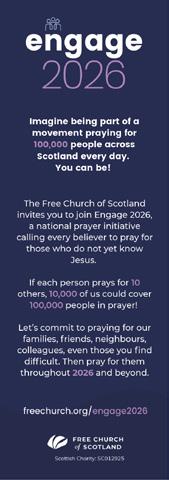
This reflection feels especially timely as we move into February and the launch of Engage 2026. The Free Church of Scotland is inviting every believer to take part in a prayer initiative, committing to pray intentionally for those who do not yet know Jesus Christ. The vision is simple: if 10,000 Christians each pray for ten people, 100,000 individuals will be brought before God in prayer. This initiative forms part of the Free Church’s wider vision for A Healthy Gospel Church for Every Community in Scotland Find out more on p 8.
As we look at the world around us, we are reminded that God works in both expected and unexpected ways. In this issue, you’ll find pieces about Historic Free Church mission in the Andes (Iain Fraser Grigor, p 25), a fascinating feature on the Life and Legacy of Hudson Taylor (Rev Norman and Alison Mackay, pp 26–28), and reflections on crosscultural mission in Mission Matters by Rev David Meredith (p 29).
It is also a great opportunity to share with you that The Record is set to continue beyond this Summer. Praise God! The name of the proposed editor will be brought to the General Assembly in May, for appointment.
Thank you all for your continued support of The Record — please email us at editor@freechurch.org if you have church news or letters to share. •
Yours in Christ
Sarah Robinson
That in all things he might have the pre-eminence
Colossians 1:18
Thomas
FREE CHURCH NEWS
WOMEN FOR MISSION
Catriona Logan
LETTERS
WORLD NEWS
Columbia, Eritrea, Yemen, Iran, Pakistan, Myanmar
YE HAVE NOT PASSED THIS WAY
HERETOFORE
Tommy Mackay
PRAYER DIARY
JESUS AND HIS STORIES
Donald Mackay
I BELIEVE IN THE HOLY GHOST... REVISITING THE APOSTLES' CREED
David J Randall
FROM ADAM'S DIARY: A LADIES HAIR SALON BOOK
FREE CHURCH MISSION IN THE ANDES
Iain Grigor
THE LIFE & LEGACY OF HUDSON TAYLOR
Norman & Alison Mackay
MISSION MATTERS
David Meredith
CHILDREN'S PAGE
POST TENEBRAS LUX
Catriona Murray
Risk & Opportunity
BY REV DR THOMAS DAVIS
On the third day Esther put on her royal robes and stood in the inner court of the king’s palace, in front of the king’s quarters, while the king was sitting on his royal throne inside the throne room opposite the entrance to the palace. And when the king saw Queen Esther standing in the court, she won favour in his sight, and he held out to Esther the golden sceptre that was in his hand. Then Esther approached and touched the tip of the sceptre.
Esther 5:1-2
The book of esther is one of the most fascinating in the bible. When we read it as children, we discover a beautiful story of an unknown Jewish girl who becomes Queen. When we read it as adults, we see a brutal plot for genocide. When we read it as theologians, we are perplexed because God is not mentioned at all. And when we read it as those living in 21st Century Scotland we see a narrative set in the most secular context in the Bible, a context that resonates powerfully with the society that we all live in today. The Book of Esther confronts us with many of the challenges that come from living in an increasingly secular society. For Mordecai and Esther, the days of living in a nation that was structured around honouring God and obeying his word were long gone. In many ways, those days look long gone for us too. In that kind of secular setting, the story of Esther is forcing us to think about two crucial issues that are immensely powerful, and that can have a huge influence on our lives as Christians and as congregations in the months and years ahead. Esther is getting us to think about risk and opportunity. Both of these are vital for us to think about in terms of the gospel. As we follow Jesus in a secular context today, we need to recognise risk and we need to embrace opportunity
RECOGNISE RISK
The scene highlighted in Esther 5:1-2 is one of those moments in the Old Testament where you have a very simple and innocent-sounding narrative and yet what is being described is monumentally tense and dangerous. If you dived straight into that chapter, then you could easily think that this is just a Queen popping in for a chat with her husband. But the truth is so much more complicated. No-one can just walk up to the King of Persia uninvited, not even his wife (chapter 4:11). That is why when Esther agrees to do this, she said ‘I will go to the king, though it is against the law, and if I perish, I perish.’ (Esther 4:16) That means that as we read about Esther entering the King’s court in chapter 5, she feels like she is taking a massive risk. And as she does so she knows that the fate of Mordecai and all her fellow Jews rest on her shoulders. Her life and all their lives hang in the balance. She gets to the court. She stands where the King can see her. And everything comes down to what he does with his sceptre. If he holds it out to her, she is safe. If he doesn’t, she is dead. She must have felt like she was taking the biggest risk of her life.
Over the last 10 or 20 years, we have become a very risk averse society. There’s lots of caution about health and safety, about risk assessment, about threats and mitigations. So much of that is good and important — many a life has been saved because of it. But, at the same time, it seems to be the case that we are becoming more and more wary of risk. And sometimes that can be paralysing — everyone is looking at each other, no one wants to take a risk, and sometimes people will do everything they can to avoid putting themselves in any position of responsibility. There are two main factors driving that: comfort and fear. We live in an age where people do not want to feel uncomfortable. Risk always feels uncomfortable, so we avoid it. But perhaps even more powerful is fear. Fear of being blamed, fear of being spoken about, fear of being accused of something, fear of all the consequences landing on our shoulders. And in a way, it is no wonder that we feel like that. We live in a strange culture that wants to be safe and create minimal risks, but at the same time that culture is often merciless if someone actually makes a mistake.
For the church, we are also becoming spiritually risk averse. That affects us at whatever stage we are at in our journey of faith: whether you have been following Jesus for years, whether you have just started, or whether you haven’t yet started, we all have a next step that we need to take. And that next step pretty much always feels risky. Should I pray to Jesus and ask him to save me? Should I tell people that I am a believer even though no-one else knows? Should I come to bible study? Should I get more involved in church? Should I take the next step? All of these feel risky.
“ ”
We live in a strange culture that wants to be safe and create minimal risks, but at the same time that culture is often merciless if someone actually makes a mistake.
They feel risky for the same reasons: comfort and fear. We worry that the next step will change things for the worse and make us uncomfortable. And even more so, we worry that something bad will happen. That we will make a fool of ourselves, or that people will talk about us, or judge us, or look down on us. And all of it is paralysing. There are a lot of people in a lot of congregations, and in a lot of Kirk Sessions, who are paralysed by the fear of risk. Wherever you are on your journey of faith and whatever your next step is, we need to think hard about Esther. And as we think about Esther standing there before the King, with everything hanging in the balance, we need to make sure that we recognise the risk involved in her situation.
And so we have to ask the question: What is the biggest risk that Esther could have taken? Was it putting on her robes? Was it entering the inner court? Was it catching the King’s eye? No, the biggest risk that Esther could have taken would have been to stay in her room and do nothing. That’s the amazing truth running through this whole narrative. As Esther stood in the King’s court, her stomach is in bits, but we are looking on and we know that she is going to be fine. The writer of Esther records it in very straightforward terms because this is not actually where the danger lies. The danger for Esther and for all the Jews lay in the risk of her doing nothing. She could so easily have been too comfortable and stayed in her room. She could so easily have been too afraid and never gone to the King. And if she had, she and all her fellow Jews were finished. And this is big point I want us to see — for Esther, and for us in our faith — the risk does not lie in taking the next step. The risk lies in doing nothing. This is why recognising risk is so important, because we are all in danger of getting this wrong. As individual Christians and as a church together we can get this badly wrong. We think evangelism is risky: inviting people to church, sharing our faith, organising events, reading a book with someone, asking to meet someone for coffee, asking them if they’d like to talk about faith, even just telling someone that we are a believer — all that feels so risky. But it’s not actually risky. NOT doing it is risky. Because if we don’t reach out, and if we don’t take the next step, then our church is finished. It is the same with serving in church, getting involved, calling a minister. It all feels scary, it all feels risky. But the risk lies in not doing these things. Think about how you might be able to reach out to someone — maybe to encourage a fellow Christian or to connect with someone who is sceptical or not yet sure about their faith — it all feels risky, but please try and recognise the real risk. The real risk is that we will do nothing.
The whole great commission is set in the context of going:
‘Go therefore and make disciples of all nations, baptising them in the name of the Father and of the Son and of the Holy Spirit, teaching them to observe all that I have commanded you. And behold, I am with you always, to the end of the age.’ (Matthew 28:19)
The word “go” is literally the word “going” — that is how Jesus builds his church. It reminds us that the biggest risk to the future of the church is standing still. And this is even more important for anyone not yet a Christian. So often it feels like taking that step to trust in Jesus and follow him is a risk. Risk of changing things? Risk of disrupting family and routine? Risk of people talking about you? Risk of making a mistake? I can understand all of these fears, I have struggled in these ways myself at many points in my life. But if you take that step, Jesus will help you. He will help you in amazing ways. Only you can take that step, but you are never taking that step alone. We have all got to recognise that when it comes to that step of putting our trust in Jesus, of reaching out, of moving forward as church, we are not actually taking a risk if we do it. We are taking a massive, massive risk if we don’t. And this is why it is so important that we recognise risk accurately. In Esther and in the gospel, the risk is not stepping forward. The risk is standing still!
EMBRACE OPPORTUNITY
All of this is reminding us that when we are following Jesus, everything that feels like a risk is actually an opportunity. It is an opportunity to grow, to learn, to serve, to be surprised, and to discover how amazing God really is. All of this means that in terms of our faith, we need to abandon a mindset of risk and instead embrace a theology of opportunity.
“ ”
The word “go” is literally the word “going” – that is how Jesus builds his church. It reminds us that the biggest risk to the future of the church is standing still.
If you look at Esther in this chapter, everything feels very precarious. She doesn’t know if the King will allow her to approach him. And even though he does, she still doesn’t know whether he will grant her request to save the Jews. In this chapter (chapter 5:7-8) all she has managed to do is get him to agree to come to a feast. And I wonder, was that her plan all along, or in the heat of the moment did she think, ‘I need to buy myself more time’? Whatever her thinking was, so much hangs in the balance. And yet, the great message of this chapter, and the whole book, is that, actually, nothing is hanging in the balance. Instead, everything is safe in God’s hands. So many little things work out in order for the mess to unravel and for God’s unfailing purposes to be fulfilled. It is all an amazing reminder that the theology of the gospel is a theology of opportunity.
Esther is telling us that God is in control. King Ahasuerus thinks he’s in charge, Haman has his schemes, and even Esther probably had a very different set of plans for her life as queen, but over it all God is in control, and that authority extends beyond the book of Esther. It extends to every inch of the universe, to every second of history, to every area and detail of your life. At the heart of the gospel is the fact that Jesus is risen and Jesus reigns. The gospel is the coming of his Kingdom and his rule. And that is an opportunity for you and me to trust him and see his plans fulfilled. We are stepping into a new week. That is an opportunity for us to say ‘I am in charge, and we do our own thing’ or it is an opportunity for us to say to Jesus — ‘You are in charge, you are in control and I am trusting you, and this week I am going to follow you.’ That is one very reassuring and very exciting way to start a week!
The book of Esther is telling two crucial things about God. First, it is telling us that God is merciful. It is important to remember that the whole reason the Jews are in Persia is because of their sin. They are not innocent victims in exile, they spent centuries ignoring God’s commands, ignoring the warnings of the prophets, and eventually they lost their nation.
Even Esther and Mordecai aren’t squeaky clean in this narrative. Mordecai’s conduct may well have stubbornly escalated the tensions with Haman, and Esther has almost certainly crossed a line and done things that she should not have done in order to become Queen. So when Haman planned to exterminate the Jews, God could easily have said, ‘They deserve it’. Ultimately, death is what every sinner deserves. But God is merciful, and his plans are for restoration, not extermination. And that is telling us that the gospel always gives the opportunity for a fresh start and a second chance.
Secondly, Esther tells us that God empowers his people. So often our sin gives us such an overwhelming feeling of guilt and failure that we think there is a massive risk that we will just stuff everything up, if we haven’t already. But in the gospel, our weakness, our failings, our unworthiness are all an opportunity to see the amazing mercy and grace of God anew. This is part of what makes the gospel so beautiful; it doesn’t just show us God making something beautiful. It shows God tenderly healing something broken. The story of Esther records God empowering his people in remarkable ways. As Esther stood trembling in the King’s court, she thought, am I about to die? At the very time God is saying, ‘You are not about to die. You are about to do something unforgettable.’ And in God’s strength, these terrifying moments that felt so risky for Esther became a wonderful opportunity for her to be used by God.
Exactly the same is true for us. The gospel brings you into a life where every day is an opportunity for you to be used by Jesus for him to accomplish amazing things for him. But the key point is this: whether it is in evangelism, discipleship, serving, or leading, if something feels like a risk, in the gospel it is really an opportunity. And that, of course, means that if we don’t take the risk, we miss the opportunity. •
Rev Dr Thomas Davis is minister at Carloway Free Church and is the Principal Designate for Edinburgh Theological Seminary
FREE CHURCH NEWS
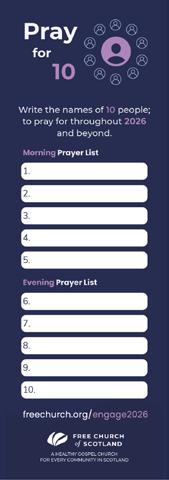
ENGAGE 2026 – PRAYING FOR 100,000 PEOPLE
hoW might our communities be transformed if 100,000 people across scotland Were intentionally prayed for? How might our churches grow in health and gospel witness if we became more prayerful?
In 2026, the Free Church of Scotland is inviting you to take part in Engage 2026 — a national prayer initiative calling every believer to commit to praying intentionally for those who do not yet know Jesus Christ.
The vision is simple. If 10,000 Christians across our congregations each commit to praying regularly for ten individuals (family members, friends, colleagues, neighbours), we will see 100,000 people brought before God in prayer. Through Engage 2026, we hope to nurture a culture of prayerful dependence and evangelistic awareness within our churches, encouraging every believer to see prayer as both the foundation and the driving force of mission.
At the heart of Engage 2026 lies a desire to see prayer become a natural and regular part of the life of every Christian and congregation. We each can identify ten people in our life who are in need of the gospel, and challenge ourselves to commit to praying for them faithfully and persistently. This is not a short-term campaign or a call for quick results, but an invitation to sustained intercession and trust in God’s work and timing as we seek to see gospel change in many lives. As we pray, we do so with confidence that God hears us, and we are encouraged to watch for the ways he is at work — often through opportunities for conversation, invitation, or daily witness through how we live for Christ.
Engage 2026 seeks to support the development of a long-term culture of mission, grounded in prayer. As a denomination, our vision is to see A Healthy Gospel Church for Every Community in Scotland. That vision can only be realised as we depend on the Lord in prayer, acknowledging that true growth and transformation come from him. Through this initiative, we aim to shape habits of prayer and expectation that sustain faithful gospel witness for years to come.
Throughout 2026, we will be sharing stories of encouragement and answered prayer from across the country — accounts of how God is working among his people and opening doors for the gospel. These stories will serve as reminders that, even when we
cannot see all that God is doing, he remains at work through the prayers of his people.
The overarching aim of Engage 2026 is to raise the evangelistic temperature of the church. As we commit to regular, intentional prayer, we trust that God will provide opportunities for witness and that we will be better equipped to respond to them with grace and courage. Over time, our prayer is that this initiative will help cultivate a lasting culture where prayer and mission are inseparable, and where every believer takes personal responsibility to pray for those around them.
Everyone is warmly invited to participate. Engage 2026 offers a simple, structured, and meaningful way to take part in God’s mission through prayer — trusting that as his people pray, he will work for his glory and draw many to himself.
We would warmly invite you to share any stories of prayer — share any updates, answers to prayer, encouragements in building prayer habits, or challenges and struggles to prayer@freechurch.org We will ensure anonymity is safeguarded where necessary in anything that is shared publicly.
Join us in praying for 10 people every day, so that God may be glorified across our nation. •
CAROLS IN THE CASTLE
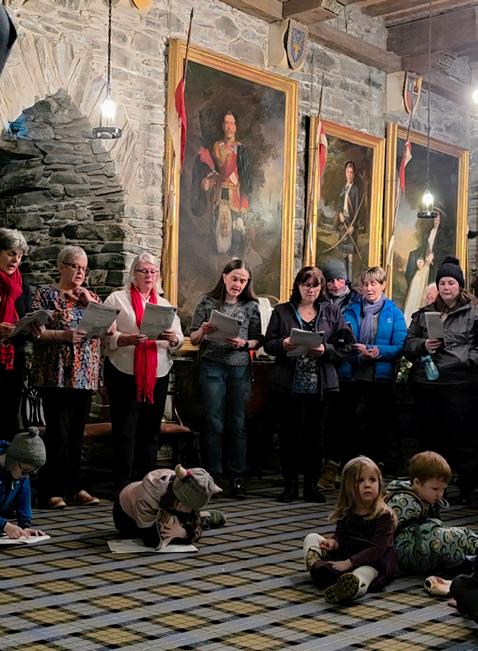
on sunday 14th december free church glenelg and inverinate along With plockton and k yle free church and representatives of other local denominations came together to hold a community carols in the castle service in one of scotland’s most recognisable and photographed landmarks, eilean donan castle.
By kind permission of the castle owners and staff this year our annual community carol service was held in the Banqueting Hall of this historical Highland monument. One hundred guests enjoyed an evening of carol singing and Bible readings, along with a short gospel presentation given by Rev James Blackwell. It was a stunning location to preach the glorious gospel of God becoming man for us.
One of the guests wrote the following account of their evening:
A Christmas Fairytale at the Castle.
It’s a cold and wet December evening, as the family and I head towards what was to be a most magical night.
We jumped into the car, and took the short journey to Eilean Donan castle, on the West Coast of Scotland. A stunning venue surrounded by Lochs and mountains, it’s truly a sight to behold.
We parked the car and headed towards the castle. The soft lighting giving this marvel a stunning orange glow, against the dark night, it wasn’t just the driving rain that took your breath away. We hurried along the path and were met by the volunteers who pointed out the way and handed out the programmes for what was to come.
Eventually, we found our way into the warmth of the castle, with a roaring log fire, and large oil paintings the size of windows hung on the walls. Lighting hung on chains strung from the ceiling, taking you back in time. A thick tartan carpet gave colour and comfort underfoot, with three large stag heads, armaments and family crests adorning the walls. Oak furniture lined the room, displaying the castle’s family history.
One hundred people of all ages had gathered, including the ministers from the surrounding parishes. Being a free but ‘ticketed’ event, our family were lucky enough to get in quick, as the tickets went faster than a mince pie down Santa’s throat. The ministers shared some readings, in between everyone else belting out Christmas carols (which had been chosen in advance from the programme we received on the way in), some verses being sung by the ladies, some by the gentlemen, and the rest sung by all.
The melodies bouncing off the thick bare stone walls, giving an extra layer of acoustic majesty to an outstanding, dramatic, and emotionally
charged environment. It truly felt like we were living in a Hollywood Christmas movie. Bringing the community together in the magical, fairytale castle, that is a landmark in the area, was truly a beautiful and memorable experience.
On the way out, we had one last surprise, with a beautiful handmade gift of locally baked biscuits and chocolate, from Chocolates of Glen Shiel Cafe. We bid farewell to our newly made friends, and travelled home, with our hearts filled with love, and we pray that we get to experience it all again, every Christmas. •
MINISTRY TRAINING CONFERENCE
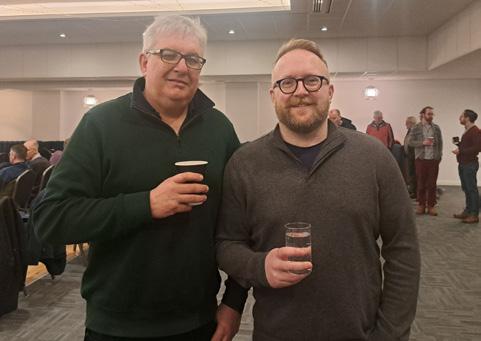
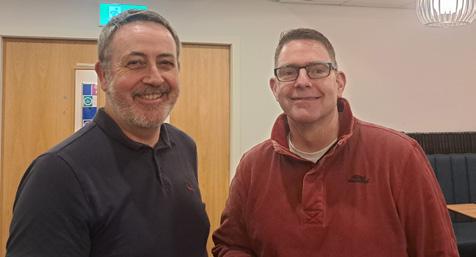
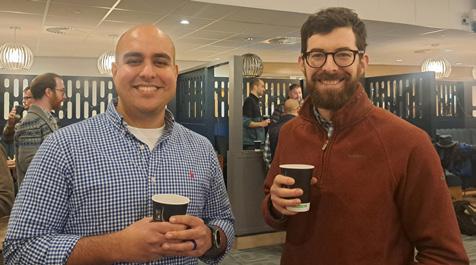
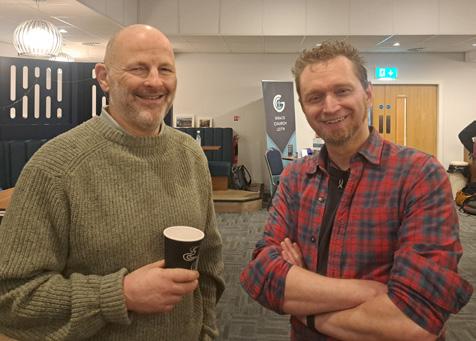
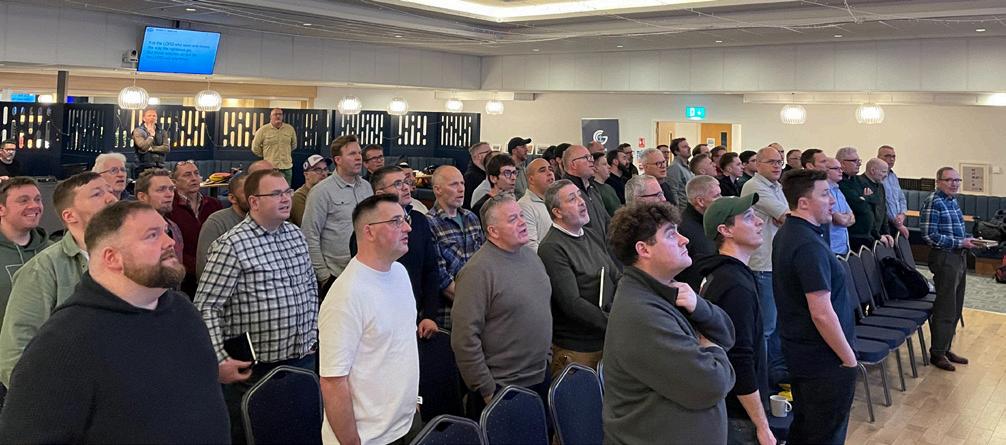
more than 60 delegates from all over s cotland attended the annual m inistry t raining c onference at g race c hurch l eith in e dinburgh .
The Conference was an opportunity for ministers to meet, pray, learn and spend time together.
Keynote speakers included Christopher Ash ‘Learning to lament in hope’, Rev David Macleod ‘Guarding the heart in ministry’, Rev Andy Robertson ‘Illustrations in preaching’ and Paul Rees ‘Patience in local church ministry’.
Carousel sessions covered Discipling Men into Leadership, Releasing Women’s Gifts in the Church and Developing a Mission Culture in your Church.
Preaching Labs also took place where ministers were given the opportunity to share feedback on each other’s preaching. Health checks were held for ministers to look at all aspects of their health.
Many of the ministers shared how the conference was a beneficial time to meet together to encourage one another and share their experiences of ministry. •
YOUTH CONFERENCE
are you looking for a Weekend to step aWay from the noise, deepen your faith, and reconnect With god’s people? Come along to the Free Church Youth Conference for a weekend of worship, teaching, and fellowship at Lendrick Muir.
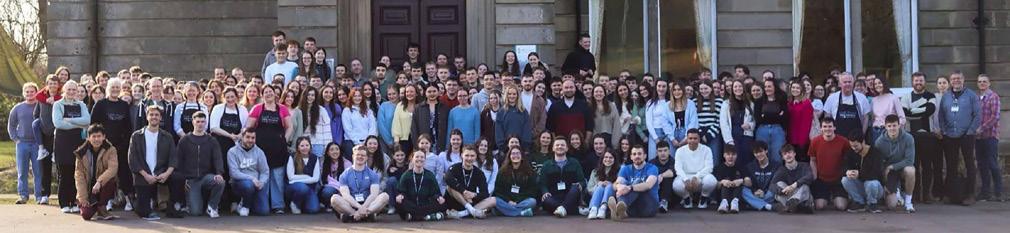
The conference will take place from Friday 13th to Sunday 15th March. It is for young adults aged 18–30 and is always a special time of encouragement, renewal, and meaningful connection with others from across the church.
Organisers are delighted to welcome Rev Cory
Brock from St Columba’s Free Church of Scotland, who will be speaking about the Holy Spirit.
Across the weekend, you can look forward to Christcentred talks, times of worship and prayer, seminars and testimonies, space to relax, reflect, and connect and great food thanks to the fantastic team of cooks who have served so well in recent years!
Organisers say: ‘Thank you for your continued support of the Free Church Youth Conference. The planning committee is excited for what God has in store and can’t wait to welcome you in March 2026.’ •
ENSPIRE CONFERENCE
booking is open for enspire, an annual gathering for ministers’ Wives and ministers-in-training Wives from across scotland and a range of denominations.
It will be held on Saturday 7th March at Smithton Free Church, Inverness, from 9.30am to 3:30pm.
The day offers time to be together, meet new and old friends, and share encouragement through God’s Word – with space to reflect, learn, worship, and be strengthened alongside others who understand the rhythms of ministry life.
This year’s theme is Rooted, drawing on Psalm 121. The day will include a main talk from Marina Longwe,
a practical workshop and plenty of time for worship, reflection, and shared conversation.
The day begins with tea and coffee, includes a twocourse lunch, and finishes with coffee and baking.
This is a free event, organised under the remit of the Mission Board of the Free Church of Scotland. The event is for ministers’ wives at all stages of ministry life, including those whose husbands are still in training or retired.
For any queries, contact: enspire.women@gmail. com. If possible, please book by 28th February (for catering purposes).
To book, go to: freechurch.org/enspire •
NEW MEMBERS & BAPTISMS AT ST PETER’S FREE CHURCH
the congregation at st peter’s free church, dundee have been greatly encouraged recently With the addition of several neW members and numerous baptisms.
In late September we welcomed nine new members. Three of these joined by transfer, and we are thankful that Ewan, Ling and Paul have chosen to make St Peter’s their new spiritual home.
Chris, Eilidh, Jayne, Logan, Megan and Tyron were all welcomed into membership by profession of their faith. Jayne and Logan were also baptised.
In addition to these adult baptisms, it was a joy to witness the baptisms of not one, but four children the week before. Frederick, Isabella, William and Xander were all brought forward by their parents and
welcomed into the covenant community.
More recently, in November, we welcomed Katy into membership by profession of faith. We have been praying for her since she began attending St Peter’s a few years ago with her husband and children. To see God answer these prayers has been a big encouragement to many.
As a congregation we have also experienced really difficult times with the recent passing of two beloved members, Sheila Mackenzie and Hugh Henderson. Yet God is good and we are thankful to him for such recent evidence of his continued work amongst us.
Please continue to pray with us that more and more people in Dundee will turn to Christ. •
LOOKING BACK ON 2025
BY CATRIONA LOGAN
as We look back on 2025, it’s impossible not to feel a deep sense of gratitude from seeing god at Work. We’re so thankful for your support and prayers and we’re grateful to God for his provision.
Psalm 136:1 says, ‘Give thanks to the Lord, for he is good, for his steadfast love endures forever.’ This year it has been evident that God has remained exactly as he is described in this passage: sovereign, good and loving. As we consider God’s steadfast love in the year past, we rightly respond with thanksgiving and praise.
As we consider God’s steadfast love for the year ahead, we rightly respond in faith. We’re entering another New Year where this remains true, confident of his unfailing love, which is not based on ourselves but in the beautiful life, death and resurrection of our Lord Jesus.
2025 was a busy and encouraging year for the WfM committee — we’ve had a few sad farewells and warm welcomes. Marion Gray, Anne Fraser and Fiona Mackaskill stepped down from the committee — we’re grateful for their dedication throughout the years. We welcomed new members: Donella Ferrier, Rachel Herbst, MC Rios, Beth Fraser and Gillian Innes. CJ Macdonald was also appointed as Vice Chair. We’re thankful that God continues to provide talented, enthusiastic women to lead Women for Mission.
We began the year with ‘Empower; Lifting women up and transforming lives’ as our active fundraising project, which came to a close in June. With the hard work and generosity of many across Scotland, an amazing total of £55,774 was raised. The fund was topped up to a round number, which meant each organisation received £14,000 (the Tumaini Fund (Scotland), The Kerusso Trust, Blythswood’s work in Mumbai and the Reanos).
At our Annual Get Together in May, we announced our project for 2025/26, ‘Flourish; Cultivating the seed of God’s Word’. The ongoing Flourish project is supporting four organisations: Junction 12 (Glasgow), the Mamie Martin Fund (Malawi), Christ the Saviour Presbyterian Church (Krakow) and Free Church Youth Camps. The Annual Get Together is always a highlight, this year held at Grace Church Leith. We opened with a time of worship then received reports from the past year and heard from several speakers, including Catriona and Stacey from Sparkle Sisters, Jennifer and Caitriona who are both working in Asia, and Eilidh Murchison, a recipient of our Support a Volunteer fund.
Early in the year, we ordered a reprint of The Ultimate Favourite Recipes Cookbook as our previous stock had sold out. With the sale of the Cookbook, in October we were able to make a £2,000 donation to Tearfund’s Gaza and Middle East Fund.
Throughout 2025, we’ve had a wide variety of applications to the Heart for Home fund. The applications have supported the purchase of a glass cleaner in Campbelltown, a coffee machine in Ullapool, supplies for a family fun day in Fort William, AV equipment in Glasgow, a PlayStation in Charlestown and others: all practical purchases that have helped to facilitate regular ministries, host events where people get together, and support youth work.
We have been so encouraged by the continued support, interest and generosity towards Women for Mission, year on year, as we seek to offer practical help in areas of health, education, poverty and disaster around the world. •
Annual Get Together in May 2025
Committee meeting in Kingussie in September 2025
LETTERS TO THE EDITOR
Dear Editor
Over recent years I have become increasingly concerned by the apparent reluctance in our church to look at science and how it relates to our Christian beliefs. Many of the topics causing greatest concern to the upcoming generation, such as climate change, plastic pollution, artificial intelligence and pandemics, clearly require some knowledge of science in order to understand them. There has always been a sacred/secular divide in the Christian church from its most extreme expression in the ancient Gnostic heresy to the more prevalent pietism of recent times. The material world that our Father created is often devalued. The wealth of Scripture teaching on creation is scarcely touched.
Within this perspective on things material, there is a particular aversion within the church at large to exploring the scientific theory of evolution. The Keswick Convention usually has a large bookstall which contains a range of subject matter, including some engaging with scientific matters such as Artificial Intelligence. However, there is a glaring absence of books from the evolutionary creation standpoint. This would be a serious enough omission but is made worse by the inclusion of books that denounce evolution for reasons that are ill thought out.
Even Denis Alexander’s book Creation or Evolution: Do we Have to Choose?, with a strong endorsement by J.I. Packer, seems to be beyond the pale for evangelical leaders. Within the Reformed wing in Scotland there is a disturbing ignorance of B.B. Warfield’s position on evolution. He was quite clear that the idea of life evolving was in no way contrary to Scripture teaching. Both Warfield and Packer were outstanding defenders of the authority of Scripture in their day. They surely deserve some respect.
Our Reformed heritage had a healthy regard for science, seeing it as God’s revelation in his works of creation to those made in his image. However, like many other aspects of our spiritual heritage, this seems to have faded into history. Augustine and Calvin warned against the misuse of Scripture, using ill thought-out interpretations of Bible verses to talk nonsense on topics we don’t understand. It’s a serious matter when we tie the Bible into our mistaken ideas and so encourage unbelievers to speak ill of God’s word.
The National Ministry Survey (2022) showed that almost half of new Christians have problems with how to think about science. Similarly, almost half of Protestant Christians who left the church did so because they thought that science and Christianity were two competing explanations and found the scientific approach more truthful. A Youth for Christ study, “Growing Spirituality”, found that, among teenagers, scientists are more trusted than the church. A 2022 Theos survey found that two thirds of the public, including religious respondents, think that science and faith are not compatible. The old belief that science has disproved the Bible has not gone away, it has simply moved from being a hot topic to being an accepted fact, part of the mythology of our age. Scientists going into schools in England, running workshops around science and faith, find that two thirds of upper primary pupils say science makes it harder to believe in God.
Do we care that even children are absorbing the idea that science and God are mutually exclusive? What do we do to protect our own little ones from such dangerous beliefs? Cultivating ignorance within the church on scientific issues is not the answer. It is a betrayal of our Reformed heritage. It has serious consequences for the little ones growing up in our churches and for the mission of the church to the world around us.
I recognise that past debates were often disruptive, but the answer to that is surely to cultivate a spirit of respectful dialogue, respecting one another and respecting the authority of Scripture.
Sincerely
Alan J F Fraser
We would love to hear from you…please write to the editor at: The Record
Free Church Offices
15 North Bank Street
The Mound Edinburgh EH1 2LS or email editor@freechurch.org
WORLD NEWS
AMERICAS AFRICA EUROPE ASIA AUSTRALASIA
PRAY FOR THE PERSECUTED CHURCH
ERITREA: A repressive regime has subjected Christians and other religious minorities to severe persecution, including imprisonment and forced conscription. Daily life is heavily monitored, with phone calls and internet use scrutinised. All Christians – whether belonging to the approved denominations or not – face intense scrutiny and risk of arrest from the government. •
YEMEN: The country has been in a state of civil war since 2014, divided up between three different factions. Less the 1% of the population follows minority religions, and Christians are particularly at risk in areas controlled by Houthi. Leaving Islam to follow Christ is seen as a huge betrayal of the native tribe – punishment by the community can include being disowned, disinherited, divorced and losing custody of their children, being banished or even murdered. •
MYANMAR: Following the military coup in 2021 Christians have faced increasing violence and tighter restrictions. Converts to Christianity find themselves persecuted by their Buddhist, Muslim or tribal families and communities because they have left their former faith. •
PROTESTANT PASTOR ASSASSINATED DURING NEW YEAR'S EVE CELEBRATIONS
Christian
Solidarity Worldwide
Pastor José Otoniel Ortega, a leader in the Foursquare Gospel denomination, was shot to death by armed individuals on 31st December 2025 in the Santa Elena neighbourhood of Fundación Municipality, Magdalena Department, Colombia.
The pastor was celebrating the start of the New Year with his family at the time of the attack. He was immediately transferred to a medical clinic but died from the severity of his wounds.
Religious leaders have been a target of illegal armed and criminal groups within the context of Colombia’s long-running internal armed conflict. These groups often perceive religious leaders as obstacles due to their influence in their communities, their willingness to encourage a rejection of violent and criminal activities, and the role of many of them play as peacemakers.
At least ten protestant leaders were extrajudicially executed or assassinated, and one Catholic priest was kidnapped, in Colombia between December 2024 and November 2025, including another pastor in Magdalena Department in January 2025.
CSW’s Advocacy Director Anna Lee Stangl said: ‘CSW extends our deepest condolences to the family and church community of Pastor José Otoniel Ortega for this loss. The nature of the attack on Mr Otoniel Ortega, whilst he was celebrating New Year’s Eve with his family, makes it clear that this was a premeditated, targeted assassination.’
Pastor José Otoniel Ortega was described by his denomination as a beloved pastor, a faithful servant,
a man who walked with God, who preached the word with love and gave his life to Kingdom service.
The Colombian Council of Evangelical Churches (CEDECOL) said in a statement, ‘This event brings sorrow not only to his family and congregation, but to the entire Christian church in Colombia. We raise our voice in defence of life, calling for justice, peace and an end to all forms of violence that continue to shatter homes and communities.’
The Colombian Ministry of the Interior also put out a statement, calling ‘...upon local civil and police authorities to locate the perpetrators and bring them to justice. ...[and urging] all individuals to respect all rights derived from religious freedom, beginning with respect for the life and integrity of religious leaders and their congregations.' •
International Christian Concern
Five Iranian Christians were sentenced to an average of 10 years each in prison for “propaganda” and “collusion” for practices such as prayer and baptism, and for distributing Bibles and Christian literature.
Though the verdict was given on 21st October, it was not communicated to any of the prisoners until late November and early December. They have been given 20 days to appeal their case before the Revolutionary Court of Tehran.
Two of the prisoners — pastor Joseph Shahbazian and Nasser Navard Gol-Tapeh — have previously spent a total of six years in prison for house church involvement before their re-arrest in February.
Shahbazian’s wife, Lida, Aida Najaflou, and a third woman who has not been publicly identified were also arrested.
According to Article 18, each Christian except Lida received a minimum sentence of 10 years.
Najaflou and Gol-Tapeh received a bail amount equivalent to $130,000 and $250,000, respectively — the highest amount demanded for an Iranian Christian’s release from prison. Shahbazian never received an official bail amount.
Nayereh Arjaneh, a Christian convert living in Iran, began serving a five-year prison term on 23rd December because of her faith.
Christian converts are often targets of imprisonment, false accusations, mistreatment,
and torture under the Iranian regime, with hundreds of Christ followers targeted by Iranian authorities in 2025 alone.
Arjaneh and her husband, Qasem Esmaili, were arrested on 7th July 2025 after they attended a Christian training event in Turkey. She was initially released on bail and later convicted of ‘promoting deviant propaganda and teachings contrary to Islamic law’ and ‘providing financial and material support to groups affiliated with Zionist Christianity.’ Arjaneh received five years in prison for each offense; however, under Iranian law, she will serve both sentences concurrently.
Her husband, who is currently undergoing chemotherapy, received a prison sentence of three years and six months. Authorities have permitted him to delay his jail term for the time being due to his cancer treatments.
The executive director of the Centre for Human Rights in Iran (CHRI), Hadi Ghaemi, expressed concern last year for Christ followers living in the country.
‘The Christian community in Iran is facing a crisis,’ Ghaemi stated. ‘The Iranian authorities are abducting growing numbers of Christians and throwing absurd national security charges at them in order to imprison them for years for doing nothing other than peacefully practising their faith.’ •
PAKISTAN'S STATE-BACKED CHRISTMAS CELEBRATIONS OFFER RARE BREAK FROM HISTORY OF EXTREMISM
Christian Daily International
Government-sponsored Christmas celebrations in Pakistan marked a historic departure from the country’s decades-long struggle with religious extremism — where religious minorities, including Christians, have been targeted in bombings, mob attacks and discriminatory practices.
For the first time since Pakistan’s independence, the federal government and provincial administrations formally sponsored Christmas events on a large, nationwide scale, projecting an official commitment to religious freedom.
From Islamabad to Lahore and Rawalpindi to Karachi, Christmas was not confined to church compounds. Instead, it was observed with state patronage, official messaging, public visibility and high-level participation, particularly in Punjab province, where government authorities organised major ceremonies, welfare distributions, and interfaith events for Christians.
The gesture drew rare bipartisan praise from the Pakistani Christian community and progressive Muslim voices, many of whom described it as a long-overdue recognition of citizenship rather than charity.
Across Pakistan on Thursday, Christians marked Christmas with special prayer services, midnight masses and community gatherings held under heightened security. Churches were decorated with lights and Christmas trees, while Christian neighbourhoods displayed banners and festive symbols — a public assertion of identity often muted by fear. In major cities, processions and peace rallies brought unusual visibility to the Christian community.
Pakistan’s Prime Minister Shehbaz Sharif, in an official message on the social media platform X, framed Christmas not as a minority observance but as a national moment.
‘Christmas is a message for humanity that connects us with feelings of love and goodwill,’ Sharif wrote, praising Jesus Christ for his message of peace and brotherhood and describing Christians as an ‘active, positive and peaceful segment of society.’
Sharif explicitly acknowledged the Christian community’s contributions to education, healthcare, social welfare and the fight against terrorism, urging Pakistanis to renew their commitment to unity and social harmony. •
The address given at the Dumbarton New Year Watchnight Service
BY PROFESSOR TOMMY MACKAY
‘And they commanded the people, saying, When ye see the ark of the covenant of the Lord your God, and the priests and Levites bearing it, then ye shall remove from your place, and go after it. Yet there shall be a space between you and it, about two thousand cubits by measure: come not near unto it, that ye may know the way by which ye must go: for ye have not passed this way heretofore’
Joshua 3:3-4
"YE HAVE NOT PASSED THIS WAY HERETOFORE"
“ ”
This is not a time for retrenchment but for expansion, for stepping out with a new vision that God will do great things among us.
the Words of our text state an axiomatic truth. ‘Ye have not passed this way heretofore’. It is also a very poignant truth for us, as this message is given at a point where, in the mercy of God, we enter another year of grace. During this year of 2026, whether as individuals, or families, or as a congregation of the Lord’s people, or as part of the wider church of God, or indeed as a nation, we will learn the truth of these words in ways we do not yet know: ‘Ye have not passed this way heretofore’.
As we come to the end of each year many make confident predictions about what the next year will hold. Often these predictions are wrong, whether it is about the impact of climate change, the outbreak of World War Three or a world economic collapse. Nevertheless, the world is changing in ways which are of major significance. Three examples may be given.
First, the old world order is changing in geopolitical terms. For several decades there has been a fairly predictable world order. It has been based on the balance of power of the great nations, and the many checks and deterrents that have guaranteed world peace, whatever wars and conflicts may rage at the level of individual nations. That world order is now less predictable than it has been since the fall of the Soviet Union.
Second, there is the exponential advance of artificial intelligence. We now use a level of technology in our daily lives that would have been unimaginable only a few years ago. The rate at which it is changing will have a major impact on the world this year. It may be a harbinger of great good in tackling many global problems, but its risks are also of such a nature that many scientists warn of potential harm in cataclysmic terms.
Third, from the Christian perspective there is the rise of false religion and the increasing apostasy of the Christian West. In particular, militant Islam has swept much of sub-Saharan Africa, the Middle East and Asia, leading to the current period being regarded as the most dangerous period for Christians in modern history. It is also an increasing problem within our own coasts. In terms of apostasy, there is encouraging talk of a ‘quiet revival’, particularly among the young, with increased church attendance. The picture is a complex one, and we must wait to see how it develops within the context of the UK. However, the more established context is one of apostasy and declension. When I was a child in the 1950s, more than a quarter of the population were members of the Church of Scotland. Today the figure is less than five percent, with only about one percent who actually attend services. A number of years ago I was asked to give a lecture on ‘Presbyterian Secession
in Scotland’. For one of the smaller Presbyterian denominations I took the figures from a book written by the father of a friend, ‘The Churches in Scotland Today’. To check if the figure of 24,000 members was still valid I phoned the denomination’s headquarters. It had fallen to 6,000. Today I looked it up, and the current figure was 1,782 members.
When Joshua said to the children of Israel, ‘Ye have not passed this way heretofore’, was there more reason then than now to be confident? Far from it! Here is the real picture. ‘Moses my servant is dead’ (Joshua 1:2). Their failed prophet had died alone on Pisgah’s mountain. The Lord himself in his compassion lifted his body and buried it in an unmarked tomb in the land of Moab. And as for the disobedient people he led, they all died in the wilderness and never saw the promised land (Joshua 4:6). And what now lies ahead in the untravelled path before them? Whole nations of enemies who are far greater in numbers and in might than they are. Is it not time to admit defeat?
But the Lord himself stands forth in a way that is almost unprecedented in Scripture. No less than ten times he tells them to have courage. Twice it was through Moses to the people: ‘Be ye of good courage’ (Numbers 13:20); ‘Be strong and of a good courage, fear not’ (Deuteronomy 31:6). Twice it was through Moses to Joshua: ‘Be strong and of a good courage’ (Deuteronomy 31:7, Deuteronomy 31:23). Three times it was from the Lord himself to Joshua: ‘Be strong and of a good courage’ (Joshua 1:6); ‘Only be thou strong and very courageous’ (Joshua 1:7); ‘Be strong and of a good courage; be not afraid’ (Joshua 1:.9). And three times it was from Joshua to the people: ‘Only be strong and of a good courage’ (Joshua 1:18); ‘Fear not, nor be dismayed, be strong and of good courage’ (Joshua 10:25); ‘Be ye therefore very courageous’ (Joshua 23:6).
Thus we too face the unknown path ahead. As our text makes clear, God has promised to guide us by the Ark of his Presence going before us, ‘that ye may know the way by which ye must go’. This is not a time for retrenchment but for expansion, for stepping out with a new vision that God will do great things among us. In the words of our late King George VI in his Christmas address to the Empire in 1939, ‘I said to the man who stood at the gate of the year, “Give me a light that I may tread safely into the unknown”. And he replied, “Go out into the darkness and put your hand into the Hand of God. That shall be to you better than light and safer than a known way”’. •
Professor Tommy MacKay is an Elder in Dumbarton Free Church
FEB-MAR
2026 PRAYER DIARY
Then you will call upon me and come and pray to me, and I will hear you. You will seek me and find me when you seek me with all your heart.
Jeremiah 29:12-13
Engage 2026 is a prayer initiative calling 10,000 believers to commit to praying for ten people each to come to know Christ, bringing 100,000 lives across our nation before God in intentional, sustained prayer. For more information please keep an eye on the Free Church of Scotland website and social media for updates.
Pray that the Lord would help each of us to faithfully commit to praying for ten specific individuals in our lives, asking that they might come to know the Lord Jesus Christ, and that we would persevere in prayer. •
Pray that, through Engage 2026, God would deepen our culture of prayer and mission, raising the evangelistic temperature of our churches and drawing many across Scotland to saving faith for his glory. •
Pray that each one of us becomes more intentional in sharing the Gospel. We pray for boldness, an assurance of our beliefs, and opportunities to share the good news with our loved ones, colleagues and neighbours, and in our communities. •
Pray that God would stir hearts across our churches to seek him earnestly, trusting his promise that when we call upon him, he hears us, and when we seek him with our whole hearts, we will find him. •
Pray for unity among believers taking part in Engage 2026, that we would encourage one another to remain faithful in prayer, standing together in hope and expectation of God’s saving work. •
Pray that God would grant patience and trust as we pray, helping us to rely not on our own efforts but on his faithfulness to work in his time and according to his purposes. •
Pray that our churches would become places marked by earnest prayer, joyful expectation, and compassionate outreach, reflecting a wholehearted pursuit of God and his mission. •
Pray that the fruit of Engage 2026 would extend beyond the initiative itself, leading to lasting transformation in individuals, families, communities, and churches across Scotland. •
Give thanks to God for our ministers and elders, for their faithful calling, servant-hearted leadership, and willingness to care for Christ’s church. We praise God for the gifts he has given them and for their obedience in using those gifts for his glory. •
Pray that God will give all his people a deep desire to abound in the work of the Lord. (1 Corinthians 15:58) Pray that God will lay it on the hearts of some to serve him full-time as ministers of the gospel, women’s workers, children’s workers and evangelists. •
JESUS AND HIS STORIES
BY DONALD MACKAY
We are often told that jesus Was a master storyteller – and so he Was. He had the qualities of wit, brevity, relevance and application in superb balance. In human terms he provides a model for any speaker of today.
But we must never make the mistake of thinking of Jesus as telling stories simply as a medium for getting his point across. Clearly that was often the case; but Jesus introduces a disturbing note when he explains to the disciples his reason for speaking to the crowds in parables. Quoting from the prophet Isaiah, he stresses that for the unbelieving crowds parables do not enlighten but obscure: the story is enjoyed for its own sake but its spiritual meaning is hidden. It is the children of the kingdom i.e. the disciples who are privileged to understand.
There are several groups of parables in the gospels:
• Parables of the kingdom. These are descriptive of the faith which Jesus has come to bestow and of the church which he had come to establish. The parable of the sower may be regarded as the foundation of all the “kingdom” parables, as it sets out the essential qualification for entry to the kingdom, namely the reception of God’s word and obedience to its precepts. Other parables in this group bring out the wonder and preciousness of belonging to the kingdom, its quiet but unstoppable growth, and the inevitable occurrence of “tares among the wheat”.
• Parables of lostness bring out the hopeless state of the sinner and the joy which his recovery brings to his saviour. Examples are the lost sheep and the prodigal son.
• Parables of judgment. These include the parables of the barren fig tree, the wicked tenants, and the rich man and Lazarus. Of course, judgment is in the background in many of the parables.
• Parables about watchfulness. especially of being ready for the Lord’s return. Examples are the ten virgins and the talents.
• Parables about forgiveness, whether at a human or divine level. These include the parables of the unforgiving servant and the Pharisee and the publican.
• Parables about human conduct. These include the good Samaritan, the rich fool, and the two sons.
We are told that, from a certain point in his teaching, Jesus never spoke to the crowds without a parable. In his debates with the Pharisees, and his discourses with his own disciples, he often used metaphor and simile, but he did not use the parabolic method.
What then are we to make of the place of parables in Jesus’ ministry? For the disciples – whether the Twelve or the wider group – they were not at the core of his teaching but functioned as memorable pegs on which to hang their understanding of the gospel, and by which they were more easily able to record it for posterity. For outsiders, the parables were hard nuts which tended to lodge in the memory but could germinate under later reading or preaching, prompted by the Holy Spirit.
What do the parables mean for us? They are unforgettable nuggets of truth, enlightening our minds and challenging our interpretations of the gospel. We cannot measure the debt we owe to the evangelists who so faithfully preserved these treasures for us. •
Donald Mackay is a member of Knox Church, Perth
Re-visiting the Apostles’ Creed
BY REV DAVID J RANDALL
I believe in God the Father Almighty, Maker of heaven and earth; and in Jesus Christ, His only Son, our Lord, Who was conceived by the Holy Ghost, born of the Virgin Mary, suffered under Pontius Pilate, was crucified, dead and buried; He descended into hell; the third day He rose again from the dead, He ascended into heaven and sitteth on the right hand of God the Father Almighty; from thence He shall come to judge the quick and the dead. I believe in the Holy Ghost; the holy catholic church, the communion of saints, the forgiveness of sins, the resurrection of the body and the life everlasting.
Yes, ‘ghost’ is the original Word, but that Word has different connotations noW, and there is nothing ghostly or spooky about the holy spirit, the third person of the trinity, Who is present in the second verse of the bible – ‘The Spirit of God was hovering over the waters’ (Genesis 1:2), among the last verses of the Bible – ‘The Spirit and the bride say, “Come!”’ (Revelation 22:17), and at all points in between.
The Creed has referred to faith in the Father (in twelve words; or eight, if ‘I believe in God’ is understood as an opening title) and now (in six words) to the Spirit, while the section about the Son has seventy words. That probably reflects (a) the fact that in apostolic times most heresies related to the person of Jesus (still do), and the Creed sets out orthodox apostolic teaching about our Saviour.
The other thing (b) is that the main ministry of the Holy Spirit is to point to Jesus. We look at the person and work of the Spirit, but we do well to remember that the Spirit’s ministry is to focus attention on Jesus. We are most Spirit-led when we are Christ-centred. The Church in which I ministered is floodlit at night. The floodlights show up the beauty of the building. But it would be strange to find someone standing beside one of the lights, admiring it and saying, ‘What a wonderful light — nice filament, well mounted on its pole, well preserved’. Any of us would say: ‘But you aren’t supposed to look at the floodlights. You’re supposed to look at the building on which they throw light’. It’s a simple picture. Jesus said, ‘The Spirit … will bear witness about me.’ (John 15:26)
The ESV heads John 16:4b-15, ‘The work of the Holy Spirit’. It is the passage where we find Jesus’ intriguing words about it being for the disciples’ benefit that he was leaving — ‘If I do not go away, the Helper will not come to you. But if I go, I will send him to you’ (v7).
In v13 he spoke of the Spirit guiding them ‘into all the truth’. Neither the disciples then nor subsequent believers would understand everything about everything (Deuteronomy 29:29), but the ministry of the Holy Spirit is to enable us to know the things we need to know, both for our salvation and our growth in grace.
Acts 1:8 records the promise of the risen Lord: ‘You will receive power when the Holy Spirit has come upon you’, and subsequent chapters tell of the tumultuous events of the day of Pentecost, and then the witness of the disciples in Jerusalem, Judea, Samaria and even Rome.
TO WHOM IS THE PROMISE ADDRESSED?
The immediate answer is ‘the apostles whom he had chosen’ (v.2). Here are the remaining eleven disciples, and they constitute a unique group. They were the apostles whom Jesus chose, to whom he gave his teaching and through whose witness the New Testament was written. But the book of Acts makes it plain that the promise of the Holy Spirit’s power and guidance applies to all believers, and when we come to Romans, chapter 8 has much to say about the ministry of the Spirit. There Paul says, ‘Anyone who does not have the Spirit of Christ does not belong to him.’ This is the emphasis of the New Testament: it is only through the work of the Spirit that anyone becomes a Christian, and it is only through the work
of the Spirit that anyone grows in Christian character, in Christ-likeness.
There are two dangers in relation to the doctrine of the Spirit. One is to overlook the Person and work of the Spirit, to live as if Pentecost never happened, to try our hardest to serve Christ’s cause in our human strength. Our constant need is for the Breath of Life to come sweeping through us to equip the Church to spread the light.
The other danger is that of dividing Christians into two groups — those who have been baptised in the Spirit and those who have not. Last century saw much controversy on this subject and some Christians were made to feel guilty because they were not enthusiastic about the socalled charismatic movement — even made to feel like second-class Christians. I remember someone saying to me, in the context of such controversy, ‘Of course you don’t believe in the baptism of the Spirit’ — to which I could only reply, ‘Not so. I simply don’t believe what you believe about it’! All who put their trust in Christ receive the gift of the Holy Spirit, and it is for us to ‘Be filled with the Spirit’ (Ephesians 5:18). ‘I believe in the Holy Ghost’ is not a statement for some but for all Christians.
WHAT IS PROMISED?
In one word, power. It is the promise of power to love, follow and serve Christ. If we only had the commission part of verse 8, we would be in a poor position. Mark Twain said that everybody talks about the weather but nobody does anything about it! We might talk about the great commission of Christ, but without the power and guidance of the Spirit, we would be unable to do anything about it.
But the wonderful promise is of a power that exceeds merely human ability. As a boy I learned to sing (CSSM 19), ‘Come and serve the Master…; He has promised power, power to all who ask, power to conquer Satan, power for every task.’ The promise still stands: ‘You will receive power when the Holy Spirit comes upon you’.
WHAT ARE THE RESULTS?
The other question is: what are the results of this gift of the Holy Spirit? When Paul wrote in Ephesians 5:18, ‘Be filled with the Spirit’, the force of the text is: go on being filled. It is not a once-for-all thing. And in that passage we find that being filled with the Spirit will result in a new song, a new submission and a new strength.
The new song is mentioned in v19 where we find thankful worship as a mark of the Spirit-filled Church: ‘… addressing one another in psalms and hymns and spiritual songs’. The inner work of the Spirit will constantly renew and invigorate the worship of God’s people.
Being filled with the Spirit will also result in a new submission. Far from leading people to take a superior attitude, it will lead to mutual submission. In v21 Paul says, ‘Submit to one another out of reverence for Christ’, and he then works out that principle as it relates to wives and husbands, children and parents, slaves and masters. And another consequence of being filled with the Spirit is a new strength. Jesus referred to the Holy Spirit as the
Comforter (ESV — ‘Helper’). It refers to someone called alongside to help you, and this is the promise of God’s word — the promise of the Spirit’s strength in the lives of his people. Romans 8:26 says, ‘The Spirit helps us in our weakness’ — simple words, but such a wonderful promise.
This is what being filled with the Spirit is about — Christlikeness in everyday life, in which we are, in the Spirit’s power, to bring forth the things that are described in Galatians 5:22 as the fruit of the Spirit.
The New Testament also refers to gifts of the Spirit and there has been much controversy in recent times about whether these gifts were intended only for the apostolic age or for future generations also. They include unusual gifts such as tongue-speaking and healing, and the modern charismatic tendency has claimed that these are gifts of the Spirit for today as well as the first century, while most Christians have seen them as sign-gifts, given specially for the days before God’s written word was completed.
One of the places where the New Testament deals with spiritual gifts (‘charismata’ in Greek) is 1 Corinthians 12 and 14. Between them comes chapter 13, the famous chapter about love, which is the principal evidence of the presence and work of the Holy Spirit. In that chapter Paul himself speaks of a time when prophecies, tongues and knowledge will cease, in contrast with love which will never cease.
None of this, of course, involves any denial of the fact that God can and does act in supernatural and miraculous ways still. The Creed begins with the acknowledgement that God is almighty; he can do anything, such as miraculous healing (and we have the exhortation of James 5:14 to pray for this).
Much of the debate around the so-called charismatic movement has concerned tongue-speaking, which some claim to be the proof of the Spirit’s presence in people’s lives. Tongue-speaking, however, is not a specifically Christian phenomenon; it is found in many contexts, including among Buddhists and Mormons1 The Bible nowhere suggests that someone who has never spoken in tongues is a sub-standard Christian and the practice is not to be expected as part of normal Christian living.
1 Thessalonians 5:19 exhorts us not to quench the Spirit. We are to go on being filled with the Spirit and, whatever gifts we may or may not be given, increasingly to manifest ‘the fruit of the Spirit’. It has been suggested that Jesus himself is the subject painted in these verses, and the work of the Spirit is to produce something of the character of Jesus in his people. ’O Thou Spirit Divine, All my nature refine, Till the beauty of Jesus be seen in me.’ •
Rev David J Randall retired from pastoral ministry in 2010 and is a member of Broughty Ferry Free Church 1 ‘(T)he phenomenon is indeed an experienced reality, but it is not a self-interpreting reality’. S. B. Ferguson, The Holy Spirit (Downers Grove: IVP, 1996), 235
A brother, known to some of us as Dr Adam, has served the Lord among his suffering church for many years. Dr Adam has also ministered in various parts of the world among refugees. We have asked his permission to print some of the stories of his life and service for the encouragement of readers of The Record. For well understood reasons, the names of people and places have usually been changed or omitted.
PAGES FROM ADAM’S DIARY
A Ladies’ Hair Salon: (in which hearts as well as hair are fixed)
“ ”
OOne evening, as if a light had been switched on in her mind, while I was teaching them, she began to cry and she said she wanted to follow Christ and become a Christian.
ne of the great joys i have had in serving our saviour has been the pleasure of seeing the conversion and transformation of men and Women through the agency and the poWer of the holy spirit — men and women who were delivered out of the dominion of darkness of this present world (Colossians 1:13), changed into the likeness of Christ, and then sent back to take his light into that very darkness out of which they were delivered. They were used by the Holy Spirit in inconceivable ways to bring many to the Saviour. Many of these believers are the personification of what is spoken in Daniel 12:3, ‘And they that be wise shall shine as the brightness of the firmament; and they that turn many to righteousness as the stars for ever and ever.’ A few of them have given their lives for the Lord, Christians who shall be in heaven’s Hebrews 11 hall of fame — men and women ‘of whom the world was not [and is not] worthy’ (Hebrews 11:38) — ordinary human beings who have been used by God in extraordinary ways. Through the lives and witnesses of these believers, thousands upon thousands, like the waves of the sea, have come to faith and in turn they have brought others to the Lord. All of this has been achieved by very common people, through whom God has accomplished the unthinkable and, as a result, he has received all the glory. The Lord has blessed his own Word and work exceedingly abundantly above all that I could have ever imagined!
Many years ago, while I was serving our Lord in Athens, Greece, one such person walked through the doors of the store we had rented in a poor city centre neighbourhood to help refugees with medical needs, clothing, food, pastoral counselling, and any other needed assistance, but more importantly to introduce them to our Lord. She was a young Afghan woman. Initially she came asking for medication for herself and clothing for her daughters. In the following days, she came asking for other things. Sometimes she would come and simply sit there and watch or help with cooking food for the refugees or to organise the clothes and the food packages. She impressed me as a natural leader, a positive, optimistic, caring, compassionate, humble and very gregarious, sociable person.
Although she was young, other Afghan women gravitated to her and respected her. Then she began to come to our evening Bible studies. One evening, as if a light had been switched on in her mind, while I was teaching them, she began to cry and she said she wanted to follow Christ and become a Christian. She then made a public profession of faith. A few days later she came with a swollen eye and bruises on her face and neck. I asked her, ‘My dear sister, what has happened to you?’
She said her husband had learned that she had become a Christian and he had beaten her. She asked me to speak to him. I did. However, it did not change anything. Subsequently he beat her so severely that she was injured and the police arrested him. He then left her and the children. I had made friends with a German missionary couple who were in Athens and they too ministered among the asylum seekers. I appealed to them to help this young woman and her children to go to Germany where they would be safer as I knew Afghan believers there who could look after them. My German friends quickly facilitated her move to Germany and my Christian friends there helped her to get on her feet.
Years passed. When I met her, she was semi-illiterate. Not any longer. She has become proficient in her own native Dari as well as German. The two girls are in university. She has an unbelievable, clandestine ministry among Afghan women in Afghanistan and Pakistan. She is an industrious woman who now owns a ladies’ beauty salon. She has eight employees. She has led all of these ladies to the Lord. Whenever I see her, she smiles and tells me, ‘Brother Adam, in this place, we not only fix ladies’ hair but also their hearts.’ That scrawny, sickly-looking Afghan woman whom I met years ago has truly become a fisher of men. She is a natural evangelist and a magnificent God-honouring ambassador of Christ in Germany and to the ends of the earth. •
BOOK REVIEWS
The start of a new year seems a great time to reflect on our “theology of communication”, and how we can use it to spread the gospel of our Lord. Everything we read, say and do has consequences, and we can choose to be wise.
BOOK
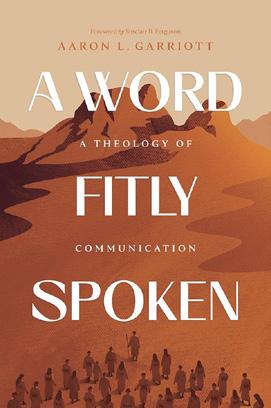
OF THE MONTH A WORD FITLY SPOKEN
AARON L. GARRIOTT (2025)
This book is subtitled “A Theology of Communication” and it certainly fulfils its remit. It is not simply about how we should communicate but starts with the fact that God is a communicating God and moves on from there. Not surprisingly for one who has degrees in communication and theology the author is a very good communicator, laying down a solid foundation and subsequent practical guidance through a lens of reformed theology. I found his approach original, engaging and illuminating, which gave me plenty of food for thought in the areas of prayer, preaching and praise. A chapter on “Digital Discourse” will be welcome reading for many, but the author reminds us that ultimately ‘The church must offer that which can’t be found elsewhere: the unvarnished, live, and in-person proclamation of the unchanging Word of God alongside his saints’. •
This book is available from amazon.co.uk
Duncan MacPherson, North Harris Free Church
(Our reviewer admitted that he is passing this book around his church’s Kirk Session as it’s such a worthwhile read.)
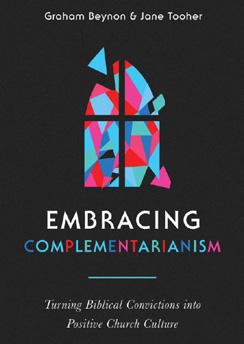
EMBRACING COMPLEMENTARIANISM
GRAHAM BEYNON & JANE TOOHER (2022)
Since the term “complementarianism” may not be familiar, a succinct definition in the opening page of this book is welcome. ‘Simply put, complementarianism is the belief that God made men and women…equal in value and dignity, and distinctive in certain responsibilities and roles.’ As the subtitle (“Turning Biblical Convictions into Positive Church Culture”) indicates, the aim is to explore these biblical convictions in a way that supports a positive outworking in the local church. Biblical authority is central and discussion throughout is with humility. Dual authorship helps give a multi-faceted treatment. Both writers have extensive experience in church contexts and college training, Graham Beynon in the UK and Jane Tooher in Australia.
After laying the foundations, the authors consider the core implications of humanity being made ‘male and female’ – equal but distinct. Chapter Five’s interesting title, “The Goodness of Men Leading in Ministry”, is pointing to church leadership as a good gift from Christ to his people, with the overarching authority being limited to qualified men. Later chapters explore the many roles – ministries, varied ways of serving –that make up church life. Throughout, the discussion is in terms of a positive embracing of God’s gifting, in serving as good stewards of the multifaceted grace of God (cf 1 Peter 4:10).
This is a stimulating resource on an important topic which is theologically robust and highly practical. It lends itself both to personal and group
study, helped by well-considered reflection questions at the end of each chapter. It could also feed into current Free Church discussion on training pathways for women. • This book is available from thegoodbook.co.uk
Karina Macleod, Back Free Church
We are keen to grow our team of reviewers, so if you love to read books about Jesus and are willing to share your thoughts, please get in touch with Miriam at books@freechurch.org. Reviews of new publications and favourite titles welcome.
HISTORIC FREE CHURCH MISSION IN THE ANDES OF SOUTH AMERICA
BY IAIN FRASER GRIGOR
the quantity of material relating to the story of the historic free church mission in the andes of south america continues to groW. As well as a book and a widely-distributed article on the subject, there is also an archive of unpublished material awaiting the attention of scholars. And now Donald MacRae of Glasgow – whose parents were Free Church missionaries in the Peruvian Andes – has made available a large quantity of additional material.
The Free Church had a missionary presence in the mountains of northern Peru for much of the 20th century. The pioneer missionary party in the early 1920s was led by the Rev J. Calvin MacKay, whose father was Free Church minister in Kingussie. He was accompanied by his wife Rachel, a farmer’s daughter from Tain, and his sister Catherine. Soon afterwards, they were joined in Cajamarca — at an altitude of 9000 feet — by Sarah MacDougall, a nurse from Glenurquart.
In the following years, others would follow. Christina MacKay, a teacher from near Tain, arrived in 1924. Towards Christmas 1926, Dr Kenneth MacKay arrived in the mountains, and it was announced that Annabella MacLeod, a nurse from Lewis, was headed for Peru, along with Margaret Fraser, a teacher from Achiltibuie. In 1932, Marion MacMillan, a nurse from Minard in Argyll, arrived in Cajamarca. Two years later, Flora Matheson arrived. Her father Norman, originally from Kilmaluag at the north end of Skye, was Free Church minister in Beauly. The Rev Murdo Nicolson arrived in 1936, and soon afterwards the Rev Malcolm MacRae (he would marry Annabella MacLeod) was in Peru too. And in 1946, Netta Fraser, a nurse from Beauly, also arrived at the Free Church hospital in Moyobamba. Many others would follow them in the years to come.
In 2020, the Free Church in the Andes was commemorated with a book of that name, with a view to ensuring that the story is not forgotten. An article on the same subject has since been published (in English) in the Transactions of the Gaelic Society of Inverness, which has a significant distribution to libraries at home and abroad. In Scotland, the journal goes to a dozen district and school libraries, as well as the National Library and the universities of Aberdeen, St Andrews, Glasgow and Edinburgh. In England, it goes to the British Library, the Bodleian in Oxford, the library of Cambridge University, and the library of the House of Commons. In the United States, the Transactions go to the Library of Congress and the university libraries in Harvard, Chicago, Cornell and Stanford. Libraries in Canada, Australia and New Zealand also receive the Transactions.
An archive of documentary material — held in the library of Sabhal Mor Ostaig on Skye — was also established in 2020. It includes rare books and pamphlets (in Spanish and English) on the subject of missionary work in the Peruvian Andes. It also includes an extensive unpublished evaluation by David Ford of the Free Church mission in the Andes, as well as a 50,000-word memoir — largely unpublished — by Dr Kenneth MacKay.
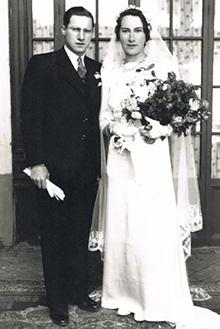
And now Donald MacRae of Glasgow has made more important material available. MacRae’s father, the Rev Malcolm MacRae, was born in Kyle of Lochalsh in 1909, and in 1942 he and Annabella MacLeod were married in Peru. As a youngster, Donald MacRae was a pageboy at the wedding of Netta Fraser and David Milnes, who was a medical missionary for the Evangelical Union of South America.
MacRae’s material includes a translation to English, by him, of the chapter about the Peruvian Free Church mission in the Spanish-language book by J.B.A. Kessler, The History of Evangelisation in Peru. The material also includes a 50,000-word memoir, You First — The
MacRaes of Cajamarca, which is of particular importance to the history of the Free Church mission in the Andes. It is expected that the memoir of Donald MacRae — who was born and spent his early years in the Peruvian Andes — will inspire continuing academic interest in the subject of the Free Church mission there, which continued for much of the 20th century. •
From top left, clockwise Rev James Turnbull, Rev Murdo Nicolson, uncertain, Mrs Turnbull and Annabella Macleod
Photo was taken in 1942 after the Macraes returned to Cajamarca after their wedding in Lima
‘…he still speaks to us by his example of faith.’ Hebrews 11:4 (NLT)
The Life & Legacy of Hudson Taylor (1832-1905)
BY NORMAN AND ALISON MACKAY
Being introduced to the life of h udson taylor can be a disorientating experience for many of us nurtured in the W estern c hurch of today . In comparison with his times, our level of Christian experience can seem mediocre, even superficial.
In some ways it might appear that he, along with a whole generation of 19 th century faith missionaries and church planters, is speaking a whole other language. To his generation it would certainly appear that we are doing so.
The words of the indomitable C. T. Studd, founder of the missionary agency now known as WEC International, capture much about the spirituality of these early pioneers. Counting his own life as nothing, he declared:
‘If Jesus Christ be God and died for me, then no sacrifice is too much for me to make for him.’
For so many Christian men and women of that generation, following Christ meant precisely that, and nothing less. For this reason, they were prepared to pioneer gospel outreach to the most unreached, inhospitable and dangerous areas of the world.
Hudson Taylor’s life and legacy will forever be bound up with the proclamation of the glories of Christ throughout inland China. The embryonic Chinese church of Taylor’s day has grown into something much greater today, both in size and influence, than perhaps even he dared to imagine. This is also true of the missionary agency he founded 160 years ago.
Given the enormity of the blessing that has come to China through the labours of such men and women, it might be helpful for us to explore briefly the guiding principles of Hudson Taylor’s life and ministry that led to such fruitfulness.
THE CROSS HE CARRIED
As with Jesus, Hudson Taylor willingly submitted himself to whatever physical, emotional, social,
psychological and spiritual pain the Father asked him to endure. He, like Jesus, took up his cross, denied himself and in so doing offered up his body as a living sacrifice.
Indeed, for this earlier generation of labourers the cross-centred life was simply a given. They understood the lessons drawn by Jesus from the agricultural harvest:
‘Truly, truly, I say to you, unless a grain of wheat falls into the earth and dies, it remains alone; but if it dies, it bears much fruit.’ John 12:24 (ESV)
We might not be called to lay down our lives as Jesus did. The circumstances of our death might be much less traumatic than the martyrdom of many of these Christian labourers. However, the notion of any sort of Christian service that does not require of us a self-sacrifice, self-giving and self-emptying is unlikely to yield any meaningful harvest.
This understanding of the place of suffering in service is captured well by the late John Stott in his 1986 magnum opus, The Cross of Christ. He states:
‘It is not just that sufferings belong to service, but that suffering is indispensable to fruitful service.’
THE BURDEN HE EXPERIENCED
Perhaps the best way to describe this experience is to envisage someone with the weight of the world on his or her shoulders. Throughout history God has implanted such a weight in the hearts of people he wishes to use to accomplish at times extraordinary exploits of faith. Men and women possessed of this burden are frequently people of
...the notion of any sort of Christian service that does not require of us a self-sacrifice, selfgiving and self-emptying is unlikely to yield any meaningful harvest. “
”
a single idea, whose whole being is characterised by zeal. They burn brightly and expend enormous amounts of energy. They are not often carefree or light-hearted. To be in their company can be as disturbing as it is inspiring.
It was this God-given weight, implanted in the soul of Hudson Taylor, that lay behind the 1865 formation of the China Inland Mission. Writing of this momentous event he recalls worshipping in a church in Brighton, UK:
'On Sunday June 25 th 1865 unable to bear the sight of a congregation of a thousand or more Christian people rejoicing in their own security, while millions (in China) were perishing for lack of knowledge, I wandered out on the sands alone in great spiritual agony…’.
This agonising not only gave birth to a new pioneer missionary society, but also inspired the writing one year later of a pivotal booklet entitled China’s Spiritual Need and Claims. Of this publication he states:
‘About this time with the help of my dear wife I wrote this booklet and every paragraph was steeped in prayer.’
By 1877 the publication had gone through seven editions and was instrumental in stirring the hearts of others to the extent that many were gripped by its vision to reach the people of inland China.
As we trace the contours of his life and ministry this God-given burden never left him. Rather than lessening, its hold on him grew with the passage of time. The more Hudson Taylor worked and travelled in China the more his passion for evangelising the immense population deepened.
This enormous weight in his soul continued to energise, empower and exhaust him until the day he was taken home to glory. Now this overpowering sense of urgency, which at times seemed to overwhelm him, is no longer his to carry. Once a perfectly fitted yoke, it has now been lifted from his shoulders, having accomplished all that the Lord intended.
THE ISOLATION HE KNEW
There were multiple factors that contributed towards Hudson Taylor’s sense of isolation, but perhaps none more so than his whole approach to mission and ministry, as well as (paradoxically) his love for the people of inland China.
Arriving in Shanghai in 1854 Taylor was exposed to colonial superiority, even within the missionary community. He was never comfortable among missionaries he deemed to be living in relative luxury, few of whom were reaching out to the poorer, rural Chinese population. While Taylor viewed some western missionaries as lazy, even self-indulgent, some in turn looked down on him as an unordained and uneducated youngster with little right to call himself a missionary.
At times in these early days homesickness engulfed him as he struggled with language study and endured the pain of hurt and rejection. Such hurt only deepened when in 1857 he fell in love with Maria Dyer, born in China to missionary parents (by then deceased). This was a marriage made in heaven and one that was to bring great joy to them both. However, much to their dismay it was a marriage resisted tooth and nail by the young lady’s supervisor, Miss Aldersey.
Oil Painting of James Hudson Taylor at age 21, created 1853, not long before he left for China
“ ”
The life and legacy of Hudson Taylor serve as a powerful reminder that the only authentic model of ministry is that of the suffering servant, who follows in the path of our Lord Jesus, and embraces the great spiritual principle that through dying comes life.
Her objection to the relationship was that Taylor in her opinion was uneducated, unordained, unconnected (with a missionary society) and uncouth. Furthermore, he was short, and wore Chinese clothes. The damage was deepened further when Maria was prohibited from taking communion until she repented of this relationship. Threatening Taylor with a lawsuit, Maria’s supervisor sullied his character further. Fortunately, the notion of repenting of the “sin” of falling in love did not win the day. On 20 th January 1858 Hudson Taylor and Maria were married.
In the 19 th century there was very little research in the field of missiology. As someone way ahead of his time Hudson Taylor insisted that all missionaries with China Inland Mission adopt an incarnational model of ministry. By this he meant adapting themselves to the host culture by dressing like the local Chinese, living in the same housing and, in general, adopting the manners and customs of local people. Plates, knives and forks were all jettisoned in favour of Chinese basins and chopsticks. Indeed, from the very outset his vision was for the planting of an indigenous church that was Chinese in every way.
However, for many of his generation of westerners, their dignity rested in strict adherence to British dress and British habits. The criticism that Taylor and the CIM missionaries received at the hands of even the British newspapers for contextualising their lives in this way was at times overwhelming. Taylor also insisted that the missionaries’ standard of living should be on a par with that of the local population, and that they should not be seen as representatives of a foreign imperial power. In short, the ultimate goal was not the denationalisation but the Christianisation of this vast empire. He was not there to represent an empire but to commend a Saviour.
It was for this reason that after the devastating Boxer Rebellion in 1900, which targeted Christians and foreigners in China, Taylor refused to accept compensation for the loss of property or life, choosing instead to focus on winning the Chinese to Christ.
Although in his own day this approach was treated with much scepticism, Hudson Taylor never departed from these principles of contextualisation,
now universally enshrined in the study of missiology, and bearing fruit in China today.
THE LOSSES HE ENDURED
Following in the footsteps of his Lord, Hudson Taylor was a man of sorrows and acquainted with grief. Doubtless there was overwhelming joy at times, but our focus is on the crosses he bore. In the course of his life’s work Taylor lost two wives. He and Maria, his first wife, had nine children in the twelve years of their marriage, of whom only four survived to adulthood. This is surely sacred ground, and many of us would be out of our depth commenting on the pain of such experiences.
It is not surprising that his health at times broke. While recuperating from severe mental and physical exhaustion in Switzerland, he endured the anguish of the news that seventy-nine colleagues and children had been slain in the 1900 Boxer Rebellion. From this he never fully recovered, and in 1902 he resigned his position as General Director of the mission. In 1905, following the death of his second wife, Jennie Hudson Taylor, he returned to China. Taylor died peacefully within one month of his arrival. On 5 th June, 2018, the Hudson Taylor Memorial Building was opened in Zhenjiang, Jiangsu province, where the great missionary is buried.
John Stott, in The Cross of Christ, written 40 years ago, observed ominously, alarmingly and indeed prophetically:
‘The place of suffering in service and of passion in mission is hardly ever taught today.’
As far back as 1986 this Christian statesman was warning us of the emergence of a brand of evangelical ministry rooted in a dubious spirituality, one that envisages the advance of the Kingdom without the taking up of the cross. The life and legacy of Hudson Taylor serve as a powerful reminder that the only authentic model of ministry is that of the suffering servant, who follows in the path of our Lord Jesus, and embraces the great spiritual principle that through dying comes life. •
Before joining the Free Church of Scotland Norman and Alison Mackay served with WEC International as pioneer missionaries.
tMISSION MATTERS
A monthly take on some of the mission work the Free Church is involved in by our Mission Director, DAVID MEREDITH
here is a lovely story about the relationship
betWeen john Wilkinson, a gentile missionary Who founded the mildmay mission to the jeWs, and j. hudson taylor, founder of the china inland mission (noW omf international). Every January, Taylor would send Wilkinson a gift with a note attached, ‘To the Jew first.’ Wilkinson would then send the same amount back as a gift to Taylor for his work among the Chinese with a note that read, ‘And also to the Gentiles.’
Sadly, the significance of this story is lost to the majority of Free Church people today. Our interest in cross-cultural mission has waned. Our interest in Jewish evangelism has all but disappeared.
In terms of finance we only give £7,500 per annum to Jewish mission, and that’s the interest from a legacy. No Free Church members are formally employed in outreach to Jews. Once, every Free Church prayer meeting would pray for people like Anna Sutherland, Ray MacCabe and Alex Cowie. All is not lost: three members of the Council of Management of the International Mission to Jewish People are Free Church members.
The priority of Jewish people is explicit in scripture, ‘For I am not ashamed of the gospel, because it is the power of God that brings salvation to everyone who believes; first to the Jews, then to the Gentile.’ (Romans 1:16) Romans 10 and 11 develop this theme, including the beautiful relationship between the Church and Israel. We are the ingrafted branches sharing the nourishing sap from the olive root.
Our heart is grieved when we hear of the latest manifestation of antisemitism whether at the heavier end as in Bondi or the more insidious but subtle propaganda of the media. Why do people hate Jews so much? Is it because they were once and even now enjoy the blessing of God?
This lack of interest in Jewish evangelism comes from a variety of sources.
The elephant in the room must be the Palestinian question and the Gaza conflict. This is not the place for a wider debate. The October 7th attacks were awful. 6,000 Gazans breached the border in 119 locations into Israel. In total, 1,219 people were killed by the
attacks. These numbers include the much publicised 364 civilians who were killed while they were attending the Nova music festival. On the other side at least 70,000 people, including 20,000 children, have been killed in IDF attacks on Gaza since October 2023. The problem is that many have confused and conflated the modern state of Israel with the Jews of Romans 10. Our interest is not in the land; it’s in the Jewish people scattered throughout the world. We are not Zionists.
A heart’s desire for the salvation of our Jewish friends is not the same as an uncritical support of Benjamin Netanyahu. I can understand the rage that people feel against the vast over-reaction of Israel. I hope there is an equal reaction against the terrorist murder machine of Hamas. Can you not for a moment put aside prejudice and love people? The state of Israel will only be tamed through recognition of Jesus as Messiah, Prince of Peace.
Is there also a fear of evangelism in general? There is a tension. On the one hand there is a closely guarded individualism which is reluctant to question the values and lifestyle of other people. However, our faith has the desire to convert and expand at its core. JH Bavinck observed, ‘from the first page to the last the Bible has the whole world in view, and its divine plan of salvation is unfolded as pertaining to the whole world.’ People are afraid of the accusation of antisemitism when we ask a people group who went through the holocaust and lost 6 million people to submit to Christ: the fulfilment of the law, the true and better Abraham and the ultimate Moses. There are fewer antisemitic acts than deliberately withholding the gospel from the descendants of Abraham.
If you are one of these people who rarely think about the Jews in your giving, praying and witnessing then I hope that this little reminder has stimulated your interest. Why not start by exploring the website of the International Mission to Jewish People? Chat with a Jewish friend and ask them what their faith means to them and share what yours means to you. Get this on the agenda of the mission committee at your local church. •
For more info go to http://www.imjp.org
CHiLDREN'S PAGE CHiLDREN'S PAGE
ACTS 2:37-41
A BIG CROWD, A BIG QUESTION, AND GOOD NEWS!!
On the day of Pentecost, when God gave the Holy Spirit to his people who believed in Jesus, Peter spoke to a large crowd about what God has done for us through Jesus. He explained that Jesus is the saviour sent to rescue us from our sins, the saviour spoken about by the prophets in the Old Testament. This sermon by Peter tells us what we should do when we believe that Jesus is the Son of God: repent from our sins and follow him.
Now when they heard this they were cut to the heart, and said to Peter and the rest of the apostles, ‘Brothers, what shall we do?’ And Peter said to them, ‘Repent and be baptised every one of you in the name of Jesus Christ for the forgiveness of your sins, and you will receive the gift of the Holy Spirit. For the promise is for you and for your children and for all who are far off, everyone whom the Lord our God calls to himself.’ And with many other words he bore witness and continued to exhort them, saying, ‘Save yourselves from this crooked generation.’ So those who received his word were baptised, and there were added that day about three thousand souls.
START
MAZE
BIG WORDS...
There are lots of big words about Christianity we might hear at church, home or school. What are they about? What does atonement mean?
Atonement is what Jesus did for us on the cross. To atone means to make up for something wrong you have done. For example, you break your sister’s toy on purpose when you’re annoyed with her. In atonement you say sorry, and maybe offer to buy her a new toy, or get the one you broke fixed. Jesus gave himself up to the cross to atone for our sins, and when we believe in him we are made right with God.
Help the children through the maze to find the Bible! ANSWERS Believe, faith, love, prayer, repentance, trust
GET CREATIVE!!
Have fun colouring this picture!
WORD SCRAMBLE
Can you unscramble the these words about being a Chistian?
MEMORY VERSE
Everyone who calls on the name of the Lord will be saved.
Act 2:21
BY CATRIONA MURRAY
POST TENEBRAS LUX
the Winter months lend themselves to much reading and contemplation, t Wo activities
Which complement each other. One of the gems I discovered towards the end of the year was a little book called The Practice of the Presence of God by Brother Lawrence. It articulated well how to tackle one of the greatest challenges of Christianity: how to live belief. God being present with us, guiding us and aiding us, is only part of the blessing; the greatest of all is when we know he is. That is why, when I pray for others, I always pray that not only should they be upheld, or comforted — but that they should be made aware from whence that help is coming. This is important to me as someone who only latterly realised that God had been there for me all along, and not merely when I realised it.
Like all relationships, though, we have to work at our awareness of God’s presence in our lives. We have to think of him, we have to remember him in all situations. Brother Lawrence advises:
‘Lift up your heart to him, sometimes even at your meals, and when you are in company: the least little remembrance will always be acceptable to him. You need not cry very loud; he is nearer to us than we are aware of’.
This resonates with me as someone who practises continual prayer — not simply the formal, coming aside from everything prayers, but the open channel with God that does not always need to be spoken out loud. Brother Lawrence talks about lifting our hearts to God, even when we are at the table, or with others; he does not say that we must lift up our voices. God, after all, deals with the inside, with the heart and is, I think, much more touched by our intentions than our pretensions. Some of my most articulate prayers have been my most arid, and some of my wordless, tear-watered prayers have been the most fruitful.
I remember hearing of a young minister who had been tasked with saying grace at a dinner provided for an ecclesiastical gathering. When he had finished praying, one of the elderly ministers present sternly observed that he had not heard a word. Without missing a beat, the young man retorted, ‘It wasn’t you I was speaking to’! And therein lies the key: prayer is not performance for a human audience, but real
communication with the Lord. The more you do it, the easier it becomes, just like conversation with any friend. You don’t, as Brother Lawrence wrote, need to make a noise about it, because he is close by. God’s proximity is not something I have ever doubted. It can be difficult to talk about without people thinking that I am being mystical, or dramatic. In fact, it is the very opposite of those things. He is simply nearby. Because of his nearness, we can speak to him at any time, in loud voices, in whispers, or even in the thoughts of our heart. I do not ever think of it as ‘calling on the Lord in prayer’, because he is here; it is more a case of turning to him and speaking. For this reason, the car can be an excellent place to spend time with him, assuming you’re the driver and there are no other passengers, of course!
This is what Brother Lawrence described as an ‘habitual, silent, secret conversation with God’, where your heart is turned towards him in everything that you do, so that even the most mundane of workaday tasks becomes prayer. You see something of this in the spiritual material collected in the Highlands and Islands by Alexander Carmichael in the second half of the nineteenth century, published as Carmina Gadelica. Our forefathers had a prayer, an invocation, or a word of blessing for all manner of domestic activities, from rocking the baby to smooring the fire, or milking the cow: God’s help was requested in all things.
Shadrach, Meshach and Abednego were so certain of God that they permitted themselves to be cast into the fiery furnace rather than relinquish their faith — even nominally — and save themselves. This is the kind of faith that can only be built on much prayerfulness and there, Nebuchadnezzar, who had ordered their death, could only look on in amazement at the presence of a fourth, keeping them company in the fire.
That fourth keeps us company in all the fires through which we may have to walk. If we practise his presence, as Brother Lawrence advises, we have the unparallelled comfort of knowing not just that he is there, but who he is. Better by far to have the faith of the three, than the bewilderment of Nebuchadnezzar. •