The Frederick News-Post
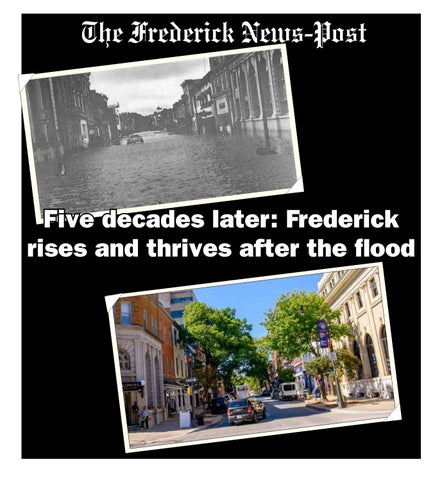
Five decades later: Frederick rises and thrives after the flood
2 | October 2026 | REMEMBERING THE FLOOD
Happy Place
FOUND
Do more of what you love at VisitFrederick.org
REMEMBERING THE FLOOD | October 2026 | 3
Remembering Agnes in 1972 Thurmont Remembers Then & Now
Visit our Scenic Main Street, Orchards, Vineyards, & Covered Bridges thurmontmainstreet.com
delaplaine.org FREE ADMISSION, OPEN DAILY | Mon-Sat 9-5 | Sun 11-5 40 S Carroll St | Frederick MD The Delaplaine Arts Center is proud of its part in preserving the region’s rich heritage while adapting this important landmark to serve in a new and vital way, serving as a cornerstone of a flourishing arts community.
THEN
NOW
Stop by to view more than 50 solo and group exhibitions annually in 7 galleries featuring artworks in a variety of media by regional and national artists. While you’re here, sign up for one of the more than 250 classes and workshops we offer for beginners as well as more advanced artists. You can also experience a variety of engaging public programs, drop-in art activities, and special events for all ages. Before you leave, don’t forget to stop by the Gift Gallery for handmade and unique items created by local artists.
Everyone deserves art—especially you!
4 | October 2026 | REMEMBERING THE FLOOD
Susie and Janet Hargett, who lived above an East Patrick Street business, are carried to dry land by United firefighters George Heffner and Franklin (Buddy) Blank in this photo by Darlene Wiles, who had joined the News-Post staff after graduating from Linganore High School. News-Post file photo
On the cover: Two views of West Patrick Street across the Square Corner, in October 1976 and and October 2026. Theresa Anderson and Ric Dugan
LOOKING BACK By COMFORT DORN
town. I didn’t learn about the Great FredComfort Dorn worked at The Freder- erick Flood until I came to work at The ick News-Post between 2003 and 2015 Frederick News-Post in October 2003, and is now working there part-time. just two years after the flood’s 25th anniversary. By that time, a concrete hen I moved to Frederick channel ran through the middle of County in 1990, downtown downtown, but I didn’t know why. Frederick was not much of a Working in the old News-Post builddestination. ing at East Patrick and Carroll Streets Beautiful old townhouses and gave us a front-row seat on the progchurches lined the side streets, but ress of the linear park project along Market and Patrick streets had a lot of that channel and all the new businessempty storefronts and the area around es flocking to Frederick. I decided that Carroll Creek was largely a construcsomeday I’d really like to live downtion zone. town. I asked some of my new neighbors Our office moved to Ballenger Cenin Middletown about good restaurants ter Drive in 2008, and a couple of years in the city, and they pointed me toward later, I finally learned the truth — the the Golden Mile. No mention of down- water I could see running through
W
downtown wasn’t really Carroll Creek. The actual creek flowed through huge pipes under the city. I even got to see the blueprints. By the time I moved away in 2015, the downtown area was hopping with shops, restaurants, galleries and performance spaces. Almost all of them were independently owned — hardly a chain store in sight. Over the past decade, Frederick has become a weekend destination for folks in D.C. and Baltimore. I started hearing “Visit Frederick” ads on the radio. My nephew had his bachelor weekend here. I was amazed. Plenty of small cities whose 19th century manufacturing economies dried up in the 1950s and 60s have spruced up their downtown areas in an effort to
draw visitors — but few have seen such success. Why Frederick? I suspect it’s a confluence of location, history, a lively arts scene, and a vibe that’s just the right blend of rural and urban — a bit of manure still sticks to the bottom of our Doc Martens. A little more than a year ago, I moved back, finally fulfilling my dream of living in the city. I can walk from my apartment into downtown Frederick along the linear park. And now, on the 50th anniversary of the flood that started it all, I’m grateful to the leaders who took the long and risky road to create such a great city. Lauren LaRocca was the project editor for this special section.
REMEMBERING THE FLOOD | October 2026 | 5
From great flood to downtown hub 50 years later, Carroll Creek Linear Park is thriving By ERIK ANDERSON and RYAN MARSHALL
eanderson@newspost.com rmarshall@newspost.com
In May 2018, a series of violent storms dumped more than 6 inches of rain on downtown Frederick in a matter of hours. The storms swamped Baker Park’s low-lying areas and sent torrents of water over the spillway in Carroll Creek near Bentz Street. That’s exactly how the city’s officials and engineers wanted it. “The water that went into Baker Park over the past few days, that width and volume of water, would basically have to be carried through town,” Tracy Coleman, then the city’s deputy director of public works, said a few days after the storms. The outcome was a victory for a flood control system developed and built over decades after floods ravaged the city’s downtown in 1972 and 1976. The flood control project and subsequent development of Carroll Creek Linear Park evolved over the administrations of seven different mayors, according to Richard Griffin, Frederick’s director of economic development who has worked for the city for close to three decades. “They all have contributed to some piece of the overall vision,” Griffin said.
Looking back 50 years According to Ron Young, mayor from 1974 to 1990, many people look at the success of the linear park and think what came to be known in Frederick as The Great Flood of 1976 was responsible for the city’s revitalization after a period of decline. But that’s a misinterpretation of events, Young said. “Everybody says, ‘Well, [the flood] was the beginning of bringing downtown back.’ No, it set me backwards.”
News-Post file photo
In 1976, Baker Park flooded, along with most of downtown Frederick, as shown in this view of the park’s Carillon from West Church Street. Since completion of the flood mitigation project, it’s the only part of the city that floods. At age 33, Young was elected mayor on a campaign of reversing downtown Frederick’s retail collapse. He spent more than two years on improvements, he said, including working with the Chamber of Commerce to fill vacant
storefronts, before the flood hit. It was what geologists call a 100-yearA storm dumped 7.2 inches of rain flood — one that has about a 1% chance on Frederick over 16 hours, beginning of occurring in any given year. late on Oct. 8, 1976, causing Carroll When Young surveyed the damage Creek to overflow its banks into several (See DOWNTOWN 6) blocks of the historic downtown.
6 | October 2026 | REMEMBERING THE FLOOD
Courtesy of the city of Frederick
Before the flood control project, Carroll Creek’s natural stream channel flowed through downtown Frederick, as shown in this undated photo.
(DOWNTOWN from 5) from a state police helicopter high above the city, he said he saw that core downtown buildings were flooded with water that was 5 to 6 feet deep on the streets. “That wiped out all the basements and the first floors of everything. … I’m looking down thinking that it probably shut down half the businesses we just brought in, what a mess it was, and what the heck am I going to do?” Young wouldn’t find an answer to that question for several years. The cleanup was only the beginning.
Bad options Bert Anderson, who opened the Antique Imports store on North East Street in 1973, said Young faced a fundamental problem: The Great Flood was likely to have encores, largely because multiple shopping centers were built along the Golden Mile section of West Patrick Street in the early 1970s. “It was a red flag for everybody,” Anderson said of the flood. “All of this development that had tak-
en place on the western part of town completely changed the runoff characteristics of Carroll Creek, and I think it was a wake-up call with the development that was taking place out there … that we were unprotected downtown, that downtown Frederick was vulnerable.” Early on, Young called the U.S. Army Corps of Engineers. “They came up and looked at everything and said, ‘It doesn’t meet our criteria,’” he said. Around the same time, Young learned most of the damaged buildings wouldn’t qualify for federal assistance programs because they were in a floodplain. “It’s just like, for a little while, everything that happened was bad,” he said, “and I decided we had to do something.” About two years after the flood, Young hired an engineering firm that provided four bad options: • Do nothing • Hold the water to the west of the city • Tear down hundreds of historic buildings in the floodplain • Build a giant open storm culvert through the middle of downtown
There was no reasonable site to hold the water to the west, he said. He didn’t want to destroy the historic downtown, and an open drainage culvert sounded “horrible-looking.” “I said, ‘Well, this big concrete sewer you want to build, could you put a roof on it?’” Young recalled asking the engineering firm. “And they said, ‘Yeah, but it will be really expensive.’ “‘Well, could you split it in half and leave a 20- to 30-foot stream in between?’” he recalled asking and said he was told, “‘Yeah. That will be even more expensive.’ “I said, ‘That’s what we’re going to do.’”
Making it work The project consisted of four underground culverts running along the path of the creek for about 1.3 miles from Bentz Street near Baker Park to an area near Highland Street and the fairgrounds. A shallow concrete canal was built above and between the 20-by-20-foot culverts for a controlled artificial creek through the linear park.
REMEMBERING THE FLOOD | October 2026 | 7
Courtesy of the city of Frederick
In 1990, work was well underway to channel Carroll Creek through two underground culverts. The system includes levees, flood walls and pumping stations, as well as Baker Park itself, which serves as an earthen holding area for flood water. The idea was his alone, Young said, and he wasn’t aware of any other city that had a similar flood control project. “I just said, ‘We’ve got to keep the city together, we’ve got to stop the flood, and I’ve got to find a way to make it work.’” The engineering firm initially estimated the project would cost about $50 million, he said, at a time when the city’s annual budget was around $10 million. No state or federal money was available for a flood control project, nor was there funding for a park on top of it. But Young was aware of political will to provide money for economic development, he said. “If we’re stopping the flood and eliminating the floodplain, we do economic development along it … and I have a chance to go to the legislature and get money for that.” The city looked to commercial development along the River Walk in San Antonio and Canal Walk in Indianapolis as models. Even with that plan, the state provided only $2 million at first, just barely enough, with some city money, to start construction. Young made the strategic decision to begin the work in the middle of town near Market Street. “If I start at the end and funding gets tough, people will forget it’s there,” he said. “If it’s in the middle, they’re going to look at it and say, ‘Why aren’t they finishing it?’” The city got the same funding from the legislature
three or four years in a row, he said, and the project spaces for people to gather, she said, including the moved slowly. The design and permits were obtained linear park’s amphitheater. between 1984 and 1988. After serving four terms as mayor, Young lost his fifth bid in 1989. The final push While Young didn’t get to see the project through as mayor, Anderson said its success is due to the forYoung ran into some political luck when his friend William Donald Schaefer was elected governor in mer mayor’s leadership. “It was a gift that we had a young mayor with a vi1986. Schaefer and a local state delegate, James “Doc” sion, with some ambition for it, who had four terms of McClellan, promised the state would provide $12 mil- office …,” he said. “We had the continuity of one viewlion for the project, Young said, if Frederick County point … and that was absolutely at the core of the sucand the city of Frederick would each also provide $12 cess of this.” To help move the linear park project along, Griffin million. Some behind-the-scenes leveraging by McClel- said, the city bought out properties along the creek, lan secured the county commissioners’ cooperation, then sold them to developers through a request for proposals process. Young said. The city took out a bond for its share. The first phase of the linear park was built in 2006, The $36 million total was enough to push the flood control project, constructed between 1988 and 1992, with the second phase coming in 2016. into its final phase, he said. Downtown Frederick wasn’t removed from the A dream come true 100-year floodplain on the Federal Emergency ManOver the years, the area has come to include the agement Agency’s map until 2003, but more than a Maxwell Place condominiums, the South Market decade before then, Young started a committee to Center retail and office complex, the Creekside Plaza plan the linear park and commercial elements. mixed-use retail/office/residential site, and the renoKara Norman, executive director of the Downtown vated Union Knitting Mills building, and other comFrederick Partnership, served on the committee that mercial development as well as public facilities such helped with the park’s design. as the C. Burr Artz Public Library. They had many ideas for amenities, she said, and Under construction beside the creek near South talked a lot about the various bridges that would cross Carroll Street is a Marriott-affiliated downtown hotel the creek at different points, as well as fountains and and conference center, a concept Griffin said was inother water features. cluded in the original plans for the project. The committee also focused attention on creating (See DOWNTOWN 8)
8 | October 2026 | REMEMBERING THE FLOOD
(DOWNTOWN from 7) Anderson, the business owner who also served on the committee to develop the linear park, said the flood control project opened the door to about $1 billion of investment in downtown Frederick. “It’s helped all the businesses, absolutely,” he said. “It’s been an economic development dream come true.” Development of the new hotel and conference center would be impossible today, he said, if that part of the city had remained in the floodplain. “It has guaranteed the future economic viability of
downtown Frederick,” he said. Phil Bowers, who opened Brewer’s Alley on North Market Street in 1996, said development of the creek project was a long process, but has proven very beneficial over time. “Well, first of all, we haven’t had any floods. So that’s helped a lot,” he said. It took some time after the linear park was created for people to get used to coming down to that part of downtown, Bowers said, but events such as the Alive @ 5 concert series and festivals in the creek’s amphitheater now draw people to the area, which helps all downtown businesses.
Griffin said the linear park provides an important corridor for transportation, recreation and residential use, creating 410,000 square feet of new or renovated mixed use space. The return on the city, county and state’s initial investment has been substantial, he said, and along the way, a project designed to avoid devastation of the city’s downtown has become something that communities around the country look to emulate. “Carroll Creek [Linear] Park and what has happened here,” he said, “is a world-class best practices project.”
Photo by Lauren LaRocca
Canopies are set up beside the creek for seasonal events such as the weekly Alive @ Five happy hour.
REMEMBERING THE FLOOD | October 2026 | 9
Lauren LaRocca
Decorative plants and water features help keep the above-ground creek flowing.
DOWNTOWN RISES The story of Carroll Creek Linear Park
By SHUAN BUTCHER
An ambitious project to prevent a repeat of the floods that hit downtown Frederick — first in 1972 and then 1976 — took more than a decade to complete. And that was just underground. After weighing several alternatives, Mayor Ron Young and his team had settled on a hybrid solution: converting Baker Park into a stormwater management pond and routing floodwaters underground through downtown to the west side. The underground work cost about $60 million project and was finished in the early 1990s. Completing the underground stormwater system, however, didn’t mean the planned linear park above it was finished. Momentum on that effort didn’t get going for quite some time. A turning point came with the 2002 election of Jennifer Dougherty as the city’s mayor. Her administration uncovered a $1.87 million grant the city had been awarded years earlier but never spent, which funded
an updated master plan. Richard Griffin, the city’s director of economic development, explained that a 1991 plan “was a very aspirational master plan, but not buildable.” So, in 2003, the city hired a Maryland-based planning firm to develop a more practical, three-phase master plan.
The first phase Phase one of the Carroll Creek Linear Park, running from Baker Park to the Delaplaine Arts Center, broke ground in 2004 and wrapped up in 2006 at a cost of $10.5 million. It coincided with a wave of private construction along the creek, including on a vacant parcel between South Court and Market streets (known as site A) and a parking lot behind the C. Burr Artz Library (site B) north of the creek and the former Greyhound bus station and a parking lot (site C) to the south. With multiple projects under construction at once, including Creekside Plaza, Maxwell Place and 50 Car-
roll Creek Way, Griffin said, “we were kind of the envy of the state at that time.” One of the developers behind that boom was Brad Tavel, president and owner of Main Street Development, who purchased Sites B and C from the city. Main Street Development went under contract with the city in 2002. But Tavel noted the process wasn’t the rigid, step-by-step approval sequence found in most jurisdictions. “It was much more organic with the city of Frederick,” Tavel said. Local resident Dale Dowling challenged the developer to get to know Frederick beyond downtown, and then spent a sunny day walking him through the city’s architectural details — lessons Tavel said he built directly into his plans, producing real estate that “maintains the architectural themes and tempos of historic Frederick.” Site C, the larger parcel and former bus station, became the residential component Tavel said was nec(See CARROLL 10)
10 | October 2026 | REMEMBERING THE FLOOD
(CARROLL from 9) essary to support a viable retail and commercial mix. Most commonly known as Maxwell Place, this property’s 68 condominium units now anchor residential living on the south side of Carroll Creek. Site B, formerly an asphalt parking lot, was more of a puzzle. Its geometry dictated the design, Tavel said: parking on the ground floor, retail “popped up above,” and two levels of commercial office space on top, producing the cantilevered structure that stands today. Tucking the parking below grade reflected a philosophy Tavel carried from his earlier work: “You really want to put the best face of the asset forward.” 50 Carroll Creek Way, or South Market Center, is now anchored by the Wine Kitchen and other eateries. The developer oriented the building’s businesses face toward the creek rather than the street, anticipating — correctly — that foot traffic would favor the creekside park over what is essentially an alley known as Carroll Creek Way. Ground-floor retail was treated as essential from the outset. Although the retail side had a rocky start, Tavel said vacancy periods have topped out at around 30 days in the 25 years since. Creekside Plaza, a six-story mixed-use building, now anchored by Frederick Social, was built on site A.
This trompe l’oeil “stone” bridge near the Delaplaine Arts Center is one of the many public art installations in the linear park.
Phase two and beyond
Photos by Lauren LaRocca
Water lilies were eventually planted in the slow-moving creek to mitigate an ongoing problem with algae.
Just as phase one wrapped, the 2008 recession intervened, Griffin said, and the project entered “a little bit of a holding pattern.” It wasn’t until Mayor Randy McClement committed to finishing the job that phase two moved forward, running east from the Delaplaine Center across East Street, past Union Knitting Mills and McCutcheon’s Apple Products, to Patrick Street. It cost about $16.5 million and was completed in 2016 — a decade to the day, in Griffin’s telling, after phase one. A third phase, extending from Patrick Street to Highland Street, hasn’t been completed. City officials originally expected it to be built by a private developer as a condition of a land sale. Griffin said the pressure to close that gap is mounting now that East Church and Renn Quarter are online. Griffin described Carroll Creek as designed to serve four goals simultaneously: flood control, outdoor recreation, transportation, and economic development. The original flood-control investment was pitched to the state and county on the promise of economic return — “it was sold as an economic development project,” he said — which shaped everything from the shared-use path connecting downtown’s east and west sides to space along the corridor for event tents. That economic bet has paid off. Griffin estimates the roughly $27 million in public investment for phases one and two has attracted about $400 million in private development that is completed, under construction or planned. He’s emphatic that the sequence mattered: “Nobody was going to build along Carroll Creek Park if the park improvements weren’t there.” Developers made that condition explicit in meetings at the mayor’s office, telling city officials, “You guys have got to advance getting this park done, and we’ll invest.” The first to act was Daryl Batson, then director of Frederick County Public Libraries, who committed to expanding the C. Burr Artz branch on East Patrick Street, making it one of the creek’s anchors.
REMEMBERING THE FLOOD | October 2026 | 11
Photos by Lauren LaRocca
In addition to this trompe d’oeil statue, artist William Cochran’s “Community Bridge” is decorated with small symbols representing the spirit of community. More recently, the Union Knitting Mill Buildings by Douglas Development has come online. It includes commercial office space and has become a hub for craft beverages and events.
More to come Tavel and Griffin both describe the Carroll Creek project less as finished than as ongoing. Griffin points to unresolved pieces — phase three, a proposed connector path, and additional developments such as Wormald’s Galleria near the Delaplaine and the Marriott downtown hotel and conference center at South Carroll Street. “The hotel is the crown jewel,” he said. Tavel resists calling the project done at all. “It’s supposed to keep moving and shifting and changing. That’s what makes it so special,” he said. “Are we there yet? Whatever, wherever there is, I hope not.” He credits Griffin for making his development projects, and others, possible. “It takes people like Richard, you know, because without Richard, I don’t think this would have happened,” he said. The unusual partnership behind Carroll Creek isn’t easily replicated, he said. “It’s not the ordinary type of development that you see going into communities, and it takes a special government to be able to pull it off.” Fifty years after the flood that started it all, the underground culverts quietly controlling the water flowing beneath the park remain the foundation for everything built above and around it — a foundation both the city and its private partners agree is still, deliberately, a work in progress.
Construction continues on a downtown hotel and conference center on the creek at South Carroll Street, the site of the old News-Post building.
12 | October 2026 | REMEMBERING THE FLOOD
REMEMBERING THE FLOOD | October 2026 | 13
AD
14 | October 2026 | REMEMBERING THE FLOOD
Out of the Rubble Cole’s Pawnbrokers Outlet and the rise of a new Frederick
By JOSEPH PETERSON
Diane Cole saw it on the 11 o’clock news. Cole was an art student at the Maryland Institute in Baltimore in October 1976 when she tuned in to see her hometown of Frederick had catastrophically flooded. She knew her family’s downtown pawn business was likely at the heart of it. “I was so utterly shocked,” she said. “I just looked with disbelief, because there were familiar buildings, like the firehouse and everything, underwater.” She immediately tried to call home on a pay phone, but by then, the family was so exhausted from the day’s efforts to rescue the shop’s inventory that they weren’t much for words. In 1976, the sign on the storefront read Pawnbroker Outlet. The family business, run by brothers Robbie and Charles Cole, had already been a fixture downtown for nearly 30 years. When the waters rose over the banks of Carroll Creek that Saturday morning, they poured into the pawn shop at Flood waters covered the 61 S. Market St.. The Coles’ old safe, but this image Courtesy of the Cole family flooding didn’t stop of Jesus, hanging above it, until it reached the Among the mementos and relics hanging in Cole’s Pawnbrokers Outlet is a photo of the old shop at 61 S. Market St. top of the industristayed dry. al Shaw-Walker fire ed up all the guns along with whatever else they could such a big tragedy,” she said. “For us as kids to be able to chip in and have pride and be able to help, that felt safe where the business stored most of its jewelry and take with them. good.” watches. Meanwhile, Diane Cole took a week off school to It takes a village come help clean and oil the rifles, which became a While the guns went to the house where Rick Cole Assessing the damage “We had probably close to six feet of water in the lived, all the musical instruments, another core catego- family affair. “We all pitched in, and it was like an assembly line, store,” Diane’s cousin Rick Cole said. Now the owner of ry in the pawn industry, made it to the house where his cousin Diane’s younger siblings lived. To clean these, trying to save the merchandise,” she said. Cole’s, he was about 19 at the time. He remembers joining his father, Charles, in an ur- the family enlisted the help of the kids as well as friends gent attempt to assess the damage and salvage as much in the neighborhood. Mythmaking amid disaster inventory as possible. Neighbor Ellen Baker remembers it all vividly, espeEvery family business enjoys a bit of lore where ac“When we were able to get in there, there was mud cially the stench. curacy blurs with the embellishments that make for a everywhere,” he said. “We had a line of windows along “We had every musical instrument with mud and good story. the backside that were all broken.” yuck and stink,” she said. “In the cases, out of the cases, Whether the Cole family enterprise began in 1948 Then there was the question of security and the del- the mud was just inside every instrument, and that was with $25,000 won in a gambling wager is one. The icacy of the situation given the abundance of a core our job, to clean all of that out.” height of the water during the 1976 flood in the shop product sold at most pawnbrokers. Baker and her brother along with two of the Cole is another. “We had to move everything out because we sold ri- children, all between 12 and 14 years old, worked for Even between Rick and Diane Cole, both six and fles and shotguns,” Rick Cole said. days, including taking cotton swabs to brass instru- eight feet came up in conversation. Getting cars downtown was tricky business, but ments for detail cleaning. She said they were all enlistFor Diane’s late brother, Bill, who took over the shop they navigated their vehicles, green and blue station ed — it gave them something to do that felt important. with Rick as the next generation of cousins to run it, wagons, past flood debris to the storefront. They load“You do feel powerless and helpless when there’s that water level took on a more spiritual angle, not with
REMEMBERING THE FLOOD | October 2026 | 15
The Coles moved their store to 242 N. Market St. after they learned that plans for the Carroll Creek Linear Park included demolition of the old building. kind of catastrophe that became a catalyst for positive change. “It was a turning point for Frederick,” Rick said. “Frederick was the same look that it’s been for the last, I don’t know, maybe 40 some years. The biggest change I’ve seen downtown was the creek project, and the widening of the streets, and the sidewalks and everything.” “That was [mayor] Ron Young’s project,” Diane said. “He did a lot for this town.” Considering their original shop was sacrificed to make way for the linear park, when asked if all of the changes were for the better, Rick Cole takes the long From catastrophe, opportunity view. All told, the Cole family was able to salvage about Since 1976, he said, “We haven’t had any ferocious half its merchandise. After some six months, they floods flooding the whole town.” moved back into the creekside location for a while until they learned the plan that became the creek’s linear park included demolition of the old pawnbrokers out- Right: This clipping of Bill Cole’s 2023 obituary hangs near the store’s old safe and the image of Jesus that let. They eventually moved to 242 N. Market St. On reflection, the Coles consider the flood as the both survived the flood. how high it got, but where it didn’t rise to. “My brother was very religious,” Diane said. “The water went right up to under this religious picture, and stopped right there, so my brother saw that as a sign.” “It’s a picture of Jesus Christ,” Rick chimed in. “We always had it beside the safe in the old store.” The symbolism lives on as the memory is retold, with flood waters rising to the top of the safe, but not beyond, sparing the image. Today, that picture still hangs in Cole’s Pawnbrokers above the old safe they reclaimed from the flood. Nearby is a printout of brother Bill’s obituary.
16 | October 2026 | REMEMBERING THE FLOOD
Horsepower, pedal power, foot power — all were used in Buckeystown.
Only Noah in the ark would have braved shopping at Frederick Towne Mall ... but it was News-Post file photos open for business.
The Barbara Fritchie House sustained extensive damage, with many irreplaceable artifacts possibly soaked beyond repair.
Mrs. Julian Bazemore, left, and her daughter, Jay Dee, survey the hopeless destruction of their home in Mountaindale.
The Monocacy River crested at Pinecliff Park, almost covering shelters and playground.
Fleeing spiders dot guardrail as they seek dry ground in this closeup photograph by Carl M. Rigler of Frederick.
REMEMBERING THE FLOOD | October 2026 | 17
News-Post file photo
At the height of the flood, volunteer firefighter Terry Keefer guides his motorboat on East Patrick Street. In the boat is volunteer Glen Dorsey. This view is looking toward the Square Corner.
As downtown Frederick flooded, the calls for help poured in
By CLARENCE “CHIP” JEWELL
After my wife and I married on Aug. 7, 1976, we moved into an apartment on the first floor in the Eighth Street Court Apartments in Frederick. Two months later, I took off work as a dispatcher at Frederick County Central Alarm on Oct. 9 to help an auctioneer friend of mine at a sale. We were living at ground level, and as I listened to the torrential rain hitting our windows, I became concerned about flooding. Rain had fallen off and on for several days and seemed to pour buckets overnight. I received a call early that morning that the auction was cancelled. My co-worker at Central Alarm, Randy Waesche, was working alone. I called him and said I would cancel my leave and come to work; I thought the day may get busier. What an understatement. As the rain continued, Carroll Creek was steadily approaching flood stage. We began to receive calls about flooded basements, not unusual for a heavy rainstorm. But suddenly, the calls took a more serious turn as people called to be evacuated from residences and vehicles. South Market Street was closed and unpaved for road reconstruction and installation of underground wiring to replace the overhead “White Way”
fluorescent lights. From Carroll Creek to South Street, South Market Street was already a mud pit from the heavy rain. The street were quickly inundated with water that reached above the first floor of some buildings. The United Fire Company on South Market Street and Citizens Truck Company on South Court Street moved their equipment from quarters to higher ground. Several vehicles owned by the firefighters were destroyed by floodwaters. Evacuating residents became a major task. The only fire department boat in the city was at the Junior Fire Company.
A rescue armada Chief John Hartman and members of the Junior Fire Company immediately responded. Several firefighters hurried home and returned with their personal watercraft to begin removing people from flooded houses. United Fire Company paid driver Charles “Mutt” Deater, who lived close to the flooding on Washington Street, retrieved his boat, Mon-Ark. My best friend Terry Keefer, a member of the Junior Fire Company, quickly got his boat and picked up fellow firefighter Glen Dorsey en route.
Keefer’s boat was launched into East Patrick Street at the Blue Ridge News Agency and navigated down the alley (now Maxwell Avenue) into the parking lot along Carroll Creek. As flood waters steadily rose in downtown Frederick, so did the volume of calls that “flooded” into Central Alarm. The 1976 flood occurred several years before 911 telephone service became available in Frederick County. Computer-aided dispatch and digital radio systems with multiple channels were still decades away. The yellow legal pad was our friend. Calls to a seven-digit emergency phone number came into the center with a maximum of four lines but only three answering locations with telephones, one of which was a single phone in the bathroom. Chief Dispatcher Donald Trimmer and other Central Alarm dispatchers arrived to help process incoming emergency calls. County Commissioner Lawrence A. “Lou” Dorsey, a member of the Woodsboro Volunteer Fire Company, also came into Central Alarm and was available to authorize any other county resources needed. It’s hard to believe today that a boat could float down South Market Street, go east through the park(See HELP 18)
18 | October 2026 | REMEMBERING THE FLOOD
News-Post file photo
The Brunswick Volunteer Ambulance Company lent its rescue boat and crew to assist personnel in Frederick. Pictured in the boat here are Dennis Moore (left) and Tony Barnhouse (right) of Brunswick, with Jesse Ward of the United Fire Company (center). Other United members stand by in the waters on East Patrick Street. (HELP from 17)
Tons of debris and watercraft flowed down Carroll Creek and became lodged under the bridges, ing lot to what is now Maxwell Avenue, go to East creating dams that forced the water to back up. It Patrick Street and float to the “Square Corner.” was so deep that boat propellers struck the tops of Boats made their way up and down South Market parked cars as the water rose higher than the vehiStreet, reaching stranded residents. cles. Areas along Carroll Creek at North Bentz Street were rapidly inundated. At West Church Street and North Bentz Street, flood waters reached over front A century before The Frederick Flood of 1976 was considered a 100porches. year flood, and in fact, it occurred just over 100 years Additional boats from the Carroll Manor Fire Company, Brunswick Volunteer Ambulance Com- after the last major flood of Carroll Creek, on July 24, pany, Woodsboro Volunteer Fire Company and oth- 1868. Houses along South Market Street were inundater area fire companies joined the armada of private boats that helped remove residents from high water. ed and the United Fire Company lost all fire comObstacles at the height of the flood included ca- pany records. The 1868 flood was believed to be the noes, rafts and small boats that had been stored in highest water level since the founding of the city. The United Fire Company at 79 S. Market St. sufthe rear of Delphey’s Sports Store on West Patrick fered significant damage in 1976. The entire engine Street.
room was flooded several feet high in the engine room floor, leaving several feet of mud. The Citizens Truck Company was completely flooded. The basement area was totally underwater and the apparatus bays and bunk area had water several feet deep. The water on South Market Street was so deep at the height of the storm that boats could nearly reach apartment windows of the second floor above businesses, such as Kidd’s Café, in the lower lying areas. Downtown Frederick was a mess. And just as fast as the floodwaters rose, they began to recede. The calls coming into Central Alarm changed from evacuating people to pumping out basements, washing away mud, and checking out buildings for safety. Cleanup took weeks. Fire engines from all around the area were needed to pump out basements and hose off sidewalks and building interiors.
REMEMBERING THE FLOOD | October 2026 | 19
News-Post file photo
Owner Charles (Mutt) Deater (left) and other members of the United Fire Company make rescues in Deater’s boat, the Mon-Ark. Tropical Storm Agnes in 1972 caused massive flooding throughout Frederick County, but left South Market Street mostly dry. In 1976, though damage occurred around the county, most serious flooding was in downtown Frederick. The events of Oct. 9, 1976, were the impetus for Mayor Ronald Young to pursue a major flood mitigation project that eventually eliminated the “floodplain” designation along Carroll Creek. The project took decades to complete, and now the beauty of the Carroll Creek Linear Park hides the massive underground tunnels that direct floodwater away from downtown Frederick. Clarence “Chip” Jewell and Randy Waesche — who also contributed to this column — were on duty at Frederick County Central Alarm on Oct. 9, 1976. Both ultimately became the director of “Central Alarm,” the Department of Emergency Communications.
Boats washed downstream from Delphy’s Sports Store on West Patrick Street and wedged under a bridge. Here, a National Guard truck is parked above to help with clean-up. News-Post file photo
20 | October 2026 | REMEMBERING THE FLOOD
Two films, one flood, and the making of modern downtown Frederick By ROCCO GEPPI
On Oct. 9, 1976, water flowed through downtown Frederick with enough force to erase whatever sense of permanence the city’s historic center still possessed. Businesses were damaged. Records were destroyed. The Carroll Creek corridor became a reminder of the vulnerability of a downtown already struggling to find its place in a changing America. But the story of Frederick’s 1976 flood does not end with the water. In the five decades since, the disaster has become part of a much larger story — one about preservation, civic investment, the arts and a community deciding that its historic downtown was worth saving. Two films explore that story from very different directions. Russ Hodge’s “InSpired” is a documentary built around interviews, archival material and the recollections of people who witnessed and shaped Frederick’s transformation. Salyer McLaughlin’s “Boomtown!” is a historical-fiction film that uses actors and recreated scenes to bring pivotal moments in the city’s history back to life. Both films give the 1976 flood a prominent place in the story. Neither, however, argues that the city simply went from devastation to revitalization overnight. Instead, they portray the flood as Courtesy photo a catalyst — a moment that accelerated changes already beginning to take Russ Hodge, right, executive producer and president of 3 Roads Communications, interviewed more than 50 business owners, shape and forced Frederick to think locals, and former and current elected officials for the one-hour documentary “InSpired.” Former Frederick Mayor Ron Young is differently about its future.
at left.
A story of people and decisions
McLaughlin realized that Frederick’s revival could make a compelling film while he was working on an entirely different project. He was researching a documentary about Colonial Jewelers, which had reached its 75th year in business, when he came across Kate McDermott’s 2023 book “From the Brink to Brilliant: The Revitalization of Downtown Frederick, Maryland.” McLaughlin knew the flood of 1976 had been significant. But McDermott’s account helped him see it in the context of everything happening around it. “I read it and was inspired to make a movie,” he said.
Frederick in the early 1970s was already struggling. Businesses were moving to suburban shopping centers. Storefronts were being boarded up. Historic downtowns across the country were losing residents and commerce, and Frederick was experiencing the same pressures. “There was already a very, very strong, civic pride thing going on in Frederick,” McLaughlin said. After the flood, “there was this resurgence of people wanting to rebuild.” That is where “Boomtown!” begins to distinguish itself from a straightforward account of the flood. McLaughlin wanted to tell the story of the people and decisions that followed, and, importantly, those that
preceded it. He points to Bert Anderson, an antique dealer who purchased the Everedy Square property in 1975, as one example of an individual whose vision was beginning to change the city before the flood arrived. The flood, then, was not the beginning of Frederick’s revival. But it became a defining moment. “It inspired [the people of Frederick] to look at preserving its community in a different way,” McLaughlin said. He explores the decisions that followed, including the effort to make the downtown less vulnerable to another disaster. Ron Young, who was mayor at the time, pushed for a massive infrastruc-
ture project that would ultimately transform the creek corridor. McLaughlin describes Young’s vision as a willingness to think beyond simply rebuilding what had been destroyed. The question was whether downtown would remain a flood zone or whether the city could turn the problem into an opportunity. That transformation — and the many decisions surrounding it — is also at the heart of Hodge’s “InSpired.”
Fighting back
Since Hodge moved to Frederick in the late 1980s, he’d seen the city change dramatically. By the early 2000s, he
REMEMBERING THE FLOOD | October 2026 | 21
Courtesy photo
Salyer McLaughlin on set for the Velvet Lounge recreation in “Boomtown.” could see that the city was following a trajectory he had witnessed in other communities. For Hodge, the disaster provided something important from a storytelling standpoint: an opening. “I was not here during the floods,” he said. “But the floods, in terms of the documentary, provided the great dramatic beginning.” It was, he said, a way of introducing a city that had been struggling and then watching its residents fight their way back. “It was sort of like the Rocky story,” he said. “Frederick was down [on the canvas] and being counted out and the city dragged itself up and started fighting back.” That fight is what Hodge wanted to document. For “InSpired,” he interviewed more than 50 people from different walks of life, giving the production team a broad collection of perspectives on Frederick’s history and its transformation. The challenge became deciding what to leave out. An early cut ran about 80 minutes. The final film had to fit into 56 minutes and 46 seconds. “It was kind of a Sophie’s Choice, trying to pick relevant soundbites,” Hodge said. McLaughlin chose a different path. Rather than asking viewers to imagine what Frederick looked like decades ago, he recreated it. Actors portray historical figures. Locations were transformed to resemble their appearances more than four (See FILMS 22)
Courtesy photo
Russ Hodge, right, interviewed former U.S. Rep. Barbara Byron, left, a Frederick resident who represented District 6 in Congress from 1979 to 1993, for his documentary, “Inspired.”
22 | October 2026 | REMEMBERING THE FLOOD
(FILMS from 21) decades earlier. Staging recreated moments that archival photographs alone could not fully capture. The flood sequence required a particularly elaborate recreation. The Chamber of Commerce, then located along the creek, was flooded in 1976, destroying archival records. To recreate this, McLaughlin’s production filled a firehouse with four feet of water. Other scenes required vintage fire engines, firefighters and period equipment. “We were recreating all these scenes that were pivotal moments in the history of Frederick,” McLaughlin said.
A sense of common purpose
McLaughlin also explored parts of Frederick’s history that he said could easily be overlooked. Among them was the role of the city’s Black community in shaping its future. “It’s not just a story about white, wealthy men who turned this town around,” he said. “It’s more about how the white community came together with the Black community and decided they were going to [rebuild downtown Frederick] together.” Both filmmakers see the flood as a moment when Frederick was forced to recognize that the future of downtown depended on collective action. Hodge said the disaster “galvanized what was already starting to take place in Frederick.” “It shook people out of it, shook the cobwebs off of people,” he said. “It took them out of their kind of doldrums, their inertia, and their unease.” McLaughlin sees a similar lesson in the community’s response. “The flood brought everybody together,” he said. “[They basically said], ‘We all own property sitting on a floodplain. Unless we do something about it, we’re all going to lose that.’” That sense of common purpose became part of what McLaughlin sees as Frederick’s lasting legacy. “We’re better off together than apart,” he said. For Hodge, the lesson is less about one transformative event than about what happens after it. Frederick’s revitalization was not accomplished through one sweeping decision. It was the result of years of smaller decisions — preserving build-
Courtesy photo
Salyer McLaughlin on set. ings, improving streets, planting trees, investing in public spaces and encouraging businesses and artists to remain downtown. The flood was dramatic. The recovery was not always. “It’s the actions that you do day in and day out that really affect change,”
Hodge said. Fifty years later, the two films offer different ways of looking back at the same watershed moment. “InSpired” asks the people who lived through Frederick’s transformation to explain it. “Boomtown!” asks viewers to step
back into the past and watch it unfold. And both suggest that the most important part of the flood’s legacy may not be what happened on Oct. 9, 1976. It may be what Frederick decided to do on Oct. 10 — and on all of the days that followed.
REMEMBERING THE FLOOD | October 2026 | 23
24 | October 2026 | REMEMBERING THE FLOOD
MOVING FORWARD Fifty years ago, the Great Frederick Flood changed our community. What followed was more than rebuilding. It was resilience. Renewal. And a commitment to creating a stronger future for the people who call Frederick County home. Today, Frederick Community College (FCC) carries that spirit forward. We help people turn potential into opportunity, goals into careers, and learning into lasting impact. Through accessible education, workforce partnerships, innovative programs, and pathways built for a changing world, FCC helps prepare the people who will shape what comes next. Because when people grow, communities grow. FCC is proud to share in the history of what’s possible when we come together, adapt, and move forward.
Frederick Community College (FCC) prohibits discrimination against any person on the basis of age, ancestry, citizenship status, color, creed, ethnicity, gender identity and expression, genetic information, marital status, mental or physical disability, national origin, race, religious affiliation, sex, sexual orientation, or veteran status in its activities, admissions, educational programs, and employment. • Under the ADA and Section 504, FCC makes every effort to accommodate individuals with disabilities for College-sponsored events and programs. For FCC employees needing accommodations, including interpreting, please email humanresources@frederick.edu. For students and others with accommodation needs or questions, please call 301.846.2408, or to request sign language interpreter services, please email interpreting@frederick.edu. Sign language interpreters will not be automatically provided for Collegesponsored events without a request for services. Requests must be made at least five workdays before a scheduled event to guarantee accommodations. • If your request pertains to accessible transportation for a College-sponsored trip, please submit your request at least 21 calendar days in advance. Requests made less than 21 calendar days in advance may not be able to be guaranteed.
FIND YOUR PATH FORWARD frederick.edu • 301.846.2400