Distributed monthly in The Frederick News-Post and through selected distribution outlets. ALL RIGHTS RESERVED BY COPYRIGHT. Prices, specials and descriptions are deemed accurate as of the time of publishing. This publication may not be reproduced in whole or in part without the express written consent of the publisher. Advertising information has been provided by the advertisers. Opinions expressed in Prime Time Frederick are those of editors or contributors and do not necessarily reflect those of Ogden Newspapers of Maryland, LLC. All terms and conditions are subject to change. The cover, design, format and layout of this publication are trademarks of Ogden Newspapers of Maryland, LLC and published by The Frederick News-Post.
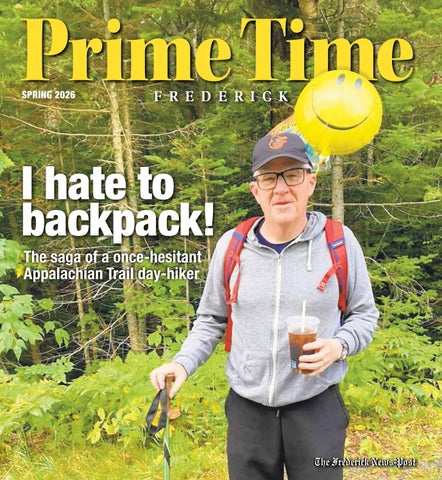
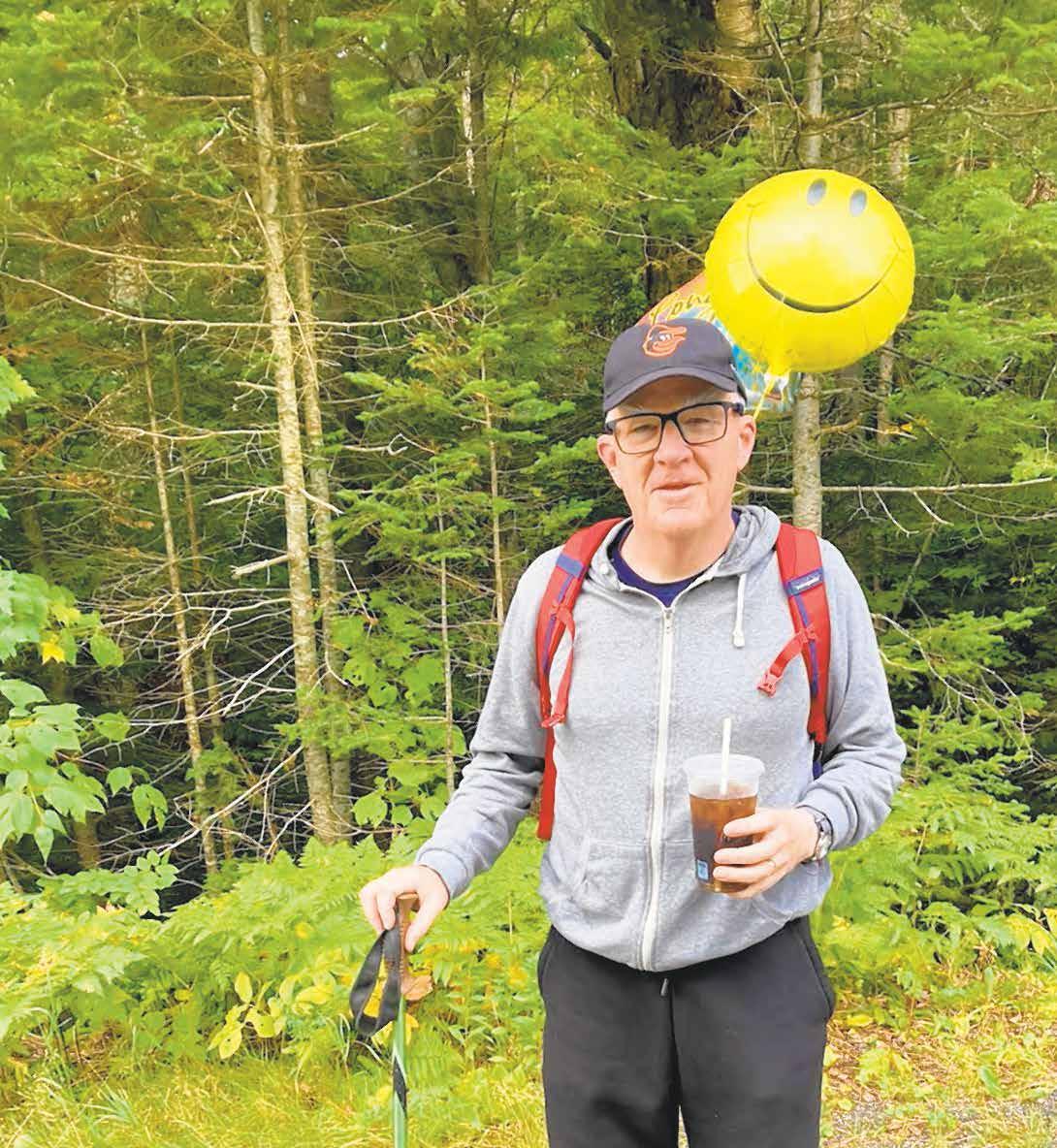
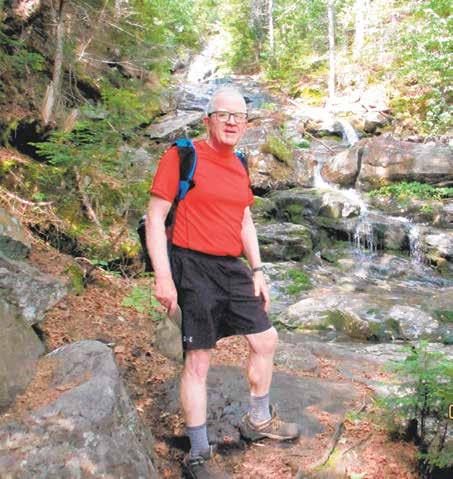
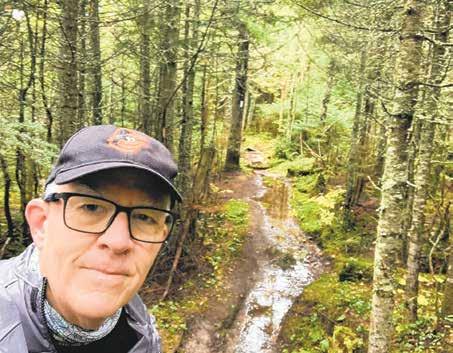
On the cover: Don DeArmon begins his final day on the Appalachian Trail in Maine. Courtesy of Don DeArmon
What would you like to read?
What would you like to read about in Prime Time Frederick? Email llarocca@newspost.com with the subject line “Prime Time.”
The Maryland Accessible Telecommunications (MAT) program gives Maryland residents the opportunity to apply for Stateprovided telecommunications equipment to independently make and receive calls. The MAT program has a variety of FREE equipment solutions to support clearer communication, including:
*The MAT program benefits Maryland residents who qualify, ages three and older, who are Deaf, hard of hearing, DeafBlind, or are living with limited speech, mobility, or cognitive abilities.
PEOPLE
I hate to backpack!
The saga of an Appalachian Trail day-hiker
BY DON DeARMON SPECIAL TO THE NEWS-POST
Ihate to backpack.
Since I’ve backpacked over 1,000 miles of the Appalachian Trail with a backpacking buddy, Ted Gregory, that may sound absurd.
The Frederick News-Post has chronicled a number of our trips together: through the Virginia Highlands, through Great Smoky Mountains National Park, through the White Mountains of New Hampshire, and through the 100-Mile Wilderness of Maine.
Certainly there were many times backpacking along the AT with Ted when I reveled in having everything I needed to survive in the wilderness — shelter, food, water, clothing — in a pack on my back. We had some great experiences.
But backpacking also meant long, uncomfortable, sweaty miles when I was lugging a too-heavy pack just to face a sleepless night crammed into an AT shelter with a horde of smelly and snoring fellow hikers.
Wasn’t there an easier way to hike the Appalachian Trail?
Well yes, there was, because I also hiked over 1,100 miles of the AT as a day-hiker. I’d start at one trailhead with a small daypack, sustain a comfortable pace over the course of the day, then leave the trail for the comforts of an inn or motel, a hot shower, and a solid meal prepared by someone other than me.
Much has been made since the popularity of Bill Bryson’s book, “A Walk in the Woods,” about the remarkable “thru-hikers” — the backpackers, predominantly young
people, who undertake the entire 2,192-mile AT in a single year. About 2,500 start out each year — 75% in Georgia and hiking north to Maine — and close to 700 finish the entire trail.
Then there are the “section hikers” like Ted and me (also affectionately known as LASHers — “long-assed, section hikers”), who backpack or day-
hike the AT in segments over a period of years.
My love affair with the AT predated Bryson’s book because a fellow Eagle Scout and I backpacked 300 miles of the AT from Maryland, through Pennsylvania and New Jersey, to New York in 1970 when I was 15. Our destination had been Maine, but a
leg injury to my buddy truncated our plans. At that time, the term “thruhiker” did not exist; fewer than 100 “end to enders” (as they were known) had completed the entire trail. Ever. Living in Frederick, we’re all within a half-hour of the trail, so my family and I enjoyed short hikes on Maryland’s 42 miles of the AT as my
Photos courtesy of Don DeArmon
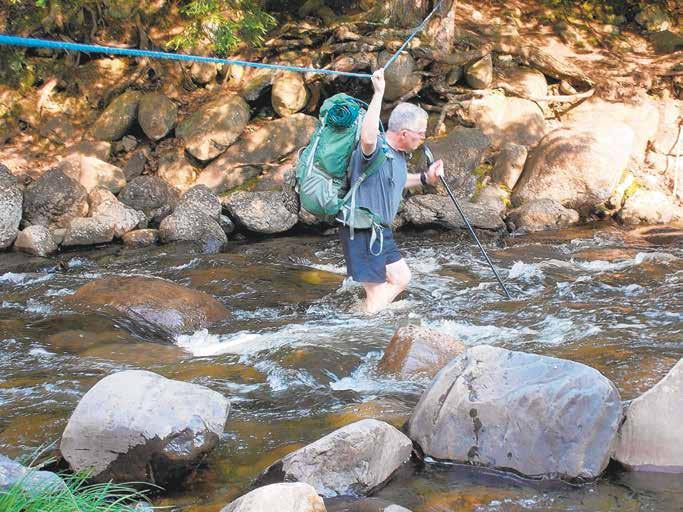
Don DeArmon crosses a stream in Maine’s 100-Mile Wilderness.
four children grew up.
Backpacking? No thanks. I’d given that up after college.
That is, until neighbor Ted lured me into a couple of backpacking weekends in Shenandoah National Park in 2011 soon after I’d turned 56. Little did I know those trips would set off a decade-long journey to hike the entire AT.
Unlike myself, Ted has always been a committed backpacker, enjoying aspects of backpacking that I consider annoying, such as setting up camp and cooking. I always ate cold food when we backpacked, leaving a stove and cooking accoutrements behind. But Ted (despite our occasional political differences) was a good hiking companion, so I compromised and became a reluctant backpacker. We became official LASHers and started planning outings that jumped around the 14 states that the AT passes through.
First, we completed a 75-mile section of the highlands of southwestern Virginia. Then we backpacked two 50-mile sections of New York. We completed the 75 miles of Great Smoky Mountains National Park.
After careful planning, we hiked the 100-Mile Wilderness in Maine and the final 15 miles of the AT to Mt. Katahdin, the AT’s northern terminus. That delightful trip required nine major stream crossings.
New Hampshire’s tough White Mountains took a toll; as we aged well into our 60s, it took us three different summers to navigate a 101-mile stretch.
The joy of day-hiking
Meanwhile, I started to connect some of our backpacking miles together with sections of the AT I completed by day-hiking. I also hopped around: Tennessee, North Carolina, Connecticut, Massachusetts — adding an extra 50 to 100 miles each year to
my AT total. As my miles grew — both from day-hiking and backpacking with Ted — I realized I was in reach of completing the entire AT.
Day-hiking for me was more enjoyable than backpacking. By carrying less, I could hike more miles comfortably than I could backpacking. Being able to sleep well at night and eat a nice meal left me far more refreshed than undertaking those chores at a shelter or tent site.
I could dress for a single day’s weather and leave surplus clothes behind. My hiking garb was usually just nylon shorts and a T-shirt. I hiked in Keen low-top hiking shoes and wool socks.
My daypack contained a light rain jacket, some first aid essentials in a small plastic bag, toilet paper, a sandwich, and snacks, such as nutrition bars, or nuts and M&Ms. I took a cell phone along but I kept it turned off; I took photos with a point-and-shoot camera. Thru-hikers use trekking poles; their clicking on the rocky trail
often alerts me to their approach. I sometimes used a single hiking pole like a staff. Even carrying abundant water, my day pack didn’t break 10 pounds. Some worrywarts would probably warn me I should have carried the means to bivouac overnight. An emergency shelter. Extra food. A headlamp in case I got caught in the woods after dark. But since my dayhiking trips were always confined to the summer or early fall, I had plenty of sunlight. And I planned each day leaving an extra margin of safety precisely to avoid an unexpected overnight. After all, I was hiking for fun, not to worry!
The logistics of day-hiking did require careful planning. Trailheads and road crossings didn’t always line up neatly with the 12 to 18 miles I preferred to walk in a day. That meant an occasional, uncomfortable, 20-plus-mile day (26 miles was my longest). I also had to plan nightly lodging, which might require changing accommodations as I
progressed north or south.
Arranging to get to trailheads in the morning and get off trail again at night also took some doing. I used a variety of methods, including family members, hitchhiking, and paid shuttle drivers.
Finding my starting points where the AT crossed local roads was often a challenge. That’s where local shuttle drivers, despite their cost, could be handy. I especially relied on them in North Carolina and Maine. My wonderful wife staged me for nearly all of Vermont — dutifully dropping me in the morning and retrieving me in the evening — while tending to our daughter and new grandson during the day. Two of my adult children spent a week staging me while I finished up the southern end of the trail in North Carolina and Georgia.
I also hitchhiked a fair amount. My “trail name” — “Hitchhiker” — was suggested by Richard Griffin during an early backpacking trip when I regaled him with stories of my teenage crosscountry hitchhiking exploits. (Most long-haul AT hikers take on a “trail name” to characterize their wilderness persona. The name is usually conferred on them by fellow hikers.)
In completing the AT, I very much earned my trail name. I put Shenandoah National Park’s 101 miles under my belt by parking my car along Skyline Drive, hitchhiking to my starting point, then hiking 15 to 18 miles back to my car. On another trip, I took an overnight Amtrak to Spartanburg, South Carolina, and hitchhiked 135 miles to Bryson City, North Carolina, to begin a week’s worth of day-hikes. (I rented a car to get home.)
In fact, even though Ted and I generally rely on shuttle drivers, we have hitchhiked on a number of occasions, most recently in Connecticut in November 2024. On two occasions — once in Virginia and once in New
(See HIKING 14)
Don DeArmon near Kinsman Notch, New Hampshire
LIVING
From white collar to blue collar
Working in retirement
BY GARY BENNETT
SPECIAL TO THE NEWS-POST
I’ve gained a new appreciation for blue-collar workers ever since becoming one myself. Retirement has a way of opening your eyes that way.
It’s not that I didn’t appreciate what they do. I’ve heartily thanked the folks who come to my home and make my life better — electricians, plumbers, HVAC workers, carpenters, exterminators and painters. I’ve marveled at how quickly construction workers can raise up buildings. I’ve admired the grace and dexterity of heavy equipment operators. I’ve respected from afar the work of warehouse workers, baggage handlers, truck drivers, store clerks and more.
It’s just that I’ve always told myself that I’m perhaps a little smarter and planned ahead a little better than they did, especially when I see them toiling away in the elements, in someone else’s home or in a retail environment. You can call me naïve or arrogant for feeling this way, but I did.
The truth is, however, I secretly admired and was always intrigued by them.
What are their days like, I wondered? Does the physical work and fresh air make them healthier than me? Is their hands-on work more meaningful than my more esoteric work? Do they get paid better than me? Would I have the stamina to do the work they do every day?
It wouldn’t take me long to find the answers.
When I retired from my whitecollar career in 2020, I suddenly had
an empty slate. I knew I wanted to eventually continue working in some capacity. It’s not that I necessarily needed the money — of course every little bit helps — but I wanted to make sure I was busy and filled my days with meaningful tasks.
I suppose if I had a hobby I wanted to pursue with a vengeance or an aging parent I needed to take care of, I would have done those things. But that wasn’t the case for me.
For me, a fun, part-time job seemed like just the ticket for a happy and healthy retirement. I’m not alone.
Why work in retirement?
According to AARP, 20% to 25% of
all retirees work part- or full-time in retirement. For new retirees — those mostly in their 60s like me — the percentage rises to about 33%.
In the future, it is estimated that the number of Gen X and Millennial retirees continuing to work will begin to approach 50%. Or as my 40-yearold son recently told me, “I don’t think I’ll ever be able to retire.”
It’s no wonder. Today, the workingin-retirement trend is driven largely by financial necessity. Social Security is not enough to get by on, and many folks spend every cent just surviving. They are unable to save for retirement.
But even if they have the money, retirees have other good reasons to
continue working. Many want to maintain good emotional and social connections. Others wish to continue feeling useful. Still others want to keep exercising their brains to help ward off mental dysfunction.
I was able to retire early from my high-pressure, white-collar job at age 62. I had a decent 401(k), a paid-off home and good health. I was OK with taking minimum Social Security. So, as a brand-new retiree, I began doing interesting things that filled my hours. I exercised in earnest, volunteered all around town, provided regular childcare for grandchildren and began writing. I even did a little traveling like new retirees are supposed to do. But for me, it still wasn’t enough. After about six months, I started to get the bug to work again.
I knew I didn’t want to continue in my chosen field, but I also knew I wanted to keep active and contribute to society in some meaningful way. Like a lot of older Americans, I see retirement as a flexible phase to do all those things I always wanted to do. To me, that meant a new job, albeit a fun and part-time one.
I had fantasies about what it would be like to work a blue-collar job that paid reasonably well but didn’t incur much stress or come with mountains of homework. To me, the folks working blue-collar jobs seemed happy and knew what they had accomplished at the end of the day. For me in my marketing and communications job with its demanding and high-powered clients? Not so much.
I didn’t have the stamina or mechanical ability to be a plumber, electrician, or construction worker. But I could
(See JOBS 20)
Metro
Many people retire — and then choose to work. And there are many reasons for this.
PEOPLE
How a 1994 screenwriter’s letter sparked a 30-year family mystery
BY J.D. VALDEPENAS SPECIAL TO THE NEWS-POST
If anyone was going to tell the story of the Kuehn family, it was going to be their descendant residing in the suburbs of Kensington: Christine.
Christine Kuehn, author of “Family of Spies: A World War II Story of Nazi Espionage, Betrayal, and the Secret History Behind Pearl Harbor,” will participate in an author talk June 1 at the Frederick 50+ Community Center, 1440 Taney Ave., Frederick. The talk will run around 45 minutes with a 15-minute Q&A session.
Kuehn’s 30-year journey began in 1994 when she received a letter from a screenwriter working on a World War II movie, inquiring about her family and their connections to the espionage activity culminating in the bombing of Pearl Harbor. Before the letter arrived, Kuehn was living a peaceful life in the suburbs. She had a career spanning journalism, public relations and the nonprofit sector. She had three children and two family dogs named Nase and Scheu — names chosen as a nod to her father Eberhard’s German heritage. In an excerpt from her book, Kuehn writes that her father “loved to tell stories” but would only speak of his past in short, vague sentences.
When Kuehn first called her father upon receiving the letter, he denied that they were the Kuehn family in question. About 15 minutes later, he called her back and admitted the family did indeed have past ties to the Nazi party.
“My dad didn’t talk much about his family. [He] always sugarcoated the past until we confronted each other,” Kuehn said. “This was a family secret. All these people didn’t want this next generation of Kuehns to really know what the family had gone through.”
affair with Ruth, which ended when he discovered that Ruth was half Jewish — leading to the Kuehn family being sent to Hawaii to work as spies, where Eberhard spent his early years.
Kuehn’s goal throughout the project was to answer the question of whether her grandfather — Bernard Julius Otto Kuehn, known simply as Otto — who would become the only person convicted for the Pearl Harbor attack, was truly guilty or not.
“It was a march to the truth,” Kuehn said of her journey. “I just [knew] I wanted to be able to prove or disprove that my grandfather was involved and that’s where we started from. How did he get there? What was his story that got him to that point?”
“The stock market crash [of 1929] caused a depression in Europe. Germany had a lot of taxes to pay in retribution [for World War I]. The Treaty of Versailles shackled Germany. Hitler and the Nazi party took advantage of the stock market depression,” Kuehn said, providing historical context. “My grandfather Otto
and his brother Leopold went to listen to Hitler and joined the Nazi party.”
Early in the research process, Kuehn and her husband, Mark, visited bookstores searching for information about her grandfather. At first, the only sources they found were highly exaggerated stories falsely claiming that Kuehn’s grandfather and aunt Ruth had led the attack themselves. When she reached out to family members, Kuehn’s requests were frequently shut down, especially by Ruth.
“The first time I ever met her was in 1987, [when] I was right out of college. My aunt Ruth wouldn’t talk to me about it. She told me, ‘You have a good life. Don’t ask me any questions about your grandfather, about Germany, about Pearl Harbor.’ She would ghost me for months,” Kuehn said.
Joseph Goebbels had engaged in an
“[When he was 16] my dad walked away from his family [and] didn’t go back to Germany,” Kuehn said. After the family was arrested for espionage, Eberhard was sent to an internment camp separate from his mother, Friedel, and sister, while his father was in prison. Growing up vehemently opposed to the Nazi party, Eberhard eventually cut off contact with his mother and refused to return to Germany despite requests from his siblings.
Throughout the book, two timelines run in parallel: Kuehn discovering the extent of her family’s involvement, and Otto’s rise and fall from struggling businessman to full-fledged Nazi spy to enemy of the American people.
“History is a lost art. It’s important to understand why things came to happen,” Kuehn said. “Young people need to understand history and if they didn’t know it, they need to go back and relearn it.”
J.D. Valdepenas is a senior at Pace University majoring in English language and literature. Along with writing about arts, culture and entertainment, she studied classical and medieval literature and Shakespearean drama.
Emily Burkhard Christine Kuehn
Courtesy photo
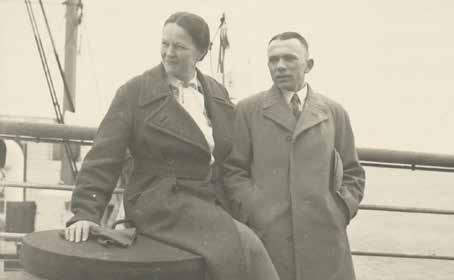
Otto and Friedel aboard the SS Stuttgart shortly after leaving the family behind in Germany on their way to the United States in 1935. They would stop in New York, California, and Oahu before making their way to Japan to meet with their espionage contacts.
Seven days in Panama Monkeys and much more
BY KAREN PEACOCK SPECIAL TO THE NEWS-POST
What’s the first thing that comes to mind when you think of Panama? Probably the canal.
I was fortunate to spend a week visiting friends who had escaped the winter for a month at a Panamanian resort. My bedroom overlooked a rainforest, while other windows framed the ocean, where distant ships waited for their turn to enter the canal.
Cynthia and Russ had already visited it and weren’t eager to return. Engineering isn’t exactly my passion, so I skipped touring the canal. There were plenty of other things to do.
As a child, my favorite exhibit at the Jackson, Mississipi, zoo was Monkey Island. Surrounded by a moat, it featured spider monkeys climbing over rocks and a miniature village. There might have been a castle. I was enchanted and longed to see monkeys in the wild someday.
In Panama, that dream finally came true. Because my friends had taken a wildlife tour the previous week with visiting family, I ventured out on my own. An internet search led to a four-hour excursion with Monkey Adventures for $79. A small price to pay for a long-time desire.
I was expecting a bus tour, but the experience turned out to be on a smaller, friendlier scale. Our group was just the driver, a young couple, and me. We drove by Panama City, passing a skyline dotted with cranes and futuristic buildings. Along the way, the driver pointed out ships waiting to enter the canal that were much closer than the silhouettes I’d seen from the condo. We also passed the Ciudad del Saber (City of Knowledge), a former military base transformed into a campus that included tech companies, nonprofits, and academic programs.
As we neared the dock, a swirl of electric-blue butterflies by the road offered a hint of the wonders to come.
The four of us soon climbed into a small motorboat, and the captain sped across Gatun Lake. The ride was exhilarating and I found myself laughing out loud. He had a talent for spotting wildlife at great dis-
tances, guiding us into coves where we saw birds, butterflies, a colony of insect-sized bats, and a baby crocodile.
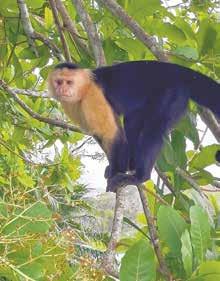
Of course, the monkeys were the main feature. They were everywhere and bolder than I expected. The howler monkeys’ eerie cries echoed through the trees. Accustomed to human visitors, one swung
right onto our boat to snatch strawberries. We saw many capuchins, and one even climbed aboard to inspect us before leaping away.
The next day we met up with one of Cynthia’s childhood friends who took us to the Punta Culebra Nature Center, operated by the Smithsonian Tropical Research Institute. There, I encountered even more unfamiliar creatures: jewel-like (and poisonous) frogs, iguanas roaming the paths, and a colorful butterfly garden. A small darkened aquarium displayed exotic sea life, some resembling plants, while nurse sharks swam in an outdoor pool. Best of all were the adorable sloths lounging in a tree, lazily munching mangoes.
After all that walking, we were also ready to do some munching. At a charming water view restaurant, each of us ordered a huge and flavorful whole fish with cilantro sauce.
Panamanian food impressed me throughout the trip, especially carimañolas (stuffed yuca fritters) and ropa vieja. Thanks to my fondness for that slowcooked shredded beef, I ate more meat
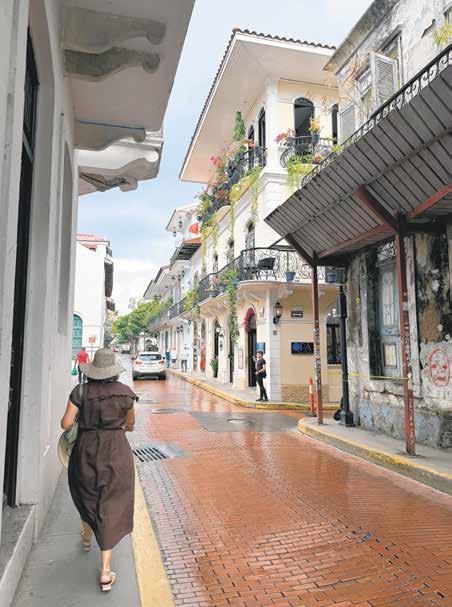
Photos by Karen Peacock Casco Antiguo is full of lovely colonial buildings.
Capuchin monkeys can be seen during the Monkey Adventure tour.
in one week than I usually do in a month. While dining at the family-owned El Trapiche, we enjoyed an array of time-honored dishes along with traditional live music and dance. I had admired polleras — intricately embroidered dresses often passed down through generations — in shops. Seeing them worn and in motion brought them to life. That night was one of the trip’s highlights.
We also enjoyed meals in Casco Antiguo, the historic 17th-century district of Panama City and a UNESCO World Heritage Site.
Before I arrived, Cynthia and Russ had discovered the Hotel La Compañía, a beautifully restored former Jesuit residence. They loved the food and ambience there so much that they returned with me. I’m grateful they did. I wouldn’t have thought to visit a hotel restaurant on my own.
The hotel is divided into three wings reflecting Panama’s history: Spanish, French, and American. We ended up eating there twice. El Santuario offered a dramatic, church-like setting along with Panamanian and international dishes, while the French-inspired Bistro 1739 served one of my favorite dishes of the trip: crispy eggplant topped with creamy baba ghanoush. Casco Antiguo offered more than just dining. We wandered its streets for hours, taking in the architecture, historic sites, art galleries, and shops. My favorite shopping experience was outdoors where I bought molas (colorful appliquéd textiles) directly from the Guna women who sewed them. During my time in Panama, even everyday errands were enjoyable. In the downtown neighborhood where Cynthia lived for a while, we stopped at Gran Morrison, a variety store where she used to buy art and school supplies. Packed with a little of everything, it reminded me of the Woolworth’s from my own childhood. We never found her family’s old apartment, but it was comforting to see that the store still serves a new generation of students. Karen Peacock is a writer and artist who lives in downtown Frederick. She turned 70 in 2025. Her column, Beginner’s Mind, explores the joy of trying new things.
Casco Antiguo has a busy outdoor market.
Sloths can be found at the Punta Culebra Nature center.
You can buy colorful clothing directly from the Guna women who sewed them.
Intricately embroidered Polleras are often inherited.
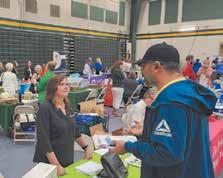
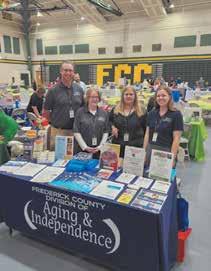
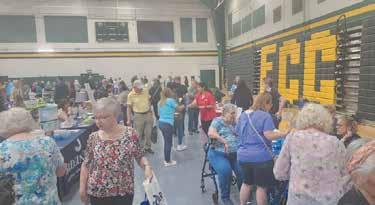
5th Annual Senior Resource & Education Fair
(Continued from 5)
Hampshire — we hitchhiked 50 miles together to get back to our car after completing backpacking trips. Along the AT, hitchhiking is common as thruhikers head to nearby towns to resupply or take a “zero” (a day off).
Day-hiking over a period of time can be expensive, but I’m fortunate to have the wherewithal to pay for comfortable motels, restaurant meals, and the shuttle rides. A New England trip where I hiked 186 miles over three weeks cost about $3,000.
The at experience
The irony of hiking the Appalachian Trail is that every hiker’s goal is to have a wilderness experience, yet we all come home talking about the people we met. I crossed paths with military veterans suffering from PTSD and using the AT for therapy; youth groups, including sets of freshmen college students out for a bonding experience; families with kids, sometimes residing in baby backpacks; hikers from many U.S. states and foreign countries; more dog owners and dogs than I preferred to encounter on the trail. (Descending challenging Mt. Moosilauke in New Hampshire, I passed a woman ascending it with six dogs on leashes. “Why six?” I naively asked. “It just sort of happened. I used to have seven,” was the reply.)
And I encountered thru-hikers almost every day. I usually hiked my segments from north to south in order to run into them coming the opposite direction. Completing my last miles in Maine, I ran into 15 to 25 thru-hikers a day. In order to avoid slowing them down, I developed a method of quickly congratulating them and asking their trail names. Some visited for a minute or two; others blew past with a quick hello or nary a word. (Women, who comprised about one-third of the thruhikers I encountered, were as a rule more friendly than the men.)
But the wilderness experience was always at hand. I’ve seen bears (seven in one three-day weekend in Shenandoah National Park), snakes, foxes, boars, turkeys, even a porcupine. I’ve been
nagged by horseflies, black flies, cicadas, mosquitoes and gnats — lots of gnats.
I’ve gotten very thirsty, very hungry, very tired, very wet, very muddy. (They say that “mud season” in Vermont ends by June; it doesn’t.) I’ve been very cold, very hot, very dirty. Sweaty is an AT constant no matter the season or weather.
So hiking the AT was not without annoyances.
Yet hiking under luxurious forest canopy, or through rhododendron thickets, or viewing the vistas across open mountain “balds,” or climbing up and down rock-faced mountain paths, was a thrilling venture. I relished the physicality of hiking the AT. At the end of each day, I was beat. But the weariness was tempered by the gratification of having earned my miles and experienced another section of the AT.
Hiking the AT always made me feel alive.
Exhilarating? Yes. But the AT can also be extremely boring. While day-hiking, I missed being able to chat with Ted. I’ve walked as long as six hours without
seeing another hiker. That’s unusual, but a few hours alone is not.
One of the novel ways I occupied the sometimes long hours was to memorize and then recite poetry aloud. My physical pacing seemed to help me memorize. I found the rhyme and meter of Henry Wadsworth Longfellow and Robert Service to be particularly engaging. Edwin Arlington Robinson, Tennyson,Yeats, Paul Laurence Dunbar, Frost and Poe were some of the great poets that kept me company. One of Shakespeare’s sonnets seemed to have been penned just for AT hikers: “Weary with toil, I haste me to my bed,
The dear repose for limbs by travel tired …”
I enjoyed accumulating AT miles, but as I entered my late 60s, I felt some urgency to step up my pace if I was truly going to complete the AT. I was well aware that any knee or hip injury or the like could end my hiking days. I logged 156 more miles in 2019. Then COVID-19 hit and wiped out any outof-state, day-hiking trips during 2020. I still had 265 miles left to go, all in New England.
I hit the AT again in 2021 with a vengeance, hiking 43 miles in Vermont and 69 miles in western New
Hampshire to finish those states, then flipping to Monson, Maine and hiking 54 miles south. But with 99 miles to go, I faltered.
I telephoned Ted, and he flew up to meet me in Maine. I slapped on a backpack so we could navigate together a notorious stretch of the AT — Mahoosuc Notch — said to be the hardest, or most fun, but certainly the slowest stretch of the entire trail, with its mile-long obstacle course of enormous boulders. We had a great time (even though we were backpacking!).
But when we drove back to Maryland, I still had 79 miles to go. I didn’t know whether I could stomach another trip to Maine. I’d hiked over 2,100 miles already. Did I really need to finish? (Bill Bryson never did.)
The last 79 miles
Only because of Ted’s urging — “You’re so close; you’ve got to do it!” — did I undertake one last day-hiking trip to Maine in 2021. However, I quickly discovered I’d left perhaps the most challenging section of the entire AT — based on the total elevation climbed and descended — for my final miles. Even though I had my car, my insistence on day-hiking required, in some cases, shuttle rides that took two hours and cost over $100. Several of the trailheads were down unmarked logging roads. Getting to one segment required a half-hour hike-in along an old forest road just to reach the AT. Still, I considered it time and money well-spent because I’d have never located the AT crossings without the local shuttle drivers. And as a result, I undertook seven terrific hikes, ate satisfying dinners, slept well at night, and made steady progress.
My remaining miles counted down each day, but I never assumed victory until the very end. As I climbed and descended a number of 4,000foot peaks — Crocker, Spaulding, Saddleback, Bemis, Wyman Mountains — there were just so many places where a single misstep could spell disaster for my 66-year-old legs, in the form of a twisted ankle or worse. Each day was demanding. I was hiking (and climbing) 10 to 13 miles daily, and it was taking
Photo courtesy of Don DeArmon
Don DeArmon navigates a muddy section of the Appalachian Trail in Maine.
anywhere from six to nine hours.
(Earlier in the summer, I’d breakfasted at a hostel with a father and son thru-hiking pair from North Carolina; the 65-year-old father broke his leg later in the day on a section of mountainous trail I’d already climbed through. Carrying him out of the remote area took a crew of 35 first responders and volunteers over nine hours.)
The day I hiked over Saddleback Mountain, I was hit by a thunderstorm that required me to take cover as best I could in the middle of the rocky summit area. Thoroughly soaked and fearing hypothermia on what had been a hot day, I started up again only to slip and fall several times on the steep, rocky descent. Then I came face to face with the back end of an enormous, antlered moose!
A wet, dismal afternoon lay ahead, but my spirits were lifted when I ran into a former Maine legislator — a cancer survivor — who had also been pummeled by the storm. She and I chatted away the wet afternoon,
relieved to reach our cars about three hours later.
Finally, the last day arrived. On the morning of Sept. 11, 2021, after checking out of my lodging, positioning my car, and getting a shuttle ride back to my starting point, I started out with a McDonald’s Diet Coke in one hand, my hiking pole in the other, and two helium balloons (which I’d picked up at a dollar store) tied to my daypack. One balloon was a yellow smiley face; the other said “Congratulations.” I didn’t want anyone passing me to somehow miss that I was about to complete the AT.
My balloons had the desired effect: Most hikers I crossed paths with were curious about the flapping helium-filled foil and offered congratulations. Atop aptly-named Baldpate, two middle-aged couples from Colorado spontaneously thrust their trekking poles into two overhead V’s for me to walk under when I told them it was my last day. For the first time, I teared up as I pondered my looming
accomplishment. Two hours later, I popped out of the woods at Grafton Notch State Park having walked every mile of the Appalachian Trail. Certainly I was pleased. But as I savored the day and thought of all the other outstanding days on the AT, I understood why some thru-hikers end up hiking the AT more than once. “It grips you like some kinds of sinning,” wrote Robert Service about the Klondike. I’ve always had a similar sentiment about the AT.
I smile when I think of my 11-year journey. Because I know I will be back on the AT again soon.
A version of this article was previously published in A.T. Journeys, the member magazine of the Appalachian Trail Conservancy.
Don DeArmon is a freelance writer, now retired from a career on Capitol Hill and living in Frederick. His favorite AT hike in Maryland is from Reno Monument to Washington Monument State Park.
SPRING CALENDAR
WEDNESDAY, April 29
Health
Exercise: Senior Recreation Council
8:55-10:10 a.m.
Talley Recreation Center, 121 N. Bentz St., Frederick.
Meets every Monday, Wednesday and Friday. Requires $10 annual dues. See website and contact coordinator.
Veterans Service Center, 1750 Monocacy Blvd, Suite A, Frederick.
Every Wednesday. Free to Active Duty, National Guard, Reservists, Veterans, Military Retirees, First Responders, LEO, and family members. Services differ each week, so check the webpage for a list of services available. RSVP. Contact: Ashley, essentialhopedealer@gmail. com.
https://veteranservicescenter.org/events/
Therapy with Art 6-7 p.m.
Veterans Service Center, 1750 Monocacy Blvd., Suite A, Frederick.
Facilitated by Disabled Veteran Marine Cpl. Derek Miller. FREE for Active Duty, National Guard, Reservists, Veterans, Military Retirees, Law Enforcement & First Responders. Wednesdays through July 1.
Contact: Veterans Service Center, info@ veteranservicescenter.org. https://veteranservicescenter.org/events/
Other
Bridge Wednesday: Senior Recreation Council 1-4 p.m.
Scott Key Center, 1050 Rocky Springs Road, Frederick.
Requires $10 annual dues. See website. Contact coordinator to reserve seat. Email meliz1950@gmail.com.
Contact: Betty Mayfield, meliz1950@gmail. com.
YOUR LIFE Your Way
UNBEATABLE VIEWS
https://srcfrederick.org
Sports and recreation
Softball — Senior Recreation Council 6 p.m.
Pinecliff Park, 8350 Pinecliff Park Road, Frederick.
Requires $10 annual dues. See website. AprilSeptember. Practice at 6 p.m. Wednesday. Games at 6:30 p.m. Friday. Associated activity costs. Contact coordinator. Activity is open to women over 40 and men over 50.
Contact: Adrian Winpigler, 301-662-6623. https://srcfrederick.org
THURSDAY, April 30
Classes workshops and lectures
Intro to Soil: A Community Workshop
7:30-8:30 p.m.
Urbana Regional Library, 9020 Amelung St., Frederick.
Join Greg Susla, Master Gardener with University of Maryland’s Extension Center, for an engaging presentation, discussing soil’s formation, profile and function. The program will also address commonly found soil types in Frederick County and provide handson experience for testing your soil before gardening or plantings. Perfect for new and
experienced gardeners alike. 18 and older.
Contact: Urbana Regional Library, 301-6007000.
http://fcpl.org
”When The President Passed This Way” Fourth Annual Lecture 7:30 p.m.
Woodsboro Lutheran Church, 101 S. Main St., Woodsboro.
Retired history teacher Dahl Drenning will share his years of research on the subject of George Washington’s 1791 tour of the original 13 states as it passed through Montgomery and Frederick counties, Maryland, and York and Lancaster counties, Pennsylvania. Dahl will lay out Washington’s itinerary in the Woodsboro area, and tell the stories, both fact and fiction, of these early days in our country’s history.
Contact: Rick Bontz, rickbontz@yahoo.com, 301-520-7154.
http://woodsborohistoricalsociety.org
Other
Senior Cafe: The place to come for coffee, conversation, friendship and fun events! Tales for my Grandchildren/Make a Memory Journal 10-11 a.m.
Walkersville Branch Library, 2 S. Glade Road, Walkersville.
Join Adjunct Professor of Creative Writing
Alba Sarria as she helps us make a memory journal, tales for your grandchildren or family. Bring along photos, trinkets or anything else you’d like to incorporate into the journal. 18 and older.
Walkersville Lanes, 44 W. Pennsylvania Ave., Walkersville.
Hosted by Senior Recreation Council. Not league bowling. Requires $10 annual dues. Cost is weekly cost of bowling. See website and contact coordinator.
Law Day: Advanced Medical Directives Prepared at No Cost!
8 a.m.-4 p.m.
Schedule a free appointment with an attorney at one of the Frederick County 50+ Community Centers: Brunswick, 301-8348115; Emmitsburg, 301-600-6350; Frederick, 301-600-1234; Middletown, 301-600-3613; or Urbana, 301-600-7020. Sponsored by the Maryland Bar Association of Frederick County and the Division of Aging and Independence.
Law Day: Advance Directives Preparation/Review at All Frederick County 50+ Community Centers
9 a.m.-3 p.m.
In a medical emergency you may not be able to convey your preferences for care. Having an advance directive lets your health care team and family know what you want. You
will be provided one-on-one assistance for the preparation or review of your advance directive. This event is sponsored by the Frederick Pro Bono Committee and the Frederick Bar Association.
Contact: Frederick 50+ (Senior) Center, virtualseniorcenter@frederickcountymd.gov, 301-600-6042.
Veterans Service Center, 1750 Monocacy Blvd., Suite A, Frederick.
Fridays through Dec. 25. A free hot breakfast each Friday which includes eggs, bacon, sausage, French toast, breads, muffins, fruit, juices, and Black Rifle Coffee Company coffee. Breakfast is open to all Active Duty, National Guard, Reservists, Veterans, Military Retirees, Law Enforcement, First Responders, and their families. Breakfast is followed by a non-denominational Bible study at 10:30 a.m. Attendance is not required to enjoy a warm breakfast with others who have served.
Contact: Veterans Service Center, info@ veteranservicescenter.org.
https://veteranservicescenter.org/events/
Sports and recreation
Bocce — Senior Recreation Council
9 a.m.-12 p.m.
Baker Park Bocce courts, Frederick.
Requires $10 annual dues. See website for details.
Pinecliff Park, 8350 Pinecliff Park Road, Frederick.
Requires $10 annual dues. See website. AprilSeptember. Practice at 6 p.m. Wednesday. Games at 6:30 p.m. Friday. Associated activity costs. Contact coordinator. Activity is open to women over 40 and men over 50.
Contact: Adrian Winpigler, 301-662-6623.
https://srcfrederick.org
SATURDAY, May 2
Community and festivals
Frederick County Veterans Appreciation Day: Honoring Veterans, Celebrating 250 Years of Freedom
9 a.m.-12 p.m.
Frederick Health Village, 1 Frederick Health Way, Frederick.
Hosted by the Frederick County Division of
SPRING CALENDAR
Aging and Independence and the Frederick County Veterans Advisory Council. This free community event features a Veterans resource fair, a career fair hosted by the Frederick County Division of Human Resources, a dedication ceremony for Veterans and Service Members, a puppy-naming ceremony sponsored by Warrior Canine Connection. WFMD will broadcast live from the event, and music and entertainment will be provided by DJ Cruzin’ Chris Michaels.
Contact: Joy Rowe, DAIVetEvent@ FrederickCountyMD.gov, 301-600-1234. http://www.frederickcountymd.gov/vad
St. Paul United Methodist Church Spring Bazaar
10 a.m.-4 p.m.
St Paul’s United Methodist Church, 200 Main St., New Windsor.
Community event with handmade crafts, local vendors decor and unique Mother’s Day gifts. Gift basket raffle and door prizes. Serving pulled pork or chicken platters, $15 dine in or take out, until 4 p.m.
St. Paul United Methodist Church Spring Bazaar — New Windsor
10 a.m.-4 p.m.
St. Paul United Methodist Church, 200 Main St., New Windsor.
Handmade crafts, local vendors, decor and unique gifts for Mother’s Day, gift basket raffle, door prizes. Food available for purchase including pulled pork/chicken quarter platters, bake table. Free admission.
Jefferson Ruritan Club, 4603B Lander Road, JEFFERSON.
Doors open 11 a.m., game starts 1 p.m. 20 regular games, two special games and a jackpot game. Tip jars, pull tabs, door prizes, food available for purchase. Bring a nonperishable/canned food item for the Jefferson Food Bank and receive a free special game card. Call 240-815-1252 for advance tickets.
Cost: $25 advance, $30 at the door. https://jeffersonruritan.org
Stone Tools Demonstration
11 a.m.-12 p.m.
Watkins Park , 615 Center St., Mount Airy. Humankind is the only animal on the planet which needs tools to survive. How did this happen? See for yourself with evolutionary anthropologist Mason Hintermeister, as he makes replicas of some of the most enduring forms of technology on the planet: stone tools. Learn about our earliest ancestors, the tools they left behind, and how studying them has changed the way we think about what it means to be human. Bring a lawn chair and join this outdoor conversation and stone tool demonstration.
”Seeds of Change Gala: An Evening of Growth, Healing & Transformation”
5 p.m.
Caboose Farm, 14754 Manahan Road, Sabillasville.
Amplified Change’s first gala. VIP happy hour at 5 p.m. Gourmet dinner and dancing under the stars. Silent and live auctions. Support rograms that empower youth, strengthen families, and create lasting generational change. RSVP required.
Contact: Jennifer Carpenter, jennifer@ nevermoreevents.com, 240-626-6639.
Cost: $150.
https://amplifiedchange.org/gala/
SUNDAY, May 3
Classes workshops and lectures
”The Blink of An Eye” 50 Years of Making Music in Frederick County 2-3 p.m.
C. Burr Artz Public Library, 110 E. Patrick St., Frederick.
Learn about one local musician’s journey as a “sideman” in Frederick County! Billy Lebherz has played across genres, including rock, folk, country, acid rock and more in bands that have spanned over decades. Billy will share his experiences as music has evolved for him over the years, from the perspective of a musician who has always been in collaboration. There will be time at the end to ask questions!
Contact: Mary Mannix, mmannix@ frederickcountymd.gov, 301-600-1368. https://frederick.librarycalendar.com/event/ blink-eye-50-years-making-music-frederickcounty-196692
Shepherdstown Opera House, 131 W. German St., Shepherdstown.
Mark the 50th anniversary of the release of this acclaimed journalistic drama based on the reporting of Washington Post journalists Bob Woodward and Carl Bernstein, whose investigation helped uncover the Watergate scandal and led to President Nixon’s resignation. Cast: Robert Redford, Dustin Hoffman, Jason Robards, Jack Warden, Martin Balsam. Post-film discussion. Optional: Embrace the 1970s D.C. spirit by wearing the D.C. style of 1970s. Admission is pay-what-youcan, $10 suggested. Doors open 2:30 p.m., snacks available for purchase.
Contact: Shepherdstown Opera House, Contact@OperaHouseLive.com, 304-8763704.
Men’s Social Group Hosted by Frederick 50+ Community Center 9-11 a.m.
Wegmans, 7830 Wormans Mill Road, Frederick.
Join the guys for a coffee and lively conversation. Participants may purchase food and drinks from Wegmans. First-time participants need to complete an intake form at the Frederick 50+ Center, 1440 Taney Ave. or at https://frederickcountymd-seniorparticipation-senior.services.app.transform. civicplus.com/forms/32401
Contact: Frederick 50+ (Senior) Center, virtualseniorcenter@frederickcountymd.gov, 301-600-3525.
Join us as we discuss best sellers! Read the book prior to the meeting. Free, pre-register. May: “Mona’s Eyes” by Thomas Schlesser. June: “The Correspondent” by Virginia Evans. Contact: Urbana Senior Center, virtualseniorcenter@frederickcountymd.gov, 301-600-7020.
Middletown 50+ Center, 101 Prospect St., Middletown.
Celebrate the spring season with a pretty flower arrangement created by you! Step-bystep instructions, hearty blooms meant to last weeks to come. All supplies included in this fun, interactive workshop presented by 4065 Florals of Boonsboro. Register by April 21.
Contact: Middletown 50+ Center, middletownseniorcenter@frederickcountymd. gov, 301-600-3613.
Cost: $30.
https://frederickcountymd-gov.3dcartstores. com/
Outdoors
Easy Hikes with the Senior Recreation Council
Meeting Locations Vary.
Requires $10 annual dues. See website for details. Hikes offered April through June, and September through October. Hike from 3 to 6 miles on terrain with good footing and little or no elevation change. Pace is adjusted to the speed of the group. Meeting locations vary, contact coordinator.
Walkersville Recreation Center (Elementary School), 83 Frederick St., Walkersville. Requires registration and $10 annual dues see website. Enter through gym doors on the right side of the school. Meets November through May. For seniors.
Contact: Don Sherwood, donpsherwood@ gmail.com, 301-514-5866.
Cost: $2.
https://srcfrederick.org
WEDNESDAY, May 6
Community and festivals
Thurmont Resource Fair 12-3 p.m.
Thurmont Regional Library, 76 E. Moser Road, Thurmont.
Hosted by the Frederick County Department of Social Services. See website for list of participating service groups.
Contact: Matthew Deschenes, mdeschenes@ frederickcountymd.gov, 301-600-7205.
Veterans Service Center, 1750 Monocacy Blvd, Suite A, Frederick.
Every Wednesday. Free to Active Duty, National Guard, Reservists, Veterans, Military Retirees, First Responders, LEO, and family members. Services differ each week, so check the webpage for a list of services available. RSVP.
Contact: Ashley, essentialhopedealer@gmail. com.
https://veteranservicescenter.org/events/
Therapy with Art
6-7 p.m.
Veterans Service Center, 1750 Monocacy Blvd., Suite A, Frederick.
Facilitated by Disabled Veteran Marine Cpl. Derek Miller. FREE for Active Duty, National Guard, Reservists, Veterans, Military Retirees, Law Enforcement & First Responders. Wednesdays through July 1.
Contact: Veterans Service Center, info@ veteranservicescenter.org.
https://veteranservicescenter.org/events/
Other
Bridge Wednesday: Senior Recreation Council
1-4 p.m.
Scott Key Center, 1050 Rocky Springs Road, Frederick.
Requires $10 annual dues. See website. Contact coordinator to reserve seat. Email meliz1950@gmail.com.
Contact: Betty Mayfield, meliz1950@gmail. com.
https://srcfrederick.org
Sports and recreation
Softball — Senior Recreation Council 6 p.m.
Pinecliff Park, 8350 Pinecliff Park Road, Frederick.
Requires $10 annual dues. See website. AprilSeptember. Practice at 6 p.m. Wednesday. Games at 6:30 p.m. Friday. Associated activity costs. Contact coordinator. Activity is open to
women over 40 and men over 50.
Contact: Adrian Winpigler, 301-662-6623. https://srcfrederick.org
THURSDAY, May 7
Community and festivals
13th Annual Youth Prayer Rally 5:30-7:30 p.m.
Baker Park Bandshell, North Bentz and Second streets, Frederick.
Join middle school, high school and college students for a free community-wide gathering featuring live music, praise & worship, student-led prayer, testimonies, and an inspiring message. This historic event celebrates America’s 250th birthday and the 75th anniversary of the National Day of Prayer. Free food provided. Bring your friends and family. All ages welcome!
2026 Golf Tournament Fundraiser | Rotary Club of Southern Frederick County (Urbana)
9 a.m.-4 p.m.
Worthington Manor Golf Club, 8329
Fingerboard Road, Urbana.
Now accepting sponsorships, donations and registrations for the golf tournament. To learn more about the event and to support this worthy cause, visit the event website, or contact the club’s Event Chair at kelly. mcquillen@ignitehcm.com. The tournament raises funds for impactful Rotary programs and donations that benefit both local communities and global initiatives. 18 and older.
Contact: Kelly McQuillen, kelly.mcquillen@ ignitehcm.com, 301-639-6002.
Requires $10 annual dues see website. Meeting locations vary, depending on ride location contact coordinator. Rides scheduled March through November, every other Thursday, beginning March 28 (weather permitting).
Walkersville Lanes, 44 W. Pennsylvania Ave., Walkersville.
Hosted by Senior Recreation Council. Not league bowling. Requires $10 annual dues. Cost is weekly cost of bowling. See website and contact coordinator.
Veterans Service Center, 1750 Monocacy Blvd., Suite A, Frederick.
Fridays through Dec. 25. A free hot breakfast each Friday which includes eggs, bacon, sausage, French toast, breads, muffins, fruit, juices, and Black Rifle Coffee Company coffee. Breakfast is open to all Active Duty, National Guard, Reservists, Veterans, Military Retirees, Law Enforcement, First Responders, and their families. Breakfast is followed by a non-denominational Bible study at 10:30 a.m. Attendance is not required to enjoy a warm breakfast with others who have served.
Contact: Veterans Service Center, info@ veteranservicescenter.org.
https://veteranservicescenter.org/events/
Memory Cafe
11:30 a.m.-1 p.m.
Brunswick Branch Library, 915 N. Maple Ave., Brunswick.
Memory Cafe is a safe and relaxed place where people with early-stage memory loss, their families, and friends can come together for social engagement. Anyone affected by early-stage memory loss is welcome to attend. Lunch is provided for free at each cafe. This program is provided in partnership with the Department of Aging and Independence and the Alzheimer’s Association. Pre-registration is required, register at least two days prior to cafe. Call 301-600-6022 or Email CaregiverSupport@ FrederickCountyMD.gov. 18 and older.
drive! I fantasized about driving a big, 18-wheeler, heading out on the open road for weeks at a time with important cargo to deliver entrusted just to me. I would be my own boss. I would see the country.
Then reality kicked in.
Driving a big rig takes lots of training, means lots of responsibility and takes you away from your family for long stretches of time. After the romance wore out, I reasoned, the job would even be kind of lonely.
So, what kind of job could I do and what kind of an organization would want me anyway?
As it turned out, lots! In my case, I used a connection my wife had and got a job delivering prescription medications two or three days a week for a local pharmacy. The hours are great — roughly 10 a.m. to 4 p.m. — so I still get to have leisurely mornings and stress-free evenings.
Along with helping other people by bringing them something they want and need, I get to be my own boss (pretty much), drive around town in a sporty Ford Focus and get a little sunshine and exercise, too!
After four years of college, a master’s degree, a few awards and 40 years of increasing responsibility and experience as a white-collar professional, I am now a dyed-in-the-wool, blue-collar worker, and I love it!
Jobs for retirees
Being a delivery driver is not for everyone, of course. But I can tell you there are lots of opportunities out there for older workers. So, if you’ve been thinking about getting back in the job market, go for it!
But be careful. When choosing a job after retirement it’s important to consider your interests, skills and goals. You also want to make sure the job fits your lifestyle and schedule.
Thankfully, AARP has done the research.
Employers with the 15 jobs listed below alphabetically have high regard for retirees and stable, older workers. All offer part-time opportunities without requiring a college degree or a lot of
experience. Most will train you. The average wage is in parentheses.
• Administrative assistant ($22.82 per hour)
• Customer service representative ($20.59 per hour)
• Data entry clerk ($20.22 per hour)
• Home health aide ($16.78 per hour)
• Nanny ($23.71 per hour)
• Pet groomer ($16.28 per hour)
• Real estate agent ($28.35 per hour)
• Receptionist ($17.90 per hour)
• Retail clerk ($20.50 per hour)
• School bus driver ($23.26 per hour)
• Secretary ($22.82 per hour)
• Security guard ($18.46 per hour)
• Shuttle driver ($17.62 per hour)
• Tutor ($21.55 per hour)
• Web designer ($45.85 per hour)
So, what have I learned?
You don’t have to be embarrassed by working in retirement. Chances are good your unemployed, retired friends will envy you.Your mind and body will thank you. And it’s a great time to reinvent yourself. When looking, consider the solid benefits blue-collar work has over whitecollar work. (These are generalities, of course.)
Desirable traits of blue-collar jobs
• It’s easy to see what you’ve accomplished at the end of the day.
• There are not many people problems. That’s for the boss, right?
• People want to do a good job and heartily support others.
• There are no business trips. You can go home every evening.
• Getting light, physical exercise is good for you and a part of the deal.
• You must clock in, but when you’re done for the day, you’re done.
• There are no or little budgeting or bottom-line worries.
• You wear a uniform that is provided so there are no worries about clothes.
• The work does not have to be stressful unless you make it so.
• You mostly work near customers or in the great outdoors.
• There are no social worries. Just get the work done!
• You receive hourly wages, which are often quite good.
• Artificial Intelligence probably can’t take your place any time soon.
Undesirable traits of white-collar jobs
• It’s hard to see what you’ve accomplished at the end of the day.
• If you’re the boss, people problems can wear you down.
• So many people seem to be overly concerned with getting ahead and getting credit.
• The business trips that seem fun at first can wear on you.
• There’s no clocking in — you can come and go as you please (pretty much) but you always have to be “on.”
• There are continuous budgeting and bottom-line worries.
• You must dress for success. That can be expensive.
• The work can be stressful.
• You must strike a fine balance between getting the work done and being a pleasant and available schmoozer.
• You receive a salary, which may not pay you all that well for the hours you actually work.
• Artificial Intelligence could absolutely do your job one day.
Next steps
As a vital, young retiree, you can get out of your comfort zone, reinvent yourself and try something different. Working in retirement can be fun. If you’ve been a white-collar worker your entire career, try a part-time, blue-collar job in retirement. You won’t regret it. If you are a retiree in Maryland considering a new part- or full-time job, there are numerous available resources for you. You can contact your local senior center, your state’s Department of Aging or a staffing agency. Additionally, if you live in one of the many retirement communities in Maryland, the staff there may have resources to help you find a job that is right for you. And don’t forget your connections. Chances are they know of available jobs that are looking for someone just like you.
Gary Bennett is a longtime Frederick resident who spends his time hiking, biking, volunteering and providing childcare for grandchildren. He is married and retired from his career as a nonprofit marketing executive.
CROSSWORD PUZZLE
CLUES ACROSS
1. Large dung beetle
7. Gambling game __-lo
10. Further along
12. Type of tobacco
13. Looked for
14. Silk fabric
15. Computer method to solve equations
16. As fast as can be done (abbr.)
17. Tear
18. Brews
19. “Famous” cookie baker
21. Women’s Army Corps
22. Front parts of an animal
27. It’s causing quite a stir
28. Beloved March holiday
33. 12th letter of the Greek alphabet
34. More impudeant
36. Indicates center
37. Young woman (French)
38. A cause of distress
39. Santa’s helper
40. Hillside
41. Many wombs
44. Is afraid of
45. Popular baked goods ingredient
48. Popular computers
49. Conceiving of
50. Google certification (abbr.)
51. Sturdy
CLUES DOWN
1. Peruse quickly
2. Automobiles
3. Razorbill genus
4. Bravo! Bravo! Bravo!
5. Consumed
6. A place to sleep
7. Small seeds
8. Legendary law man Wyatt
9. Female sheep
10. Indigenous peoples of eastern Siberia
11. A place ships dock
12. Reciprocal of sine
14. Discomfort
17. British Air Aces
18. Exit sleep
20. Solar energetic particle
23. Plagues characterized by starvation
24. Short musical composition
25. Trauma center
26. Habitual twitching
29. A place where checks are exchanged (abbr.)
30. Decameter
31. Hinged surface in a wing
32. Shouting
35. Sports official
36. Volcanic craters
38. Supportive device
40. It’s part of a rosary
41. Two-toed sloth
42. Body art
43. Let out
44. Foreign medical graduate
45. Nonprofit journalism organization (abbr.)
46. Couples say it
47. Bird’s beak
SUDOKU
Here’s How It Works:
Sudoku puzzles are formatted as a 9x9 grid, broken down into nine 3x3 boxes. To solve a sudoku, the numbers 1 through 9 must fill each row, column and box. Each number can appear only once in each row, column and box. You can figure out the order in which the numbers will appear by using the numeric clues already provided in the boxes. The more numbers you name, the easier it gets to solve the puzzle!