FRANCIS MARION
FOCUS SPRING/SUMMER 2026
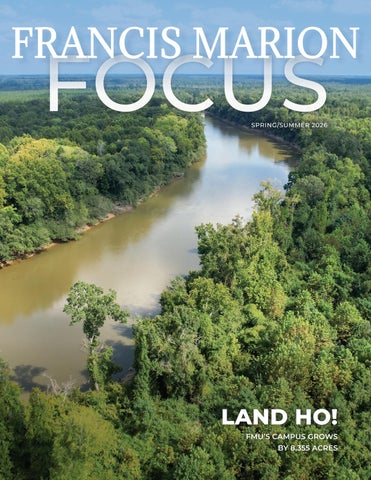
LAND HO! FMU’S CAMPUS GROWS BY 8,355 ACRES 1 | F R A N C IS M A RI O N FO CUS
S
enator Hugh Leatherman and Dr. Eddie Floyd were more than just community leaders. They were two extraordinary men determined to improve a neglected region of the state. They accomplished this by shattering the arguments of contrarians who felt such efforts were foolhardy and misguided and then quietly proceeded with their projects. Leatherman and Floyd invariably prevailed and, without arrogance, moved on to other equally challenging tasks. Sometimes they worked individually, many times jointly. Now they have been gone sufficiently long that the magnitude of their loss is apparent, and the community mourns them deeply. Chairman Leatherman and Dr. Floyd were the most politically astute among us, and they were the most aggressive proponents for positive and constructive change. For me and my friends, the loss has been devastating. Hugh and Eddie were great advisors and shrewd mentors. They taught us the importance of recognizing the needs of the least understood part of the state, the Pee Dee. They also instilled in us the power of acting collectively. Eddie was a true native, born and raised in Lake City. He was a physician who fiercely loved this region and devoted his career to treating its sick and ill. He worked just as diligently at enhancing the prosperity of its communities. Hugh was a North Carolinian by birth who spent his adult life here. This is where he made his life — as a husband, father, employer, and political titan. He was educated as an engineer and brought a measure of practicality to every endeavor. Another senator once asked him why he allocated so many resources to his own area. His reply was simple and truthful. “I thought that was my job.” Florence and the Pee Dee have produced no more loyal progeny. They were proud and unapologetic about protecting us and improving our lives. Working in concert with many others – but invariably as the visionaries and strategists – they built libraries, cultural facilities, athletic complexes, a performing arts center, a museum, and a variety of educational buildings. The transformational effects have been remarkable. Most of us aspire to leave a legacy that will enhance the well-being of our families and maybe a few friends. They accomplished this for tens of thousands of people within the most underserved area in South Carolina. Ironically, most will never know who they were or what they did. But many of us do, and we will never forget the scope of their generosity and the strength of their compassion. Of course, they had strong and effective allies upon whom they relied. For years, the Chairman was dependent upon Representative Phillip Lowe creating appropriation lines in the South Carolina House of Representatives budget so Hugh could add to them in the Senate. Eddie relied upon Judge Haigh Porter to keep the Bruce and Lee grant process effective and seamless. Dozens of other supporters joined in myriad roles. Their efforts spanned the continuum of industry and
government, but health education was a special focus. This may seem obvious given Dr. Floyd’s love of medicine, but it was just as important to Hugh Leatherman. Both men understood the importance, and the power, of an excellent healthcare system. They also understood that no other improvement would lift the community faster and sustain its residents more readily. So, they joined with Florence Mayor Stephen Wukela and Francis Marion University to build four new health education buildings. These facilities serve several medical specialties, from nursing to speech language pathology, to occupational therapy, to health administration, to medical education for 3rd and 4th year medical students and residents. Educating generations of healthcare providers in our own backyard was transformative in a variety of ways. The students who trained here were more likely to stay here, a pattern that addressed a longstanding recruitment problem in the region. In addition, the students were frequently from here, meaning new career pathways were opened for the community’s sons and daughters. Last, but hardly least, this influx of healthcare talent has made quality healthcare far more accessible than it ever was before. A decade ago, sixty percent of the caregivers who provided me with chemotherapy infusions in a Florence hospital were FMU graduates, a source of immense pride to my family and me. It was as therapeutic psychologically as the chemo was medically. Of course, it does beg the question as to why I am writing this letter when I should be out raising even more scholarship money for such extraordinary students and practitioners. I’ll get back to that in a few minutes. These facilities, many in downtown Florence, meshed with other Floyd and Leatherman initiatives to energize the city’s once-sagging downtown core. These included a new performing arts center, a new library, a new museum, and a university art gallery, all of which invited private investment. Of course, Florence’s resurgence has, in turn, provided momentum for new growth through much of the region. How did these two men accomplish all this? Through hard work mostly. Yes, they had political power, but that wasn’t handed to them. Both achieved sufficient prominence to allow them to bring disparate forces together to coalesce around a shared vision. They found partners who could help them, and then they combined resources for greater impact. They saw farther and dreamed larger than anyone, always insisting that returns justified investments. They were remarkable men, two of the best I have ever known. And now they are gone. Who will fill their shoes? Who can direct public, private, and philanthropic funding for a common purpose that will continue the region’s amazing journey? It’s difficult to imagine. But once upon a time it was difficult to imagine two leaders like this, emerging in the same place and the same time. And yet, they did, and we all became beneficiaries of that brilliant coalition.
Fred Carter, President
2 | F R A N C I S M A RI O N FO CUS
What’s in THI S I S S U E
16 FAREWELL TO MR. FMU No one has seen more FMU athletic contests, or devoted more hours to promoting the university than associate athletic director Michael Hawkins (’85), and it’s unlikely anybody ever will.
Francis Marion Focus Magazine S PR I N G/S U MM E R 2026 CO N T R I B UTOR S Tucker Mitchell Anna Todd Betty Suggs Chris Day D E S I GN E R S Kelly Cross Madeline Moseley
20 A BOOST ON THE WAY TO THE FUTURE FMU’s varied scholarship program boosts opportunities and makes a difference in student’s lives every day.
PH OTO GR APH E R S Chris Day Betty Suggs
24 IN HIS FOOTSTEPS (BUT NOT REALLY) Brothers Andrew and Alex Lance have thrived at FMU. Being together? Well, that just kind of happened.
42 IN MEMORIAM University mourns, and remembers, Keith Best and Roger Hux
The FMU Focus Magazine is a semi-annual publication of Francis Marion University. It is distributed digitally to University alumni, donors, and friends. Print copies can be requested. The magazine is published by FMU’s University Communications office.
Cover photo: The 8,355-acre Duck Ponds tract stretches eight miles along the Great Pee Dee River. Photo credit: Lyles Cooper, courtesy of OSI.
QUESTIONS OR COMMENTS?
Send comments or ideas to fmufocus@fmarion.edu.
SPRING/SUM M E R 2026
| 3
A RIVER Runs ThroughIt FMU’S NEW DUCK PONDS PROPERTY WILL TRANSFORM THE UNIVERSITY AND THE REGION – NOW AND FOREVER. BY TUCKER MITCHELL
and operator of a new, 8,355-acre tract along the Great Pee Dee River, just east and north of the main campus.
W
hen Francis Marion University (then, College) opened in 1970, folks marveled at the vastness and natural beauty of the campus, located on donated (and later, some additional, purchased) acreage just east of Florence. Just look at all this land, they said. Yes, that is nice … but boy oh boy, if they could see it now. Following a decade-long campaign, and a complex transaction involving a half-dozen different entities, FMU is now the owner 4 | F R A N C IS M A RI O N FOCUS
The property, known as Duck Ponds because, yes, duck ponds are included in it, stretches roughly from the Highway 301 bridge north to the Wachovia Hills development. It courses along more than eight miles of Great Pee Dee riverfront and encompasses a portion of several tributary waterways as well. Coupled with FMU’s previous land holdings, the university now has nearly 10,000 acres under its wing, and is the secondlargest institutional landholder in the state. More importantly, it possesses a new tool that university leaders say will unlock unparalleled educational opportunities for decades to come. “This acquisition is unprecedented and it’s difficult to grasp its scope and all it means,” says Dr. Fred Carter, FMU’s president. “It’s an incredible piece of land with vast potential. It’s going to
take us a year or more just to kind of understand it. But that’s okay. It will be an unbelievable asset for many years to come.” Says Dr. Jason Doll, the coordinator of FMU’s environmental studies program, “It’s great in so many important ways. … It’s difficult to wrap your head around something like this.”
A WINDING PROCESS Duck Ponds is a wild and wet landscape filled with all kinds of interesting flora and fauna, and it has been that way for eons. Timber has been harvested from the site for a long time – the previous owners were timber-using corporations. A couple of hunting clubs have used parts of the property for more than a century. FMU’s pursuit of the land doesn’t go back quite that far, but it’s a long-term proposition all the same. The university, and various governmental partners, have been looking at the tract, and others around it, with an eye towards acquisition and conservation for more than a decade. Preliminary conversations with the land’s corporate owners began then and started the ball rolling that led to the recent purchase. The project finally came to fruition when an assortment of congruent interests – wildlife conservation, regional flood and storm abatement, heritage preservation, a massive educational laboratory – came together with willing landowners to create
the opportunity for a major conservation acquisition. The Duck Ponds project is directly connected to a similar acquisition in 2024 of 7,600 acres in southern Florence County, at the confluence of the Great Pee Dee and Lynches rivers. FMU partnered with a variety of state agencies and non-profits on the initial project, known as the “Snow’s Island Assemblage,” too, because of its relative proximity to FMU and its connection to Snow’s Island, the famous, and somewhat legendary hideout of the university’s namesake, Revolutionary War Hero General Francis Marion. The Snow’s Island Assemblage is held by the South Carolina Department of Natural Resources (SCDNR). FMU’s Carter says even though the university will not own the Snow’s Island property, it will still have ample access to the “Swamp Fox’s” old stomping grounds through a county park that is being constructed nearby. The two projects form a critical conservation corridor along the Pee Dee that’s more than 15 miles long. The corridor actually connects two larger pieces of the Pee Dee flood plain – one north near Bennettsville, and one to the south of Johnsonville – and was identified as a high priority for conservation acquisition on the Southeastern Conservation Blueprint, a massive planning document that maps out long-term conservation needs across the southeastern United States. The properties also ranked as the highest conservation priority for both the South Carolina Conservation Bank (SCCB) and the South Carolina Office of Resiliency (SCOR), organizations tasked with mapping out, and assisting in acquiring, conservable land that’s critical for the state’s future. Raleigh West, director of the SCCB, says the Duck Ponds project “builds on recent conservation milestones, including Snow’s Island and the 62,000-acre S.C. Forestry Commission easement, and reflects strong momentum to continue protecting important lands throughout the region.” SPRING/SUM M E R 2026
| 5
Says FMU’s Carter, “we’re going to be part of something that’s very big, very impactful, across our region and well beyond. That feels good.” Carter praised South Carolina Governor Henry McMaster’s interest in conservation and persistence in pushing agencies to bring the many working parts of the project together. Besides FMU, the SCCB, SCOR, and the S.C. Department of Natural Resources, the Duck Ponds coalition also included Florence County, the non-profit Open Space Institute (OSI), and the Darla Moore Foundation. The Moore Foundation and OSI combined to fund the $22.5 million purchase until funds from the state and Florence County were available. Moore and OSI will be reimbursed. The state will eventually see some payback through a series of carbon sequestration grants and other federal conservation dollars.
FUTURE ‘DEVELOPMENT’ Duck Ponds is a sprawling, challenging piece of terrain that is currently all but inaccessible. Viable passage is by rough-hewn logging and hunting roads, and is not available at all for parts of the year when water levels are high. FMU is working with Florence County and some of the legacy hunting groups to develop a plan for improving access. There will never be a major highway running through the property, but FMU is committed to opening it up for public access. The county’s funding of the project was, in part, based on the possibility of creating a unique new “eco-tourism” site. County officials are excited by that prospect, which would be unique in the state and nation. While access will undoubtedly be improved, construction at the site will be just a few shed-like structures to store equipment and serve as a scientific staging ground, says Carter.
“It’s nothing short of remarkable,” says Londo. “This kind of forest – bottomlands with all kinds of trees – is unique. It’s so big and so untouched from a research point of view, that it’s just hard to say what we’ll find out there. But there’s no doubt it will be a tremendous benefit, not just to forestry, but to environmental science, and a lot of other programs.” Londo thinks the diversity of the tree population of the area will lead to all kinds of research, and the ability to work in a bottomland will be essential to forestry students planning to become the future managers of the region’s forests. “It’s the kind of forest we have around here and it’s not like forests anywhere else,” says Londo. “Typically, this kind of land is owned by the (state or federal) forestry department, or by industry, and nobody much can go out there. That won’t be the case for our students.” Dr. Doll, the environmental science program director, says the project is a boon from several perspectives.
“It’s the Great Pee Dee, one of the most breathtaking rivers in South Carolina. Revolutionary War and Civil War battles were fought here. Francis Marion formed and dismissed his militia here. It’s an incredible place and it's going to be something very special for this university and the community it has always supported.” Dr. Fred Carter
“The site is very limited,” says Carter. “Contrary to what some may think, there won’t be a lot there in terms of buildings.” But there is a lot there.
PRESERVE AND EDUCATE Faculty in FMU’s biology department, and especially in the newly formed departments of environmental science and forestry, are overwhelmed at the possibilities.
6 | F R A N C I S M A RI O N FOCUS
Dr. Andrew Londo, the recently hired head of the nascent forestry program, says that while it is common for major collegiate forestry programs to have a “lab forest,” it’s not common to have one like Duck Ponds.
“The first thing is just the land and water preservation,” says Doll. “There’s a few small tributaries – Black Creek is one – that runs through which serves as a valuable thermal refuge in summer. Having this land put into conservation assures us that the banks retain nurturing vegetation, overhanging trees and so on, so that (the waters) don’t get as hot. It assures there won’t be clear cutting, that there won’t be development. And that, that first thing, is important because there are several fish species that prefer cooler water. For a lot of them, it helps them survive. They go to those areas in summer.
“The next aspect is just the availability to take classes in ornithology, ichthyology, herpetology, all those fields, into a natural habitat for observation,” says Doll. “It saves us some time in not having to go far from campus, but more importantly, it puts us into this space that is not manipulated, not altered – not anthropogenically altered – and that is an extraordinary opportunity for students, faculty, and the community at large.” And that, says Doll, is likely just the beginning. Benefits will accrue over time – long-term studies now become far more feasible – and develop in surprising ways.
“Those are just a few observations, a few ideas about what this means, what it could be, from looking at some aerial photographs,” says Doll. “We really don’t know what we have here. “But,” he says, “we know it’s going to be great.”
THE LONG RUN Doll and others say one the most intriguing aspects of possible academic research in Duck Ponds is that ability to study trends over a long time. Research in an area like, for instance, nutrient flow in a flood plain, requires data to be acquired over decades before a true picture can be acquired. Researchers can start projects one year, then watch as it is maintained by successive waves of students and faculty in the years – decades – to come. “You can run some very long studies if you have the ability to control the land,” says Doll. “We’re looking forward to that. We’ll see what our faculty is interested in, what they can come up with.” Carter enjoys the long view, too. Land – and water – is an asset that lasts forever. Their importance and significance never go away. Indeed, for a unique site like Duck Ponds, it seems likely that the value will only grow as the waters flow and the years pass by. “Man,” says Carter, “it’s the Great Pee Dee, one of the most breathtaking rivers in South Carolina. Revolutionary War and Civil War Battles were fought here. Francis Marion formed and dismissed his militia here. It’s an incredible place and it's going to be something very special for this university and the community it has always supported.”
IT’S CALLED
DUCK PONDS
BUT THE FISH LOVE IT, TOO The Great Pee Dee River is home to a number of important fish species, including several that spawn in or near the waters now protected by Duck Ponds. Dr. Jason Doll, associate professor of fisheries biology and director of FMU’s environmental science program, says several diadromus species (fish that migrate between salt and fresh water during their life cycles) are regulars in the river around Duck Ponds. Some spawn in the river. Some, like the Atlantic Sturgeon and the Short-Nose Sturgeon — both on the National Oceanic and Atmospheric (NOAA) endangered list — pass through Duck Ponds’ waters on the way to spawning grounds further upriver on the Great Pee Dee. “They (the sturgeon) are heading upstream to spawn in shallow rocky areas of the river where the current is fairly fast,” says Doll. “They are only in the river when they spawn. The rest of the time, they are in the ocean or estuaries.” There are a lot of other diadromous species that use the Great Pee Dee River, including fish such as Blueback Herring, American Shad, and Hickory Shad. Some catadromous species (fish that live in freshwater and migrate out to the ocean to spawn) such as the American Eel, can also be found in Duck Ponds’ waters. Striped Bass, which are numerous in the area and well-known as a game fish, are potamodromous, meaning they migrate within freshwater systems for spawning.
SHORT-NOSE STURGEON
Best of all, Carter says, it will be here forever.
STRIPED BASS FRESHWATER ECOLOGY CENTER
DUCK PONDS
NOAA Fisheries
ON THE
MARCH FMU’S NEW MILITARY LEADERSHIP PROGRAM OFFERS UNIQUE PATHS TO STUDENTS BY ANNA TODD
F
LeQuint Johnson (right) leads some military leadership program students on a jog.
rancis Marion University is ready to put more boots on the ground.
The university launched its Military Leadership Program this past fall. It gives students the opportunity to develop advanced leadership skills while pursuing their college degree and earning a minor in Leadership. While students in the program are not required to commit to military service, it does give graduates a path to service through the National Guard if they desire. Lequint Johnson, director of FMU’s Military Leadership Program, says the initiative provides a valuable pathway for students of all backgrounds. 8 | F R A N C IS M A RI O N FOCUS
“The Military Leadership Program at FMU equips both enlisted and traditional students with knowledge, discipline, and confidence to lead,” Johnson says. “It truly offers the best of both worlds – preparing enlisted graduates for future officer roles while giving nonenlisted students the chance to experience military-style training and earn a minor in leadership.” The program is a collaborative effort between Francis Marion and the Palmetto Military Academy, which serves as the commissioning agency. Once enrolled, students participate in physical
FMU STUDENT REQUIREMENTS Physical training is a part of the military leadership program.
training and a weekly leadership lab, along with two military leadership courses each academic year. Coursework emphasizes leadership development, physical and mental endurance, and a strong understanding of military structure and principles. Students who choose to serve will enlist in the South Carolina Army National Guard after completing 90 hours of coursework – typically before their senior year. They then undergo 15 days of active-duty training in June between their junior and senior years, followed by 12 months of inactive-duty training during their senior year, consisting of one weekend per month in Columbia, SC. After graduation, they complete another 15 days of active-duty training at Fort McClellan, Alabama, before being commissioned through the Palmetto Military Academy.
“We’re proud to offer a program that strengthens our students’ leadership potential and supports military readiness.” - Lequint Johnson Nearly a dozen students have enrolled in the program, several of whom plan to enlist. “We’re proud to offer a program that strengthens our students’ leadership potential and supports military readiness,” says Johnson. “It’s a powerful example of how FMU continues to develop leaders who serve their communities and their country.”
All students enrolled in Military Science (MIU) will participate in physical training and a weekly lab. These courses focus on building leadership skills and mental and physical endurance, all while learning military structure and fundamental principles.
FRESHMAN Complete MILI 101 and MILI 102 Grant students four credits for prior service or JROTC Completion. If no prior military service, students are required to take 101 and 102. 101 Fundamentals of Military Science 102 Introduction to the Army
SOPHOMORE Complete MILI 201 and MILI 202 Student must take each of these courses to prepare them for PMA (14 credits).
301 Advanced Military Decision Making 302 Applied Military Leadership
SENIOR Complete MILI 401 and MILI 402 Grant credit for these courses with percentage of completion of PMA (Phase 2) during student’s senior year. Documentation would be required from PMA by April to allow for graduation at the end of the spring semester. Complete Palmetto Military Academy
201 Fundamentals of Military Leadership
401 Leadership and Management Seminar I
202 Fundamentals of Military Decision Making
402 Leadership and Management Seminar II
JUNIOR
MILI 406 Grant three credits for course. Students could also receive credit for military history requirements in Phase 2 with documentation from PMA.
Complete MILI 301 and MILI 302 Student must take each of these courses to prepare them for PMA (14 credits). Enroll in the Palmetto Military Academy at 90 credits
406 United States Military History
SPRING/SUM M E R 2026
| 9
good research Any research is
AN FMU STUDENT’S UNDERGRADUATE HONORS THESIS STARTED DR. LORI TURNER’S LATEST CANCER RESEARCH PROJECT.
Professor Lori Turner
S
erious research opportunities for undergraduate students are a time-honored part of Francis Marion University’s culture. Students regularly engage with faculty in projects that are typically reserved for graduate-level work at other colleges. It’s a great path for students to learn and experience the excitement and rewards of real-life research. Sometimes, the path can go in two directions. Professor Lori Turner, the James B. Gray Chair of Microbiology and Co-coordinator of the Medical Laboratory Science Program at FMU, is experiencing that journey. Turner is currently conducting her own research on how hypoxia – low oxygen levels – affects the potency of chemotherapy drugs. The research is important because cells at the center of a solid tumor often don’t get as much oxygen. That, in turn, causes them to increase other functions to deal with the low-oxygen stress. Researchers have noted that sometimes makes them more resistant to chemotherapy. 10 | F R A N C IS M A RI O N FO CUS
BY CHRIS DAY
The project began with a student project in Turner’s “Biology of Cancer” class. A student in the class was inspired by the class content, and decided to write her honors thesis on a related topic. “She asked me if I would mentor an honors thesis,” Turner says. Part of the research involved figuring out how to culture cells in low-oxygen environments. FMU doesn’t own a hypoxia-specific incubator, so, says Turner, “the student and I found papers on how others were doing hypoxia testing in (a regular) lab. We were able to test and verify that we were achieving those conditions.” The project took almost a school year and produced some useful results on the subject. But then, the student graduated. Turner picked up the work and is continuing to research the subject. “Having the opportunity to work on some of those things myself for a bit allows me to get another level of results which then generates another set of ideas for projects
students can do,” Turner says. She’s looking forward to delving into the project in a more concentrated way next fall when she will be on sabbatical.
MORE RESEARCH That’s not Turner’s only live cell project. She recently collaborated with Dr. Jeremy Rentsch, an associate professor of biology at FMU, on the distillation and separation of compounds from plants. Now, working with another undergraduate student researcher, she is testing the effects of those compounds on the growth of cancer cells. The research will examine if those compounds can slow or stop the growth of cancer cells. She is also looking forward to spending her sabbatical time studying immunology, specifically the evolution of the immune system. “That’s one of my back burner reading projects that I pick up from time-to-time when I have the chance,” she says. Research, and specifically research on cancer, has been a big part of Turner’s academic career. It began well before she joined the Francis Marion University faculty in 2009 as a part-time instructor.
Matt landed his first job after college at FMU, and that eventually brought his wife to Florence as well. “Over those years as I saw Matt interact at FMU and I went to certain events with him, I met lots of different people and a lot of the biology faculty,” she says. “The support among my colleagues and the administration has been extremely positive over the years. I’ve also really enjoyed the ability to get some funding for research projects, so I could continue research with students and give them the opportunity to work in the lab,” Turner said. Turner has interests outside the university. She likes biking, going to the beach, sewing, cooking, gardening and traveling. Perhaps her biggest hobby is playing the violin. She was just 3-years old when her mom got her a violin and a violin teacher. “It’s been part of my life since I was very young. I had private lessons my whole life. I did consider majoring in music,” Turner said. But, biology won out.
Turner had been working on post-doctorate research at the Medical University of South Carolina in Charleston for three years prior to that. She and her husband, Dr. Matt Turner, an associate professor of philosophy at FMU, were living in Moncks Corner, S.C., while she completed her studies. “My doctorate is in microbiology and immunology from Temple University,” says Turner. “My post-doc was focused more on cancer biology.” Matt and Lori met towards the end of her senior year at the University of Michigan while Matt was working at an outdoor store. It didn’t take long for them to start dating. They then went to graduate school at Temple together. Microbiology professor Lori Turner's speciality is cancer research.
SPRING/SUM M E R 2026
| 11
FIGHTING
FIRE WITH...
ANALYSIS DR. JESSICA GAUSE AND HER STUDENTS ARE STUDYING BETTER WAYS TO ANALYZE MATERIALS IN ARSON CASES. BY CHRIS DAY
F
rancis Marion University Associate Professor of Chemistry Dr. Jessica McCutcheon Gause (‘06) and her students are working to make the identification of the accelerants used in arson cases easier and faster. The goal: turn a process that currently takes two to four weeks into an instantaneous, at-the-scene operation. To that, they’re working to develop a spectroscopy machine that’s small enough for fire investigators to take into the field. The device could “read” materials found on the scene, allowing investigators to almost immediately discover which accelerant was used in a particular arson case. 12 | F RA N C I S M A RI O N FO CUS
Dr. Jessica Gause at work in the lab.
Gause says that early returns are promising. “The data as of right now looks really good,” Gause says. The current procedure for fire investigators now is to secure the scene, protect the area to prevent evidence contamination, and make observations about burn patterns and points of origin. After that, physical evidence, including samples of accelerants and other identifiable materials are collected. This step is crucial to establish if the fire was accidental or intentional. The collected evidence is analyzed in a laboratory while
Infrared Spectroscopy (FTIR), which applies infrared light to a material sample. It’s one of several types of infrared analysis. With FTIR, the material sample absorbs the light, causing the sample's molecules to vibrate. The vibrations are specific to specific types of molecules, and can be measured and turned in a standard spectroscopic analysis using a mathematical process known as the Fournier Transformation. FTIR analysis is a broad spectrum type of spectroscopy and hence, can be used in a variety of fields. The arson investigation application that Gause and company are researching is being studied in labs around the world. Research needs to confirm the accuracy of the analysis in this area. Additionally, portable devices need to be invented for refinement. Gause hopes to contribute to the pool of data on the subject. She knows she’s providing a challenging problem for her students, since the work involves both the actual lab experiments where the data is produced, and the computational (math) work required to transform the data into spectroscopic information typically used to confirm chemical analysis. “Since I like statistics, we started looking into computational analysis of computer programs and researching different ones that did amazing things with the data,” says Gause. “So, I did a little bit of the computational as well as the actual research in the lab with the experiments.” The students, she says, like both the analysis of computer programs and spectroscopy. “They see the need for both,” says Gause. “I try to give them a little bit of each, but they get the real-world applications. Then, we go in the lab, do the data, see it on the computer and how it can be used to determine the results or optimize the results.” For now, the research continues, but someday Gause hopes to see it used in the field to detect arson accelerants on scene. the investigators examine burn patterns and review witness statements. If arson is suspected, all the information is compiled into a report, evidence is preserved and the firefighters ensure the investigation can withstand legal scrutiny. The laboratory analysis can take two to four weeks, and currently, most analysis uses gas chromatography to analyze materials, a process that is not only slower, but which also destroys sample material as well. Gause and her students are focusing on a form of spectroscopic analysis known as Fourier Transform
Gause has researched subjects related to forensics ever since she arrived at FMU, including blood stain analysis. She teaches general chemistry, analytical chemistry, instrumental chemistry, and forensics. “Forensics is new,” says Gause. “It’s a class that I developed and started as an honors class. Now, we have a degree option in chemistry in forensics,” Gause says. Gause says her first group of students to graduate with the forensic option will graduate next fall. “That’s very exciting,” Gause says. SPRING/SUM M E R 2026
| 13
EXPLORING POSSIBILITIES, NARROWING THE PATH
FMU'S INNOVATIVE RECRUITMENT DAYS OFFER STUDENTS IN-DEPTH LOOKS AT THE PROGRAMS AND MAJORS THAT INTEREST THEM THE MOST. BY ANNA TODD
F
rancis Marion University is expanding the way it connects with prospective students through a series of innovative recruitment events designed to showcase specific academic programs, career pathways, and hands-on learning opportunities. These specialized experiences help future Patriots discover where their passions and goals align with the university’s academic strengths. The events have been rolled out in the past year. They include EPIC (Engineering and Physics Institute of the Carolinas), Health Sciences Career Discovery Day, School of Business and Education (SOBE) Day, and STEM Day. Collectively, they have drawn thousands of high school students from across the Pee Dee and beyond to the FMU campus. Here’s a look at some of the events.
EPIC EPIC provides high school seniors with an immersive introduction to the fields of engineering and physics through advanced laboratory demonstrations and small-group experiments on the FMU campus. During the most recent event, students were exposed to university-level technology and research while highlighting career opportunities in engineering, applied sciences, and physics. 14 | F R A N C I S M A RI O N FOCUS
Participants explored areas including radio astronomy, nuclear and atomic physics, laser and plasma physics, medical physics, industrial engineering, mechanical engineering, and computational physics. Hands-on activities included measuring the speed of light, operating a wind tunnel, detecting radiation, and experimenting with advanced manufacturing technologies. Prospective students worked alongside FMU faculty and students to gain a deeper understanding of how engineering and physics principles translate into real-world innovation and problemsolving.
HEALTH SCIENCES CAREER DISCOVERY DAY The inaugural Health Sciences Career Discovery Day welcomed high school juniors and seniors, along with their teachers, from schools throughout the Pee Dee region to the university’s downtown campus where they explored the growing health sciences programs through immersive, hands-on experiences. Students were provided a program overview, then selected two disciplines to learn about in greater depth, including Nursing, Occupational Therapy, Physician Assistant Studies, and Speech-Language Pathology. In these tracks, students had the
opportunity to complete hands-on activities such as performing assessments including atrial fibrillation and COPD using adult high-fidelity simulation manikins to learning about therapeutic activities within a clinical lab and augmentative and alternative communication technologies used to support individuals with communication disorders. Dr. Karen Gittings, FMU’s Dean of Health Sciences, says, “Most students know about nursing, but fewer understand the wonderful careers available in Occupational Therapy, Physician Assistant Studies, or Speech-Language Pathology. This event gave students the opportunity to explore these rewarding career paths available at FMU.”
SCHOOL OF BUSINESS AND EDUCATION DAY More than 200 prospective students attended FMU’s School of Business and Education (SOBE) Day this spring. Future business students from across the region participated in sessions focused on problem-solving, teamwork, and decision-making while learning foundational concepts in accounting, finance, management, and technology. Those considering careers in education stepped into the role of future teachers through interactive classroom simulations modeled after experiences in FMU’s teacher education programs where they explored instructional strategies, classroom engagement techniques, and the daily realities of teaching students of all ages.
STEM DAY FMU’s annual STEM Day continued to grow in scale and impact, drawing more than 700 prospective students from across the state for a day of discovery and innovation in the Leatherman Science Facility and McNair Science Building. The event featured nine outdoor sessions and 40 indoor sessions spanning biology, chemistry, computer science, engineering, environmental science, mathematics, astronomy, and physics. Students engaged in a wide variety of interactive activities, including simulation demonstrations, virtual reality experiences, escape rooms, engineering challenges, and laboratory experiments designed to make STEM concepts accessible and exciting. Faculty and current students guided participants through hands-on experiences that encouraged experimentation, collaboration, and creative thinking. Attendees built, tested, explored, and problem-solved while gaining a firsthand look at life as a STEM major at FMU. Beyond the activities themselves, STEM Day offered prospective students an opportunity to experience the university campus, interact with faculty mentors, and envision future careers in science and technology fields. Opposite: High school students view a live demonstration at Health Sciences Day 2026. Top: Dr. Camper and a high school student handle a snake at STEM Day 2026, Dr. Lawrimore-Belanger speaks to high school students at SOBE Day 2026. SPRING/SUM M E R 2024 2026
| 15
F S A T T P S A O T P I U TR OTS FM PATRIO TS FMU PATRIOTS S T U O TRI OTS FMU PATRIO TB I M R F T e S A u l P & I U e t i O R I U Wh M , AT HIOeT' sS RFed U PATR TS FM PATRIOT ATR IOTS FM U PATRIO TS FMU PATRIOT O R I U M T R F M A T P RIOTS MU PA IOTS F U PATRIO PAT RIOTS F MU PATR IOTS FM U PATRIO PAT RIOTS F MU PATR IOTS FM U PATRI T R F M A T F P S A U ATRIOT FMU P TRIOTS MU PATR U P ATRIOTS FMU PA TRIOTS F MU PATR R F P S A T T P S A U M PATRIO S FMU ATRIOT FMU P T MU PATRIOT S FMU P ATRIOTS FMU PA T MU PATRIOT S FMU P ATRIOTS FMU PA T P U O I U M F U PATR TS FM PATRIOTSS FMU PAA FM U PATRIO TS FMU PATRIOT S FMU P FM U PATRIO TS FMU PATRIOT FM U PATRIO TS FMU FM U PATRIO FM No one has seen more FMU athletic contests, or devoted more hours to promoting the university than associate athletic director Michael Hawkins (’85), and it’s unlikely anybody ever will. As he heads into retirement, he has a few thoughts on a life spent amidst the Patriots. He sat down with FOCUS magazine’s Tucker Mitchell for his exit interview. FOCUS: So, you’ve been around here awhile ….
Michael Hawkins: A long time. FMU has been a huge part of my life and it’s been a privilege to be a part. I was a student from 1981-85, graduated with a B.S. in Mathematics. I started working here in October of 1985. But I was working here part-time before that, the entire time I was a student, in fact. I was kind of the part-time sports information director (SID), writing some game stories, taking a few photos. FMU didn’t have an SID before then. I was going to continue doing the sports information part-time job when I graduated and find another part-time job in town, but before I
16 | F R A N C I S M A RI O N FO CUS
could even start, a news writer position in FMU public relations opened up and I was hired there. The first 10 years, it was kind of a 50-50 job, regular news about the university, and helping out with that department, and then athletics.
FOCUS: How’d you get started working as a student? MH: (John W.) “Jack” Baker was one of the vice presidents at FMU and he knew me from Wilson (High School), knew I kept stats there. So since they didn’t have a SID at FMU, he talked to me about that. They gave me a partial scholarship, and a stipend, and that seemed like a pretty good deal. It’s really why I
came to FMU in the first place. I mean, we lived nearby. My dad (Harlan Hawkins) taught there, was one of the original faculty members. But that wasn’t the first idea (to go to FMU). I’d been on a trip to the University of South Carolina to check that out, and I was interested in sports broadcasting, so I had some brochures and what not from Boston University, which was big into that at the time. But the idea of a job actually doing something I really enjoyed was what triggered it. FOCUS: So 1981 to now, that’s 46 years. But really it goes back farther than that, right? MH: Yes. I remember coming to FMU, to games, with my dad, right from the start. We went to a lot of baseball games – I think that was dad’s favorite sport. But lots of other things, too. You know, at the beginning, the university had no gym, so they played at high schools all around. Mostly they played at West Florence (High) but also in Hartsville, in Pamplico, in Kingstree, at the old McClenaghan High School (in Florence), all around. It was some long travel but we went to a lot of those games. … One very unique thing about me, and my position here at FMU, is that everybody in the record books – and I think I can say that this is literally true – I either know or I saw play at some time. I saw Allen Floyd (’75) play. I saw Perry Stokes (’76). I mean really, everyone in the hall of fame I knew or saw play, most of them both. FOCUS: Your dad was a big sports fan. He was famous as a fan here at FMU. There’s even a road named for him. Sports were a big deal in your family growing up? MH: He played some sports, maybe through the junior college level, but mostly he was just a fan of sports. I remember him playing church league softball and umpiring. And, he coached our (Michael and his brother and sister) little league teams. He was very involved with sports. So I got some of my love for sports from him, from doing things with him. We went to all those games, and when we couldn’t go, we listened to the games on the radio. We talked about, dreamed you might say, about the things FMU might do one day, like win the District 6 championship in basketball and go to the National Association of Intercollegiate Athletics (NAIA) championship. And, one day, they did.
teacher at the school who helped out with keeping score and stats, said to me, ‘I know you love sports. Don’t you want to help me with stats and scorekeeping?’ And I did and there you go. … Still, I would have preferred being a shooting guard in the NBA. FOCUS: Your FMU connections never seem to end. Even the guy who knocked you out of sports as a player was from FMU. MH: Yes. My (younger) brother and sister both went to FMU, too. It was a family thing. And then I can’t go on and not mention that I met my wife here. FOCUS: Yes, I was going to get around to that. MH: I met Kim at FMU. That worked out pretty well. FOCUS: Exactly how did that happen? MH: Well, it really began in high school. My senior year, Wilson played her team (Summerville High) in the women’s state basketball tournament, and I saw her play. The next year, after I was at FMU, I mentioned to (legendary FMU women’s basketball coach) Sylvia Hatchell that there was a pretty good player in Summerville she might want to take a look at.” FOCUS: So you were scouting your future wife in high school… MH: She was a good player! Anyway, she came to FMU and we met. FOCUS: Right away? MH: No. The first two years she was here she did not know I existed. Maybe she might have been able to say, ‘oh, that’s the guy who did stats.’ I don’t know. We haven’t discussed this very much. I did have an English class with her. I knew she was in my class, but I’m pretty sure she did not know I was in hers.
FOCUS: And you got to see it, of course. MH: Of course. It’s one of the highlights because it seemed like we were so close so many times. We beat USC-Aiken here (in 1991) and got to cut down the nets, and then we went to Kansas City for the nationals. It was like a dream come true. FOCUS: Most people who love athletics love playing sports. How did you transition from playing to stats, publicity and so on? MH: It’s a sad story. I was planning on being a shooting guard in the NBA, but then Tommy Johnson (FMU ’73) cut me from the (junior basketball) squad my sophomore year during tryouts at Wilson. I was down, but another
FMU's newly minted sports information director — with hair! — enjoys lunch at his desk in the late 1980s. It wouldn't be his last. SPRING/SUM M E R 2026
| 17
FOCUS: The suspense is killing me. How did you actually meet? MH: I finally got to talk to her at some point. There was a road trip where I sat next to her, I think. We kind of hit it off and started dating, and you know, there you are. FOCUS: And now you have two kids and three grandkids. MH: Yes. It’s been great. FOCUS: You never know what can happen on a road trip. MH: … FOCUS: What have you enjoyed most in your job? MH: I’ve met a lot of really interesting people, coaches and kids. The students are always a lot of fun. I still keep up with a lot of them … And I do enjoy going to all these games. I enjoy every one because you never know when something is going to happen that’s just unforgettable, that you’ll remember all your life. That really happens fairly often. There’s about one of those per season, per sport. I wouldn’t want to miss one of those.
"It’s been the privilege of my life to promote FMU, and I do bleed red, white and blue. I always will." - Michael Hawkins
FOCUS: You’ve been to a lot of games, stay very busy. When was the last time you went to a game just for fun? MH: I almost did that this spring! Kim and I went to an FMU softball doubleheader at Pembroke. It was away, so I wasn’t covering it for FMU or our website. I did have my laptop because there was this women’s tennis match (happening elsewhere) that I needed to get onto our website and so forth. But mostly, we just sat in the stands as fans. …. I mean yes, between games, I did work on the tennis story some and updated some stats. But mostly, we were there as fans. FOCUS: It still sounds like you were working. … MH: Yeah … I guess I was. But it was close. I’ll be doing the fan thing soon, though. I’m still going to go to a lot of the games (after I retire). We’ll be there. … One of the reasons I’m retiring is so we can travel and do some things we’ve been wanting to do. Basically, we haven’t had any vacation, or many days off, August to May, for 40 years. I loved that, but it’s getting harder. I don’t rebound as well 18 | F R A N C IS M A RI O N FOCUS
from those days where there was a doubleheader and I was in the office til midnight or after, and then back at 8:30 a.m. the next morning. It’s time to go. FOCUS: Kim likes going (to sporting events), too, I take it. MH: I’m very lucky. It’s something we both enjoy. FOCUS: Favorite FMU sports moment, since you’ve seen them all? MH: Obviously, winning a national championship is the ultimate for any team in any sport. I’ve been fortunate to be in a place where we won five. Our first in women’s basketball was when I was a student. We won the second one (in women’s basketball) my first year as the “official” SID. I got to go with the team to Kansas City. I wasn’t there for (the national championships in) tennis and golf, but I still was a part of writing about that, promoting that. It was great. … You can’t say FMU without talking about (basketball legend) Pearl Moore. … The numbers she put up were mind boggling, and the opportunity to promote her to get into the women's hall of fame, and to be a representative of FMU at the Naismith induction, that’s a high point in my career. …. And then there’s beating South Carolina in the first baseball game at the new athletic complex, at Sparrow Stadium. No one – surely not South Carolina! – thought that would happen. It was a big moment. But what I really remember was when South Carolina’s radio crew, and some of their athletic personnel came in, they were just marveling. They said it was much better than some of the places they went to play in the Southeastern Conference at that time. That’s changed now, I’m sure. College baseball has exploded. So much money, so many new stadiums. But it felt good at the time. … The night after the game – this was in 2012 as social media was just getting going – I got online and looked at some of the fan message boards in the SEC. There was this one (message) board where a guy from Alabama wrote, ‘wow, did you see where Francis Marion just beat South Carolina?’ Another guy, identified as an LSU fan, wrote, ‘yeah, that’s amazing.’ Then the first guy wrote, ‘I went to FMU.’ And the other guy said, ‘me, too!’ It was kind of crazy, two FMU guys out in cyberspace, celebrating that win.” FOCUS: You were probably celebrating, too … MH: One of the things you have to learn in this business is that you are representing your institution, Francis Marion, and you can’t be screaming at the officials, or hollering when something happens. But yes, that was a very cool night for me. … I really can’t imagine working anywhere else. It’s been the privilege of my life to promote FMU, and I do bleed red, white and blue. I always will.”
A T P S A MU PATRIOT S FMU P ATRIOT T P ‘SUPER’ SEASONS U O I U O I FM U PATRON THETDIAMOND M R F T S A P O I U M F U PATR TS FM PATRIO O I U M R I F FOURUINPAAROW FOR FMU SOFTBALL M T OTS F R T A P I U M S F MU PATR IOTS FM U PATR R F T S MU PA IOTS FM U PATR R F M T F S A T FMU P RIOTS MU PAT T S A T FMU P RIOTS F MU PAT T F S A T P S A O BASEBALL T P U O I U M R F M T F TOPS 40-WIN MARK AGAIN S A T P S O FMU TRIOT FMU PA S A T P O FMU TRIOTS FMU P S A T P IO S FMU ATRIOTS FMU P T P S O T I U O R TS FM PATRI S FMU RIO TS FMU PATRIOT S FMU T U O RIO I U M FMU BASEBALL, SOFTBALL TEAMS ADVANCE TO NCAA SUPER REGIONALS.
Patriot softball under the incomparable Stacey Vallee has been on fire in recent years. The flame didn’t go out this year.
FMU finished the season 47-13, and made it to the super regionals before losing to nemesis North Georgia.
On the way, the Patriots captured their fourth straight Conference Carolinas title, and Vallee recorded her 700th career win. She’s 700-391-1 in 22 seasons. Her win total represents a little more than half of all the games FMU’s storied softball program has won in its 50-plus year history.
This year’s FMU was a stingy club that ranked fifth in NCAA Division II softball in earned run average (1.97). All-American Jenna Walling was third in the nation in complete games and had a 27-8 record. Lefty Alyssa Poston went 16-3 and posted an individual ERA of 1.85. Anderson Thrower (.435) and All-American Madalyn White (.429) led the Patriot batsmen. White added to her FMU career records for
FMU’s baseball team led the nation in 2025 improvement, winning a whopping 22 more games than the year before and posting a 40-13 record. That seemed like a tough act for coach Jeff Jefferson’s second team to follow, but the Patriots managed just fine. They went 46-14 and reached the NCAA Division II super regional before falling to North Greenville.
games played, hits, and runs scored.
This year’s excellent finish comes on the heels of the 2025 team that finished 53-6 before also falling in the super regionals. The 2024 team was 47-13, and 2023 team was 42-13, bringing FMU’s four-year record to 189-41.
The 2022 team also earned a bid to the NCAA tournament.
FMU softball team celebrates regional victory.
Jefferson’s second team was once again an offensive power. The Patriots led Conference Carolinas in batting average, hitting at .354 clip, runs scored, stolen bases and on-base percentage. The Patriots were in the top five nationally in batting average, stolen bases and OBP.
Southeastern Region player of the year Charlie Bussey III fueled the offense. Bussey led the nation in batting at .489. He also hit 21 homers and 77 RBIs. The three-year starter for FMU is now the program’s career leader in homers. First baseman/designated player Ethan McAnally hit .424 with 24 homers. On the mound, senior Robbie Jordan posted a 12-2 record and newcomer Aydin Palmer, a transfer from the University of South Carolina, went 10-2. Jefferson is now 86-27 in two seasons at FMU.
Baseballers pile it on after winning regional series.
SPRING/SUM M E R 2026
| 19
CHANGING LIVES ONE SCHOLARSHIP AT A TIME FMU’S VARIED SCHOLARSHIP PROGRAM BOOSTS OPPORTUNITIES AND MAKES A DIFFERENCE IN STUDENTS' LIVES EVERY DAY. TEXT AND INTERVIEWS COMPILED BY BETTY SUGGS
For years, Francis Marion University has helped students pursue a meaningful education through a range of scholarships and grants. These scholarships play a crucial role in making higher education more affordable and accessible, particularly for students in South Carolina and the Pee Dee region. FMU’s scholarship program reached new heights in recent years. Total scholarship support topped $27 million last year. The bulk of that comes from state and federal dollars, but
20 | F R A N C IS M A RI O N FO CUS
donations and other sources funded nearly $4.5 million in aid. By offering a mix of state-funded programs, institutional awards, and privately funded scholarships, the university expands opportunities, promotes academic success, and contributes to the strength of the community and the state. FOCUS magazine’s Betty Suggs recently spoke with a mix of students about the impact of scholarships on their lives.
Halie Hightower
Sophia Rameizl
Biology/Pre-Physician Assistant Studies and Healthcare Administration Surfside Beach, SC
Early Childhood Education Hilton Head, SC
What motivated you to apply for the McNair Scholarship? When I learned about the McNair Scholarship Program, I was intrigued. After meeting with a few people in FMU Honors, the decision to go for the scholarship was quickly solidified.
What motivated you to apply for the McNair Scholarship? After I applied to FMU, I received an email suggesting I would be a great fit for the McNair Scholarship. I thought, “Why not?” My dad raised me for the most part, and I wanted to do whatever I could to save him money. I applied, interviewed, and was offered the scholarship a few days later.
McNair Scholar
How has the McNair Scholarship impacted your life? Thanks to the McNair Scholarship, I haven’t had to worry about paying for college. While I do have a job as a tutor in the Tutoring Center, I’m able to tutor by choice, not out of financial necessity. The support from Dr. Titanski-Hooper, the McNair Program director, and Dr. Kennedy in FMU Honors, has been invaluable. The scholarship also made it possible for me to study abroad at RPTU in Landau, Germany. Why FMU? Coming from a small high school, I knew I would thrive in a close-knit college environment. I value one-on-one time with professors and forming meaningful connections with peers. I also wanted to stay close to home and family. After hearing from one of my mom’s coworkers that her daughter loved FMU, I applied my senior year and it’s been the perfect fit. Advice for future Patriots. Get involved and be yourself. I participate in SGA, Biology Club, Future Physicians Association, and two honor societies: Phi Kappa Phi and Tri Beta. Pursue what you’re passionate about, apply yourself, join clubs, and volunteer.
McNair Scholar
How has the McNair Scholarship impacted your life? The McNair Scholarship opened doors I never imagined. I studied abroad at University College Cork (UCC) in Ireland and traveled to France with other scholars. With thousands of international students at UCC, I was immersed in diverse cultures and perspectives. Why FMU? FMU stood out to me because of its strong scholarship opportunities and small class sizes. I appreciate being able to build real relationships with professors, and I liked that FMU was close to home while still giving me space to grow. Advice for future Patriots. Be genuine. When applying, let your personality show and don’t hesitate to ask questions. Get involved on campus and build a strong support system. I’ve done that through the Education Club and Baptist Collegiate Ministry (BCM).
SPRING/SUM M E R 2026
| 21
Madison Woodle
Naiya Cherry
Darla Moore Scholar
FMU Academic Scholarship
English Literature Bennettsville, SC
Sociology Rock Hill, SC
What motivated you to apply for the Darla Moore Scholarship? My guidance counselor at Marlboro County High School encouraged me to apply while I was searching for scholarships. FMU was already on my radar from school trips and Open House visits, so applying felt natural. The interview seemed intimidating at first, but quickly turned into a genuine conversation.
How has your scholarship impacted your life? Without my renewable academic scholarship, I probably wouldn’t have attended college and would have gone straight into the workforce. College is expensive, and knowing I won’t have to pay anything back has relieved a huge amount of stress. The scholarship also made it possible for me to study abroad at RPTU in Germany, an experience that broadened my perspective and helped solidify my future plans.
How has the Darla Moore Scholarship impacted your life? The Darla Moore Scholarship is the reason I live on campus and why I’m so involved. Without it, I likely wouldn’t have lived on campus, and I’m grateful I did; it has kept me engaged in events and organizations. I now serve as vice president of Sigma Tau Delta, editor-in-chief of the Snow Island Review, and am a member of the National Society of Leadership and Success. Why FMU? I chose FMU because of its smaller class sizes and personal atmosphere. During my junior year of high school, I realized I wanted a close-knit college environment. At FMU, I know my classmates and professors well, which creates a strong sense of community. Advice for others applying for the Darla Moore Scholarship. The (Moore Scholarship) program is incredible. It may feel intimidating, but don’t let that stop you; just go for it. Beyond the financial support, it has helped me build connections and meet so many people. 22 | F R A N C I S M A RI O N FOCUS
Why FMU? I chose FMU for its affordability and welcoming campus. It felt more inviting than other schools; small enough to feel like home, but still very much a university. I also liked being far enough from home for independence, yet close enough to visit easily. FMU is a hidden gem, with small class sizes, supportive professors, and a highquality education. Advice for others planning to attend FMU. My main piece of advice for future students is to get involved on campus. You have to put yourself out there and get involved. For academics, get to know your professors; sit in the front of the class, go meet with them during office hours. Your professors want to know you. I am on the leadership and production teams for Baptist Collegiate Ministry (BCM). I’m also in the National Society of Leadership and Success and Alpha Kappa Delta.
Rayce Shird
Katelyn Fennell
Darla Moore Scholar
FMU Academic Scholarship
General Business Johnsonville, SC
Mass Communications Pamplico, SC
What motivated you to apply for the Darla Moore Scholarship? I applied for several scholarships when I was preparing for college, including the Darla Moore Scholarship. I was incredibly surprised and grateful to receive it. It meant I could attend school with a full ride, which was a huge relief and a major motivation for me to succeed.
How has your scholarship impacted your life? My renewable academic scholarship has allowed me to focus more on my education and college experience without constantly worrying about finances. While I still work during college, my scholarship has taken a lot of the pressure off when it comes to paying for school and worrying about future debt.
How has the Darla Moore Scholarship impacted your life? The Darla Moore Scholarship made it possible for me to attend college without the burden of financial costs. It has also increased my visibility on campus, opening the door to valuable opportunities.
Why FMU? I chose FMU because it has a close community and it's close to home. Being able to live with my parents and commute to campus has worked out really well for me. I also like the smaller class sizes because it's easier to get to know your professors and build relationships with them.
Why FMU? I chose Francis Marion because of how welcoming the people were. Its close, tightknit campus felt familiar—similar to my high school, Hannah-Pamplico High School. It’s beautiful, smaller in size, and has a very friendly atmosphere. It also felt special to attend FMU since my brother, Tristan, went there as well. Advice for future Patriots. My advice would be to get out of your dorm and get involved. There are so many experiences and organizations that offer valuable opportunities. I’m involved in the Campus Activities Board (CAB), the cross country team, and the chess club. I also serve as an orientation leader, am a member of NSLS, and am the vice president of FMU Diplomats. For those applying for scholarships, don’t lose hope. I was genuinely surprised and excited when I received mine!
Advice for others planning to attend FMU. My advice is to get involved, even if you're not sure about it at first. FMU has so many organizations to choose from, and they're a great way to meet people and try new things. Getting involved helped me make friends with all kinds of people and made my college experience a lot more fun.
SPRING/SUM M E R 2026
| 23
STUDENT FOCUS
IN HIS FOOTSTEPS,
but not on purpose
BROTHERS ANDREW AND ALEX LANCE HAVE THRIVED AT FMU. BEING TOGETHER? WELL, THAT JUST KIND OF HAPPENED. BY CHRIS DAY
A
lex Lance says he isn’t following in his brother’s footsteps at Francis Marion University, but he’s on his way to doing just that … and maybe a little bit more.
Which won’t be a bad thing. Older brother Andrew Lance (‘26) graduated with a degree in mechanical engineering this spring and already had a job offer with Duke Energy, where he worked as an intern. He was also a javelin thrower on the FMU track team, and has been named, repeatedly, to the Conference Carolinas AllAcademic team (GPA of 3.25 or higher).
He’s majoring in computer science with a minor in applied mathematics, and is an accomplished coder and game designer. “The same way Andrew likes building stuff in real life and seeing things come together,” says Alex, “whether it’s websites, digital platforms, web comments, I just like building things digitally.” The Lance brothers, who are two years apart at FMU, grew up playing a variety of sports at Spring Valley High School in Columbia. The brothers enjoyed baseball the most. Their ability to throw brought them to the javelin in college.
Alex Lance, a McNair Scholar, is an excellent student … and a member of the FMU track team where he throws the javelin and competes in the 400-meter dash (he is already the school record holder in the event). He’s also a CC AllAcademic selection.
TWO PATHS Andrew blazed the family path to FMU. When he graduated from high school in 2021, he visited a lot of colleges in North and South Carolina. When he toured Francis Marion, he fell in love with the campus and campus community.
He joined the track team his sophomore year, after sitting out athletics as a freshman to focus on academics.
“It felt personal,” he says. “It didn’t feel overwhelming like a lot of the bigger schools. I think those were the key factors that brought me in.”
Alex is not, for the record, in mechanical engineering. 24 | F R A N C I S M A RI O N FOCUS
Above: Alex, left, and Andrew ('26), right.
He liked the idea of smaller class sizes and being able to speak one-on-one with his professors. That feeling during his exploration has proven to be true in his actual college career.
just kind of happened. Younger brother Alex finished his high school career at Spring Valley High School before enrolling at FMU in the fall of 2024.
“I like being able to wake up, work out, and go to class,” says Andrew. “I like how small the class sizes are and how each professor works with you on an "Whether it's websites, individual level. They want you to digital platforms, succeed.” A few years later, when it was his turn, Alex explored a variety of universities before deciding on FMU. He liked the computer science program, the professors, and the beautiful campus. Of course, he also had the offer of a McNair Scholarship, among FMU’s most prestigious.
web comments, I just like building things digitally." Alex Lance
The brothers say they’ve enjoyed reconnecting at FMU. They never really considered being teammates in college. It
He focused on academics his first year as a Patriot. “I took my freshman year off to focus on academics because I’m on an academic scholarship. I wanted to make sure that was solidified before I started a whole lot of extracurriculars,” Alex says. His sophomore year he joined his brother on the university’s track and field team where he runs the 400-meter, throws the javelin, and sometimes runs the 200 as well.
“It’s been an amazing experience being able to do something I really enjoy, which is running … and use my past baseball experience throwing the javelin,” he says. SPRING/SUMM E R 2026
| 25
BUILDING AND DESIGNING Andrew loved taking things apart as a child. His parents bought him Lego sets, and he would try to build things without following the instructions. “I love taking an idea that’s in your head and making it physical,” Andrew says. “When I was younger, my mom would tell me that is what an engineer does. I guess I’ve known from a young age that I wanted to go into mechanical engineering.” Andrew worked as an intern for Southern Industrial Constructors in 2024. In summer 2025, he was a distribution engineer intern at Duke Energy in Lancaster, and worked at Duke Energy as a design intern at the Florence office. His postgraduate employment offer is as a distribution engineer at Duke’s Lancaster facility. Knowing he wanted to be a collegiate athlete, Andrew tried out for FMU’s track and field team, even though he had very little experience. The first time he ever threw the javelin – an admittedly rare event in South Carolina high school track – was during his freshman year at FMU.
Alex is fascinated by computers and programming. He’s been involved with computers for years now and likes creating things on the computer. He used a programming platform called Scratch to create games daily while in elementary school.
"I love taking an idea that's in your head and making it physical."
“It’s been helping me learn how to stay consistent while working on a project. It will translate into actual internship opportunities,” he says. Alex will be attending an AI research camp with the mathematics department this summer where he will learn the algorithms behind artificial intelligence and how to develop them from scratch.
Andrew Lance
“That will be pretty interesting,” he says.
“Sometimes, the teacher would let me present them, so I made all different types of games – platforming games, racing games. I was just in love with making games,” he says.
Alex’s main career goal is to develop large scale educational platforms for K-12 – like ABC Mouse. He knows his professors at FMU will make sure he’s ready because he is already experienced with the way computer classes align with real world careers.
At FMU, Alex is developing scripts for data collection nodes for FMU Instructor of Mathematics Doris Sears’ biodiversity research. The scripts let the different computer
Above: Alex (left) and Andrew (right) at a track meet. Right: Andrew and Alex at the African American History Monument in Columbia. 26 | F RA N C I S M A RI O N FO CUS
nodes communicate with each other, send data to each other and forward that data to a supervisor. Then, the data returns to the server where it’s processed.
“They have been setting up everybody for success,” Alex says.
Pictured left to right: Alumni Advisory Board President Brooke Thibodaux ('16), Philip Guyton ('05), Stephanie Grosick ('16, '21), Glenn Godfrey ('92), Latoya Lane-Milo ('17, '19), Tyra McBride ('11), Paul Reardon ('89), Director of Alumni Affairs Lee Daughtery ('89)
FMU CELEBRATES
DISTINGUISHED ALUMNI
F
rancis Marion University celebrated the achievements and service of six standout alumni at its annual Alumni Awards ceremony. The evening highlighted graduates whose careers and community impact reflect the university’s commitment to leadership and service. The year’s Outstanding Alumnus award went to Paul Reardon (’89), a business graduate whose career in healthcare administration led to the founding of a successful receivables organization later acquired by a private equity firm. A former FMU cross country and track athlete and a 2024 Athletic Hall of Fame inductee, Reardon remains deeply involved with the university and local nonprofits. Stephanie Grosick (’16, ’21) received the Benjamin Wall Ingram III Young Alumnus Award. Now Vice President of Business Development for the Florence County Economic Development Partnership, Grosick has played a key role in attracting and expanding industry in the region while staying active in numerous professional and community organizations. In the business sector, Glenn Godfrey (’92) earned the Professional Industry Award for Business and Industry.
As President and CEO of QAT, Inc. and Pee Dee Tank, Godfrey has built a reputation not only for growing companies but also for mentoring young professionals and emphasizing leadership and character. Healthcare honoree Latoya Lane-Milo (’17, ’19) was recognized for her work as owner of Gold Star Urgent Care and founder of the Gold Star Cares Foundation, which provides free medical services to underserved populations. Her commitment extends beyond patient care to mentoring the next generation of healthcare professionals. Tyra McBride (’11) received the Professional Industry Award for Public Service and Law. Serving as Deputy Legal Counsel and Director of Appointments in the Governor’s Office, she oversees key state appointments while contributing to legal and civic organizations across South Carolina. Rounding out the honorees, Phillip Guyton (’05) was named Volunteer of the Year, the first recipient of the award. Through his work with local nonprofits, his digital platform Florence Unlocked, and his photography business, Guyton has become a vital supporter of community initiatives throughout the Pee Dee region. SPRING/SUM SPRING/SUMM M E R 2024 2026
| 27
ALUMNI FOCUS
FROM THE
PITCH Ph.D. TO
MELINA MUCH’S JOURNEY FROM FMU BY ANNA TODD
O
n any given day, Melina Much (`18) analyzes political behavior, studying how identity shapes public opinion and how digital spaces influence civic life. As a postdoctoral fellow at New York University’s Center for Social Media, AI, and Politics, her work sits at the intersection of data, democracy, and digital life. But her path to one of the nation’s leading research institutions didn’t begin in a lab or a lecture hall. It began on a soccer field, with a leap of faith that carried her across the country. A native of Valley Center, California, Much first discovered Francis Marion University during her junior year of high 28 | F R A N C IS M A RI O N FO CUS
Melina Much
school after being recruited by the university’s soccer coach. She traveled east for an ID camp for prospective players and quickly realized she had found something special. “I just fell in love with the campus,” she says. “The environment, the weather, the people, it was an easy sell.” That visit sealed her decision to move thousands of miles from home, and ultimately, back and forth across the country in pursuit of both athletic and academic excellence. At FMU, Much found exactly what she was looking for: the opportunity to compete at a high level while engaging deeply in her studies.
Dr. David White, a professor of political science and one of Much’s mentors, recalls first connecting with her when she reached out to him while she was still a student in high school.
projects analyzing data related to the Black Lives Matter and MeToo movements, an experience that introduced her to the rapidly evolving field of social media and political behavior.
“Melina is one of the best political science majors I have ever had,” says White. “I remember when she first reached out to me while a high school student contemplating attending FMU. She asked so many great questions and was so engaged even at that point. The fact that she earned her Ph.D. in political science, and from a top graduate program, makes her success very special.”
That work ultimately led her to NYU, where she now studies how digital platforms shape political attitudes and engagement. Her days are filled with research, analyzing complex datasets, and managing multiple projects at once. It’s fast-paced, demanding work, but it’s exactly where she wants to be.
On the field, Much stood out as an outside back player, earning All-Academic Team honors and the Swamp Fox Academic Award, the athletic department’s highest academic honor. She credits FMU’s coaching staff and campus community with creating an environment where she could thrive both athletically and academically. Her interest in political science, however, had taken root many years earlier. A trip to Washington, D.C., when she was in middle school sparked her curiosity, which continued to grow through her high school AP Government coursework. By the time she arrived at FMU, she knew she wanted to explore the field more deeply. Pairing political science with economics allowed her to better understand both the systems and behaviors that shape society. It was her involvement in FMU’s Honors Program that truly defined her trajectory. As an Honors Ambassador, Much had the opportunity to study abroad in Ireland, broadening her perspective and deepening her academic interests. Her honors thesis, How Southern Women Associate with Feminism, proved to be a formative experience, foreshadowing the work she would pursue years later.
Looking back, Much credits FMU with laying the foundation for her success. “The small class sizes and close relationships with professors made a huge difference,” she says. “I was able to see what academic work really looked like and build connections that went beyond the classroom.” Those early experiences helped demystify research and gave her the confidence to pursue it as a career. Now, as she completes her postdoctoral fellowship, Much is focused on the future. She hopes to secure a tenure-track faculty position where she can continue her research, teach the next generation of students, and contribute to a deeper understanding of politics. What began as a soccer recruitment trip has grown into a career dedicated to understanding how people think, connect, and engage in an increasingly digital world.
Melina Much in action for FMU.
“The Honors research project I chose really sparked my interest in gender and politics,” she says. “It was during this project that I realized how much I really loved research.” That realization would guide the next phase of her journey.
After graduating from FMU, Much returned to California, where she earned both an MS in Math and Behavioral Science and a Ph.D. in Political Science from the University of California at Irvine. During her doctoral studies, she spent two years as a visiting Ph.D. research student at the California Institute of Technology, where she worked as an identity politics specialist. There, she contributed to SPRING/SUM M E R 2026
| 29
ALUMNI FOCUS
A SMALL TOWN BOY
Takes Flight
From modest beginnings, Luke Fennell (‘19) is flying high as a flight surgeon in the U.S. Air Force.
BY BETTY SUGGS
Captain Luke Fennell ('19) on the runway. 30 || FFRRAANNCCISI SMMAARIRIOONNFOCUS FO CUS
L
uke Fennell (`19) didn’t travel far from home to attend college at FMU, but the sky has (barely) been the limit ever since. A native of the Olanta community in southern Florence County, Fennell is now a captain and flight surgeon for the U.S. Air Force. Fennell was an academic standout at FMU where he graduated with honors and a biology degree in the pre-med track. Then he obtained his medical degree from the Edward Via College of Osteopathic Medicine in Spartanburg, South Carolina. And then, his career path took an unusual turn, one that merged medicine with service and flight. Fennell entered the U.S. Air Force, completed his residency at Eglin Air Force Base in the Florida panhandle, and became a flight surgeon. He is currently stationed at Seymour Johnson Air Force Base in North Carolina. Flight surgeons serve as the primary physician for aviators and flight crews. They focus on the unique physical and physiological demands of flight, ensuring those in the cockpit are healthy, prepared, and mission-ready. “I work closely with aircrew to make sure their health is optimized for flight,” says Fennell. “There are unique challenges that come with aviation, especially in high-performance aircraft, and my role is to address those while keeping them ready to go.” As part of his duties, Fennell also flies, allowing him to experience firsthand the physiological demands of the aviation environment and better care for the aircrew he supports. Fennell says his time at FMU was a defining chapter in his young life so far. He was drawn to FMU because of its proximity, its close-knit feel, and the promise of hands-on opportunities.
"[Travel] makes you a more well-rounded person in whatever path you choose." Luke Fennell “The faculty-to-student ratio was ideal for development,” Fennell says. “The Honors Program really opened doors and gave me opportunities I wouldn’t have had elsewhere.” That included undergraduate research projects and overseas travel. Fennell went on an Honors Program trip to Ecuador to study at the Wildsumaco Biological Research Station, which is co-managed by FMU Professor Travis Knowles, director of the Wildsumaco Station and an associate professor of biology at FMU. Knowles accompanied the group. “As a small-town guy from South Carolina, it was incredible to hike through the jungles of South America and explore the Andes Mountains,” says Fennell. “International travel broadens your perspective regardless of career interests. It makes you a more well-rounded person in whatever path you choose.” He also traveled to England as an Honors Program ambassador with Dr. Jon Tuttle, former director of FMU Honors and emeritus faculty of English. Fennell says the assortment of mentors he found at FMU, primarily in the Biology Department, were impactful, too. Dr. Vernon W. Bauer, then pre-med advisor at the time, helped guide him through the complexities of mapping out a path to medical school. Dr. Jennifer K. Lyles, associate professor of biology, offered handson biomedical research opportunities that gave Fennell an early look into the field he hoped to enter. Professor Knowles inspired a sense of curiosity that extended beyond textbooks and lectures.
“The medical experiences and research opportunities available at Francis Marion are things I wouldn’t have had elsewhere,” Fennell says. “They were truly invaluable.” Fennell worked on a gene therapy project with Dr. Lyles for a year and half (May 2018 through December 2019), first as an independent research project and later, as his honors thesis project. He presented his research at different conferences. Lyles says Fennell was “hands-down one of the most mature, responsible, and independent research students I have ever mentored. “He always took his personal performance in the lab very seriously,” she says. “I knew that when I asked Luke to do something, it would be done to the best of his ability and in a timely manner. I couldn’t have asked for a better research student! I am so proud of all that Luke has accomplished so far and can’t wait to see what else he does in the future!” Fennell plans to continue his work in flight medicine, but is already mapping out some new career goals. He plans to pursue a psychiatry residency, a program that typically takes 4 years to complete, and ultimately integrate his experience as a flight surgeon into his work in mental health care. He can picture himself serving in the Air Force Reserves, or the Air National Guard while building a civilian practice in psychiatry in the Florence area. “The relationships that I’ve built at FMU will continue throughout my career,” he said. “They gave me opportunities I never thought I would have.”
SPRING/SUMM SPRING/SUMM EE RR2026 2026 || 31
ALUMNI FOCUS
READY TO
EXPAND STEPHEN MOTTE ('01) IS PLANNING TO CURATE BIG CHANGES AT THE FLORENCE MUSEUM. BY CHRIS DAY 32 | F R A N C I S M A RI O N FOCUS
S
tephen Motte (‘01) wasn’t supposed to go to the Florence Art Museum when he was growing up, at least not by himself.
It was just too dangerous. “My mom would always say ‘you can go to the end of the road, but you can’t cross Cherokee (Road),’” Motte says. “But I did and here I am today, curating that same museum.”
The museum owns several of Johnson’s works, and has gained access to others in the past for temporary exhibitions. Motte says curating a museum is a “unique and challenging job.” “Most cities the size of Florence, if they have museums at all, will only have one and in that museum, there will be only one curator.”
Motte is the head curator for the museum. He’s been in that position since 2008, when the museum was still next to Timrod Park – the forbidden across-Cherokee location Motte surreptitiously visited as a kid.
At the Florence Museum, Motte supervises a small staff of curators, each responsible for particular areas.
The museum moved to its current location in downtown Florence in 2011. Motte helped lead the transition and is now readying for another one as the museum prepares to begin a major expansion project next year.
He says he’s fortunate to have found a career in the field he loves, too.
When complete in about two years, it will add more than 15,000-square-feet to the facility, including a new second floor with two galleries and renovations to the 3,200-square foot Pee Dee history gallery on the first floor. The centerpiece of the expansion is creating space for a permanent exhibition of Florence native William Johnson’s paintings. If the Johnson gallery develops as planned, it will be the first and only gallery in the United States permanently devoted to Johnson’s work. Johnson (1901-70) was a prolific painter whose unique, “primitivist” style gained him a place among the most important American painters of the 20th century, although much of his recognition occurred after his lifetime. “This expansion will enable the museum to do three things,” says Motte. “First, is to have galleries dedicated to our permanent art collection. Second, is to have a gallery downstairs dedicated to rotating exhibitions of modern and contemporary art and third, perhaps most significantly, is a large gallery space for the permanent exhibition of work by Florence native artist William Henry Johnson.”
Opposite: Stephen Motte ('01).
“I am fortunate to be curator of this museum,” Motte says.
Motte began creating art as a child. Early on, he tended to create abstract art, and soon moved into mixed media, a combination of artistic mediums and materials. The Florence native graduated from South Florence High School as well as Francis Marion University. He says his art teachers in school and special summer art programs fueled his appreciation of the field. Two professors at Francis Marion, Dr. Stephen Gately and Dr. Sam Howell, were particularly influential. They influenced Motte’s growth in art and art history. The late Dr. Gately challenged his students. Many of them, says Motte, learned to appreciate Gately’s high standards and refinement of basic principles, techniques and critical thinking. Motte says he considers Howell, an emeritus professor at FMU following his retirement in 2025, as a mentor because he had an “encyclopedic” knowledge of art. That was inspiring. “His classroom was the perfect environment for someone like me,” says Motte. “He always gave very engaging and spirited lectures. He set a precedent I think for not only what I expected from my other teachers, but also myself.”
SPRING/SUM M E R 2026
| 33
TIMELINE FRANCIS MARION UNIVERSITY
FALL COMMENCEMENT More than 230 students received degrees during the Fall 2025 Commencement. Honorary Doctor of Humanities degrees were awarded to P.J. Browning, CEO of Evening Post Publishing and President and Publisher of The Post and Courier, and Murrary Hartzler, former FMU Director of Athletics. Browning also gave the commencement address.
DECEMBER
BSN PINNING AND GRADUATE CEREMONY The Department of Nursing held its graduate recognition and undergraduate pinning ceremonies in Chapman Auditorium. These ceremonies honor the dedication, compassion, and beginning of a new journey in nursing.
34 | F R A N C IS M A RI O N FOCUS
JANUARY
MLK CELEBRATION The Rev. Waymon Mumford, pastor and longtime member of the Florence County Council, delivered the keynote speech at the annual Dr. Martin Luther King Jr. Celebration hosted by FMU and the Greater Florence Chamber of Commerce.
STEM DAY More than 700 high school juniors and seniors from Pee Dee region high schools attended the annual STEM recruitment day to learn more about majors and careers in Science, Technology, Engineering and Math on January 30. Read more on page 14.
FEBRUARY
SNOW DAY Campus was covered in white as the area was blanketed with more than 5 inches of snow in February.
PAC SPOTLIGHT: ABBA The Music of ABBA, an ABBA cover band, played to a sellout crowd at the FMU Performing Arts Center.
PAC SPOTLIGHT: ALFREDA SINGS “THE DIVAS OF SOUL” FMU alumni kicked off homecoming festivities at the annual alumni reception at Gately Gallery followed by Alfreda Sings “The Divas of Soul” at the FMU Performing Arts Center. This annual reception followed by a show has become a beloved tradition for many of the university’s alumni.
SPRING/SUMM E R 2026
| 35
HOMECOMING Homecoming 2026 was full of memorable events for students and alumni. From a comedy show to the pep rally bonfire and a day of tailgating, Patriot Pride was felt throughout the week. Homecoming Day included baseball and men’s and women’s basketball games. Azayvya Wright was crowned Homecoming Queen, while Shawn McMichael was named Homecoming King. Former baseball catcher Jared Barkdoll (`09), former men’s basketball player Patrick Callaway (`87), and former men’s tennis player Oshada Wijemanne (`11) were inducted into the Athletic Hall of Fame.
FEBRUARY
THREADS, FOLDS AND RABBIT HOLE FMU’s Gately Gallery hosted a public reception for the Kristy Deetz art exhibition, Threads, Folds, and Rabbit Holes on Feb. 12
36 | F R A N C IS M A RI O N FO CUS
SC CHAMBER MUSIC FESTIVAL The 14th annual South Carolina Chamber Music Festival was held February 23-27 at the FMU Performing Arts Center. This year’s lineup featured FMU professor and the festival’s artistic director, Dr. Paolo André Gualdi (piano), Kirstin Chávez (Mezzo-Soprano), The ViMaDeAn Experience: Anastasia Petrunina (violin), Denis Petrunin (Percussion), Irina Pevzner (piano), Gabriel Martins (cello), and Viktor Uzur (cello).
SOBE DAY Nearly 200 high school students from across South Carolina took part in the inaugural SOBE Day (School of Business/School of Education Day) in February. Students interested in business collaborated with FMU faculty on real-world projects and scenarios, while aspiring educators engaged in hands-on mini-lessons and explored innovative teaching strategies during the event. Read more on page 14.
MARCH
FMU PERFORMING ARTS CENTER BLACKBOX THEATRE NAMED IN MEMORY OF D. KEITH BEST
MARION MEDALLION Donna Isgett, President and CEO of McLeod Health, and Mike Miller, President of the Greater Florence Chamber of Commerce, were awarded the 2026 Marion Medallions in a ceremony held on Francis Marion Day, February 27. This annual award, presented by FMU and the Morning News, recognizes Pee Dee-area citizens who have made sustained and significant contributions to improve the region and lives of its residents.
At its March meeting, FMU’s Board of Trustees named the D. Keith Best Black Box Theatre located inside the FMU Performing Arts Center in memory of the longtime theatre professor. Best served on FMU’s faculty for 32 years. During this time, his service included various positions such as chair of the Department of Fine Arts, associate provost, associate dean of the College of Liberal Arts, chair of the faculty, and secretary of the faculty. He was also awarded numerous awards including the Distinguished Professor award.
SPRING/SUM M E R 2026
| 37
SPRING CAREER FAIR The Spring Career Fair brought employers from across South Carolina to campus to meet with students about jobs and internships.
AAFSC BANQUET The African American Faculty and Staff Coalition (AAFSC) celebrated 25 years of advancing student success through scholarship support during its annual event. Ann Williams ('03, '17), FMU Registrar, received the AAFSC Diversity Award. The keynote speaker was Bishop Michael Blue ('85).
PAC SPOTLIGHT: GARY LEWIS & THE PLAYBOYS Gary Lewis and the Playboys performed their Top 40 hits at the FMU Performing Arts Center.
MARCH
NPLI GRADUATION
TKE’S TAKE THE BOWL The President’s Bowl, an annual quiz bowl tournament held each spring, saw Tau Kappa Epsilon take home the 2026 crown. The group also won last year’s tournament. Sigma Pi Bonds was the runner up in the competition.
38 | F R A N C I S M A RI O N FO CUS
The Non-Profit Leadership Institute held its graduation ceremony at the Fire Tower Welcome Center at the Moore Farms Botanical Garden. This year’s class brought together non-profit leaders from across the state.
MORAN ADDRESS Dr. Rebecca Flannagan delivered the annual Moran Address. Her talk, Narratives from Home: How a Kentucky Girl Moved to South Carolina and Started a Different Story, looked back at her life as a young girl growing up in rural Kentucky who became a first-generation college student and ultimately, an English professor.
OUTSTANDING ALUMNUS Don Strickland (‘04) was honored with the 2026 Morgan B. Coker Outstanding Alumnus Award from the FMU School of Business. A Business Administration graduate and three-year Patriot Baseball letterman, Don has built a distinguished career in public service. He currently serves as Executive Director of the Pee Dee Regional Transportation Authority.
HEALTH SCIENCES CAREER DISCOVERY DAY High school juniors and seniors attended the inaugural Health Sciences Career Discovery Day held at FMU’s downtown campus. Prospective students were given a program overview and then chose two health sciences disciplines to discover further throughout the day, participating in hands-on activities and performing assessments.
SPRING/SUMME R 2026
| 39
MS. FMU Sophomore Grace Cribb, a healthcare administration major, was crowned the 2026 Ms. FMU.
ACADEMIC AWARDS The University hosted its annual Academic Awards ceremony where students were honored for their academic achievements. Five university-wide awards were presented, recognizing overall academic performance across all disciplines. Additionally, awards were presented by the College of Liberal Arts, School of Education, School of Business, and School of Health Sciences.
APRIL STUDENT LIFE AWARDS The 2026 Student Life Awards recognized student organizations across campus for their work over the past academic year.
PAC SPOTLIGHT SERIES: WOMEN OF AMERICANA The Women of American performed folk, Gospel and Western Swing Music at the FMU Performing Arts Center.
40 | F R A N C IS M A RI O N FO CUS
DISTINGUISHED FACULTY Dr. Hari Rajagopalan, professor of management, was named the J. Lorin Mason Distinguished Professor for the 2025-2026 academic year. The annual award is the highest honor bestowed upon a faculty member at the university. Four faculty members were also recognized for their outstanding work. Dr. Allison Munn, associate professor of nursing, was awarded the Charlene Wages Shared Governance Award. Dr. Nathan Harness, assistant professor of biology, received the Award for Excellence in Teaching; Dr. Erica Johnson, Associate Professor of History, was honored with the Award for Excellence in Research and Scholarship; and Dr. Karen Fries, Professor of Education, received the Award for Excellence in Professional Service.
RED DAY
Over 100 students participated in the 12th Annual Research and Exhibition Day. Undergraduate and graduate students shared work they completed in collaboration with FMU faculty members or as part of final projects for research-based courses.
Arts International, featuring music, dance, artisans, a children’s area and international cuisine, was held on the FMU main campus in April.
SPRING/SUMM E R 2026
| 41
IN MEMORIAM:
ROGER HUX
A friend to man and bird alike
Roger Hux was a member of FMU’s library faculty for 40 years, working primarily as a reference librarian where he guided students and faculty on research projects. He was married, and very tightly tied, to FMU biology professor emeritus Julia Krebs. The couple were regular world travelers, and staunch supporters of the university, their community, and their church. Friends and colleagues share some memories. Paul Dove, library colleague 1975-2008
Yvonne Davis, long-time library colleague
“At one point while I was dean of the library, our head reference librarian left and of the people remaining in the department, Roger was my choice for the position. But after a few years he came to me and said, ‘could I just go back to being a regular old reference librarian?’ He didn’t like administration one bit, not one bit. But he loved research of all kinds, loved answering questions, which was the job of the reference librarian of that time. They were sort of like Google back then. That, along with Julia and the (Atlanta) Braves, was Roger’s love.”
“The “Hux-ster” and I worked together for a long time and we were just a great fit. … He tried to encourage me to go travel with him, but I said, ‘Hux-ster, when I was growing up I was told to stay away from water. Period. The end. No reason, it was just my culture.’ There you are flying over it all the time. No thanks. So he encouraged me to be active in my community, to make my voice heard, and I did that. And when I managed to accomplish a few things, and be elected to a few organizational positions, he said, ‘see, I told you.’ And I appreciated that. He was a good man and it was a good relationship.”
42 | F R A N C I S M A RI O N FO CUS
Above: A happy Roger Hux in Atlanta with the Braves' World Series trophy.
Jonathan McKissick, Director of Development and Finance, United Way of Florence County “I knew Roger – and really it was Roger and Julia – through the United Way. They were already long-time, generous donors who were committed to giving back to the community, when I came aboard. I had the opportunity to meet them through personal visits to give them updates, and really, just to chat. Roger loved to play Wordle, and to be with people. He was a wonderful conversationalist, a kind man.”
Stuart Grainger, long-time friend “Roger was proud of having visited nearly every major league baseball stadium … Attending a game meant arriving early so Roger could fill out the lineup card. Every pitch was logged throughout the game. In the event ‘nature called,’ the book would be passed to another member of the party until he returned. Peanuts were required at all games.”
Susanne Haertel, an international friend of Roger and Julia, from Switzerland “It was in the early times of our friendship when Julia and Roger took us to a baseball game in Myrtle Beach. We knew nothing about baseball at the time. Adrian (Borer, Susanne’s partner) in particular was very pleased with the idea to visit a baseball game together with Roger, a true enthusiast. We were looking forward to learning about the game, its rules, its fascination, its players, its tactics, its intricacies. This was going to be an important piece of American culture we would get acquainted to, and we would share the joy of it with Roger. Well, when the game started, Roger pulled out of his pocket a scheme on paper (that is, a scorecard) where he would record the course of the game. That turned out to draw the entirety of Roger’s attention. He was so focused on the game that he did not talk at all and basically forgot everything around him. We tried to ask questions here and there, with no success. Looking at Roger’s paper did not help, either. We had a few beers in the stadium but we still have no idea about baseball!”
Lisa Pike, professor of biology, FMU “Roger just was a really good man. A white southerner, a Jimmy Carter campaigner, a social justice and civil rights advocate, an historian who researched about lynchings in the local area, and a philanthropist. Roger practiced what he preached, and really walked the walk.”
Travis Knowles, professor of biology, FMU “Not long after meeting Julia during my courtship with FMU, I met her husband Roger. He, like Julia, was an avid birder and so we hit it off immediately. Julia told a story about her early days with Roger, who, as she explained to students, was ‘a very nice man, but doesn’t know beans about birds.’ Fortunately for Roger, he yielded to Julia’s tutelage and was soon off to the races, becoming a proficient naturalist himself. And the rest, as they say, is history.” “Roger Hux and Julia Krebs were a team. They did everything together. Except for work, symphony practice, and other mundane tasks, chances are if you saw Julia, you saw Roger, and vice versa. Recently, Julia
reminded me of their history. They first met when Julia was a young faculty member at Francis Marion, teaching a vertebrate zoology course. She thought an introduction to library resources for an assignment was a good idea for her class, and Roger volunteered to introduce the resources of Rogers Library for her. It went well – both the class and its eventual repercussions. Roger and Julia were married in 1980.”
Johnathan McKissick “I think everyone knows (Roger and Julia) were bird enthusiasts. Roger had a favorite bird, the Baltimore Oriole, and was proud of his discovery of a particular attraction for that bird – pound cake. It turns out Orioles loved sweets and especially a pound cake that Roger made and put out for them. Roger’s yard was kind of the headquarters for Baltimore Orioles in the Pee Dee who, presumably, came from miles around for the cake. I think he’d want that “discovery” to be known.”
Paul Dove “Roger took a lot of pride in his ability to answer any question asked (to the reference desk). One day a woman from the community came in. Her son was in school in Florence somewhere – I forget which grade – and was doing a report on General Francis Marion. The woman wanted a picture of Marion in a coonskin cap, like he wore on the TV Show (The Swamp Fox, a Disney-produced show about Marion that aired in 1959-61). Well, he didn’t actually wear a coonskin hat and there was no picture. So Roger couldn’t find it, and neither could anyone else. This made the lady who came in looking for it rather mad. She thought that surely the university named after Marion ought to have a proper picture of him. I don’t think Roger ever got over that, over being stumped. Every now and then some of us on the library staff, if we were feeling a little mischievous, would ask him if he’d ever found that coonskin hat picture.”
Travis Knowles “"It is perhaps a lesser-known fact about Roger that he was a serious historian, by training and practice. He dug deeply into the lynching of Lake City’s Black postmaster, Frazier B. Baker, after whom today’s Lake City Post Office is named. Roger’s research uncovered the history of Baker’s widow and five surviving children, who were rescued and moved to Boston by a woman named Lillian Clayton Jewett. All but one child died in a tuberculosis epidemic. Roger’s paper was published by the Historical Journal of Massachusetts in 1991.”
Demetra Walker, long-time library colleague and friend “There were a lot of folks who worked in the library for a long time, 20, 30 years, sometimes more. It was a good place, very much a family feeling, and Roger just loved that. Even after he retired, or maybe especially after that, he never missed out on an occasion to come back and visit. I still remember the last time, for our Christmas party in December 2024. Roger came back, and all these other old-time folks were there. His face just lit up with that big smile of his. I’ll miss that.” Roger Hux memories were compiled by Tucker Mitchell with some borrowing from memorial remarks assembled by Travis Knowles.
SPRING/SUM M E R 2026
| 43
IN MEMORIAM:
KEITH BEST
The calm at the center of the storm
Keith Best, actor, playwright, animal lover, and much more, was a friend to many and a master of smooth sailing in stormy seas, before his recent passing. During his more than three decades at FMU, he was a professor of theatre, and served as associate provost, chair of the fine arts department, and chair of the FMU faculty. Friends and colleagues share some memories. Todd Rowan, College roommate at Valdosta State, lifelong friend “In college, he was older than most of us – he’d already been in the Navy and all – and he kind of became that “dad” guy in the group that people would go to for advice about some kind of problem they were having. He was a caring person, cared about what you had to say. … He was very bright, always the top of class pretty much. Maybe he was a little more driven, a bit more mature. It was clear he knew exactly what he needed to do – get a theatre degree and then move along.”
Kyle and Brooke Rea, Husband and wife. Kyle (FMU ’03) was a student of Keith Best’s. Brooke met Keith at a summer theatre in the North Carolina mountains. Kyle: “He was not a structured professor. His classes were more how he felt on that day. You could get him off track – I know, an old student trick – without much effort. I don’t think we ever 44 | F RA N C I S M A RI O N FO CUS
fooled him about that. He was just okay with it, with whatever class wanted to talk about. Because of that, it was never a class I dreaded. The lessons got through along with a whole lot more. It was a different experience, a good one.”
Brooke: “I met Keith Best in 2001 in the costume shop at Unto These Hills. It was a little different experience. He was never my professor, more of my “Steel Magnolias buddy.” We had good conversations, snarky a lot, about who (in the cast) was complaining most. You know, he had that sense of self, and that Steel Magnolias sense of humor: ‘If you don't have anything nice to say … come sit by me.’ We connected pretty quickly.”
Glen Gourley, Long-time friend, FMU (and summer theatre) colleague “We got along well, worked together well, I think. One reason is that I don’t have Keith’s demeanor, and to his credit, he doesn’t have mine. Keith was very … even-keeled. One of the calmest
Above: Unto These Hills reunion — Glen Gourley, Brooke Rea and Keith Best at Seminar Brewing.
people I’ve ever been around. I am less so. Once, when he was chair (of the fine arts department) and I was vice chair, we had a meeting with a very angry faculty member. It didn’t go well and a few minutes in, I was ready to slap him (the faculty member). But Keith just kind of took over and handled it very professionally, very intelligently, and things calmed down and we worked it out.
Jon Tuttle, professor emeritus of English, playwright, long-time friend “Over time, I would say the burdens of academic leadership in the roles that (Keith) accepted… I don’t know how to finish that thought …. You know, he was associate provost, faculty chair, department chair … all that is a lot, and it began to register on his face in terms of wrinkles or maybe just overall wear. You had to look hard to see that because you certainly didn’t see that at the superficial level. He was the calmest person ever born. Anyway, the more that happened, the more he invested himself in his Zen calm. It was a practiced calm, not something he came by through prescriptions or even his given nature. He put his mind to it, to being calm, chose to just live in the moment, to, as he said often, to just be still. I never saw otherwise, and I’ve never seen anything like it.
Fred Carter, FMU President “Keith had all these abilities, could teach, manage, write, act of course … he had them all. He just got it right, and he was widely respected and admired throughout the state. Every award or honor that we bestow, he received. And he deserved them all.”
Jon Tuttle “We were on the board together of the Florence Regional Arts Alliance. He was the chairman, actually. Up until then, I’d just known him as a friend and colleague at FMU. In that role with the arts alliance, I was astounded by his business sense, by his understanding of procedures, of people. He was a really inspiring leader with this incredible skill set as an administrator. Who knew?
Todd Rowan He was my best friend, I could call him any time, and I did. I was texting with him the day before he passed, was going to go to see him. He’s always been pretty much the person he was at the end of his life, just a good, solid person that people gravitated to, wanted to be around. … Keith was very open, very witty. He was the Pun King. That livened things up when he was around – or maybe made you want to run away. But either way, it was something he loved, the words, and all his friends knew him for that. We could never come up with those things that he did.”
Kyle Rea “I just thought he was a great professor, but he was more than that. I trusted him enough for career advice, and he was easy to go to for advice, for guidance. As a college student experiencing a lot of new things, that’s a great asset. There aren’t lots of profs that are that available. … Because of that, we kept up. When we were in Florence, we’d always try to get together. Usually it was at Seminar (Brewing). It was nothing heavy, just a chat. Just a great person to be around.”
Glen Gourley “Being very different kind of explains us, our relationship. We weren’t alike in a lot of ways, actually. We didn’t have the same taste in theatre, not at all. I liked comedy. I thought if you went to the theatre you ought to forget the outside world existed, laugh, sing, have a good time, and that was that. Keith, on the other hand, was interested in the “Big Questions,” the meaning of life, and so on. I mean, he wrote his doctoral dissertation on Waiting for Godot. Beckett! … (Groan) I can only take that for so long. But he loved it. … As it turned out, this made for a great pairing. We’d go to a show and afterwards, we'd start by agreeing whether it was any good or not, but then we’d argue all the way home about what we did or didn’t like about it, which was never the same thing.”
Brooke Rea “This may sound a little strange, but he was great at analyzing dreams. I’m an avid dreamer, so that ended up being a connection. About every week (during summer theatre), we’d have a conversation about that, about what I’d dreamed, and what he thought of that. I still have a dream book he gave me to keep track. We’d go through cards (in the book), go through imagery. Try to understand it. I did have some wild dreams, still do. … He Keith Best and a friend. never really told me about his dreams. He seemed to really enjoy trying to figure out others, though. We all had our laundry nights in Cherokee (North Carolina, site of Unto These Hills). That was a good way to spend it.”
Jon Tuttle People got us mixed up. I don’t know. I guess there was some resemblance. We also both wrote plays, were in the theatre, and so on. Maybe that’s why. Anyway, they got us mixed up. One time, Keith was the lead in Inherit the Wind. People complimented me for that performance for a long time and I was very accepting. And they knew that one of us was married, had a wife, but couldn’t remember which one of us. It was not Keith, but he really enjoyed telling people, when they asked, just how well his wife was doing. We hit it off from the first day we met, I think, and that just continued. … He was such a reliable presence at FMU and in my life. … I’m still visited by waves of shock that he’s gone. …. ” Keith Best memories were compiled by Tucker Mitchell. SPRING/SUM M E R 2026
| 45
MILLER, ISGETT HONORED WITH 2026 MARION MEDALLIONS
TWO OF THE PEE DEE’S MOST INFLUENTIAL LEADERS WERE RECOGNIZED FOR THEIR LASTING IMPACT ON THE REGION DURING THE 2026 MARION MEDALLION CEREMONY. Presented annually by Francis Marion University and The Morning News, the Marion Medallion honors individuals whose sustained contributions have improved life across the Pee Dee. This year’s recipients, Michael Miller and Donna C. Isgett, embody that mission through decades of leadership in business and healthcare. Miller, president of the Greater Florence Chamber of Commerce, has spent nearly 40 years shaping the region’s media and business landscape. After a career in newspapers and television, including leadership roles with the Morning News and WBTW-TV Channel 13, he returned to Florence in 2014 to lead the Chamber. Since then, he has played a central role in driving economic development, fostering collaboration among local leaders, and championing initiatives aimed at strengthening the community. Isgett, president and CEO of McLeod Health, was honored for her transformative work in healthcare. Her career began on the front lines as an emergency flight nurse before she rose through the ranks into executive leadership. Since becoming CEO in 2021, she has continued to expand McLeod’s impact across the region while emphasizing a broader vision of health. Established in 2012, the Marion Medallion is awarded each year on or around Francis Marion Day, recognizing individuals whose leadership and service have left a lasting imprint on the Pee Dee. This year’s honorees continue that tradition, reflecting the region’s ongoing commitment to progress, collaboration, and community. Above: Left to right, Mike Miller, FMU president Dr. Fred Carter, Donna Isgett, and Kyla Fraser 46 | F R A N C I S M A RI O N FO CUS
PAST WINNERS 2012 Kathy Baxley Henry Johnson & Heyward King 2013 Bill and Olive Timberlake Ralph Porter 2014 Henry Badie & Clyde Odom Henry Brunson 2015 John and Vicki Kirby Paige Alexander Deanna Strickland 2016 Carlos Washington Manna House 2017 Regi Armstrong Carl Harmon Courtney Graham (posthumously)
2018 W.O. “Billy” Powers Help 4 Kids 2019 Chuck McNeil Parking Lot Ministry 2020 Mayor Stephen Wukela Allen Floyd 2021 Allie E. Brooks HopeHealth 2022 Jean Leatherman Ellen Hamilton 2023 Tim Norwood Jim Brown Pat Gibson-Hye Moore 2024 Mirah Horowitz Jayne Boswell 2025 Miracle League of Florence County Debbie Wall
FOCUS ON OLD FRIENDS
California Dream
RETIREMENT IS PRETTY SWEET FOR RICH CHAPMAN BY TUCKER MITCHELL
far, I do not. I go around with big eyes all the time.” Chapman spent much of his academic career at Francis Marion. He was a professor of history from 1989-1999. After a brief hiatus, he returned in 2000 as the university’s provost. He served in that position until his retirement, the longest-serving provost in FMU history.
Rich Chapman rocking his FMU hat on the Embarcadero in San Francisco. In the background is the U.S. Coast Guard’s “Eagle.”
T
hese days, on a good day, Rich Chapman can see an elk, a seal, or the inside of a nice San Francisco restaurant. His grandchildren are nearby and so is his fishing gear.
Retirement is, by and large, pretty good for the former FMU provost. Chapman retired in 2016. He and his wife of many years, Marilyn, moved to Novato, Calif., in Marin County, just north of San Francisco in 2021. The draw was their son and daughter-in-law and two grandchildren who’d been in the Bay Area for some time. “There’s a lot of time to be with grandkids, to fish in big lakes, of which there are many, and to just putter around and do some retirement kind of things,” says Chapman. “A lot of it is focused on the grandkids, who are just down the road in Mill Valley, Calif. It’s good to be able to be around them on a regular basis. Our grandson is something of a chess prodigy now. I used to look forward to playing him. Not anymore.” “All in all, it’s a great place just to be and to be around, really lovely,” Chapman says. “The Point Reyes National Seashore is 45 minutes away from the house and just about any day you go there, you can see an elk or an elephant seal, or some other wildlife, and then you go just three or so miles from our house in another direction and you’re into farms, and dairies, and rugged mountains. Locals, I think, take all this for granted. So
Rich and Marylin Chapman at restaurant in Novato, Calif., with their grandchildren (from left to right) Coby (12) and Kindcaid (10).
The Chapmans traveled extensively during the first few years of his retirement. He expected they’d be traveling more, but Marilyn’s health has curtailed some of those plans. “Most of what we do is day trips,” he says. “Fortunately, there’s a lot to see in a short drive. There’s a lot of natural wonders, and there are lots of museums and galleries in San Francisco. Chapman often travels to the big city with his uncle, Don, a long-time employee at the San Francisco Federal Reserve, as his guide. He and Don are about the same age. Chapman says Don is “really more like a brother.” “We probably go into town once a week or so,” says Chapman. “We did take one extended trip up to the Tahoe area just after Christmas. The kids are big skiers and snowboarders. I’m a big sit-by-the-fire-and-read guy, so it was a nice mix. We could spend time with the whole family. One day, her other grandfather and I took our 10-year-old granddaughter, Kincaid, into one of the touristy towns to look around. I think we spent about $100 on fudge between us. You could say it was a pretty sweet time.” Retirement is supposed to be like that.
“Old Friends” is a regular feature of FMU’s FOCUS Magazine. Wondering about a particular old friend? SPRING/SUMM E R 2026 | 47 Send us a name at fmufocus@fmarion.edu and we’ll put them on the list!
Office of Communications PO Box 100547 Florence, SC 29502
FMU PAC SPOTLIGHT SERIES 2026-2027
S N E A K PE E K LOS LOBOS SEPTEMBER 13
DIAMOND RIO OCTOBER 29
GAELIC STORM NOVEMBER 12
ICAN POP AMWITER H THE GRASS ROOTS,
THE BUCKINGHAMS, THE BOX TOPS
JANUARY 16
YEXPERIENCE AS NT FA WIND AND FIRE
THE EARTH,
FEBRUARY 27
THE TE XAS TENORS MARCH 13
A N D M O R E T O CO M E ! 201 S. DARGAN STREET 843.661.4444
48 | F R A N C I S M A RI O N FO CUS
FMUPAC.ORG
SERIES ON SALE SOON!