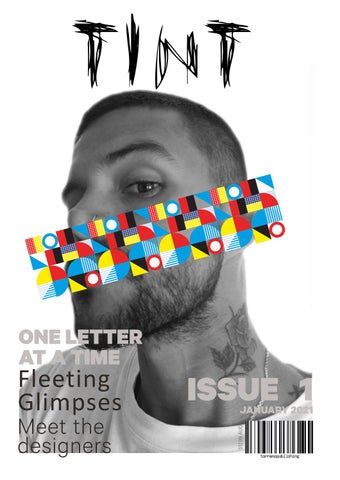
ONE LETTER AT A TIME
Fleeting Glimpses
Meet the designers
EDITORIAL Welcome to our first issue Fiona Kerr, Editor Welcome to the first edition of Australia’s newest design magazine. Our monthly magazine aims to bring you the best from the design community, from Australia and worldwide. We will be profiling emerging as well as established designers, along with tips to help you develop your design skills along the way. We will be exploring the different design disciplines through interviews with current design practitioners and articles on them and their inspiring work. Our first edition covers a range of the type of delights that we aim to offer you in the future. We drill down into the world of hand lettering with the inimitable Megan Carter. We delve into the world of photography with Raul Ortiz de Lejarazu Machin and explore how photographers paint with light. Then we meet some up and coming graduates of Billy Blue College of Design who 2
TINT
have managed to find their dream job working in design. The path to success is not always smooth, but it sure is exciting. So no matter if your interest is photography, typography or illustration, we’ve got you covered. Our magazine will feature the artisans and their amazing projects as well as design secrets known only to the professionals. Welcome to our magazine, we had so much fun creating it, we hope you have as much fun reading it.
Editorial Editor Fiona Kerr fiona.kerr@torrenspublishing.com Production Director Andy Wana Editor in Chief Robyn Latimer Art Director & Designer Francisco Doncel Prada Contributors Jemma Smith, James Brown, Fiona Kerr Photography Ian Camdon-Smythe Sales & Advertising Media packs are available on request. Advertising Manager Evelyn Waugh evelyn.waugh@torrenspublishing.com +61 2 1234 5678 Marketing Director Henry Lawson Account Director Andrew Barton Patterson Account Manager Richard Carleton International Content is available for licensing. Contact the international department to discuss partnership opportunities. International Licencing Director Mabel Bridge mabel.bridge@torrenspublishing.com Publisher Torrens Publishing Level 1, 46-52 Mountain St Ultimo NSW 2007 Australia Print Subscriptions and back issues Web: www.torrenspublishing.com Email: contact@torrenspublishing.com Phone: +61 2 1234 5678 Our magazine is published 12 times per year. 1 year subscription $95 2 year subscription $175 Overseas subscription $250 (1 year) Submission Details The editors welcome submissions from freelance contributors. Please contact the editor before submitting your story. Editorial guidelines are available via email and include requirements for story and photographic or artwork submissions. All text should be provided as either a word (.doc, .docx) or rich text format (.rtf). All images should be supplied as high resolution JPEG format with captions as a separate list. JPEG compression should be no lower than 75%. Digital images should be provided at a resolution of 300ppi, at a physical size of at least 20cm and no more than 45cm on the longest side. Disclaimer Views expressed within this magazine are not necessarily those of the editor or publisher. All efforts have been made to ensure the accuracy and truthfulness of the stories included in this issue. The writers, editors and publisher cannot be held responsible for inaccurate information supplied and therefore subsequently published. Social Media Facebook: http://www.facebook.com/torrenspublishing Twitter: http://www.twitter.com/torrenspublishing Printed on Ball and Doggett Titan Gloss. Cover 250gsm. Text 113 gsm http://www.ballanddoggett.com.au/
CONTRIBUTORS Publisher
Rosaline Ryder
Editor
Fiona Kerr
Sub Editor
Giles Longley
Advertising Manager Amethyst Singer
Advertising Production Kevin Khan
Marketing Manager Caroline Freund
Art Director
Giselle Whidette
Designer
Elias Abboud
Production Manager Andy Chan
TINT
3
Megan Carter
CONTENTS - TINT
Raul Ortiz
One Letter at a time 5
What happens when you practice hand lettering every day for 6 months? We think you should meet Megan Carter, hand letterer extraordinary. This Brisbane designer works in a design studio and also teaches workshops on the art of the font.
Fleeting Glimpses 6
From art director to freelance photographer. Meet the man who gave it all away to follow his passion for photography. Multi-award winning photographer Raul Ortiz de Lejarazu Machin has traveled halfway across the world to find himself – behind the lens.
Making the transition from university to a successful career in design is not always an easy journey. Meet the designers – graduates from Billy Blue who have successfully found their way in the world of graphic design. Be inspired!
Fiona Kerr
Todd Watts
Meet the Designers 8
Contributors Fiona Kerr is a writer, producer and designer based in Sydney. She has worked for the BBC and ABC TV in television, web production and in print.
4
TINT
ONE LETTER AT A TIME T
aking the art of hand lettering to its heights is Megan Carter, a Brisbane based communications designer and hand letterer. Her work could be described as florid, flowing and freeform. It has a simplicity and elegance of form, which belies the 5-18 hours of work that makes up each piece. Her love affair with hand lettering started in primary school, where her friends often asked her to do their title pages with rainbow bubble type. She became serious about hand lettering skill development in 2016 during the last semester of the course at Billy Blue College of Design.
As she was only doing one subject in the last semester, she filled her time by practicing every morning for 2-4 hours with her Wacom tablet and eventually experimented with brush pens. She is now one of the shining lights of hand lettering in Brisbane. Her process is different depending on the type of lettering she is doing. “Brush lettering involves me going through butt loads of paper due to the warm up drills that I always start with. Then I experiment and play around with the composition until I’m happy with it.”
By Fiona Kerr
students? “Practice makes progress! The biggest thing I can think about it the art of practice. It takes time and discipline to become even slightly happy with the work you’re creating. You just need to enjoy the learning process and trust that with time you’ll be chuffed with it”. You can find more of Megan Carter’s amazing work @megandesigns on Instagram.
Hand lettering involves sketching, lightboxing and experimentation before adding dimension, shadows and flourishes. Her iPad Pro has become an essential hand lettering tool, which she uses as well as Photoshop and Illustrator. Carter teaches hand lettering workshops - her advice to TINT
5
FLEETING GLIMPSES
By Fiona Kerr
P
hotography is the art of capturing a fleeting glimpse, a moment frozen in time. Such a moment could pass unremarked, but it is the skill of the photographer not only to record the transient march of time, but to do so in a way that is truly remarkable. Raul Ortiz de Lejarazu Machin is one such photographer. Highly skilled in painting with light, he also manages to capture the overwhelming intensity of the harsh Australian sun. His work is diverse and eclectic, covering lifestyle, documentary, events, portraits, commercial and creative content. And it is that diversity that has led to a robust and successful career. Raul graduated from a course in Advertising and P.R. in his native Spain and worked as an art director for six years in advertising in Madrid. But the pull of photography became too strong, he quit his high-powered job and ended up in Sydney, where he studied a Diploma of Photography and Imaging at CATC (now Billy Blue College of Design) before completing a Masters of Design with Torrens University. He now works in Sydney as a freelance photographer for different national and international clients. His advice for up and coming photographers? “Be happy and have fun doing what you do.” According to Raul, photography students need to develop skills that aren’t necessarily taught in school: patience and diplomacy. These help when dealing with real clients and when searching for new projects. He feels that students need to learn not only
6
TINT
the new technologies but also need an appreciation of the old processes and the origins of photography. “I remember spending hours in the dark room just editing one image that probably wouldn´t go anywhere because it was not good enough. Now everything is becoming more instant, we don´t stop to think about what we create and we just create a lot of images because it is easy to do.” The most important thing in photography is “not how well your camera works, but how your brain works and how you can think out of the box and make things interesting and beautiful.” For students he says that one of the “most important things to keep learning is to ask yourself and others a lot of questions, normally things nobody asked before.”
H
is inspiration is derived from curiosity, popular fiction books and music. He is influenced by famous photographers such as Cartier-Bresson, Gregory Crewdson and Max Dupain, but has equal admiration for the new generation of young photographers. He is also influenced by his grandmother, a chemist, who enabled him to inject an element of science into his photography. He likes photography because it allows him to “use something that is so technical to create art”. His latest project ‘The Chemistry of Light’ is, as he puts it “an exploration of how light affects us not
only physically but also emotionally.” This project started a few years ago with a series of images called the Lux Series which can be found on his website (http:// ruliphotoart.com/lux). “I think sometimes I´m obsessed with colour, I love to create colourful images. I love colour theory and how colours can affect us or make us feel.” He feels his greatest achievement was his work “Multiverse” which was a series of abstract images of architecture in Sydney. This work was selected to be included in the Head On Festival, an international photography festival.
Moving forward, Raul feels that photography has changed drastically in the past few years. Everyone has access to great technology, with the next smartphone cameras enabling everyone the potential to become a photographer.
“I think the future is going to be multidisciplinary, photographers are becoming filmmakers, designers are photographers etc. I think we will find more exciting things mixing different creative industries.” TINT
7
MEET
THE
DESIGNERS Josh Sobel
M
eet the designers, people who inspire, communicate and enthrall. These designers have mastered the art and skill of transmitting ideas through the visual realm. They don’t all do the same thing, each designer works within their chosen areas of specialization. Because graphic design such a broad discipline it includes a number of specializations: typography, photography and illustration. A designer might work on books, posters, magazines, info graphics, type design, motion graphics, user experience, 3D, games, way finding or even environmental design. The tools they use may include natural media or be entirely digital. These champions of design may specialize in any one of these areas, or may use all of them as part of the arsenal with which they work. Because that’s what designers do.
8
TINT
Slick, creative, simple, colourful, these are just a few of the words that describe the work of Sydney-based Josh Sobel, who applies a love of medium to his graphic design. Sobel likes to work with form, light and colour in combination. “Particularly some of my more recent work where I’ve been able to create abstract imagery and use this as the basis for the composition of type and colour. Whereas traditionally my work was more minimalist and “swiss” in inspiration, it has now developed to combine more organic features which pairs well with more rigid design aesthetics.” His graphic design style has grown and developed organically along with his career. After graduating from Billy Blue College in Sydney, Sobel did an internship for Naughtyfish (now Garbett Design), a boutique studio specializing in highly crafted brand design. He moved into a full time role at Yello (now Designworks) where he was exposed to large-scale corporate branding. Two years later, he went freelance before landing a job with Lavender to help them break into the branding industry. After two years there he found himself applying for a French work visa and spent the next 18 months living in Lyon and working Paris for a small boutique agency. He returned to Australia and worked freelance before landing a job at Moon. He is currently working at Principles. He cites his greatest achievement so far as creating the brand identity for The Domain in Sydney, which uses natural media elements and employs a range of design solutions. His time at Billy Blue allowed him to “understand the fundamentals of design and how to channel, curate and distill my thoughts and ideas into solutions. You can always be taught/teach yourself how to use software, but to be shown how to create concepts is
invaluable.” Sobel is inspired by “creative solutions that make you smile and those that have a big idea at their core.”
A
s for the future – he doesn’t think robots will be taking designer’s job any time soon. “There’s been a huge shift towards designers becoming “blended” ie. having both conceptual, craft and digital skills in UI and/or UX. It feels like it’s happened overnight but I think in reality I think it’s been happening for the last 3-4 yrs, it’s only just now that people know what to do with these skills and companies not traditionally associated with design are snapping people up who have them.” In terms of the skills, he thinks designers should understand that technology is important, but it is only a tool, “it only aides the creation of concepts and doesn’t limit or control them.” It only gets harder as you go along to ‘get into digital’”. His advice for designers starting out?
“Be hungry, not just to work hard (people will always want that) but for information. Read lots; articles and books on all manner of things like tech, politics, social commentary, anything.” When it comes to design, nothing is off-topic, inspiration can come from anywhere.
TINT
9
Todd Watts
W
hen it comes to high achievers it’s hard to go past Melbourne designer Todd Watts. Having graduated from Billy Blue in 2016, Watts has not only been a finalist twice for the Adobe Design Achievement Awards, as well as The Rookies, and the Premier’s Design Awards; but he’s actually won an A’ Design Award and an Adobe Creative Jam Award in the UI/ UX category. He managed to do this in just one year, juggling freelance work with the likes of SNASK, Bengar Films, Matchbox Pictures, Forde & Nicol, Caroline Records, and most recently, Yell Design. He certainly is a designer with a lot on his plate! Working across mediums and design disciplines, Watts creates everything from short form animation, digital design, branded communications, to interior design and packaging. “My roles include concept development for advertisements, pitching concepts, storyboarding, animation (digital and/or stop-motion), photography, set design (right now this is mostly paper craft) and social media marketing + strategy.” Watts loved his time at Billy Blue, “It was great! Exciting, challenging and exhausting all at the same time. I loved questioning everything I thought I knew about design and every day being opened to a new world of possibilities. The connections and networks I made were also invaluable.” Transitioning from Billy Blue to the ‘real world’ is a challenge for any budding designer. “I don’t think university can ever properly replicate the real world, Billy Blue came close but the only way to get that experience is by working on something with real risk. The moment you’re presented with a real chance to fail is when you discover what you’re truly capable of (and in my experience, your IQ doubles the moment people are given actual responsibility).” Watt’s work has evolved since graduation: “Initially I loved
10
TINT
pushing pixels and following the rules - minimal, highly refined design with heavy grids. Now I keep my distance from the tools (adobe suite/ computer) as much as possible and try my best to encourage clients to let me get my hands dirty. I love working with paper, wood, paint, glue, string anything tactile. It allows me to guarantee a genuine and unique design solution.” Working with real clients requires discipline and Watts uses a collaborative process. “We figure out the deliverables. I create a detailed project outline. Once that’s agreed upon I create ONE concept (allowances for two rounds of revisions) then we finalize the work. I try to keep the ideation stage as tactile as possible. If I can’t do something I won’t hesitate to get someone who can. Above all else, I don’t start a project unless I’m excited by the brief.” His advice to up and coming designers?
“Learn the rules and then forget them completely. Get out and meet as many people as possible. Don’t network, build friendships instead.”
After three months of interning, I was lucky enough to get offered a full time spot working alongside the great team at Frost, and I’ve been there since.” He’s wanted to work in the creative fields, and became interested in graphic design when a friend said: “‘graphic design is like drawing, but in the computer.’ I realize now that’s not really all that true, but it was enough of a sales pitch for me to I somewhat blindly jump into the course. Luckily, I knew pretty much within my first semester that this is what I wanted to do.”
Some of the projects that Mistry is working on include a new campaign for the City of Sydney and the annual report for OzHarvest as well as materials for Nubo, an educational children’s playspace. He is influenced by “everything around me. I’m also influenced by the people I work with my Creative and Design Directors have had a big influence on the way I think and approach design. I’m also a big fan of a designer named Robert Brownjohn, he was a bit of a crackpot, but he had some amazing work and that’s also been an influence even since uni.” He sees the future of design involving more technology. Designers need to become multi-skilled. “I think technology will continue to impact design. I think those who can utilize new technology will be in a good spot. I see some aspects of design becoming automated, I think designers are going to become multi skilled if they’re not already to keep up with the variety of ways that design/ design thinking can be used.”
Advise for De igner s s
B
illy Blue graduate Keiran Mistry has managed to do what many designers dream of – nailing a dream job. He is currently working for Frost*Design in Sydney, a job which he got after completing a Bachelor of Applied Visual Communication at Billy Blue in late 2015. “The week after the degree finished I reluctantly went along to a portfolio review day that Billy Blue put on. It was a good job I did go in the end, as I met the Design Director of Frost*Design at the time and he got me in for an internship a few weeks later.
HIS
Keiran Mistry
TINT
11
“Learn how to talk about your work, being able to articulate your ideas/work confidently is going to help out massively regardless of what area of design you go into. I also think having at least a basic understanding of animation will definitely put you at an advantage, seeing as how lots of brands are thinking digital first.�
12
TINT
Andy Roberts
M
oving from design to photography – that particular part of the graphic design field that lends itself to specialization. Meet commercial photographer Andy Roberts, who is based in sunny Sydney. Roberts quit the corporate world in 2012 to study a Diploma of Photo Imaging at Billy Blue and has been working as a freelance photographer ever since. His work encompasses fashion, tech, medical, education, finance, hospitality, lifestyle and design, which can be seen on his website http://www. andyroberts.com.au. Moving into photography from the corporate world through his diploma was an eye-opener.
“I was very much in a corporate mindset before quitting and training in photography. Immersing myself in my course was so much fun. I started to think about everything differently; was emboldened and given space to grow creatively, and I found I could make mistakes in a safe environment.” He cites his inspirations as coming from not only a multitude of world-famous photographers, but people who are “intelligent, articulate, positive humans who are using their skills to do what they want, the way they want – casting aside the usual fears of failure and breaking norms.” He was drawn to photography as a profession because of its creativity and lifestyle. “My only real routine these days in making the bed in the morning and my 8am coffee down at the beach. From there, every day is different.”
Roberts believes that light is key to the photographic image. “Whether you are shooting in a controlled studio environment, or out on location using natural light and topography, light and composition (equally) are key to a great image in my mind. All the technical stuff around taking the photo comes second to those two elements.” Software these days has superseded the traditional dark room, and Roberts finds that using technology is “the boring part of your photography work, but Digital Asset Management is really important – looking after your images from capture, through download, backing-up, selection, editing, output and delivery to your client.” His advice to people starting out in photography? “The hardest times are when you have a really quiet week or two in-between jobs - you can easily lose motivation and self-confidence. It’s important to remember that this happens to everyone. Stick with it all…it will be worth it! Also, there are no rules saying that hard work can’t be fun work too…so try not to take everything too seriously.” So there you have it – a roundup of design professionals who have successfully moved from their course into a fulfilling career in their chosen field.
TINT
13