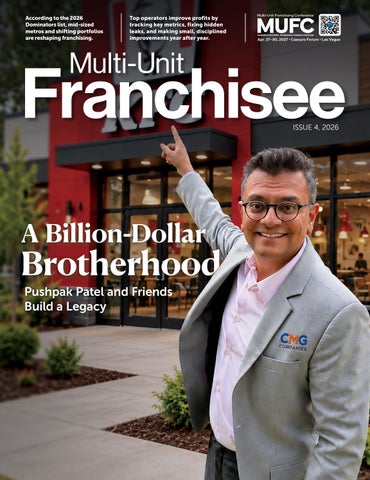
According to the 2026 Dominators list, mid-sized metros and shifting portfolios are reshaping franchising.
Top operators improve profits by tracking key metrics, fixing hidden leaks, and making small, disciplined improvements year after year.
Apr. 27–30, 2027 • Caesars Forum • Las Vegas
ISSUE 4, 2026
Pushpak Patel and Friends Build a Legacy
• Day 1 capital, cut by $400K+: Value engineering and design innovation lowered the initial investment by more than $400,000, without touching the premium experience. • 6,000 SF unlocks more sites: Greater flexibility in site selection, with an adaptable layout that works across urban, suburban and infill markets. • Scalable Capacity: Our phased scalability allows you to manage initial expsenses by expanding capacity as you capture local market share. $1,089,859 Average Unit Revenue*
96% Franchise Agreement Renewal Rate
50% System-wide Multi-Unit Ownership
LEARN MORE Camp Bow Wow® is part of the Propelled Brands portfolio which is the Franchisor of FASTSIGNS® International, Inc. and My Salon Suite® *Per the 2026 Franchise Disclosure Document (“FDD”). Results are estimates only, and there is no assurance you will achieve similar results. If you rely on these figures, you must accept the risk. Average annual gross revenue is based on 207 franchised locations included in Reporting Group One, as defined in Item 19 of the 2026 FDD, that were open and operating for more than 24 months as of December 31, 2025, and submitted required reports during 2025. Of these, 93 (45%) exceeded the average of $1,089,859.75. **Represents the average Total Franchise Owner’s Benefit (as defined in Item 19 of the 2026 FDD) for the top 25% of franchised locations based on that metric, among locations that submitted financial information. Results are based on unaudited financial information reported by franchisees. See Item 19 of the 2026 FDD for additional details, including definitions, reporting criteria, assumptions, and limitations.
FRANCHISE OPPORTUNITY
UNIQUE MENU. SAVE UP TO $20K ON YOUR INITIAL AND AN LOWFRANCHISE STARTUPFEECOST. ADDITIONAL 1% REDUCTION IN ROYALTY* $3.77M AUV. Take advantage of the opportunity to become part of our growing footprint and save up to $310K** on Initial Franchise Fees and royalties for each location opened in the United States. The Unit Economics Behind the Opportunity
$3.9M AUV and $528K Average EBITDA*** Top 50% of Locations
$2.9M AUV and $228K Average EBITDA**** All Locations
$422K - $1,204M Low Initial Investment*****
$596K 2025 Median Initial Investment******
Net a great opportunity.
angrycrabfranchise.com | 586-907-6404 *Offer valid through 12/31/2027. **This figure represents a $20K reduction in the Initial Franchise Fee and a one (1) percent reduction in royalty on an AUV of $2.9M annually over ten (10) years. ***This figure represents the net sales and the average EBITDA achieved for calendar year 2025 at the top 50% of affiliate owned and franchised restaurants. ****This figure represents the net sales and the average EBITDA achieved for calendar year 2025 at all affiliate owned and franchised restaurants. *****This figure represents the Total Initial Investment range to open an Angry Crab Shack restaurant in a second-generation site. ****** This figure represents the Median Initial Investment to open twelve (12) franchised restaurants operating in 2025, all of which were opened in second-generation sites. Second Generation Sites are restaurant locations where the operator utilized a premises that was previously operated as a restaurant and therefore requires less initial investment to open and operate. Most Angry Crab Shacks are opened in Second Generation Sites. This information appears in Item 19 of our Franchise Disclosure Document (FDD). You should review our FDD for details about these results. Your results may differ. There is no assurance that you will do as well. ©2026 Angry Crab Franchise Opportunity. All rights reserved. Angry Crab Franchise LLC., 2345 S. Alma School Rd. Suite 106, Mesa, Arizona 85210
CONTENTS
Multi-Unit Franchisee Issue 4, 2026
CHAIRMAN’S NOTE 4
FEATURES
Embracing Advocacy
42
MU PROFILES 6
48
COLUMNS
Troy Morrison
52
CEO goes from corporate life to a 136-unit portfolio
14
Alex Mortensen
54
Chad Mussmon
56
Pushpak Patel
Business Law Smart business transfers protect buyers and sellers
Exit Strategies Disciplined operators turn economic pressure into long-term value
Raj Patel President leads The Hari Group past 130 units
60
Market Trends Unit count isn’t the only measure of emerging franchises
RANKINGS 35
58 59
Building a billion-dollar business with “brothers”
32
Finance Ensure your lease supports profitability and long-term plans
Salem Najjar Former CPA sets his sights on a $500 million enterprise
28
People High turnover might be a management issue
CEO drives youth enrichment with 2 brands
24
Customers Count Don’t wait for leaders to walk out the door
Operator bulks up his portfolio with Crisp & Green
20
When Tough Times Pay During challenging economies, strong operators move forward
Cameron Gentry Entrepreneur finds franchise growth in home services
10
Making Smart Bets Emerging brands offer multi-unit franchisees opportunities and risks
The part of giving back you don’t get credit for
61
Dominators
IFA Report Now is the time to build momentum for the year ahead
Franchising’s largest MSAs and operators ranked by state and region
Our Team IFA Executive Team
DIRECTORS, BUSINESS DEVELOPMENT SALES
SENIOR MANAGER, WEB DEVELOPER
CO-FOUNDERS AND STRATEGIC ADVISORS
PRESIDENT & CEO
Matt Haller
Hope Alteri Jeff Katis
Matt Wing
Gary Gardner Therese Thilgen
CHIEF OPERATING OFFICER
DIRECTOR, EXECUTIVE EDITOR
MANAGER, WEB DEVELOPER
Jennifer Brandeen
Don Rush
Kerry Pipes
CONTRIBUTING WRITER
Christopher Quinn
COORDINATOR, DIGITAL CHIEF FINANCIAL OFFICER
Amy Brown
MANAGER, EDITOR
SR. MANAGER, GRAPHIC DESIGN
FUM Team
MANAGER, EDITOR
VP, MARKETING AND CONTENT
Kevin Behan
Diane Phibbs VP, BUSINESS DEVELOPMENT
Barbara Yelmene
Juliana Foley
M. Scott Morris
DIRECTOR, CREATIVE
Michael Llantin MANAGER, MARKETING AND CONTENT
Erika Freber
Taylor Williams
DIRECTOR, TECHNOLOGY
COORDINATORS, SPONSORSHIP BENEFITS
Benjamin Foley
2 | Multi-Unit Franchisee | Issue 4, 2026
Alison Shelton Heather Stoner
CONTRIBUTING EDITORS
John DiJulius Jack Grespin Keesha Kitterman Barbara Nuss Brian Schnell Paul Wilbur
ARTICLE INQUIRIES
editorial@ franchiseupdate.com SUBSCRIPTIONS
subscriptions@ franchising.com 408-402-5681
everyday moments
deserve a little sunshine
Explore wh at’s possible with Jamba. scan here
take the next step toward franchise ownership.
This information is not intended as an offer to sell a franchise. We will not offer you a franchise until we have complied with disclosure and registration requirements in your jurisdiction. Contact Auntie Anne’s Franchisor SPV LLC, Carvel Franchisor SPV LLC, Cinnabon Franchisor SPV LLC, Jamba Juice Franchisor SPV LLC, McAlister’s Franchisor SPV LLC, Moe’s Franchisor SPV LLC, or Schlotzsky’s Deli Franchisor SPV LLC, located at 5620 Glenridge Drive, NE, Atlanta, GA 30342, to request a copy of their FDD. RESIDENTS OF NEW YORK: This advertisement is not an offering. An offering can only be made by a prospectus filed first with the Department of Law of the State of New York. Such filing does not constitute approval by the New York Department of Law. RESIDENTS OF MINNESOTA: MN Franchise Registration Numbers: Auntie Anne’s Franchisor SPV LLC: F-8191, Carvel Franchisor SPV LLC: F-8199, Cinnabon Franchisor SPV LLC: F-8190, Jamba Juice Franchisor SPV LLC: F- 6111, McAlister’s Franchisor SPV LLC: F-8196, Moe’s Franchisor SPV LLC: F-8188, and Schlotzsky’s Deli Franchisor SPV LLC: F-8192.
Chairman's Note
Embracing Advocacy
The part of giving back you don’t get credit for Last time, I wrote that networking only works when it flows both ways and that the further I’ve come, the more time I spend giving back. I meant mentoring: taking the call from the operator who is considering their first unit and sharing numbers with them that I didn’t have to share. In September Washington, D.C., I learned there’s a version of giving back where you never meet the person you helped. I was at the IFA Advocacy Summit, the largest in the association’s history. More than 500 people from across franchising spent three days in Washington and on Capitol Hill instead of at their businesses. What struck me wasn’t the size of the crowd; it was who was in it. I expected franchisors. Brand leaders show up for this kind of thing; it’s part of the job. What I didn’t expect was how many franchisees were standing next to them. Owners of three units. Owners of 30. People closed a gap in their week, left their teams, and flew to Washington to sit across from a member of Congress, or their staff, and explain what franchisees actually do for a living. Here’s the part I keep thinking about: Almost none of them needed to be there. They’re established. They’ve already built the thing. Whatever comes out of their lobbying efforts lands hardest on the person who hasn’t bought their first unit yet, and that person had no idea anyone was in the room fighting for them. That’s the highest form of giving—no introduction, no thank-you note, and no relationship on the other end of it. I grew up in this industry. My dad built a brand inside a model that worked, and I’ve spent my career building inside that same model. It never occurred to me until last week that the model arrived in working order because people before us kept it that way. Somebody paid that bill. I just never got the invoice. The ask in Washington was the American Franchise Act. The joint-employer standard has changed four times since
4 | Multi-Unit Franchisee | Issue 4, 2026
2015, and every change costs us. When the line blurs, franchisors pull back on training and support out of legal fear, and franchisees lose exactly the help they signed up for. The bill draws one clear line: A franchisor can be determined to be a joint employer with its franchisee only when it actually exercises direct control of the terms of employment of its franchisees’ employees. That’s it. It’s bipartisan, bicameral, and backed by more than 100 business organizations—not a partisan idea, a clarity idea. So, here’s what I’m asking. If the American Franchise Act hasn’t crossed your desk, make it your business. Call your representative. IFA has made it easy. And save the date for the Multi-Unit Franchising Conference, April 27–30, 2027, Caesars Forum, Las Vegas. Come ready to share what you know and learn what you don’t. That’s still the deal. But bring something for the operator three rows back who can’t pay you for it yet. That’s the part nobody sees. It’s the part that matters.
Nicholas Marco NICHOLAS MARCO 2027 MUFC Chair
Cameron Gentry
“I lead the way I operate: hands-on but focused on building leaders who share the same vision rather than a sense of entitlement.”
Serial Entrepreneur
Operator finds franchise growth in home services Written by KEVIN BEHAN
of the brand, but the opportunity piqued his interest. He reached out to the local franchise owner in St. George, Utah, who operated the business only on weekends. He made an offer to acquire the territory. Gentry said he took a leap of faith, bought a franchise with no office or employees, and worked his “guts out for six months.” The effort quickly paid off. Gentry earned $30,000 in his first month and then tripled the volume the following month. “I was really good with operations, and I knew my numbers inside and out,” Gentry says. “I also knew how to hire people. I jumped with both feet in and trusted everything Budget Blinds told me. I tell other franchisees that’s why they bought into the brand, and they’ll want to follow the rules. Life is a lot easier when you stop trying to recreate everything.” Gentry has since expanded his Budget Blinds business to 17 territories. The business is supported by eight offices and a team of more than 100 employees. Along the way, he has continued to build and refine his franchise portfolio, buying and selling four Crumbl Cookies locations and adding single-unit franchises with The Tailored Closet and PremierGarage. After the Great Recession and the pandemic hurt his previous businesses, Gentry says he has found the home services sector to be the best fit for his entrepreneurial approach. Those experiences have also shaped how he is building his business today by placing greater emphasis on sustainable growth and resilience.
CAMERON GENTRY Owner Company: CJG Management Units: 17 Budget Blinds, 1 The Tailored Closet, 1 PremierGarage Age: 46 Family: Wife, Josie, and 4 daughters, Baylee, 18, Pyper, 16, Maycie, 13, and Quinn, 10 Years in franchising: 21 Years in current position: 7 6 | Multi-Unit Franchisee | Issue 4, 2026
C
ameron Gentry has spent nearly half his life building franchise businesses. At 46, he has already operated eight brands, mostly in the food sector, following a straightforward playbook: acquire territories, grow the business, and sell at a profit. Now, he’s taking that experience into home services with 17 Budget Blinds territories leading his portfolio. Gentry’s franchising career began at 25, when he bought his first Little Caesars restaurant. Three years later, he became the youngest franchisee in Five Guys history. Gentry estimates he worked approximately 80 hours a week while operating and scaling both franchises. He eventually sold all his stores and used the money to purchase a trampoline park entertainment center in Atlanta. In 2018, a former Little Caesars franchisee introduced Gentry to Budget Blinds and suggested that his operational experience would translate well to the home services industry. Gentry had never heard
“Things happen, but you can’t dwell on them,” Gentry says. “You’ve got to move forward and count your losses. I learned the importance of spreading out my net. I don’t want to put everything in one basket. That is why we have a bunch of different locations across multiple states with Budget Blinds.” Three years ago, Gentry took a strategic step back to focus on the back end of the business. His business partner, Stetson Southwick, now oversees daily operations while continuing to drive the franchise’s expansion. Gentry jokes that he is “always for sale,” but for now, he is pleased with the business’ trajectory and its potential to scale. His focus has shifted toward strengthening operational systems and creating opportunities for employees to become partners in the business, positioning the company for continued growth while giving its team a stake in its success.
PERSONAL
First job: Working a paper route for the Daily Herald in Utah starting in second grade and running through eighth grade. I delivered to 60 homes
Cameron Gentry
a day for $100 a month, assuming everyone paid their $8.25 monthly bill. Formative inf luences/events: I was raised around entrepreneurship. My mom owned a flower shop, and I spent countless hours as a kid in the shop watching “Sesame Street” while she built relationships with her customers and put arrangements together. That’s where the entrepreneurial bug started. I also served a two-year mission for The Church of Jesus Christ of Latter-day Saints in London, England, from age 19 to 21, working closely with people from every walk of life. That experience shaped how I lead and serve to this day. Key accomplishments: 2026 IFA Franchisee of the Year, Budget Blinds Franchisee of the Year, and Lutron Franchisee of the Year. Building a 17-unit Budget Blinds footprint across five states plus The Tailored Closet and PremierGarage in Southern Utah and launching our own proprietary brand, Halo Automation. Biggest current challenge: Finding the right employees who genuinely want to grow with us. A lot of people want the title or the position, but far fewer are willing or able to put in the work it actually takes to win.
Best advice you ever got: You can only bet on yourself. That is something I’ve heard from a lot of people.
cancerous, but the odds of paralysis were high. Going through that changed how I see everything. It taught me not to take life, or opportunities, for granted.
What’s your passion in business? Watching what you can build and taking it to a whole new level. It is fulfilling to create real opportunities for other people to succeed alongside you.
Pet peeve: Hearing someone eat Grape-Nuts cereal.
How do you balance life and work? Family and travel are everything to us. Boating, mountain biking, working out together, and this past year competing in HYROX. Taking care of myself physically every morning is what makes the rest of the day possible.
Last vacation: A week on a houseboat at Lake Powell with family and friends in June.
Guilty pleasure: Being out on the lake with a peach cobbler made in a Dutch oven. Favorite book: The Book of Mormon. Favorite movie: “Tommy Boy.” What do most people not know about you? I’ve had a tumor in my spinal cord. Thankfully, it wasn’t
What did you want to be when you grew up? A professional athlete first and then a pilot before landing on entrepreneur.
Person you’d most like to have lunch with: My grandma Ellen. She always asked if I’d cleaned behind my ears growing up and was endlessly proud of me. I miss her dearly.
MANAGEMENT
Business philosophy: Don’t micromanage. Find people who you genuinely want to work with and are willing to put in the effort and then get out of their way.
Next big goal: Keep growing within the system while maximizing profitability against rising costs. We’re also pushing hard to grow our own brand, Halo Automation, alongside our Budget Blinds locations as the right opportunities come along. First turning point in your career: Buying our Five Guys territory. At the time, we were the youngest franchisees ever accepted into that system and signed a development agreement for 11 locations. I was stretched thin overseeing our Little Caesars locations while barely scraping by to get Five Guys off the ground, but it taught me how to operate under real pressure. Best business decision: Bringing on my business partner, Stetson Southwick. Finding someone with the same tenacity and drive to help run and grow the business reignited my own fire and has completely changed the trajectory of where we’re headed. Hardest lesson learned: Learning that not every business you’re certain about will end up being successful. I’ve had real failures and close calls where we nearly lost it all. Shutting down a failing business during Covid was one of the hardest lessons of my career but also one of the most valuable. Work week: Monday through Friday, 8:30 a.m. to 5 p.m., but my phone is always on. If a team member or customer needs me, I’m there for them regardless of the time. Exercise/workout: Nonnegotiable, every day; it sets the tone for everything else. My family and I have been competing together in HYROX events, an indoor fitness racing series combining 8 km of running and eight functional workout stations. Issue 4, 2026 | Multi-Unit Franchisee | 7
Cameron Gentry
Management method or style: I lead the way I operate: hands-on but focused on building leaders who share the same vision rather than a sense of entitlement. Greatest challenge: Building a team and leadership group that all share the same vision without slipping into an entitlement mindset. How do others describe you? A serial entrepreneur who doesn’t stop. Have you ever been in a mentor-mentee relationship? What did you learn? I haven’t had a formal mentor. Most of what I know came from experience, failure, and figuring it out in real time across every brand I’ve operated. One thing you’re looking to do better: Continuing to strengthen our team and always finding ways to improve at every level of the customer interaction. How do you give your team room to innovate and experiment? We meet constantly to talk through ways to improve, and we make a point to invest in the team beyond just work. We organize team activities at Christmas and in the summer. We build genuine friendships across the company. How close are you to operations? Still close to day-to-day, but I’ve intentionally stepped back to let my business partner run point. What are the two most important things you rely on from your franchisor? Support and trust that they will continue to provide the tools and assets that keep our brands strong. What you need from vendors: Trust and loyalty in both directions. The vendors who make us jump through hoops are the ones we lose focus on. The ones who work with us, show up with us in the field, and see what we face on a day-to-day basis are the partners who earn our business. A treat now and then is nice too, but showing up matters more. Have you changed your marketing strategy in response to the economy? How? Yes. We have pushed marketing harder and focused on adding new products beyond the standard blinds experience, particularly automation, so we can offer style and service at a high level for any budget.
always done in person with a manager present. It’s never done alone and includes documented writeups along the way. How do you train and retain? Heavy, hands-on training across every position. We do a lot of shadowing before anyone is signed off as fully capable. Communication is the key to all of it. How do you deal with problem employees? We address it directly and document it. Writeups are done with a manager present and always in person. Fastest way into your doghouse: Any of these are an instant problem: a no-call no-show, treating a customer poorly, or disrespecting another employee.
“The vendors who make us jump through hoops are the ones we lose focus on. The ones who work with us, show up with us in the field, and see what we face on a day-to-day basis are the partners who earn our business. A treat now and then is nice too, but showing up matters more.” BOTTOM LINE
How is social media affecting your business? It’s been huge for staying relevant. Raw, authentic customer testimonials carry real weight with today’s buyers.
Annual revenue: $6.5 million.
In what ways are you using technology (like AI) to manage your business? Our entire sales team uses AI daily to help customers visualize their space. This includes AI-generated imagery to bring their vision to life before a single product is installed.
Growth meter: How do you measure your growth? Not just by adding new territory, but by getting better and finding new ways to improve the business and life alongside it.
How do you hire and fire? We interview as most companies do, but we also bring in other team members from the position we’re hiring for to weigh in. When it’s time to let someone go, it’s 8 | Multi-Unit Franchisee | Issue 4, 2026
Goals over the next year: To increase profitability and identify and act on the right new opportunities when they present themselves.
Vision meter: Where do you want to be in five years? 10 years? Still pursuing the same passion of taking something and making it awesome while enjoying my family and continuing to grow the business.
Do you have brands in different segments? Why/why not? Yes. Budget Blinds, The Tailored Closet, and PremierGarage complement one another and make the overall customer experience even stronger. How is the economy in your region(s) affecting you, your employees, your customers? It’s a rough environment right now. Payroll costs are high to retain great people, and customers are doing a lot more homework before they buy. We’re still winning; it just takes more interaction and more focus on building trust and relationships. Are you experiencing economic growth in your market? Yes. We are continuing to see growth, but it requires more work to earn than it used to. How do changes in the economy affect the way you do business? It means more relationship building and more trust building with every customer rather than relying on the sale coming easily. How do you forecast for your business? We work closely with our accountant and bookkeeping team, watching costs and numbers closely across every location to guide our decisions. What are the best sources for capital expansion? At this point, we’ve gotten to where we largely fund growth with our own capital. Experience with private equity, local banks, national banks, other institutions? Why/ why not? We’ve reached a point where we operate primarily on our own capital and manage our growth rather than leaning heavily on outside financing. What are you doing to take care of your employees? We reward top performers with prizes and incentives. We stay closely engaged with the team daily and not from a distance. How are you handling rising employee costs (payroll, minimum wage, healthcare, etc.)? We monitor the numbers and manage costs carefully across every location so that we can continue paying for great quality without losing ground. What laws and regulations are affecting your business, and how are you dealing with them? We stay closely tied in with our accountant and bookkeeping team to stay ahead of changes and manage them proactively across our multistate footprint. How do you reward/recognize top-performing employees? We host an annual company trip for hitting attainable goals. Past destinations have included an island getaway and Alaska. What kind of exit strategy do you have in place? We’re always keeping an eye out for the right acquisition or exit opportunity, but we’re not pushing until it feels right.
THE FRANCHISE WORTH WAKING UP FOR Breakfast Is Booming.
Due to consumer demand, the daytime café category is rapidly expanding. Join the #1 largest and fastest-growing franchised daytime café brand. Exclusive multi-unit growth opportunities available!
eggsupgrillfranchise.com
1.6M+
$
*
AVERAGE UNIT VOLUME TOP 50% OF
SYSTEM
19.7% FOR THE TOP 50%**
EBITDA
23
CONSECUTIVE
QUARTERS OF COMP
SALES GROWTH
+ 110 CURRENT LOCATIONS
*Average unit volume reported by the top half (45 of 91 franchised restaurants that operated for the entire period of April 1, 2025 to March 31, 2026 (“Measurement Period”)) was $1,609,507, and 21 of 45 (46.7%) franchised restaurants exceeded this average. AUV reported by the bottom half (46 of 91 franchised restaurants that operated for the entire Measurement Period) was $1,138,836, and 25 of 46 (54.3%) exceeded this average. There is no assurance that you’ll sell or earn these amounts. Please refer to the 2026 FDD for complete disclosure regarding other initial and ongoing fees and the financial performance of franchised restaurants.
EUG Franchising LLC For more information, please contact: Jennifer Folger. 100 Dunbar Street, Suite 301, Spartanburg, SC 29306, Tel: 678-523-2570. FOR THE STATE OF NEW YORK: This advertisement is not an offering. An offering can only be made by a prospectus filed first with the Department of Law of the State of New York. Such filing does not constitute approval by the Department of Law.
**Average EBITDA reported by the top half (31 of 62 franchised restaurants that operated for the Measurement Period and reported complete cost and EBITDA data to us) was 19.7%, and 14 of 31 (45.2%) franchised restaurants exceeded this average. AUV reported by the bottom half (31 of 62 franchised restaurants that operated for the Measurement Period and reported complete cost and EBITDA data to us) was $14.6, and 16 of 31 (51.6%) exceeded this average. 29 franchised restaurants that operated for the entire Measurement Period were excluded from this measurement because they did not provide us complete cost and EBITDA data. There is no assurance that you’ll sell or earn these amounts. Please refer to the 2026 FDD for complete disclosure regarding other initial and ongoing fees and the financial performance of franchised restaurants.
Troy Morrison
“If it all went to hell in a handbasket, I knew I could live in a trailer with my wife, and I would be okay.”
Betting on Himself
Going from corporate life to a 136-unit portfolio Written by KEVIN BEHAN
very strong understanding of the franchise process. That was due to how much the corporate side developed me professionally. I was blessed to have that experience.” Morrison’s decision to become a franchisee was sparked by a conversation with a Taco Bell owner as the two discussed their financial goals. Realizing he was unlikely to reach those goals in his corporate role, Morrison took a significant leap in 2011, purchasing 13 Taco Bell restaurants. At 48, he was a first-time business owner stepping into an uncertain market. The brand faced declining sales and negative public attention stemming from a class-action lawsuit over the beef used in its restaurants. Looking back, Morrison remembers the decision as a considerable risk but one he was willing to take to build the future he envisioned. “That first Tuesday when I didn’t get a check, I was very nervous. I took less money to start my own business, and I was doing it with a company going in the wrong direction. I threw every penny I had into the business,” he says. “Luckily, I had already taken care of retirement plans for my wife and me, our children’s education, and the savings for my daughter’s wedding. If it all went to hell in a handbasket, I knew I could live in a trailer with my wife, and I would be okay.”
TROY MORRISON CEO Company: Meauxmentum Strategies and Investments (MSI) Units: 63 Taco Bell, 47 Wingstop, 26 Chicken Salad Chick Age: 63 Family: Wife, Gay Lynn, daughter, Kylie Hanken, and 2 sons, Taylor and Baylor Years in franchising: 40 Years in current position: 10 10 | Multi-Unit Franchisee | Issue 4, 2026
T
roy Morrison didn’t know it at the time, but his 25 years with Taco Bell and Yum! Brands were preparing him to become a franchise owner. He spent his first eight years in Taco Bell operations before joining the Yum! Brands corporate team, where he gained experience in nearly every part of the business, including construction, real estate, market planning, and franchise development. Morrison’s broad experience proved invaluable when he moved into franchise ownership. “That is where I got the background that has significantly helped me in my journey as a franchise owner,” Morrison says. “I worked with a lot of very smart people. I never learned how much I really knew until I left. I thought I was missing a lot of things, but as I got going, I found I had a
Morrison’s steady hand and deep industry experience helped him successfully guide and grow his Taco Bell restaurants, and then he added Wingstop to his portfolio. After several promising years, Wingstop’s delivery-driven model gained significant momentum during the Covid pandemic, prompting Morrison to accelerate his growth and acquire additional locations. Two years ago, he expanded his portfolio again with Chicken Salad Chick. Today, Morrison remains bullish on the growth potential of all three brands. He developed a leadership structure designed to position each for continued success. Morrison often references From Strength to Strength by Arthur C. Brooks. The book explores how professional strengths and skill sets evolve with age. The concept closely mirrors his own leadership philosophy. As younger team members develop the skills and take on the responsibilities Morrison mastered earlier in his career, he has shifted his focus toward what he believes are his greatest strengths today: leading others, developing talent, and bringing out the best in the people around him. “If I can build what I built, then anyone can do it,” Morrison says. “That’s what drives me. I want to see if I can find others like me who are not the
Troy Morrison first pick, so to speak. At the end of the day, it is my passion and energy that drive me, not my intellect. That’s what’s cool about this industry. You can really help people be successful because it is energy over intellect every single day.” Morrison doesn’t have an exit plan. He is firmly focused on building the future of his company, Meauxmentum Strategies and Investments. His vision includes adding a fourth brand and 10 vertical companies to the portfolio while also establishing a family office to serve as the company’s long-term holding structure. He is also preparing the next generation to carry the business forward, working alongside a son, daughter, and son-in-law to build a family enterprise designed to thrive for generations to come.
PERSONAL
First job: I prepared food at Dixie Burger when I was 13. Formative influences/events: The move from Taco Bell to Yum! Brands about eight years into my career. This broadened my view of the industry, and I got a chance to see all phases of the restaurant business, including franchising. Key accomplishments: I earned regional general manager of the year; led the country in sales growth for Taco Bell corporate; ranked No. 80 in the Franchise Times Top 200; Developer of the Year for Wingstop; and Developer and Owner of the Year for Chicken Salad Chick 2025. Building a company beyond anything I could have ever imagined. We will celebrate our 15th year of business this year. Biggest current challenge: Preparing the organization for future growth. To take advantage of the opportunities in front of us, we need to be even better strategically, structurally, and culturally. Continuous improvement is hard at our size and geographic footprint. Execution is crucial. Next big goal: Working on vertical companies to establish our own private equity/family office. First turning point in your career: Moving from operations at Taco Bell Corp to development with Yum! Brands. It was where I learned about the strategic side of the business, and that includes growth, finance, market planning, and real estate. That’s what changed my education and professional growth pattern in this industry. Best business decision: Passing on acquisitions. Some of the things that I didn’t do are the best decisions I made. Hence, growing at the pace we could handle and executing at a high level. Hardest lesson learned: Sometimes, my emotions can get in the way. Being too passionate about certain things can lead people to misunderstand me. I’ve learned that leadership is not about doing everything you can do. It’s about doing what creates the greatest value and impact. This applies to everything, especially when it comes to the opportunities I want for others. They must want what I want
from them, and they must be prepared to handle the opportunity. Work week: 24/7 and whatever it takes. As the owner of a company, I am always on the clock. You have to be there when your people want and need you. Exercise/workout: Daily pushups, squats, burpees, and walking. Like anything worthwhile, it’s a continual improvement journey for me. Best advice you ever got: Be willing to hire people better than you. Seek out people better than you who fill your gaps in talent and skills. Always make room for talented people who share your values and can help move the organization forward. What’s your passion in business? Building the development side of the business to provide opportunities for the wonderful people who work for me. How do you balance life and work? My family keeps me grounded and makes sure that I spend time with the kids and grandkids. Taking care of your people should include taking care of yourself and the people waiting at home. Guilty pleasure: I love following LSU football. I enjoy music, either attending concerts or playing drums for relaxation. Favorite book: I have three: The 7 Habits of Highly Effective People by Stephen Covey, Traction: Get a Grip on Your Business by Gino Wickman, and From Strength to Strength by Arthur C. Brooks. Favorite Movie: “Apollo 13.” I love the line from that movie: “Failure is not an option.” What do most people not know about you? I lost my dad when I was 6 weeks old. This event has had a profound impact on the man I have become, and I am grateful for the path that was laid out for me. Pet peeve: I value accountability and integrity, so my biggest pet peeve is when people don’t follow through on commitments. If you say you are going to do something, do it. If something changes, communicate that to me. What did you want to be when you grew up? To be a diesel mechanic, drive a Cutlass, live in a nice doublewide trailer, and marry a beautician. I thank God every day that he did not grant these wishes, and I’m grateful for unanswered prayers! Last vacation: A river cruise down the Rhine in Germany with five couples in October 2025. Person you’d like most to have lunch with: David Green, the founder of Hobby Lobby. I love his simple business formula and how he has managed his family life and his generosity.
MANAGEMENT
Business philosophy: People, process, and profit. Always in that order. I’m in business for other people, and creating opportunities is what drives me. I’m building a culture that people can excel in and
become their best. Take care of your people, take care of your customers, and never stop improving. Management method or style: I’m hands-on, accountable, people focused, and results driven. I believe in giving people the opportunity to make decisions and take ownership. Greatest challenge: My heart. For me, the challenge is finding the right balance between compassion and accountability as a leader. I never want to lose the heart I have for people, yet I understand that leadership requires courage, fairness, and the willingness to make tough decisions. How do others describe you? Cares for people and treats everyone with respect. Hardworking, genuine, and generous. Have you ever been in a mentor-mentee relationship? What did you learn? Yes. Several folks have impacted my career. You can learn something from everyone. Being transparent and clear is the key to being a good leader. One thing you’re looking to do better: Trying to get more time to think, more time away, and more time to recharge. Letting the C-suite make more of the decisions needed to grow the business. How you give your team room to innovate and experiment: I always ask questions, help them come up with solutions, and let them implement their recommendations. I allow failure because experience is the best teacher. I have reframed failure as learning. How close are you to operations? I still look at the numbers and metrics every day. I talk to operators every day. I’m in touch with my COO, VPs, DOs, and people in the field. What are the two most important things you rely on from your franchisor? Great marketing and brand protection. What you need from vendors: I need them to be fair and do what they say they’re going to do. Issue 4, 2026 | Multi-Unit Franchisee | 11
Troy Morrison
Have you changed your marketing strategy in response to the economy? I haven’t necessarily changed my marketing strategy because our brands have national marketing funds and are hugely successful and full of value. How is social media affecting your business? Social media allows us to engage directly with our guests and communities in meaningful ways. Through localized, geo-targeted marketing around each restaurant, we promote relevant offers, support local initiatives, and stay connected to the people we serve. Our commitment to guests, team members, and communities helps strengthen brand perception, drive engagement, and create lasting customer loyalty. In what ways are you using technology (like AI) to manage your business? We have been working with more AI lately, and we are getting better at systems and processes to improve productivity. I am beginning to understand how AI can increase my productivity and help me get information faster and more completely than ever before. Some examples are legal opinions, leadership programs, and understanding customers’ needs and desires. How do you hire and fire? Hire slow, fire fast. I rely heavily on recommendations because past performance is the best predictor of future results. I hire for character, competence, and chemistry. How do you train and retain? We use the brands’ training programs and augment those with skills training through LMS programs. We hire executive coaches and schedule traveling training meetings in the field. Another program we created this year is the Certified Business Leaders (CBL), a program that tests our managers and teaches them the systems used by each brand. We are seeing great progress in the knowledge and execution ability of our area coaches, store managers, and their store teams. How do you deal with problem employees? As a servant leader, you must be willing to lean in and be totally honest with people. Sometimes, employees need to be promoted to customers if they don’t fit the culture we want. It is our fault if we allow people to stay employed when they don’t fit our company values and culture or are unwilling to buy into our company mission. Fastest way into your doghouse: A lack of accountability. You must recognize what needs to be done and do it on your own.
BOTTOM LINE
Annual revenue: $250 million. Goals over the next year: Prepare the company for a large acquisition and connect with a fourth brand. We need to use technology as a business advantage. Growth meter: How do you measure growth? By unit count, sales growth, EBITDA growth, people, and community engagement. 12 | Multi-Unit Franchisee | Issue 4, 2026
Vision meter: Where do you want to be in 5 years? 10 years? I plan to be at 200 units and have 10 vertical businesses created with people from within my company over the next five years. In 10 years, we want to reach $500 million in sales; donate more than $1 million a year through our charitable arm, The Gladys Foundation; increase real estate holdings to more than $200 million; and have Eden Capital, our family office, executing as a holding company. We are working to be free of debt in 20 years. Do you have brands in different segments? Why? Yes. We operate restaurants in the QSR and fast-casual segments. We also have geographical differences, which I like because they support growth and development. This mitigates risk and allows us to use our talents in different areas. We are now growing into a vertical business that will serve our restaurant businesses. How is the economy in your region(s) affecting you, your employees, your customers? The bulk of my business is in Texas. Regionally, we are doing very well. Our footprint is in the middle of the U.S., and I’m thrilled to say that most of these regions are doing well economically. Inflation has put pressure on the P&L in cost of goods sold (COGS), labor, insurance, and utilities. Unfortunately, that has flowed down to guests through higher prices and fewer transactions. Taking care of our people is important to me. I’m proud that we’ve been able to provide wage growth for our employees while continuing to grow our restaurants, create opportunities, and invest in the future of the business. Are you experiencing economic growth in your market? I am blessed to have three great brands that have grown significantly over the past few years. Most of our stores are in Texas, and the economic growth has been awesome. Chicken Salad Chick is an amazing brand and is growing by double digits today. Average unit volume growth for all brands has been incredible over the past three years because we operate in great markets. I really like the geographic diversity in our broad territory in the middle of the country. How do changes in the economy affect the way you do business? Pricing affects how we can pay our employees and what we can price based on our prime costs. We focus on controlling overhead and all costs below restaurant controllable profit. The VPs do an incredible job of managing COGS, which allows us to provide a bit more labor to meet guest service demands. How do you forecast for your business? I first focus on cash on a daily and weekly basis and a 13week run rate. Secondly, we plan every line item for each store every year. I use the franchisor’s forecast and apply it to my business. We apply the development pipeline and target acquisitions as they come on board. Lastly, we maintain 5% overhead.
What are the best sources for capital expansion? We use senior debt and development lines of credit (DLOC). Lately, we have started sourcing private funds from friends and family to share the wealth. Experience with private equity, local banks, national banks, other institutions? We use national and local banks. We use different banks for our various brands because the diversity gives us the flexibility to grow quickly and to do what we want at competitive rates. It also allows us the ability to grow the brands the way we need to meet franchisor development agreements. What are you doing to take care of your employees? We offer healthcare benefits, a 401(k), and participation in our charitable programs, which offer scholarships and a hardship fund. We also offer bonuses and profit sharing. We created a new partner program for general managers to share store profits. We try to promote from within when possible. How are you handling rising employee costs (payroll, minimum wage, healthcare, etc.)? We manage our overhead to 5%. We try to benchmark our pay against the local markets. We set policies based on those benchmarks, and we adjust them every year for inflation. We give generous bonuses from profits. We manage hours daily. If you manage your COGs, you have a little room to give back to your employees. We are careful to pass on costs. What laws and regulations are affecting your business, and how are you dealing with them? We always try to make sure we have legal employees, but changing immigration laws cause us to lose employees. The customer base has gotten aggressive, and we deal with consumer and employee lawsuits. We have faced lawsuits for things we couldn’t control. Advertisements from employment lawyers seem to target a very litigious society, which hurts businesses and causes inflation. How do you reward/recognize top-performing employees? We do that through bonuses, recognition awards, the Gladys Awards given out annually, and The Champions Club trip. We also have the Beating the Enemy Called Average (BECA) Cup. What kind of exit strategy do you have in place? I do not currently have an exit strategy in place. I do have a succession plan to transition the business to new leaders over time and move to chairman of the board. As long as I can still spread joy, create opportunities for others, and enrich lives, I do not need or want an exit strategy. My purpose is to build a life, a company, and a business that is pleasing to God.
FRANCHISE OPPORTUNITIES
ONE CUSTOMER. MULTIPLE REVENUE STREAMS. Join the nation’s largest pool retail, supply, and service franchise.
RETAIL
MAINTENANCE
EQUIPMENT
REPAIR
Year-round product sales and solutions
Recurring pool cleaning & maintenance
Upgrades, replacements & new installations
Repairs and seasonal service needs
$2M
25%+ RECURRING REVENUE*
IN-HOUSE FINANCING
According to the 2026 FDD
From pool cleaning & maintenance
For qualified candidates
AUV*
UP TO
80%
300+ LOCATIONS Across the Sun Belt
Source: Pinch A Penny Franchise Disclosure Document 2026, item 19. Individual results may vary. *This advertisement does not constitute an offer to sell a franchise. An offer to sell a franchise can only be made through the delivery of a FDD. Certain states require franchise registration before an offer or sale can be made. This advertisement is not directed to residents of states requiring franchise registration. Pinch A Penny will not offer or sell franchises in those states unless applicable registration or exemption requirements have been satisfied and the FDD has been delivered in accordance with applicable law.
LEARN MORE 844-740-5139
Alex Mortensen
Fit for Growth
Operator bulks up his portfolio with Crisp & Green Written by KEVIN BEHAN
A
lex Mortensen has been building businesses since he was 17, when he started his own construction company. He later turned that entrepreneurial drive to franchising, growing his first brand to more than 100 locations. Now, he’s starting over with a new concept, bringing the same hands-on approach to his next act in franchising. Mortensen got an early education in entrepreneurship by handling sales, managing projects, and hiring employees for his construction company while still in high school and college. After graduation, he moved into sales and marketing for a Fortune 500 company and built a successful career. But after several years, he found himself wanting to run a business again and be his own boss. He turned to franchising, but the timing could have been better. He admits that starting over at a young age in the middle of the recession came with plenty of stress.
ALEX MORTENSEN Owner/Managing Partner Company: M3CG Holdings Units: 133 Planet Fitness, 8 Crisp & Green, 3 Valenti Salon & Spa Age: 46 Family: Wife, Kim, and four children, Lucia, 15, Elia, 14, Decker, 12, and Banx, 3 Years in franchising: 18 Years in current position: 6 14 | Multi-Unit Franchisee | Issue 4, 2026
“I enjoy finding an opportunity, understanding the economics, putting the right people around it, and turning it into a successful operating business.”
Alex Mortensen “There was some heartburn associated with that decision,” Mortensen recalls. “My wife and I were young, and we didn’t have any kids, so that helped. There was never going to be a better time to do it. There was definitely some risk, but I felt very confident I could make it work. I had to walk away from a strong paycheck and all the benefits that come with that, but it wasn’t where I wanted to be.” Mortensen and his partner opened their first Planet Fitness studio in 2009 and steadily expanded their footprint over the next eight years. At that point, they needed to decide whether to keep adding two to four units per year or partner with private equity to supercharge their growth. They chose the latter, found the right partner, and invested in stronger operational and reporting systems. Over the next seven years, they quadrupled their studio count.
“My wife and I were young, and we didn’t have any kids, so that helped. There was never going to be a better time to do it. There was definitely some risk, but I felt very confident I could make it work.” Once the group surpassed 100 locations, Mortensen stepped away from the day-to-day operations to pursue new ventures and apply what he had learned to his next chapter. That led him to Crisp & Green, a fast-casual dining concept known for its chef-crafted, healthy menu options, including salads, grain bowls, and smoothies. “It comes back to my entrepreneurial roots,” Mortensen says. “When you manage a system of that size and scale and you create the teams, systems, and processes to support that growth, your involvement in the day-to-day operations diminishes. I enjoy building the business from the ground up. Although we had a great run with Planet Fitness and I enjoyed every minute of that, this gave me the opportunity to recreate that success with another brand.” Mortensen is once again embracing the energy and challenges of being on the ground floor of a growing brand. He remains hands-on in site selection, construction, marketing, and store openings,
giving him a front-row seat to every stage of growth. Today, he operates eight Crisp & Green restaurants with another eight in development. He also owns three Valenti Salon & Spa studios. That’s on top of the group’s more than 130 Planet Fitness locations, which make it the fifth-largest franchise group in the brand’s system. While the brands operate in different segments, Mortensen says the three have a natural connection of fitness, nutrition, and wellness.
company and on a good career path. My founding partner and I had the opportunity to buy into Planet Fitness, and it was a massive financial risk for us. We didn’t have a lot of money and essentially put all our chips on the table. Plenty of people around me thought it was a bad idea. I moved from Connecticut to Minneapolis, and we committed to opening Fargo. That was really the stake-in-theground moment where I decided to bet on myself and see where entrepreneurship could take us.
Mortensen sees parallels between the business today and the early days of his franchise ownership. While he doesn’t expect to replicate the explosive system-wide growth Planet Fitness experienced 15 years ago, he’s focused on building a sustainable, profitable business with Crisp & Green. Regardless of the pace of expansion, Mortensen’s fingerprints will be evident across every aspect of the franchise’s operations and development.
Best business decision: Taking that first entrepreneurial risk and then learning over time to surround myself with talented people. As we’ve grown, one of the biggest evolutions has been moving from trying to solve every problem myself to building teams and systems that can solve problems without me.
PERSONAL
First job: My first paid job was as a bag boy at a Thriftway grocery store, but my first meaningful business experience came from working in construction and building fences when I was 17. I turned those skills into my first company. I built fences, barns, and other construction projects. I hired employees and managed jobs. That was really my first taste of entrepreneurship and where I realized I eventually wanted to own and operate businesses. Formative inf luences/events: Early entrepreneurship was probably the biggest influence. Starting a small construction company taught me at a young age that I liked the combination of risk, independence, and accountability that comes with owning a business. My time in corporate America was equally formative. I worked for Newell Rubbermaid and moved through several roles and divisions. I had good opportunities and a clear career path, but I also watched very successful people work incredible hours, travel constantly, and struggle to balance their careers with their families. I realized that wasn’t the path I wanted for myself. Key accomplishments: Building businesses and teams across multiple industries and brands. I’m proud of the growth and financial success we’ve achieved, but I’m probably most proud of creating organizations that provide careers and opportunities for hundreds of people. Biggest current challenge: Scaling without losing the entrepreneurial mindset and operating discipline that made us successful. As the organization gets larger, we need more structure and systems, but I never want bureaucracy to replace speed, accountability, and good judgment. Next big goal: Continue building a diversified multi-brand operating platform with the people, technology, systems, and capital structure capable of supporting significant additional growth. First turning point in your career: Opening our first Planet Fitness in Fargo, North Dakota. I was 28 years old and working for a Fortune 500
Hardest lesson learned: Problems rarely improve by ignoring them. Whether it’s a person, location, strategy, or investment, when you know something isn’t working, delaying the difficult decision usually makes it more expensive and more painful. Work week: There isn’t really a traditional work week. I stay very connected to our businesses, but I try to focus my time where I can have the greatest impact: strategy, capital allocation, growth, leadership, and solving significant operating issues. With four young kids and their activities, I’ve also become increasingly protective of my time. Exercise/workout: Fitness has always been a big part of my life. I was a college athlete and still strength train several days a week along with conditioning and cardio. I also love mountain biking and wake surfing when I get the opportunity. Best advice you ever got: Keep it simple and follow the passion. If I can’t explain an opportunity simply, understand how it’s going to work, or don’t feel genuinely passionate about the business, it’s probably a pass. That filter has helped keep me grounded and avoid taking unnecessary risk. What’s your passion in business? Building. I enjoy finding an opportunity, understanding the economics, putting the right people around it, and turning it into a successful operating business. I’m also drawn to businesses I personally believe in. Planet Fitness connected with my lifelong interest in fitness and the idea of making exercise accessible to people who weren’t traditional gym users. Crisp & Green is an extension of that by making healthy food convenient, approachable, and something people enjoy eating. How do you balance life and work? You need to be intentional about it. With four kids, family is a major priority, and time becomes incredibly valuable. I work hard and stay very engaged in our businesses, but I also try to protect time for my family, fitness, travel, and the things I enjoy outside of work. I’ve seen what happens when career consumes everything else, and that’s never been the definition of success I wanted for myself. Issue 4, 2026 | Multi-Unit Franchisee | 15
Alex Mortensen
Guilty pleasure: Probably disappearing into a good sci-fi series. When I have some downtime, that’s one of my favorite ways to unplug.
own business. I didn’t necessarily know what the business would be, but I knew I wanted to be an entrepreneur and be my own boss.
Favorite book: Red Rising by Pierce Brown and Outlive by Peter Attia. I have a broad reading interest from science fiction to history and big-picture nonfiction. I like books that either tell a great story or make me think differently about where we’ve been and where we’re going.
Last vacation: Family vacations are a priority. We spend a lot of time in Scottsdale, Arizona, relaxing by a pool, hiking, or mountain biking, and just enjoying uninterrupted time together as a family.
Favorite movie: “Braveheart” and “Gladiator.” I’m a product of the 1990s, and those big, epic movies have always stuck with me. What do most people not know about you? I’m probably more of a sci-fi and futurist nerd than people would expect. I spend a lot of time reading and thinking about what the world might look like five, 10, or 20 years from now. I consider how AI and AGI, technology, health, and longevity will change the way we live and work. Pet peeve: Lack of accountability. Mistakes happen. What frustrates me is when someone recognizes a problem and doesn’t take ownership of it or waits for somebody else to solve it. What did you want to be when you grew up? Like a lot of kids, I wanted to be a professional baseball player. By high school, though, that started evolving into a desire to eventually own my
Person you’d most like to have lunch with: Phil Jackson. How he managed Michael Jordan, Kobe Bryant, Dennis Rodman, Shaquille O’Neal, and all those personalities while building championship teams fascinates me. As a business grows, success becomes less about what you can accomplish individually and more about your ability to put the right people together and get them moving in the same direction. I’d love to pick his brain about how he did that.
MANAGEMENT
Business philosophy: Keep things simple, invest in businesses you believe in, surround yourself with great people, and stay disciplined about the economics. Growth by itself isn’t the goal. Sustainable and profitable growth is. Management method or style: Direct, collaborative, and data driven. I like giving strong leaders autonomy, but that comes with accountability. I want people to challenge assumptions, bring ideas
forward, and make decisions. Ultimately, though, we need measurable results. Greatest challenge: Maintaining consistency as you scale. Adding locations is relatively easy compared with building the leadership, culture, systems, and processes required to operate them exceptionally well. How do others describe you? Competitive, entrepreneurial, direct, analytical, demanding but fair, and always looking for a better way to do something. Have you ever been in a mentor-mentee relationship? What did you learn? I’ve never really had a traditional mentor relationship. In some ways, I wish I had. What I’ve tried to do instead is learn from a lot of smart people I’ve had the opportunity to be around, whether it is partners, private equity professionals, operators, or other business owners. I’ve learned a tremendous amount simply by watching how successful people approach problems, make difficult decisions, and lead through challenging situations. I’ve probably borrowed pieces from dozens of people rather than having one person I would identify as my mentor. One thing you’re looking to do better: Spend more time working on the business rather than getting pulled into issues that should ultimately be solved elsewhere in the organization. As you scale, that’s an important discipline. How do you give your team room to innovate and experiment? I want people to bring solutions, not just problems. We give leaders room to test ideas when there’s a clear hypothesis, reasonable downside protection, and a way to measure whether it worked. Not every idea will succeed, and that’s okay if we’re learning quickly. How close are you to operations? Very close. As we’ve grown, I’ve intentionally moved away from managing day-to-day operations, but I remain deeply involved in financial performance, development, marketing, major people decisions, and strategic initiatives. I want enough visibility to understand what’s really happening without becoming the person who needs to make every decision. What are the two most important things you rely on from your franchisor? First, a strong, differentiated brand and a clear strategy for keeping it relevant. Second, an operating system that allows franchisees to consistently deliver the brand promise while generating attractive unit-level economics. What do you need from vendors? Reliability, transparency, competitive economics, and partnership. The best vendors understand our business and proactively help us solve problems rather than simply selling us something. Have you changed your marketing strategy in response to the economy? How? Absolutely. Consumers are more selective about where they spend discretionary dollars, so marketing needs to
16 | Multi-Unit Franchisee | Issue 4, 2026
HTeaO is your perfect blend of simplicity and scalability that fits into your portfolio seamlessly — making ownership refreshingly easier.
“
Owning multiple HTeaO locations provides many competitive advantages, like increased brand awareness and operational efficiency.”
Bryan Benson
HTEAO FRANCHISE OWNER
READY TO TAP INTO SOMETHING BIG? ©2026 TBevCo IP, LLC. All rights reserved. This information is not intended as an offer to sell, or the solicitation of an offer to buy, an HTeaO franchise. It is for informational purposes only. We will not offer you a franchise in states where registration is required unless and until we have complied with applicable pre-sale registration or filing requirements in your state (or have been exempted therefrom) and a Franchise Disclosure Document has been delivered to you before the sale in compliance with applicable law.
Alex Mortensen
work harder. We’re increasingly focused on measurable customer acquisition and retention, loyalty, local-store marketing, and promotions that create traffic without unnecessarily discounting the brand. How is social media affecting your business? It has made every location and every customer experience more transparent. A great, or poor, experience can reach thousands of people immediately. That’s challenging, but it’s also an incredible opportunity. Great operators can turn customers into advocates at a scale that wasn’t possible 15 years ago. In what ways are you using technology (like AI) to manage your business? Aggressively. We’re working to integrate AI and automation across accounting, financial reporting, HR, marketing, labor management, forecasting, vendor analysis, and administrative workflows. I believe AI will fundamentally change the economics of multi-unit operations. It should allow relatively small support teams to manage much larger organizations while giving operators better and faster information to make decisions. How do you hire and fire? Hire carefully enough to understand whether someone fits the culture and has the ability to succeed. Then give them clear expectations, support, and the tools to perform. If someone isn’t succeeding, communicate directly and give them a fair opportunity to improve. When it becomes clear the fit isn’t right, make the decision. How do you train and retain? People stay when they see opportunity, feel valued, understand what’s expected of them, and believe they’re part of something successful. Training shouldn’t just teach someone today’s job; it should help prepare them for their next one. How do you deal with problem employees? Directly and quickly. First, determine whether the issue is clarity, training, capability, or willingness. The first three can often be fixed. The last one usually can’t. Fastest way into your doghouse: Lack of integrity or accountability. I can tolerate mistakes. I have very little tolerance for hiding them or blaming somebody else.
BOTTOM LINE
Vision meter: Where do you want to be in five years? 10 years? Five years from now, I want a significantly larger, diversified multi-brand organization with professional leadership and centralized infrastructure that allows us to continue scaling efficiently. Ten years out, I want the organization to have enough depth that its success isn’t dependent on any one individual, including me. That gives us the flexibility to continue owning and compounding, bring in partners, and recapitalize or monetize investments when the timing makes sense.
Experience with private equity, local banks, national banks, other institutions? Why/ why not? We’ve had experience with private equity and have worked extensively with banking partners. I evaluate capital on much more than rate. Flexibility, certainty of execution, structure, relationship, and the capital partner’s understanding of our business can be equally important. We’re open to different forms of institutional capital when the structure and strategic objectives make sense, but capital should enable the strategy rather than dictate it.
Do you have brands in different segments? Why/why not? Yes. Diversification is intentional. Different brands, industries, and consumer segments have different economic cycles and growth characteristics. At the same time, there are significant efficiencies in sharing leadership, accounting, HR, technology, marketing, real estate expertise, and other infrastructure across businesses.
What are you doing to take care of your employees? We continue investing in compensation, benefits, training, development, technology, and career opportunities. As we’ve grown, we’ve also become more intentional about building systems that make us a better and more consistent employer. Ultimately, I want people to see an opportunity to build a career with us, not simply have a job.
How is the economy in your region(s) affecting you, your employees, your customers? Consumers are increasingly value-conscious while virtually every major operating expense (labor, healthcare, insurance, occupancy, construction, and food) has increased. That creates pressure from both directions. Operators have to deliver greater value to customers while becoming more efficient internally. Are you experiencing economic growth in your market? It varies considerably by market. We operate across multiple states and communities, so we see very different dynamics. Strong population and household growth creates opportunity, but even growing markets have become more competitive for employees, real estate, and consumer spending. How do changes in the economy affect the way you do business? They make discipline more important. We stress-test new investments, watch labor and margins closely, and continually evaluate pricing and capital deployment. A tougher environment doesn’t necessarily mean stop growing; it means being more selective about where and how you grow.
Goals over the next year: Continue growing the restaurant portfolio, add new locations, improve same-store performance and profitability across the existing portfolio, and continue building the centralized leadership and infrastructure necessary to support a significantly larger organization.
How do you forecast for your business? We combine historical performance, current trends, unit-level operating data, budgets, development pipelines, and scenario analysis. Increasingly, we’re looking at how technology and AI can improve forecasting and help identify variances and opportunities earlier.
Growth meter: How do you measure your growth? Revenue matters, but revenue alone isn’t a particularly good measurement of success. We look at same-store sales, unit-level EBITDA, cash flow, return on invested capital, new-unit performance, employee retention, customer satisfaction, and the strength of our leadership pipeline.
What are the best sources for capital expansion? The right answer depends on the investment. We’ve generally favored traditional banking relationships and internally generated capital where possible because they provide attractive economics while allowing us to retain control and participate fully in the upside.
18 | Multi-Unit Franchisee | Issue 4, 2026
How are you handling rising employee costs (payroll, minimum wage, healthcare, etc.)? You can’t simply cut your way through wage and benefit inflation. We focus heavily on productivity, scheduling, labor deployment, technology, automation, and employee retention. The goal is to become more productive while remaining competitive as an employer. What laws and regulations are affecting your business, and how are you dealing with them? Employment regulations, healthcare requirements, wage and tip laws, food safety, permitting, zoning, and construction requirements all affect our businesses. As we’ve grown, we’ve had to become more sophisticated about compliance and build that expertise into the organization rather than treating it as an afterthought. How do you reward/recognize top-performing employees? Compensation matters, but so do opportunity and responsibility. Our strongest performers should see a clear connection between exceptional performance and increased compensation, advancement, autonomy, and the opportunity to participate in the organization’s growth. What kind of exit strategy do you have in place? I don’t think about an exit as a specific date. I think about building valuable, transferable businesses. If we create strong brands, sustainable cash flow, professional management, and scalable systems, we’ll have multiple options. We’ll continue owning and compounding, bring in strategic or financial partners, recapitalize, or sell individual businesses when it makes sense.
Strong performance found here n e v o r p a to e m o c l e W th w o r g o t path
• Craveable, island-inspired menu stands out in a crowded category • Streamlined operations support a 30-second drive-thru service target • Open markets and flexible formats help you scale quickly
You should join us Scan the QR code to connect with our franchise development team or visit hawaiianbros.com/franchise. © 2026 Hawaiian Bros Island Grill The franchise sales information in this website does not constitute an offer to sell a franchise. The offer of a franchise can only be made through the delivery of a Franchise Disclosure Document (“FDD”). Certain states require that we register the FDD in those states. The communications in this website are not directed by us to the residents of any of those states. Moreover, we will not offer or sell franchises in those states until we have registered the franchise (or obtained an applicable exemption from registration), and delivered the FDD to the prospective franchisee in compliance with applicable law. *This figure represents the average gross sales of the top 25% (top quartile) of 30 franchised Hawaiian Bros Island Grill restaurants located in Arizona, Arkansas, Iowa, Kansas, Nebraska, Oklahoma and Texas that were open and operating for the entire 12-month period beginning December 30, 2024, and ending December 28, 2025, as disclosed in Item 19 of our 2026 Franchise Disclosure Document (FDD). The average gross sales for the top 25% of 21 company-operated traditional restaurants located in Illinois, Kansas, Missouri, Oklahoma, and Texas during the same period was $3,014,730.
Chad Mussmon
“Find a great brand, take a calculated risk, hire well, empower, and get out of the way.”
CHAD MUSSMON CEO Company: Kid Power Units: 7 The Little Gym, 2 Snapology Age: 53 Family: Wife, Tiffany, 5 children (ages 19-29), and 2 grandchildren Years in franchising: 29 Years in current position: 27
Kid Power
CEO drives youth enrichment with 2 brands Written by KEVIN BEHAN
C
had Mussmon’s nearly three-decade career in franchising began with a classified ad and a specific instruction: Call between 5 and 5:15 a.m. The early hour wasn’t a test. Bob Cole, the local The Little Gym franchise owner, was also a Washington, D.C., attorney who squeezed in a few hours at the business each morning before heading to his law office. Mussmon answered the ad, made the call, and began a career in franchising that he never saw coming. Mussmon’s musical background and teaching degree were a perfect fit for the assistant manager opening, and he was hired on a call that morning. After several months, he noticed The Little Gym had been losing money, and he approached Cole with a plan to turn around the struggling business. 20 | Multi-Unit Franchisee | Issue 4, 2026
Cole agreed, and the franchise’s fortunes soon improved under Mussmon’s leadership. Mussmon and his wife, Tiffany, combined efforts to run the location’s operations during the day and teach classes in the evening. Leveraging the fast-growing Loudoun County, Virginia, market of young families with disposable incomes, they dramatically increased membership and opened several more locations in the area. After 10 years as partial owners, the couple bought all five units from Cole. Beyond the business’s growth and operational success, Mussmon says he is motivated by The Little Gym’s transformative experience for its students, who range from several months to 12 years old. The brand’s “three-dimensional learning” approach combines early childhood social interaction with physical and cognitive development.
“We like to say we are the springboard to life’s adventures,” Mussmon says. “It is often the first time a child will have an experience in a classroom. The risks and chances they take at The Little Gym are their first exposure to trying something new. We celebrate those wins and the confidence a child gains. Those are things I see every day in the faces of the kids and the pride their parents get from it.” Three years ago, Mussmon added two mobile territories for Snapology, a STEM (science, technology, engineering, and math) education franchise for children ages 4-14. That led to a 9,000-squarefoot co-branded location in Leesburg, Virginia, serving parents with children across a range of ages. He is also developing Snapology’s mobile program in the area by offering classes at five to six schools per week.
Chad Mussmon “Both brands provide something that is educational or exercise development,” Mussmon says. “Parents appreciate and can justify spending on their children because they see the value they are getting. We believe in what we do and that it makes a difference in kids’ confidence, socialization, and cognitive development.” Mussmon aims to restore revenue to the levels seen before federal government cutbacks reduced spending by families in the area. He would also like to add more units and another brand to his portfolio. His long-term succession plan includes running the operation and mentoring his son and daughter over the next decade as they gain experience. He hopes they will someday take over the family business.
PERSONAL
First job: When I was in high school, I worked at a roadside produce stand in Lancaster County, Pennsylvania. Formative influences/events: My uncle owned a flooring company, and I would watch him manage payroll, accounts receivable, and bidding jobs as we left to do the manual labor for the day. At that point, I knew I wanted to be a leader/owner like him. I understood the stress and risk he was dealing with, but I felt that always outweighed the other alternative, which was not being in total control of the future. Key accomplishments: Personally, my marriage of 29 years and raising our five children into successful, well-adapted adults. Professionally, building our family business. We love the flexibility franchising creates in life. We see the balance of owning a franchise and having a life that we can spend time with our children.
the Great Recession. Cash flow stopped on a dime, and I had to borrow to save the company. It took a while to dig out from that. I should have grown more slowly in 2007 and 2008.
What do most people not know about you? I was a founding member of the contemporary Christian music band, FFH. I played in the group through high school, college, and a few years after graduating college.
Work week: At this point, with a fantastic GM and two of my children involved in the business, I only work about 30 hours a week. But it was a grind for many years before that.
Pet peeve: When someone makes fun of another person.
Exercise/workout: We live on a working farm estate in Western Loudoun County in Virginia with cattle, sheep, goats, and Christmas trees. Between the upkeep of the property and caring for the animals, it’s hard for me to get fewer than 15,000 to 20,000 steps in a day.
Last vacation: We have a family cottage on Lamoka Lake in Finger Lakes, New York. We love to spend time there each summer.
Best advice you ever got: Bob Cole, my mentor and the person who hired me at The Little Gym, said no one will care for your business as much as you do and to never take your eye off the ball. I learned that I need to check the KPIs on a daily basis and always have my finger on the pulse of the business. What’s your passion in business? I still think what we do for kids in our centers each day really impacts children. The confidence they gain through experiencing our programs keeps me going the same way it did when I started 29 years ago as an instructor/director. How do you balance life and work? Our family business has always been a lifestyle that we enjoy together. We make it fun and still do the tasks that we love. We hire and empower others for the rest. That makes the balance work for us. Guilty pleasure: A long drive by myself. Favorite book: The E-Myth by Michael Gerber. Favorite movie: “The Shawshank Redemption.”
What did you want to be when you grew up? A singer in a band.
Person you’d most like to have lunch with: Theo Von.
MANAGEMENT
Business philosophy: Find a great brand, take a calculated risk, hire well, empower, and get out of the way. Repeat the process while keeping an eye on the cash flow asset as you watch over your child. Management method or style: Hands-off empowerment once expectations are clear and success is noticed. Greatest challenge: Finding great talent to deliver our product. We are picky about whom we choose. Our curriculum is amazing, but the most important part is the experience a child and the parent have with the instructor. Our product is the interaction with children. Our less successful locations over the years have been directly tied to the quality of instructors. We’re looking for nurturing people who help kids separate from their parents while also understanding movement and gymnastics and keeping them safe. Finding those people is our biggest challenge.
Biggest current challenge: Same-store sales growth. We saw an incredible increase in business after Covid with pent-up demand and disposable income in the greater D.C. market. With increased competition and cuts to federal government workers in the area, we are not seeing the same growth we had prior to 2024. Next big goal: Return to 2024 revenue numbers at our existing locations and open two more The Little Gym franchises. First turning point in your career: I was an assistant manager at The Little Gym right out of college. The location was losing money, and the owner was not active. I approached him with a business plan to grow The Little Gym in the D.C. metro area. Within two to three years, we were profitable and the largest operator at the time. Over the next several years, we bought him out and continued to expand. Best business decision: Opening more locations after Covid. We hit the market at the right time and took advantage of the pent-up demand. Hardest lesson learned: I used to sign leases too quickly. We opened three locations prior to Issue 4, 2026 | Multi-Unit Franchisee | 21
Chad Mussmon
How do others describe you? Never satisfied yet fair and thoughtful. Have you ever been in a mentor-mentee relationship? What did you learn? Yes. My mentor was a Harvard graduate and accomplished D.C. attorney. I was a 25-year-old kid with zero experience or capital, just ambition. We were total opposites politically, financially, and religiously yet got along like family. He brought me into franchising and let me make mistakes and learn from them when he could have easily told me what to do. Now, when I mentor other franchise owners and team members, his patience resonates before I speak and train. One thing you’re looking to do better: With the help of my GM and store-level leaders, I want to improve class quality and the customer experience in our locations. How you give your team room to innovate and experiment: Within the bounds of our franchisor and operating procedures, we allow our leaders to try new initiatives. One benefit of having multiple units is we can test new systems at one location before a full company rollout. However, we rein it in to make sure the agreed system is duplicated across all locations. How close are you to operations? I visit a location at least once a week to get my eyes on the facility and vibe. I track conversion of leads to memberships sold and attrition of our customer base each day. Twice a week, I have formal meetings with my GM and bookkeeper to identify trends and tackle next steps. What are the two most important things you rely on from your franchisor? Technology POS system and brand quality assurance. What you need from vendors: Efficient digital marketing partners and lead follow-up generators on The Little Gym side and supply of new materials and kits from Lego on the Snapology side. Have you changed your marketing strategy in response to the economy? How? We have increased our digital ad spend with Meta and Google. More recently, we have spent more money on search, specifically at locations with a 4.8 Google review or higher. Our national advertising fund (NAF) spend is set to increase from 1 to 2.5%, so we will bring down the local spend by 1% but still keep our spend up to fill the funnel. Then we will work daily to improve lead to membership to retention. How is social media affecting your business? Our brands are active, so having great videos of kids jumping, tumbling, cartwheeling, and creating amazing Lego builds does very well on socials. Parents are increasingly concerned about posting their children online, so we need to make sure all media releases are signed, which is a new concern. In what ways are you using technology (like AI) to manage your business? Our franchisor, Unleashed Brands, recently released a new app 22 | Multi-Unit Franchisee | Issue 4, 2026
called KidHub. The app allows parents to track the progress of their children’s growth through milestones, virtues, and uploaded pictures by the instructors. It’s a one-stop scheduling and promotion tool across all seven Unleashed Brands, so parents see the value of what we do each day, and our customer acquisition costs go down. We are excited to see full adoption of this and what it can drive to our bottom line.
Are you experiencing economic growth in your market? It is fairly flat compared to the past 10 to 15 years.
How do you hire and fire? Our team members need to be nurturing and confident. We are picky, and we quickly know who is not the right fit.
How do you forecast for your business? We are a membership-based business, so our cash flow is predictable. When we see the KPI’s change, we are quick to address it at a per-location level. We have some aggressive goals for the fourth quarter of 2026 and into 2027 for us to return to where we need to be.
How do you train and retain? Unleashed Brands has created a robust LMS for our team members, but we like to balance that with real classroom experiences soon after the hire begins. Our average manager tenure is more than five years. We value loyalty and reward it. How do you deal with problem employees? We reset expectations and refer to systems that hold them accountable. If the problem still exists, it’s clear to both parties that a change will be made. Fastest way into your doghouse: If a team member does not take notes in a meeting.
BOTTOM LINE
Annual revenue: $6 million. Goals over the next year: An 8% revenue growth on a path to return to 2024 revenue numbers. Identify at least two more The Little Gym locations and expand our Snapology footprint in the community. Continue to look for another brand to add to our portfolio. Growth meter: How do you measure your growth? Same-store sales growth. The Little Gym is a membership-based program, and we know cash flow based on new memberships and retention. We want to grow 4 to 5% per year. We have ancillary programs, such as summer camps and birthday parties, but the majority of our revenue comes through memberships. Vision meter: Where do you want to be in five years? 10 years? In 10 to 12 years, I want to have thriving cash-flow locations with an additional brand. Our children will run locations with equity stakes. Do you have brands in different segments? Why/why not? We are currently only in the kids space. We have an interest in diversifying, but we love what Unleashed Brands is doing. How is the economy in your region(s) affecting you, your employees, your customers? The D.C. market has always been recession resistant. However, our region has been hit hard over the past two years with the federal government cutbacks. It’s still a great market, but we have seen a substantial decline in our top-line revenue because of this.
How do changes in the economy affect the way you do business? We only have a few levers we can pull. The main one is labor. Managers get bonuses on labor percentage to revenue, so we have to monitor that closely and make changes proactively early.
What are the best sources for capital expansion? We have always used local banks with conventional financing or cash-flowed growth. Experience with private equity, local banks, national banks, other institutions? Why/ why not? Local banks took a chance on us when we were unproven and are glad to do business with us now that we are established. Our family has retained 100% equity in our locations. Our only experience with private equity is on the franchisor level. After Covid, our brands were bought by Unleashed Brands. What are you doing to take care of your employees? Competitive salaries, benefits, and a sense of purpose. I am a firm believer in showing them we care. Little things mean a lot. Notes, words of affirmation, recognition, and small gifts go a long way. How are you handling rising employee costs (payroll, minimum wage, healthcare, etc.)? It’s tough for us to raise prices again, so we are relying on volume and upselling. What laws and regulations are affecting your business, and how are you dealing with them? Although all our locations are within a 40mile radius, we are dealing with two different states and the District of Columbia. My bookkeeper monitors the new changes via our payroll provider, and we are thankful for all the work the International Franchise Association does on behalf of the franchise community. How do you reward/recognize top-performing employees? Bonuses and trips. We sent our GM to Paris when he met the stretch goal in 2024. What kind of exit strategy do you have in place? Our kids are involved, so as long as the franchisor continues to move the brands in a positive direction and they continue to cash flow, we see this being a long-term wealth-building opportunity for our family.
Simpli.Hub
Every Location, On-Brand, One Partner. Simpli.Hub brings enterprise-grade digital advertising to every location in your network, packaged into a buying experience as simple as placing an order.
The Challenge If managing your brand across multiple markets is one of your biggest challenges, you’re not alone. Nearly half of franchisors struggle with the same thing.1 The result: inconsistent advertising, missed local opportunities, and brand equity eroding market by market. 1
Constant Contact, “State of Franchise Marketing Report,” 2025
One Platform. Every Market. Total Brand Control.
01
Corporate Builds
02
Define the approved packages, creative, offers, and guidelines
04
Everyone Sees What’s Working
Operators Browse and Order Local operators pick a package, set budget, and market
03
Corporate gets network-wide reporting Operators see local performance
Simpli.Hub Launches Across Your Network Campaigns go live, reach the right local audience, and stay optimized
All in one view
“ Simpli.Hub solved a franchise marketing problem we’ve been working around for years. Our operators launch their own campaigns, corporate stays in the loop across every location, and our brand stays consistent—locally relevant, nationally on-brand. ” — Roxane Harris, Vice President, Franchise Operations & International H&R Block
Ready to see how Simpli.Hub can work for your business? To book a demo contact your Simplifi representative or reach out to us at hi@simpli.fi
Salem Najjar
“After a decade of being in the industry, I now have the right team and playbook, and now, it is just a matter of executing at a faster pace.”
Doing the Math Former CPA sets his sights on a $500 million enterprise Written by KEVIN BEHAN
Driven by memories of his father’s entrepreneurial experience of owning a convenience store when he was a child, Najjar researched nearly 50 franchise brands before opening his first Tropical Smoothie Cafe in 2016 at the age of 26. Although he admits the career transition was stressful, he says he made a deliberate choice to work relentlessly in those early years, building the foundation that would later let him focus more on his growing family. After a decade in franchising, Najjar now owns 32 Tropical Smoothie Cafe restaurants and has another 25 in development. His unit growth attracted the attention of others in the QSR space. Two years ago, he was contacted by someone impressed by his work with Tropical Smoothie and proposed a partnership with 7 Brew, a drive-thru beverage franchise. The partnership owns 11 7 Brew units with 80 more on the way. Najjar has aggressive plans to scale both brands over the next three years and has more than 100 units under development. He believes his vision is the perfect fit for the rapidly growing 7 Brew brand, which has opened more than 800 locations over the past four years. Najjar also says he has the personnel, resources, and knowledge to fuel the growth of his company, SERVE Hospitality Group. “I’ve already done it the other way in getting to more than 35 units in my 10 years at Tropical Smoothie,” Najjar says. “After a decade of being in the industry, I now have the right team and playbook, and now, it is just a matter of executing at a faster pace. The only constraints are money and time. Time gets solved by adding more people to the team and hiring in advance of the end goal.”
SALEM NAJJAR CEO Company: SERVE Hospitality Group Units: 32 Tropical Smoothie Cafe, 11 7 Brew Age: 36 Family: Married with 2 sons, 7 and 6, and 1 daughter, 3 Years in franchising: 10 Years in current position: 10
24 | Multi-Unit Franchisee | Issue 4, 2026
S
alem Najjar knew the numbers. What he didn’t know was that they would eventually lead him out of accounting and into franchising. After earning his CPA license, spending three years with Deloitte, and launching his own Michigan accounting firm, Najjar began working with franchise clients and saw firsthand the potential of owning a franchise himself. “When I did bookkeeping for franchisees, it really opened my eyes to how structured franchising is and how you can execute the systems and processes at scale,” Najjar says. “I had developed my own internal systems and processes, but with the complexities of figuring out a menu or handling marketing off my plate, all I had to do was execute at a high level. What attracted me most was the scalable way to do four-wall retail.”
Najjar’s biggest development challenge is finding coveted real estate throughout his Midwest markets as stand-alone locations for each concept. Nonetheless, he is on track to reach his goal of 10,000 jobs in the next three years. He also has his sights set on becoming the top franchisee for both Tropical Smoothie Cafe and 7 Brew.
PERSONAL
First job: Stocking walk-in coolers at my father’s convenience store when I was 9 years old. Formative influences/events: My father. He taught me hard work, integrity, and that character is who you are when no one’s watching. Key accomplishments: I’ve been fortunate to receive Tropical Smoothie Cafe’s Inspire Better award and its Highest Sales Volume Cafe award as well as 7 Brew’s Rookie of the Year award. The accomplishment I value most doesn’t come with a
Salem Najjar How you give your team room to innovate and experiment: I build trust with a team member and then get out of their way. I don’t micromanage. I give people the autonomy to have a voice and find meaning in the work.
trophy: mentoring entrepreneurs who remind me of myself when I started. Titles and awards fade. What stays is whether you made someone else’s path a little easier. Biggest current challenge: Development. We can’t grow fast enough to keep up with demand. Real estate is the main constraint. Neither is a brand that can go into any plaza or location. It requires a prime location for each. You need to maintain a certain level of discipline to choose the prime real estate and balance it economically.
How close are you to operations? Very much in the details. I’m aware of every aspect of the restaurant operations at each location. What are the two most important things you rely on from your franchisor? World-class marketing and storytelling and data-driven development support.
Next big goal: To create 10,000 jobs over the next three years.
What you need from vendors: Fantastic customer service.
First turning point in your career: The moment I had enough revenue to bring on a VP of operations and a project manager. It freed me up significantly and let me start leading instead of just operating.
Have you changed your marketing strategy in response to the economy? How? Yes. Consumers want value and experiences right now. We train our teams to deliver a great experience at a great value, and our marketing carries that same message.
Best business decision: Trusting my instincts on the two brands I chose to invest in. Both had great products, leadership, and unit economics. Hardest lesson learned: Spend the money on “A” players sooner. I moved slower and encountered delays in reaching my goals when I had the wrong team members in place. Work week: I typically go hard from the moment I wake up until dinner with the family and then pick back up for a few hours several nights a week and a few hours on the weekend. I’ve become more intentional lately about protecting that time with my kids. Exercise/workout: Weightlifting and cardio five days a week. That’s paired with a disciplined, healthy diet. Best advice you ever got: One thing I heard, and it stuck with me, is, “Ask yourself: What else could this mean?” Whenever something goes wrong, that question has a way of turning a setback into a setup. I’ve come to believe that everything happens for a reason, and that question is how I find it. What’s your passion in business? Betting on people and watching them grow. How do you balance life and work? I discipline myself to prioritize family and health every day, and I make up the work on my own time. Guilty pleasure: A flurry from one of those small, old-school Midwest ice cream shops that only open four months a year. Favorite book: The Legend of the Monk and the Merchant by Terry Felber. Favorite movie: “Capernaum.” What do most people not know about you? My wife is the source of all my wisdom. Pet peeve: Sitting through business dinners. What did you want to be when you grew up? An investment banker or a priest. I was very conflicted.
Last vacation: Nazareth for a family wedding in August 2026. Person you’d most like to have lunch with: Entrepreneur and investor Alex Hormozi.
MANAGEMENT
Business philosophy: Fix systems, not symptoms. Rather than solving problems one at a time, build accountability directly into the business’ operating rhythm so that issues surface and get resolved structurally. Management method or style: Direct, forward looking, and systems oriented with a strong bias toward proactive planning over reactive fixes. Greatest challenge: Challenges are opportunities. When you frequently punch above your weight class, you must learn to be resilient. You can’t be too hard on yourself. If you continue to be resilient, you will eventually succeed. How do others describe you? Assertive and inspiring. Have you ever been in a mentor-mentee relationship? What did you learn? Yes, on both sides, as a mentee to successful entrepreneurs and a mentor to aspiring ones. The lesson is the same either way: Stay humble and always pay it forward. There’s something incredibly fulfilling about supporting someone else’s growth. One thing you’re looking to do better: Continue evolving as a leader. I want to help others elevate themselves and improve in their respective careers.
“We can’t grow fast enough to keep up with demand. Real estate is the main constraint. Neither is a brand that can go into any plaza or location.” How is social media affecting your business? Competition is fierce. You must stay relevant and fun to earn attention. In what ways are you using technology (like AI) to manage your business? AI and structured systems are woven into day-to-day operations from internal knowledge dashboard hubs that centralize training and processes to AI-driven management tools and software. How do you hire and fire? Hire slow by checking references, running a personality assessment, and using job previews. Fire fast, especially when someone isn’t embodying the company’s core values. How do you train and retain? Training is hands-on with resources and support always available. Retention comes down to making sure employees feel genuinely appreciated. Most importantly, we focus on making sure our employees know their voice is heard and their work has meaning. Issue 4, 2026 | Multi-Unit Franchisee | 25
Salem Najjar
Are you experiencing economic growth in your market? Yes. Both brands continue to see strong demand, which is exactly why development, not demand, is our biggest constraint right now. How do changes in the economy affect the way you do business? It sharpens our focus on value and efficiency. We adjust marketing, staffing, and pricing decisions based on what consumers can absorb without cutting corners on experience. How do you forecast for your business? The same discipline that drives our growth meter drives our forecasting: three-year, one-year, quarterly, and weekly targets reviewed on a regular operating rhythm so that we can course correct early rather than react late. What are the best sources for capital expansion? A mix of conventional project-level debt and structured investment vehicles built specifically for unit growth, which lets us scale development without overleveraging any single project. Experience with private equity, local banks, national banks, other institutions? Why/ why not? We have been betting on ourselves. We continue to reinvest our own money to fund our growth. Both local and national banks have been great partners along the way, and we’re grateful for the banking relationships that have helped get us to where we are today. What are you doing to take care of your employees? Building a culture around core values, recognizing people who embody them, and investing in leadership development so that our best people have a real path forward. How are you handling rising employee costs (payroll, minimum wage, healthcare, etc.)? We’re leaning into efficiency and retention rather than cutting corners. Every dollar we save on turnover is a dollar we can put toward pay and benefits for the people who stay. How do you deal with problem employees? I rate them against our core values, and if it’s not a fit, I tell them directly. Fastest way into your doghouse: Break my trust.
BOTTOM LINE
Annual revenue: $70 million. Goals over the next year: Line up enough development opportunities so that my leadership team can keep executing at a high level. Growth meter: How do you measure your growth? I set three-year, one-year, quarterly, and weekly goals, and I measure growth by whether we hit or exceed them. I typically start by identifying my biggest goals and work my way backward. Vision meter: Where do you want to be in five years? 10 years? In five years, I want to be the top franchisee in each of my brands by every objective measure. In 10 years, I hope I’ve built the 26 | Multi-Unit Franchisee | Issue 4, 2026
organization to the point where I can graduate into a chairman or advisor role. Do you have brands in different segments? Why/why not? Yes. Tropical Smoothie Cafe operates in the fast-casual healthy food and beverage segment while 7 Brew operates in the drive-thru coffee segment. The two are complementary rather than competitive, giving the portfolio exposure to different dayparts and customer occasions. I’m proud that both brands offer a positive customer experience for our guests. How is the economy in your region(s) affecting you, your employees, your customers? Customers are more value conscious across our Midwest markets, and rising labor and food costs are pressuring margins. We’re managing it by keeping the value proposition strong at the register and running the business more efficiently behind the counter.
What laws and regulations are affecting your business, and how are you dealing with them? Minimum wage increases and evolving labor regulations across our states are the biggest factors. We stay ahead of them by building compliance into our systems rather than treating it as a one-off scramble. How do you reward/recognize top-performing employees? Formal reviews and bonus structures tied to performance. Those are paired with public recognition when someone lives out our core values in a way worth celebrating. What kind of exit strategy do you have in place? I don’t right now. I’m fully focused on growth and building an executive leadership team that operates autonomously.
Own a Recession-Resistant Healthcare Business. Proven at Scale. 42+ years of brand experience High-demand urgent care model Multiple revenue streams No medical experience needed Prime territories available Accessible, affordable healthcare
400+
Locations Nationwide
$1.86M
*
Average Cash Revenue
*Refer to Item 19 of the Franchise Disclosure Document (FDD) for details. Results may vary.
Pushpak Patel
“We never chase money; we chase the right thing to do in running a business.”
The Friendship Dividend “Brothers” build a billion-dollar business together Written by KEVIN BEHAN
A
s CEO of Mitra QSR and one of six founding partners of CMG Companies, Pushpak Patel often attributes the group’s success to the close relationships among its partners. Each partner is a first- or second-generation immigrant from India. Though they’re not related, Patel refers to them as his brothers, a reflection of the deep personal bonds that have helped shape the company. Fittingly, “mitra” is the Hindi word for “friend.” “It is a tight-knit family,” Patel says. “We came here together during the same stages of life, and we’ve experienced the same struggles. We have similar values and work ethics. Money is not the driver. The value system is the driver. The village is important. We never chase money; we chase the right thing to do in running a business.” After several unsuccessful business ventures early in his career, Patel’s franchise journey began in 2008, when he became a partial owner of a KFC/ Taco Bell restaurant in Anna, Texas, with a goal of eventually owning three units. Several years later, Yum! Brands approached Patel and his partner, Manish Patel (no relation), about acquiring four underperforming restaurants. When the pair learned Yum! was selling those stores as part of a 32-location package, they saw an opportunity to go all-in and purchased the entire package. Patel and Manish Patel moved to Missouri to work alongside their team. Their primary focus was to build a strong company culture. In 2012, the partners expanded their portfolio by purchasing an additional 120 units directly from Yum! Brands. “At that stage of our growth, acquiring existing restaurants allowed us to create value through stronger operations, leadership, and culture,” Patel says. “It was important for us to be authentic and show our employees how much we care for them. We did that by being there with them and not telling them what to do but rather doing it with them. The customer experience will never exceed the employee experience.” As Patel and Manish Patel expanded Mitra’s QSR portfolio, they also invested in their friends’ business, the Chalak Restaurant Group, which opened its first Genghis Grill location in 2002 and became the brand’s franchisor two years later. Chalak, in turn, invested in Mitra over the years. In 2014, the two groups formalized their partnership by merging to create CMG Companies. CMG ranks No. 10 on the 2026 Mega 99 Rankings with 577 units and comprises 10 portfolio companies across restaurant, retail, automotive, and other businesses. Mitra QSR operates 160 KFC and Taco Bell locations.
28 | Multi-Unit Franchisee | Issue 4, 2026
Pushpak Patel Patel and his longtime brothers in business are focused on continuing the company’s growth while positioning the next generation of leaders for success. The close friendships they forged at the University of Texas at Dallas decades ago have since evolved into a billion-dollar business built on trust, shared vision, and enduring partnership.
understand capital, operate well, and can take CMG and its culture further than we did. If the next generation is more successful than we are, then we did our job.
PERSONAL
Best business decision: Doing business with my partners at CMG. People say don’t do business with friends or family. I disagree because when real trust already exists, you don’t have to manufacture it.
First job: I bagged groceries when I was in high school. Formative influences/events: My parents and grandmother were huge influences along with my wife, kids, and my partners at CMG, who are my close friends from high school and college. We grew up together, learned together, and ultimately built CMG together. Key accomplishments: Coming from India in 1986 and having the chance to live the American dream through hard work is something I will always be grateful for. Professionally, I am proud of what my partners and I built at CMG. Personally, I am most proud of my family for their unconditional love and support.
PUSHPAK PATEL Founding Partner Company: CMG Companies Units: 271 Sonic Drive-In, 160 KFC and Taco Bell, 121 Arby’s, 64 Little Caesars, 40 Ace Hardware, 30 RentA-Center, 25 American Freight, 9 Valvoline Instant Oil Change, 1 Dunkin’ Age: 52 Family: Parents, wife, and 2 children Years in franchising: 25 Years in current position: 18
First turning point in your career: Entering franchising with KFC and Taco Bell in 2008 alongside people I trusted. That decision changed the trajectory of my life and career.
Hardest lesson learned: Know when to let go. If something isn’t working, don’t become a prisoner of hope. Work week: Entrepreneurship does not come with office hours. I stay available and use nights and weekends to think and prepare. The early bird gets the worm. I like to get there before the bird wakes up. Exercise/workout: One of the reasons I’d love to meet Warren Buffett is to ask for his workout plan. I have a feeling it’s finally one I could follow. Best advice you ever got: My grandmother said it far more colorfully, but the lesson was simple: “Take care of your own business before trying to take care of everyone else’s.” What’s your passion in business? Becoming the best at what we do. Whatever CMG gets into, if we’re going to do it, let’s do it very well or don’t do it at all. How do you balance life and work? Still working on that one. My goal is to free up more time for the people I care about and for myself. Guilty pleasure: Wine. Favorite book: Good to Great by Jim Collins. Favorite movie: A Bollywood movie, “Zindagi Na Milegi Dobara.” What do most people not know about you? I really like time to myself. Pet peeve: When someone says, “It’ll only take five minutes.” What did you want to be when you grew up? A business owner and entrepreneur. Last vacation: Mexico with my extended family in the summer of 2026. Person you’d most like to have lunch with: Warren Buffett and the late, great Charlie Munger.
Biggest current challenge: Navigating change. Consumers, costs, technology, and capital markets are all moving quickly. You cannot control the environment, but you can control how fast you see it, decide, and respond. Next big goal: To “fill the boat” by helping the next generation of CMG leaders achieve financial freedom and giving all the CMG kids the tools and opportunities to create their own success. We want to develop leaders who think like owners,
MANAGEMENT
Business philosophy: I run the company with data and lead people with my heart. Management method or style: Explain the why, involve your people, and take people with you. Greatest cha l lenge: Communication. Communication isn’t what you say; it’s what people hear.
How do others describe you? Meticulous and detail oriented—probably sometimes more than they’d like. Have you ever been in a mentor-mentee relationship? What did you learn? Absolutely, especially with my partners at CMG. We’ve all been mentors and mentees to each other, and the biggest lesson is simple: keep learning. One thing you’re looking to do better: Use my time more wisely. How you give your team room to innovate and experiment: Set the goal, explain the why, establish the guardrails, and let them figure out the how. How close are you to operations? Very close. CMG was built by operators, and I still want to know what is really happening in the business, not just what the report says. But scale also requires great leaders and trusting them to lead. What are the two most important things you rely on from your franchisor? Partnership and support. The best systems understand that franchisor and franchisee interests are aligned. Franchisees need healthy unit economics and the tools to succeed, and brands need strong operators who invest in the long-term health of the system. What you need from vendors: Partnership and support. Both sides need to make money. Singles and doubles are welcome. Home runs at the other side’s expense are not. Have you changed your marketing strategy in response to the economy? How? Our brands establish the broader strategy, and many have placed greater emphasis on value as consumers have become more selective. Locally, we use targeted digital marketing to make our marketing dollars work harder. How is social media affecting your business? Tremendously. Marketing has always been about going where the customer is, and today, the customer is on their phone. In what ways are you using technology (like AI) to manage your business? Every way we can. I use AI almost like another member of my team. It helps us eliminate repetitive work, analyze data faster, spot issues, and make better decisions sooner. How do you hire and fire? Hire slow, fire fast. How do you train and retain? Train people until they’re great at what they do and retain them with a culture they want to be part of. How do you deal with problem employees? Give them the tools and opportunity to improve, but do not chase them. I would rather spend time making our best people even better. Fastest way into your doghouse: Lying. Make a mistake, and we can fix it; lie to me, and you’ve broken the trust.
Issue 4, 2026 | Multi-Unit Franchisee | 29
Pushpak Patel
Are you experiencing economic growth in your market? It varies by market, industry, and brand. Different businesses and markets move through economic cycles differently, which is one reason we believe in diversification. How do changes in the economy affect the way you do business? We adapt. You cannot control the economy, but you can control how quickly you respond. How do you forecast for your business? Very carefully. At our scale, we have had to become a data and technology company in how we operate. We use data to forecast sales, food, labor, and other key parts of the business. AI helps us identify patterns and turn that data into better decisions faster. What are the best sources for capital expansion? There is no single best source. The right capital depends on the opportunity, risk, and return. We match the right capital with the right opportunity. Experience with private equity, local banks, national banks, other institutions? Why/ why not? Yes to all. The best capital relationships are true partnerships with people who understand our business and strategy. What are you doing to take care of your employees? Money matters but so does culture. We offer healthcare options, free life insurance and telehealth, and a 401(k) with company match. We also invest heavily in training, development, recognition, and advancement. How are you handling rising employee costs (payroll, minimum wage, healthcare, etc.)? By focusing on what we can control: sales, waste, productivity, and technology. We simply need to become better business owners. What laws and regulations are affecting your business, and how are you dealing with them? Operating across more than 40 states creates complexity. Our job is to understand the rules, invest in the right systems and people, train well, and operate responsibly.
BOTTOM LINE
Annual revenue: $1 billion-plus. Goals over the next year: Make the company stronger. Better operations, stronger leaders, healthier businesses, disciplined capital allocation, and being ready when the right opportunities arise. AI and data are also a major focus. The faster we can turn information into decisions and decisions into execution, the better operators we will be. Growth meter: How do you measure your growth? By the strength of CMG’s foundation and the quality of our people. Vision meter: Where do you want to be in five years? 10 years? In five years, I want the 30 | Multi-Unit Franchisee | Issue 4, 2026
next level of leaders taking greater ownership. In 10 years, I want the next generation defining CMG’s next chapter. Do you have brands in different segments? Why/why not? Absolutely. Diversification gives us resilience because different businesses move through economic cycles differently. How is the economy in your region(s) affecting you, your employees, your customers? Everything costs more. Customers have less to spend, employees’ paychecks do not go as far, and our businesses cost more to operate. We must stay affordable, take care of our people, and remain profitable.
How do you reward/recognize top-performing employees? Recognition is a big part of our culture. Every year, we take our restaurant general managers and above store leaders to Cancun. Last year, more than 300 people joined us. I believe in travel and experiences. People may forget the amount of a bonus check, but they remember the trip they earned, the places they saw, and the people they shared it with. What kind of exit strategy do you have in place? For me, the exit is not about exiting CMG. It is about eventually stepping out of the day-to-day and knowing the next generation is ready to take it further.
Powerful growth. Proven opportunity. Powerful growth path
A top opportunity
Refreshing blend
$1.25M* Average Unit Volume for the top 50% of cafes. 1,750+ cafes open nationwide.
Ranked the #1 Smoothie/ Juice franchise for 6 consecutive years.
This 60/40 smoothie-to-food menu mix needs no hoods or fryers and means multiple dayparts and revenue streams.
“I thought I’d open 20 of them because I love the brand. That was my dream — now I have 43 locations.” HANI HALLOUN Multi-Unit Franchise Owner
Own the #1 in category today Franchise Opportunity
770-580-2333 tropicalsmoothiefranchise.com
*$1,251,191 Top 50% Average Net Revenues, with 274 of 716 (38% of the top 50%) Restaurants attaining or surpassing this figure. $978,298 System Wide Average Net Revenues, with 643 of 1,431 (45%) Restaurants attaining or surpassing this figure. Based on our fiscal year ending 12/28/2025 and includes 1,431 restaurants (including one company-owned restaurant) that were open for at least 12 months as of 12/28/2025. Excludes non-traditional locations and restaurants that were not open for at least 357 days in 2025. This information appears in Item 19 of our Franchise Disclosure Document. Your results may differ. There is no assurance that you will do as well. This information is not intended as an offer to sell or the solicitation of an offer to buy a franchise. It is for information purposes only. The offering is by prospectus only. Currently, the following states regulate the offer and sale of franchises: California, Hawaii, Illinois, Indiana, Maryland, Michigan, Minnesota (File No. F-11356), New York, North Dakota, Oregon, Rhode Island, South Dakota, Virginia, Washington and Wisconsin. If you are a resident of or want to locate a franchise in one of these states, we will not offer you a franchise unless and until we have complied with applicable pre-sale registration and disclosure requirements in your state. New York State Disclaimer: This advertisement is not an offering. An offering can only be made by prospectus filed first with the Department of Law of the State of New York. Such filing does not constitute approval by the Department of Law. © 2026 TSC Franchisor, LLC, 1117 Perimeter Center West, Suite W200, Atlanta, GA 30338
CALIFORNIA DISCLAIMER: THESE FRANCHISES HAVE BEEN REGISTERED UNDER THE FRANCHISE INVESTMENT LAW OF THE STATE OF CALIFORNIA. SUCH REGISTRATION DOES NOT CONSTITUTE APPROVAL, RECOMMENDATION OR ENDORSEMENT BY THE COMMISSIONER OF CORPORATIONS NOR A FINDING BY THE COMMISSIONER THAT THE INFORMATION PROVIDED HEREIN IS TRUE, COMPLETE AND NOT MISLEADING.
Raj Patel
“Leadership matters as much as the brand, and relationships matter more than money.”
A Dunkin’ Destiny
President leads The Hari Group past 130 units Written by KEVIN BEHAN
A
s the son of a Dunkin’ franchisee and now the owner of more than 100 Dunkin’ locations, Raj Patel might have seemed destined to follow in his father’s footsteps. But his career path was not always so clear. Initially drawn to investment banking, Patel interned with Smith Barney and Merrill Lynch, gaining early exposure to the world of finance. Ultimately, the allure of the restaurant industry and the opportunity to build and scale a business led him to franchise ownership. “I didn’t go to school to become a franchisee, but I knew I wanted to control my own destiny,” Patel says. “I don’t think there is a better way to do that than in the restaurant industry. That may be the most lucrative industry in the world if you are willing to work hard and put in the time. Leadership matters as much as the brand, and relationships matter more than money. If younger franchisees can focus on those two principles, the sky is the limit.”
Patel got his start in franchising with Jersey Mike’s Subs at 23. He grew from one location to 12 in four years. During that time, an opportunity emerged to become a Dunkin’ franchisee, a move Patel viewed as the more established and lower-risk path. He sold his Jersey Mike’s locations, and his Dunkin’ ownership became the foundation of his entrepreneurial career. Today, Patel serves as president of The Hari Group, which operates more than 130 units with Dunkin’, Dave’s Hot Chicken, McAlister’s Deli, and Tide Cleaners. His portfolio is poised for further expansion following a recent development agreement to bring approximately 30 Mike’s Red Taco restaurants to the Chicago market. In 2025, Patel reached a major milestone when he opened his 100th Dunkin’ location, which was also the brand’s 10,000th store. “When you start off, you don’t always think you’ll get a certain number,” Patel says. “People don’t realize that the restaurant industry is a long grind to get to where you want to go. Even when you get to 100 units, you are still chasing and fighting. It was special, but the work is not done.” With Dunkin’ and Dave’s Hot Chicken driving much of the growth, Patel would like to add roughly one unit per month across the portfolio and reach 200 locations within the next five to seven years. Despite operating five franchise concepts, Patel’s strategy is less about developing separate brands and more about building density within a region. Today, The Hari Group has locations across six Midwestern states with the bulk of its units concentrated in Illinois and Indiana, an approach that allows the company to leverage its operational infrastructure and regional expertise across brands. 32 | Multi-Unit Franchisee | Issue 4, 2026
Raj Patel
Even as Patel remains focused on day-to-day execution and continued growth, he occasionally steps back to reflect on how far the company has come over the past 15 years. He says progress comes from setting clear goals and manifesting them into reality. “I didn’t think about 100 units and getting to where I am today,” Patel says. “In the back of my head, I knew where I wanted to go. Did I think we would get there this quickly? No. We rode a great wave, we picked great brands, and we were conservatively aggressive along the way. It has been quite a ride.”
PERSONAL
First job: I interned at Merril Lynch for two summers while in high school. Formative influences/events: My grandmother helped raise me and gave me old-school values. Entrepreneurship has always been in the family. My grandfather owned an appliance business in India before moving here, and my father was a franchise owner with Dunkin’. Key accomplishments: Opening our 100th Dunkin’ location last year, which was also the 10,000th Dunkin’. Growing up, I thought 10 locations would have been a stretch. Biggest current challenge: We are currently in the most uncertain environment in the past five years. Costs are rising, and we are seeing the middle class get hammered. Real estate and construction costs are increasing as well.
Next big goal: Double unit count at Dave’s in the next three years and continue a 10% growth annually with Dunkin’. First turning point in your career: Having a bad business partner taught me how to communicate better with investors. It also taught me the importance of hiring good people for your team. Best business decision: Working with local community banks. We never felt pressure from those banks after we opened. We know we can rebound from a down quarter, and community banks know your story, and there is mutual trust. Hardest lesson learned: You can’t fix everything yourself, and you need a full team. You get what you pay for when it comes to the talent around you. Work week: 24/7. There are no real days off. Exercise/workout: I work with a personal trainer two to three times a week and work out at home three days a week. Best advice you ever got: Leadership is as important as the brand is. It is something I learned from talking to people in the industry. How do you balance life and work? They are intertwined throughout. I make sure I’m there for the important things at home, but when work calls, I make sure I am there to keep things moving. There really is no turning off. Guilty pleasure: Golf. Favorite book: Outliers: The Story of Success by Malcolm Gladwell. Favorite movie: “Good Will Hunting” and “The Wolf of Wall Street.” What do most people not know about you? I really don’t know. I consider myself an open book.
RAJ PATEL President Company: The Hari Group Units: 104 Dunkin’, 23 Dave’s Hot Chicken, 7 McAlister’s Deli, 2 Tide Cleaners Age: 38 Family: Wife and 2 daughters Years in franchising: 15 Years in current position: 15
Pet peeve: Laziness. What did you want to be when you grew up? I always wanted to be in the financial world, working in investment banking, etc. Last vacation: Paris and Saint-Tropez in July. Person you’d most like to have lunch with: My dream would have been with Kobe Bryant.
MANAGEMENT
Business philosophy: You get rich on doubles and singles. You don’t need a home run. The little deals can get you where you need to be. Management method or style: I don’t know if you can have a single management style. It changes very quickly, and it all comes down to who we have in leadership and where. Greatest challenge: The rising costs of labor and construction. We already pay employees above market wages, and they keep increasing. High construction costs change how aggressive I can get on certain deals. How do others describe you? Passionate. Have you ever been in a mentor-mentee relationship? What did you learn? Not in a conventional manner, but I have surrounded myself with people I can lean on during my life. I have people I trust to help me run the numbers and create banking relationships that have guided me. One thing you’re looking to do better: Bringing on talented people faster. Sometimes, we have waited too long and have lost good people. How do you give your team room to innovate and experiment? I have set boundaries on our basic goals; if it fits our end goal, they can do whatever it takes to get there. I can also trust our team, which makes things easier. How close are you to operations? It depends on the brand and what is needed—some days more than others and some months more than others. It just depends on what the business needs at that time. What are the two most important things you rely on from your franchisor? Growth and innovation. What you need from vendors: Reliability and consistency. We also need them to be flexible because things don’t always go to plan, and we need them to work with us. Have you changed your marketing strategy in response to the economy? No. You should change it based on who you are marketing to. Each generation is in a different place, so it’s not a onesize-fits-all approach. How is social media affecting your business? It’s everything in every possible way. People look to social media for what to eat, when to eat, and where. It’s wild. Issue 4, 2026 | Multi-Unit Franchisee | 33
Raj Patel
How is the economy in your region(s) affecting you, your employees, your customers? The middle class is getting crushed, but the market is currently at an all-time high. There is not a onesize-fits-all approach to engaging guests, which is what makes things so difficult today. Are you experiencing economic growth in your market? No. We are seeing a population decline now. How do changes in the economy affect the way you do business? In 2020, I took my foot off the pedal to wait and see what happened, but some other brands didn’t. I learned that regardless of the direction of the economy, you should come out okay as long as you structure deals within your realm. How do you forecast for your business? If you have a good brand and have developed it correctly and have good leadership, the goal should be positive same-store growth every year. But to forecast, we always keep sales flat, tick up cost of goods sold (COGS) and labor, and make sure we’re overly focused on the small things. What are the best sources for capital expansion? Community banks and personal dollars. Experience with private equity, local banks, national banks, other institutions? Why/ why not? We only do business with small community banks that we know well, and they know us. What are you doing to take care of your employees? We pay competitive wages and have retirement plans available in each of our brands. How are you handling rising employee costs (payroll, minimum wage, healthcare, etc.)? We take the hits as they come. That’s why you always need to be growing in your top and bottom line. In what ways are you using technology (like AI) to manage your business? Our financial modeling is shifting to AI, and we also use it for projections. Accounting functions are being done with AI reconciliations and comparison reporting. We are also using AI to help with local store marketing. How do you hire and fire? The goal has been speed to make quick decisions on both. If someone doesn’t fit our culture, we need to address it quickly. How do you train and retain? By having a good leadership team, trusting them to lead by example, and creating an environment to keep talent engaged. Then provide consistent training, ongoing development, and opportunities for growth so that team members feel supported and want to stay. How do you deal with problems with employees? Quickly. You can’t let problems stay. They will affect your whole team. Fastest way into your doghouse: Through laziness and not following through.
34 | Multi-Unit Franchisee | Issue 4, 2026
BOTTOM LINE
Annual revenue: More than $100 million. Goals over the next year: Increase the top-line revenue by 15%. There are two ways to look at that, which are same-store sales and new-unit growth. Growth meter: How do you measure your growth? I don’t pay attention to unit count. It is all top-line and bottom-line revenue. Vision meter: Where do you want to be in five years? 10 years? Within the next five years, we plan on bringing in two new brands and growing those into double digits. We have smart and sustainable growth. It’s as if we are going to keep these units forever. Is there a chance to sell in 10 years? Yes. But in that time, I would also be thrilled to reach 200 units. I just don’t know. Do you have brands in different segments? Why/why not? Yes. Tide is part of our mix, but our focus right now is clearly on food. It’s what we do best, where we have the most experience, and where we see the strongest economies of scale.
What laws and regulations are affecting your business, and how are you dealing with them? The rising costs for minimum wage, food, and real estate are a three-headed monster. We need to see what is next. The IFA has lobbied for a fairer tax rule to help in that fight. How do you reward/recognize top-performing employees? We have bonuses and internal recognition on a daily and weekly basis. What kind of exit strategy do you have in place? I don’t have a strategy in mind right now. All the brands in our portfolio are very stable.
2026 DOMINATORS
STEADY METROS, SHARPER PORTFOLIOS, AND PRIVATE CAPITAL ON THE MOVE
Written by AMBIKA OBEROI
T
he 2026 Dominators analysis shows the five largest markets (New York, Los Angeles, Chicago, Dallas, and Houston) held their positions for another year. Across the country, FRANdata tracked 794,632 franchised units in 940 core-based statistical areas (CBSAs).
AREAS OF GROWTH
This year, the largest metros grew modestly but consistently. New York added more than 650 units to reach 16,668, a 4.1% gain. Houston (4.2%) and Miami (4.5%) posted the strongest growth among the top 10. Provo-Orem, Utah, grew 10.4%. Des Moines rose 8.5%, Montgomery, Alabama, gained 6.9%, and Lincoln, Nebraska, and Boise each grew nearly 5%. Montgomery made the biggest jump in the rankings, climbing eight spots. For operators, these markets offer growing demand and less saturation than the major metros.
FLYNN’S FOOTPRINT
Flynn Group remains the defining Dominator. It is again the largest franchisee in nine states, matching last year’s count, but the mix changed. Flynn now leads Florida with 204 units and no longer leads Oklahoma. Flynn also passed 1,000 units in the South, growing from 964 to 1,031. Its 2025 purchase of 45 Pizza Hut restaurants in Alabama, Georgia, and Tennessee pushed its Pizza Hut count past 1,000.
BRAND-OPERATOR CONNECTION
KBP Brands shows how brand performance affects even the largest operators. As KFC’s largest domestic franchisee, KBP declined in every region where it ranks. It fell from 284 to 256 units in the Midwest and from 611 to 590 in the South, and it dropped off the East list entirely. The decline comes as KFC’s U.S. footprint shrank from 4,089 to 3,784 restaurants between mid-2025 and mid-2026.
PRIVATE CAPITAL
Sizzling Platter, acquired by Bain Capital in a deal valued at more than $1 billion that closed in 2025, grew 17% in the Mountain West, from 151 to 176 units. In South Carolina, Eyas Capital is the new top franchisee with 81 units. Its 2025 acquisition of BOJ of WNC, Bojangles’ largest franchisee, brought in more than 120 restaurants across six states.
LARGEST FRANCHISEES BY STATE STATE (and D.C.)
LARGEST FRANCHISEES
UNITS
STATE (and D.C.)
LARGEST FRANCHISEES
UNITS
ALABAMA
TACALA
ALASKA
SUBWAY DEVELOPMENT OF ALASKA
161
MISSOURI
FLYNN GROUP
201
MONTANA
THE TAX DOCTORS
21
21
NEBRASKA
STAAB MANAGEMENT CO
ARIZONA
DESERT DE ORO FOODS
57
185
NEVADA
TERRIBLE HERBST
141
K-MAC ENTERPRISES
110
49
G & M OIL CO
301
CAFUA NEW HAMPSHIRE MANAGEMENT CO
ARKANSAS CALIFORNIA COLORADO
FLYNN GROUP
128
CONNECTICUT
CAIN MANAGEMENT INCORPORATED
54
D.C.
KOVAN GROUP/ DEKK GROUP/NGP MANAGEMENT
10
DELAWARE
NISTAZOS AND SONS/FRANCHISE MANAGEMENT SERVICES
26
FLORIDA
FLYNN GROUP
204
GEORGIA
FLYNN GROUP
151
HAWAII
RESTAURANT BRANDS/RBD CALIFORNIA RESTAURANTS LIMITED/RBD HAWAII
59
IDAHO
FLYNN GROUP
53
ILLINOIS
THE DHANANI GROUP
204
INDIANA
FLYNN GROUP
175
IOWA
FRASIER ENTERPRISES
39
KANSAS
ROTTINGHAUS CO
126
KENTUCKY
FOURTEEN FOODS
60
LOUISIANA
B&G FOOD ENTERPRISES
115
MAINE
CAFUA MANAGEMENT CO (CMC)
MARYLAND
FLYNN GROUP
CAFUA MASSACHUSETTS MANAGEMENT CO (CMC)
NEW JERSEY
FLYNN GROUP
95
NEW MEXICO
MERRITT GROUP/B & B CONSULTANTS
66
NEW YORK
METRO FRANCHISING COMMISSARY
137
NORTH CAROLINA
BODDIE-NOELL ENTERPRISES
121
NORTH DAKOTA
CULTIVATE SOLUTIONS
24
OHIO
THE COVELLI FAMILY LIMITED PARTNERSHIP
130
OKLAHOMA
LOVE'S TRAVEL STOPS & COUNTRY STORES
113
OREGON
JCK RESTAURANTS INC/KB RESTAURANTS
83
PENNSYLVANIA
FLYNN GROUP
117
RHODE ISLAND
DAN'S MANAGEMENT CO
38
SOUTH CAROLINA
EYAS CAPITAL
81
SOUTH DAKOTA
CAVE ENTERPRISES OPERATIONS
23
TENNESSEE
RRD FINANCIAL SERVICES/STUDLE FINANCIAL SERVICES
93
TEXAS
THE DHANANI GROUP
686
UTAH
SIZZLING PLATTER
104
35
VERMONT
TASTY RESTAURANT GROUP
18
90
VIRGINIA
BODDIE-NOELL ENTERPRISES
167
93
WASHINGTON
NORTHWEST RESTAURANTS
125
WEST VIRGINIA
LITTLE GENERAL STORE
102
WISCONSIN
CAVE ENTERPRISES OPERATIONS
106
WYOMING
GRAND MERE RESTAURANT GROUP
18
TEAM LYDERS (SUNDANCE INC/OLD WEST PROPERTIES)
94
MINNESOTA
BORDER FOODS
99
MISSISSIPPI
CARLISLE
75
MICHIGAN
Source: FRANdata. Note: Data based on most current FDDs
Issue 4, 2026 | Multi-Unit Franchisee | 35
ENTIRE U.S. MSA
FRANCHISED UNITS
NEW YORK-NEWARK-JERSEY CITY, NY-NJ-PA
16,668
LOS ANGELES-LONG BEACH-ANAHEIM, CA
13,686
CHICAGO-NAPERVILLE-ELGIN, IL-IN-WI
11,608
DALLAS-FORT WORTH-ARLINGTON, TX
10,938
HOUSTON-THE WOODLANDS-SUGAR LAND, TX
10,114
ATLANTA-SANDY SPRINGS-ALPHARETTA, GA
9,203
WASHINGTON-ARLINGTON-ALEXANDRIA, DC-VA-MD-WV
7,396
MIAMI-FORT LAUDERDALE-POMPANO BEACH, FL
MSA
FRANCHISED UNITS
VIRGINIA BEACH-NORFOLK-NEWPORT NEWS, VA-NC
2,914
CLEVELAND-ELYRIA, OH
2,582
JACKSONVILLE, FL
2,436
RALEIGH-CARY, NC
2,360
MILWAUKEE-WAUKESHA, WI
2,256
SAN JOSE-SUNNYVALE-SANTA CLARA, CA
2,140
OKLAHOMA CITY, OK
2,139
7,099
RICHMOND, VA
2,044
PHILADELPHIA-CAMDEN-WILMINGTON, PA-NJ-DE-MD
6,848
LOUISVILLE/JEFFERSON COUNTY, KY-IN
1,793
PHOENIX-MESA-CHANDLER, AZ
6,263
SALT LAKE CITY, UT
1,773
RIVERSIDE-SAN BERNARDINO-ONTARIO, CA
5,541
NEW ORLEANS-METAIRIE, LA
1,745
DETROIT-WARREN-DEARBORN, MI
5,386
MEMPHIS, TN-MS-AR
1,739
MINNEAPOLIS-ST. PAUL-BLOOMINGTON, MN-WI
4,910
PROVIDENCE-WARWICK, RI-MA
1,694
TAMPA-ST. PETERSBURG-CLEARWATER, FL
4,811
BIRMINGHAM-HOOVER, AL
1,594
BOSTON-CAMBRIDGE-NEWTON, MA-NH
4,646
GREENVILLE-ANDERSON, SC
1,553
SEATTLE-TACOMA-BELLEVUE, WA
4,508
OMAHA-COUNCIL BLUFFS, NE-IA
1,547
SAN FRANCISCO-OAKLAND-BERKELEY, CA
4,462
HARTFORD-EAST HARTFORD-MIDDLETOWN, CT
1,459
DENVER-AURORA-LAKEWOOD, CO
4,456
TULSA, OK
1,409
CHARLOTTE-CONCORD-GASTONIA, NC-SC
4,370
GRAND RAPIDS-KENTWOOD, MI
1,356
SAN DIEGO-CHULA VISTA-CARLSBAD, CA
4,018
CHARLESTON-NORTH CHARLESTON, SC
1,340
ORLANDO-KISSIMMEE-SANFORD, FL
3,925
KNOXVILLE, TN
1,327
ST. LOUIS, MO-IL
3,880
DES MOINES-WEST DES MOINES, IA
1,325
NASHVILLE-DAVIDSON-MURFREESBOROFRANKLIN, TN
COLUMBIA, SC
1,312
3,403
NORTH PORT-SARASOTA-BRADENTON, FL
1,302
SAN ANTONIO-NEW BRAUNFELS, TX
3,390
DAYTON-KETTERING, OH
1,241
INDIANAPOLIS-CARMEL-ANDERSON, IN
3,386
COLORADO SPRINGS, CO
1,234
BALTIMORE-COLUMBIA-TOWSON, MD
3,335
LITTLE ROCK-NORTH LITTLE ROCK-CONWAY, AR
1,229
CINCINNATI, OH-KY-IN
3,318
CAPE CORAL-FORT MYERS, FL
1,198
SACRAMENTO-ROSEVILLE-FOLSOM, CA
3,209
ALBUQUERQUE, NM
1,191
AUSTIN-ROUND ROCK-GEORGETOWN, TX
3,136
TUCSON, AZ
1,178
LAS VEGAS-HENDERSON-PARADISE, NV
3,133
BATON ROUGE, LA
1,149
KANSAS CITY, MO-KS
3,076
BUFFALO-CHEEKTOWAGA, NY
1,116
PORTLAND-VANCOUVER-HILLSBORO, OR-WA
3,042
BOISE, ID
1,096
PITTSBURGH, PA
2,968
OXNARD-THOUSAND OAKS-VENTURA, CA
1,089
COLUMBUS, OH
2,967
URBAN HONOLULU, HI
1,074
36 | Multi-Unit Franchisee | Issue 4, 2026
what’s missing in your market? Hot Dogs, Soft Serve, Chili Cheese Fries
AMERICAN FOOD
LESS LABOR
SIMPLE OPERATIONS
LOW FOOD COSTS
MULTIPLE BUSINESS FORMATS
GET MORE INFO HERE
MSA
FRANCHISED UNITS
FRANCHISED UNITS
MSA
FRESNO, CA
1,070
PORT ST. LUCIE, FL
674
BRIDGEPORT-STAMFORD-NORWALK, CT
1,070
RENO, NV
673
MADISON, WI
1,064
SYRACUSE, NY
671
EL PASO, TX
1,038
MODESTO, CA
669
ALLENTOWN-BETHLEHEM-EASTON, PA-NJ
1,017
FAYETTEVILLE, NC
668
GREENSBORO-HIGH POINT, NC
1,007
SALISBURY, MD-DE
661
CHATTANOOGA, TN-GA
996
PORTLAND-SOUTH PORTLAND, ME
655
ROCHESTER, NY
983
YOUNGSTOWN-WARREN-BOARDMAN, OH-PA
644
WICHITA, KS
965
KILLEEN-TEMPLE, TX
627
BAKERSFIELD, CA
957
POUGHKEEPSIE-NEWBURGH-MIDDLETOWN, NY
625
MYRTLE BEACH-CONWAY-NORTH MYRTLE BEACH, SC-NC
951
SCRANTON-WILKES-BARRE, PA
621
ALBANY-SCHENECTADY-TROY, NY
945
SPRINGFIELD, MA
620
JACKSON, MS
943
MOBILE, AL
611
AKRON, OH
938
FORT COLLINS, CO
595
WORCESTER, MA-CT
918
VALLEJO, CA
591
NEW HAVEN-MILFORD, CT
909
MONTGOMERY, AL
589
AUGUSTA-RICHMOND COUNTY, GA-SC
899
LUBBOCK, TX
588
STOCKTON, CA
888
GULFPORT-BILOXI, MS
584
LEXINGTON-FAYETTE, KY
885
CORPUS CHRISTI, TX
584
PALM BAY-MELBOURNE-TITUSVILLE, FL
882
CRESTVIEW-FORT WALTON BEACH-DESTIN, FL
582
FAYETTEVILLE-SPRINGDALE-ROGERS, AR
872
NAPLES-MARCO ISLAND, FL
572
DELTONA-DAYTONA BEACH-ORMOND BEACH, FL
872
LINCOLN, NE
570
LAKELAND-WINTER HAVEN, FL
858
FORT WAYNE, IN
568
TOLEDO, OH
852
SANTA ROSA-PETALUMA, CA
566
OGDEN-CLEARFIELD, UT
838
WILMINGTON, NC
565
HARRISBURG-CARLISLE, PA
832
MANCHESTER-NASHUA, NH
555
PROVO-OREM, UT
826
LANCASTER, PA
549
SAVANNAH, GA
794
TALLAHASSEE, FL
542
DURHAM-CHAPEL HILL, NC
789
GREEN BAY, WI
542
HUNTSVILLE, AL
780
BEAUMONT-PORT ARTHUR, TX
542
PENSACOLA-FERRY PASS-BRENT, FL
769
BOULDER, CO
534
WINSTON-SALEM, NC
766
DAVENPORT-MOLINE-ROCK ISLAND, IA-IL
527
MCALLEN-EDINBURG-MISSION, TX
762
TRENTON-PRINCETON, NJ
524
ASHEVILLE, NC
732
SHREVEPORT-BOSSIER CITY, LA
522
SPRINGFIELD, MO
710
CANTON-MASSILLON, OH
522
SPOKANE-SPOKANE VALLEY, WA
693
SIOUX FALLS, SD
501
LAFAYETTE, LA
690
PEORIA, IL
489
LANSING-EAST LANSING, MI
687 Source: FRANdata. Note: Data based on most current FDDs
38 | Multi-Unit Franchisee | Issue 4, 2026
A BUSINESS WHERE
BRAND LOVERS KEEP COMING BACK
again and again and again...
A membership model built for predictable recurring revenue.
DOGTOPIA.COM/FRANCHISING
Consistent growth & proprietary tech deliver true canine wellness.
Backed by experienced leadership with unmatched support.
SEVENTH CONSECUTIVE YEAR
THIS ADVERTISEMENT IS NOT AN OFFERING OF A FRANCHISE. AN OFFER OF A FRANCHISE CAN ONLY BE MADE BY A FRANCHISE DISCLOSURE DOCUMENT.
LARGEST FRANCHISEES BY REGION
MOUNTAIN WEST
WEST
(CO, ID, MT, UT, WY)
(AK, CA, HI, OR, WA)
UNITS
UNITS G & M OIL CO
301
FLYNN GROUP
FLYNN GROUP
235
277
SIZZLING PLATTER
176
FEAST ENTERPRISES/BESHAY ENTERPRISES/ DMSD FOODS
255
ALVARADO RESTAURANT NATION/ALARADO HOLDINGS/PALO ALTO
106
H&S ENERGY PRODUCTS
238
HARMAN MANAGEMENT CORP
103
GHAI MANAGEMENT SERVICES
219
MBN BRANDS (FRONT RANGE HOLDINGS)
79
SOUTHWEST
PLAINS
(AZ, NV, NM)
(IA, KS, MO, NE, ND, OK, SD)
UNITS
UNITS
DESERT DE ORO FOODS
195
FLYNN GROUP
476
TERRIBLE HERBST
141
ROTTINGHAUS CO
235
WENDYS OF COLORADO SPRINGS/HOLLAND RESTAURANTS
129
LOVE'S TRAVEL STOPS & COUNTRY STORES
202
MERRITT GROUP/B & B CONSULTANTS
126
K-MAC ENTERPRISES
196
QUALITY BRAND GROUP
110
FUGATE ENTERPRISES
128
MIDWEST
SOUTH
(IL, IN, MI, MN, OH, WI)
(AL, AR, FL, GA, KY, LA, MS, NC, SC, TN, TX, VA)
UNITS
UNITS 1,031
FLYNN GROUP
368
THE DHANANI GROUP
911
THE DHANANI GROUP
336
SUN HOLDINGS (RMH FRANCHISE-APPLEBEE'S)
715
KBP BRANDS
256
BORDER FOODS
201
KBP BRANDS
590
ALLINE SALON GROUP
190
TACALA
421
FLYNN GROUP
NEW ENGLAND
EAST
(CT, ME, MA, NH, RI, VT)
(DC, DE, MD, NJ, NY, PA, WV)
UNITS
UNITS FLYNN GROUP
338
CAFUA MANAGEMENT CO (CMC)
195
SUMMERWOOD CORP
197
KOVAN GROUP/DEKK GROUP/NGP MANAGEMENT
148
PARIKH NETWORK
177
DOHERTY ENTERPRISES
168
90
HAZA GROUP
158
COUTO MANAGEMENT GROUP DARTMOUTH MANAGEMENT GROUP/CAPE MANAGEMENT TEAM HK ENTERPRISES
84
DE FOODS
75 Source: FRANdata Note: Data based on most current FDDs
40 | Multi-Unit Franchisee | Issue 4, 2026
42 | Multi-Unit Franchisee | Issue 4, 2026
BETS
Emerging brands offer multi-unit franchisees opportunities and risks Written by M. SCOTT MORRIS
T
he next great franchise opportunity may be hiding among hundreds of young brands and so may the next expensive mistake.
From 2017–19, before the pandemic, the franchise industry averaged about 352 new emerging brands each year; from 2021–23, the average was about 412 new brands, a roughly 17% increase, according to FRANdata figures. There has been a leveling off with 393 new brands debuting in 2024, and FRANdata estimated there were 360 new brands in 2025. “Offering a blend of established success and scalability, the franchise model is drawing growing interest from nonfranchised brands seeking to expand their operations and market presence,” FRANdata COO Paul Wilbur wrote in Franchise Update magazine. The growth gives experienced multi-unit operators opportunities to get in early. Emerging brands can offer larger territories, better sites, closer relationships with leadership, and the chance to help shape a system as it develops. They also come with less operating history, fewer units to validate, and systems that may still be evolving.
Issue 4, 2026 | Multi-Unit Franchisee | 43
Emerging Brands Profile
For experienced operators, sorting opportunity from expensive mistake means knowing what to look for. The four franchisees interviewed for this story approach emerging brands differently, but their decisions turn on many of the same fundamentals: unit economics, leadership, scalability, geography, differentiation, and fit. They aren’t looking for certainty.
412
The franchise industry averaged approximately 412 new brands annually from 2021–2023, up from 352 annually in 2017–2019, an increase of roughly 17%.
affordable and not dependent on selling merchandise. She specifically rejected pet concepts with significant retail components because she didn’t want to compete with Amazon and Walmart. Still, checking all those boxes didn’t eliminate the risk. Sparkle had just one corporate location when Cammarano became involved. Franchise veterans behind the young brand gave her confidence.
They’re looking for enough evidence to make a smart bet.
“They had a plan, and they had franchising understanding,” she says. “It wasn’t pie in the sky, ‘Hey, I think I’m going to franchise this.’”
REQUIREMENTS
Getting involved early gave Cammarano room to stake out territory and help shape the system as it grows.
The multi-unit franchisee already operates 14 The Joint Chiropractic locations across Illinois, Oklahoma, and Florida. When she and her husband began looking to diversify their portfolio, they spent about a year searching for another concept. Cammarano went to franchise fairs. She studied brands and eliminated plenty of them.
“You’re going to get the pick of the litter,” she says. “You’re going to get the best sites. You’re going to get the best regional developer areas. You can forge your own path.”
Cori Cammarano knows what she wants from a franchise.
“We wanted something that we knew we could have multi-units relatively quickly. That was important to our vision,” she says. Eventually, their search turned toward the pet industry. Cammarano saw lasting demand there, but she had another requirement that would eliminate more contenders: Whatever they chose had to be affordable enough to work across different markets. Cammarano lives in Aurora, Illinois, next door to affluent Naperville, where a premium concept may find plenty of customers. But operating in other parts of the country has taught her not to mistake the economics of a prosperous Chicago suburb for the economics of the U.S. “Oklahoma wants nice stuff, but they want nice, affordable stuff,” she says. “Affordability is the name of the game right now.” Sparkle caught her attention because its routine dog-grooming model reminded her of something she already understood at The Joint. It’s a membership-driven, recurring service that’s relatively
The opportunity to influence the young system also matters. Cammarano says Sparkle’s leadership has been willing to listen to its early franchisees as the brand develops. “I love that they listen,” she says. “That’s another reason why I like being in on the ground floor.” Cammarano is now building her first Sparkle location in Broken Arrow, Oklahoma, and holds regional development rights across Wisconsin, Kansas, Iowa, Oklahoma, Arkansas, and Western Missouri. That gives her plenty of territory to test the premise that drove her search. The markets may be different, but Cammarano believes the concept has the right fundamentals to work in all of them. “You need to make your concept so that it will work in all 50 states,” she says. Cammarano wasn’t looking for a franchise she could learn to love. She wanted one that fit the investment thesis she already had: scalable, affordable, backed by experienced leadership, and capable of growing far beyond a handful of affluent markets. Sparkle survived the cuts, making Cammarano more willing to take a risk. “It’s exciting, and it’s scary,” she says, “but that’s part of being alive to me.”
A SAVVY RUNWAY
Anirban Maiti isn’t ready to leave the corporate world. He works in a leadership role for an engineering company while building a franchise portfolio on the side. Maiti began with Great Clips, an established brand that gave him a place to learn the mechanics of franchise ownership. He started from the ground up, finding a site, overseeing construction, hiring and training employees, and building a management team. But Maiti wasn’t simply looking for another source of income. He wanted to build something 44 | Multi-Unit Franchisee | Issue 4, 2026
Emerging Brands
that could eventually outlast his corporate career and become a business his children could inherit. “I wanted to build something generational,” he says. Great Clips presented a problem. Maiti had entered a mature franchise system in a market where longtime operators already owned substantial portfolios. Some had been in the system for 20 or 30 years, leaving a newer franchisee limited room to grow. “I cannot compete against them,” he says. But by then, Maiti no longer needed to. Nearly three years of operating an established franchise had given him confidence in his ability to handle the business side. What he needed was room to grow. That search led Maiti toward younger brands, including Savvy Sliders. Because the brand was not yet established in Pittsburgh, Maiti saw an opportunity to become a major operator in the market as the brand grew. “Since they are a newer brand, even though they’re rising, they were willing to give me the whole market without a lot of financial commitment as long as I work with them to grow and build the market and the brand in Pittsburgh or the greater Pittsburgh area,” he says. That was the appeal. “I have the runway that I need to be able to expand my wings,” he says. Today, Maiti operates one Great Clips location and two Deka Lash studios. He is also working to bring Savvy Sliders to the Pittsburgh market with plans to develop at least three to five locations. The first has not yet opened as Maiti searches for suitable real estate, including second-generation restaurant space that he can repurpose. That experience changed Maiti’s tolerance for risk. When he first entered franchising, he had ruled out emerging brands because he didn’t yet trust his ability to operate a business. Now, he can evaluate a younger concept differently. He needed a product he believed in and a leadership team he could work alongside.
Investing in an emerging brand offers that runway he was looking for and provides the opportunity to build generational wealth. “Hopefully, my kids are motivated, see this as an exciting thing to be part of, and someday join me,” he says. “That is the long-term goal.”
PERSPECTIVES
Kayla Edidin has seen emerging brands from both sides. Before becoming COO and 60% majority owner of Red Door Brands, Edidin joined Mike’s Red Tacos when the emerging concept had just two locations open. Eight months later, the company had sold 200 franchise locations. Now, Edidin helps oversee a multi-brand portfolio that includes three Arby’s, two Little Caesars, and five McAlister’s Deli restaurants. She and Red Door Brands President and CEO Argus Wiley are also applying lessons learned from years of working in franchise systems to develop concepts of their own. Red Door is preparing to launch Firenze, a fast-casual pasta concept, and Sammie’s, a steamed-sandwich concept inspired by a Knoxville, Tennessee, tradition. The first Firenze was nearing completion when Edidin spoke with Multi-Unit Franchisee.
That experience is shaping how she approaches Red Door Brands’ emerging concepts. Rather than rushing Firenze into franchising, the company plans to open several locations and establish the restaurant’s unit economics first. Only then will the company begin putting together an FDD and offering franchises. “We really need it to be open. It’s helpful to have some financials in your FDD,” Edidin says. “We need to be able to have accurate and complete information before we can start to put that together.” That same discipline applies when Edidin and team evaluate an emerging brand as a potential franchisee. Experience may make the company comfortable with younger concepts, but it doesn’t eliminate the need for proof. When Red Door Brands considers adding a new brand, Edidin says the team looks closely at the concept itself and whether the economics work at the individual-unit level. The brand also must complement the company’s existing portfolio rather than simply adding more of what it already owns.
“It didn’t feel like a franchisee-franchisor type of a relationship,” he says.
“We’re looking to differentiate,” Edidin says. “We don’t want to be only value brands. We don’t want to only be fast-food brands. We want to have a nice blend between all of that because those businesses ebb and flow.”
“Being able to shape the direction we are going together is a very humbling experience,” he says. “It feels more personal.”
Mike's Red Tacos had just two locations open when Kayla Edidin joined. Eight months later, the company had sold 200 franchise locations. These were sales, not necessarily opened restaurants.
“We know what makes systems and brands work,” she says. “We know where they struggle.”
Maiti found both with Savvy Sliders. He first encountered the brand at the Multi-Unit Franchising Conference, where he tried the food and met the founder’s son. Later, Savvy invited Maiti and his family to visit its headquarters and tour its locations.
Maiti communicates with Savvy’s real estate and operations teams through a group text, an experience he compares to working in a startup.
200
That was part of what initially attracted the company to Main Squeeze Juice Co. The emerging health-focused juice concept offered something different from the company’s existing restaurant Issue 4, 2026 | Multi-Unit Franchisee | 45
Emerging Brands
Key Takeaways •Know what you want. Establish your investment criteria before evaluating brands. •Accept the added risk. Emerging brands offer less history and fewer proven locations. •Study unit economics. Make sure individual locations can generate sustainable returns. •Evaluate the leadership. Experienced, franchise-savvy management can reduce uncertainty. •Look for differentiation. A young concept needs a compelling reason to beat established competitors. •Consider scalability. Determine whether the concept can work across multiple locations and different markets. •Protect your geography. Available territory is valuable only if the concept fits the markets you can operate effectively. •Value early influence. Early franchisees may gain greater access to leadership and a voice in shaping the system. •Demand financial discipline. Set clear return expectations and be willing to walk away when the numbers don’t work.
“Geographically, it didn’t fit into our current program,” she says. For operators who find the right fit, Edidin says the opportunity to influence brand decisions is an advantage to joining an emerging brand. With fewer franchisees in the system and a business model still evolving, experienced operators can have a greater role in shaping what the franchise becomes. Edidin experienced that firsthand at Mike’s Red Tacos, where franchisees and leadership regularly discussed what was working and where the brand should go. “It was a little bit more of a dialogue rather than a one-way communication,” she says. “And I think that’s the fun of emerging brands.”
Marco’s Pizza, PopUp Bagels, Restore Hyper Wellness, Hand & Stone Massage and Facial Spa, Vio Med Spa, and Sandbox VR. Emerging concepts bring more uncertainty, but they can also offer more available territory and the potential for greater returns. Gullapalli spent much of his franchise career acquiring existing businesses but says premier brands have become increasingly expensive. Paying a high multiple for an established operation can leave little room for an economic downturn or operational mistakes. “Isn’t it better to maybe take a calculated risk or gamble on an emerging brand that has a very strong product or service and a strong management team?” he says. “That’s where I see that the risk-reward is better in emerging brands, especially when multiples are high.”
RISK MEETS RIGOR
His latest bet is on Mike’s Red Tacos. Gullapalli recently signed a development agreement for Tampa, Orlando, and Florida’s east coast. The first location is expected to open in early 2027.
Over the past three to four years, Florida-based Gullapalli has added emerging brands to a franchise portfolio that includes Dave’s Hot Chicken,
Gullapalli’s willingness to take risks doesn’t mean he takes many of them. He looks at a couple of opportunities each week but estimates that he passes on 98 to 99%.
Kal Gullapalli, CEO of Built Different Brands, likes risk. He just wants to manage it.
46 | Multi-Unit Franchisee | Issue 4, 2026
“If you’re like the fourth or fifth player in the same market and there’s already an incumbent or there’s already a number-one player,” he says, “what I don’t understand is why someone would jump into that fourth, fifth, and sixth player.” A new concept needs to offer something substantially better than what is already available. “If it’s not a lot better, I’m not sure why you’re even playing in that category,” Gullapalli says.
98–99%
Kal Gullapalli estimates he passes on 98– 99% of the franchise opportunities he reviews.
•Leave room for judgment. Data and diligence can guide the decision, but eventually operators still must make the bet.
portfolio. At the time of the interview, Red Door Brands was in the process of selling its six Main Squeeze Juice Co. locations in Houston, Texas.
The reasons vary. A brand may not fit his geography or may duplicate something already in his portfolio. Gullapalli is also wary of emerging concepts trying to enter a niche category already dominated by established competitors.
Getting past those initial hurdles begins a deeper examination. Gullapalli looks at the management team and what its executives have accomplished before. Without an established track record, he wants to see whether the CEO has the grit to build a successful system. He also listens closely for whether leadership is focused on franchisee profitability and unit economics rather than simply selling franchises. Gullapalli won’t invest in a brand with no operating locations. Even when only a handful exist, his team studies their economics and tries to determine whether their performance can be replicated in the markets where he plans to operate. He also considers whether the concept has staying power and whether he has the right operating partner to lead it. “A lot of times, the biggest sniff test that we look at is can we get our capital back in three years?” Gullapalli says. “If the answer is no, we don’t even take a call.” Numbers can take Gullapalli only so far. Even after thorough examinations by people who know what they’re doing, an emerging brand remains a bet on what comes next. “At some point, it does become gut feeling,” he says. “You look at all the data that you want, and that’s helpful to guide your gut.”
OWN THE COMPLETE SELF-CARE ROUTINE WITH
Leading Beauty & Wellness Brands
One powerful franchise platform, built for endless growth opportunities.
Elements Massage captures the growing wellness market with massage therapy, personalized skincare, and a model built for multi-unit growth.
As the fast-growing powerhouse at the center of the blowout bar boom, Drybar is the ultimate beauty asset.
Be the heartbeat of your local health scene with Fitness Together, a personal training and fitness franchise backed by a recurring revenue model.
YOUR NEXT VENTURE STARTS HERE Ready to get started? Connect with WellBiz Brands and take the first step in adding top, category-defining concepts to your franchise portfolio.
Visit WellBizBrands.com
WHEN
PAY
Tough Times Written by CHRISTOPHER QUINN
W
obbly economic times have many multi-unit franchisees hyperfocused on their P&Ls as they look for ways to protect their bottom lines.
In the wake of tariffs and the conflict in Iran, the costs of everything from groceries to diesel fuel must be factored into budgetary and pricing decisions. In addition, operators are adjusting to climbing real estate prices and rising borrowing costs. All of that is happening while consumer sentiment is dropping. According to the University of Michigan’s Surveys of Consumers, the index of consumer sentiment dropped from 55.2 in July to 51.7 in August. In August 2025, the index was at 58.2. While the specifics might differ, conditions are reminding some of the difficulties caused by Covid-19. Daniel Moos, the founder of Cobblestone Group in Louisiana, a multi-brand operator with more than 100 locations, tore up his business plan a couple of years after coming out of the pandemic. “We underestimated how long interest rates would remain high,” he says. He made a similar mistake when projecting how long inflation would continue driving up prices. When combined with political uncertainty, questions about the positive and
48 | Multi-Unit Franchisee | Issue 4, 2026
negative impacts of technology, and an uncertain job market, operators have reasons to be wary. “I would tell you, five years ago, pre-Covid, we would wait out the storms,” Moos says. “We quit waiting for it to get better and became proactive.”
Those who successfully navigated past challenging periods say that steps taken now can help franchisees weather the difficulties while also setting their businesses up for future growth. We asked several franchise owners for ideas that provide them with breathing room and propel their businesses forward.
AI ADVANTAGE
Questions remain about the full impact of AI on businesses as the fast-changing technology continues to develop, but those diving in are discovering tangible benefits. Some franchisors are rolling out brand-specific AI to franchisees, and other owners are buying it from independent vendors.
Issue 4, 2026 | Multi-Unit Franchisee | 49
Challenging Times
goals. Moos says one of the first things Cobblestone did under its new plan was review its P&L statements and create a comprehensive list of ways to cut costs. That meant scrutinizing even small expenses, including making sure store managers turned down the air conditioning before closing each night. Moos, whose company operates The UPS Store, Batteries Plus, and Techy locations, was surprised that AI could help him find locations for new stores. He has a real estate background but appreciates AI for making it easier to keep up with these fast-moving times. “We used to ask the Wendy’s people where we should put a Wendy’s store, and they said look for a McDonald’s and go close to them. That was the business model,” says Moos, a former passive investor in Wendy’s. He began using AI about 18 months ago, and he’s learned that well-designed AI tools can provide answers that affect the bottom line. “Today, with laser accuracy, we can pick a location and go from a 50-50 chance that the store is going to be successful to a 90-10 chance,” Moos says. AI is helping John Hotchkiss’ company, DHC of San Antonio, drive down waste and improve efficiency at 43 Little Caesars, Dave’s Hot Chicken, and Firehouse Subs locations from Texas to Tennessee. Hotchkiss’ team tested a vendor’s AI system and then rolled it out fully in September. It aggregates information from all the company’s software packages into a single overwatch platform, giving DHC and its store managers real-time, individual location insights into controllables. In addition, AI helps track daily food scheduling, labor needs, and local weather. “It will tell every manager, ‘It’s supposed to rain today. Sales typically drop during rain, so you should trim down labor today,’” he says. AI also provides reports on real-time points of sale, accounting, and online reviews to help monitor company reputation and customer satisfaction. “It is interactive for the store managers, and we get a higher-level report that tells us where we need to focus for the week or the day as far as controlling what we can control. It is a monthly subscription per location, but so far, it pays for itself,” Hotchkiss says. For owners not using AI, there are still paperand-pen ways of accomplishing some of the same 50 | Multi-Unit Franchisee | Issue 4, 2026
TOUGH CALLS
To reduce his business’ overhead, Moos took an aggressive approach with property rent. “We gave landlords two or three options,” he says. “If you like the location, you negotiate with the landlord and say, ‘I like the location, but let’s talk about extending the lease in return for some help to get through this economic crisis. It’s quid pro quo. I’ll stay but help me through this next year or two.’” “I can tell you nine out of 10 times,” he continues, “the landlord has cooperated. Even if it’s a 90day rent reduction. And I have had some situations where the landlord cut rent for a year but added a year at the back end.” If the landlord refuses, there are other steps to take. “If you’ve done everything you can on the controllable items and done everything you can to get foot traffic in and it is the location, you have to figure out how to bite the bullet and work your way out of that lease and get into a better location,” he says. Moos recommended consistently building and maintaining relationships with bankers and landlords because having a tough conversation is easier when both parties know each other. Moos also cut costs and improved store profitability by negotiating to close locations in oversaturated markets. He suggested working with other franchisees, including competitors, and franchisors to get through difficult economic times. It could be worth approaching other operators to see “if we could put our locations together, would it benefit us? And what would be the outcome of that?” he says. Shutting down a location might not sound like an appealing option, but it’s a tactic that keeps longterm goals active during short-term pain. “In Aurora, Colorado, we had a UPS Store for over a decade, and our lease was coming up for renewal,” he says. There were three stores in town, but it made economic and demographic sense for one to go away. Moos negotiated an agreement and closed his store. In return, he got a share of sales from his competitor for a period.
Moos also negotiated to reduce his Batteries Plus footprint in Las Vegas from eight stores to five, cutting expenses and improving profitability. “None of them was making money,” he says. “Now, we have five, and all of them are profitable.” Working with franchisors on such deals can be tricky. Long-term relationships smooth the process when it comes to asking for help, negotiating strategic closures, or pitching new ideas. “You have to sit down and say, ‘What is best for the brand?’” Moos says. He is also pioneering a shared-space concept in Albertson’s grocery stores for his Techy locations, which offer repairs of phones and electronics. The locations give him guaranteed foot traffic. Techy is beginning to sell electronics and accessories to bolster operator income. That would not be allowed in a partner store that already sells those items. “It’s the first one. It’s hard to say if it’s going to be successful or not,” Moos says. It opened in August. He says he will know within a year if the business delivers a return on investment. “If it goes well, I think it will be a nice model to expand to other grocery stores,” he says.
EMBRACE THE SQUEEZE
Tough times for smaller operators can create opportunities for a well-run multi-unit business that has the flexibility to move quickly. Jeff Burroughs, who with his wife, Robyn Hanson, owns multiple Sports Clips and Rita’s Italian Ice shops in Maryland and adjacent states, returned from a trip to South Carolina in early September with a newly purchased portable Rita’s catering trailer. “There was an opportunity to grab it when somebody was not doing so well,” he says. The tight economy can pressure an owner of a single or maybe a couple of locations because they do not have the economy of scale to help them handle the economic squeeze. For larger operators with deep pockets, this could be a time for bargain hunting. When opportunities pop up, such as an operator ready to retire, Burroughs says it’s crucial to be ready to move. “It is not a time to put the parking brake on; it’s time to go,” he says. He has three Rita’s stores and three trailers, including the one he recently purchased. The trailers add flexibility and position him to adjust to what he sees as changing customer demand. He can go to customers at weddings, outdoor events, and a nearby air base. “Right now, it is all about customer service and convenience,” he says. “People are wanting you to come to them.”
Challenging Times
Diversifying brands can also add strength to a franchisee’s portfolio. Burroughs concentrated initially on a service brand, Sports Clips, and bought into Rita’s after finding out about the company at the Multi-Unit Franchising Conference. “It opened our eyes about not being one-dimensional,” he says.
That helps prevent turnover and keeps high performers in a circle of employees. “It just goes back to the basics of running restaurants, getting back to the fundamentals of controlling what you can control and incentivizing managers to watch those things. So far, it’s working,” he says.
Acquisitions can be about more than growing holdings. They can serve a second purpose: a money-making flip. Burroughs first tried flipping during the pandemic, picking up stores that were going to close. He paid bargain prices, brought the stores up to speed, and sold them at discounted rates.
Moos looks for committed managers and offers them complete or part ownership. His company helps with the financing. “Several have done quite well for themselves,” he says, adding that none have gone out of business.
“I thought, I’ll make a little bit of money and move on. I did a couple of those in Covid. It worked well for us and for the franchisee,” Burroughs says. He has owned as many as 31 Sports Clips but now has 20. Like Moos and Hotchkiss, he has shaved costs, including trimming his labor needs, to prevent price increases to customers who are already experiencing ballooning prices across the board. “So many people are getting caught up in, ‘We have to raise prices to make a profit,’ and they are not looking at the back side of the business,” he says. Operators need to know their numbers to understand what dominoes might fall after raising prices. He noted that every time the price of a haircut goes up, there is a 7% drop in customers. As for Rita’s, “It’s really hard to continue to raise your price on a cup of Italian ice that a kid wants to buy,” he says. Parents may start to look for cheaper options, depressing the customer base. Burroughs sees maintaining relationships as a natural part of running a business through good times and bad. He got word of the Rita’s trailer from the Rita’s community and moved fast to close the deal. Maintaining the same high-level contact with other businesses that support franchises is also important. If a business owner is only paying the monthly rent and not communicating with the landlord, then the operator does not have as much leverage when asking for help or better terms, he says. “Your landlord, your bank, your franchisor—it is all about relationships with those folks. As we have all seen, times will go up and down. But relationships can stay steady and can help you overcome some of the down periods,” Burroughs says.
SHARING RISKS AND PROFITS
Another option to strengthen locations is to give store managers more skin in the game. Hotchkiss says his company tries to make its restaurant managers feel like owners. If they make their weekly numbers, DHC pays them a bonus.
These are uncertain economic times with undeniable headwinds, and operators should not be sitting on their hands. If changes are needed, now is the time to make them, Moos says. “Right now, from what I see in the last two or three years, don’t wait. Don’t hope and pray,” says Moos, reminding operators that bad situations don’t fix themselves.
From Renegotiating Leases to Acquiring Units Challenging economic conditions can force franchisees to play defense, but experienced multiunit operators are protecting their businesses by cutting costs, renegotiating leases and debt, and shedding underperforming units. They stay alert for opportunities to acquire locations, secure better real estate, or add brands. Here are steps to consider: • Renegotiate your leases. Talk with landlords about lower rent or temporary relief or consider extending a lease in exchange for better terms. If you’ve been a good tenant and have an established relationship, you may have more leverage than you think. • Dig into your costs. Look closely at labor, food, insurance, technology, utilities, vendors, and back-office expenses. Small savings multiplied across several locations can make a meaningful difference. • Take a hard look at weaker units. Some locations may no longer make sense. Selling or closing an underperforming store can free up capital and management time to invest in stronger locations. • Look for acquisition opportunities. Struggling franchisees may be ready to sell. If you know your numbers and have access to capital, a difficult economy can create opportunities to acquire units at more attractive valuations. • Look for better real estate. Business closures can put desirable second-generation space on the market. You may be able to secure a better location while reducing construction costs and shortening the time it takes to open. • Talk with your lenders. Explore whether refinancing debt, extending maturities, or renegotiating terms can improve cash flow. Maintaining those relationships can also help you move quickly when an acquisition opportunity comes along. • Work with your franchisor. Talk about development schedules, territories, remodel requirements, troubled locations, and other commitments. Your franchisor may also know about struggling franchisees looking to exit before those opportunities reach the broader market. • Invest when others pull back. A challenging economy doesn’t necessarily mean you should stop growing. Opening stores, remodeling, marketing, or making acquisitions while others sit on the sidelines can put you in a stronger position when conditions improve. • Consider diversification. Adding another brand or category can reduce your dependence on one concept or customer base. Just make sure the addition strengthens your portfolio rather than simply making it bigger. • Use technology to improve the numbers. AI and other technology can help you schedule labor, control costs, evaluate real estate, manage expenses, and make acquisition decisions. Focus on tools that produce measurable results.
“And we profit share with overall profitability of stores,” says Hotchkiss, adding that DHC also rewards managers for high customer reviews. Issue 4, 2026 | Multi-Unit Franchisee | 51
Customers Count
Build the Bench
Don’t wait for leaders to walk out the door Written by JOHN DIJULIUS
O
nly 11% of organizations report having a strong leadership pipeline. That statistic comes from a 2026 leadership skills gap report and deserves more attention. Nine in 10 organizations operate with a management bench that is too thin, underprepared, or dependent on a small number of irreplaceable individuals to absorb any significant disruption. The DSG Global Workforce Power Index, based on a survey of more than 300 HR leaders conducted with The Harris Poll, found that two-thirds of respondents cited succession planning as a top pain point, followed closely by leadership pipeline development. And DDI’s 2025 Global Leadership Forecast, one of the largest leadership studies ever conducted, spanning 2,185 HR professionals and 10,796 leaders, confirms the urgency: 77% of chief human resources officers lack confidence in their bench strength.
First, the AI-driven elimination of entry-level and middle management roles (the stages where future senior leaders develop their judgment, people skills, and understanding of the business) is creating a structural pipeline gap. As Val Grubb’s analysis put it: “Organizations eliminating middle management and entry-level leadership roles to cut costs are simultaneously eliminating the development stages where future senior leaders learn to lead. The cost savings show up on the income statement immediately. The pipeline damage shows up three to five years later.” Second, the most common response to a leadership vacancy is still promotion based on technical performance rather than demonstrated leadership potential. We take the best salesperson and make them the sales manager. We take the best technician and give them a team. Then we are surprised when they struggle. It’s not because they are not talented but because nobody ever taught them how to lead. Third, DDI’s forecast found that 71% of leaders are under increased stress with 40% considering leaving their roles. This is a present risk. The leaders who are closest to burnout are often the ones whose institutional knowledge and relationship capital are most irreplaceable.
THE RIGHT TRAITS
Before you can build a bench, you must know what you are looking for. Most organizations identify future leaders primarily based on current performance. The best performer in the role becomes the candidate for the role above it. But performance in a current role is only one signal.
If your top performer, best manager, or most irreplaceable senior leader resigned tomorrow, is someone ready to step in to carry the culture, maintain the customer experience, and lead the team through the transition? For most organizations, the answer is no. The time to build the bench is before resignation letters land on your desk.
WORSENING CRISIS
The research identifies several forces converging to make the pipeline problem worse. 52 | Multi-Unit Franchisee | Issue 4, 2026
Future leaders demonstrate the traits that predict success even when they are not yet in a leadership role. Traits show up in how a person responds to ambiguity, how they handle setbacks, how they treat struggling colleagues, and how they ask, “How can I help?” rather than waiting to be directed.
WHAT TO LOOK FOR
Future leaders can manage their reactions under pressure and read the emotional state of people around them. They respond rather than react. Emotional intelligence most directly predicts whether a person will be able to lead a team through difficulty and most directly predicts leadership failure when it is absent.
Even without a title, future leaders support colleagues, take initiative on problems that are not strictly their responsibility, and organize the energy of the people around them toward a goal. Future leaders do not subscribe to the “we’ve always done it this way” mentality. They are curious about why things work the way they do, and they bring ideas rather than just observations. Potential leaders on your bench contribute positively to group dynamics, offer their colleagues a safe space to share ideas, and do not hoard credit. They believe the team’s success matters more than individual recognition.
3 STEPS
Brands don’t need leaders who think like departmental contributors even when seated at the executive table. To prevent this, take active steps: 1. Make the bench visible. For each critical role in your organization, there should be a named individual, or ideally two, who is being intentionally developed for that responsibility. When the bench is visible, it drives deliberate action. When it is hidden in an HR spreadsheet, nothing happens. 2. Give them experiences, not just training. The research from DDI, McKinsey, and The DiJulius Group is consistent: Leadership development happens in stretch assignments, cross-functional projects, client-facing responsibilities, and coaching. 3. Teach them what leadership requires. The person who is exceptional at their craft needs to be taught (explicitly, not assumed) what it means to hold accountability for a team’s performance, have the difficult conversations, maintain culture under pressure, and represent the organization’s values in every decision they make. This is trainable but only if the training happens before the title arrives.
BE READY
The organizations that get this right are not the ones with the most sophisticated succession planning software. They are the ones where a leader actually asks: “Who on our team is ready to lead, and what are we doing right now to make them more ready?” John DiJulius III, author of The Customer Service Revolution, is president of The DiJulius Group, a customer service consulting firm that works with companies such as Starbucks, Chick-fil-A, RitzCarlton, Nestle, PwC, Lexus, and many more. Contact him at info@thedijuliusgroup.com or 216-839-1430.
FEBRUARY 22-24, 2027 | LAS VEGAS, NV
WWW.FRANCHISE.ORG
People
Root Causes
High turnover might be a management issue Written by KEESHA KITTERMAN
to have relationships with your teams. Whether you’re personally managing your locations or hiring leaders to manage them for you, the tone set by both owners and their leaders can dictate how the entire employee experience goes. I am in my salons consistently, and I think that both my presence and how I behave when I’m there shape how my teams view me. Employees need to see that leadership is in the trenches with them. I don’t walk in with my nose turned up and expect everyone to stand at attention. My team sees both sides of me: I can have fun, but I also work hard. I clean the bathroom just like they clean the bathroom. We are very much in it together; everyone understands that it’s a team effort all the way around. This in-person time is invaluable. I recently had a new stylist who seemed to avoid me when I walked into the salon, and I realized she assumed I was going to be the “bossy boss” or judge her strictly for her work. Once she saw me sweeping up hair that she had cut, that barrier dissolved almost immediately. Whoever holds that lead role at your locations needs to be building real personal connections. Make sure your leadership team makes frontline staff feel like peers, not subordinates. Employees shouldn’t fear someone just because they have a manager title.
W
INVESTING IN CONNECTION
hen franchisees face high turnover, it can be easy to blame external factors like wage pressures, generational workplace shifts, or a tough hiring market. Retention can be treated like a high-level human resources metric or a number to monitor on the dashboard. But it can also serve as a sign to step back, reflect, and investigate.
an environment where your teams truly feel that your door is open.
To build sustainable multi-unit operations, we must stop treating turnover as an unavoidable cost of doing business and start using it to our advantage.
When someone new joins the team, I meet with them every two to four weeks at first. We’ll talk about how they’re doing, but I also ask what they like about the salon, what isn’t working for them, and whether there’s anything they think we should do differently.
When an employee becomes disengaged or leaves the organization, it’s rarely due to compensation alone. More often, it stems from how they feel about the workplace as a whole. Pay may be part of the equation. But employees could also be pushed away by inconsistent expectations, operational friction, or poor leadership. When we fix the underlying issues, usually through stronger management practices, retention often takes care of itself.
OPEN COMMUNICATION
Many leaders will claim they have an open-door policy, but just telling your team, “My door is always open,” is rarely enough to build trust. Frontline employees are not conditioned to approach their boss (or their boss’ boss) unprompted to share a complaint or discuss something that isn’t going well. You must bridge that gap ahead of time and create 54 | Multi-Unit Franchisee | Issue 4, 2026
I make a point of sitting down with each employee at least twice a year. One of those conversations is their formal annual evaluation. The other is more casual, but I still set aside time for us to talk privately about how things are going, where they may need support, and what they would like to see change.
Creating the relationships and level of comfort required for team members to speak freely about these things requires continuous effort. In the past, when we experienced higher turnover rates, I realized that catching issues early made the biggest difference. I like to catch things when they’re small to prevent them from becoming big. If you deal with a little smoke, you can prevent it from becoming a fire.
FROM THE FLOOR
Another common driver behind poor retention is the disconnect that occurs between leaders and their frontline staff. Multi-unit owners can’t be everywhere at once, but this can’t be an excuse not
Laying the foundation for connection with teams opens lines of communication that can help you address interpersonal and operational issues. As leaders, we must look for operational patterns and address them head-on with creative solutions. Connecting with your team, having tough conversations, and working through challenges together can help prevent turnover. There are many factors that contribute to turnover or, on the flip side, drive retention. These trends can’t just be looked at as another number to watch and analyze later. There are real variables that can be identified and adjusted in real time. The holistic approach to retention requires a real look at how the business operates and how it’s managed. When you build proactive communication patterns, lead alongside your team in the day-to-day work, and solve small operational frustrations before they escalate, you’re able to build a workplace that people want to be a part of. When your employees begin to look elsewhere, you should treat it as a nudge to analyze your business’ leadership and management. The retention solution may already be right at your fingertips. Keesha Kitterman is a multi-unit franchise owner with Pigtails & Crewcuts. She operates the Wichita franchise locations.
INCENTIVE* 2%ROYALTY
$2.7 mil average systemwide AUV* (All stores—not just the top quartile) *2026 FDD, Item 19
THE FACTS • 8-HOUR DAY 7AM-3PM • 2 DAY PARTS, 1 SHIFT • 43 LOCATIONS / 6 STATES • FLEXIBLE REAL ESTATE — 2ND GEN / CONVERSIONS Valerie McCartney valeriem@brokenyolkcalfe.com
FRANCHISE TERMS • 4.5% ROYALTY • 2% ROYALTY FOR FIRST 2 YEARS* (for area development agreement signed by 3/31/27)
• 1.5% BRAND MARKETING / 2% LOCAL STORE MARKETING • $35,000 FRANCHISE FEE 858-740-9554 brokenyolkfranchise.com
Finance
Considering a Lease Renewal?
Ensure your deal supports profitability and long-term plans Written by BARBARA NUSS
A
lease renewal may seem like a real estate decision, but for a franchisee, it is also a profit decision, a franchise agreement decision, and potentially an exit-planning decision.
If you are facing a rent increase, you are not alone. According to CBRE’s U.S. Retail Figures Q2 2026, average U.S. retail asking rents rose 2.4% over the prior year, and retail availability remained relatively tight at 4.9%. National trends don’t determine what is reasonable for a particular location, but they provide an important reminder: Franchisees should prepare well before responding to a renewal proposal. The objective is to secure a lease that supports the business’s profitability, value, and long-term plans.
START EARLY
Begin evaluating your options 12 to 18 months before the lease expires. Larger locations, specialized spaces, or moves requiring extensive construction may require 18 to 24 months of planning. First, review the lease for renewal-option deadlines and notice requirements. Missing a deadline can limit your options before negotiations begin. Starting early gives you time to assess your current location, research the market, tour comparable properties, negotiate terms, obtain franchisor approval, complete improvements, and relocate if that proves to be the better choice. If you wait until only a few months remain, the landlord may recognize that moving is no longer a realistic option. Evaluate how effectively the existing space serves the business. Consider its visibility, accessibility, parking, customer convenience, capacity for growth, condition, and alignment with the brand. Consider customer familiarity, improvements already made, and limitations that may constrain sales or increase future costs. Then investigate: • Rental rates and recent transactions for comparable locations
• Common-area maintenance, property taxes, and insurance • Improvements planned for the property This information helps you determine whether the proposed terms reflect market conditions and how your current location compares to the alternatives.
DO THE MATH
Next, determine how an expected rent increase will affect your ability to meet your long- and short-term profit goals. Suppose monthly rent increases from $6,000 to $7,500. That adds $18,000 to annual fixed expenses. At a 20% contribution margin, the business needs $90,000 in additional annual sales to maintain its current profit: $18,000 ÷ 20% = $90,000, or Incremental Fixed Costs ÷ Contribution Margin = Incremental Sales Required. Traditional breakeven identifies the sales volume needed to avoid a loss. Breakeven Plus identifies the sales volume needed to cover fixed expenses and achieve your target profit: (Fixed Expenses + Target Profit) ÷ Contribution Margin = Breakeven Plus Sales. With the new cost structure, what sales would achieve the profit goal? How close is that to your current sales volume? If the proposed rent raises Breakeven Plus sales by $90,000, from $800,000 to $890,000, and you’re on track to hit $1 million, that’s a very different scenario than if you’re on track to reach your original goal of $800,000. The location may still be profitable, but there is less room for a sales decline, unexpected costs, or future investments.
THE ENTIRE PACKAGE
Base rent is only one part of the economics. If the landlord has limited flexibility on rent, other terms may improve the agreement or mitigate risk:
• Vacancies within the center and nearby properties
• Phasing in the rent increase
• Concessions and tenant-improvement allowances
• Negotiating a tenant-improvement allowance
56 | Multi-Unit Franchisee | Issue 4, 2026
• Adjusting annual escalators • Capping common-area maintenance increases
• Clarifying responsibility for major repairs • Adding renewal options • Revisiting personal guarantees • Improving assignment and transfer provisions Evaluate each concession financially. For example, a tenant-improvement allowance may reduce your immediate cash requirement, but some or all of its cost may be reflected in higher rent.
MIND THE EXIT
Consider the lease and franchise agreement together. Ideally, their renewal periods should be reasonably aligned. The lease should also align with your expected holding period. This is one of many reasons every business owner should plan how and when they will leave the business. The calendar is undefeated, and time flies. An owner planning to operate for many years may value a longer term and additional renewal options. An owner anticipating a future sale should aim to align lease terms and assignment provisions to facilitate a smooth transfer to a qualified buyer. Coordinate with the franchisor on renewal timing, site requirements, required improvements, and transfer provisions. A commercial real estate broker and an attorney can help evaluate market terms and lease terms.
THE PATH FORWARD
For a successful location with meaningful advantages, staying may offer the best balance of profitability, continuity, and manageable risk. In other cases, the analysis may indicate that relocating would better support growth and profitability. Compare the full financial and operational impacts of staying versus moving, including occupancy costs, buildout, business interruption, customer retention, sales potential, and cash requirements. The goal is to select the location and lease terms that minimize business risk, increase profit, and build a strong foundation for the future. Barbara Nuss, CPA, is the president and founder of Profit Soup, a financial education organization that provides services to franchisors and franchisees to help them trust their numbers, focus on priorities, make better decisions, and earn more profit. Follow Barb on LinkedIn or email barbara. nuss@profitsoup.com.
NOW AWARDING MULTI-UNIT TERRITORIES
Chef-driven Vietnamese fast casual. San Francisco, since 2011.
BUN MEE. BUILT TO SCALE.
Gourmet banh mi, pho, bowls and Vietnamese iced coffee from high-volume airport and street-front stores. Now awarding multi-unit development territories to experienced operators.
$6,242,685 $5,219
$1,829,697 $1,793
2025 sales revenue • Terminal 3, 1,196 sq ft*
2025 sales revenue • Pacific Heights, 1,020 sq ft*
REVENUE PER SQ FT*
TOP SFO AIRPORT CORPORATE UNIT
REVENUE PER SQ FT*
TOP TRADITIONAL CORPORATE UNIT
LET'S TALK TERRITORY.
SCAN MEE
MULTI-UNIT DEVELOPMENT • 3-UNIT MINIMUM MIN. LIQUIDITY $500K • MIN. NET WORTH $2M
Kera Vo, Franchise Development Director
303-956-4317 • kera@bunmee.co • bunmee.co/franchise *FINANCIAL PERFORMANCE DISCLOSURE: Figures are from Item 19 of Bun Mee Franchise, LLC’s 2026 Franchise Disclosure Document and reflect unaudited 2025 sales revenue and revenue per square foot of affiliate-owned outlets in San Francisco, CA. They represent the outlet with the highest sales revenue in each category: 1 of 2 airport (non-traditional) outlets attained or exceeded $6,242,685 (range $4,963,781–$6,242,685); 1 of 3 traditional outlets attained or exceeded $1,829,697 (range $867,298–$1,829,697; one outlet opened October 2024 and one operates part-time). Sales revenue is not profit and does not reflect the costs of operating a franchised outlet. Affiliate-owned outlets do not pay royalties or brand fund contributions. Some outlets have earned this much. Your individual results may differ. There is no assurance that you’ll earn as much. This advertisement is not an offer to sell a franchise. An offer can only be made by a franchise disclosure document filed first with the appropriate agencies of the respective filing states. Such filing does not constitute approval by any such agencies. Bun Mee Franchise, LLC, 3328 Steiner Street, Unit 3, San Francisco, California 94123.
Business Law
A Successful Handoff
Smart business transfers protect buyers and sellers Written by BRIAN SCHNELL
returns, any lease/sublease, marketing data, key contracts, and customer and employee information. Also, determine when and how you want to engage advisors in this process. Selling your franchised business can be an emotionally charged time. The more prepared and organized you are, the more interest and confidence you will instill in a potential buyer. During any potential sale process, stay keenly focused on the ongoing operation of the business. Do not take your eye off that ball. Being well prepared and understanding the steps required to transfer ownership of your franchised business smoothly will help maximize your likelihood of achieving your desired outcome.
KEY COMPONENTS
Franchisors with successful resale programs provide the following as part of the transfer policy: • Step-by-step checklist for a sale, including how to market and determine price • Corresponding checklist for the buyer
S
uccessful franchisors have a franchise resale program that helps franchisees understand their exit strategy options. These successful franchisors design an effective resale program and then educate franchisees on its availability and key features. Often, the resale program is communicated to franchisees as a policy. Successful franchisees do not wait until the last minute to understand their franchisor’s franchise resale program. Instead, they are deliberate in planning in advance how they can utilize a resale program to achieve their desired outcome. Why? Few franchisees invest in franchised businesses to own those businesses for decades. Even if a franchisee does not believe they are ready to sell their business today, they must understand that a sale of the franchised business will be considered a transfer under the franchise agreement. It’s important to know the conditions the franchisee and any buyer must meet to get the franchisor’s consent to the transfer/ sale of the business. To obtain consent and buyer approval, the seller must follow the process outlined by the franchisor. Even if a franchisee plans to keep the franchised business in the family, passing it to family members, whether as a gift, sale, or through a trust, will be considered a transfer and subject to the franchise agreement’s transfer conditions. There are key franchise transfer points a franchisee should consider in planning for the potential sale of their franchised business. Understanding the elements of the franchise resale program/policy increases the likelihood of a successful sale. Too 58 | Multi-Unit Franchisee | Issue 4, 2026
• Clearly defined roles and responsibilities of the selling franchisee, the buyer, and the franchisor often, franchisees wait too long to understand what it will take to get a successful outcome regarding the sale of their business. Similarly, franchisors who fail to design an effective franchise resale policy often have franchisees frustrated with the resale process, resulting in suboptimal outcomes for the franchisee, potential buyer, and franchisor. Those outcomes are avoidable if the parties are aligned on the roles and responsibilities each has in the franchise resale process.
THE FRANCHISE AGREEMENT
The franchise agreement will define the ownership change in the franchised business or franchisee entity that will constitute a transfer and be subject to the transfer conditions and process set forth in the franchise agreement. That includes any franchisor right of first refusal. The transfer conditions and process can be complicated. Each franchisee should review the transfer provisions in their franchise agreement now. Any transfer not complying with the transfer conditions typically is an event of default under the franchise agreement without any opportunity to cure.
PREPARE YOUR BUSINESS
If a franchisee is potentially interested in selling their business, the initial step is to prepare the business for sale. That preparation must include collecting and organizing data and information about the franchised business that a potential buyer will want to review and evaluate. That can include updated and accurate unit-level financial information, tax
• Key documents that must be reviewed or signed as part of the resale process, including a template agreement that a selling franchisee can modify for their specific circumstances • A FAQ piece that answers the key questions that parties may have regarding the sale and clarity on the corresponding franchisor expectations
FAMILY MEMBERS
A transfer to family is still a transfer, and the franchise agreement’s conditions still apply, including franchisor consent. (See point above regarding termination of the franchise agreement for an unauthorized transfer.) Any family member taking ownership of the business must meet the franchisor’s qualifications, really want the role and responsibility, and be fully aligned on what will be required of them to take the business to the next level. Not getting this right can potentially disrupt family harmony. Finally, if you are planning to use a trust or will as an estate-planning vehicle, consult with an estate-planning lawyer/other advisors and your franchisor early and often to understand the franchisor’s view on those plans. Brian Schnell is the chair of Faegre Drinker’s franchise practice. He is passionate about franchising and has more than 35 years of experience in finding opportunities and solutions for clients. He is also the chair of IFA’s Franchise Relations Committee.
Exit Strategies
When the Market Blinks Disciplined operators turn economic pressure into long-term value
operators, landlords, and investment banks active in the sector. Advisors who work regularly within a brand can identify emerging situations, explain valuation expectations, and distinguish a temporary problem from a broader system issue. Many attractive transactions are negotiated quietly and never enter a broad auction, so relationships and credibility matter.
Written by JACK GRESPIN
QUICK AND DILIGENT
and distressed opportunities move on compressed timelines. Buyers should speak with lenders and potential equity sources before a specific acquisition appears. Understand the capital available, realistic leverage, and liquidity needed after closing for working capital, deferred maintenance, remodels, and unforeseen issues. A buyer who can fund a transaction without a financing contingency has a meaningful advantage. Cash provides certainty, reduces execution risk, and may support a better price or access to an opportunity that never reaches a broad process.
THESIS FIRST
C
hallenging economic environments create real pressure across the multi-unit franchising space while also creating some of the best opportunities for disciplined growth. When financing becomes harder to obtain, weaker operators lose flexibility, and assets that rarely come to market may suddenly become available. Strong operators often emerge even stronger while undercapitalized or overextended groups may be forced to evaluate alternatives. For buyers with sound operations, available capital, and a clear plan, these periods can be an opportunity to consolidate markets and build long-term value.
STRENGTHEN THE CORE
Before looking externally, assess your own business honestly. If liquidity is tight, performance is uneven, or management is already stretched, adding more locations can quickly compound those problems. The best growth candidates have stable operations, reliable reporting, capable field leadership, and enough capacity to absorb disruption. In some cases, the highest return on investment may be improving operations at existing locations.
PRESERVE FLEXIBILITY
Cash matters more than usual in a difficult market. Debt is more expensive, lenders are more selective,
Do not buy an asset simply because it appears inexpensive. A low multiple or valuation cannot compensate for a weak brand, poor real estate, declining trade areas, or no credible path to improvement. Before signing a letter of intent, buyers should be able to explain why they want the brand and portfolio, what is suppressing performance, and why they can change the outcome. Consider two 12-unit groups offered at similar prices. One has solid locations and sales but suffers from poor scheduling, high food costs, and weak field leadership. Those are problems an experienced operator may be able to fix. The other has declining trade areas, bad leases, and deteriorating real estate. A low purchase price doesn’t make those problems fixable. The acquisition thesis should identify not merely what’s wrong, but why the buyer is equipped to make it right. The acquisition thesis should also extend beyond closing. Decide who will lead the transition, how quickly systems and reporting will be integrated, which managers must be retained, and what changes should occur in the first 30, 60, and 90 days. Scaled operators can create value by spreading accounting, purchasing, recruiting, training, and field leadership across more restaurants, but those benefits are not automatic. Without a practical integration plan, new units can distract the organization and weaken the existing base.
FOCUS
Periods of pressure bring opportunities from many directions. Stay close to franchisors, lenders, other
Distressed sellers often value speed as much as price. A liquidity shortfall, lender deadline, franchise default, or pending closure may leave only weeks, sometimes days, to reach an agreement. Buyers need an experienced transaction team, clear internal approval authority, and a focused diligence process that can begin immediately. That does not mean cutting corners. Distressed assets require more diligence, not less. Review store-level trends, leases, franchise obligations, remodels, equipment, staffing, liabilities, and working-capital needs. Determine whether underperformance is operator-specific or rooted in the brand, market, or real estate. Time may not allow every question to be answered, so buyers must identify the issues that could change the decision, price known risks appropriately, and accept that speed may involve additional uncertainty.
UNDERWRITE THE TOTAL
A five-unit package offered for $2 million may look like a bargain. Add $500,000 in required remodels, $200,000 in equipment, working capital, management turnover, and operating losses during stabilization, and the real investment may exceed $3 million. The return should be measured against that number, not the headline purchase price. Buyers should also stress test the investment against slower sales recovery, higher labor costs, and a longer stabilization period.
BUILD STRONGER
Challenging economic periods accelerate consolidation: Strong operators gain scale as other operators are acquired or exit. That dynamic can create exceptional opportunities, but growth alone is not the objective. The goal is to acquire the right units within brands and markets you believe in at a price that supports a realistic improvement plan. Buyers who prepare capital early, move decisively, conduct focused diligence, and remain disciplined can use a difficult market to build a stronger, more durable business for the next cycle. Jack Grespin is a partner with C Squared Advisors, an investment bank that has completed hundreds of transactions in the multi-unit franchise and restaurant space. Contact him at (419) 239-1980 or jack@c2advisorygroup.com. Issue 4, 2026 | Multi-Unit Franchisee | 59
Market Trends
The Trouble With 100 Unit count isn’t the only measure of emerging franchises Written by PAUL WILBUR
R
eaching 100 franchised units (domestically) has long been treated as a sign that an emerging brand has arrived. It conveys scale, validation, and a degree of marketplace acceptance. It’s an achievement that relatively few franchises attain. Fewer than 18% of franchise brands have reached 100 franchised units. Only 10.7% operate between 100 and 299 units, and 7% have grown beyond 300 units. But opening 100 units is not necessarily proof that the business is sustainable. FRANdata’s research indicates that franchise brands generally reach recurring-revenue selfsufficiency somewhere between 35 and 120 units with many reaching that point at approximately 80 units. Recurring-revenue self-sufficiency occurs when royalties and other recurring revenue can support the franchisor’s operating costs. That is a more meaningful milestone than an arbitrary unit count. It suggests that the franchisor is becoming less dependent on initial franchise fees and more capable of supporting the system through the continuing success of its franchisees. It is also an indicator that the current units are having some level of success. For a prospective investor, this distinction matters. A brand may have sold 100 franchises without creating 100 healthy operating businesses. It may have grown its unit count without building a support organization equal to the needs of its franchisees.
LONG-TERM
Reaching the stage of sustainable franchise growth is typically a long process. FRANdata’s analysis shows that an average franchise brand opens approximately seven franchised units in its first year and does not surpass 100 franchised units until around its 11th year. That decade-long journey can include changes in leadership, capital requirements, competitive pressures, shifting consumer preferences, and the difficult transition from an entrepreneurial organization to a professional franchise system. The brand you evaluate at 20 units may look very different at 75 units. Its leadership team may need 60 | Multi-Unit Franchisee | Issue 4, 2026
Conversely, a system seeking experienced operators needs to understand that those franchisees bring different expectations. Multi-unit owners require strong unit economics, scalable operating processes, access to financing, a clear development strategy, and franchise leadership. They are not simply buying themselves a job. They are allocating capital across a portfolio of competing opportunities.
BRAND CAPACITY
to change. Its training program may need to be built. Its field support structure may have to expand. This is why an early investment should not be based solely on the appeal of the concept or the apparent availability of open territory. The investor must evaluate whether the franchisor understands what the next stage of growth will require.
REINVESTMENT
One of the most revealing indicators of franchise system health is not how many new franchisees are joining. It is how many existing franchisees are choosing to invest again. An existing owner understands the actual operating model, the support provided by the franchisor, and a realistic expectation of returns. When successful franchisees continue investing and opening locations, it’s a good sign. This does not mean that every emerging brand should recruit only experienced multi-unit operators. Many exceptional franchise systems were built with first-time business owners. But a system dominated by relatively inexperienced operators must have the support structure required to help those owners develop business skills, manage employees, maintain standards, and respond to changing market conditions.
The appeal of an emerging brand is real. Early franchisees may secure territories and development rights that would not be available in a more mature system. They may have greater access to leadership and a meaningful voice in shaping the brand. But influence and opportunity come with risk. More than 37% of franchise brands that have surpassed 100 units since 2010 now operate fewer franchised units than they did at their historical peak. Those brands have declined by more than 23% from their peak unit counts. That does not mean operators should avoid emerging brands. It means they should evaluate the brand’s capacity for sustainability just as carefully as they evaluate the concept itself. The best ground-floor opportunity is not necessarily the brand selling franchises the fastest. It is the brand building a system in which successful franchisees have the confidence, economics, and organizational support to keep investing. As COO, Paul Wilbur is instrumental in building the research and consulting framework at FRANdata. He plays an integral role in the strategic development of FRANdata’s suite of franchise solutions. A 20-year veteran at the company, he is the franchise business model expert and plays a key role in fostering strategic advisory relationships with some of FRANdata’s biggest clients.
Average Time to Reach 100 Units
IFA Report
A Full Fall for Franchising Now is the time to build momentum for the year ahead Written by MATT HALLER
find the right franchisees and ensuring that the next generation of entrepreneurs sees franchising as a path open to them. IFA and the Franchise Update Media team also hosted franchise leaders in Atlanta for the Franchise Leadership and Development Conference to exchange the strategies and ideas that drive franchise development while strengthening the relationships that make growth possible. The IFA franchise event calendar will culminate in November, when we head to Nashville for two important IFA events. The Emerging Franchisor Conference will once again bring together founders and leaders working through the challenges of building and scaling a franchise system. Some of the best and the brightest will share their wisdom with those getting started. Immediately afterward, we will launch IFA SCALE. This new event reflects a trend we are seeing throughout franchising: growing interest from investors and private equity firms in the future of the business model. SCALE will bring franchise leaders and the investment community together for candid conversations about capital, responsible growth, and franchising’s future. And then, somehow, it will be time to turn our attention to Las Vegas.
F
all can feel like a whirlwind in franchising, from a jam-packed events schedule to yearend deadlines and holiday promotions. This year is no exception, especially as we charge forward to push for passage of the American Franchise Act. Over the next several months, our community will have gathered in Washington, D.C., Atlanta, Fort Lauderdale, Florida, and Nashville, Tennessee. And before we know it, we will be together again in Las Vegas. Each gathering serves a different purpose, but all of them advance the same mission: to protect, enhance, and promote a business model that creates opportunity for millions of Americans. We began in Washington, D.C., with one of the most consequential IFA Advocacy Summits yet. From Sept. 14–16, franchise advocates descended on the nation’s capital to meet directly with lawmakers to make the final push for the American Franchise Act. Hundreds of franchisees were in town to share the story of franchising. The bipartisan American Franchise Act would provide certainty around the joint-employer standard and protect the independence at the heart of the franchise relationship. IFA members made the case better
In February, thousands of us will gather for the IFA27 Annual Convention. It remains the one event where the entire franchise community, including franchisees, franchisors, suppliers, and leaders from brands of every size and sector, comes together to learn from one another and consider what comes next. than ever that this year is our window to move this legislation forward to provide long-term stability to our business model after a decade of policy threats. Gathering in person at the Advocacy Summit matters. Policymakers may hear statistics and policy arguments from IFA, but nothing is more powerful than hearing directly from franchise owners about the people they employ, the investments they make, and the communities they serve. Those personal stories remain our greatest advocacy tools, and we will continue to lean on them until the bill is signed into law. But our work this fall extended well beyond Washington. Later in September, the IFA World Franchise Show returned to Fort Lauderdale, bringing franchise brands and prospective owners together under one roof. The event is an important reminder that, even as we work to protect the franchise model, we must also continue to grow it. The enthusiasm for franchising and business ownership is real with record-breaking attendance from prospective franchisees. This second annual event introduces more people to business ownership, helping strong brands
These events deserve attention because they reflect the strength and breadth of our community. Our mission remains the same, whether we are walking the halls of Congress, connecting an aspiring entrepreneur with a franchise opportunity, helping an emerging brand grow responsibly, or bringing thousands of franchise professionals together. Our job is to ensure that franchising remains one of America’s best pathways to business ownership and entrepreneurship both today and for generations to come. There is plenty of work ahead of us this fall. I look forward to seeing you along the way. Matt Haller is president and CEO of the International Franchise Association.
Issue 4, 2026 | Multi-Unit Franchisee | 61
ADVERTISERS INDEX
Multi-Unit Franchisee Issue 4, 2026
COMPANY
PAGE
COMPANY
PAGE
American Family Care
27
Hawaiian Bros
19
Angry Crab Shack
1
HTeaO
17
Broken Yolk Cafe
55
Pinch A Penny
13
Bun Mee
57
Retro Fitness
5
Camp Bow Wow
IFC
Simpli.fi
23
Dine Brands Global
BC
Tropical Smoothie Cafe
31
Dogtopia
39
WellBiz Brands
47
Eggs Up Grill
9
Wienerschnitzel
37
GoTo Foods
3
Woof Gang Bakery, LLC
41
62 | Multi-Unit Franchisee | Issue 4, 2026
UPCOMING IFA EVENTS IFA26 EMERGING
November 16-18, 2026 | Nashville, TN
IFA26 SCALE
November 18-19, 2026 | Nashville, TN
IFA27 ANNUAL CONVENTION
February 22-24, 2027 | Las Vegas, NV
INTERNATIONAL FRANCHISE SHOW LONDON
April 16-17, 2027 | London, England Partnership event with Business Show Media
MULTI-UNIT FRANCHISING CONFERENCE April 27-30, 2027 | Las Vegas, NV
IFA27 LEGAL
May 2-4, 2027 | Washington, DC
IFA/IBA JOINT CONFERENCE
May 4-5, 2027 | Washington, DC
FRANCHISE GROWTH AND MARKETING CONFERENCE June 15-17, 2027 | Atlanta, GA
IFA27 ADVOCACY SUMMIT
June 21-23, 2027 | Washington, DC
franchise.org/events
Registration Now Open April 27-30, 2027 | Caesars Forum, Las Vegas
Network. Learn. Grow. Find your people. Be ready for what’s next.
At MUFC, the world’s largest gathering of multi-unit, multi-brand franchisees, you’ll network with brands, lenders, and operators, learn what’s really working, and grow with your next unit, brand, or deal. Your network is your net worth. MUFC is where you build it. www.multiunitfranchisingconference.com
Network with leaders who've been there.
Every Stage of Growth Has Its Own Playbook
From delegation to acquisition strategy to succession, MUFC 2027 puts you in sessions and conversations built for the business you run now and the one you’re building. Explore education sessions designed for every stage of growth. Peers who've been there and are ready to share what works. Brands, suppliers, and investors who can help you maximize what your operation today and help you build what's next. You'll leave with a peer network ready to help you build what’s next, content to inspire smarter growth, and your next expansion move in clear sight.
1–5 Units
5–25 Units
25+ Units
Maturing Franchisees
Investors & NextGen
Franchisors & Suppliers
Governance, acquisition strategy, and the "Beyond the Brand" track — plus the room where your next deal starts.
Standardization, leadership benches, and KPI playbooks that turn a growing footprint into an organization.
Systems, delegation, and capital fundamentals that turn handson work into a real business.
350+ exhibit booths and a room full of operators who are actively growing and already in-market.
A pathway built for how you entered the business, not just how long you've been in it.
Succession, exit, and legacy conversations with peers who've built what you're building.
Register Today! Ticket Type
Best Rate (exp 1/24/2027)
Franchisee Best Rate
$
Early Bird (exp 3/14/2027)
695
$
Franchisor Best Rate
$
1,995
$
Supplier Best Rate
$
1,995
$
Area Developer Best Rate
$
1,995
$
April 27–30, 2027
Caesars Forum, Las Vegas Register today and bring your next stage into focus. ©2026 Franchise Update Media. All rights reserved.
Regular Rate (exp 4/30/2027)
795
$
895
2,195
$
2,395
2,295
$
2,495
2,195
$
2,395
Dine Meets Demand Your next growth move is on the table. Three brands. More pathways for multi-unit growth.
Explore franchise opportunities nationwide.
Learn More Here
This is not an offer to sell a franchise, which can only be made through the delivery of a Franchise Disclosure Document. Past performance is not indicative of future results. A franchisee’s individual results may differ from the results stated or implied
@2026 Dine Brands Global. 10 W. Walnut St. Pasadena, CA 91103. dinebrands.com. 866-995-3463