$156 average monthly dues driving consistent revenue
CLOUDNINE EXPERIENCE
A signature experience system that drives consistency, retention, and lifetime value at scale.
Designed to drive 95% monthly member retention
Where experience consistency meets predictable revenue
Built Differently. Designed to Scale.
Three integrated pillars designed to drive frequency, revenue, and retention.
WELLNESS TECHNOLOGIES
High-margin, low-labor services that expand capacity without adding headcount
HANDS-ON THERAPY
Massage + skincare that anchor the experience and drive core membership value
SOCIAL CLUB
Built-in community that increases visit frequency and lifetime value
This isn’t transactional wellness. It’s a membership model designed to drive consistency, retention, and recurring revenue.
$77K+
A multi-revenue model designed to scale without proportional increases in overhead. scan to explore the model
*Financial performance data derived from Item 19 of the Heights Wellness Retreat 2026 FDD. monthly revenue by month four Territories now available.
Common Cause
MUFC brings partners, insights, and opportunities together
As I look back on this year’s Multi-Unit Franchising Conference in Las Vegas, I’m reminded of just how powerful it is to bring together franchise leaders, brands, and partners from across our industry. MUFC 2026 delivered a dynamic, informative event filled with meaningful learning, valuable networking, and forward-looking conversations about the future of multi-unit operations and customer experience.
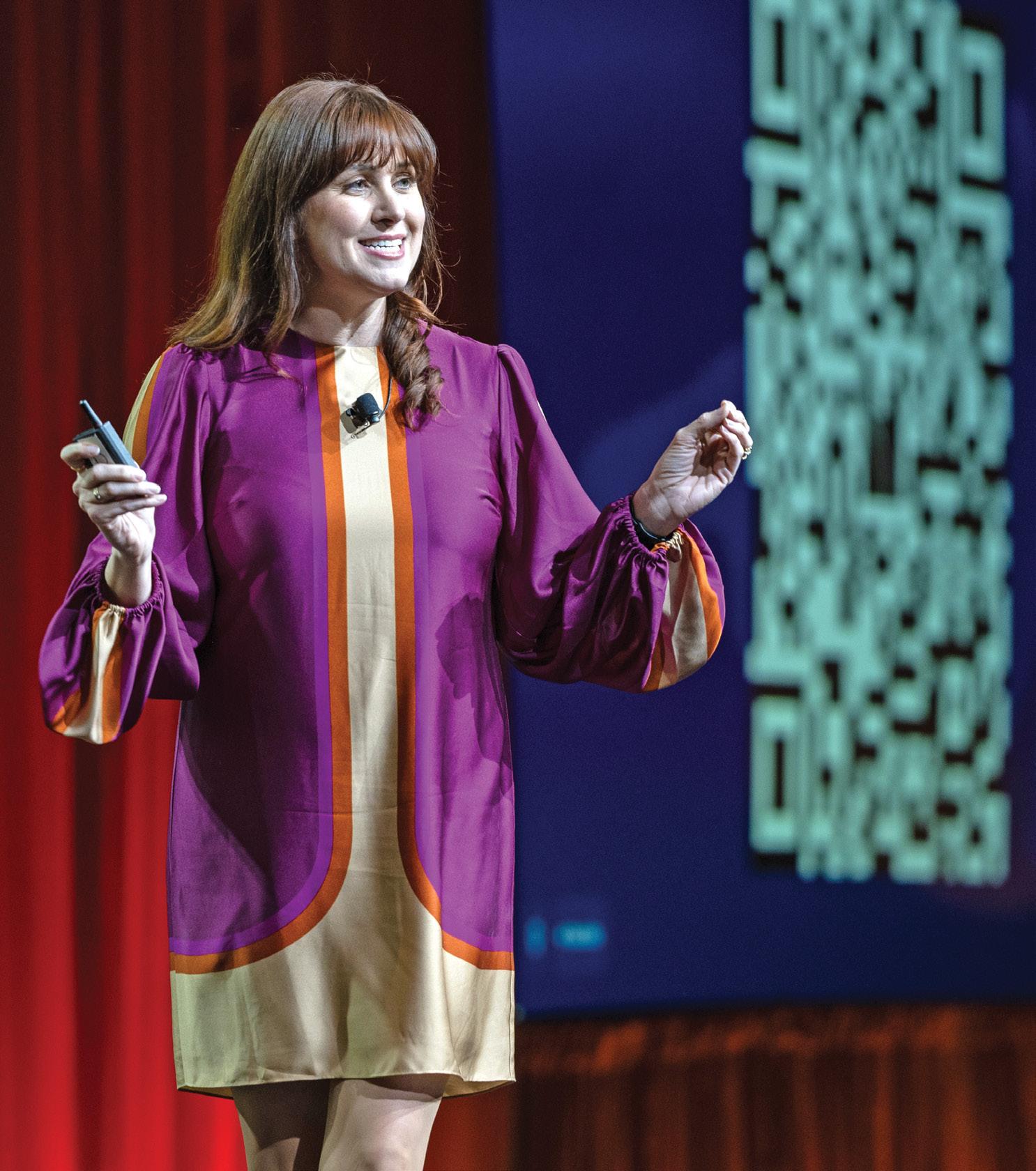
Keynote speaker Brittney Hodak, author of Superfans set the tone right from the start. Her message was clear: When we combine strong, human in-store experiences with the right technology, we can deliver exceptional service and build lasting customer loyalty.
That theme carried through the general sessions, where franchisees and industry partners tackled the ongoing employee reset and the evolving definition of value in service. These discussions reinforced the importance of staying adaptable while remaining focused on the fundamentals that drive our businesses forward.
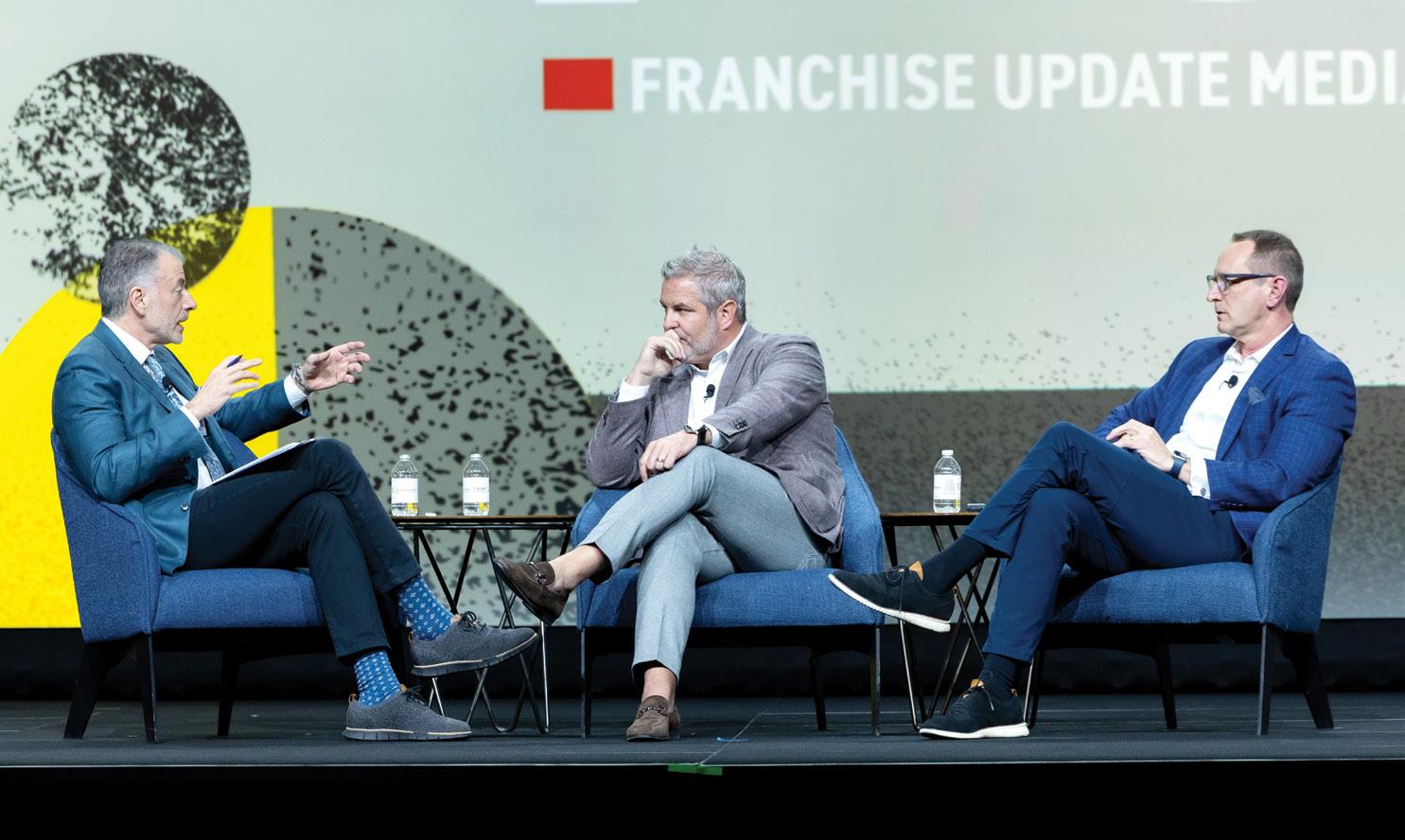
One of the highlights of the conference was the fireside chat between Matt Haller and Greg Flynn. Hearing Flynn share his journey and insights on scaling, leadership, and growth was both engaging and incredibly valuable for operators at every stage.
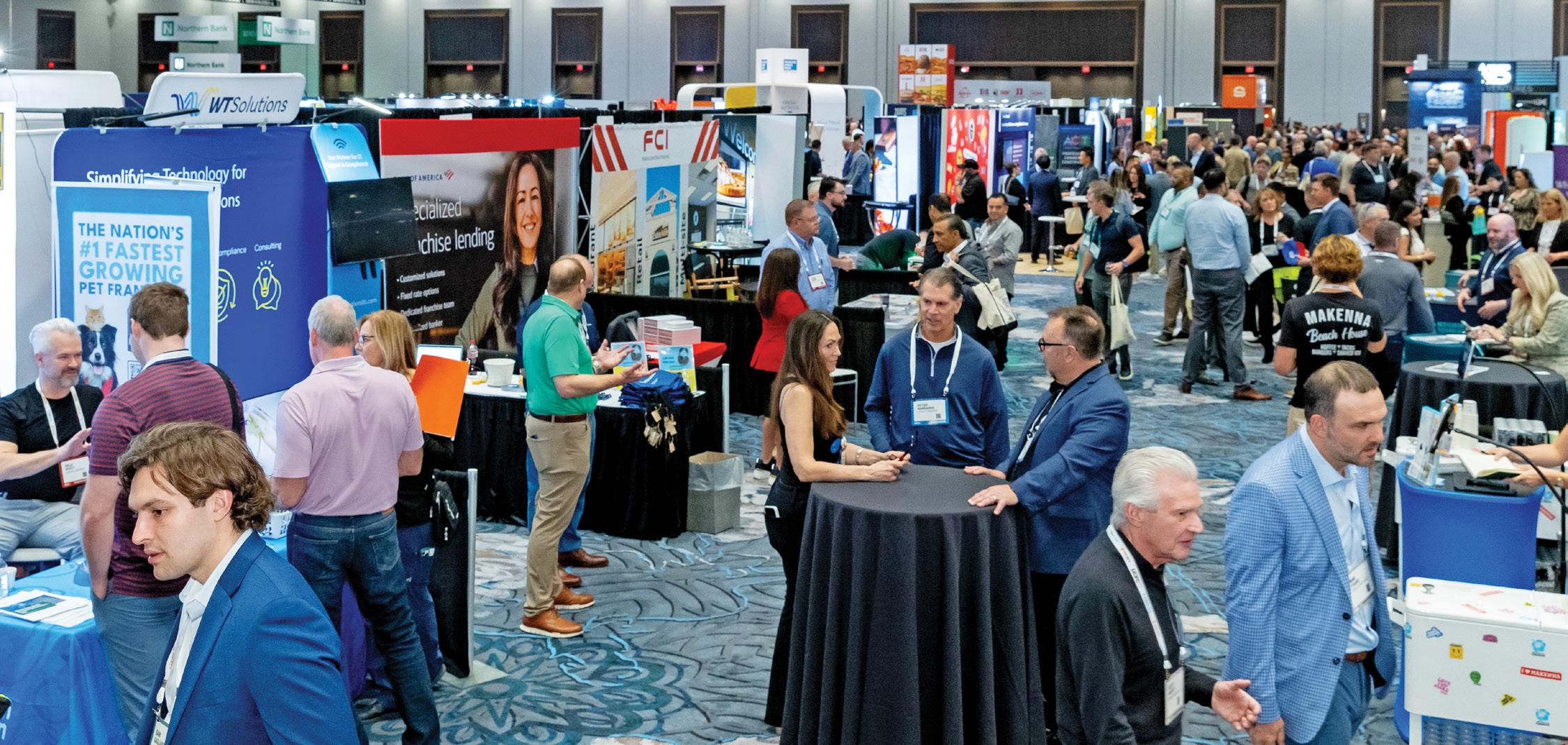
The Exhibit Hall was another standout, filled with brands and vendor partners
offering new ideas, innovative solutions, and opportunities to help all of us run stronger, more efficient businesses.
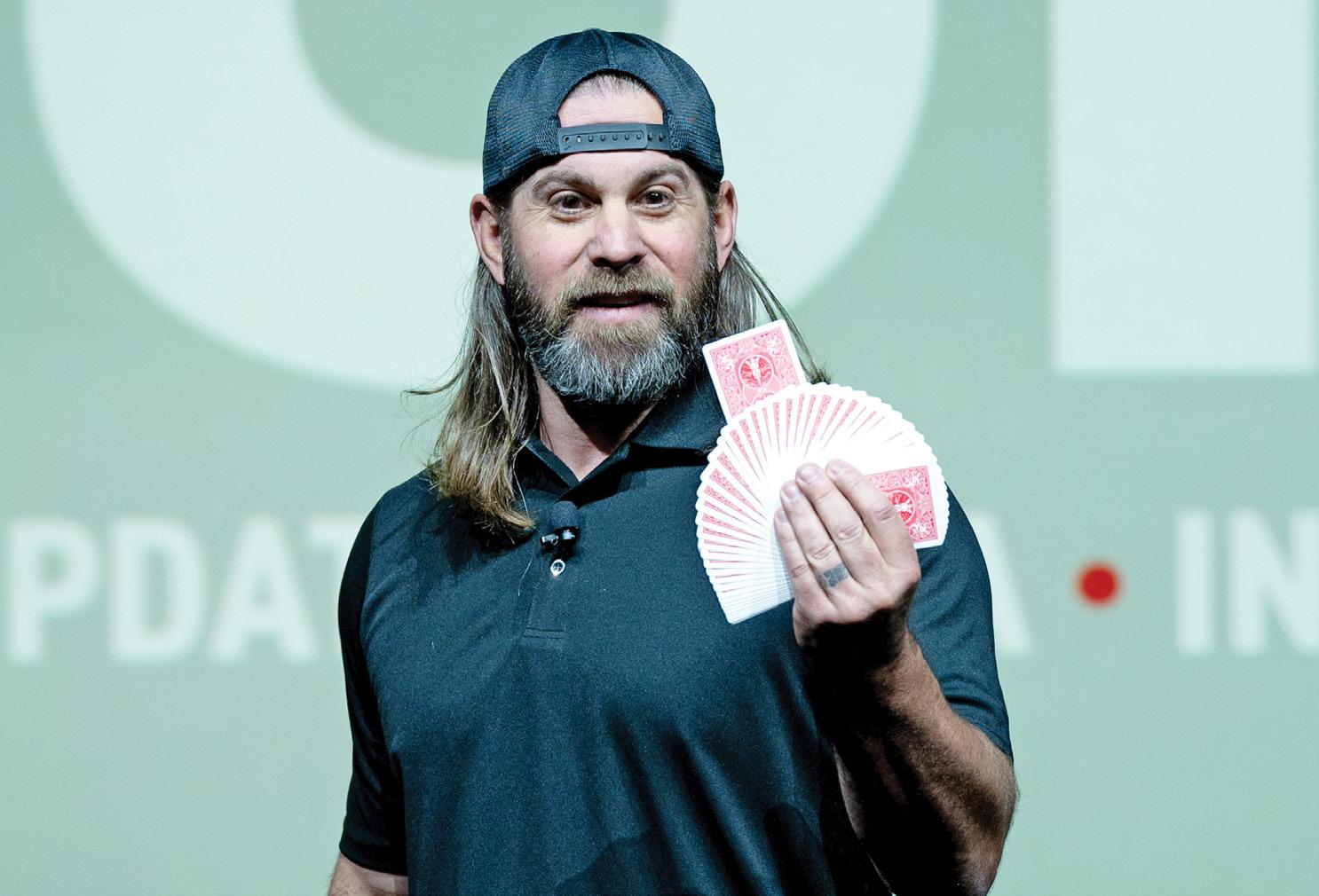
Day 2 continued to inspire with powerful presentations from Jon Dorenbos and Jim Craig. Both speakers shared personal stories about overcoming adversity and reminded us that resilience, mindset, and preparation play critical roles in business and life.
It has been an honor to serve as chairman for MUFC 2026. I want to thank the Franchise Update Media team and everyone who worked behind the scenes to make this event such a success. Most importantly, thank you to all of you who invested in yourselves and your businesses by attending this year’s conference.
If you weren’t able to join us this year, I encourage you to make plans to attend MUFC 2027. You won’t want to miss it.
Congratulations to Nicholas Marco as he steps into the role of chairman for MUFC 2027. I know he will lead an outstanding event that continues to elevate our industry and create even more opportunities to learn, connect, and grow.
Thank you again for being part of MUFC and for helping make franchising one of the greatest industries in the world.
Mitch Cohen
MITCH COHEN MUFC 2026 Chair
Top Third Avg. Net Profit*
$262,379
Top Third AUV*
$1,421,960
*2025 fiscal year figures based on the top third of six Jeff's Bagel Run affiliate-operated stores open and operating for a full fiscal year as of 12/31/2025. One of these affiliate-operated stores exceeded these figures and five did not. Your individual results may differ. The bottom third had an AUV or average "Sales" of $821,416 and Avg. Net Profit of $19,487. See Item 19 of JBR Franchising Co's Franchise Disclosure Document for definitions of "Sales" and "Net Profit" and additional information. Written substantiation for the financial performance representation will be made available to a prospective franchisee upon reasonable request.
This advertisement is not an offering. An offering can only be made by prospectus filed first with the Department of Law of the State of New York. Such filing does not constitute approval by the Department of Law. MN – 11233.
THESE FRANCHISES HAVE BEEN REGISTERED UNDER THE FRANCHISE INVESTMENT LAW OF THE STATE OF CALIFORNIA. SUCH REGISTRATION DOES NOT CONSTITUTE APPROVAL, RECOMMENDATION OR ENDORSEMENT BY THE COMMISSIONER OF THE DEPARTMENT OF FINANCIAL PROTECTION & INNOVATION, NOR A FINDING BY THE COMMISSIONER THAT THE INFORMATION PROVIDED HEREIN IS TRUE, COMPLETE, AND NOT MISLEADING.
Franchisees of Note: The 2026 Multi-Unit MVP Awards
Written by M. SCOTT MORRIS
At the 2026 Multi-Unit Franchising Conference in Las Vegas, Multi-Unit Franchisee magazine recognized this year’s MVP Award winners, operators who continue to raise the bar across the franchise landscape.
These franchisees have built more than unit counts. They’ve built organizations. Over time, they’ve taken on the hard work of growing teams, refining systems, and making decisions that ripple across multiple locations. Along the way, they’ve navigated shifting consumer expectations, tighter labor markets, and the constant pressure to perform.
What sets this group apart is how they approach those challenges. They invest in people, creating pathways for employees to grow into leaders. They stay close to their numbers, using data to guide decisions while remaining grounded in day-to-day execution. And they look for opportunities to improve, whether that means adopting new technology, streamlining operations, or rethinking how they serve customers.
Their stories reflect a willingness to adapt. Some expanded into new brands. Others strengthened their existing portfolios. Many leaned on mentors, peers, and teams to work through obstacles and seize opportunities. In every case, progress came from steady effort over time.
Franchising provides a framework, but it’s the operator who brings it to life. The early mornings, the long days, the constant problemsolving: Those are the realities behind the results. This year’s MVPs have embraced that responsibility and used it to build businesses that are both resilient and forward-looking.
In the pages that follow, their experiences offer a closer look at what it takes to grow, lead, and evolve in today’s environment. Together, they represent the kind of disciplined, peoplefocused leadership that continues to shape the future of franchising.
WINNERS
Luke Andrus
MEGA-GROWTH LEADERSHIP MVP
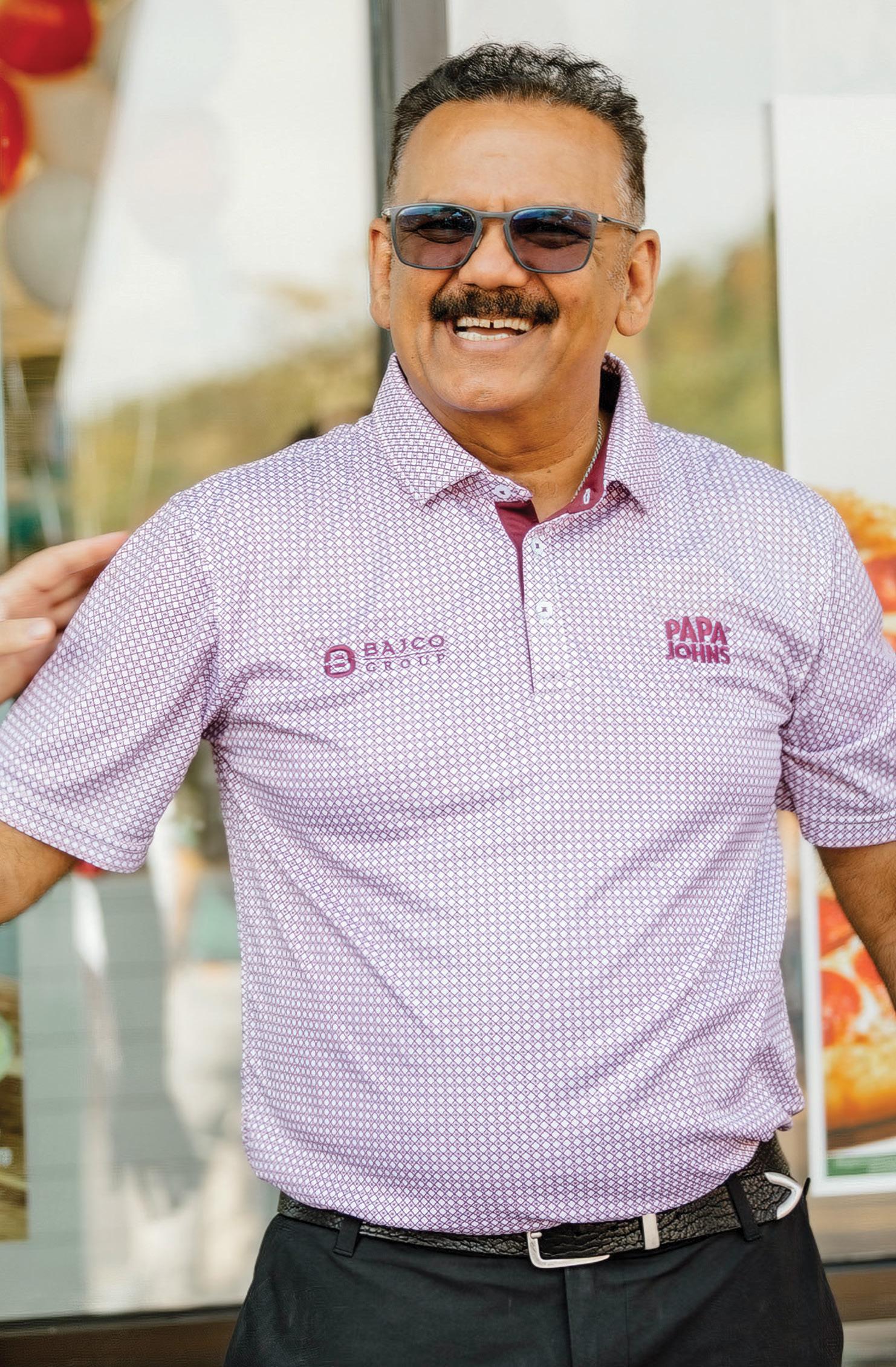
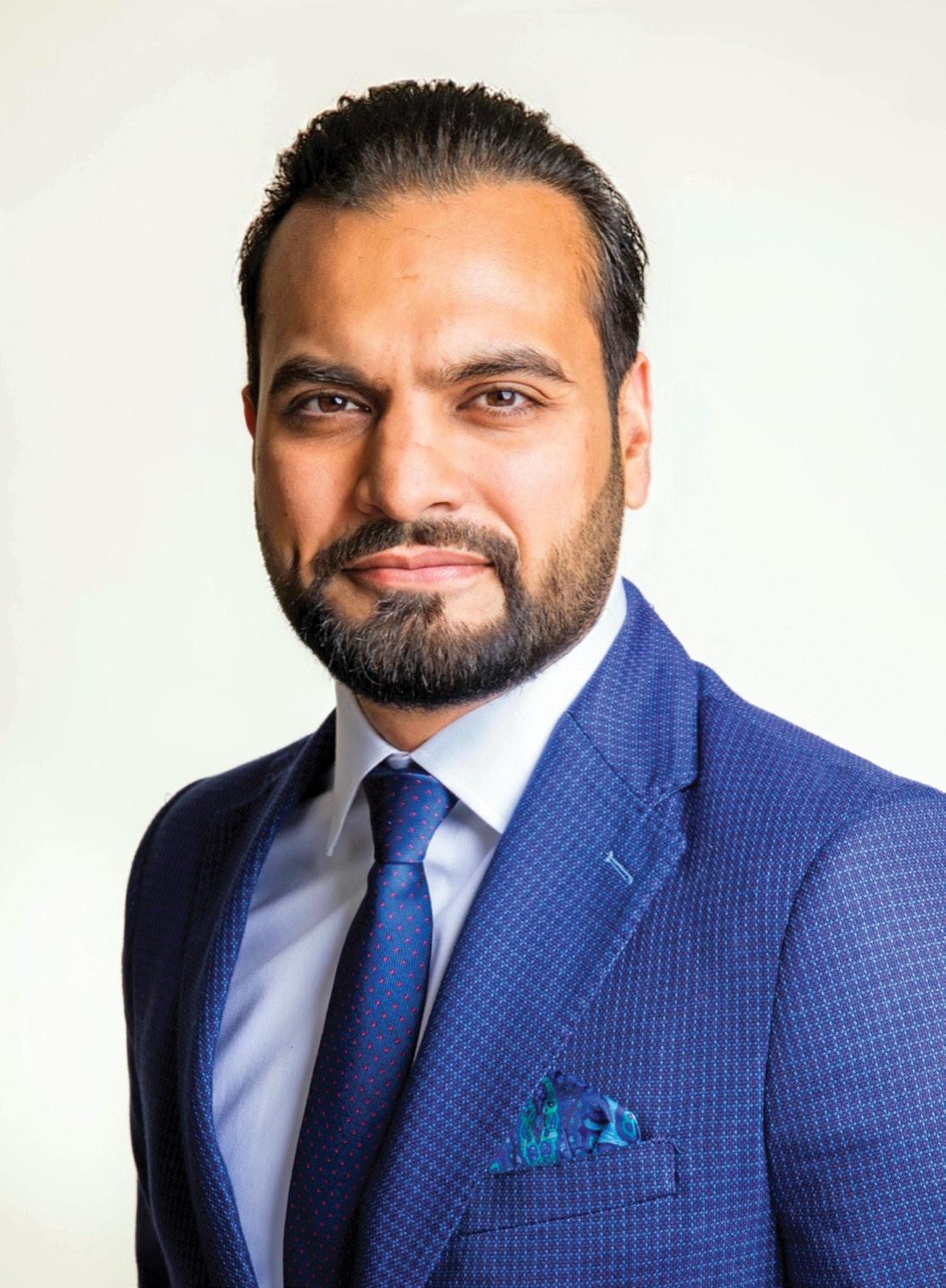
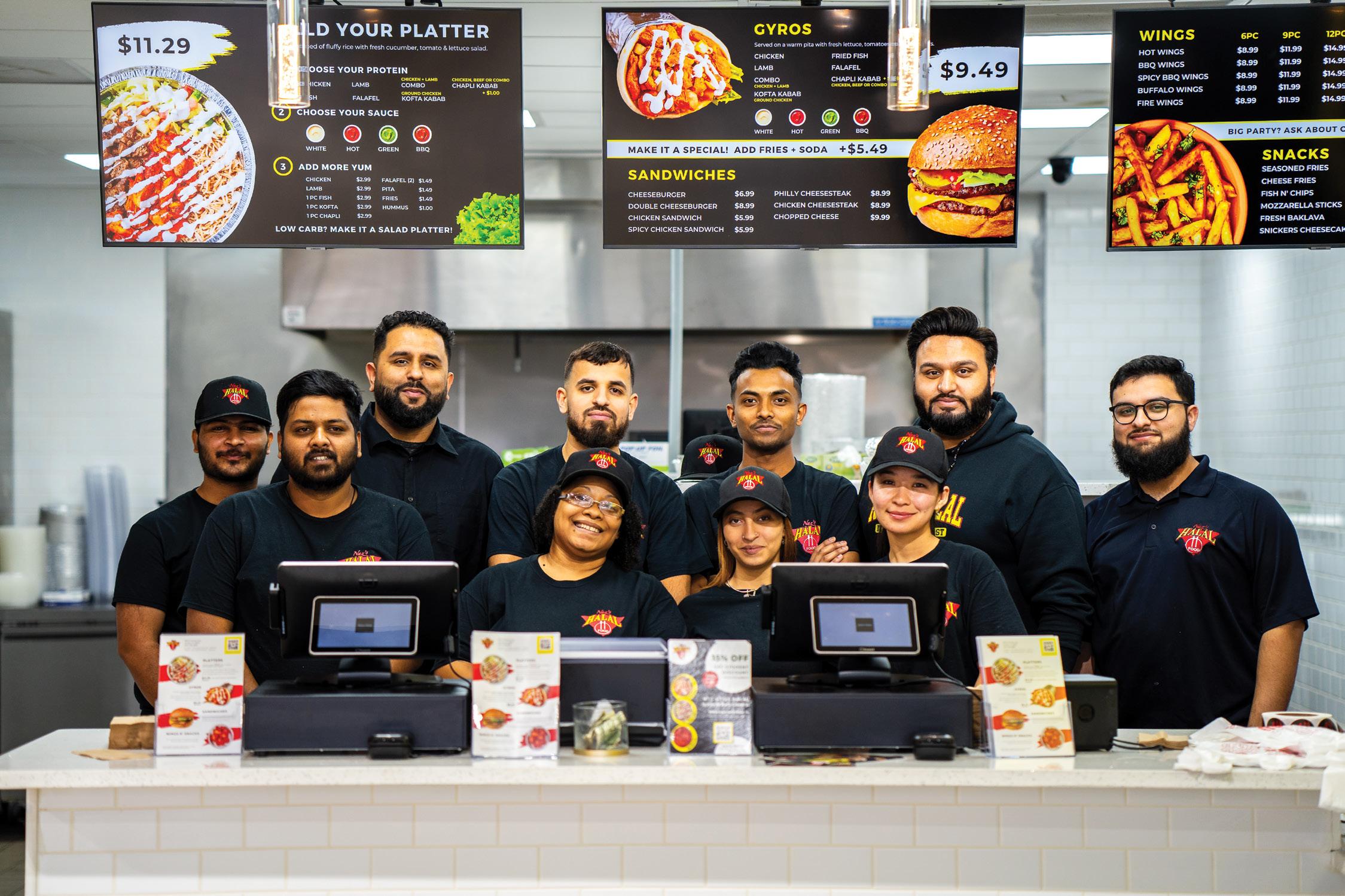
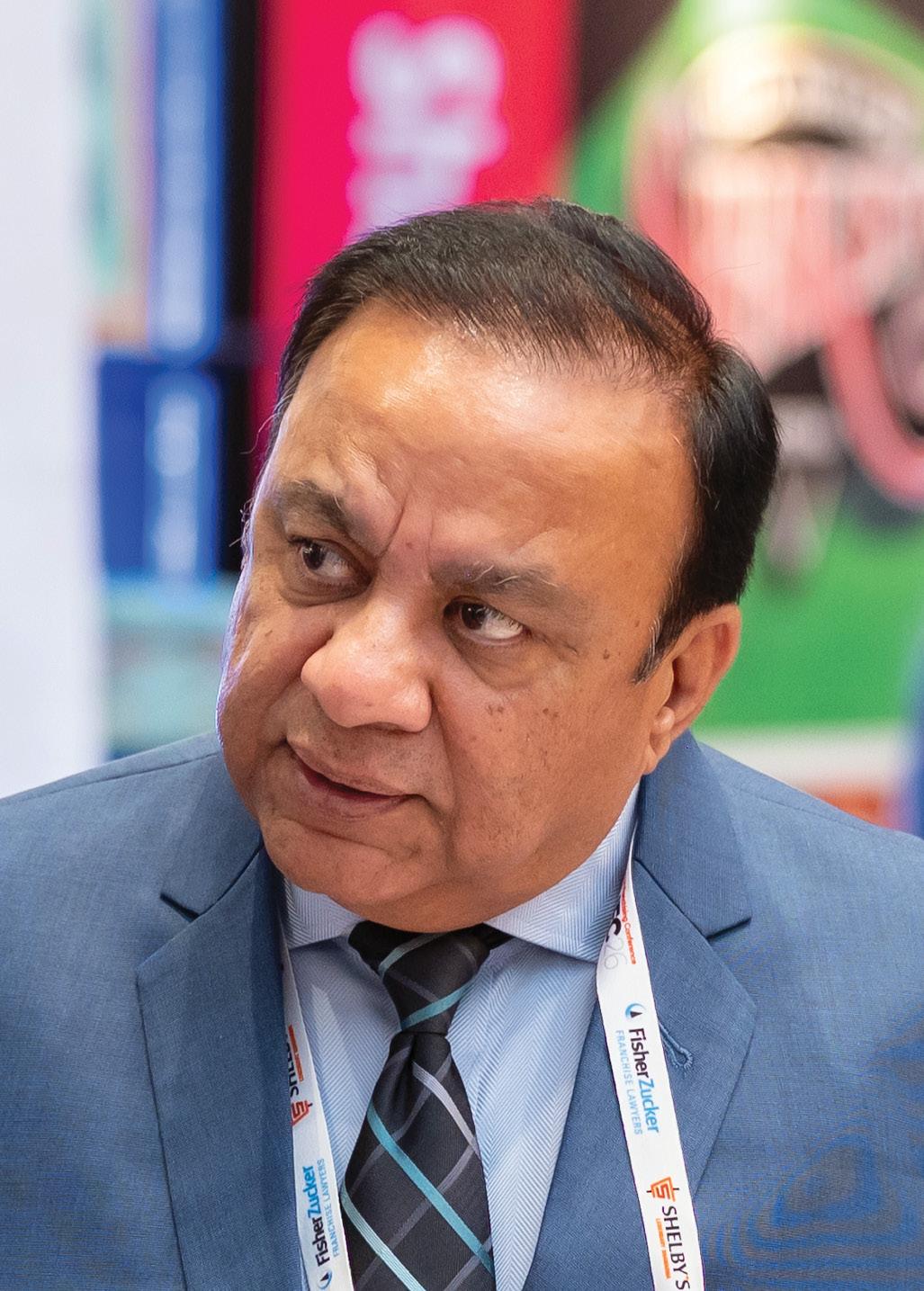
Nadeem Bajwa
AMERICAN DREAM MVP
Bart and Theresa Casiello
2026 INNOVATION AWARD MVPS
Rick Cseak
VETERAN ENTREPRENEURSHIP MVP
Bryant Greene
SINGLE-BRAND LEADERSHIP MVP (TIE)
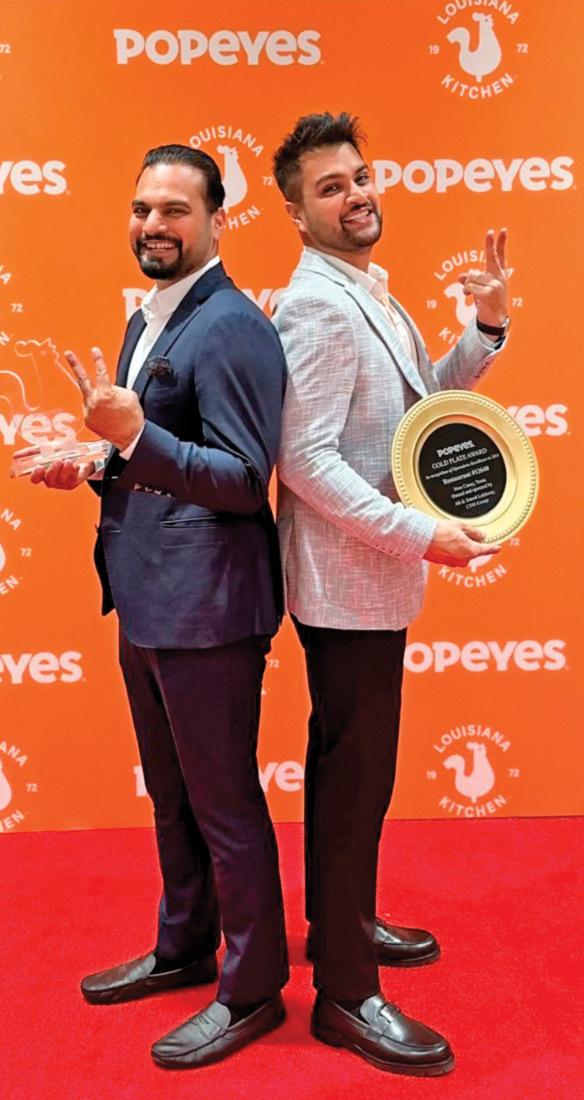
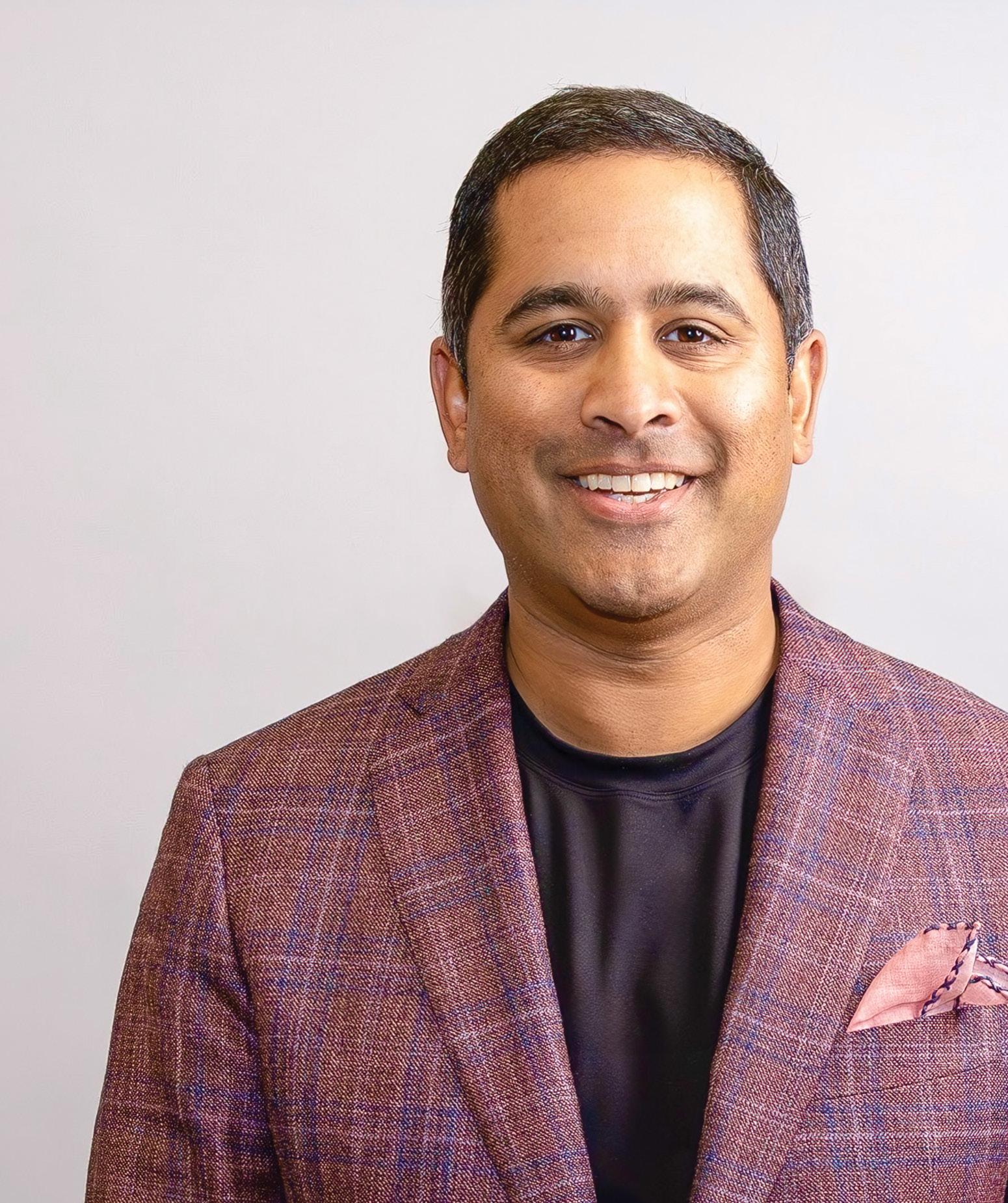
Ali Lakhany and Emad Lakhany
MEGA-BRAND LEADERSHIP MVPS
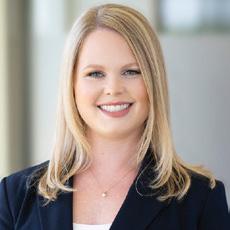
Katie Lee and Brian and Hope Bayer
SINGLE-BRAND LEADERSHIP MVPS (TIE)
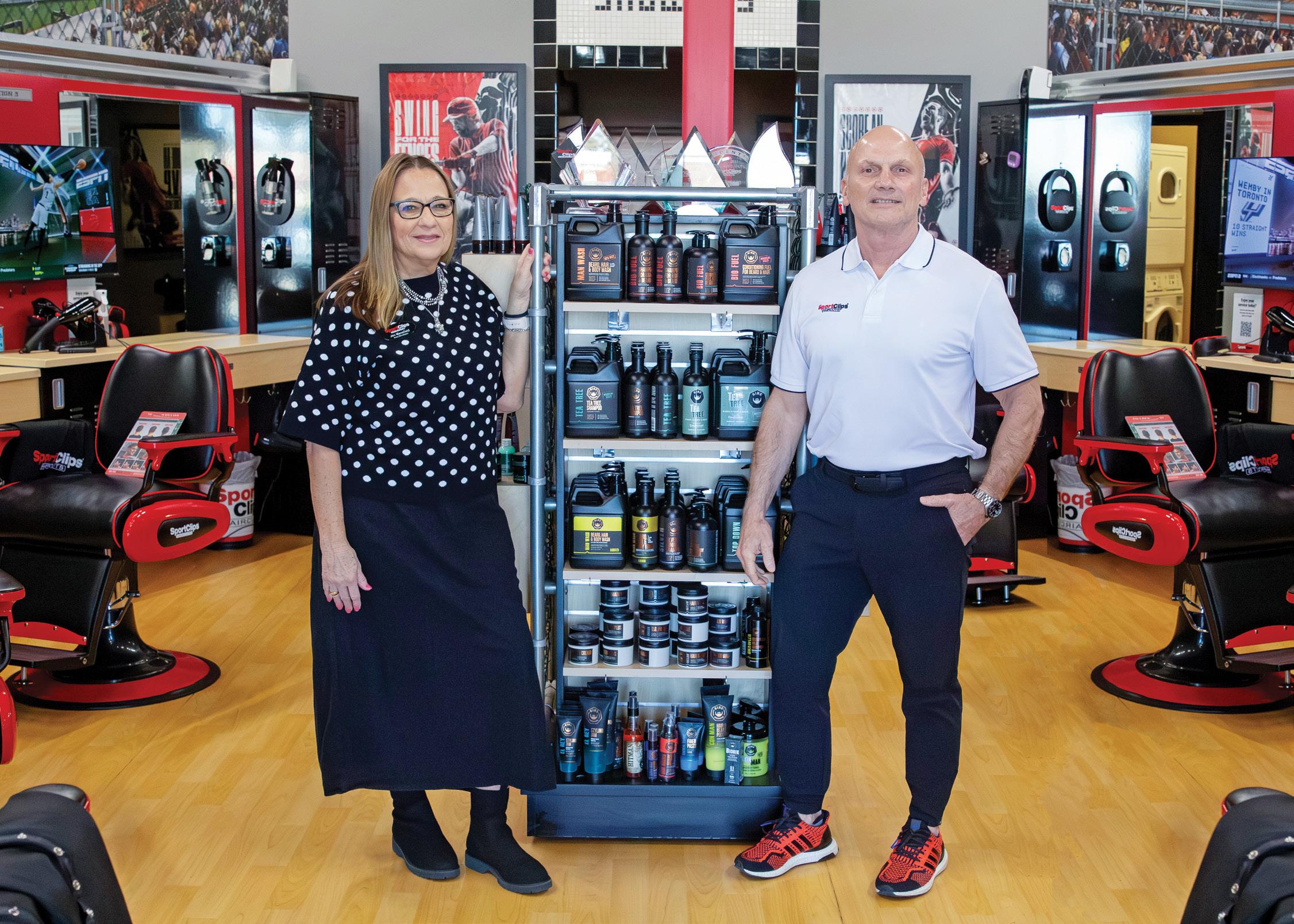
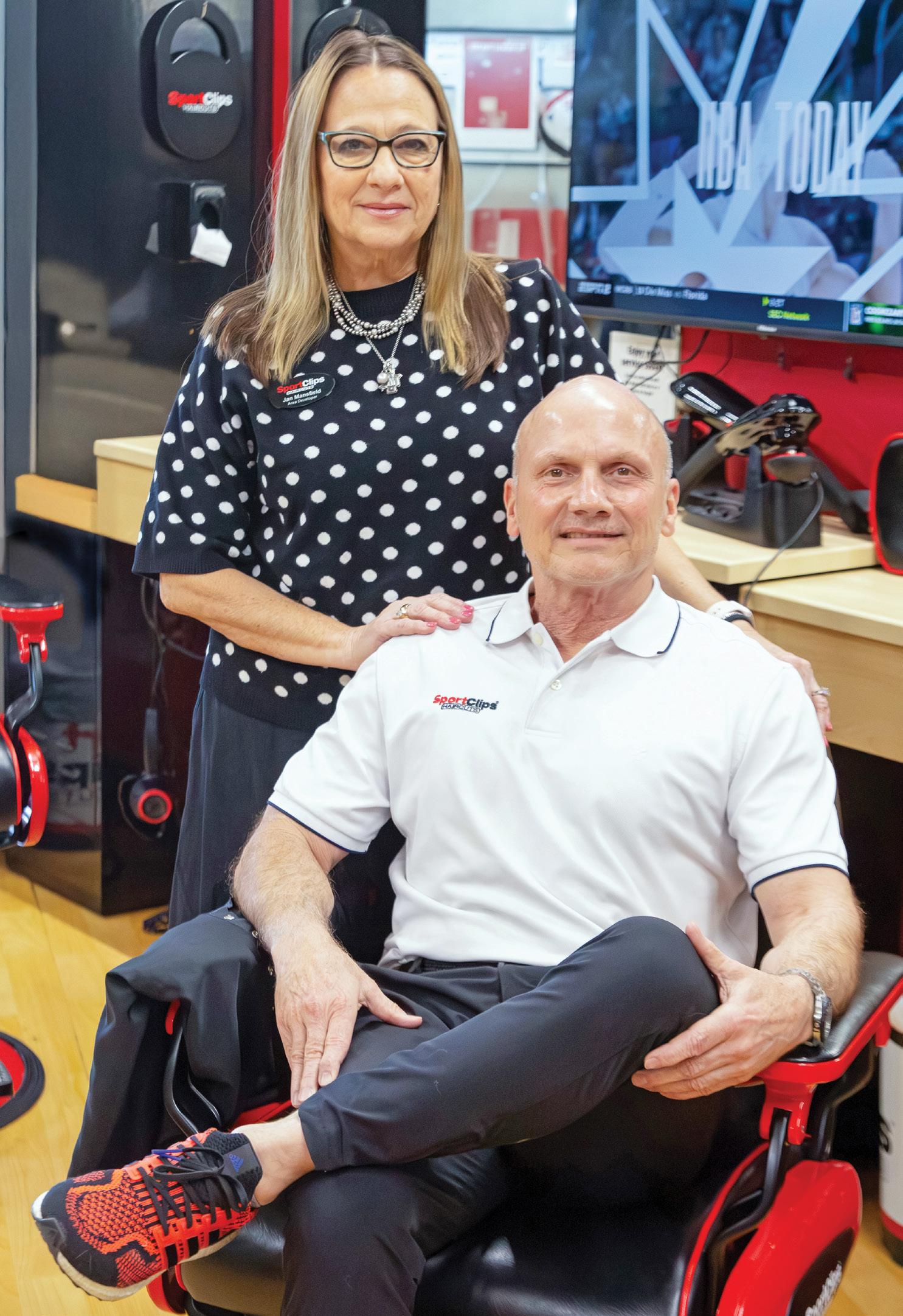
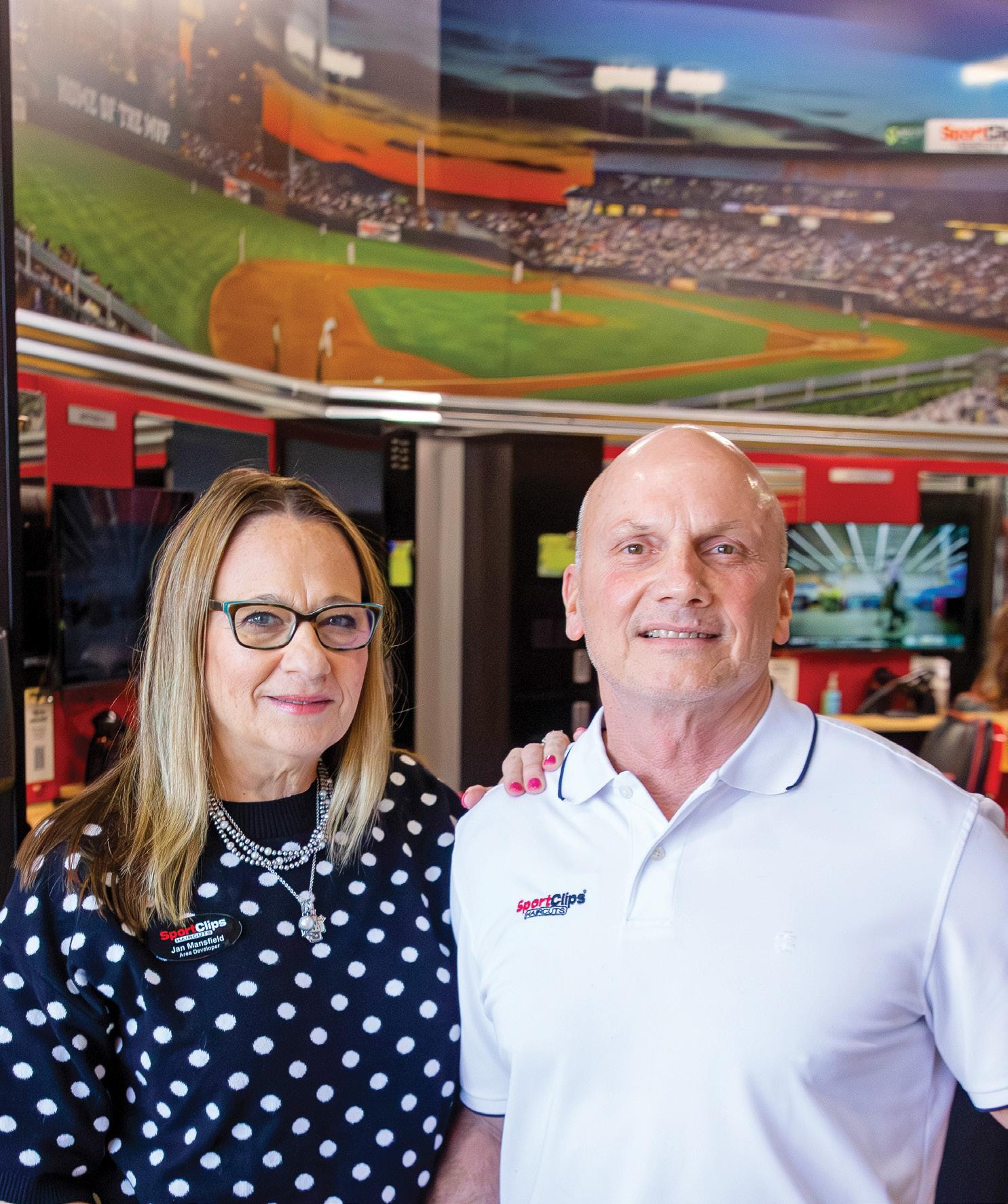
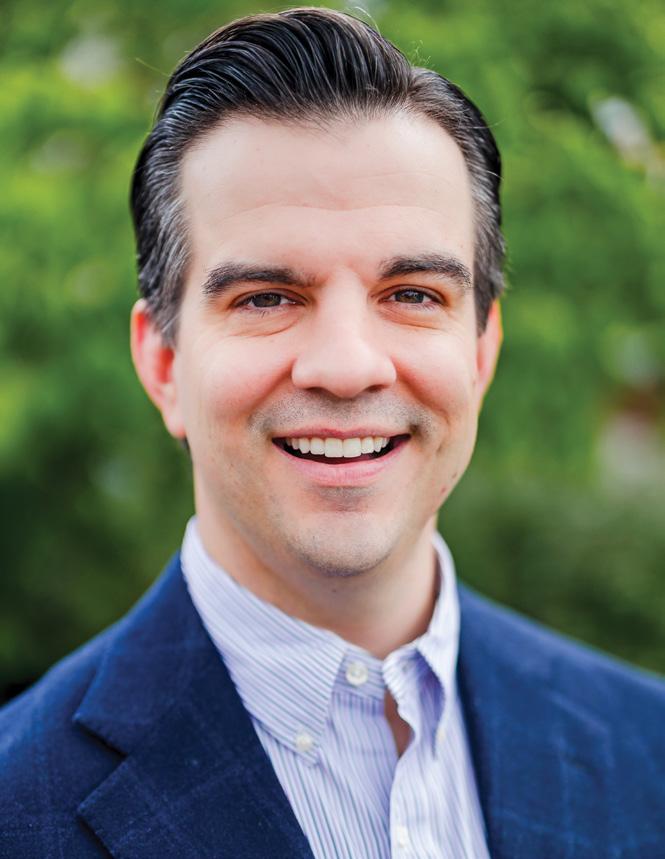
Mark and Jan Mansfield
HUSBAND & WIFE TEAM MVPS
Wade Oney
SPIRIT OF FRANCHISING MVP
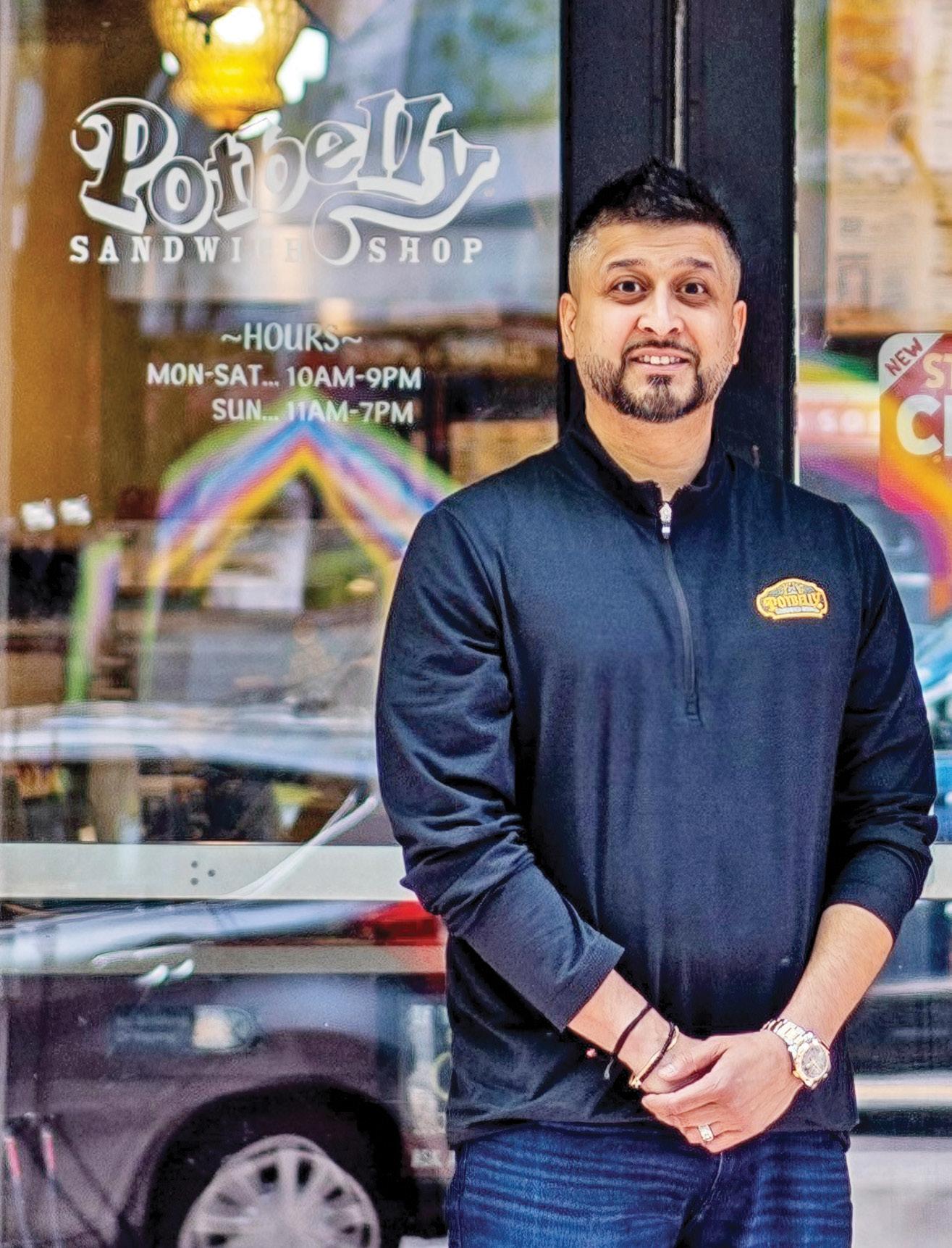
Shak Patel
NOBLE CAUSE MVP
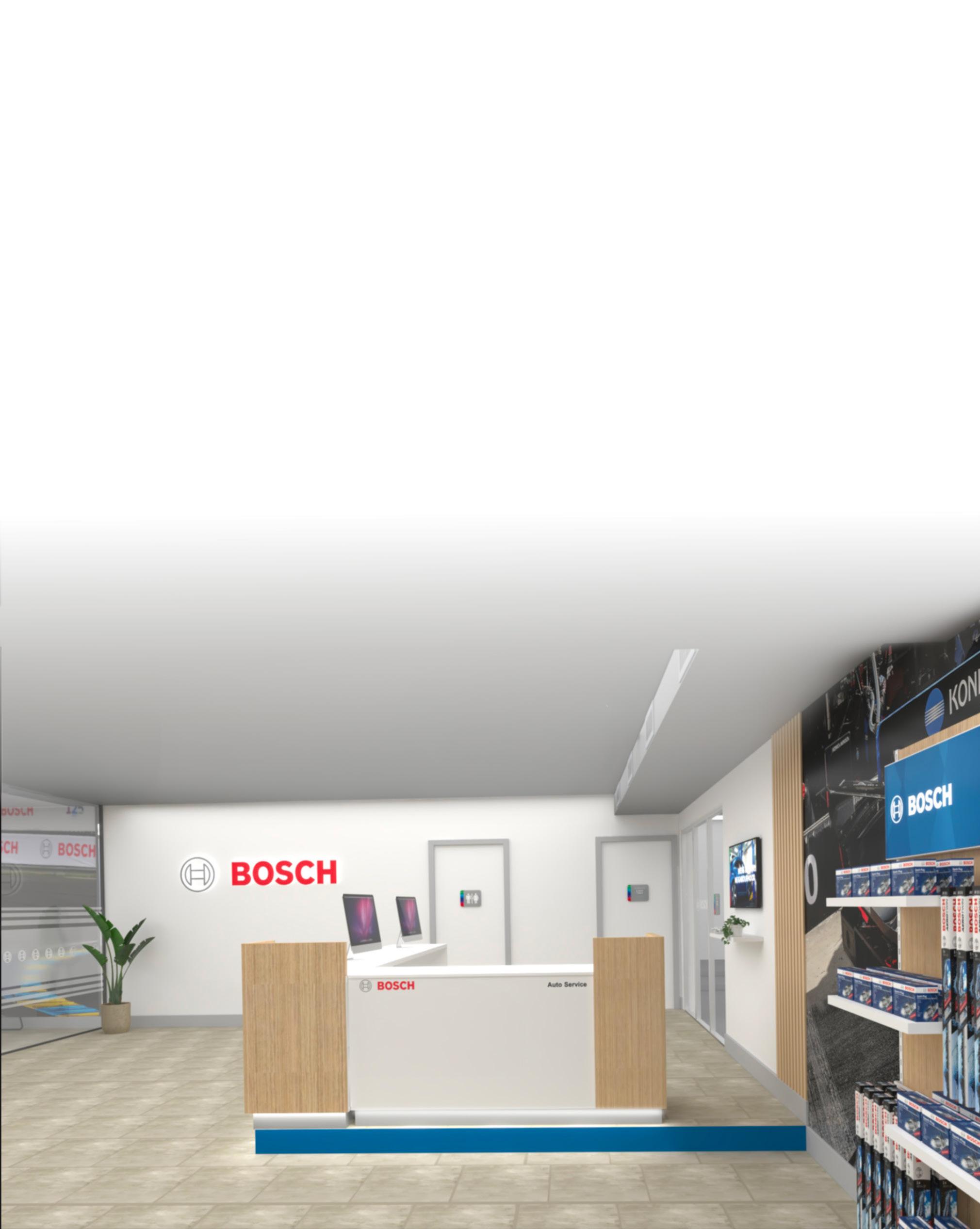
INVEST IN THE FUTURE OF AUTO REPAIR
With a Bosch Auto Service Franchise.
Vehicles are becoming more advanced, staying on the road longer, and requiring increasingly specialized diagnostics and expertise. As automotive technology evolves, the service market is shifting toward providers equipped to meet this new level of complexity.
A Bosch Auto Service Franchise gives you entry into this growing, essential industry with the backing and brand recognition of the world’s leading automotive suppliers. Beyond expert training and ongoing business support, you would gain exclusive access to Bosch industry insights, a strategic advantage that helps you anticipate trends, make confident decisions, and stay ahead in a rapidly evolving automotive market.
Step into the future. Franchise with Bosch.
“2025 was a banner year for us. We purchased 34 locations and opened one, including closing on 21 locations in one day.”
Bulking Up
CEO targets top spot in Anytime Fitness system
Written by KEVIN BEHAN
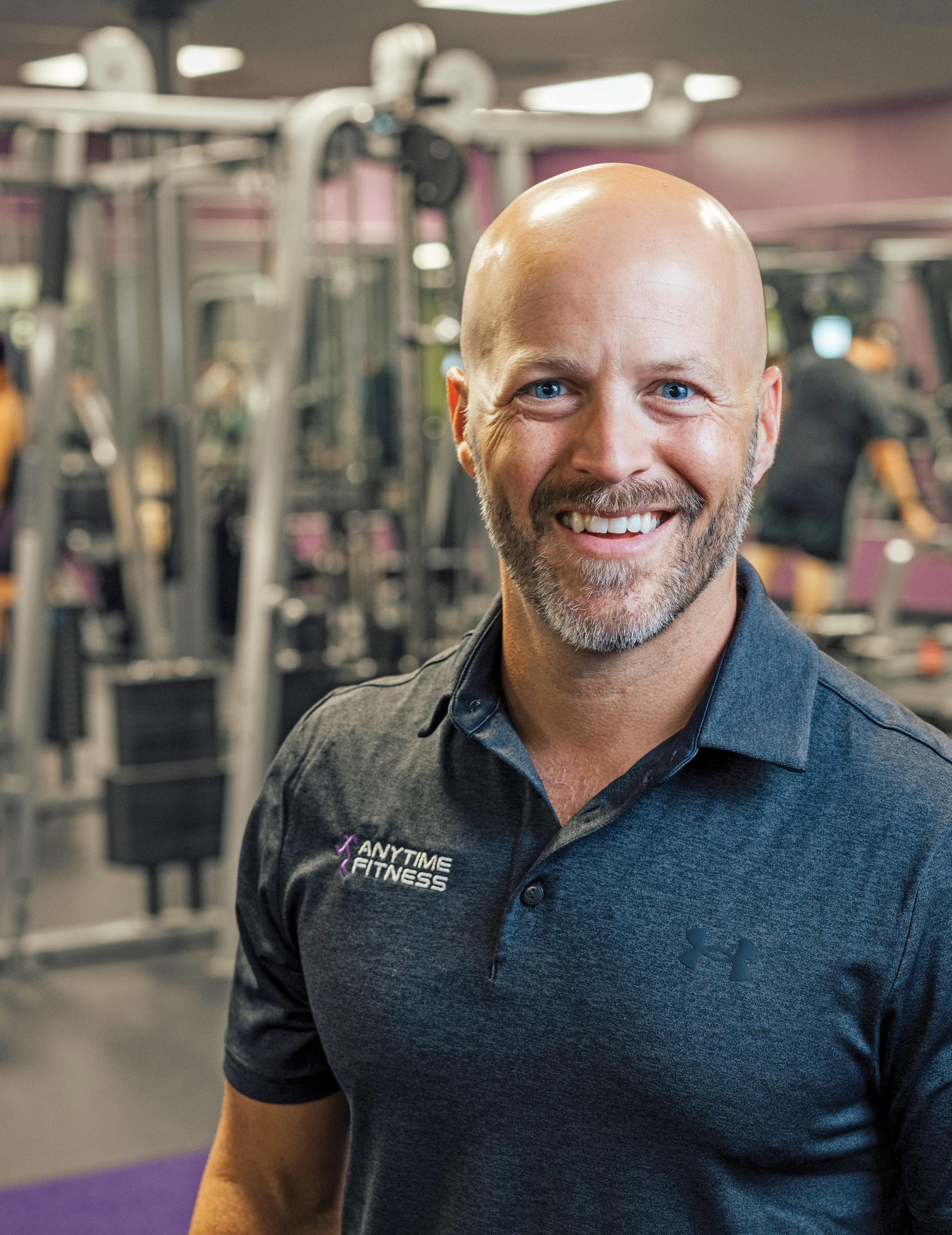
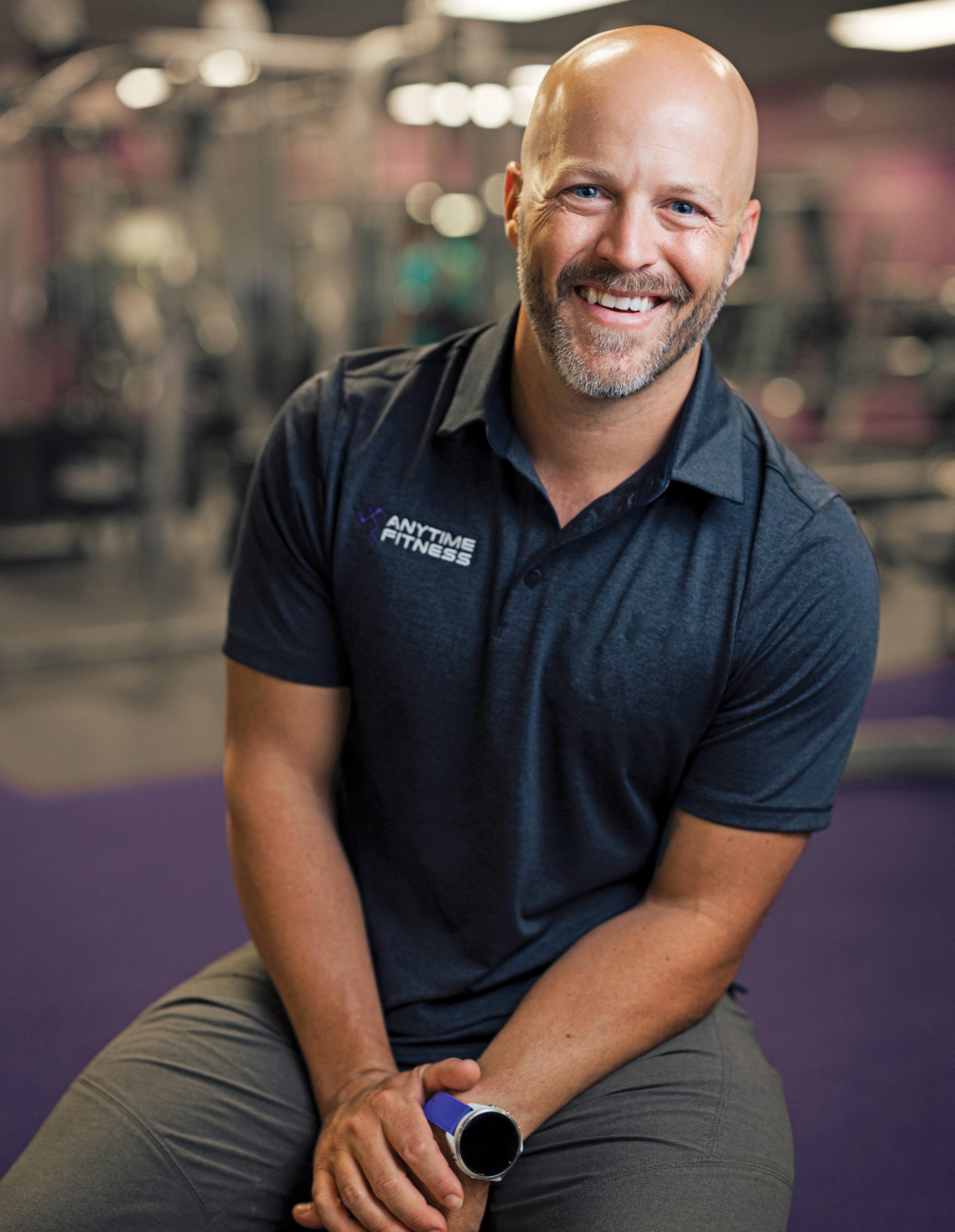
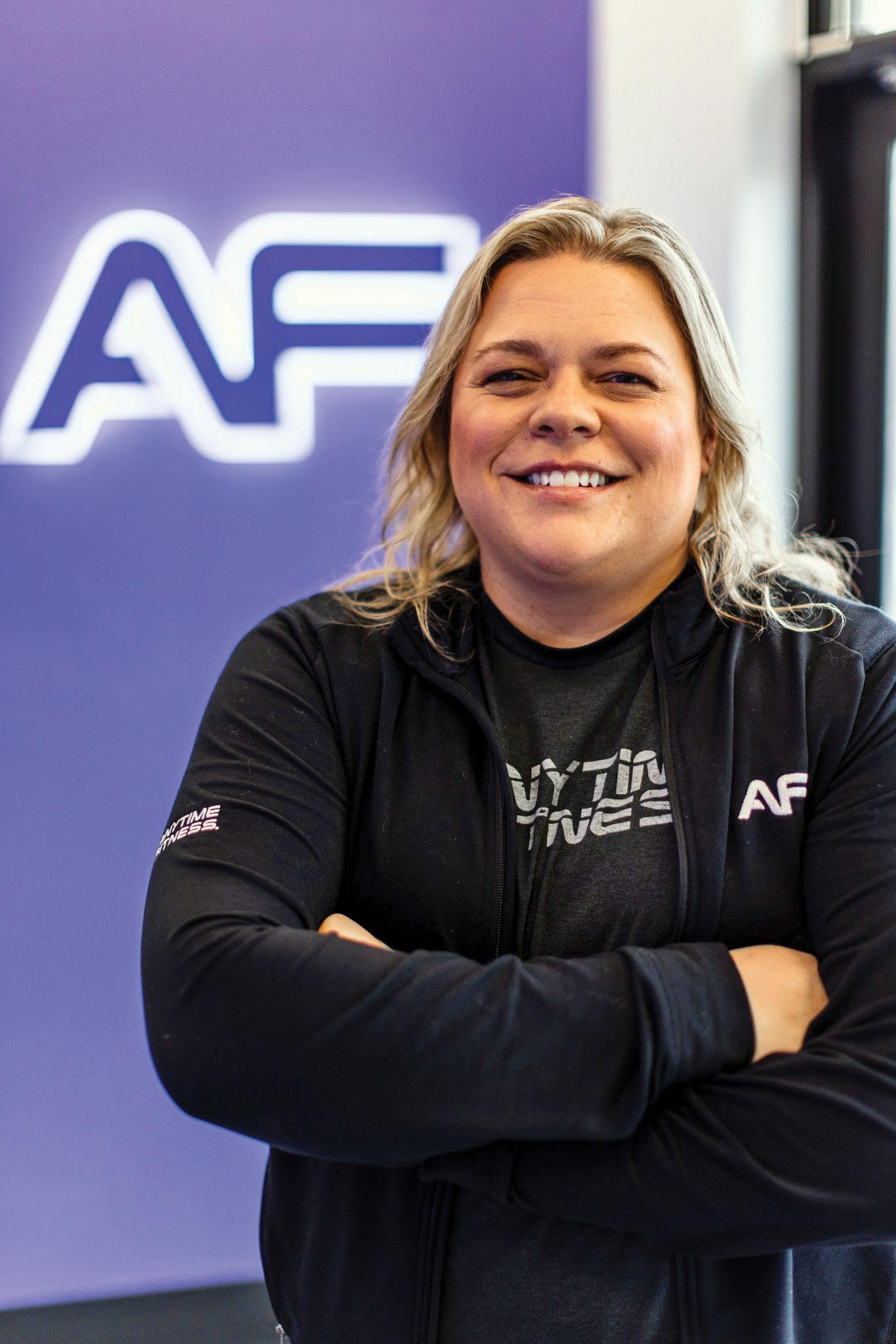
When Multi-Unit Franchisee magazine profiled Luke Andrus in 2024, he operated 46 Anytime Fitness locations and aimed to double the number of gyms over the next five years. He has nearly reached that mark in less than half that time while setting his sights on becoming the largest franchise group in the Anytime Fitness system.
As CEO of Blue Star Investments, Andrus now owns 83 units across 16 states. He added 35 locations in 2025 alone, which is a primary reason why he earned the MegaGrowth Leadership MVP. He is also quick to credit his business partner, Kevin Tupy, for the group’s aggressive approach to scaling the business.
“I never saw myself as being CEO of one of the largest Anytime Fitness groups in the country,” Andrus says. “I am pas sionate about leadership, and I’m passionate about jobs. It is Kevin who brought growth to the table, so I said, ‘Let’s go to the moon.’ When I came on board, I thought we would have around 50 locations. But growth is addictive because it provides more opportuni ties for my employees to achieve their dreams.”
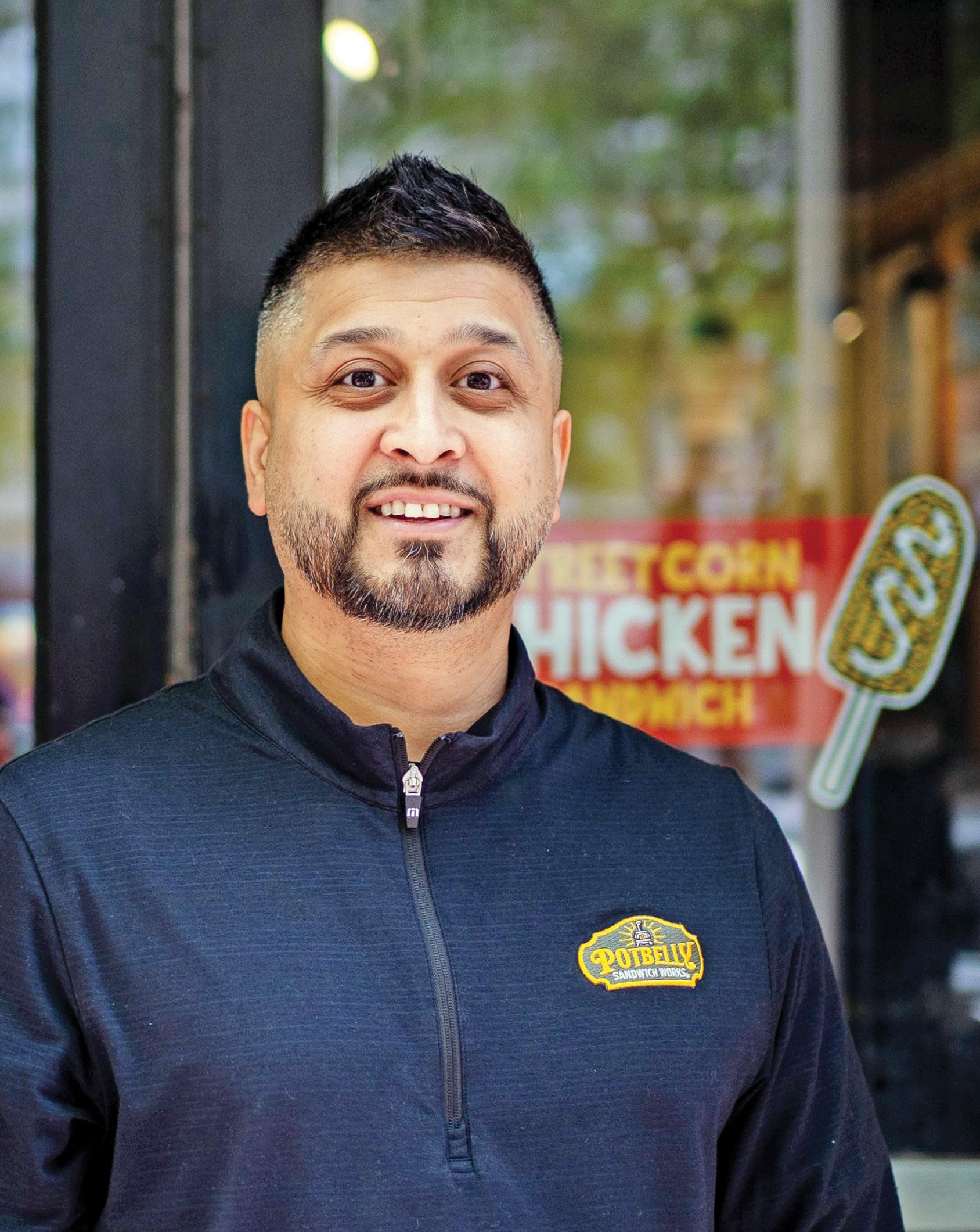
Luke Andrus is the Mega-Growth Leadership MVP (Most Valuable Performer) for achieving excellence in growth and expansion.
A former personal training director and fran chise business consultant with Anytime Fitness, Andrus became a franchisee with Tupy in 2019, owning 10 gyms. He originally came aboard as COO, but four months later, the CEO resigned, and Tupy told him, “Luke, you are the horse I’m betting on.”
As he tried to navigate in this sudden, unexpected role, Andrus Googled “Accidental CEO” and
MVP Awards
found David Novak’s book, The Education of an Accidental CEO. He read the book while traveling to Anytime Fitness’ corporate headquarters in Minnesota and learned some important takeaways about leadership and delegation.
He discovered that customers often evolve more quickly than corporations, and he realized the fitness sales process is different now than when he worked in that role a decade ago. He has learned to trust his current sales team’s method of reaching potential customers through videos and social media. By trusting his team, Andrus can focus on overall financial numbers while letting them carry out the sales process and suggest refinements.
Andrus’ approach to adding locations is primarily through acquiring high-performing units and taking them from good to great. That means holding his locations to the highest standards of Anytime Fitness’ three pillars of operations: cleanliness, friendliness, and well-maintained centers. He has reinvested in his business by renovating seven clubs last year and plans to refurbish 15 this year and another 20 in 2027.
It is easy to wonder how the married father of five young children finds enough hours in the day. He says the key for him is to cherish the moments of silence in his life, which slow down time. He ran a 50K race in February and used that time to enjoy the silence and meditate.
“Human beings are resilient and learn to adjust pretty darn quickly,” Andrus says. “The more you load on, the more you can handle. Your muscles get stronger. You just find a way.”
MVP QUESTIONS
Why do you think you were recognized with this award? 2025 was a banner year for us. We purchased 34 locations and opened one, including closing on 21 locations in one day in October.
How have you raised the bar in your own company? I think raising the bar simply comes down to consistent execution while including vision and purpose for what we’re doing. Words can do only so much. I imagined that as a CEO, I’d be playing golf with fewer day-to-day tasks, and that’s just not how we can lead in this industry. The work looks different, but the grind stays the same. Every day, you move the business forward by getting into the details and communicating with your team. While we do that, we celebrate the wins that give us purpose.
The other part is elevating leaders who can lead from the trenches and by example. I’m grateful to have John Witzke, our VP of sales, leading from the front. When it comes to raising the bar, the example he has set is unparalleled in the Anytime Fitness world, and our territory managers and regional managers are happy to rise to it.
What innovations have you created and used to build your company? Our proudest innovations are happening in our ability to continuously evolve in our saturated industry with our new gen-
eration of members. Our sales funnel and process evolve to our gym members, and our business structure evolves to the needs of our team members and what they value most. Our VP of sales has done a great job of this. Getting a fresh mind from a retail background and planting it in the service industry was one of our best decisions. They continue to effortlessly execute the things that take no talent and focus our efforts on constantly improving what does take talent. In addition to this, we continue to keep our business performance visible via scorecard on the front lines every morning. Our sales team does a heat check every day to keep the performance and provide advice on how to improve front and center.
LUKE ANDRUS
CEO
Company: Blue Star Investments
Units: 83 Anytime Fitness
Age: 42
Family: Wife and 5 children, ages 13, 11, 7, 5, and 1
Years in franchising: 17
Years in current position: 6
What core values do you think helped you win this award? Our four core values have stayed the same since we implemented them in 2020:
• Be humble, hungry, and smart.
• Relentlessly execute the fundamentals.
• Grow and develop future leaders.
• Be a “daymaker.”
These values have contributed to who we want to be, how we execute, where we want to go, and how we serve our members.
How important is community involvement to you and your company? Extremely. Especially given the marketing challenges we are all facing in a growing industry. The online world has become highly competitive, and we are getting back to our roots by continuing to be as involved as possible in our local communities.
We have done everything from leading the way in local runs to developing deeply personal ways to serve our community. For example, our team in LaPlace, Louisiana, hosted a memorial service for one of our deceased members at the club. He was a transplant to South Louisiana and had only one liv-
ing family member who lived in New Jersey. When the team realized he wouldn’t be having a funeral, they put a memorial service together. More than 60 people from our club and community attended, including his sister, who flew in from New Jersey. It was truly beautiful, and it’s why our clubs are a haven of community and comfort.
What leadership qualities are important to you and your team? Anytime Fitness has had great service standards for years now. It is known as PLEASE: personal, listen, empathy, anticipate, sense of urgency, and encourage. These exist for our members, but if we aren’t treating our team members the same way, it means nothing. If we treat our team right, it will bleed down to our customers.
PERSONAL
First job: My first job was building cabinet doors for my dad in his cabinet shop when I was 12 years old.
Formative influences/events: I began to take a personal interest in health when my mother was diagnosed with lung cancer. I was 14 years old at the time. She died when I was 16 years old, and I got my first job in the fitness industry shortly after.
Key accomplishments: In 2014, I won the Anytime Fitness Trainer of the Year award at our international conference. Currently, we are the third largest franchise group in our system, and we won an IFA Franchisee of the Year award in 2025.
Biggest current challenge: Our biggest challenge is to continue to grow in membership in a tough economy with increased competition.
Next big goal: We’d like to reach 100 gyms without compromising our same-store growth.
First turning point in your career: The first turning point in my career was when I won the Trainer of the Year award. It gave me a platform to speak to as many owners as I could to offer advice. This lit a fire in me to help as many business owners as I could, which led to consulting, and that eventually led to my partnership.
Best business decision: The best business decision I’ve ever made was to leave the franchisor side to become a franchisee with my partners. My business partner, Kevin Tupy, has become a mentor in my life. He has a wealth of knowledge on how to build a business that cares about people.
Hardest lesson learned: It is important to draw boundaries between the workplace and your personal life. I tend to get close to many of our team members, and there always comes a time when you inevitably must draw the line between work and personal so that you can hold your employees to a high standard of work, and they can do the same to you. Work is personal, so you can’t just be their colleague. You must draw clear lines and find the balance. Admittedly, I’m still learning how to do that.
Work week: The work week is a mix of travel, club visits, and office work spent learning about new opportunities for growth through acquisition and new
“Our four core values have stayed the same since we implemented them in 2020:
• Be humble, hungry, and smart.
• Relentlessly execute the fundamentals.
• Grow and develop future leaders.
• Be a ‘daymaker.’”
what’s missing in your market?
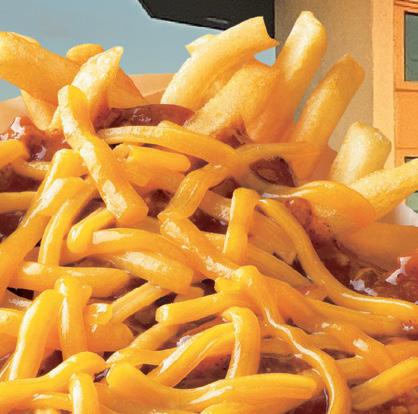
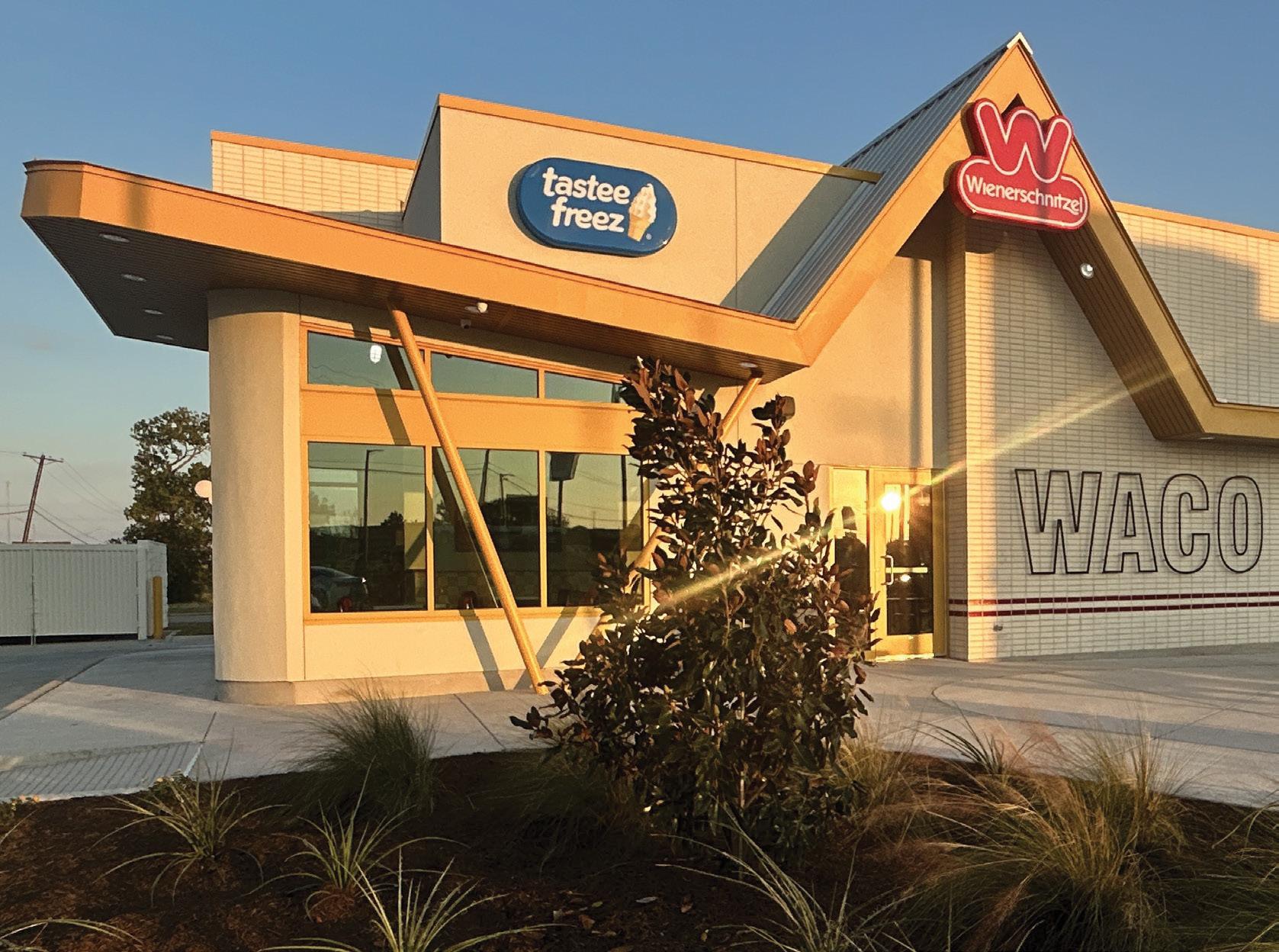
Hot Dogs, Soft Serve, Chili Cheese Fries
AMERICAN FOOD LESS LABOR LOW FOOD COSTS SIMPLE OPERATIONS
MULTIPLE BUSINESS FORMATS
development. I will typically travel twice a month to scout other locations.
Exercise/workout: I try to practice what I preach and stay healthy. In addition to lifting weights in our clubs, I’ve been running marathons and ultramarathons for a few years now. It’s been a great source of personal prayer and meditation for me.
Best advice you ever got: This comes from my favorite character, Augustus McCrae, in Lonesome Dove: “You can’t avoid mistakes; you’ve got to learn to handle them. If you only come face-to-face with your own mistakes once or twice in your life, it’s bound to be extra painful. I face mine every day. That way, they usually ain’t much worse than a dry shave.”
What’s your passion in business? My absolute passion is watching people advance in their careers and grow in their personal lives. What else are we doing if we aren’t making others better?
How do you balance life and work? Work-life balance can be defined in many ways. I define it as the ability to maintain your own identity when you are with your family. If work is a heavy weight 365 days a year to the point that I’m no longer myself, I am not balancing it correctly.
The popular idea is to just shut work off and not touch it, but the business needs what it needs, and the business supports life. This really depends on the place of the business at the time and the demands it makes. When the demands are high, it’s just not as simple as shutting it off.
In practice, the key for me is that when I’m present with my family, it’s important to segmentize work and family. Instead of setting a nearly impossible standard to unplug completely, I step out when I’m needed so that my kids don’t see me buried in my work. Then I come back in when it is resolved. Even if it is a day that they have only 20 minutes with me before bedtime, the phone is off, we isolate ourselves, and they get full attention. A little goes a long way.
Guilty pleasure: I love my movies and shows. I’m addicted to quoting the shows I like at all the wrong times. I’m basically Michael Scott from The Office
Favorite book: The Brothers Karamazov by Fyodor Dostoevsky.
Favorite movie: “Big Fish.”
What do most people not know about you?
I’m an avid hobbyist and enjoy most things that make zero money. I enjoy painting, woodburning, drums, and guitar.
Pet peeve: When people say, “That’s not my job.” The job is the job; do what it takes.
What did you want to be when you grew up? Rock star and/or an actor.
Last vacation: Croatian cruise with my lovely wife in 2024—all the islands, all the wine.
Person you’d most like to have lunch with: This will always be Robert Duvall or the spirit of Augustus McCrae from Lonesome Dove.
“I imagined that as a CEO, I’d be playing golf with fewer day-to-day tasks, and that’s just not how we can lead in this industry. The work looks different, but the grind stays the same.”
MANAGEMENT
Business philosophy: The one that comes to mind is simply that relationships matter. Give freely. People remember the advice you gave them when you had nothing to gain, and those relationships resonate and sometimes come back to you as opportunities. If they don’t, you still did the right thing. Management method or style: Trust and delegate, but step in when needed. Too many fail to manage out of fear of micromanaging.
Greatest challenge: Currently, it’s how to encourage people in a language that they understand. You can praise them all day, but if you aren’t doing it in a way they can receive it, they won’t feel your appreciation.
How do others describe you? I’m not sure if I want to know that, good or bad, unless it’s nega-
tively affecting others. But I hope they see me as someone who helps others.
Have you ever been in a mentor-mentee relationship? What did you learn? Absolutely. Every pivotal moment in my life has been assisted by a mentor. Currently, that is my business partner, Kevin Tupy. We speak and collaborate about the company every day. His guidance and experience are invaluable.
One thing you’re looking to do better: Listen more.
How close are you to operations? As close as I can be. I’ve worked in most of the positions in this industry, including club manager, trainer, regional manager, consultant, and owner. I can’t take responsibility for its success or failure unless I’m part of it.
What are the two most important things you rely on from your franchisor? Solid platforms that track performance and consumer insights. What you need from vendors: Efficiency in their process and delivery along with prompt support.
Have you changed your marketing strategy in response to the economy? How? As the online battle gets tougher, we find ourselves gravitating more toward the basic roots. Referrals, word of mouth, even direct mail, and simply giving as much as we can to the people of our communities.
How is social media affecting your business? Its primary use for us is being our outside voice to reveal our excellent culture to the world.
How do you hire and fire? We try to hire fast and fire fast in the beginning. It sounds harsh, but in reality, we just don’t want to drag out a person’s next chapter if they aren’t a fit for their role with us. The first things we’re looking for are natural ability that we can build on and their coachability. We are also heavily influenced by Patrick Lencioni’s book, The Ideal Team Player, and looking for someone who is humble, hungry, and emotionally intelligent.
How do you train and retain? We have much to grow here. We train with a combination of corporate courses, our own LMS for our company, and mentorship. We retain them with great benefits, competitive pay, and a passionate culture. We also reward them as quickly as is appropriate. We give a preemptive raise for those who deserve it. We also surprise them occasionally and don’t wait until you risk losing them to reward them. My dad once said, “Pay people what they’re worth. If you’re paying them the lowest you can, you are saying to them, ‘If I could pay you less, I would.’”
How do you deal with problem employees? Visibility and documentation on work performance and corrective communication. We’ve learned that to be clear is to be kind. We keep coaching reports logged on expectations so that when they need to be rewarded or require correction, we have the evidence. Fastest way into your doghouse: Say the words, “No one told me to do that.”
“We give a preemptive raise for those who deserve it. We also surprise them occasionally and don’t wait until you risk losing them to reward them. My dad once said, ‘Pay people what they’re worth. If you’re paying them the lowest you can, you are saying to them, ‘If I could pay you less, I would.’’”
BOTTOM LINE
Annual revenue: We are aiming for $35 million this year.
2026 goals: We would like to open two locations and acquire as much as we can.
Growth meter: How do you measure your growth? Same-store sales are king.
Vision meter: Where do you want to be in five years? 10 years? The vision is to maintain our highest level of customer service and facilities while growing store count and same-store sales. In 10 years, we want to be the largest Anytime Fitness franchisee and be synonymous with quality locations.
Do you have brands in different segments? Why/why not? We only operate Anytime Fitness franchises. When it is the right time, we will seek more opportunities in the health space.
How is the economy in your region(s) affecting you, your employees, your customers? We’ve had to get creative. What I have seen is that
people don’t mind paying for quality. Our maniacal focus is on a sales process that connects with our members. Our other focus is on helping every member succeed, whether they purchase personal training or not. When they believe in themselves and us, they will invest in themselves and us.
Are you experiencing economic growth in your market? In many of our markets, yes. We have locations in urban and rural areas. That’s one of the best things about this franchise. Every town needs an Anytime Fitness.
What are the best sources for capital expansion? Until now, it’s been conventional financing and using our cash flow to fund growth. Most people can get creative with cash when acquiring businesses through seller notes, and we try to do that as often as we can.
Experience with private equity, local banks, national banks, other institutions? Why/ why not? We have experience with all of these, but we structure our company like a PE group. I can see us landing there in the future.
What are you doing to take care of your employees? Passion goes a long way, but in the end, they want more security. It’s important to have a clear path to positional and financial growth.
How are you handling rising employee costs (payroll, minimum wage, healthcare, etc.)? We’ve prided ourselves on providing great healthcare plans for our team members. We also offer a 401(k) match for all team members, including part-timers. As for minimum wage, we work in an industry that calls for higher than that. So, this hasn’t been an issue for us.
How do you reward/recognize top-performing employees? We regularly give recognition to our performers at weekly and monthly meetings. We also give awards and trophies once a year to our top performers.
What kind of exit strategy do you have in place? Exit? And miss all the fun? n
“Passion and humility can show you the path to success and get you to where you want to be.”
Delivering the Dream
Franchisee starts at the bottom and builds an empire
Written by KEVIN BEHAN
As a young man growing up in Pakistan, Nadeem Bajwa saw members of his family pursue careers in medicine or finance. An admittedly mediocre student, he felt those fields were too difficult for him, so he set his sights on becoming an entrepreneur.
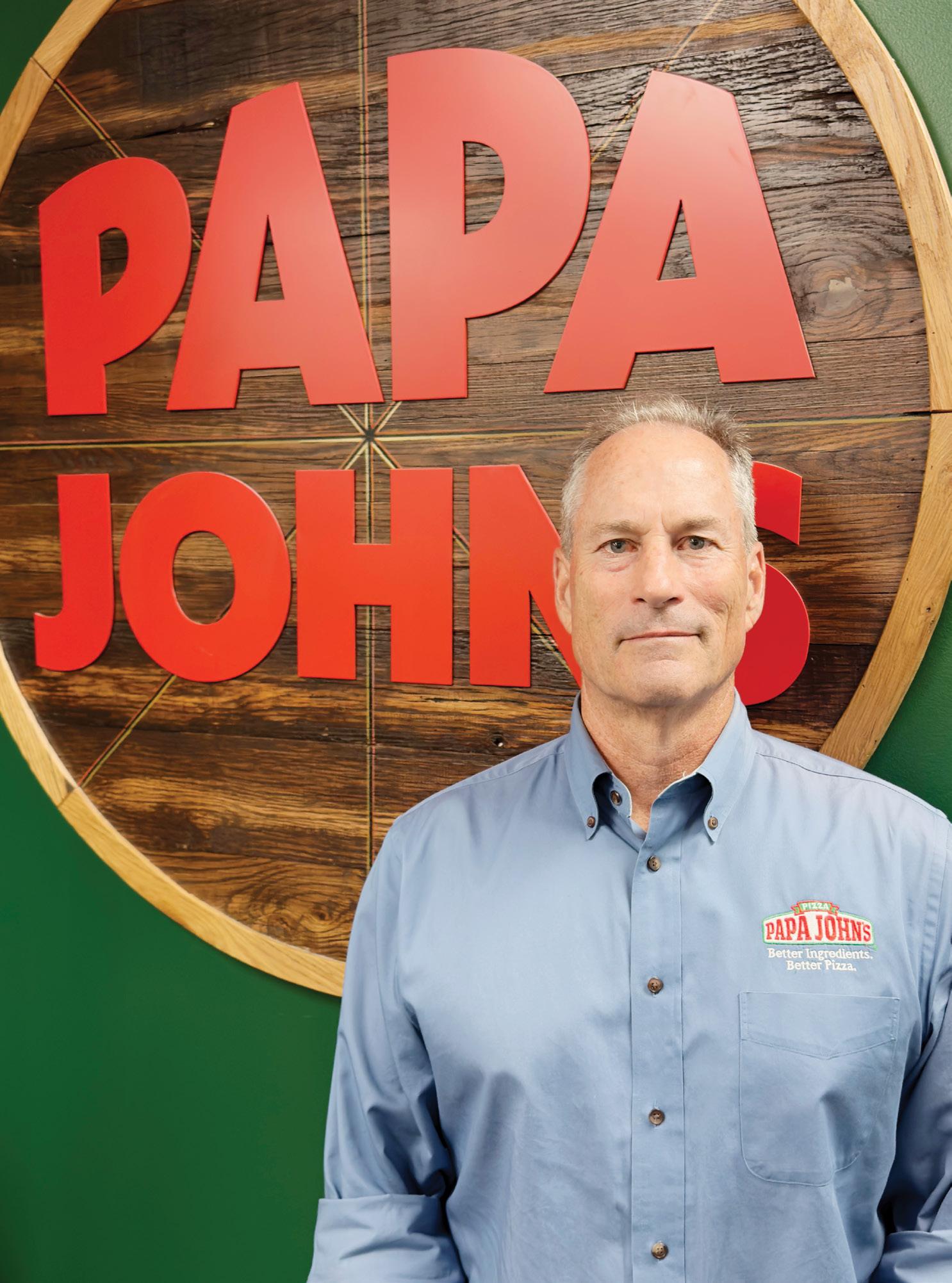
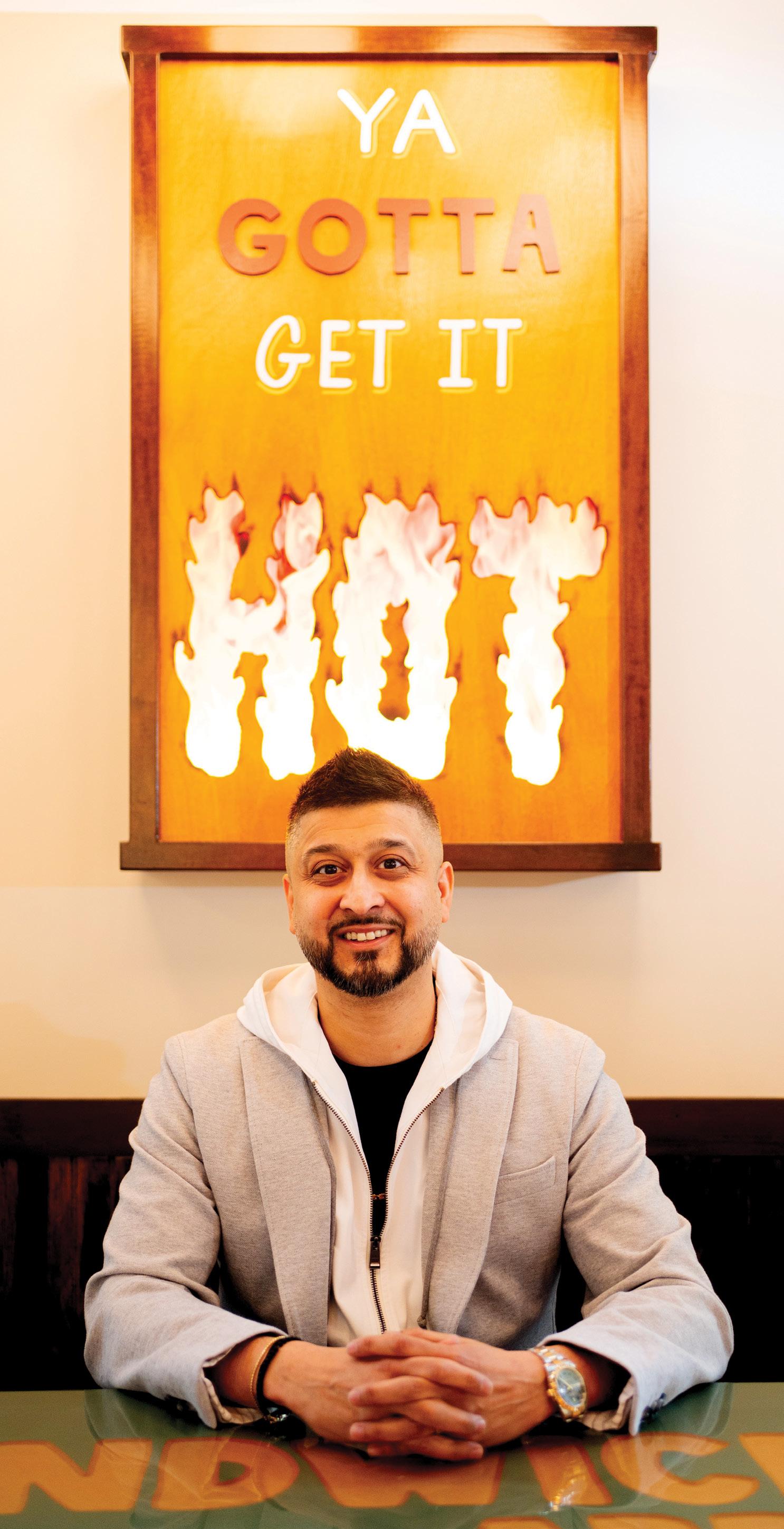
Nadeem Bajwa is the American Dream MVP (Most Valuable Performer) for achieving remarkable success in his new country.
Bajwa dreamed of the life-changing opportunities available in the U.S. At 22, he became the first member of his family to move here in 1991. Life wasn’t easy. In addition to the language barrier and frigid January temperatures upon arriving in Fort Wayne, Indiana, the culture shock of coming
to a new country made him feel even farther from home. While attending college, he washed dishes and delivered pizzas for $4.25 an hour. Those jobs helped bring his future into focus.
“I didn’t have a car, and I would walk two miles to get something to eat when the cafeteria was closed on weekends,” Bajwa says. “There were nights that I cried. I would miss my family, and it was tough, but going back was not an option because of the life I could have here. When I got here, it wasn’t easier, but it was rewarding.”
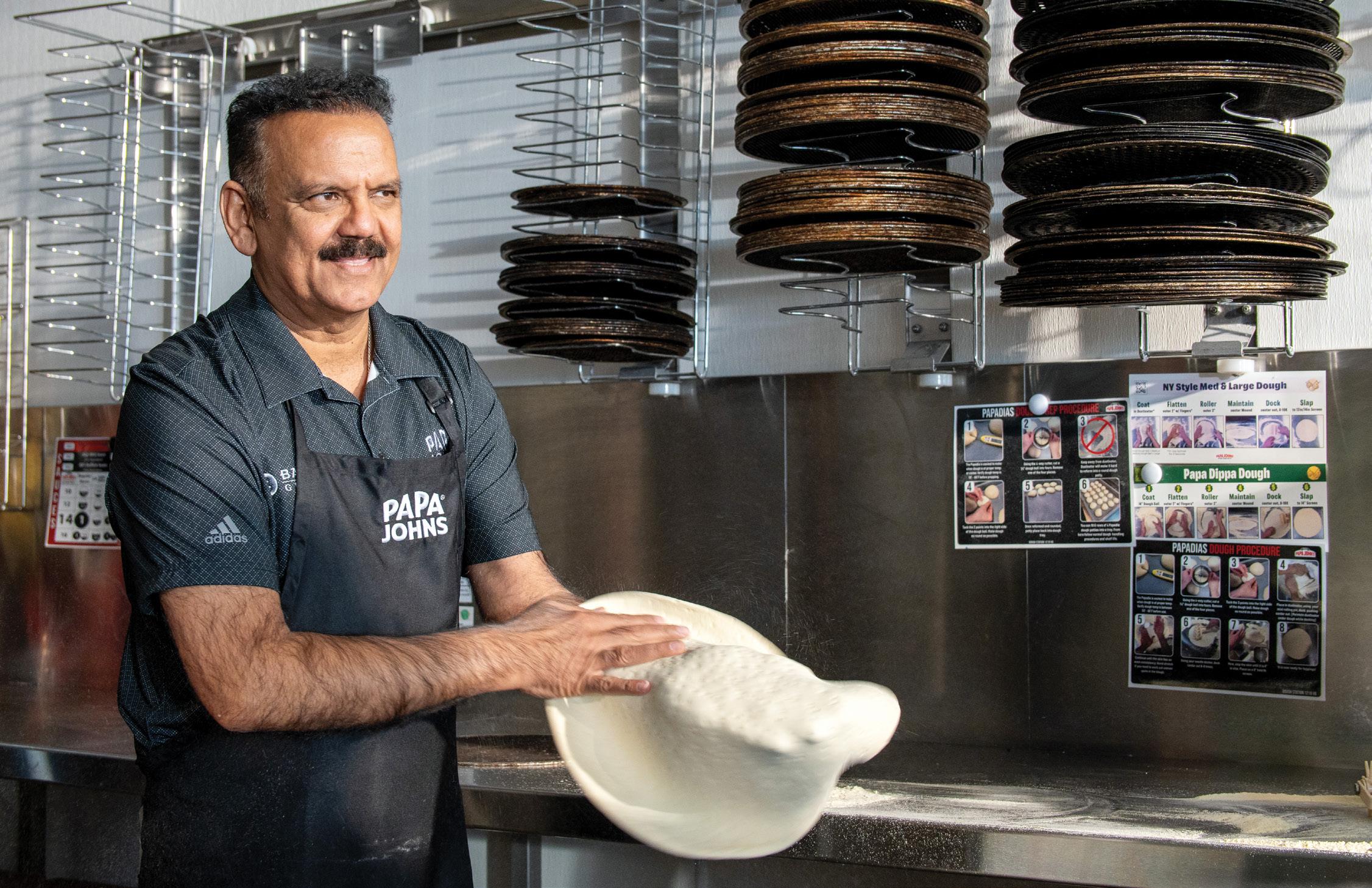
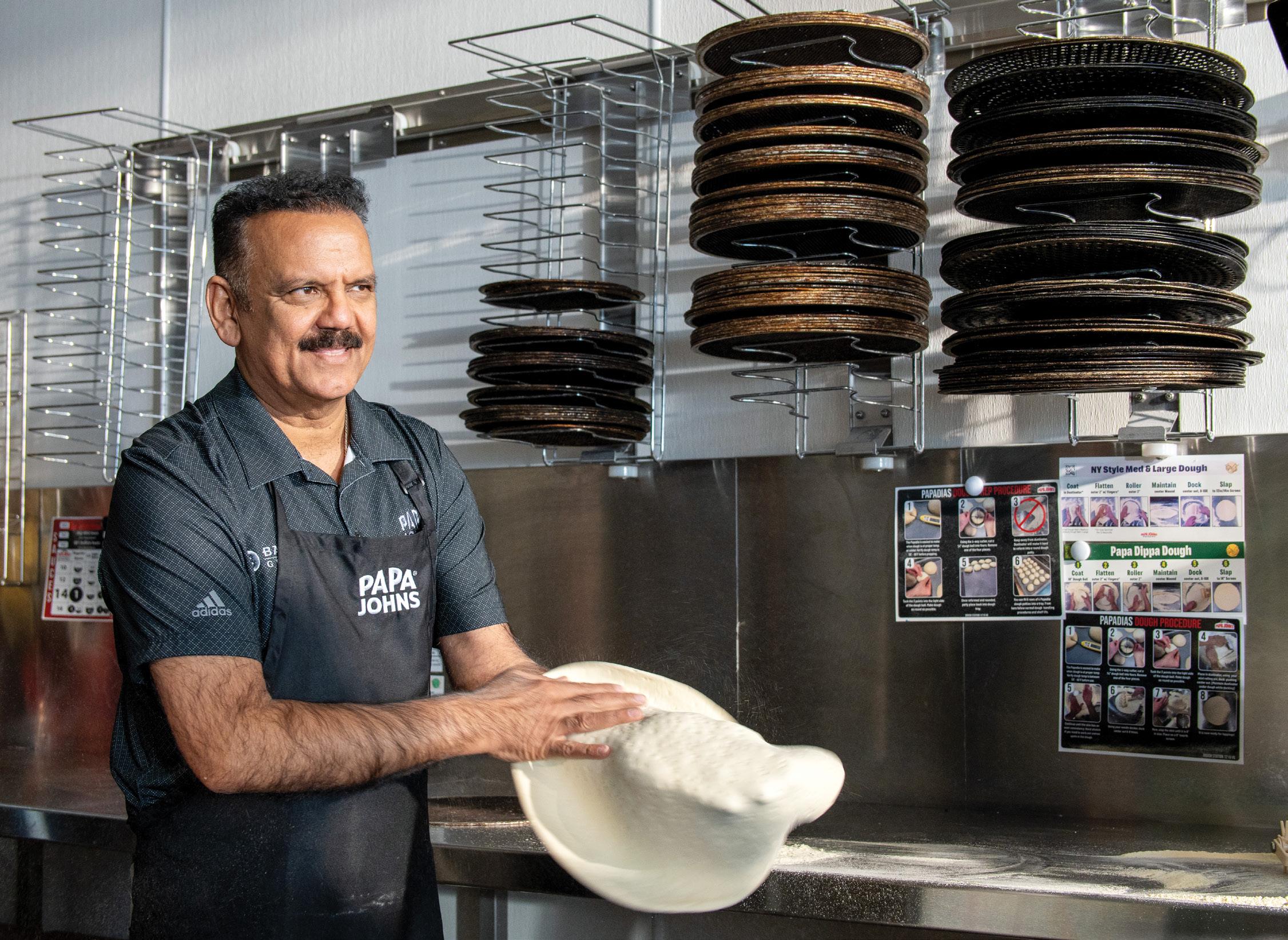
Several years after arriving in the U.S., Bajwa joined Papa Johns and eventually worked his way up
MVP Awards
to store manager. By the time he graduated from college, he was a district manager of seven stores in Fort Wayne (all of which he currently owns). He built his first restaurant in the system in 2002 and partnered with his brothers. Two of his brothers, Abdul Malik and Faisal, both had financial backgrounds, and they were critical in helping to fund his growth. His company, the Bajco Group, operates more than 270 Papa Johns locations and employs more than 5,000 people.
“We first thought about owning 10 to 12 units, but after opening the fourth store, I knew I needed someone else,” says the American Dream MVP. “I found people with similar passion and dreams, and by the time we got to 10 restaurants, it became an addiction, and it was fun. Developing leaders is also addictive. It is such a great feeling to develop leadership for tomorrow. One can only live for so long. It is amazing to think that something you built will be around for generations after you. It is very fulfilling.”
Bajwa returns to Pakistan several times each year to visit his other businesses and to see friends and family members in his native country. His wife and three daughters accompany him at least once a year to reconnect with their roots. While in Pakistan, Bajwa shares advice for other aspiring entrepreneurs hoping to achieve the American dream.
“Passion and humility can show you the path to success and get you to where you want to be,” Bajwa says. “Those are the two words I live by: passion and humility.”
MVP QUESTIONS
Why do you think you were recognized with this award? I believe I was recognized with this award because of my consistent hard work, true passion for what I do, and the humility I embody. My story as an immigrant is the foundation of who I am as an individual and business owner. It can also inspire others like me who are pursuing the American dream.
NADEEM BAJWA
Co-founder and CEO
Company: Bajco Group Units: 270+ Papa Johns Age: 57
Family: Wife and 3 daughters; brothers as business partners
Years in franchising: 24
Years in current position: 24
lationships have instilled within me the importance of consistency, compassion, and tenacity.
for Papa Johns before continuing to work my way up the ranks.
How have you raised the bar in your own company? By practicing deep self-reflection and prioritizing my team’s individual goals as much as I can. This mindset has allowed me the opportunity to raise the bar at my own company and inspire the professional development and growth of others in my circle. What innovations have you created and used to build your company? As a company, we found that outsourcing vendors was less efficient and cost hundreds of thousands more than taking on those services ourselves. We developed numerous businesses within our company to assist with accounting, technology, and construction. This helped us save money and understand our work thoroughly. We are also able to service other companies with these resources.
What core values do you think helped you win this award? I’ve had the privilege of being supported by incredible mentors and my amazing family, whom I get to work with every day. These re-
How important is community involvement to you and your company? Nothing can flourish without the support of a community and a sound foundation. Giving back to the communities that have helped our businesses grow and succeed is extremely important to us. We are heavily involved with numerous local charities, fundraisers, and community organizations in all our markets.
What leadership qualities are important to you and your team? I believe that one of the most important qualities of a leader is the desire to learn from everyone inside and outside of your business. If you are consistently the smartest person in the room, you are not challenging yourself.
PERSONAL
First job: I got my first job after immigrating to the U.S. for college. I began washing dishes at a local restaurant and eventually started delivering pizzas
Formative influences/events: The most influential event in my life was coming to the U.S. from Pakistan for school. I went through extreme culture shock and missed my family immensely. This experience deeply humbled me and pushed me to take life much more seriously to make the move worth it. Key accomplishments: Proving to myself that although I did not feel like the smartest person, I worked extremely hard to get to where I am today. I never thought that I would be able to build the company and team I have. Supporting my team through their growth has been extremely rewarding and a full-circle moment.
Biggest current challenge: The QSR category cycles through phases. Currently, the industry is operating in a moment where external factors, like shifts in consumer spending habits, are influencing performance across the board. However, this is not the first time I have experienced roadblocks nor is it the first time the QSR category has seen challenges.
MVP Awards
I’ve always considered challenges to be opportunities for growth and improvement. They push me to get back to the basics and think beyond boundaries.
Next big goal: I hope to continue developing more leaders in the space, offering the same opportunities to grow that I was given. As a company, we aim to expand to 500 locations in the next couple of years. First turning point in your career: When I graduated from college in the U.S. and began looking for jobs, I found that there were not a lot of opportunities better than my career trajectory at Papa Johns. I was managing numerous stores and loved the brand, so I decided to stick with it.
Best business decision: I believe that going into business with the right people is the most important decision you can make as an entrepreneur. Finding people who share the same values as you and are eager to learn builds the foundation for a long-lasting, successful company.
Hardest lesson learned: While immigrating to the U.S., I was filled with the excitement of independence and opportunity. However, I quickly grew lonely and homesick and began to doubt my abilities. This was a very hard time in my life, but instead of giving up and going home, I began to work harder to make these struggles worth it.
Work week: My schedule is more or less sectioned into monthly rotations. I consistently travel within the U.S. to different markets and restaurants once a quarter, and I travel overseas once a quarter to Pakistan as well. I have weekly calls with senior leadership that I never miss and monthly calls with our financial team to ensure I stay as involved as possible even while things change very quickly. Exercise/workout: I enjoy walking and aim to get in my 10,000 steps a day.
Best advice you ever got: Papa Johns founder John Schnatter told me to focus on the people you surround yourself with in business and to support each other’s development.
What’s your passion in business? My passion is rooted in creating a strong business foundation for future generations while accomplishing my own career goals. I believe that paying back the privileges you were given is one of the most rewarding aspects of growing a business.
How do you balance life and work? I am very lucky to have such a supportive and loving family. My wife is incredible and understands that I take every second I can to be with her and our children.
Guilty pleasure: Whenever I get the chance, I love sleeping on a flight. I often take long flights back to Pakistan and like to take advantage of this downtime.
Favorite book: Although I don’t have much time for reading, I regularly listen to audiobooks and industry podcasts.
Favorite movie: “The Silence of the Lambs.”
What do most people not know about you? I’m a fairly anxious guy. The people closest to me know I sometimes have moments of doubt in myself.
Pet peeve: When individuals lack commitment and discipline and are not open to learning and improving their mindset.
What did you want to be when you grew up? I always knew I wanted to be a businessman. I was never stellar in school and knew I wouldn’t succeed in the medical industry, like much of my family. I focused instead on what I knew I would excel at, being an entrepreneur.
Last vacation: I got to spend time with my family in Hawaii near the end of 2025.
Person you’d most like to have lunch with: I have always said I would love to have lunch with my mom. She passed this year, and I would love nothing more than to spend a meal with her.
MANAGEMENT
Business philosophy: To build something strong for the next generation of business owners.
Management method or style: Give second chances but no more if the effort to learn and grow is not there.
MVP Awards
Greatest challenge: Relinquishing control of certain responsibilities to allow for growth as a team and as individuals.
How do others describe you? As somebody with passion and a desire to win.
Have you ever been in a mentor-mentee relationship? What did you learn? My brothers have been some of my most influential mentors in life and business. I have also been greatly inspired by John Schnatter, the founder of Papa Johns. The most inspiring lessons I have learned from my mentors are to remain humble, stay hungry to succeed, and always keep learning.
One thing you’re looking to do better: I’m always looking to improve. I consistently self-reflect to see what I could be doing better.
How you give your team room to innovate and experiment: I strongly encourage my teams to connect with all other teams and employees at the company. No matter your title or rank, you will always learn something from one another. This opens the door to innovative ideas.
How close are you to operations? When I first got started as a business owner, I was much closer to the operations side of my company. Now, I have an amazing team that I know I can rely on to keep things running smoothly. It can be hard to relinquish that control, but with quarterly meetings and regular communication, I’m able to stay involved and in the know.
What are the two most important things you rely on from your franchisor? I have always relied on the Papa Johns team to uphold a commitment to quality products and consistently support us franchisees with proven tools and business models.
What you need from vendors: As we have developed internal teams for many of the vendor services we need, there is a company-wide understanding of every facet that results in efficient systems and processes.
Have you changed your marketing strategy in response to the economy? How? Even as the economy changes, we always prioritize consumer needs. Often, the best way to maintain this value is to start with more localized marketing campaigns and micropartnerships.
How is social media affecting your business? We have our own marketing team that utilizes social media to connect with local restaurants, and we work closely with the Papa Johns corporate team to contribute to national marketing. These strategies help us get a feel for our customers’ opinions across markets. How are you using technology, like AI, to manage your business? At our inbound call centers, we are currently testing AI programs for order taking. This is live in three locations, and we are seeing great results so far.
How do you hire and fire? Experience is a huge plus when we are hiring, and we place a big emphasis
on positive attitudes and excitement for the business. When that alignment is not there, we work to problem-solve with the individual to see if the connection needs nurturing. We believe in doing all we can to allow our team members to grow to their potential first before we consider firing someone. How do you train and retain? When welcoming a new member to the team, I emphasize our company-wide values of commitment, passion, and efficiency. Reflecting these values myself helps to set the tone. We also pride ourselves on promoting from within to grow deep connections with our team members and recognize their hard work.
“Papa Johns founder John Schnatter told me to focus on the people you surround yourself with in business and to support each other’s development.”
How do you deal with problem employees? We know that some individuals need additional resources and that mistakes happen. When this happens, we ensure that our values align before giving the time and support that the employee may need to truly succeed with us.
Fastest way into your doghouse: Consistently repeating mistakes after reliable direction and guidance shows me that there is a difference in our long-term goals.
BOTTOM LINE
Annual revenue: More than $300 million. 2026 goals: We are aiming to grow our Papa Johns portfolio to 350+ locations through a combination of building new locations and acquisitions with a heavy focus on rapid growth of our accounting, call centers, tech, and construction businesses.
Growth meter: How do you measure your growth? We measure through a combination of revenue growth, customer count, and profitability. Vision meter: Where do you want to be in five
years? 10 years? In the next five to 10 years, we aim to grow the Bajco Group team to 15,000+ employees from our current 5,000 globally. We always keep in mind that we have grown past our goals. Do you have brands in different segments? Why/why not? We currently only franchise with Papa Johns. We are open to considering partnering with other brands, but I have not been able to find the right fit yet.
How is the economy in your region(s) affecting you, your employees, and your customers? The economy is particularly tough, but we always stay financially disciplined, ensuring that team members are taken care of and that we are catering to customer affordability.
Are you experiencing economic growth in your market? Yes, in some of our markets. It varies from city to city.
How do changes in the economy affect the way you do business? The economy, of course, affects the way we do business. By staying focused on the fundamentals, such as quality, service, team development, and smart cost management, we put our business in a better position to navigate unstable economic cycles.
How do you forecast for your business? We keep a well-rounded outlook as a business by evaluating growth daily, weekly, monthly, and yearly.
What are the best sources for capital expansion? The best sources, in my opinion, are combinations of equity and debt.
Experience with private equity, local banks, national banks, or other institutions? Why/ why not? We work with a traditional bank. We have never worked with private equity.
What are you doing to take care of your employees? Other than competitive wages and benefits, we really focus on promoting each individual’s growth to become successful business leaders for tomorrow.
How are you handling rising employee costs (payroll, minimum wage, healthcare, etc.)? Our system efficiency and internal vendor sectors keep our costs low.
What laws and regulations are affecting your business, and how are you dealing with them? None.
How do you reward/recognize top-performing employees? We promote self-improvement at Bajco with incentives such as increased compensation and bonuses.
What kind of exit strategy do you have in place? As a business, we maintain a heavy focus on the long-term succession plan, preparing for the next generation of the company rather than implementing an exit strategy. n
looking to franchise? scan QR code
BART AND THERESA CASIELLO
“We never said something should be done because ‘this is the way we have always done it.’”
Automatic for the People
Couple breaks the 9-to-5
model
in dry cleaning
Written by KEVIN BEHAN
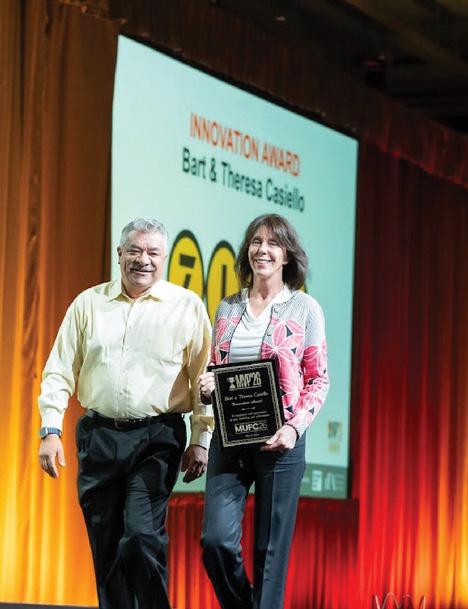
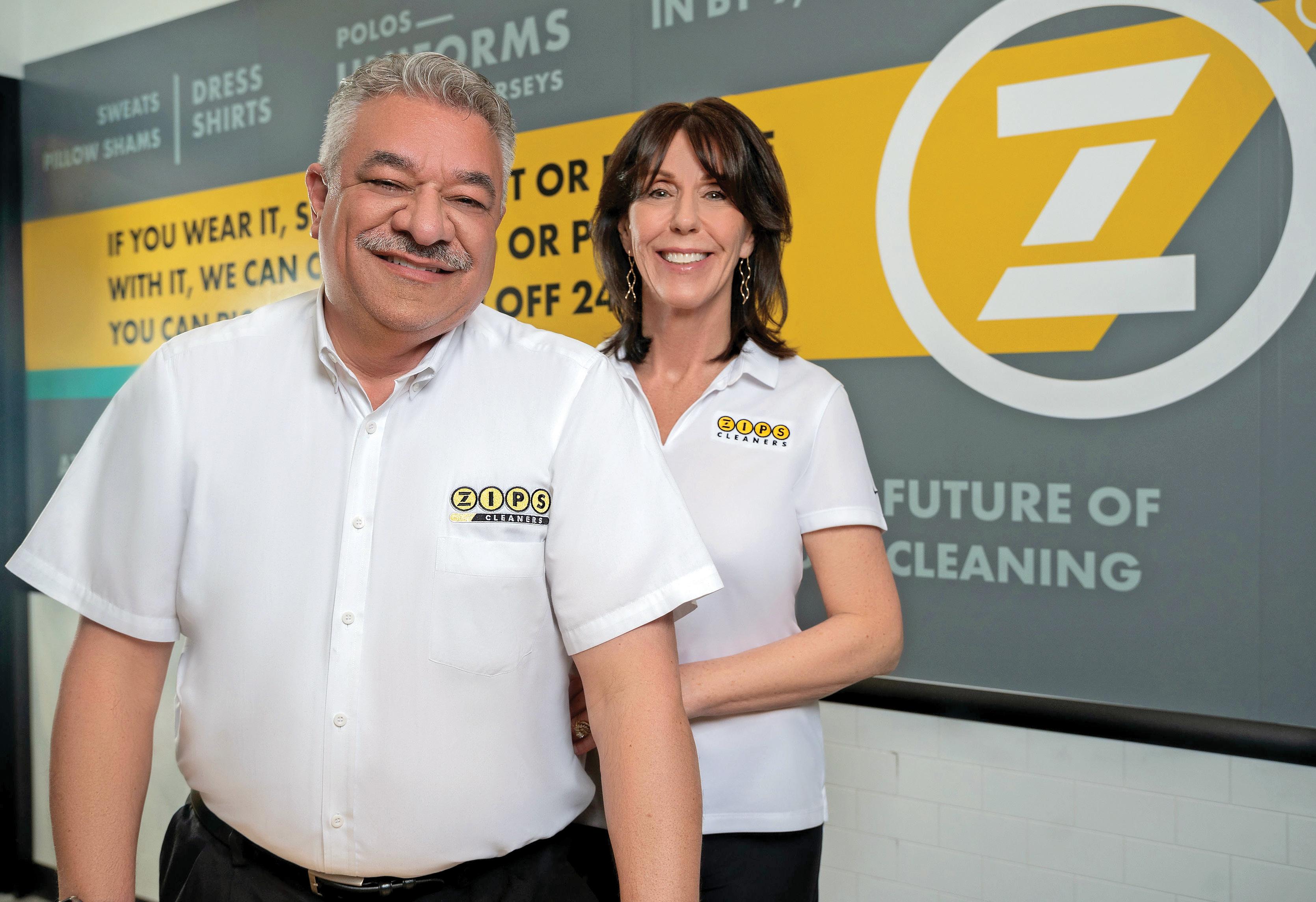
During their 25 years of owning Zips Cleaners dry-cleaning franchises, Bart and Theresa Casiello have never been afraid to think outside the traditional business model.
“We never said something should be done because ‘this is the way we have always done it,’” Bart says. “We thought if it didn’t make sense, why should we do it that way? A lot of the innovations that have happened over the years have been things used in other industries, and we asked, ‘How can we apply that to dry cleaning?’”
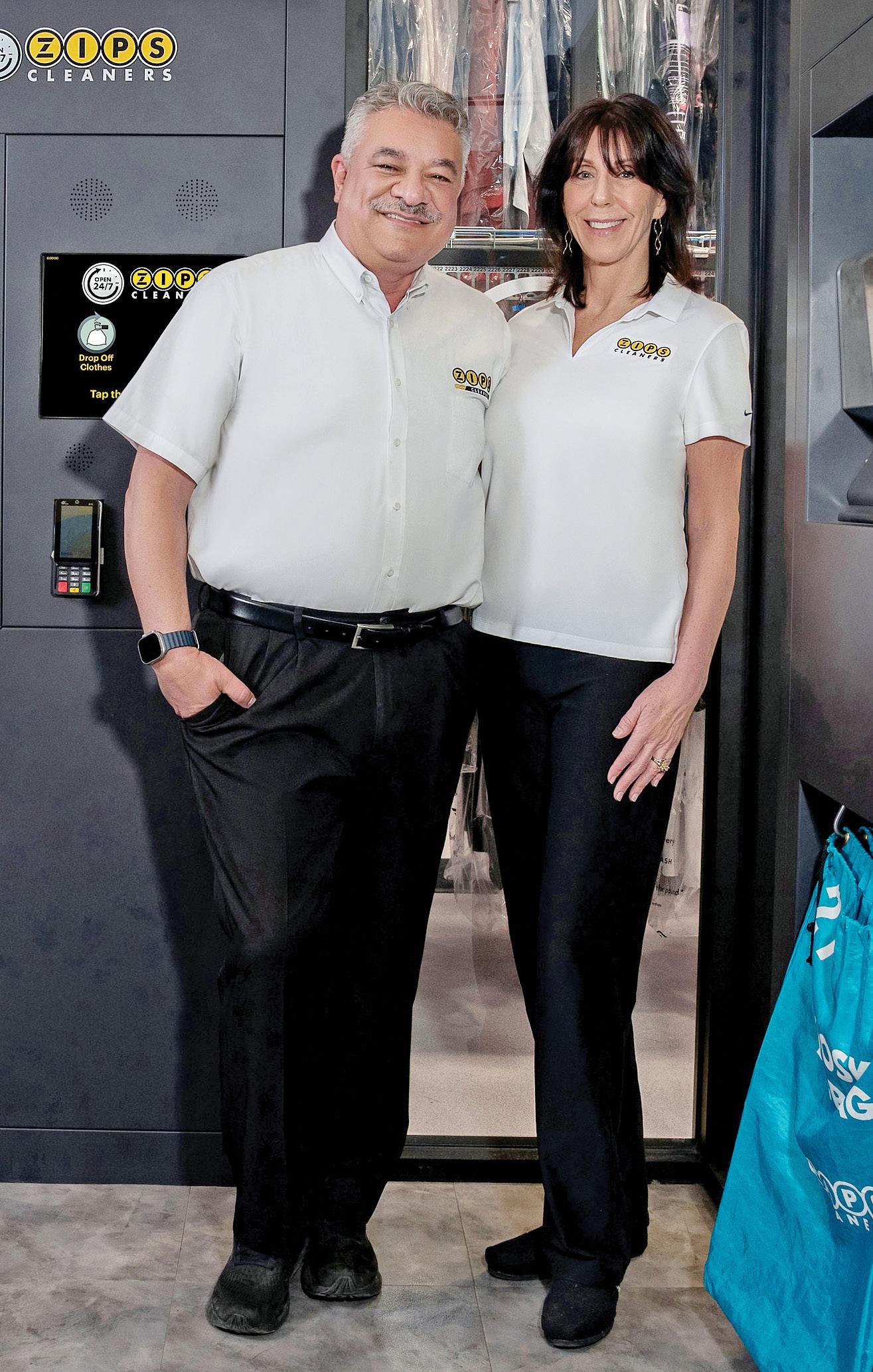
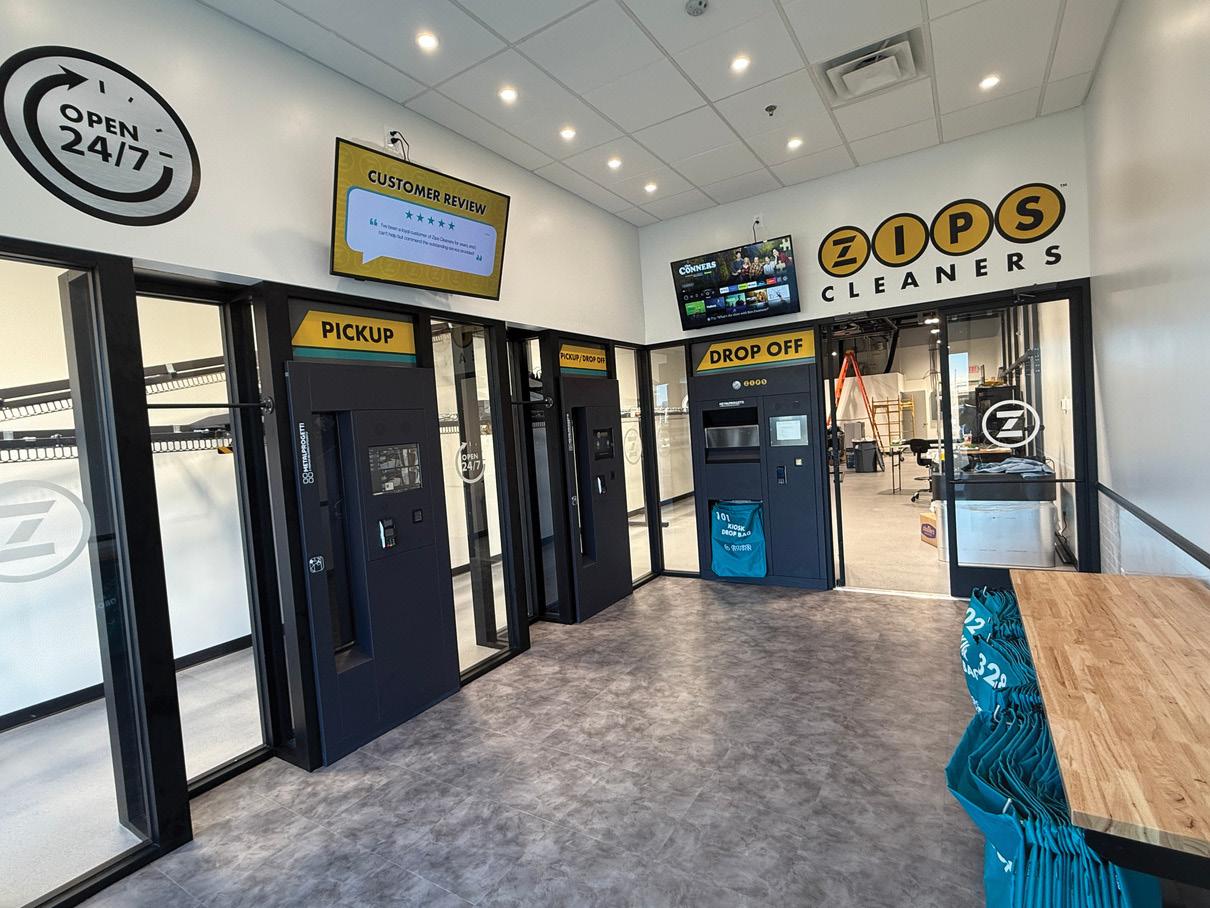
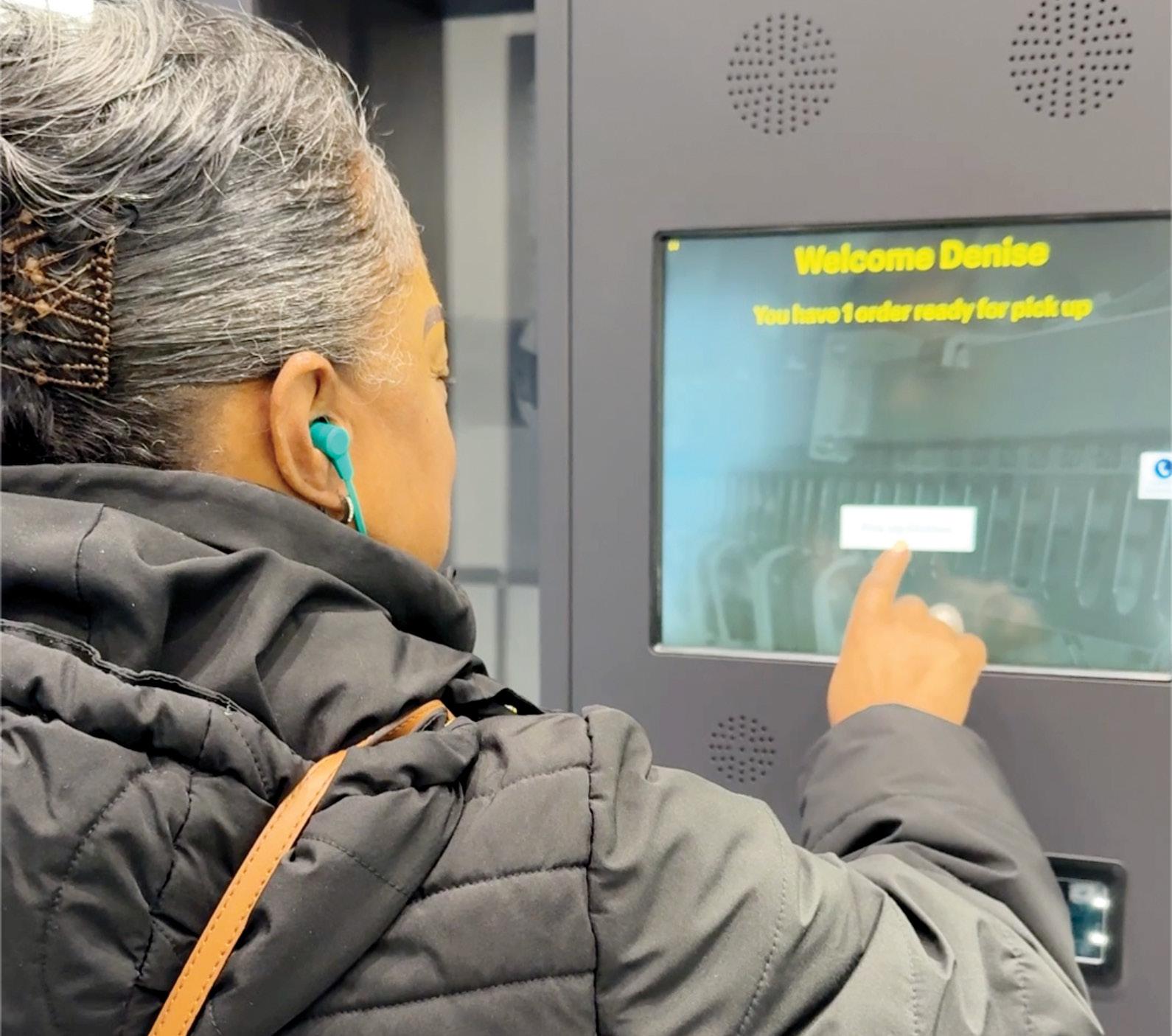
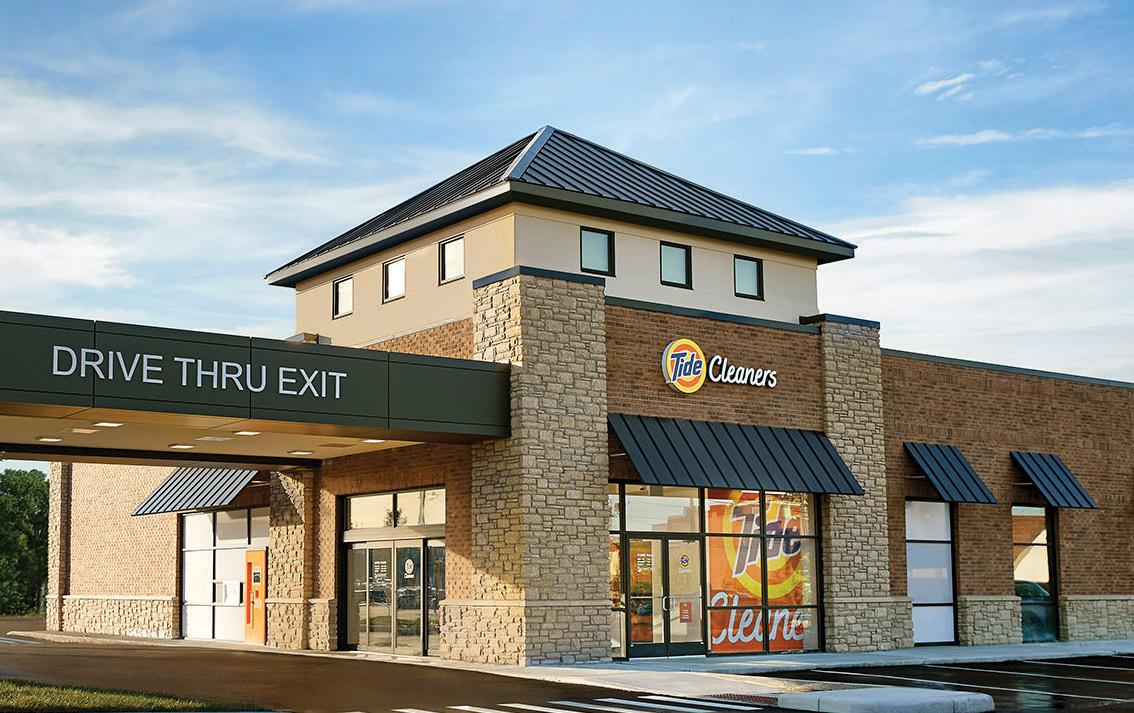
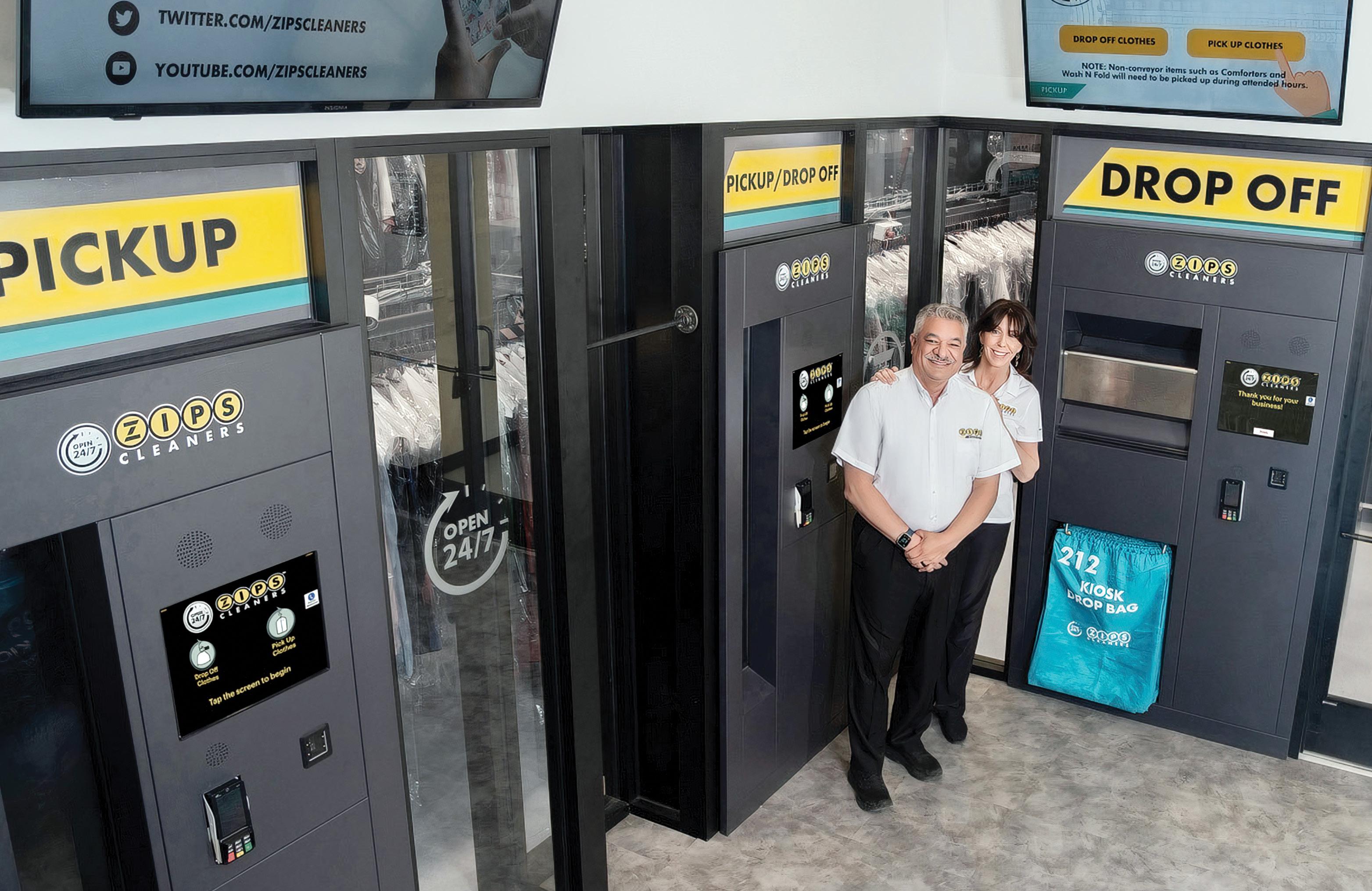
The Casiellos’ latest creation is an automated system that allows customers to drop off and pick up their dry cleaning orders 24 hours a day. They were named the Innovation Award MVPs for bringing a new and unique contribution to the Zips brand after successfully implementing the technology in their new store in Brandywine, Maryland, in November 2024.
Under their system, customers can drop off their clothes for dry cleaning at any time of the day or night. They enter their cell number and order instructions on a kiosk and leave their clothes in a secure bag in an area similar to an overnight deposit box or library book return. Customers receive a text message with the progress of their order and an email confirmation when the clothes are ready.
Customers can pick up their order at their convenience. Doors of the Zips’ store are locked between 8 p.m. and 7 a.m., but customers can gain access to the facility by scanning a QR code on the window. The doors then unlock, and clothes are available for pickup on an automated conveyor rack.
Under the traditional Zips dry-cleaning model, customers who wanted same-day service needed to drop off their clothes by 9 a.m. to pick them up at 5 p.m. That creates long lines for customers and a heavy load for employees during peak hours. Under the new system, work is spread out across the day, daily staffing has been reduced from 12 hours to
Bart and Theresa Casiello are the 2026 Innovation Award MVPs (Most Valuable Performers) for bringing a new and unique contribution to their brand.
MVP Awards
eight, and there are fewer manual tasks for employees, which allows them to provide additional customer service. The Casiellos say the new system has reduced labor costs by 54%.
“We no longer have mad rushes right before 9 a.m. because customers now have the freedom to drop their clothes off at any time, based on their schedule, and the same thing in picking up,” Bart says. “There is no rush, and it is so much more relaxed, and that is something we didn’t anticipate. It has made a major impact from the operations standpoint with staffing, and it has made life so much easier for the customers.”
The 24/7 automated system is the latest example of the Casiellos using creativity and innovation at their seven Zips locations. Their stores run informational videos for customers to watch while in line, including helpful tips on how to remove a stain or properly tie a tie. When the Covid-19 pandemic hit and initial sales were cut by as much as 80%, the couple offered delivery and additional services, such as wash and fold, to better serve their customers. The latest automated system has been such a success at the new location that the Casiellos are looking to retrofit it into their other six stores. Four other franchise groups in the Zips Cleaners system are incorporating the 24/7 innovation into their stores, and more are likely to follow.
MVP QUESTIONS
Why do you think you were recognized with this award? We are truly humbled and honored to
BART AND THERESA CASIELLO
Multi-Unit Franchisees
Company: Zips Cleaners Units: 7
Age: Bart, 60, and Theresa, 63
Family: 7 children, 8 grandchildren, and Theresa’s mother, Gail Hicks
Years in franchising: 25
Years in current position: 29
receive this award. We believe we were recognized because we challenged the traditional dry-cleaning model. We incorporated technology used in other industries and developed a hybrid system that allows customers to drop off and, more importantly, pick up their garments 24/7. This gives customers the choice to work with an in-person team member, and we’ve reduced labor costs by 54% while improving customer service. It’s rare to implement technology that both lowers costs and enhances the
customer experience, and that balance has been key to our success.
How have you raised the bar in your own company? By refusing to accept “this is how it’s always been done.” We examine and reexamine every step of our process and ask: Is this necessary? Does it add value? If not, we change or eliminate it. The dry-cleaning industry has historically been slow to adopt new technology. When we entered the business 29 years ago, machines were operated with punch cards, and receipts were handwritten. We’ve embraced innovation at every stage to modernize operations and improve the customer experience.
What innovations have you created and used to build your company? Our biggest innovation has been building a hybrid service model that blends automation with personalized service. We implemented 24/7 automated pickup and drop-off systems and leveraged data to reduce waste and improve productivity. We also redesigned our labor model to align staffing with peak demand instead of traditional fixed schedules, dramatically improving efficiency. What core values do you think helped you win this award? Customer-first thinking, innovation over tradition, accountability, integrity, and discipline in execution. We believe effort alone doesn’t guarantee success. Results matter. That mindset drives everything we do.
How important is community involvement to you and your company? Community involvement is extremely important. Our business only succeeds if our community succeeds. We support local schools, nonprofits, and initiatives whenever possible. Being part of the community means more than just operating in it. It means investing in it.
What leadership qualities are important to you and your team? Leading by example, decisiveness, accountability, transparency, and adaptability. We won’t ask our teams to do something that we wouldn’t be willing to do ourselves.
PERSONAL
(Answers are from Theresa unless otherwise noted.)
First job: I worked for the Internal Revenue Service as a revenue agent. I was a field agent, auditing business income tax returns. From that experience, I developed a set of criteria that were common to the successful businesses I audited and that I would look for in owning a business.
Formative influences/events: My father was in active duty and training to be a Navy pilot. When I was 4 years old, he was in a horrific plane crash that drastically changed our family’s lives. He spent two years in Bethesda Naval Hospital (now known as Walter Reed National Military Medical Center), undergoing many surgeries and healing. He survived when he wasn’t expected to. It was an example of strength and resiliency. He was in pain every day for the rest of his life, but he did not complain to us. My mother was an incredible example of the strength and grit necessary for our survival. She
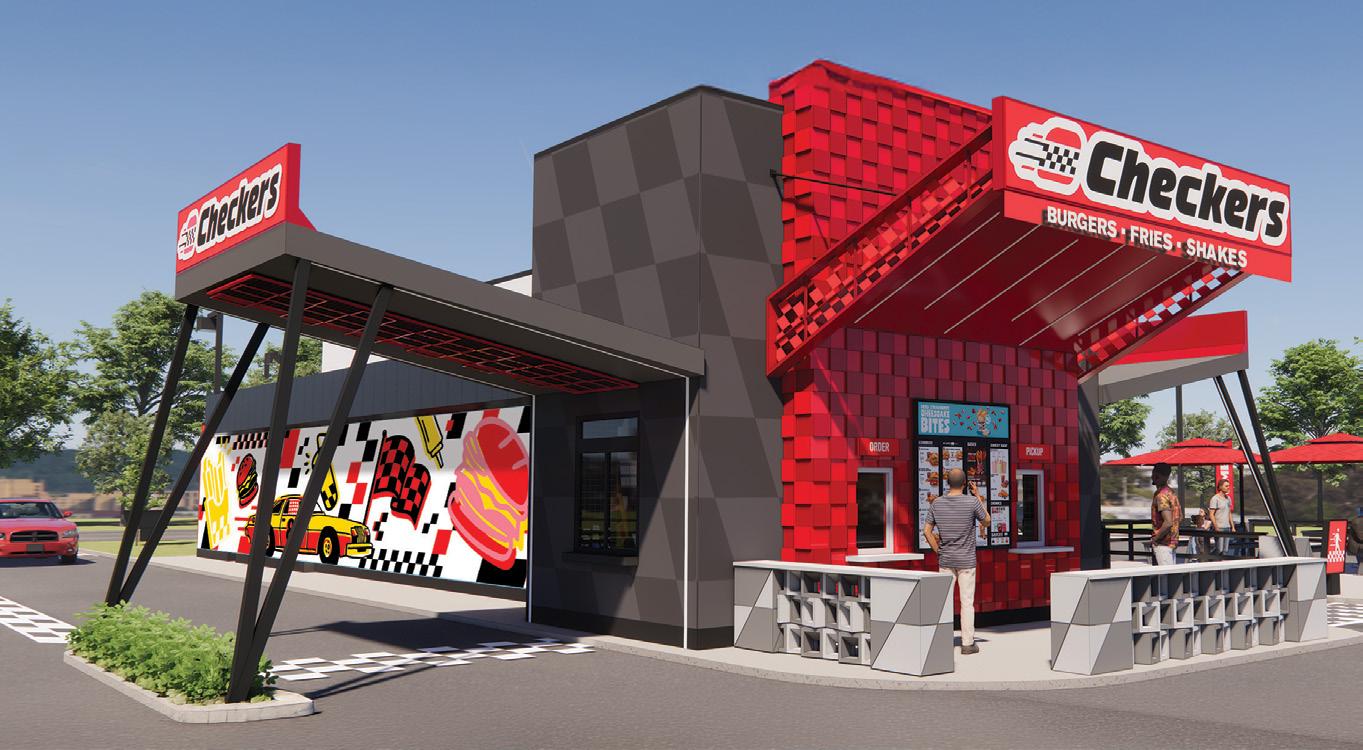
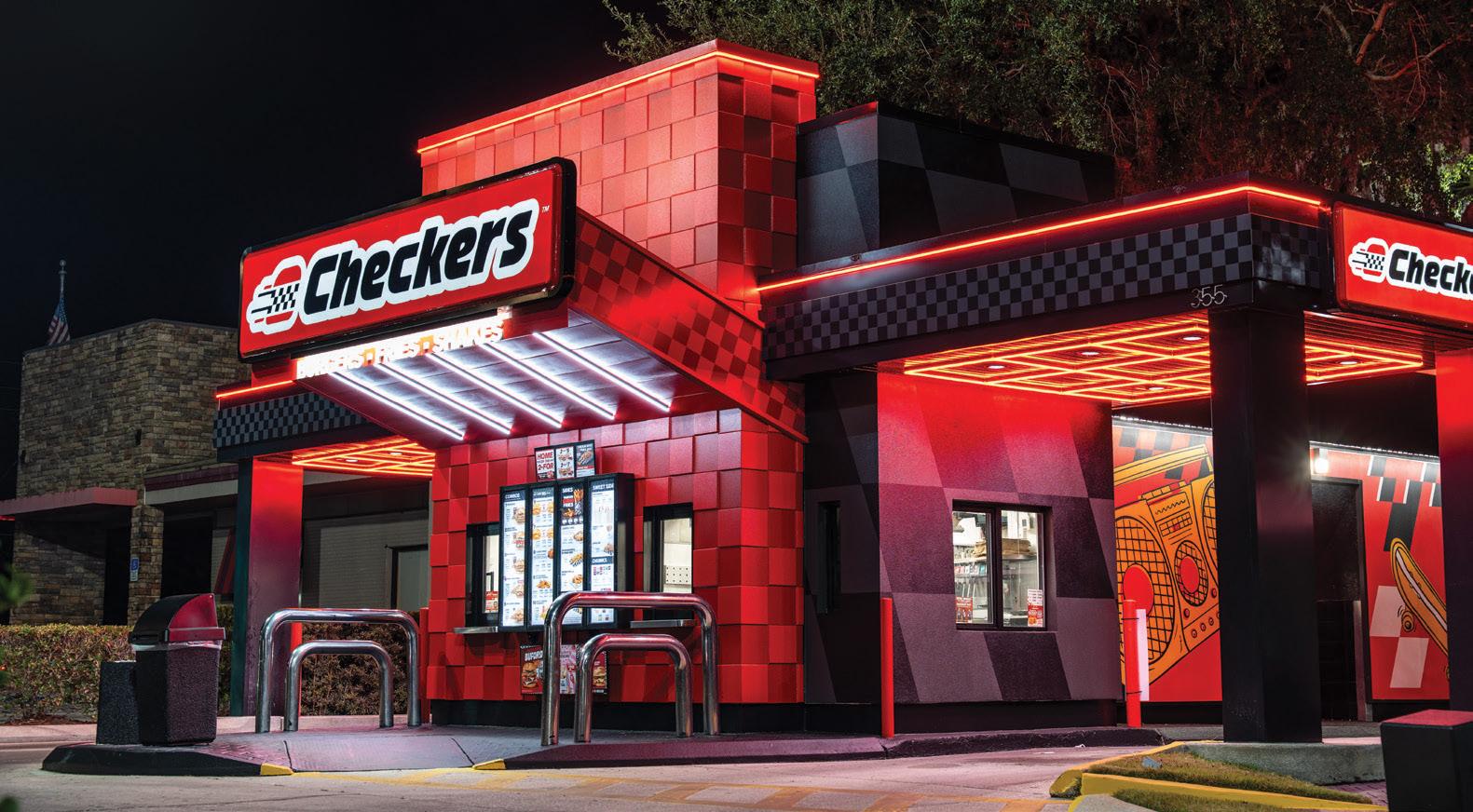
Headquartered in Tampa, Florida, Checkers & Rally’s operates more than 700 locations across the United States and built our name over 40 years of serving communities. With our Fearless approach and a Focus on Four-Wall Sales and Profitability, we remain Fan Fanatics heading into the future. Now is a great time to become part of the family.
Checkers & Rally’s, known for our award-winning seasoned fries and iconic burgers, continues to create opportunities for our franchisees with a bold restaurant design that delivers a WOW factor built to honor our legacy while maximizing efficiencies and streamlining output. We deliver unmatched quality, unbeatable value and legendary taste that keep guests coming back for more again and again. Profit from a proven franchise system that’s ready to dominate the competition.
MVP Awards
had to immediately get a full-time job and take care of my sister and me while managing my dad’s recovery. Mom was and always has been a strong role model. She had her own successful career. These early lessons have deeply influenced and molded me into the person I am.
Key accomplishments: Building a scalable, innovative dry-cleaning model that reduced labor costs by more than half while improving service. We also survived the Covid-19 crisis when much of our industry struggled.
Biggest current challenge: Continuing to innovate in a mature industry while maintaining profitability in a changing economic environment. Next big goal: To fully automate our existing locations, improving profit margins and delivering an even better customer experience while continuing to set a new standard for efficiency and service in the garment care industry.
First turning point in your career: Recognizing time and again that technology could fundamentally change our cost structure and customer experience and having the conviction to be the first to act on it.
Best business decision: Bart: Theresa is the best person I know and the best business partner I’ve ever had. We have different talents that comple-
ment each other extremely well. I would never even think of getting involved in a business without her. Theresa: We may be opposites in our skill sets, but we take a divide-and-conquer approach.
Hardest lesson learned: Tomorrow isn’t guaranteed. Our business felt predictable until Covid-19 devastated the dry-cleaning industry. It tested us in ways we never expected. But what doesn’t kill you makes you stronger.
Work week: Work doesn’t stop. We have a labor-intensive business with multiple deadlines to hit every day. We are constantly training staff, overseeing operations, and finding new ways to improve our processes.
Exercise/workout: Rowing! I’m a member of Annapolis Rowing Club. I sweep and scull. Being on the water with my team as the sun rises focuses my mind for the day. It’s my meditation.
Best advice you ever got: Focus your mind on your goals and make them happen.
What’s your passion in business? Finding inefficiencies and turning them into opportunities. How do you balance life and work? We’re not doing the best at that currently, but it’s temporary. At least, we recognize that. Working alongside each other makes it hard sometimes to see where
one ends and the other begins. Almost every conversation involves business. We do make family a priority. We have seven children and eight grandchildren, so there is always a family event to look forward to. We love to travel and have visited some wonderful places together.
Guilty pleasure: Dark chocolate and music.
Favorite book: I’m an avid reader, finishing two to three books per week, and I enjoy historical fiction the most. I can’t pick one book.
Favorite movie: “Secondhand Lions.” We love the heartwarming story of two eccentric men who always went against the grain and how their nephew changed their lives.
What do most people not know about you? I haven’t missed a Bruce Springsteen concert tour since I was 14 years old.
Pet peeve: Entitlement.
What did you want to be when you grew up? This is so corny but true. My college degree is in public accounting. I always wanted to open my own tax and accounting practice since I was in the eighth grade. I did just that after leaving the IRS.
Last vacation: We went to the Cinque Terre region of Italy in 2022. It was the first time we traveled without a schedule, and it was exactly what we
Stronger franchise teams start here
A smarter way to attract, retain and upskill your workforce
Today’s franchise brands are competing for talent and worrying about long-term workforce stability. But with Degrees@Work®, franchisors and franchisees can develop internal talent pipelines and position their workforce for the future – with a predictable, fixed-cost structure.
Degrees@Work allows employees to earn a No Cost – No Debt College Degree® in a learning format designed to fit the lives of working adults. Meanwhile, employers can see gains in retention, internal mobility and real business impact.
Build a workforce that grows with your brand.
needed. I also went on a few trips with girlfriends: Bike & Barge trip where I cycled from Amsterdam to Bruges, Mexico for the beach, and Aix-enProvence, France, for the Cézanne exhibit (and rosé wine). Bart takes an annual golf trip with the guys.
Person you’d most like to have lunch with: Bart: Jesus Christ. I’d love to understand what this is all about. If it is someone living, I’d choose Elon Musk to talk about innovation, risk-taking, and long-term thinking. Theresa: I would like to go back in time and talk to my dad about business. He had unique experiences and insight, and I would really like the opportunity to speak with him again.
MANAGEMENT
Business philosophy: Lead by example. Don’t ask your team to do anything you wouldn’t do yourself. Management method or style: Be a leader, not a boss. Teach, mentor, and guide; don’t rule. Bart leads from the front. He is involved in daily operations not because he has to but because he genuinely enjoys it. There’s no substitute for knowing your business from the inside out.
Greatest challenge: Dealing with federal and state-level government initiatives that affect how we operate and how we manage our workforce. How do others describe you? Bart is genuine, kind, caring, sincere, quick-witted, and very funny. He makes me laugh every day. Since I handle the accounting, I am very matter-of-fact. People say that I may not speak a lot, but when I do, I speak with authority.
How you give your team room to innovate and experiment: We encourage our managers to bring ideas to the table and give them the autonomy to test improvements in their areas. If it adds value or eliminates waste, we want to hear it. Some of our best process improvements have come directly from the people doing the work every day.
How close are you to operations? Very close. Bart is at our locations daily, and he wouldn’t have it any other way. It’s where he is most at home. I handle all the accounting, tax, payroll, HR, etc. Even though I’m no longer on location, I’m very involved in operations. Accounting will tell you everything right and wrong with your business.
What are the two most important things you rely on from your franchisor? Our software and our marketing support. Those two things allow us to focus on running a great operation without reinventing the wheel.
What you need from vendors: Consistency. We need them to handle their area, so we don’t have to worry about it. When vendors are reliable, it frees us up to focus on serving our customers.
How is social media affecting your business? It’s been a long road learning how to use it to our advantage, but we’ve made real progress. Social media is now an important part of how we connect with our community and attract new customers.
How are you using technology, like AI, to manage your business? We’re using AI to sharpen our marketing decisions and to manage our online reviews more effectively. On the operations side, our 24/7 automated pickup and drop-off systems continue to be a cornerstone of how we deliver a better customer experience while keeping costs in check. Automation is at the heart of everything we’re building.
How do you hire and fire? That’s handled by our management team. We only get involved if there is a serious issue. We trust our people to manage their teams well.
“Be a leader, not a boss. Teach, mentor, and guide; don’t rule. Bart leads from the front. He is involved in daily operations because he genuinely enjoys it.”
How do you train and retain? Zips Cleaners has a very good online training program. Clothing styles change every year, and new materials come in and out of fashion. With every new design comes a new cleaning challenge. Staying current on training keeps our team sharp and our quality consistent.
How do you deal with problem employees? We address issues directly and early. Clear expectations, honest conversations, and consistent accountability. Most problems can be resolved when you deal with them before they grow.
Fastest way into your doghouse: Cell phone use on the job. We’re here to serve our customers, and nothing signals disengagement faster. It’s disrespectful to the customer and to your teammates.
BOTTOM LINE
Annual revenue: More than $7 million across our locations.
2026 goals: Our primary focus in 2026 is automating our existing locations. We believe our biggest opportunity is increasing profit margins while delivering an even better customer experi-
ence. We’re not just growing for the sake of growth; we’re building smarter.
Growth meter: How do you measure your growth? We measure growth by margin improvement, customer retention, and operational efficiency, not just top-line revenue. If we’re running leaner and serving customers better, we’re growing the right way.
Vision meter: Where do you want to be in five years? Ten years? We want to be recognized as the gold standard for innovation and efficiency in the garment care industry. This is a family business, and our goal is to build something that lasts and something our family can be proud of and continue to grow for generations.
Do you have brands in different segments? Why/why not? We’re focused on doing one thing exceptionally well. The dry cleaning and garment care space has an enormous opportunity for innovation, and we’d rather be the best in our lane than spread ourselves thin.
How is the economy affecting you, your employees, your customers? Like everyone, we feel the pressure of a changing economic environment. But our investment in automation has given us a buffer that many competitors don’t have. By reducing our labor cost structure, we’re better positioned to absorb economic headwinds without passing the burden entirely on to our customers or our team.
How do you handle rising employee costs? The honest answer is that automation is our primary strategy. Rising minimum wages, healthcare costs, and payroll expenses are real challenges across our industry. By automating where possible, we reduce our dependence on labor for routine tasks, which protects both our margins and the jobs of the people we do employ.
What laws and regulations are affecting your business? Federal and state-level labor and regulatory initiatives remain our biggest challenge in this area. We stay closely engaged and adapt as needed, but it requires constant attention.
How do you reward/recognize top-performing employees? We believe in recognizing great work publicly and often. The best reward is a culture where people feel seen, valued, and trusted to do their jobs well.
What kind of exit strategy do you have in place? We’re building this to last. Our goal is to pass on a thriving, well-run business to our family. That means continuing to invest in systems, processes, and people so that the business doesn’t depend on any one person to succeed. All our children have worked with us or stepped in to help at one time or another. Our oldest son, Justin, has been working with us for more than 10 years. He was integral in launching our 24/7 concept and has an ownership stake. n
HTeaO is your perfect blend of simplicity and scalability that fits into your portfolio seamlessly — making ownership refreshingly easier.
“Owning multiple HTea O locations provides many competitive advantages, like increased brand awareness and operational e iciency.”
Bryan Benson
READY TO TAP INTO SOMETHING BIG?
HTEAO FRANCHISE OWNER
“Our company works together, knowing it takes a village to give our best.”
Aiming High
Third-generation veteran finds purpose in senior care
Written by KEVIN BEHAN
Rick Cseak’s family instilled in him a strong sense of commitment and dedication early in life. Now, he applies the values he learned as a multi-unit owner with Home Helpers Home Care.
Cseak’s grandfather was stationed in Pearl Harbor, Hawaii, when the base was attacked in 1941. He went on to fight in WWII and serve as a driver for Gen. George S. Patton. Cseak’s father served as a pilot in the U.S. Army, flying helicopters in Vietnam.
When it was time for college, Cseak enrolled in the U.S. Air Force and served for four years in the Electronic Security Committee Command in Japan and Texas. In that role, he worked with every branch of the military and the country’s allies to track airplanes and communications from all over the world.
In his final year of service, Cseak joined the prestigious Tops in Blue touring performance ensemble, comprised of active-duty members of the Air Force. Cseak’s role as a male vocalist on the tour was a perfect combination of performance and military service. During his year with the 10-person group, Cseak traveled to 29 countries, performing for troops and setting up and breaking down 20,000 pounds of equipment before and after each two-hour show.
“It was the best year of my life. I traveled all over the world representing the U.S. Air Force,” says the Veteran Entrepreneurship MVP. “Some of my favorite memories were looking out in the audience with many people who were away from their families and their kids and being able to make an impact on their lives. It was a dream come true for me. It was kind of my Broadway show in the military.”
When it was time to transition to a civilian career, Cseak sought a path that would provide purpose and fulfillment. He says “a light went on” after starting a position as a marketing manager with an
Rick Cseak is the Veteran Entrepreneurship MVP (Most Valuable Performer) for outstanding performance, leadership, and innovation by a military veteran.
The Hole-in-One Franchise Shot
Small Footprint
TruGolf Links is the state of-the-art indoor golf and entertainment venue with double-digit profit margin potential. With almost 40,000 golf courses in 4K being released on our new E6 APEX Software, our locations will be providing communities with the best indoor golf experience that is blurring the line of outdoor experiences. Take a swing at TruGolf Links today!
TruGolf ® simulations of world class golf courses For more information call 888.TGLINKS or visit trugolflinks.com
Poke combines a mission-driven brand, a
Led by Todd Stottlemyre, 3x World Champion MLB Pitcher
MVP Awards
in-home senior care company, which led to his becoming a franchisee with Home Helpers Home Care in 2008. He now operates eight locations in the Denver metro area.
Cseak strongly believes in the franchise’s mission to help seniors remain independent in their homes. He sees it as an extension of the values of service and commitment to others that he learned through his family and military service. He is grateful that he and his 150 employees have been able to provide in-home care for thousands of clients over the years.
“I tell a lot of people that about 90% of Americans will say that they don’t love their job,” Cseak says. “I think we’re in an industry where, if you have the passion and the heart for helping seniors remain independent in their homes, you can love your job.”
MVP QUESTIONS
Why do you think you were recognized with this award? Persistence in the in-home care industry, dedication to our brand, and helping others. As a third-generation veteran, these traits are part of our family value system. As I have built my team, we have also been able to expand our territories and, as we continue to grow, keep an intimate and family atmosphere with our clients and employees. How have you raised the bar in your own company? By giving the same energy and commitment to my team, my employees, and my franchise system. It is all about giving back. What I give comes back tenfold.
What innovations have you created and used to build your company? I stay involved with the Home Helpers national support center and, for several years, was active in the Home Helpers Innovation Council. Many of our platforms, vendor relations, and training ideas came out of our council, which brings innovative ideas to franchisees nationwide.
What core values do you think helped you win this award? I have embraced our culture, practicing what I preach. The folks who have been there and behind me know I have had a long commitment to our team and our mission of helping seniors remain independent and in their homes.
How important is community involvement to you and your company? It is 100% of what we do: being involved, giving back, and building trusted relationships with others who are making a difference.
What leadership qualities are important to you and your team? Communication, integrity, and dedication to what we do together and what I do for my team and customers.
PERSONAL
First job: Selling jeans at The Gap when I was 16. Formative influences/events: My grandparents and parents, who taught me the value of hard work and loving what I do.
RICK CSEAK CEO and President
Company: Seniors Rock Inc. dba Home Helpers Home Care of Denver, CO
Units: 8 Home Helpers Home Care
Age: 64
Family: Partner Marty, niece, Kirsten, nephew, Corbin, and pup, Cooper
Years in franchising: 24
Years in current position: 17
Key accomplishments: Serving in the Air Force and doing a tour with the Tops in Blue, the Air Force touring entertainment group, around the world. I formed friendships and collaborated with people I care about.
Biggest current challenge: Navigating the quick changes as the home care industry is growing quick-
er than it ever has. The “Silver Tsunami” is here. In the U.S., we grew from 44 million to 58 million seniors over 25 years from 2000 to 2025. With an additional 40% growth of seniors in the next five years, we will see 77 million seniors living in America by the year 2031.
Next big goal: Continue educating and training the next generation of leaders who will care for our growing senior population.
First turning point in your career: In the late 1990s, I was blessed to have worked with a couple of entrepreneurs who took an interest in me, believed in me, coached me, and changed my life and direction.
Best business decision: Being persistent and staying with a brand that holds the exact or similar values I have.
Hardest lesson learned: Always surround yourself with the best people. Early on, I made some mistakes, and I learned it is best to follow your heart and your intuition to surround yourself with amazing, caring people.
Work week: 30 to 35 hours a week. I aim for a work-life balance.
Exercise/workout: I recently started working with a trainer/coach three or four days a week.
Best advice you ever got: Joe Sanders, a CEO with another in-home senior care service, once told me, “Treat your customers like they are No. 1 and your employees like they are A+.”
What is your passion in business? Changing someone’s life and making a difference. That can be through our work in helping someone’s mother remain independent or be a part of changing the lives of our 150 employees and their families.
How do you balance life and work? You must set your priorities. Work, family, friends, and balancing these with things that truly make you happy. It took me a lot of time to get there, and it is something I learned later in my career journey.
Guilty pleasure: Crème brûlée.
Favorite book: A River Runs Through It, which reminds me of my dad.
Favorite movie: “The Sound of Music,” which reminds me of my mom.
What do most people not know about you? Early on, I worked in the music industry. I lived in Nashville for a few years, and I had a band and traveled nationally.
Pet peeve: When I get a voicemail that says, “I’m unavailable.”
What did you want to be when you grew up? A musician and a singer/songwriter.
Last vacation: Puerto Vallarta, Mexico, in February.
Person you’d most like to have lunch with: Dolly Parton. I identify with the life stories that she puts into song.
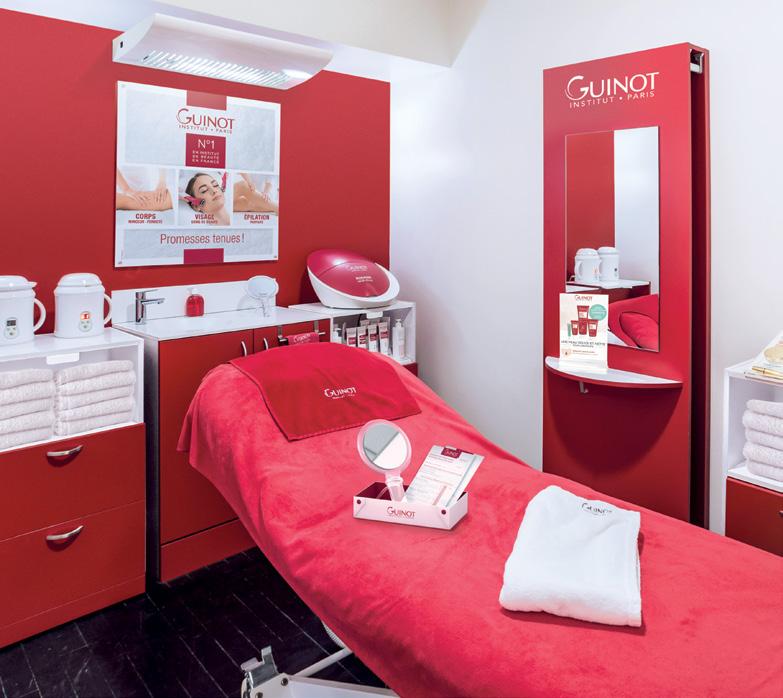
• No. 1 Professional Skincare brand in France created more than 50 years ago.
• Leader in facial treatments, slimming treatments and depilation methods.
• Present in 17,000 Beauty Salons and day spas across 92 countries.
• A 100% French integrated production with the highest pharmaceutical standards (ISO 22716, ISO 14001).
• 460 Franchise units in France with more than 60 openings per year.
• More than 55 franchises in 20 countries.
• A full franchise package through on-going training, operational & digital marketing support.
• Franchised Salons already established in the USA.
MVP Awards
MANAGEMENT
Business philosophy: Always give what you expect from others. By taking care of others, doing the right thing, and always remembering that we are all part of the greater good.
Management method or style: Ongoing. My method centers around total quality and companywide focus on doing the best job we can. Our company works together, knowing it takes a village to give our best.
Greatest challenge: Letting go. I’m not a micromanager, but I want to make sure our customers are getting the best service available. I’m the shepherd watching over my flock, the management team. The hardest thing for me has been letting go and holding
them accountable, knowing they’re going to do it a different way than I do. It can be neat to stand back and watch others doing something differently. It is a healthy thing for a franchise owner.
How do others describe you? Enthusiastic, dedicated, and loyal to all.
Have you ever been in a mentor-mentee relationship? What did you learn? Yes. I love mentoring, coaching, and growing with others, whether it is my team or coaching and mentoring with a new Home Helpers Home Care owner. What I have learned most is that I gain as much back. It is a reciprocal mentoring process. I’m always open to learning more.
One thing you are looking to do better: Take
better care of myself. Taking care of others means putting yourself at the top of the pyramid when it comes to your health.
How you give your team room to innovate and experiment: My team meets together weekly and monthly within their department. Our goal truly is not to compete with other home care companies but to compete within ourselves and improve our systems and customer service each month. I let each member bring ideas, innovation, and their energy to the table.
How close are you to operations? I am always available. Through the years, as I have delegated tasks and built up my team, I have maximized efforts by letting key managers oversee their departments. We meet weekly and monthly, and I am here
Enter to win the 2026 Wellness Entrepreneur Grant
GRAND PRIZE WINNER RECIEVES
$42,500
FRANCHISE FEE: COMPLETELY WAIVED!
<!DOCTYPE html><html lang=”en” class=”replit-ui-theme-root notranslate” translate=”no” style=”-webkit-app-region:drag”><head><title data-next-head=””>Loading... - Replit</title><link rel=”shortcut icon” href=”/public/icons/favicon-prompt-192-rebrand.png” sizes=”192x192” type=”image/png” data-next-head=””/><meta property=”og:title” content=”Loading...” data-next-head=””/><meta property=”og:description” content=”Build and deploy so ware collaboratively with the power of AI without spending a second on setup.” data-next-head=””/><meta property=”og:type” content=”article” data-next-head=””/><meta property=”og:image” content=”https://replit.com/public/images/opengraph_rebrand.jpg” data-next-head=””/><meta property=”og:site_ name” content=”replit” data-next-head=””/><meta property=” :app_id” content=”1775481339348651” data-next-head=””/><meta itemProp=”name” content=”replit” data-next-head=””/><meta itemProp=”description” content=”Build and deploy so ware collaboratively with the power of AI without spending a second on setup.” data-next-head=””/><meta itemProp=”image” content=”https:// replit.com/public/images/opengraph_rebrand.jpg” data-next-head=””/><meta name=”description” content=”Build and deploy ware collaboratively with the power of AI without spending a second on setup.” data-next-head=””/><meta name=”keywords” content=”replit,ai,so ware,build,collaborate,IDE,platform,code,deploy,prototype,online,agent” data-next-head=””/><mename=”author” property=”og:author” content=”replit” data-next-head=””/><meta name=”twitter:card” content=”summary” data-next-head=””/><meta name=”twitter:site” content=”@replit” data-next-head=””/><meta name=”twitter:title” content=”Loading...” data-next-head=””/><meta name=”twitter:description” content=”Build and deploy so ware collaboratively with the power of AI without spending a second on setup.” data-next-head=””/><meta name=”twitter:image” content=”https://replit. com/public/images/opengraph_rebrand.jpg” data-next-head=””/><meta name=”twitter:domain” content=”replit.com” data-next-head=””/><meta name=”google” content=”notranslate” data-next-head=””/><meta name=”viewport” content=”width=device-width, initial-scale=1” data-next-head=””/><meta charSet=”utf-8” data-next-head=””/><link rel=”manifest” href=”/public/ manifest.json” data-next-head=””/><meta name=”theme-color” media=”(prefers-color-scheme: dark)” content=”#1a1b1b” data-next-head=””/><meta http-equiv=”origin-trial” content=”AsKJNnBESA8LBSWSiA1TeHAuM7wj/zSm2MVlsxnG6yMeAuorNg9zyAEC3w+lp88yOz+9zkJmIQ++T1Cl4asHoAUAAABQeyJvcmlnaW4iOiJodHRwczovL3JlcGxpdC5jb206NDQzIiwiZmVhdHVyZSI6IkRpZ2l0YWxHb29kcyIsImV4cGlyeSI6MTYzMTY2Mzk5OX0=” data-next-head=””/><link rel=”apple-touch-icon” href=”/ public/icons/favicon-prompt-192-rebrand.png” data-next-head=””/><meta name=”mobile-web-app-capable” content=”yes” data-next-head=””/><meta name=”apple-mobile-web-app-title” content=”Replit” data-next-head=””/><link rel=”preload” href=”/ public/fonts/ibm-plex-sans-v8-latin-regular.wo 2” as=”font” type=”font/wo 2” crossorigin=”anonymous” data-next-head=””/><link rel=”preload” href=”/public/fonts/ibm-plex-sans-v8-latin-italic.wo 2” as=”font” type=”font/wo 2” crossorigin=”anonymous” data-
We’re investing in the next generation of wellness entrepreneurs.
One qualified entrepreneur will be selected to receive their franchise fee waived, an investment valued at $42,500, as they launch their MassageLuXe spa.
Because ownership should be earned through vision, commitment, and alignment. Not just capital.
Enter by June 30TH . Scan Here to Apply!
*Inquire for full rules and details.
MVP Awards
in the office/training center 30 hours on average each week.
What are the two most important things you rely on from your franchisor? To be informative to all franchisees and to continually push the envelope so that we are always knowledgeable about our industry.
What you need from vendors: To deliver quality service and products and stand behind what they say they are going to do.
Have you changed your marketing strategy in response to the economy? How? Somewhat. You must be spot on and pinpoint each decision. Our strategy includes honing our outside sales relationships so that we are the choice for those who can best use our services.
How is social media affecting your business? I am still working on this, but it is more important each day and a major part of relationship building. How are you using technology, like AI, to manage your business? This complements the intimacy of home care. We are constantly bringing more AI technology into our operations and using it as a tool to sharpen our efforts.
How do you hire and fire? Whether it’s a new manager or a member of our care staff, hiring is a very thorough and engaging process. We look for integrity, heart, and a sense of loyalty to our mission of helping others. Interviews, training, and relationship building all focus on these qualities. Firing is rare in both areas, but if the loyalty, heart, and ethics to the mission are not there, it is not a good fit in our business culture, and we will caringly and quickly let go of an employee.
How do you train and retain? Training is the most important aspect when a new employee joins our team. In addition to company culture, processes of taking care of others, and opportunities to gain knowledge and education, training is a commitment to having the best employees. They all appreciate it when you go the extra mile. Retention of employees focuses on continual training, caring for all your employees, a hug, a bonus, and recognition. They need to feel as important as your customer. We are all customers.
How do you deal with problems with employees? We follow what we call Conduct 1-2-3. This involves having a conversation, meeting one-onone, and making the best effort to fix the problem or issues. Listening often opens understanding. If the problem continues, we will let them go, knowing it is not a good fit and does not benefit them, our client, or the team.
Fastest way into your doghouse: Doing the wrong thing and not caring that you did it.
BOTTOM LINE
Annual revenue: $5 million.
2026 goals: Continue to advance and build internal leadership within my team. My financial goal is to reach $6.5 million in revenue in 2026.
Growth meter: How do you measure your growth? By the number of clients we are serving and by hitting revenue growth goals each year. Additionally, the more my team takes off my operations plate, that’s growth for me.
Vision meter: Where do you want to be in five years? 10 years? In five years, having a team that is running full operations 100%. In 10 years, living in Italy part-time.
“Our goal truly is not to compete with other home care companies but to compete within ourselves and improve our systems and customer service each month. I let each member bring ideas, innovation, and their energy to the table.”
Do you have brands in different segments? Why/why not? I do not. My philosophy as a home care agency is to do what we do well and dedicate ourselves to those we serve and those who serve you. How is the economy in your region(s) affecting you, your employees, your customers? All of us are watching the U.S. economy. As the demand for in-home senior care increases with 77 million seniors in the U.S. by 2031, we are finding ways to be creative so that folks can afford care. We must reward our employees with above-industry pay and benefits. We also look for other ways to elevate our appreciation for them for the intimate/caring work they do. Are you experiencing economic growth in your market? Yes. The Denver market continues to boom.
How do changes in the economy affect the way you do business? You must stay on it. We are constantly balancing cost and value.
How do you forecast for your business? I have a working business plan that targets my goals as an owner and adjusts and tweaks the numbers quarterly. This helps me to keep an eye on things. I am constantly adjusting.
What are the best sources for capital expansion? By reinvesting profits back into my company, including bank loans, so I have strong margins for dependable growth.
Experience with private equity, local banks, national banks, other institutions? Why/why not? It is okay to use these, but be careful not to bite off more than you can chew. If you feel secure in your growth and opportunities to pay debt off quickly, it may be a promising idea.
What are you doing to take care of your employees? Above-industry pay. I constantly connect with them and treat them as family. We offer both 401(k) and health insurance, and I am a huge believer in all employees having PTO and sick time. Ensuring a work-life balance is important.
How are you handling rising employee costs (payroll, minimum wage, healthcare, etc.)? There is a constant meter to keep your eye on. My best advice is to not ignore employee costs and adjust quarterly/ongoing so that it is not a system shock in one big moment.
What laws and regulations are affecting your business, and how are you dealing with them? I stay actively aware of state and federal legislation changes and issues that protect our seniors and employees. I have accompanied Home Helpers leaders and other franchise owners to Washington, D.C., to meet our legislators. Here in Colorado, I support several organizations involved in what is affecting our seniors.
How do you reward/recognize top-performing employees? Personal recognition, bonuses, a hug, and sharing in the success of our company.
What kind of exit strategy do you have in place? I hope that when the day comes to retire and rewire, I can pass the torch to an individual who brings their added wisdom and knowledge to the table, recognizing the successful culture we have built here in Denver. Whether you are a new franchisee or a seasoned one, an exit strategy should always be part of your business plan, so when the day comes, you are ready. n
Revolutionizing TV for Businesses
Engage Customers
Award-winning channels like Atmosphere Sports, NOW, and Chive TV feature viral videos, news, sports highlights, lifestyle, nature, and art content; keeping your patrons entertained while you deliver great service.
Improve Profitability
See a substantial boost to your bottom line by moving away from expensive and less versatile services of traditional providers. Our free cable cutting monthly service allows you access to value-enhancing advertising tools that enable your businesses to recruit, upsell, celebrate and engage.
Control the Remote
Never be concerned with what’s playing on your TVs again. Our platform allows you to select what channels are available to team members while providing the ability to change channels remotely either centrally or at site level.
Easy, on-screen promotions. Highlight your products, events, pricing and more with free, in-house television ads created, scheduled and controlled by you. Increase your sales and get started with Digital Signage today.
STRENGTH. POWER. CONFIDENCE.
Founded in 2001, Pure Barre is the largest barre brand in the U.S., offering a range of effective, low-impact, full-body workouts for a broad range of fitness levels. Pure Barre has four signature formats including classic barre, weight-based strength training, interval training, and restorative stretching, as well as an introductory format. Its high quality instructors receive specialized multi-tiered training allowing for class format and choreography to be refreshed on a quarterly basis. Pure Barre is ranked on Entrepreneur Magazine’s Franchise 500 each year, the Fastest-Growing Franchises in three years running as well as Inc. Magazine’s Inc. 5000.
Sq. Footage | 1,400 - 1,800 Sq. Ft.
Max Class Size | 25
6x larger than the 2nd barre provider Largest barre brand in the U.S.
www.purebarre.com
GET YOUR SIX ON
Founded in 2012, YogaSix is the largest franchised yoga brand in the United States that offers a broad range of heated and non-heated yoga classes, strength-building and cardio-boosting fitness classes, and restorative yoga classes accessible to all. YogaSix has six Signature class formats, including Y6 101, Y6 Restore, Y6 Slow Flow, Y6 Signature Hot and Warm, Y6 Power Flow, and Y6 Sculpt & Flow, plus three Specialty Classes: Y6 Mix, Y6 TRX, and the new Y6 Mobility. YogaSix is ranked in Entrepreneur Magazine’s Franchise 500 in two years running, Fastest-Growing Franchises, and Top New Franchises two years running.
Sq. Footage | 1,600 - 2,200 Sq. Ft.
Max Class Size | 40
Modern-day approach to yoga - low barrier to entry
Long-standing core boutique fitness modality
www.yogasix.com
“I’ve always taken care of people, and it is in my DNA. I enjoy making an impact, and it is very fulfilling.”
Purpose Meets Performance
Revenue leader turns care into competitive advantage
Written by KEVIN BEHAN
Bryant Greene almost talked himself out of attending the career fair where he first discovered Always Best Care, the franchise opportunity that would shape decades of his life.
Greene built his career in accounting and business operations, but when Comcast eliminated his position during the Great Recession in 2009, he found himself starting over. He described himself as “scared to death” when he reluctantly attended that career fair, hoping to land an opportunity. He met a franchise broker who showed him four turnkey opportunities, including one in senior care.
“I was blessed with having my great-grandparents present until my adulthood,” Greene says. “I understood what it meant to be a caregiver and the family dynamics that are involved. I didn’t set out to buy a franchise. It was an opportunity presented to me when no other options were available. As it got closer, it made more sense to me, and I thought I could be good at it. And it turns out that I am.”
The co-winner of the Single-Brand Leadership MVP, Greene opened his first Always Best Care franchise in 2010 and has since expanded to 15 territories across Southeastern Pennsylvania and Delaware while overseeing more than 850 caregivers serving 750 clients. He has led the system in revenue since 2012 and was twice named the brand’s Franchisee of the Year for his excellence in operations, caregiver relationships, and community engagement.
Many of the clients Greene’s team works with benefit from Medicaid, which provides coverage for lower-income individuals and al lows them to receive services while remaining in their homes. Always Best Care provides nonmedi cal in-home care services, such as companionship, housekeeping, grooming, bathing, light meal prepa ration, and appointment escorts.
Bryant Greene is a co-winner of the
Single-Brand Leadership MVP
(Most Valuable Performer) for achieving leadership with a single brand.
“I enjoy helping people,” Greene says. “I come from a modest background, and there are a lot of things that are personal to me that I try to help others with. I’m not Superman, but I try to assist where I can. Now that I have been doing it for a while, there are certain things I enjoy doing. Everything I do, I have some kind of connection to it. It makes me feel good.”
Greene has leveraged the sustained success of his business to become a powerful voice in the community. He hosts a public affairs radio program and a TV show to educate people on healthcare, senior living, business resources, and community initiatives. He has been an advocate for home care services and issues that affect people with disabilities. He’s also spoken on Capitol Hill to address issues related to economic growth, tax policy, and access to capital.
Greene shares his business knowledge and leadership by serving on the boards of several hospitals and community organizations. He also established scholarships at his alma mater and hires scholarship recipients as interns, providing mentorship and hands-on experience. He has raised more than $500,000 for the Alzheimer’s Association and has ranked as the top Alzheimer’s Corporate Fundraiser in the Delaware Valley for the past 13 years.
“I try to make sure the people who are underserved get help,” Greene says. “I don’t have a problem with rolling up my sleeves and getting involved. This business we’ve built is something we are really proud of. I’ve helped family friends, people from church, and community members. I get the juice out of that. I found something I really enjoyed doing. I’ve always taken care of people, and it is in my DNA. I enjoy making an impact, and it is very fulfilling.”
MVP QUESTIONS
Why do you think you were recognized with this award? I believe I was recognized with this award because of the accomplishments our organization has achieved over the years, particularly our sustained growth, operational consistency, and the impact we have made serving clients and families in our communities.
How have you raised the bar in your own company? By setting high expectations for service quality, accountability, and professionalism across the organization while continually looking for ways to improve operations and outcomes for both our clients and our workforce.
What innovations have you created and used to build your company? One of the operational strategies that has helped us build the company is maintaining a 24/7 operating model. By ensuring we are available around the clock, we can better support our clients’ needs and provide consistent care whenever it is required.
What core values do you think helped you win this award? Openness, candor, and respect in how we handle both our clients and our workforce.
BRYANT GREENE
Multi-Unit Franchisee
Company: BMG Circle of Life LLC, BG Circle of Life LLC, TG Life LLC
Units: 15 Always Best Care Age: 56
Family: Daughter Bria Greene
Years in franchising: 16 Years in current position: 16
Treating people with honesty and dignity has been fundamental to building strong relationships and long-term trust.
How important is community involvement to you and your company? Community involvement is very important to both the company and me. We believe it is essential to support the communities we serve and to give back through local initiatives and charitable efforts whenever possible. What leadership qualities are important to you and your team? The ability to multitask, prioritize responsibilities, resolve conflicts effectively, and keep the entire team focused on shared goals.
PERSONAL
First job: From age 5 until I was a teenager, I was a painter’s apprentice for my grandfather.
Formative influences/events: Some of my most formative experiences were working part-time with my grandfather and later spending time reading and working as a librarian aide, which helped shape both my work ethic and appreciation for learning.
Key accomplishments: Being Always Best Care’s top revenue producer for the past 14 years and serving as the top fundraiser for Alzheimer’s initiatives in the Delaware Valley tristate area for the past 13 years.
Biggest current challenge: Maintaining the caregiver workforce. Those positions can be transient because a lot of the work is part-time. Some stay while others look for other opportunities. There is also a lot of outside competition.
Next big goal: To open a new business in retail cannabis.
First turning point in your career: Transitioning to full-time work while also obtaining my MBA, which helped expand my professional opportunities.
Best business decision: Choosing to work with Medicaid clients, which allowed us to serve a broader population in need of care.
Hardest lesson learned: Hiring family members is not always the best decision for a business. It is difficult when you fire a family member. Some of the family members I’ve hired have worked out well, and some have not. The dynamics change outside of work.
Work week: Seven days a week. My average day can be 10 to 12 hours or more. I will take days off, but I will never turn off my cell phone.
Best advice you ever got: The best advice I’ve received came from Emmanuel Amobi, one of my general accounting professors at Virginia State University. He said that knowledge leads to confidence while ignorance leads to fear.
What’s your passion in business? Providing great care and ensuring that clients receive the support and services they deserve.
How do you balance life and work? I try to balance life and work by taking breaks when possible to enjoy extracurricular activities such as attending basketball games or seeing Broadway musicals. Guilty pleasure: Cooking unhealthy food.
Favorite book: Go Tell It on the Mountain by James Baldwin.
Favorite movie: “The Wiz.”
What do most people not know about you? Most people don’t know that I am actually a homebody.
Pet peeve: Chaos and unnecessary drama. What did you want to be when you grew up? A cross between George Jefferson and J.R. Ewing. Last vacation: My last vacation was in Tuscany in the summer of 2025.
Person you’d most like to have lunch with: My daughter.
MANAGEMENT
Business philosophy: That consistency is the hallmark of a true professional.
Management method or style: It is both inclusive and direct. I believe in open communication while also being clear about expectations and responsibilities.
Greatest challenge: Dealing with obsolete regulations that haven’t changed with the times, such as mandatory drug testing in Delaware or requiring employee background checks.
How do others describe you? Others typically describe me as outgoing and fair.
Have you ever been in a mentor-mentee relationship? What did you learn? Yes. I learned to give myself grace and to treat every challenge or setback as an opportunity to learn.
One thing you’re looking to do better: Learning to say “no” more often when necessary.
MVP Awards
How you give your team room to innovate and experiment: I encourage my team to share ideas and take initiative when they see opportunities to improve processes or outcomes.
How close are you to operations? I remain partially involved in day-to-day operations, maintaining awareness while allowing leadership teams to manage their responsibilities.
What are the two most important things you rely on from your franchisor? For them to give us space and autonomy, which allows us the flexibility to operate effectively within our market.
What you need from vendors: I expect agreed-upon deliverables to be completed accurately and on time.
Have you changed your marketing strategy in response to the economy? How? Yes. We have adjusted our strategy by carefully managing spending and focusing more on workforce recruitment trends.
How is social media affecting your business? It has made a positive impact on the business, helping increase awareness and engagement.
How are you using technology, like AI, to manage your business? We use technology within skilled care services to support documentation and notes, which helps improve accuracy and efficiency.
How do you hire and fire? All hiring and termination decisions are handled in a manner that is fully compliant with HR policies and regulations.
How do you train and retain? Training and retention efforts include routine development programs, new-hire orientation, and virtual training opportunities.
How do you deal with problem employees? Directly and quickly resolve problems before they escalate.
Fastest way into your doghouse: Dishonesty and disloyalty are the fastest ways to lose my trust.
BOTTOM LINE
Annual revenue: $33 million.
2026 goals: To reach $38 million in revenue.
Growth meter: How do you measure your growth? Client and workforce satisfaction. We subscribe to different vendors that are always surveying our census and our workforce. People are more likely to be honest with a third-party service.
Vision meter: Where do you want to be in five years? 10 years? Continue expanding the business while maintaining strong service quality and operational stability.
Do you have brands in different segments? Why/why not? Yes. My brands are multi-layered with cannabis and home care.
How is the economy in your region(s) affecting you, your employees, your customers? Lower Medicaid rates and workforce recruitment
challenges are having an impact on both operations and staffing.
Are you experiencing economic growth in your market? We are seeing growth in Delaware, but the Pennsylvania market has remained relatively flat.
How do changes in the economy affect the way you do business? Economic changes can adversely affect the business. Some of our daily expenses, like gas, parking, and transportation, have increased. How do you forecast for your business? We forecast business performance using historical data and financial report cards.
What are the best sources for capital expansion? Profit and revenue generated by the business.
Experience with private equity, local banks, national banks, other institutions? Why/ why not? I have a background in accounting and finance. I have done some nontraditional financing, but I haven’t gotten an SBA loan.
What are you doing to take care of your employees? We support our employees through competitive wages, incentive programs, and perks such as tickets to concerts and plays.
How are you handling rising employee costs (payroll, minimum wage, healthcare, etc.)? We are managing rising employee costs as effectively
as possible while trying to remain competitive and sustainable.
What laws and regulations are affecting your business, and how are you dealing with them? Electronic visit verification requirements are one example. It is a requirement for Medicaid providers to clock in and out. The problem comes with locations lacking internet or people without cell phones. We address regulatory challenges by maintaining consistent communication with both clients and our workforce.
How do you reward/recognize top-performing employees? Top performers are recognized through our company newsletter, internal email communications, and monetary incentives.
What kind of exit strategy do you have in place? I would like to work three to five more years and then focus on retirement. Even while retired, I expect to act as some kind of business consultant. n
Ali Lakhany and Emad Lakhany’s franchising journey started when their father and uncle pursued their dreams to the U.S. more than 50 years ago. Hashim Lakhany and his older brother, Ash Lakhany, emigrated from Pakistan with several hundred dollars to their names in 1969. Hashim worked in several restaurants while putting himself through college. He eventually opened his own restaurant and later became a franchisee with Del Taco in the late 1970s before landing with Popeyes Louisiana Kitchen in 1987.
From an early age, the co-winners of the MegaBrand Leadership MVP Award witnessed the hard work and sacrifice their parents put into the family business. They developed a deep appreciation for the discipline and time management that went into operations. They also learned to value their guests and team members. Each brother worked at the Popeyes restaurant while in high school, spending years learning the business before moving into management positions.
“Our upbringing gave us the belief to dream big and the conviction that, through hard work, unity, doing things the right way, and with God’s blessings, anything is possible,” Ali says. “But it also showed us the other side of how much sacrifice, grit, and resilience it takes to build something from zero. We can never fill our father’s shoes. He is the true definition of the American dream, and that standard is what pushes us every day.”
Ali and Emad were working in leadership roles at the family’s three restaurants when their father passed away in 2009. They took over ownership of
“Every decision we make and every action we take reflect the values our father instilled in us.”
Ali Lakhany and Emad Lakhany are the Mega-Brand Leadership MVPs (Most Valuable Performers) for achieving excellence in growth and expansion
ALI LAKHANY AND EMAD LAKHANY
Chief Executive Officer (Ali) and Chief Development Officer (Emad)
Company: CSM Group
Units: 141 Popeyes Louisiana Kitchen, 11 Tim Hortons, 2 Andy’s Frozen Custard, 118 T-Mobile, 4 LaPasha Mediterranean Lounge and Grill, 4 Marriott International and Hilton Hotels
Age: Ali, 40, and Emad, 35
Family: Ali and Emad have three children each
Years in franchising: Ali, 25, Emad, 20
Years in current position: Ali, 20, Emad, 15
the business and experienced modest growth before Restaurant Brands International (RBI) purchased Popeyes in 2017. RBI sought qualified developing operators, and officials were impressed by the brothers’ journey from working in the field to becoming owners and building a strong company culture along the way.
The association with RBI launched the Lakhanys’ ascension into franchising. They formed the CSM Group, which comprises 141 Popeyes restaurants and a total of 280 franchise units across multiple industries. The brothers’ approach toward growth relies on strategic partnerships and passive ownership interests. Their primary focus continues to be scaling and strengthening their restaurant platform.
Growth isn’t gauged by the number of units they own but by building a sustainable, healthy, and profitable business model. They are passionate about developing people and creating an environment where leaders can grow, thrive, and build meaningful careers. Despite the company having more than 3,000 employees, the brothers still consider it a family business. They see their company as one way to honor what their father made possible for them.
“Our name represents our reputation. Every decision we make and every action we take reflect the values our father instilled in us,” Ali says. “Carrying on his legacy isn’t just about growing the business.
It’s about doing things the right way, developing the right people, and ensuring that what he built continues to have a lasting impact for generations to come.”
MVP QUESTIONS
Why do you think you were recognized with this award? We believe we earned the Multi-Brand Leadership Award because of our ability to successfully grow and operate across multiple brands while maintaining a strong culture, disciplined operations, and a long-term commitment to the brands we represent. Our focus has always been on building great teams, developing leaders, and creating systems that allow each brand to perform at the highest level.
How have you raised the bar in your own company? Growing up, we were always actively involved in competitive activities, and that spirit has carried into how we lead the company today. We constantly push each other to improve, and that mindset naturally flows throughout the entire organization. That culture of raising the bar has led to major milestones, including being recognized as Popeyes Franchisee of the Year in 2024 and 2025. After winning in 2025, the first thing we said was that the bar needed to be set even higher and that the goal should be a three-peat.
At the same time, we believe that raising the bar is not only about the growth of the company, but also about the growth of our people. When the company achieves its metrics and KPIs, the team that made it possible should enjoy the fruits of that success as well. Raising the bar is not just about performance, but about creating an environment where the entire team grows and celebrates wins together. What innovations have you created and used to build your company? One of the main reasons we continue to grow and thrive is that we constantly challenge ourselves to innovate and improve. We are always looking for ways to build not just a stronger company, but stronger leaders within our organization. We created a three-pronged approach:
• CSM University trains and develops our people to think like franchisees and owners.
The goal is to give our team the mindset and skills needed to lead at a higher level and, in some cases, position them to one day become franchisees themselves.
• CSM Circle recognizes and retains our top-tier talent through premium compensation structures, performance bonuses, and profit sharing.
• CSM Cares allows our managers to give back to the communities in which they operate. Our managers lead the charitable efforts and decide where the funds are donated. It could be schools, churches, homeless shelters, or any other community organization that allows our team to give back to a cause that’s near and dear to them.
Together, these initiatives reflect how we try to innovate not only in operations, but also in how we
develop people, reward performance, and give back to the communities we serve.
What core values do you think helped you win this award? Our late father, Hashim Lakhany, lived by a set of fundamentals both at work and in his personal life. They became the company’s core values and were integrated into our company manifesto. We live this daily and call it DEPICTS: decision-making, empowering others, importance of the process, how to prioritize, influence others around you, cultivate your leaders and the next generation, trust by verification, and servant leadership. These principles are instilled into all our leaders. How important is community involvement to you and your company? Community involvement is a core responsibility for our family and our company. It’s a value passed down by our forefathers that success should be measured by the opportunities we create for others.
At the University of Houston, we’ve been proud to support the SURE Program (Stimulating Urban Renewal through Entrepreneurship), which empowers students and entrepreneurs from underserved communities to work with the C.T. Bauer College of Business to develop their businesses. Our involve-
MVP Awards
ment has included both financial support and active engagement through mentorship and participation. We established the Salma & Hashim Yousuf Lakhany Entrepreneurship Floor at the UH Innovation Hub, which houses the SURE program along with the entrepreneurship program. It creates a space where entrepreneurs and students grow businesses with structure and a focus on profitability and sustainability. Helping them to gain confidence and build their futures is what makes this work truly meaningful.
At CSM Group, we carry this forward by focusing on creating opportunities, developing people, and strengthening the communities we serve. What leadership qualities are important to you and your team? Decision-making, trust, and servant leadership.
PERSONAL
First job: We both worked behind the counter at Popeyes while we were in high school.
Formative influences/events: As a franchise owner himself, our father instilled in us the importance of guest experience, discipline, time management, and truly valuing the team. He also taught us how to dream big, work hard, remain united, and do things the right way.
Key accomplishments: We were named the Entrepreneurs of the Year by the C.T. Bauer College of Business at the University of Houston in 2023. We also won Popeyes’ Franchisees of the Year in consecutive years in 2024 and 2025.
Biggest current challenge: Recruiting top talent in the QSR space. Finding the right candidate willing to work in fast food is difficult in today’s environment. The majority of Gen Z, Gen X, and millennials don’t find QSR to be a sexy space.
Next big goal: We recently launched an owner-operator platform with CSM University, where we incorporate educational resources and support, including collaboration with Restaurant Brands International and the C.T. Bauer College of Business at the University of Houston.
First turning point in your career: From 2006 to 2009, we submitted 46 applications to open new Popeyes locations and were rejected each time. Those rejections fueled our fire, and our development plans took off after RBI purchased Popeyes.
Best business decision: We both worked in the kitchen at Popeyes for three years. That gave us an understanding of our employees and guests. There is no shame in doing the “dirty job.”
Hardest lesson learned: We missed out on a lot of acquisition opportunities because we couldn’t read between the lines. We learned how to listen, listen, and listen and to hear what is unsaid.
Work week: Start early, end late, and remember that family and health come first. Go at a pace where you listen to your body. It changes with time.
Exercise/workout: Ali walks three to four times per week and works out. Emad works out five days a week and enjoys a cold plunge.
Best advice you ever got: Stay in your lane, know your strengths and weaknesses, and most importantly, reward your people.
What’s your passion in business? Developing people, building profitable and sustainable businesses that impact others, and building a legacy for the next generation to follow.
MANAGEMENT
Business philosophy: Treat others well and with respect.
Management method or style: Treating others with honesty and integrity.
Greatest challenge: Dealing with factors outside our control, like inflation and political instability. It is difficult to make decisions without knowing the long-term outcomes of each.
How do others describe you? Honesty, integrity, approachable, and able to communicate.
“We operate in markets we know. We have a mandatory DM meeting biweekly and a manager meeting monthly. We know our entire management team on a firstname basis.”
How do you balance life and work? We both have great life partners. We work hard, and outside of work, we focus on our families. We enjoy and live in the moment.
Guilty pleasure: Food.
Favorite book: Ali: The 21 Irrefutable Laws of Leadership by John Maxwell. Emad: Atomic Habits by James Clear.
Favorite movie: “Remember the Titans” and “Guru” (both Ali and Emad).
What do most people not know about you? Emad lost 60 pounds about five years ago through eating right and working out. Ali collected the most cans in a recycling competition in elementary school.
Pet peeve: We both feel lying is unacceptable. What did you want to be when you grew up? Emad: a businessman. Ali: an intelligence officer.
Last vacation: Ali: Iceland in 2025. Emad: Costa Rica in 2025.
Person you’d most like to have lunch with: Ali: Barack Obama or Turkey’s president Tayyip Erdogan. Emad: Warren Buffett or LeBron James.
Have you ever been in a mentor-mentee relationship? What did you learn? Yes. We learned to listen more, extract the strengths, and overlook the weaknesses.
One thing you’re looking to do better: Execute. We have great ideas and strong opportunities. We just need to be able to take them to the finish line.
How you give your team room to innovate and experiment: We set guardrails and implement the Triple-A Rule: autonomy, accountability, and appreciation.
How close are you to operations? Close. We operate in markets we know. We have a mandatory DM meeting biweekly and a manager meeting monthly. We know our entire management team on a first-name basis.
What are the two most important things you rely on from your franchisor? Strategic partnership and alliance on the long-term vision of the brand, brand marketing, and supply chain support. We have in-person meetings once a quarter. If they help bring the guest to our door, it’s our duty, responsibility, and honor to offer hospitality and an elevated guest experience.
What you need from vendors: Trust, transparency, and reliability.
Have you changed your marketing strategy in response to the economy? How? Yes. We’ve gone heavy with social media and local targeted marketing. Community engagement is a must.
How is social media affecting your business? It has a positive impact. As an example, the popularity of the chicken sandwich was brought through social media platforms, and our sales have gone up in double digits.
How are you using technology, like AI, to manage your business? AI is our new best friend. Much is in the works in the back end of the business.
How do you hire and fire? We hire by being selective. Once we find a strong fit, it is likely they will never leave. We provide employees with clear deliverables and expectations. If they are not met in the timeline of 30 to 60 days, we tell them it is best to remain friends.
How do you train and retain? Training is the backbone of our business. Recognition, appreciation, and frequent monitoring incentives are the secret to our retention. We train people with our
in-house platform, CSM University. It has been so popular that people from other franchise teams come to us for training.
How do you deal with problem employees? We have 30, 60, and 90-day rules that allow employees to correct themselves. If they don’t correct themselves after the third time, we let them go. Fastest way into your doghouse: A mistake of the mind is forgiven and respected. A breach of trust and a mistake of the heart require us to part ways.
BOTTOM LINE
2026 goals: 8 to 10% yearly growth through samestore sales and new existing market growth.
Growth meter: How do you measure your growth? We calculate the investment and the time available. You can never double your store count overnight. We like to grow at an aggressive yet manageable pace.
Vision meter: Where do you want to be in five years? 10 years? A healthy, sustainable, and longterm business model. We are a generational family business and in no rush to grow. There is a major focus on growing the right way and for the next generation to move the enterprise forward.
Do you have brands in different segments? Why/why not? Yes. We are in three different segments. Our QSR brands are active while hospitality and telecom are passive. The reason is diversification and long-term value added for the next generation. Nearly 80% of our time and capital is spent on our day-to-day active investments in the QSR space. The remaining is invested in strategic partnerships through alternative passive investment platforms.
How is the economy in your region(s) affecting you, your employees, your customers? In Texas, heavy immigration reforms have impacted traffic and sales.
Are you experiencing economic growth in your market? Yes. Most of our franchises are in Texas, where there has been major growth in population, the business sector, and the GDP.
How do changes in the economy affect the way you do business? We change with the times and revisit our operating and growth strategies every quarter.
How do you forecast for your business? Through local insights and growth generators.
What are the best sources for capital expansion? The cheapest capital that adds value is the best capital.
Experience with private equity, local banks, national banks, other institutions? Why/why not? We’ve only worked with conventional banks. What are you doing to take care of your employees? Our CSM Circle program recognizes and retains our top-tier talent through premium compensation structures, performance bonuses, and profit-sharing plans.
How are you handling rising employee costs (payroll, minimum wage, healthcare, etc.)? Through stronger operational efficiency.
What laws and regulations are affecting your business, and how are you dealing with them? Today, it’s immigration. Tomorrow, it will be something entirely different. We need to be ready to move quickly at all times.
How do you reward/recognize top-performing employees? We give bonuses through our CSM Circle program.
What kind of exit strategy do you have in place? We have no pla ns. n
We are a team of highly experienced, direct nationwide franchise lenders offering a convenient one-stop shop for all of your franchise financing needs—conventional, SBA, and equipment.
Our team of professionals has many years of experience lending to thousands of stores across dozens of concepts, ranging from new and expanding to widely known. If you are in need of financing, contact us today to get started.
About Gulf Coast Franchise Finance:
• We offer conventional loans, real estate financing, SBA loans, and equipment financing at competitive terms to meet your needs.
• We focus on building long-lasting relationships and have the available loan products to grow with our borrowers from their first unit to becoming large multi-unit operators.
• Our straight forward underwriting focuses primarily on historical and projected cash flow.
• We feature a comprehensive pre-approval process which allows us to issue a very detailed and accurate proposed term sheet within 3-5 business days after receipt of a complete application package.
• In addition to being conventional lenders, we are a nationwide SBA preferred lender.
• Financing availability includes: commercial real estate acquisition, new construction, renovation/remodel/reimage/relocation, business expansion or acquisition, start-up financing/new stores, leasehold improvements, debt refinance, purchase of equipment or inventory, partner buyout, development/conversion, and/or working capital.
KATIE LEE AND BRIAN AND HOPE BAYER
“We set the precedent for what franchise owners needed to be in a brand that was changing the face of the industry.”
Built on Friendship Childhood bonds
fuel a 36-unit portfolio
Written by KEVIN BEHAN
Lifetime connections and relationships are the foundation of the original and largest franchisee group in the Goldfish Swim School system. Since becoming Goldfish’s first franchisees in 2009, Katie Lee and childhood friends Hope and Brian Bayer have grown their business to 36 schools across nine states with a goal to reach 40 by the end of the year.
Their story dates to when Katie and Hope were 8 years old and started swimming competitively together. Hope and Brian started dating when they were 15 and later married, and the three have remained best friends since. After leaving her corporate job and returning home to Michigan in 2007, Katie was introduced to Goldfish by its co-founder, Jenny McCuiston, whom she knew as a swimmer from a rival high school while growing up.
Katie began teaching classes there part-time and was impressed by the number of kids taking swimming lessons. Brian was in the process of leaving his family business at the time, and the three of them discussed the possibility of partnering together on a new Goldfish location. The timing was fortuitous because McCuiston was considering franchising the concept.
Katie oversees all operations, and Brian serves as CFO and leads growth. Although Hope’s background is in teaching, Katie says her role is constantly evolving and she “does everything and all things.” The three credit their success to understanding their strengths and staying focused on their respective roles, which helped them become co-winners of the Single-Brand Leadership MVP Award.
After initially expanding into several Midwest states, the group moved into New York and New Jersey (now its largest markets) and recently entered Florida. Managing locations across multiple states and more than 2,000 employ
Katie Lee and Brian and Hope Bayer are co-winners of the Single-Brand Leadership MVPs (Most Valuable Performers) for achieving leadership with a single brand.
KATIE LEE AND BRIAN AND HOPE BAYER
Multi-Unit Franchisees
Company: BHB Investment Holdings
Units: 36 Goldfish Swim School
Age: Katie, 49, Brian, 50, and Hope, 48
Family: Katie and her husband, Tommy, have 3 children, Carolina, Joseph, and James; Brian and Hope have 3 children, Kaitlin, Alex, and Elizabeth
Years in franchising: 18
Years in current position: 18
ees presents challenges, Katie says, but she sets the tone each week with a Monday noon call that brings together about 125 members of the management team and keeps everyone aligned.
“I never want people to feel like a number,” Katie says. “It first started by not wanting clients to feel like a number and by treating them as individuals. Now, it has evolved to my team. All the people on our team, specifically general managers on up, know who Hope, Brian, and I are. We are intimately involved in the business, and we are not stepping away. I’ve stuck to the Monday call because I want them to see me and know I’m in it with them.”
As Goldfish Swim School’s largest and longesttenured franchisees, Katie, Hope, and Brian serve as mentors to other owners in the system. Katie says she is happy to speak with other franchisees seeking advice, but she also relishes the opportunity to learn from them. Franchising is collaborative, and everyone can learn from each other regardless of size or experience.
“We are changing children’s lives to be safe in and around the water,” she says. “You really can’t beat that in having a job with as many kids as we teach in a given year. Every child deserves the opportunity to learn how to swim. It has also changed the trajectory for my family. The ability to be a working
mom and have my kids see what I am doing: what an opportunity of a lifetime.”
MVP QUESTIONS
(Answers are from Katie.)
Why do you think you were recognized with this award? We set the precedent for what franchise owners needed to be in a brand that was changing the face of the industry. We were the first ones to show what it looked like to go all in on Goldfish Swim School before anyone else had proven it at scale. We built the blueprint.
How have you raised the bar in your own company? As we expanded into different states, we put regional managers in place to manage our operations groups on the ground. That structure has allowed us to maintain our standards and culture across all 36 schools wherever they are located. What innovations have you created and used to build your company? We have made a heavy investment in leadership development by constantly pushing our team to grow and evolve. We also use technology as a key tool to manage our business both up close and from a distance. When we opened our first out-of-state school, I needed to see what was happening every day with total sales, performance bench-
MVP Awards
marks, etc. We built dashboards that consolidate data across all 36 schools. That gives us a low, a high, and a middle, so we can identify where a school is underperforming and course correct fast. Having that many data points is a real competitive advantage. We can see things a three-unit operator simply cannot.
What core values do you think helped you win this award? Integrity, compassion, and trust most define us as an organization.
How important is community involvement to you and your company? It is hugely important. We are in these communities, and we want people to feel like part of the family we have created. It is not just about teaching a swimming lesson; it is the whole experience from the moment you walk in the door to the moment you leave. The balloons, the family swim nights, the pizza and cupcakes: We want you to want to come here, and we know you, and you know us. Our staff feels that way too.
On the charitable side, we partner with the Children’s Center in Detroit. My dad was on their board, so it was a natural connection for me. I have been going there since I was a child myself. Every summer, we bus the camp kids in to swim twice a week for six weeks at two of our schools. The joy on those kids’ faces is something else. Every child deserves the right to learn how to swim, and we are doing everything we can to make that happen. Our staff looks forward to it every single year.
What leadership qualities are important to you and your team? Being futuristic, being stable, staying focused on the P&L, and being actively involved in the schools. And above all, it is servant leadership. I believe you lead people by being alongside them, not above them. That philosophy runs through everything we do.
PERSONAL
First job: I was a lifeguard and swim coach for seven years as a teenager.
Formative influences/events: I worked with a female VP when I was with IBM. She changed the way I lead. She was a single mom with kids at home. One day, she told us she was taking a leave of absence because her family needed her. As a 25-year-old, I didn’t connect with this idea until I became a mother myself. I now understand exactly why she made this critical decision for her family. That stuck with me deeply.
My dad was a CFO for a large hospital, and I am absolutely the product of my father. Watching him lead with respect and build real relationships with the people around him is where my relational leadership style comes from.
Key accomplishments: Taking the leap from corporate America into Goldfish was the first major accomplishment, and then later opening our first school out of state was a massive milestone.
The accomplishment I am most proud of, though, is the longevity of our team. I have someone approach-
ing 20 years with us who has gone from Goldfish’s first employee to my director of pool operations. That kind of loyalty tells you everything about the culture we have built.
Biggest current challenge: Acquiring, retaining, and training great people. It is a constant in the operations business, and honestly, I have made peace with it, and it does not rattle me anymore. But I also work hard to reframe it for my team. I tell them not to look at this as a negative but as an opportunity to find amazing people and bring them into what we are building. We have 2,000 people working for us, and I never want anyone to feel like a number.
Next big goal: To reach 50 units and to figure out how to scale our operations sustainably. That has been our biggest hurdle this past year. We were able to grow, but now we are asking ourselves: How do we do this at scale?
First turning point in your career: Entering franchising with my best friend and her husband. It was the biggest life change and trajectory shift I have ever made for both my family and me. Leaving the security of corporate America to build something from the ground up with people I trusted completely was everything. It changed what I do every single day.
Best business decision: Taking the leap into franchising with Brian and Hope. Leaving a stable, well-paying corporate career was a risk, but doing it alongside people I trusted with my life made it the best decision I have ever made professionally. Everything we have built stems from that one choice.
Hardest lesson learned: Leading at this scale can feel like operating in a silo. In corporate America, if you are a VP, you have a peer VP right next door whom you can bounce things off. In our world, we are paving the road ourselves. The franchise system supports us, but when you operate 36 schools, you are often figuring things out without a true peer to lean on. That is both the challenge and the responsibility of being this size. Every day brings something new, and I have learned to embrace that.
Work week: Every Monday at noon, I run a leadership call with our entire management team of about 125 people. That is the anchor of my week. I have an office in Northville, Michigan, and I try to be there at least every other week. Beyond that, my travel schedule is built entirely around the needs of our schools and our team. I may be in the office every day one week and traveling out of state the next.
Exercise/workout: I am a 5:30 a.m. workout person—no exceptions. I genuinely cannot function without it. It is not optional for me.
Best advice you ever got: My dad told me, “Hire slow, fire faster.” I thought it was pretty blunt at the time, and I remember thinking, Dad, really? But he just said that I would figure it out, and he was right. I live by it now.
What’s your passion in business? Leading people and working with others. That is my niche. If you looked at my strengths profile, I am a high executor, and I get things done. But my other top strengths are harmony and positivity, and those
Franchise Suppor t Program for Signage
SignArt provides a comprehensive platform that executes the process from st art to finish for your signage program. This Proven Process is dedicated to helping franchise leaders decide the right type of signage and placement for their expanding brand on a Regional/National Level.
•
•
SignArt's Franchise Program:
All project stages: Scheduling, permits, manufacturing, installation, electricians and utilities.
Work with municipalities to achieve the best sign size and placement for the most impact/visibility.
Oversee the projects in real time, placing our customer's best interest first.
Communication is a priority.
Every Program Includes: Survey Site Plan Brand Book / Design Permits / Variance
In-House Manufacturing
Installation
Completion Report with Photos
Ignite Your Brand With SignAr t
MVP Awards
two things work really well together in operations. I learned that from my dad. I watched him build genuine, mutually respectful relationships with everyone around him. I am wired the same way, and I think it shows in how I lead my team.
How do you balance life and work? I know when I need a break. I am very conscious of that now. Sometimes, it is as simple as telling myself not to open my laptop on Sunday. I do work a lot, and I will not pretend otherwise. But I also know when my body and my mind need to shut it down and pause. I am a better leader when I give myself that space, and I think everyone is. Whether that means exercise, reading, watching a movie, or going on a real vacation, you have to protect that time.
Guilty pleasure: Traveling up north with my family to places like Charlevoix and Walloon, Michigan. There is nothing better than getting away with the people I love most.
Favorite book: Kristin Hannah is one of my alltime favorite authors, and The Nightingale is at the top of my list. I read to escape, not to learn.
Favorite movie: “The Holiday.” We are a massive Christmas family, and we love everything about the holidays.
What do most people not know about you? I am terribly claustrophobic. I do not love people knowing that about me.
Pet peeve: If you say you are going to do something, do it. Simple as that.
What did you want to be when you grew up? An accountant because that is what my dad was.
Last vacation: Deer Valley, Utah, with my husband, Hope, Brian, and our kids in March.
Person you’d most like to have lunch with: Mother Theresa and/or Charlie Kirk.
MANAGEMENT
Business philosophy: Be the best you can be while keeping people safe in and around the water. That is our brand promise and our operating philosophy. Management method or style: Servant leadership, through and through. I want to be alongside my team, not above them. I travel to our schools specifically to work side by side with my directors so that we are seeing the same things. I run our Monday noon call every single week so that 125 managers hear directly from me. I believe that when people feel seen and valued, and not like a number, they show up differently. That is the culture we have built, and I protect it fiercely.
Greatest challenge: Acquiring, training, and retaining great employees at scale. It is the nature of the operations business, and it does not go away. But I have reframed it for myself and my team. We are not losing people; we are constantly creating new opportunities to bring in great talent. The goal is to make sure no one ever feels like a number even when you have 2,000 employees across 36 locations.
How do others describe you? People would probably describe me as firm but kind. Have you ever been in a mentor-mentee relationship? What did you learn? Absolutely, and it is the foundation of how I lead today. I had a mentor at IBM who pushed us to level up our communication and treat every person, no matter where they were in the world, with genuine respect. My dad also served as a mentor for me. Watching him lead with integrity and build real relationships taught me more than any business book ever could. Now, I am on the other side of it. I invest heavily in my team because those IBM leaders invested in me. My people may not stay at Goldfish forever, and that is okay, but I want them to walk away with something that changes how they lead for the rest of their lives.
What are the two most important things you rely on from your franchisor? Data and strategy. What you need from vendors: Due to our size and our focus on scaling, I need vendors who can work with large franchisees. I am not buying 100 towels; I am buying 1,000, 2,000, 3,000 towels. Vendors need to be able to accommodate us and support the volume in which we operate.
Have you changed your marketing strategy in response to the economy? How? Our strategy has been to get back to the basics and deliver a golden experience for the customer so that we can differentiate ourselves. When people are more careful about where they spend their money, the answer is to make sure they never question the value of what we offer.
“I run our Monday noon call every single week so that 125 managers hear directly from me. I believe that when people feel seen and valued, and not like a number, they show up differently. That is the culture we have built, and I protect it fiercely.”
One thing you’re looking to do better: I am always looking to improve my leadership.
How you give your team room to innovate and experiment: I give my team tools that help them see the business a little differently, and then I give them the freedom to make the decisions. That combination of visibility and autonomy is what drives real innovation.
How close are you to operations? Very close. I build my entire travel schedule around where our schools and our team need me most. I work alongside my directors in the field, not just checking in but working with them, so we are looking at the same things through the same lens. That hands-on presence is nonnegotiable for me.
How is social media affecting your business? Social media has been a real asset for us because it lets us show people what is happening inside our facilities. A video of a lesson in the water tells a story that a static image never could, and everybody responds to that.
How are you using technology, like AI, to manage your business? We have been using it quite a bit over the past six months to further enhance and execute our cross-location scalability.
How do you hire and fire? Hire slow, fire faster. It is the truest thing I know. Take your time finding the right person. And when it is not working, do not drag it out for their sake or yours.
How do you train and retain? We invest heavily in leadership development at every level. The Monday noon call is a big part of it. Our 125 managers hear directly from me each week. It keeps the culture alive and makes people feel connected to something bigger than their individual school. We also work with a leadership coach, and I push my team to grow constantly. The goal is to make sure people never feel like a number even at our size. When people feel valued and developed, they stay.
How do you deal with problem employees? We first try to coach up, and then, if necessary, coach out. We use a framework that a leadership coach taught me a long time ago: Does the employee understand the job? Do they have the capacity to do the job? Do they want to do the job? If you cannot answer “yes” to at least two of those three, then you work to figure out whether they are in the wrong seat or simply not a good fit for the company.
Fastest way into your doghouse: Not being honest.
BOTTOM LINE
Annual revenue: $60 million.
2026 goals: Our goal is to reach 40 units by the end of the year while continuing to build the infrastructure that makes us truly scalable. Everything we are doing right now is designed so that we can add a school, whether it is a new or existing unit, and fold it right into our system seamlessly.
Growth meter: How do you measure your growth? We measure our growth primarily through revenue growth combined with our ability to continue developing and acquiring franchisees within the Goldfish system and adding them to our portfolio.
Vision meter: Where do you want to be in five years? 10 years? Our vision is to reach 50 units and to have built an operations model that is truly scalable at that size. Everything we are working on right now is laying the groundwork for that next chapter.
Do you have brands in different segments? Why/why not? No. And honestly, I cannot imagine it. Goldfish requires us to be incredibly handson with our clients, our employees, and our facilities. Adding another brand on top of that would mean running something very differently, and that is not how I operate. I would rather acquire more Goldfish schools and do what I do really well. I love what I do. Let me do more of it.
How is the economy in your region(s) affecting you, your employees, your customers? The economy is always a topic, but thankfully, we are in a business where every child needs to know how to swim. What we are seeing now is that some clients are not spending as long as they have in the past. They might swim with us for four months, take a break to play soccer, and then return. There are simply more activities competing for families’ time and budgets than there were 10 years ago.
Are you experiencing economic growth in your market? Yes. We are growing.
How do changes in the economy affect the way you do business? We know the customer is much more sensitive to where their money is being spent, so we are doubling down on being the best in the business when it comes to quality care and treating every family as an individual. The customer needs to see value, and we show them that through our lessons and by reinvesting in our facilities. We have completed major six-figure renovations across several of our older schools in the past two to three years. How do you forecast for your business? Our business is cyclical with busy and slow periods throughout the year. When we are forecasting, the first thing I look at is growth relative to having enough staff. Our controllables are payroll and expenses. During slower times, I need to make sure we are cutting appropriately without diminishing the business. It is very quarterly driven and varies by state.
What are the best sources for capital expansion? For our earlier growth, a strong relationship with a local bank, Level One, which later became First Merchant, got us off the ground. For the large acquisition, we did something different and worked with MGG Capital, which essentially bought our debt. It is not private equity but rather debt leveraging, and it was the only way to make that deal happen at the scale we needed. They have been wonderful partners.
Experience with private equity, local banks, national banks, other institutions? Why/why not? We have not gone the private equity route. Our approach has been debt leveraging through MGG Capital for our most recent acquisition and a long-standing local bank relationship that really built the foundation of our growth. Our banker at Level One believed in us so much that he eventually became a Goldfish franchise owner himself.
What are you doing to take care of your employees? We work hard to make sure no one ever feels like a number. With 2,000 employees across 36 schools, that could easily get lost, but we fight against it every day. We also have a leadership coach who works with our team, and we invest real time and resources into developing people at every level. How are you handling rising employee costs (payroll, minimum wage, healthcare, etc.)? On the hourly rate side, we are working to stay ahead of whatever the state or federal government has mandated. It is fascinating to see how many states are still following the federal mandate without a statewide one in place. On the benefits side, we are now at a size where we can put really strong
healthcare and 401(k) plans in place, and that is exactly what we are focused on building out. What laws and regulations are affecting your business, and how are you dealing with them? There is nothing major beyond the standard health department requirements that come with owning a business in the pool space. That is just part of the territory.
How do you reward/recognize top-performing employees? Every employee has an anniversary program tied to their tenure of service. The longer they stay, the more the award grows. We also do discretionary bonuses and trips for top performers. What kind of exit strategy do you have in place? We do not have one in place at the moment. n
MARK AND JAN MANSFIELD
“We’re focused on creating a championship experience for all team members, franchisees, and salon clients.”
Partners in Growth
Area developers scale Sport Clips across 3 states
Written by KEVIN BEHAN
This year’s Influencer for Husband & Wife Team MVPs have been a couple since the seventh grade, married for 37 years, and multiunit franchisees for more than a quarter of a century. Mark and Jan Mansfield grew up in Richardson, Texas, and attended middle school, high school, and
Mark and Jan Mansfield are the Influencer for Husband & Wife Team MVPs (Most Valuable Performers) for demonstrating excellence in franchising as husband and wife.
college together before becoming partners as franchisees and area developers with Sport Clips.
When the Mansfields opened their first Sport Clips store in 1998, it was the franchise’s 26th location in the country and one of the first in the Dallas market. As the emerging brand focused on expan-
and added area developers to their responsibilities.
“Living in the area, we understood the local real estate and felt we could help bring on new franchisees faster to grow the market,” Mark says. “We really believed in the system. We had a lot of initial success with our own stores. It clicked early for us on how this could work. We saw it as a great business opportunity and just decided to go all-in.”
As area developers, the Mansfields recruit qualified franchise candidates, identify locations for new stores, train franchisees and their teams, and provide ongoing support. Mark’s primary responsibilities are in the early stages of recruitment and real estate development, and Jan handles the operations side with education, training, assistance with grand openings, and leadership and awards programs.
DEDICATED MARKETING PARTNER
Marketers who know your brand, your markets, and your franchisees.
DIGITAL +
Geo-targeted media that performs where your customers actually live, work and search.
LOCAL SEO
When a franchisee’s neighbor searches, they should find them — not the brands hundreds of miles away.
PERFORMANCE BY LOCATION
Real-time visibility into what’s working in every market, so you can scale what wins.
MVP Awards
In addition to the five stores they operate, the Mansfields support 16 franchisees across 120 Sport Clips stores in Texas, Oklahoma, and New Mexico. They say one of the most rewarding parts of the job is the relationships they have with employees at their five stores, area coaches, and the franchisees and store managers they have worked with over the years. In addition to monthly meetings and quarterly visits, the couple hosts an annual awards gala among their 88 stores in the Dallas-Fort Worth market. There’s also a virtual awards gala that includes teams outside the area.
“To be able to see other people have success is a big win for us,” Mark says. “We have people who started as hair stylists who have become managers, and two of our former stylists have become multiunit franchisees. Seeing success stories like that has been very fulfilling. The money is also great—don’t get me wrong—and we get to have fun most days.”
While some married couples who are business partners have strict boundaries between their work and personal lives, the Mansfields admit they discuss business at all times of the day. They joke that occasionally one of their kids will ask, “Can we not talk about Sport Clips?”
Mark and Jan plan to continue adding new locations as area developers while doubling the number of stores they own. They have discussed a plan for their son to assume ownership of their stores when they retire. They also make it clear that stepping away from the business is years away.
“Do we really have an exit strategy? I guess we’re going to have to because we are going to die at some point, but that is not a great strategy,” Mark says. “I have no idea what we would do in retirement. If we want to travel, we can go now. We can be gone for two weeks and not miss a beat because of the people who work for us. We don’t ever see ourselves retiring, per se. We love what we do.”
MVP QUESTIONS
Why do you think you were recognized with this award? We have more than 25 years of leadership, growth, and success within the Sport Clips system. Our stores have won the Logan Trophy (top store) five times, and we have previously been named Team Leader of the Year and Area Developers of the Year. We offer an example of how a husband-and-wife team can have a successful working partnership.
How have you raised the bar in your own company? In addition to the five stores we operate, we support 16 other franchisees (120 stores) and help them grow their own Sport Clips business. We operate high net-sales stores and lead by example. What innovations have you created and used to build your company? Sport Clips does a great job accepting feedback to improve things like operations and store design enhancements. What core values do you think helped you win this award? We live and breathe Sport Clips
values, which are “Do what’s right, do your best, and treat others the way they want to be treated.”
How important is community involvement to you and your company? We have been involved with the St. Baldrick’s Foundation’s headshaving events and Dream Flights to assist seniors. Last October, we held a seven-day focus week in Lubbock, Texas, to raise $5,000 and awareness for Team Luke Hope for Minds for children with brain injuries. We also support the local high school football, baseball, and cheerleading organizations through T-shirt sponsorships at sports camps, sponsorships, and spirit fundraising.
MARK AND JAN MANSFIELD
Multi-Unit Franchisees and Area Developers
Company: Nextquest Inc. operates 5 Sport Clips; todumFX LP is a Sport Clips independent area development company with an additional 120 stores in North Texas, Oklahoma, and New Mexico
Units: 5 Sport Clips
Age: Both are 62
Family: 3 adult children, Gable, 33, Dibrell, 32, and Boone, 28, and 1 grandchild, Maine, 6 months
Years in franchising: 27
Years in current position: 27
What leadership qualities are important to you and your team? We believe being honest is most important to develop trust with our team. We’re focused on creating a championship experience for all team members, franchisees, and salon clients.
PERSONAL
First job: Mark had a newspaper delivery route and a lawn mowing service when he was 12. Jan was a swim instructor when she was 14.
Formative influences/events: Mark’s high school football and baseball coach, Russ Stovall, showed him how to be competitive and have empathy at the same time. Empathy builds trust, and competitiveness drives performance and high standards. Jan’s father, George McMillion, was the head
swim coach at Southern Methodist University and was her example of helping others be successful. Key accomplishments: We have won the Logan Trophy as the top store five times, and we have previously been named Team Leader of the Year and Area Developers of the Year.
Biggest current challenge: Picking the right people to work with us who we believe can be successful. In the hair industry, stylists and barbers must have a client-first attitude and be able to fit into a very structured system that provides a consistent, high level of customer service. If they cannot work as a team, they will not be successful with us.
Next big goal: Open 10 more stores in the next five years in our development area and eventually get to 135 stores.
First turning point in your career: When Mark left his other full-time job, we were able to focus on helping our local franchisees open five to 10 stores a year over 10 years.
Best business decision: Joining Sport Clips early and investing in the area developer program. Although it initially felt a bit risky, we believed in the concept and wanted to bring it to our home market of Dallas. Being first to the market had challenges due to a lack of brand recognition. However, getting in early allowed us to pick out the best real estate opportunities. Sport Clips’ founder Gordon Logan recognized our success and offered us the opportunity to invest in the area developer program. This allowed us to recruit other franchisees to join us locally, manage the local real estate, and further build out the brand.
Hardest lesson learned: There will always be change, and you have to adapt and grow along with it. When we had our first brand refresh in the early 2000s, we didn’t fully embrace the necessary upgrades and did everything on the cheap. We were compliant but not brand excellent. I think that made our team members think we didn’t believe they were worth the investment, and we lost a few people. Our team members are the most important part of our business, and their work environment needs to show that we care.
Work week: We both work about 35 to 40 hours per week, about 80% in the office and the rest in the field. We are night owls, so we usually work from 10 a.m. to 9 p.m. As a small franchisee with five stores, Mark is also the maintenance man, so if equipment needs attention, we will usually work after hours so as not to disrupt the client experience during normal hours.
Exercise/workout: Mark works out Monday through Friday at Orangetheory.
Best advice you ever got: Kerin Haney, Sport Clips’ first VP of operations, told us, “Trust the system. It works,” but I’m sure it also came directly from the founder, Gordon Logan. We bought into a franchisee system that was proven, and they had already created the keys to success. Nearly anytime a franchisee is struggling with their business, it is because
MVP Awards
they skip steps or ignore Sport Clips’ recommendations. There really is a playbook for everything. What’s your passion in business? Winning and being part of the success of other people. How do you balance life and work? We love what we do, so it is an easy balance. We have clear roles in the business, so we are not stepping on each other’s responsibilities. Jan manages all store operations, and she has the help of a very talented area manager, Candy Huffman, and regional coach, Brittany Burton. Mark manages the franchisee relations, real estate, technology, business, and financial responsibilities. Our offices are only 20 feet apart, so we are always bouncing ideas back and forth or asking advice from each other.
Guilty pleasure: Cadbury mini chocolate eggs.
Favorite book: Mark’s is The One Thing, and Jan’s is The Bridge to Terabithia.
Favorite movie: Mark’s is “Animal House,” and Jan’s is “Pretty Woman.”
What do most people not know about you? Mark was Jan’s first and last kiss, and Mark was a DJ in college.
Pet peeve: A half-drunk bottle of water. Such a waste!
What did you want to be when you grew up? Mark wanted to be a professional baseball player. Jan always wanted to be a teacher.
Last vacation: Pensacola Beach, Florida, in 2025.
Person you’d most like to have lunch with: Kevin Hart. We would be laughing through the whole meal.
MANAGEMENT
Business philosophy: Hire good people and treat them like family.
Management method or style: Servant leadership that focuses on developing team members to utilize the successful systems provided by Sport Clips.
Greatest challenge: Finding the best people who thrive in a team environment. We need talented barbers and stylists who enjoy working as a team. We have a high volume of clients, so the team must communicate well and help each other to keep the flow moving. When we hire the right team members, we can retain our staff and build on the culture.
How do others describe you? People say we are fun, outgoing, and personable.
One thing you’re looking to do better: Better organize our home offices. We’re a mess.
How you give your team room to innovate and experiment: We are always open to listening and allowing them to experiment. As a result, our team is great at learning and perfecting new ideas.
How close are you to operations? Jan is involved with operations, training, and marketing. Mark is involved with franchise recruitment and relationships, real estate and construction, and some marketing.
What are the two most important things you rely on from your franchisor? Keeping the system current with the latest technology (POS, scheduling, mobile apps, LMS, marketing platforms), technical training, and marketing support.
What you need from vendors: Education on hair care products offered in salons.
Have you changed your marketing strategy in response to the economy? How? The bulk of our marketing is handled at the national level. Our local marketing strategy has changed to be more digital versus print. We engage more with community events and school sponsorships.
How is social media affecting your business? We encourage our team members to show their creativity and share their haircuts on our social media channels. This gets seen not only by clients, but by other stylists, which further builds the brand.
How are you using technology, like AI, to manage your business? We use AI to assist in recruitment and scheduling interviews. AI also manages our customer engagement and reviews. How do you hire and fire? Slowly and thoroughly with our management teams. We are very quick to hire stylists since there are so many different options for those positions. If a stylist isn’t a good fit with us
m o r e r e t e n t i o n
m o r e p r o d u c t i v i t y
❌ n o c e l l p h o n e d i s t r a c t i o n s s h o r , i e r
m o r e r e v e n u e
f r e e r e w a r d s F R E E T R I A L a t w w w . p r y z e a p p . c o m
MVP Awards
after training, then we should part ways early so that they can find their success somewhere else. How do you train and retain? We use LMS systems to track all the training of team members, which includes online courses, virtual training, and in-person training. We train our managers to teach their team, which can be technical training, customer service training, or assistant management training. We require every stylist to complete our Core Camp training within 30 days of initial hire, and our managers are required to complete an extensive series of training within five months of starting.
How do you deal with problem employees? We give our store managers the authority to hire and terminate. If we have a problem employee, our manager will always directly address the issue, document it, and attempt to resolve it while consulting with our area manager for advice. Our expectations are very clear and have purpose. Sometimes, if the problem employee didn’t understand the “why,” we need to explain it to them. If they don’t agree or if they can’t meet our expectations, we are not going to be a good fit for each other.
Fastest way into your doghouse: Arguing with a client or another team member in front of a client. The client is the only reason we have a business, and they deserve to be treated with respect.
BOTTOM LINE
Annual revenue: Our five stores did $3.4 million in net sales in 2025.
2026 goals: To open three new stores in our development territory.
Growth meter: How do you measure your growth? We look at growing our client count and repeat clients.
Vision meter: Where do you want to be in five years? 10 years? To grow our development area to 135 stores in five years and 145 stores in 10 years. We also want to double our personal store ownership from five stores to 10 stores in the next seven years.
Do you have brands in different segments? Why/why not? No. Sport Clips has done very well for us because we can focus and be a part of others’ success.
How is the economy in your region(s) affecting you, your employees, your customers? The “No Tax on Tips” provision will refund between $3,000 to $5,000 back to our full-time stylists. Are you experiencing economic growth in your market? Yes. Our locations are in Texas, which is a booming market.
How do changes in the economy affect the way you do business? It puts more pressure on cost controls to avoid having to raise prices. Balancing savings in one area, such as phone and internet, helps offset rising costs in other areas, such as rent, wages, and insurance.
”We live and breathe Sport Clips values, which are ‘Do what’s right, do your best, and treat others the way they want to be treated.’”
How do you forecast for your business? We dynamically review the trailing 13-week average performance of our key business indicators (KBIs). We look at past client visits and hourly trends to forecast future visits and maximize staffing for client convenience, which will allow for growth.
What are the best sources for capital expansion? SBA and local banking relationships.
Experience with private equity, local banks, national banks, other institutions? Why/why not? National banks are a good place to get started for initial business with SBA loans and great online services. We prefer dealing with a local bank that can develop a personal relationship and understand our business. If a new opportunity arises and you need to move fast, a relationship with a personal bank helps speed things up.
What are you doing to take care of your employees? We provide them with a 401(k), medical insurance, and mental health assistance. Sport Clips also has a national relief fund that helps team members with grants up to $15,000 for unexpected crises (illness, death, natural disasters). We have assisted four of our team members with these grants. How are you handling rising employee costs (payroll, minimum wage, healthcare, etc.)?
We implement smart scheduling tools to help manage payroll, but unfortunately, we are forced to implement some price increases due to rent and healthcare increases.
What laws and regulations are affecting your business, and how are you dealing with them?
We spent two days in Washington, D.C., lobbying members of Congress for the 45B tax credit, in which employers’ taxes are paid on tip income. The 45B FICA Tip Tax Credit allows salon owners more money to invest back into their businesses. The “No Tax on Tips” provision will have a positive impact on all our stylists and barbers. Most full-time workers will receive tax tip refunds of more than $3,000 this year.
How do you reward/recognize top-performing employees? We have commission and bonus-based pay plans, and we provide quarterly and annual stylist awards by store for top KBI winners. We have an annual Area Awards Gala among our 88 stores in the Dallas-Fort Worth market and an annual Virtual Awards Gala for those in other markets.
What kind of exit strategy do you have in place? Sport Clips has created a really great second-generation program, and our son has expressed interest in being involved in the business. We don’t consider it an exit strategy, but it is our path toward retirement. n
Growth and Giving Franchisee
scales operations while developing future owners
Written by KEVIN BEHAN
There have been several constants throughout Wade Oney’s four-de cade career in the restaurant industry: pizza, explosive brand growth, and a desire to create opportunities for others through franchise ownership.
Oney started as a store assistant with Domino’s Pizza in 1981 and earned 11 promotions over the next decade, eventually overseeing operations for all franchise and corporate stores nationwide. He moved to Orlando in 1992 with a plan to become a franchisee for the company. However, Papa Johns lured him with an offer to oversee the development of the then-emerging brand in Florida. He became the company’s COO two years later.
“What a tremendous train ride it was to go from 400 stores to almost 4,000 with Domino’s,” Oney says. “As a young guy, I took it all in, and I was part of heavy, heavy growth. I learned so much at Domino’s that I was able to apply at Papa Johns in helping them grow.”
Despite having one of the top leadership positions during a formative time of the company’s growth, Oney still wanted to be a franchisee himself. He was given half of the Orlando market to develop as a franchisee and served in the dual role of franchise owner and member of the corporate team.
“There was no specific time when I wanted to be a franchise owner; it was always a goal.”
Wade Oney is the Spirit of Franchising MVP (Most Valuable Performer) for extraordinary and enduring performance, growth, and community giving.
cific time when I wanted to be a franchise owner; it was always a goal. I had such a blast building teams and working for the corporation, either Domino’s or even more so Papa Johns. I loved the ride. When it became an option to do both, I thought it was a tremendous opportunity.”
“I was always interested in being an owner,” says the Spirit of Franchising MVP. “There was no spe-
chisee. He owned approximately 35 stores at the time, which he has scaled to 96 units today.
Oney has leveraged the growth of his restaurants to become an active part of the markets they serve. His franchise group, Bam-Bam Pizza Inc., supports local schools, PTAs, youth sports teams, and police departments across Florida through fundraising and pizza giveaways. Oney says that giving back to the community helps build stronger loyalty with his customers. WADE ONEY
After helping grow Papa Johns from 160 to more than 2,000 locations, family considerations and a heavy travel schedule led Oney to step aside as COO in 2000 to focus exclusively on being a fran-
He is also proud of a program he created in which managers, supervisors, and members of the executive team of his restaurants can purchase a minority share of multiple stores within their market. It is a mutually beneficial plan. The employees secure additional income through partial ownership, and Oney keeps people who are invested in the success of the business.
“It helps them know it is a team and a career and not just a job,” Oney says. “You can say it is generous, but I also gain from it by retaining talented team members. That is a pretty cool thing that has happened, and our people love it.”
His plan over the next five to 15 years is to identify key people to become majority owners at the stores to run the business on their own. As he shifts to a minority role, Oney looks forward to continuing to build the culture and legacy of his franchise group while setting team members up for long-term success.
MVP QUESTIONS
Why do you think you were recognized with this award? Because we have been a supporter of growth within the Papa Johns network for several years and an advocate of helping the brand move forward. We also have a diverse franchise umbrella.
How have you raised the bar in your own company? Between marketing, training, and new stores, we work hard to invest in our system and people. One of the things I think is cool is that, over the past 30-plus years, we have allowed our managers, supervisors, and executive team the opportunity to buy and earn shares. About a third to half of our managers, supervisors, and executive team have a piece of ownership in our company. What innovations have you created and used to build your company? Innovation in building culture and investing as much as we can into our people has allowed us to offer them the opportunity to stay with us for a long time. You want to keep your best people as long as you can, which ties into our ownership plan.
What core values do you think helped you win this award? Loyalty, dedication, and being highly competitive.
How important is community involvement to you and your company? Our community involvement is extensive. Our fundraising and programs have been highly successful. Our work with local schools in Florida has been well recognized. That includes sponsorships of sports teams and the Nifty Fifty fundraising campaign, which has generated more than $5 million for local community sponsorships. Each year, we give away a significant amount of free coupons to hometown heroes in our markets, and we work with as many police departments as we can to give tickets out to kids when they catch them doing the right thing. The ticket is actually a Papa Johns pizza, not a citation.
What leadership qualities are important to you and your team? Loyalty, dedication, competitiveness. These are not only values our team
upholds, but characteristics we instill in our leaders. As we hire and help people grow within the company, we try to remind them that if they aren’t doing well, then maybe we haven’t done enough as a company to train and lead them. We lean on second and third chances, where we can give people a support system and an opportunity to grow. We tell our people that if they want to do something else, we will try to help them find another opportunity or run their own business and assist them in achieving their goals. We have done that for years. Several times, the individuals come back, and they are even more loyal and enthusiastic.
WADE ONEY President
Company: Bam-Bam Pizza Inc.
Units: 96 Papa Johns, 8 Qdoba, 8 Starbucks Age: 64
Family: Wife Elizabeth Years in franchising: 41 Years in current position: 34
PERSONAL
First job: Mowing lawns and working on a farm when I was 16.
Formative influences/events: My wife is a big influence on me, and my parents have inspired me greatly. Domino’s executives Mike Orcutt, Dave Black, and Pete Shipman were early mentors for me in the pizza business. They impacted me quite a bit.
Key accomplishments: When I was a manager with Domino’s in 1981, we opened the first location to exceed $20,000 in opening week sales, and two members of the corporate team came to present me with a Rolex in celebration. We’ve won Franchisee of the Year multiple times from the Papa Johns network, and I was fortunate enough to be inducted into the Papa Johns Hall of Fame many years ago. We were also very excited to open 10 Papa Johns location in 2025.
Biggest current challenge: The biggest challenge in today’s environment is finding exceptional people who are committed to the business and eager to be trained. We always strive to grow and build our culture, and that starts with finding qualified team members who not only believe in your company as much as you believe in them, but also lean into the guidance and training that is provided to them. Next big goal: Increase sales by an additional 5% and improve our margins so that we can deliver bet-
ter bonuses and do more for our team. I am also very excited about opening our farm animal sanctuary later this year.
First turning point in your career: The first lesson early in my career was vivid. I was sure, as a young manager, that my supervisor could give me anyone to train to get ready to be at the manager level. What I didn’t realize as a 19-year-old at the time was that the other person also had to have the same goal and be vested in moving up the ranks. I was absolutely wrong. It’s a two-way street.
Best business decision: Making the decision to join Papa Johns. I had a great career with Domino’s Pizza before that, but when I moved to Florida to be a franchisee, things changed. I got a great offer from Papa Johns, and they gave me a chance to be a franchisee and work for corporate at the same time. Taking that role was the best move I’ve made.
Hardest lesson learned: I got a promotion once that required me to work in a different area. After the next promotion, I closely watched the area that I had left, and it slowly went downhill. Sales and margins faltered a bit, and momentarily, I thought that was a good thing for me. It made me think I made an impact while I was there. At the same time, a mentor of mine said to me, “Do you realize that maybe you didn’t train those teams as well as you should have to sustain their growth without you there?” That changed my perspective entirely. I realized I didn’t do nearly the job I thought I did to set my old team up for success.
Work week: It dramatically changes from week to week. There are times when I can put the majority of hours into our animal sanctuary, and other weeks, the franchise companies have the majority of my time. With all our growth and challenges within the past year, the range per week was 35 to 70 hours, which has been a blast.
Exercise/workout: I love to golf and do a good amount of stretching along with workouts. Best advice you ever got: Look in the mirror and not out the window. That means be accountable before you decide to blame someone else. I’m big on accountability and not being a victim of circumstance.
What’s your passion in business? I am passionate about investing in my team members and creating a positive culture where people can grow. How do you balance life and work? Having the right team and structure in place. When I need to focus on work, I have a fantastic family and friends I can rely on. When I need to focus on life, I know I can trust my restaurant teams to support me.
Guilty pleasure: Cakes and cookies. I love baking. I used to love making Nestlé Toll House cookies for my mom and dad.
Favorite book: The One-Minute Manager by Ken Blanchard and Spencer Johnson.
Favorite movie: “Iron Man.” He is my favorite Marvel character, and I love comic books. “The Notebook” is another great movie.
MVP Awards
What do most people not know about you? As a teenager, I was involved in the dog show business and had my own set of clients.
Pet peeve: When restaurant teams don’t pay attention to detail in the presentation of food, especially pizza quality. I love to check the pizza in the boxes that are about to go to the customer to ensure quality standards. I want to know that we don’t need to remake it.
What did you want to be when you grew up? It started with being a veterinarian, and then I wanted to be a professional golfer. But once I got into the pizza business, I never looked back.
Last vacation: I visited London and Berlin at the end of 2025.
Person you’d most like to have lunch with: Arnold Palmer. I met him multiple times but would love to have sat down with him.
MANAGEMENT
Business philosophy: Work hard for yourself. Work harder for others.
Management method or style: Invest in your people and allow teams the opportunity to grow.
Greatest challenge: It takes a lot of time to find and develop talented team members who provide consistent, impressive customer service.
How do others describe you? I think others would describe me as competitive yet fair, honest, detail oriented, caring for others, and pushing to better myself and others.
Have you ever been in a mentor-mentee relationship? What did you learn? Yes. Mike Orcutt, Dave Black, and Pete Shipman were all very influential early in my career at Domino’s, and they have been mentors of mine in the pizza space. One thing you’re looking to do better: We are always looking for ways to improve our company culture and take it to the next level.
How you give your team room to innovate and experiment: Fortunately, we have maintained the sales and capital to invest in the team, which allows for a lot of innovation and experimentation, like new and creative marketing strategies.
How close are you to operations? I’m still very close to operations through managers and supervisors. However, I’m not able to visit nearly as many stores as I would like.
What are the two most important things you rely on from your franchisor? I lean on them most to stay healthy as a company, to lead us in marketing and operations, and to hold franchisees and themselves accountable to the consumer and the rest of our network.
What are the two most important things you rely on from your vendors? I trust my vendors to supply quality services and fair pricing.
Have you changed your marketing strategy in response to the economy? How? As the econ-
omy changes, we strategically increased spending digitally and socially while adjusting our TV budget to level out.
How is social media affecting your business? Social media is a great tool to promote our businesses, especially on a regional level.
How are you using technology, like AI, to manage your business? We have dipped our toes in the water at this point with AI and other tech resources, but there is room for more implementation. How do you hire and fire? We hire strategically. We look for employees who want to climb the ladder. If we have the unfortunate situation of a team member falling short of expectations, we do everything in our power to improve their performance.
How do you train and retain? We invest significantly in the training and development of our teams. Retaining our best talent comes from providing the right support as well as offering opportunities for growth and ownership. We offer the chance for managers and other top-level team members to get a stake in ownership, and we are thrilled that we have so many team members who have taken that opportunity.
How do you deal with problem employees? First, we look at ourselves to see where we are falling short as leaders. From there, we enact counseling and action plans in an effort to break through and develop that individual’s skill set.
Fastest way into your doghouse: Not holding oneself accountable for actions and results.
BOTTOM LINE
Annual revenue: $160 million.
2026 goals: Increase sales by an additional 5% and improve our margins so that we can deliver better monetary incentives and do more for our employees.
Growth meter: How do you measure your growth? Sales, profits, and the number of stores we own.
Vision meter: Where do you want to be in five years? 10 years? Get more wealth and ownership into the hands of the company team members who have worked hard for it. I’ve been so blessed over so many years, which is ultimately why we wanted to offer opportunities to get a stake in ownership for our company teams.
Do you have brands in different segments? Why/why not? We started our first pizza company and then went to other franchise brands. One of our passions is to grow our teams and get people involved in the business. In owning different brands outside of Papa Johns, we wanted to make sure they were low-risk opportunities to protect our team members from any losses.
How is the economy in your region(s) affecting you, your employees, your customers? A changing economy makes us more diligent in our
spending and investing. We always aim to uphold our values and care for our customers and teams as fairly as possible.
Are you experiencing economic growth in your market? Yes. Most of that has happened through a lot of our new stores. We opened 10 Papa Johns stores in 2025, and we are seeing positive reactions from the community and healthy competition in the pizza space. There are several pockets of growth we are seeing across our Florida markets.
How do changes in the economy affect the way you do business? We are more careful about extracurricular funds. We’ve evolved and been more thoughtful when it comes to spending.
How do you forecast for your business? There are a lot of unknowns in today’s economy, and we do our best to plan for these surprises with strategic reallocation.
What are the best sources for capital expansion? The best sources for capital expansion usually come from business earnings and our partners.
Experience with private equity, local banks, national banks, other institutions? Why/why not? I’ve used local and regional banks. I’ve been very fortunate because we’ve had a strong enough balance sheet to get loans without having to pay silly numbers for interest rates.
What are you doing to take care of your employees? We strive to care for our employees through innovative development training, fair pay, performance-based bonuses, and offering ownership opportunities.
How are you handling rising employee costs (payroll, minimum wage, healthcare, etc.)? This is a challenge we are always working to resolve. We are committed to caring for our employees, and if needed, we lower profitability overall.
What laws and regulations are affecting your business, and how are you dealing with them? The state of Florida leads the country in personal injury lawsuits. We care deeply for our employees and always handle these situations with care, but when this is taken advantage of for the wrong reasons, we have to find the best course of action that considers all parties.
How do you reward/recognize top-performing employees? Our top-performing employees set the standard for our teams. We always reward our hard workers with bonuses, promotions, and growth opportunities.
What kind of exit strategy do you have in place? We love the business and want to share this opportunity with our dedicated employees. As executives retire, we look at ways to get more ownership in the hands of key team members, keeping the culture intact. n
“I love making people smile even if it is just giving away a cookie to a kid. Donating meals is my passion.”
Service and Sandwiches
Franchisee turns meals into community contributions
Written by KEVIN BEHAN
Shak Patel, a Potbelly franchisee with six restaurants in North Carolina, makes charitable giving and community support a core part of his business. His efforts earned him the Noble Cause MVP for contributing thousands of dollars and countless hours to help those in need.
During his nine years as a franchise owner, Patel has strengthened his community through hands-on service. In 2025, he donated 100 boxed lunches to a summer basketball camp, provided 50 meals for a Little League team, delivered free meals to nurses at Cape Fear Valley Hospital, supported a local food drive, and catered more than 1,000 boxed lunches for Bank of America.
“I love making people smile even if it is just giving away a cookie to a kid,” Patel says. “Donating meals is my passion. It is something that is very satisfying for me. I still feel like I’m not doing enough and that I could always do more. We live one life. I want to make as many people happy as possible.”
Shak Patel is the Noble Cause MVP (Most Valuable Performer) for his passionate, unwavering support for those in need.
Patel operates four restaurants in the Charlotte market. Two years ago, in what he calls a career-defining move, he opened a pair of Potbelly units at Fort Bragg military base. He says speak ing with the soldiers there and learning about their sacrifices have given him a new respect and appreciation for what they do for the country. Patel frequently donates meals to the troops to thank them for their service.
“When I go on the base, I want to shake hands with all of those people and feed them,” Patel says. “It is so powerful when you have that, and it means so much to me. I want to do as much as I can with
this opportunity. I have gained so much from that, and it has given me the most growth individually.”
Patel’s work in the community is not limited to providing free food or monetary contributions. He volunteers twice a year with the Second Harvest
Food Bank of Charlotte. During the holidays last year, he and many of his employees, along with members of the Potbelly corporate staff, helped pack boxes to provide 3,000 meals for families in need across North Carolina. He jokes that he donates nearly as many meals as he sells. Whether
MVP Awards
through volunteer work or preparing meals for donation, Patel hopes the effort is felt by members of his restaurant team and others.
“It is very satisfying. I feel complete, and I itch to do it more,” Patel says. “That is the best part about it. How can I do this with more, with my friends, or with my wife? How can I teach my little son how we can do this when he is older? The more exposure you can give others to that type of work, I think, there is so much value to that. People often feel the same way I do. We can all do more of that, I think.”
MVP QUESTIONS
Why do you think you were recognized with this award? I am passionate about going above and beyond but mainly putting others first. My goal is to provide a quality product or service and make someone smile or laugh.
How have you raised the bar in your own company? I hold my team accountable and push them to achieve their goals outside of work. For example, I have assisted and guided my employees to purchase their first homes, obtain driver’s licenses, buy new cars, and more. Teaching my team that the sky is the limit makes them more motivated in their day-to-day work. In turn, they become passionate about their work so that they can achieve other goals. Success always attracts success. It’s important to stay hungry and not become complacent.
What innovations have you created and used to build your company? I have mastered the art of marketing and creating a strong catering business to earn repeat clientele. To be successful, you must be a good salesman. I love to talk to people and learn a few things about them. If you can make someone feel special or important just by having a short conversation with them, chances are they will reach out again.
What core values do you think helped you win this award? Developing and maintaining connections within the community and having an unwavering passion for the brand. I love Potbelly! How important is community involvement to you and your company? Community involvement is at the forefront for my company and me. We are all about strengthening and supporting our community through local donations, sponsorships, and food drives each year.
What leadership qualities are important to you and your team? As a leader, I focus on customer satisfaction and the importance of working as a team. I also stress treating everyone with equality and being kind and fair. One of my favorite quotes is that you should always treat the CEO and the janitor with the same respect.
PERSONAL
First job: I worked at my family-owned hotel when I was a young boy. I then worked as a front desk associate at a Hilton hotel in Charlotte, North Carolina, when I was 18.
SHAK PATEL
Multi-Unit Franchisee
Company: Breaking Bread, LLC
Units: 6 Potbelly, 1 The Halal Guys Age: 42
Family: Wife Roma, son, Jaxxon, 4, and daughter, Zuri, 2 Years in franchising: 20 Years in current position: 9
Formative influences/events: I worked with my older sister and my brother-in-law, who owned more than 50 Subway restaurants, when I was in high school and college. It had its ups and downs, and I decided to move away from my family and friends in Florida in 2012 to venture off and pursue my own goals.
Key accomplishments: Several promotions I received during my time with Salsarita’s. I was able to move up in the system and was given the opportunity to eventually oversee 25 franchise locations as a franchise business consultant. It was an amazing opportunity to travel the country to different franchise locations. The experience I got there led me to be able to run a franchise on my own.
Biggest current challenge: Keeping up with the latest AI and technology and being able to adapt and learn from it. I don’t want to feel like I am behind on something.
Next big goal: I hope to own 10 restaurants in the next two to three years. I would also like to get more into real estate and own land on which my restaurants are located.
First turning point in your career: After leaving the family business in franchising and going out on my own, I learned what it took to be out on my own as a business owner. It was a reality check for me, but it has turned me into the successful person I am today.
Best business decision: Trusting myself to go out to start franchising on my own. I also recently took a risk to put two new Potbelly locations within the military base in Fort Bragg, North Carolina. There were a lot of unknowns, but the risk was well worth it.
Hardest lesson learned: Trust is earned, and it’s not always best to trust that someone or something will always work out. I will now always trust my intuition.
Work week: I am generally in the restaurants from 10 a.m. to 6 p.m. However, I am always answering emails, putting out fires, overseeing marketing, and participating in meetings.
Exercise/workout: I like to work out a few times a week and decompress in the sauna. Otherwise, we love to take our family dog, Astro, for walks.
Best advice you ever got: Marco Jacoby, boss and head franchise business consultant at Salsarita’s, told me to always know my numbers. I am really dialed into knowing how much everything costs. What’s your passion in business? It’s a thrill for me to do this kind of work in the restaurant industry and to meet people, land deals, and make relationships.
How do you balance life and work? It’s hard, but I am learning that I need to share some responsibility with others and that I can’t do it all. My wife has also been my biggest supporter and is a huge help when it comes to balancing life and work.
Guilty pleasure: I love to be the best-smelling person in any room.
Favorite book: The Wolf of Wall Street by Jordan Belfort.
Favorite movie: “Forrest Gump.”
What do most people not know about you? I love eating sandwiches and not just from Potbelly. My wife says that I am literally the “Sandwich King.” Jersey Mike’s Subs, Firehouse Subs, Jimmy John’s—all of them. Not only do I enjoy a good sandwich, but I also like to eat at my competitors because it gives me insight into what to do and what not to do.
Pet peeve: Tardiness. The older I’ve gotten, the more I realize how important it is to respect other people’s time. If you are not five minutes early, you are late.
What did you want to be when you grew up? An entrepreneur or business owner.
Last vacation: London to celebrate my daughter’s first birthday in December 2024.
Person you’d most like to have lunch with: Michael Jordan.
MANAGEMENT
Business philosophy: Time is money.
Management method or style: Working with my team. I will jump in on the line and help, always! You can’t be afraid to get your hands dirty.
Greatest challenge: It used to be a challenge to find people who are loyal to you, but that is now my greatest strength. I have a core team that has been loyal to me for more than 10 years. Currently, I would say factors that are out of my control, such as inflation and the costs of goods.
How do others describe you? A generous, inspiring, and passionate boss.
Have you ever been in a mentor-mentee relationship? What did you learn? Yes, I have. It is important to have mentors throughout life. I am a very good listener, so I have kept a mental library of all the life stories and advice I have been given. I
MVP Awards
will always refer to the advice and guidance I have received.
One thing you’re looking to do better: Time management and delegating responsibilities.
How you give your team room to innovate and experiment: I tell my team to be open to new ideas and not to be afraid. I want them to feel comfortable stepping outside of their comfort zones and doing something different.
How close are you to operations? I am very close to operations as I am an operator at heart. I need to be part of all aspects of operations to ensure things are running smoothly.
What are the two most important things you rely on from your franchisor? I enjoy that Potbelly is innovative as a franchisor. They are always coming up with new ideas and concepts to keep the customer intrigued. I also appreciate having their support in all aspects of the business. What you need from vendors: Reliability for their timeliness and product inventory. Have you changed your marketing strategy in response to the economy? How? Yes. You always have to adapt to the economy. During Covid, I had to figure out how to keep my businesses alive. In seeing the state of the economy and community at that time, I noticed that the one thing that did not stop was the sanitation department. I ended up making a few phone calls and landed a deal that brought in $250,000 in revenue that year, and it felt good to feed those who were still going out to serve our community.
How is social media affecting your business? The younger demographic uses it as their main form of communication. It is great for marketing and promoting new menu items.
How are you using technology, like AI, to manage your business? Right now, I am using a lot to get the latest data, trends, and business insights for the catering side of my business.
How do you hire and fire? My staff is not allowed to hire or fire without my knowledge. I expect my staff to hire talented individuals whom they saw something in. If they have a reason to fire, I expect it to be a good one. However, I also have a zero-tolerance policy for situations involving theft or misconduct.
How do you train and retain? Ensuring that they are following the brand standards and guidelines. No shortcuts allowed.
How do you deal with problem employees? I rarely have a problem employee, but I have a zerotolerance policy.
Fastest way into your doghouse: Stealing.
BOTTOM LINE
Annual revenue: $5.5 million.
2026 goals: To reach $7 million in revenue.
At Key HR we take a hands-on approach to building your workforce management infrastructure, helping you unlock peace of mind and the freedom to focus on your core business goals.
Human Capital, Upgraded.
Key HR helps franchises unlock success with powerful Human Capital Management solutions designed to streamline operations, reduce risk, and support longterm growth.
Unlock your franchise’s full potential with HCM solutions built to fuel your success.
Winning in the franchise world requires more than just ambition; it demands a proven playbook and world-class support behind the scenes. That’s where Key HR steps in. We provide the infrastructure, trusted expertise, and modern technology that power your workforce, so you can focus on leading, scaling, and succeeding without the back-office challenges.
The Result...
Streamlined processes, proactive compliance, empowered teams, and a scalable foundation that moves at the speed of your business.
Consistency Across Every Unit
Standardized payroll, onboarding, HR and compliance, aligned with your brand and applied to every location.
Dependable Coverage
A-rated, pay-as-you-go workers' compensation coverage with hands-on claims management and custom safety planning.
Healthier, Happier Workforce
Dental, vision, 401(k), ancillary benefits and employee perks, all included at no added cost to you.
Strong, Scalable Infrastructure
An HCM platform engineered to grow with you, with seamless onboarding and a team of experts supporting you every step of the way.
“During Covid, I had to figure out how to keep my businesses alive. I noticed that the one thing that did not stop was the sanitation department. I ended up making a few phone calls and landed a deal that brought in $250,000 in revenue that year.”
Growth meter: How do you measure your growth? Through the success of my team by having them move up, learn, and improve their skill sets. Sales will also always dictate growth.
Vision meter: Where do you want to be in five years? 10 years? In 10 years, I could see myself owning 20 units. During that time, I want to continue to grow personally and within my community. As long as the passion and drive are still there, I want to keep doing this for as long as I can. Do you have brands in different segments? Why/why not? No. I have been in the restaurant industry for 20 years. I could potentially get into real estate or the hotel industry someday, however.
How is the economy in your region(s) affecting you, your employees, your customers? The workforce is slowly getting back to the office, which has been great for our sales and overall business. We are also dealing with inflation but learning to adapt and get creative.
Are you experiencing economic growth in your market? Yes. We have some great companies like Bank of America, Wells Fargo, and Truist in our region. With the return-to-work requirements, we are experiencing growth.
How do changes in the economy affect the way you do business? We need to learn to adapt and pay attention to see what changes must be made for the business.
How do you forecast for your business? A lot of my forecasting is data driven, so we can review prior years to make a plan for the coming year.
What are the best sources for capital expansion? Having wealthy friends and family is pretty nice, but you also can’t be afraid to take a loan.
Experience with private equity, local banks, national banks, other institutions? Why/ why not? I’ve built strong relationships with the local banks in which we’ve done our business.
What are you doing to take care of your employees? I like to reward my staff on busy days and recognize achievements and good work. I’ll frequently buy my team lunch or dinner or give out gift cards.
How are you handling rising employee costs (payroll, minimum wage, healthcare, etc.)? We need to create more volume and build sales to keep up with those rising costs. I also need to hire the right people.
What laws and regulations are affecting your business, and how are you dealing with
them? Food safety and health regulations. With the health inspections, you always have to be on top of your game in how you handle and cook the food. We’ve also had to deal with price increases through tariffs.
How do you reward/recognize top-performing employees? Through raises and bonuses for top performers. I like to treat my employees to a meal or a small reward on the days they are putting in long hours and large orders.
What kind of exit strategy do you have in place? I don’t currently have an exit strategy. I love being a Potbelly franchisee. n
Scale Evolves Into Strategy
Written by AMBIKA OBEROI
The 2026 Multi-Brand 50 ranks the 50 largest multi-unit, multi-brand franchise operators in the U.S., drawing on FRANdata’s proprietary database that spans more than 4,000 franchise brands and more than 200,000 franchisees. To qualify, operators must hold active franchise agreements across two or more concepts. The 2026 ranking reflects unit counts as of late 2025.
KEY THEMES
This year’s list is defined by consolidation and restructuring. Several operators reorganized how their entities are reported, changing their apparent ranking without necessarily changing their underlying scale. Aggressive acquirers, particularly in QSR, continued to climb while operators tied to contracting brands or non-food concepts gave back ground.
The broader pattern across all of these: Large, experienced operators are starting to add brands that would have seemed out of place in a traditional QSR portfolio five years ago, including dessert chains (Nothing Bundt Cakes), childcare, specialty, and chicken (like Dave’s Hot Chicken). It suggests that the most forward-thinking multi-brand operators are thinking less
like franchise operators and more like diversified portfolio companies.
DOMINATORS
Flynn Group holds the top spot for another year. Its portfolio spans Pizza Hut, Applebee’s, Arby’s, Wendy’s, Taco Bell, Panera Bread, and multiple hotel flags. The recent acquisition of Grand Fitness adds 141 units of Planet Fitness to its portfolio.
KBP Brands grew from 1,119 units in 2025, driven by two rounds of Sonic Drive-In acquisitions totaling 167 units. The Kansas-based operator remains the nation’s largest KFC franchisee at 831 locations.
NOTABLE BRANDS
With 66 units across four operators (new to 2026), Nothing Bundt Cakes is one of the most consequential emerging brand debuts on the list. It shows up under Chunara Group, Quality Restaurant Group, Luihn VantEdge Partners, and Fresh Dining Concepts.
Dave’s Hot Chicken is a new brand to Multi-Brand 50, and 87% of its operators are multi-unit, multi-brand owners.
MOVERS
Every year, the list captures changes in franchising:
• Moving up. Purple Rock Investment/ Purple Square Management jumped
nine spots to #20 (371 units). Fresh Dining Concepts rose to #43 (235 units). Ampler Group climbed to #11, and Luihn VantEdge Partners reached #29.
• New to the list. Delight Restaurant Group debuts on the list with 232 units, including the recent addition of two 7 Brew locations.
• Heading down. Aramark dropped six spots to #16 as its franchise unit count contracted. Summit Restaurant Group fell five spots to #22. Warner Foods slipped seven spots to #48.
BOTTOM LINE
The 2026 Multi-Brand 50 reinforces that franchise scale increasingly belongs to operators who combine acquisition discipline with brand diversification. The largest franchisees on this list are not passively managing locations; they are actively reshaping their portfolios in response to brand performance, capital markets, and consumer trends. These 50 organizations represent the leading edge of where franchise power is concentrated and how it continues to evolve.
Ambika Oberoi is director of information management for FRANdata.
A streamlined healthcare model designed to scale with experienced operators
The Joint Chiropractic offers a simplified, retail-based care model built for operators focused on unit growth and portfolio expansion. With a proven playbook, strong brand awareness, and significant whitespace across key markets including the Northeast, The Joint is positioned for experienced franchisees looking to build and scale multiple locations.
A model designed to scale
• Walk-in, no-appointment model engineered for accessibility and consistent patient flow
• Retail-based clinics positioned to maximize visibility and convenience
• Cash-pay model that simplifies operations and eliminates payer complexity
• Streamlined staffing model designed for efficient unit-level management
• Established operating systems and support infrastructure for multi-unit operators
PHILLY PRETZEL FACTORY HIGHLIGHTS:
• Unique retail snack food and meal replacement concept with a B2B advantage in a FUN ENVIRONMENT.
• Not sure if you want to get involved with retail, food, or B2B? Philly Pretzel Factory is the PERFECT ANSWER—it blends all three!
• Philly Pretzel Factory provides coaching, guidance, and consulting in all aspects of site selection, lease negotiations, build-out, a full week of Pretzel University, and support team in-store on Day 1.
• Continued support from your Franchise Business Consultant, Marketing, Technology, monthly System-Wide Call, and the PPF EXPO (Annual Conference).
*Store-in-store models are more of an impulse item—thus the lower AUV and transaction!
• All-in investment of $183K-$405K (lower investment—no mixer, walk-in box, or PPF proprietary stringer required)
Over 50 Years of Serving a Higher Order of Pizza™
Freshly Baked, Everyday
The Accounting Firm Chosen By Multi-Unit Franchise Owners
Soley
Segmented
Monthly
Year-round
Straightforward
SOURCE:
Tusual golf tournament at the Sienna Gold Club. That evening, first-time franchisees had the chance to mingle at a special welcome mixer. This brought together the new attendees and the conference ad visory board for conversation, networking, refresh ments, and discussions of how to make the most of the conference experience.
Exhibitor “Kick-Off Party,” an exclusive event for franchisor and supplier sponsors and exhibitors.
morning when 2026 Chairman Mitch Cohen ad dressed the group. He described the conference’s power and shared how it had benefited him over the years.
he said. “We are not just business owners; we are problem solvers.” He also told the crowd that net working at the conference “is more valuable than
any single deal you’ll ever sign.” He touted the benefit of the conference’s Exhibit Hall and add ed, “Never a better time to be in franchising; never a better time to be a franchisee.”
The following pages provide further insight into the events, speakers, and content at this year’s MUFC
Next year’s conference will be at Caesars Forum in Las Vegas, April 27–30, 2027. For more informa tion, visit www.multiunitfranchisingconference. com in the coming months.
All-In
Written by KERRY PIPES
The 2026 Multi-Unit Franchising Conference (MUFC) brought the action back to Las Vegas’ Caesars Forum, March 24–27, drawing more than 2,600 attendees and 350-plus exhibitors and sponsors for four days of networking, learning, and motivation.
Across packed sessions and hallway conversations, franchisees shared what’s working, where they’re investing time and money, and how they’re scaling their businesses. The focus was on building stronger teams, managing costs, and leveraging technology to drive performance.
As always, much of the action unfolded in meetings between operators, brands, and suppliers. Those are the kinds of conversations that can turn into partnerships.
A high-impact keynote lineup and the annual MVP Awards added energy and recognition to the mix, but the core message was clear: Growth favors those willing to step up.
The conference kicked off informally with its usual golf tournament at the Sienna Gold Club. That evening, first-time franchisees had the
Franchisees trade ideas and strategies at the Multi-Unit Franchising Conference
chance to mingle at a special welcome mixer. This brought together the new attendees and the conference advisory board for conversation, networking, refreshments, and discussions of how to make the most of the conference experience.
New to MUFC this year was a Sponsor & Exhibitor “Kick-Off Party,” an exclusive event for franchisor and supplier sponsors and exhibitors.
The conference formally kicked off the next morning when 2026 Chairman Mitch Cohen addressed the group. He described the conference’s power and shared how it had benefited him over the years.
“There is a quality of conversation in this room,” he said. “We are not just business owners; we are problem-solvers.” He also told the crowd that networking at the conference “is more valuable than any single deal you’ll ever sign.” He touted the benefit of the conference’s exhibit hall and added, “Never a better time to be in franchising; never a better time to be a franchisee.”
The following pages provide further insight into the events, speakers, and content at this year’s MUFC.
Next year’s conference will be at Caesars Forum in Las Vegas, April 27–30, 2027. Visit www.multiunitfranchisingconference.com in the coming months for more information.
DAY 1
GENERAL SESSION KEYNOTE
Brittany Hodak: Build Superfans Through Experience, Not Transactions
Written by M. SCOTT MORRIS
During her keynote address at the 2026 MUFC, Brittany Hodak didn’t start with strategy; she started with a treadmill.
When a deliveryman installed her new machine, he offered a running commentary about weight, treadmills, and who should use them. Then, on his way out, he added one more remark.
“You ain’t that fat,” he told her. “I bet you got a fat husband.”
The moment had nothing to do with the product. But it was the part of the experience she couldn’t forget.
“It’s a reminder that no matter what industry you’re in, you’re in the experience business,” Hodak said.
Hodak is a customer experience expert and author of Creating Superfans. She works with major brands, drawing on lessons from the entertainment world, including early work with artists like Taylor Swift, to help businesses turn customers into loyal advocates.
When working with Swift, she noticed a different approach to building loyalty. At the time, Swift was spending hours on MySpace. She wasn’t promoting her music; she was connecting directly with fans.
“I want to sell a million copies of this album,” Swift told her. “And I know that if a million people are going to buy my record, they have to care about me first.”
Hodak said Swift’s example extends far beyond music. Before customers care about what a business sells, they need a reason to care about the business itself. That’s why “story” is the first step in her S.U.P.E.R. Model framework.
START WITH YOUR STORY
Swift was telling her story, creating a connection with fans before ever asking them to buy the product. The same principle applies to franchise operators. Customers may come in for a transaction, but they come back for a reason. The brands that stand out are the ones that clearly communicate who they are and why they exist.
Hodak advised franchisees to look beyond marketing and consider every interaction. Whether it’s how a team member greets a guest, how a space is designed, or how a problem is handled, each touchpoint reinforces the story.
“Does everyone who works with you understand why you are doing this?” she said.
When that story is clear and consistent, customers begin to see the brand as something more than a place to buy. They see it as a place they want to return to and recommend to others.
UNDERSTAND THEIR STORY
The next step is understanding each customer’s story.
“The moment you start treating customers like numbers is when they start treating you like a commodity,” Hodak said.
She advised operators to recognize that every guest walks in with a specific need, context, or expectation. Some are in a hurry. Some are celebrating. Some just want the process to be easy.
The brands that stand out are the ones that train their teams to pick up on those cues and respond in the moment, Hodak said. When customers feel understood, they are far less likely to see the business as interchangeable. Instead, they begin to see it as the place that understands them.
PERSONALIZE
The next step is making that understanding visible. Hodak pointed to Chewy as an example of how small, thoughtful touches can turn a routine transaction into something memorable. After ordering prescription dog food for her dog, Bear, she received a personalized email from a customer service rep that referenced Bear by name and used a tone that felt human, not automated.
“The best marketing doesn’t cost anything. It’s about showing up in the places that you already are differently,” Hodak said.
Later, the company sent a portrait of her dog, an unexpected gesture that had nothing to do with the transaction itself but everything to do with how it felt.
She said the scale of the gesture isn’t as important as the intent behind it. Personalization does not require a large investment. It requires paying attention and finding small ways to make customers feel like more than just another order.
EXCEED EXPECTATIONS
Exceeding expectations does not always mean doing something big. Often, it means rethinking the moments that frustrate customers in the first place.
Hodak encouraged operators to identify what she called “slow elevators,” the friction points in a customer journey that can be improved or reimagined.
During a family trip to Legoland, she noticed the hotel elevator was unusually slow, but instead of trying to hide it, the experience was transformed with music, lights, and visuals.
“My kids love this every time we’re in the elevator,” she said. “It’s like a dance party. The Bee Gees or ABBA play. It wasn’t until probably the 10th time I was in the elevator that I realized this is the slowest elevator on the planet.”
She urged operators to look beyond the transaction and examine the full experience. Long waits, confusing processes, or small inconveniences are opportunities. When those moments are handled creatively, they can shift from a source of frustration to a point of differentiation.
REPEAT
The final step is consistency. Great experiences are not built on one-off moments. They are built through repetition, systems, and a culture that reinforces them every day, Hodak said. That’s not just the role of franchise operators. Team members need to understand their role in delivering the experience, not just completing the task.
Over time, small, repeatable actions add up. They turn positive interactions into expectations and expectations into trust. That creates superfans.
“If your customers aren’t telling their friends about you, you’re in trouble,” Hodak said.
BY THE NUMBERS
Aggregated statistics from the 2026 MUFC 2,600
Total attendees registered
Exhibitors and sponsors $25 billion+ Total annual revenue
Franchisees seeking new brands
Franchisees interested in acquiring existing operating franchises 4,400
Units opening in the next 12 months 9%
Currently supported by private equity
The Consumer-Employee Reset: Rethinking Value, Leadership, and Execution
Written by KERRY PIPES
It was clear during one of the early general session panels at this year’s MUFC that franchise operators aren’t riding out a downturn. It’s more like they’re navigating a full-scale reset.
During the session “The Great Consumer and Employee Reset: Rethinking Value and Service in 2026,” Gary Robins, a multi-unit Supercuts and Waxing the City operator, led a discussion with Michael Kulp, a 1,000-plus-unit, multi-brand restaurant operator, and David Henkes, a senior principal at Technomic. Together, they outlined what has changed and what operators must do to stay competitive. The consensus was that fundamentals still matter, but expectations around them have shifted.
Henkes opened with data and a direct assessment. He said consumer confidence remains low and uncertainty shows up in traffic and spending behavior.
Consumers are still spending but more selectively. They are making fewer visits, watching their budgets, and reacting quickly when an experience falls short.
Kulp said, “Tolerance for a poor experience has never been lower.” When customers choose to spend discretionary dollars, they expect it to feel worth it. If it doesn’t, they won’t return.
That shift raises the stakes for operators. Price alone won’t win. In what Henkes called an affordability crisis driven by rising menu prices and slower wage
growth, brands must deliver a complete experience that justifies the spend.
The panel pushed back on the idea that today’s consumer only cares about cost. Henkes said that while consumers feel pressure, they are still willing to spend when the experience delivers. Many are cutting back on frequency but not eliminating spending.
Restaurant operator
Michael Kulp shared an example from his operation where they use a system that tracks customer interactions and performance in real time. By turning that data into actionable dashboards, his team improved behaviors across units by 30 to 40%.
Kulp sees the same trend. The brands that stand out combine value with differentiation. They offer something unique while still meeting expectations on price.
Today’s value equation includes quality, trust, convenience, and service, not just cost. And in a tighter environment, loyalty becomes fragile. As Henkes noted, brands must earn loyalty transaction by transaction. Every visit matters.
The reset extends to employees as well. Henkes pointed to shrinking labor participation, especially among younger workers, as a long-term challenge.
But Kulp emphasized that employee expectations haven’t fundamentally changed. People still want a workplace where they feel supported, where morale is strong, and where they can grow. That growth remains central to retention.
For operators, that puts the focus on leadership. Strong general managers drive culture, performance, and consistency at the unit level. As Henkes put it, employees often leave managers, not jobs. In a tighter labor market, leadership quality becomes a competitive advantage.
The panel also addressed technology as a tool to improve execution, not a replacement for labor.
Henkes said technology delivers the most value when it “removes friction from ordering and payment,” freeing employees to focus on service.
Kulp shared an example from his operation where they use a system that tracks customer interactions and performance in real time. By turning that data into actionable dashboards, his team improved behaviors across units by 30 to 40%.
The panel agreed that technology works best when it strengthens coaching, speeds up problem-solving, and drives consistency.
At the end of the day, the basics still matter. Kulp noted that operators often underestimate the impact of strong in-store execution. Greeting customers warmly, delivering consistent service, and closing interactions well can carry more weight in today’s environment.
In a market where customers are quick to notice disappointment, they also reward brands that deliver a reliable, human experience.
All agreed that a disciplined approach is imperative. Growth still matters but only when supported by strong operations, capable leaders, and scalable systems. Henkes warned against overexpansion without operational strength. Kulp added that organizations must evolve as they grow rather than relying on outdated structures.
The next five years will favor operators who execute well, invest in leadership, and adapt to a more demanding customer. The environment is tougher. Consumers are cautious. Labor remains tight. But the opportunity is still there.
Operators who understand the new definition of value and execute consistently at the unit level will not just survive this reset. They will grow through it.
to Drive Performance
Driving Frequency
• Wendy’s Rewards loyalty program
• National delivery partnerships (DoorDash, Uber Eats, Grubhub)
• Mobile ordering, curbside and digital engagement
Built for Throughput
• Efficient restaurant design optimized for speed and accuracy
• Flexible formats to support multiple market types
Extensive Franchisee Support
• Real estate, design and construction support
• Initial and ongoing training, marketing and operations support
• Supply chain strength and integrated technology systems
AUV IN THE UNITED STATES FRANCHISED RESTAURANTS
RESTAURANTS
Why Wendy’s
• Proven global brand with strong consumer demand
• Modern restaurant formats with flexible footprints
• Significant white space with 4,000+ potential trade areas across North America
A Proven Brand Built for Growth
Built on a legacy of quality and operational consistency, Wendy’s delivers fresh, craveable food with a system designed for scale. Today, the brand continues to expand with experienced operators focused on disciplined, multi-unit growth. GLOBAL SYSTEM-WIDE SALES
Who We’re Looking For
Wendy’s is seeking experienced, well-capitalized multi-unit operators with a proven track record of growth, strong leadership infrastructure, and a focus on developing and expanding strategic markets within a globally recognized system.
Franchising Opportunities – Contact Us
ERIC ROSCHEL Eric.Roschel@wendys.com +1 (410) 459-6320
MICHELLE KELLY Michelle.Kelly@wendys.com +1 (614) 989-8330
*References to Wendy’s as the “2nd largest QSR burger brand” are based on traffic and dollar share, not total restaurant count. **Global systemwide sales for the fiscal year ended December 31, 2025, excluding Argentina.
***As explained in Wendy’s 2026 United States FDD, AUV is representative of average annual gross sales for Wendy’s United States franchised restaurants for the period December 30, 2024 to December 28, 2025. Survey included 5,347 restaurants, which had at least 52 weeks of consecutive sales within the prior 12 months. From the restaurants surveyed, the overall gross sales ranged from $391,533 (minimum) to $7,726,390 (maximum). Your individual results may vary. There are no assurances that you’ll earn as much.
Greg Flynn: On Scaling With Discipline and Purpose
Written by KERRY PIPES
The world’s largest franchisee, Greg Flynn, sat down with IFA President and CEO Matt Haller for a “fireside chat” at the recent MUFC.
Flynn, founder, chairman, and CEO of Flynn Group, offered a candid look at how he built his franchise organization and discussed what it takes to lead at scale.
For the record, Flynn Group operates more than 3,000 units across 44 states and generates roughly $5 billion in annual sales. Its portfolio spans eight major brands, including Applebee’s, Taco Bell, Panera Bread, Pizza Hut, Wendy’s, Arby’s, and Planet Fitness. But Flynn made it clear that the company’s growth didn’t come from chasing size. It came from disciplined decision-making and a willingness to learn along the way.
Flynn’s journey began after he graduated from business school in 1994. He partnered with a friend who owned a restaurant. That experience, he said, became his “school of hard knocks,” where he learned firsthand how to operate a business. Later, he discovered financing options that allowed him to acquire top-tier franchise brands. In 1999, he made his first major move by acquiring eight Applebee’s locations.
GENERAL SESSION KEYNOTE
That decision shaped everything that followed, he said. Flynn quickly recognized the advantages of franchising, including brand awareness, marketing support, and a proven operating model. “The royalty you pay is worth it,” he said, referencing the leverage that strong brands can provide.
As Flynn Group expanded, the company focused on a clear strategy of investing in premier brands. Flynn’s criteria center on large, growing categories, established systems with geographic reach, collaborative franchisor relationships, and business models that are not overly capital-intensive. That discipline has helped the company avoid distractions and focus on opportunities that can scale.
One of those opportunities came after the pandemic, when Flynn began looking beyond restaurants. A trip to Australia and New Zealand opened his eyes to broader possibilities. After a formal review process, Flynn Group entered the fitness category with Planet Fitness. It was the organization’s first major move outside foodservice.
But scaling the business is more than just adding units, Flynn said. As companies grow, they gain efficiencies in areas like HR, IT, and real estate, and they can attract stronger talent. But
Jon Dorenbos: It’s a Great Day To Be Alive
Written by KEVIN BEHAN
Former NFL player-turned magician and world-class speaker Jon Dorenbos featured a mixture of personal accounts and sleightof-hand tricks to entertain and inspire the crowd on the opening day of MUFC.
Dorenbos captured the attention of the audience from the outset with a self-deprecating description of his role as a long-snapper during his 14-year career in the NFL. He performed several jawdropping card tricks and spoke of his early love of magic as a child growing up outside of Seattle.
For those unaware of Dorenbos’ personal story, his keynote address took a shocking turn as he spoke openly about coming home one day when he was 12 years old to learn that his father had murdered his mother. By using magic to cope, along with intense therapy and perspective over time, he was able to view life not as what is lost but what can be achieved. Dorenbos said tragic circumstances in life should not define people. During low points, it’s important to keep striving for happiness and success.
he emphasized the importance of maintaining a local mindset.
“We think of ourselves as a fleet of ships,” Flynn said. The corporate office provides support, but individual operators retain autonomy to make decisions at the unit level. That balance allows the organization to scale while still delivering a localized customer experience.
Flynn also ties leadership closely to ownership. By offering profit sharing and equity opportunities, he aligns operators with the performance of their businesses. “I’m partners with all of our brand operators,” he said, reinforcing a culture built on accountability and shared success.
Flynn said he embraces technology but takes a measured approach. While Flynn Group continues to explore AI and other tools, he stressed that technology should support, not replace, the human element.
“This is a people and relationship business,” he said. “Customers still want an experience, not just a transaction.” That belief influenced Flynn Group’s investment in an emerging brand like 7 Brew, where personal interaction drives the customer experience.
Throughout the conversation, Flynn returned to a consistent theme: Growth requires discipline. Operators must choose the right brands, build the right infrastructure, and invest in the right people while staying grounded in the fundamentals of the business.
Flynn said that franchisees looking to scale should think big while not losing sight of what happens at the unit level. That’s where growth starts and where it’s sustained.
“I tell myself every day that life is magic and it is a great day to be alive,” Dorenbos said. “Shame on me and shame on everyone in this room if we don’t wake up every day on time, prepared, and ready to work for the business, for our souls, and for the ones around us so that we can take pride in protecting everything around us and make this world a better place for the next generation and make this world a better place for us right now.”
Dorenbos discussed overcoming the odds to play college football and appear in 162 consecutive games over 11 years with the Philadelphia Eagles. Toward the end of his career, he gained national popularity by twice making it to the finals of “America’s Got Talent.”
During a routine physical after he was traded to the New Orleans Saints, doctors discovered an aortic aneurysm, which required emergency open-heart surgery, ending his playing career. Dorenbos said that experience was another example of not letting life’s setbacks derail your dreams.
Despite the sudden end to his playing career, Dorenbos pivoted to a successful second act as a ma-
gician and motivational speaker, which has given him a platform to share his powerful story. Seven years ago, shortly before the birth of his daughter, Amaya, he decided to revisit the darkest point of his life. As a release from the bitterness and anger he had held on to for decades, Dorenbos visited his father and forgave him for killing his mother. He said it was a feeling of peace he needed before he became a dad himself. He told the crowd that regardless of our circumstances, we can all rise above our hardships and serve those around us.
While performing one final card trick, Dorenbos reflected on his journey from tragedy to professional success. He talked about his near-death experience, saying “I forgive you” for the first time in his life, and experiencing fatherhood. He then told the crowd how they could apply some of the lessons he learned to their lives.
“I appreciate how everyone of you prepares and executes and delivers every single day for people like me,” he said. “May all of us wake up each day and say it is a great day to be alive and hate just a little less. May we blame a little bit less and forgive just a little bit more.”
DAY 2
BREAKOUT SESSION
Getting Out of the “Hell Zone”: How To Scale Smarter
Written by KERRY PIPES
One relatable session at MUFC tackled a phase every growing franchisee eventually faces: the “Hell Zone.” Moderated by Lauren Johnson (Smoothie King and The UPS Store franchisee), the operations workshop brought together Bryce Bares (Smoothie King), Cesar Coronado (Tropical Smoothie Cafe), and Charles Keyser (Sport Clips, Oxi-Fresh Carpet Cleaning, and Waxing the City) to break down what happens when operators scale from three to 10 units and how to push through without burning out.
Panelists defined the Hell Zone as the point where growth outpaces infrastructure. Bares described hitting it at his fourth Dunkin’ location, when he found himself so buried in day-to-day operations that he could no longer focus on strategic growth. Coronado echoed that experience, noting that between three and five units, “you can’t be in more than one place at a time.” The loss of control and freedom became clear. For Keyser, the warning signs showed up in staffing challenges and long hours. “You can’t just work twice as hard when you add a location,” he said.
Hiring the right leadership team emerged as the turning point. All three panelists pointed to the district manager role as a game changer. Coronado framed the decision in financial terms, asking, “How much is your freedom worth?” He tied leadership hires directly to EBITDA. Bares emphasized the importance of finding managers who can grow the business, not just maintain it. Keyser stressed the need for training, clear expectations, and consistent communication to retain strong talent.
Delegation proved to be one of the hardest but most necessary shifts. Bares shared a practical benchmark: If someone can do a task 89% as well as he can, he delegates it. Coronado admitted he initially believed culture had to flow directly through him but later realized that clearly defined standards and systems, not constant presence, drive consistency across locations. Keyser added that leaders must learn to diagnose root problems rather than constantly reacting to symptoms.
Systems became the foundation for escaping the Hell Zone. The panel outlined five core systems every
operator needs: operating, financial, people, training, and communication. Keyser emphasized standardization, from manager schedules to KPI tracking, as critical to creating consistency and accountability. Coronado reinforced that tools alone won’t solve problems, adding that operators must build systems and train teams to use them effectively.
Technology can support those systems, but it doesn’t replace leadership. Bares shared how camera systems helped monitor store operations remotely, and Keyser highlighted scheduling tools that improve labor efficiency. The panel agreed that technology only works when paired with disciplined execution.
Financial discipline also plays a key role. Bares noted that allocating just 3 to 4% of general and administrative expenses toward management hires can unlock growth. Coronado viewed those hires as investments rather than expenses.
Beyond operations, the session addressed the emotional toll of the Hell Zone. Bares described the exhaustion of doing everything himself while raising a young family, underscoring the personal cost of poor delegation and weak systems.
So how do operators know they’ve made it out? For Keyser, it was simple: when he stopped working seven days a week and realized his systems could scale. More importantly, he learned that growth doesn’t come from feeling ready. Instead, it comes from deciding to move forward.
Operators don’t escape the Hell Zone by working harder. They escape it by building the right team, installing the right systems, and trusting both to carry the business forward.
P&L Deep Dive: Profit Doesn’t Collapse, It Leaks
Written by M. SCOTT MORRIS
Multi-unit franchisees looking to improve profitability need to stop treating their P&L as a report card and start reading it like a story.
That was the central message from “P&L Deep Dive,” an MUFC panel led by Kris Cox, CFO of Sizzling Platter, alongside operators Monica Harrigill (Massage Envy, Palm Beach Tan, My Salon Suite, Hampton Inn & Suites, and Holiday Inn & Suites), Nick Marco (Hand & Stone Massage and Facial Spa, Sweat440, and Drybar), and Greg Thomas (Great Clips, Smoothie King, and Salty Dawg Pet Salon).
“We want to get into the depth of why things are happening inside our P&L, learning how to read the P&L like a story, understand it, and deep dive it,” Cox said.
The panelists advised operators to learn how each budget line item affects their business. The shift in mindset separates reactive operators from disciplined ones. Top performers don’t just review results; they investigate them.
“You’ll be amazed at what you find,” Thomas said.
Marco said building a “culture of profitability” starts with visibility and ownership. He ties general manager incentives directly to profit and reviews P&Ls regularly to identify variances and assign action items.
“The number one thing was just awareness,” Marco said, noting that increased focus on profitability drove more than $1 million in additional profit across his portfolio in one year.
Transparency is key. Harrigill said her team shares P&Ls with managers and expects them to take ownership.
“Everything above the EBITDA line, they own,” she said.
Panelists stressed that the biggest threats to margin are often small decisions. Discounts, insurance costs, vendor creep, and minor operational expenses can quietly compound over time.
“I think sometimes we fight the elephants, and we forget about the mice,” Harrigill said.
Thomas said those small shifts are where most operators lose control. “Every one of those percentage points matters. They add up,” he said.
Jim Craig: “Miracle on Ice”
Hockey Gold Medalist Inspires
Written by KEVIN BEHAN
Jim Craig, the legendary goaltender behind the 1980 U.S. Olympic hockey team “Miracle on Ice,” took the stage on Day 2 of the MUFC. Speaking to a packed room, Craig captivated the audience with a powerful message about setting big goals, preparing relentlessly, and stepping up when the moment comes. He said those lessons apply as much to business as they did on the ice.
Best known for his key role leading the U.S. to a gold medal, including a stunning upset of the Soviet Union, Craig is now the owner and president of Gold Medal Strategies, a motivational speaking and lead-
ership training company. In addressing the MUFC crowd, he weaved in stories of the dreams he had as a kid, the sacrifices he made to achieve them, and the teamwork and commitment it took to be part of one of the signature sporting events in U.S. history.
“IF
YOUR DREAMS DON’T SCARE YOU, THEN THEY’RE NOT BIG ENOUGH.”
Craig shared his story of growing up in a large working-class family in Massachusetts and recounted the personal sacrifices they all made to help him achieve his hockey dreams of earning an athletic scholar-
He added that many franchisees underestimate what good profitability should look like, noting that operators need to understand their margin targets and how quickly they can disappear if not actively managed.
Discounting, in particular, was highlighted as a hidden risk. Promotions designed to drive growth can unintentionally erode margins if they don’t attract new customers or improve long-term value. Thomas pointed to poorly designed promotions as an example of bad revenue, where sales increase but profitability declines. In some cases, brands give away value to existing customers without attracting new business.
As businesses grow, complexity increases. More units mean more systems, more overhead, and more opportunities for inefficiency. Panelists stressed the importance of focusing on the highest-impact areas first.
Technology also plays a growing role in managing that complexity. Marco advised operators to appoint a dedicated tech expert to oversee systems, improve reporting speed, and eliminate manual inefficiencies.
“There are so many tools that will help you be proactive,” he said.
Discipline is what ultimately drives results. The operators described consistent monthly reviews, structured reporting, and accountability systems as essential habits. Harrigill emphasized asking “why” repeatedly to uncover root causes, and Marco said task management tools help ensure follow-through.
In the end, profitability is not lost in one dramatic moment. It slips away quietly through small decisions, missed signals, and a lack of discipline.
ship to college, making the Olympic team, and playing in the NHL. He accomplished all three, but the journey came with hardships and rejections.
He urged the audience to adopt a “winning underdog” mindset when facing obstacles, drawing on his own experience of competing behind an AllAmerican goalie at Boston University and overcoming long odds to make the Olympic team.
“THE ONLY THING STOPPING YOU FROM WHERE YOU WANT TO GO IS YOUR OWN COMFORT ZONE.”
Craig discussed his experience with the U.S. Olympic hockey team and how its coach, Herb Brooks, molded a raw collection of college-aged players into a team and pushed them to reach a level they may not have believed possible. The hardcharging coach was critical in preparing and motivating the team to not just compete, but to achieve the ultimate goal of winning the gold medal.
Craig cited a quote from Brooks: “The responsibility of a leader is to get their people from where they are to where they have not been.”
“COMING TOGETHER IS THE BEGINNING OF A TEAM, BELIEVING TOGETHER IS PROGRESS, EXECUTING TOGETHER IS SUCCESS.”
While many people associate the 1980 team’s underdog story with belief and teamwork, Craig also emphasized the importance of preparation and execution. He said the reason the team won the
GENERAL SESSION PANEL
gold was an excellent game plan, and the players executed it successfully. Whether it is on the ice or in the business world, having goals and the proper motivation only work if the team accomplishes them effectively.
As he shared stories behind the team winning the gold medal in Lake Placid 46 years ago, Craig captured the attention of many in the audience
Balancing Growth: Profit, Purpose, and Priorities When Scaling
Written by KERRY PIPES
Challenges shift as franchise operators grow. Many go from adding one or two units to realizing they must focus more on balancing profit, purpose, and priorities without losing control of the business as they begin to scale more quickly.
That was the focus of an MUFC general session panel called “Scaling Your Enterprise: Profit, Purpose & Prioritization—Navigating Franchise Leadership,” where moderator David Tresko of Sizzling Platter (a multi-brand franchisee) led a discussion with Sam Askar (Dunkin’ and Church’s Texas Chicken), Rob Branca (Dunkin’, RimTyme, and Interstate Batteries), and Mitch Cohen (Jersey Mike’s Subs and Sola Salon Studios). The conversation dealt with how to scale responsibly in today’s cost-pressured environment.
The first topic of discussion was how each franchisee framed their organization’s purpose. Not surprisingly, it came down to people.
Branca advised operators to focus on building strong teams and “giving employees a path to grow.” In a competitive labor market, that approach serves a dual purpose of developing talent while preventing competitors from taking it away.
Askar emphasized alignment. Operators must stay in sync with their franchisor and “ensure the teams understand where the brand is headed,” he said. Without that clarity, growth becomes harder to manage.
Cohen boiled it down to “a relationship business.” That people-first mindset drives decisions from hiring to operations.
Next, the panel discussed how they frame career paths for their teams. As operators scale, career development becomes more important and more complex.
Branca said using franchisor-provided tools was one of the ways his team develops employees. Askar stressed the importance of identifying highpotential team members early and investing time in their growth. “Take time to get to know them and who can grow,” he said.
Cohen took a more direct approach: transparency. His organization shares P&Ls with its leaders, giving them a clear understanding of how the business operates. Tresko agreed: “Your leaders can’t grow if they don’t understand how the system works.” Transparency builds accountability and better decision-making.
The operators then shifted to a discussion on the kinds of challenges they have faced. Branca brought up the importance of maintaining culture and warned against chasing unit count at the expense of profitability. As companies scale, they must evolve their systems and reinvest in their teams. In some cases, that includes offering equity to top performers or investing in real estate to strengthen long-term stability.
Askar, whose company has grown through acquisition, emphasized the importance of being “open and vulnerable with your team.” Leaders must be willing to admit mistakes, learn, and adjust.
Cohen added that taking care of people matters most during tough decisions. If a unit closes, operators should work to place employees somewhere else in their system when possible.
The panelists also emphasized taking a longterm, thoughtful approach to underperforming locations. Branca said he focuses on reinvesting in stores or relocating them when it makes sense. Askar cautioned that closures could hurt team morale and should be carefully considered. All three
who remembered the experience firsthand, relived it through this year’s Olympic hockey team, or watched Netflix’s recent documentary on the 1980 squad.
Craig concluded by telling the crowd, “Don’t ever let your memories be bigger than your dreams.”
highlighted the value of learning from peers and using forums like MUFC to gain insights and make more informed decisions before taking action.
The operators then shifted to a discussion on dealing with financial challenges. Profitability is more difficult to predict today, and operators can no longer rely on price increases to offset rising costs.
Cohen said his team focuses on improving customer experience, creating a “Cheers”-like environment where guests feel known and valued. Retention, he noted, is more cost-effective than acquisition.
Askar tied customer experience directly to employee satisfaction. “If our employees are happy, our customers will be happy,” he said.
Branca focused on operational simplicity. “Make the job suck less,” he said. Systems should run smoothly, allowing managers to spend more time with customers and less time buried in administrative work.
The group then shifted into technology and its ongoing implications for operators. Though technology continues to play a larger role in operations, the panel cautioned operators against overcomplicating their businesses.
Askar highlighted investments in back-office systems and AI to streamline administrative tasks and improve efficiency. The goal is to give teams faster access to information and reduce manual work.
Cohen echoed that he was “revamping back-ofthe-house systems” and emphasizing the need for franchisors to keep menus and operations simple.
Branca reinforced that any technology must make life easier for team members. If it creates friction, it misses the point. “Any changes need to make things better, not create more pain points,” he noted.
Tresko summed it up: Automate where it makes sense, but don’t overdo it. Clean, accessible data remains one of the most valuable tools operators can have.
Scaling a franchise enterprise requires discipline, alignment, and a commitment to people. Operators who balance profit with purpose and prioritize the right things at the right time will be best positioned to grow. n
BREAKOUT SESSION
From Multi-Unit to Multi-Brand: Avoiding the “Death Zone”
Written by M. SCOTT MORRIS
Making the transition from a multi-unit to a multi-brand portfolio requires a fundamental shift in how franchisees think about their business.
At the 2026 MUFC, experienced operators discussed what it takes to scale across brands during a breakout panel, “Multi-Brand Best Practices to Avoid the Death Zone.” Moderator Dennis Drake, a multi-unit franchisee with Tropical Smoothie Cafe and Another Broken Egg, led a discussion with fellow operators Sumit Bansal (Hand & Stone Massage and Facial Spa and Great Clips), Alex Karcher (Jersey Mike’s Subs, Dave’s Hot Chicken, and The Human Bean), and David Plait (Hungry Howie’s, KFC, and Great American Burger).
“You’re no longer just running good locations,” Drake said. “You’re beginning to transition to running an enterprise.”
That change is where many operators run into trouble. The session framed it as the “Death Zone,” the point where complexity outpaces leadership ca-
pacity. Operators add brands faster than they build the structure to support them, leading to inconsistent execution, stretched leadership, and burnout.
“Growth doesn’t create problems. Lack of structure does,” Drake said.
Panelists said operators often enter that phase the same way. They succeed with one brand, add another, and assume the same playbook will carry over. Karcher said the real-world experience can be vastly different for the unprepared.
“It was a little too late, honestly,” Karcher said. “We were kind of patching things up, and then Covid stressed everything further. We had to get organized real quick.”
That realization often comes with growing pains. The panelists said operators move from managing individual locations to coordinating multiple systems, cultures, and teams at once, which can create a leadership void.
“You really need a brand leader for each brand you operate,” Karcher suggested.
From there, franchisees begin building shared infrastructure, including accounting, HR, and reporting systems, but it’s important to preserve what makes each brand distinct.
“It’s less about what you can share,” Bansal said. “It’s more about what the brand needs to be successful.”
Systems also become more critical as complexity increases. Panelists pointed to the importance of consistent reporting cadences, simplified KPIs, and standardized playbooks to keep teams aligned.
“Simplicity is the key,” Bansal said.
Becoming a multi-brand franchisee means stepping away from former roles, so there’s less time dealing with customers and more time steering the organization.
“You’ve got to get out of the house,” Plait said. “That was the hardest thing for me, to step away from what I loved doing every day.”
He said the shift was not just operational, but personal. As operators scale, he said, success depends on trusting the people around them and building a culture that can carry the business forward. He added that it’s also important to pay team members what they’re worth.
“Provide the opportunity for them to earn the resources they need to be comfortable, or you‘ll never have that freedom,” Plait said. “It took me a long time to learn that.”
Multi-brand franchises must lean into building strong systems, processes, and teams that make long-term growth possible. “The goal isn’t more brands,” Drake said. “It’s building an organization that can support them.” n
Clarity Is King
Unit-level data points the way to profitability
Written by HELEN BOND
Abusy store and a profitable one can look identical from the outside: same traffic, same staff, same hours. The difference usually lies in the numbers and whether someone is paying attention to the right ones.
Unit-level economics has always been at the center of franchising. Labor, inventory, marketing, and pricing all show up on each location’s profit-and-loss statement.
What’s changed is visibility. Today’s POS systems, loyalty platforms, and back-of-house tools generate more data than any previous generation of operators experienced. Access isn’t the problem anymore. Clarity is.
In a world of rising labor costs, tighter margins, and more demanding customers, the operators who succeed are the ones who know what matters. They build systems around the right metrics and act early before small issues turn into costly problems.
KNOW YOUR P&L
Jeff Flannery spent years in procurement, supply-chain recruiting, and corporate strategy before becoming a Hand & Stone Massage and Facial Spa franchisee in 2019. He knew how to read a business.
“I thought I did,” he says of his early confidence in reading his own financials. “I kept finding stuff.”
Since then, Flannery has grown to 17 spas across three states. Along the way, he discovered how much complexity hides inside a membership model. Revenue may be steady, but line-item costs, like points redemptions, comps, charge-backs, and front-desk labor, can quietly chip away at profitability.
The challenge isn’t a lack of data. If anything, it’s the opposite. His franchisor generates
large amounts of information on member activity, service utilization, sales, and conversion rates.
“It’s like baseball,” Flannery says. “They count everything.”
The real work is deciding what matters and what to do with it.
“Our membership model has a lot of hidden costs that people aren’t aware of,” he says. “Make sure you really understand your P&L. And if you don’t, talk to a franchisee who does.”
The lesson isn’t unique to the spa industry. Every single day, no matter how busy things get, Anytime Fitness multi-unit franchisee Amanda Rainsberger’s eyes are on sales.
With 14 Michigan locations and eight under development, Rainsberger tracks every revenue stream, including memberships, training, nutrition, recovery, vending, and retail, before anything else.
“I want to see we’re moving the needle,” she says. Rainsberger organizes her business around four pillars: high-margin recurring revenue, labor cost control, strong four-wall EBITDA, and attrition and lifetime member value. As her portfolio has grown, her lens has sharpened.
“Early on, I was looking at revenue,” Rainsberger says. “Now, I’m looking at revenue quality, EBITDA per square foot, return on invested capital per unit, and really getting into the details. Every location is different, so you have to dig deep into each one and then translate those insights into operational changes your leaders can execute at the unit level.”
She also focuses on net figures rather than gross.
“A lot of franchisees make that mistake,” Rainsberger says. “If your cancels, delinquencies, and nonpays are high, your sales numbers are irrelevant.”
Customer satisfaction gets the same daily attention. Each day, Rainsberger monitors Medallia, the experience management platform her brand uses. She scans for patterns in friendliness, cleanliness, speed of service, and operational execution before they become bigger problems. She also tracks lead-response times and recently shifted the entire operation from monthly to daily KPI tracking.
“If we can put out a fire on day five instead of day thirty, that’s a whole month saved,” Rainsberger says.
VISIBILITY
Knowing your costs is one challenge. Seeing them clearly across multiple locations is another. After acquiring his first two spas, Flannery knew he needed more infrastructure to scale. He hired a software developer and began building a custom tracking tool inside Smartsheet, a cloudbased work management and automation platform that now serves as a real-time operating layer for the business.
“I joke now that I know more about what’s going on at my spas in a different state than I ever did from the spot that was 15 miles from my house,”
Flannery says, “because I created so many processes and made a lot of the invisible things visible from an operational metrics standpoint.”
The system tracks more than financials. Customer complaints, response times, and employee requests are now measurable.
“I don’t know many places that have the visibility about how many customers have called in to ask about their membership or cancel,” Flannery says. “I can give you not only the metrics of how many of those things happen and complaints, but also how long it takes on average for my managers to respond.”
Front-desk labor, for instance, emerged as a major profit leak. Without clear tracking, managers sometimes overstaffed to avoid scheduling headaches. It’s a small decision that compounded into significant cost. One manager defaulted to scheduling two openers and two closers when the operation needed one of each.
“You can really blow all your profit by overstaffing the front desk,” Flannery says. Once those hours were visible against budgets, the behavior changed.
The same pattern played out with giveaways and charge-backs. By tracking them as a percentage of revenue, publishing weekly rankings, and tying performance to bonuses, Flannery reduced those costs dramatically.
“We went from that being like 2.5% of our revenue to 1%,” he says.
The shift, emphasizes Flannery, wasn’t about stricter enforcement; it was giving managers the information they needed to see where they stood, compare themselves to peers, and adjust accordingly.
Since building out the system, Flannery’s company, Purple Eagle, has scaled from $1 million to $25 million in revenue with plans to reach $100 million with 50 locations.
BRAND FIRST
Behind every well-run franchise portfolio is a franchisor paying close attention to the same numbers. The brand sets the baseline, and the strength of that foundation can impact everything that follows.
Cesar Coronado Jr. and his business partner, Marlon Sullivan, own 17 Tropical Smoothie Cafe locations across Chicago and South Carolina. For them, unit-level profitability is essential.
“Franchisors absolutely have to be obsessed at the unit level because that’s where the scale comes from,” Coronado says. “As you build a portfolio, you want a franchisor that is focused on making sure every location is profitable.”
For Coronado, that means partnering with a franchisor that helps protect margins through smart menu engineering, negotiates equipment
“I joke now that I know more about what’s going on at my spas in a different state than I ever did from the spot that was 15 miles from my house.”
—Jeff Flannery
and vendor contracts, and provides back-of-house systems his team can build on.
Rainsberger’s franchisor, Purpose Brands, gives her a CRM-based KPI dashboard, monthly Fab 5 reports, and access to the ABC billing system. She layers her own dashboards on top, monitoring marketing, staffing, financials, lease obligations, and facility performance. When Rainsberger needs something more specific, she reaches out to her franchise business coach directly. Read more about franchise business coaches on page 134.
The franchise disclosure document, she adds, is an often overlooked source of important data.
“It’s opportunity central if you want to grow or scale,” Rainsberger says. “You can also use it to plan ahead for things like fee increases.”
FORECASTING DEMAND
For some operators, the next evolution of analytics isn’t just understanding what happened; it’s seeing around corners.
In Coronado’s Tropical Smoothie business, managing sales variability often starts with the
weather. A cold week can slow traffic. A warm Saturday can drive a rush. Minding the margins starts with being relentless about what Coronado calls prime costs, the two largest controllable expenses in the business.
“We focus on inventory and labor pretty aggressively,” Coronado explains. “We’ve done a pretty good job at managing that, and that’s facilitated our growth.”
Coronado’s back-of-house system, Synergy Suite, integrates real-time forecasts directly into sales projections, allowing his team to adjust labor and inventory before demand hits.
“What I found—probably the most useful case of it all—has been the integration of predictive analytics,” Coronado says. “Being able to put in all these variables from weather to pricing to economic uncertainty, consumer price index—how does that all correlate?—and not having to do that manually.”
On a recent Saturday, when temperatures in Chicago climbed to 78 degrees after weeks in the 50s, the system flagged the forecast and projected
a 15% sales bump. Teams staffed up, and actual results came in closer to 22%.
“The conversation quickly shifted to ‘our labor budget has increased by this much, so let’s staff a little heavier,’” Coronado says. “And that’s exactly what we did. We were able to capitalize on it and maintain that quality guest experience while dealing with that increased volume.”
Beyond staffing, Coronado uses a separate layer of data to give his general managers a clearer picture of what’s moving across the counter. Menu mix and sales mix analyses pulled directly from his POS system show which items are driving volume. The information feeds directly into inventory management.
“That allows us to communicate to our GMs and empower them to fully understand what it is that we’re selling,” Coronado says, “which then empowers them to fully own inventory management.”
“Every location is different, so you have to dig deep into each one and then translate those insights into operational changes your leaders can execute at the unit level.”
—Amanda Rainsberger
Even with sophisticated tech tools, Coronado keeps coming back to the same principle. “The basics are pretty timeless,” he says. “You’ve got to get the basics right.”
PLAYBOOK
Spotting a problem in the data is only step one. What separates strong operators from the rest is what happens next.
Flannery relies on a structured playbook, a defined set of diagnostic questions managers work through when a number moves. When sales associate costs spike, the response isn’t guesswork. Is the location over the budgeted hours? If not, are pay rates too high? The questions, he explains, follow a sequence until the cause is identified and the right intervention becomes clear.
“Know what the biggest levers are and then use the data at your fingertips to create a process to systemically evaluate those numbers and benchmark them,” Flannery says. “Maybe it’s training, maybe it’s coaching, maybe it’s discipline. This is how I do it.”
He applies the same thinking to revenue. With roughly two-thirds of his revenue already locked in through memberships, remaining targets are broken into daily levers: gift cards, enrollment fees, additional services, and product sales.
“For the manager to make budget, that can seem like a scary, big number,” Flannery says. “But a big portion of it is already baked in.”
By breaking the remaining revenue into everyday targets and clearly defining how to hit them, managers gain both focus and control.
Rainsberger takes the same approach across her portfolio. Each month, she picks a handful of priority KPIs, and when a location needs closer attention, that list gets shorter. Earlier this year, two clubs were showing soft appointment show rates. Members were booking consultations and not showing up. Because she was tracking daily, she caught it within days and sent in a senior manager to retrain the staff.
“Every KPI tells a story,” Rainsberger adds. “You can dive deeper into any of them and find or fix an opportunity.”
For locations she acquires, pricing is usually where she starts, updating the rate structure to reflect what the club actually offers before turning attention to attrition, overall satisfaction, and labor costs. She also recommends franchisees benchmark against reality rather than aspiration.
“Look at the median in the FDD, not the top or bottom,” she says. “Most operators fall in the middle, and that’s the most realistic benchmark.”
REVENUE AND MARKETING
Nowhere is the impact of data and analytics more immediate than in marketing.
Flannery’s new prospect count in 2025 grew 23% through two structural investments: a CRM system
KEY TAKEAWAYS
• Busy doesn’t equal profitable. The difference shows up in the numbers and whether you’re tracking the right ones.
• Data isn’t the problem; clarity is. Operators have more data than ever. Winners know which metrics matter and act on them early.
• Know your P&L at a granular level. Hidden costs from labor to charge-backs can quietly erode margins if you’re not paying attention.
• Track daily, not monthly. The faster you spot issues, the faster you fix them and the more profit you protect.
• Make the invisible visible. Systems that track real-time performance across units expose costly habits and drive better decisions.
• Focus on controllable costs. Labor and inventory remain the biggest levers, so manage them aggressively.
• Turn data into action. Strong operators use playbooks to diagnose problems and execute consistent solutions.
• Marketing amplifies operations. Don’t pour fuel on a broken system; fix operations before increasing spend.
• Train teams to think like owners. Data only works if managers understand it and act on it.
• Scale changes everything. As portfolios grow, complexity increases and so does the need for sharper metrics and stronger leadership.
integrated live with his marketing partner’s lead flow and an outbound call center that follows up on prospects with speed and consistency.
“That’s not the secret sauce,” he says of the Facebook advertising itself. The integration and the follow-up discipline are what made the difference.
“Because I have all this data, I can tell you down to the penny how much it costs me for a prospect from marketing. I could never get that before,” he says, adding that cost per lead, cost per prospect, conversion rate, and cancel rate are tracked in Smartsheet and visible in real time.
Elevate your guest experience with AI-powered facilities management software.
“ServiceChannel helps us stay organized, allowing us to communicate accurate and timely information to our store teams and effectively manage our vendors.”
Rob George, Facilities Manager, Philz Coffee
Get a demo at: www.ServiceChannel.com/request-a-demo
When his cost per lead climbs, Flannery goes straight to his marketing partner with specific questions: Is this a creative issue unique to his locations or a macro shift?
“If it’s just me, then I’ve got a creative issue,” he says. “What are we going to do—different content, different promotion, AB testing—to get that cost per lead back down?”
Rainsberger pulls spend from locations with staffing problems or operational warning signs rather than directing money into clubs that aren’t positioned to convert and retain.
“If a location has a staffing issue or a pattern emerging, we’ll pull back marketing spend until the operational issue is fixed,” she says.
The underlying principle that marketing amplifies what’s working, not what isn’t, runs through every allocation decision Rainsberger makes.
“Most people focus only on lead generation,” she adds, “but if your attrition is bad, you’re just selling to replace losses. We focus on maximizing the value of the members we already have.”
Coronado found his most recent revenue opportunity not in marketing but in a granular read of hourly sales patterns across his two markets. He noticed his Chicago stores had relatively even traffic throughout the day while his South Carolina units spiked at lunch and dinner with a softer breakfast window.
He treated the gap as an opening, recently launching a morning happy hour ($5 smoothies from 7 to 9 a.m., Monday through Friday) across South Carolina.
“That whole opportunity came out of us going in and looking at the analytics and saying, ‘This is an opportunity for us,’” Coronado says.
TRAINING THE TEAM
Even the best data is useless if people don’t know what to do with it.
Coronado and Sullivan came into franchising as self-described “spreadsheet guys,” so they were fluent in financial logic in ways their field teams were not. Bridging that gap became one of the franchise partners’ most important early lessons.
“Our folks that are out there working in the field every single day, they don’t appreciate spreadsheets, not how we do,” Coronado says.
The goal is to teach team members what the numbers are saying and how to respond. General managers are expected to operate as leaders of profit centers with accountability for sales, labor, inventory, and execution. Incentives reinforce that ownership through bonuses and advancement opportunities.
“We have general managers who have been with us for five years,” Coronado says. “We have a core group in Chicago of self-promoters, people who have grown within the ranks, because we communicate that there’s upward mobility. We’re big on being a meritocracy.”
“What I found— probably the most useful case of it all— has been the integration of predictive analytics.”
—Cesar Coronado Jr.
Rainsberger emphasizes consistent communication and narrowing the focus when intervention is needed.
“We communicate KPIs constantly: daily, weekly, monthly,” she says. “If a location needs action, we narrow the focus to two or three KPIs and coach the actions that create change.”
THE NEW LAYER
Attention is shifting to parts of the P&L that many franchisees still don’t fully treat as controllable, and new tools are beginning to change that.
For Coronado, the frontier is employee turnover and facility maintenance, which are costs that quietly compound in ways operators may underestimate.
“A big hidden expense that we’re starting to really dive in on is turnover,” Coronado says. “Employee turnover directly influences labor. It unfocuses your managers or your trainers because they have to be onboarding. It’s just a big hidden expense.”
He’s also experimenting with AI to analyze POS data faster, surfacing outliers and flagging issues without hours of manual work.
Flannery sees the same potential but has a caveat.
“AI is the smartest personal assistant and also the stupidest personal assistant,” he says. “You have to triple check their work.”
Once the right processes are in place, though, he says the efficiency gains are real. His broader advice: Document your processes and automate the number crunching to spend more time analyzing rather than assembling reports.
SCALE CHANGES THE JOB
Growth changes the nature of the business at every stage. More units bring more complexity, more overhead, and more people to manage. Coronado sees that as a challenge and an opportunity.
“If you care about people development, which you absolutely need to in this business because it’s a people business,” he says, “this business will be very rewarding not just financially, but also spiritually and emotionally.”
Flannery says maximizing unit-level economics will always be a worthwhile but moving target. “We fail every day,” he says. “I wish we did this perfect every day. We don’t. We keep falling down and picking ourselves up.”
For Rainsberger, the metrics that matter keep evolving as she scales, and each location demands its own level of attention.
“What you track at one location is not what you track at fourteen,” Rainsberger says. “Every unit has its own personality, so you have to be willing to dig deep, adjust, and communicate changes clearly to your leaders. Data is only useful if you actually act on it.” n
A GUIDING HAND
Coaches help franchisees make better, faster decisions
Written by M. SCOTT MORRIS
Every two weeks, Caitlin Heidrick logs on to a video call with her business coach to review scorecards, staffing, and whatever challenges have surfaced since their last conversation. The meetings last anywhere from 30 minutes to an hour. For Heidrick, who operates three Drybar locations across three states, they’re a constant.
“I look forward to that call heading into it,” Heidrick says.
She uses the time to step back from the day-to-day and focus on the bigger picture, reviewing key performance metrics, setting priorities, and working through challenges with someone who can see the brand end to end. The goal is not just to keep operations on track, but to help her grow as an owner and leader.
“I always walk away from those meetings reinvigorated,” Heidrick says. “I always am very thankful and appreciative of her guidance.”
Heidrick’s experience reflects a common structure in franchising. She had a team to help her with all the details necessary to open her first location. Then, Drybar provided a coach, sometimes known as a franchise business consultant, field consultant, franchise
business coach, or operations coach, to work with her over the long term.
A coach’s role can include everything from analyzing performance data to offering strategic guidance. But as several franchisees say, the value of the relationship can vary widely, depending as much on the operator’s attitude as the coach’s expertise.
GETTING STARTED
Before franchisees ever meet a long-term business coach, they typically work with a different kind of support team focused on opening a location. Heidrick says the process begins with specialists in marketing, training, and operations who usher new owners through site selection to hiring and opening day.
“You are guided along the way with what we call a new shop opening team that has support team members in every category to help you,” Heidrick says.
John and Eli Collier, who operate five HomeWell Care Services territories in the Nashville, Tennessee, area, had a similar experience. Before opening, they worked with coaches who helped map out timelines, ensuring nothing was missed in the rush to launch.
“They would say, ‘Okay, at this point, we need to be getting these things done. You need to be talking about getting insurance set up now. You need to be talking with a payroll vendor now. This is how long we’re seeing it take for licensing to come through in your state, so we can estimate about this much time,’” Eli Collier says. “It was making sure that we knew about everything that had to get done.”
While Eli and her husband have MBAs, they say the support significantly accelerated their timeline, especially as they navigated the challenges of opening during the Covid-19 pandemic. It also helped them see how the right coaching can directly affect the success of their enterprise.
“I think growth-wise it probably sped us up by more than a year,” John Collier says.
“BIG ROCKS”
Once the doors are open, that support shifts. For the Colliers, the focus moved from checklists and timelines to ongoing problem-solving and performance. Instead of guiding a launch, their business coach became someone they could turn to with questions, challenges, and decisions as they built out their operation.
“They may not always have the answer, but they can point you to someone who does,” John Collier says. For Heidrick, coaching conversations are less about solving immediate operational issues and more about stepping back from them. Her coach helps her focus on the “big rocks,” identifying priorities that can have the greatest impact across her business.
“It’s really helping you get that 50,000-foot view,” she says.
She adds that discipline is reinforced through her regular work with a coach, who helps her focus on
“ I ALWAYS WALK AWAY FROM THOSE MEETINGS REINVIGORATED. I ALWAYS AM VERY THANKFUL AND APPRECIATIVE OF HER GUIDANCE.” —CAITLIN
Coaching
KEY TAKEAWAYS
• Coaching shifts from start-up support to long-term growth. Franchisees first work with opening teams to launch locations and then transition to ongoing relationships with business coaches focused on performance and development.
• The value of coaching depends on the franchisee. Operators who actively engage, ask questions, and apply feedback tend to get far more out of the relationship than those who take a passive approach.
• Coaches help franchisees focus on the “big rocks.” Rather than chasing every metric, coaching encourages prioritization of the few actions that drive the greatest impact across the business.
what matters most and avoid getting overwhelmed by the data. Rather than chasing every metric, she prioritizes consistency, using regular check-ins and clear goals to drive performance over time.
“You can have the best process in place,” she says, “but if you’re not consistent with it, it doesn’t matter.”
Mike Davis, who owns 13 Elements Massage units in the Northwest, says that an outside perspective is often the most valuable part of the relationship. He says it can be easy for even experienced operators to become too close to their own business to see what’s working and what isn’t.
“A lot of times, you just have blinders on,” Davis says. “You think everything’s going well, or you don’t realize where you could be better.”
Coaching changes how operators make decisions over time, Davis says. Instead of looking for a quick answer, they begin to think more critically about the problem itself and how different solutions might play out across the business.
He’s found that the most helpful coaching is grounded in both data and direct observation. The franchisor provides specific benchmarking numbers so that Davis can compare his numbers with others in the system, but reviewing metrics tells only part of the story.
According to Davis, the Elements Massage coaching process has become more hands-on in recent years. It has shifted beyond reviewing reports to include more in-person observation, so coaches can see how operations are running and connect those insights back to the data.
• Data and real-world observation work together. Benchmarking and dashboards provide insight, but in-person visits and operational context help coaches connect numbers to actual performance.
• Coaching accelerates early growth. Structured guidance during the start-up phase can shorten timelines, helping franchisees avoid delays and ramp up operations more quickly.
• External perspective reduces blind spots. Coaches provide an outside view that helps franchisees identify weaknesses and opportunities they may not see within their own operations.
• Peer connections extend the value of coaching. Coaches often connect franchisees with others in the system, turning individual challenges into shared learning opportunities.
• Scaling requires a shift from operator to leader. As franchisees grow, coaching helps them transition from hands-on management to building systems, processes, and teams.
• Systems become more complex at scale. Growth introduces deeper layers of reporting, staffing, and decision-making, requiring more structured processes and disciplined execution.
• Coaching builds better decision-making over time. The longterm benefit is not just solving individual problems, but helping franchisees develop a repeatable way of thinking through challenges.
“A LOT OF TIMES, YOU JUST HAVE BLINDERS ON...YOU DON’ T REALIZE WHERE YOU COULD BE BETTER.” —MIKE DAVIS
Coaching
“Just having numbers by themselves isn’t great, or just doing field visits isn’t great,” he says, “but when you combine the two, you’re going to learn things or find opportunities.”
Amber Rainsberger, an Anytime Fitness franchisee with 14 locations in Michigan, has a team of coaches. In addition to working with her franchisor’s business coach, she also works with an external advisor from the American Franchise Academy and participates in a peer group, creating a broad support system around her business.
Rainsberger says there’s a difference between the brand systems provided by a franchisor and the internal business systems she needs to scale.
“They’re two separate things. Anytime Fitness is really good with their brand system. That’s how they’ve scaled all over the world,” she says. “But as a business owner, you’ve still got to have strong business systems and processes in place that work for you.”
For her, the value of coaching is in building those systems over time. Working with multiple coaches has helped her move beyond day-to-day op-
erations and think more deliberately about structure, process, and long-term growth. Coaches have helped her develop a detailed set of dashboards that track everything from marketing and sales to staffing and financials, reviewing results daily, weekly, and monthly.
“You’re not figuring out things by yourself,” Rainsberger says. “With a coach, you’re making better decisions faster.”
AT SCALE
When Rainsberger decided to expand her Anytime Fitness portfolio, she realized growth didn’t just mean adding locations; it meant learning how to run the business in a new way. She says early success comes down to effort.
“When you have one to three locations, you’re an operator,” she says. “As you scale, you have to become a leader. Your whole skill set changes.”
That shift, she says, isn’t always obvious at first. Systems that worked at a smaller scale can become limiting, and decisions that once felt straightforward require more structure. What started as a handful of key metrics grew into multiple layers of reporting, each tied to a different part of the operation. She has built detailed processes and developed new ways to manage people, performance, and growth. Coaching has helped her focus on the ways metrics interact with each other: how staffing affects sales, how marketing drives traffic, and how decisions in one part of the business ripple across others.
“You get to a point where you’re tracking things at a much deeper level,” she says. “It’s kind of like going from beginner to Jedi level.”
Davis says much of his early expansion was driven by his own experience. He added locations as opportunities came along. As his business grew, he says, the challenge shifted from opening new units to maintaining consistency across them, something that required more structure over time.
COACHING “ IS NOT JUST ABOUT HAVING THE ANSWER. IT’ S ABOUT UNDERSTANDING HOW TO GET TO THE ANSWER.” —ELI COLLIER
But with the growth, he says, the impact of coaching shifted. It wasn’t just about what he learned, but how well those ideas could be carried out across locations. Coaches don’t need to visit every location. Davis says insights from one store can be applied across others, so managers are responsible for implementing changes system-wide.
“I have a very aggressive management team. They pride themselves on being the very best,” he says. “They learned that coaching can make us even better. That’s part of the culture now.”
For the Colliers’ business, scaling introduced a different kind of challenge: staffing. As they expanded into new territories, they found it difficult to bring employees together for consistent training, especially when teams were spread across locations and reluctant to travel. While new employees didn’t mind driving 10 or 15 miles to meet with a client, they didn’t like the idea of driving 60 miles for orientation. The Colliers took the problem to their coach.
“It became almost a brainstorming session,” John Collier says. “He connected us with others who had similar kinds of territories. He might say, ‘This owner in state X is doing really well with multiple territories. Talk to him about how he handles it.’”
Eli Collier says franchise coaching isn’t about getting a single answer from a single person. It’s about having access to multiple perspectives and knowing how to use them.
“It’s not just about having the answer,” she says. “It’s about understanding how to get to the answer.”
To solve their training issue, they scrapped the idea of centralized staff orientation meetings. Instead, they put a manager in charge of training and tasked them with finding temporary locations.
“We talked with operators at the FBC’s suggestion,” John Collier says. “They were using these offsite orientations. They were using spaces that were more geographically friendly. That was very helpful.”
ATTITUDE, ATTITUDE, ATTITUDE
For some franchisees, the value of coaching is obvious. For others, it’s less clear. Despite the structure
and support available, not every operator leans into the relationship the same way, and not every coach delivers the same impact.
The Colliers fall firmly in the first camp. For them, the idea of ignoring that support doesn’t add up.
PERSPECTIVE AND PERFORMANCE
Mentoring and coaching may look similar on the surface, but they serve different purposes. A mentor usually draws on personal experience to help someone grow over time. The relationship is often informal and built around trust, perspective, and advice. A mentor says, in effect, “Here’s what I’ve learned, and here’s what I’d want you to know.” The focus is broader, often centered on career development, confidence, leadership, and longterm judgment.
Coaching is typically more structured and immediate. A coach helps someone improve performance, solve problems, and reach specific goals. The relationship is less about sharing wisdom from a lifetime of experience and more about helping the other person think clearly, stay accountable, and make better decisions. A coach may ask more questions than they answer. Instead of saying, “Here’s what I would do,” a coach is more likely to say, “What are you trying to achieve, and what is getting in the way?”
“ YOU’ RE NOT FIGURING OUT THINGS BY YOURSELF. WITH A COACH, YOU’ RE MAKING BETTER DECISIONS FASTER.”
In franchising, a mentor may help an owner grow into leadership and navigate the emotional side of expansion. A coach may help that same owner review scorecards, improve staffing, or identify the KPIs that most affect results. One relationship is often developmental, the other operational.
Both can be valuable. Mentoring helps shape the person. Coaching helps sharpen the performance. At their best, they work together, giving franchisees both perspective and practical support.
Coaching
THE RIGHT COACH
Franchise business coaches (FBC), also known as franchise business consultants and field consultants, are excellent resources provided to franchisees by many brands. Franchisees who use them say they have made a huge difference in their business success. But what if your brand doesn’t offer the service? Well, you can look outside for business coaches, and there are many qualified experts available to help you. Independent coaches can help you both inside and outside of your business.
A franchise business coach works inside a franchise system and often comes equipped with:
• Deep brand knowledge. They know the model, systems, benchmarks, and what works across the network.
• Proven playbook. FBCs can quickly point to best practices and replicate success.
• Data and benchmarking. They have access to system-wide metrics and can show how you stack up.
• Aligned incentives. Their goal is to help you succeed within the system.
• Operational focus. FBCs are strong on execution, compliance, and unit-level performance.
“I don’t understand why you wouldn’t take advantage of it,” John Collier says.
“You’re spending thousands of dollars to be part of a franchise system. Why wouldn’t you listen to them? It makes no sense to me,” Eli Collier adds.
She says small changes can scale across multiple locations. Rather than relying on instinct alone, they take full advantage of their coach’s expertise to test ideas, refine decisions, and apply what works more consistently across the business.
John Collier adds, “I think it helped because it made us willing to ask questions. I’d say we’re both very proud of what we’ve done, but I don’t think we necessarily have any ego about thinking we know more than we do.”
Davis says he’s happy for any advice that improves efficiency and profitability, but not every operator is eager to be coached, especially early on.
An independent business coach is an external advisor hired by the business owner. They bring:
• Objective, outside perspectives. They work for you, not the franchisor.
• Strategic thinking. External coaches can challenge assumptions, models, and growth direction.
• Cross-industry insights. They bring ideas from outside your brand or even franchising.
• Highly customized. Advice is tailored to your goals, portfolio, and leadership style.
Some believe they already have the answers or assume they can figure things out on their own.
Over time, he says, that perspective tends to shift. As the business grows and challenges become more complex, it’s easier to see where an outside perspec-
tive can help and where small changes can make a bigger difference than expected.
“We’ve consistently seen growth in our membership and growth in our sales across all the locations,” he says.
Rainsberger says the difference often comes down to how actively a franchisee engages with the process. In her experience, coaching doesn’t automatically improve operations; it requires effort on both sides.
“You have to ask for what you need,” she says. “It’s not like they’re going to chase you down.”
For operators who actively embrace coaching and apply its lessons, the relationship tends to be more productive. For those who don’t, opportunities can be easy to overlook.
“I feel very strongly about using the resources that are available,” Rainsberger says. n
The Power of Portfolio
Top operators stack brands to unlock growth and efficiency
Written by LEON STAFFORD
It’s been eight years since Beth Georges, a former news anchor and California State University at Fullerton professor, did a career about-face to become a franchisee. Some in her social circle still don’t understand her decision.
“Every single person thought I was crazy,” says the Orange, California, resident. “People think I’m absolutely nuts.”
Crazy like a fox, maybe. Georges is in the final months of opening a Club Pilates in Melbourne, Australia, the
the first of five locations she has planned for Down Under. She also operates two locations of YogaSix, another brand under the umbrella of San Diegobased health and wellness giant Xponential Fitness.
She is among a growing number of entrepreneurs who operate multiple franchise brands. Entrepreneurs are attracted to multi-unit, multibrand franchises so that they can diversify their investments, share resources, and scale businesses. They can also facilitate better real estate deals, share marketing platforms, and streamline human resources, accounting, and training needs.
Ben Lawrence, director of the franchise entrepreneurship and innovation program and the Aziz Hashim Professor of Franchise Entrepreneurship at Georgia State University in Atlanta, says multiunit, multi-brand operators (MUMBOs) focus on building systems that can run efficiently under any model. That gives the operator room to step back from day-to-day tasks and look at the big picture.
“They have some hierarchy that allows them to focus on making investments,” he says. “Regardless of the business, it can run efficiently as long as the model works.”
Branching out into other brands is also beneficial if a franchise operates in an area that is saturated by a brand that doesn’t offer room for growth, Lawrence says. Owning a second brand allows franchisees to keep expanding while staying close to home.
“There’s only so many of one brand you can fit in a geographic area,” Lawrence says.
MAKING IT WORK
Operating as a MUMBO comes with challenges. Brands have different cultures, marketing strategies, and operational systems that must be carefully managed.
Compatibility is key. A barber shop franchise generally has nothing in common with a restaurant chain, so adding both to a portfolio is less attractive because shared services between the two would be limited.
The trick for any multi-unit entrepreneur ready to make the transition to becoming a multi-brand operator is to have perfected the operations of a single brand, says Kal Gullapalli, CEO of Built Different Brands.
“Don’t add a second brand until the first is genuinely healthy,” he says. “Growth exposes weakness; it doesn’t fix it. Build the corporate team ahead of unit count, not behind it.”
Gullapalli says being a MUMBO has significantly scaled his business. Built Different Brands began with two locations of fitness brand Orangetheory in 2017 and then quickly jumped into a four-store acquisition of European Wax Center in 2018, he says.
“With more [brands], you can cast a wider net and catch more fish. But on a rainy day, you need a much larger umbrella. The good days are better, but the bad days are worse.”
—Tanner Holmes
Now Built Different Brands operates seven brands, Dave’s Hot Chicken, Marco’s Pizza, PopUp Bagels, Restore Hyper Wellness, Hand & Stone Massage and Facial Spa, Vio Med Spa, and Sandbox VR, in North Carolina, South Carolina, Georgia, Florida, and Tennessee.
“We’re opening around 15 locations a year with a pipeline through 2028, run by a corporate team of about 25,” he says. “That ratio doesn’t work for a single-brand operator. You are either drowning or overstaffed. Multi-brand spreads fixed costs, strengthens vendor leverage, and smooths the cycles when one category softens.”
He says he became a multi-brand franchisee because of leverage and risk.
“Once you build real corporate infrastructure, a single brand usually can’t fully utilize it, and concentrating everything in one concept felt fragile,” says Gullapalli, adding that when he evaluates a new brand, he looks for category leadership, unit economics, and a franchisor that behaves like a partner.
Maximizing real estate and leadership teams also helps build the business.
“With multiple concepts, a site that doesn’t fit Marco’s might be perfect for Dave’s or PopUp Bagels, and landlords value that,” Gullapalli says. “And our shared services model means every marketing dollar and recruiter gets leveraged across 80plus units instead of being siloed. The same goes for technology: We’re building an operational intelligence platform across our systems, so every brand runs off the same scorecards. That’s only worth doing at scale.”
STAYING FOCUSED
Tanner Holmes says being a multi-unit, multibrand franchisee requires a lot of focus and no ego. He learned that lesson through experience. The current owner of four Perspire Sauna Studio locations and two Sola Salon Studios units in the Chicago area, Holmes started in franchising a decade ago with a 12-unit portfolio of European Wax locations and served as director of operations. It didn’t take him long to realize he was in over his head.
“I had never been to Chicago before. I knew nothing about waxing, nothing about owning a business, managing a team,” he says. “It was a total mess.”
He had not done enough research on European Wax. Though he worked hard, he didn’t know what he didn’t know. The mistake makes perfect sense in hindsight, but at the time, he was excited about the opportunity and dove in. What saved him, he says, was the franchising system itself.
“The beauty of franchising is that franchisees in the system are super willing to help each other out,” he says. “I was this young, hungry kid just trying to figure it out.”
That experience reshaped how he approaches growth. Instead of chasing “shiny objects,” he began looking for opportunities that resonated with his goals.
“If it doesn’t align with who you are and what you want in life, then you’re likely chasing something that is someone else’s dream,” he says.
“We’re building an operational intelligence platform across our systems, so every brand runs off the same scorecards.
That’s only worth doing at scale.” —Kal Gullapalli
Moving into the health, wellness, and beauty space was a deliberate choice to scale by creating overlap in customer base and staffing. While each brand has its own systems, culture, and operational demands, it’s easier to focus because of the similarities, he says.
“There are still so many nuances from one business to the next,” he says. “More legal, more liability, more insurance, more payroll. It all adds complexity.”
While scaling is one of the most attractive aspects of operating multiple brands simultaneously as a franchisee, he cautioned that it is not easy. Every new location is a learning experience, and not all perform to expectations.
“With more, you can cast a wider net and catch more fish,” he says. “But on a rainy day, you need a much larger umbrella. The good days are better, but the bad days are worse.”
MULTI-BRAND PLAYBOOK
Multi-brand franchising can accelerate growth but only if operators stay disciplined, build the right systems, and scale with purpose.
What works:
• Master one brand first. Build a strong, profitable foundation before expanding.
• Invest in systems early. Leadership, tech, and shared services must scale ahead of unit growth.
• Choose brands carefully. Look for operational fit, strong unit economics, and aligned franchisors.
• Leverage the portfolio. Diversify risk, maximize real estate, and spread fixed costs across concepts.
• Build strong teams. Empower unit-level leaders to avoid becoming the bottleneck.
What to watch out for:
• Complexity multiplies fast. Different brands bring different systems, cultures, and challenges.
• Growth exposes weaknesses. Expansion won’t fix operational gaps; it will highlight them.
• Chasing “shiny objects.” Adding brands without strategic fit can derail focus.
• Scaling without infrastructure. Growing too fast without systems creates costly problems.
Key mindset shifts:
• Think like a portfolio builder, not just an operator.
• Prioritize business health over unit count.
• Know when to push and when to walk away from underperforming units.
Turn smart hiring into immediate tax savings with the Work Opportunity Tax Credit.
WORK OPPORTUNITY TAX CREDIT (WOTC)
The Work Opportunity Tax Credit (WOTC) is a federal tax credit that Congress provides to private-sector businesses for hiring individuals from target groups who have traditionally faced significant barriers to employment.
The main objective of this program is to enable the targeted employees to move from economic dependency into self-sufficiency as they earn a steady income and become contributing taxpayers, while the participating employers are compensated by being able to reduce their federal income tax liability. The WOTC program has greatly expanded in recent years as Congress has introduced new target groups, increased the tax credit benefit, and established new flexible filing provisions. The following target groups are eligible for the WOTC program:
1. Long-term Family Assistance (LTFA) Recipient
2. Temporary Assistance for Needy Families (TANF) Recipient
3. Supplemental Nutrition Assistance Program (SNAP for “food stamp”) Recipient
4. Designated Community Resident
5. Summer Youth Employee
6. Qualified Military Veteran
7. Vocational Rehabilitation Referral
8. Qualified Ex-felon
9. Supplemental Security Income (SSI) Recipient
10. Long-Term Unemployment Recipient
A MUMBO must learn when to walk away. If a store is underperforming, it’s critical to understand what happened, learn from the misfire, and move ahead, he says.
“There’s a skill in knowing when to push and when to throw in the towel,” says Holmes, adding that managing time wisely and hiring strong leaders are top priorities.
“Sometimes, you’re just going to have more fires burning than you can put out,” he adds. “It’s about finding the most critical ones, the ones that threaten the business the most. And you learn to strengthen the team by giving them autonomy to make decisions.”
He encourages new operators to start with one location and truly understand the business before expanding.
“We try to measure our growth in people. If you have more great people than you have restaurants, it’s a clear sign you can open another one.”
—Alex Karcher
“You can show up to one location and fix every problem,” he says. “At two, you can’t be in two places at once.”
For Holmes, success is not measured by the number of locations but by how they align with the mission. “The number always gets bigger,” he says. “For me, that’s more of an ego metric. It’s more about the health of the business, the health of the team, and impacting the community.”
PUMPING THE BRAKES
Alex Karcher, operating principal of Oregon-based JCK Restaurants, says growth is the obvious goal for every company, but it’s also important to pump the brakes if systems are not keeping up with expansion.
A franchisee of Carl’s Jr., Jersey Mike’s Subs, The Human Bean, Dave’s Hot Chicken, and Hawaiian Bros Island Grill, Karcher says he is judicious about growth when it comes to getting his company’s accounting house in order.
In 2019, JCK Restaurants had three reporting systems, which had become so complicated that team members weren’t closing their books each month.
“And we’re like, ‘Okay, we’ll get caught up. We’ll get caught up,’” Karcher says. “Well, then, we brought on another brand, and things kind of got further and further behind. Those cracks really blew open during Covid because not only could we not report and close, we couldn’t even sit face-toface to figure it out.”
Eventually, the company built its own “agnostic” reporting tool for accounting that was independent of the brands. Karcher and team started automating processes and brought in a new CFO with experience in guiding multi-unit, multi-brand businesses.
In hindsight, he says, the company should have slowed down until it figured out a more streamlined system when trouble first started.
“If you allow yourself to grow too big without setting up your systems, you’re going to be trying to hire yourself out of a hole, and that’s way more expensive than leading with the right people and the right support up front,” he says.
Karcher says JCK, which has roughly 2,200 employees, is focused on building the internal infrastructure needed to support its next phase. Future growth won’t be measured by store count alone.
“We try to measure our growth in people,” Karcher says. “If you have more great people than you have restaurants, it’s a clear sign you can open another one.”
That philosophy is already shaping expansion decisions. Newer brands like Dave’s Hot Chicken and Hawaiian Bros. Island Grill are attracting internal talent eager for advancement.
“Every single person thought I was crazy. People think I’m absolutely nuts.” —Beth Georges
“We have a surplus of talent,” he says. “People are chomping at the bit for new opportunities.”
The food industry has been in his blood since he was a child watching his parents follow the footsteps of his legendary grandfather, Carl Karcher, founder of Carl’s Jr. While Karcher initially worked in the world of finance after going away to school in San Diego, the lure of working with his family proved too much to resist. The family began investing in brands outside the Carl’s Jr. system in 2013 after the brand had been mostly built out in Oregon and Washington.
While becoming a MUMBO is about developing efficiencies that lead to growth, success ultimately comes down to providing high-quality service to customers. No amount of business acumen can make a multi-unit, multi-brand franchise work if the product being offered underwhelms.
“It always starts with great food,” Karcher says. n
Finding Hidden Value
Environmental responsibility drives efficiency, loyalty, and long-term profit
Written by COLLEEN MCMILLAR
Forty years ago, when Daniel Moos began making his first forays into franchising, McDonald’s environmental footprint was enormous and growing by the day.
The world’s largest fast-food chain was opening a new restaurant every 15 hours in the mid-1980s. Its 7,000 U.S. outlets devoured massive amounts of resources and produced mountains of waste.
At the time, Moos was CEO of a real estate investment company and a passive partner in a group
that operated McDonald’s restaurants and other fast-food brands. He remembers the Golden Arches’ polystyrene clamshell packaging for burgers, the plastic toys in Happy Meals, and air-conditioning systems sometimes left running at 65 degrees all night when stores were closed.
Today, McDonald’s is “significantly more environmentally friendly,” Moos says. Biodegradable kraft paper has replaced polystyrene, napkins are made of recycled fiber, Happy Meal toys are primarily fashioned from sustainable materials, and temperatures in the restaurants are often controlled by smart HVAC systems.
Over the decades, the public has become increasingly aware that overconsumption of resources and a throwaway culture are harming the planet.
“Through that education process, we’re seeing more and more people being conscious about doing the right things for the environment,” says Moos, who is now retired from his corporate job and has investments in 14 franchise brands, including three that he directly manages: Batteries Plus, The UPS Store, and NerdsToGo.
Sustainability isn’t just a buzzword. Many Americans have changed their lifestyles to embrace the idea that people need to do their part to ensure
that a healthy planet and its natural resources will be there for future generations. And they expect businesses to do the same.
MCDONALD’S TRANSFORMATION
In the late 1980s, environmental groups, who were acutely aware of the looming problems ushered in by ozone depletion, set their sights on McDonald’s and, specifically, the clamshell styrofoam packaging.
The fast-food giant saw a golden opportunity to change its image in 1989. It entered into a groundbreaking partnership with the Environmental Defense Fund (EDF) with the goal of making its packaging more eco-friendly. The result was stunning. In the first 10 years, the franchisor eliminated 150 tons of waste by changing the material that held its food and drinks, according to the EDF. It also began outfitting its restaurants with products made from recycled material, including booster seats, trays, and tables. Before long, it announced plans to reduce energy use in its restaurants.
Many environmentalists hailed the partnership as a shining example of how business and environmental interests could align.
Last year, McDonald’s, which has grown to more than 44,000 units in 100-plus countries, announced an initiative to commit $200 million over seven years to help promote and accelerate regenerative grazing
practices, habitat restoration, and water and wildlife conservation on cattle ranches in dozens of states.
“As a brand that serves more than 90% of Americans every year, we recognize the responsibility we have to help safeguard our food system for long-term vitality,” Cesar Piña, senior vice president and chief supply chain officer for North America, said at the time. “Through our support of this initiative, McDonald’s USA is demonstrating the power of partnership between the public and private sectors and that feeding the population and stewarding our natural resources can coexist.”
GOING GREEN
As states, cities, and local municipalities tighten regulations that govern waste and energy emissions, so have franchises.
Bart Casiello and his wife, Theresa, own seven Zips Cleaners in Maryland. While the industry is heavily regulated, he says, “Zips has been very proactive in taking steps to make sure we are in compliance.” He adds that the brand has “done a good job of reading the writing on the wall, sometimes years in advance. This has given us time to make adjustments well before any mandate.” See MVP Awards on page 30.
Zips has focused on minimizing water usage. Franchisees encourage customers to bring back hangers so that they can be reused. That helps re-
BY THE NUMBERS
Sustainability isn’t just good for the planet; it’s increasingly good for business.
• 2 out of 3 Gen Zers and Millennials say they will pay more for sustainable products or services.
• McDonald’s eliminated 150 tons of waste in its first decade of eco-focused changes.
• Tommy’s Express uses less than 30 gallons of water per car, compared to more than 115 gallons for driveway washing.
• Just 2 gallons of recycled motor oil can generate enough electricity to power a home for nearly 24 hours.
Bottom line: Consumers expect it, regulators demand it, and operators increasingly benefit from it.
duce waste and saves money for franchise operators. Cleaned clothes are returned in recyclable bags. The cleaners use hydrocarbon solvent, an eco-friendly alternative that breaks down more easily and has lower toxicity than harsher chemicals. Sometimes, going greener means spending more, Casiello says. However, he says, the foresight of the
corporate office helps to soften the blow. “Giving us a heads up gives us time to implement the changes over time, instead of last minute,” he says. “That breathing room makes all the difference.”
Zips Cleaners is one of the many franchisors that now have system-wide sustainability standards. Franchisees who implement them frequently have seen an increase in customer loyalty as more con-
SUSTAINABILITY THAT SCALES
Across the franchise landscape, sustainability has moved from a “nice to have” to a business imperative. From reducing waste to improving energy efficiency, brands are finding practical ways to operate more responsibly while also strengthening their bottom lines. Companies like Batteries Plus, The UPS Store, NerdsToGo, Zips Cleaners, and Tommy’s Express Car Wash offer a clear look at how environmentally driven initiatives are taking shape across different sectors.
Batteries Plus has built its sustainability model around recycling and reuse. The brand plays a critical role in keeping hazardous materials out of landfills by collecting and recycling batteries at scale. Its stores serve as convenient drop-off points for con sumers and businesses, helping re cover valuable materials and reduce environmental harm. Beyond re cycling, Batteries Plus promotes rechargeable batteries and ener gy-efficient lighting, encouraging customers to reduce waste and lower energy consumption over time. The company also supports device repair, extending the life of electronics, and reducing the need for new raw materials.
The UPS Store approaches sustain ability through operational efficien cy and materials management. Many locations have transitioned to ener gy-efficient lighting systems and in creased the use of recycled paper and packaging materials. The brand has also worked to reduce overall waste within its stores, aligning everyday operations with broader environ mental goals. These efforts may seem incremental,
but across a large network, they add up to meaningful impact.
NerdsToGo focuses on sustainability through technology life cycle management. The brand extends the usable life of electronics by repairing devices rather than replacing them, an approach that reduces electronic waste and conserves resources. In addition, many locations offer free recycling for computers and other electronic devices, ensuring they are disposed of responsibly. By combining repair services with recycling, NerdsToGo supports a more circular approach to technology consumption.
sumers expect eco-friendly practices and are willing to reward business owners who implement them. That loyalty could run especially deep for younger generations. According to Deloitte’s “2025 Gen Z and Millennial Survey,” two-thirds of the people questioned say they are willing to pay more for environmentally sustainable products or services.
Zips Cleaners has taken a proactive approach to sustainability in a highly regulated industry. The brand uses hydrocarbon solvent, a more environmentally friendly alternative to traditional cleaning chemicals, which breaks down more easily and has lower toxicity. Zips also focuses on reducing water usage and minimizing waste. Franchisees encourage customers to return hangers for reuse, and garments are typically returned in recyclable bags. These practices reduce environmental impact and create cost savings for operators over time.
Tommy’s Express Car Wash has built sustainability into the core of its operating model through water conservation. The company uses advanced water reclamation systems that allow each vehicle to be cleaned using significantly less fresh water than traditional washing methods. By recycling and reusing water, Tommy’s reduces overall consumption while maintaining high cleaning standards. This approach is especially valuable in regions where water conservation is critical.
Together, these brands demonstrate that sustainability in franchising is not a one-sizefits-all approach. Instead, it reflects the unique demands of each business model. Whether through recycling, energy efficiency, water conservation, or waste reduction, these initiatives show how franchise systems can operate more responsibly while delivering long-term value.
For franchisees, the takeaway is clear: Sustainability is no longer just about meeting expectations; it’s about building a smarter, more efficient
Real Estate Real Estate
Design Design
Construction Construction
r t u n i t i e s , R o a r k D e s i g n d e v e l o p s
t h o u g h t f u l a n d f u n c t i o n a l p l a n s , a n d
S F V S e r v i c e s b r i n g s t h o s e p l a n s t o l i f e
t h r o u g h h i g h - q u a l i t y c o n s t r u c t i o n a n d
p r o j e c t m a n a g e m e n t .
T o g e t h e r , o u r t e a m s o f f e r a s i n g l e
d e v e l o p m e n t a p p r o a c h t h a t m a k e s i t
e a s i e r f o r o w n e r s a n d i n v e s t o r s .
F r o m s i t e s e l e c t i o n a n d f e a s i b i l i t y t o
a r c h i t e c t u r a l d e s i g n a n d f i n a l
c o n s t r u c t i o n , e a c h p h a s e i s h a n d l e d
w i t h c o l l a b o r a t i o n a n d c l e a r
c o m m u n i c a t i o n . T h i s i n t e g r a t e d m o d e l
a l l o w s p r o j e c t s t o m o v e e f f i c i e n t l y
w h i l e m a i n t a i n i n g s t r o n g d e s i g n
s t a n d a r d s , c o s t c o n t r o l , a n d r e l i a b l e
e x e c u t i o n .
There are myriad ways brands are demonstrating more environmental responsibility.
Dunkin’ has transitioned from polystyrene foam cups to paper cups and to recyclable hot coffee lids.
At Tommy’s Express Car Wash, water reclamation technology is used to clean vehicles using fewer than 30 gallons of fresh water per car. By comparison, driveway washing can use more than 115 gallons.
Jiffy Lube locations recycle motor oil and accept used oil brought in by people who change their own. The oil is then sent to a recycling center, where it is re-refined and used to make heating oil, asphalt, and other petroleum-based products. According to the American Petroleum Institute, two gallons of recycled oil can generate enough electricity to run the average household for almost 24 hours.
Moos’ brands have their own green boasts.
He has more Batteries Plus stores than any other franchisee in the network. Nationwide, the stores have recycling programs that break down batteries to their raw materials, some of which can then be reused. The stores sell rechargeable batteries, decreasing the overall number of power cells that are discarded. When batteries and lightbulbs are disposed of, according to the brand, it’s in a safe way meant to prevent landfill contamination.
Then, there are his NerdsToGo units. In addition to extending the lifespan of electronics with its services, NerdsToGo offers free recycling for old computers and several other electronic devices.
At The UPS Store, Moos says, energy-efficient lighting is installed when units are remodeled, the amount of waste has been reduced, and more recycled paper is used. He says The UPS Store does “a very good job from a corporate level, making sure that products we use are environmentally friendly.”
Incorporating sustainable practices doesn’t just meet consumer demand. It can drive long-term profitability. Energy-efficient equipment saves money for franchisees even if the initial investment is higher.
“If you have to replace an air conditioner at your
“There are limited natural resources on this planet. I’m a strong believer that technology will make this planet livable indefinitely.”
—Daniel Moos
business or your home, it’s going to cost you twice what it would have cost you 10 years ago. That’s an enormous inflation,” says Moos. “But, over a period of time, you will use less natural gas or less electricity. It looks like about a six-and-a-half-year payback for us. So, what we’ve had to pay up front for the unit, we’ll recoup from the money we’ll save. If the unit runs 15 years, you’ve done well for yourself.”
In addition, his Batteries Plus stores in Arizona and Nevada have tinted windows and improved insulation to help reduce their air-conditioning needs.
PRACTICAL STEPS TO GO GREEN
Franchisees don’t need to overhaul their entire operation to make an impact. Start with these highreturn moves:
• Upgrade to energy-efficient equipment and smart HVAC systems.
• Switch to LED lighting and programmable thermostats.
• Reduce waste with recycling, composting, and eco-friendly packaging.
• Cut water usage with low-flow fixtures and better maintenance practices.
• Work with suppliers that prioritize sustainability.
These changes reduce environmental impact. They can lower operating costs and improve long-term profitability.
Moos welcomes the changes. From a business standpoint, they make good sense. From a human standpoint, they make even more sense.
“There are limited natural resources on this planet,” he says. “I’m a strong believer that technology will make this planet livable indefinitely.”
For franchisees trying to reduce their environmental impact, there are meaningful steps that can be taken. Among them:
• Use suppliers that embrace sustainable practices.
• Reduce energy consumption by installing energy-efficient equipment and improving insulation. Business owners should look into LED lighting, upgrade to a better HVAC system that can lower the amount of power needed to heat or cool a building, and use programmable thermostats.
• Cut down on waste by recycling and composting, using eco-friendly packaging, reducing single-use plastic such as water bottles, adopting paperless systems, switching to hand dryers, training staff on waste reduction, and repairing equipment when possible instead of buying new items.
• Conserve water by addressing leaks, using water-efficient landscaping, running dishwashers and washing machines only when there’s a full load, and installing low-flow faucet aerators and high-efficiency toilets. n
In the world of franchising, leadership must be about more than the basics. It requires a shift from managing tasks to leading with purpose. When leadership is built on self-awareness and a commitment to helping others succeed, it creates a culture that allows a business to truly scale.
WITH INTENTION
Thoughtful leadership starts with intention, creating space for employees to learn, grow, and take ownership of their roles.
This requires leaders who swap quick answers for curious questions. Rather than jumping in to extinguish every fire, they walk their teams through the logic of a solution, building their people’s confidence and skills. A steady, coaching-led approach ensures that excellence doesn’t live at just one location, but spreads across the system.
DON’T SOLVE
Many leaders rise through organizations by demonstrating their ability to execute. They are problem-solvers, decision-makers, and reliable operators. In leadership roles, continuing to operate this way can limit their teams’ development.
When leaders consistently solve others’ problems, they remove growth opportunities. Team members need to be empowered to think critically, make decisions, and learn through experience. This shift builds stronger, more capable teams and supports retention. If leaders invest in their employees, team members feel trusted and are more engaged and confident in their roles. They’re also more likely to make meaningful contributions to the organization.
STAY GROUNDED
Real leadership gets tested when the pressure is on. When deadlines loom or a crisis hits, the instinct is to react fast and start barking orders.
Thoughtful leaders know better and make a point of hitting the pause button before reacting. By separating the heat of the moment from the facts, they make better calls for the team.
Leaders who show up, stay approachable, and listen build a culture where people feel safe and supported.
CORE TRAITS
Thoughtful leaders usually share a few standout traits. They have a high level of self-awareness and are always mindful of how their mood or actions ripple through the room.
They’re also great listeners, creating space so that people feel safe sharing messy issues, not just wins. That kind of safety is a game changer because ignored mistakes can turn into a major headache.
Consistency is another defining characteristic. Thoughtful leaders set clear expectations and follow through, encouraging stability and trust.
SHAPE RESULTS
Many individuals focus on their intent, assuming that good intentions will naturally translate into positive outcomes. However, leadership effectiveness is determined by impact, not intent. Emerging leaders must understand how their communication style, tone, and decisions affect their teams.
Coaching can help. Walking through scenarios, discussing outcomes, and identifying areas for improvement allow new leaders to become self-aware so that they can adjust their approach.
EMPATHY AND ACCOUNTABILITY
One of the most common challenges in leadership is balancing empathy with accountability. These are often viewed as opposing forces, but they must work together.
Empathy allows leaders to understand team members’ perspectives, including their challenges and motivations. Accountability ensures that expectations are met and standards are upheld.
When expectations are clearly communicated and consistently reinforced, employees understand what is required. If leaders also demonstrate understanding and support, team members feel challenged and valued.
NEXT GENERATION
Leadership development must be intentional and ongoing. Train future leaders through a combination of real-world experience and continuous feedback.
Emerging leaders need opportunities to lead before they hold formal titles. This hands-on experience allows them to develop confidence, make decisions, and learn from successes and mistakes.
Mistakes should be viewed as a critical part of development. You want your team members to feel safe taking ownership so that they learn from their experiences and become resilient leaders.
BURNOUT TRAP
New leaders often take on too much to prove their value. They may avoid delegating, leading to burnout.
Thoughtful leadership comes down to trust in a leader’s own judgment and in their team’s potential. By handing over responsibilities, leaders give their people room to stretch their wings.
By sharing the load and empowering those around them, leaders create a rhythm that’s sustainable while building capable, confident teams.
DEVELOPMENT PIPELINE
As businesses grow, a strong leadership pipeline becomes increasingly important. Identifying potential leaders early and providing them with opportunities to develop ensures that the organization is prepared for future expansion.
Hand over the reins on smaller projects, let people get a feel for leadership, and be there to catch them if they stumble. If the team knows their leader genuinely cares about their development, it builds trust and confidence that transforms the culture.
A well-developed leadership pipeline supports growth and creates flexibility and resilience.
WHERE TO START
The starting point is self-awareness. Understanding how actions impact others, listening more intentionally, and approaching decisions with greater care can create immediate and meaningful change.
Thoughtful leadership is not about perfection. It is about consistency, growth, and a willingness to evolve. By focusing on developing others rather than simply directing them, leaders can build stronger teams, improve retention, and create organizations that are built to scale.
In the end, leadership is not defined by how much a leader can do alone but by how effectively they can develop others to succeed alongside them. n
Leah Ciolek is the recruiting and retention manager at Two Men and a Truck, where she works closely with franchise owners and cross-functional leaders to strengthen workforce strategy. She focuses on aligning recruiting and retention efforts with business performance, long-term growth, and building stronger teams across the franchise system.
A Marketing Platform Purpose Built for Franchises
Why Emma®
Your franchise is growing. Your marketing shouldn’t be getting harder. Emma is built for organizations where email marketing happens everywhere, but accountability stays at the top. Our parent/child account structure bakes brand control directly into execution: Headquarters sets the guardrails with locked templates and approved assets, while franchisees market independently without going rogue.
Emma also acts as a built-in Al strategist.
With Al-powered features like Smart Send and Smart Segment, your franchise locations can optimize send times and segment audiences automatically. When you’re accountable for outcomes you don’t directly execute, you need a platform built for exactly that challenge.
Central teams set the guidelines while local teams execute confidently.
Local teams have the freedom to send email campaigns while operating within brand standards.
Smart Send and Smart Segment optimize timing and targeting automatically.
Missing the Mark Target’s decline offers a leadership warning
Written by JOHN DIJULIUS
Customers didn’t say they were going to “Target.” They were going to “Tarzhay,” the faux-French pronunciation that captured something real: This wasn’t just a discount retailer, but a brand people felt good about. You went in for paper towels and left with a throw pillow, a candle, and a pair of shoes you didn’t need. Somehow, you felt great about it.
That brand is gone. The story of how it disappeared is an instructive leadership case study because of Target’s leadership failures.
Target has posted roughly flat annual sales for four years. Comparable store sales fell 3.8% year over year in Q3 2025. Foot traffic dropped 2.7% in the same period and by nearly 8% at some locations.
On Feb. 1, the company replaced its CEO after 11 years. The new chief executive’s first public statement acknowledged the company had to earn back customer trust. And in February 2026, Target announced it would cut approximately 500 jobs to reallocate dollars back to frontline store workers because customers had been complaining loudly about long checkout lines, messy stores, and employees who were nowhere to be found.
Target got so top-heavy with corporate structure that the actual stores where the brand promise is either kept or broken didn’t have enough people to run them properly.
You cannot cut your way to a great customer experience. But you can neglect your way out of one.
BREAKING THE BRAND
The media narrative has focused on the DEI controversy, including the back-and-forth on Pride merchandise and diversity programs that alienated customers on both sides and triggered boycotts. When you make a values-based promise to your customers and reverse it under pressure, you lose the trust of everyone watching because they learn that your values are negotiable.
But the DEI controversy was a spark, not the fire. The fire had been burning for years.
Former Target CEO Brian Cornell acknowledged in a 2025 earnings call that the company faced “five consecutive months of declining consumer confidence” and named the boycotts as a headwind. But analysts had been sounding alarms
an asset to be invested in.
before the controversies arrived. Customers reported that the stores felt messier, the merchandise was less inspired, and the service was less attentive. One analyst said, “Target seems to be experiencing something of an identity crisis.”
An identity crisis. In a brand that built its entire competitive position on identity.
RELATIONSHIP CAPITAL
In The Relationship Economy, I write that every brand makes a promise to its customers that goes far deeper than product or price. That promise is relational. It says, “This is who we are, this is what you can count on, and this is how we will make you feel every time you walk through our doors.” When that promise is kept consistently, you build relationship capital, the accumulated trust and loyalty that make customers choose you even when a competitor is cheaper, faster, or more convenient.
Target had enormous relationship capital. “Tarzhay” was relationship capital made visible. And leadership spent it down, year by year, decision by decision, until the account was nearly empty.
FRONT LINE = BRAND
Your brand does not live in your marketing department, your strategic plan, or your executive suite. Your brand lives on your store floor in every checkout interaction, every question answered, and every customer who couldn’t find an employee.
The best leaders are obsessed with the front line. They know that the gap between a customer who becomes a loyal advocate and one who quietly stops coming back is almost always a single human interaction: one employee who genuinely saw them, one problem that got solved without friction, one moment where the customer felt like they mattered.
Target got distracted by strategy documents, corporate restructuring, and the politics of the moment. And customers felt it. Something that used to be special had become just another errand.
The front line is the strategy. Every other decision in your organization exists to serve those customerfacing moments, or it shouldn’t exist at all.
BEYOND LOWER PRICES
When a brand loses its customers’ trust, the instinct is almost always to offer lower prices, discounts, sales, and loyalty points. Target launched backto-school discounts, cut prices on 3,000 everyday items, and did everything the finance team could model in a spreadsheet. It didn’t work.
It never does. Customers who have lost emotional connection to a brand don’t come back for a deal. They come back when they trust you again. n
John DiJulius III, author of The Customer Service Revolution, is president of The DiJulius Group, a customer service consulting firm that works with companies such as Starbucks, Chick-fil-A, Ritz-Carlton, Nestlé, PwC, Lexus, and many more. Contact him at 216-839-1430 or info@thedijuliusgroup.com.
Finance From Conversations to Capability 5 coaching competencies can drive profitable growth
Written by BARBARA NUSS
When a district manager or franchise business consultant (FBC) visits a store manager, they probably don’t coach. It’s probably a blend of consulting, problem-solving, supervising, and directing, and it’s delivered by someone who cares about results and is doing their best with the tools they have. This is not criticism. It is a starting point.
Financial conversations happen in every franchise system. Sales are up or down. Labor costs creep over budget. Food costs are off. Do these interactions build capability or manage the moment?
Many coaches fall into one of two patterns:
• The answer giver knows the numbers but solves the problem for the manager, often creating dependency.
• The cheerleader builds strong relationships and brings positive energy but lacks the financial fluency to drive performance.
Both are well intentioned. Neither builds a business that scales.
The goal is to become something different: a financial coach who combines financial understanding with coaching skill to build capability, not dependency. The best coaches embody the following five competencies.
1. ASK FIRST
Busy leaders default to telling because it feels faster and more certain. “Your food cost is too high” is quicker than “What does last week’s food cost percentage tell you about the operation?” Those approaches produce different results. The first gives an answer. The second builds a thinker.
Great coaches resist the urge to lead with solutions. They ask questions that require team members to analyze, reflect, and draw their own conclusions. Managers who are coached to self-diagnose will spot problems and identify solutions before the DM or FBC arrives. This is essential for transforming a team that depends on you into one that can operate without you.
The answer giver defaults to telling. The cheerleader asks but often without the financial depth
to guide the conversation. The financial coach asks questions that lead to insight and action.
2. UNDERSTAND THE NUMBERS
There is a meaningful difference between reading a P&L and understanding how transaction volume, average ticket, labor hours, and cost of goods interact to produce results.
This is not about turning DMs and FBCs into accountants. It is about giving them enough financial fluency to use the numbers, not just explain them, in real conversations.
The answer giver lives here but often stops at explaining. The cheerleader avoids this entirely. The financial coach uses financial understanding to unlock better decisions.
3. FOLLOW A STRUCTURE
Great coaching is rarely spontaneous. The coaches who produce consistent results work from a repeatable framework. They know how to open the conversation, what they plan to review, how to elicit the manager’s thinking, and how to close with clear commitments. A structured approach creates consistency across locations and makes coaching scalable.
The best coaches connect performance to where the business is going. They bring benchmarks and goals into the conversation: “We are at 31% food cost. The benchmark is 28%. Our goal for Q2 was to close half that gap. What has moved and what has not?”
The answer giver reviews results. The cheerleader has conversations. The financial coach leads structured discussions tied to performance and goals.
4. BUILD TRUST
Accountability without relationship is just pressure. Managers who feel managed rather than supported learn to manage the conversation, not the business. They tell you what you want to hear, hide problems until they become crises, and disengage the moment you leave.
Skilled coaches build rapport, listen actively, and approach performance gaps with curiosity. This means having hard conversations in a way that leaves the manager more motivated, not less.
The cheerleader excels at trust but often avoids accountability. The answer giver pushes accountability without building trust. The financial coach does both.
5. DEVELOP PEOPLE
The best coaches ask, “What does this manager need to be ready for more responsibility? What skills are quietly limiting this location’s potential? How do I develop this person so they can eventually coach the team below them?”
The owner develops DMs. The DMs develop GMs. The GMs develop assistant managers and shift leaders. The entire organization becomes stronger. When it breaks down, gaps show up in turnover, flat sales, profit erosion, and an owner who cannot step back from day-to-day operations.
The answer giver develops answers. The cheerleader develops confidence. The financial coach develops capability.
THE TAKEAWAY
FBCs, DMs, and multi-unit owners who invest in developing these five competencies build organizations that are more profitable, more resilient, and better positioned for growth.
If you recognize the answer giver or the cheerleader, you are not alone. Most systems have both. The opportunity is to intentionally develop financial coaches who combine financial fluency with real coaching skill. Start by looking inward, but do not stop there. Evaluate the quality of the financial conversations happening around you and below you:
• Are your DMs or FBCs walking into store visits with a clear structure and a working knowledge of the numbers?
• Are they connecting daily performance to the benchmarks that matter?
• Are they asking questions that build capability, or are they creating dependency?
• Are you giving them the skills, information, and tools to do these things?
The answers will tell you exactly where to focus next. n
Barbara Nuss is president and founder of Profit Soup, a financial education organization specializing in providing services to franchisors and franchisees to enable them to trust their numbers, focus on priorities, make better decisions, and earn more profit. She can be reached at 206-282-3888 or barbara.nuss@profitsoup.com.
Time To Sell Know your options to maximize value
Written by JACK GRESPIN
If you’re a multi-unit operator or franchisee considering selling your business, one of the first decisions is whether to hire an investment banker or run the process yourself.
Some default to hiring one. Others assume they don’t need one. There are situations where an investment banker will materially improve the outcome and others where they won’t add much value at all. Understanding the difference is what matters.
ON YOUR OWN
There are plenty of scenarios where hiring a banker doesn’t make sense.
If you already know the buyer and it’s a credible, approved, well-capitalized operator, you may not need an intermediary. This is especially true in the multi-unit industry, where relationships with neighboring operators are close and active. If you’ve done deals before and understand valuation, structure, and the approval process, you can often get a deal done efficiently on your own.
Smaller transactions also don’t always justify a full advisory process. For a single unit or a small cluster of locations, the incremental value created by running a broad process may not outweigh the fees, time, and added complexity. In these cases, a direct negotiation or even a broker-led process can be more practical.
EXPERT ADVICE
An investment banker earns their keep when they can create competition, improve positioning, and drive a better outcome than you could achieve alone.
When you don’t know the best buyer, an investment banker can add value. The universe of qualified buyers, especially in the multi-unit space, is deeper than most operators realize. Strategic buyers, private equity-backed platforms, family offices, and emerging operators are all active, but they’re not always visible. A good banker brings access to that network. More importantly, investment bankers create competition.
One of the biggest mistakes operators make is engaging with a single buyer too early. Even if that buyer is credible, you’ve immediately capped your outcome. Without competitive tension, there is no reason for that buyer to stretch on price or terms. A structured, targeted process forces buyers to put their best foot forward, and that alone can be worth multiples of the advisory fee.
Bankers also help with positioning and narrative, which is often overlooked. Buyers are not just buying trailing EBITDA; they are underwriting future cash flow. Two businesses with identical financials can trade at very different val uations depending on how clearly the story is told and how confident a buyer feels in its credibility.
This is where experience matters. Knowing how to frame margin expansion, normalize earnings, present remodel cycles, or position temporary headwinds (like commodity spikes) as embedded upside can materially impact valuation.
age a structured process designed to create compe tition and protect confidentiality.
Beyond approach, specialization matters.
Finally, there’s process management and friction reduction. Transactions are time-consuming and disruptive. Running a process while operating a business is difficult. A banker manages diligence, coordinates buyers, pushes timelines, and keeps deals moving. Just as importantly, they act as a buffer in negotiations, allowing you to maintain relationships while still pushing for better terms.
SIZE AND COMPLEXITY
As a general rule, the larger and more complex the transaction, the more value an investment banker can add.
A 50-plus-unit portfolio with multiple buyers, lenders, franchisor approvals, lease assignments, and operational diligence is fundamentally different from selling a handful of stores. Complexity introduces risk, and risk impacts value. A well-run process reduces that risk and gives buyers confidence, which translates into better outcomes.
On the other hand, smaller, simpler deals with a known buyer may not warrant the same level of advisory involvement.
PICKING A PARTNER
If you decide to hire an advisor, the next question is just as important: Which one?
This is where many operators make mistakes: hiring a generalist or not fully understanding the differences in how advisors approach a process.
At a high level, there is a distinction between investment bankers and brokers. Brokers typically run broader, high-exposure processes, often marketing opportunities widely to generate interest. That approach can work in certain situations, particularly for smaller or simpler transactions where the goal is to find a buyer quickly.
The restaurant and franchise space is relationship driven and highly nuanced. Franchisor approvals, transfer processes, remodel obligations, POS systems, and brand-specific dynamics all matter. An advisor who doesn’t operate in this space regularly will miss things, move more slowly, and ultimately create more friction.
You want someone who:
• Specializes in multi-unit and franchise businesses
• Is actively doing deals in your category
• Knows the relevant buyer universe by name
• Understands franchisor dynamics and approval processes
• Has credibility with both strategic operators and financial buyers
THE BOTTOM LINE
There’s no single right way to sell a business. Not every situation requires the same approach. Some transactions come together directly and efficiently without the need for an advisor or investment banker. Others benefit from a more structured, competitive process that brings multiple buyers to the table.
The key is understanding the dynamics of your situation. If you bring in an advisor, make sure they know your space, know the buyers, and can run a process that drives results, not just activity. n
Jack Grespin is a partner with C Squared Advisors, an investment bank that has completed hundreds of transactions in the multi-unit franchise and restaurant space. Contact him at (419) 239-1980 or jack@c2advisorygroup.com.
F L E X I B I L I T Y F L E X I B I L I T Y C O N V E N I E N C E C O N V E N I E N C E E X P E R T G U I D A N C E E X P E R T G U I D A N C E T O N G O I N G S
Multi-Unit Reality Check Expansion decisions carry real consequences
Written by BRIAN SCHNELL
Transitioning from single-unit to multi-unit franchise ownership is one of the most consequential decisions a franchisee can make. The decision must be made for the right reasons with the right management team, advisors, and financial foundation at the unit level. It also requires a sound investment plan for expansion, including working capital, and the right franchisor with a proven multi-unit track record.
Too often, the decision to expand from a singleunit franchisee to a multi-unit franchisee is driven by an unrealistic development schedule that the franchisor and franchisee agreed to at the outset of the franchise relationship when the franchisee knew nothing about the operation of the franchise business and the franchisor knew little about the franchisee’s capabilities to operate multiple locations. The result is a franchisee who might be having some level of success with their existing location but ends up with two struggling locations because they don’t have the financial, operational, and team resources to own and operate multiple businesses. In too many instances, both locations suffer, which isn’t a good outcome for the franchisee or the franchisor. The bottom line is don’t expand if you are not ready with the right operational, financial, and human resources.
What often gets overlooked in this decision is the legal and contractual weight behind expansion. Development schedules are not just operational goals; they are binding commitments that can place a franchisee at risk of default if performance or timing falls short. Expanding too quickly without the proper capital, team, or infrastructure can trigger real consequences under the franchise agreement. Multi-unit growth, done improperly, can turn a successful operator into a distressed one, putting units and contractual standing at risk.
Let’s identify a few difference makers for franchisees and franchisors to consider in enhancing the likelihood of successful single-unit franchisees transitioning to successful multi-unit franchisees.
BE REALISTIC
The most common mistake many franchisees make is that they agree to an unrealistic development schedule before they fully understand the franchise business and what it takes to drive unit-level profitability. An unrealistic development schedule does not benefit the franchisee or the franchisor.
Instead, the franchisee and franchisor should consider a reasonable development schedule with
required milestones and conditions that go beyond requiring a franchise to open an additional location every 12 to 18 months regardless of other relevant factors. Any franchisee who encounters a franchisor (especially an emerging franchisor) who insists on a misguided development schedule should walk away.
LOCAL MARKET
The most successful franchisees are those who have substantial franchise experience and/or substantial business ownership in the geographic area in which they will operate. For successful multi-unit expansion, it’s crucial to understand:
• The real estate market if the franchise system is location based
• Local competition
• Consumers’ knowledge of a new or existing franchise brand
• The local market for employees
These factors are even more important if the expansion is multi-brand rather than multi-unit, where the franchisee is crossing over to a new brand as part of their expansion.
LEADERSHIP ROLE
A successful multi-unit franchisee must understand their role as the leader in the organization. You can no longer simply be an owner/operator of a single-unit business. Strong multi-unit leaders know their unit-level economics and have a keen understanding of the financial and human resources it will take to successfully operate multiple units.
Undercapitalization for the next unit and failure to build a management team are primary reasons multi-unit franchisees fail. As a multi-unit franchisee, you must have the personal capabilities and resources to develop a sophisticated understanding of operating the franchised business at multiple locations, which is far different than operating at a single location. It’s important to have a strong business reputation in the local market (you are the face of the brand) with the resources necessary to succeed (i.e., the capital to establish and grow the brand through multiple units as well as build an experienced management team).
Successful multi-unit franchisees make the time to be sure their leadership skills are a top priority because those skills do not just show up on their own for most individuals. Develop on your own with a coach or professional advisor. Request that your franchisor provide support in this area, which is just as important, if not more, as the franchisor’s operations manual or marketing programs. Connect with other multi-unit franchisees one-on-one or as part of a peer performance group.
COLLABORATIVE CULTURE
A leader’s attitude is a difference maker in driving results. Emphasizing a culture of collaboration will produce far better results than a command-andcontrol approach, where the employer is less willing to view their employees as key stakeholders in the organization. Your employees must understand the franchise business and how to deliver on the brand promise to customers.
Successful multi-unit franchisees effectively recruit employees and then retain them by providing support and training, enabling employees to comply with the franchisor’s system standards and brand promise.
Please note that your employees will not have an undying devotion to the brand if you don’t. If you don’t, you must fix that before transitioning to multi-unit franchise ownership. n
Brian Schnell is the chair of Faegre Drinker’s franchise practice. He is passionate about franchising and has more than 35 years of experience focusing on finding solutions to challenges and opportunities for clients. He is also the chair of IFA’s Franchise Relations Committee.
Market Trends Managing the Overload Leaders face a new problem: too much information
Written by PAUL WILBUR
Change has always been part of franchising. What feels different today is the nonstop pace of change.
Across business and society more broadly, leaders and operators alike are navigating a constant stream of new technologies, shifting customer demand, regulatory uncertainty, economic volatility, and cultural change. Uncertainty has become part of the operating environment.
Franchising feels this anxiety acutely because so many decisions involve long-term horizons, shared risk, and contractual commitments made under constantly evolving conditions.
In previous eras, change arrived in waves. Today, it arrives continuously.
Consider that the average franchise system today runs on more than a dozen distinct software platforms: POS, labor scheduling, inventory, loyalty, franchise disclosure, royalty reporting, and learning management. Each was adopted to solve a real problem. Few were designed to work together. New tools are introduced before old ones are fully understood. Processes are updated before behaviors have settled. Initiatives overlap. Rarely is there a pause long enough to ask whether the system is functioning more smoothly than it was before.
This matters because uncertainty doesn’t only affect the immediate bottom line; it affects strategy. When everything feels provisional, organizations become more reactive. Leaders look for reassurance in dashboards and artificial intelligence. Everyone wants confirmation that they are not falling behind. Ironically, this often leads to more complexity rather than less. Most technology adopted by franchise systems over the past decade arrived with good intentions: improve efficiency, increase visibility, reduce friction. Many succeeded on their own terms.
But the accumulation of change puts pressure on the ground. Corporate teams may experience greater transparency; franchisees experience information overload. One report shows traffic growth. Another suggests declining conversion. A third highlights labor efficiency concerns, and a fourth frames the same data optimistically.
Each signal may be internally consistent. The issue is not errors. It’s accumulation and reconciliation that lead to reactionary decision-making.
Franchising depends on clarity to move decisively: approving development, addressing underperformance, allocating capital, and intervening early. When confidence in interpretation erodes, leaders hesitate. Franchisees grow cautious. Decisions drift. More data was meant to reduce uncertainty. Instead, it sometimes amplifies it.
INTENTIONALITY
Franchising sits at a delicate intersection: standardization and independence, central oversight and local reality. It also operates through long-term agreements that cannot easily adapt to short-term technological churn. Franchisors must justify new tools as systems investments. Franchisees must live with them daily. Neither side wants to appear resistant to progress, especially in an environment where standing still feels risky.
None of this is an argument against technology. It is an argument for reintroducing intentionality during a period of continuous change. Progress does not come from adding capabilities indefinitely. It comes from deciding what changes to make and what changes not to make.
Healthy systems ask difficult questions:
• What process is being replaced?
• Why are we making this change? Does it make things simpler and better?
• How will things on the ground have to change to incorporate this new ability?
• Who on the ground actually asked for this, and what did they say they needed?
Creating clarity today can require doing less, not more, and being comfortable with that choice. The next operational advantage in franchising may not come from adopting faster but from stabilizing faster. In an anxious environment, clarity is calming. Integration builds confidence. Restraint signals leadership. The franchise systems that came through the 2008 recession and the early pandemic
period strongest weren’t necessarily the most technologically advanced. They were the most operationally coherent: Franchisees knew what to do, and corporate knew what to leave alone.
The McDonald’s experience with voice-automated ordering at the drive-thru is instructive. The system was tested broadly enough to generate real data and real public attention. Accuracy held in the low-to-mid 80% range, roughly 10 points below what the brand determined it would need to deploy with confidence. In June 2024, McDonald’s discontinued the pilot and removed the technology from participating restaurants.
What’s notable is not the failure but the discipline. The company tested, measured against a clear standard, and stopped. That sequence (try, evaluate, pause) is harder than it sounds in an environment where standing still feels like falling behind. The pressure to keep moving, to show progress, to have an answer ready for the next operator meeting is real. McDonald’s absorbed that pressure and made the less visible choice.
For multi-unit leaders, this moment calls for a different kind of discipline. The challenge is no longer simply scaling systems or adopting the next tool but deciding where straightforward operations matter more than capability. Change will continue. Technology will keep advancing. The trick is not to let it reshape operations in unproductive ways.
In a world that feels like it is constantly accelerating, operational excellence increasingly depends on a willingness to pause and choose simplicity on purpose. n
As COO, Paul Wilbur is instrumental in building the research and consulting framework at FRANdata. He plays an integral role in the strategic development of FRANdata’s suite of franchise solutions. Nearly a 20-year veteran at the company, he is the franchise business model expert and plays a key role in fostering strategic advisory relationships with some of FRANdata’s biggest clients.
Las Vegas Lessons
4 perspectives from MUFC frame what comes next
Written by MATT HALLER
Each year at the Multi-Unit Franchising Conference (MUFC) in Las Vegas, conversations with operators reveal more than any single session ever could. Between meetings, panels, and hallway discussions, clear themes begin to emerge. These are practical lessons shaped by real-world experience.
This year, four perspectives stood out across conversations with franchisees, franchisors, suppli ers, and industry leaders. These real-world observa tions reflected the realities operators are navigating today and the strategies shaping growth ahead.
1. UNIT-LEVEL ECONOMICS
Across conversations at the conference, one message stood out: Price alone no longer defines value.
Gary Robins, a multi-unit franchisee operating Supercuts and Waxing the City, described value as the combination of quality, convenience, and hospitality measured against price.
That formula reflects how customers evaluate experiences today. They expect consistency, convenience, and service that justifies every dollar spent.
There was one phrase repeated across panels and hallway conversations: unit-level economics.
For years, growth in franchising was measured by unit count. Today, many operators are shifting their focus toward performance discipline.
Lauren Johnson, a multi-unit franchisee operating The UPS Store and Smoothie King, described this change directly. She explained that her expansion decisions are increasingly selective, noting that she is “only moving on sites where the unit economics are undeniable.”
Her approach reflects a broader shift across franchising. Before committing to new locations, operators are strengthening existing stores by tightening labor models, evaluating costs, and improving operational performance.
Brooke Wilson, a multi-unit franchisee with Two Men and a Truck, reinforced this mindset. She emphasized the importance of protecting operational fundamentals before pursuing aggressive expansion.
This shift does not signal slower growth. It signals more disciplined growth, expansion built on performance rather than pace.
2. GROWTH PARTNERS
Private equity’s role in franchising continues to expand, particularly among multi-unit operators seeking new pathways to growth.
However, operators emphasized that success with private equity depends first on choosing the right capital partner, one that builds a strong, collaborative relationship and understands the unique dynamic that must exist between franchisor and franchisee.
This year, Susan Black-Beth, founder of Auspicious Owl Group, delivered a clear message to franchisees evaluating outside capital: Success begins with clarity of purpose, a process that starts with the reason behind pursuing capital before focusing on the deal itself.
That purpose, whether growth, liquidity, succession planning, or operational scale, determines how partnerships are structured and how businesses evolve.
Alec Fogarty of TSG Consumer Partners and Blake Lantero of Uncommon Equity reinforced that perspective. Investors are not evaluating financial performance alone. Leadership strength, operational discipline, and franchisor alignment remain critical indicators of long-term success.
Private equity is no longer viewed simply as a funding tool. It is becoming a strategic growth partner but only when the partnership is built on shared expectations, long-term alignment, and trust.
3. DEFINITION OF VALUE
Operators today face a more disciplined customer, one who expects value but defines it differently than in years past.
Operators are responding accordingly. Rather than relying solely on price increases or staffing reductions, many are strengthening training programs, refining workflows, and improving operational consistency.
Customer expectations have not declined; they have sharpened. Franchisees can meet these expectations by strengthening loyalty and protecting long-term growth.
4. AI CAPABILITY
Artificial intelligence was once viewed as an emerging trend. Today, it is becoming an operational reality.
Operators described how AI tools are improving forecasting, scheduling, and customer engagement. These technologies are not replacing employees; they are strengthening teams.
Wilson described how technology investments, including AI-enabled scheduling tools, are becoming essential to maintaining efficiency in today’s cost-conscious environment.
The conversation around AI has changed. The question is no longer whether operators will adopt these tools; it is how quickly they can do so responsibly.
WHAT IT MEANS
What connects these perspectives is a shared understanding: Franchising continues to evolve, and successful operators are evolving with it.
They are grounding expansion in strong unit-level economics. They are embracing new capital structures while maintaining disciplined partnerships. They are redefining value through customer experience. And they are adopting technologies that strengthen performance.
The franchise model has always been defined by adaptability, and the conversations at this year’s conference made that clear. Successful operators in the years ahead will apply these lessons with clarity, discipline, and long-term focus. n
Matt Haller is president and CEO of the International Franchise Association.
STEP INTO MULTI-UNIT
Guided by Purpose, Designed for Growth
• Child care services are projected to grow 4.3% ahead of large franchise categories.*
• 75% of our centers are owned by experienced multi-unit franchisees.
• Over 200 centers in 21 states with available territories for expansion.
• Benefit from a culture of collaboration with award winning support.
We knew at the grand opening of our first location that we wanted a second location! We were thrilled to join such an incredible organization that securing our second center was a clear next step for us.