TRENDS 2025
Published by the Canadian Franchise Association CFA Board of Directors
BOARD CHAIR
Ryan Picklyk, A&W Food Services of Canada
PRESIDENT & CEO
Sherry McNeil*, Canadian Franchise Association
ABOUT THE CANADIAN FRANCHISE ASSOCIATION (CFA)
The Canadian Franchise Association (CFA) helps everyday Canadians realize the dream of building their own business through the power of franchising. The CFA advocates on issues that impact this dream on behalf of more than 600 corporate members and over 40,000 franchisees from many of Canada’s bestknown and emerging franchise brands. Beyond its role as the voice of the franchise industry, The CFA strengthens and develops franchising by delivering best-practice education and creating rewarding connections between Canadians and the opportunities in franchising. Canadian franchises contribute over $100 billion per year to the Canadian economy and create jobs for more than two million Canadians.
Learn more at www.cfa.ca or www.FranchiseCanada.online
CANADIAN FRANCHISE ASSOCIATION
5399 Eglinton Avenue West, Suite 116 Toronto, Ontario M9C 5K6
Ph: 416-695-2896 or 800-665-4232
F: 416-695-1950
W: www.cfa.ca
E: info@cfa.ca
© 2025, Canadian Franchise Association (CFA). All rights reserved. Contents of this publication may not be reproduced either wholly or in part, without the consent of the CFA.
Legal Disclaimer: The opinions or viewpoints expressed herein do not necessarily reflect those of the Canadian Franchise Association (CFA). Where materials and content were prepared by persons and/or entities other than the CFA, the said other persons and/or entities are solely responsible for their content. The information provided herein is intended only as general information that may or may not reflect the most current developments. The mention of particular companies or individuals does not represent an endorsement by the CFA. Information on legal matters should not be construed as legal advice. Although professionals may prepare these materials or be quoted in them, this information should not be used as a substitute for professional services. If legal or other professional advice is required, the services of a professional should be sought.
1ST VICE CHAIR
Todd Wylie, Master Mechanic
TREASURER
Lyn Little, BDO Canada LLP
SECRETARY & GENERAL COUNSEL
Darrell Jarvis, Fasken Martineau DuMoulin LLP
PAST CHAIR
David Druker, The UPS Store
CHAIR, LEGAL & LEGISLATIVE COMMITTEE
Andraya Frith, Osler, Hoskin & Harcourt LLP
CHAIR, FRANCHISE SUPPORT SERVICES
Paul DaSilva, RBC
DIRECTORS
Andrew Arminen, Metal Supermarkets
Chuck Farrell, Pizza Pizza
Dixie Ho, Mr. Lube & Tires
Joel Levesque, McDonald’s Restaurants of Canada
Limited
Ken Otto, Redberry Restaurants
Nathan Oxford, Jani-King Canada
Gary Prenevost, FranNet, President
John Prittie, Koala Insulation
Thomas Wong, Kevito Group
The CFA wishes to acknowledge and thank these National Sponsors for their support throughout the year. Find out more about these companies at www.cfa.ca/sponsorship.
ABOUT
Reshift Media
Reshift Media is an award-winning digital marketing firm that develops digital marketing strategies, processes, and technology to help franchise companies earn new customers and find new franchisees. The company’s in-house team supports more than 200 franchise clients in 20 countries across all aspects of digital media, including software development, social media, influencer marketing, search, and website/mobile development.
Reshift Media has cemented itself as the leading digital marketing agency for franchise companies worldwide. Among the company’s accolades, Reshift Media is the creator of three proprietary digital marketing automation platforms: Social Brand Amplifier, Brand Amplifier, and Franify—each designed specifically for franchise businesses.
Reshift has been recognized as the World’s Best Franchise Marketing Firm at the 2023 and 2024 Global Franchise Awards, ranked #1 in Entrepreneur’s 2024 Top Franchise Suppliers Marketing Category, and named 2024 Marketing Disruptor of the Year by the International Business Awards.
www.reshiftmedia.com
1-855-965-2714
info@reshiftmedia.com
/reshiftmedia
/reshiftmedia
/company/reshiftmedia
Partner with


















Introduction
Welcome to our annual report outlining the top franchise digital marketing trends. This year, the Reshift Media team has identified six major trends that franchise marketers should be aware of as we head into 2025:
- Generative AI as a foundational gamechanger
- Voice search and the resurgence of the long tail
- Video as a “must have” marketing tool
- Influencer marketing is going “nano”
- Data privacy is top-of-mind
- Social search and commerce are changing the purchasing landscape
In this report, we review each of these trends in detail and provide actionable recommendations for franchise executives to consider.
Although the purpose of this report is to outline the most impactful digital marketing trends we’re seeing for 2025, we are not suggesting that franchise organizations abandon fundamental marketing tactics in favor of the “newest thing.” Rather, our advice is to consider these trends in the context of your core marketing strategy to determine how you might adjust your approach to capitalize on potential opportunities.
1 1

The Gamechanger: Generative Ai
Generative AI is transforming the way marketers create content, personalize customer experiences, and target advertising. In 2025, we will continue to see a proliferation of AI-driven tools that produce personalized ads, videos, and written content, allowing companies to connect with their target audiences on a more intimate level. These AI-generated materials are not only tailored to individual preferences but also optimized for engagement, improving click-through rates and conversions. Brands and marketing platforms like Meta, Google, TikTok and others will continue to leverage AI to refine their targeting and messaging to deliver hyperpersonalized interactions that resonate with consumers.

Advertising personalization
Artificial intelligence (AI) is being actively integrated into all major advertising platforms to enable greater automation, personalization, and measurement. Ad platforms such as Meta and Google have incorporated predictive analytics and machine learning to allow generative AI to serve dynamically created ads and/or suggest products that are in line with the user’s past behavior, established needs, and potential preferences, resulting in better customer experience and increased likelihood of sales.
Generative AI can adjust to real-time shifts in customer behavior and preferences. For instance, if a customer views a product on the website and later engages with a chatbot, Generative AI can use this data in the conversation, offering a smooth, context-aware experience.
Customers say they value the convenience of personalization. Approximately 47% of people indicate that they appreciate personalized deals aligned with their buying needs, with 42% interested in customized product recommendations. Personalization has also found to increase trust by 25% and make shopping less overwhelming (38%).
In addition to making content and advertising personalized to the individual based on behaviors and attributes, franchise companies have the unique opportunity to use their multi-location footprint to programmatically create content unique
to the markets where they operate. This involves personalizing content based on where the person lives or works.
This can be as simple as incorporating the name of the pertinent city/neighborhood or using local photography. Combining personalization and localization in this way allows franchise companies to create advertising designed to stand out to consumers, which dramatically increases conversion at the local level. We have found that incorporating localization in advertising leads to a 500% increase in performance, on average.
Incorporating localization in advertising leads to a 500% increase in performance

Personalization and localization are powerful tools for franchise companies, and we strongly recommend actively exploring them to see how they can be applied to your business. Although the concept of personalization may seem overwhelming to implement, most major advertising platforms have incorporated easy-to-use tools that are openly available to anyone:


Google Performance Max
Performance Max uses machine learning to dynamically create promotions across all of Google’s properties including YouTube, Display, Maps, Gmail, Discover, and Search. All the advertiser needs to do is set a conversion objective (such as website sales or form completions), upload a company logo and provide some creative options (images, video, copy). Google then combines the assets in different combinations to create ads that are optimized both for the platform they are being displayed on and the user who is viewing them. As the system gains data, it “learns” how best to optimize ad delivery based on the advertiser’s business objectives.
Meta’s dynamic creative
By leveraging advanced algorithms and real-time data, Meta can personalize ad content to maximize engagement and conversion rates. Dynamic creative combines various media elements, like images and videos, with ad components such as text, audio, and calls-to-action, and rearranges them in different ways to enhance ad performance. This approach enables automatic creation of personalized ad variations for each viewer, delivering scalable results.
TikTok Dynamic Showcase Ads
TikTok’s dynamic ads are called Dynamic Showcase Ads (DSA). They are personalized video advertisements generated in real time from an ad template. This template contains product information from a constantly updated product catalog. The main advantage of Dynamic Showcase Ads is the fact that they are fully automated and require only a well-prepared product feed from the advertiser.
Google Search Generative Experience
Google Search Generative Experience (SGE), also known as AI Overviews, is an experimental Google Search feature from Google Labs that uses generative AI to answer a user’s search. These answers appear at the top of the search results and are trained on a variety of content from across the internet.
As an example, if a user types in a question like “what’s better for a family with kids under 3 and a dog, bryce canyon or arches.” With generative AI, Google will provide an AI-powered snapshot of key information to consider, with links to dig deeper.
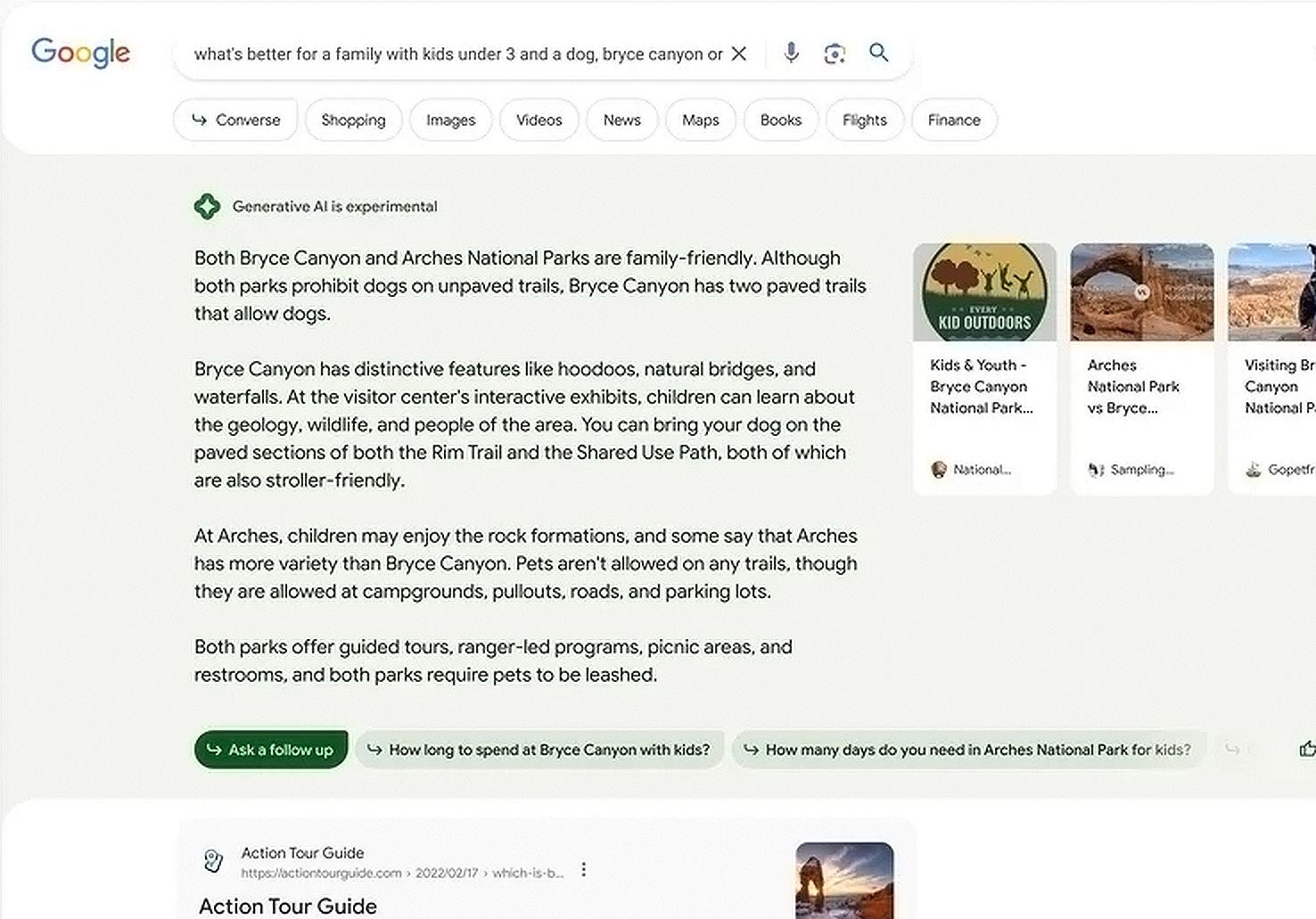
This is often referred to as a “zero-click” search because users are able to find the information they want directly on the search results page without clicking through to a website. This approach clearly has a major impact on traffic to company websites, in particular sites that focus on top-offunnel, question-based content such as “what is” and “how to” searches.
Google officially launched AI Overviews in the US on May 14, 2024. Within three months they rolled the functionality out to six more countries: the UK, Japan, India, Mexico, Indonesia, and Brazil. On October 28, 2024 Google announced that the company was starting its rollout of AI Overviews for Canada.
To adapt to this, brands must shift their focus from simply driving clicks to ensuring that their brand and message are visible in these zero-click environments. Creating concise, value-rich content that can be featured in snippets or rich results will be essential. Additionally, brands will need to explore new metrics for measuring success, focusing on brand visibility and engagement rather than traditional traffic-based metrics.
Some specific areas for franchise companies to focus on in 2025:
Continue to follow SEO best practices:
Provide Google with key business information:
Grow brand mentions and backlinks:
Google has stated that SGE is “rooted in our core Search ranking and quality systems,” and all indications are that sites with strong SEO fundamentals continue to perform well. Quality original content and good website structure are still important factors in showing up for searches.
AI Overviews include citations, and Google Knowledge Graph is an important citation source. The Knowledge Graph is a Google-owned database that provides SGE with billions of data points to use for AI-generated results. To help Google learn about your business, we recommend franchise companies implement the following for your corporate site and location pages/sites:
- Include a homepage or “about us” page on your site that clearly outlines information about your business
- Implement organization schema markup on your website
- Create social media profiles on platforms such as Facebook, Instagram, and LinkedIn
- Claim and optimize your Google Business Profile (GBP) for every location
- Link to your homepage or “about us” page from your social profiles and GBP
It is very valuable to increase the amount of positive content about your brand online. This can be in the form of user reviews, backlinks to your site, or even articles about your company. The interesting part about generative AI is that you don’t necessarily require a backlink to your site – just being mentioned is a positive signal.
Implement structured data:
Structured data (also called “Schema markup”) is important to enable search engines to not only crawl your site, but to truly understand it. Structured data is implemented at the template level of your website to describe your content to search engines in a specific way. Forward-looking franchise organizations should be actively exploring opportunities to add structured data to their site to ensure the search engine understands who your company is, what you do, and who you do it for. Structured data is particularly important for franchise systems who have ecommerce on their websites.
Improve content readability and target the long tail:
Optimize your content for humans first and search engines second by using natural language to address user needs, questions, and search intent. Also, structure your content to answer “long tail” questions. The in-depth nature of long tail queries allows AI to generate personalized, detailed answers from various sources. When the AI links to you as a source, that can boost your visibility and engagement on search engine result pages. This is why informational queries, particularly long-tail ones, are anticipated to gain prominence in SGE. To tap into this potential, it’s important to comprehensively answer questions users have. That means you should try to create and optimize content specifically for question-based queries. As an added benefit, long-tail queries typically have higher conversion rates than their short-tail counterparts.
Focus on E-E-A-T signals:
Related to several of the above activities, we recommend continuing to pay close attention to E-E-A-T signals –experience, expertise, authoritativeness and trustworthiness.
To improve your E-E-A-T, you should actively demonstrate your company’s expertise and experience through strategies such as:
- Including subject matter experts in your content creation
- Incorporating trust signals into your website such as certifications, awards, or years of experience
- Supporting information on your website with studies, statistics, or quotes from trusted sources
- Using an “active” tone in your content. As an example, “set up local Facebook pages”, as opposed to “you should set up local Facebook pages.”
Chatbots
Perhaps the area that has seen the greatest adoption of AI is chatbots. As AI evolves, chatbots and virtual assistants are becoming more humanlike and capable of engaging customers in natural conversations. Modern chatbots can manage a range of customer interactions, from answering product questions to guiding purchase decisions. The rise of large language models (LLMs) like ChatGPT is driving this trend by enabling more conversational, personalized, and efficient customer interactions.
The use case for AI-driven chat varies based on the industry. In retail and e-commerce, for example, AI chatbots can improve customer service and loyalty through 24/7 multilingual support. Through the use of data, a chatbot can provide personalized responses tailored to the customer, context, and intent. As an example, AI can provide personalized product or service suggestions, boosting basket size and customer lifetime value.

Chat can also be used for more routine activities such as booking appointments and answering customer questions about the company and its products or services. This represents an opportunity to free up human support staff to focus on more complex interactions, which improves service quality and increases operational efficiency.

One area that some franchise systems have been experimenting with is using AI-driven chat for franchise development lead capture and nurturing. In terms of lead capture and general FAQs, generative AI performs reasonably well, as it is able to handle routine tasks and questions. However, chatbots are not as useful past the initial lead capture, simply because the purchase of a franchise is immensely more complex and meaningful than buying an item on a website. At this point a “human touch” remains necessary to guide the purchase process and provide reassurance to potential franchisees.

Predictive analytics and consumer insights
AI tools provide marketers with deep insights into consumer preferences and behaviors. By analyzing large amounts of data, AI models are able to forecast trends, predict customer behavior, and offer insights that allow marketers to make informed decisions.
As an example, companies are uploading recordings of customer interactions to identify “winning” and “losing” patterns to create an ideal script. This approach can be applied in franchise systems that use a call center or where franchisees are interacting with customers directly to identify areas of leakage and/or coaching. This is also an opportunity to evaluate your franchise development conversations to fine-tune your sales approach.
Franchise companies generate a significant amount of data which, when harnessed, can lead to a tremendous competitive advantage over both national and local competitors

AI can also analyze customer data to identify at-risk and/ or high-value customers, enabling proactive measures such as personalized offers to retain them. In addition, sentiment analysis via AI aids in understanding customer perceptions of your brand by analyzing feedback across various platforms, allowing franchisors to address issues and reinforce positive elements.
The opportunities for franchise systems in this area are almost endless. Franchise companies generate a significant amount of data which, when harnessed, can lead to a tremendous competitive advantage over both national and local competitors. As always, we recommend making use of existing technologies to streamline the process, as opposed to attempting to build your own AI-based technology.

2 2 Voice Search: The Long Tail Is Back
Voice search is becoming an integral part of how people find the information they are looking for. Although voice-enabled search has been around for some time, recent breakthroughs and the wide adoption of smart speakers have accelerated this trend, which is expected to continue through 2025. Voice search is performed via smart speakers and devices, cellphones, and even in-car. According to eMarketer, the number of voice search users in the US is expected to reach 154 million in 2025, and a study by PWC found that 65% of 25-49-year-olds speak to their voiceenabled devices at least once per day.
Voice assistant users in the US (in millions)
An interesting aspect for franchise systems to consider is that people are increasingly using voice search to find information about local businesses. A recent study by PWC found that 74% of people use voice search on their smartphone to find information on local businesses at least weekly.
Voice assisstant users % change
Source: eMarketer
On average, how often do you speak to voice-enabled devices?
How frequently do you use voice search to find information on local businesses?
This shift in consumer behavior is causing companies to optimize their websites and content for voice searches, which requires a different approach than traditional text-based queries. Although SEO fundamentals still largely apply, voice queries tend to be longer and more conversational. This means that marketers should consider natural language and a conversational tone when developing content.
Source: PWC
Source: PWC

As an example, a text search might be phrased as “pizza near me” whereas a voice search may be phrased as “Where can I get the best hand-tossed pizza near me?” Voice search optimization focuses on the intent of the searcher as opposed to simply matching keywords.
Given this trend, we recommend that franchise organizations take steps to ensure they rank well for voice searches, and in particular, local voice searches. Note that the strategies outlined in this report to optimize for Google Search Generative Experience also largely apply to voice search optimization.
Some specific areas for franchise companies to focus on in 2025:
Use conversational language in your content and target the long tail:
As mentioned, voice searches tend to be worded differently than text searches. They tend to be longer and more specific than text searches. When we speak, we’re used to using full sentences with more detail than when we type. To optimize for voice search, one of the best things you can do is target long-tail keywords, especially question-based phrases, in your content. Long-tail keywords contain three or more words and are a major component of keyword optimization in general. They attract high-intent traffic because they’re more specific to the user’s query. A great example of this is to target longtail phrases for each of your franchise locations and include local information (ex: “best hand-tossed pizza in Houston” instead of just “pizza”), which leads to better ranking for highvalue local voice searches.
Long Tail Keywords
tomato plant
(12,100 average monthly searches)
when to plant tomatoes
(3,600 average monthly searches)
tomato plants for sale (1,000 average monthly searches)
why are tomato plants turning yellow (390 average monthly searches)
Conversion rate
Source: Semrush
Prioritize local SEO:
Local search optimization has long been a critical strategy for franchise businesses, as it targets potential customers who are actively looking to purchase products and services in their vicinity. As previously discussed, a significant number of voice searches are local, meaning that optimizing for local searches also improves your opportunity to rank in voice searches. One of the most important ways to rank for local searches is to create and maintain a Google Business Profile (GBP) for each of your franchise locations. Your Google Business Profile is important because voice search results often pull information from these profiles. Therefore, a complete listing with your locations’ hours of operations, address, phone number, etc. means your company is more likely to rank for these local voice searches. It is also a good idea to keep your GBP active by creating posts, adding events, and engaging with comments/questions with personalized replies.
Implement structured data:
As discussed earlier in this report, structured data is important to enable search engines to not only crawl your site, but to truly understand it. Given the importance of local search as outlined above, we strongly recommend all franchise companies implement the Local Business Schema markup for each of their locations. This will ensure the search engine knows exactly where your franchises are located, and allows them to answer queries regarding hours of operation, products, services, etc.
AI-enabled conversational searches
The next evolution of voice search is already emerging in the form of “voice mode” for generative AI. Both OpenAI (owner of ChatGPT) and Google Gemini have launched conversational-based search that allows users to engage in a spoken conversation with the AI, enabling a more natural interaction.
The experience is already very impressive, allowing users to have freeflowing conversations with the AI, such as:
Brainstorm ideas out loud:
Ask for a gift idea, to plan an event, or to make a business plan.
Outline a problem you have and the AI will suggest solutions, including products and services.
Uncover more details about topics that interest you.
Rehearse for important moments in a more natural and conversational way.

There is no question that this technology will evolve rapidly and have a massive impact on how consumers find information. Forward-looking companies should be actively implementing the search optimization recommendations in this guidebook to position themselves for success.
3 3
Video, Video, Video
Our previous annual forecasts have highlighted video as a major area of growth, and 2025 is no different. With video accounting for more than 82% of all online traffic, it simply cannot be ignored as a marketing tool. Consumers are increasingly turning to videos not just for entertainment but also for shopping inspiration, product reviews, tutorials, and behindthe-scenes brand content. According to HubSpot, 62% of consumers have watched video content such as product demos, reviews, and unboxings to learn about a brand or product. In addition, 37% of consumers say that they prefer to discover products through short-form videos such as TikTok, YouTube Shorts, or Instagram Reels.

With high levels of engagement and growth, video content creation and advertising – particularly short-form video – is a must for all marketers. A Wyzowl survey found that 91% of businesses used video as a marketing tool in 2024, with 87% saying video has directly increased sales. Marketers consider YouTube to be the most effective video platform, followed by Facebook and Instagram. Surprisingly, TikTok is viewed as being less effective, however, we believe this is because brands often struggle to understand how to effectively “TikTok-ify” their content for this audience.
Video channels companies find to be most effective

Source: wyzowl
Beyond the obvious social media applications, short-form video is also a benefit to your website. Videos have been found to be very effective at generating first-page search rankings compared to other SEO tactics, and 82% of consumers report that they made a product purchase after watching a video.
If you aren’t already using video on your website and social media channels, 2025 is the time to get on the bandwagon. Long-form video should remain part of your marketing mix, as it is valuable for providing in-depth information about a product, brand or service, particularly if your goal is SEO improvement. However, the big opportunity in 2025 is in creating entertaining and/or informative short-form videos.
Some specific areas for franchise companies to focus on in 2025:
Create relatable and authentic content:
A recent Hubspot study found that 38% of consumers reported relatable content as being more memorable. For social media videos in particular, consumers prefer to see relatable and authentic videos (63%) over polished and highproduction-value videos (37%). For franchise systems, we recommend engaging your franchisees to create authentic and relatable “grassroots” content. Encourage them to be creative and entertaining, while of course remaining aligned with your company’s brand voice.
Shorter is often better:
Consumers are looking for quick, engaging, and entertaining videos, particularly on social media. A good rule of thumb is to keep your videos under 3 minutes. Having said that, consumer preferences across industries can vary significantly, so we always recommend experimenting with different lengths and creative concepts to find what works best for your audience.
“TikTok-ify” your videos:
If you decide to use TikTok as part of your video strategy, bear in mind that videos on TikTok tend to have a different style than Facebook, Instagram, or YouTube. TikTok videos are typically high-energy with quick cuts, overlays, and hightempo music. In addition, TikTok videos are typically very short, no longer than a minute or two. In our experience, video posts or ads that work well on other platforms may not perform as well on TikTok due to the unique nature of the platform and audience.
Consider where to place your call-to-action:
A Wistia survey found that conversion occurs most frequently at the end of the video for shorter-form content, but longerform videos often see conversions earlier in the video. Not surprisingly, conversion tends to be quite high when people watch the entirety of a long video, as they are clearly engaged with the content. Again, we recommend experimenting both with the length of your video content and the placement of your call-to-action to find a formula that works for your company.
Source: Wistia
Position of call-to-action in the video
4

The Rise of Nano-Influencers
Influencers have become an important part of the digital marketing ecosystem. In 2024, 80% of companies reported allocating budget towards influencer marketing. We can generally define influencers as belonging to one of the following groups:
- Mega-influencers: influencers with over 1M followers, usually a celebrity, athlete, actor, or other prominent public figure.
- Macro-influencers: influencers with between 100K and 1M followers
- Micro-influencers: influencers with between 10K and 100K followers
- Nano-influencers: have the smallest audiences, typically between 1K and 10K followers.

The recent trend, which we expect to continue into 2025, is that brands are focusing less on mega and macro-influencers and instead gravitating towards micro and nano-influencers. In 2024, 64% of brands said that they have shifted towards working with smaller creators. Nano-influencers tend to be ordinary digital content creators who have a knack for social media and have earned a small but dedicated audience. Because of this, these influencers are seen as more trustworthy and relatable than large influencers who aren’t as approachable to the average consumer.
Nano-influencers often focus on a specific niche and have developed a deep understanding of their followers’ interests and preferences. This means they’re very skilled at creating highly specialized content that appeals to their followers. As a result, nano-influencers consistently have higher engagement rates than macro or even micro-influencers. Their followers are more likely to like, comment, and share their content because they feel a personal connection. This means that even with a smaller audience, nano-influencers can generate significant buzz for a brand.
This combination of high engagement rates and loyal audiences who trust the nano-influencer’s recommendations translates into higher conversion rates when they endorse a product or service. In fact, Influencer Marketing Hub reports that micro-influencers have an engagement rate of 3.86% in 2024 compared to 1.21% for mega-influencers.

To make the opportunity even more compelling, nano-influencers are often willing to collaborate for free products, small payments, or simply for the love of sharing something they believe in.
Cost-per-engagement (CPE) measures how much a company pays per like, share, comment, or click on an influencer’s post. Because nanoinfluencers tend to cost less and have highly engaged audiences, their CPE is much lower than macro-influencers on Instagram and TikTok. Interestingly, the opposite is true for YouTube. This is almost certainly due to YouTube’s more “mass media” nature.
Cost-per-engagement (CPE) based on platform & influencer type
Source: Aspire
Another consideration when working with influencers is that there is an increasing expectation of transparency. The Federal Trade Commission in the US has made it clear for some time that any paid endorsement should be disclosed. However, in October 2024 the FTC further updated its endorsement guidelines which impacts how brands, influencers, and digital agencies are required to handle user-generated content (UGC) and disclosures in digital advertising.
The updated guidelines make it clear that if there is a material connection between a brand and a person endorsing it, then the connection must be clearly disclosed. This includes paid partnership, free products, or any form of compensation. This means that if you are working with influencers, you must be sure they understand their responsibility to disclose material connections. Disclosures must be included in the text, spoken word, and visual elements as appropriate.
Going into 2025, we recommend that franchise companies add influencer marketing to their marketing mix.
Major influencer marketing considerations to keep in mind:
Keep it authentic:
Go “nano”:
When choosing influencer partners you should be looking to ensure authenticity by finding influencers that align with your brand values. People often feel like they know and understand their favorite creators, so they can spot when a brand partnership feels forced. Allow creators to be “real” with their audience and utilize their creativity to connect with their followers.
In our experience, franchise companies find it difficult to find mega or macro-influencers whose reach matches their system footprint. At the same time, the cost and complexity of influencer marketing makes it impractical for individual franchisees to pursue on their own. This is where the trend towards micro and nano-influencers makes perfect sense for franchise systems.
The reach of micro and nano-influencers is often focused within a specific geographic area, which means that instead of trying to find a handful of larger influencers to cover your network, franchise companies are able to source local influencers on a market-by-market basis for maximum effectiveness. This approach increases engagement, trustworthiness, and relatability, all focused in areas where you have a location.
Convert customers into influencers:
You almost certainly have some “fans” within your customer base that have a good-sized social media following. These individuals are ready-made nano-influencers for your brand because they already know and like your company. Even better, they often are happy to create content in exchange for free products/services.
Repurpose influencer content:
Posts created by influencers can be used across marketing channels to increase content authenticity, including paid media. This approach not only improves advertising effectiveness, but also aligns with consumers’ preferences for genuine, relatable content.
Be aware of regulations:
Ensure you are compliant with the pertinent regulations in the area(s) you are operating in.
5 5

Data Privacy Is Critical
People are becoming increasingly aware of the value of their personal data and are demanding more control over how it’s used. As privacy concerns among consumers continue to rise and regulations like the General Data Protection Regulation (GDPR), Personal Information Protection and Electronic Documents Act (PIPEDA), California Consumer Privacy Act (CCPA), and ePrivacy evolve, marketers in 2025 will need to prioritize a privacy-focused approach to digital marketing. Success will hinge on transparency, effective consent management, and responsible data practices.
Brands must not only stay up-to-date with the latest privacy laws but also work to build consumer trust. A 2024 Deloitte study revealed that 70% of consumers would stop purchasing from a brand that misuses their data. Consequently, many brands are implementing clear, transparent data policies to communicate precisely how customer data is collected, stored, and utilized.

“Instead of deprecating third-party cookies, we would introduce a new experience in Chrome that lets people make an informed choice that applies across their web browsing, and they’d be able to adjust that choice at any time.”
- Anthony Chavez, Google’s Vice President of Privacy Sandbox
The major privacy-related event of 2024 was when Google announced in July that it will not be phasing out third-party cookies from Chrome. The company says it will instead pursue an opt-in model, signaling a major shift for Google’s Privacy Sandbox, its long-delayed post-cookie solution.
It is too early to say how this new approach will take shape, but many industry experts are predicting that the result could be similar to the App Tracking Transparency (ATT) approach implemented on iOS. Through the ATT, Apple has implemented an explicit “opt in” approach for consumers to share their data with companies. Not surprisingly, the majority of people choose not to share their data. A recent report from Singular found that only 13.85% of people opted-in to tracking in Q2 of 2024.
ATT Opt-in Rates
Source: Singular
Given these trends, one of the key areas of focus in privacy-first marketing is zero-party data. For clarity:
- Third-party data is information that is collected by another entity that is entirely separate from your relationship with your audience. As an example, placing a Meta or Google pixel on your website is an example of third-party data tracking.
- First-party data is information you collect from your audience directly via your own channels. First-party data is typically gathered through your company-owned assets such as your website, app, CRM, etc.
- Zero-party data is information that a customer intentionally and proactively shares with a business. It can include preference center data, purchase intentions, personal contexts, and data on how an individual wants to be recognized by your brand. You can acquire zero-party data through physical interactions in your stores, quizzes/ polls, website activity, customer profiles, messages with customers, and other similar sources.
Zero-party data is viewed as more valuable than third-party or firstparty data because it comes directly from the consumer and is given with explicit consent. By focusing on building direct relationships with consumers and creating value exchanges, brands can gather zero-party data in ways that foster trust and loyalty.
franchise companies should be actively reviewing their data collection approach and strategies, including:
Have a data plan:
Be clear on what data you would like to gather, how you will gather it, how you will store it securely, and how you will use it.
Prepare for the future:
First-party and zero-party data will be important for marketers in 2025 and beyond, as it will allow companies to better understand and target their customers and prospective customers. If you do not gather this type of data today, then you should be developing plans to do so. The major benefit of first-party data is that only you have it, so it can be used in a variety of ways to give you an advantage over your competitors.
Be transparent with consumers:
Provide people with easy-to-understand options for managing their privacy. Communicate what data you collect and how it could potentially be used. Where possible, provide consumers with the ability to opt out of data sharing if they choose.
6 6

Social Media: More Than Memes
Social media has evolved beyond just connecting people - it is now an integral part of the buying journey. People are actively seeking out information about products and services on social media and are even making purchases directly through social channels.
This evolution in social media is fueled by the massive amount of time people spend on social platforms. According to Statista, people average 2.4 hours per day on social media sites such as Facebook, Instagram, TikTok and others.
Daily time spent on social media sites by internet users worldwide
Social search
Younger generations are increasingly using social media platforms for discovery rather than traditional search engines. Forbes reports that Instagram ranks as the top search platform for Gen Z, with 67% of surveyed users selecting it as their first choice. TikTok follows closely with 62%, while Google ranks third at 61%. However, Google’s ranking includes traffic from YouTube, Google Maps, and Google Images, which boosts its search traffic, leaving “traditional” Google Search as a distant third for Gen Z.
Source: Statista
Search Preferences by Age Group
Source: Forbes
Likelihood of people to search on social platforms to research a product before making a purchase
Source: eMarketer
The survey didn’t include younger generations, but if it had, it’s likely it would have shown even greater dominance by TikTok and Instagram. In fact, as early as 2022, Google revealed that 40% of young people use TikTok or Instagram for recommendations instead of Google.
This shift doesn’t signal the immediate downfall of search engines like Google and Bing, but social media platforms are becoming increasingly popular as search tools across all age groups. This trend makes sense, as social platforms use complex algorithms to deliver content that people may be interested in, which makes them inherently effective for search.
In addition to the above survey, recent research by Hubspot found that 31% of people use social media to answer their questions and that 15% of people say that they prefer social media to search engines. Not surprisingly, Gen Z and millennials are leading the pack, with 31% and 28% saying that they prefer to search via social media.
How consumers search for answers to questions online
Percentage of people who prefer social media search over traditional search engines
For franchise marketers, this trend means that you should think about your social media content less as a “push out” to people and more as an opportunity for both existing and potential customers to learn about your brand and your business. Said another way, the focus should be on creating user-centric, informative and/or entertaining content designed to drive engagement within your target customer base.
To do this, your company should have a clear social media content strategy, including a clear definition of who your target audience is, what they are interested in, and how you intend to engage with them. Experiment with different content and creative ideas and carefully measure the results to identify a winning approach.
Influencers are another great opportunity for franchise companies to optimize for social search. Not only are influencers an effective way to directly reach your target customers with relevant content, but they often create content that is naturally geared towards social search. Product and services reviews are an excellent example of content that is tailor-made for social search.
Source: HubSpot
Source: HubSpot
there are A number of tactical activities you can implement to aid in
social search visibility:
Integrate relevant keywords in captions:
Use descriptive alt-text and subtitles:
Industry terms, product names, and descriptive phrases as keywords in captions and hashtags can help content surface prominently in platform searches. This ultimately enhances discoverability for relevant search queries, while also helping your content appear in the Explore or For You pages.
Adding alt-text to your posts enhances accessibility by providing extra details and helping social platforms better understand your content. This can improve its chances of appearing in relevant searches. Include subtitles on video content as the social platform will include that information in search results.
Tag your location:
Enhance your profile bio with keywords:
Tagging the location of your franchise business makes it easier for your audience to find you, as users often include a location or destination in their search queries.
The profile section of your social media account, where your handle and description are located, is valuable for social search. Include relevant keywords in your business name and description to increase the likelihood of appearing in search results.
Social commerce
Social commerce combines social media with ecommerce, allowing purchases to occur directly on social platforms. It enables consumers to discover products, connect with a brand’s community, and shop seamlessly without leaving the platform, ensuring an uninterrupted customer experience.
According to eMarketer, US retail social commerce sales will pass the $100 billion milestone in 2025, representing a 22.4% growth from the prior year. On a global scale, social commerce is expected to reach $2.9 trillion by 2026. Social commerce sales will account for 6.6% of total ecommerce sales in 2024 and are expected to grow to 17% in 2025.
Global social commerce revenue
Social networks where people are likely to make a direct purchase
For marketers, the ability to advertise and sell within the same platform simplifies the buying process and offers numerous advantages, such as direct customer access, clearer insights into return on ad spend, and opportunities to leverage peer recommendations and the creator economy.
Social commerce thrives on inspiration, trends, and driving demand for products users may not have initially considered. Unlike traditional ecommerce, where shoppers often search with specific items in mind, social commerce excels at promoting discretionary products like fashion and beauty items.
While younger generations, more accustomed to digital spaces, were the first to adopt social commerce, older generations are now embracing it as social media platforms become increasingly user-friendly. According to eMarketer, more than half (53%) of social buyers are 35 years of age or older.
Social buyers by age
Source: eMarketer
Shoppers who follow influencers also make up a large social commerce audience. According to Morning Consult, 33% of Gen Zers have purchased a product from an influencer-founded brand in the last year. In addition, a Deloitte study found that Gen Z is more likely than any other generation to purchase a product after watching a review from an influencer they follow.
There are four major social platforms in North America that have welldeveloped social commerce tools:

Facebook remains the single largest social platform in North America. Due to the size of the audience and variety of ad executions available, Facebook is very effective at driving awareness, engaging interested customers and converting interest into action.
Statista reports that one-third of social commerce buyers prefer to buy through Facebook. Plus, according to an Insider Intelligence survey, some 62% of US social buyers said their most recent social purchase took place on Facebook, with features like Marketplace and Shops facilitating these transactions.
For franchise brands exploring social commerce, starting with a Facebook page is a practical choice. Any Facebook Business account can set up a customizable Facebook Shop—an online storefront where brands can upload an existing product catalog or create one from scratch.
On a brand’s Facebook profile, visitors can browse available products, including sizes, color options, and details, and can directly message brands with questions via Facebook Messenger. When shoppers are ready to buy, they can complete the purchase with Facebook Checkout on the platform, or brands can direct them to an external online store.

Instagram, also owned by Meta, is a powerhouse in social commerce. Studies indicate that nearly 26% of the global population over age 13 uses Instagram, and 70% of shoppers on the platform use it to discover new purchases.
From building brand awareness to enhancing the online shopping experience, Instagram provides brands with a valuable way to reach a broader audience and drive sales.
Instagram Shops enable users to purchase products featured in images and videos across the platform. Like Facebook, Instagram Business accounts can present products through a customizable storefront. Brands can curate collections, and each product in an Instagram Shop catalog has its own page with pricing, a detailed description, and supporting images or videos.
TikTok is projected to reach 48.8 million users in the U.S. by 2025, surpassing Instagram’s 48.2 million, despite Instagram’s six-year head start.
However, TikTok users aren’t solely there for entertainment. Approximately 43% of Gen Z users begin their product searches on TikTok, outpacing traditional search methods like Google or Amazon. By 2026, the U.S. is expected to have around 39.5 million TikTok shoppers.
TikTok Shop allows brands and creators to sell products directly to viewers, starting from short videos or livestreams, with the goal of managing the entire buyer journey within the app. A unique feature is the option for users to combine items from multiple brands into a single cart and complete their purchase without leaving TikTok.
However, concerns surround the platform’s in-app shopping feature, TikTok Shop, due to limited adoption by U.S. merchants, a lukewarm response to live shopping, and the possibility of a nationwide US ban. Such a ban would likely have minimal impact on most brands and shoppers, who can redirect their efforts to other marketplaces. Instead, the ban would mostly affect TikTok’s social commerce and live shopping, areas where significant investments have driven growth and user adoption.
Pinterest is both a search engine and a social media platform for images, where users create mood boards, save travel ideas, and—most importantly—discover new products. Every month, over 465 million people use Pinterest to gather inspiration and research items.
Interestingly, a large majority (97%) of searches on Pinterest are unbranded, and 31% of U.S. users have a household income exceeding $100,000. When merchants upload product listings from their online stores to Pinterest, they can reach potential customers who may not yet know about their products but have the income to make discretionary purchases.
Pinterest’s unique approach to social commerce, focused on inspiration, discovery, and shopping, sets it apart from other social platforms. Its impact on the buyer’s journey, along with new features and engagement strategies, makes it a strong asset for businesses. The platform provides a distinctive space to inspire, engage, and convert a diverse audience, making it a strong consideration for any brand interested in exploring social commerce.
Many franchise systems find implementing social commerce to be complicated due to the decentralized nature of the franchise business model. Depending on how the company is set up, it is often the case that sales generated in a particular territory are owed to the franchisee that owns that territory.
Despite the challenges, social commerce is too large an opportunity to be ignored. We recommend starting small to test the opportunity and finetune the approach. Create one “shop” to test your setup and consumer adoption. Based on learnings, adjust your approach and develop a strategy to roll the idea out throughout your network.