
is pleased to present a Special Franchise Focus on
is pleased to present a Special Franchise Focus on
Tommy Gun’s Original Barbershop is globally recognized, proudly Canadian, and committed to setting its franchisees up for success
In 2009 in Red Deer, Alberta, entrepreneur Ken Fisher noticed a gap in the market. Barbershops seemed to fall into one of two categories: a convenient option that lacked experience and quality, or a high-class experience that had to be booked weeks in advance. To fill that niche, Tommy Gun’s Original Barbershop was born.
“Our concept was designed around the basis of creating the ultimate five-star experience, but with what we call modern convenience— meaning it’s available when you want it,” says Keenan Fisher, Ken’s son, who now runs day-to-day operations at the company along with his brother-in-law, Cory Anderson.
The concept proved a popular one: at the height of the Great Recession in 2009, the newly launched brand doubled its first year’s projected budgets. Fifteen years later, the company is still going strong, hitting 29 record months in a row over the past two plus years.
This Canadian-founded, familyrun juggernaut knows they’ve hit on something special—for their customers and franchisees.
The ‘masstige’ experience
“Because of the way we operate, we create a lot of efficiency in our business, which allows us to provide a lot more for our guests at a very approachable and affordable price,” says Fisher. “We believe we can be just slightly above mid-price point, but we can provide a service level that’s best-in-class in the market.”
The brand calls this offering “masstige,” prestige offerings for the masses.
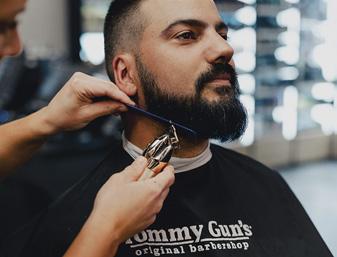
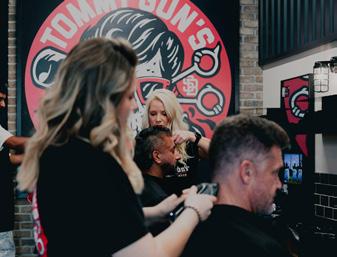
In practicality, it means being a full-service barbershop: haircuts, traditional straight razor shaves, beard trims, colouring and facial services, and the largest selection of professional-grade styling and grooming products in the industry. Then there are the extra touchpoints along the way that enhance every service: the sleek design of the space, inspired by 1930s Chicago and New York, classically designed Takara Belmont chairs, free drinks, an in-mirror TV controlled by the guest, and a complimentary twominute scalp massage with every service. “It’s not just about the haircut, it’s about every bit of the way,”
says Fisher. “It’s part of our Every Guest, Every Time code.”
The biggest innovation is Tommy Gun’s embrace of technology. In 2009, the brand hired a software developer to create proprietary queueing-based software to allow the barbershops to operate under a walk-in model. The brand has always stayed a step ahead with this prioritization of convenience and ease for customers.
“A guest could say, okay, it’s Friday, I’ve got an interview this afternoon and I need a haircut,” explains Fisher. The customer can get in the virtual queue, for either the next barber available or their favourite barber. The software will communicate how long the wait is and notify the guest via text message, either five or 15 minutes ahead of an appointment, depending on their preference. “And then the customer can get in, have a high-end, five-star service experience that same day, and leave feeling great,” says Fisher.
That’s what it’s all about, after all. “It can be an uplifting event, going for a haircut,” he adds. “When things are going great, or when they’re not
great. What we know about human nature is we want to feel great; we want connection.”
Fisher likens the never-flagging popularity of barbering services to the so-called “red lipstick effect” of the 1930s; even in tough economic times, the need for affordable luxuries stays strong, or even rises. It makes Tommy Gun’s a uniquely recession-resistant business model, he notes. “People want things that are uplifting, and haircuts are an affordable way to do that.”
The brand’s innovations have won it devoted customers. But it has also created a passionate network of success-driven, community-minded franchise partners.
Fisher credits the brand’s shared success model. “We really view the franchisee and franchisor relationship as a true partnership. We work backwards from our focus on setting franchisees up for success, and build our systems around that,” he says.
“We believe if we can make everyone around us as successful as possible, then, de facto, we’ll become successful as well.”
Along with Tommy Gun’s 15-year history, the Fisher family has more than 50 years of experience in the hair, beauty, and grooming business. This expertise has primed them well to support franchisees. The brand has a robust training and support system for its franchise partners, including Tommy Gun’s
University—an online learning management system—a global technical education team for barber education, a full suite of manuals, and a field team offering day-to-day support for franchisees.
Prospective franchisees don’t need barbering experience; in fact, most come from outside the industry.
“As long as someone wants to lead teams, has a community-focused personality, and is competitive in nature, we can help them on the industry side of the business,” says Fisher. A Tommy Gun’s franchise is “a work-on, not a work-in business,” he notes.
“You’re not buying a job; you’re buying a business that you can manage and scale.” More than 80 per cent of Tommy Gun’s owners are multi-unit franchisees, which Fisher says is the ultimate validation. “It shows that the franchisee wants to reinvest, which for us is the best signal of success.”
The system is focused on franchisee profits, but in the end the most successful franchisees are those passionate about the brand’s mission of creating unbeatable highend experiences with modern convenience.
“Barbershops naturally act as community hubs,” Fisher points out. “They’re a nice, shared space for a community, and a welcoming, positive environment. So it’s natural, as we open across different communities, to actually invest back in and connect with those communities.”

Tommy Gun’s franchisees often partner with youth sports teams, at the junior and youth level, supporting their local communities and encouraging kids to get active. And system-wide each November, the brand runs charitable events promoting men’s health. “We’ve raised hundreds of thousands of dollars over the years for various men’s health causes,” says Fisher.
All of this has not gone unrecognized. In February 2025, Tommy Gun’s Original Barbershop was named Best Franchise in the Health and Beauty category of the Global Franchise Awards.
“We were really honoured by that, as obviously it’s a very competitive category,” says Fisher. “It’s a testament to our amazing group of franchise owners, our barber network, and our shared success model.”
The brand has had major growth since that first shop opened up in Red Deer, and there’s no need for a trim. Today, there are 90 shops in Canada, and the brand has begun expanding into Australia, New Zealand, and the U.S.
“For us, it’s all about very strategic growth,” says Fisher. He notes that the brand is still looking to expand further, with the primary areas of growth including Ontario, the Maritimes, B.C., and the U.S.
“We’re a very competitive, ambitious bunch,” he says with a smile. “We want to lead the industry, and lead the evolution of the industry.”
To learn more about franchising opportunities, visit https://ca.tommyguns.com/pages/franchise-tommy-guns
The beauty and salon services industry is lush with new ideas and strategies for success
In a time of ever-evolving new trends and an emphasis on presenting your best self to the world, the beauty and salon services industry is ripe with fresh styles and ideas.
As new technologies, programs, and techniques are shared both within the industry and to the public, salons are focused on cultivating positive customer experiences to gain and maintain a loyal clientele. Social media is an unstoppable force of information, and there is no shortage of tips and tutorials teaching potential consumers how to take care of their hair at home. However, the salon experience is not so easily replicated.

Verified Market Research reported that the market size for hair salons was valued at $7 billion USD in 2024 and is projected to reach $8.8 billion by 2031. Moreover, the compound annual growth rate (CAGR) is estimated to grow 2.9 per cent between 2024 and 2031
Salon operators and staff offer a wealth of information on personal care and maintenance backed by education and expertise. And for customers, there’s no match for the experience of a professional salon service.
Despite tough economic times, beauty services are an affordable luxury and continue to be an integral and recurring investment for consumers as confidence and self-care influence everyday wellness routines. Plus, with the burgeoning tech developments in customer satisfaction strategies and loyalty programs, beauty specialists are looking at an optimistic future for their businesses.
85% of beauty professionals shared that by the end of 2024 they felt more optimistic about their businesses than they did 12 months prior.
A 2019 survey by Statistics Canada showed that the average Canadian household spent $1,243 on personal care services and products. About 45 per cent of this was on hair care specifically.
In 2021, household expenditures for personal care hit $1,430. The average Canadian household spent $89 on hair care products specifically and $515 on hair grooming services
Specialized services have become increasingly popular, bringing more clientele into the industry for services such as:
• Hair colouring
• Keratin treatments
• Scalp care
For 84 per cent of beauty industry leaders, social media marketing is important in driving business and sales. 82 per cent state the importance of using social media to educate clients about at-home beauty and wellness practices.
Social media isn’t just important for clients, but for the industry professionals too—online tutorials are a valuable resource for employees’ professional development.
For business owners, it’s an important tool in boosting traffic. 80 per cent of industry leaders are investing more time in marketing and social media than they were a year ago
On Pinterest alone, interest in “hair care routine” went up 600 per cent from July 2023 to 2024
New technology systems for scheduling and communication are on the rise, with many salons prioritizing these new developments in their regular business practices.

Professionals are increasingly leaning on automation and AI to boost their digital footprint and communication through social media. Beauty industry respondents said that their top uses for automated technology is generating social media posts at 43 per cent and writing marketing copy or product descriptions at 39 per cent .

Despite social media’s popularity, 80 per cent of Canadian beauty leaders believe that email is extremely or very important for generating sales and interest
The 2025 Future of Beauty Report found that most consumers appreciate the ease of tech-forward booking:
62% liked automated appointment reminders
59% liked mobile applications
56%
liked using automated payment systems
52% liked automated appointment scheduling
Many owners, operators, and employees of the beauty services industry are actively implementing new technologies into their work. 81 per cent of industry leaders said they’re researching or applying new time-saving technologies.
Source: 2025 Future of Beauty Report by Square
Aside from their services, in-house product sales offer additional revenue for beauty salons. With a rising emphasis on daily self-care, new programs and products provide extra revenue potential to the industry.
Statista projects that the beauty and personal care retail market in Canada will generate $9.1 billion dollars of revenue in 2025. Between 2025 and 2030, it’s estimated to grow annually at 2.3 per cent
Canada is experiencing a growing demand for natural and organic products in the beauty industry.
Beyond the traditional upselling of hair care and maintenance products, salons are getting creative with ways to generate new revenue. Approximately 78 per cent of beauty professionals say that both expanding their product offerings and implementing new classes for interested clients are important to their growth plans.
With the constant influx of tips, tricks, hacks, and advice shared online, it can be overwhelming to know what information is actually accurate. For clients, the personal touch of a stylist’s advice demonstrates the importance of their services. 41 per cent of Canadian consumers frequently or occasionally purchase a product or implement a wellness practice recommended by their specialist
Additionally, 43 per cent of consumers reported in Square’s 2024 survey that they had purchased an item such as a shampoo or cleanser from a local salon within that year

Sources: Square, Statistics Canada, Statista, Verified Market Research, Globe and Mail
For many, finding their trustedand-true stylist is like striking gold. Handing your appearance over to someone else is no easy feat; your confidence hangs in the balance. But once you find the stylist who makes you feel like your best self, there’s no going back. In the beauty and salon services industry, a loyal client base is key.
Square Future of Commerce’s data shares: 56 per cent of consumers reported that they have a preferred beauty provider. This loyalty is especially important to women, of whom 73 per cent visit beauty and personal care providers regularly, with 61 per cent remaining loyal to one provider
To foster success in the beauty and salon service industry, providers are honing in on loyalty programs: 79 per cent of beauty leaders use a loyalty or rewards program and 81 per cent plan to invest more in their loyalty programs over the next year