THE
THE MAGAZINE OF FRANCHISE BUSINESS SERVICES
|
2022 ISSUE 1
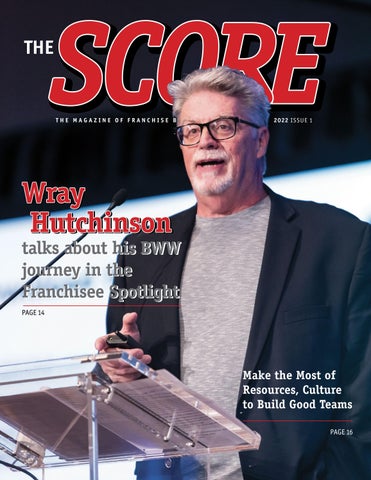
Wray Hutchinson
talks about his BWW journey in the Franchisee Spotlight PAGE 14
Make the Most of Resources, Culture to Build Good Teams PAGE 16
PROUD TO BE YOUR WINGMAN SINCE 2012
McLane Foodservice offers its sincere gratitude to the BUFFALO WILD WINGS franchisees for their years of partnership and success in growing together.
© 2021 McLane Company, Inc. All rights reserved.
TABLE OF CONTENTS
2022 Issue 1
FBS Board of Directors Wray Hutchinson Chairman James Bitzonis Vice Chairman Jenny Beaudoin Director Brian Carmody Director Steve Grube Director Roz Mallet Director Bobby Pancake Director Larry Podlogar Director Christy Williams Executive Director
ON THE COVER
Franchise Business Services (FBS) Chairman Wray Hutchinson has been a Buffalo Wild Wings® franchisee since 2005, and he’s been in leadership with FBS for much of the time since. Hear how he got his start in the brand and what keeps him excited about it in the Franchisee Spotlight on page 14.
COLUMNS 2
From the Chairman
DEPARTMENTS 4
FBS Member News
5
Event Calendar
10 One Topic: 10 Facts 12 Look, Listen, Read 14 Franchisee Spotlight
FBS Editorial Board
FEATURES
Sean Ireland Editor-in-Chief seani@myfbsonline.org
8
Rachel Jackson Managing Editor rachelj@myfbsonline.org
16 Make the Most of Resources, Culture to Build and Keep Good Teams by Sean Ireland, FBS director of communications
Savannah Daly Associate Editor savannahd@myfbsonline.org
Advertising Sales
BWW Foundation Local Grants Program Adds Flexibility to Giving
11 Spotlight on the 117th Congress: Rep. Andrew Garbarino (R-NY-02)
18 Could Your Business Benefit from a Cost Segregation Study? by Stacy Smith, Mize CPAs Inc. 20 Employment Law by Douglas H. Duerr, Elarbee Thompson Sapp and Wilson LLP
Jeff Reynolds Director of Business Partner Relations jeffr@myfbsonline.org 678-797-5163
22 The Front Line Equals the Bottom Line by Dennis Snow, Snow & Associates Inc.
Christy Rowan Vendor Sales and Development Manager christyr@myfbsonline.org 678-439-2284
26 The Benefits of Coaching: Six Ways It Can Boost Productivity by Laura Stack, The Productivity Pro®
Design and Layout Kristen Thomas KT Graphic Design ktgraphicdesign@gmail.com
24 The Real Value of Reverence in Relationship by Dan Coughlin, The Coughlin Co.
DIRECTORIES 7
Associate Member Listing
28 Advertisers Guide and Editorial Calendar
Headquarters 1701 Barrett Lakes Blvd. NW Suite 180 Kennesaw, GA 30144 Phone: 678-797-5161 Fax: 678-797-5171
In keeping with our commitment to the environment, this publication is printed on certified, environmentally-friendly recycled paper using eco-friendly inks. Franchise Business Services publishes The SCORE. Any reproduction, in whole or in part, of the contents of this publication is prohibited without prior written consent of Franchise Business Services. All Rights Reserved.
Copyright© 2022
Printed in the U.S.A.
www.myfbsonline.org
Together We’ve Built a Strong Organization
T
his is my final message in The SCORE magazine as chairman of Franchise Business Services (FBS). After joining what was then the Buffalo Wings National Franchisee Association (BWNFA) Board
of Directors in 2011, I became chairman of the board in 2014 and have served in that role since with Mark Jones as my wingman.
2022 Issue 1
|
THE
SCORE
2
At our Summit in May, Jim Bitzonis, a Buffalo Wild Wings® franchisee from New York, an outstanding operator and a very good friend, will take the gavel, and Roz Mallet will assume the role of vice chairman. I look forward to remaining on the board of directors and supporting Bitz and Roz in their new roles. I have no doubt that they and our board, which also includes Jenny Beaudoin, Brian Carmody, Steve Grube, Bobby Pancake and Larry Podlogar, will continue to lift FBS to new heights. Our association has seen remarkable change over the last eight years. In some ways, those years have flown by, while in others, they have been a very long haul. What is certain is that I have been blessed to work with a remarkable group of people for all that time – leaders who are responsible for helping our organization grow, mature and mark some important achievements for our Buffalo Wild Wings businesses. One of the most important developments was the repurposing of the association, a process we started in 2014. The
BWNFA was a fragmented group in need of new direction. After a detailed strategic planning session, we changed our name to FBS, and we aligned our board of directors with the Franchise Advisory Committee (FAC) to ensure that we had talent on both as well as on the FAC subcommittees. That allowed us to build a new relationship with brand leadership, and today, we know that Buffalo Wild Wings views us as an important partner in the success of BWW® and that our views and opinions are heard, valued and trusted. The respect and cooperation between our organization and the leadership at Inspire Brands is the result of hard work, honest conversations and relationship building on both sides. I offer my thanks to President Lyle Tick, Chief Operating Officer John Bowie and all leaders who guide the brand for joining us to create this symbiotic relationship. FBS has boosted its advocacy efforts not only with the BWW, but also with state and federal governments. We created an Advocacy Committee that has educated franchisees and elected officials on the impact of legislation on our system and our businesses. In fact, Buffalo Wild Wings, FAC and FBS representatives met in Washington, D.C., many times with elected officials to express our views on issues affecting the franchisee community and brand. During the coronavirus pandemic,
FBS led the important initiative to hire Trinity Capital to conduct a financial analysis of the BWW system and measure the impact of the pandemic on our businesses. This important work now serves as a template that Buffalo Wild Wings uses to better understand the financial condition of the system. We’ve faced many challenges in the last eight years. To each one of you, I offer my thanks and appreciation for your support and hard work as we overcame them. No one gets into a franchise business because it is easy, and each of you who dedicates your time and talent play a vital role in our overall success as a system. It has been my honor to serve and represent your interests, and I wish you nothing but the best moving forward. You and the organization are in great hands with Jim. I look forward to seeing you and your families on May 9-11, at the Summit, at the Hyatt Regency Coconut Point Resort in Bonita Springs, Florida. This year’s Summit is a departure from our traditional Las Vegas event. The FBS board sought to offer a more relaxed, leisurely atmosphere to provide an opportunity for you to bring your families as we unwind from the struggles of the past two years. We hope you and your family are planning to attend! We’re planning a great program with many opportunities to network with one another and our valued vendor partners, an island excursion and some other fun beach and sun activities in addition to getting great information from brand and franchisee leaders and other speakers about ways to overcome operational challenges and build better businesses. If you haven’t made plans yet, be sure to check out the Summit website at https://cvent.me/P0oaMG!
Wray Hutchinson
MEMBER NEWS
Aspire2B’s Chris Olexa Receives Spirit of Franchising MVP Award From Franchising.com
F
ranchisee Chris Olexa of Aspire2B Hospitality Group has been recognized by Franchising.com with its Spirit of Franchising Most Valuable Player (MVP) Award for 2020. The MVP awards were initially going to be recognized in April 2020 at the Multi-Unit Franchisee Conference, but the coronavirus pandemic changed those plans. Olexa and other MVP winners were instead recognized recently with a story in Multi-Unit Franchisee Magazine. To qualify for an award, entrants must have at least five operating franchise units and have been in their franchise system for more than two years. Olexa operates nine Buffalo Wild Wings® with more on the way, and several other concepts under the Inspire Brands umbrella. Olexa got his start in the franchise industry with Quiznos, which he left to open his first few Buffalo Wild Wings locations. After overcoming a cancer diagnosis and two hurricanes that struck his
Chris Olexa is the founder and CEO of Aspire2B Hospitality Group, which operates nine Buffalo Wild Wings, three Arby’s, one Rusty Taco and one Mellow Mushroom in Texas.
businesses, he has led Aspire2B to success. “This award shows how hard our team is working. It’s not just myself,” he said. “When you grow to the size we are, it’s a lot of people pulling the ropes and making us all look good. So, it’s awesome to see the team and my company be recognized for something like this.” Despite operating 14 restaurants, he still sometimes feels as if his business is a mom-and-pop shop in Beaumont, Texas.
“But when you see the other awards and the other winners that received recognitions, it’s a huge honor for us. Just being nominated for this is an awesome feeling.” Over his two decades in the restaurant industry, Olexa said the biggest change is the concept of hospitality. He knows that giving customers great hospitality is something his team now must teach new hires – it doesn’t always come as naturally to them as it has to previous generations. At Aspire2B, the phrases “maverick hospitality” and “be the bull in the room” are both used often, encouraging team members to go against the grain and be headstrong in everything they do, from customer service to preparing wings to wiping tables. Staying focused on growth and operational excellence are core values that make Aspire2B successful, he told Franchising.com. These phrases and values, Olexa believes, are what helped him win the MVP award.
Plattsburgh Buffalo Wild Wings Hosts Watch Party for Olympic Athlete
D
2022 Issue 1
|
THE
SCORE
4
uring the 2022 Winter Olympics in Beijing, Americans tuned in to see Team USA compete despite the 13-hour time difference. In Plattsburgh, New York, supporters gathered at their local Buffalo Wild Wings® to cheer on a hometown competitor, Hunter Church, in the bobsled event. At 25, Church continues a bloodline of bobsledders: His great-uncle competed in the sport in the 1940s, followed by his father and uncle in the 1980s. Church is proud to be the first of his family to make the Olympic team. “My lineage is what continued to motivate me throughout this entire journey,” he told People magazine. “For me to come full circle and be the first of my family to make the Olympic team and cement our legacy in the sport, it was a huge driving factor,” he continued. “It’s incredible this is where I am.” On Feb. 19, the Plattsburgh BWW® was packed with about 200 people who watched Church’s final two heats in the four-man bobsleigh event. Guests wore red, white and blue and brought posters and noise makers to cheer on Church. BWW
Hunter Church and his four-man bobsled team during the 2022 Winter Olympics in Beijing.
A crowded sports bar cheered on hometown native Hunter Church to a 10th-place finish in his final two heats in Bejing.
team members wore American flag masks with their uniforms to show their support. The watch party was organized by Courtney Roy, Church’s girlfriend of almost four years. Roy wanted to get as many friends and family members together as possible to watch Church, and BWW was a natural venue since the couple frequently dines at the restaurant. She created a Facebook event page to spread the word, and the restaurant also advertised it on its message board in the dining room lobby. Church was the pilot of the bobsled in both this event and the two-man race
held earlier during the competition. He steered his four-man sled to a 10th-place finish. Darryl Moschelle, general manager of the Plattsburgh BWW, was overjoyed to see the support for Church at the restaurant. “It was absolutely amazing to see someone from our community out there representing Team USA on the world stage,” said Moschelle. “We are a very small tight-knit community, so we don’t often have our community members involved in events of such magnitude. Being able to see it was an extremely proud moment for all of us.”
MEMBER NEWS
Ohio BWW Helps Schools Raise Money by Hosting Weekly Radio Program T
he Buffalo Wild Wings® in Tiffin, Ohio, has taken school fundraising to a new level over the past three years by hosting a weekly sports radio talk show focused on school athletics. The BWW® in Tiffin, owned by The Mastro Development Group LLC, donates a percentage of sales to local school athletic programs each Monday that WTTR radio broadcasts from the sports bar. Franchisees Mike and Lori Mastro estimate that about $50,000 has been contributed to school programs since the unique arrangement started. On Monday nights in the fall and spring, WTTR’s team of sports analysts convenes at BWW to highlight a school and an upcoming matchup in football, basketball or other sports, depending on the season. Fans of the schools are encouraged to eat dinner at the restaurant. School bands and cheerleaders attend and perform, and usually coaches and athletes are there to be
The BWW in Tiffin, Ohio, hosts a weekly radio show dedicated to area sports. Each Monday night is also a fundraiser for a local school.
part of the broadcast. Fifteen percent of the night’s total sales are then donated to the featured school’s athletic program. The program usually boosts the sports bar’s sales by several thousand dollars over an average Monday night. “That’s what makes it work for us,” Mike Mastro said. “The labor cost as a percentage of sales goes down if our sales go up, so all we’re really doing is sharing our labor cost savings that we get with the schools. That’s the way we view it.”
This win-win scenario has additional benefits, branding BWW as the place to go for local events and as an involved, caring community partner. The sports bar has also hosted benefits for local fire and police causes, Alzheimer’s disease research and other community events. “You have to wrap your arms around these communities and give back,” Mike Mastro said. “We’ve been very fortunate in Tiffin and in the other communities where we’ve run Buffalo Wild Wings sports bars. We’re going to keep it going. It makes us feel good, and it’s a good deal for everyone.”
EVENT CALENDAR FBS Summit May 9-11, 2022 Hyatt Regency Coconut Point Bonita Springs, Florida
HOW CAN WE HELP?
____________________________________________________________________________________________________
Experience A Leader in The Technology Industry with Over 80,000 Completed Service Requests Annually. Retail Tech Inc. Offers Superior Engagement with Its Customers, Customized Solutions, And A Commitment to Excellence.
2022 Issue 1
Contact Your Account Executive Today!
Shannon Johnson – sjohnson@retailtechinc.com - Direct: 952-224-4327
5 SCORE |
Convenient POS Hardware Advance Exchange & Depot Repair Solutions Staging, Integration & Imaging Services New Store Openings / Remodel / Store De-Install Services Infrastructure, Network & Cabling Services POS & IT Equipment Installation Services Digital Menu Boards Installation Services Project Management Services
THE
MEMBER NEWS
AZ Wings Management Inc. Honors the Lives of Two Guests
S
ince 2007, Ohio State University (OSU) football fans in Gilbert, Arizona, have called the Gilbert BWW® their home bar on Saturdays during the fall. Loyal guest Dan was one of them – he always was the first to come and sit at his favorite spot at the bar each week for years. On Dec. 20, Dan lost a battle with stage four colon cancer that metastasized to his liver. Dan always wished to be buried in his home state of Ohio, so the restaurant raised over $1,000 to contribute to shipping his body. Another OSU fan’s company also donated $1,500 for the burial. OSU faced the Utah Utes in the Rose Bowl on Jan. 1, and guests and staff at Buffalo Wild Wings® honored his life by saving his seat at the bar and preparing his go-to order, a glass of iced tea. The entire bar rail was reserved for Dan’s closest friends. His mother and sister flew from Ohio to gather his things, so they also attended. “He will always be remembered, and we’ll always give him a salute during each game,” said franchisee Gayle Schmidt. “He
The BWW in Casa Grande, Arizona, set up a memorial for loyal guest Diane with her photo and favorite beer.
Franchisee Gayle Schmidt (middle) holds a picture of Dan while standing with his mother and sister during the Rose Bowl.
was the nicest guy and loved by all.” Another AZ Wings Management Inc. location in Casa Grande, Arizona, recently celebrated the life of loyal guest Diane, who died suddenly from a stroke. The Casa Grande team held a memorial for Diane, and many regulars attended. They put a photo of Diane at the bar with her favorite beer and encouraged guests to donate to the
American Stroke Association. They raised $750 for the cause. “Guests become family who are close and dear to us,” said Schmidt. “When they pass, there is a tremendous void felt by all and a period of mourning takes place. They will always be remembered as special friends, and those bar seats will always have their names attached in memory.”
Aspire2B Hospitality Group Prepares to Open Two BWW GO Units in 2022 A
2022 Issue 1
|
THE
SCORE
6
spire2B Hospitality Group, a Buffalo Wild Wings® franchise group with nine restaurants in Texas and Louisiana, recently signed a seven-store deal for new Buffalo Wild Wings GO locations in College Station and the greater Houston area. The group has plans to open the first two restaurants this year. Franchisee Chris Olexa immediately became interested in the concept when it was introduced by Inspire Brands. “We had some of our full-service stores doing $1 million in takeout sales alone, which kind of over-strapped our restaurants inside,” said Olexa. “Before the pandemic, we never knew that we would have that many people ordering takeout from Buffalo Wild Wings. Being able to alleviate that stress on our existing stores while also seeking a growth opportunity was really attractive for us.” The Aspire2B team visited some of the first GO restaurants that opened and was excited by the concept of the smaller
labor model. The team even recently helped open a new corporate-owned location in San Antonio to prepare for its first restaurant opening this summer. Like other franchisees, Olexa and his team have faced obstacles from the labor and supply chain shortages, specifically for walk-in coolers and signage. Lead times on this equipment have increased exponentially, so the development team has had to plan accordingly when setting opening dates. To tackle the labor shortage and recruit staff for its new restaurants, Aspire2B uses social media to promote its company culture and attract the right candidates. “We want to establish that we are the place to be, as opposed to any other chain restaurant down the road,” said Olexa. The company recognizes its employees on social media for good performances and showcases how they go above and beyond for their staff inside the restaurants. During busy nights, like the Super
The Aspire2B Hospitality Group helped open a corporate Buffalo Wild Wings GO in San Antonio as training for opening its own locations.
Bowl or UFC Fight Nights, managers set up a hospitality table in the back with snacks, candy and energy drinks. Small gestures like these motivate employees and create intrigue for potential candidates when they see it on social media. For other FBS members looking to expand, Olexa advises franchisees to look at what’s a good fit for their brand, study opportunities and react fast when the right opportunity arises.
Support the Vendors
THAT SUPPORT YOUR ASSOCIATION CONTACT
PHONE
josephp@elevanta.com elevanta@locktonaffinity.com
678-797-5160 844-403-4947
Partner
Stephanie Luke
sluke@mizecpas.com
800-234-5573
Diamond Diamond Emerald Sapphire Sapphire Pearl Pearl Pearl Pearl Pearl Pearl Pearl Assoc. Mbr. Assoc. Mbr. Assoc. Mbr. Assoc. Mbr. Assoc. Mbr. Assoc. Mbr. Assoc. Mbr. Assoc. Mbr. Assoc. Mbr. Assoc. Mbr. Assoc. Mbr. Assoc. Mbr. Assoc. Mbr. Assoc. Mbr. Assoc. Mbr. Assoc. Mbr. Assoc. Mbr. Assoc. Mbr. Assoc. Mbr. Assoc. Mbr. Assoc. Mbr. Assoc. Mbr. Assoc. Mbr. Assoc. Mbr. Assoc. Mbr. Assoc. Mbr. Assoc. Mbr. Assoc. Mbr. Assoc. Mbr. Assoc. Mbr. Assoc. Mbr. Assoc. Mbr. Assoc. Mbr. Assoc. Mbr. Assoc. Mbr. Assoc. Mbr. Assoc. Mbr. Assoc. Mbr. Assoc. Mbr. Assoc. Mbr. Assoc. Mbr. Assoc. Mbr. Assoc. Mbr.
Lynn Modisette John Ledva Shannon Johnson Danny Moch Jim Reinhardt Kari Gladney Kervain Paul Kasey Beeler Chuck Mathison Scott Outwater Candida Banti Matt Brown Charles Mattox Mike Bouche Jason Abbott Jeff Diem Josh Soloman Gary Fragle Dennis Greenwood James Bales Ray Mannello Terrie Miller Matt Borgard Josh Flattum Michael Kelliher Randy Cearlock Liz Waldman Nick Frantz John Orgeron Cathy Bass Kristi Kent David Boerlin Nicole M. Durio Cameron Calhoun Stephanie Vint Marene Harof Mike Ross Alex Alvarez Aaron Sosnoski Bill Wildman Judy Ryan Jimmy Rack Edward Cole Vanessa LeDuc Byron Baird Ken Hibben Winston Banks Karl Hodoh Nikki Hendricks Dan Longton Ted Travis Rosie Mehaffie Scott Axonovitz Ron Rogers Ryan Anderson
lynn.modisette@mclanefs.com john.ledva@pepsico.com sjohnson@retailtechinc.com danny.moch@campari.com jim.reinhardt@wyrestorm.com kgladney@newbelgium.com kervain_paul@cable.comcast.com kasey.beeler@ecolab.com cmathison@heinekenusa.com soutwater@paulanerhpusa.com cbanti@sazerac.com mattbrown@wasserstrom.com cmattox@affinitechinc.com michael.bouche@anheuser-busch.com jrabbott@avdiusa.com jdiem@beatboxbeverages.com josh@beerboard.com gary.fragle@bostonbeer.com dennis_greenwood@b-f.com jbales@c-tdesign.com rmannello@copesan.com terrie.miller@daltile.com mborgard@disaronno.com josh@drascases.com m.kelliher@duvelusa.com rcearlock@federalheath.com waldmanl@foundersbrewing.com nfrantz@hennypenny.com john.orgeron@kdrp.com cathy.bass@lagunitas.com kristi@leasecake.com david.boerlin@lge.com nicole.durio@madisonbrothers.com cameronc@mahoneyes.com stephanie.vint@molsoncoors.com mharof@netspend.com mross@osdistillery.com aalvarez@onemoretimeinc.com asosnoski@pabst.com wildman@pincomcap.com jryan@plymold.com jimmyrack@fuse.net scole@greendotcorp.com vanessa.leduc@redbull.com bbaird@savicontrols.com khibben@scicustom.com wbanks@restaurant.org karl.hodoh@skechers.com nhendricks@touchtunes.com dan@hrgems.com ttravis@galaxycorp.com rosie.mehaffie@trimarkusa.com scott@upshow.tv rrogers@valleyproteins.com ryananderson@workstream.is
972-364-2050 732-618-8578 952-224-4327 240-367-6137 631-901-9709 419-280-6015 267-319-4335 612-750-0759 770-377-6959 845-702-8355 415-302-0202 614-737-8314 727-331-1003 617-750-1924 260-615-8995 317-506-9232 315-579-2360 770-402-9850 678-602-5996 317-654-3721 253-405-0860 216-409-3153 630-235-9816 507-402-4812 708-297-1142 317-697-4442 847-340-0619 937-456-8752 678-333-2031 615-946-2045 407-559-2579 760-415-7797 832-264-8668 910-465-6636 816-289-1786 678-642-8311 248-882-8668 323-839-8541 609-638-5005 317-514-6906 507-789-8337 513-617-4896 813-340-3276 858-361-3712 214-785-6510 815-483-2253 630-703-9043 785-608-8124 847-840-0382 239-877-0110 949-510-0950 614-570-3829 419-261-1802 540-877-3220 931-409-1440
7
2022 Issue 1
Joseph Pieper Reid Robson
Partner Partner
SCORE |
LEVEL
Elevanta Health Lockton Affinity Mize Restaurant Group, providing Elevanta Payroll and Accounting Services McLane Foodservice Distribution PepsiCo Retail Tech Inc. Campari America WyreStorm Technologies ProAV Corp. New Belgium Brewing/Bell’s Brewery Comcast Business Ecolab Heineken Paulaner USA Sazerac The Wasserstrom Co. Affinitech Inc. Anheuser-Busch Audio Visual Design & Install BeatBox Beverages BeerBoard Boston Beer Co. Brown-Forman Corp. C&T Design and Equipment Copesan – Specialists in Pest Control Daltile Disaronno International Dras Cases Duvel USA Federal Heath Founders Brewing Co. Henny Penny Keurig Dr Pepper Lagunitas Brewing Co. Leasecake Inc. LG Electronics Madison Brothers Consulting Group Inc. Mahoney Environmental Molson Coors Beverage Co. Netspend Ole Smoky Distillery One More Time Pabst Brewing Co. Pinnacle Commercial Capital Plymold Rack Draft Services Inc. rapid! Red Bull North America SAVI Controls Seating Concepts ServSafe SKECHERS TouchTunes TraitSet TredSafe/Walmart TriMark SS Kemp UPshow Valley Proteins Inc. Workstream
THE
COMPANY
BWW Foundation Local Grants Program Adds Flexibility to Giving T
he Buffalo Wild Wings Foundation’s new local grants program kicked off at the beginning of the year. Through this program, eligible franchisees and company leaders can nominate local youth nonprofit organizations to receive the funds raised during the Team Up for Kids fundraiser. This marks a significant change from previous years, when all funds supported the Boys & Girls Clubs ALL STARS program. The added flexibility in local giving has been well received. “We love the new concept behind Team Up for Kids. With 40 plus locations, we can individualize each of our stores to a respective local organization. This type of fundraiser is much more appealing to our customers and truly endears us to each community that we represent,” said Rick Small, director of
marketing for Grube Inc. While many franchisees are continuing to support their local Boys & Girls Clubs, others have identified new organizations that are also serving children in their community. “We are supporting the 14th Street Community organization. It’s less than a mile from our Portsmouth, Ohio, sports bar, and they do so much to help kids in the community. We’re excited to have the opportunity to partner with them this year,” said Katie Vetter, marketing director for Schmidt Family Restaurant Group. In the coming months, the foundation is excited to share the many ways these funds are impacting kids across the country. To learn more about how to get involved, contact Catherine Stranberg at cstranberg@inspirebrands.com.
2022 Issue 1
|
THE
SCORE
8
Foundation funds are supporting local youth nonprofit organizations in the communities where Buffalo Wild Wings sports bars raise funds.
FUEL CHAMPIONS OF THE NEXT GENERATION. SCORE | 2022 Issue 1
TM & ©2021 Buffalo Wild Wings, Inc. BWW2021-0250255
9 THE
TO LEARN HOW TO SUPPORT YOUR COMMUNITY CONTACT CATHERINE STRANBERG AT THE BUFFALO WILD WINGS FOUNDATION AT CSTRANBERG@INSPIREBRANDS.COM
One topic: 10 facts EMPLOYEE EXPECTATIONS: Keeping Teams Happy During the Great Resignation What is the Great Resignation? • The number of American workers resigning hit record highs in November 2021, with 4.5 million employees quitting their jobs, creating what has been nicknamed the Great Resignation. • Not all job sectors are being affected equally.
About 6.9% of those working in the accommoda-
tion and food-services sectors quit in November, while only 1.7% of those working in finance left their positions. • These 920,000 workers who quit their jobs at restaurants, bars and hotels left openings of 8.4% of jobs in those industries in November.
2022 Issue 1
|
THE
SCORE
10
So, why are employees leaving? What are they expecting from their employers to keep them happy? One study shows that fairness in the workplace is a make-or-break factor for employees. • According to a Gartner Inc. survey of 3,500 employees, only 18% feel that they work in a high fairness environment and have an employee experience that is characterized as fair.
• The survey found that employees who work in a high-fairness environment have a 26% higher performance level than those who don’t …
• … and are 27% less likely to quit their jobs.
What are companies doing to retain their employees and hire new ones? • Increasing wages: Wage rates in 2021 increased about 10% for restaurants. • Investing in employee health: In 2020, 94% of companies made significant investments in their physical, mental and financial well-being programs. This trend continued into 2021 and is expected to grow further in 2022. • Utilizing technology for good: Adobe’s 2021 State of Work Survey found that before COVID-19, about 22% of workers claimed they had quit their jobs because workplace technology made their jobs challenging. • Today, over
32% of workers claim they will
quit if technology at work becomes a bottleneck to performing their job. Sources: National Bureau of Labor Statistics, Gartner Inc., Restaurant Business Online, Adobe
Spotlight on the 117th Congress:
Rep. Andrew Garbarino (R-NY-02) Q A
sure the small-business community on Long Island has the resources necessary to take advantage of any program that any small business wants to apply for. My district office has worked with our local SBA office to create an environment of collaboration and responsiveness. We work hand-in-hand to provide feedback and resources to our area’s small businesses. I look forward to continuing that relationship with the local SBA and providing services to business owners across Long Island.
What skills or perspectives from your background do you apply as a public official?
I am an attorney by trade, and I saw firsthand how laws and regulations can affect people, for better or worse, on a day-to-day basis. As a congressman, this has allowed me to focus on the real-life implications of the laws we work on and ensure that policies I support work for the people, not against them.
Q
How has being the son of a small-business owner influenced your opinion on the impact of legislation on small business?
A
I know from experience how much goes into running a small business. It takes a lot of hard work and a lot of dedication, and nothing is more frustrating than when red tape or intrusive regulations make it harder to help your business thrive. Whenever I’m reviewing a potential new law that would affect small businesses in my district, I consider a question – will this make it easier for small businesses to grow and thrive or more difficult?
Q A
In your role on the House Committee on Small Business, what do you see as the current biggest threat to small-business owners?
What challenges have you helped small businesses in your district overcome?
Small-business owners are in the best position to determine what they need and don’t need from Congress, which is why it’s important to me to keep an open line of communication with the business community. Last year, I created a Small Business Advisory Council made up of small businesses from across my district and representatives from local chambers of commerce. My meetings with this council have become a forum for local business leaders to share their needs and frustrations for me to take back to Washington, as well as opportunities for me to provide information about federal resources available to our small-business community. For legislation to work in the real world, we need the input of the real people the new policy would impact.
Q A
You are a member of the bipartisan Problem Solvers Caucus in Congress. How do groups like this benefit the business community and the nation?
Politics today is fractured. However, I firmly believe that there is more that unites us as Americans than divides us. That’s where groups like the Problem Solvers Caucus come in to work toward bipartisan solutions through civility, mutual respect and open discussion of the issues. Members of Congress are sent to Washington to represent their home districts and to pursue legislation that will impact their constituents. Not every bill gets consideration in committee or on the floor, but proper discussions and building support happens within open-minded caucuses and groups such as Problem Solvers. Such collaboration will always be beneficial to how Congress functions and to the future of our nation’s politics. S
11
2022 Issue 1
Maneuvering government bureaucracy is difficult, especially in the aftermath of the pandemic and the implementation of new Small Business Administration (SBA) programs and loan opportunities. Since taking office, I have been active in making
A
SCORE |
Q A
In what ways are you seeking feedback from small businesses in your district in New York and using that information in Washington, D.C.?
THE
The biggest threats to small businesses and business owners today are increased taxation, overregulation and uncertainty. Burdensome taxes and regulations have long been a hinderance to all businesses. Government imposing higher taxes and increasing bureaucratic red tape will always prevent a small business from growing, thriving and advancing into success. Uncertainty is a product of taxes and regulations, but in this current pandemic state, small businesses are unsure if they will be able to open their doors based on state or local health directives. These small-business owners have had their livelihoods stripped from them because of shutdowns and mandates and need to be given the opportunity to do what is best for them as business owners.
Q
LOOK LISTEN READ L
ook, Listen, Read is a quarterly compilation of some of the most highly rated and reviewed apps, podcasts, books, websites and other resources. FBS does not support or endorse the use of these tools, which merely serve as a guide to exploring a new level of knowledge and productivity for your business.
1
2022 Issue 1
|
THE
SCORE
12
”Simply Said” is the essential handbook for business communication. Do you ever feel as though your message hasn’t gotten across? Do details get lost along the way? Have tense situations ever escalated unnecessarily? We all communicate, but few of us do it well. From tough presentations to everyday transactions, there is no scenario that cannot be improved with better communication skills.
2
In “WorkLife with Adam Grant,” organizational psychologist Adam Grant takes you inside the minds of some of the world’s most unusual professionals to explore the science of making work not suck. From learning how to love criticism to harnessing the power of frustration, one thing’s for sure: You’ll never see your job the same way again.
3
In ”The Culture Factor” podcast, you’ll hear conversations with founders and influential leaders about company culture. Hosts share stories from the C-suite that help executives engage their business from the inside and create a map to transform their culture. Because the truth is culture eats strategy for breakfast.
4
Well-being is the most misunderstood, misaligned and undervalued asset in business today. This needs to change. To address this, Daryl Brown and Lina Mbirkou are igniting conversations around measurable and accountable methods and processes for developing a thriving, generative conscious workplace culture in the ”Beyond Wellbeing”podcast.
5
SOS Inventory is designed to make inventory tracking, order management and manufacturing easier. SOS Inventory integrates with both QuickBooks and Shopify and can be used on desktop, tablet or mobile. With this app, you can manage inventory in more than one business location, track your items according to several different attributes (like serial number and cost history), and create tickets and packing slips, among other features.
6
If you’re managing more than a few employees and need to implement larger, more complicated processes, Trello is a good option. This card-based system lets you easily create, assign, monitor, update and complete different tasks – it’s a great way to make sure everyone is as productive and efficient as possible.
7
This resource management software allows you to check team availability, schedule resources, and track working time and days off within one application. Customizable reports can also be generated within Teamdeck to help you oversee your team’s performance and track the KPIs of your choosing with online software and a corresponding mobile app.
8
If you’re like most entrepreneurs, you started your business so you could be your own boss, make the money you deserve and live life on your own terms. But you’re bogged down in the daily grind, constantly putting out fires, answering an endless stream of questions and continually hunting for cash. Author Mike Michalowicz offers a straightforward step-by-step path out of this dilemma. In ”Clockwork,” he draws on more than six years of research and real-life examples to explain his simple approach to making your business ultra-efficient. S
one heart in the game, two hearts in your hand
13 SCORE |
THE
two hearted ale
2022 Issue 1
FRANCHISEE SPOTLIGHT
Wray Hutchinson
w
World Wide Wings
Partner(s): Cook, Joe Janaszek, Dennis The MastroTom Development Group LLC January and The Partners Group Year Became a BWW® Franchisee: 2005 Total Number of BWW Locations: 66 Total Number of Employees: 3,200
How did you and your partner(s) meet?
Tom was vetting BWW as a way of expanding his business base. At the time he had about 40 Taco Bells, and he, Dennis and Joe were evaluating an opportunity to develop a territory in southern California. During due diligence BWW gave him my number as a reference. Our backgrounds were very similar, and we hit it off from the get-go. We kept in touch, and in 2008 and 2009, my original two partners exited, Tom’s group stepped in and we put our two companies together. I believe we had eight at that time. In 2015 we brought in the Partners Group, which is our private equity partner.
What drew you to the brand?
I was introduced to the brand when I met up with a former KinderCare colleague in Columbus, Ohio. We hadn’t seen each other and had a lot to catch up on, and he said, “I know a place.” We hung out, drank a pitcher or two of beer, ate wings and watched Monday Night Football. It was perfect. So, 10 years later as I was searching for the right concept, I remembered that night and fortunately for me, the territory I was interested in was available.
What is your favorite thing about the brand?
2022 Issue 1
|
THE
SCORE
14
So many things. First the energy – it’s palpable from the moment you walk in the doors. Second is probably the flexibility. You can make your visit anything you want it to be. Pull some tables together, bring your friends, order some sharables, watch a game or not. Play Trivia. Play the jukebox. Order a drink, a beer, a Pepsi, whatever. If you don’t have fun, you have no one to blame but yourself.
What other concepts do you own?
I am a one-trick pony, so only BWW. I am the bookkeeper for Eileen’s real estate and construction company!
What are your current top three business goals?
Help our district managers fill in and upgrade their teams with talent. Help our restaurant managers rebuild their teams and finally begin reinvesting in our facilities and growth.
Describe your best recent business decision:
Protecting our field management team during the shutdown. Our West Coast operations were particularly hard hit, and it has lingered to this day. Our competitors made different decisions, and I’m proud we protected our guys even if we weren’t able to utilize their leadership skills to the fullest. They worked their asses off, and I’m proud of what they did.
What is the best business advice you have received?
“Hire GREAT people,” tied with “Do the right thing, it will all work out.” That’s us in a nutshell.
Describe the biggest industry change since you started: Government intervention and regulation in our business, which ultimately turns into predatory lawsuits.
Describe your current biggest challenge as a franchisee: Getting enough great people!
How long have you served as chairman of Franchise Business Services (FBS)?
I don’t remember. It’s not how I measure the experience.
Why did you take on this additional role with FBS?
First, because Mark Jones said he would do it with me! There was a storm brewing, the brand had lost its way and franchisees didn’t have a voice at the table. Something had to change. Mark and I were aligned in that and stepped up. We then recruited smart, talented and passionate people to work with on the board. Bobby Pancake was like Al Pacino in “Godfather III,” poor guy. Looking back from where we started to now, it’s impressive what this team has done. We have gone from an organization that was not recognized to a partner with the brand. This team has done that, and sorry Bobby, we ain’t done yet.
What is your favorite BWW wing sauce? Spicy Garlic If I weren’t a franchisee, I would be … bored. S
15
SCORE |
THE
2022 Issue 1
Make the Most of Resources, Culture to Build and Keep Good Teams by Sean Ireland
A
s 2022 began, a persistent shortage of labor continued to be a key challenge for Buffalo Wild Wings® franchisees and their teams, who’ve hoped for improvement after nearly two years of suffering from the business complications of the ongoing coronavirus pandemic. While COVID-19 infections have ebbed and flowed since March of 2020, the difficulties that franchisees
2022 Issue 1
|
THE
SCORE
16
and businesses have had finding, hiring and retaining team members have been constant. Not limited to the restaurant or hospitality industries, the trend in the nation’s labor rate even earned a nickname in 2021: the Great Resignation. Government data shows that more than 20 million people quit their jobs in the second half of last year for a wide range of reasons. It was a continuation of a trend that has seen employers struggle to find the personnel they need to keep their operations running. Be it due to the fears of contracting COVID-19, child care difficulties caused by the pandemic or other causes, a significant decrease in eligible workers in the labor pool has employers throughout the economy scrambling to find job candidates and keep them on board as team members. While some point to specific pandemic-related causes for the struggles,
others believe there is a significant philosophical shift in the psyche of workers. Anthony Klotz, an organizational psychologist and professor at Texas A&M University credited with coining the term, “the Great Resignation,” told Bloomberg News in an interview in May that many people are seeking to change their work-life
fit,” Carmody said. “Though I may not have an opportunity today, I have built a network with local talent and kept regular communications on opportunity potential. Building relationships has helped us have a bench in waiting for unexpected turnover.” “When someone walks in and wants a job, you need to bend your schedule to meet those needs,” Dover said. “We need to grab them up because they can go next door and get hired.” He also suggested keeping the restaurant team members on alert – keeping their eyes and ears open for new team members wherever they are. “We have used ads for hiring all the way down to our most simple position,” Parkerson added. “We’re offering retention bonuses, sign-on bonuses and referral bonuses. They have helped to a small degree. Anyone hired from any of these methods is a win.” Carmody also suggested widening – but not lowering – standards. “I don’t always look for candidates with the best resume or tenure. You have to look to take a chance on positive people who are excited to lead and be a part of a team,” he said. “You can always teach the Xs and Os they don’t know, but teaching leadership is a challenge. We work on being hard on standards but easy on people, and I feel this has been a road to our success in keeping solid tenured managers.” If half of the equation is finding and hiring, the other half is retaining team members. Those who leave are citing their unhappiness in the workplace and work environment, often dealing with the fallout from being short-staffed and overworked. “We’re trying to keep managers to keep things light in the environment and really push them to create a fun work environment and embrace busy times with the staff,” Carmody said. “It’s easier said than done, but I feel that coming off the stresses that COVID-19 has brought, it has taught our managers to be easier on people while keeping the focus on executing standards.” “We are staying active with our present team members and making sure
“ We want and ne managers and ed our team members to fe el t they add to th he value that we are th e team, e American spo greatest rt that we create s bar and aw culture.” – Joe inning l Dover
2022 Issue 1
SEAN IRELAND is the FBS director of communications. You may reach Ireland at 678-797-5165.
17 SCORE |
they feel appreciated and asking them to encourage their friends to work with Buffalo Wild Wings,” Dover added. “We promote based on productivity and highlight that any team member can advance with our company.” In the end, the best way to meet and conquer the labor challenge may be through the organization’s culture. “Our Buffalo Wild Wings culture is huge in our ability to attract and retain [team members],” Dover said. “We want and need our managers and team members to feel the value they add to the team, that we are the greatest American sports bar and that we create a winning culture.” “I feel culture plays a huge role. I am a firm believer that if your team leaders don’t provide a consistent and enjoyable culture for your team, then you will always be fighting an uphill battle,” Carmody agreed. “The key is managing strong personalities that don’t fit the culture and working with them to change. If they don’t change, then the cord must be cut as they will likely negatively impact the culture you are trying to build. It doesn’t take many ‘culture suckers’ to negatively impact the environment of your operation.” “It plays an extremely important role. A positive culture and a structured environment will attract and retain talent,” Parkerson said. “Pay is competitive from one company to the next, but the culture inside the four walls is crucial.” S
THE
balance. In the future, he said, “Work will fit around our personal lives rather than our personal lives fitting around work.” No matter the cause, the turmoil in the labor market continues to affect restaurant operations. Even in the last few months, some restaurants have pared back menus and trimmed hours of operation because they simply don’t have the teams to support their previous levels of service. The tight labor supply market also creates many problems beyond the in-restaurant experience. A shortage of drivers in the trucking industry and laborers in other industries has disrupted the supply chain for food and restaurant supplies, putting additional stressors on operations. It adds up to a big headache for leaders of Buffalo Wild Wings sports bars. “It’s the worst it has been since the beginning of COVID-19,” said District Manager Jeff Carmody of Patton Wings, which owns 92 BWW® restaurants in several midwestern and southern states. “I would have thought by now application flow would improve and the COVID-19 issues would start to fizzle, but it’s only gotten worse.” “Wages have increased dramatically to keep up in our competitive industry,” added Patton Wings District Manager Dan Parkerson. “There is a shortage of workers applying, as well as not staying longer than three to six months.” Another Patton Wings District Manager, Joel Dover, echoed those sentiments. “We have a large demand and very little supply,” he said. “We have been forced to increase the amount of money we are paying both our team members and managers. Labor also has had extra stress due to the lack of staff in the buildings. It has forced our team members to do more on their shifts.” That stress can lead current team members to join the Great Resignation, worsening an already bad situation. 7shifts, a team management software company designed for restaurants, reports that only 23% of restaurant openings for cooks and line cooks have applications, 37% of manager postings have applications and 56% of bartender postings have applications. That’s a lot of openings without candidates to fill them. These Patton Wings managers have developed ways to try to make the most of the job candidates they see. “I am talking to as many candidates out there as possible that may look like a potential
Could Your Business Benefit From a Cost Segregation Study? by Stacy Smith
A
2022 Issue 1
|
THE
SCORE
18
cost segregation study is a method of separating real property from land improvements and personal property to accelerate depreciation deductions. Or to put it simply, a cost segregation study can reduce your tax bill and improve your cash flow! Commercial property is generally depreciated over 39 years, and residential rental property over 27.5 years. Real property is more than just the building itself – it also contains plumbing, fixtures, carpeting, awnings, removable partitions, window treatments, lighting, HVAC systems … you get the idea. Personal property, such as equipment, machinery, furniture and fixtures, is eligible for depreciation over either five or seven years. Land improvements like landscaping, sidewalks, dumpster enclosures, fences, outdoor lighting and parking lots are depreciable over 15 years. Certain building improvements can also qualify as personal property if their purpose serves a business function over and above the basic structure, such as reinforced flooring that supports heavy manufacturing equipment, enhanced electrical or plumbing required to run specialized equipment, or cooling equipment needed for a data processing room. So rather than depreciating your building and its fixtures together over the life of the building, a cost segregation study allows you to front-load the depreciation on the items that can be split out, reducing your tax liability for those early years. You can find a sample list comparing different asset lives specific to restaurant fixtures and equipment at www.irs.gov/businesses/cost-segregation-guide-chapter-72industry-specific-guidance-restaurants.
Scan this QR code to find a sample list comparing different asset lives specific to restaurant fixtures and equipment.
How much tax savings can a cost segregation study provide? Whether a cost segregation study results in a reduction in your tax obligations depends on your facts and circumstances. But it can be a valuable investment, especially with enhancements to certain depreciation-related tax breaks. The Tax Cuts and Jobs Act (TCJA) increased limits on Section 179, which allows the entire cost of qualifying equipment to be immediately deducted. The TCJA also expanded 15-year depreciation to include qualified improvement property instead of only qualified leasehold improvement, retail improvement and restaurant property. And it temporarily increased first year bonus depreciation to 100% instead of 50% through 2022.
When should you conduct a cost segregation study? The best time to initiate a cost segregation study is at the time a building is purchased, constructed or undergoes a remodel. But if that’s not possible, you can conduct a look-back study in a future year. If a later study results in additional depreciation deductions, you won’t have to amend previous tax
returns, as those deductions can be claimed on your next tax return. It doesn’t make sense to conduct a cost segregation study if you don’t intend to hold onto the property for a longer period. If you acquire a property upon which a cost segregation study has already been done, it’s still a good idea to conduct your own study because your circumstances may be different. You only need to conduct a study once for a particular property unless you make significant improvements after it’s placed into service, such as a building addition or major remodeling project.
Who conducts the study? We can assist you in determining whether conducting a cost segregation study makes sense for your business. It’s important to work with a qualified service provider with experience in conducting cost segregation studies. This is not a do-it-yourself project! The team can include both accountants and engineers to determine how building components should be classified. The process involves reviewing property records, appraisals, inspections, closing documents, project costs, construction drawings and blueprints and may include an on-site tour of the property. The service provider will analyze tax law to support the classification of assets used in the study. A cost segregation study is subject to IRS audit, so it’s important to have supporting documentation for the deductions you’re claiming. A properly documented cost segregation study will resolve many IRS questions at the outset.
How much does a cost segregation study cost? Fees for a study depend on a variety of factors, including the estimated time to conduct the study, the size, location of the property, the type of property, uniqueness of the building, type of business activity and complexity of the taxpayer’s situation.
Is there a downside to conducting a cost segregation analysis? The two disadvantages are cost and time. The study is likely to cost thousands of dollars, which are hopefully recouped by the tax benefit resulting from the analysis. And it takes time for the service provider to review all the appropriate information, so expect the study to take four to eight weeks. If you dispose of personal property after the study, you could incur depreciation recapture subject to ordinary income tax rates. And if your tax position is too aggressive, the IRS could assess penalties, which is why it’s important to use a qualified vendor to conduct the study with good backup documentation.
As always, consult your tax adviser. Every situation is different, so visit with your tax professional to determine whether a cost segregation study makes sense for your business. The benefits can be substantial, so it’s worth considering! S STACY SMITH, CPA, is a shareholder of Mize CPAs Inc. – a full-service accounting firm that provides the Elevanta Accounting & Payroll Solution for FBS members.
19 SCORE |
THE
ENJOY XX® RESPONSIBLY. ©2022 DOS EQUIS® Lager Especial Beer. Imported by Cervezas Mexicanas, White Plains, NY.
TM
2022 Issue 1
GET A DOS
Teen Workers May Be One Solution to the Great Resignation
by Douglas H. Duerr
2022 Issue 1
|
THE
SCORE
20
W
here are the workers? I wish I knew. There are many theories, but none of them are completely satisfactory. While it might be intellectually interesting to know the “why” if you have the luxury of free time, the fact is that the “Great Resignation” has taken almost every employer by surprise; the hit on productivity and customer service is hard to bear. With the continuing difficulty (inability?) of filling job vacancies, many employers have resorted to costly tactics, such as referral and sign-on bonuses, increased pay, enhanced benefits and foosball tables in the breakroom (well, OK, maybe not that, but more and better snacks and drinks are now common).
Despite these efforts, finding, hiring and then retaining employees is harder than ever. This reality is confounding because the so-called labor participation rate (the percentage of individuals of working age who are working or actively looking for work) is still below pre-pandemic rates as of January and well below the average since 2000. While the “why” behind the shortage of workers may be unclear, the impact is unavoidable. So what to do when individuals are not looking to work even when offered good pay and
benefits? One response is to take a second look at hiring teens under 18 years old. In fact, according to a report from the U.S. Bureau of Labor Statistics (BLS) last fall, the labor participation rate for workers 16-19 is only slightly more than half the overall rate and still much lower than the rates preceding the 2008 economic downturn. That is, there is an even larger pool of untapped labor that employers (particularly readers of this magazine) could target for recruitment to fill job vacancies. At this point, you might be thinking to yourself something like “aren’t there reasons why I decided some time ago not to hire younger workers?” All sorts of rules come with teens depending upon their age. That’s why you may have decided “no one under 18.” Yes, there are some rules that come with workers under 18, but it may now be time to take a new look at those burdens and the costs associated with the positions you cannot fill. There is an untapped pool of workers who could help fill some of the gaps driving those signs that offer some variation of: “We are not fully staffed, so sorry for the poor customer service. Please do not get angry.”
It is imperative that all young employees, particularly supervisors and managers, be well educated on issues of harassment, including examples of what conduct is not permitted.
DOUGLAS H. DUERR is a partner at Elarbee Thompson, a national labor and employment law firm with an industry practice area focused on franchisees. Learn more at www.elarbeethompson.com.
21 SCORE |
THE
2022 Issue 1
What are the rules and burdens? Both state and federal laws govern the hours or work and occupations (i.e., tasks) for employees under 18. Generally, limitations on the hours of work only apply to those 15 (as well as significant limitations on tasks) and younger and fall away once a teen reaches 16 years of age. Once a teen reaches 16, the only limitations that typically apply relate to safety (e.g., no driving, no use of power-driven bakery machines, compactors, balers, etc.). It is typically not practicable to hire anyone younger than 14. For a general overview of the federal requirements, this link directs you to helpful information: https://www.dol.gov/agencies/whd/youthrules/employers. While the rules and burdens of hiring a teen are generally lower once the teen turns 16, for those reading this magazine, it is important that you follow the rules for obtaining certification of the teen’s age as prescribed by state law. As with many laws governing interactions with those under 18, a good-faith belief that the teen is 14 or 16 is not enough. While in most instances, the burden for obtaining a work permit can be largely borne by the worker with little input from the employer, it is critical that a work permit (or certificate) is obtained when employing anyone
under 18. That burden, however, particularly if hiring a teen at least 16 years old, should be more than offset by the benefit of filling the vacant position. While for most readers of this magazine, hiring a worker 16 or older could be very beneficial, one thing to keep in mind is the issue of harassment, particularly sexual harassment. Significantly, the concerns here are the same for workers who are 18, 19, 20, etc. Many young workers, not just teen workers, (including their young supervisors and managers) do not have even a basic understanding of the rules and boundaries governing conduct in the workplace. It is imperative that all young employees, particularly supervisors and managers, be well educated on issues of harassment, including examples of what conduct (particularly sexual jokes, requests for dates and touching) is not permitted. They also need to understand, which is sometimes particularly difficult for supervisors to grasp, that the limitations apply outside of work when interacting with co-workers and subordinates. Teen workers represent a large pool of potential workers to fill those vacancies that are hard (or impossible) to fill with those who are at least 18. While there are some additional burdens that come with hiring workers younger than 18, those burdens are greatly lessened for those workers who are 16-17 years old. Thus, the time may be right to re-examine your recruitment program. S
The Front Line EQUALS the Bottom Line by Dennis Snow
M
ost of us have heard the expression, “The front line is the bottom line,” as it pertains to a company's employees. It means that as far as the customer is concerned, a company's front-line employees are the company. After all, rarely do customers have contact with an organization’s executives. Those front-line employees are truly the face of the organization. But as leaders, do we perform in a way that is consistent with the front line equals bottom line philosophy? In many cases, I think the answer is no.
LESSONS LEARNED FROM COVID-19 It’s hard for me to think of a better example of the front line equals the bottom line philosophy than what we are all experiencing right now. Businesses of all kinds find themselves struggling to
2022 Issue 1
|
THE
SCORE
22
find front-line workers. Just over the past few months, I’ve lost count of how many times I’ve pulled up to a drive-thru restaurant only to find it closed or the employees completely overwhelmed because they don’t have enough staff to manage their customers. Business owners that I talk with are now having to get behind the counter to serve customers themselves because one of their remaining employees called in sick, and there is no one else to fill in for them. Front-line staff in hotels are being asked to pick up the slack after several of their co-workers were furloughed and not brought back because management felt they could do without them and meet their guests’ minimum needs. This has placed an enormous
strain on staff members and employee burnout is becoming a significant problem. It’s not hard to see how truly important the front-line staff is for any business.
WHY FRONT-LINE EMPLOYEES ARE CRITICAL FOR BUSINESS I was pondering this issue a while back while I sat eating in a TGI Fridays restaurant. As I was observing the employees, the reality of the situation hit me. These servers, bus boys, etc., are the most important people in the company. I knew this intellectually (I've talked about it for years), but the truth of it hit me at that moment. These employees are typically the lowest paid in the organization, treated as expendable, often treated in a condescending manner, and yet they are the most important people in the company. If these employees fail in their duties, it makes no difference how smart the senior vice president of marketing is. The transaction between the customer and the company (the front-line employee) can so easily crash and burn. This is true in restaurants, hospitals, banks, grocery stores or any other industry/organization. Executives can call in sick, but if the truck drivers for a distribution center don’t show up one day, now there is a situation. When they do their jobs with pride and enthusiasm, the likelihood of company success is exponentially increased. When they do their jobs with boredom and skepticism, the greatest technology systems in the world won’t help.
HOW TO TREAT YOUR FRONT-LINE EMPLOYEES We should treat our front-line employees like the stars they are. We should honor them for the work they do because they are the ones that make the world turn. All our strategies, visions and corporate goals are only as good as the execution of those plans, and execution ultimately comes down to front-line people doing things. Theirs is the most honest work of all. The customer was either happy, or she wasn’t. The delivery either happened on time, or it did not. The cooler was either stocked or not. The food was either hot, or it was not. The front line doesn’t need a report in a binder to know how things are going. The score is real time for them.
THE FRONT LINE IS THE BOTTOM LINE LESSONS
When employees work hard all day, doing the real work of the company, being treated with honor isn’t too much to ask. RECOGNITION: THE IMPORTANCE OF SAYING ‘THANK YOU’
When my wife and I were both working, we had a housekeeper, Val, who cleaned our house once a week. She was truly an excellent housekeeper and would clean even the hardest to reach areas. Debbie, my wife, sincerely appreciated the extra effort and would always show her appreciation. My wife and Val became good friends. One time Val mentioned that although she cleaned a lot of houses, Debbie was the only one who appreciated those extra touches and actually showed appreciation. What is important to note is that Debbie didn’t say thank you to get Val to do the extras. Debbie thanked Val because she did the extras. Val, however, said that she wanted to do more because of the appreciation. It was simply a sincere cycle of performance and appreciation. Saying thank you and recognizing the people who work hard is simply the right thing to do. And usually when we do the right thing, we get the right thing in return. Not always, but usually. You know who the front-line employees are in your own organization. I challenge you to take a hard look at the level of appreciation that you show to those front-line employees. Do they know that you appreciate them? How do they know that you appreciate them? S 23 SCORE | 2022 Issue 1
DENNIS SNOW is the president of Snow & Associates Inc. Dennis worked with The Walt Disney Co. for 20 years and now consults with organizations around the world, helping them achieve their customer service goals. He is the author of “Unleashing Excellence: The Complete Guide to Ultimate Customer Service” and “Lessons From the Mouse: A Guide for Applying Disney World’s Secrets of Success to Your Organization, Your Career, and Your Life.” You can reach Snow at 407-294-1855 or visit his website at www.snowassociates.com.
THE
I think what is missing in business today is knowing the importance of the front line at a gut level. Most of us know that we should say the front line is the bottom line, but I don’t think it often shines through in our actions. If it did, we would be having pizza parties regularly, pitching in to help when things are busy and taking employees to lunch regularly to ask what can be improved. We would hold celebrations all the time. We would say thank you at every opportunity. Think about those times in your personal life when you were grateful for something that someone did. I mean truly grateful. Remember how sincere and heartfelt your appreciation was toward that person? Can you remember the last time you showed that level of appreciation to an employee or group of employees in your organization? The need to be appreciated is one of the strongest needs of all. When employees work hard all day, doing the real work of the company, being treated with honor isn’t too much to ask.
Having a lavish holiday party for the executive team while giving me a $2 tree ornament says something about how you feel about my contributions. Walking by the reception desk, the loading dock or the stockroom without acknowledging employees, taking a moment to see how things are going or just saying thanks are all behaviors that tell employees what management really thinks. Is it any wonder that turnover in front-line positions is so ridiculously high?
The Real Value of Reverence in Relationship
by Dan Coughlin
R
2022 Issue 1
|
THE
SCORE
24
everence is a dignified word. Since I’m a self-professed non-fancy word kind of guy, I had to look it up. It sounded so, well, fancy to me. This time I like the Merriam-Webster definition better than anything I could have come up with. The definition of reverence is “respect felt or shown.” I love that. It’s so simple. Success in relationships comes down to respect that goes both ways. Respect that you feel coming from the other person, and respect you show to the other person. The enormous value of reverence is true in marriages, friendships, families, communities and work relationships. Rather than trying to break respect down into seven easy-to-remember steps, I’m just going to share with you one remarkable example of reverence in my life. Jeff Hutchison I met Hutch in 1978 when we were 15-year-old sophomores in Mr. Calacci’s World Cultures class. We sat right next to each other. Hit it off from day one. He’s been my best buddy for 43 years.
In high school Hutch was already a salesman extraordinaire. He went on to have a fabulous career in sales as a salesperson and mainly as a sales executive. He’s worked for Proctor & Gamble, Brach’s Candy, Boston Scientific, Medtronic, Motus GI and a few other great companies. He’s lived in Texas, Minneapolis, Chicago, and Nashville. I was an aspiring teacher when we met. In the summers I worked at camps for grade school kids, and then went on to be a high school math teacher, soccer coach, and then an executive coach and seminar leader. I lived in Indiana, Chicago and St. Louis. Since 1981 we went to different colleges, lived in different cities and worked in different industries. Hutch has three children and I have two children, and they are all in their 20s. Our personal and professional lives never overlapped, except for three magical weeks in 1989 when we lived together in Chicago as he was moving to Chicago, and I was moving out. And yet somehow we have managed to talk at least once
every other week for 43 years. Hutch has been married to Jean for 32 years, and I’ve been married to Barb for 25 years. Last weekend for the first time ever, the four of us spent a weekend together in Nashville without anyone else. And we had a blast for three days. It was as if we were together all the time. What’s the Secret? How in the world have Hutch and I been able to maintain such a high-quality friendship over the past five decades? It all comes down to that fancy word: reverence. • We consistently have shown respect to each other and felt respect from each other. • We know every dream the other person has aspired after, and we’ve respectfully cheered each other on. • We know each other’s successes and failures. • We have respectfully given each other mountains of advice, and we have each received the advice in a respectful way. • We have respectfully been supportive of the other person’s children and their efforts. • We listen respectfully to each other and apologize when we make a mistake. • We still occasionally hand write respectful letters of encouragement to each other. • We look forward to our next respectful conversation. Imagine if every relationship in our lives was filled with reverence. What would our work lives be like? What would our families, our communities, our politics and our world be like if we could all value reverence as a top priority?
Reverence for Life In 1993 a slim book called “Reverence for Life” was published, and a second edition came out in 2016. This is a collection of statements from Albert Schweitzer, the famous jungle doctor, that were culled from more than 50 years of his writings. “Reverence for Life” was the core philosophy of Schweitzer, who lived from 1875-1965. This little book is filled with powerful statements about the importance of reverence in relationships. Here is a quote from page 9, which Schweitzer first said in an interview in 1959: “When we are truly filled with the idea of Reverence for Life, all our attitudes, thinking, actions change. We must go deep into ourselves to find inspiration. If we turn within, pondering our duty in this world in silence and act to move toward this goal, a change will come about. There are many opportunities to prove that we live in the spirit of the philosophy of Reverence for Life.” S
Since 1998, DAN COUGHLIN has worked with serious-minded leaders and executives to consistently deliver excellence. He provides executive coaching, leadership and executive development group coaching programs and seminars to improve leadership and management performance. His topics are personal effectiveness, interpersonal effectiveness, leadership, teamwork and management. Visit his free Business Performance Idea Center at www.thecoughlincompany.com
25 SCORE |
THE
2022 Issue 1
The Benefits of Coaching: Six Ways It Can Boost Productivity
by Laura Stack
“Coaching isn’t therapy. It’s product development, with you as the product.” – Fast Company magazine
B
2022 Issue 1
|
THE
SCORE
26
usiness experts often cite coaching as an effective way of enabling employees, by making sure they embrace their jobs and maximize performance. By coaching, I don’t mean those all-hands-on-deck motivational sessions where a celebrity or high-powered speaker (like me!) delivers a keynote address aimed at improving solidarity or general productivity. Those have their place but count as coaching only in the most general sense. Coaching isn’t the same as an annual evaluation though some coaching may take place during the evaluation. It isn’t mentoring, because that usually doesn’t involve a manager. Nor is training, another essential, the same as coaching. True coaching involves one-on-one, informal face time between a manager and his or her direct report, in which both parties discuss what the employee needs to do, learn, or become to boost his or her performance. Coaching is rarely a one-time thing, or a merely annual event like an evaluation. The manager has the responsibility of checking in with each direct report on a regular basis to see if their team member needs more attention, using the opportunity to improve not just the individual, but the team as well.
Here are just a few reasons why coaching can help direct reports boost their productivity:
1
It’s compassionate. If nothing else, coaching proves that management cares about the worker, their well-being and their abilities. Sure, it’s all about making them work better in the context of the office, but it can improve their lives overall if undertaken properly. Warning: Without some level of emotional investiture by the manager, it rings hollow.
2
It addresses sensitive issues in a safe place. The manager and employee talk things over in a private space, where the employee can discuss their issues as well as the manager. No one but those involved knows what they discussed. It takes place during a scheduled round of interviews when all the manager’s direct reports receive individual coaching, so it doesn’t seem like the employee is “called to the office” for poor performance, even if that’s the case.
3
Coaching improves motivation and job satisfaction, resulting in employee engagement and ownership of their jobs. The best coaching inspires and boosts confidence, because it concerns not just what the employee is doing wrong, but also what they’re doing right.
4
Good coaching helps an employee discover and manage strengths and weaknesses. This leads to attempts to maximize strengths and improve weaknesses (if worthwhile), while also overcoming obstacles and challenges. It also sets goals or benchmarks for the employee to strive for, and teaches them to stay on task, helping them improve their time management and fostering problem-solving skills.
5 6
It provides a deeper level of perspective and personal awareness to the employee moving forward.
It helps them improve communication skills, at least between the employee and the manager, and ideally between them and all team members. Among other things, this promotes more effective teams with stronger bonds built on meaningful connections. All these factors can increase personal performance if the direct report takes them to heart and the manager follows up regularly. The latter point is where coaching often fails … if it’s tried at all.
Whither Coaching?
Coaching in the enlightened workplace can result in better training; better integration of the worker into the team; the worker buying into the vision and goals of team and organization; finding better ways to communicate; and providing a deeper perspective of themselves and the organization. It must occur at least quarterly to really work. But how often is coaching practiced? You may have noticed
that I haven’t written much about coaching previously in this blog. That’s because it seems to be dying out, despite its importance. Think about it: How often have you experienced coaching? I know people who never have. In the hustle to produce, and the long hours that prevailed after the tech bubble popped and the Great Recession overwhelmed us, it fell out of favor, possibly because managers felt they didn’t have the time or resources to do it properly. Later, millennials moving into managerial and executive positions failed to continue the practice simply because they didn’t know or think about it. I fear coaching as a corporate practice may be on its last legs due to the lingering COVID-19 pandemic, during which face-to-face meetings have been avoided like, well, the plague. I believe it’s time to start reemphasizing coaching in the corporate environment again. What do you think? S LAURA STACK, MBA, CSP, CPAE is an award-winning keynote speaker, bestselling author, and noted authority on employee and team productivity. She is the president of The Productivity Pro Inc., a company dedicated to helping leaders increase workplace performance in high-stress environments. Stack has authored eight books, including “FASTER TOGETHER: Accelerating Your Team’s Productivity” (Berrett-Koehler 2018). She is a past president of the National Speakers Association, and a member of its exclusive Speaker Hall of Fame (with fewer than 175 members worldwide). Stack’s clients include Cisco Systems, Walmart and Bank of America, and she has been featured on the CBS Early Show and CNN, and in The New York Times. To have Laura Stack speak at an upcoming meeting or event, call 303-471-7401.
with
A more efficient labeling program • All Buffalo Wild Wings food items already loaded • Save labor versus handwriting labels • Uses genuine Daydots labels, leaving no residue • Accurate, Consistent, Quick and Legible • Intuitive App, Printer requires no ink
2022 Issue 1
© 2022 Ecolab USA Inc. All rights reserved.
Food Safety Solutions
SCORE |
Ecolab Food Safety Solutions foodsafety.ecolab.com prepnprintflex.com 800 321 3687
THE
Visit our Ecolab website to order: bit.ly/bwwflex
27
ADVERTISERS GUIDE 2022 FBS Summit
CS
New Belgium Brewing/Bell’s Brewery 419-280-6015
13 www.bellsbeer.com
Buffalo Wild Wings Foundation 9 cstranberg@inspirebrands.com foundation.buffalowildwings.com Campari America 240-367-6137 Comcast Business 267-319-4335 Ecolab 800-321-3687 Elevanta Health 678-797-5160 Heineken 770-377-6959 Lockton Affinity 844-403-4947 McLane Foodservice Inc. 972-364-2050
SCORE THE
| 2022 Issue 1
27 bit.ly/bwwflex 3 elevantahealth.com/fbs 19 www.heinekenusa.com
19 bww@wasserstrom.com
WyreStorm Technologies 631-901-9709
25 WyreStorm.com
* CS=Cover Sheet, IF=Inside Front, IB=Inside Back, BC=Back Cover
2022 EDITORIAL CALENDAR ISSUE
AD RESERVATION DEADLINE
PUBLICATION DATE
2
May 27
July
3
Aug. 19
October
4
Oct. 18
December
IB Elevanta.LocktonAffinity.com IF lynn.modisette@mclanefs.com 21 paulanerhpusa.com
PepsiCo 732-618-8578
BC www.pepsico.com
THE
27 cbanti@sazerac.com
The Wasserstrom Co. 800-888-9963
13 Brian_Klinger@comcast.com
Paulaner USA 845-702-8355
Retail Tech Inc. 952-224-4327
28
25 www.campariamerica.com
Sazerac 415-302-0202
5 sjohnson@retailtechinc.com
CALL FOR FRANCHISEE NEWS Issue 2 is due out July 2022. As always, we want to highlight any news or events associated with our members. If you have ideas for potential stories, please submit online at www.myfbsonline.org, email communications@myfbsonline.org or call 678-797-5160 by June 6. Our editorial staff can assist in writing the article.
THE
Time is money. We’ll save you both.
The Elevanta Insurance Program is administered by Lockton Affinity, LLC d/b/a Lockton Affinity Insurance Brokers LLC in California #0795478. Coverage is subject to actual policy terms and conditions. Policy benefits are the sole responsibility of the issuing insurance company. Coverage may be provided by an excess/surplus lines insurer which is not licensed by or subject to the supervision of the insurance department of your state of residence. Policy coverage forms and rates may not be subject to regulation by the insurance department of your state of residence. Excess/Surplus lines insurers do not generally participate in state guaranty funds and therefore insureds are not protected by such funds in the event of the insurer’s insolvency. Elevanta will receive a royalty fee for the licensing of its name and trademarks as part of the insurance program offered to the extent permitted by applicable law.