SOUTHEASTERN LOUISIANA UNIVERSITY
Fall/Spring 2025

Fall/Spring 2025
Views expressed in The Pick are those of the authors and are not intended to represent the official views of Southeastern Louisiana University's administration, faculty, staff, students, or the Writing Center. All papers included adhere to the most recent edition of one of the following citation styles: MLA (Modern Language Association), APA (American Psychological Association), Chicago, or Kate Turabian's AManualforWritersofResearchPapers,Theses,and Dissertations . Pseudonyms have been used as needed.
The responsibility for the selection and editing of all content, as well as any necessary grammatical and mechanical changes, is assumed by the editor and the editorial board. The editor is a graduate student appointed by the Coordinator of the Southeastern Writing Center, and the editorial board is appointed by the editor and faculty mentor. Editorial advice, financial management, and production assistance are provided by the Southeastern Louisiana University Department of English and World Languages, Dr. David Hanson (Department Head), and the Southeastern Writing Center.
Copies of The Pick , submission forms, and guidelines are available in the Writing Center and online. Faculty members are encouraged to submit works on behalf of their students, as well as to urge their students to submit their own pieces. Please contact The Pick at thepick@southeastern.edu.
To benefit both the student and the publication, all works are subject to an intensive peer-review process prior to acceptance. Students whose papers are conditionally accepted then are asked to meet with the editor to collaborate on proposed revisions. Faculty committee members also review the papers and suggest additional modifications to ensure that only the most outstanding work is presented for publication.
Pierre Guillory created the journal's graphic design in fulfillment of Tasheka Arceneaux-Sutton's course.
Emily Drez, Editor
Faculty Committee
Dr. David Hanson
Ms. Alysia Anderson
Dear Readers and Writers,
It has been a jam-packed year of celebration for Southeastern’s centennial anniversary. As the University reaches its one-hundredth year, so too does the history of student publications on campus, the first being the Campus Reflector—a newspaper that ran 1925–1926. In 1939, Ms. D Vickers sponsored a new publication to publish student writings titled Pick O’ The Patch; that name was shortened to The Pick in 1987.
Today, The Pick celebrates Southeastern’s centennial year with Volume 54, featuring exceptional student essays on narrative, rhetoric, literature, and art. Many of these essays have a feminist bent, which happened by chance as I was selecting the best essays for this issue; I would like to think my subliminal bias here is also an indication of how crucial it is to wield our power to write about the causes that mean the most to us.
The completion of this volume would not have been possible without the assistance of Ms. Alysia Anderson and Dr. David Hanson. Additionally, thank you to Dr. Jerry Parker for his expertise in APA style.
More thanks to Dr. Jason Landrum, the Southeastern Writing Center staff, and the entire English Department faculty for supporting and promoting the writing of Southeastern's student body.
A final thank you to the Southeastern Student Government Association, and our students, whose words and ideas make this journal's publication possible.
Emily Drez Editor, The Pick
Holding On Salma Shahid
Zola's Alleged "Paradise" for Women
Ainsley O'Brian
Sympathy, the Sublime, & Sensibility
Kimber Peters
The Enlightened Technique of Ben Carson Emma Franzo
Generation Z's Attitude Toward Democratic Leadership & Ethics
Paige Bigelow
"Big Profound Things": The Literary Feminine and The Things They Carried
Maggie Tregre
The Complexities of Youth and Adolesence
Cyla Logan
Comply or Combat: The Roles of Women in Antigone
Lily Schuler
A Female Uprising: "No Scrubs" and What a Woman Deserves
Eva Delatte
From Obedience to Independence: The Liberation of Nora and the Fall of the Patriarchy
Courtney Stevens
"An Epistle to a Lady": Naked vs. Nude and Public vs. Private in Art History
Salma Shahid Instructor: Alysia
Anderson
Course: English 1010
Genre: Narrative
The explosions outside my home have become so frequent that I hardly flinch anymore. They shake the walls of my small home, but I remain seated by the window, clutching my prayer beads.
My name is Leila, and I have lived in Gaza for over 70 years. This is my city, where my ancestors were raised, where I was raised, where I have raised my own children, and where they have
gone on to raise theirs. This land, these streets, and this home are more than just a place to me—they are my identity, my dignity, and the very essence of who I am. My children and grandchildren have fled to safety, leaving me with nothing but memories and the determination to not abandon the land that has given me everything. Enduring this war will not take away my sense of self or connection to the land I love. It has forced me to place
my identity and legacy above my safety. It is a calm afternoon. I no longer hear birds chirping outside my window. In order to hear the birds, the warplanes must be silent. My eldest granddaughter, Alaa, lays beside me as I tell her stories of my childhood. I do not tell her about my family’s displacement, about how at such a young age I had to learn to live and breathe in a state of panic, never knowing what I would lose the next day. Slowly my mind takes me back, but Alaa asks, “Dadi, when will I get to see the world?”
She’s talking about our world. These are our countries the culturally rich and vibrant Arab lands we call home.
I take a breath and try to relax as I reassure her. “Soon my dear, soon.”
As we drift off to sleep, I look up at the ceiling and think of how she may never have the luxury of not having to worry about it falling on our heads as we sleep. Each day, the war takes a little more from me. The streets that once echoed with the sound of laughing children are now silent and desolate. The market where I once bought fresh vegetables and fruits to cook for my family is now closed. There is no guarantee of what will remain and what I will have lost when I wake up.
We wake up to the sound of an explosive bomb. As the fighting begins to intensify, my eldest son, Hani, urges me to leave with them.
“Mama, you must come with us,” he pleads. “It’s not safe here anymore.”
His voice is shaking with worry, but I cannot bring myself to go.
“This is my home, Hani,” I tell him, my voice steady despite the fear gnawing at me. My heart feels heavy, and my eyes begin to swell with tears. “I will not abandon it; I will not abandon who I am.”
I see the pain in his eyes, the frustration. He is looking at me with sadness, not able to understand how I could stay in such a place with danger lurking at every corner. How could I leave? This house holds every memory of my life, every joy, and every sorrow. To leave would be to leave behind a part of myself that I could never get back.
The bombs fall closer and closer into Gaza. The familiar faces of my neighbors, too, have vanished. The gunfire is a constant reminder of how things will never be the same again. Yet in the midst of this warfare and devastation, I find ways to hold onto my dignity. Every morning I sweep the floors of my home, just as I have done for years. I tend
to my small garden in the back, watering the herbs and plants that have somehow managed to survive. These small acts of routine give me a sense of normalcy, and a way to resist the chaos unfolding around me. But the hardest part is the silence filling my home now. I have not heard from Hani or any of my children in weeks, and the uncertainty is a heavy burden on my heart. I lie awake at night, praying they are safe. That they will find a way to survive in the chaos that has engulfed our lives. But I refuse to let my fears break me.
“They are strong,” I tell myself over and over again. “I am strong.”But inside, I feel the weight of the sadness that lingers just beneath the surface; I must hold on, no matter the cost.
I know I may never see peace return to Gaza. This war has taken so much from me—my family, sense of security, and the vibrant community that once surrounded me. But as I sit here, watching the sun set over my war-torn city, I feel a sense of calm.
“They can destroy our buildings, but they cannot destroy our spirit,” I whisper to myself. I am determined to stay in Gaza, to remain rooted in the land of my ancestors. I am more than just a casualty of this war; I am a living testament to the
strength of my people, to the resilience of a woman who refuses to let her identity be erased. And for as long as I breathe, I will hold onto that.
Ainsley O’Brian
Instructor: Dr. Ziba Rashidian Course: English 3520
Genre: Literary Analysi s
Emile Zola, a nineteenth-century French naturalist writer, explored the roles that the bourgeoisie and capitalist ideas played in the creation of what Karl Marx calls the “Modern Industry” (Marx 29). He then developed a series of twenty novels known collectively as Les Rougon-Macquart, which details the stories of his fictional bourgeoisie family after whom the series is named. Au Bonheur des Dames, or "The Ladies’
Paradise," was the eleventh novel in this cycle, published in 1883 (“Les RougonMacquart”). This particular novel follows the development of Paris’ first large department store as it swallows up the small family-owned shops around it. The owner of this store, Octave Mouret, is a member of the Rougon-Macquart family, a prominent member of the bourgeoisie, and he becomes a highly successful entrepreneur by manipulating those
around him (Hennessy 2). He employs the basic ideals of capitalism and uses them to develop the small shop into a colossal monument of a store. Mouret also claims that for success in his business, “Of supreme importance… was the exploitation of Woman” (Zola 76). This shows his belief that, in order to sell his products to women, he must manipulate their desires and weaknesses for his own advantage. Although in The Ladies’ Paradise, Mouret claims that he has built this “monument for Woman” that is catered specifically to her desires, Zola explains that this “paradise” is quite deceitful in its exploitative capitalist nature.
Until the mid-nineteenth century, small family-owned shops were popular for the shoppers of French society and the world, a concept that is echoed in Zola’s novel. However, after a clever shop owner decided to adjust his methods of selling, the world of shopping began to drastically change. “In the 1840s, Aristide Boucicaut opened a small retail shop for dry goods and clothing in Paris. This shop became the ‘Bon Marché,’ the world's first department store, and soon the idea was emulated by other commercial entrepreneurs throughout the world” (McBride 664). In his novel, Zola
has modeled the grand store "Au Bonheur des Dames" and its masterful owner, Octave Mouret, after Le Bon Marché and the founder, Aristide Boucicaut.
Boucicaut was, like Mouret, a ruthless, clever businessman that used capitalist ideals to expand his store. “The low mark-up of the large stores allowed lower prices (hence the name, Bon Marché) and helped to attract crowds of customers from throughout the city” (McBride 665).
Here, McBride alludes to the fact that “le bon marché” literally translates to “the good market” or “the good deal,” which is exactly the phrase on which Boucicaut modeled his business; he gained popularity by providing the French public with inexpensive goods. In comparison, Mouret’s store, translating to “the joy of the ladies” or “the ladies’ paradise,” shows how he prioritized exploiting women’s desires to cater to their needs and wants.
Zola’s description of Mouret’s business motto, which mainly involves appealing to the women of France, is rather indicative of this character’s personality and opinions about women in general. He feels comfortable manipulating them in order to take their money- or rather, their husbands’ money- because he, like many men of
this era, do not see women as independent people who deserve more than to be manipulated. Marx says about the bourgeoisie: “It has pitilessly torn asunder the motley feudal ties that bound man to his ‘natural superiors’ and has left remaining no other nexus between man and man than naked self-interest, than callous ‘cash payment’” (Marx 30). This blunt description of the ruthless class to which Mouret and his equals belong is very accurate regarding their characters in Zola’s novel. Mouret’s apathy toward the lives of the less fortunate families around him is made very clear by Zola as the character continuously and relentlessly tears down these families’ businesses and, simultaneously, their homes.
Zola explains at several points in his novel the ways that the character Octave Mouret was able to quickly grow his wealth through a certain economic process. Capitalism is defined by Merriam-Webster’s Dictionary as “an economic system characterized by private or corporate ownership of capital goods, by investments that are determined by private decision, and by prices, production, and the distribution of goods that are determined mainly by competition in a free market”
(“Capitalism”). With this description, it is apparent that capitalism is prominent within the department store in Zola’s novel. Mouret, while speaking with the Baron Hartmann about his success, goes into detail about what his business models were:
We don’t need a large amount of working capital. All we want is to get rid of our stock very quickly, in order to replace it and make the capital earn interest each time… as our general expenses reach the enormous figure of sixteen percent and we seldom deduct more than twenty percent profit on stock, it means there’s a net profit of four percent at most; but if we operate with a large stock and continually renew it we’ll end up making millions. (Zola 74)
The Baron then sums this up by stating quite simply, “You sell cheaply in order to sell a lot and you sell a lot in order to sell cheaply” (Zola 74). This is precisely what Mouret did to grow his business and his wealth. Additionally, in order to keep his wealth, Mouret would, in capitalist fashion, compete to undercut the prices of the smaller shops around him. He takes advantage of the shops’ inability to fight back and lower their prices any further because this is a man that cares nothing for anything other than
his own wealth and well-being. Zola makes it apparent that Mouret does not have morals that could be corrupted by his choices and actions.
Zola uses Mouret’s habit of having rivalries with surrounding businesses to show the businessman’s competitive determination to prevail no matter the circumstances; this is portrayed especially when Monsieur Robinaeu opens his own shop to oppose Mouret’s. Zola describes this as a “decisive battle against the cheap drapery stores” (Zola 191). Mouret’s most popular item in his store is his famous ParisParadise silk, with which Robineau intends to compete. He finds a “finer” silk than the Paris-Paradise, as Gaujean claims, and prices it for ten centimes cheaper than the opposing silk; it is then that the undercutting battle begins. Each of the men continue every day to lower their own price, and, though both are being hurt by this battle, Robineau takes a much bigger blow to his overall income. This is because “The Ladies’ Paradise had loans and enough customers to enable it to break even; whereas he [Robineau]… remained at a low ebb, and every day slipped a little further down towards bankruptcy” (Zola 197). This one battle represents the ones being fought
by every one of the other shops that are left on this street, and they are all sinking towards bankruptcy alongside Robineau. They all know, including Mouret, that it is only a matter of time before the Paradise swallows the entire neighborhood and their decades-old shops are gone.
Zola details in the thirteenth chapter of his novel the final downfall of the small shops in Mouret’s neighborhood. When the Baudus’ only daughter dies, it signifies the death of the business. Bourras, another small shop owner, exclaims that they are “burying the whole neighborhood with this child,” and this assessment is quite an accurate account of the event (Zola 372). Denise feels guilty for the crushing of the quaint shops with her genius business ideas for the Paradise, but she concludes that “this manure of distress was necessary to the health of the Paris of the future” and that “every revolution claims its victims, for it was only possible to advance over the bodies of the dead” (Zola 375, 376). The ultimate demise of small businesses leads to the prosperity of large ones, and, as these bigger stores have lower prices, consumers are benefitting from it.
It is clear that inside Mouret’s store is an extremely fast-paced, modern environment. It is stated in Karl Marx’s
and Frederick Engels’s Communist Manifesto that “The bourgeoisie cannot exist without constantly revolutionizing the instruments of production, and thereby the relations of production, and with them the whole relations of society” (Marx and Engels 31). Here he explains that the constant transformation of industry and consumption in society is essential to the survival of the bourgeoisie, or, in the case of The Ladies’ Paradise, of Mouret. He represents the bourgeoisie in the novel, and he displays Marx’s notion of this group’s need for the evolution of, in this case, the consumption of goods by the public.
Toward the end of the novel, Mouret reflects on the downfall of the Baudus’ shop in particular, and he consoles himself and Denise by saying, “they had brought their troubles on themselves by sticking obstinately to the old-fashioned ways in their worm-eaten hovel… no one in the world could prevent it.” He also justifies his actions by saying that, had it not been himself and his store, “another big shop would have sprung up on its own next door” (Zola 375). He does not feel guilty for the crushing of small business because he believes that times are changing and that the demolishing of the shops was inevitable. Mouret “felt no
remorse; he was simply carrying out the task of his epoch” (Zola 376).
Mouret’s justification of the rise of his mass corporation is echoed by Denise’s self-consolations that “she could not save anyone; she was even aware that it was a good thing: this manure of distress was necessary to the health of the Paris of the future” (Zola 376). Denise believes wholeheartedly that the destruction of the traditional, “oldfashioned” modes of business must take place for the benefit of the French public and consumers as a whole. She thinks that the lowering of prices of goods will be better for the classes of women buying these products, when, in reality, Mouret’s promotion of mass consumption by these women is contributing to their—or rather, their husbands’—declining funds. As women and families go bankrupt because of this “paradise” Mouret created, he himself grows wealthier and his ideas become more popular by the minute. Zola highlights this overtaking of consumers, which are mainly women, by showing how Mouret continuously abuses women’s wants and demands as he lures them into this overwhelming trap of a paradise which he has built for them.
In The Ladies’ Paradise, Mouret time and time again shows his patterned
style of identifying and exploiting women’s desires to persuade them to buy from him—and only him. Women of the bourgeoisie are exploited by this man and his employees until they finally leave his store spending more money than is wise. Michael B. Miller, in the article “The Department Store and Social Change in Modern France,” states:
Public relations at the Bon Marche fostered a new community image to adapt both clientele and the public at large to the new social relationships of the department store's world. On one level this meant the creation of a new community of house and clientele wherein a daily visit to the store… would be identified with the bourgeois way of life. On another and broader level, the Bon Marche sought to project a public image of itself as a model French community within the context of a mass, rationalized society (Miller 148).
He shows how Boucicaut, after whom Zola has modeled Mouret, would lure customers into his store with a plethora of sales and bargains, and then he would manage to keep them constantly returning for the addictive atmosphere. Zola’s character and his store were no different. Even if women had no need for any new items or products, the alluring beauty and
pressure of sales people in the grand Paradise convinced them to submit to temptations. Zola describes Mouret’s customers by saying, “The idea of getting goods below cost price aroused in them the ruthlessness of Woman, whose enjoyment as buyer is doubled when she thinks she’s robbing the shopkeeper. He [Mouret] knew they were incapable of resisting a real bargain” (Zola 81). Mouret exploited this “Woman’s” desire for a reduced-price item by advertising certain days for which he would plan massive sales, and these took place to encourage mass consumption of his products. Mouret’s ultimate sale takes place in chapter nine of the novel, and it reveals the ways women fall for his methods of selling. Zola states, “Mouret’s sole passion was the conquest of Woman. He wanted her to be queen in his shop; he has built this temple for her in order to hold her at his mercy. His tactics were to intoxicate her with amorous attentions, to trade on her desires, and to exploit her excitement” (Zola 234). This manipulative view of women is Mouret’s key element of business. He says about women, “temptations present themselves as they pass, and they succumb” (Zola 237). His assumptions about most of the women arriving at his store are true and lead to
his immense wealth and success. Another element of these accomplishments is his ability to compete with the opposing shops in the neighborhood and consistently prevail.
Emile Zola’s novel Au Bonheur des Dames is an in-depth account of the results of the bourgeoisie’s adoption of capitalism into their growing businesses, and it also shows how women were taken advantage of in this process. According to a quote from the author which can be found in the article “Gender, War, and the Department Store,” “Zola's main idea for the novel… is that of a department store ‘absorbing, crushing all the small businesses of a neighborhood.’ ‘But,’ the author hastens to add, ‘I will not weep for them; on the contrary, for I want to show the triumph of modern activity; they are no longer of their time, too bad for them! they are crushed by the giant’” (Ramazani 126). Zola explores the role that capitalism played in the development of these large corporations and how women were mistreated in order to progress the establishment in the novel and its owner, Mouret. Zola’s department store, which he named “The Ladies Paradise,” was run by Mouret in such a way that it both physically and emotionally demolished the small
family-owned shops around it while simultaneously tearing apart the psyches of the women that were his “cherished” customers and workers.
CITED
“Capitalism.” Merriam-Webster, https://www.merriam-webster. com/dictionary/capitalism.
Hennessy, Susie. “Consumption and Desire in ‘Au Bonheur Des Dames.’” The French Review, vol. 81, no. 4, 2008, pp. 696–706. JSTOR, http://www.jstor.org/ stable/25481248.
"Les Rougon-Macquart." Wikipedia, The Free Encyclopedia, 6 Oct. 2024, https://en.wikipedia.org/ wiki/Les_Rougon-Macquart.
Marx, Karl, and Friedrich Engels. The Communist Manifesto. Penguin, 2015.
McBride, Theresa M. “A Woman’s World: Department Stores and the Evolution of Women’s Employment, 1870-1920.” French Historical Studies, vol. 10, no. 4, 1978, pp. 664-83. JSTOR, https:// doi.org/10.2307/286519.
Miller, Michael B. “The Department Store and Social Change in Modern France The Case of the Bon Marché, 1869–1920.” Business and Economic History, vol. 6, 1977, pp. 147–48. JSTOR, http:// www.jstor.org/stable/23702619.
Ramazani, Vaheed. “Gender, War, and the Department Store: Zola’s ‘Au Bonheur Des Dames.’” SubStance, vol. 36, no. 2, 2007, pp. 126–46. JSTOR, http://www. jstor.org/stable/25195129.
Zola, Émile. The Ladies’ Paradise New York, Oxford UP, 1995.
Kamm, Lewis. “Time and Zola's Characters in the 'Rougon-Macquart'.” Romance Notes, vol. 16, no. 1, 1974, pp. 83–86. JSTOR, http://www.jstor.org/stable/43801277.
Kimber Peters
Instructor: Dr. David Hanson
Course: English 6060
Genre: Seminar Paper
To be deemed tasteful, seventeenth and eighteenth-century artists had to—among other things— demonstrate their ability to illustrate beauty by imitating ideal, classical works and forms. This standard was upheld until it was challenged and altered by movements such as the Sublime and the Sensibility movements which promoted darker subjects and encouraged appreciation of the irrational. With careful
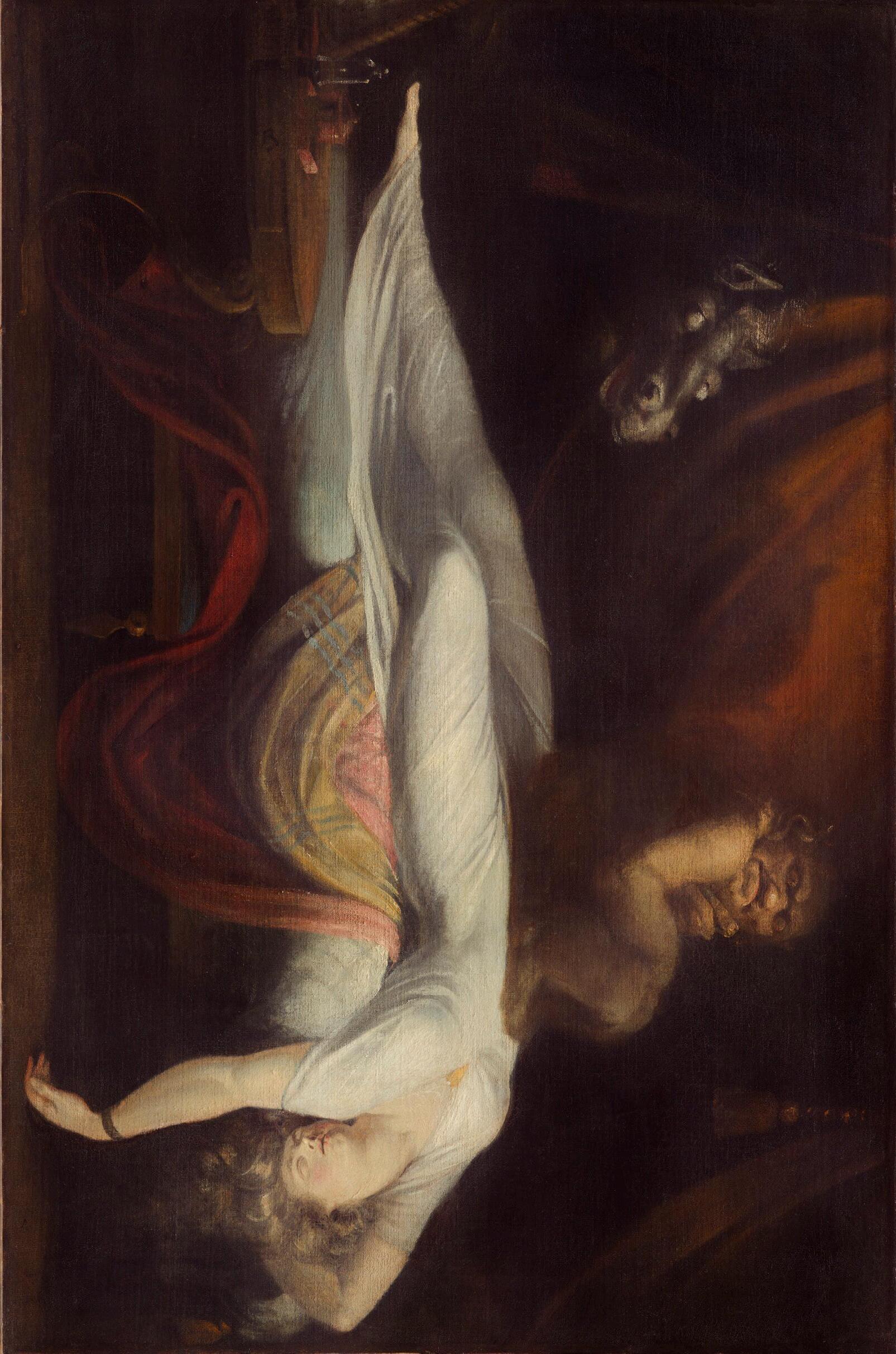
consideration, it can be observed that Henry Fuseli fostered overwhelming experiences that could have encouraged sympathetic reactions from viewers. He was succeeded by writers such as Edgar Allan Poe, whose work utilized irrational thought to make readers deeply consider the absurd parts of humanity by writing stories that depicted madness and murder. By comparing Fuseli’s painting, The Nightmare, and Poe’s short story,
“Tell-Tale Heart,” the relationship between the sublime, sympathy, and the Sensibility movement becomes clear. Though their forms differ, both works utilize irrational, improper subjects to generate storylines that audiences can connect with, thus utilizing sympathy to facilitate experiences that embrace irrational emotions and reactions. This utilization of sympathy to trigger responses from observers and readers was made possible by the gradual shift away from neoclassical ideologies regarding art. In his book titled The Sister Arts, Jean Hagstrum explains that Neoclassicism went “against the emblematic expression of the seventeenth century, which [was] considered barbarously unnatural and inelegant” (129). Rather than encourage the creation of art to establish emotional connections, neoclassicism promoted traditional art that prioritized logic and order. Because of this, art from this time tends to imitate Greek and Romantic forms while idealizing real life. For example, neoclassic artists such as Benjamin West strived to accurately depict historical events in beautiful and noble ways. This can be seen in his painting The Death of General Wolfe which articulates the significance of General Wolfe’s death
during the Battle of Quebec. Similarly, neoclassical poets such as Alexander Pope looked to nature for inspiration and wrote about the world around them with vivid imagery that embodied the literary picturesque.
Neoclassicism’s focus on realism and logic was challenged as artists began to gravitate toward the empathetic values of sensibility. This shift, which resulted in the decline of neoclassical expression, was the beginning of an art revolution that prioritized the sharing of emotions and experiences. In her study titled Sensibility: An Introduction, Janet Todd states that this shift was initialized by “the shifting importance of various classes, the growth of London…the changing perception of the family and its importance within society, the economic and cultural situation of women, and the interrelated developments in religion, philosophy, and science” (10). Additionally, Todd explains that the sensibility movement was propelled by “an assumption that life and literature are directly linked, not through any notion of a mimetic depiction of reality, but through the belief that the literary experience can intimately affect the living one” (4). This assumption upholds the artists as being capable of not only mimicking real life but
creating realities of their own that have the possibility of affecting those of others.
The cult of sensibility was a large step away from neoclassicism. However, the foundational connection between the arts remained widely acknowledged and celebrated. Particularly, the relationship between art and literature was as prevalent during the sensibility movement as it was during the era of neoclassicism. Art was thought to have literary qualities which were evident in a piece’s usage of allegories and small details to communicate stories and messages. Likewise, it was believed that literature had pictorial qualities since it utilized language to make “the reader ‘see’ a picture” (Hagstrum 139). This connection is represented by the phrase ut picture poesis which asserts that “everything said of painting is applicable to poetry and vice versa” (Hagstrum 135).
While the assumed relationship between the arts connects neoclassical and sentimental ideologies, many art theorists believed that art forms differed in their capabilities. Among these skeptical art theorists was the author of A Philosophical Inquiry into the Origin of Our Ideas of the Sublime and the Beautiful, Edmund Burke, who was not convinced that art and literature could be related to
one another. Burke differentiated the two forms by explaining that words “create emotional [responses]” while paintings “bring to the mental retina the objects of nature” (Hagstrum 153). In her study titled The Enquiry: The Sublime and the Sister Arts, Hélène Ibata critiques Burke’s divisive theologies such as his belief that paintings were limited in the emotional responses they could elicit from viewers in comparison to poetry which could “raise a stronger emotion by [its] description” (42). Burke insisted that still images could not trigger emotional reactions as well as poetry could and that, likewise, written words could not create notable imagery. Whereas other critics of this time promoted the idea that “the force…of language…[could create] clear, complete, and circumstantial images…[which turn] readers into spectators” (Hagstrum 153), Burke argued that literature could not effectively accomplish such a task. He is cited as saying:
So little does poetry depend for its effect on the power of raising sensible images, that I am convinced it would lose a very considerable part of its energy, if this were the necessary result of all description. Because that union of affecting words, which is the most powerful of all poetical instruments, would frequently lose its force, along with its propriety and
consistency, if the sensibly images were always excited. (Hagstrum 153-4)
By saying this, Burke challenges the validity of concepts such as pictorialism and ut pictura poesis which are foundational to the Sister Arts. In Ibata’s words, in pointing out the limitations of art and literature, Burke “undermined the sister arts tradition” (30). While revolutionary for his time, Burke’s thinking is ultimately flawed. He fails to acknowledge the power of written words and the impact of painted images. Additionally, he does not consider the implications that their shared abilities hold, especially regarding their capability to represent the sublime and elicit emotional responses from audiences.
Observing Henry Fuseli’s painting, The Nightmare, and Edgar Allan Poe’s short story, “Tell-Tale Heart,” can aid in uncovering the connections between literature, art, and their ability to produce the sublime and sympathetic responses. Upon their initial releases, both works received mixed reviews from critics. While some were delighted with their dark themes, others felt that the works were too disturbing to facilitate any sort of pleasurable experience for audiences. Specifically, the fitfully sleeping woman in The Nightmare was regarded as being
“too unpleasant…unfit for furniture [i.e. as decoration]” and her depicted nightmare was seen as “a disagreeable subject” (Frayling 11). Similarly, for its exploration into the mind of an insane man, “Tell-Tale Heart” was criticized for being "overstrained and repulsive," and "fearfully vivid" (Hirst 33). With this being said, these works were both successful in their own rights. According to Frayling, The Nightmare “spread [Fuseli’s] name all over the earth” (13) and helped him become “a leading painter of the sublime and supernatural…whose work had… sensational immediacy” (Myrone 289). Likewise, Poe was also well renowned and recognized for his short stories and poems, especially “Tell-Tale Heart” which commented on the loss of rationality.
Despite their mixed reception, what cannot be overlooked or diminished is both works’ ability to explore darker parts of humanity in ways that encourage audiences to participate in sympathetic experiences. Fuseli’s The Nightmare places spectators in a woman’s room as she suffers from a terrible, corporeal nightmare. Although philosophers such as Burke may have undermined The Nightmare’s ability to trigger emotional reactions, the painting’s composition begs audiences to question their position within
the painting and, thus, within the nightmare. In doing this, Fuseli forces spectators to experience the terror the woman must be feeling as she fitfully sleeps. Likewise, “Tell-Tale Heart” achieves more than what Burke believed literature was inherently capable of. Not only does Poe portray irrationality, but he does this in a way that causes readers to feel, hear, and see what the narrator experiences. Particularly, his usage of sound and sight to create elaborate scenes far exceed Burke’s limitations.
Within Poe and Fuseli’s works are manufactured sympathetic experiences which compel viewers and readers to feel extreme emotions. Such techniques that utilize irrational subjects to create sympathetic reactions are key characteristics of the art that was created during the rise of the Sensibility movement. In his lecture, Bates explains that “in connecting with a tale of distress, the reader also connects with the full tide of Life; the heart reaches out in the spirit of fellow feeling with suffering humanity” (4:20-32). The ability to access humanity through distress occurs thanks to sympathy which, as Burke explains, “transfuses [passions] from one breast to another” (44). In this context, sympathy acts as the key to creating sublime
experiences and to entering the realm of Sensibility.
According to Pop, Fuseli’s invitation of the spectator into the sleeping woman’s private dream experience allows sympathy to act as a “gulf between individual consciousnesses” (936), thus connecting viewers to the sleeping woman in The Nightmare. The woman depicted in the painting sprawls across her bed as a demon weighs down on her abdomen and a horse pokes its head out from behind a curtain. While viewers observe the demon perched on top of her, they can understand the sensation that the woman must be feeling. In his article which analyzes the subject of nightmares as it is represented within Fuseli’s paintings, Feingold states this sensation is the familiar “feeling of suffocation characteristic of the pathology of nightmares” (Feingold 55). Fuseli’s placement of the demon on the woman’s chest allows the viewer to experience the sensation of having a nightmare as they imagine the heavy pressure the creature must be placing on her body.
In the painting, a ghostly horse gazes off into the distance—seemingly startled by something viewers cannot see—while the demon stares through the borders of the painting as if it can see the spectator just outside of the frame. By
acknowledging the viewer, the demon draws the spectator into the painting, making them feel as though maybe they’re having a nightmare as well. This feature of the painting suggests that Fuseli might be utilizing the organization of the painting to imply that the “spectator [is] asleep and dreaming the whole scene” (Pop 938), which heightens the experience through an employment of sympathy that allows the spectator to feel as if they are dreaming as the woman (Pop 940).
In depicting this nightmare, Fuseli calls upon viewers to consider the act of dreaming which was a phenomenon that was not yet understood during The Nightmare’s first showing. While they can also experience dreaming through viewing the woman, spectators can also participate in a sympathetic experience that moves them to feel concern for the sleeping woman. Along with concern, this painting also creates an experience that welcomes an irrational display of emotions such as distress and discomfort. Considering the influence the Sensibility movement may have had on this painting, it is interesting to consider if the overwhelming reactions of unease and concern were satisfying to Fuseli as the critiques began to circulate. Naturally, positive reactions do not often come from objects that make spectators
feel unsettled; however, the ability of audiences to feel so strongly towards a painting communicates the great talent of Henry Fuseli.
Additionally, it is interesting to consider how the reactions to Fuseli’s paintings contradict Burke’s statements regarding paintings’ ability to create emotional experiences. The Nightmare achieves ut pictura poesis by doing what Burke believes to be impossible: forcing spectators to feel. As Pop has explained, this is achieved partly because of the components of the painting (the posture of the woman and the placement of the demon), but the darkness and the implied silence of the piece could also be accredited for the sentimental qualities of the painting. In the fourth part of A Philosophical Enquiry, Burke explains that the ability of darkness to be sublime varies based on who is experiencing it. He goes on to acknowledge that, for those who feel a sense of terror while faced with darkness, it is reasonable that such a state would make one feel tension since “it is impossible to know in what degree of safety [they] stand [and] we are ignorant of the objects that surround us” (Burke 141). However, when looking at the dim painting, spectators have an idea of where they stand and of what is around them.
So, how does this aspect of the painting communicate the sublime to viewers?
Perhaps it is the fact that viewers can see the objects within the dark room that causes their emotional responses. To remain in control while facing unpredictable circumstances, humans may try to remind themselves that their fears are not real and cannot harm them; however, The Nightmare creates a scene where spectators are being actively confronted by their fictional fears. The painting proposes that, perhaps, this is what exists within the dark. Additionally, the implication of silence aids in amplifying the sublime qualities of the painting. Burke speaks at length about the effect of sound—the suddenness of it, the repetition of it—but does not directly mention that the lack of it can have a sublime effect on audiences. However, the implied silence within Fuseli’s painting is another key component of its overall composition, creating a sense of terror. After observing the composition of this painting, it would do it an injustice to claim that it is incapable of fostering emotional experiences for spectators. Contrary to Burke’s beliefs, The Nightmare has the force needed to reach from the canvas to touch viewers and strike them with terror, awe, and other emotional responses.
The same can be said about Poe’s short story, “Tell-Tale Heart”; contrary to Burke’s assumptions about literature, the short story succeeds in creating vivid imagery that affects the reader’s experience without forfeiting any of its energy. Although it was initially published decades after The Nightmare, “Tell-Tale Heart” also received critiques that were similar to The Nightmare’s. While critics commented on “Tell-Tale Heart” as being overwhelming and distressing, this was likely Poe’s intention when writing the story. Discomfort can only be expected when witnessing the rapid decline of a man’s sanity as he struggles to come to terms with his part in another man’s murder. As Poe explores the suppressed, dark, and irrational parts of humanity, he also creates an environment where irrational reactions are permissible. The purpose of “Tell-Tale Heart” appears to be to make a spectacle of the irrational and it achieves this purpose in an abundantly sympathetic way. Readers can sympathize with the victim of the murder, the insane narrator who is losing his mind, and with each other as they begin to consider the disturbing, unpredictable, and inconsolable parts of themselves. This sort of sympathetic
experience is fostered by many things such as Poe’s descriptive language that utilizes sound to disorient the reader and vivid descriptions that create intensely unsettling images within readers’ minds. While the absence of sound in Fuseli's The Nightmare amplifies the effect the painting has on spectators, the reoccurrence of it within “Tell-Tale Heart” triggers the senses and enhances the overall sentimental experience that lies within the story. As the narrator of the story recounts his descent into madness, he says that, “there came to [his] ears a low, dull, quick sound, such as a watch makes when enveloped in cotton…it was the beating of the old man’s heart” (Poe 171). The beating of the man’s heart haunts the narrator as well as the reader who is forced to imagine the intermittent thumping. As the story progresses, so does the intensity of the phantom heartbeat. Eventually, the beating becomes so intense that the narrator resorts to digging up the dead man to chop him apart to silence his heart. However, this does not get rid of the sound, rather “the noise steadily increased” (Poe 173).
At this point in the story, readers are familiar with the narrator’s anxiety since it has also become their own. The
racing thoughts of the narrator paired with the persistence of the beating sound efficiently communicate a sense of urgency, guilt, and worry to readers. This use of intermittent sound is acknowledged by Burke who states that:
A low, tremulous, intermitting sound, though it seems in some respects opposite to [suddenness], is productive of the sublime… [since] low, confused, uncertain sounds leave us in the same fearful anxiety concerning their causes, that no light, or an uncertain light does…[and] a light now appearing, and now leaving us, and so off and on, is even more terrible than total darkness; and a sort of uncertain sounds are, when the necessary dispositions concur, more alarming than a total silence. (Burke 84)
It seems that Poe understood that repetitive and uncertain sounds are more frightening than total silence. The strategic utilization of the disembodied heartbeat to elicit anxiety and fear is a sublime component of the story which helps it create a sympathetic experience. The short story’s ability to effectively create emotional experiences is one that was challenged by philosophers such as Burke. As previously stated, Burke believed that literature was best for creating emotional response, but that they
lacked the ability to create pictures within the mind (Hagstrum 153).
In contrast, Burwick states that writers can make “[readers] perceive [objects] so sensually that [they] are more clearly conscious of [the] object than… [the] words. Thus, a verbal description may bring [readers] closer to that degree of illusion which is the peculiar capacity of the material painting” (425). Poe’s language within the “Tell-Tale Heart” successfully provides readers with a sense of imagery that creates an experience akin to the experience of viewing a painting. The most notable example of this is the description of the old man’s eye, which the narrator cites as the catalyst for his insanity. He calls it “the eye of a vulture” and describes it as being “pale blue…with a film over it” (Poe 168). This initial image of the eye is unsettling, but the irrational responses it draws from the narrator are just as, if not more, disturbing.
The narrator says that, after looking the man in his vulture eye, “[his] blood ran cold; and…[he] made up [his] mind to take the life of the old man, and thus rid [himself] of the eye forever” (Poe 168). As Poe paints this picture, he also uses the narrator’s responses to guide the reader’s sympathetic experience. Similar to the descriptions of the eye itself, the
narrator’s reaction to it paints a vivid picture of the narrator’s internal turmoil. This dramatic reaction plus the vivid description of the eye communicates the true extent of the eye’s grotesqueness. The combination of these elements compels the audience to imagine the eye, perhaps in such a way that may be far more disturbing than the one Poe set out to create. Nonetheless, Poe successfully paints a picture that, like a material painting, immediately delivers an image that also effectively evokes an emotional experience that is to be expected of a piece of literature.
Poe defies Burke’s limitations by using the force of his language to place images within the minds of readers. His work confirms that language and literature can function as paintings do. Additionally, the theme of insanity, which recurs often within Poe's work, presents audiences with a space to contemplate madness as well as their own fragile sanity as they witness the deterioration of another person’s mental state. This use of terror and sympathy within the “TellTale Heart” creates a narrative around the unexplainable which shows a connection between the sensibility movement and the sublime. Similarly, Fuseli’s The Nightmare also contradicts Burke’s ideologies by
eliciting sympathy from spectators. By doing so, The Nightmare heightens the experience of the audience as they try to ground themselves within the painting. Audiences of “Tell-Tale Heart” and The Nightmare must accept the irrational as a public spectacle while they collectively suffer through their emotional and sympathetic reactions to the artworks. By considering these aspects of the two works, a connection can be drawn between literature and painting which supports ut pictura poesis and asserts the validity of the Sister Arts.
CITED
Bates, Jonathan. “Wordsworth, Coleridge and the Poetic Revolution.” Youtube, uploaded by Gresham College, 22 October 2018. https://www.youtube.com/ watch?v=0wgVApASNxw.
Burke, Edmund. A Philosophical Enquiry Into the Sublime and Beautiful. Routledge, edited by James T. Boulton, 2008. EBSCOhost, research. ebsco.com/linkprocessor/ plink?id=5caca188-145d-344b899a-213fe7a3c5a3.
Burwick, Frederick L. “Edgar Allan Poe: The Sublime, the Picturesque, the Grotesque, and the Arabesque.” Amerikastudien / American Studies, vol. 43, no. 3, 1998, pp. 423–36. JSTOR, http:// www.jstor.org/stable/41157397.
Feingold, Lawrence. “Fuseli, Another Nightmare: ‘The NightHag Visiting Lapland Witches.’” Metropolitan Museum Journal, vol. 17, U of Chicago P, 1982, pp. 49– 61. JSTOR, https://doi. org/10.2307/1512786.
Frayling, Christopher. “Fuseli’s The Nightmare: Somewhere between the Sublime and the Ridiculous.” Gothic Nightmares: Fuseli, Blake and the Romantic Imagination, edited by Martin Myrone. Tate Publishing, 2006, pp. 9-20
Hagstrum, Jean. The Sister Arts: The Tradition of Literary Pictorialism and English Poetry from Dryden to Gray. U of Chicago P, 1958.
Hirst, Henry B., and Edgar A, Poe. "From Poets and Poetry of Philadelphia (1843)." Poe in His Own Time: A Biographical Chronicle of His Life, Drawn from Recollections, Interviews, and memoirs by Family, Friends, and Associates, edited by Benjamin F. Fisher. U of Iowa P, 2010.
Ibata, Hélène. “The Philosophical Enquiry, Theories of the Sublime and the Sister Arts Tradition.” The Challenge of the Sublime: From Burke’s Philosophical Enquiry to British Romantic Art, Manchester U P, 2018, pp. 29–60. JSTOR, http://www.jstor.org/ stable/j.ctvn96j0v.7.
Myrone, Martin. “Henry Fuseli and Gothic Spectacle.” Huntington Library Quarterly, vol. 70, no. 2, 2007, pp. 289–310. JSTOR, https:// doi.org/10.1525/hlq.2007.70.2.289.
Poe, Edgar Allan. The Tell-Tale Heart and Other Stories, Lerner Publishing Group, 2015. ProQuest Ebook Central, https://ebookcentral-proquestcom.ezproxy.selu.edu/lib/ selouisuniv-ebooks/detail. action?docID=5444146.
Pop, Andrei. “Sympathetic Spectators: Henry Fuseli’s Nightmare and Emma Hamilton’s Attitudes.” Art History, vol. 34, no. 5, Nov. 2011, pp. 934–57. EBSCOhos t, https:// doi-org.ezproxy.selu.edu/10.1111/ j.1467-8365.2011.00854.x.
Todd, Janet. Sensibility. Methuen & Co. Ltd, 1986.
Emma Franzo
Instructor: Alysia Anderson
Course: English 1010
Genre: Rhetorical Analysis
Inspiring messages and deeply meaningful speeches are given at the National Prayer Breakfast in Washington, D.C., every year to unite numerous political figures in prayer over the nation. Many of the speeches are extremely effective and powerful because of the speakers’ impressive abilities to create valuable points and incorporate subtle literary techniques. In Ben Carson’s speech, “Address at the 2013 National
Prayer Breakfast,” there is great use of rhetorical devices that allow him to truly capture the audience and provide a welldeveloped message. At the annual prayer event, Carson discusses the importance of not being easily offended, educating young people, and becoming a more unified country that solves problems rather than struggling to find solutions. Throughout the message, he heavily emphasizes that the nation is full of
intellectual individuals that can impact growth and improvement in society. His goal is to motivate others to initiate more beneficial practices in the United States and alter their perspective on standing up for their beliefs. Ben Carson’s speech at the National Prayer Breakfast is highly effective because of his use of allusions, anecdotes, and point of view.
To begin, Carson enhances his speech through the usage of both biblical and patriotic allusions. Knowing his audience contains many people of faith, Carson uses these biblical allusions to connect them to the purpose of his speech. He implements verses from scripture as well as his own personal experiences and knowledge of faith, hoping to pique the interest of the audience and help them understand the message he formulates on education, unity, and problem solving. Citing Proverbs 11:9, Carson clearly lays out the concept that “through knowledge the righteous escapes,” enabling every listener to contemplate biblical truths (Carson). By making a reference to the Bible, Carson intensifies the importance of the idea that people can create solutions if intelligence is emphasized. The allusions in Carson’s speech also add a spiritual aspect to his points on running a proper
government. He presents his own solution to economic problems in the United States: paying an exact percentage of one’s income as taxes. Carson uses an allusion to the Scriptures again, arguing that “the fairest individual in the universe” is God and that God’s methods of government surpass those of man (Carson). His direct reference to God, a spiritual being, links the audience’s moral values to their political views. Through the Biblical allusion, Carson invokes strong positive reactions to his message. Lastly, Carson influences his listeners by appealing to their patriotic beliefs in a reference to the American Pledge of Allegiance. Carson reminds his audience that they are unified as “One nation, under God,” and his patriotic allusion effectively hints at the tenacity of the country (Carson). The reference to the Pledge of Allegiance radiates the confidence Carson has in his nation’s ability to make a difference and solve problems. Showing his trust in the American people through patriotic and biblical allusions, Carson creates an incredibly effective speech that will reach the listeners.
By integrating anecdotes into his speech, Carson is able to communicate a more relatable message to his audience. Using experiences from his
childhood and from other stories, he keeps the audience engaged and applies the intention of his teachings to the real world. In a humorous story about a mother eating the prized birds her son buys for her, Carson highlights that the birds “should [say] something” before they are eaten; he stresses that the American people need to “forget about unanimity of speech and unanimity of thought” (Carson). Though the anecdote seems ridiculous, Carson aims to bring the light-hearted story into perspective. He applies the theme of speaking one’s opinions through the telling of the story, guiding the audience to realize the disaster that political correctness can bring. Carson continues to use anecdotes of his childhood experiences as well. As he recounts his adolescence, he explains that he “hate[s] poverty” because he feels hopeless, but his mother’s persistence in making him read books helps him believe that he “[can] be anybody” (Carson). He acquires the ability to excel even in difficult circumstances because of the lifestyle his mother so strongly enforces. Using the compelling story of his determination through a childhood of hardship, Carson expresses to the audience that they have the power to improve their nation’s conditions. The anecdote does an exceptional job of connecting the listeners to Carson’s message and encouraging them to be proactive. Finally, Carson includes a patriotic and emotional anecdote in order to effectively impact the audience. Towards the end of the speech, he portrays a glorious scene of the American flag as “the torn and tattered Stars and Stripes” continue to wave after a brutal War of 1812 (Carson). By echoing the origin story of the beloved “Star Spangled Banner,” Carson captures the attention of the attendees and emphasizes his point: the country is stronger and can accomplish beneficial change more than it may realize. Carson’s anecdotes successfully relate the audience to his speech, and they form a memorable foundation to strive for excellence and establish problem-solving. Lastly, the speech is made more effective as Carson uses point of view through first-person pronouns such as “we” in order to make listeners feel included and known. By ensuring that all people should consider his solutions, he introduces a sense of unity and teamwork that could evidently influence action. Carson rhetorically asks how “we [can] solve problems” in an attempt to evoke the audience to action (Carson). By implying that the government and the American
people have a role in developing solutions, he makes the audience feel qualified to truly influence their country. Moreover, Carson’s intentional use of point of view includes the listeners in order to give them a sense of duty. While Carson presents the issues of society, he reminds the audience that it is “our real responsibilities” that “can solve problems” (Carson). Carson is lending this accountability onto the American people by incorporating words like “we” and “our,” permitting them the opportunity to become more unified, more proactive in the government, and more passionate about education. Finally, the addition of a unifying point of view aids Carson in dramatically convincing the listeners of their competence to make effective transformations for the United States. After introducing many solutions, Carson explains that “we can do all these things because we are smart people” (Carson). Since Carson sincerely affirms the intelligence of all people, he appeals to the audience’s emotions. The inclusive language and pronouns contribute to the listeners’ confidence in their abilities, so Carson can effectively instill his message into their lives.
The vast amount of rhetorical techniques Ben Carson uses in his
National Prayer Breakfast speech are quite compelling. His various topics seem difficult to compose into one speech, but he is able to brilliantly use allusions, anecdotes, and point of view as components that connect each focus. Storytelling and inclusive language are powerful tools that Carson embraces to make sure every audience member is integrated and feels they can make a difference. Assuredly, Carson’s speech effectively portrays the need for quality education, action to solve issues, and riddance of political correctness without disturbing the unity within his audience.
Carson, Ben. “Address at the 2013 National Prayer Breakfast.” American Rhetoric, 7 February 2013, https:// www.americanrhetoric. com/speeches/.
Paige Bigelow
Instructor: Dr. Jerry Parker
Course: Humanities 4010
Genre: Research Paper
The purpose of the study was to research Generation Z’s (GenZ's) attitudes toward ethics and democratic leadership. A survey was conducted utilizing both narrative response questions along with a Likert scale. The results of the survey concluded that GenZ valued ethics the most in leadership, along with a democracy being an ideal government system evolving. Comprehensively
speaking, this paper goes into detail explaining the relationship of ethics and democratic leadership in terms of Generation Z’s attitude towards these two topics. The findings of this study tell us that if the leadership is not ethical and honest then GenZ does not support it. Also, the results of the study reveal that Generation Z values democracy as well. These findings are useful for future politicians and employers because of the
increasing population of Generation Z in both the workforce and voting block of elections.
These results further emphasize the importance of democracy that GenZ values as an acceptable type of government. As society advances, GenZ’s attitudes are becoming more prominent in modern day society. Overall, this research is critical to shaping the future of policies, leadership styles, and organizational practices for an emerging generation.
Keywords: Generation Z, democratic leadership, ethics Introduction
Generation Z’s views on ethics and democratic leadership is incredibly important considering they are now expected to move into the job market within the coming year (Lim & Lianto, 2024, p. 92). However, further research on this topic is needed because GenZ makes up such a large percentage of the current world population as well. With increases in social media and the ability to communicate in real-time, GenZ opinions are becoming more prominent as society becomes more technologydependent and interconnected. The next section will expand on who Generation
Z is, ethics and leadership, and democratic leadership; following this, it will expound on GenZ and ethics and Democratic leadership.
Literature Review
Generation Z was born between 1995 and 2012, is known by many names, but GenZ is the most commonly seen one. This generation is highly significant because people born during this time “make up 20.7% of the US population”, and this significance plays a part in politics as GenZ is said to be a substantial “voting bloc in future elections” (Lal & HarbridgeYong, 2023, pp. 1-4). Knowing this information can help express the value of this generation in terms of governmental relations. The findings on GenZ are unique in this factor, but one must also consider how they are in a period of rapid technological development (Lim & Lianto, 2024, p. 88). Technological advancements influence GenZ’s opinions due to fast information flow and delivery.
Ethics & Leadership
Ethics and leadership are two uniquely different things, but when put together, the two form a strong bond. While ethics and leadership differ, they connect with one another as “ethics is the heart of leadership” and both “go hand in hand" in almost everything (Mullane et al., 2009, p. 1). Ethics is a set of principles that guide behavior in a specific context or
group, and good ethics determine good leadership. Examples that can clarify this point are both Hitler and Mother Teresa. Both historical figures exemplify excellent leadership, but Hitler's portrayal of a leader lacks in ethics while Mother Teresa's leadership is an admirable representation of good ethics. There are more examples that could be used to help clarify ethics but these two are specific and highlight the importance of ethics. Overall, a leader who has good leadership but lacks in ethics makes people follow out of fear. Hitler is someone that led people to following out of fear whereas Mother Teresa was the opposite. Despite this, it is valuable to note how ethics plays a role in leadership. In the real world, ethics' role in leadership is crucial and affects people of all ages. While looking at the different levels of leadership (for example executive, legislative, and judicial), it is important to realize that “all levels of ethical political leadership matter” (Mozumder, 2021, p. 822). Even the lower levels of political leadership are just as valuable as the higher levels. This essentially means that each branch, even if one is deemed lower than the other, matters and makes an impact no matter what. Ethics itself is a contribution to
society that helps generations decide their views on leaders, and when combined with leadership, it is beneficial as “ethics lies at the heart of leadership studies” (Levine & Boaks, 2014, p. 225). The topic of ethics and the research done are necessary and helpful for a person learning what they wish to support and what type of leadership they choose to follow. When selecting the type of leadership a person wants to follow, they must look into each style and see which one gives the best overall benefit.
Democratic Leadership
Even though there are multiple definitions of leadership, democracy can be defined as “government by the people” (Grabo, 1918, p. 763). Defining democracy will help research and clarify what democracy is to people who are uncertain. After clarifying what democracy is, the next thing to define is democratic leadership because that term itself is valuable to know. Democratic leadership relates “to being a democratic and fair leader in all contexts” (Özturgut, & Craven, 2014, p. 156). This definition is beneficial because it gives insight into democratic leadership. The benefit of having multiple definitions yields to being able to explain the topic more easily,
and using these definitions can aid in understanding democratic leadership. In addition, democratic leadership can establish a “symbolic relationship between leaders and followers” (Metz, 2021, p. 9). A positive relationship between leaders and followers is another benefit to look at democratic leadership. When you look at democratic leadership in this way, it is valuable because this type of leadership is built on comfortability between the people and the leaders.
Democratic leadership is crucial especially in locations where it is the foundation of government such as the United States of America. This leadership style is important since democratic living allows people to change their character and become ethical, sensible citizens as they grow (Woods, 2020). With democratic leadership progressing, its importance is increasing because of the differences in leadership styles across the world. However, if used incorrectly, this leadership style can be a “tool of injustice” as evident in other styles (Beerbohm, 2015, p. 649). When a leadership style is used for injustice, it can lead to corrupt leaders and outcomes similar to dictators like Francisco Franco in Spain and Pol Pot in Cambodia. As a
result, this can lead to people distrusting the government, and the phrase, “Trust me, I’m a politician,” becoming a joke in the eyes of the people (Kane, 2007). This phrase is just another example of how easy it can be to distrust the government. When a leader says something of this nature, it can lead to their personal bias being expressed and the sole target of their purpose being unveiled. A perfect example of this is when a president is elected and immediately starts focusing on being reelected. Overall, Democratic leadership is vital in areas where the government style is practiced because of the comfortable connection created between leaders and people.
After expanding on GenZ, ethics & leadership, and democratic leadership, their correlation to one another is more clear. A statistic on the GenZ population states how GenZ “is expected to reach 2.56 billion individuals globally by 2020 and estimated to occupy 20% of the workplace” (Dwidienawati et al., 2022, p. 894). This statistic further proves that, with this increase, the matter of ethics, and leadership (preferably democratic leadership) with Generation Z’s opinion will become more evident in
this group within the workforce. Also, due to there being a large percentage of GenZ in the current population, the importance of their opinion will be more noticeable as time progresses in events like elections or hiring processes. With the growth in popularity of GenZ, there will be a greater need for different types of leadership that would cause an increase in work productivity (Dwidienawati et al., 2022, p. 894). Despite the different leadership styles in modern society, the democratic leadership style stands out the most when paired with GenZ. The reason behind this is because of the choices this specific leadership style offers towards its people. Democratic leadership essentially gives GenZ the opportunity to have their voices heard without penalties or repercussions to an extent.
Ideals like democratic leadership and ethics are significant to Generation Z; however, this generation values characteristics such as honesty and communication. This supports the idea that GenZ has expectations from a leader (Aksakal & Ulucan, 2024). GenZ has made up such a vast majority of the population that it is hard to ignore what they want and value. The high percentage and background of technology that GenZ possesses makes
this group essential to the world's future and explains why leader particularity is so important in this current day and age. GenZ has become so popular that their opinions on leadership, even democratic, is becoming more notable than previous generations. This is also shown when politicians focus their attention on GenZ in propaganda. With stances becoming more predominant, it is important to look into these viewpoints and see what correlations there could be. A survey of college students was conducted to see if there was an underlying connection between Generation Z and its attitude towards democratic leadership and ethics.
The purpose of this research was to gauge Generation Z’s attitudes toward democratic and ethical leadership. Based on the existing literature, the following research questions were chosen:
• What is GenZ’s attitude toward democratic leadership and ethics?
• What is GenZ’s attitude toward ethical leadership?
• How does GenZ’s attitude affect their decision-making for the future? These questions were selected
because of the style of government in the United States, where the survey takes place, which is democratic leadership, and ethics is an important matter. The questions picked gave a better insight into the large population of GenZ. The relevance behind the questions is that with society moving forward and becoming technologically dependent, it is crucial to understand the generation most involved with technology. The study's findings will help answer these questions and help understand the generation becoming more prominent in the workforce while understanding the topic better.
These questions are beneficial to the study because they all relate to one another and actively connect to the real world. The first question is the most valuable because it encompasses what the study is attempting to uncover in one question. The second point will question the attitude towards ethical leadership from Generation Z’s view, and this is important because ethical leadership is the difference between willful obedience or forceful obedience. Lastly, the third question asks how their attitudes affect decision making for the future, and knowing this will increase the likelihood of beneficial change following crucial
historical events.
Survey Research Methodology was used to collect data to respond to the proposed research questions. Survey research is defined as “the collection of information from a sample of individuals through their responses to questions” (Check & Schutt, 2011, p. 160). The value of Survey Research Methodology is that survey research is both “a useful and legitimate approach to research” that is clear to dissect and allows an easier way to “describe and explore variables and constructs of interest” (Ponto, 2015). The usefulness of a Likert scale is that it allows “anonymity” which can help “reduce social desirability bias” and allows “quantitative data to be obtained” which can be analyzed easier for researchers (Mcleod, 2023).
A random sampling technique was used to collect data. Participants in the survey include students taking courses at a mid-sized regional institution located in the southeast United States. The participants of the survey were also Generation Z age students. These students were a sample population to help understand the large population of GenZ.
A survey was drafted and had a variety of questions, some using a likert scale, narrative responses, and multiple choice. After the survey was drafted, a piloted survey was sent out before being released. The piloted survey was completed by three willing Generation Z participants. These three participants gave feedback on any areas that needed improvement or better clarity. Each participant of the piloted survey said that it was great and was clearly understood. The survey was then sent out to students taking courses at a mid-sized university in the southeast United States. I waited three weeks before I closed the survey to give plenty of time to get an ample amount of participants in the survey before closing it. After closing the survey the results were then analyzed. The following section discusses the findings of this data.
The following section presents the results of a survey of GenZ related to their attitudes toward ethics and Democratic leadership with the number of respondents being N=46. This study aimed to better understand GenZ and their attitudes on both ethics and
Democratic leadership. The following section is separated into four parts. The first part discusses GenZ’ attitudes toward ethics and leadership. The second section captures their thoughts on democracy. The third section provides narrative responses. The survey closes with demographic data.
The overwhelming majority (87%) agreed that good ethics are important in leadership. They (78.3%) also agreed that ethics matter in politics and that leadership can be used as a tool of injustice against certain individuals (69.6%). The majority (67.4%) of respondents also felt that there is secrecy and dishonesty among local, federal, and state officials. Dually, good character and integrity are what they look for in a leader (76.1%). The majority (82.6%) suggested that the government is not 100% honest with the American people and that ethical leadership has a positive and significant impact on employee satisfaction (71.7%). The majority (45.7%) agreed that ethics lies at the heart of leadership studies; however, a small minority (21.7%) agreed felt neutral. Likewise, they (35.6%) felt that moral guidance is not limited to the possession of certain knowledge of the
pursuit of specific values. A significant minority (20%) was neutral as well. Last, the majority (41.3%) felt that democratic leadership styles refers to being a democratic and fair leader in all contexts.
The majority (41.3%) of respondents agreed that democracy is an ideal system of government that is evolving. They (47.8%) also agreed that the government regularly disappoints you and causes you to lose trust in the government. The majority (43.5%) felt that typically they distrust the representatives and suspect them of peddling lies or half-truths; however, a minority (8.7%) felt neutral about this. There was an overwhelming majority (71.7%) agreed for democracy to work efficiently it demands wise and unselfish leadership. However, there was a majority (52.2%) that disagreed that democracy in the United States is fine, and you are not worried about the country.
In response to the question “What characteristics do you believe a political leader should have and why?" respondents stated that a leader
should be honest, trustworthy, educated, intelligent, selfless, and have integrity. The participants' responses also reveal that a majority believed honesty and integrity to be the more significant characteristics of a political leader. These responses to this question express the participants value to a political leader’s characteristics.
The responses received to the question “What is the relationship between leadership and ethics and is it positive or negative?” revealed that the majority believed that a relationship is positive but that ethics plays a huge role in if that relationship stays positive. Interestingly, one respondent stated that “You can be a great leader and a vile person. While preferably one is both a good person and a good leader, the relationship is overall neutral. Its all very situationally dependent.” Overall, the respondents' responses varied but revealed the answer to be a positive relationship.
When asked “In particular leadership contexts are there specific values that are needed, if so, what are they?” respondents expressed that specific values needed are empathy, boldness, honesty, adaptability, intelligence, and determination. Uniquely
enough, one participant said that “Educated, strong speaker, empathetic. A good leader is able to hold a strong ground to protect their followers but also empathetic enough to want to do what’s best for their followers and not just themselves.” The responses essentially expressed the main values essentially needed are boldness and adaptability.
The majority of respondents were 18-21 (84.8%) along with a minority (15.2%) being 22-25. A significant majority (67.4%) of the participants were females followed by 26.1% being male and then 6.5% identifying as nonbinary. The races that were received in the population by the survey were white (73.9%), black/African American (19.6%), biracial (4.3%), or other (2.2%). Additionally, the range of political parties that were recorded was unique since there was a close range between the Republican (30.4%), Democrat (19.6%), Independent (30.4%), and Other (15.2%). There was also a slim minority (2.2%) identifying as part of the Green Party, and another portion (4.3%) addressing their political party as Libertarian.
This section will respond to the proposed research questions. Additionally, the data will be analyzed and the importance will be expressed in this section. The data will also be used to help strengthen the responses to the proposed research questions.
Research Question 1: Attitudes toward democratic leadership and ethics
In response to RQ1, Generation Z has a considerably expressed attitude towards democratic leadership and ethics. The literature and the data supports this by the multiple viewpoints from the survey, and the variety of details from the authors. After conducting the survey GenZ has a majority of a positive attitude towards democratic leadership and ethics. I found that after reviewing the data and reading a multitude of sources that their attitude is based on how ethics determines the quality of the leadership. However, there is a highlight on democratic leadership being more notable and supportive of Generation Z.
Research Question 2: Attitude toward ethical leadership
The attitude toward ethical leadership from Generation Z is that if the
leadership is not ethical then the leadership will not be successful and there will be problems. Also, ethical leadership is highly valuable to this generation because they strongly value honesty and integrity. These two specific traits are crucial to note because GenZ is a generation that is becoming more prominent in society. However, I took notice of how, if these two characteristics are not present, then there is no support from this generation. Furthermore, after reading the literature the survey further proves that GenZ will have no issue making their attitudes known, because they are aware of becoming more prominent in society.
Research Question 3: Decision-making for the future?
Generation Z’s attitude affects their decision-making for the future by the fact that they base their decisions on ethics solely. I found that after analyzing the data from the survey that the participants essentially revealed how ethics affects leadership, democracy, and based on literature their own viewpoints. However, one notable difference between the literature and survey is that the survey is modern day data compared to the information obtained from previous scholars. Essentially due to GenZ becoming such a large portion of society their viewpoints are becoming more prominent along with the
decisions they are making more frequently. So, it can be said that their decision-making for the future is becoming based on ethics.
In conclusion, the study's purpose was to gain more knowledge and insight into GenZ’s attitude toward ethics and democratic leadership. The survey was successful in proving the relationship despite the low participant count. After explaining the importance of ethics and leadership, democratic leadership, and GenZ and ethics and leadership, along with more detail into each topic, it moved the paper’s purpose along. However, the findings and discussion sections were the most critical sections of this paper because they are the glue behind the research of GenZ’s attitude towards ethics and democratic leadership. Yet, the findings prove there is a correlation between the attitudes of GenZ on ethics and democratic leadership. Also, any future research that is conducted needs to be done because it can help an emerging generation. This research will be extremely helpful to those in the workforce along with political offices due to the fact of the enormous population that is GenZ. So to conclude, this research will be valuable to the future of politics and the workforce.
Aksakal, N. Y., & Ulucan, E. (2024). Revealing the leadership characteristics of the modern age: Generation-Z perspective. International Journal of Organizational Leadership, 13(1), 22–38. https://doi.org/10.33844/ ijol.2024.60397
Beerbohm, E. (2015). Is democratic leadership possible? American Political Science Review, 109(4), 639–652. https://doi.org/10.1017/ s0003055415000398
Check, Joseph, and Schutt, Russell K. (2011). Research methods in education. Sage publications.
Dwidienawati, D., Syahchari, D. H., & Tjahjana, D. (2022). Effective leadership style for Generation Z. Proceedings of the 4th European International Conference on Industrial Engineering and Operations Management. Rome, Italy, August 2-5, 2021. https://doi. org/10.46254/eu05.20220183
Grabo, C. H. (1918). Education for democratic leadership. American Journal of Sociology, 23(6), 763–78. http://www.jstor. org/stable/2764035
Kane, J. (2007). The ethical paradox of democratic leadership. Taiwan Journal of Democracy, 3(2), 33–52. https://researchrepository.griffith.edu.au/ handle/10072/18010
Lal, A., & Harbridge-Yong, L. (2023). Gen Z attitudes towards American democracy and reform. Journal of Student Research, 12(3). https://doi. org/10.47611/jsrhs.v12i3.4824
Levine, M. P., & Boaks, J. (2014). What does ethics have to do with leadership? Journal of Business Ethics, 124(2), 225–42. http:// www.jstor.org/stable/24033265
Lim, A. T., & Lianto, L. (2024). Ethical leadership in the eyes of Gen Z: A Literature Review. Firm Journal of Management Studies, 9(1), 8396. https://doi.org/10.33021/firm. v9i1.5059
Merriam-Webster. (n.d.). Ethic. In Merriam-Webster.com dictionary. Retrieved October 23, 2024, from https://www. merriam-webster.com/ dictionary/ethic
Metz, R. (2021). Democratic leadership as a political weapon: Competition between fictions and practices. International Journal of Public Leadership, 17(4), 313–324. https://doi. org/10.1108/ijpl-09-2020-0094
Mcleod, Saul. Likert Scale definition, examples and analysis. Simply Psychology, 31 July 2023, www. simplypsychology.org/likertscale.html.
Mozumder, N. A. (2021). Can ethical political leadership restore public trust in political leaders? Public Organization Review, 22(3), 821–35. https://doi.org/10.1007/ s11115-021-00536-2
Mullane, S. P., University of Miami, H. McCoy, B. H., Buzz, Ciulla, J. B., Johnson, C. E., Osland, J., Kolb, D., Rubin, I., Kouzes, J., & Posner, B. (2009). Ethics and Leadership [Book]. University of Miami. https://sites.education. miami.edu/wp-content/ uploads/2016/08/Sports_ethicsand-leadership.pdf
Northouse, P. G. (2007). Leadership: Theory and practice. India: SAGE Publications.
Özturgut, O., & Craven, A. E. (2014). Leadership styles and cultural intelligence. Journal of Leadership Accountability and Ethics. http://www.nabusinesspress.com/JLAE/ OzturgutO_Web11_3_.pdf
Ponto, J. (2015, March 1). Understanding and evaluating survey research. https://pmc. ncbi.nlm.nih.gov/articles/ PMC4601897/#A3
Woods, P. A. (2020). Democratic leadership. Oxford Research Encyclopedia of Education https://doi.org/10.1093/
Maggie Tregre
Instructor: Dr. Jason Landrum
Course: English 6480
Genre: Seminar Paper
In 1989, a special issue of the journal Vietnam Generation featured nineteen different scholars writing about gender and the Vietnam War. In her introduction, editor Jaqueline Lawson quotes from philosopher Jean Bethke Elshtain’s book Women and War. Elshtain wrote about how men and women participate equally in any war: “‘Wars,’ she quite logically points out, ‘are not men's property’: ‘rather, wars destroy and bring into being
men and women as particular identities by canalizing energy and giving permission to narrate’” (Lawson 6). Lawson probably chose to quote from Elshtain because this specific issue of Vietnam Generation focused on gender, but I was primarily drawn to the phrase “permission to narrate.” Who has permission to tell stories about the war? It was this very question that drove most of my research and framed my reading of
Tim O’Brien’s book The Things They Carried
Published one year after the special issue of Vietnam Generation, O’Brien’s book continues his legacy of innovative storytelling through the fictional men of the Alpha Company and the women they encounter. There is already much criticism on O’Brien’s use of storytelling and his portrayal of gender, so my primary focus here is to examine where these two areas overlap. Storytelling, literature, and communication, as noted by Susan Farrell, have a strong tie to femininity in O’Brien’s stories. These stories “show that imagination and storytelling, often associated with the feminine and perceived to have no place in the masculine realm of war, must work alongside history if we are to get at the truth of past experiences and imagine a future that leads us away from war” (Imagining Home 143). I will examine what these associations reveal about the nature of storytelling and conventional gender roles at the time of the Vietnam War. I will also analyze the need (or lack of a need) for language itself as a storytelling tool. In the final story “The Lives of the Dead,” a young Timmy O’Brien reveals that he has “big profound
things” to tell his love interest, but he does not know what to say or how to say it (258). He claims that this impediment is due to his age, since he is only nine, but many of the characters in The Things They Carried struggle to share their “big profound things.” Both men and women are experiencing a profound war, and there may not always be words to express what they are feeling. Those with the “permission to narrate” may run into other obstacles when it comes to telling a story about the war, since the need to communicate sometimes goes beyond the abilities of language. O’Brien is not trying to alienate his female characters and female readers. Instead, he is showing the complex nature of storytelling that exists beyond traditional conventions of gender.
Tim O’Brien Scholarship
Even before the publication of The Things They Carried, much of the scholarship and criticism on O’Brien focused on storytelling. Steven Kaplan wrote in his analysis of The Things They Carried that “Tim O’Brien takes the act of trying to reveal and understand the uncertainties about the war by looking at it through the imagination” (Understanding Tim O’Brien 171). We see
this idea in stories like “The Lives of the Dead,” when a young Timmy O’Brien has imaginary conversations with a dead girl, and also in “How to Tell a True War Story,” which has elements of fiction and reality intertwined in a single narrative. Kaplan also claimed “this entire book can be seen as a love story. It is O’Brien’s expression of his love of storytelling as an act that can wrestle tolerable and meaningful truths from even the most horrible events” (Understanding Tim O’Brien 186-87). Categorizing the entire book as a love story raises an interesting question: Who are the lovers in this story? They may not just be characters, but ideas or things. Kaplan also explains how The Things They Carried uses the imagination to tear down the divide between fact and fiction. When facts are provided in one of the stories, the fact is then immediately questioned or doubted, and this cycle continues throughout the rest of the book. This looming doubt, Kaplan points out, is meant to help readers understand that the only “real truth” they will ever know about Vietnam is “the undying uncertainty” of the war itself (“Undying Uncertainty” 52).
Storytelling is essential to understanding O’Brien’s themes. He uses it to establish that people can have
different experiences or even different takeaways from the same experience. Other scholars have noted this, such as Tobey C. Herzog, who claimed in his book Vietnam War Stories: Innocence Lost that “...for Americans, the Vietnam War is everyone’s experience, but in different ways” (212). Even though multiple people “experienced” the war, each of them had a different experience to take away from it. This also applies to war stories: “the best war stories, fiction and nonfiction, contain important lessons about war – if readers pay attention” (Vietnam War Stories 2). The qualification “if readers pay attention” implies that multiple people can listen to the same war story but “hear” different things depending on whether or not they were really listening. Another author, Alex Vernon, posited that O’Brien’s “essential question” in The Things They Carried was this: “Can one achieve moral or spiritual redemption through storytelling?” (222). Vernon explores how O’Brien uses storytelling to bridge the gap between men and women, the war front and the home front, the reader and the storyteller.
Feminist studies of The Things They Carried began in the mid 1990s and continue through the twenty-first century. One of the first and most influential feminist scholars of O’Brien was Lorrie
Smith. Smith argued that The Things They Carried “preserves a very traditional gender dichotomy, insistently representing abject femininity to reinforce dominant masculinity and to preserve the writing of war stories as a masculine privilege” (3). Building on the ideas of Eve Sedgwick, Smith posits a triangle with the three points standing for the male writer, the male reader, and the female reader. The male writer writes for the male reader and criticizes the female reader for her inability to understand, while simultaneously making no attempt to communicate with her. Smith cushions her argument with her own personal experience as a female reader experiencing O’Brien’s work as if it were meant to exclude her. This analysis inspired many other feminist scholars to respond, including Susan Farrell in her article “Tim O’Brien and Gender: A Defense of ‘The Things They Carried.’” Farrell claimed that while a few of Smith’s claims held some validity, O’Brien the author was not the raging misogynist that Smith interpreted him to be. Previous scholars of feminist literary theory have argued that male authors write about war at the expense of the female perspective, but Farrell qualifies this argument with her analysis of O’Brien’s portrayal of
“truth.” O’Brien’s male characters do embody patriarchal values, but at the same time, he demonstrates that the act of storytelling can be compelling enough to share the trauma of war with those who did not experience it.
Farrell’s other book on O’Brien reveals more about both gender and storytelling. In Imagining Home: American War Fiction from Hemingway to 9/11, Farrell shows how traditional roles of masculinity and femininity are prominent in literature of the Vietnam War and used as an affirmation of gender: a boy becomes a man when he fights in a war, and a girl becomes a woman when she has a home and raises a family. Farrell’s chapter on O’Brien demonstrates how “O’Brien depicts characters who must weigh their desires to stay home, to build a domestic life, a life often associated with literature and ideas and that is characterized largely as feminine, against the expectations of traditional masculinity with which they are raised” (Imagining Home 106).
Through the majority of his female characters, “O’Brien shows how the writing life, the world of literature and ideas that his characters so often long for, is often associated with women and domesticity” (Imagining Home 107).
Farrell also points out how The Things They Carried reflects O’Brien’s idea that “narrative is a partnership between a storyteller and an audience who work together to get at truth” (Imagining Home 127). This relationship is similar to the point made by Herzog about listening. O’Brien scholars have collectively come up with their own “rules” for understanding his works. O’Brien’s stories can carry multiple meanings for different audiences, depending on who is really listening to what is being said. The storyteller is working with the reader to achieve a certain truth, but the male storyteller acts differently toward the male reader than he does the female reader. The female storyteller is often dismissed for not sharing the same experiences as the male storyteller. The stories I discuss here include different variations of these complex relationships.
“The Things They Carried”
From the beginning of the book, there is a clear connection between female characters and the literary world. The story that opens the collection is “The Things They Carried,” which describes the literal and metaphorical burdens carried by the men of the Alpha Company. Among them is Lieutenant
Jimmy Cross, who carries letters and photographs of a girl named Martha. Jimmy has been “hoping” that they are love letters, and even though she signs them with “Love,” he knows that she does not mean it (O’Brien 3). Martha is “an English major at Mount Sebastian, and she wrote beautifully about her professors and roommates and midterm exams, about her respect for Chaucer and her great affection for Virginia Woolf. She often quoted lines of poetry” (O’Brien 3). Immediately, Martha is associated with literature and language. She studies literature in school and uses letters to communicate with Jimmy, although she avoids the topic of the war. In another letter, she sends Jimmy a pebble from the Jersey shore, which she found “precisely where the land touched water at high tide, where things came together but also separated. It was this separate-buttogether quality, she wrote, that had inspired her to pick up the pebble and to carry it…” (O’Brien 9). The concept of separate-but-together stands for their relationship. Martha and Jimmy are separate physically, but they are connected together through letters. The idea of things being together and separate at the same time mirrors Farrell’s goal in her introduction to
Imagining Home: “to show how the domestic enters into war fiction, to show how the two spheres are intertwined” (8). It is also indicative of the relationship between storyteller and listener. If someone is not listening to a story, they are together and not at the same time. They hear the story, but they are not listening.
Martha’s ties to the literary world continue in the next story. In “Love,” which takes place several years after the events of the first story, Jimmy gives Tim permission to write a story about Martha, and Jimmy’s initial response is that maybe the story will inspire Martha to “come begging" (O’Brien 31). Even hypothetically, she continues to be associated with literature and storytelling, and Jimmy wants to manipulate this association by using it to change her mind about him. Jimmy and Martha’s story might seem like a depiction of traditional gender roles at first: Martha is the domestic, idealized woman at home while Jimmy is braving it out on the battlefield. Farrell describes Jimmy’s perception of these gender roles as “the world of women and memories of domestic harmony...hav[ing] no place in war, that women will never be able to understand war trauma or ‘the things men
do’ in wartime, that the home front and the front lines must remain separate and distinct” (Imagining Home 134). Martha clearly tries to break through the separation, since she consistently writes to Jimmy, even if she never mentions the war in her letters. She wants to communicate with him, but not necessarily understand “the things men do,” as she later reveals to Jimmy when they reunite after the war (O’Brien 31). If she allowed herself to understand why men do “the things men do,” then she would have to open her mind to the horrible things she tries to protect herself from. Martha’s letters represent a “dangerously one-sided form of communication: the listener, frequently a woman, is distant and uncomprehending and therefore unable to perform the duties of the trauma witness [...] They illustrate the dangers of potential retraumatization when war stories are not listened to properly” (Farrell 122-23). Curt Lemon’s sister, for example, is just another woman who will never understand what happens during war. While Martha acts as the writer rather than the listener, she is still engaging in a one-sided form of communication. Her letters, unlike other methods of storytelling, do not serve to share and
connect, but rather to protect herself from the harsh realities of the war.
“Sweetheart of the Song Tra Bong”
Mary Anne’s performance in the Green Beret’s tent reveals how she views Vietnam and the culture of war. She wears “a necklace of human tongues [...] the tips curled upward as if caught in a final horrified syllable” (O’Brien 120). The tongues should represent communication, but since they have been severed, they now represent the inability to communicate. The right to share stories has been violently taken away from the people the tongues were stolen from. Those people could be the Vietnamese, women, or even the dead soldiers. Images of tongues and mouths appear in several other places throughout the book, including Ted Lavender’s death and the young victim from “The Man I Killed.” Farrell argues that “[t]he images of destroyed mouths in these passages suggest that what most marks death is the utter lack of ability to communicate, to talk and tell stories any longer” (Imagining Home 123). The real danger is not being unable to return home, but it is the inability to express the truth of what happens during wartime. Mary Anne’s voice resonates as “a language beyond translation,” meaning that her desire to communicate is so strong that it exists beyond the boundaries of formal language (O’Brien 121).
Since Mary Anne is unable to be a listener for the company’s war stories, instead she acts as a witness. She was actually there to experience life on the front, so she has more credibility than a disengaged reader or listener back home would. Farrell mentions that Mary Anne’s role as a “witness” becomes so important to her identity that she “she imagines merging completely with her surroundings,” claiming that she wants to “eat Vietnam” (Imagining Home 130). The roles of storyteller and listener are torn apart here, when she takes matters into her own hands rather than being forced to listen to one side of the story. By ignoring the authority of the storyteller, she has gained a new sense of the truth that no longer permits her to fit within society. This story demonstrates how “war is so alien, so unprecedented in ordinary human experience, that it can transform an innocent young woman into a remorseless killer almost overnight. Rat Kiley insists that Mary Anne’s experience, like the soldiers', will be utterly incomprehensible to the young women back home” (Bates 157). By introducing a
female character directly into the war experience, what may seem like an attempt to bridge the gap between storyteller and listener only creates a stronger divide. Instead of having a female character for a female audience to relate to, now Mary Anne’s story is so unbelievable that it could not be as effective as any other war story that only features men.
Of all the stories in The Things
They Carried, none have attracted the attention of feminist scholars like “Sweetheart of the Songs Tra Bong.” On the one hand, it introduces a reversal of the traditional gender roles, where Mary Anne steps in as a soldier and rejects her femininity, but on the other hand, it only emphasizes the authority of the male storyteller:
“Sweetheart of the Song Tra Bong” is a story of the male imagination. We must remember that the final portrait of Mary Anne we have at least fourthhand. Rat Kiley [...] had been transferred out of the unit, and he has the story’s ending "third-hand." He has it from Eddie Diamond, who has it from the Greenies (if they can be believed), and we have it from Tim the narrator [...] The final vision of Mary Anne is, as Rat admits, "speculation" (113). As far as we know, Mary Anne died the day after Kiley left the unit. Her unnatural
monstrosity, where she becomes more masculine, results from the embellishment of story-truth that O’Brien preaches throughout the book. The chain of male storytellers has collectively imagined her transformation. (Vernon 249-250)
All of the information that readers learn about Mary Anne has been diluted by the time it reaches the listeners. Her story has been filtered through male storytellers and we are left with a figure that seems unbelievable because there is a good chance it did not really happen that way.
The final story in the book presents a lot of ideas about storytelling that seem to oppose the other ideas previously mentioned. Narrator O’Brien recalls the story of a girl he loved at the age of nine, before he could even describe what love was. His relationship with Linda is unique because he considers it a mature relationship, but the character is not yet mature enough to adequately describe it: “It had all the shadings and complexities of mature adult love, and maybe more, because there were not yet words for it, and because it was not yet fixed to comparisons or chronologies or the ways
by which adults measure things” (O’Brien 258). This description contrasts other ideas about storytelling from the book. In this case, there are no adequate words to describe Timmy and Linda’s relationship. He attributes this to the fact that they are children, but it could represent a larger idea that sometimes there are no words fit to describe a situation. It does not take away from the significance of his feelings just because he cannot express them in words. On his date with Linda, he understands that “[d]own inside I had important things to tell her, big profound things, but I couldn’t make any words come out” (O’Brien 258). His feelings are not invalidated just because he does not know how to express them. This notion can be applied to storytelling. Just because an author does not express the words in the most effective way does not mean the story is unworthy of reader’s attention.
Linda is also associated with literature the same way that Martha is. After her death, Linda appears to Timmy in his imagination and explains that being dead is like “being inside a book that nobody’s reading [...] An old one. It’s up on a library shelf, so you’re safe and everything, but the book hasn’t been checked out for a long, long time. All you
can do is wait. Just hope somebody’ll pick it up and start reading” (O’Brien 273). What makes Linda’s literary association unique is that in her case, she is the story. She wants to be read and experienced through an audience, which she equates with coming back to life and being remembered. This mirrors Herzog’s idea that “[t]hese stories keep the dead and the living alive in the minds of readers and listeners” (Tim O’Brien 124). War stories need to be told to keep the memories of the dead alive. This notion goes both ways: those who died in the war need to be remembered, and those who are left behind when the soldiers go to fight need to be kept alive so they have a reason to make it out alive. Linda’s analogy also recalls the relationship between he story and the reader. The reader now has an obligation to keep the story alive by sharing it with others and save the memory of the dead.
Conclusion
There is no one way to interpret how O’Brien uses storytelling in The Things They Carried. However, by looking at the way that female characters are involved with the process of storytelling, we can see how women are essential to communication and understanding
the war. In her chapter on O’Brien from Imagining Home, Farrell wrote: “Just as stories might need to be retold again and again to relate emotional truth, they might also need to be reread and reheard in a serious, caring, and responsible way” (132). We see this notion in the book as Jimmy Cross compulsively rereads Martha’s letters, but we also see the opposite happen when Linda compares herself to a book that has been sitting on a shelf for too long without anyone reading it. Telling the story is just one half of the experience. If it is not heard and understood in a “serious, caring, and responsible way,” then the storyteller has not failed, but the listener has. Applying a new level of understanding to a story over and over is how we learn new things about it. Just as we keep turning the pages of O’Brien’s novels over and over again to make new meaning out of old words, we can hear the same war stories over and over again until we finally come to terms with what we can only hope is the truth.
Bates, Milton J. The Wars We Took to Vietnam: Cultural Conflict and Storytelling, University of California Press, 1996.
Farrell, Susan. Imagning Home: American War Fiction from Hemingway to 9/11. Boydell & Brewer, 2017. JSTOR. wwwjstor-org.ezproxy.selu.edu/ stable/10.7722/j.ctt1t6p57v.
—“Tim O’Brien And Gender: A Defense of ‘The Things They Carried.’” CEA Critic: An Official Journal of the College English Association, vol. 66, no. 1, 2003, pp. 1-21.
Herzog, Tobey C. Tim O’Brien Twayne Publishers, 1997. Vietnam War Stories: Innocence Lost, Routledge, 1992.
Kaplan, Steven. Understanding Tim O’Brien. University of South Carolina Press, 1995.
—“The Undying Uncertainty of the Narrator in Tim O’Brien’s The Things They Carried.” Critique: Studies in Contemporary Fiction, 1994, vol. 35, no. 1, pp. 43-52.
Lawson, Jaqueline. “Gender and the War: Men, Women, and Vietnam: Introduction.” Vietnam Generation, vol. 1, issues 3-4, 1989, pp. 6-11.
O’Brien, Tim. The Things They Carried. Houghton Mifflin, 1990.
Smith, Lorrie N. “‘The Things Men Do’: The Gendered Subtext in Tim O’Brien’s Esquire Stories.” Critique: Studies in Contemporary Fiction, vol. 36, no. 1, 1994, pp. 16-40.
Vernon, Alex. Soldiers Once and Still: Ernest Hemingway, James Sater, and Tim O’Brien, University of Iowa Press, 2004.
Cyla Logan
Instructor: Jason Kirker
Course: English 2107H
Genre: Literary Analysis
Navigating adolescence is one of the toughest things people experience in their lives. It is one of the most troublesome times where a person must discover their own identity, learn how to cope with intense feelings and emotions, and start adapting to adulthood all while their body is going haywire and everything is changing. The brain is constantly developing and changing throughout a person’s
adolescent years, and the teen years are all about refining how the brain receives and interprets given information. The lack of proper development in the brain of young adolescents can lead to uncertainty of one’s identity and purpose in life. Furthermore, trauma can complicate this development of the brain, and one may not know how to properly handle and address these traumatic situations. Sarah Marie Griffin’s novel, Spare and Found
Parts, published in 2018, executes this concept of struggling with adolescence and maturity and being further complicated by the protagonist’s trauma throughout her teen years. The protagonist, Nell, is searching for her identity and purpose in this world all while being pressured from the people around her to deliver a contribution to society and still coping through the loss of her mother. In the novel, Griffin explores this theme of searching for a purpose and identity using imagery and symbolism to explore the complexities of growing up in a dystopian society.
One of the most prominent devices Griffin uses to show this theme of searching for a purpose and identity is imagery. Griffin uses vivid descriptions to convey how Nell is longing to have an identity of her own, not just a reused identity from those of the past. One example of this usage of imagery is how Griffin describes the setting and decay of the city around Nell, stating: “Not that they’d ever come across anything made of flesh and bone, but the abandoned pieces of people’s lives were sad and terrible enough: drowned blank books, washed of ink, useless pieces of unconscious technology, scraps of the old world swallowed up while the town was burning”
(Griffin 13). This vivid description of the world around Nell shows how the city was left in despair and isolation. These feelings of isolation due to the condition of the world around them explains how Nell struggles to find her own identity and place in this world. It appears the world she lives in is just seeing depressing fragments of other people’s lives, therefore she is building her own identity from that depressing past and what she has been told. This desolation of this broken environment leaves her searching for a meaning and purpose in this postapocalyptic world, where it feels out of place and meaningless.
Building an identity as an adolescent person is already hard enough, but consistently watching the bits of other people’s identities wash up on shore or find them just scattered about really makes it hard for Nell, or anyone, to establish one for themselves. In an article written for the Journal of Research on Adolescence, it states, “One way in which adolescents attempt to create continuity and self-sameness is by integrating their past, present, and future selves into a personal narrative about their lives” (Branje et al 908). This directly relates to the protagonist, Nell, because she knows she is building her identity from parts of
the past that are not favorable and were times of struggle for the community. This quote not only directly relates to Nell, but can relate to most adolescents, showing how many of them pick parts of their past, present, and future to build and shape their own identity. This can be problematic, because for many adolescents, parts of their past and present are not favorable things they would like to be part of their identity. It can leave them with a sense of confusion and rejection because they have no favorable aspects to build their identity upon. It can also leave them feeling unauthentic, like they are unable to develop a true purpose and identity of their own. This is a major problem that many adolescents face and can lead to drug usage and other risky behaviors as an attempt to be unique and find their own sense of belonging. In another article published in The Sociological Quarterly, it states, “Participation in a drug lifestyle has also been found to influence such identification” (Anderson 161). This quote furthers the notion that adolescents can struggle to form an identity from a broken past, which can even lead to risky behaviors to find an identity that they feel resonates with them.
Throughout this novel, Griffin
uses rich symbolism to further portray the theme of struggling to find a purpose and identity as a young adolescent. This symbolism starts with the central concept of “spare parts.” The protagonist desires to build a robot for her contribution to society and advance this technology in a world of people who are afraid of it after what they call the turn. In her search to build this robot, she acquires these spare parts which are old prosthetic limbs that she can use to create this robot. These old, discarded limbs that people have previously used are symbolic of Nell’s journey of discovery and identity. She creates this notion that her identity can be created from these remnants of the past, even using things that people consider useless. She uses these discarded parts to create something new and magnificent and found value in things that many people do not value. Griffin writes: “How full of genius each prosthetic was. Each of these strange inhuman things had lived a human life of its own. What must one feel like? She placed her hand to her chest, still thrumming. What must it look like in there? There was such beauty in these augmented human shapes” (116). This quote displays how Nell finds beauty and humanity in each of these prosthetics, with each part building her identity one by
one. In an article written by Kristj´an Mímisson, it states: “To my understanding a grand narrative is a self-contained version of history, composed of one or many metanarratives, uncritically reproduced time after time. A grand narrative is not necessarily ascribed to a particular author, but many draw its content from various sources, sometimes entirely unrelated” (208). This quote also exemplifies how a person can build their identity through discovered remnants and ideas of the past. These remnants are not contained to just one person or even a time period, they get passed down and used by others to form a sense of purpose and identity. It creates the narrative that anyone can build their identity and purpose from the past, regardless of how other people may see them for it.
Griffin also shows the symbolism that old things can be turned into new, and that people have different perspectives on things that are of value to them. It is symbolic to human change and how one item can be repurposed and used for various tasks and ideas, just as one person can change and have different perspectives and tasks than they once had. Nell exemplifies this, such as in the beginning of the novel she does things such as lying and stealing from people to
get what she wants. But once she finds out that her parents did the same deceitful things, she vows to never be like them and changes her personality and ways. Griffin states: “A disaster like Julian, a furious rebel like Cora: Nell was a cocktail of them both. The chaos of them lived on in her” (389). This text shows how Nell has realized she has taken characteristics from her parents that are not favorable, and she wants to change. To further this point, a study done on family relationships and child identity development from the Child Development journal states, “Our results suggest that in late adolescence, acknowledgement and coordination of such differences in family interactions, as seen in permeability and mutuality, offer a context in which adolescents may consider and refine options for their identity” (Grotevant and Cooper 425). This quote from the journal shows how adolescents can shape their identity based upon the qualities of their parents. They can refine the aspects of their parents' identity and personality that they like or don’t like and shape their own personality around that. This is why identity formation for adolescents can be so difficult, because many of them do not see favorable traits in their parents and they struggle to set themselves apart from
these traits they have learned their whole life. It becomes difficult to form an identity of one’s own when all they have is negative learned traits from their parents that they know they do not want to be a part of them.
Throughout the novel, Sarah Marie Griffin explores the theme of searching for an identity and purpose through imagery and symbolism. She delves into the idea of adolescent struggles, particularly in a dystopian society. Her use of imagery and symbolism really enhances the reading experience and immerses the reader in the setting. The symbolism also can help a reader relate certain aspects of the story to their own life, transforming the novel into a personal connection. Griffin also explores the notion of discovering purpose through pieces of experiences and trauma acquired during adolescent years, and how this can affect a person’s identity. Many people may relate to this novel as they struggle to build their own identity and pick through pieces of the past— some more favorable, some not so much.
Anderson, Tammy L. “Drug Abuse and Identity: Linking Micro and Macro Factors.” The Sociological Quarterly, vol. 35, no. 1, 1994, pp. 159–74. JSTOR, http://www.jstor. org/stable/4121249.
Branje, Susan, et al. “Dynamics of Identity Development in Adolescence: A Decade in Review.” Journal of Research on Adolescence (Wiley-Blackwell), vol. 31, no. 4, Dec. 2021, pp. 908–27. EBSCOhost, https:// doi-org.ezproxy.selu.edu/10.1111/ jora.12678.
Griffin, Sarah Marie. Spare and Found Parts. Titan Books, 2018.
Grotevant, Harold D., and Catherine R. Cooper. “Patterns of Interaction in Family Relationships and the Development of Identity Exploration in Adolescence.” Child Development, vol. 56, no. 2, 1985, pp. 415–28. JSTOR, https:// doi.org/10.2307/1129730
Mímisson, Kristján. “Building Identities: The Architecture of the Persona.” International Journal of Historical Archaeology, vol. 20, no. 1, 2016, pp. 207–27. JSTOR, http://www. jstor.org/stable/26174198..
Lily Schuler
Instructor: Dr. Denelle Cowart
Course: English 3000
Genre: Literary Analysis
Throughout history, women have been subject to certain social expectations in light of their time and place. In Sophocles’s tragedy Antigone, the three female characters— Antigone, Ismene, and Eurydice—fulfill various roles as they face the overwhelming male authority in ancient Greece: King Creon of Thebes. Antigone, Creon’s niece, actively defies Creon’s unjust sovereignty despite the social
expectation of women's submissiveness in ancient Greece. Ismene, Antigone's sister, complies with Creon's authority and adheres to the passive role traditionally expected of women in her time and place. Eurydice, Creon's wife, parallels Antigone's actions and behaviors by resisting Creon's rule. The three female characters in Antigone either conform to or combat the social expectations of feminine submissiveness and passivity in
ancient Greece by obeying or questioning King Creon's male authority.
Antigone, King Creon’s niece, is a bold and fiercely unapologetic character. She actively resists the submissive social expectation of women in ancient Greece by defying Creon’s edict pertaining to the burial of her brother, Polyneices. Creon declares that it is illegal to bury Polyneices’s body because he traitorously attacked the city of Thebes. Anyone who defies this proclamation will suffer the penalty of “death by stoning publicly” (Sophocles 1876). Antigone defiantly buries her brother’s body despite her prior knowledge of this punishment. With this act, she directly disobeys Creon’s sovereignty and simultaneously undermines the passive social expectation of women in her time and place. In his analysis of Antigone’s character, William Robert details Antigone’s behavior in light of ancient Greece’s social expectations and patriarchal political sphere. He writes: “As a woman, her ‘proper’ place in her ancient Greek context is the oikos: home, hearth, and household. But Antigone steps out of place and improperly speaks and acts in the polis, the public and political sphere . . . The ancient Greek polis was a masculine world, with only native men who owned property eligible for citizenship
and political participation” (Robert 414). This quote provides contextual evidence of the nature of ancient Greece’s worldview and attitude toward women. Antigone’s love for Polyneices transcends Creon’s injustice and the assigned gender roles in ancient Greek society, so she rebels against them. She remains faithful to the moral obligation she has to her brother despite the unforgiving nature of the social expectations of women in ancient Greece and the dire circumstances she faces.
Antigone further undermines Creon’s authority by openly admonishing him in front of his senators. Creon interrogates Antigone by asking if she dared to disobey his public proclamation. She confesses: “Yes, it was not Zeus that made the proclamation; nor did Justice, which lives with those below, enact such laws as that, for mankind, I did not believe your proclamation had such power to enable one who will someday die to override God’s ordinances, unwritten and secure” (Sophocles 1887). Antigone does not yield to Creon’s futile attempt at intimidation. She does not consider a mortal man’s law as the equivalent of God’s law, so she overtly scolds Creon for his entitlement. In doing so, Antigone actively voices her opposition to male
authority and simultaneously undermines the social expectation of feminine passivity in ancient Greece.
Antigone’s final act of resistance to Creon’s sovereignty is her eventual suicide. Creon banishes Antigone to a tomb cavern where she will die of starvation as punishment for her resistance to his authority. However, Antigone does not surrender to his wishes. The text states: "In the furthest part of the tomb, we saw her, hanging by her neck. She had tied a noose of muslin on it" (Sophocles 1905). She defiantly hangs herself because she believes death is preferable to spending the rest of her days rotting away for acting upon her sacred familial duties. Antigone does not yield to Creon's sovereignty; she actively decides her own fate by choosing how she will die on her own terms. She subverts the social expectation of feminine submissiveness in ancient Greece by acting on her own accord against Creon and his injustices
Ismene, Antigone’s sister, is the antithesis of Antigone’s character. She starkly contrasts with Antigone’s assertive personality and actions by embodying a passive role. Ismene is cognizant of the social expectation of women’s submissiveness to male authority in ancient Greece. She recognizes this standard role and conforms to it by obeying Creon’s proclamation. Bonnie Honig explores the play’s first scene in her analysis of Ismene’s character. She writes: “Ismene has refused to help Antigone bury Polyneices and has tried to persuade Antigone from her course using every possible rhetorical tactic, reminding her of the ignominious fates of their father, mother, and brothers, underscoring their limitations as women and underlings dependent upon the hospitality of their uncle [Creon], and urging her sister to see that her plan is extreme” (43). Ismene understands that her bloodline is defined by tragedy, and only further devastation awaits Antigone if she proceeds with her plan. However, she complies with Creon’s edict predominantly because she fears his authority and recognizes that it is not her “place” to defy him. Ismene says, “You ought to realize we are only women, not meant in nature to fight against men, and that we are ruled, by those who are stronger, to obedience in this and even more painful matters” (Sophocles 1877).
Ismene acknowledges women’s limitations against male authority but does not combat them. She adheres to the submissive role expected of women in light of her time and place by obeying
Creon’s decree and attempting to dissuade Antigone from burying Polyneices.
Eurydice, Creon’s wife, parallels Antigone’s character in her actions. She resists Creon’s authority and undermines the standard submissive role of women in ancient Greece by defying Creon until her last breath. Although Eurydice is a briefly introduced character, she is pivotal to the tragedy because of her resolute actions. Susan Wiltshire emphasizes this aspect of Eurydice’s character in her analysis of Antigone. She writes: “Perhaps only Eurydice, shadow character though she is, provides a proper analogue to Antigone: she views the situation and she acts—decisively, without time-serving, without hesitation” (32). Eurydice commits suicide in the final act of the play after she learns of her son’s death. Before she decisively ends her own life, she curses Creon for his injustices against their family. A messenger informs Creon of Eurydice’s suicide. He states: “She stood at the altar, and with keen whetted knife she suffered her darkening eyes to close. First she cried in agony recalling the noble fate of Megareus, who died before all this, and then for the fate of this son [Haemon]; and in the end she cursed you for the evil you had done in killing her sons” (Sophocles 1906).
Eurydice faults Creon for the death of their sons and outwardly expresses her
grievances. Although she does not curse Creon face-to-face, she wants him to feel guilty for possessing the immense hubris that ultimately ended their family. Eurydice does not shy away from cursing her husband or taking matters into her own hands. Her defiant act of suicide parallels Antigone’s previous actions by questioning Creon’s sovereignty and undermining the standard submissive role of women in ancient Greece.
Sophocles’s Antigone explores the various roles of women in ancient Greece through the actions of the three female characters in the play. Each woman complies with or resists male authority in light of their time and place. Although there are only three female characters in this tragedy, each depicts a vital role in the story. Antigone is a valiant character and remains faithful to her morality by burying her brother despite Creon’s unjust edict. Ismene is an apprehensive character and submits to Creon’s sovereignty out of fear. Eurydice defies Creon by steadfastly committing suicide. The female characters in Antigone undertake different courses of action to the overwhelming oppression of King Creon's sovereignty. They achieve this by complying with or combating the standard roles of feminine submissiveness and passivity in ancient Greek society.
Honig, Bonnie. “Ismene’s Forced Choice: Sacrifice and Sorority in Sophocles’ ‘Antigone.’” Arethusa, vol. 44, no. 1, 2011, pp. 29–68. JSTOR, http://www.jstor.org/stable/44578337.
Robert, William. “Antigone’s Nature.” Hypatia, vol. 25, no. 2, 2010, pp. 412–36. JSTOR, http://www.jstor.org/ stable/40602713.
Sophocles. “Antigone.” The Norton Introduction to Literature 12th Ed., edited by Kelly J. Mays. W.W. Norton & Company, 2016, pp. 18751907. Print.
Wiltshire, Susan Ford. “Antigone’s Disobedience.” Arethusa, vol. 9, no. 1, 1976, pp. 29–36. JSTOR, http:// www.jstor.org/stable/26307534.
Eva Delatte
Instructor: Robert Estenes
Course: English 1020
Genre: Musical Analysis
The feminist movement of the early 1900s in the United States focused on advocating for women’s equal rights such as the freedom to vote, hold a job, and pursue a higher education. As the century progressed and the initial objectives were accomplished, the feminist movement stagnated until the release of the 1999 song titled “No Scrubs” by TLC. One of the most widely known female groups in the 1990s–2000s, TLC
was known for their innovative music which combined the three most popular genres of the time: rap, funk, and R&B. TLC stands for T-Boz, Left Eye, and Chilli, who are the three powerful women that represented their voice in feminine values and the social customs with which they did not agree. When the band released “No Scrubs," it was one of the most widely known musical protests of how women should have expectations of men when in
a relationship. It shifted the focus in the feminist movement from providing equal rights for women to setting expectations and boundaries for men who pursue a relationship with women. TLC’s “No Scrubs” not only represented a new sound in terms of music, but also served as a small portion of the zeitgeist for the evolution of the feminist movement in the next millennium and set the foundation for the future generation of women.
TLC's innovative sound in the 1990s was a groundbreaking fusion of rap, funk, and R&B, with tracks like "No Scrubs" showcasing their unique ability to effortlessly blend the most popular genres during that time. The song’s empowering anthem against toxic relationships is driven by a smooth, funky bassline and a catchy, rhythmic hook, blending the soulful melodies of R&B with a confident, rap-infused vocal delivery. T-Boz firmly declares, "No, I don't want no scrub," her voice both assertive and melodic, while Chilli’s harmonies add depth to the track (9). As Left Eye raps, “See, if you can't spatially expand my horizons (Horizons) / Then that leaves you in a class with scrubs, never risin' (Risin')," she creates a clear juxtaposition between a strong, empowered woman and a lazy, entitled man that was already implied throughout
the entire song (54-55). This new dynamic elevates the mixture of funk and R&B into a versatile sound that brings clarity to the fundamental meaning of the track. The rap verses, delivered with sharp, rhythmic precision, break down the emotional core of the song, elevating it from a simple breakup anthem to a full-blown declaration of independence. TLC's fearless combination of these genres set a new standard in the 1990s music scene, defining an era of empowering, genredefying sound.
"No Scrubs" represented a new evolution of music that incorporated more than the typical girls' group’s message. Before TLC, former Black female rappers were forced into the constraints of what society expected of women in order to make it in the music industry. In Goodall’s "Depend on Myself: T.L.C. and the Evolution of Black Female Rap," the article highlights TLC's “No Scrubs” as a significant moment in the evolution of both R&B and rap, particularly in how the group uses their platform to challenge traditional gender roles and assert autonomy. The song represents a bold departure from the typical narratives of women in mainstream music at the time. TLC's rejection of "scrubs," or men who lack ambition and self-sufficiency, is not only a lyrical
statement, but also a reflection of the broader social and cultural expectations placed on women. Goodall argues that “No Scrubs” positioned the group within a lineage of Black female artists who used rap and R&B as tools for selfempowerment and resistance (85). The combination of T-Boz's cool, funky, and assertive delivery with Chilli’s more harmonious and melodic vocals creates a balance that underscores their message of independence and self-worth. The song’s success advocates for how TLC's innovative blending of rap, funk, and R&B, paired with their unapologetic feminist stance, redefined what it meant for Black women to navigate both the music industry and society at large.
The song is a powerful anthem that communicates their strong stance on how women should be treated in relationships. The lyrics, “No, I don’t want no scrub / A scrub is a guy that can't get no love from me" asserts that women deserve respect, love, and partners who offer more than just the bare minimum (lines 9-`10). In the song, TLC rejects the notion of settling for a partner who doesn’t meet their standards or contribute to the relationship in meaningful ways. The lines, “Hanging out the passenger side of his best friend’s ride / Trying to holla at me”
produces imagery that suggests that a “scrub” is a man who tries to impress a woman while lacking basic self-sufficiency (lines 11-12). This critiques men who are lazy or disrespectful, offering only superficial gestures instead of genuine effort. Through these lyrics, TLC expresses that women should not accept being treated poorly or with disregard, and they reinforce the importance of selfrespect and independence. By rejecting "scrubs," the group encourages women to hold out for relationships that are built on mutual respect, love, and equality, making "No Scrubs" both a personal declaration and a universal message about female empowerment.
TLC’s empowering melody redefined the feminist movement in the 1990s by blending empowerment with accessibility, and their approach to female independence became a defining moment in music and pop culture. As Jael Rucker notes in “An Oral History of TLC’s ‘No Scrubs,’” the song’s message was not just about rejecting men who don’t meet high standards, but also about championing women’s right to set those standards for themselves. Rucker asserts, “TLC is a group that has never shied away, sugarcoated, pretended, or faked." This implies that TLC’s message was truly
unscathed by societal norms which resonated deeply, especially in a time when female empowerment was often tied to individual achievement or success. TLC expanded that feminist notion to include emotional and relational boundaries for men. The lyric “No, I don’t want no scrub" was a direct challenge to traditional gender roles that expected women to passively accept the actions of men (line 9). TLC’s feminist vision was inclusive and unapologetic, emphasizing self-respect, mutual respect in relationships, and the importance of setting boundaries— creating a new dynamic in the feminist movement of the 1990s that celebrated independence and self-assurance for all women, regardless of their background or circumstances.
TLC not only utilized the song “No Scrubs” as a protest for the evolution of the feminist movement, but also furthered their stance in their official music video. In the "No Scrubs" music video, TLC visualized a bold, forward-thinking future for women, where independence, self-respect, and empowerment were at the forefront. The video is filled with imagery that portrays a sense of confidence and liberation. TLC is seen in bright, futuristic settings, embodying a sense of strength and unity as they reject
the traditional norms of what women should tolerate in relationships. In the “No Scrubs” music video, they are depicted as gravity defying individuals, walking on the sides of walls, resembling a metaphor for defying societal expectations and bringing a new vision for the future generation (1:00–1:10). By placing themselves in a high-tech, almost utopian world, TLC presented the 2000s as a time when women would take control, challenge the status quo, and shape their own futures. Their message was clear: the next generation of women could be anything they wanted, free from the constraints of outdated expectations. The video was not just a reflection of the changing times, but also a declaration of how TLC envisioned a more empowered and self-assured future for women in the new millennium.
TLC’s music video can be seen as not only a visual manifestation of the future they envisioned, but also as having contributed to the beginning of a new era of women taking control for themselves in relationships. In the video, TLC rejects the traditional, patriarchal power dynamics that often subjugate women in relationships, invoking a vision of female autonomy and freedom which represents the central ideas that are examined in Miri Rozmarin’s "Power, Freedom, and
Individuality: Foucault and Sexual Difference." As Rozmarin explains, "the creation of feminist subjectivity is mediated by the possibility for women to be agents; active determinants of their own lives" (5). TLC’s music video aligns with this ideal by portraying the group as confident, assertive, and independent, unapologetically claiming their right to choose the relationships they engage in. The video emphasizes the rejection of limiting gender expectations, particularly those tied to the idea that women should tolerate substandard behavior in men. Rozmarin contends, “power is an open and dynamic structure, shaped but not determined by social, historical and discursive conditions” (5). TLC’s lyrics and imagery in the "No Scrubs" video work to dismantle this internalized subjugation, offering an alternative vision of female empowerment where women actively choose to enable themselves by rejecting toxic relationships. By visually representing a world where women make their own decisions and set their own boundaries, TLC challenges the existing power structures, calling for a future where individuality, freedom, and self-respect are paramount.
TLC’s "No Scrubs" played a transformative role in reshaping the
feminist movement at the turn of the millennium. By shifting the conversation from securing women’s basic rights to asserting the importance of self-respect, personal boundaries, and high standards in relationships, the song marked a pivotal moment in both music and culture in the 1990s–2000s. TLC’s innovative sound that blended R&B, funk, and rap, amplified their message of empowerment, and the song’s lyrics became a rallying cry for women who no longer felt obligated to settle for less than they deserved in relationships with men. The impact of "No Scrubs" extended beyond its catchy beats and memorable hooks; it became a defining anthem that reflected the evolving role of women in society and set the tone for the feminist movement in the years to come. As a powerful statement of independence, "No Scrubs" by TLC was initiated as part of a zeitgeist for a new generation of women who would continue to challenge traditional gender norms and redefine what it means to demand respect in every aspect of life.
CITED
Goodall, Nataki H. “Depend on Myself: T.L.C. and the Evolution of Black Female Rap.” The Journal of Negro History, vol. 79, no. 1, 1994, pp. 85–93. JSTOR, https:// doi.org/10.2307/2717669. .
Rozmarin, Miri. “Power, Freedom, and Individuality: Foucault and Sexual Difference.” Human Studies, vol. 28, no. 1, 2005, pp. 1–14. JSTOR, http://www.jstor.org/ stable/20010395. .
Rucker, Jael. “An Oral History of TLC’s ‘No Scrubs.’” ONE37pm, 2 Feb. 2024, www.one37pm.com/ music/tlc-no-scrubs-history.
TLC. “No Scrubs,” Fanmail, LaFace Arista, 1999, Spotify, open.spotify. com/track/1KGi9sZVMeszgZOWivFpxs?si=Pp3GVd3cTcae2Taj1LBcJ.
TLC. “No Scrubs.” YouTube, 2014, youtu.be/FrLequ6dUdM?si=KG-ny4GMk04ir1bI.
Courtney Stevens Instructor: Dr. Denelle
Cowart
Course: English 3000
Genre: Literary Analysis
Henrik Ibsen’s A Doll’s House is a drama that is a pioneering masterpiece of its time, one that explores many themes of how gender roles relate to ideas of marriage, identity, and societal expectations. His play takes place in the home of a 19th-century Norwegian middle-class family and centers on Nora, the protagonist of the tale, who at first comes off as a fairly carefree mother and wife. But as the play
progresses, Ibsen makes it clear that Nora is a woman who is imprisoned by domesticity. Ibsen uses Nora’s journey to criticize the rigid gender roles that ruled the 19th-century society in which he lived—a time when women were compelled to live lives that were governed by men and had little to no agency outside of their home responsibilities. In A Doll’s House, the play tracks Nora’s transformation from seeking validation in
her role as a wife to wanting personal autonomy; in the process, Ibsen reveals the damaging effects of a patriarchal society, showing how women’s pursuit of equality often originates from the limitations and oppression that are imposed by traditional gender roles. Throughout the play, Nora’s actions help demonstrate how society’s patriarchal expectations continue to limit her from experiencing personal growth and autonomy. Saimer Akter, an English lecturer at the BGMEA University of Fashion and Technology, analyzes Ibsen’s play through a feministic lens in her 2021 article titled “Re-Reading Henrik Ibsen’s A Doll’s House: A Modern Feminist Perspective,” giving insight to the connections the play makes to the societal expectations of its time. She writes that “[w]omen were expected to remain subservient” to the male gender, and that “occupational choices” for women were “extremely limited” (82). Nora’s situation mirrors the ideal women of the time that Akter describes, for not only is she financially dependent on Torvald, but her primary role is to maintain the household and care for their children. Her dependency on Torvald is evident during the scene in which Torvald tells Nora, “No debts! Never borrow! Something of
freedom’s lost---and something of beauty, too---from a home that’s founded on borrowing and debt” (Ibsen 1980). Torvald limits her agency, both financially and personally, for Nora is not even allowed to take financial matters into her own hands, reinforcing her subjugation. Similarly, his restriction on Nora’s eating habits---as seen when Nora discreetly hands out macaroons to Kristine and Dr. Rank, informing them that “Torvald had forbidden them” because he worries that the sweets will “ruin [her] teeth” ---illustrates how even her desires and pleasures are controlled by him (Ibsen 1989). Torvald's restrictions on Nora are trivial yet significant: his rules show how much he diminishes her role as an independent human being. She is forced to live according to Torvald’s desires and regulations, not her own, further emphasizing the damaging effects that a patriarchal society can have on women, which Ibsen intentionally exposes.
Torvald’s treatment of Nora helps to reveal the patriarchal authority he represents; he consistently views her as his possession rather than an equal partner in marriage. His language and actions throughout the play shape Nora’s perception of herself and her place as a wife. Abdul Baseer and his colleagues, all of whom are PhD candidates and English
lecturers at the Government College University Faisalabad, give further insight into the interactions Torvald uses to establish a difference of power between him and Nora in their 2013 article, “The Use of Symbolic Language in Ibsen’s A Doll’s House: A Feministic Perspective.” They write that “language is a tool in the hands of the dominating gender” where patriarchal societies use speech to “create an impression of ruler and be ruled” (Baseer et al. 626). Torvald’s possessive language---such as when he refers to Nora as “my little lark” and “my squirrel”— reinforces the dynamic between language as a power display, as explained by Baseer and his colleagues (Ibsen 1979). His use of the word “my” signifies how he views Nora as his possession, an object to be controlled. In addition, his tendency to compare her to small animals such as larks or squirrels emphasizes his views on Nora as something fragile and as dependent on him to provide and make decisions for. In other words, he sees her as “not a human being with brain and personality” (Baseer et al. 627). Torvald’s patronizing, condescending attitude towards Nora’s abilities reveals that he does not trust Nora to be intellectually capable of making her own thoughts or judgments; hence, he makes strict rules
that limit her freedoms. His view of Nora as lacking intellectual capacity shapes her ability throughout the play, as she seeks to please him and remain in his favor, all the while sacrificing her own desires and autonomy.
Nora remains so focused on prioritizing her husband’s happiness above her own that she goes as far as risking her reputation in order to save Torvald’s life by going against his rules and taking out a loan. While her taking the loan can be seen as a sign of rebellion, her intentions towards helping her husband reveal that, once again, she is displacing her own happiness to maintain his. In the process, she has to deal with the intense pressure of maintaining the illusion of a happy marriage while simultaneously managing debts Torvald knows nothing about. Such tension can be seen during the scene when Kristine asks Nora whether she has ever confided the secret to Torvald, and Nora responds that, due to Torvald’s “masculine pride,” it would be “painfully humiliating for him” to discover he was in debt because of her (Ibsen 1987). As she further explains, “[their] beautiful, happy home would never be the same” if the truth were revealed (Ibsen 1987). Here, Nora reveals that her taking out a loan was not an act of
rebellion, but rather an act of love that paradoxically reinforces her dependence on Torvald. However, her fear about his reaction is not about just the financial consequences of her decision but also the societal expectations of what a woman in her position must uphold. Amir Hossain, a researcher and English lecturer at the Department of English at IBAIS University, writes in his 2015 article, “Re-Interpreting A Doll’s House through Post-Modernist Feminist Projections,” that in patriarchal marriages, the wife is strictly “the dependent being and the humble follower,” the one who is “not allowed to participate in major decision making” (10). Nora’s actions, then, reflect Hossain’s explanation of gendered expectations; her reluctance to disclose her secret to Torvald comes from the subconscious belief that she must adhere to the role of the obedient wife, even if that means she must sacrifice her own independence.
Despite Nora’s deep sacrifices for Torvald’s well-being, her moment of epiphany comes when she realizes that Torvald is unwilling to make the same sacrifices for her, as shown during the play’s pivotal moment, when Torvald finally reads the letter Krogstad wrote that exposes Nora’s deception. His reaction, one of rage and self-pity, is opposite of
what she had hoped: he demands that she “give [him] a reckoning” and questions whether she comprehends the extent of her actions (Ibsen 2021). Nora, whom Ibsen describes in the stage directions as looking squarely at Torvald with her face hardening, responds, “I’m beginning to understand everything now” (Ibsen 2021). The stage directions are crucial to understanding the importance of this line, which may not seem that significant at first. The description of Nora’s facial expressions signals a sudden, profound change in Nora’s character---just moments earlier, she was in intense distress. Here, Ibsen portrays Nora as having a moment of clarity. Nora begins to see that he is incapable of offering her the same devotion she has given him. She was willing to put her reputation on the line to save him, an act of love and duty, only to be met with Torvald’s selfish pride. His inability to see beyond his own shame makes her realize that their marriage, which she had always viewed as a partnership, has only been a facade, built on Torvald’s ego and his need for control. Her revelation shatters the illusion of what she has always held of their relationship, and for the first time, she recognizes that her devotion to him has only reinforced her own subjugation.
Her feelings of betrayal are only deepened when Torvald fails to grasp the importance of how he has wronged her, especially when he immediately softens once he receives the second letter from Krogstad, which clears her of any wrongdoings. He amends that “[she] loved [him] the way a wife ought to love her husband,” and that “[she] mustn’t mind those sharp words,” explaining that they were spoken only “in the first confusion of thinking [his] world had collapsed” (Ibsen 2023). Torvald’s response exposes him for who he truly is: rather than seeing Nora as an equal partner, he remains preoccupied with his own image and sense of control. He even goes as far as to claim that he will protect her “like a hunted dove [he has] rescued out of a hawk’s claws,” assuring her that “[for] a man there’s something indescribably sweet and satisfying in knowing he’s forgiven his wife,” and that in doing so, she “belongs to him in two ways now,” as both his wife and his child (Ibsen 2023). Once again, Ibsen uses language to illustrate Torvald’s possessiveness over Nora, whom he reduces to a mere object of his control, both as his wife and as someone to be “rescued” and cared for. Little does Torvald know that it is he who “has been the ‘hawk’ devouring upon her silently but
surely all these years of their conjugality” (Hossain 7). Torvald sees himself as his fragile wife’s noble protector, but in reality, he has been the one maintaining control over her life and choices all these years. In the process, he stifles her autonomy and relegates her to a position of subjugation. It is in this scene that Ibsen exposes the irony of Torvald’s claims, which represent a wider, mainstream view of how patriarchal societies treat women, especially in marriages. Torvald’s comments reaffirm Nora’s realization that her submission to Torvald's dominance has defined her entire existence. Nora’s revelation forces her to confront the painful truth that her identity has been entirely defined by her marriage and the expectations placed on her as a woman, thus resulting in her making the ultimate decision to leave everything she has ever known. When she informs Torvald of her decision, he admonishes her for abandoning her home and family, warning her of the societal consequences she will face. As if to remind her of her place, he tells her, “[a]bove all else, you’re a wife and a mother,” reinforcing this belief to Nora that she should remain within the confines of her prescribed role (Ibsen 2025). In defiance, Nora asserts that “before all else, [she] is a human being,”
and can no longer “go on believing what the majority says” (Ibsen 2025). Here, Ibsen marks Nora’s declaration as a crucial moment of self-realization in which Nora rejects the narrow roles of wife and mother, affirming that her personal development and happiness are just as important as her domestic roles---if not more so. Torvald, frustrated by her defiance, scolds her for acting like a child and claims she knows nothing of the world. While Nora admits some truth to this, she reasserts that, by leaving, she will “discover who’s right, the world or [her]” (Ibsen 2026). Ibsen reveals that Nora’s decision to leave is not just a personal rebellion but an ideological stand; Nora is asserting her right to explore who she truly is outside of gendered expectations, challenging societal norms that are neither inherently “right” nor unchangeable. Her resolve is sealed by the slamming of the door, an act that Houssain writes is not only against Torvald, but also against “the very system of patriarchy from which Nora has, finally, freed herself with a view to acquiring her actual empowerment” (8). Nora’s physical exit, marked by the door slam, symbolizes a bold act of defiance against the patriarchal forces that have controlled her life, part of which Torvald represented.
Through this dramatic ending, Ibsen marks the beginning of her empowerment, which is a transformation that he encourages all women to undergo in order to free themselves from the same patriarchal pressures that Nora has experienced.
In closing, A Doll’s House critiques the patriarchal societies that oppress women, revealing the harmful effects of a society that reduces women to subservient roles. Through Torvald’s possessive treatment and language towards Nora, Ibsen portrays the extreme limitations placed on her autonomy, from the trivial to the profound. Nora tries her best to fit into the role of obedient wife and mother; and her repeated sacrifices, including her secret loan, show that she has a selfless devotion to their marriage that, in reality, contributes to the constraint placed on her personal growth. She hopes that, in the threat of her infraction coming to light, Torvald would be willing to make the same sacrifices she made to save him. However, when her husband fails to reciprocate her sacrifices, it becomes apparent to her that their marriage has been a facade, one that fuels Torvald’s selfishness. Her revelation leads her to the decision that she must leave everything behind to discover her true identity, one
that is not puppeteered by a man. By slamming the door, she marks a moment of dramatic liberation in which she frees herself not just from Torvald, but from the patriarchal system that has governed her life. Through her final act, Ibsen sends a call for all women to challenge oppressive societal norms, and for society as a whole to reconsider the structures that limit women’s agency. Thus, Ibsen sheds light on the importance of self-empowerment in the pursuit of gender equality.
Akter, Saimer. “Re-Reading Henrik Ibsen’s A Doll’s House: A Modern Feminist Perspective”. International Journal of English and Comparative Literary Studies, vol. 2, no. 3, Apr. 2021, pp. 79-87, doi:10.47631/ijecls.v2i3.219.
Baseer, Abdul, et al. “The Use of Symbolic Language in Ibsen’s A Doll’s House: A Feministic Perspective.” Language in India, Mar. 2013, pp. 622–630. www.languageinindia.com/march2013/ baseer.pdf.
Hossain, Amir. “Re-Interpreting A Doll’s House through Post-Modernist Feminist Projections.” Indian Review of World Literature in English, vol. 11, no. 1, Jan. 2015, pp. 1–14. Literary Reference Plus, research.ebsco.com/linkprocessor/ plink?id=bd8265d0-3aec-3d91a08e-b085ae567605.
Ibsen, Henrik. A Doll's House The Norton Introduction to Literature, 12th ed., edited by Kelly J. Mays. W.W. Norton & Company, 2016. 1979-2028. Print.
Katelyn Swanson
Instructor: Dr. David Hanson
Course: English 6060
Genre: Seminar Paper
When gazing upon Johann Zoffany’s The Academicians of the Royal Academy (1771-72), viewers may revel in the technique and detail of the painting. However, a detail many fail to recognize are the two portraits of women hanging on the wall on the right hand side of the painting. Like the men in the painting, these two women (Angelica Kauffman and Mary Moser) were founding members of the Royal Academy. But why
weren’t they allowed in full portraiture? Through comparing Zoffany’s painting with Alexander Pope’s “Epistle to a Lady,” one can examine the complicated gendered dynamics throughout this period in art history, as well as uncover the difference between the naked and the nude, and the public versus the private sphere in artistic expression. These two works show that it is acceptable for women to be nude and private, but unacceptable to be naked and
public, unless presented through the lens of a man.
In order to fully delve into these questions, one must first understand the composition of The Academicians of the Royal Academy. Zoffany’s painting depicts all but five of the original founding members of the Royal Academy: Thomas Gainsborough, George Dance, Nathaniel Dance, Angelica Kauffman, and Mary Moser. Kauffman and Moser, while not exactly missing from the painting, are instead depicted as portraits on the far right wall. The sculptures adorning the back and left walls of the painting are meant to symbolize the classic and sophisticated style of Greek and Roman artists. There are two male models to the right of the painting, one already nude and one in the process of undressing. The model who is undressing is one of the two people in the painting that are looking towards the viewer, the other being Zoffany himself. For the purposes of this essay, the most important aspect of this painting is to the right of the model looking at the viewer: a bust of a female torso. This bust has been haphazardly cast aside, and the man standing above it has balanced his cane on it, specifically, in the bust’s groin. This small but extremely important detail
is often missed by viewers or deemed unconscionable by those who do notice it. As noticed in Colette Crossman’s article, “Priapus in Park Street: Revealing Zoffany’s subtext in ‘Charles Townley and friends,’” Zoffany does this quite often. Crossman says, “Paulson and others have demonstrated how Zoffany exploited his clever positioning of objects to create both public and private meanings in his earlier works” (74). She then goes on to list some examples of this in Zoffany’s paintings, such as creating a family tree showing “the divine descent of the monarchy” in a painting of the Queen and King and Christ, as well as painting a fellow artist “banished from Rome for his questionable orientation” holding Venus of Urbino and pointing at the rear end of a nude male sculpture (Crossman 74). Based on this analysis, one can deduce that the female bust in the corner of The Academicians is another one of Zoffany’s “public and private meanings.” With this context, the cane resting on the bust’s groin has an entirely new meaning: it is no longer a playful image, but a direct jab at women and femininity. Zoffany is clearly trying to make a statement through this image, which, when paired with the portraits of Kauffman and Moser, tell a very clear story about how women were viewed within this
period of art history.
Alexander Pope’s “An Epistle to a Lady” further develops the beliefs that Zoffany describes through his painting. The first stanza of his poem reads:
Nothing so true as what you once let fall, “Most Women have no Characters at all.” Matter too soft a lasting mark to bear, And best distinguish'd by black, brown, or fair (Pope lines 1-4).
He begins his poem by stating that women have “no character at all” and that trying to paint them would be for naught, as there is no substance to a woman that would be able to be portrayed within a painting. In the Grand Style, men are often painted in such a way that the things around them represent what they do and what they represent. What Pope is saying here is that women have no “character,” no objects to sprinkle around them in a painting that would be able to represent them. Throughout the rest of the poem, Pope gives details about various other women, and revels in their beauty, but he always circles back to the second line of his poem: “Most Women have no Characters at all.” The reader comes to understand that Pope believes that the only thing that a woman can possess is beauty; without beauty, a woman is
nothing. Towards the end of the poem, however, he begins to change his tune. He addresses the woman he is writing to (believed to be Martha Blount) and explains that she is not like all the other women he has described. Pope says, “Kept Dross for Duchesses, the world shall know it, / To you gave Sense, Goodhumour, and a Poet” (lines 291-292). This woman, as opposed to all other women, is a perfect blend of all the good qualities of both men and women.
Comparing Pope’s poem to Zoffany’s painting, one can see the very clear distinction that is drawn between women in the arts and men in the arts. Women are to fill subordinate roles within the artistic world, and any woman trying to break out of subservience, is deemed as trying to fit into masculine roles. But where exactly is the line drawn? Kenneth Clark, in "The Naked and the Nude," explores this distinction between women and men within the artistic world through a comparison of the concepts of the naked and the nude. Clark explains that to be naked is to be without clothes, and “implies some of the embarrassment most of us feel in that condition,” while to be nude carries no “uncomfortable overtone” and represents the body “re-formed” (3). This distinction between the naked and
the nude is important, especially in the context of art history, as it separates the muse/model of a painting from the judgment of the viewer. A nude is a work of art, while a naked is vulgar and profane. Clark also discusses a variety of human experiences that can be portrayed through the nude, such as “harmony, energy, ecstasy, [and] humility” (9). The nude, as Clark explains, is a form of art connected with “idealism and faith in measurable proportions,” as well as “the belief that the body was something to be proud of” (22). Clark’s explanation brings us back to the idea of women in painting, specifically the differentiation of women as models vs. women as painters. Why was one acceptable but the other wasn’t?
This is further explored in sections two through four of Part I of Lynda Nead’s book, The Female Nude: Art, Obscenity and Sexuality, which are titled, 2. A Discourse on the Naked and the Nude, 3. A Study of Ideal Art, and 4. Aesthetics and the Female Nude. A Discourse on the Naked and the Nude further analyzes Kenneth Clark’s examination of the differences between being naked and being nude, and introduces the concept that “the positive values of the mind are associated with masculine attributes, whereas the
negative values of the body are related to femininity” (Nead 14). A Study of Ideal Art further examines Clark’s work, but focuses more on the contrast between “the psychic conventions of the male and female body (a contrast between the hardness of male form and the deliquescence of female matter)” (Nead 18). While the female and the male are similar, they are different in their purposes in terms of artistic expression. Male and female nudes fall into different sections of form and matter, and when an attempt is made to break the sexes out of their molds, that is where art delineates. Aesthetics and the Female Nude goes beyond Clark’s interpretation of the naked and the nude, and focuses instead on the “fundamental formation of European aesthetics and its influence” (Nead 23). Nead traces back to Immanuel Kant’s analysis that “you can distinguish… between the intrinsic and the extrinsic” (24). She connects this concept back to ideas of form and matter, and explains that she believes that these concepts offer a vital understanding of the importance of the female nude.
Connecting these concepts back to Pope and Zoffany’s works, one can begin to understand why women are portrayed in the manner in which they are. There is a difference between a naked
woman and a nude woman, as well as between a male model and a female model. But why exactly is this distinction important? Looking now at sections two, Pure and Motivated Pleasure, and four, Displaying the Female Body, within Part III of Nead’s study, let’s attempt to answer this question. In Pure and Motivated Pleasure, Nead discusses the relationship between the male viewers and nude female statues and paintings. Nead says, “In spite of historical variations, the basic division between respectable, public art and a pure pleasure, and forbidden, private culture and a sensual pleasure is a useful one” (88). Art and pornography are, even if we wish to deny it, intrinsically interconnected. Displaying the Female Body furthers this, by detailing the different ways that pornography is viewed. Nead explains that pornography takes what is most private and makes it public, thus connecting back to the concept of the naked and the nude. Naked is private, but nude is public. Nead’s analysis explains why a nude female body is the ideal model for artistic expression, but a naked female body is something obscene. The nude is meant to be on display, like we see in the female bust of Zoffany’s painting, but the naked is private, like the portraits of Kauffman and Moser on the wall. Although
not actually naked, these women represent what is meant to stay behind closed doors: women as painters.
One can further see this in Zoffany’s love for mixing the public and the private. Throughout his oeuvre, Zoffany constantly plays with the ideas of public and private, by painting hidden (or sometimes not-so-hidden) images and metaphors within his paintings. As Ronald Paulson discusses in his study, Emblem and Expression, “a conventional mode of communication has become, on the one hand, generalized; and, on the other, in so far as it is still an instrument of particularization, private” (148). Similarly, Pope displays this mixing of public and private with the very concept of his work “to a lady;” the idea of the work being an epistle, a letter, to a lady, that has been published brings the private directly into the public’s eye. What do these artists gain by taking what was once hidden and bringing it into the light? Both Zoffany and Pope, whether maliciously or innocently, have clearly indicated in both of their works that women are a separate entity then men. Both have depicted women as being acceptable to be seen as a muse, but not respected enough to be an artist or writer themselves.
As we have now established that
there is separation between women as muses and women as painters, let us examine the distinction between male nude models and female nude models. Much like Nead explains in her book, the male nude model represents more than the nudeness, he represents everything around him, such as status and power, like the paintings within the Grand Style. Female nude models, on the other hand, represent nothing but themselves, they represent beauty and body in its most natural form. In chapter two of his study, titled "Apollo," Kenneth Clark details the history of Apollos, or the earliest nudes in Greek art, and the two characteristics of how these models became symbols of beauty centuries later: they are clear and ideal. Clark states, “So Apollo is clear and ideal before he is beautiful” (32). He later goes on to describe the division of the “great puritans of art,” which is separated into “those who renounce a rich, early sensuality,” and “those who hope to purify art by giving it the logic and finality of an intellectual theorem” (36). Through these distinctions, Clark explores the differences between a model being beautiful and a model being perfect; the two aren’t mutually exclusive. Apollo is not only an inspiration for artistic representation, but an inspiration for the “union of art and
reason” (69). This inspiration is only possible through these Apollos, which are only male nude models. As Clark states, an Apollo must be perfect before it can be beautiful; if a female nude model is only allowed to be beautiful, according to Nead, then they cannot be perfect.
Let us connect these concepts back to Pope’s poem. In her article, titled “Dipt in the Rainbow: Pope on Women,” Felicity Rosslyn delves deeper into the unique way in which Pope intertwines the ideas of the Apollnoian and the Dionysiac interpretations of art. In Rosslyn’s words, Apollnoian art is “perpetually striving to fix what cannot be fixed,” and “the Dionysiac flux of life, never to be repeated or called back” (213-14). Rosslyn examines these artistic practices in Pope’s “Epistle to a Lady,” comparing these practices to Pope’s descriptions of women throughout his poem. Pope is constantly going back and forth between these two concepts. As he describes these women, he describes Martha as perfect, an Apollo, while also saying that this is the nature of women, or the Dionysiac. Rosslyn also notes the use of satire throughout Pope’s poem, and describes how this satire, combined with Apollnoian and Dionysiac interpretations, articulates the complicated nuances that come with capturing art, whether in written
or visual form. There is a certain balance between feminine attributes and masculine attributes, beauty and perfection, the naked and the nude that an artist must decide how to use for the purposes of their work.
Through comparing Johann Zoffany’s The Academicians of the Royal Academy and Alexander Pope’s “An Epistle to a Lady,” one can begin to understand the complicated nuances through which women were treated in the art world. Women were thought unfit for creating art, but acceptable to use as muses for art, but only within certain constraints. The naked, a woman’s character, was meant to be private, hidden from public view. The nude, a woman’s beauty, however, was meant to be displayed, a marvel of artistic expression of the male painter. Zoffany and Pope’s direct address to this distinction between public and private clearly indicates that a woman is meant to stay private, unless she acts as inspiration or a muse, then she may be presented in the public, but only by way of a man. A woman’s only value was in her body, not her mind.
Clark, Kenneth. “Apollo.” The Nude: A Study in Ideal Form, vol. 2, Princeton UP, 1956, pp. 30–69. JSTOR, https://doi.org/10.2307/ jj.5425898.7. .
Clark, Kenneth. “The Naked and The Nude.” The Nude: A Study in Ideal Form, vol. 2, Princeton UP, 1956, pp. 3–29. JSTOR, https://doi. org/10.2307/jj.5425898.6.
Crossman, Colette. “Priapus in Park Street: Revealing Zoffany’s Subtext in ‘Charles Townley and Friends.’” The British Art Journal, vol. 6, no. 1, 2005, pp. 71–80. JSTOR, http://www.jstor.org/stable/41615328.
Nead, Lynda. The Female Nude: Art, Obscenity and Sexuality Routledge, 1992. EBSCOhost, research.ebsco.com/linkprocessor/ plink?id=7d119eb4-b52e-3c76860c-458f0688cb7a.
Paulson, Ronald. Emblem and Expression. Harvard UP, 1975.
Pope, Alexander. An Epistle to a Lady: Of the Characters of Women. 1743. https://www.ling.upenn. edu/courses/hum100/lady.html.
Rosslyn, Felicity. “‘Dipt in the Rainbow’: Pope on Women.” The Cambridge Quarterly, vol. 16, no. 3, 1987, pp. 212–24. JSTOR, http:// www.jstor.org/stable/42966662.
Zoffany, Johann Joseph. The Academicians of the Royal Academy 1771-72. Royal Collection Trust, https://www.rct.uk/ collection/400747/the-academicians-of-the-royal-academy.
Students
Work that has been previously published or accepted for publication elsewhere shall not be eligible for publication in The Pick
All submissions must have been created in fulfillment of a Southeastern course assignment.
Submissions may include, but are not limited to, essays, literary analyses, and short narratives. Please see the appropriate submission forms for more detailed submission guidelines pertaining to the particular college or department.
Submission forms and release documentation shall accompany all works and shall be completed in their entirety—including the instructor's signature.
Work shall be submitted in the form of one electronic copy and one completed submission form sent as e-mail attachments to thepick@southeastern.edu.
Instructors
Complete the instructor portion of the General Submission Form.
When you conference one-on-one with a Writing Center staff member, you talk and interact with trained writing consultants about your course papers, useful strategies for generating ideas or for revising and editing your work, or any number of other academic writing needs.
Each conference is different, but here is a brief list of what you can expect:
Half-hour sessions, with repeat appointments if needed
Responsive readings and substantive discussions of work in progress
Feedback on strengths and ideas for improving areas of weakness
Practice using brainstorming and organizing techniques, plus other useful “start-up” strategies
Demonstrations of efficient revising, editing, and proofreading strategies
Help with grammar, punctutation, and documentation
Students have access to the following:
Online submission of student papers
Our entire collection of instructional handouts
Links to other online writing resources
To make an appointment or ask questions about our services, visit us in D Vickers Hall 2095, e-mail us at writing@selu.edu, or call us at (985) 549-2076. You can also like our Facebook page Southeastern Louisiana University Writing Center and follow us on Instagram under @sluwritingcenter.