ADVERTISERS
THE M&B TEAM CHRIS TIBLIER
Double D Meats pg 2,16
MELANIE TIBLIER
publisher
editor in chief
Southside Cafe pg 3
MARCELLE TIBLIER art director
MILLIE TIBLIER
SID TIBLIER
features editor
circulation manager
Boat Stuf Pg 4,5
TABLE OF CONTENTS
OCTOBER 2026 VOLUME 27 • ISSUE 313
ORFANELLO field editor
PAGE 8-9
Acquistapace’s pg 11
M&B NEWS
Finnan’s pg 12
PAGE 14
CCA STAR pg 13
FISHING FORECAST
by Ray Huntz & Captains
RAY
PAGE 22
HUNTZ
DREW'S DISHES
field editor
CHAS
CHAMPAGNE
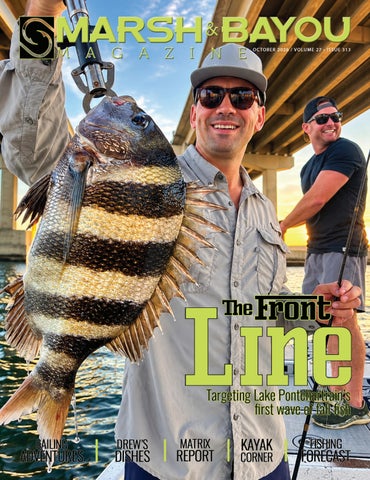
ON THE COVER Chase and Clint Favre PAGE 32
The Front Line CAPT. TORI ARNONA contributing writer
JACK HICKMAN
Capt. Brad D’Alfonso and the Lakeshore Auto Group crew target Lake Pontchartrain’s advance forces as the fall invasion begins. Page 32 by Chris Tiblier & Ray Huntz
contributing writer
contributing writer
Down South Charters pg 14 Duvic's pg 15 The Bait Shop pg 16
PAGE 24
Bayou Boudreaux pg 18
Gus’ Tackle pg 17 Jason's Charters pg 18
PAGE 30
Speck Dat Charters pg 19
by Chas Champagne
Rigolets Marina pg 21
MATRIX REPORT
PAGE 32
THE FRONT LINE
United Rentals pg 20 Wildfowl Fest pg 24
by Chris Tiblier & Ray Huntz
C&O Marine pg 25
PAGE 38
Seabrook Marine pg 27
200,000 REDFISH by Randy Pausina
PAGE 42
SAILING ADVENTURES by Scott St. Germain
PAGE 46
TIPS AND TECHNIUES by Capt. Ben Tiblier
MIKE FERGASON
Overtime Charters pg 14
by Drew Mire
KAYAK CORNER by Jack Hickman
field editor
contributing writer
Phil’s Marina Cafe pg 9 Nathan's Restaurant pg 10
COLLEEN
DR. NICK RAUBER
Lakeshore Pg 7,15,28,35
PAGE 50
HOT SHOTS & HOT SHOT OF THE MONTH
Bosco's Restuarant pg 26 Bengal pg 30 Williams Law Office pg 31 ML&M Lumber pg 36 Blue Crab/The Point pg 37 Tempest Managment Pg 40 Lion Grafix pg 44 Deep South Dock pg 45 New Orleans Roast pg 47 Bayou Marine pg 48,49 Easy Lube pg 53 RFRI pg 55 Whiskey Tree/73 pg 56
CAPT. JACOB COMMER
contributing writer
BROCK MILLER
contributing writer
ADVERTISING IS EASY WITH
MARSH & BAYOU MAGAZINE HIT YOUR TARGET MARKET WITH US! EMAIL: marshandbayou@gmail.com OR CALL (985) 960-0824
DREW MIRE
contributing writer
SCOTT ST GERMAIN contributing writer
6
OCTOBER 2026
MARSH & BAYOU MAGAZINE
Marsh & Bayou Magazine is published monthly by Marsh and Bayou Magazine LLC, P.O. Box 0023, Slidell, LA 70458. Phone: (985) 960-0824. © 2026 Marsh and Bayou Magazine LLC. All rights reserved. No part of this publication may be reproduced without the publisher’s written consent. The reproduction of editorial content or graphics in any form or medium is strictly prohibited. The opinions of staff and contributing writers do not necessarily reflect those of the publisher. Letters to the Editor are welcome. Please send signed letters to P.O. Box 0023, Slidell, LA 70458, and include a phone number for verification (it will not be published). Letters may also be emailed to marshandbayou@gmail.com. The editor reserves the right to edit submissions for length, style, grammar, and clarity.
lAKMflOlffl
2223 WEST ESPLANADE AVENUE KENNER, LA 70065 CALL US TODAY! (504) 305-8289
C•-tR'YSLE R
C> Cl Cl
c::. -
,,b;,.
JeeP.
KENNER
�Fll�IMI
A BOOST FOR GULF FISHING Trump’s latest fishing order could bring more access, better data and new artificial reefs to Louisiana and the Gulf Coast
P
resident Donald Trump has put recreational fishing into the federal spotlight, signing an executive order aimed at expanding fishing opportunities, reducing regulatory burdens and giving anglers and charter captains a larger role in how America’s saltwater fisheries are managed. For Louisiana and the Gulf Coast, several parts of the September 17 order could have a direct impact. The executive order, Restoring American Saltwater Angling and Recreation, directs federal agencies to give greater consideration to recreational fishing when making decisions involving federal waters and marine access. It also calls for better fisheries data, streamlined permitting, increased cooperation with states and new efforts to create fish habitat. Perhaps the most interesting provision for Gulf anglers is a push to turn more retired offshore oil and gas structures into permanent artificial reefs. The order directs the Department of the Interior to establish a federal Reef-in-Place Program designed to make
CCA Louisiana Completes 70th Artificial Reef
CCA Louisiana completed its 70th artificial reef Sept. 15 with the deployment of 400 Cajun Coral reef modules in Garden Island Bay off Venice. Funded by Shell, LDWF and Building Conservation Trust, the project was constructed with support from Natrx, Danos and White Water Contractors. The new reef provides structure and habitat for speckled trout, redfish and other species while creating another fishing opportunity for Louisiana anglers. GPS coordinates will be released once available. 8
OCTOBER 2026
MARSH & BAYOU MAGAZINE
it easier to convert decommissioned offshore structures into reefs rather than removing them entirely.
That could be significant for Louisiana fishermen
For generations, oil and gas platforms have created productive offshore habitat for snapper, cobia, amberjack and other species. As aging structures are removed from the Gulf, fishermen have voiced concerns about losing that habitat. Under Trump’s order, federal agencies are directed to develop a process allowing suitable structures to be reefed in place or otherwise converted into permanent habitat when allowed by law.
Better Numbers, Better Seasons?
Another major focus is fisheries data. The order calls for expanded electronic reporting and modern applications to collect recreational catch and effort information. It also directs federal managers to improve the way state-generated data is incorporated into federal decisions. That issue should sound familiar to Gulf Coast anglers. Louisiana has invested heavily in recreational fisheries data collection, while differences between state and federal estimates have complicated discussions surrounding seasons and quotas. Faster and more accurate information could give managers a clearer picture of what fishermen are actually seeing and catching. Better data does not automatically mean longer seasons or larger limits. Those decisions will still depend on stock conditions and federal fisheries law. But improved information could reduce some of the uncertainty that has frustrated Gulf fishermen for years.
Relief for Charter Captains
Louisiana’s charter industry could also benefit from changes in federal permitting. The order directs agencies to evaluate moving certain federal permits toward terms of at least three years, with a presumption of renewal for operators in good standing. It also calls for a unified federal permitting portal to reduce duplicative paperwork. For charter captains, fewer repetitive applications and a more predictable permitting process could mean less time behind a desk and more time with customers on the water. The administration is also directing fisheries managers to better account for the economic value of recreational fishing and the businesses surrounding
it. In Louisiana, that economic chain stretches far beyond the marina. Recreational fishing supports guides, tackle shops, boat dealers, mechanics, fuel docks, restaurants, hotels and coastal communities from Venice and Grand Isle to Hopedale, Delacroix and the Northshore.
Tackling the Shark Problem
The order even addresses an issue Gulf fishermen have increasingly complained about: sharks stealing hooked fish before they reach the boat. Known as shark depredation, the problem has become a frequent topic among offshore fishermen and charter captains. Trump’s order directs NOAA to develop a standardized reporting system for depredation and gives priority to research partnerships involving charter captains and recreational fishing organizations. Better documentation could help managers understand where and how often the problem occurs.
Commercial Fishing Gets Attention Too
The recreational fishing order follows Trump’s April 2025 executive order aimed at strengthening America’s commercial fishing and seafood industries. That earlier action directed federal agencies to examine regulations affecting commercial fishermen, improve fisheries science, expand fishing opportunities where sustainable and address competition from imported seafood.
Few places have more at stake than Louisiana. The Gulf shrimp industry continues to face economic pressure from imported seafood. Federal efforts involving imports, trade enforcement and promotion of domestically harvested seafood could therefore be particularly important to Louisiana shrimpers, docks and processors.
WHAT HAPPENS NEXT
The biggest question is how quickly these directives turn into changes on the water. An executive order establishes priorities and directs federal agencies to act, but many individual provisions still require agency action and must comply with existing fisheries and environmental laws. There are also questions about how expanded fishing access will be balanced with conservation and sustainable fisheries management. Still, the order could have significant implications for Louisiana: more offshore structures preserved as reefs, better fisheries data, less paperwork for charter operators, greater attention to Gulf seafood producers and increased consideration of recreational fishing in federal decisions. Along a coast where fishing is both an industry and a way of life, those changes will be worth watching closely.
HEALTHY STOCKS, NEW RULES
Councils Seek Angler Input on Mutton and Yellowtail Snapper
C Whistling Duck Season Reminder
Louisiana hunters, mark your calendars. The state’s new black bellied whistling duck season runs Oct. 3 through Oct. 11. The special season gives hunters an additional early fall opportunity to target a species that has become increasingly common across South Louisiana. Check current LDWF regulations before heading to the blind.
hanges could be coming to the management of mutton and yellowtail snapper across the Gulf and South Atlantic, and fishermen will have an opportunity to weigh in before final decisions are made. The Gulf Fishery Management Council and South Atlantic Fishery Management Council are jointly developing Reef Fish Amendment 55 and Snapper Grouper Amendment 44. The proposal would update catch limits, determine how allowable catch is divided between the Gulf and South Atlantic regions, and adjust South Atlantic commercial and recreational sector allocations. The good news for anglers is that recent stock assessments found both mutton and yellowtail snapper stocks healthy as of 2023. The assessments also found evidence that both species are expanding their ranges northward. Under the alternatives currently preferred by the councils, fishery closures are not expected. The councils will hold a virtual public hearing on Tuesday, October 20, at 6 p.m. Eastern, giving fishermen and other stakeholders an opportunity to learn about the proposed changes, ask questions and provide comments. Written comments are due October 23.
Meeting information and registration are available through the Gulf Fishery Management Council.
LOUISIANA FLOUNDER CLOSURE RETURNS OCTOBER 15 Latest stock assessment shows some improvement, but Louisiana’s southern flounder population remains below its target.
L
ouisiana’s annual southern flounder closure begins October 15 and continues through November 30, with the season reopening December 1. The statewide closure applies to recreational and commercial fishermen and all gear types. Flounder caught as bycatch during the closure cannot be kept. The closure was established to
“Louisiana’s flounder are showing signs of improvement, but the comeback is far from complete.” protect mature female flounder during their fall migration from Louisiana’s interior marshes and bays into offshore waters to spawn. When the regulation was implemented, LDWF projected the
closed period would reduce the harvest of mature female flounder by approximately 50 percent, allowing more spawning fish to contribute to future generations. The latest 2025 Paul Templet landed this huge 21" flounder under dock Louisiana Southern Flounlights in Lake Pontchartrain using a H and H lure. der Stock Assessment offers an updated look at the fishery. LDWF found that early 1990s, while recent landings have southern flounder are no longer experi- fallen to around 100,000 pounds. encing overfishing, meaning the current LDWF attributes the decline to several fishing mortality rate is below the estab- factors, including reduced fishing effort, lished limit. However, the population hurricanes, the seasonal closure and a is still considered overfished, meaning series of years with below average respawning biomass remains below the cruitment of young flounder. state’s target. The current spawning For anglers, the latest assesspotential ratio is estimated at 31 ment provides an encouraging sign that percent, just below the 32 percent fishing pressure has decreased, but rethreshold used in the assessment. building Louisiana’s flounder population Louisiana flounder landings remains a work in progress. have also changed dramatically. Annual harvest exceeded one million pounds during portions of the late 1980s and
PRESENTED BY
MARINE
fE.ffjftfffJJJ5fi3
PRODUCT REVIEW
JARED SERIGNE’S
MARSH FIRE
If you spend enough time in a Louisiana kitchen, you know a good seasoning needs more than heat. It needs flavor, balance and versatility. Jared Serigne’s Marsh Fire Seasoning from Outside the Levees checks those boxes. Marsh Fire brings bold Louisiana flavor with a kick that gets your attention without overpowering the food. It is especially good on seafood, complementing the catch instead of covering it up. Sprinkle it on redfish, speckled trout, shrimp or sheepshead before they hit the grill or skillet. It is equally at home on chicken, pork, vegetables and anything headed for the smoker. Marsh Fire tastes like it was created by someone who knows how we cook down here. Jared Serigne and Outside the Levees are rooted in Louisiana’s outdoor culture, and that comes through in every bottle. Marsh & Bayou Take: Plenty of flavor, a little fire and a perfect fit for the kitchen or camp.
AVAILABLE AT:
MARSH & BAYOU OUTFITTERS 2600 FLORIDA ST STE 3, MANDEVILLE, LA 70448
F
inally, fall is here, and the summer heat is fading away. October always ushers in incredible fishing all along the coast. It is truly one of the best times of the year to be on the water. The trout have transitioned back in, the redfish are firing off
on their fall bite, and they are all hungry. Plus, our hunting seasons are starting to open. It is truly a glorious time to be outdoors. As always, good luck to everyone, and stay safe out there. Have a fishing or hunting memory that you would like to share? Send us your favorite photos to marshandbayou@gmail.com for a chance to be featured on our monthly Marsh & Bayou Magazine HotShots page! Put “HotShots” in the subject line, and we will take it from there.
-RAY HUNTZ
LAFITTE Capt. Kevin Hezeau
Down South Fishing Charters (985) 768-1656
Man, October is such a great month to fish Lafitte. The weather is finally beautiful, and the fish know it. The trout are back in the marsh, allowing us to target trout and redfish on the same trip. Trout will be on oyster reefs and points. Anywhere you find current and bait should hold fish. Plastics or live shrimp will fill the box. On a rising tide, I like to get back in the ponds, where redfish will be hammering bait. On a falling tide, I fish the mouths of trenasses and drains. Fish want to exert the least amount of energy while getting the most food, so look for areas where the tide brings bait to them. I also look for windblown banks and points with current moving around them. Fish both the windy and slack sides. Redfish will sometimes sit in an eddy, ambushing bait swept by with the current. Moving water is the most important thing I look for. If the tide is slack, I target windswept banks until the water starts moving again. After moving water, bait is most important. I am not worried about finding the cleanest water. I want to find where the fish want to be. I use a Four Horsemen popping cork with market shrimp on a jig head about a foot and a half deep. A gold spoon, chatterbait, Marker 54 Shrimp or Shrimplet, and soft plastics will also catch redfish if you prefer artificials.
LAKE CATHERINE Capt. Brad D’Alfonso Speck Dat Charters (985) 259-9170
O
ctober is when I really start looking forward to our fall fishing. Water temperatures have started to drop into the mid to low 80s and will continue dropping as the days get shorter and cooler fronts begin to push through. Along with cooler fronts, which will drop water temperatures and get fish into their normal fall patterns, tidal range will be an important factor as we move into the fall season. Clean, moving water is important to look for, and October looks to have a few good windows with favorable moon phases and tidal ranges. Around the stronger moon phases, I will be paying close attention to the days with the best tidal range and water movement. A good falling tide will pull shrimp and baitfish out of the marsh, while a strong incoming tide can push clean water and bait back into the estuary. On days with smaller tidal ranges, areas like the Highway 90 Bridge and L&N Bridge will still have enough current to move bait and hold fish. Shrimp were very plentiful throughout September, leading the way for transitioning fish, and the bigger trout should not be too far behind them. Live shrimp on a drop shot will be one of my top choices when fishing deeper passes or structure in Lake Pontchartrain. October is here, cooler weather is coming, and I am looking forward to a great fall season.
CALENDAR OF EVENTS
October 8, 2026
ST. BERNARD
CHAPTER BANQUET
Val Riess Sports Complex, Chalmette, LA
October 9 & 10, 2026
18TH ANNUAL GRAND ISLE LADIES RODEO Bridgeside Marina in Grand Isle
October 15, 2026
2026 BATON ROUGE AND STAR
TOURNAMENT BANQUET
Live Oak at Cedar Lodge 6300 Jefferson Highway Baton Rouge, LA, 70806
GRAND ISLE/LEEVILLE Capt. Don Bordelon Captain Don Dee's Bayou Coastal Guide Service (985) 291-2464
O
ctober is here, and the fall fishing is looking to be incredible. Bull reds are biting along the beaches of Fourchon, Elmer’s Island, and Grand Isle, as well as in the channels and passes. Around the rock jetty systems in this area, concentrate on the ledges, deeper drop offs, and areas where moving water sweeps bait past the rocks. Also try the sandbars along the coast where the Gulf meets the area lakes. These transition areas can hold plenty of bait and feeding reds. The best baits are cut mullet, crab, and live croaker. Topwater lures are also working well, especially early in the morning when fish are actively feeding near the surface. Heading inshore to the smaller lakes, like Lake Laurier, Catfish Lake, and Sulphur Mine, as well as the surrounding bays and ponds, look for shell reefs, oyster beds, channels, bayous, and trenasses. These areas act as funnels for baitfish and are good places to target speckled trout, redfish, and black drum. Pay close attention to moving water around points, drains, and channel intersections. Shrimp and baitfish being pulled from the marsh can quickly turn these locations into feeding zones. The best artificial baits are Berkley Rattle Shrimp, Matrix Shad, and DSL lures. Live bait options include shrimp, minnows, and finger mullet. Try working artificials along the bottom around deeper structure, then move higher in the water column when you see shrimp or baitfish near the surface. As temperatures begin to cool through October, expect the action to continue improving as more fish settle into their fall patterns.
COCODRIE
Capt. Casey Lombard Precision Fishing Charters (985) 714-3987 October is when trout start settling back into the marsh. Bay St. Elaine, Sea Breeze, Madison Bay, and Lake Barre are good areas to fish. Plastics under a two foot popping cork have been the ticket. Look for birds diving on shrimp along the coast to find trout. There are plenty of smaller fish, so you may have to weed through them for keepers. Bull reds are around the platforms in Terrebonne Bay, the mouth of the HNC, and Terrebonne Bayou. Shrimp or cracked crab on the bottom works best. For slot reds, fish marsh drains, trenasses, points, and banks with current or wind pushing bait. Live shrimp under a popping cork is a good choice.
HOPEDALE/ SHELL BEACH Capt. Thomas Carbone
Overtime Charters (985) 445-3899
October brings incredible fishing for trout and redfish. Anywhere you see bait, there will likely be fish. The trout have just finished spawning and are gorging themselves on bait. I’m targeting choke points going into the marsh and following the trout as they move toward their fall and winter spots. Live shrimp under a popping cork is all you need. The redfish are enjoying the nicer weather, too, and they will also be anywhere you find bait. Fish the shorelines, grass beds, trenasses, cuts, and points. I use live shrimp under a popping cork for redfish as well. For both trout and redfish, I want moving water. If you have moving water and bait, there are usually fish there during October. You can frequently catch redfish along the bank, then turn around and cast into the current for trout. The fish will also stay active for longer periods because of the mild weather. That beautiful fall weather makes October a great time for anglers to be on the water.
VENICE INSHORE
Capt. Rich McCloskey
Blueline Charter Service (225) 276-5263
The river has dropped, and the fish have moved up the river. Fall is prime time in Venice, giving fishermen plenty of options. If you want to target keeper sized redfish, start close in along the main Mississippi River and fish the rocks. Work the breaks and openings in the rocks until you find fish. If you catch a few, give the area some time. Don’t move too quickly. If you want to have some fun with big bull reds, head out of Red Pass and fish along the beaches. Look for fish slicks on the surface in about 4 to 10 feet of water. Get upwind of the slick and start casting around the area. I like using a popping cork with 2 to 3 feet of 60 pound leader and a 1/2 ounce jig head rigged with a large curl tail. Bull red fishing makes for some great trips this time of year. You just can’t beat the action. As always, my bait of choice for keeper redfish is live shrimp on a 3/8 ounce jig head about 2 feet under a Four Horsemen popping cork. Another productive option is bouncing a live shrimp along the bottom with a 3/8 ounce jig head. Hope to see y’all in Venice, Louisiana, soon. Come say hey if you see me on the water or around Venice Marina. Good luck!
October 15, 2026
MANDEVILLE AND COVINGTON BANQUET Castine Center 63350 Pelican Dr Mandeville,LA
October 16 & 17, 2026 CAST FOR KIDS FISHING RODEO 1301 Yscloskey Hwy St. Bernard LA
October 24 & 25, 2026 THE LOUISIANA WILDFOWL CARVERS & COLLECTORS GUILD FESTIVAL The Castine Center 63350 Pelican Drive Mandeville, La. 70448
DELACROIX
Capt. Jason Williams Jason’s Saltwater Guide Services (985) 507-7644
F
ishing in October is about as good as it gets. The trout have moved back into the marsh, and they are hungry after spending the summer spawning. I target choke points in the marsh for fall trout. They are moving into the marsh on their way to their winter holes. If you have a choke point with moving water and bait, there will most likely be trout there. f I see bait popping in the interior lakes or birds diving on bait, I am going to stop and fish. It is usually trout pushing the bait to the surface. I like to use live shrimp under a popping cork. Redfish are just as hungry as the trout. They know it is fall, they feel it, and they are more active. I am targeting grass beds, windswept banks, trenasses, and points that have current and bait. Once you find the fish this time of year, you can fill the box. Just like with trout, I am using live shrimp under a popping cork.
RIGOLETS REPORT
by Capt. Kris Roberts ONE LAST CAST LLC (228) 284-9502
N
ow that we have September out of the way, in rolls October, and we have waited all summer to see it. It is not that September was so bad, but man, the heat has been out of control. We should start seeing some mild cold fronts in October, which will help cool the water and get the white shrimp moving. We are still catching a decent number of fish in the usual places. The Highway 90 bridge is holding some decent speckled trout and white trout, along with some big bull croakers. If you want to take the kids out and catch something on almost every cast, that would be the place to be. The sheepshead and drum have been thick around the Twin Span and Trestles. Live shrimp from Rigolets Marina is a must, and the tanks have been full. As temperatures begin to cool, we should also start seeing a good number of fish moving into Lake Catherine and Sawmill Pass.
DREW'S DISHES
The Hits Live On
A modern redfish dish pays tribute to the chefs, flavors and memories that helped define Louisiana cooking and continue to inspire what lands on our tables today.
H
e cooked with confidence and seasoned without apology. They helped convince the rest of the world that Louisiana cooking deserved the attention. Prudhomme grew up in Opelousas and lifted Cajun cooking out of the back kitchen and set it on the world’s table. In the early 1980s, he took redfish, once dismissed as a coarse, bottom feeding trash fish, and dragged it through butter and spice and a skillet hot enough to make a kitchen smell like a campfire. That move changed the trajectory of a species. Commercial fishing nearly loved the fish to death. Sportsmen and chefs kept it alive. Years later, Chef Paul became a mentor by Drew Mire and father figure to my business partner, Chef Aarón Sánchez, and his legacy and techniques still speckle our culinary adventures today. Then came Emeril. He followed Prudhomme at Commander’s Palace before opening Emeril’s in the Warehouse District in 1990. His food was unmistakably New Orleans and never trapped by tradition. We still work with Chef Emeril and his team through the Emeril Lagasse Foundation. People say you never want to meet your heroes, but he is a better man and a kinder soul than television ever needed him to be. One of those early dishes at Emeril’s was an andouille crusted redfish. That plate sent me back down this road. I made my own version: andouille crusted redfish over shrimp and corn maque choux, circled with a meunière cream built from toasted shrimp heads. Andouille shows up twice. The shrimp get used from meat to shell. Nothing about it is particularly restrained, and I like that. Modern kitchens are taught to edit, to 22 OCTOBER 2026
MARSH & BAYOU MAGAZINE
let the product speak, to show restraint. But sometimes you want the guitar turned up. Redfish will stand with smoke, spice, cream, and sausage without disappearing. The fillet gets Paul Prudhomme’s Seafood Magic and a hard sear, then a crumble of browned andouille, breadcrumbs, and Parmesan. Maque choux takes more sausage, the last of the summer corn, cream, and shrimp already kissed by the same Magic. The sauce starts with toasted shrimp heads, Worcestershire, lemon, a pinch of clove from the boil,
and stock cooked down with cream and butter. On top, crispy potato strings remind me of the canned shoestring potatoes that seemed to appear on half the casseroles of my childhood. It reads loud. It eats quieter than it sounds. Hearty, yes. Cartoon spicy, no. The cream and corn do the diplomatic work. October in South Louisiana is a transition month. The first fronts make you believe summer might actually end. Waterfowl dreams begin. At the time, those camp days were just what we did. Only later do you understand that the ordinary ones were the days you would want back. Nostalgia rarely announces itself while you are living it. The same is true of food. And of thinking about Emeril’s again. There is something fitting about watching his son, E.J., now lead the kitchen there and bring his own perspective to a restaurant his father opened more than three decades ago. The place is evolving. Evolution does not require pretend-
“Nostalgia rarely announces itself while you are living it. The same is true of food.” ing the past never happened. Sometimes moving forward means knowing what was worth carrying with you. Chefs grow tired of their greatest hits. Musicians probably do, too. Play the same song enough times and you want to write another one. Put that song away for twenty or thirty years and the opening notes land differently. You remember where you were. Who was there. Maybe who you were then. A piece of redfish. Andouille. Corn. Shrimp. A rich sauce. Crispy potatoes scattered across the top. Nothing subtle about it. And maybe that is exactly why it feels right. Some dishes are worth cooking again. Some stories are worth telling again. And some of the old hits became hits for a reason.
Sweet Corn and Shrimp Maque Choux INGREDIENTS: • 4 ounces andouille sausage, finely diced • 3 tablespoons butter • 1 sweet onion, finely diced • 1 red bell pepper, finely diced • 1 jalapeño, seeded and finely diced • 3 cups fresh sweet corn kernels, from about 4 ears
• 1 pound medium Gulf shrimp, peeled and deveined • Paul Prudhomme’s Seafood Magic • 1 cup heavy cream • 1/3 cup grated Parmesan cheese • 2 tablespoons chopped chives • Kosher salt
INSTRUCTIONS: Season the shrimp lightly with Seafood Magic. In a wide skillet over medium high heat, sear the shrimp in a little rendered andouille fat or a touch of butter just until they turn pink, about 1 to 2 minutes per side. Transfer to a plate. In the same pan, render the diced andouille until it browns and the fat pools. Add the butter, onion, bell pepper, and jalapeño. Cook until the vegetables soften, about 4 minutes. Stir in the corn and cook until it turns bright and just tender, another 3 to 4 minutes. Fold in the cream and Parmesan and let the mixture tighten slightly. Return the shrimp to the pan, add the chives, & season with salt. The maque choux should be creamy, not soupy, and still taste like the last of the summer corn.
Meunière Cream Sauce SAUCE BASE INGREDIENTS: • 1 tablespoon olive oil • 1 cup shrimp heads and shells • 1 clove garlic, smashed • ½ cup Worcestershire sauce • Juice of 1 lemon
• 2 whole cloves • 2 bay leaves • 1 tablespoon cracked black pepper • 2 teaspoons Seafood Magic • ½ cup shrimp or chicken stock
FINISHED SAUCE INGREDIENTS: • ½ cup reserved sauce base • ½ cup heavy cream • ½ cup cold unsalted butter, cubed • Kosher salt INSTRUCTIONS: Heat the olive oil in a saucepan over medium high heat. Add the shrimp heads and shells and toast them, stirring often, until they turn deep pink, about 5 minutes. Add the garlic and cook just until fragrant. Stir in the Worcestershire sauce, lemon juice, cloves, bay leaves, black pepper, Seafood Magic, and stock. Bring to a boil, then reduce to a simmer and cook until the liquid has reduced by half. Strain through a fine mesh sieve, pressing on the solids, and discard what remains. You should have about ½ cup of sauce base. Return the base to a clean pan with the cream and bring to a simmer. Whisk in the cold butter a few cubes at a time until the sauce is glossy. Continue cooking until it thickens and darkens, about 4 to 6 minutes. Season with a pinch of salt. The sauce should coat a spoon and circle the maque choux without running all over the plate. Keep warm until the redfish comes out of the oven. Enjoy!
KAYAK CORNER
Never a Dull Moment
Fall tournaments, hungry redfish and one unforgettable gator encounter keep the Bayou Coast crew entertained.
S
eptember was a busy month for Bayou Coast Kayak Fishing Club! Our tournament schedule kicked back into action with Cajun Castaway in Calcasieu. It was our final Cajun Slam tournament of the year, where the angler with the heaviest combined weight of a speckled trout, redfish, and flounder wins. Our members from the Lafayette area have a big advantage since they are only about an hour and a half away. Add another two hours for the New Orleans crew. It is tough to drive seven hours in a day and fish all day, so lodging is pretty much required. Calcasieu Lake has one launch near I 10, one on the east side that is a little dicey, by Jack Hickman about five on the west side, and one at the port on the south end of the lake. A ship channel runs north to south from I 10 to the Gulf of America, and when fishing it in a kayak, LNG supertankers can pass within
a hundred yards of you. Quite the sphincter exercise! There is limited marsh area, but it is full of reds and flounder. There are a few trout in the marsh, but the rocks along the channel and numerous reefs around the lake hold some beauties. This year, we had 54 entries vying for the win. Our own Tournament Director 2, Jerry Cottrell, scouted for months, earning a place in the CCA STAR Tournament for his efforts, as well as first place in Cajun Castaway. Two BCKFC officers placed, along with two Lafayette area members and one member from Alabama. All took home checks. Cajun Castaway is our final Championship Series tournament of the year. Members who have placed in a Championship Series tournament or accumulated enough points, like me, qualify for the coveted BCKFC Championship, which will be held at the Golden Meadow public launch on November 7. It will feature a shotgun launch and artificial bait only, with anglers competing for the heaviest combined weight of three trout and two redfish. In addition, no one is allowed to launch within 10 miles of Golden Meadow before the day prior to the tournament, giving everyone only one day to prefish. It is always a great competition! Me? No, I did not fish Cajun Castaway. Instead, I have been fishing down Highway 23 in preparation for our next rodeo style tournament, Fall N Tide, on October 10. This year, we will give away four Newport NK180 HD Electric Outboards. One will go to the angler with the biggest trout, one for the biggest redfish, and one for the biggest flounder. The fourth will be raffled off among everyone who registers for the tournament. That means one person could actually win two motors. Crazy! Tournament boundaries stretch from Myrtle Grove south to Venice Marina. All publicly accessible launches are allowed, and there are 12 that I know of. Most anglers will prefish Friday, then attend our Captains Meeting dinner at Delta Marina. The tournament starts early Saturday and concludes with a 3 p.m. weigh in at Delta Marina. After the weigh in, we will eat, present awards, and hold the raffle. It is a fun packed day! I have made a couple of trips down to south Plaquemines Parish and found great numbers of upper slot reds, as usual. I had success with a Four Horsemen Tackle oval cork paired with a Baby Boom Boom Shrimp and a 4 inch Knockin Tails paddletail on a Deathgrip 1/8 XL jighead. I have only caught a couple of flounder, but they have been on the bigger side. Both were caught slow jigging around reazos in the current. Trout, on the other hand, have been hard to come by and were caught mostly on the Four Horsemen cork setup over reefs. Sailcats have been extremely plentiful and are hitting anything you throw, including topwater. Yeah, I know! A funny story was told to me secondhand that simply must be shared. Our board member, Cajun Castaway winner, and all around amusing guy, Jerry Cottrell, made a bad cast and hooked a fairly large bird. He was in shallow water, so he exited his kayak to retrieve his bait and limit the injury to the bird. When he grabbed the bird, it started letting out an extremely loud, blood curdling scream. Anyone within hearing distance would have thought something terrible was happening, making it tough for Jerry to concentrate. Then he heard something moving in the bushes and spotted a seven foot plus alligator coming toward the screaming bird, and him, with a meal in mind. At that point, all concern for the well being of the bird was
this same tournament, he passed out and was transported by ambulance to a hospital, where it took three bags of saline to rehydrate him. He was also once beached by an LNG tanker drawing water from a cut, then flipped out of his boat when the water rushed back in, losing a lot of expensive gear. That does not even include the duck blind relief hijinks. Like I said, he is totally entertaining. Come to a Bayou Coast event. I CAN pretty much GUARANTEE you will be entertained. I will see you there! I cannot wait until next time!
forgotten. Jerry hit the gator so hard with his paddle that the paddle shattered into pieces. The topwater bait was lodged in both wings, but Jerry ripped it out and hurled the bird directly toward the mildly stunned alligator, which accepted the gift like it had not eaten in years. Then Jerry turned around to get into his kayak, only to discover it had floated away. He had to push through thigh high water, past the dining gator, to reach his kayak. He climbed aboard and pedaled away, without a paddle, as quickly as possible. Now, I cannot guarantee it happened, but Jerry has had some exciting experiences. A couple of years ago, after
Join the Kayak Fishing Community! Want to learn more and meet fellow anglers? Bayou Coast Kayak Fishing Club and Lafayette Kayak Fishing Club host tournaments in all these areas and more. These events are about the fishing and camaraderie, not just the prizes. You’ll learn more at a weigh-in than I could ever explain, and you’ll likely meet some new fishing buddies to swap stories with. Good luck, and hopefully, I’ll see you on the water!
FISHIN'
WITH FERG
L
Bank Fishing
for the Win! by Michael Fergason
ife has been hectic these past few months in the Fergason household, and unfortunately, I haven’t spent as much time on the water as I’d like. I have, however, been making the most of every opportunity to fish from shore. Before work, after work, and whenever I can squeeze it in, I’m making a cast. One of my goals this year was to catch a truly big fish. I’m talking about a really big fish! From the bank, that can be a tall order. But one afternoon, I left work a little early and stopped by Marsh and Bayou Outfitters in Mandeville for some fresh frozen shrimp. My destination was Jackson Street near the Pontchartrain Yacht Club. I chose a Carolina rig and quickly caught a hardhead catfish. Remembering a technique I had seen another content creator use, I dispatched the fish and swapped my small mosquito hook for a properly sized circle hook. Five minutes after casting out the larger bait, my rod doubled over. After a hard fought battle, I landed a six foot alligator gar. It was the exact fish I had on my list to catch this year! After a few quick photos, the beast swam back into the depths. Another great bank fishing opportunity this time of year is the white shrimp run in Lake Pontchartrain. One of the easiest signs that the shrimp are moving is seeing shrimp trawlers scattered across the lake. Catching these tasty morsels takes some know how and plenty of patience, not to mention a few tears in a cast net. I like to work the seawall along the New Orleans lakefront. Get there before sunset, and as the lights come on, start throwing! Once word gets out, the competition can get intense. Cast net after cast net, shrimp are hauled from the water into buckets and champagne baskets. The action can continue until stronger cold fronts move through in October. No boat? No problem. October is one of my favorite months to fish from the bank. All it takes is patience, persistence, and a willingness to explore. I hope this encourages you to get out and discover what Lake Pontchartrain’s shorelines have to offer.
MATRIX REPORT
Deep in the Marsh
W
High water and heat are changing the fall trout game.
ell, it may not feel like it outside, but autumn is officially here. You would never know it by the extreme heat we continue to have. Water temperatures are still hovering in the mid to upper 80s, but the trout are starting to move in. Redfish, on the other hand, have been very inconsistent, but I am looking for a strong speckled trout fall. The most consistent approach I have taken lately is pushing far back into the marsh and fishing popping corks with the new Matrix Shrimp underneath. The farther back I go, the better I seem to do with the extremely high water we continue to have. Do not think the trout will not go deep into the marsh. Think about those great marsh by Chas Champagne bass spots and take your trout techniques there. Just forget about the bass. The high temperatures and strong saltwater surges have killed off a lot of grass, making sight fishing for reds very difficult. That is usually what I really enjoy doing this time of year. With redfish being so inconsistent, I am simply targeting
schools of trout in deep marsh ditches right now. Focus on three things: current, three way intersections, and places where a ditch meets a duck pond. The throwback to keeper ratio is running about four to one, so stay with it and keep grinding to build a box. After a front or two, we should not have to deal with nearly as many throwbacks, but right now, they are part of the game. Make sure to check out all of our DockSide TV episodes for more information. We have also filmed several episodes deep water drop shotting the new Matrix Shrimp, which can be another great approach while water temperatures remain high, especially in the deeper passes.
COVER
FEATURE by Chris Tiblier & Ray Huntz
very fall, an invasion takes place in Lake Pontchartrain. There are no landing craft or artillery, but there is definitely a front line. By October, it begins forming around the bridges, passes and deeper water on the eastern side of the lake. The first troops are already here. Sheepshead are gathering around bridge pilings. Black drum and redfish are mixed among them. Shrimp are moving throughout the system, and speckled trout are beginning to appear. Behind them is the main force Lake Pontchartrain fishermen have been waiting for all summer. If speckled trout are the headline act of Lake Pontchartrain’s fall season, sheepshead are among the advance forces. Historical fishing reports consistently show October as an excellent month to catch sheepshead, particularly around the Trestles, Causeway and Twin Spans. Lake Pontchartrain’s bridges are essentially miles of artificial reef. Their pilings are covered with barnacles and other marine growth, while the surrounding bottom provides habitat for crabs, shrimp and small fish. As fall approaches, sheepshead become increasingly concentrated around this hard structure. They are powerful fish, excellent table fare and one of the first signs that the fall transition is underway. Think of them as hungry troops occupying the forward position while reinforcements gather behind them. 32 OCTOBER 2026
MARSH & BAYOU MAGAZINE
THE REAL BATTLE, HOWEVER, IS BEING FOUGHT OVER FOOD.
Fall shrimp season is largely a white shrimp fishery. White shrimp spend an important portion of their lives inside Louisiana’s estuaries, where marshes provide food and protection while they grow. As fall approaches, changes in water temperature and salinity help regulate their movement. Strong cold fronts can accelerate that migration, pushing shrimp from shallow interior marshes toward larger bayous, passes, lakes and eventually the Gulf. Those shrimp have to travel, and their movements create natural supply lines. Bayous, drains, passes and channels become highways, and nearly every predator in the estuary knows where those highways are. Sheepshead, redfish, black drum, flounder, white trout and speckled trout all take advantage. Capt. Brad D’Alfonso with Speck Dat Charters believes that movement of bait is one of the most important pieces of the fall transition. “What makes it a great month, especially for trout? I’m not a biologist, but I believe as the water temperature cools down, it triggers the trout to start heading for the lake, and I believe that bait is the reason why. As the water cools down, the bait starts to migrate, and the trout follow them. The trout have been spawning all summer and are
looking to fatten up for the fall. Same thing with redfish. Everything is eating to pack on fat heading into fall and then winter.” There are encouraging signs for this fall. Recreational and commercial reports have indicated plenty of shrimp throughout the Pontchartrain and Lake Borgne system. Salinity has also been favorable in portions of southeast Louisiana, while fishermen are already reporting sheepshead and the first signs of speckled trout. That eastern connection is critical. Lake Pontchartrain is a brackish estuary, and much of its saltwater enters through the Rigolets and Chef Pass.
On a perfect mid September day, I joined the Lakeshore Auto Group crew and Capt. Brad for a full day of rod bending excitement. We worked the Twin Span, Highway 11 Bridge, and Trestles, filling the box with just about every Front Line species you can imagine.
Capt. Brad D'Alphonso Speck Dat Charters
Cody Favre landed the heavyweight of the day with this bruising 25 lb. black drum. The big drum put man and gear to the test during a hard fought 10 minute battle beneath the Twin Span before finally giving in. After a quick photo, the brute was released to fight another day.
Clint Favre Lakeshore Auto Group
Cody Favre Lakeshore Auto Group
Chase Favre Lakeshore Auto Group
Chris Tiblier Marsh & Bayou
Historically, salinity is highest toward the eastern side of the lake. That helps explain why anglers begin looking toward the Rigolets, Lake Catherine and the eastern bridges as the fall transition develops. This is where the front line comparison really gets interesting. Speckled trout spend much of the warmer season closer to saltier waters where summer spawning occurs. As spawning winds down and fall arrives, their priorities change. Feeding becomes increasingly important, and fish begin moving back toward Lake Pontchartrain. “October is when we get the big trout funneling into Lake P, the ‘World Series trout’ you hear people talk about,” D’Alfonso said. “For the trout alone, October would be the best month, but you can’t forget about the redfish, either. We have outstanding fall redfishing here, too.” The exact arrival of those trout is never written on a calendar. Water temperature, salinity and bait all matter, but cold fronts can be the trigger. Old Lake Pontchartrain fishermen dubbed the famous fall run the “World Series Trout” bite because it traditionally developed around the same time as baseball’s World Series. Historical reports show the bridge bite often improving after repeated fronts lower water temperatures. During warmer falls, the major push can be delayed into November. “Last year, we didn’t get the normal cold fronts in October, and the fish didn’t show up on the bridges until November,” D’Alfonso said. “With a normal fall, and normal fronts coming through in October, the trout and fishing on the bridges will be at its best when we get the third front. The first two fronts get the bait and the fish moving. Front number three is when they are as thick as they get on the bridges.” Until the main body of trout arrives, sheepshead provide plenty of action. The Trestles, Highway 11, Twin Spans and Causeway all provide excellent hard structure. Live shrimp is difficult to beat, particularly when presented close to the pilings.
A Carolina rig or dropshot allows anglers to work different portions of the water column. Do not assume every sheepshead is sitting directly on the bottom. These fish work pilings vertically, feeding on barnacles, crustaceans and passing shrimp. Their bite can be surprisingly subtle, but once hooked, the first move is often toward the nearest barnacle covered piling. Keep pressure on the fish and get it away from the concrete quickly. Once trout begin occupying the bridges, moving water becomes critical. “Moving water is the key, the one thing you have to have to turn the fish on,” D’Alfonso said. “The bait is already there. Once the tide starts moving, it’s like someone flipped a switch. The fish start feeding very aggressively.” Bridge pilings create natural feeding stations. Current moving around the concrete creates faster water along the sides and slower water behind the structure. Shrimp and baitfish passing through become vulnerable, allowing predators to hold near the pilings and wait for food to come to them. When everything comes together, the bridges can produce far more than trout. “Once the trout are on the bridges, you can get a limit of big trout when the tide is moving, and have a nice mix of redfish and drum mixed in,” D’Alfonso said. “All it takes is a dropshot and a live shrimp, or your favorite plastics, and you are going to catch fish.” Redfish are also becoming increasingly aggressive in the surrounding marsh. Falling water after a front can pull shrimp and other forage from shallow ponds through drains,
cuts and bayous, creating predictable feeding locations. “For redfish in the marsh, I’m looking for drains, cuts, points and banks that have moving water and bait,” D’Alfonso said. “A live shrimp under a popping cork is all you need to grab the attention of a redfish.” Heading into October, several important pieces appear to be falling into place. Shrimp are abundant. Salinity has been favorable. Sheepshead are occupying structure. Speckled trout are beginning to appear, and cooler weather is coming. “The weather being cool and mild, water temperatures dropping, and a large amount of bait followed by big fish to the bridges, and the redfish starting to get really aggressive and active on the bridges and in the marsh, loads of bait is in the marsh as well, is why October is arguably the best month to go fishing,” D’Alfonso said. The front line has formed. For now, sheepshead may be among the first troops anglers encounter. Behind them are drum, redfish and flounder. Then comes the main force Lake Pontchartrain fishermen have been waiting for. The bait is moving. The water is cooling. Now we wait for the third front.
Lakeshore for the WIN! It was great to finally get on the water with the guys from Lakeshore Auto Group, and let me tell you, these guys can fish! We had a full day of bent rods, plenty of laughs and some serious fish hitting the deck. If you are in the market for a new truck, Jeep or SUV, give the crew at Lakeshore a call. They have a huge selection and three convenient locations across Southeast Louisiana and South Mississippi. Whether you are looking for a new ride for the daily commute or a truck built to tow the boat to your favorite fishing hole, the Lakeshore crew can get you set up. Slidell: (985) 214-1868 • Picayune: (601) 590-9754 • Kenner: (504) 229-5200 From the showroom to the shoreline, thanks to the Lakeshore Auto Group crew for a great day on Lake Pontchartrain!
Ready to get in on the action?
Book a trip with Capt. Brad D’Alfonso of Speck Dat Charters and experience Lake Pontchartrain and Southeast Louisiana’s incredible trout, redfish and hard fighting Front Line species firsthand. Whether you’re chasing a trophy or filling the box, Capt. Brad knows where to find them. (985) 259-9170 You can also follow the outdoor and culinary adventures of Ray Huntz on Instagram at @marshwhisperer and @deuxgarsbizarres.
COASTAL
SCIENCE
I
n September, a three year idea finally became something Louisiana anglers could see: thousands upon thousands of small redfish swimming away into the marshes, lakes, passes, and shorelines where we hope they will grow. This first production season yielded approximately 200,000 juvenile redfish. About 175,000 have already been released into Louisiana waters, including 50,000 in Calcasieu Lake, 50,000 near Grand Isle, and 75,000 in the Rigolets through two separate releases. Another 25,000 remain at the hatchery, including 5,000 being grown to approximately eight inches for a planned November release. Those larger fish will be fitted with external dart tags so anglers can recognize and report them when caught. Most of the fish released this year could fit in the palm of your hand. But the accomplishment they represent is enormous.
usina by Randy Pa
38 OCTOBER 2026
MARSH & BAYOU MAGAZINE
Those fish are the result of three years of permits, fundraising, broodstock collection, hatchery work, genetic planning, transportation logistics, and cooperation. They also mark the beginning of something Louisiana recreational fishermen have never had before: a dedicated, science based redfish enhancement program. The question most anglers will ask is simple: Will this eventually put more redfish in the water and improve fishing?
That is exactly the goal. From an Idea to Fish in the Water
The journey began three years ago when the Recreational Fisheries Research Institute began working with CCA Louisiana and the Louisiana Department of Wildlife and Fisheries to determine whether hatchery based redfish enhancement could become another responsible tool for supporting Louisiana’s fishery. Louisiana had no dedicated marine RED RELEASE finfish stock enhancement program. Before a Crews release hatchery raised juvenile redfish into Louisiana waters as part of the state’s first science single fish could be released, the entire process based redfish enhancement effort. Approximately 175,000 young redfish have been released this year in the had to be built. RFRI pursued the first permit for evalu- Rigolets, Grand Isle and Calcasieu Lake, marking a major first step for the program. ating hatchery raised red drum in Louisiana waters. CCA Louisiana helped connect the effort ing approximately two million fertile eggs. with anglers, conservation leaders, elected officials, and sponThose eggs still had a long way to go. The larvae had sors, while LDWF worked through the permitting, fish health, to hatch, begin feeding, survive, and grow. Water temperature, release, and fisheries management considerations. salinity, oxygen, food, density, and fish health all had to be The University of Southern Mississippi’s Thad Cocarefully managed. Eventually, the juveniles had to be counted, chran Marine Aquaculture Center provided the hatchery extransported hundreds of miles, acclimated to Louisiana waters, pertise, while Southeastern Louisiana University took on the geand safely released. netic work that will allow scientists to identify hatchery produced Watching those fish disappear into Louisiana water fish after they enter the wild population. meant we had successfully completed the process from LouisiIn 2024, Louisiana took another important step when ana broodstock to Louisiana release. State Representative Joseph Orgeron helped establish the Marine Finfish Stock Enhancement Fund. Then came the breakthrough. Louisiana broodstock successfully spawned at the hatchery, produc-
What It Means for Anglers
This first pilot will not change anyone’s fishing trip next weekend. Nature is hard on juvenile fish, whether they are raised in a hatchery or spawned in the wild. Stock enhancement gives us an opportunity to add juvenile fish to that natural system. Every hatchery raised fish that survives becomes another redfish in Louisiana waters. If enough survive, grow, and enter the recreational fishery, repeated releases could eventually supplement natural reproduction and increase fishing opportunities.
The key word is repeated.
One year of releases will not transform Louisiana’s redfish population. A permanent program that produces fish year after year, improves its methods, targets suitable habitat, and measures results could become much more meaningful. Louisiana has now demonstrated that it can collect its own broodstock, produce juvenile redfish, transport them safely, release them in several coastal systems, and create a scientific plan for evaluating what happens next.
Following the Fish
Before the adult broodstock spawned, scientists collected genetic samples from them. Their offspring carry a genetic family fingerprint. Later, a tissue sample from a redfish caught in Louisiana waters can be compared with that information to determine whether it came from the enhancement program, even without a visible tag. That can help answer important questions. Did the released fish survive? How fast did they grow? Did they stay near the release area or move elsewhere? Did fish released in one estuary perform better than those released in another? The Rigolets, Grand Isle, and Calcasieu Lake represent very different coastal systems. Comparing those areas may eventually help scientists determine where juvenile redfish have the best chance of surviving. The approximately 5,000 fish being grown to around eight inches provide another experiment. Larger fish may have a better chance of avoiding predators, but they also require more food, labor, tank space, and money. Those fish will carry dart tags, giving anglers a direct role in the research. Tag numbers, catch locations, fish lengths, and other information can help researchers determine how far the fish move, how quickly they grow, and how long they survive. Ultimately, we hope to learn whether it is better to release large numbers of smaller fingerlings or fewer, larger fish. Louisiana is entering an area of fisheries management already being used elsewhere along the Gulf Coast. Texas, Florida, Alabama, and Mississippi have developed marine hatchery, stock enhancement, or related fisheries research programs. 40 OCTOBER 2026
MARSH & BAYOU MAGAZINE
Texas provides an example of what sustained commitment can become. In July 2024, Texas Parks and Wildlife released its cumulative one billionth hatchery produced coastal fingerling after more than four decades of work. Louisiana is not at that scale, nor does it need to be. We must build a program suited to our coast, habitats, and fisheries management needs.
This year was our first real step. A Team Effort
RFRI helped begin and coordinate this effort, but no organization accomplished it alone. CCA Louisiana has been a true partner, helping turn a technical concept into something Louisiana’s recreational fishing community could understand and support. LDWF developed the regulatory framework and helped guide releases and long term mon-
The Beginning, Not the End
The fish released this year now have to be monitored. Genetic samples must be collected and analyzed. Tagged fish must be reported. Release locations and fish sizes must be compared, and new groups of juvenile redfish must be produced. Stock enhancement is not a replacement for sound fisheries management. Healthy spawning stocks, appropriate regulations, good fisheries data, wetlands, habitat, and water quality remain essential. It is another tool, and Louisiana now has an opportunity to learn how much that tool can contribute. Anglers will be an important part of that process. Anyone catching one of the tagged redfish should record the tag number, location, approximate length, and requested catch information and report it to RFRI. The program also needs continued financial support. RFRI’s next major equipment needs are a dedicated live fish transport trailer and fish hauling boat, which would improve the ability to safe-
“Most of the fish released this year could fit in the palm of your hand. But the accomplishment they represent is enormous.”
itoring. USM produced the fish, and Southeastern Louisiana University provides the genetic science. Sponsors also made individual pieces possible. Air Products funded the Rigolets releases and genetic work. Jefferson Parish, through Councilman Deano Bonano, funded the Grand Isle release. Cameron LNG and Sempra Infrastructure supported the Calcasieu Lake release. AFTCO sponsored broodstock collection, while the Louisiana Charter Boat Association and Fourchon Energy Association have also supported the effort. Other donors, volunteers, businesses, scientists, hatchery staff, boat operators, and fishing organizations contributed money, equipment, labor, expertise, and time. That is what successful conservation looks like. It takes an entire team to turn an idea into 175,000 fish swimming in Louisiana waters.
ly move juvenile redfish from the hatchery to release areas throughout coastal Louisiana. Three years ago, this was an idea. Then came the permits, partners, legislation, sponsors, broodstock, hatchery work, successful spawn, and finally approximately 175,000 juvenile redfish released across Louisiana’s coast. Those fish will not rebuild the fishery by themselves. What they have already done is prove Louisiana can build a responsible redfish enhancement program from the ground up. The first fish are in the water. What happens next will depend on the science, partnerships, support, and commitment we build from here.
Northshore Beach 1981 Located off Carr Drive, Northshore Beach was the hot spot for summer day gatherings for both sailers and beach bums.
42 OCTOBER 2026
MARSH & BAYOU MAGAZINE
lateen sail is a triangle on a long spar set at an angle on a short mast. The front corner sits low near the bow, while the high end of the spar points aft. In the ’70s and ’80s, that little tilted sail used to cover Lake Pontchartrain and the bays and beaches of this coast. I was a boy on the lake, fishing, skiing, trawling, and crabbing. Dad always seemed to have the right boat for the job. The motor provided all the effort. The destination was the point, and I enjoyed going faster. But my transportation around the neighborhood was by sail, and the lateen was my wing. If you grew up on the lake or along this coast, it is burned into your memory. Sunfish sailed across the bay. Hobie 16s by Scott St. Germain lined the beach or rode on trailers behind station wagons. Kids capsized, stood the boats back up, and sailed off before anybody had time to worry. Sailing was not just a yacht club thing. It was a cheap water toy that taught you
When Wind Was King
In the 1980s, small sailboats like the Sunfish and Hobie Cat were a familiar sight along the Gulf Coast. Affordable, easy to launch, and powered by nothing but the wind, they introduced a generation of kids and families to sailing from beaches, bays, and backyard docks.
the wind, and somebody you knew had one. For a lot of us, that lateen was a sport. The simplicity of the lateen is why it stuck. It was easy to rig and easy to sail solo. There is almost nothing on the boat. One sheet, one daggerboard, one halyard, and a tiller you can feel. There is no crew and no instruments, just the wind in your face and a sail that either works for you or capsizes you. That was the first real shift for me: speed you earned on the water instead of speed you bought at the pump. The Hobie was next. It had two hulls, a trampoline, and enough power to make me think I was flying above the water. It was faster than the Sunfish and required more skill. You could
get out on the wire, but a mistake could mean a painful capsize. It was quiet on the water except for that hum when the rig was in tune. I loved that boat as much for the fear as for the excitement. Then the jet ski showed up and took over the parking lots, beaches, and bays. That world of kids sailing the canals, the lake, and the Gulf Coast did not vanish overnight. The lateen did not leave because it lacked fun. It left because speed won the ramp. No offense to the powerboaters. I was one of them. Skiing behind Dad was already an argument for a key and some gas. A jet ski is that same argument with the learning curve removed. It never has to feel the wind. It just goes from A to B. A lateen will not do that. Fifty years later, I started wondering why we do not see daysailers littering the lakes, beaches, and bays anymore. The numbers told the same story. New sailboats peaked in this country around 1984. They were selling thousands a year. Now they sell only a few hundred. Used boats still sell, but a lot of them are more than thirty years old, and the people who know how to keep them going are getting old with them. Kids still come through junior programs, but few of them buy a sailboat of their own. Sunfish and Hobie built hundreds of thousands of boats. In 1977, Fortune put the Sunfish on a list of the best designed products alongside the Porsche. In 1981, Hobie had most of the U.S. catamaran market. The problem was that they built them too well. A twenty year old Hobie still sails. A twenty year old jet ski is often junk. Hobie created its own competition, something an old surfer probably never planned on. I did what a lot of us did when we grew up. I went bigger. I owned a large sailboat. I lived on it. I had the adventures that are supposed to be the point: nights on the hook, friends aboard, and a boat that could handle weather and make a passage over to Florida. It was fun learning the systems and navigation and making overnight passages. But then there were the months when it would just sit, and I learned that a boat that never leaves the slip is not a sailboat anymore. It is a bill.
Along the Gulf Coast
Christopher Sterling, now 44, in the mid 80's ready to hit the water on a family trip to Daytona Beach, FL.
Even the good days on a big boat can miss something you do not recognize until it is gone. You can sail a long way and still not feel what you felt as a kid, with a tiller in one hand and a sheet in the other and nothing else to do but stay upright. I did not recognize what was missing until I had those two things in my hands again. Sailing is not dead down here. It is just that the version that remains does not look like the ’80s anymore. What works for me now is small, on a trailer, and easy to rig. I can launch at the public ramp and be home by dark. I still keep a Sunfish for solo sailing and a Tanzer 16 when company wants to join me. I put people on these daysailers when they are learning to see the wind instead of just feeling it. If this sport gets saved, it will not be by another sixty foot offshore racer or another membership drive. It will be saved the same way it started for me: a boy who is comfortable on the water, a tilted triangle for a wing, a tiller that talks back, and nothing but the sound of the bow cutting through the water. If you have a Sunfish in the weeds or a Hobie in the backyard, hose it off. If you know a kid who only knows jet skis, or only knows fishing, skiing, and going faster behind somebody’s boat, take them sailing once. Put them on the lateen.
That is the plan. The rest is weather.
TIPS &
TECHNIQUES
FIND THE BAIT
FIND THE
FISH!
Understanding bait movement may be the most important piece of the inshore fishing puzzle.
L
ocating bait is one of the most reliable ways to consistently find fish along the Gulf Coast. Anglers have long lived by the saying, “Find the bait, find the fish,” and there is plenty of science behind that simple advice. Trout, redfish, flounder, and other predators do not randomly scatter themselves across a lake or marsh. They position themselves where food is concentrated and where they can capture it without wasting energy. Understanding what controls bait movement can help anglers eliminate a tremendous amount of unproductive water.
Follow the Food Chain Brown shrimp, white shrimp, pogies, mullet, croakers, minnows, and small crabs are primary food sources for many Gulf Coast gamefish. Their locations are influby Capt. Ben Tiblier enced by water temperature, salinity, current, tide, dissolved oxygen, season, and habitat. When those conditions change, bait moves, and the fish usually follow.
Current Concentrates Bait Moving water is one of the most important factors in locating feeding fish. Tidal current can turn scattered shrimp and baitfish into a concentrated food source. As water moves through bayous, drains, passes, points, bridges, and narrow openings, bait moves with it. Predators take advantage of these conditions. A trout does not need to chase a shrimp across an entire lake when it can position itself along a current seam and wait for food to arrive. Redfish use points, grass lines, drains, and trenasses in much the same way. The strongest current is not always the best location. Often, the best area is where fast and slow water meet. Slick water beside rippled water, foam lines, floating grass traveling along a defined path, or bait repeatedly appearing along the same edge can reveal what is happening beneath the surface. Structure Creates Ambush Points Current becomes even more effective when it meets structure. A bridge piling creates an eddy, while an oyster reef redirects water and a point concentrates current. A dropoff allows predators to remain in deeper water while attacking bait
“When moving water, structure, bait, and predator activity come together, you have found something more valuable than a waypoint. You have found the reason the fish are there.” moving across shallower areas. Consider shrimp leaving a marsh pond on a falling tide. Instead of searching the entire pond, a redfish can position itself near the mouth of a drain. Much of the bait leaving that pond eventually has to pass through the same narrow opening. This creates a natural feeding funnel. The same principle makes bridge pilings, rock jetties, reef edges, passes, and canal intersections consistently productive locations.
Read the Water Some of the best fish finders are your own eyes. Shrimp skipping across the surface are often escaping predators, while spraying pogies can signal fish feeding below. Diving gulls and terns can reveal concentrations of bait, especially during fall when trout push shrimp toward the surface. Subtle clues also matter. Nervous water, jumping shrimp, bait flickering along a grass line, or a slick downcurrent can be enough reason to stop and cast. Electronics reveal what your eyes cannot. Sonar can locate deeper bait, but pay attention to its position in the water column. Bait packed near the bottom or compressed into a tight ball can indicate predators nearby. Temperature & Salinity Move the Bait Water temperature affects bait movement. During hot weather, bait often seeks deeper water, current, or areas with better oxygen. As fall fronts cool Gulf Coast waters, shrimp leave interior marshes for larger bayous, lakes, and passes, with trout and redfish following. Salinity also moves bait. Rainfall, river discharge, wind, and tides can quickly change conditions. When a productive area shuts down, the fish may simply have followed the food elsewhere. Match What You Find Once you find bait, note its size and depth. Match your lure to the forage and place it in the same part of the water column. If bait is holding six feet deep, a lure near the surface may miss the feeding zone entirely. The key is putting your lure where predators expect to find food. Stop Fishing Empty Water Anglers often fish a shoreline, bridge, reef, or drain simply because it produced before. But yesterday’s hotspot can be empty today. Before committing, look for signs of life such as jumping shrimp, active mullet,
flipping pogies, working birds, bait on sonar, or moving water. Several of these clues together provide a strong reason to stop and fish. When moving water, structure, bait, and predator activity come together, you have found more than a waypoint. You have found the reason the fish are there. Find the bait, and you are much more likely to find the fish.
FUAU
FUl:IUNO
Kimmie Serigne Jr. and Mark Vogt with Bayou Bowfishing and Alligator Hunts had a blast bringing in this massive 13 foot Delacroix Island dinosaur.
Charley Bretey shows off a couple of nice speckled trout she caught while working the birds around the MRGO.
Matthew Weaver shows off a nice catfish caught in mid September while fishing at Bayou Segnette State Park.
Joshua Pettus shows off a monster black drum landed in Mud Lake as a beautiful sunrise lights up the morning sky.
Perry Hess got quite the surprise while crabbing in Bay St. Louis. When a crab net suddenly felt extra heavy, he pulled it up to find this tripletail inside. Definitely not the catch he was expecting!
Jacob Schulz caught the beautiful slot redfish while working the shoreline in Bayou Batola
Cory Nelson landed this nice sheepshead while fishing along Lake Road in Madisonville. The fish fell for a dead shrimp fished on the bottom.
Cameron Hanley stuck a few sheepshead along the trestles in late Sept.
George Davis found the trout while running the oyster beds in Bay Eloi.
Lauren Luke landed this impressive gar on dead shrimp while fishing the bottom near the mouth of the Tchefuncte River in Madisonville.
Ruby and Jack Gremillion show off a nice 4 lbs sheepshead they landed while fishing beneath the Twin Span Bridge.
Jennifer Bowden of Nashville, Tenn., enjoyed a bowfishing adventure in Delacroix with the Hotel Bell Crew.
Austin Campbell put the Shimano SLX DC to the test with this hefty black drum, caught on dead shrimp beneath the Causeway in September.
Dawson Latiolais striking a pose in front of Marsh & Bayou Outfitters after filling tags.