ADVERTISERS
THE M&B TEAM CHRIS TIBLIER
Double D Meats pg 2 & 12
MELANIE TIBLIER
publisher
Southside Cafe pg 3
editor in chief
MARCELLE TIBLIER art director
MILLIE TIBLIER features editor
SID TIBLIER
circulation manager
COLLEEN
ORFANELLO field editor
TABLE OF CONTENTS
JANUARY 2026 VOLUME 27 • ISSUE 304
FEATURES
COLUMNS
PAGE 30
LAFITTE REDS
PAGE 10-15
by Ray Huntz
M&B NEWS
RAY
HUNTZ
field editor
CHAMPAGNE field editor
Acquistapace’s pg 13 Route 22 Pg 14
Lakeshore Pg 15,28,29,43
Riverside Boat Sheds pg 16
by Ray Huntz & Captains
Down South Charters pg 18
Overtime Charters pg 18
PAGE 22
Speck Dat Charters pg 19
PAGE 36 DUCK VISION
by Drew Mire
PAGE 24
by Eddie Lamulle
KAYAK CORNER by Jack Hickman
Finnan’s pg 24
C&O Marine pg 25
United Rentals pg 33
Nunmaker Yachts pg 35
SAILING ADVENTURES by Scott St. Germain
ML&M Lumber pg 23
Blue Crab/The Point pg 32
contributing writer
PAGE 44 VOYAGE PREP
Rigolets Marina pg 21
Williams Law Office pg 27
by Chas Champagne
contributing writer
Bayou Marine pg 10.11,46
Gus’ Tackle pg 17
MATRIX REPORT
CAPT. TORI ARNONA
Phil’s Marina Cafe pg 9
FISHING FORECAST
PAGE 26
DR. NICK RAUBER
Tiger Beach pg 8
PAGE 14
DREW’S DISHES
CHAS
Boat Stuf Pg 4 & 5
PAGE 40 CAMPING STAYCATION by Chris Tiblier
Alert Transportaion pg 37 Frog Daddy pg 38
Marsh & Bayou pg 39 Rusty Pelican pg 41
Lion Grafix pg 42
Deep South Dock pg 47 Seabrook Marine pg 47
JACK HICKMAN
New Orleans Roast pg 49 Seabrook Marine pg 51
contributing writer
MIKE FERGASON contributing writer
PAGE 50
HILTON HEAD SHAKERS
BEYOND THE BAYOU by Colleen Orfanello
New Orleans Roast pg 49 Dockside Marine pg 54 Easy Lube Pg 52
The Bait Shop pg 53
Dockside Marine pg 63 Tin Cup Whiskey pg 64
CAPT. JACOB COMMER
contributing writer
BROCK MILLER
contributing writer
ADVERTISING IS EASY WITH
MARSH & BAYOU MAGAZINE HIT YOUR TARGET MARKET WITH US! EMAIL: marshandbayou@gmail.com OR CALL (985) 960-0824
DREW MIRE
contributing writer
SCOTT ST GERMAIN contributing writer
Marsh & Bayou Magazine is published monthly by Marsh and Bayou Magazine LLC, P.O. Box 0023, Slidell, LA 70458. Phone: (985) 960-0824. © 2026 Marsh and Bayou Magazine LLC. All rights reserved. No part of this publication may be reproduced without the publisher’s written consent. The reproduction of editorial content or graphics in any form or medium is strictly prohibited. The opinions of staff and contributing writers do not necessarily reflect those of the publisher. Letters to the Editor are welcome. Please send signed letters to P.O. Box 0023, Slidell, LA 70458, and include a phone number for verification (it will not be published). Letters may also be emailed to marshandbayou@gmail.com. The editor reserves the right to edit submissions for length, style, grammar, and clarity. MARSH & BAYOU MAGAZINE
JANUARY 2026
7
LA ANGLERS STAY THE COURSE License sales remain steady as new regulations reshape fishing across the state
F
ishing license sales in Louisiana continue to show long term stability, reinforcing the state’s strong connection to both freshwater and saltwater angling. While the surge seen during the pandemic has leveled off, overall participation remains healthy and continues to provide critical funding for fisheries management and conservation efforts statewide.
PARTICIPATION TRENDS ACROSS THE STATE According to participation trends tracked by the LDWF, Louisiana consistently sells hundreds of thousands of recreational fishing licenses each year, with recent estimates approaching nine hundred thousand annually. Those figures place Louisiana among the most active fishing states in the country and reflect a broad mix of resident and nonresident anglers.
PANDEMIC SURGE LEAVES A LASTING IMPACT License sales jumped sharply in 2020 as fishing became a popular outdoor
outlet. While that spike has normalized, sales have not fallen back to pre pandemic levels, suggesting many new anglers stayed engaged as restrictions eased. Resident anglers make up the majority of license holders, particularly in freshwater and inshore fisheries, while nonresident anglers contribute significantly along the coast through short term and saltwater licenses. Participation remains strongest among adults ages twenty five to fifty four, with growing interest from younger anglers and retirees driven by outreach programs and improved access.
REGULATION CHANGES AND ANGLER CONFIDENCE Recent changes to trout, flounder, and redfish regulations have added a new dynamic to participation. Adjustments to size limits, bag limits, and seasons are intended to rebuild stocks following years of environmental stress. While some anglers initially expressed concern, early indicators suggest the rule changes have not meaningfully reduced license sales. In many cases, conserva-
“Louisiana anglers have shown they are willing to adapt when conservation is part of the conversation.”
tion focused regulations have strengthened angler confidence in the long term health of Louisiana’s fisheries. Guides and tournament anglers increasingly frame the changes as an investment in future opportunity rather than a loss of access.
ECONOMIC AND CONSERVATION IMPORTANCE
Fishing license revenue remains vital to Louisiana’s outdoor economy. Because LDWF does not rely on general state tax dollars, license sales directly fund fisheries research, habitat restoration, enforcement, and public access improvements.
A CULTURE THAT ENDURES For now, Louisiana anglers appear committed. Rules may evolve, but the culture of fishing remains firmly rooted, and licenses continue to support the waters anglers depend on.
LA DUCK MIGRATION UPDATE Current conditions remain strong with more birds expected through January
Winter migration is in full swing across Louisiana, and current conditions point to a solid waterfowl season as more ducks continue to move down the Mississippi Flyway. Recent observations and survey data show increasing numbers of birds using the state’s coastal marshes, flooded fields, and inland wetlands as colder weather pushes migration south. According to recent aerial surveys conducted by the Louisiana Department of Wildlife and Fisheries, duck numbers have risen noticeably from late fall 8
JANUARY 2026
MARSH & BAYOU MAGAZINE
into early winter. Coastal Louisiana and interior basins are holding higher concentrations than earlier in the season, with southwest Louisiana continuing to lead the state in overall bird numbers. These increases typically follow sustained cold fronts across the Midwest, which force birds out of northern staging areas. Hunters and biologists are reporting a healthy mix of species. Blue winged and green winged teal remain common, joined by growing numbers of gadwall, shovelers, wigeon, pintail, and ring necked ducks. As winter progresses, diving ducks are also becoming more prevalent in deeper freshwater systems. Weather remains the primary driver of migration. Early season warmth slowed initial movement, but recent cold fronts have triggered fresh pushes of birds into Louisiana. Additional north winds and dropping temperatures farther north should continue to funnel ducks south through January, especially during periods of consecutive cold days. Habitat conditions are also playing a key role. Areas with stable water levels and abundant food are holding birds longer, while fluctuating water or pressure can cause ducks to shift quickly. Wildlife management areas, refuges, and well managed private lands are serving as critical wintering habitat. Looking ahead, migration is expected to remain active through the heart of winter. Each passing cold front increases the likelihood of new arrivals and tighter concentrations of birds. For those watching the skies or waiting in the blind, conditions suggest Louisiana will continue to see steady duck movement as winter settles in.
BIG BASS UPGRADE COMING TO
LAKE BUHLOW SUNSET POINT PIER REBUILD MOVES FORWARD IN MANDEVILLE After years of storm damage and delays, the city begins the long path toward rebuilding a beloved Lake Pontchartrain landmark. More than four years after Hurricane Ida damaged the Sunset Point Fishing Pier, the City of Mandeville is taking long awaited steps to restore one of its most familiar lakefront landmarks. What was once a quiet gathering place for anglers, families, and sunset watchers along Lake Pontchartrain has remained closed since the storm, leaving a visible gap along the shoreline. In 2025, the city began demolishing what remained of the damaged pier. Years of exposure following Ida left the structure unsafe and beyond repair, making full removal the only viable option.
lighting and electrical systems, and better accessibility for all visitors. Funding for the project is primarily coming through FEMA disaster recovery grants, supplemented by city capital improvement funds. The federal review process has added time to the project, but it also ensures the new pier is built to higher resilience standards than the original structure. Design work is nearing completion, with construction expected to continue through 2026. Depending on permitting and weather conditions, the timeline could extend into early 2027. City leaders have acknowledged community frustration with the length of the process “Public access fuels participation, and particbut emphasize that the delays ipation fuels the outdoor economy. Rebuildare tied to engineering requireing Sunset Point restores a gateway that supments and federal approvals rather than a lack of local comports local anglers, small businesses, and the mitment. lakefront community.” For Mandeville residents, Sunset Point has always been more than a While the demolition marked the end of the origi- place to cast a line. It has been a front row seat nal pier, it also signaled real progress toward re- to lake sunsets, a gathering spot for neighbors, building rather than continued delays. and one of the easiest ways to connect with the City officials have made it clear that the water without leaving town. project is not about restoring the pier exactly as it When the new pier opens, it will restore once stood. Instead, the new Sunset Point Fish- public access to the lake and bring back a small but ing Pier will be a complete replacement designed meaningful piece of the city’s waterfront identity. to meet modern construction standards and withstand future storms. Plans call for a stronger structure with improved safety features, upgraded
12
JANUARY 2026
MARSH & BAYOU MAGAZINE
Lake Buhlow is about to get a serious bass boost, and local anglers are the real winners. On December 10, the Louisiana Department of Wildlife and Fisheries will release 140 adult Florida Largemouth Bass into the Pineville lake as part of an ongoing effort to keep the fishery strong, healthy, and full of potential. These fish are not rookies. They join 77 Florida Bass stocked earlier this year and bring
with them proven genetics that have already helped produce fingerlings stocked across Louisiana. While these broodstock bass are officially retiring from hatchery duty, they still have plenty left in the tank and will continue contributing high quality offspring for years to come. Florida Bass are known for their size potential, and adding them to Lake Buhlow means better odds of bigger bass showing up on the end of a line down the road. It is a long term investment in the lake that pays off every time an angler launches a boat or casts from the bank. Anglers may notice LDWF staff and trucks around the lake during the stocking, which is always a good sign that something positive is happening beneath the surface. LDWF also credits the continued support of local state legislators for making projects like this possible, with special thanks to Representative Mike Johnson for his leadership and dedication to improving local fisheries.
January brings weather that does not seem to know what it wants to do. One day it is nearly eighty degrees and calm, and the next it has dropped into the forties with thirty mile an hour winds. Then there are the fast, extreme low tides that are common during the winter months. Winter fishing can be outstanding, but you must always stay aware of the tides and the weather and be prepared for sudden changes. Another thing to keep in mind in January is duck season. Give the birds their space in the ponds and avoid those areas until later in the day. As always, be safe and good luck. Have a fishing or hunting memory you would like to share? Send your fishing and hunting photos to marshandbayou@gmail.com for a chance to be featured in our monthly Marsh & Bayou Magazine HotShots pages. - RAY HUNTZ
LAFITTE
Capt. Kevin Hezeau Down South Fishing Charters
(985) 768-1656
Redfish fishing in January is usually pretty good in Lafitte. I focus on windswept banks, coves, drains, points, and trenasses. What makes this time of year more challenging than the rest is the winter tide cycle. The water gets extreme-
ly shallow, and we cannot access many of the ponds we fish during other seasons. I look for areas with enough depth and fish dead shrimp about a foot and a half under a popping cork. This time of year, I also target walls, rocks, and deeper holes. For that approach, I use dead shrimp on a Carolina rig. I always want moving water, whether it comes from the tide, the wind, or a combination of both. I also want to see bait in the area. In a typical winter, redfish do not stop biting. We usually get enough warm days mixed in with the cold that the bite stays consistent. Last year was different, with extreme cold and snow. That impacted the fish, but they appeared to have fully recovered by the fall. You have to be careful year round in this area because the water is so shallow, and that caution is even more important during winter. You can get stranded quickly when the tide falls, as winter low tides can be two feet or more lower than what we see the rest of the year.
marsh, and I target drains, points, choke points, and windy banks that push warmer surface water around. If the tide is high, I will get back in the ponds, especially after a cold night when fish slide shallow to warm up. You have to be mindful of the tide, too. When it starts falling in winter, especially after a hard freeze, it gets really shallow really fast, and you can be stuck on a mudflat before you know it. I fish with live or dead shrimp about a foot and a half under a popping cork. I want moving water and bait around. The moving water can be from tide or wind, but it needs to be moving to get the fish to bite consistently after freezing temperatures. Capt. Jason Williams For trout, I head to some of the bigger Jason’s Saltwater Guide Services lakes or lagoons in the marsh, where I can find (985) 507-7644 deep holes with nearby ledges and hard shell botJanuary is busy for me. I am toms. During cold snaps, trout stack up deep and guiding duck hunts and fishing trips, stay there longer, so I fish on the bottom with a Carand it makes for some fun days, even olina rig and live shrimp. When the sun comes out and the water when mornings start below freezing and ice forms on the deck before daylight. warms a few degrees, they move up to the flats, Cold temperatures do not shut the and I switch to live shrimp about three feet under a bite down, but they do change how and popping cork. You still need moving water and bait nearby to keep the bite going. where I fish. Redfish are going to be in the
DELACROIX
CALENDAR OF EVENTS
Beginner Rainbow Trout Fishing Course Tangipahoa
Jan 17, 2026
ZEMURRAY PARK 400 S. OAK STREET, HAMMOND, LA, 70403
Washington
Jan 17, 2026
BOGUE CHITTO STATE PARK 221 LA NEUVILLE RD, YOUNGSVILLE, LA, 70592
Lafayette
Jan 24, 2026
SOUTHSIDE REGIONAL PARK 17049 STATE PARK BLVD, FRANKLINTON, LA
Rayne-Church Point Banquet
Jan 22, 2026 6:00 The Ballroom in Rayne, Rayne, Louisiana
COCODRIE Capt. Casey Lombard
Precision Fishing Charters (985) 714-3987
For redfish in January, go as far back into the ponds as is safely possible. This time of year, low tides and north winds can drain water from the ponds quickly, so staying aware of conditions is critical. Find bait and moving water near trenasses and drains, and you will find redfish. Trout and redfish are often found in the same areas. Look for deep holes that gradually shallow as they approach the grass lines and banks. These areas can hold redfish on one side of the boat and trout on the other. Trout typically stay in the deeper water, while redfish hold shallow along the grass. On warmer, sunny days, trout will move up into the shallows. Now that a few cold fronts have passed and water temperatures have dropped, trout have settled into the deeper holes and are less spread out. The marshes around Dularge will hold redfish in the ponds throughout the winter. The NAV Canal near Dulac, New Lake, the marsh near LUMCON, and the canals and marsh north of Bayou St. Ann all produce both redfish and trout during this time of year. In January and February, sheepshead will be heavily grouped together. All you need is shrimp and a smaller hook. The rocks and locks around Dularge, along with nearby wells and platforms, are loaded with sheepshead this time of year. Always look for bait and moving water in these areas and fish where the bait is present. I like to use market shrimp under a cork for redfish, along with soft plastics for both trout and redfish, either under a cork or tight lined depending on water depth. My preferred plastics are Matrix Shad in Green Hornet or Shrimp Creole. Other effective baits include the H&H Sparkle Beetle, Tsunami swim baits, Berkley Rattle Shrimp, and the classic gold spoon for redfish.
SHELL BEACH
Capt. Jacques Laboureur Jakamo South Fishing Adventures
(504) 303-1494
By January, trout settle into their deeper winter holes. I target areas ten to twenty feet deep with nearby ledges and flats over a hard bottom. On cold days, I fish deep with a Carolina rig and live shrimp. On warmer days, trout move onto the ledges and flats to feed, and I switch to a popping cork with live shrimp. The MRGO and surrounding marsh offer plenty of water like this. For redfish, focus on marshy areas along the MRGO. Windswept banks, trenasses, points, and drains are good places to start. I use live or dead shrimp about two feet under a popping cork. For larger redfish, try the long rock structures where fish often school up, fishing the bottom with live or dead shrimp on a Carolina rig. Whether I am targeting trout or redfish, I always look for some form of current and the presence of bait. For trout, clean water matters more, while redfish are less particular. Winter also brings extremely low tides, especially in areas like the Biloxi Marsh. It is easy to get stuck on a mud flat, so always stay alert and prepared.
VENICE
Capt. Rich McCloskey Blueline Charter Service (225) 276-5263 As we move into the heart of winter in Venice, Louisiana, the fishing remains strong in January. As temperatures continue to drop, the redfish action only heats up this month. One great thing about January is that you do not have to leave the marina too early in the morning. Give the sun a few hours to warm the water, then head out. As always, live shrimp two feet under a Four Horsemen cork on a three eighth ounce jig head is king. However, if live shrimp is not available this month, dead shrimp will still get the job done. If you prefer throwing artificials, start with gold spoons and spinnerbaits, working them slowly along the cane lines as you move down the bank. Some top spots this month include the marsh on either side of South Pass, Uratch, Pole Lake, and the edges of Grand Pass. Focus on drainage ditches and points. Give each area a few minutes as you work the bank and do not move too quickly. Allow time for the fish to hear the cork being popped and locate your bait. A good rule of thumb is to fish each spot for about fifteen minutes before moving on if you do not get any action. Even with cold temperatures, redfish will often be shallow this month. I like targeting them in two to five feet of water along the edges. If wind conditions are light, try the South Pass rocks. Fish the rock edges with a cork or on the bottom with live shrimp for some fun sheepshead action. Hope to see you in Venice soon. Come say hey when you see me at the marina, and good luck on the water.
Feb. 6th-8th 2026
MISSISSIPPI COAST COLISEUM
Pearl River Banquet
Feb 20, 2026 St Tammany Parish Recreation Building
Feb. 27-March 1, 2026 THE MOBILE CONVENTION CENTER
March 27th - 29th 2026
BACK IN THE SUPERDOME
RIGOLETS REPORT
LAKE CATHERINE Capt. Brad D’Alfonso Speck Dat Charters
(985) 259-9170
January can be a tough month, to say the least. Conditions can be miserable, but there are still fish to be caught. Dropping water temperatures force fish to seek refuge in deeper water, which offers more stable temperatures during major cold fronts. One tactic I like
to use is finding flats in about five to ten feet of water that drop off into twenty plus feet. Cast to the flat and slowly work the bait down the slope of the ledge. During big cold fronts, water levels will also drop drastically, often leaving mud banks exposed. Some of these areas may have a ditch or creek like flow of water draining into a larger body of water or pass. If birds are sitting at the mouth of a trenasse, it may be worth a quick stop. Deep holes and ledges in the Geoghegan and Lakeshore Estate canal systems are also good protected areas on windy days. Dress warm. You can always take layers off. Not having enough layers or the right cold weather setup can make or break a day
by Capt. Kris Roberts ONE LAST CAST LLC
(228) 284-9502
Thomas Byrd fishing for flounder outside the Chef pass in late December.
this time of year. It is always colder than it seems once you are on the water.
GOLDEN MEADOW/LEEVILLE
Capt. Don Bordelon • Don Dee’s Bayou Guide Service (985) 291-2464
Fishing the Leeville, Golden Meadow, and Pointe aux Chien areas of Lafourche Parish in January can be as simple as pulling up to your favorite spots and making a few well placed casts. Whether you are throwing artificial plastics on a tight line or fishing under a cork, consistency and patience are key this time of year. An eighteen to twenty four inch leader depth is a good starting point, paired with a small split shot placed in front of a live minnow and worked slowly along the bottom. This steady presentation often pays off. In January, anglers can expect a mixed box that includes trout, redfish, flounder, and black drum. The public boat launch in Golden Meadow provides easy access to Catfish Bay, along with the many pipeline canals, estuaries, and natural bayous scattered throughout Pointe aux Chien, Golden Meadow, and Leeville. Marker 54 Shrimp, other artificial shrimp lures, and soft plastics fished under a cork all produce well, as do free lined minnows with a light split shot and tight line plastics worked close to structure. Rotating through these methods can help dial in the most productive pattern for the day. Be sure to slow your presentation until you trigger a reaction bite, as winter fish often prefer an easy meal. When everything comes together, you should be rewarded with a solid box of trout and reds ready for the dinner table. As colder winter weather settles in, trout and redfish will typically slide into nearby deep holes for comfort and stability. As the sun climbs higher and begins to warm the water, those fish will often move back up onto the shallows, especially on the milder days we tend to get between fronts. Paying attention to these subtle movements can make all the difference during a January trip. Take care, fish safely, and enjoy the slower pace and steady action that winter fishing has to offer. 20
JANUARY 2026
MARSH & BAYOU MAGAZINE
Well I will tell you this December was a great month for fishing, one of the best I have seen in years. Birds were working from the Hospital Wall all the way to the Lakefront Arena, which is always a good sign that trout are actively feeding. Now we are heading into January, and the action is still holding steady. Surprisingly, we have had a mild winter so far, and the trout are still hanging in there at the bridges and in the deep holes around Sawmill Pass. Some beautiful white trout are showing up in Sawmill Pass in about 17 feet of water, especially when the tide is moving. Wind direction has been playing a big role in where the fish are setting up. Light east and southeast winds have helped keep water on the flats and pushed bait into predictable areas, allowing trout to stay shallow longer than usual for this time of year. When the wind switches to the north after a front, expect the water to fall quickly and the fish to slide back into the deeper holes and channels. On calmer days with a light south wind, the trout are still holding on the flats over by the Chef area and can be caught by working slowly and staying patient. Just remember to fish in between the fronts, pay attention to how the wind is positioning bait, and you will catch fish. The Rigolets Marina is still getting a steady supply of nice shrimp, so stop by, pick some up, and go fill the box!
DREW’S DISHES
M
FROM THE PONTCHARTRAIN
TO THE PLATE
ost mornings, before the coffee has found its way into my bloodstream, I pull up Find My iPhone. Not because I am a helicopter parent, but because there is comfort in knowing where my people are. The little glowing dots often tell a quiet story. The youngest, Jace, is usually close to home, navigating the cautious freedoms of his sophomore year of high school. My middle son, Christian, now a freshman at LSU, is often playing a digiby Drew Mire tal game of “Where’s Waldo” across Baton Rouge that has unde-
sirably added to my growing collection of gray hair and wrinkles. And then there is Jacob. Jacob’s dot often floats not at his house or any building, but regularly over 22
JANUARY 2026
water. Lake Pontchartrain, most days. Sometimes tucked into a bayou or canal, but more often along the long concrete stretches of Highway 11, the Trestles, or the Twin Span. While most twenty one year olds are sleeping late and nursing God’s reminder of the night before, Jacob eases into winter mornings with a baitcaster in his hand, reading wind direction and temperature like scripture and checking tide charts as faithfully as any calendar. This winter has been warmer than most, and the trout have lingered, so Jacob has lingered with them. His story was written long before he could hold a rod. His great grandfather on his mother’s side shrimped commercially well into his eighties, swinging around boat decks, tip toeing down narrow gunnels, and working heavy nets better than men half his age. On my side, we were dedicated but, for the most part, weekend warriors. Still, some of my earliest outdoor memories were watching my dad work crab traps during summers off from teaching, chasing a side hustle that rarely paid but always fed us well. Shrimp, crab, and trout were constants on our table and in our freezer. We learned early that food tasted better when you earned it. Jacob had no choice but to tag along. He stood on decks too hot for his feet, watched poles being rigged, learned when to ask for help, when to keep quiet, and when to reel. Somewhere between that childhood and college, tagging along turned into a way of life. These days, he is the one filling our freezers. He knows which bridges fish better on falling tides, which Matrix Shad outperforms when the water turns green, and how to sense that often gentle winter bite. I call him for advice now, and I cannot hide my pride
MARSH & BAYOU MAGAZINE
when his answers come easier than mine. The student has become the teacher. Being the oldest son comes with a certain gravity, and Jacob carries it quietly, like a third parent. Not afraid to be the early riser, the teacher, and the steady hand. He has his Paw Paw’s red hair, his mother’s calm wisdom, and a heart that seems too large for his age. So this month, I decided to put his winter fishing adventures on a plate. A dish that speaks the language of the lake. Jacob’s Winter Trout Pontchartrain. Breaded trout, sweet lump crabmeat, sautéed oyster mushrooms, and a satsuma beurre blanc that finishes the dish with both bright flavor and rich body. It is Trout Pontchartrain, but not exactly as you remember it. It evokes memories of bridge pilings and citrus stands, of early Northshore mornings and late winter afternoons. Most importantly, it honors a boy who was born on the water and never left it.
NEW M&B MAG PICK UP LOCATION 930 POYDRAS ST A,
NEW ORLEANS, LA 70112
Jacob’s “Breaded” Trout Pontchartrain
INGREDIENTS:
TROUT & TOPPING
• 1 loaf brioche or soft white bread • 4–6 speckled trout fillets • 1 Tbsp chopped fresh tarragon • 1 stick unsalted butter, softened • 1 cup sliced oyster mushrooms (or mushrooms of your choice) • Juice of ½ lemon • ½ lb fresh shrimp, peeled & deveined • ½ lb lump Pontchartrain blue crabmeat • 2 Tbsp chopped fresh chives • Kosher salt and freshly ground black pepper
DIRECTIONS:
SATSUMA BEURRE BLANC
• 1 cup Sauvignon Blanc • Juice of 3 satsumas • Zest of 1 satsuma • 2 shallots, thinly sliced • 1 garlic clove, crushed • 2–3 sprigs fresh tarragon • 1 tsp fresh lemon juice • 2 sticks cold unsalted butter, cut into small cubes • Salt to taste
Preheat the oven to 400°F. Slice the bread into pieces large enough to cover each trout fillet, about 3/4 inch thick, and use a rolling pin to flatten each slice to roughly 1/8 inch thickness. Season the trout fillets with salt, freshly ground black pepper, and chopped tarragon. Generously butter one side of each bread slice, then place the trout seasoned-side down onto the buttered bread. Trim away any excess bread with a sharp knife. Carefully flip each fillet and butter the exposed bread side. Arrange the fillets on a well-buttered baking sheet and bake for 10 to 12 minutes, until the bread is golden and crisp and the fish is just cooked through. While the trout bakes, prepare the beurre blanc by combining the Sauvignon Blanc, satsuma juice and zest, sliced shallots, crushed garlic, lemon juice, and one sprig of tarragon in a saucepan. Bring to a gentle boil and reduce until only two to three tablespoons of syrupy liquid remain. Strain the reduction, return it to the pan, and set aside, off the heat. In a sauté pan over medium-high heat, melt two tablespoons of butter. Season the shrimp lightly with salt and pepper and sauté for about two minutes, just until pink. Add the sliced mushrooms and continue cooking for another two to three minutes, until tender. Gently fold in the lump crabmeat and finish with the juice of half a lemon. Remove from the heat and toss with chopped chives. When ready to serve, gently rewarm the wine reduction over low heat and slowly whisk in the cold butter a few cubes at a time, swirling constantly to form a smooth, emulsified beurre blanc. After adding the first two to three pads of butter, toss in a one or two additional sprigs of tarragon. Spoon the sauce onto warmed plates, set the breaded trout fillets on top, and crown each with the shrimp, crab, and mushroom mixture. Garnish with fresh herbs of your choice and serve immediately.
KAYAK CORNER
My Favorite Winter Spots Where Quiet Marshes, Old Friendships, and Winter Trout Collide
O
nce upon a time, I got my first bay boat and a shed at Campo’s, where I had been launching my 20 foot V hull. The Campo family was very good to me then and still is now. I was off on Mondays in the fall and winter, spending those days alone in the middle of the Biloxi Marsh. I found a remote area away from the thoroughfare and fairly untouched. The water was always clean, with grass beds and structure. It always held fish and became my personal paradise, shown to only one other person, who never returned because he could not find it again. I sold my last bay boat months beby Jack Hickman fore Katrina and did not fish for a couple of years after, until I got the itch. Several families in my neighborhood had become close, and it turned out that Mr. Randy, who lived only four doors down, was also a passionate fisherman and had a boat. He prodded me a few times, and I finally agreed to take him to the Biloxi Marsh with the guarantee that he would not take anyone else to the
specific area nor divulge the location. Our first trip produced a quality of speckled trout he was not accustomed to and a pristine marsh he had never seen. We fished the area monthly for the next few years until I moved and had a career change. Then I got hooked on the plastic boat thing, and we did not fish together for a while. About three years ago, we ran into each other in a restaurant and promised to fish together again. This is year three of the annual fishing voyage. We launched during the duck season split, so boat traffic was light, and we noticed the water level was very low. As we neared the promised land, we were both concerned we would be denied entry, so I recommended another nearby area. We started jigging and getting hits right away. Randy switched to a cork and caught a redfish, then I caught one shortly after. We caught a few trout, him on a cork and me jigging. We moved around and found more fish in a small pass, but the trout were small. By this time, the tide had changed and the water level had come
up at least half a foot, so we decided to attempt entry to the promised land. Shortly after, we shut the motor off and started trolling flats. We caught a fish here and there but were not too concerned or excited, as we had to troll quite a distance to reach the area. As we passed the last big point, I hooked up with the Scope Stick 100 jerkbait. The redfish nearly jerked the rod out of my hand on the rise. What an awesome fight. Mr. Randy started catching trout on live shrimp, but I held fast with artificial, alternating between two different sizes and colors of Knockin Tails, a Four Horsemen cork and Boom Boom Shrimp combo, and the jerkbait, until I connected on the Four Horsemen. We moved fifty feet at a time and caught more trout with every move. When the fish slowed down, we moved a little more and started catching again. The bite was definitely on fire. Randy switched back and forth between two different depth live bait cork
setups and an artificial shrimp cork setup. He caught trout, redfish, sheepshead, and two large freshwater catfish on cork, live shrimp, and artificial. I caught fewer fish but better quality fish on artificial, including the largest trout and redfish of the day. What an awesome trip. Not being able to stay away from lovely Lower Lafourche, I made a trip down the morning after a cold front to fish the community hole. The wind was blowing well over twenty when I launched, but I fished under anchor with my back to the wind. Tip for success. Cold weather makes the bite very soft. Anchoring gives you a major edge when slow jigging. I alternated between three Knockin Tails colors and sizes before catching the first winter fatty on the four inch chartreuse
Knockin Tail on a Deathgrip XL one quarter ounce jighead. Since the Blizzard of 25, the numbers have not been there, so I had to move around quite a bit before finishing a limit with a bonus flounder. Once achieved, I started fishing the same jerkbait and Four Horsemen combo and caught a few more, just for fun. I retreated to the fabulous Galliano Inn to clean fish and myself and get a good night’s sleep. After a fresh pot of Café Bustelo and the essential potty break, I drove south again and met a BCKFC newbie to show him around. Jonas hooked up on his first bull red on an X Rap, which both made and ruined his day, as he was unable to improve. I pulled up to a point and caught ten trout on the Scope Stick with a super light bite. The bait would be rising and I would see a tick in the slack line, then set the hook. It is a technique that requires a lot of patience but comes with great reward. We moved to a reef and saw the only other boat of the day. I watched him fish the wrong side of the reef with poor tactics and knew he would not be there long, and he left. We caught fish and watched him go. The numbers were not there, but we caught plenty of trout and redfish, making for a successful day. I will see y’all on the water. I cannot wait until the next trip. Join the Kayak Fishing Community! Want to learn more and meet fellow anglers? Bayou Coast Kayak Fishing Club and Lafayette Kayak Fishing Club host tournaments in all these areas and more. These events are about the fishing and camaraderie, not just the prizes. You’ll learn more at a weigh-in than I could ever explain, and you’ll likely meet some new fishing buddies to swap stories with. Good luck, and hopefully, I’ll see you on the water!
MARTIX
FUN FACTS
REPORT
January on the Pontchartrain Basin Weather driven patterns and wintertime opportunities
Southern Ice
When Arctic cold turned south Louisiana upside down
A rendering depicting ice patches drifting down the Mississippi River south of New Orleans.
A
January sets the tone for winter fishing on the Pontchartrain Basin, and an early warm trend in 2026 could keep trout action steady. On post front January days, focus on the Chalmette Wall area and avoid the open lake. When several warm days line up, shift to the open waters of Lake Pontchartrain and target quality trout, either under birds or around the bridges. Recent bird activity around the Seabrook area is a strong indicator that white shrimp are stacking up. As always, cold fronts will dictate the bite. The more fronts we see in January, the tougher trout fishing becomes unless you run farther south. Winter fishing here is completely weather driven. Warm winters supby Chas Champagne port consistent trout action, while colder patterns push anglers toward redfish and, at times, freshwater options. January also leads into what can be a challenging February, but there are still reliable plays. After a front, targeting smaller redfish can keep rods bent, and that has been our go to approach all winter. Anglers can find more on that strategy 26
JANUARY 2026
MARSH & BAYOU MAGAZINE
by watching our DockSide TV episodes. Another positive January sign is loons showing up strong on the bridges, which usually means trout are close behind. On cloudy days with southeast winds and ahead of a front, checking the bridges can produce a true mule trout. You may not get many bites, but the quality can be worth the effort. When the wind makes the lake unfishable, late January is also an excellent time to pivot to crappie and bass. Both species begin feeding heavily ahead of the spawn, making this one of the better windows of the year for freshwater action. Overall, 2025 was a solid year, and as long as spillway openings are avoided, Lake Pontchartrain should continue to thrive. We are also excited about a new shrimp coming in 2026. Gear for all of these fisheries is available at www.MatrixShad.com, along with how to videos on YouTube. Simply search DockSide TV and the species you want to target.
Check out my YouTube channel for more tips and current conditions
sk any south Louisiana angler about cold weather, and they will complain about a stiff north wind and numb fingers. But nothing compares to the winter of 1899, the coldest winter ever to hit Lake Pontchartrain. Known as the Great Blizzard of 1899, this legendary freeze pushed temperatures in south Louisiana into the single digits. Yes, single digits. Ice reportedly formed on parts of the lake and across the surrounding marshes, something almost impossible to imagine today. Snow and ice were even documented as far south as New Orleans, turning the region into a scene more fitting for the Midwest than the Gulf Coast. The freeze was brutal on the ecosystem. Shallow waterways locked up with ice, and widespread fish kills followed. The lake’s fisheries were reshaped for years, serving as a hard lesson in just how vulnerable shallow estuaries can be when cold weather sticks around for too long. When anglers complain about winter cold fronts today, it helps to remember that even the harshest freezes of recent decades barely register compared to 1899. That is why modern winters, even the cold ones, are far more forgiving on speckled trout and redfish populations. In short, if Lake Pontchartrain survived 1899, it can handle just about anything winter throws at it now.
T
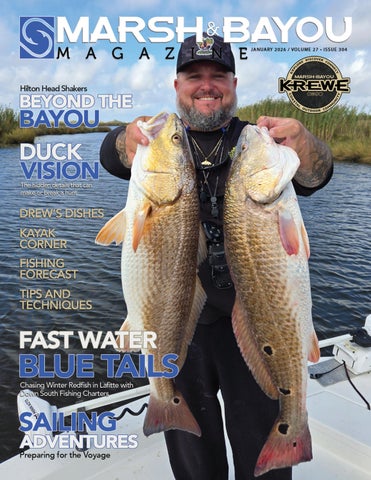
he sun had yet to break the horizon when Capt. Kevin Hezeau and I pulled away from his Down South Fishing Charters dock in Lafitte and eased into the channel to look for redfish on a beautiful and almost cool late November morning. “Redfish in Lafitte is incredible,” said Capt. Kevin. “We have an incredible fishery down here. It can be a challenge sometimes. You might catch fish almost every cast in a spot one day, or ten days in a row, and then you go back and they’re gone. But they are never far away. You just have to find by Ray Huntz them. That cold we had in January 2025, the snow, it hurt our redfish. We don’t have the deep spots they can go to in the cold like a lot of areas of south Louisiana. Our fishing in the spring and even
summer meant we had to look a little harder. They seem to have rebounded now, though. The fishing has gotten better and better as we get into fall.” After a few minutes, Capt. Kevin cut into the marsh and wound around until we came to three canals intersecting before opening into a small marshy bay. He eased the boat toward a cut into one of the canals. “I always look for moving water, whether it’s from tide or wind,” explained Capt. Kevin. “Today we have both. I also like to see bait, and I do see some here. I don’t really worry about water clarity too much down here. This spot has the wind blowing along the bank of the canal, and we’re going 30 JANUARY 2026
MARSH & BAYOU MAGAZINE
to work the roseau cane, the grass patches, and the little coves. I always use market shrimp about a foot and a half under a Four Horsemen popping cork.” We started fishing, and on his second cast, Capt. Kevin’s cork disappeared after the second pop. Moments later, a beautiful twenty inch redfish slid into the net. We worked the spot for another twenty minutes with no luck and then moved down the bank to a shell bank. Within a couple of casts, the captain had another redfish, this one just over nineteen inches. Once again, we worked the area for about twenty minutes without another bite. After fishing a few more spots along the canal with no success, Capt. Kevin decided to move into the marsh behind the canal. Ten minutes later, we were fishing the cuts of a string of small grassy islands in a shallow lake. The first two cuts produced a fifteen inch redfish for the captain and a sixteen inch fish for me, with no additional bites. The next cut looked promising. You could see the current curling around the small points on both sides, perfectly carrying bait to any redfish waiting just beyond the points. We both cast tight to either point several times with no bites. I decided to cast farther past the point, on the outside edge of where the current swung around. My cork had just hit the water when I popped it once and it disappeared with a loud clack. I set the hook and my drag started singing. I would gain on the fish, then it would run. When it saw the boat, it made another long run. After nearly ten minutes of back and forth, I finally brought the fish to the net. It was a tank of a redfish measuring thirty three inches. We took photos, revived it, released it, and went back to fish-
h
ing. On Capt. Kevin’s second cast to the same point, his cork disappeared. As soon as he set the hook, his drag began screaming as well. This was another big fish. He would get it close, only for it to run again. After its third run, the next one was shorter, and Capt. Kevin guided the redfish into the net. This one was even bigger, measuring nearly thirty six inches. After reviving and releasing it, we went back to fishing. Thirty minutes later, after working three more spots with no bites, Capt. Kevin decided it was time to move. “We’re going to get back into some ponds,” he said. “The tide just started falling, and the redfish should be stacked at the drains and trenasses coming out of the interior ponds. The falling tide will pull bait out, and the redfish will be sitting there waiting.” About fifteen minutes later, the captain eased off plane and entered a canal lined with draining ponds before pulling into a large pond fed by several smaller interior ponds. “This is one of my favorite
winter spots,” explained Capt. Kevin. “This first drain, with all this grass forming a little island, has produced some great trips, especially when I bring my kids. We have absolutely smoked the redfish right here.” After fifteen minutes and one small flounder, Capt. Kevin decided to move again. “I’m watching the current,” he said. “That far drain closest to the outside is flowing just right. I can see bait moving and redfish pushing. That’s where we need to be.” We were fishing the drain within minutes. We both cast along either side. The captain’s cork disappeared on the first pop, and mine vanished on the third. Both of us had drag peeling out in opposite directions. It was a beautiful kind of chaos. We landed both fish at nearly the same time. Capt. Kevin scooped mine first, flipped it onto the deck, then netted his fish and brought it aboard. His measured twenty three inches, mine twen-
ty one. Into the box they went, and we were right back to fishing. “This is one of the things I love about Lafitte,” Capt. Kevin said as he popped his cork. “When you have good conditions and you find them, it’s fast action.” He paused as his cork disappeared in a swirl and set the hook on another redfish. His line screamed as he continued. “There are a ton of fish in here eating all this bait. You can see them chasing it in this shallow water. With the tide falling, they’re stacked up, letting the current bring the bait right to them.” This fish had some shoulders and made several strong runs before finally tiring. Capt. Kevin guided it into the net. “This is a tournament winner,” he said. “Just over twenty six inches and fat.” Into the box it went. I cast into the cut as redfish swirled on bait all around us. After two pops, my cork disappeared. I set the hook and after a spirited fight, Capt. Kevin netted a fat twenty five inch redfish. With the bite on fire and only two fish left to fill our limit, I grabbed my baitcaster and tied on a chatterbait. On the first cast, I felt a solid thump, set the hook, and brought a chunky twenty inch pond pumpkin to the net. After boxing that fish, Capt. Kevin cast into the cut. This time he never even popped his cork. As soon as it hit the water, it disappeared. After a short fight, a twenty two inch redfish hit the box to finish our limit. We continued fishing for another thirty minutes, catching and releasing ten to fifteen redfish each, all between twenty and twenty four inches. “Let’s head to the dock,” Capt. Kevin said as I released another chatterbait redfish. “The tide is falling and we want to get out while there’s still water. These fish were so fired up, every one of them has a bright blue tail. That’s how redfishing is here. When you find the right spot with moving water, it’s on. It took us about twenty five minutes to finish our limit in here. When you get back into these ponds with moving water and bait, you’re going to catch fish. You just have to stay aware of the tide and water depth. Even today, with the tide just starting to fall, every spot we fished was less than three feet deep. The bottom drops out fast here. This is a unique fishery. The redfishing is unmatched. With halfway decent conditions, you’re going to catch fish. Sometimes, like today, you just have to find them. When you do, it’s fast and furious.” With that, he got the boat on plane and headed back to the dock. Another Louisiana redfish adventure of a lifetime in the books. For Capt. Kevin, it was just another day on the water doing what he does every single trip. Get your own Louisiana redfish adventure with Capt. Kevin Hezeau and Down South Fishing Charters. Call 985 768-1656 to get on the books today. Visit downsouthfishingchartersnola.com and follow Down South Fishing Charters on Facebook and Instagram. FOLLOW THE OUTDOOR AND CULINARY ADVENTURES OF RAY HUNTZ ON INSTAGRAM AT @MARSHWHISPERER AND @DEUXGARSBIZARRES.
The hidden details that can make or break a hunt Have you ever given much thought to how ducks see their environment? As kids learning to hunt with our elders, how many times were we told to sit still and stop wiggling? Or how often did you leave a hunt scratching your head, wondering why birds flared just as they reached the edge of your spread? Was it the decoys, your camouflage, the blind brushing, or bare spots creating obvious dark holes? Understanding how ducks see can help answer those questions and lead to more successful hunts. 36 JANUARY 2026
MARSH & BAYOU MAGAZINE
H
umans see using three color cones in the eye that allow us to detect red, green, and blue. Ducks, however, possess a fourth cone that enables them to see ULTRAVIOLET LIGHT. This is something the human eye cannot detect without electronic assistance. What may appear dull or neutral to us can look extremely bright and vibrant to a duck. Their vision allows them to see ultraviolet reflections in feathers, plants, seeds, and even on the surface of the water. This enhanced color perception gives ducks a clearer and more detailed view of their surroundings. Objects appear sharp-
er, contrast is stronger, and motion is easier to detect. Ducks also have slight differences in the structure of their eyes by Eddie Lamulle that allow them to scan wide areas while flying, including long distances and broad horizons. This combination of wide vision, ultraviolet sensitivity, and motion detection makes them highly effective at identifying anything that looks out of place.
Because of this, ducks are constantly analyzing the environment they are flying over or preparing to land in. Anything unnatural can raise concern. A small movement, an odd reflection, or a shape that does not belong can be enough to make them flare. What looks perfectly hidden to a hunter may stand out clearly
covered or dulled. One effective method is burning a cork and using the ash to darken high points of the face, since many face paints still reflect light. • Break up gun ports in blinds using grass or natural vegetation to eliminate dark holes that stand out to birds approaching from above.
“What looks perfectly hidden to a hunter may stand out clearly to a duck from far away.” to a duck from far away. This explains why a blind or decoy spread that looks flawless at ground level can still be rejected by approaching birds. So what can hunters do to improve their odds? Paying attention to how ducks see can make a noticeable difference.
• Keep blinds freshly brushed throughout the season. While research has not proven that ducks can distinguish fresh cut vegetation based solely on ultraviolet reflection, regular brushing helps eliminate dead space and prevents obvious gaps created by wilting plants.
CONSIDER THE FOLLOWING TIPS WHEN SETTING UP FOR A HUNT:
• Research the decoys you use and whether they are painted with ultraviolet reflective coatings. Decoys designed with duck vision in mind can appear more natural and realistic to incoming birds.
• Look for items that create glare or unnatural brightness such as gun barrels, boat hardware, watches, sunglasses, or exposed skin. These reflective surfaces should be
• Wear camouflage that matches the environment
From overhead, a duck analyzes wind direction, decoy placement, and contrast against the water. Any unnatural shine, shadow, or movement stands out instantly. If the setup matches a safe, natural landing zone, the bird commits. If not, it flares and moves on.
you are hunting in, whether grass, marsh, or timber. Patterns that break up the human outline are especially effective. Clothing with textured or leafy elements can further disrupt your shape. • Sit still, stay low, and limit movement as much as possible. Even small motions can be detected easily by ducks once they lock onto your spread.
Weather and lighting conditions also play a major role in how ducks see your setup. Wind direction and sun position should always be considered when choosing a blind location. Ducks flying into the wind with the sun reflecting off the water may struggle to see details clearly, giving hunters an advantage. When the sun is at the ducks back, their vision is enhanced and
they gain the upper hand. In these situations, camouflage, brushing, and motion control become even more critical. Cloudy days can be challenging as well. With fewer shadows to break up shapes, movement and inconsistencies stand out more clearly. Any flaw in camouflage, blind brushing, or unnatural shine can cause ducks to become suspicious and flare away for safety. By understanding how ducks see, hunters can better camouflage themselves, their blinds, and their equipment. Reducing glare, eliminating unnatural shapes, and creating a more natural visual setting can prevent birds from becoming alarmed as they approach. This attention to detail can make the difference between watching ducks flare away and watching them finish into your spread. So when you think back to all those times you were told to sit still and stop wiggling, it turns out our elders knew exactly what they were talking about.
There is a special kind of joy that comes from a getaway that does not involve packing the truck like we are fleeing the state, burning through a tank of gas, or negotiating time off with ourselves like it is a business deal. That is the beauty of a true staycation, and it is exactly why Fontainebleau State Park has become one of our favorite local escapes. Sitting comfortably on the north shore of Lake Pontchartrain, Fontainebleau proves that feeling away does not require going far, just slowing down. This is the kind of trip where we wake up in our own beds, drink our
40 JANUARY 2026
MARSH & BAYOU MAGAZINE
usual coffee, and still manage to feel like we are officially on vacation by lunchtime. There is no long drive, no rigid itinerary, and no backseat countdown of “are we there yet?” And if work absolutely must happen, it still can, because Marsh & Bayou Outfitters is just a few miles down the road. We get oak trees, open water, and a change of pace, with the quiet satisfaction of knowing we pulled off a great getaway without ever fully unplugging or leaving our comfort zone. Sometimes the best escapes are the ones that let you have it both ways.
F
rom the moment we enter the park, the pace changes. The road winds beneath towering live oaks, Spanish moss hanging down like nature’s idea of interior decorating, and the lake starts to peek through the trees. Everything immediately drops a few decibels. This is where the Monday through Friday grind loses its megaphone, and simple pleasures take over, like a walk to the beach, slow mornings, and deciding that absolutely nothing on the agenda is a solid plan. Fontainebleau’s roots run deep, and not just the ones threatening to trip us if we are not paying attention. In the early 1800s, this land was home to a sugar plantation owned by Bernard de Marigny, the founder of nearby Mandeville and a man with a clear appreciation for European style. The park takes its name from the Forest of Fontainebleau, because even two centuries ago Louisiana was already adding a little flair. Today, the preserved sugar mill ruins near the entrance quietly remind us of the land’s past. Walking through them makes history feel by Chris Tiblier close, and also makes us grateful our toughest task is figuring out dinner. Camping options are one of Fontainebleau’s biggest draws, and they fit just about every comfort level. You can choose from RV sites, tent camping, primitive sites, or lakeside cabins. Each offers a slightly different experience, but all come with the same laid
back vibe. Campsites are shaded and spaced comfortably, so you can enjoy nature without knowing our neighbors’ entire life story by the second morning. The cabins are especially appealing for anyone who likes the outdoors but also enjoys air conditioning, solid walls, and not waking up on the ground. Lake Pontchartrain is the heartbeat of the park. The sandy beach is perfect for swimming, beachcombing, or sitting in a chair convincing ourselves we might swim later. Morning walks along the shoreline are peaceful, while evenings bring sunsets that stop conversations mid sentence. The fishing pier stretches into the lake, giving us a quiet place to cast a line, watch pelicans drift past, and take in the simple joy of watching kids fish, one cast and tangled line at a time. Outdoor opportunities stretch well beyond the water. Fontainebleau’s trail system winds through hardwood forests, marsh areas, and open green spaces. The trails are friendly for casual hikers and families, which means we can explore without special gear or a dramatic recovery period the next day. Biking is popular, and wildlife sightings are common. We rarely don’t see deer grazing around at night, this time of year. Birds are the most reliable performers, showing up regularly and acting like they know they are part of the experience. One of Fontainebleau’s most underrated strengths is how easily it balances nature with convenience. After a day of hiking, biking, or mastering the art of doing nothing, we are only a short drive from great food in Mandeville. Breakfasts at Liz’s Where Y’at Diner, lunch at The Rusty Pelican, or dinner at Cafe Lynn or Bosco’s all fit perfectly into the plan. It is easy to eat well and still make it back to
camp in time for a fire and a quiet evening under the trees. The oak trees themselves deserve their own standing ovation. Massive, old, and unmistakably Southern, they define the park’s personality. They provide shade during the warmer months and a sense of permanence year round. Sitting beneath them with a camp chair and a cold one feels timeless, and it becomes very clear why so many people (we) keep coming back. Each season gives the park a slightly different mood. Spring and fall are prime time, with comfortable temperatures and perfect exploring weather. Summer invites swimming, kayaking, and unapologetically lazy afternoons near the water. Even winter has its charm, offering crisp air, quiet trails, and fewer crowds, making the park feel like it was reserved just for us. Fontainebleau State Park is proof that a great camping trip does not have to be complicated. It offers just enough history to spark curiosity, enough outdoor activity to stay engaged, and enough comfort to truly relax. Whether we are planning a weekend campout, a cabin stay, or a simple overnight escape, Fontainebleau delivers an experience that feels complete without trying too hard or traveling too far. For anyone looking to unplug without going far, this Northshore favorite continues to be one of Louisiana’s most rewarding places to slow down, recharge, and remember that sometimes the best trips are the easy ones.
SAILING
ADVENTURES
Preparing for the Voyage Inside the Planning, Crew, and Prep Behind a Lagoon 450 Delivery from Savannah to the Gulf Coast
A
s I gear up to deliver Herbert’s Lagoon 450 catamaran from Savannah, Georgia, to Gulfport, Mississippi, the excitement is palpable. This is not just a coastal hop. It is my longest adventure yet, running south down the Atlantic seaboard to the Florida Keys, skirting the Gulf Stream, then heading west with a planned twenty four to thirty six hour stop at the Dry Tortugas before turning northwest to cross the Gulf. Our planned departure is January 6, with flexibility built in for weather windows. With a deadline prompting the trip, Marsh and Bayou asked for more detail on the preparation side of things. Here is how I am putting it all together, from assembling a solid crew and provisioning meals to fine tuning technology 44 JANUARY 2026
for a safe and enjoyable eleven hundred plus nautical mile sail.
BUILDING THE CREW: EXPERIENCE AND ROLES A catamaran like the Lagoon 450 handles beautifully, but with legs that include river outlets, the Intracoastal Waterway, open ocean, and a full Gulf crossing, I need a reliable team, especially for
splitting night shifts in busy waterways. I am planning for five crew total, including myself, all committed for the full trip as of our last check. My core group includes Michael Just, a seasoned sailor with decades of experience on monohulls and offshore passages, making him ideal for sharing watch captain duties. Herbert, the by Scott St. Germain proud new owner, brings strong technical and mechanical expertise from powerboating, along with limited sailing experience. He is handling the Starlink installation for offshore connectivity, managing GRIB and GPX file transfers to the chartplotter, and contributing valuable coastal cruising experience. Rob, our media specialist who will share chef duties with Michael, is newer to sailing but has offshore experience and a medical background for emergencies. He has prepared twelve liters of frozen gumbo, corn and crab bisque, chili, and other heavy weather meals. I am packing two drones, three
“To build cohesion and skill, I will rotate watch pairings, matching experienced sailors with newer crew members for training in sail trim, weather routing, and night operations until everyone is fully competent.”
MARSH & BAYOU MAGAZINE
hundred sixty degree cameras, GoPros, and extra batteries for documentation. Our offshore fisherman, known as WaterDog, will handle fresh catches. We are eyeing yellowfin tuna at our cruising speeds, pending a final review of regulations. Herbert has been coordinating logistics and making multiple trips to Georgia to load the boat. I am organizing watch lists, end of watch checklists, and assigned bunks, with four guest quarters and two crew bunks located in the bows. To build cohesion and skill, I will rotate watch pairings, matching experienced sailors with newer crew members for training in sail trim, weather routing, and night operations until everyone is fully competent.
PROVISIONING & FOOD PREP: FUELING THE ADVENTURE With five people aboard, provisioning is critical, especially for a potential ten day trip with limited stops. I am planning for five days offshore at a time, focusing on hearty, easy to prepare meals to keep morale high. The crew has put together a solid menu. Breakfasts will be substantial, including eggs, bacon, fresh fruit, yogurt, and coffee to kick off each watch. Lunches will be lighter, with sandwiches, salads, wraps, deli meats, cheeses, vegetables, and snacks like nuts and energy bars. Dinners will center around the grill, featuring steaks, burgers, and fresh catches such as mahi mahi, mackerel, or tuna. Michael and Rob are handling marinades, spices, and sides like grilled vegetables and potatoes, along with frozen meals for rough conditions. Shopping lists account for storage
using the Lagoon’s spacious galley and refrigeration, as well as waste minimization. Water tanks are topped off with more than two hundred gallons, and the desalinator is ready to go. Herbert is bringing a diesel cockpit heater for chilly January nights, and the full enclosure will help keep wind and spray out of both the lower and upper cockpit. Total provisioning costs are expected to fall between eight hundred and one thousand dollars, sourced fresh in Savannah.
WEATHER PLANNING WITH PREDICTWIND: PICKING THE WINDOW January sailing requires close attention to cold fronts and northerly winds, but tools like PredictWind make it manageable. I am using their professional subscription for high resolution GRIB files, integrating wind, current, wave, and routing data optimized for the Lagoon 450’s polars, adjusted down ten to twenty percent for cruising loads. Long range models suggest a warmer than average winter overall, but early January looks cold and sunny along the Georgia coast, with lows in the thirties and forties and highs in the forties and fifties. Conditions become milder toward mid month, with possible showers. In the Keys, expect highs in the seventies with isolated rain. Preliminary window planning includes a potential front on January 5 bringing north to northeast winds at fifteen to twenty knots and seas building to four to six feet, followed by a post front high pressure window on January 6 with lighter winds and calmer seas, ideal for inshore legs. January 7 shows moderate north winds and manageable swell if the front clears as expected.
I will download updated GRIB files daily via WiFi or Starlink, overlaying them on charts to adjust routes inshore where the Gulf Stream approaches the Florida shoreline. PredictWind removes much of the guesswork, but radar will remain essential for squall detection. The PredictWind package costs a minimum of five hundred dollars annually.
SPARES, PARTS, AND GEAR: READY FOR ANYTHING No offshore voyage is complete without backups. Spare parts include fuel and oil filters, impellers, belts, and spare alternators for both the Yanmar engines and the Onan generator. S V Dreamer has loaned an air hose and compressor for emergencies such as debris wrapped around a prop. Sailing gear includes spare lines, shackles, blocks, jacklines, and tethers. The rigging has passed survey, and foul weather gear is ready. Fishing gear includes rods, reels, and tackle for trolling tuna, mahi, and mackerel, along with mask, snorkel, and speargun for shallow water opportunities in the Keys. Hogfish would be a welcome upgrade to dinner. Technology includes drones, three hundred sixty degree cameras, GoPros, and Starlink for communications and forecasts. The EPIRB has a new battery and is fully up to date, and each crew member will carry a personal locator beacon for man overboard situations.
MASTERING NAVIGATION: SYSTEMS AND FILES Navigation will be managed using a combination of iPad with the Navionics Boating app and the boat’s B and G Zeus
squared chartplotter. The setup checklist includes WiFi connectivity, PredictWind integration, and autopilot calibration, which will be critical for efficient hull speed sailing against expected northerlies. GRIB files will be uploaded to the Zeus squared for overlays that visualize Gulf Stream boundaries, which can sit sixty to eighty nautical miles offshore of Georgia and move closer to shore along Florida. GPX routes exported from Navionics will
be imported via memory card to guide inshore routing and help avoid the strongest current. All manuals have been uploaded digitally, including those for the chartplotter, instruments, radar, AIS, generator, and engines. Crew training will be hands on, covering navigation, autopilot use, instruments, radar interpretation, and AIS operation.
HELM SHIFTS & DAILY RHYTHM
With five crew members, we will operate on a four hour on, eight hour off watch rotation, with two people per watch handling helm and lookout duties. During daylight hours we will run full sail when conditions allow, reefing at night if winds increase. I will rotate strategically to maintain balance and rest, especially before the Gulf crossing, with fatigue checks built into the plan. Safety remains the top priority. Life jackets will be worn at night and on deck, jacklines will run stem to stern, and tethers will be used for safe movement. Each helm vest will carry a personal locator beacon for added security. As departure approaches, everything is coming together. The Lagoon 450’s stability, a capable crew, and careful planning set the stage for an unforgettable run. Stay tuned for the underway report in Marsh and Bayou. Fair winds.
BEYOND THE BAYOU
Famous for golf but equally defined by its fishing and waterways, this small island offers far more than most expect.
HILTON HEAD SHAKERS
The tiny island of Hilton Head is located along the southern coast of South Carolina, just north of the Georgia state line. Only 12 miles long and 5 miles wide, the island is known by many as a golf destination. With its manicured greens and comfortable coastal climate, that assumption is absolutely true. However, when I visited Hilton Head this past November, I realized that it is so much more.
U
pon arrival, I immediately noticed three things. First, After unpacking, we headed to the marina. Shelter its landscape is very similar to southeast Louisiana’s Cove is one of the largest deep water marinas on the island. flora. Palmettos, oak trees, and marsh grass dom- It offers restaurants, shops, and a well stocked ship’s store. inate the scenery. I also noticed that Hilton Head balances For those wishing to dock their own vessel for a short or long upscale sophistication with casual approachability. term visit, the 15 acre marina has 178 slips for It is a strange mixture of first class offerings paired vessels up to 145 feet. We spoke with the comwith shorts and sandals, at least in my opinion. mercial coordinator for Shelter Cove Marina, CinLastly, I noticed that Hilton Head is unrushed. It dy Rodriguez. She was a wealth of information is dripping with thick molasses southern charm. I and eagerly shared her knowledge of the area loved it immediately. and its on water opportunities. She explained that Originally, my husband Christian and I Hilton Head offers inshore and offshore fishing did not intend to fish since we were technically in charters, dolphin watching, shark tooth huntHilton Head for a work conference. After checking ing, nature tours, and group dinner excursions, by Colleen Orfanello into our resort, we noticed we were only minutes just to name a few. Pontoon, paddleboard, and from Shelter Cove, one of several marinas on the kayak rentals are also available. island. I should have known that my fishing obsessed husCindy has been at Shelter Cove for nearly six years band would make time for his favorite pastime and want to and, like me, believes Hilton Head is much more than a golf test the waters of Hilton Head. destination. She has been fishing since she was eight years 48 JANUARY 2026
MARSH & BAYOU MAGAZINE
old, received her captain’s license in her late twenties, and now in her fifties, she loves her role at Shelter Cove and enjoys the perks of helping people create adventures on the waters of Hilton Head. Her enthusiasm had us hooked. We strolled along the pristine pier and noticed a young captain cleaning his boat. We introduced ourselves to 23 year old Captain Caleb Altman, a Hilton Head native. Christian and Caleb immediately began talking speckled trout fishing and were finishing each other’s sentences. Needless to say, we knew we had found our captain. Caleb has the quiet, humble demeanor that only a seasoned and confident captain exudes. There is no need for him to boast about his talents. What he does boast about is his love for his island home and the fishing opportunities it offers. That passion runs deep. Caleb’s father, Miles
HILTON HEAD FUN FACTS Bikes over cars, boats over roads
You can bike almost everywhere thanks to more than 60 miles of paved bike paths. And when biking won’t get you there, chances are a boat will. With tidal creeks, marinas, and the Intracoastal Waterway weaving through the island, some of the best spots are reached by water instead of roads. Cars are optional, but bikes and boats are the real way locals get around.
Altman, is a Navy brat who chartered along the East Coast before purchasing Bayrunner Fishing Charters in 2010. Caleb told us, “I started fishing with my dad when I was three years old and could barely reel in a largemouth bass, but I fell in love with it after catching my first fish. After being his first mate for years, I knew one day I would get my captain’s license and run a boat of my own. Being a charter captain does not even feel like work because I love putting people on fish and watching the joy they get from catching something on their bucket list.” His intuition proved true. Caleb earned his license and now runs trips for Miles aboard the well equipped Bayrunner, a 24 foot Pathfinder powered by a 250 horsepower Yamaha. We did not have much time to fish due to our conference schedule, but our hopeful target for the day was hard fighting, head shaking speckled trout. As luck would have it, Captain Caleb announced the inshore speckled trout bite was on fire, which made for a short boat ride. We navigated through a small marsh into an area lined with lake houses and floating docks. We used live shrimp on Carolina rigs and immediately boated several beautiful redfish. After releasing the reds, the captain said, “Now let’s
get on those speckled trout.” Following a smooth ten minute ride, we entered a spillway and anchored. The tide swings in Hilton Head are incredible compared to what we are used to in southeast Louisiana. The waterline on the bank’s rocks was easily ten feet high. I fished live shrimp on a Carolina rig while Christian threw a hard plastic crankbait. Christian’s first cast produced a solid thump and some fun head shaking action. Cast after cast, we boated specks, often with double hook ups. It was nonstop until our arms were tired. We kept two fish for a planned catch and cook dinner and released another dozen or so trout over the next hour and a half. Captain Caleb Altman wasted no time putting us on fish. He understood we had a limited window before our conference began and went above and beyond to make this spontaneous trip truly specktacular. He quickly cleaned and packaged our catch, and we returned to our hotel, changed, and arrived at the conference with time to spare. That first day in Hilton Head was a success thanks to an enthusiastic Shelter Cove employee and a knowledgeable beyond his years captain. If you are not a golfer and plan to visit Hilton Head Island, consider traveling with rods rather than clubs. You will not be disappointed. Or if you enjoy both, do it. Just a few hours on the water will give you a well rounded experience of what Hilton Head has to offer. The island is surrounded by an intricate network of tidal creeks, salt marshes, estuaries, and open Atlantic waters. These ecosystems create ideal habitats for a wide range of fish species, from inshore favorites like redfish, trout, flounder, and sheepshead to off-
shore giants such as sharks, billfish, cobia, snapper, and grouper. Captain Caleb and Bayrunner Fishing Charters do not venture far offshore. Caleb refers to it as nearshore fishing, taking guests two to ten miles off the beach to target artificial reefs for Spanish and king mackerel on the surface, or cobia, black sea bass, and other bottom dwellers. He reminds us that everything in Hilton Head is seasonal. “In the summer, you can expect to catch lots of sharks since we are the biggest breeding ground on the East Coast for nearly twenty species. Mackerel are also close to the beach and provide thrilling action 50 JANUARY 2026
MARSH & BAYOU MAGAZINE
on light tackle. In the fall, we catch bull redfish ranging from fifteen to forty pounds, and the creek bite for smaller reds and trout heats up as water temperatures drop. In the winter, the creeks are on fire with trout, redfish, flounder, and black drum. Sheepshead show up around docks and nearby reefs. Spring brings the cobia run along the beach and rivers, which makes for excellent table fare. Sharks begin to show up again, and the sheepshead start to leave.” No matter the season, it is always a good time to visit Hilton Head. Just go. For your catch and cook dinner, I recommend Hudsons on the Docks, where the sunsets are breathtaking and the gumbo may be better than my mother in law’s, which is not easy to do. We ate there three times during our short stay. For nature enthusiasts, the island’s marsh system is one of the most productive ecosystems on the East Coast. There are more than sixty miles of paved bike paths, walking trails, boardwalks, and interpretive signage explaining local ecology and wildlife. Guests can paddle through tidal creeks where dolphins and water birds are common sights. Hunting is prohibited, allowing white tail deer and other wildlife to roam freely. From May through early November, loggerhead sea turtle hatchlings can be seen instinctively crawling toward moonlight reflecting off the ocean’s surface. Because artificial light can disorient them, our resort enforced a ten o’clock lights out curfew on ocean facing balconies. For history buffs, once you have explored Hilton Head Island’s historical sites and museums, consider the thirty five mile trip to Savannah, Georgia, or the two hour ferry ride. It is an easy way to visit one of America’s most historic and haunted cities. As a fun side note, although Hilton Head is a resort town filled with accommodations of every kind, it was not named after Conrad Hilton. The island was named for Captain William Hilton, an English explorer who identified a headland near the entrance to Port Royal Sound in 1663. Hilton Head Island exceeded my expectations. It was my first visit, but it will not be my last. This tiny island truly has something for everyone. With or without clubs, visit this destination knowing that golf is just one of many experiences waiting for you. Fish the low country waters of Hilton Head Island, and like the trout, you will be shaking your head and wondering why you did not visit sooner.
Triton Hickey with a solid 31” Venice redfish caught on a popping cork and live shrimp.
Thomas Cook with a 34.4 lb. tripletail, good for seventh place on the state record list, caught in Venice.
Ray Huntz with a beautiful red caught in Lafitte last month with Down South Charters.
Roy Cathcart
with a massive stringer of sac au lait caught on the Northshore.
Michael Ellender with a 2.58LB bass caught at the Bonnet Carré Spillway, a popular hotspot that continues to produce quality fish.
Abe Gristina with a hybrid bass caught while fishing ledges in the MRGO.
Ms. Danyele with a nice redfish caught in Hopedale over the holidays.
Allyson Schulz with a 31” black drum caught in Grand Isle over Thanksgiving weekend, joined by Ben Schulz on the right and Jacob Schulz in the middle. Bane Tenorio with a big speckled trout caught December 16, 2025, fishing 20’ of water in Bayou Bienvenue on a half ounce Death Grip jighead paired with a lemon head Matrix Shad.
Mike Fergason made the most of the holiday break, staying locked in on Lake Pontchartrain trout from his trusty kayak.
Butler Sauvinet, age seven, with his very first flounder caught, landed, and released on his own on New Year’s Day in the Rigolets, with dad Elliott Sauvinet.