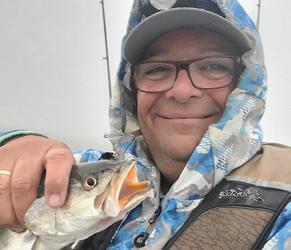
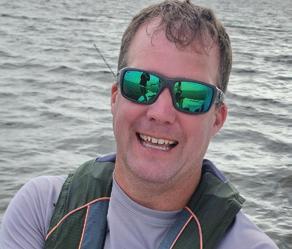
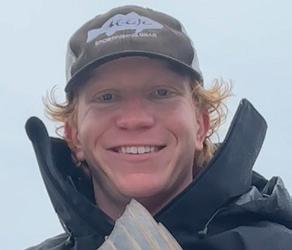
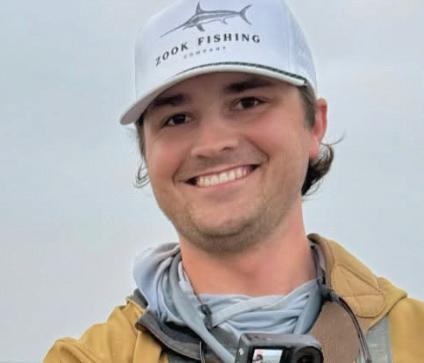
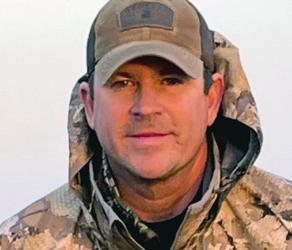
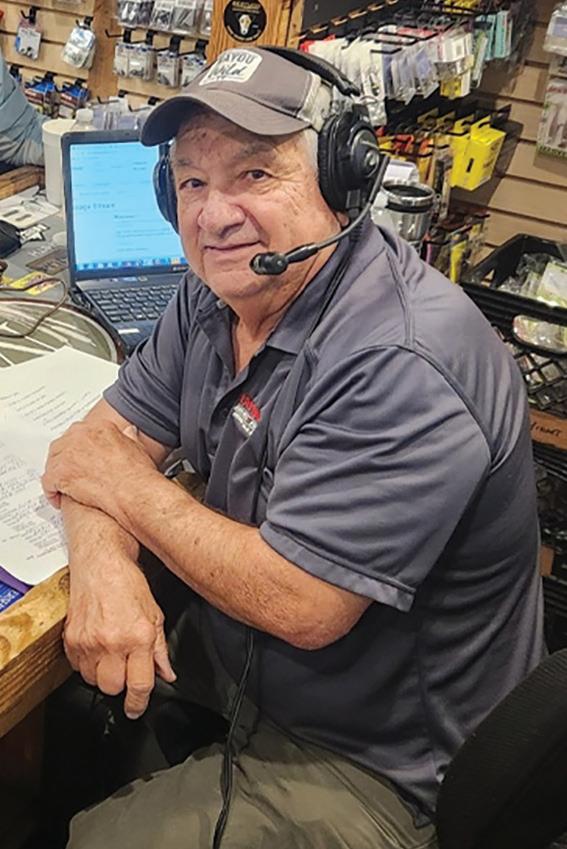
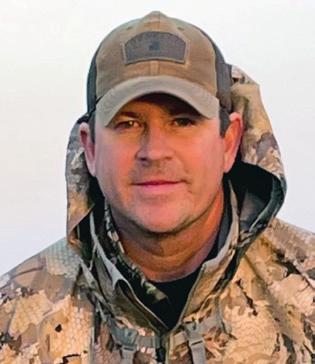
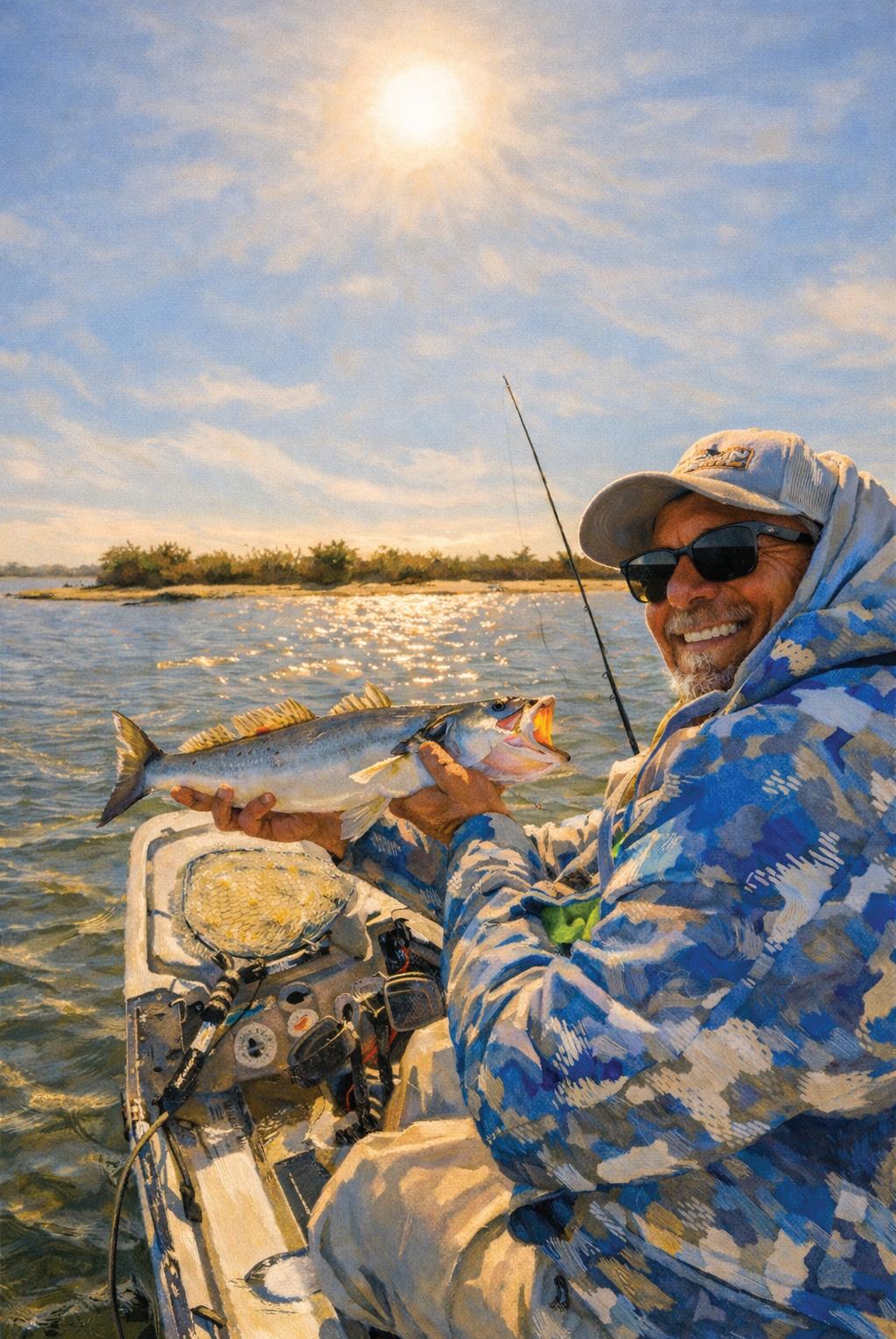
Don Dubuc’s storied career was built on hard work, dedication, and commitment. For more than 40 years, his distinctive voice and calm demeanor have enriched the lives of outdoor enthusiasts along the gulf south and far beyond.
by Colleen Orfanello
The Outdoors Guy, as he is commonly known, is much more than an award-winning journalist, broadcaster, and conservationist; he is by far, a legend. That status didn’t come easy. The young Dubuc once pitched a story to a national magazine editor and asked to have it published. The editor denied his request but offered encouraging words that would sow the seeds for his future in journalism. The editor said, “Don’t give up, you have a talent for this”.
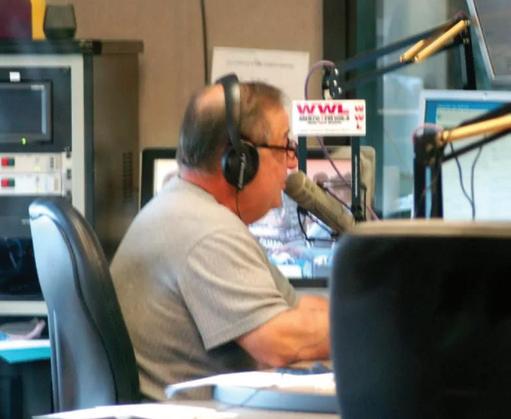
Don certainly didn’t give up. He soon had a weekly newspaper column, a handful of published magazine articles, and a 15-minute radio show. The doors continued to open as he expanded the show with a network of stations. In 2011, WWL’s beloved radio and TV superstar, Frank Davis,
recommended that Don be his successor hosting the Fish and Game Report. Davis, who coined the term “Naturally N’Awlins”, left big shoes to fill but Don wore them well. As Don became the new host, he carved out a space rooted in trust—where knowledge was shared freely, opinions were honest, and viewers heard the authenticity in his voice. Don’s love for all things outdoors was evident whether he was behind the mic or in front of the camera. His vast knowledge, even on the most complex of topics, was delivered in a factual –but friendly – way. He served as a virtual guide, teacher, and best buddy every time you heard him speak. Don Dubuc has been a household name in the homes of millions of outdoor enthusiasts for more than 40 years. His followers didn’t hear a scripted personality when they listened to his shows, they heard a familiar and respected friend that was virtually sharing his enthusiasm (and often his concerns) as if he was sitting at your kitchen table sharing a meal. That type of
connectivity only comes from those who have earned trust through years of honesty, humility, and consistency. Don never chased trends or tried to reinvent himself to stay relevant. Instead, he stayed true to who he was, confident that his sincerity and knowledge would resonate with his fans. The late Frank Davis would be proud, Davis told Don to “Be Yourself”, and that’s exactly what he did.
For his work in radio, television, non-profit advocacy, conservation efforts,
A Calm Voice During the Storm
Of all the chapters in Don Dubuc’s career, none left a deeper imprint than that of Hurricane Katrina. As the Gulf Coast struggled to recover, Dubuc’s microphone became something far more important than a broadcasting tool, it became a lifeline to those who needed comfort in their darkest days. Don’s twenty-year career on radio was temporarily suspended due to the storm, but he quickly regrouped in Baton Rouge where he was offered a slot through an affiliate station.
Don said that he didn’t know how the show would go since many people didn’t have electricity, access to phones, or was so overcome with shock they wouldn’t – or couldn’ttune in. To Don’s surprise, the calls poured in. Some had lost homes, others livelihoods, many simply needed to be heard. Dubuc listened.
He heard the exhaustion and despair when callers spoke about the waters rising, or the sticky-heat, or the lack of understanding what the future holds. He offered reassurance, perspective, and compassion when uncertainty ruled the day. He didn’t pretend to have answers, but he gave people something just as valuable: stability. Don still points to that period as his greatest accomplishment.
and journalism. Don has been honored with admission into the Louisiana Sportsman “Hall of Fame”, was twice awarded “Conservationist of the Year”, and was bestowed with the Louisiana Outdoor Writers Association’s Arthur Van Pelt Award - for lifetime achievement in conservation. The number of awards is far too great to list in this short article, but I am sure that Don’s greatest honors are the titles of father, friend, veteran, and Grandfather. Don approaches his retirement this month at age 75. He leaves with gratitude rather than regret. His final broadcast will take place on February 7, 2026. It will mark the closing of an extraordinary chapter, one that reshaped outdoor broadcasting and connected countless lives through shared experiences and passion. For those who are concerned that the national award-winning Bayou Wild television show will come to an end, fear not. Bayou Wild will continue through the artistic efforts of Chris Lecoq.
But retirement won’t slow him down. Don plans to spend his days exactly as he’s lived them for years: fishing, hunting, and making memories with his family and loved ones. He and his girlfriend, Janice are planning a well-deserved and unrushed trip to New Zealand – (If you’re wondering, hunting will be part of the agenda). Don will call both Alabama and Kansas home, continuing to live his best life surrounded by the natural world he has devoted his life to celebrating.
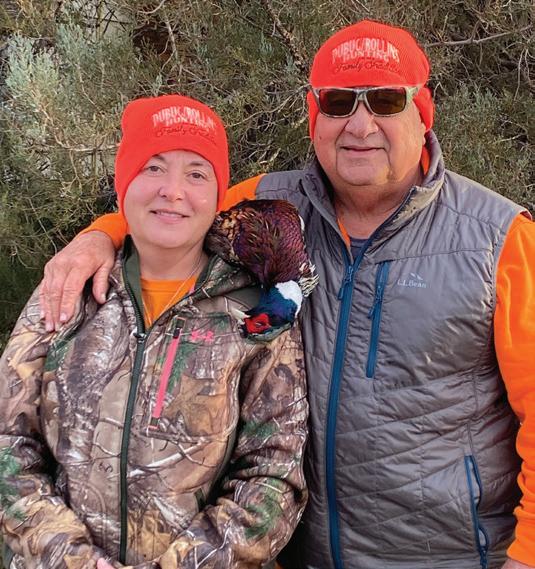
Don and his sister Cheri after a pheasant hunt in Kansas.
SPEAK UP OR LOSE IT
Why Louisiana anglers must make a stand to protect menhaden buffers and our coastal fisheries
Despite overwhelming public support from recreational anglers and CCA Louisiana, the Louisiana Wildlife and Fisheries Commission has voted to move forward with a Notice of Intent that would reduce menhaden buffer zone protections off our coast. This decision threatens nearshore waters and breaks an agreement made less than a year ago to protect a critical forage species. The window to act is now. If no further action is taken, the rule change becomes official March 20, 2026. Silence between now and then means accepting the loss of protections our fisheries depend on.
WHY MENHADEN BUFFERS MATTER
Menhaden are not just another commercial species. They are the backbone of the Gulf food chain, supporting redfish, speckled trout, tuna, tarpon, seabirds, and countless other predators. When menhaden stocks are pressured, the impact ripples through the ecosystem, directly affecting the fisheries Louisiana anglers rely on.
Nearshore buffer zones exist for a reason. These waters are nursery areas, feeding zones, and heavily used recreational fishing grounds. The half-mile buffers were designed to keep industrial harvest out of the most vulnerable areas and away from where anglers spend the majority of their time on the water. Weakening these protections puts short-term interests ahead of long-term sustainability.
A DEAL BROKEN TOO QUICKLY
What makes this decision especially troubling is how recently these protections were negotiated. Less than a year ago, industry, conservation groups, and state leaders reached a compromise to maintain half-mile buffer zones, a solution widely viewed as fair and balanced. “The decision to break the deal the industry made less than a year ago to maintain half-mile buffers was unexpected,” said Rad Trascher, executive director of CCA Louisiana. “We truly did not believe that the good-faith negotiations that led to that solution would be so easily discarded.”
Recreational anglers showed up, engaged respectfully, and trusted that their voices mattered. Advancing this Notice of Intent sends the opposite message.
THIS IS ABOUT MORE THAN MENHADEN
This issue goes beyond a single species or regulation. It reflects how Louisiana values its coastal resources and whether public input carries weight in decisions that affect everyone on the water. Recreational fishing fuels coastal economies statewide, supporting guides, marinas, bait shops, and local businesses. When nearshore ecosystems suffer, the damage extends far beyond the shoreline. Once protections are rolled back, they are rarely restored.
WHAT HAPPENS NEXT
The Notice of Intent will become official March 20, 2026, unless action is taken during the current oversight period. CCA Louisiana is urging anglers and concerned citizens to contact legislators and civic leaders to oppose reducing menhaden buffer protections. This is the final opportunity to influence the outcome before it becomes permanent.
SPEAK UP OR LOSE THE RESOURCE
Louisiana anglers have already lost too much to coastal erosion, habitat loss, and poor management. Allowing hard-won protections to disappear without resistance guarantees more loss ahead. Defending menhaden buffer zones is not anti-industry. It is pro-resource, pro-science, and pro-Louisiana. It is about honoring agreements, protecting nearshore ecosystems, and ensuring future generations inherit healthy fisheries.
SILENCE WILL BE INTERPRETED AS APPROVAL
If we care about our coast, our fisheries, and our voice in how they are managed, now is the time to use it.
It is the middle of winter, deer season is over or almost over, so what do you do? Go fishing, of course. While we get our share of cold winter weather, it is marked by periods of beautiful mild days. Either way, there are always fish to be caught here in southeast Louisiana.
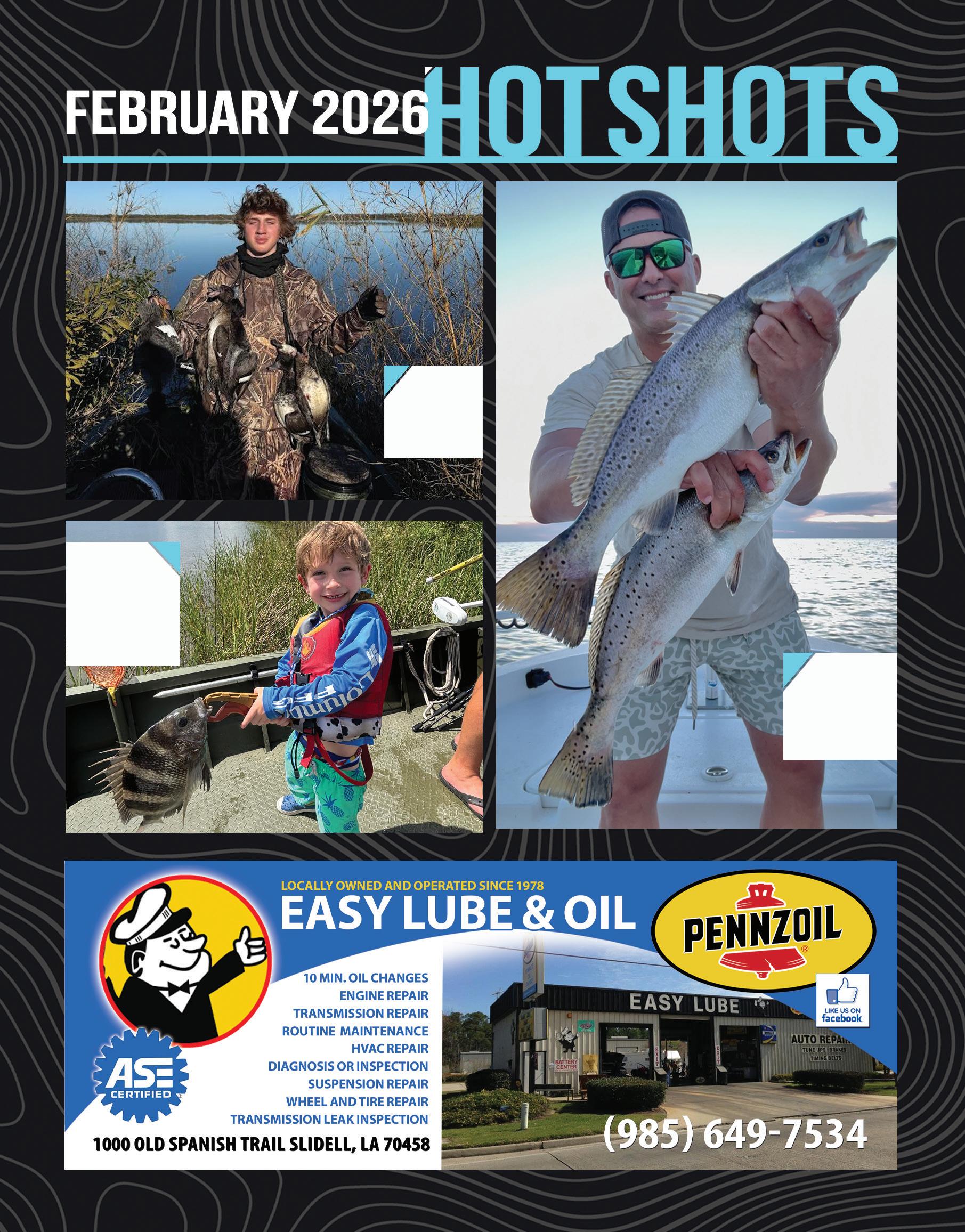
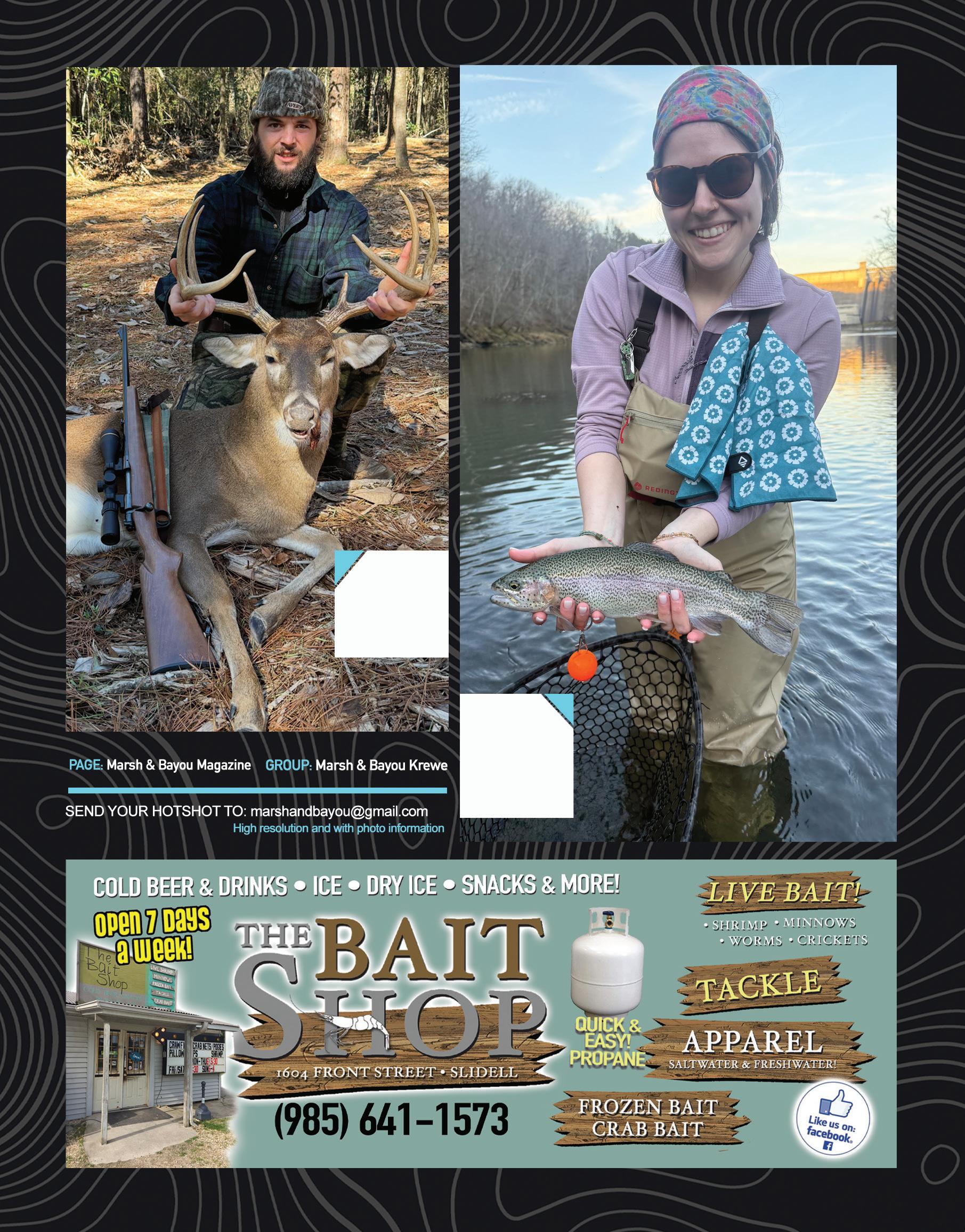
Always be careful in the cold and watch the tides. Our extreme winter tides can make areas unpassable very quickly. Good luck. Have hunting or fishing photos you are proud of? Send them to us at marshandbayou@gmail.com for the chance to be featured on our monthly Marsh and Bayou Magazine HotShots page. - RAY HUNTZ
LAFITTE
Capt. Kevin Hezeau
Down South Fishing Charters (985) 768-1656
First off, just like I said last month, it is shallow in Lafitte, and winter can bring extreme tides. This year, the water levels are the lowest I can remember, so do not get stranded. February is much like January once it gets cold. I like to fish back in the marsh, near or in ponds, depending on the tide and how low the water
stays. I also target old canals with roseau cane, isolated grass, trenasses, small coves, and isolated grass along the edges of smaller bays. I always like windswept banks.
In the ponds, I set up just outside or in the mouth of drains, cuts, or trenasses from interior ponds during a falling tide. On a rising tide, I push farther back in if possible, although the extremely low tides this year have made that difficult. A falling tide pulls bait out of the ponds, while a rising tide pushes bait in.
In the canals and small bays, I look for current or wind pushing through the grass, along the bank, and around points.
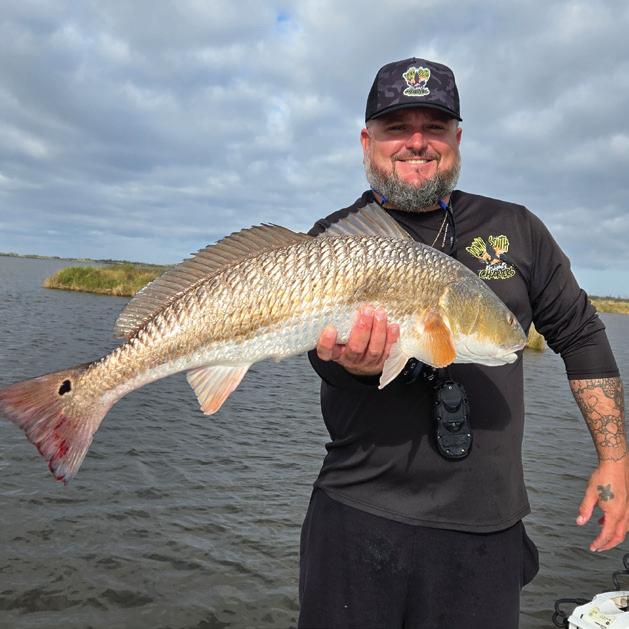
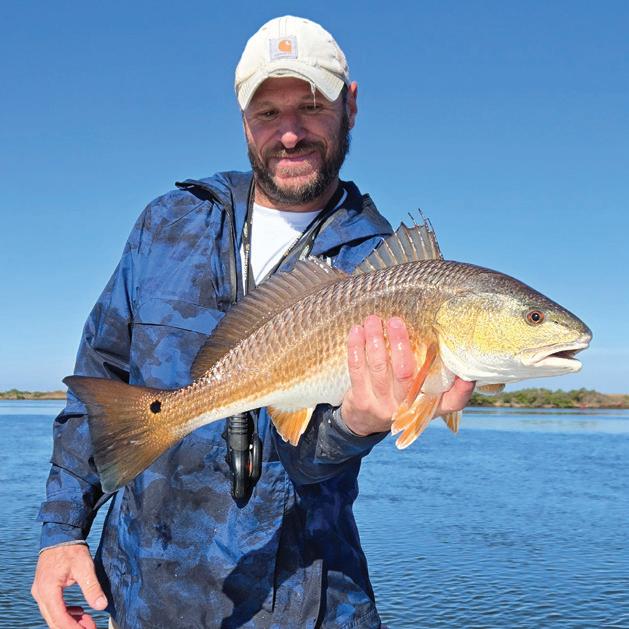
Whether it is ponds, canals, or small bays, redfish will be where tide or wind is pushing bait and where it is easiest for them to ambush it. In shallow pond areas, you can often see redfish pushing bait. That said, it is winter, and when temperatures drop into the thirties, redfish will seek the deepest holes they can find. Fortunately, that kind of weather does not last long here, and as soon as it warms up, the redfish move back up. Anytime I fish, I look for moving water from tide or wind. Second, I like to see bait activity. I am not too concerned with water clarity when targeting redfish. My setup is simple. I use a Four Horsemen popping cork with market shrimp on a jig head about a foot and a half deep. If you prefer artificials, gold spoons, chatterbaits, Marker 54 shrimp or shrimplets, and soft plastics all catch redfish here.
One thing about redfish in Lafitte is that they move around. You may catch them in one spot for a day or even ten days in a row, then come back and they are gone. Usually, they are not far. You just have to move around, pay attention to the tide and bait, and you will often find them stacked up nearby.
DELACROIX
Capt. Jason Williams
Jason’s Saltwater Guide Services (985) 507-7644
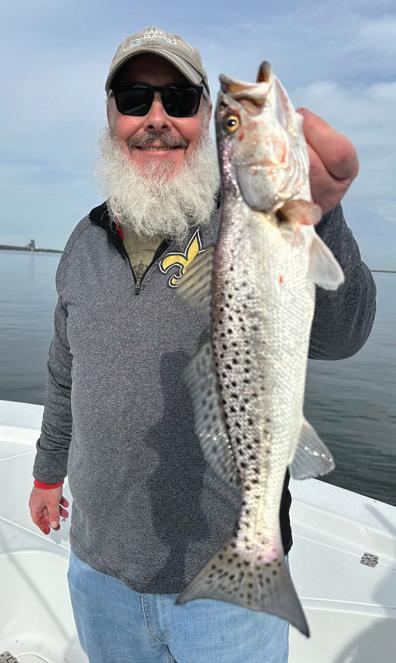
In the middle of winter, when I am trout fishing, I look for them deep when it is really cold. During winter warm ups, I target ledges and flats with shell bottoms near deep holes. As the upper water column warms on those nice days, trout will move up and feed.
If live shrimp are not available, I use plastics and fish them slowly. The
bites are very light in winter, often just a tap when it is cold. On warmer days, trout become more aggressive. With live shrimp, I use a Carolina rig when fishing deep. As they move up on warmer days, I switch to a popping cork rig. I need moving water, bait around, and the cleanest water I can find. For redfish, I stay in the marsh unless it is really cold. When the surface temperature hits fifty two degrees or lower, redfish will move to deep holes. They will still bite, because deep water stays warmer. It is similar to when a redfish jubilee occurs. The surface water cools, north winds push water out of the marsh, and redfish concentrate in deeper areas. I use live or dead shrimp on a Carolina rig, or soft plastics, when redfish are deep. When they are not deep, I move back into the marsh with a popping cork and shrimp. I look for windy banks, trenasses, drains, choke points, and points with rolling current. Always watch your water levels. Big tides can turn five feet of water into a mud flat very quickly.”
CALENDAR OF EVENTS
Lafayette Duck Bingo
Feb 5, 2026 5:30
River Oaks Event Center, Lafayette, LA
Feb. 6th-8th 2026
MISSISSIPPI COAST COLISEUM
Pearl River Banquet
Feb 20, 2026
St Tammany Parish Recreation Building
COCODRIE Capt. Casey Lombard
Precision Fishing Charters (985) 714-3987
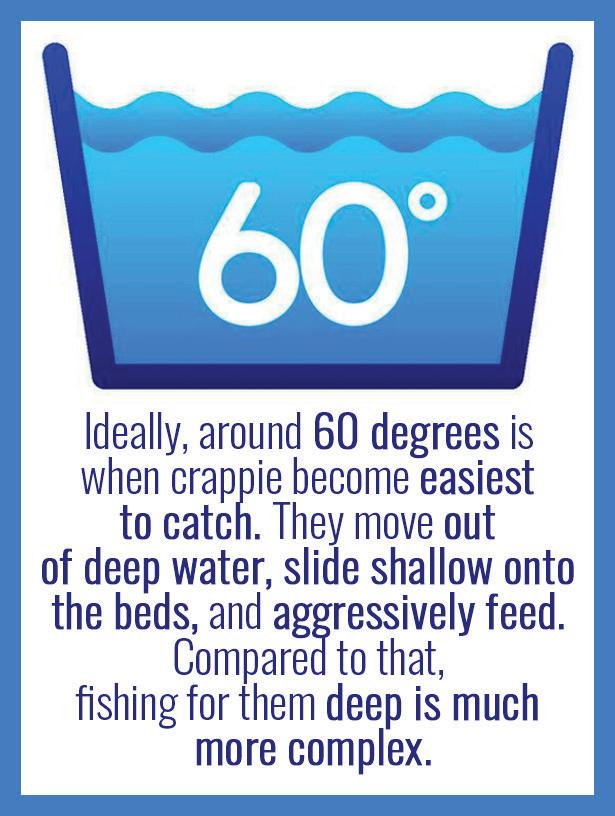
For winter redfish, push as far back into the ponds as safely possible. Strong north winds will drain water out of the ponds, and when combined with low tides, conditions can change and become dangerous quickly. Focus on areas with bait and moving water around trenasses and drains, as these spots consistently hold redfish during the winter months. Trout and redfish are often found in the same general areas. Look for deep holes that gradually taper toward grass lines and banks. Trout usually hold in the deeper water, while redfish stay shallower along the grass. During extreme cold, redfish will slide a bit deeper and closer to trout. On warm, sunny days, trout will move shallow to feed. When water temperatures drop, trout become less active and settle into the mud on the bottom to conserve warmth.
The marshes around Dularge are well known for holding winter redfish in protected ponds. The NAV Canal near Dulac, New Lake, the marsh near LUMCON, and the canals and marsh north of Bayou St. Ann all produce both trout and redfish throughout the winter. February also brings peak sheepshead spawning activity. Shrimp on a small hook is all that is needed. Rocks, locks, wells, and platforms around Dularge are loaded with sheepshead this time of year, offering a great change of pace when conditions allow. No matter the target species, always look for bait and moving water. I prefer market shrimp under a cork for redfish and plastics like Matrix Shad for both trout and redfish, fished under a cork or tight lined depending on depth. My favorite winter Matrix Shad colors are Green Hornet and Shrimp Creole. Other productive baits include H and H Sparkle Beetles, Tsunami swim baits, Berkley Rattle Shrimp, and the ever reliable gold spoon for redfish.
SHELL BEACH
Capt. Jacques Laboureur
Jakamo South Fishing Adventures (504) 303-1494
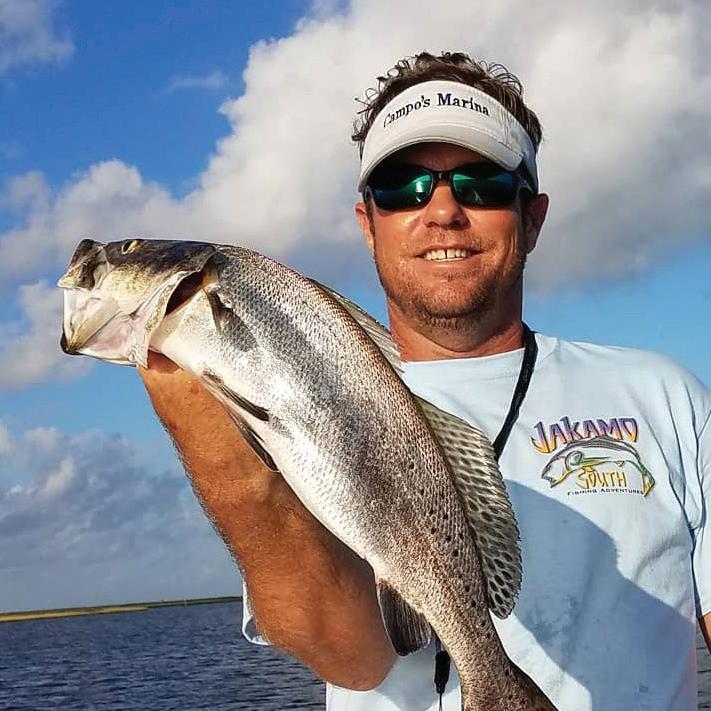
Iam primarily a trout fisherman, and that is what most of my charters want. In February, I focus on flats near ledges and deep holes.
On mild days, trout feed on the flats. After cold fronts, they drop deep, then move up the ledge as the sun warms the water. I look first for current, then bait in the cleanest water I can find, preferably over a hard shell bottom. Trout will be in the marsh, along the MRGO, and on the backside of the dam. For redfish, I stay in the marsh, often in the same general areas. I target windswept banks, trenasses, points, drains, cuts, and isolated grass with moving water or a steady breeze. On a falling tide, I fish just outside a drain or trenasse. On a rising tide, I move back inside. Redfish position where they can ambush bait pushed by tide or wind. In colder weather, schools of bull reds will gather near the rocks. This time of year through early spring, watch the tides closely. Big tides can turn three feet of water into a mud flat fast.
VENICE
Capt. Rich McCloskey Blueline Charter Service (225) 276-5263
Well, February is finally here, and in my opinion, it is hands down the best redfishing of the year in Venice, Louisiana. There is a lot going on in Louisiana this time of year, including Mardi Gras, but if you have some free time, you need to get down to Venice and chase some redfish.
There is no rush to get up early either. Leave the marina around 7:30 in the morning and head south. I like to start by fishing the marsh on either side of South Pass. Focus on all the broken up marsh cuts, points, and drains in two to three feet of water.
As far as bait goes, all you really need is a Four Horsemen cork with a two to three foot leader tied to a three eighth ounce jig head. Put a live shrimp on and cast toward the canes. Get your cork as close to the marsh as possible, pop the cork, then let it sit. Repeat this until you are about ten feet away from the canes, then reel in and do it again.
Other good areas to try this month include Blind Bay, the broken up marsh at the end of Pass a Loutre, and Uratch. If you want to top off your box with some sheepshead, head to the inside rocks along Southwest Pass. Anywhere south of Joseph Bayou should be holding fish.
Hope to see you down in Venice this month. Come say hey when you see me on the dock, and I will be glad to point you in the right direction.
Feb. 27-March 1, 2026
THE MOBILE CONVENTION CENTER
Feb 28th 2026
COOK-OFF FOR THE COAST
Gates at Docville Farm open at 11 am.
March 13th - 15th 2026
THE LOUISIANA OUTDOOR EXPO AT LAMAR DIXON IN GONZALES, LA
March 27th - 29th 2026
BACK IN THE SUPERDOME
LAKE CATHERINE
Capt. Brad D’Alfonso Speck Dat Charters (985) 259-9170
For most of the beginning of the month conditions will be cold and much like January. Picking best days to be on the water is crucial, typically a few days after a front passes through water temps start to warm and stabilize, allowing fish to start feeding again until the next front begins to come in.
Focus on deep water, deeper water is more consistent with water temps during big cold fronts and is less affected by the cold air temperatures that blow in. With these fronts pushing winds from the North and West, the water will be “pushed out” leaving behind extremely low water levels this time of year. Not only will mud banks be exposed making water dirty as it twists and turns around marsh,
hazardous low water levels can make it dangerous navigating areas of the marsh too. Pay attention to the water levels at the marinas and tide charts before leaving, getting stuck on a mud flat in February waiting for SeaTow can be a damper on a fishing trip. Things that were once submerged in the water
redfish show up near the passes and points/pockets along the shorelines of the lakes, but bring the Marsh Romance, gnats will be intense as warmer weather creeps in. Live bait can be scarce this month, but soft plastics will work, just match the color of the baits with the water clarity your fishing in, 1/4oz or
RIGOLETS REPORT
by Capt. Kris Roberts
January was a wild one, with the first half mild and warm and the second half turning very cold for us. Now we move into February, typically the coldest time of the year, but there are still fish to be caught. Water levels are usually very low this time of year, which means when you find fish, they are often packed in tight.
The back of Rigolets Marina in Geoheagan’s Canal has several deep spots where fish stack up. Look for small drains that lead into deeper water, and you should find bass mixed with redfish. Around the L and N Bridge, there are also reports of sheepshead holding near the pilings.
will also be able to be seen, old crab traps, stumps, or rocks will be protruding out the water or mud and should be marked or noted for when water levels return. A little warming will occur towards the end of the month, and we will start seeing
GOLDEN MEADOW/LEEVILLE
3/8oz jig heads or heavier for deeper waters. Soft plastics can also be worked on a drop shot rig with 1oz weight for fishing areas like the MRGO or ICW which is deeper water.
Capt. Don Bordelon • Don Dee’s Bayou Guide Service (985) 291-2464
The Leeville, Golden Meadow, and Pointe aux Chien areas of Lafourche Parish offer great fishing year round, even in February. The public boat launch in Golden Meadow provides access to Catfish Bay, pipeline canals, estuaries, and natural bayous throughout the area. Marker 54 Shrimp, other artificial shrimp lures, plastics under a cork, free lined minnows with a small split shot, and tight lined plastics all work well. Slow your presentation until you find the reaction bite, and you should end up with a nice box of trout and redfish for dinner.
We are seeing a strong influx of blue catfish, which is common during the cooler months. Many people pass them up, but they make excellent table fare. If you have ever eaten a seafood platter in Louisiana, chances are you have eaten blue catfish. The difference is knowing it is fresh and not farm raised, so do not overlook them. March is right around the corner. Use this time to get the boat ready and take care of things at home.
The time change will bring longer, warmer days, and that means speckled trout will start coming out of hiding. Until next month, good fishing and stay warm out there.
Ronnie Artigue got into the action fishing the MRGO rocks south of the Great Wall on a cold January day. When the bite turned on, it was hammer time.
THE OTHER WINTER SPECKS OPPORTUNITY, PREPARED
Yby Drew Mire
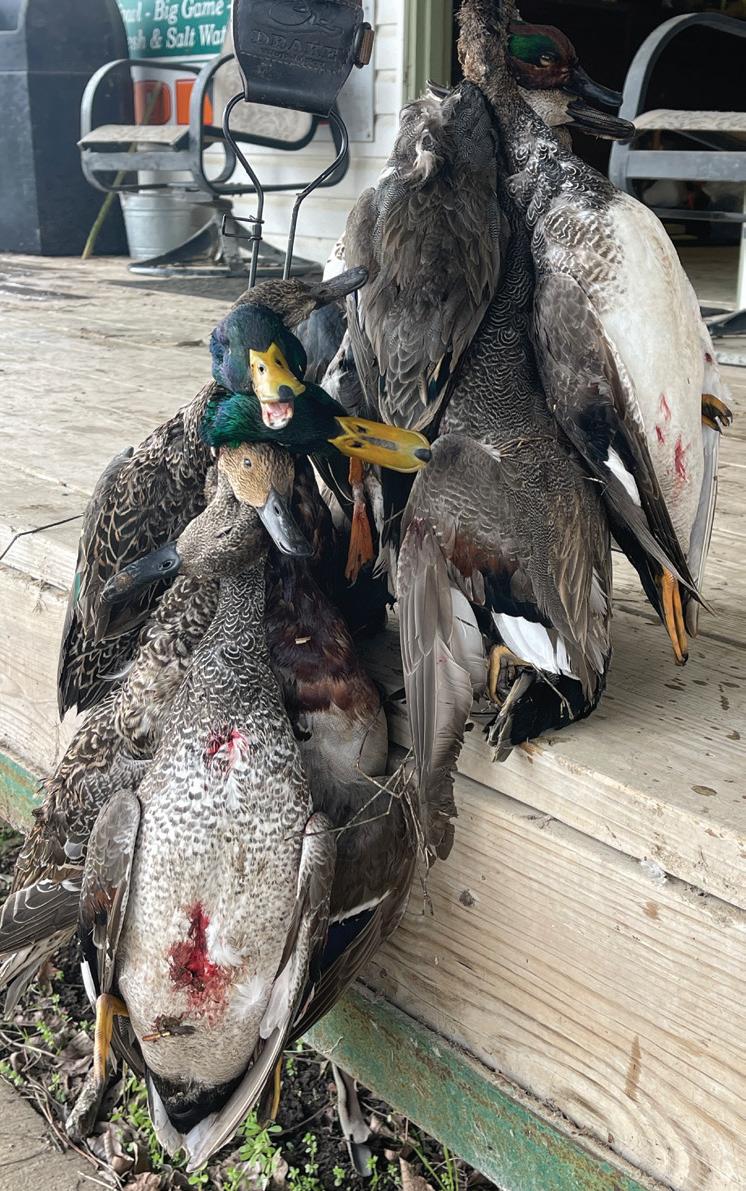
ou gotta love it when a plan comes together… sorta. Contrary to popular belief, or at least contrary to the debates traded over gas station coffee and on tailgates, our duck season has been better than expected. Better than most I have talked to anyway. That did not happen by accident. I believe it happened because we put in the work. We prepped fields and blinds, cut and brushed and covered, tweaked decoy spreads and shooting lanes, and spent more hours than I care to admit thinking through what worked last year and what did not. Not to be the best. Just to be better. And for the most part, the ducks, and the occasional goose, played their part nicely.
Our setup would raise a political eyebrow in today’s divided waterfowling community. The lease sits squarely in the middle of the state, surrounded by ag land, and we hunt flooded ag fields that have been producing birds for longer than most of the debates about how birds ought to be hunted. Coming from someone who grew up chasing ducks in the salt and brackish marshes of southeast Louisiana, from Slidell to Delacroix and all the way down to Venice, I can report with confidence that ducks still move with weather, no matter the zip code. Hard north winds and cold fronts push birds in. Pressure and warming temperatures thin them out. This year followed that script. The difference was that we paid closer attention and made adjustments during the pauses between the shots.
Early in the season, after a cold push, you might get one good hunt, maybe two. Then the birds slid south in smaller flocks, riding that north wind like obedient soldiers. But when temperatures warmed and fewer hunters bothered to show up, something interesting happened. We had some of our best hunts, maybe our best, on a south wind. Birds that pushed south seemed to creep back up along the weather
boundary. South wind hunts meant longer sits. Unlike those blustery north wind mornings that declare themselves before daylight, south winds build slowly.
As they picked up, so did the action. Long days in the duck blind are what I live for. Birds break from migratory discipline, settle in, and start making decisions instead of following orders.
And then there are the geese. Specifically, specklebellies. The true ribeye of the sky for south Louisiana hunters. They are revered for good reason and elusive for even better ones. The cover has to be perfect. The calling has to be convincing. They prefer ag fields, but muddy ones specifically, and getting them to commit over a flooded duck pond is rare, though not impossible. Southwest Louisiana tells a slightly different story, where specks hop from rice field to rice field and opportunities sometimes open between feeds. Here, most of what we see are in V formations, loud enough to raise your heart rate but content enough to pass overhead without ever offering a look.
This year, we tried something new. Our pit blind sits on a levee between two flooded ponds. Mostly as confidence for wary ducks, we placed a handful of full body and silhouette decoys along the levee on both sides. The plan was not to drag flocks out of the sky. It was simpler than that. Maybe, just maybe, a curious single or pair would dip low enough to make a mistake. What I do have going for me is range, or at least the confidence in trying. Growing up hunting pressured birds on public land, with friends just as hungry and a dad who believed you earned your shot, you learned to be ready for getting bulldogged or taking birds at the edge of comfort. Not every hunt, but often enough. Confidence in rangy shots became a necessity at a young age, and it becomes a tool late in the season when stale birds have seen it all.
After weeks of blown opportunities, mostly because confidence outweighed execution, it finally came together. With my son beside me, who has inherited both the patience and the willingness to
tighten the choke and take a chance. A few amateur yodels and some feeding clucks later, one last loop became one fatal miscalculation.
Back home, the plucking began. If the first pulls from the breast do not reveal a lot of shot damage, an often quiet benefit of a long shot, I keep plucking. Not every bird earns that treatment. I save it for the fat ones. The green teal, mallards, pintails, and of course specks. One of ours was nearly perfect.
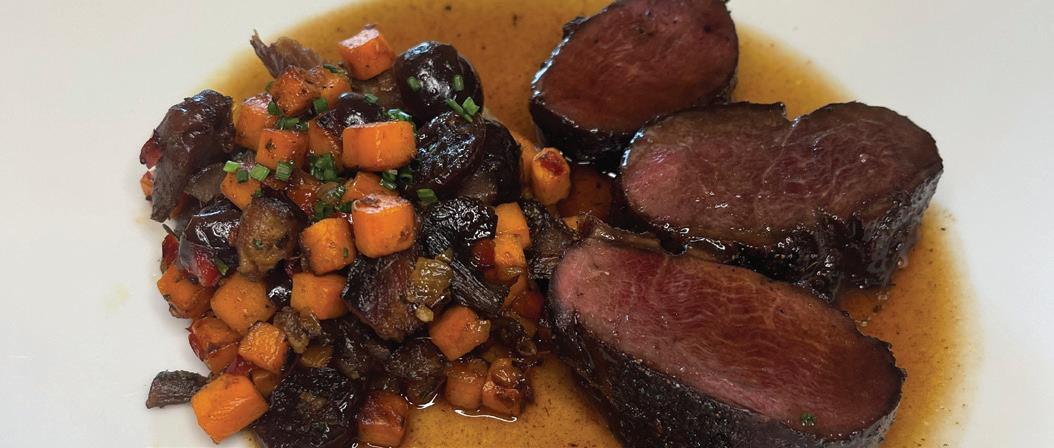
So to honor the hunt, the bird, and the season that led to it, I cooked it accordingly. Five spice seared speck breast, medium rare, with a sour cherry and sweet potato hash built from the legs, thighs, and wings confited low and slow in smoky bacon fat. People always ask how to cook duck or goose without it tasting livery or tough or gamey. My answer never wavers. You have four minutes or four hours. No in between. Either sear it hot and fast or cook it long enough to surrender. This dish does both. It tastes like warm spice, quiet sweetness, and the satisfaction that comes when planning, patience, and a little luck finally share the same table.
FIVE-SPICE SEARED GOOSE BREAST
INGREDIENTS: DIRECTIONS:
• 2 Goose breast - skin on
• 1 Tbsp Chinese five spice
• 1 Tbsp Salt
• 1 Tbsp coarse black pepper
• 1 Teaspoon sugar coarse
In a bowl, combine the Chinese five spice, salt, black pepper, and sugar. Score the skin side of the goose breast with shallow crisscross cuts, taking care to cut only through the skin and fat, not into the meat. Season the breast liberally on all sides with the spice mixture. Heat a sauté pan over medium to medium-low heat. Place the goose breast skin-side down in the dry pan and cook, rendering the fat until the skin is deeply browned and crisp, about 4 minutes. Flip and cook the flesh side for an additional 3–4 minutes. Using an instant-read thermometer, continue cooking until the internal temperature reaches 125°F. Remove the breast from the pan and rest on a cutting board, loosely tented with aluminum foil, for about 10 minutes. The internal temperature should rise to 130–135°F for medium-rare. Slice into 1-inch pieces and serve with the sweet potato hash and sauce.
THE SAUCE INGREDIENTS:
• 1 Tbsp confit fat
• 1 small onion thinly sliced
• 1/4 cup seasoned rice wine vinegar
• 1 Tbsp sugar
• 2 Tbsp luxardo cherry syrup
• 2-3 sprigs thyme
• 1 sprig rosemary
• 1 quart chicken or beef stock
DIRECTIONS:
In a saucepan over medium heat, warm the confit fat and add the thinly sliced onions. Sauté until the onions are soft and caramelized, about 8–10 minutes. Add the rice wine vinegar, sugar, cherry syrup, thyme, rosemary, and stock. Reduce the heat to medium-low and cook, stirring occasionally, until the mixture has reduced by half, about 30 minutes. Strain the sauce, return the liquid to the saucepan, and continue reducing over low heat until glossy and thick enough to coat the back of a spoon.
SWEET POTATO & SOUR CHERRY HASH
INGREDIENTS: DIRECTIONS:
• 2 Tbsp confit fat
• 1 large sweet potato cubed
• 1 small onion diced
• 1 red bell pepper diced
• 2 gloves garlic minced
• 1 teaspoon fresh thyme
• 1/2 teaspoon smoked paprika
• 12-15 luxardo cherries halved
• Shredded confit meat
• Salt and pepper to taste
CONFIT GOOSE LEGS, WINGS,THIGHS
INGREDIENTS:
• 1 Tbsp kosher salt
• 2 Tbsp black pepper
• 1 teaspoon fresh thyme
finely chopped
• 1 teaspoon fresh rosemary
finely chopped
• 2 cloves garlic minced
• 16oz bacon fat
• 3 cloves garlic whole
• 1 sprig fresh rosemary
• 2-3 sprigs fresh thyme
In Cube the sweet potato into ¼–½ inch pieces. In a saucepan over medium heat, warm 2 tablespoons of confit fat. Add the diced onion and bell pepper and sweat until soft and translucent, about 6–8 minutes. Stir in the garlic & sauté until fragrant, 1–2 minutes. Add the cubed sweet potato and cook, stirring frequently, until just tender and lightly caramelized, about 10–12 minutes. Stir in the thyme, smoked paprika, sour cherries, and shredded confit meat, and continue cooking for another 5 minutes to warm through and meld flavors. Season to taste and serve warm.
DIRECTIONS:
Season the goose legs, thighs, & wings by mixing the kosher salt, black pepper, chopped thyme, chopped rosemary, and minced garlic in a bowl, then rubbing the mixture evenly over all sides of the goose. Place the seasoned pieces in a nonreactive dish, cover, and refrigerate for 4–6 hours or overnight to cure. Once rested, rinse off the seasoning mixture and pat the goose dry thoroughly. Return the pieces to the nonreactive dish and pour the warmed bacon fat over them, ensuring they are fully submerged. Add the whole garlic cloves along with the rosemary and thyme sprigs, cover tightly with foil, and slow roast in a 200–225°F oven for 4–6 hours, until the meat is tender and silky.
IWinter Is My Season
When Southeast Louisiana Turns Cold, I Launch Anyway
t is 42 degrees, and the wind is blowing 20 to 30 mph. Typical winter in southeast Louisiana. Some dummy is launching a kayak off the side of the road. Wait. That is me.
The average temperature in our area is about 70 degrees. We spend about half the year living in a sauna. There is nothing like walking outside at 3 a.m. and sweating when it is 90 degrees with 90 percent humidity. Many people will not fish because it is too hot. Really.
by Jack Hickman
Then we get about four months when it is actually tolerable all day, spring and fall. And then there is January and February. Winter, as we call it. You cannot call it hell, because it is hot in hell, but winter is miserable in its own way. The same people who say it is too hot in the summer also say it is too cold in the winter, so they watch sports. I make my own entertainment.
PREPARATION IS EVERYTHING
Preparation is everything. Staying warm and dry is the most important part of winter fishing. I am wearing Royal Shrimp boots with high quality wool, wicking socks. You have to stay dry to stay warm, and kayakers typically step in the water to launch. My PVC bibs are tucked into the boots.
“The same people who say it is too hot in the summer also say it is too cold in the winter, so they watch sports.”
PVC never needs treatment and is completely windproof and waterproof. I bought a premium set with a lifetime warranty. Under the bibs, I wear thermals and fishing pants. Up top, I have a long sleeve performance shirt, a medium fleece layer, and a hooded windbreaker. My gear is reasonably loose, as loose as it can be on a fat guy, which keeps my mobility intact. My seat puts me about ten inches off the water while fishing, and anything can happen, so mobility matters.
LAUNCHING INTO THE COLD
There is nothing quite like dreading the moment you get out of a warm truck to literally get in the water. It makes you question why you woke up at 4 a.m. and drove an hour and a half. Then the kayak is out of the truck, and you are pushing off the bank. A 20 plus mph wind immediately starts pushing you away, and I find myself pedaling into first light. I purposely choose areas with deep holes that offer some protection from the wind and anchor with the wind at my back. All of this is pre planned. I put on disposable nitrile gloves to keep my hands dry. The added bonus is that they block the wind and stay warm. I plan to catch fish, and I must keep my hands dry to stay warm.
SLOW FISHING AND SMALL WINDOWS
A few casts with a jighead later, the plan works. I catch fish. It does not matter what kind or whether they are slot fish. I am entertained. I am watching a beautiful sunrise. I see bait flipping on the surface. I watch birds hunting. I sip hot coffee in relative comfort and live large.
January weather had given me two such days of fishing, no more. I am deprived, and I have little doubt February will be much the same. I will bide my time and choose windows that might bring success, because I am far more entertained by success than failure.
On very cold days, I look for deep holes. The bottom holds its temperature, and fish will congregate there to survive. Where fish gather, bait follows, and predators are not far behind. Both January trips
were productive, yielding plenty of slot trout and redfish, including a trout over 20 inches on each trip and some fine meals. I credit slow jigging for that success, and I mean real slow.
SAFETY, COMFORT, AND WHY IT MATTERS
The key is to pause a few seconds after your bait hits the bottom, then barely jiggle the rod tip. Cold blooded predators are not very frisky this time of year. When you think you are going slow, slow down even more until you find the rhythm they are feeding on. I tend to speed up after catching a few fish and have to calm myself and refocus to keep the bites coming.
If we get a few warm days, look for flats near deeper water. Fish will slide up to warm themselves, especially on sunny days. I will still start with jigheads and soft plastics, but I will also mix in jerkbaits and slow falling twitch baits. Once again, slow is the key in cooler water. The marina basin at Myrtle Grove offers everything you need in cold, windy weather.
The basin is deep compared to the surrounding marsh and is a well known winter spot. There are also deep canals off Highway 23 and LA 1. Hopedale has deep bayous and the dead end at MRGO. There are plenty of great cold weather fishing spots in our area. If you are not an experienced kayaker, I would not push it in the winter. Small mistakes can put you in the water quickly.
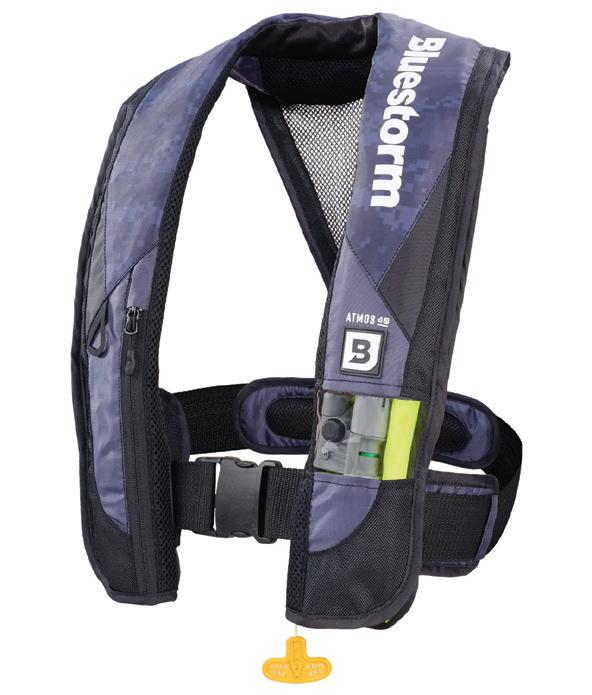
I am very experienced and ex tremely careful. I wear a Bluestorm inflatable PFD with 40 pounds of flo tation, far more than most, because I respect and fear the environment. My clothing is premium for the same reason. Comfort and safety are non negotiable. Nothing matters more on the water than staying safe and staying comfortable. I am praying the weather improves soon, because I am dying to go fishing. I will see y’all on the water.
Join the Kayak Fishing Community! Want to learn more and meet fellow anglers?
Bayou Coast Kayak Fishing Club and Lafayette Kayak Fishing Club host tournaments in all these areas and more. These events are about the fishing and camaraderie, not just the prizes. You’ll learn more at a weigh-in than I could ever explain, and you’ll likely meet some new fishing buddies to swap stories with. Good luck, and hopefully, I’ll see you on the water!
FRIGID FEBRUARY
Fishing one of the toughest months of the year.
February can have its moments, but it is typically one of the more difficult months of the year to fish. It is often when I put the boat on the trailer and take advantage of slower days to handle maintenance. Even so, I still make trips to the Chalmette and Violet areas, which consistently produce during the dead of winter.
Wby Chas Champagne
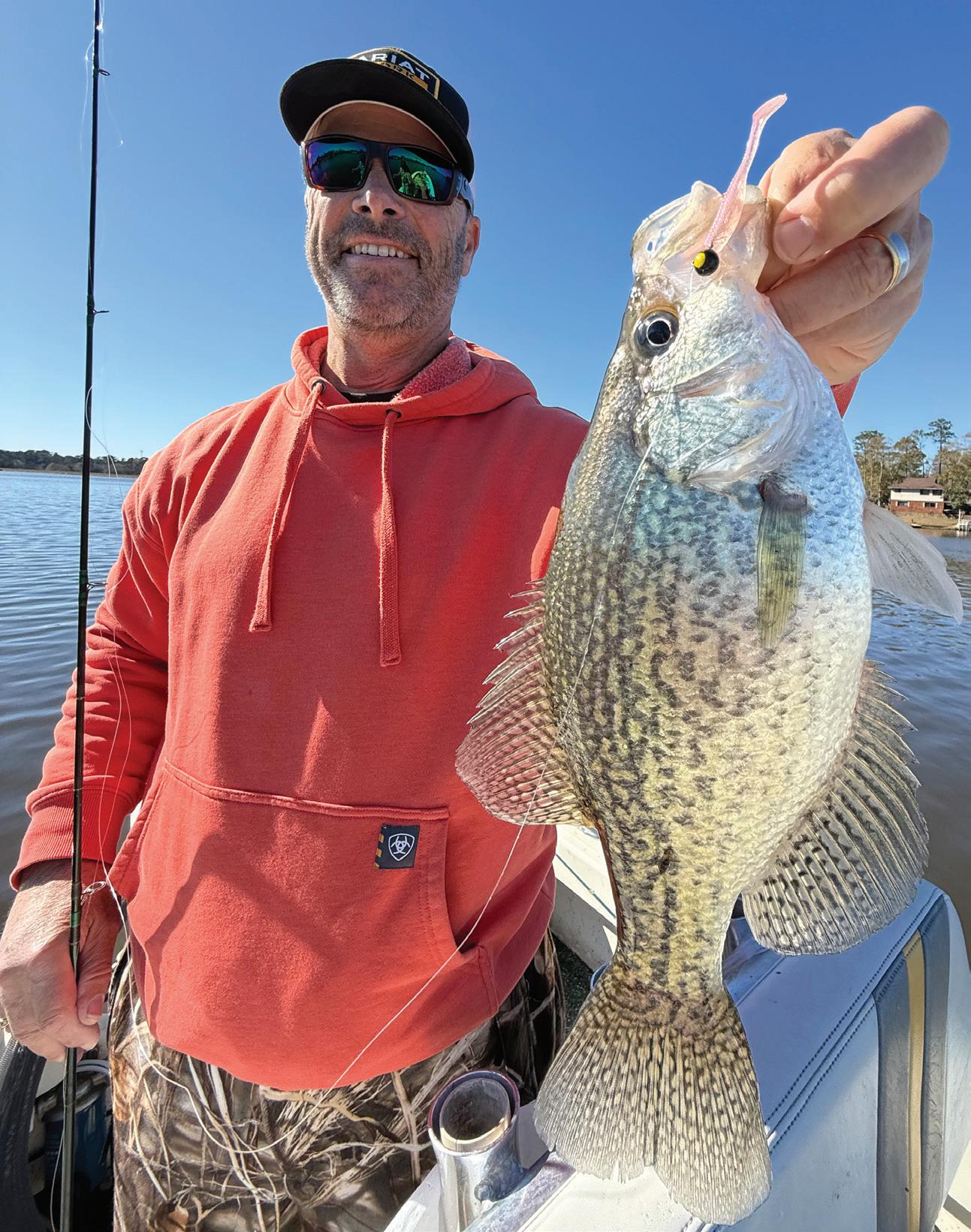
hen the crowds in Chalmette get heavy, I pivot to one of my favorite winter targets, sac a lait, better known as crappie. Anyone who follows our Dockside TV episodes knows these are our favorite fish to chase year round. Crappie are aggressive freshwater predators that school tightly and feed heavily on minnows and shiners. They are exciting to target and, in my opinion, the best table fare you will find anywhere. While the coastal fishery slows from January through March, crappie fishing peaks. Cold water does not bother them. When low temperatures shut down many species southern anglers usually chase, crappie seem to get fired up. I have had outstanding days on the Pearl River catching crappie in water as cold as 47 degrees. Speckled trout can still be found around bridges but usually need a warming trend, especially after a cold January. Reds remain a strong option, particularly the day after a front when they stack up at the locks around Chalmette. Jerk baits along the MRGO rocks are always a reliable winter play. February is also one of the least crowded months on the water. Do not put the poles up this month, but do not burn your sick days either.n When targeting crappie, water temperature and spawning behavior dictate everything. Much of what I know comes from my good friend Brian Baldwin, known as the crappie whisperer. During extended cold spells, crappie hold deep. In these conditions, we avoid corks and focus on jigging deeper water from 8 to 25 feet.
one eighth to one sixteenth ounce, going heavier in river systems with stronger current. We drift deeper lakes, vertical jig once schools are found, and troll to locate scattered fish. That sharp thump from a crappie is addictive. As water temperatures rise and the spawn begins, the bite shifts shallow and cork fishing becomes effective. White crappie push very shallow and favor stained water, while black crappie stay slightly deeper in cleaner water. Cork depth is critical because crappie feed upward. Fluorocarbon leaders are important due to their excellent eyesight.
after the spawn when fish stay tight to the banks. Crappie can be unpredictable, sometimes stacked on structure and other times suspended in open water. One constant is their use of structure such as bridges and brush piles.
Long jig poles are another key tool, allowing anglers to place baits precisely in tight spots, especially in river systems when corks are not producing. For a closer look at these techniques, check out our Dockside TV crappie and sac a lait videos on YouTube. February may be tough, but with the right approach, it can still be one of the most rewarding months of the year.
We typically use Matrix Minis on jigheads from
Small spinners tipped with a Matrix Mini can also be deadly
Check out my YouTube channel for more tips and current conditions
Local angler, Barrett Marz with a huge slab he caught while jigging deep water in January.
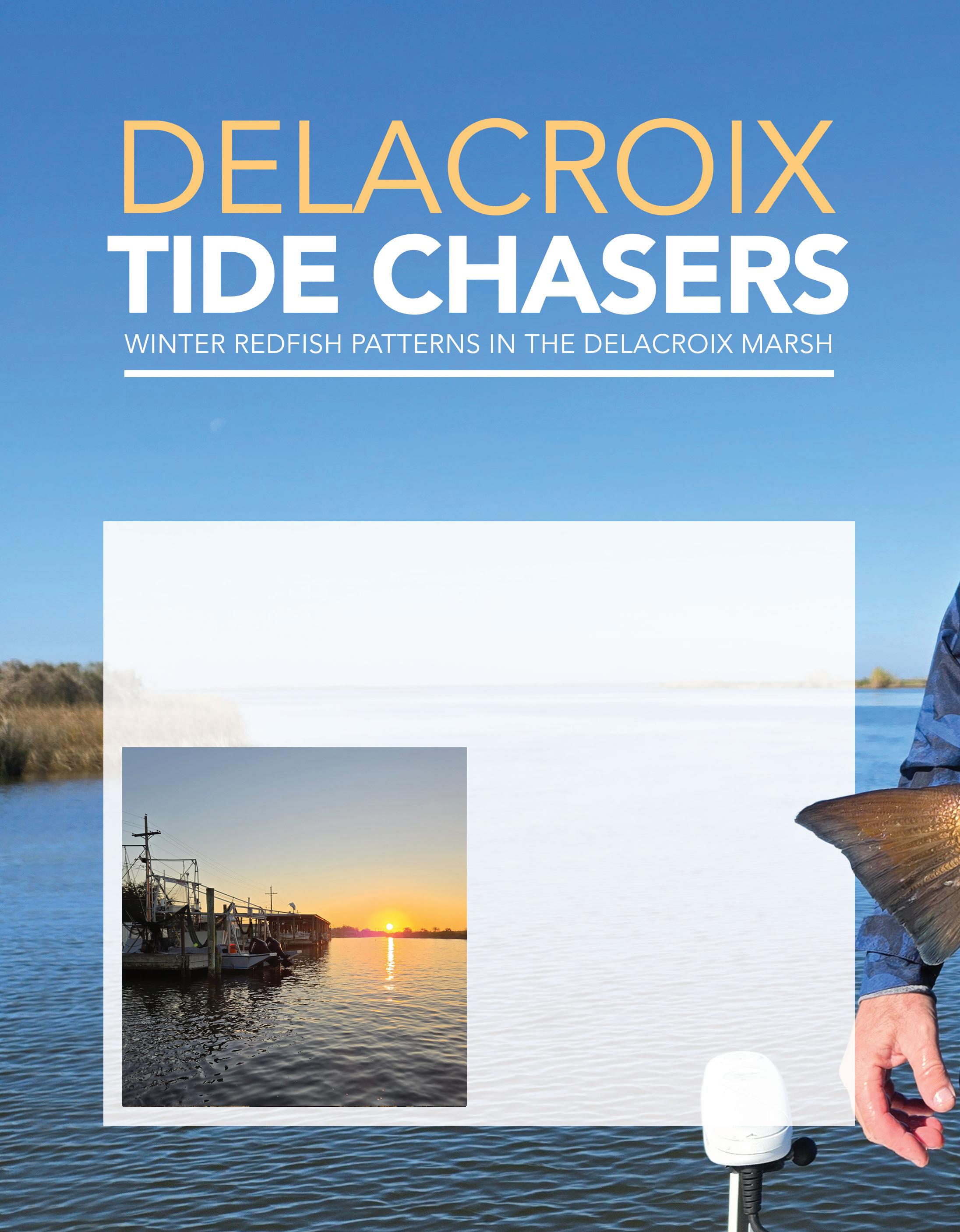
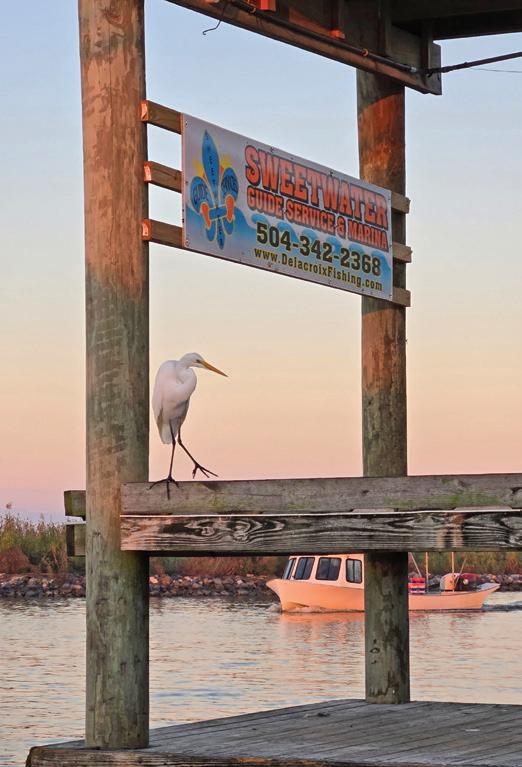
Winter fishing in the Delacroix marsh is rarely about luck. It is about timing. Cold fronts, short daylight windows, and stubborn tides force anglers to pay close attention to water movement. On days like this, success comes from following the water rather than forcing a spot. That morning, as the boat eased away from Sweetwater Marina, Capt. Jason Williams had one simple plan. Chase the tide until it started moving.
Every winter, redfish position themselves where ponds and drains empty, waiting for falling water to deliver bait. Even subtle tidal movement can turn quiet marsh into a feeding lane. The challenge is finding that movement and staying with it as it shifts through the marsh.
As Capt. Jason Williams of Jason’s Saltwater Guide Services eased away from Sweetwater Marina, he explained that winter redfish often stack at the mouths of ponds and drains when water begins to
fall. Even on days with limited tidal range, that slight movement is often enough to trigger feeding.
by Ray Huntz
“Our plan today is to get back into the marsh where a couple of ponds empty,” Capt. Jason said. “This falling tide should have redfish stacked at the mouths of those ponds. We do not need much tide to get them fired up.” After idling down the bayou, Capt. Jason brought the boat on plane and wound through the Delacroix marsh. About twenty minutes later, he slowed as we entered a small lake where two ponds emptied side by side. He dropped the trolling motor and quietly positioned us near the drains.
“When I fish back here in winter, it is usually on a day like this,” he explained. “A little breeze and mild temperatures keep redfish shallow. I fish live or dead shrimp on a jighead about a foot and a half to two feet under a cork. When the water temperature drops below fifty two degrees, redfish move into deeper holes. As long as it stays above that, they will feed shallow once the sun gets up.”
Even when redfish move deep, Capt. Jason noted that they continue feeding because deeper water holds warmth. He compared it to the well known redfish concentrations near Shell Beach, where fish settle into deep holes and eat whatever the tide delivers.
At the first stop, the tide had not yet started moving. The water remained slack, with only a light breeze pushing water along the bank. After twenty minutes without a bite, the wind died and the surface turned slick calm.
Capt. Jason decided it was time to keep chasing the tide. “We have to have water movement, either tide or wind, but preferably tide,” he said. “Moving water is the most important thing I look for whether I am fishing for redfish or trout. It activates the bait and makes fish aggressive. Clean water helps, but moving water matters more.” We headed southeast toward Hopedale in search of current. Twenty minutes later, we entered another small lake that narrowed into a bayou.
“This choke point forces water through before other areas start moving,” he explained. We worked the bank and the point where there was just a hint of current, but the fish did not cooperate. We continued southeast, stopping at several more choke points, but the tide still refused to show itself.
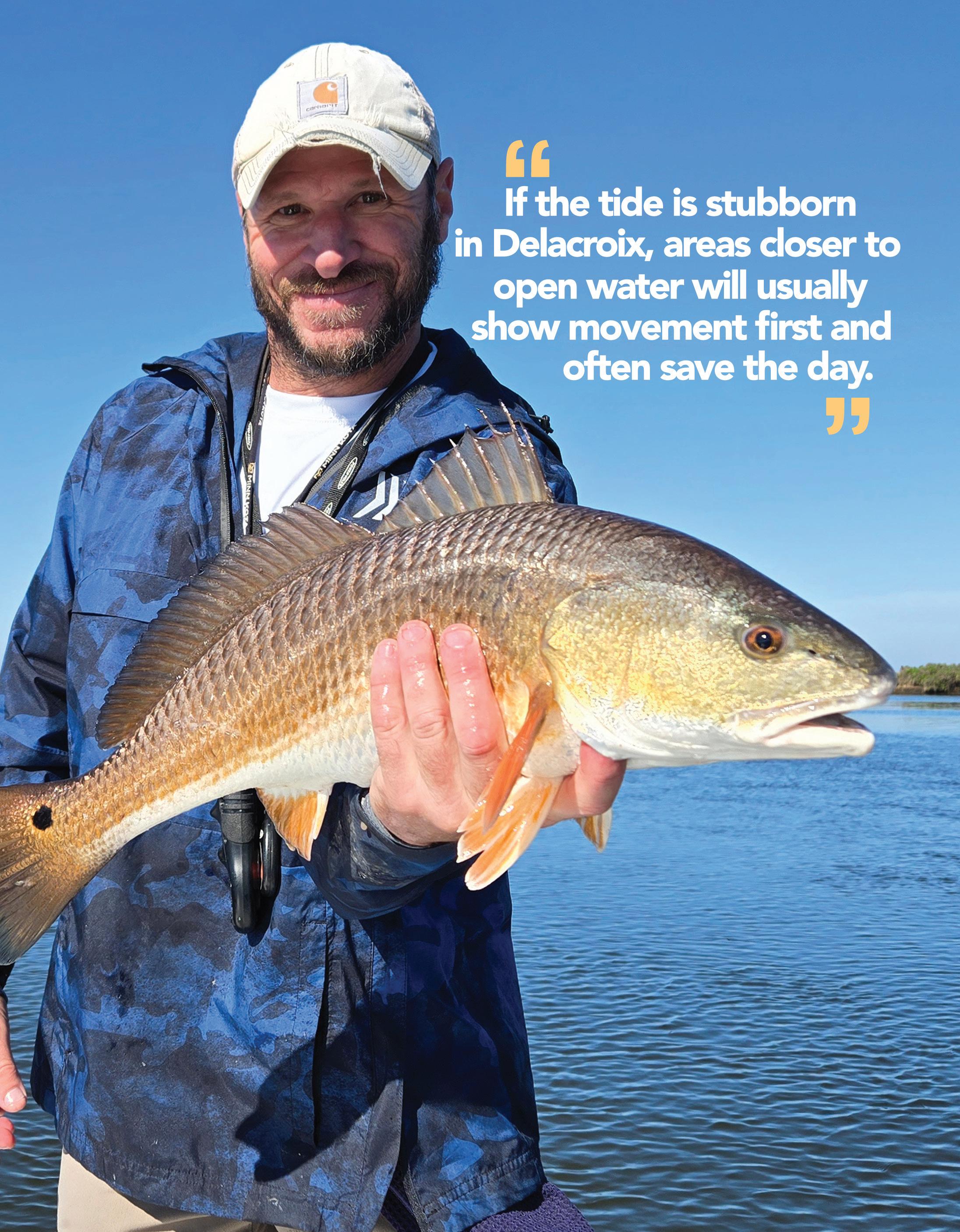
“We are heading farther south now,” Capt. Jason said. “There is a canal closer to open water that snakes into an inner lake. When the tide is stubborn in winter, this place usually saves the day. It has ponds, drains, and trenasses emptying into it, and it almost always holds redfish.”
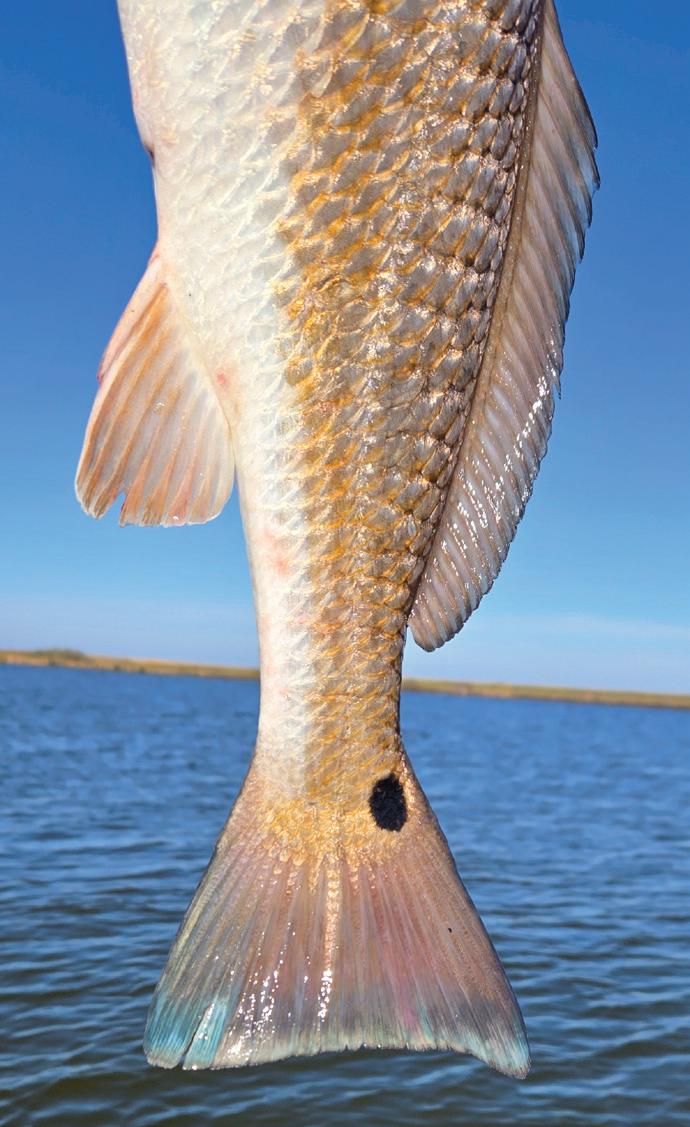
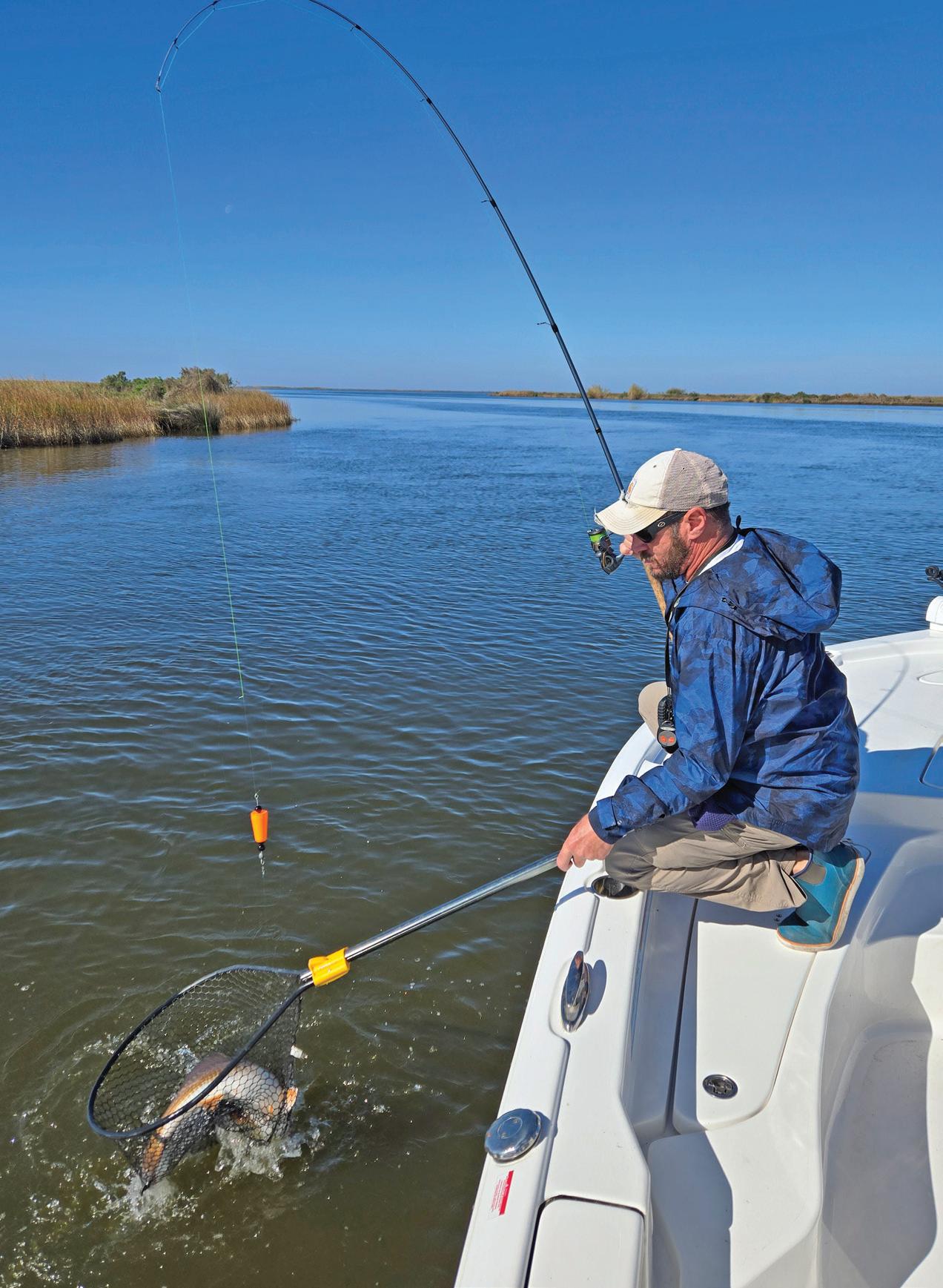
Fifteen minutes later, he crossed a large lake and entered the canal. He slowed the boat, cut the engine, and dropped the trolling motor. “You can see the tide moving through here,” he said, pointing along the shoreline. “This is what I look for. Pond drains, trenasses, points, and wind pushed banks. This falling tide should have redfish stacked along this flat and sandbar. I can already see them pushing bait.” We started casting, and on our second casts both corks disappeared. The sound of drag peeling confirmed solid fish. After a few minutes and a couple of scoops with the net, two redfish were on the deck, one measuring twenty two inches and the other nineteen. “There is plenty of bait here,” Capt. Jason said. “You can see redfish all along this bank. We are just going to move and fish each opening.”
At the next drain, redfish were clearly visible in two feet of clean water. We cast along the shoreline and watched both corks disappear again for another double hookup. Soon, an almost nineteen inch redfish and a solid twenty one inch fish were added to the box. While Capt. Jason retied a hook swallowed deep by a fish, I cast ahead of a small group chasing bait. My cork disappeared immediately. After a strong fight and several runs,
a twenty three inch redfish slid into the net. On his next cast, Capt. Jason landed a twenty two inch redfish. With fish still visible along the flat, he put the trolling motor on spot lock. We each needed one more fish to reach our limits.
It did not take long. Capt. Jason hooked a powerful twenty four inch redfish that made several strong runs before coming to the net. With his limit secured, I cast toward a group of fish pushing bait tight to the bank. A twenty one inch
redfish crushed the shrimp and was quickly brought to the net.
Just like that, we were done.
“Every spot we stopped at earlier holds fish when the tide is right,” Capt. Jason said. “Once we found it today, it only took about thirty minutes to limit out. In winter, weather does not matter nearly as much as fishing the tide. If you fish moving water, you are going to catch redfish.” With that, he cranked the engine and we headed back toward Sweetwater Marina, having done exactly what winter fishing in Delacroix demands. We chased the tide until it finally paid off.
Capt. Jason Williams has fished St. Bernard Parish his entire life and knows where redfish and trout set up throughout the year. In addition to fishing, he also guides duck hunts in Delacroix. He enjoys explaining what the fish are doing and why certain areas produce, and he brings an easygoing approach that makes every trip enjoyable.
To book a Louisiana fishing, duck hunting, or blast and cast adventure, contact Capt. Jason Williams with Jason’s Saltwater Guide Services at 985 507 7644. Trips book quickly. Follow Jason’s Saltwater Guide Services on Facebook and Instagram for fishing and hunting updates.
FOLLOW THE OUTDOOR AND CULINARY ADVENTURES OF RAY HUNTZ ON INSTAGRAM AT @MARSHWHISPERER AND @DEUXGARSBIZARRES.
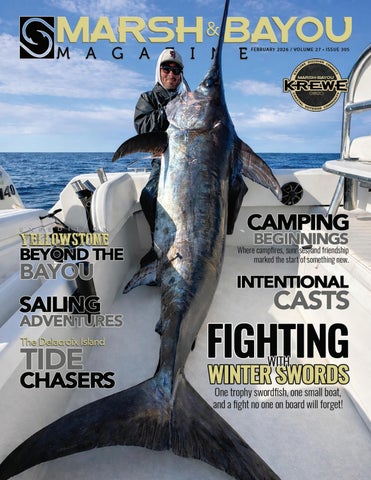
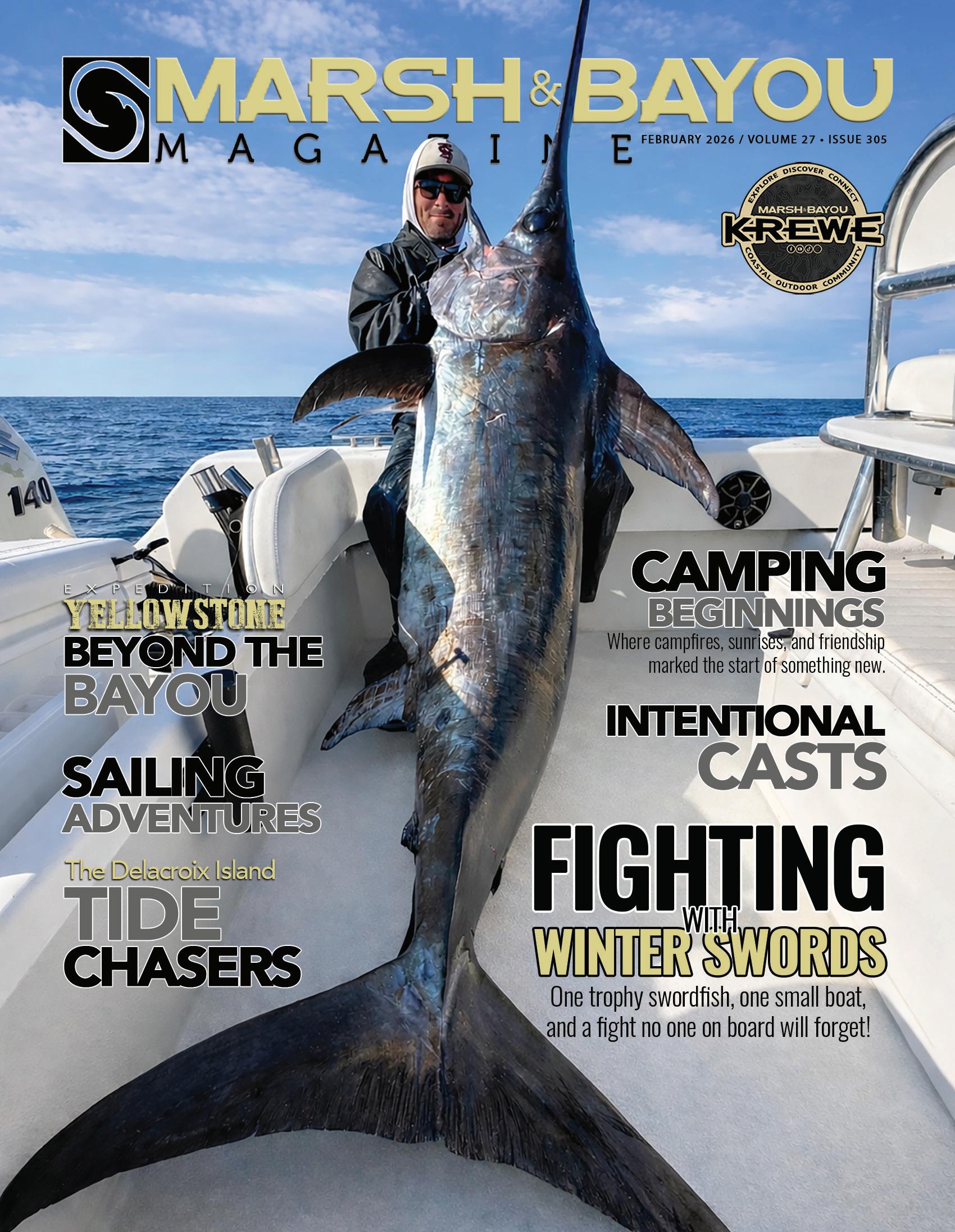
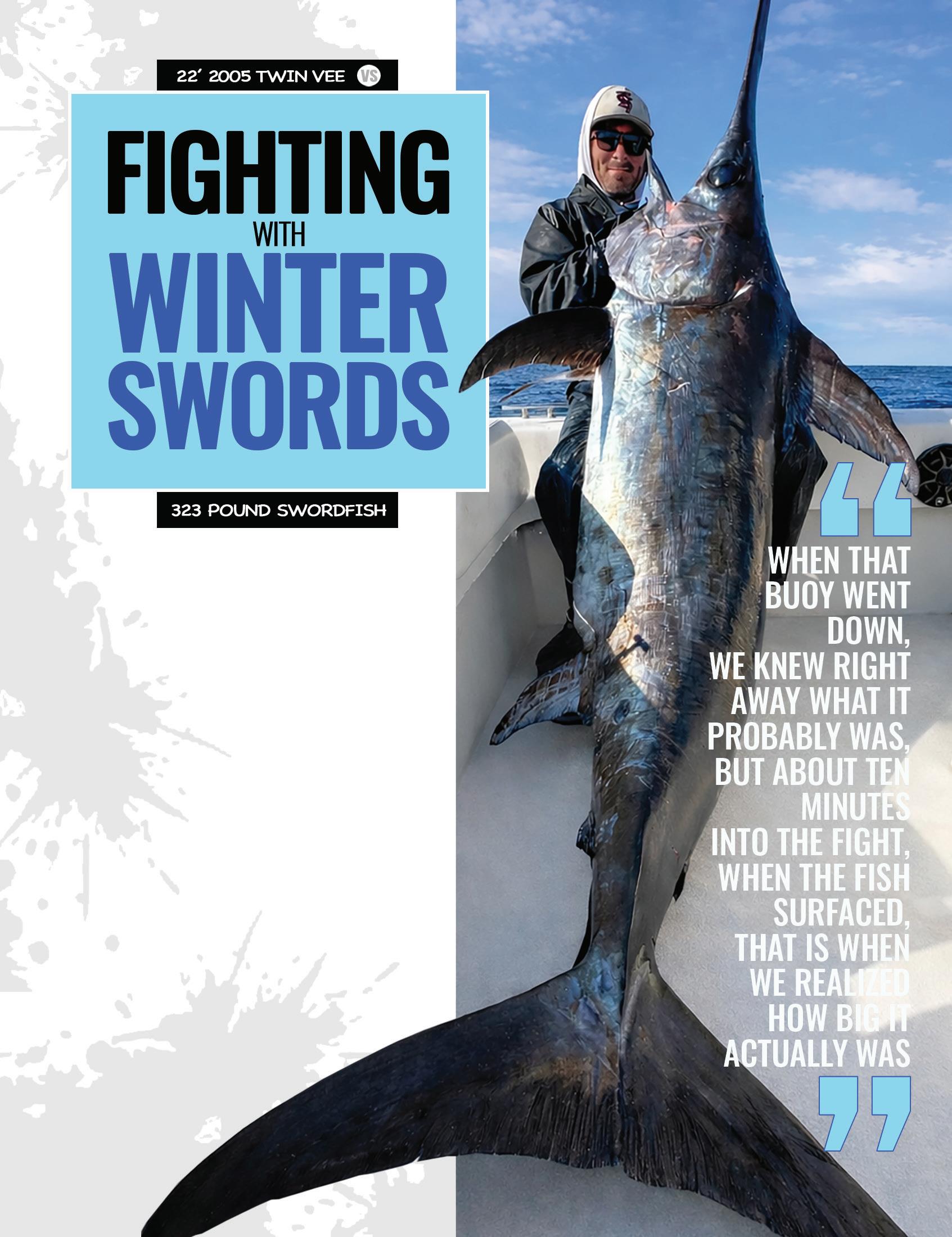
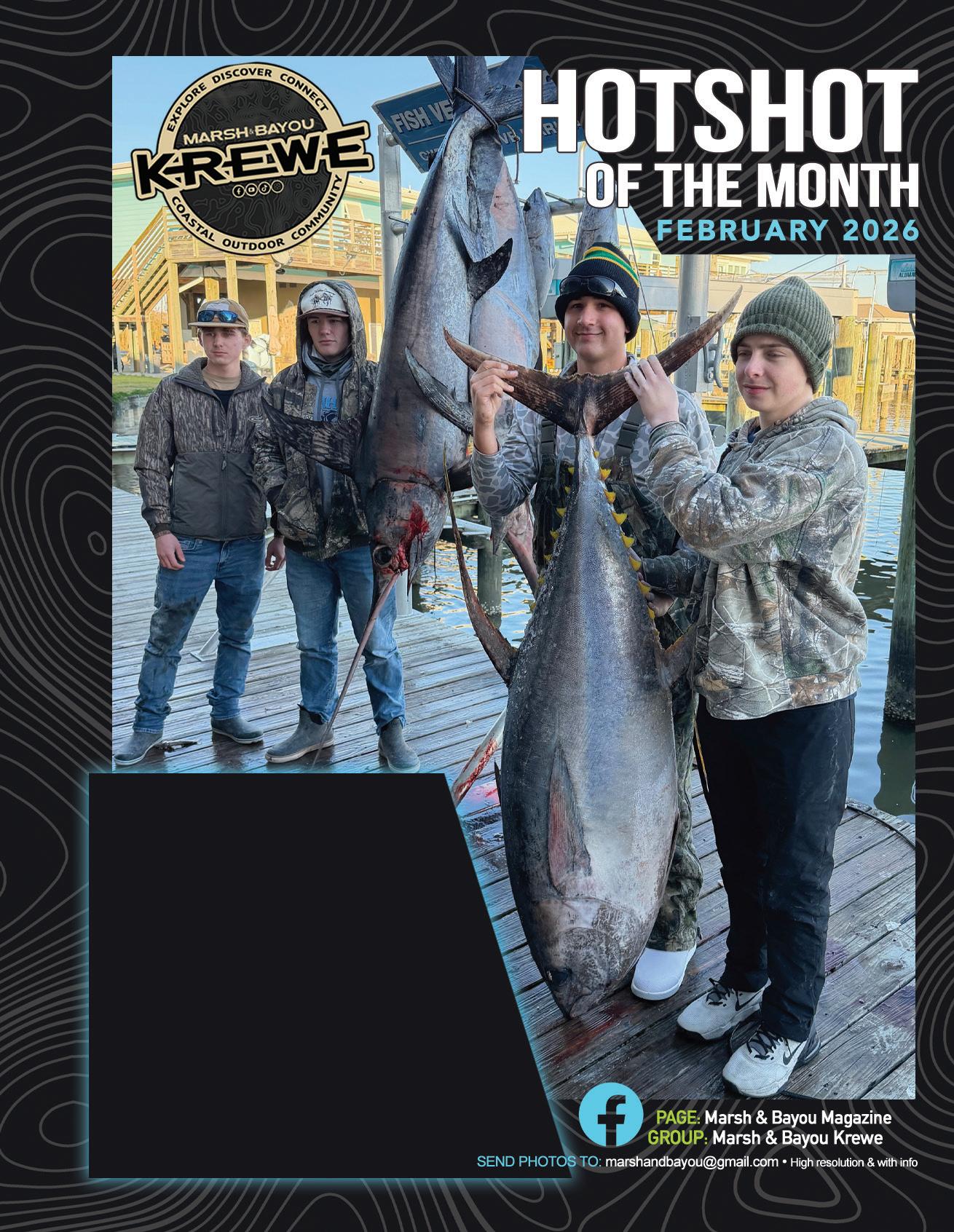
ONE TROPHY SWORDFISH, ONE SMALL BOAT, AND A FIGHT NO ONE ON BOARD WILL FORGET!
Captain Seth Ward of Ocean Springs has spent the majority of his life on the water. His father, Chris, owns and operates Sea Tow South Mississippi, and Seth has been involved with its operations since he was eight years old. When he is not working, Seth is usually fishing or boating. Being on the water is not just his livelihood or passion, it is his way of life.
Seth’s experience on the water would prove invaluable as he and four friends departed Venice’s Fowl Hooked Lodge in the pre dawn hours of January 14. The friends headed offshore in Seth’s 2005 22 foot twin engine Twin Vee. By 8 a.m., they arrived at their fishing grounds, and everyone was eager to catch their targeted species, swordfish.
by Colleen Orfanello
The seasoned crew deployed their usual daytime swordfishing gear, two rods designed to fish in extreme depths without tangling. One was their tip rod, a Talica 50 matched with a Check N Bottom daytime swordfish rod, dropped straight to the bottom and kept vertical throughout the drift, baited with a large squid. The second was the buoy rod, a Daiwa Tanacom 1200 paired with a light current broadbill bouncer rod, rigged with a skirted bonita strip. A buoy clipped to the line allowed the
bait to fish at deeper levels while drifting away from the boat. The process and setup were familiar. The crew had done this before. They had caught swordfish over 250 pounds and knew the possibilities were ripe to boat another. They were patient, but also keenly aware that at any time a monster fish could take their line and run, and they would need to spring into action. They did not have to wait long. Shortly after 9 a.m., the buoy laid over. “When that buoy went down, we knew right away what it probably was,” Seth said. “But about ten minutes into the fight, when the fish surfaced, that is when we realized how big it actually was.”
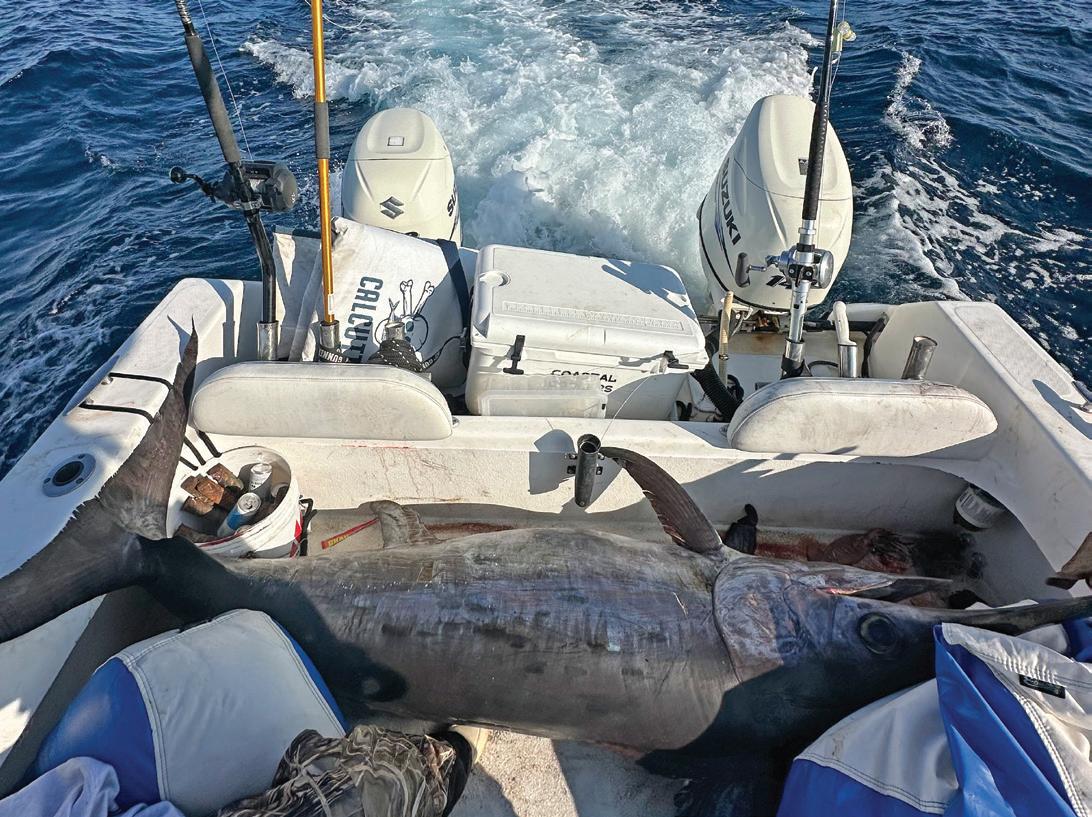
What followed was a nearly five hour battle that tested every ounce of patience, strength, and teamwork on board. The angry swordfish made multiple runs, each diving 600 to 800 feet back into the depths, and breached several times, a sight few anglers ever witness, especially from a small, older catamaran. Seth, age 27, drew from his previous experience catching large gamefish and was careful as he worked the lines. After seeing the size of the swordfish when she breached, he knew there was a high probability of losing the fish. Still, he remained optimistic, and both he and the fish fought hard. Then came the complication no captain ever wants. One of the Twin Vee’s lower units failed, causing the port motor to shut down. Without the ability to turn sharply or apply full horsepower, positioning the boat around the fish became significantly more difficult. “We lost a lot of maneuverability,” Seth explained. “Not being able to swiftly manipulate the boat to chase the fish made it harder than normal, but we were able to overcome it.”
Experience made the difference. This was not Seth’s first encounter with a monster fish, nor was it his first time facing mechanical breakdowns. His many years responding to emergencies
with Sea Tow had trained him to stay calm and adapt under pressure, even while dealing with a disabled engine and the possibility of losing the fish. Although his father is an owner and Seth is an employee of Sea Tow Mississippi, Seth also carries a membership. Because he fishes outside of his franchise area, he relies on nationwide assistance if he gets into a jam. Seth contacted Rob Buck, owner of Sea Tow West Bank, who happened to be on call that day. Rob headed out in frigid temperatures to help. He knew Seth was 28 miles from South Pass and operating on one engine in a heavily weighted boat. Fuel would be required to make it back to Venice Marina. Rob and Seth arranged a 5:45 p.m. fuel drop at Port Eads. With a game plan in place and a safe return now pos-
sible, the fight with the swordfish continued. Hours later, the exhausted fish and fishermen reached a turning point. Seth prevailed, and the battle finally came to an end. Seth and two of his buddies managed to gaff and drag the massive fish over the side of the boat. Once secure on deck, the sight of the swordfish caused everyone on board to yell and high five. “We knew it was a giant swordfish,” Seth said, “but we did not realize yet that we had a state record worthy fish.”
Just before 6 p.m., Seth’s boat hobbled into Port Eads while Rob began the fuel exchange. One can only imagine the scene as Rob’s large Twin Vee met Seth’s smaller, disabled vessel. Had the tow occurred during daylight, a photo of an older boat carrying five anglers and an enormous swordfish would have been priceless. But with darkness settling in and cold temperatures setting the tone, the focus remained on safely towing the boat rather than admiring the catch. With 15 knots of speed and six miles to go toward Venice, Seth’s remaining engine failed. Seth quickly rigged a bridle, and Rob took the boat fully under tow while maintaining 10 knots. As Rob entered the Head of Passes, he radioed his entry into the Mississippi River with a vessel in tow. Sea Tow signal lights flashed as Rob confirmed via AIS that no river traffic was within 10 miles in either direction. Anyone who has navigated the river at night understands the danger. With
total darkness and navigation guided only by GPS and radar, Rob safely towed the Twin Vee across the shipping lanes and into Venice Marina shortly before 9 p.m.
With the tow complete, Rob finally took a look at the massive swordfish. “Very impressive,” were his words. Rob suspected the fish would break records and was curious about the final weight, but with another fuel stop and a long trip home ahead of him, he departed before the fish was weighed.
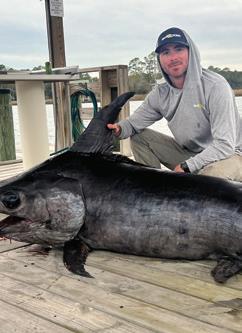
Sea Tow operates 24 hours a day. Sometimes their captains are the ones responding to calls, and other times they are the ones who need assistance. It is a strong bond among the Sea Tow family. “Never leave your wingman,” Rob said as he headed out. The crew and onlookers gathered as the massive fish was raised onto the scales. The display stopped at an astonishing 323 pounds. Sadly, due to the use of electric reels, the fish was disqualified from state record consideration. Last year, Thibodaux angler Lee Graftin also landed what could have been a record swordfish, but his fish was disqualified for the same reason. While Seth and his crew were aware of Louisiana record holder Thomas Dantin’s 310 pound swordfish caught in Mississippi Canyon 46 years ago, Seth emphasized that records were never the goal. “Records are not what you fish for. They are just what happens when preparation, teamwork, and opportunity all line up.” Still riding the adrena-
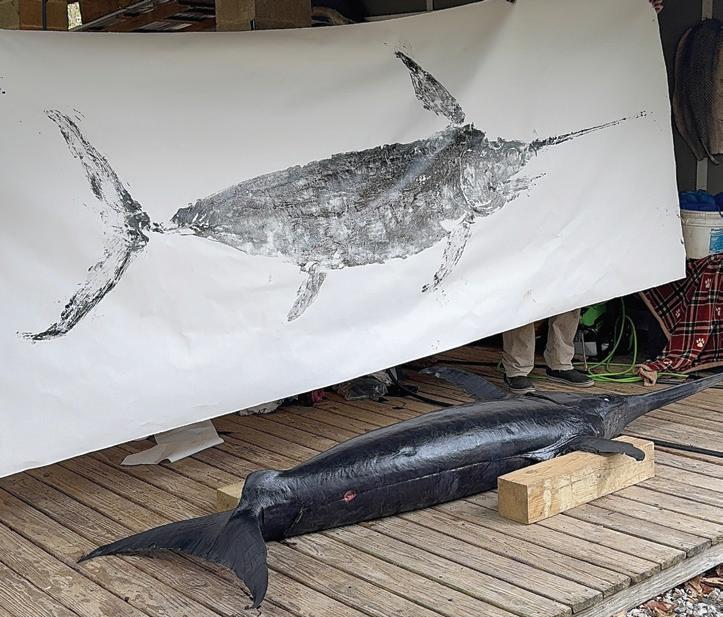
line, Seth and his friends returned to Fowl Hooked Lodge, owned by Jacob Alexander, one of the anglers on board. Seth later commissioned a traditional Gyotaku fish print by artist Craig Brumfield to preserve the details of the swordfish before it was harvested. The artwork will hang as a lasting tribute to friendship, determination, and teamwork.
The meat from the fish was shared with family and friends.
When asked if he had any final thoughts, Seth said, “The catch was not about the weight or the record. It was about trust in my friends, confidence in my skills, and respect for a fish that fought the good fight. Oh yeah, and tell everyone to get a Sea Tow membership.”
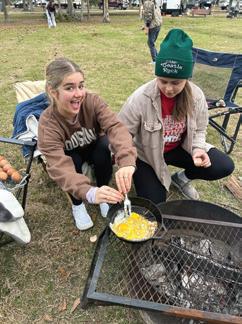
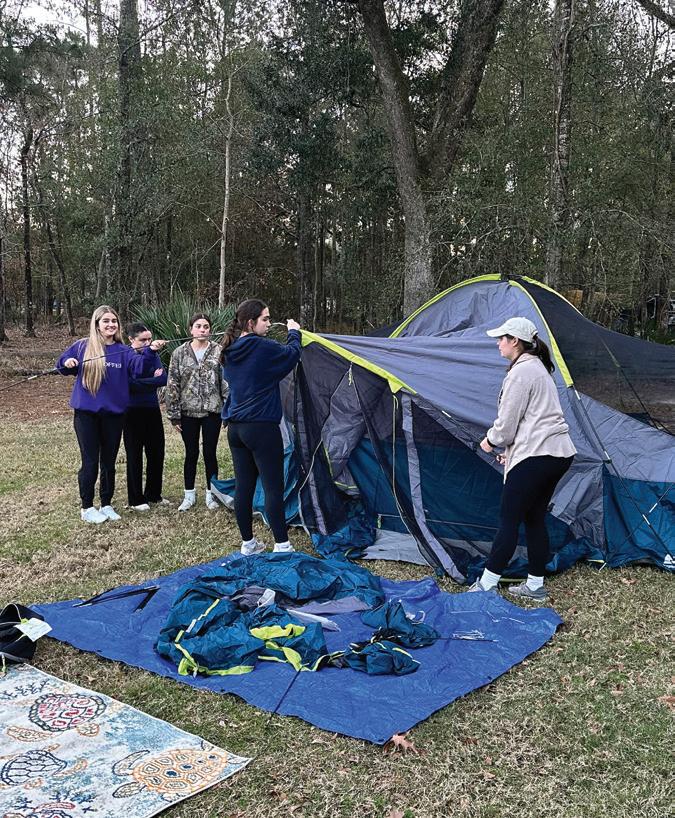
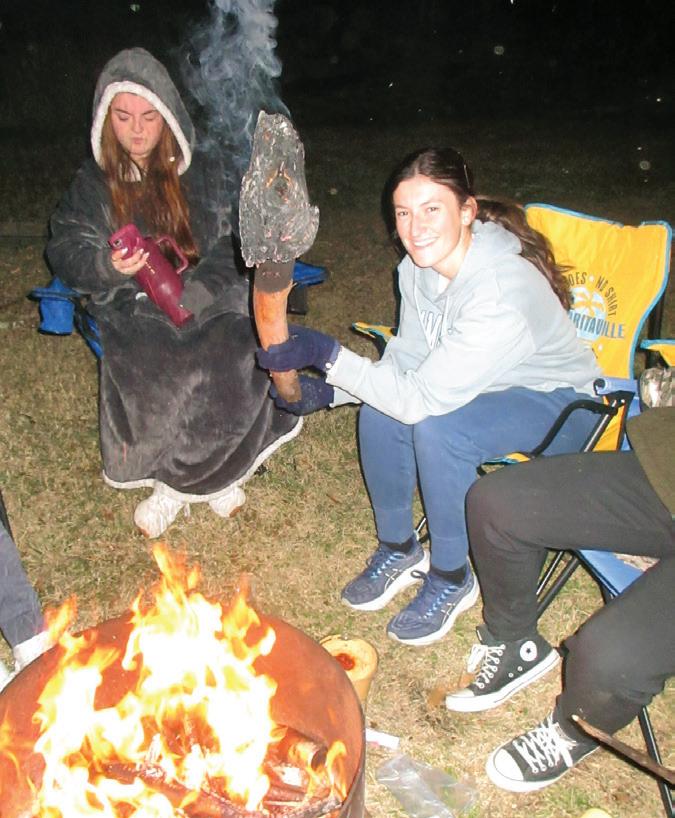
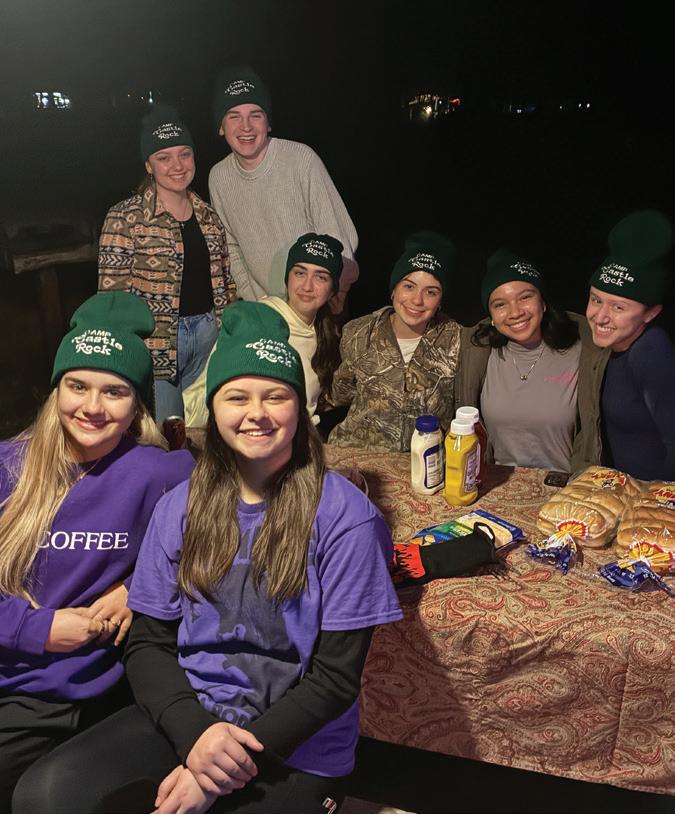
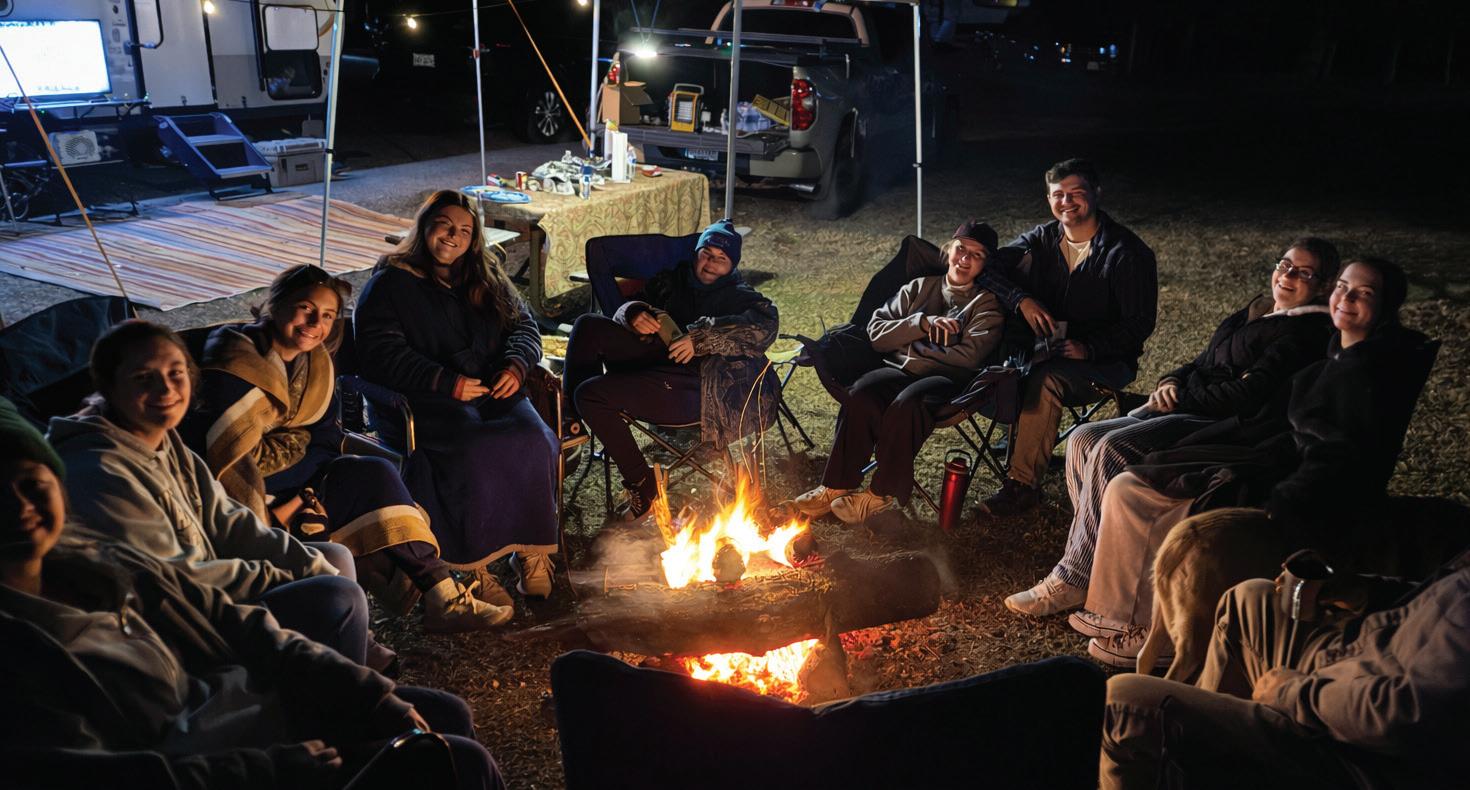
This special trip was in celebration of the one and only Millie T’s birthday, and I cannot thank her enough for introducing me to the camping experience. Our first night began with a group of nine, hot dogs cooked over the fire, and meaningful bonding time without our phones. Since the first night often sets the tone for a trip, we spent hours playing games, hosting a talent show, and talking about everything we hoped to do over the weekend. As the night slowly wound down, we prepared for our first night in the tent. Many of us were exhausted, so the conversations ended early once we left the fire and headed to bed
Boisdore
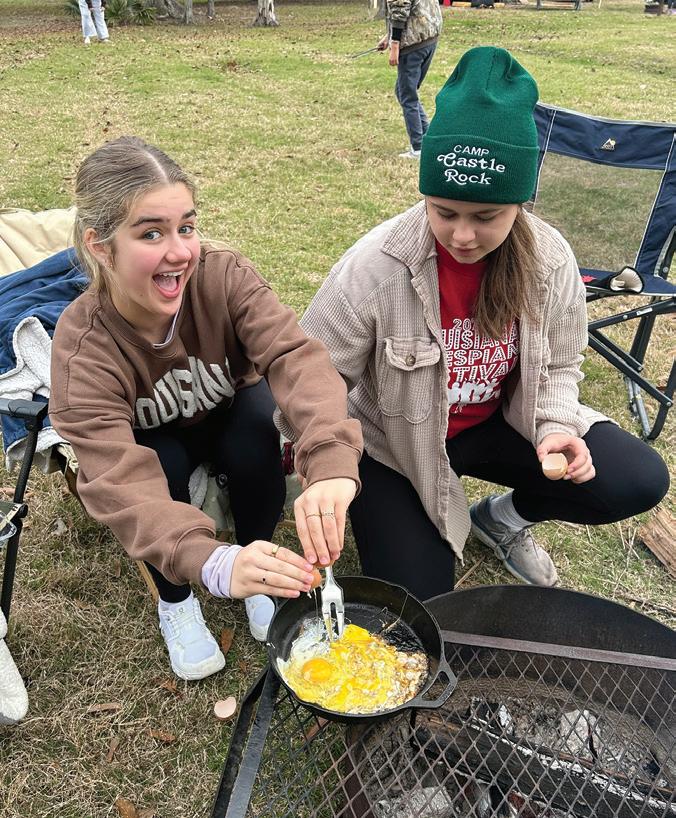
By sunrise, everyone was awake and ready for the day. After taking a moment to enjoy the sunrise, we started our morning with a fire cooked breakfast made by Millie T, along with a much appreciated pot of coffee. Once everyone was fueled, we set off on our first adventure, a nature walk to the lake. That walk was when I truly realized the peace nature brings. The calm air, trees swaying in the wind, and birds chirping created a refreshing break from the chaos of everyday life. Some moments were filled with laughter and jokes, while others were quiet, allowing us to fully take in the scenery around us. When we reached the lake, the sound of waves hitting the rocks was almost impossible to describe. It made time feel slower, as if the world had finally paused. Many of us sat on the rocks, reflecting quietly and enjoying our own thoughts. While much of our trip was filled with conversation and laughter, this moment was silent, by Ali
I never imagined that camping would become something I would love. If you had asked me just days before this trip what my plans were, camping would not have crossed my mind. Yet, by the end of the weekend, I was absolutely certain it would become a new norm. As a first time camper, I had plenty of worries, questions, and unknowns. However, once the trip came to an end, those concerns faded away, replaced by memories I find myself replaying again and again.
allowing peace to be at its loudest. After returning to camp, we spent time playing ball, eating lunch, and talking nonstop. It was during these moments that I realized while nature created the setting, our bond and friendship are what made the trip unforgettable.
Being surrounded by a peaceful environment with the people you love most is truly an incredible experience.
The bonding continued into the night as we gathered around the parents’ camper to watch the Bills game, eat cake, and celebrate the birthday girl. Later, in our tent, conversations stretched late into the night as we talked about the past, the present, and the sunrise we planned to watch the next morning. By 5 a.m., many of us were awake, and by 5:30 we were back at the lake watching one of the most beautiful sunrises I have ever seen.
The peace I felt was powerful, but feeling that same peace shared by everyone around me made it even more meaningful. While watching the sunrise, my friend Hemmy said, “I feel like I’m going to cry,” and in that moment, it was clear that the sense of peace was mutual among all of us. Despite the cold, our discomfort turned into laughter because we knew we were experiencing it together. That was when the true meaning of the word together became clear to me.
Experiencing both the peaceful and chaotic moments of life side by side builds a bond that feels unbreakable, and I truly believe that bond was strengthened on this trip. After the sunrise, we returned to camp for best over the fire coffee and breakfast sandwich I have ever had, once again thanks to Millie T. On Sunday morning, before heading to church, we played ball, listened to music, and stayed busy despite occasional rain showers.
Once it was time to change for church, I packed my bags knowing I would be heading home afterward. As I packed, the smell of the campfire on my clothes and blankets brought back memories from the past few days.
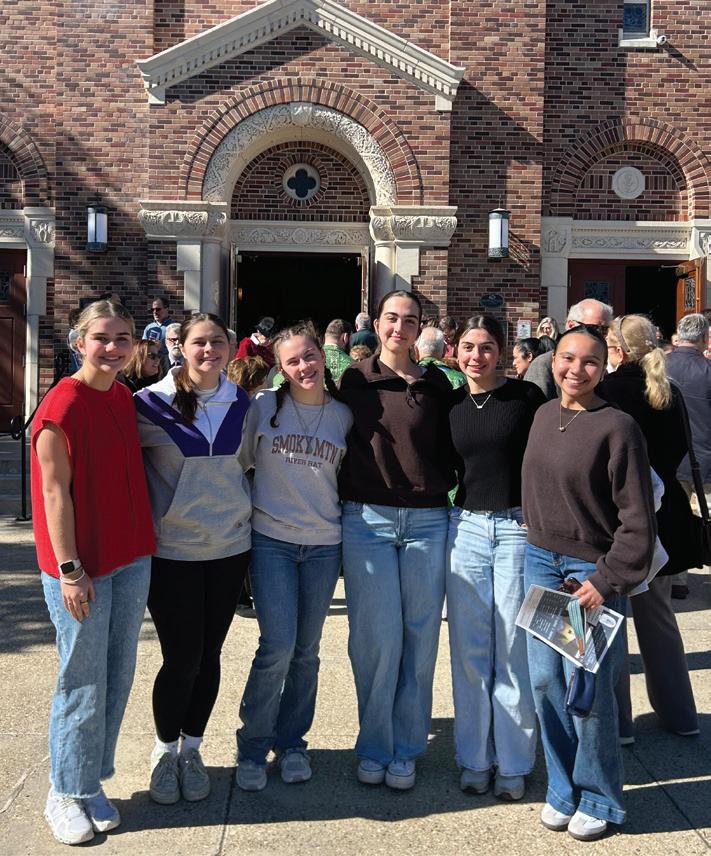
On the way to church, I reflected on how incredibly blessed I am to have friends like these. Friends who are there when you need them, friends who share laughter with you, and most of all, friends who get to experience your first camping trip alongside you.
FROM CORKS TO FLYS & NEW WAY OF SEEING OUR MARSH
by Capt. Tori Arnona
For years, my days on the water followed a familiar rhythm. Popping corks, soft plastics, chasing tides, and watching clients lean into big redfish. It worked well. Over time, though, I felt the pull to slow things down and challenge myself. Fly fishing did exactly that. It forced me to think more deliberately about every decision, every cast, and every piece of water in front of me.
Ionce believed clear, sight fishing water only existed far to the east, maybe Florida and beyond. That was where you went to see the bottom and watch fish move. I never realized those same conditions existed right here at home. As I spent more time on the water, I heard stories about the Chandelier Islands and other pockets of clean water. I simply was not looking in the right places.
A few summers ago, a group of Florida guides stayed at the lodge for several months. They were dedicated sight fishermen, and I soaked up everything I could. I watched how they approached fish, read water, and practiced patience instead of blind casting. Capt. Danny Allan opened my eyes to a side of Venice I had overlooked. We ran areas I had passed hundreds of times, and suddenly the marsh looked alive. Grass flats with two to three feet of visibility held sheepshead, black drum, golden redfish, and more. Seeing that fishery here in Louisiana changed how I viewed our marsh and reminded me to slow down and really look.
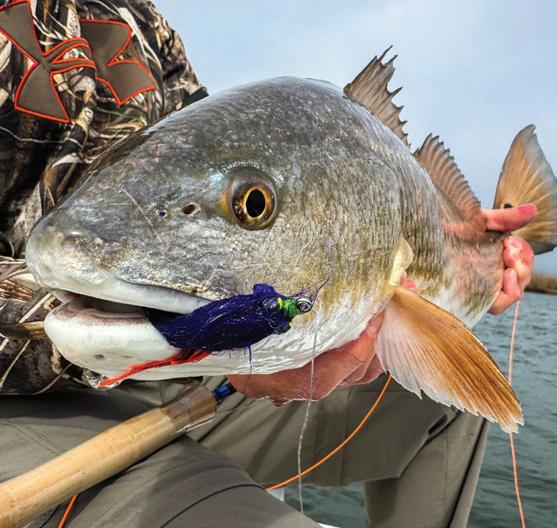
Over the past few seasons, fly fishing and sight fishing have become a core part of how I guide. No matter the gear, I focus on reading water and understanding how fish move. Winter redfish reinforce those lessons every trip. I scan drains, drop offs, and protected edges. On high water, reds push deep into the grass. As the tide falls during winter lows, they slide to deeper edges and wait for bait. Some hold tight along sheltered shorelines where clean water presses against the bank. Those quiet pockets are prime winter ambush zones. Approach matters. Boat position, wind angle, and letting the fly drift naturally can make or break an opportunity. Some fish hang on until the last moment, backs barely breaking the surface and blue tails giving them away. On calm days, those subtle signs define winter sight fishing. When a redfish finally appears, the wait feels worthwhile. I cast ahead of the fish and let the fly drift into its path. Everything has to look right. Cold fronts and wind can muddy the marsh and slow fish down. On those days, patience is everything. I move slowly, watch edges, and let fish come to the fly. Presentation matters far more than the pattern.Many of my go to flies are tied by Capt. Jacob Commer and Capt. Evan Hileman. Purple and black patterns and tan shrimp styles have been consistent producers. When spinning gear comes into play, the Lemonhead Matrix Shad has saved tough days after a front. Fly fishing has not replaced conventional fishing for me, but it has changed how I see the water. Every cast feels intentional. Every eat feels earned.
I encourage anglers to explore what they usually pass by. Run that extra canal. Stop at that point you normally skip. Move slowly along protected marsh banks where clean water gathers. Those overlooked spots often hold reds willing to wait you out. The marsh rewards patience, and guiding anglers through winter sight fishing has become one of the most rewarding parts of my job.
Running with the Wind
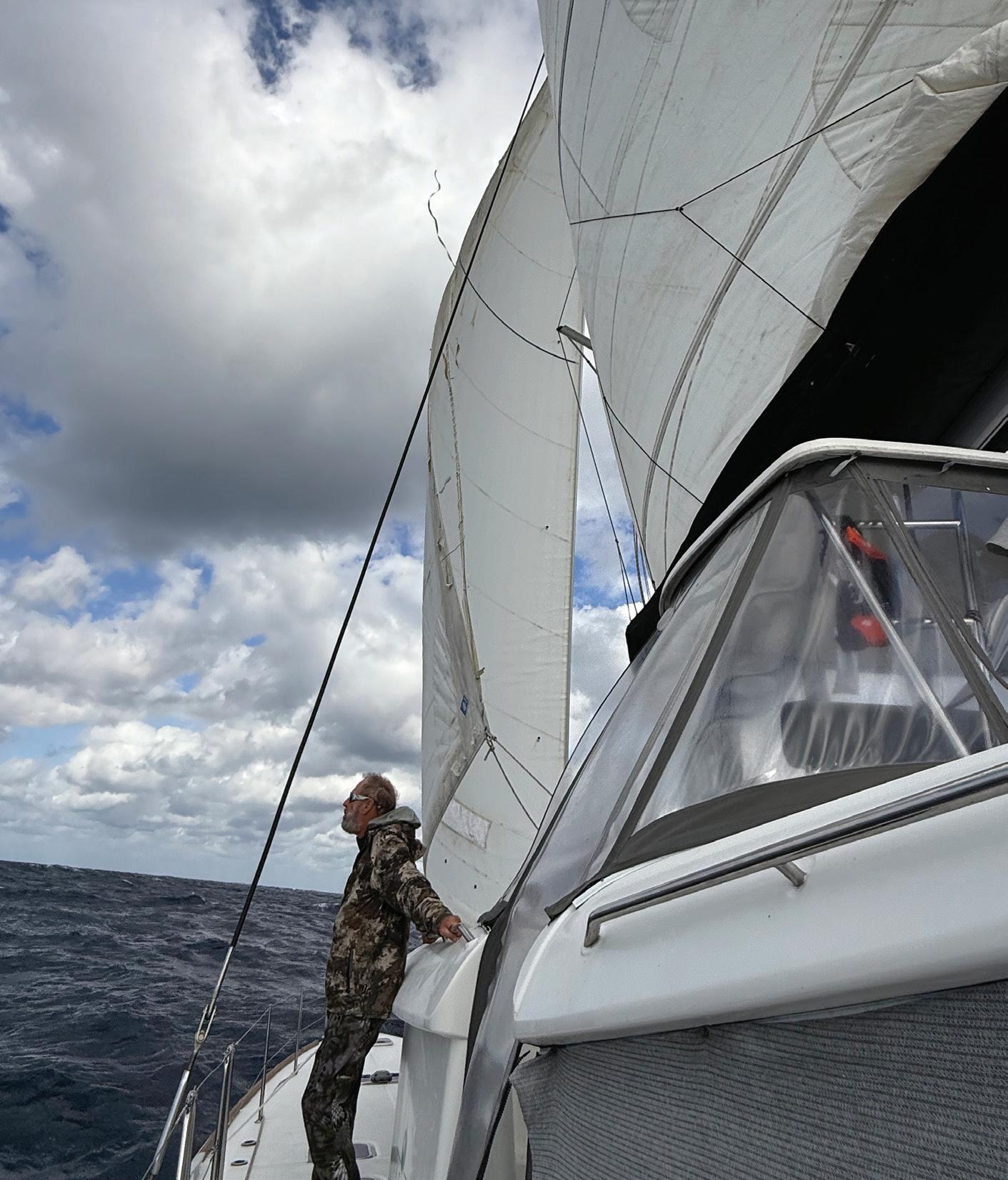
The adventure began in a blur, the kind that only happens when plans slip and momentum takes over. Delays installing the new sail drives pushed our departure back more than a week, forcing a complete rethink of weather routing and scrambling crew schedules.
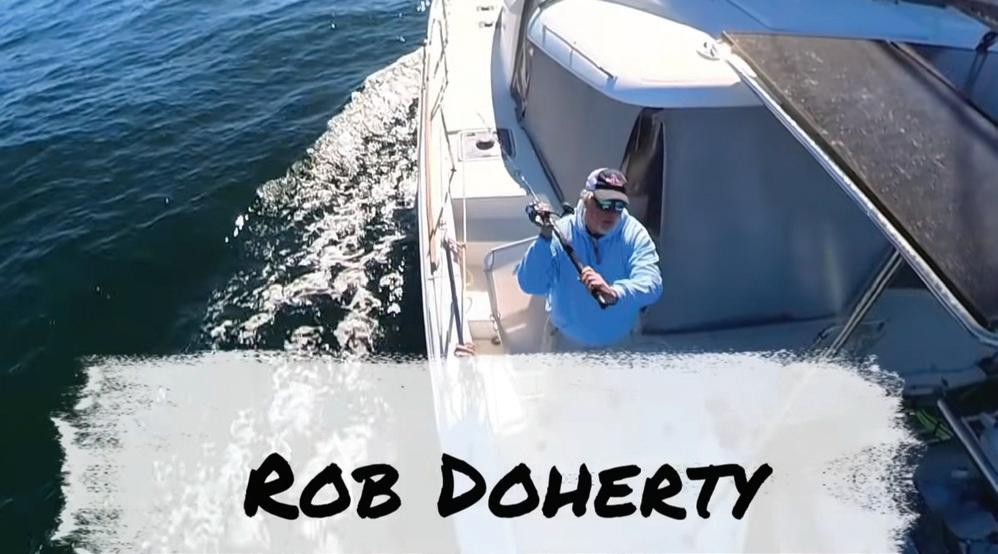
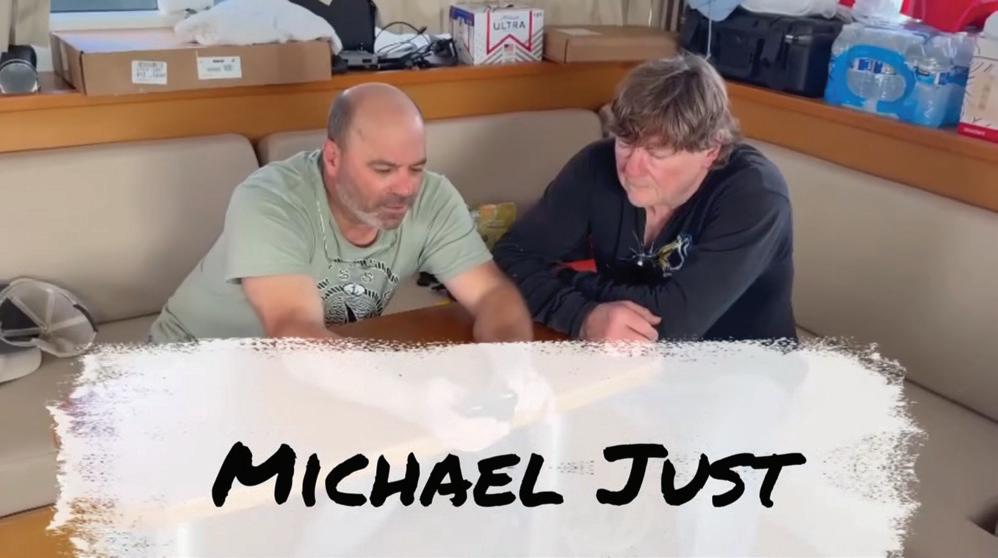
Michael Just had to grind through a 16-hour drive before linking up with Rob Doherty and myself in Gulfport. From there, it was another ten hours in a rental car to Savannah, rolling through the night fueled by caffeine and anticipation. Somewhere on I-10, a quiet dread set in. A strong northerly had been
blowing for days, what if it pushed too much water out of the inlet and delayed the splash past the yard’s minimum tide window? After all that effort, how would the crew take it if the boat wouldn’t be ready for another 24 hours?
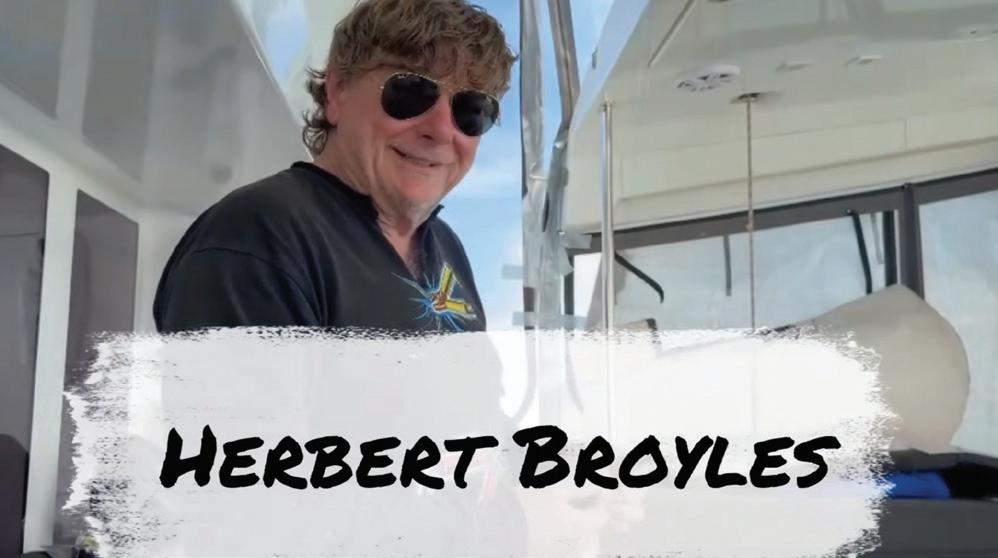
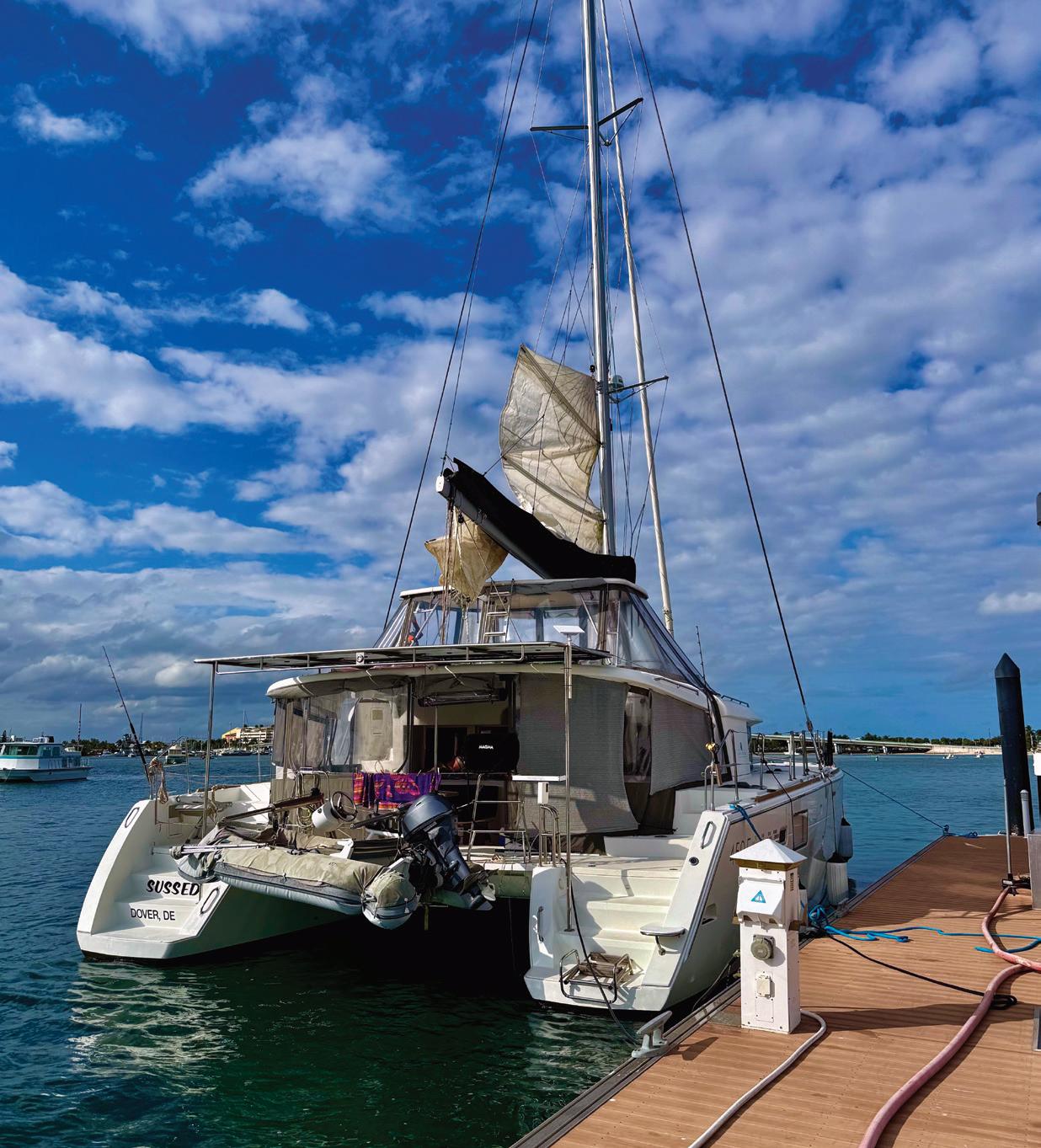
At 8 a.m., we pulled in to find the Lagoon 450F freshly splashed and tied neatly to the dock. Relief washed over me like a clean breeze. No celebration, though, this was go-time. Two crew members immediately scattered for last-minute provisions while Herbert and I dove headfirst into systems checks. We traced pumps, located thru-hulls, and memorized valve positions,
A winter sail from Savannah to Miami through heavy weather, fast miles, and the rhythm of an offshore catamaran.
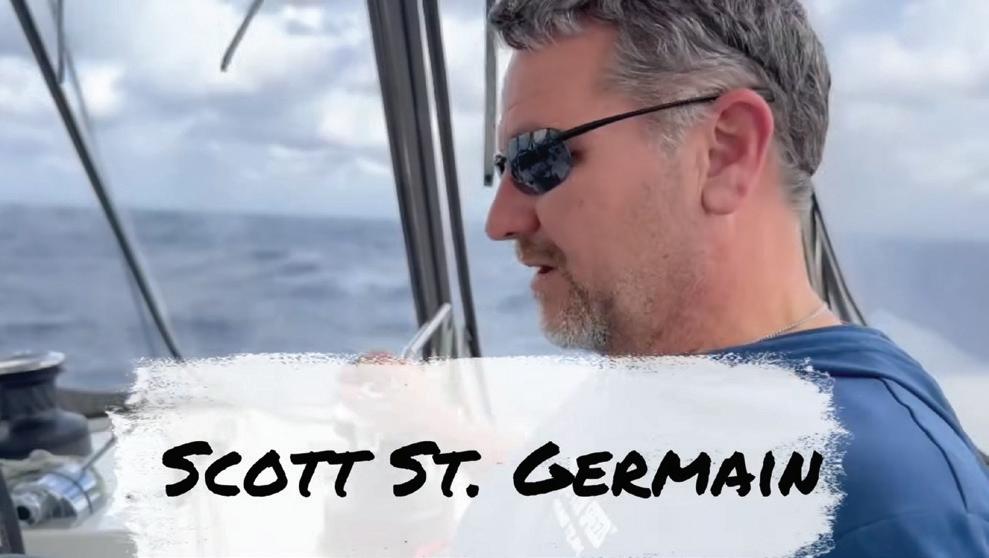
by Scott St. Germain
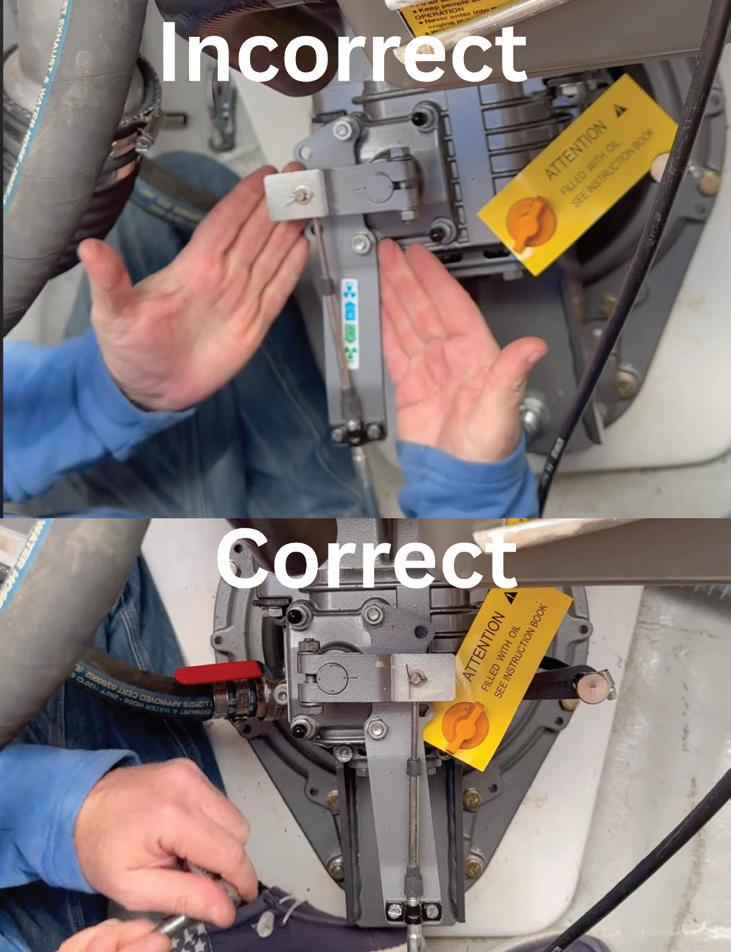
crawling in and out of lockers in both hulls. Yard workers were still finishing gelcoat touch-ups nearby. The yard also hooked up the shifting linkages backwards and I had to rework both engines so that forward was forward. I started learning just how different a cruising cat is from any monohull I’d sailed. That lesson really hit home when I climbed twenty feet up the mast, then crawled the full 21-foot length of the boom inside the sail bag to unzip the cover, something my old Catalina 36 never asked of me.
We debated the dinghy setup next. It was hoisted in the stern arch with about four feet of clearance above the water. With the large following seas forecast, that didn’t inspire confidence. We cross-tied it tight, and with a prayer, hoped it would survive the run home.
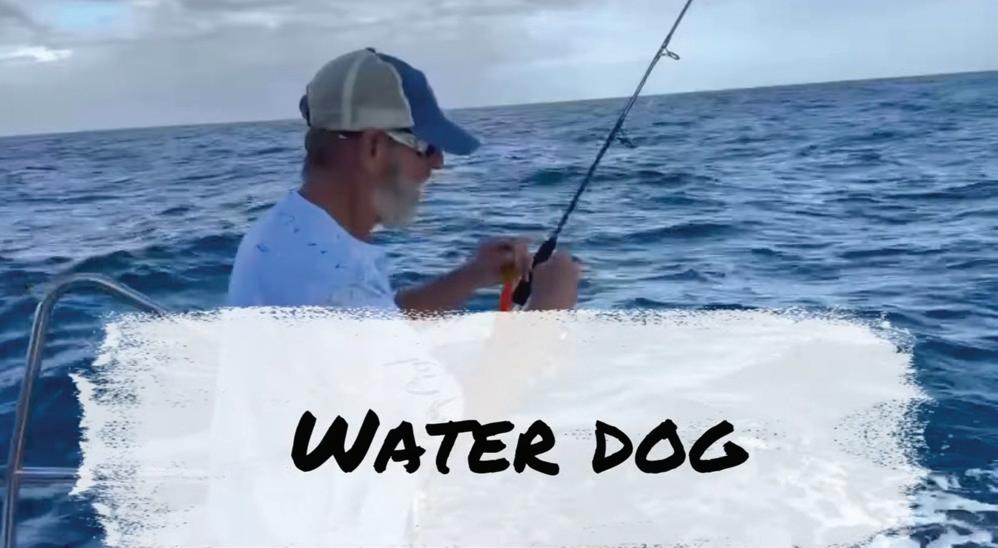
Those pre-departure hours were controlled chaos, and exhilarating. Michael and Rob stuffed lockers, refrigerators, and the freezer with food for five crew: hearty breakfasts, light lunches, steaks and burgers for the grill, and optimistic plans for fresh fish along the way. Standing back, it hit me: this was my longest sail ever, my first serious offshore run on a big catamaran (a far cry from the Hobie Cats of my youth), and a return to places I loved, Loggerhead Key and the Dry Tortugas. The forecast was heavy, but I trusted the boat and, more important-
The Crew
ly, the crew. At 5 p.m., we slipped the lines in a stiff 30-knot northeast wind. Cutting the cord felt momentous. This was bigger than anything we’d done before, and Gulfport was the only acceptable ending.
The East Coast did exactly what I’d hoped: it kept the swell from growing and turned that hard northwesterly into pure propulsion. Within an hour we were making nine knots, systems humming, crew grinning ear to ear. The Lagoon sliced cleanly, surfing the seas like a carnival ride you never want to end. I felt the quiet satisfaction of seeing my routing plan play out, skepticism aside, we were on pace to reach the Keys in about 72 hours.
Our first leg, Savannah to Jacksonville, covered 102 miles in roughly twelve hours. From there we settled into a rhythm, blasting down the East Coast. We logged the entire 540-mile run to the Keys in under three days, making seven to nine knots under sail alone in steady 20-plus-knot winds. When we needed to claw a little upwind, we motor-sailed on the leeward engine to reduce set and drift, holding eight knots comfortably. Our
top speed, 15.1 knots while surfing larger waves, was a reminder of how differently a cat surfs compared to the monohulls I grew up on: faster, straighter, and far less prone to twisting or broaching.
This stretch gave me my first real taste of catamaran life. The wide beam and shallow 4-foot-3inch draft delivered impressive stability as the seas built, and the ability to skim over pale sandbars that looked uncomfortably close from above. Steering from the elevated cockpit, about fifteen feet over the water, offered incredible visibility, though watching wave tops rise to eye level was less comforting. Even on a beam reach, the pounding could be bone-jarring, and the dinghy began taking a beating under the arch. Cutting it loose to drag it crossed my mind more than once, but towing in 16- to 18-foot, tightly stacked seas didn’t seem any safer.
Compared to my Catalina 36, off-watch sleep was blissfully easier. The flatter motion meant less rolling, though hull slap in chop could still wake the dead. One predawn slam hit so hard I slid forward
in my bunk, jolting awake convinced we’d hit something solid. The steering took adjustment too. With rudders forward of the props, a design choice I’m still wrapping my head around, manual steering demanded more effort. But once we were fully in the Atlantic and two-foot grew into six-footers, the lack of heel was pure joy. No bracing yourself sideways for days on end, comfort suddenly felt like a real promise for the miles ahead. Electronics earned their keep early. AIS was invaluable as traffic thickened between Jacksonville and Cape Canaveral. With the headsail blocking our view from nine to twelve o’clock, AIS became our extra set of eyes, painting targets eight miles out and giving us time to adjust. We sidestepped several fast movers, including cruise ships charging along at 20-plus knots, long before they became close calls. PredictWind kept us safely west of the Gulf Stream’s “wall,” which crept within a mile of the coast in places. Seeing those massive, standing waves, “elephants walking,” as sailors say, on the eastern horizon brought deep gratitude we hugged the coast. With near-gale winds opposing that current, it was no place for a heavily loaded cat with a vulnerable dinghy.
As the miles rolled by, the first gremlins appeared. Nighttime temperatures dropped into the 30s, and we looked forward to firing up the generator to run the heaters. After one hour underway, the generator quit, permanently, as it turned out. The error code suggested that finding a technician was necessary, so we pressed on. Solar panels and alternators kept the batteries happy, but HVAC was off the table. I layered every piece of clothing I brought and resigned myself to being cold. Water was next. We were drawing solely from the port freshwater tank until it ran low. Switching tanks should have been simple, but the valves weren’t obvious. No problem, I thought, we have a watermak-
er. That, too, refused to cooperate. What followed was hours of cabinet disassembly, tracing hoses, and finally locating threeway valves, well hidden. Air in the lines or a stubborn diaphragm pump turned a simple fix into a slog. I kept a positive face for the new owner, but inside I was irritated for him. The sea has a way of testing you early, and thoroughly.
We ducked into West Palm Beach to top off water, which turned briefly confusing when marina directions led us down a narrow fairway to a dead end. Still, with twin engines and both bow and stern thrusters, I wasn’t worried. Spinning a 45-foot cat in tight quarters, even in crosswinds, was almost effortless. One clean 180-degree turn
and we were clear, a reminder of how forgiving twin screws spaced 25 feet apart can be compared to a single-engine monohull.
Water issues lingered despite the refill. We adapted: heads switched from fresh to saltwater, conservative showers, and constant awareness of every gallon. Through it all, morale held. The boat’s stability made cooking a pleasure, and meals became highlights. Grilling steaks underway without worrying about heel or sliding plates felt downright luxurious
We ran rotating watches to keep everyone sharp, though exhaustion from the Savannah push never fully lifted. Tempers flared once or twice, usually when someone got hauled out of a bunk too soon. One latenight snap earned Michael an apology once I became aware of the urgency.
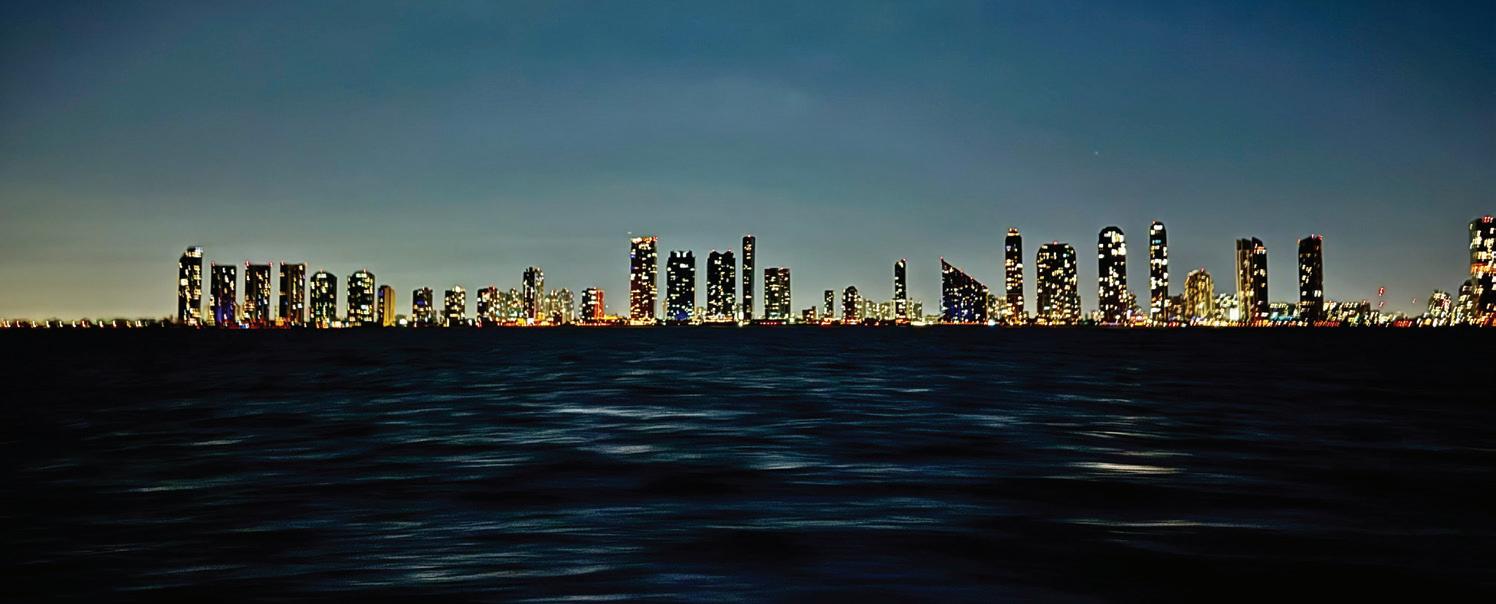
Just north of Miami, another failure: AIS went dark. I ran through every diagnostic I knew, power cycles, NMEA 2000 checks, cable inspections, nothing. Radar, tracking, and sharp lookouts carried us through the increased traffic, but tension rose noticeably. At 2 a.m., we slid past Miami, its skyline glittering against the black sea. Michael climbed into the cockpit and said, “As tired as I am, I couldn’t stay in my bunk knowing we’re sailing past Miami.”
It was a milestone moment, gremlins and all. What we didn’t yet know was that the Florida Keys would deliver some of the best sailing of the trip, along with challenges that made these feel like warm-ups. Part 3 would take us farther south, to Fort Jefferson and the Dry Tortugas, where the adventure truly deepened.
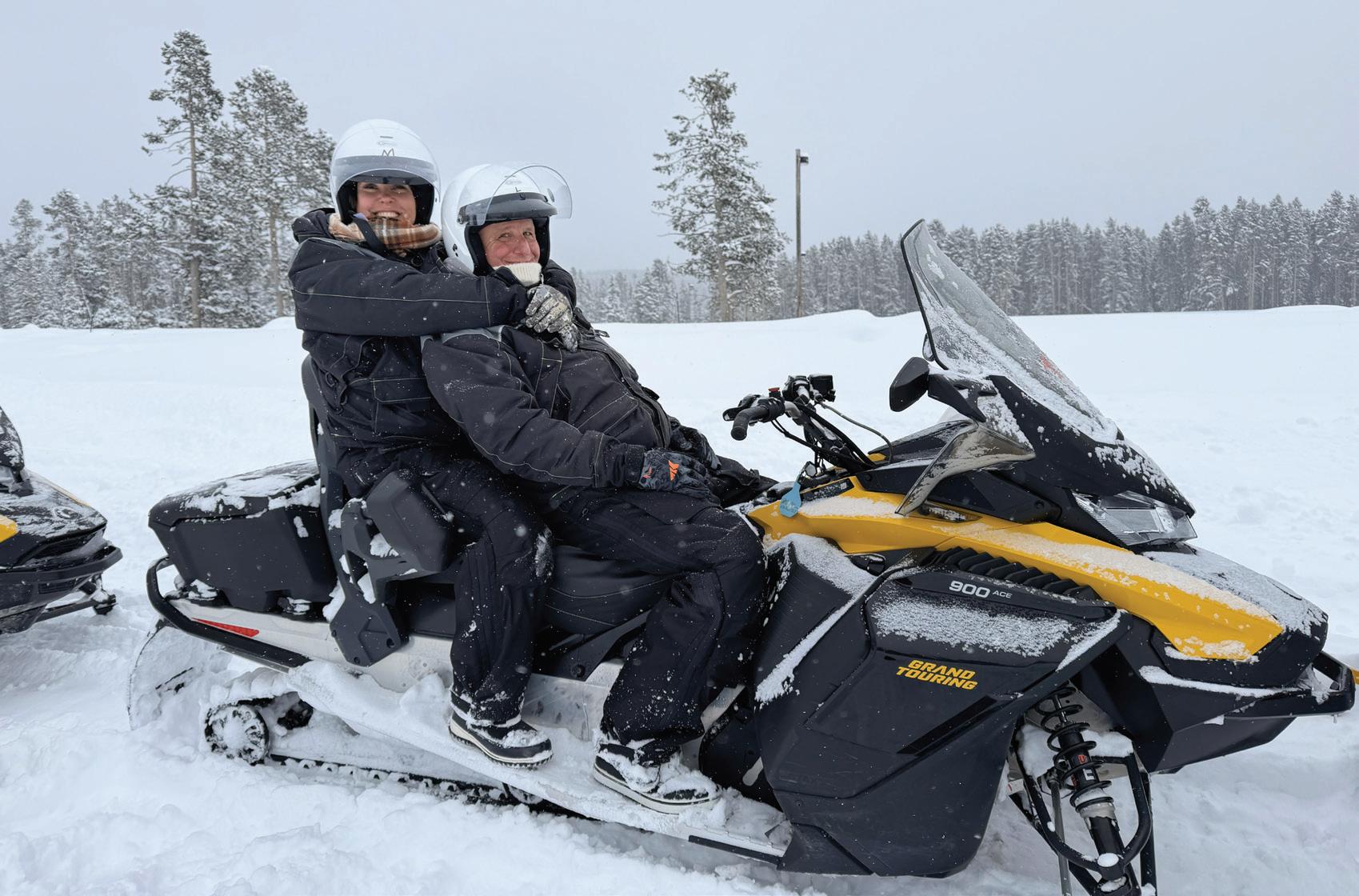
It is hard to believe that Christmas was only a few weeks ago. While many couples were exchanging gifts, my husband and I did not. Instead of a wrapped present, we chose to exchange the gift of adventure. This year, he was in charge of where we would go. I eagerly awaited the big reveal when he excitedly yelled, “Expedition Yellowstone!” It took me a few moments to realize he meant Yellowstone National Park. We are outdoorsy people, so this adventure made sense. “Are we camping, fishing, or hiking?” I asked. With a devilish smile, he replied, “Nope. We’re snowmobiling to Old Faithful, and we leave in two weeks.”
Please allow me to edit my previous statement about being outdoorsy people. We may be outdoorsy, but I am not an outdoorsy winter person. So, in the spirit of the season, I pulled out our Frabill ice fishing suits and kept my mouth shut.
We landed in Bozeman, Montana, mid day. The temperatures were in the 40s, which I could handle. We rented a four wheel drive Jeep and began our two hour trek to our rental cabin in Island Park, Idaho, the closest community to Yellowstone’s West Entrance. We stopped at a grocery store for supplies and enjoyed the first 40 minutes of the very scenic Highway 287. Since Montana is known for its world class fly fishing, we had planned to stop at The Tackle Shop in the tiny town of Ennis, Montana. The shop is
by Colleen Orfanello
nearly 90 years old and has earned Orvis’ Fly Fishing Outfitter of the Year award. However, daylight was quickly fading and we still had more than an hour to go, so we decided against it. As we continued toward our lodging, the snow began to fall and the temperature dropped into the low 20s. It was dark, real dark. The snow came in horizontally, and I swear I felt like I was on the Millennium Falcon about to thrust into hyperdrive. When we finally arrived in Island Park, I felt more relaxed knowing we were only a few miles from our cabin. Nearly everything was covered in snow, including the recently plowed streets. The cabin, named the Imperial Elk Lodge, was nothing short of spectacular. If I had not been awake since 3:30 that morning, I would have immediately used the sau-
na, hot tub, and massage chair. Instead, with an early morning snowmobile tour ahead of us, we opted for a quick dinner and an early bedtime. We slept like a rock.
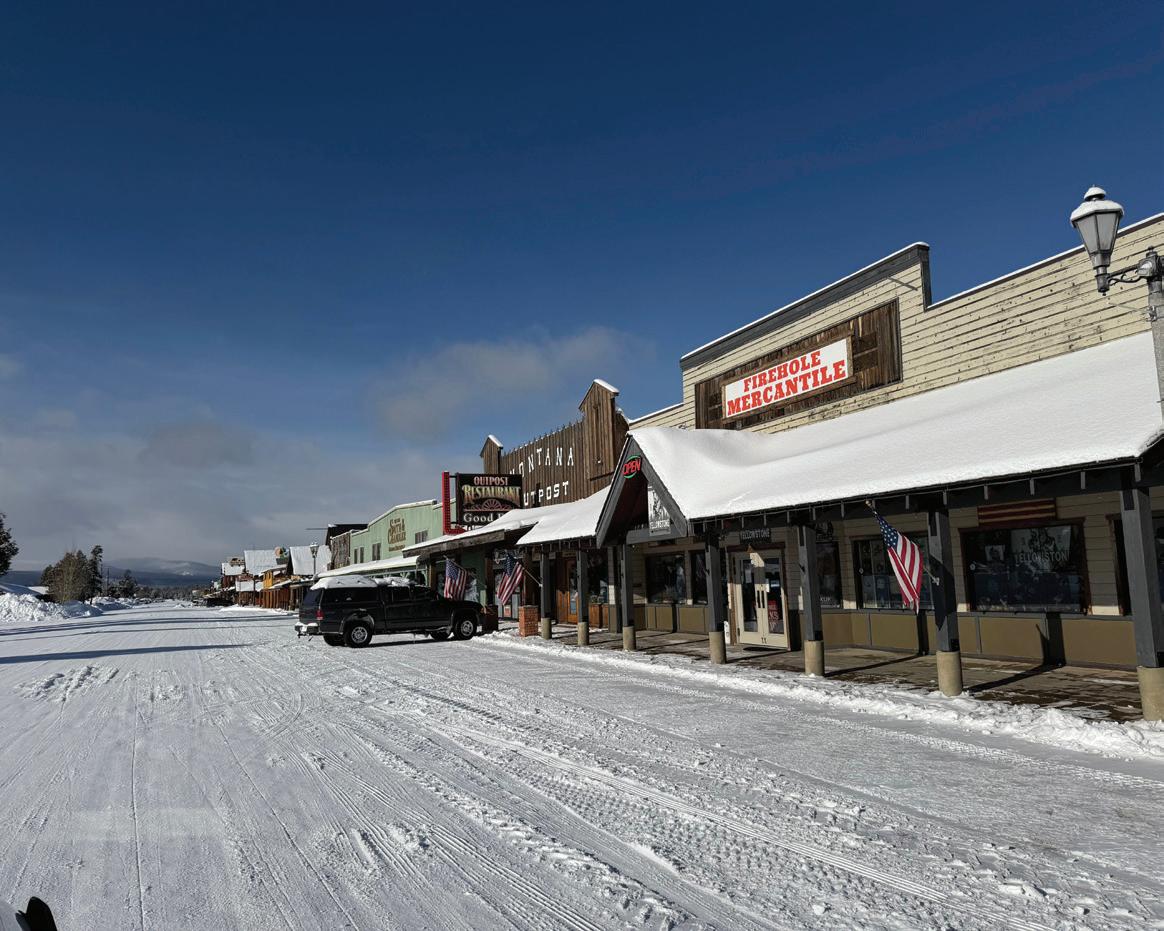
The cabin was situated less than 600 feet from US Route 20, the longest road in America. It connects Oregon to Massachusetts, a fact I did not previously know. I also learned that Island Park is home to the “Longest Main Street in America.” FUN FACT: in 1947, Island Park, Idaho, was incorporated so businesses in the area could legally serve alcohol. Their Main Street is 33 miles long in a town no more than 500 feet wide with a population of approximately 200 residents.
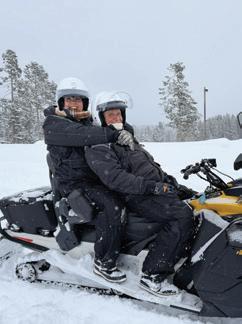
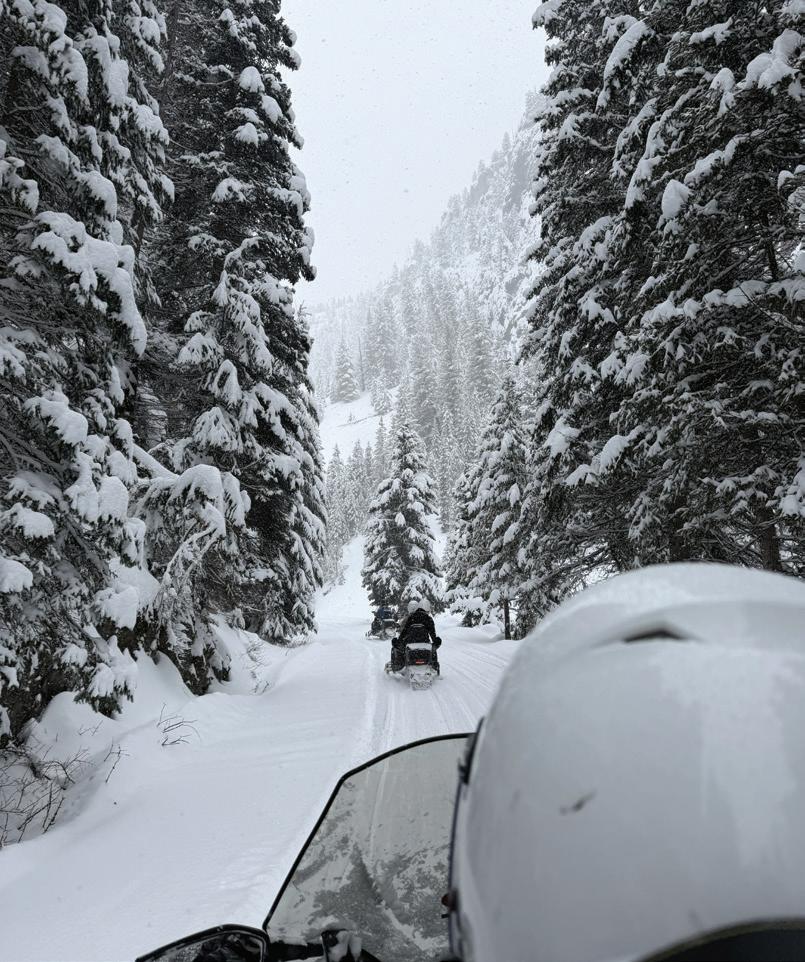
Main Street, or this stretch of Highway 20, led us directly to Two Top Snowmobile Tours. Yellowstone had experienced an unseasonably mild winter, and our guides informed us that our group of 17 was the first to snowmobile in the park due to the lack of packed snow. The park typically opens for snowmobiles on December 15. Vehicular traffic, other than a few snowcoaches, is prohibited during the winter months.
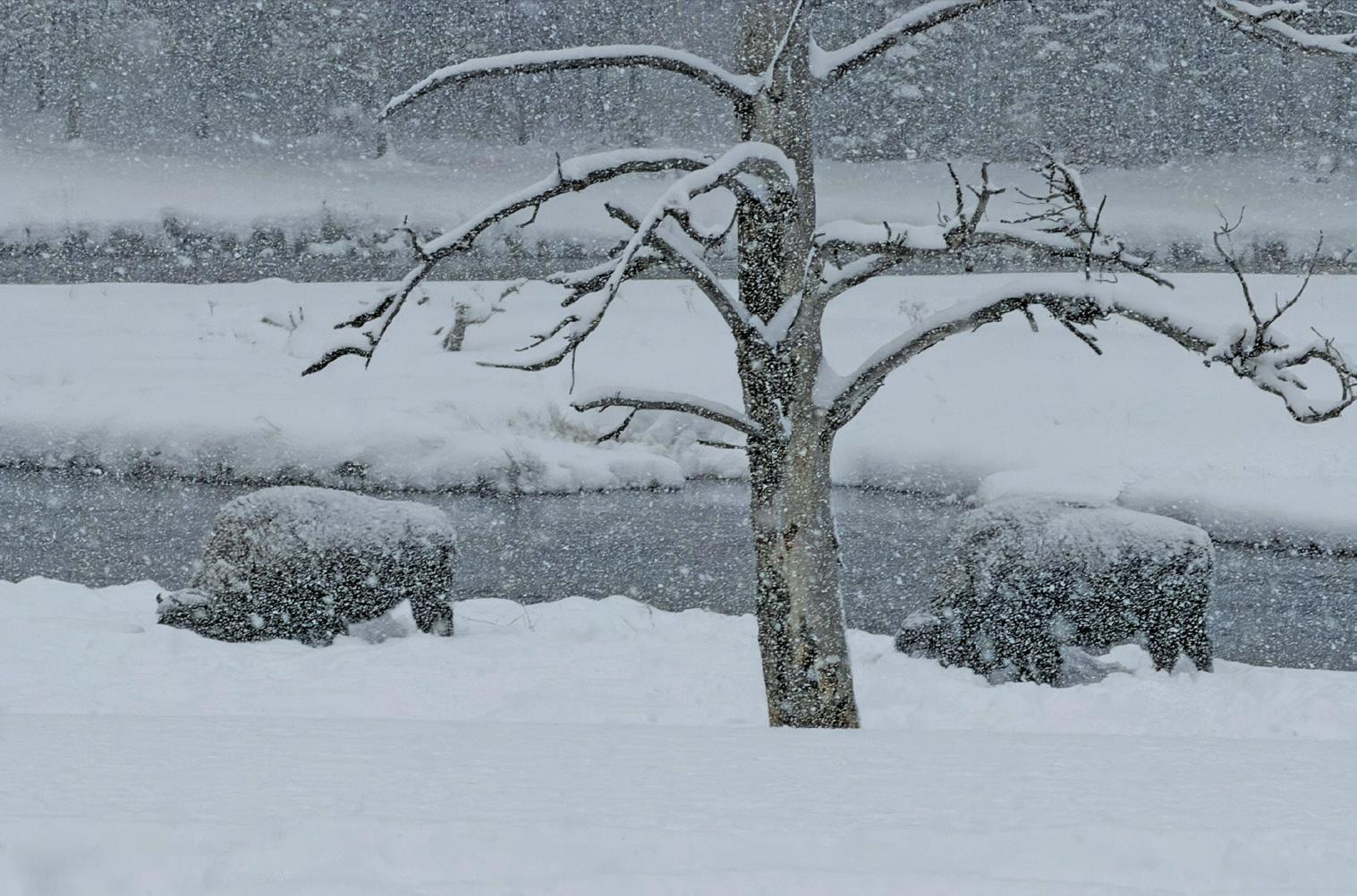
After a brief safety course, our group of nine snowmobiles zipped through West Yellowstone and directly to the park’s west gate. There were no other vehicles in sight. We raced through the park along the Madison River, stopping to photograph waterfalls, mountain views,
and hundreds of bison.
Although the temperature was two degrees, we were cozy in our base layers and ice fishing suits. Ryan, our tour guide, shared his knowledge at every stop. He explained that Yellowstone is home to the largest bison population on public land in the United States. Bison were nearly extinct in the mid 1800s, but when the park was founded in 1872, conservation became
Yellowstone has the only continuously wild bison herd in the U.S. These bison have lived there since prehistoric times and were never domesticated or ranched.
a priority. In 1902, the federal government introduced 21 bison into Yellowstone. Today, more than 5,000 roam freely.
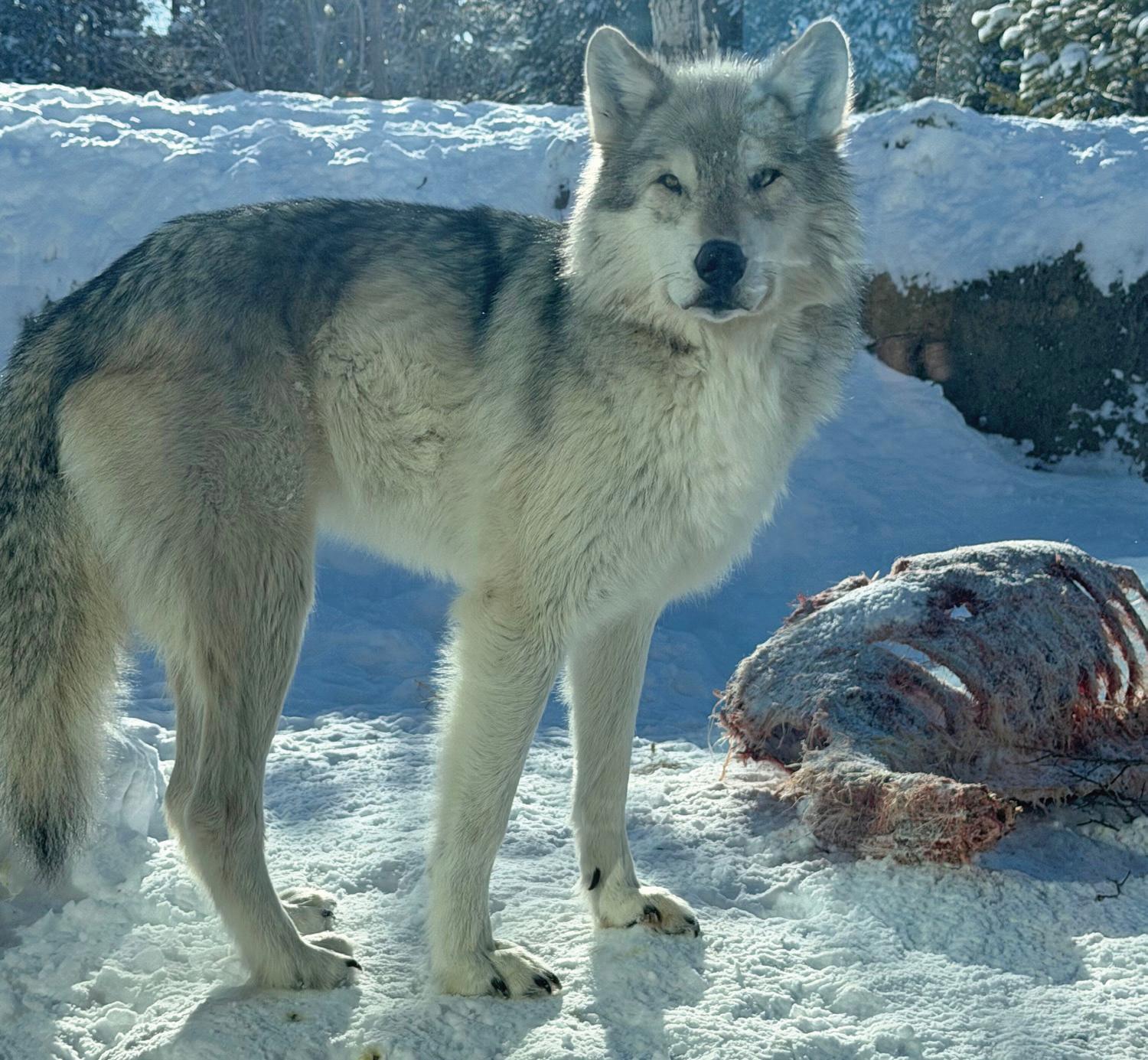
Ryan also explained that predatory wolves were removed from the park in 1926. Without them, grazing animals increased rapidly, leading to overgrazing that destroyed habitat for smaller animals like beavers and otters. Grey wolves were reintroduced in 1995 to help restore the natural ecosystem. After a quick lunch, we
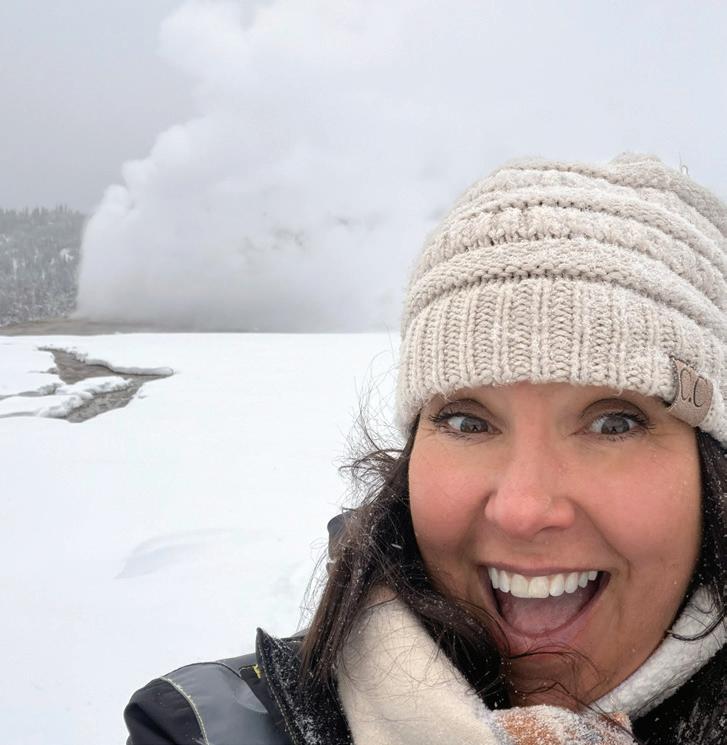
visited the Yellowstone Visitor Center in Teton, Wyoming, and walked straight to Old Faithful. There were no lines, no crowds, and no distractions. Seeing Old Faithful erupt had been on my bucket list, and it did not disappoint. With only a few dozen people present, the experience felt intimate and powerful. Out of more than 500 geysers in Yellowstone, only six are named for their predictability. Old Faithful was the first, erupting roughly every 90 minutes. Our eruption lasted more than three minutes,
sending over 6,000 gallons of steaming water more than 100 feet into the air. On the way back, we stopped at boardwalks surrounding geothermal mud pots and prismatic pools. Walking through the snow, even on the boardwalks, was challenging for me. At 7,000 feet in elevation, I was fatigued. If I were an animal in Yellowstone, I would probably be the one left behind and eaten by wolves.
After a seven hour tour, we headed back toward the West Entrance and
stopped one last time to watch a herd of bison along the Madison River. The sun peeked through storm clouds, making the snow look like floating diamonds along the riverbank. It was stunning. The Madison River is part of Yellowstone’s 2,000 miles of waterways and is home to native species such as Arctic grayling, mountain whitefish, and cutthroat trout. Ryan explained that invasive species like rainbow, brown, brook, and lake trout aggressively compete with native fish for habitat and food.
These invasives tend to occupy deeper waters, forcing native fish into shallower areas where they are more vulnerable to predators, including bears and birds like pelicans. Fishing opportunities exist year round in Yellowstone, though the general season opens Memorial Day weekend. The Lower Gardner and Madison Rivers are typically open for winter fishing, but winter access requires snowshoes or skis due to road closures. Anyone 16 or older needs a permit. Barbed and leaded hooks are prohibited, invasive species must be harvested, and native fish must be released safely.
After an eight hour, 65 mile round trip, we returned to Two Top Snowmobile Tours and asked locals about fly fishing. They explained the best season runs from late June through October, with decent con-
ditions in March and April. Many outfitters, however, were closed for the season. We stopped at Yellowstone Provisions for elk steaks and seasonings and were back in our warm cabin within 15 minutes. After dinner, we slept like a rock once again.
The next morning, we called countless fly fishing outfitters within a 75 mile radius, but all were either closed for the day or the season. Our muscles were sore, and the massage chair in the cabin was a blessing. It was a Titan 3D Pro Prestige Zero Gravity Massage Chair by Osaki, and it may have changed my life forever. After clearing snow from the hot tub cover, we took a soak that perfectly soothed our tired bodies. Later, we visited the Grizzly and Wolf Discovery Center in West Yellowstone, a nonprofit sanctuary for injured or nuisance bears and wolves. It was an unexpected gem. The animals were majestic, and we loved it so much we returned the following day.
With only three days left and slim chances of finding a guide, we made one final attempt to fish. My husband, Christian, dreamed of reenacting scenes from A River Runs Through It, forgetting the movie was filmed in summer, not mid January. Ice fishing was available, but it lacked the scenery and excitement we wanted.
Instead, we took a self guided auto tour of the Lewis and Clark Trail. Before the trip, I learned that the cutthroat trout, Oncorhynchus clarkii, was named after William Clark of the Lewis and Clark expedition. I proudly shared this during the drive, hoping to win a point in the history buff battle. After a pause, Christian asked how long I had been hoarding that information. I claimed I had always known it and continued sharing facts throughout the four hour tour, thanks to my former professor Stephen Ambrose and his book Undaunted Courage.
The Lewis and Clark Trail spans more than 6,500 miles across 11 states. Using the Lewis and Clark Experience App, we learned more about the 1805 expedition while crossing the Continental Divide.
Expedition Yellowstone was more than an adventure. It was a historic, thrilling experience I will never forget. I do not regret skipping our fishing trip, and I do not regret visiting Montana, Idaho, and Wyoming in the dead of winter. It was the perfect blend of exhilaration and spontaneity. If you are planning a visit to Yellowstone, the world’s first national park, do not hesitate. Just do it. Whether in winter or summer, enjoy your own Expedition Yellowstone.
Chandler Callahan with a full strap after a great hunt in the Biloxi Marsh.
Don Barcelona with a couple of Lake Pontchartrain hammer trout caught over the holidays.
Paul McDuff all smiles after landing a solid sheepshead in Hopedale.
Roger Earl harvested this impressive 8-point buck in St. Tammany Parish in January with a .270 Winchester.
Adriana Michel showing off a rainbow trout caught on the Little Red River in Arkansas.
The day started fast and never slowed down. We launched at 5:30 a.m. with Capt. Eddie Burger of Fish Venice Charters out of Cypress Cove Marina, and about 20 miles offshore ran into chaos. Fish were busting balls of bait as hundreds of pelicans dove on the pogies. We fired poppers into the boiling water and hooked up on the first cast. The boys spent the next 30 minutes tag teaming a giant yellowfin tuna on a 20000 Saragosa loaded with 80 lb braid and a heavy mono leader. It took myself, Capt. Eddie, and deckhand Josh, along with three gaffs, to haul the fish over the rail.
When the surface bite faded, Capt. Eddie ran us to the sword grounds. A squid went down on an 80 wide in 1,400’ of water, and about 20 minutes later the rod tip went slack and Josh started cranking. The fish raced up, loaded the rod, and the boys took turns on the fight. At the wind on leader, Capt. Eddie called the jump, and the swordfish exploded out of the water. We thought the hook had pulled until Josh yelled that the fish was still on, hooked in the dorsal. Minutes later, Capt. Eddie and Josh gaffed and landed the fish. Ethan, Jacob, Ian, and Ryan celebrated as Capt. Eddie smiled and said, “Let’s do it again.” The same squid went back down, and within 35 minutes swordfish number two hit the deck, barely fitting in the fish box.
We made a brisk run back to the Fish Venice Lodge dock, where the tuna weighed right at 200lbs. Josh cleaned our catch, and we headed home with ice chests full of fish to share with friends and family.