



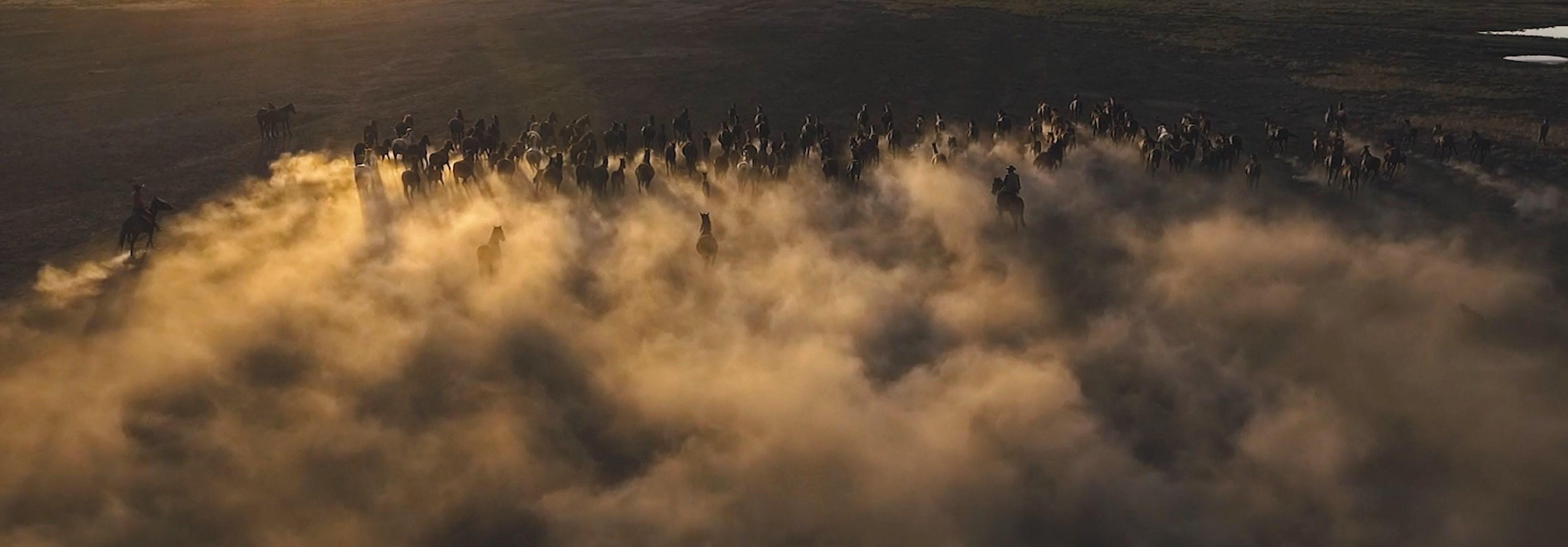

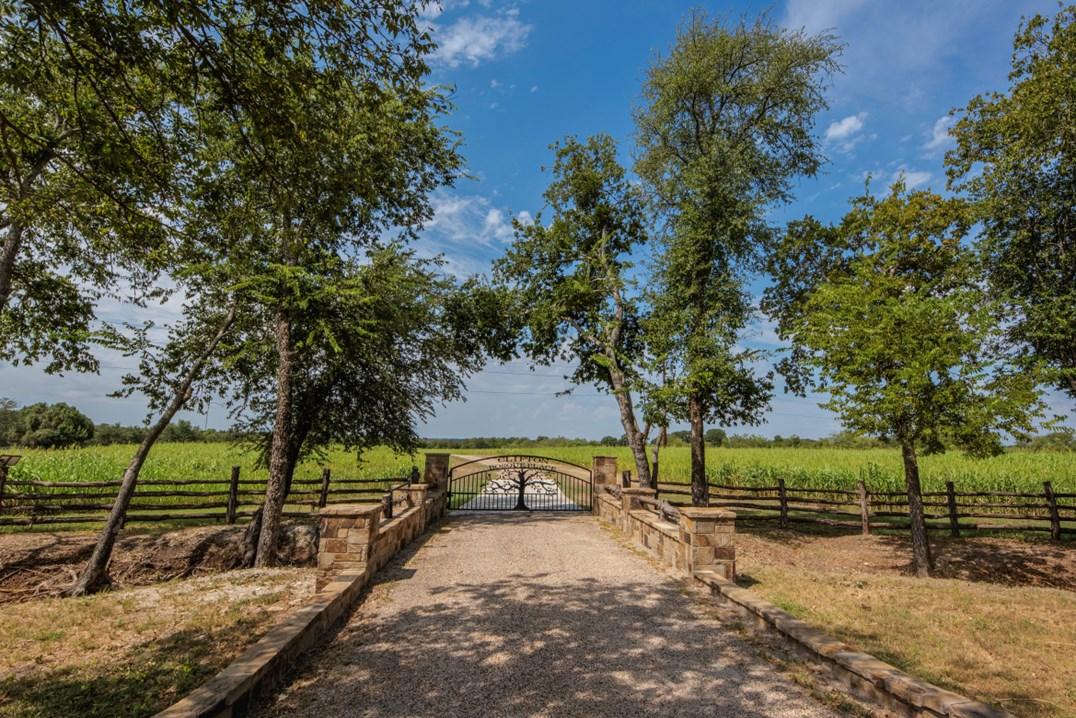
kind residence, this ranch offers the perfect balance of elegance, comfort and natural beauty. $2,250,000
www.bosqueriverplace.com
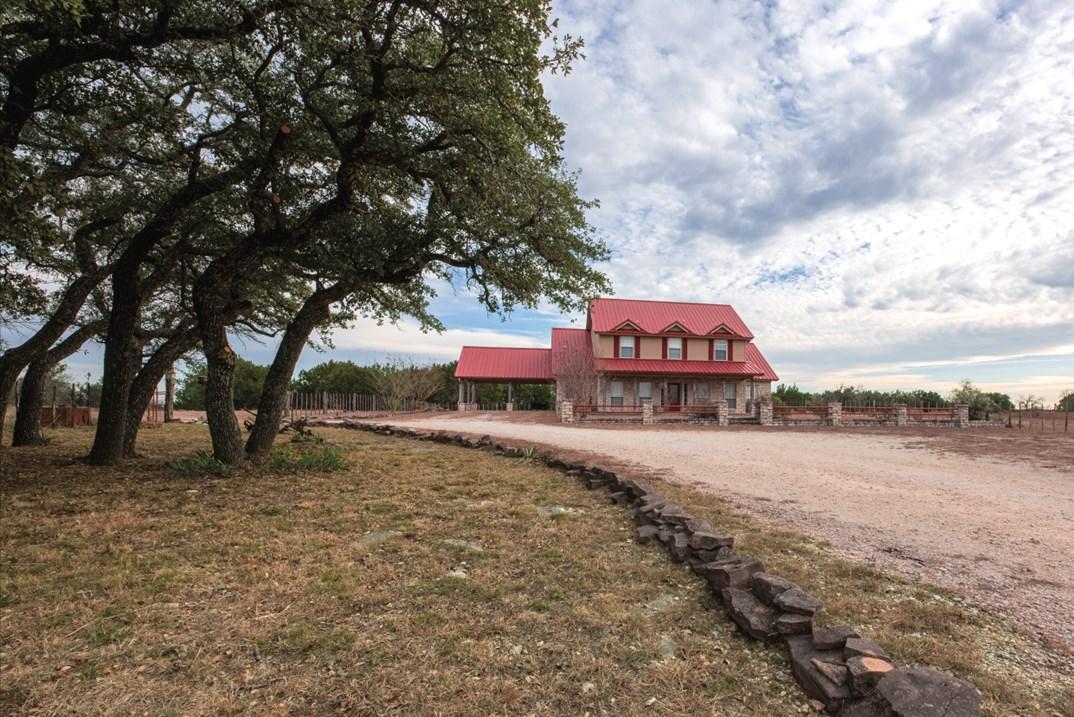

ERATH COUNTY | 314 ± ACRES
This property offers the best of country living with a 2,304 SF stone -clad custom home with 4 bedrooms and 2.5 baths. The spacious open -concept design features wood floors, a stone fireplace and great natural light. A covered patio and custom gazebo with a smoker and pit make this the perfect setting for fun family gatherings or quiet relaxation. Ready for cattle, hunting, fishing, recreation or all of the above, this ranch has it all! $3,900,000
www.thewhiteranchtx.com


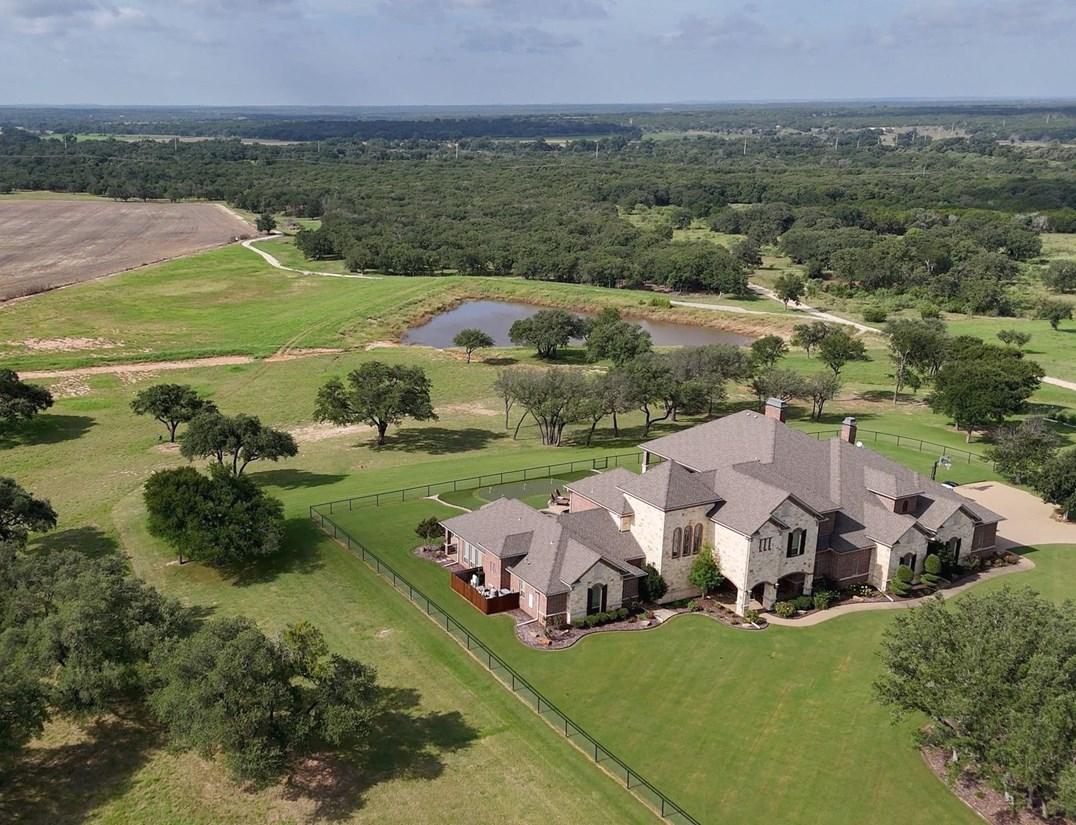
CORYELL COUNTY | 466 ± ACRES
This distinguished estate in the Texas Hill Country offers a harmonious blend of natural beauty and rich ranching heritage. The property has served as a cherished family retreat...an enduring sanctuary where generations have gathered to raise cattle, farm, hunt, hike and swim, amid a landscape steeped in history and tradition. Amenities include a luxurious, modern ranch home, guest house, swimming pool and three car garage. $10,490,000
www.shipleyriverranch.com


Smalltown newspaper remains relevant by E.
HEART FOR HORSES
Richmans’ life passion for barrel racing by SIMONE WICHERS-VOSS
Whitney Dam led to conflicting changes by SIMONE WICHERS-VOSS
Lloyd Voges crafts oases of tanquility by SIMONE WICHERS-VOSS
Entertainer & educator lives the dream by NATHAN
Since 1931, Central Texas Youth Fair sustains by SIMONE WICHERS-VOSS
Coon Creek community celebrates unity by SIMONE WICHERS-VOSS
Lake Whitney’s best kept fishing secret by E.
Laura Burt captures cowboy & rodeo life by SIMONE WICHERS-VOSS




Despite the constantly changing and evolving ways in which we disseminate information in today’s digitally-driven world, a smalltown newspaper remains a vital source for keeping communities informed, engaged and connected. And certainly, that stands true in rural Bosque County today.
Under a corporate model for the last 17 years, the Bosque County Record Tribune – the product of a merger between The Clifton Record and Meridian Tribune weekly newspapers more than two years ago – unfortunately continued to struggle financially. To avoid permanently closing the doors on a newspaper that’s been publishing since 1894, Moser Community Media made my wife Simone and I an offer we couldn’t refuse.
Consequently, we decided to incorporate the weekly newspaper into our multi-media business Southern Cross Creative and relaunch the publication as the new Clifton Record Tribune. In the process, we also became the owners of the Bosque River Run magazine, a quarterly publication Simone and I launched 10 years ago while working for MCM. As a result, we are relaunching the quarterly magazine under the Southern Cross Creative umbrella as a continuation of Chisholm Country magazine, which we premiered in the Spring of 2022.
By becoming owners of the newspaper, we are able to take everything we do with our multi-media business to the next level.
For over 130 years, The Clifton Record had been the enduring journalistic constant in Bosque County. By bringing back the name that has earned respect across the state for generations, we hope to restore the tradition worthy of its historical significance.
The newspaper may bear the name “Clifton Record” in its flag, but it also includes “Tribune” and an image of the Bosque County courthouse to pay homage to the Meridian Tribune. And beyond that, we strive to once again become a newspaper all of Bosque County will be proud to call its own.
Assuming ownership of the newspaper a year ago in May, we opened a new brick-and-mortar office in downtown Clifton at 122 N. Avenue D, which has become the new home to the Clifton Record Tribune, along with Chisholm Country magazine, Brett Voss’ The Sports Buzz and River Run Video Productions, while also providing a business address for the Bosque Film Society, founded in October 2020, outside the historic Cliftex Theatre.
With the mission to give Bosque County citizens news they care about, we focus on highlighting local events as well as cover local and county government issues that directly impact their daily lives. The multi-media platform, offering print, social media, website and video coverage presents
new possibilities for local businesses regarding their advertising, reaching many more customers, within and beyond the county boundaries.
And make no mistake about it, we will always be content driven, striving to be constantly relevant.
In a timely fashion unprecedented in Bosque County news coverage, the Clifton Record Tribune’s Facebook page offers news briefs and sound bites of events. Coming in June 2026, the Clifton Record Tribune will launch its new website, joining the existing Brett Voss’ The Sports Buzz and Chisholm Country magazine websites. Then with one click, readers can access the website or digital newspaper to read the whole story – taking the newspaper to a new level of accessibility.
To be honest, I have been working in the newspaper business in one way or the other my entire life. Beginning as the sports editor of my high school newspaper, I continued my journalism endeavors with The Daily Texan at the University of Texas in Austin as well as The Shorthorn at the University of Texas at Arlington.
After working as a stringer for the Dallas Times Herald, Fort Worth Star-Telegram and the Arlington Daily News, I accepted my first fulltime sports writing job at The Dallas Morning News – something I dreamed of doing after reading a Dallas Cowboys article when I was 11-years-old.
Returning to the newspaper business after a stint as publisher for The Clifton Record and Meridian Tribune from 2013-18, it’s my honor and privilege to serve as co-owner, publisher and custodian of the Clifton Record Tribune, the only weekly newspaper still serving Bosque County. And of course, I will continue my first love as a sports writer, covering the area high school sports, as well as writing an occasional column or editorial.
Since 2018, Southern Cross Creative has been reaching more than 30,000 readers per day with its Chisholm Country magazine and The Sports Buzz websites and Facebook pages. Additionally, Southern Cross Creative owns and operates two of the largest Facebook groups in the area, Bosque County Breaking News and Information, as well as Bosque County Area Events and Entertainment.
By adding the Clifton Record Tribune to its publications quiver, Southern Cross Creative has the means to reach all of Bosque County and the 10-county Heart of Texas region better than ever before.
If you have a moment, we would love to see you come by our new location and check it out. After all, you are the reason we are doing this – bringing our smalltown weekly newspaper back home where it belongs.
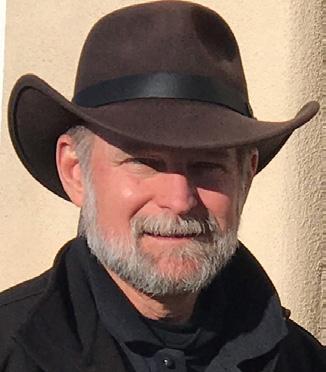
E. BRETT VOSS Publisher

Publisher
E. Brett Voss Editor-In-Chief
Simone Wichers-Voss
Managing Editor
Nathan Diebenow
Contributing Writer
Bryan Davis
Contributing Photographers
Laura Burt
Marvin Grelle
Eugene Mazzurana
Vickie Mitchell
Supporting Patrons
Punky & Wally Penberthy
Jack & Nancy Harvard
COUNTRY magazine is published quarterly by Southern Cross Creative, LLP P.O. Box 431 Clifton, Texas 76634 (254) 675-3336
NOTICE TO THE PUBLIC:
All editorial and advertising materials are copyrighted by Southern Cross Creative, LLP. The entire content of each issue of Chisholm Country magazine is protected under the Federal Copyright Act. Reproduction of any portion of any edition will not be permitted without written permission from Southern Cross Creative. Chisholm Country magazine & Bosque River Run, as well as any reasonable derivative of this name, are trademarks of Southern Cross Creative, LLP and use of these trademarks without the express written consent of Southern Cross Creative, LLP is strictly prohibited.
THE
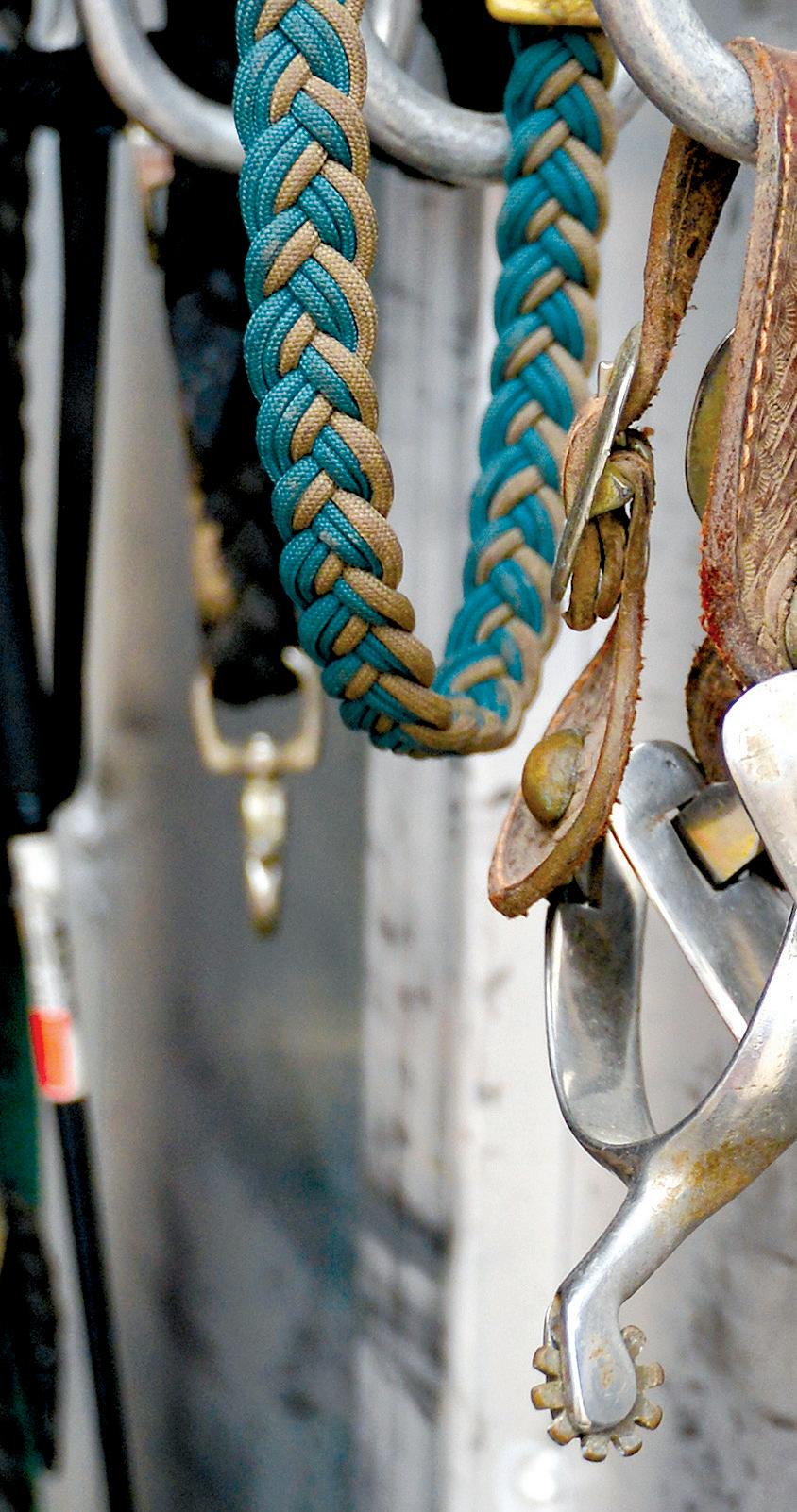

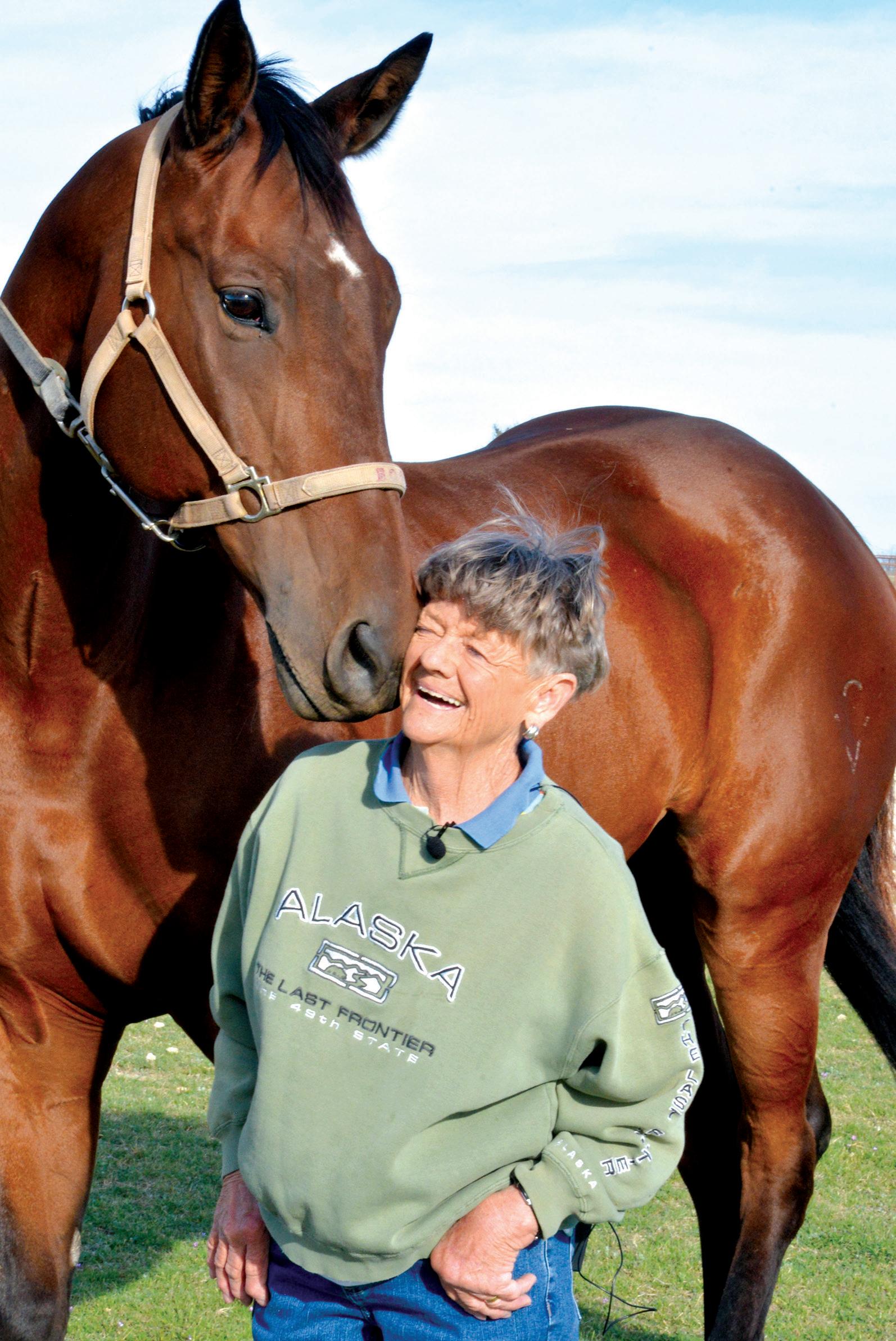
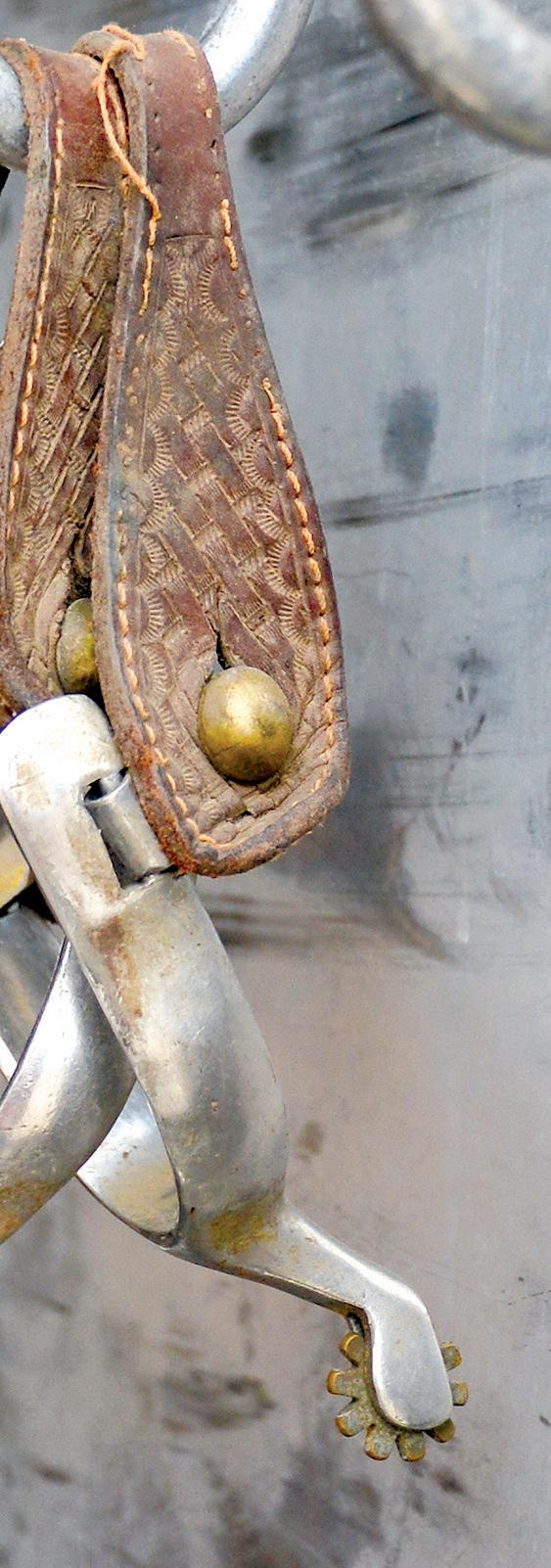

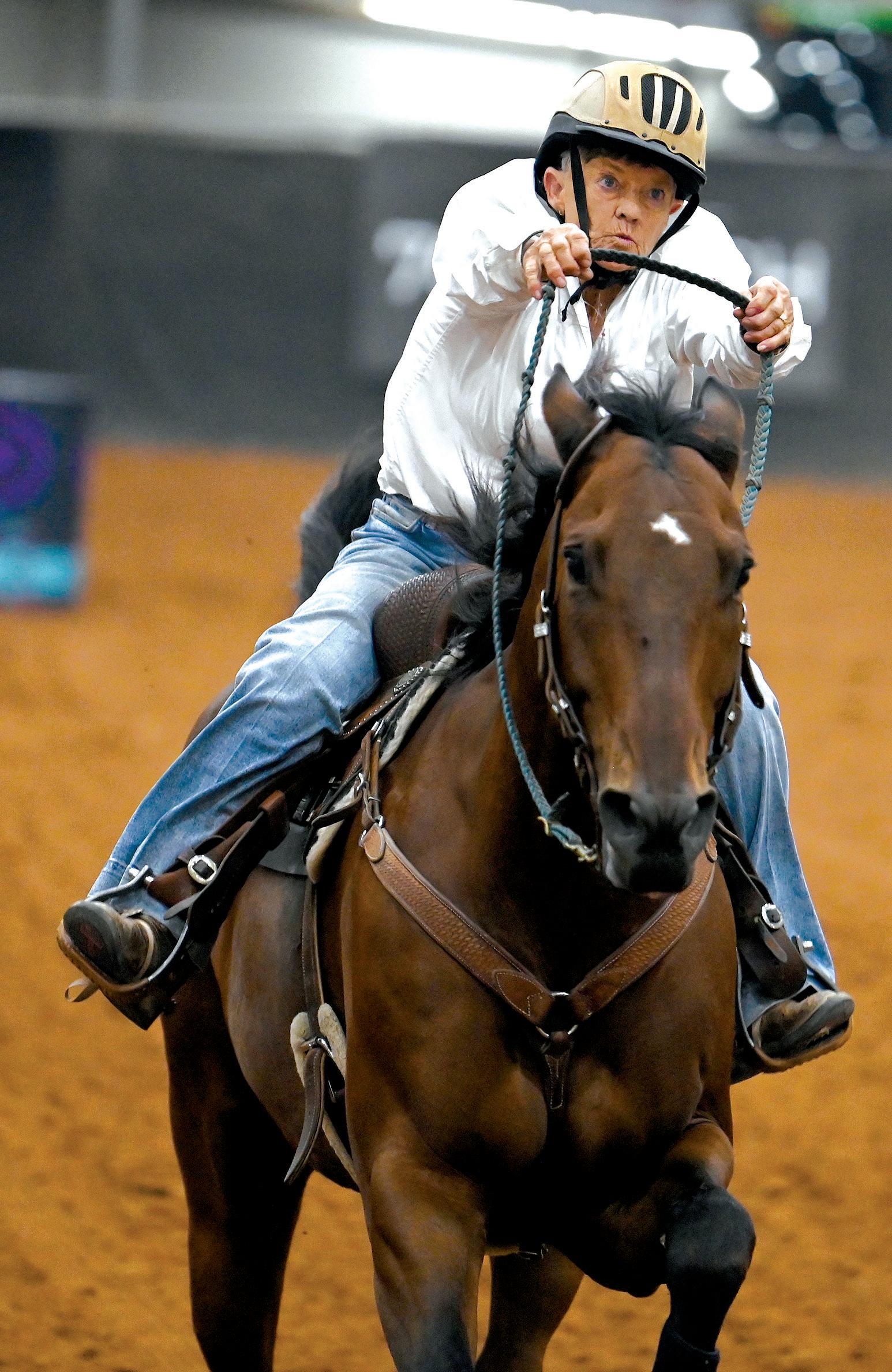
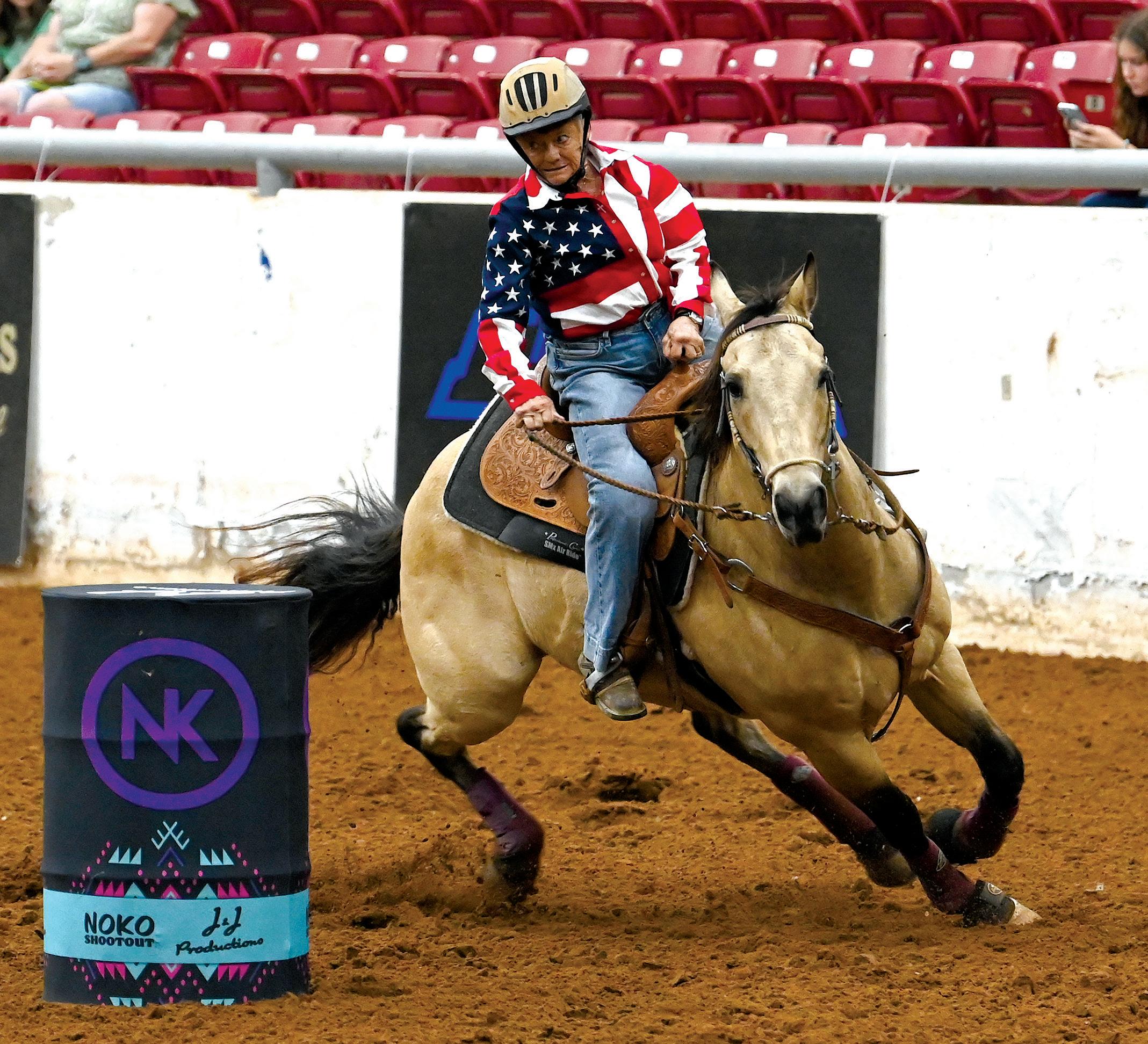
Coming out of the holding pen, the big bay smells the freshly dragged dirt, sees the light at the end of the arena corridor, and excitedly tramples the red sandy loam in anticipation of what comes next. He just loves what he gets to do on the weekends. You can nearly hear him think “bring it on!”
His rider, small as she is, keeps him in check just a little bit longer before giving him the signal to burst loose. They are a team with a dream to get the fastest possible run around the cans.
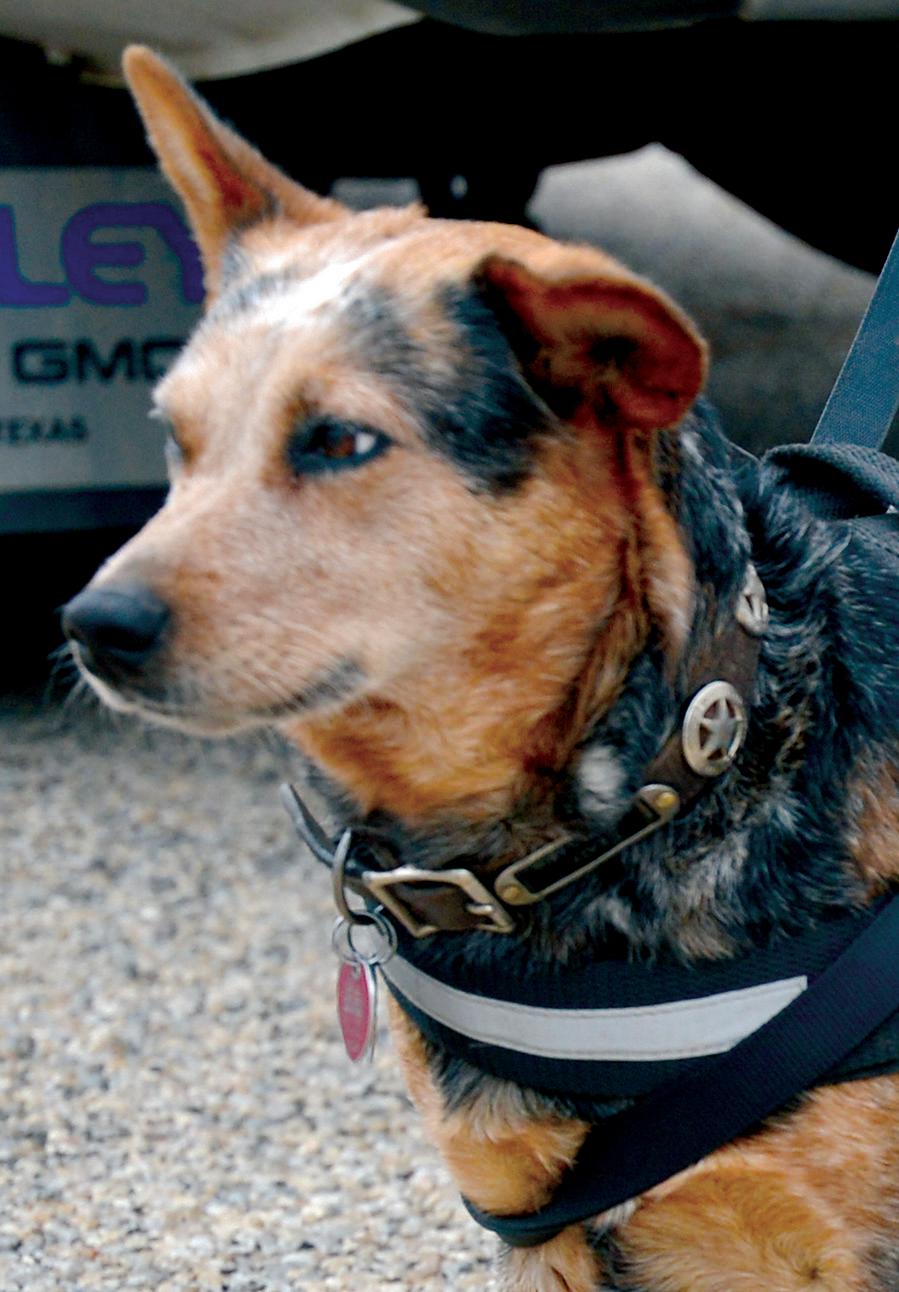
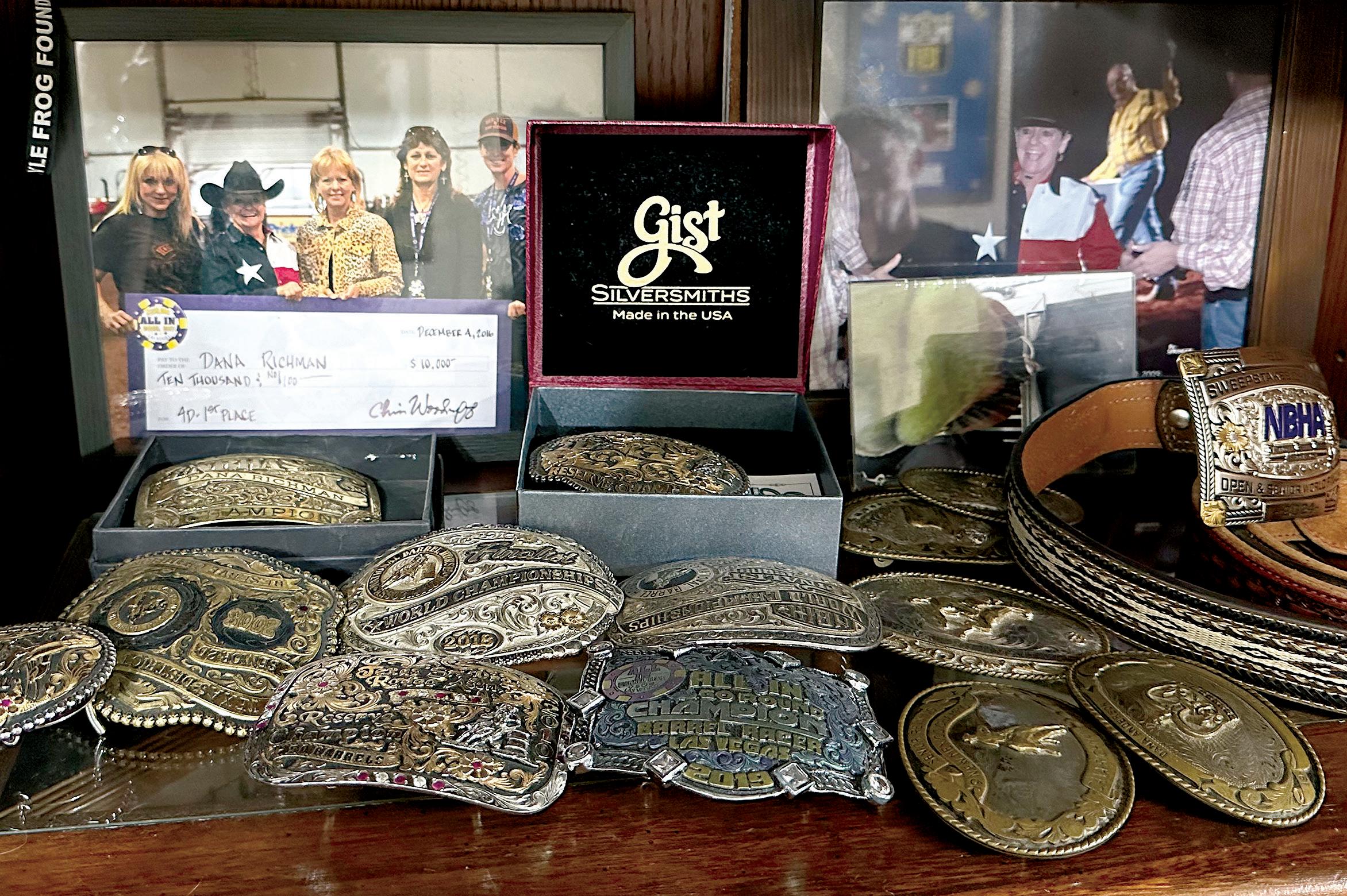
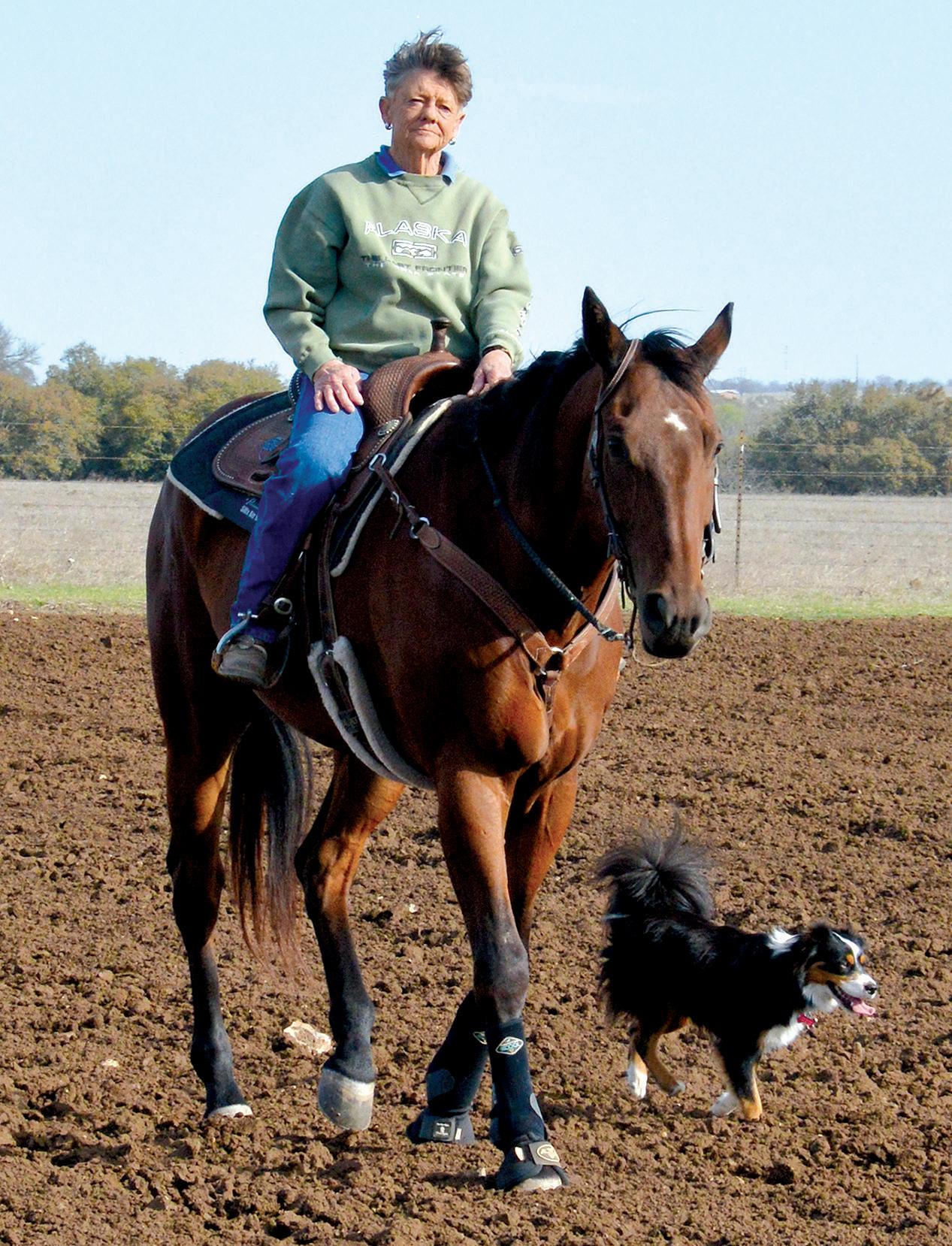
Dana Richman, her horses Boo and Shortstop, her husband Jim and service dog Katie can be found at weekend barrel races most of the year round in and around Bosque County, some smaller, some bigger events. At this time of the year, they look forward to traveling to big competitions in Georgia and Las Vegas. Their team, though, is not characteristic of what you would expect to see competing in this fast-paced, adrenaline-high sport. Dana and Jim have passed the 70-year mark, but aging bones and joints and a slower walking pace don’t keep them from doing what they love. Barrel racing is a fast rodeo event with the goal for a horse and rider – a vast majority being women -- to complete a clover-leaf pattern turning around three preset barrels in the fastest time. Riders must balance speed with control while navigating around the barrels, and the
horses need to know their job. Popular quotes regarding the sport “If you’re not scared to death on the way to the first barrel, start kicking ‘cos you ain’t running fast enough,” “Three barrels, two hearts, one race,” and “Barrel race your best and let God do the rest,” characterize the adrenaline rush, the speed, the team effort.
Dana’s competition shirts, crisply starched, customized with her horses’ names on them, will also have the Lord’s name or cross embroidered on them somewhere, honoring who’s really leading the team.
The high-intensity, short-duration sport involves fast bursts of energy from the horse. And these bursts require excellent muscular strength and cardiovascular fitness. Barrel horse training balances speed work with long, slow distance work to build strength and stamina. And the Richman couple does whatever is necessary to keep precious Boo and Shortstop sound, and in the best possible shape and condition. A huge amount of preparation and cash go into competing in these 15-18 second races.
At their homestead out in the Cayote community, Dana works with them every single day to train them, strengthen them, but also to grow the bond with her equine athletes. Jim is the all-around maintenance guy, combining driving duties, farrier, groomer and mane braider, keeper of the tip top the tack, adjuster of stirrups, videographer of rides, keeper of the calendar, overall supporter and number one fan.
“He helps me in every way to allow me to do what I love,” Dana said. “We do it together.”
Service dog Katie never leaves Jim’s side, while Pippa, the mini-Aussie, the youngest of the clan, gets to run around in the field as Dana practices with Boo. Trapper, the Bassett, howls from the porch. Being the hound dog that he is, he will be chasing rabbits in the brush if let out
THREE BARRELS, TWO HEARTS, ONE RACE: In spite of her age, Dana Richman embraces every opportunity to push the limits of her skills in the barrel race arena. Her husband Jim and his service dog Katie, always accompany her on her quest for prize money and buckles.
Boo that something extra. In the first couple of races, they didn’t do well as a couple yet. But when they took him to Las Vegas, Boo showed what he was capable of, and in a competition with over 600 other teams, he won $10,000.
Dana’s love for horses started when she was two, and her parents gifted her a brown and white Shetland pony, Nelly. It would be allowed to come into the house. Dana started showing horses in the Midland and Rankin area, where she grew up, and competing in the show ring with halter, reining, western pleasure, and some jumping. And when Jim went into the service, she became a race jockey in Alaska between 1972-78.
“The Lord has blessed me, allowing me to do what I love,” Dana said. “I would never choose another life.”
But it’s not all been a smooth ride. In her career breaking and training horses, Dana says she’s “worn out a few angels” with the amount of falls and injuries. In the early 80s, a nasty accident with a horse falling on her resulted in a major head injury and weeks of being in a coma. After a slow recovery process, Dana knew she would still want to be on and around horses, but something needed to change.
Which is why, in her early 30s, a late bloomer to the sport, she switched gears and focused on barrel racing. She had the incredible fortune of having the famous, National Rodeo Hall of Fame inductee, barrel racer Jimmie Gibbs Munroe, as her neighbor and trainer. At that time, she also decided to become a nurse and enrolled in nursing school at McLennan Community College.
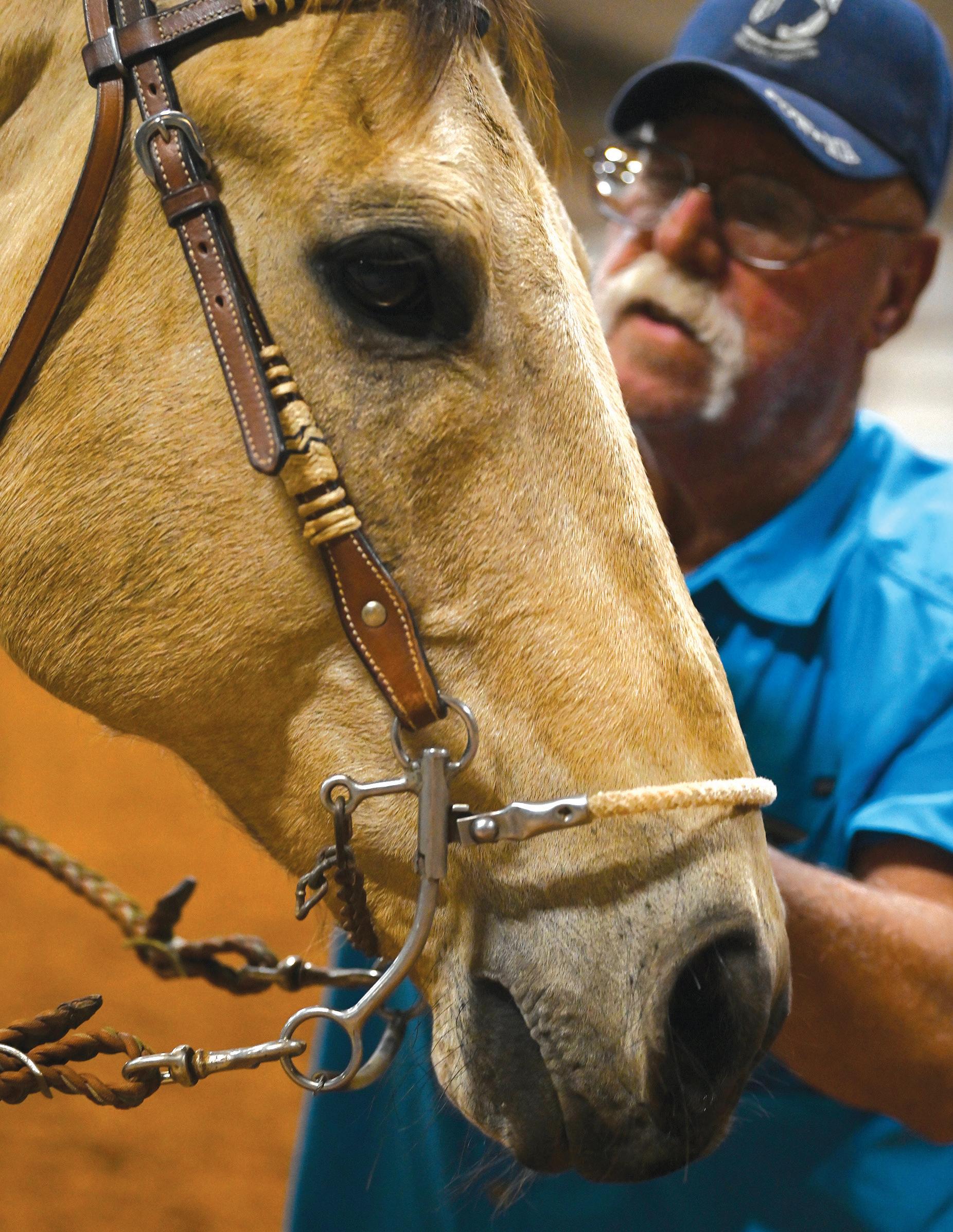
Dana and Jim went shopping for a smaller, easier-to-manage horse after Dana had shoulder surgery in 2022. Shortstop was the yellow, 14.5-hand horse she always wanted. He came from a North Dakota ranch, where he was a tool, a cutting horse, used in the field. Because he was so responsive to commands, the rancher’s daughters would use him to practice roping. And that responsiveness allows him to do well with a Hackamore, bit-less bridle. Boo, on the other hand, favors a traditional bit, but nothing fancy. Boo and Shortstop have become inseparable – a team.
loose, and no telling where he would end up.
While you see all types of horses in barrel racing, the best ones are built for speed and agility to turn around those steel drums quickly, but they also have to be intelligent and gritty.
Back in 2016, Dana was looking for a new barrel racing horse, preferably yellow and small, maybe 14 and a half hands high, to match her small four-foot-nine-inch stature. But there was dark chestnut-colored, Boo at 16 and a half hands – a totally different kind of horse. Big, sweet boy Boo was in a lot, sort of babysitting 20 weanlings. It was serendipity that their paths crossed, and it was love at first sight.
An intuitive buyer when it comes to animals, Dana had no doubts about Boo, while Jim
wanted to look at more horses, saying, “You can’t just buy the first horse you get on.”
“The minute I got on him, I knew it had to be him,” Dana said of her first ride on her boy.
Dana trusted her gut, and Boo is her best buddy, her “lifetime forever love.” That could also be said about her love for Jim, too. At the tender young age of 16, it was Dana who asked the one-year older Jim to accompany her to a Sadie Hawkins dance. And they’ve been together ever since. And true to form, they got married on horseback, right after high school graduation in 1972, the same year Dana became Miss Texas Appaloosa.
His lineage from a top American Quarter horse father and a racing horse mother gave
Before a race, you can usually find Dana in a side arena away from the hubbub. She mostly walks her horses, a little trotting, some loping. It’s not only to warm up her horses, but also to calm the pre-run nerves and get focused. You can tell they are a true team with an effective routine.
“Once you get to the race, your training should be done,” Dana said. “And they should know their job. And if the race doesn’t go as well, it’s usually rider error.”
In her younger years, Dana would get upset about hitting a barrel, or having a slower run, but now it’s all about hanging out together with the horses, the overall experience and not so much about the win.
While the more experienced barrel racer Boo
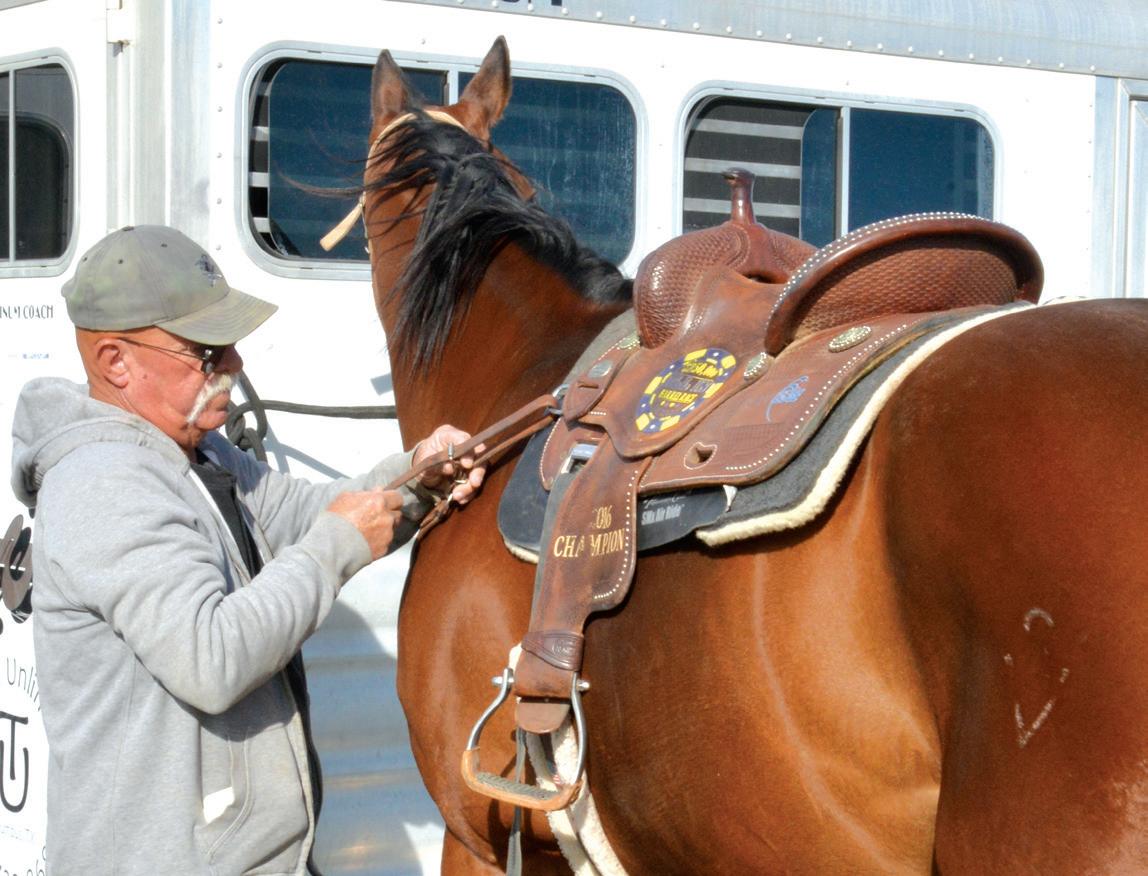
competes in a higher dimension – races with a quicker time – Shortstop earns the nickname “Mr. Moneybags” because he always seems to win some money, if only winning back the race entry fees. So, that’s always a nice way to wrap up a race weekend.
For now, the Richman’s start their day as they always do, by doing the chores around the homestead, feeding the dogs and the horses, turning the horses out. The 1971 song “Me and You and a dog named Boo,” by Lobo comes to mind as they prepare for the next fun weekend at a barrel race. Why? Because they do everything together, but in their case it’s a horse named Boo, and another named Shortstop, and their three dogs Katie, Trapper and Pippa, and the other horses they tend to and all the other critters on the homestead on their own pretty piece of God’s green earth.





FLOOD CONTROL, FIRST & FOREMOST:
Whitney Dam gates open after heavy spring rains (left); Grandaughter
Starting “with a sunrise on a soft autumn morning,” author John Graves embarks on a three-week trip down the Brazos River trip. He describes his float in a kayak with his dog, down the river of his childhood, in his book “Goodbye to a River.” Traversing the land of Oliver Loving, Charles Goodnight, Peta Nocona and Cynthia Ann Parker, woven into the account of this journey, is the history of the people who have lived along its banks – Indians, settlers, warriors and wanderers.
“Creeks draining history into the river, along with silt and leaves and drift and water,” so eloquently captures the essence of the journey. The book is filled with descriptions of flora and fauna to be found along the river, named “Arms of God” by the Spanish.
“Out of the scrub cedar country southwest of Fort Worth comes a book that is like a Texas river itself – meandering through Texas’ chancy bloodstained past and crazy oil-stained present toward a future full of dams and ideas that will change both geography and men,” Lewis Gannett said about the book.
Marian Kleine shares family history in her grandfather LP Reed’s office. Civil engineer Reed and his wife Jessie headed up the dam construction (above).
photography by
With the Whitney Dam construction in 1951, this meandering river turned into a 23,220-acre lake, with 225 miles of shoreline, changing the landscape from a riverine ecosystem to a lake ecosystem, to the detriment of some wildlife and trees, but opening up opportunities for other species to thrive on the protected federal lands. The Brazos River and lake reservoir serve as a large part of Bosque County’s eastern border. While not desirable in the plains and prairie areas of the project, Ashe juniper is a valuable species on the limestone slopes of the surrounding hills and canyons, providing nesting material for the endangered – federallylisted – golden-cheeked warbler. The protected federal lands helped the feathered friend come back from when the flooding destroyed much of their habitat. And after being hunted out, river otters have reclaimed their home in the creeks. The large body of water provides refuge for migrating flocks of water fowl, and on occasion, you can find white pelicans bobbing on the water’s surface. There is a healthy deer population at Lake Whitney, too.
The U.S. government began approving and authorizing dam construction along Texas
rivers in the 1930s to absorb the flood waters, after devastating floods from heavy rainfalls in 1913, 1921 and 1936 resulted in death and destruction. The Whitney Dam was originally authorized by Congress in 1941 under the Flood Control Act. However, when the U.S. became involved in World War II, the funding was diverted to the war effort. The construction was authorized again in the Flood Control Act of 1944, with construction starting in May 1947.
A total of seven dams were constructed along the Brazos, of which Possum Kingdom and Lake Granbury are the only constant level lakes. When there’s a lot of rain, these lakes dump a lot of water downstream, filling up Lake Whitney – the only flood control dam on the main flow of the Brazos. Other dams are on tributaries of the Brazos, like the Waco dam, which is on the Bosque River; Belton is on the Leon;
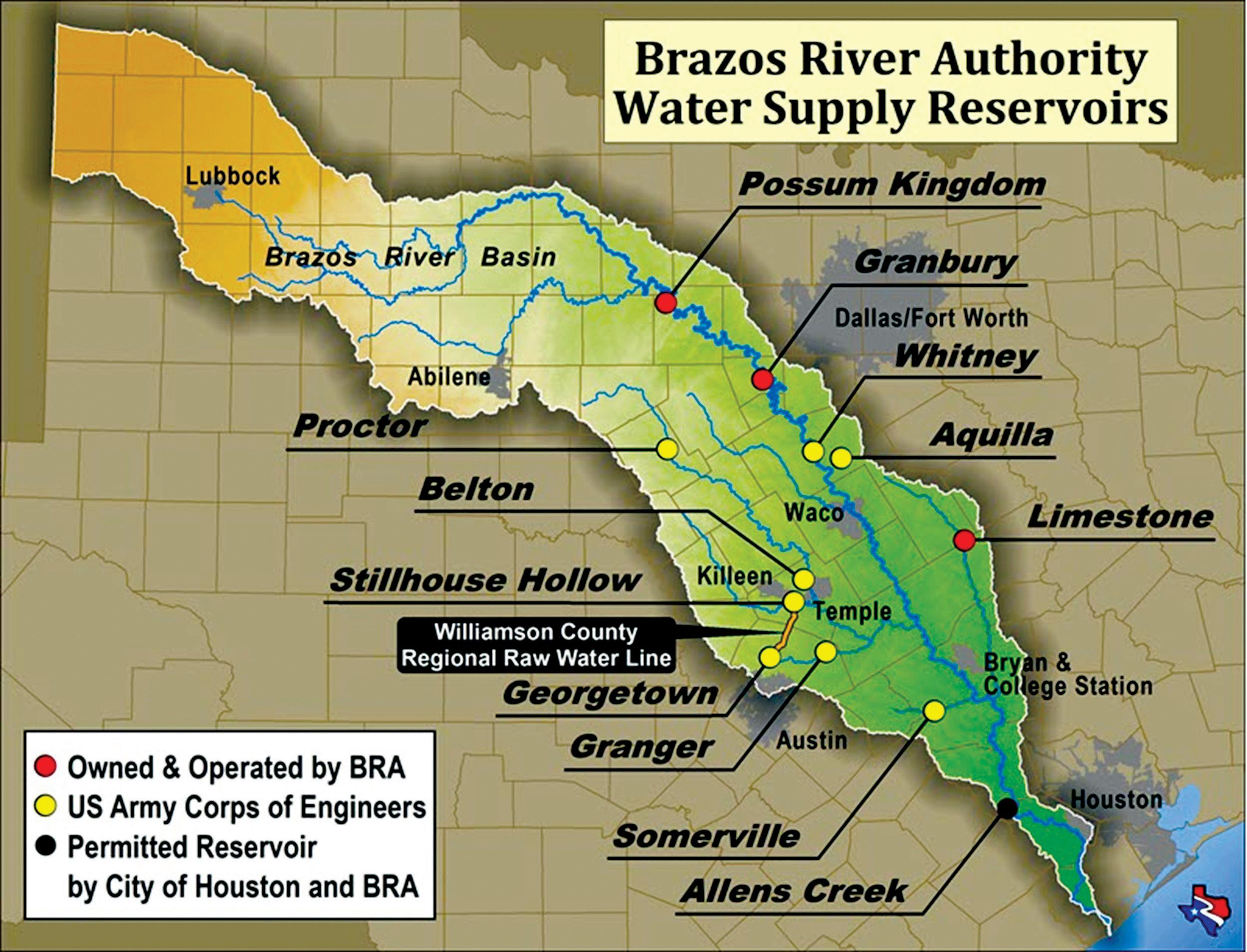


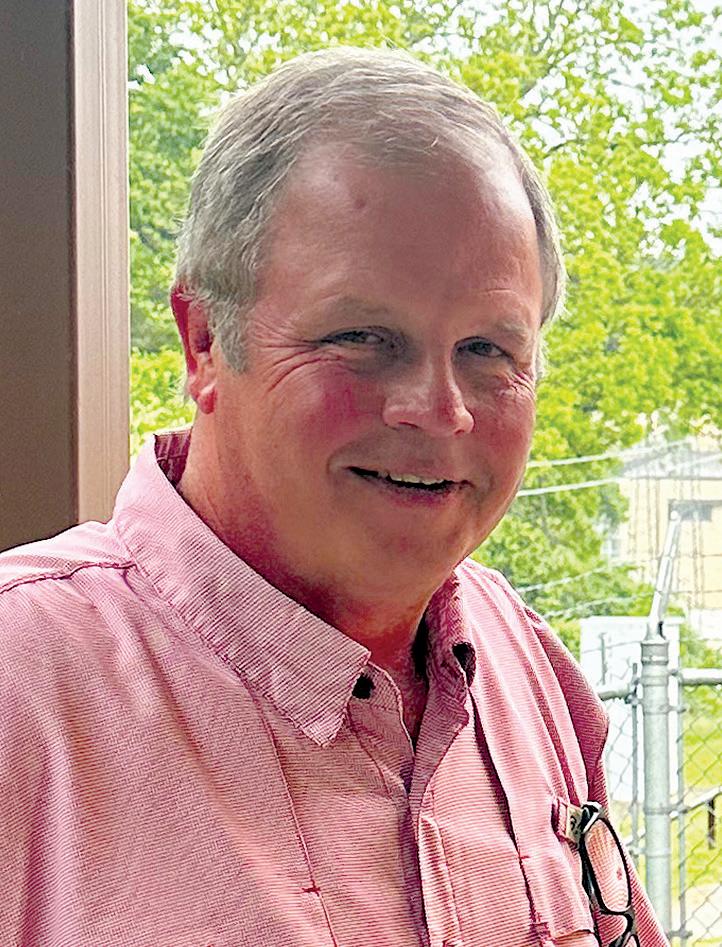
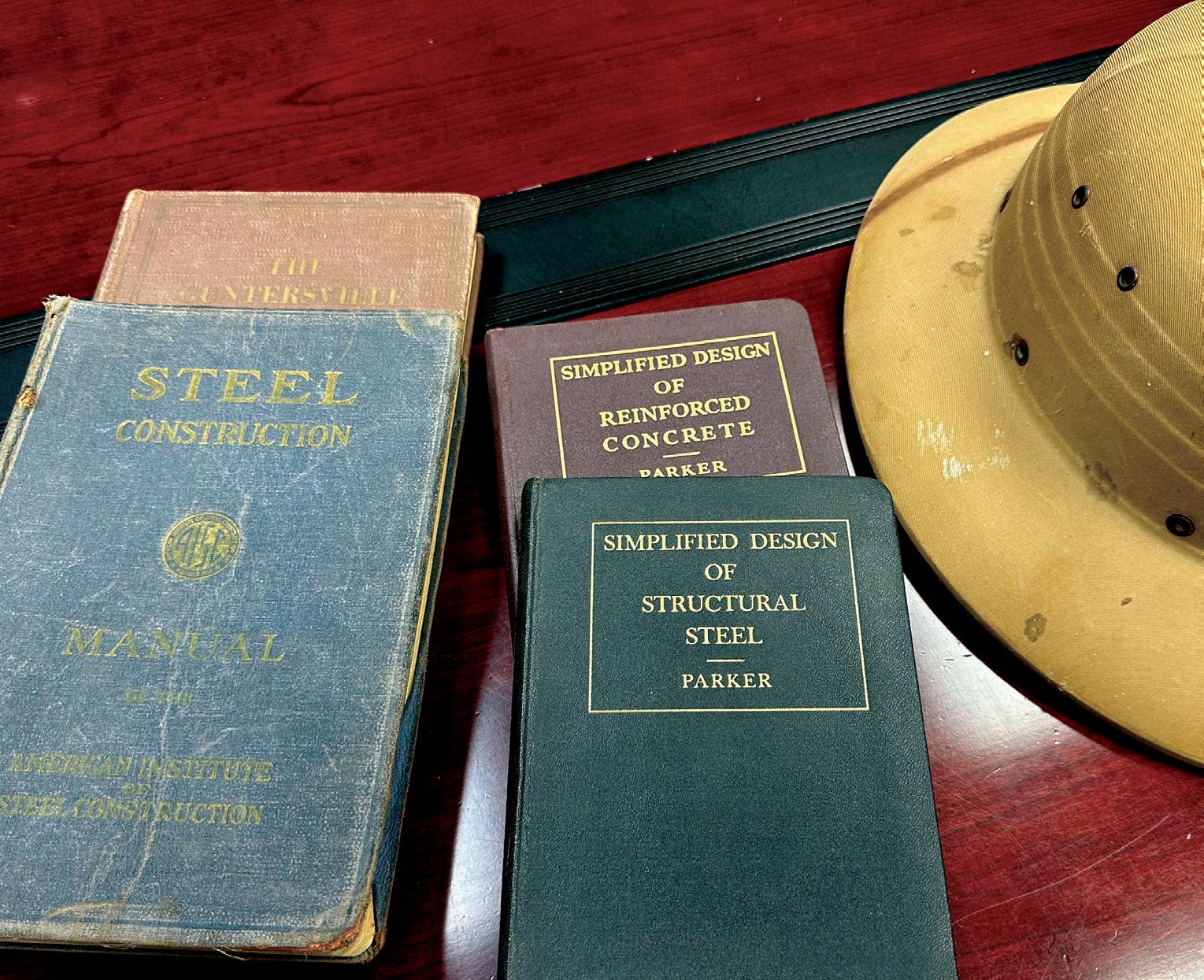
TAMING THE BRAZOS RIVER: Several dams in the Brazos River watershed offer flood control (left); Jeff Boutwell, retired U.S. Army Corps of Engineers Recreation Business Line Manager, offers insights on dam build and function (inset); Before computer aided design, dam engineers used printed manuals and slide rules (above).
Aquila is on Aquila Creek; Somervell is on the Somervell Creek – they all catch water away from the river, slowly releasing it to the river, instead of it gushing in all at one time. That way they mitigate how much water releases into the lower Brazos.
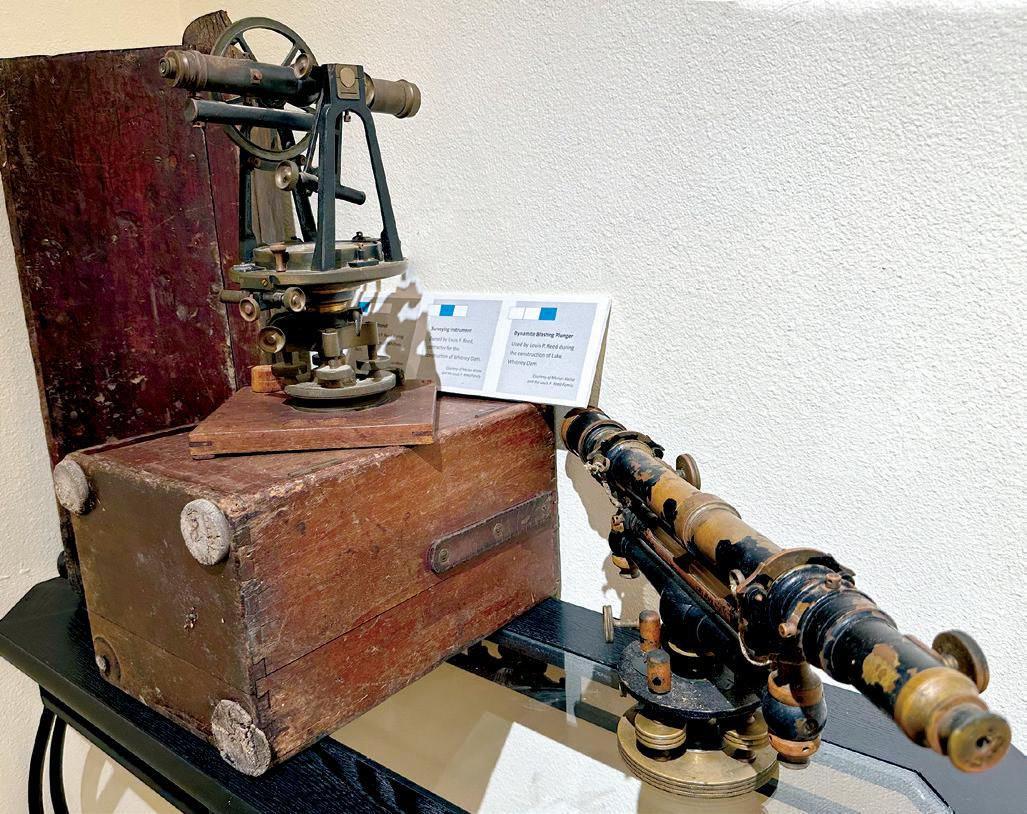
Granddaughter Marian Kleine loves to share stories about her grandparents Louis Phelps Reed and Jessie Mosley Reed. Memorabilia like ledgers, tools and photos of the dam construction could be viewed in the 2024 Bosque Museum exhibit called “Taming the Brazos.”
After a serious political push and pull, Reed secured the bid to construct the 17,695 feet long and 166 feet high concrete gravity structure and earth fill embankment.
Kleine stressed that her grandparents built the dam together, as a team – her grandfather, the engineer armed with a slide rule and her grandmother the business, personnel manager, and accountant, armed with pen and pencil and a mechanical calculating machine.
Civil engineer Reed built a name and reputation building dams, highways and airports in West Texas, and had worked a lot with the U.S. Corps of Engineers. With Reed as an independent contractor, the Corps wanted to break the monopoly on major governmental construction projects held by Brown and Root and H.B. Zachry.
The politics got in the way of a straight-up bidding procedure when Lyndon B. Johnson

more or less assured his favorites, Brown and Root, of the contract, and even had Reed’s bonding pulled. There were even death threats uttered. But Reed had friends in Washington who worked their magic behind the scenes, pulling some strings to make it a fair bidding process in the end.
When the Corps requested him to bid for the Whitney Dam project, Reed was already retired, applying his knowledge and expertise to building dams, focusing on cattle and angora goats on the Bosque County property bought along Spring Creek. The LP Reed Ranch celebrated its 85th anniversary this year.
Kleine vividly remembers driving down the gravel county roads as a child, viewing deer, racoons and streams. She now loves to sit in the library of the ancestral home, where her grandfather sitting behind his big desk, surrounded by his beloved books, pored over blueprints, doing calculations. Engineers are known for their logical, mathematical and analytical minds. But Kleine recalls her grandfather having a very creative side, playing the piano and mandolin, writing lyrical letters to Jessie when they were courting. She has his journal, filled with poetic prose.
“A surveyor at the time, LP was swept away by her, but she declined his proposal,” Kleine said. “She did not want to be poor again, and required LP to get his civil engineering degree.”
After losing her dad to suicide, the family was destitute. Jessie worked after school and didn’t go to college in order to help financially support the family of her mom and eight siblings. She took night classes in accounting and business.
“They were such an inspirational couple,” Kleine said. “They were always educating themselves in one way or another.”
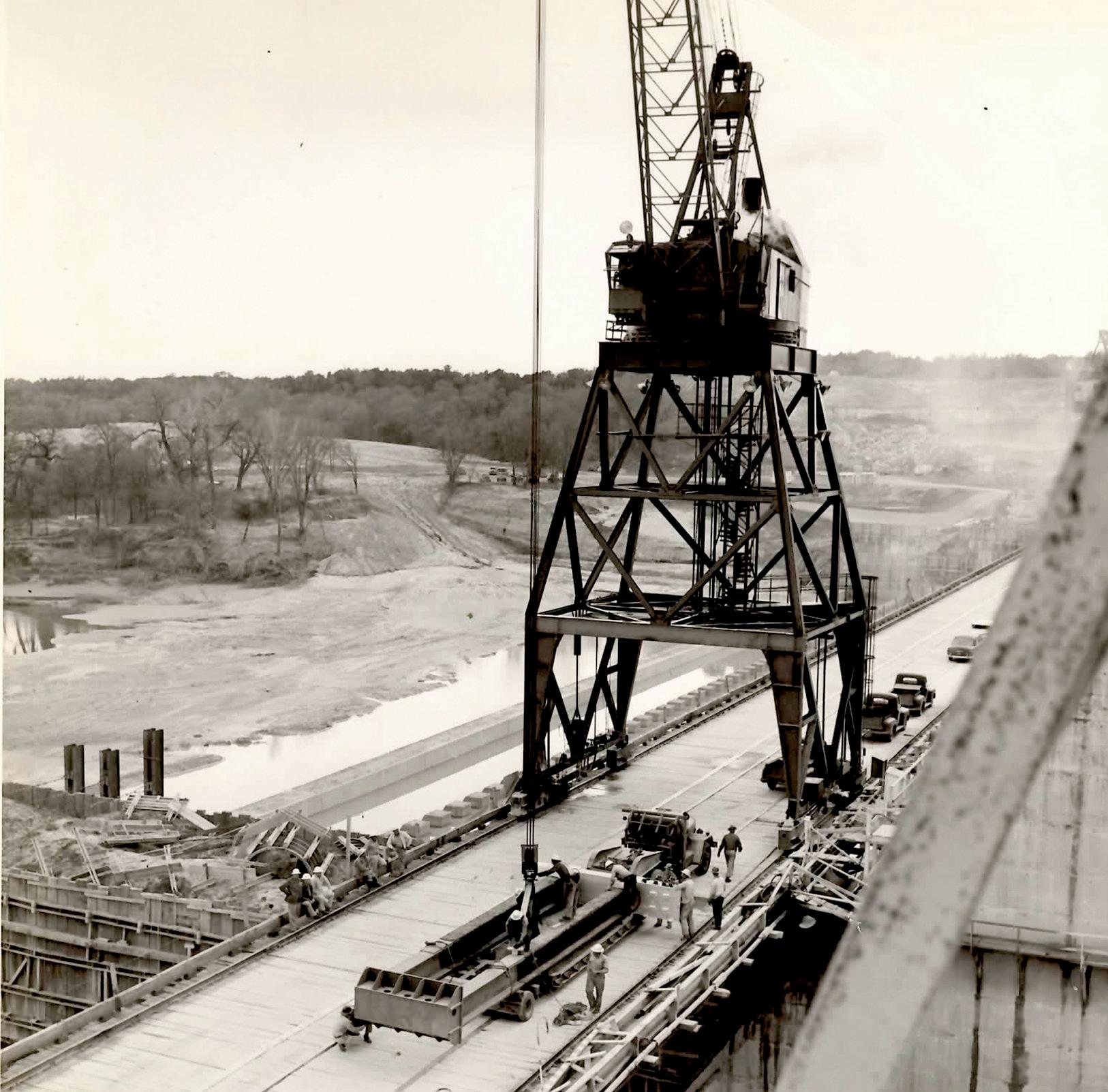
Construction on the dam began in May 1947 and was completed in December 1951, six months ahead of schedule and without any fatalities. This was quite the feat, considering the scope of the project, without the use of modern resources like Computer Aided Design, spread sheets, specialized and automated machines. The construction cost of the dam was $41,880,000.
Train tracks were built to haul in the construction material of aggregate
rock. A total of 33,000 train car loads of material hauled in. An ice house was built, because the concrete had to be iced in the summer heat to keep it from setting too quickly.
The 1953 Westinghouse turbines were replaced in 20132016 did their job for a long time, but had to manufacture their own parts to keep them running though.
Two repurposed Quonset sheds serving as a workshop and a party venue at the LP Reed Ranch are a tangible reminder of the dam construction.
Throughout the early 1800s, Comanche, Taovaya, Caddo, and Hainai peoples settled along banks of the Brazos in this area. The most prominent group, the Hainai, migrated from Louisiana in 1835. Anglo-American traders and soldiers referred to their settlement as Towash Village, for the name of the Hainai’s chief.
Following the annexation of Texas by the United States in 1845, the U.S. Army established a series of forts along the western frontier. Fort Graham (1849-53) was established in the present location of Whitney Lake, and with the arrival of substantial numbers of Anglo-American settlers pushing the frontier westward, the Native Americans were forced to relocate farther upstream. During the 1870s, the Chisholm Trail and its cattle drives passed through the area, with major trail crossing of the Brazos River at Kimball, just north of the lake.
“Where the cattle of the Chisholm Trail crossed the Brazos at Kimball Bend, now, bright tail-finned boats sometimes slice the water, trailing bathing suited boys and girls on skis,” Graves writes in his book, alluding to the changes on the horizon for the river.
Towash now lies in a silent, watery grave at the foot of Towash Creek on the east side of the lake. When the lake gets extremely low during a drought, the demarcation lines


of the sunken city’s cemetery can be seen. While a drowned town speaks to the imagination, it was but a remnant of a town and already dead by the time the buying of property around the lake began. The official post office had already moved to Whitney, which was growing because of the railroad in the 1870s, followed by many townspeople had already moved to Whitney.
The area bordering the river consisted of rolling, tallgrass prairies, cedar trees, hardwood timber and 100-foot limestone bluffs and rock points. This was a poor part of the state, with a stoic, unmoving economy. Only a thin layer of topsoil covered the cedar-covered limestone hills and people worked the land to exhaustion for money crops like cotton. They were tied to the land, poor as it might be.
The dam construction compelled people to move from the area to be claimed by the lake. Coming out to the Great Depression and World War II, the generous offers for the land were a welcome opportunity for some. They picked up and moved to Whitney, Meridian or Clifton.
But the involuntarily uprooting caused resistance in some families that had worked the land along the river for generations. For those not wanting to comply, the land would be condemned by a judge, offering owners the going rate and a deadline to vacate the property. Decades later, some families still held onto hard feelings regarding the forced sale of their ancestral land. They still feel robbed to this day.
Another sensitive act with regards to the creation of the lake was digging up the remains from seven cemeteries and moving them to surrounding areas.
The Whitney Dam is owned and operated by the U.S. Army Corps of Engineers. The primary purpose of the resulting Lake Whitney was, and is, flood control – or as it’s now called “flood risk management.” After a record-breaking drought in Texas during the 1950s, there was an added emphasis on reservoirs serving a secondary purpose as water storage facilities and recreation.
Recreation had been around forever at the river, but it was certainly not organized as it is today. Back in the days before air conditioning, people would seek relief from the heat around the water, the river, and fish for a cheap dinner.
Lake Whitney Lake is now known for its beautiful limestone cliffs and abundant wildlife viewing opportunities which makes it a popular destination for boating, angling and camping. Recreational use at Whitney Lake continues to evolve. Lake Whitney is also part of the Texas Lakes Trail Region of North Texas. The lake provides a quality fishery as well as quality wildlife habitat on public land associated with the project.
Other purposes of the lake include the production of hydroelectric power. Construction of the powerhouse began in April 1951 and was completed in June 1953, and the cost of the powerhouse was $2,208,354. The 1953 Westinghouse turbines did their job for a long time, even though special parts had to be separately manufactured to keep them running until they were replaced in 2013-16.
Prior to the dam’s construction, only 300 people in Bosque County had telephones. To facilitate the dam’s construction, phone lines were erected, and by the time the dam and powerhouse was completed in 1953, over 3,000 people had telephones.
The tops of the dam are at elevations of 584.0 feet and 580.0 feet above mean sea level for the concrete dam and the earth embankment, respectively. The maximum design water surface is 573.0 feet above mean sea level. Normal pool level is 533 feet. At its deepest point, close to the dam, the lake is 108 feet deep.
“While the Corps spends a lot of money keeping the Whitney parks nice for recreation, we won’t think twice about flooding them,” retired U.S. Corps of Engineers Recreation Business Line Manager Jeff Boutwell said. “We’re here for flood control, and the by-product is that we protect
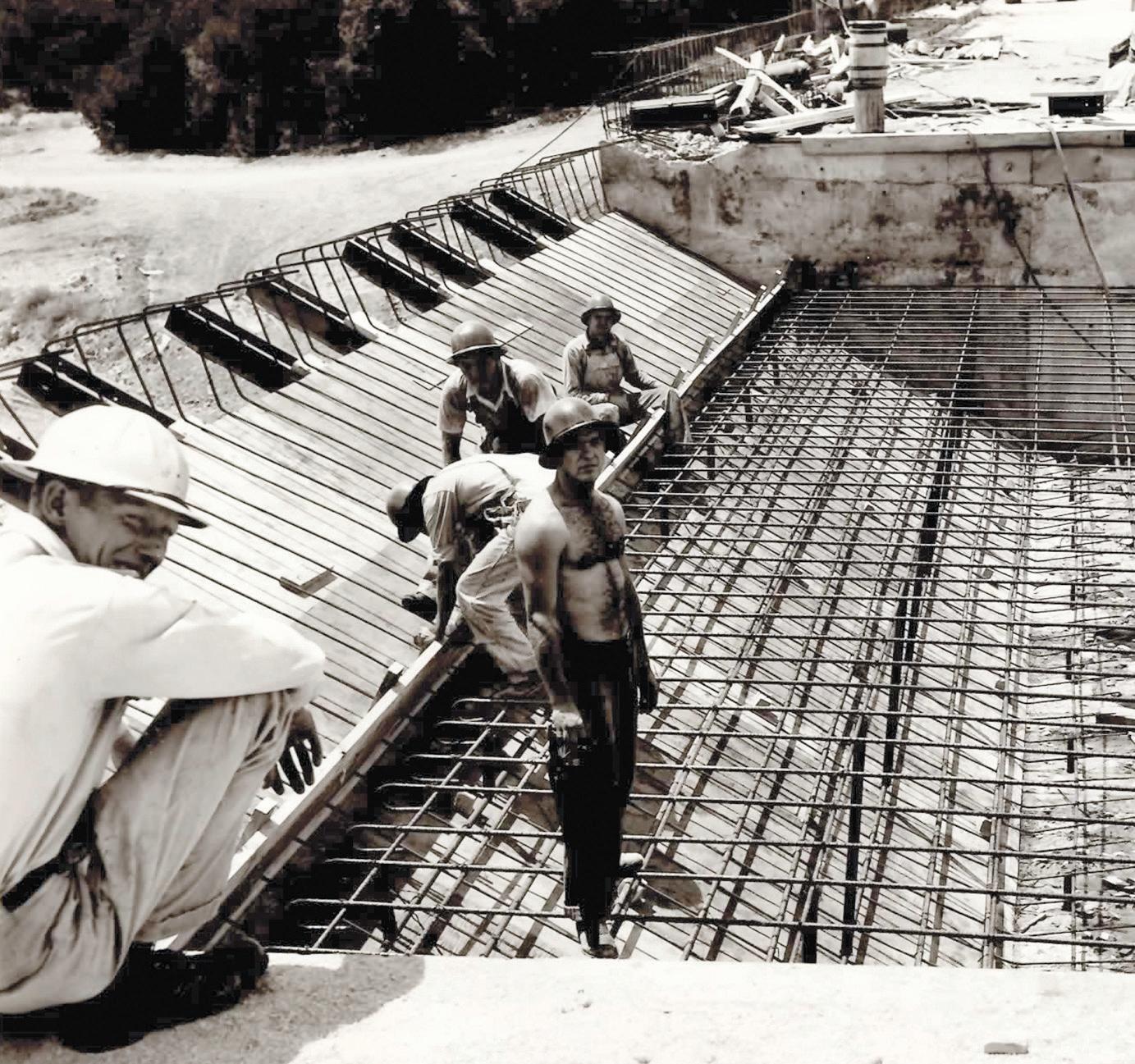
BUILT TO LAST: Surveying tools before laser technology (left); Miles and miles of rebar support Whitney Dam construction (above).
the environment that surrounds the lake, and we provide recreation opportunities. But all of that is secondary.”
This is why the USACE does not allow homes below the 573 elevation. The lake is usually at 533 feet, and therefore has 40 feet of flood storage.
“We will use every inch of that if we have to,” Boutwell said. “We can impact the flooding a little bit. But nature cannot always be controlled. It’s the Texas way – no water or way too much water.”
When Boutwell started work in Whitney, the lake was 13 feet below normal level, and it was four years before he saw a high level in 1991 which took the lake from 16 feet low to 16 feet high in one rain event.
The landowners adjacent to the lake sometimes regard the public land that they back up to, like their backyard and assume they can do things that they aren’t allowed to do, like cut down trees on Corps land/ government property to improve their view.
In their job to “maintain integrity of the flood pool” the Corps deals a lot with residents around the lake. The government property is monitored by the Corps, and they identify and correct instances of unauthorized use, including trespasses and encroachments.
The term “trespass” includes unauthorized transient use and occupancy, such as mowing, tree cutting and removal, livestock grazing, cultivation and harvesting crops, and any other alteration to Government property done without USACE approval.
The term “encroachment” pertains to an unauthorized structure or improvement on government property. When encroachments are discovered, lake personnel will attempt to resolve the issue at the project level. Where no resolution is reached, or where the encroachment is a permanent structure, the method of resolution will be determined by the Real Estate Division with recommendations from Operations
Division, Office of Counsel, and lake personnel. USACE’s general policy is to require removal of encroachments, restoration of the premises, and collection of appropriate administrative costs and fair market value for the term of the unauthorized use.
Much like the Texas Department of Transportation Right-of-Way easement, the landowner still owns the property, pays taxes on it, and can use it, but the USACE has specific rights. The easement grants the USACE the legal right to flood and inundate private land during flood risk management operations and to prohibit activities on the flowage easement that would interfere with flood risk management operations such as placement of fill material or construction of habitable structures.
There are 9,122 acres of flowage easement lands at Whitney Lake.
When the lake went to 570 feet back in 1991, there were close to 15 homes underwater, because they had built on the flow easement or government property under the 573-foot mark.
“We do not want to flood people’s houses, and endanger their lives, so we are diligent in reminding people of their easements,” Boutwell said. “Either the Corps bought the right to flood it, or owns the land outright.”
“We [the Corps] are authorized to release 25,000 cfs (cubic feet per second) to the river below the dam, which is a lot of water,” Boutwell explained “If the water reaches the top of the dam, it’s ‘no holds barred,’ and
the Corps is allowed to release whatever is necessary to keep the integrity of the dam, which could amount to 375,000 cfs, an unimaginable amount of water.
It would bring the river up around the USACE building. It has never happened, and you do not want it to happen. It would turn McLane Stadium into a big, big swimming pool.”
When Boutwell started working with the Corps as a ranger at Lake Whitney in 1986, there were four maintenance crew members in their 60s-70s, who had been part of the Whitney Dam construction.
“Mind you, they were older than my grandparents,” Boutwell said. “They would say ‘C’mon boy, let’s get you some knowledge.’ I always thought it was really cool that I knew people that built this place, that I worked with them, that I heard their stories and stuff. It was really neat.”
They had stories of cranes that had taken on too much weight toppling over. But surprisingly, taking the scope of the project into account, no fatalities occurred with the site accidents.
“The sheer scope regarding the construction of this thing just intrigues the bejesus out of me” Boutwell said. “We focus on so much safety nowadays around here, and looking at the old photos, you instantly go ‘nope, not happening,’ because of the safety restrictions and stuff.”
For example, there was no roll-over protection on vehicles, and workers could be seen wearing regular fedoras, not hard hats. But then again,
that was the time before safety belts in cars, and children weren’t secured in car seats.
And over the years, the actual architecture of dams has not changed much. Some gate mechanics might have changed, but the actual dams are much the same. The Whitney Dam structure is in good shape according to Boutwell. Specialized crews inspect the dam annually.
Some of the original buildings and foundations, the artesian well from the construction site still exact.
“What I wanted to do was to wrap it up, the river, before what I and Hale and Satanta the White Bear and Mr. Charlie Goodnight had known ended up down yonder under all the Criss-Crafts and tinkle of portable radios,” Graves writes in his book. “Or was that, maybe, an excuse for a childishness? What I wanted was to float my piece of the river again. All of it.”
And as it is with history, some things could not be predicted.
“The lake was only supposed to last for 50 years, based upon the lake would silt in,” Boutwell said. “Because farming practices have changed drastically, there is less erosion of the land, causing less silt to run off into the river and lakes…something they didn’t know would happen.
“And here we are. It will probably be around at least another 100 years. It’s not going anywhere, as long as they take care of it.”
It’s another sweltering summer day in Central Texas and everybody knows the feeling of beads of sweat dripping down their backs – sweat making hair stick to their faces and the effect of the draining heat on already frazzled nerves.
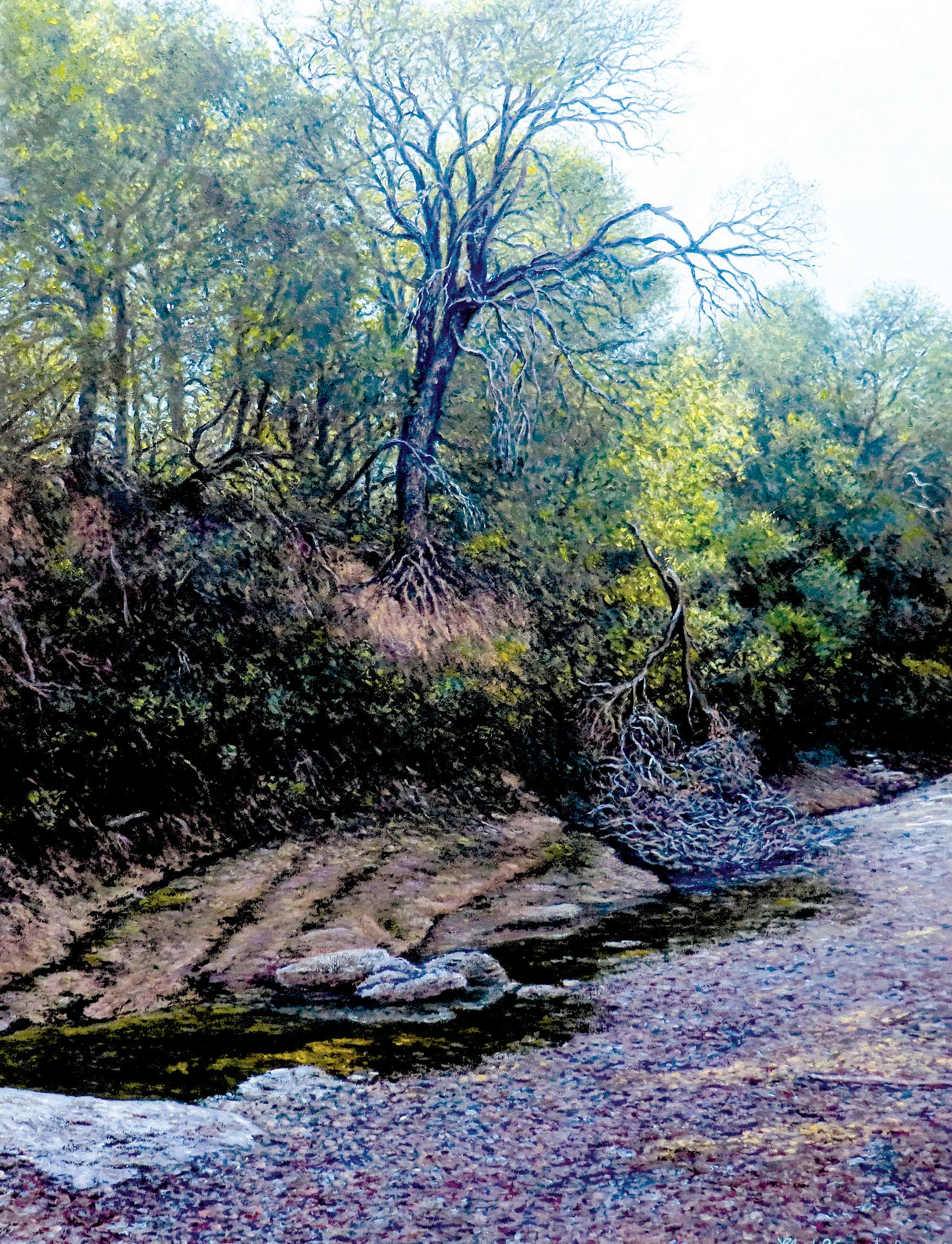
But there is a solution, a very simple one. Just take some time to look at a creek painting by award-winning artist Lloyd Voges, and a refreshing calmness just takes over.
The heat is forgotten as the viewer pictures placing their feet in the water, feeling the coolness wash over their toes and around their ankles, hearing the soft breeze rustle through the leaves, and the waters roll over the rocks. The heat stress is forgotten as the watery blues, the leafy greens and limestone greys breathe tranquility into one’s soul.
The artist wants the viewer to think “I remember that from my
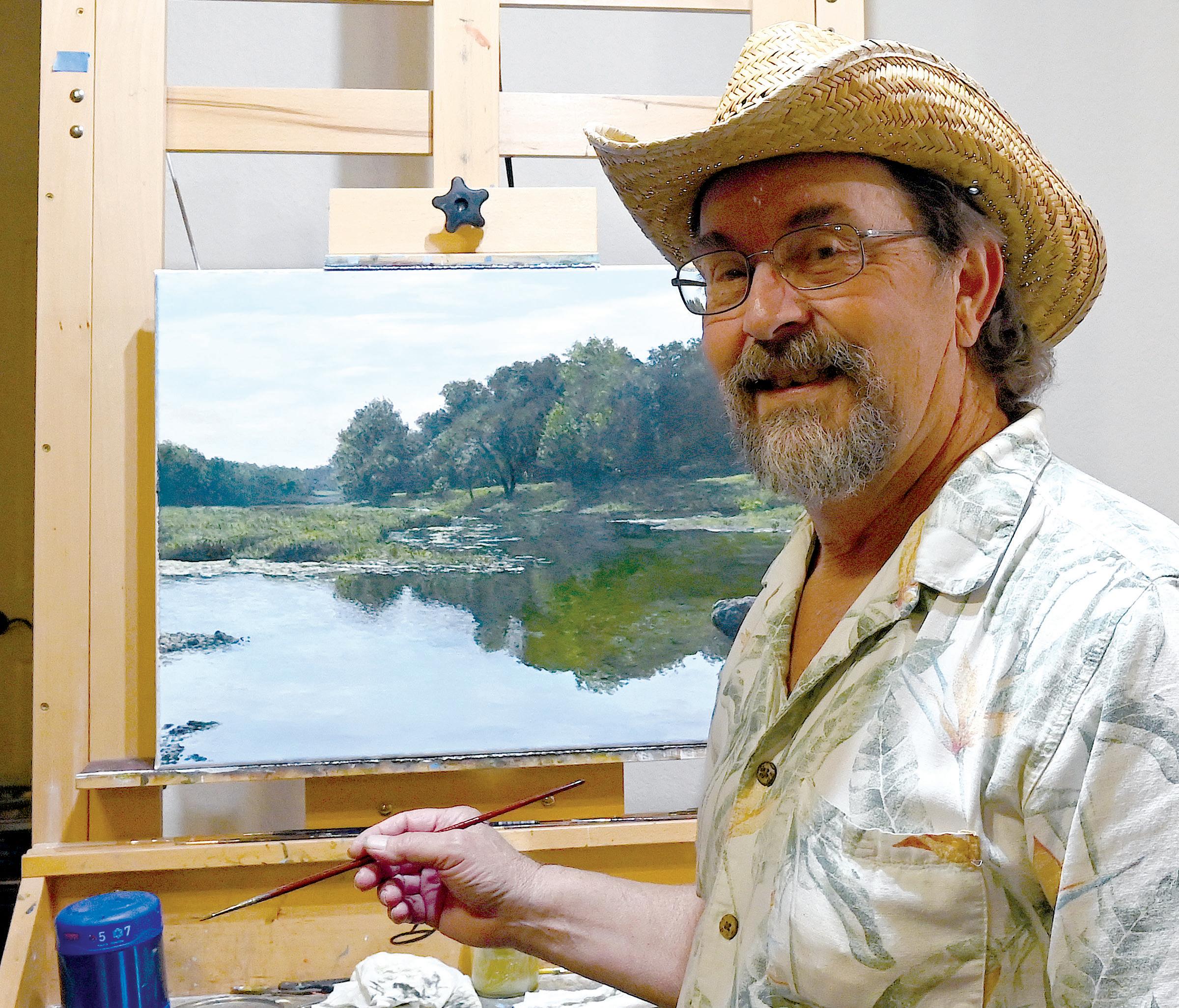
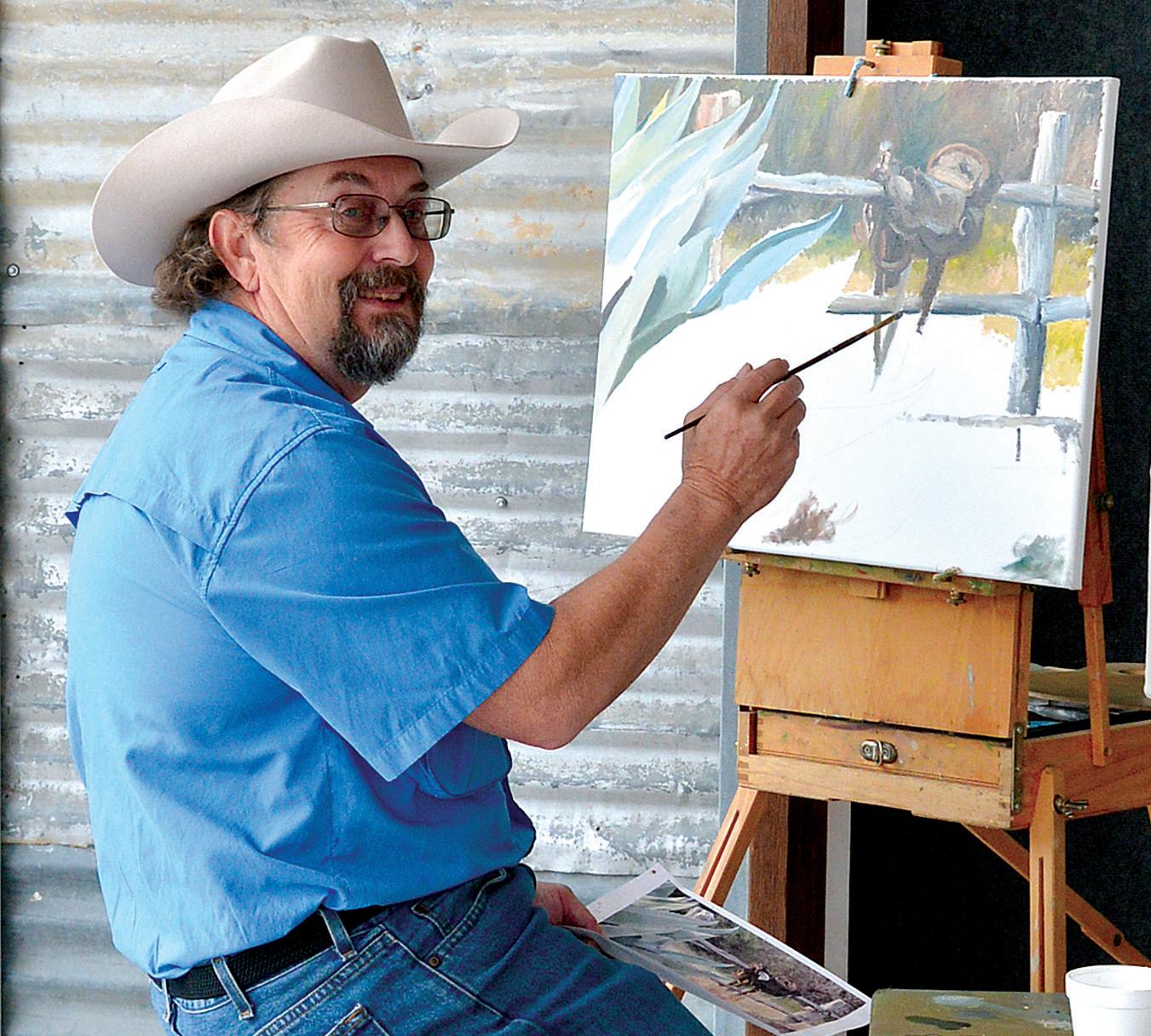
PAINTING WHAT HE KNOWS, CAPTURING THE PEACE IN NATURE: Bosque County painter Lloyd Voges finds inspiration in the creeks and scenic beauty close to home (above); “Evening Peeking Through On Meridian Creek” 24x18 oil on panel.
childhood,” and be transported back to that time of joyful innocence. The titles of his work like “Moment to Reflect,” “A Touch of Water Color” and “Creeking Along” exude this sense of serenity and peace.
For those who do not know the artist, his work truly reflects his character and demeanor – unassuming, extremely personable and real.
Voges paints what he knows and loves, and his love of the outdoors and ranch life always shines through in his compositions. His paintings tell stories of day-to-day ranch life and like the cows lounging around, tails a-swishing, happily cud chewing away in the shade – one can practically hear the crickets chirping away in unison in the background. Or the gentlemen callers – some tail rustling turkeys – set in a quintessential Bosque County countryside.
And it’s those oh-so-recognizable stories of central Texas that draws people into his work. Voges and his wife Teresa also take every opportunity to visit other ranches and historical towns throughout Texas, admiring the old architecture. This not only gives the painter the
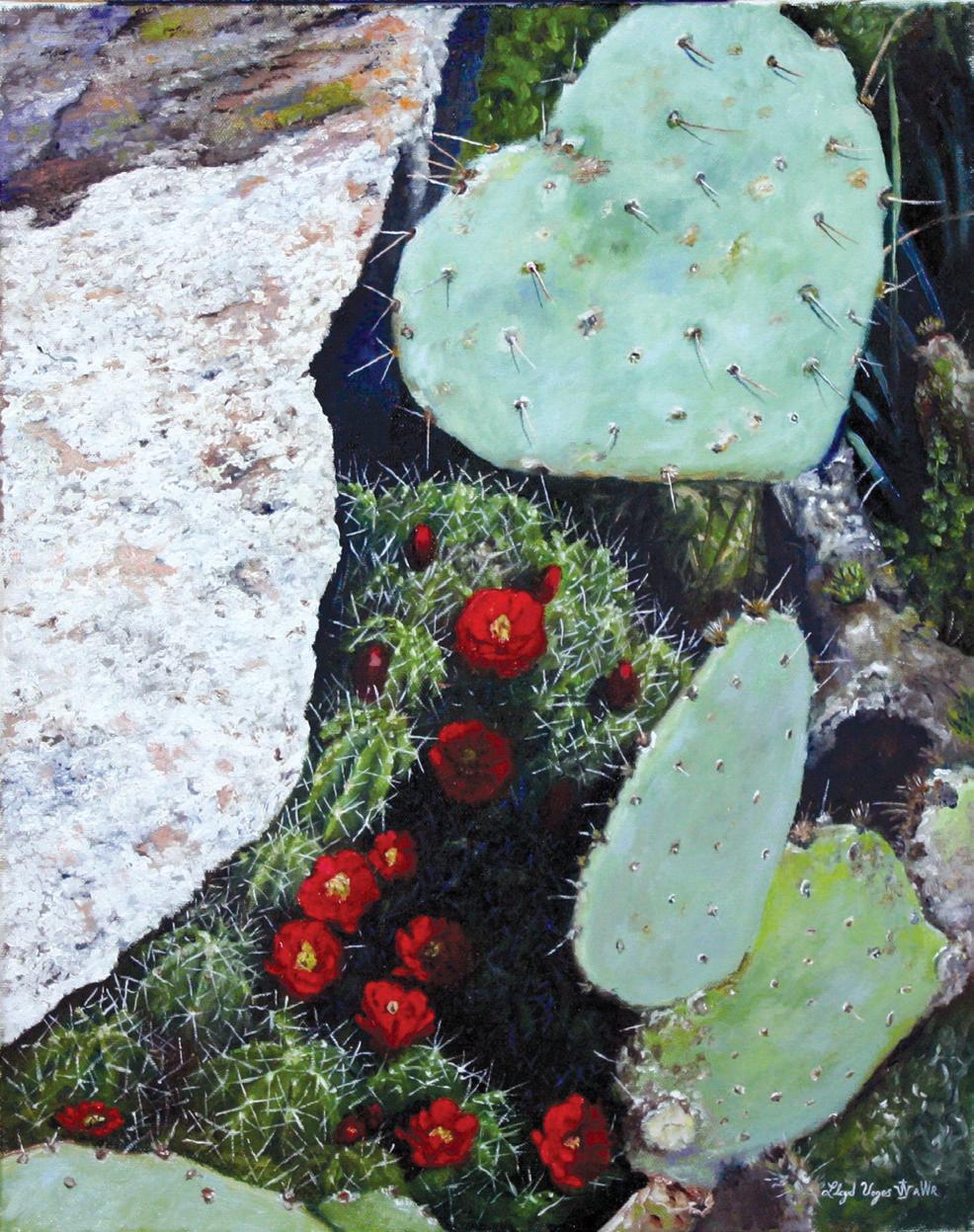
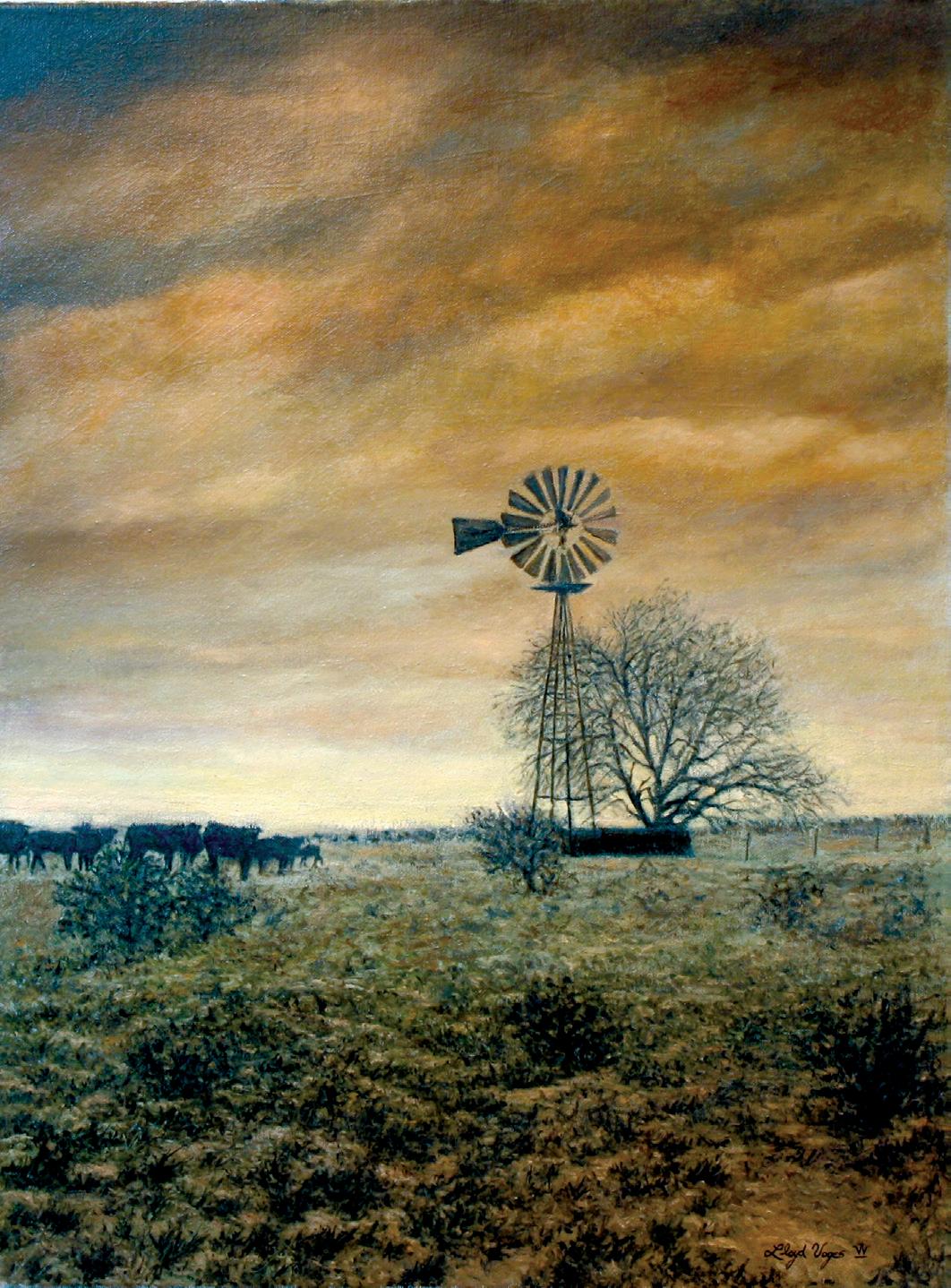
INSPIRATION IN NATURAL BEAUTY: Local artist Lloyd Voges captures everything from cacti to Texas windmills. “Texas Cactus Floral” (above); “Eclipsed Windmill: Out of the Haze” 20x16 oil on panel (far right).
inspiration to paint country scenes, but to study old structures in different light and angles.
Lloyd painted intermittently since childhood without formal training until 2002. After gallbladder surgery, doctors advised he take it easy. With a stroke of genius, Teresa bought him some oils and suggested he take up painting again to keep himself busy. And it all clicked. In that same year, he became a student of Richard Skurla, owner of the Silver Maple Gallery and School in Waco. In 2009, Voges took the step to quit his day job at Mars M&M and became a fulltime artist.
Well, that’s not entirely true. He always ranched alongside his main job –first mainly cattle and now a flock of 28 Dorper-Barbado mix ewes and a ram. Sheep are easier to handle than 1500 pound cows, the cowboying of which gave him a few too many concussions and left him with his signature chippedtooth smile.
Wearing a ball cap or straw hat, coffee in an insulated mug in hand, his “up at the crack of dawn” days always start with him and Bruiser, their “Oops” Anatole-Pyrenese-Bassett Hound mix dog checking the wooly subjects delegated to his care in their Norse pasture realm. Sweetie Pie, the grey

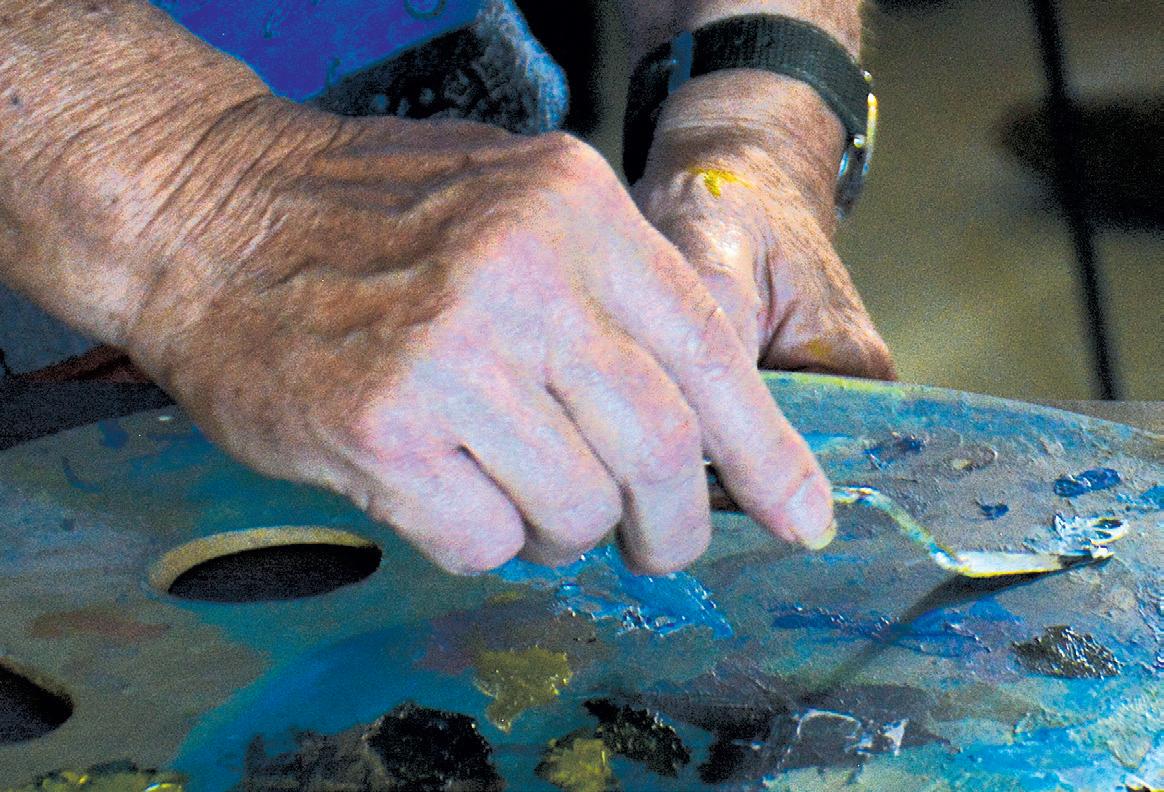
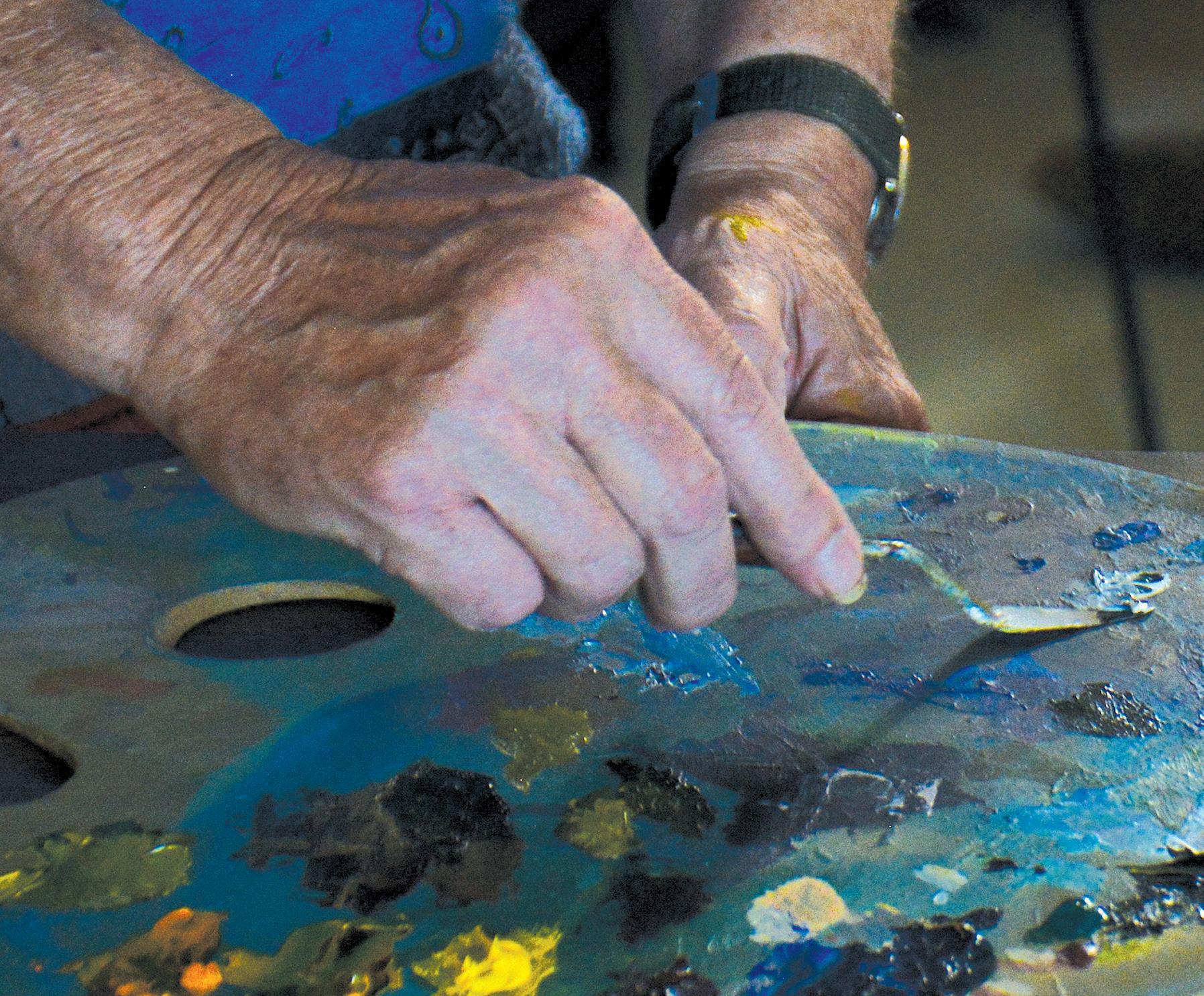
Manx, stays closer to the house, waiting to greet Teresa when she gets home. Only after the ranching chores are done can Voges settle in to a day of mixing paint colors on his glass palette, tweaking a new canvas on the easel, organizing new and refurbished frames and finding inspiration in photos he has taken in the beautiful countryside surrounding their homestead – there is so much of it.
In the early years of his rediscovered passion, Voges kept putting paint on his brush and on his canvas, improved the mixing of his colors, trying different light situations and angles as he studied with Skurla and other artists for the next nine years. Voges’ competitive nature led to entering juried shows, the next logical step. And in 2011, he and Teresa decided to attend the Western Artists of America annual sale and exhibition at the Pearce Museum in Corsicana and chatted with the association’s President Edward L. Holmes.
An artist friend suggested he was not ready to enter a show yet, but Holmes disagreed. That made Voges feel confident enough to enter the prestigious Bosque Art Classic in the same year with a work called “Waterbreak,” of Corriente cattle around a water trough, done with palette knife only.
The next year, Voges entered the

WAA show, and while he did not garner any awards, his cactus floral painting sold. The red barn with a duck and a rooster entered in that same show now has a spot in the couple’s home, a memento of the show opened a lot of doors for the artist and was the start of the steady climb to his success today.
“I felt like such a rookie in a class of veteran artists,” Voges said of that first show. “I felt special, but not that special, like Cinderella who was new to the ball.”
His compositions have since been in several shows throughout Texas and the U.S.A., juried by renowned artists and art connoisseurs like Bobbie Gentry, Mike Irvin, Tony Eubanks, Nancy Boren, George Hallmark, Martin Grelle.
The shows include the annual Bosque Museum Art Show and Sale, The International Guild of Realism Exhibition in Santa Fe, NM, the prestigious, national Bosque Arts Classic – for the eighth consecutive time in a row, 10 in total since 2011 – the Annual Roundup Art Show at the Museum of Western Art in Kerrville and the classic American Plains Artist Show, all high quality shows maintaining the history and
heritage of western representational and realistic art.
Voges was selected into the Western Artists of America in 2011, in 2013 he became a member of the Western Associates, and in 2019 was selected to join the International Guild of Realism as one of their new members.
In 2021, he became a signature member of The American Plains Artists – Highlighting the Diversity of the American Plains Through Art –the landscape, the life, the people and the wild life. He is also an emeritus member of Western Artists Roundup.
While his first competitively entered works did not win awards, they did sell, showing the artist his voice was heard and appreciated. It must be a special feeling for Voges to be able to prove a high school art teacher wrong, who uttered the words “You’re never going to be an artist.”
This past year has been a testament to his ongoing success and popularity.
In March, the painting “Shades of Blue” featured in the C.M. Russel Museum auction, and “A Waters Glistening” received the Honorable Mention award at the Texas Invitational Art Show at the Pearce Museum in Corsicana.
“Getting awards still amazes me,”

Voges said. “God’s blessings are awesome.”
In April “Overflowing With Reflections” sold at the opening night of the 42nd Western Roundup Art Show at the Museum Of Western Art in Kerrville. July brought the American Plains Artists Signature Show North Platte Award for “Just a Prickly Pear.”
And for over 10 times now, Voges’ works have been accepted into the Bosque Art Classic, juried by Bruce Greene CA this year. His works are “Sunlit Morning” and “Canadians Honkering Down In Texas” will be on display during September in the Roland Jones Memorial Gallery, alongside the other selected works for this year’s show. And Voges has entered two works into the Mountain Oyster Show in Tuscon, AZ, with over 50 years since its establishment, it is the oldest-running western art show in the country.
Voges’ work can found at the Lost Creek Gallery in Calvert, Lovetts Gallery in Tulsa, OK, and the Studio Gallery in Waco. Voges also sells originals and prints of his work at Ladybugs and the Shoppes at Whiethorse Station in downtown Clifton.
“I always looked for authenticity and sincerity in an artist’s work, because people respond to that,” former art gallery owner An Thompson said. “Everybody has an opinion and own taste when it comes to what they like in art, but all people respond to Lloyd’s realistic work.
“It alludes to a sentimentality, to a simpler, serener life; especially his more recent creek paintings. They hold the sentimentality of childhood memories of going to the creek; the beauty of splashing in the water, seeing the water run over the low water crossing, especially for Central Texas folk. They can relate. People
close to the land recognize those spots.
“Lloyd’s work is highly collectible, and I know that Lloyd’s work is going to appreciate in value over the next years. He is really at the top of his game right now, getting into the big shows and still evolving. And on top of that, he is such a genuine, grounded person.”
The scripture on his website “We can do all things through Christ who strengthens usPhillippians 4:13,” reveals the artist’s inspiration when challenging himself. Carl Willy “Poppa,” his grandfather on his dad’s side, gave the advice: “Whatever you do, give it 100 percent, whether it’s sleeping, playing or working.”
On hindsight for Voges, learning to paint with skill along with the many rejections was the hardest thing he ever did in his life.
“God has shown he believes in me, so I won’t be worried,” Voges said. “He will lead me, and that’s where I get my confidence.”
But unassuming as he is, Voges prays for continued success. Not leaving things up to divine providence though, over the years, he has never stopped studying about art and practicing, practicing, practicing.
Inspired by so many artists, his study of old Renaissance masters with their use of light and composition, and new western artists like Don Oelze’s landscapes and studies of Native American Indians, Jay Hester’s depictions of rustic beauty, June Dudley’s use of vibrant color and Kathy Tate’s loose-stroked still life paintings, helped improve his composition, use of values, color and along the way he learned how to capture things like evanescent snow and water with incredible iridescence and how to make a cactus floral pop off the canvas with color and perspective.
Since his first successful shows, Voges has moved from a more active brush and palette knife work to finer detailed portrayals of the world he loves.
“This man can smear some paint,” fellow artist and friend TW “Pops” Vanya said. “Through diligence, a lot of effort and sweat Lloyd and I had the providence to advance in our careers. And there has been such progression in his work since he started his waterscapes. It’s as if he was touched by a magic wand. It is so wonderful as an artist to see your compatriot take off.”
Raised in a family dedicated to preserving the farm and ranch lifestyle, Voges’ dad Ronald had done what he could to prevent his son from becoming a rancher, to spare him a hard life. so, being competitive, Voges sought to be an athlete, but being on the smaller side, football and baseball were not feasible, so he became a semi-professional bowler and golfer.
With that background Voges likes to compare himself to the golfer with the most unorthodox swing, calling himself the “Lee Trevino” of the art world. The realist with a twist of impressionism, starts with the horizon in his landscapes and slowly watches it unfold, sometimes with happy mistakes. And unlike portraits and other figurative subjects, landscapes can be a bit more forgiving, allowing the artist to play and change things.
His “just go with it” and “play with it” attitude seems paradoxical to his very precise depictions of nature. The advantage of painting in oils, helps his philosophy that “there is nothing you can’t fix;” and at a recent oil painting workshop at the Bosque Arts Center, he told the students: “Never waste a botched canvas, you can always use it as target practice.”
PAINTING TEXAS, FROM BLUEBONNETS TO LONGHORNS & THE HOMESTEAD
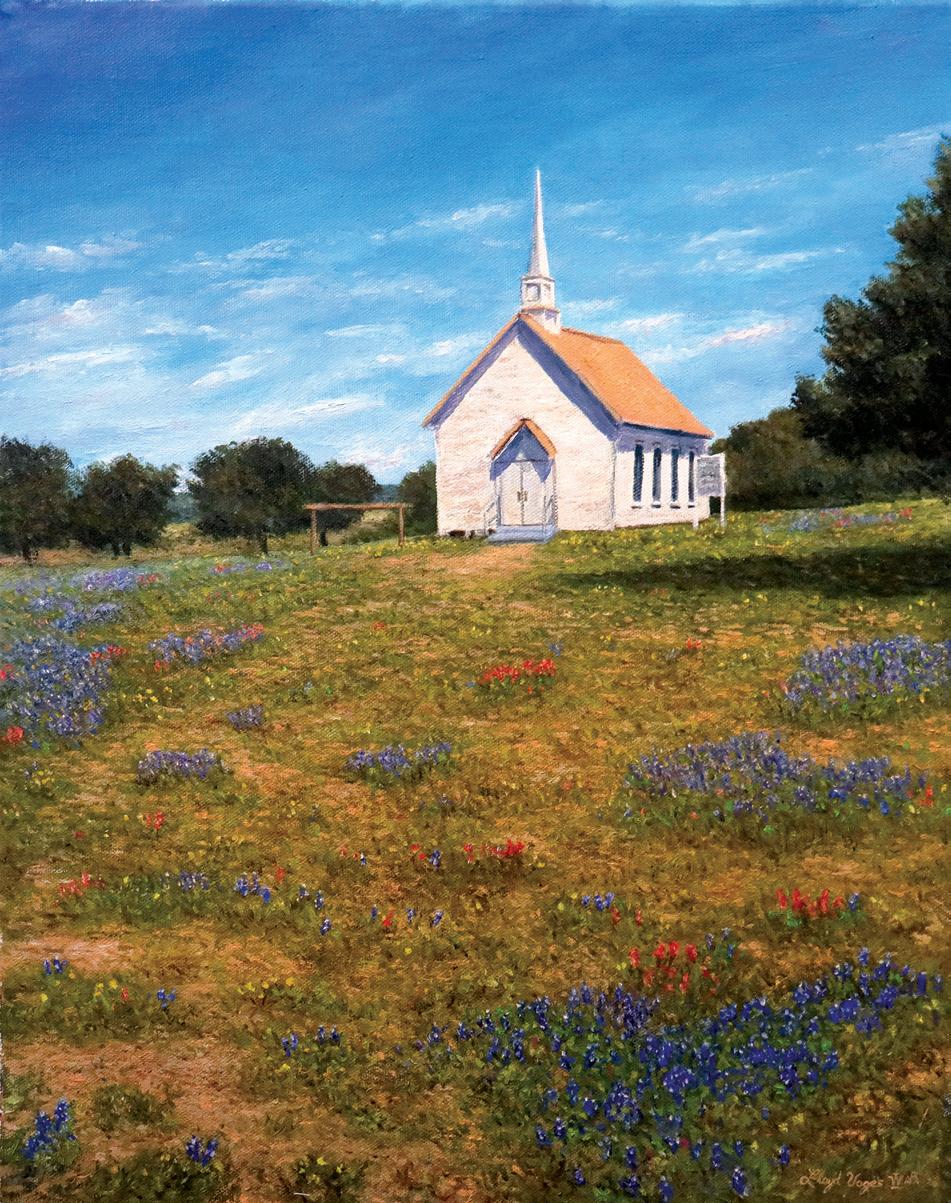
CHICKENS: Local artist Lloyd Voges mainly finds inspiration for his paintings in the Lone Star State, and specifically his home in Bosque County. “Springtime At The Norse 7th Day Advent Church” 20x16 oil on canvas (above left).
A quote attributed to Leonardo Da Vinci comes to mind, “Art is never finished, only abandoned.” Recently, Voges struggled with a piece “Coming Out of the Haze,” to the point he wanted to burn it. Its subtle coloring in sepia’s and greys and looser, more impressionistic strokes are a detour from his usual greens and blues and meticulous detailing. He felt it was missing something, and kept tweaking it. But at a certain point he just had to lay down the brushes.
The painting has the quietude of his other paintings of Texas, but adds a feeling of soft melancholy. And that turned out to be a good thing, because it and two other of Voges’ paintings were selected for this year’s Bosque Art Classic and won an award at the 2022 American Plains Artists Show.
Artists create an illusion, using unexpected colors to add vibrancy and contrast in their paintings – like purple to snow and white to a shadow. Voges’ illusion is that of tranquility and serenity in a fast-paced world; a maze full of chaos, stress and uncertainty; an illusion of lounging Longhorns, lazy creeks, love of God and country filled with Texas florals.
One of his most recent works “Lakefront Comfort” is as if you are looking through a large window at a vista of a Lake Whitney cove – just picture perfect. It is a successful, very relatable illusion that put several Best in Show, People’s Choice and Award of Excellence under his belt, and there will be many more to come in the future.

article by NATHAN DIEBENOW


What is success? How can a person thrive in the music business? – especially in this economy? Ask 1,000 professional touring musicians and 1,000 high school band directors to define “success,” and you’ll get 2,000 different answers. Or we can simply ask Toney Rogers – one of the few high school band directors in Texas with a 40-plus year career in the live music industry.
“I’ve never looked at success from a financial standpoint,” Rogers told Chisholm Country. “I’ve valued more in what I’m contributing to society.”
In one world through Crawford ISD, Rogers serves music students and parents, and in a second parallel world through NETEX Productions, he serves professional musicians and venue operators.
“Crazy as it sounds, both worlds don’t really mix too well,” Rogers said. “But I’ve kind of figured out a way to make it work.”
Rogers’ ability to cross-over between these two worlds didn’t happen overnight. As an eighth grader in 1979, Rogers launched his own career in live entertainment when two of his cousins bought him a bunch of vinyl records and encouraged him to deejay a teen dance in McGregor. His mobile DJ act grew such that he played one of the first dances officially sanctioned by Baylor University. While in high school, he joined the McGregor ISD band program, playing drums under those famed Friday night lights.
His experience performing in a high school garage band led him to join a touring band called Rockin’ Rick and the Corvettes. While touring with Rick, Rogers adopted the stage persona “Daddy T” known for his flamboyant outfits, afro wigs, and platform shoes on stage. In creating the “Daddy T” character, he borrowed from his childhood idols – the crooner Dean Martin and the comedian Don Rickles – both of whom are known for their quick wit, tender teasing, and sharp threads.
“Everything’s off the cuff,” Rogers said of his stage persona. “To me, it’s more natural. It’s not staged.”
When not touring, Rogers worked in the hospitality and retail sectors –night clubs and parks & recreation departments, auto parts stores, and custom t-shirt printing shops. When not working, he’d come home to his wife Althea
and their two daughters Austin and Savannah in McLennan County.
Over the years, Rogers honed his act, learning to turn “Daddy T” on and off with greater ease –a skill useful in managing different audiences. His daughters quickly picked up when their father was in “Daddy T”-mode by his “Dallas voice.” Rogers re-entered the high school band world when his daughters played in the Crawford ISD marching band. Across nine years there, he volunteered as a drum tech and then served as an interim head band director. Crawford ISD’s next band director turned out to be Daniel “Mr. Y” Yguerabide, whom with Rogers would later join forces again in Meridian ISD.
In 1996, Sonny Foster founded NETEX based on his experience as a musician, singer/ songwriter, radio disc jockey, and judge/producer of talent contests and music fests. The acts on his roster have been diverse – from Kevin Fowler to The Temptations.
About seven years ago, Rogers took the reigns of NETEX Productions – the same booking agency that promoted him as a musical performer. Now an entertainment agent, he has his hands in complete concert production and books national, regional, and local artists on stages big and small across Texas.
Foster said he chose Rogers to lead NETEX based on his personal integrity and commitment to fulfilling positive live music and entertainment experiences. “Toney is just a great guy,” Foster said. “I’m glad I chose him. You have to have

initiative in this business, and Toney’s got hustle.”
Foster pointed out that he and Rogers both go the extra mile to make sure the show runs smoothly, which means they are physically present at the venue to serve the musicians, light and sound technicians, and venue operators. While NETEX’s official headquarters is in Mount Pleasant, Tx, Rogers works from Bosque County, which allows him to travel with great ease to venues across the Texas Triangle – Dallas/Fort Worth, Austin, San Antonio, and Houston.
Rogers discovered Bosque County through his youngest daughter whom he helped set up a second location of the family’s screen-printing company in Clifton. With every intention to leave the entertainment industry behind, he ended up assisting the Clifton Main Street program by booking bands for its annual Fall Fest.
“It’s become a blessing living in Bosque County because this is one of those businesses that can consume you really fast, if you’re in the element like in Austin,” he said. “I would probably spend 20 hours a day dealing with music, where here I’m able to do it remotely and still have a life.”
At the same time, Rogers has learned Bosque County’s place in music history – from the influence of cowboy ballads on the Chisholm Trail to the time of the Larry Joe Taylor Festival in Meridian. Rogers gives high praise to the folks across the county for maintaining public venues for local live music, such as the Chisholm Trail Plaza and the Lomax Amphitheater in Meridian as well as Clifton City Park and the Armory in Clifton.
“To me, these are a huge attraction,” he said, also crediting the private venues like the Bosque Arts Center in Clifton and the Walnut Springs Roadhouse (just to name a few) for boosting the Bosque County music scene.
In many of these local venues, Rogers booked Meridian’s “Not So Jazz Band – Jazz Band” –a professional performance group consisting of several young musicians formed through Mr. Y’s
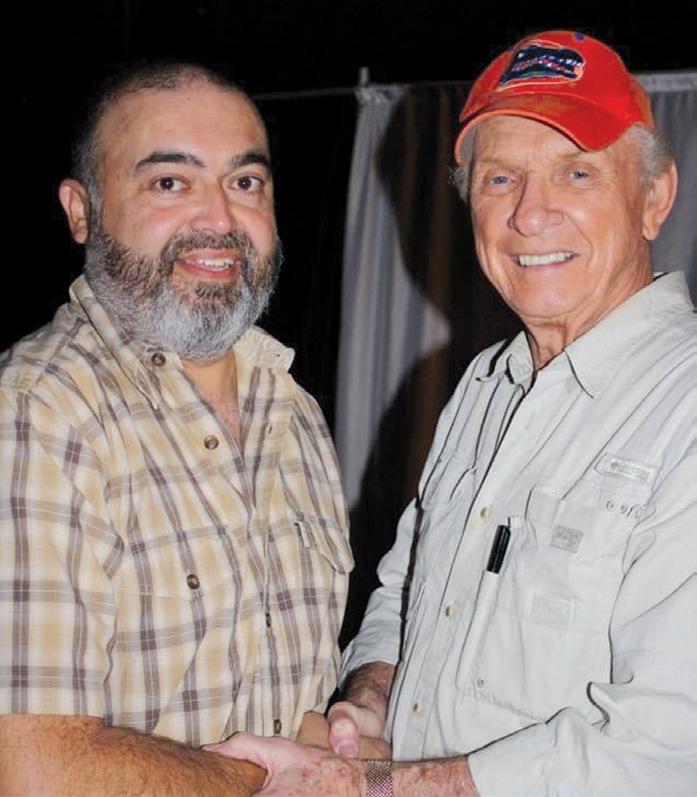
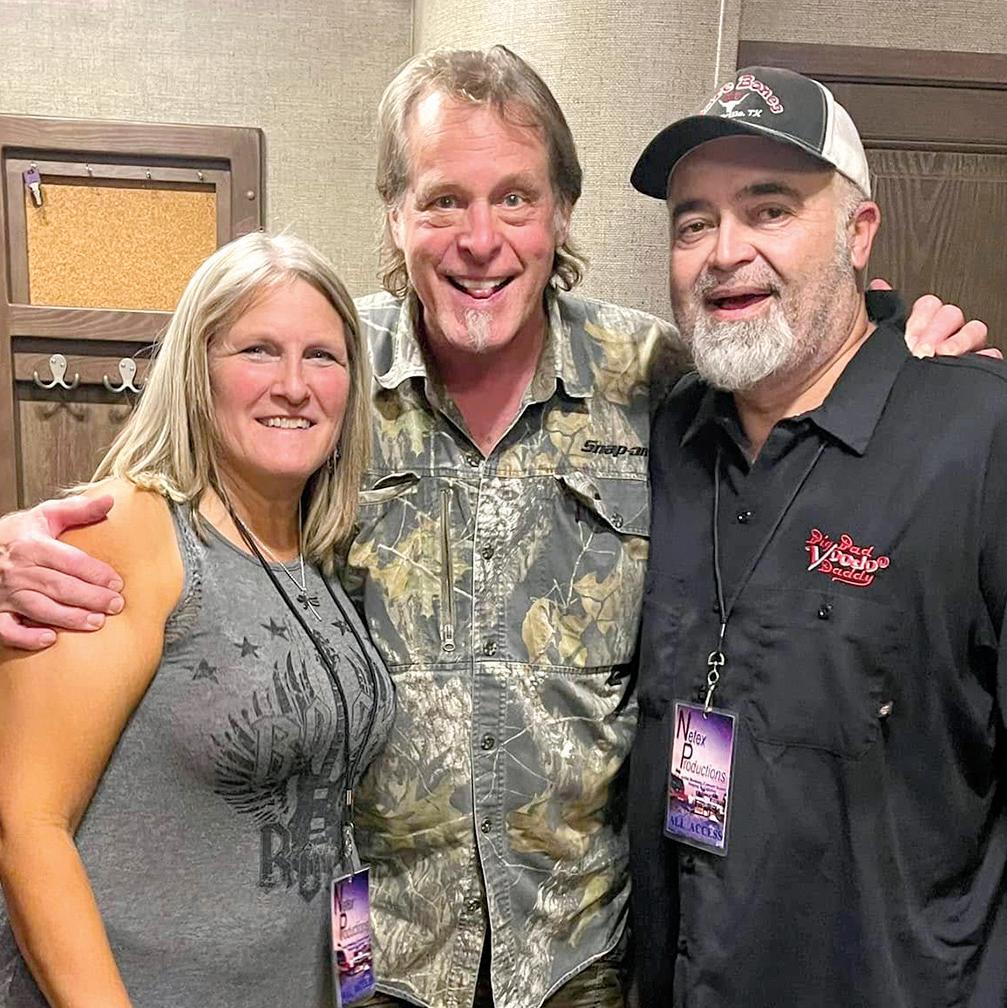
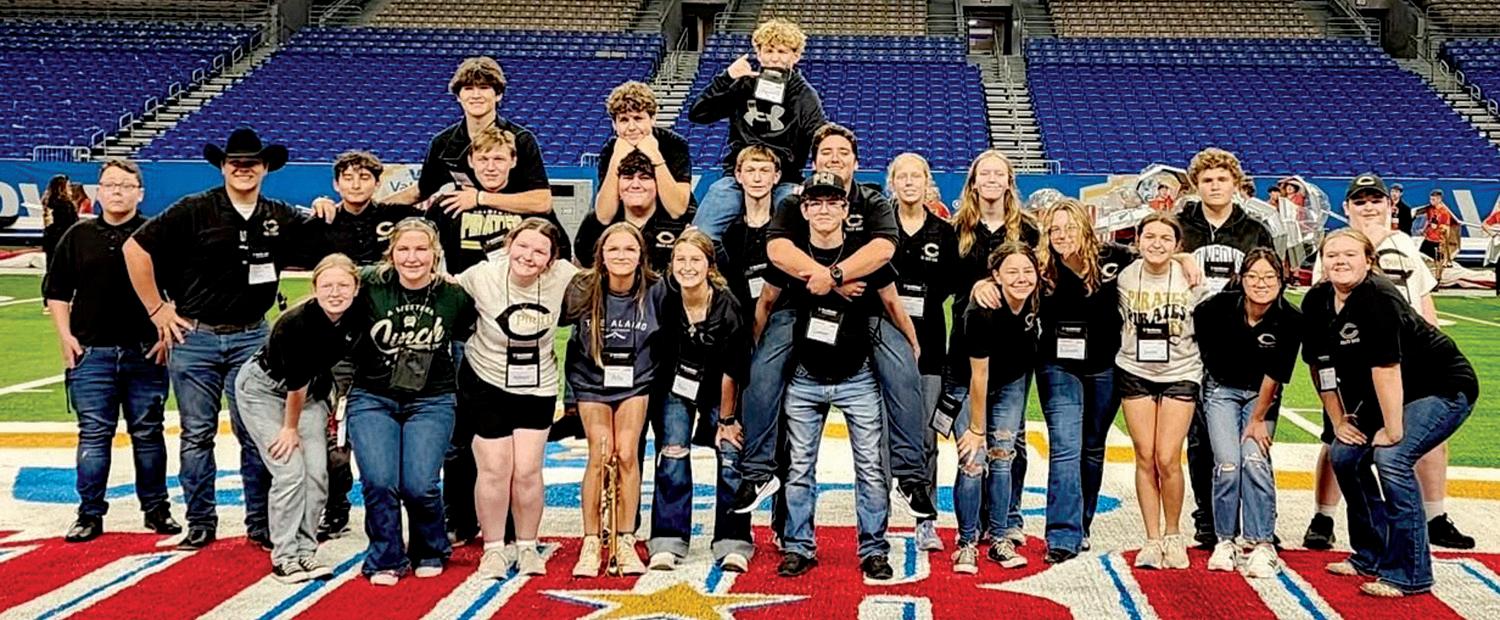
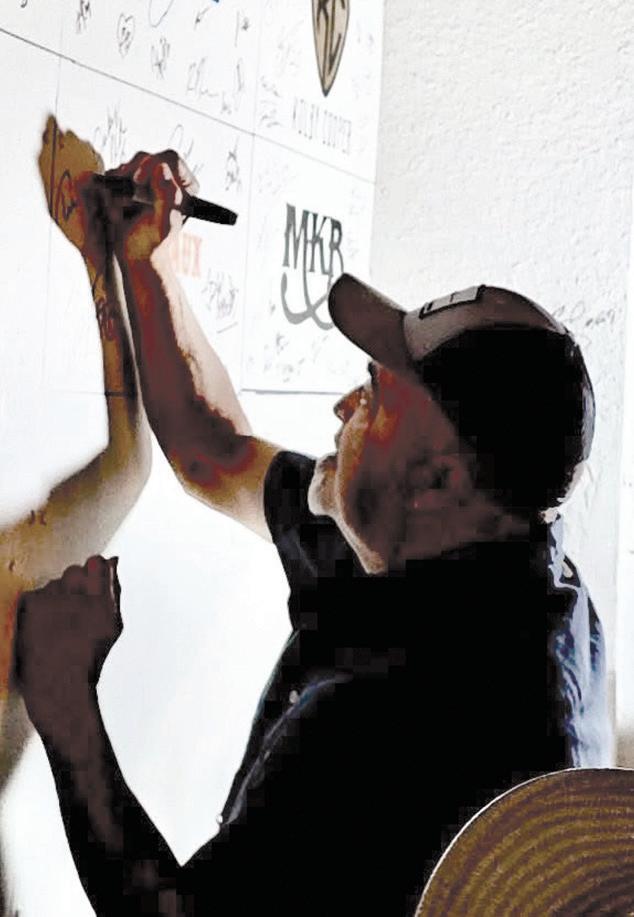
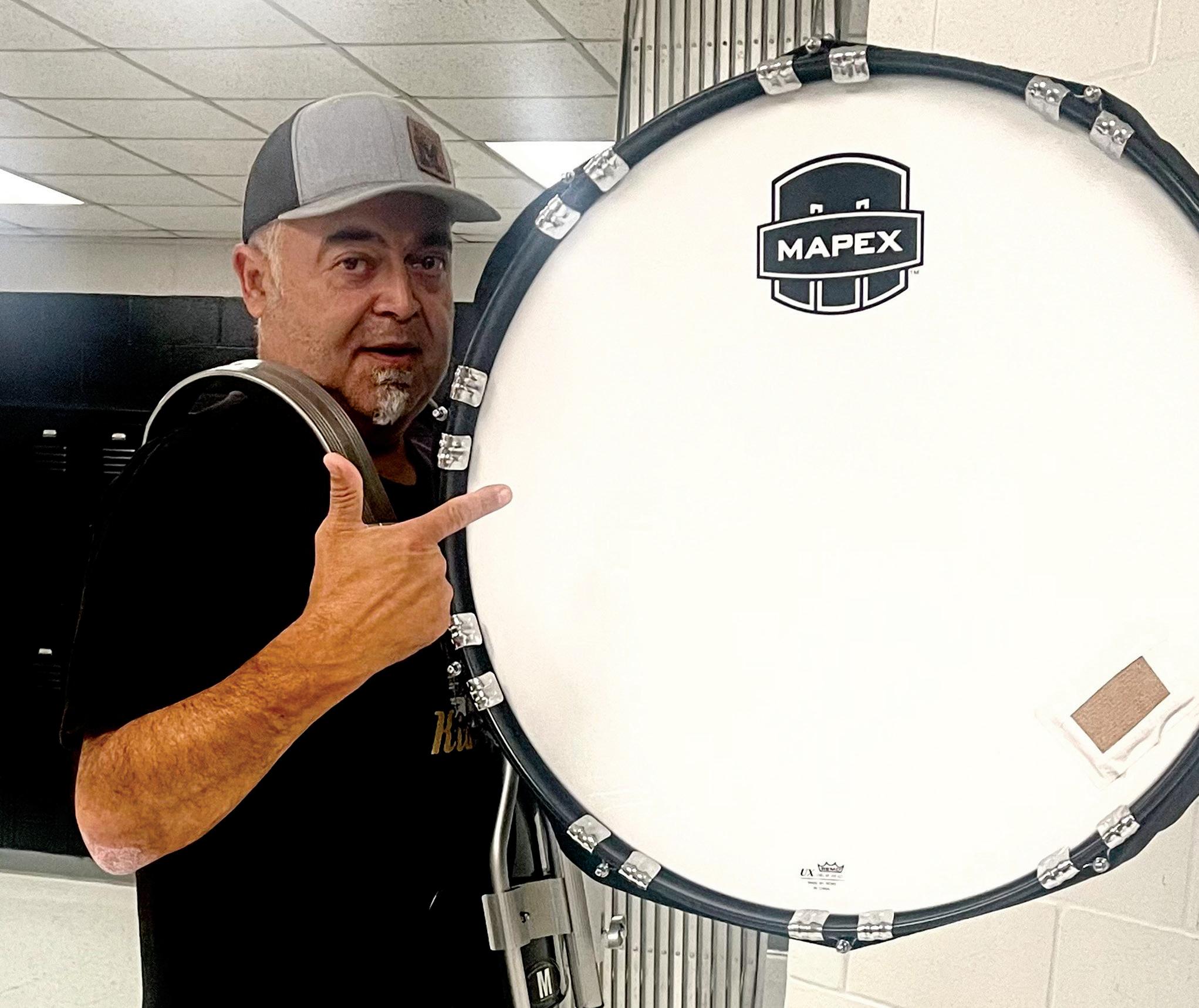
STEPPING INTO THE SPOTLIGHT: Toney Rogers with Grammy-nominated country music singer and songwriter Mel Tillis Jr. (top left); Hard rock guitarist, singer, songwriter and right-wing political activist Ted Nugent embraces Rogers and his wife Althea (top right); Under the direction Rogers as band director Rogers, the Crawford ISD marching band performed at the Alamodome in 2024 (above).
jazz class. While Mr. Y focused on their music (like Chicago’s “25 or 6 to 4”), Rogers coached the group on their showmanship skills, so they could be ready to open for such musical acts as

Ricochet.
“It was a ‘lightning in the bottle’ thing where these kids all gelled together, which was the coolest thing,” Rogers said of NSJB-JB. “You

literally had eighth graders to seniors that in the real world would not get along but got along in the band hall.”
With the same vigor, Rogers returned to Crawford ISD to rejuvenate their struggling marching band program this past school year. To start, he had 26 music students – 13 of which were in the eighth grade while the other 13 were in the upper classes. Crawford ISD superintendent Dr. Kenneth Hall described Rogers’ impact as “culture changing” by making the band fun and exciting for the young student musicians.
“Toney created a culture where students have a love for music,,” Dr. Hall said. “And they feel their participation in the program is having a positive impact on our campus.”
Dr. Hall said Rogers has balanced his time well among his professional responsibilities inside and outside the school district.
“We could never expect to bring someone into our district with his experience,” Dr. Hall said. “His continued involvement just serves to increase his value to us. Our students do get a benefit in that trade-off.”
Rogers’ approach with his students has been three-fold: build their confidence, build their sound, and build their sense of fun.
“The biggest success this year was building their confidence,” he said. “Once we got their confidence back, everything else fell into place.”
To illustrate, Rogers noted that during a scrimmage football game, he had his young musicians run through the inflatable tunnel like the Crawford Pirate football players usually do. Then, each band student had the opportunity to introduce themselves to the community in their own voice on the microphone.
“From the pictures they took, you see these kids have the biggest smiles because they’re coming out of the tunnel,” he said. “They all were confident.”
Next, Rogers focused on their musicianship, followed by their marching skills.
“My philosophy was it doesn’t matter how we get on the field as long as we sound great when we’re on the field,” Rogers said, further explaining. “I’m building musicians first. I want them to be able to play their instrument well when they leave school.
“If you’re comfortable playing – you understand the rhythm, then the marching is easy.”
Finally, Rogers plans on offering his young musicians more opportunities to have fun in the program, like performing in the halftime show at the Alamo Bowl again. He recently signed another contract year at Crawford ISD, hoping to the Pirate band program will grow to 40 musicians.
For Rogers, building new leaders is his top priority, and to do so, he models his values – being professional, reliable, and easy to work with – to his students.
“What I’m saying, I’m doing,” he said, later adding, “In the music world, your lifeline is your reputation.”
Typically, Rogers will leave the band hall after school and check-in with people working in bands, production, venues, and marketing by phone. One recent Friday night, he traveled to Texas City – south of Houston – to “hang out” with Braxton Keith, Dawson Drake and Chris Colunga. The next night, he was in College Station, then Sunday night in Arlington.
Rogers acknowledged he couldn’t have juggled these two worlds without the support of Crawford ISD’s administration, board of trustees and the band boosters.
“I did not realize how engulfed I am – how much music is a part of my life,” Rogers said. “I’ve always known it, I guess, but I didn’t realize it until the other night that literally I wake up, I go teach music all day, and then I come home, and I’m dealing with contracts and whatnot.”
Dr. Hall said Crawford’s community has taken note of Rogers’ positive effect on the band students’ performance quality.
“[Parents] love how he has taken the program and created new expectations for our students,” Dr. Hall said. “In one year, we have gone from having a lot of doubt about what we could do to enhance our band program to eagerly awaiting the next great way our band will represent Crawford ISD. Thanks, Toney Rogers!”

article & photography by
SIMONE WICHERS-VOSS
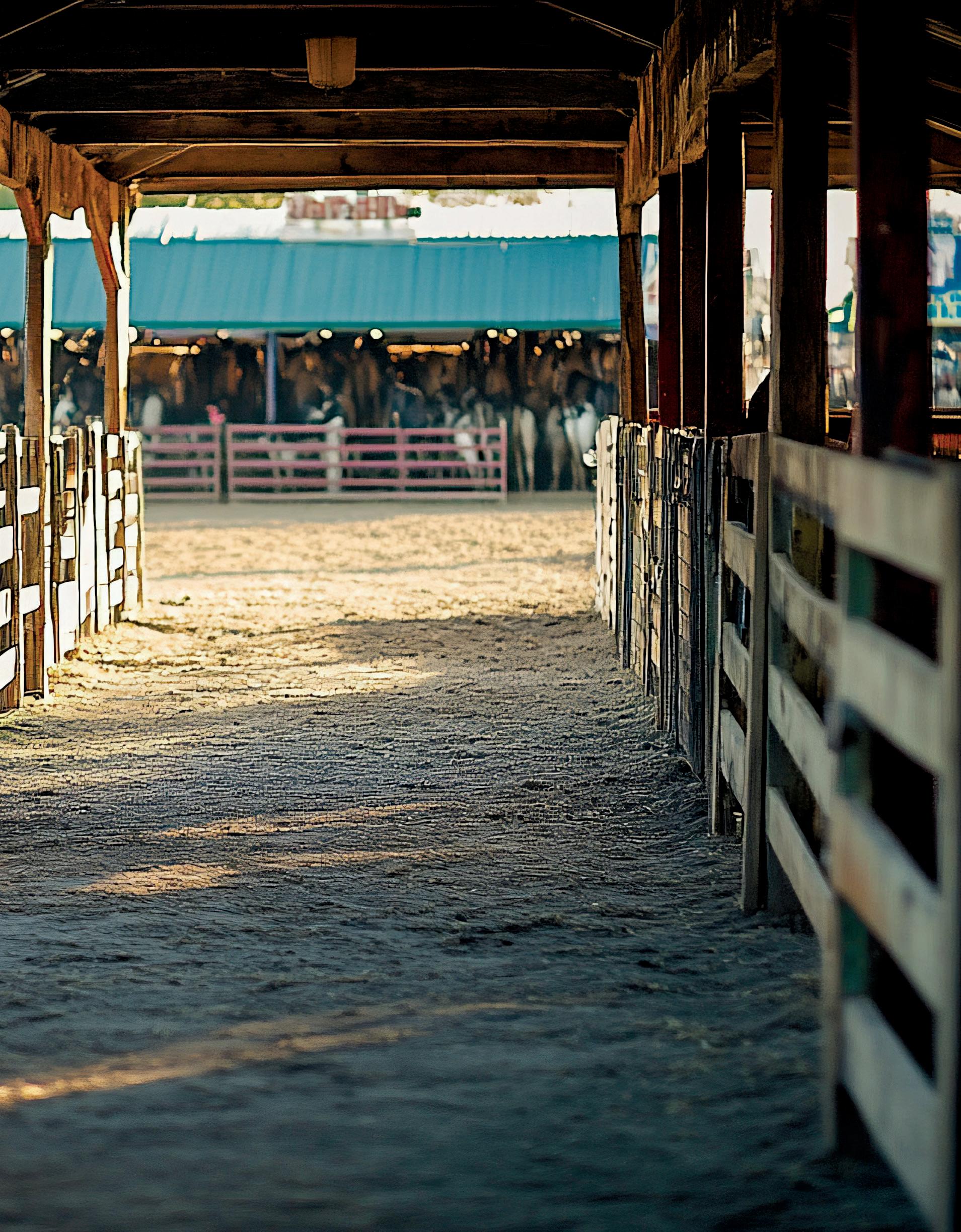

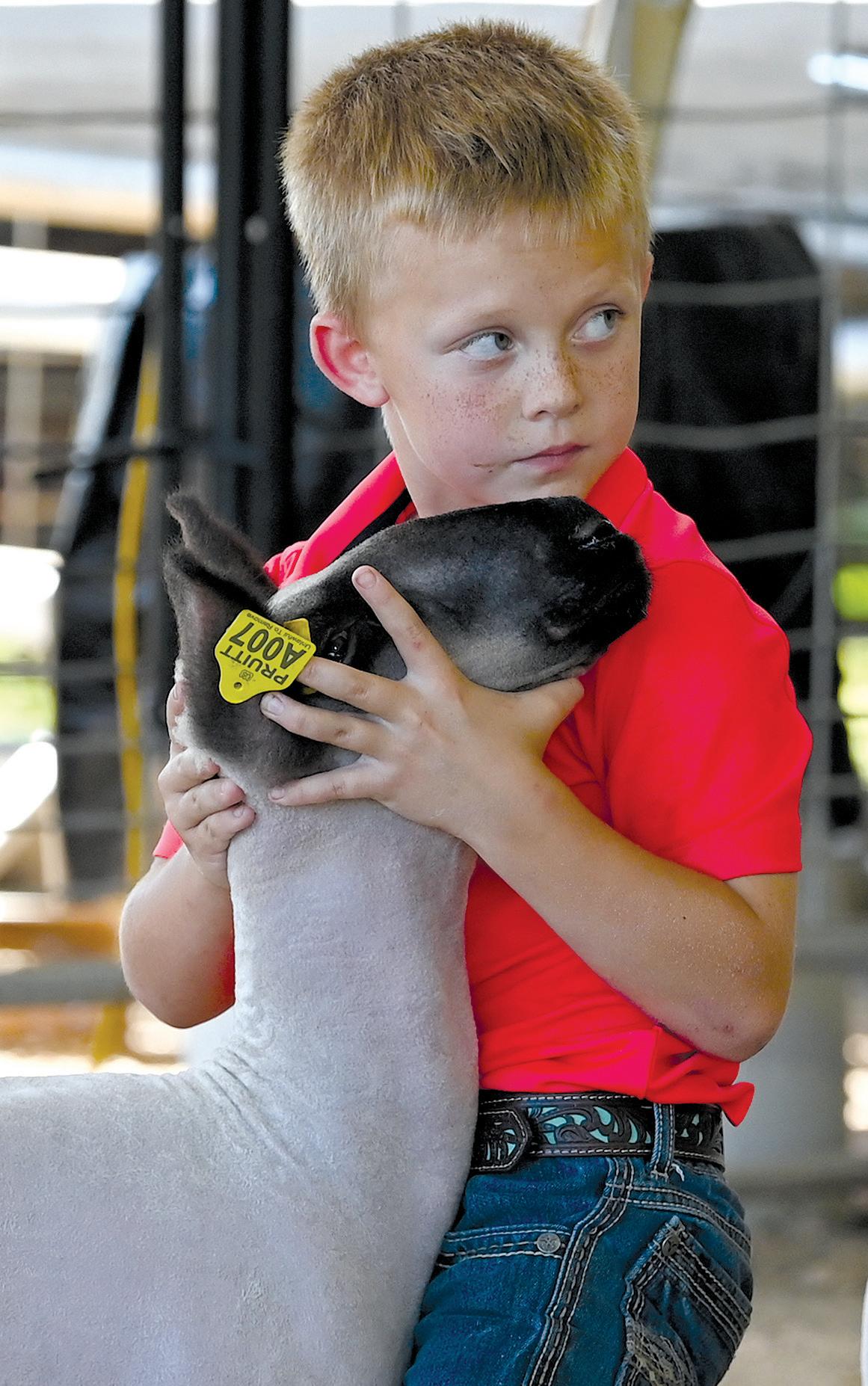
This is it. Years and months of preparation are about to come down to this very moment. All those years of early morning and late evening feeding, every day grooming, daily training his showmanship, his steers and lambs; grabbing some time here and there for school homework – Meridian High School senior Alex Rodriguez rounded off his days of showing livestock at the 2025 Central Texas Youth Fair county livestock show.
Hours before the show he washed, blow dried, oiled, and brushed his animals to perfection. He changed from the heat-easy shorts and T-shirt to clean jeans, smart belt and boots and starched shirt and now it’s time to bring it.
Granted, those hours and hours spent in the ag barn at Meridian High School since eighth grade, showing Dorpers were not always fun, especially those cold, early morning feeds. And the support of his parents, who sometimes had to pick up the slack, was invaluable.
Such will be the case for many of the area’s young aspiring farmers, ranchers and cowboys at the 75th Annual Central Texas Youth Fair held June 2-6 at the Clifton Fairgrounds.
Last year, Alex showed two steers, one pig, one goat, two lambs and broilers. He had an overall grand champion goat, a grand champion lamb and a grand champion steer. Not everything always goes as planned, and several of his best broilers died before the show.
Getting a sizable check after he won a calf scramble at the 2022 CTYF and another at the Houston Livestock Show and Rodeo in 2023, Alex started showing steers. That first year, he straight away won grand champion with a Bosque County born and bred animal from the Winkler ranch.
Having worked with goats, lambs, steers and pigs, Alex learned that each species
needs a specific approach.
“You have to work with your animals, otherwise it will show in the ring,” Alex said. “And you have to know your animal. Cattle and pigs are smart; sheep and goats need a repetitive routine. And goats are stubborn. You have to be more relaxed around them to get them to do what you want them to do. With all animals it’s better if you don’t fight them constantly.”
Alex recalls one steer named Hurley that was “mean as hell” and even put him on the fence one time. But with a show halter on, the big lug was a big baby.
“I’ve learned more life skills showing than school,” Alex said. “When something goes wrong, just shut up and relax, for one.”
Getting into the livestock show world is easy. There is the initial purchase amount for the animal – which has increased significantly in the past couple of years – but it’s all the extra stuff, like special blankets, special clippers, special bandages and special feeds to supplement, medications when they get pink eye or an intestinal tract infection. And then there’s show entry fees. It can get expensive and becomes quite the extra investment for a family, in money and in time. The added value of this unique education makes it all worth it.
Showing livestock requires a lot of hard work and dedication but is rewarding in many ways. Being part of the Texas Future Farmers of America agricultural education with its slogan “cultivate,” Alex was part of a dynamic youth organization making a positive difference in students’ lives by developing their potential for premier leadership, personal growth, and career success.
Texas has the largest number of 4-H and FFA livestock projects in the nation. And with each lamb, broiler or steer, youth learn invaluable life lessons and skills, setting them up for success in the future. Passions discovered, friendships across county lines forged and engaging in quality family time, traditions upheld, learning how to win humbly and how to lose courageously and defining their future.
Research shows that Texas FFA students are more confident, better prepared and continue their leadership into the college experience. And the more semesters of agricultural education in high school, the higher graduation rate in college than other students. Many local exhibitors over the years went on to study Pasture Management, Ag Communications to become ranch managers, hay suppliers, breeders, and part of ag-related businesses.
Another example of the family commitment to showing livestock is the Thiele family from Valley Mills. In the arena this year was Heather, who started showing with a mini-Hereford, now won Overall Grand Champion with her British, Bosque County bred and raised steer, and she added Junior Showmanship to her achievements. Dad Ben and mother Lou Ann both volunteer at the CTYF and help out prepping the bovines for the show. Sister Kaitlyn – now a Gunther
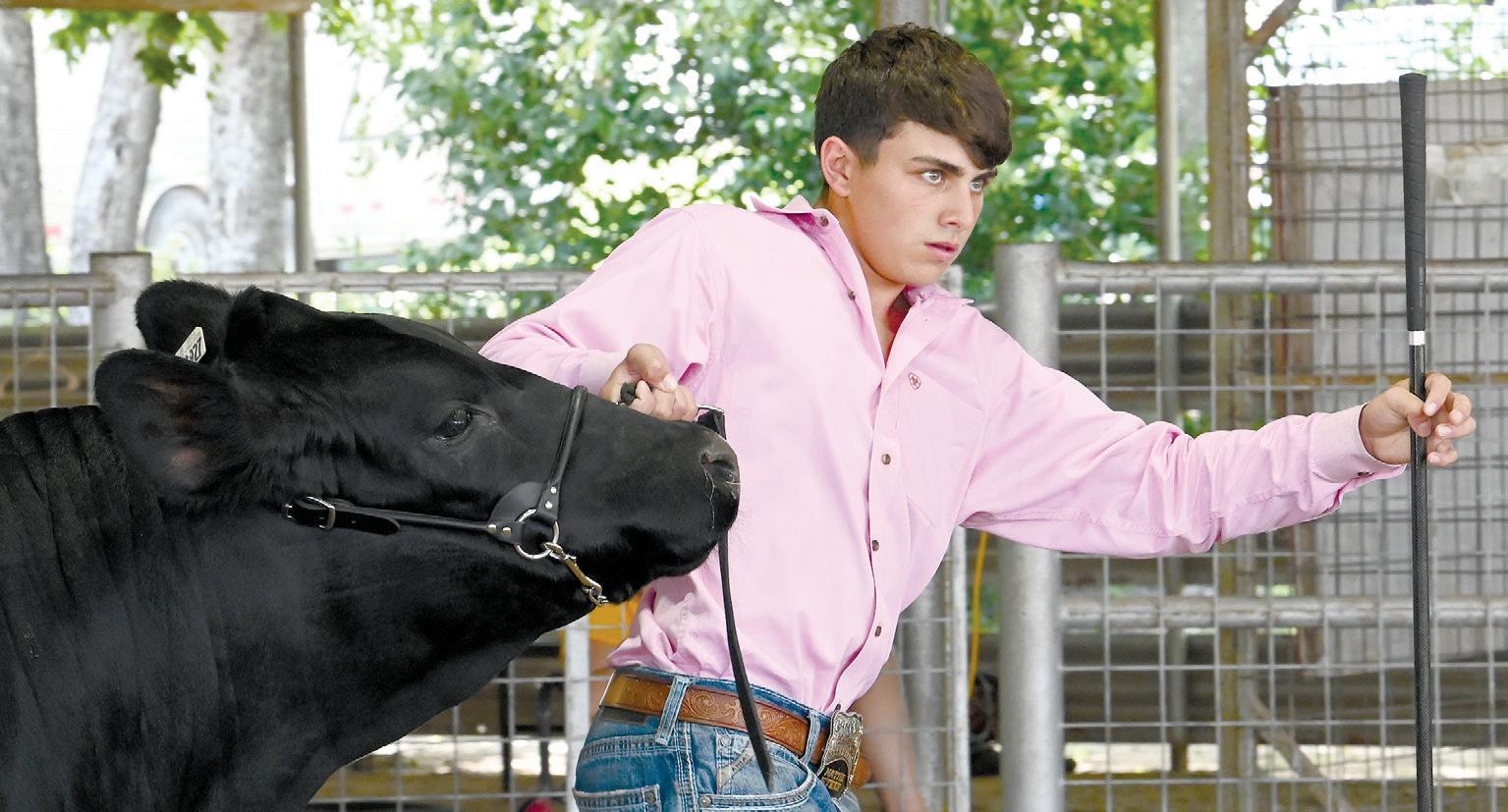


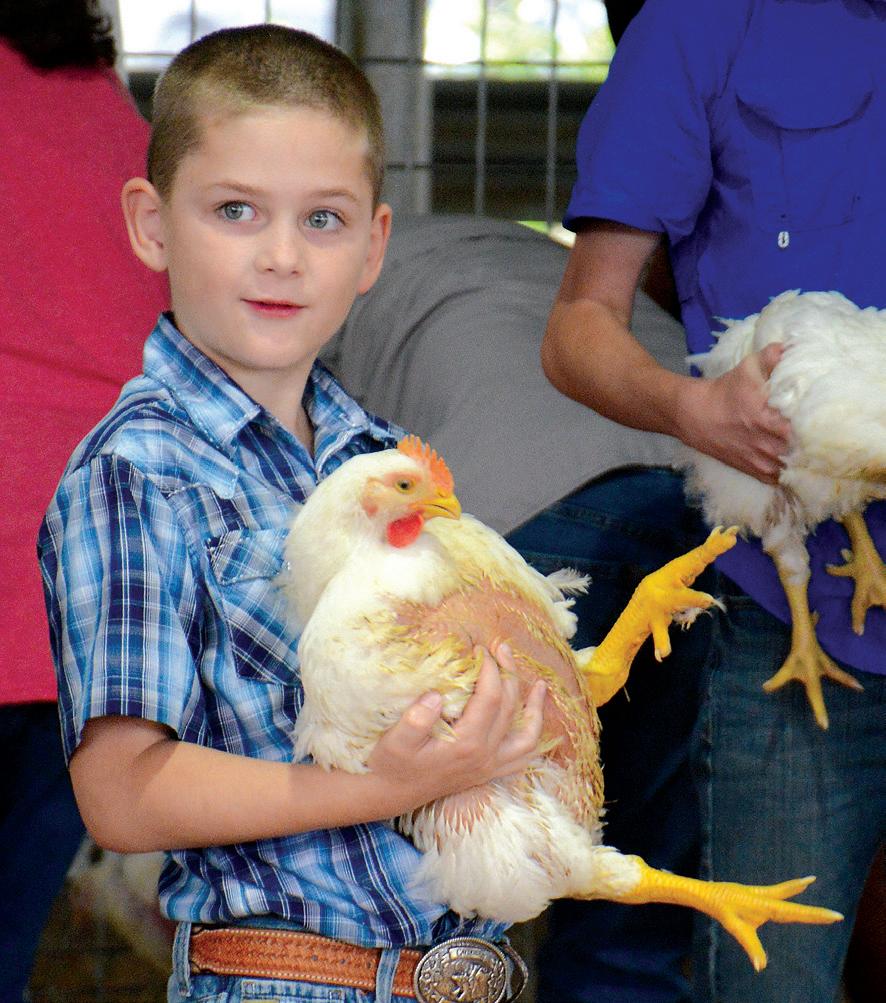
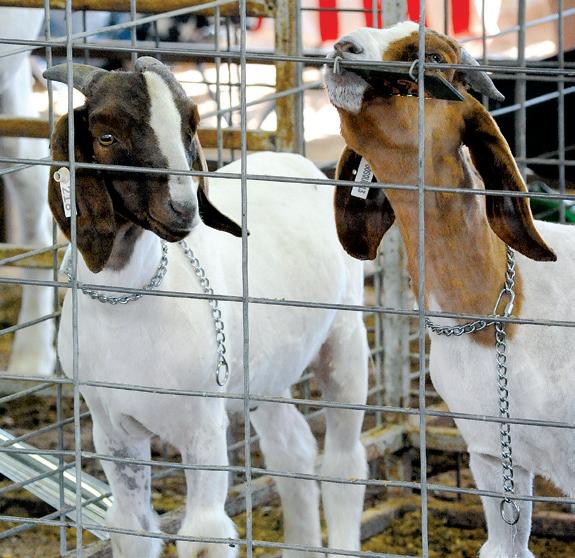
The CTYF offers shows from broilers, rabbits, hogs, goats, steers, heifers, pet show, home economics, cakes, photography, Ag mechanics and Build off (top right).
– is the Bosque County Agrilife Extension 4H program coordinator, assisted in the steer arena, as sister Erin took photographs of her sibling’s and other exhibitors’ exploits in the arena.
“Showing livestock is very much a family affair,” Bosque County Extension Agent Chelsea Dorward said. “Good support is absolutely necessary for success.”
The County AgriLife Extension Office advises and coordinates the county’s 4-H projects together with the parents, which includes the showing of livestock. Raising broilers is an excellent way to introduce young children to livestock care – the daily caring for chickens builds the sense of responsibility, and they can see the effects of their efforts quickly. Showing broilers and seeing how they grow in a short amount of time makes it a most satisfying project. An added bonus for the family is now a sizable supply of whole chickens in the freezer.
“All broilers in a show have to come from the same patch, born on the same day,” Dorward explained. “Unlike any other breed of animal, they all have the same start and winning a ribbon is all about the way the broilers are raised.”
Dorward herself showed steers growing up in Oklahoma, and her nine-year-old son started his county fair experience raising onions. Her six-year-old daughter prefers to enter cakes and sewing projects in Home Economic projects. It is important to recognize that the size of the animal does not have any effect on the value of the project for the young person to develop character. A youth will learn the same things and have the same opportunity to exercise character with a rabbit as with a steer project. A trend in the past 10 years is the increasing sales in goats, rabbits and cakes. These categories have the

highest yield – not in total sales, but pound for pound.
“These young people have a strong foundation in work ethic and character,” Texas AgriLife Extension Service Youth Livestock and Ag specialist and assistant professor Billy Zanolini said when he judged at the CTYF. “They are the next generation of agricultural leaders who will provide solutions to the challenges of a growing population. They know how to start a project, do all the work in between and finish it. There is no sitting around and being lazy.”
Even though winning in larger stock shows like Fort Worth and Houston has its merits, participating at the CTYF show has added value. Anyone will tell you, the major shows are overwhelmingly big, and in a blink of an eye, without any explanation, your hog or steer that you have pampered and worked with for months was not deemed good enough for the sale ring during pre-selection.
At a county show, most judges explain what they see in the show animals – the things that catch their eye in a positive way, and explain things that might need improving. The youth gain ring experience in a smaller more informal setting, surrounded by encouraging family and friends, and supportive fellow FFA chapter members, priming them for bigger shows.
Born in horse-and-buggy days, town and county fairs gave citizens that lived far apart an opportunity to visit friends and family, trade crops and crafts, and catch up on fellow farmers and livestock breeders. A timeless tradition showcasing a rural way of life, a county show like the Central Texas Youth Fair is important to the community and the CTYF offers a wellrounded county fair, with a wide range of events
for county Future Farmers of America and 4-H students to compete in.
More often than not, the judges are impressed by the animals on show in Bosque County, where over the years “quality over quantity” seems to be the motto. There might not be a whole lot of exhibitors, but the quality is high, making it a competitive, worthwhile show for the local youth. Pound for pound, it’s as good as it gets.
In her youth, MaryAnn Brandenberger showed Angus steers and heifers throughout the Southwest with her brother. Now as CTYF secretary and supervisor for several show rings at the fair, she believes a county show is “more democratic,” where youth from less affluent families get a chance to compete. Saving on travel and hotel costs and high entry fees also benefits the local exhibitors.
“Major shows are more competitive, and more money is pumped into the projects, and higher caliber animals are necessary to compete there,” Brandenberger said.
Having showed goats for 10 years in her youth at the CTYF, board member Shelby Crockett agreed with that, stating the accessibility of the CTYF was an important factor in their family’s decision to allow showing livestock.
With that said, the declining exhibitor numbers does not diminish the importance of keeping the show going for the many volunteers clocking countless hours preparing and running for the show. All of them believe it all boils down to the intangible benefits and life lessons the youth learn from raising their livestock projects, and that is worth donating their time and efforts to.
Established in 1931, each year the board offers improvements and changes to make it a better experience for all involved. According
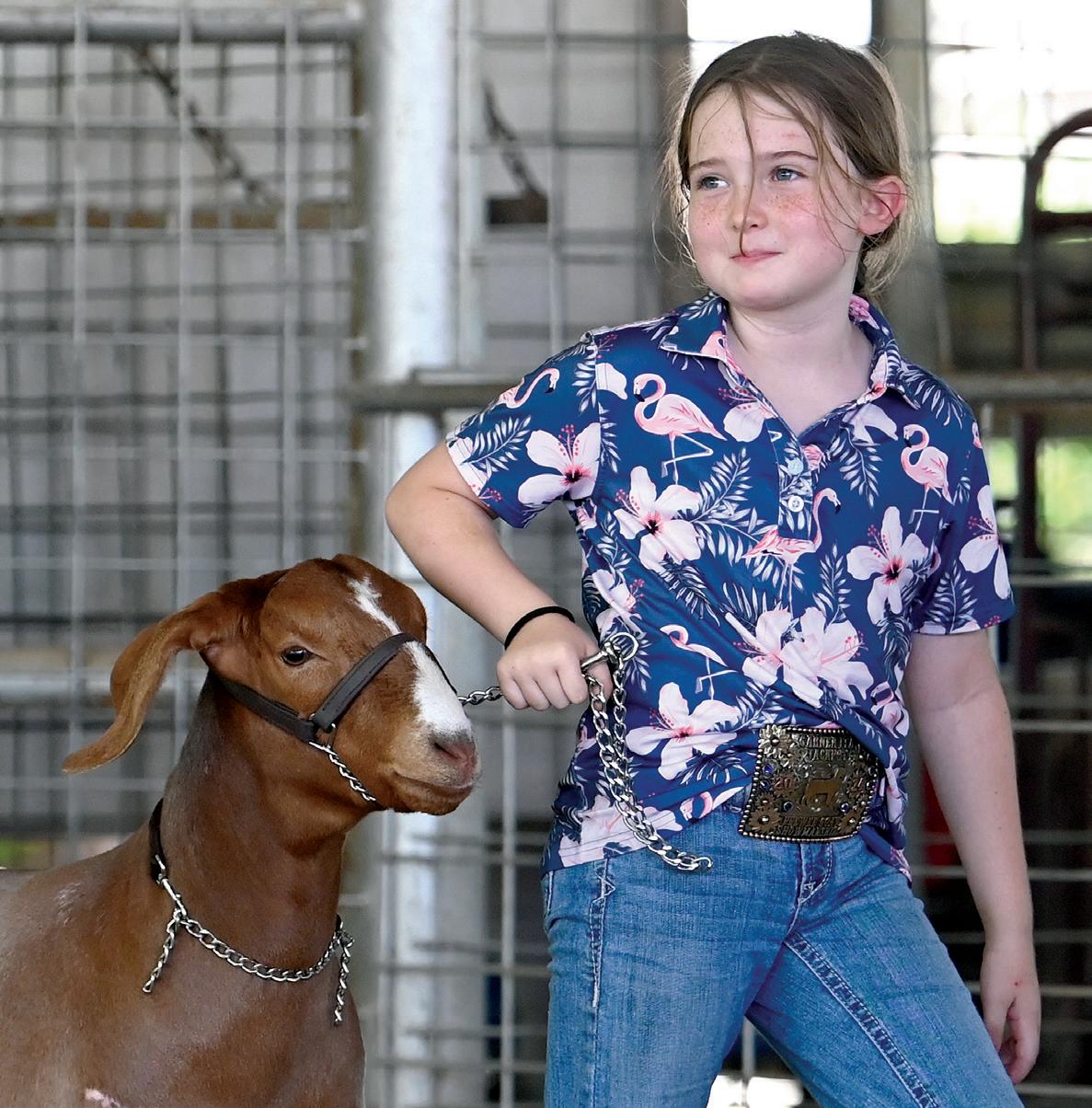
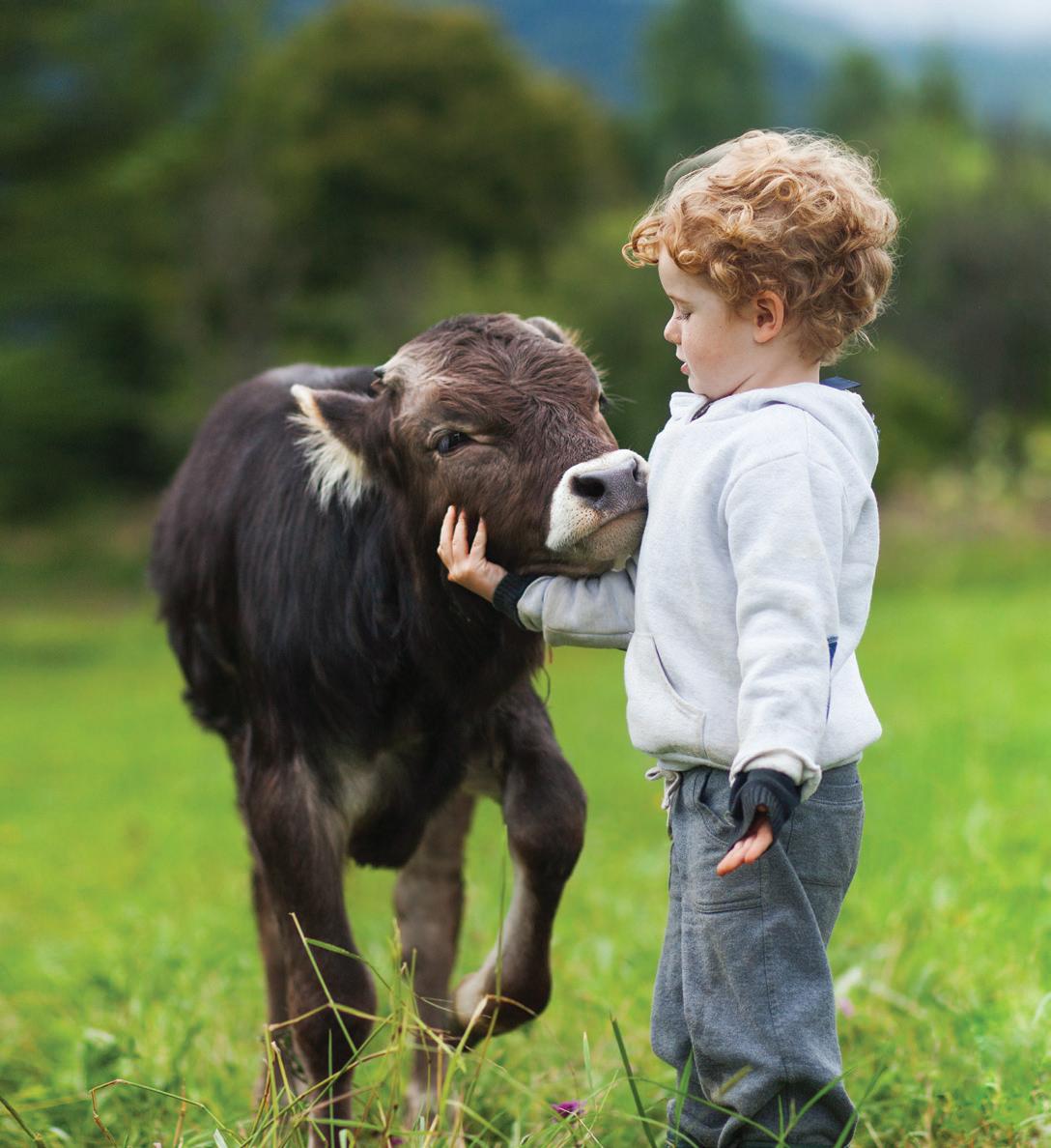






to Dorward, being more removed from agriculture, the increasing cost of buying and raising livestock, the many other extra-curricular options the youth have like athletics and band, and parents unable to help out all play into the decrease in fair entries.
The declining amount of youth showing at CTYF is a concern -- with the biggest decline in steer entries – over the years the board added events like the pet show, the crop show, the ag build off and the ag blueprint categories to engage youth that might not normally participate in the fair and give them a chance to show using less start-up resources than other projects. They also included the commercial heifer category and the breeding livestock category.
Between events, visitors get to enjoy traditional fair food and refreshing drinks at the concession stand, which was rocking and rolling with quick yet thorough service by die-hard fair volunteers. Local businesses sponsor the exhibitor breakfast and other social events in the fair week.
Additionally, the CTYF changed from a market show to a premium show in 2020, meaning the monies raised in the fair auction are all in support of the youth, and they get to keep their animal, either to sell or to develop further for the Heart of Texas Fair or the State Fair of Texas in the fall. Many youth support groups end up “buying” the animals, and there is a steady group of generous businesses and individuals that buy the animals outright or add-on money to a sale. Most of the time, the exhibitors know their buyer, and go up to them, shake their hand, and thank them for buying their project.
According to a 2022 article by Addie Broyles for the Texas Association of Counties, county fairs contribute about $70 million per year to the youths and families who participate.
“A steer might only have a market value of $1,200, but at a county fair, investors will pay a premium of $6,000 or $10,000, knowing that it’s 500 to 600 percent over what the animal is worth, just because they want to support these youth,” Zanolini said in the article. “These community members see the value in this, and they invest over and over again.”
Zanolini, who is also a member of Texas Youth Livestock & Agriculture, which supports students, families and agricultural science teachers who participate in projects to raise steers, rabbits, goats and other livestock, grew up showing livestock in Sonoma County, California, said this level of support is unprecedented outside Texas.
With buyers being all about supporting the youth, the 2025 Central Texas Youth Fair brought in a staggering $292,790 in auction of the show animals and cakes – up from $160,000 in 2018. Thanks to a large $20,000 add-on to Jagger Monroe’s overall Grand Champion, the swine category brought in the most funds this year, nearly $85,000. It was followed by the steer division, bringing in nearly $63,000, thanks to $13,000 for Heather Thiele’s overall Grand Champion steer. Lambs brought in close to $34,000, and of the 43 cakes in competition, 10 made it to the auction, bringing in just over $17,000.
Over the past years, the CTYF has seen a decline participation, especially in lamb and steer sales. A trend in the past three years is the increasing sales in goats, rabbits and cakes. These categories have the highest yield for a more economical initial investment for the exhibitor families. And Home Economics, with their photography show, sees an increasing interest over the years.
Many of the exhibitors also enter the jackpot shows, that allow for a wider age range and includes exhibitors from surrounding counties. The jackpot shows are a good exercise for the market show ring, and offer an opportunity for quick cash. In recent years, the CTYF board included the commercial heifer division to the arsenal of shows, and this year five pens of quality heifers made it hard for the judges to designate a champion and reserve champion.
“Adding the commercial heifers to the shows gives more youth the ability to show,” commercial heifer show judge Steve Conrad said. “It’s a very practical thing too, it’s education for a future rancher. And any livestock project teaches the young people things way beyond what they can learn in a classroom.”
The actions of all the volunteers involved in organizing the fair keeps the spirit alive. In appreciation for the volunteers’ invaluable service and generosity in giving of their time, guidance or support – monetary or
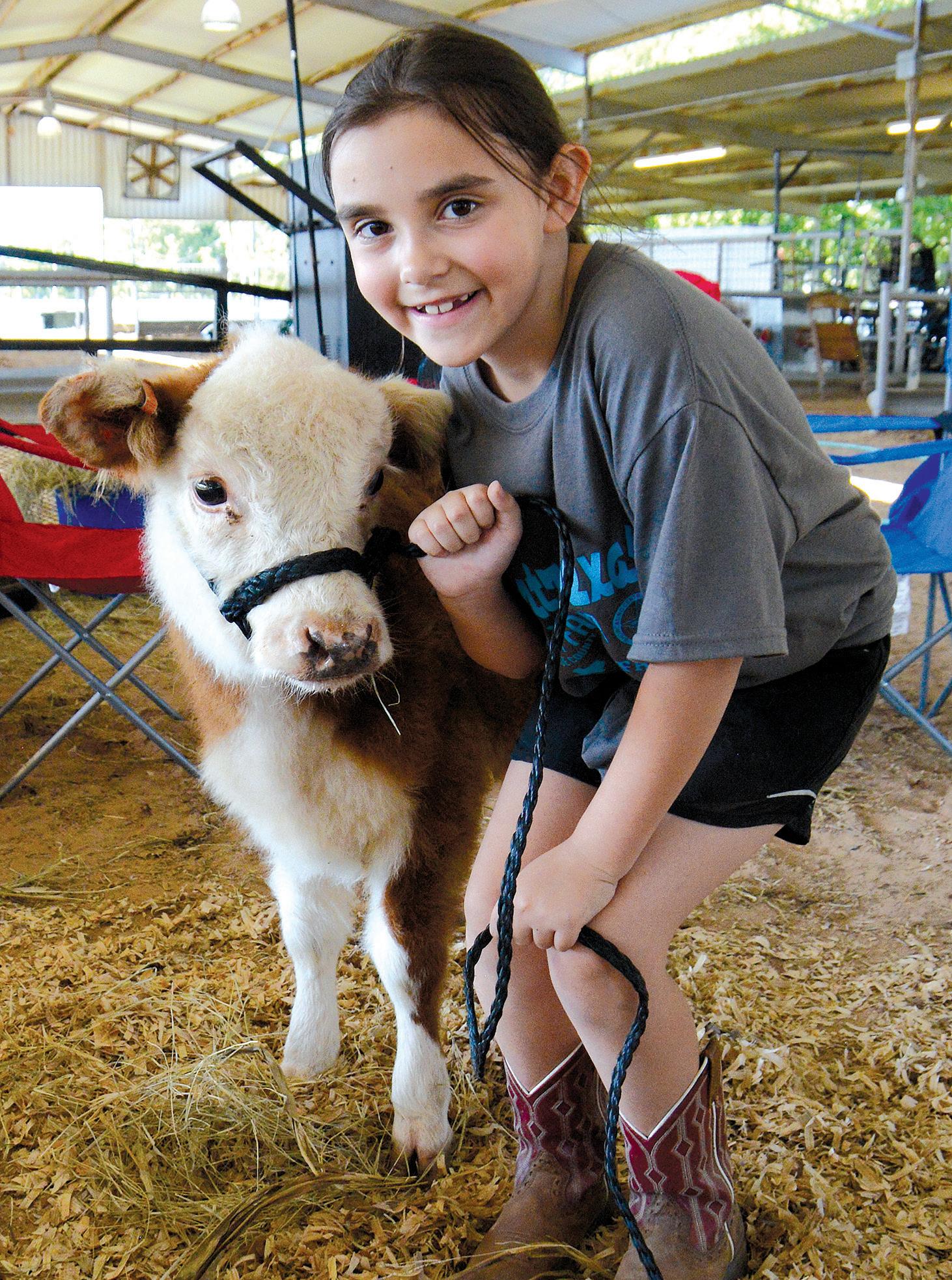
otherwise – each year the fair board spotlights an individual, or group, who have served the fair and the Bosque County community in special and exceptional ways. In the last several of years, they include David Bevels, David and Margaret Winkler, Weldon Bartels, the ladies at First National Bank, Dr. Lloyd and Donna Hampe, Bill Murdoch, Bob and Julie Conley, Gary and Gena Dean Arnold, Ginger and Gene Albrecht, as well as Mike and Barbara Domel.
As his HeyDudes and his pig’s feet kicked up the dirt, the grooming brush with his name in his hand, the misters and the evening breeze try to bring some cooling to the arena filled with spectators and other participants, a young exhibitor walks out into the ring. Walking with a smooth stride, grunting happily with his nose in the air as he showed off his broad shoulders, broad butt, long back – meaning lots of bacon and healthy, shiny skin. This pig was the complete package.
Sprinting out the starting blocks of his livestock showing career in 2023, young Jagger Monroe from Iredell, once again won Grand Champion Overall with his heavy weight hog, Junior Showmanship and Junior Record Book in the pig arena in 2025. He shows an ability beyond his years of keeping in the judge’s line of sight, controlling his happy hogs and showing them to their best advantage.
Vying for CTYF Overall Point Winner, Jagger also entered broilers, a goat, a cake and Home Economics projects besides showing his beloved pigs; all to amass more points in total. He is one of the next generation livestock showing youth in Bosque County, carrying on the tradition and learning invaluable lessons along the way.
A Texas Tech University study aimed at validating the perceived benefits of competitive youth livestock exhibition produced a number of surprises. The most common benefit people mention about livestock exhibition is
the responsibility a “stock show kid” gains from raising and showing an animal. It was not the strongest theme to emerge in the study though –it was the social relationships.
“The comradery with all involved in the fair makes for many memorable moments, as does watching the youth’s progress over the years,” Dorward said.
Character was the second theme to emerge in the study – responsibility, confidence, sportsmanship, and how to deal with loss, promoting personal growth and building character.
The animals rely on a caretaker to provide them with the proper nutrition and daily care. Caring for show animals teaches the importance of consistency and attention to detail. Youth provide their livestock with the exact amount of feed, exercise, and grooming to ensure they are looking their best.
Knowledge and care of animals was the last theme that emerged from the study. Participants felt this knowledge was important, especially if it relates to a future career. And as for the love and care for their animals, “Show Mom” and CTYF officer Cindy Wiese encouraged her sons not to get too attached to them. For one, they would ultimately be sold in auction or otherwise.
Popular belief is not to name your livestock, to avoid too much emotional attachment. Instead the Wiese’s with the motto “do not get too attached to your food,“ they named their steer “Hamburger,” and their show pigs “Sausage,”
and “Bacon.” In that vein, Shelby named her first show goat “Fajita.”
While Alex really wanted to stay in the livestock business, he decided to pursue a career as lineman, starting studies at Texas State Technical College. Much to his mother Carmen’s delight, he will continue raising livestock and is already mentoring his younger brother Adrian and his cousin Louis with their livestock show aspirations. Alex gives them emotional and practical support, helping them with grooming and handling tips, calming their nerves before ring appearances.
While it is a big investment for the family, Carmen loves everything about her children raising and showing livestock, especially the life lessons they acquire while doing so.
Of course, winning the purple champion ribbon or championship buckle at a livestock show is important to Alex, Heather and Jagger, on a competitive level. But showmanship is the one thing nobody else or money can influence. There is no perfect animal, and even when it’s being less cooperative on show day, it’s the exhibitor staying calm and collected that shows their animal to its best advantage.
When it comes down to the hours and hours of disciplined dedication, careful preparation for a show and love and responsibility for their animals and projects, the participating youth at livestock shows are all winners. They gained skills and through that gained confidence, learned persistence – pushed harder and worked longer,
became resilient facing unexpected challenges and losing every now and then and valued good sportsmanship.
The tension rises, his heart rate increases, his gaze tightens as the announcer calls in the participants to the show ring. One deep breath, forgetting the other exhibitors, Alex coaxes one of his lambs into the arena, out in front of the judge’s eyes to hear his comments. In his mind he is asking himself, “What is the judge thinking?” “How is the placement of my lamb’s feet?” He is intent on showing this lamb the absolute best way he can – little wonder how he won showmanship awards many times over; the accolade that shows his personal quality.
“If you’re going to do it, you’re going to do it to win,” Alex said showing his competitive streak and commitment. “It’s not a hobby, it’s a lot of work, so you have to really enjoy it. I wish I had another year to show. It kept me out of trouble.”
For seniors like Alex, their times showing at livestock shows supplies them with a lifetime of fond memories and great stories.
The Central Texas Youth Fair in Clifton is woven into the fabric of Bosque County’s rural character. And so, the CTYF circle continues to turn, welcoming the next generation into the arena, as the seniors go off to college or careers. For Jagger and his younger brother Jett, he and his family are embarking on a journey filled with invaluable life lessons. And Alex’s younger brother will take over the being the Rodriguez holding the show halter.


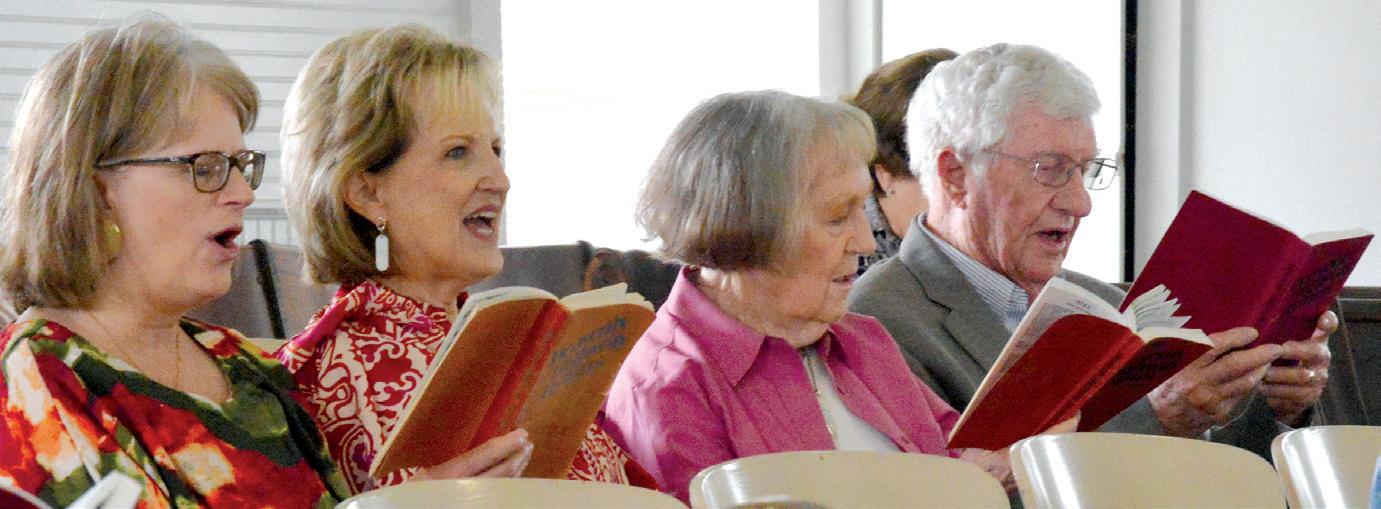
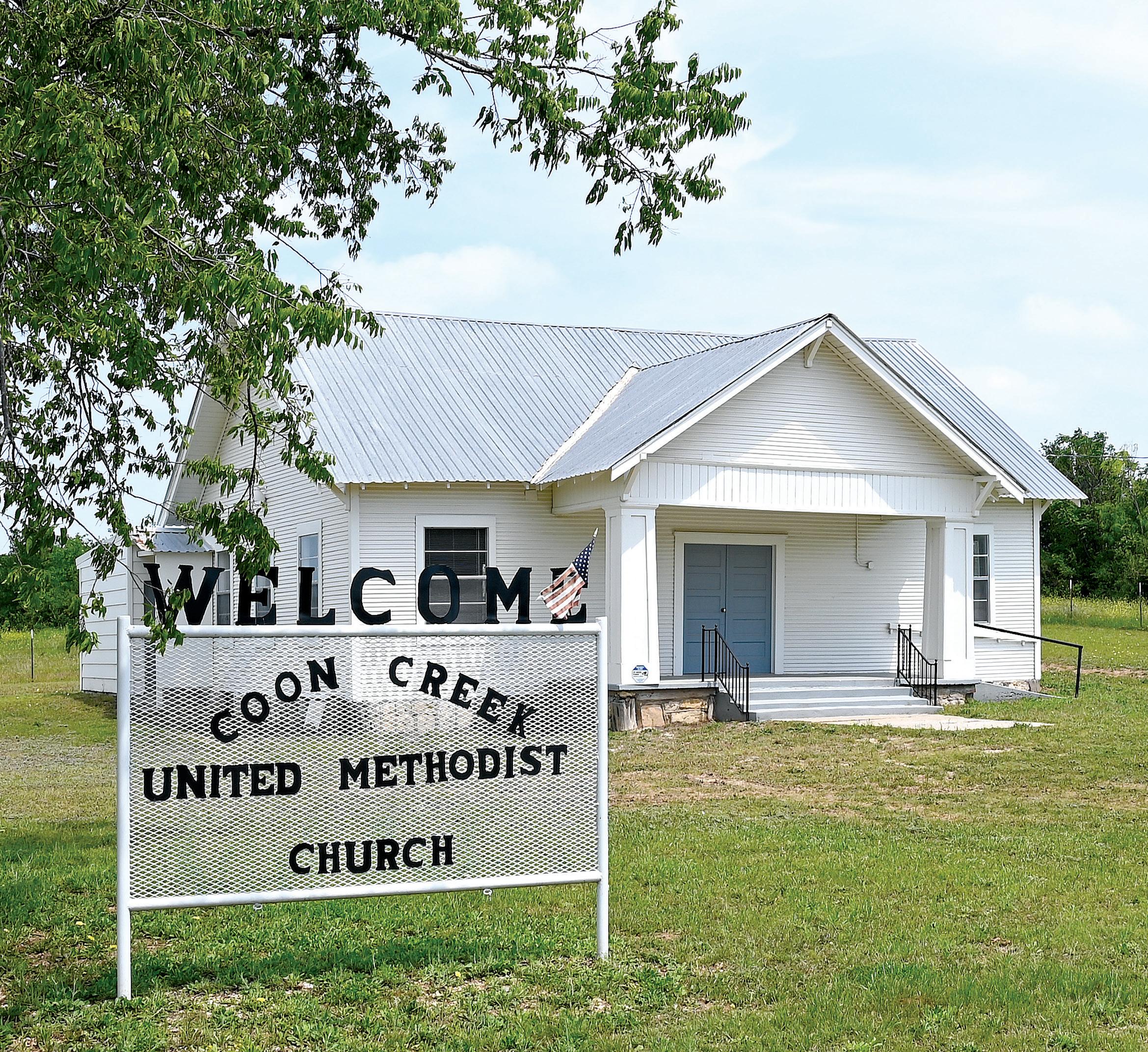
Celebrating over 100 years with
Psalm 100: “Make a joyful noise unto the Lord All ye, all ye lands. Serve the Lord, the Lord with gladness Come before His presence with singing.”
As one favorite hymn after another is sung, Jesus and his apostles gaze upon the crowd from a painting behind the pulpit. Tapping the old grey-painted floor, feet keep rhythm; heads sway as eyes follow along the stanzas; the hymnal pages rustle in unison as the next song is announced; a grandmother lovingly squeezes her granddaughter’s hand as the girl hums along; a toddler squirms on her mother’s lap wanting to hold the hymnal.
Youngsters – probably the fifth or sixth generation youth -- hand out the “Heavenly Highway Hymns” song books to the guests seated in the hodge podge of pews and 1950s church chairs at the Coon Creek Church. Taking Master of Ceremony Marsha Brown’s lead, the guests start a grand Southern tradition of Singing and Dinner on the Grounds, bound by spiritual songs, their
faith and family ties. The annual Homecoming celebration starts with the most appropriately named hymn #300 “That Glad Reunion Day” with the lines “There will be a happy meeting in Heaven, I know; When we see the many loved ones we’ve known here below, Gathered on that blessed hilltop with hearts all aglow. That will be a glad reunion day.”
Over the years, members and family of the Coon Creek community comes together annually on the last Sunday of April for worship, music and dear memories at the Coon Creek Church. It is a time to reflect, reminisce, replenish and revisit. And everybody agrees, Coon Creek is such a special, special place. That last April Sunday usually sees the countryside covered in Bluebonnets and Indian Paintbrushes – the air is usually cool but not cold, warm but not hot, and beautiful Coon Creek is running crystal clear.
The creek that gives the church its name was running from the recent rain runoff – the ground soggy from an overabundance of water, and the kids happily sloshing across the field to the church. But still, people of all ages, all related in some way or another to each other or to the land, packed into the small, white-washed, tin-roofed church off Highway 56 for the 103rd Annual Homecoming,

April 26, 2026. Some chose to linger in the doorway, hoping to catch the slightest of breezes in the muggy air. Familiar faces brought smiles, handshakes and hugs; people visited with each other, sharing photos on phones, giving the latest family news before the main event – the singing.
Representatives from each founding family since 1850 were present, being called upon to select the next family favorite hymn to sing. Most were happy, upbeat hymns; many connected to dear memories of family members. Besides the everpopular “I’ll Fly Away,” and “Amazing Grace,” the congregation sang one of Grandma Ethel’s favorite songs #156 “Blessed Assurance,” and Momma Jay Hollem’s favorite #18, “Let Me Help Somebody Today,” a very fitting hymn, because she helped people all the time, to the point of driving around Clifton looking for people to help.
The Coon Creek Community evolved from the old Cyrus community, the oldest settlement in southeastern Bosque County. The first settler was Temple Spivey who purchased land on the Brazos River in 1853. John Jackson Smith from Mississippi purchased 1,280 acres of land in Jan. 1856, and sent his son Burton to prepare the settlement. Burton Smith died in July 1856, after taking a drink of water from the creek.

Smith’s son-in-law, Silas McCabe and his wife Ann Smith, relocated from Dewitt County to the Smith plantation to take over where Burton had left off, and to take care of his young widow.
While the community was born out of this tragic death, over the generations the many descendants return for the annual Homecoming for a Southern tradition.
Economic conditions and lack of jobs, especially after WWI, the Great Depression and the collapse of King cotton started a trend of families moving away. Jim Hulme and Will Mallory were both good singers who loved the Gospel songs. And in the early 1920s, the two men organized a Homecoming which would be an All Day Singing and Dinner on the Grounds affair. People indeed came back to their roots and reconnected with those who stayed.
For years, Hulme and Mallory shared the MC duties of the singing. The music would be lively, loud and joyful. Mallory always sang inspired, especially his favorite hymn “Heavenly Sunlight.” Over the decades, the singers became so used to singing together, they sing some stanzas “Coon Creek” style – in double time and acapella. Pianists such as Alice Beale, Mattie Nell Bonds Boswell, and Rosalynn White accompanied the singing.
After the original organizing duo became unable to emcee the singing, a string of willing men and women took over the duties – Maurice Jameson, Pistol and Mattie Nell Boswell, Joe White and Marsha Brown carried on the tradition. And it is a
tradition much alive and well over 100 years later.
This is Marsha’s 70th year to attend the homecoming, which endured the Depression, WWII, and the Sixties. Even in the height of the COVID-19 pandemic, she and seven others came to the church to make sure the tradition did not miss a beat and lapse.
“It is just one of those things you do, like Thanksgiving and Christmas,” Marsha said in a video by Kelli and Joe Grady Tuck at the 75th Annual Coon Creek Homecoming in 1998. “I always enjoyed it, even as a kid. As soon as lunch was over, we’d head to the creek to play, a continuation spanning generations.”
Gifted with a beautiful voice, Marsha attributes her musicality and inspiration to her mother, who was a piano teacher. Her father had a beautiful voice too, but was apparently shy about it. The couple would be asked to sing at funerals so often, that when one of their sons was asked what his parents did, he replied “They go to funerals.”
One of Barbara’s precious memories was that Marsha would show up in church with red petticoats and laced socks. Marsha on the other hand “hated that frilly stuff,” and envied Barbara, because she got to change after the service into jeans and a t-shirt and got to play in the creek. Most of Marsha’s childhood memories surround the homecomings, picking bluebonnets and swimming in the creek.
“This is where we learned about Jesus and bible verses,” Marsha said. “And from her people have left and one on to do great things. It was the

starting place of a lot of good people and good things.”
Among the singers at the church were doctors, lawyers, musicians, engineers, nurses and more.
“Wouldn’t our grandparents be proud,” Marsha said.
After her dad became ill when Marsha was in eighth grade, the family moved to the 1908 Walter Pope “Pie” Bonds house that sits behind the former school building. Marsha graduated from Clifton High School, and went on to study Social Work at Baylor. After living all across Texas throughout the years, her family bought a place on Coon Creek in 1992. And now, the seventh generation of her family swim in the creek’s amazing swimming holes.
According to Marsha’s sister Leanne Messner, the Coon Creek Homecoming in the 1940s and 1950s was spectacular event where residents and homecomers wore their very best dresses and hats, suits and ties. Cars lined the highway on both sides for about a half mile and there was standing room only inside of the church and more people stood outdoors than were inside.
They brought their very best foods to spread on the long white wooden tables. Garden fresh beans, peas, squash, and onions alongside deviled eggs, chicken and dressing, roast, fried chicken, homemade bread and more pies and cakes filling the tables as talking and laughter filled the air. Marsha also carries forth her grandmother’s tradition of bringing a coconut cake to the communal meal after the singing.


“We reunite, reminisce, eat, laugh and sing. Oh yes, we sing!” Leanne said lovingly. “The Homecoming was such a special day for my grandmother who looked forward to it each year. She relished visiting with her old friends who she had attended school and church in the late 1800s and early 1900s. She also enjoyed seeing family and loved ones who might not have been back to Coon Creek since the last year.”
There is unity through song at each singing homecoming, gratitude for the place’s heritage and people. The joyful singing creates a fun event, making going to church enjoyable for the youngest generation. With the large families back in the day, it is easy to get lost in the “who’s who” but descendants hear the community’s treasured stories of beloved relatives long since passed, keeping them and the family trees alive through the memories. Marsha’s mother Mattie Nell Bonds for example was the youngest of eight children. Her father, Larry Lee “Pistol” Boswell, was the youngest of 10. Another example of a large family is the Mallorys with seven boys and seven girls.
Piano player Gary Goss from Nacogdoches is grandson of Will Mallory. While she did not grow up in the Coon Creek Community, his sister Dayna Robinson, her husband Craig and their children are presently much involved in the community.
The Robinson’s daughter Carly Belle Robinson Ochsendorf as well as their son Seth were at the 100th Homecoming. Carly was interviewed for the 75th Anniversary video at the age of seven, saying she wanted seven children and would bring them to Coon Creek, “so they can enjoy it, like I did when I was little.“ A clip also shows her singing, adding sign

language to “Yes, Jesus loves me, the bible tells me so.”
“In my opinion, it is for tradition and sentimentality reasons harkening back to days that were cleaner and simpler in many ways,” Dayna said about the “what” and “why” folks keep coming back to the Coon Creek Homecoming Weekend. “Personally, I also love the unison and the unity in the singing worship; the bonds solidified through song.”
During the Goose Creek Field oil boom around 1920, Dayna’s parents packed up their family in the T-Ford, to Baytown and later Huntsville. Dayna then studied at Sam Houston State and Baylor, majoring in Education. She met a Business major Craig while studying in Waco, and they raised their son and daughter in their home in Woodway.
Part city (Houston) and part country (Bosque County), Craig grew up a “hybrid,” so to speak. His family came to Bosque County every other weekend. His dad, Ralph Robinson was a land man working for AMOCO, but he was also a rancher who loved the land and cattle. Ralph was born on the Reuter place in 1932 because his folks rented a house there, still without running water. Ralph’s father was Omar Robinson, who was Bosque County’s Tax Assessor/Collector for many years.
When Craig’s parents retired to Clifton in 1992, the Robinsons knew that they wanted to be closer them and moved to Bosque County from their Woodway home in 2000. Not particularly a “country girl,” Dayna was willing to give it a try. And in Bosque County she discovered she really and truly was a Christian naturalist and conservationist.
After Craig’s dad started slowing down, the couple bought out his cows. Avid conservationists, Craig and Dayna have been ranching ever since. For a while, Craig was also a banker in Waco at the same time. They hope to continue carrying on, in their precious farming and ranching community in their beloved Bosque County.
“I never dreamed that I would live three miles from the Coon Creek Community where my people came from and where I had been coming to since I was basically an infant. My mother and others were baptized in that creek,” Dayna said. “Our family called it [the Homecoming] Coon Creek Weekend because we would camp out either at Arrowhead Lodge or Lofers Bend and have a hamburger cookout on that Saturday. Then of course, the singing was the next day. I always loved the smell of the bluebonnets and being in such an arid place, compared to living in Baytown near the Gulf Coast with all its humidity.”
Like many small rural, pioneer communities, life revolved around family, farm, church and school. The settlers built their homes with fire places and dogtrots, and community buildings themselves, after they had tended their crops – primarily corn, oats and cotton – and livestock, cows and hogs. Meal content followed the seasons.
When “a cold norther came through” four-five hogs would be communally slaughtered by “The Good Neighborhood Club,” and people would smoke the meat to preserve it. Usually, by the time the last smoked ham was used up, poultry meat and eggs became the protein source. The Stachas and Sieberts took care of calf slaughter and distribution of different cuts of meat.
Kinship, cooperation, communion and being a good neighbor bound the community. The Barnes brothers bought a thresher which was run by the community. Hard work, determination and a sense of humor in harsh times kept it going.
In Aug. 1856, School District Four was established, and McCabe opened a school in a one-room log cabin on the south side of Coon Creek, opposite his home. Over the decades, the location and size of the school changed – the newest built in 1929, which became part of the Clifton Independent School District in 1944. That building is now the Coon Creek Community Center where the traditional, communal, pot luck meal after the singing is held.
The Coon Creek Methodist Episcopal Church
dates back to 1874. Early ministers were circuit riders who came to the church on the first, third and fifth Sundays. At that time, it was called the Methodist Episcopal Church South. Surnames such as Brittain, Bonds, Conine, Goodall, Shaw, Smith, Word, Shaw, Fowler, Cradock, Mormon, May, Culp, Whitney, Reed, Hix, Vaughn and Williams filled the Methodist roll.
In 1883, the Cyrus Community evolved into two separate communities. The area south of Coon Creek became known as Smith Bend and the area north of the creek as Coon Creek. And a new log school was constructed at Crystal Spring on Coon Creek, two miles west of the school. The two communities share the Smith Bend Cemetery established by John Jackson in 1856. Both Marsha and Dayna intend to be buried there alongside their ancestors.
In 1887, the Coon Creek Missionary Baptist Church of Christ was established. Baptists also usually had a circuit preacher who met with them on the second and fourth Sundays. The congregations shared the building and met together with the alternating preachers until the Baptist group disbanded in the 1960s. Byrum, Beal, Bridger, Greenwade, Gouldman, Hestilow, Hulme, Holt, Jeanes, Kelly, May, Mallory, New, Raines, Rainboldt, Ryder, Rowe, Schoonover, Siepert, Thomas, White and Williams filled the Baptist roll. Some family names were on both rolls. The present church building was constructed in 1916 and was shared by the Methodist and Baptist congregations.
The most visible program of the Texas Historical Commission can be seen along the roads of Texas – the historical markers commemorating diverse sites and topics – from the history and architecture of houses, commercial and public buildings, religious congregations and events that changed the course of local and state history, to individuals who have made lasting contributions to the state, community organizations and businesses, military sites and many more.
Just 155 markers per year are given out and

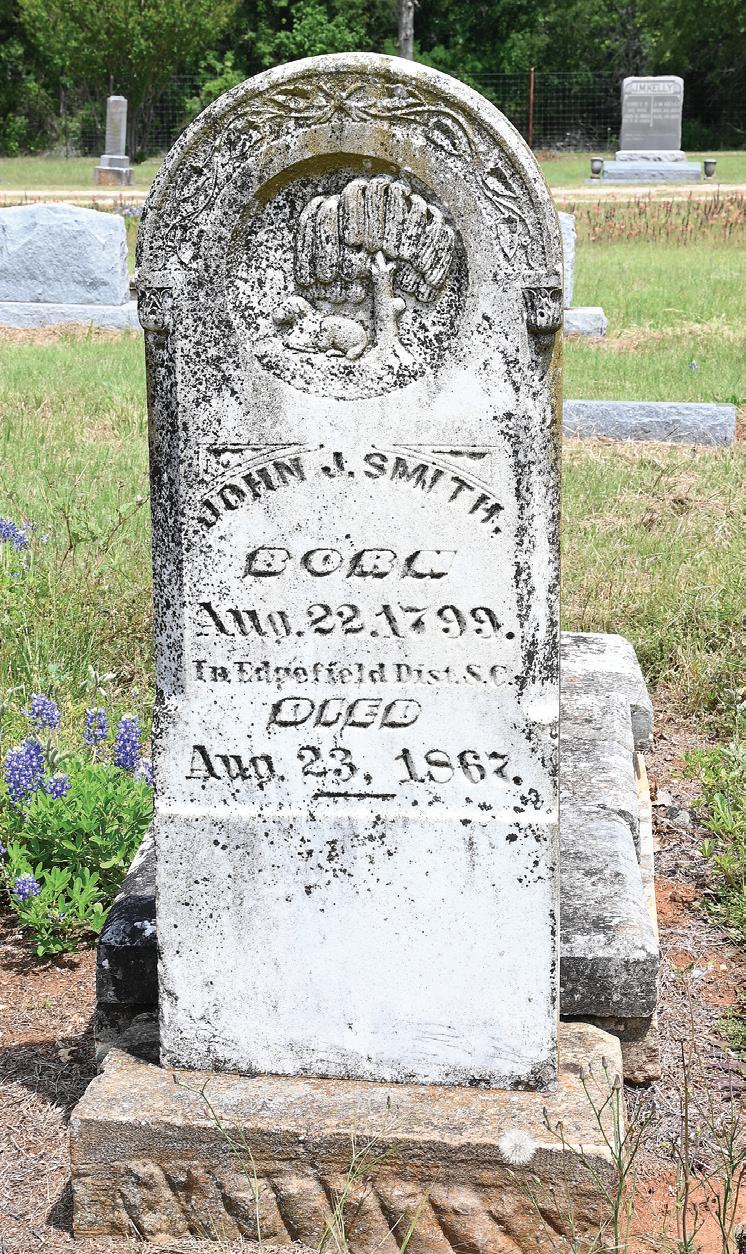
BORN IN HISTORY, CARRIED ON THROUGH THE DECADES: John J. Smith helped found the Coon Creek Community. His legacy remains strong today.
they have to meet very specific criteria and have the relevant documentation to support the claim of importance. Subject markers are solely educational and reveal aspects of local history that are important to a community or region which have value as under-told or untold aspects of Texas history, and Bosque County has their fair share of them.
After a two-year paperwork process, descendants and friends of the original Coon Creek Community in the Southeast part of Bosque County, came to the unveiling of “their” Texas Historical Marker Oct. 14, 2018. At present, three buildings of the original community remain – the church, the old school house and the Walter Pope “Pie” Bonds homestead.
Together with members of the Bosque County Historical Commission and “The Good Neighborhood Club,” over 80 people were present for the unveiling. BCHC’s Jo Nell Meyer quoted Proverbs 22:28 – “Remove not the ancient landmark, which thy fathers have set” – on the importance of preserving history.
Not on the marker is the historical significance that the Coon Creek Community was located on one of the oldest roads in Bosque County – the military road known as the Austin-Fort Graham Road. The Coon Creek crossing provided a convenient stop over for wagon traffic. The subsequent establishment of the railroad at Whitney and the ferry at McCabe crossing dramatically increased the flow of traffic through Coon Creek.
While not used for regular Sunday services, the church and school are used for weddings, funerals, Thanksgiving and the Coon Creek Country Christmas. Marsha was happy to state that the past years saw more weddings than funerals. The long tradition of gathering to sing has brought together descendants of the first settlers every year to raise their voices and make a joyful noise. Some come from far away – as far away as Seattle, WA and even though they might not ever have lived in Bosque County, their families still have property here.
Sunlight filters into the sanctuary as the congregation claps and sings “Do Lord,” with the lyrics “I have got a home in Gloryland, that outshines the Sun, look away beyond the blue.”
“We give thanks for the history, the worship and the music,” Steve Messner said in his opening prayer. “Be right here, where our feet are today.”
And that is exactly what the heartwarming annual Homecoming offers – a sense of place, a sense of belonging, a sense of deep-rooted family and community ties, their heritage – a blessing for the community, and its forbears. Back in the early days, the community stuck together for survival, now they stick together because of this sense of community and belonging.
A community that sings together, stays together, and this is why this community is different from the many other small communities in rural Texas built around the church and a school, which have long since deteriorated and relinquished their buildings to the ever-encroaching prairie.

article
by

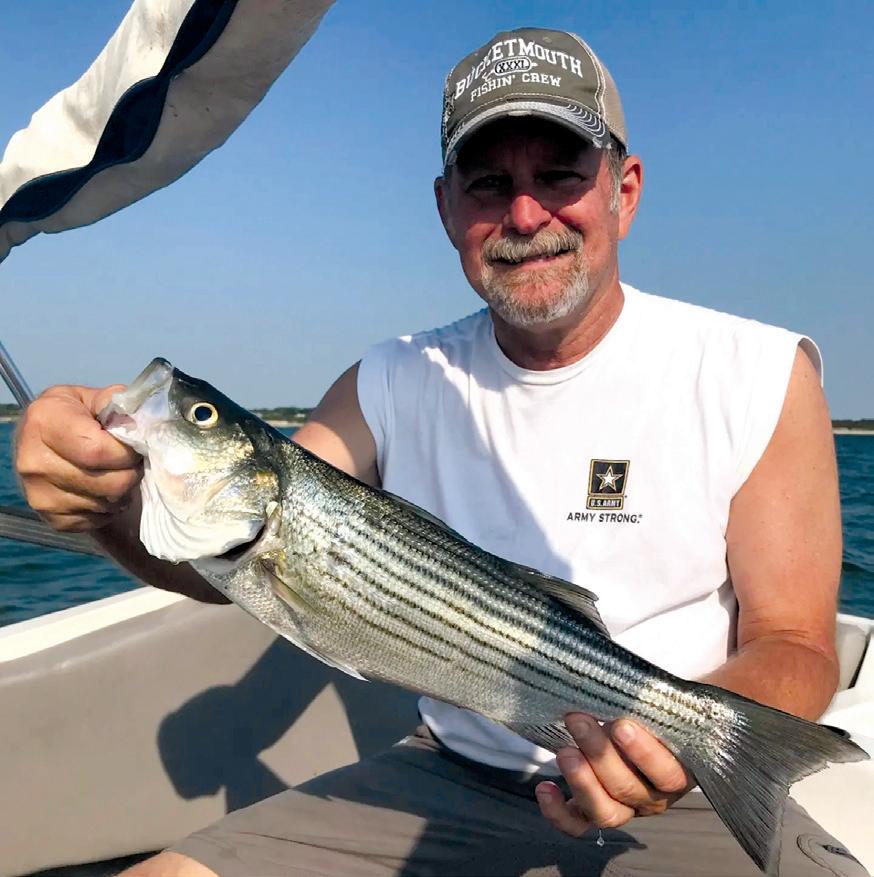
Lake Whitney remains striper fishing’s best kept secret in Texas, but holds much more to offer
“The worst day of fishing is better than the best day of work.”
The beauty of a “best kept secret” destination lies in its unspoiled authenticity, offering a rare opportunity for genuine discovery away from the curated lens of mass tourism.
When it comes to the top striper lakes in Texas, it remains hard to beat Lake Texoma – often referred to as the “Striper Capital of the World.” Undeniably the premier striper destination in Texas, Lake Texoma in Grayson County offers ideal habitat featuring a self-sustaining population with large numbers of “box fish” and frequent catches over 20 pounds.
Stretching into both Bosque and Hill counties, Lake

Whitney remains known for a very strong, well-established population of striped bass within the Brazos River system. Known as a “hidden gem” on the Brazos, it provides some of the state’s best fishing.
But Lake Whitney also ranks as one of the prettiest lakes in Texas, offers excellent public access, provides top-notch angling for striped bass and white bass, along with unique and diverse opportunities for smallmouth bass and trophy blue catfish.
So, it can be arguably stated that Texas anglers who have not fished Whitney are missing out on a great experience.
On the Brazos and Nolan rivers off Texas Highway 22 about 30 miles
northwest of Waco and impounded in 1951, Lake Whitney provides a surface area of 23,500 acres with a maximum depth of 108 feet. Typically presenting with a stained clarity, the lake level conservation pool elevation stands at 533 feet above mean sea level with a fluctuation of four to eight feet annually.
When it comes to fishing cover and structure, natural rock shorelines, including steep bluffs, boulders, and sand and gravel flats dominate this Brazos River impoundment. Submerged timber and flooded terrestrial vegetation add to the diversity of natural habitat for fish while man-made habitats include boat ramps, marinas, piers, docks and bridge pilings. Aquatic vegetation includes willow, bushy pondweed, buttonbush, bulrush, coontail, pondweed and water willow.
The Waco Inland Fisheries District worked with Bosque and Hill County 4H members and other volunteers on two separate occasions to assemble and deploy both commercial and PVC fish habitat structures to help attract and hold sportfish for bank and boat anglers.
The first project, consisting of three freshwater reefs, was completed near Whitney Ridge Resort & Marina in the South Fork Rocky Creek. The most recent project, also consisting of three freshwater reefs, was completed in coves along the shores of Lake Whitney State Park. To date, a total of six freshwater reefs have been deployed in Lake Whitney.
For most anglers, the main draw for Lake Whitney remains striped bass, offering excellent, year-round fishing with peak action from March through May, particularly for schooling fish in the 32-inch range. Success often involves tracking birds or using electronics for deep, schooling fish. Diving seagulls frequently indicate feeding schools of stripers.
Anglers find success using live bait, topwater lures and jigs. When it comes to live bait, shad and inland silversides known as “ghost minnows” stand out as highly effective. Artificial lures such as topwater lures, white hair jigs and flutter spoons work well, especially during early morning, late evening or on overcast days. And then, trolling and drift fishing has proven effective in deeper water during summer.
Focusing on the Nolan and Brazos rivers in the spring and the lower reservoir in the summer and fall, fishing often proves productive in 3060 feet of water, particularly in the lower end of the reservoir and near the dam. Of course, early morning topwater action remains popular, while deadsticking in 30-45 feet commonly produces in colder weather.
Recent reports in 2025-26 mention anglers catching quality, healthy fish, with some catching limits, although many reports note a high volume of smaller fish. Finding fish remains the key as they move fast. Consequently, using live shad or vertical jigging often proves to be the most productive method.
From June through September, the lake turns stratified with little oxygen and cooler temperatures below 20 to 30 feet. Stripers seek out the coolest water they can find with tolerable oxygen levels. Trolling or drift fishing using large diving baits, jigs or live bait may catch these suspended fish. Most summer catches are made in the middle and lower portions of the reservoir.
In October and November, stripers inhabit all depths. They are frequently found along river channels in deep water, and occasionally feeding at the surface. From December through March, troll river and creek channels using large jigs and other artificial baits. Many wintertime catches are made fishing off the bottom with live bait, slabs or jigs.
But make no mistake about it, striped bass isn’t the only game in town.
White bass migrate up the Brazos and Nolan rivers to spawn from March through May. Best catches are made below sand and gravel bars and along sandy shorelines. Anglers use a wide variety of baits including minnows, jigs, slabs, and spoons.
White bass fishing is productive in the main reservoir from April through November. Concentrations are most commonly found near sandy beaches, on roadbeds, and near submerged timber in shallow water. Large schools frequently surface in open water while feeding on schools of shad.
Anglers can find them by using sonar or observing gulls that feed on shad. Most activity occurs in early morning and late afternoon. Tail spinners, spoons, and small jigs are good bait choices.
When it comes to catching quality size largemouth bass, Spring ranks as the best time of year. From March through May, fish are in shallow water two to 15 feet deep. At this time of year, bass are caught along shorelines and in coves on spinner baits, topwater baits, plastic worms, and crank baits. Anglers are most successful in areas with flooded terrestrial vegetation, submerged brush or logs, or inundated willows.
From June through August, largemouths are usually found at depths of 10 to 20 feet in the clearest parts of the reservoir. However, some may remain at shallow depths during the day in the murky “off-colored” water.
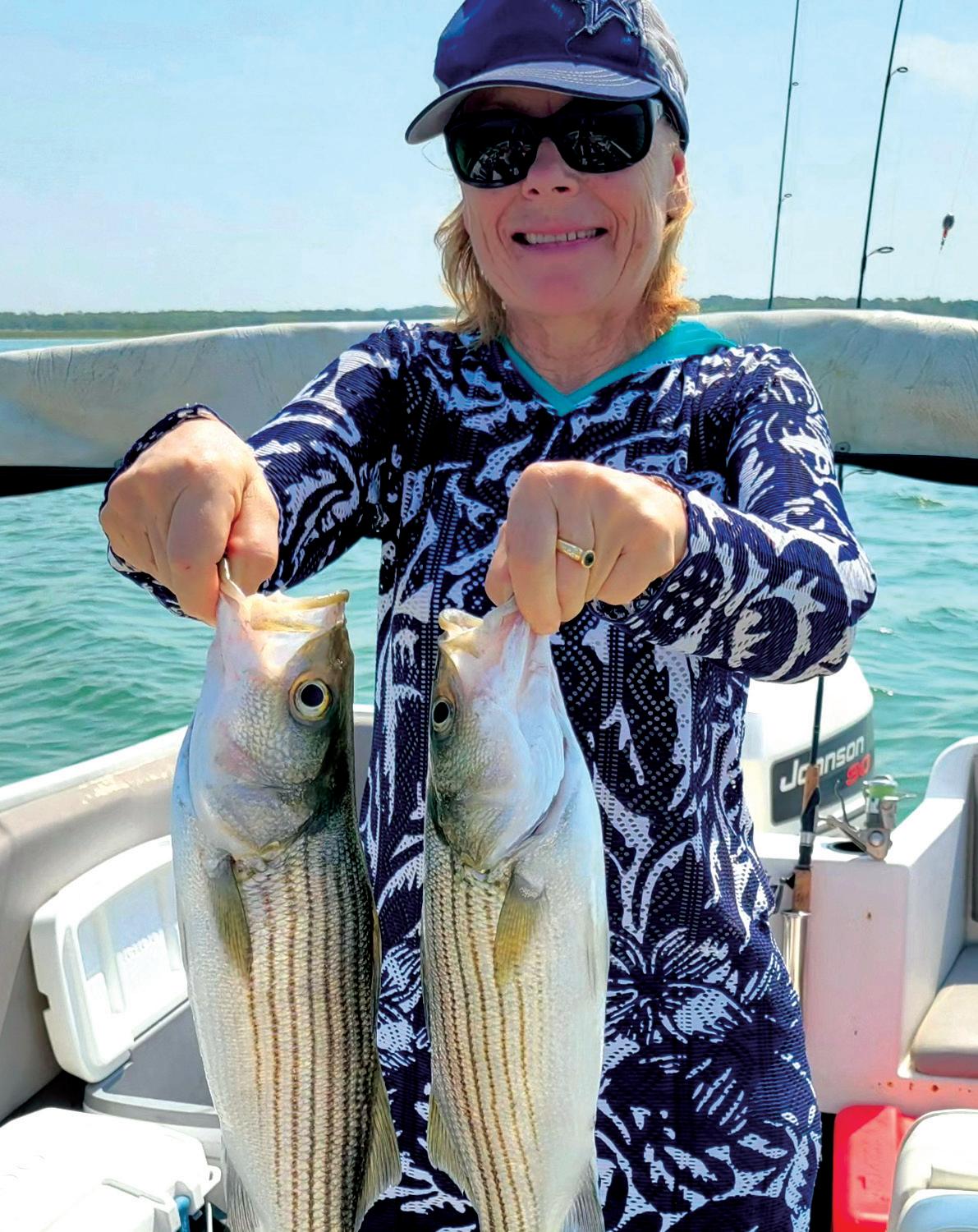
Productive baits include plastic worms and deep-diving crank baits. In September and October, bass may be caught near the surface or in water less than 10 feet deep. From December through February, anglers should concentrate on depths of 15 to 30 feet, using plastic worms, jigs, and deepdiving crank baits.
And of course, blue, channel and flathead catfish are all present in Lake Whitney. All three species can be caught year-round, but fishing remains best from April through June, when catfish are spawning. Most spawning occurs in shallow coves or along cut banks in submerged timber or sparse, large rock, with adjacent deep water.
Channels and blues can be caught in warmer weather by drift fishing across shallow main lake flats with cut shad, shrimp, worms, or commercial dough or dip baits. Anglers can improve their success by “chumming” likely spots with grain that has been soaked in water for a week or two. Many anglers fish for trophy blues from December through March. Best areas are near channels and submerged brush or rock. Fish over 40 pounds are possible, and often caught on live shad.
Flatheads also generally prefer live bait, but very fresh cut bait can be used. Flathead anglers should target areas with timber and brush piles along cut banks at night.
Trotlining will always be a popular and effective method for catching all three species, and is generally more productive in the upper parts of the lake.
But aside for the quality of the fishing, what gives Lake Whitney the allure of the undiscovered?
First of all, tranquility and intimacy can be attained as Lake Whitney offer peace and space to slow down. Without the hordes of watercraft and boats creating noise and pressure, you can fully absorb the essence of a place –just be on the water surrounded by its natural landscapes.
And remarkably, Lake Whitney provides a sense of serendipity through the joy of what feels like a secret destination. It’s the thrill of discovery itself – the feeling of stumbling upon a “private” paradise.
“There’s always time to cast one more line.”

article by SIMONE WICHERS-VOSS
People clad in their best boots, belt buckles shining, a good crease ironed into their jeans and shirts, gradually make their way to their seats in the rodeo arena. The excitement among the youngsters builds as their parents check the helmet again to see if it’s secure. Grandma already took their photo wearing their mutton bustin’ bib.
It’s nearly show time, and the rodeo clown moseys on down, ready to grab the tikes when they face plant in the heavy arena sand after their rumble with the sheep.
Regular rodeo photographer Laura Burt gets a nod. She’s chomping at the bit to photograph the evening’s fun and games and competition. This is where her two passions merge seamlessly – her love of rodeo and everything that goes with it, and her love of photography.
Whether it’s freezing the bull riders grimace as he desperately tries to hang on as the bull does a 180, the bronc rider floating off the saddle, the neon-colored rope just over the calf’s head, the spray of sand as the rough stock’s hooves hit the ground, that head hunter bull that’s out to hit anything on two legs in the arena or capturing the speed of the barrel racer as she spurs on her steed to the finish line, hat flying, Burt wants to catch all those pinnacle moments with her camera.
And she loves to capture the rodeo story – the pure cowboy swagger on display, the defeat on a rider’s face as he picks up his hat after a disappointing ride, close ups of the specific horse tack and spurs, the audience’s amazed and thrilled faces, the young man’s arm around his buckle bunny’s waist.
Photographing the rodeo cowboys and cowgirls is where God landed her, and she has quickly become a fixture in small town rodeos all across
Texas, Oklahoma and Kansas. Her passion for the Western and Rodeo way of life has marked her as unique in her field. Traveling thousands of miles each year, in her Jeep Wrangler, AKA the “rodeo rig,” sometimes in difficult, with environments that outdoor photographers also face.
Besides shooting rodeos – which is a seasonal thing from March to the end of October – Burt especially loves taking photographs of the working cowboy and the ranch way of life but capturing images of people’s lives, of their work, their traditions, and their character.
Born in Fort Worth in 1969, Burt lived in rural Texas all of her life, growing up on a farm. Her pocket money was what she made picking black-eyed peas and corn for her parents. Finding an old Argus Camera – a little bakelite and metal box camera – in her great-grandparent’s attic, hidden away in a box among the life’s mementos and discarded housewares, started a lifelong passion for all types of photography. And that pocket money she made would eventually go towards buying film and developing photos.
The love of photography slowly progressed from there. A Polaroid camera she got at a following Christmas had her snapping away at her siblings doing goofy stuff; joining the yearbook staff taught her how to develop her own photos and to frame her pictures for maximum effect.
As she got older, she taught herself more and more about photography and the art of capturing life, dabbling in landscapes, flowers and the tucked away caliche country roads. A class taught by a Texas Tech college professor showed her the intricacies of shooting the night sky. And friends would ask her for senior portraits or to shoot a special event “just to make some money.”
“One thing just led to another,” Burt said about her photog path. “I was learning as I went along. I never thought I would ever be a professional photographer, but here I am.”
That path that eventually led to Sambo, her former team roper husband. Burt always loved the cowboy scene, dressing the part with starched shirts
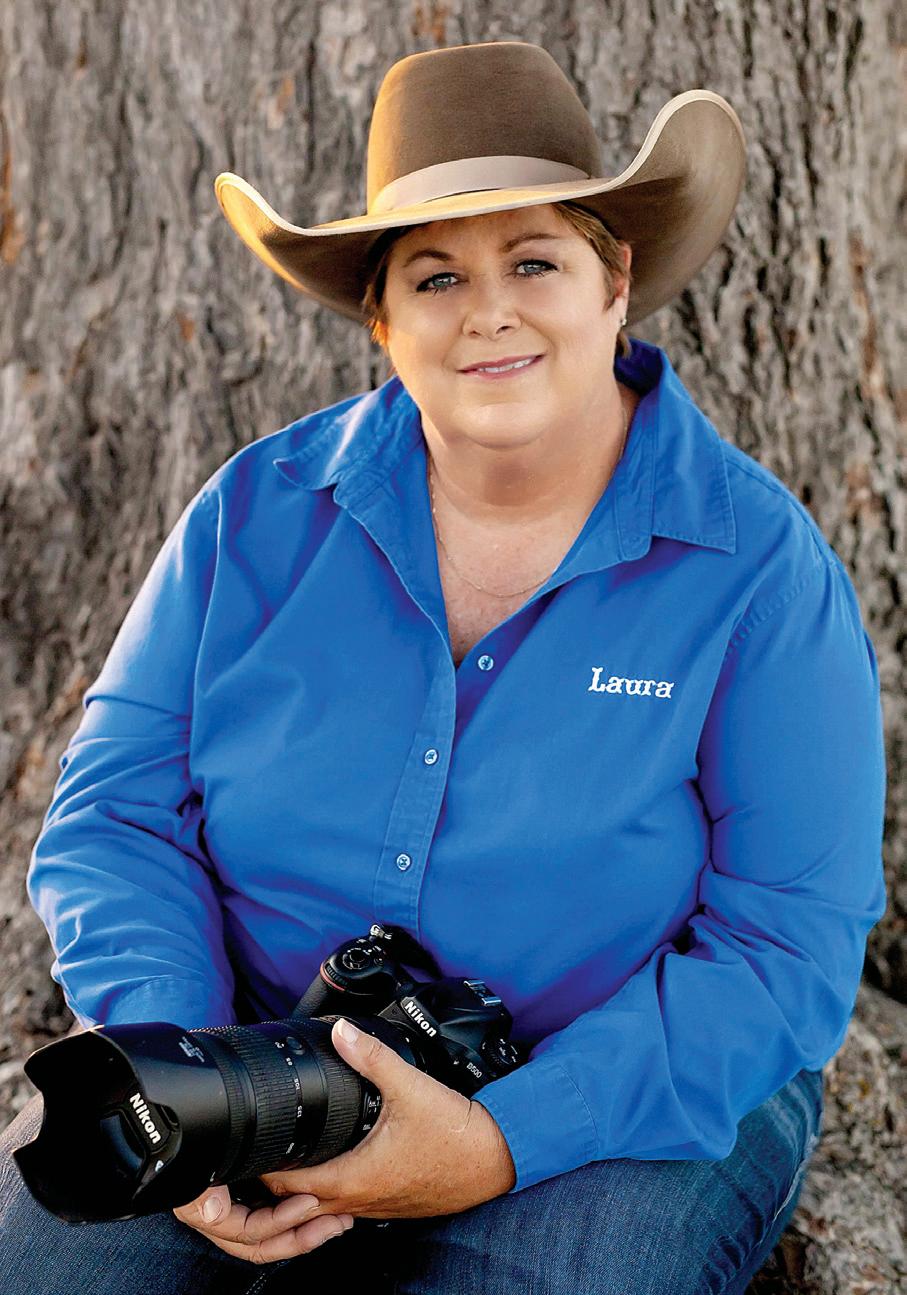
and snazzy boots, but she didn’t get into the rodeo scene until she met Sambo.
The couple started going to the Top Hand Cowboy Church, where she was asked to photograph their ranch rodeo and other church activities. By that time she had a Sony Cybershot, which was fine for the day time event.
One thing led to another, and thanks to her husband’s affiliation, she got to shoot the Texas Senior Pro Rodeo. Burt was not particularly proud of the quality of those photos, but she did sell around $300 worth. And her photography business took off after that, thanks to word of mouth.
Her biggest supporter, Sambo taught her the ins and outs of rodeo – from how the animals react, getting comfortable in the daunting arena setting, telling her what customers wanted in their rodeo pictures.
“I got the nickname ‘runner,’ because I would run to get out of the way a lot,” Burt said with a grin. “One day shooting calf roping, the calf hit my leg, and the MC called out ‘photog got smoked.’ Nowadays, I sometimes realize I should be more careful. But anything for that great shot, right?”
In a short time, Burt has become well known in rodeo circles and in small town Texas as photographer who will get the job done. She strives to do the best job she can keeping in mind what her parents taught
9:15
9:15 a.m. Children’s Sunday School
10:30 a.m. Worship Service Tuesday
6:30 p.m. Bible Study Wednesday
10 a.m. Ladies Bible Study 911 W, 3rd Street, Clifton – 254-675-3281 Email: info@immanuelclifton.org Website: immanuelclifton.org

her about integrity and always doing what you say you’re going to do – delivering what she promised. She might not have grown up a cowgirl, but since 2008, she is known as “Cowgirl at Heart,” because that is who she feels she is, and it was a perfect name for her business.
Burt has covered everything from the State Fair of Texas Rodeo, State of Texas Future Farmers of America Rodeo, the Kansas Women’s World Final Ranch Rodeo, the Region 10 High School Rodeo, the Cody NesSmith Memorial Team Roping, the Rustin Mexia Memorial Roping, the Mexia, Graham, Teague, Brownwood and Clifton Rodeos, the Central Texas Youth Fair in Clifton, the Original Team Roping Finals in Abilene, and recently, she added the four-day San Antonio Livestock Show and Rodeo equine events to her roster.
Her work is held by public and private collectors. Burt’s photography has appeared in Texas Monthly, Dally Times, Western Horseman, Nationals Final Rodeo Journal and The Breakaway Journal.
Life’s about the ride, and wild horses couldn’t drag Burt away from this ride she’s on, with her trusted Nikon D850 and 70-200 mm lens – it might be hot and sweaty at times, and sometimes a bit hairy – but she truly loves capturing the images of those Texas dusty days and rodeo nights.
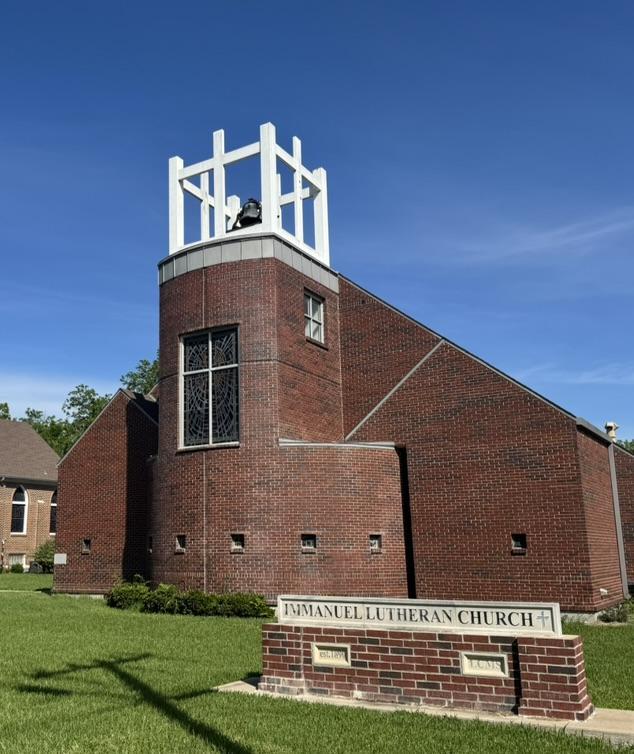



As forgiven sinners, we follow in the footsteps of our Savior, Jesus Christ



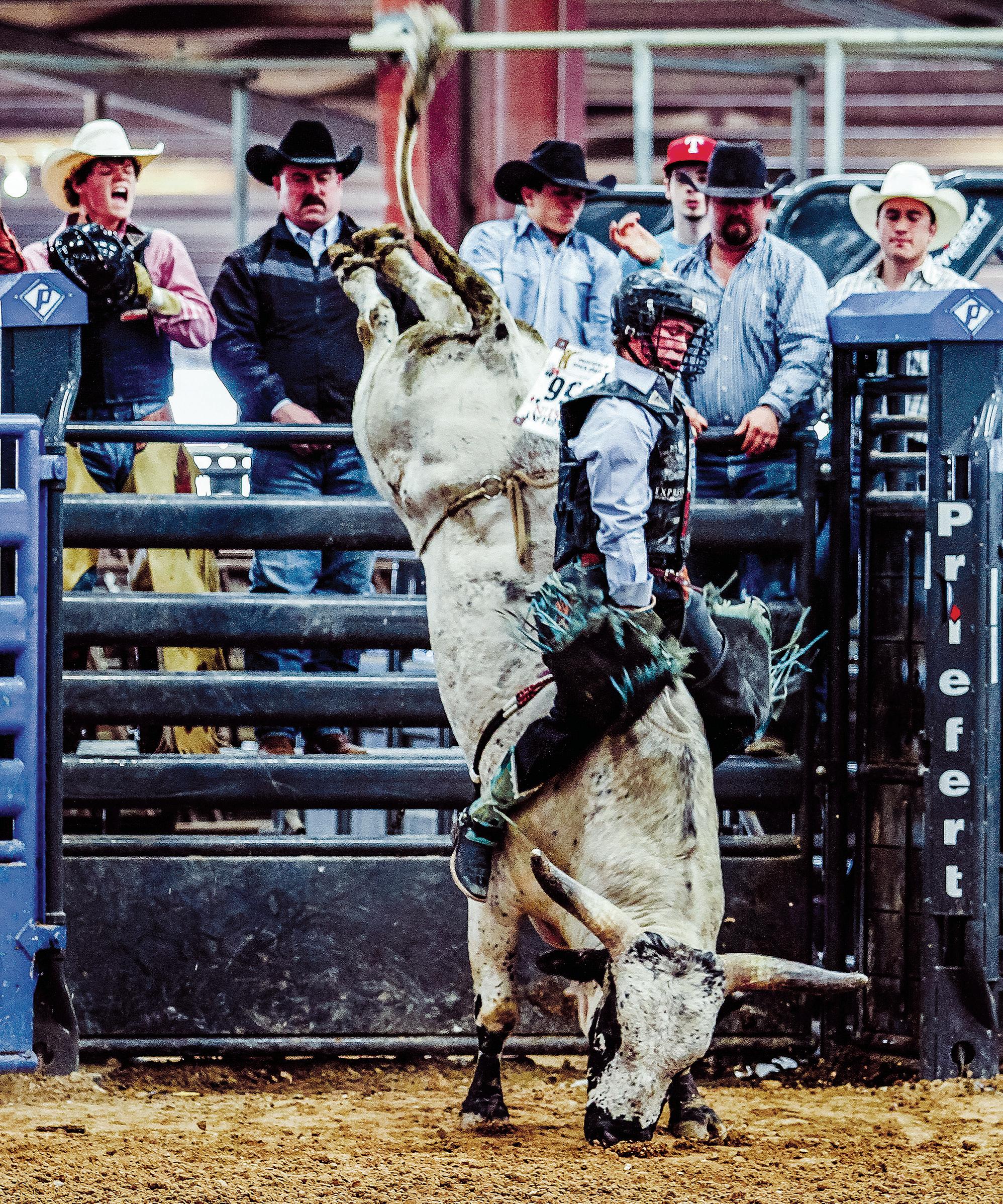
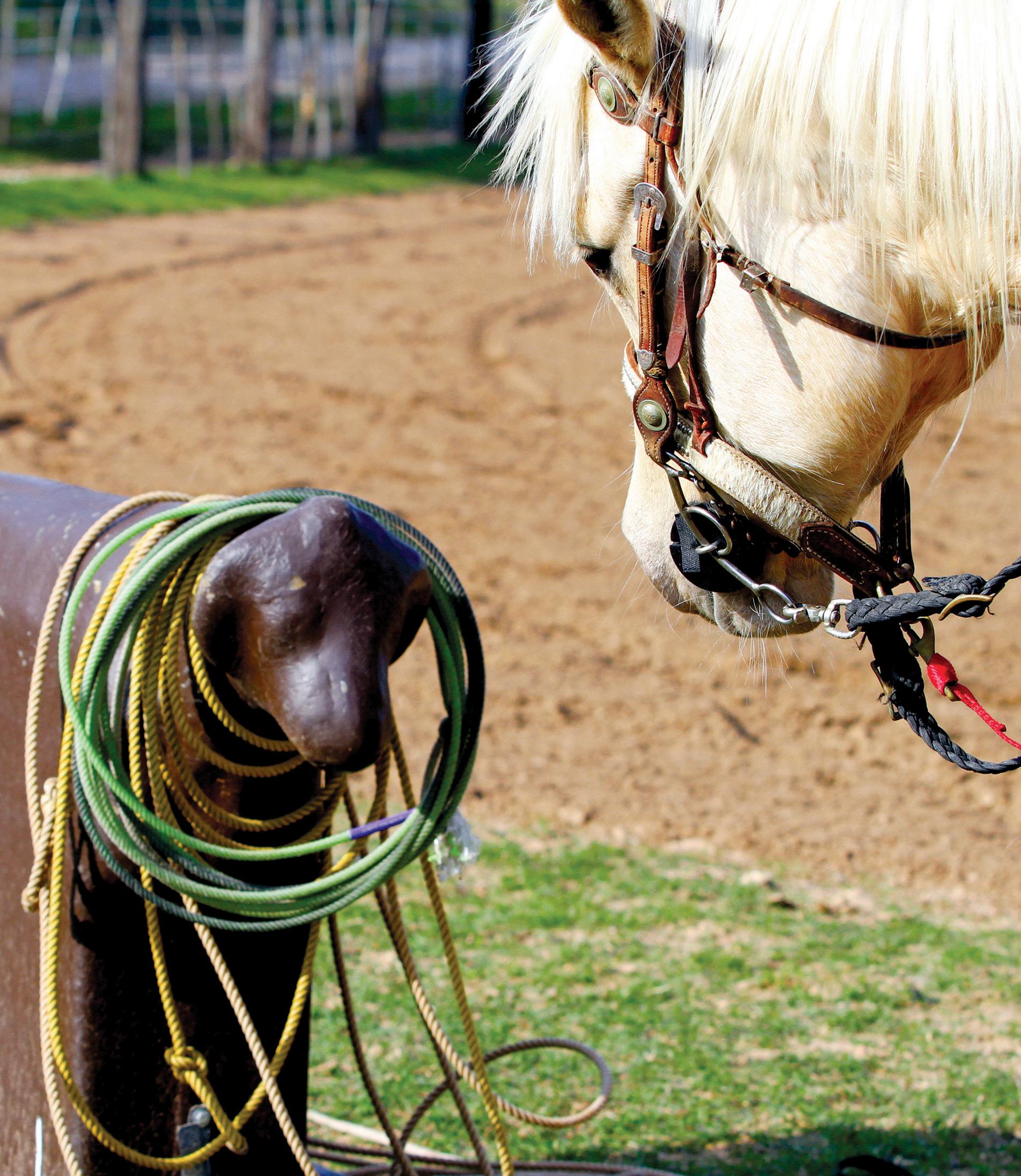

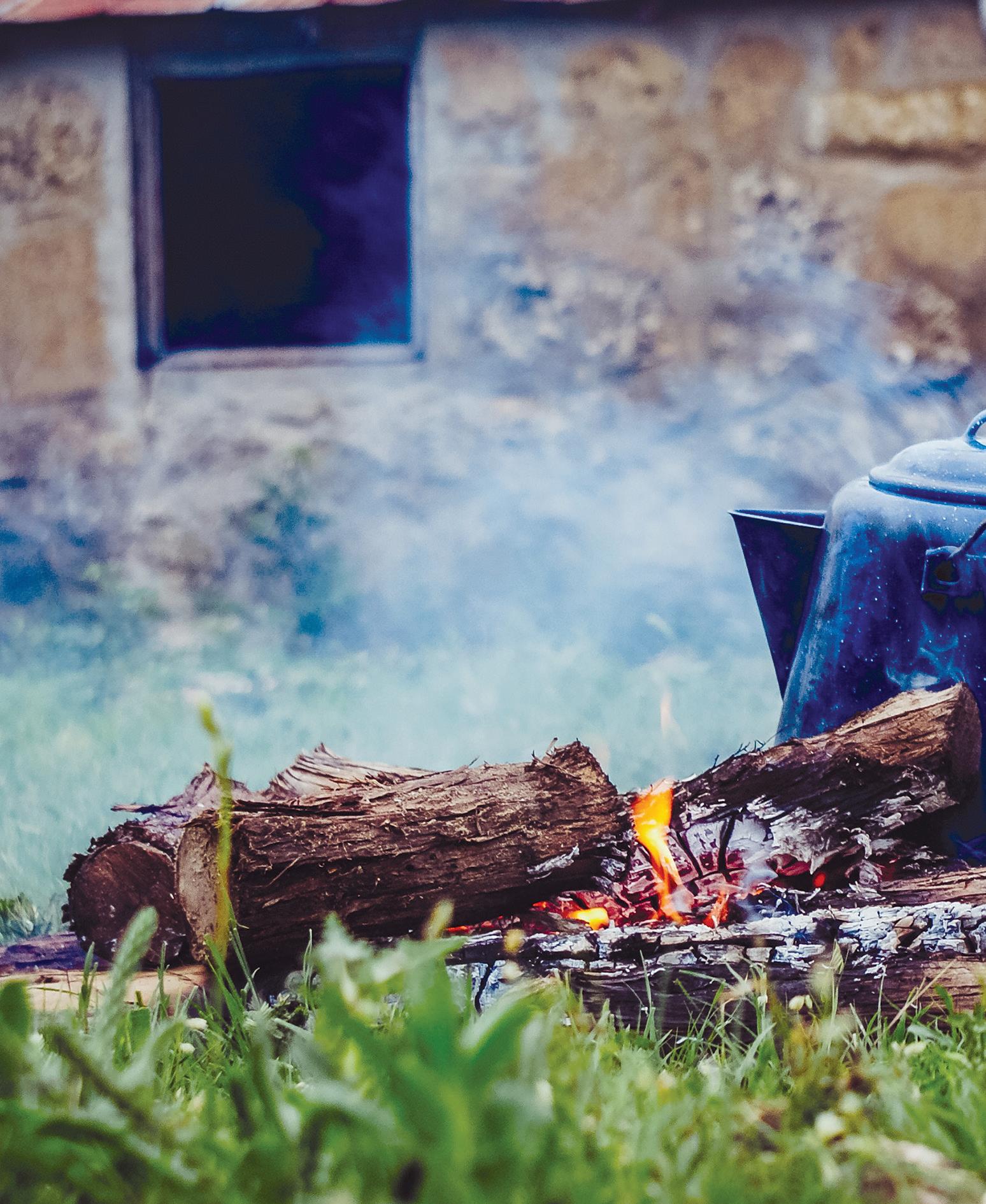
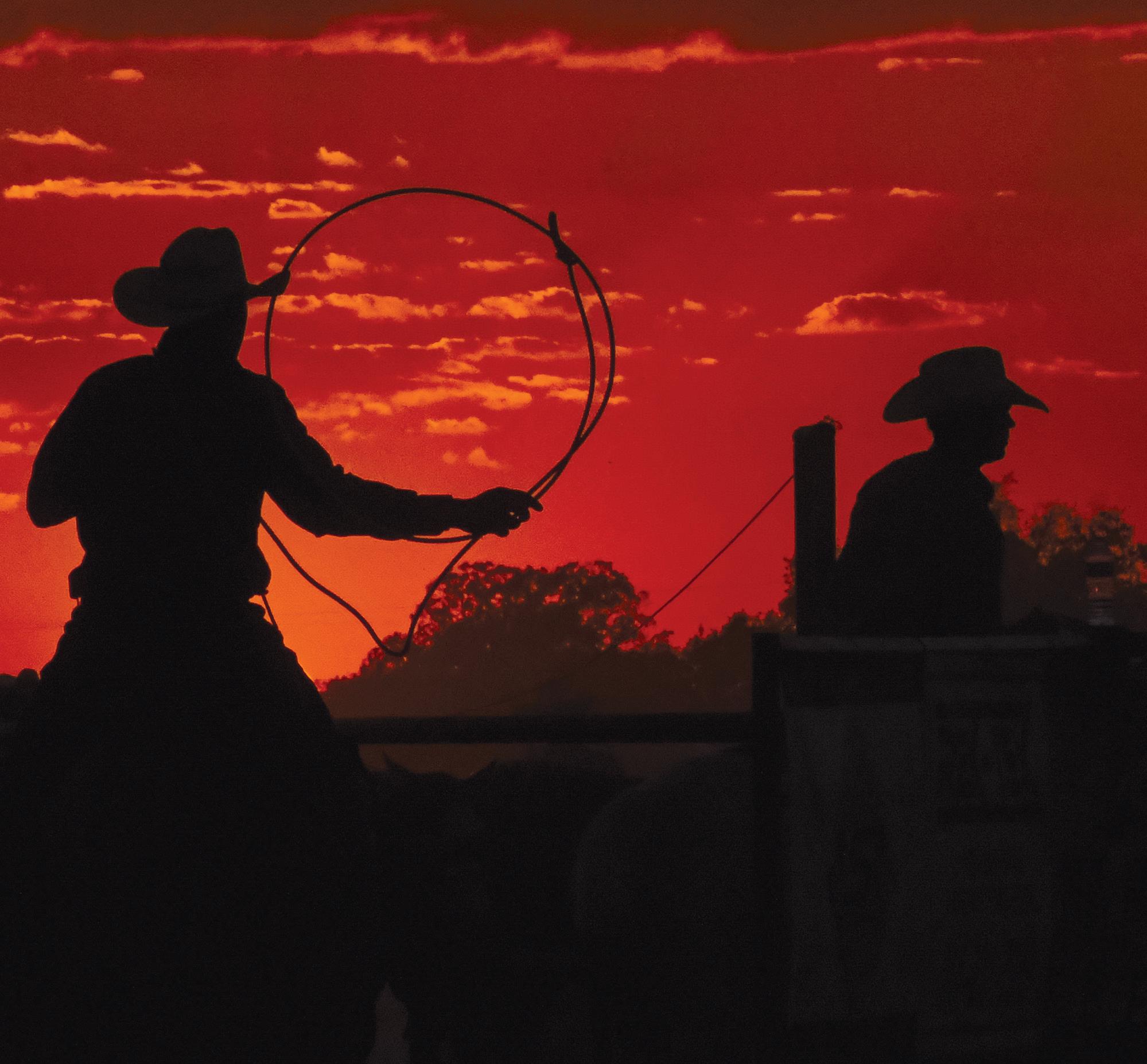
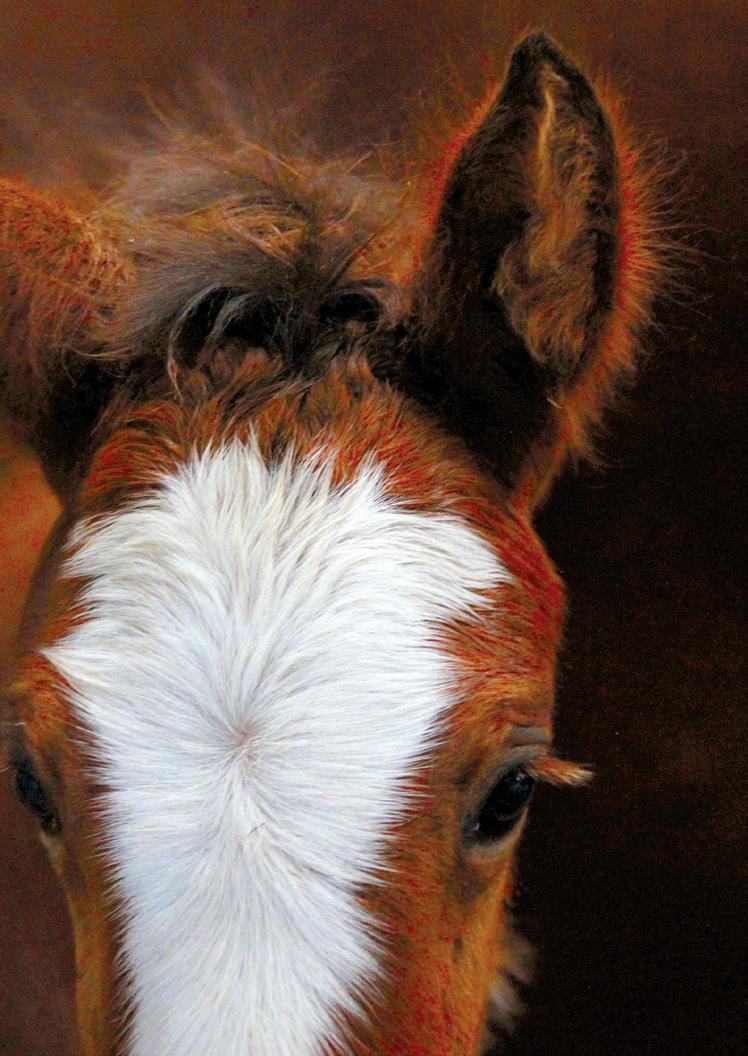
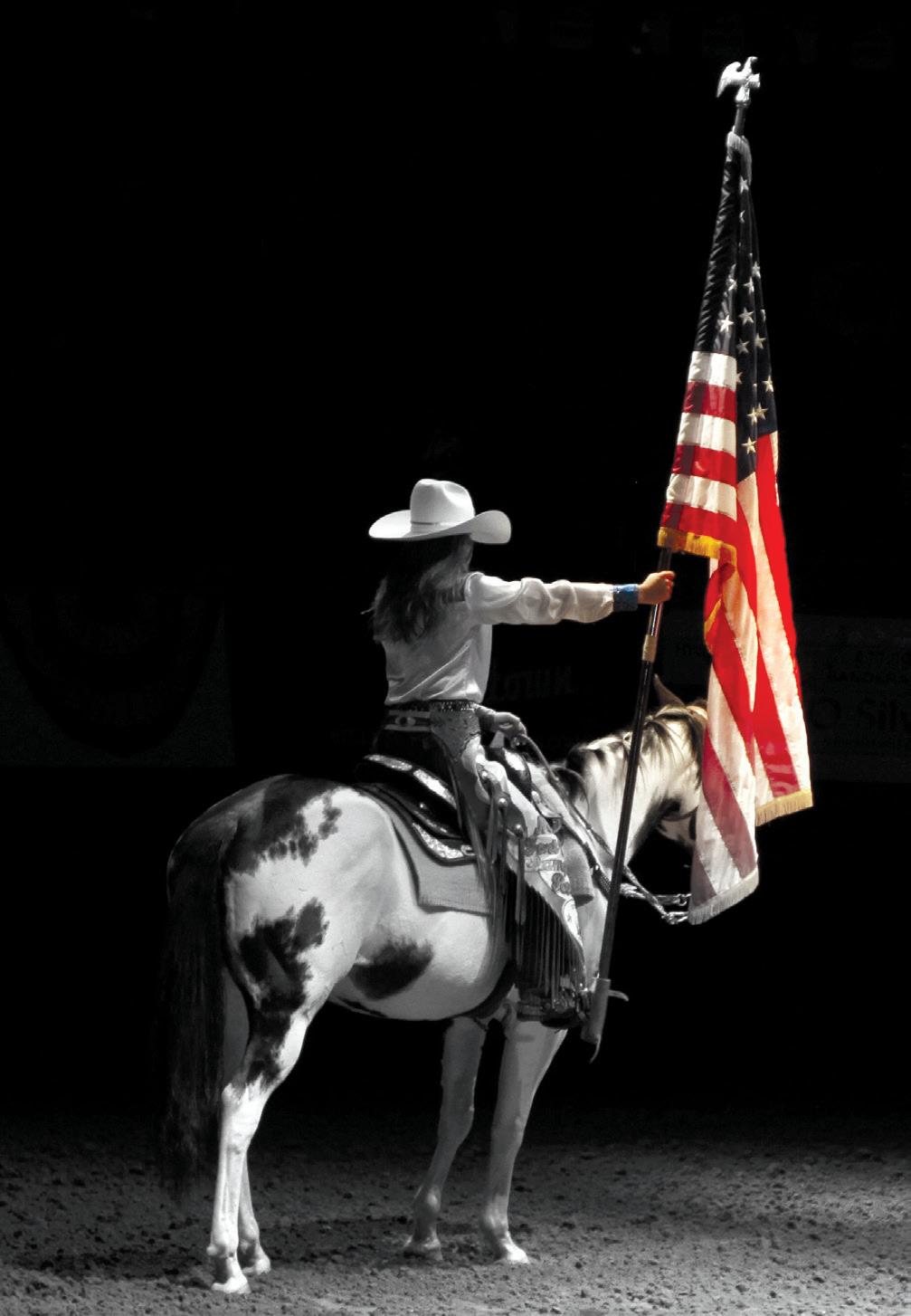
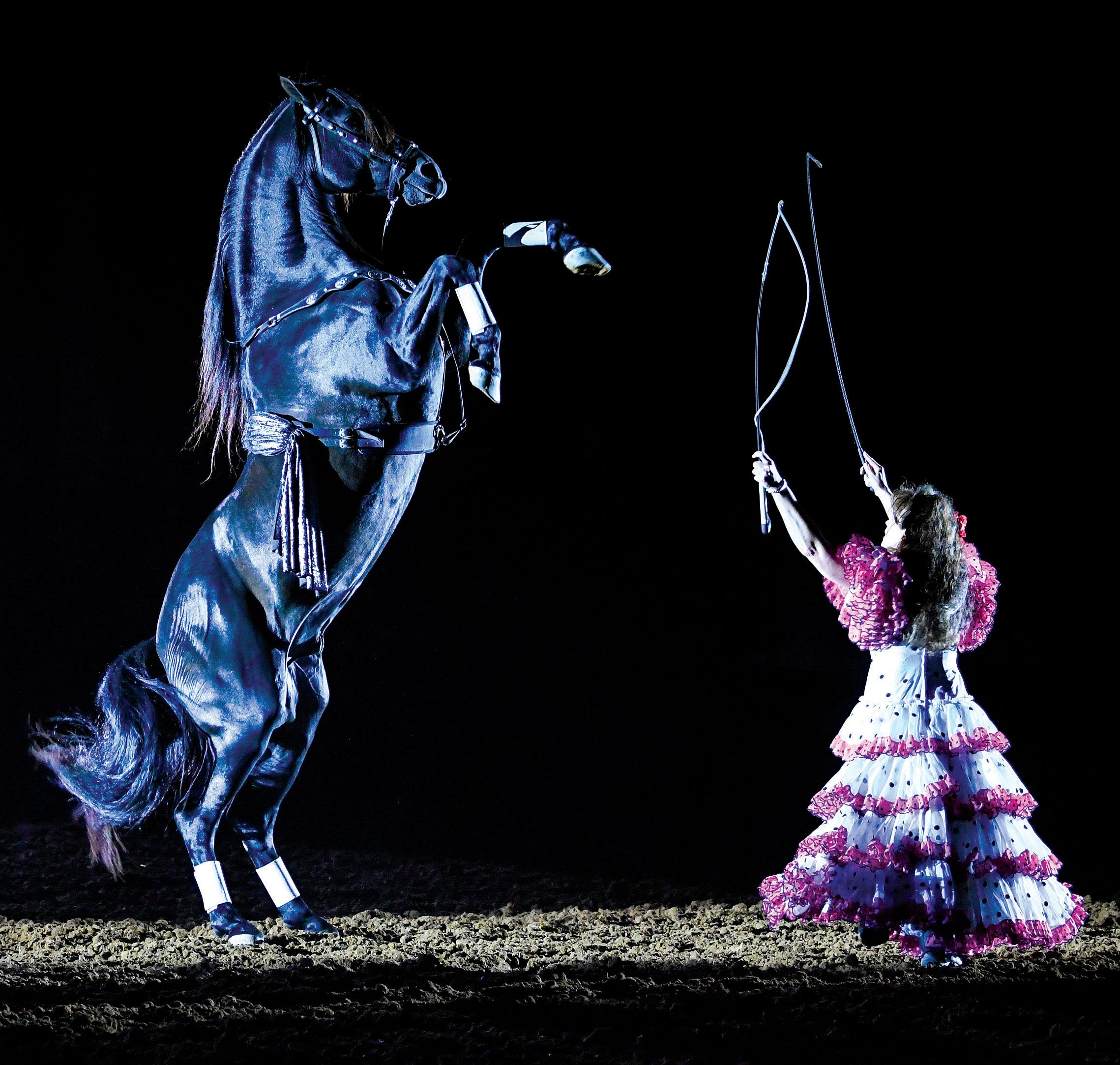

articles & photography by SIMONE WICHERS-VOSS
It’s time to cowboy up, and feel some Old West Spirit at the 75th Annual Clifton Rodeo. Spectators fill the renovated stands to marvel at the skill of the ropers, the wild antics of the bucking broncs, and the speed of the barrel racers chasing the cans on Friday June 5 and Saturday June 6 at the Clifton Rodeo Arena on 101 E. 7th Street in Clifton.
“The rodeo was a huge success last year,” said Clifton Chamber of Commerce President Paige Key. “And we try to make it bigger and better each year.”
Organized by the Clifton Chamber of Commerce, the rodeo events start at 7 p.m. on both evenings with mutton bustin’ for the cowboys- and cowgirls-to-be.
Rodeo events sure to keep the crowd gasping include Bareback and Saddle Bronc Riding, Bull Riding, Tie Down Calf Roping, Breakaway Calf Roping, Team Roping and Barrel Racing start at 7:30 p.m. on both evenings. Other entertaining events include the calf scrambles for the youth and the parade of champions from the Central Texas Youth Fair.
With the rodeo being UPRA and CPRA sanctioned, and run by a professional outfit like Rockin’ Bar M and Hat Brand Rodeos, this is a small town rodeo worth watching. Hat Band/ Rocking M Rodeo Company ensure quality livestock and entertainment.
The 4-H concession stand offers delicious hamburgers and a whirl through the Carnival will top off your evening experience – a hometown event with something for young and old to enjoy. So, buckle up for some serious fun. Tickets to an evening of exciting fun are $10 for adults and $5 for children 12 and under.
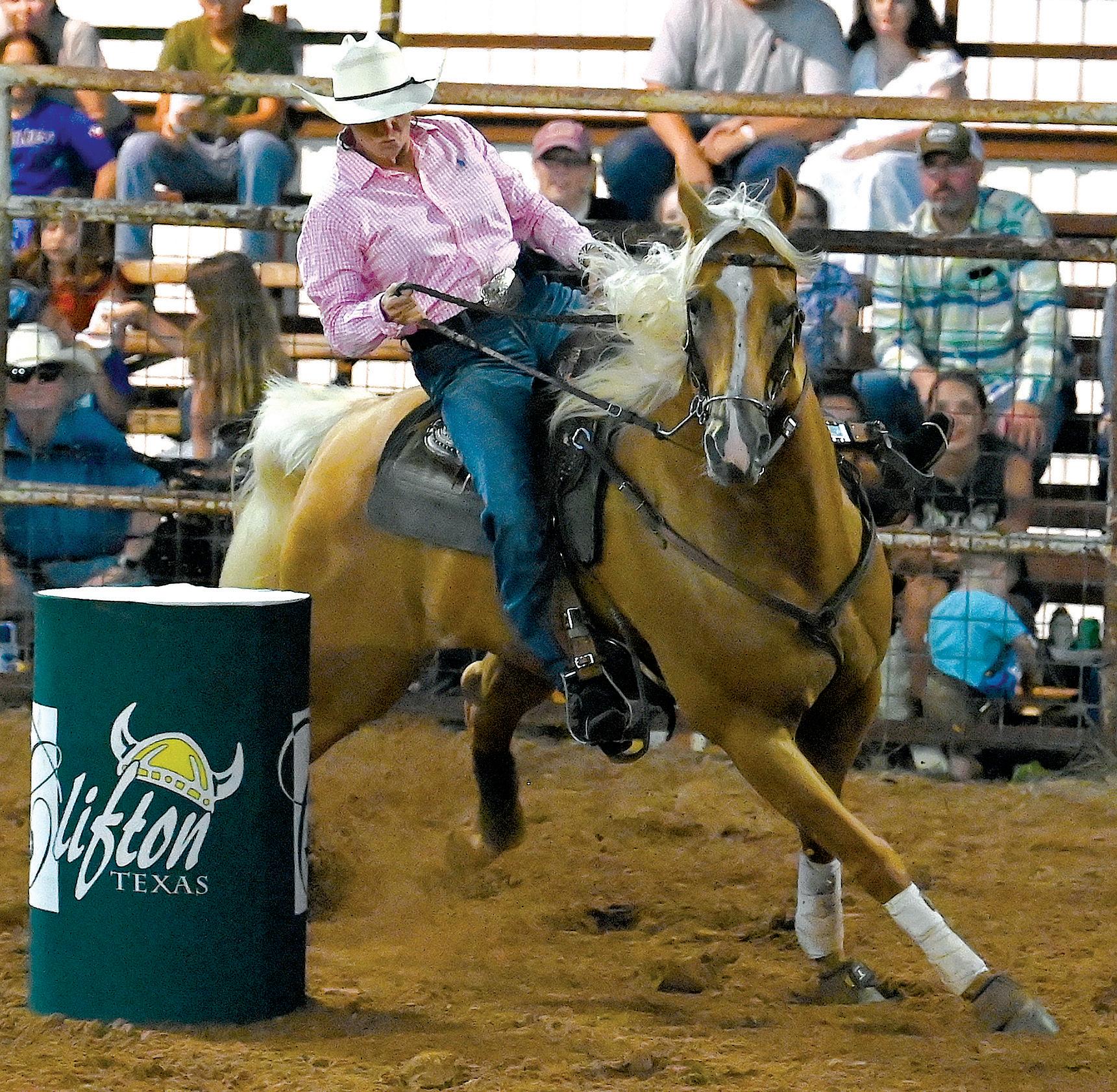
line up of events and entertainment.

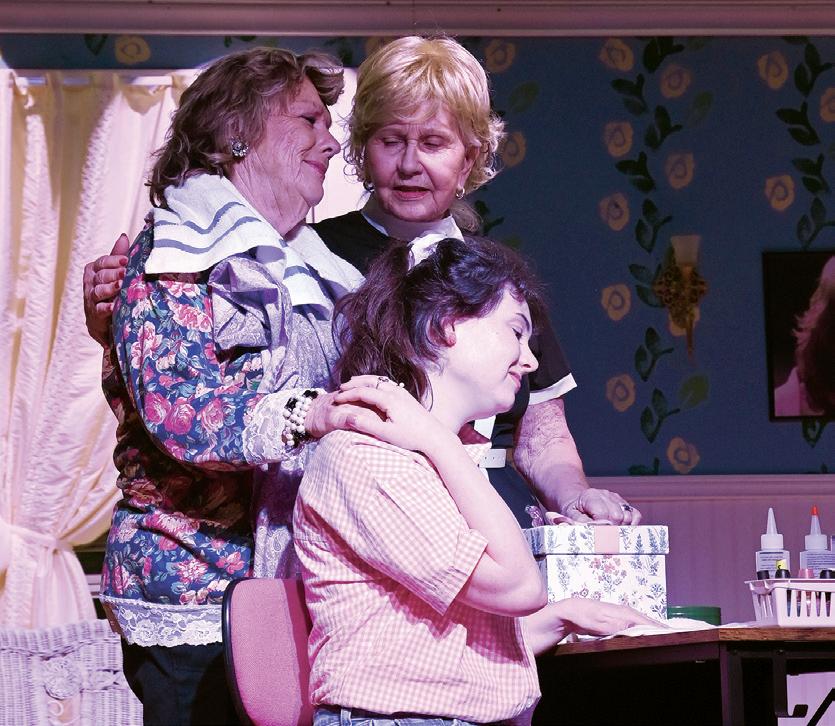
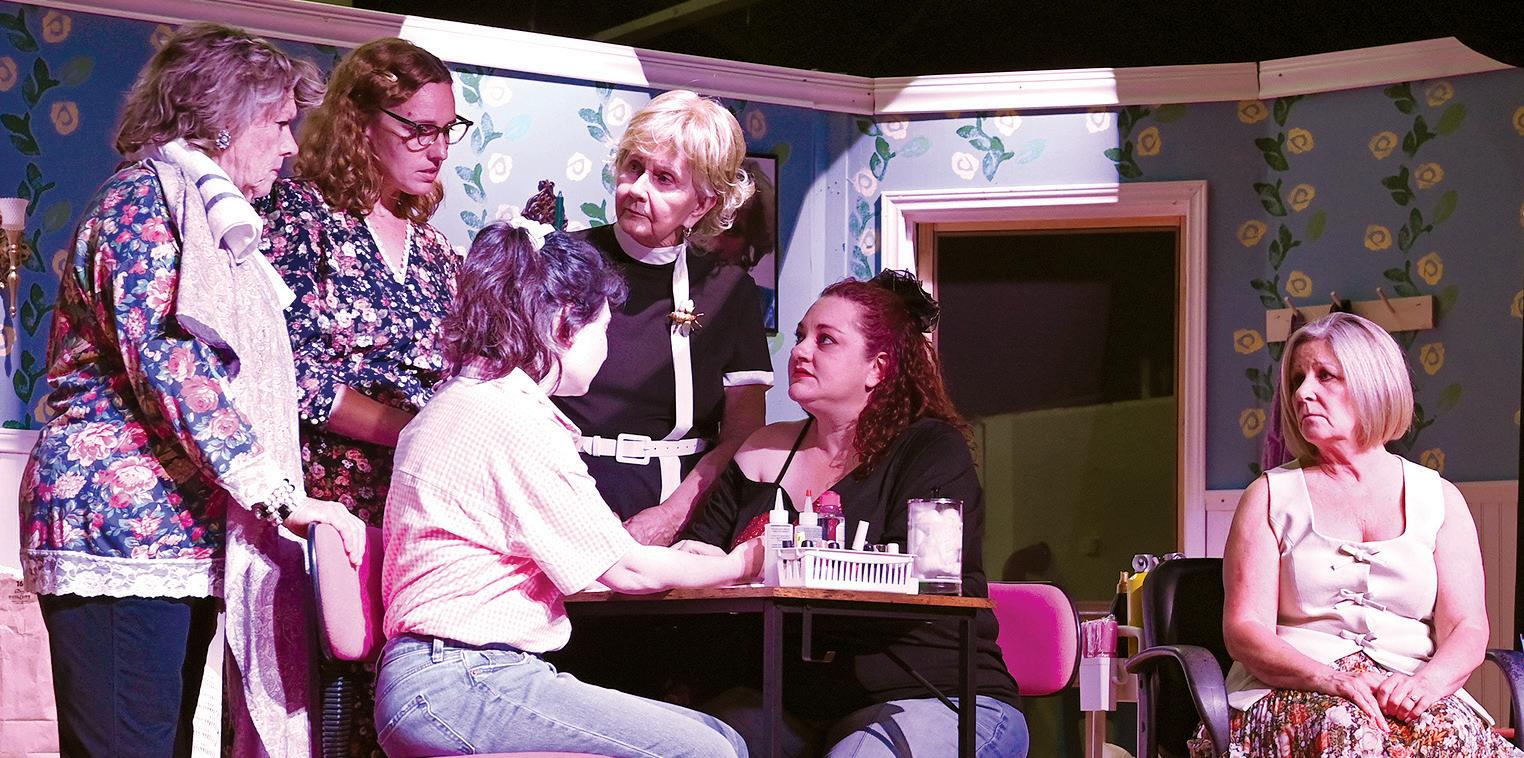
BRINGING A SOUTHERN CLASSIC TO THE STAGE: Bosque Arts Center’s theatre troupe performs ever-poppular “Steel Magnolias” in the Harvard Tin Building Theatre.
The title Steel Magnolias of the play by Robert Harling suggests the female characters are – like women in the South tend to be – “as delicate as magnolias but as tough as steel.” The play is the ultimate tragi-comedy, with the characters coping with loss thanks to unconditional love, unwavering support and laughter through tears.
This represents the fourth time the Bosque Arts Center’s Tin Building Theatre has brought this truly touching play about female bonds forged by life, experiences and love for each other to the stage. Expose yourself to a little Southern culture, camaraderie and community by reserving tickets by calling 254-675-3724 or by going online www. bosqueartscenter.org.
Tickets are now on sale for a dinner theatre June 6 and 13 at 6:30 p.m., a matinee on June 7 at 2 p.m. and a regular performance on June 12 at 7 p.m.
Set in the 1980s, Steel Magnolias is about the deep friendship among six witty, some wiser than others women in a Louisianan small-town, centered around the life and tragic death of Shelby from diabetes complications.
Taking place over three years, the play spans from Shelby’s wedding, her highrisk pregnancy because of her diabetes, the premature birth of her son, the ensuing kidney failure to ultimately her funeral.
While Shelby may be the protagonist in the story, it’s the women that surround her that makes the play so beloved.
Buy a ticket to this pinnacle of tragi-comedy and be prepared to encounter people in the audience that will recite the play’s witty or heartbreaking signature one-liners, ladies that will clutch their hankies anticipating a heart wrenching moment, and husband’s holding their wives’ hands in comfort, as they dab away a tear, either from sadness or laughter.



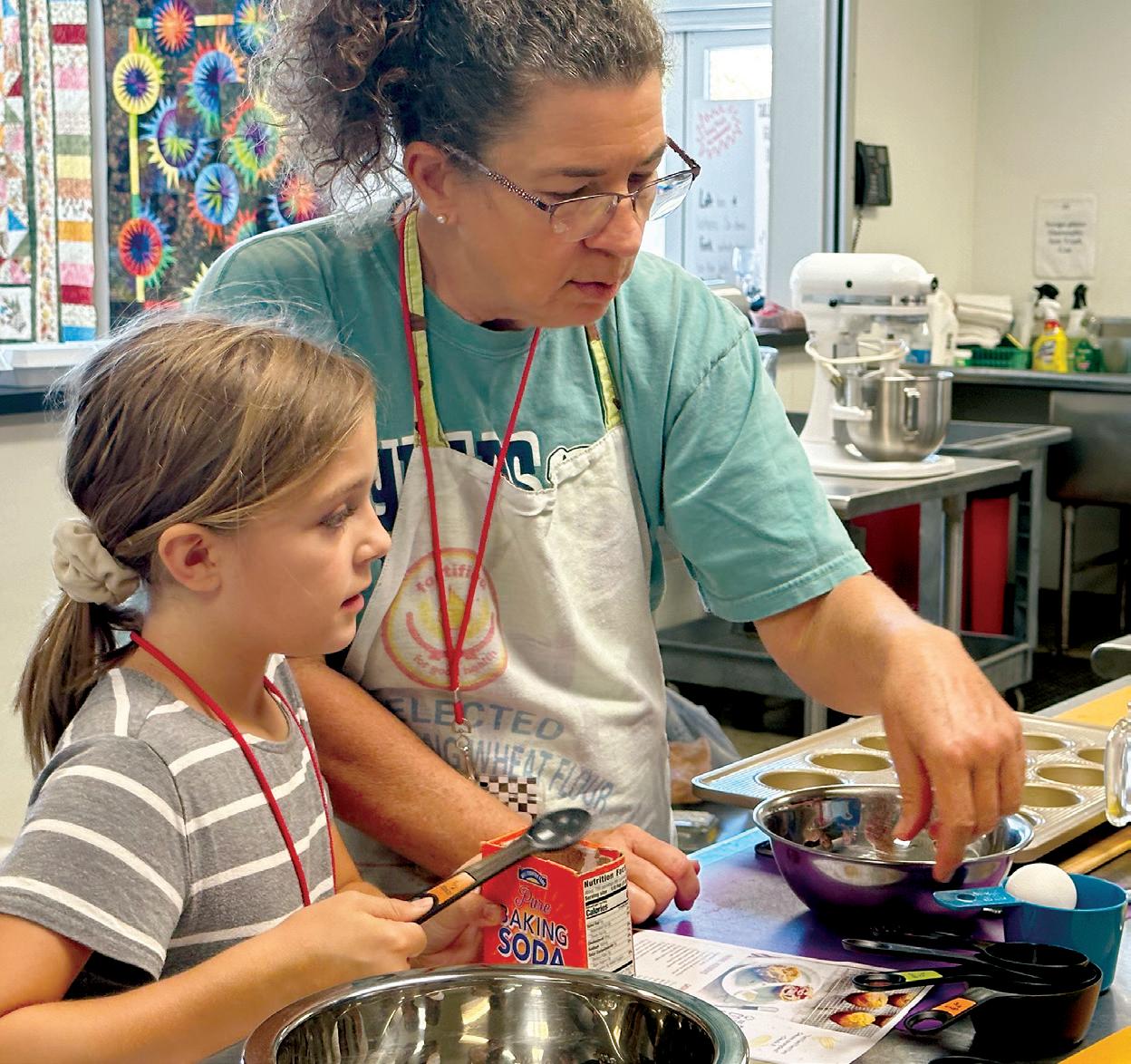


For more than 40 years and three generations, the Bosque Arts Center has been a location promoting all facets of the visual and performing arts under a single umbrella in rural Texas.
The not-for-profit fine arts organization continues making dreams a reality for young and old alike in a historic setting with a modern twist.
In the summer months, the building is abuzz with youth participating in a diversity of Kids Summer Camps to explore and unleash their creative side. The camps include:
June 8-July 29 – Rising Stars Theatre Camp – learn all about the theatre, backstage activities and perform in the musical “Something Rotten Jr.”
June 16-19 – Imagination Factory - creative camp with all types of art and music experiences
June 22-26 – Taekwando Camp
June 23-25 – Sewing Camp – youth learn to sew and make a project on their own
June 29-July 2 – Cursive Writing Camp
June 29-July 2 –Calligraphy Camp – its not just cursive, its art in letters
July 6-8 – Story Arts workshop - a trip into journal writing, art and illustration.
July 7-9 – Pottery Camp –create different projects in clay
July 13-16 – Music Camplearn to sing and play music
July 27-30 – Stained Glass Camp
July 27-30 – Young Chef Camp – learn the basics of cooking with a variety of recipes and skills
For more information, visit bosqueartscenter.org. Sign up by calling 254-675-3724. Scholarships are available for several of the camps
The Bosque Arts Center is located at 215 S. College Hill Drive in Clifton.