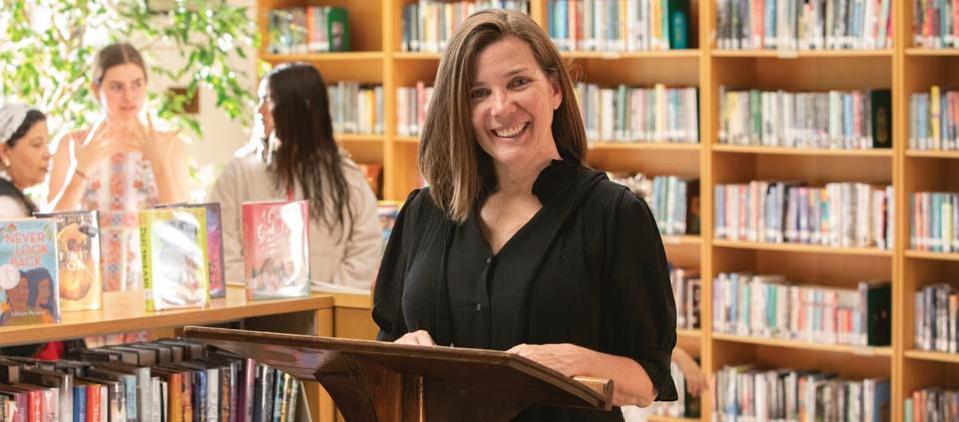
Foxcroft’s new Assistant Head of School answers questions about education, teaching teens, and her new role at Foxcroft.
You hold a Ph.D. in nutrition and spent some time working in a laboratory during your post doc years. How did you find your way to education?
I got into education about 14 years ago. I thought I was going to try it for a year. [laughs] I really thought it was going to be temporary because I didn’t think high school was where I wanted to go. But I immediately and deeply fell in love with teaching teenagers.
Why do you think that is?
I think my adulthood has brought me a lot of patience, and I think that is
By Cristina Santiestevan
just the right thing for working with teenagers. Just sitting and being with them and all of their energy. It was just wonderful and grounding. It made me feel connected to something. And so, work became a passion for me.
What were your teaching years like?
I loved teaching. I taught AP Biology, AP Environmental Science, and human anatomy and physiology. That was always the kids’ favorite. I took it to a place where we were really letting them learn about their bodies. We spoke about it in very clinical terms, which made it easier for them to ask questions. Especially
when we got to something sensitive, like the reproductive system. They could just speak very clinically because we used the correct terminology. And then our conversations could go from there.
What started your transition from the classroom to administration?
I ended up having some really deep conversations with my students about things like consent. Somewhere in school, they had a sex education class where some of these girls were told that if they dressed a “certain way,” they could be expecting... And I was just like, ‘What? Wait, what? Time out. Time for a different conversation.’
That got me talking with my Head of School. I was still full-time in the classroom at that point, but I had been wanting administrative experience, and this was the moment. Because now I was not just thinking about the students in my classroom. I was thinking about everyone in that senior class. I had 20 students in that classroom, but there were 72 seniors who were going to graduate that year. That meant there were 52 other students who wouldn’t get this message about consent.
Well, they did. We had an all-senior program at the end of the year so that nobody graduated without hearing these very important messages about consent and our bodies, how we talk about them, and what’s healthy and what’s not.
For a while there, you juggled teaching and administrative roles. Now at Foxcroft, you are fully out of the classroom in your new role as Assistant Head of School. How has that transition been? Do you miss the classroom?
It's been a big transition. I loved teaching. Most days, it was the absolute best part of my day. But there were days when some of my administrative work made it more challenging to give my all in the classroom.
In my previous role, I was doing a whole lot of meeting with people and trying to troubleshoot different areas of campus, and then I was having to stop what I was doing and run across campus to the classroom to teach. It wasn’t always easy to switch roles mentally, so I wondered if my students were really getting my best.
So I’ve found it quite wonderful to be able to devote my full attention to the student sitting in front of me, or the faculty member who needs my attention, or the administrator who needs to talk, or this meeting that needs to happen. It’s a lot easier to make those things happen now.
The first thing I would do when looking at a school was go to their website and click on academics. I looked at math. I looked at the science electives. Tons of electives. I looked at English. I looked at history. Lots of options. Arts. Lots of options.
I was struck by the variety of classes these students can choose from. And with such a small student body, I knew these classes must be small, which means they’re getting a lot of attention. So
“We get to be here cheering them on, building all the to help them launch are going."
that was what I was excited about and what really struck me about Foxcroft.
Now that you’re here, are there any academic programs that especially stand out?
The EP (Exceptional Proficiency) program. To me, it is a hallmark program of the school because it allows girls to do what they do best, which is learning out in the world. Hands-on. So they are getting these experiences that are super important. For their own development, for whatever it is that’s coming next.
Has life on campus been what you expected?
It has. The community here is lovely. I expected that, and it’s true. So that has been delightful.
Yes, but it’s more about the area around campus. I didn’t get to see a lot of the surrounding area before moving here. But Middleburg is precious. It is just adorable. And Purcellville isn’t very far away, which has tons of shopping and groceries and things like that.
You know, when you look at it just on a map, and you see the little cities and towns all separated by all that green, you don’t see anything about them other than the dot on the map. So getting here and figuring that out has been super fun.
What does a typical day in your classroom look like?
Students in my class are in the driver's seat. Any student could be working on learning a new skill through a video, attempting practice problems, or demonstrating their understanding on a skill check. That allows me to move around the classroom and work with individuals and small groups to help the students that need it most. Because the class is selfpaced, students are not required to be on a specific lesson on a specific day.
Algebra II, I don't want to get to Unit Four, and they still don’t understand Unit One.
How do you think that'll serve them in a class that's not masterybased learning?
How do you foster a sense of belonging for students in your classroom?
I get to have one-on-one mini-tutorial sessions with many students throughout a single class. I talk to individual students more often than I ever did before this change and really get to know them. The big thing I'm trying to do this year is foster a growth mindset. I tell them, ‘When I learned this stuff, I didn't get 100% the first time I took that test.’ It takes time to learn all this. When they're doing practice problems and get them wrong, we can talk about it, and then they can do better. If they do a quiz and don’t do great, they can redo it and do better.
And is that part of your masterybased learning approach?
Algebra II is fully mastery-based; the only grades they get are for the skills. Calculus has some other grades mixed in, too, but in terms of the test, that is all mastery-based — you can keep redoing the skill until you know it, understand it, and can do it. We have to make sure they have their foundation before moving on to the next thing. So in
Even if a student takes an assessment and they don't do as well as they thought they would, they still have developed the mindset of ‘I can still learn after an assessment.’ So it's not this deadline where all learning for Unit One stops. We can keep learning Unit One as we're doing Unit Two or even later than that. Say they’re in Spanish and didn't learn, or forgot, the word for ‘stapler’ — it doesn't mean they can't learn the word ‘stapler’ later. Knowing they’ve got to go back and relearn is a skill they can apply outside of my class.
Do you have any specific ways you hope to incorporate this year’s theme into your work?
With “Be Well,” I think the self-pacing I'm doing in Algebra II is good for that. I have a questionnaire they fill out at the start of class, and one question asks, ‘How are you feeling today?’— ‘I'm okay,’ ‘I'm doing great,’ ‘I'm not doing great.’ Once in a while, a student clicks the ‘not doing great’ button, and I know on that day, maybe I'm not expecting them to do a bunch of work. If they do get something done, that’s a good accomplishment for them.’
There also are opportunities throughout the class to take a mental break. I have coloring books in the back if they need five or 10 minutes to do something other than math. I've had students step out of class and walk around the hallway for a bit because there's too much going on, and they couldn't focus. They always come back and get back to work. Having that five minutes is
really useful for them, and if you give them a five-minute break in the middle, they'll be more productive than if you try to make them work for the entire time straight.
Knowing that you can make mistakes is kind of a hard thing to buy into for a student, but in small ways, with retakes and one-on-one help in the classroom, my hope is they’ll find they can speak up and collaborate. I think it's hard to do, but when they get that, it's really beneficial.•
Learn more about Dr. Sweeney’s mastery-based approach on Foxcroft’s “It’s Academic” faculty blog at https://foxcroftfaculty.wordpress.com/.
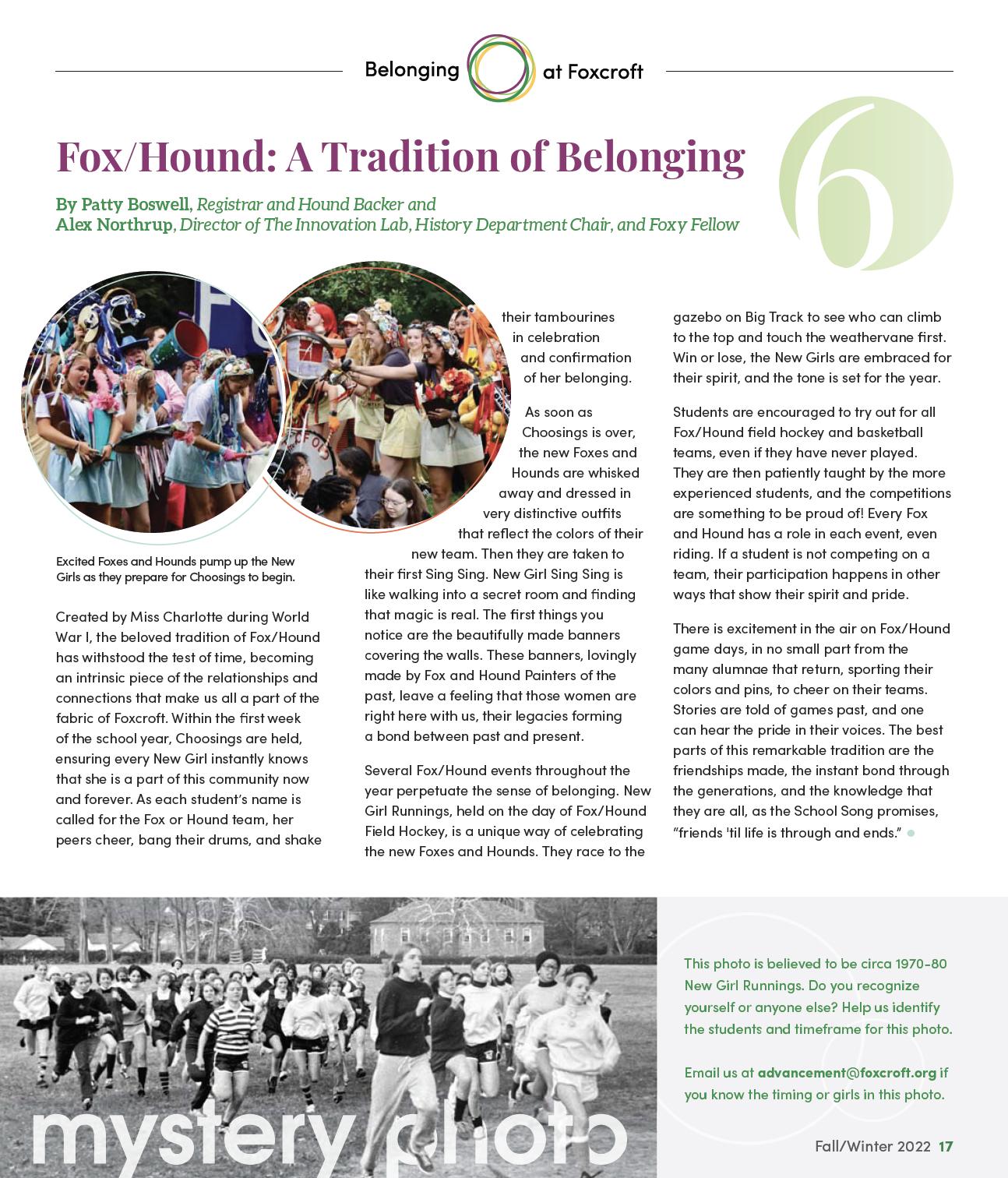
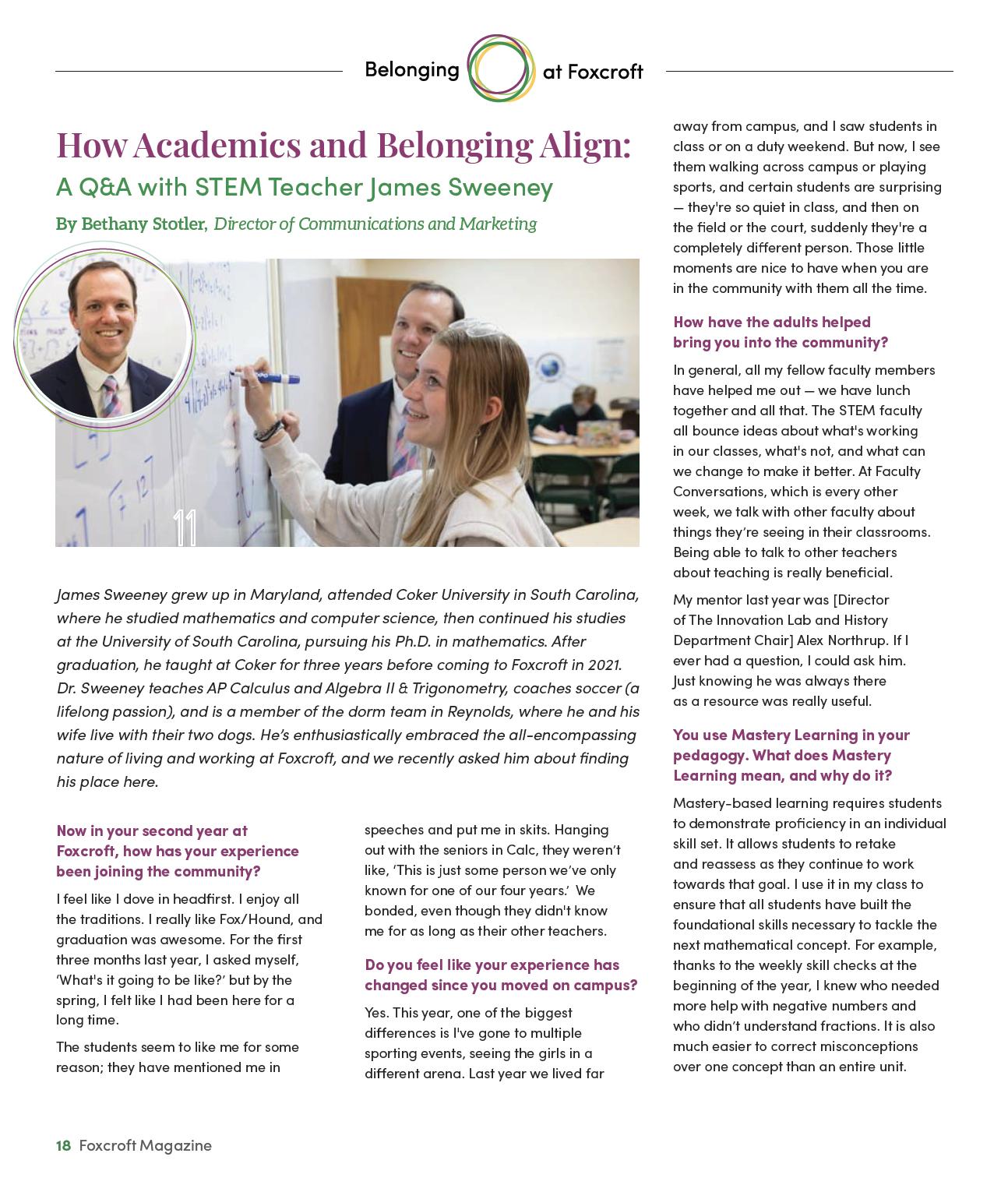
11. Dr. Sweeney works at the whiteboard with Kaden Weatherford ’26 during his Algebra II/Trigonometry class.
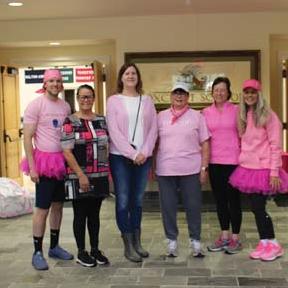
12. A proud Fox and enthusiastic participant in all things Foxcroft, Dr. Sweeney sports a pink tutu during the campus-wide walk for breast cancer awareness.
During the summer of 2022, Dr. Sweeny was the recipient of a Kenan Summer Grant, which provides funding for faculty to study, do research, or work on a project that applies to their classroom.
How did you benefit from the Kenan Summer Grant?
The Kenan Grant was instrumental not only in helping me develop this course but also in making it as successful as it has been. The planning time required to design each unit and curate all the materials students use when working at their own pace is vast. So having that head start on the semester and time to iterate on the design helped me begin this school year with something I can be proud of.
For more information on the Kenan Summer Grant program and recipients, see pg. 5 of this issue.
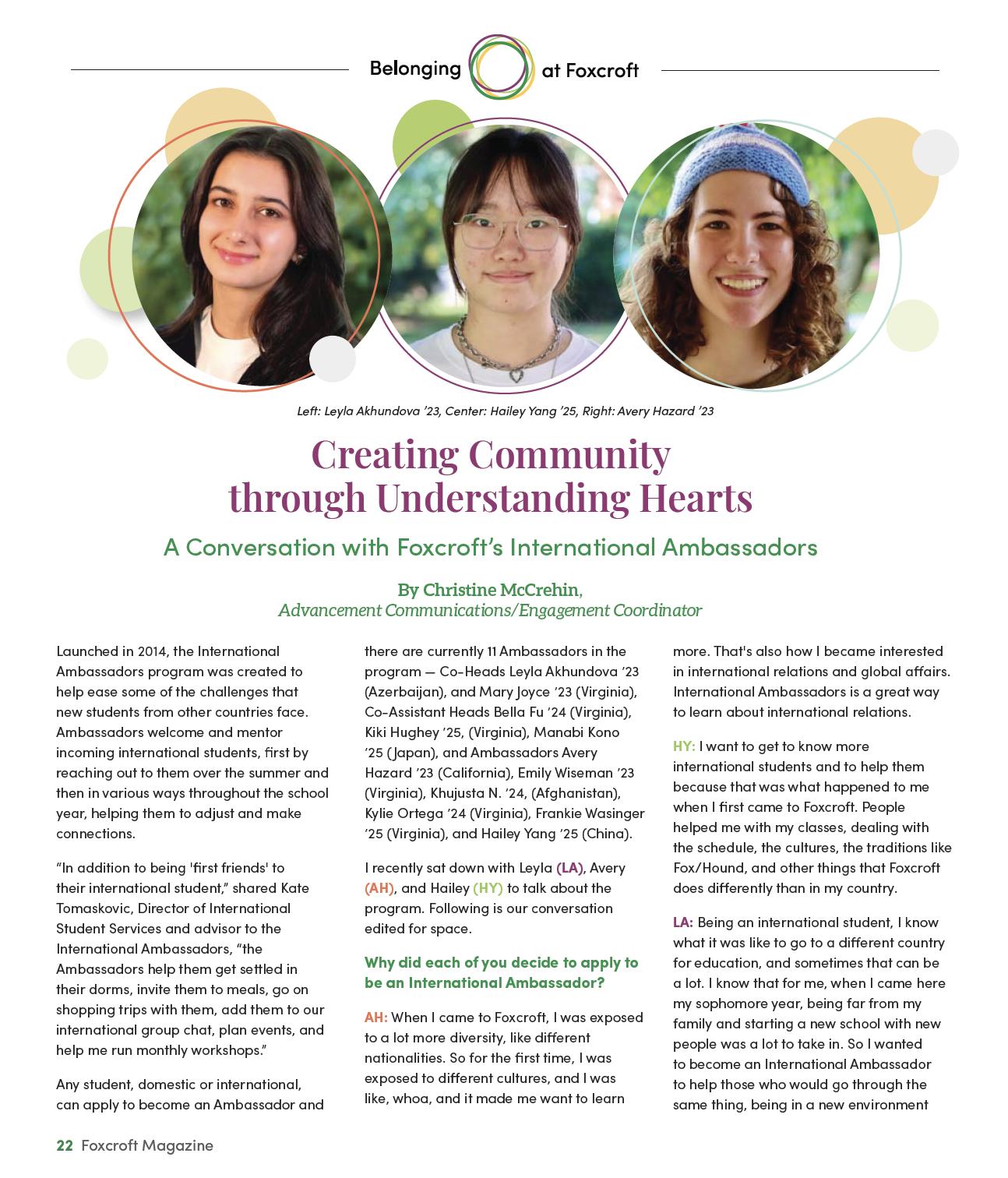
and meeting new people. I also want to make international friends, and I think that's the best way to do it because we have a lot of bonding time together. Not just Ambassadors but international students in general, and being able to plan events that might bring a sense of home to international students really makes me happy.
What events do you have planned for this year?
LA: We're planning some small events for international students and some big events that the whole school can take part in. For the little events, we want to plan workshops to help international students get familiar with our school rules, talk about culture shock, homesickness, or communication difficulties, and who they can reach out to for help — like a starter guide. For the big events, we want to host an international fashion show where students can show their heritage and roots through clothing. We also hosted the International Gala, where students came together to show their talents/skills/dances to express their cultural values. We're also talking about hosting an International Night Market where any student can sell handmade items or food from their culture.
What is your favorite part of being an Ambassador?
HY: International Ambassadors are actually the first ones to meet new international students and make friends. During the first week, we bond and help each other, and we keep doing that — chatting, asking if they need anything, and how they are doing. That's what I like. I want to know if I can help them. I want to make friends with them and introduce my friends to them so they can belong to the community. That makes me happy.
AH: I would agree. You create a lot of bonds and friendships. I was partnered with three girls my sophomore year, and none of them could come to campus; they were all online. Unfortunately, they did not return to Foxcroft, but I'm still friends with them to this day. We still contact and connect with each other, which shows that whether it's online or in person, you still get this bond and friendship.
LA: I think my favorite part is what Hailey said because you're basically the international student's first friend on campus. Most of them, like many of us, are really shy at first and sometimes might be hesitant to talk to people and that's completely normal. Seeing those
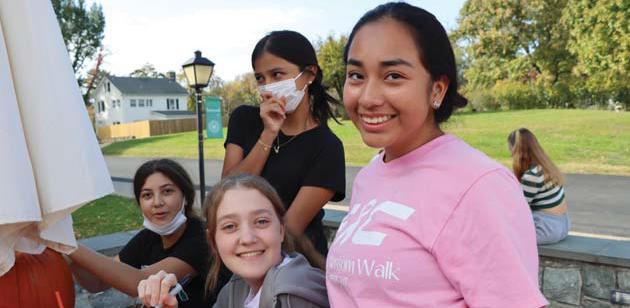
international students who were really shy at first end up having so many friends and being in so many circles, like in the Dining Hall talking to people and eating with them — that really encourages me to keep going and helping international students.
This year’s School theme is “Be Well, Be Green, Belong at Foxcroft.” Do you think the International Ambassador program represents any part of the theme?
HY: I feel like ‘Belong’ is the thing that fits the most. I remember my first year in America in 7th grade. I wasn't having a good experience because no one was helping me with English and communicating with people, so I was kind of alone. But [at Foxcroft] the International Ambassadors help the international students to belong in this community and with the stuff they need help with and need to understand. It's really important to try to help them belong in this community.
LA: I agree. I think it's really important that every single person feels they belong at Foxcroft. When you're far from home and in a new environment, feeling a sense of belonging is the best thing anyone can ever feel. We have our own Foxcroft group where it's all of us international students together, and that's really the mission of International Ambassadors — to help everyone be engaged, be involved, and belong.
As they spoke of their passion for the International Ambassador program and affection for the friends they have made, it was not hard to see in these girls — and the International Ambassadors program — the quintessence of Foxcroft’s promises of a community of understanding hearts and a lifetime of friendships and global connections. Indeed it is heartening to know that not only are these promises that Foxcroft fulfills with our students but ones that our students fulfill with each other. •
The Foxcroft Community remembers former Board of Trustees members.
Barbara Iselin Sears, 100, died peacefully at her home in Hamilton, MA, on August 19, 2022. A member of the Class of 1939, she supported Foxcroft in myriad ways. From serving as a member of Foxcroft’s Board of Trustees (196366) to hosting alumnae events in Boston, imparting the story of her philanthropic journey in Morning Meeting to students, and even attending a summer Foxcroft computer camp for alumnae, Barbara was always willing to share her time, talent, and treasure with her school.
Barbara spent most of her early years in Middleburg, growing up with a menagerie of animals. She and her sister, Nancy, would often ride their ponies to The Hill School, which she attended before matriculating to Foxcroft and then to Sarah Lawrence College in New York. After college, during WWII, she served as a staff assistant to General William J. Donovan, head of the Office of Strategic Services (OSS), accompanying him to Paris after its liberation from Nazi Germany and then the Nuremberg Trials in 1945. Horses always played an important role in Barbara’s life. She would return to Middleburg every year, often driving her horse van from Hamilton, where she lived with her husband Francis P. Sears, Jr., to foxhunt, a sport she loved. She finally decided at the age of 80 to give up the sport but continued to ride until she was 90. Even after she stopped riding, she made the yearly trek back to Middleburg.
Barbara’s family and Foxcroft have shared a history that spans more than 100 years. Barbara’s mother, Elizabeth Brown Iselin, was one of the first Foxcroft graduates as a member of the Class of 1915. Barbara’s sister Nancy Iselin Marburg 1937 was at Foxcroft with her and they were followed by Barbara’s daughter Nancy Sears Randall 1973, her daughter-in-law Suzanne Harte Sears 1969, nieces Anne Morgan Wiedenmayer 1961,
Elizabeth Morgan Pack 1964, Christine Marburg Wolf 1970, Julie Iselin Diehl 1977, and great niece Amanda Wiedenmayer Wood 1987. All-in-all, the family produced four generations of Foxcroft women.
Barbara learned many of her life’s lessons while at Foxcroft and loved Miss Charlotte. Throughout her life, she was guided by her faith and understanding heart. She was the consummate volunteer, whether for the Bloodmobile, her church, Foxcroft, or just about anywhere else she could help out. She will be missed by all whose lives she touched.
Barbara is survived by her three children, Francis P. Sears, III (Suzanne), Thomas M. Sears, and Nancy S. Randall (Jeffrey), as well as several grandchildren and greatgrandchildren. Her husband, Francis P. Sears, Jr., died in 2004. Her son, Francis, died not long after his mother.
Richard Carl “Dick, Remo” Riemenschneider died September 23, 2022, at his home in Bluemont, VA. He was 86 years old. Dick was a member of Foxcroft’s Board of Trustees from 198284, is the father of Robin Riemenschneider Burge 1983 and Polly Riemenschneider Gardiner 1985, and the grandfather of Ridgely Burge 2011. A loyal Fox, his wonderful, big smile and sense of fun made the Riemenschneider household a welcoming place for many of his daughter’ s Foxcroft friends.
Dick earned his B.S. from the McIntire School of Commerce at the University of Virginia, then attended the UVA School of Law, graduating in 1964. Upon graduation, he worked at the law firms of Weaver, diZerega & Major and later formed a firm with partners George Martin and Thomas Murtaugh before striking out on his own in 1976. Active in his professional community, Dick served as President of the Loudoun County Bar Association, a member of the Board of Directors for the Virginia State Bar (Representative of the 20th Judicial Circuit Court), on the board of Leesburg-based Jefferson Savings & Loan Association, and as Director of the Marshall National Bank, Marshall, VA. He was also a member of the Board for The Hill School and the Piedmont Fox Hounds in Upperville, VA.
A passionate and talented polo player whose career began at a young age and carried throughout his life, he was honored for all that he had given to the sport when he was inducted into the U.S. Polo Association Hall of Fame in 2016. He is survived by his wife Andrea, daughters Robin (Richard) and Polly, son John Van Sant (Elizabeth), and ten grandchildren. He was predeceased by his daughter Stephanie Van Sant Auen.