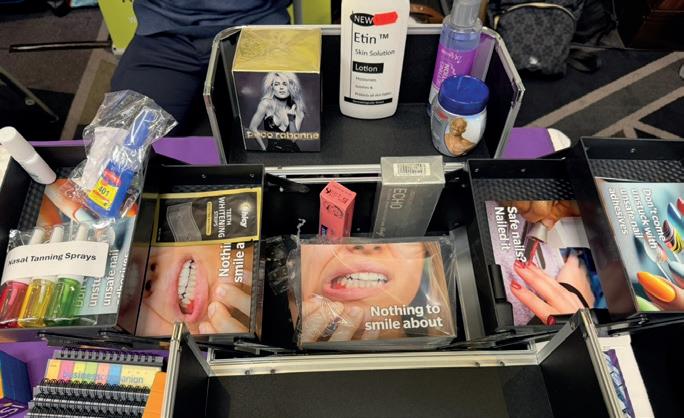
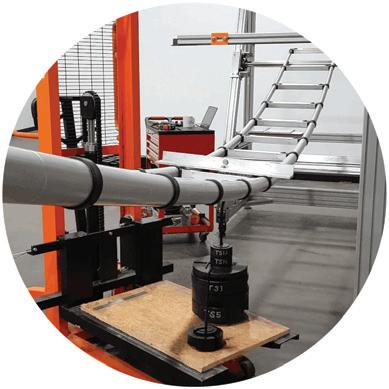
Maintaining a competency based training regime in both the public and private sectors is paramount in the continuously changing and developing areas of enforcement and brand protection. WRi Group are an accredited training provider for the CTSI Unit 5 investigations and intelligence module qualification but also offer bespoke training modules on topics such as:
The WRi Group have delivered several training courses for Trading Standards South East Ltd, since 2017 and have provided the region and the delegates who have attended their courses with very high quality training. Working with WRi Group is a pleasure, as they are so organised, quick to respond to enquires, very thorough with their preparation and delivery I would highly recommend the WRi Group for training in these areas
TRADING STANDARDS FELLOWS’ CHARITY
SUPPORTING OUR MEMBERS FOR MORE THAN 65 YEARS
The Trading Standards Fellows’ Charity assists with educational and other needs of dependents and families suffering health or domestic misfortune This includes grants for purchase of mobility aids, long term illness and initial financial support
Welfare Support
I cannot thank you and the Trading Standards Fellows’ Charity enough for this financial support, it will certainly relieve a lot of the financial pressure we are under at the moment, and allow us to focus on his recovery
If you would like to support the Charity and make a donation, please scan the QR code.
The Trading Standards Fellows’ Charity Charity no. 213351
Leader
David MacKenzie Chair, CTSI
Bringing it all back home
For many of us at this time of year, thoughts turn to travel. As the weather improves and the days get longer, there’s an urge to pack our bags and get out and about, to see new and different parts of the country we call home. While there are certain procedural duties that come the way of everyone who is lucky enough to serve as CTSI Chair, we each put our own spin on things during our tenure. Having an opportunity to hit the road — or rails, skies and seas — is one of the things I’ve particularly enjoyed about the role, since it has allowed me to meet with CTSI members across all four corners of the UK, and to see first-hand the incredible work they do. It has also given me a chance to hear their opinions, to be asked questions and to be set challenges that I can then take back with me.
“This diverse array of people are all making an increasing contribution”
One of the many highlights of my year has been a visit to Llandrindod in Wales, a two-day-long journey there and back via planes, trains and automobiles — working on my laptop all the way, of course. The time spent travelling was well worth it though because the branch visit was a great event with a room full of new ideas.
I have met Trading Standards professionals from across the entire career spectrum, from new recruits and apprentices, to inspirational members who are still making a contribution during their wellearned retirements. Crucially, I have also met with CTSI members from beyond the traditional bedrock of local authority-based branches, including representatives of businesses, the civil service and the charity and third sectors. This diverse array of people are all bringing their impressive range of skills to the table and making an increasing contribution to the Institute and what we do.
Another thing that has really energised me over the past few months is the increased influence the Institute has been able to forge in places where it really makes a difference. We have built upon a fruitful working relationship with Government, including productive meetings with Consumer Minister Kate Dearden and high-ranking officials within the DBT and other key departments. These meetings have resulted in more than just photo opportunities and soundbites — they have led to real, tangible outcomes on a range of key issues.
Many of these discussions are ongoing, and will serve as the backdrop to this year’s Conference in Glasgow. I am delighted that my time as Chair coincides with the event taking place on my home turf — and I know my colleagues and I will do our utmost to offer a warm welcome. So if you see me there, come up and say hello — and if I haven’t made the trip to see you yet, please do invite me and I’ll do my very best to return the favour. l
Editor-in-Chief: Kerry Nicol
Editor: Richard Young
Designer: Sam Millard
Contributors: Matt Allwright, John Herriman, Caden Lunness, Jessica Merryfield, Graham Mogg, Ryan Parker, Vincent Searle
Writers: Helen Nugent, Richard Young
Editorial Board: Damien Doherty, John Herriman, Tendy Lindsay, David MacKenzie, James Munro, Phil Owen, Giles Speid, Gareth Walters
Article suggestions and feedback should be sent to: jots@tsi.org.uk
The Journal of Trading Standards magazine and website are produced on contract by Fourth Estate Creative Ltd. www.fourthestatecreative.com connect@fourthestatecreative.com
Printed in the UK by Manson Group Distributed by Gold Key Media
Published by the Chartered Trading Standards Institute, 1 Sylvan Court, Sylvan Way, Southfields Business Park, Basildon SS15 6TH.
Views expressed by the authors are not necessarily the views of CTSI.
Some of the images used in this publication were generated by AI.
5 | Upfront
A round-up of the latest news and developments from Trading Standards.
10 | Fighting the fakes
In this special feature we look at the work of the Anti-Counterfeiting Group.
12 | A vital resource
Highlighting the benefits of the Enforcement and Legal Process Manual.
13 | Opinion: Matt Allwright
Why problems in the holiday caravan park sector need to be taken seriously.
14 | Opinion: John Herriman
Why investment in Trading Standards is critical to the fight against organised crime.
16 | Opinion: Jessica Merryfield
Making sense of the sweep of changes taking place at a local and national level.
18 | Opinion: Caden Lunness
What are the implications of ongoing political turmoil for Trading Standards?
22 | In with the new
We hear from the latest additions to CTSI's Lead Officer network.
48 | The real thing
WRi Group's Graham Mogg takes a look back over 15 years of tackling counterfeits.
50 | CPPD: Regulated chemicals
Learn about the key points of a new Home Office reporting tool.
52 | The best laid plans
How will the Warm Homes Plan avoid the errors of previous home energy schemes?
56 | Plugged in
Examining an innovative new electrical safety initiative focused on the PAT sector
58 | Broadening access
A visit to the REACH Conference helped spread the Trading Standards message.
CTSI Conference 2026
This year’s event in Glasgow is set to be a feast of ideas, inspiration and innovation for consumer protection professionals
Mapping it out
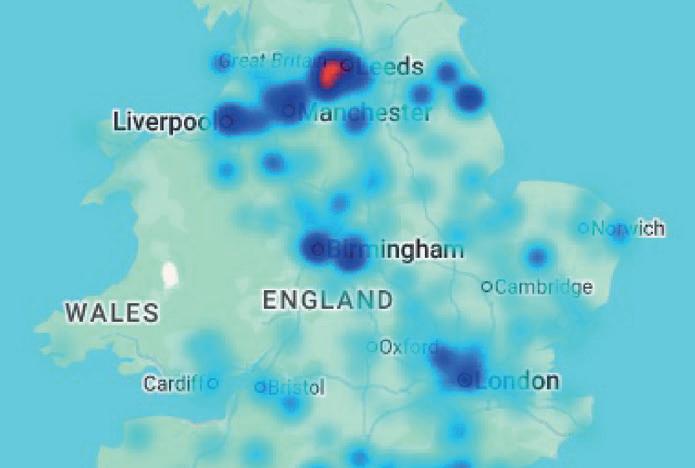
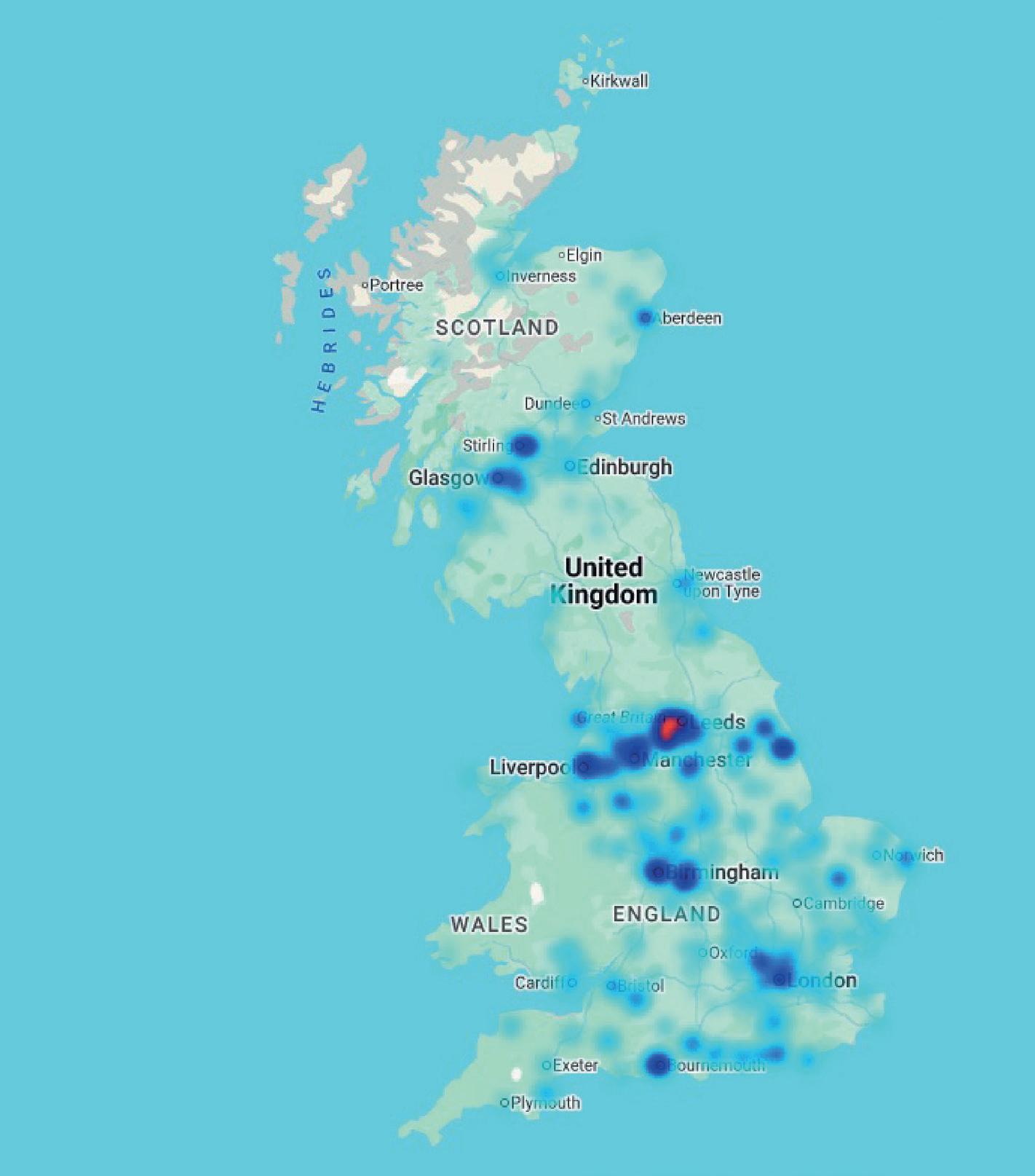
A new CTSI report delves into the reality of organised crime on the UK’s high streets using data that highlights crime hotspots
One for the ages
Without Trading Standards enforcement, the intentions behind the landmark Tobacco & Vapes Act could go up in smoke
Crisis on the caravan park
The holiday caravan park sector is facing a reputational crisis, with a surge in complaints tarnishing its sunny image
Not playing around
With unsafe toys still abounding on online marketplaces, how will the new provisions of the PRaM Act address a serious problem?
In conversation: Emma Cochrane
The CMA's Executive Director for Consumer Protection outlines recent cases that prove the regulator means business.
Upfront
Attack of the AI voice clones
National Trading Standards (NTS) has warned that criminals are using artificial intelligence (AI) to clone people’s voices and set up unauthorised direct debits over the phone in the latest wave of scams that harness the emerging technology.
Samples of victims’ voices are taken during an initial ‘lifestyle survey’ phone call which also gathers detailed personal, health and financial information. That data is then used to develop AI-generated voice clones which are designed to deceive banks into setting up direct debits. Personal details are also passed on to other criminal operations who can set up payments without the victim’s knowledge.
Louise Baxter, Head of the NTS Scams Team and CTSI
Consumers are urged to be alert
Lead Officer for Consumer Education & Advice, said:
“What we’re seeing is a deeply disturbing combination of old and new: traditional phone scams supported by disturbing new techniques. Criminals are using AI not just to deceive victims, but to trick legitimate systems into processing fraudulent payments. This is no longer just a nuisance – it’s a coordinated, sophisticated operation targeting some of the
Holiday fraudster jailed
A woman who operated a Ponzi-style holiday fraud that left victims almost £300,000 out of pocket has been jailed following a complex investigation by Portsmouth Trading Standards, supported by the National Trading Standards (NTS) Tri Region Investigations Team. Shelley Simpson (46) ran Sphere Events Ltd between March 2019 and November 2022, taking customers’ money while pretending to make holiday and event bookings.
Portsmouth Trading Standards received more than 90
complaints from consumers who never received their bookings, were provided with falsified documentation, or were left paying substantial additional costs for replacement flights and accommodation.
Others paid tens of thousands of pounds for once-in-a-lifetime trips, including honeymoons, which were never booked at all.
Simpson, who had pleaded guilty to one count of fraudulent trading at an earlier hearing, was given an immediate 33-month custodial sentence at Portsmouth Crown Court on 6 May.
most situationally vulnerable consumers in society. We urge everyone to speak to friends and relatives about scam calls, check bank statements regularly and report anything suspicious.”
NTS revealed the scam when it released data on Operation Derdap, a project which has blocked nearly 21 million scam phone calls and shut down 2,000 numbers over the past six months. The operation began in 2022 when it was identified that consumers were being coerced into providing financial and personal details to criminals who then took continuous payments from their accounts.
NTS data shows that on average, UK adults receive seven scam calls or texts per month, with almost one in 10 people receiving them every day.
John Herriman, Chief Executive of CTSI, commented: “This alarming new twist in phone-based fraud shows just how quickly criminals are exploiting emerging technologies to prey on the public. Voice cloning takes scam calls to a sinister new level, making it even harder for legitimate businesses and consumers to distinguish real interactions from fraudulent ones.
“Trading Standards teams across the UK are working tirelessly to disrupt these operations, but we need the public to stay alert, talk to loved ones about the risks, and report anything suspicious. Protecting consumers, especially those most vulnerable, requires all of us to stay informed and work together to tackle these modern day and emerging examples of fraud.”
‘High Street Unit’ plans
The Home Office has announced plans to create a £30m ‘High Street Organised Crime Unit’ that will see enforcement partners – including Trading Standards services – embark on a ‘nationwide crackdown on dodgy shops’. The Unit will be run by the National Crime Agency (NCA), which will receive £20m in funding over the next three years. An additional £6m will go to Trading Standards, with £3.75m being split between HMRC and immigration enforcement.
CTSI has welcomed the announcement, but has urged
the Home Office to rapidly review enforcement powers, resources, and measures to keep Trading Standards Officers safe.
John Herriman, Chief Executive of CTSI, said: “The proliferation of so called ‘dodgy shops’ puts consumers at significant risk and undermines the legitimate businesses who drive economic growth across the UK. The new Unit will bring a much-needed focus to help clamp down on a blight on our high streets and communities.” For more about serious organised crime, see page 34.
Direct line for NI businesses
The Trading Standards Service of Northern Ireland (TSSNI) has launched a dedicated telephone service to help local businesses better understand Trading Standards regulations.
Businessline, which was launched by Economy Minister Dr Caoimhe Archibald on 27 April, provides free advice to help businesses get to grips with their rights and responsibilities under consumer protection law.
Archibald said: “By using the service, businesses can reduce the risk of costly mistakes, strengthen compliance and build consumer confidence.
“The service offers guidance on a wide range of issues, including the description of goods and services, pricing regulations, online selling rules, requirements around weights and measures, and businesses’ obligations when selling to consumers.”
Dr Caoimhe Archibald (centre) with TSSNI's Richard Knipe and Christina McNiece
Richard Knipe from TSSNI said: “Businesses that understand regulation are better placed to succeed. They reduce the risks associated with non compliance, deliver better services for customers, and are more likely to achieve longterm sustainability, customer satisfaction and repeat business.”
Businessline is available on 0300 077 0323 or at tssbusinessline@ economy-ni.gov.uk
COSMETIC PROCEDURES
‘Botox’ beautician fined for fraud
An aesthetician who used an unlicensed Botox substitute and falsely claimed to be a trainee nurse has been fined and ordered to pay compensation following an investigation by Anglesey Trading Standards.
Carol Ann Edwards (38), who traded as ‘5 Star Aesthetics’ and advertised Botox procedures via social media, admitted to Officers that the substance she had used was not in fact Botox but an alternative called Fraxin, which is not authorised for use in the UK.
Edwards also told Officers she was a trainee nurse in the final year of her qualification. This was later found to be untrue.
At Caernarfon Crown Court on 11 March, Edwards was sentenced to a 12-month Community Order, 15 days rehabilitation, and ordered to pay a £500 fine plus £1,000 in compensation. She had pleaded guilty to two counts of
Edwards used a Botox substitute
Fraud by False Representation at a previous hearing.
Anglesey Trading Standards Manager, Emma Jones, said: “Although they may initially seem lower risk than surgical alternatives, unregulated cosmetic treatments do not require qualifications, licensing or adherence to any codes of professional conduct.”
Cosmetic procedures have emerged as a topic of high concern, with CTSI last year calling for reform of the sector.
‘Largest ever’ haul of fakes in Scotland
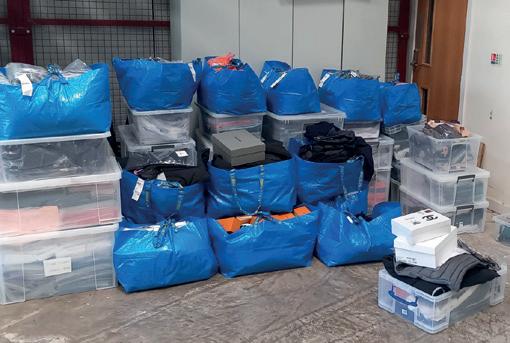
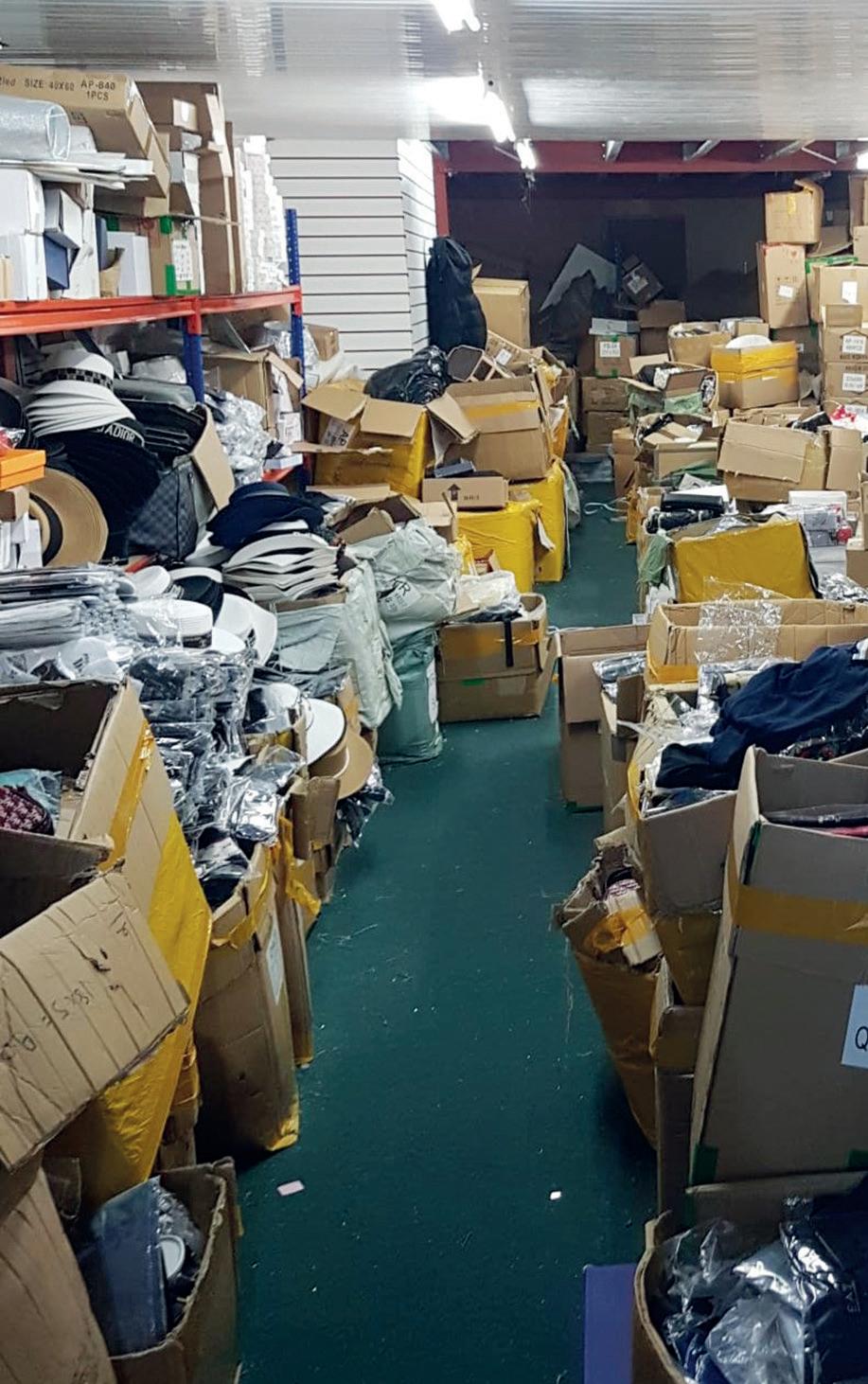
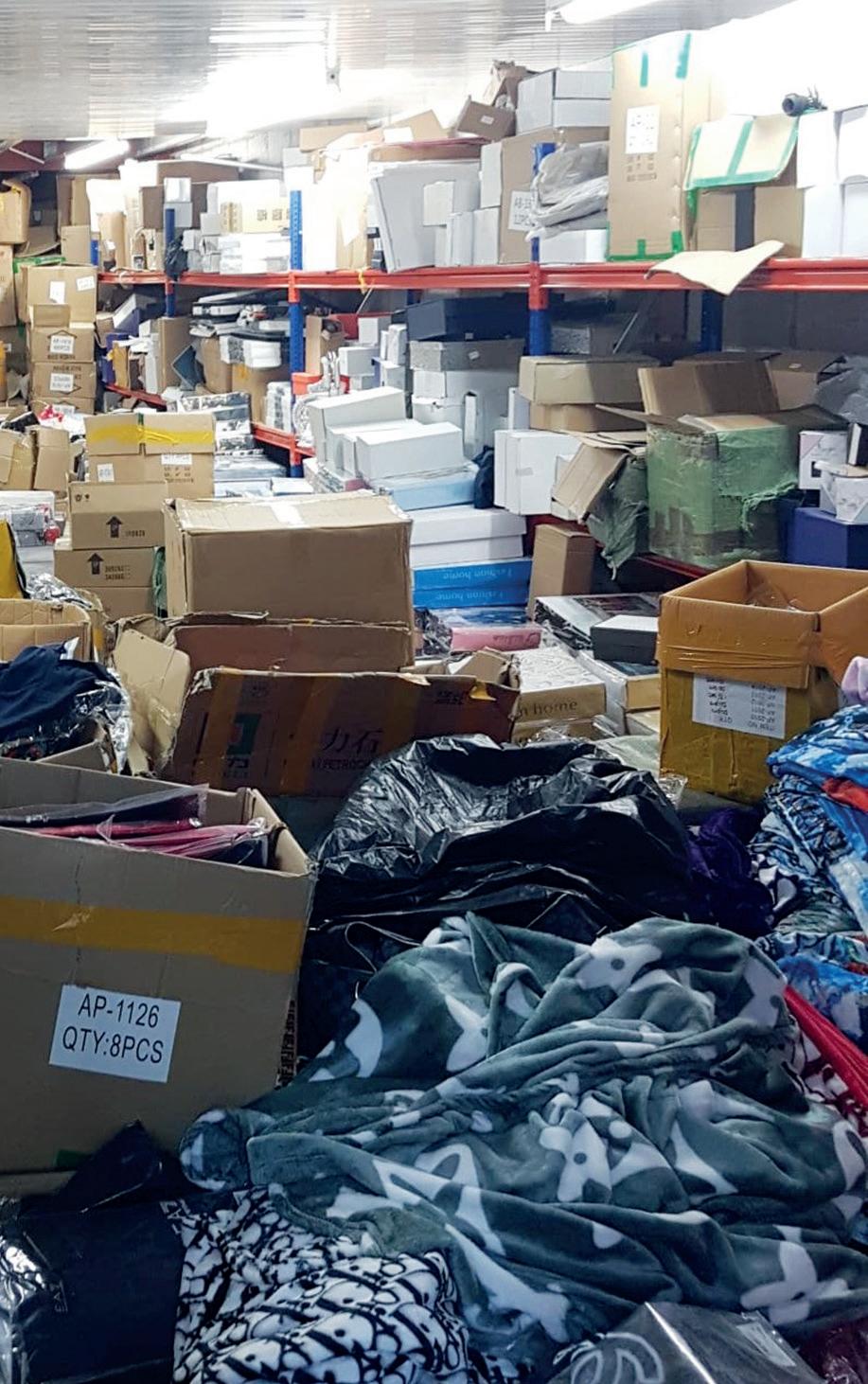
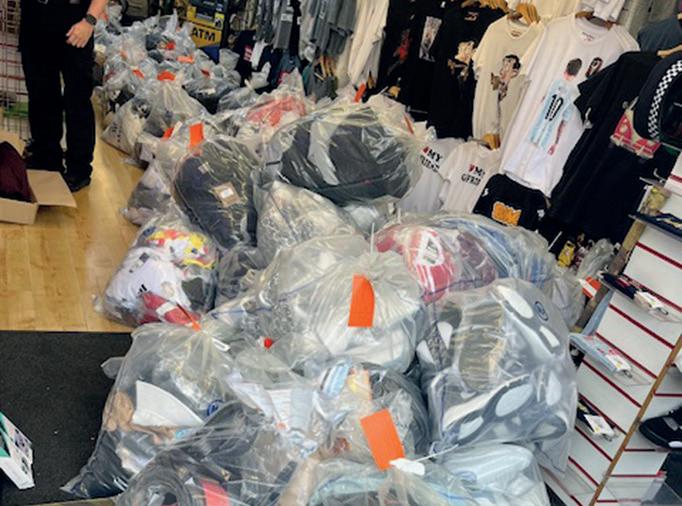
A series of successful operations undertaken by Trading Standards Scotland (TSS) has resulted in ‘the largest haul of counterfeit goods’ ever seized in the country, and a guilty plea from a man who was found in possession of around 20 tonnes of counterfeits worth an estimated £11m.
The fake designer clothing and accessories were seized from storage facilities in Ibrox, Bellshill and East Kilbride by TSS and its partners, including local authority Trading Standards services, Police Scotland, the Anti-Counterfeiting
Group (ACG) and brand holders.
On 22 April 2026, Ian Jones (65) pleaded guilty to 15 charges under the Trade Marks Act 1994 at Hamilton Sheriff Court. Sentencing will take place on 24 June. Following the guilty plea, the seized goods will be recycled.
Fiona Richardson, Chief Officer for TSS, said: “Illicit trade is a priority for Trading Standards Scotland and the team regularly looks to undertake action against those selling counterfeit goods.
“We would like to thank our partners for their assistance with the operations which led to today’s guilty plea.”
ACG Director General, Phil Lewis, said: “We are delighted to see this landmark result, for Scotland and the wider fight
against organised counterfeiting groups across the UK. This type of criminal activity will not go unchallenged.
“The sale of counterfeit goods is not a victimless crime. Behind every fake product are criminals involved in the illicit trade of drugs, weapons and forced labour. All consumers are at risk of harm from legitimate businesses that destroy jobs and rob the country of revenue that could be used to fund vital public services, schools and hospitals.” For more on counterfeiting see pages 10 and 48.
Some of the fake goods seized
OPSS offers data insights
The Office of Product Safety and Standards (OPSS) has published the ninth edition of its ‘Product Safety and Consumers’ report, which examines public awareness of product safety issues.
Based on an online survey of more than 10,000 participants, a telephone survey of 250 people and four online focus groups, the research focused on consumer detriment stemming from product safety failures, and paid particular attention to the experiences of consumers with disabilities, emerging
technologies and personal light electric vehicles such as e-scooters and e-bikes.
Among the report’s key findings are ‘a strong level of public trust’ in product safety in the UK, but increased caution when shopping online. Respondents also expressed unwillingness to purchase products with ‘AI-enabled’ labels.
The research also found that consumers with physical disabilities tend to shop with extra care, and seek better instructions and stronger
29% of UK adults reported having personally experienced a product safety issue. Of these, 60%
related to electrical appliances.
6%
support mechanisms. OPSS said that it “continuously aims to improve our outreach to the public and understand public opinion through our research, and these findings have helped
COMMUNITY SERVICE
25% of those who experienced a product safety issue were physically harmed.
41% attributed the product safety issue to design flaws or faults.
OPSS strengthen the data we have from the previous waves, which focused more on the participants’ awareness, understanding, and experience of product safety, OPSS and other organisations”.
Trading Standards enforcement and prevention activities making a difference around the UK
TRICKS AND MORTAR
A former director of a renovations company has received a suspended jail sentence for misleading customers in Devon, Somerset, Torbay and Plymouth. In a case brought by Heart of the South West Trading Standards, Andrew Charles Parker (59) also pleaded guilty to the unauthorised use of logos on company paperwork.
COLD COMFORT
A farmer has been banned from keeping animals for 10 years and ordered to complete 150 hours of unpaid work after being prosecuted for 'appalling' welfare and identification offences by Staffordshire Trading Standards. Alexander Blackwell (41) failed to meet the needs of cattle, pigs, sheep and poultry in his care, keeping animals in 'unacceptable conditions'.
ROAD TO NOWHERE
A lengthy investigation by Swansea Council Trading Standards has resulted in a guilty verdict against a company which provided fraudulent medical certificates to HGV drivers. Doctors on Wheels Ltd, which was run by Andrew Eburne (51), is thought to have processed thousands of D4 medical certificates. Eburne will be sentenced in June.
SHARK TANKED
A 46-year-old man was arrested on suspicion of illegal money lending as part of an operation in Essex during Stop Loan Sharks Week in May. The arrest was made by the England Illegal Money Lending Team (IMLT) in partnership with Essex Police and Essex County Council Trading Standards. Officers seized electronic devices and paperwork.
SCENT AWAY
Suspected fake perfumes with a retail value of more than £20,000 were seized from a market stall by Lancashire Trading Standards in April, with assistance from West Lancashire Neighbourhood Policing and Licensing Team. The raid resulted in the seizure of 473 bottles of perfume and 223 illicit vapes from a separate retailer.
of the UK public own or have access to a personal light electric vehicle such as an e-scooter or e-bike.
CONSULTATION OPEN
The Department for Business and Trade (DBT) is seeking views on a package of reforms of the market surveillance and enforcement aspects of the product safety framework. The consultation, which is a companion to wider proposals to modernise and strengthen product safety, seeks responses from enforcers and will close on 23 June.
SKIN LIGHTENERS SPREAD
Trading Standards Officers are reporting the sale of illegal skin-lightening products in an increasingly wide range of outlets, including butchers, specialist food shops and small grocery stores, as well as online. Many of these products have been found to contain banned substances such as hydroquinone, mercury and powerful corticosteroids.
PIPCU FUNDING
The Intellectual Property Office (IPO) has announced that baseline funding for the Police Intellectual Property Crime Unit (PIPCU) will be maintained for a further three years, from April 2026 to March 2029. The IPO and PIPCU will also work together to develop a pilot scheme for collaborative industry co-funding, beginning in April 2027.
DMCCA TOOLKIT
CTSI is launching a new toolkit to help members get to grips with the new civil enforcement regime introduced under Part 3 of the Digital Markets, Competition and Consumers Act (DMCCA). The toolkit will be launched at Conference and be available on the CTSI website to local authority members shortly after.
Bulk fuel checks ‘essential to ensure value for consumers’
CTSI has welcomed the Government’s announcement of a £53m support package for households affected by rising heating oil costs, but has cautioned that without legal metrology inspections, consumers may not be getting what they pay for.
In England and Wales, more than 860,000 homes rely on heating oil, with roughly 28% of rural homes in Wales using it as their primary heating source. In Scotland, Trading Standards Officers estimate that individual heating oil tankers can deliver an average of around 3 million litres of fuel each year.
Fuel tankers rely on meter measuring systems to determine the quantity of fuel delivered to consumers. However, these vehicles sometimes operate for long periods without any inspection of their measuring
ENFORCEMENT
equipment. Under Weights and Measures legislation, Trading Standards is responsible for checking that these systems are accurate and properly sealed.
However, open source national inspection figures suggest that these checks are rarely carried out due to a lack of resources after years of underinvestment in local Trading Standards services.
Data submitted through the statutory Section 70 Weights and
Measures returns shows that in 2024 to 2025 only 13 out of 189 local authorities in Great Britain reported inspecting any bulk fuel tankers. Even where inspections were recorded, they did not always involve testing the accuracy of the meter measuring system.
Some authorities have even reported selling metrology equipment or scaling back inspection work because they no longer have Officers available to undertake it.
CTSI Lead Officer for Legal Metrology, Iain Hoey, said: “Most Trading Standards services across Great Britain lack the specialist equipment and facilities required to carry out effective bulk fuel inspections. With recent rapid increases in fuel prices, it is more important than ever that UK consumers can be confident they are receiving exactly what they pay for.”
TSO intimidation in the spotlight
A report by the BBC has highlighted a rise in assault, threats and harassment of Trading Standards Officers, with 24 of them sharing details of the ‘daily intimidation and violence they face from criminal gangs running mini-marts and vape shops’.
Officers reported being on the receiving end of abuse, including threats of murder and rape. Others reported sexual abuse, with one female Officer being 'manhandled' and forced to watch
pornography. Another Officer was ‘poked in the breast’.
The Journal of Trading Standards has previously reported on cases of harassment and intimidation of Officers, including racial abuse and assault. In some cases Officers have been followed home from court cases, where they have faced intimidation on their own doorsteps or had their vehicles damaged.
A recent survey that was sent out to more than 2,000 CTSI
members indicates that 70% of Officers have experienced threats of intimidation or violence.
CTSI is calling for an investment of £100m into Trading Standards to help fund more Officers to support those already in the field.
According to the Institute's Chief Executive, John Herriman, funding would provide extra “boots on the ground”. “We weren't set up to be able to deal with serious and organised crime,” Herriman added.
Delivery lorries 'must be checked'
Lithium-ion battery fires surge
UK fire brigades are now tackling a lithium-ion battery fire once every five hours (equivalent to 4.8 fires a day), according to new research from global business insurer QBE.
The number of lithium-ion battery fires continues to rise year on year, up 147% since 2022. By comparison, in 2022 fire brigades dealt with the equivalent of two lithium-ion fires a day.
E-bikes accounted for 520 fires in 2025, more than tripling since 2022 and making up close to a third of all lithium-ion battery fires recorded that year. Of these, 44% were tackled by the London Fire Brigade, with 230 e-bike fires occurring in the capital last year.
Where fire services recorded this information, converted or retrofitted e-bikes were involved more frequently than officially manufactured models.
London Fire Brigade recorded the highest number of lithium-ion battery fires in 2025, with 522 incidents, followed by West Yorkshire Fire and Rescue Service, reporting 126 lithiumion battery fires, and Lancashire Fire and Rescue Service, reporting 117 fires.
Bedfordshire and Luton is the only fire service to have reported a year-on-year reduction in lithium-ion fires. This coincided with the fire service issuing updated e-bike and e-scooter safety guidance in 2023.
Neon face paints warning
CTSI is urging consumers to take extra care when buying neon makeup and body paints, with some products, particularly those sold by third-party sellers via online marketplaces, potentially presenting a risk to health. Some neon cosmetic products have been found to contain colourants that are banned or not approved for use on the skin. These ingredients can trigger skin irritation, rashes and allergic reactions, especially around sensitive areas such as the eyes and lips. Non-compliant products have also been found to contain dangerous substances including lead, mercury and
asbestos, as well as excessive amounts of butylparaben, a reproductive toxicant that can weaken female fertility. Studies have also linked butylparaben to cardiovascular, gastrointestinal and skeletal health problems, as well as respiratory illnesses and breast cancer.
To avoid UK cosmetic safety regulations, some manufacturers misleadingly label items as ‘not for cosmetic use’, despite marketing them clearly for application to the skin.
Richard Knight, CTSI Lead Officer for Cosmetics and Beauty, said: “The UK’s high product standards mean that all cosmetics must be safety assessed by scientific experts before being sold, so the broader concern is that if non-approved colours are being used in face paints, lipsticks, mascaras, etc, then these products haven’t been through the rigorous pre-marketing scrutiny that UK law requires.”
National Trading Standards (NTS) has published its 20262027 Annual Business Plan, which sets out its strategic priorities for the year ahead.
This year NTS, which works with partners across consumer protection, will receive £12.68m from the Department for Business and Trade; £2.4m from the Food Standards Agency to deliver its feed programme; £1.3m from the Ministry of Housing, Communities and Local Government to support work relating to letting agencies; £1.23m from the Department for Health to tackle illegal vapes; and £2.73m from HMRC to disrupt the supply of illicit tobacco.
Face paints are popular at festivals
Upfront Fighting the fakes
In this special feature, we look at how the AntiCounterfeiting Group (ACG) is bringing together professionals from across the enforcement landscape and, by providing intelligence, logistical support and training, is front and centre in the fight against fake goods
The Anti Counterfeiting Group (ACG) is uniquely positioned as a bridge between industry and law enforcement, enabling coordinated, intelligence led re sponses to intel lectual property (IP) crime. I lead the intelligence function, which combines oper ational expertise, industry insight and policy awareness to support enforcement agencies.
ACG coordinates intelligence from its members, including Border Force detentions, online and physical marketplace mon itoring and test purchasing, and insights into transnational sup ply chains. This is underpinned by an extensive contacts data base spanning international law enforcement, regulators, brand owners, and key facilitating sectors such as online platforms and logistics providers.
Through its central co or dination role, ACG improves access to industry support — facilitating remote product examinations, on-site brand authentication and fast track witness evidence, and no tice and takedown requests via its membership network.
Furthermore, ACG is the sec retariat for the National Markets Group, bringing together key stakeholders to tackle the UK’s most prob lematic markets, and supports UK and European IP crime operations and initiatives (such as Operation Flash and Opera tion Archer), helping to promote and expand participation.
ACG also provides witness statements detailing the eco nomic and societal harm caused by counterfeiting at both local, national and international levels. These incorporate the latest data and case studies from organisations such as the UKIPO, EUIPO and OECD, to support sentencing and closure order applications.
For further information about how ACG can provide support to Trading Standards teams, contact matthew@a-cg.com
Anti‑counterfeiting enforcement isn’t just a professional interest of mine, it’s something I care about deeply because of the real people it affects. Counterfeit goods aren’t just cheap imita tions; they can pose serious risks to consumer safety. The harm is often hidden, but the conse quences can be very real.
Strong IP enforcement not only protects consumers, but also safeguards legitimate businesses and brand owners who invest sig nificant time, money and exper tise into creating safe, compliant products. Counterfeiting under mines fair trading, erodes con sumer trust and diverts money into organised criminal networks. Anti‑counterfeiting enforcement therefore plays a vital role in help ing to ensure a level playing field, giving consumers confidence in what they are buying.
Counterfeiting is never a victimless crime. There are always victims; they’re just not always visible. Consumers can be exposed to unsafe or substand ard products without realising it and there are also victims among legitimate businesses who invest heavily in producing safe, com pliant products. When counter feiters undercut them, it erodes trust, damages livelihoods and discourages innovation. Over time, that harm ripples out into local economies and communities.
Perhaps most worrying to me is that counterfeiting is rarely a standalone activity. It’s often linked to organised crime and wider criminality, meaning the profits are reinvested into activity that causes further harm.
There is a great value in the collaboration between Trading Standards and ACG, which brings different organisations with dif ferent perspectives together for a shared purpose, giving everyone a voice. For Trading Standards Officers who are battling coun terfeit goods, access to brand intelligence, emerging trends and practical insights from brand representatives is invaluable.
From my perspective, that collaboration also builds con fidence in Officers. Knowing you can pick up the phone to a trusted contact, make decisions based on reliable intelligence or better understand how a product should look or behave makes enforcement more effective and more proportionate. It instils a sense of security that none of us are tackling this alone; on the contrary, we’re part of a wider network trying to tackle the same harm but from different angles.
The ACG’s events and training sessions play a crucial role in this. They do far more than share information; they create a space for learning, discussion and professional curiosity.
For Trading Standards Of ficers, particularly those earlier in their careers, these sessions help to build specialist knowl edge and encourage questions in a supportive environment. They also offer the opportunity to foster relationships and learn directly from brand represent atives, which can be difficult to replicate elsewhere.
Emma Honey, Trading Standards Enforcement Officer, Isle of Wight Council
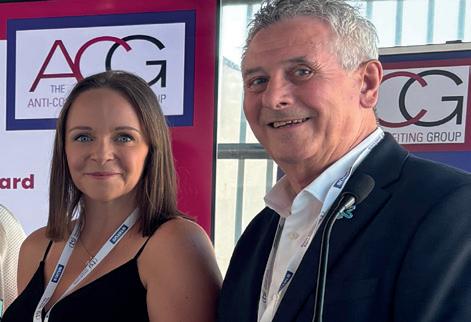
Emma Honey being presented with the ACG Rising Star Award in 2025 by ACG's Phil Lewis
Matthew Knowles MCTSI, ACG Intelligence and Strategic Initiatives Manager
I've always been passionate about trying to get people to understand why anti-counterfeiting work is so important; apart from anything else, it’s vital to the economy. In the UK a lot of our GDP comes from the creative industry, and IP rights underpin all of that. Every big company started off as someone's bright idea which has flourished over the decades. IP enforcement work helps keep that alive.
There's a growing realisation that counterfeiting does not happen in isolation. Where you get one form of criminality, there are likely to be others, including on the high street. By working with the support of AGC, we can bring in other agencies like the police and Border Force to tackle this. One of the things I have been particularly involved with is addressing the links
between counterfeiting and self storage. Five years ago I was involved in the launch of the Tick Box scheme (tick-box.org.uk). Through the IP Crime Group we also offer support to local authorities to carry out disruption work on self-storage facilities. Enforcement is a struggle because Trading Standards has been cut back so much; most authorities now have to prioritise and counterfeiting often falls below the line. Which is why the ACG’s support is so crucial.
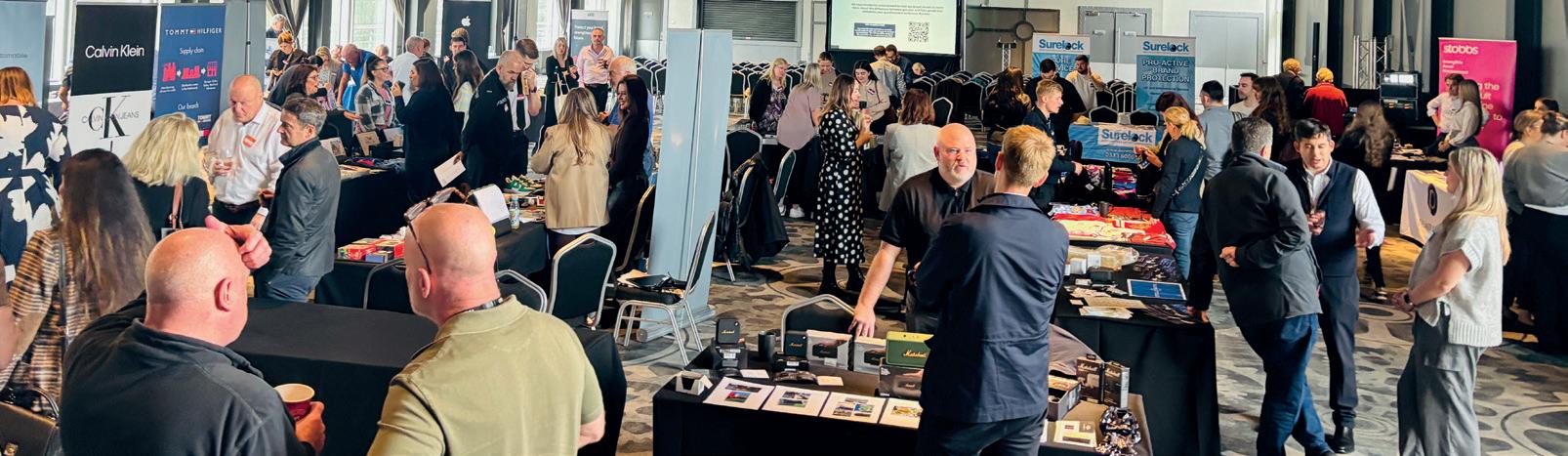
ACG's free IP Expos are held annually across the UK and Ireland to provide the very latest in brand training and to create an informal networking platform for the IP community.
Enforcement Officers (Police, Trading Standards and Customs) in each region are invited to attend free of charge and will benefit from brand training as they visit ACG members' stands, where genuine and fake products are on display from more than 30 exhibitors.
As well as networking opportunities and chances to update their brand knowledge, attendees will enjoy a varied programme of expert guest speakers providing the very latest information, research and developments in the fight against counterfeiting.
All Trading Standards Officers will also benefit from CPPD Certification for attending an ACG IP Expo. Complimentary lunch and refreshments are provided for all attendees.
Counterfeiting is increasingly shifting online. Sellers often operate anonymously using rapidly changing accounts and disposable payment methods. Counterfeit goods can be drop-shipped to consumers within days of production or stored in third-party warehouses and fulfilment centres, where they are distributed alongside legitimate products. These practices exploit weaknesses in fast-moving, complex supply chains, allowing unsafe goods to reach consumers with minimal oversight and limited visibility of their true origin.
A key recent focus has been Operation Archer, a two-year National Trading Standards (NTS) funded initiative led by Newport City Council across England and Wales. The operation disrupts online counterfeiting by using civil financial investigation powers under the Proceeds of Crime Act 2002, providing an effective alternative to criminal enforcement by targeting the profits of IP crime through account freezing orders. Following the operation's success, NTS have funded a new Intellectual Property Investigations Team.
Collaboration between local Trading Standards teams and ACG allows intelligence to be shared, offending patterns to be identified earlier, and enforcement action to be better targeted. ACG brings expert brand intelligence and industry insight, while Trading Standards contributes frontline investigation and consumer protection expertise. This partnership strengthens enforcement, disrupts criminal networks, and keeps the public safe from dangerous counterfeit goods. The ACG has also been a strong supporter of Operation Archer since its launch in April 2024, encouraging active engagement from its industry members.
ACG IP Expo - Edinburgh
Date 16 September, 2026
Location Palace Hotel, 34-38 York Place, Edinburgh
ACG London Conference
Date 25 November, 2026
Location Sheraton Skyline Hotel, London Heathrow (discounted rate for enforcement officers)
ACG IP Expo - London
Date 26 November, 2026
Location Sheraton Skyline Hotel, London Heathrow
For further information and to register, please visit www.a-cg.org/events
ACG IP events
Sean Rovai, Team Leader Trading Standards, London Borough of Tower Hamlets
Chris Watkins, Principal Trading Standards Officer, Newport City Council
A vital resource
Improve the consistency of enforcement and support best practice within your local authority by subscribing to the Enforcement and Legal Process Manual
The purpose of the Enforcement and Legal Process Manual is to provide investigative Officers, case supervisors and managers with a self-contained guide to the procedures, records and forms associated with the investigation, enforcement and legal processes. It provides a mixture of recommended best practice and the actual legislation local authorities must follow when conducting enforcement activities.
The Manual is designed to guide an Officer through the process of putting a case together – from initial considerations and the collection and handling of data, through to interview procedures. It also includes select pieces of Case Law
that are relevant to the interpretation of legislation and the handling of certain elements of the process.
The Manual is a fully indexed and searchable eBook, and is also available in print for those who prefer to a hard copy. It is not intended to be a static document, but is reviewed and updated regularly – which is why after 20 years we still have more than 100 local authorities subscribed and more than 1,600 users nationally.
The Manual covers both criminal and civil legislation, and provides local authorities with more than 150 template forms which can simply be rebadged and put to use. They can also be adapted to
suit local requirements. The procedures can be used by all enforcers within a local authority (for example, they can be shared with Environmental Health and Licensing Officers under a single license), and multiple Officers can be set up under a single subscription for that local authority.
The senior Officers who support the review and maintenance of the Manual also encourage feedback, with an annual survey providing users a chance to comment on any additions they would find helpful.
There is an annual subscription for the Manual (password-protected access to the website with regular updates online costs just £276 + VAT per annum), while for those who would also like the print version, the subscription starts at £351 + VAT and increases dependent on how many copies are required.
In an era of increasing financial constraints, this is your opportunity to improve efficiency by investing wisely in this Regulatory Services resource. l Digital and print versions available from just £276 + VAT annually
Making enforcement simpler, faster and more consistent Enforcement and Legal Process Manual for local authority enforcement teams
Matt Allwright Journalist
and presenter of the BBC’s Watchdog and RogueTraders
Gunning with the good guys
To take out the cowboys in the caravan park sector and elsewhere, lawmakers and enforcement need to be quick on the draw
“It’s the Wild West.” That’s a phrase I hear quite a lot in my work, and which you’d think I’d welcome. I’ve always enjoyed both Country and Western music (yes, there IS a difference) and I regularly cosplay as a cowboy at weekends in a series of country bands. The sad reality is, however, that this phrase is usually being deployed by colleagues and contributors when society has circled its legislative wagons and left one group or another outside of the reaches of the laws and rules which should protect them. They’re left stranded when the music stops – and where the law has no sway, good people pay.
Caravan park living is a classic example. The law provides a safety net for lodgers, renters and homeowners, for whom centuries of legislation have provided highly developed and sophisticated rights which tend to work. Yes, there are still disputes and misunderstandings, but on the whole, if you’re renting or you have a mortgage on the freehold of a property, you have rules you can fall back on.
Western analogy to one side, what can make these cases particularly tragic is that we’re often talking about people who have downsized, lost partners, are working on a fixed income, and whose future may involve hospital trips and long-term care. You don’t want to be fighting for justice when it should be your turn to ride off into the sunset.
It’s not the only area of our lives where the law doesn’t make it into town very often. Heat network and fuel oil users. Unpaid carers. Bereaved cohabiting partners. The hidden homeless. The digitally illiterate. Leaseholders. Cash users. They are all examples of groups for whom ‘Legislation’ is to be found in the dictionary between ‘Left Out’ and ‘Liability’, but provides no comfort for them when they need it most. Their situations don’t fit the mould, so they sit on the fringes where they are easy pickings for businesses and individuals who see their weakness as an opportunity to cash in.
They are all examples of groups for whom ‘Legislation’ is to be found in the dictionary between ‘Left Out’ and ‘Liability’
If you’re living in a static caravan on a park, however, you fit neatly in between these categories, and you fall through a gap in the law where the park owners can set rules, levy charges and dictate buying and selling without too much oversight. In short, you may have just ridden into Dodgy City, the town where the bad guys are in charge. If there’s a shootout in the saloon, you will lose because they took your pistol at the door.
Lawmakers are always behind the pace. They are reactive rather than proactive. Time in Parliament is precious and scarce, and the process of drafting and passing a bill to take in marginalised communities is torturous at best. What we can do for these groups is to listen, record and relay their stories to those in power to ensure that they understand the scale of the problem and the damage being done.
After all, if this is the Wild West, we’re the sheriffs. l For more on caravan parks, see page 28.
John Herriman Chief Executive, CTSI
The long shadow
The shadow economy poses a serious threat to both businesses and consumers – which is why investment in Trading Standards and broader enforcement is critical
We are all aware that the UK is in the grip of a cost-of-living crisis. Levels of confidence among both consumers and business are low, and almost everyone is looking at ways of making their money go further — whether that means buying less or buying cheaper.
When consumers are under extreme and prolonged economic pressure, they are encouraged to spend their limited money outside ‘conventional’ markets and business structures. Given the choice between two superficially similar products with dramatically different prices, many people are likely to opt for the cheaper alternative, regardless of any corners that may have been cut along the way. This has always been the case – from the spivs of the 1940s and 50s cashing in on post-war austerity and rationing, to the Del Boys and Arthur Daleys of the 1980s and 90s.
But perhaps the scale of the problem has never been more widespread, and it is no longer merely confined to shady characters operating out of suitcases behind market stalls. Instead, organised crime groups (OCGs) are now operating, in plain sight, across many high streets across the UK. There was pretty much universal recognition of this by our
Trading Standards members in a recent survey – with 97% aware of OCGs operating on their local high streets and the problem getting worse, particularly since Covid.
The pandemic and the lockdowns had a devastating impact on high street businesses, but retailers were already struggling even before that, shaken up considerably since the arrival of online marketplaces.
The arrival of Amazon, Ebay, Temu and others provides convenience to consumers, but it has also led to the closure of many long-established and well known high street retailers – Woolworths, Debenhams and just recently, Claire’s Accessories. The closure of legitimate retailers has created an opportunity ripe for exploitation by their ‘shadow economy’ counterparts, with illicit tobacco and vapes, non-compliant food, unsafe electrical goods and a plethora of other horrors following in their wake.
Wake-up call
In our latest policy report, ‘Hidden In Plain Sight’ (see page 28), CTSI maps out the extent to which this shadow economy is now dominating our high streets. Based on findings from a recent survey of CTSI
members, along with data from brands and the Anti-Counterfeiting Group (ACG), it paints a stark picture of the extent to which businesses linked to organised criminality are taking root on high streets and communities across the UK.
Unsurprisingly the scale of the problem is centred around major towns and cities, but perhaps more surprising is the extent to which it is endemic across the UK, with tourist and coastal towns also impacted. Our estimates are that around one in four fast food takeaways and as many as half of vape retailers may have links to serious and organised criminality. These figures are stark and while they are only an estimate, they underscore the challenge facing UK high streets.
An even more alarming distinguishing characteristic of the shadow economy is polycriminality — an opportunistic and intertwined array of illegal activities concealed by superficially legitimate fronts, the most immediately visible being high street retail premises. Polycriminality encompasses forced labour and modern slavery, the illegal trade in drugs and weapons, and even child sexual exploitation.
And the growth of organised crimebacked businesses is also endangering
the safety of Trading Standards Officers –nearly three quarters of TSOs CTSI heard from in our recent national survey said they had experienced threats of violence, intimidation or verbal physical abuse.
Taking from us all
Every business that is operating in the shadows, not playing by the rules, endangering the public and undercutting legitimate businesses is also depriving the state of tax revenue that is vital for investment in local economies and communities. Serious and organised crime is estimated to cost the Treasury around £50bn a year — twice the budget for the Home Office, the government department leading efforts to tackle the threat.
The quantifiable economic implications of this are bad enough. But perhaps harder to grasp are the intangible knock-on effects on things like emotional wellbeing and mental health, and community pride and cohesion. Change is inevitable of course, and it is not necessarily bad; but there is a sense in many places that something irreplaceable is being lost, with a widespread feeling of fear, suspicion and social malaise following in its wake.
As well as investment we also need to enhance the powers for Trading Standards to close down shops and take action against individuals and landlords
global supply chains become infiltrated by criminals and rogues however, even those acting in good faith can unwittingly become part of the problem.
The outcome of this scenario is a kind of ‘doom loop’, with consumers being priced out of legitimate markets, the consequent business closures limiting consumer choice, more money going into the pockets of rogue traders, less money going into the coffers of the Treasury and the vital public services that rely on it, and an already beleaguered economy taking a hit at every stage along the way.
And the shadow economy is not just penetrating high street retail shops. Legitimate businesses that provide services from home improvements to cosmetic treatments, from haircuts to house removals, have also seen their markets being undermined and eroded by competitors with little or no regard for quality, standards or safety. According to the British Association of Removers (BAR), hard-pressed consumers are increasingly turning to informal ‘man with a van’ arrangements via social media, leaving them vulnerable to poor quality service and with no access to recourse or recompense if something goes wrong. That makes businesses which play by the rules vulnerable as well, putting them at a competitive disadvantage and incentivising them to lower their own standards to survive.
It also raises the very real prospect of legitimate businesses becoming increasingly exposed to non-compliant and dangerous products themselves. A garage sourcing motor components online, for example, or a restaurant buying ingredients from a wholesaler, needs to be confident that it is not passing substandard or potentially dangerous goods on to its customers. When complex
While Trading Standards is not the lead agency in tackling serious and organised crime, it does play a vital role in supporting law-abiding businesses — and it is perhaps no surprise that the proliferation of organised criminality on the UK’s high streets has coincided with a dramatic paring down of Trading Standards services over the last decade and a half.
To counter this CTSI is urging the Government to invest in enforcement capabilities and capacity to address the threat to local economies and communities. We need to see more boots on the ground in local communities to help stamp out this threat, and an expansion in partnership working. In our report we highlight the success of initiatives such as Operation Vulcan in the northwest of England. This worked at reducing the scale of organised criminality but it required long-term and sustainable funding.
As well as investment we also need to enhance the powers for Trading Standards to close down shops and take action against individuals and landlords who are linked to OCG-backed businesses. And we need to strike at the heart of organised crime gangs – and do more to strip them of their ill-gotten gains by seizing their assets. The challenge of us not doing something is very stark – it could lead to the complete breakdown of the level playing field for business. And that would be devastating for consumers, for the economy and for the Government. l
Jessica Merryfield Head of Policy & Campaigns, CTSI
All change, please
Big changes are afoot across a huge swathe of Trading Standards functions. CTSI is here to drive the profession in the right direction
It feels like we are on the precipice of some seismic changes in our regulatory landscape and, unusually, these changes appear to be happening simultaneously at the local, regional and national levels, as well as across all four nations. These reforms come at a time of already intense pressures: evolving consumer behaviour, increasingly complex markets, emerging risks (including online harms and global supply chains), and longstanding resource constraints.
For our profession, and for us as Trading Standards and consumer protection professionals, these changes may feel compounded and as if they are happening on all fronts. It would be easy to feel overwhelmed, daunted and sometimes a little scared by the uncertainty, but let’s unpack these in more detail.
Starting with the national changes, we know that the ‘Regulatory Action Plan’ is well underway. This plan, by UK Government, intends to reform and modernise the regulatory system so that it keeps protecting consumers while better supporting economic growth, innovation and investment. That sounds great – but what does that actually mean for you and I?
System-wide with local impact
Let’s look at the national regulation model being created and rolled out by the Food Standards Agency (FSA) in response to declining local authority capacity. Initially focusing on the food hygiene matters at large, national retailers, it aims to reduce the regulatory burden on locally placed Environmental Health professionals in the first instance. We are expecting this to be replicated to food standards in due course. CTSI, with support from colleagues at the Association of Chief Trading Standards Officers (ACTSO), are asking for clarification around the boundaries between the national and local expectations as these are still not clear for our members.
For those undertaking food standards work at local authorities, the rollout of the Food Standards Delivery Model (FSDM) is a significant change in delivery, prioritising and recording the work using a far more dynamic, intelligence-led approach to food standards. It is also expected that a food hygiene version will be rolled out to mirror the FSDM.
These are part of the plan to modernise the food regulatory system (at both national and local levels) to ensure it can respond to emerging threats, risks and
changes, and are an example of national changes having local impact.
Similarly, Trading Standards professionals across all our membership sectors have highlighted the Sanitary and Phytosanitary (SPS) agreement being worked on currently at the national level to bring the UK back into greater alignment with the EU across the food chain: food safety, animal health and plant health sectors.
As with the European Exit, the combination of going at pace and the current lack of clarity and guidance around the alignment is creating confusion for Trading Standards professionals in the public, private and not-for-profit sectors, who cannot clearly advise and guide organisations into a state of readiness.
The impact on the individual professional, business and local authority Trading Standards services, let alone parts of the economy, will be profound if these changes are not agreed and communicated in a timely manner.
Addressing enforcement capacity
It would be remiss of me not to mention the other national changes that we're seeing currently. At the time of writing this, we are in consultation phase for the secondary legislation regarding the Product Regulation and Metrology (PRAM) Act, and Royal Assent has just been granted for the Tobacco and Vapes Act. Both will bring changes nationally that will have impacts locally, not least because they are enforced and applied at the local level and, particularly with the ‘Weights and Measures Authority’ being a statutory duty and function for a local authority, it cements Trading Standards as a ‘must-have’ service to provide. Also, we are working with the Department for Business and Trade (DBT), who have acknowledged the significant challenges our members face, and are reviewing how we tackle these challenges. DBT recognise that the issue is often due to a lack of enforcement capacity more than gaps in the system, and they are taking a holistic view of the
It is a positive thing to see the workforce ready for action and stating its case so early on in the changes
There must be recognition that local authority Trading Standards (LATS) are a service, in every sense of the word; they are not a ‘cost’ or burden to the taxpayer. Trading Standards brings significant economic and public health benefits which far outweigh the investment placed in it. This unrivalled value is explained in more detail in CTSI’s ‘Making the Case’ infographics, but as a financial example:
• £11 of savings for every £1 invested in English LATS;
• £12 for every £1 spent in Welsh LATS;
• £106 saved per £1 in Scottish LATS.
consumer protection landscape to find the most effective and sustainable solutions. This includes the National Consumer Protection Strategy, which is focused on Prevention – stronger legislation and regulation to allow consumers to confidently purchase; Empowerment –education and support for consumers and businesses; Resolution – effective complaints, redress and ADR mechanisms; and Enforcement – robust action against those causing consumer detriment. CTSI is involved at the heart of these discussions.
A service, not a burden
Moving from the national to the local, we know that the local authority reorganisations happening across parts of England, the changes being mooted in Scotland and the recent launch of the Trading Standards Wales manifesto are all further indications that we are in changing times. It is a positive thing to see the workforce ready for action and stating its case so early on in the changes.
The same can be said of our members who operate outside of the local authority sector. The value that a Trading Standards professional can bring to any organisation is often overlooked, yet it is crucial in ensuring that the way in which that organisation operates, communicates and interacts with its customers or stakeholders continues to inspire trust and confidence. Involving a Trading Standards professional at the start of any changes to processes, services and/or products is fundamental to understanding and mitigating the risks associated with such changes. It is a false economy to miss capturing those insights at the start. That professional is a vital conduit from which the national, and sometimes international, requirements are translated to understand the local impact and the actions needed to be taken to remain safe, legal and trusted. Understanding and planning now saves the need to undo mistakes later, often at significant cost.
The key challenge for today’s Trading Standards professional is not whether change happens, but how they position themselves and their organisation within that change. There is a narrow window to engage proactively, shape emerging models, and secure a sustainable future that ensures economic security and growth through effective regulation. The time to act is now – so please do get in touch with me to share your thoughts and opinions on how we can shape the future, together. CTSI is with you all, every step of the way. l
Caden Lunness Policy and Public Affairs Executive, CTSI
ALL BETS ARE OFF
With the age of the two-party system looking increasing untenable, what are the implications for Trading Standards?
Ask anyone with a fleeting interest in British politics to imagine who will be the occupant of 10 Downing Street in 2030 and the conversation usually follows a familiar arc. Prime Minister Nigel Farage — plausible, even probable, if current polling holds; Prime Minister Kemi Badenoch — less likely if you follow the polls, but no longer an impossibility; Prime Minister Zack Polanski — peculiar, perhaps, though more likely than a year ago. The name that certainly doesn’t come into speculation is Prime Minister Keir Starmer. Not because his departure has been formally announced, but because the public has arrived, with unanimity, at the conclusion that it is simply a matter of when.
What is striking about that list is not who leads it, but what it represents. For the first time in living memory, the two parties that governed Britain in rotation for the better part of a century – barring the war and coalition years – are no longer the dominant answer to the question of who comes next. The age of bipolarity,
in which Labour and the Conservatives traded power, might be coming to an end. In its place, something rather more complicated is taking shape: a political landscape in which traditional categories of left and right are being stretched and scrambled, moving in directions that confound the old political maps entirely.
Restless for change
To truly understand what is happening, it helps to trace a single thread of voter behaviour over the last decade. My home in the so-called ‘Red Wall’ in the North of England is a set of post-industrial constituencies that had always voted Labour. However, the ‘Wall’ first cracked in 2019 when many of the constituencies lent their vote to Boris Johnson’s Conservative Party to ‘Get Brexit Done’, but also because of a sense that Labour had taken them for granted. In 2024, several of those same constituencies lent their votes back to Labour, giving Keir Starmer his landslide on the back of ‘change’. Now,
barely 21 months later, polling in those same constituencies places Reform as the dominant party, meaning that in the space of several years voters there have gone from Labour to Conservative to Reform. These constituencies aren’t made up of ideologically restless voters. Rather, they’re people who are searching, with increasing urgency, for a party that addresses their material reality, and concluding that the one they voted for last time is not it.
Labour’s inability to hold these voters cannot be explained away as mid-term turbulence. A government that won office on a platform of ‘change’ has governed as though change were something to be managed from Whitehall, rather than felt in places like Rotherham or Rochdale.
Three-quarters of the public now believe things are getting worse, compared to the eight percent who think things are getting better, according to a recent YouGov poll. With this, we’ve seen the party grow increasingly fractured, with leadership questions, factional
positioning, and the openly discussed succession scenarios. This instability had meant that Labour is losing voters in two directions simultaneously: traditional working-class constituencies are moving right towards Reform, and younger urban progressives in university towns are moving left towards the Greens and a cohort of independents. A party haemorrhaging support at both ends is not experiencing a fluctuation; it is succumbing to a slow death.
mindset. On that basis, those voters are open to any party that can credibly present itself as outside the mainstream and different from the past. This is what Kemi Badenoch is now trying to do.
The age of bipolarity, in which Labour and the Conservatives traded power, might be coming to an end
Reform’s ascent is the most visible feature of this landscape, dominating both the social and media landscapes. Founded as the Brexit Party in 2018, the party has evolved and now leads virtually every national poll. Projections earlier this year had Reform winning 335 seats at a general election, more than any party
combined. At the time of writing, recent polling has that number down to 248, shy of the majority needed to govern, and making them dependent on a Tory coalition deal. The party’s 2024 manifesto set out a programme of considerable ambition: cutting income tax by raising the threshold to £20,000; cutting corporation tax to 15 percent; replacing the House of Lords with a smaller, more democratic chamber; leaving the ECHR; abolishing the licence fee; and scrapping Net Zero targets. Whether such pledges could survive contact with the Treasury is a matter of debate, and Ipsos polling from January found notable scepticism amongst the public about the party’s governing readiness. Despite highprofile defections to Reform, the question of whether the party can govern, as opposed to just campaign energetically, remains open.
Recent polling shows that many Reform voters’ main reason for supporting the party is that Reform is neither Labour nor Conservative. That suggests a rejection of the status quo, a ‘none of the above’
The Conservative leader has spent the last few months building a profile that her predecessors failed to establish. A run of outstanding performances at Prime Minister’s Questions, a credible autumn conference speech, and a persistent focus on the Mandelson vetting scandal have produced measurable results. Her net approval among 2024 Conservative voters has risen from plus 22 in November to plus 54 by April. She now leads Nigel Farage by 12 points on personal approval. For the first time, she leads Starmer on the ‘who would be best Prime Minister?’ question.
On the left, the disruption is equally significant, if rather different in character. The Green Party’s transformation under Zack Polanski has been one of the more striking developments in recent British politics. With an average four-point rise
in polling since he took over and a party membership that now exceeds 226,000, the Greens are the most popular party among voters aged under 50. Around 47 percent of Labour’s 2024 base say they are now considering voting Green at the next election. The crystallising moment was the Gorton and Denton by-election in February, in which the Greens overturned a Labour majority of 13,000 in a seat the party had held for more than a century, pushing Labour into third behind Reform. It was the Greens’ first ever by-election victory, and it suggested that the surge is not merely a polling phenomenon.
The questions the Greens have yet to answer, however, are more than organisational. Their 2025 conference voted to abolish private landlords, a position affecting roughly one in five households in England, before the leadership subsequently clarified this to mean greater regulation rather than outright abolition. How such regulation would work and who would enforce it has not been clarified. It was the kind of
episode that feeds the suspicion that Green policy is conceived for student unions rather than government departments: eye-catching in the announcement, elastic under pressure. But converting a polling surge into the disciplined ground operation required to win seats systematically under first-past-the-post (FPTP) is harder than it looks, and the Greens have yet to demonstrate they can do it at scale. Whether the machinery exists to translate it into seats is a different question.
Cracks visible
Beneath all of this lies a structural problem that each cycle makes more acute. FPTP was designed for a country in which two parties divided the overwhelming majority of votes between them. Britain is no longer that country. The 2024 election was the most disproportionate in its history: Labour won nearly two-thirds of parliamentary seats on a third of the popular vote. PolitPro’s polling aggregator currently places four parties within a range that, in most European democracies, would
produce a genuinely hung parliament. Under the current system, it risks producing results that satisfy almost no one and accurately reflect almost nothing. The Electoral Reform Society has observed with some regularity that Britain now has a multi-party electorate operating inside a binary voting structure. The observation is correct, and the consequences are becoming impossible to ignore.
The local, Scottish, and Welsh elections on 7 May delivered the clearest evidence yet of how far this realignment has travelled. Reform and the Greens provided the biggest upset in England, sweeping up the votes of a public that has stopped believing the old parties deserve their loyalty. Reform took control of Sunderland, Barnsley, Newcastle-underLyme, Suffolk, and Essex councils, and pulled off a surprise by gaining control Britain now has a multiparty electorate operating inside a binary voting structure
of Havering, its first ever London borough. The Greens made substantial gains across urban England, with particular strength in London boroughs and university cities. Labour lost more than 1,200 seats and 30 councils in England, experiencing its worst local election results ever, while the Conservatives suffered significant losses of their own, shedding almost 500 seats and eight councils.
The picture beyond England’s borders was no less striking. In Scotland, the SNP came out on top but, with Reform, the Lib Dems and the Greens also picking up seats, it fell just short of a majority. In Wales, the picture was starker still: Labour lost the Senedd for the first time since its establishment in 1999, falling to third behind Plaid Cymru and Reform. That a Welsh left-wing nationalist party benefited most from Labour’s collapse is telling. Both the SNP and Plaid Cymru occupy ideological ground not entirely dissimilar to Labour’s, yet both derive their energy from national identity rather than class solidarity. Labour’s difficulty is not simply
that it is losing votes to the right; it is losing them to parties that share its instincts but have concluded that Westminster is not the vehicle for realising them.
What does this mean for TS?
These results will ring changes for local Trading Standards services, with new-togoverning leaders now setting the course and priorities locally. To help with this, CTSI has produced a short guide, ‘Local Authority Leadership briefing note’, to help summarise what Trading Standards does, the value and impact it brings and why council leaders should invest in it. It can be used at any time but may be particularly valuable when leadership changes.
Against this shifting political backdrop, CTSI has been engaged across the spectrum. On the government side, CTSI has worked closely with ministers on both the Product Safety and Metrology (PRaM) Act (see page 36) and the Tobacco and Vapes Act (see page 40) – the latter accompanied by a welcome announcement of £10m in investment for Trading
Standards services across England. CTSI is now actively working with the government and a coalition of like-minded partners to shape both pieces of legislation through their consultation periods. The Conservatives have signalled a broadly pro-market instinct and a preference for reducing regulatory burden; the case CTSI continues to make is that proportionate, well-resourced Trading Standards is not the enemy of enterprise but its guarantor – the mechanism by which legitimate businesses are protected from those who undercut them unlawfully. Reform’s engagement with consumer protection detail remains limited, though public appetite for action on rogue traders and unsafe goods is substantial and presents a clear opening. The Greens have shown the greatest appetite for stronger consumer and environmental protections, though the translation of that enthusiasm into workable enforcement frameworks remains to be tested. In each case, CTSI’s approach has been consistent: nonpartisan, evidence-led, and focused on outcomes for consumers and businesses.
What the 7 May results have not settled is the larger question of what comes next. Reform and the Greens remain, for now, united principally by what they are against. Whether either can construct the durable electoral coalitions required to govern remains unproven. For Trading Standards in all sectors, the shape of the next government matters in practical terms. Decisions on local authority funding, consumer protection legislation, product safety regulation, and the UK’s broader trading framework will all be determined by whichever party, or parties, find themselves in office. In that sense, the political realignment now confirmed at the ballot box will directly determine the conditions in which the profession operates.
The next general election can be held no later than 15 August 2029. Will Labour survive that long? Nobody knows, but what is for certain is that somebody new will occupy 10 Downing Street after that election. That person’s name is still unknown. And the elections of 7 May have gone a long way towards determining who that person is likely to be. l
In with the new
This spring CTSI has been delighted to welcome seven new Lead Officers across four portfolios, providing the profession with an unparalleled wealth of expertise.
The new recruits complement CTSI’s existing network of 35 Lead Officers across 21 specialist areas, and are a vital component of the Institute’s mission to support its members, provide expert opinion in the media and work
Serious & Organised Crime
Dennis Chalmers
With more than two decades of frontline experience in Trading Standards, Dennis has built a strong reputation within law enforcement for getting results where it matters most. Since beginning his career in 2004, he’s “dealt with it all,” he says, “from counterfeit goods and doorstep crime to tackling organised criminal networks operating across the UK”.
Dennis adds that he’s “earned more than a few battle scars along the way” — as well as a collection of awards, commendations, and professional recognition for his efforts. He recently received a CTSI Hero Award for his work on illegal ‘ghost’ number plates, as part of which he presented evidence to MPs about the links between ghost plates and serious and organised crime.
His work has not only disrupted major criminal operations but also helped protect vulnerable consumers and legitimate businesses from exploitation and harm.
Known for a no-nonsense approach, a sharp investigative mind and an unwavering commitment to enforcement, Dennis has led teams through complex cases, secured
with businesses, consumers and other stakeholders. They also engage with government ministers and politicians at a national and local level, campaigning for improvements to the consumer protection system, pushing for additional resources and support for Trading Standards, and consulting on legislation that is better suited to meet the needs of enforcers, consumers and legitimate businesses.
key prosecutions, and forged strong partnerships with national bodies and law enforcement agencies.
Even after 20 years, he says, “I’m still learning, still pushing, and still passionate about protecting the public and making life difficult for the bad guys”.
David Benbow
As one of the Lead Officers for the new Serious & Organised Crime portfolio, Dave specialises in tackling problems relating to illegal money lending. He has spent the past 16 years with the England Illegal Money Lending Team (IMLT), managing the work across all functions, including intelligence, victim engagement, and investigation and enforcement.
He is currently Head of the IMLT, Head of Birmingham City Council Trading Standards, and Head of the Central England Trading Standards Authorities (CEnTSA) Regional Investigation Team. He also serves as CEnTSA’s champion for Doorstep Crime and Scams. Dave is a highly motivated enforcement professional with more than
25 years’ experience and a strong passion for consumer protection.
Lee Ormandy
In 2002, Lee became a Principal Trading Standards Officer in Cumbria, specialising in complex food fraud and multi-jurisdictional investigations. He went on to lead special investigations and informal economy work across Lancashire, co-creating the Home Office-recognised Operation Genga in 2011.
After joining Surrey County Council in 2013, Lee progressed through intelligence, legal and leadership roles, driving major digital transformation and award-winning crime prevention initiatives.
Currently based at Buckinghamshire and Surrey Trading Standards, he chairs the Surrey Serious and Organised Crime Board and is a key national influencer in policy, strategy and multi-agency public protection.
Contact details losoc@tsi.org.uk
Rebecca Barker
Beccy has more than 20 years’ experience in Animal Health & Welfare, including stints working as a Dog Warden and at the RSPCA.
She has worked across the breadth of the entire Trading Standards portfolio, serving as a frontline Officer and specialist Animal Health and Welfare Inspector for both Somerset and Devon Trading Standards. She has also worked in Licensing for Taunton Deane Borough Council. In her spare time, she enjoys looking after her own animals and live music.
Zoe Phillips
Zoe has worked in Trading Standards for more than 20 years, mainly in Animal Health & Welfare. She is currently employed through Monmouthshire County Council as the Regional Coordinator and Project Manager for Animal Licensing Wales.
She is also Chair of the National Animal Health & Welfare Panel and Vice Chair of the newly formed National Companion & Exotic Animal Panel, as well as Lead Officer for Animal Health for Trading Standards Wales, representing Wales on various national forums.
Alongside this, Zoe delivers the CTSI Animal Health & Welfare qualification and the Animal Health module for the apprenticeship scheme in England. “Supporting Officers through training and mentoring is an important part of my work, and I’m committed to helping develop confidence and consistency across the profession,” she says.
As Manager of the Primary Authority scheme for Monmouthshire Council, she adds, “I am particularly interested in bridging the gap between fair trading and animal health, as there are clear overlaps that are often overlooked and could benefit from a more joined-up regulatory approach. I have a strong passion for animal behaviour, particularly canine behaviour, having qualified as a dog trainer a few years ago.”
Contact details loanimalhealth@tsi.org.uk
Lewis is a Product Safety Consultant and contractor who has worked as a Trading Standards Officer for several local authorities and as Trading Standards Manager for the retailer TK Maxx. He recently set up the Product Safety Collective, which provides consultancy and training businesses and product safety professionals.
Contact details loproductsafety@tsi.org.uk
David began his career in Trading Standards and has more than 20 years of experience in consumer protection and regulatory enforcement. A former Assistant Director at the OPSS, he now runs DSL Regulatory Ltd and has a particular interest in digital markets legislation and the regulation of online marketplaces.
Contact details loecommerce@tsi.org.uk
Lewis Collantine
David Lovell
CTSI Conference 2026
This year’s event in Glasgow is set to be a feast of ideas, inspiration and innovation for consumer protection professionals. In this special feature section, we look at some of the big topics on the agenda
CTSI’s annual Conference is the leading consumer affairs and Trading Standards event in the UK. It provides an opportunity for new recruits, seasoned professionals, experts and leaders from across the world of Trading Standards and regulatory services to come together and share insights, explore emerging challenges, and collaborate on the solutions that will shape the future of consumer protection.
It is also an opportunity to celebrate the achievements and successes of the past 12 months, to recognise those teams and individuals which have gone above and beyond in their efforts to protect the public and businesses, and to cement Trading Standards’ position at the heart of the UK’s drive to become healthier, safer and more prosperous.
As an essential training event, it also provides the perfect setting for CTSI members to supplement their CPPD, to network with their peers and share knowledge with other professionals from the world of Trading Standards, enforcement, regulation and beyond.
Over the following pages, we’ll take a look at some of the themes on the agenda in more detail, including:
Caravan parks (see page 28)
In Day 2’s seminar session ‘The Caravan Trap: Uncovering Consumer Harm in Holiday Parks’, CTSI’s External Affairs Manager, Kerry Nicol, and Lead Officer for Civil Law, Jemma Cox, will spotlight the scale of consumer detriment, unpack the barriers to enforcement, and explore what needs to change to better protect buyers in the caravan holiday park sector.
Civil Enforcement Toolkit
In this Day 1 seminar, facilitated by CTSI Head of Policy Jessica Merryfield, Lead Officer for Civil Law Jemma Cox will talk us through CTSI’s new Civil Enforcement Toolkit, which has been designed by Officers for Officers to help Trading Standards turn new powers into meaningful outcomes for consumers and compliant businesses in the wake of the Digital Markets, Competition and Consumers Act
(DMCCA). Day 1 has also been allocated as ‘Consumer Day’ and has been supported by Conference partners Checkatrade.
Serious organised crime (see page 34)
Day 2’s morning plenary, ‘Breaking the Chains — Combating Serious and Organised Crime Together’, is just one of several sessions at this year’s Conference that will address the hot topic of serious organised crime (SOC) with the support of partners the Anti-Counterfeiting Group (ACG). Speakers will examine the extent and impact of SOC on Trading Standards and explore the prevalence of ‘dodgy shops’ on the UK’s high streets.
Other sessions to tackle the issue will include Day 2’s National Trading Standards (NTS)-led seminars ‘Doorstep Crime Investigation — SOC System Tasking in Action’ and ‘How OCG Mapping and Flagging can help Trading Standards’; the Day 2 seminar ‘Counterfeiting, Forced Labour and Organised Crime: How to Spot the Signs and Report Labour Exploitation’, presented by Sarah Woodcock, Chief Executive of the The Anti-Slavery Collective; and Day 3’s seminar ‘OCG and the Use of Tobacco and Vapes as a Criminal Commodity’.
Product safety (see page 36)
CTSI’s Kerry Nicol and Sue Davies, Head of Consumer Rights and Food Policy at Which?, will be joined by Dr Thomas Bell, UK Country Lead within the Customer Trust and External Relations Team at Amazon, for the Day 1 seminar ‘Rewriting the Rules: Can PRAM Make the UK the Safest Marketplace in the World?’. The session will examine the implications of the Product Regulation and Metrology (PRAM) Act, including the new responsibilities it places on online marketplaces to ensure the safety of the products they sell.
The Test and Research Centre in partnership with the Ladder Association will also be presenting a product safety seminar on Day 1, and the the British Toy and Hobby Association (BTHA) will be focusing on toy safety in their seminar on Day 2.
Tobacco
and vapes (see page 40)
The arrival of the landmark Tobacco & Vapes Act means the topic will be hot on the agenda at this year’s Conference, with a variety of sessions addressing different aspects of the issue. In Day 1’s ‘Tobacco and Vape’ masterclass session, CTSI Lead Officer for Tobacco
and Vaping David Hunt will be joined by a representative of the Department for Health and Social Care (DHSC) to look at the enforcement angles of the Act.
Vapes will also be in the spotlight in the Day 1 seminars ‘Single Use Vape Ban — Where We Are Now’, and ‘A Third of High Street Vapes Sold are Illegal — How to Trace Those Responsible’.
The theme will continue in the Day 2 NTS-hosted seminar ‘Illicit Tobacco – Behind the Butt’ and in the aforementioned Day 3 seminar ‘OCG and the Use of Tobacco and Vapes as a Criminal Commodity’.
DMCCA: The first year (see page 44) In this Day 1 seminar, the Competition and Markets Authority (CMA) will focus on the first year of the DMCCA coming into practice. Chaired by Emma Cochrane, the CMA’s Executive Director for Consumer Protection, the session will bring together experts to discuss key learnings, challenges and successes.
Attendees will gain valuable insight into how the DMCCA has radically reshaped consumer protection enforcement, directly impacting businesses and consumers across the UK.
The DoubleTree by Hilton Glasgow Central will provide the venue for this year’s event
Counterfeiting (see page 48)
This year’s Conference features a variety of sessions on counterfeiting, each taking a look at a different aspect of the problem. Day 2’s ‘Countering the Counterfeit Medicines’ seminar, facilitated by CTSI’s Director of External Affairs, Duncan Stephenson, will examine the serious public health implications of a growing problem. Another Day 2 seminar, hosted by the Anti-Counterfeiting Group (ACG; see page 10), will provide an update
More than 40 expert-led sessions
In addition to the seminars, plenaries and masterclasses featured above, the Conference will also feature sessions dedicated to providing the latest updates on key legislative changes and best practice across a host of topics. Just some of the highlights include:
• Conference welcome CTSI Chief Executive, John Herriman, and Chair, David MacKenzie, will be joined by Consumer Protection Minister Kate Dearden MP and consumer rights experts Martyn James and Nick Stapleton.
• ‘Protecting Consumers in a Changing World’ Day 1’s plenary session will kick off proceedings with a thought-provoking look at what a step change in consumer protection strategy looks like, and how to rebuild trust and resilience in the system.
• Apprenticeships The ‘Futureproofing Trading Standards: Apprenticeships, Skills and the
on their latest work and initiatives. The links between counterfeiting, organised crime and forced labour will be examined in the aforementioned Day 2 seminar hosted by The Anti-Slavery Collective’s Sarah Woodcock; and the Intellectual Property Office (IPO) will be presenting the seminar ‘IP Crime: Threats, Tactics and Trajectories’, also on Day 2. To round things out on Day 2, ACG will be holding their Awards Ceremony to recognise the Trading Standards professionals whose
work has made a real impact in removing fakes from the market over the past year.
Regulated chemicals (see page 50)
This Day 2 seminar, presented by the Home Office Explosives Precursors & Poisons Engagement Team, will highlight how a new reporting tool for regulated chemicals has created a simple, streamlined process for enforcement Officers to help keep the public safe from harmful substances.
CTSI Qualification’ session on Day 1 will reflect on the apprenticeship landscape, highlighting its impact and next steps for the profession.
• Race and equality: Day 1 will also feature a seminar hosted by the CTSI Race and Equality Committee on the theme of ‘Creating Inclusive Teams: practical things we can do every day’.
• Institute Celebrates Success Graduation Ceremony This Day 2 highlight is an opportunity to celebrate achievement.
• Animal health In the Day 2 Defra-supported seminar ‘Animal Health & Welfare: One Nation - One Health’, CTSI Lead Officers Steph Young and Zoe Phillips will explore the One Health approach, including the statutory responsibilities held by local government.
• ‘Skills That Safeguard: Championing Compliance Across the Profession’ This plenary
session on Day 3 will bring together a panel of experts from across the Trading Standards profession to discuss how they are responding to changes in the consumer protection landscape.
• Renters’ Rights Act In this Day 3 seminar Alison Farrar, CTSI Lead Officer for Property and Lettings, will look at the key features of this major piece of legislation.
• AI and Trading Standards Cenred Elworthy, CTSI Lead Officer for AI and Digital, will share knowledge and best practice about all things AI in this Day 3 seminar.
• Consumer product standards Updates on standards for furniture, cosmetics, food and supplements.
• Legal insights Sessions led by barristers and legal professionals.
• National regulators Including the CMA, Food Standards Agency (FSA), Office for Product Safety and Standards (OPSS), DHSC and the National Crime Agency (NCA).
Kate Dearden MP Martyn James Nick Stapleton
Welcome Drinks Reception and Awards Dinner
This year’s Welcome Drinks Reception is sponsored by UKAS. No booking is required — just come along and join the fun from 5.45pm on Day 1. One of the highlights of the consumer protection year rounds off Day 2: the CTSI and Status Awards Dinner and After Party, which recognises the best and brightest of Trading Standards, providing a well-deserved opportunity to celebrate with friends old and new. Status International also continues to show its generous support as Main Sponsor of Conference, as it has done for the past 10 years.
Chair’s welcome
“CTSI’s Annual Conference is our chance each year to come together as the Trading Standards community — to learn from each other, share what works, and take practical ideas back into our services. This year’s theme, Competitive Advantage, reflects what great Trading Standards delivers every day: confident consumers, a fairer playing field for responsible businesses, and safer communities. I hope you’ll join us in Glasgow and be part of it.”
David
MacKenzie,
CTSI Chair
Crisis on the caravan park
The holiday caravan park sector is facing a reputational crisis, with a surge in complaints tarnishing its otherwise sunny image. Now a new project by CTSI is seeking to support consumers and help legitimate operators distinguish themselves from the troublemakers
Contracts that ‘aren’t worth the paper they’re written on’. Demands for money with no forewarning or transparent justification. Threats of violence, abuse and intimidation. In most sectors, any one of these issues would be a cause for alarm and an argument for concerted enforcement action; but in the holiday caravan park sector there is evidence that they are part of a wider and deeply concerning trend.
Of course, these problems are not representative of the sector as a whole.
Many caravan sites across the UK are operated by reputable and conscientious businesses, which have often been in the hands of the same families for generations. And many of these legitimate operators are under enormous pressures themselves, with rising energy bills, business rates and employment costs all adding to their overheads and eating into their margins.
Visits to holiday parks provide a fondly remembered backdrop to many people’s childhoods, and they are a vital
component of the UK’s multibillionpound tourism industry — especially so in an age of economic turbulence and soaring travel costs. Which is why it is so concerning that, in some cases, the sector has also been infiltrated by rogue operators, riding roughshod over consumer protection law and causing a surge in complaints.
It is an issue which has caught the eye of numerous MPs and ministers, with letters from constituents about the harms they have encountered landing in Whitehall inboxes with a worrying degree of regularity over the past few years. As a consequence the Department for Business and Trade (DBT) has commissioned CTSI to carry out a research and consumer education project, collating case studies
from individuals affected by problems in the sector, speaking to industry experts and stakeholders, and conducting polling and focus groups to find out about levels and types of consumer detriment.
The outcome of the project, which will be completed later in the summer, will include a range of resources designed to help consumers avoid common pitfalls and make informed purchasing decisions; tools to promote best practice and steer prospective customers towards the reputable end of the sector; and the referral of specific or endemic problems to the relevant enforcement bodies, including Trading Standards, Environmental Health, Licensing and, where there is evidence of serious criminal activity, the police.
A tale of two sectors
The residential park home and holiday caravan park sectors are separate and distinct, and fall within the remit of different government departments: the Ministry for Housing, Communities and Local Government (MHCLG) and the DBT respectively. They are also covered by different legislative frameworks: the Mobile Homes Act 2013 (or the Caravans Act 2011 in Northern Ireland) governs practices in the residential sector, while general consumer protection law, including the Consumer Contracts (Information, Cancellation and Additional Charges) Regulations 2013, covers the holiday sector.
However, in some cases the lines between the two sectors can become blurred — intentionally or otherwise — by consumers who are either not aware of these distinctions or choose to ignore them; by sales agents who, likewise, are not aware of the distinctions or choose to ignore them in order to make a sale; or by site operators and managers who intentionally mislead consumers about the restrictions regarding permanent residency on holiday sites. This can put residents, who often have limited alternative housing options, at risk of eviction; it can also affect legitimate site owners, who risk losing their licences as a result of the ‘mis-buying’ of holiday caravans or lodges.
In one case uncovered by CTSI during its research, one elderly woman bought a lodge on a mixed-use site in the East of England, making it clear to the site’s sales manager at the time of purchase that she planned to live there permanently. “I spoke to the site manager at length about the fact that I’d sold my property and was looking for somewhere to live,” she says. “I was told I could live in it — he knew 100% that I wanted to live in it. He also knew in his own mind that I couldn’t.”
It was only two weeks after buying the lodge for £150,000 that the woman received the paperwork, and discovered to her horror that it only permitted her to stay in the lodge for a maximum of 10 months per year. “It was only a holiday licence, which meant they could evict me at will,” she says. “I found out very soon afterwards that everybody else on the site was in a similar position.”
Another woman CTSI spoke to also found herself in a highly vulnerable situation after buying a lodge on a site in the North of England in July 2024. After a relationship breakdown she visited the site and told the manager that she was looking to live there all year round. “I had nowhere else to go,” she says.
The sales manager told her that wouldn’t be a problem. “I was told that would be absolutely fine — my daughter would have to go on the licence agreement so that it would show a residential address in case the council came around to inspect the site,” she says. She purchased the caravan, which she had been assured was up to residential specifications, for £67,000, taking out an unsecured loan of £17,000 to help cover the cost.
“I moved in in the July and by the October I was experiencing issues — all my clothes were damp and when I opened the drawers everything was wet,” she says. “I contacted the park and I was just ignored. I kept being fobbed off — I was told it must be a warranty issue, they were going to sort this — but they never did.
“I put in foil insulation, two dehumidifiers running 24/7 trying to collect all the moisture. I couldn’t heat the place — the floor was unbelievably cold even with the heating on. I had blankets wrapped around my legs.”
She started posting negative reviews of the park online and talking about her
experiences on social media. “They didn’t like that — that’s their Achilles’ heel,” she says. “This is where the bullying starts. The park manager would ring me up and say, ‘You’re not helping yourself — you need to remove those reviews and social media posts’. I’d just say to them, ‘You’re not going to blackmail me, I’m not scared of you’.”
The woman also got in contact with the lodge’s manufacturer. “They confirmed to me in an email that my lodge was not of residential spec and did not have the adequate insulation to live in in the colder months,” she says. “[The site] had missold me — they knew I was going to live here full-time.”
Within an hour of confronting the site manager and threatening to escalate the matter to Trading Standards, she received a 28-day eviction notice. Facing homelessness, she was also hit with a charge of £1,500 plus VAT to disconnect the lodge from its utility supplies.
“I went back to the park and said, ‘You’re leaving me in an impossible situation because I’ve got no money and I’ve got nowhere to live — they just came back and said, ‘Let us know the date when you’re having your caravan collected’. I can’t get my site fees back so I can’t pay for the disconnection,” she says.
“It’s just exhausting. They think they can get away with it because it’s a private site and no one wants to get involved. On a consumer level I think that has to change, to help me and others. I’m at a point now where I’ll just have to empty out my stuff and walk away. And I’ve still got the loan to pay back.”
Common themes
In further case studies gathered by CTSI, and in conversations with experts and stakeholders including residents’ associations and action groups, academics, consumer groups and trade associations, several common themes
I was told I could live in it — he knew 100% that I wanted to live in it. He also knew in his own mind that I couldn’t
emerged regarding widespread problems in the holiday caravan sector.
First and foremost, there is a lack of reliable and consistent data available, with no centralised register of caravan park sites (for both holiday and residential use) in the UK. Much of the data that has been gathered is provided by site owners themselves on a voluntary basis — inevitably, therefore, it is ‘self-selecting’ and unlikely to show a clear picture of consumer detriment.
A major contributing factor to the lack of consistent data is the fragmented nature of licensing, planning, council tax and enforcement regimes between different local authorities — and even, in some cases, within a single local authority. Particular attention was drawn to a lack of resources, as well as a lack of sector-specific expertise, as key drivers of this problem.
While theoretically site licences should be reviewed and renewed every five years, some stakeholders pointed to examples where sites have had the same licence for 50 years or more. That may be in part because the sites in question have caused little or no reported consumer detriment and there has been no reason to scrutinise them. It also raises the prospect, however, that some sites may have changed ownership with no oversight as to whether the new owner meets the ‘fit and proper person’ criteria required by licensing conditions.
Several stakeholders also pointed to the involvement of serious organised crime in the sector. It appears that some cases referred to the police were subsequently dismissed as ‘civil
22%
REPORTED INCREASES IN SITE PITCH FEES WITHOUT TRANSPARENT JUSTIFICATION
18%
HIGHLIGHTED UNFAIR OR UNCLEAR ARRANGEMENTS RELATING TO THE SUPPLY OF UTILITIES
36%
SAID THEY HAD SUFFERED THREATS, HARASSMENT OR INTIMIDATION BY SITE OWNERS
15% CITED ISSUES RELATING TO SALES BLOCKING OR THE PRIVATE RESALE OF CARAVANS
15%
REPORTED PROBLEMS WITH FAULTY CARAVAN PURCHASES
matters’, whereas local authority enforcement teams, already struggling with limited resources and capacity, would argue that they qualify as criminal cases, and deem them too high-risk for regular enforcement visits. This has resulted in a gap in enforcement, often affecting particularly vulnerable people.
CTSI’s polling (see overleaf) also pointed to a degree of confusion about the distinctions between, and respective rules governing, holiday parks and residential parks. This is likely to be exacerbated by the existence of ‘mixed-use’ sites with unclear boundaries between categories (although these do not appear to be particularly widespread).
Some consumers appear not to be aware of what they are actually purchasing — i.e. only the caravan itself, not the land it sits on. Similarly, some consumers are possibly unaware that a caravan or lodge — whether for holiday or residential use — is a rapidly depreciating asset, and is therefore more akin to a car than a bricks-and-mortar property.
Strict resale restrictions also apply on many sites, making it impossible for residents to sell their caravans independently to third parties. In some cases that can mean a caravan recently purchased for £100,000 or more will only be bought back by the site owner for a fraction of that cost before being sold on again to a new customer at a substantial profit.
Some stakeholders referred to common problems arising from false or misleading claims in contracts; the late provision of contracts and other important paperwork, sometimes after payment or the expiration of cooling-off periods; complex, one-sided agreements that consumers do not read or understand; and hidden or poorly explained costs such as pitch fees, commissions, and disconnection charges.
Confusion around contracts and consumer rights is likely to be exacerbated by a lack of specialist solicitors qualified to offer advice on the sector, and differing views around the interpretation of the relevant legislation. Many consumers commit to spending large sums of money without seeking legal advice or conducting proper due diligence — unlike the property sector, there is no conveyancing process or similar point of legal oversight.
There is also evidence that some sites insist that repairs, cleaning services or renovations — such as the installation of wooden decking — can only be carried out by traders approved by the site. It appears that some site managers take substantial commissions from these approved traders, and ‘blacklist’ those which refuse to participate in that process. In effect, this creates the potential for some site managers to operate illegal ‘cartels’, preventing consumers from engaging with third-party traders, and charging extortionate sums for potentially substandard or unsafe work.
Similarly, some site operators appear to be restricting residents’ energy supplies, illegally profiting from the resale of energy, or giving consumers no visibility of their energy consumption. There also appear to be cases of park operators tampering with energy supplies such as gas canisters so they need to be replaced more frequently — at a profit to site operators themselves.
There is a significant and widespread imbalance of power between site owners and residents, with site owners controlling access, resale, fees, repairs and maintenance, and essential services. Residents and caravan owners therefore have limited leverage, relatively limited legal protections (especially in the holiday sector) and, on certain sites, fear retaliation.
Threats and intimidation
In April 2026 CTSI commissioned polling company Censuswide to conduct two surveys; the first of these was directed at a nationally representative sample of
I went back to the park and said, ‘You’re leaving me in an impossible situation because I’ve got no money and I’ve got nowhere to live’
2,000 UK adults; the other surveyed 500 people who currently own a caravan or lodge on a holiday park.
Among that smaller sample, 36% said they had suffered threats, harassment or intimidation by site owners or their representatives since making the purchase. One respondent described receiving death threats, while another cited “repeated unwanted behaviour that made me feel uncomfortable and unsafe”. Other respondents reported being subjected to bullying, sexual harassment and vandalism.
One respondent said she had been threatened with a knife while she was pregnant; another said they had received repeated unwanted messages with the implication of violence.
Other respondents highlighted sales blocking — meaning caravan owners are not allowed to sell their caravans to
independent third parties and are forced to sell them back to site owners at a loss — and aggressive responses to complaints about noise and antisocial behaviour.
Almost a quarter (22%) of respondents reported increases in site pitch fees without transparent justification or meaningful challenge mechanisms; 18% highlighted unfair or unclear arrangements relating to the supply of utilities such as water or electricity; 16% noted problems arising from site owners’ misunderstanding of their obligations under the Consumer Rights Act, with 15% noting an absence of written agreements between site residents and site owners; and 14% pointed to problems stemming from site owners’ lack of compliance with the Mobile Homes Act.
Some 15% cited issues relating to sales blocking and restrictions on the private resale of caravans; 15% also reported problems with faulty caravan purchases for which the seller refused to take responsibility; 14% highlighted the arbitrary relocation of caravans upon sites; 13% said they experienced problems relating to short pitch licences and lack
of security of tenure; and 12% mentioned problems with the tying-in of services and inflated preferred supplier arrangements.
Lack of consumer awareness
Among the larger, nationally representative sample CTSI surveyed, 21% said they were considering purchasing either a holiday or residential caravan within the next few years. That group of prospective buyers was dominated by the younger cohorts of consumers, with 43.4% of 18-24-year-olds, 41.8% of 25-34-year-olds and 27.2% of 35-44-year-olds potentially entering the market in the near future (as opposed to 14.6% of 45-54-year-olds and 6.35% of respondents aged over 55).
That prevalence of intention to purchase a residential park home specifically among the younger cohorts (12.3%, 14% and 9.6% respectively) suggests a lack of general awareness about the age restrictions that apply on many residential sites, which stipulate that only those aged over 55 can live on them. The polling showed that just 1.5% of respondents within that older age group are considering purchasing a residential park home in the next few years.
Despite that apparent lack of awareness, the majority (73%) of respondents claimed they are ‘aware of the rules and restrictions around permanent residency in a caravan that is licensed for holiday use only’. This suggests that some consumers tend to overestimate their levels of knowledge or awareness regarding the sector. The high rate of confidence in their understanding (whether justified or not) was consistent between the different age groups.
Respondents’ apparent awareness of key aspects of the sector(s) is also called into question by a 30.3% rate of agreement with the statement: ‘A park home or holiday caravan is a financial asset that will increase in value over time’, with a further 38.1% neither agreeing nor disagreeing that the statement is true (in reality park homes and holiday caravans fairly consistently depreciate in value after purchase).
Similarly, a significant minority (14.9%) either agree with or are unsure (28.9%) about the validity of the statement: ‘Owners of park homes or holiday caravans on permanent sites own the land they sit on’. Just over half (56.1%)
of respondents knew the statement to be false. Higher rates of misunderstanding skewed towards the younger cohorts.
That lack of understanding suggests that respondents’ belief that they know ‘the risks involved in buying a park home or holiday caravan’ is often misplaced; 66.8% of them were either ‘very’ or ‘somewhat’ confident in their level of understanding, as opposed to 13.9% who described themselves as ‘not confident’. Levels of confidence were distributed fairly evenly across all age groups.
It is precisely that lack of awareness and misplaced confidence that CTSI’s project will aim to address. If successful, it will help provide a much-needed boost to an industry under threat, supporting legitimate businesses and empowering consumers with the tools they need to make informed decisions. n
CTSI’s research and consumer education project will be featured at Conference in the Day 2 seminar ‘The Caravan Trap: Uncovering Consumer Harm in Holiday Parks’
Ryan Parker Research and Policy Executive, CTSI
Mapping it out
A new CTSI report delves into the reality of organised crime on the high street, and will be a key focus on Day 2 of Conference
Complex hides. Obstructive behaviour. Plentiful supplies. These are just some of the challenges that Trading Standards Officers face when investigating ‘dodgy shops’ on UK high streets.
The presence of illegitimate businesses on our high streets has rocketed up the media and political agenda over the past year. With the public becoming increasingly aware and vocal about the questionable activity of such shops – be that the sale of illegal tobacco, vapes and counterfeit goods, or wider criminality such as modern slavery and money laundering – there has been an increased focus from politicians to address the problem, and increased media coverage spotlighting various aspects of the criminality.
The scourge of dodgy shops is hollowing out our already strained high streets. Their presence undercuts legitimate businesses, deprives the Treasury of critical funds, and puts consumer safety at risk through the sale of illegal products. To achieve vibrant, healthy high streets across the UK, dodgy shops will have to be rooted out to allow legitimate business to flourish and to ensure a variety of amenities, rather than several of the same shop.
These risks have rightly been recognised in Parliament, where Jo Platt (MP for Leigh and Atherton) and
Melanie Onn (MP for Great Grimsby and Cleethorpes) have teamed up to launch a ‘Close the dodgy shops’ campaign, which seeks to encourage the Government to provide enforcement agencies with the powers and resources they need to clamp down on the problem.
Speaking on the issue, Platt and Onn said: “Too often, we see a handful of irresponsible shops stocking illegal vapes, avoiding tax, and selling their products to underage customers. These rogue traders undermine the trust that our communities place in local businesses that play by the rules. The Government’s Pride in Place funding and new Tobacco and Vapes [Act] are a strong foundation, but we need to go further to give councils and Trading Standards Officers the tools they need to shut down offenders once and for all. This campaign is about protecting honest businesses and restoring confidence in our local high streets.”
Gathering evidence
This new focus, coupled with CTSI members recently highlighting the presence of organised crime on our high streets as the number-one threat facing the profession, sparked a renewed impetus for CTSI to delve deeper into the topic, and to capitalise upon the seeming political appetite to support enforcement agencies with the
Survey findings
The survey of CTSI members resulted in some shocking revelations, with respondents noting that:
• 96% have encountered serious and organised crime, or organised crime groups while performing their duties
• 97% are aware of suspected organised crime groups operating out of retail premises on their local high street(s)
• 99% have seen an increase in the number of cash-intensive businesses on their local high street(s) since 2020
• Almost three-quarters (72%) had experienced intimidatory behaviour or had been threatened with violence in the course of their duties
• In some areas, as many as half of mini-mart/convenience stores and vape retailers; up to a third of American candy stores; and one-in-four fast food takeaways have likely links with organised crime
resources and powers they need. CTSI has launched a policy report, ‘Hidden in Plain Sight: Tackling Crime on the UK’s High Streets’, which draws upon extensive stakeholder engagement and new data from a CTSI member survey on serious and organised crime (SOC), and new consumer polling on attitudes to purchasing illegal goods.
The report sets out the current SOC enforcement landscape, spotlights the unique role of Trading Standards within that landscape, and makes recommendations on how the Government can better support enforcement agencies to address the issue. It highlights the need for resourced and sustained multi-agency action to effectively enforce the various aspects of criminality, coupled with a review of enforcement powers.
The report focuses on three areas (amongst the many which CTSI could have chosen from) where organised criminality on the high street frequently intersects with the remit of Trading Standards: the sale of counterfeit goods, the sale of illegal tobacco and
Mapping the UK’s high street hot spots
Top 10 SOC hot spots:
Methodology: In a recent CTSI survey (2025), Trading Standards professionals were asked to self-identify places in their locality that were perceived hot spots for organised criminality, based on their experiences. The heat map draws on those responses, as well as supplementary data detailing instances where known brand test purchasing and enforcement action took place, and detentions at the border where there was a known high street or commercial onward address. If a location was mentioned, it will have a light blue hot spot. The more a location was referenced, the redder that spot appears on the map.
vapes, and issues relating to food and drink. It touches on the incredible work undertaken by Trading Standards in the face of significant resource challenges and the proliferation of dodgy shops –including ‘pop-ups’ – across the UK. The report concludes with a ten-point plan – ranging from resourcing and Accredited Financial Investigators to Closure Orders and ports and borders – that the Government must urgently introduce to support enforcement agencies to clamp down on the issue.
National issue
As part of the survey, CTSI members were asked to identify areas in their locality that they perceive to have a particular problem with organised criminality on the high street. This data, coupled with data provided by the Anti-Counterfeiting Group (ACG), were combined to produce a ‘heat map’ of the UK which highlighted the top ten SOC hot spots in the UK. Birmingham was the most frequently referenced data point, with Liverpool second, and London third.
The map shows that dodgy shops are a truly nationwide problem. The data indicates two ‘corridors of crime’ stretching from Liverpool on the west coast to Hull and Grimsby on the east coast, with a second encompassing a collection of coastal settlements across Dorset, Hampshire and Sussex.
A national issue requires a national, coordinated response. That is why the report sets out a ten-point plan to reclaim the UK’s high streets that highlights the need for resources, multi-agency action, and increased powers to support enforcement agencies.
It is therefore encouraging that the Home Office recently announced the launch of a new High Street Organised Crime Unit, which will provide new funding to address high street criminal hotspots (see page 5).
CTSI members also shared significant challenges relating to Closure Orders, in terms of the maximum duration and the inability of certain local authorities to issue them. In a recent CTSI member survey, 98% of respondents felt the maximum duration of Closure Orders should be extended and just 11% of Scottish respondents felt they had sufficient powers to close a premises that persistently breaks the law. The report therefore makes a series of recommendations to bolster Closure Order and Closure Notes, including extending their availability to Scottish local authorities.
These are just two of the many recommendations the report sets out to help address the issue. It is crucial that the Government acts upon the ten-point plan to help protect consumers and support legitimate businesses to grow.l
Further information
The ‘Hidden in Plain Sight’ report is available on the CTSI website at tradingstandards.uk or via the QR code:
NOT PLAYING AROUND
The PRaM Act was heralded as a watershed for product safety, placing new requirements on online marketplaces. But since its inception, unsafe toys and other products still abound
It is the stuff of nightmares. Toys containing asbestos, swallowable magnets, dolls with detachable parts, and flammable bath foam. Yet all of these products are readily available on online marketplaces and, in some cases, on the UK high street. According to the British Toy & Hobby Association (BTHA), at least 15 percent of toys bought in the UK are from an online marketplace third-party seller. But, under existing legislation, the obligations on online marketplaces for the safety of toys being sold on their platforms are vague, and there is no publicly available precedent for enforcement action being taken against them.
The statistics are extremely worrying. In an investigation published in October 2025, BTHA found that 90 percent of the toys it purchased through leading online marketplaces failed to meet the UK’s toy safety requirements. The litany of problems included toys posing choking, suffocation and strangulation risks, protruding wires, loud acoustics and easy access to button batteries.
Despite these life-threatening issues, more than two-thirds of the toys showed either a CE mark or a UKCA mark, and babies and toddlers aged under three were continuously used to advertise toys designed for children aged three and above.
After years of campaigning by BTHA, CTSI and other groups, last year the Government passed a major new law – the Product Regulation and Metrology (PRaM) Act 2025. The Act establishes a new legal framework for product safety in the UK but, as an ‘enabler’, it only provides the Government with powers to make secondary legislation to tackle product safety problems.
Nevertheless, Ministers have signalled their intention to use PRaM to hold online marketplaces to account for dangerous products sold through their platforms. Measures include:
• Online marketplaces will be expected to prevent unsafe products from being made available to customers.
• They will have to ensure that thirdparty sellers comply with product safety obligations.
• Online marketplaces must provide relevant information to the public and they must cooperate with regulators. It all sounds like a big step in the right direction, with the Government saying it will launch these new rules at the ‘earliest opportunity’. But what does that mean in practice, and will it be soon enough to prevent further harm to babies and children?
A persistent problem
“Online marketplaces and toy safety is a huge issue, and it has been consistently for a number of years,” says Lewis Collantine, one of CTSI’s Lead Officers for Product Safety. “Despite the claims of online marketplaces that they take product safety seriously, their controls simply aren’t working.”
number of goods refused entry into the UK because they were unsafe or noncompliant, including those checked by Suffolk Trading Standards Imports Team at the port of Felixstowe during 2024, among them 74,565 toys.
More recently, CTSI has issued warnings about the growing number of counterfeit ‘Labubu’ dolls being sold in the UK. The plush toys, which quickly became part of a viral craze, are incredibly popular, spiking a surge in fake products which often contain small, detachable parts such as eyes, hands and feet which present a serious choking hazard to young children. Loose stitching and exposed stuffing further increase the risk of suffocation.
In just one month, more than 2,000 of the counterfeit dolls were confiscated from 13 retailers in North Tyneside, with further seizures across England, Wales, Scotland and Northern Ireland. Meanwhile, in December 2025, CTSI urged shoppers to be wary of cheap and counterfeit Anime toys and non-compliant children’s makeup sets presenting serious chemical risks due to dangerous nail varnishes.
So, will the PRaM Act make a difference? According to Collantine, “All it has done so far is define online marketplaces. We’re waiting for the secondary legislation that says, for example, what do online marketplaces need to do differently?”
Despite the claims of online marketplaces that they take product safety seriously, their controls simply aren’t working
Research by CTSI backs up BTHA’s findings. In December 2024, Trading Standards warned consumers to be on guard against deadly toys, exploding batteries and electric shocks from dangerous electrical products. It cited the vast
The Government has launched three consultations on the PRaM Act, including one on enforcement powers for Trading Standards and other regulators, and one on general product safety and marketplaces. Organisations have until 23 June, 2026 to submit their responses.
Kerry Nicol is External Affairs Manager at CTSI. She says that a key action must be to hold online marketplaces to account for the safety of products available on their sites. “At the moment, we’re not sure that’s going to be fully achievable from the wording in the consultations,” she says. “From an enforcement point of view, our Officers will need to see the detail, and the details are just not there at the moment. This could be a long journey.”
She continues: “There needs to be a sole responsibility on the person that is marketing that product to the UK consumer — that is the online marketplace. At the moment, if a product is being sold by a third-party seller, that responsibility sits with that thirdparty seller. The way that a lot of online marketplaces operate means that the third-party seller is often based overseas.
“Trading Standards don’t have any jurisdiction overseas so they can’t carry out any enforcement activity at all to address issues of product safety. Their only point of contact is through the marketplace. At the moment, the marketplace just says that you have to go direct to the third-party seller, and we don’t have jurisdiction there. We want the buck to stop with the marketplace.”
Kerri Atherton, Head of Public Affairs at the BTHA, agrees. “We really want to see online marketplaces have accountability for product safety and for verifying who their sellers are,” she says. “There should always be someone accountable to enforcement here in the UK. We didn’t have online marketplaces when the legal framework was created so it’s important that the gap is now closed. Traditional high street retailers have accountability in the supply chain for product safety, with specific responsibilities in relation to suppliers and products. It’s just not the same in the online world.”
Unsafe products
In the meantime, hardly a week seems to go by without new safety concerns being raised about products aimed at children. In February, mouldable aerosol bath foam, marketed for children to play with under adult supervision, hit the headlines.
An investigation by BBC’s Watchdog into Kids Stuff Crazy Foaming Soap highlighted the
From an enforcement point of view, our Officers will need to see the detail, and the details are just not there at the moment
case of a three-year-old girl who suffered significant burns when a nearby incense stick caused the foam to ignite. Other similar incidents have also come to light, including that of an 11-year-old in Estonia who sustained second-degree burns as well as a UK three-year-old who experienced flash burns.
Watchdog had the foam tested and found that it burned for 15 seconds. Regulated in the UK as a cosmetic aerosol, in other countries Kids Stuff Crazy Foaming Soap is classified as a toy. Following the Watchdog report, the Office for Product Safety and Standards (OPSS) suspended sale of the product while further investigations are carried out.
Collantine says it is difficult to get hazardous products removed from sale, and foaming soap is a case in point.
“This type of product has been around for years and safety concerns have been raised about this kind of product before… they are being treated as cosmetics, which they are, but in my view they also meet the definition of a toy. Often, brands will look with their
blinkers on and say, ‘Well, everything we do is cosmetics’. And because they’re not familiar with some of the other laws out there, they’re not thinking broadly and saying, ‘Actually, we have intentionally added play value’.”
He continues: “I’ve looked at the pictures and videos from this Kids Stuff brand and they show snowmen being built with the foam, they show kids with the foam as a kind of snowy hairstyle. The definition of a toy is something designed or intended for use in play, whether that’s solely its use or one of its uses for under14s. This meets that definition, it’s not one of the exemptions. So, I think there’s a really strong argument that this is also a toy, and in my view it’s likely to be noncompliant as a toy.”
Recently, Collantine has been looking at inflatable swimming floats for babies.
“I could go onto most of the online marketplaces now and, within seconds, find unsafe products in this category. They aren’t allowed to be the colour blue because, if that were to deflate and the baby was drowning, it’s very hard to see that underwater. And they’re not allowed to have a canopy. But some of them have inflatable canopies and some have textile canopies. If there’s a gust of wind, that
can flip the swimming float that the baby is strapped into.”
Despite having to recall some items, TikTok Shop still sells these products.
Keeping children safe
So, what can Trading Standards do to prevent dangerous toys from ending up in the hands of children? “Trading Standards Officers do have some powers,” says Collantine. “One of the best enforcement tools available is safety notices. Suspension notices allow Officers to temporarily stop the sale of a product that they suspect is unsafe while they investigate further. Withdrawal notices allow them to permanently withdraw products from the market once they are confident they’re unsafe. There are also recall notices if an Officer needs to force a business to recall a product if they’re not willing to do it voluntarily.”
Unfortunately, many third-party sellers, particularly those based overseas, will ignore safety notices. Nicol says that CTSI would welcome some clarity from Government on how online marketplaces can be brought to account if they allow dangerous products to be sold on their sites.
She says: “We cannot have gaps left
in regulation, because the marketplaces will take advantage of any gaps. There needs to be fairness and consistency across the marketplaces like there are for bricks-and-mortar stores on the high street. Everybody should have the same obligations of selling safe products to members of the public in the UK.”
Atherton says that, at this point, it is still not clear what the final legislation will contain and whether online marketplaces will be required under law to make significant changes. “It’s a good step forward because the Government is wanting a more proactive approach. However, it is unclear which of the proposals will be mandatory and they fall short of transforming the role of online marketplaces into a legally accountable actor in relation to product safety.
“The high-risk area for these platforms is their third-party sellers. That’s where their focus should be to ensure they are satisfied with the sellers they allow onto their marketplace.”
She adds: “It’s clear from the consultation that the Government really recognises what the challenges are, so that’s good progress. We’re just unsure about how much of that will actually translate into legislation and necessary baseline requirements rather than vague, outcomes-based guidance that is difficult to enforce. If it’s too ambiguous for a business, we wouldn’t be confident that it’s going to change anything. We hope to see defined minimum, legally binding standards for online marketplaces and for them to ultimately be responsible for the safety of products as a last resort – then I think we could see improvement and change from the status quo.”
Government action isn’t likely to happen any time soon. Once the current PRaM Act consultations have finished, draft legislation will be published, followed by another consultation. Then it will have to progress through Parliament. Ultimately, it could be years before final regulations are in place. Watch this space. l
One for the ages
It
is one of the biggest pieces of public health legislation in decades — but without Trading Standards enforcement, the intentions behind the Tobacco & Vapes Act could go up in smoke
The key aim of the Tobacco & Vapes Act, which received Royal Assent at the end of April after a lengthy and somewhat tortuous passage through Parliament, is to create the UK’s first ‘smoke-free generation’. The Act has been hailed as ‘one of the most significant pieces of public health legislation in a generation’; and its arrival, fittingly, will also provide funding for a new generation of Trading Standards Officers.
The legislation, which prohibits the sale of tobacco to people born on or after 1 January 2009, also contains provisions on the licensing of retail sales and the registration of retailers; it introduces new information requirements for tobacco, vapes and other products; places new restrictions on advertising and promotion; and will introduce new restrictions on places where cigarettes, vapes and other related products can legally be used.
Since Trading Standards will be central to ensuring the legislation’s success or failure, the Department for Health and Social Care (DHSC) has committed to investing £10m per year in Trading Standards services in England, which will support the recruitment and training of new apprentice enforcement Officers.
CTSI and its Lead Officers worked closely with DHSC to secure that funding. Alongside other partners, including National Trading Standards (NTS) it was also involved extensively in the legislation’s drafting process, ‘contributing vital frontline enforcement expertise to help shape workable and
effective regulation’. The Institute is also a member of the Smokefree Action Coalition (SFAC), a broad alliance of organisations including Action on Smoking and Health (ASH), the Chartered Institute of Environmental Health (CIEH) and Cancer Research UK, all of which have championed the legislation.
Step in the right direction
The funding boost which the Act brings about has been warmly welcomed by CTSI. According to the Institute’s Chief Executive, John Herriman, “We are delighted that this collaboration has already delivered real results, including the securing of £10m in government investment for Trading Standards services across England.
“This funding, which will support new apprentice Trading Standards Officers, is a significant and welcome step in building the capacity our profession needs to deliver this Act on the ground. It partly addresses CTSI’s longstanding calls for additional resourcing, and we would warmly welcome similar investment for colleagues in Wales, Scotland and Northern Ireland.”
‘Partly’ is, of course, the important word there — while any additional funding for hard-pressed Trading Standards services is welcome, there is still much room for improvement. As Kate Pike, one of CTSI’s Lead Officers for Tobacco & Vapes, puts it: “Enforcement is always like a piece of string. You can do as much as you’re funded to do.
Enforcement is always like a piece of string. You can do as much as you're funded to do
The more money we have, the more enforcement we can do; the less money we have, the less we can do.
“In England, the DHSC has listened to us all along. When we said, ‘We need more money’, they provided it. Then we said, ‘Well, there’s no point in just giving us one or two years’ funding. We need to be able to take on new people — there aren’t spare Trading Standards people out there.’ So they supported us to develop the apprenticeship programme, which enables us to grow fresh Trading Standards Officers from the ground up.”
However, Pike points out, “There is a big challenge in Scotland and Wales in particular because the money that was attached to the whole ‘smoke-free generation’ policy has got lots and lots of strands — whether that’s about illegal tobacco, which we deal with under Operation CeCe, or the age of sale.
“The money which was attached to enforcement to enable a smoke-free generation was given quite considerably to HMRC and Border Force, which is absolutely right because they’re protecting our ports and borders from illicit tobacco, which is the big harmful product. Substantial amounts have been given to Trading Standards in England [from that pot], alongside things like ‘swap to stop’ or local smoking cessation services.
“But a lot of money was given to the Scottish and Welsh governments to do with as they wished. My understanding is that in Wales and Scotland, a much smaller
share of the smoke-free generation funding appears to have been allocated to Trading Standards, which is a real shame.
“It is difficult as a Lead Officer because you’re conscious that [Officers in] Scotland and Wales are looking at it going, ‘Why did you only get that money for England?’
“There’s only so much influence we can have on devolved governments. We can provide as much support, guidance, ideas and business cases as we like, but they still have the political power, and they choose how they spend their money. And if they don’t feel that enforcement is where they should be putting that money, we’re sort of stuck.
“Conversely, in 2010, when the Scottish government brought in the tighter laws around age of sale and introduced the Retailer Registration Scheme, we in England didn’t have any money at the time. We cannot pretend everything in the garden is lovely for our devolved nations.”
Hypothetically at least, those funding disparities could provide a future ‘test case’ that demonstrates the links between Trading Standards funding and public health outcomes. It is unfortunate, however, that it comes at the cost of Trading Standards services and the communities they protect, Pike believes.
“Trading Standards is just one piece in a jigsaw which is designed to reduce smoking prevalence,” she says. “It’s not
like Trading Standards only care about illegal tobacco. That’s absolutely not true — we’re part of the solution to reduce the harm from smoking generally. And adult smoking prevalence rates in England are actually lower than they are in Wales and Scotland. So it’s slightly bizarre that they’re in this position. It does create a test case — but it is a shame.”
Practical implications
As well as regional disparities in Trading Standards-specific funding, there are also subtle differences in how the Act will be applied across the four nations, with much of the detail yet to be determined in the form of secondary legislation. As Pike explains, “There are powers to introduce a licensing scheme for tobacco and nicotine products in England, Wales and Northern Ireland but not in Scotland. The legislation that already exists in Scotland around age verification will stay — we don’t have that legislation in England.
“The basics apply right across the four nations though — there’s just some nuances in penalties, mainly about how they’re applied.”
In addition to allowing enforcement authorities in England and Wales to issue Fixed Penalty Notices (FPNs) of up to £200 for underage sales offences, there will also be provisions for FPNs of £2,500 in connection with licensing breaches.
“All that the Tobacco & Vapes Act does is bring in the power to introduce a licensing scheme, and the power to issue those FPNs around breaches of the licensing scheme,” Pike says. “We don’t know what the licensing scheme will look like; we don’t know what the requirements will be on the person applying for a license; we don’t know whether it will be a separate license for tobacco and vapes. All we do know is that there will be a penalty of £2,500, and that might be issued by Trading Standards and it might be issued by licensing teams. If it’s a straight licensing breach, I suspect it would be a licensing authority that would issue it.
But it may not be.
“It’s not a problem in most unitary councils, but it would be potentially an issue in two-tier authorities where they need to have those discussions. Obviously that’s impacted by government reorganisation. Don’t hold your breath on the licensing scheme because I think there’s a lot of other regulations they want to introduce first before they jump into licensing.”
One of the things that is, thankfully, more clear-cut than the licensing aspects of the Act is the part relating to age restrictions. “It’s going to be so straightforward,” says Pike. “It’ll be much more straightforward for businesses than before, because there’s a date to look out
for that never changes. So you ask for ID, you look at that date, and it doesn’t matter how old that person looks, it doesn’t matter if they look 24 or 25, as long as they’re born before 1 January 2009.
“When I went to New York a couple of years ago, I had to show ID everywhere to get a drink or to get into a place. I was thinking, with the best will in the world, I don’t look anywhere near 21; but everybody just has to show it and if you don’t have it, you don’t get a drink. That’s the way it works.
“The whole principle around the policy is around creating a smoke-free generation. Obviously, as fewer people smoke, there will be fewer things to enforce. People won’t sell tobacco if they’re not going to be able to sell it to anybody. It’s not like food where you’ve got to have it — smoking is very much something that you can get rid of,” Pike adds.
Just the beginning
Only time will tell whether the Tobacco & Vapes Act will succeed as the revolution in public health that it has been heralded as. When the legislation was passed, the (now former) Health Secretary Wes Streeting described it as “a turning point for the nation’s health”.
“By ending the cycle of tobacco addiction for future generations, we are taking one of the boldest steps in decades
The secondary legislation that follows will need to be decisive, and it must be carefully designed to make the Act fully operational in practice
to prevent illness before it even begins,” Streeting said. “For too long, smoking has claimed lives, widened inequalities and placed avoidable pressure on our health services. This law changes that trajectory — protecting young people from ever starting, while backing current smokers with the support they need to quit for good.”
As Herriman pointed out when the legislation was passed, however, “Today marks the beginning, not the end, and the challenges ahead are significant. Effective enforcement is now the critical priority: without robust, well-resourced Trading Standards activity on the ground, even the strongest legislation will fall short of its ambitions.
“The secondary legislation that follows will need to be decisive, and it must be carefully designed to make the Act fully operational in practice. CTSI will be at the table, working alongside our SFAC partners, to ensure it is workable, proportionate, and delivers on the promise of this historic moment. Trading Standards Officers across the country stand ready to enforce this landmark legislation, to keep illegal tobacco and vapes out of neighbourhood shops, to prevent underage sales, and to help deliver a genuinely smoke-free future for the next generation. But they must have the right tools, powers, and resources to do so.” l
Tobacco & Vapes Act: key provisions
• A progressive generational ban on tobacco sales, preventing anyone born on or after 1 January 2009 from ever legally being sold tobacco products in the UK.
• Stricter regulation of vapes and nicotine products, including restrictions on flavours, packaging and nicotine content designed to reduce their appeal to children and young people.
• Extension of legislation to cover novel and emerging nicotine products, closing loopholes that have allowed concerning products to proliferate in the market.
• Strengthened enforcement powers for Trading Standards Officers, providing the tools needed to take effective action against retailers selling noncompliant or illicit products.
• Clear duties on local authorities to carry out enforcement activity, supporting a consistent national approach to implementation.
EMMA COCHRANE
The CMA’s Executive Director for Consumer Protection discusses why, with new tools at its disposal and a renewed focus on supporting economic growth and household prosperity, the regulator means business
The term ‘level playing field’, so often bandied around in consumer protection circles, conjures up images of a sports pitch that has been carefully mown, flattened and tended to remove every errant lump and bump, stray tuft of grass and unwelcome weed. The reality though is that the modern consumer protection landscape is more like a minefield, with new threats emerging all the time and the frontline troops often being sent in to battle under-equipped and over-exposed.
In the past year though, there has been something of a fightback with the arrival of a powerful new weapon: the Digital Markets, Competition and Consumers Act (DMCCA). The landmark legislation provides new powers for enforcers including Trading Standards and its allies — not least the Competition and Markets Authority (CMA), the regulator tasked with ensuring that businesses that trade fairly are not placed at a disadvantage by those that don’t.
Emma Cochrane joined the CMA in November 2024 as part of its legal team. She was appointed Executive Director for Consumer Protection on an interim basis in April 2025 before being permanently confirmed in the post in April this year. Prior to that she had worked at legal firms Linklaters and Simmons & Simmons, with a focus on competition and consumer law.
Cochrane came to the CMA at a time of change, with a new Chief Executive — Sarah Cardell — on board and a government-decreed focus on driving economic growth. “I was hugely excited to join right at the start of the new regime,”
BY RICHARD YOUNG
Cochrane says. “It's a really exciting time to be doing that work, with the DMCCA coming into force. Our 2026-2029 strategy essentially sets out what we're doing to exercise our powers to promote competition and protect consumers.”
That strategy has five key aspects: ‘promoting effective competition’; ‘championing consumers’; ‘helping government deploy tailored procompetition interventions to support growth, innovation and investment-related policies’; ‘fostering a UK regulatory landscape that attracts investment and instils business confidence’ and; ‘prioritising UK interests’.
“There's no surprises there — that’s our purpose,” Cochrane says. “The bit that's changed is that we've said very specifically that we’re going to do that in service of improving household prosperity and driving growth — which are interlinked. If you improve growth, then household prosperity is likely to improve naturally.
“We don't see competition and consumer protection just as end goals in themselves, but as a means to that end of improving outcomes for people across the country.”
With regards to consumer protection, that means “making sure that consumers have the confidence that they can engage in markets, that they can spend their money — and when things go wrong, we will step in and put money back in people's pockets and make sure businesses are doing what they need to do to put things right.”
Move fast and fix things
Following the inception of the DMCCA, there are clear signs that less talk, more action, is the order of the day. In November 2025, shortly after the legislation came into force, the CMA announced major investigations into a range of potentially unfair business practices relating to drip pricing and hidden fees; pressure selling; and the secondary ticketing market. The first of those has already borne fruit, just five months after it was announced, with the AA Driving School and BSM Driving School – both of which are owned by the AA – being ordered to refund more than 80,000 customers a combined £760,000 and pay a fine of £4.2m.
According to Cochrane, “DMCCA is a complete game-changer in the way we interact, particularly with businesses, because now when we sit down at the table with them, they are very focused on what we're saying. That’s because of a combination of the fining powers if we find an infringement's happened, but also the administrative powers that make sure that when we ask for information from a business, they have to provide that — and if they don't, we can fine them.”
A clear example of that, she adds, came in February with the fining of Euro Car Parks £473,000 for failing to respond to an information notice.
“The AA Driving School case went from opened to settled in just under five months — which is a timeframe that we simply could not achieve under the
previous regime. It's really important not just in terms of the impact that we can have, but also it means that we can move more quickly. At the moment, our consumer portfolio is bigger than it has been at any point in the past, and it's a function of being able to act more directly and more efficiently, which is really, really good.”
The publicity attracted by such cases also, I suggest, sends a message to other businesses that ‘there’s a new sheriff in town’ — and they had better clean up their act or face the consequences.
“I think awareness of our work is higher and we've been working hard on that,” Cochrane says. “We've been producing lots of guidance that helps businesses understand what they need to do. If they are coming to it new, hopefully there are things that they can pick up and implement — I'm not going to say it’s always easy because it might be quite difficult for them — but at least they have a good understanding of the requirements.
“The publicity does mean that that message is getting through. That’s also why we're focusing on clusters of different kinds of conduct; we’ve got three other ongoing cases on drip pricing; the message we want to send is clear: nobody should be drip pricing, and if you are doing so, you're at risk of enforcement.”
However, Cochrane adds, the successes achieved so far are no reason for the regulator to rest on its laurels. Alongside launching and concluding headline-grabbing investigations, it has also sent out a swathe of advisory and warning letters to other businesses that present concerns. “We think that a lot of businesses still have further to go. So you can expect more enforcement on drip pricing — the Department for Business and Trade’s (DBT) upper estimate of consumer harm was £3.5bn. So there is a long way to go to bring that down, and we want businesses paying attention. That's about [having a] sustained presence in relation to that practice, so businesses know that it's simply not going to pay to break the law.”
Clockwise
from top left: Everyday
essential goods and services including infant formula, veterinary practices, dentistry and heating oil have been on the CMA’s radar recently
At the moment, our consumer portfolio is bigger than it has been at any point in the past, and it’s a function of being able to act more directly and more efficiently
In terms of what's coming next, Cochrane says, “we're careful about making sure that people don't think we only care about drip pricing or fake reviews. That's not the case. So we've got a number of standalone cases that we're expecting to be able to open over the coming months.
“On subscription contracts, the legislation doesn't come into force until next April, but I don't think it would surprise anybody to know that when that comes in, we'll be looking at that very closely. The consultation on our unfair terms guidance has just closed; we’ve recently opened a case looking at software company Adobe and potentially unfair exit charges.
“A focus on unfair contract terms and supporting businesses to take a look at the terms and conditions that they're putting in front of consumers, and thinking about whether they're compliant with the guidance, is also likely to be an area of focus,” she adds.
Working with TS
As part of the CMA’s renewed focus, Cochrane says the regulator is keen to build upon the existing relationships it has with Trading Standards, and to forge new alliances in the consumer protection space. “We work with Trading Standards closely. We sit on the Consumer Protection Partnership (CPP) alongside them and a number of other regulators, as well as DBT. We speak to them regularly on a number of issues. It's not as formal as, ‘this is for you… this is for us’; there's lots of dialogue.
“I think it's really important to keep that going because Trading Standards have a lot of very localised expertise about what's happening in their area. They've got boots on the ground and they understand that dynamic much better than we ever can. But what we bring to the party is that overarching understanding of what's happening across the country, and making sure that we're taking the
information from both of those things and thinking about who is best placed to act — and where we can have the most impact for consumers.
“We also look at things like consumer complaints data, which helps to inform where we focus our efforts. We do a lot of talking to people through our Growth and Investment Council, our Consumer Forum, our work with the CPP and bilateral work on a number of issues with Trading Standards Officers, National Trading Standards (NTS) and CTSI.”
The latest phase of the DMCCA’s roll-out includes new requirements for businesses to point consumers towards alternative dispute resolution (ADR) providers in the event of a problem. Cochrane says she sees ADR as “absolutely invaluable”.
“When it works well it can drive really good outcomes for consumers. A good ADR scheme can help people understand their rights in the first place and if those
rights are not respected, can provide a much faster and more accessible route to compensation or whatever a consumer is entitled to than going through the courts. A good ADR scheme will also set out clearly what a business's obligations are and provide that framework. So they benefit both sides of the equation. I know that CTSI is doing a lot of work in that space which we're very happy to support,” she adds.
“Where the CMA could come in is that [there are] certain banned practices that we can enforce that relate to Approved Codes, which I think could be a very interesting thing for us to step in on. We're not seeing vast amounts of intelligence on that at the minute, but we have an open invitation to CTSI and those that work with Codes to keep talking to us about that.”
Brass tacks
The CMA is also, like Trading Standards, heavily involved in work to address the cost-of-living-crisis which, says Cochrane, “is absolutely a front-and-centre focus of what we're doing”.
“Over the last few years, we really have been focused on those areas of essential spend; things like our markets work on road fuel, infant formula and vets. More recently, we've opened an investigation into private dentistry. These are all things that people really have no choice about; you’ve got to feed your baby; if you've got a pet dog or cat, then you've got to take them to the vet when they get ill; you’ve got to get your teeth sorted out if there’s a problem.
“We are thinking really carefully about targeting interventions at those markets where people have to spend their money and need to be protected. Most recently, the example would be our work in heating oil — when the conflict [in Iran] broke out, we had a lot of reports that were concerning. Very quickly we responded, looking from a consumer protection lens at the complaints that we saw about businesses cancelling orders that had already been accepted.
“Separately, we're doing some markets
work to understand exactly whether those prices are reflecting the underlying wholesale spike or whether there's something else going on there. And we will do that really fast — it's a threemonth timeframe on a piece of work that normally takes 12 months.
“We understand how important it is to get answers and to do this work really fast to ensure that people and businesses have the right information about what's going on.”
There’s obviously a shared sense of purpose between Trading Standards and the CMA, and there appears to be a productive and positive working relationship as well. So how can Trading Standards better engage with consultations or get in touch with ideas, problems, concerns or individual cases?
“First of all, I agree — I think by and large, we do have a really good relationship with Trading Standards, and hopefully there are good flows of information both ways,” Cochrane says. “We do our set piece consultations and always welcome input from Trading Standards on whether we're in the right place. They input on things like our commercial practices and price transparency guidance and so on, and that's really, really helpful.
“We can’t act on every issue, but I think making sure that collectively we're looking at those areas where consumers are facing detriment, and making sure that there's a coordinated approach, is critical.”
Cochrane and her team will be at the CTSI Conference in Glasgow this year (see page 24) and, she says, she is “really looking forward to it. I'm hoping to hear from lots of Trading Standards teams; I was in Blackpool last year and it's a really good opportunity to share experiences. We're going to be hosting a session on Civil Enforcement, trying to share some of the learnings that we've got from that first year of the DMCCA being in effect for colleagues. We’ll also be doing plenty of listening, hearing what people are seeing on the ground, and catching up with some friends.” l
Graham Mogg Founder and CEO, WRi Group
The real thing
As anti-counterfeiting specialists WRi Group celebrate a milestone birthday, Founder and CEO Graham Mogg looks back at 15 years spent supporting consumers, businesses and the Trading Standards profession
You’ve got to fake it to make it — so goes the old adage anyway, and it usually refers to the public personas people employ to succeed in business, showbiz or politics. But in some circles, it can be depressingly literal. Wherever there are opportunities for money to be made by cutting corners or ignoring the rules, there will be plenty of people more than willing to step in and exploit vulnerabilities in the system.
Counterfeiting has always been a problem — in fact, modern-day Trading Standards has its origins in the hallmarking protections introduced in the early 14th century. But the fraudulent trade in fake goods has, unfortunately, been undergoing something of a renaissance of late, with online marketplaces, complex global supply chains, turbulent economic conditions and new manufacturing methods all contributing to the problem.
But perhaps one key contributor to counterfeiting’s comeback, in the UK at least, is the dramatic decline in funding for Trading Standards. There has been an exodus of talent as many highly experienced Officers have reached retirement age, and in many
local authorities, intellectual property enforcement has been pushed down an ever-expanding list of priorities and objectives. That has coincided with a rise in the sale of counterfeit goods in the physical space — in bricks-and-mortar shops, on market stalls and in kiosks and pop-up stores — as our high streets come under increased pressure from serious organised crime.
We’re fighting an uphill struggle, which is why at WRi Group we focus on supporting Trading Standards and promoting it as the lead agency for IP enforcement. Through the WRi Academy we deliver the CTSI Unit 5 Investigations and Intelligence module as part of the Trading Standards qualification, and we’ve done that for the past six years — with an excellent success rate. Reaching trainee Officers early in their careers — including the much-needed influx of new apprentices — is vital to the fight back against the fakers.
So is collaboration between partners; one of the key benefits of training up new Officers is that it creates a pool of investigative talent we can then refer cases to. Now the Academy is coming into
its own, picking up pace and expanding. We have a new trainer joining us soon, and our training now covers the entire criminal justice system, from intelligencegathering and investigations through to prosecutions to fully equip students to deal with any scenario.
In harm’s way
Fresh investment in training and resources cannot come soon enough if we are to keep pace with the problem. Whilst many still see product counterfeiting as a low level crime that only affects big companies, the reality is that counterfeiters are undermining legitimate businesses, robbing the public purse through non-payment of taxes, and endangering the public on a daily basis with fake perfumes and cosmetics containing urine and other substances that you would not wish to have anywhere near your skin; counterfeit aircraft and automotive components which pose a serious and long-term hidden threat to people around the world; and dangerous electrical goods that have caused deadly fires.
That is in addition to the deluge of
fake football kits and designer clothing, merchandise and memorabilia, toys and food products — to say nothing of the recent surge in counterfeit pharmaceuticals. I can’t think of many things more cynical than exploiting the desperation of people with serious health problems, knowingly distributing a product that will not only fail to treat them, but in all likelihood, make them even more ill.
There are also the known links between counterfeiting and other forms of serious criminal activity, with numerous examples of modern-day slavery connected with the trade, as well as of counterfeiting being used as a seed-funder for other illicit industries and activities.
In it together
The roots of our work at WRi and that of Trading Standards and other partner organisations run deep and go back years. We were contracted to set up the National Trading Standards (NTS) e-Crime Intelligence team in 2012 and supported NTS as a consultant on their Fulfilment House Project, both of which were
fundamental to coordinating intelligencesharing between industry, enforcement and government.
We have been heavily involved in the work of the National Markets Group for IP Protection (NMG), sponsoring the Real Deal Charter and helping in the early development of the Tick Box self-storage scheme, which addresses the central role storage facilities play in the infrastructure of the counterfeit trade, and have worked with legitimate businesses to ensure their facilities are not being used to house fake goods. We have also supported enforcers in clamping down on those who turn a blind eye.
During our tenure as the intelligence Coordinator for the Anti-Counterfeiting Group (ACG) we provided investigative, logistical and operational support to countless Trading Standards Officers and more recently we have supported Camden Trading Standards on our collaborative, award-winning Operation Clear-Up initiative, which has so far resulted in about 80 raid actions and the seizure of £40-£50m of counterfeit goods — protecting consumers and legitimate businesses.
And bringing things full-circle, we are now supporting the London and Sheffield Assay Offices on their innovative hallmarking education, awareness and enforcement projects, Operation Stamping It Out and Operation Tudor Rose, both of which see my team carry out
‘traditional’ market surveillance to boost compliance with the Hallmarking Act and provide vital support to local authority Trading Standards teams — 31 as of the last count, with more to come. Through no fault of their own, some of the Trading Standards Officers involved in those projects hadn’t carried out a hallmarking inspection for more than a decade. Both projects are seeing amazing results and we are extremely proud to be involved in work that demonstrates the common thread that runs through consumer protection since its inception.
We are also proud — and grateful — to have been an integral part of the Trading Standards family over the years, including being a full and corporate member of CTSI, Vice Chair of the Welsh Branch, and sponsoring awards at the annual conference Gala dinner and other events. And speaking of family, I am also immensely proud of the team we have at WRi. We are 19-strong now and I am grateful to every single one of them for their continuing and award-winning commitment to supporting consumers, legitimate businesses and Trading Standards. It is important work which has a real impact on the lives and prosperity of people across the four nations and beyond — and long may it continue. l
For further information, visit www.wri-group.com
Left Fake goods in a storage facility in Southall, London
Above Bags of counterfeit goods seized in a raid on Camden High Street as part of Operation Clear Up
Right Mohammed Tariq of Camden Trading Standards with un-hallmarked silver jewellery seized during Operation Stamping It Out
CPPD Module 30:
Regulated chemicals
Trading Standards Officers and the Home Office Explosives
Precursors & Poisons Engagement Team can work together to protect the public from harm with
Regulated chemicals continue to be misused across the country, often purchased in everyday shops or through online retail environments. Trading Standards Officers play a critical role in preventing this harm.
Trading Standards remains one of the most important frontline partners in ensuring that regulated chemicals are sold safely, legally and responsibly. As the Home Office Explosives Precursors & Poisons Engagement Team, our mission is to support you, guide retailers, and reduce opportunities for the criminal or harmful misuse of dangerous substances.
Your daily visibility in shops, warehouses and online retail environments makes you our eyes and ears in a way no other partner can be. This article outlines how your work directly supports the Poisons Act 1972, what to look out for, and how to report concerns quickly and effectively.
(Please note the regulations apply to Great Britain only.)
Why the Poisons Act matters
The Poisons Act 1972, strengthened by the Explosives Precursors and Poisons Regulations 2023, controls the sale of certain chemicals that can be misused for illicit purposes or the manufacture of explosives. These controls exist to prevent harm while supporting legitimate trade.
The Engagement Team works nationally with retailers, online marketplaces, chemical suppliers, policing and intelligence partners, and Trading Standards to educate, intervene, and prevent harm.
We provide:
• Retailer guidance and point-of-sale posters;
a new reporting tool
• Training sessions and briefings;
• Compliance checklists;
• Direct intervention with national and large retailers;
• National monitoring of trends and emerging risks, and;
• Support for local Trading Standards investigations.
Where you identify poor practice, we can take this forward nationally or escalate concerns to the appropriate partners.
Our frontline early‑warning system
Your daily work provides intelligence that no national agency could gather alone. Trading Standards Officers help identify poor storage, suspicious transactions, mislabelled products, and both in-store and online sellers offering controlled substances.
Many small businesses now sell through social media and online marketplace platforms. Trading Standards Officers often spot:
• Incorrect product categorisation;
• Missing or unclear licence requirements;
• Dangerous substances being advertised informally, and;
• Improper packaging or labelling.
This information is extremely valuable for our national platforms engagement work and helps close compliance gaps at scale.
Identifying Poisons Act substances
Identifying Poisons Act regulated substances either in shops or online can sometimes be challenging, particularly where products are imported, relabelled, or sold under non-standard names.
In cases where they are unsure,
Trading Standards Officers are encouraged to:
• Photograph the product label, including ingredients, concentrations and hazard pictograms;
• Record the exact product name and retailer (shop or website URL);
• Send the information to the Engagement Team via the One-Off Reporting inbox for review (see QR code below), and;
• Avoid seizing or challenging the retailer prematurely until classification is confirmed, as many legitimate products sit close to regulatory thresholds.
This simple approach supports accurate chemical assessment, proportionate enforcement and effective retailer education — while preventing avoidable disruption.
The One-Off Reporting Process is a streamlined way for Trading Standards to report non-compliant retailers, suspicious sales, hazardous storage and online marketplace concerns. It results in a single, nationally actioned report.
The process
1. Officers send a single detailed report to the ‘Report suspicious chemical activity’ portal (see QR code below)
2. Engagement Team logs it centrally
3. We determine whether:
• A national retailer intervention is needed
• A compliance letter should be issued
• A national online marketplace escalation is required with policing partners
We will keep you informed and provide feedback and outcomes. We know it is important for Officers to understand how their information has been used and what action has been taken.
This ensures information is captured once, properly actioned, and used to strengthen national prevention.
Using the EPP Database
The Explosives, Poisons and Precursors (EPP) Database is a mobile-optimised website designed to support Trading Standards Officers when dealing with retail chemical products.
The database contains details of products that can be sold legally only where a purchaser holds a licence and is over the age of 18, including everyday items such as drain unblockers, patio cleaners and household cleaning products containing chemicals like caustic soda. With more than ten different chemicals subject to varying trigger concentrations, legislation can be complex and difficult to recall in operational settings. The EPP database provides a practical solution. Officers can search by product name and quickly identify whether an issue falls within Trading Standards’ remit or requires police involvement.
The website is designed for use instore or on the go. Access costs £120 per year. Every region in England now has at least one participating authority, with some nearing full enrolment. With nearly 200 products currently listed, the database has become an invaluable frontline tool. Access to the EPP can be requested by emailing stuart.radnedge@ londontradingstandards.org.uk. Where available, New Burdens funding can be used to support registration. l
CPPD MODULE 30: REGULATED CHEMICALS
Submit your answers at tradingstandards.uk/cppdtest
1. Which piece of legislation controls the sale of regulated poisons and explosives precursors?
A. Chemical Safety Act 2010
B. Poisons Act 1972
C. Hazardous Substances Order 2000
D. The Dangerous Goods Directive
2. Trading Standards Officers are described as our _______ in the retail environment.
A. Supervisors
B. Eyes and ears
C. Auditors
D. Inspectors of taxes
3. Which of the following requires a report to the Engagement Team?
A. A compliant sale with correct ID
B. Store staff who understand the rules
C. An online marketplace seller offering sulphuric acid without checks
D. A general enquiry about bleach pricing
4. What is the purpose of the One-Off Reporting Process?
A. To send multiple small updates
B. To log one detailed report that is nationally actioned
C. To record staff training
D. To update annual revenue figures
5. Which of these areas can Trading Standards help identify?
A. Poor storage
B. Unlabelled chemical substitutes
C. Nontraditional retailers selling controlled substances
D. All of the above
What else Trading Standards can help us with
Spotting emerging sellers Including:
• online marketplaces, and;
• retailers such as car washes, vape shops, convenience stores, discount stores, market stalls, and small independent hardware shops.
These businesses often fall outside major retailer training programmes and present higher risks.
Identifying unsafe substitutes
Products marketed as:
• ‘Drain unblocker’;
• ‘Stain remover’;
• ‘Oxidiser’, and;
• ‘Food preservatives’ which may contain regulated chemicals but be mislabelled.
Spotting stockpiling or diversion
Including unusually large quantities, hidden stock, or chemicals kept without a legitimate purpose. Together, Trading Standards and the Engagement Team can reduce harm, close compliance gaps, and protect the public from the misuse of dangerous chemicals — both on our high streets and online.
6. When Trading Standards Officers are unsure whether a product is regulated under the Poisons Act, what should they do first?
A. Immediately seize the product
B. Leave it and assume it is compliant
C. Photograph the label and send it to the Engagement Team
D. Tell the retailer to remove the product from sale
7. Why is photographing labels of suspicious products important?
A. It helps create marketing material
B. It allows the Engagement Team to accurately identify substances and assess compliance
C. It proves the officer visited the shop
D. It is required for annual Trading Standards audits
8. Which scenario best represents an online marketplace risk relating to Poisons Act substances?
A. A verified retailer providing full safety data sheets
B. A private seller listing a chemical product with no ingredient information
C. A website offering general household goods only
D. An online retailer displaying correct hazard labelling and licence checks
Applicants who complete the module will be given a certificate. The test must be taken by 31 December 2026. If you have any questions, please email training@tsi.org.uk
Previous module answers are available on the CTSI website.
Reports of suspicious activity can be submitted at www.gov.uk/guidance/ report-suspicious-chemical-activity or via the QR code:
Trading Standards Officers can request access to the EPP database by emailing stuart.radnedge@ londontradingstandards.org.uk
The best laid plans
Previous energy-efficiency retrofit schemes have turned out to be a fiasco, leaving consumers in the lurch and putting money in the pockets of cowboys. Will the latest one be any different?
Here we are again. Over the years, successive governments have tried and failed to insulate the UK’s draughty homes, launching a series of schemes to persuade householders to implement energy-efficient measures. Now, with soaring energy bills and political tension overseas stoking the global price of fuel, the issue is nearing crisis point.
Ministers are pinning their hopes on a new £15bn scheme called the Warm Homes Plan. A long time coming, this initiative, unveiled in January, takes a different approach: bypass insulation in favour of installing green technology including heat pumps and solar panels.
Catchy phrases such as ‘rooftop revolution’ have been bandied about by the Government as it promises to triple the number of properties with solar by 2030 and lift one million people out of fuel poverty. These are lofty claims. Some commentators have been reluctant to endorse the plan, referring to it as ‘all carrot and no stick for UK households’.
So, how will it work – if it works at all? Let’s take a closer look.
Big numbers
Ed Miliband, Secretary of State for Energy Security and Net Zero, says this is the biggest public investment in home upgrades in British history. As the Warm Homes Plan currently stands, over five years some £15bn will be made available to UK households in a bid to improve energy-efficiency, reduce heating costs, and promote cleaner energy in homes. The money will be distributed via lowinterest loans and grants.
Measures in the plan include:
• The extension of the Boiler Upgrade Scheme by a year to 2029/30, making provision for £7,500 grants for qualifying air source heat pumps.
• Government-backed low and zerointerest loans for households, regardless of income.
• Low-income households to receive funding for the entire cost of solar panels and batteries. Average costs are currently between £9,000 and £12,000.
• For social housing residents, upgrades to entire streets at one time.
• A reformed system of comprehensive and robust consumer protection.
• Heat network investment to include heat network zoning.
Some £5bn will be devoted to lowincome schemes, £2bn will go to consumer loans, and £2.7bn will be set aside for the Boiler Upgrade Scheme. The rest of the £15bn will be spent on Heat Networks, the Warm Homes Fund for home upgrades, and funding for devolved administrations.
The Government is aiming for at least 70 percent of heat pumps installed in the UK to be manufactured here by 2035, and has also committed to delivering more than 450,000 heat pump installations each year. In total, and including rooftop solar, battery storage and clean energy, it wants to upgrade five million homes.
Welcomed by various sectors, including the energy industry, workers’ unions and finance companies, policymakers are banking on a rush to low-carbon technology once people see the potential savings. But Trading Standards Officers are not so sure.
Steve Playle is CTSI’s Lead Officer for Green Energy, and Trading Standards Manager at the City of London
Corporation. He says: “Governments just seem to expect consumers to carry the can and pay the price without putting any protections in place for consumers. History shows that things go wrong. You’ve got the Green Deal, the Boiler Upgrade Scheme, and the ECO (Energy Company Obligation) scheme. They’ve all been wracked with fraudulent businesses and governments just don’t learn any lessons from those mistakes.”
Historic failures
At the beginning of the year, the Public Accounts Committee (PAC) issued a scathing report on the now-closed ECO scheme, calling on the Serious Fraud Office to investigate its failure and that of the parallel Great British Insulation Scheme. The report followed a National Audit Office (NAO) survey, published in October 2025, which found a litany of failures in the two schemes, including widespread suspected fraud.
According to the NAO, 98 percent of homes fitted with external wall insulation under previous Conservative governments’ retrofit schemes needed
remediation to correct myriad major issues, among them damp and mould.
Meanwhile, the PAC described the ECO scheme as an ‘abject failure’ and warned that many defective homes may still be exposed to unaffordable repair bills. All told, it estimated that the ‘catastrophic’ scheme left more than 30,000 homes with problems, leading to health and safety concerns.
According to the PAC, while ministers said that households should not have to shoulder the costs of the repairs, this amounted to no ‘real assurance that they will be covered’.
The report stated: ‘This is due to the fact that the original installer is liable for fixing issues, with costs up to £20k covered by guarantee if they fail to do so or cease to trade. However, costs will sometimes exceed the guarantee cap; the PAC is aware of cases with damage worth over £250k, and is sceptical that the original installers and guarantee providers will be able to withstand the potential scale of claims.”
Playle is also concerned. “There’s a whole trail of destruction left behind by
Governments just seem to expect consumers to carry the can and pay the price without putting any protections in place for consumers
these different companies,” he says.
In April, the Serious Fraud Office launched an investigation into three businesses suspected of fraudulently claiming £44m of public money via ECO projects. It also arrested four people on suspicion of conspiracy to defraud.
Playle says: “The threshold has been reached where we need to have a mandatory licensing system in place for tradesmen who carry out green energy measures in your home. My personal view is that all tradesmen who come into your home should be licensed. That way, you’d have far more control over what’s going on. I do think a mandatory licensing scheme is the way forward. Sadly, government hasn’t got an appetite for things like that because they want to make it easier for businesses and this would be seen to be an obstacle.”
He continues: “If you read some of the stories about cavity wall insulations, that ruins people’s lives. It’s not just about dodgy insulation. It can take years and years to sort it out and causes stress, health conditions and untold angst on families. It’s completely unacceptable.”
Consumer protection
Within the fine print of the Warm Homes Plan is a section on ‘improving quality and consumer protection’. The document states that ‘high-quality installations and strong consumer protections are essential for consumers when they choose to upgrade homes’, adding that ‘work carried out on consumers’ home should be done right first time, with clear installer accountability and easy access to redress in the rare cases where it does go wrong’.
The Warm Homes Plan accepts that, in the case of the ECO programme, ‘unacceptably high levels of noncompliance were found in the installation of solid wall insulation in particular’ and goes on to state that government is committed to a fundamental overhaul of the system. In January 2025, Labour announced it would review the system of standards, oversight and protections for energy-efficiency and installations of heat pumps, solar panels and batteries. It now says that its first priority is to deliver a system of consumer protections that is simple for consumers and installers to navigate, conceding that the existing
system is overly complex and reliant on a large number of organisations with overlapping responsibilities.
However, it is not clear how – and when – this patchwork system will be streamlined. The Government says it will consult on the available options, and will change what it calls ‘the current, failed protections system to one that can command public confidence’. This may include bringing the oversight for energy-efficiency schemes under closer Government control.
From 2027, the Warm Homes Plan will provide advice and information on home upgrades to consumers both online and over the phone. But Playle is not convinced that anything will change.
everyone just wrings their hands and says, ‘I’m not going to help you, you have to go it alone’.” He adds: “I’ve seen it time and time again, and I can’t see it being any different with the Warm Homes Plan.”
Scottish schemes
In Scotland, the ECO4 scheme is still running, most likely until the end of the year. Also, the country has the Scottish Government’s Warmer Homes Scotland programme, run by Home Energy Scotland. It provides financial support of £10,000 or more for eligible households wanting energy-saving home improvements like heating and insulation. In addition, there are area-based schemes run through local councils.
Consumers are left with excessive heating bills, products that don’t work, and maybe they don’t have any heating at all
According to Playle, “Governments expect consumers to fork out thousands to install things like a ground source heat pump. Payback will take years and years and, when things go wrong,
Diane Bryson is Principal Investigator at Trading Standards Scotland and is also CTSI’s Lead Officer for Green Energy. She says that the biggest problem lies with TrustMark-registered traders who are allowed to subcontract out work – often to businesses who do not fall under the TrustMark scheme. “We have had similar problems to England with the ECO4 scheme where a lot of consumers were
getting heat pumps and solar panels in their home. But they weren’t the correct products for their home or they weren’t being installed properly, so they weren’t working properly. They were told their bills were going to be halved but they actually quadrupled.
“The consumer then tried to get redress or tried to get it fixed. The nonTrustMark subcontracted business wasn’t interested, the TrustMark company wasn’t interested, the energy companies have nothing to do with it because they just supply the money, and Ofgem is a nightmare to deal with. These consumers are then left with excessive heating bills, products that don’t work, and maybe they don’t have any heating at all.”
Bryson says that the convoluted and complex nature of the sector, including a proliferation of different bodies, makes it extremely difficult for consumers to navigate the system. The regulatory system differs in Scotland and there have been moves to make it easier for households to seek help when things go wrong. But Bryson says it is still disjointed and needs further simplification.
A system fit for purpose
While CTSI welcomes the intention to support customers to upgrade the energy efficiency of their homes, it continues to be concerned about a rising demand for upgrades increasing the opportunities for rogue traders to rip off consumers.
As Playle has said, CTSI wants the Government to introduce a mandatory licensing system for installers to make it a criminal offence to trade without a licence on green heating initiatives.
Polling commissioned by CTSI in 2024 found that around one fifth of homeowners were deterred from applying to energy-efficiency schemes because they didn’t know where to find a reliable installer. CTSI encourages consumers to look for tradespeople who are members of reputable consumer codes, such as the Approved Code Scheme (ACS). Originally established by government, the ACS is now administered by CTSI and requires traders who belong to the scheme to adhere to professional standards that align with consumer protection law and to demonstrate high levels of customer service.
A spokesperson for the Department for Energy Security and Net Zero says: “We set out plans to provide an additional £100m of funding for the Social Housing Fund, subject to final approvals, to support the delivery of up to a total of 57,000 solar installations for households this financial year.
“And on plug-in solar, we are exploring ways to ensure that low-income households can benefit through our Warm Homes Plan this year, and have earmarked up to £25m with a view to piloting support for plug-in panels in partnership with local authorities and mayors: our vision is a street-by-street approach where tens of thousands of low-cost solar panels are delivered to those most in need.
“And we are accelerating the next round of devolved funding for local mayors to deliver home upgrades in their areas. The mayors of Liverpool, London and West Yorkshire will receive funding to upgrade low-income homes street by street, joining the mayors of Greater Manchester and the West Midlands in having this £130m of funding fully devolved.” n
Plugged in
An innovative electrical safety initiative has won new Trading Standards allies at the same time as gathering intelligence about potentially dangerous products
Portable Appliance Testing (PAT) ensures that electronic equipment is safe to use and fit for purpose, and is widely recognised as the most effective way for businesses and landlords to meet their legal obligations for maintaining electrical safety in their premises and properties. Which is why it is so important that those carrying out the procedure are qualified, accredited and up to the job.
Worryingly, however, it appears that some of the individuals and companies carrying out PAT inspections lack the necessary credentials, are only performing very superficial checks on appliances, and may be misleading their customers on a range of fronts. Some, for example, appear to be reaching out to prospective clients with false claims that their usual PAT company has gone out of business. Like many other cold callers, they ‘just happen to be in the area’ — and are, of course, more than happy to offer their services.
Lewis Collantine, one of CTSI’s Lead Officers for Product Safety and founder of consultancy the Product Safety Collective, says he first became aware of the issue about a year ago from a PAT inspector who had highlighted problems in the sector on social media. “Multiple
people are talking about this and how it’s affected their businesses,” he says. “Ironically, some of them have received calls as if they’re an organisation that needs PAT testing themselves.”
Collantine says that in the course of his early discussions with his contact, however, he identified a lack of awareness about how Trading Standards could benefit legitimate operators. “I asked him, have you ever reported any of this stuff to Trading Standards? He said he had made various attempts over the years but wasn’t sure which bits fell within Trading Standards’ scope.”
The PAT inspector had submitted highly specialised technical details to his local Trading Standards service which had failed to convey the true nature of the problem. “I then had another conversation with him and told him about some of the fair trading and product safety laws that we enforce,” Collantine says. “So, for example, for a plug to be safe it has to have a suitable fuse and it has to have certain markings.” (See boxout, opposite.)
“I told him about Trading Standards’ responsibilities for making sure businesses are not misleading other businesses. If a PAT testing company is
talking to a business and offering their services, if they were to say something misleading, that would be a criminal offence. And if there was a PAT training company that was selling a two-hour online course and claiming that would make you fully competent to be a PAT inspector, that would be misleading too.
“These companies are making false claims, so we want to weed out some of those practices. They have no connection whatsoever to legitimate PAT testing. It is fraud and that is enforced by Trading Standards.”
Sparking collaboration
That initial conversation sparked a guidance and awareness project, supported and funded by Electrical Safety First (ESF) and with the blessing of the Health and Safety Executive (HSE), the government body that is ultimately responsible for overseeing the PAT inspection sector. That project has led to the creation of a onestop online portal where PAT inspectors and their customers can report suspected rogue outfits, as well as a webinar providing information about the role of Trading Standards in supporting legitimate PAT practitioners (see links opposite).
These companies are making false claims, so we want to weed out some of those practices
a huge risk, including the loss of life, electrocution and fires resulting from faulty electrical equipment,” he says. “This was demonstrated by the Grenfell tragedy and various other instances out there.
“From ESF’s point of view, it’s imperative that these appliances are checked to ensure the safety of users, occupants and other people that could be affected.”
Collantine agrees that a robust PAT inspection regime is essential. “We’re particularly worried about care homes, nurseries, schools, hospitals, those higher risk premises,” he says. “They’re paying for a service thinking that they’re protecting their staff and any service users that come into their buildings. But some of these companies are just charging them and not doing the work.
them out in the field every day looking at thousands of electrical products. We know they’re seeing unsafe products. We know they’re seeing dodgy travel adapters and organisations are saying, ‘Oh, yeah, we bought that online’. But that intel has been going nowhere.” l
Who needs PAT?
Employers To ensure the safety of equipment used by staff
Landlords To ensure safety of appliances supplied in social rented accommodation
Schools, colleges and hospitals To maintain safety for students, staff and patients
Charity shops To test donated electrical goods before resale
Equipment hire companies To ensure devices are safe before each hire
The reporting portal is an openly accessible online form which, Collantine says, has been designed to be quick and easy to use. “We want the PAT community to start talking to Trading Standards, and we want to make it as simple for Trading Standards as possible.”
According to Luke Osborne, Technical Director at ESF, the charity agreed to back the project because it aligned with its overall mission. “We have a fund that supports a number of projects each year that can help increase electrical safety or increase the awareness of the need for electrical safety throughout the UK,” he says. “Supporting the webinar seemed like a good idea to help increase knowledge and awareness for practitioners on the requirements and methods of doing it safely.
“Countering unscrupulous actors in this space is key, as is making sure that people are aware of the types of businesses that they should be using.”
The implications for public safety of PAT inspections that aren’t up to standard are serious, Osborne says — and even more so now that electrical safety inspections are required by law in the social rented housing sector. “There’s
“We’re really keen for PAT inspectors who are talking about this on Facebook groups amongst each other to report it to Trading Standards.”
The initiative is also a powerful way for Trading Standards to gather intelligence about the potentially dangerous electrical goods which have proliferated since the advent of online marketplaces.
According to Collantine, “There are unsafe electricals in workplaces and organisations up and down the country. Particularly on online marketplaces, unsafe electricals are rife.
“A really interesting thing that we’ve learned from this project is that PAT testers used to be told, ‘Trust the manufacturer of the electrical product that you’re testing. Trust that they have made their product safe and labelled it correctly. And check that it hasn’t degraded over time’. Well, that assumption doesn’t stand up any more because if you open up lots of plugs, there will be a fake fuse in it, which would just explode if something went wrong. There’s often not a manufacturer’s name or address on it. It’s missing mandatory markings.
“So we’re trying to get PAT inspectors to fundamentally shift their thinking, and for Trading Standards to see them as a resource. There are hundreds of
Construction and industrial sites To check high-risk, high-use equipment
Plug safety markings
UKCA mark Mandatory for Great Britain (England, Wales, and Scotland)
CE mark Accepted in Great Britain for most products and in Northern Ireland
ASTA Diamond mark Widely recognised evidence of independent certification, often required by importers
British Standard The plug must be marked with the British Standard number BS 1363 (or BS 1363/A for ASTA)
Manufacturer information Name, trademark, or identification mark
Fuse rating Indication of the correct fuse size (e.g. 3A or 13A)
PAT inspectors can report suspected fraudulent practice or unsafe products at reportpat.org.uk
The webinar session is available via this QR code:
Broadening access
This year’s REACH Conference provided another opportunity for the profession to make its case to potential new recruits
What does the future of Trading Standards look like? At a time when the profession faces ongoing challenges around workforce capacity, that question is increasingly pressing. At this year’s REACH Society Careers Conference, more than 600 young people met Officers, apprentices and leaders who are working across consumer protection and business regulation to offer a practical view of the breadth, responsibility and impact of a career in Trading Standards.
The event – which helps students from under-represented ethnic minority backgrounds access professional careers – provided an opportunity for direct, informed discussion about Trading Standards activity and the impact of this work in protecting consumers and communities. Awareness of Trading Standards remains uneven and entry pathways are not always well understood. Events such as this play an important role in widening access into the profession.
The profession’s presence at the event was shaped in part by the work of the CTSI London Branch Race & Equalities Working Group (REWG), in partnership with London
Trading Standards, helping to ensure that visibility, representation and access were central to that engagement.
A defining feature of the day was the contribution of Trading Standards apprentices from across London, who shared first-hand insight into their responsibilities and the work they are already undertaking early in their careers. They spoke with authority about investigations, enforcement activity and day-to-day decision-making, demonstrating both technical competence and a strong sense of professional purpose. For many attendees, what resonated most was seeing
Attendees were shown examples of Trading Standards work, including CTSI’s recent ‘Cost of Beauty’ campaign
people from similar backgrounds speaking confidently and credibly about their work, reinforcing the sense that the profession is accessible to them.
Alongside the apprentices, experienced Officers and senior leaders also shared their own career journeys. Together, these perspectives showed how a career in Trading Standards can develop over time, moving from early professional training through to senior leadership roles. Attendees could see how experience is built, capability strengthened and responsibility increased, reinforcing the message that this is a profession offering meaningful progression.
Delegates heard first-hand accounts of frontline Trading Standards casework, including investigations into counterfeit goods, enforcement action relating to unsafe products and operations targeting the sale of illicit vapes. These conversations illustrated the risks professionals address daily and showed how Trading Standards delivers real benefits for consumer protection, business compliance and public health.
The apprentices who took part in the event are part of a wider programme supported by National Trading Standards (NTS) and funded by the Department of Health and Social Care (DHSC). This programme is helping to establish clearer and more accessible routes into the profession, while strengthening workforce capability for the future. Its impact is already evident, not only in technical skill development, but in the confidence and professionalism of those now representing Trading Standards to a new audience.
For members, the message is an encouraging one. The future of Trading Standards is already taking shape. New entrants are joining the profession with skill, motivation and a strong sense of public purpose, supported by clearer and more structured pathways than in the past. Events like the REACH Careers Conference play a vital role in making that possible – widening access to the profession, strengthening the future pipeline, and helping to ensure that the future of Trading Standards is both strong and representative. l
Members of the CTSI London Branch Race & Equalities Working Group with CTSI Chief Executive John Herriman (right)
Targeting Standards R
Informing and Supporting Local Authority Regulators
Whether it's assisting with enforcement, advising businesses or upskilling your workforce, Regulators’ Companion will help you keep ahead of the curve.
FREE access to an extensive range of resources and training materials to help ensure local authority regulators are up-to-date with key legislation and the latest insights.