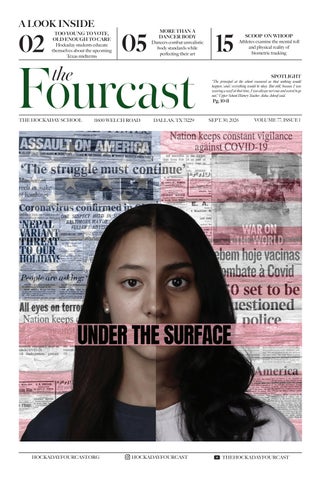
A LOOK INSIDE
02
TOO YOUNG TO VOTE, OLD ENOUGH TO CARE Hockaday students educate themselves about the upcoming Texas midterms
05
MORE THAN A DANCER BODY Dancers combat unrealistic body standards while perfecting their art
Fourcast the
THE HOCKADAY SCHOOL
11600 WELCH ROAD
HOCKADAYFOURCAST.ORG
DALLAS, TX 75229
HOCKADAYFOURCAST
15
SCOOP ON WHOOP Athletes examine the mental toll and physical reality of biometric tracking
SPOTLIGHT
“The principal at the school reassured us that nothing would happen [and] everything would be okay. But still, because I was wearing a scarf at that time, I was always nervous and scared to go out,” Upper School History Teacher Aisha Ashraf said.
Pg. 10-11
SEPT. 30, 2026
VOLUME 77, ISSUE 1
THEHOCKADAYFOURCAST
02
NEWS
The Hockaday School
TOO YOUNG TO VOTE,
OLD ENOUGH TO CARE
Students educate themselves on the upcoming midterms
By Aneeka Tansen Managing Editor
$18B+
Elias speaks with Talarico at his Love Thy Neighbor Grocery Drive. Photo: screenshot from @teamtalaricohq
tax cut for Texas property owners issued by Gov. Greg Abbott
20,000+ pounds of groceries collected through Rep. Talarico's "Love Thy Neighbor" drive
Abbott appears on stage at Texas Republicans Party convention in Houston. Photo: screenshot from @abbottcampaign
W
ith the midterms nearing, two Texas races are especially competitive: the seats for Governor of Texas and Senator of Texas. On the Democratic ticket is Texas State Rep. James Talarico (Senator) and Texas State Rep. Gina Hinojosa (Governor). On the Republican/Grand Old Party (GOP) ticket is Texas Attorney General Ken Paxton (Senator) and Texas Governor Greg Abbott (Governor). The Texas midterms have drawn attention across the U.S. mainly because the Senate race could decide which party controls the U.S. Senate. Paxton and Talarico have been polling closely with Talarico currently holding a slight lead, according to a recent AARP poll that placed Talarico four percentage points above Paxton (48 percent to 44 percent respectively), which introduces the possibility of Texas “flipping” after a three-decade GOP stronghold. Talarico’s faith-centered “Love Thy Neighbor” approach as a progressive populist sets him apart from previous Democratic candidates; in addition, Ken Paxton’s primary win made national news because it displayed Trump’s grip on the GOP, since his endorsement toppled fourterm incumbent John Cornyn. Junior Elizabeth Atkinson has spent time with her family watching various candidates’ past interviews and believes that it has helped her understand what makes a well-rounded candidate. “I've listened to a couple of interviews with my mom and my dad,” Atkinson said. “We broke down what [they were] saying and how it was important for any political candidate to explain why they are going to
be good rather than just bringing down their opponent.” Exposure to political rhetoric has made Atkinson more cognizant of candidates’ campaigning strategies. “Now that that's been on my mind, I see it in a lot of political ads, just bringing down the other opponent rather than showing why you would be a good candidate,” Atkinson said. When researching candidates on both sides, Atkinson emphasizes going directly to the source for information rather than relying on secondary avenues. “I started doing my own research on Paxton and Talarico by going to [their] websites to see what they both stand for,” Atkinson said. “I think it's really important to see the bias everywhere and to hear from the source about what they are fighting for. Even though I can't vote, I think it's still good to be informed about what's going on and what their goals are.” Though Atkinson is still 16, she finds staying educated about local politics important and already has a list of ideals that she prioritizes in candidates. “What matters to me is not only how things will affect my rights as a woman of color but how it will affect others,” Atkinson said. “I think it's important that everyone has the same opportunities while keeping us all safe.” By making an effort to listen to others with differing views, Atkinson has been able to both strengthen her own values and understand others better. “I've had one discussion with one other person who thought differently,” Atkinson said. “I try to remind myself that even if I don't agree with someone, nine times out
Hinojosa converses with her supporters. Photo: screenshot from @teamginatx
of 10, they have a reason for feeling the way they feel or supporting what they support. I tried to hear her out, and it was really interesting to be like 'I never thought of it from that perspective.' I found that conversation really productive, and I want to have more with people that I don't have the same views as.” Junior Briar Metcalf spent her summer engaging with people around the country about the midterms as part of Close Up 250, a student program based in D.C. Metcalf was surprised at the national interest in an election that seems so local. “I've talked to a lot of people in different states,” Metcalf said. “I think it's a debate that a lot of people care about, especially for a midterm where a historically Republican state has held office for a while.” In D.C., Metcalf had the chance to hear from professionals in politics, including Ben Turner who leads fundraising and media for the Talarico for Texas campaign. “They are looking at advertisements [from] a new perspective, specifically by focusing on what Paxton has done wrong,” Metcalf said. “Negative campaigning has gone on both sides, and I think it will definitely continue.” Metcalf has taken a specific interest in the fundraising behind campaigns. “I've been following local races for a while,” Metcalf said. “Campaign fundraising is an important part of transparency, especially in Texas for the last couple of years.” Although Metcalf cannot vote yet, she believes that teens should care about local elections now. “We could have [the candidate] in office for a long time,” Metcalf said. “If you put
them in office, you have to think about their legacy. When you elect them the first time, that's when it really matters.” Atkinson said that regardless of one’s impact, passion should be guided by ideals. As she continues to learn more about local politics, she believes that holding onto personal values matters even when one cannot act on them yet. “At the end of the day, morals, no matter if you can act on them, are the foundation of who you are,” Atkinson said. “I think it's really important to carry them with you through everything.” Senior Sara Elias, who attends Townview TAG High School, spent the summer working with Hockaday students at the Texas Hispanic Policy Foundation (TXHPF), a nonpartisan nonprofit that conducts original polling, research and analysis on the Hispanic Texans. “Getting to talk to people so intertwined with the entire political atmosphere has been such a great experience,” Elias said. “I’ve also been in contact with both the Hinojosa and Talarico campaign, so it has been great getting to learn about these candidates and what politics is looking like right now.” During the summer, Elias created social media posts and collected a list of potential donors for the foundation. Through her work understanding both sides, it became evident to her what she values. Elias was drawn to Talarico and Hinojosa’s campaign and recently joined a joint block walk for the campaigns. She spent four hours knocking on doors, tracking support for the campaign. See TX MIDTERM, Page 3
the
Fourcast
September 30, 2026
03
Zero calories. Zero sugar. Zero risk? Diet soda negatively affects consumers despite being the "healthier option"
T
By Deetya Dinesh Staff Writer he ads all say: “diet,” “no sugar” and “guilt-free.” The research says: 66 percent higher risk of developing Type 2 diabetes from just two cans a day, thousands of times sweeter than real sugar and 200 percent higher risk of obesity (Arkansas Health Hospital). For students and faculty alike, caffeinated beverages are a daily necessity to keep up with busy schedules. History teacher Dr. Elizabeth Bennett drinks a Diet Coke every afternoon as a “healthier” fix for sugar cravings. “I was eating a lot of chocolate [every afternoon], and I was like, ‘This is not good. I got to find something else that is kind of sweet, like a treat, a break, but not just loading up on candy,’” Bennett said. “It just didn’t seem like a great idea.” Bennett has been drinking Diet Coke for years because of its flavor and sugar-free alternative: aspartame. However, she learned to be careful with how much she incorporates into her daily routine. “Sometimes I would drink Diet Coke, and then my blood sugar would drop,” Bennett said. “I would get really shaky, and I was like, ‘That is super weird, because it does not have any sugar in it, and I'm very sensitive to [sugar].’” Now, Bennett balances her afternoon Diet Coke with trail mix to stabilize her blood sugar and help her feel good throughout the afternoon. She is not concerned about the risks of drinking Diet Coke though.
TX Midterm
“It’s moderation,” Bennett said. “It’s a treat. It’s not like I’m drinking five of them a day.” However, some students cannot say the same. Senior Vittoria Sofia Testa, a self-proclaimed Diet Coke addict, drinks between two to five Diet Cokes a day. “I think that they’re better than regular soda,” Testa said. “The more diet soda I have, the happier I am.” Nevertheless, her happiness comes at a price. Testa too has experienced some side effects of her high diet soda consumption. “It’s technically healthier, but there are some downsides,” Testa said. “It dehydrates you, and I’ve found that I don’t sleep as well drinking a lot of diet soda. It’s 100 percent worth it though.” From a health perspective, diet soda has physical side effects. The term “diet” also negatively affects consumers from a psychological standpoint. Health teacher Dr. Kim Ferner sees this as a common issue. “I think the word ‘diet’ is one of those fad, thin, healthier things,” Ferner said. “I think you put ‘diet’ on something and then automatically in our brains, we think, ‘Oh, it must be healthier.’ Everyone knows it’s bad, but then you’re like, ‘Oh, its diet soda,’ it’s not as bad.” As social media popularizes diet culture, as evidenced by trends like dirty diet sodas, the language and reasoning behind these foods could pose a danger, especially for high school girls. “I think dieting is not necessarily a problem, but it can become an unhealthy prob-
lem,” Ferner said. “Using [diet soda] as an everyday thing or relying on caffeine in general to function, I think that’s where there’s a problem.” However, there is a time and a place for diet sodas as a treat. Ferner’s personal recommendation is one diet soda a week, but individual preferences and health can certainly play into this estimate. “I think moderation looks different for everyone depending on where their health stands and any different concerns they might have,” Ferner said. This guidance is especially applicable to teenagers. Even though there is not currently much conclusive research about the effects of diet sodas on teenagers, high schoolers should be careful about their intake. “Your brains are still developing, your bodies are still developing and [diet sodas] could have a negative impact,” Dr. Ferner said. “If there is a negative impact, I don’t think it’s talked about enough so that people are aware of it and making informed decisions.” Photo: The Coca-Cola Company
Continued from Page 2
“You can’t try to convince anyone when you’re door-knocking,” Elias said. “That makes it hard because as much as you want to be like, ‘This is what I believe in, and I want you to believe in this too,’ you can’t do that. The impactful conversations we were having were with the people in the middle.” Elias said she once ran into an undecided voter who was not on her list to talk to. “There was a lady just walking on the street, and she saw us holding flyers and asked us what we were handing out,” Elias said. “She told us that she is an independent, so we asked her what she is worried about in Texas. We then went through each point and gave her reasons why we believed our candidates possessed what she was looking for. Informing her that one day could have made a difference [in] her vote. If there are people doing the same thing around the state, that is extremely impactful and special.”
As part of her work with TXHPF, Elias had the opportunity to meet Talarico at one of his recent “Love Thy Neighbor” grocery drives. To Elias, it was his faithcentered approach that first drew his campaign to her. “At the event, a pastor gave a speech,” Elias said. “Seeing Christianity, a big thing on the GOP ballot, come into play with a Democratic candidate was a really cool mix that I didn’t think I would see. My parents are Christian immigrants, and as much as they want to support the Democratic candidates, faith is also huge to them, so this really bridged that gap.” Through her work with the foundation, Elias learned the value of nonpartisan work. Even though she now aligns with a particular party, she is the strongest supporter of policies that benefit all Texans. “One thing that Talarico said that resonated with me was that he didn’t want
to turn Texas blue; he wanted to turn it purple,” Elias said. “Of course, he said it in a more impactful way, but the goal of blurring generational and partisan lines, as opposed to issues that separate the aisle, places the focus on everyday Americans.” Just like Atkinson and Metcalf, Elias cannot vote yet, but that has not slowed her down. She values learning about candidates so that when she turns 18, she will be prepared to vote for what is important to her. “Everything in politics builds,” Elias said. “If I want to be an informed voter come next year, the best way I can do that is stay tapped into what’s going on right now, so it doesn’t feel overwhelming when I start to vote.”
Your voice matters. The voter registration deadline in Texas for the Nov. 3, 2026 Uniform Election is Oct. 5, 2026. Scan here to register to vote:
Talarico and Elias
Photo courtesy of Sara Elias
04
FEATURES
The Hockaday School
Sharing stories on a summer stage Seniors perform in Stagedoor production
T
By Sarah Nosratinia Staff Writer
heater can tell stories that history books leave behind. For seniors Lauren Lockhart and Varsha Jagarlamudi, that came to life at Stagedoor, a performing arts summer camp in upstate New York that trains some of the best young actors. They immersed themselves in the world of theater, performing in productions while taking various classes. For both Lockhart and Jagarlamudi, Stagedoor’s environment demanded a level of commitment that was familiar from their experiences at Hockaday. “Stagedoor definitely mimics a professional rehearsal environment,” Lockhart said. “The work ethic [Hockaday] instilled in me was really helpful going into it. I learned about the commitment it takes,
building good habits and how to practice.” For Jagarlamudi, Stagedoor was an opportunity to challenge herself in new ways while performing in “Head Over Heels.” “It was really great stretching my experience as a dancer,” Jagarlamudi said. “There was lots of teamwork and bonding, feeding off of each other on the stage. The intensity of the program also reinforced why she was there in the first place. She leaned into her passion for theater and the driven community around her. “Being in that intense environment and around people who have the same goals as me is a privilege,” Jagarlamudi said. The demanding schedule meant they had to learn quickly. “In reality, you’re rehearsing for two weeks to put up 2.5-hour show,” Lockhart said. “Along with that show, Stagedoor has something called Our Time Cabaret (OTC).” OTC is the best dancers, singers [and] actors putting on a cabaret about the journey of an actor. On top of learning my show, I also had to learn that OTC show in Lockhart performs in "Suffs" at Stagedoor. Photo courtesy of Lauren Lockhart just two weeks.”
As the performers adjusted to the camp's intensity, they also had opportunities to work with experienced theater professionals. One of those professionals was Broadway actor and composer Shaina Taub, who wrote the music and lyrics for the musical “Suffs.” Suffs explores the women’s suffrage movement and the fight for the 19th Amendment. One of Lockhart’s most memorable moments from the show comes after the death of one of the main characters, when the women ask, “How long must a woman wait for liberty?” “It was opening night, and you’re looking around at moms crying, dads crying and grandparents crying,” Lockhart said. “You’re looking at all of these generations of people that have been impacted by the same thing.” The audience’s reaction taught Lockhart how theater could connect history with a modern audience. “These women have been forgotten in history, and by doing this show, we brought their story back to life,” Lockhart said. “That’s what theater and acting is about: reflecting those parts of humanity.”
The experience reinforced what she had learned from working with Taub: artists can use stories to make people reflect on issues that continue to matter. “I now feel I have a responsibility to use my voice to stand up for what I believe in,” Lockhart said. “I hope that every show I do can inspire girls like me to create art and be changemakers.”
Harnessing hope
Sophomore Isha Kapoor creates juvenile cancer nonprofit By Savannah Simon Arts & Life Editor
cancer community as a whole and realized that children may not have the ability to find support groups like her mom did. She decided she had to break the barriers of isolation surrounding juvenile cancer patients. “Parents might be busy with medical stuff and might not think about the mental well-being of children,” Kapoor said. “I wanted to show [the kids] that there are people supporting them.” After significant brainstorming, Kapoor formed a nonprofit called Hearts for Hope with the intention to bring joy directly to children’s bedsides by delivering toy kits. Logistically, it seemed overwhelming to bring her idea to fruition, but her fierce determination fueled her path forward. “I started putting myself out there,” Kapoor said. “Over the summer, I [raised] over $1,000 by just talking to people. I went door-to-door to my neighbors and told them about my mission to fund the boxes of toys.” After she secured financing from fundraising, she considered how to keep the donations consistent and sustainable. She created an Instagram to draw more traction and donors. Once she had the capital in place, she investigated what kinds of toys her kits could include. “I go pick five to seven toys that account for all ages and [include] an Kapoor delivers toy kits to Cook Children's Medical encouragement note,” Kapoor said. “I try to put in entertaining things Center. Photo courtesy of Isha Kapoor
Last summer, sophomore Isha Kapoor found out her mom had breast cancer. Struggling with her mother’s cancer diagnosis, she turned her grief into positive action. She saw her mom's fear and noticed that emotional support for cancer patients was not prioritized. “She had to go by herself and find Facebook support groups,” Kapoor said. “It felt like she was alone.” Support groups offered her mother comfort from those who experienced the same affliction. Kapoor reflected on the
like squishes and fidget toys but not things that [the kids] have to go outside to use.” The final logistical obstacle was finding a hospital willing to accept the kits. Kapoor crafted letters detailing her mission and work, then physically pitched her organization to Cook Children’s Medical Center, who gladly recieved the toys kits. “It was scary at first because I didn’t know how they would respond,” Kapoor said. “I talked to more staff, and it became easier.” Although Kapoor cannot directly meet the children due to legal reasons, she still gets glimpses of the kids’ reactions from word-of-mouth. “When I'm talking to the hospital staff, they're so sweet,” Kapoor said. “I'm just happy I get to donate and they feel grateful.” Kapoor also intends to spread Kapoor packs the toy kits for delivery. her work across borders, specifically Photo courtesy of Isha Kapoor charity just to say they did charity, but I in places that need medical aid. “My parents go to India once a year,” think if you don’t really deeply enjoy what Kapoor said. “Maybe they'll be able to you do, it’s a waste of time.” Kapoor intends to bring her innovative bring the boxes to a children's hospital in my dad's hometown where the funding has philanthropic opportunities to campus with a Hearts for Hope club. She believes been cut.” Philanthropy requires an enormous in spreading joy and opportunity with her amount of work, and Kapoor believes that peers but most of all, encouraging them to it is truly only rewarding when you put your kickstart a mission to help the community. “Don't wait for something to come to heart into it. “It [matters] how passionate you are,” you,” Kapoor said. “Go do it for yourself.” Kapoor said. “I know a lot of people do
the
September 30, 2026
Fourcast
05
More than a dancer body
Dancers combat unrealistic body standards
F
By Bridget Chisolm and Isabella Silva Staff Writer
or decades, women have faced intense beauty and body standards in competitive sports like dance and cheerleading. Many dancers struggle with body image while perfecting self-expression through physical movement. A 2025 study done by the International Association for Dance Medicine & Science showed that dissatisfaction in body image was present in 65 percent of adolescent ballet dancers. The expectation of all dancers to look identical on stage has bred negative expectations over the years of what a “dancer body” should look like. Company directors in the dance industry are now starting to move towards individuality and the capabilities of athletes over simply their body image.
ally skinny, it makes us also want to be like that, even though it’s sometimes not healthy,” Liu said. “You are unique, but that’s what makes you special.” Sophomore Anya Elizondo has been a dancer since she was three years old. In fifth grade, she started noticing body standards in dance. After not making one of the competition dances, she learned the decision had nothing to do with skill but with her body instead. “[My dance teacher] told me that the reason why I didn't make [the dance] was because she only wanted dancers with an athletic body, [with] visible abs so she could put them in crop tops.” Elizondo said. “I didn't have the body type that she wanted, so she didn't want to put me in a crop top.”
- International Association for Dance Medicine and Science Graphic courtesy of Anya Elizondo
Harmful body image expectations within the industry have led to many dancers developing a negative relationship with the art form. Senior Betty Liu, who has been a dancer for the past eleven years and has danced in all different genres, including Chinese classical dance, jazz, ballet, contemporary and lyrical, believes these beauty standards are unrealistic expectations that foster societal pressures resulting in negative self-perceptions. “When [dancers] look in the mirror every day at the dance studio, [they] see changes that [they] want to make to [their] bodies,” Liu said. “There’s no one that thinks they have the perfect dancer body. That’s just not a thing.” With social media creators promoting unreasonable body standards, it can be easy for young dancers to fall into the comparison trap, ultimately harming their overall health by creating a false sense of reality. Instead of focusing on these unrealistic body standards, Liu believes that having confidence in your body and embracing your own individuality is what truly defines a healthy body. “When we idolize those influencers and celebrities who are re-
After hearing these harsh words at such a young age, Elizondo’s mindset about food and bodies shifted. “I started comparing my body to the bodies of the girls who made the dance, which is inevitable when your sport requires you to spend hours looking at yourself in the mirror,” Elizondo said. However, Elizondo did not let that negative moment get in the way of the friendships she made and experiences she had throughout her time pursuing dance. “I mainly love dance because of all the friendships and memories it’s brought me,” Elizondo said. “I look past the intense body image pressure by knowing my body doesn’t affect the friendships and memories I made.” Body image remains prevalent even in sports outside of dance such as competitive cheer. St. Mark’s Cheerleader Junior Kate DeBoever has participated in competitive cheer since 5th grade and has similarly encountered unhealthy body standards throughout her time cheering. “For modeling the uniforms, it's always going to be the skinniest girls,” DeBoever said. “It will never be someone who has more muscle on them, and even if you have muscle, coaches still con-
sider that to be fat; you're overweight, you're too big.” Young girls are constantly forced to consider uncontrollable aspects of physical appearance to create an unrealistic aesthetic appeal. Health and physical capability come second to fulfilling strict body standards in young athletes in the competitive cheer world. “I quit a team because the coach would always fat shame me,” DeBoever said. “Then, I got replaced by this tiny flyer who was skinnier than me." These standards breed negative criticism in an athletic setting. The stress of conforming to a single body type causes mental health issues that uproot positive self-worth and value. “When I left my old gym is when I think the eating disorders were getting really bad,” DeBoever said. “And these girls are like skin and bones, and people looked at them and be like, ‘I wish I looked like her,’ because that's what you're told in the cheer world. That's what you're supposed to look like, even though that's really unhealthy.” Advice from parents and support from peers helped her navigate difficult moments without losing her passion for the sport. Through overwhelming criticism, DeBoever has learned that maintaining confidence in her abilities is ultimately what shapes her performance as an athlete. “My dad always told me, ‘Control what you can control,’” DeBoever said. “You cannot control your coaches, [but] you
[can] control your attitude and how you think of yourself and that's all that matters.” The key to growth in any community is to find support in the people surrounding you. For many dancers, including DeBoever, the dance community has been a fundamental part of their lives. “You have to find your people, and if you can, you find yourself a family, someone you can talk to, and honestly, just be yourself around,” DeBoever said. Hockaday Upper School dance teacher Mandy Stallings has been a dancer her entire life, beginning dance as a small child, eventually working with the acclaimed choreographer Cleo Mack and her Cleo Mack Dance
DeBoever, age nine, competes at Spirit of Texas Shade. Photo courtesy of Kate DeBoever
Company. Mack is the recipient of two Individual Artists Fellowships from the New Jersey State Council of the Arts and dubbed by Dance Magazine as the “25 to Watch”. Stallings worked with Mack for a total of 18 years, ranging from 2008 to 2026. Stallings’ own choreography has been presented in many venues across New York City. She believes that mentors and members within the community are beginning to acknowledge these harmful standards and expectations. “I think that the dance world, especially in the last 10 to 15 years, has made real, purposeful [and] intentional shifts to celebrate dancers of all body types, races [and] ethnicities,” Stallings said. “The dancers have put in the work to make sure that all dancers are visible and feel like they have a place in the community”. Stallings reflects on her experiences as a young dancer and how dance has shaped her life. She believes it allowed her to express herself as a shy and quiet child, building her confidence in self-expression. “It was liberating to get to a place of confidence and understanding of my body and my movement,” Stallings said. Photo courtesy of Anya Elizondo
As a dance teacher, Stalling believes in protecting the dance community and nurturing young dancers to feel comfortable and confident in their bodies. Drawing from her own experiences with past dance instructors, she strives to create a positive environment for her students at Hockaday where every dancer feels heard and cared for. “As teachers, as leaders in the dance community, there are ways to have conversations with young people about making sure that they're staying healthy and safe,” Stalling said. “It is important to acknowledge and know when to intervene to get help for people.” Dance transcends the harmful ideals society places on young female athletes and instead emphasizes human connection and creativity through movement. The dance community is constantly working to protect the mental and physical health of dancers as they grow to make an impact on society and establish their identity. “Dancers have to be really intelligent in so many different ways,” Stallings said. “You have to have emotional intelligence, you have to have body intelligence, [and] you have to empathize with other people [and] partner with each other [to] create that kind of community.”
06
The Hockaday School
FEATURES
New year, new classes
The English department debuts six new English seminars
A
By Mary Elise Estess Web Editor-in-Chief s the Class of 2027 stepped onto campus in August, they donned their senior polos and hopeful attitudes. These stylish upgrades were not the only new things for seniors this year; the English department revamped senior course offerings and introduced six new senior seminar classes. These senior seminars include Literature and Adaptation: Standing on the Shoulders of Giants; Disability Pride: Literature, Representation, and Social Change; Call of the One Ring: A Study of Tolkien; Awakenings and Rebellion: The Literature of Women Artists; Blue Skies Smiling: Reading for Hope in Contemporary Climate Fiction; and The Literature of Gossip.
Literature and Adaptation: Standing on the Shoulders of Giants
In Dr. Jennifer Boulanger’s senior seminar, students pair original texts with modern and contemporary adaptations that provide a different approach to the text. The inspiration for this seminar came from the book “James” by Percival Everett, a book that is taught in her course. Dr. Boulanger has been teaching senior seminars for almost 11 years. Some of her previous seminars include Short Stories, Monsters and Creative Writing. So far, her class is enjoying the new material. “This year is fantastic because my kids are so excited about the topic, and I really love that passion,” Dr. Boulanger said. “One of the cool things about the seminars is that there is an element of choice, which means students in your room have chosen to be there and are excited to be there.” Another thing that Dr. Boulanger enjoys about senior
seminars is the level of maturity and academic capability that seniors have, especially in the second semester when most seniors have been accepted into college. “[The seniors] are so talented and capable that it reminds me of when I taught college,” Dr. Boulanger said. “[They] challenge me. I learn so much from my seniors because [they] are at a much more advanced level that is also infused with passion.”
Call of the One Ring: A Study of Tolkien
Upper School English teacher Benjamin Gerdts took on the unique task of creating a seminar class centered around a single text: “The Lord of the Rings.” “[It] was both exciting, because I love the
“It's the blend of curiosity that seniors have, but also the intellectual maturity that they have,” Gerdts said. “I hope to turn at least one-third of them into lifelong Tolkien nerds, and
Disability Pride: Literature, Representation and Social Change
Disability Pride, taught by Dr. Claire Cothren, was first offered as an interdisciplinary course around three years ago. This year it is an official English senior seminar. “I wanted to create a class that not only talked about disability concepts, language and history, but helped students think about how to evaluate representations of disability in the things that they read and in the world around them,” Dr. Cothren said. A unique aspect of this seminar is that it is a social impact class, so students will use the exploration of disability in literature to engage with the Dallas community through field trips and projects. As part of a class project, students will be asked to create an accessibility proposal for a group or space in the Dallas community using the principles of inclusive design. Dr. Cothren said she created this class because of her son, who has a disability. Before the birth of her son, she had never really thought about disability as an identity or a lens through which to view the world. “He changed my whole view of the world,” Dr. Cothren said. “I think it's a view that everybody should be exploring.”
text, and it was also very challenging to design a class around just one text,” Gerdts said. Teaching a seminar appealed to Gerdts because he enjoys teaching seniors, and a seminar class provides a unique circumstance where he can be immersed in a topic of his choosing. “Seminar classes are fun because you can geek out as a teacher, teaching stuff that you like and want your students to like as well,” Gerdts said. He said the seminar class does not feel as rigid in terms of the curriculum. The independence of seminar classes allows teachers to progress at their own pace. “With the lower forms, you’re on a team,” Gerdts said. “You need to hit certain benchmarks at certain times so that you're not getting to something later than your teammates.” Gerdts said teaching a senior seminar is a great experience because of the capability of his senior students.
then the other two-thirds to know that they have the capability and patience to get through a 1,000-page novel.”
Awakenings and Rebellion: The Literature of Women Artists
This seminar looks at the literature of women artists, including poetry, novels, and short stories about fictional and living female artists and female artists who, in addition to creating visual art, produce their own writing. Taught by Upper School English department chair Dr. Jason Goldstein, this class begins by providing a foundational understanding of issues women artists have faced since the 19th century. “Then, we fast-forward to the present day, looking at how these issues have lingered and how women have rebelled against them,” Dr. Goldstein said. Dr. Goldstein has an educational background in both art history and literature, and he is always looking for ways to bring the two into conversation. “Throughout our course, we examine the relationship between word and image and give students experience making interdisciplinary connections,” Dr. Goldstein said. “I’ve always enjoyed teaching a senior seminar. It gives me a chance to explore some of my own academic interests with students, and it's also great to see the culmination of all their work over the course of four years and see how they have matured as readers and writers.”
Blue Skies Smiling: Reading for Hope in Contemporary Climate Fiction
Texts and course readers for the senior seminars Photo courtesy of Mary Elise Estess
Upper School English teacher Sara Harder knew that she wanted to teach a seminar about na-
ture and the environment but narrowed her focus to climate change as a source of conflict. “As I've been reading with my own book clubs or watching my children select their own texts, I noticed an emerging trend of hopeful stories,” Harder said. Climate literature can be a daunting genre in today's world, which is why Harder wants to emphasize that climate literature offers
optimism by presenting creative solutions to the crisis. “The hope part of this was just thinking about our students and how [they] are going to be the changemakers, the problem solvers,” Harder said. “I thought if [all they] read is pessimistic dystopic literature that doesn't give [them] that glimmer of hope: how are we modeling creative problem solving?”
The Literature of Gossip
Upper School English teacher Parker Stoker got the idea for his seminar while listening to the podcast “Normal Gossip” during the coronavirus shutdown. At the time, he was struck by how similar fictional literature and gossip were. The connection between the two goes back centuries, when the literary novel itself was at one point considered a feminine and frivolous mode of discourse. This seminar takes a literary approach to the human instinct to narrate other people's lives as a way of understanding our own lives and each other. “There are so many parallels between how the novel was talked about and how gossip has been treated,” Stoker said. “I had never approached gossip as it is represented in stories or as inspiration behind literary fiction.” Stoker noted one aspect of his class that is a product of the exclusively senior demographic: his students' familiarity with their peers. “I thought it was really cool on day one how my students clearly knew each other pretty well already,” Stoker said. “They were able to pick up and go with discussion right off the bat.”
the
September 30, 2026
Fourcast
07
The summer shift
Students spend summers working, learning and earning
C
By Gwendolyn Becker Multi-Media Editor
utting vegetables, making smoothies in the kitchen and taking orders is how senior Maddie Brandt spent her summer. Brandt decided to work at Juice Land because it was one of her favorite places to eat. “I knew I wanted to work at Juice Land because I go there all the time, and I really like their food,” Brandt said. “I applied specifically for Juice Land through their website.” Before starting work, Brandt took about three weeks getting her Food Handlers certification, filling out several forms and training. On the job, new types of challenges arose. “The long hours coupled with having to write college essays was a lot of work,” Brandt said. “All my shifts are around eight hours.” This job changed Brandt's ideas about customer service and the realities of having a job in high school. “It made me more appreciative of people who work in customer service,” Brandt said. “Sometimes it can be a lot, and customers aren’t always the nicest.” Sophomore Jordan Lannen spent her summer in customer
service, working at Dallas workout studio Ritual One. “What made me want to get a job at Ritual One over the summer was that I wanted to fill my time with something I enjoy doing and something that would keep me busy,” Lannen said. “I [also wanted] something that would benefit me and bring in an income.” Lannen’s first day at work was different than she had expected. In her role as a receptionist, she checked people in, cleaned the rooms between classes and kept the studio clean. “I thought everything was going to be a lot slower, and I was going to have time to adjust, but I really just got thrown out there,” Lannen said. “During the rush times, it was hard, but it always kept me on my feet.” This job has also taught Lannen a lot about what she wants for her future. “It definitely taught me that I want to do something with people where I am engaging with others,” Lannen said. “It helped me with my public speaking and with people I don’t know. It showed me I want to do something with the community.”
Senior Sudha Kodem spent her summer helping the community by working at the Dallas Water Department, where she learned about water systems, municipal infrastructure and data on University of North Texas’s campus. “I found my job from an email from Dr. Fischel about applying to this internship, so I sent in my application,” Kodem said. “I got an email the next day requesting an interview.” Once hired, Kodem worked at the Dallas Water Department with other high school students for seven weeks during the summer. “I liked the opportunity to do data analysis and learn skills I haven’t been able to learn at school,” Kodem said. “We did data analysis on water quality, and we used geographical information systems to map how water consumption happens over Dallas.” Kodem’s internship also included field work. “We did research into the actual quality of water by going to different lakes, sampling them and doing lab work,” Kodem said. “This was to figure out how the
Kodem presents her work with the Dallas Water Department. Photo courtesy of Sudha Kodem
microorganisms in the water affected the quality of it.” At the end of her internship, Kodem and her coworkers presented their findings to the city and created a solution on reducing water consumption. “I worked really hard on [this presentation] because my part was forty-five minutes long,” Kodem said. “Just practicing and preparing and going over it over and over with my coworkers really stood out to me.” Above all, the summer work experience provided all three girls
with a sense of independence. “I was able to make and spend my own money,” Brandt said. “It also gave me a new insight into all the hard work that goes into an everyday shift, something that may seem ordinary to other people.”
Notes with meaning
Students spread love and help children find their voice By Neela Reddy Staff Writer works alongside teachers, caregivers and clinicians. It’s helped many children find their voices and, in doing so, has also helped their families. Having not heard her nonverbal daughter's voice in years, her mother, overjoyed, relayed her gratitude to Miracle Melodies in a letter, conveying the impact it had on her and her family’s life. “She pretty much came up and started singing with us,” Amanda Greene said. “Her mom was also there, and that was the first time she had seen or heard her daughter talk in three years, so she wrote us a really beautiful letter talking about how she was so happy that she could see her daughter be so happy again.” Greene, president of the Miracle Melodies Hockaday chapter, said that music has always Green at AUsome Moms resource fair been a huge part Photo courtesy of Amanda Greene
After three years of being nonverbal after the loss of her father in an accident, a young girl began to sing for the first time at a Miracle Melodies event. Miracle Melodies is a student-run volunteer group in the Dallas-Fort Worth area. Created in 2022 by a group of Cistercian alumni, this organization brings interactive music sessions to children and individuals with developmental disabilities and
of her and her brother, William's, lives. William is one of the founding Cistercian alumni of Miracle Melodies. “I’ve been playing piano since I was four, and my brother has been playing since he was four as well,” Amanda said. “We grew up doing different piano styles, just playing piano for hours a day.” Amanda and Williams’ love for music runs in their family. Their father, John Greene, shares a passion for singing and also plays the guitar. Their mother, Xuan Greene, has played the violin for most of her life. Amanda’s family fostered her deep-rooted love for music, especially playing the piano or immersing herself in singing choral music. “Even though playing the piano was stressful at times, when it sounded good, it would bring such a calm to me,” she said. “My brother likes to improvise playing the piano a lot. It would be super calming for him, so he thought that it would be really cool if he could share that with other people.” The Hockaday chapter meets once a rotation, and members plan, pick songs and practice music. Amanda said Miracle Melodies is open to all students.
“You don’t even have to be super musical,” Amanda said. “Honestly, you just need to be empathetic and treat others with respect. All it takes is a little passion and enthusiasm.” Miracle Melodies strengthened the bond between Amanda and William, as well as the lives of all the other families it touched. “My brother would always ask me about what songs we should do, and we would practice together,” Amanda said. “That was a really good bonding moment for me and my brother. Having my brother as my mentor helped me lead Miracle Melodies when he was gone.” After William began at Northwestern University, he created a Miracle Melodies chapter there, while Amanda took over as head of the North Dallas chapter. Miracle Melodies has since partnered with many different schools and organizations across the Dallas metroplex. “When I started school at Hockaday, I made Miracle Melodies a club to gain more volunteers, and we did private lessons for children,” Amanda said. “We worked with Hanks Friends, Dominique Cares, AUsome
Moms and other organizations, expanded within our circle and performed at resource fairs. We partnered with different memory care centers, and we worked with schools like St. Mark’s, Greenhill, Woodcrest and Booker T. Washington.” Since joining Miracle Melodies, Amanda has experienced unforgettable moments, like the nonverbal girl finding her voice. She said moments like this transform volunteers, fostering deep gratitude and reflecting the compassionate spirit at the heart of Miracle Melodies. “It’s made me more empathetic, given me a lot of patience [and] taught me a lot about myself,” Amanda said. “Honestly, it’s made me a lot happier, because I love seeing the impact it has on people: not just the people I work with but also their families. Music is really powerful, so it brings the character back to [people]. With our dementia and Alzheimer's patients, they just kind of sing along with us a lot so it’s great.”
08
The Hockaday School
ARTS & LIFE
Giving garden
Program supports learning in science and social impact
D
By Virgina Epperson Staff Writer
irt under their fingernails and green jumpers spilling soil onto their legs, Lower School first-graders march back inside after a class period spent working in The Hockaday Garden. Adjacent to the green-top sport court, the current garden succeeds a long line of school agrarian practices, beginning with Miss Ela Hockaday’s World War II victory gardens at her home on Fisher Road and, in the 1980s, a fenced-off gardening space on the present-day soccer fields near the playground. However, for Lower School Garden Coordinator and Science Teacher Lara Guerra, today’s Hockaday Garden represents something more than just a place for students to get their hands dirty. “I really want everyone in the community to feel like they can use [the garden],” Guerra said. She and other Lower School faculty members use it as a learning tool in their classes for science and social impact. Guerra teaches a first-grade gardening class and co-teaches third-grade
Science and Social Impact (SSI) with Social Studies Teacher Paloma Gomez. Art Teacher Emily Dutcher combines science, art and nature journaling into a second-grade Field Studies class. However, Guerra stresses that teachers are not the only individuals that contribute to the garden’s role as a STEM and social impact foundation; parents, alumnae, Maintenance, administration and older students all play an incredibly valuable part in its caretaking. With the combined efforts of so many people, Lower School Daisies get a fuller experience. Pre-K covers seeds, plants and pollinators, and Kindergarten, in addition to a cooking class, learns all about bulbs. Kindergarten girls also begin to practice giving back to their community through the bulb study. “They each get to take [a bulb] home,” Guerra said. “And they start one on stone that goes to a senior center, I believe, in East Dallas.” Daisies build independence by selecting their plants, tending to them, observing their life-cycle and developing resilience when
faced with obstacles like weather issues and infertile seeds. They also have the opportunity to take their crops home and learn how fresh produce contributes to a well-rounded meal. Firstgrader Caroline Beacom said that the onion bulb donation was her favorite part of kindergarten science. “We plant all sorts of plants in the garden and research animals and flowers,” said Beacom. Social outreach through The Hockaday Garden, however, extends beyond the kindergarten bulbs and first-grade gardening class. In the third-grade SSI class, Daisies focus on food insecurity and how nutrition choices impact overall bodily functions. The class dedicates all of their garden beds to charity. Melanie Robinson, Director of the Institute for Social Impact, deliberately organizes filters the crops into various charities. “[Robinson] knows onions go to a senior center because they use a lot of onions,” Guerra said. “Whereas if we sent that to a middle school, the kids would say, ‘ew, what is that? I don’t want to eat that.’”
Lower School Giving Garden Photo courtesy of Virginia Epperson
During the 2025/2026 school year, the SSI class donated 308 pounds of kale, cabbage, onions, lettuce, cilantro and potatoes to charity. Guerra, however, wants girls in all divisions to take part in this massive science and social impact mission. “We started out as ‘The Lower School Garden,’ but I don’t want it to be just the Lower School,” Guerra said. Sophomore Sophia Marsh confirms that The Hockaday Garden impacts more than just our youngest Daisies. “The Lower School garden is one of my favorite memories of
Lower School because it was just all of us having fun in the garden together and getting to plant and learn about different things and getting to see food grow,” Marsh said. She believes The Hockaday Garden teaches invaluable lessons of perseverance, dedication, environmental social impact and science, and she is determined to prevent her experiences in the garden and its long-time legacy from simply fading to memories. Marsh said, “I ended up growing my own garden in my backyard because of it.”
Hot spots in the Hollow
Trendy food and drink sites launch in Dallas
By Bela Koganti Staff Writer From the inventive spreads of PopUp Bagels to the decadent treats of Salt & Straw, Daisies have no shortage of food or drink spots to try. Recently opened and popularized by social media, Plugged in Nutrition, PopUp Bagels, Scoop & Scootery, Salt & Straw and Molly Tea are dominating Dallas, as well as the meadow. Plugged in Nutrition serves healthy shakes, breakfast and energizing iced teas. The teas, their most popular choice, contain zero sugar, 24 calories, antioxidants and vitamins. Senior Lou Lou McCrea and sophomore Scarlett Harper have a tradition of breakfasts together before school, and Plugged in Nutrition has been one of their go-to drink spots. “I feel like the best [tea] is Blue Raspberry,” Harper said. “Or Rainbow Candy.” Originally influenced by
Salted bagel Source: PopUp Bagels
TikToks praising the restaurant, McCrea and Harper decided to try Plugged in Nutrition, but McCrea found that it does not always meet social media’s high expectations. “Every time we go there, it’s kind of a lot,” McCrea said. “It’s sometimes good.” For Harper, its inconsistency became a dealbreaker. “It was a little too much,” Harper said. “We probably won’t be back to Plugged in.” The pair also frequents PopUp Bagels, a spot known for fresh out-of-the-oven bagels and weekly rotating schmears. “The rotating cream cheese flavors are smart because no one else does that,” Harper said. “Scallion is always the best one. It’s reliable.” Located in Fort Worth, Scoop & Scootery serves ice cream sundaes, frozen yogurt, milkshakes and cookies. Since
Plugged in Nutrition
Photo courtesy of Bela Koganti
it is around a 45-minute drive for most students, sophomore Annalisa Ryser stopped by while in the area. “I ordered That Thicc Boi,” Ryser said. “It was cookie dough, brownie and ice cream, and then I put Nutella whipped cream on top.” Although Scoop & Scootery is far from Hockaday, Ryser believes the desserts make up for the distance. “There are so many flavor combinations, and you can fully customize your order,” she said. “It was so good. Everyone should go.” On the other side of the ice cream spectrum, Salt & Straw reinvents run-of-the-mill scoops with flavors like Cream Cheese Jalapeño Jelly and Salted Caramel Apple Pie. Senior Emily Blumenthal has loved Salt & Straw since her childhood living in Los Angeles.
“There was a location really close to my grandparents in Venice [Beach],” Blumenthal said. “So, I had known and liked it, and I saw that it was coming to Dallas and got really excited.” Housed at Knox/Henderson, Salt & Straw is around 11 miles from Hockaday, which makes it a substantial drive for many Daisies. “The location is kind of inconvenient for my friends who live in Preston Hollow,” Blumenthal said. “I live in Highland Park, so it’s close.” Although Dallas has frozen treats nearly everywhere, Blumenthal has stayed loyal to Salt & Straw. “I feel like Salt & Straw just does it right,” Blumenthal said. “It’s definitely as good as I remember. It’s nostalgic.” Like Blumenthal’s connection with Salt & Straw, junior Ellie Tran has been going to Molly
Tea, a jasmine-based milk tea shop, since before its opening in Dallas. “My family really likes food, and we go to Houston just for certain restaurants,” Tran said. “There wasn’t [a Molly Tea] in DFW before, but there’s one in Houston. So, I would go when I was there.” Although Tran loves Molly Tea, the lines have been too long for her to regularly visit it since its soft launch in early August. “I don’t think it’s worth it to go now,” she said. “I plan to wait two months for all the hype to die down so I can start putting it into routine.” However, even with the long wait times, Tran continues to recommend Molly Tea. “It’s at least top five [in the United States] in terms of the quality of the tea,” Tran said. “Typically, you don’t adjust anything, you just order as is because it is so pure and so good.”
Poppyseed bagel Source: PopUp Bagels
Molly Tea Photo courtesy of Bela Koganti
Everything bagel Source: PopUp Bagels
the
Fourcast
September 30, 2026
Is 2026 the new 2016?
Daisies navigate the revival of old trends
W
By Haniya Khowaja and Hannah Park Features Editor and Staff Writer ater bottles flip through the air as Drake’s “One Dance” blares from a wireless speaker. In the corner, girls with skinny jeans and Adidas Superstars huddle around an iPhone 6, completing their Snapchat streaks with the infamous dog filter while throwing up peace signs. This was 2016—an era that many teenagers today are trying to revive. A decade later, the 2016 aesthetic has resurfaced on Tiktok through vintage filters, recreated photos and the resurgence of old trends. While the year is often portrayed as the carefree, pre-pandemic “golden age,” those who actually experienced it remember a more nuanced reality. Bianca Schwimmer ‘19, a student at the University of Virginia School of Law, was a sophomore in 2016. In some ways, her high school experience was similar to those of current students, minus the side parts and velvet chokers. “There were lots of skinny jeans, giant sneakers and oversized cardigans,” Schwimmer said. “There was very big and bold makeup. It was very much contour blindness and tons of bronzer. People would carve their eyebrows with concealer.” Along with fashion trends, the use of social media has changed significantly since 2016. Schwimmer said her peers gave less thought to how each post might be perceived. “We just posted for fun,” Schwimmer said. “We were online more as a fun thing rather than a ‘let me curate this’. People weren’t really worried about their digital footprint.” Schwimmer thinks that the drastic change in social media use as of late has altered the mindsets of younger generations. “There was more of a sense of adolescence [then],” Schwimmer said. “We were more like kids than you guys are.” Schwimmer believes that 2016’s blissful reputation is partially shaped by what came after. “Everyone was saying Summer 16 [was] the best summer of everyone’s life,” Schwimmer said. “People were having fun and there was a lot of good music on the radio, but COVID really changed the way the world works in a lot of ways.” That shift has also changed the way 2016 is remembered— and revolved. For some, its appeal lies more in the colorful style associated with it than the
year and events surrounding it. For sophomore Justina Zeng, 2016 culture revolved around the aesthetic. This past summer, she visited the Paul Smith Pink Wall in Los Angeles, California, a vibrant, bubblegum-pink wall that served as an iconic selfie spot during 2016 and has recently surged in popularity. “The Pink Wall is kind of a gimmick,” Zheng said. “It's just funny to go there and see so many people actually show up. It kind of [reminds me] how everyone was doing dumb stuff in 2016, but trying to get creative with it.” Zeng believes the brighter, oversaturated colors of 2016 are making a comeback as people look for new ways to stand out amid the recent shift to more minimalistic styles. “They’re bringing a lot of different colors of [that] summer back,” Zeng said. “Everyone was doing teal, coral [and] whatever [colors stood] out.” To Zeng, 2016’s emphasis on visual freedom is what makes the style so popular among teens and young adults today. “The appealing part about [2016 culture] is that it was more fun back then,” she said. “It was just eye-catching.” While some see the current nostalgia surrounding 2016 as an aesthetic trend, others find it to be an inaccurate depiction of the past and a problematic way of thinking. Senior Sudha Kodem believes that the 2016 trend has overlooked the reality of the year itself. “2016 is seen as this last era of freedom before we were all shut inside for two years,” Kodem said. “The issue with that is the stuff that was happening during 2016 is not only glamorized, but almost portrayed as something behaviorally] aspirational.” Kodem appreciates aspects of 2016’s impact, but she believes there’s a difference between celebrating its style and following its resurgence as a trend. “I am a big colored eyeshadow fan, but that’s just who I am as a person,” Kodem said. “I do unfortunately bake my under eyes.” For Kodem, that distinction is apparent on social media. She feels like the shift between the casual posts of 2016 to the curated feeds of today have changed how teenagers engage with trends. “Instagram has already fallen so far from what its original purpose was, which [was] to just share pictures of your everyday life,” Kodem said. “It’s turned into something so carefully curated that we can’t compare 2016 Instagram to 2026 Instagram. I don’t think [trend following] is necessarily performative, but
you’re not doing it in a way to inspire other people to believe the way you believe.” Rather than letting social media trends dictate decisions, Kodem encourages others to find a style that reflects them as a person. Kodem said, “Everybody should live exactly as they want to live and not be dictated by whatever hashtag is trending at the time.”
Sophomore Justina Zeng sports a 2016 look. Photo courtesy of Justina Zeng
09
The Hockaday School
10
UNDER THE SURFACE
September 11, 2001: One of the most tragic days in U.S. history. A date that, 25 years later, continues to change the face of our country.
Victims of profiling
Racial profiling impacts everyone By Lucy Pigott & Tanvi Cherukuri Opinions Editor and Features Editor
Graphic courtesy of Tanvi Cherukuri
The Fourcast honors all those who lost their lives or loved ones on September 11. 2001.
Upper School History Teacher Aisha Ashraf was a senior in high school on Sept. 11, 2001. She believes that in light of so much fear and loss, 9/11 united our country. “There was just so much unrest that was happening, a lot of fear and being scared,” Ashraf said. “With this attack that had happened, it also brought the American people together.” However, while most of the country united, many Muslims, Arabs and South Asians became targets of racial profiling, fear and hate. “There were a lot of cases of targeted racial profiling against Muslims and people who were of Sikh religion, because people couldn't really tell them apart,” Ashraf said. “People would attack the Sikh men, because they would be wearing turbans.” After 9/11, Ashraf ’s high school shut down for a few days. “The principal at the school reassured us that nothing would happen and everything would be okay,” Ashraf said. “But still, because I was wearing a scarf at that time, I was always nervous and scared to go out. Nothing particularly did happen to me, but I know things that happened to my friends and things that people have said to my friends.” Following 9/11, she said she has encountered racial profiling in smaller, personal events such as when traveling. “At the airport, [Muslims are] always randomly selected for extra security checks,” Ashraf said. “Our boarding passes will say SSSS [Secondary Security Screening Selection], extra security.” Since 9/11, other racial and religious groups have become the focus of hate crimes and racial profiling. In 2020, a surge
of hate crimes targeted Asian Americans as a result of the COVID-19 pandemic. Junior Ariel Yuan moved to the U.S. when she was just eight years old. Processing the widespread blame on Asian-Americans at the time left a lasting impression on her. “Seeing the news as a very young and impressionable person and seeing all of this blame being put onto Asian Americans for something that we obviously didn’t do was very hard to grapple with,” Yuan said. The weight of that discrimination felt very personal for Yuan. “I had to face the fact that there was this condemnation from society towards myself just because of the way I looked,” Yuan said. Yuan feels like there are still a lot of small microaggressions that Asian Americans face in their day to day lives. “It is the small things that affect [Asian Americans],” Yuan said. “One of my friends was at a restaurant, and she was just eating and enjoying food with her mom. Randomly, this guy just says ‘Go back to where you came from.’ I found it pretty absurd because I thought that only happened in movies.” Addressing the public fears and insecurities created by racial profiling requires specific training within law enforcement.
Lieutenant Ford in his police uniform Photo courtesy of Curtis Ford
Curtis Ford, a police officer of many years and uncle of junior Bella Portera, said most police officers are now trained to prevent racial profiling before they can become a cop.
September 30, 2026
the
Fourcast
11
“The training which we receive is usually during the 7-month police academy,” Ford said. “They do in-class discussion and training regarding avoiding racial profiling, and then we do 40 hours of mandatory training every year, just about police work generally. They'll discuss racial profiling there too.” Beyond training and official protocols, Ford recognizes the broader emotional weight that profiling carries when it happens. “It's unfortunate when racial profiling occurs, whether it's by a police officer or anyone else,” Ford said. “Nobody deserves to be judged on their race, religion or ethnicity.”
Finding Community
Every September, students bustle around Metzger Plaza, moving between tables decorated with pictures, foods and objects that represent cultural groups at the Affinity Fair. With a variety of 15 affinity groups, students have the opportunity to join as many as they’d like, fostering a community of inclusivity. For students like Yuan, this inclusive environment mirrors the diverse communities that shaped her upbringing. Yuan believes that being part of many diverse neighborhoods after moving to the U.S. helped her better assimilate to her new environment. “In all of the communities I lived in, there were a lot of diverse populations,” Yuan said. “So, I never felt that I was singled out for my race.” Yuan is a member of the Asian Student Association (ASA), an experience which has helped her connect with others with similar backgrounds. “It was very nice that Hockaday was offering me a community of people from similar backgrounds,” Yuan said. “It was a good place to connect with those people in a setting outside of the classroom.” Yuan believes this sense of belonging is not unique to ASA but extends to all the affinities groups on campus. “Being in the same surroundings as people from your same culture, heritage or background [gives] you that innate sense of community,” Yuan said. “Since there's so many affinity groups from all different backgrounds
Grecia Tarin
Tarin Photo courtesy of Grecia
[at Hockaday], I think pretty much every student is able to find a place where they feel like they really belong.” Beyond individual belonging, student leaders also see affinity groups as tools for broader cultural education and awareness. Senior Leila Ashour, president of the Muslim Student Association (MSA), points out that these spaces play a crucial role in tackling stereotypes and prejudice on campus. “Affinity groups help people feel like they are not alone and give them a space to connect with people who may have similar experiences,” Ashour said. “They can also help people learn about different cultures and experiences, which can reduce stereotypes and racism.” She believes affinity groups play a vital role in encouraging students to address systemic issues directly. “As an affinity group leader, I think we could create a space where people feel comfortable talking about their experiences with racial profiling,” Ashour said. “Most importantly, I think we should encourage people to speak up when they see something unfair happening.” Dr. Tracy Tevis, Hockaday’s Director of Diversity, Equity and Inclusion, says that experiencing stereotypes, biases and microaggressions may lower a student’s self-esteem and sense of belonging. “I equate microaggressions to a death of a 1000 paper cuts,” Tevis said. “If you get a paper cut one time, it’s just a paper cut, you move on. But, if someone continuously says something about you, it could be your race, your religion, the way you look, your socioeconomic status, your family upbringing, that's like getting 1000 paper cuts, and eventually, that is going to affect you in other ways.” Tevis believes that Hockaday’s affinity groups help combat microaggressions by creating a place for people to advocate for themselves and talk about the issues affecting their group. She believes a particularly special part of affinity groups is that students can
Aryaa Sachdev
Photo courtesy of Aryaa Sachdev
connect with faculty and staff who either share a piece of their identity or want to learn more about the identity of the group they sponsor. “I want students to know that there are also adults here that can say, ‘I've been in your shoes,” Tevis said. “[To say], ‘I’ve gone to a place like Hockaday,’ or ‘I have that background and experience, and I've been 16 years old,’ so you can lean on the adults in the community too.” Outside of affinity groups, Tevis believes that educating people on civil discourse and other cultures is an important step towards combatting microaggressions. “You have to educate yourself by reading, listening to others, being able to practice civil discourse, being able to go into a space and practice cultural competence and cultural humility,” Tevis said.
Examining the impact of technology
Emerging technology is changing how communities handle safety and privacy. Nationwide, communities are debating how Flock cameras, automated license plate readers that capture vehicle details, may invade privacy and be used to track certain people. According to CBS News Texas, the Dallas Police Department has deployed 684 Flock cameras across the city to monitor traffic. Yet, a study performed at Christian Newport University showed that prominently Black neighborhoods are surveilled by Flock cameras almost four times more than primarily white neighborhoods. From a law enforcement perspective, Flock cameras serve as an essential tool for solving otherwise challenging criminal cases public. “A lot of times, witness IDs are difficult to obtain and not always accurate,” Ford
said. “So, we have very little information to go on as to who a suspect might be. Officers reference our Flock camera database, and they can enter data regarding the case.” While police see the technology as crucial for crime prevention, public suspicion has grown surrounding the invasive nature of Flock surveillance. “Flock cameras are a very new tool, and that’s why they're still such a popular issue right now,” Ford said. “I think it's unfortunate the negative view that the public is developing about them, although, I understand people's concerns with privacy.” On the other hand, junior Grecia Tarin has concerns over neighborhood camera placement, a perspective shaped by her research on security and discussions with a local Dallas advocate group. “Just recently I was talking with this group called the Latino Leaders Coalition of Dallas, and [Flock cameras] are something that has been brought up many times,” Tarin said. “Flock cameras are a very major form of surveillance, and where I'm living, there's one road where it's full of Flock cameras, and I believe it's because it's an area that's populated by Hispanics.” Data from the American Civil Liberties Union (ACLU) reveals roughly 120,000 Flock cameras are installed nationwide across neighborhoods, highways and local businesses. As Flock cameras move into areas where communities are built, concerns grow beyond targeted neighborhoods to broader surveillance. “I think it's affecting everyone,” Tarin said. “It's in schools and churches, and I just don't feel comfortable with things being surveilled all the time. I feel like when you're trying to reduce someone just from where they're from, that fragments society. It fragments the identities of so many groups of people.”
The Hockaday School
ARTS & LIFE
12
A bid for your future
Young women navigate hurdles of rush season in sororities
C
By Brooklyn Friesen and Ariel Adashek Sports Editor and Staff Writer
ollege applications are hectic enough with SAT coaches, professional essay graders and AP score predictors. But for many young women, getting in is only the catalyst for navigating adulthood. Now more than ever, finding sisterhood through college sororities is in demand. For Texas Christian University (TCU) freshman Devyn Galardi ‘26, rush season began before she even graduated. A single Instagram post amassed over 300 likes and shares from a variety of sorority chapters, including her future sorority Kappa Kappa Gamma (Kappa). “I wasn't even committed,” Galardi said. “I had sorority girls from TCU following me and seeing every post.” With the rise of platforms like Instagram and TikTok, students’ online presence has become a growing factor in sorority recruitment. Months before active recruitment begins, scouts from different chapters are already on the lookout for potential new members (PNMs). “Definitely watch what you post on social media, especially Instagram,” Galardi said. “Be careful what you say about people and who you say it to. There are eyes everywhere.” Galardi recognizes how navigating rush forces girls to balance their reputation with recruitment standards. For her, utilizing the Hockaday alumnae network helped her foster a supportive community during the stressful rush season. “I remember [meeting] Kate Davidson ‘25, and while I was not friends with her in high school, I texted her and she [said] ‘I'd love to have you,’” Galardi said. “Don't be afraid to put yourself out there; had I not done that, I wouldn’t have [met] all of Kate's friends and potentially wouldn't have known how great TCU was.”
Amid all the novelty of rush, Galardi simultaneously acknowledges the criticism sororities often face, with many prospective members questioning what a sorority can offer that can’t already be done alone. She believes that shifting the focus to the strength of a collective community rather than an individual sheds light on the various nuances available in sorority sisterhood. “I know a lot of people will say [that] you’re buying friends and it’s not really worth it,” Galardi said. “I kind of disagree because you do a lot for your community, your grades matter a lot and you form connections that last a lifetime. I find value in that.” Reflecting on her sorority journey, Galardi emphasizes the importance of trusting the process throughout rush and the rest of college. “I know a lot of Hockaday girls are [kind] of control freaks, and it’s hard to let someone else be in control of what is going to happen to you,” Galardi said. “Everything happens for a reason.” Alexa Welch ‘23, a Delta Delta Delta (Tri Delt) at the University of Alabama, remembers her bid day feeling both exciting and nerve-racking. “A bunch of girls that I had met beforehand met up in the hallway [of our dorm],” Welch said. “We walked to the stadium and there were so many people there. [Al-
abama’s] row is huge and super loud, so that really added to the atmosphere of it.” Going through an out-of-state rush, there were a lot of opinions shared with Welch before the process started. Although she did not know many people going into recruitment, Welch was glad that she was
Photos courtesy of Tennie McFarland
able to go in with an open mind. “Always go with your gut,” Welch said. “Don’t listen to what other people are saying about the reputations of some sororities. It’s important during rush and recruitment to be yourself and listen to what your heart wants, not what other people are telling you.” Becoming involved with Greek life also opened a lot of doors for Welch, benefiting her social life. “[Joining a sorority] really shaped my college experience in that I have met so many people I never would have met if I hadn’t joined Greek life,” Welch said. “I’ve met so many other girls and have joined things I never would have joined if it weren’t for Tri Delt.” Tennie McFarland ‘25, a Pi Beta Phi (Pi Phi) at Auburn University, experienced her recruitment with fellow Hockaday alumnae, making the process feel more comfortable from the start. “I got to go through rush with two other Hockaday girls,” McFarland said. “It was so electric and it kind of felt like starting a new chapter.” Being in a sorority gave McFarland an instant community at a large Southeastern Conference (SEC) school, making the adjustment to college life much easier. “Joining a sorority right when I got to [Auburn] allowed Galardi (left) and fellow '26 Ellie Bell and Angelina Crook on Bid Day at TCU. Photos courtesy of Devyn Galardi, Tennie McFarland and Alexa Welch
me to have people who I could talk to and know familiar faces,” McFarland said. “Being in one forced me to put myself out there more so that I could actually meet people.” The atmosphere of recruitment and bid day made rush an unforgettable experience for her. “[Auburn’s] rush this year was one of the biggest rushes [they have had],” McFarland said. “I would say that makes it so much more hectic, but with [that],
rority’s philanthropy, she believes sororities to be a foundation for girls as they start college. “Sororities are a network for the rest of your life, not just [for] your four years of college,” Miller said. “[My advice] is that you should definitely try it and see what you think. You could meet your very best friends, and there are also alumni chapters that you can join.” Finding the best sorority for you is also important, and Miller emphasizes that being authentic while going through recruitment is the best thing you can do to stand out. “Just go in being your best self,” Miller said. “You want to be the best version of yourself; you don’t want to try to fit a mold. In whatever sorority you’re supposed to be in, you will feel at home.”
it makes it so fun because everyone is screaming and excited.” Sarah Miller, a rush consultant for Greek Chic NYC, works with girls interested in sorority recruitment at The University of Texas at Austin and Auburn University. “I helped my daughter and so many of her friends with their resumes, their rankings and how to answer all the questions they would be asked during [rush],” Miller said. Miller wants girls to understand that joining a sorority helps build lifelong connections with others. From alumni events to the impact of a so-
Welch (right) celebrates with her friend at the University of Michigan's Tri Delta Bid Day. Photos courtesy of Alexa Welch
the
September 30, 2026
Fourcast
13
Under the influence
Creators crossover into television
A
By Bella Portera and Sara Vijay Arts & Life Editor and Opinions Editor
THE SOUNDTRACK By Siri Panchumarthi Staff Writer There are songs that belong to Friday. Not necessarily because they are about football, or even because they’re particularly good. They just sound better when the final bell rings, the school week ends and the night is still completely undecided. At 4 p.m., the parking lot begins to empty as students head home, and “Lovers Rock” by TV Girl sets the tone for the drive. The school day fades into the autumn background. Homework and studying still dwell somewhere in the back of everyone's mind, but for now, the fun has officially started. By 4:30 p.m., the headphones come out again. Getting ready becomes its own ritual: changing outfits, checking the mirror, putting on lip gloss, curling hair and one last song before heading out the door. “It's ok I'm ok” by Tate McRae echoes through the bathroom as the night officially begins. At 6:15 p.m., the playlist changes with the scenery. “E85” by Don Toliver substitutes for the GPS as friends make their way to the game. The anticipation builds with every turn toward the field. Then, at 7 p.m., the lights come on and the game begins. “...Ready For It?” by Taylor Swift belongs here; as she sings her last closing line, “Let the games begin,” the stands are already going wild.
And when the team scores, your playlist becomes irrelevant. At 8:17 p.m., “National Treasures” by Drake blasts through the crowd as students jump to their feet. For a moment, the music is not coming from a phone or speaker. Instead, it projects from everyone around you. By 9:30 p.m., the game is over, and the celebration begins. The playlist shifts again, this time to “I Gotta Feeling” by Black Eyed Peas blaring from the speakers in the emptying stands. It hits the perfect notes; getting the party started, before carrying the energy all the way home. And finally, at 10:30 p.m., on the last drive of the night, “Night Changes” by One Direction blasts from the car speaker. The windows are down, letting in the warm night air and blowing your hair all over the place. The same night that felt endless a few hours ago is already coming to a close. That is what makes a Friday night playlist special. The songs don't just fill the silence. They mark where you were, who you were with and how the night felt. By Monday, you might forget the score, but you'll probably remember the songs. Photo: Bella Portera Graphic: Tiffany An
s the creator industry Netflix adaptation of Molly Fadcontinues to grow, er’s novel “The Sunshine Girls.” many influencers are “I think this is Netflix trying expanding their reach to get younger generations into with new deals on platforms like shows by incorporating influNetflix and Amazon Prime. encers like PresLee Faith,” Cody TikTokers Alix Earle, PresLee said. “If I didn’t follow her, I probFaith and Deja Clark have re- ably wouldn’t want to watch her leased or are currently filming TV upcoming show.” shows, while popular podcasters Cody said the distinction beJake Shane and Jay Shetty have tween influencers and traditional reformatted their content for Net- celebrities is becoming less clear flix streaming. as audiences increasingly look to This shift from social media leaves Hockaday students questioning the difference between clout-chasing and career progression in the digital world. Sophomore Sophia Marsh has some mixed feelings about influencer reality shows like “Earle Meets World.” She said this new media caters to a younger demographic, but it also detracts attention from quality cinema. In fact, according to Yahoo Entertainment, Netflix deleted 79 movies from their library on Sept. 1. “Netflix has been removing a lot of classic movies because young people want to watch drama and gossip instead,” Marsh said. “This crossover makes traditional television seem less important.” These influencer-centric television shows also provoke a sense of worry in Marsh, who is hesitant to engage with content that she feels glamorizes a toxic and impractical lifestyle. “If Alix uses her platform correctly, she could make something out of the show, but she could Photo: Netflix also influence children on social media to act entitled creators for inspiration. when they need to be more hum“I feel like a celebrity is someble,” Marsh said. “Netflix chose one you look up to,” she said. Alix because she’s pretty and has “With influencers, sometimes we a huge audience, showing how look up to them too for day-to-day standards for women are getting things.” shallower and more out of touch.” Regardless, she also acknowlHowever, sophomore Laurel edges that the transition from soCody sees value in certain aspects cial media to television could have of influencer content. drawbacks. “What I look for in content is “I think influencers entering relatable stuff such as outfit in- television will affect how many spiration or funny things,” Cody of them approach their careers,” said. “That overlaps with what I Cody said. “Some people may belike in TV shows as well.” come influencers just to enter the Cody believes influencers’ abil- acting industry, which can someities to connect with younger au- times take opportunities away diences can make their transition from others.” into television more appealing, Other creators like Jake Shane citing the addition of teen lifestyle and Jay Shetty have made their creators PresLee Faith and Deja podcasts available on Netflix in Clark to the cast of the upcoming video format. Sophomore Ari-
anna Armendariz was initially confused by this addition to the platform. “At first, I didn't really think there was a point,” Armendariz said. “I usually just listen on Spotify and YouTube, but then I watched an episode of Jake Shane’s podcast with Malcolm Todd. I thought it was cool and unique to introduce this new form of media.” Armendariz notes that since
Netflix began publishing Shane’s podcast, she has become more inclined to engage with it. She believes that these interindustry partnerships have allowed influencers to enter the mainstream. “Being on Netflix definitely gives him more status,” Armendariz said. “I take him a little bit more seriously, but I still think of him as a small podcaster.” Armendariz feels that Netflix’s podcast formatting creates a sense of intimacy that listeners can’t feel through just audio. “Jake Shane’s show is more comfortable,” Armendariz said. “It feels like you're in the room while he's interviewing.”
14
The Hockaday School
SPORTS
Scoop on
WH
Athletes examine the mental and physical toll of biometric tracking
I
n high school athletics, the rival is not always on the other side of the field or in the next lane; Sometimes it is strapped directly to an athlete’s wrist. Behind that drive is the WHOOP band: a screenless, biometric tracker that calculates daily strain, recovery and sleep with each measured on its own distinct scale. As checking their WHOOP app becomes second nature, athletes find that the hardest metric to manage is the mental weight of their 24/7 score. Unlike traditional smartwatches with a screen and text notifications, the WHOOP’s strap sits against the skin, with many putting it on their wrist or bicep. By monitoring heart rate variability (HRV), resting heart rate and other metrics overnight, WHOOP combines an athlete’s condition into a single daily “recovery score” from zero to 100 percent. While the system is de-
signed to guide training loads and prevent burnout, using a single daily score in a competitive environment creates a mental battle before the day even begins. When intense athletic drive meets biometric scoring, the pressure to maintain elite numbers is high. Junior Lila Puig notes how easy it is to become dependent on daily digital validation. I feel like I have a certain standard of where my strain needs to be from my training,” Puig said. “[On] my normal training days, I usually hit over 20, so I feel like I need [to get] that every day. During periods when I didn’t have my WHOOP, I would wake up and [not] have any scores. It was like, ‘What is my life without it? I don’t know what I’m doing.’ You get so attached to seeing those numbers.” For junior rower Slone McNutt, having constant access to recovery percentages quickly started to dictate her attitude.
“I used to check my recovery first thing [when I woke up], but then it would usually be red or yellow and that would ruin my entire day,” McNutt said. “So, I just stopped going straight [to the app] in the mornings. I've become less dependent on it.” The morning dread comes from the “nocebo effect,” an effect when an algorithm warns an athlete that their nervous system is exhausted, and the athlete subconsciously starts to anticipate that exhaustion. Yet in highstakes training, when an athlete sees a low score, it rarely results in her taking a rest day. Instead, it triggers internal mental conflict. “I would still do the same workout regardless, and I would just expect myself to perform as if I were in the green,” McNutt said. “If every time it was red or yellow you couldn't work out, then you would only work out twice a week. You just have to get through it.” To prevent the device from triggering performance anxiety, Puig now takes the band off or deletes the app entirely during major regattas. “I get very anxious over my races, so I don’t need something added onto that,” Puig said. “It doesn’t really matter what it says, because I’m going to have to go out there [to] row and perform no matter what.” The psychological weight skyrockets when biometric data is shared in a social space. Through WHOOP’s community leaderboards, teammates and friend groups can view each other’s daily strain, sleep duration, recovery percentages and calories burned. For senior field hockey player Sadie Small, who shares a community group with both male and female athletes, the public comparison tends to create unnecessary anxiety. “I think the WHOOP group is a little bit worse than having a WHOOP by yourself, because you compare yourself to others,” Small said. “Obviously, guys burn more calories than I do. My friends playing football are going to burn 4,000 calories and I burn 1,500. That’s normal—I'm a 5-foot-girl. But between my girlfriends, sometimes they’ll be like, “Why do they burn so many more calories than me?” Small notes that these shared leaderboards can create a feeling of always being watched, where missing a workout or sleeping late becomes visible to a social circle.
P
By Anvesha Nigam Staff Writer
Griggs prepares for her race with her WHOOP. Photo courtesy of Annabella Griggs
“One of my friends had a really late night and took off her WHOOP to go to sleep because she didn’t want to see a low sleep score in the morning or have people see that,” Small said. “When we’re all together, people will bring it up and be like, ‘You only had a four strain today.’ It makes you conscious about it. It should just be that you do your own thing rather than having that anxiety put on you.” To protect herself from similar mental traps, junior rower Annabella Griggs deliberately avoids group leaderboards entirely. She finds it easier to workout without concerns about what other people think about her own training and health metrics. “I’ve been invited to group WHOOPs, but I don’t like the competitive aspect,” Griggs said. “Knowing what other people do is just going [to] make me stressed about, ‘Oh am I not doing enough? Am I doing too much?’ Why stress? Ignorance is bliss.” Griggs also chooses not to wear her strap to bed before crucial fitness testing or 2,000-meter time trials to ensure any type of score doesn’t affect her mentally. “On days that I'll have to test or race, I won't wear it to bed, because I don't want my recovery getting in my head,” Griggs said. “I don't want to make up an excuse and be like, ‘Oh, I didn't get enough sleep.’ There’s no excuse. I just have to do whatever I can that day.”
Despite the mental aspects of score tracking, student-athletes acknowledge that the technology does provide benefits when balanced properly. Biometric feedback frequently forces students to confront poor lifestyle habits and prioritize rest even through hard academic weeks. For sophomore rower Lauren Raju, tracking body metrics is a wake-up call regarding sleep, hygiene and daily physical capacity. “The first thing I check is typically my sleep score and my recovery for that day, and that helps me dictate what to do and what not to do,” Raju said. “The biggest change I’ve made is my sleep, because that correlates to having good recovery, good scores and a lower resting heart rate. It definitely triggers some anxiety just knowing that I can’t perform to my full potential, but it makes me more cautious about [the] work I’m putting in and the rest I’m getting.” As biometric tracking becomes more common with high school athletes, students are discovering that data is only constructive when it is combined with trust. “It’s kind of a toxic relationship right now,” Puig said. “Before you have a WHOOP, you have to be very confident within your abilities, because at the end of the day, it’s just a tool and you have to have a connection to your body first.”
the
Fourcast
September 30, 2026
15
Melt down in The Meadow Rising temperatures put athletes at risk
D
By Juliette Friguletto Managing Editor
espite the extremely high temperatures in Dallas, Texas, Hockaday athletes in outdoor sports, like field hockey and cross country, continue to practice. Even with some practices and games moved to mornings to combat the extreme highs, players still experience the side-effects of heat complications. When players fail to fuel their bodies properly before strenuous exercise, they are susceptible to even more risks. Senior Elle Mayrosh recently suffered from heat fatigue; although it didn't occur while participating in a Hockaday sport, Mayrosh emphasized the risk of it in all athletic events, including her fall sport, Cross Country. “When I was doing club soccer, I experienced insane heat exhaustion,” Mayrosh said. “All of a sudden, I was extremely dizzy, and my heart started pounding. I felt extremely sick, and [I’ve] truly never experienced anything like it.” Mayrosh underlines the importance of staying consistently
hydrated before and after a game, race or match, while using electrolytes to replace what the body loses during competition. “There is a misunderstanding that electrolytes should be used to hydrate before [sports] when they should be used to replenish,” Mayrosh said. “Since I am a Hockaday cross-country athlete as well, I’ve become very conscious about my personal hydration and the dangers of heat.” Head Athletic Trainer Madissen Davis has plenty of experience treating athletes who have suffered heat exhaustion. Although she is trained to prevent, evaluate, treat, and rehabilitate injuries and illnesses, Davis hopes that students will overall become more conscious of the dangers of Texas heat to help prevent extraneous cases. “Texas summers are especially dangerous,” Davis said. “High temperatures, humidity, intense sun and lack of wind can make it difficult for athletes to cool themselves during outdoor activity.” Field Hockey Captain, Lucia Ubinas, also experienced a
heat exhaustion event two years ago during pre-season. Since the incident, she has emphasized the importance of hydration not only in personal health but also in sports performance. “Everything started spinning, and I felt like I couldn’t process anything,” Ubinas said. “I had to sit down and take a long break before I could even think about standing back up.” Ubinas stressed that even if players don’t experience a situation as drastic as heat exhaustion, heat fatigue can make a sport feel less exciting and more like a chore. Despite increased heat warnings, many teenagers fail to understand the severity of heat-related injuries. “Heat stroke is real and it’s not something to joke about,” Mayrosh said. “It killed a football player in Lancaster, Texas just last year. Drinking water is more important than you think. Never underestimate the Texas heat.” In addition, Davis emphasizes the seriousness of heat-related illnesses and how they can af-
Senior Victoria Zavala competes at Cistercian Trail Invitational. Photo courtesy of Callie Coats
fect athletes of all ages and body types, regardless of their level of physical fitness. “One of the biggest things athletes should know is that heat illness can progress quickly, and no matter how healthy or fit you are, no one is immune [to it,]” Da-
vis said. “Trying to ‘push through’ can be dangerous. Recognizing when you don't feel well and communicating those symptoms early can help prevent a much more serious emergency.”
Lifting to the next level
Sports performance class offers new specialized PE option
By Aria Knepler-Pearl News Editor “Fitness assessments for sports performance are geared towards strength, speed and power training, not so much just general fitness,” Stanfield said. Given the intensity, students enrolled in Sports Performance may not be concurrently enrolled in an interscholastic sport. “If [someone] is enrolled in a Hockaday sport, [they] shouldn't be doing this type of training,” Stanfield said. “It's not the time to spend a lot of hours [on] strength and conditioning.” Stanfield organized the course into blocks of training, building from muscular endurance and stabilization strength to hypertrophy, max strength and power. “I get to actually treat you the entire way, from baseline all the way through,” Stanfield said. Sophomore Eleanor Felix, who plays club water polo year-round and swims for Hockaday during the winter season, appreciates the progression. “I haven’t done a structured thing like that before where I can really see my progress by the end,” Felix said. Felix is grateful for the flexibility the class provides, especially with PE exemptions no Sports Performance students lift weights during class. Photo courtesy of Siena Ebert longer being offered.
On Tuesdays and Thursdays from 7:45 to 8:45 a.m., the Fitness Center fills with the sound of shuffling feet and clanking weights as 19 students meet for Sports Performance, a new physical education (PE) course. A trimester of this early-morning athletic training class fulfills one PE credit of the six needed to graduate. Elia Stanfield, Head Strength and Conditioning Coach, leads the class with Coach Meagan Rowe. Stanfield said Sport Performance challenges athletes differently than other PE classes.
“Adding Sports Performance PE makes [my schedule] a lot more manageable,” Felix said. “It fills the gap [created by] the exemption and then also adds a little bit more.” Though the early morning workout combined with water polo practice sometimes exhausts her, Felix values maximizing her time. “I get to keep my free period, but I’m still doing my PE requirement,” Felix said. “I feel like I'm doing a lot without putting in hours and hours of work.” The class consists of mostly Form I and II students, which Felix views as positive. “I’m getting to know the freshmen a lot more than I would otherwise,” Felix said. “It’s nice, because we’re all kind of figuring it out together.” Freshman Layla Wilson, who plays recreational softball and hopes to join the Hockaday team, compares the class with her softball practices. “In softball, we mainly focus on throwing, hitting and pitching mechanics,” Wilson said. “There’s not a lot of time for cardio workouts, so I feel like this helps with that.” Wilson highlights the variety of exercises in the class. “I like learning all these new exercises that we can do in the gym and all these new workouts,” Wilson said. “I’ve never deadlifted before, so that was fun to do.” Athletes began the trimester by recording their current gym stats; benchmarks throughout the course will help track their improvement across many different areas. “There’s not just one part of your body that you focus on,” Wilson said. “[For ex-
ample, one day,] we did some exercises for explosiveness and sprints, and then we did a small workout in the gym.” The high-intensity training is balanced by periods of recovery. “If we have been doing a lot of tough workouts for three or four weeks, we’ll have a week of slower workouts so that we can recover,” Wilson said. The inclusion of a recovery week with reduced volume and intensity between blocks was one of Stanfield’s priorities in designing the course. “Oftentimes you think that doing more will get you farther [and] faster, and it’s actually the opposite,” Stanfield said. “Recovery is so important.” By emphasizing holistic health through progressive training, Stanfield seeks to improve students’ athletic knowledge. “I love to be a continuous learner and to share that with the students, because when I was growing up, we didn’t have access to this kind of information,” Stanfield said. “I didn’t learn how to lift weights until I got to college, so for [the students] to have access is really exciting.” Students in Sports Performance find learning and growing as athletes just as exciting as Stanfield does. The time spent in class is short but valuable, with meaningful coaching tactics to support athletic growth. “I’ve been corrected a lot on my technique, which is nice,” Felix said. “I want to get even more comfortable with the gym and knowing the technique of how to do things and how to structure my own workout.”
16
The Hockaday School
SPORTS
Game on, give back
Students spread their love for sports within communities By Claire Gicheru Castoff and Special Features Editor
Chisango pictured teaching drills at her lacrosse clinic. Photo courtesy Thandi Chisango
S
enior Thandi Chisango’s passion for lacrosse started in sixth grade. The University of California, Berkeley commit has played both on Hockaday and GRIT Dallas’ Lacrosse teams. Two years ago, Chisango started her organization LaxReach: a non-profit working to make lacrosse accessible to children in Africa. “LaxReach started because I came to understand and really conceptualize all the opportunities that I was given through lacrosse and the community that it has, because it’s such a small sport,” Chisango said. Chisango spent time reflecting on how lacrosse changed her life and realized she wanted to make a change bigger than herself, but she wasn’t sure how. However, the answer came when Chisango traveled to Zimbabwe for a wedding in the summer of 2025. “I wanted to hang out with [my cousins who live in Zimbabwe], so I [thought], ‘I guess I could
share the sport with them and see if they’d want to play with me,’” Chisango said. “From that it has evolved into a bigger idea.” Lacrosse is largely popular in the Northeast and Mid-Atlantic Regions of the United States but recently started growing rapidly in Africa after the Africa Association of Lacrosse was founded in 2022. “I thought [lacrosse] was something that everyone had heard of everywhere,” Chisango said. “If [my cousins] seem excited to learn it, I want to see if I can spread it to as many people as possible.” After seeing how much her cousins enjoyed lacrosse, Chisango decided to share her love for lacrosse with more individuals than just her cousins. She considered that if other kids in Zimbabwe had access to good coaching and equipment, lacrosse could open doors for them, like it has for her. “I asked my mom if she could ask her Alma Mater, the Dominican convent in Bulawayo, to see if their kids wanted to come out and
Thomas and Marcus Students who participate in Coaching for a Change
Photo Courtesy of Kora Thomas
learn lacrosse,” Chisango said. “Other kids from around the area came to this clinic and that’s how it started.” The way in which Chisango has been connecting kids to lacrosse is not just opening doors for them but creating opportunities that could change their lives. She has traveled to Victoria Falls, Eswatini, Zimbabwe, Botswana and Mozambique to create clinics for kids interested in lacrosse. “Each country we reach is trying to receive their world lacrosse accreditation, which allows them to participate in the world lacrosse tournament, which is like the World Cup for lacrosse,” Chisango said. “Since lacrosse is going to the Olympics in 2028, we’re actually just trying to open up more possibility and an opportunity for people to showcase themselves on the main stage.” Senior Kora Thomas accompanied Chisango on her most recent LaxReach trip to Africa this summer to assist her with the lacrosse clinics. “Watching Thandi teach the sport she loves, you can really see the joy in her eyes and the love of her sport, and, honestly, I hope I do the same for those kids,” Thomas said. Similarly to Chisango, Thomas is driven to spread her passion for athletics. Thomas recently won the Mary Anne Cree Young Woman of Distinction Award. This honor is awarded to Girl Scout Gold Award projects that address local issues connected to global problems with a sustainable impact.
“My Gold Award, Breaking Barriers: [Making Sports Accessible to Kids in Underserved Communities], brought awareness to the pay-to-play phenomenon that continues to grow across the country,” Thomas said. “It was about making sports more accessible to kids who may not otherwise have those opportunities primarily due to finances.” For her award, Thomas organized free soccer clinics at Marcus Elementary School. To make her efforts sustainable, she incorporated the initiative into Hockaday’s recurring social impact program Coaching for a Change, a project started by Hannah Coats ‘25 and currently run by Thomas alongside Hannah’s sister, senior Callie Coats. “[Coaching for a Change] brought the community together and created connections that will continue beyond my Gold Award,” Thomas said. Coaching for a Change connects Hockaday Upper School students interested in athletics with students at Marcus Elementary School. Last year, around 14 daisies participated in volunteering with Coaching for a Change. Daisies join Marcus students during their P.E. classes twice a month and introduce new skills or techniques. Popular activities include soccer, volleyball and tag. “We use sports to build relationships, encourage and support the kids and give them mentors they can look up to,” Thomas said. Coaching for a Change creates a team-centered environment with consistently high spirits and positivity. “Sometimes, I’ll forget they remember me and they’ll cheer my
name when we’re playing sports. It’s just the cutest and most amazing experience,” Thomas said.” Many times, that’s the best part of my day: their smiles.” Senior Callie Coats co-leads Coaching for a Change with Thomas. As a fellow athlete, she finds meaning in seeing the kids at Marcus grow a little more every week in their sport. “It was really cool that we got to be a part of helping them learn about something that they could possibly love doing,” Coats said. Coaching for Change recently collaborated with LaxReach, and Chisango visited Marcus to teach a lacrosse clinic, providing lacrosse sticks and organizing skills drills for the students. “Getting to introduce [the kids] to a sport that a lot of those kids genuinely hadn’t heard of was great.” Coats said. “A lot of them really enjoyed it.” Chisango, Thomas and Coats have taken their passion for sports and put it toward creating initiatives to let other kids experience the same passion. “If you notice a problem or inequality either in your community or in someone else’s, the last thing you should do is leave it up to someone else to fix,” Chisango said. “Because you have all the passion behind it, you’re going to [fix it] better than anyone else would.”
September 30, 2026
17
OPINIONS
Should students have their phones at school? Offline Together
W
By Elizabeth Farrell Editor-in-Chief hen I first heard the news that Upper School students were no longer allowed to have their phones out during the day, I was distraught. I thought, ‘how will I survive without checking Instagram during advisory and lunch?’ However, after experiencing this phoneless school for two weeks now, I hope things never go back to the way they were. I first reaped the rewards of this new policy while studying in Senior Commons. It was STAT at the end of the day, and some seniors worked on assignments while others quietly chatted. Everyone was being productive or spending quality time with one another, which is even more important during our last year together. Spending my free time in Senior Commons with no phone, I have talked to people that I usually do not see, and I am far more productive without the temptation to scroll on social media. In addition to helping seniors foster community, the policy also positively benefits Form I while navigating their first year in Upper School. With 42 Form I students who are new to Hockaday, a record incoming class, it is key that students make meaningful connections rather than sharing silent communal scrolling time, which my friends and I used to succumb to. Getting to know each other is a lot easier when you can’t resort to your phone when the conversation dies a little. Removing phones from the lunchroom has drastically changed the social environment. Tables are louder than ever, bursting with conversation and energy. Where there used to be quiet students glued to their phones, there now exist lively ones who want to build community and get to know their peers better. Phone free advisory also gives students the chance to decompress between classes instead of getting wrapped up in their many notifications. With more challenging classes, sophomores are learning to master the art of time management. Instead of procrastinating with their phones, students no longer have that distraction to keep them from finishing their homework at school. Moreover, the screenless environment serves juniors well during their months of writing the dreaded Junior Research Paper. Students
Beyond the Ban By Anderson Rhodus Broadcast Editor
can no longer delay researching in the library or conferencing with their teachers. Back in my researching days, I would read a few pages, take a mind-numbing scroll break and then resume reading. If I went through that process in a screenfree school, who knows what else I could have accomplished with the time I wasted scrolling. Productivity has been boosted in the Upper School, which will prepare students for harder classes, a more demanding workload and eventually college. Overall, I believe that the phone policy has impacted our community in more positive ways than negative ones. As a senior, I value my relationships with classmates and teachers this year more than ever, and I think that a phoneless environment will make every interaction I have more memorable. I encourage the entire Upper School to welcome this policy change with an open mind, and who knows? Maybe it will strengthen your friendships and boost your mood without you even realizing.
Photo courtesy of Sara Vijay
Schools nationwide are implementing stricter phone policies, but Hockaday’s new rule takes this restriction too far. Phones can be distracting when used during class; however, punishing students simply for having a phone visible is illogical for several reasons. First of all, let me say that I do NOT support students’ phone use during class instruction. Not only is doing so disrespectful to teachers, but it is also detrimental to your overall education. However, banning phones during class is completely different from banning them throughout the entire school day. Stop living in oblivion. Life happens outside of school boundaries. Families have busy schedules, students have appointments, practice times change, rides fall through and emergencies happen. Parents should not have to, go through multiple people and wait for a message to reach their child just to communicate a simple but important update.
We are in high school. Our parents should be able to contact us when necessary. The policy also creates a larger safety concern. If an emergency occurs on campus, a phone is a lifeline. Students will also want to contact their families and let them know they are safe. The policy can also make students feel more isolated and disoriented. Believe it or not, we do not only use our phones to, as teachers and parents call it, “doomscroll.” Phones are part of modern life, and their role continues to expand as technology advances. Pretending they serve no purpose does not teach students responsibility; it prevents us from learning how to use them responsibly, something that is especially important with college just around the corner. The punishment itself is also excessive. If someone is actively scrolling during class, there should be a consequence. A student checking the time while walking through the hallway or quickly responding to a parent during lunch is completely different. Context matters, and treating every phone-related situation the same is far from reasonable. Hockaday constantly expects us to be independent and prepared for life beyond campus. Yet this policy sends a message that we cannot be trusted about when it is appropriate to check our phones. There is an obvious compromise: phones should remain silent and put away during class, assessments and assemblies. During lunch and passing periods, students should be allowed limited access. If an individual student abuses that privilege, punish that student, not the entire Upper School. Phones can absolutely be distracting. I guarantee every student would admit to that. But there is a difference between limiting distraction and completely disconnecting students from the outside world.
18
The Hockaday School
OPINIONS
Fandom Fallacies
Society dismisses female enthusiasm as obsession
By Siena Ebert Editor-in-Chief
A
man paints his face in his football team’s colors, spends thousands of dollars on playoff tickets and jerseys, memorizes the statistics of players who retired before he was born and screams at a television for three hours every Sunday. He is praised as a dedicated, diehard fan. A teenage girl does the same thing for her favorite boy band. She knows every lyric, watches every interview, collects exclusive merchandise and travels across the country for once in a lifetime concerts. She is ridiculed as an obsessive, delusional fan-girl. The difference between the “die-hard sports fan” and the “crazy fangirl” has little to do with the intensity of their devotion and more to do with who they are and what they love. Of course, not all sports fans are men, and not all music fans are women. But in popular culture, fandoms associated with women and girls are often treated differently from those traditionally associated with men. For decades, female-dominated fandoms haves been portrayed as inherently irrational. From Taylor Swift to One Direction to Justin Bieber, teenage girls screaming at
concerts have become a cultural punchline. Their enthusiasm is dismissed as hysteria, infatuation or a phase. Their appreciation for an artist is warped into a teasing crush, reducing a complex, analytical appreciation of art, music or literature down to mindless obsession. While the artists and platforms have changed, the caricature of the irrational fangirl has remained. In October 1963, British media began using the term “Beatlemania” to describe the female fan-driven frenzy surrounding the English rock band The Beatles, whose concerts were frequently overwhelmed by the screams of teenage girls. This term helped contemporary media pathologize young female fans by labeling their excitement as irrational hysteria or social dysfunction rather than a legitimate form of youth expression, liberation and cultural participation. More than 60 years later, the language has changed little. When renowned artist Taylor Swift began dating Kansas City Chiefs tight end Travis Kelce in July 2023, her appearance at Chiefs games introduced her massive female audience, known as “Swifties,” to football. Women who had never considered them-
selves sports fans were watching games and participating in conversations about the sport. And they were not simply watching once and moving on. A 2026 study by Syracuse University sport analytics professor Kerianne Rubenstein and Berry College economics professor E. Frank Stephenson analyzed viewership data from 247 NFL games across the 2022 and 2023 seasons. The researchers found that Chiefs viewership increased by about one-third after Swift first attended a game in the third week of the 2023 season, with the increase partly attributed to new viewers tuning in. Instead of simply welcoming these new fans, however, parts of sports culture questioned whether their interest was legitimate, treating their presence as an intrusion. The criticism was targeted at the idea that Swifities were watching for the “wrong” reason: Taylor Swift. Their presence was often framed as proof that the NFL was catering to Swift at the expense of “real” football fans. Complaints about how often Swift appeared on broadcasts became widespread, while fans questioned whether those drawn to the Chiefs through Swift or
Seniors Mary Elise Estess and Cate Baker support the St. Marks Varsity Football Team. Photo courtesy of © Scott Peek Photography
Kelce belonged in the sport’s culture. Some longtime fans dismissed Swifties as “bandwagon” fans who would abandon the Chiefs if Swift and Kelce broke up. As a result, their fandom was treated as temporary, performative and inauthentic. Yet for many lifelong sports fans, fandom begins in exactly the same way: a father brings his son to his first football game. A family gathers around the television every Thanksgiving to watch the annual game. Over time, familiarity becomes attachment, and attachment becomes identity. No one questions whether that
fan’s passion is authentic simply because someone else introduced him to the sport. Female fans can build that same relationship with sports, just as male fans can build intense relationships with music, television or other forms of entertainment. Fandom does not become irrational simply because more women participate in it. Society should retire the “crazy fangirl” stereotype, not because fangirls are above criticism, but because they should not be criticized for behavior that is celebrated when the fan happens to be a man.
Wait—let me take a picture!
Social media packages experiences into content By Sophia Salem Business Manager
We all know the feeling of opening Instagram and seeing a birthday party where everyone looks effortlessly happy, a beautiful sunset picture or a perfect photo dump that makes the person’s life look like a movie.
We know that someone’s Instagram profile is not the full picture of their life. That’s not the issue. It is so easy to compare your bad days to someone’s carefully curated profile, even if your posts look just like theirs.
Tanvi Cherukuri captures a firework show in Seattle on her phone. Photo courtesy of Tanvi Cherukuri
We understand that photo dumps leave out awkward moments, terrible pictures and boring afternoons. We know the amount of thought and time many put into these posts. Still, when scrolling through these, it is easy to wonder why our lives don’t seem as exciting as someone else’s highlights. That pressure does not end the moment you put your phone down. Instagram has made it so that every moment we should be enjoying is spent taking photos and imagining how it will look on our profiles and feeds. At a concert, we hold our phones above our head to get the best angle of the artist for the entirety of our favorite song. At a birthday party, we spend twenty minutes trying to arrange the best group photo. There is nothing inherently wrong with wanting to take photos and videos. Those photos are documentation of our favorite memories. But the real problem arises when that fixation on the most perfect photo takes precedence over actually enjoying the moment.
Our obsession contributes to the illusion that makes us compare ourselves to others online. The more we think about how to make our lives look perfect online, the more we exacerbate those comparisons. We post the birthday photo where everyone is laughing, not the argument before. We post the vacation pictures, omitting the long, exhausting flight, or the stress getting through the airport. Instagram also affects more than just how we experience things, but what we choose to experience. Ordinary days that don’t seem post-able become less meaningful, and we enjoy them less. A spontaneous afternoon with friends might not make a very good photo dump and is instead replaced by a carefully planned reservation at a nice restaurant, even if that wasn’t the experience that you enjoyed more. For example, at senior sunrise, it was easy to see how much we think about the Instagram version of an experience. A large part of the morning was actually waiting in the long line for coffee, looking for friends or just trying
to stay awake. But when we posted about it, we turned that sunrise into a coffee in hand, smiling friends, and a few pictures of the view. Wanting those photos is completely normal. But failing to realize that those pictures are just brief snapshots of a more complex experience is what can truly be harmful to a person’s negative self perception in contrast to others. The answer doesn’t have to be completely getting rid of Instagram, nor does it have to be thinking that we’re above comparison. It is putting in conscious effort to remind yourself that when you look at someone’s Instagram post, you’re comparing your whole day to a few of their best minutes. The next time you catch yourself looking at someone’s Instagram post too long, remember that it’s not the full extent of their life. And the next time you catch yourself filming a moment you were excited for just because you wanted to put it on Instagram, put your phone away for a little bit and enjoy the moment.
FW
September 30, 2026
the
Fourcast
19
Testing the limits
EDITORS-IN-CHIEF Siena Ebert and Elizabeth Farrell WEB EDITORS-IN-CHIEF Mary Elise Estess and Katie Ma COPY EDITORS
Bridget Chisolm, Deetya Dinesh, Virginia Epperson, Haniya Khowaja, Isabella Portera, Sophia Salem MANAGING EDITORS Juliette Friguletto and Aneeka Tansen MULTIMEDIA EDITOR Gwendolyn Becker NEWS EDITOR Aria Knepler-Pearl ARTS & LIFE EDITORS Bella Portera and Savannah Simon FEATURES EDITORS Tanvi Cherukuri and Haniya Khowaja SPORTS EDITOR Brooklyn Friesen OPINIONS EDITORS Lucy Pigott and Sara Vijay
CASTOFF & SPECIAL FEATURES EDITOR Claire Gicheru BUSINESS MANAGER Sophia Salem STAFF WRITERS Ariel Adashek, Samara Bhatki, Bridget Chisolm, Deetya Dinesh, Virginia Epperson, Bela Koganti, Anvesha Nigam, Sarah Nosratinia, Siri Panchumarthi, Hannah Park, Isabella Silva FACULTY ADVISER Kristy Rodgers EDITORIAL POLICY The Fourcast is written primarily for students of the Hockaday Upper School, its faculty and staff. The Fourcast has a press run of 400 and is printed by Midway Press. It is distributed free of charge to the Hockaday community. The staff reserves the right to refuse any advertising which is deemed inappropriate for the Hockaday community. Opinions will be clearly marked and/or will appear in the views section. Commentaries are the expressed opinion of the author and do not necessarily reflect that of The Fourcast staff, its adviser or any other member of the Hockaday community. The Staff Editorial on the Opinions page reflects the position of The Fourcast staff, but not necessarily the position Hockaday administration or community. The Fourcast staff determines the content of each issue and strives to work as independently as possible, but content is subject to prior review by the Head of Upper School, the Communications Director and other members of the Hockaday leadership team. Letters to the editor and guest columns are welcome and should be addressed to the editors-in-chief. Only signed pieces will be published. Corrections and clarifications from previous issues will be found in the news section. Questions or concerns should be addressed to Editors-inChief Siena Ebert (sebert27@ hockaday.org) or Elizabeth Farrell (mfarrell27@hockaday. org).
The Bechdel Test highlights the absence of women in media hen people think of their favorite movies, they often don’t consider how feminist they are. It isn’t until the Bechdel Test reveals how few movies properly depict women as individual, profound people that the characteristic of accurate femininity becomes notable.
WHAT IS THE BECHDEL TEST? The Bechdel Test was created by cartoonist Alison Bechdel, though it was never originally created to denote whether a work was feminist or not. In fact, the Bechdel Test originated from a satirical comic strip that was not intended to serve as any grand public statement. She never imagined its quick popularity, much less the public adopting her name along with it. Inspired by her friend Liz Wallace, Bechdel first presented her idea of the Bechdel Test in her popular comic series Dykes to Watch Out For, in a strip called “The Rule.” The comic strip first depicts two women passing a movie theater, with one of them asking her friend if she wants to see a movie. The friend replies hesitantly, then explains “The Rule” that must apply to every movie she watches. She introduces the basic requirements: 1.) The movie must feature two or more named women. 2.) These women must participate in a discussion. 3.) Said discussion must have a topic that does not center around a man. The comic strip ends with the friend admitting that the last movie she watched was “Alien,” which only passed “The Rule” because the women speak of a monster instead of a man. Having browsed through every movie available without finding a viable option, the women glumly trudge away from the theater, saying they’ll just make popcorn at home. The irony is not lost on any reader, enhanced by the comic’s humorous yet cynical tone. That
being said, Bechdel never intended for “The Rule,” now called the Bechdel Test, to be taken seriously, but the idea has inspired film festivals, think pieces, and media criticisms regarding the feminism— or lack thereof— that movies and books exhibit. Much to Bechdel’s chagrin, the Bechdel Test is now a wellknown concept used by film students and movie enthusiasts alike to analyze the depth and diversity of works. Some film scholars have even introduced new versions of the Bechdel Test, such as the Race Bechdel Test, which requires a movie to feature two or more people of color who participate in a conversation about something other than a white character.
APPLYING THE TEST TODAY
centages of passing movies. The Bechdel Test is not hard to pass, yet shockingly few movies clear the bar. Surprisingly enough, many modern movies that feature female leads do not pass the test, such as Arrival, A Star is Born, The Imitation Game and The Avengers. Classic Disney movies such as Mulan, Ratatouille, Aladdin, The Jungle Book, The Lion King and Big Hero 6 fail, revealing a shocking disparity in female representation no matter the age group. Even some of the most popular movies released in 2026 fail the test, including The Odyssey, Michael, Backrooms and Project Hail Mary, yet audiences are slow to point out these shortcomings.
Some skeptics of the Bechdel Test question its relevance today; after all, it was first created in 1985, when the highest-grossing movies of the year were Back to the Future, Beverly Hills Cop, Rambo: First Blood Part II and Rocky IV (none of which pass the Bechdel Test). One could argue that the days of male-centered media have passed, but the Alison Bechdel Photo: Wikimedia Commons Bechdel test says otherwise. Alarmingly, the Bechdel Test A website inspired by this anis just as applicable today as it alytical tool called the “Bechdel was over four decades ago, an obTest Movie List” catalogs 10,921 servation that begs the question: movies created between 1874 and why haven’t we changed? present day and identifies whether they pass or fail the Bechdel Test. BEYOND THE Out of the total list, only 57.4% THEATER fulfill all three requirements. As It’s no groundbreaking realione might imagine, filmmakers zation to acknowledge that womand feminists were appalled after en are often underrepresented finding that most movies creatand inaccurately portrayed in ed throughout the 1900s did not the media, even if improvements pass this simple test, prompting have been made in recent years. a surge in female-centered media Depictions of the female experithat drastically improved the perence are rife with stereotyping, objectification and sexualization, but, because these issues are widely normalized, we’ve failed to create media that matches the modern expectations of women’s representation. The inequality revealed by the Bechdel Test is noticeable when blatantly pointed out but easy to miss when forgotten, so we must learn to be intentional in raising our and others’ awareness. Even outside of pop culture, the lack of female representation remains
shockingly present. The National Library of Medicine reports that “on a global scale, news coverage appears to mostly feature men… where women are still underrepresented (24%) despite a rise in coverage in the last 5 years” in an article on gender and media representations. Despite the harmful effects underrepresentation of women can have public perception of women’s societal roles and detrimental stereotypes, our culture remains extremely male-centered, a harsh truth revealed by Bechdel’s casual joke. So, beyond the Bechdel Test, what can we do? Naming the problem won’t always be enough, but luckily there are many steps that can be taken toward increasing female representation in movies. According to Deadline, a media magazine, 56% of films created by at least one female director or writer feature female protagonists, contrasting against the 23% of films with exclusively male directors. In addition to more and more women studying film, we must prioritize casting women in dynamic, non-passive roles to better suit modern women’s jobs, emotions and relationships. Expanding the public view of women will also require diversification in the personalities, lifestyles, races and sexual orientations of female characters, who are much more likely to be portrayed in a “traditional,” one-dimensioned light than male characters are. Even for those not interested in creating movies, starting conversations like the Bechdel Test does is extremely important in building public awareness and highlighting issues that may go unnoticed otherwise; after all, rules such as these— ones that sound simple yet apply to so few movies in actuality— have a tendency to shock people into addressing reality. While truly changing the future of women’s representation in the media will require many more years of intentional casting, screenwriting and story reframing, the Bechdel Test embodies a crucial step in the direction of progress: acknowledging the flaws. So, the next time you pick out a movie, ask yourself whether it passes the Bechdel Test and take the time to consider your impact on female representation; every choice makes a difference.
The Hockaday School
September 30, 2026
CASTOFF
First Month on Film
Handheld digital cameras have been around for decades. However, they’ve clearly come back in style. Like so many other teenagers around the nation, Daisies captured some of their best memories on digital cameras this summer.
tt anndior e r r a G adrid pose for sse. M s r a o Seni she Barw ram photo Ana ise Instag sunr Seniors Jad a Rice, Eliza beth Konde Anusha Cho v, wdary, Bris tol Moore, L Saachi Vyas, Mary Eli Annabel M se il li e Lopez, Lib onteiro capt by Temple, Ir Estess, ured posing a Sirohi, an for a pictur d e on senior retreat. Seniors Jada Rice, Lauren Lee, and Annabel
Monteiro pictured enjoying themselves at senior sunrise.
Senior Victo a cave with ria Cruz explored her co Guanajuato usin while in , Mexico.
Seniors Emilie Illum and Anashe Barwa pictured smiling excitedly for a summer picture Seniors Jada Rice, Emilie Illum, Carolyn Mitchell, Lauren Lee, Kora Thomas, Marley Randolph, Porter Johnson, Estelle Burugu, Cata Parra, Bailey Kidwell, Reagan Nyugen, and Sadie Bono pictured while taking a dip in the lake at Camp Blacones on senior retreat.