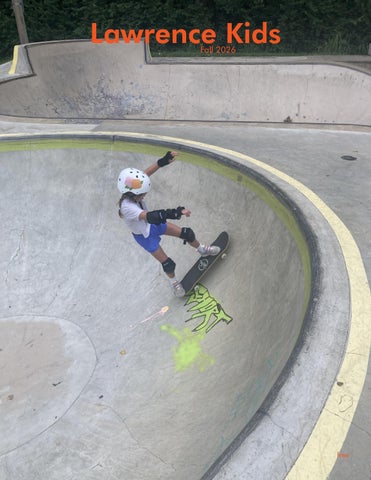
Lawrence Kids Fall 2026
free
Lawrence Kids / Fall 2026 8
Season’s Readings S’more for the Season
12
Building a Better Lawrence, One Park at a Time
16
Babies & Beer
20
Shredding, Together
26
(785) 766-5669 / info@lawrencekidsmagazine.com A project of Four Birds Media. Reproduction without permission is prohibited.
Thank you for reading.
Open 7am - 2pm
920 Massachusettes Lawrence, KS
785-843-1110
@theroost920mass
@920mass
Season’s Readings by Dan Coleman from the Lawrence Public Library
Snow Geese Season, by Angela Burke Kunkel, illustrated by E.B. Goodale A lonely boy who splits time between separated parents stays with his grandpa on a weekend when neither parent can take him. Pops wakes his grandson in the pre-dawn darkness and drives him to a field where the rising sun reveals thousands of migrating snow geese. When the flock lifts off and departs, the boy realizes that, like his family, the fall migration will endure. Pumpkin Circle: The Story of a Garden, by George Levenson, photographs by Shmuel Thaler This beautifully photographed non-fiction book explores the pumpkin patch, offering close-ups galore of seeds, vines, flowers, jack-o-lanterns, and last, but probably least, the mush pile. A great readaloud before and after a visit to the patch. The Pumpkin Thief, by Alice Hemming, illustrated by Nicola Slater Everyone’s favorite seasonal nitwit is back! This time Alice Hemming’s Squirrel, star of the bestselling Leaf Thief and others, tries to solve the mystery of who is stealing fall’s favorite vegetable. How to Draw Fall Things for Kids, by Alli Koch Alli Koch’s simple, step-by-step instructions show kids how to draw basic objects in minutes, and her books have become some of the most popular drawing manuals in the library. Scarecrows, acorns, turkeys, and more “fall things” fill this themed volume. The Apple Doll, by Elisa Kleven This simple story of a young girl starting school in the fall was a favorite around my house during apple-picking season. Lizzy makes a doll out of an apple from her favorite tree and takes comfort in the doll’s sweet smell as she battles loneliness during the first few weeks of school. Eventually Lizzy and her doll win over the class, and they all make apple dolls together as a craft. The book includes instructions on how to make your own apple doll.
Fall Walk, by Virginia Brimhall Snow Take a close look at the falling things that give the season its name, as a grandmother walks with her grandkids and identifies twenty-four different tree types by the shapes of their leaves. Includes a section on how to make leaf rubbings and press leaves in a book. If You Find a Leaf, by Aimee Sicuro If Harold used leaves instead of his purple crayon, the result would be a book like this. Kids in Aimee Sicuro’s hand-drawn illustrations use fall leaves, depicted in actual-size photographs, as hats, horns, hammocks, hot air balloons, and more. Fall Day All Day, by Kari Percival A fall palette colors this cozy celebration all things fall, from chipmunks fattening up for the winter to household cats growing out their fur coats. Little Homesteader Fall Treasury of Recipes, Crafts, and Wisdom, by Angela Fanning, illustrated by Anneliesdraws The Little Homesteader treasuries are full of great ideas for seasonal crafts and recipes that kids can do (mostly) on their own. If you have a kid in the house who wants to make pumpkin muffins, acorn cap candles, or a birdhouse out of a gourd, this is your book. And you don’t have to wait for winter, spring, or summer to check out the other seasonal volumes in the series for more activities. Every Autumn Comes the Bear, by Jim Arnosky Naturalistic watercolors in this classic by Jim Anosky tell the simple tale of a bear preparing for winter. Like an incantation, the narrator describes what the bear sees as he makes his way through a forest in late autumn to the place where he will hibernate. A beautiful book about nature in the fall, and a great bedtime book, too.
21 W 9th Street www.littlekco.com
Tues-Sat 10-5 @littlekcoshop
S’more for the Season We’ve published Fall Seasonal Essentials for 11 years. Every family, every single one, has listed s’mores by a fire as a must-do. photo by Tasha Keathley-Helms
photo by Amber Yoshida
photo by Amber Yoshida
photo by Mallory Thompson
T
here’s something magical about a s’more. Maybe it’s the way a marshmallow slowly turns golden over an open flame, the anticipation of sandwiching it between two graham crackers or the first delicious bite when melted chocolate and warm marshmallow squeeze out the sides. Whatever the reason, few treats bring people together quite like a s’more. And while s’mores are often associated with summer camping trips and backyard barbecues, fall might just be the best time of year to enjoy them in Lawrence. As the temperatures drop, leaves turn shades of orange and red and evenings arrive a little earlier, families have a new reason to gather outside. A backyard fire pit, a stack of firewood and a plate of graham crackers, chocolate and marshmallows are all it takes to turn an ordinary autumn evening into a memorable family tradition. Fall offers the perfect conditions for fireside fun. The air is cool enough to make the warmth of a fire feel especially inviting, but not so cold that kids have to spend the evening bundled up indoors. There’s something about sitting around a fire with family that encourages everyone to slow down. Phones get put away, stories get shared and kids find endless entertainment in trying to roast the perfect marshmallow. Of course, achieving marshmallow perfection is no small task. Some kids prefer theirs lightly toasted, with just a hint of golden brown. Others insist that the only acceptable marshmallow is one that’s practically on fire. And then there are the adventurous ones who deliberately let their marshmallows catch flame before blowing them out and enjoying the crispy exterior and warm, gooey center. There is no wrong approach, although a little patience usually helps. The classic s’more is a simple combination of three
ingredients: graham crackers, chocolate and marshmallows. But part of the fun is experimenting with new combinations. Swap traditional milk chocolate for dark chocolate or peanut butter cups. Add sliced strawberries or bananas. Try cinnamon graham crackers, caramel squares or chocolate-covered cookies. For kids who enjoy getting creative in the kitchen, a s’more becomes an opportunity to invent an entirely new dessert. And don’t forget the hot chocolate. A warm mug of cocoa is the perfect companion to an evening around the fire, especially when the fall temperatures start to dip. Families in Lawrence have plenty of reasons to make the most of the season. A walk through a neighborhood filled with colorful leaves, an afternoon at a local park or a weekend trip to enjoy the changing scenery can all end with an evening around the fire pit. Even a simple Tuesday night at home can become something special when everyone gathers outside for a sweet treat. For families without a backyard fire pit, a portable outdoor fire pit can be a fun addition to the fall season. The best part of making s’mores isn’t really the dessert. It’s everything that happens along the way: the laughter when a marshmallow falls into the fire, the friendly debate over who makes the best one, the sticky fingers and chocolate-covered smiles. These are the little moments that become family memories. Summer may get the credit for campfires and outdoor adventures, but fall deserves a place in the s’more spotlight. So grab a bag of marshmallows, break out the graham crackers and enjoy one more reason to spend time outside together. After all, there’s no season quite like fall for gathering around a fire, sharing a few stories and making life a little sweeter, one s’more at a time. LK
Building a Better
Lawrence,
One Park at a Time
Lindsay Hart, new Lawrence Parks, Recreation and Culture Director, discusses the future of local parks and making recreation accessible to every family.
Tell us about your career in parks and recreation and what first inspired you to work in the field? I studied Kinesiology at K-State and developed an interest in health, wellness and the role recreation plays in bringing people together. That interest eventually became a career. I’ve always enjoyed the opportunity to make a difference in people’s lives and contribute to a stronger community. As Director of Lawrence Parks, Recreation and Culture, I get to do that every day with a great team. You’ve served twice as interim director of Parks, Recreation and Culture. What did those experiences teach you about Lawrence, its families and what they want from their parks and recreation system? Serving twice as interim director gave me a better understanding of how much Lawrence families value their parks and the connections they create. Parks and recreation are about more than playgrounds, ball fields and facilities. They’re places where families spend time together, neighbors get to know each other and kids make memories. Families want safe, well-maintained parks close to home, along with programs that fit their interests and schedules. Those experiences also showed me how important it is to listen to residents and understand what they want from their parks and recreation system.
You’ve said you’re excited to implement the city’s new Parks, Recreation and Culture Master Plan. What are the biggest changes or improvements Lawrence families can expect to see from that plan? The Master Plan gives us a clear direction for improving parks, facilities, programs and trails throughout Lawrence. Families should expect to see continued investment in neighborhood parks, better connections between recreational spaces and improvements that make our facilities more useful and accessible. I’m also excited about finding more ways to bring arts, culture and recreation together through programs and community events. Lawrence has families with very different needs and resources. What can the city do to make sure children from all neighborhoods and income levels have access to quality parks, programs and recreational opportunities? We’ll continue offering scholarships to help families afford programs and make sure parks in every neighborhood are safe, welcoming and wellmaintained. We also need to hear directly from families about what keeps them from participating. Sometimes it’s the cost. Other times, it’s the location, schedule or lack of transportation. We need to take those things into account when planning programs and making decisions. Every child should have the opportunity to play, explore and enjoy what Lawrence has to offer, regardless of where they live or what their family can afford. What opportunities do you see for expanding affordable or free activities for children and teens, particularly during the summer and after school? Partnerships give us a great opportunity to offer more activities without having to build everything ourselves. Working with Lawrence Public Schools, the library and local nonprofits can help us reach more kids and give families more choices. We can also make better use of the parks and facilities we already have by offering activities in different neighborhoods. I’d like to see families have more opportunities to find something affordable for their kids, whether that’s a structured program or simply a place to spend time with friends. Are there specific parks, playgrounds, recreation centers or other facilities that you believe should be priorities for improvements? What would you like to see changed? Some of our biggest needs involve playgrounds that are outdated or difficult for children with disabilities to use, recreation centers that need updates and parks in neighborhoods that haven’t received much
investment in recent years. I’d like to see more inclusive playground equipment, shaded areas where families can gather, updated sports courts and fields, and more places for older kids and teenagers. Community feedback and our assessment of existing facilities will help determine where improvements are needed most. The Master Plan gives us a starting point, and now it’s time to put those ideas into action. How can Lawrence create more opportunities for older kids and teenagers, who sometimes outgrow traditional playgrounds but still need safe, affordable places to gather, play and be active? We need to give teenagers places of their own. Traditional playgrounds aren’t designed for them, but that doesn’t mean they’re done looking for places to hang out and be active. Skate parks, bike features, basketball courts and other multi-use spaces are good options. I’d also like to see more places where teens can simply spend time with friends. Not every activity needs to be organized or supervised. Mobile recreation, pop-up events and partnerships with schools and youth organizations can also help us bring activities directly to them. What role do you see for partnerships with schools, nonprofits, youth sports organizations and local businesses in creating more opportunities for Lawrence children? We can’t do it all on our own, and we shouldn’t try to. Schools, nonprofits, youth sports organizations and local businesses all have something to offer. Schools help us reach children and families, nonprofits bring experience and connections, and local businesses can support programs and events through sponsorships and other partnerships. Working together allows us to reach more kids, make better use of our resources and offer opportunities that might not otherwise be possible. If we check back with you three years from now, what would you like Lawrence families to be able to say has changed for the better because of your leadership? I’d like families to see a difference in their own neighborhoods. I hope they’ll be able to point to improved parks, better facilities and more activities for children of all ages. I’d also like programs to be easier to access and more affordable for families. Most importantly, I want residents to feel that their input mattered. We’ve heard what people want through the Master Plan process, and I want them to see that we’re following through. That’s how we build a parks and recreation system that serves Lawrence families. LK
Babies & Beers A dad is helping other dads get ready for their biggest adventure
The name might get your attention, but the lessons are all about babies. Babies & Beer is a class designed specifically for soonto-be fathers, giving them a chance to learn newborn care in a relaxed, welcoming environment. Despite what the name might suggest, there’s no beer served by instructor Nate Mattson. The class takes place at an establishment that does, creating an atmosphere where dads can feel comfortable asking questions, sharing concerns and getting hands-on experience.
Mattson, a father, nurse and nursing professor, came up with the idea after years of working with newborns and their families in hospital settings. He noticed a familiar pattern among first-time fathers. “When baby is born, there’s a time where the nurse will take baby to the warmer and weigh, measure and perform a more in-depth assessment,” Mattson says. “Whenever I do this, I invite dad to come and see their baby and do some education. I realized that dad was so overwhelmed that much of the education was being lost.” He began thinking about how those moments might look different if fathers had an opportunity to learn before arriving at the hospital. Rather than absorbing everything while meeting their newborn for the first time, dads could walk into the delivery room with some knowledge and a better idea of how to help. That idea became Babies & Beer. Mattson saw an opportunity to fill a gap in traditional childbirth education. While plenty of resources prepare expectant parents for pregnancy, labor and delivery, he found relatively few classes focused on the practical responsibilities fathers face once a baby arrives. “Dads want practical, hands-on information,” he says. “How can I help with my hands when I need to, and what do I ask when I don’t know the answer?” Drawing on his background in nursing and higher education, Mattson uses evidence-based information and keeps the material accessible to dads from all backgrounds. One of the biggest concerns? Feeding. Many first-time fathers have never prepared a bottle or spent much time around breastfeeding. Mattson walks them through bottle preparation, proper positioning and recognizing signs that a baby might be uncomfortable. He also discusses how fathers can support breastfeeding partners, from calming the baby and tracking feeding times to holding the newborn upright afterward and properly storing expressed breast milk. It’s about more than knowing how to feed a baby. It’s about understanding the work involved and finding meaningful ways to share that responsibility. The class also covers labor and delivery, including details fathers might not think to ask about. Mattson recalls one dad who later sent him a message saying the information about cervical dilation
and active labor had “saved him.” The father remembered learning that when his partner reached eight centimeters, delivery could be close. He had considered leaving the hospital to take care of something outside but decided to stay. Thirty minutes later, his baby arrived. Sometimes, knowing what to expect makes all the difference. Other lessons are more hands-on. Mattson remembers one father who arrived at an early class, listened to a few slides and finally raised his hand. “OK, you know your stuff. I came here for a very specific reason. I need you to teach me how to hold a baby.” That’s exactly the kind of question Mattson wants dads to feel comfortable asking. One of his favorite memories came after a class when a father, feeling confident about his new skills, challenged his partner to a diaper-changing contest. He won, then shared some of what he’d learned. As the couple left, his partner turned around and mouthed “Thank you” to Mattson. Beyond bottles, diapers and swaddling, the class emphasizes building a connection with a newborn. Mattson talks about the importance of a father’s voice, touch and presence, particularly through skin-to-skin contact. His advice to new dads is simple: Take off your shirt, place your baby against your chest and enjoy the experience. He also encourages fathers to prepare for the challenges their partners will face during recovery and breastfeeding. Social media can make early parenthood look effortless, but the reality often involves exhaustion, physical recovery and a steep learning curve. Understanding those challenges can help fathers become more supportive partners and confident parents. Ultimately, Mattson hopes dads leave Babies & Beer understanding that they don’t need to know everything before their baby arrives. They just need to be willing to learn, ask questions and show up for their families. His advice to soon-to-be fathers in Lawrence is straightforward. “Love your family. If you approach each situation thinking about how to best serve your family, you’ll make the right decision most of the time.” LK
Drs.Newkirk, Newkirk, and Willms Drs. Adams,Adams Willms, McGuire & Randa Serving Lawrence For Over 30 Years Visit our state-of-the-art office:
Drs. Newkirk, Adams and Willms 4111 W 6th Street
And now open in De Soto: 33391 Lexington Ave C
Or Visit Us at:
Newkirk
Dr. Brad Adams
Dr. Kailah Willms
www.freestatedental.com
d, comprehensive, friendly dentistry for all ages.
s / Same Day Crowns / Cleanings / Veneers Implants Whitening / Invisalign / Referral Rewards
our office today! 785-843-2636
or visit us at 4111 W. 6th Street
freestatedental.com
Shredding, Together River Rat Skate Shop & Lawrence Parks and Recreation are helping kids discover that skateboarding is about more than learning tricks. photos from River Rat Skate Shop
T
here’s a moment every skateboarder knows. You’ve been trying the same trick over and over. You’ve fallen, picked yourself up, adjusted your feet and tried again. Then, finally, the board does exactly what you wanted it to do. For Joshua Rukes, manager of River Rat Skate Shop in Lawrence, that moment never gets old. Watching a young skateboarder experience it for the first time is one of the best parts of his job.
a regular part of the department’s recreation offerings. Unlike many organized sports, skateboarding doesn’t follow a strict set of rules, drills or practices. It’s an individual pursuit driven by curiosity, experimentation and the freedom to figure things out. “Skateboarding is a very free thing,” Rukes says. “I’m going to do this how I want, when I want.”
“It’s the coolest thing ever to see kids learn and grow,” Rukes says. “I’m so passionate about skating. When I see a kid push their ability and do something they didn’t think they could do, it’s exciting.”
Putting that freedom into a scheduled class required some creativity. Rather than force the activity into a traditional lesson format, Rukes developed a loose structure that allows kids to work at their own pace.
For the past three years, Rukes has partnered with Lawrence Parks and Recreation to introduce local kids to skateboarding through group lessons. The program gives beginners an opportunity to learn the basics while more experienced skaters can develop their skills with guidance from someone who has spent much of his life on a board.
Some students arrive having never stepped on a skateboard. Others are ready to learn a new trick. Rukes assesses each student’s ability and adjusts accordingly.
The partnership began when Parks and Recreation approached River Rat about helping launch a skateboarding program. “We were already doing private lessons, and the city contacted us,” Rukes says. “They wanted to start a skateboard program and asked me to interview for the position. They wanted to make sure I was a nice guy who could work with kids. Maybe the best skateboarders aren’t necessarily the best with kids.” Rukes got the job, and the lessons have become
For beginners, the first goal is getting comfortable standing on the board, learning how to position their feet, push off and maintain their balance. More experienced skaters might work on an ollie, a kickturn or another trick they’ve been trying to master. Rukes also gets on his own skateboard to demonstrate tricks and show students what’s possible with practice. The lessons aren’t about making everyone do the same thing at the same time. If a student wants to work on a trick, that’s fine. If another wants to spend time getting comfortable on a ramp, that’s fine, too.
The important thing is that they’re trying, learning and enjoying themselves. A typical full class accommodates about 15 or 16 students. During the spring, Parks and Recreation generally offers two sessions, each meeting on four consecutive Mondays. Both sessions often fill. The program also runs during the summer and fall. Over the past three years, Rukes estimates he has worked with approximately 200 young skateboarders. For him, the numbers are less important than what happens when a student discovers a new ability. Skateboarding is an activity built around failure. Tricks rarely work the first time, and sometimes they don’t work the hundredth time. Learning to skate means accepting that falling is part of the process. “You see them trying the same trick for hours or even days,” Rukes says. “Then they finally get it. You see the look on their face when they do something they didn’t think they could do.” Rukes hopes the perseverance kids develop at the skate park follows them into other parts of their lives. “You have to fail a lot,” he says. “You have to try again and again and again. I hope that rubs off. I hope they learn not to give up.” Skateboarding may be an individual activity, but that doesn’t mean it has to be solitary. Kids watch one another, share ideas and celebrate each other’s progress. A student who lands a trick can inspire someone else to give it a try. Rukes wants the lessons to reflect that spirit. He also believes kids need room to work through frustration on their own, which is why he discourages parents from putting too much pressure on their children.
Henry Olson, an 11-year-old who took lessons through the program, has enjoyed the opportunity to develop his skills and learn from more experienced skaters. “It’s awesome,” Henry says. “I love skating and learning how to get better is fun. The older guys help and it’s great to learn new tricks and get better.” Henry’s enthusiasm reflects another benefit of the partnership between River Rat and Lawrence Parks and Recreation. The lessons give young skateboarders a chance to build friendships, learn from experienced skaters and become part of a community that encourages them to keep progressing. Rukes hopes kids understand that the skate park belongs to them. Skateboarding has its own culture and etiquette, and respecting the space and the people using it is part of becoming a member of the skating community. But there’s no secret handshake or special qualification required. “That skate park is as much yours as it is mine,” Rukes says. For families who have never considered skateboarding as a recreational option, the lessons offer an approachable place to start. Kids don’t need to arrive knowing how to do tricks or even knowing whether they’ll enjoy skating. They just need to be willing to give it a try. Rukes often thinks about a line from Way of the Peaceful Warrior, a book by Dan Millman: “You’d be surprised what you can do when you stop thinking.” It’s a fitting idea for skateboarding. Sometimes the hardest part is getting past the fear of falling or convincing yourself that a trick is too difficult.
“I don’t like to see parents get on their kid about what they’re doing,” he says. “That’s not what skateboarding is. This isn’t football. There’s no team. Having fun is really the only point of skateboarding.”
For Rukes, the best outcome isn’t necessarily a student mastering an ollie or learning to navigate every ramp. It’s seeing a child gain confidence, encourage a friend and discover the satisfaction of doing something that once seemed impossible.
That doesn’t mean kids shouldn’t have goals or work to improve. It means they should have the freedom to decide what those goals are and enjoy the process.
And if they leave wanting to come back and do it all over again, that’s even better.
Rukes wants students to feel comfortable asking questions, making mistakes and trying things they might initially think are beyond their abilities. “I want anyone who’s interested to try it,” he says.
After all, skateboarding is supposed to be fun. The tricks, the falls and the occasional scraped knee are all part of the experience. The real reward is finding out what you can do when you give yourself the chance to try. LK
With Christ as our teacher, the Corpus Christi Catholic Community will prepare students academically, socially, and spiritually to become lifelong learners in a faith-filled environment.
CO S CH ISTI CATHOLIC SCHOOL 6001 BOB BILLINGS PKWY
LAWRENCE, KS
WHY CORPUS CHRISTI CATHOLIC SCHOOL? Rigorous & Differentiated Instruction in a Faith-Based Environment Accredited by Kansas State Department of Education & Lumen Excellent Scores on KSA
Wide Variety of Co-Curricular Activities: - Theater - Choir - Spanish - Band - Yearbook
Small Class Sizes
Alumni Include: - National Merit Scholars & Finalists - Perfect ACT Scores - High School & College Valedictorians - College Athletes & Debaters - Honor Society Presidents
See the difference being a Corpus Christi Saint can make in your child’s life! (785) 331-3374 | cccparish.org/school