Museums, galleries, and exhibition spaces present artworks; Fountainhead introduces you to the artists who create them. ”
About Fountainhead
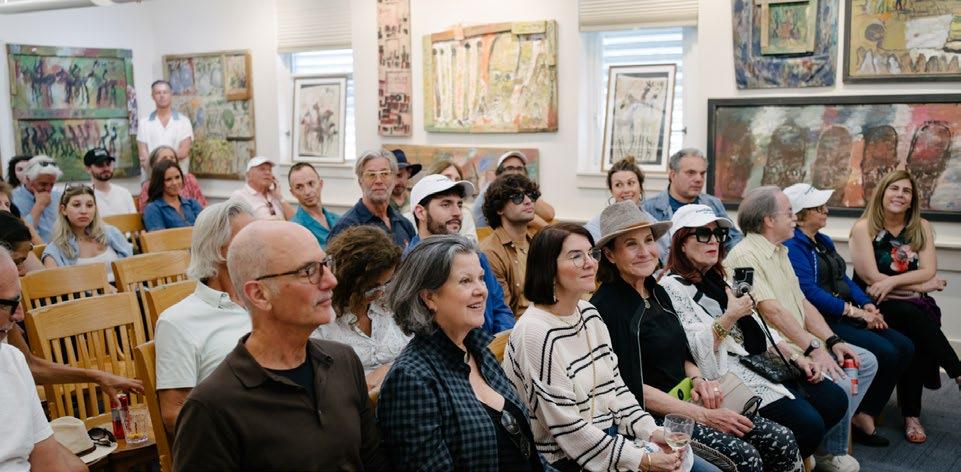
Based in Miami, FL, Fountainhead Arts is an artist residency and career empowerment program serving artists across the global arts ecosystem. Founded in 2008 by collector and passionate art appreciator Kathryn Mikesell, Fountainhead was created to positively impact the lives and careers of artists and nurture and grow their local arts community. Establishing a residency program for visiting national and international artists and a local artist studios complex that same year, Fountainhead has since welcomed over 600 artists from 50 countries, and served nearly 1,000 local artists through its local programs, Fountainhead Studios and the Miami-Dade County-wide open studios event, Artists Open. In 2025, Fountainhead launched Forum, an initiative providing funding support to alumni artists for significant museum and institutional acquisitions and exhibitions.
With a mission to elevate the voices, visibility and value of artists in our society and make their work accessible in a welcoming and inclusive environment,
Fountainhead focuses on encouraging public engagement with artists and their work. Their approach empowers artists by making connections that lead to growth in their work and careers, providing time and space to experiment and challenge their practice, and mentorship and business skills to help them lead thriving careers.
In its 18-year history, Fountainhead has become a pioneering force in the arts and culture landscape, developing innovative artist and community engagement programs and cultivating key relationships with leading art institutions in South Florida and beyond.
Harnessing the power of our collective diversity, Fountainhead is building a global family of artists and appreciators, one personal connection at a time.
by Kathryn Mikesell
by Nicole Martinez
Camilo Restrepo, Guillermo Garcia Cruz, Marcelo Moscheta
Marcos Castro, Naima Green, Portia Munson
Emily Velez Nelms, Marcelo Canevari, Matthew David Rahming
Gabriela Ruiz, Monsieur Zohore, Navot Miller
Isabella Mellado, Jordan Ann Craig, Kayla Mattes
Armani Howard, Autumn Knight, Sonia Barrett
Andrew Roberts, Anna Perach, Mamali Shafahi
Chantal Peñalosa Fong, Mira Dayal, Yashua Klos
2025 Photo Gallery
A Foreword: On Community & Hope
By Kathryn Mikesell
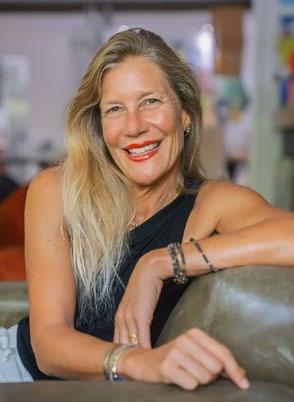
2025 was a year defined by many as tumultuous. A year filled with high highs and low lows personally and professionally. Yet through it all my most consistent feeling was that of hope and expansion that was within reach and just over the horizon. How? Why? Community.
Community has always been the foundation of Fountainhead. We call ourselves a family because that is how we feel about our community of artists and supporters. We all need the love and support of others. When it’s built on appreciation for one another and mutual respect, and nurtured over time, the possibilities to create, evolve, and grow are endless.
Artists who choose to come to Fountainhead are trusting us to welcome them into a safe space and care for them while they’re here. They’re leaving behind friends and family, work, and all that’s familiar to them for an entire month. They expect that their time with us will help them build their careers, create new relationships, and that they’ll leave inspired. The team and take pride in this responsibility, and we hope to exceed their expectations each and every year.
Our supporters are much the same. They are entrusting us with their donations, expertise and time. It’s important that each person feels rewarded for their contribution in their own way. We work hard to be present and good listeners to ensure this happens.
This year was full with uncommon pairings. A life goal of mine is to show people that no one is defined by the “boxes into which they fit.” Each of us is beautifully unique. Our race, gender, religion, upbringing, and education are just that; it is our stories, experiences, and outlook on life that built us into the lovely humans we are today. We brought together artists that, from the outside and on paper, looked very different from one another. They had different philosophical views and were from countries that were presently at war. What happened? Endless conversations in the living room and around the dining table, new friendships, plans we made to meet in artists’ home countries, global connections and introductions, families meeting families, personal and professional growth, and hugs and texts and phone calls that continue to this day.
As write this, fond memories flood my brain, tears fill my eyes and my heart feels warm. I think of the many people that make Fountainhead what it is today. I’m blessed with a dream team. Three incredible, strong and independent women. Nicole, our deputy director, is our engine pulling us forward and pushing us to new heights. She is responsible for every bit of documentation we create and press we receive, nurturing our partners and collaborators; writing and managing our grants, and literally thousands of details. She somehow manages all this with grace, professionalism, and a whole lot of spunk.
Francesca, our director of engagement, is our force ensuring the success of every member event, trip, dinner, and staying in contact with all our donors so they feel the impact of their support. She’s able to focus on every detail and keep us on schedule with a smile on her face and boundless energy. Natalie, our program manager, the newest member of our team, is our calm and flow, making sure the artists are cared for, their home is ready to welcome them, they have the materials and information they need, and someone to call when they’re not sure what’s next.
Attendees of our open houses are always greeted at the bar with a warm smile from Rory Feinberg. Thanks to our wonderful sponsors Marjanne Kalf of Estrella Damm, Carlos Fonseca
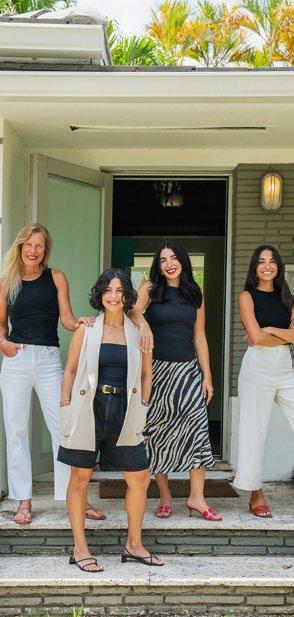
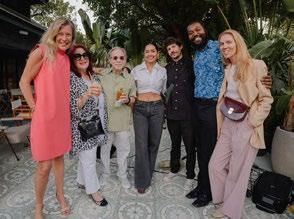
at El Carajo, Francesca Tavara of LALO Tequila, and Matteson Koche and Simon Caicedo of El Bagel we are fed, hydrated, and happy during our events. Estela Ribiero helps keep the place in order with love and efficiency. Marcos Cherlo is our quiet genius repairing the beauty of experimentation to ready the home for each cohort, along with Marcela Reis who makes sure the home is looking its best to welcome its new guests.
We could not do this work without our incredible board of directors. Continuing to steer the ship and guide us forward are Don Savelson (President), Teresa Enriquez (Vice President), David Ross (Treasurer), Lois Whitman Hess (Secretary), Ben Wolkov, Sabrina Beraja, Nicole Blackburn, Emily Campbell, Jimena Guijarro, Spring McManus, Ian Krawiecki Gazes, Jumaane N’Namdi, Carole Server, and Henry Zarb.
So much of what we do creates a dialogue between visiting artists and local artists, and I’m so proud to see the fruits of that come alive in this book. Thank you to the photographers and writers who contributed their time and creativity to us this year.
Artists were selected to join Fountainhead by an esteemed jury; our 2025 artists were thoughtfully chosen by Jose Díaz, who was then the chief curator at the Seattle Art Museum and has since returned to Miami to lead the curatorial vision at PAMM; Naima J. Keith, the vice president of education and programs at the Los Angeles County Museum of Art; Joaquin Segura, a 2023 alum and one of the founding members of SOMA
in Mexico City; and Arden Sherman, a curator at the Norton Museum of Art. We can’t thank them enough for their time and continued support of Fountainhead and the arts ecosystem in which they play such a valuable role.
Fountainhead counts with the support of its cultural community, who show up time and again for studio visits with our visiting artists. While there are too many to thank personally, want to personally acknowledge the time and care that collectors Mera and Don Rubell and Beth Rudin DeWoody and Maynard Monrow share with our artists in residence.
Connection is at the forefront of everything we do. The ripple effects that start from just one meeting can flow for years to come. Forum, our latest initiative, is a testament to that spirit. Thank you to our founding Forum members Caroline Larson, Donnalynn Patakos, Francie Bishop Good, Jane Marcus, Jill Ginsberg, Joyce Worthington Virga, Lois Whitman Hess, Mary Mcintosh, Pauline Shender, Sarah de Blasio and Stephanie Krass.
Fountainhead would not be able to reach its ambitious goals without the generosity and support of donors. The people behind family foundations and individual donors are not only our supporters, they are our partners, mentors, and friends. I want to thank Kristina Newman-Scott and the John S. and James L. Knight Foundation; Jorge and Darlene Perez and Belissa Alvarez and the Jorge M. Perez Family Foundation; and Lindsey Linzer and The Miami Foundation who have supported Fountainhead since it transitioned to a nonprofit in 2018. Thank you to the government entities that invest in the arts and their communities, like The State of Florida and the Miami-Dade County Division of Cultural Affairs. I want to say a very personal thank you to Lisa Schejola Akin and Jeff Akin of the Leomi Foundation who we’re so happy to welcome back to Miami; Harriet, Leslie and Michael Weissman and the Paul & Harriet Weissman Family Foundation; Sarah Arison and Arison Arts; Francie Bishop Good and David Horvitz; Lois Whitman Hess and Eliot Hess; Hesty Leibtag and Terry Verk; Adriana and Ricardo Malfitano; Julie Mercier and A. David
Mikesell; Jane Wesman and Don Savelson; Anne and Rolf Coppenrath; and Ann and Melvin Schaffer. For the past several years we’ve had the honor of commissioning artists for Windstar Cruises thanks to the brilliant direction of Stijn Creupelandt, Chris Prelog, and Jessica Payne. In 2025, we also partnered with the Central Bank of the Bahamas, led by Uli Voges to bring an exceptional Bahamian artist, Matthew David Rahming. While I’d love to personally thank all our generous Fountainhead Experience Members, the list is long. hope they all feel the love and appreciation each time they step inside Fountainhead or attend one of our events and trips.
This year we partnered with several outstanding organizations, each working diligently to highlight artists in their own unique way. The Human Rights Foundation, led by Celine Assaf- Boustani, Holly Baxter, Issa Sarikamis and Michelle Gulino, fights tirelessly to bring rights and dignity to people living under authoritarian regimes and supports artists whose works provide a voice and visual to create change. Our partnership with YoungArts, led by Clive Chang, identifies leading artists from high schools throughout the country, provides priceless education and experiences, and nurtures them throughout their careers—including with a Fountainhead Residency for one prior YoungArts award winner per year. Untitled Art Miami Beach, led by Clara Andrade Pereira, focuses on curatorial balance and integrity across all disciplines in contemporary art.
While there are many names written here and on the pages to follow, I can give you an example for how each of them has impacted my life. am immensely grateful for Fountainhead, and for you all.
Take Care: On Community & Collective Action
By Nicole Martinez
people who serve them. In times of darkness, we often find ourselves turning inward: When the world feels out of control, we can focus on the microscopic actions that have an impact on the people closest to us. am consistently awed by the care and kindness this community shows one another, and it leads me to consider a deeper understanding of art as relational infrastructure—a set of practices that produce and sustain community, collective well-being, and shared cultural life. The work of contemporary critics and theorists like Alice Wexler, Sara Ahmed and Nicolas Bourriaud gives us tools for thinking about how art accumulates social meaning, fosters belonging, and engages with structures of power and care. Their writing insists that art’s value is not only aesthetic, but social, ethical, and political — and that care is not a theme, but a practice embedded in relationships and shared histories.
A number of the artists that joined us at Fountainhead in 2025 expand on systems of care through their work. From Sonia E. Barrett’s collaborative material rituals to Naima Green’s relational photography, Jordan Craig’s culturally grounded abstractions, Autumn Knight’s performance as social inquiry, and Emily Velez Nelms’ spatial investigations — embody this expanded sense of artistic practice. Their work does not merely reflect communities; it helps make them. These artists operate through slow, relational practices that sustain cultural memory, shared presence, and ethical attention.
InBridgingCommunitiesthroughSociallyEngaged
2025 ushered in foundational change, and for many of us, it was a year of shedding, re-aligning, and moving forward in ways we couldn’t have imagined. As federal budgets for the arts were swept out from under us, and government funding across all levels began to dwindle, we were left with the existential question of whether the arts will continue to matter in the United States. When the scaffolding supporting artists becomes shaky, the very ecosystems that allow artists to make work with and for their communities are in jeopardy.
Nevertheless, artists are persistent, as are the
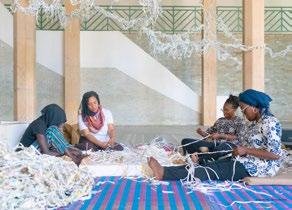
the Map Room of the Society building in London to braid the shredded pieces into dreadlocks.
This communal ritual—sitting within the storied institution, utilizing official maps, and engaging in a hair styling practice passed along geographies and generations—reframes the traumatic history inflicted on Black bodies with a new intention. People gathering, touching, and remembering together creates the conditions for a new narrative, one that foregrounds shared histories and collective presence, and can activate social justice as Wexler and Sabbaghi argue in their book.
When Nicolas Bourriaud first put forward the idea of relational aesthetics in the late 1990s, he wanted to articulate that art wasn’t about the birth of an object but about the people moving through our everyday lives. He described an emerging field of art that took “the whole of human relations and their social context” as its starting point, creating works of art that, in turn, became social environments where people participate, interact, and co-create meaning. That’s a useful way to think about artists like Naima Green’s work. Her photography is rooted in shared presence, laughter, play, and intimacy with the people she photographs. In her own words, her work “cannot exist without friends and loved ones around me,” which is to say that the images are born out of real relationships and mutual trust, not just observation. In that sense, Green’s practice embodies a version of relational art that isn’t just about bringing people into a space, but about centering community and care as the
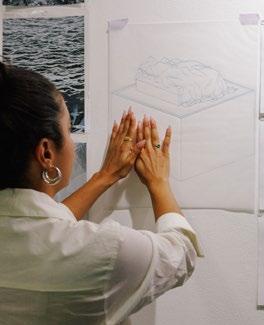
Art , Alice Wexler & Vida Sabbaghi frame socially engaged work as practices that create ‘spaces for change,’ underscoring the relationships between artists, educators, institutions, and communities as surpassing the production of objects. London-based artist Sonia Barrett intertwines all of these relationships in her work, which ranges from assemblage to collective weaving and incorporates extensive historical research to draw parallels between race, environment, and object. In DreadingtheMap(2021), Barrett carefully selected maps of the Caribbean and the UK and shredded them, giving the shreds over to a group of Black and brown women who gathered in
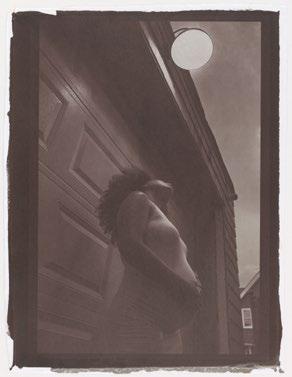
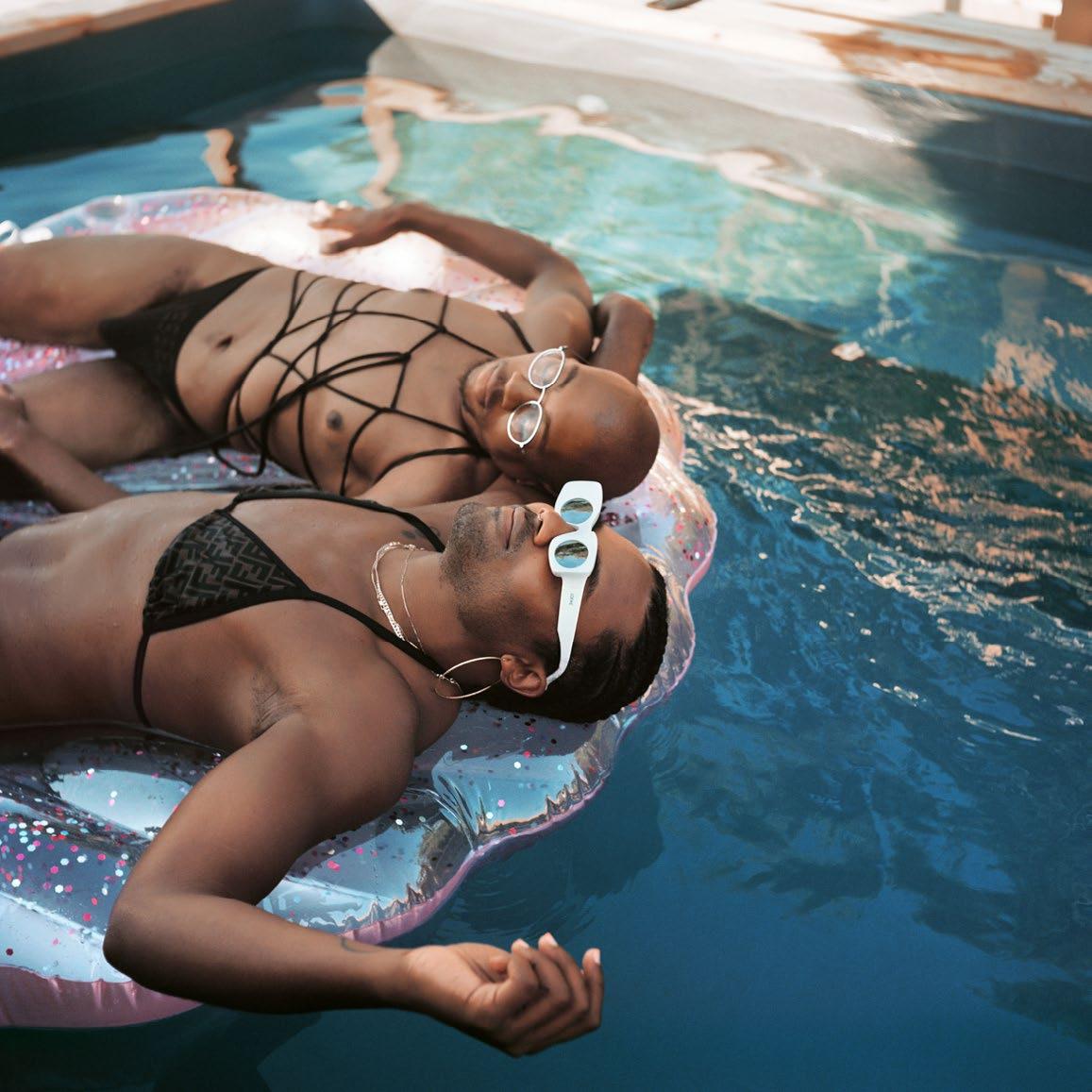
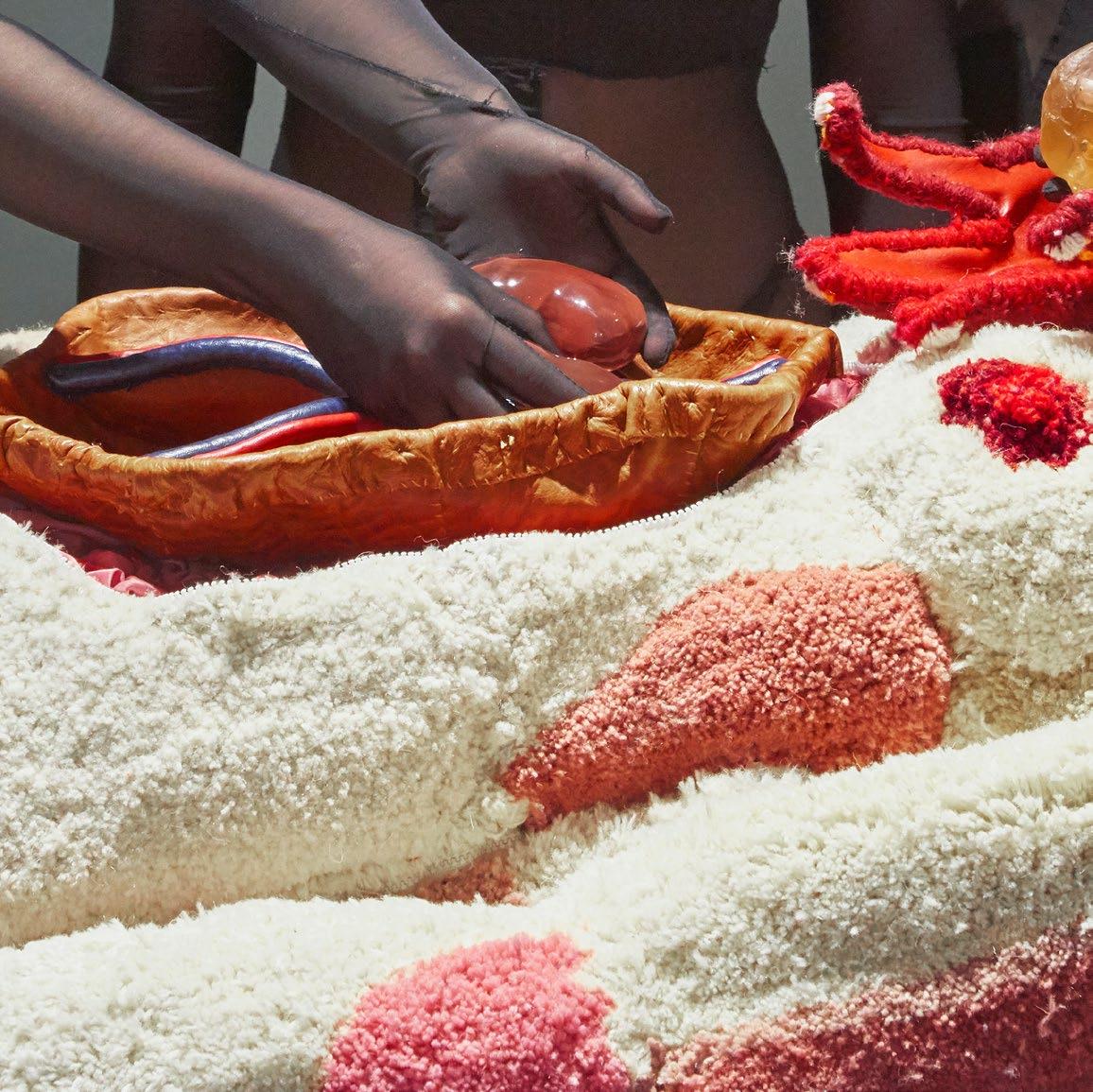
very material of the work itself. At Fountainhead, Green extended this practice into the imaginary, as she prepared to open a solo exhibition at the International Center for Photography in New York. For instead,Ispinfantasies(2025), Green donned a silicone belly to stage photographs of herself pregnant, a way of grappling with her own feelings around motherhood while simultaneously centering the experience of birthing bodies. Within these photographs, we see women wrestle with personal identity, intimacy, and longing, reflecting a shared experience that touches every single person on earth.
Complex emotions are at the heart of the human condition, and they’re an important nexus for scholar Sara Ahmed. In The CulturalPoliticsof Emotion, she pushes us to see feelings not as
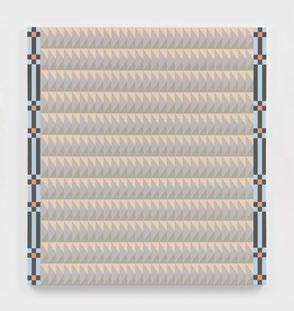
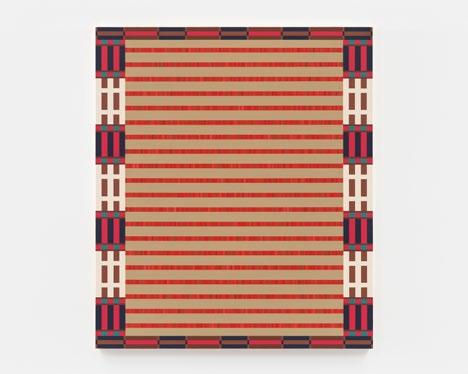
Cheyenne, treats her geometric abstractions as containers for shared histories and ancestral memory. She resurrects the intricate patterns of the Northern Cheyenne’s textiles onto canvas so we can remember to question whose histories are honored and whose are erased. In this sense, crafting pattern — repetition, variation, shared language — becomes an act of cultural care. It’s less about individual expression and more about preserving and sustaining what binds a community together.
work is spatial: it’s about attending to the histories embedded in place and asking how we might reimagine those spaces as shared ground for collective belonging.
private experiences but as social forces — what she calls the way emotions “take shape as effects of circulation” rather than dwelling entirely inside the individual. In other words, what we feel isn’t just our own; it shapes and is shaped by the communities we inhabit. Perhaps that’s why we feel so powerfully connected in the shared communion of art; and why, over time thinking about, talking about, and sharing this experience with one another, we form deeper bonds and understanding.
This practice, while sometimes insular to an artist and their community, transcends that community when viewed on a wider scale. Jordan Ann Craig, an artist whose mother is Northern
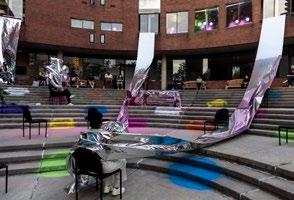
Wexler often argues in SociallyEngagedArtand Ethicsthat the only ethical approach to art-making within the context of social practice is with the participation of the community and the audience. This idea matters because participation changes who the artwork is ‘for’ — it shifts the focus to how people are implicated in the situations a work creates. Autumn Knight’s performances do precisely this: beyond staging relation, they reveal it. In her performance work, the audience is rarely passive; rather, its implicated in moments where social expectations — around race, authority, and attention — are made visible. You can feel the room shift when Knight reframes social norms as durational social performance, making us ask: who is the subject here? In that sense, her work aligns with the idea that ethical socially engaged practice demands attention to how people are drawn into shared situations, not just whether they show up. The ethics of participation, in Knight’s work, is about collective awareness and mutual recognition.
Public art theorists emphasize that space itself is socially produced — it’s shaped by economic forces, histories of access and exclusion, and the movements of bodies through it. Emily Velez Nelms’s work directly addresses how environments mediate the way communities live, work, and remember together. Whether she’s tracing memories tied to specific places or uncovering how tourism and built terrain shape everyday life, Velez Nelms treats space as a social organism. Her installations and films make you conscious of how environments accumulate meaning, and how they archive collective stories that might otherwise be invisible. The care in her
Collective belonging, as a concept, felt frayed in 2025. There is no question that the world as we once knew it is falling away to make room for something new, and this uncertainty is breeding division and derision. Times of profound change call for both adaptability and resistance, and believe that placing an emphasis on community, care, and belonging lets us achieve both. As we enter a new year and welcome new artist cohorts, may we stay open to what they can teach us, and
Naima Green. DreamFeed(2024); albumen print.
Autumn Knight. M___ER(2022); performance.
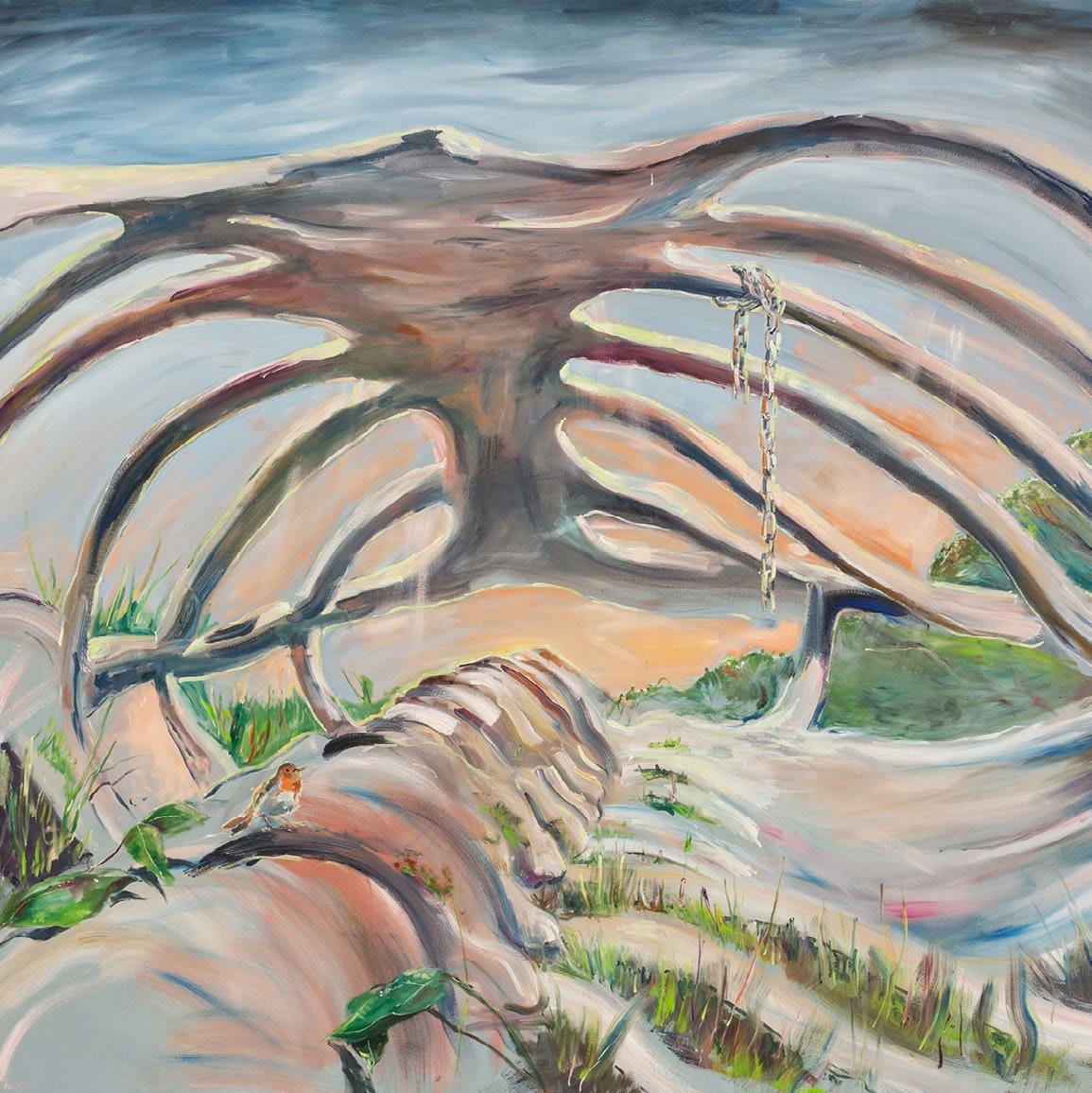
Jordan Craig. TooSlowGoBacktoCrow(2023); acrylic on canvas.
Sonia Barrett. TheMap-lective(2024); a performance at the Dakar Biennale.
Session 01
Camilo Restrepo
Camilo Restrepo’s artistic journey is one of rupture and reinvention, a path marked by destruction and reconstruction, both within himself and his work. Born in Medellín, Colombia, Restrepo’s early years were spent in the analytical precision of mechanical engineering, yet it was a backpacking trip through South America that revealed his true calling. Photography became the gateway, but academia led him deeper into the arts. It was his time at CalArts, however, that shattered and reassembled him, forging an artist unshackled from convention and perfectionism.
CalArts was less an education and more an initiation. Thrust into crisis and self-reflection, he was unmoored from certainty and ultimately unearthed a practice built on raw instinct and material resistance. In his studio, Restrepo confronted his anxieties, scrawling across walls, collecting debris, and embracing the grotesque. From this chaos, his passion for drawing emerged, not as mastery but as survival. He began expanding his compositions organically until they sprawled like tangled neural pathways, a subconscious mapping of trauma and catharsis. His materials ranged from anti-fraud pens, crude crayons, and even images scavenged from Google.
Rooted in the turbulence of Colombia’s narco history and the globalized flood of digital imagery, Restrepo’s work echoes the raw immediacy of outsider artists. With his selftaught and intuitively driven style, he rejects refinement, subverting the authority of the polished mark. His figures exist in a state of monstrous imperfection, uncanny and uncontained. In its most recent form, his practice is devoted to the fusion of the real and the imagined, forcing us to face realities as his original forms meld with images of popular culture and the familiarity found in his inclusion of newspaper photographs. The absurd finds its place in our reality.
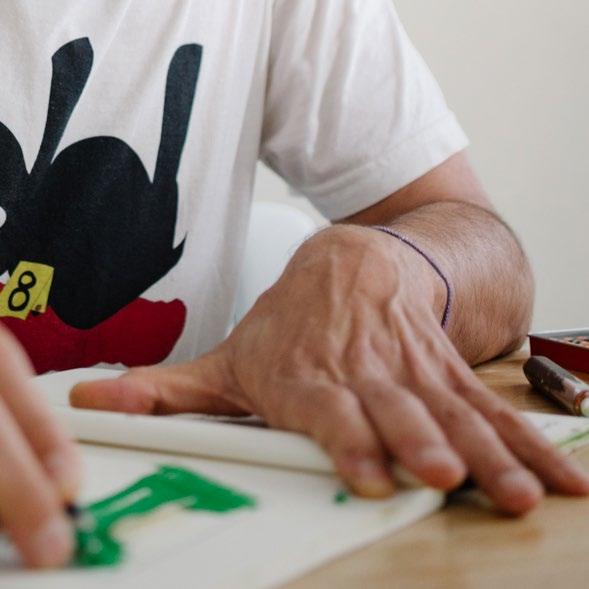
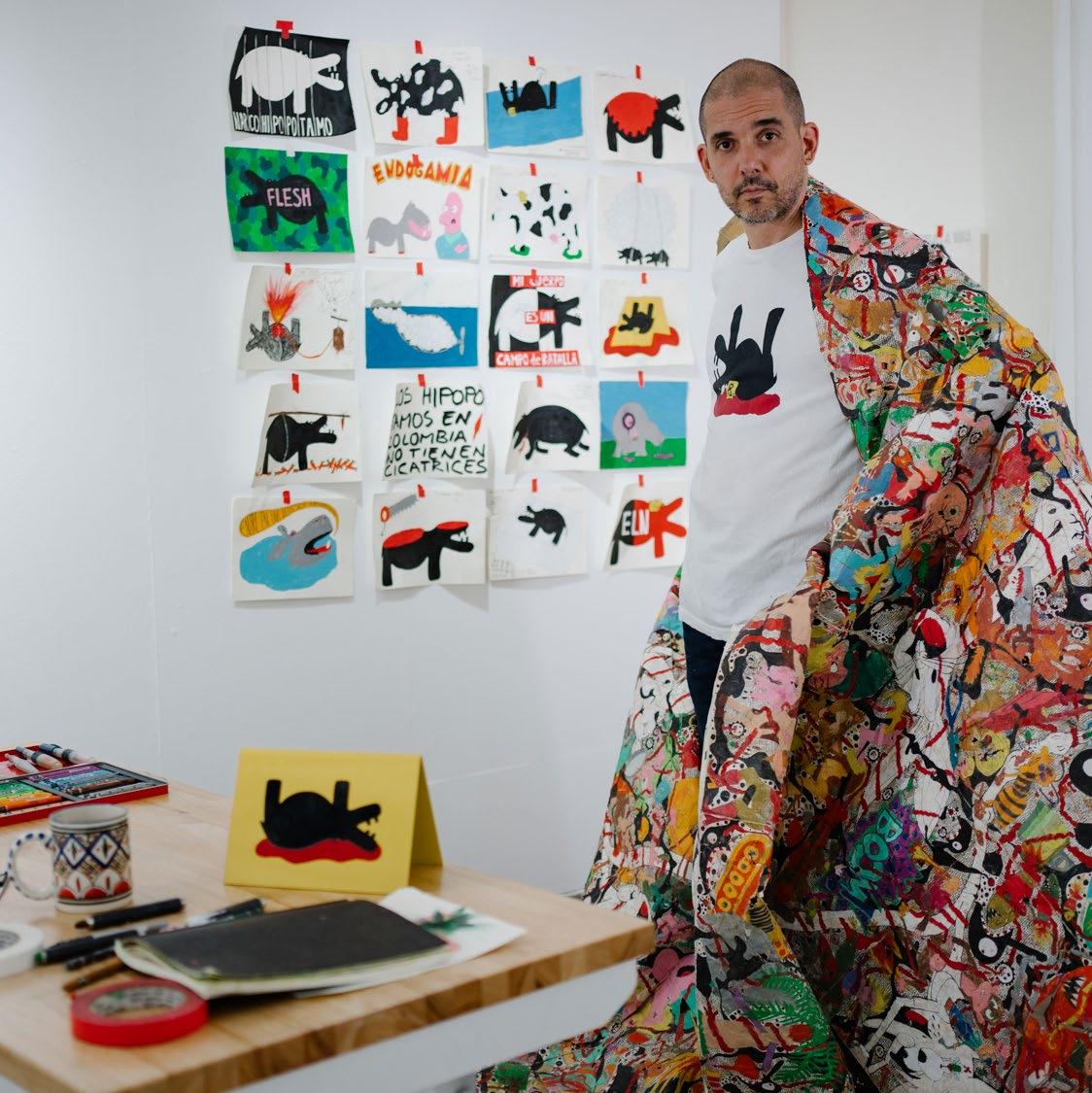
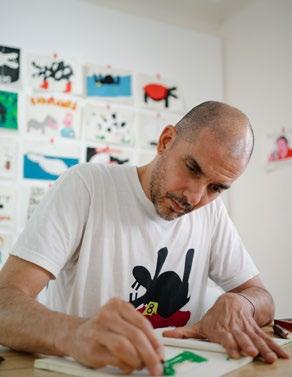
Camilo Restrepo in his Fountainhead studio; photographed by Karli Evans.
Between each crumbled sheet, the vulnerability of the fractured pages taped back together, and the layers of ink, it was these notions that became reinforced through his participation in the residency program. Embracing notions of collaboration and relationship-building, the cathartic nature of his practice has been reinforced. While tackling such weighted and relevant issues, he has unearthed new, relaxed, and conceptual approaches that allow his practice of destruction, excavation, and repairing to flow more seamlessly into dialogue with other contemporary artists. His is a practice of disorder as language. Through it, he has exorcised the weight of personal and collective history, forging a path where art is not a performance of control but a space of radical surrender.
WordsbyCharlesMoore
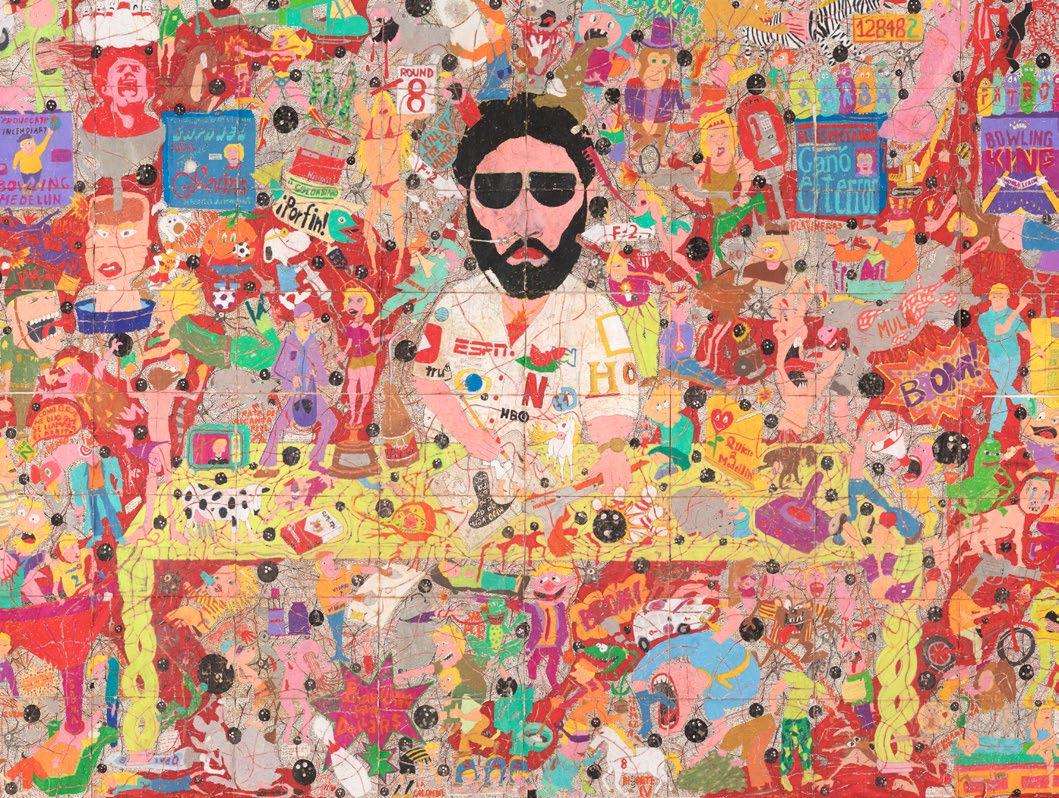
BowlingForMedellin#4(2019), ink, water soluble wax pastels, tape, stickers, newspaper clippings, glue and saliva on paper.
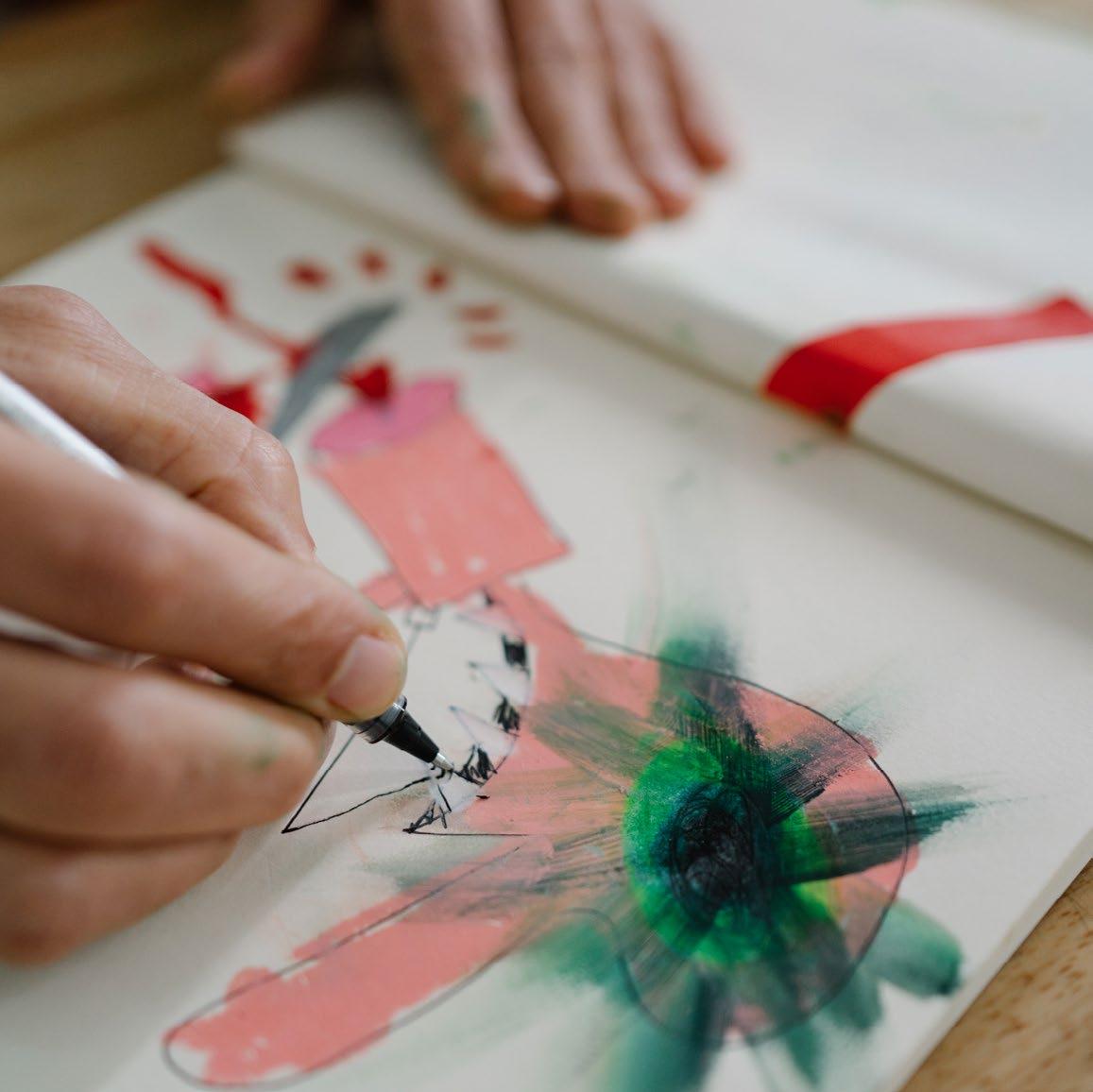
Camilo Restrepo in his Fountainhead studio, photographed by Karli Evans.
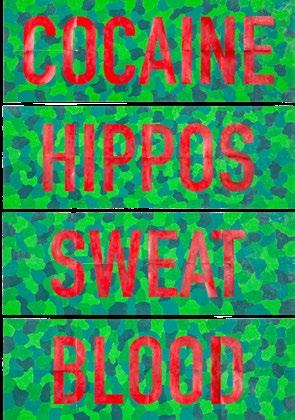
CocaineHipposSweatBlood(2024); ink, water soluble wax pastel, acrylic and tape on paper.
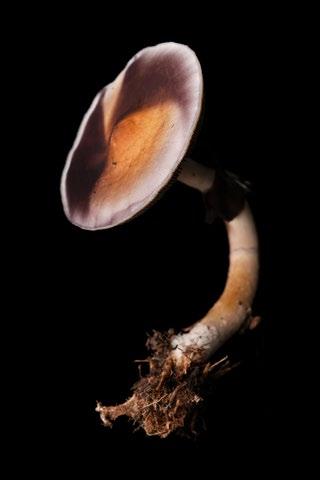
PsilocybeHippopotamensis(2025); digital print.
Drawing is an integral component of Restrepo’s practice.
Image by Karli Evans.
Guillermo Garcia Cruz
Guillermo Garcia Cruz constructs a visual language where geometric precision collides with the impermanence of the digital age. Born in Uruguay, he found himself searching for an artistic identity within a nation not often associated with the deep historical narratives of pre-Columbian civilizations that shape much of Latin American art. Instead, he turned to Uruguay’s most significant artistic contribution, Universal Constructivism, as pioneered by Joaquín Torres-García. Yet, rather than homage, Cruz extends the lineage of this movement into the present, merging its formal rigor with the ephemeral nature of contemporary digital experience.
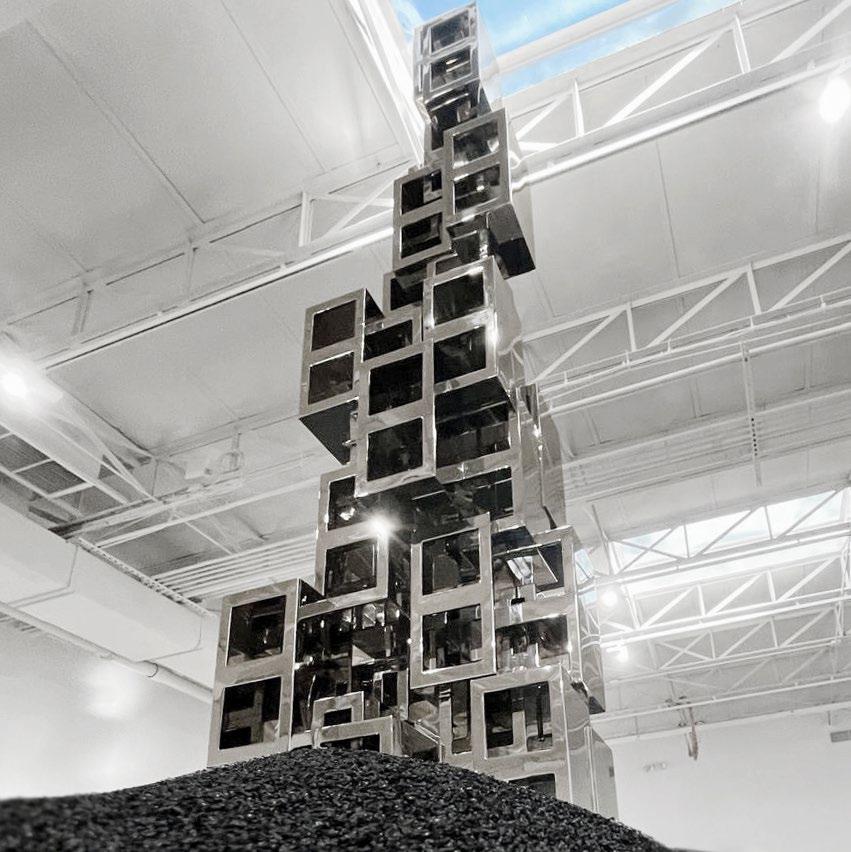
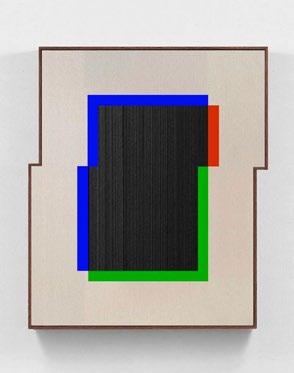
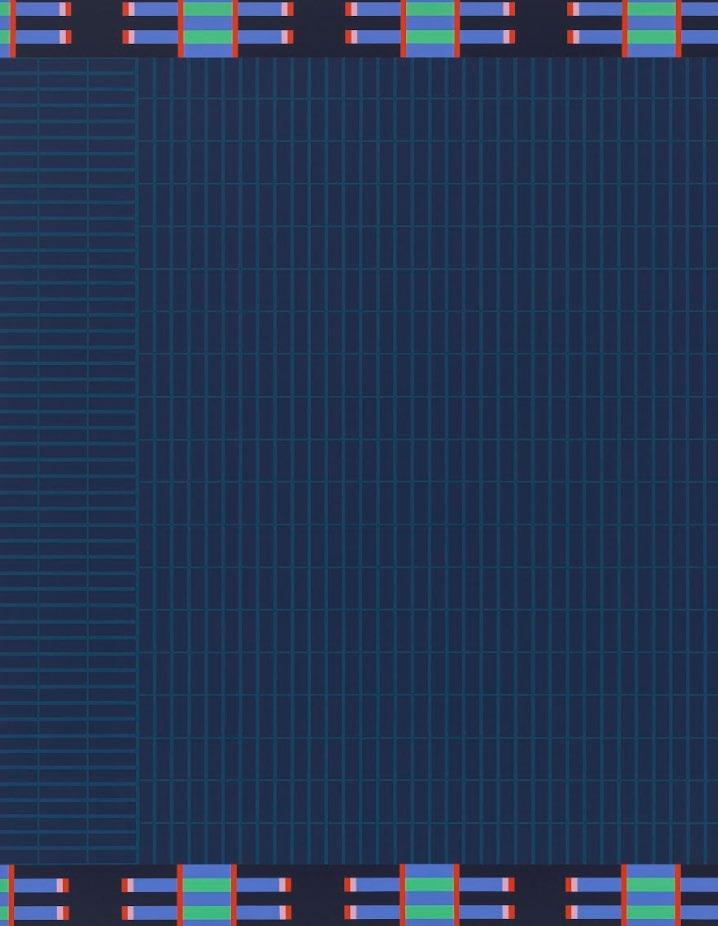
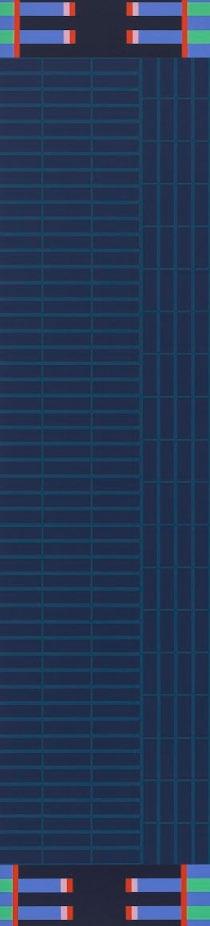
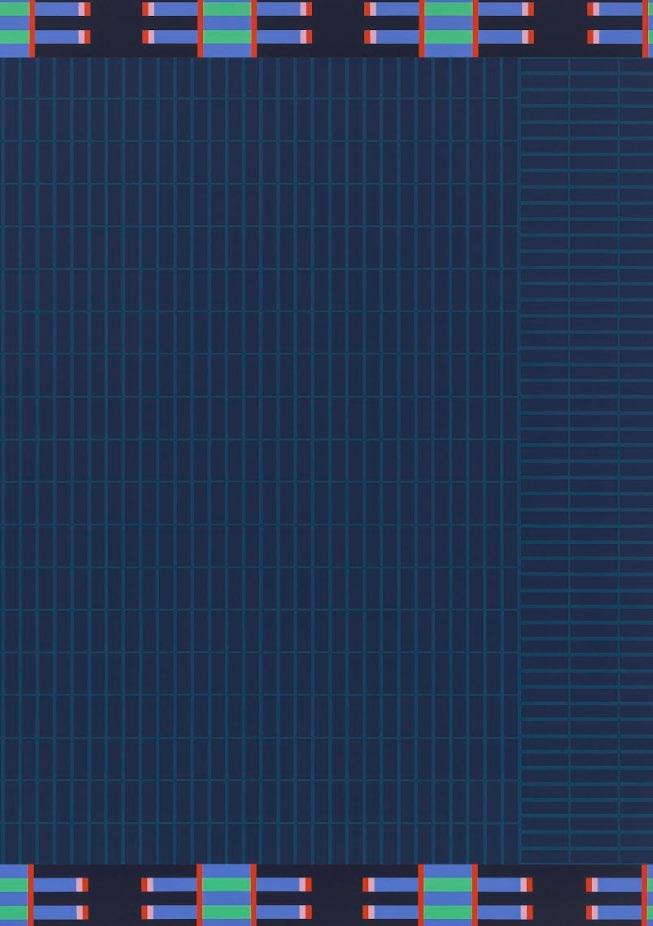
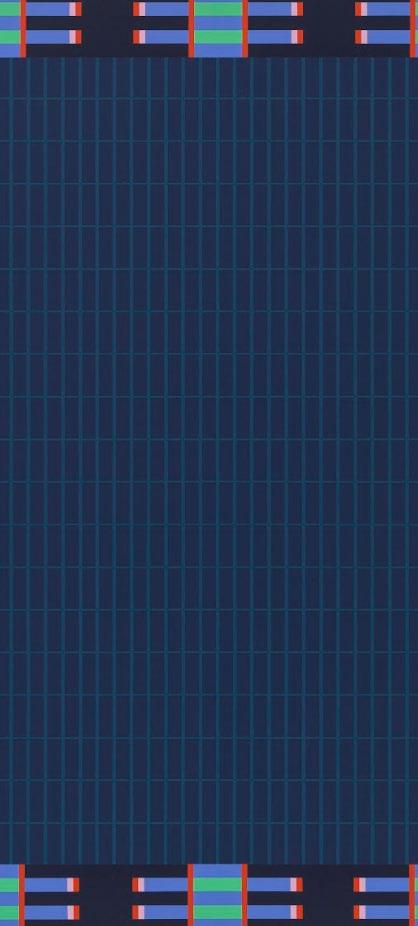
At the core of his practice is a meditation on the mediation of our reality, specifically reimagining the way technology refracts and distorts our lives. His vertical compositions, stark in their geometric clarity, recall the ubiquitous screens through which modern life is filtered. Glitches, breaks, and shifts in repetition punctuate his paintings, evoking the unstable rhythm of digital existence. His palette, grounded in black, reflects the totality of pigment yet the absence of light. This is complemented by an embracing of RGB configurations. They act as both a reference to the pixelated building blocks of the virtual world, and to the proliferation of primary colors found in the work of other historic geometric artists like Piet Mondrian. This synthesis of minimalism and digital symbolism places Cruz at the intersection of structure, perception, and technology.
DivergentStructure(2024), stainless steel, installation detail.
In constructing his own artistic practice, he found the need to leave Uruguay. In doing so, he found its essence, discovering new ways of bridging the past and present, between physical presence and digital ether. Through his residency, this act of uncovering identity takes one step further. In the forced calm of the studio, he was presented with the opportunity to reflect and experiment amidst a time of professional pressures and prolific creation. With a newfound sense of distance, he could see his own artistic heritage with new clarity. Enveloped in outsider perspectives, he could see new ways of challenging the monolithic portrayals of Latin American culture, analyzing how his practice is viewed and can change the conversation of art in Uruguay today. With new sketches and work on the horizon, Cruz navigates the glitches, embraces the flux, and sees new abstractions that echo a rapidly shifting reality.
WordsbyCharlesMoore
Garcia Cruz
Session 01
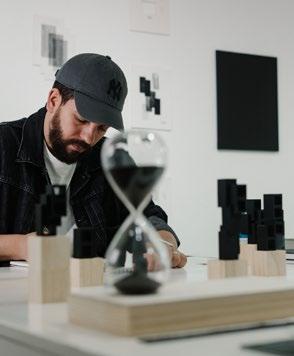
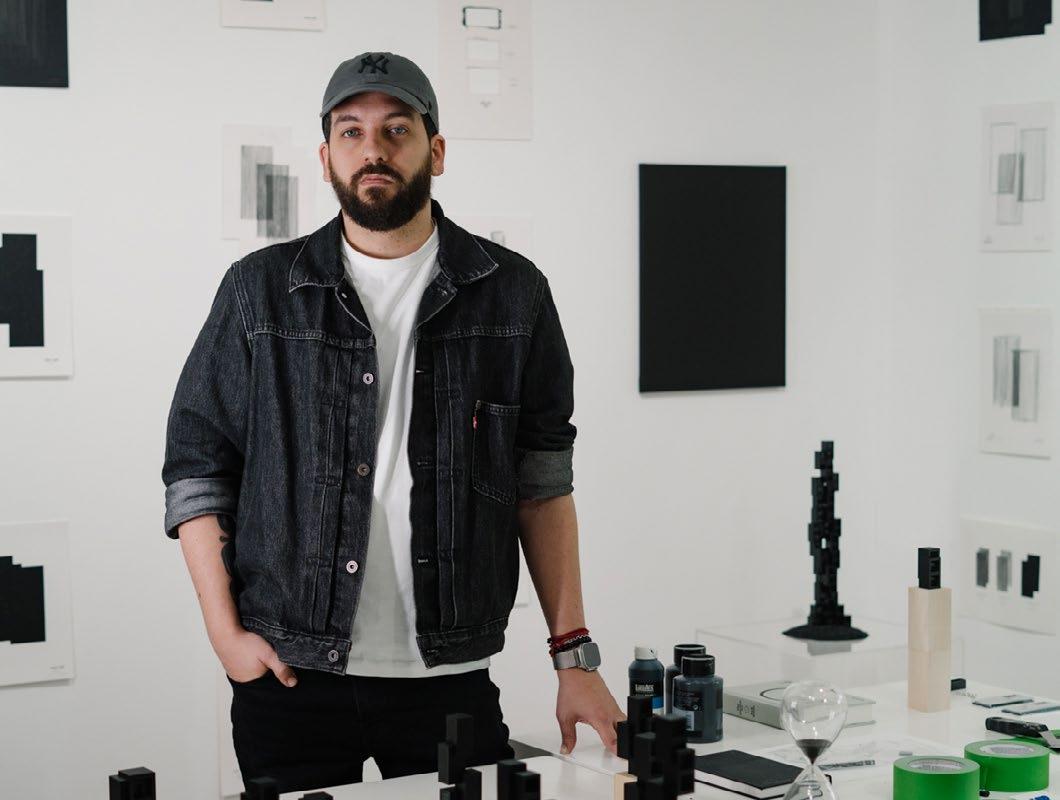
A portrait of Garcia Cruz by Evans.
Guillermo Garcia Cruz in his Fountainhead studio, photographed by Karli Evans.
ScreenRGBXXIV(2024), acrylic on canvas.
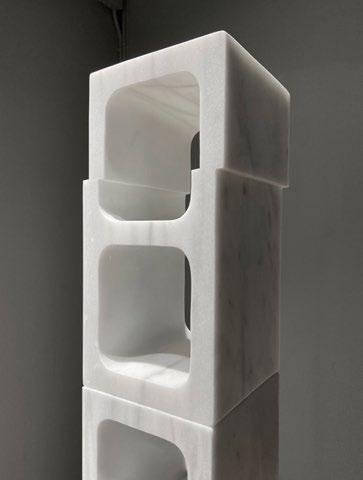
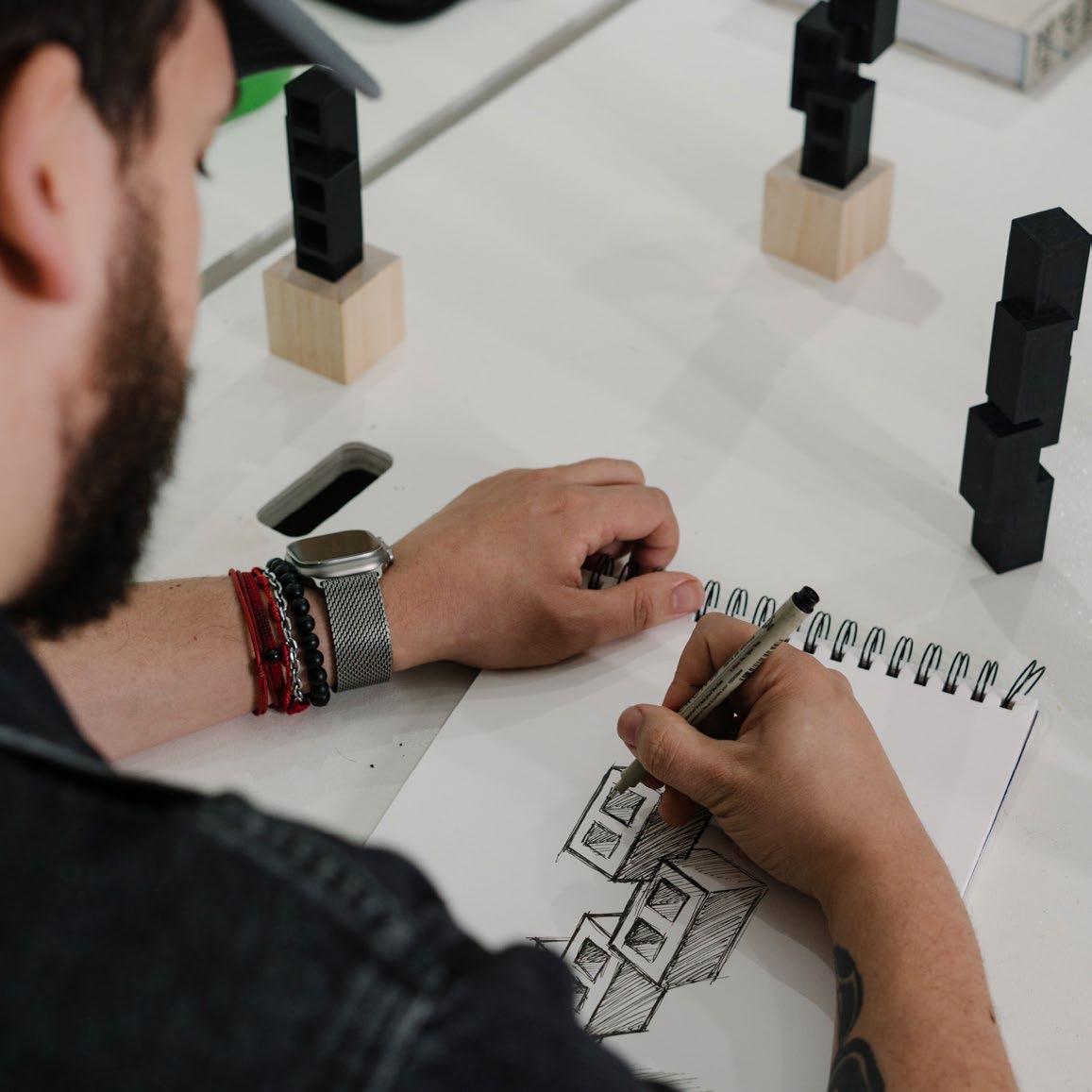
GlitchedWalls(2022); installation, variable dimensions, macael marble bricks.
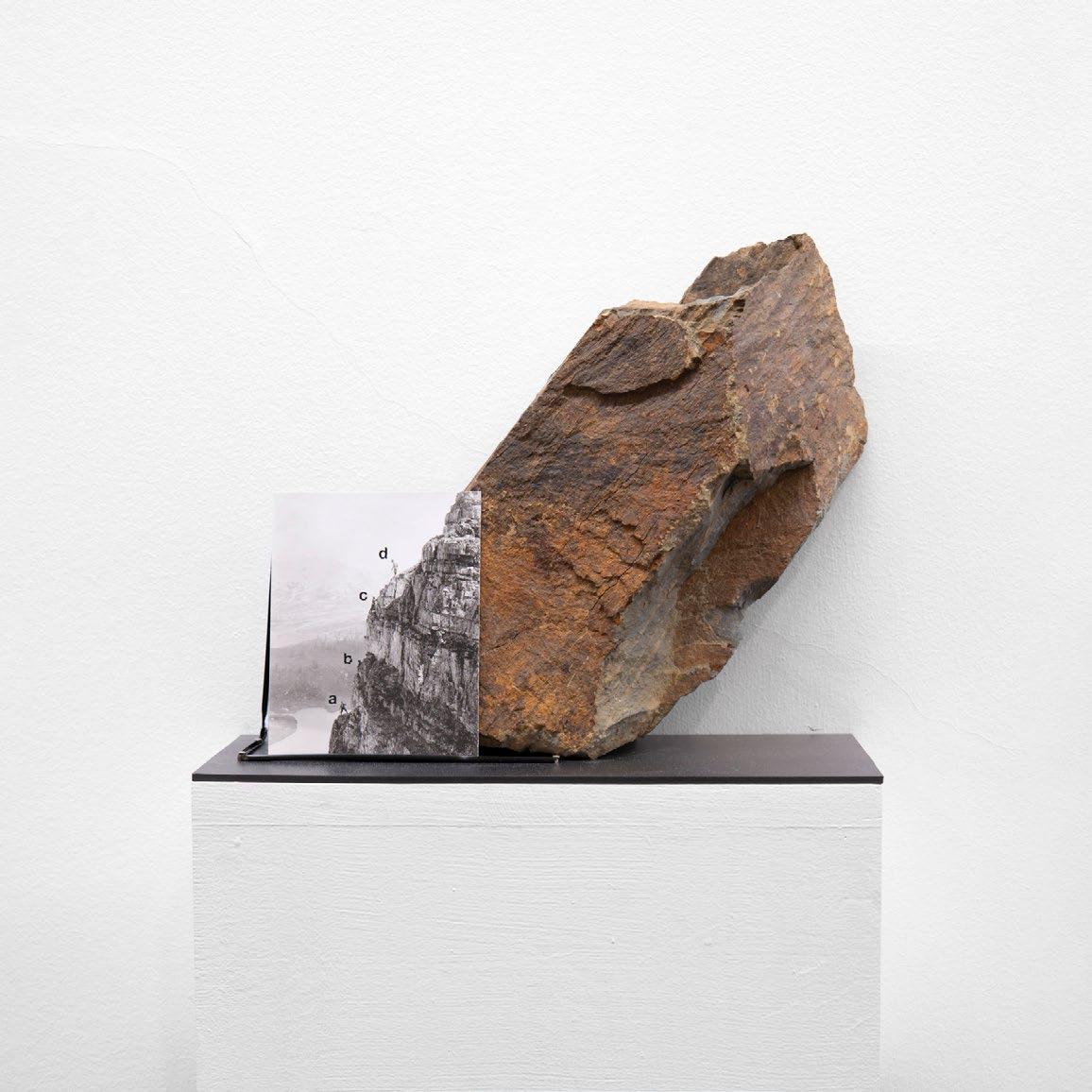
Marcelo Moscheta
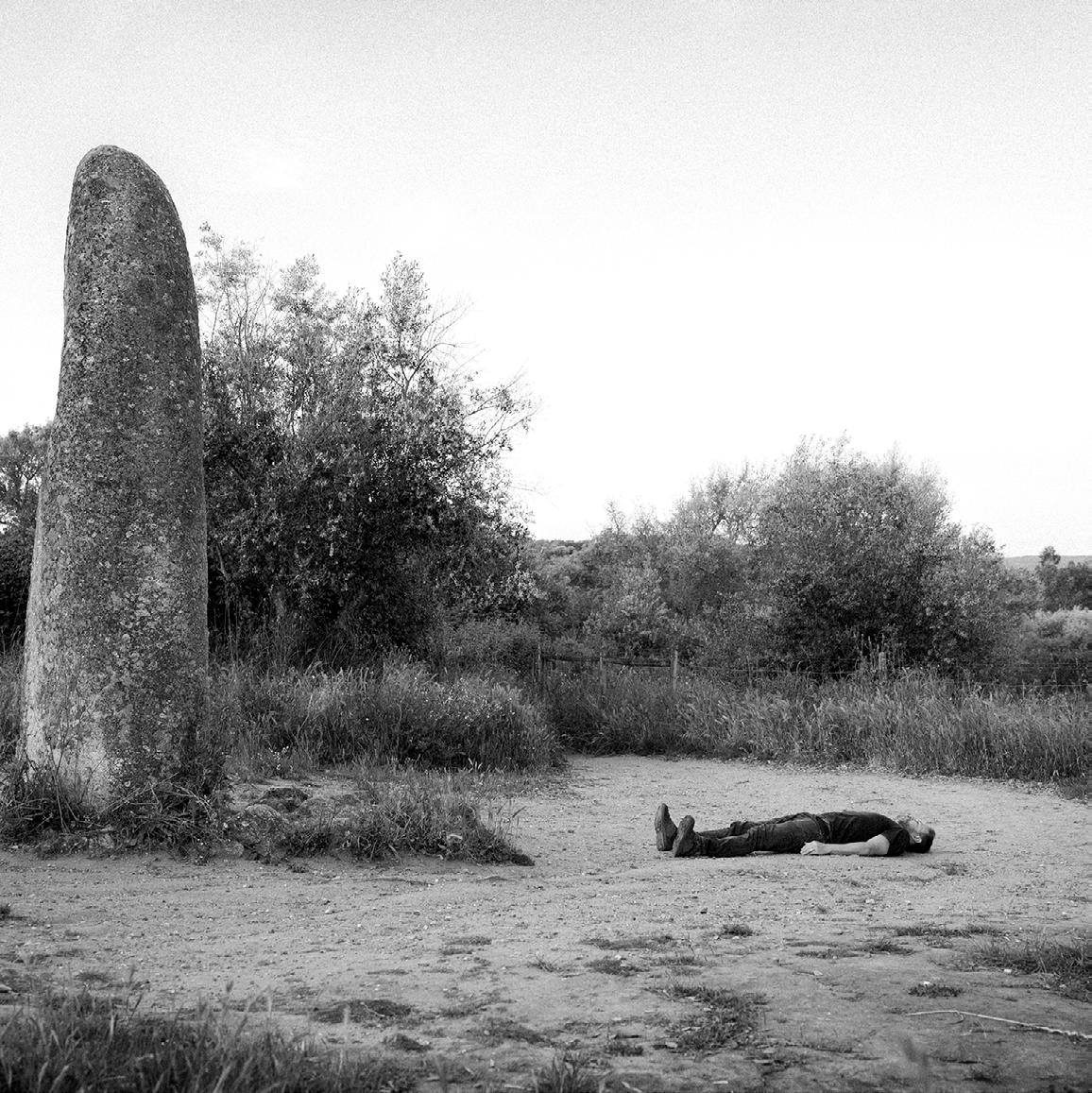
Marcelo Moscheta maps the fragile intersection of memory, landscape, and materiality, charting a practice that is as much about presence as it is about absence. Born in Brazil and now based in Portugal, Moscheta’s work is an excavation of land, of time, and of the intangible forces that shape both. His early years, spent in a city devoid of art institutions, fueled an instinct to search and uncover connections where none seemed to exist. His first works traced the lineage of a grandfather he never met, scouring through materials from his familial archive to create etching fragments of the past into tangible form. This impulse to locate oneself within the vastness of history and geography continues to drive his work today.
He works with a diverse array of mediums from graphite to concrete, PVC, ceramics, and found natural elements. Moscheta engages in a material dialogue with the landscape, evoking both its solidity and ephemerality. Dissolving into liminal spaces, within his work we find something both hyper-real and intangible. Unfixed and vulnerable to touch, he mirrors the instability of memory and place. In other artworks, he repurposes the earth itself, mud from environmental disasters, shaped into ceramic relics that preserve destruction as artifacts, forcing us to confront the tension between what we discard and what endures.
Entranced by texture and shape, the materiality of his work dictates its execution. His preference for haptic versus optic is apparent in his monochromatic palettes. Color is merely a vehicle for propelling the nature of his subject, the metaphors lying within each material, and the true essence of the place within each piece. Much like the British artists Richard Long and Hamish Fulton, the use of earthly pigments heightens the conversation of disconnection and dislocation.
Moscheta views the intersections of art, place, and identity not only from an artistic perspective but a critical one. Channeling art historians like Lucy Lippard and anthropologists like Bruce Chatwin, his work reorients our landscape as both a physical and mental place for enlightenment. In a reinvention of minimalist interpretations of art—combined with the grandeur of geological intervention witnessed by influential Brazilian artists like Nelson Felix and Anna Bella Geiger—Moscheta’s sculptural installations force new perspectives through an aura of ephemerality and immersion.
In creating these works that reflect on the relationship of the individual to the world, their past, and themselves, Moscheta’s practice has evolved into an isolating one. His residency experiences have been pivotal, transforming his solitary studio practice into a site of exchange, where the process of creation becomes performative and communal. From this urban environment emerged a culture of exchange that added a condensed and deepened self-perception of his work that will continue to expand his poetic topology of impermanence, where the landscape becomes both a mirror and a measure of the self.
WordsbyCharlesMoore
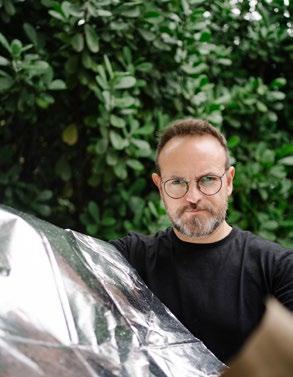
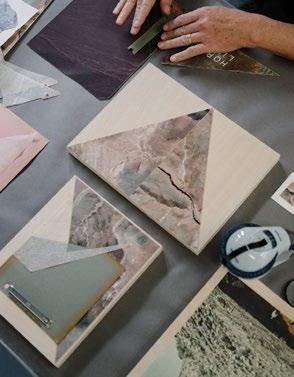
In his Fountainhead studio, Moscheta traces his family’s lineage against samples of lands traversed.
Images by Karli Evans.
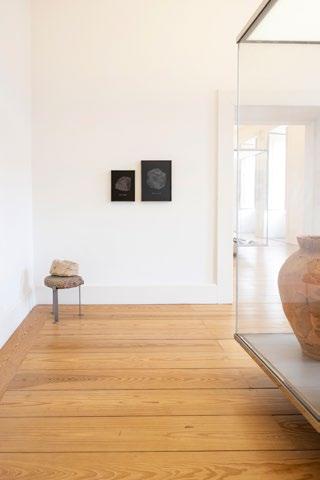
Installation
view of the solo show, TrasladosatMIEC, Portugal(2025); graphite drawing on PVC board and embossed adhesive tape.
Traslado_1 (2025); inkjet pigmented print on paper.
Session 02
Marcos Castro Naima Green
Portia Munson
Painting Photography Sculpture
Mexico
Marcos Castro
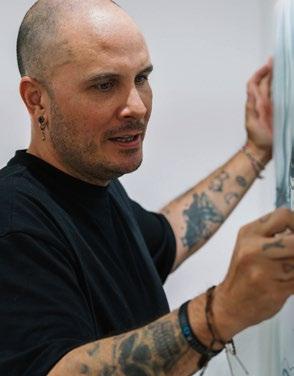
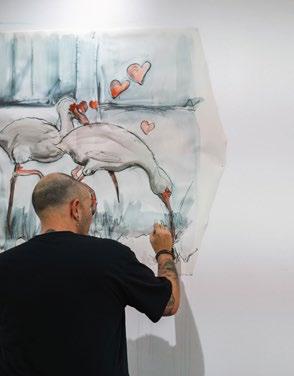
When Marcos Castro arrived in Miami, the ibises—often seen strolling through the city’s bustling streets and parks, landing atop cars stalled in traffic—became his muse. In the early mornings of Miami, as the sun climbs over the horizon, the city’s skies are filled with the graceful flutters of ibises. Their long, slender necks curve with ease, and their bright white feathers almost seem to glow in the light. Their elegance and almost comic persistence weaved their way into his mind.
At the heart of Castro’s practice lies an inherent connection to space, a bond that transcends the canvas. His works often expands beyond traditional boundaries, challenging the limitations of painting by transforming the environment itself. The walls, floors, and ceilings of the gallery become part of the artwork. His work does not merely inhabit a gallery—it swallows it whole, digests its architecture, and reimagines it as an extension of his own myth-making. In Mexico City, where the ghosts of muralists loom large, Castro paints with a reverence that both honors and fractures tradition, extending beyond the confines of canvas, into the skin of the walls, into the bones of the building itself.
This idea of fluidity—of painting coming alive through interaction—echoes the legacy of Mexican muralism, a movement he holds dear. Figures like José Clemente Orozco and David Siqueiros inspire him, as they once did for an entire nation grappling with identity, history, and revolution. But rather than illustrating the past, Castro fractures it, layering symbols of decay and renewal—bones, birds, fragmented landscapes—into compositions that blur the lines between the ancient and the apocalyptic. His signature use of surrealist, dark, saturated tones and textured surfaces imbues his work with a haunting quality, a sense that something is shifting beneath the surface.
Adentroyafuera(2025); oil on canvas.
The vision starts in his sketchbook, a private space where surreal fantasies change to emerge. It’s here that Castro’s thoughts begin to take shape: tiny drawings and scribbled ideas swirl into a cohesive narrative. The sketchbook serve s as his playground, where he envisions how these playful, heart-eyed ibises might leap off the page and into the world—how they might, in their final form, become living, breathing installations, as they adorn the walls of his Fountainhead studio.
His art is born not in isolation, but in communion. Castro found his first artistic home in the vast expanse of an abandoned house he shared with other artists, and he has carried this ethos with him, understanding that to create is to connect, to gather, to build a sanctuary in the face of an art world that can be unrelenting.
In Miami, he sees nature pressing in from all sides, an unfamiliar yet intoxicating force. Birds he cannot name (the ibis) stare back at him, their presence a quiet demand: Look. Notice. Translate. His sketchbooks fill with new creatures, new landscapes—his lines attempting to capture the feeling of a city that shapeshifts overnight. Here, he is an outsider with fresh eyes, attuned to details that long-time residents may no longer see. The sea breeze, the weight of humidity, the quiet struggle of a space trying to hold onto its past as it is rewritten by wealth, by movement, by the inevitability of change— these forces seep into his work, into the murals that grow beyond themselves, into the paintings that refuse to be contained. In his world, the painting does not end at its edges. It continues. It consumes. It breathes.
WordsbyAlexandraMartinez
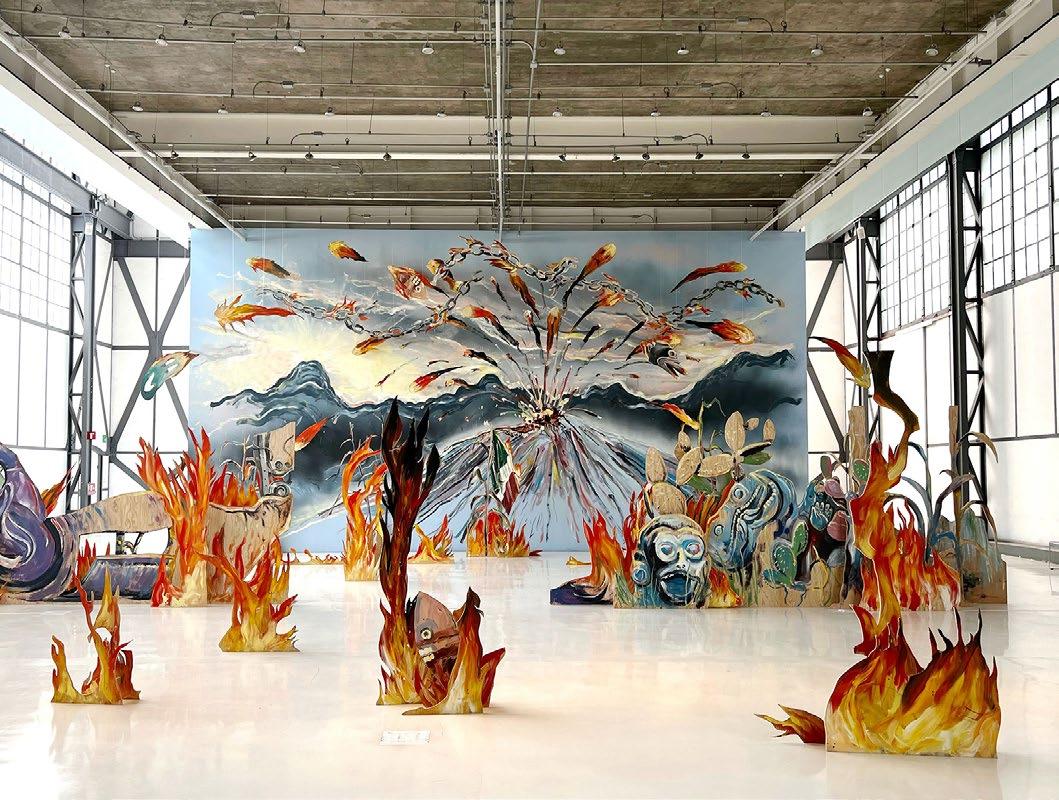
Elestadodelascosas(2021); mural and installation.
Castro arrived in Miami and was immediately drawn to the ibis. Images by Jayme Gershen.
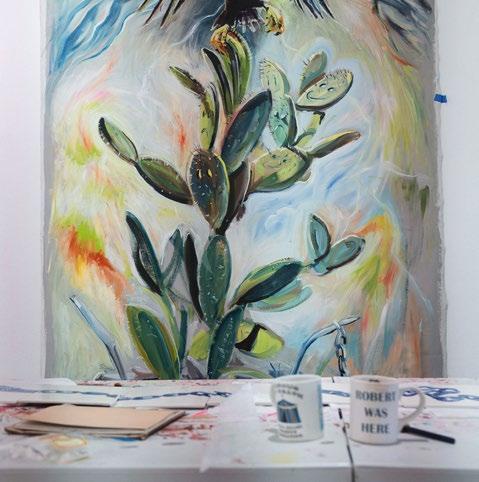
A work in progress in Castro’s studio features a nopal cactus, Image by Gershen.
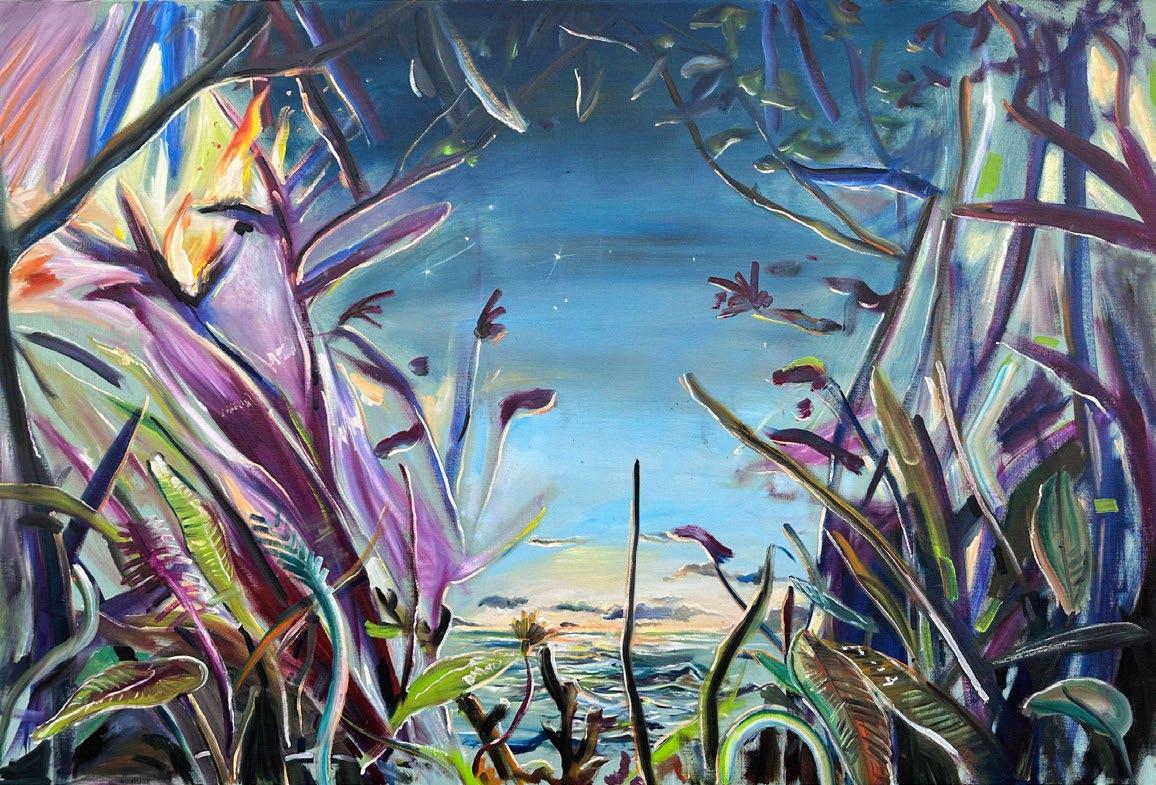
Elfinaldelanoche(2024); oil on canvas.
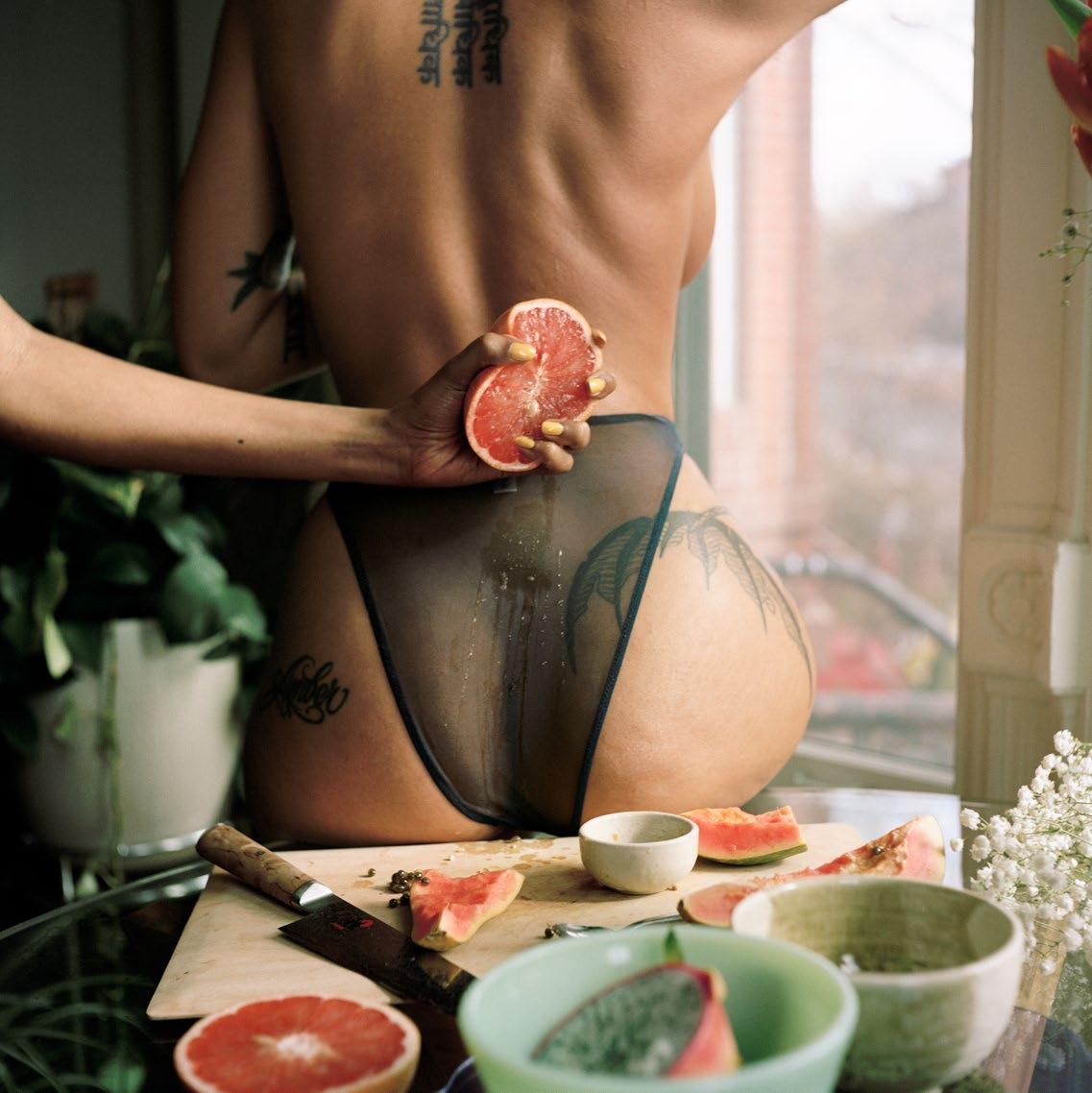
Naima Green
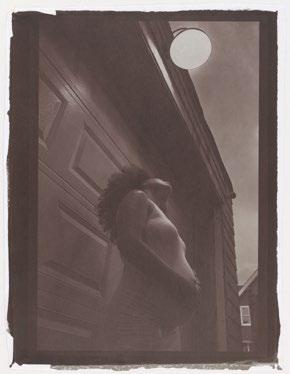
In the dimly lit corners of Naima Green’s studio, she carefully mixes an albumen mixture—a process from the 1850s that primarily uses egg whites to coat paper—breathing life into the glossy surfaces of her photographs. The process is intimate, labor-intensive, and enacted through her hands. The egg, no different than the fertile bodies Green portrays in her portraits, is a perpetual liminal space–where creation is at the precipice, but never realized, instead yielding a whole other thing. Green uses the egg white, that gooey, liquidy protective sac that encases the life-full yolk, to coat the paper. With each coating of the paper, the surface becomes glossier, protecting the image Green has created.
Green stages intimate self portraits around this series of parenthood and possibility, often wearing prosthetic bellies, and photographs pregnant friends in a gesture that acknowledges the fragility and power of the maternal or gestating body. Green has long been captivated by water as both an elemental and conceptual force–both vulnerable and strong, just like the maternal body.
Through staged portraiture, she constructs images that oscillate between the tangible and the imagined, unraveling the narratives we inherit about parenthood. Her work probes the politics of pregnancy, asking who is granted the privilege of safe childbirth and maternal agency, and who is denied.
In these images, Green explores the layers of personal and societal narratives that shape the experience of the maternal body. These staged photographs exist in a space between the personal and the public, inviting the viewer to contemplate societal expectations surrounding motherhood and the often-unspoken tensions embedded in the reproductive body.
JuicyFruit(2022); archival pigment print.
Each photograph, coated in egg-whites, becomes an extension of the bodily water that Green seeks to understand. Through her lens, she investigates the ways bodies interact with both natural and constructed environments, particularly water as a vessel of life, sustenance, and tension.
In her broader practice, Green’s work challenges notions of intimacy, care, and resource scarcity, particularly through her engagement with the themes of pregnancy and childbearing in an era marked by climate crises and systemic inequality. Double exposures and sequential imagery imbue her compositions with a sense of motion—bodies caught in the act of becoming. In this, she aligns with artists like Lorna Simpson and Carrie Mae Weems, who use photography as a tool to complicate identity and representation.
As she shifts from photographing others to depicting her own body in stages of change to prosthetic life, Green gives form to the unspoken realities of gender, race, and power— making visible the complex layers of identity, responsibility, and desire that so often go unacknowledged. Water flows through her work not as a singular idea but as a multiplicity of truths, a catalyst for thought, movement, and change.
At a moment when reproductive rights hang in the balance, Green’s work is both timely and timeless. Pregnancy, in her hands, is neither purely biological nor wholly symbolic—it is a contested space, a site of resistance, a vessel of histories both personal and collective.
WordsbyAlexandraMartinez
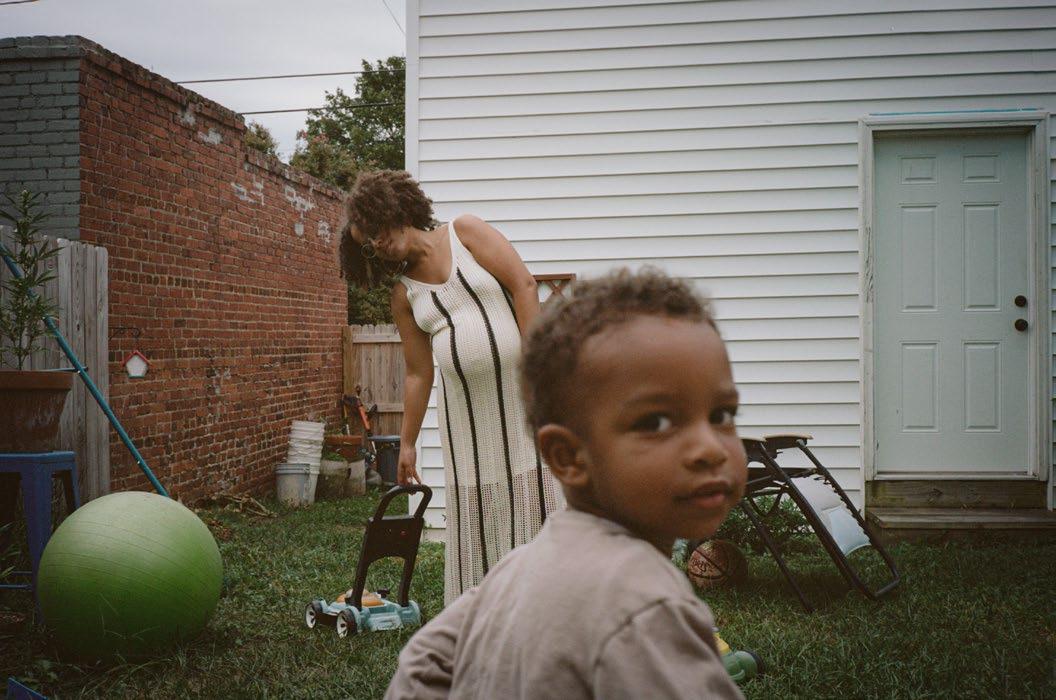
WithSolintheBackyard(2024); archival pigment print.
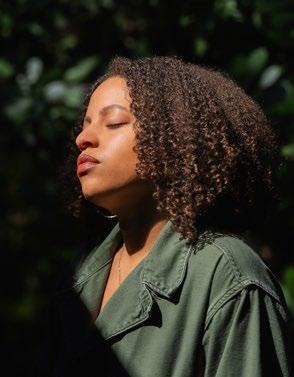
A portrait of Green by Jayme Gershen.
DreamFeed(2024); albumen print.
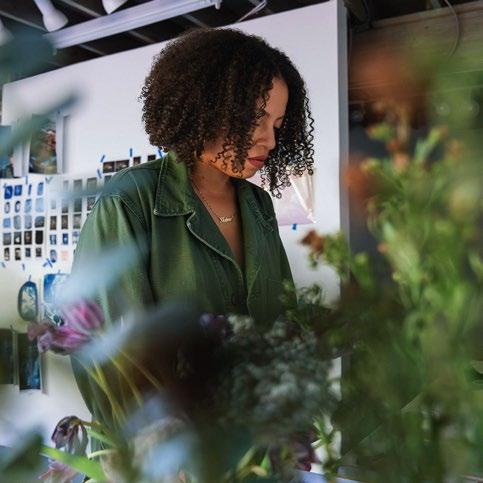
Green in her Fountainhead studio photographed by Gershen.
Saltwater&Gold(2021); archival pigment print.
Portia Munson
When a church patron bows down at the altar of religious piety, certain relics are to be expected as a reassurance of the patron’s own moral righteousness–a sacrificial Jesus, a forgiving Mary. But, in today’s secular world, where identity is defined more by consumerist desire, ephemeral objects become relics at the altar of late stage capitalism.
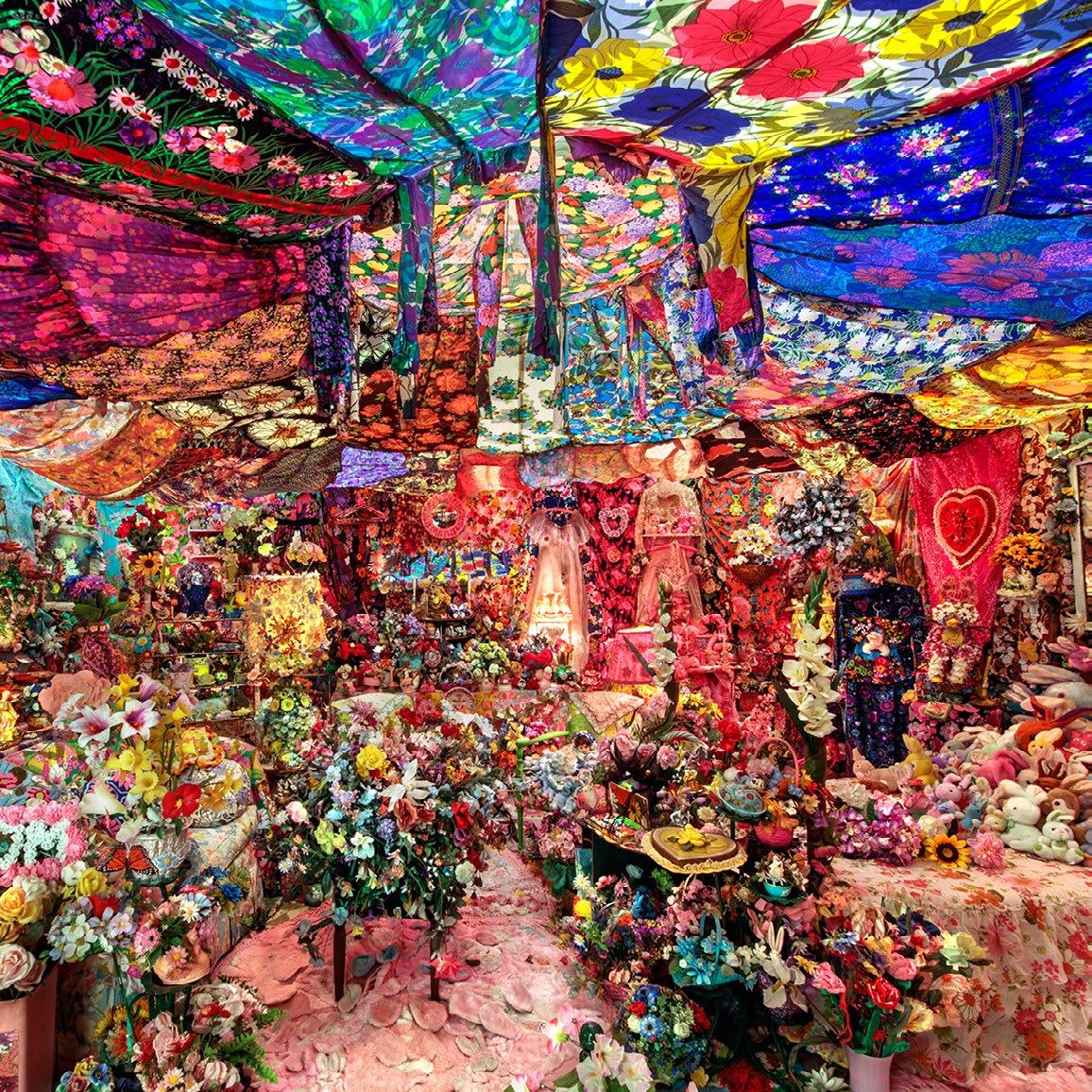
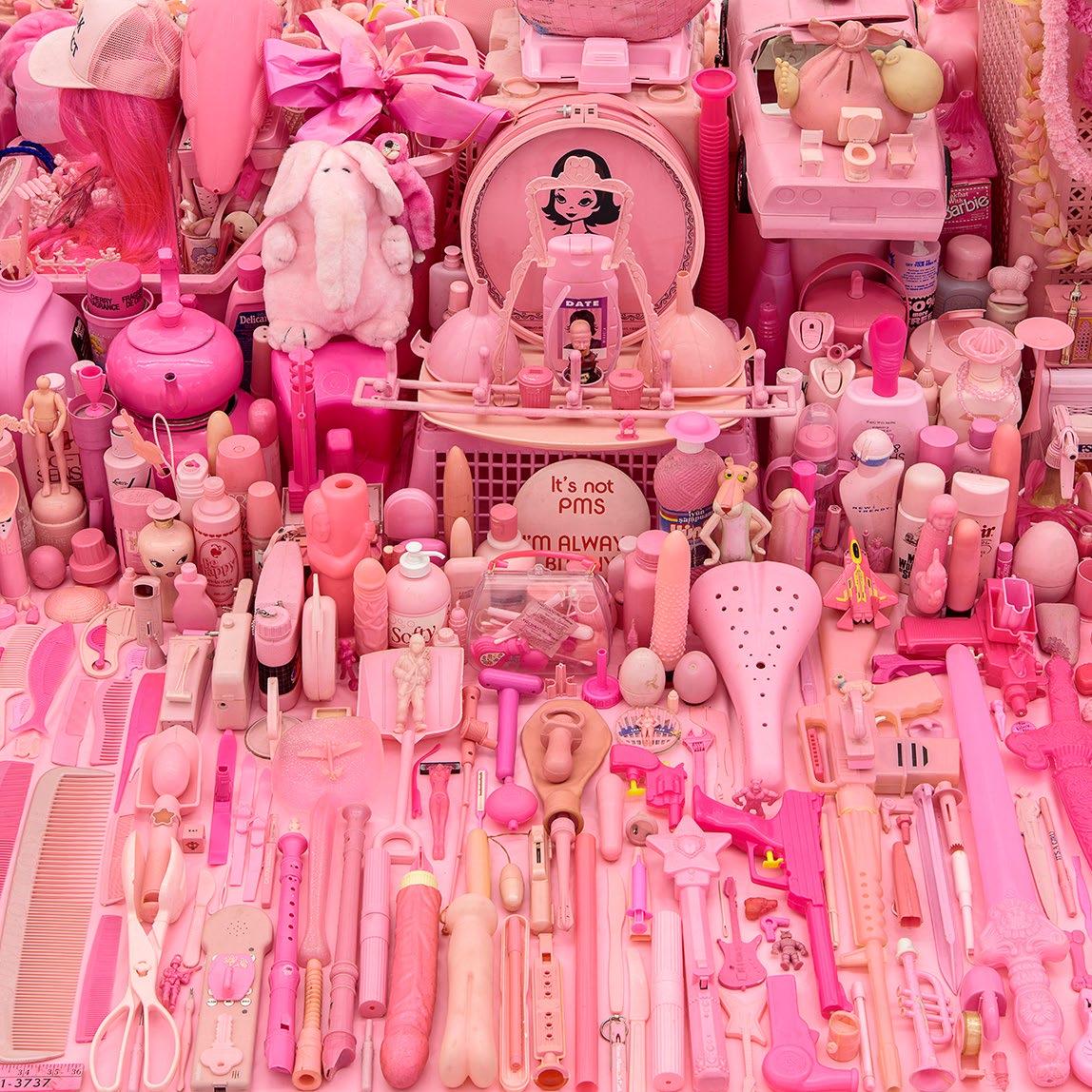
Artist Portia Munson’s world is a cascade of color, a young femme’s fever dream of discarded pastel relics, an altar to the overlooked. Each object she gathers—mass-produced, forgotten, imbued with the quiet weight of cultural expectation—finds new breath in her work. Munson’s practice accumulates everyday objects to expose how consumer culture, gender norms, and environmental degradation are deeply intertwined. In her hands, the detritus of consumerism transforms into reminders of third and fourth wave feminism–in a post-Roe world, what weight do these signifiers hold?
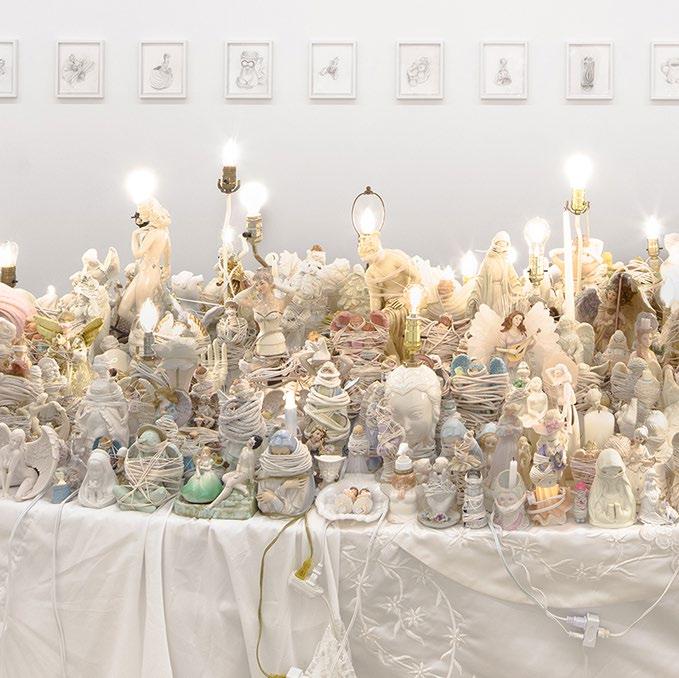
Various shapes and iterations of plush pink plastic are placed in conversation with each other, adorning a shelf, filling a table, or in the case of her ongoing PinkProject (ongoing since 1994), an entire bedroom. Pink, that saccharine specter of girlhood, drapes her altars in a blush of manufactured innocence. Hairbrushes, nail polish, plastic ponies—fragments of identity molded and sold in infinite repetition—press against one another, whispering of beauty standards, of girlhood commodified. Munson, who has been collecting pink objects from thrift stores and antique malls for over three decades, arranges these objects as excavations, uncovering the soft power and unspoken rules stitched into the fabric of femininity. The color becomes both cage and celebration, a symbol of constraint and self-expression entwined.
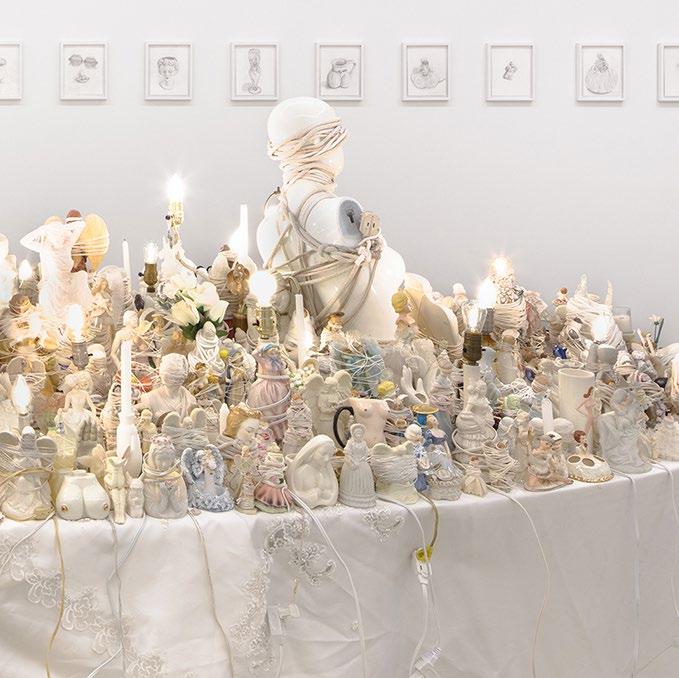
Among Munson’s exploration of color is also blue—deep as the ocean, divine as the Virgin Mary’s robes. Here, the color takes on the weight of water, of purity, of mermaids and their siren call. The objects remain the same: massproduced, discarded, but through Munson’s gaze, they reveal new narratives, a duality of innocence and seduction. The sacred and the profane collapse into one another, literally bound together by strands of synthetic hair and electric cords, their meanings re-stitched.
Munson’s work is more than the act of collection—it is resurrection. Each tiny pink trinket, each discarded blue vanity, speaks to the silent expectations wrapped around gender, around beauty, around self-worth, and around the identities we allow to dictate our lives. In assembling them, she does not simply critique consumerism’s endless cycle, she creates something that reflects our world back to us, refracted. If a relic offers a moment to remember the spirit that exists outside of ourselves then what difference is it to an object we purchase to demonstrate an aspect of ourselves. Her altars stand as testimony: to what we buy, what we discard, and what, in the end, still owns us.
WordsbyAlexandraMartinez
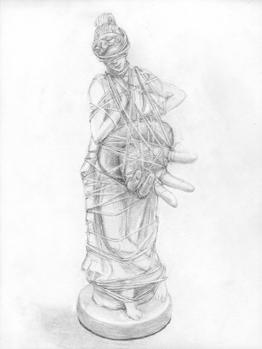
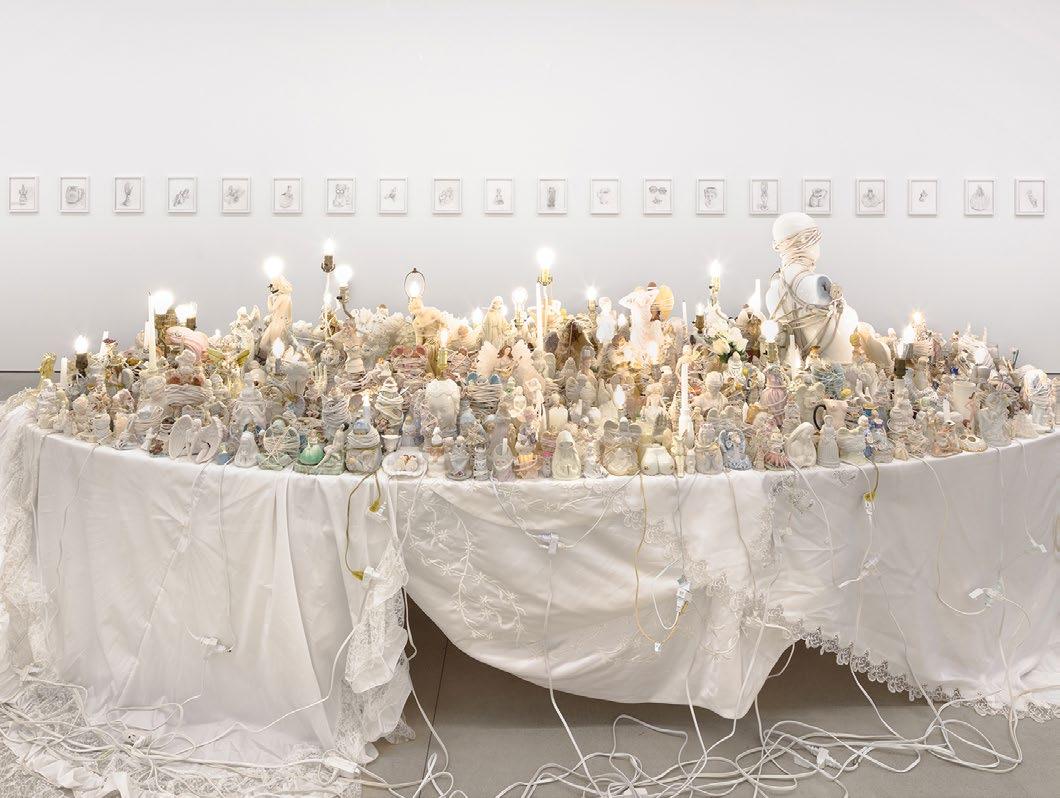
BoundAngel(table,sideview)(2021); found figurines, lamps, candles, string & rope, wedding gowns (tablecloth), extension cords, oval table.
BoundwithHand(2024); graphite on Strathmore 100% cotton rag acid free paper.
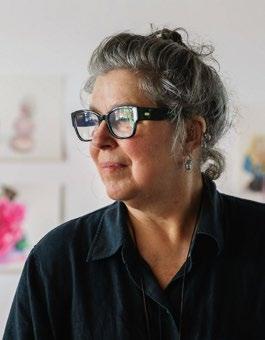
A portrait of Munson by Jayme Gershen.
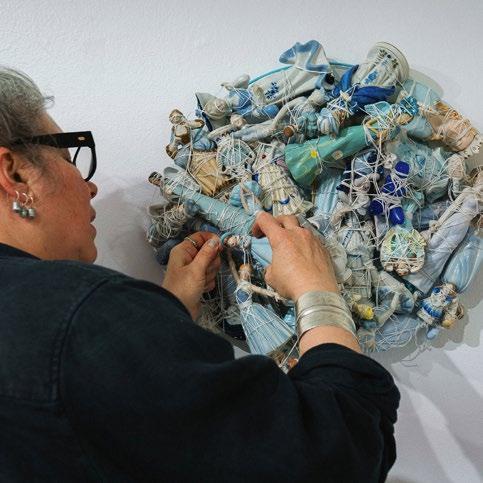
Munson completes SomethingOlde,SomethingNew,Something Borrowed,SomethingBlue(wall sculpture) (2025); found figurines, string, thread, rope and wire support. Image by Gershen.
Session 03
Emily Velez Nelms
Marcelo Canevari
Matthew David Rahming Sculpture Painting Painting
Florida Argentina Bahamas
Emily Velez Nelms
Emily Velez Nelms, a conceptual sculptor who uses the tools and methods of architecture to conceive and execute her work, grew up in Broward County, “in the last housing development before the Everglades,” she says. Her grandmother was a painter of “robust sky scenes, with lots of clouds and light breaking through—they’re very dramatic,” Nelms remembers. “She would let me paint on top of them.”
Her grandmother, Juanita, was also a belly dancer who performed at various venues on Miami Beach in the 1960s and ’70s. Juanita’s father was a Filipino featherweight boxer. This sparked Nelms’s interest in histories of racialized performance, as well as the tourism economies built around them, in South Florida and elsewhere. At the Yale Peabody Museum for her 2024 exhibition Resonance of Things Unseen, Nelms dug into Yale’s collection of papers from William C. Sturtevant, a 20th-century anthropologist and ethnologist who studied Seminole and Miccosukee language and culture. Nelms made prints of Sturtevant’s letters and etched them in yellow flypaper, then applied dead mosquitos to them.
Velez Nelms
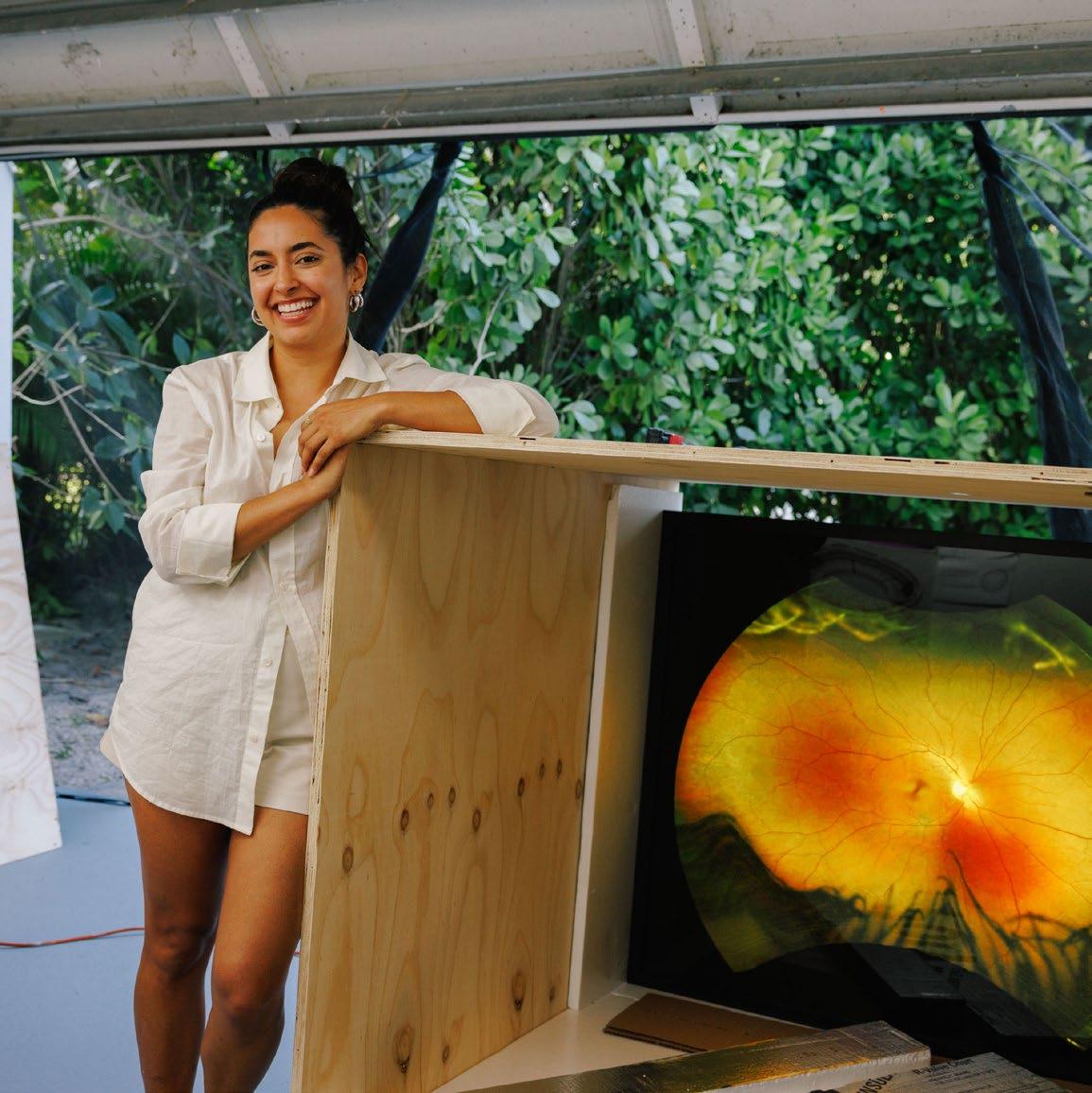
During her Fountainhead residency, the artist built a steel base and worked on the pumping system for a sculpture shaped like a bed. Filled with liquid, the sculpture is “like a water bed,” except the liquid will include quinine, the alkaloid used in tonic water that also glows when exposed to UV light. Representing the bioluminescence of sea creatures, Nelms is interested in drawing connections between the intimate space of the home and the ocean— that other ecosystem that defines South Florida. At the moment, she can only get it to glow for about two weeks. “I’m still learning,” she says.
WordsbyRobGoyanes
RhinestonesonCollinsandCoinsand PearlsOverJuliaTuttleCauseway(2022); 19 panels total, silkscreen on silk, inkjet print, embroidery.
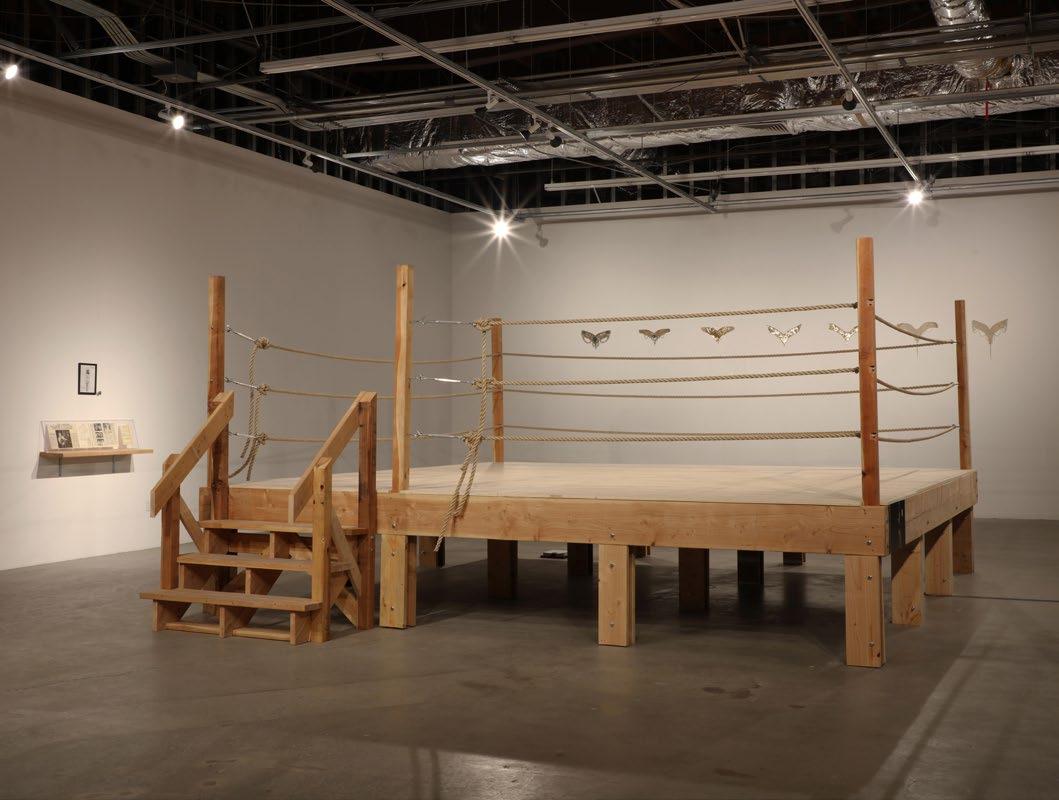
TowardaReferendumonPerformativity(2019); wood, rope, perspiration, spoken text, Debra Paget performance (video excerpt) fromJourney to the Lost City 1962, “Object of Comfort,” belly dancing belts, archival costume boxes, Images: Juanita Distrito Music Nelms, Felix Distrito, Fanned Prison, Rebecca Horn, 1978.
Nelms mounts references in her Fountainhead studio, photographed by Jackman.
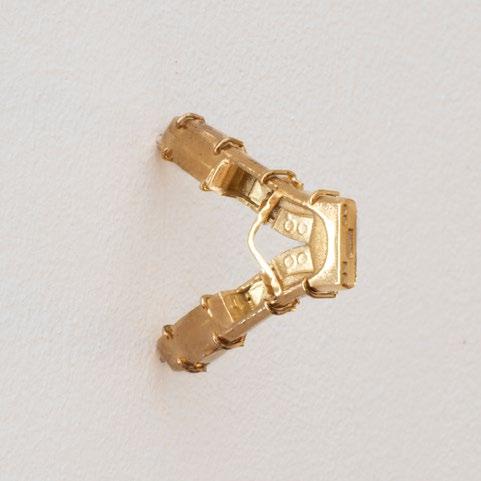
TracingaGriddedViolenceintheWarmth ofaCruelOptimism(2024); 20k gold.
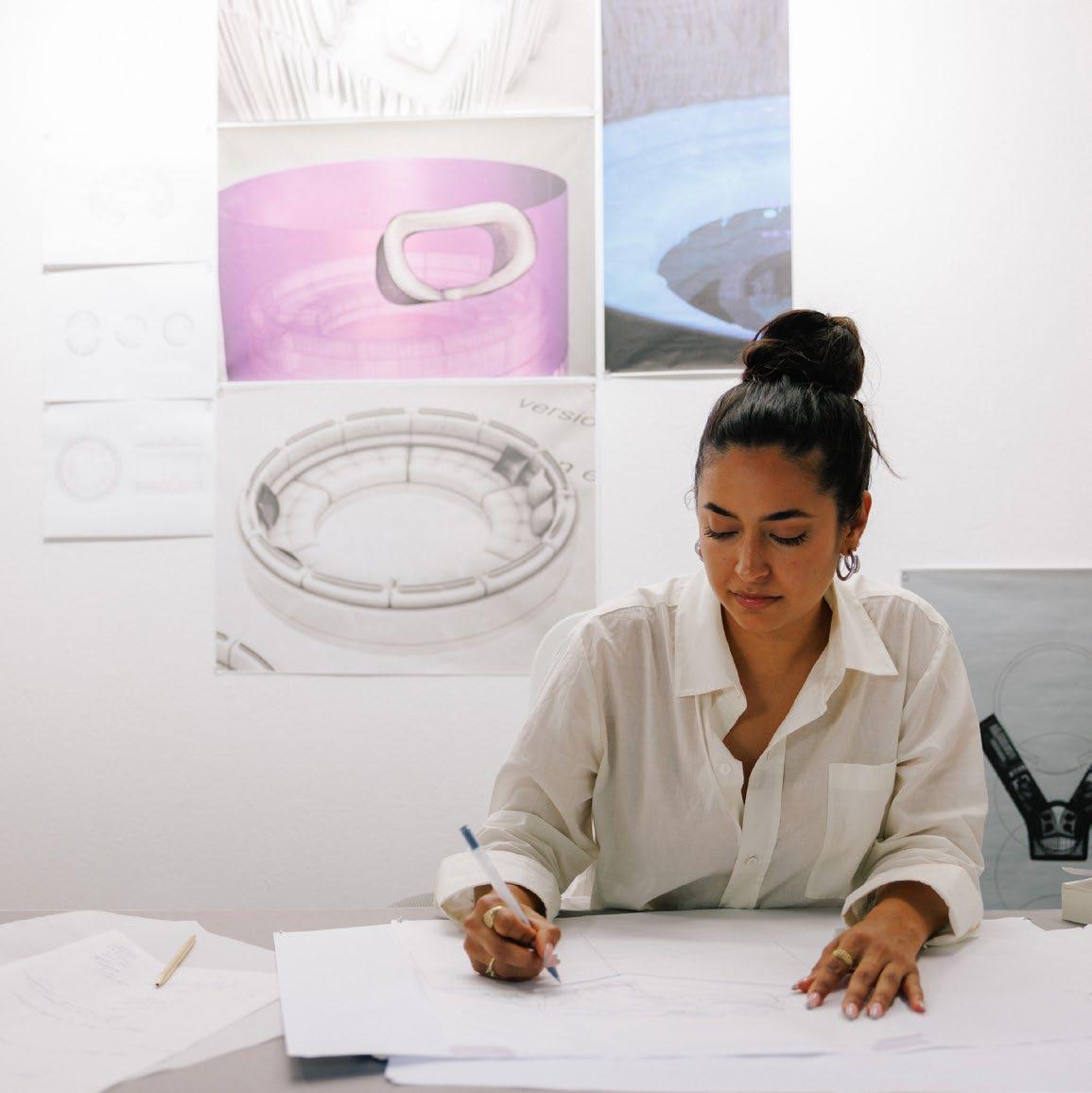
Nelms in her Fountainhead studio, photographed by Jackman
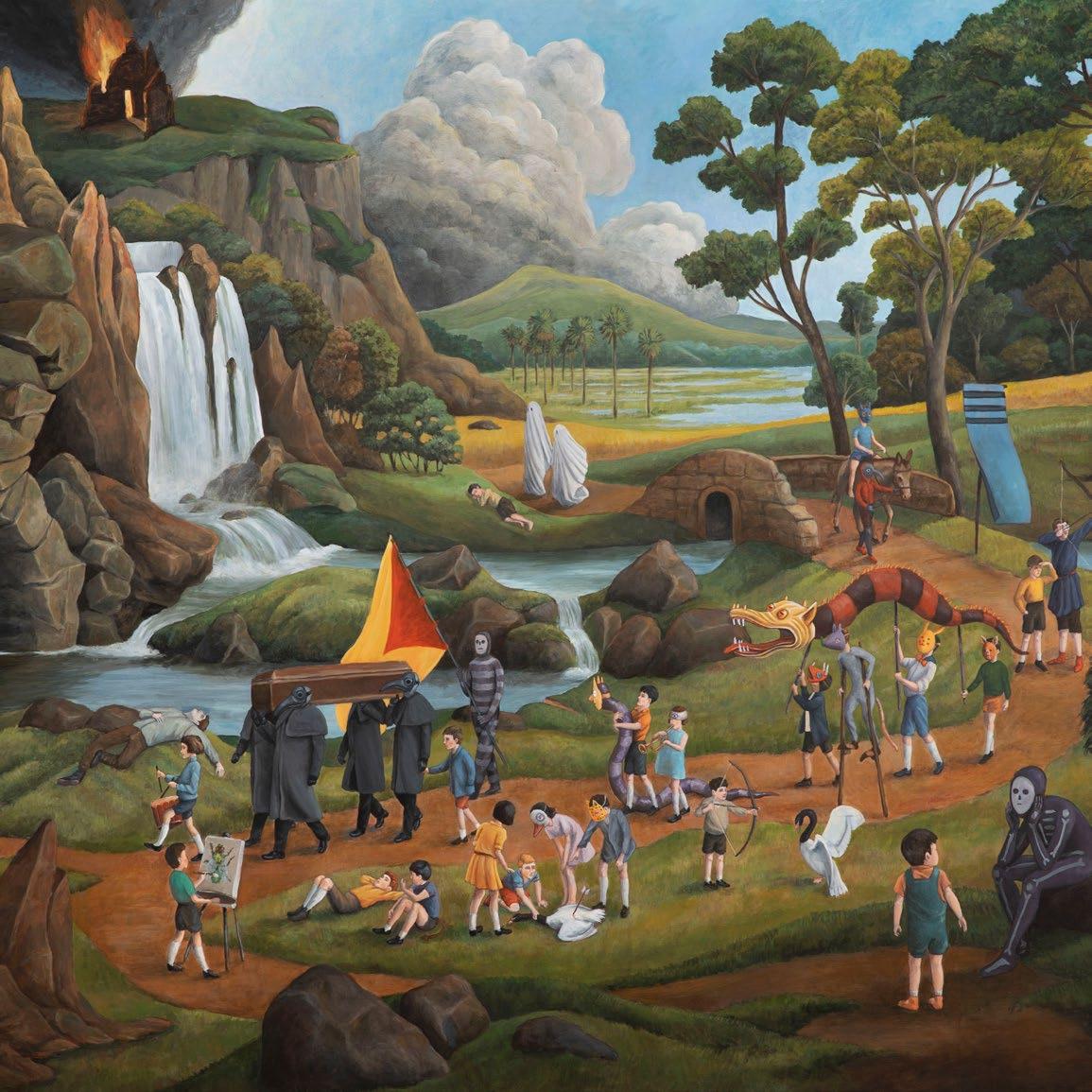
Elcarnavaldelasmoscas(Thecarnivaloftheflies)(2022);
Marcelo Canevari
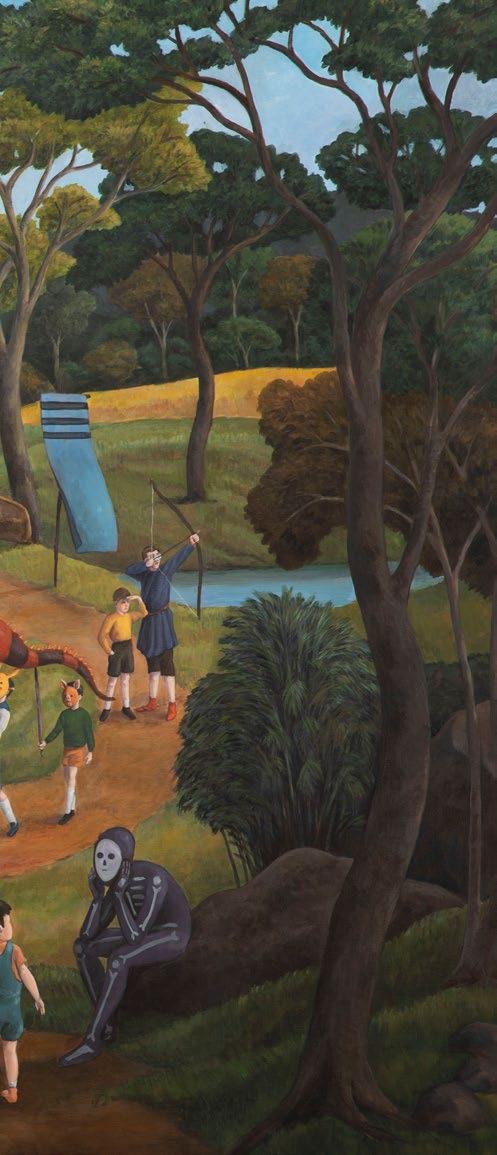
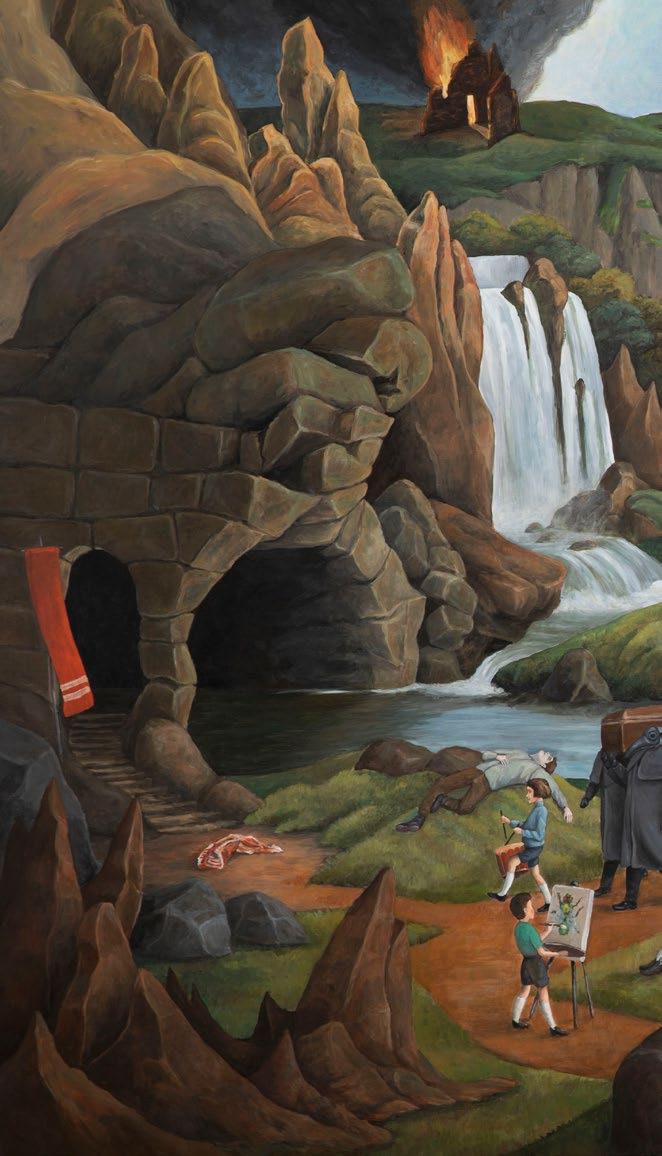
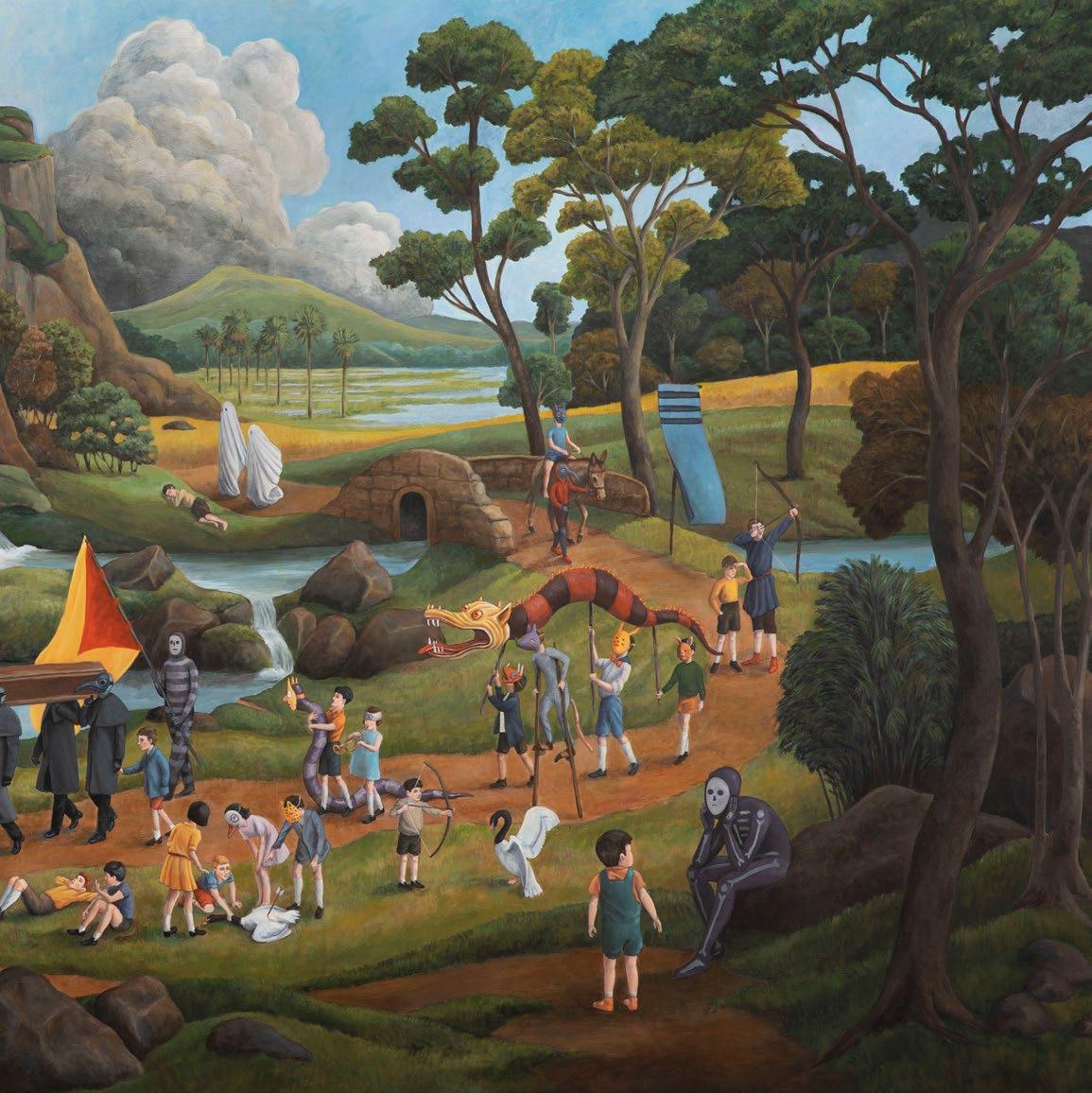
Born in Buenos Aires, Marcelo Canevari’s dad was a naturalist who worked as a wildlife illustrator. When Canevari was around sixteen, his dad offered to teach him, and they worked together on field guides for the mammals and migrating birds of Argentina. Eventually though, Canevari found the strict representation to be limiting. Today, Canevari’s paintings combine the narrative landscape style of Flemish masters like Pieter Bruegel with scenes of Argentinian nature. Look closer, however, and things are amiss. “My trick is: ‘Come on in. You know this place, you are safe,’” Caneveri says. “And once you are [in the painting], you know that you are maybe not as safe as you thought you were.”
In 2016, Canevari was the victim of a brutal, random attack on the street, which was a turning point in his practice. He started to include darker elements and themes in his work. There are tigers and jungles and waterfalls, but also figures dressed as ghosts, children wearing creepy masks, and octopuses climbing trees. Inspired by the way fairy tales navigate the “border between innocence and darkness,” Canevari’s paintings are carnivalesque studies of both the human subconscious and natural environments. “You enter this world where rules will change,” he says.
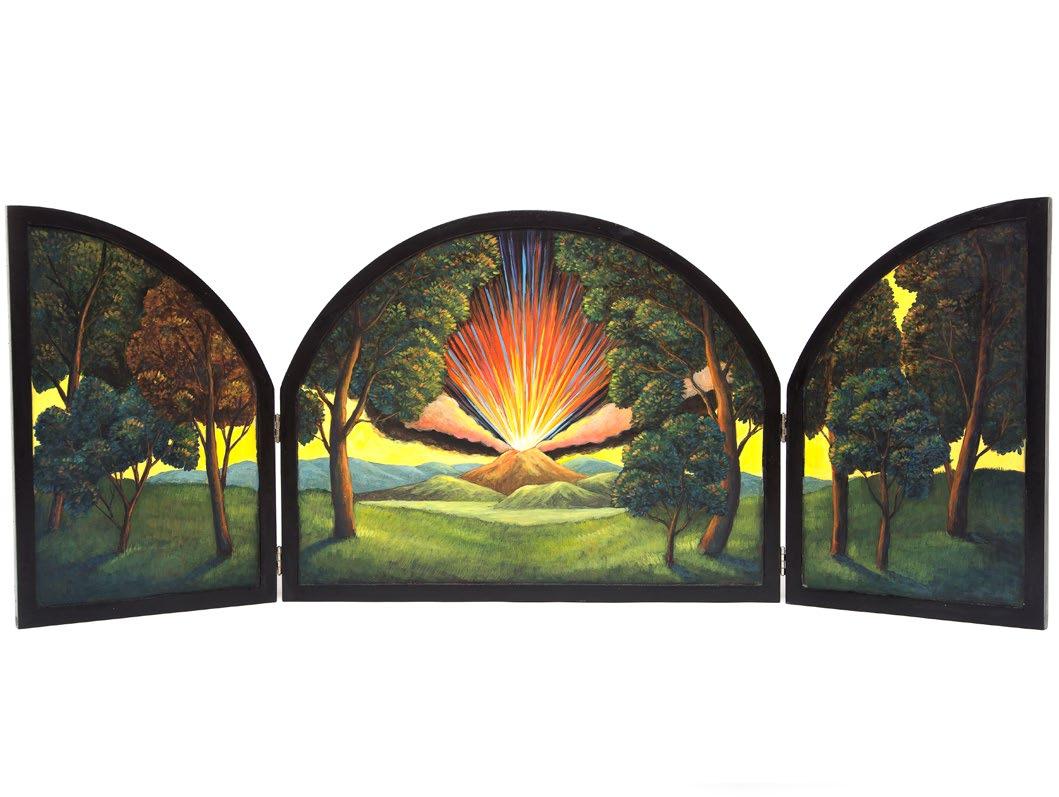
His father passed away in 2023. In the process of grieving, “I was trying to mimic what we used to do, and I realized— he wasn’t there,” Canevari says. So he started to include an untouched area amongst the lush scenes, an empty canvas within the canvas, a sort of ode to his father’s absence, but also presence. This year, his work turned to “explosions of nature,” erupting volcanoes, lightning storms, and raining meteorites. But still, “the only element that I kept,” he says, “was this empty canvas shape on one side of the painting.”
WordsbyRobGoyanes
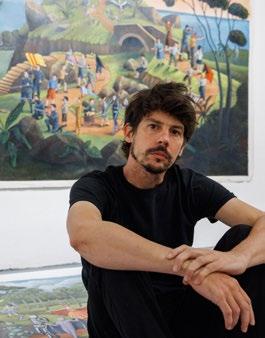
A portrait of Canevari in his Fountainhead studio by James Jackman
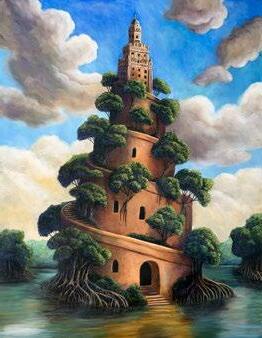
Babelalta(2025); oil on canvas.
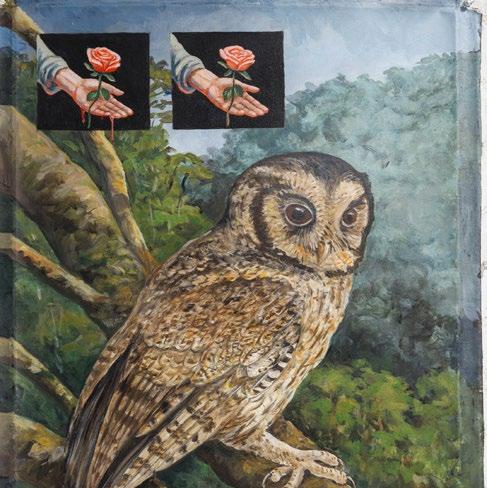
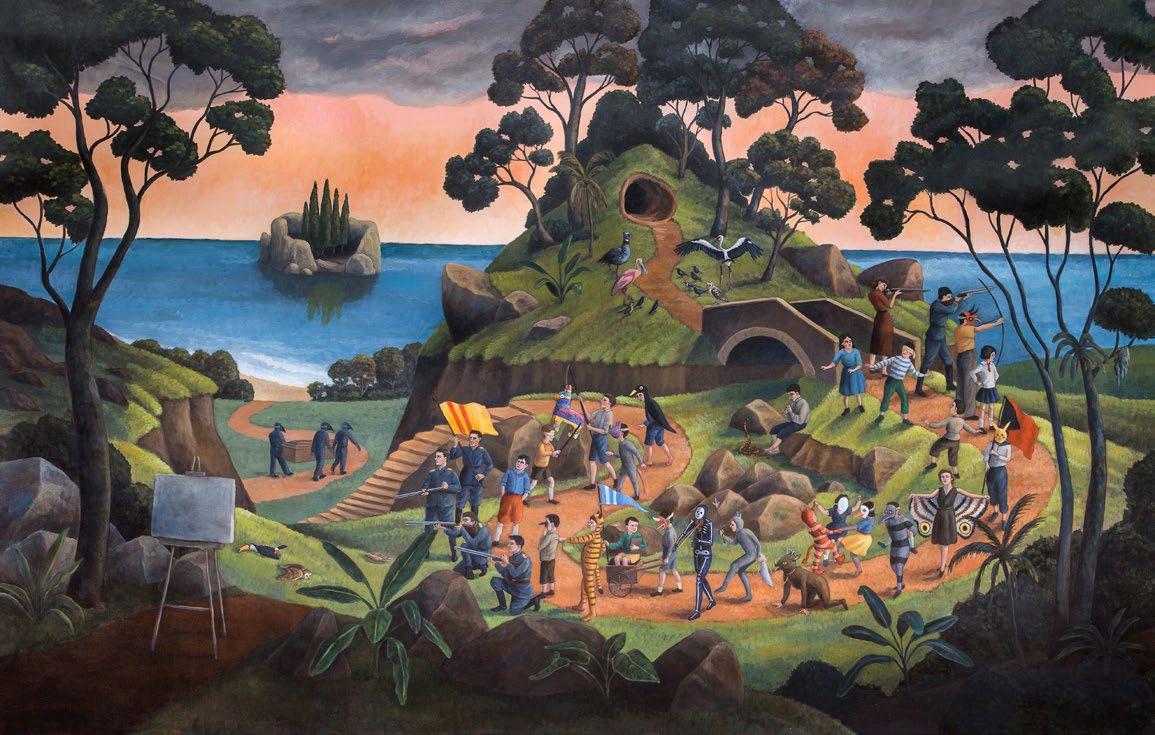
Owlsarenotwhattheyseem (2023); oil on canvas.
This work was completed in collaboration with his partner and 2022 alum Ornella Pocetti.
Elcaminohastalaisla(2025); oil on canvas
Matthew David Rahming
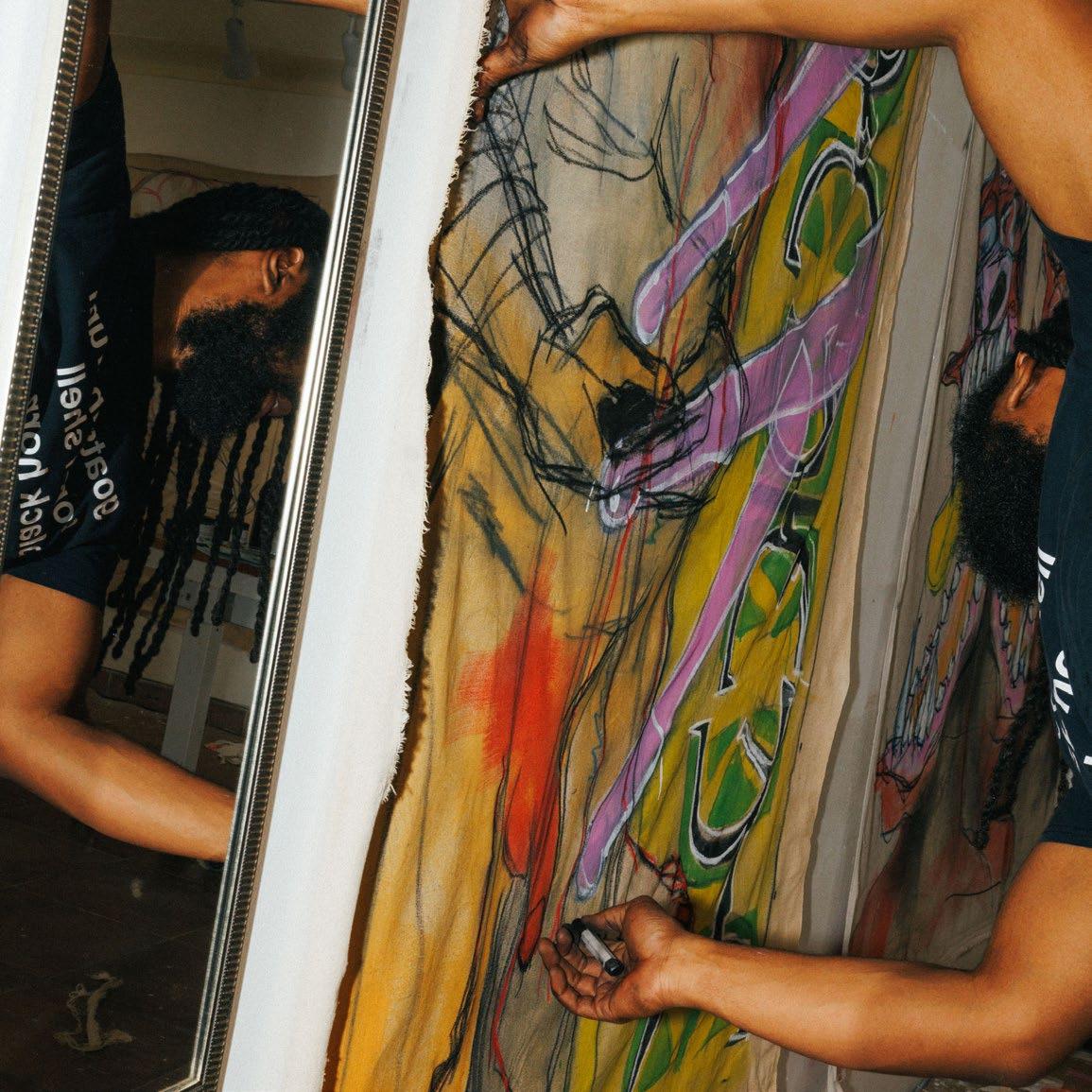
While growing up in Nassau, Matthew Rahming remembers his house always being filled with beautiful, handmade things. His mother and the other women in the family would make bridesmaids dresses for weddings and flower arrangements for funerals. “The men were equally as creative and hands-on,” Rahming says. One of his uncles builds drums from scratch, using animal skins as the drumhead. “He always carries at least one drum in the backseat of his truck, ready to go.”
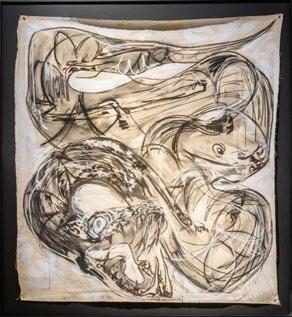
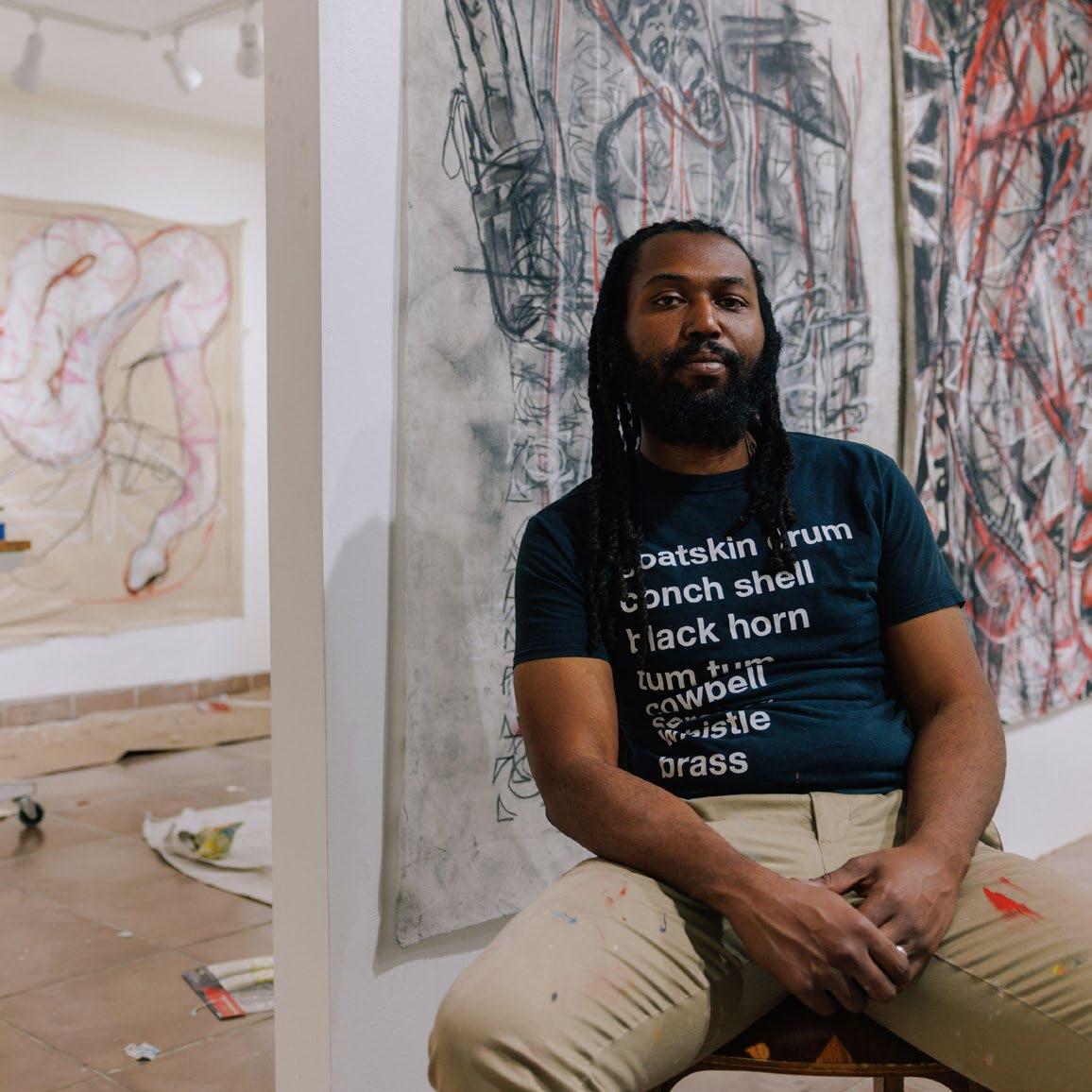
Rahming’s paintings have an abstract expressionist style, with a focus on the line and mark. But they also contain figures and forms firmly rooted in place. With an intuitive, controlled chaos, Rahming’s portraiture, often of humans and dogs, is charged with the spirit of a quick sketch. Working on canvas and cardboard—recently a focused palette of black, white, and red—Rahming is inspired by Bahamian painters like Amos Ferguson and Kendall Hanna, and Americans like Basquiat, Barkley Hendricks, and Purvis Young. He’s also a fan of Louis Bourgeois. “One of my favorite things about her work is this ability to create this incredibly delicate line that can cut you in half.”
Matthew David Rahming in his Fountainhead studio photographed by James Jackman.
Rahming’s lines deliver similar intensity. While at Fountainhead, he started working in color again. He worked on a new painting of a dog, a recurring figure in his work, which he sees as a metaphor for the self. Potcakes, a breed found throughout the Caribbean, are especially prevalent in Nassau. Thousands of strays move across the island, and often have multiple caretakers. “There’s this idea that you can’t really be a stray because you have all of these homes,” Rahming reflects. “But in another way, it’s like you’re not a stray at all, because it’s your function to roam.”
WordsbyRobGoyanes
Rahming
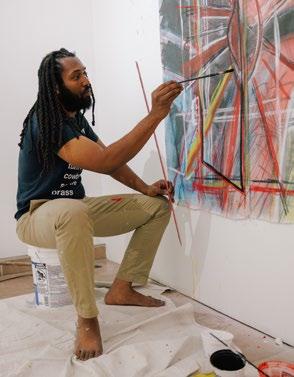
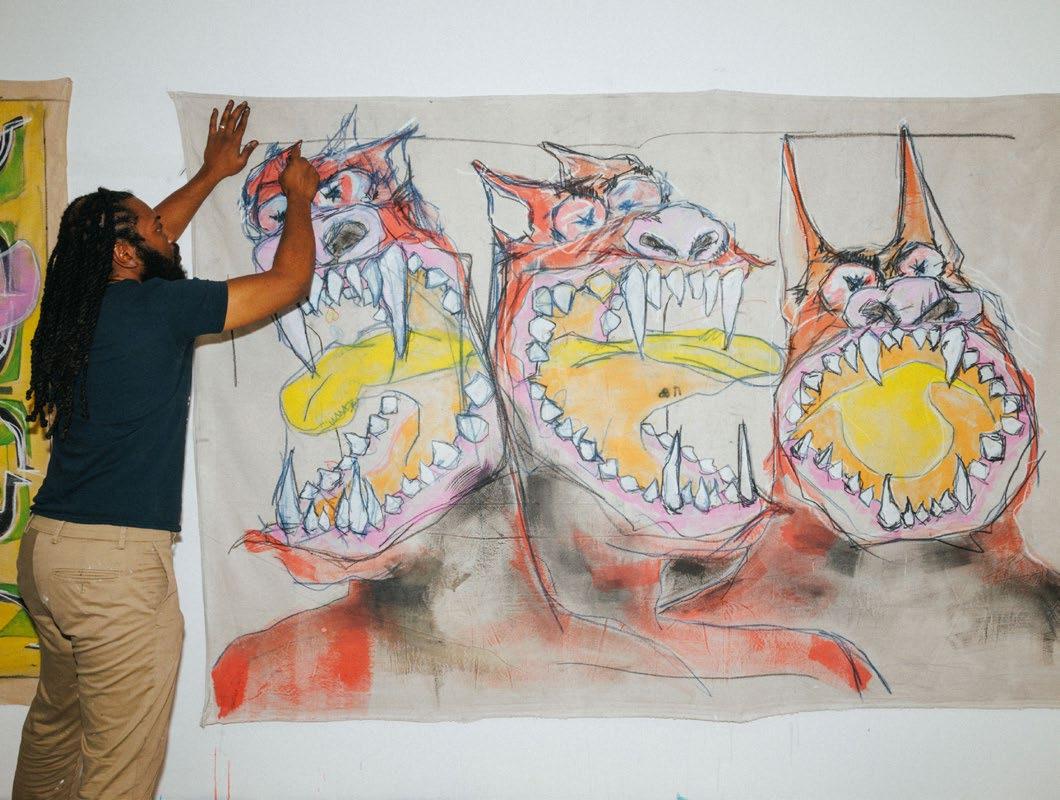
YouDogs!(2025); acrylic, charcoal, and oil pastel on canvas.
asnakecansmellanewbaby(2023); charcoal on canvas.
AtMorningsideIcanstillseethebay(2025), acrylic and charcoal on canvas
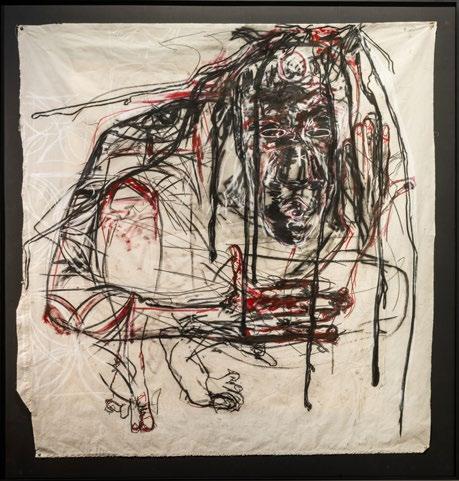
whocomestobeheldinmyarms(2023); charcoal and oil on canvas.
Session 04
Gabriela Ruiz
Monsieur Zohore
Navot Miller Multimedia Multimedia
Gabriela Ruiz
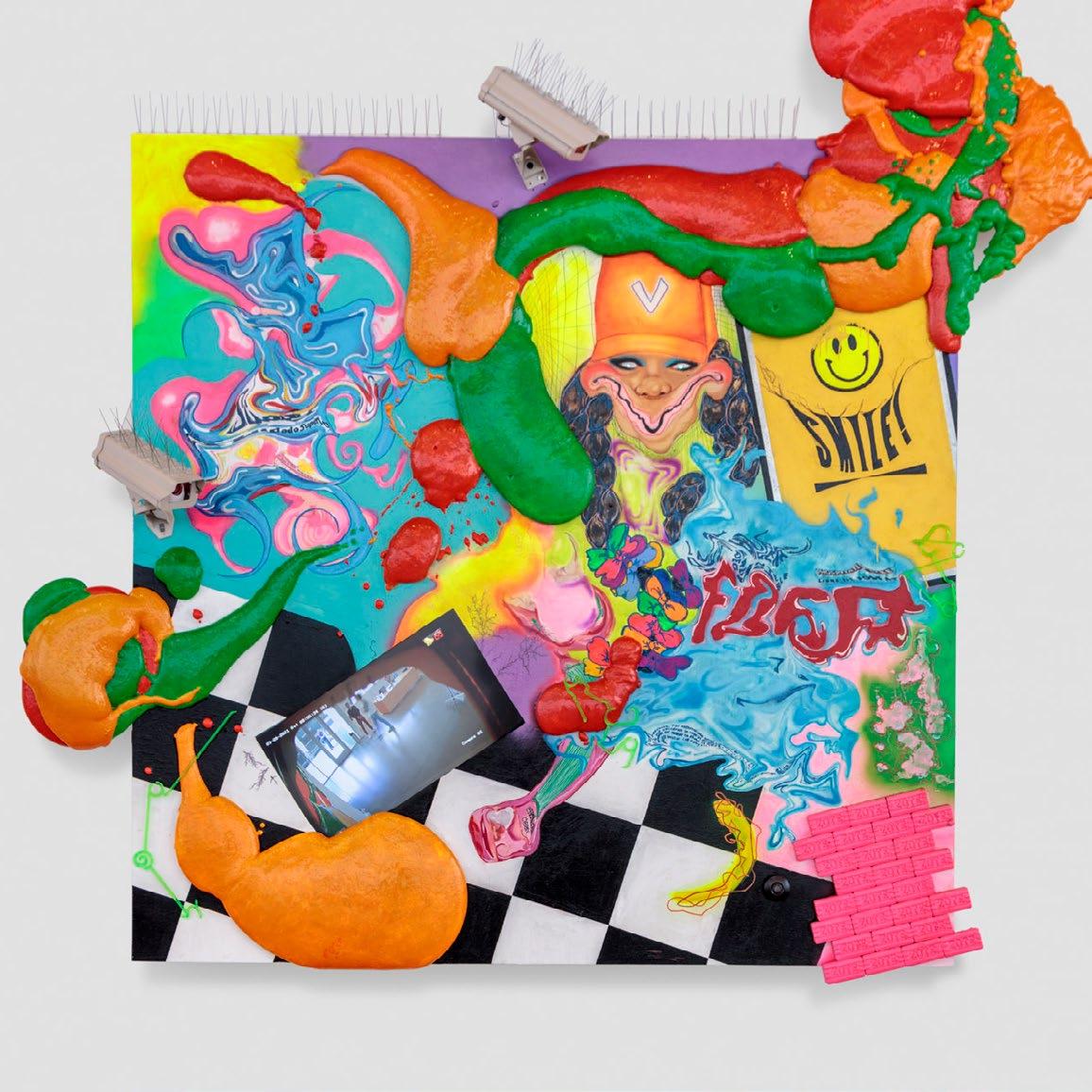
Gabriela Ruiz does not confine her work to the flat rectangle of a canvas or a screen. She uses wood, plexi, and foam like taffy: materials to be cut, stretched, pierced, repurposed, and stuffed with concealed cameras. As a self-taught artist who was raised in San Fernando Valley in LA, Ruiz learned elements of play and transformation from her Mexican-American culture and queer nightlife. Her DIY practice in video, sculpture, painting, and performance addresses the malleability of materials and technology around us.
In the world of Gabriela Ruiz, the viewer is under surveillance. Paintings are not quiet or passive decor. Imagine walking over to a painting and suddenly hearing a door chime as if entering a bodega with a familiar “Hello, welcome!” Cameras and screens are attached to Ruiz’s paintings like appendages, similar to constantly holding a front-facing camera phone. The first time I encountered ThePowerofNine(2021) at PAMM as part of the exhibition Xican-a-o-xBody , I smirked at the irony of subverting the camera’s gaze by taking a video of my own. Nearby viewers were documented and live on in my camera roll.
LaLavada(2021); multimedia, acrylic, resin, polyurethane foam, surveillance camera, TV monitor, two-way communication speaker, LED on wood panel.
Ruiz
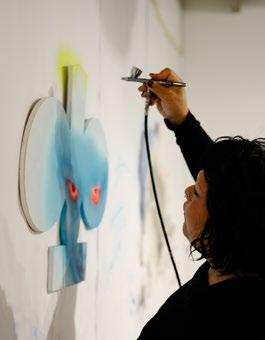
During her residency, Ruiz created a series of sculptural paintings for Made in L.A. 2025, an upcoming exhibition at The Hammer Museum. The works are still in progress, but the textures and faces instantly coax me into her fantasyland like a shared reality. In one untitled work, a blue face with red hot eyes stares ahead; a double-headed neon green snake slithers by. Another work depicts a blue face with green eyes covered by a surveillance camera; the subject is obscured, but the camera sees all. A round blade-like wooden panel is covered in cherry red mouths being pulled open by fingers. Layers are pierced with a thick fish hook. The face and its framing device are completely entangled.
WordsbyAimeeRubensteen
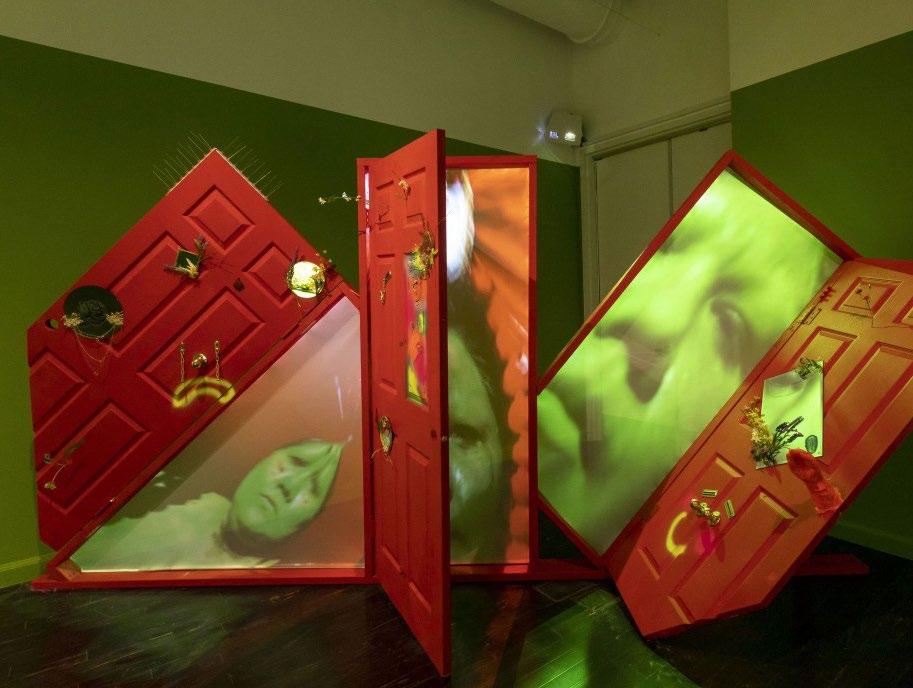
FullofTears(2019); installation, multimedia on wood frame door.
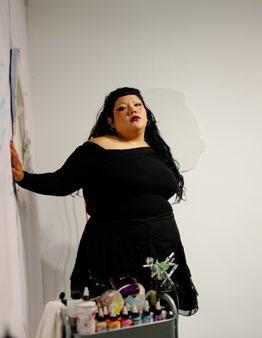
A portrait of Ruiz in her Fountainhead studio by Martina Tuaty.
Ruiz often works with a spray gun to complete her mixed-media works, photographed by Tuaty.
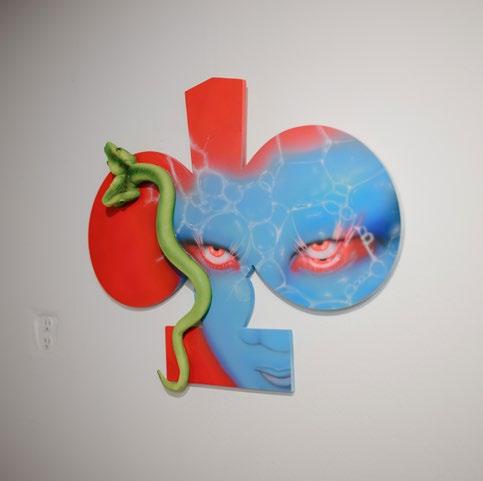
Untitled (2025); acrylic, pastel, marker, color pencil, gauche on wood panel.
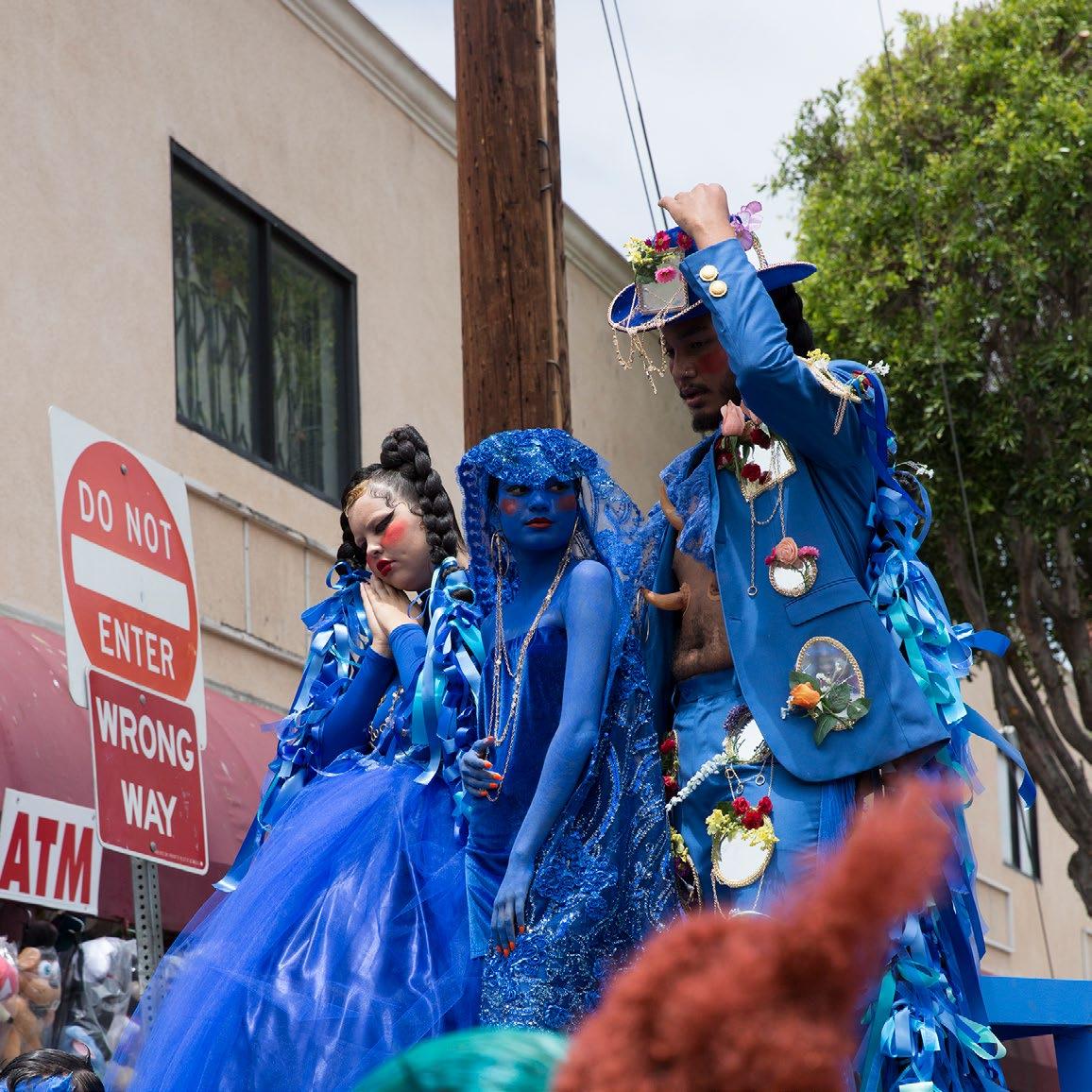
DeLaCalle(2018); a performance as part of rafa esparza’s exhibition at ICA LA in the Santee Alleys in the fashion district.
Image by Dorian Ulises López Macía.
Monsieur Zohore
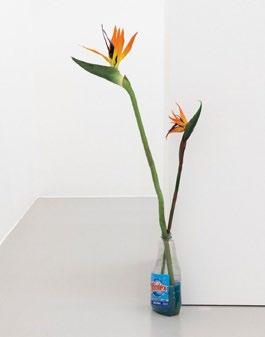
I’m inspecting a Bird of Paradise for any trace of its water source: a bottle of blue Windex. Monsieur Zohore’s studio is full of question marks and juxtapositions. While the flower wilts in a cleaning solution, the Ivorian-American artist describes the work titled Primitivism (2015-) as a self portrait, opening a discussion about migration, consumption, and dark humor.
Zohore excavates our personal and historical relationship to the quotidian in his performance, installation, painting, sculpture, and video. Images from the internet and pop culture are printed on Bounty paper towels and collaged onto canvas. Miami is the subject of Zohore’s work during his residency. Like the city’s history, racism, and celebrity, Battleground(19102025), on view in his Fountainhead studio is still a work in progress. Muhammad Ali is dominating a wrestling match about Coconut Grove and Coral Gables. E.W.F.
Stirrup and George Merrick are on either side of the battleground on this canvas. Some images are crisp while others are obliterated. The artist plays with levels of absorption as he layers and layers countless paper towels until they harden and form into a new material. Together, the images and medium take on multiple meanings depending on its storyteller.
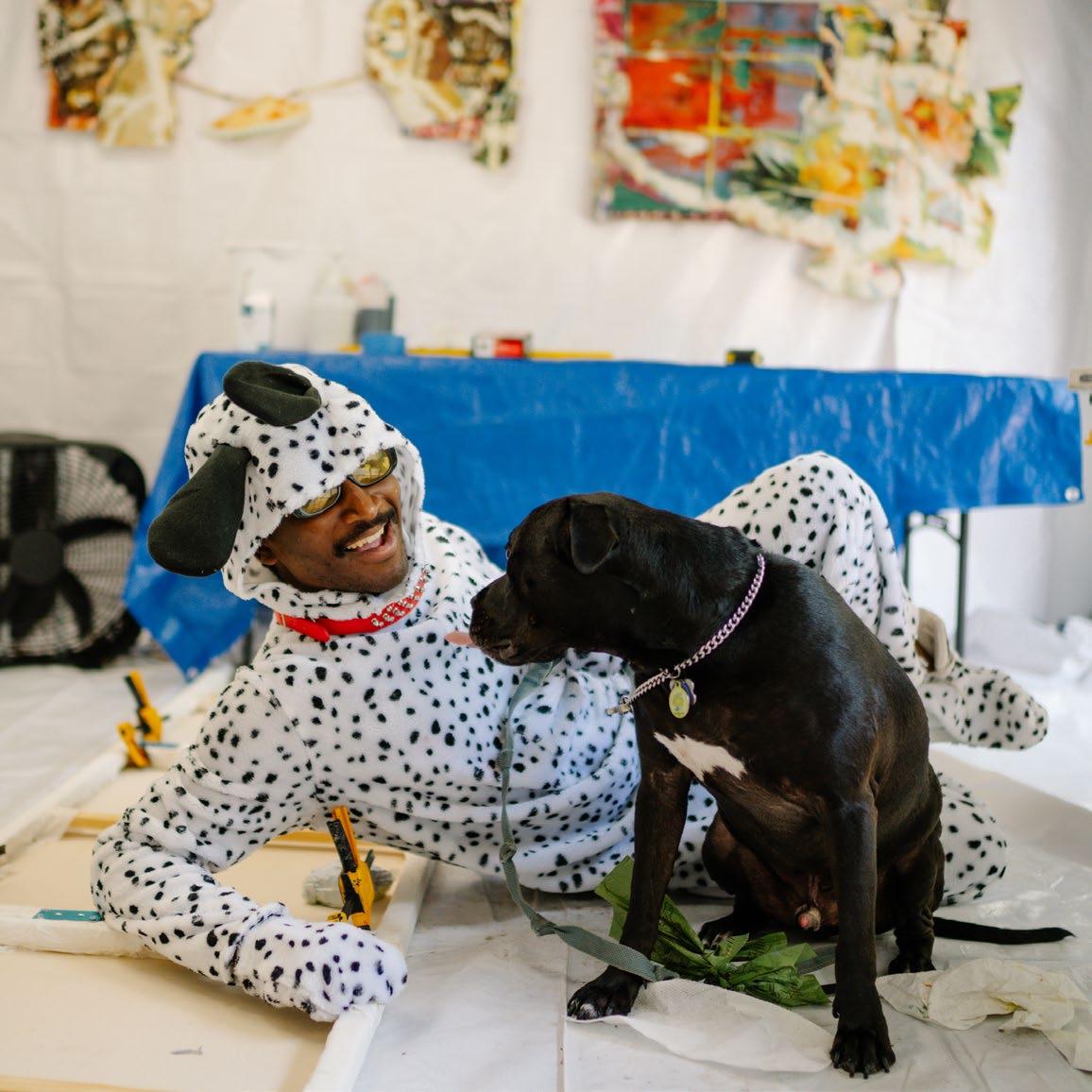
Monsieur Zohore takes a playfully performative approach to his work, pictured here with Visitor Mikesell, photographed by Martina Tuaty.
Zohore
Zohore will make you laugh and cry at the same time. For Heat Index (1512-2025), Miami Heat logos are printed on paper towels and then cut, pinned, and collaged with orchids and forecast heat index markers. Miami Heat player Tyler Herro wears a jersey emblazoned with “white hot playoffs.” You don’t need to follow sports to feel the extreme heat overwhelming Miami, and the comedy in celebrating with a flaming ball logo designed by two fans who won the public contest in 1988. Zohore is Assistant Professor of Painting and Printmaking at Virginia Commonwealth University, and his works contain curriculum and critique. Can you feel the heat?
WordsbyAimeeRubensteen
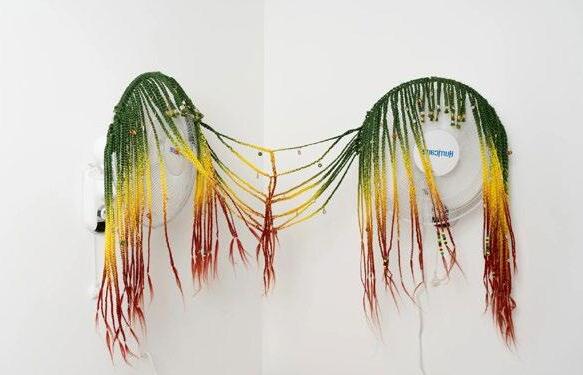
HurricaneMayaandMia(DoWhiteGirlsLookThe SameBecauseThey’reWhiteorBecauseThey’re Twins)(2022); fan, beads, braiding hair.
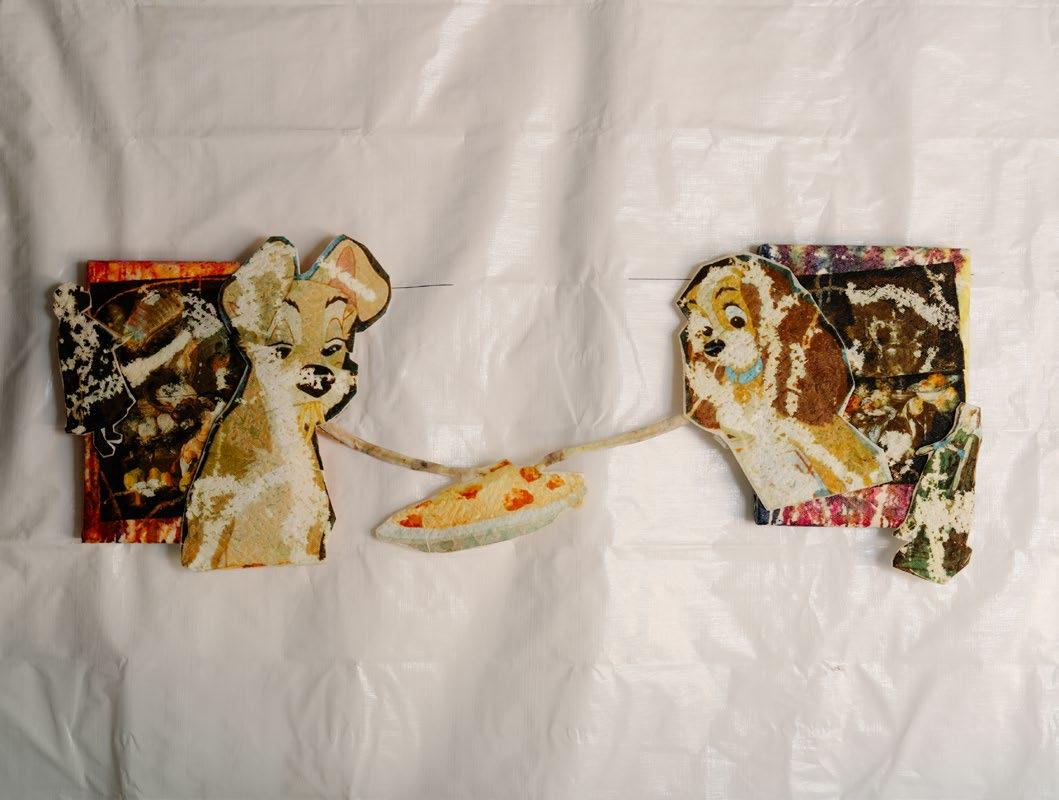
LongDistanceRelationships…InThisEconomy?(1934-2022);
Zohore’sresidencywasgenerouslysponsoredinpartbyLeslieandMichaelWeissman.
Primitivism(2015-); bird of paradise in Windex.
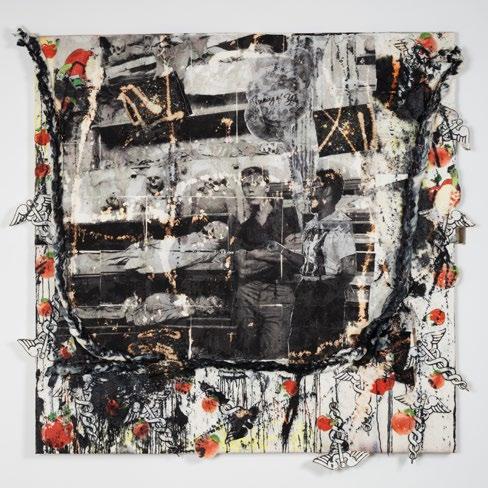
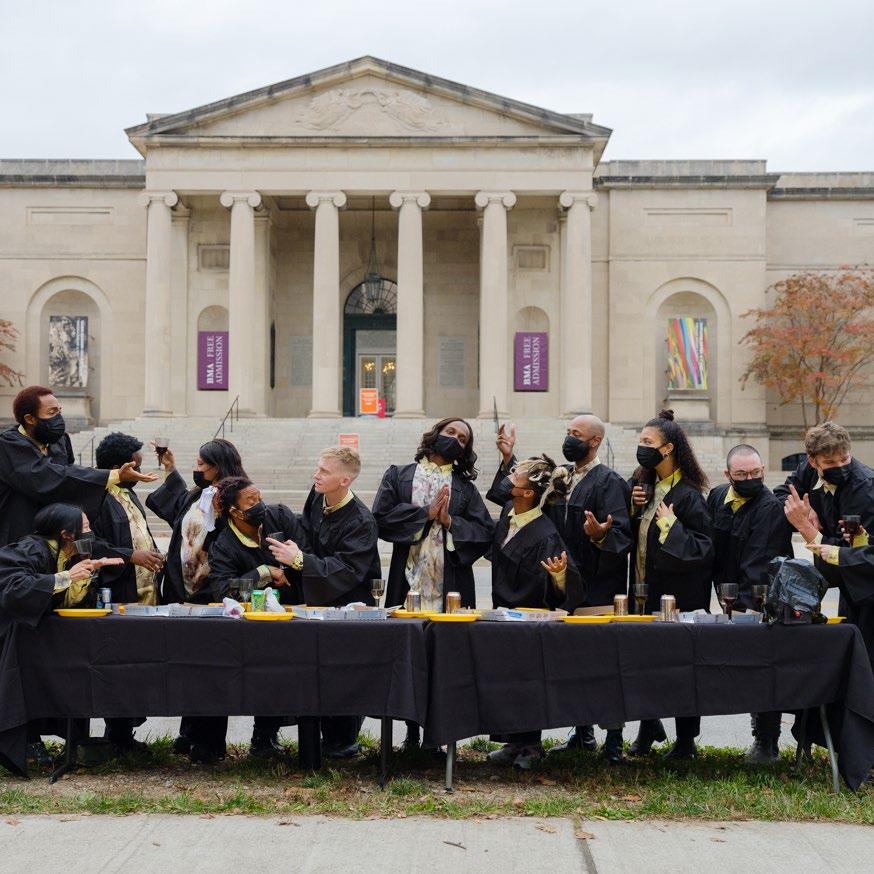
GetWellSoon(1963-2024); mixed media on canvas..
Navot Miller
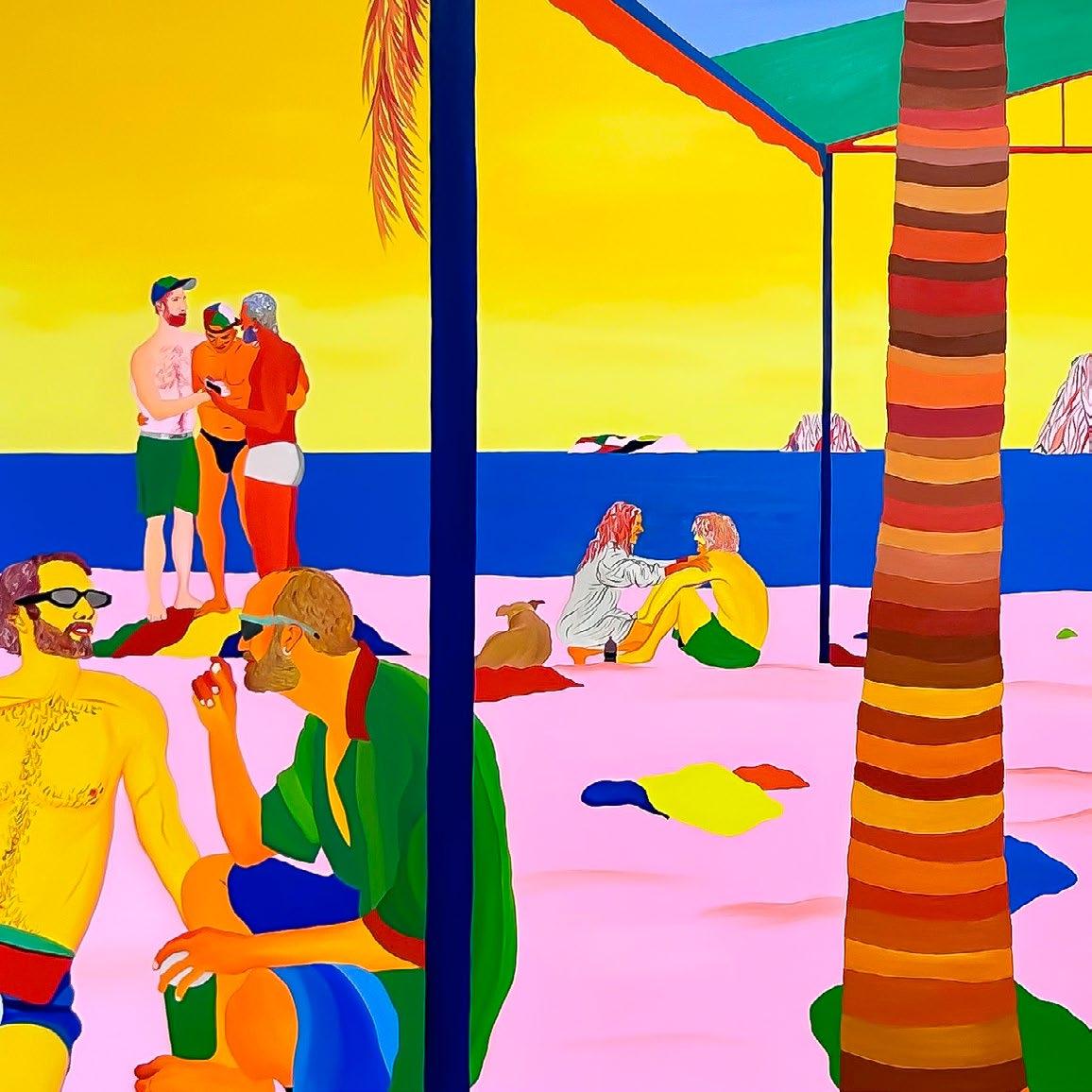
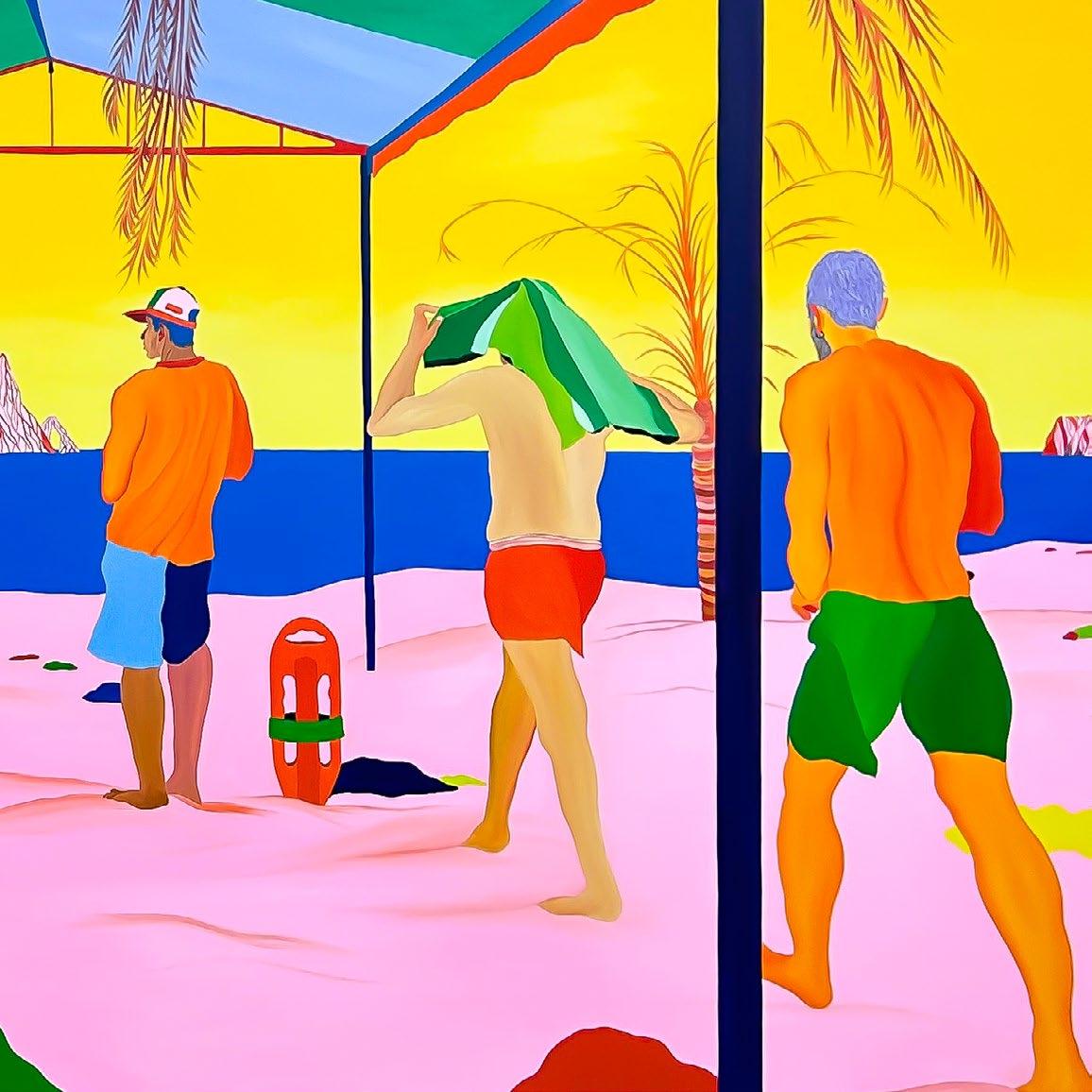
You adjust your mouth, your body right before a photograph is taken. Anticipating the image, a smile stretches across your face or an expression is temporarily held. Navot Miller is interested in the moment after, when the facade is released. His paintings capture his life as it’s happening in a bathroom, at the beach, or overhearing a phone call on a balcony.
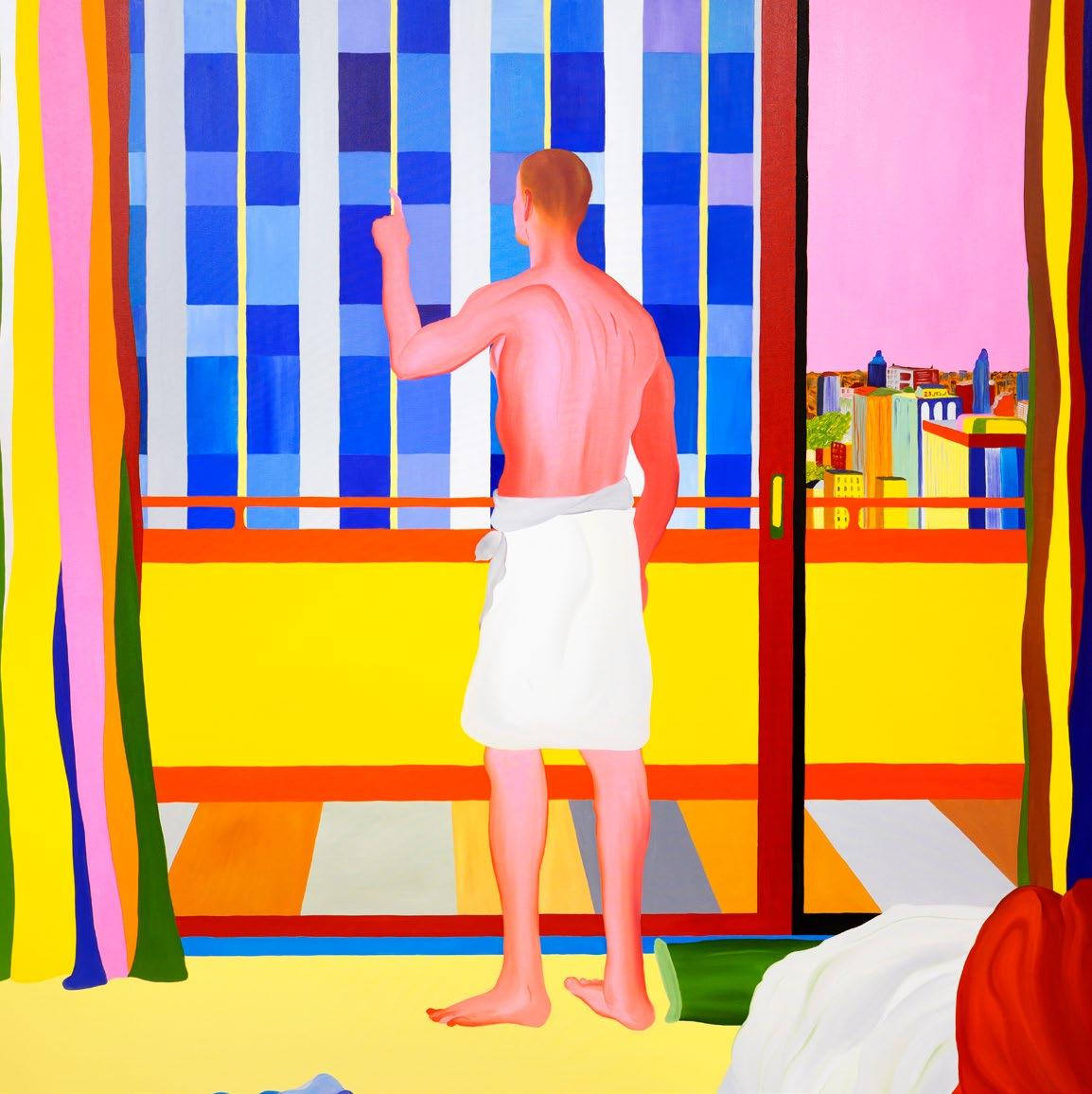
Miller paints straightforward pictures of his friends and lovers, but the colors and compositions are striking. Looking at fluorescent pink swaths of oil on canvas in his studio makes my eyes feel like they’re biting into the first mango of the season. Adaminthehiltoninmidtown (2023) is a bright painting measuring nearly eight feet by seven feet. Striped curtains are drawn in a hotel room. Underwear is on the floor. A man with a towel around his waist is pointing to something outside with his left index finger. The balcony door is ajar, its red frame splits the landscape in two. On the left is a skyscraper with windows patterned in a quilt of blue pixels. A pink sky envelops the New York cityscape to the right. We observe the painting like Miller might have observed the man’s gesture.
AdamintheHiltoninmidtown(2023); oil on linen.
Initially, the artist planned to study architecture, which is apparent in how he constructs space on canvas, and now in his recent designs. Born in Israel and based in Berlin, Miller began working with furniture and Jewish ritual objects for his exhibition A Pink Shul (2024) at Wannsee Contemporary. Paintings and drawings were displayed with a matching pastel pink synagogue pew and Chanukiah (a nine-branched candelabra) with blue, red, yellow, green, and orange trimming. Miller’s designs are reminiscent of Memphis Design and Ocean Drive. The artist dreams of building a pink synagogue, and I can picture it in Miami.
WordsbyAimeeRubensteen
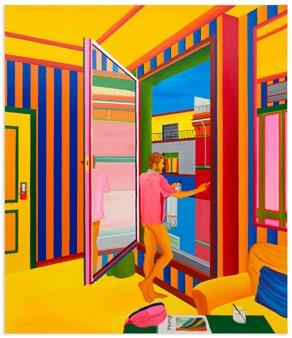
RiccardosmokinginHotel InternazionaleinBologna(2024); oil on canvas.
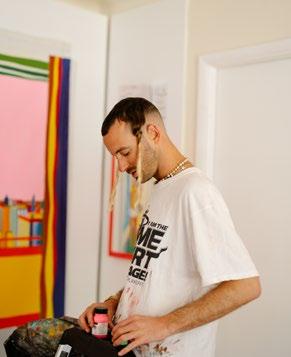
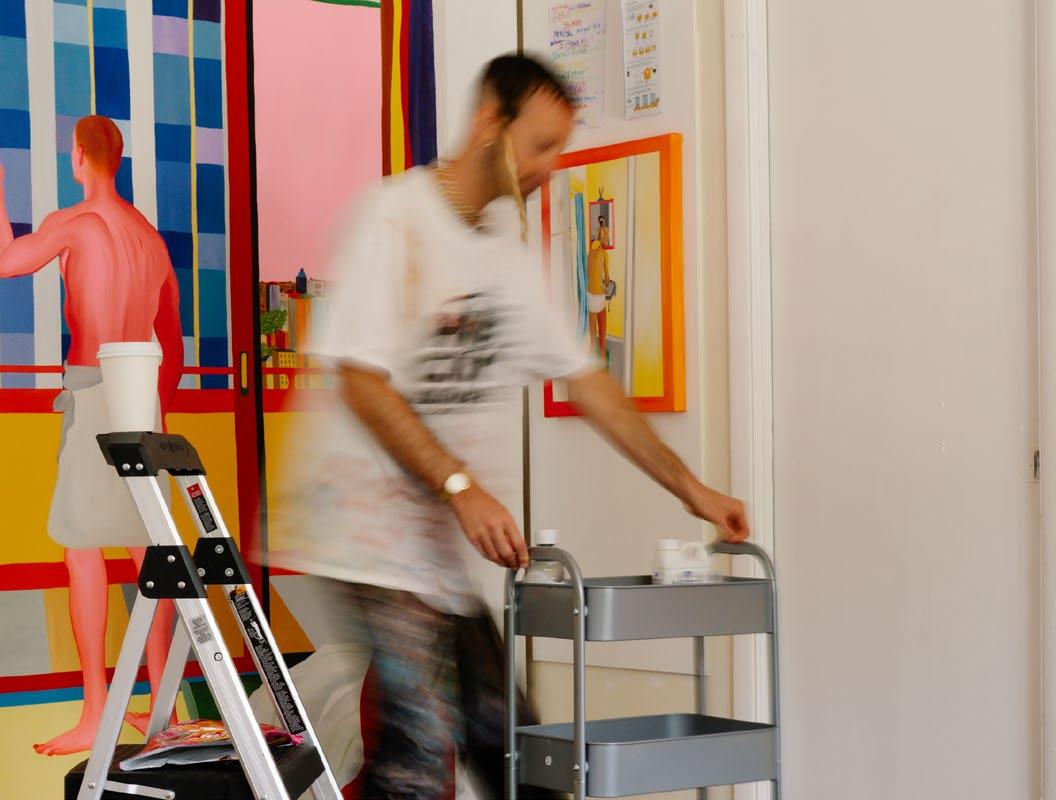
Miller photographed by Martina Tuaty in his Fountainhead studio.
Miller’s process is often intuitive and guided by the intimacy of everyday experiences
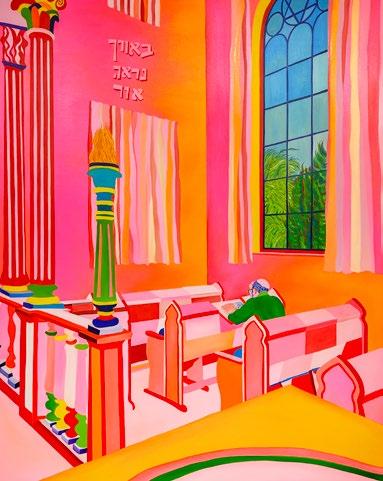
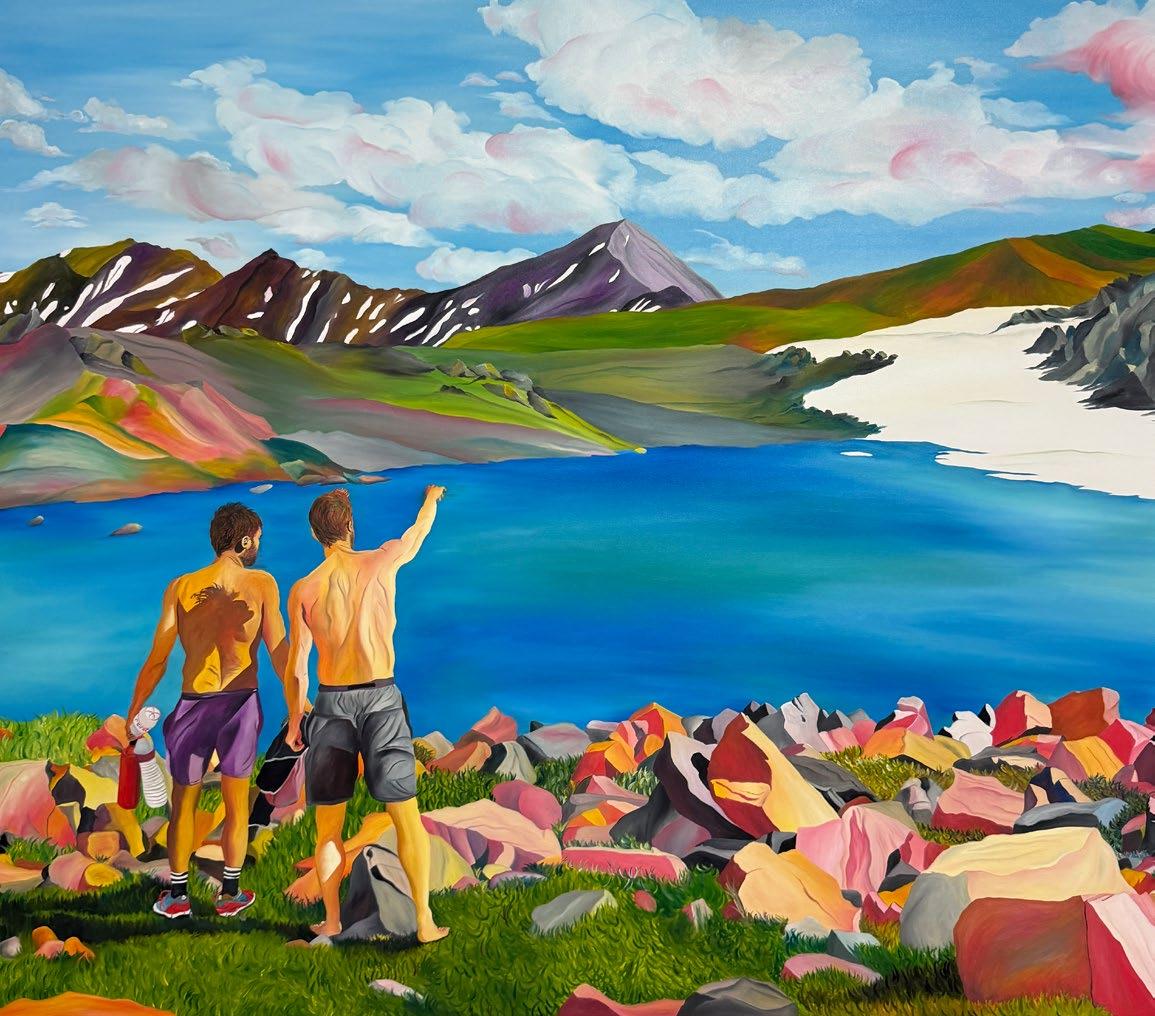
Apinksynagogue(2024); oil on canvas. JaviandIñigointheFrenchAlps (2025); oil on canvas
Session 05
Isabella Mellado
Jordan Ann Craig
Kayla Mattes Painting Painting Fiber
Puerto Rico
New Mexico
California
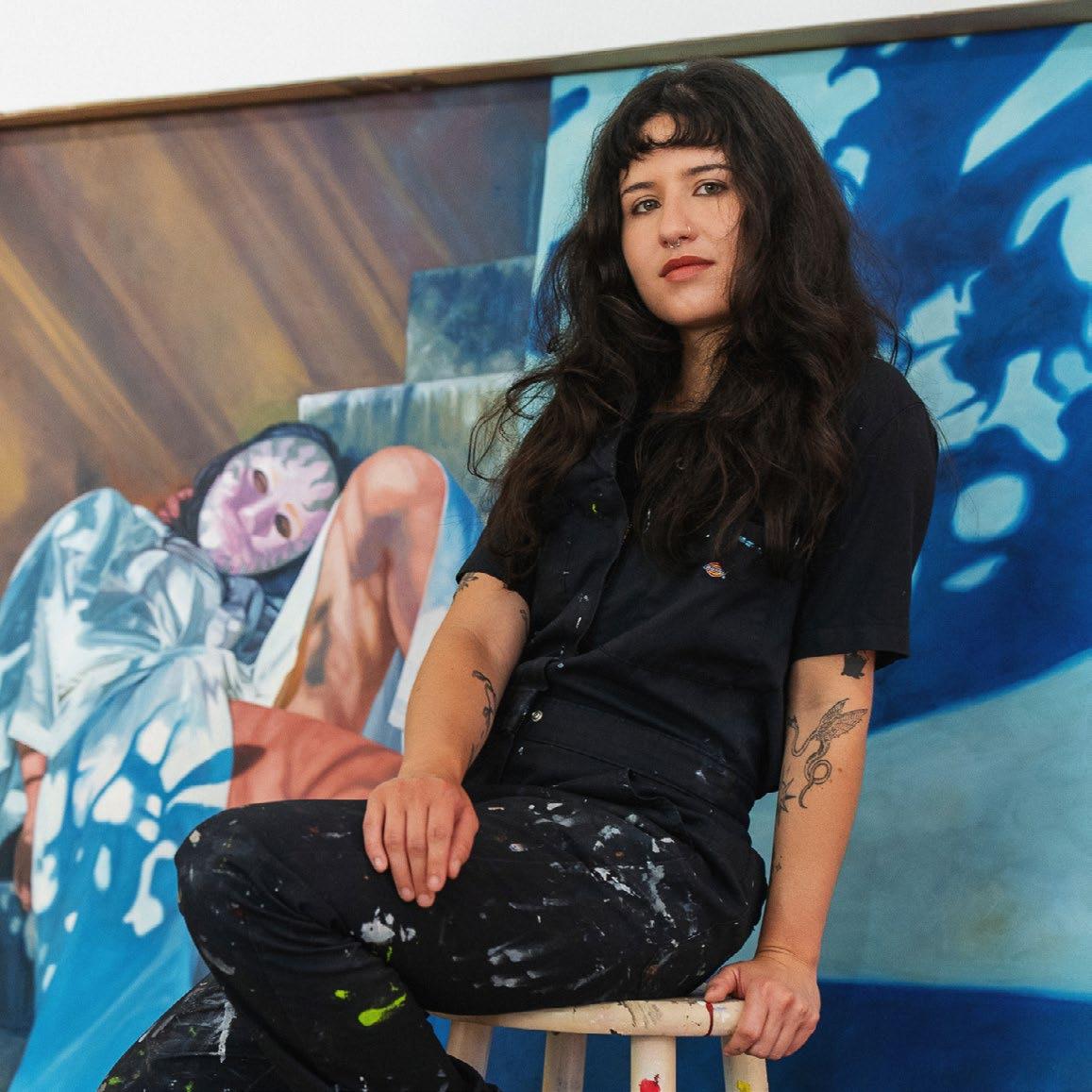
Isabella Mellado
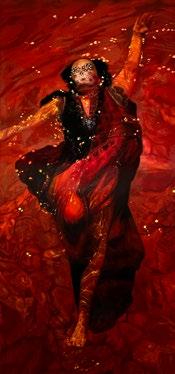
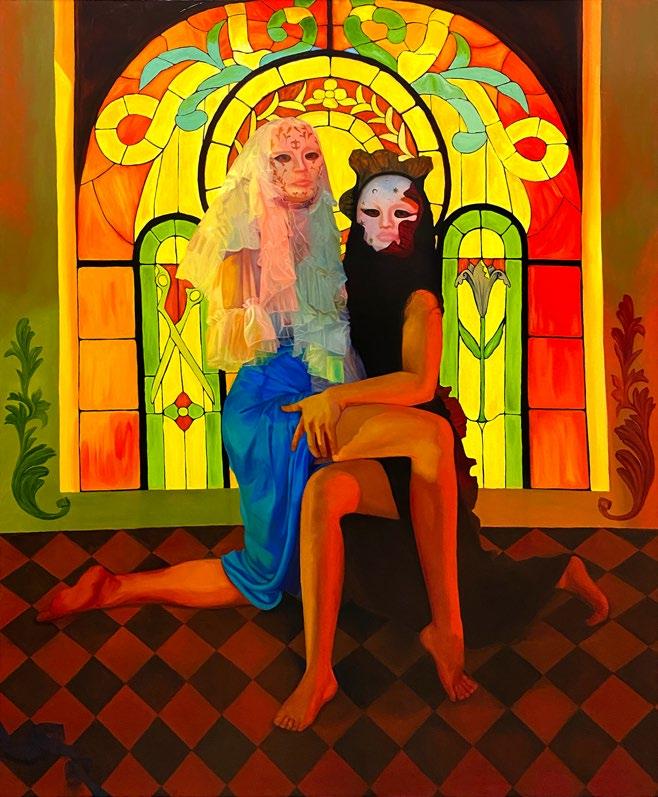
The blood red waters of gluttony. The interlaced legs of lovers in lust. The fallen bodies in envy. The slumped, delicate body of sloth. The penetrative eyes of greed. The entangled headlessness of wrath. The vejigante mask in pride. In Isabella Mellado’s newest work, the seven deadly sins are larger than life—combining these universal condemnations with the identities of boricua, femme, and queer bodies. Applying oil on canvas with her reference material—pre-staged photographs organized by the artist—the vision is set in unpacking what is emotion and what borders the “sinfulness” of these sentiments. Masks play an overarching role in hiding the identities within the series, a triple entendre of masking as performance, as drag, and as crafted emblems of a shared folk. Made by Mellado, who either dresses herself or her friends, the paintings speak to the reality of living in diaspora as a Puerto Rican, where what appears to be the Caribbean Sea is actually Lake Michigan, and how theatrics play a role in the way that belief is dissipated across the world.
Jayme Gershen captures Mellado in her Fountainhead studio..
Catholicism and the birth of tarot cards in the Renaissance are two faith systems that converge in Mellado’s practice. Everything from reliquaries—where jewel-encrusted skulls are housed—to the sheer, flowing fabric worn by her subjects creates momentum toward a liminal sense of possibility. A body of water is the foundation for the suit of cups or a harlequin tile floor juxtaposes a medieval stain glass window. Queerness is the artist’s weapon of choice, as a reminder that shame is a manufactured lens through which sexuality is repeatedly questioned and challenged by those who have the power to influence a crowd, whether a country, a church, or a household. Across Mellado’s reimaginings of morality, the raw humanity of simply being is the sole truth.
WordsbyIsabellaMarieGarcia
Mellado’sresidencywasgenerouslysponsoredbyCarloandMicolSchejolaFoundation andwascarriedoutinpartnershipwithYoungArts.
Lust(TheLovers)(2025); oil on canvas.
Gluttony(TheEmperorMidas)(2025); oil on canvas
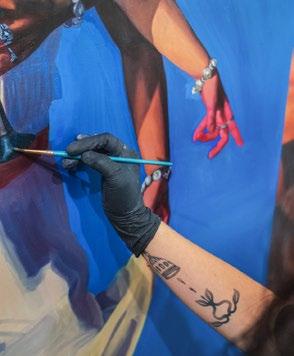
Mellado paints from reference photographs she stages herself with friends and family. Image by Gershen.
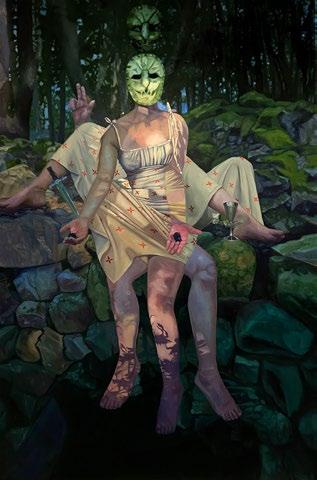
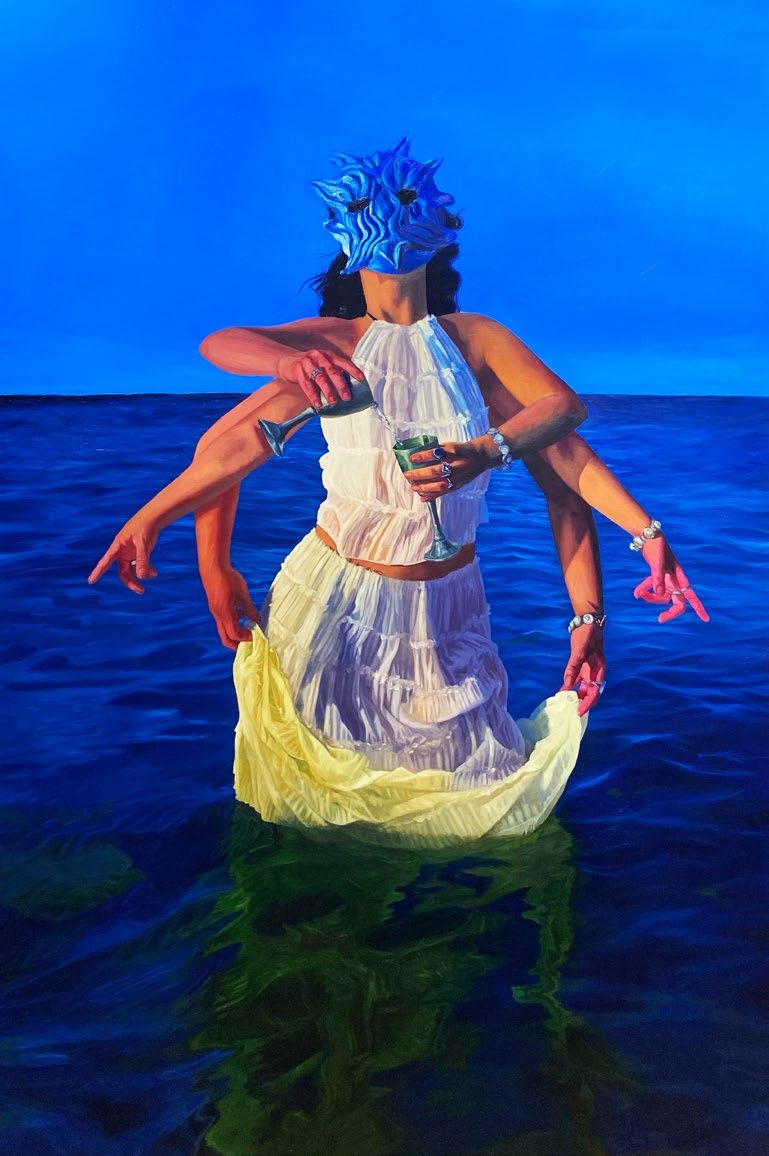
TheMagician(2024); oil on canvas.
Pride(2025); oil on canvas.
Jordan Ann Craig
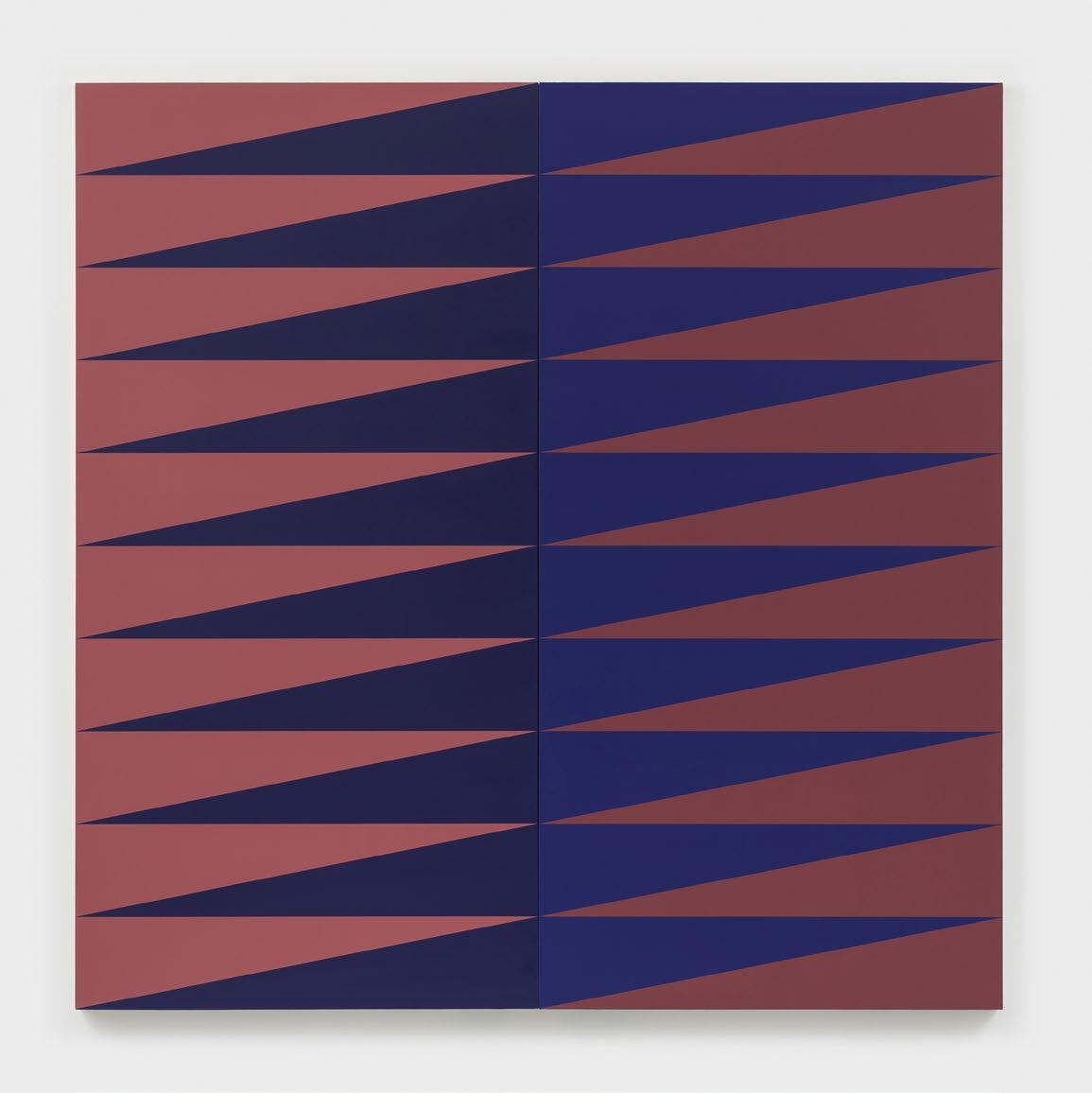
In blankness lies the unknown, the endless, and the approachable. For Jordan Ann Craig, a month spent in residence in Miami at Fountainhead was a period to explore the thrill of having no official plan, literally and figuratively, for this next iteration of her practice. Sitting on the makeshift shelves of the garage door that serves as a wall in Craig’s temporary studio, the saturated tubs of paint call towards a brighter approach to color in this session of exploration. A blue that vibrates, hot oranges and sultry reds that parallel the burn of the Miami sun setting in the sky, a muted pink that is as sweet as it is elegant. Digitally designing the overall layout first on Photoshop with the shape tool and then transferring the renderings onto canvas, there’s a methodical touch behind Craig’s smooth compositions. What appears simple is incredibly intentional, as the artist’s process is reflected in the raw sides of the works. Drips and wet sanding border precision, telling the calculated and messy decisions of her fingerprints, rendering chaos into order.
SharpTongue,Slantno.2(2023); acrylic on canvas.
Abstraction pulling from ancestry, Craig paints through the study of her Northern Cheyenne heritage. Material culture in the form of pouches and moccasins materialize into layers painted onto a grid, more layers than can be counted on two hands. Scavenging inspiration from items found in online auctions or web engines, the coloring Craig utilizes is not necessarily true to the original beadwork. It is fused with the aesthetics of her own eye. A willingness to scrapbook together the ancestral with the hues and shades calling to her in a present moment. The artist pulls the tape away from the surface in order to reveal a secret in the form of a geometric scheme. Painting, beading, weaving—it’s all mathematical.
WordsbyIsabellaMarieGarcia
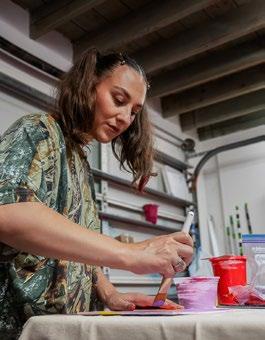
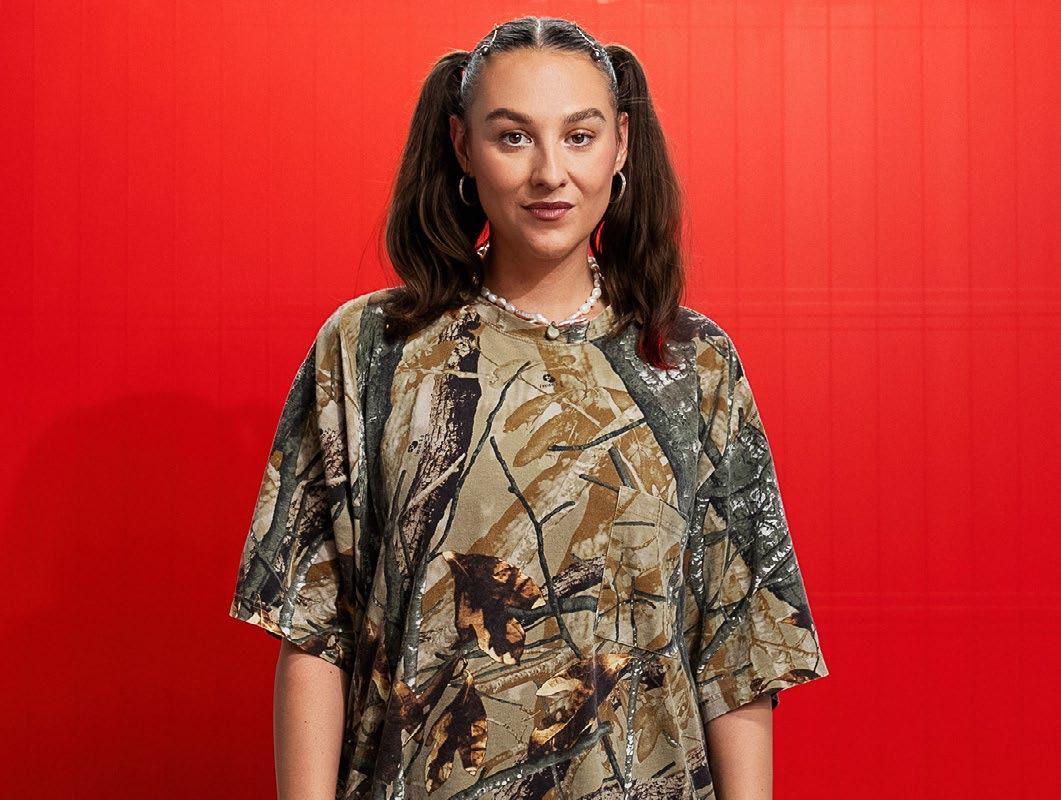
A portrait of Craig in her Fountainhead studio,
Photographed by Jayme Gershen.
Craig’s canvases are meticulously planned to honor the Northern Cheyenne’s geometric craft patterns. Image by Gershen.
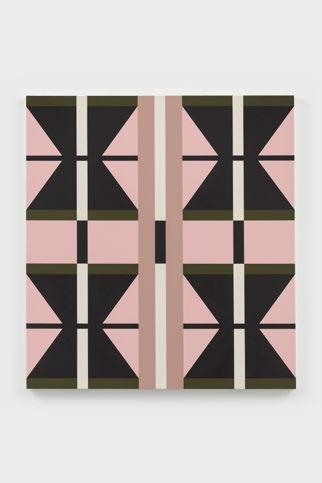
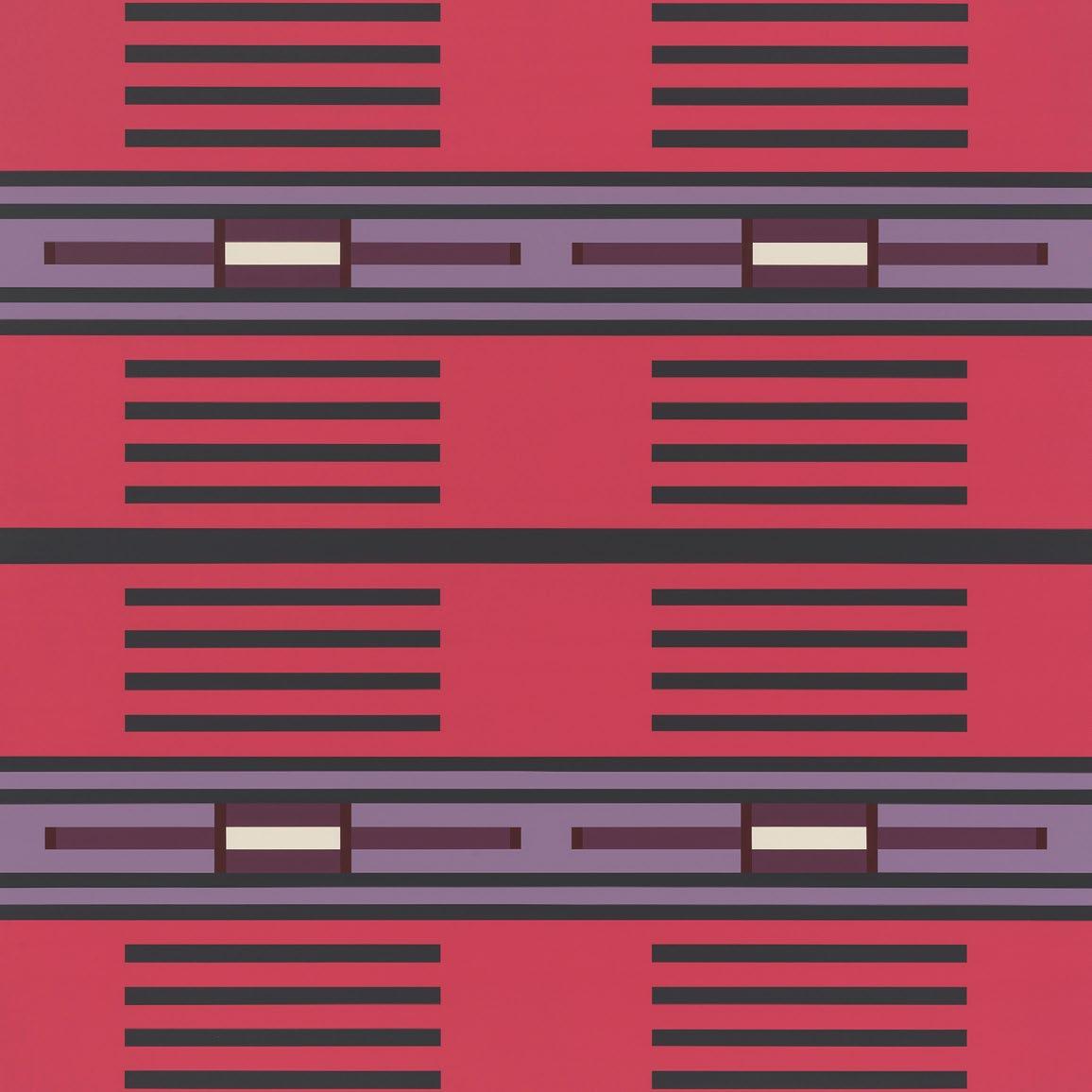
Don’tEverBeAlone(2023) ; acrylic on canvas.
ILikeThatYouareSoft(2022) ; acrylic on canvas.
Kayla Mattes
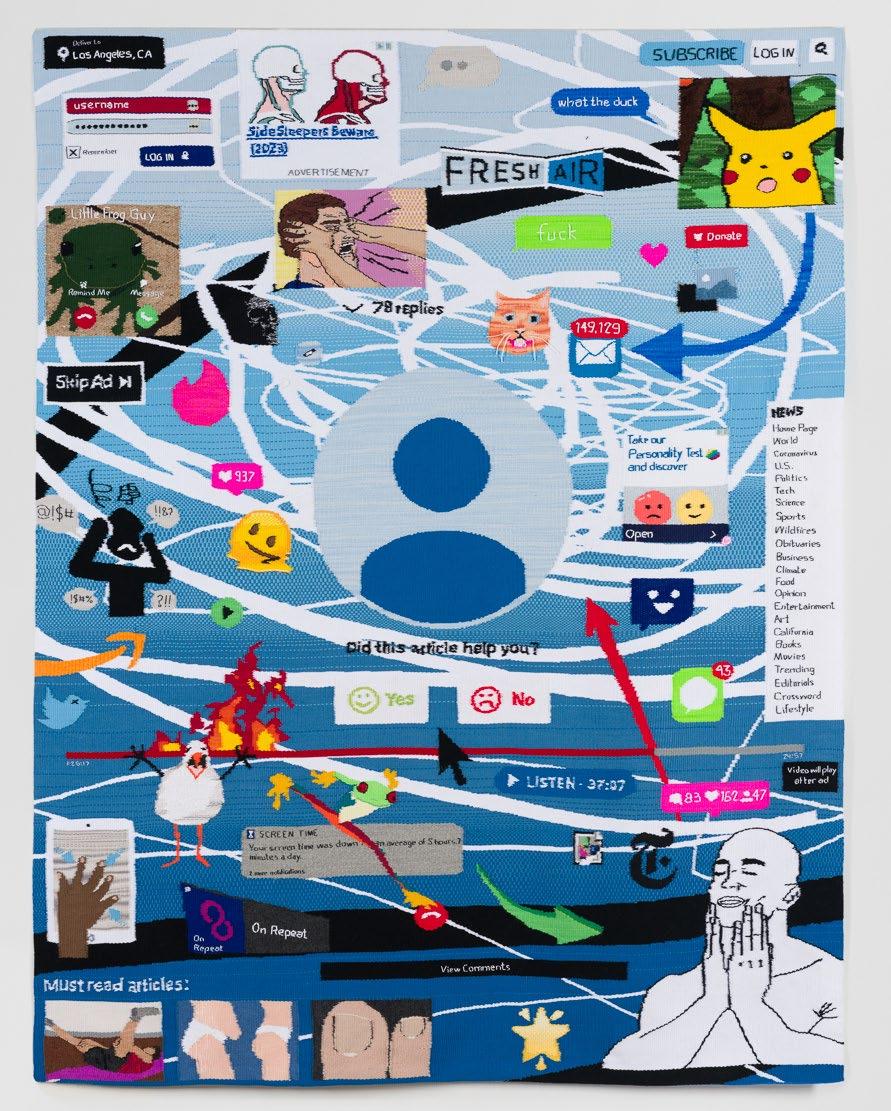
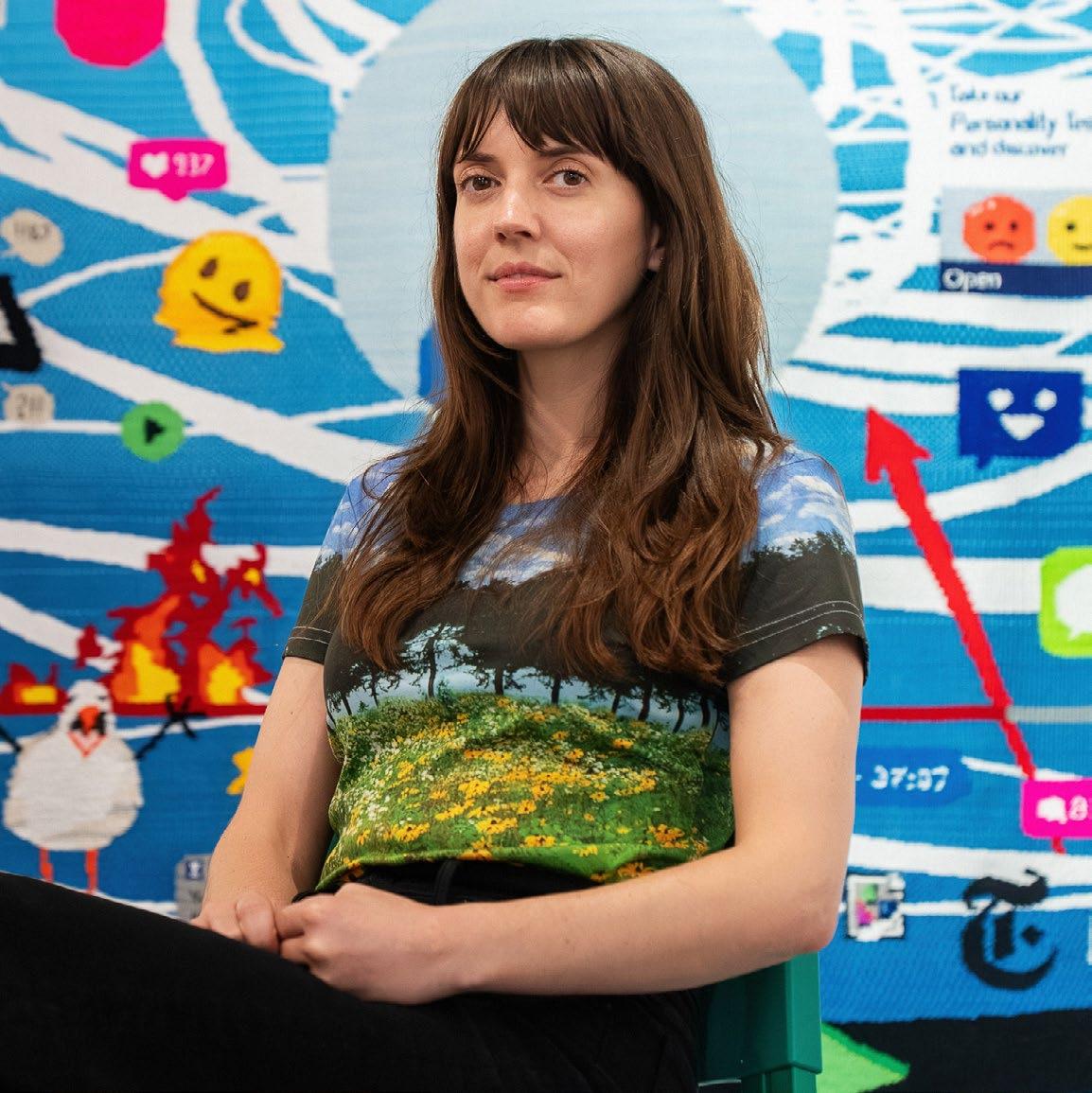
If there’s one sense of solidarity that ages well across the world, it’s the way humor brings communities together. In digital culture, memes are a constant across all platform feeds and within a segmented part of the Internet, from Instagram to the heyday of Tumblr and 4chan. Getting sucked into a screen and down a doomscroll of laughing while crying is what makes Kayla Mattes’s woven tapestries the crafted bulletin boards of the current times. Memes typically experienced online can be touched, delicate in their pixelation that is now made of hand-dyed wool. Looms are just as technical as they are magical, the whimsy of feeding a linear string into a readable image. For Mattes, the medium is just as physical as it is mental. Top to bottom, side to side. The popularity of taking shortcuts with technology is countered by this deeply classical artistry, which requires Mattes to labor on a singular tapestry over the course of weeks and months.
whattheduck(2023); handwoven cotton, wool, and silk.
Mattes
Computing’s roots in weaving come full circle, as Mattes wields the earliest form of binary in her textiles. Mirroring the programming instructions that fed the oldest computers, the artist slows down in this era of shortform media consumption. The algorithm leaves the app, wrapped in tangles, as iconic symbols in the form of Pepe the Frog and iconic symbols like flame emojis poke fun at the political state. Floating text bubbles and app notifications dictate affirmations of praise and satire. Adjacent to the tapestries are hand-sketched graphite screenshots hung in front of the artist’s desk. A time stamp records the impermanence of a click and the fleetingness of a save. In this, Mattes makes the seemingly solitary experience of being online all the more universal in how relatable these cartoon characters are in reacting to the world’s harsh realities and buoyant joys.
WordsbyIsabellaMarieGarcia
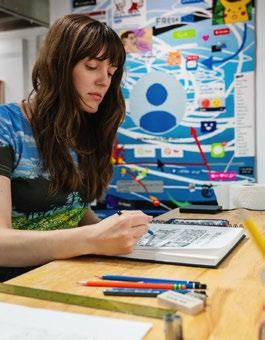
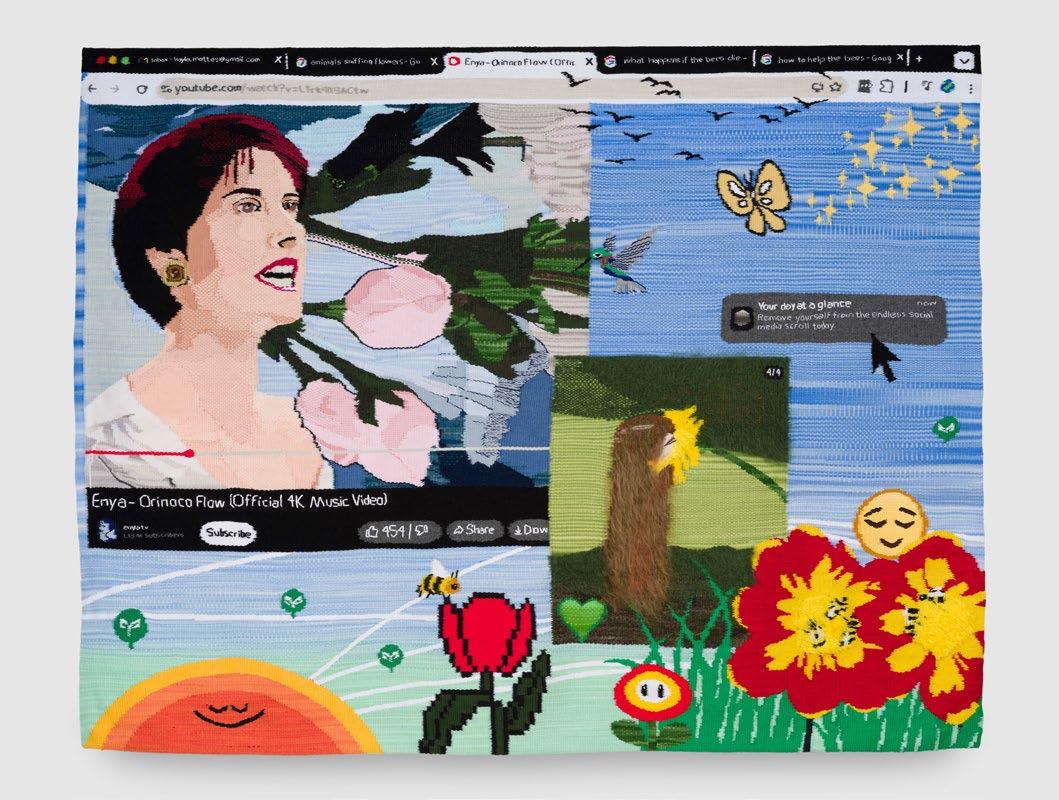
OrinocoFlow(turnitup)(2025); handwoven wool (hand-dyed), cotton, mohair, polyester, and acrylic.
Mattes’ process involves drawing before she begins working on the loom. Image by Jayme Gershen.
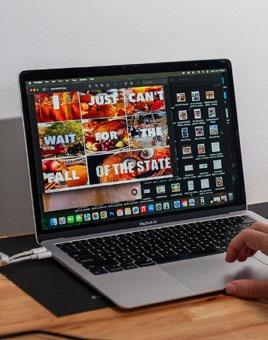
Mattes scours the web for source material. Image by Gershen.
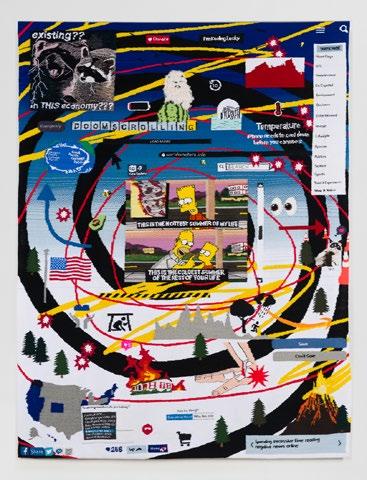
Existing??(2023) ; handwoven cotton, wool, faux fur, chenille, mohair and acrylic.
A portrait of Mattes by Gershen.
Session 06
Armani Howard Autumn Knight Sonia Barrett
Painting
Performance
Sculpture
Armani Howard
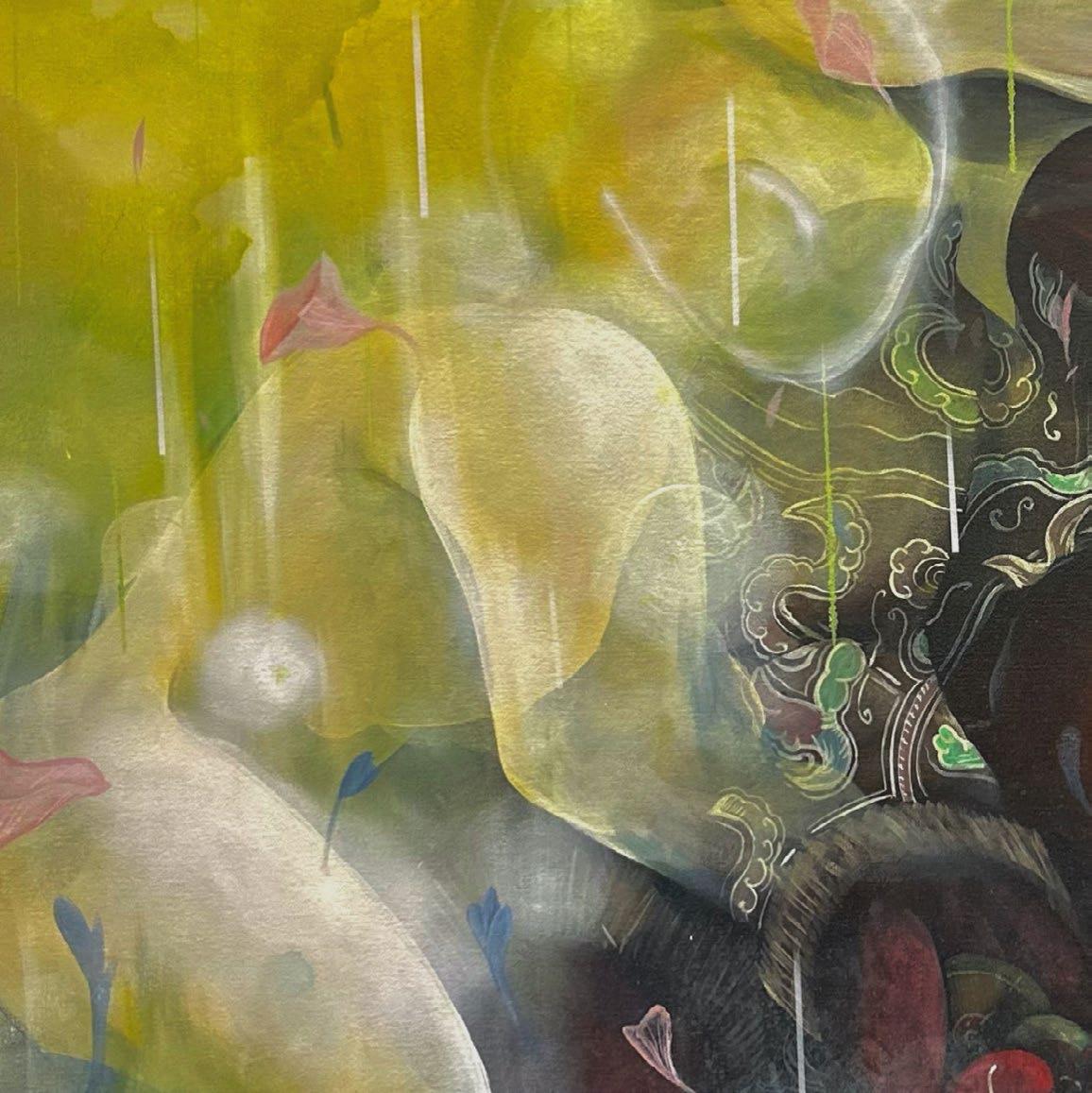
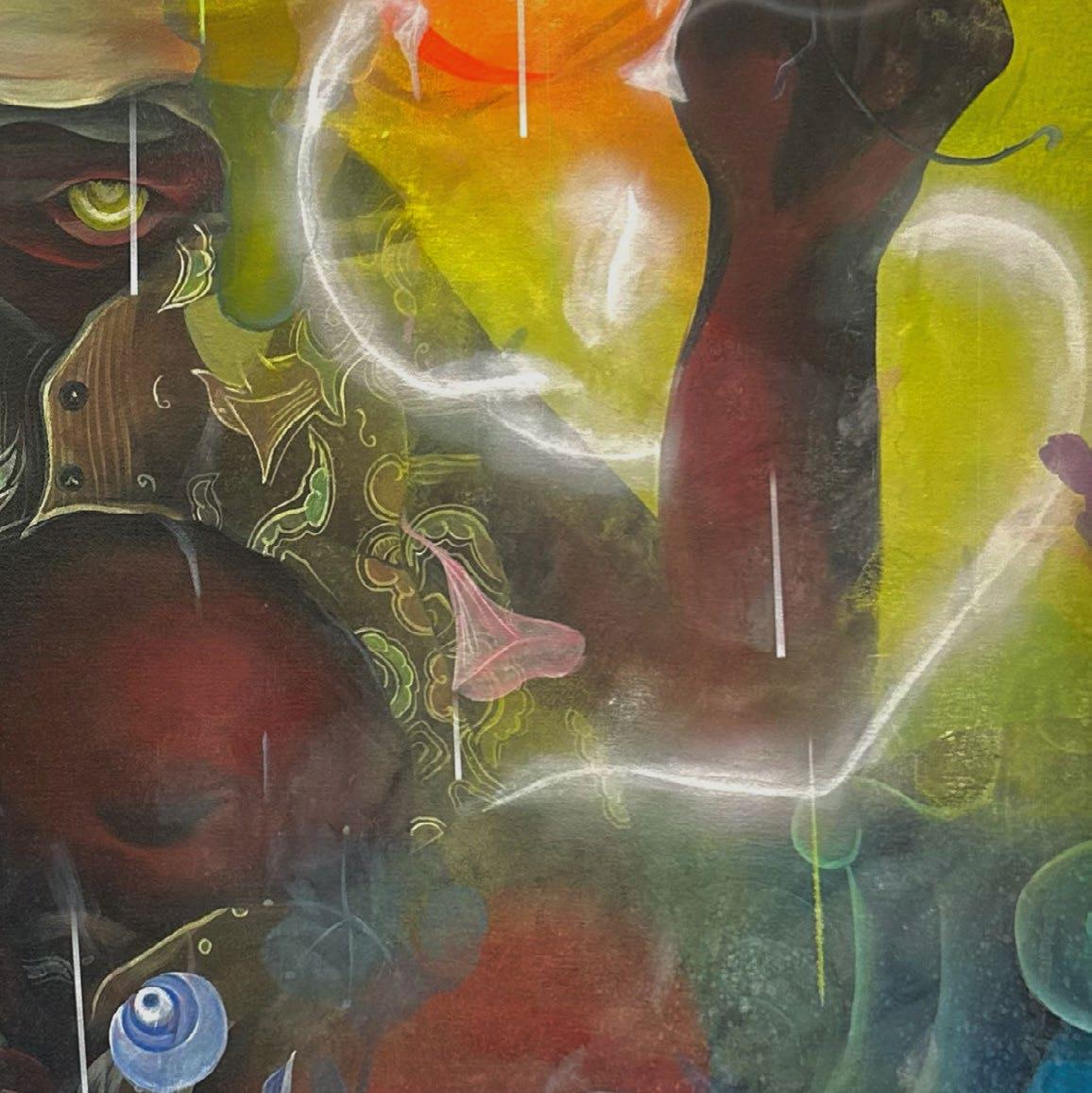
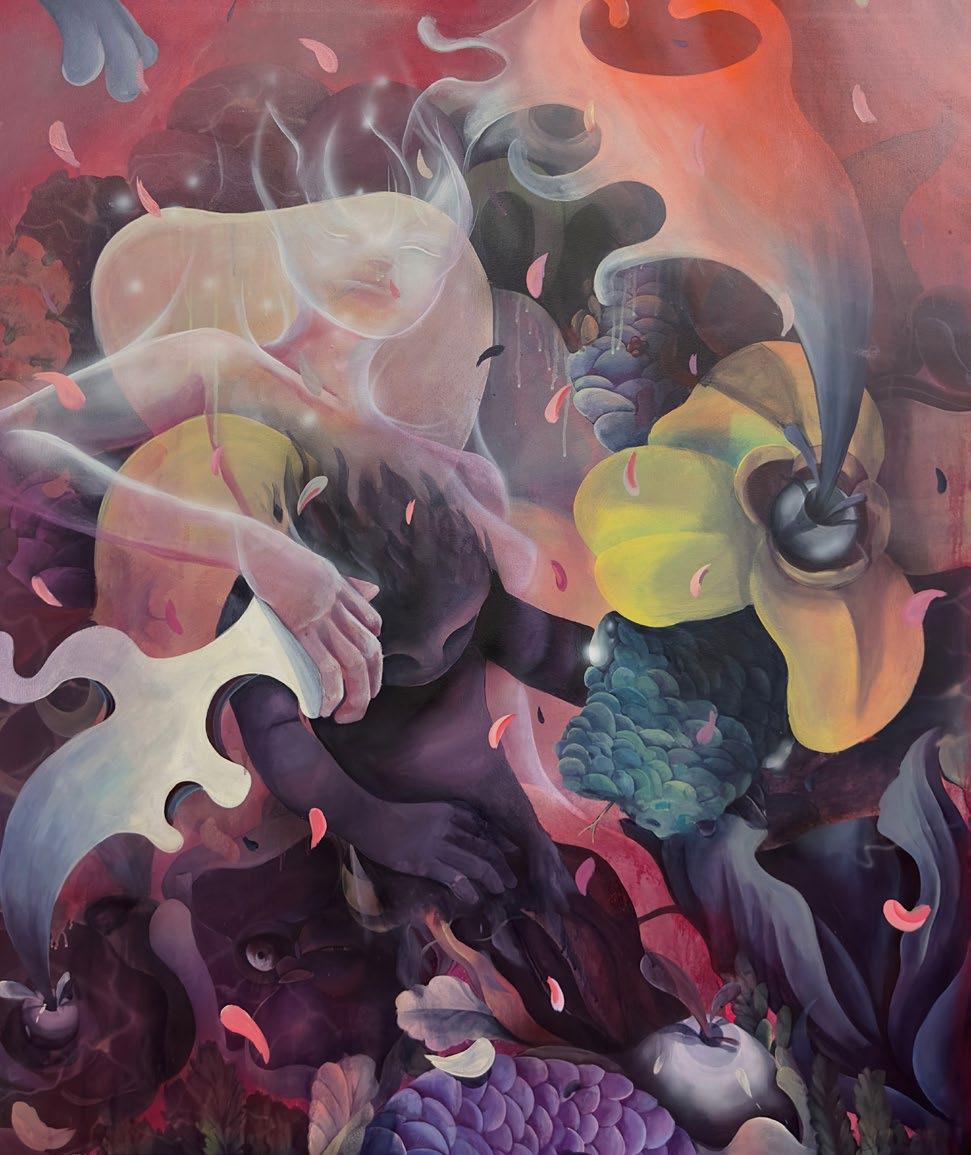
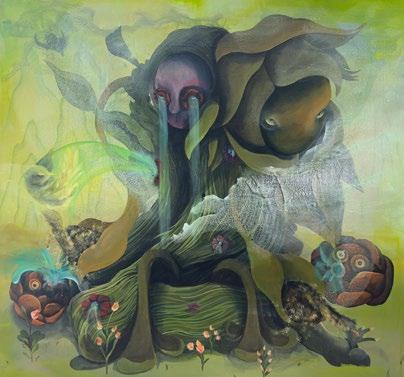
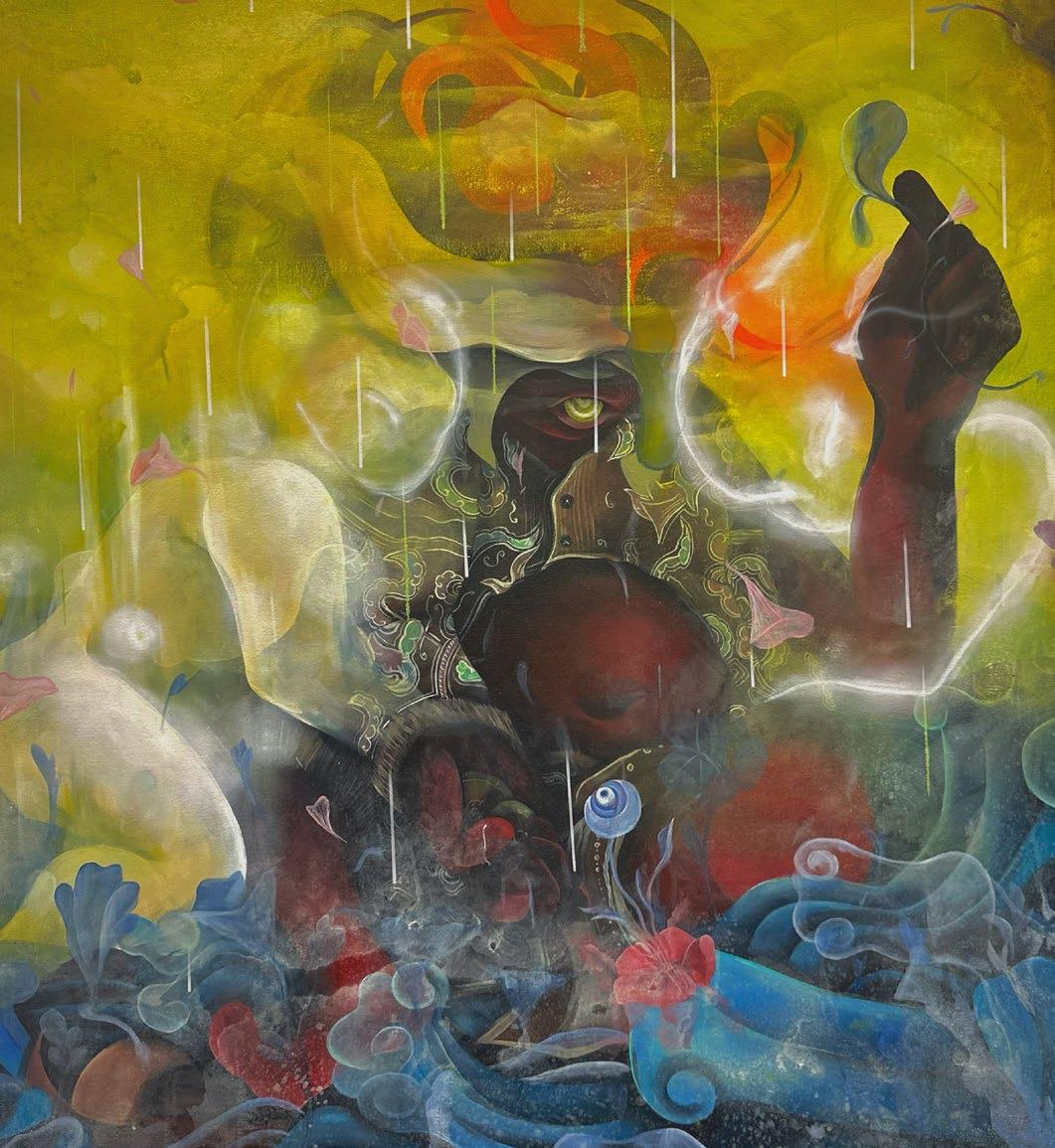
For Armani Howard, painting initially served as a therapeutic outlet. It soon became a vehicle that conveyed tender dialogues, speaking to the abstraction of his memories, experiences, and existence. “A lot of it [painting] was reclaiming those memories, but also allowing them to exist on their own,” he says. Following the loss of his father as a young child growing up in Chicago, he digested the stories told by family members. These conversations conjured new layers of meaning and led him to explore mythology in ways that helped him understand the essence of someone more than their actuality. The idea of existence within multiple planes became the foundation for Howard’s practice. Mystical figures in richly pigmented landscapes, surrounded by floral elements, are the hallmark of Howard’s paintings. Howard emphasizes that every sketch and finished painting stems from feeling.
Matriarch(2024), acrylic on canvas.
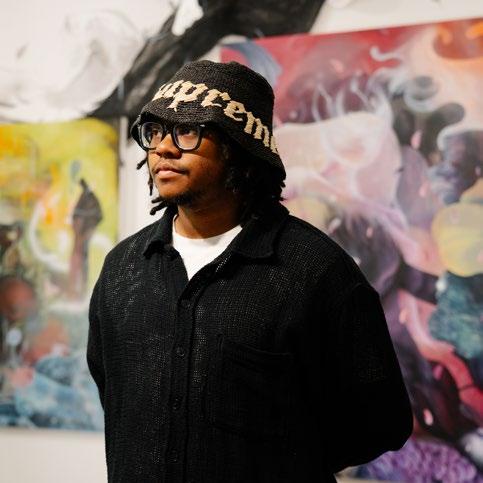
He channels the many dialogues, experiences, and memories he holds and allows them to take shape in whatever ways they translate to in that time and space that he is creating. Howard also incorporates elements from Buddhist artworks, given that his grandmother was a Buddhist, to create a world where spirits are in control of the landscape and, at times, convey the idea of escapism.“In my work, I’m creating something I want to believe in, rather than giving the viewers an answer,” he said. Howard describes his residency experience at Fountainhead as allowing him to breathe again, to create his artwork without the constraints of work and responsibilities back home. He quotes, “Being here has made me reconnect with time and relinquish more control.” Howard highlights how access to water, nature, and vibrancy, as well as the diverse and layered communities in Miami, have shaped ideas for new work.
WordsbyLaurynLawrence
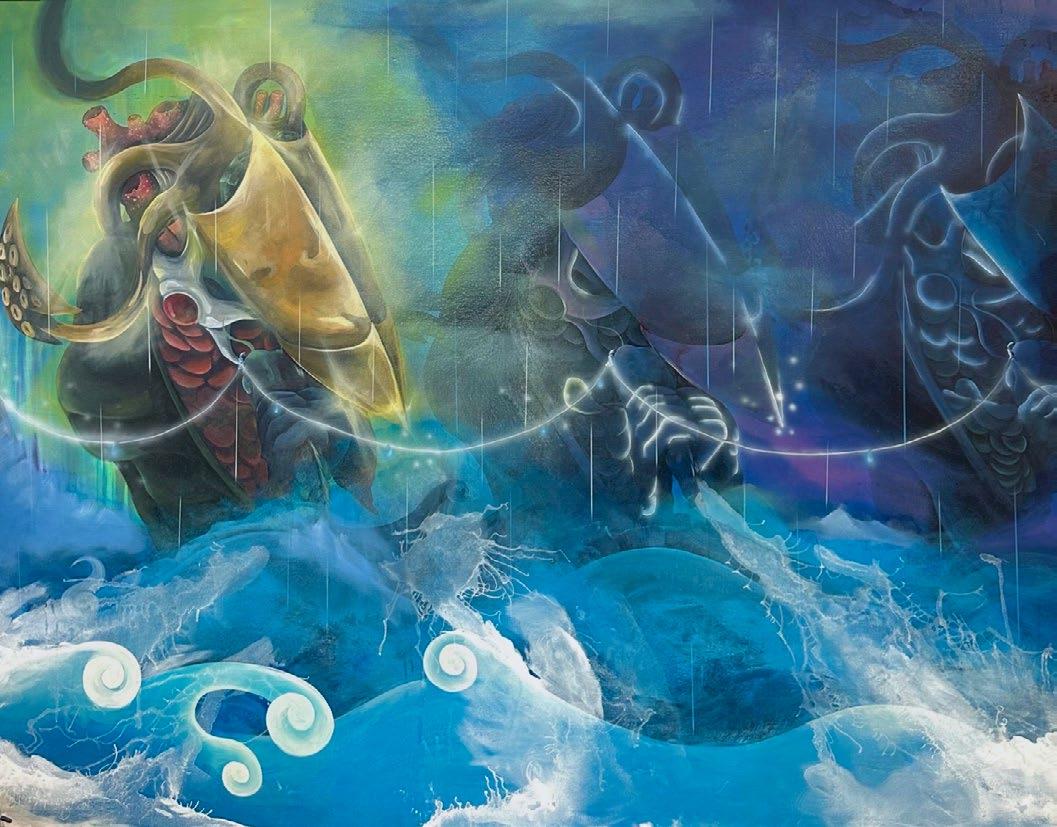
Offering(ToTheSea)(2024); acrylic on canvas.
Bouquet(2024); acrylic on canvas.
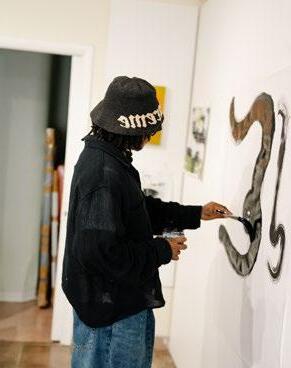
Howard begins a new work in his Fountainhead studio, photographed by Martina Tuaty.
A portrait of Howard by Tuaty.
Slumber(2024) ; acrylic on canvas.
Autumn Knight
Autumn Knight’s practice draws on elements of humor, improvisation, gatherings, and timing. The incorporation of comedic relief and breaking the fourth wall in her work invites viewers into another realm of reality. In her ongoing performance piece, titled SanityTV , Knight creates a sitespecific talk show, taking on the role of a TV host, and the audience becomes the show’s guests. Knight’s work invites viewers to examine the rigidity and structure that envelop certain events, such as panels and livestreams, and to allow our imagination to interact with immediacy. Taking SanityTVto different places, such as Berlin in 2018, prompted Knight to consider the collective psyche and basis of humor in other cultures. “Humor is a practice and a shared language you learn at home,” she says.
Knight’s Fountainhead studio included elements from Knight’s past performance works. Image by Martina Tuaty.
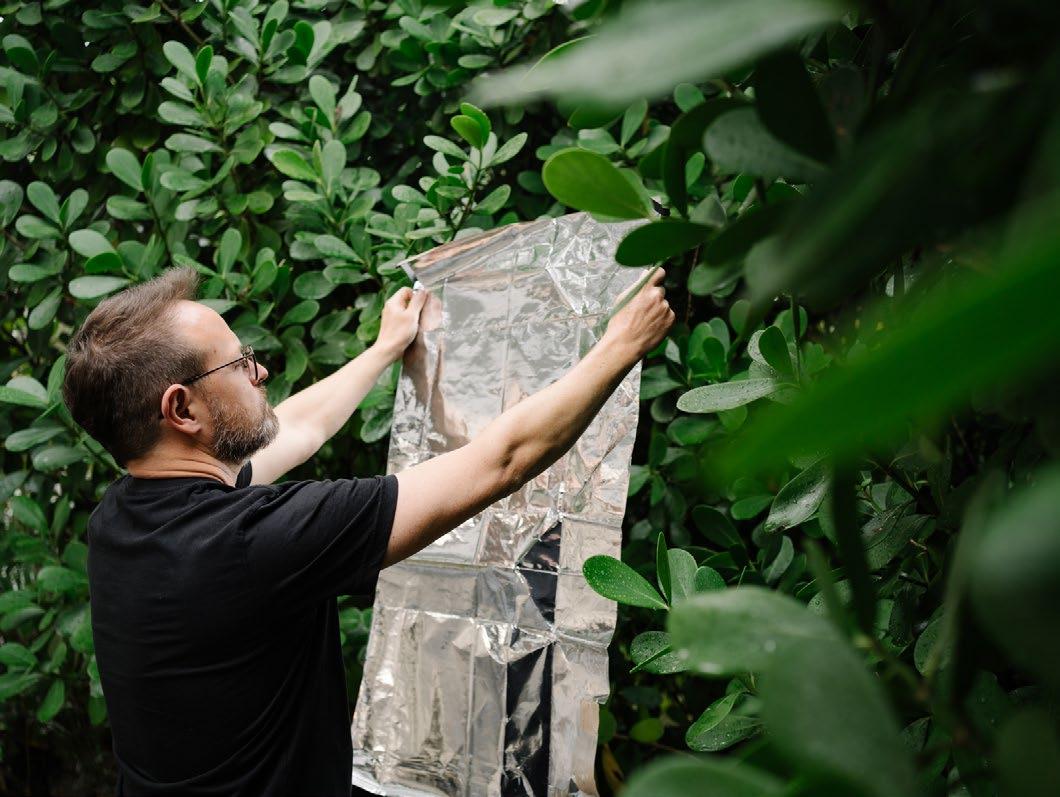
In Knight’s workspace at the Fountainhead residency, she had shiny silver tablecloths covering the walls. This element functions as a representation of her reflective experience at Fountianhead. During her residency, she found it essential and valuable to be at Fountainhead, where she met artists and art administrators in Miami and held discussions about not only her practice but also the current state of performance art. This experience has allowed Knight a moment to reflect on all the work she has done and create new work that speaks to the many reflective conversations she had during her residency.
WordsbyLaurynLawrence
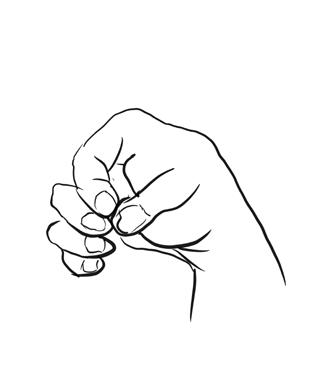
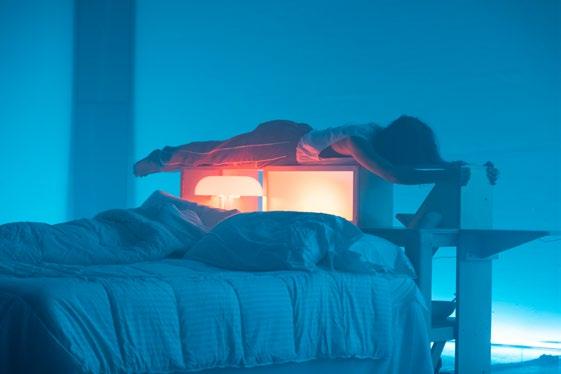
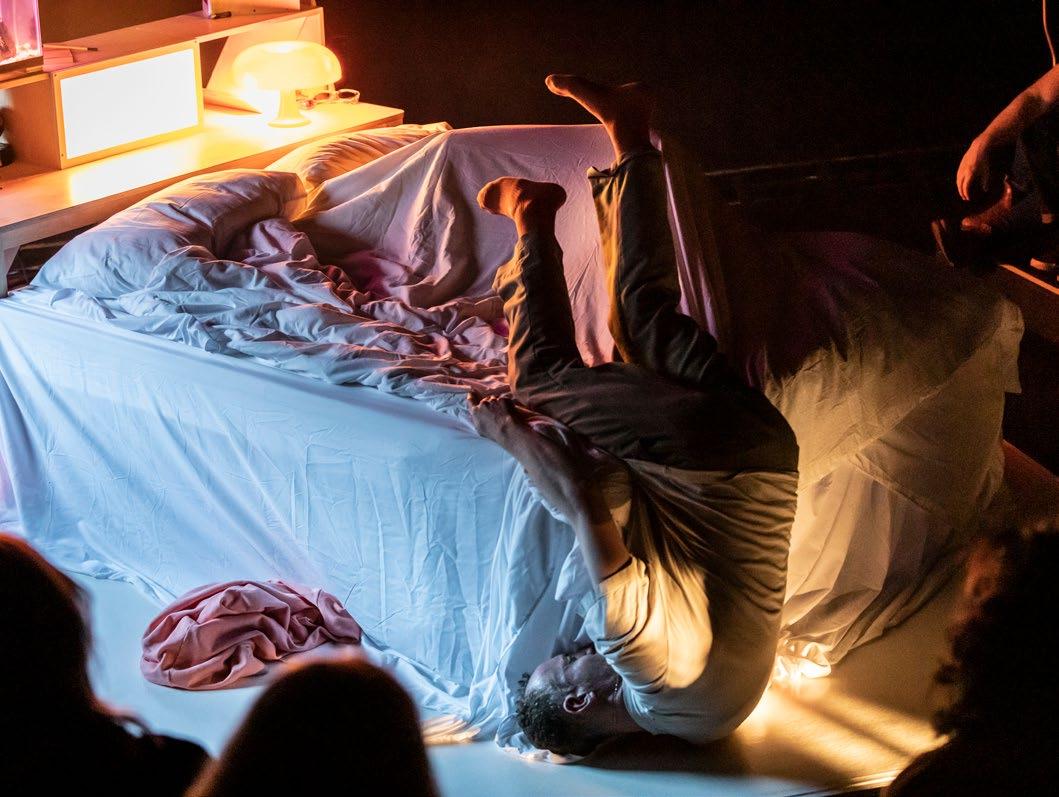
abed(2023); performance.
Photo by Rachel Papo.
Untitled,Drawing(2020); courtesy of the artist.
abed(2024), performance.
Photo by Malique Pye.
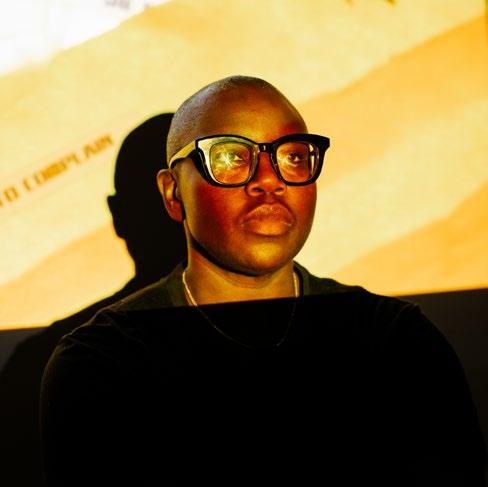
A portrait of Knight in the studio by Tuaty.
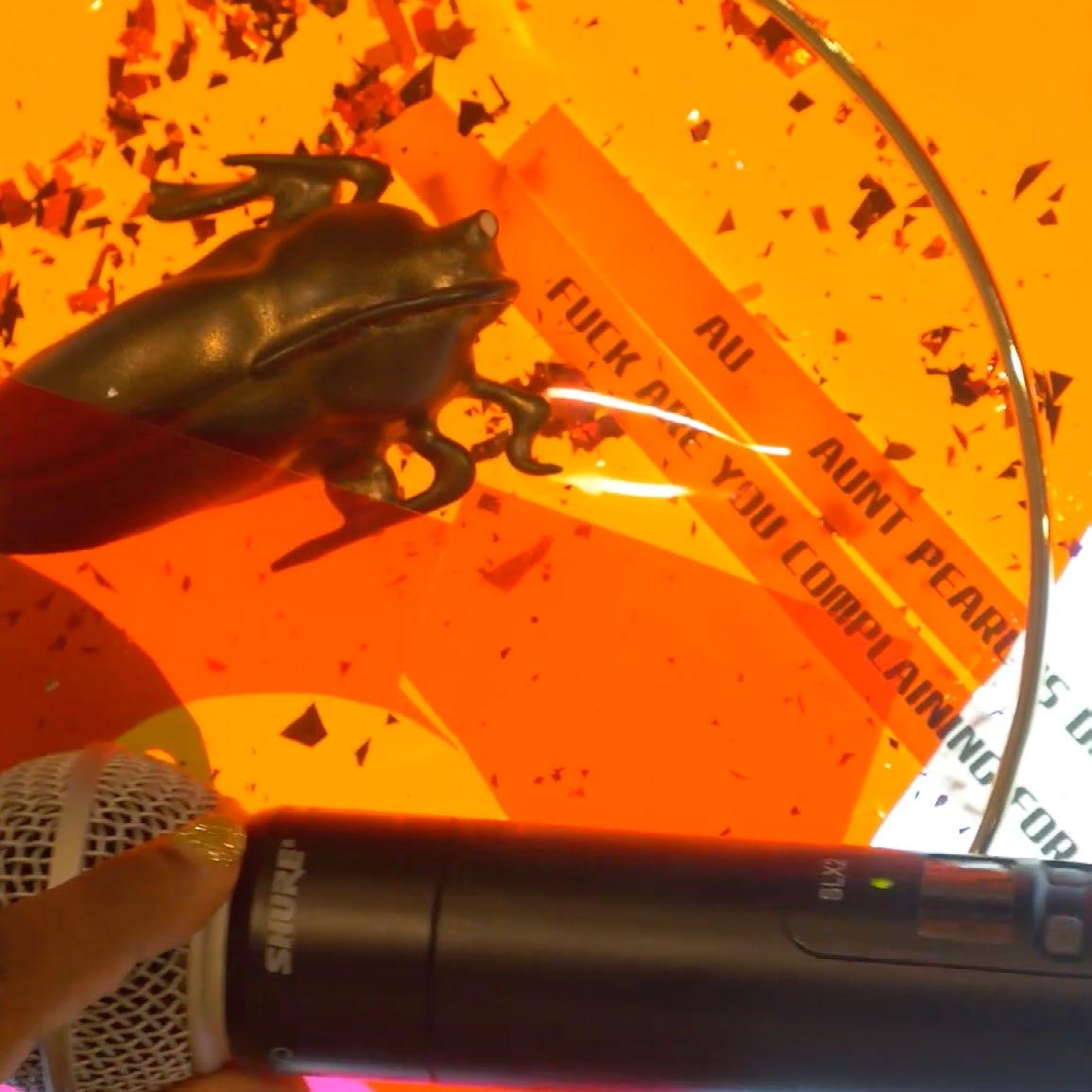
complain/disappoint(2023); video, performance.
Image courtesy of the artist.
Sonia Barrett
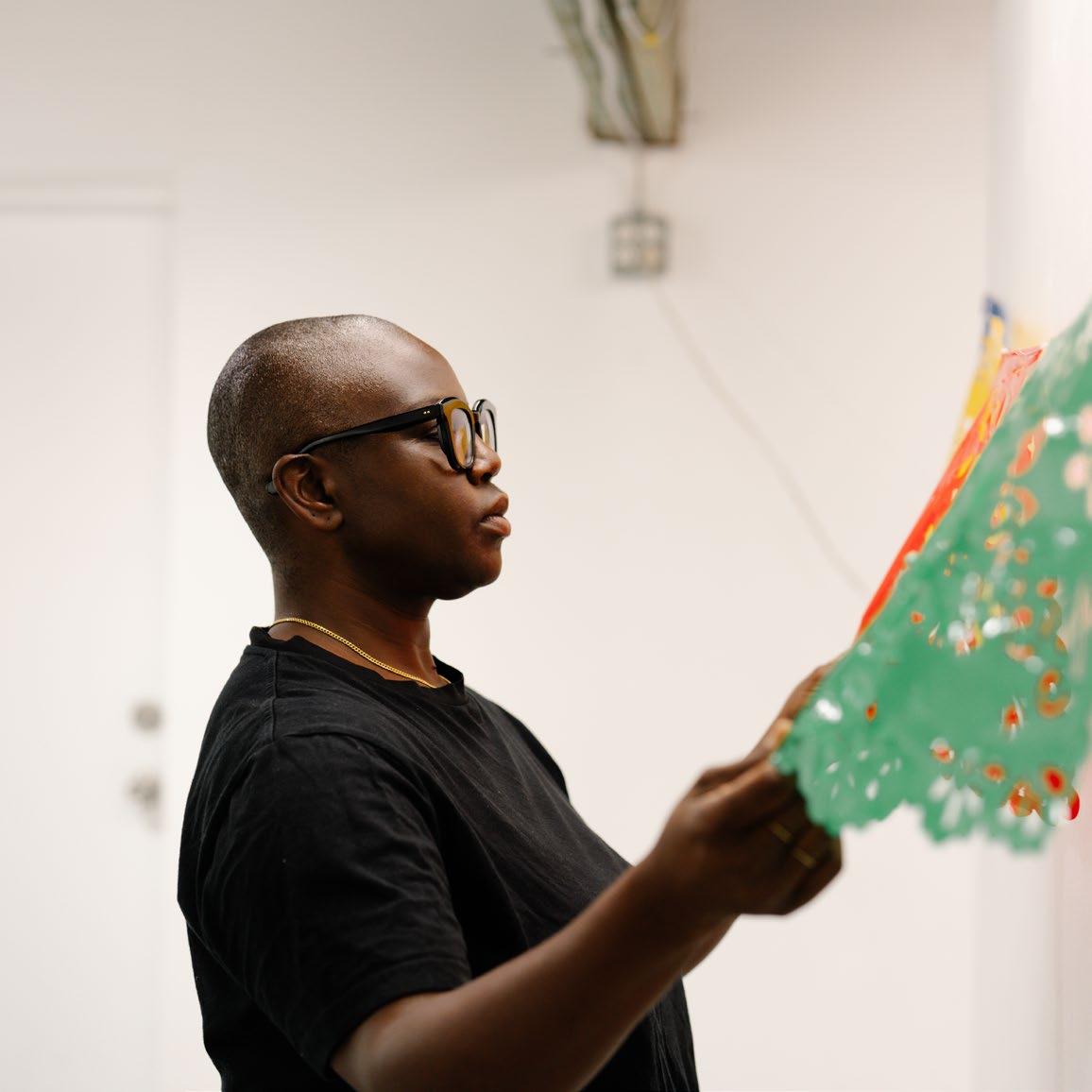
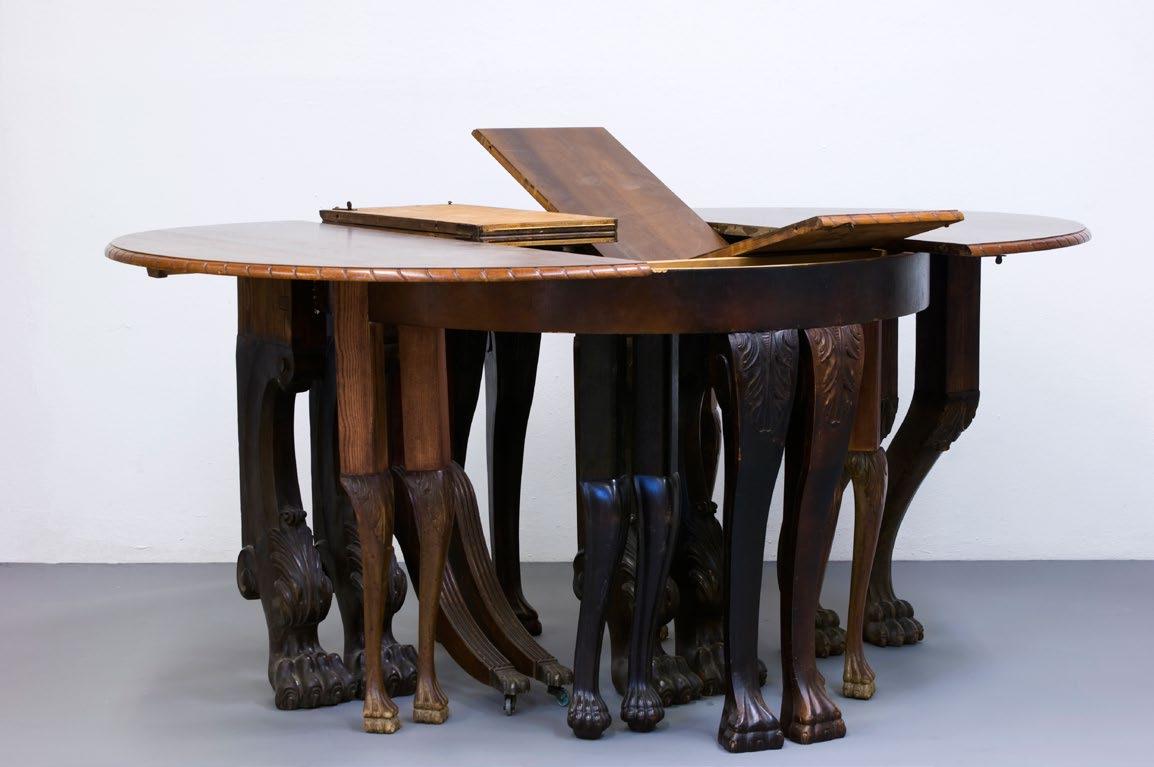
Sonia Barrett explores themes of loss and collectivity through assemblages, sculptures, and gatherings, all informed by in-depth archival research. The materials that she leans on are furniture, composites of plants and animals, tablecloths, maps, and hair. Barrett often questions how we can reset and reframe notions of biology with her furniture work, politics with her stonework, and geography with her braided maps.
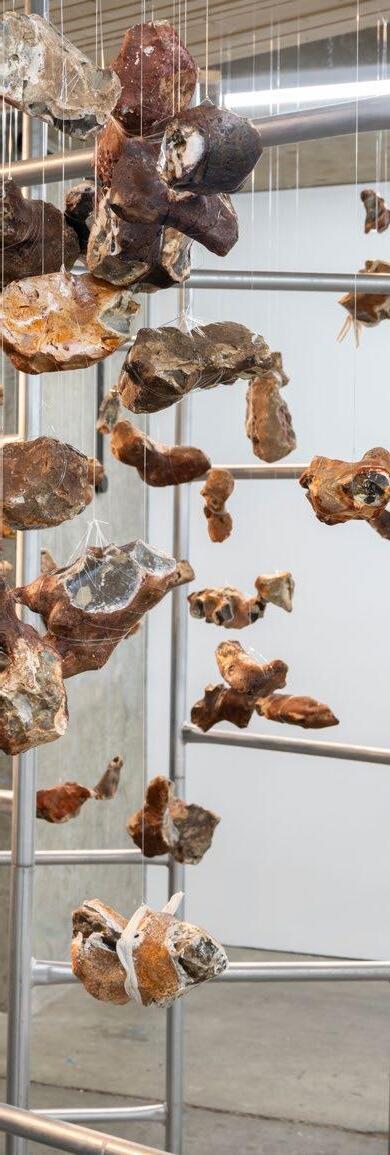
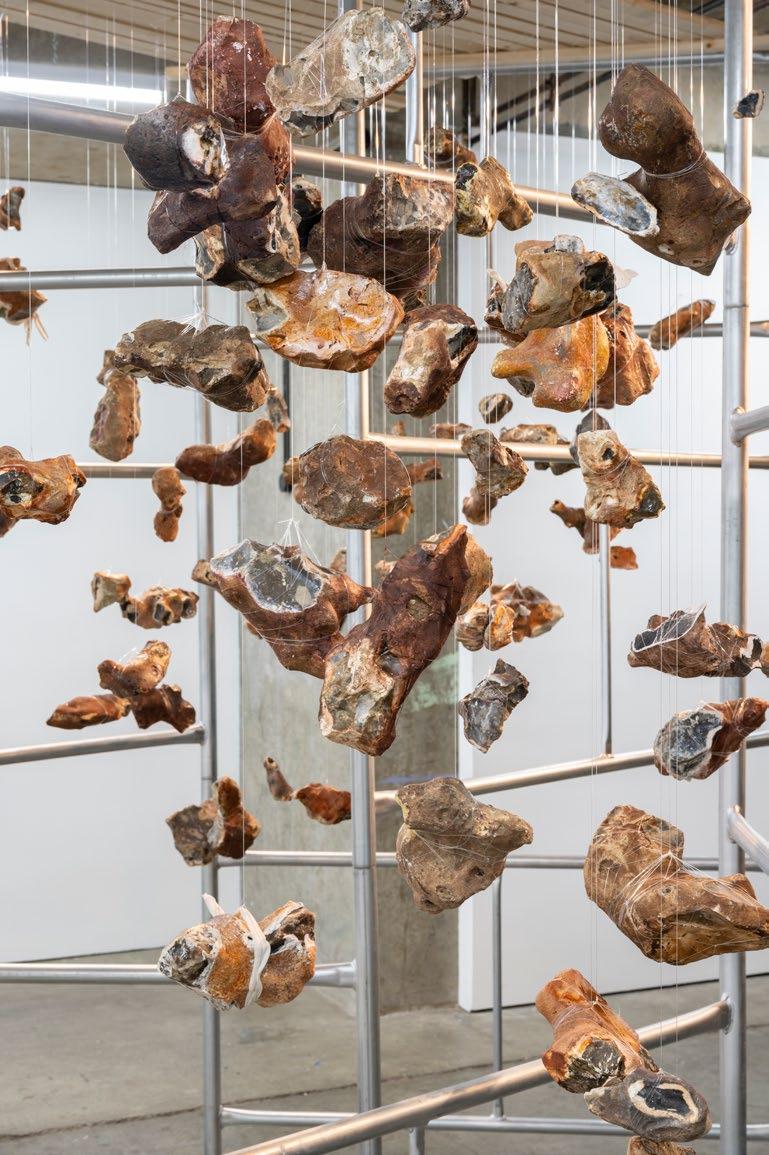
In her “Flint” series, Barrett was struck by how flint scattered across English fields resembles human bones. Using flint as both material and metaphor, she traces a shared history of dispossession linking working-class white communities in England with Black and Brown people across the British Empire. Flint itself is the fossilized remains of some of England’s earliest aquatic life, and in Neolithic Britain it was mined on an industrial scale to produce tools, weapons, and the stones used to build enclosing walls—structures that literally severed ordinary white Britons from their land.
The flint was cut into square shapes by working-class white men, a labor that caused one of the earliest fatal industrial airborne diseases, known as knapper’s lung. These same square flints were later used in gun mechanisms, providing the spark that fired weapons across the British Empire. In this way, the material that dispossessed white rural communities at home became instrumental in the violent seizure of land and life from Black and Brown people abroad. Barrett uses flint as a touchstone to reveal how loss—of land, labor, and life—was unevenly experienced but structurally connected across empire and within Britain itself.
We see more examples of her research-based practice in her assemblage work, which incorporates West Indian furniture found in the UK, prompting consideration of what it meant to create a new home in another country. During her residency at Fountainhead, Barrett spent a considerable amount of time outdoors, exploring the mangrove trees in Miami. She reflects on mangrove roots as a saving force, a form of rooting that thrives in both saltwater and freshwater and has led her to focus on plants that require change in order to survive. Blue—a color that surrounds Miami—has found its way into a new piece she’s created during her residency. Time spent at Fountainhead has also led her to an expansive way of utilizing furniture to represent all that has been lost, and as a testament to a solution to the emptiness.
WordsbyLaurynLawrence
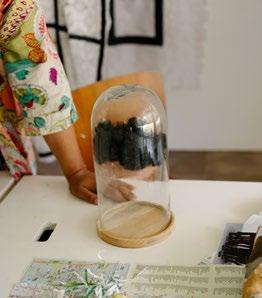
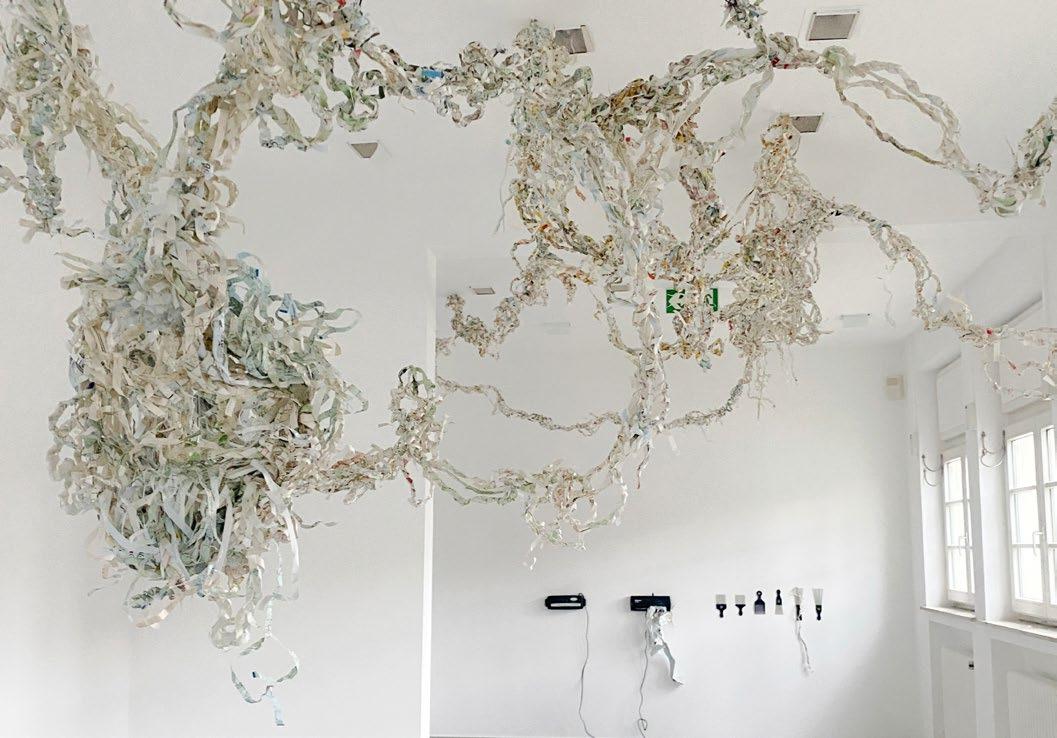
Installation view of Sel Noir, Museum Villingen Schweningham (2025); antique dated and contemporary maps, paper, string metal.
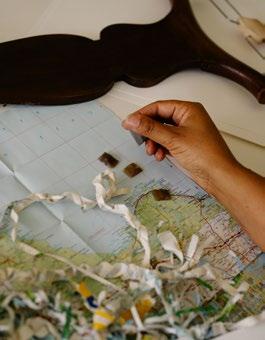
In her Fountainhead studio, Barrett braids maps to build on her series, Dreadingthe Map.Image by Martina Tuaty.
Skynr3(2025), comprised of glass, mango wood, and hair. Image by Tuaty.
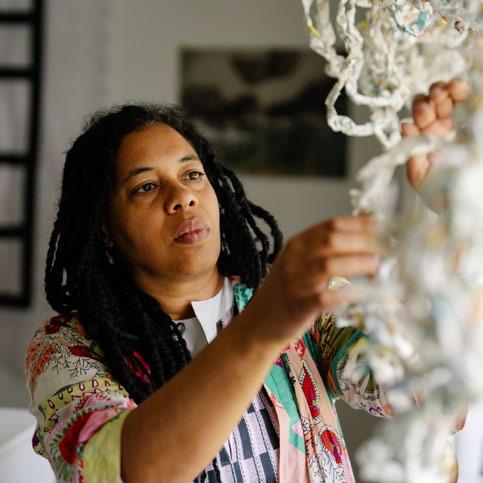
A portrait of Barrett by Tuaty.
Tablenr6(2012); wood, metal.
Image by Bruno Weiss
Andrew Roberts
Anna Perach Mamali Shafahi
Andrew Roberts
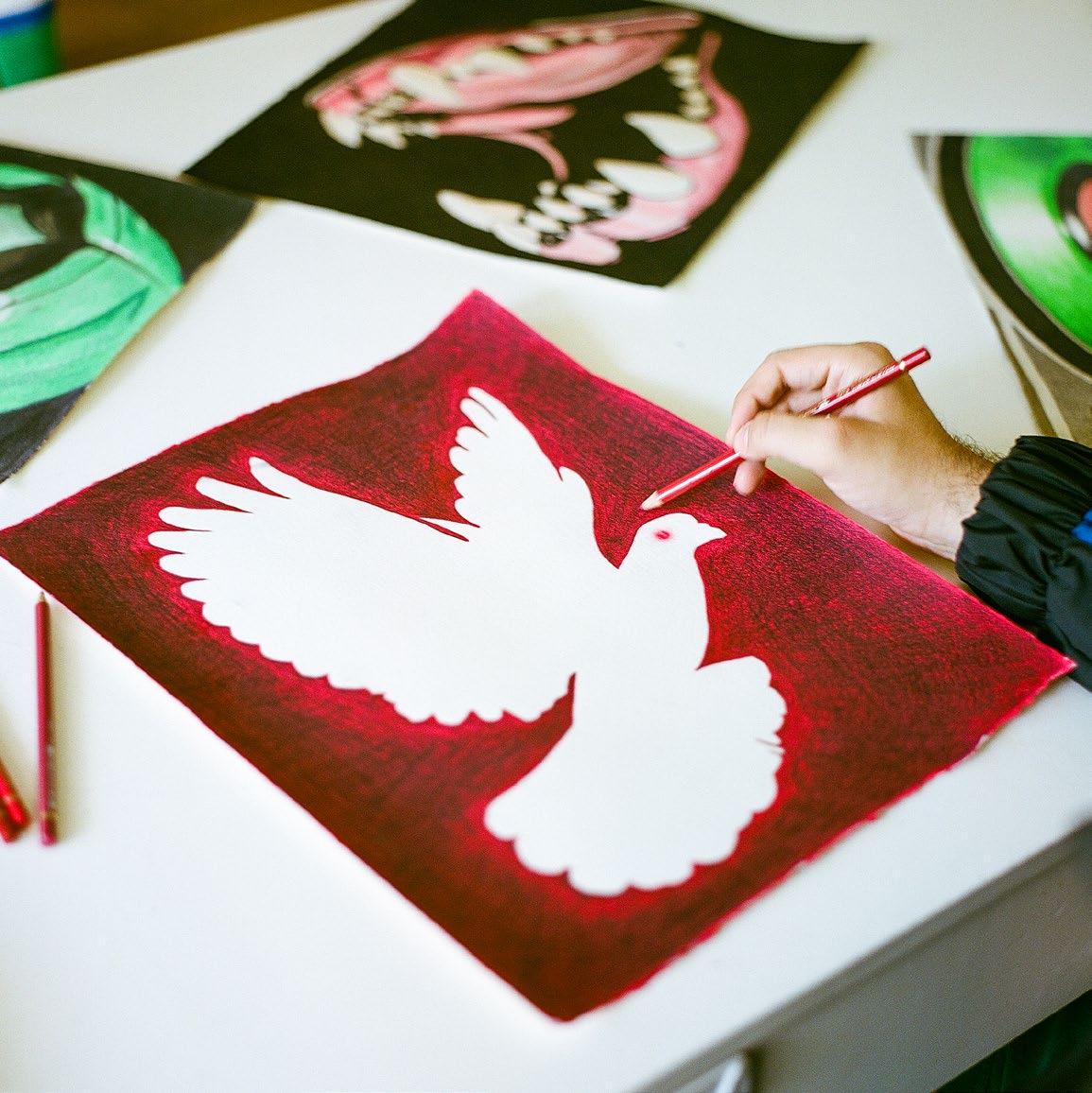
Andrew Roberts doesn’t want to tell his audience what to think. He wants to confuse them instead.
Born in 1995 in Tijuana, Mexico, Roberts is a multimedia artist that blends video games, film and 3D-printed sculpture with horror, fantasy, science fiction, pop culture and a touch of humor. Roberts creates worlds where orcs fall in love and zombie teenagers dance. Raised in a family of engineers, Roberts hung out in his father’s workshop after school and played with 3D softwares. His mother, a horror fan, would drive around Tijuana with Roberts in the passenger seat listening to “La Mano Peluda,” or “The Hairy Hand,” a radio show where listeners call in to share scary stories at night.
Roberts attended a traditional art school, but his true interests lay elsewhere. He watched tutorials online to teach himself 3D softwares. Roberts’ work feels more honest, channeling his family’s background in engineering and love for the macabre to unpack themes of memory, pain and the U.S.- Mexico border.
Roberts’ practice involves drawing and digital animation
His work is a modern take on the storied tradition of Latin American artists using horror elements to explain real, complicated and difficult issues. He builds upon the border art movement of the 90s, but with a new aesthetic. In his two 2025 solo exhibitions, Roberts appropriates ghosts and zombies as metaphors for trauma and otherness. He describes his work as both political and playful, using the survival horror subgenre as a lens to view migration. At Fountainhead Residency, Roberts was encouraged to push his ideas further into the abstract. Perhaps zombies are a type of liminal space. Roberts lives and works in Mexico City.
WordsbyAmandaRosa
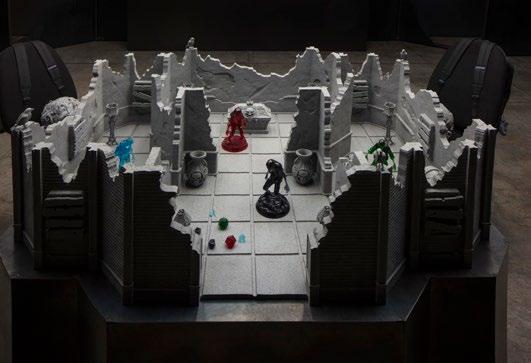
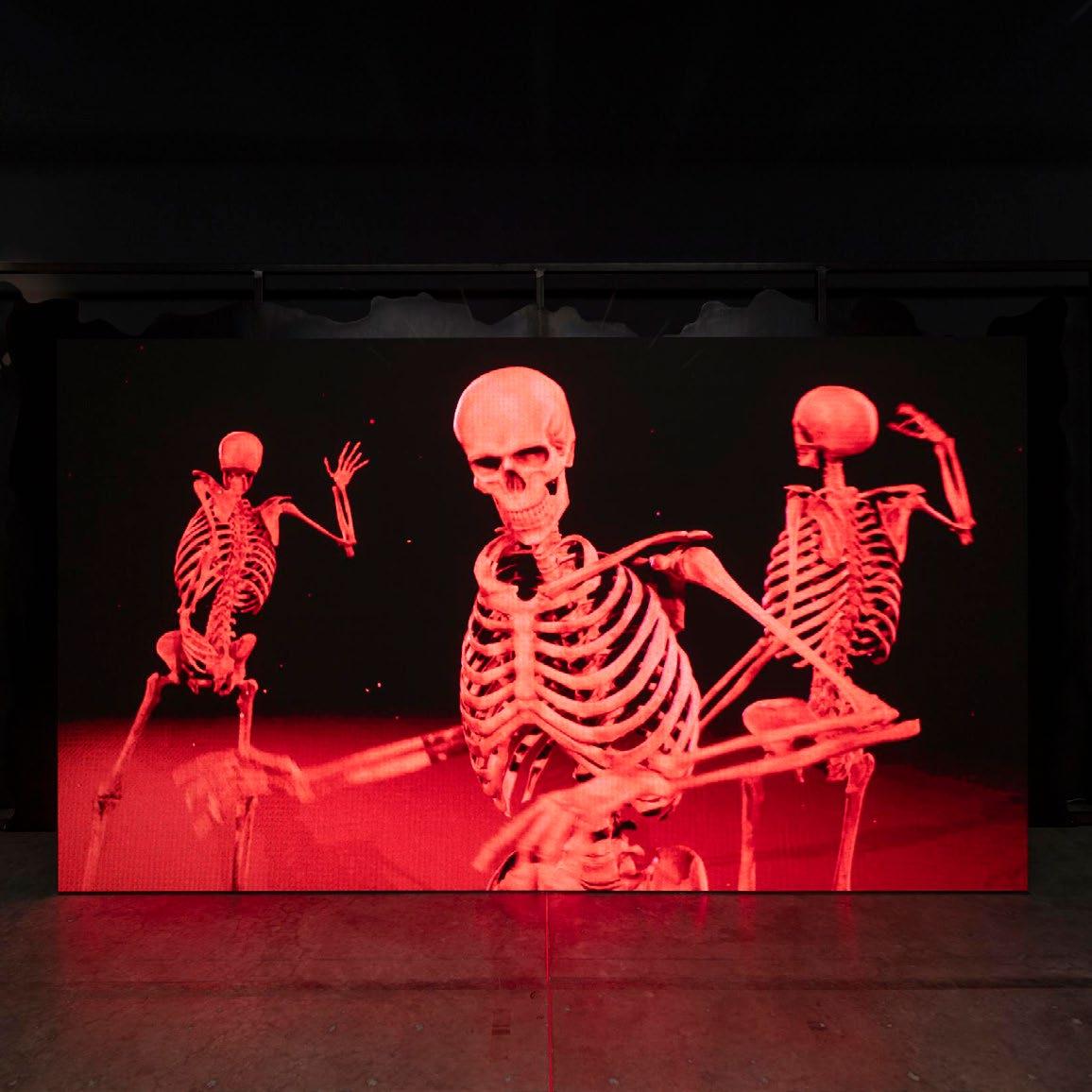
Círculodeinvocación:másalládetu muerte,undía,laTierragiraenelcielo [Circleofinvocation:beyondyourdeath, oneday,theEarthturnsinthesky](2025); automotive paint on PLA 3D print, resin 3D prints, chairs, backpacks.
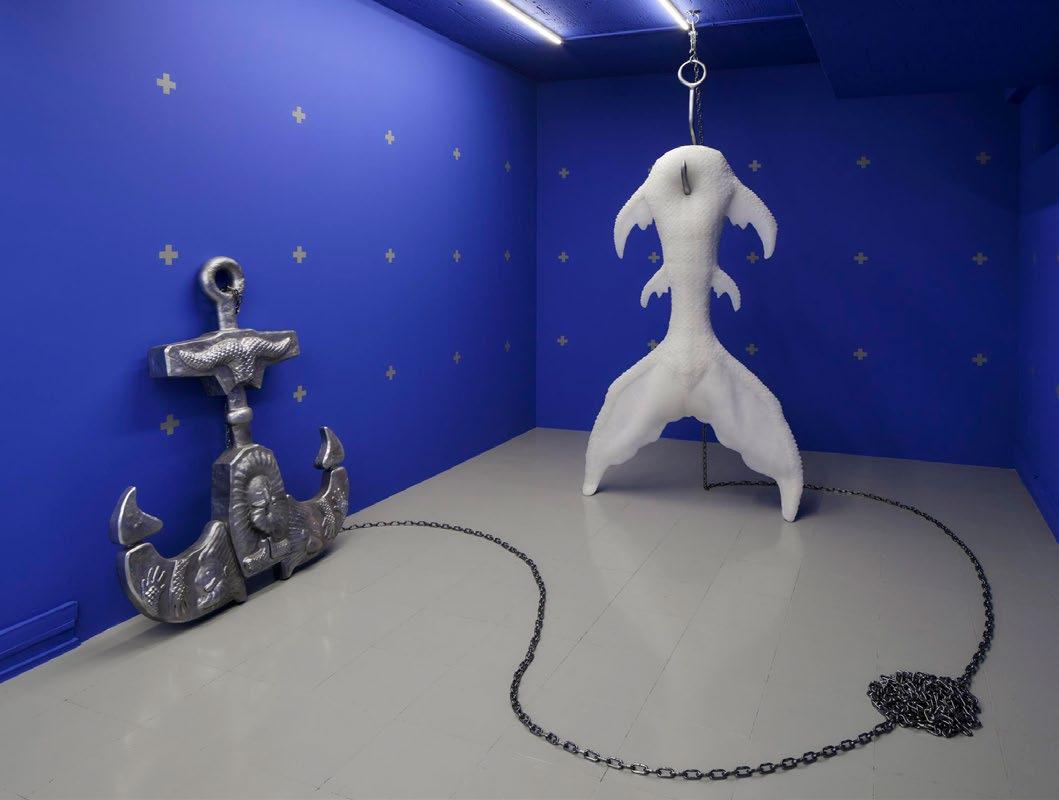
ParoxysmalPositionalVertigo(2023); medical grade silicone, 3D print in polylactic acid, polyurethane foam, steel armature, pulley, hook, chain, resin and paint.
Roberts tinkers with one of the maquettes featured in his digital work. Image by Nicole Combeau.
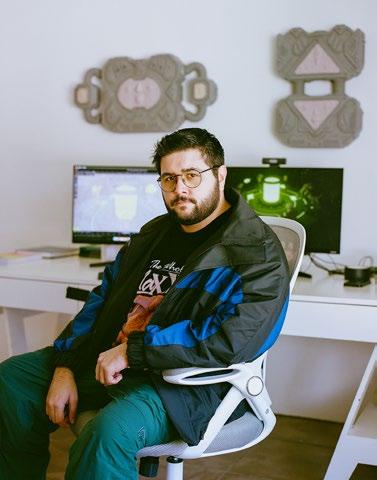
A portrait of Roberts in his studio by Combeau.
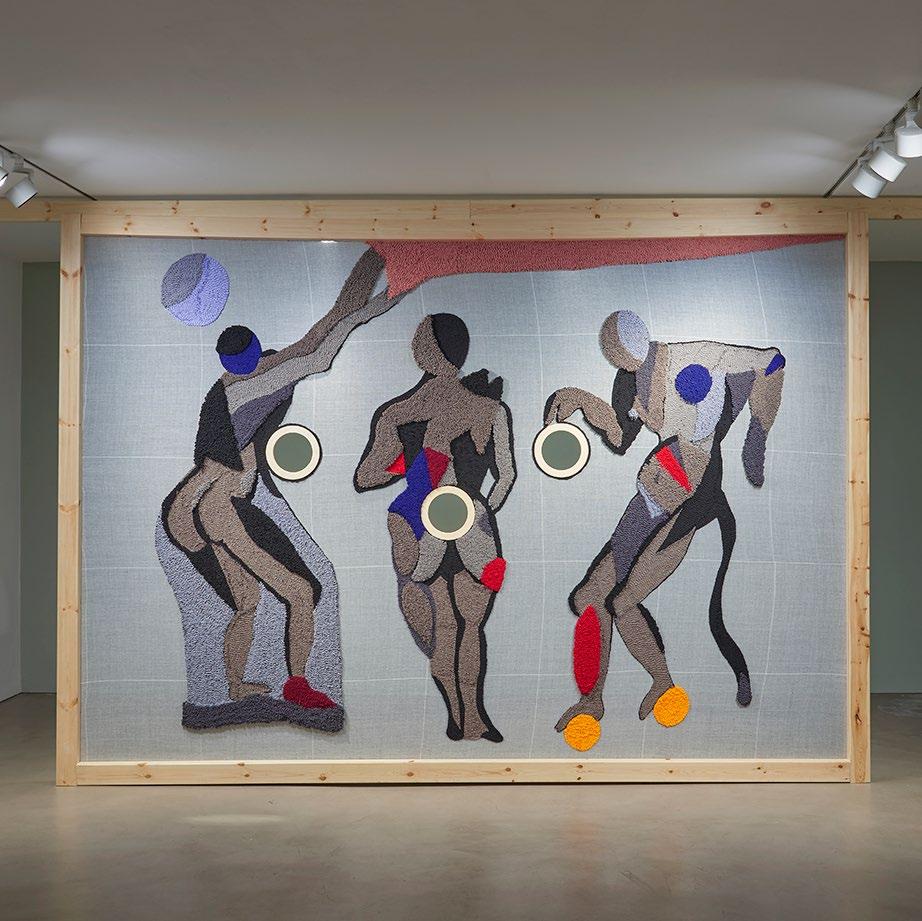
Cadáverfantasma[Spectralcorpse](2025) ; installation view at the Museo Universitario Arte Contemporáneo, MUAC, Mexico City.
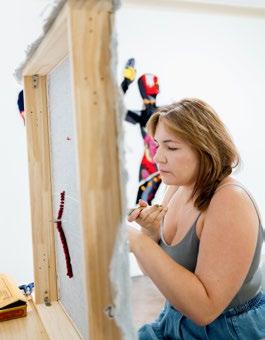
Anna Perach
Anna Perach grew up in the warmth of carpet. She was born in Ukraine in 1985, just a few years before the Soviet Union collapsed and citizens had to wait in long lines for food and basic necessities. When she was seven, Perach’s family moved to Be’er Sheva in the Negev desert. In stark contradiction to their new desert environment, Perach’s family lined the floors and walls of their home with rugs, just as they did in the Soviet Union for both warmth and decoration.
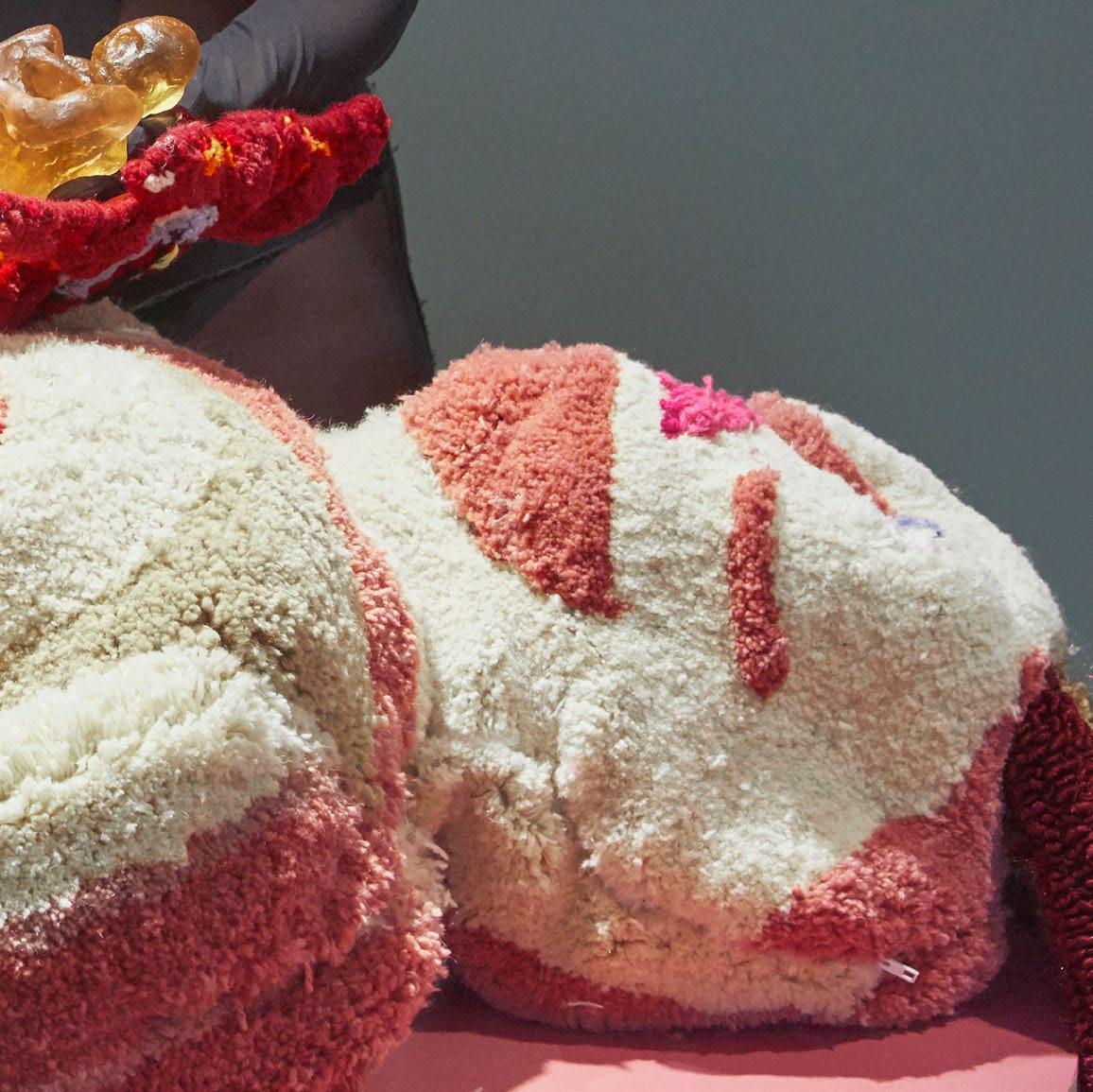
As an artist fascinated by femininity and the domestic space, Perach uses the tufting technique to create wearable carpet-like sculptures that can be activated for performances, like elaborate headpieces and fullbody carpet suits. Perach’s preferred medium of tufting dissects how artistic practices associated with so-called “women’s work” are typically perceived. “Craft was always considered second to high art,” Perach said. “And then women were always considered, historically, to be second best to men.”
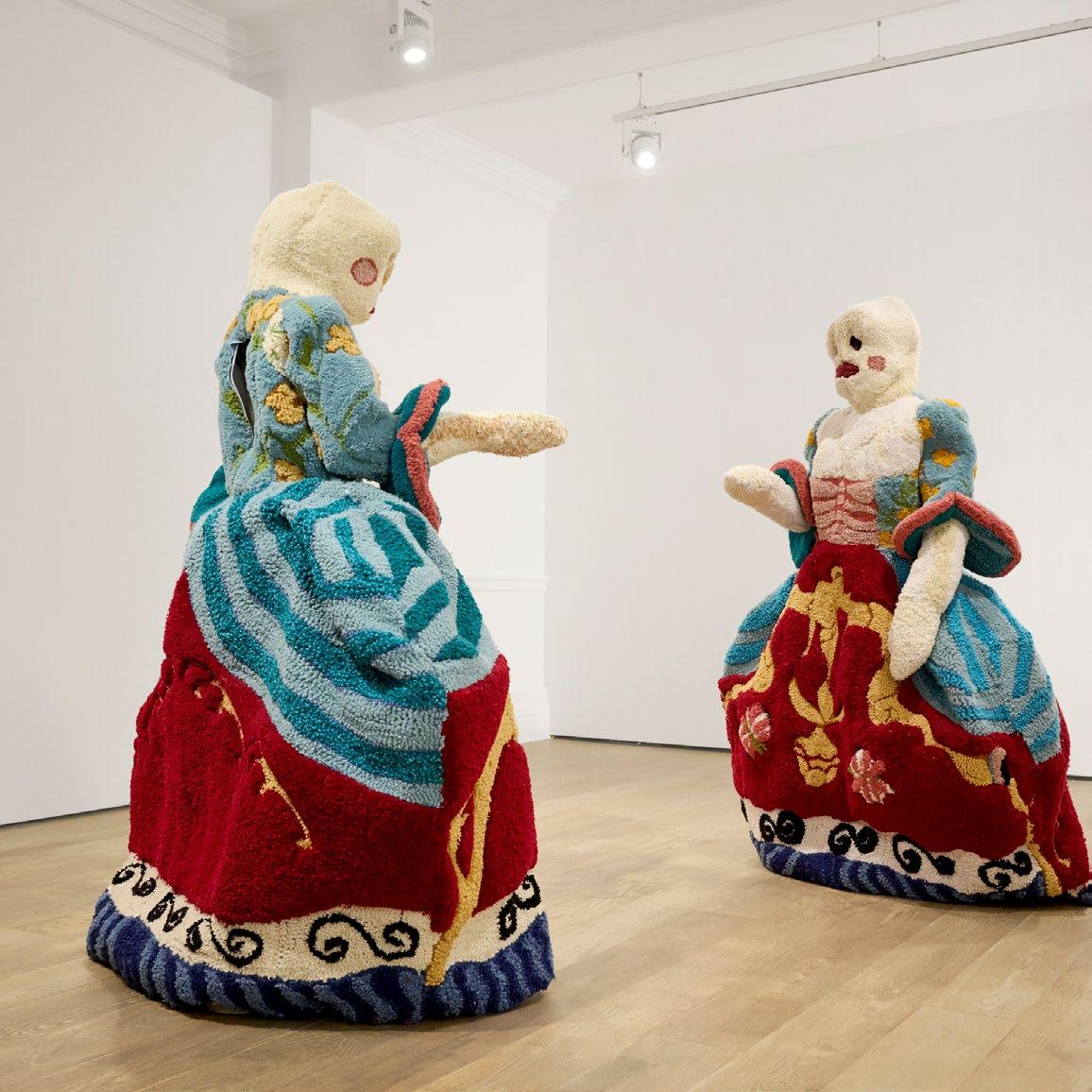
Olimpia(2025) ; Axminster yarn, wooden structure, robotics 2 parts.
Perach
Perach researches myths and folk tales to create her own story based on a female character. She pulls from her work as a counselor and art therapist to expand on the emotions of her characters. She finds that the social pressures and physical violence that women experience in real life often mirror mythological narratives. In a male-centric world that rewards stoic rationality, Perach’s work embraces emotion and empathy.
For her 2025 solo exhibition in the U.K., Perach created two identical, life-sized tufted sculptures inspired by the character of Olimpia in E.T.A Hoffman’s “The Sandman.” One sculpture is hollow and worn by a performer, the other is automated. Perach lives and works in London.
WordsbyAmandaRosa
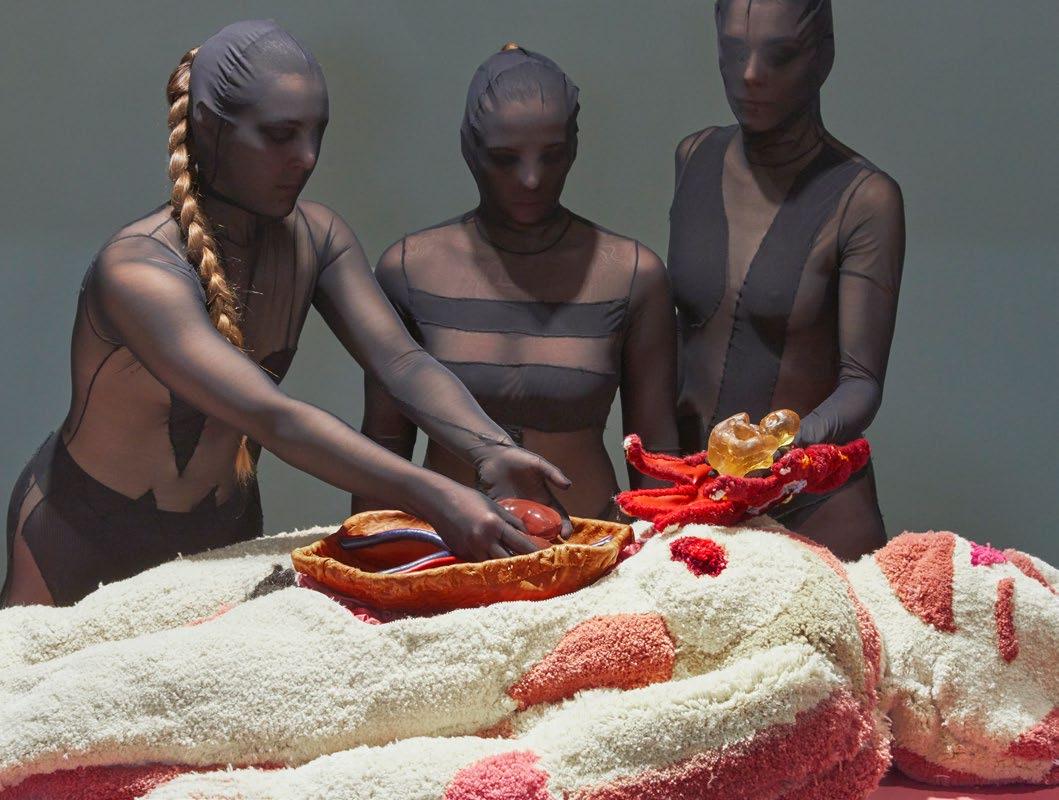
Ecstasies(2024); performance. Image by Andy Keate
Perach uses a tufting process to create her textile works. Image by Nicole Combeau.
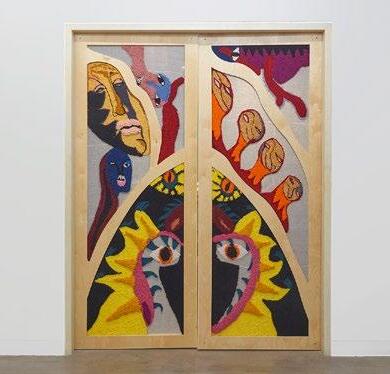
Gateaway(2024); hand-tufted Axminster yarn, pine edging, birch plywood. Image by Andy Keate.
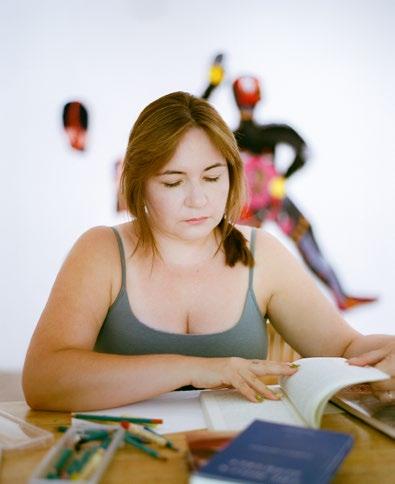
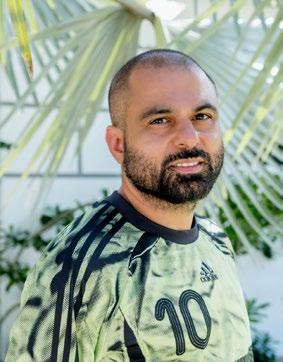
A portrait of Perach in her Fountainhead studio by Combeau.
Womenfromoutside(2024); hand-tufted Axminster yarn, pine, birch plywood.
Image by Andy Keate.
Mamali Shafahi
Mamali Shafahi likes to make things complicated. Born in Tehran, Iran, in 1982, just three years after the Iranian Revolution, Shafahi grew up in the aftermath of war. Censorship was the status quo, but there was one place of respite: the movie theater. Hollywood movies were banned, but European films were permitted and the Iranian filmmaking scene grew. Inspired by the likes of Jean-Luc Godard and David Lynch, Shafahi dreamed of becoming a filmmaker as a teenager. “It was the only art medium [in Iran] that was very dynamic,” he said. “I really discovered the whole complexity of the outside world through cinema.” His move to Paris at 23 was a pivotal moment. As a gay man, he was finally free to be open with his sexuality, not closeted. And his career as an artist and filmmaker has flourished.
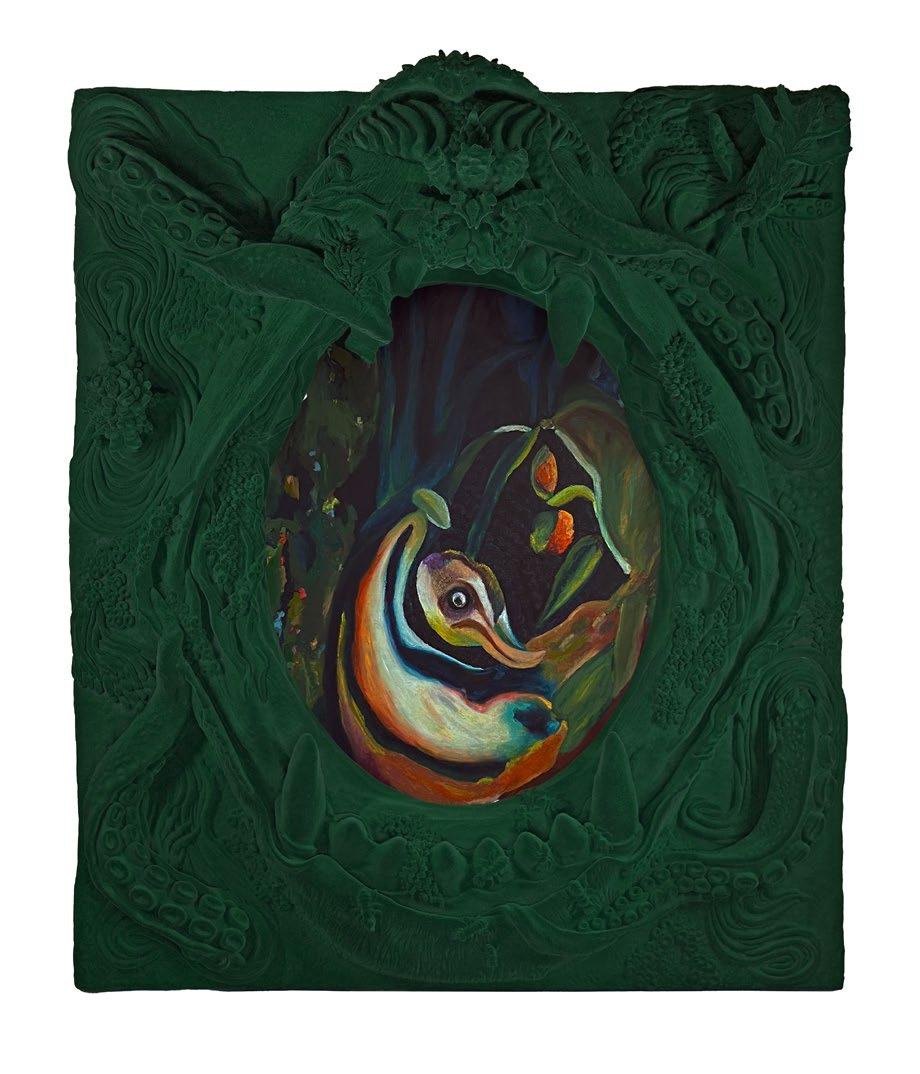
EchoesofEuphoria(2025); oil on canvas and flocked epoxy clay, collaboration with Domenico Gutknecht.
Shafahi’s work is best described in one word: duality. His work – whether it be film, sculpture, painting or installation – combines seemingly opposite ideas to expose viewers to something new. As he pulls inspiration from Iranian culture, ancient myths and pop culture, he aims to push the boundaries of filmmaking and art. “If I’m talking about pain, I want to bring joy. If I’m talking about horror, want to make it pleasant,” he said. “I believe the whole world and reality is a complex thing. I want to add more to this complexity.”
Like any filmmaker, Shafahi’s art practice is propelled by collaboration. He works closely with his partner and fellow artist, Domenico Gutknecht, and envisions starting his own creative house one day. Shafahi also draws inspiration from his father, who became an artist at 72 years old after Shafahi asked him to draw some images for an exhibition. Shafahi lives and works between Marseilles and Paris, France.
WordsbyAmandaRosa
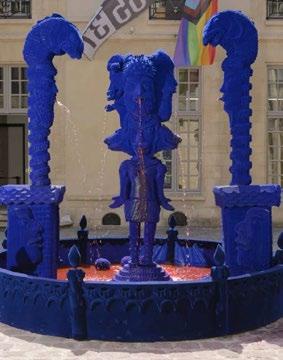
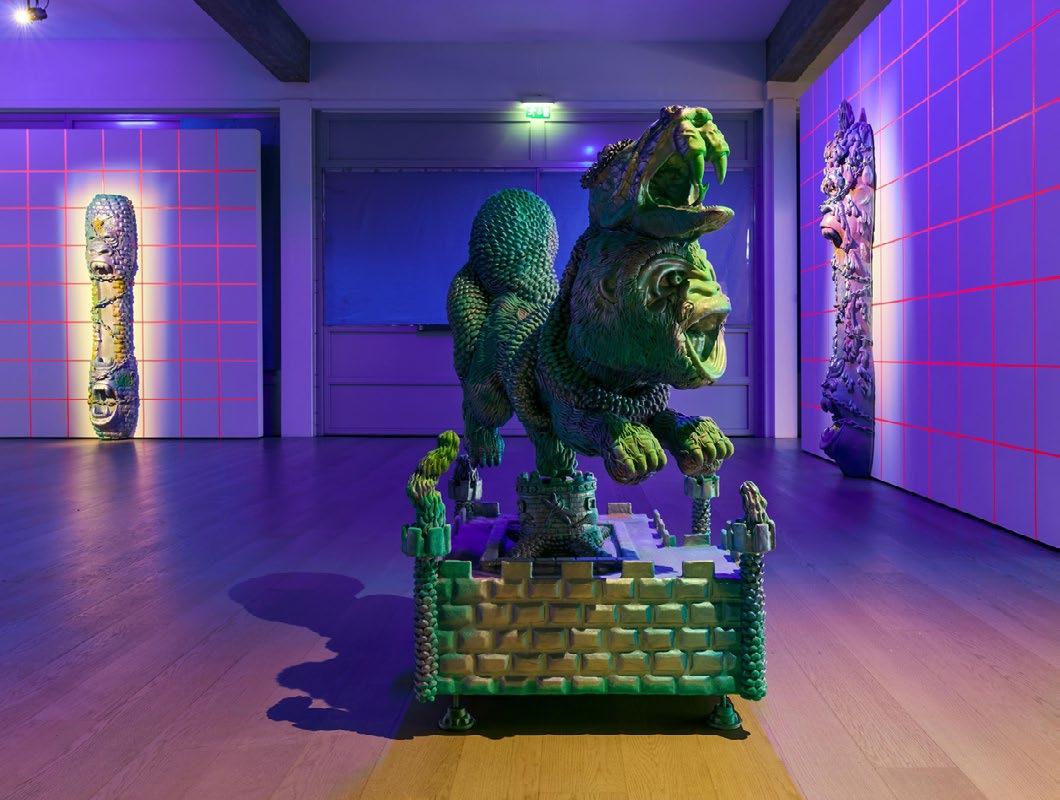
PhantasmagoriaCarouselride(2023); car paint and flocking on epoxy clay, moving engine
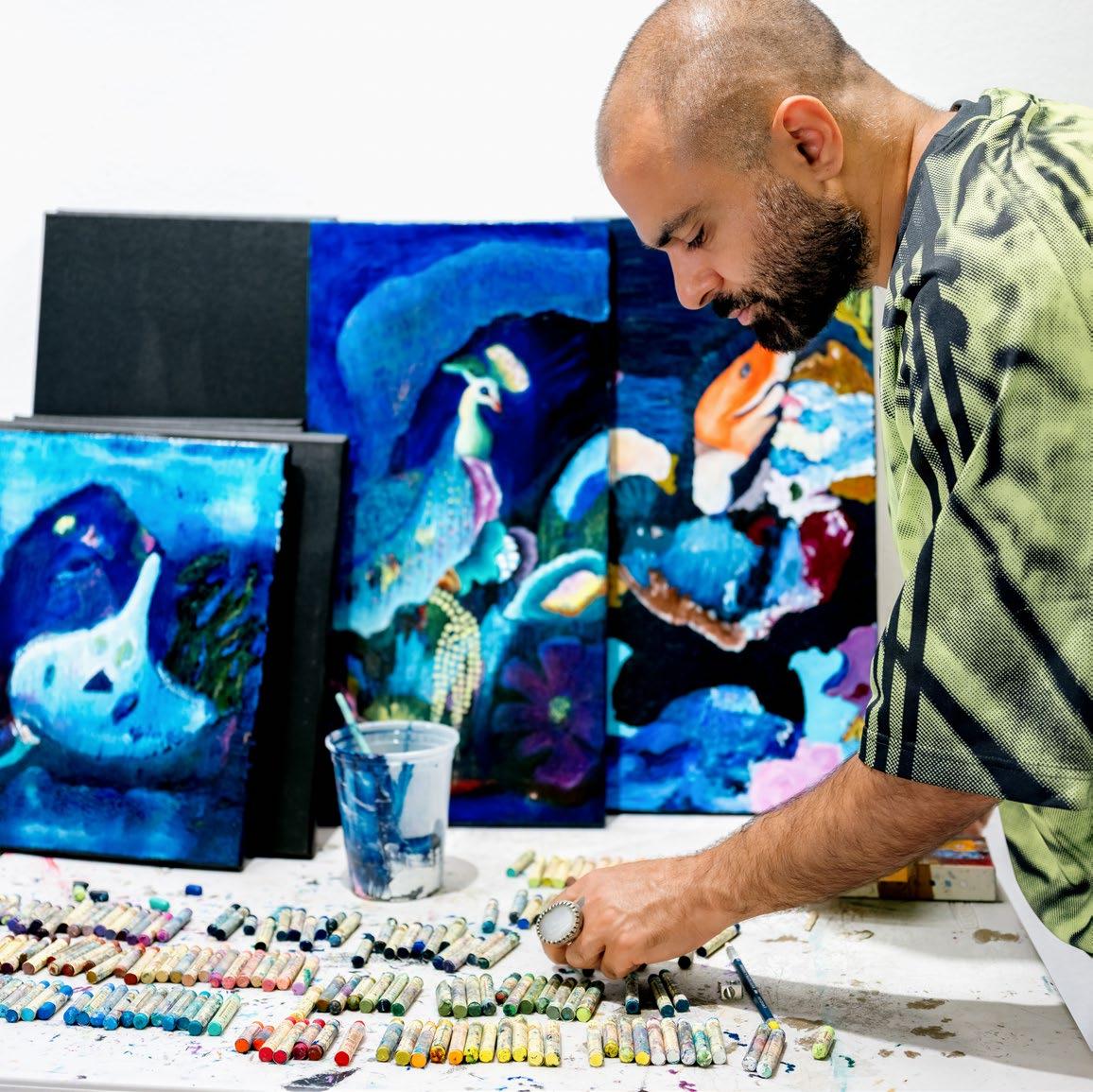
A portrait of Shafahi at Fountainhead by Nicole Combeau.
Phantasmagoria(2023); car paint and flocked epoxy clay.
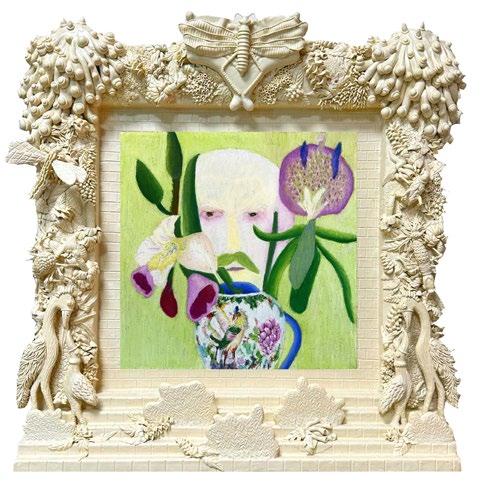
RestinPeace(2024); oil pastel on canvas, epoxy clay.
Shafahi’s rich color palette evokes the vibrancy of his native Iran.
Image by Combeau.
Session 08
Chantal Peñalosa Fong
Mira Dayal
Yashua Klos
Multimedia
Sculpture
Chantal Peñalosa Fong
A descendant of Chinese migrants, born and raised in Tecate, Baja California, a town that sits directly on the border between Mexico and the United States, Chantal Peñalosa Fong’s artistic practice is grounded in the historical, social and emotional intricacies of border life. Through installations and narrative interventions, she frequently weaves together personal and collective memories, using a wide array of methods and materials.
Peñalosa Fong’s work grows out of an enduring curiosity about the world around her, a sensibility that has shaped her since childhood. Looking back at her development as an artist, she fondly recalls the hours spent in her grandfather’s library, surrounded by the promise of new knowledge. “I remember how every time I flipped through a book I felt like I was getting closer to discovering something that had been hidden. Knowing there were other worlds, far different from the one I knew, largely led me to want to continue that search through art,” she said.
A sustained interest in themes of time, labor, repetition, identity, and invisibility also recurs throughout her oeuvre. And, in many ways, Peñalosa Fong sees her practice as an excuse to propitiate conversations with other disciplines, such as science, history, and the metaphysical world. “If my work isn’t in dialogue with something else, it’s clear to me that it’s not finished. need to feel connected to the world, in the best and worst sense.” Reflecting on her time at Fountainhead, she said, “It’s one of the most generous places I’ve ever been to. I quickly felt like I was part of a family and that brought forth many ideas that sometimes don’t come to me for months. It’s been a true gift to be in this place—to be surrounded by so many people who are genuinely interested in exploring the world of an artist.”
WordsbySaloméGómez-Upegui
Peñalosa Fong
Larutinadeuntenedor(2013); video HD.
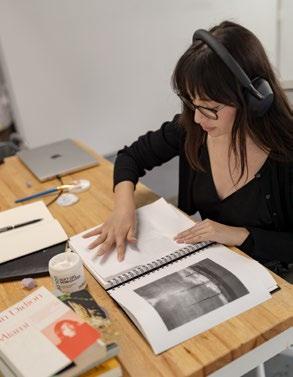
Peñalosa Fong reviews research in her Fountainhead studio, photographed by Brooke D’Avanzo.
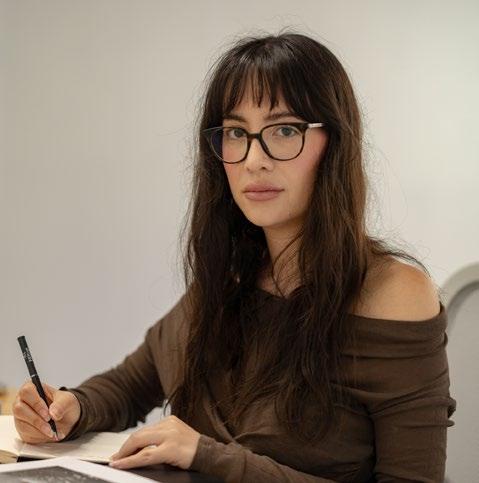
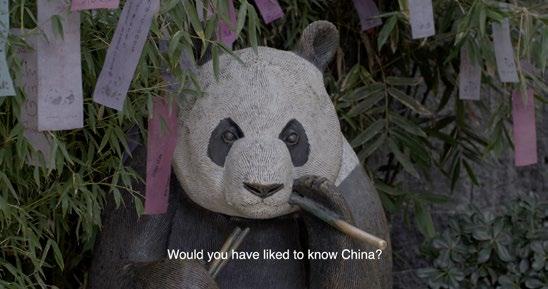
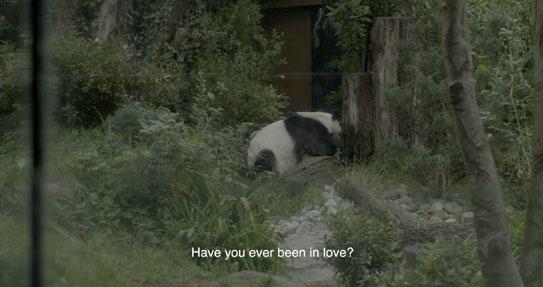
A portrait of Peñalosa Fong by D’Avanzo.
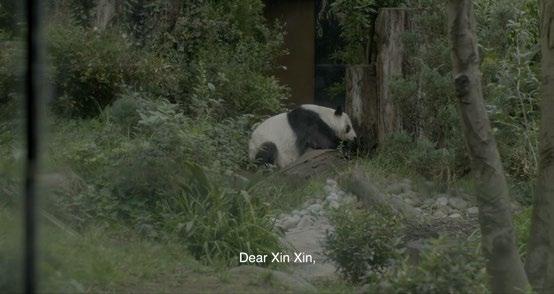
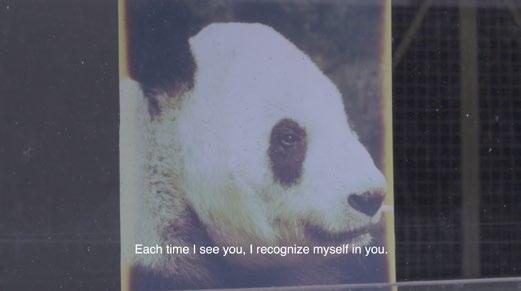
LoveLetterstoXinXin(2025); video 4K 17:18 min.
Courtesy of Proyectos Monclova and the artist.
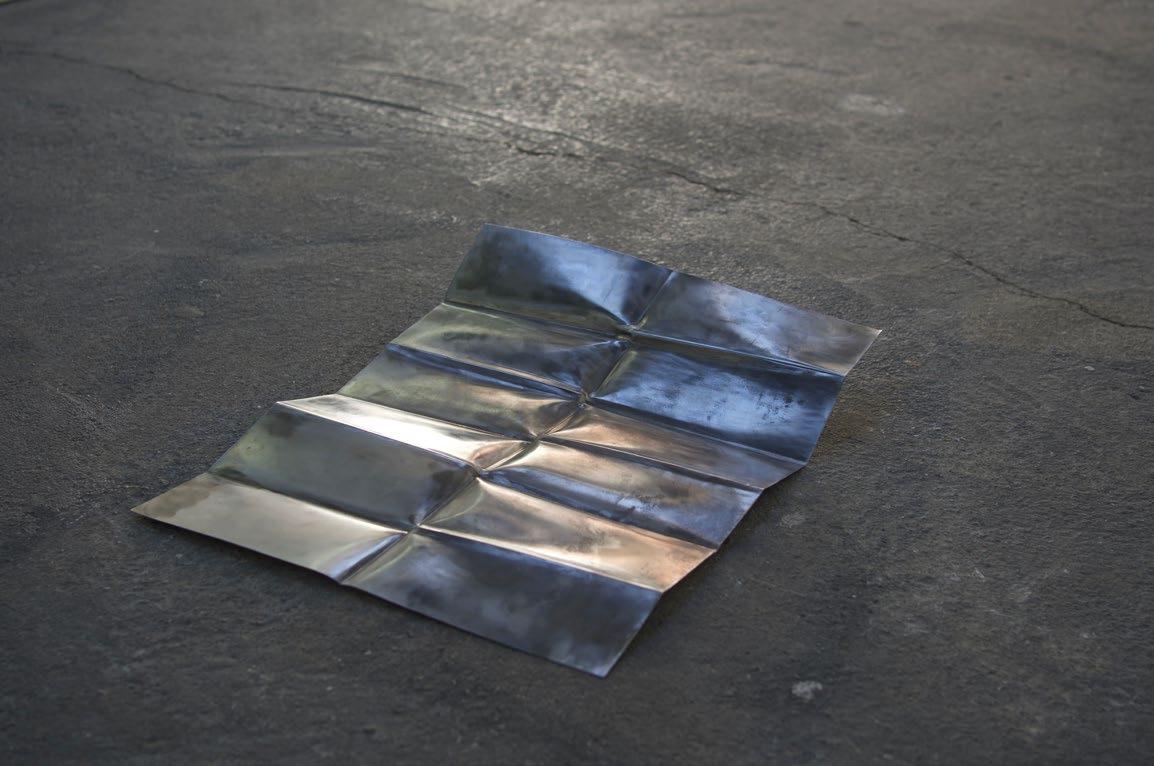
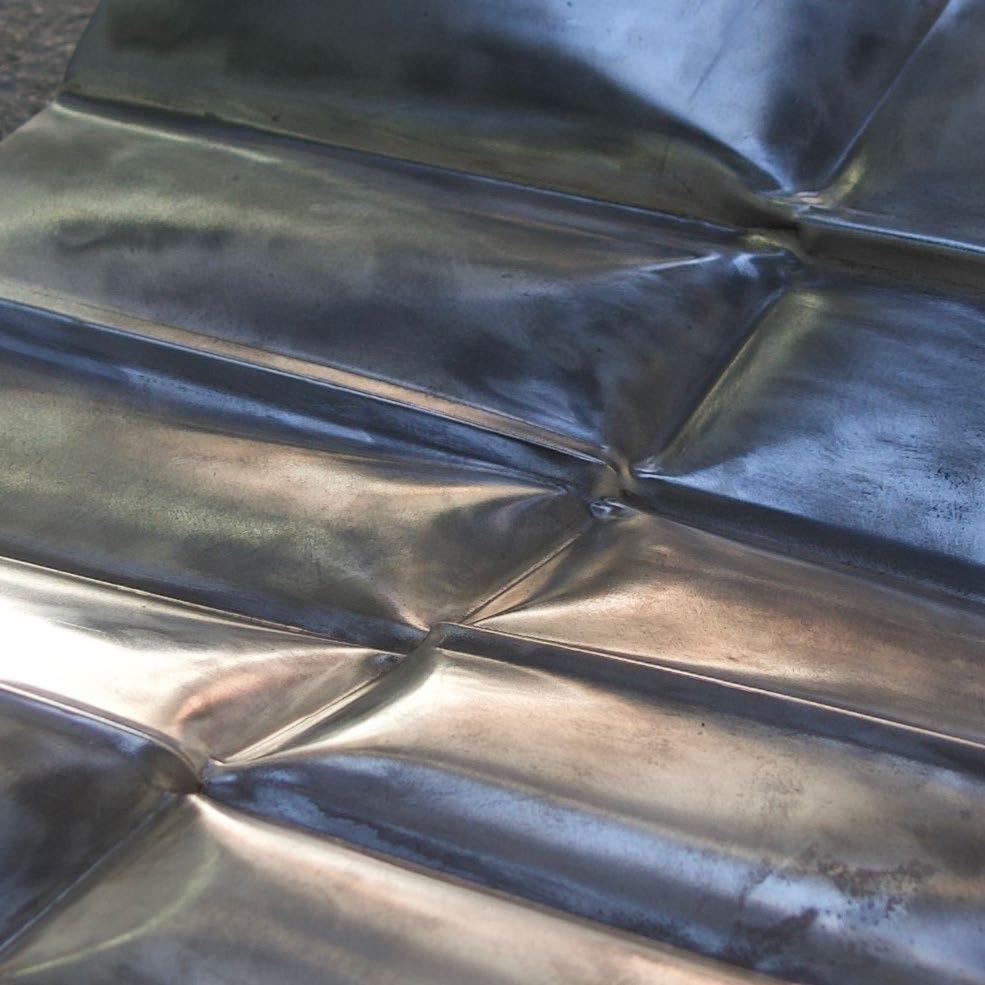
Mira Dayal
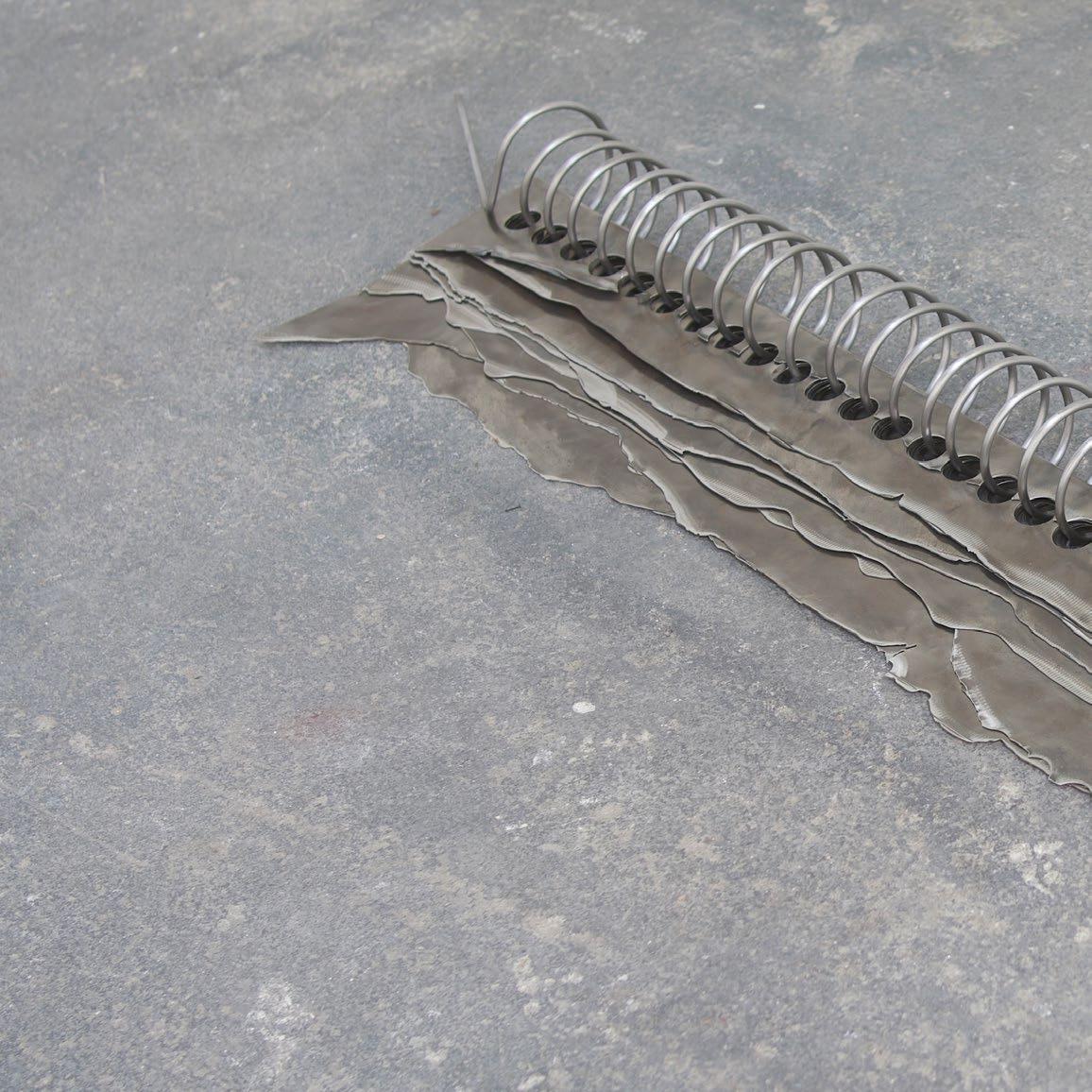
Mira Dayal’s background as a writer and editor is central to her artistic practice, profoundly shaping how she thinks about form and intention. “I think of visual art as a language,” she says. “You could say that I’m ‘editing’ the physical materials, concepts, and immaterial ideas and formal languages I’m working with. I’m manipulating systems of meaning, trying to say things with them, or sharpen what has been said.”
In her ongoing series “Language Objects,” Dayal creates delicate steel sculptures that evoke tools and materials associated with writing, memory, and narrative. Through these pared-down forms, she invites viewers to slow down, look closely, and consider how the structures of language that surround us—from ancient scripts to contemporary artificial intelligence—inform how meaning is made. In doing so, the work draws attention to the many systems that lie beneath our ability to communicate.
MapFold(2024) ; installation view of Steel Model of PaperCopyofDesk TopwithPencilGrooveat Spencer Brownstone Gallery.
Dayal’s acute fascination with layered meaning extends to her use of steel, a material with many conceptual associations, including architecture, public space, mass-produced objects, and infrastructure. “Steel is a material we see everywhere but we don’t often think about how it is produced or worked into the forms we see it in,” she explains. The metal’s malleability (it’s an alloy created by combining different metals into something both adaptable and structurally strong) offers her a productive tension. “This aspect allows me to play with the spectrum between drawing and sculpture or drawing in space, which I’ve always found exciting.”
The winner of the 2025 Fountainhead Residency Untitled Artist Prize, Dayal spent her time in Miami preparing for her solo booth at Untitled Art Fair with Spencer Brownstone Gallery, while also immersing herself in the city’s coastal rhythm and forging new connections within the local arts community. “It feels like I’m planting lots of seeds here, and I’m excited to see what grows,” she said.
WordsbySaloméGómez-Upegui
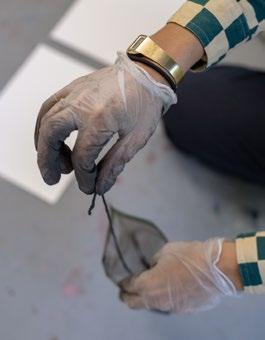
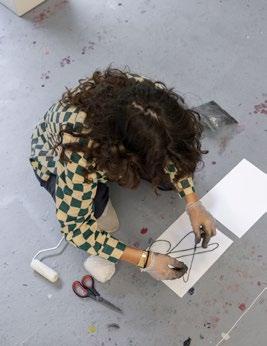
...InthatEmpire,theArtofCartography...(2021); installation view at Spencer Brownstone Gallery.
Dayal often works with unconventional materials, like hair or alumnimum.
Image by Brooke D’Avanzo.
Dayal assembles a work in progress in her Fountainhead studio. Image by D’Avanzo.
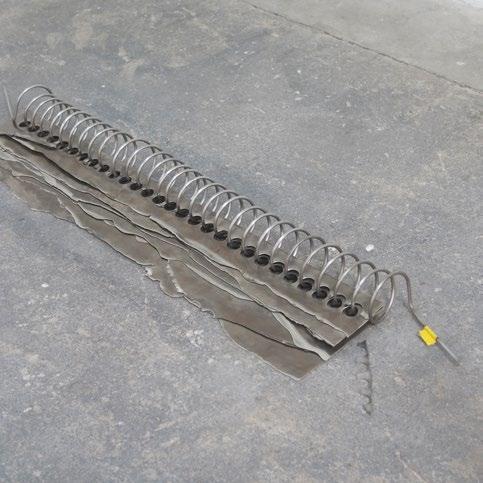
Spiral-BoundNotebook Remainder(2022-2025); steel.
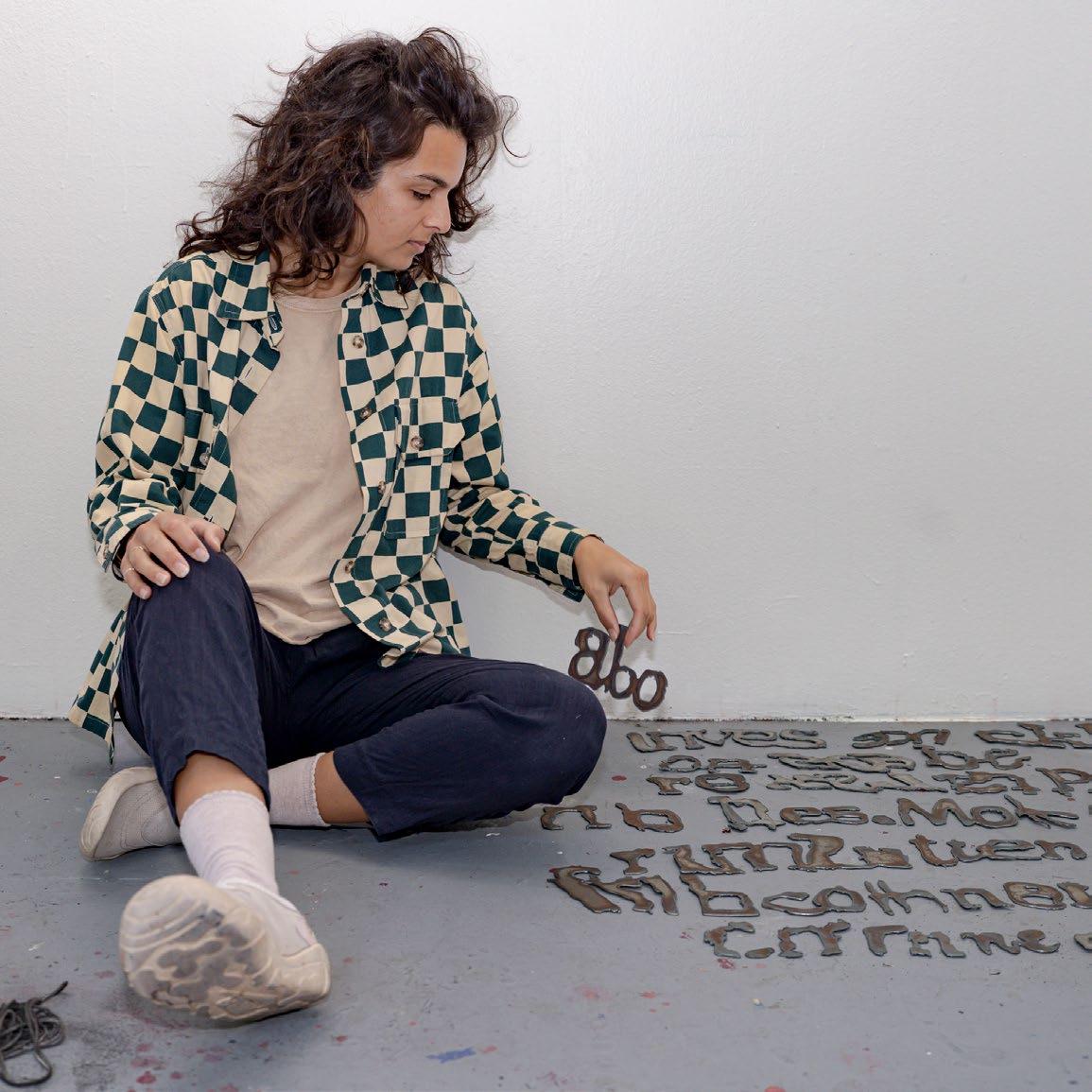
A portrait of Dayal by D’Avanzo.
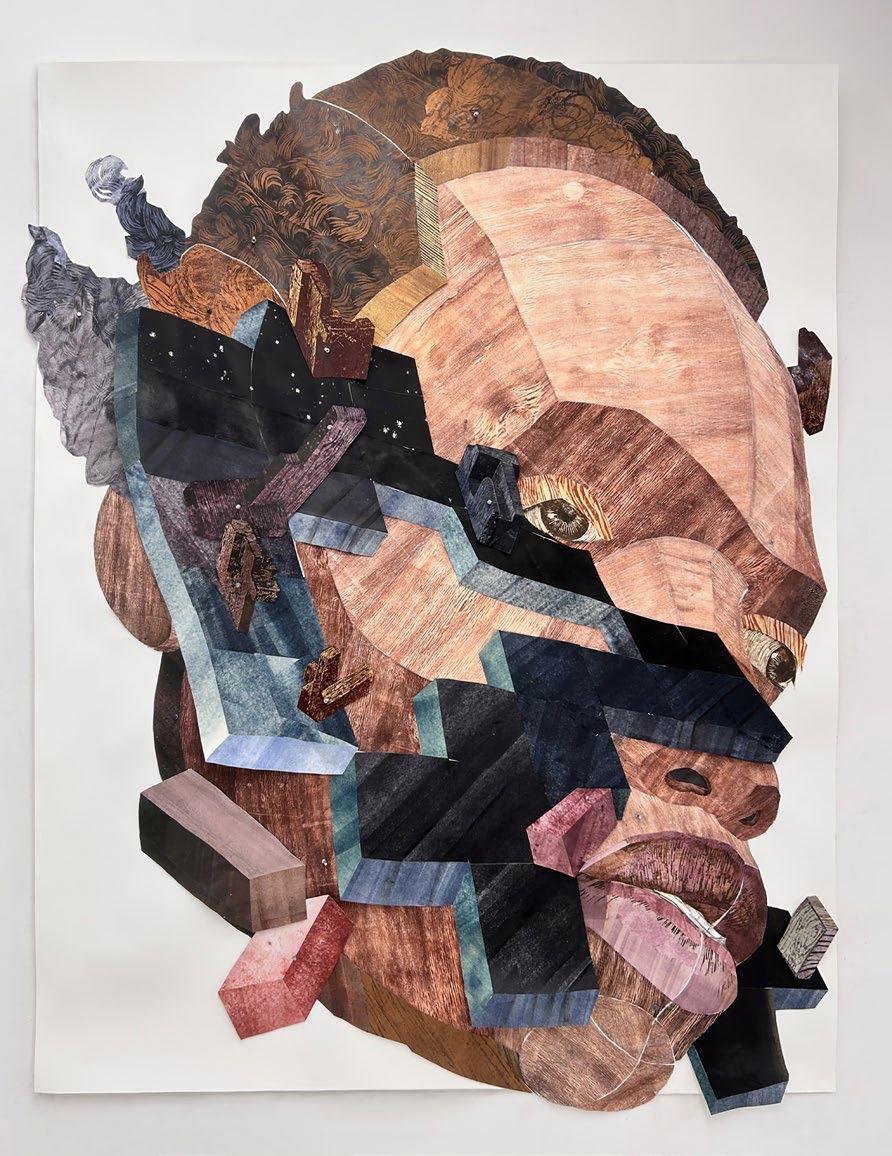
There’sNeverEnoughCityTo HoldYou(2025); woodblock prints, acrylic, and colored pencil on archival paper.
Yashua Klos
To create his monumental collage works, Yashua Klos begins by carefully hand-carving woodblocks, which he then uses to print the unique textures and figures that anchor his arresting compositions. Subtle and striking at once, these elements come together in expansive figurative and abstract works that also incorporate materials such as Japanese rice paper, acrylic paint, colored pencils, and fabric dyes. Through this layered approach, Klos explores ideas of Blackness from a deeply personal perspective: one shaped by his family’s migration history, his upbringing on Chicago’s South Side, and his enduring belief that identity is a continuously evolving matter.
“My earliest sense of identity was that of a drawer. As I matured and realized drawing was integral to my mental health and wellness, I knew I’d have to dedicate my life to keeping art at the center of it,” Klos says. Raised by a single mother, the artist reconnected with his father’s side of the family through a DNA test later in life—an experience that greatly influenced his artistic practice. Portraits of his many relatives appear frequently throughout his work.
During his time at Fountainhead, the breadth of Klos’s practice was fully on view: a large carved woodblock laid out across a table, sheets of rice paper scattered across the studio floor, and walls lined with work in-progress and photographs of family members, a vivid map of the artist’s ongoing inquiries that in many ways remain connected to his early interest in drawing. “Woodblock printing is so raw, filled with the kinetic energy of carving. It’s an extension of my drawing hand,” he explains. “The gesture of the gouge is the same as that of a drawing implement, though I’m subtracting the line rather than adding it. Every time I carve a block, I feel like I’m etching my ideas into a rich political tradition.”
WordsbySaloméGómez-Upegui
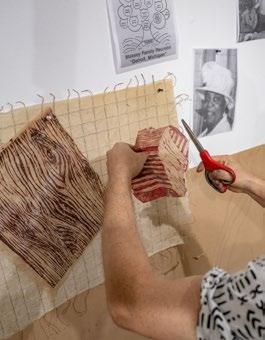
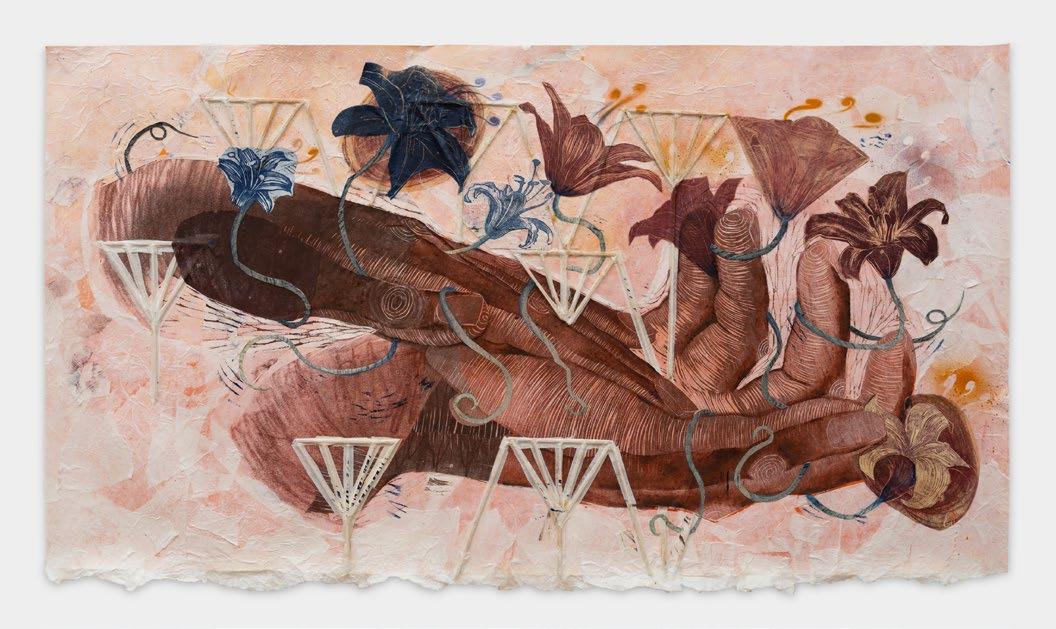
It’sPlantedInYourPalm(2023); woodblock prints on archival paper, Japanese rice paper, acrylic, spray paint, and wood mounted on paper.
Klos’s practice involves a variety of media, including woodblocking, to create layered works. Image by Brooke D’Avanzo.
Detail shot of a work in progress. Image by D’Avanzo.
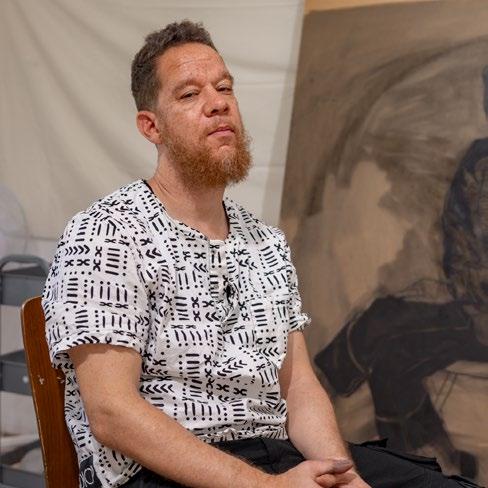
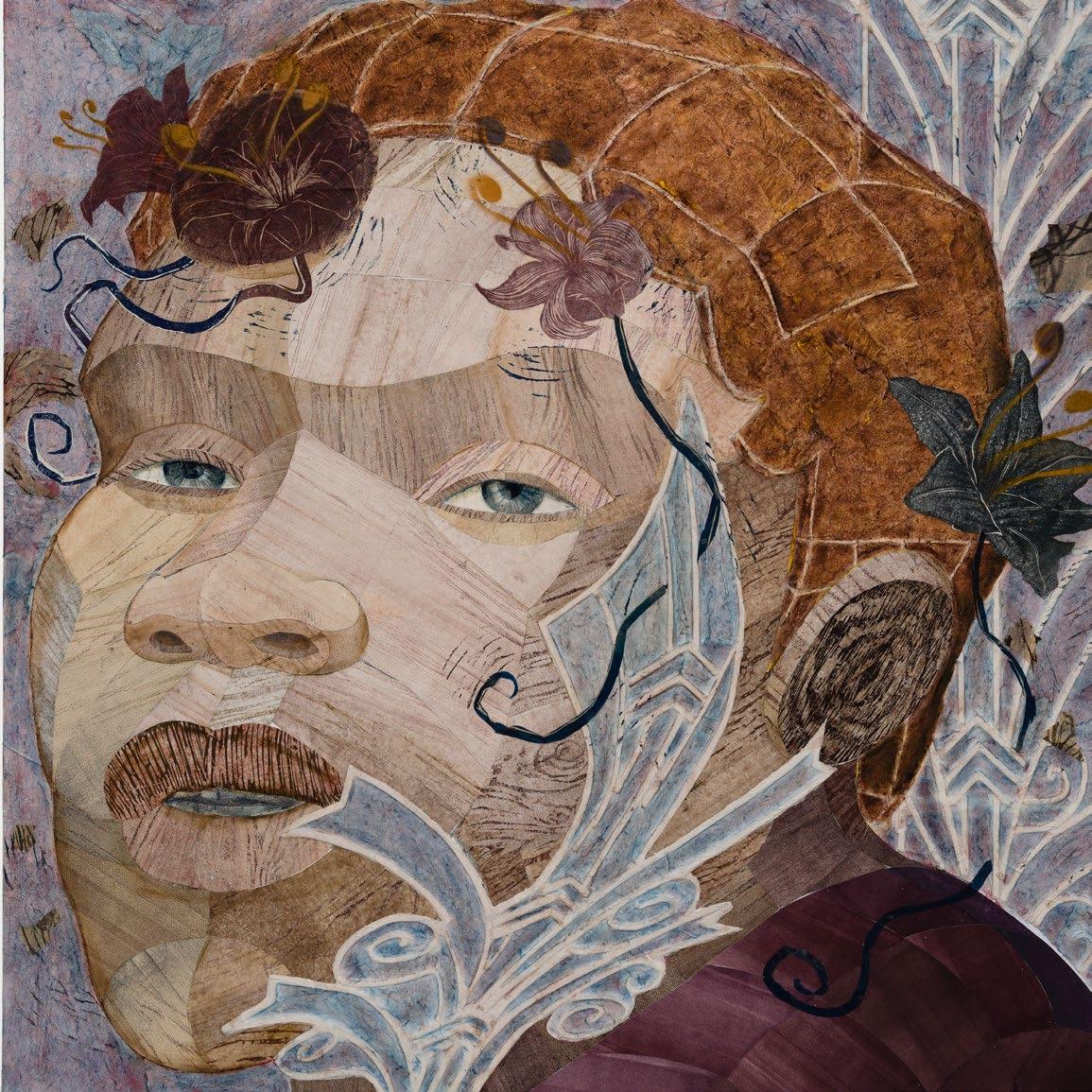
A portrait of Klos by D’Avanzo.
OurChamp(2023); woodblock prints on archival paper, Japanese rice paper, acrylic, spray paint, colored pencil, and wood on canvas.