H 0T 15 E SU IS
SPRING 26 ARTISANS IN THE GARDENS: RENEWAL AND REINVENTION
ISSUE 150 I $12.95 CELEBRATING 150 ISSUES OF THE GARDENS MAGAZINE
A NEW CHAPTER FOR CADI JAM ORA: FIRST ENCOUNTERS
EDITORIAL EDITOR Nicola Conville DESIGNER Three Blocks Left FEATURE WRITERS Chantelle Doyle (Research), Hayley Smithers-Kirk (Interpretation & Placemaking) CONTRIBUTORS David Bidwell, Peter Dawe, Michael Elgey, Ashley Filipovski, Colleen Fitzgerald, Vanessa Fuchs, Mariana Irigoyen, Jarryd Kelly, Belinda Moon, Peta Rattray, Amanda Relf, Eva Telemachou SCIENTIFIC ADVISER Dr Russell Barrett SUB EDITOR Katey Knight MARKETING & COMMUNICATIONS MANAGER Ted Rose: ted.rose@botanicgardens.nsw.gov.au Text and design © Foundation & Friends of the Botanic Gardens
PRINTER Bright Print Group PRINT POST APPROVED: PP 100004091 ISSN 1324-8219 Printed in Australia on paper made from FSC-certified and other controlled materials FSC® helps take care of the forests, and the people and wildlife that call them home.
FOUNDATION & FRIENDS OF THE BOTANIC GARDENS Foundation & Friends of the Botanic Gardens Ltd, Cottage 6, Mrs Macquaries Road, Sydney 2000 Phone (02) 9231 8182 Executive Director: Ciara Timlin foundation.friends@botanicgardens.nsw.gov.au botanicgardens.org.au/foundation-and-friends Office hours: Mon – Fri, 9am – 3pm facebook.com/FoundationandFriends instagram.com/FoundationandFriends linkedin.com/company/foundation-and-friends
ACKNOWLEDGEMENT OF COUNTRY We honour and respect all Elders and Traditional Custodians of the lands on which the Botanic Gardens of Sydney and Foundation & Friends stand. We acknowledge the profound significance of the enduring connection between the First Custodians and this land, recognising their vital care and stewardship for their country and its meaning to all who cherish and share in it.
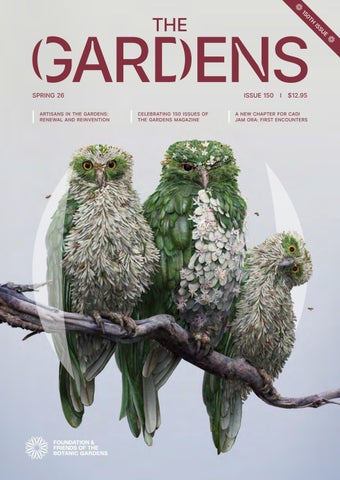
This page and cover: Josh Dykgraaf for Artisans in the Gardens
Contents Features 11
ANCIENT DNA
Discover a library of plant life
14 ARTISANS IN THE GARDENS Meet this year’s artists
20 FIRST ENCOUNTERS
A new chapter for Cadi Jam Ora
Gardens news 4
SPRING NEWS
9
A TRIBUTE AT MOUNT TOMAH
Read the latest updates
Meet the de Ferranti family
18 150 ISSUES
Four decades of sharing stories
In each issue 24 SEASONAL UPDATE
What to look out for in the Gardens this spring
27 FIVE PLANTS FOR SPRING Our top picks
28 SECRET LIFE OF TREES Conifers
29 WHAT’S ON
Your guide to activities and events
THE GARDENS SPRING 2026
3
I N T H E K N OW
Spring News Youth Community Greening Appeal raises $210,000 Thanks to the extraordinary generosity of Foundation & Friends supporters, the Youth Community Greening Appeal has raised $210,000 to help young people facing disadvantage across NSW develop practical skills, build confidence and connect with nature. The funding will support the expansion of Botanic Gardens of Sydney’s Youth Community Greening program, which has worked with thousands of young people since 2008. “Every day, we see the impact the program has on young people, giving them opportunities to have a voice, collaborate and make decisions that benefit their physical and mental health, as well as their local environment,” said Peter Dawe, Lead – Youth Community Greening.
The Youth Community Greening team will now work with partner schools and community organisations to identify where the funding can have the greatest impact. Areas of focus will include teaching horticultural skills, supporting employment pathways, encouraging healthy lifestyle choices, creating urban green spaces and providing training for educators, particularly in regional areas. “The support shown by the Foundation & Friends community will have a far-reaching impact on the young people we work with,” Peter said. We look forward to sharing updates and stories from participating schools and communities in the next edition of The Gardens magazine.
Spring into Summer Plant Sale Join Growing Friends from 13–22 November for a seasonal selection of native and exotic plants, lovingly propagated by volunteers from the Botanic Gardens’ Living Collections. At the Royal Botanic Garden Sydney, visit Monday–Friday, 11am–2pm, or Saturday–Sunday, 10am–2pm. The sale also extends to Visitor Centres at the Australian Botanic Garden Mount Annan and Blue Mountains Botanic Garden Mount Tomah during their opening hours. Enjoy 20% off plants, or 40% off for Foundation & Friends members. 4
Scan the QR code to learn more.
From the Executive Director Spring always brings a sense of optimism across our Gardens. Native plants come into flower, collections shine and our horticulture teams prepare for one of the busiest and most rewarding times of the year. The season is also a reminder that our Gardens are not only beautiful places to visit, but centres for conservation, scientific research and learning. They are where families make memories, volunteers share their knowledge, scientists unlock new discoveries and school students experience the wonder of plants for the first time. That connection between people and plants sits at the heart of everything Foundation & Friends does.
Photo: Glenn Smith Photography (paper daisy)
This spring, I am especially looking forward to Artisans in the Gardens as it celebrates its 25th anniversary. I hope to visit with my own family, discover a few special pieces for home and see you enjoying the exhibition, shop and pop-up cafe. This much-loved event is run by volunteers,
whose enormous contribution makes it possible each year, with funds raised helping support our Education programs. Growing Friends Plant Sales continues to help gardeners discover beautiful and resilient plants, while our events calendar offers more ways to experience the Gardens throughout the season. This edition also marks the 150th issue of The Gardens magazine – a wonderful milestone that reflects the enduring connection between our members and Botanic Gardens of Sydney. For many years, these pages have celebrated the stories behind our collections, our people and our conservation work, helping bring the Gardens to life wherever you are. Thank you for continuing to be part of this community. Whether you support us by being a member, volunteering, attending events or making a donation, you are helping ensure these extraordinary Gardens continue to inspire, educate and protect our natural world. I hope to see you enjoying the Gardens this spring. CIARA TIMLIN, EXECUTIVE DIRECTOR, FOUNDATION & FRIENDS
Have your say Help us shape future editions of The Gardens by completing our short two-minute reader survey. Your feedback will help us understand what you enjoy most, what you'd like to see more of, and how we can continue to improve the magazine. Complete the survey and go into the draw to win two tickets to the Scan the QR code or visit Artisans in the Gardens Opening Night. surveymonkey.com/r/D7WSTLN THE GARDENS SPRING 2026
5
I N T H E K N OW
Foundation & Friends Board Directors Foundation & Friends is inviting expressions of interest from members who are passionate about the future of Botanic Gardens of Sydney and are interested in contributing to the strategic leadership of our organisation as a Board Director. As Foundation & Friends enters an exciting new phase of growth, we are raising our ambitions for philanthropy and fundraising to support the Gardens' world-leading work in science, horticulture, conservation and education. We are particularly interested in hearing from individuals with significant experience in philanthropy, fundraising and relationship development who bring strong networks and
EXPRESSIONS OF INTEREST
a demonstrated ability to influence, connect and open doors to new supporters and opportunities. The Board provides strategic direction and governance for Foundation & Friends and its Trust Funds. Directors work collaboratively to guide the organisation's longterm success, contributing their expertise, judgement and advocacy while supporting the mission and impact of Foundation & Friends. The role is voluntary, with appointments generally made for a three-year term. To request a Director Information Pack, please contact Foundation & Friends on (02) 9231 8182 or email foundation.friends@botanicgardens.nsw.gov.au. Expressions of interest must be submitted by Monday 14 September 2026.
Writers in Residence Botanic Gardens of Sydney’s inaugural Writers in Residence program welcomed Cheryl Leavy and Jess Harwood, selected from more than 135 applicants. Inspired by the Gardens’ landscapes, science and collections, they created new works celebrating nature through storytelling. Their residency showcased the Gardens as a place where creativity, science and nature come together.
Celebrate New Year's Eve in the Gardens Celebrate New Year's Eve in one of Sydney's most spectacular locations. Join Foundation & Friends for our annual New Year's Eve Picnic on the beautiful Mare and Foal Lawn in the Royal Botanic Garden Sydney, with uninterrupted views of the Sydney Harbour Bridge and Opera House fireworks. Pack your favourite picnic and drinks (BYO alcohol is welcome) and relax with family and friends as you enjoy live entertainment before the countdown to midnight.
6 6
As Foundation & Friends' largest annual fundraiser, every ticket helps support the Botanic Gardens of Sydney's vital conservation, horticulture, science and education programs. Member tickets are available now, with members able to purchase up to 10 adult tickets. Don’t miss out! Be sure to renew your membership or join today to secure your spot at this sell-out event.
MEMBER TICKETS RELEASED SEPTEMBER
I N T H E K N OW
What the Flora? Get ready for a wild ride through the most shocking, inspiring and unbelievable stories about plant life. What the Flora? is a new non-fiction book written by Vanessa Fuchs for Botanic Gardens of Sydney and published by Hardie Grant. Blending science, true crime, history and lore, it reveals the ingenuity, drama and wonder of the plant kingdom. Inside, you’ll encounter trees that survived atomic blasts, deadly species that shaped medicine and myth, the mind-bending secrets of plant intelligence and pollen used to crack a murder case. This thrilling journey explores how plants have fuelled civilisations, inspired innovation and sustained life on Earth. Whether you’re a hardcore plant nerd or simply
What the Flora? ($36.99, Hardie Grant) is out now and you can grab a copy from your favourite book retailer or pick it up from the Garden Shops at all three Botanic Gardens of Sydney locations. Visit botanicgardens. org.au/what-the-flora-book to learn more.
curious, it will transform the way you see plants.
Waratah community gathers at The Calyx Foundation & Friends was delighted to welcome supporters to The Calyx for the inaugural Waratah Community Social, an evening celebrating the generosity and shared commitment of this special community. Set within the Royal Botanic Garden Sydney, the event provided an opportunity to connect, reflect on the work made possible through philanthropic support and celebrate the important role Waratah supporters play in helping the Gardens thrive.
The evening also welcomed guests interested in learning more about becoming part of the Waratah community and supporting the future of the Gardens. Thank you to everyone who joined us and helped make the evening so memorable. If you are a Foundation & Friends member interested in deepening your connection with the Gardens and making an even greater impact, we would love to welcome you to the Waratah community. Find out more about becoming a Waratah supporter at botanicgardens.org.au/waratah-program
Through their generosity, Waratah supporters help advance the vital work of Botanic Gardens of Sydney across plant science, conservation, education, climate resilience and community programs, ensuring this work can continue to grow for generations to come. Being part of the Waratah community also offers supporters a closer connection to the Gardens, with opportunities to come together at special events, meet like-minded supporters and learn more about the people and projects their generosity helps make possible.
AGM: Save the date Members are invited to attend the Foundation & Friends' 44th Annual General Meeting on Tuesday 17 November, commencing at 5.30pm in the Gadi Seminar Rooms, Brown Building, Mrs Macquaries Road, Sydney.
THE GARDENS SPRING 2026
7
I N T H E K N OW
Growing the next generation of plant lovers Created by Botanic Gardens of Sydney Writer in Residence Jess Harwood, this original comic celebrates the story of our Youth Community Greening program and the positive impact it makes.
8
P H I L A N T H R O PY
Raoul and Susanne funded the new pavilion in memory of their parents
A tribute at Mount Tomah For Raoul and Susanne de Ferranti, the de Ferranti Pavilion at the Blue Mountains Botanic Garden Mount Tomah is far more than a beautiful place to pause, it is a living legacy to their parents.
Photos: Hannah Izzard
In May 2026, a long-held vision came to life at the Blue Mountains Botanic Garden Mount Tomah with the official opening of the landscaping and redevelopment of the de Ferranti Pavilion. Made possible through the generosity of siblings Raoul and Susanne de Ferranti, the space honours the memory of their parents, Maurice and Joyce de Ferranti, and reflects the family’s connection to nature, education and the Gardens. The idea began after their mother died in 1998, three years after their father. Raoul and his sisters – Margot, Susanne and Leone – wanted to honour the contribution their parents had made during their lives. "We loved our parents and we admired them," Raoul says. "We wanted to memorialise the wonderful contribution they made to their family and to the community." Education was central to their father’s life, while their mother was a passionate and knowledgeable gardener. A project bringing together learning, nature and conservation therefore felt like a fitting way for the siblings to honour them both. Although neither Raoul nor his sisters had previously been involved with the Botanic Gardens of Sydney, THE GARDENS SPRING 2026
9
The pavilion offers visitors a calm, reflective place to pause.
"I remember bringing back big bunches of beautiful camellia flowers – they were one of my mother’s favourite plants. I can see her smiling and enjoying herself here." SUSANNE DE FERRANTI
Raoul already knew Mount Tomah through bushwalking and his work as a geologist. He also remembered Keith Ingram, a close colleague of his father’s in the Department of Education, and knew that Keith’s son, horticulturist and designer Ross Ingram, worked at the Garden. Believing Mount Tomah might offer the right setting for a memorial, Raoul contacted Ross. “In retrospect, it seems it must have been the right week,” he recalls. Ross had already prepared drawings and identified a suitable location for a Japanese-style pavilion, but the project required philanthropic support. Bringing together horticulture, education and the natural landscape, it immediately felt like the perfect project, and the siblings agreed to fund its construction.
10
"I remember bringing back big bunches of beautiful camellia flowers," Susanne says. "They were one of my mother’s favourite plants. I can see her smiling and enjoying herself here." The setting also reflects the family’s shared memories of bushwalking in the Blue Mountains, where their mother would teach the children the botanical names of plants along the way. Susanne hopes visitors will experience the pavilion as a calm and reflective place – somewhere to reconnect with nature and appreciate the beauty of the surrounding landscape. For the family, seeing the pavilion continue to evolve has been one of the great rewards of giving during their lifetime.
The pavilion now sits in harmony with the neighbouring Camellia Garden, connected by carefully considered planting, stonework and pathways that invite visitors to slow down, take in the view and spend time in nature. For Raoul and Susanne, the transformation feels fitting and deeply personal.
Raoul believes philanthropy is essential to helping the Gardens realise ambitious projects that public funding alone cannot support. He also values being able to see and enjoy the impact of a gift. “I'm very much in favour of philanthropic support in advance of any bequest because you can enjoy the results,” he explains.
The renewed landscape has integrated the pavilion with the Camellia Garden in a way that feels serendipitous. Their mother loved growing camellias and during her retirement at Avoca Beach, would often send Susanne home with armfuls of blooms.
Susanne agrees. For anyone considering supporting the Gardens and paying tribute to a loved one in a similar way, her advice is simple: "Go for it. It's a good feeling donating to something that you know is going to live on for people."
Advanced genomic methods are unlocking DNA from historic plant specimens, revealing how Australia’s plant diversity has changed through time, writes Chantelle Doyle, Restoration Genomics Outreach Coordinator.
R ES E A R C H
Ancient DNA: not just for fossils
This page: Dr Hannah McPherson and Edana Lord collecting leaf material. Previous page: This work is part of a long-term plan to collect genetic data from the Herbarium's oldest specimens. Photos: Chantelle Doyle
Ancient DNA is not only helping scientists understand enigmatic creatures such as woolly mammoths and dire wolves. These techniques can also unlock genetic information from historic plant specimens once considered too damaged or degraded to contain readable DNA. Driving along the Hume Motorway towards the National Herbarium of New South Wales, I am enthralled by palaeogeneticist Dr Edana Lord’s stories of ancient DNA sequencing. Edana completed her PhD at Stockholm University, where she used ancient DNA to investigate the impacts of climate change on animals including the extinct woolly rhinoceros, lemmings and muskox. Since joining the Research Centre for Ecosystem Resilience (ReCER) in 2024, she has turned her attention to plants, applying the same methods to the National Herbarium’s historic specimens. The long-term goal is to build a picture of the genetic health and diversity of New South Wales plant species across their current distribution and retrospectively through time. "It is great to be part of a project where we can embed new and exciting technologies within existing resources," Edana says. "It is a whole new chapter, with the aim of developing world-leading sampling and genomic protocols."
Reassembling the puzzle Ancient DNA does not necessarily come from fossils. Technically, it can refer to DNA from any biological sample that was not intentionally preserved for later genetic analysis. When an organism dies, the repair systems that kept its DNA intact are no longer active, and so the DNA breaks into smaller and smaller pieces and becomes damaged. 12
"You could start, for example, with a 10-piece puzzle, which is very easy to put back together," Edana explains. "But over time, as that breaks down, we’re looking at more of a two-million-piece puzzle." Advanced genomic techniques allow researchers to reassemble those fragments by comparing them with a reference genome from a living specimen or close relative.
A library of plant life At the National Herbarium, we are greeted by Collections Manager Dr Hannah McPherson, who says interest in the collection – and particularly its DNA – continues to grow. The Herbarium holds more than 1.4 million plant specimens. Each contains information about pollen, seeds, physical characteristics, location and DNA. "Our Herbarium isn’t just a collection of ‘stuff’," Hannah says. "It is actively used for research and has enormous potential to help with all kinds of conservation initiatives, now and in the future." The collection includes specimens gathered by Joseph Banks and Daniel Solander during Cook’s voyages in 1769 and 1770, along with plants collected in the 1930s by renowned First Nations artist Albert Namatjira. Together, these specimens offer snapshots of Australia’s vegetation across hundreds of years. By comparing historic DNA with that of present-day populations, researchers can investigate how the diversity and genetic health of species have changed. The age, collection history and storage conditions of older specimens mean their DNA is often highly degraded. Some may have spent weeks exposed to heat or humidity before reaching the Herbarium, while fleshy plants such as succulents and orchids can be particularly difficult to preserve.
Ancient DNA methods are expected to be most useful for specimens more than 100 years old, although the team will initially screen material collected before 1980.
From specimens to restoration This is not simply research for research’s sake. Genetic data from historic specimens could help scientists identify diversity that has disappeared from modern populations and search for surviving populations that still carry those older genotypes. That information could then guide seed collection, plant breeding and restoration programs. "This isn’t just theoretical research," Hannah says. "This can have a positive, practical, landscape-scale impact." One pilot study is sequencing the genome of forest red gum (Eucalyptus tereticornis), an important food tree for koalas. Researchers will investigate whether Herbarium specimens reflect the diversity currently found in wild populations, or whether they contain ‘lost’ genotypes that could be incorporated into future plantings. Professor Maurizio Rossetto, Head of ReCER, says the broader project could transform the way restoration is planned.
"Using our Herbarium, we can capture an entire species distribution in one room, as opposed to field sampling across the entire east coast," he says. The long-term aim is to take advantage of Herbarium sampling for population-wide genetic studies, in particular where field collecting would be prohibitively expensive, or where temporal information is valuable. The resulting information will complement digital specimen images on the Herbarium Search Portal and contribute to Restore and Renew, a free platform that helps guide climate-ready restoration projects. By drawing new information from old collections, the project is revealing that Herbarium specimens are not simply records of the past. They may also help shape the future of Australia’s plants and landscapes.
The first phase of this project has been supported by Bioplatforms Australia and the NSW Department of Climate Change, Energy, the Environment and Water. To find out more about ancient DNA watch this explainer: vimeo.com/1213882501
Botanical History Study Tours Small groups led by expert tour leaders since 2007
A Botanical Tour of Tasmania with FRBGM 1–7 November 2026 Botanical Histories in the Himalayas 21 March–2 April 2027 Wildflowers, Wine and History in the Canary Islands 8–15 April 2027 Botanical Histories in Yunnan with Tim Entwisle 18–31 May 2027
COMING SOON!
Tibetan lady’s slipper orchid (Cypripedium tibeticum), taken by Tim Entwisle on tour in Yunnan in 2026
Scan QR code to find out more or reach out here: EMAIL info@jonbainestours.com CALL (03) 9343 6367 VISIT www.jonbainestours.com
Botanical Histories in Peru with Carolyn Fry (late 2027)
EXHIBITION
Artisans in the Gardens Celebrating 25 years, Artisans in the Gardens returns with a vibrant collection of contemporary Australian art, craft and design, created by established and emerging makers from across the country.
14
Diver by Dariya Gratte
While We See It by Anna Dudek
Romulus by Adam Humphreys
This year’s Artisans in the Gardens exhibition celebrates 25 years, continuing a long tradition of showcasing Australian artisans and craftspeople while raising awareness and much-needed funds for Botanic Gardens of Sydney. The event has its roots in 1987, when gallery owners Elizabeth and Geoff Davis first staged Artisans in the Gardens, setting the foundation for a decade of increasingly ambitious and prestigious exhibitions. In 2001, recognising the need for a flexible venue to present exceptional work by Australia’s leading makers, an exhibition was established at Lion Gate Lodge. The past 25 years have flown by, marked by extraordinary support, widespread recognition and great success. Artisans has become a highly anticipated event on the Sydney arts calendar, with funds raised helping Foundation & Friends support vital programs across the Gardens. We are enormously grateful to the many artists and makers who have generously contributed their work over the years, as well as the volunteers and supporters who make the exhibition possible.
Art inspired by renewal This year promises to showcase a rich and eclectic variety of innovative and exciting works. With more than 50 artists exhibiting, many of them new to the exhibition and some returning exhibitors from previous years, Lion Gate Lodge, Victoria Lodge and the surrounding gardens will be abundant with fresh, vibrant art.
The Artisans exhibition endures due to the enthusiasm of the staff, volunteers and artists. With renewal at the heart of their practice, our artists look to the environment for inspiration, exploring the possibilities of recycling and reinvention. This year’s exhibition features a strong selection of indoor and outdoor sculpture, alongside textiles, décor, jewellery and ceramics. Victoria Lodge will also offer a range of affordable pieces for gifts and the home.
Returning favourites This anniversary year, we have artists returning to the exhibition having started their creative journeys with us. One such artist is sculptor Adam Humphreys who first exhibited at Artisans in the Gardens in 2011 and was then working with wood and a chainsaw. Originally from Wales, Adam now lives in Tamworth with his young family. Adam specialises in equine and figurative work in wood, steel and bronze. His equine sculptures capture the intrinsic beauty of horses. Also returning is well-known South Coast sculptor Jen Mallinson. Jen has always been a favourite, not only because of her positive can-do attitude to bringing her work to Sydney, but because her art is always a favourite with the public. Jen works mostly in steel and wood, creating statement pieces shaped into fluid, organic forms inspired by coastal vegetation. THE GARDENS SPRING 2026
15
EXHIBITION
Artisans making an impact Since 2017, Artisans in the Gardens has raised more than $1 million reflecting its enduring commitment to supporting the Gardens and the important work they deliver. Over the past two years alone, Artisans in the Gardens has generated $56,495 for the Education Access Program, enabling thousands of students from disadvantaged communities to experience the Gardens’ education programs free of charge.
Western Australian ceramicist Dariya Gratte also returns with a series of stunning porcelain, wheel-thrown and hand-formed ceramics that are fun, decorative and functional. Multi-award-winning glass artist Nicole Ayliffe from JamFactory Adelaide will present a range of engraved ‘Optical Landscape’ pieces of different colours and sizes. This year also has a strong representation of textile work. Alissa Cook returns with her beautifully stitched photographs of nature with a focus on the Australian Botanic Garden Mount Annan using bright spring colours to highlight the details of plants and birds endemic to the Garden.
Fresh perspectives This year we also welcome new artists, including Kym Brookes whose wall art uses reclaimed wire and natural 16
threads to weave extraordinary pieces. David Cheah uses a combination of techniques such as stencilling and naturally dyed silk to create delicate artworks with texture. Birte Larsen also joins us, showcasing works that involve assembling charred pine on birch ply to create sculptural forms. rtists and designers Karen Davis and Pepa Martin A of Shibori Textiles will present beautiful hand-bound, dyed, sculptural textile artworks. Karen and Pepa create patterns using modernised versions of ancient and traditional techniques to create a striking display. Josh Dykgraaf is an artist who examines the Australian landscape through photographic manipulation. His exploration of the relationship between animals and their environment, as well as the impact of climate change is impactful, vibrant and quirky.
Above: Vase by Nic Fern Opposite: Blue Gum by Jen Mallinson
Nic Fern’s whimsical glazed ceramic vessels and ceramic wall works explore notions of gender and class in modern Australia. Sculptor Jennyfer Stratman from Victoria will present ‘The Gravity Between Us’ – a series of wall-based organic bronze sculptures with painted elements as
tiny highlights. The bronze forms are combined to create shapes reminiscent of constellations and planets. We are also pleased to welcome sculptor Anna Dudek. Born in New Zealand and now based in Sydney, Anna draws on the shifting qualities of light to explore what is revealed and concealed in nature and within ourselves.
Artisans in the Gardens Artisans 2026 will be open from Saturday 24 October to Sunday 1 November at Lion Gate and Victoria Lodges in the Royal Botanic Garden Sydney. The exhibition will feature exceptional handcrafted works across a wide range of practices, including ceramics, textiles, woodwork, jewellery, metalwork and mixed media. Visitors can look forward to a beautifully curated collection that reflects both traditional craftsmanship and contemporary innovation.
THE GARDENS SPRING 2026
17
R E T R O S P E CT I V E
From modest beginnings as a newsletter to the magazine you hold today, The Gardens has spent more than four decades sharing the stories of our Gardens, people and plants. As we celebrate our 150th issue, we look back at how we’ve grown over the years.
150 ISSUES OF When the first edition of The Gardens appeared in 1982, it was a folded A4 newsletter created to keep Friends informed about activities and developments across the Gardens. Over time, it grew in size and ambition, reflecting the work of Foundation & Friends and the Botanic Gardens of Sydney.
1
EARLY NEWSLETTER August, September, October 1989 The Friends of the Royal Botanic Gardens newsletter from 1989 shared news and updates from Sydney, Mount Tomah and Mount Annan.
Long-time volunteer Janet Snodgrass, involved with the Friends for 31 years, remembers early editions recording talks, tours, projects and achievements. Stories included a scholarship enabling a staff member to study dry-stone walling in Scotland before creating walls at Mount Annan. The magazine also chronicled garden tours and Jan’s journey to the Galápagos and Ecuador. Through changing formats, mastheads and designs, its purpose has remained constant: to connect readers with the people, plants, places and projects at the heart of the Gardens. Across 150 issues, it has documented horticulture, plant science, conservation, education and philanthropy, while capturing the evolution of the Gardens and its community. Fittingly, The Gardens has been shortlisted for Custom Publication of the Year at the Mumbrella Publish Awards. Stay tuned for our summer issue to find out how we did and see highlights from the night.
18
2
WATERLILIES Feb, March, April 1998 An early edition of The Gardens, Number 24, featuring waterlily artwork and a preview of the 11th Friends’ Art Exhibition.
"The Gardens has given me a platform to share the remarkable stories held within the Daniel Solander Library – stories of science, history and culture – and to hopefully move others in the way that I have been moved."
"It has been wonderful to contribute to The Gardens to share our work in science and conservation, and the wonder and joy of the plant and fungal kingdoms. I hope it continues to highlight the fantastic work of our scientists, educators and horticulturists but also explore some of the big environmental and societal issues."
MIGUEL GARCIA, LIBRARIAN
PROFESSOR BRETT SUMMERELL, CHIEF SCIENTIST AND DIRECTOR OF SCIENCE, EDUCATION AND CONSERVATION
THE GARDENS 3
4
FLYING FOXES IN FOCUS June, July, August 2008
CELEBRATING AUTUMN Autumn 2014
A fern-filled cover explored the impact of flying foxes, alongside stories about a self-destructing palm, native orchids and a prehistoric beauty.
The Autumn 2014 edition invited readers to enjoy the best of the season and explored plants and pollinators at the Botanica exhibition.
5
6
A MAJOR MILESTONE Winter 2022 The Winter 2022 edition, Issue 133, celebrated the 40th anniversary of Foundation & Friends with a mosaic of people and moments from its history.
A CONTEMPORARY NEW LOOK Summer 2024 The Summer 2024/25 edition, Issue 143, saw a new chapter for the magazine with a redesign and striking close-up of a native flower.
"The Gardens is like a time capsule, it’s a beautiful way to track the evolution of the Gardens themselves. I hope the magazine continues to celebrate the varied and interesting world of plants and how they are interwoven into everything we do as humans."
"I have been contributing to The Gardens for more than two decades and have watched it evolve into a sophisticated publication that celebrates not only the beauty of the Gardens, but also tells the stories of the science, conservation, horticulture and people behind them."
MARION WHITEHEAD, SUPERVISOR ORNAMENTAL GARDENS AND NURSERY MOUNT TOMAH
JOHN SIEMON, DIRECTOR HORTICULTURE AND LIVING COLLECTIONS 19
SCIENCE
A new chapter for Cadi Jam Ora
After 26 years of sharing the Cadi Jam Ora – First Encounters story with millions of visitors, a renewed journey is beginning, writes Hayley Smithers-Kirk, Interpretation & Placemaking Lead. 20
"Country speaks. Country has a song, and every part of Country contributes to this song. It is singing us a song of knowing, of how to live." AUNTY RHONDA DIXON-GROVENOR
Opposite: Aunty Rhonda and Tyra Carr, First Nations Education and Engagement Officer Above: Uncle Dean Kelly and Aunty Rhonda Dixon-Grovenor at renewed Cadi Launch
Photos: Guy Dixon (main image), Marinco Kojdanovski (Uncle Dean and Aunty Rhonda)
For tens of thousands of years, the Gadigal People and their surrounding kin of the Sydney Saltwater Basin were marana yurabirong, the first people of this place Wuganmagulya (Royal Botanic Garden Sydney). This is their nura, Country. This is saltwater Country, it is strong water Country, and it is sandstone Country. These are their ancestral lands and waters, holding shared stories of the oldest living continuing culture in the world. After 26 years of the Cadi Jam Ora – First Encounters story holding space and being read by millions of garden guests, an inspiring new story journey has been embedded into the landscape. Led by culture, inspired by lines in the landscape, and 65,000 years of knowing the ecology of Wuganmagulya, where land meets sea, this new interpretive experience is as ancient as it is contemporary.
A call back to Country Aunty Rhonda Dixon-Grovenor (Gadigal/Bidjigal/Dharug/ Yuin Elder and Traditional Descendant) leads us from the rise of the gardens, down to the water’s edge at Yurong Point. We gently and carefully navigate the uneven steps while tourists snap selfies, and the garraway (sulphurcrested cockatoos) call out their messages from above. I look up and smile. Maybe rain is coming. Maybe their screeches share the gossip from beyond the mountains, over the horizon line. Maybe they’ve come to greet
Aunty Rhonda. The birds speak as if to each other, yet somehow to Aunty as well. She seems to share a language with them, a kinship and recognition, older than any names. Garraway stitch the sky to the branches where they land and I return my attention, looking outwards to where we are. This place, Warrane, Sydney Harbour, is not one colour but many. Teal near the shore, lapping gently over the oysters fused and hardened onto the stone’s edges. The rock shelf canopy rises above us, weathered into ledges and hollows the colour of old bone and honey, kissed by the sun and shaped by the wind over millions of years. Aunty looks up to take it all in again and smiles. Through the journey of this project, I have returned to this place with Aunty Rhonda many times, together and with others who have played an important part of the renewed and revitalised Cadi Jam Ora collaboration. Cloaked in buurruu (kangaroo), Uncle Dean Kelly (Yuin/Bidjigal/Dharawal/Wailwan Elder and Traditional Descendant), breathes life into memories. He claps his boomerangs, rhythmic like a heartbeat, and he sings up Country. He sings out to Warrane, the middens and the memories of women in their nawis (canoes), skilfully navigating the choppy waters fishing on dusk, fires burning in clay-pots and babies feeding clinging to their chests. THE GARDENS SPRING 2026
21
SCIENCE
"If we care for Country, Country will care for us. If Country is healthy, we will be healthy.” UNCLE DEAN KELLY
Clockwise from top: Lachlan Moore, First Nations Education & Engagement Officer and Uncle Dean; children on Country at Wuganmagulya
You can almost picture it, imagine that they are there on the water, their legacy and knowing continuing to vibrate in rich, profound ways of responsibility and care. The First Nations Education & Community Programs team from the gardens do just that. They ask the children visiting from Alexandria Park Community School to close their eyes and imagine this place, a deeper sense of a landscape that was. To visualise this Country before invasion. Before the augmentation, towers of bricks and steel pushing up into the sky, swallowing the shoreline. What would it have been like for their ancestors before colonisation? The kids make many journeys back and forth on Country that day, just like the old people would have. Well-worn, well-known pathways, cared for and cleared by hand purposefully, the kids connected to Gadigal Country. Guided by award-winning First Nations graphic designer and creative Dennis Golding, they sketched what they felt, giving shape to what they imagined. A sense of belonging to this whole landscape, honouring the Gadigal people who were here before and the Gadigal people who are still here today.
Much like the quiet choreography of Gadigal women’s fingers moving fibres as they weave their tools for coastal life, the renewed Cadi Jam Ora story journey has been rewoven. Taking shape with patience, being revealed at the speed of trust over two years of collaboration and consultation. Every story shared an act of resilience. Every Cultural practice celebrated honouring a legacy and a knowing that reaches far into the past and extends into the future. Grounded in 65,000 years of relationships, reciprocity and responsibility, marana yurabirong guide us toward a deeper understanding of Country and our place within it. With joyful generosity and an outstretched hand inviting us all to walk in the beauty of Mother Earth, Elders and traditional descendants of Wuganmagulya have entrusted the Gardens to hold and share their stories like never before. This project was proudly funded by the NSW Government's reVITALise program. 22
Photos: Guy Dixon (Lachlan and Uncle Dean), Hayley Smithers-Kirk (children on Country)
A story rewoven
Celebrating Milestones Together Looking for a place in Sydney that feels like home, where culture, connection and conversation come together? As The Women’s Club celebrates our 125th anniversary, we invite you to discover a membership-based community of curious, creative, and accomplished women from across Australia. Friends enjoy access to our elegant clubrooms overlooking Hyde Park, vibrant cultural programming, literary events, hospitality, and boutique accommodation perfect for regional members visiting the city. Explore our TWC Friends pathway for just $500 for 12-months and enjoy select Club benefits and updates. Discover membership today!
Contact us at 02 9264 5383 or email membership@thewomensclub.com.au
POLITICS,
SCANDAL,
MOTHERHOOD
MACHIAVELLIAN MANIPULATION
AND
S E A S O N A L U P DAT E
Plants in the Gardens Spring brings fresh energy across the three Botanic Gardens, from renewed cultural storytelling and vibrant floral displays to new walking experiences and conservation projects. The new Cadi Jam Ora: First Encounters at the Royal Botanic Garden
ROYAL BOTANIC GARDEN SYDNEY There is something undeniably special about spring in the Royal Botanic Garden Sydney. As winter gives way to warmer days, the Garden awakens with fresh energy. New foliage unfurls, blossoms emerge, and every corner of the landscape begins to tell a story of renewal. For our horticultural team, spring represents the culmination of many months of careful planning, propagation and planting, resulting in one of the Garden's most spectacular seasons.
24
including species from the critically endangered Eastern Suburbs Banksia Scrub. Together, they create a landscape that is both beautiful and meaningful. Nearby, our newly established Rose Garden continues to develop into a showcase of one of the world's most treasured ornamental plants. Bringing together species roses, old garden roses and modern cultivars, the collection celebrates centuries of breeding while providing a succession of colour, fragrance and seasonal interest that will only become more impressive with time.
Across the Garden, vibrant displays of annuals, perennials and flowering bulbs create waves of colour, complemented by ornamental grasses, shrubs and mature trees that provide texture, structure and seasonal interest. While the floral displays often capture the spotlight, it is the layering of plants and thoughtful horticultural design that creates the rich tapestry visitors experience throughout the Garden.
Of course, spring is about far more than flowers alone. It is the sounds of birds returning to nest, the gentle buzz of native bees, the scent of citrus blossom carried on the breeze, and the fresh green canopy that stretches across the Garden's magnificent tree collection. Every visit offers something new to discover, whether it is a favourite specimen bursting into bloom or a quiet moment beneath the shade of a centuries-old tree.
This spring also marks an exciting new chapter with the completion of the revitalised Cadi Jam Ora – First Encounters Garden. The recently opened Gadigal storyline introduces visitors to an important cultural narrative through a carefully curated landscape celebrating Aboriginal knowledge, culture and connection to Country. Many of the plants featured are significant to the Gadigal people, while others represent threatened ecological communities,
On behalf of our horticultural team, thank you to all Foundation & Friends members for your ongoing support and enthusiasm. Your generosity helps us care for these remarkable living collections and continue sharing their stories with the community. We look forward to welcoming you into the Garden this spring to experience another season of beauty, discovery and inspiration. JARRYD KELLY, CURATOR MANAGER, ROYAL BOTANIC GARDEN SYDNEY
AUSTRALIAN BOTANIC GARDEN MOUNT ANNAN There are an estimated 360,000 plant species worldwide, with approximately 24,000 native Australian plant species. From this remarkable diversity, the Australian Botanic Garden Mount Annan (ABGMA) has, in a relatively short period of time (in botanic garden terms), secured and curated approximately 2,563 plant taxa on display from across our magnificent nation located within the Living Collection. All of this has been achieved in just 38 years since the Garden opened to the public, or 41 years since the first plantings in 1985.
This exciting new destination is the culmination of several years of work by our Project Management Office together with the Horticulture and Living Collections teams through generous donor support. From the platform, visitors can continue along the track, formerly the summit track, which has been renamed following First Nations consultation to Muru Nangamai – Pathway to Dreaming, which meanders down towards the Banksia and Acacia Gardens. Spring is undoubtedly one of the best times to experience these iconic Australian plant groups in flower.
This achievement is also the underlying reason that, at any given time of the year, there is always something to discover. Every display, collection and landscape is curated by a team of passionate horticulturists, whose collective expertise helps bring this array of Australia's extraordinary flora to its full potential in one location.
Visitors should note that this section of the track heading west from the viewing platform is a Category 3 walking trail with some steep, uneven terrain, so sturdy footwear and a moderate level of fitness are recommended. Alternatively, visitors can return via the sandstone stairs and follow the pathway towards the Sundial before continuing on to the Eastern Ridge.
Spring has finally arrived, and it is a season we have been eagerly awaiting since April, when preparations began for our annual paper daisy display. This display will feature Rhodanthe chlorocephala, Schoenia filifolia and Rhodanthe manglesii, delivering a spectacular burst of pink, white and yellow blooms. Surrounded by a tapestry of long-lived native perennials, the mass planting ignites the entrance to the Connections Garden with colour and energy.
The Eastern Ridge forms part of the broader Macarthur Scenic Hills region. From this ridge in the morning, as the sunlight catches the freshly cylinder-mown lawns, light glistens across the lakes, mirroring the surrounding landscape, and as the sun’s rays hit the canopy of the Connections Garden Forest the contrast between areas still in shade and sunlight is spectacular. Combined with the vibrant display of flowering paper daisies below, it creates a truly magnificent vista.
Open to the public from 11 September 2026 and not far from the paper daisy display and nestled amongst recently established Western Sydney Dry Rainforest plantings, visitors will discover the new Mount Annan Summit viewing platform and sandstone stairway, accessed from the Summit Entrance Gardens. From this elevated vantage point, sweeping views unfold across Central Valley and beyond. On a clear day, visitors can see Mount Banks, Mount Tomah, the Sydney skyline and even the distinctive arch of the Sydney Harbour Bridge.
When ABGMA was first established, it was largely a garden designed to be explored by vehicle. Yet as the Garden matures, and as our collections continue to expand and diversify, I increasingly see it as a place best experienced on foot. So, park the car, put on your walking shoes, and take the time to explore. You'll be rewarded with a kaleidoscope of colour, discovery, and a deeper appreciation of Australia's remarkable flora. MICHAEL ELGEY, CURATOR MANAGER, AUSTRALIAN BOTANIC GARDEN MOUNT ANNAN
The annual paper daisy display at the Australian Botanic Garden is not to be missed
Photo: Botanic Gardens of Sydney
S E A S O N A L U P DAT E The Temple of Nature Project will help protect plants including the Wollemi pine
BLUE MOUNTAINS BOTANIC GARDEN Looking at a bird closely reveals the keenness in its eyes, the way it behaves and the remarkable detail in each feather. But it is not until a bird takes flight that it can be truly known. Observing plant stock in an artificial environment can feel much the same. Leaves, seeds and fruit reveal extraordinary diversity, but seeing plants in their natural habitat offers a deeper understanding – a context vital to conveying the significance of each species within a living collection. This is the vision behind the Temple of Nature Project at the Blue Mountains Botanic Garden Mount Tomah (BMBG) – to create remarkable visitor encounters while championing urgent conservation action. Located on a basalt peak 1,000 metres above sea level, BMBG curates 28 hectares of gardens in a cool mountain climate, with a focus on southern hemisphere plants. It also includes 234 hectares of wilderness, surrounded by the Greater Blue Mountains World Heritage Area. This breathtaking landscape is visible from almost every vista in the Garden. For horticulturists, however, it is a bittersweet view: an extraordinary ecosystem that has already lost many of its rare and threatened treasures. Some species are now increasingly accessible only through botanical displays and nurseries. The Temple of Nature Project was born from a shared desire among Botanic Gardens of Sydney, NSW National Parks and Wildlife Service, the philanthropic community and horticultural partners to take these plants home. The project is designed to conserve key species in their natural habitats while showcasing living collections found nowhere else in the world. At its heart is a 1.6km hiking trail through the steep, undulating terrain of the BMBG wilderness. Visitors will pass through 26
Photo: Botanic Gardens of Sydney
wet sclerophyll forest and riparian zones, cross waterways and emerge into a cool natural cavern with cascading water, soft light and significant plantings. Among the rare species to be showcased in meta collections is Pherosphaera fitzgeraldii, the Dwarf Mountain pine, a critically endangered Blue Mountains conifer found near south-facing waterfalls in Leura, Katoomba and Wentworth Falls. With weeping glaucous needles and dark, flaky trunks, the plants resemble ancient bonsai growing from escarpment waterfalls. The largest survey recorded only 755 individuals, 25 per cent of which perished in the past three years. Working with the Department of Climate Change, Energy, the Environment and Water’s Save Our Species branch, NSW National Parks and Wildlife Service, and the Botanic Gardens of Sydney ReCER team, BMBG has helped examine the genetics of all known individuals. The remaining 25 individual genets were collected, capturing 95 per cent of the species’ genetic diversity in a single collection. The Garden’s nursery has since propagated the largest genetically diverse collection of P. fitzgeraldii. As public access to wild populations is increasingly restricted, the Temple of Nature Project will help protect endangered and over-exposed sites by diverting foot traffic and introducing species into new, pristine areas. Other significant plants to be featured include the Wollemi pine (Wollemia nobilis), southern beech (Nothofagus moorei) and the critically endangered Fletcher’s drumsticks (Isopogon fletcheri). The project depends on the generosity of philanthropists and benefactors, alongside the commitment of the local mountain community. Together, they are helping create a lasting conservation legacy for generations to come. ASHLEY FILIPOVSKI, CURATOR MANAGER, BLUE MOUNTAINS BOTANIC GARDENS
3
4
5
G R OW I N G F R I E N D S
1
2
Five plants for the spring garden BELINDA MOON, GROWING FRIENDS PLANT SALES, SYDNEY
Spring awakens plants that have been dormant through winter and gives us the chance to rethink our gardens for the year ahead, to create landscapes that are more climate tolerant, resilient and rich in habitat. We often overlook our wonderful Australian native plants, turning instead to exotics which, while beautiful, don’t always adapt well to harsh conditions. Yet there are many exceptional natives perfectly suited to naturalistic principles of layering, structure, form and colour. Below are five standout species that bring ecological value, seasonal interest and enduring beauty to the spring garden. 1
Rhodanthe chlorocephala (everlasting/paper daisy)
This delightful small perennial shrub grows to around 30cm high and has a neat clumping habit, tolerating coastal conditions and light frost. Its papery flowers attract bees, butterflies and other insects, and when mass planted creates a spectacular display from spring through summer. Top tip: Plant in a sunny position with free-draining soil. A light prune after flowering encourages fresh growth and even more blooms.
2
Ozothamnus diosmifolius (rice flower)
A versatile shrub reaching up to 2m, rice flower produces dense clusters of small buds and flowers over a long season. It attracts bees, butterflies and other beneficial insects, and is safe for areas where children may come into contact. It thrives in poor, free-draining soils in full sun and requires very little maintenance. Top tip: Widely used as a cut flower, it responds well to regular trimming and continues to produce abundantly.
3
Chamelaucium uncinatum (Geraldton wax)
4
Prostanthera scutellarioides (coastal mint bush)
A beautiful shrub with aromatic, verdant foliage and masses of purple spring flowers, coastal mint bush reaches 1-2m and is excellent as a hedge, screen or border plant. It attracts birds and native bees, tolerates both frost and drought, and performs best in dappled light. Top tip: Fast growing and hardy, it benefits from a light prune to extend the flowering period and maintain a tidy shape.
5
Melastoma malabathricum (native lasiandra/blue tongue)
An iconic Australian native, Geraldton wax is celebrated for its delicate, long-lasting waxy blooms. Growing up to 5m, it makes a striking feature shrub or screen. This low maintenance plant is tolerant of drought and pollution, complements both native and exotic plantings, and provides valuable habitat for wildlife.
This lovely Australian native shrub grows to around 2m and produces attractive mauve purple flowers mainly in spring and summer, with occasional blooms throughout the year. Its flowers are popular with many insects, including the blue banded bee, and its purple fruits attract a variety of birds.
Top tip: A favourite in floristry worldwide, its aromatic foliage and abundant flowers make it ideal for arrangements.
Top tip: Plant in full sun in a protected position with free-draining, well-composted soil. It needs only occasional light pruning.
Many of these plants are available in the Growing Friends Plant Shops and our volunteers are happy to suggest other suitable options.
27
SECRET LIFE OF TREES
Conifers These three remarkable deciduous conifers bring changing seasonal colour to Sydney gardens, writes David Bidwell. Conifers are usually thought of as evergreen trees but there are some exceptions. Two conifer genera that are sometimes confused are Metasequoia and Taxodium. The two genera may appear superficially similar, but have differing leaf arrangements. They are both in the Cypress plant family, Cupressaceae. Metasequoia was only known from fossils until 1944, when a giant tree of one species, Metasequoia glyptostroboides, commonly known as the dawn redwood, was discovered in China. Seed from the discovered trees was collected from Arnold Arboretum in the USA and distributed in 1948 to botanic gardens throughout the world, including the Sydney Botanic Gardens. The original Sydney tree was planted in the Middle Gardens and grew successfully until it succumbed to a combination of Armillaria root rot, and flying fox damage in the early 2000s. Taxodium are native to the Americas. Two of the best-known species are Taxodium distichum, common name swamp cypress, naturally occurring in the wetter
Dawn redwood
28
Mexican bald cypress
areas of southern USA, and Taxodium mucronatum, known as the Mexican bald cypress, being found naturally in higher elevations in Mexico. Swamp cypress, as the name suggests, grows in lowland areas, which are periodically inundated with water, and have evolved root growths known as ‘cypress knees,’ which are thought to help provide the trees with oxygen and stability during wetter periods. The Tule Tree is a giant and ancient Mexican bald cypress known by tree enthusiasts throughout the world, and is amongst a collection of other marginally lesser giants in the village bearing the same name near the city of Oaxaca in southern Mexico. The photos here show examples of all three species mentioned in Sydney gardens, with the dawn redwood and the swamp cypress showing their autumn/winter foliage before the leaves fall entirely. The Mexican bald cypress often retains most of its leaves during Sydney winters.
Swamp cypress
D I A RY
What’s On Spring has sprung, bringing fresh colour and new life to the Gardens. From creative workshops and guided walks to family activities, talks and special events, there’s something for everyone to enjoy. For more information about our events and to book visit botanicgardens.org.au/Whats-On scan the QR code or phone 02 9231 8182 Please check the event listing to see whether it is presented by Foundation & Friends or Botanic Gardens of Sydney.
Walks and talks B OTA N I C G A R D E N S O F S Y D N E Y
B OTA N I C G A R D E N S O F S Y D N E Y
TWILIGHT GARDEN TOUR
CUMBERLAND PLAIN WOODLAND WALK
Woolloomooloo Gate, Mrs Macquaries Road, Royal Botanic Garden Sydney
Meet at PlantBank, Australian Botanic Garden Mount Annan
Wed 16 and Wed 30 September, 7pm – 8.30pm; Wed 7 and Wed 21 October, 7.30pm – 9pm; Wed 4 and Wed 18 November, 7.30pm – 9pm
Sat 26 September, 9.30am – 11am
As the sun sets, a hidden world awakens in the Royal Botanic Garden Sydney. Join an ecologist-led tour as day turns to night, listening for the dusk chorus, spotting nocturnal animals and discovering plants with special after-dark adaptations. Using your senses and torchlight, you may encounter Brush-tailed possums, flying foxes, Golden Orb spiders, Longfin eels and night-blooming flowers. Recommended for ages 8+; all children must be accompanied by a ticket-holding adult. Member $42 I Non-member $49
Discover the biodiversity of south-western Sydney on an expert-guided bushwalk through the critically endangered Cumberland Plain Woodland. Explore this rare ecosystem and learn to recognise its dominant canopy trees. Look for native wildlife among the grasses and scrub, from wallabies and lace monitors to birds and microbats. The 90-minute walk follows an unpaved trail; no bushwalking experience is required.
Member $27 I Non-member $35 THE GARDENS SPRING 2026
29
Walks and talks B OTA N I C G A R D E N S O F SY D N E Y
F O U N D AT I O N & F R I E N D S
BREAKFAST WITH THE BIRDS
ASTRONOMY AT MOUNT TOMAH
Foundation & Friends Terrace, Royal Botanic Garden Sydney
Visitor Centre, Blue Mountains Botanic Garden Mount Tomah
Wed 30 September, 7.30am – 9.30am
Sat 17 October, 7pm – 9.30pm
Discover the beauty of Sydney’s birdlife with a magical morning of bird watching in the heart of the Garden. Keep an eye out for species including Tawny Frogmouths, White-necked Herons, Chestnut Teals and, with luck, the shy Buff-banded Rail. Bring your binoculars and your curiosity as expert guides introduce you to the birds that call this city oasis home. The tour concludes with breakfast on the Foundation & Friends Terrace.
Spend an evening under the stars in the heart of the World Heritage-listed Blue Mountains. Astrophysicist Dr Ángel López-Sánchez will explore the remarkable discoveries shaping our understanding of the universe, before guests venture outside for mindful stargazing and telescope viewing with volunteers from the Northern Sydney Astronomical Society. A glass of wine and grazing box are included.
Member $45 I Non-member $55
Member $55 I Non-member $65
F O U N D AT I O N & F R I E N D S
F O U N D AT I O N & F R I E N D S
B OTA N I C G A R D E N S O F SY D N E Y
ASTRONOMY AT THE CALYX
PASSION FOR PALMS
CHRISTMAS PUDDING
The Calyx, Royal Botanic Garden Sydney
Foundation & Friends Terrace, Royal Botanic Garden Sydney
Foundation & Friends Terrace, Royal Botanic Garden Sydney
Wed 25 November, 10am – 12pm
Wed 9 December, 5.30pm – 7pm
Discover the night sky with astrophysicist Dr Ángel López-Sánchez. Hear talks on distant planets, space volcanoes and dark energy, then head outside for stargazing and telescope viewing with the Northern Sydney Astronomical Society. A glass of wine and grazing box are included.
Join Paul Nicholson for a talk and walk exploring one of the Garden’s most diverse and historically important collections. Discover why palms are among the world’s most commercially valuable plant groups, while seeing rare and threatened specimens from places including Madagascar, New Caledonia and the Seychelles.
Celebrate the festive season with a guided walk exploring the plants, fruits and spices that have gone into Christmas puddings for generations. Discover stories behind familiar festive ingredients while enjoying the Gardens in early summer, then gather for a glass of wine and a festive snack.
Member $55 | Non-member $65
Member $35 | Non-member $45
Member $45 | Non-member $55
Mon 19 October and Mon 16 November, 7pm – 9.30pm
D I A RY
Classes and workshops F O U N D AT I O N & F R I E N D S
B OTA N I C G A R D E N S O F SY D N E Y
ORDO AB CHAO WITH CHARLOTTE THODEY
Visitor Centre, Australian Botanic Garden Mount Annan
Maiden Theatre, Royal Botanic Garden Sydney
Sat 12 September, 10am – 11.30am
Tue 29 – Wed 30 September, 9.30am – 4pm
Welcome spring with paper daisies in the Connections Garden. Learn why these vibrant members of the Asteraceae family thrive, when to sow them at home and how to create your own living collection. After exploring the display, take home a pot of paper daisies grown on site by Growing Friends Plant Sales, plus seeds to plant next autumn.
Immerse yourself in the world of still life painting across two inspiring days. Guided by Charlotte Thodey, this hands-on workshop explores composition, tone and colour through a range of techniques, from loose, open brushwork to finely detailed studies. Refreshments and lunch are included each day.
Member $55 I Non-member $70
Member $340 I Non-member $380
SP
9 MEET THE HEAD GARDENER Gadi Rooms, Royal Botanic Garden Sydney
Meet at Australian PlantBank Lobby, Australian Botanic Garden Mount Annan
Wed 9 September, 6pm – 7.30pm
Sat 17 October, 10.30am – 12pm
What does it take to care for some of Sydney’s most remarkable gardens?
Learn a new way of looking at plants in this outdoor workshop for amateur botanists and plant enthusiasts. Explore the identifying features of familiar NSW plant families, including Myrtaceae, Proteaceae, Fabaceae, Asteraceae and Poaceae, while examining flowers, fruits and leaves in the Living Collection.
Meet Andrew Price, Head Gardener for Justin Hemmes, alongside Powerhouse Museum Senior Horticulturist Tyler Howard, for a fascinating conversation about horticulture, career pathways and the care of significant and historic gardens. Member $50 | Non-member $65
Member $55 I Non-member $70
F O U N D AT I O N & F R I E N D S
F O U N D AT I O N & F R I E N D S
BOTANY FOR BEGINNERS: AUSTRALIAN PLANT FAMILIES
SE ECIA PT L E EM VEN BE T R
ALL ABOUT ASTERACEAE
Kids activities WILDLIFE EXPLORERS Meet the creatures that call the Gardens home during this school holiday adventure. Kids will explore local wildlife, discover animals living beneath the water through dip-netting, and learn why gardens and green spaces matter for native species. They will finish by planting a native plant to take home. Recommended for 5–12 with an accompanying adult.
SEEDLINGS
Tues 29 and Wed 30 September, Fri 2, Tues 6, Wed 7 and Fri 9 October, 10.30am – 12pm
Join experienced Early Years educators for playful, hands-on learning in the Gardens. Children aged 2.5–5 years and their caregivers will explore plants and wildlife through activities, games and stories. Each term includes a special session led by a First Nations educator.
ROYAL BOTANIC GARDEN
AUSTRALIAN BOTANIC GARDEN
Mon 28 and Tues 29 September, Thurs 1, Tues 6 and Thurs 8 Oct, 10.30am – 12pm
Every Tues and Wed, 28 July – Wed 16 September, 9.30am – 11.30am
AUSTRALIAN BOTANIC GARDEN
BLUE MOUNTAINS BOTANIC GARDEN Thurs 1 and Thurs 8 Oct, 10.30am – 12pm. Member $20 | Non-member $22
SPRING HOLIDAY PROGRAM:
ROYAL BOTANIC GARDEN Every Thurs, 30 July – 17 September, 10am – 12pm Term pass $147 | Casual $22 per child per session
For Botanic Gardens kids activities, parents or carers must attend and participate in the session and are responsible for their children's whereabouts and safety.
Australia’s Longest-lasting DEET-free Repellent FORMULATED FOR SENSITIVE AND ECZEMA-PRONE SKIN • 14 Hours of mosquito protection • 6 Hours protection from sandflies & midges • DEET-free & Hypo-allergenic • Ocean & reef friendly • Suitable for everyone, including babies 2 months + Available online at fend.au, Amazon, Chemist Warehouse Online and selected Pharmacies.
Inspired by nature. Backed by science.
Exhibitions and special events B OTA N I C G A R D E N S O F SY D N E Y
F O U N D AT I O N & F R I E N D S
CULTIVATING TOMORROW: A DAY OUT IN PITTWATER
MINDFULNESS IN THE GARDEN Meet at the Australian PlantBank Lobby
‘Trincomalee’, Pittwater NSW Sat 14 November
Sat 3 October, 10am – 11.30am
Join Garden Life founder Richard Unsworth at his private residence, Trincomalee, for a day of gardens, nature and restoration. Travel by private ferry from Church Point, then choose a morning or afternoon experience featuring workshops, guided bushwalks, garden tours and refreshments. All proceeds support the new Nature Restoration Nursery at Australian Botanic Garden Mount Annan. For more information, email foundation.friends@botanicgardens.nsw.gov.au Members $250
Slow down and reconnect with yourself and the natural world in this gentle, guided mindfulness session in the Cumberland Plain Woodland. Through focused attention on what you can see, hear, feel and smell, explore how the Garden can support calm, clarity and a deeper sense of connection.
Member $27 | Non-member $40
F O U N D AT I O N & F R I E N D S
F O U N D AT I O N & F R I E N D S
ARTISANS IN THE GARDENS OPENING NIGHT
ARTISANS IN THE GARDENS
Lion Gate Lodge, Royal Botanic Garden Sydney
Lion Gate Lodge & Victoria Lodge, Royal Botanic Garden Sydney
Fri 23 October, 6pm – 8pm Celebrate the official opening of the much-anticipated Artisans in the Gardens exhibition. Meet the artists and exhibition curator, enjoy a glass of wine and canapés, and take in the artworks in the beautiful setting of Lion Gate Lodge. It is an opportunity to be among the first to experience the exhibition and hear more about the artists and their work.
Member $75 | Non-member $85
Sat 24 October – Sun 1 November, 10am – 4pm Showcasing Australia’s best established and emerging artists and craftspeople, this exhibition features exceptional works across a wide range of practices, including ceramics, textiles, woodwork, jewellery, metalwork, and mixed media. Visitors can look forward to a beautifully curated collection that reflects both traditional craftsmanship and contemporary innovation. Free THE GARDENS SPRING 2026
33
SPRING INT SUMMER PLANT SALE
13 – GE 22 N TI N E OVEM AR LY BER 2 —S 0 TO 26 CK IS L
20%off plants, 40%off for Foundation & Friends members. Discover a seasonal selection of native and exotic plants, propagated by Growing Friends volunteers from the living collections of Botanic Gardens.
Scan to find out more:
IM
I TE D
CELEBRATING 25 YEARS OF
ARTISANS IN THE
GARDENS 24 OCT – 1 NOV 2026 10AM – 4PM
FREE ENTRY
Celebrating 25 years, Artisans in the Gardens has grown from four exhibitors to become one of Australia’s leading artisan events, showcasing more than 3,000 works across sculpture, ceramics, painting, jewellery, photography and textiles. EXHIBITION AT LION GATE LODGE & VICTORIA LODGE ROYAL BOTANIC GARDEN SYDNEY
Scan QR for more Artisans details
Porcelain Flora & Fauna Vessels – Dariya Gratte