The Sound
Advocate
Thank you for 50 years of service to the Tennessee Walking Horse
A Champion for All Gaited Horses Volume 9 Issue 3, 2026
Sound Advocate Friends of Sound Horses, Inc. 6614 Clayton Rd. #105 St. Louis, MO 63117 info@fosh.info * www.fosh.info
Board of Directors President - Teresa Bippen Missouri Tbippen1957@yahoo.com
Secretary/Treasurer-Gina Vehige Director at Large-Bill Coon VP IJA Program-Dianne Little Missouri Utah Alberta, Canada gvehige115@gmail.com wbotis@gmail.com ddlittle@telus.net VP Programs/Gaited Sport Horse Director at Large-Anita Dunham VP HIO/DQP-Lisa Harris Dianne Little Missouri Tennessee Alberta, Canada dunhamanita@gmail.com ddlittle@telus.net
Executive Advisory Committee
Keith Dane Patti Potts Pauline Stotsenberg Hawaii Missouri California pottspa@gmail.com ps@yesteryearfarms.net
Editor
Stephanie J. Ruff Florida stephaniejruff@gmail.com
FOSH Mission Statement To promote all “sound,” naturally gaited horses, with a specific emphasis on Tennessee Walking Horses. (In this context, sound means not “sored”.) Importance is placed on education in regards to the humane care for the emotional, mental and physical wellbeing, training, and treatment of all gaited horses. FOSH will only support flat shod or barefoot horses and will never endorse any event that uses stacks and/or chains as action devices, or any mechanical, chemical, or artificial means to modify the natural gaits of the horse.
To these ends, FOSH focuses on three areas for gaited horses: 1) educating people about sound horse training principles; 2) supporting sound shows, events and activities; 3) working to end soring. FOSH is a 501(c) (3) non-profit organization. All donations are tax deductible to the extent permitted by law. Your donation to support the FOSH mission is needed to advance the goals set forth by FOSH in conjunction with its formal mission statement.
2 • The Sound Advocate • Issue 3, 2026
Publication Guidelines
Member’s Advertising Rates
The Sound Advocate is a digital magazine published quarterly by Friends of Sound Horses, Inc. Reproduction of any article is prohibited without the express written permission of FOSH. FOSH accepts unsolicited submissions, but reserves the right to edit any and all submissions for content, style and space constraints. FOSH further reserves the right to refuse advertising for any reason. At no time shall the publisher’s liability exceed the total cost of the revenue from advertising in the issue involved in any dispute. All show suspensions and show results are printed as they are received from the reporting agencies. FOSH does not guarantee their accuracy. FOSH does not endorse the content of any advertisement in this publication, nor does it warrant the accuracy of any advertisement. Readers are urged and cautioned to use due diligence and to thoroughly research, including asking for references, before following through with any transaction. FOSH does not endorse any trainer, educator, clinician, style of natural training, tack, or horse equipment to the exclusion or preference of any other. Each horse is an individual and may respond differently to particular methods.
Back Cover $300 Inside Front Cover $275 Inside Back Cover $275 Full page $125 Half page $75 Quarter page $60 Business Card $25 Directory $25 Discounts for Multiple Issues 2 issues - 10% off total fee 4 issues - 20% off total fee 6 issues - 30% off total fee Ads will be accepted in pdf, tif or jpeg formats. Text and photos must be e-mailed separately by the 10th of the month when the issue is released. Photos must be 300 dpi. Camera-ready ads are emailed at 300 dpi. Materials should be emailed to editor@ fosh.info. All advertisements must be paid in advance by check, money order, or credit card. Payments should be made out to FOSH and mailed to: 6614 Clayton Rd. #105 St. Louis, MO 63117
More FOSH information can be found online. Find us at www.fosh.info.
Articles published by FOSH reflect the views and opinions of the writers and do not reflect, necessarily, those of FOSH.
Like us on Facebook.
Publication Information Subscribers: The Sound Advocate is a benefit of membership. To ensure that you receive your issues, be sure that your e-mail address is current. To change an e-mail address, contact gvehige115@ gmail.com. Submission of Articles, Calendar Dates, News and Photos: Send to tbippen1957@yahoo.com. Photos may not be embedded in text and must be submitted as jpeg format, minimum of 300 dpi. The deadline for each issue is the 15th of the preceding month when the issue is to be released. Submissions will not be accepted after the deadline, but may be carried over to another issue. Submissions will not be returned to the submitter.
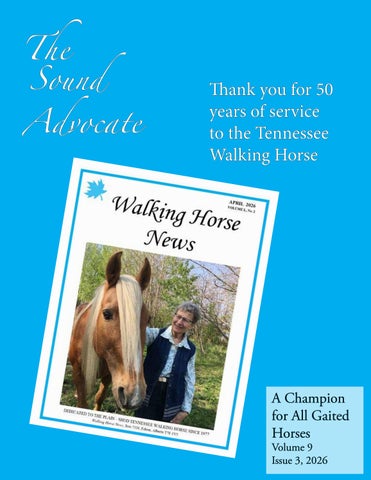
On the cover: After 50 years, Canada’s Walking Horse News is ceasing publication. The April 2026 cover is courtesy of Marjorie Lacy.
3 • The Sound Advocate • Issue 3, 2026
TABLE OF CONTENTS Features Open Letter From USDA Animal and Plant Inspection Service 7 Leadership of FOSH 8 Celebrating 50 Years of Walking Horse News 10 My Gaited Journey With My Spotted Saddle Horse Armed Comanche 15 Riding History: Gaited Horses on the Butterfield Overland Trail 18 Riding from the Bighorn to Ice Lake and Back Again 22 How Much Should You Feed Your Horse 24 Murdoch Minute 26 Why Horse Owners Need to Rethink Bug Season the Rest of 2026 28 In Every Issue From the President 5 From the Editor 6 Our Forever Friends 23 Soring Data Sheet 32 FOSH Sound Principles 36 FOSH Sound Directory 37 FOSH Event Support Form 38 FOSH Scholarship Form 39 FOSH Membership Form 40
4 • The Sound Advocate • Issue 3, 2026
From the President...
Dear FOSH Friends and Supporters, We thought you might want to read an unusual letter from Ms. Juarez, USDA, in the event you have not seen it on their website. It is on page 7 and once again, we are angry and saddened that the Horse Protection Act (HPA) appears to be nonexistent for big lick owners and trainers. From two events, their drug of choice was a sedative – in which 97.6% of the horses tested positive while 59% of the samples contained two or more prohibited substances. I cannot imagine what additional evidence the USDA requires to enforce the law. According to Ms. Juarez, the publishing of the information will cause an immediate and significant reduction in the use of sedatives and other prohibited substances. I am scratching
my head on this one as publishing names, tickets, suspensions, etc., has not made a single dent in stopping these horrific practices. Ms. Juarez should realize this as she has been involved in HPA enforcement for a long time, including when suspension records were made public. Next up, how was your Summer? I realize it was unbearably hot for most of us; however, we would love to hear if you tried any new-to-you activities with your trusty steed. It seems that some of our members no longer find showing to be as much fun or as interesting. What is cool is that our members continue to expand their horsemanship skills and knowledge by attending clinics just like the Carl Bledsoe clinic held last weekend. We also have in this issue an article by my dear friend, Barb Wood. Barb and I met at hunter jumper riding lessons forty years ago and stayed in touch through horses, careers and relationships. Barb went the warmblood dressage route until a few years ago when she tried Western Dressage with a gaited horse! Of course, she’s crazy about his abilities, attitude and mind. Here is to some great trail riding this autumn with sunny skies and mild weather! Enjoy!
Teresa Teresa Bippen, FOSH President Tbippen1957@yahoo.com
5 • The Sound Advocate • Issue 3, 2026
From the Editor...
Hello FOSH Friends. This year I’ve joined the board of directors of two different equine organizations. It’s not like I need anything more to do, but they were both in somewhat dire straights from people resigning. I figured I could help out at least until they were able to find additional people. FOSH is in a similar situation. Many of the board members have been serving for years, and they are ready for a break. Might you be interested in helping? Or maybe you know someone who would like to get more involved. No experience is necessary. You really just need a love for horses. Please consider giving some time to help promote these beautiful gaited horses. The cover story in this issue is an interview with Marjorie Lacy, the power behind Walk-
ing Horse News for 50 years. I have a huge amount of respect for keeping a publication active for so long. I know first hand the struggle to keep a magazine alive when advertising support wains and the difficult decision to stop publication. I did the same thing in 2017 with a magazine that had been around for 30 years (although I didn’t have it that entire time). Then round two of seeing a magazine end was during my tenure at the Arabian Horse Association as the managing editor of Arabian Horse Life. They decided to stop its printing and along with it I lost my job. Equine media (particularly print media) is a difficult place to be. Congraluations to Marjorie for her many years of dedication and success. I hope she enjoys her downtime. Take some time to enjoy this issue. I’d also love to hear what type of stories you would like to read going foward. This is your publication. Please feel free to email me at stephaniejruff@ gmail.com.
Stephanie Stephanie J. Ruff Editor, stephaniejruff@gmail.com
6 • The Sound Advocate • Issue 3, 2026
Open Letter from USDA Animal and Plant Heath Inspection Service Dear Management of Horse Shows, Exhibitions, Sales, and Auctions (Management), Horse Industry Organizations and Associations (HIOs), and Designated Qualified Persons (DQPs); and Owners, Trainers, Exhibitors, Custodians involved in Horse Protection Act (HPA) Regulated Events: Last month, I provided you with an update on the USDA’s work to implement a recommendation from the National Academy of Sciences (NAS) to collect swabs from the pasterns of horses at HPA-covered events for substance testing and blood samples to identify medications that may alter a horse’s behavior during compliance inspections. The initial scope of this effort involves collecting samples without gathering any associated personally identifiable information about the horse, its owner, custodian, rider, or any other person associated with the horse. Today, USDA shared aggregate findings from two events on its website. Consistent with NAS’ recommendation, the laboratory analyzing the samples followed the United States Equestrian Federation’s rules for substances. Out of the 41 post-show blood samples (from padded and flat shod horses) collected at the two events, the laboratory findings show that 97.6 percent of samples contained sedatives, and 59 percent contained two or more prohibited substances, including local anesthetics, NSAIDs, corticosteroids, and antihistamines. These results can be found
on USDA’s Horse Protection webpage under the header, “Horse Protection Event Reports” at aphis.usda.gov/hpa. We recognize that the industry needs timely information to support compliance and prompt corrective action. Accordingly, we will continue to collect samples at HPA covered events and will share aggregated results—without any personally identifiable information—on our public website and directly share them with industry stakeholders. As sampling and testing continue, we expect to see an immediate and significant reduction in the use of sedatives, masking agents, and other prohibited substances – both of which are critical to eliminating soring and ensuring fair competition. We will continue sharing additional summaries of laboratory findings so that stakeholders can monitor trends, evaluate progress, and make informed decisions in advance of upcoming events. Your leadership and cooperation remain critical as we work together to eliminate soring practices and strengthen the integrity of HPA covered events. If you have any questions, please contact Dr. Emi Roberson at emily.a.roberson@usda.gov or (405) 394 4846. Sincerely, Bernadette Juarez Deputy Administrator, Animal Care USDA APHIS
7 • The Sound Advocate • Issue 3, 2026
gvehige115@gmail.com
8 • The Sound Advocate • Issue 3, 2026
9 * The Sound Advocate • Issue 3, 2026
Celebrating 50 Years of Walking Horse News With the Canadian Walking Horse News publishing its last issue in August 2026, we wanted to hear from the person behind it all, Marjorie Lacy, and congratulate her on celebrating 50 years of dedication to the plain-shod Tennessee Walking Horse (TWH). Sound Advocate: Were you always interested in horses? How did you get involved with Tennessee Walking Horses and what do you love about them? Marjorie Lacy: I was always fascinated with horses – any and all horses. I think I must have been imprinted on them as a toddler in the forties, seeing the big black team that worked at the lumberyard near our house come back to the barn to be unhitched. (The teamster even let me ride up on the wagon bench with him once in a while!) After I learned to read, I devoured every book I could find about horses. Marguerite Henry’s Album of Horses about many of the American breeds was so interesting. In it, the old-time Tennessee Walkers sounded ideal, but I’d never seen or heard of one in Manitoba at that time.
Skip ahead a quarter century. My husband and I were living in Edmonton, Alberta, and we had four horses for mountain riding and pack trips. My little bay Morgan was an excellent horse for me, a novice rider, except for his jack-hammer trot! However, every once in while he would go into a smooth gliding gait – just like riding on a cloud. But it was transitory, usually when he was walking down a slope and wanting to go faster than I would let him without breaking to a trot. I remembered the description of the Walkers from Album of Horses. If there actually was a breed that smooth, I wanted one! So, I started searching for Tennessee Walkers. This was in the late 60s early 70s, long before the internet. I checked all the local and provincial classifieds in all the newspapers and farm papers. I contacted Marjorie on Mo the Morgan with others on a pack trip in the Willmore Wilderness area, Alberta. All photos courtesy Marjorie Lacy.
10 • The Sound Advocate • Issue 3, 2026
the very few who advertised Walkers. No luck, but I kept a record of any I found. I also sent for Calvin Miller’s Double Diamond Ranch catalogs. My dream catalogs! Dozens of Walkers listed there, but Rhame, North Dakota was a long, long way to go for a horse. In the meantime, we’d moved west to be closer to the mountains. And one day in 1974 I saw an ad in the Western Producer paper for two TWH mares in Alberta which was not that far away. They turned out to be a mare and filly that I’d sighed over from Millers catalog! We drove right down to see them. We purchased both, a big palomino, Major’s Gold Lady, and her 3-year-old daughter by Sun’s Merry Man.
Lady’s Merry Mist Canadian # 89, USA #713370 was one of the first two TWH Marjorie owned.
daughter, achieved the Platinum Dam Award offered by the Canadian Registry, while Smokey was named the first Platinum Sire. They are the only Walkers to achieve this award to date. There are 39 TWH in the Candadian Registry of the Tennesse Walking Horse (CRTWH) that carry our Uphill farm prefix and many more sired by stallions we stood at Uphill Farm over the years.
Since we had no land of our own yet, we made a deal with folks I’d discovered on the other side of the province who owned Prince Radar, a stallion from Montana. We arranged SA: What made you start the Walkthat they would keep the mares on ing Horse News (WHN)? Who bore a foal share basis while we searched the cost of those first years? for land. ML: The search to find a Walker here in Alberta took me so long and Those two mares were the beginwas so much more difficult than it ning of our adventure with Walkshould have been. I’d enjoyed reers. I treasure the easy-going, ceiving the Morgan Horse newsletpeople-friendly temperaments. The ter and thought “Why couldn’t the 24-year-old stallion I own now, UpWalkers have something like that?” hill Heir Trigger, aka Smokey, is the 4th generation from that first So, I sent out a letter to about 17 mare, Major’s Gold Lady. We raised TWH folks whom I’d found in my him and his mother, Uphill Arnica search and asked if anyone else (Sawdust), along with others from would be interested. Quite a few the same lines. Uphill Sand’N Sareplied, others contacted owners ble (Betty Buckskin), Sawdust’s 11 • The Sound Advocate • Issue 3, 2026
they’d heard of, and before we knew The first Walking Horse ewsletit there was a list of over 30 names. ter, three pages long, went out in June of 1977 (photo bottom left). I It turned out that there was already mailed out 70 of that first one and a thriving group of owners in south- by the August one had 24 subscribern Alberta who had organized TWH ers (since I’d asked for a subscripclasses at various fairs and horse tion fee of $2.00 to cover postage, stencils and paper. I’d been given shows. Another group who already permission to use the school equipowned Walkers were the dog trial ment and typed the stencil (Hunt & guys who train and compete with Peck method) and cranked it out by their bird dogs, mostly pointers, hand on a spiritmaster typewriter. on the Saskatchewan and Alberta prairies. These dogs cover a lot of One hundred seven-page Walking ground and need a fast smooth-go- Horse newsletters were mailed out in August. ing horse to follow them. There were individuals from all over Alberta, B.C., Saskatchewan and Manito- By October we had 45 subscribers, ba, even some as far east as Ontar- and 71 by December. People were io who had TWH, but we just hadn’t hungry for information, eager to write about their TWH, send ads for been connected. Now that was to sale or wanted, and ask questions change. about training, registration, and where to find others with Walkers. I subsidized the newsletter to all for whom we could find addresses that first year but after that only sent a free invitational copy to anyone new who came along. SA: When did you add another person to assist you? Why did you move from a newsletter to a magazine format? Switch from a typewriter to a computer? Source to outside printing? Go on-line? ML: The newsletter continued as simply printed pages until the end of 1987. It changed when Jo Kingsland came on board with a vision of the WHN as a professionally printed breed magazine. WHN bought a Gestetner so we could print more than 100 copies at a time. (The 12 • The Sound Advocate • Issue 3, 2026
typed stencil faded out by 100 copies!) We then added some photocopied pages so we could include a few photos. Next came professionally printed covers, paid for by ads from breeders who wanted to advertise their farms and stallions. Eventually the whole magazine except the covers was photocopied (and the Gestetner is still sitting in my basement). Also in the 80s WHN was asked to become the print carrier of news from the CRTWH, incorporated in 1984. Like a snowball rolling downhill the newsletter kept growing. In the 90s, we were carried columns by Allanna Jackson, Backyard Walkin’, and Franne Brandon’s From Foundations to the Future. Subscriptions rose to nearly 500, and some issue contained 40 to 50 pages. But then in 2000 Jo announced she’d be 65, and she was retiring. I really thought this was the end. I’d gathered most of the content and stories, but Jo had been setting up and mailing the magazine. How could it continue?
magazine with colour photos and ads (but colour only on the covers).
In 2016 Jo died suddenly. From then on the magazine had to be mailed directly from Edson. That was the year that it became an e-mailed publication as well. When one of the Then came desktop publishing! We original subscribers moved to South had been using computers for sevAmerica but still wanted his WHN eral years but not to that extent. I magazine, there was only one way persuaded Jo to stay on for another to accomplish it. I set up an e-mail year while I learned the basics. With version in addition to the print copy, a new computer and lessons on how which some others appreciated as to use the Publisher program, WHN well. They really liked the fact that carried on. Trail Printing, the local it was all in colour. printing shop, allowed me to work there, and they took over printing The years marched along. On the the magazine. Jo agreed to continue 45th anniversary of Walking Horse mailing, and at last Walking Horse News I thought how neat it would News was a professionally printed 13 • The Sound Advocate • Issue 3, 2026
be to have the whole magazine printed in colour. Colour photos were now so easily taken on subscribers’ phones. When I asked the printer to do the whole magazine in colour, he charged me the same as for greyscale just to mark the occasion! When I saw the results, I just couldn’t go back. Ever since, all photos in Walking Horse News have been in colour. Now I wish I could just wave a magic wand and have all the back issues light up in colour! It just adds so much. SA: Why did you put “Dedicated to the Plain Shod Tennessee Walker in Canada” on the front of every magazine since the covers have been professionally printed? ML: In the 80s the question of soring came up. Rumours floated around. Could it be true? It didn’t seem to be something we needed to worry about here where nearly all the horses were trail and using horses that were only shod if needed for riding on gravel or rocks or for the occasional show class. But the question ‘Is it true’? ‘Can it be true’? kept coming up. A real split opened between those who denied it and those who were afraid it was true. I happened to see a list of persons on suspension for soring and realized one of them was booked to judge an up-coming show in Alberta. WHN was asked to carry an ad for it. Surely this wasn’t true? I phoned the show chairman. The response was ‘What was my problem? He would be off suspension before
the show was to occur.’ The upshot was that WHN didn’t carry the ad, the show went on, and that particular group of TWH owners stopped supporting the magazine.
My Gaited Journey With My Spotted Saddle Horse Armed Comanche
SA: How have you seen the flatshod TWH industry change over the years? ML: In my opinion we do not have a TWH industry per se in Canada but more a community. Only a very few made the kind of investment in stock, trainers, and facilities that would qualify as an industry to my way of thinking. There are no shows here anymore. Most who ride TWH are people who love the breed as a valued trail and pleasure horse. And those are mostly the folks who continue to breed and raise them.
I purchased Armed Comanche whom I call “Chief” in early 2021. At the time, I was apprenticing as a Western Dressage Judge and we were being trained on how to judge gaited horses as well. I was very impressed with the beauty and harmony of the Spotted Saddle Horses and decided to purchase one for myself. I saw Chief, and he was sold after 5 minutes on his back! I could feel his honesty and heart immediately. His gait was four beat, his walk was solid and his lope was
As well, interest and enthusiasm for horses and horse-keeping in general is waning. More and more people are living in urban environments and simply cannot afford to keep a horse even if they had the interest. The future of pleasure saddle horses does not look as bright now as it did in the early years of WHN.
By Barbara Wood
lovely. I thought these are the wonderful basics with which to begin our dressage journey. Chief is smart and truly trying to always please me and perform any movement correctly. I personally love to show and so this combination has led us to an extensive and successful show record that just keeps growing. To begin, Chief is the very first Spotted Saddle Horse to obtain Supreme Champion status with WDAA (Western Dressage Association of
Barbara Wood aboard Armed Comanche “Chief ” at the 2025 WDAA World Show at the Lazy E Arena in Guthrie Oklahoma.
SA: What made you continue the WHN for 50 years? ML: I think the magazine just took on a life of its own. The TWH owners, breeders, and WHN subscribers became my community and, in many cases, my best friends. It’s a real wrench to give it up but as they say, nothing lasts forever. I’ll still have my horses and my friends.
14 • The Sound Advocate • Issue 3, 2026
15 • The Sound Advocate • Issue 3, 2026
America). This is hard for any horse and for a Spotted Saddle Horse, this is proof they can shine in the western dressage ring like a diamond.
One is the WHLPAP (WDAA Horse Lifetime Points and Awards Program). This program travels with the horse through their journey in Western Dressage with WDAA. This It is a privilege and honor to ride program is all about recognizing and own Chief and I do not take this the growth and accomplishments of for granted. I train him to soft aids the dedicated horses/equines in the and he is just like a magic carpet program. ride. I have ridden many trotting/ jogging horses in my lifetime and There are awards and career milestill do, and I can say that Chief stones earned with beautiful lifetime is my favorite horse for riding and awards that celebrate your horse’s competing. Chief is fun, and the achievements in Western Dressage. harmony is there. When we show, These points never expire and travel of course, we would like ribbons and with ownership changes and differwe do, but we also are out there to ent riders. show the world just how capable and truly beautiful this horse is. I enrolled Chief into the WHLPAP program right away as well. As a reOur journey is anything but over, sult, so far, we have so many mileand we hope to perform another stones. Gaited Musical Freestyle this year at the World Show in Guthrie, Okla- In 2022 Armed Comanche earned homa, compete in WDAA live shows his WDAA Register of Merit (35 and WDAA online shows as much as points) and Register of Achievement we can. (100 points). Chief is amazing and knows when we are performing and steps up to the plate for every dressage test. We performed two gaited musical freestyles at the World Show in 2024 and 2025 and are World Champions in these divisions.
In 2023 Armed Comanche received his Register of Excellence (200 points) and Bronze Medal (300 points).
Chief also garnered several World Championship honors at the Western Dressage World Shows. In addition to these wins and ribbons and prizes, WDAA has other programs for any horse.
In 2025 Armed Comanche received his Gold Medal (500 points) and the Supreme Champion (700 points) Award. Supreme Champion requires at least five tests submitted riding Level 4 or higher and awards a Supreme Champion Buckle.
In 2024 Armed Comanche received his Silver Medal (400 points).
16 • The Sound Advocate • Issue 3, 2026
beautiful harmonious partnerships This is quite the achievement for Chief as many horses can take years with all equines. WDAA has embraced the gaited horses with apto reach these milestones. preciation and respect. I am so excited about this for so many horses! Secondly, in 2025 Armed Comanche also won “YEHP”; Year End High There are so many gaited horses Points in two Open Gaited divisions, out there! The Spotted Saddle Horswhich is a new program though es are one of my favorites. They look so spectacular in the dressage WDAA. A beautiful belt buckle is awarded to all horse and rider com- ring and our attire can be simple or dressy if you like. I always dress to bos who place in their divisions. try and bring out the beauty of Chief YEHP rewards Western Dressage horses for their performances across when I show. It is a choice, and for various classes throughout the com- me it is part of an artistic expression and pride. petition year, encouraging broader and more competitive participation My passion for the Spotted Saddle in WDAA-recognized shows. Horse continues to grow, and I am always so excited to judge them at After many years riding and comshows, see them attending clinics peting in classical dressage, I am and taking western dressage lesimpressed with WDAA. I believe it sons. Get out there! has opened a new door for these
Registering purebred Walking Horses worldwide since 1982.
More than a Registry! Come see us at CRTWH.ca or visit on
facebook.com/crtwh Contact secretary@crtwh.ca 17 * The Sound Advocate • Issue 3, 2026
Riding History: Gaited Horses on the Butterfield Overland Trail By Janet de Acevedo Macdonald Picacho Peak in Arizona. Photo credit Tom Fisk.
The Butterfield Overland Route stretched roughly 2,800 miles from St. Louis to San Francisco, carrying passengers, mail, and freight across some of the most varied terrain in the American West. Today, much of that original corridor still exists in fragments — dirt roads, ranch tracks, county lanes, and preserved historic segments — offering modern riders a rare chance to experience history not as a distant story, but as a landscape you can feel beneath your horse’s hooves. For gaited‑horse riders, the Butterfield is especially compelling. The route’s long, rolling distances and
mixed footing echo the very conditions that made smooth‑gaited horses so valuable to 19th‑century travelers. Riding these segments today is a way to connect the past and present through motion, terrain, and the steady rhythm of a horse bred for distance. A Road Built for Endurance When John Butterfield launched his Overland Mail Company in 1858, he created the longest stagecoach line in the world. Coaches traveled day and night, stopping only to change horses, repair equipment, or take on water. The route crossed: ● the Ozarks of Missouri and Arkansas ● the prairies of Indian Territory ● the deserts and sky‑island basins of Texas, New Mexico, and Arizona ● the rugged passes of Southern California The Butterfield line operated for just under three years, but its impact was enormous. It connected communities, accelerated communication, and laid down a corridor that would later influence railroads, highways, and settlement patterns. An 1860 Butterfield courier riding near Tucson wrote that his “little pacing horse never once broke my writing hand,” even over rocky ground — a reminder that
18 • The Sound Advocate • Issue 3, 2026
smooth‑gaited mounts were prized for keeping riders functional mile after mile. Today, riders can still trace portions of that original path — and in many places, the land looks remarkably similar to what travelers saw in the 1850s.
Apps for Modern Riders While there is no single, official “Butterfield Overland Trail App,” most riders build their own toolkit using these three apps: ● NPS App — Best for Fort Bowie, Dragoon Springs, Apache Pass, and any NPS‑managed Butterfield sites. Includes maps, interpretive stops, trail descriptions, and offline access. ● Avenza Maps — The most practical navigation tool for riders. Allows offline use of geo‑referenced BLM, USFS, NPS, and county maps that overlap Butterfield segments. Shows your exact location even without cell service. ● Ride With GPS — Useful where local historical societies or trail groups have uploaded Butterfield‑adjacent gravel or county‑road routes. Not comprehensive, but excellent for mapped segments.
Missouri: The Journey Begins Missouri was the eastern anchor of the Butterfield system, with St. Louis the official starting point. But it was Springfield — the first major division headquarters — that became the operational heart of the route. Modern riders exploring Missouri’s Butterfield segments will find: ● rolling oak‑hickory forests ● limestone bluffs ● creek crossings ● quiet gravel roads that parallel Indian Territory (Oklahoma) original stage lines Riders encounter open prairie, blackjack oak, and long, rhythmic stretchThe Missouri State Fairgrounds in es ideal for gaited horses. Many Sedalia also holds a unique conneccounty roads still follow original tion: the grounds include historic stage alignments. structures and exhibit areas that interpret the state’s transportation A trader on the Natchez Trace once and agricultural heritage, making it a natural complement to any Butter- recalled his horse “moved like a shadow under the trees,” the only field‑themed ride or visit. sound the soft thud of hooves on leaf‑molded earth — a timeless deAcross the Southern Plains and scription of what gaited horses ofDeserts fered long‑distance travelers. As the route moved southwest, the terrain shifted dramatically. 19 * The Sound Advocate • Issue 3, 2026
● historic ranch corridors ● preserved stage stations ● multi‑use trails that parallel original alignments
Natchez Trace in Native American territory in Oklahoma. Photo credit Keith Lowery.
The terrain is demanding but rewarding — a fitting end to a transcontinental journey. Why Gaited Horses Belong on Historic Trails Long‑distance travel shaped the development of gaited breeds. Riders valued: ● smooth movement over rough ground ● efficient energy use ● the ability to cover miles without
Texas The Butterfield corridor through Texas is vast — more than 700 miles — and includes: ● ranch country ● desert basins ● rugged canyons ● historic stage stops preserved or marked by local groups Some of the best‑preserved segments lie in West Texas, where the landscape remains wide, quiet, and unchanged. New Mexico and Arizona These states offer some of the most visually striking remnants of the route: ● volcanic mesas
excessive fatigue One drover joked that men on trotting horses “walked like they’d been split in two,” while those on smooth‑gaited mounts were ready to keep going — a blunt testament to why gait mattered on the open prairie. On the Butterfield, these qualities shine. Whether you’re tölting, fox‑trotting, racking, or running walk, the terrain invites a steady, forward rhythm that feels both natural and historically appropriate. Riding a gaited horse on the Butterfield isn’t reenactment — it’s continuity.
● high‑desert grasslands ● sky‑island foothills ● preserved ruts and stage stop ruins Arizona’s portion is especially evocative. Riders can explore areas near Fort Bowie, Dragoon Springs, Picacho Peak, and the San Pedro Valley — landscapes where the Overland Mail coaches once rattled through Apache Pass and across open desert. California: Final Push to the Pacific The last leg of the Butterfield route crossed the mountains and chaparral of Southern California before descending into the coastal valleys. Riders today can experience: ● oak‑studded hills
20 • The Sound Advocate • Issue 3, 2026
21 • The Sound Advocate • Issue 3, 2026
Stagecoach horses on the trail. Photo credit Mattingly Marinaccio.
A dirt track portion of the trail stretches for miles. Photo credit Brett Sayles.
OUR FOREVER FRIENDS FOSH Lifetime Members
Traveler’s Notes ● Total historic route: approx. 2,800 miles ● Operation: 1858–1861 ● Stagecoach speed: 5–12 mph ● Travel time: 22–25 days end‑to‑end (depending on weather, Apache Pass conflicts, equipment failures, and river crossings) ● Best modern riding segments: Missouri, Oklahoma, West Texas, New Mexico, Arizona, Southern California Planning Your Ride: Modern riders typically explore the Butterfield in segments. Some of the most accessible options include county roads that follow original alignments, public‑land trails near historic stage stops, ranch or private‑land rides offered during special events, and heritage corridors maintained by local historical societies. For more history and route details, local historical societies along the Butterfield corridor — including the Greene County Archives (MO) (greenecountymo.gov/ archives/), the Oklahoma Historical Society (okhistory.org/), Fort Bowie National Historic Site (AZ) (nps.gov/fobo/index.htm), and the San Bernardino County Museum (CA) (museum.sbcounty.gov/) — offer maps, archives, and visitor information. 22 • The Sound Advocate • Issue 3, 2026
Jo Anne Behling, Wauwatosa, WI Esther L. Bell, TN Pamela Brand, Carlisle, PA Sarah Bushong-Weeks, Denver. CO Julie Church, Pagosa Springs, CO Mary & William Church, Pagosa Springs, CO Luella DeBono, Eden Prairie, MN Beverly Foster, St. Augustine, FL Nancy Gillespie, Pullman, WA Cristine Holt, Dubuque, IA Jane Howlett, Pocatello, ID Marjorie Lacy & Walking Horse News, Edson, Alberta Sue De Laurentis, Dripping Springs, TX Bobbie Jo Lieberman, Chicago, IL Dianne Little, Calgary, Alberta Debbie Locke, Mack, CO Ann Loveless, Ashtabula, OH Patricia Mayer, East Aurora, NY Janelle T. McCoy, Prague, OK Frank Neal, Nashville, TN Lori Northrup, Ellicottville, NY Anne Northrup, Ellicottville, NY Shellie Pacovsky, Bainville, MT
Denise Parsons Anita Rau, Catlett, VA Debbie Rash, Chino, CA Southern Comfort Gaited Horse Club, ID Bucky & Nancy Sparks, Cortez, CO Marcy Wadington, Canon City, CO Leslie Weiler, Pagosa Springs, CO Laura Wyant, Chesire, OR An Anonymous Donor Yankee Walkers of New England
k n a h T ! u yo
23 * The Sound Advocate • Issue 3, 2026
How Much Should You Feed Your Horse? by Jim Fiorini, aka “Jim “Jim the Feed Guy” Guy” Originally published on Facebook. One question that I am often asked is “how much should I feed?” The true answer is another question; “How high is up?” I have covered the three categories of commercial horse feed; balancer, performance feed and complete feed. Balancer and performance feed rates are determined after a horse is being fed as much forage as necessary to maintain weight. Complete feed is used when forage is not available or when the horse’s condition is not conducive to forage. Every feed that is complying with the AAFCO guidelines is required to publish feeding directions on their bag or feed tag. Below is an example of the feeding directions for a performance feed and I can tell you from experience that these tables for any feed are next to useless and are only published to maintain compliance with regulations. Here’s why.
on 1.2% of the horse’s bodyweight. That is probably a bit low since most of the feed guidelines are 1.5% of bodyweight so that’s one strike. Now let’s talk about the quality of the forage. First cutting? Second cutting? Orchard grass? Coastal? The weight management attributes of forage have as many variables as putting an object into Earth orbit. Literally rocket science. One of my favorite subjective variables is work. My “heavy” work is probably just a warmup for many professional riders.
only one that is black and white can be found by skipping all the way to the bottom where you will find the “minimum feed rate.” As you can see in the example the minimum feed rate for this feed is 0.3 pounds per 100 pounds of bodyweight. Mathematically, if your horse weighs 1,000 pounds it will require a MINIMUM of 3 pounds of this feed per day to meet the daily requirements as prescribed by the NRC in order to sustain a 1,000-pound horse at maintenance. Basically eating, sleeping and making manure. So, if your 1,000-pound horse is gaining too much weight on 3
pounds of Healthy Edge and you cut it back you are cheating the horse out of essential nutrition. Likewise, if the horse is holding a good weight on 3 pounds per day but is in work he is likely being underfed nutrients. These are cases when a feed should be supplemented with balancer or, if possible, feed more or better forage for weight and add a ration balancer. Over the years I have heard many times some version of “Oh, that feed is awful. I fed it a few years ago and my horse looked terrible!” “Really! How much were you feeding?”
Although I go by “Jim the Feed Guy” I am really the forage first guy. Before I will suggest a feed program I like to ensure that the horse is being fed maximum forage to maintain a healthy weight because forage is what keeps a horse healthy and the natural fiber is what is best to maintain weight. The supplemental fat and carbs in performance feeds should only be required to offset work and performance requirements. But that’s not really important for this piece.
This is a performance feed so it is designed to be fed in addition to forage. This is clearly indicated; howThe only important statement of ever the baseline rates are based feeding directions because it is the 24 • The Sound Advocate • Issue 3, 2026
25 * The Sound Advocate • Issue 3, 2026
Continued on page 31
Murdoch Minute No. 100: Level Your Chin
By Wendy Murdoch Do you tuck your chin when you ride? Feel tension in your throat and neck? Have difficulty breathing when you ride? Try to pull your chin back to your collar to sit up straight? Forcing your head position will adversely affect your rein contact and overall position. Yes, it is important to balance your head for good riding but not by creating tension in your neck. Next time you ride notice what you do with your chin. Do you pull it down and in toward your throat? Do you pull your head back? Look down at the horse’s withers? Or perhaps you push your chest forward and pull your shoulders back? Do you think of a string on the top of your head and try to pull yourself upward? While this can be a useful image for some, overdoing it can create a too-straight neck and overly tucked chin. Your head weights approximately 8 – 15 lbs. That is about as much as the average bowling ball. It is perched on the top of your spine and supported by the entire spine and pelvis.
Often, when you attempt to “sit up straight” the natural curves are altered. The lumbar curve increases because you have overly hollowed your lower back. The cervical curve increases when your chin juts forward and up and is decreased when you pull your chin toward the back of your shirt collar. For good head balance it is best to allow the lumbar spine to flatten slightly due to your sitting position on the horse and maintain a natural curve in your neck so that your entire spine can lengthen upward and balance your head with ease. To find a balanced head position take your reins in one hand and make the letter “L” using the thumb and index finger of your other hand. Bring the “L” toward your throat and chin. Place your thumb on your sternum. Most likely it will be at the very top, which is called the “manubrium”. This piece of the sternum is the same of the Superman shield. Place your index finger on the point of your chin. Rest your chin on your finger and feel the length of your neck when in this position. Think of lengthening your neck slightly by
26 • The Sound Advocate • Issue 3, 2026
“pricking your ears” the way your horse does when he sees something in the distance. Feel how your chest softly rises and your neck lengthens when you keep the “L” and prick your ears. Ride at walk, trot and canter with your “L” marking the position of your chin. Change hands when you change direction. Of course if you need to, return your hand to the reins for steering or if your horse gets anxious. Remove your hand and continue to ride imagining the “L” and pricking your ears. Use this Murdoch Minute to balance your head. When your neck lengthens without tension by you maintaining a space between your chin and your chest your shoulders relax. This improves your rein contact. When you need to keep both hands on the reins think of pricking your ears to lengthen your neck and always remember to enjoy the ride!
Photo 1 (left): The rider is tucking his chin to his chest and pushing his chest forward. As a result he was always behind the motion of the horse. Photo 2 (top): He has made an “L” with his thumb and index finger and placed the thumb on the sternum and index finger on the chin bone. This lifts his chin and lengthens his neck. Also notice how the chest has softened. Photo 3 (bottom): Having taken his hand away he has maintained his neck length softer but open chest so that his head is well balanced without tension while restoring a natural curve to his neck.
27 • The Sound Advocate • Issue 3, 2026
Why Horse Owners Need to Rethink Bug Season the Rest of 2026 Courtesy Merck Animal Health
monitor local mosquito activity and consult their veterinarian as conditions can shift quickly and in unexpected locations.
“Young horses need more time to establish a strong antibody response and are more susceptible to EEE,” Long notes. “Owners of horses under 5 should talk to their veterinarian about whether more frequent vaccination is appropriate, especially in the South.”
• Southeast: Above-average fall and winter rainfall is creating conditions for year-round mosquito activity. Fall boosters are particularly important this year, protecting not only against WNV, which peaks in fall, but also against early spring EEE transmission. • Midwest, Northeast and Mid-Atlantic: Warmer winters with less snow and more rain increase flooding risk, elevating mosquito-borne disease exposure through spring and summer. Coastal areas face heightened arbovirus risk from predicted winter rainstorms. • California and the Southwest: El Niño effects are already established, with “It’s the instability,” explains Maureen warmer ocean and land temperatures Long, DVM, PhD, DACVIM, professor driving an intensive start to mosquiof equine medicine at the University of to season, including high numbers of Florida College of Veterinary Medicine. WNV-positive mosquito pools, dead “Dry conditions followed by the wet birds and confirmed human cases.2 Vaccination Timing Matters create ‘the pothole effect.’ These are WNV is now endemic throughout the focal zones of standing water where mosquitoes, birds and animals all con- United States, while EEE continues expanding beyond its historical hotspots. verge, creating the conditions for inProtection depends on completing rectense WNV and EEE transmission.” ommended foundational annual vaccinations and staying current on booster Rather than relying on previous mosdoses. quito season trends, owners should
Earlier this spring, the CDC reported that emergency department visits for human tick bites were the highest for that point in the season since 20173,underscoring broader seasonal tick activity across many parts of the country. “Horses and humans are exposed to many of the same tick vectors, including blacklegged ticks, makBecause the window before peak mos- ing it reasonable to expect that broad quito season may be compressed this patterns of tick-borne disease risk may be similar,” says Toby Pinn-Woodyear, owners should review vaccination schedules with their veterinarian cock, DVM, DACVIM, associate clinical professor at Cornell University College and consult the American Association of Equine Practitioners vaccination of Veterinary Medicine. guidelines for WNV and EEE. Many cases occur in horses that have not The two most common tick-borne completed recommended annual diseases affecting horses in the U.S. vaccinations or received appropriate are anaplasmosis and Lyme disease, booster doses. both caused by pathogens transmitted by blacklegged ticks. Common cliniTicks Continue to Spread cal signs in horses with anaplasmosis Changing weather patterns are only include fever, lethargy, limb swelling part of the story. According to Erika and jaundice. Lyme disease is assoMachtinger, PhD, associate professor ciated with four clinical syndromes in of entomology at Pennsylvania State horses, including uveitis, neuroborreliUniversity, expanding tick populations osis, cutaneous pseudolymphoma, and are also being driven by changes in nuchal bursitis (aka poll evil). Lyme wildlife populations, land use and hab- disease is also frequently implicated itat. Together, these factors are allow- with clinical signs of shifting leg lameness, joint swelling, back and neck ing ticks to establish themselves in pain and change in attitude, however areas where horse owners have hisa definitive diagnosis is challenging in torically faced lower risk. these cases. “Horse owners should not assume historical patterns of tick risk still apply,” “Lyme disease in horses is considered Machtinger says. “Routine tick checks, a diagnosis of exclusion,” Pinn-Woodcock explains. “A veterinarian must vegetation management and locally appropriate veterinary prevention are first rule out other common causes of these nonspecific clinical signs and becoming increasingly important.” find evidence of Lyme disease
28 • The Sound Advocate • Issue 3, 2026
29 • The Sound Advocate • Issue 3, 2026
A record-breaking El Niño weather pattern has arrived, and with it a potentially unexpected impact on horse owners. Combined with expanding tick ranges and the first detection of New World screwworm in the U.S. since 1966, the threat for horses has changed in 2026.
A Region-by-Region Look at the Risk The effects of El Niño will vary by geography, but few horse country regions will be unaffected, Long warns. Her regional breakdown:
How El Niño Reshapes Mosquito Risk The National Oceanic and Atmospheric Administration (NOAA) recently confirmed the onset of El Niño – one of the fastest developing on record, with a greater than 90% probability of strengthening into a “super El Niño” by fall.1 The important issue for horse owners isn’t whether their region will get more rain but rather the volatility of the season’s weather. El Niño shifts bands of wet and dry weather in ways that are difficult to predict, creating ideal breeding grounds for mosquitoes that transmit West Nile virus (WNV) and eastern equine encephalitis (EEE).
exposure using an antibody detection test before concluding a Lyme diagnosis is appropriate – and many horses in endemic regions will test positive on antibody detection tests due to exposure.”
expanding tick ranges and emerging threats crossing U.S. borders for the first time in decades, horse owners can’t rely on last year’s assumptions to protect their horses this summer. “What makes this year different isn’t just one threat – it’s the convergence Pinn-Woodcock encourages owners in of several at once,” says Chrissie Pariboth established and newly endemic seau, DVM, MS, DABVP (Equine Pracregions to remain vigilant year-round. tice), cVMA, Senior Equine Professional “In the northeastern U.S., tick-borne Services Veterinarian for Merck Animal disease is diagnosed in horses yearHealth. “In my experience, the horsround – tick activity decreases in cold- es that fare best are the ones whose er months but it is not absent.” owners stay informed, stay connected to their veterinarian, and are proactive Another Emerging Threat in protecting their horses.” Mosquitoes and ticks aren’t the only insect threats horse owners should be Dr. Long puts the stakes plainly: watching this year. New World screw“When it comes to WNV and EEE, vacworm (NWS), absent from the concination is the only reliable tool availtinental U.S. since 1966, has been able.” There is no specific treatment confirmed in Texas and New Mexico, once a horse is infected. In an unpreprompting USDA livestock movement dictable season, the window to act is restrictions and a national response now. effort. Unlike mosquitoes and ticks, screwworms target open wounds, Horse owners should review their making routine wound inspection a horses’ vaccination status with their critical new habit, particularly for own- vet. Vaccines that provide protection ers in southern states, where warmagainst WNV, EEE and WEE, such as er year-round temperatures create a PRESTIGE® 5 + WNV from Merck higher risk of sustained screwworm Animal Health, play an important role presence. when administered according to veterinary recommendations. Eradication efforts are underway, but the timeline is measured in months to References 1 National Oceanic and Atmospheric Administrayears. Horse owners should consult tion, Climate Prediction Center. ENSO Diagnostic their veterinarian for current guidance Discussion. August 2026. cpc.ncep.noaa.gov/prodon wound management and fly control ucts/analysis_monitoring/enso_advisory/ensodisc. shtml and monitor screwworm.gov for the 2 Centers for Disease Control and Prevention. West Nile Virus: Current Year Data. 2026. cdc.gov/westlatest USDA recommendations as the nile-virus/data-maps/current-year-data.html situation evolves. Stay Ahead of the Season In a year defined by weather volatility,
How Much Should You Feed Your Horse cont.
“Oh, he’s an air fern so I only fed about a cup twice a day.” The feed was great, the fact that the horse needed 4 pounds per day of the feed for full nutrients but was only getting 1 pound per day was why the horse looked terrible.
Taking the confusion out of feeding your horse
So, when starting any new feed be sure that the horse has all of its health and dental boxes checked, keep full-time hay available (unless it’s chubby), start with the minimum daily feed rate and go from there. That will be your hard baseline.
Phone consultations and farm visits available. Contact us for more information. jimthefeedguy.com
3 Centers for Disease Control and Prevention. “CDC Data Show Weekly ER Visits for Tick Bites Higher Than Usual.” April 23, 2026. cdc.gov/media/releases/2026/2026-cdc-data-show-weekly-ervisits-for-tick-bites-higher-than-usual.html
30 • The Sound Advocate • Issue 3, 2026
Jim Fiorini is a certified equine feed and nutrition specialist helping horse owners around the world untangle the twisted world of feeding horses.
31 • The Sound Advocate • Issue 3, 2026
––hh umane acTivisT ,m ayay , 2011. umane acTivisT ,m , 2011.
hoW hoWto detect dd a ttto aadetect ss hh ee ee tt a
••Palpation Palpation ••Gas Gaschromotography chromotographyoror “That just “That justlooks lookswrong.” wrong.” “sniffer” “sniffer” ——10year -olD while waTching viDeo of aa “big ”” 10year -olDboy boy while waTching viDeo of “biglick lick • Thermography • Thermography horse shown inin sTacks anD chains , J,une horse shown sTacks anD chains June10, 10,2011. 2011. ••Blood Bloodororsaliva salivatests tests Artwork by by Victoria vonvon Kap-herr www.vonkapherr.com Artwork Victoria Kap-herr www.vonkapherr.com ••Drug-detection Drug-detectiontrained traineddog dog ••Visual inspections for: Visual inspections for: done? WhY is abuse WhY isthis this abuse done? – scarring and inflammation, signs – scarring and inflammation, signs soring to Soringisispracticed practicedtotoget getgaited gaitedhorses horses to ofofsoring Chemical Chemicalsoring soringisisthe theapplication applicationofofpainful, painful, Soring insults. insults. their artificiallyenhance enhance theirstep steptotowin winininshows. shows.AA caustic causticliquids liquidstototenderize tenderizethe thehorse’s horse’spastern pastern artificially – wavy, rippled, curly hair on the front – wavy, rippled, curly hair on the frontlegs, legs, winningimage imageisisrewarded rewardedwith withribbons, ribbons,cash, cash, area area(ankle), (ankle),sosothe therepeated repeatedstrike strikeofofa achain chainisis winning an indicator ofofrepeated chemical soring an indicator repeated chemical soring future breedings and fees. recognition, future breedings andtraining training fees. painful painfuland andcauses causesthe thehorse horsetotosnatch snatchhis hisfoot foot recognition, with withleg legwraps. wraps. higher higherwith witheach eachstep. step.The Thechain, chain,a acrucial crucialpart partofof ––cording, cording,a atype typeofofscarring scarringcaused causedby bythe the this thisshow showhorse horsestyle, style,isistermed termedan an“action “actiondevice,” device,” enForcement enForcement plastic wrap What is soring? plastic wrapsliding slidingdown downand andtightly tightly What is soring? and exaggerated gaits andthe the exaggerated gaitscannot cannotbe becreated created to soring toend end soring bunching around without this Soring isisdeliberately inducing bunching around thepasterns. pasterns. without thischain. chain. Soring deliberately inducingpain paintoto There law called Thereisisa afederal federal law calledthe ––Protection checking application exaggerate checkingfor for applicationofofforeign foreign exaggeratea agaited gaitedhorse’s horse’smovement movementfor for the Act, theHorse Horse Protection Act, hoW it’s done substances, by the ring. A ofofdevious hoW it’s done substances, by walkingthe thebarns barnsand and theshow show ring. Avariety variety deviousand andcruel cruel which soring at whichprohibits prohibits soring atwalking Chemicals are to the horse’s lower Chemicals areapplied applied to the horse’s lowerlegs, legs, trailers at methods have devised over the years. trailers ata ashow. show. methods havebeen been devised over the years. shows sales, showsand and sales,enforced enforced then the leg is wrapped in plastic for days. This then the legalso is wrapped in plastic for days. This Soring violations include methods Soring violations also includemany many methods by bythe theUSDA. USDA.However, However, causes the chemicals to “cook” into causes the chemicals to “cook” into theflesh. flesh. most inspections are selfused usedtotoavoid avoiddetection. detection.Soring Soringisisagainst againstthe most inspections are selfThis creates highly sensitized front pasterns This creates highly sensitized front pasternsthat that Federal law and subject totofines penalties Federal law andisis subject finesand and penalties regulated USDA scarscar rulerule violation photos, 2009 regulatedby byHIOs HIOs(horse (horse USDA violation photos, 2009 are when the strikes arepainful painful when thechain chain strikeswith withevery every ififdetected atata apublic show or detected public show orsale. sale. industry industryorganizations organizations step. step.Examples Examplesofofsoring soringchemicals chemicalsused: used: licensed licensedby bythe theUSDA.) USDA.) •• kerosene ••GoJo hand cleaner kerosene GoJo hand cleaner Soring includes the of foreign Soring includes theabuse abuse ofchains, chains, foreign ••diesel ••WD40 oil diesel WD40 oil substances and illegal shoeing substances andchemicals, chemicals, illegal shoeingtoto ••croton oil •• mustard oil croton oil hoof mustard oil ofoftoe, change the angles, length change thenatural natural hoof angles, length toe, “The “Thetopical topicalsamples samplesfrom from weighted shoes, pressure shoeing, as well as weighted shoes, pressure shoeing, as well asthe the Tennessee TennesseeWalking WalkingHorses Horseshad had With the increased scrutiny ofofsoring-related With the increased scrutiny soring-related insertion ofof blocks and devices between insertion blocks andother other devices between thehighest highestincidences incidencesofofpositives positives scars, scars,another anothercruel cruelpractice practiceisisused usedtotoremove removethe the thehoof hoofand andthe theshoe shoestack stacktotoplace placepressure pressureon on the thetelltale telltalescarring. scarring.The Thehorse’s horse’slegs legsare are (of (ofillegal illegalsubstances substancesfrom fromgas gas the thefrog frogand andsole soleofofthe thefoot foottotocreate createpain painininthe the covered in a chemical stripping agent, which covered in a chemical stripping agent, which chromatography chromatographysamplings) samplings) front frontend endofofthe thehorse. horse.These Thesemethods methodsallallcause cause burns burnsoff offold oldscar scartissue tissuethrough througha avery verypainful painfulthat thatI’ve I’veever everseen seenin inmy mylife.” life.” the thehorse horsetotoattempt attempttotoavoid avoidthe thepain painby bypicking picking process. process. ——DD r.rT , leaDing inin . omas TomasTobin Tobin , leaDingveTerinarian veTerinarian up uphis hisfront frontfeet feetfaster fasterand andhigher, higher,and andshifting shifting Drug conTrol anD Toxicology inin compeTiTion horses , , Drug conTrol anD Toxicology compeTiTion horses his hisweight weightback backonto ontohis hishocks. hocks.Slang Slangfor foran an nn ovember 5,5,2010 ovember 2010 obviously obviouslysore-going sore-goinghorse horseisis“going “goingtoo toodeep.” deep.” www.thomastobin.com www.thomastobin.com
Chemical ChemicalSoring Soring
Fixing Fixing……Touching Touching……“putting “puttingthem themin inaabucket” bucket”……Soap Soap‘em ‘em…… Fly Flyspray spray(a (aterm termowners ownersuse useso sothey theycan canavoid avoidadmitting admittingknowing knowingthat thatan anillegal illegal substance been horse) getting right substance has beenused usedon on their horse)…… getting them right……brushing brushing them Soring violations … bilateral sore ……them unilateral sore … Soringhas violations …their bilateral sore unilateral sorethem … …… square square‘em ‘emup up……head headshake shakein inaabottle bottle……dropping droppingthem them…… scar rule … foreign substance illegal shoeing scar rule … foreign substance … illegal shoeing…… 26 • The Sound Advocate • Issue 1, 2024 … Mojo Mojo(commonly (commonlyused usedby bypeople peoplereferring referringtotoGoJo GoJohand handcleaner) cleaner)……
falsifying falsifyingrecords records……pressure pressureshoeing shoeing……
Artwork by Victoria von Kap-herr www.vonkapherr.com Artwork by Victoria von Kap-herr www.vonkapherr.com
Soring
hoW hoWto todetect detect
“Without “Withoutthe thechains, chains,there therewould would be beno noneed needfor foraascar scarrule.” rule.”
Pressure PressureSoring Soring Pressure Pressuresoring soringcauses causespain paininina ahorse’s horse’s front frontfeet, feet,sosowhen wheneach eachfront fronthoof hoofhits hitsthe theground, ground, the thehorse horsewill will“snatch” “snatch”the thefoot footoff offthe theground, ground, resulting resultingininan anunnatural, unnatural,high, high,dramatic dramaticstep. step.
hoW hoWit’s it’sdone done ••Grinding Grindingthe thehoof hoofsole soledown downsosothin thin“beads “beads ofofblood bloodshow” show”and andthe thesole solegets getsspongy spongyand and super-sensitive. super-sensitive. ••Taking Takingthe thehoof hoofwall walldown downslightly slightlyshorter shorter than thanthe thesole, sole,sosoititprovides providesno nosupporting supporting protection, protection,called called“rolling “rollingthe thesole.” sole.” ••Inserting Insertinghard hardobjects objectsbetween betweenthe theshoe shoe ororpad padand andthe thetender tendersole, sole,such suchasasbolts bolts (removable (removablefor forinspections), inspections),half halfa agolf golfball, ball, hardened hardenedepoxy, epoxy,orora adried driedpiece pieceofofhoof. hoof. ••“Blocking,” “Blocking,”which whichisisstanding standingthe thehorse horsefor for hours hourson onwedges wedgesduct-taped duct-tapedtotothe thehoof. hoof. ••Purposely Purposelyfoundering founderinga ayoung younghorse horse(called (called “the “thenatural naturalfix” fix”and and“nature’s “nature’sway wayofofsoring”). soring”). ••“Road “Roadfoundering” foundering”the thehorse horseby byriding ridingfast faston on a ahard hardsurface surfacesuch suchasasa apaved pavedroad. road. ••Extreme Extremetightening tighteningofofmetal metalhoof hoofbands bandstoto cause causepain painfrom fromexcessive excessivepressure pressureon onthe thehoof. hoof.
Observations: Observations: ••Horse Horselies liesdown downininstall stalland and groans groansininpain. pain. ••Horse Horseisiscrampy crampyand andunwilling unwilling totomove. move. Horse in in pain at at a May, 2010 horse show. Horse pain a May, 2010 horse show. ••Horse Horsewarms warmsup upinto intomotion motionwith witha a“praying “praying mantis mantisstance,” stance,”with withabnormal abnormalweight weightthrown thrown on onhis hishind hindquarters quarterstotoavoid avoidfront frontend endpain. pain. ••Horse Horsestands standsininclassic classic“standing “standinginina abucket” bucket” pose posetotoalleviate alleviatepain painininfront frontlegs legs(photo (photoabove). above). ••Response Responsetotohoof hooftesters testers(ideal (idealififshoes shoesare are pulled pulledfirst). first). ••Digital Digitalradiography radiography(x-ray (x-raywill willshow showextreme extreme thinness thinnessofofsole, sole,any anyforeign foreignobjects, objects,oror excessive excessivecoffin coffinbone bonerotation). rotation). ••Thermography Thermographytotodetect detecthot hotspots spotsfrom frompain. pain.
Methods MethodsUsed Usedto toAvoid Avoid Detection Detectionat atInspection Inspection ••numbing numbingagents agentsthat thatwear wearoff offbetween between inspection inspectionand andshow showtime time(such (suchasasinjected injected anesthetic, anesthetic,“the “theshot,” shot,”ororsurface surfaceapplication applicationofof Lidocaine). Lidocaine). ••“stewarding”: “stewarding”:teaching teachingthe thehorse horseatatpractice practice inspections inspectionsthat thatflinching flinchingororreacting reactingwill will cause causeworse worsepain, pain,such suchasasa abeating beatingororusing usinga a “hot “hotstick” stick”ororelectric electricprod. prod. ••distraction distractiondevices: devices:a anerve nervegum gumcord, cord,bit bit burr burrunder underthe thesaddle, saddle,hand handtwitch, twitch,alligator alligator clips clipson onsensitive sensitivegenital genitaltissue, tissue,ororsurgical surgical staples staplesunder underthe themane, mane,applied appliedjust justbefore beforean an inspection inspectiontotocause causedistracting distractingpain painelsewhere elsewhere during duringthe theinspection. inspection. ••horse horseswitching: switching:providing providinga asubstitute substitute horse horsefor forinspection inspectionunder underfalse falsepaperwork, paperwork, and andthen thenswitching switchingand andputting puttingthe thesored sored horse horseinto intothe theshow showring. ring.
fixing fixing……pressure pressuresoring soring……“putting “puttingthe thefever feverin inthe thefoot” foot”…… pressure pressureshoeing shoeing……“pinching “pinchingthe thetoes” toes”……bolting bolting……blocking blocking……“under “underpressure” pressure”…… “in “inaabind” bind”……quicked quicked……hot hotnailed nailed……“tightened “tightenedup” up”(for (forbands) bands)……cranking cranking…… “fixing “fixingbelow belowthe thepastern” pastern”……going goingtoo toodeep deep……concussion concussionfoundering foundering…… 2727• The • TheSound SoundAdvocate Advocate• Issue • Issue1,1,2024 2024 “peak “peakpoint” point”describes describesthe themaximum maximumpain painpoint pointin inthe theweekly weeklysoring soringprocess process……
hoW to detect
“Without the chains, there would be no need for a scar rule.” hoW to detect
Artwork by Victoria von Kap-herr www.vonkapherr.com
Chemical Soring Chemical soring is the application of painful, caustic liquids to tenderize the horse’s pastern area (ankle), so the repeated strike of a chain is painful and causes the horse to snatch his foot higher with each step. The chain, a crucial part of this show horse style, is termed an “action device,” and the exaggerated gaits cannot be created without this chain.
hoW it’s done Chemicals are applied to the horse’s lower legs, then the leg is wrapped in plastic for days. This causes the chemicals to “cook” into the flesh. This creates highly sensitized front pasterns that are painful when the chain strikes with every step. Examples of soring chemicals used: • kerosene • GoJo hand cleaner • diesel • WD40 oil • croton oil • mustard oil
• Palpation • Gas chromotography or “sniffer” • Thermography • Blood or saliva tests • Drug-detection trained dog • Visual inspections for: – scarring and inflammation, signs of soring insults. – wavy, rippled, curly hair on the front legs, an indicator of repeated chemical soring with leg wraps. – cording, a type of scarring caused by the plastic wrap sliding down and tightly bunching around the pasterns. – checking for application of foreign substances, by walking the barns and trailers at a show.
USDA scar rule violation photos, 2009
With the increased scrutiny of soring-related scars, another cruel practice is used to remove the telltale scarring. The horse’s legs are covered in a chemical stripping agent, which burns off old scar tissue through a very painful process.
Fixing … Touching … “putting them in a bucket” … Soap ‘em … Fly spray (a term owners use so they can avoid admitting knowing that an illegal substance has been used on their horse) … getting them right … brushing them … square ‘em up … head shake in a bottle … dropping them … • The Sound Advocate • Issue 1, 2024 Mojo (commonly used by 28people referring to GoJo hand cleaner) … 28 • The Sound Advocate • Issue 1, 2024
Artwork by Victoria von Kap-herr www.vonkapherr.com
– humane acTivisT, may, 2011.
Observations: The “big lick” package 2-year-old in training at renown stable • Horse lies down in stall and Spotted Saddle horse hoof sheared off by band at show The “big lick” package 2-year-old in training at groans in pain. renown stable positions who has had soring violations • Horse is crampy and unwilling within recent years. positions who has had soring violations to move. • Join FOSH or the HSUS. Horse in pain at a May, 2010 horse show. within recent years. • Volunteer for FOSH projects to end soring. • Horse warms up into motion with a “praying • Join FOSH or the HSUS. with weight thrown • Volunteer for FOSH projects to end soring. What Would have the mantis stance,” Voice Yourabnormal Concerns quarters to avoid front end pain. • Tell yourYour Congressmen that you demand full biggest impact on the on his hind What Would have Voice Concerns • Horse stands in classic “standing a bucket” enforcement of the lawinand adequate HPA full eliminating soring? • Tell your Congressmen that you demand biggest impact on funding. 3 pose to alleviate pain in front (photo q More money allocated tosoring? the USDA’s enforcement of legs the law and above). adequate HPA eliminating • Inform traditional show venues and their enforcement. At present, USDA’s inspectors • Response to hoof testers (ideal if shoes are funding. 3 q More money allocated to the USDA’s sponsors that you will not support themtheir attend only 7% ofAtthe shows,USDA’s due to inspectors budget pulled first).• Inform traditional show venues and enforcement. present, because these shows encourage soring. constraints. Relying sponsors that you will not support them • Digital radiography (x-ray will show extreme attend only 7% ofon the“self-policing” shows, due towith budget • Demand that the USDA and the industry industry inspectors has not been effective because these objects, shows encourage soring. constraints. Relying on “self-policing” with thinness ofinspectors sole, any foreign enforce the laworand effectively. Pressure soringover causes pain in a horse’s the past decades. • Demand that the USDA the industry industry inspectors has not been effective coffin bone rotation). 3when Severe penalties for hits those of soring.excessiveReport front feet, soq each front theguilty ground, inspectors enforce the law effectively. Soring to the USDA, HSUS, and FOSH: over the pasthoof decades. • Thermography to detect hot spots from pain. Substantial fines and mandatory, serious the horse will “snatch” the foot off the ground, 3 • Document soring at FOSH: q Severe penalties for those guilty of soring. Report Soring toincidences the USDA,observed HSUS, and periods for trainers owners, resulting in ansuspension unnatural, high, dramatic step. and serious barns or shows with photos or video and Substantial fines and mandatory, • Document soring incidences observed at including lifetime bans for andtrainers prison and time,owners, submit anonymously. suspension periods barnspersonally or shows or with photos or video and would deter soring. • Report barns and trainers engaging in soring including lifetime bans and prison time, hoW it’s done submit personally or anonymously. 3 Federal ban on “pads and action devices,” q practices. would deter soring. • Report barns and trainers engaging in soring • Grinding the hoof sole termed down so thin “beads commonly “stacks and chains.” 3 Federal ban • Report scheduled “outlaw shows” organized q on “pads and action devices,” practices. of blood show” and the sole gets spongy and • numbing agents that wear off between without licensed HIO inspections. commonly termed “stacks and chains.” • Report scheduled “outlaw shows” organized super-sensitive. inspection and show time (such as injected What can You do without licensed HIO inspections. Friends of Sound Horses, Inc. (FOSH) anesthetic, “the shot,” or surface application of • Taking the hoof wall down slightly shorter to help end soring? What can You do Lori Northrup, President Friends of Sound Horses, Inc. (FOSH) Learn than the sole, soMore ithelp providesend no supporting to soring? Lidocaine). 6614 Clayton RoadPresident #105, St. Louis, MO 63117 Lori Northrup, • www.StopSoring.com for latest news and • “stewarding”: teaching the horse at practice protection, called Learn“rolling More the sole.” 716-474-7580 • Lori@Northrup.com #105, St.will Louis, MO 63117 facts on soring inspections6614 that Clayton flinchingRoad or reacting • www.StopSoring.com for latest news and • Inserting hard objects between the shoe 716-474-7580 • Lori@Northrup.com • www.SoundHorseConference.com for The pain, Humane of the United cause worse such Society as a beating or using a States on soring or pad and thefacts tender sole, such as bolts presentation lectures on soring (HSUS) • www.SoundHorseConference.com for“hot stick” or electric prod.Society of the United States The Humane (removable for inspections), half a golf ball, • United States Department Agriculture Keith Dane, Director Equine Protection presentation lectures onofsoring • distraction(HSUS) devices: a nerveofgum cord, bit hardened epoxy, oron a dried piece of hoof. (USDA) Horse Protection 700 Professional Drive, Gaithersburg, MD 20879 • United States Department of Agriculture Keith Dane, Director of Equine Protection burr under the saddle, hand twitch, alligator • “Blocking,”www.aphis.usda.gov/animal_welfare/hp which is standing the horse for 301-258-3076 • kdane@hsus.org (USDA) on Horse Protection 700 Professional Drive, MD 20879 clips on sensitive genital tissue, or Gaithersburg, surgical Humane Society of the United States (HSUS) hours on •wedges duct-taped to the hoof. www.aphis.usda.gov/animal_welfare/hp 301-258-3076 • kdane@hsus.org United of Agriculture, staples under theStates mane,Department applied just before an http://www.humanesociety.org/issues/tenn_ • Purposely foundering young horse • HumaneaSociety of the(called United States (HSUS) APHIS (USDA) inspection to cause States distracting pain elsewhere United Department of Agriculture, walking_horses http://www.humanesociety.org/issues/tenn_ “the natural fix” and “nature’s way of soring”). Dr. Rachel Cezar, Horse Protection Coordinator during the inspection. APHIS (USDA) walking_horses Get Involved • “Road foundering” the horse by riding fast on Dr.Dr. Chester Gipson, Administrator Rachel Cezar, Deputy Horse Protection Coordinator • horse switching: providing a substitute • Run for a Board of Directors’ position with 4700 Road, Suite 6D03, Riverdale, MD 20737 a hard surface such as a paved road. Get Involved Dr.River Chester Gipson, Administrator horse for inspection under falseDeputy paperwork, the Tennessee Walking Horse 301-734-5784 • Rachel.Cezar@aphis.usda.gov • Extreme tightening of metal hoof to Breeders • Run for a Board of bands Directors’ position&with 4700 River Road, Suitethe 6D03, Riverdale, MD 20737 and then switching and putting sored Exhibitors Association (TWHBEA) and effect theexcessive Tennessee Walking Breeders & 301-734-5784 • Rachel.Cezar@aphis.usda.gov cause pain from pressure on Horse the hoof. horse into the show ring. change from within. Exhibitors Association (TWHBEA) and effect “Call it what it is. This is torture.” • Propose changes to the TWHBEA bylaws that change from within. inTernaTionally -renown , 2011 —“Call it what it is.clinician This, fisebruary torture.” preclude anyone from holding leadership • Propose changes to the TWHBEA bylaws that fixing … pressure soring … “putting the—fever in the-renown foot”clinician … inTernaTionally , february, 2011 preclude anyone from holding leadership pressure shoeing … “pinching the toes” … bolting … blocking … “under pressure” … 2-year-old in training with cruel mechanisms 2-year-old in training with cruel mechanisms
Spotted Saddle horse hoof sheared off by band at show
What Can Be Done Can Be Done toWhat End Soring? to End Soring?
Pressure Soring
Methods Used to Avoid Detection at Inspection
… stinging … rolling the toe … bubble gum (use of commercial sole support product “in a bind” … quicked … hot nailed … “tightened up” (for bands) … cranking … to sole putting a button in … screwing it down … support jack bolts … … cause stinging …pressure) rolling the…toe bubble gum (use commercial sole “fixing below the pastern” ……going too deep … of concussion foundering … product pressure plates … screws … bolts …Sound cranking …1, 1,2024 heel helper (heel spring with … a 2929 •putting The Advocate • Issue to cause sole pressure) … a button inin …spring screwing it down jack bolts • The Sound Advocate • Issue 2024 “peak point” describes the maximum pain point the weekly soring…process … foreign to cause pressure at the apexhelper of the (heel frog) spring with a pressure plates …object screwsused … bolts … cranking … heel spring
FOSH Sound Principles
Principle #1 All FOSH events adhere to the requirements of the Horse Protection Act. Principle #2 Horses are to be treated with dignity, respect, and compassion. Principle #3 Horses must be presented as sound in both body and mind. Principle #4 The preferred way of going is natural, correct, and without exaggeration. Principle #5 Shoeing is intended only for the protection of the foot and its structure. Where practical, barefoot horses are both welcomed and encouraged.
FOSH Directory Gaited Clubs Southern Comfort Gaited Horse Club Southern Comfort promotes activities highlighting the smooth ride and versatility of all gaited breeds. Pursuits include trail riding, competitions, shows, exhibitions, clinics and many other equine activities. The club promotes horse safety and friendship for all that are interested in horses. Owning a horse is not a requirement. SCGHC is based in southwestern Idaho and is a flat shod exclusive club with members contributing and supporting various interests using sound, natural horses. www.gaitedhorseclub.com Chesapeake Plantation Walking Horse Club The Chesapeake Club is celebrating over 25 years of promoting the versatile, naturally gaited, horse. As a member of the Maryland Horse Council, we have been the voice of the gaited community and through demonstrations, clinics and guest speakers, a resource for other disciplines to learn about the gaited breeds in our region. Members enjoy monthly trail rides, newsletters, parades, clinics, social gatherings, and friendly help. We welcome all breeds, riding styles, and experience levels from beginners to professionals. Cpwhclub. wordpress.com or jacquiecowan@comcast.net Breeders Summerwind Marchadors and Future Foal Breeders Plan for your next lifetime partner! Come breed with us! Offering frozen semen (12 stallions in 2020) or reservations for Future Foals “do Summerwind” The Marchador is Brazil’s national horse, harking from Iberia, but bred there for 200 years. Expect to be impressed! http:// futurefoal.net or call Lynn @ 602-999-3915 Missouri Morgans Easy gaited in color. Rare gaited Morgans located in the Heart of America near beautiful Lake of the Ozarks; for photos, videos and available horses. Talk to Jim or Vali Suddarth at 417-286-4720 or gaitedmorgans@missourimorgans.com
Principle #6 Handlers and riders are expected to use training techniques and equipment that conform to the highest humane standards as recognized by the general equestrian community. Principle #7 Exhibitors have a duty to conduct themselves in an orderly, responsible, and sportsmanlike manner. FOSH is a national leader in the promotion of natural, sound gaited horses and in the fight against abuse and soring of Tennessee Walking Horses. For more information about FOSH or to become a member, please visit www. fosh.info. 36 • The Sound Advocate • Issue 3, 2026
37 • The Sound Advocate • Issue 3, 2026
Friends of Sound Horses, Inc. Sound Show / Event Support Form
Friends of Sound Horses, Inc. Scholarship Request Form
Please print or type information below
Please print or type information below
Name of Event: _____________________________________________________
Student Applying: _________________________________(name) Age: ____ (yrs)
Event Description: ______________________________ (show, clinic, expo, etc.)
Student Email: ______________________________________________________
Breeds Included: ____________________________________________________
Student Phone: _____________________________________________________
Date(s) of Event: ____________________________________________________
Student Address: ______________________________________________ (street)
Location of Event: ____________________________________________ (street)
____________________ (city) __________ (postal code) _____(state or province)
__________________ (city) __________ (postal code) _____(state or province)
___________ (country)
___________ (country)
School Name: _______________________________________________________
Principal Contact Person: ______________________________(name)
Major: ____________________________________________________________
Principal Contact Person Email: ________________________________________
Date of Last FOSH show participation*: __________________________________
Principal Contact Person Phone: _______________________________________
Attach copy of acceptance letter and note date on letter here: _______________
Name of Organization to RECEIVE Support Check: (check will be made out to…)
School Address: _______________________________________________ (street)
__________________________________________________________________
____________________ (city) __________ (postal code) _____(state or province)
ADDRESS to where support check should be sent:
___________ (country)
_______________________________________________________ (street) __________________ (city) ____________ (postal code) _____ (state or province)
Note: Checks will be made out to [Institution Name] for the benefit of [Student Name] and will be sent to the attention of the Financial Aid department. If you are chosen to receive a scholarship, you will be notified within 90 days of applying.
___________ (country)
Please EMAIL this completed form to: president@fosh.info (faster) or mail to:
If your event is approved, you should receive your support check within 30 days.
FOSH
Please EMAIL this completed form to: president@fosh.info (faster) or mail to:
For FOSH use only… Amount provided: _____________ Date sent: ____________
FOSH
6614 Clayton Rd., #105
St. Louis, MO 63117
For FOSH use only… Amount provided: _______________ 38 • The Sound Advocate • Issue 3, 2026
6614 Clayton Rd., #105
St. Louis, MO 63117
Scholarship Guidelines are on the following page (and do not need to be submitted with this form). 39 • The Sound Advocate • Issue 3, 2026
Please consider adding FOSH to your list of worthy causes in making a taxfree charitable deduction or help us to promote legislation, education, and training that protects and helps gaited horses, simply by renewing your own membership or giving a gift membership to a kindred spirit. We know you have many choices when it comes to giving. Thank you for considering FOSH.
FOSH Membership Application and Order Form All annual memberships include a digital, bi-monthly issue of the Sound Advocate & educational packets. Mail to: FOSH 6614 Clayton Rd. #105, St. Louis, MO 63117 Type of Membership (check one) Annual: Single ___$30 Annual Family ___$50 Annual Youth <18 ___$20 Lifetime__$600 Organization Membership (for your gaited horse club or association) ___ $50 Please print neatly. Name: _______________________________________________________________________ Address_______________________________________________________________________ City: ____________________________________State: ____________
Zip: ______________
Phone: _______________________________________________________________________ E-mail: ______________________________________________________________________ Breed (s)_____________________________________________________________________ Additional donations ___ $20 ___ $30 ___ $40 ___ $50 ___ Other $__________ Total Enclosed: $____________________ How did you hear about FOSH? ___________________________________________________ 40 • The Sound Advocate • Issue 3, 2026