

RECLAIMING MEMORY, REIMAGINING RESISTANCE
AsForward Justice approaches its tenth year, and we reflect on 2025, we are holding two truths at once: deep gratitude for what we have built together, and a clear-eyed understanding of what this moment demands from us.
Forward Justice was born from the belief that the South is not a political afterthought, it is a strategic terrain. For a decade, we have stood alongside communities, organizers, and movement partners to challenge voter suppression, defend democratic participation, advance transformative justice, and build legal and organizing infrastructure where it has long been denied. Together, we have helped secure critical policy wins, protected access to the ballot, strengthened grassroots leadership, and affirmed that justice in the South is inseparable from justice in this nation.
This work is our legacy. And it is also our foundation.
Today, we find ourselves in a moment defined by escalating policy violence, shrinking resources, and coordinated efforts to dismantle collective care. In response, Forward Justice is choosing not only to resist, but to reimagine. We are reclaiming memory as a strategy and reimagining resistance as a practice rooted in relationship, healing, and long-term power building.
Our June Symposium, Reclaiming Memory & Reimagining Resistance, emerged directly from the voices of movement partners across the ecosystem who named what was missing: space to dream together, to deepen political analysis, and to reconnect with the histories and relationships that sustain us. That gathering reaffirmed a truth we hold deeply: movements cannot survive on urgency alone. The future requires reflection, alignment, and the courage to build differently.
As we enter our next decade, Forward Justice is evolving into a more intentional law, policy, and strategy center that integrates
social movement lawyering, organizing, narrative change, political education, and transformative justice into a cohesive, ecosystem-wide approach. We are strengthening our internal systems, deepening our partnerships, and investing in staff leadership and scholarship so that our work to advance racial, social, and economic justice in the U.S. South is both responsive and visionary.
Transformative justice remains central to this next phase. At a time when harm is escalating and resources are being stripped from the most vulnerable, we are committed to approaches that strengthen community, repair relationships, and expand our collective capacity to care for one another. This is not an alternative to policy change, but a critical companion to it. We believe justice must be lived, practiced, and sustained at the community level if it is to endure.
So where are we going from here?
We are building an organization that is resourced for the long haul. One that serves as a connector across movements, a home for political education and shared strategy, and a trusted partner in moments of crisis and possibility alike. We are investing in the South as a site of innovation, resistance, and imagination because it is essential.
Our vision remains clear: change the South, change the nation.
As we reflect on ten years of history-making work, we do so with humility, resolve, and hope. The world we know can exist will not be handed to us. It will be built together through memory, movement, and a commitment to transformation that outlasts any flashpan moment.
Thank you for walking with us into this next chapter.
IN SOLIDARITY AND WITH PURPOSE,

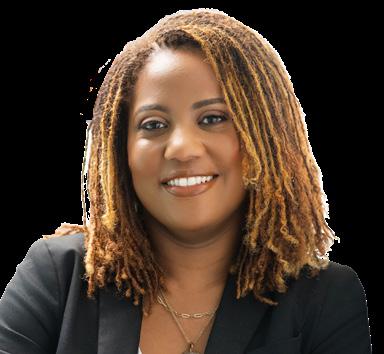
Caitlin Swain, Esq. CO-FOUNDER AND EXECUTIVE DIRECTOR
Ashley Marshall, Ph.D. CO-FOUNDER AND SENIOR DIRECTOR OF SUSTAINABILITY AND EMERGENCE
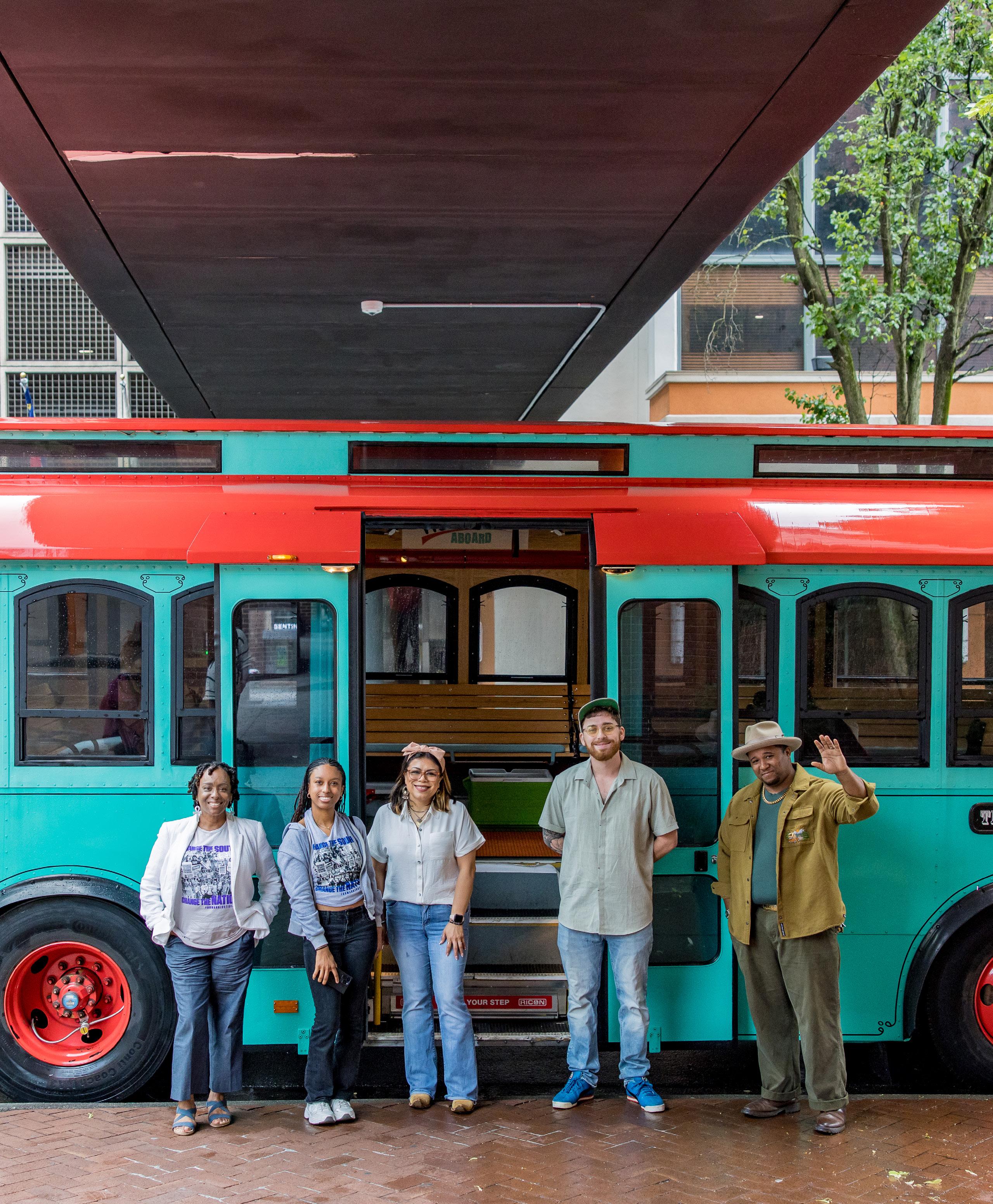

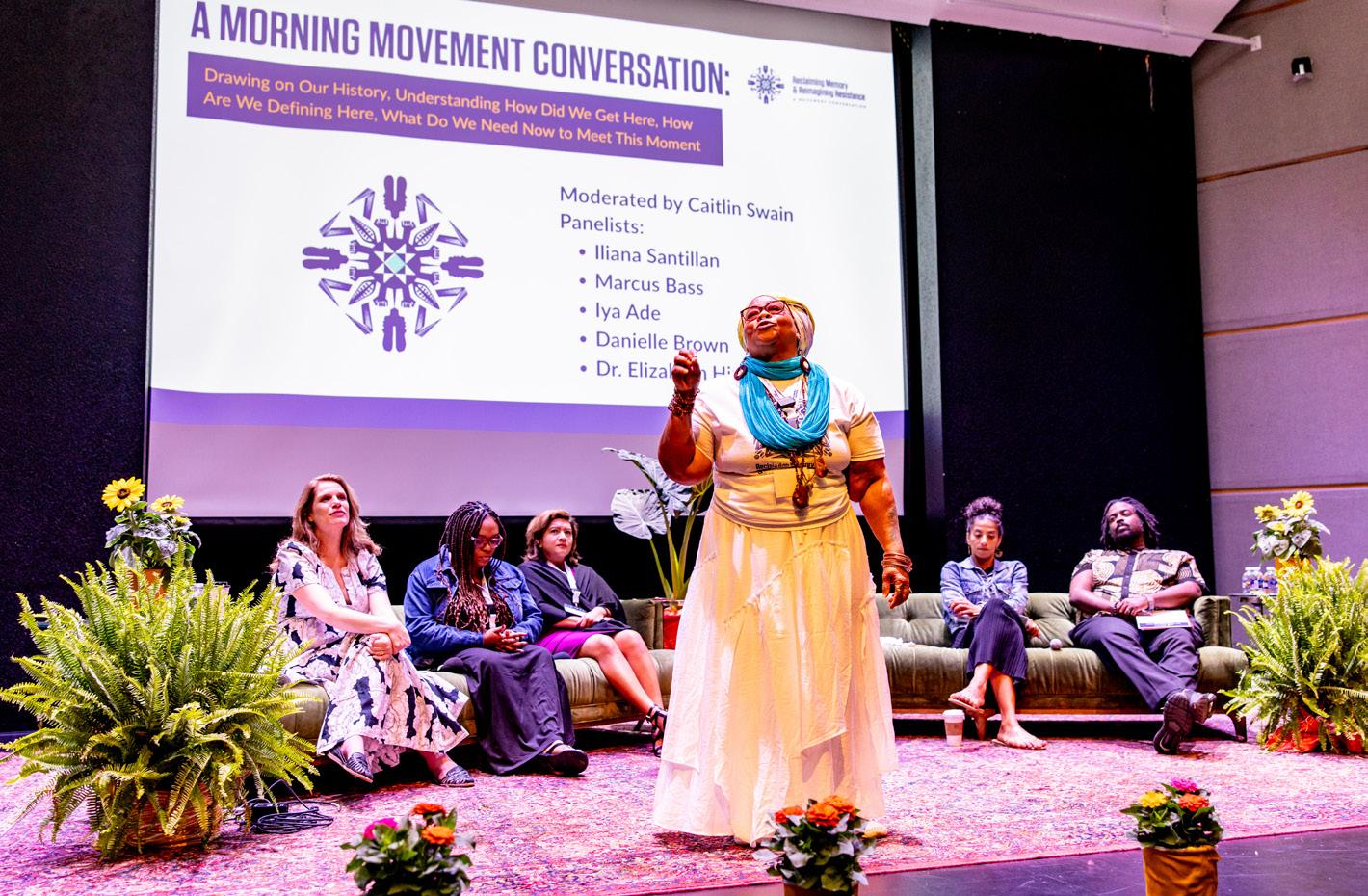
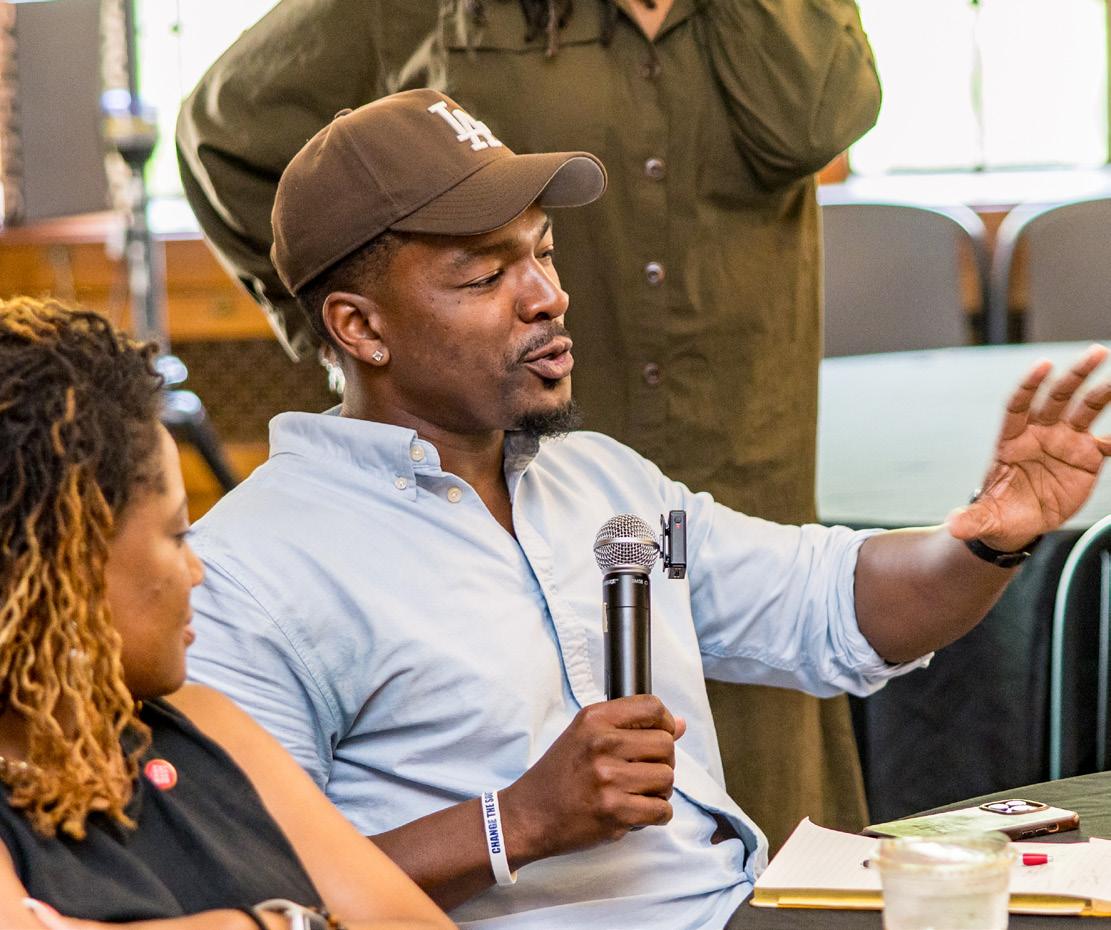
The Reimagining Symposium: Reclaiming Memory & Reimagining Resistance, held in June of 2025, was a direct response to what organizers, advocates, and legal partners identified as missing: time for reflection, collective learning, and strategic alignment beyond the constant pressures of campaigns and crises.
Held in Winston-Salem, North Carolina, a city shaped by labor organizing, racial justice struggle, and enduring traditions of resistance, the Symposium was designed as both a gathering and a grounding. The Symposium rooted participants in historical memory, strengthened shared political frameworks, and cultivated the relationships necessary for durable, coordinated action across the South and beyond.
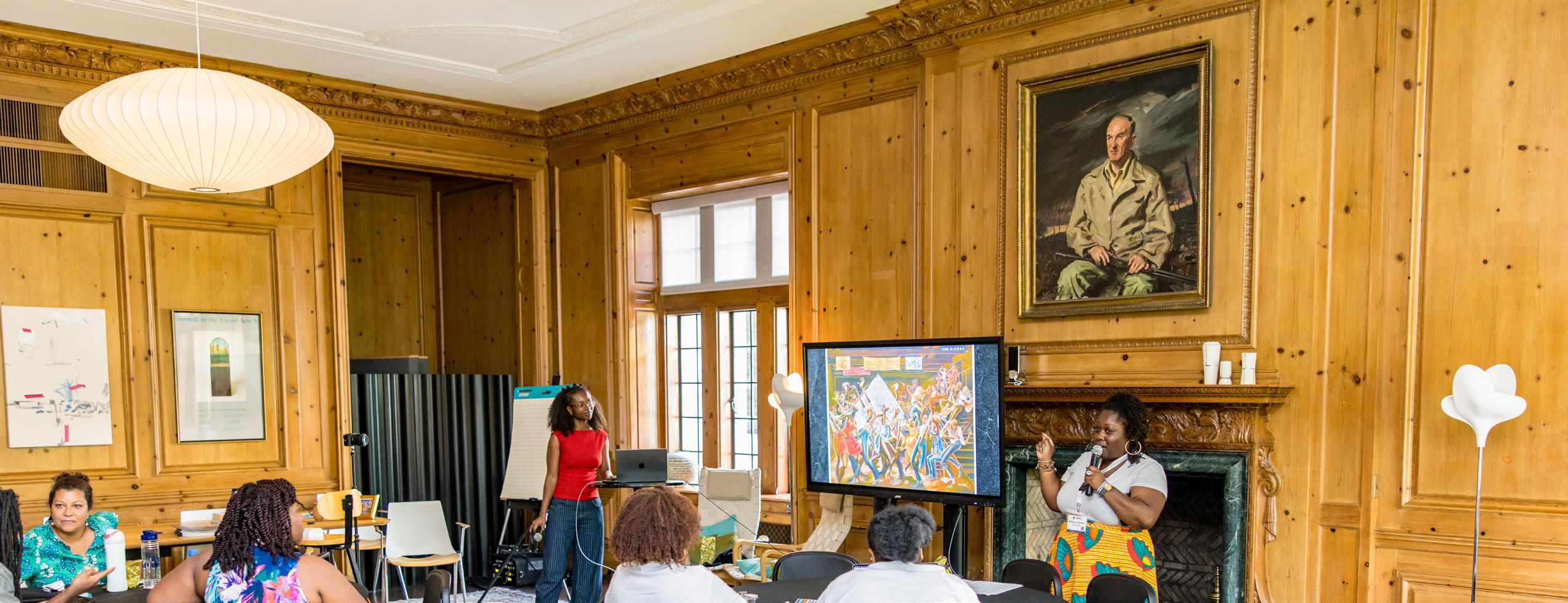
The three-day gathering included a trolley tour of Winston-Salem’s historically Black neighborhoods and spaces, a session for the Louder Than Words Movement Lawyering cohort, action labs, curated co-learning spaces and a sneak preview of Love Songs from
the Liberation Wars, an original opera composed by singer/songwriter Steve Jones and directed by labor activist and cultural worker, Elise Bryant.
At its core, the Symposium was grounded in the belief that memory is a strategy. By reclaiming the stories and lessons of resistance that have shaped our movements, participants were better equipped to imagine and build what comes next. The convening prioritized dialogue, curiosity, and cross-movement learning instead of working toward prescriptive solutions; recognizing that sustainable change requires both intellectual rigor and human connection.
For social movement partners, the gathering provided a rare opportunity to step out of day-to-day crisis response and into collective reflection. It strengthened relationships across the organizing system, generations, and geographies; surfaced shared challenges and emerging opportunities; and reinforced a sense of shared purpose at a time when fragmentation often feels inevitable.
By hosting the Symposium in the
South and centering Southern leadership and experience, Forward Justice reaffirmed its commitment to the region as a critical site of resistance, innovation, and possibility. Cultivating this space of reimagining was not a one-time event. It was a contribution to a broader ecosystem of movement infrastructure rooted in trust, strategy, and long-term vision.
The Reimagining Symposium marked the beginning of a deeper phase of Forward Justice’s movement-building work. Insights, relationships,
and questions generated through the convening are already shaping future programming, strategic partnerships, and cross-organizational collaboration. Looking ahead, Forward Justice will continue investing in spaces that foster political clarity, shared learning, and collective care so that we ensure that our movements are both responsive and resilient.

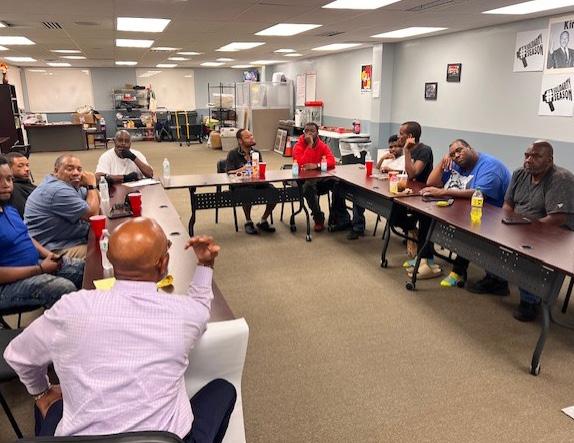
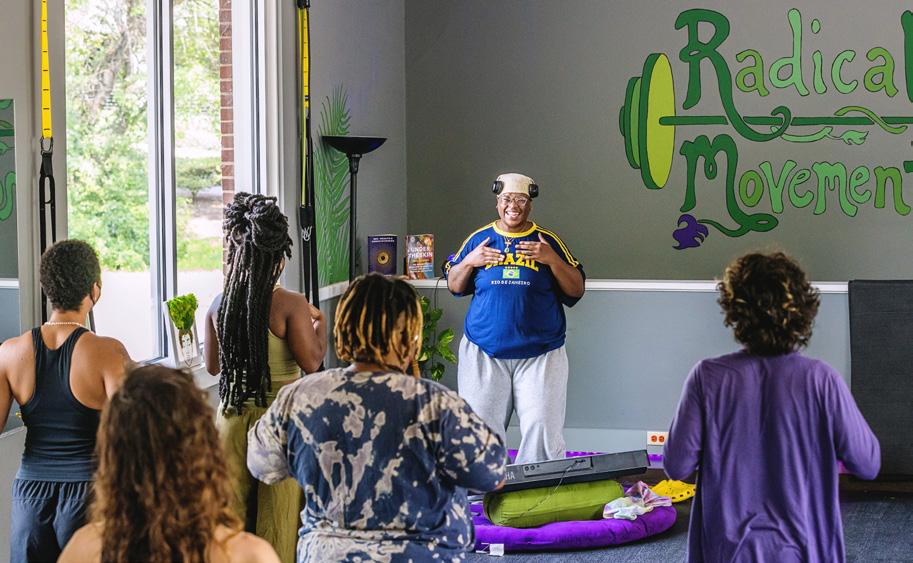
This year we launched our Transformative Justice Project in collaboration with SpiritHouse South, Inc. This body of work prioritizes caring and healing for communities disproportionately impacted by initially COVID-19 and other structural harms; with a focus on culturally rooted, interdisciplinary support that strengthens community wellbeing. This year we hosted unique opportunities to gather, learn, reflect, heal, and plan.
Events and activations included:
Our Mirror Dinner series, where community members can explore what it looks like to reflect positive and empathic masculinity in a safe space for Black Men
A farm tour with Urban Community AgriNomics (UCAN), to enjoy the Beauty of Catawba Trail Farm, explore land, learn and get involved with current UCAN projects
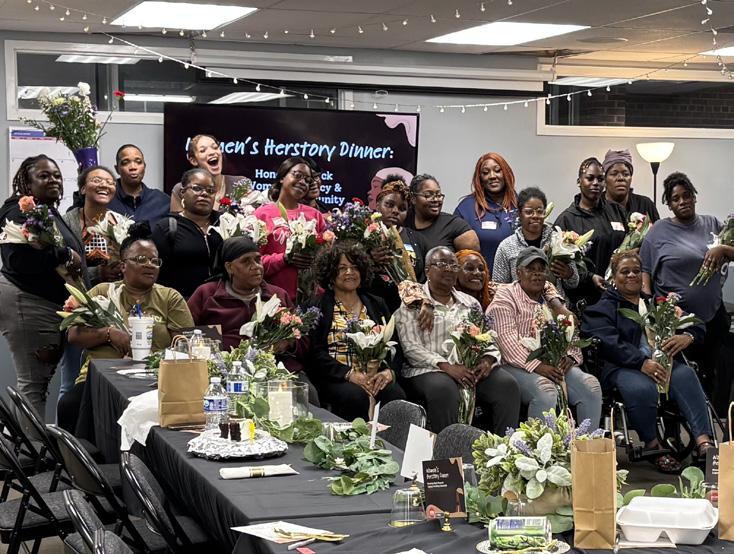
A Women’s Herstory Dinner honoring Black women’s legacy feeding and honoring Black women members of the Union for Southern Service Workers in Durham, NC
A series of free workshops on mental health for the Black community that provided a safe space to discuss and explore grief and stress, healing generational trauma, unlocking your own genius and more Civic Engagement Game Night where our team created several original games to teach about Durham history, the importance of elections, and the role of our elected officials in our community

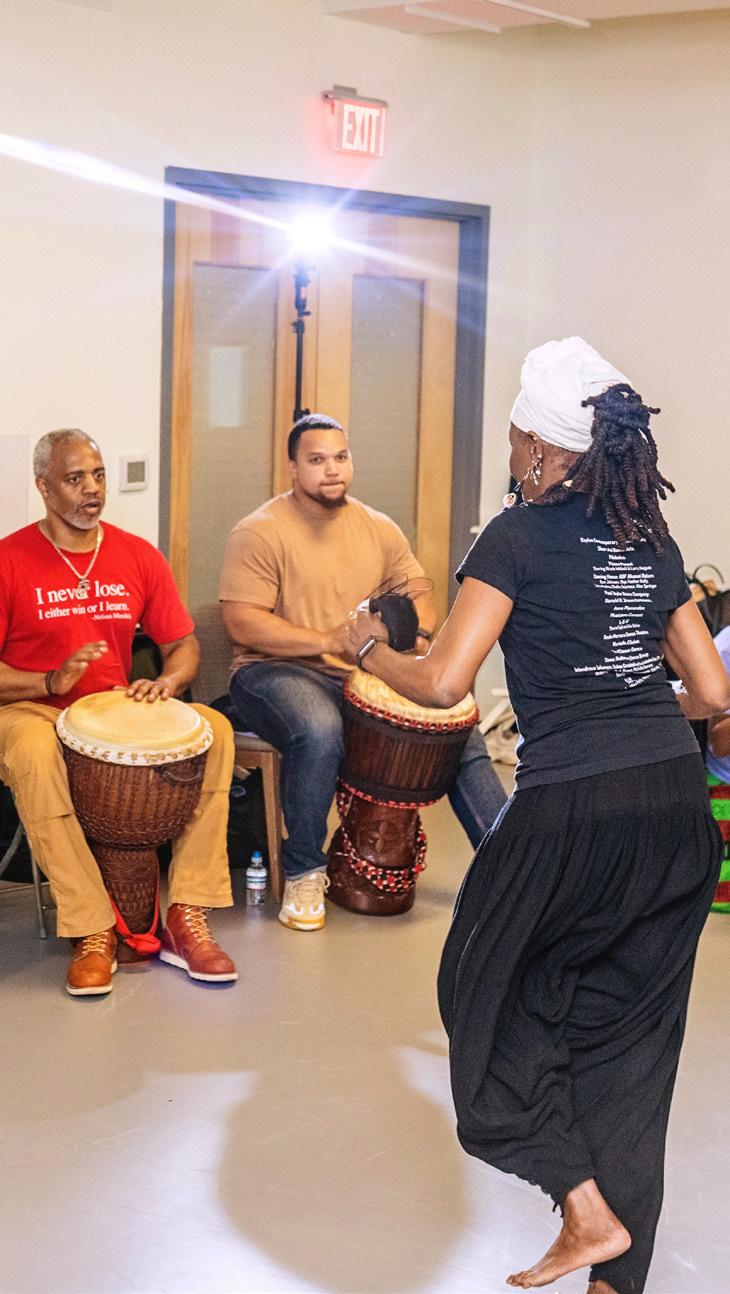

We also held ‘For the Culture Week’ in Durham, when we offered a full week of community events, activities and resources that were free and open to all including a no-cost Business Crawl with free offerings, a Farm to Fork community mixer, a Harm Free Zone Skill share dedicated to exploring what it means to be in community, and a wellness day with free classes, holistic wellness offerings and activities for children.






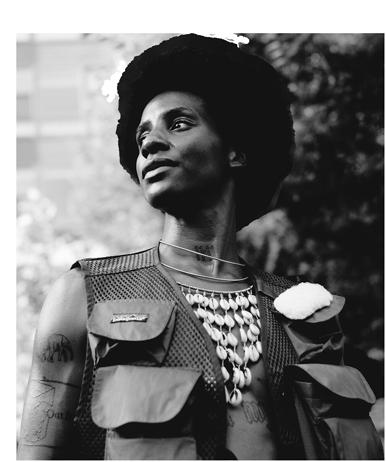
We closed the year with Kwanzaa programming in Durham that centered on creativity, inspiration, purpose, and collective action. We held a vision board making session, provided free in-studio family photo sessions, coordinated a community coat drive and partnered with the city of Durham for their 30th annual Kwanzaa Celebration.

Policies and practices often have origins tied to the stories and narratives we hear and share about each other, our systems, and our values. To truly catalyze change, we challenge and disrupt harmful narratives, while centering the voices and experiences of those most directly impacted by injustice and oppression. Our narrative change work continued this year with the production of the third edition of the Forward Star Journal, which features an interview with Dontae Sharpe, a conversation about the Art program at Nash Correctional and art’s impact on rehabilitation, along with a host of other updates and resources.
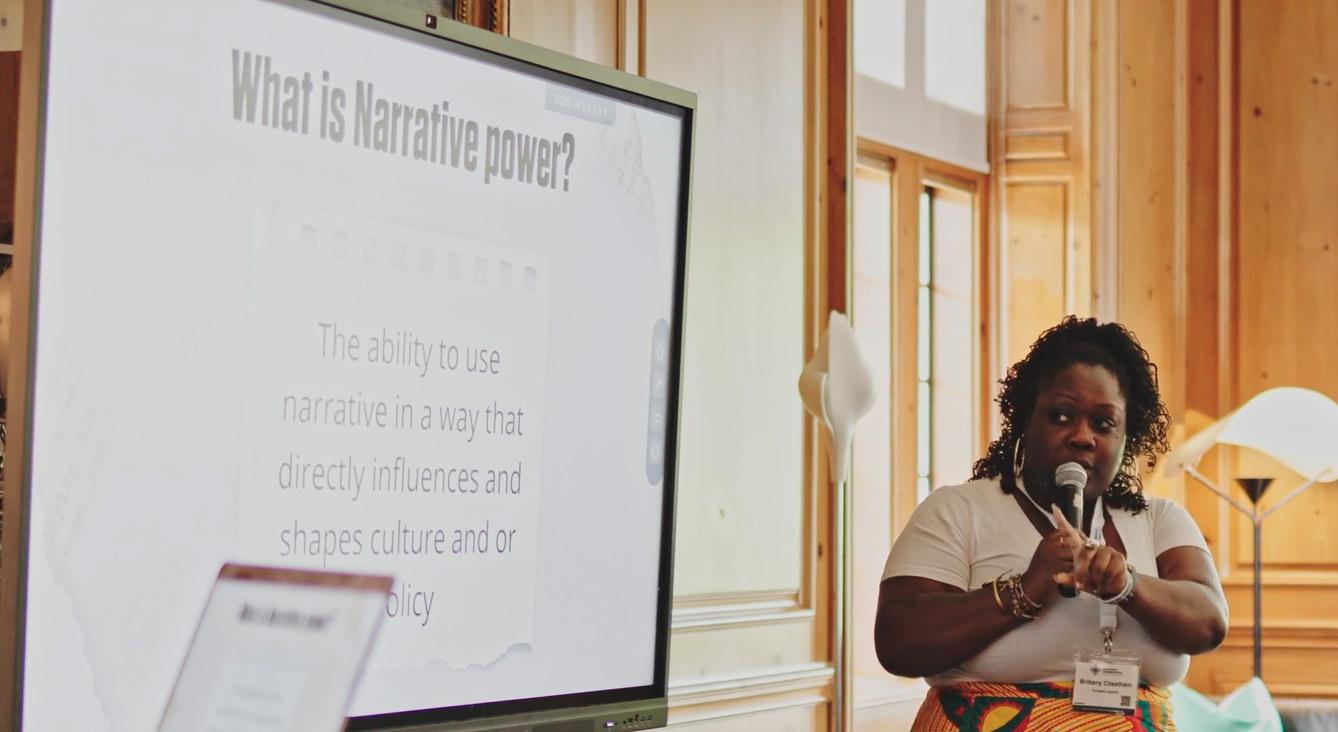
Our communications team led three trainings this year on the importance of narrative and storytelling in shifting policies, practice and culture; while exploring the role and history of art in the movement. Each presentation uplifts work at Forward Justice as case studies around the real potential for narrative change and power building across issue areas.

This year, Dontae Sharpe stepped into a new role to drive thought leadership and narrative change around the impacts of wrongful convictions, the reclamation of freedom, and the reentry journey. He has launched a new YouTube channel called ‘L.I.F.E. -- Living is For Everybody – with Dontae Sharpe’ to cultivate an informed base of community and highlight formerly incarcerated people’s leadership and experiences. On his new platform, Dontae plans to host other individuals who have been wrongfully convicted, key stakeholders, policy makers and more to discuss paths to advance racial equity, reduce mass incarceration, and promote restorative justice practices.
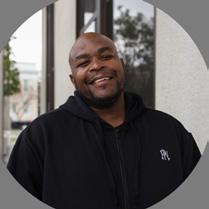
L.I.F.E. with Dontae Sharpe @LIFEwithDontaeSharpe
SUBSCRIBE




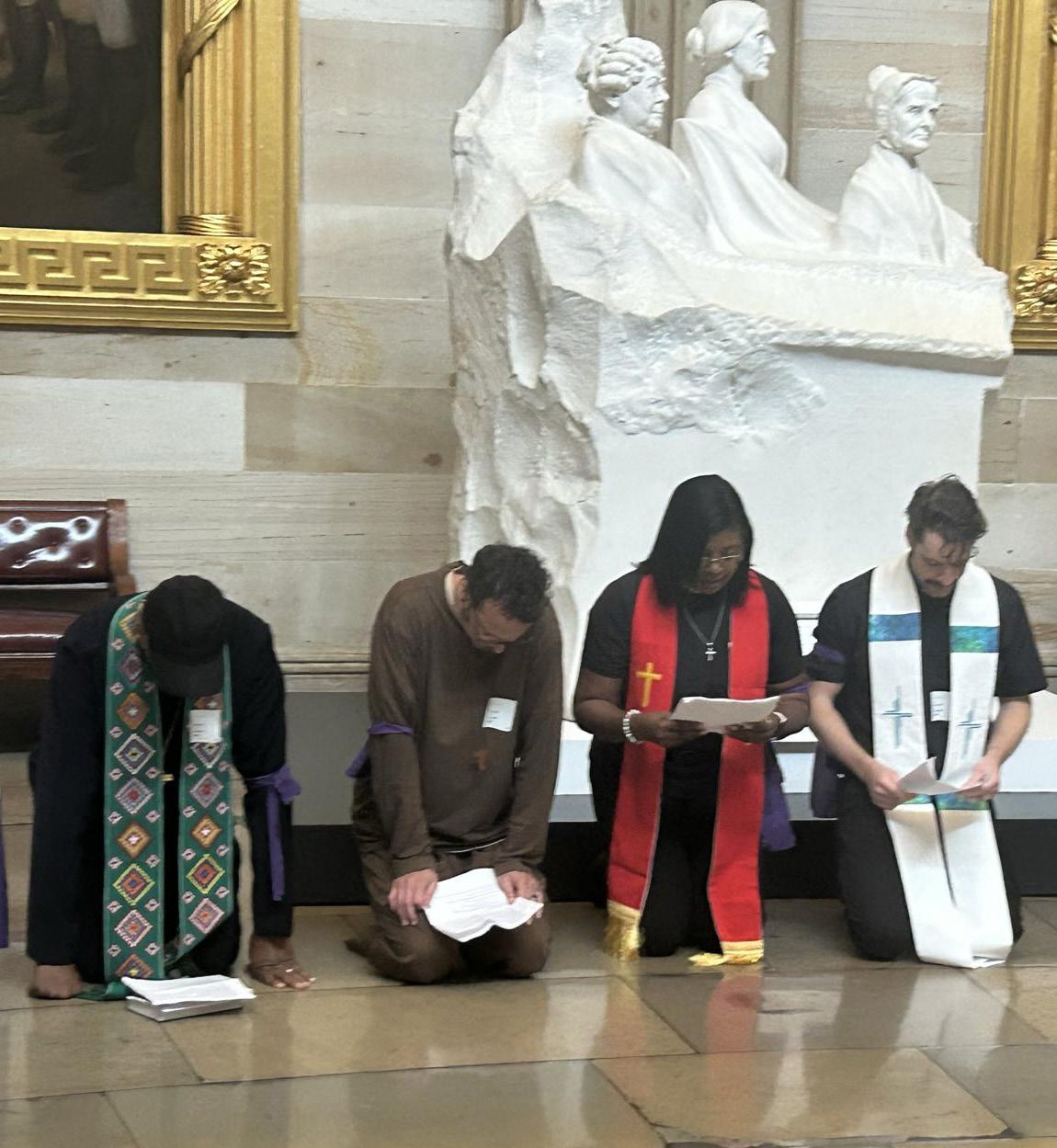
In March, Forward Justice provided legal and policy support for Rev. Dr. William Barber II and Repairers of the Breach’s first Washington D.C. action in 2025 held on Ash Wednesday. This action was a part of a series of Moral Mondays and Moral Witness Wednesdays designed to tell the truth and raise a moral message about the damaging policy choices that Congress and the Executive Branch were considering, including:
• gutting Medicaid, SNAP, and Head Start programs
• harming immigrants with mass deportations and detentions
• harming employment, wages, and labor protections.
Delegations throughout the south and across the nation held demonstrations throughout the year aimed to highlight
the impact of those policies on children, poor and low wealth workers and historically marginalized communities in this country. Forward Justice provided legal and policy support for 11 of these activations throughout the year to advocate for a more moral policy agenda.
Back home in North Carolina, Forward Justice again joined our partners for Moral Monday demonstrations across the state- opposing redistricting efforts in the state and ongoing policy violence being waged against Black, Brown and poor community members. Our ongoing advocacy with this group of partners includes preparation for next year’s Mass Gathering in Raleigh and continued work to support a collective reimagining of democracy that lifts from the bottom up and is inclusive of all.
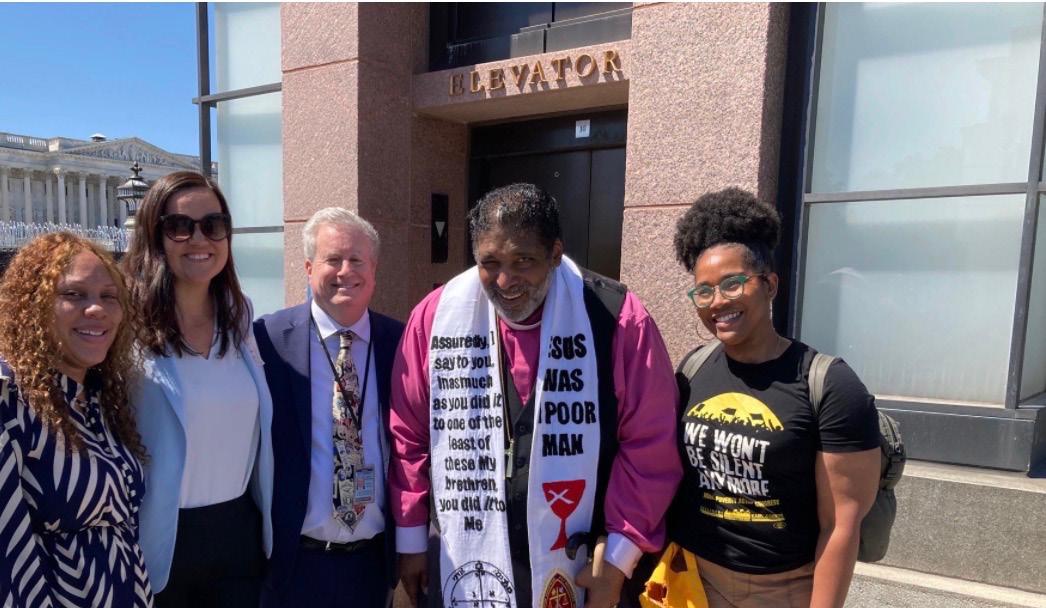


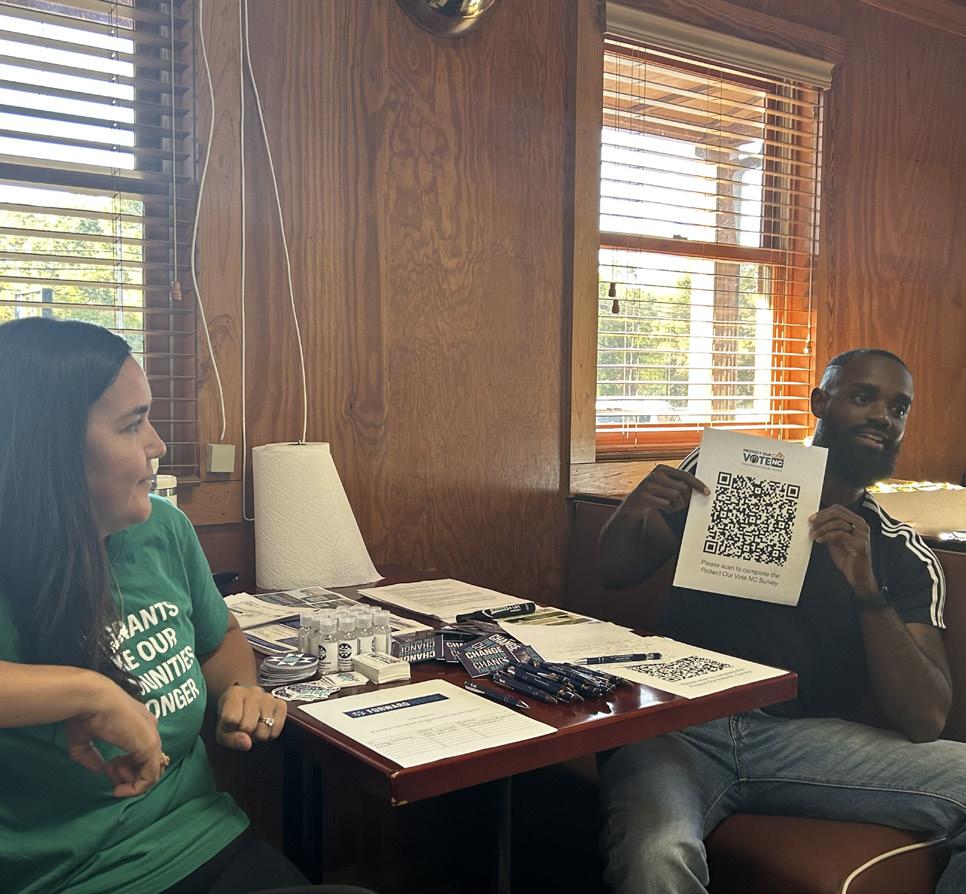
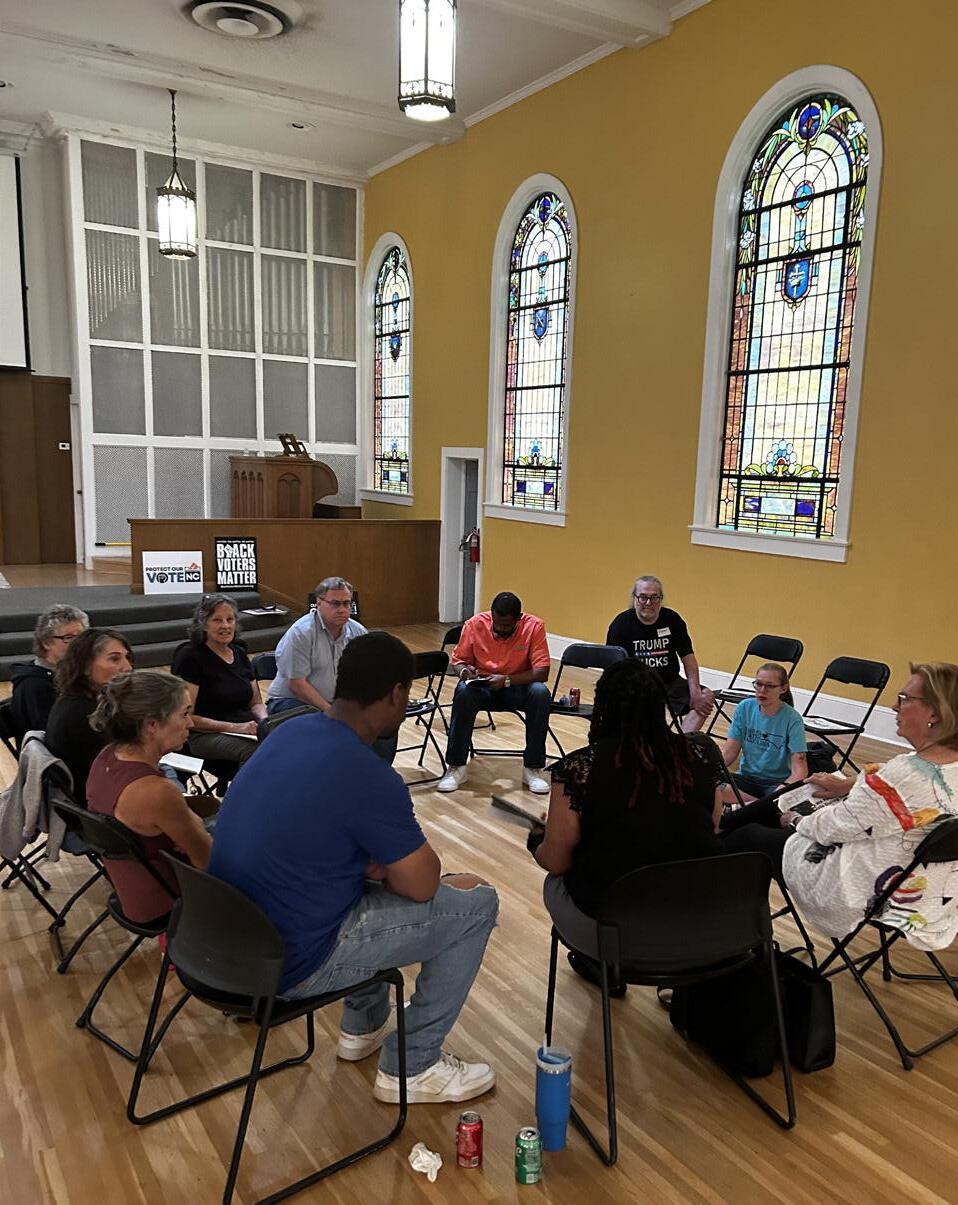
In 2025, our Protect Our Vote NC campaign focused on empowering and amplifying the voices of Black and Brown rural communities across North Carolina. In addition to running the statewide voter protection hotline during municipal elections this year, we embarked on a statewide tour to strengthen civic engagement by deepening relationships and ensuring equitable access to the ballot.
During our 2025 POV Mini Tour, we facilitated voter education and mobilization efforts centered on fair voting policies and the importance of local elections in Cabarrus, Pasquotank, and Rockingham counties. These events served as a cornerstone of our work - bringing residents together to learn, connect, and take action ahead of the 2025 municipal elections. Through this campaign, we not only provided critical information about voting rights and election processes, but also built a foundation for ongoing advocacy that reflects the power and priorities of our communities. Our team will continue to focus on rural counties across the state to ensure communities are informed and empowered ahead of the 2026 Primaries and Midterm Elections.
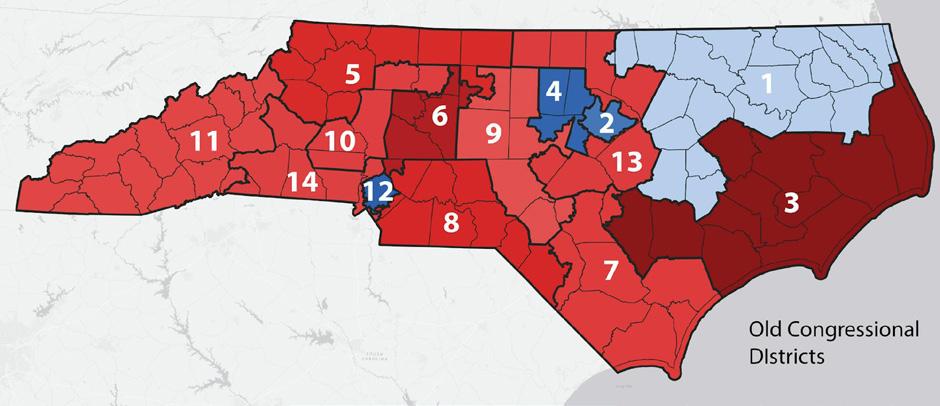
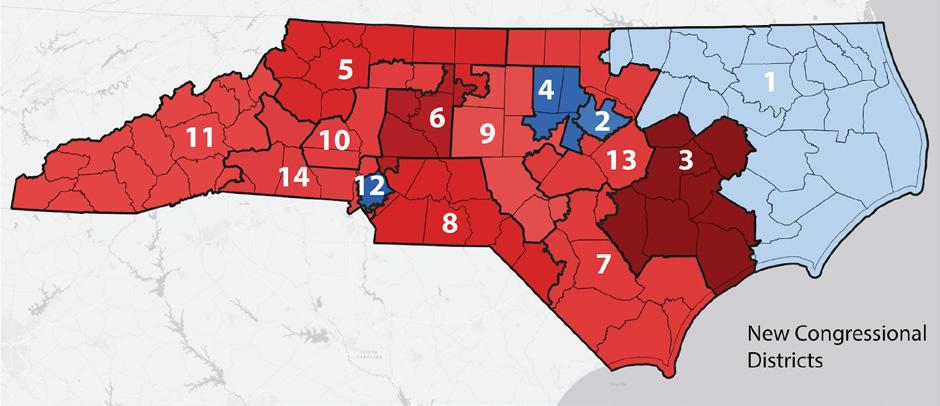
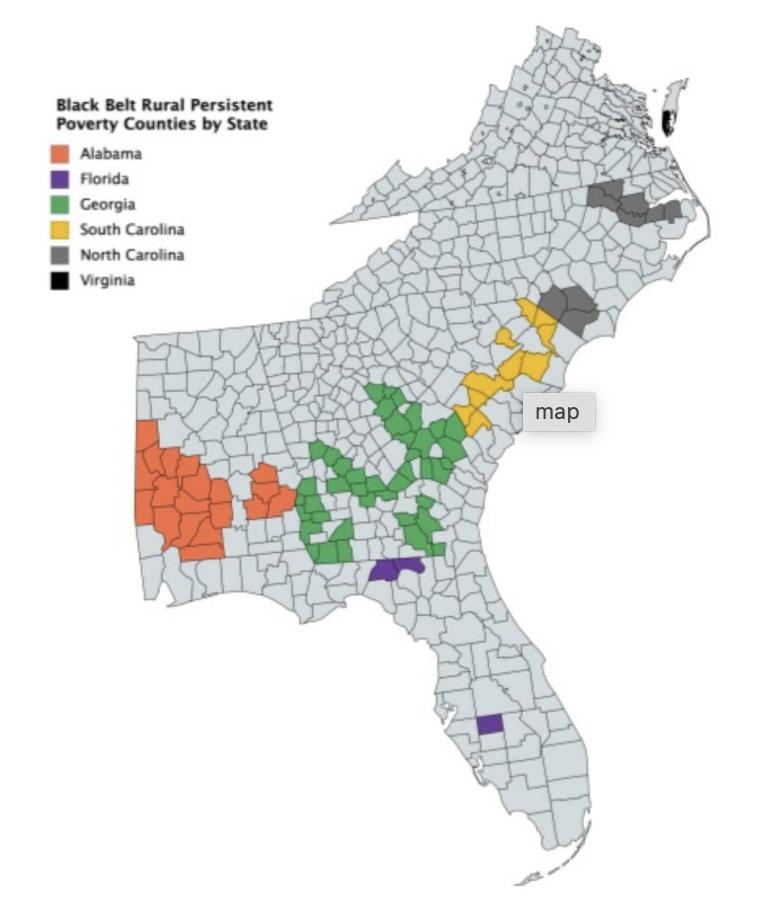
In 2025, Republican leaders of the North Carolina General Assembly released new proposed voting maps during mid-cycle redistricting designed to ensure that the GOP can maintain its control over the U.S. Congress in the 2026 midterm elections. They intended to gain this additional seat by splitting the Black population of Eastern North Carolina (the “Black Belt”) between Congressional District 1 and Congressional District 3 so that Black voters in both districts would be unable to elect a candidate of their choice.
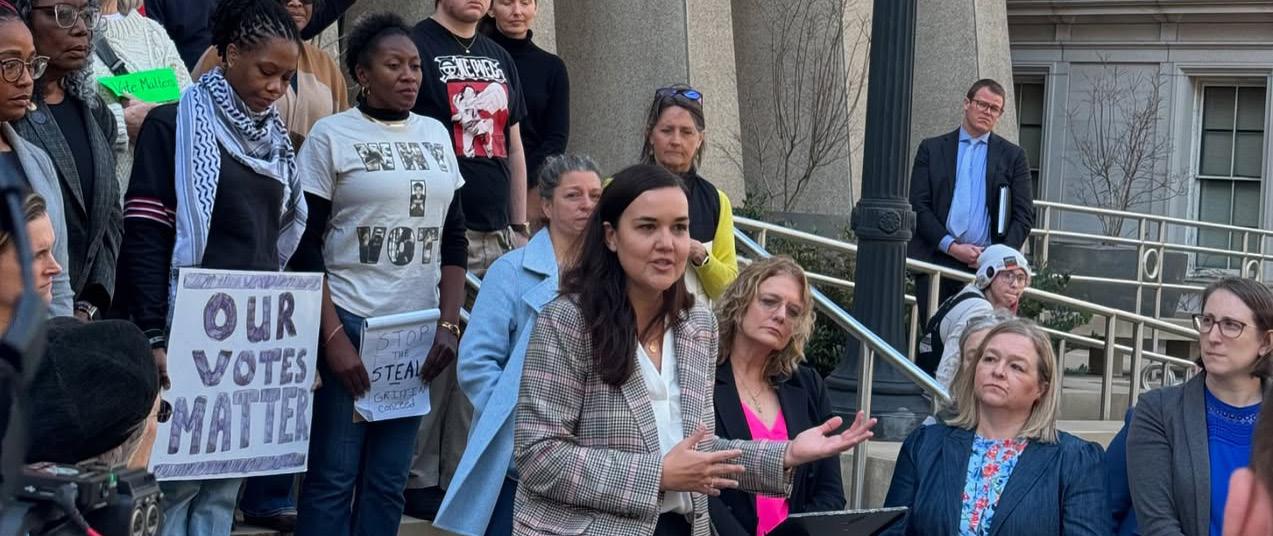
Attorneys from Forward Justice partnered with the Southern Poverty Law Center to file an amicus brief on behalf of Repairers of the Breach, North Carolina Black Alliance, Black Voters Matter, and several North Carolina voters and community organizers, urging the courts to reject the new maps and their purposeful blow to the state’s Historic Black Belt region
A Federal Court hearing was held in November in Winston-Salem where a panel of three Judges voted to uphold the maps for the 2026 elections. We are prepared to continue to stand with our clients and movement partners in this fight against this continuation of the state’s long record of voter suppression, and deliberate strategy to sideline Black, brown, rural, and poor voters and weaken their collective voice.
Redistricting shifts congressional boundaries in North Carolina.
Notable changes appear in disticts one and three following the 2025 redistricting process.
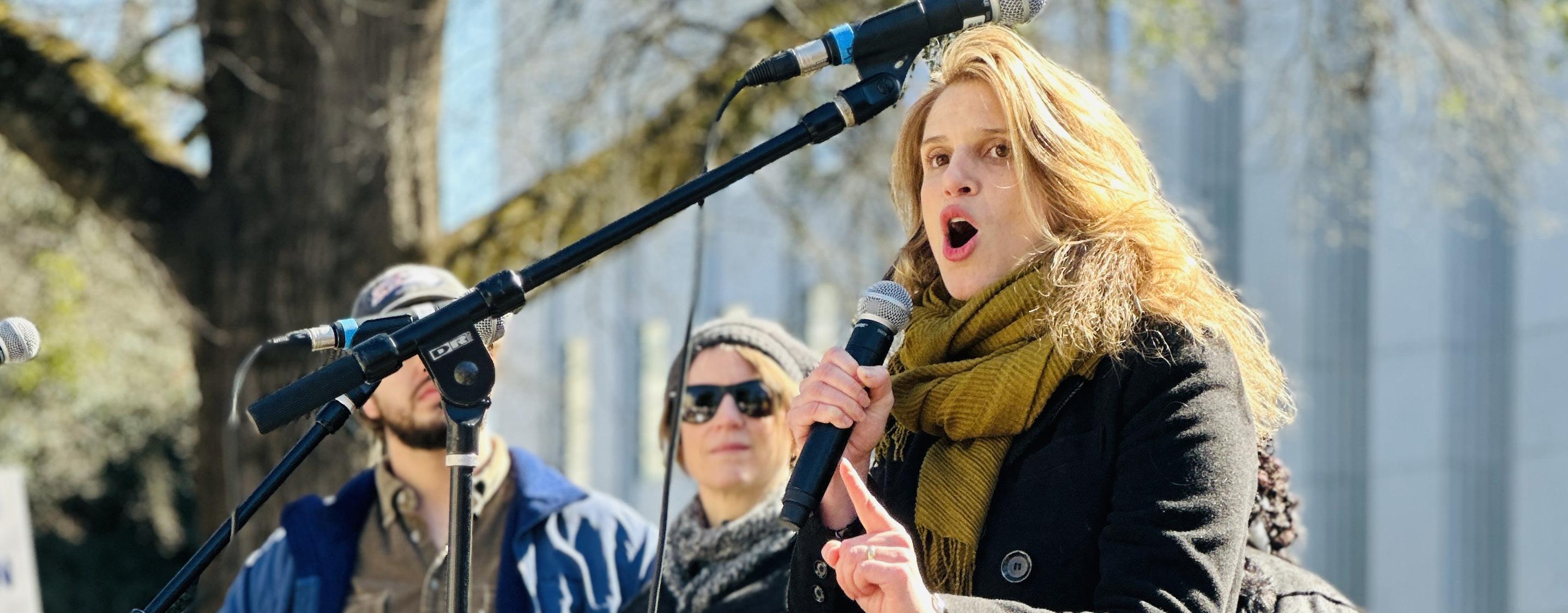
The North Carolina Supreme court race was one of the most watched elections in the country, and one of the last in the country to be certified. Justice Allison Riggs, the Democrat candidate and incumbent, had her 734-vote lead in the November election confirmed in two recounts- but Judge Jefferson Griffin, the Republican candidate, brought both state and federal court challenges to the outcome of the race. In an attempt to win his election, he challenged the validity of more than 60,000 votes cast by North Carolinians.
In February, we filed an amicus brief on behalf of organizational and individual clients impacted by this attempt to throw out thousands of legally cast votes. The organizations we represented were NC NAACP, NC Black Alliance, Common Cause Education Fund, Democracy North Carolina, El Pueblo, N.C. Asian Americans Together, and the NC Poor People’s Campaign. Through the brief as well as our organizing and communications work, we told the story
of how this attempt to change the rules of an election after it had concluded was not only unconstitutional but also something that would undermine voters’ confidence in the North Carolina electoral system for decades to come.
In close collaboration with partners across the state, our legal, organizing, and communications efforts helped catalyze statewide protests, drawing thousands of North Carolinians into the streets to reject an attempt to overturn a legitimate election outcome. What we saw was rare and powerful, and a broad multiracial coalition of voters, advocates, and community organizations unified around a clear demand: uphold the principle that voters choose their representatives, not that representatives choose their voters. Ultimately, in May 2025, after our intervention in state-court proceedings, a federal judge in a related proceeding ordered the election be certified, and Judge Griffin conceded the election to Justice Riggs.
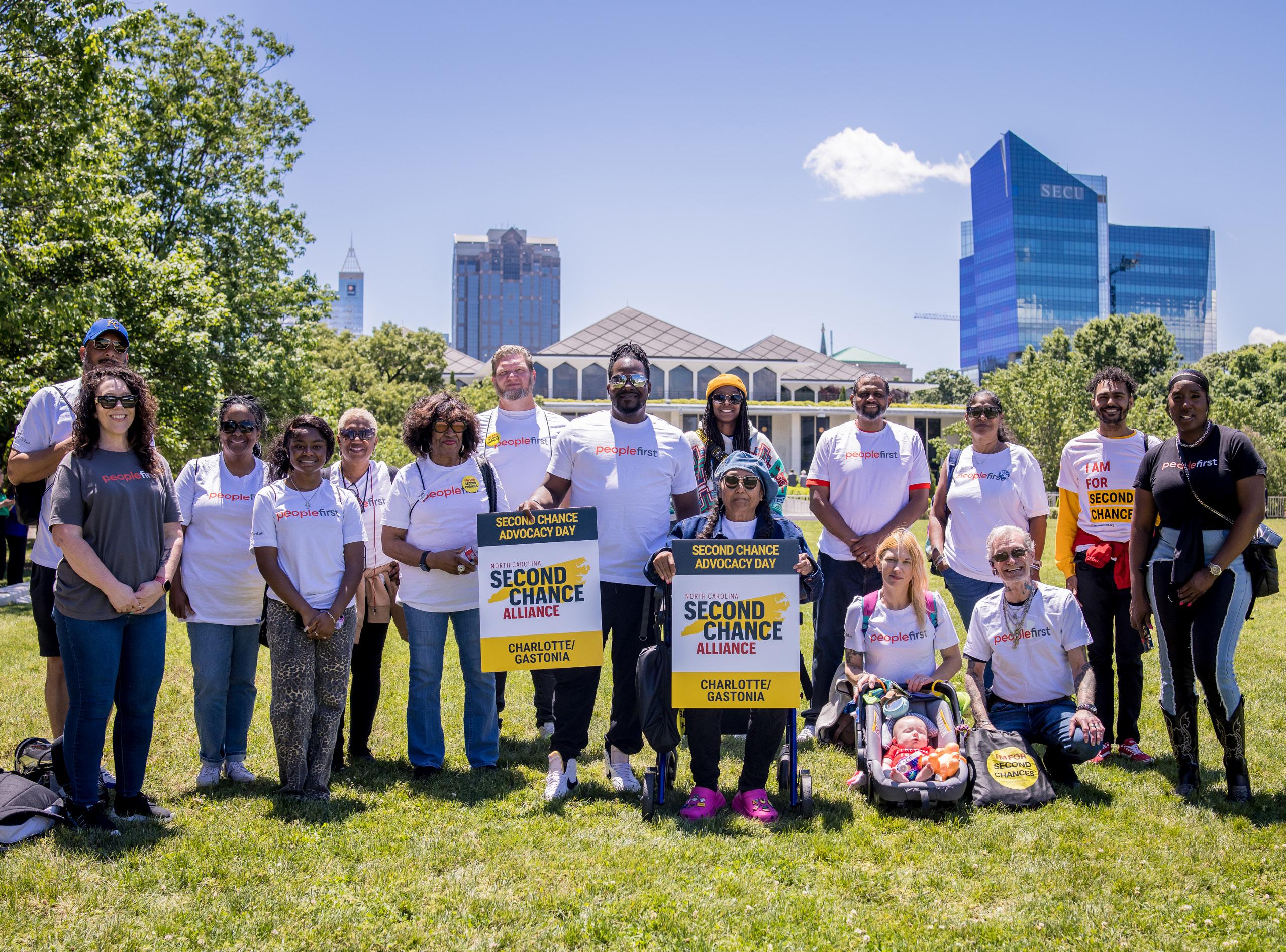



On May 6, 2025, we organized and participated in Second Chance Advocacy day where members of the NC Second Chance Alliance gathered in Raleigh, NC to advocate for policies that enhance opportunities for second chances for people with records. Over 250 people with criminal records from 6 different areas of the state came to the General Assembly to advocate for second chances in their authentic voices. The event was well attended and demonstrated strong momentum for second chance policies. We will continue to build on this engagement and advocate for policies and provide resources that support people returning from the criminal legal system.
During this year's municipal elections, we again hosted the Second Chance Voter hotline to serve as a resource for people with criminal records who have questions about their right to vote in North Carolina. With the ongoing confusion and legal changes related to voting with a criminal record in NC, this resource remains critical.
Additionally, we partnered with No Votes Barred, a national organization combating misinformation and helping people with criminal records understand their voting rights, to provide statespecific guidance and help ensure that North Carolina’s complex rules were clearly and correctly reflected in their online “voting quiz”. North Carolina was officially added to their website this year, including links to state-specific resources such as our Second Chance Voter hotline.
We developed a plain language handout designed to help individuals understand what a certificate of relief is and how to apply for one. We intend for this resource to expand access to relief from collateral consequences for people who may not be eligible for an expunction. We’re looking forward to broadening outreach and education around this tool in 2026.
$12K + in relief from court fines and fees for community members across 415 Day Campaign :
Forward Justice led a coalition of organizations across the state to uplift April 15th as ‘415 Day’ to raise awareness of the harmful impact of court fines and fees while expanding access to relief through North Carolina’s AOC-CR-415 Motion for Relief. Through community outreach and partnerships with legal advocates, we engaged directly with community members in Buncombe, Guilford, and Wake counties, supporting individuals with accessing court records, completing and filing motions, and providing representation at court hearings.
The Campaign aims to file more than 415 of these motions this year on behalf of indigent community members across the state through community outreach efforts, ensuring that inability to pay does not continue to punish people living in poverty. At the 6-month mark in the campaign, coalition partners have collectively gotten more than $12k in relief from court fines and fees for community members across NC, helping individuals move forward without the burden of unaffordable court debt.
In addition to direct services, Forward Justice worked to create system-level change around ability to pay determinations in North Carolina courts. We participated in an Ability to Pay Sprint, a national initiative focused on improving how courts respond to people’s financial circumstances. This work resulted in the drafting of a potential ability to pay policy framework that could be adopted by local jurisdictions to promote more consistent and fair practices.
We were subsequently invited to attend a research and evaluation convening in Houston Texas hosted by Results for America in partnership with the Fines and Fees Justice Center. This gathered court actors, researchers, advocates, and legal service providers from across the country to discuss best practices for implementing ability to pay assessments and ensuring they are applied consistently. Forward Justice continues to push for policies and practices that ensure ability to pay is considered in every courtroom, regardless of jurisdiction, judge or charge so that relief doesn’t depend on where a case is heard.


Town Hall:
Legal Debt Fines & Fees: In March, Forward Justice co-hosted a Town Hall: Legal Debt Fines & Fees. The event included legislative advocacy updates, insights into the historical context behind criminal legal debt and how it impacts individuals and communities today, court watch training and a panel discussion on critical issues such as court fees, fair process assessments, driver’s license revocation, and other financial penalties in North Carolina. The event was co-sponsored by the International Civil Rights Center & Museum and host partners included The Almond Connection, NC Second Chance Alliance, and Duke Law School’s Criminal Defense Clinic.
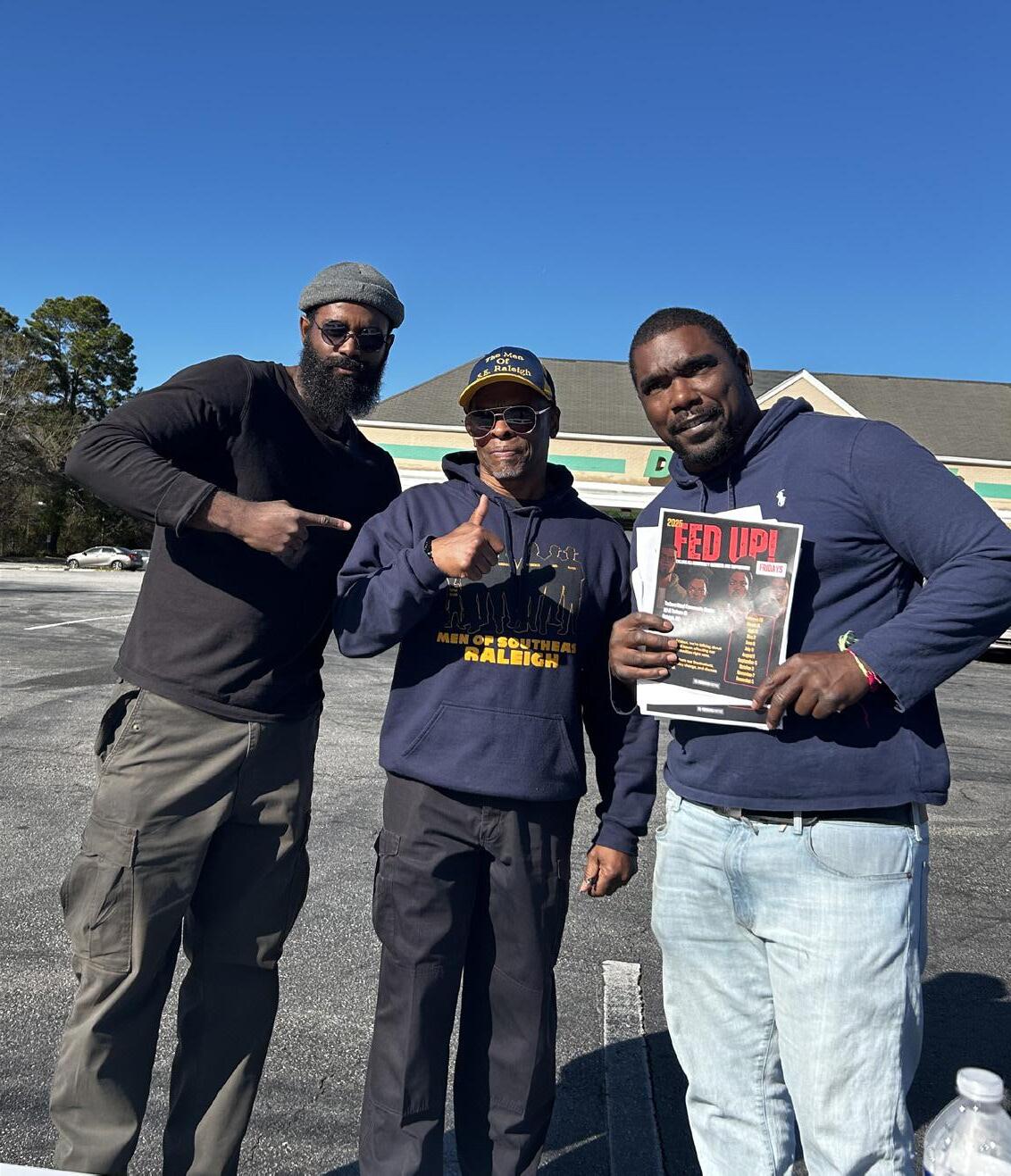
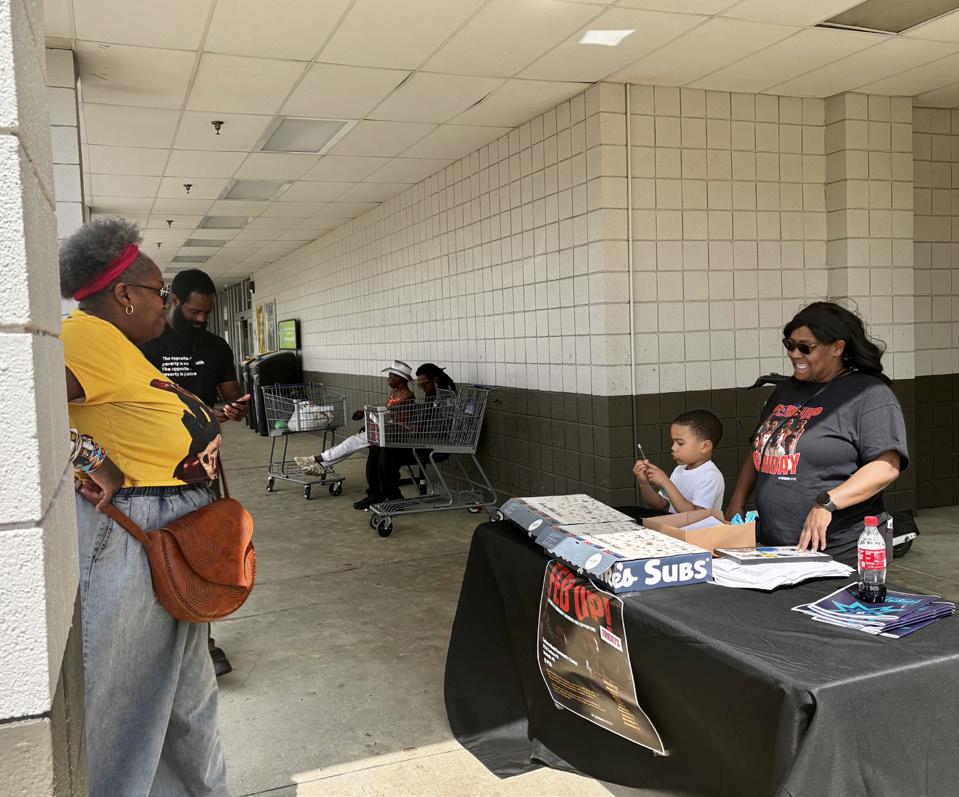
Since 2023, Forward Justice has organized Fed Up Friday, a monthly community-based program in Raleigh, NC, focused on police accountability. The program convenes on the first Friday of each month and currently includes approximately 30 active members, organized into three committees: Media, Research, and Canvassing. Through these monthly meetings and committee structures, members are helping develop an organizing blueprint in support of the community-driven policy, drafted by Forward Justice to eliminate regulatory stops in Raleigh.
In 2025, the program produced a “Know Your Rights During Police Stops” guide to help residents understand their rights during law enforcement encounters and distributed roughly 500 copies through canvassing and community tabling events across Southeast and East Raleigh. Looking ahead to next year, our goal is to finalize crafting the policy in partnership with community members and present it to the City Manager, Police Chief, and Sheriff’s Office for consideration.

This year also marked a significant expansion of our website NC Copwatch with the addition of ‘Likelihood of Stop’ graphs, a new data visualization that allows site visitors to see how much more likely Black drivers are to be stopped in a traffic stop compared to White drivers by a specific law enforcement agency in a particular
city or county. These new visuals along with the other data visualizations on the site put racial disparities in policing into clear perspective and make the data easier for community members to understand and discuss, resulting in a more accessible tool that supports community education, organizing, and policy advocacy.
Likelihood of Stop by Raleigh Police Department since 2002

In the summer of 2022, Jackson faced a catastrophic water crisis, resulting in a complete loss of water pressure. The City, State and Federal Government declared a state of emergency. The Biden Administration filed suit against the City and allocated over $500 million to fix the system.
The parties agreed to an Interim Stipulated Order (ISO) that strips power away from the city and gives unilateral control to Ted Henifin, the Interim Third Party Manager (ITPM), who oversees the Jackson water system.
Since the lawsuit and ISO, Forward Justice and its partners have fiercely advocated for its clients by preparing and submitting a community statement, filing an Emergency Petition with the EPA, Petitioning for intervenor status, and fighting for transparency.
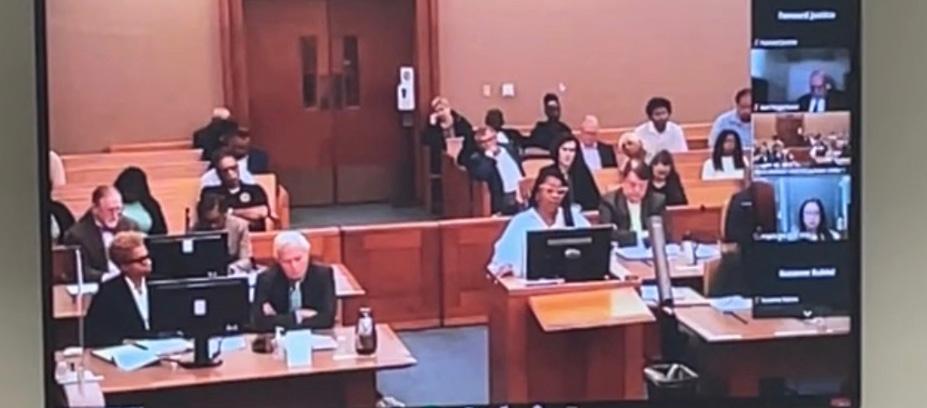
In 2024, our clients successfully gained intervenor status in the federal lawsuit. Since then, we've continued to advocate for our clients in discussions with the EPA, State of Mississippi, and the City of Jackson. We have fought to be involved in the final consent decree process and have attended every hearing.
In March 2025, the ITPM unilaterally proposed a second water rate increase. In response, our team filed written opposition that advocates for our clients and their constituents. Our team appeared in Court to advocate for our clients and we’ve published a letter that outlines, to the public, the issues with the unilateral water rate
increase. Our team is the only party, on record, to push back against the water rates. As of December 19, 2025, the Court has not granted the water rate increase.
In 2025, our team also filed a Motion to Modify the ISO because the Order is outdated and significantly limits the power of the people. If our team is successful, this change will give power back to the Citizens of Jackson. The Motion to Modify the ISO is scheduled for a hearing on January 19, 2026.

BUILDING A BASE OF DIRECTLY-IMPACTED LEADERSHIP
Since our inception, Forward Justice has committed to the leadership development of people negatively impacted by the criminal justice system. This year, we continued to build collective people power and connect new members to the more extensive North Carolina Second Chance Alliance network, hosting successful organizer training sessions in Greensboro, Durham, and Lumberton. We renewed our partnership with the International Civil Rights Museum and hosted another training there for people from the Greensboro and Forsyth areas. Over 60 leaders attended the training, which featured a fireside chat with Mr. Dorsey Nunn, author and activist.
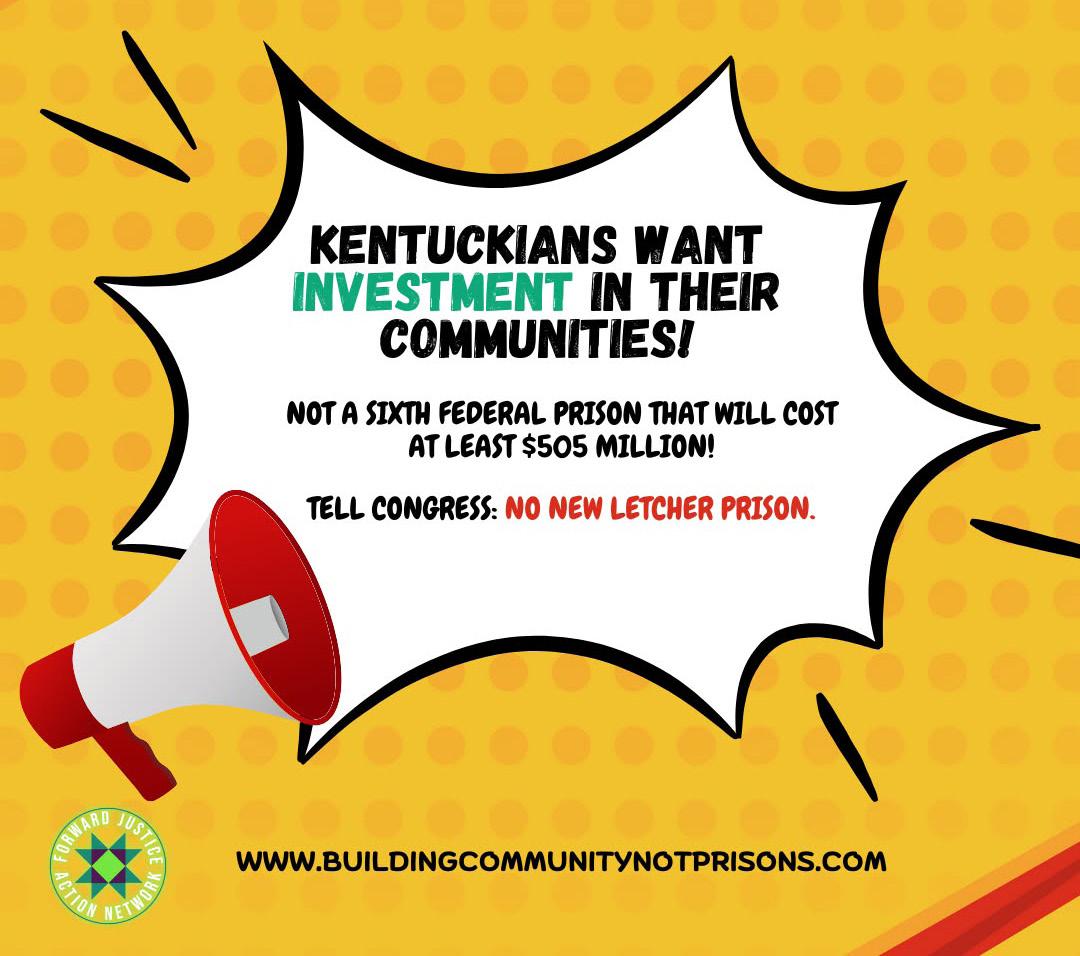
Our sister organization, Forward Justice Action Network (FJAN), continued their involvement with the No New Letcher Prison campaign. It is a nonpartisan national effort of the ‘Building Community Not Prisons’ coalition to stop the construction of a new federal prison in Letcher County, Kentucky. The prison would be constructed on top of a former strip coal mine putting at risk the health of those incarcerated, their family members who visit, as well as correctional staff. FJAN Director of Special Projects Attica Scott served on the Media Outreach team for the Appalachian Rekindling Project's community event where they announced plans to reintroduce bison on land they acquired that's located in the heart of the proposed prison location.

As we prepare to enter 2026 and Forward Justice approaches its tenth year, the organization is engaged in a comprehensive strategic planning process to ensure that our growth, impact, and internal systems are aligned with the needs and demands of this moment. This process is designed to strengthen Forward Justice’s role as a strategy center advancing social movement lawyering, grassroots organizing, political education, and long-term systems change; integrating legal advocacy with community powerbuilding, narrative shift, and ecosystemwide collaboration. Through this work, Forward Justice is deepening its capacity to not only respond to harm and injustice, but to help reshape the structures, strategies, and relationships necessary for a more just and equitable future.
Guided by reflection, data, and deep listening, the strategic planning process brings together staff, board members, movement partners, and trusted advisors to assess what has worked, name where we are stretched, and clarify where Forward Justice can have the greatest impact in the years ahead. It creates intentional space to
examine our internal culture, leadership structure, financial sustainability, and programmatic priorities while staying rooted in our values and long-term vision for justice in North Carolina and the South.
For Forward Justice, this process strengthens clarity, focus, and organizational health, ensuring that our team is supported, our systems are resilient, and our work is sustainable. For partners, it offers greater alignment, transparency, and coordination across shared campaigns and strategies. For the broader ecosystem, it reinforces Forward Justice’s role as a connector and thought partner capable of holding complexity, responding to emerging threats, and supporting long-term power building beyond moments of crisis.
This strategic planning process is ultimately about readiness: positioning Forward Justice to meet the challenges of this political moment while building the infrastructure, relationships, and leadership needed to advance collective liberation for the decade to come.

North Carolina continues to be a critically important state and testing ground for shaping our nation’s policy and democracy in 2026 and beyond. Our state regularly sees election outcomes with razor thin margins and the policies that are enacted here are often replicated in other parts of the county. As we continue to witness the attempted erosion of our rights and freedoms, we know that we must hold the line:
• Our team will once again take the lead on responding to all reports of voter intimidation that are reported to the state’s election protection hotline (888-OUR-VOTE), serving as an ongoing, trusted resource to help ensure voters have the information and protections that they need at the polls during a pivotal election season.
• Our legal team will deploy strategic policy advocacy and litigation when appropriate to prevent the further consolidation and entrenchment of political power and the expense of our people.
• The Protect Our Vote NC tour will continue in rural counties across the state to ensure communities are informed and empowered ahead of the 2026 Primary and Midterm Elections.
The narrative training workshop led by our staff during the symposium affirmed both the urgency and the appetite for deeper storytelling and narrative change work across our partner network. In a moment where our histories are being rewritten and voices are being increasingly silenced, this work is not supplemental to movement building, it is essential to it.
Our communications team will continue to lead narrative and storytelling trainings that equip partners to tell critically important stories, while working alongside them to co-create a shared and coordinated narrative change strategy. Together, this work will continue to shape public understanding and influence practices and policies rooted in equity and justice.
As we approach a decade of operation and impact, this commitment to narrative power builds on the victories, voices, and stories that have already driven historic change. Through the Forward Star Journal, a revitalized website, innovative storytelling campaigns, and strategic media engagement, we are creating more space to explore, celebrate, and lift up the stories that define this movement.
These efforts will continue to shape the narrative of powerful resistance in the South, highlight the legacy of the movements born here, and share the vision of our potential to reimagine resistance in a way that catalyzes ripples of transformative change across the nation.

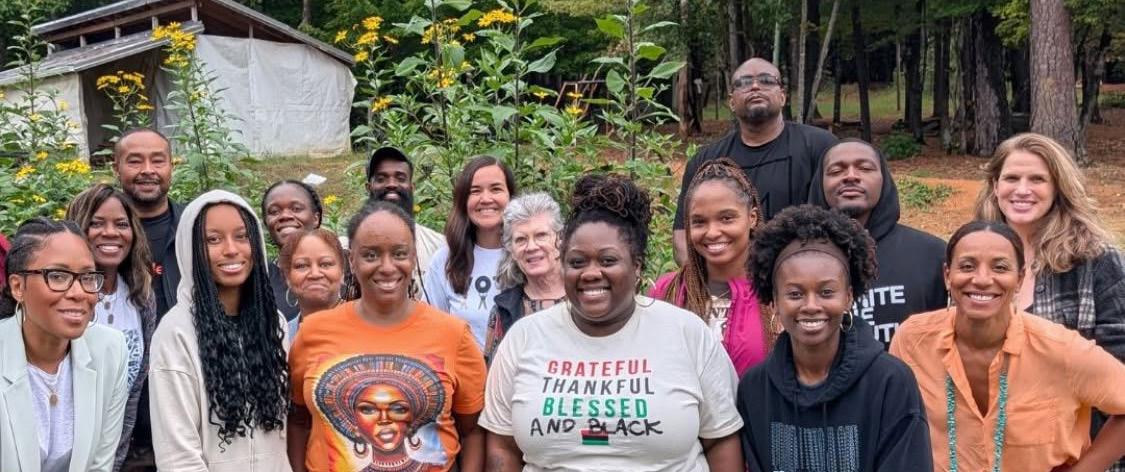
Caitlin Swain, Esq. CO-FOUNDER & C0-DIRECTOR
Daryl Atkinson, Esq. CO-FOUNDER
Dr. Ashley Marshall CO-FOUNDER & SENIOR DIRECTOR OF SUSTAINABILITY & EMERGENCE
Rameisha Bordeaux DIRECTOR OF PEOPLE & CULTURE
Kirstin Bigham DIRECTOR OF FINANCE
J. Anthony Holbert DIRECTOR OF IMPACT
Gaynelle Little EXECUTIVE & SPECIAL ASSISTANT
Carolyn Winder SENIOR FINANCE MANAGER
Penda Hair SENIOR COUNSEL
Kathleen Roblez SENIOR VOTING RIGHTS COUNSEL & LITIGATION MANAGER
Whitley Carpenter SENIOR CRIMINAL JUSTICE COUNSEL & POLICY MANAGER
Lori Sherman STAFF ATTORNEY
Ashley Mitchell STAFF ATTORNEY
Kristie Puckett SENIOR PROJECT MANAGER
Jarvis Johnson SENIOR CAMPAIGN DATA FIELD MANAGER
Isaiah Withers SENIOR ORGANIZER
Jason Hicks ORGANIZER & PROJECT ASSOCIATE
Dontae Sharpe
R.I.S.E LEADERSHIP FELLOW
Brittany Cheatham SENIOR COMMUNICATIONS MANAGER
Damola Akintunde VISUAL INNOVATION & BRAND MANAGER
Kimaya Davis-Stovall
SENIOR LAW & NARRATIVE ASSOCIATE
Ashanti Scott
SOCIAL & DIGITAL MEDIA ASSOCIATE
As Forward Justice continues to grow, we’ve gained tremendous support from those who align with our vision of a free, equitable South. We want to take this moment to thank those who strengthen our capacity to continue to do the transformative and historical work in the region, so that one day our movement will Change the South, Change the Nation. Without your support, none of this is possible. We look forward to the journey that lies ahead for us all.




RECLAIMING MEMORY, REIMAGINING RESISTANCE