
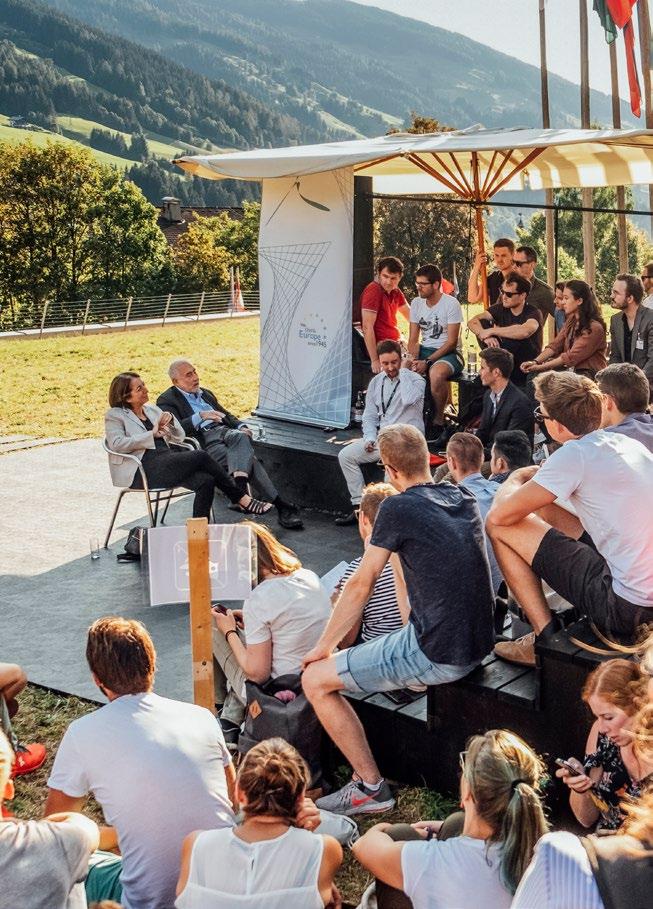
Alpbach Moments
With many thanks to our partners
Imprint:
Publisher: Europäisches Forum Alpbach gemeinnütziger Verein Franz-Josefs-Kai 13/10, 1010 Vienna | Tel.: +43 1 718 17 11 | forum@alpbach.org
Pictures EFA 2018: Bogdan Baraghin, Luiza Puiu, Andrei Pungovschi, Laurent Ziegler | Other: Lukas Beck
Editor: Cornelia Mayrbäurl | Editing: EFA Team | Production: Franz Mailer Design: WHY.Studio | Printing: Gerin Druck GmbH, Wien | Paper: Lenzing Papier
SEMINARWOCHE
TIROLTAGE
GESUNDHEITSGESPRÄCHE
TECHNOLOGIEGESPRÄCHE

POLITISCHE GESPRÄCHE
RECHTSGESPRÄCHE
WIRTSCHAFTSGESPRÄCHE
PRINCIPAL PARTNERS
EVENT PARTNERS
FINANZMARKTGESPRÄCHE

MOBILITY PARTNERS
Guided by the desire, – to serve the arts and sciences, – to play a role in the preservation and expansion of freedom, – to foster human self-reliance, – to strengthen a pluralistic and democratic society guided by the spirit of tolerance, – to contribute to a balance between the economy, ecology and social responsibility as a sustainable economic and social model, – to promote European integration and international cooperation, the ‘European Forum Alpbach’ strives to be a space for intellect and culture and a platform for encounter, exchange and debate; a place for the forward-looking development of Europe’s academic, cultural, humanitarian, political and economic heritage.
Annual Review 2018
Where to begin? For the European Forum Alpbach, 2018 was another year packed full not only of thought-provoking ideas but many a new insight as well. Those who joined us in Alpbach in August will have their own personal highlights. The conversation between the presidents of Serbia and Kosovo captured the public’s attention –suddenly it became apparent that there was a new option on the table for resolving the conflict between the two states. Nobel prize-winner Joseph Stiglitz, taking this year’s motto ‘Diversity and Resilience’ as his starting point, emphasised that in order to be more resilient to climate change, we need a greater diversity of energy sources. And the issues addressed in the Breakout Sessions included what skills are needed by the state, businesses and citizens in order to hold their own in a digital society.
Those likely to be the ones setting the agenda in a few years’ time, namely our scholarship holders, heard thought-provoking talks during the Seminar
FRANZ FISCHLER, CASPAR EINEM, SONJA PUNTSCHER RIEKMANN, CLAUS J. RAIDL EXECUTIVE BOARD OF THE EUROPEAN FORUM ALPBACH
Week from speakers such as Julia Ebner, an expert on extremism. In the spirit of holistic education, the Arts and Culture Programme provided some very different food for thought – Deborah Sengl’s rat-based installation inspired by Karl Kraus’ ‘The Last Days of Mankind’, Doris Uhlich’s workshop on physical energy, the balcony scenes at Alpbach’s town hall … unforgettable moments for those who were there.
Vienna and Linz also hosted some passionate debates. Our discussion evenings have been a genuine hit with audiences. Pianist Igor Levit at Vienna’s Konzerthaus, for example, sharing his thoughts about artists’ responsibility to express their political views, or a discussion focussing on the discrimination against migrants in everyday life.
Where to stop? There’s much still to tell. And we’ll do so over the following pages. Read on!
PHILIPPE NARVAL MANAGING DIRECTOR OF THE EUROPEAN FORUM ALPBACH
SONJA JÖCHTL MANAGING DIRECTOR OF THE FOUNDATION
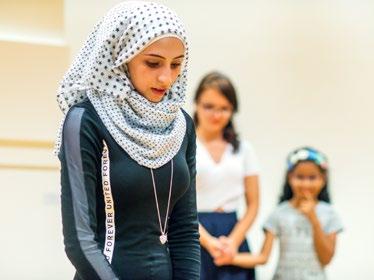
PREMIERE OF THE PLAY ‘NOT OUR FATE’ BY NOUR BARAKEH WITH DOAA AL ZAMEL, BOTH FROM SYRIA. THE PLAY IS ABOUT DOAA AL ZAMEL´S EXPERIENCE OF WAR, LOSS AND SURVIVAL, AND ABOUT THE NECESSITY OF DIALOGUE.
Demokratie in Europa 31.01.
Erleben wir eine politische Gründerzeit? 11.04.
Divide et impera – teile und herrsche 02.06.
Auf die Resonanz kommt es an! 20.09.
Kunst und Politik 07.11.
Wenn MigrantInnen den Mund aufmachen 19.12.
Wem nützt Wirtschaft? 22.04.
Mitreden! Mehr Demokratie und nicht weniger, 05.12.
RE:THINK
Innovation Lab 2018 07.-09.06.
EUROPEAN
Seminar Week 15.-21.08.
Arts and Culture 15.-31.08.
Tyrol Days 17.-19.08.
Health Symposium 19.-21.08.
Artists in Discourse 22.08.
Technology Symposium 23.-25.08.
Political Symposium 25.-28.08.
Diversity & Resilience
Legal Symposium 26.-28.08.
Economic Symposium 28.-30.08.
Financial Market Symposium 30.-31.08.
European Forum Alpbach 2018 Diversity & Resilience 15 to 31 August in Alpbach (Tyrol)
Alpbach Symposia
The main programme comprised two and threeday conferences on forward-looking issues in the fields of financial markets, health, politics, law, technology and the economy. An integral part of proceedings were occasions such as the Tyrol Days and the Arts and Culture Programme, including the ‘MEET’ event.
Seminar Week and Scholarship Programme
Nearly 700 young people from all corners of the globe attended Alpbach thanks to a scholarship. They were able to choose from 22 different academic seminars.
Alpbach Campus
The ‘Alpbach Campus’ programme gave participants opportunities for continued professional development through gaining new, praxis-oriented knowledge. The courses on offer included the ‘Entrepreneurship’ summer school, the ‘Professional Programme Art of Hosting’ and the Alpbach university course on European law. Academic partners such as the University of Cambridge contributed their expertise.
TOTAL NUMBER OF PEOPLE AT THE FORUM 2018
5,196 36 %
PROPORTION OF WOMEN SPEAKERS AT THE FORUM 2018
NUMBER OF NATIONS REPRESENTED BY THE FORUM 2018 PARTICIPANTS 105
Alpbach in Motion
40 of tomorrow’s international leaders came to Alpbach to discuss Europe’s economic future and work on innovative solutions in an interactive setting.
Alpbach Media Academy
For three weeks, young journalists from across Europe produced incisive, cross-media reports on the conference proceedings under the guidance of media professionals. Moreover, young journalists from Central and Eastern Europe were able to take part in a workshop run by the Thomson Reuters Foundation.
Retreats in Alpbach
A range of organisations used the informal and interdisciplinary atmosphere of Alpbach to hold a retreat, including the Austrian Foreign Ministry and the global initiative ‘Ethics in Action’.
Seminar Week
‘Open societies are more resilient’, emphasised Joseph Stiglitz at the opening of the Forum 2018, which also marked the start of the Seminar Week. It attracted just under 700 young scholarship holders from around the world. The 2018 programme invited them to explore ways out of the climate crisis with natural scientists, investigate the relationship between multilingualism and resilience with anthropologists, and consider the consequences of the Euro crisis with economists. Four seminars with an artistic focus and a distinct workshop approach rounded out the programme, which was put together by the EFA Scientific Advisory Board under the leadership of Caspar Einem.
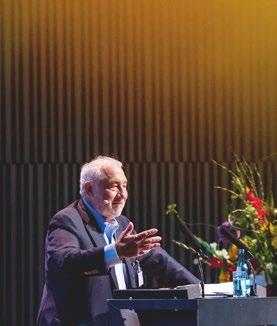
JOSEPH STIGLITZ, PROFESSOR OF ECONOMICS AT COLUMBIA UNIVERSITY AND NOBEL PRIZE-WINNER
Forum Alpbach Network
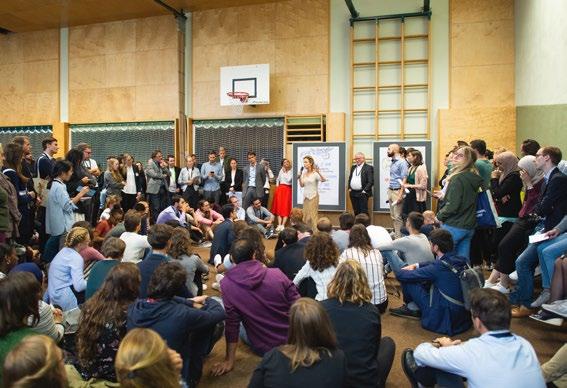
The Forum Alpbach Network (FAN), the umbrella association of Alpbach Clubs, also made its mark on the programme. At the ‘My Europe’ storytelling workshop, around 200 scholarship holders learned how to convey their experiences and ideas about Europe to their peers back home in a lively way. At the ‘International Evening’, scholarship holders from around the world presented their group projects, while at the ‘Speakers’ Night’ speech competition, the titles ranged from ‘Dear Holy Land: God Is Not Happy!’ to ‘Communicating Complex Climate Issues to my Kronen Zeitungsubscribing Grandparents’. In 2018 it was Club Alpbach Salzburg who contributed significantly to the programme.
BREAKOUT SESSION ‘THE RISING OF “TECHNIUM”: IS IT REAL, FANTASY OR ARTIFICIAL?’
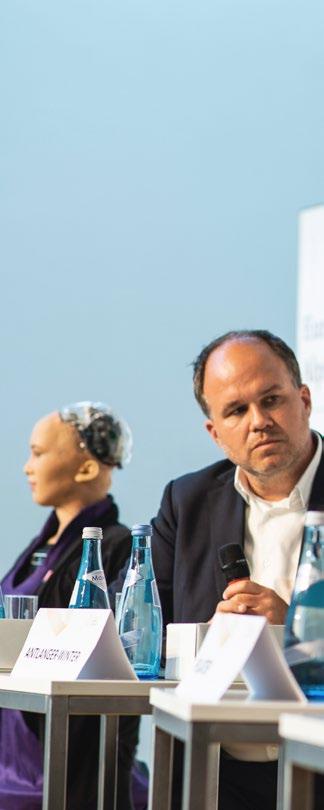
How artificial is our future?
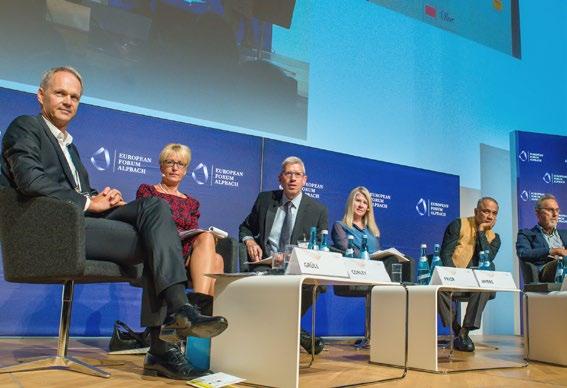
This was the question occupying participants of the Economic Symposium. Robots such as Sophia (far left) use artificial intelligence (AI) to make decisions that affect our daily lives. Current developments, for example in healthcare and telecommunications, make it clear that a new entity is looking after our interests. But does it really have our best interests at heart?
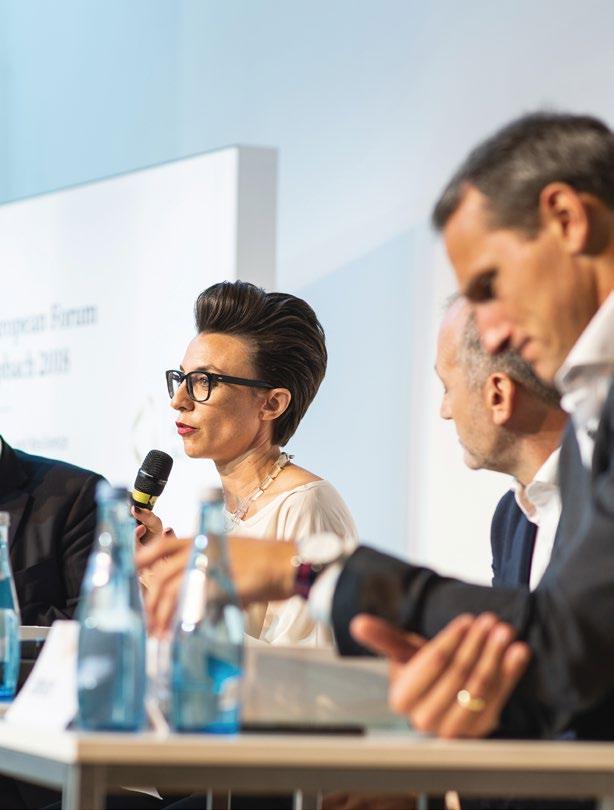
Among the topics explored in other Plenary and Breakout Sessions were how businesses can take advantage of diversity to become more resilient in a crisis and how diversity can be transformed into innovativeness.
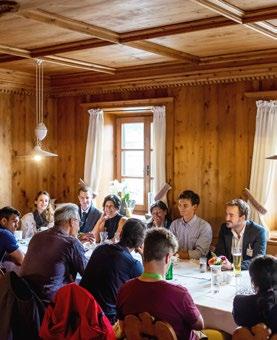
NO ONE MINDED IN THE END: BAD WEATHER TURNED THE ALPBACH HIKES INTO A JAUSE, A GATHERING WITH A BITE TO EAT.
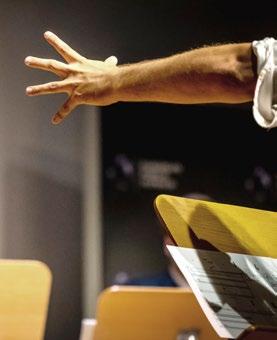
EIGHT TROMBONISTS AND A CONDUCTOR SET THE TONE, SO TO SPEAK, AT THE OPENING OF THE FINANCIAL MARKET SYMPOSIUM.
Alpbach Jause
Participants of the Financial Market Symposium were given the chance to meet with international figures working in investment in the cosy surroundings of a mountain inn. They conversed with experts such as Woody Tasch (founder of the ‘Slow Money Institute’) about how capital can be a driver of social change and about how fiduciary responsibility can bring money ‘down to earth’.
The true impact of investing
Around the world, sustainable financing and impact investing are becoming increasingly important. But what’s behind it all? Is there any substance to the concept? Can it combine investing with creating a better world? Top-level representatives from the Austrian and international banking and investment sectors exchanged opinions during a Plenary Session. Other events during the Financial Market Symposium explored international crypto-currencies, the European equity market and the future of cash in Austria.
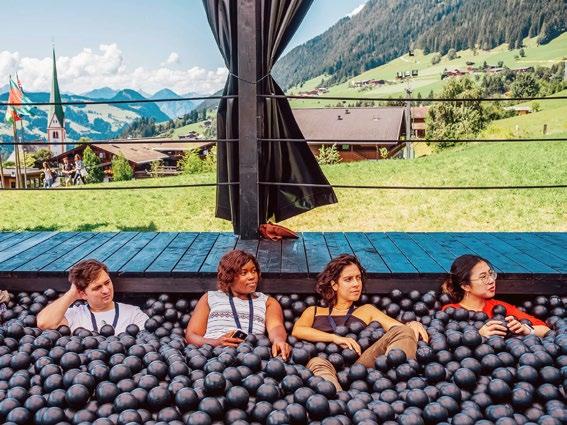
Immerse body and mind in philosophy’s world of ideas – a sizable pool on the roof of the Congress Centrum made this possible. Each of the 25,000 or so balls it contained was printed with some wisdom from the Stoics: ‘Always act as if someone is watching’, ‘The angry person is the outlier’, ‘I rise to do to the work of a human being’ – this contemporary variation on the baths of antiquity formed a counterpoint to the rhythm of Alpbach.
The Last Days of Mankind
Les Thermes
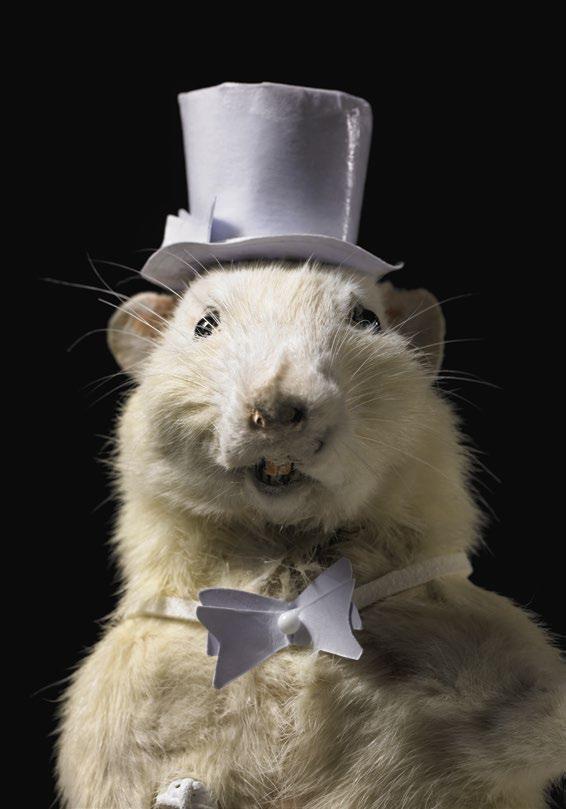
Artists are the seismographs of social change. Their creativity has always been an integral part of the European Forum Alpbach. 200 stuffed white rats in the Art Foyer of the Congress Centrum Alpbach were Deborah Sengl’s response to Karl Kraus’ ground-breaking play ‘The Last Days of Mankind’. In his introduction to the work, curator Günther Oberhollenzer made us curious about contemporary art that engages critically with history and literature. And a 24-hour reading of ‘The Last Days of Mankind’ featuring some of the scholarship holders allowed listeners to immerse themselves in Kraus’ panoramic work in an entirely new way.
Unanswered questions about the Western Balkans
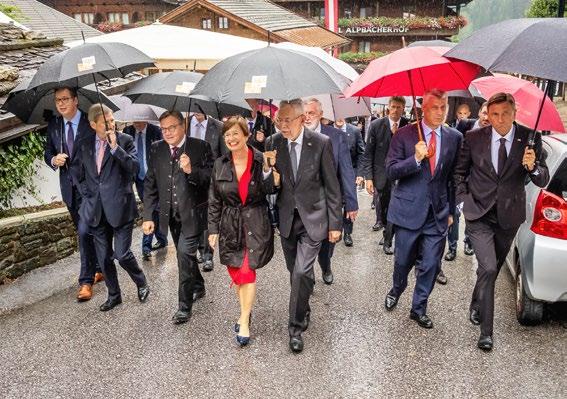
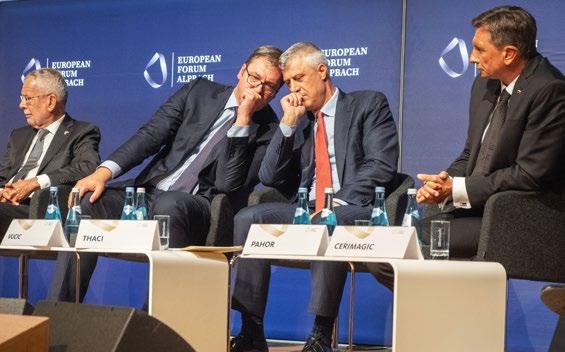
While the presidents of Serbia and Kosovo discussed the headline-grabbing idea of an exchange of territory in order to resolve the conflict between the two countries, renowned experts, decision-makers and symposium participants formed working groups to discuss topics such as ‘Citizens don’t bite’ and ‘European Security and the Mediterranean’. Cooperation partners at the Political Symposium included the Centre for European Policy Studies, the Austrian Foreign Ministry, the Club of Rome and the Mercator Foundation.
EU Council Presidency
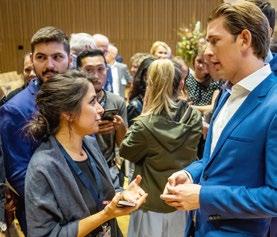
Federal Chancellor Kurz outlined the government’s plans for Austria’s EU presidency during the second half of 2018, commenting: ‘I’m delighted to be able to talk for a few minutes uninterrupted, but even more I’m looking forward to the discussion afterwards, because that’s what it’s really all about.’
FEDERAL PRESIDENT VAN DER BELLEN, PRESIDENT VUCIC OF SERBIA, KOSOVO’S PRESIDENT THACI AND PRESIDENT PAHOR OF SLOVENIA.
The rule of law in peril
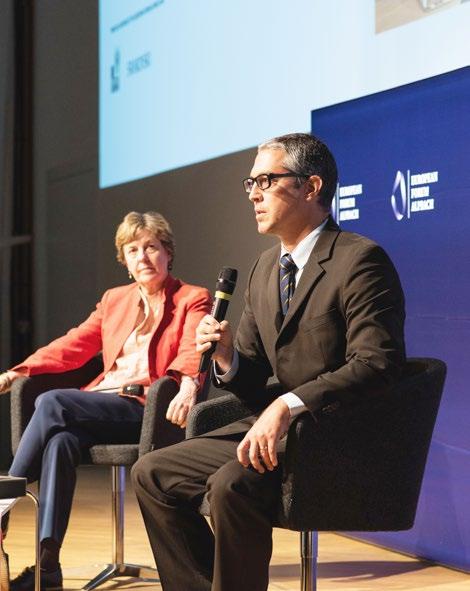
No democracy without the rule of law. Particularly in view of current developments, we need an answer to the question of how to ensure the rule of law in the future. What are the foundations underpinning a Europe based on the rule of law? Which narratives can explain by example how essential the rule of law is to Europe?
Free and equal
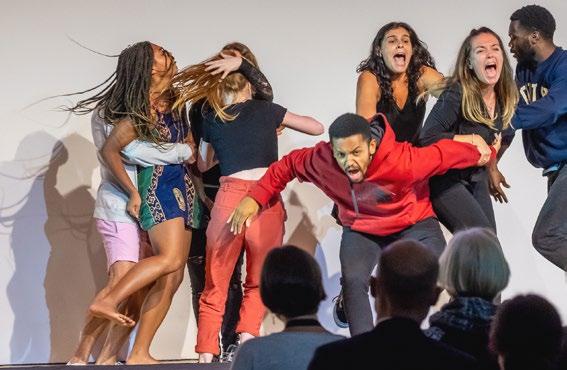
To open the Legal Symposium, students from the Royal Academy of Dramatic Art took to the stage of the Congress Centrum to illustrate the theme of human rights and the universal value system common to all peoples and nations. Subsequent events looked at topics such as the movements of migrants, which are putting our legal system under pressure, equality between men and women in legal professions, and independence movements in Europe.
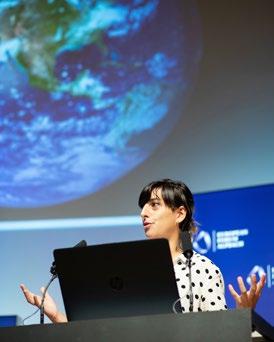
THE AVANT-GARDE ARTIST MOON RIVAS WEARS A SENSOR ON HER ELBOW THROUGH WHICH SHE FEELS EARTHQUAKES HAPPENING AROUND THE WORLD.
Cyborgs: technology under the skin
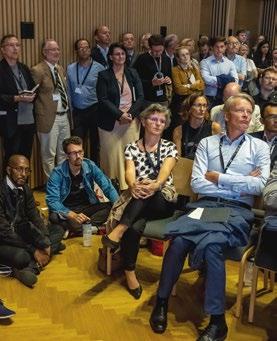
Today, people are living in a symbiotic relationship with the technology that surrounds them, carrying it as wearables on or as implants in the body. The possibilities for fusing humans with technology are varied and ever expanding. Artists and scientists approach these technological experiments in different ways. In doing so they raise questions that are both social and ethical. What conclusions can we draw from them?
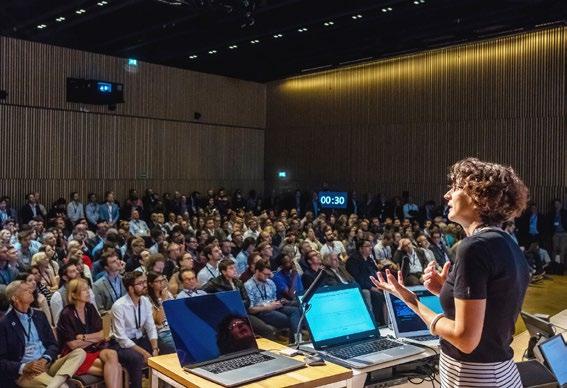
MIRTA GALESIC, WHO RESEARCHES COMPLEXITY, SPEAKS ABOUT THE EFFECTS OF DIGITALISATION ON THE PSYCHE AND ON BEHAVIOUR.
How human will the digital future be?
Technology has a firm grip on the world. AI and machine learning, data science and complexity science, cybersecurity and automation use algorithms and a growing mass of data in their computer-based models, which are changing our lives and working practices from the ground up. How should we deal with this without losing faith in the future? What can and should this revolutionary technology be doing for us?
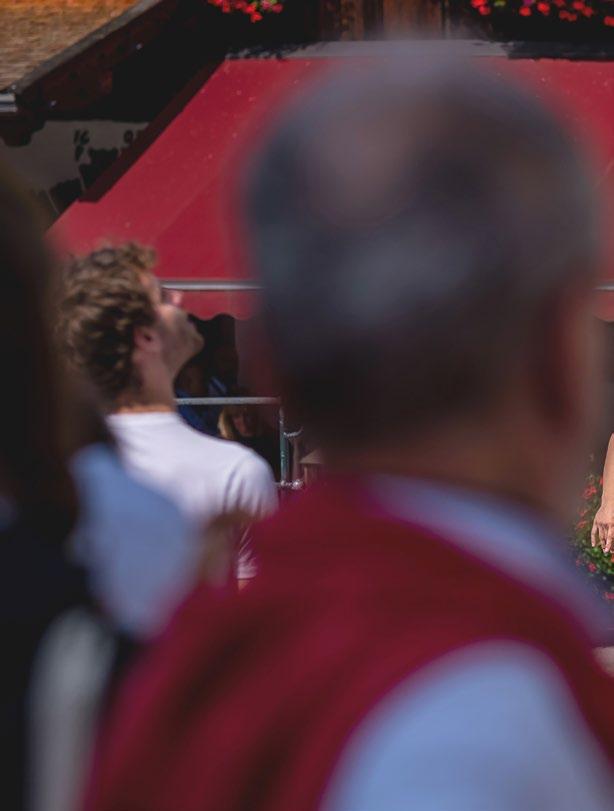
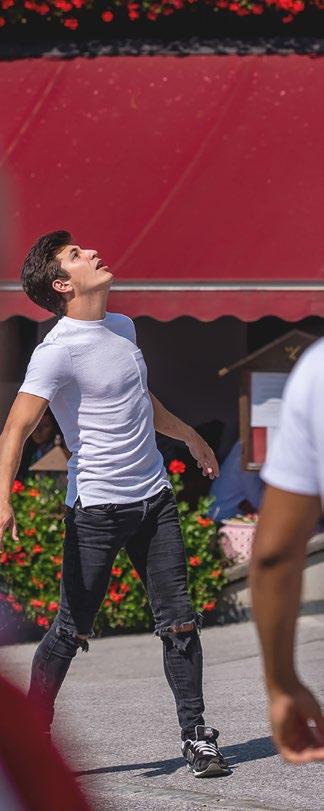
High Noon on the balcony
On seven days, Alpbach’s church bells heralded the start of a play at twelve noon on the dot: students from the Royal Academy of Dramatic Art and scholarship holders staged balcony scenes – famous ones by Sophocles and Shakespeare, but also some of their own. The town hall balcony was transformed into a town centre theatre.
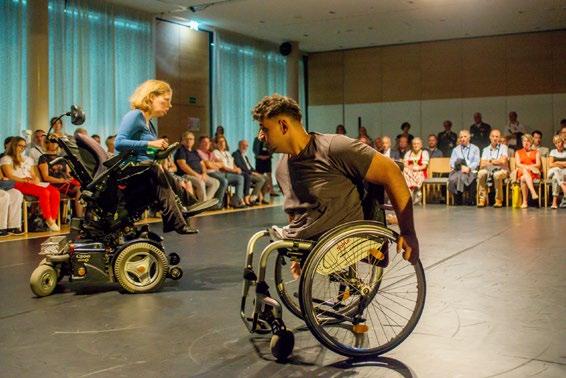
DORIS UHLICH WAS JOINED BY PEOPLE WITH PHYSICAL IMPAIRMENTS TO CREATE ‘ENERGETIC ICONS’. WHAT POSSIBILITIES OPEN UP WHEN MACHINES – FOR EXAMPLE WHEELCHAIRS – ARE UNDERSTOOD AS EXTENSIONS OF THE BODY AND TREATED IN PERFORMANCE AS SUCH?
Alpbach Debate
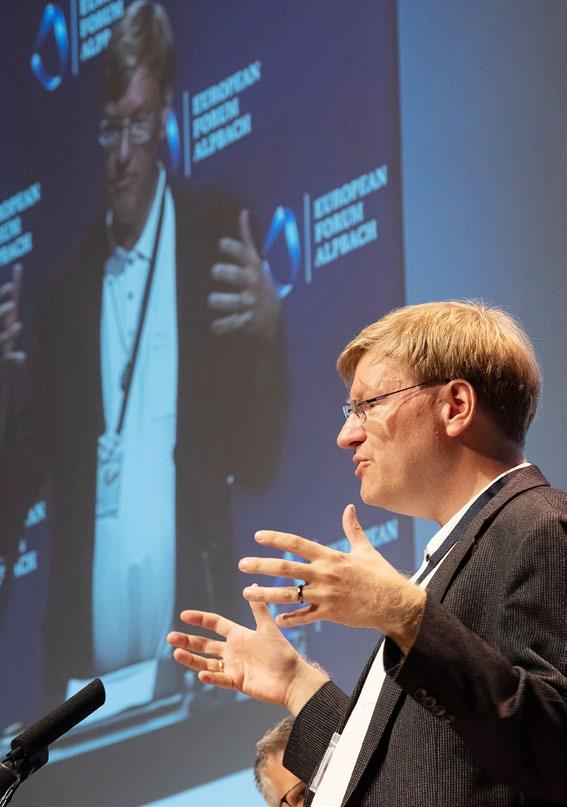
New technologies open up the possibility for selfoptimisation. But to what extent shall we strive for it? What are the pros and the cons? Two experts apiece from neuroscience, ethics and technology argued for one stance or the other. At the end of the debate, the audience voted for the more convincing side (pictured here, Anders Sandberg, University of Oxford). The Health Symposium also explored issues such as the significance of productivity and success for our resilience and addressed questions of training in health professions.
In the media lab
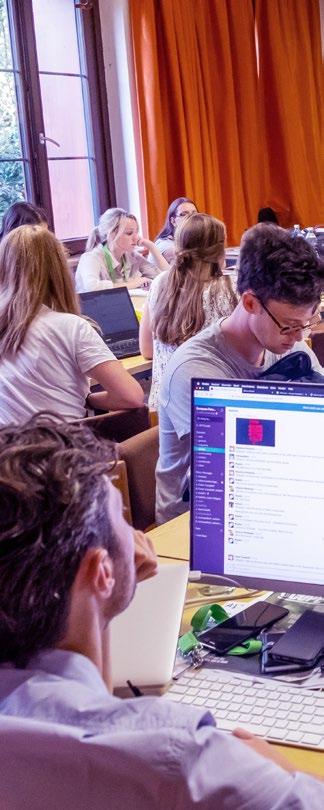
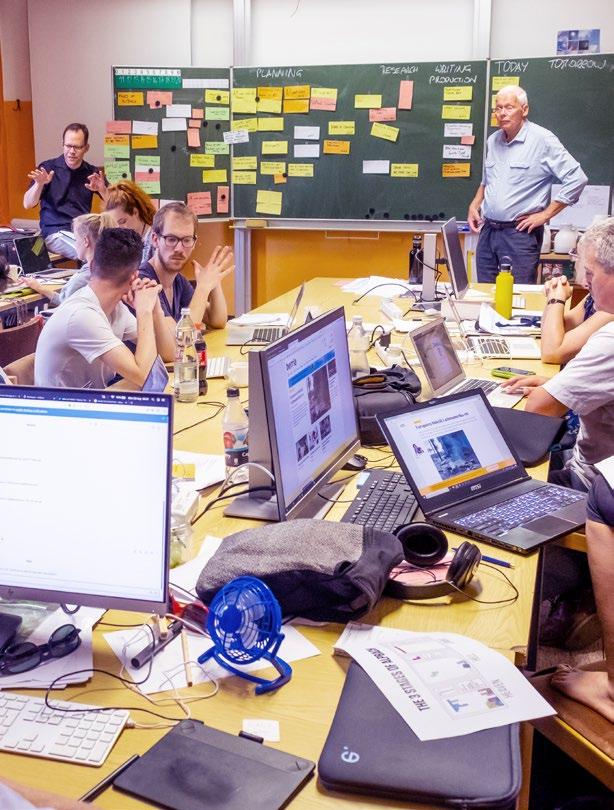
The Media Academy offered a unique training programme for young journalists from across Europe. Experienced mentors, in-depth seminars and fascinating interview partners came together in a temporary media lab. Twitter was a hive of activity and the print magazine ‘Scope’ explored topics such as the gig economy (title: ‘Your boss will be an algorithm’). Moreover, journalists from Central and Eastern Europe took part in a workshop run by the Thomson Reuters Foundation.
New encounters
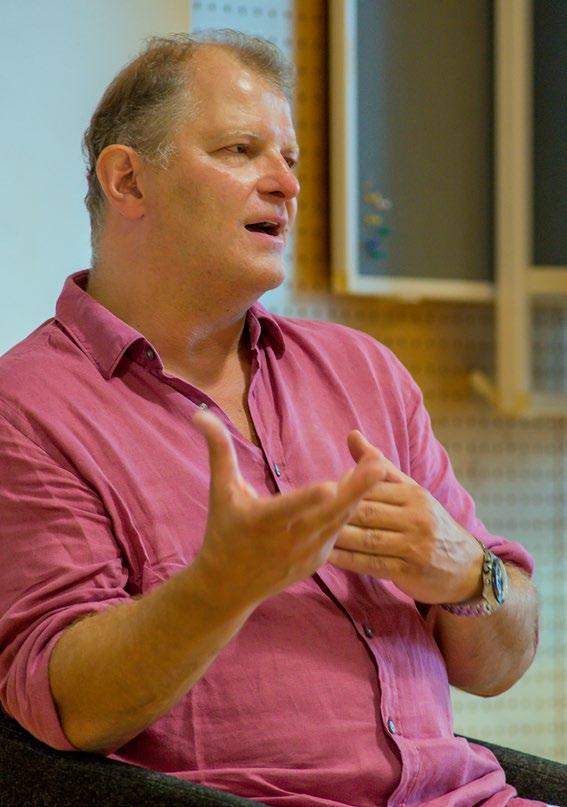
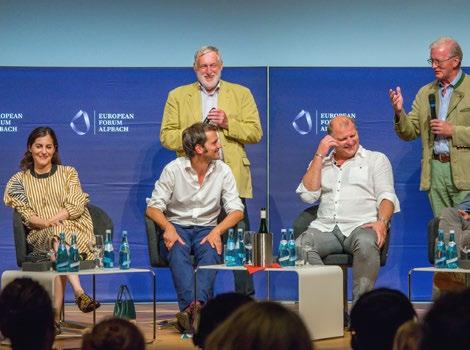
New for 2018 was a day organised under the heading MEET. The host selected by the EFA was theatre director Martin Kušej, who discussed the status and value of art with his invited guests: Ayad Akhtar, Amira Casar, FLATZ, Antonia Klugmann and Martin Grubinger. Where might art be hiding in people, when does it emerge unconsciously, and why does it hold us in thrall? When a society finds that ‘business as usual’ has stopped working and that it needs to develop new ways of thinking and acting to overcome a range of challenges, what can art contribute? Can it provide an unexpected ‘instruction manual’?
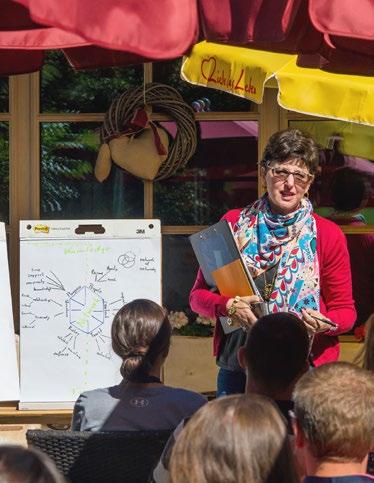
A mentor for tomorrow’s movers and shakers
Each year, Alpbach in Motion brings together leaders in their 30s and 40s from start-ups, small to mid-sized businesses, NGOs and the cultural sector to consider new solutions to old problems in their fields. In 2018 Julia Hobsbawm, whose ideas have been propagated at the WEF in Davos or by the OECD, was chosen as mentor. She views the concept of ‘social health’ as an antidote to the inundation of information. It is about better managing knowledge, networks and time.
Rewarding retreats
For international networks and public bodies, the Forum Alpbach presents a perfect opportunity for holding workshops in a focussed environment. In 2018, Alpbach Retreats were organised by the Austrian Foreign Ministry, the Ban Ki-moon Centre for Global Citizens and the EU-Russia Experts Network, among others. The conclusions and findings of these kinds of consultations, for example those of the ‘Social Impact Investing’ retreat, were presented and discussed as part of conference proceedings.
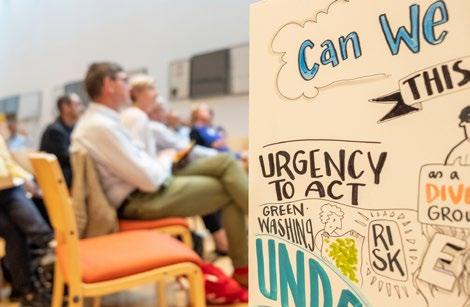
Our other activities in 2018
7 TO 9 JULY
Re:think Austria
On six evenings in 2018, the Berio Saal at Vienna’s Konzerthaus provided the ideal setting for panels to discuss topics such as discrimination against migrants in everyday life, the relationship between art and politics, and current developments in Eastern Europe.
In 2013, the European Forum Alpbach, together with Kovar & Partners and freims:contemporary consulting, launched a series of innovation labs to promote dialogue on political reform in Austria. Using a participative process, stakeholders from politics, the economy, science, culture and civil society develop new ideas and projects for reform on key political themes. Input from trendsetters from across the German-speaking region and an innovative communication concept play a central role.
Unexpected questions from the audience, gripping debates on stage and a lively exchange of opinion in the foyer – through the DialogForum series, over the year the ORF and EFA addressed burning issues in science, society and politics. ‘Who benefits from the economy?’, one event asked, with another demanding we ‘Join in! More democracy, not less’.
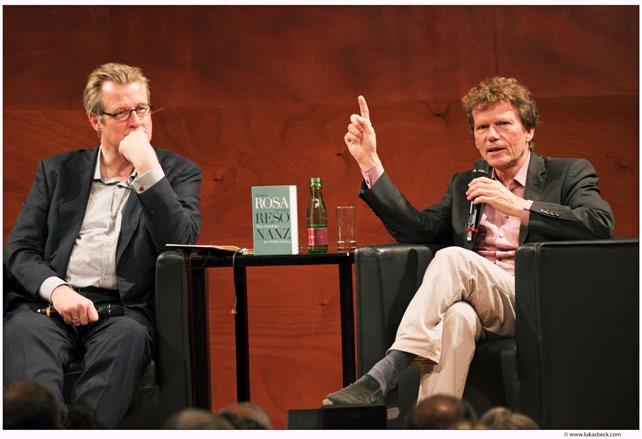
It has to resonate
One of the six Alpbach Dialogues at the Konzerthaus (see left) included German sociologist Hartmut Rosa among the guests. His focus was on the concept of resonance: humans enter into dialogue with the things that surround them and constitute the world, they are in tune with their interlocutors and are perceptive beings who sense their own and the world’s vitality. Openness, trust and freedom from fear are needed in order to experience resonance. And these kinds of spaces of resonance are necessary for human coexistence to flourish.
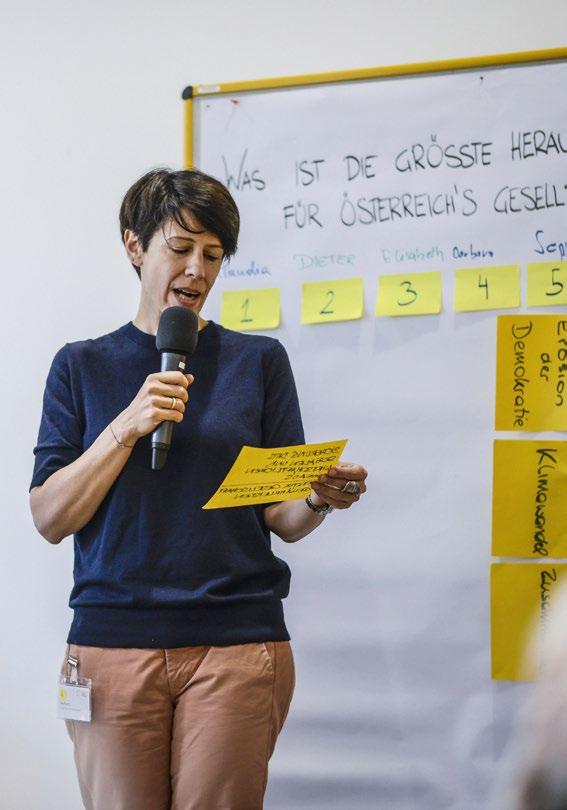
THE FUTURE CAFÉ, WHERE FUTURE SCENARIOS WERE DEVELOPED AND PROJECT IDEAS SUBJECTED TO A REALITY CHECK.
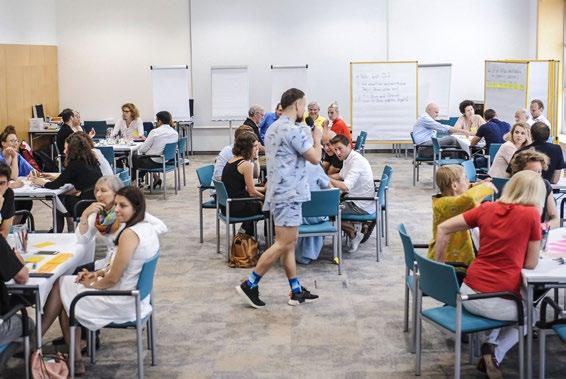
How can we improve Austria?
‘Step into someone else’s shoes and allay fears’ –the format for the two-day Re:think innovation lab allowed participants discover a range of new perspectives. Whether electrician, police officer or artist, role-play revealed the difficult issues facing society today: uncertainty caused by globalisation, digitalisation, migration, climate change – how can these fears be dissipated and social cohesion strengthened? What unused resourced can be used to future-proof politics? How might networks be activated in order to get new ideas into play? These questions engrossed the 59 participants over two days in Linz.
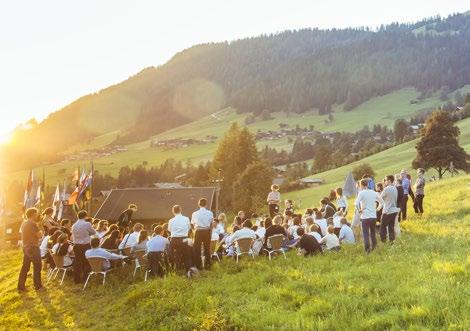
Forum Alpbach Network
The time spent together at EFA connects former scholarship holders for many years to come and across national borders. A clear expression of this connection are the 32 alumni associations in 22 different countries, which are also responsible for organising hugely successful scholarship programmes. More at https://forum.alpbach.network
In places where there is not yet an Alpbach Club, our ambassadors promote our cause. This is particularly the case in countries outside Europe –for example in Brazil, India and Ethiopia.
1. Initiative Group Alpbach Albania (AL)
2. Initiative Group Alpbach Armenia (ARM)
3. Club Alpbach Belgrade (SRB)
4. Club Alpbach Brussels (B)
5. Club Alpbach Bulgaria (BG)
6. Club Alpbach Burgenland (A)
7. Club Alpbach Croatia (HR)
8. Club Alpbach Georgia (GE)
9. Club Alpbach Germany (D)
10. Club Alpbach Greece (GR)
11. Initiative Group Alpbach Kosovo (KS)
12. Kyiv Initiative Group Alpbach (UA)
13. Club Alpbach Liechtenstein (LI)
14. Club Alpbach London (GB)
15. Lviv Initiative Group Alpbach (UA)
16. Club Alpbach Macedonia (MK)
17. Club Alpbach Montenegro (MNE)
18. Club Alpbach Niederösterreich (A)
19. Club Alpbach Oberösterreich (A)
20. Initiative Group Alpbach Romania (R)
21. Club Alpbach Russia (RUS)
22. Club Alpbach Salzburg (A)
23. Initiative Group Alpbach Sarajevo (BIH)
24. Club Alpbach Senza Confini (A/SLO/I)
25. Club Alpbach Steiermark (A)
26. Club Alpbach Südtirol Alto Adige (I)
27. Club Alpbach Sweden (SWE)
28. Club Alpbach Tirol (A)
29. Club Alpbach Trentino (I)
30. Club Alpbach Turkey (TUR)
31. Club Alpbach Vorarlberg (A)
32. Initiativgruppe Alpbach Wien (A)
European Forum Alpbach Non-Profit Foundation under Private Law
The scholarship programme of the non-profit private foundation of the European Forum Alpbach enables young people from across the world to come to Alpbach and to participate in the Forum. Here they find an intellectual environment in which they can tackle key socio-political questions in depth. The international exchange, the constructive dialogue and the substantive debates with renowned academics, managers and thinkers influence and connect the scholarship holders far beyond Alpbach. Thus the non-profit foundation of the European Forum Alpbach makes a sustainable contribution towards European integration and intercultural understanding.
Without the support of national and international partners, the extensive scholarship programme would not be possible. Around 700 scholarship holders took part in the European Forum Alpbach 2018. This was made possible by partners, the international Forum Alpbach Network and the foundation´s own funds.
The foundation was established as a non-profit private foundation of the same name by the association ‘European Forum Alpbach’ in 2005. Detailed information about the scholarship programme, its cost structure and how you can support it can be found at www.alpbach.org/foundation
Board of the Non-Profit Foundation under Private Law
FRANZ FISCHLER
President of the European Forum Alpbach
INGRID HAMM
Charity funding expert and formerly director of the Robert Bosch Foundation
WERNER WUTSCHER
Entrepreneur and investor
HOWARD WILLIAMSON
Professor of European Youth Policy (co-opted)
We would like thank the partners of the 2018 scholarship programme for their support.
MAIN BENEFACTORS
BENEFACTORS
A1 Telekom Austria AG
Austrian Federal Ministry of Education, Science and Research
Austrian Red Cross
AVL China
Ban Ki–moon Centre for Global Citizens
CONTRIBUTORS
The Boston Consulting Group Cultural Affairs Department of the City of Vienna (MA7)
Erste Group Bank AG
KAUTE Foundation
Lung Yingtai Cultural Foundation
Raiffeisen Bank International AG
Rupp AG
Renée Schroeder
Stadtakademie der ÖVP Wien
VP Bank Stiftung
WH Media GmbH
Audited and transparent
Each year, the European Forum Alpbach has its annual accounts audited by Sedelmayer & Klier Steuerberater und Wirtschaftsprüfer GmbH. This renders account of the money that sponsors and donors entrust to us. The audit for the 2017 financial year was unanimously passed by the annual general meeting on 8 May 2018: ‘In our view, the present accounts are a transparent and comprehensible representation of the business processes. The financial situation of the organisation can be assessed as in order.’ The annual accounts were
presented by the administrative bodies of the association for use in accordance with the statues and were fully explained to the executive management by the voluntary auditors Günther Schrems (Director of Organisation Sales Processes, Erste Bank) and Max Kothbauer (Vice President, Oesterreichische Nationalbank) and the bookkeeping and financial management of the organisation were assessed as in order. In 2017 the association realised a profit of 381 Euros.
Turnover 2017
3,191,365
PARTICIPATION FEES
Costs 2017 € 3,191,365
ORGANISATION
RESERVE
MEMBERSHIP FEES
European Forum Alpbach
The first European Forum Alpbach took place in 1945 as the ‘International College Weeks’. Founded in 1948 as a non-profit association based in Vienna, it acts independently of any ideology, religion or political party. The association only functions thanks to the vast number of people who, with
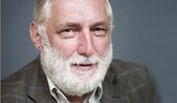
FRANZ FISCHLER PRESIDENT
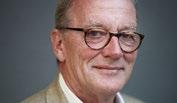
CASPAR EINEM VICE PRESIDENT
Honorary Presidents
Erhard Busek, Heinrich Pfusterschmid-Hardtenstein
Executive Board
Präsidium, Michaela Fritz, Benjamin Monsorno, Lisa Charlotte Sonnberger, Shalini Randeria, Manfred Url
Finanzreferent
Manfred Url
Auditors
Günther Schrems, Max Kothbauer
Arbitration Board
Waldemar Hummer, Michael Neider, Katharina Scherke, Matthias Strolz
Managing Director of the Association
Philippe Narval
Managing Director of the Foundation
Sonja Jöchtl
the exception of the organisation team, all give their time voluntarily to the Forum Alpbach. They have contributed to making the European Forum Alpbach one of the most important interdisciplinary dialogue platforms in Europe for science, politics, economics and culture today.
PUNTSCHER RIEKMANN VICE PRESIDENT
Council
Peter C. Aichelburg, Martin Bernhofer, Jürgen Busch, Verena Ehold, Friedrich Gleissner, Erich Gornik, Ivo Greiter, Wolfgang Habermayer, Michael Haider, Edeltraud Hanappi-Egger, Günter Hillebrand, Herwig Hösele, Michael Ikrath, Beatrix Karl, Wolfgang Knoll, Georg Kopetz, Friedrich Korkisch, Kathryn List, Johann Luif, Ulrike Lunacek, Christian Macek, Bernhard Marckhgott, Thomas Mayr-Harting, Beate Meinl-Reisinger, Patricia Mussi-Mailer, Dieter Natlacen, Ewald Nowotny, Johannes Ortner, Klaus Poier, Filip Radunovic, Reingard Rauch, Wolfgang Renner, Verena Ringler, Walter Rothensteiner, Sabine Schindler, Peter M. Schmidhuber, Christoph Schneider, Rainer Schrems, Matthias Strolz, Alexandra Terzic-Auer
Scientific Advisory Board
Brigitte Bach, Gerald Bast, Walter Feichtinger, Ulrike Felt, Fatima Ferreira-Briza, Eva Flicker, Elisabeth Freismuth, Martin H. Gerzabek, Markus Hengstschläger, Martin Kocher, Sabine Ladstätter, Stefanie Lindstaedt, Wolfgang Lutz, Irmgard Marboe, Tilmann Märk, Gerd Müller, Christa Neuper, Manfred Nowak, Helga Nowotny, Peter Purgathofer, Miriam Rehm, Kirsten Rüther, Christoph Schneider, Margit Schratzenstaller-Altzinger, Renée Schroeder, Franz Schuh, Stefan Thurner, Susanne Weigelin-Schwiedrzik
SONJA
CLAUS J. RAIDL VICE PRESIDENT
Corresponding members of the Scientific Advisory Board
Petar Bojanic, Paul Dujardin, Pascale Ehrenfreund, Irene Giner-Reichl, Hermann Hauser, John-Dylan Haynes, Sabine Junginger, Hedwig-Josefine Kaiser, Lisa Kaltenegger, Jan Kickert, Wilhelm Krull, Burton Lee, Konrad Paul Liessmann, Nathalie Loiseau, Dominik Markl, Thomas Mayr-Harting, Jürgen Mlynek, Berthold Molden, Patrizia Isabelle Nanz, Friedrich B. Prinz, Michael Reiterer, David Rejeski, Stephan Schmidt-Wulffen, Nona Shepphard, Elisabeth Wehling, Howard Williamson, Ruth Wodak, Klaus Zeyringer
Organising Team (as of 12/2018)
Philippe Narval (Managing Director), Sonja Jöchtl (Managing Director Foundation, on maternity leave), Martina Albrecht, Martin Anderl, Fruzsina Herbert, Bettina Hirzinger, Hannah Kickert, Nadine Kremsner, Olexandr Kuzmenko (on maternity leave, Christine Maass, Franz Mailer, Sarah Matysek, Cornelia Mayrbäurl, Katharina Okulski, Magdalena Rostkowska-Müllner, Elisabeth Schack, Christiane Schwaiger, Floria Springer (on maternity leave), Charlotte Steenbergen, Paul Stolberg, Annamariá Tóth, Franziska Werkner, Bernadette Zimmermann
Advisory Committees
Health Symposium
Clemens Martin Auer, Alena Buyx, Amin El-Heliebi, Karl Forstner, Julian M. Hadschieff, Hedwig Kaiser, Robert Körbler, Michael Landau, Philippe Narval, Sigrid Pilz, Josef Probst, Ursula Schmidt-Erfurth, Viktoria Stein, Christa Wirthumer-Hoche, Johannes Zschocke
Legal Symposium
Sonja Barnreiter, Maria Berger, Ludwig Bittner, Tamara Ehs, Caspar Einem, Michael Enzinger, Michael Holoubek, Martin Kreutner, Brigitte Loderbauer, Klaus Poier, Alexander Somek, Michael Somlyay, Richard Soyer, Christine Stix-Hackl (†), Verica Trstenjak, Eva Tscherner, Alma Zadic
Tyrol Days
Andreas Altmann, Konrad Bergmeister, Adriano Cataldo, Matthias Fink, Franz Fischler, Wolfgang Fleischhacker, Martin Kubat, Simon Lochmann, Paolo Lugli, Tilmann Märk, Veronica Rungger, Julia Sandrini, Werner Stuflesser, Ulrike Tanzer, Francesca Valentini, Jens Woelk, Giuseppe Zorzi
Economic Symposium
Christoph Badelt, Wolfgang Eichert, Anna Handschuh, Martin Kocher, Georg Kopetz, Bernhard Marckhgott, Markus Marterbauer, Philippe Narval, Claus J. Raidl, Emanuel Riccabona, Franz Schellhorn, Christoph Schneider, Agnes Streissler-Führer, Norbert Zimmermann
Forum Alpbach Network Board
Lisa Sonnberger (chairwoman), Florian Altendorfer, José Magnaye, Benjamin Monsorno, Lisa Plattner, Sophie Rendl (coopted), Raphael Wurm
Forum Alpbach Network Standing Committee
Lisa Ecker-Eckhofen, Michael Essl, Markus Fuchsberger, Manuel Mühlburger, Tobias Neugebauer, Anna Puhr
Political Symposium
Almina Bešić, Erhard Busek, Vedran Džihić, Walter Feichtinger, Franz Fischler, Ulrike Guérot, Pavel Kabat, Kilian Kleinschmidt, Gerald Knaus, Winfried Kneip, Alexander Marschik, Thomas Mayr-Harting, Emilia Pasquier, Sonja Puntscher Riekmann, Shalini Randeria, Verena Ringler, Bernhard Wrabetz
Financial Market Symposium
Willi Hemetsberger, Sonja Jöchtl, Günther Lindenlaub, Jeffrey Owens, Claus J. Raidl, Franz Rudorfer, Christoph Schmidinger, Agnes Streissler-Führer, Gertrude Tumpel-Gugerell
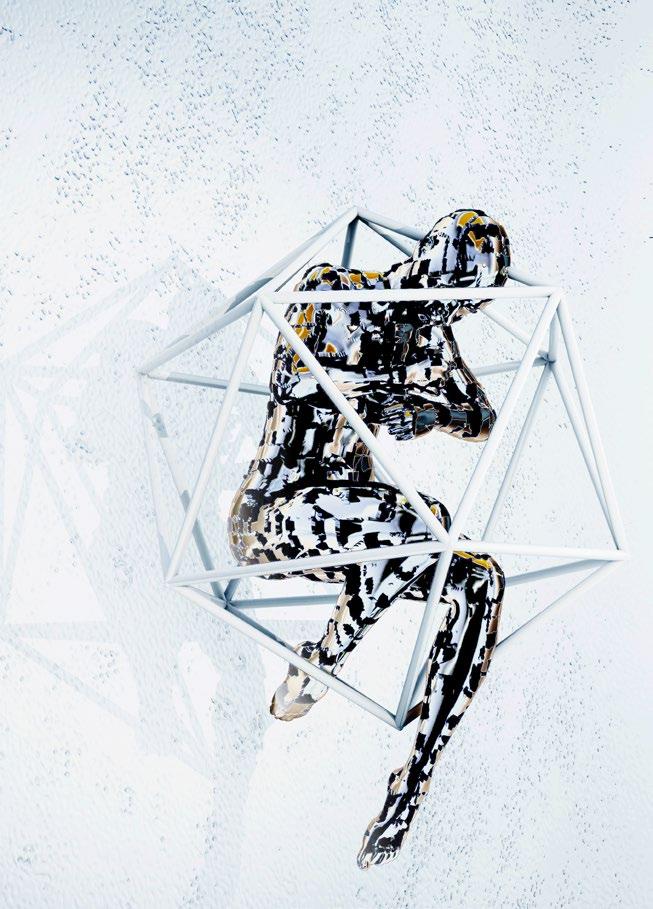
Liberty & Security
European Forum Alpbach August 14 to 30, 2019
Alpbach, Tyrol | #efa19