We’re delighted that you have chosen to join us at the Elevate.Tech – a unique event, tailormade to meet your individual requirements. We have carefully planned out your itinerary to ensure your time here is worthwhile: Connect with businesses relevant to your current and forthcoming projects in our matchmade one-to-one meetings.
And let’s not forget the networking – we’ve created a relaxed environment for you to form new partnerships, with ample opportunities to mix with peers during the buffet lunch and coffee breaks!
4
6
8
Our Partners
10 Seminars
16 ‘ Digital Transformation: Building architectures that support real-time insight ’
24 Itinerary
20 ‘Ai & Machine Learning Month: Managing security, risk and compliance in public sector and critical infrastructure environments ’
‘Cloud Strategy: Multi-cloud, hybrid or simplified for public sector IT estates? ’
Chris Cannon - Event Manager on 01992 374058 or C.Cannon@forumevents.co.uk
Luke Jackman - Delegate Sales Executive on 01992 374101 or L.Jackman@forumevents.co.uk
Itinerary
08.30 - 08.45
Welcome Presentation with Sarah Leteney
Bishopsgate & Chancery
09.00 - 09.35
Opening Presentation
‘ The New IT Leader Mandate - From Technologist to Strategic Leader’ Sarah Leteney
Urenco
Bishopsgate & Chancery
09.35 - 10.05
Roundtable
‘From Fragmented Collaboration to Seamless Communication: Modernising Secure Video Infrastructure in a Hybrid, Multi-Platform World’ Kulveer Rupra & John McDermott Pexip Exchange
09.35 - 10.05
Face to Face Meetings
Great Eastern & Gallery
10.10 - 10.40
Keynote
‘ Technology Governance in the Age of AI’
Matthew Wolff Simon Freewheel
Bishopsgate & Chancery
10.10 - 10.40
Face to Face Meetings
Great Eastern & Gallery
10.45 - 11.00
Group Coffee Break
Great Eastern & Gallery
11.00 - 11.30
Keynote
‘Cultural Shift, looking beyond the technical’
Mollie Brentnall
Crawford & Company
Bishopsgate & Chancery
11.00 - 11.30
Face to Face Meetings
Great Eastern & Gallery
11.35 - 12.05
Keynote
‘Human + AI: The future operating model for institutions’
Alma Shala Company Bishopsgate & Chancery
11.35 - 12.05
Face to Face Meetings
Great Eastern & Gallery
12.10 - 12.40
Keynote
‘How I Talk to My Board About Cybersecurity ’
Chris Gunner Thrive Bishopsgate & Chancery
12.10 - 12.40
Face to Face Meetings
Great Eastern & Gallery
12.45 - 13.35
Networking Buffet Lunch
Great Eastern & Gallery
13.35 - 14.05
Cyber Escape Room Fenchurch
14.10 - 14.40
Face to Face Meetings
Great Eastern & Gallery
13.35 - 14.05
Cyber Escape Room Fenchurch
14.10 - 14.40
Roundtable
‘From Reactive Alerts to Proactive Defence: Transforming Security Operations in an AlwaysOn Threat Landscape’ Steve Whincup eSentire Exchange
14.10 - 14.40
Face to Face Meetings
Great Eastern & Gallery
14.45 - 15.15
Roundtable
‘Building the Digital Backbone: Scaling Resilient Infrastructure for a Connected, Always-On Enterprise’ Indi Singh Sall NG Bailey IT Services Exchange
14.45 - 15.15
Face to Face Meetings
Great Eastern & Gallery
15.20 - 15.50
Roundtable
‘How different cognitive operating systems collide in complex organisations — and how understanding them changes delivery ’
Simon Ball
Scott Bader Ltd Exchange
15.20 - 15.50
Face to Face Meetings
Great Eastern & Gallery
15.55 - 16.30
Keynote
‘ Technology Transformation: Why leadership determines success’ Barry Smith
Transformation Leader
Bishopsgate & Chancery
15.55 - 16.30
Face to Face Meetings Great Eastern & Gallery
16.30 - 16.40
Closing Speech with Sarah Leteney
Bishopsgate & Chancery
17.00 - 21.00
Networking Mixer Drinks Longarm Pub & Brewery
AI & MACHINE LEARNING MONTH: Managing security, risk and compliance in public sector and critical infrastructure environments
Public sector organisations and critical infrastructure operators are facing a new challenge: how to adopt AI securely and responsibly in high-risk environments. From utilities and healthcare to transport and government services, AI is increasingly being used to support automation, analytics and decisionmaking. The focus for IT and CISO leaders attending the Elevate Tech Summit and Cyber Secure Forum is shifting beyond innovation towards governance, resilience and risk management…
The expanding threat landscape AI systems introduce new attack surfaces and operational risks. Unlike traditional software, machine learning models rely heavily on data quality, training integrity and ongoing monitoring. For critical infrastructure operators, this creates concerns around:
• Manipulated or poisoned training data
• Adversarial attacks designed to mislead AI models
• Unauthorised access to sensitive datasets
• Lack of transparency in automated decision-making
In sectors where operational continuity and public trust are essential, these risks can have significant consequences.
Public sector pressures around governance
Public sector organisations face additional scrutiny around data privacy, ethics and accountability. AI systems must comply with UK data protection regulations while also
aligning with broader expectations around fairness and transparency. This is particularly important where AI is used in:
• Citizen services and case management
• Resource allocation and prioritisation
• Security monitoring and threat detection
Leaders must be able to explain how AI-driven decisions are made, and demonstrate that systems are operating fairly and securely.
Building secure AI environments
To manage these risks, organisations are strengthening governance across the AI lifecycle. Key priorities include:
• Securing training and operational data environments
• Implementing strict identity and access controls
• Monitoring models continuously for drift or abnormal behaviour
• Maintaining audit trails for AIgenerated decisions
Security teams are also increasingly involved earlier in AI development processes, ensuring governance is embedded from the outset rather than added retrospectively.
Managing third-party AI risk
Many organisations rely on external AI platforms and cloud-based services. This increases the importance of supplier due diligence and third-party risk management. IT and security leaders should assess:
• Where data is stored and processed
• How models are trained and updated
• Whether AI outputs are explainable and auditable
• Supplier compliance with UK regulatory and security standards
In critical infrastructure environments, resilience and operational continuity should be central considerations.
Balancing innovation with control
One of the biggest challenges for CISOs is enabling innovation without creating unacceptable risk. Overly restrictive governance can slow adoption, while weak controls may expose organisations to operational or reputational harm.
Leading organisations are addressing this through crossfunctional AI governance frameworks, bringing together IT, security, legal, compliance and operational stakeholders.
Building trust in AI adoption
For public sector and critical infrastructure leaders, successful AI adoption depends not only on technical capability, but on trust, transparency and resilience.
By embedding strong governance, securing data and scrutinising supplier practices, organisations can harness the benefits of AI and machine learning , while ensuring systems remain secure, compliant and fit for critical environments.
Scan or click here to subscribe to the IT Briefing newsletter
What happens if a user is compromised?
With ThreatLocker®, you are in complete control.
Choose what to trust: Allow only authorized applications and users.
Restrict interactions: Control how trusted apps access your data, preventing lateral movement.
Isolate threats: Contain the damage when credentials are compromised.
Rest easy: ThreatLocker Orlando-based Cyber Hero ® Team responds in about 60 seconds.
Seminars
WEDNESDAY 17TH JUNE
09.00 – 09.35
Sarah Leteney
Group Chief Information Officer Urenco
Opening Presentation: “ The New IT Leader MandateFrom Technologist to Strategic Leader ”
Do you ever look at your role today and wonder “How the devil did I get here and where on earth will I need to be in 2 years?”
• How the landscape has changed in the last 2 years
• Moving Beyond Technology
• The Rise of the Strategic Digital Leader
• Balancing the New with the Old
• A Few Tips to Take Away
Sarah Leteney, seasoned Group CIO with three decades of expertise in leading IT delivery teams for Blue Chip and Central Government organsiations. Named in the UK Top 100 CIO Awards in 2024 & 2025. Demonstrated success in driving business value through technology solutioning. A strategic thinker and effective collaborator, passionate about agile delivery to meet organisational objectives. Extensive experience in Digital Transformation, Business Change, Consultancy, Service Delivery, ERP Programmes, T&T Projects, and Organisational Management. Proven ability to navigate complex business landscapes and deliver results in high-pressure regulated environments.
09.35 – 10.05
Kulveer Rupra Senior Account Director
John
McDermott Senior Solutions Architect
Pexip
Roundtable: “From Fragmented Collaboration to Seamless Communication: Modernising Secure Video Infrastructure in a Hybrid, Multi-Platform World ”
Today’s Enterprise runs on conversations that can’t afford friction. Yet many firms still need to connect people across Microsoft Teams, Zoom, legacy video systems and beyond, every day. Let’s discuss how interoperability can simplify yours and your customers meeting workflows, support disaster recovery, and create more consistent, branded meeting experiences in your high-stakes environment.
• The challenges of video communication in mixed estate environments
• How can you keep your meetings secure in an age of AI Deepfakes and increased cyber security breaches?
• Disaster recovery
Kulveer Rupra is Account Director for Enterprise UK&I at Pexip, where he helps organisations collaborate seamlessly across spaces and places. With over 20 years in the technology sector, he has held senior roles at Kinly and AVI-SPL spanning global account management, sales leadership, and professional services. His career began at IBM as an accredited software specialist. Kulveer brings deep expertise in enterprise collaboration and AV technology, with a track record of building lasting client partnerships across the UK market.
John McDermott is Technical Business Solutions Director at Pexip, bringing over two decades of expertise in enterprise networking, unified communications, and solution architecture. Before Pexip, he spent nearly a decade at Tesco as UC & Network Architect, where he grew their global telepresence estate from 20 to 690 rooms and delivered major programmes spanning voice, video, broadcast and contact centre platforms. His career spans senior roles at AT&T, BT Design, and Jaguar Land Rover, with advisory CTO experience across financial services and public sector. John is recognised as a thought leader in enterprise collaboration technology.
Wolff Simon Director, International Operations Freewheel
WEDNESDAY 17TH JUNE
Keynote: “ Technology Governance
in the Age of AI”
AI Governance in Practice: Shadow Models, Cultural Blindspots, and the Gap Between Individual Innovation and Institutional Control
Exploring how organisations manage AI development outside formal SDLC, the cultural dimensions models miss and building governance that enables rather than suppresses creativity.
• Shadow AI and governance gaps: Individual contributors training models outside SDLC approval - why it happens, what breaks, and how to design controls that don’t kill innovation
• Cultural dimensions AI can’t see: How models trained on Western data miss context, nuance, and meaning across cultures, and what that means for global deployment
• Data governance at the coalface: The gap between enterprise data policies and how teams actually work, balancing compliance, velocity, and practical risk management
• AI alignment beyond ethics: Aligning AI systems with organisational intent, operational reality, and diverse stakeholder needs
• Building governance that scales: Establishing decision rights, approval processes, and technical controls that enable safe AI adoption without becoming bottlenecks
Matthew Simon leads global technology and service operations at scale, most recently scaling a business unit in Comcast’s India Engineering Center encompassing a wide range of operational and engineering disciplines. His trajectory maps how technology organisations actually work: from troubleshooting dial-up modems in 2003, to designing operating models, chairing a UK credit union through regulatory crisis to successful merger, to setting up 250+ person operations and engineering organisations and designing policy and governance for enterprise IT. He translates executive ambition into durable systems - workforce strategy, offshore governance, regulatory compliance, and the decision rights that prevent disasters. Boardlevel experience as SMF8 in regulated financial services; trusted advisor on operational risk, resilience, and what’s actually feasible. Currently studying for a doctorate in AI and Machine Learning.
Beyond operations, Matthew’s interests span appropriate technology, safe water access, humanitarian work with displaced persons in Ukraine, stray animal welfare in Georgia, wolf conservation, and intercultural understanding, reflecting a belief that technical capability should serve human dignity.
Keynote: “Cultural Shift, looking beyond the technical
Looking at various methods to ensure that change is embedded into the culture of a company, not just added on top.
Examples covering:
• Communications
• AI adoption
• Procurement
• Decision making
Mollie Brentnall joined Crawford as IT Director for UK & Ireland in 2024. As IT Director, Mollie Brentnall is responsible for managing the UK Development and Crawford Legal Services™ IT teams and is accountable for all IT deliverables across the UK business. She is also part of the UK executive leadership team at Crawford.
Mollie Brentnall has considerable experience in leading IT teams for major organisations in the UK. Most recently, she was IT Director, UKI, AXA Partners where she led teams across IT service delivery, applications, infrastructure, project delivery, and security execution. Prior to this, Mollie was Head of IT, Core Transport, DHL with her remit spanning the UK. Winner – Hot Topics Global Future CIO 100 Finalist – Women in Insurance Awards: Role Model category 10.10
Matthew
Mollie Brentnall UK & IT Director Crawford & Company
Seminars
Keynote:
“
Human + AI: The future operating model for institutions”
Alma Shala
Associate Director of Strategy and Change University of London
Exploring how institutions can adopt a Human + AI operating model to drive transformation, embed governance, and scale innovation, combining culture change, data strategy, and responsible AI for sustainable impact.
• Human + AI operating model for modern institutions
• Embedding governance and responsible AI at scale
• Aligning data strategy with organisational transformation
• Culture change as the enabler of AI adoption
• Practical approaches to scaling innovation sustainably
Alma Shala is a strategic digital, data, and AI transformation leader with over 20 years of experience delivering large-scale technology modernisation and organisational change across Higher Education and Local Government. Currently serving as Associate Director of Strategy and Change at the University of London, leading enterprise-wide transformation initiatives supporting the UK Government’s Lifelong Learning Entitlement agenda. Specialises in AI governance, digital strategy, cloud modernisation, enterprise architecture, and data-driven operating models. Recognised for building human-centred digital organisations, with a strong track record of leading complex transformation programmes, stakeholder engagement, and innovation initiatives that improve operational efficiency, learner experience, and institutional performance.
Keynote: “How I Talk to My Board About
Cybersecurity ”
Chris will walk through his recent Board slides to his clients, including private equity and finance, explaining the ‘whys and hows’ of what he presented, hisand his team’s objectives from the session, and advice on how to tailor updates to your Board, what worked, what didn’t.
• The myth of ‘talking the Board’s language’
• Who is your Board, really?
• What they really care about
Chris Gunner is an Information Security professional, with experience ranging as CISO delivering firm-wide strategy to client-facing delivery as a cyber consultant in a variety of roles and industries. He is a strong advocate that security is something a business does across the enterprise; it must be built into processes and policies across the organisation in a way that keeps the place running. He does this by working with teams inside and outside IT‘shift even further left’ is his mantra.
Information security experience in government, legal and financial services, encompassing: Board reporting, cyber security strategy, certifications and compliance, third party assurance, security policy frameworks, and operational resilience, business continuity and IT disaster recovery.
How can we help organisations understand the threats to their information, today and in the future? 11.35 – 12.05
14.10 – 14.40
Steve Whincup Senior Territory Manager eSentire
WEDNESDAY 17TH JUNE
Roundtable: “From Reactive Alerts to Proactive Defence: Transforming Security Operations in an Always-On Threat Landscape”
• How to move from exposure visibility to actionable operational resilience that reduces real business disruption
• Ways to operationalise offensive security by combining adversary-led testing, continuous validation, and MDR
• How to detect, prioritise, and contain threats earlier to minimise impact on services, revenue, and productivity
• How to demonstrate measurable resilience improvements to boards, regulators, and insurer
• Exclusive customer spotlight: Discover how Aston Villa F.C. works with eSentire to proactively identify exposures, stop threats in real time, and strengthen cyber resilience across the organisation
Steve Whincup has worked with clients in the cloud, security and digital transformation arena for over 15 years, with a focus on the security, risk and compliance space. The roles have been with tier 1 vendors, reseller partners, global assurance & threat specialists and Global Systems Integrators.
Traditionally Steve works closely with CISO’s and board member & key supporting stakeholders to help clients build out cyber resilience strategies & threat protection capability in line with current regulatory frameworks and compliance standards.
Recent & relevant experience and roles have been with Symantec, Microsoft UK & Telefonica O2.
At Microsoft Steve was the UK cyber security lead for Financial services here in the UK for 5 years, working with Tier 1 Banks, Insurance houses and challenger banking institutions, advising clients deliver and drive business advantage through security, risk and operational resilience projects.
14.45 – 15.15
Indi Singh Sall
Digital Transformation Director NG Bailey IT Services
Roundtable: “Building the Digital Backbone: Scaling Resilient Infrastructure for a Connected, Always-On Enterprise”
This presentation explores how resilient, secure, and scalable digital infrastructure enables always-on operations, supports AI adoption, enhances user experiences, and provides the foundation for future business growth and innovation.
• Why resilient digital infrastructure has become a strategic business asset, not just an IT function.
• How organisations can build secure, scalable platforms that support always-on operations and growth.
• The role of automation, AI, and observability in improving performance and reducing operational risk.
• Lessons learned from delivering digital infrastructure across different sectors.
• Practical steps to create a future-ready digital backbone that enables innovation and business transformation.
Indi Sall is the Digital Transformation Director at NG Bailey IT Services, where he leads the development and delivery of digital strategy, business transformation, and technology innovation programmes. With extensive experience in digital infrastructure, operational transformation, and emerging technologies, Indi works closely with clients and stakeholders to modernise services, improve business performance, and deliver measurable outcomes. He is passionate about harnessing technology to create resilient, future-ready organisations and helping businesses navigate the opportunities and challenges of an increasingly connected and data-driven world.
Seminars
WEDNESDAY 17TH JUNE
15.20 – 15.50
Roundtable: “How different cognitive operating systems collide in complex organisations — and how understanding them changes delivery ”
Digital transformation fails less often because of poor technology — and more often because human systems are not architected with the same rigour as technical ones. This talk explores how cognitive operating systems collide — and how integrating them stabilises delivery.
• Digital transformation fails more from misaligned human systems than flawed technology.
• People operate with different cognitive architectures that process risk, emotion, power, and complexity differently.
• These operating systems collide under pressure, creating friction misdiagnosed as personality conflict.
• Middle leaders act as translators between architectures, reducing destabilising friction.
• Designing organisations with cognitive diversity in mind increases delivery stability, speed, and trust.
Simon Ball is a technology and data strategist focused on the structural resilience of enterprise systems, both technical and organisational.
He has led global IT and BI functions, delivered integrated data and ERP strategies, and advised on complex system modernisation within regulated and operationally intensive environments.
Si’s work centres on identifying early signals of systemic fragility in digital transformation. He examines how architectural overlap, distributed accountability, and misaligned cognitive operating systems can create hidden integration risk despite positive reporting indicators. His perspective combines deep data architecture experience with governance awareness, enabling him to bridge technical complexity and board-level oversight.
He speaks and advises on integration risk, cross-boundary accountability, and the structural factors that determine whether enterprise transformation stabilises or drifts.
Delivering technology transformation isn’t about technology but leadership, clarity and execution. Drawing on CIO experience, Barry Smith shares lessons on stakeholders, teams and governance in an AI-driven world.
• Transformation success is driven by leadership, not technology
• Clarity, stakeholder alignment, and governance are critical to execution
• The right team determines whether transformation succeeds or fails
• AI doesn’t change the fundamentals—it exposes weaknesses in them
Barry Smith is a Chief Information Officer and digital transformation leader with over 20 years’ experience delivering large-scale technology change across global infrastructure and professional services organisations. He specialises in aligning technology strategy with business outcomes and leading complex programmes spanning ERP, cloud, cyber security and AI governance. Barry has led multi-country transformation initiatives and advises boards on technology strategy and risk. He is recognised for building high-performing teams and delivering measurable business value, with a focus on the leadership required to deliver transformation in an increasingly complex world.
Simon Ball
Interim Global IT
Scott Bader Ltd
Barry Smith
CIO & Transformation Leader
Productivity without limitations
UK managed services delivered by specialists who protect today and innovate for tomorrow. Helping you build your future.
Cloud
Secure, resilient and managed cloud to support what matters now and what comes next.
Connectivity
Reliable networks and SD-WAN solutions that keep people, sites and services securely connected.
Communications
Modern voice and collaboration solutions designed to make every interaction matter and every voice heard.
Security
Putting risk, compliance and protection at the centre of your business.
Protect what matters. Build what’s next. From strategy to delivery, we help you move forward with confidence and control.
DIGITAL TRANSFORMATION: Building architectures that support real-time insight
For both the public and private sectors, digital transformation is increasingly being driven not by applications alone, but by how effectively data can be captured, connected and acted upon in real time. IT leaders are recognising that legacy data architectures (often fragmented, slow and siloed) are no longer fit for purpose. To support modern services, organisations are redesigning their data foundations to enable faster insight, better decision-making and more responsive operations…
Many organisations still operate with disconnected systems, where data sits across multiple platforms such as ERP, CRM, operational systems and third-party tools with limited integration.
This fragmentation restricts visibility and delays decision-making. As a result, organisations are moving towards integrated data architectures, where information can be accessed and analysed across systems in near real time.
Approaches such as data lakes, lakehouses and unified data platforms are helping IT teams consolidate structured and unstructured data, creating a more complete view of operations.
Enabling real-time analytics
The shift towards real-time insight is being driven by both operational and customer demands. Whether
it’s monitoring service performance, detecting fraud or responding to citizen needs, organisations increasingly require up-to-date, actionable data.
Streaming technologies and eventdriven architectures are enabling continuous data flows, allowing organisations to analyse events as they happen rather than relying on batch processing.
This capability supports use cases such as real-time dashboards, predictive analytics and automated decision-making, all of which are becoming central to digital transformation strategies.
Strengthening data governance
As data volumes and complexity grow, governance is becoming a critical priority. Organisations must ensure that data is accurate, secure, compliant and accessible to the right people at the right time.
Modern data governance frameworks are focusing on clear ownership, standardised definitions and robust data quality processes. This is particularly important in sectors such as healthcare and government, where data sensitivity and regulatory requirements are high.
Balancing accessibility with control is key, enabling innovation while maintaining trust and compliance.
Building scalable analytics platforms
To unlock the full value of data, organisations are investing in scalable analytics platforms that support both technical and nontechnical users.
Self-service analytics tools are enabling business teams to explore data without relying entirely on IT, while advanced platforms support data science, AI and machine learning initiatives.
Cloud-based infrastructure is also playing a major role, providing the flexibility and scalability required to handle growing data volumes.
Turning data into value
Ultimately, data becomes a transformation engine when it is embedded into everyday operations. This means integrating insights into workflows, automating decisions where appropriate and ensuring data is aligned with business outcomes.
For IT leaders, the focus is shifting from managing data to activating it: building architectures that not only store information, but enable organisations to respond faster, operate smarter and deliver better services in an increasingly datadriven world.
Scan or click here to subscribe to the IT Briefing
Delegates
Acacium Group
Adsatis Limited
Allianz Technology UK
AlTi Tiedemann Global
Atolls
Barclays
BHP
Boldyn Networks
Brainkind
Cabinet Office - GCF
CBRE
Civil Service
Close Brothers
Commonwealth Secretariat
Crawford & Company
Dassault Systemes
Dowds Group
Excel London
Fair Finance
Freeman Clarke
FreeWheel
Genus Plc
Girlguiding
Healthxchange Group
Honeywell
Houses of Parliament Restoration & Renewal
HSBC
Head of Infrastructure Operations
Global Director of Infrastructure & Modern Workplace
CIO
AI Product and Program Management Lead
Senior Technology Support Engineer
Director, Head of Technology Infrastructure
Associate Directory Information Security
Enterprise Architect - Chief Technology Office for Risk, Finance and Treasury
Head of insider Threat Management
CDIO
Head of Technology
Head of Digital and Systems Team
Sr Director - Enterprise Architecture
Head of Security, GRC and Incident Response
Enterprise Solutions Director
Head of ICT Data and Analytics
UK IT Director
Director, Industry & Business Consulting - EuroNorth
Head of Business Transformation & IT
Senior Business Architect
Senior Technical and Cyber Security Analyst
Fractional CIO
CTO
Director, Global Operations
Global Head of Platform Strategy, Technology and Transformation Director
CTO
Global Head of Applications & Connected Services
CDIO
AI Regional Lead - Europe
Icici Bank UK PLC
JP Morgan Chase
LCW UCC
Lloyds Banking Group
Mars Inc
MBNL
McQueens Dairies
MOD
NFU Mutual
Oberon Investments
Octavius Infrastructure
On Location
Redwood Bank
Runa Network Limited
S&W
Scott Bader Co Ltd
SEB Bank
Sector Alarm Group
Simba Sleep
Social Finance
TC Group
Teignbridge District Council
The Design Museum
Thomson Reuters
Trinity House
UBS
UCL
University of London
Vanguard
VIA
Wasabi Sushi and Bento
World Horse Welfare
Head of Governance
SVP Chief Data and Analytics Officer
Director of Digital
Integration and Culture Lead
Digital Transformation (Innovation & Scale Up) Lead
Technology Delivery Lead
Project Manager - Digital Transformation Programme
Intelligence Training Officer
Transformation Lead
Head of IT
Head of IT Services
Senior Finance & IT Lead
Senior IT Advisor
CISO
Head of Forensic Data Analytics
Global IT Director
Global Head of Data - CDO FCP
Technical Lead
Head of IT
Technology & Information Governance Lead.
Chief Digital Information & AI Officer
Digital and Data Development Officer
Head of IT
Director Of Application Engineering
Digital Transformation Lead
Director
IT Director
Associate Director of Strategy and Change
Senior Data Analyst
Director of IT and Digital Transformation
IT Director
Head of Digital
CLOUD STRATEGY: Multi-cloud, hybrid or simplified for public sector IT estates?
For the public sector, cloud strategy is about executing an approach that balances flexibility, cost, security and compliance. With estates spanning legacy systems, critical services and sensitive data, choosing the right model is a complex, high-stakes decision. IT leaders attending Elevate.Tech are navigating three primary approaches: multi-cloud, hybrid and simplified (single-cloud) strategies, each with distinct advantages and trade-offs…
The reality of public sector estates
Unlike many private sector environments, public sector IT estates are often highly fragmented, with a mix of legacy infrastructure, on-premise systems and newer digital platforms. Regulatory requirements, including data sovereignty, security and service continuity, add further complexity. This makes a one-size-fits-all approach impractical and reinforces the need for a carefully considered strategy.
Multi-cloud: flexibility with complexity
Multi-cloud strategies, using multiple cloud providers, offer flexibility, resilience and reduced dependency on a single vendor. They can also support best-of-breed solutions for different workloads. However, they introduce significant operational complexity, particularly around integration, governance and skills. Managing multiple platforms can
increase overheads and create challenges in maintaining consistent security and compliance standards.
For many public sector organisations, multi-cloud is most effective when used selectively, rather than as a default approach.
Hybrid: balancing legacy and innovation
Hybrid models (combining on-premise infrastructure with cloud services) remain common in the public sector. They allow organisations to retain control over sensitive systems while moving more flexible workloads to the cloud. This approach supports gradual transformation, enabling legacy systems to be modernised over time without disrupting critical services.
However, hybrid environments require strong integration and management capabilities to avoid creating silos between on-premise and cloud systems.
Simplified cloud: reducing overhead
Some organisations are moving towards more standardised, single-cloud strategies to reduce complexity and improve cost control. This can streamline operations, simplify governance and make it easier to build internal capability. The trade-off is reduced flexibility and potential vendor lock-in, which must be carefully managed through contract terms and architectural design.
Governance and supplier strategy
Regardless of the model, strong governance is essential. Public sector IT leaders must ensure clear policies around security, data management, cost control and supplier accountability. When working with cloud providers, key considerations include:
• Compliance with UK data protection and sovereignty requirements
• Transparent pricing and cost management tools
• Integration with existing systems and services
• Long-term support and roadmap alignment
Choosing the right path
There is no single ‘right’ cloud strategy for the public sector. The most effective approaches are context-driven, aligning with organisational priorities, risk appetite and existing infrastructure. For IT leaders, the focus should be on balancing flexibility with control, enabling innovation while maintaining the reliability and security that public services depend on.
Scan or click here to subscribe to the IT Briefing newsletter
Most IT providers focus on systems. We focus on what they enable. Enhanced is an employee-owned IT partner that helps organisations use Microsoft, AI and cloud technology to simplify complexity and move faster. With over 30 years’ experience, businesses work with us to remove friction, improve resilience and better support the people behind their technology, not just keep systems running. Our employee ownership model means every client benefits from a team that has a direct stake in delivery. No rigid processes. No passing the buck. Just accountability, continuity and a genuine focus on better outcomes. From managed IT and cybersecurity to Microsoft 365 and cloud, technology is applied pragmatically, no hype, no noise, so teams stay secure, productive and focused on progress rather than maintenance.
Our origins are in hunting threats and securing complex environments in the world’s single most targeted industry— financial services. With two decades of experience in thwarting dynamic, advanced persistent threat campaigns, we have scaled our cybersecurity services to eliminate critical cyber threats, reduce cyber risk, and put our customers’ business ahead of disruption. We stop threat actors in their tracks, disrupting attacks before they become businessdisrupting events. Others claim it. We prove it – with world-class original security research, no table breach discoveries, and transparent threat dissections. We created the category of Managed Detection and Response cybersecurity services to define the power of Team eSentire – the industry’s most powerful and scalable Machine Learning XDR Cloud Platform, incredible human expertise and proven end-to-end security operations leadership. We recognise there is no end to cyber risk when your preventative controls fail – and they will – know that we are there to respond.
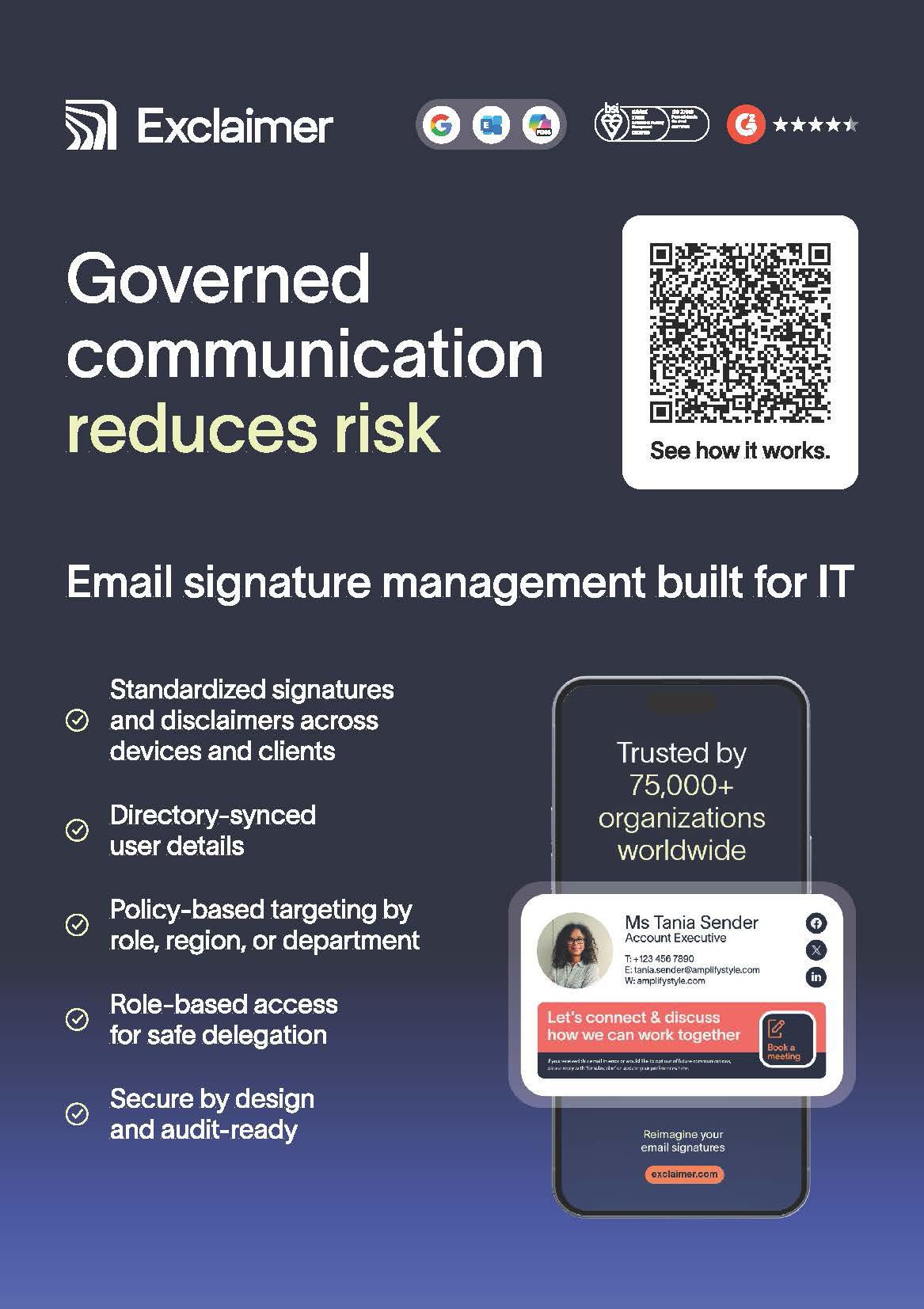
Exclaimer is the global leader in email signature management for Microsoft 365 and Google Workspace. Its cloud platform enables organizations to centrally manage and automate email signatures and video meeting branding, ensuring consistent corporate identity, reducing brand and compliance risk, and meeting regulatory requirements across everyday business communications. Built for IT and valued by Marketing and Compliance teams, Exclaimer eliminates manual updates, enforces brand governance, and gives organizations greater control over their most critical business communication channels. Exclaimer is trusted by more than 9 million users across 75,000 organizations worldwide, including Sony, Mattel, Bank of America, NBC, the Government of Canada, the BBC, and the Academy Awards. Learn more at www.exclaimer.com or follow Exclaimer on LinkedIn, Facebook, and X.
Freshworks Inc. (NASDAQ: FRSH) builds uncomplicated service software that delivers exceptional employee and customer experiences. Our enterprise-grade solutions are powerful, yet easy to use, and quick to deliver results. Our people-first approach to AI eliminates friction, making employees more effective and organizations more efficient. Nearly 75,000 companies, including Bridgestone, New Balance, Nucor, S&P Global, and Sony Music, trust Freshworks’ Employee Experience (EX) and Customer Experience (CX) software to eliminate complexity and increase productivity, loyalty and growth. For the latest company news and customer stories, visit www.freshworks.com and follow us on Facebook, LinkedIn, and X.
In an era where robust digital infrastructure and connectivity underpin nearly every aspect of operations NG Bailey IT Services (ITS) stands out as a trusted, end-to-end partner. We are the specialist digital technologies division of the NG Bailey Group, the UK’s largest independent engineering and services business founded in 1921. Our capabilities span the full spectrum of modern IT infrastructure, from the physical network layer through to managed support and digital integration. Design and installation of wired and wireless infrastructure, structured cabling, LAN, Wi-Fi, and data centres. The digital backbone your organisation runs on. Deploy voice and collaboration platforms, cloud telephony, video conferencing, and contact centre systems for seamless internal and external communication. 24/7 monitoring, maintenance, and on-site support ensuring maximum uptime and rapid incident response across your estate. Embed IT seamlessly within built environments integrating digital systems with cabling, hardware, and power from day one for maximum performance.
Pexip provides seamless video communication to all organisations regardless of technology platforms and security requirements. In deep collaboration with world-leading technology companies, Pexip powers solutions that remove video communication barriers and enable organisations to create secure and unique experiences tailored to their needs. Pexip serves large organisations, governments, and the justice, health, and defence industries world-wide. Pexip (PEXIP) is listed on the oslo stock exchange. 07565 000 966 / calum.fowler@pexip.com /
Redcentric
01423 877 559 / gareth.huxall@redcentricplc.com /
Redcentric is a UK managed service provider with over 29 years’ experience supporting organisations to run, secure and improve their IT. With roots in Yorkshire and a growing footprint across the UK, we partner with over 1,700 organisations, helping them tackle complex technical challenges. We deliver connectivity, cloud, communications and cyber security that keep systems running and teams connected. Our resilient, scalable solutions are designed to support change, helping IT leaders manage complex environments, improve performance and reduce pressure on internal teams. We combine hands-on expertise with a straightforward, partnership-led approach, helping you stay in control while building the foundations for what’s next.
Reversec is a global cybersecurity consulting company helping organizations tackle their most complex cybersecurity challenges. With a focus on continuous research, practical solutions and knowledge sharing, Reversec’s findings provide the rationale behind informed security decisions. With over 30 years of experience, Reversec brings together the expertise of renowned companies MWR Infosecurity, F-Secure, WithSecure, Digital Assurance, nSense, and Inverse Path.
SEP2 are an award-winning cybersecurity specialist and MSSP delivering a range of advanced solutions from their 24/7/365 UK-based SOC. They partner with world-class vendors, and are one of the most technical Check Point, Google and Wiz partners in the UK. Their team of expert engineers, analysts, and consultants is driven by a genuine passion for protecting customers from evolving cyber threats. That’s why they say they are Tech Driven, People Powered. SEP2 is an approved Google MSSP and one of the UK’s most technical Cloud Security partners. As a Premier Partner for Co-sell, Technology and Workspace Technology, SEP2 is one of the only partners in Europe able to provide services on the entire portfolio. They are a Check Point Elite Partner, delivering award-winning services with in-house resolution of 98.98% of support tickets. With more than ten Certified Security Master Elite engineers, SEP2 delivers unmatched expertise.
Spherica Group, powering end-to-end transformation through technology, delivery, and operational excellence. Spherica and Double Diamond Delivery unite to showcase a fully integrated approach to modern business transformation, combining automation-first managed services, advanced technology capabilities, and expert-led change delivery to drive measurable outcomes. Spherica delivers 24×7, automation-led Managed IT, Professional Services, and Assessment Services, enabling organisations to modernise their technology landscape, optimise performance, and unlock the full potential of AI and automation across their operations. We will also be showcasing ServiceHive, our innovative AI-driven Service Desk platform, designed to provide instant support, deliver significant productivity gains, reduce costs, and enhance service delivery. Double Diamond Delivery specialises in technology-enabled transformation, solution design, structured programme delivery, and operational improvement. Their expertise ensures organisations can execute complex change with confidence, accelerating outcomes, improving efficiency, and embedding sustainable, long-term value.
The Cyber Escape Room Co. is the UK’s leading experiential cyber security training company. Founded in 2023 by CEO Amy Stokes-Waters, the company operates on a single conviction: awareness training alone doesn’t change behaviour. Experience does. They design and deliver a suite of immersive products including physical escape rooms (ESC), large-scale conference installations (SPACE_), digital soloplay scenarios (SHIFT), AI-powered vishing simulations (CTRL+Vish), augmented reality experiences (ALT) and tabletop exercises (CMD). Clients include Channel 4, Admiral Insurance, ScottishPower, and McDonald’s. The company operates across the UK and internationally.
Stop attacks before they start. Get a comprehensive solution to your security needs on a single agent with the ThreatLocker Zero Trust Platform. With ThreatLocker, you’ll have the necessary controls in place to: •Block untrusted software and limit lateral movement •Gain operational efficiency and oversight •Leverage vast telemetry and intelligence data to alert unusual behaviours and Indicators of Compromise You’ll also be backed by the included 24/7/365 US-based Cyber Hero support team for rapid assistance and response as you harden your environment.
Thrive is a NextGen 3.0 global technology outsourcing provider that empowers small and mid-market organisations to transform their technology into a strategic advantage. Offering a breadth of services from AI and cybersecurity to cloud, compliance, and traditional MSP/MSSP solutions, Thrive’s team of seasoned experts develop strategies that standardise, scale, and automate technology to achieve outsized ROI. From advisory services to a 24×7×365 SOC and NOC, Thrive provides end-to-end IT and cybersecurity management so clients can focus on innovation and growth. With Thrive, your business is always supported and always secure.
Thumba is a Generative AI-powered platform that enhances clarity, quality and speed in user story creation and test artefacts. In agile teams, unclear user stories often cause misinterpretation, delays, and rework. Thumba solves this by generating complete, testable, implementation-ready requirements from the start. It identifies missing acceptance criteria, edge cases, dependencies, and risks, while producing structured test cases and scenarios. This enables early QA involvement and better collaboration. QA teams save time on manual effort, focusing more on quality improvements. Organizations report up to 70% productivity gains, 85% coverage, and 60% reduced rework, ensuring faster and confident software delivery.
Tier 1 is one of the UK’s most trusted and accredited IT Asset Disposition (ITAD) providers, specialising in the secure and compliant retirement of IT equipment. We help organisations maximise residual value while ensuring full data security, sustainability, and compliance throughout the entire asset lifecycle. From secure collection through to final reporting, Tier 1 provides a fully managed end-to-end service supported by certified documentation and comprehensive audit trails. Our solutions are tailored to meet both operational and ESG requirements, helping businesses reduce risk and improve efficiency. Our services include secure collections, onsite data destruction, data centre decommissioning, system upgrades, site surveys, and desktop and monitor installations. With a strong focus on professionalism, security, and customer service, Tier 1 supports organisations across the UK with reliable, scalable IT lifecycle solutions.
We design, develop, and defend Agentic AI-orchestrated bespoke software that gives you total digital autonomy. We solve the ‘gnarly’ technical problems that off-the-shelf solutions can’t, transforming your technology from a strategic liability into a defensible competitive advantage. Stop being bottlenecked by legacy systems; take control of your roadmap and build an unrivalled advantage. 07863 211 775 / zoe.perkins@unipro.io / unipro.io