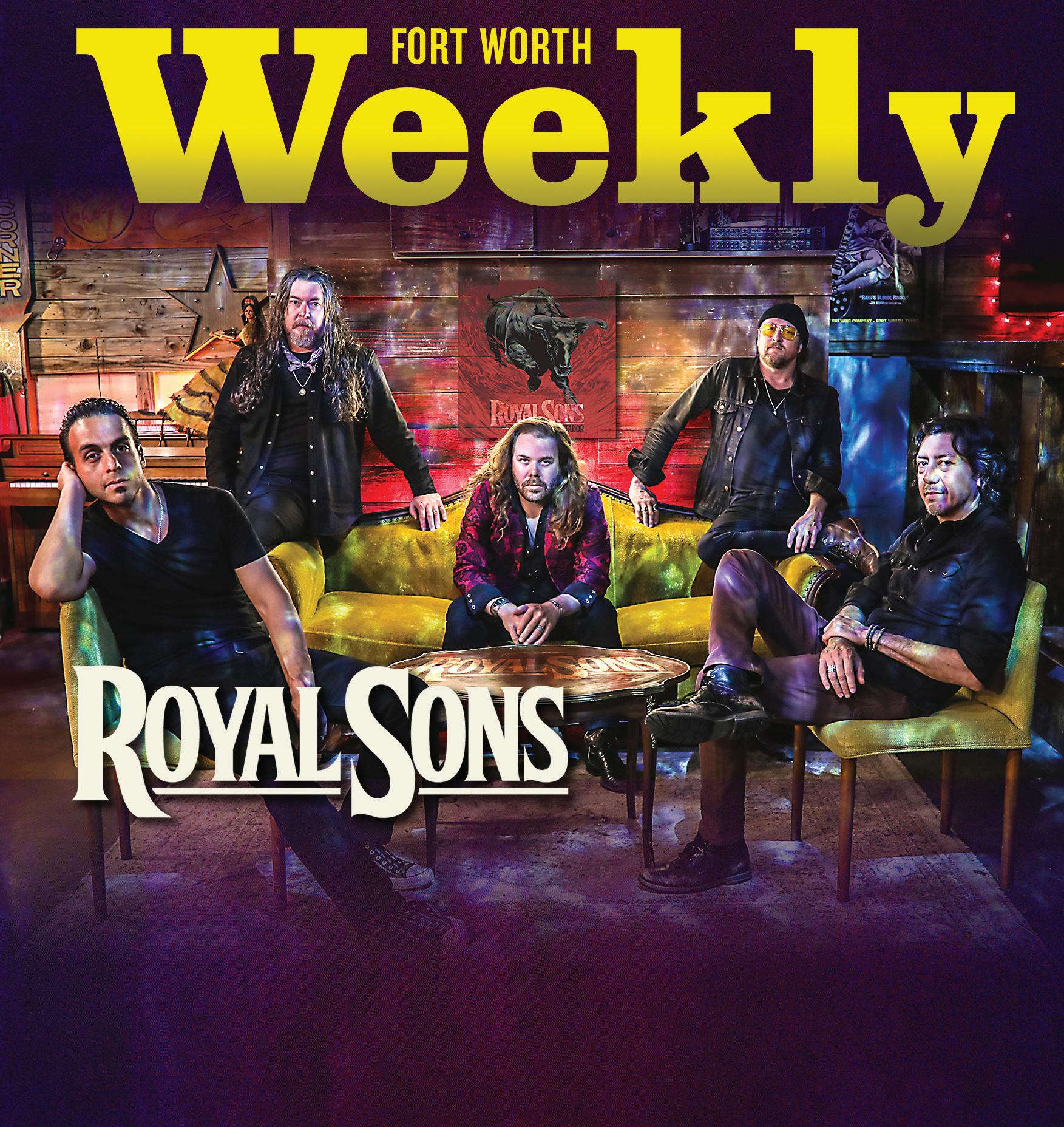
Fort Worth’s scuzzy, hard-rocking psyche-blues quintet returns with a new album, the brilliant Matador. BY
STEVE STEWARD
METROPOLIS
With the cancellation of Arlington Pride and the city’s new, antiLGBTQ+ ordinance, “Dream City” shows its true colors. BY JENNIFER
ZOOKI STURGES
EATS & DRINKS
Should the Juneteenth museum ease the “food swamp” that is the 76104? BY
PATRICE JONES
SCREEN
It’s a bird, it’s a plane, it’s a hot mess — it’s Supergirl! BY
KRISTIAN LIN
HEARSAY
The electronic-punk artist known as Squanto, Fort Worth’s Rickey Kinney is missing in L.A. BY STEVE
STEWARD
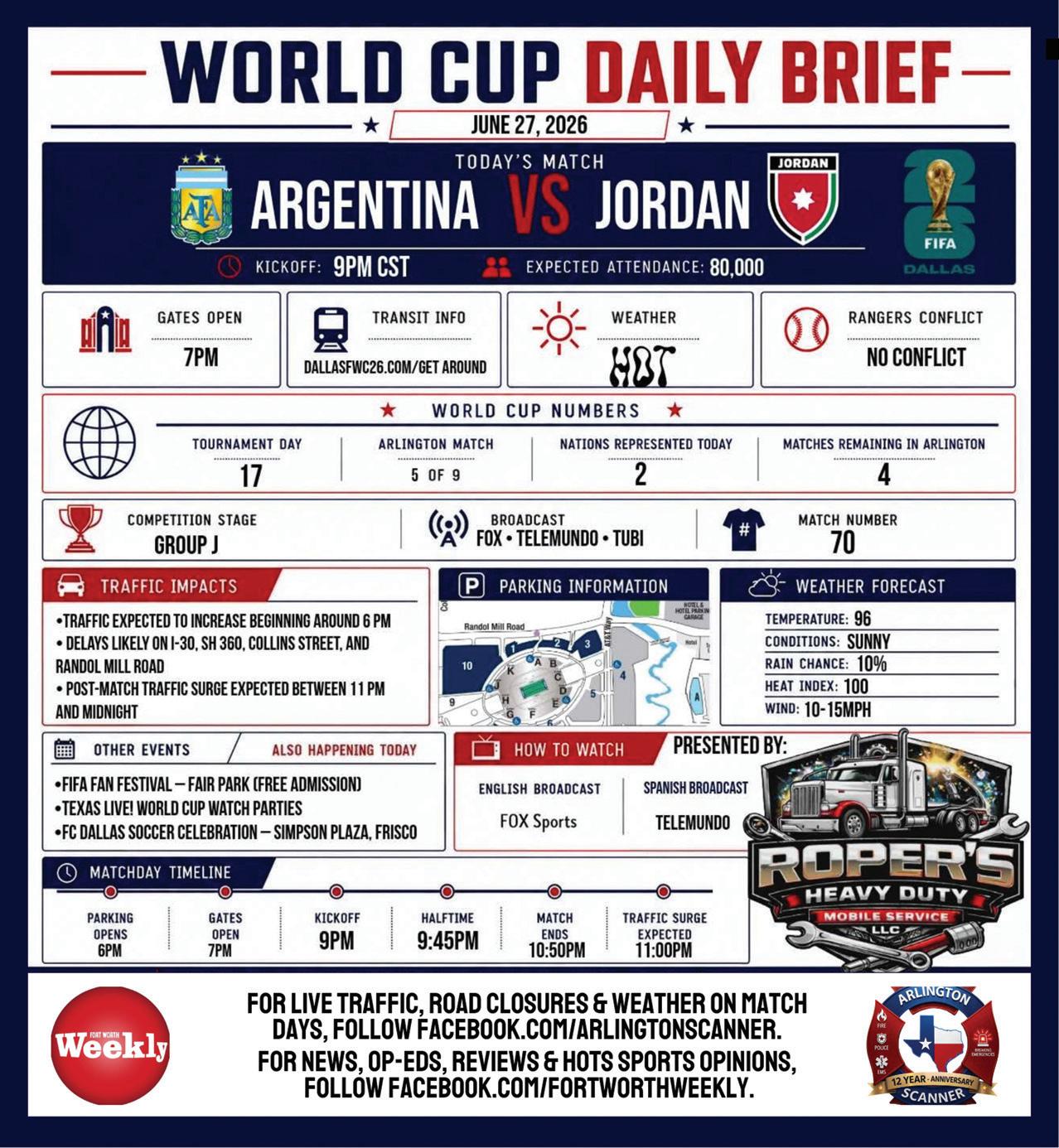
ICYMI // Cyber Soccer
BY FORT WORTH WEEKLY STAFF
A lot can happen between Wednesday, when the paper hits the stands, and Tuesday, when we do it all over again. Thankfully, with a great website at our fingertips, we can hit the #WorldWideWeb with breaking news and timely op-ed pieces at will. As Ferris Bueller once said, “Life moves pretty fast. If you don’t stop and look around once in a while, you could miss it.” With the World Cup in town, this is us making sure you don’t. — Jennifer Bovee
London Calling
BY ZACK FREEMAN (JUNE
19)
Wholesome British hooligans love The Londoner in Arlington, happily shocked by all-you-can-eat sirloins at Golden Corral. “Team England fans got a taste of home before their game yesterday against Croatia. The Londoner, a Dallas pub with locations throughout the Metroplex, held a soft opening at its new Arlington location just in time for the game. The wholesome hooligans were out in force …” Read more at https://bit.ly/FWW_LondonCalling.
World Cup Update (The Vozinha Edition)
BY KRISTIAN LIN (JUNE
17)
For one week, Gio Reyna’s goal against Paraguay silenced the noise around him. “On Ted Lasso, the British made fun of Ted for thinking that soccer matches are divided into quarters like American football games. This World Cup, the hydration breaks that come midway through each half have effectively divided the matches into quarters. The Americanization of soccer continues apace. We have the skinny on USA’s magnificent opening win and many, many other doings …” Read more at https://bit.ly/FWW_Vozinha.
World Cup Sparks Curiosity
BY
RUSH OLSON
(JUNE 14)
The World Cup sparks curiosity about soccer and maybe more. “What made the Samurai Blue? It’s not a riddle, actually. It’s a question people like you might be asking right now (kinda). See, you may have picked up on the fact that the Japanese men’s national soccer team calls itself the ‘Samurai Blue.’ That’s because the word that there’s a big tournament in that sport going on in the United States right now (also in Canada and Mexico) has spread rapidly. And Japan drew the first North Texas game of the tournament, so they have been especially prominent in the news in that region …” Read more at https://bit.ly/FWW_SoccerCuriosity
For more World Cup goings on, meet us back here next week or daily at FWWeekly.com.
17 9 5 10
ICYMI
2 Cyber Soccer
Follow the Weekly on socials and at FWWeekly.com for our ongoing World Cup coverage.
By Jennifer Bovee METROPOLIS
5 Arlington Unmasked
Why Arlington canceled Pride.
By Jennifer Zooki Sturges ARTS & CULTURE
6 Black Photojournalism x Sports Sports in Black Photojournalism exhibit part of broader Black-equality campaign.
By Rush Olson STUFF // SPORTS
9 World Cup Updates
It’s the USA’s own goals edition!
By Kristian Lin SCREEN
10 Straighten Up and Fly Right Supergirl review: a new kind of heroine.
By Kristian Lin CALENDAR
12 Night & Day
This weekend brings Lucky Leaf Expo, Rush, and more.
By Elaine Wilder
13 Reel Worth
Pizza and Pelé await in Irving.
By Elaine Wilder FEATURE
15 Men’s Health Month
What can we do to help men from dying earlier than anyone else?
By Mark Henricks EATS & DRINKS
17 Food Apartheid
76014 is a “food swamp” that shouldn’t be.
By Patrice Jones MUSIC
21 HearSay
Electronic artist Rickey Kinney, a.k.a. Squanto, is missing in L.A.
By Steve Steward
22 Music Feature
Royal Sons are back and rocking harder than ever.
By Steve Steward CLASSIFIEDS
23 Class Notices
24 Bulletin Board
STAFF
Editor-in-Chief: Anthony Mariani
Art Director: Ryan Burger
Special Projects Manager: Jennifer Bovee
Calendar Editor: Elaine Wilder
Film Editor: Kristian Lin
Music Editors: Patrick Higgins, Steve Steward
Proofreader: Emmy Smith
Editorial Board: Anthony Mariani, Emmy Smith, Steve Steward, Elaine Wilder
Contributors: E.R. Bills, Jennifer Bovee, Jason Brimmer, Amber Chadwick, Jess Delarosa, Buck D. Elliott, Danny Gallagher, Ozzie Garza, Juan R. Govea, Mark Henricks, Patrick Higgins, Laurie James, Kristian Lin, Cody Neatherly, Rush Olson, Jeff Prince, Emmy Smith, Kena Sosa, Steve Steward, Jennifer Zooki Sturges, Teri Webster, Ken Wheatcroft-Pardue, Elaine Wilder, Cole Williams
Owner / Publisher: Lee Newquist
Director of Operations: Bob Niehoff
Director of Sales: Michael Newquist
Director of Marketing: Jennifer Bovee
Account Manager: Julie Strehl
Sr. Account Executive: Stacey Hammons
Account Executives: Tony Diaz, Wendy Maier, Sarah Niehoff, Wyatt Newquist
Brand Ambassador: Clint Newquist
COPYRIGHT
The entire contents of Fort Worth Weekly are Copyright 2025 by Ft. Worth Weekly, LP. No portion may be reproduced in whole or in part by any means, including electronic retrieval systems, without the express written permission of the publisher. Please call the Fort Worth Weekly office for back-issue information.
Fort Worth Weekly mailing
For retail advertising: 817-321-9719 For classifieds: 817-987-7689 For national advertising: 817-243-2250 website: www.fwweekly.com email: question@fwweekly.com
DISTRIBUTION
Fort Worth Weekly is available free of charge in the Metroplex, limited to one copy per reader. Additional copies of Fort Worth Weekly may be purchased for $1.00
Cover photo by Robert Chickering
Arlington Unmasked
“Dream
City”’s new, anti-LGBTQ+ policy is likely
one reason a huge annual Pride event was
canceled.
BY JENNIFER ZOOKI STURGES
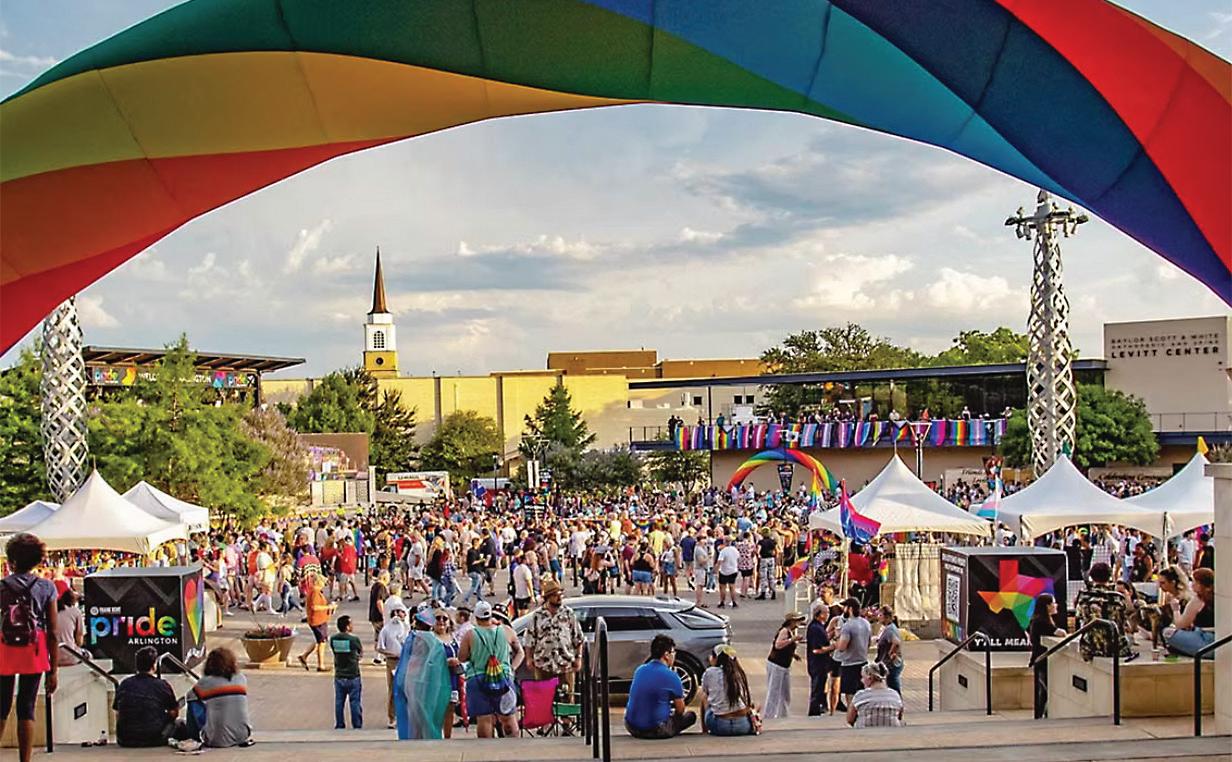
Levitt Pavilion in downtown Arlington sits desolate this month, a stark contrast to June, when an estimated 1,500 people piled into the small green space to enjoy the Help Center for LGBTQ+ Health’s celebration of gay culture which included vendors, live entertainment from notable drag queens, food trucks, and more.
The self-proclaimed “Dream City” has become a nightmare for the LBGTQ+ community and all discriminated people. In September, Arlington’s city council approved Ordinance No. 25-068, which “temporarily suspends the application and enforcement of the city’s antidiscrimination chapter” implemented in 1987.
City Council’s justification is that Donald Trump threatened to end federal funding for cities still following diversity, equity, and inclusion (DEI) policies. But Arlington took it a step further and is now the only major American city to respond in this way to Trump’s threat.
Arlington has also canceled Arlington Pride, an annual event that would have packed downtown.
Although DEI and Affirmative Action share the common objective of promoting fairness and preventing discrimination, they differ in their methods and guiding principles. Affirmative Action seeks to remedy past discrimination, while DEI initiatives take a broader approach, working to foster inclusive environments where individuals of all backgrounds can thrive and succeed.
The city’s removal of anti-harassment policies negates protections from harmful behavior which ensure a safe, respectful city. While these ordinances feed into larger, federal laws, local guidance acts as the standards of procedure for these laws. A concept taken from corporate America, standards of procedures, or SOPs, are documented step-by-step instructions that define how tasks and processes should be performed to ensure consistency, efficiency, quality, and compliance. DEI expert Katherine McCord said that without these foundational local-level laws, the larger federal guidelines cannot be upheld.
METROPOLIS
This erosion of protections led to the cancellation of this year’s Pride Arlington event. The organizers have said, “When equality is challenged
at the local level, we must prioritize the well-being of our community above celebration.”
But pride in Arlington could not be
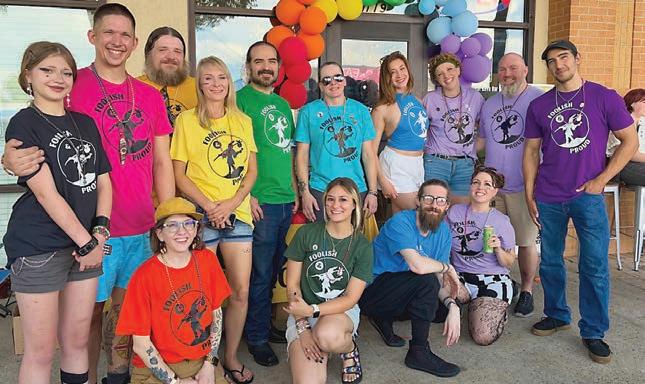
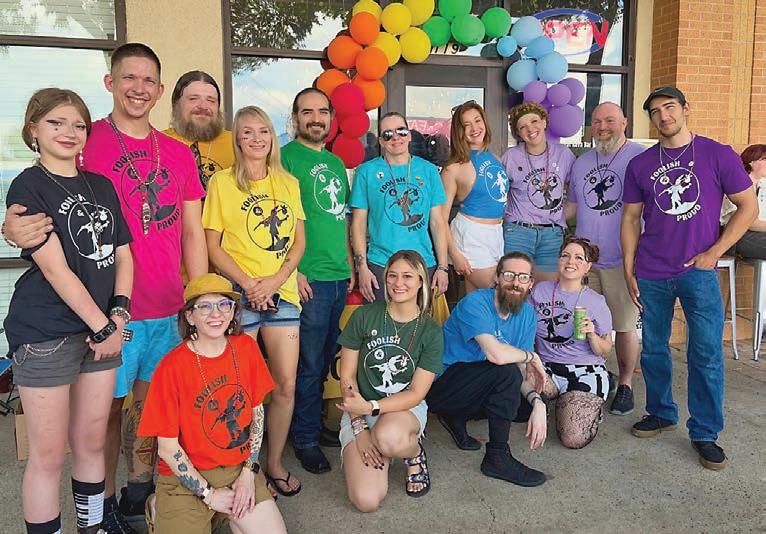
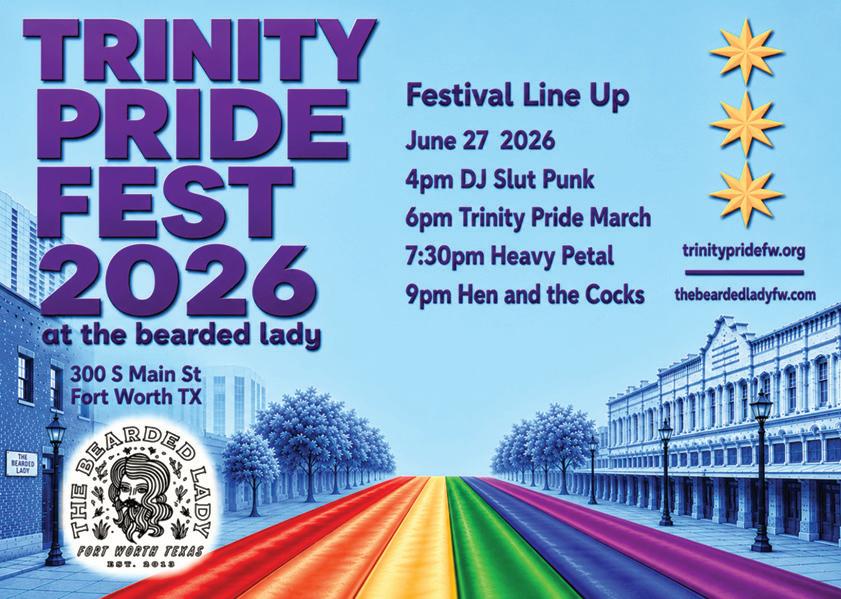
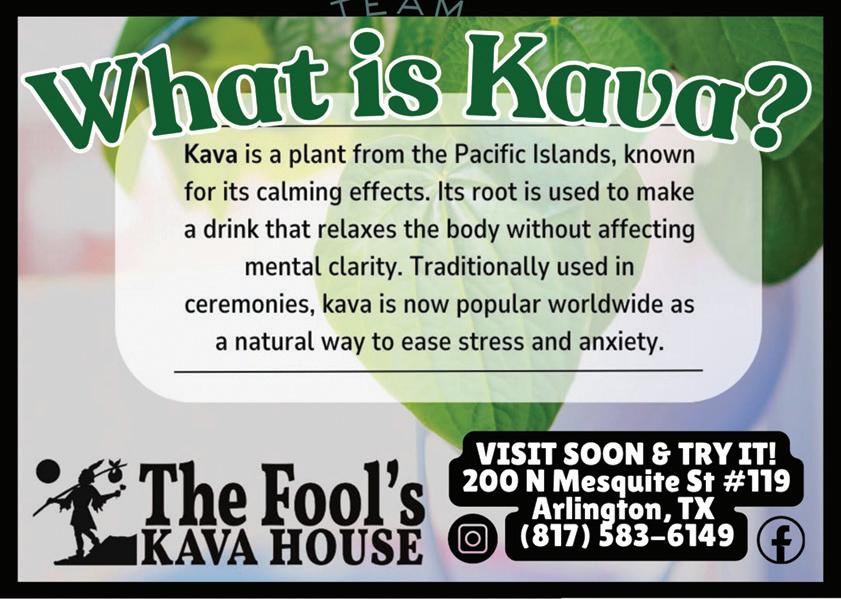
completely taken away. Spearheaded by Mary Elaine and Ashley Benton of The Fool’s Kava House, members of the community were able to enjoy food, shopping, and entertainment in a queer-aligned space on June 20.
Elaine said their goal was to “feature local Arlington, particularly queer vendors,” and they did. There was also live music from members of the community, and the evening ended with “getting the glow sticks out and all the disco balls” for a silent rave, Elaine said, “just [to] have a really fun time until 2 a.m. dancing and being silly.”
Benton did credit the city for creating the LBGTQ+ police officer liaison team that provided security.
While the event was small in comparison to Arlington Pride, the women of Fool’s Kava House offered something much more important: an example of the resilience of the LGBTQ+ community. From the days of the Stonewall Riots to modern-day issues of canceled Pride events and laws against drag queens, the community has always been spirited and difficult to keep down. l
This column reflects the opinions and fact-gathering of the author(s) and only the author(s) and not the Fort Worth Weekly. To submit a column, please email Editor Anthony Mariani at Anthony@ FWWeekly.com. He will gently edit it for clarity and concision.
Does the LGBTQ+ community still believe in “Dream City”?
Gabby King
The annual Arlington Pride fest would have brought tons of people downtown. Alas, the event was canceled.
ART
Wider Lens
At the Amon Carter, Black
Photojournalism
shows how sports strengthened the broader campaign for Black equality.
BY RUSH OLSON
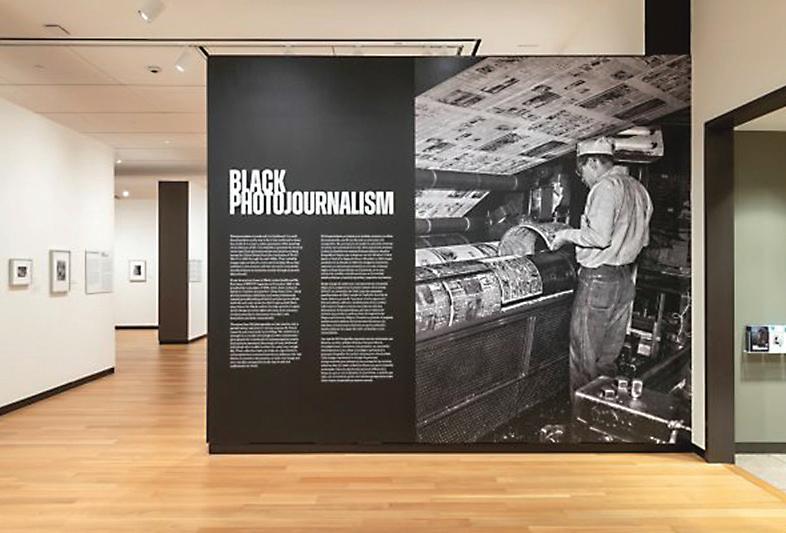
Visuals of athletic competition impact us. The perfectly captured victory celebration, the image of a defeated competitor’s despair, the moment of a home run robbery — such pictures drive home the emotion we feel about what happens on the playing surfaces. They can have impact beyond the fields, courts, and pools, too, as seen in Black Photojournalism at the Amon Carter Museum of American Art through July 5.
“What we tried to do with this exhibition is to show things you might not have seen before of said players — basketball players, football players, track stars — but slightly different than you’re used to seeing on the front page,” said Charlene Foggie-Barnett, co-curator of the exhibition who serves as community archivist for the Charles “Teenie” Harris Archive at the Carnegie Museum of Art in Pittsburgh. She oversees the 70,000-plus items in the collection created by Harris, a Black photographer who worked as a photojournalist in 20th-century Pittsburgh. The works presented at the Carter include many of his photos alongside
those of other Black photographers working between 1945 and the mid-1980s.
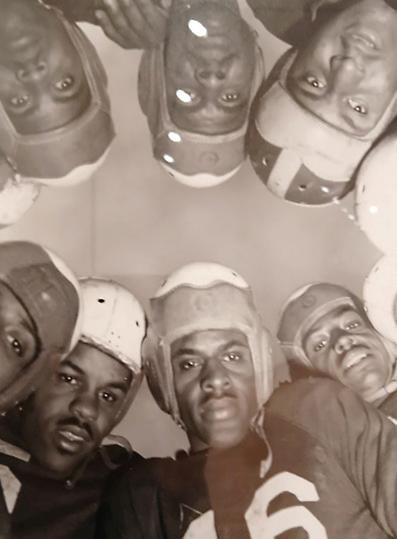
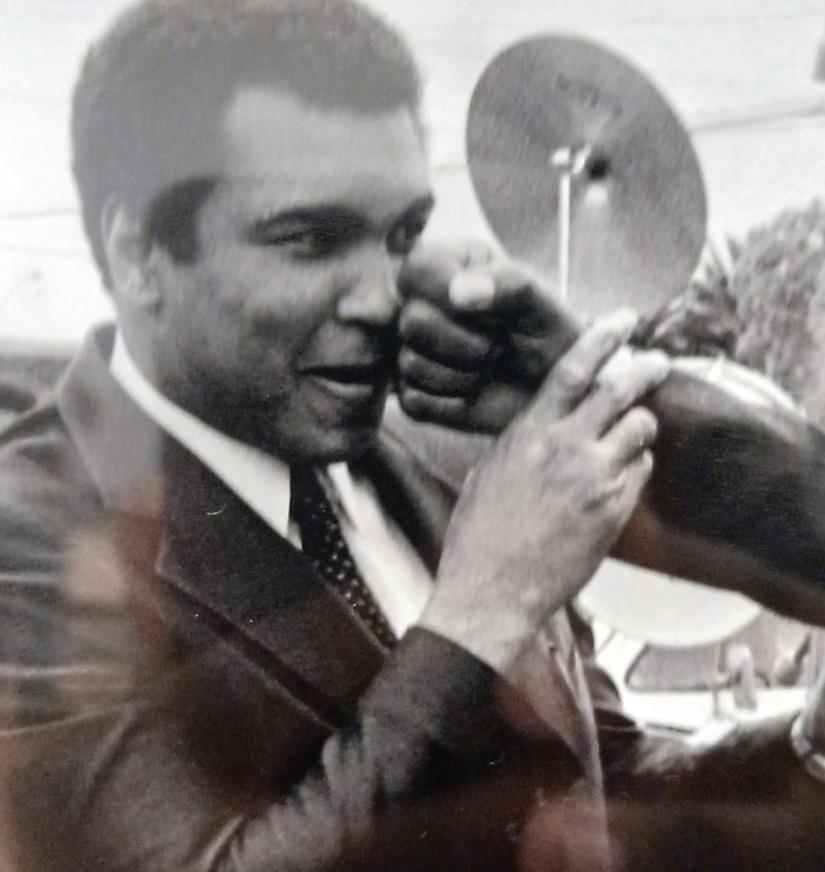
The pieces represent a general exhibit of photography, although Foggie-Barnett noted they would have had enough material to create a dedicated sports version. Indeed, Black Photojournalism does feature a number of sports-themed photos, including images of the likes of Muhammad Ali, Wilt Chamberlain, and Charlie Sifford. While some depict on-field competition, Foggie-Barnett and her co-curator, Carnegie Museum Curator of Photography Dan Leers, chose others that show athletes in other settings.
Foggie-Barnett: “What we tried to do with this exhibition is to show things you might not have seen before of said players — basketball players, football players, track stars — but slightly different than you’re used to seeing on the front page.”
While mainstream media might have stopped featuring Black athletes once the games ended, African-American newspapers, like the Pittsburgh Courier that employed Harris, wanted to provide their readers more detail. The installation includes an image of Jackie Robinson at the plate continued on page 7
in mid-swing but also ones that show him at a community event and in a commercial setting. The latter photo, by an unidentified photographer, features the pioneering baseball player alongside boxer Sugar Ray Robinson in an appliance store. We learn from the label that Jackie served as a TV salesman to earn extra money in the offseason, a normal practice for players in all leagues in the days before six-figure minimum salaries.
“We specifically wanted to take them out of this direct context of everything you’ve seen about them and say, ‘Oh, there’s two gentlemen selling TVs in shirts and ties,’ but they’re sports celebrities,” Foggie-Barnett said.
A 1967 advertising photograph in the gallery shows a pair of tennis players enjoying Tang breakfast drink.
“All money is green, so the airline industry and food and beverages were trying to get the Black dollar,” Foggie-Barnett noted. “Everybody wanted Tang after the astronauts went to space, and so now everyone’s like, ‘I want to be like the astronauts and have Tang,’ so that was promoted for, ‘OK, Black tennis players drink Tang, too.’ ”
The courting of African-American consumers by mainstream brands could be considered a subtle sign of progress. The newspapers for whom many of these photos were taken were also commercial enterprises, featuring ads that paid the photographers’ salaries. The papers’ readers wanted to see their own lived experiences reflected in these publications’ pages. Indeed, many of the images in Black Photojournalism show the everyday lives of Black Americans. The
organizers intentionally did not present well-known images of 20th-century domestic tumult. Instead, they opted to show more relatable signs of advancement, especially through sport.
“People will contact me at the museum and say, ‘Oh, I want to cover some civil rights things. I need civil rights information,’ ” Foggie-Barnett said, “so they go straight to Martin Luther King, and they go straight to that kind of civil rights. All of this is civil rights, and the sports activities are, in particular, a proving ground for civil rights, because it was happening in a national pastime.”
When Jackie Robinson worked with Branch Rickey to integrate Major League Baseball, it played a huge role in unleashing the power of sport to quicken the progression toward a more tolerant American society. Foggie-Barnett, a lifelong Steelers fan, cited the iconic Coca-Cola ad in which UNT alum Mean Joe Greene gives his worn jersey to a young white fan as one of many examples of visuals that have confirmed shared bonds through sports. Harris, whom Foggie-Barnett had known as a child (he even photographed her family), had played Negro League baseball as a co-founder of the Pittsburgh Crawfords. When he moved behind the camera for a career, Harris, along with the other photographers who contributed to the exhibition, provided visual evidence for the humanity of Black Americans, professional athletes or not.
“They are the proof of our existence as African Americans in this country, not the stereotypes and not the assumptions or misnomers,” Foggie-Barnett said. l
Foggie-Barnett: “The sports activities are, in particular, a proving ground for civil rights.”
DISCOVER THE BEST-KEPT SECRET
WEST OF FORT WORTH
TO ALL INTERESTED PERSONS AND PARTIES:
BIMBO BAKERIES USA, INC., has applied to the Texas Commission on Environmental Quality (TCEQ) for Renewal of Air Quality Permit Number 20765, which would authorize continued operation of the Commercial Bakery Facility located at 7301 South Freeway #IH35 West, Fort Worth, Tarrant County, Texas 76134. Additional information concerning this application is contained in the public notice section of this newspaper.
If our country had been facing Australia in cricket or men’s rugby, I’d have been bracing for a beatdown. However, since we were playing them in the sport that both they and we call soccer, our guys came away with an easy 2-0 win. That clinched USA’s spot in the knockout rounds with one game still to go, and a few hours later, Paraguay’s 1-0 win over Türkiye ensured that USA will finish top of the group and that this week’s final group-stage match against the Turks will mean nothing for either team. I’m here for the lack of drama and for answering your questions about the second round of matches at the World Cup.
What other significance does the win over Australia have?
Our press is making much of defender Alex Freeman scoring a goal on the same ground where his father, Antonio Freeman, caught a touchdown pass for the Green Bay Packers in Super Bowl XXXI. However, the international community noticed that Christian Pulisic was injured. Since he’s the American player whom most foreigners know about, Team USA winning so easily without him shows that the squad is more than just the AC Milan playmaker.
Is that all?
I noticed the “0” on Australia’s side of the scoreline. This is only the third clean sheet that USA have kept at the World Cup since 2010, and it’s particularly encouraging, since it testifies to the U.S. players’ ability to keep their focus and defensive
they spent the entire second half against Paraguay playing one man up after Miguel Almirón’s red card ejection. The international broadcast showed one Turkish fan giving his team the finger as they walked off the pitch, and you could see his point of view. Türkiye captain Hakan Çalhanoğlu has now received a harsh and very public lesson in keeping his big mouth shut.
Why do you get a red card for covering your mouth? This rule change was effected after a Champions League match this past spring, when Benfica player Gianluca Prestianni put his hand over his mouth to shout racial slurs at Real Madrid’s Vinícius Júnior, whom you likely know is Black. Ordinarily, that offense is punished immediately in the modern day, but Prestianni’s suspension took longer to be handed down because video replays couldn’t show his lips moving. (Also, Prestianni denied making racist remarks and said instead that he was making homophobic ones. The Argentinian player said the latter was perfectly normal, which it might be in Argentina.) Anyway, Almirón concealed his lips against Türkiye and duly got sent off, and now Paraguay will have to face Australia without their playmaker.
I didn’t know a rating of five one-hundredths of a goal was possible, unless a team spent the entire match standing still with the ball. Granted, the Carthage Eagles were in the position of adjusting to a brand-new coach in the middle of the World Cup, but that’s putrid.
Speaking of putrid, what about Ecuador?
After Cape Verde’s historic draw, Curaçao said, “Hold my blue curaçao.” The Dutch possession in the Caribbean is the smallest nation ever to compete at the World Cup, and they managed a scoreless draw against Ecuador. Imagine if the city of Denton had a team in the World Cup that pulled off a similar result, and you’ll understand how big this is. Curaçao goalkeeper Eloy Room tied the record for saves in a World Cup match set by USA’s Tim Howard against Belgium in 2014 (15). Take nothing away from Room, but the Ecuadorians’ poor finishing doomed them. I had the South Americans down as a possible dark horse, but between their lack of goals and their final game against Germany, La Tricolor may be out of this World Cup soon.
And what about Cape Verde?
intensity after taking an early lead. Beating inferior sides while allowing them to score consolation goals is generally not a recipe for a deep run at the World Cup, so let’s see Coach Mauricio Pochettino and his players keep things tight.
What was odd about USA’s win?
We reaped another own goal. Australia’s Cameron Burgess turned Folarin Balogun’s cross into his own net for USA’s opener, making our guys the first team in World Cup history to see the opposition score on themselves in two straight games. Own Goals has now scored five for the Stars and Stripes at World Cups, which ties Landon Donovan for the all-time lead. (The only country that Own Goals has scored more for is France.) I’d write a fight song celebrating it here, but Own Goals can turn on you in a heartbeat, so I’ll just quietly appreciate Own Goals’ performance in a USA jersey.
What happened with the Turks?
I had them rated as the most talented squad in Group D, and I still have them rated that way, but they are now a dead team walking, while Cape Verde, Curaçao, and Qatar are all still alive. (Let that sink in.) Contra other pundits’ predictions that Türkiye’s defense would be their Achilles heel, it was their offense that failed to break down two opponents who sat deep and bunkered in. That’s inexcusable, especially considering the fact that
I’m still traumatized by Ismaël Koné’s broken leg against Qatar. Has a worse injury ever happened at the World Cup?
Oh, yes. At World Cup 1982, West Germany goalkeeper Harald Schumacher tried to decapitate France defender Patrick Battiston, knocking out several teeth and leaving him temporarily in a coma. Incredibly, the referee called Battiston for the foul, and Schumacher went completely unpunished. (For that reason and many others, everybody hated the Germans that year.) Not escaping punishment was Brazil winger Leonardo at World Cup 1994, when he elbowed USA’s Tab Ramos and fractured his skull. Ramos was America’s best attacker at the time, and he was never the same after that. The Brazilians didn’t even wait for a suspension, sending Leonardo back home immediately, and they proceeded to win the World Cup without him. As for Assim Madibo, the Qatari player who snapped the Canadian midfielder’s tibia and fibula, his immediate reaction showed that he wasn’t trying to injure the player, but I doubt we’ll see him again at this World Cup.
What is xG?
It stands for “expected goals,” and it’s an advanced statistic that can be measured for a team or an individual player. The formula for computing xG takes in many variables and is more complicated than I care to explain. I bring it up because Tunisia managed an xG of 0.05 during their 4-0 loss to Japan.
The Blue Sharks continued their amazing run with a draw against Uruguay. At this point, who would bet against them beating Saudi Arabia or advancing out of the group? If they can do this, why can’t our team put together a run to the semis? (Japan’s probably thinking the same thing, too.)
How will Pochettino approach the dead rubber game against Türkiye?
Pulisic will almost certainly be given additional time to rehab his mysterious calf injury. Beyond that, it bears watching to see if Poch benches all, some, or none of his other regular starters. Resting the ones who have picked up yellow cards is an option, too, because a second yellow in the last group-stage match will draw a suspension in the following game and yellow cards will be wiped clean after the end of the group stage. Players currently on a yellow are: Balogun, Tyler Adams, Chris Richards, and Antonee Robinson.
Will the Turks even bother showing up?
You never know how a team will react to an early elimination. Some teams in the past have indeed thrown in the towel, but others have thrown everything they had at their remaining opponent to salvage some pride. In World Cup 2002, Poland crashed out after two losses but roared back to beat USA in the last group-stage game, a result that could have eliminated the Americans. We’ll see what the Turks do. l
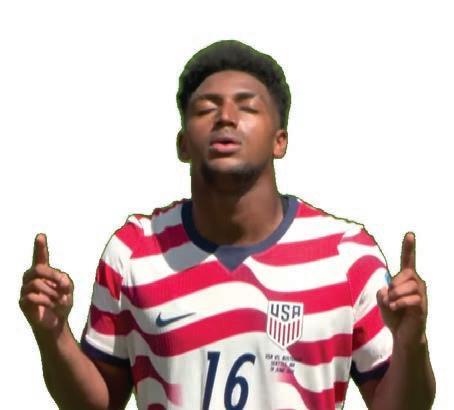
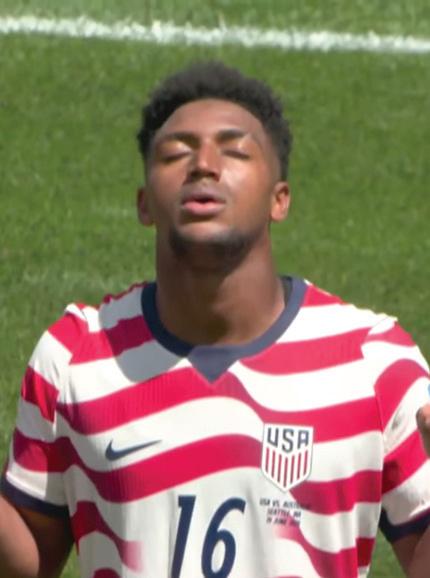
Alex Freeman gave thanks after Team USA’s win over Australia last week.
Courtesy YouTube
SCREEN
Straighten Up and Fly Right
A flaming, drunken mess of a superheroine is the reason to see Supergirl.
BY KRISTIAN LIN
Forget superhero movies for a second. There are so many stories about sons born into privilege who waste their youth on pleasures and have to grow up, however belatedly, to be worthy of their family legacies. (Shakespeare’s Henry IV Part One is a good example.) How many such stories are there about daughters? Aren’t they as likely to need straightening out? It’s true that for centuries such stories weren’t needed because expectations for girls were limited to having children, but what excuse do we have now?
From the moment Supergirl (Milly Alcock) appeared at the tail end of last year’s Superman, the character had a whole new take. Where Kara ZorEl has so often been merely a pretty blonde female version of her more famous cousin, this iteration made her into the family screw-up who’d rather order another cocktail than save the universe. That is easier to relate to, not to mention more fun. It’s where Supergirl’s own movie starts, and it successfully distinguishes the film from the herd of other superhero flicks. I just wish it had advanced the idea further than it does.
As stated at the end of Superman, Supergirl prefers to spend her time on planets with red suns,
where she doesn’t have superpowers but can much more easily drink herself into oblivion. She spends much of this movie wearing a Hole T-shirt, and Courtney Love ca. 1992 is just about her vibe. This gives life to some of the fight sequences, where her male enemies have a chance against her because she’s drunk or hungover. One nameless bad guy kicks her in the stomach during a bar brawl and makes her vomit copiously. She says, “Thanks, I needed that” and rejoins the fight.
The drinking has a solid psychological base, too. A flashback reveals young Kara’s parents (David Krumholtz and Emily Beecham) bringing her into being after Krypton explodes and her father manages to preserve a fragment of the planet.
The little girl then grows up watching her parents and everybody else die slowly from kryptonite poisoning before she’s sent to Earth to join her cousin (David Corenswet). As Kara points out, Clark never had to deal with that.
The Australian newcomer from TV’s House of the Dragon and Sirens, Alcock gets in a nice crack at Supergirl’s anger and pain and self-pity. Against all of that, Superman’s wholesome optimism comes
off as refreshing when he shows up. Her backstory even gives emotional weight to Krypto, the dog, seen as a stray puppy who comes up to Kara during her mother’s funeral. This movie’s villains shoot the dog with a slow-acting poison, and I’m glad Ana Nogueira’s script comes with a logical reason for this, because there’s no movie if the poison acts fast. (Or rather, there is a movie, but it’s John Wick, and we don’t want that.)
What doesn’t work is most of the rest of it. The action sequences are not only muddy, but they’re also not well integrated into the story. The flashback revealing Supergirl’s past comes during a huge lull in the plot, and director Craig Gillespie can’t keep it from turning into a dead spot. In fact, he can’t even come up with a single memorable visual or set piece. Balancing action and character material is an issue for him all movie long, and the story’s forward movement is consistently clunky.
Supergirl reluctantly has to look after a girl (Eve Ridley)
whose family was murdered by the same gang of bandits who shot Krypto, and the whole subplot is flat. We don’t believe that Kara turns her life around by convincing this girl not to take revenge. Even the time element of Kara needing to retrieve the poison’s antidote from the robbers before Krypto dies doesn’t appreciably raise the movie’s tension.
Jason Momoa turns up as a rude, cigar-chomping bounty hunter who alternately works with and against Supergirl. His wit and verve do much to leaven the proceedings and bring out a different form of humorous toughness in the heroine. The superhero genre is rife with male characters who have to work through their personal issues while coming to terms with their powers. There’s plenty of room in the genre for women who are in the same spot. Supergirl sets up that story, but I can’t help thinking that it could have been that great film. No such luck here. I guess we’ll have to wait for the sequel. l
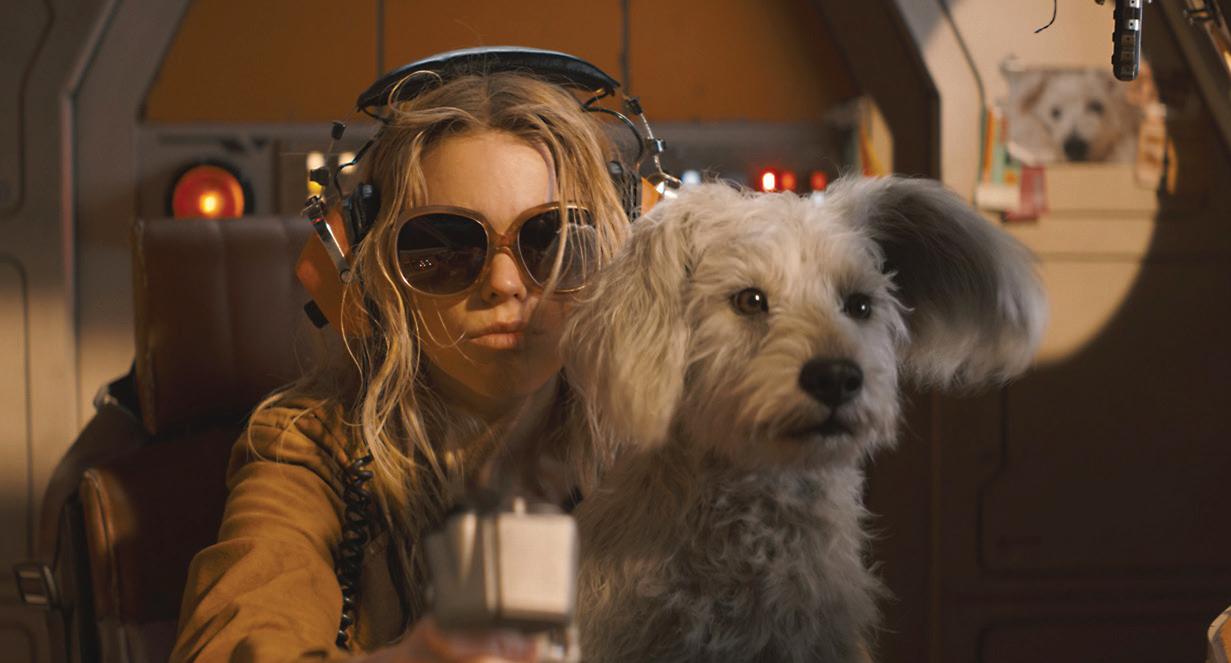
Don’t drink and fly: Piloting her spaceship with Krypto on her lap, Milly Alcock is a new kind of superheroine.
Courtesy Warner Bros. Pictures
Supergirl
Starring Milly Alcock and Eve Ridley. Directed by Craig Gillespie. Written by Ana Nogueira. Rated PG-13.
CALENDAR
Night & Day: A Week Without Futbol
This just in. There’s more happening around town than just the Beautiful Game.
BY ELAINE WILDER
With soccer in your face at every turn, it’s hard to imagine anything else is going on. And yet, here we are.
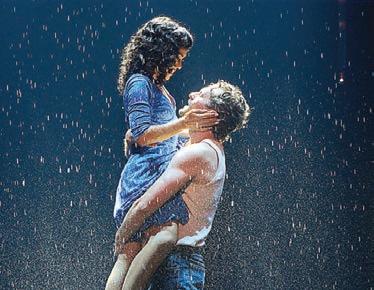
Broadway at the Bass presents The Notebook: The Musical Based on the bestselling novel that inspired the iconic film, the story follows Allie and Noah, from different
center back in the day?) but have done Big D dozens of times in the intervening years. And, y’know, since Fort Worth — now the country’s 10th largest city — gets lumped in with Dallas all the time, and I’m sorry for having some civic pride. Geddy, Alex, you’ll be in Fort Worth, not Dallas. Geddy, Alex, I don’t think any place in town serves poutine, but I know where to get some killer Mexican food. Text me! — Anthony Mariani
worlds, who share a lifetime of love despite forces that threaten to pull them apart. Entertainment Weekly says the musical is “full of butterfly-inducing highs and beautiful songs” and is “a deeply moving portrait of the enduring power of love.”
Tickets to the show at Bass Performance Hall (525 Commerce St, Fort Worth, 817-212-4280) start at $50 at BassHall.com.
The next biggest classic rawwwk! gigs (plural) are by Rush, all four concerts — Jun 24, 26, 28, and 30 — at Dickies Arena (1911 Montgomery St, Fort Worth, 817-4029000). As a fan of the Canadian power trio since “Tom Sawyer” first flipped my wig in sixth grade (circa 1981), I admit I will crap my ridiculous, some would say “overworn” cargo shorts if Geddy or Alex addresses the crowd as “Fort Worth” instead of “Dallas,” since the guys haven’t played the Fort in decades if at all (maybe the convention
From noon to 4pm, Topgolf (2201 E 4th St, Fort Worth, 817-349-4002) and the Fort Worth Chamber of Commerce invite you to a patriotic celebration of America’s 250th, “bringing Fort Worth together to party like it’s 1776.” This isn’t your typical golf tournament. No early tee times, no lost balls, and no waiting on the group ahead of you. Not really a tournament! You and your teammates can participate in a little friendly rivalry and a lot of fun. Let Freedom Swing! offers branded bays, contests, networking, music, great food, and friendly competition — fostering connection and celebration the whole time. Spots are limited. The event is open to both members and nonmembers of the Fort Worth Chamber. For registration info, team fees, and other details, go to Business.FortWorthChamber. com.
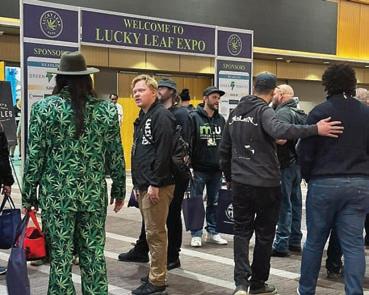
It’s also time for the biggest cannabis-oriented event of the year. The two-day Lucky Leaf Expo at the Irving Convention Center (500 W Las Colinas Blvd, Irving, 800-247-8464) is Fri-Sat, Jun 26-27. This major cannabis conference and expo features more than 100 exhibitors, speakers, and networking opportunities for industry
professionals. Learn about the new laws, markets, and business opportunities 10am-5pm Fri and 10am-4pm Sat. Two-day passes start at $35 at LuckyLeafExpo.com.
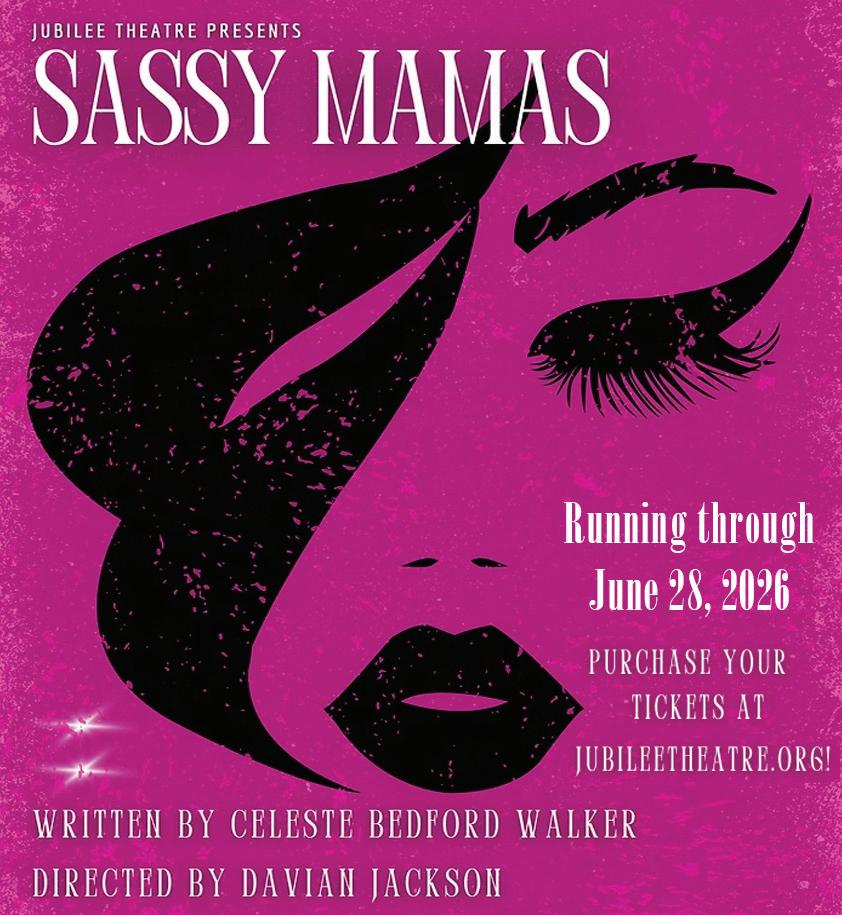
In celebration of its 46th anniversary, Jubilee Theatre (506 Main St, Fort Worth, 817-3384411) presents Sassy Mamas. Onstage Fri-Sun, Jun 26-28, and directed by Davian Jackson, the play follows three accomplished women who, later in life, boldly step back into the dating world — seeking younger men they proudly call “tenders.” Written in 2007, the play has earned multiple awards. Though playful and sexy on the surface, the story is ultimately about empowerment: three women refusing society’s rules about age, love, and who they’re allowed to desire. Each finds her own path to rediscovering joy, confidence, and freedom. This show is for mature audiences only (18+). Tickets start at $28 at JubileeTheatre.org/
Alysha Deslorieux (Middle Allie) and Ken Wulf Clark (Middle Noah) star in the North American tour of The Notebook at Bass Hall.
The biggest cannabis-oriented event of the year, Lucky Leaf Expo, is at the Irving Convention Center this weekend.
CALENDAR
Reel Worth: Pelé & Pizza
BY ELAINE WILDER
Aaaaand we’re back to the Beautiful Game — or a movie screening about it, at least.
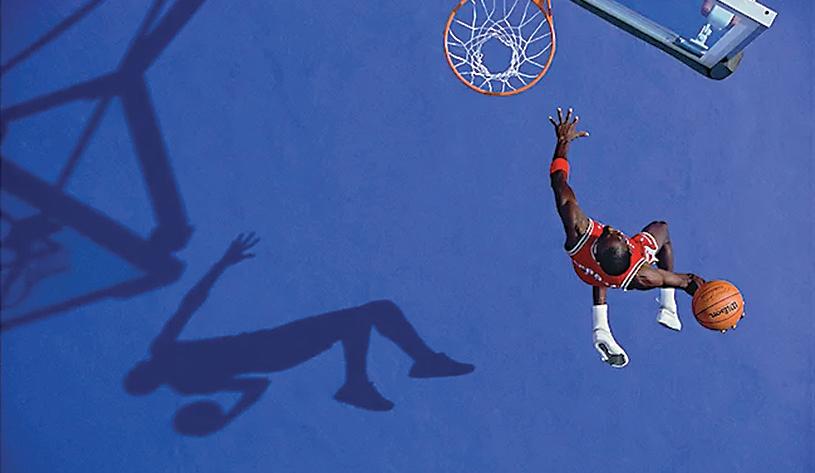
The Irving Archives and Museum (801 W Irving Blvd, Irving, 972-721-3700) invites you to step into the stories behind sports history via two current exhibits: The Perfect Shot: Walter Iooss Jr. and the Art of Sports Photography and Tom Landry: A Life in Football
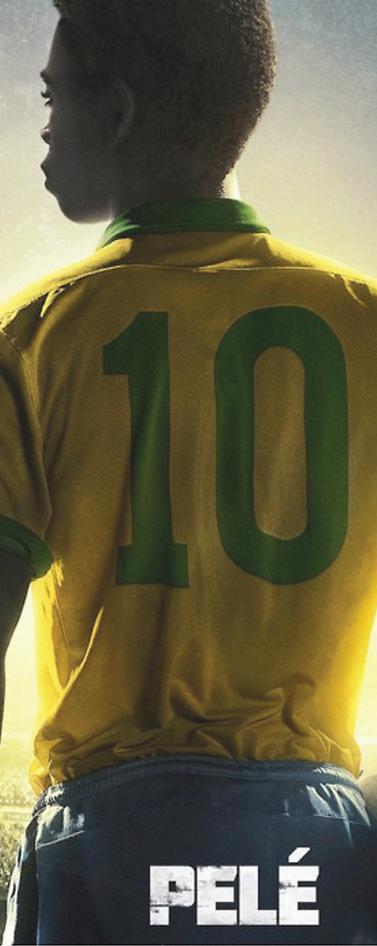
In celebration of these exhibits and the summer of soccer we are all experiencing, the museum is hosting a free screening of the documentary Pelé: Birth of a Legend on Sat, Jun 27, at 1pm.
Before the film, explore the exhibitions and discover the athletes, coaches, and moments that have shaped the world of sports. Then, follow Pelé’s remarkable journey from humble beginnings in Brazil to becoming one of the most celebrated athletes of all time and his story of perseverance, passion, and determination.
The event is hosted by the museum in collaboration with Civic Season, a national initiative observed between Juneteenth and the Fourth of July that connects community members with history and democracy.
Admission is free to this all-ages event, and guests can enjoy complimentary pizza while supplies last.
a
As part of
retrospective of his work, Walter Iooss Jr.’s “The Blue Dunk” is on display in Irving.
The documentary Pelé: Birth of a Legend screens on Saturday in Irving.
FEATURE
Gone Too Soon
Taking action to reduce premature male death could be the biggest and best opportunity we have to help America and Americans.
BY MARK HENRICKS
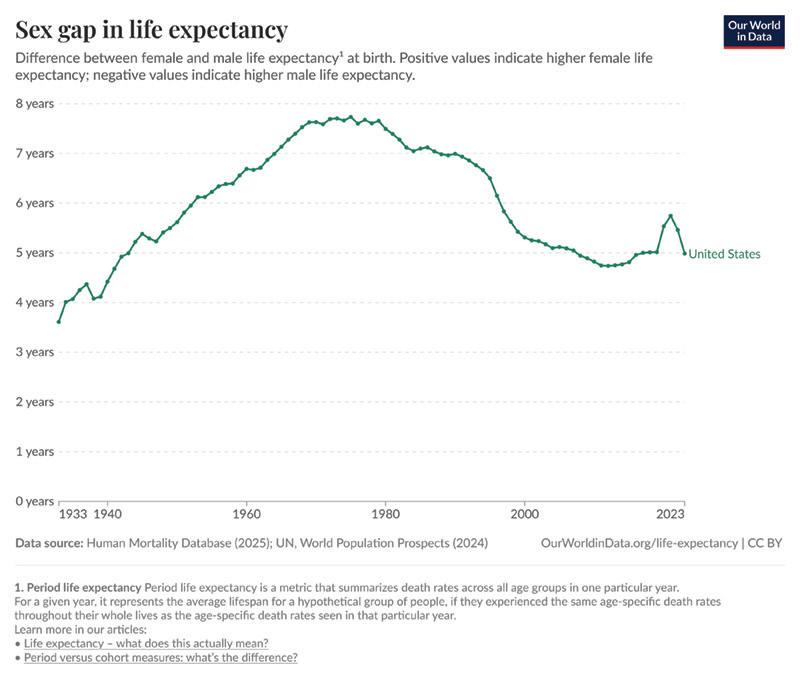
An American boy born today will on average live almost five fewer years than a member of the opposite sex born today. In addition to directly affecting in the most profound and personal manner the 1.88 million boys who will be born in our country this year, this burden also weighs heavily on society at large.
Male premature death imposes enormous economic costs as well as incalculable emotional and other damage on families, friends, employers, and others. Basically, it affects any person or institution that cares about or relies on men.
Racer Kyle Busch’s death last month at 41 is a timely and high-profile reminder of how often and tragically American men pass before their time. The winner of more races in the top NASCAR divisions than anyone in history collapsed and died from complications of pneumonia less than
a week after winning his final professional race. In addition to his wife and two children, ages 11 and 4, Busch was mourned by countless motorsports fans, sponsors, team owners, and other drivers.
Like many people, I’ve been personally touched by premature male death. Twenty-five years ago, my father died aged a few months younger than I am now. He passed because of a fatal embolism to which smoking and alcohol use likely contributed. My son, Brady, died almost 10 years ago at 16 of suicide. Suicide is one of the major causes of death in America, and 80% of those who die from it are men.
And it’s not just me and some race fans. Virtually every American has felt the loss of a father, husband, son, or other man who left before what would have been his time if premature male death were reduced. And even those without personal male attachment can be significantly affected by broad societal effects of so many tens of millions of people dying so much younger than the rest.
Men make up almost half (about 49%) of the 342 million Americans. This group of roughly 167.5 million is larger than any other cohort affected by a similar life-expectancy deficit. Two top causes of early death — obesity and smoking — reduce life expectancy for millions, but neither condition is nearly as common as being male.
The loss in lifespan is also massive. The magnitude of male premature death varies over time — more on that later — but currently sits at nearly five years. This exceeds the three to four years of reduced life expectancy for a smoker who puffs half a pack of cigarettes a day. It’s similar to all but the most severe forms of obesity. And maleness is not something most people choose. It’s mostly chosen for them at birth.
It’s easy to see how losing a father, husband, son, brother, or friend can affect individuals. The social impact is perhaps harder to discern, but, once you look, it is massive. To get an idea, let’s look at the economic effects. They may not be the most important, but measuring them is relatively straightforward.
When you add it up, male premature death probably has an economic impact of at least $300 billion every year, using the most conservative estimates. A midrange estimate would put it at over $2 trillion, year in and year out.
These estimates are necessarily imprecise and use figures like the statistical value of a life which are not completely standardized. However, when considering lost earnings to families, lost productivity to employers, higher healthcare
outlays, and other costs, it’s clear that few, if any, social investments offer potential for more broadbased rewards.
Of course, before you try to change something, you need to ask what causes it. The answer’s not simple. Male premature death has many causes. A brief list includes biology, behavior, occupational hazards, mental health, societal roles, violence, and war. All these and more cut men’s lives shorter than the average.
Looking at the details, when it comes to biological factors, men tend to have less robust immune systems. This can make them more susceptible to infections such as Kyle Busch’s fatal pneumonia. Men also tend to have more testosterone, which may incline them to risky behaviors such as driving too fast. Men are more than twice as likely to die in traffic accidents.
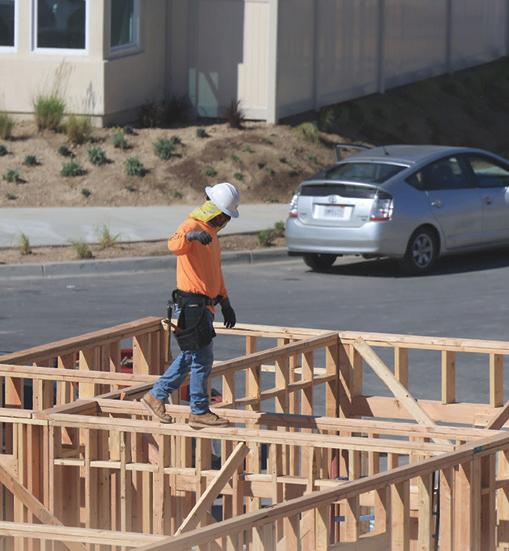
On the social front, men are far more likely to work dangerous jobs — more than 90% of the 5,000 or so fatal on-the-job accidents each year kill men. Male social roles also draw them to lifespan-reducing choices such as smoking and drinking. Similarly, masculine stereotypes discourage seeking medical attention for physical and mental health conditions.
A variety of causes calls for a variety of solutions. Fortunately, we can choose from proven effective approaches. Even biology can be overcome. It’s not set in stone by nature that men will die younger. Several pieces of evidence support this view.
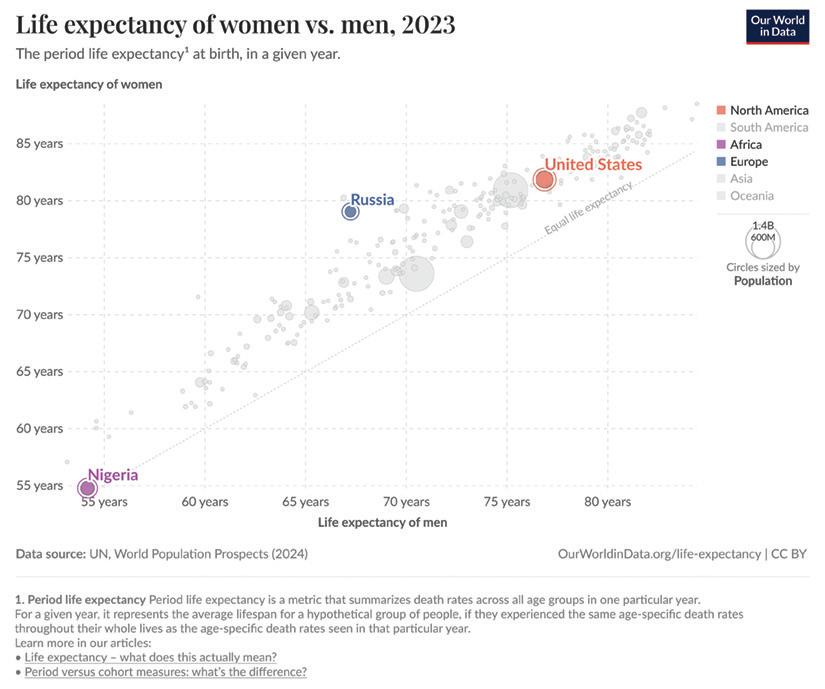
First, consider how male premature death shows up in different countries. In Russia, for instance, men die an average of almost 12 years sooner. In Nigeria, the difference is just six months. Since Russians and Nigerians are biologically interchangeable, the variation suggests that culture and society are as important as biology in male premature death.
History also makes it plain that biology can’t fully explain male premature death. In 1880, for instance, American men actually outlived women. This began to shift in large part because of better maternal care following labor and delivery.
Before washing hands and sterilizing surgical instruments became standard practice in maternity wards, mothers often died from childbirth — a biological factor if ever there was one. By 1933, the effects of better medical care for mothers and other factors meant American men died about 3.6 years sooner.
That trend of increasingly premature male death has generally continued today, with occasional spikes. One occurred during the pandemic, when men represented a lopsided share of COVID deaths. A bigger one happened in the 1960s and 1970s, as American men died on average nearly eight years prematurely due to war, smoking, drinking, and accidents.
Since biologically based female premature death was reversed by social change, it follows continued on page 16
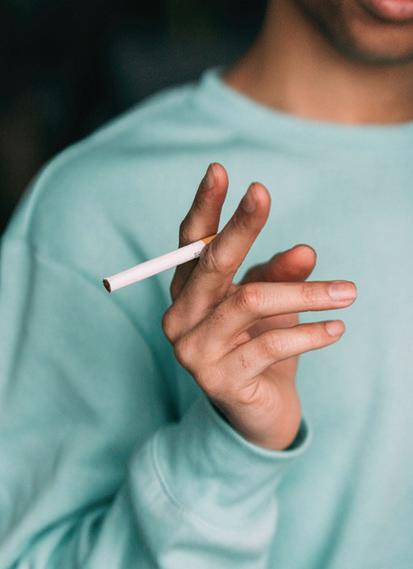
Smoking is one of the characteristically masculine traits that can lead to male premature death.
Pexels
Social
Men are much more likely to work dangerous jobs and engage in risky behaviors that can shorten their lives.
that social changes can, in principle, reduce male premature death. The recent introduction of the 988 suicide crisis hotline shows that this is not just theoretical. More than 4,000 fewer American teens and young adults died from suicide in the first few years after the hotline’s national rollout.
Because suicide is so lopsidedly male, this mostly benefited men and shows how relatively small, inexpensive initiatives can help reduce male premature death. In the case of the hotline, the federal government has budgeted $231 million to fund its national operations for five years. That is a cost of about 15 cents per year for each American. Other promising low-cost moves include campaigns like those encouraging mammograms, which would prompt men to visit their doctors more often, drink and smoke less, and even choose less dangerous occupations.
There are predictable objections to any effort to reduce premature male death. One is that it won’t work, that there’s nothing we can do. The evidence that cultural factors influence male premature death show this is not so. We can’t change biology for the most part, but we can change culture.
Detractors are also sure to say that this would redirect resources from other worthwhile social goals. This isn’t about taking from anyone. We can do this without neglecting other pressing needs.
Today, virtually no money or attention is directed at solving this problem. Because so little is being done now, even limited and low-cost
produce significant improvement. Resource constraints are not the issue.
Any widow, fatherless child, or bereaved parent probably doesn’t need to ask whether
success here would be worth the effort. Others could consider the benefits of having two-income households later in life, expanded grandparent involvement in childcare, longer
marriages and friendships, and more multigenerational family experiences. More pluses include a better return on investments in education, the availability of more mentors, and improved institutional memory.
It’s not going to help only the men who would otherwise die, or NASCAR fans, or my family, or my late son’s friends and relatives. It will improve life for virtually everyone by ensuring that half the people in America don’t die five years sooner than the other half when there is something we could do about it.
Premature male death is as big an opportunity as it is a problem. There probably is no other preventable health risk that affects as many people, or as large a portion of the population, in so many profoundly meaningful ways. If we can reduce premature male death, we’ll all be a lot better off.
So let’s start now. Let’s first recognize that premature male death exists. Let’s see it has large, lasting, and nearly universal effects. Let’s get our heads around the idea that it probably can be meaningfully reduced even if not eliminated. Then we can discuss practical paths to change.
For Men’s Health Month this June, look at a man near you whom you care about — even if it’s yourself. Now think about what it would be like if they were gone, finally, completely, and irreversibly. Wouldn’t you like something done to keep that from happening? I would.
Writing this article is an effort to do something by starting to shift attitudes. It may take a while for that to happen, and it’s too late for my beloved son Brady, Dad, Kyle, and uncounted millions of other men who died before their time. But, hopefully, it’s a start. l
EATS & drinks
Food Apartheid
The 76104’s health crisis is intertwined with the National Juneteenth Museum.
BY PATRICE JONES
The term “food apartheid” was coined by food justice advocate Karen Washington to highlight that lack of healthy food is not a natural con dition but a system of segregation that divides people with access to abundant, nutritious food and those who are denied that access because of systemic injustices. Food apartheid goes beyond the common “food desert” label — it points to de liberate social and economic policies like redlin ing and disinvestment that restrict grocery stores, farmers’ markets, and fresh produce to affluent areas and leave Black and Latino neighborhoods with few or no options.
Communities suffering food apartheid often become food swamps — areas where energy‑dense, ultra‑processed foods from conve nience stores and fast‑food restaurants flood the local market. Healthline defines a “food swamp” as a place where there is more access to less‑nu tritious food than nutrient‑dense food, and these areas disproportionately affect historically marginalized racial and ethnic groups, especially Black residents. Research shows that living in a food swamp is a stronger predictor of obesity than living in a food desert.
The consequences of food apartheid are stark in Fort Worth. In the 76104 ZIP code — an historically Black area comprising the neigh borhoods of Morningside, Hillside, Southside, and Terrell Heights — life expectancy hovers around 66 67 years, the lowest in Texas. UT Southwestern’s statewide analysis found that ZIP codes with less than 5% of residents living in poverty had an average life expectancy of 82.4 years, whereas those with more than 20% poverty had an average of 76.4 years. In 76104, the poverty rate is around 40%, and the median household income is about $31,450 in 2019. Despite sitting within Fort Worth’s Medical District, the community has few grocery stores and abundant fast‑food outlets — residents told researchers that the nearest supermarket is more than a mile away and that convenience stores and dollar stores dominate.
A 2013 food‑desert study found no grocery stores in 76104, and 22% of Tarrant County households lack a vehicle and live over a mile from a supermarket. As a result, diet‑related chronic
While the National Juneteenth Museum symbolizes cultural pride and investment, local residents stress that art and tourism alone cannot solve their daily struggle for healthy food.
diseases such as heart disease and hypertension are common.
These health inequities have roots in de cades of discriminatory policies. Redlining — a racist practice in which banks refused loans in neighborhoods graded “C” or “D” by the Home Owners’ Loan Corporation — created cycles of disinvestment. A 2022 national study found that historically redlined neighborhoods still exhibit reduced food access and increased food insecurity. Other research links “supermarket redlining,” in which grocery chains avoid inner‑city neighbor hoods, to hunger, poor diets, and higher rates of diet‑related diseases. As advocates at the Straydog Institute explain, this legacy of structural racism has left Black, Indigenous, and other commu nities of color with fewer supermarkets, zoning restrictions that discourage local food retail, and limited economic opportunities. When combined with low wages and a lack of transportation, these policies effectively determine who eats fresh fruits and vegetables and who relies on processed foods.
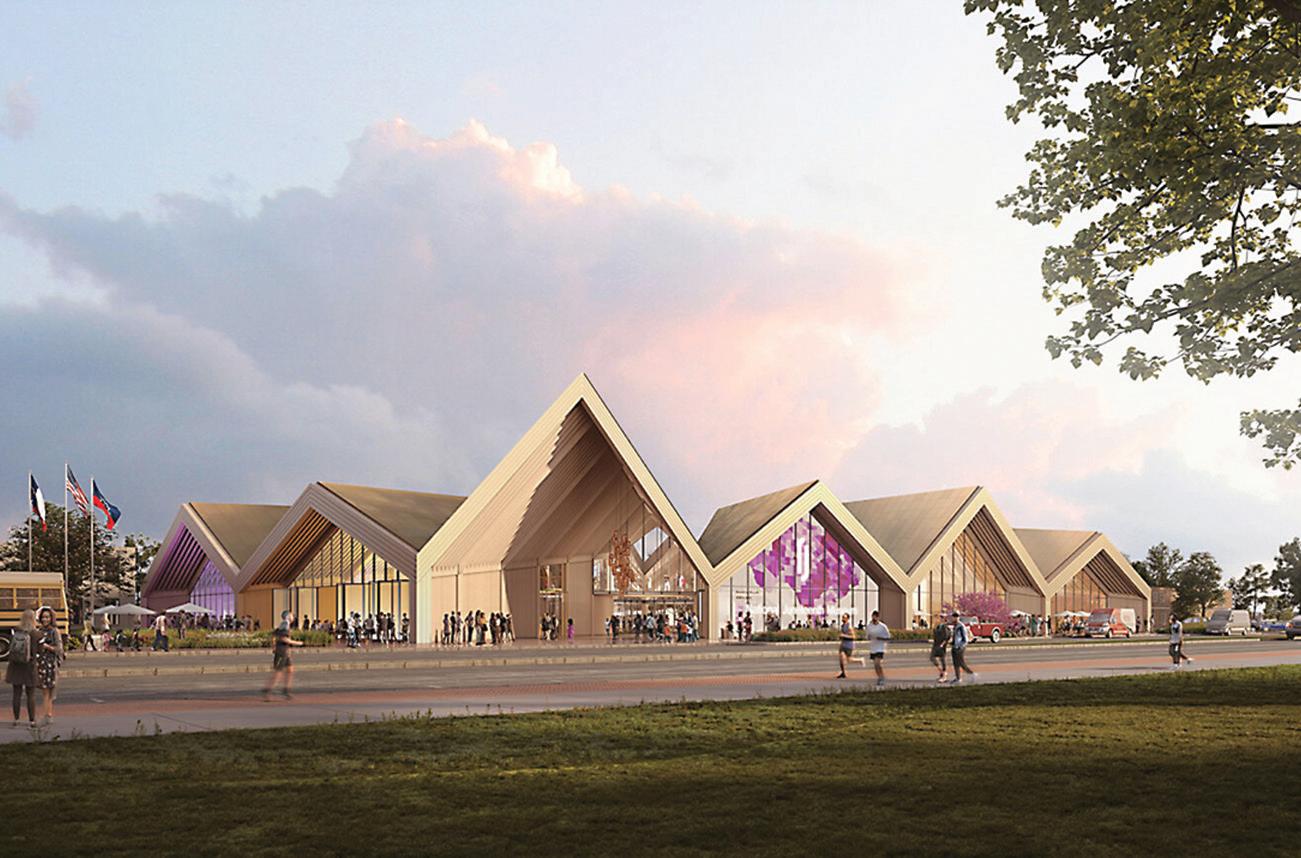
Against this backdrop, Fort Worth is developing the National Juneteenth Museum (NJM) in the 76104. The museum will occupy the corner of Rosedale Street and Evans Avenue in the Historic Southside — a neighborhood once dubbed the “Black Wall Street of the South” but later divided and impoverished by I‑35. The project aims to create a “community gateway” that brings education, cultural heritage, and economic opportunity to one of the city’s most underserved areas. Renderings show a two‑level, 50,000‑square‑foot building with immersive galleries, a theater, a business incubator, and a food hall. The City of Fort Worth has committed $15 million and the Texas Legislature $10 million toward the estimated $70 million cost. As of February 2026, the construction management team anticipates breaking ground in fall 2026.
While the NJM symbolizes cultural pride and investment, local residents stress that art and tourism alone cannot solve their daily struggle for healthy food. Community meetings during the Evans and Rosedale redevelopment highlighted access to food as a top priority, and residents asked for a full‑service grocery store. The Texas Observer noted that in the 76104, residents continued on page 19
Eats & Drinks
continued from page 17
wanted a health clinic, pharmacy, and grocery store to accompany the museum. An NBC 5 re port described the area as a “food swamp,” where fried food and convenience store fare are plenti ful but fresh produce scarce. Survey results from Spectrum News found that 63% of Fort Worth adults suffer from diet‑related chronic diseases — many respondents said they need a nearby gro cery store rather than another dollar store selling processed foods. Living in a neighborhood with good schools, clinics, recreation, and healthy food access should not depend on ZIP code or median income. Food apartheid is a human‑made injustice. Rectifying it requires investments in grocery stores, urban agriculture, transportation, and livable wages, alongside cultural institutions. Only by addressing the racist policies that shaped neighborhoods like the 76104 and by en suring that economic development includes fresh food access can Fort Worth fulfill the Juneteenth promise of freedom and opportunity for all. l
Patrice Jones is executive director of Southside Community Garden.
This column reflects the opinions and fact gath ering of the author(s) and only the author(s) and not the Fort Worth Weekly. To submit a column, please email Editor Anthony Mariani at Anthony@FWWeekly.com. He will gently edit it for clarity and concision.
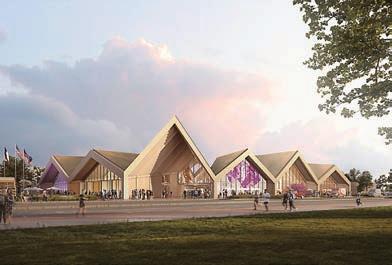
The hope is that the forthcoming National Juneteenth Museum drags the 76014 out of the “food swamp.”
Courtesy National Juneteenth Museum
HearSay
Missing: Rickey Kinney
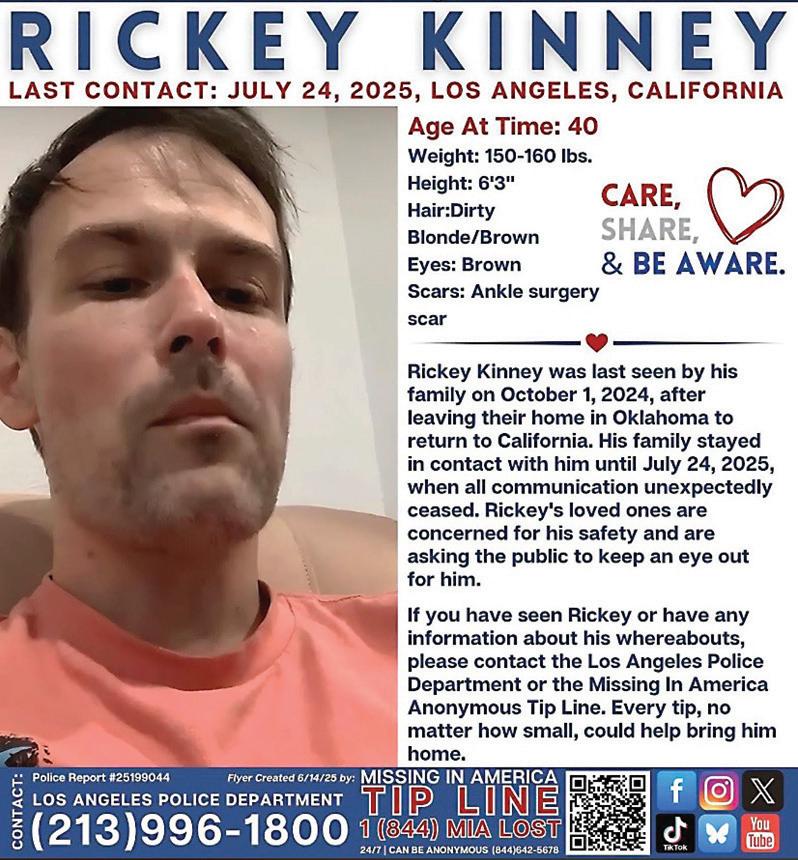
Rickey Kinney is missing. The outsider artist and electronic musician called Fort Worth home in the late 2000s through late 2010s, composing, performing, and releasing electronic music under the nom de guerre Squanto, as well as producing music videos for local bands like Oil Boom and Son of Stan. Around 2019, he decided to give the West Coast a shot and moved to Los Angeles, but in 2022, he joined his family in Oklahoma. He would bounce between there and here until October 1, 2024, when he left Oklahoma again to give L.A. another try. Based on a post shared through the Facebook group Missing in America Network, that was the last his family saw him, though they maintained contact with him through July 24, 2025, when he no longer responded to any communication.
Like everyone else who knows Rickey, my heart sank seeing that post. The last I heard from him was November 14, 2023, when I got a text from him at 1:58am asking if he could crash on my floor. I read it hours later. Regretfully, I did not respond. I’d known he was in a rough patch and that the tribulations of getting by in Los Angeles had really ground him down, but I also knew that was kind of par for him. He always seemed consumed with The Weight — never in a substance-abuse kind of way — but I really felt like he was an artist for whom the pressures of surviving, like paying bills and keeping up with the endless flood of high-stakes-but-meaningless
bullshit that gets in the way of, you know, just experiencing life, were both creatively inspiring and also forever looming over his psyche. His entire aesthetic arose from his attempts to mentally corral the contradictions, confusion, and intrusive absurdities engendered by late-stage capitalism
As Squanto, Rickey made punk out of an abrasive tangle of computerized noise and electronic beats that somehow still tethered itself to pop music. He took elements of trip-hop and glitched them out into nervy, agitated, aural tics. The videos he made for himself and his friends’ bands felt like you were watching a late-night real-estate infomercial dosed with acid, perhaps in an attempt to mitigate whatever anxieties a sentient infomercial might fixate on. Rickey’s art was jarring, weird, and wonderful. For all its darkness, it still felt earnest, honest, and even hopeful.
In a 2015 Fort Worth Weekly interview about Squanto’s debut EP, clrtvdth (pronounced “color TV death”), Rickey said he was “driven by what everybody’s paying attention to, getting frustrated about. What is this bullshit we are paying attention to? I’m on the same boat. I’m making music, and I’m affected by it too. We’ve all been affected by it for a long time. We are just now suffering repercussions from it, and for me the music is funny. It’s satirical. I love Frank Zappa. I love all the musicians who saw the humor in things, but I also have a very deep appreciation of musicians who made free-expression music with a little more experimentation, like free jazz, things like that, Ornette Coleman, crazy stuff that never settled down.”
A decade later, the world has not improved, and reading a missing person alert about him only makes me fear the worst. If you have any information about Rickey Kinney’s current location or situation, please call the Los Angeles police department at 213-9961800 or the Missing in America anonymous tipline 844-MIA-LOST (844-642-5678). — Steve Steward
The spellbinding Fort Worth electronic artist known as Squanto, Rickey Kinney is missing in Los Angeles.
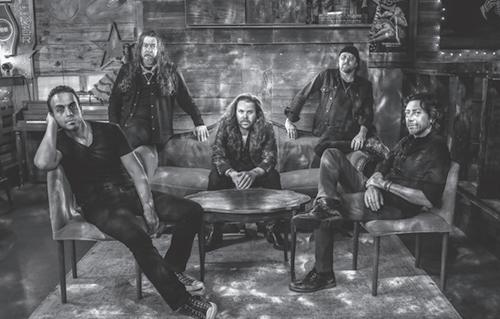
Royal Sons Fort Worth’s scuzzy, hard-rocking psycheblues quintet returns with a new album, the brilliant Matador.
BY STEVE STEWARD
The timing is probably coincidental, but Royal Sons are dropping their new album on June 27, which is a day after the 150th anniversary of the Battle of Little Bighorn. I bring this up primarily because the fourth track on the first side is called “Crazy Horse” but also because Matador has been a long time coming — the earliest-written song on the new album came together over five years ago, in part because the band kept missing their own self-imposed deadlines.
“When you get depressed, you also have that, like, self doubt. I was like, ‘Everything came together so smooth in the first round. Why isn’t [the songwriting] happening faster?’ ”
But a year and half after his dad passed, Parish got sober. The lyrics came back. “There were some [lyrics] about what I’d been through. You know, there’s themes about addiction and darkness and bitterness. Well, and shit, there’s some about watching a city change and the, like, ‘fuck you’ to all that … the kind of feeling of being chewed up and spit out by the music scene in a little bit of a way, by my own doing. That’s kind of what [the title track] ‘Matador’ is. It’s kind of just about, like, living too hard in that scene, and now I’m jaded, faded, wired, wasted, worn.”
“We always have a deadline, and then we always end up moving it,” said lead guitarist Chad Beck, who, along with lead singer Blake Parish and bassist/backing vocalist Marcus Gonzales, had joined me on a Friday night for a few beers on a local patio — guitarist Johnny McConlogue and drummer Javier Garza were unable to make it — where we shot the shit about the band’s formation in 2016 and what had happened between now and the debut of their first album, 2018’s Praise and Warships
“I don’t even feel like you tell me those deadlines,” Parish said.
“We did,” Beck said, shrugging. “I remember telling you, ‘Hey, we need lyrics, we need lyrics.’ ”
Parish chuckled. “Oh, I guess you did say that a couple times, didn’t you?”
They laugh about it now, but the period between the albums was clouded by a host of personal tragedies, in particular the deaths of several close friends of the band, as well as McConlogue’s mother and Parish’s father plus both of his dogs.
“We lost a lot of people in a short amount of time, like in about 18 months,” Parish said.
This was in 2021, and over the previous five years, the band had been riding pretty high. Praise and Warships had been well received, and the band’s bluesy, scuzzy psyche-rock resonated with local audiences, many of whom had been fans of In Memory of Man, the defunct hard-rock band crewed by Beck, Garza, Gonzales, and McConlogue, plus the Hanna Barbarians, Parish’s old band that had dissolved in 2016. But like every band, the 2020 pandemic hit the brakes on Royal Sons’ momentum, then the darkness of 2021 rolled around.
“I guess we got through COVID, got a few songs written, and then that’s when my dad passed, and then we had a whole series of shit, and then Johnny’s mom passed after that,” Parish said. “And then, it was just, I don’t know. … I just didn’t feel like doing it, writing lyrics.”
Devastated by all the loss, Parish dived headfirst into a whiskey bottle. “I was drinking really heavily, and I was just depressed, and so … there was about a year after my dad passed before I got sober. There were 18 months that were just really dark, and I felt really isolated.”
While the riffs still came to Beck, Gonzales, and McConlogue, Parish’s depression made creative inspiration beyond his reach, which made him feel even worse.
The weary indifference of “Matador” is specific to the bandmembers’ disillusionment with their cumulative years of local rock ’n’ roll experience — among the five of them, it’s probably over a century — and that emotional scar tissue is marbled throughout the album. Parish’s sardonic takes on fame and authenticity (“Insert Your Popstar Here,” “Matador”) are mirrored by the hard-charging riffage and stoner-rock thunder of his bandmates, and all of that amplifier grime is rendered in crisp detail by producer Eric Delegard and mastering engineer Steve Nagasaki. Overall, Matador sounds like a deeper, angrier Fu Manchu, trading that band’s muscle-car-desert-cruise fantasies for the kind of knotty riffs borne of NorTex’s groove-metal legacy, the arrangements rendered in shades of Deep Purple and King Crimson. The record’s riffs are surprisingly knotty, the high-gain guitar assault shooting through proggy twists and turns, as well as a cover of King Crimson’s “21st Century Schizoid Man” on Side B. Matador is a thrilling, head-banging successor to Praise and Warships, and it’s clear that Royal Sons are back and swinging hard.
Gonzales said that Matador is the consequence of his and his band’s love for the power of rock ’n’ roll, how Royal Sons was a refuge during dark times.
“I mean, after the amount of time, that stuck with each other. … We never started thinking, ‘Oh, man, let’s just, you know, hang it up,’ ” he said. “Let’s keep showing up every Tuesday. Let’s do our practices. Let’s keep in touch, keep pushing each other.”
Even when that pushing meant trudging through the quicksand of depression, Royal Sons were there for one another, deadlines be damned. Parish was honest about that, admitting that reinhabiting those times in Matador’s songs is often emotionally rough. “But sometimes it feels really fucking triumphant to be on the other side of it, you know?”
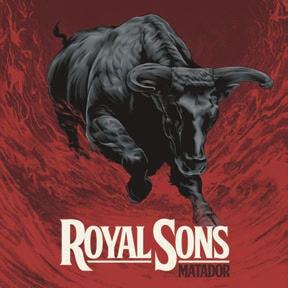
He paused for a moment, then he referenced the bull on the album’s cover.
“The bull, it gets stabbed the whole time during a bullfight. It’s basically torture. I mean, it’s pretty easy to feel like that these days, so I definitely root for the bull against the matador.” l
Parish (center): “I definitely root for the bull against the matador.”
CLASSIFIEDS
Texas Commission on Environmental Quality
NOTICE OF RECEIPT OF APPLICATION AND INTENT TO OBTAIN AIR PERMIT (NORI) RENEWAL
PERMIT NUMBER 29235
APPLICATION. Anodics, Inc. has applied to the Texas Commission on Environmental Quality (TCEQ) for renewal of Air Quality Permit Number 29235, which would authorize continued operation of an anodizing facility located at 4105 Murray Avenue, Haltom City, Tarrant County, Texas 76117. AVISO DE IDIOMA ALTERNATIVO. El aviso de idioma alternativo en espanol está disponible en https://www.tceq.texas.gov/permitting/air/newsourcereview/airpermits-pendingpermit-apps. This link to an electronic map of the site or facility’s general location is provided as a public courtesy and not part of the application or notice. For exact location, refer to application. https://gisweb.tceq.texas.gov/LocationMapper/?marker=-97.285,32.827777&level=13 The existing facility is authorized to emit the following air contaminants: hazardous air pollutants, nitrogen oxides, organic compounds, particulate matter including particulate matter with diameters of 10 microns or less and 2.5 microns or less, sulfur dioxide and sulfuric acid mist.
This application was submitted to the TCEQ on June 2, 2026. The application will be available for viewing and copying at the TCEQ central office, TCEQ Dallas/Fort Worth regional office, and the Haltom City Public Library, 4809 Haltom Road, Haltom City, Tarrant County, Texas beginning the first day of publication of this notice. The facility’s compliance file, if any exists, is available for public review in the Dallas/Fort Worth regional office of the TCEQ. The application, including any updates, is available electronically at the following webpage: https://www.tceq.texas.gov/permitting/air/airpermit-applications-notices
The executive director has determined the application is administratively complete and will conduct a technical review of the application. Information in the application indicates that this permit renewal would not result in an increase in allowable emissions and would not result in the emission of an air contaminant not previously emitted. The TCEQ may act on this application without seeking further public comment or providing an opportunity for a contested case hearing if certain criteria are met.
PUBLIC COMMENT. You may submit public comments to the Office of the Chief Clerk at the address below. The TCEQ will consider all public comments in developing a final decision on the application and the executive director will prepare a response to those comments. Issues such as property values, noise, traffic safety, and zoning are outside of the TCEQ’s jurisdiction to address in the permit process.
OPPORTUNITY FOR A CONTESTED CASE HEARING. You may request a contested case hearing if you are a person who may be affected by emissions of air contaminants from the facility. If requesting a contested case hearing, you must submit the following: (1) your name (or for a group or association, an official representative), mailing address, daytime phone number; (2) applicant’s name and permit number; (3) the statement “[I/we] request a contested case hearing;” (4) a specific description of how you would be adversely affected by the application and air emissions from the facility in a way not common to the general public; (5) the location and distance of your property relative to the facility; (6) a description of how you use the property which may be impacted by the facility; and (7) a list of all disputed issues of fact that you submit during the comment period. If the request is made by a group or association, one or more members who have standing to request a hearing must be identified by name and physical address. The interests the group or association seeks to protect must also be identified. You may also submit your proposed adjustments to the application/permit which would satisfy your concerns.
The deadline to submit a request for a contested case hearing is 15 days after newspaper notice is published. If a request is timely filed, the deadline for requesting a contested case hearing will be extended to 30 days after mailing of the response to comments.
If any requests for a contested case hearing are timely filed, the Executive Director will forward the application and any requests for a contested case hearing to the Commissioners for their consideration at a scheduled Commission meeting. Unless the application is directly referred to a contested case hearing, the executive director will mail the response to comments along with notification of Commission meeting to everyone who submitted comments or is on the mailing list for this application. The Commission may only grant a request for a contested case hearing on issues the requester submitted in their timely comments that were not subsequently withdrawn. If a hearing is granted, the subject of a hearing will be limited to disputed issues of fact or mixed questions of fact and law relating to relevant and material air quality concerns submitted during the comment period. Issues such as property values, noise, traffic safety, and zoning are outside of the Commission’s jurisdiction to address in this proceeding.
MAILING LIST. In addition to submitting public comments, you may ask to be placed on a mailing list for this application by sending a request to the Office of the Chief Clerk at the address below. Those on the mailing list will receive copies of future public notices (if any) mailed by the Office of the Chief Clerk for this application.
AGENCY CONTACTS AND INFORMATION. All public comments and requests must be submitted either electronically at www14.tceq.texas.gov/epic/eComment/, or in writing to the Texas Commission on Environmental Quality, Office of the Chief Clerk, MC-105, P.O. Box 13087, Austin, Texas 78711-3087. Please be aware that any contact information you provide, including your name, phone number, email address and physical address will become part of the agency’s public record. For more information about the permitting process, please call the TCEQ Public Education Program, Toll Free, at 1-800-687-4040 or visit their website at www.tceq.texas.gov/goto/pep. Si desea información en Español, puede llamar al 1-800-687-4040. You can also view our website for public participation opportunities at www.tceq.texas.gov/goto/participation.
Further information may also be obtained from Anodics, Inc., 4105 Murray Avenue, Haltom City, Texas 76117-1714 or by calling Mr. Frank Gaudet, Environmental Engineer, Regulatory Compliance Services at (214) 500-4081.
Notice Issuance Date: June 15, 2026
Texas Commission on Environmental Quality
NOTICE OF RECEIPT OF APPLICATION AND INTENT TO OBTAIN AIR PERMIT (NORI) RENEWAL
PERMIT NUMBER 20765
APPLICATION. BIMBO BAKERIES USA, INC., has applied to the Texas Commission on Environmental Quality (TCEQ) for Renewal of Air Quality Permit Number 20765, which would authorize continued operation of the Commercial Bakery Facility located at 7301 South Freeway #IH35 West, Fort Worth, Tarrant County, Texas 76134. AVISO DE IDIOMA ALTERNATIVO. El aviso de idioma alternativo en espanol está disponible en https://www.tceq.texas.gov/permitting/air/newsourcereview/ airpermits-pendingpermit-apps. This link to an electronic map of the site or facility’s general location is provided as a public courtesy and not part of the application or notice. For exact location, refer to application. https://gisweb.tceq.texas.gov/ LocationMapper/?marker=-97.319166,32.637222&level=13. The existing facility and/or related facilities are authorized to emit the following air contaminants: carbon monoxide, nitrogen oxides, organic compounds, particulate matter including particulate matter with diameters of 10 microns or less and 2.5 microns or less, and sulfur dioxide.
This application was submitted to the TCEQ on June 1, 2026. The application will be available for viewing and copying at the TCEQ Central Office, TCEQ Dallas/Fort Worth Regional Office, and the Fort Worth Public Library Southwest Regional, 4001 Library Lane, Fort Worth, Tarrant County, Texas 76109, beginning the first day of publication of this notice. The facility’s compliance file, if any exists, is available for public review in the Dallas/Fort Worth regional office of the TCEQ. The application, including any updates, is available electronically at the following webpage: https://www.tceq.texas.gov/permitting/air/airpermitapplications-notices
The executive director has determined the application is administratively complete and will conduct a technical review of the application. The reasons for any changes or incorporations, to the extent they are included in the renewed permit, may include the enhancement of operational control at the plant or enforceability of the permit. The TCEQ may act on this application without seeking further public comment or providing an opportunity for a contested case hearing if certain criteria are met.
PUBLIC COMMENT. You may submit public comments to the Office of the Chief Clerk at the address below. TCEQ will consider all public comments in developing a final decision on the application and the executive director will prepare a response to those comments. Issues such as property values, noise, traffic safety, and zoning are outside of the TCEQ’s jurisdiction to address in the permit process.
OPPORTUNITY FOR A CONTESTED CASE HEARING. You may request a contested case hearing if you are a person who may be affected by emissions of air contaminants from the facility. If requesting a contested case hearing, you must submit the following: (1) your name (or for a group or association, an official representative), mailing address, daytime phone number; (2) applicant’s name and permit number; (3) the statement “[I/we] request a contested case hearing;” (4) a specific description of how you would be adversely affected by the application and air emissions from the facility in a way not common to the general public; (5) the location and distance of your property relative to the facility; (6) a description of how you use the property which may be impacted by the facility; and (7) a list of all disputed issues of fact that you submit during the comment period. If the request is made by a group or association, one or more members who have standing to request a hearing must be identified by name and physical address. The interests the group or association seeks to protect must also be identified. You may also submit your proposed adjustments to the application/permit which would satisfy your concerns.
The deadline to submit a request for a contested case hearing is 15 days after newspaper notice is published. If a request is timely filed, the deadline for requesting a contested case hearing will be extended to 30 days after mailing of the response to comments.
If any requests for a contested case hearing are timely filed, the Executive Director will forward the application and any requests for a contested case hearing to the Commissioners for their consideration at a scheduled Commission meeting. Unless the application is directly referred to a contested case hearing, the executive director will mail the response to comments along with notification of Commission meeting to everyone who submitted comments or is on the mailing list for this application. The Commission may only grant a request for a contested case hearing on issues the requester submitted in their timely comments that were not subsequently withdrawn. If a hearing is granted, the subject of a hearing will be limited to disputed issues of fact or mixed questions of fact and law relating to relevant and material air quality concerns submitted during the comment period. Issues such as property values, noise, traffic safety, and zoning are outside of the Commission’s jurisdiction to address in this proceeding.
MAILING LIST. In addition to submitting public comments, you may ask to be placed on a mailing list for this application by sending a request to the Office of the Chief Clerk at the address below. Those on the mailing list will receive copies of future public notices (if any) mailed by the Office of the Chief Clerk for this application.
AGENCY CONTACTS AND INFORMATION. All public comments and requests must be submitted either electronically at www14.tceq.texas.gov/epic/eComment/, or in writing to the Texas Commission on Environmental Quality, Office of the Chief Clerk, MC-105, P.O. Box 13087, Austin, Texas 78711-3087. Please be aware that any contact information you provide, including your name, phone number, email address and physical address will become part of the agency’s public record. For more information about the permitting process, please call the TCEQ Public Education Program, Toll Free, at 1-800-687-4040 or visit their website at www.tceq.texas.gov/goto/pep. Si desea información en Español, puede llamar al 1-800-687-4040. You can also view our website for public participation opportunities at www.tceq.texas.gov/goto/participation.
Further information may also be obtained from BIMBO BAKERIES USA, INC., 7301 South Freeway #IH35 West, Fort Worth, Texas 76134-4004, or by calling Ms. Shely Tennor, Regional Environmental Manager, at (404) 212-3780.
Notice Issuance Date: June 12, 2026
BULLETIN BOARD
ADVERTISE HERE!
Email Stacey@fwweekly.com today.
Are You Road-Trip Ready?
CALL COWTOWN ROVER!
With our handy pick-up and drop-off services, having your car checked out could not be easier. www.CowtownRover.com 3958 Vickery | 817.731.3223
BCI BATH SHOWER
The bathroom of your dreams in as little as 1 day. Limited Time Offer: $1000 off or No Payments/No Interest for 18 months for customers who qualify. Many options available. Quality materials, professional installation. Senior and military discounts available. Call 1-855-659-5784 today! (MB)
CONSUMER CELLULAR
We offer the same reliable, nationwide coverage as the largest carriers. No long-term contract, no hidden fees and activation is free. All plans feature unlimited talk and text, starting at just $20/month. For more information, call 1-888-671-2579. (MB)
DENTAL INSURANCE
Coverage for 400 plus procedures available from Physicians Mutual Insurance Company. Real dental insurance, NOT just a discount plan. Do not wait! Call now and get your FREE Dental Information Kit with all the details! Call 1-888-361-7095 or visit Dental50plus. com/fortworth. #6258
EMPLOYMENT
Falcon Holdings Management LLC seeks an IT & Security Manager in Southlake, TX to lead the dsgn & oversight of the co’s technology architecture, ensuring that systems, n/works, & operational platforms support reliable day-to-day business functions. Implmt & enforce cybersecurity controls, incl internal security policies, access mgmt procedures, activity monitoring, & incident-response protocol. Manage the organization’s server infrastructure, n/work environments, & cloud systems, ensuring system availability, timely updates, & compliance w/ internal tech’l standards. Dvlp disaster-recovery & businesscontinuity strategies, assess tech-related risks, & coord mitigation measures to minimize operational disruptions. 1 yr of exp in IT & Security Manager, IT Operations Engineer, IT Administrator, Info Security Officer or closely rltd position. Email resume to abraham@falconholdings.com ATTN: HR-22280.
EMPLOYMENT
Lahiani Group Inc. (DBA Dolce Vesta) seeks a Fashion Designer to design custom clothing and accessories for clients, perform alterations and adjustments on suits; conduct precision fittings; realize all types of alterations; Confer with clients to discuss design ideas. Requirements: 24 months of experience as Fashion Designer. Compensation: $46,779 annually. Resumes Attn: H.Lahiani. 1101 Melbourne Rd, #0J03A, Hurst, TX 76053.
EMPLOYMENT
Madero Engineers and Constructors LLC seeks to employ an Engineering Technician for their North Richland Hills, TX location. Read and interpret blueprints and technical drawings to identify surface preparation need. Draft job plans and layout diagrams to guide crews in confined space entry requirements, surface preparation, coating application method, application sequencing, and curing schedules. Pay $49,200 to $55,000. Send resume to frank@madero.net referencing job #4.
EMPLOYMENT
PMG Worldwide LLC has multiple openings in Fort Worth, TX: Analyst II! to lead key reporting and analytics workstreams and builds performance insights in collaboration with Media and Strategy teams; telecommuting anywhere in US; up to 10% domestic travel reg’d. Equal Opportunity / Affirmative Action Employer. Relevant experience, education, and/or skills required. For more information & to apply online, visit https://www.pmg.com/careers/job-openings.
HISTORIC RIDGLEA THEATER
THE RIDGLEA is three great venues within one historic Fort Worth landmark. RIDGLEA THEATER has been restored to its authentic allure, recovering unique SpanishMediterranean elements. It is ideal for large audiences and special events. RIDGLEA ROOM and RIDGLEA LOUNGE have been making some of their own history, as connected adjuncts to RIDGLEA THEATER, or hosting their own smaller shows and gatherings. More at theRidglea.com.
LIFE INSURANCE
Up to $15,000.00 of GUARANTEED Life Insurance! No medical exam or health questions. Cash to help pay funeral and other final expenses. Call Physicians Life Insurance Company at 844-317-3246 or visit Life55plus. info/ftworth. (MB)
NO MORE GUTTER CLEANING!
LeafFilter, the most advanced debris-blocking gutter protection, will help you eliminate gutter cleaning forever. Schedule a FREE estimate today. (MB) Call 1-877-689-1687
OMAHA STEAKS
Wait until you taste it! 100% guaranteed and delivered to your door! Our Butcher’s Savory Collection is only $129.99 and comes with 8 FREE Omaha Steaks Classic Burgers. Call 1-888-703-0342 and mention code 81305BKM or visit OmahaSteaks.com/Savory3110. (MB)
SAFE STEP: North America’s #1 Walk-In Tub Comprehensive lifetime warranty. Top-of-the-line installation and service. Now featuring our FREE shower package and $1600 Off for