Swine Grist
A PERIODIC NEWSLETTER PRODUCED BY FORTIFIED NUTRITION LTD. VOLUME 8, ISSUE 2 | SUMMER 2021
Dear Friends, It is normally at this time of year that we have the privilege of reconnecting in person with many of our customers and industry friends at the Alberta and Ontario Pork Congress. These types of industry events also typically provide the opportunity to introduce new GVF team members to many of our long-standing customers. Sadly, both of these events were cancelled due to COVID restrictions. Thankfully we are witnessing the re-opening of our provinces this summer and we look forward to visiting with you again soon! In the meantime, please allow us to introduce you to our new CFO, COO, VP of Sales and PhD., Monogastric Nutritionist through this edition of the FNL Swine Grist. Additionally, we are excited to discuss feeding alternatives for expensive ingredients in your swine herd’s diet. We trust that you enjoy this edition of the FNL Swine Grist. Wishing you a successful growing season and pleasurable summer! Sincerely, Ian Ross, President & CEO
SENIOR LEADERSHIP TEAM UPDATES
by: IAN ROSSPresident & CEO, GVF group of companies
T
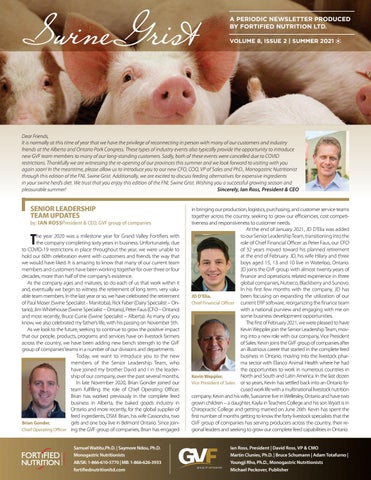
he year 2020 was a milestone year for Grand Valley Fortifiers with the company completing sixty years in business. Unfortunately, due to COVID-19 restrictions in place throughout the year, we were unable to hold our 60th celebration event with customers and friends the way that we would have liked. It is amazing to know that many of our current team members and customers have been working together for over three or four decades, more than half of the company’s existence. As the company ages and matures, so do each of us that work within it and, eventually we begin to witness the retirement of long term, very valuable team members. In the last year or so, we have celebrated the retirement of Paul Moser (Swine Specialist - Manitoba), Rick Faber (Dairy Specialist – Ontario), Jim Whitehouse (Swine Specialist – Ontario), Peter Faus (CFO – Ontario) and most recently, Bruce Currie (Swine Specialist – Alberta). As many of you know, we also celebrated my father’s life, with his passing on November 5th. As we look to the future, seeking to continue to grow the positive impact that our people, products, programs and services have on livestock farmers across the country, we have been adding new bench strength to the GVF group of companies’ teams in a number of our divisions and departments. Today, we want to introduce you to the new members of the Senior Leadership Team, who have joined my brother David and I in the leadership of our company, over the past several months. In late November 2020, Brian Gonder joined our team fulfilling the role of Chief Operating Officer. Brian has worked previously in the complete feed business in Alberta, the baked goods industry in Ontario and more recently, for the global supplier of feed ingredients, DSM. Brian, his wife Cassondra, two girls and one boy live in Belmont Ontario. Since joinBrian Gonder, Chief Operating Officer ing the GVF group of companies, Brian has engaged Samuel Waititu,Ph.D. | Saymore Ndou, Ph.D. Monogastric Nutritionists AB/SK: 1-866-610-5770 | MB: 1-866-626-3933 fortifiednutritionltd.com
in bringing our production, logistics, purchasing, and customer service teams together across the country, seeking to grow our efficiencies, cost competitiveness and responsiveness to customer needs. At the end of January 2021, JD D’Elia was added to our Senior Leadership Team, transitioning into the role of Chief Financial Officer as Peter Faus, our CFO of 32 years moved toward his planned retirement at the end of February. JD, his wife Hilary and three boys aged 15, 13 and 10 live in Waterloo, Ontario. JD joins the GVF group with almost twenty years of finance and operations related experience in three global companies, Nutreco, Blackberry and Sunovo. In his first few months with the company, JD has been focusing on expanding the utilization of our JD D’Elia, Chief Financial Officer current ERP software, reorganizing the finance team with a national purview and engaging with me on some business development opportunities. The first of February 2021, we were pleased to have Kevin Weppler join the Senior Leadership Team, moving into a new role with our company, Vice President of Sales. Kevin joins the GVF group of companies after an illustrious career that started in the complete feed business in Ontario, moving into the livestock pharma sector with Elanco Animal Health where he had the opportunities to work in numerous countries in North and South and Latin America. In the last dozen Kevin Weppler, Vice President of Sales or so years, Kevin has settled back into an Ontario focused work life with a multinational livestock nutrition company. Kevin and his wife, Suezanne live in Wellesley, Ontario and have two grown children – a daughter, Kayla in Teachers College and his son Wyatt is in Chiropractic College and getting married on June 26th. Kevin has spent the first number of months getting to know the forty livestock specialists that the GVF group of companies has serving producers across the country, their regional leaders and seeking to grow our complete feed capabilities in Ontario. Ian Ross, President | David Ross, VP & CMO Martin Clunies, Ph.D. | Bruce Schumann | Adam Totafurno | Youngji Rho, Ph.D., Monogastric Nutritionists Michael Peckover, Publisher
With the lack of opportunity to participate in physical trade shows and conferences for over a year now, we have not had the occasion to introduce many customers to these new members of our GVF leadership team in person. We certainly look forward to having this opportunity again in the future. Until then, please join us (virtually) in welcoming these three gentlemen to our team. We trust that you will enjoy working with them as much as we are. n
FEED ALTERNATIVES TO COSTLY SOYBEAN AND CANOLA MEAL
by: SAMUEL WAITITU, PH.D. Monogastric Nutritionist, Fortified Nutrition Ltd.
E
nergy is the most expensive component of feed cost (approximately 50%), and oil is the most expensive energy source. Apart from increasing energy density, feed fats and oils improve feed processing, mixing and palatability, supply of essential fatty acids and reduce dust. Therefore, the recent ballooning price of canola and soy oil is like a painful sore on the toes of a marathon runner. The current oil price hike is largely ascribed to the robust China demand for soybean and canola as they restock their swine herd population after the African Swine Fever losses and undesirable climatic patterns in Brazil that reduced soybean and corn production. Agroeconomists speculate that oil prices are likely to continue soaring. This article is meant to highlight ration formulation and management strategies to lessen dependence on expensive oil without hurting performance. How do we raise hogs with inflated vegetable oil prices? Alternatives such as corn oil, palm oil, tallow (beef ), poultry fat and choice white grease (pork) do exist. There is little difference in performance resulting from the type of supplemental fat fed to growing pigs, however, different fat sources may induce variable effects on pork quality especially the fatty acids profile. Benz et al (2011) illustrated no differences in performance and carcass quality between pigs fed 5% soybean oil or choice white grease from 44 kg body weight (BW) to slaughter. Engel et al (2001) found no performance differences between pigs fed rations with 6% choice white grease or poultry fat from 60 kg to 110 kg BW and reported no evidence of soft fat. These alternatives are therefore worth exploring in such times in the spirit of an African proverb that says when a lion cannot find the flesh to feed on, it has no choice but to eat the grass. Nevertheless, the extent of peroxidation should be tested before using animal fat because oxidized lipids decrease growth rate and feed intake. For producers with access to animal fat, an alternative cost saving strategy is incorporating them in rations during the early growth stages and withdrawing them towards finishing. From experience, high-fat canola and soybean meals are potential alternatives due to their high caloric values. For instance, a high caloric ExPress soybean meal would only require 1% oil in nursery diets and 0% oil in grower rations without compromising performance. Generally, energy content of oilseed meals varies depending on processing conditions. Thus, it is important to not only review the crude protein content of oilseed meals but also their energy and crude fiber contents. Sometimes, a slight deviation from tradition doesn’t hurt. We use more barley and less corn or wheat in grower to finish rations. Increasing the inclusion of wheat or corn in finisher rations boosts the energy level of the ration hence requiring less oil supplementation to balance the energy. For instance, a 3000 kcal/kg all barley-soybean meal finisher ration requires about 15 kg of oil per tonne. Every 100 kg of wheat or corn added to the same ration will offset 5 or 8.5 kg of oil, respectively. Working smart rather than working hard has become an emblem of this generation. In nutrition science, smartness is embracing technologies that can turn ashes into paper! That is exactly what happens when we use phytases, proteases and fiber degrading enzymes: they convert feed components that would have ended in the lagoon to sweet tasting pork ribs and bacon. For example, adding less than
200 g of a ‘smart’, powerful, and high quality phytase endows an energy uplift that offsets 10 kg of oil. If that isn’t smart, then you will never understand some secrets that make our BioForce feeding program effective in offering the best performance at an unbeatable cost across the Canadian Prairies. Have you ever wondered why a high health herd has better performance than a low health herd on the same feeding program? Averting a health challenge diverts energy needed for growth to support the energy and nutrient exploitative defensive mechanisms of the immune system. Therefore, remaining faithful to an effective biosecurity protocol is synonymous to ‘insulating’ your herd against metabolic energy wastage, and that cuts your feed bill. In colder seasons, this ‘insulation’ would include ensuring the room temperatures are within the recommended thresholds, hence reducing metabolic energy demand for thermoregulation, which would require more oil in the ration. In conclusion, these feeding strategies and management techniques will help reduce dependence on supplemental oil without compromising pig productivity. We strongly believe that alternatives to expensive canola and soy oils should not only focus on opening opportunities for livestock producers to control feed prices but must also open ways for in-feed technologies that restore the benefits previously associated with the displaced oil. Benz, J. M., et al. (2011). Effects of choice white grease and soybean oil on growth performance, carcass characteristics, and carcass fat quality of growing-finishing pigs. Journal of animal science, 89(2), 404-413. Engel, J. J., et al. (2001). Effects of choice white grease or poultry fat on growth performance, carcass leanness, and meat quality characteristics of growing-finishing pigs. Journal of animal science, 79(6), 1491-1501.
FEED ALTERNATIVES TO EXPENSIVE BARLEY
by: SAYMORE NDOU, PH.D. Monogastric Nutritionist, Fortified Nutrition Ltd.
B
arley is a low energy cereal and one of the traditional sources of dietary fibers commonly used in swine diets. Midwestern Canadian pig producers favor the use of barley because it is easily accessible and affordable in their geographical location. More recently, because of the increased awareness of the beneficial effects of dietary fiber (DF) in gut health and continuous rise in feed ingredient costs, barley has received more attention and is becoming scarce. The shortage of feed ingredients is triggered by a combination of factors including climatic change and the growing swine industry, that is exacerbated by the growing world population. The absence of barley in the market calls for the need to engage other alternative fiber sources and cereals that can be included in pig rations at reasonable costs. When compared with corn, barley’s low energy density will not be the only factor limiting its use, but its utilization is further limited by the rising oil prices that may call for dietary fortification with high energy feedstuffs. Thus, our Fortified Nutrition Limited (FNL) team is tirelessly researching and collaborating with hog producers to develop strategies to counteract future shortages and/or limitations in the inclusion rate of barley that may also arise due to scarcity of other ingredients. What to do when barley is scarce? A prudent strategy is to replace barley with combinations of ingredients that will induce physicochemical behaviours that resembles barley during transit in the gut. To do so, our in-feed technologies are designed to create opportunities for barley alternatives to not just supply DF and energy but also induce other functional benefits like those of barley fiber including stimulating wellness by inducing satiety and acting as a laxative agent. Sourcing DF replacements for an ingredient such as barley, with a balance of both soluble and insoluble fiber is a challenge on every farm. This implies that the best alternative to barley can be formulated by using combinations of fibrous feedstuffs that are rich in either soluble or insoluble fiber. The team at FNL has continuously been researching new products and developing formulation strategies that promote DF utilization and consequently promoting animal welfare and gut health. A plethora of feeding for-
Swine Grist mulas involving cereals such as oats, wheat and corn can be used in conjunction with agri-industrial co-products to supply adequate energy and DF that may arise due to shortages of barley. In the Western Prairies of Canada, the most popular fibrous feedstuff includes soy hulls, sunflower meal, oat hulls and sugar beet pulp, however, other high DF containing co-products such as wheat bran, corn bran, and cereal distillers’ grains that are rich in insoluble fiber but are often ignored during formulation have great potential to supply adequate DF for pigs. For instance, while soluble fiber from barley can be replaced by dietary inclusion of oats and sugar beet pulp or flaxseed meal, alternatives to insoluble barley fiber include cereal brans, and seed hulls. Replacing barley with alternative high fiber feedstuffs pose nutrient digestibility challenges which can be mitigated using exogenous carbohydrases (fiber degrading enzymes such as EcoNase and GrainMore sold by FNL), that solubilize the insoluble DF components, thereby promoting the overall gut health, gut microbiota and hindgut fermentation. Some of our clients have partially or fully replaced barley with alternative feedstuffs in the last few months to achieve certain benefits. For instance, in one grower-finish barn, we have incorporated up to 10% oat hulls to keep barley below 25% and successfully cut backfat from 21 mm to 18.5 mm despite having wheat at 56% without losing on performance and days-to-market. In another barn, we have successfully replaced all barley with inclusions of 9 and 4% soya hulls in gestation and lactation rations, respectively, allowing dietary inclusion of up to 65% corn without affecting reproductive performance. The DF content of oat hulls and soya hulls is much higher than that of barley, hence, very low inclusions are sufficient to dilute the energy, hence giving more control in conditioning sows. Moreover, this approach allows maximum sourcing of energy from corn and wheat, and less reliance on vegetable oil, hence resulting in relatively cheaper rations. We have also observed that sows fed rations containing these DF sources have less incidence of constipation. For those who love numbers, in a tonne of complete feed, it takes about 800 kg of barley to achieve a 4.1% crude fiber (CF) content in an all barley-soybean meal gestation ration, whereas without barley, it takes 70 kg of oat hulls (22% CF) or 60 kg of soya hulls (36% CF) or 130 kg of beet pulp (15% CF) to achieve the same crude fiber composition. Considering the recent research developments on sows’ gut health effects of DF, some prominent researchers are advocating for at least 4.5 and 5% CF content in gestation and lactation rations, respectively, hence, an all-barley ration still fails to meet the target. In our efforts to learn the chemistry and effective use of these DF sources in swine nutrition, we found that it is of utmost importance to analyze the fiber content of every batch of alternative fibrous feedstuff. Finally, it is worth noting that the identification of the replacements of barley energy and fiber, and their incorporation in swine diets is a complex process that can be simplified by engaging a holistic approach that may not only need us to understand the physicochemical properties of the alternative ingredients, but also comprehend how much energy they supply and how the dietary fiber components behave during transit in the gastrointestinal tract. n
Sciences, at the University of Guelph, Youngji originally planned to pursue a career in microbiology. However, an introduction to Dr. Kees de Lange helped her to realize that her passion was not in microbiology but in agriculture instead, specifically pigs. As a result, Youngji decided to pursue her Masters of Science under the guidance of Dr Kees de Lange and Elijah Kiarie. The focus of her Masters was “Improving the nutritive value of corn distiller’s dried grains with solubles (DDGS) for growing pigs, using liquid feeding systems and fiber degrading enzymes. Following her Masters, Youngji pursued her PhD with her advisor Elijah Kiarie, expanding her knowledge on the application of using exogenous enzymes to enhance both the nutrient value and the functional value of DDGS and wheat shorts in grow-finish pigs. (To learn more about what she discovered, be sure to read her article also in this issue of the Swine Grist.) Youngji’s studies in her Masters and PhD are extremely relevant to our swine industry today, as we look to maximize nutritive values of the feed ingredients we feed to pigs. As COVID restrictions lessen we hope to have the opportunity to introduce Youngji to many of you in person as she is excited to meet our customers and learn about their production systems. Join us in welcoming Youngji to our team and the Canadian pork industry.
IMPROVING UTILIZATION OF FIBRE
by: YOUNGJI RHO, PH.D. Monogastric Nutritionist, Grand Valley Fortifiers
D
ried distillers grains with solubles (DDGS) and wheat middlings (WM) are commonly used in swine diets as they are a good source of energy and nutrients. However, they also contain a high concentration of fiber. The high fiber content negatively influences nutrient availability and therefore, compromises the growth performance of pigs. To overcome this problem, fiber degrading enzymes (FDE) have been widely used. FDE help to alleviate this issue by promoting hydrolysis and solubilizing insoluble fiber fractions, thereby improving the digestibility and fermentability of nutrients in fibrous ingredients. Fiber is often referred to as non-starch poly saccharides (NSP), which in other words, is a complex carbohydrate that monogastric animals cannot digest. Among cereal grains/co-products, arabinoxylans are the major NSP, followed by cellulose and mixed-linked β-glucans (Figure 1). Therefore, FDE such as xylanase, β-glucanase and cellulase are most commonly added in diets containing these ingredients to improve their digestibility. However, when enzymes are added to pig diets containing co-products, the results are not always positive. This is where Youngji’s research objectives stemmed from. Figure 1: Major non-starch polysaccharides in corn, wheat and their co-products. Data adapted from Bach Knudsen (2014), Jaworski et al. (2015) and Tiwari et al. (2019).
WELCOME YOUNGJI RHO Monogastric Nutritionist, Grand Valley Fortifiers
W
e at Grand Valley Fortifiers are proud and excited to announce the hiring of Dr. Youngji Rho as our new monogastric nutritionist. Youngji was born in South Korea but spent a lot of time abroad in Canada, a place where she now calls home. Her father is a practicing large animal veterinarian who also teaches at a national university in South Korea. He has spent time at the Ontario Veterinary College with his family which brought Youngji to Guelph. While doing her B.Sc. in Biological
For her master’s program with Drs. Kees de Lange and Elijah Kiarie, she worked on using FDE in a liquid feeding system to improve the feeding value of DDGS for growing pigs. The FDE used were a mix of xylanase and β-glucanase (XB). Prolonged soaking of feedstuff has been shown to improve nutrient digestibility in many other studies, so Dr. Rho tested two types of liquid feed: 1) steeping DDGS for a longer time with XB, and 2) using XB only (no steeping). Results showed that adding XB without steeping improved the average daily gain (ADG) in the earlier phase and was linked to greater feed intake (FI). This effect was not seen when pigs were fed DDGS steeped with XB. DDGS steeped
for tifiednutritionltd.com
with XB was found to contain high levels of acetic acid and low levels of lactic acid, which may have decreased the palatability of the liquid feed and subsequently reduced FI. In contrast, a good quality liquid feed can be characterized by 1) high lactic acid concentration, 2) low acetic acid concentration, and 3) low pH. Despite the improvements in digestibility, the DDGS steeped with XB was less desirable for gut health. It was concluded that steeping feedstuffs has a great potential to improve nutritive values; however, the process should be carefully monitored in order to achieve good quality liquid feed. For Youngji’s Ph.D. thesis, working with Dr. Elijah Kiarie, she carried out three experiments to better understand how FDE work on co-products, specifically DDGS and WM. First, the chemical composition, including sugars (sugar monomers) of corn, DDGS, wheat and WM were analyzed (Table 1). As expected, greater concentration of arabinose and xylose monomers were seen in co-products, which indicates greater arabinoxylan concentration. Table 1: Chemical composition and sugar monomers in corn, wheat, DDGS and WM. Data from Rho et al., (2020).
Item, %
Corn
DDGS
Wheat
WM
DM
88.5
91.3
88.5
86.6
ADF
4.11
11.3
4.32
11.9
NDF
13.8
33.3
15.7
35.1
Fat
2.97
7.98
1.43
3.99
CP
7.55
28.4
11.1
16.3
1.2
3.3
1.2
2.2
Figure 2: Fiber (Neutral detergent fiber (NDF), acid detergent fiber (ADF)) disappearance when ileal digesta collected from pigs fed DDGS or WM were incubated with or without enzymes.
Enzyme activity was detected in both pigs fed with or without XBC (Figure 3). The enzyme detected from pigs fed diets without XBC was due to gut microbes producing the enzymes. However, XBC fed pigs had a greater enzyme activity across the GIT. Enzyme activity was lowest in the stomach, which was expected, as low pH can inhibit or inactivate enzymes. However, Youngji found that the enzyme activity recovered after passing through the stomach. Figure 3. Enzyme (xylanase) activity in GIT of pigs fed corn-DDGS or wheat-WM diets with (+) or without (-) XBC.
Sugar Monomers Xylose Arabinose
1.2
4.4
1.0
2.3
Mannose
0.3
0.7
0.3
0.3
Galactose
0.7
1.2
0.5
0.8
Glucose
31
5.8
27.6
23.7
A/X Ratio
1.0
1.3
1.0
0.8
Fiber is intertwined with proteins and different types of fiber fractions. Therefore, Dr. Rho hypothesized that the combination of FDE and protease may be more effective in breaking down fiber in DDGS and WM than just using FDE by themselves. The selected FDE mix was xylanase, β-glucanase and cellulase (XBC). There were three enzyme treatments, 1) XBC, 2) protease, and 3) XBC + protease, that were tested on each of the raw ingredients in vitro. Enzymes were added to DDGS or WM and were steeped for up to 72 h. She found that protease alone had minimal effect in breaking down fiber in DDGS and WM compared to XBC. XBC was as effective as XBC+protease in fiber hydrolysis, as there were small to no differences among these two treatments. Results also indicated that steeping for 12 to 24 h with XBC increased monosaccharide availability and reduced fiber concentration. But, the efficacy of XBC showed differences among the two ingredients. After confirming that the XBC alone was effective in hydrolyzing fiber fractions in the raw ingredients, Youngji wanted to test whether the enzymes could break down fibrous components that pigs typically cannot digest in their upper gut. In this study, she compared XBC to a single xylanase with a greater dose. Enzymes were applied to ileal digesta collected from pigs fed DDGS or WM diets and were incubated in a pH 6 solution for 24 h. This solution was used to mimic the gut pH. Results showed that XBC was more effective in breaking down undigested fiber fractions than single xylanase. As in previous experiment, XBC had a greater effect on WM digesta compared to DDGS digesta (Figure 2). It was speculated that the reason for this was due to the processing differences. As DDGS undergoes intensive drying and fermentation, the fiber fractions are aggregated making it more difficult for the pigs and added enzymes to digest and break down. Lastly, XBC was added in corn-DDGS or wheat-WM diets and fed to growing pigs to determine the growth performance and digestibility of fiber. In addition, enzyme activity in the gastro-intestinal tract (GIT) was tested, as enzymes are pH sensitive and can be deactivated in some cases.
Additionally, pigs fed XBC had higher ADG, but this wasn’t linked to FI. Instead, the improved ADG was explained by higher enzyme activity in the GIT which improved fiber digestibility, monosaccharide release, and healthier gastrointestinal morphology. Her thesis concluded that, FDE increased fiber hydrolysis under in vitro, in vivo- in vitro, and in vivo conditions, which improves the availability of nutrients that are usually inaccessible to pigs. She suggested that further research is required in order to find out the optimum dose and combination of enzymes. Dr. Youngji Rho’s research has a tremendous application for our industry today as we continually look for ways to reduce the cost per kg in our production systems. Dr. Rho has shown through her research that we can achieve this a number of ways with the right selection of enzymes. We can improve the digestibility of fibrous feedstuffs (wheat shorts and DDGS) making them more available to the pig and allowing higher inclusion rates in diets, while capturing additional economic savings from their increased use. We can also improve feed conversion of producers’ current feed rations, by making previously undigestible components in the diet more bioavailable to pigs and poultry, which will improve producers’ bottom line. We are excited to have Dr. Youngji Rho on our team and welcome the opportunity for you to work with her technical expertise to help maximize the profitability of your farm. n
Thought for the Day
The righteous care for the needs of their animals, but the kindest acts of the wicked are cruel. 11 Those who work their land will have abundant food,but those who chase fantasies have no sense. 12 The wicked desire the stronghold of evildoers, but the root of the righteous endures. Proverbs 12:10-21, NIV 10