Dairy Grist
A PERIODIC NEWSLETTER PRODUCED BY FORTIFIED NUTRITION LTD. VOLUME 1, ISSUE 4 | WINTER 2021
Dear Friends, Christmas greetings from all of us at Fortified Nutrition Ltd and the GVF group of companies! We trust that you will enjoy the information shared in this edition of the Dairy Grist. One of our Dairy Nutritionists, Kathleen Shore has an excellent article discussing the knock-on hoof health effects of the past hot summer months. We are also pleased to include a great article from D. Clair Doan, Associate VP Agriculture for National Bank and from Vicki Wiens a Manitoba based Dairy Specialist at Fortified Nutrition. Recognizing the significance of feeding costs in 2021 and most likely again in 2022, we are committed to continuing to bring fresh ideas and perspectives on how to maximize your dairy operation’s profitability and success in these ever changing times. We trust that you will find this edition of the Dairy Grist helpful in this regard. As we near the end of 2021, all of us at Fortified Nutrition are thankful. We are thankful for the opportunity to work so very closely with many of the Prairie province’s dedicated dairy producers. I know that I speak for our entire team when I wish you and your family a very blessed Christmas and a new year in 2022 filled with good health, and success in your farming endeavors. Sincerely, Ian Ross, President & CEO
THE MEMORY OF A HOT SUMMER LIVES ON IN A COW’S HOOF
by: KATHLEEN SHORE Ruminant Nutritionist, Grand Valley Fortifiers, Nutrition Direct
Table 1 Locomotion Scoring Guide (adapted from Sprecher et al, 1997).
W
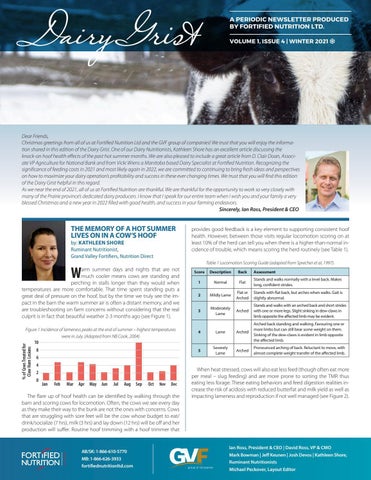
arm summer days and nights that are not much cooler means cows are standing and perching in stalls longer than they would when temperatures are more comfortable. That time spent standing puts a great deal of pressure on the hoof, but by the time we truly see the impact in the barn the warm summer air is often a distant memory, and we are troubleshooting on farm concerns without considering that the real culprit is in fact that beautiful weather 2-3 months ago (see Figure 1).
% of Cows Treated for Claw Horn Lesions
Figure 1 Incidence of lameness peaks at the end of summer – highest temperatures were in July. (Adapted from NB Cook, 2004)
10 8 6 4 2 0
provides good feedback is a key element to supporting consistent hoof health. However, between those visits regular locomotion scoring on at least 10% of the herd can tell you when there is a higher-than-normal incidence of trouble, which means scoring the herd routinely (see Table 1).
Jan Feb Mar Apr May Jun Jul Aug Sep Oct Nov Dec
The flare up of hoof health can be identified by walking through the barn and scoring cows for locomotion. Often, the cows we see every day as they make their way to the bunk are not the ones with concerns. Cows that are struggling with sore feet will be the cow whose budget to eat/ drink/socialize (7 hrs), milk (3 hrs) and lay down (12 hrs) will be off and her production will suffer. Routine hoof trimming with a hoof trimmer that
AB/SK: 1-866-610-5770 MB: 1-866-626-3933 fortifiednutritionltd.com
Score
Description
Back
Assessment
1
Normal
Flat
Stands and walks normally with a level back. Makes long, confident strides.
2
Mildly Lame
Flat or Arched
Stands with flat back, but arches when walks. Gait is slightly abnormal.
3
Moderately Lame
Arched
Stands and walks with an arched back and short strides with one or more legs. Slight sinking in dew-claws in limb opposite the affected limb may be evident.
4
Lame
Arched
Arched back standing and walking. Favouring one or more limbs but can still bear some weight on them. Sinking of the dew-claws is evident in limb opposite the affected limb.
5
Severely Lame
Arched
Pronounced arching of back. Reluctant to move, with almost complete weight transfer of the affected limb.
When heat stressed, cows will also eat less feed (though often eat more per meal – slug feeding) and are more prone to sorting the TMR thus eating less forage. These eating behaviors and feed digestion realities increase the risk of acidosis with reduced butterfat and milk yield as well as impacting lameness and reproduction if not well managed (see Figure 2).
Ian Ross, President & CEO | David Ross, VP & CMO Mark Bowman | Jeff Keunen | Josh Devos | Kathleen Shore, Ruminant Nutritionists Michael Peckover, Layout Editor
Figure 2 Ruminal response to heat stress (adapted from Mishra et al, 1970).
Other conditions in the barn will also increase the incidence of lameness. A study done by Chapinal et al, 2013 found clinical lameness increased with sawdust bedding and decreased with herd size, deep bedding, and access to pasture. Access to pasture led to a 50% variation in clinical lameness compared to cows without access to pasture irrespective of deep bedding also being available to the herd. While pasture availability may not be practical for all barns it is something to consider when cows are in the dry cow period during the warmer months to give their hoofs a chance to heal/recover before the next lactation. The same study went on to show that in barns where severe lameness occurred, the incidence increased with the number of manure contaminated stalls and the use of sawdust bedding. Incidence decreased with deep bedding, sand bedding, herd size and rearing heifers on site. Other factors that helped reduce the incidence was a having a neck rail further from the curb (lower perching tendency), greater water drinking space per cow and frequency of foot baths per week (keeping in mind that footbaths are good for 100 cow passes). If herd size is ignored the neck rail distance and water drinking space is no longer as important. All that to say that overcrowded barns are a part of the puzzle when we see these post summer hoof health flare ups. Keep in mind that overcrowded is not just about enough stalls per cow but enough stalls that fit cows comfortably – enough space to eat, enough space to drink and enough space to lie down. Nutritionally, there are some additives that can help promote hoof health. They cannot, however, overcome poor stall hygiene, overcrowded barns, and lack of footbathing! They are meant to work synergistically with good herd management practices.
Biotin
• Essential co-factor in glucose, fat and protein metabolism • Specifically affects production of keratin and cementing substance of epidermal cell layers in skin, claw, and hair • Deficiency produces gaps in that intracellular cementing • Claw horn quality affected by biotin status • Some improvement seen 6 months after inclusion and optimal improvement seen after 12 months
Chelated Minerals
• Improves availability of key trace minerals • Works with the immune system to improve wound healing and maintenance of cellular integrity • Hardens the outer layer of the hoof via the promotion of keratin synthesis • Improves formation of cartilage
Alongside nutritional technologies, cooling the barn is critical to hoof health. An increase in 3 hours per day standing from coolest to hottest temperatures (most notably in the middle of the day – noon to 6 pm) saw an increase in claw-horn lesion development in September to November (Cook, 2006). Further support through foot baths to avoid small problems becoming herd wide and potentially contagious is also critical. Consider foot bathing 3-4 days per week using a 5-10% solution of copper sulfate (a foot bath with mild soap prior to walking them through a solution to clean feet and get better contact can be effective too). Looking after the herd during hotter weather is critical to ensuring that health and productivity are maintained for the rest of the year. Impacts of heat stress are generally seen most clearly about 2-3 months later. Selecting additives are measures that should be in the diet at least 1 month prior to heat stress; consider a summer diet in May/June (with biotin consider that it should be there year-round). Now, when we battle the aftermath of hot summer days is when routine care is most important: • Hoof trimming by a knowledgeable trimmer • Foot bathing • Ensuring that stalls are well managed • Feed is well mixed and not so easy to sort These steps are critical to reducing the incidence of lameness and enabling your herd to reach their peak production. Once things are under control, that’s when it is time to discuss nutritional additives that will help keep things in good check! n
FARM MANAGEMENT: PLANNING FOR 2022 AND BEYOND
by: D. CLAIR DOAN Associate Vice President, Agriculture, Ontario for National Bank
A
daptability is one word that all people including farmers, have experienced in operating businesses in a fluid and changing environment, particularly these past two years. In the coming months, the skill of adapting will continue to be ever more important where elements of volatility will persist in operating profitable dairy farms under the reality of rising costs and limited resources. A key benefit of supply management remain its access to domestic markets with prices established by the Canadian Dairy Commission. The recent announcement indicating a price adjustment of approximately $6.31/hl or 8.4% will help to offset increased input costs and following the pressure of increased input costs including all aspects of production from crop inputs to labour and interest rates. The next few years in dairy production will be marked by domestic growth partially taken up by additional imports from Europe, members of the CPTPP as well as CUSMA. As the implementation of these agreements is completed, the Canadian dairy industry will reclaim the growth of the Canadian market, which is expected to be solid at 3% annually. The offsets for the first two agreements mentioned, with final payments scheduled for 2022 and 2023, help to mitigate their negative effects. Even with the revenue adjustment, farmers can expect further volatility and their primary focus should remain on cost management. We cannot assume all price increases will be passed along to consumers in the future plus it remains an unknown impact on demand as consumers look to manage their household spending. At the same time, not only does the market continue to demand a product of impeccable quality at a competitive price; consumers are increasingly interested in how it is produced. Carbon footprint, water protection, healthy cohabitation, etc., the dairy community must maintain a high level of concern in these areas. Maintaining the excellent market position of Canadian dairy products is directly related to this.
Dairy Grist
Despite some headwinds, including high input prices, Canadian dairy farmers are optimistic about the future. This is evidenced by the steady increase in the value of milk quotas in the Prairie Provinces (while their value is capped in the Eastern Provinces, it recently reached $50K in Alberta). Unquestionably, a strong confidence in the future is expressed through this growth in value. Now that the winter months are upon us, most feed as been put away for the year ahead, farmers across the country reflect on the variability in their growing conditions, perhaps more so in western versus central Canada, but no matter the location, all farmers have noticed increased costs in nearly every category of expenses. This is an ideal time of year to understand last years costs and start planning and budgeting for the year ahead. Cost minimization in supply management sectors remains the key driver in on farm profitability. Given the rise of increased input costs over the past year, its never too late to generate your year-to-date comparable reports to understand where the costs are changing and by how much and start budgeting for 2022. These often include feed costs, including crop inputs, labour and custom work, health and reproduction, building and equipment repairs as well as interest costs as the largest expense categories. Thus, focus on your greatest expenditures and those that have varied over time to ensure you understand how these may continue to increase and putting these into a budget today. Every farm has a unique mix of assets that include barn facilities, cattle, quota holdings, labour availability and land base, however many farmers have strived to maximize production output, which may be the right strategy for some farmers, but understanding the costs in relation to production output must be fully known. With the rapid increase of feed and input prices, what is your return over feed costs? It is not necessarily the feed cost per tonne but understanding the total output of production and how that relates to the overall farm system, capacity, and limitations. Farms with limitations on facilities will approach this differently than the farm with surplus capacity or cattle, however understanding your own individual farm as a system unique to each operator is key. Benchmarking your farm in comparison to peers can be done with the support of key advisors such as farm management groups, accountants, bankers and alike. Understanding the unique aspects of every farm,
reviewing the overall farm from a financial efficiency perspective with comparisons year over year help establish your on-farm trends. Considering total expenses as a percentage of total income will determine the efficiency ratio. However, from a banker’s perspective, we often look at the expenses with the interest and depreciation costs removed to compare the variable costs in establishing on farm profitability to compare management and farm profitability among peers. These ratios will vary across region where top managers may be below 50% with other areas in the low 60% of costs related to gross income. Through benchmarking, identifying peers who operate in the most efficient quartile, can often establish goals for on farm cost management. Despite the results of on farm efficiency, it ultimately comes back to the on-farm profitability and how much money is available to cover living costs, debt carrying costs and funds available for growth and further on farm investment, relative to the farm itself. It is this final number that matters, with this value stress testing the cashflow of the farm operation. Testing needs to be done on several metrics, such as fluctuation to income, be it milk price or quota allotment; the variability of input cost changes or in broad terms, the efficiency ratio, testing of interest rate variability, which is relevant to on farm debt levels and considerations for asset acquisition. Stress testing your operation is about knowing your numbers and having the knowledge to implement strategies in being proactive versus reactive in volatile markets. Farmers have benefited from the stability and predictability of the Canadian dairy system and will continue to do so for years to come, however the pace of increased costs is occurring at a quicker rate than in the past. Farmers will need to adapt and more importantly plan and budget for the year ahead, including stress testing your business, knowing the cashflow, establishing goals related to strengthening the business and being prepared for uncertainty that we perhaps have not faced in the past. If this seems daunting, do not hesitate to reach out to your trusted advisors where we all benefit from working with profitable farm businesses. n
WELCOME VICKI WIENS Dairy Specialist, Fortified Nutrition Limited
W
e are pleased to introduce you to our newest Dairy Specialist joining GVF group of companies, Vicki Wiens. Born and raised on a dairy farm in Grunthal Manitoba, Vicki will join Gilles in representing Fortified Nutrition in a sales and support role across the Manitoba region. Dairy is Vicki’s passion as evidenced by the time she has spent on dairy farms across the globe. From New Zealand to Ireland, Vicki has gained a wealth of on farm experience working on dairies in those countries as a farm assistant and farm manager. University experiences in Manitoba and Sweden along with 4-H experience in western Canada, has also been helpful in her path to dairy expertise. As a Dairy Specialist for Fortified Nutrition, Vicki will be visiting producers throughout Manitoba to see their cows and facilities as well as discussing how Fortified Nutrition can be a benefit to their dairy operation. With great cow sense and an outgoing friendly personality, producers can look forward to meeting Vicki and discussing their feeding programs with her over the coming months. n
for tifiednutritionltd.com
with VICKI WIENS Dairy Specialist, Fortified Nutrition Ltd.
Q A:
Are there any feed additives that would help improve digital dermatitis?
Digital dermatitis, also known as Hairy heel wart or Mortellaro, is an infectious bacterial disease that causes painful lesions on the heel, with impacts in nearly all Canadian dairy farms today. This disease, causing lameness to occur, can have costly repercussions. A 2010 American study found that with each case the cost was $186 CDN per infected cow per year when losses via milk, fertility as well as treatment were added up. The high incidence we see on farm means this turns into substantial losses to the farm every year. Management is critical to prevent/reduce the severity of this disease including reducing manure accumulation and running cows through footbaths to help decrease the bacteria load in the hooves. However, I am here to talk about how nutrition can play a key role in reducing the prevalence of digital dermatitis. There are certain trace minerals that play a key part in hoof health which include Zinc, Manganese, Copper, and Cobalt. These minerals are integral to cell repair and replacement, inflammatory response, immune system, and keratinization process. All these roles play a part in the prevention as well as reduced severity of digital dermatitis. These trace minerals are packaged together as Availa 4 Dairy. The best strategy however, is prevention and that starts while they are young! Heifers are often overlooked on farms, and they are often the source of digital dermatitis in barns. Digital dermatitis can already be seen in heifers during puberty. Keeping hooves clean, dry, and free from manure build up will go a long way to preventing hoof health issues. Putting heifers through a foot bath on a regular basis (1 - 2x a week) is also key to minimizing hoof health problems in these groups, which will help prevent them from entering the milking herd with hoof problems that will negatively affect their ability to milk, etc., and breed back successfully. Several research trials have demonstrated that the inclusion of the aforementioned trace minerals can significantly reduce the amount of digital dermatitis seen in heifers by 45% which in turn decreased cull rates and improved farm profitability long term. Keep in mind when you start to feed these increased levels of minerals, it can take 2-3 months to see progress which is why its recommended to start before it is an issue. Numerous Fortified Nutrition products provide this package, so contact your Fortified Nutrition Dairy Specialist and we can evaluate and include this in your feeding program. With a combination of management and nutrition, dairy farmers can combat digital dermatitis. n
Beginning in January 2022, all Fortified Nutrition Ltd. Dairy products and people will become branded as
Grand Valley Fortifiers.
As we work closer and closer together with our Nutrition Direct Dairy team in Ontario, who assist with the formulation of rations, we’ve decided that taking on the Grand Valley Fortifiers brand best fits our plans for future growth. Stay tuned for more details to follow. 1-877-625-4400 grandvalley.com
Advanced Animal Nutrition for Improved Human Health
Canadian Family Owned
Thought for the Day Christmas Reflection: Mary’s Magnificat “My soul magnifies the Lord, and my spirit rejoices in God my Savior, for he has looked on the humble estate of his servant. For behold, from now on all generations will call me blessed; for he who is mighty has done great things for me, and holy is his name. And his mercy is for those who fear him from generation to generation. He has shown strength with his arm; he has scattered the proud in the thoughts of their hearts; he has brought down the mighty from their thrones and exalted those of humble estate; he has filled the hungry with good things, and the rich he has sent away empty. He has helped his servant Israel, in remembrance of his mercy, as he spoke to our fathers, to Abraham and to his offspring forever.” (Luke 1:46–55) Mary, the soon the be mother of Jesus, shares this special song we now know as “The Magnificat”. In it she reveals a very remarkable thing about God: He is about to change the course of all human history; the most important three decades in all of time are about to begin. The birth, 33-year life, death and resurrection of Jesus Christ, will transform the relationship mankind can have with Creator God for all eternity. This Christmas I invite us all not to forget the significance of the season we love to celebrate. — Adapted from John Piper’s Daily Devotionals