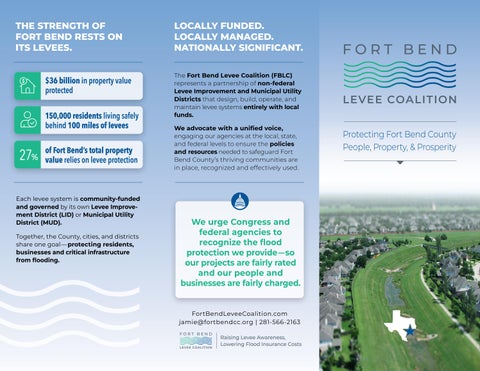
THE STRENGTH OF FORT BEND RESTS ON ITS LEVEES. $36 billion in property value protected 150,000 residents living safely behind 100 miles of levees Fort Bend’s total property 27% ofvalue relies on levee protection
Each levee system is community-funded and governed by its own Levee Improvement District (LID) or Municipal Utility District (MUD). Together, the County, cities, and districts share one goal—protecting residents, businesses and critical infrastructure from flooding.
LOCALLY FUNDED. LOCALLY MANAGED. NATIONALLY SIGNIFICANT. The Fort Bend Levee Coalition (FBLC) represents a partnership of non-federal Levee Improvement and Municipal Utility Districts that design, build, operate, and maintain levee systems entirely with local funds. We advocate with a unified voice, engaging our agencies at the local, state, and federal levels to ensure the policies and resources needed to safeguard Fort Bend County’s thriving communities are in place, recognized and effectively used.
We urge Congress and federal agencies to recognize the flood protection we provide—so our projects are fairly rated and our people and businesses are fairly charged. FortBendLeveeCoalition.com jamie@fortbendcc.org | 281-566-2163 Raising Levee Awareness, Lowering Flood Insurance Costs
Protecting Fort Bend County People, Property, & Prosperity
FEDERAL ASSUMPTIONS. LOCAL CONSEQUENCES.
RESTORE FAIRNESS & TRANSPARENCY National Flood Insurance Program (NFIP) Reauthorization and FEMA:
Since the Federal Emergency Management Agency’s (FEMA) Risk Rating 2.0 launch in 2021, Fort Bend’s non-federal levees have not been fully recognized by FEMA or the U.S. Army Corps of Engineers (USACE) for the flood damage reduction benefits they provide.
• Federally recognize the full level of protection provided by non-federal levee systems in FEMA and USACE programs used to set premiums • Ensure pricing transparency—publish data, models, and rate assumptions • Reinstate a process to challenge incorrect premiums
This lack of recognition causes:
• Maintain current flood insurance mandates; do not expand requirements to leveed areas
• Flood insurance premiums to be up
• Treat levees as reliable flood protection; do not create a new zone for leveed areas on flood maps
to 25% higher than federal systems
• Unfair treatment to communities that
locally fund ongoing operation and maintenance for their own flood protection
• Develop community-based flood insurance options for rapid recovery • Study FEMA–NFIP separation for better program management • Keep NFIP balanced and focused solely on flood insurance, not all-hazards coverage • Encourage strong local floodplain management and enhance flood risk reduction through FEMA’s Community Rating System
Fort Bend residents fund, build, operate, and maintain top-performing levees—yet pay more than they should for flood insurance.
• Retain FEMA’s Flood Insurance Rate Maps with Base Flood Elevations (BFE) for regulatory use • Avoid raising the BFEs by using higher confidence limits in calculations unless the FEMA 3-foot freeboard accreditation requirement that accounts for uncertainty is eliminated • Keep structures protected by accredited levees excluded from the special flood hazard area and its mandatory purchase requirement for flood insurance • Incorporate state, county, and local input in new flood risk tools
RECOGNIZE LOCAL PERFORMANCE, NOT FEDERAL ASSUMPTIONS Water Resource Development Act (WRDA) and USACE: • Allow levee owners’ engineers to
perform certified risk assessments for USACE review
• Use these results in FEMA’s premium
setting within 180 days of approval
• Establish a Levee Owners Board to enable
representation of non-federal levee sponsors nationwide in agency policy-making and programs
• Require collaboration with willing levee
owners under WRDA 2020 §131 to identify deficiencies and remediate with realistic cost and timeline estimates