FMIC FORESTRY MUTUAL INSURANCE COMPANY
SUMMER 2021
WOMEN IN FORESTRY INSIDE OUR SUMMER MAGAZINE
AGENCY CORNER
Plan Ahead To Avoid Confusion When An AUTO CLAIM OCCURS
SAW SHOP
Breaking down the manual felling process.
HEAVY EQUIPMENT TIRE SAFETY “Don’t Tread on Me”
FMIC SPOTLIGHT Meet the women who work in the industry; from our clients, associations and staff
THEN & NOW
Interview with George Pace
Gwen Marion, Office Manager, Franklin Brothers Logging, and CF Marion Trucking Timberland, Virginia
SUMMER 2021
CONTENTS
From the BIG Desk
4
FMIC SPOTLIGHT - Women in Foresty
6
THEN & NOW Interview with George Pace
8
Keith talks about core values of supporting loss control and continued safety mentoring.
We take a look at the women who work in the indusry and contribute to our continued success.
How forestry operations and forestry insurance have changed over the years.
THE RISK ASSESSMENT Don’t Tread on Me
12
SAW SHOP
14
AGENCY CORNER (Auto Claims)
18
FMIC SPOTLIGHT - Trucking
19
LEGENDS OF FMIC - Monsters
20
by Jeremy Helton Equipment tires have a funny way of knowing when you are having a bad day. by Bryan Wagner Breaking down the manual felling process.
by Eddie Campbell Here are several steps to consider having in place beforehand in the event of an auto accident.
by Greg Plumley We talk with Rodney, “Slider” Honeycutt from A & K Construction about staying positive on the road.
by Jean-Paul Damé (JP)
Patrick Revette
Raymond Revette Timber, LLC
FMIC SPOTLIGHT - Mississippi
28
FMIC KITCHEN
27
Staff Directory
28
by Jack Williams We sat down with James Davis, owner of Circle, T. Ltd. on the timber industry and Missisippi logging. Scallops and Low Country Boil
visit us @ www.forestrymutual.com
BIG 50 Celebrating for the next
2
FMIC SUMMER 2021
twelve months our clients, employees and our success stories. These past 50 years could not have been possible without the dedication and support from you.
Gwen Marion, Office Manager, Marion Brothers Logging & CK Marion Trucking
6
FMIC SPOTLIGHT
Women in Forestry
Forestry Mutual felt it was necessary to spotlight some of the many women who work in the wood products industry.
Candace Dinwiddie, Executive Director, Tennessee Forestry Asociation
Gwen Marion, Marion Brothers Logging & CK Marion Trucking
Candace Dinwiddie, Tennessee Forestry Association Amy Almond, CPA, CGMA, CFO, Forestry Mutual
Amy Almond, CPA, CGMA, CFO, Forestry Mutual Insurance
8
THEN & NOW
We sit down with George Pace, former Chairman at FMIC
12 RISK
ASSESSMENT “Don’t Tread On Me” by Jeremy Helton
FORESTRY MUTUAL BOARD OF DIRECTORS
CHAIR Michael Walters
DIRECTORS Tommy Barnes Chip Capps Joel Cathey Randy Denman Candace Dinwiddie Joey Ferguson John Hatcher Mike Macedo Tedrick Ratcliff Bernard Rose Marshall Thompson Matt Thuman FORESTRY MUTUAL INSURANCE COMPANY 801 Jones Franklin Road Suite 100 Raleigh, NC 27606
(800) 849-7788 www.forestrymutual.com
FMIC AGENCY
P.O. Box 19467 Raleigh, NC 27619
(866) 755-0344 www.fmicagency.com 3
FMIC SUMMER 2021
FROM THE
BIG DESK “Loss Control is the key to our success.” 4
FMIC SUMMER 2021
A
lot has happened since my last quarterly (Spring) update that I am optimistic about.
March 1st was our 50th anniversary. As of our last Board of Directors meeting in November 2020, our loss ratio has declined marginally. However, there are still way too many preventable claims occurring. What is making it difficult is the rates continue to decline every year in every state. There is stiff business competition, and we must continue our core values of supporting loss control and continued safety mentoring.
Even though it was a slow spring period, we managed to maintain our overall sales volume levels. I am very encouraged by this because I see it as more evidence of a pattern of consistency that has been emerging which demonstrates that we are capable of sustaining our performance levels over time, in spite of seasonal and cyclical market fluctuations. In addition, we already have a number of initiatives planned or underway that I believe will allow us to be even more productive and better than ever at exceeding our customers expectations. Forestry Mutual added a Communications Director, Jean-Paul Damé (JP). He has worked to improve our website, newsletter,
business cards, and social media presence. His extensive background in broadcast television will be a huge asset to Forestry Mutual as he creates educational and training content to support our core values in safety with our Loss Control members. I am excited and optimistic about our establishment of Forestry Mutual products and services in Mississippi. The hard work from our marketing agent in that region, Jack Williams, and our Loss Control representative, Justin Guyer, will be great assets to our continued growth and success. We have had great results with our appointed agents in the state and look to continue to mutually grow that book as well.
Between now and the end of this year we will continue to develop innovative technology platforms designed to further streamline our billing operations and enhance the products and services that we offer our customers. In fact, I believe that our ongoing efforts to continuously improve the products, services and pricing mix that we offer to both our customers and our agents will be a never-ending quest if we are to stay at the forefront of our industry. The coronavirus put a wrinkle in our in-person training that we had scheduled last year, and hopefully, this year, we can move forward in our hands-on, in-per-
son training. I am still not satisfied with the seriousness and the number of preventable claims that are still occurring. With truck drivers still having incidents, we must continue our efforts to train these drivers. We have shown some progress in this area, but we still have a long way to go.
TEAM Safe Trucking (TST) is still evolving. There are over 60 modules now. Some of our staff have gone through the Train The Trainer class. My hope this year is to get more drivers engaged in the training instead of creating more modules. Forestry Mutual loss control staff has also participated by providing driver training with the Carolina Loggers Association. In all of the classes that CLA has presented, Forestry Mutual has presented our training content in those classes. Forestry Mutual will continue to help when we can. We are excited to know that CLA will be taking over their training in the coming months. “Loss Control is the key to our success.”
We continue to make steady and encouraging progress in the industry and in every state. I have no doubt that if we continue to work as a team committed to exceeding our customers expectations our future 50 years will be a success. If you have any questions or suggestions on how we can better serve you, please don’t hesitate to give me a call. Keith Biggs, President, Forestry Mutual Insurance Company Jack Williams, FMIC Agency Account Executive, visiting Dakota Pruitt with Pruitt and Son Logging in Mississippi Photo Credit: FMIC Staff Photographer
FMIC SUMMER 2021 5
FMIC SPOTLIGHT
WOMEN IN FORESTRY GWEN MARION,
Office Manager, for Marion Brothers Logging and CF Marion Trucking
T
oday, women in forestry are getting recognition for be equally as effective as men in business by taking the initiative and demonstrating integrity and honesty. The wood products industry has a growing number of women who have proven themselves to be true leaders. We felt at Forestry Mutual it was time to celebrate some of the women making a positive impact in our industry. We visited Gwen Marion, Office Manager with Marion Brothers Logging, Candace Dinwiddie, Executive Director with the Tennessee Forestry Association, and Amy Almond, CPA, CGMA, CFO with Forestry Mutual Insurance. These women are taking risks and are innovating game-changers within their respective positions in forestry. Their humble entrepreneurial spirit is pushing them to not just dream but act -- as well as tackle the unique hurdles that come with forestry operations. Gwen Marion, Office Manager for Marion Brothers Logging and CF Marion Trucking out of Cumberland, Virginia. Gwen is married to Franklin Marion. She grew up in Chesterfield County and graduated from Matoaca High School.
Left to Right: Rebecca Smith, Gwen Marion & Stephanie Marion Photo Credit: FMIC Staff Photographer
6
FMIC SUMMER 2021
Gwen was engaged to her high school sweetheart, “who turned out to be a real jerk,” She says laughing, “which made being in a small town difficult.” She started spending weekends in Cartersville with her aunt and uncle and continued to work for a wholesale company in Petersburg. Gwen changed careers and moved in with her relatives to drive a school bus for Prince Edward Academy and worked there as a librarian. That’s how she met Franklin through a mutual friend. Gwen has a very humble, wry
Left to Right: Franklin Marion, Gwen Marion, Curtis Marion, Keith Marion, Stephanie Marion, Kyler and Kailey Marion (grandkids), Josh Covington Photo Credit: FMIC Staff Photographer
sense of humor and joked about Franklin and there first date. While they were sitting in her car at the Tasty Freeze, she pulled out an ax handle and jokingly threatened Franklin with it. “Don’t be a jerk, or I’ll beat you with this.” Undeterred, Franklin called on Gwen, and they began to date. “Why he bothered to call back, I do not know, but I’m glad he did,” she says, smiling. Gwen and Franklin were married in 1989. Franklin’s family were farming tobacco and raising hogs, and Franklin decided after high school he did not want to be a pig farmer and went into the logging business. As his younger brothers graduated, they came to work with Franklin, and a logging business was born.
Gwen decided to leave Prince Edward Academy and go back to a career in finance and accounting, working with the Department of Corrections. “I went from school kids to convicts,” jokes Gwen. She left the “convicts” behind and started working with Franklin in 2001. Gwen’s timing was advantageous as health issues arose with Franklin’s father and his ability to take care of the contracts and bookkeeping for the companies suffered. The logging industry
is a lot like the entertainment industry in that nepotism does exist. Both industries hire and work closely with all their family members. Often it is a multi-generation business with grandfathers working sideby-side with their sons and grandsons. It is not uncommon for the wives to manage the business operations of a logging/trucking company. Like many other women who work in the shade of forestry, Gwen is dedicated to smooth operations that make a family-run business successful.
business was not such a challenge to me because that’s just numbers on the page and making sure it balances out.” One hardship that Gwen did have to overcome was on the trucking side. When she first started twenty years ago, she burned up the phone with Betty Jane continued on page 22
While the physically demanding hard work of logging in the field is typically our focus, in this article, we wanted to spotlight the women, wives, daughters, daughters-in-law, and grandmothers whose dedication to the industry and their families should be commended.
In the beginning being taken seriously was one of the hurdles she had to endure. Almost twenty years later, with the help of Rebecca Smith and Stephanie Marion, they now orchestrate a smooth operation from timber contracts, legal, governmental, and taxes and again her peers’ respect. “It’s a pretty close-knit community, and everybody is willing to help everyone.” Gwen says, “The logging part of the
FMIC SUMMER 2021 7
&
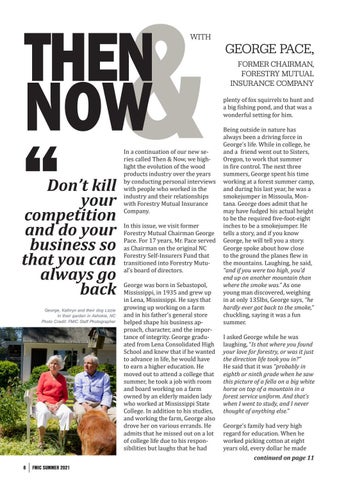
THEN NOW Don’t kill your competition and do your business so that you can always go back George, Kathryn and their dog Lizzie In their garden in Ashokie, NC Photo Credit: FMIC Staff Photographer
8
FMIC SUMMER 2021
WITH
In a continuation of our new series called Then & Now, we highlight the evolution of the wood products industry over the years by conducting personal interviews with people who worked in the industry and their relationships with Forestry Mutual Insurance Company.
In this issue, we visit former Forestry Mutual Chairman George Pace. For 17 years, Mr. Pace served as Chairman on the original NC Forestry Self-Insurers Fund that transitioned into Forestry Mutual’s board of directors. George was born in Sebastopol, Mississippi, in 1935 and grew up in Lena, Mississippi. He says that growing up working on a farm and in his father’s general store helped shape his business approach, character, and the importance of integrity. George graduated from Lena Consolidated High School and knew that if he wanted to advance in life, he would have to earn a higher education. He moved out to attend a college that summer, he took a job with room and board working on a farm owned by an elderly maiden lady who worked at Mississippi State College. In addition to his studies, and working the farm, George also drove her on various errands. He admits that he missed out on a lot of college life due to his responsibilities but laughs that he had
GEORGE PACE, FORMER CHAIRMAN, FORESTRY MUTUAL INSURANCE COMPANY plenty of fox squirrels to hunt and a big fishing pond, and that was a wonderful setting for him.
Being outside in nature has always been a driving force in George’s life. While in college, he and a friend went out to Sisters, Oregon, to work that summer in fire control. The next three summers, George spent his time working at a forest summer camp, and during his last year, he was a smokejumper in Missoula, Montana. George does admit that he may have fudged his actual height to be the required five-foot-eight inches to be a smokejumper. He tells a story, and if you know George, he will tell you a story. George spoke about how close to the ground the planes flew in the mountains. Laughing, he said, “and if you were too high, you’d end up on another mountain than where the smoke was.” As one young man discovered, weighing in at only 135lbs, George says, “he hardly ever got back to the smoke,” chuckling, saying it was a fun summer.
I asked George while he was laughing, “Is that where you found your love for forestry, or was it just the direction life took you in?” He said that it was “probably in eighth or ninth grade when he saw this picture of a fella on a big white horse on top of a mountain in a forest service uniform. And that’s when I went to study, and I never thought of anything else.” George’s family had very high regard for education. When he worked picking cotton at eight years old, every dollar he made
continued on page 11
to be able to support our members and grow our organization in new directions.
TENNESSEE
Candace Dinwiddie, Executive Director, Tennessee Forestry Association
The Tennessee Forestry Association appreciates the partnership with FMIC. Thanks to all the folks at FMIC for working with our loggers and mills to ensure that safety and professionalism are top priorities in our state. FMIC is a vital partner with our Tennessee Master Logger program and other activities and events sponsored and organized by our association.
TFA has continued to work successfully in our General Assembly for landowners and industry to grow trees and manufacture wood products in a business-friendly environment. Our organization will always endeavor in the Tennessee legislature and on the federal and local levels to keep our Tennessee industry and landowners from facing unnecessary regulations and burdensome taxes. During the past two years, TFA has been very fortunate to receive several grants from the TN Dept. of Agriculture and other sources
TFA has contracted with a Workforce Development Coordinator, Larry Pitt. Forestry curriculum programs are now included in several TN Colleges of Applied Technology (TCAT) vocational schools. TFA is also working with local county school systems, particularly in rural and distressed counties, to include curriculum related to future careers in the sawmill and logging industries. Apprenticeship programs in wood products industries are now available with support from the TN Dept. of Economic and Community Development. Still work in progress, but TFA’s workforce program is making a positive difference in counties with a strong presence of forest industry to ensure a trained and safety-conscious workforce for the future.
TFA is partnering with the AL Forestry Association on the Forestry Works Training Institute programs and is excited to grow our workforce programs in the future. Also, TFA has contracted with a Conservation Education Coordinator. With the help of our coordinator, Teri Frye, TFA has held Project Learning Tree programs both in schools and online. Also, in 2021, we have again scheduled in-person four Teacher Conservation Workshops and two Green Jobs Workshops. TFA is hosting mill tours and logging site visits for teachers and providing educators the opportunities to understand better the connection of harvesting trees to everyday wood products. TFA is active in local Envirothon competitions, and along with our Workforce Development Coordinator, Teri is scheduling middle and high school forestry career days for
autumn 2021 across the state. TFA’s Conservation Education Coordinator is also working with several state and private universities to ensure that Project Learning Tree training is included in all pre-service teacher programs before graduation.
Another grant from the National Fish & Wildlife Federation (NFWF) provides TFA funding to contract with a forester to work with landowners in the Elk and Duck River Watersheds to promote sustainable forest management and growing the number of acres of certified private non-industrial land in the Tennessee Tree Farm program. Cost-share funds for planting trees are available to landowners, along with funding for consultant visits. TFA’s forester, Alex Richman, actively works with landowners, consultants, and TN Division of Forestry personnel to ensure that non-industrial landowners understand the importance of growing trees, strong markets for certified wood and foresters achieve landowners’ goals for their forests. Other projects that TFA is working on include a grant to work with landowners to grow more white oak in Tennessee, expanding our Master Logger training, honoring milestone Tree Farmers, landowner education through Tennessee Healthy Hardwoods, and “Welcome to Your Woods.” At the Tennessee Forestry Association, we believe in safety, advocacy, education, networking, and believing in and supporting our members. We always want to thank our members for the great job they do in the woods and their communities. For more information on the Tennessee Forestry Association, check out www.tnforestry.com FMIC SUMMER 2021
9
VIRGINA
Virginia Loggers Association Ron Jenkins, Executive Director, Virginia Loggers Association VLA is a 501 C 6 trade association designed to bring your Voice to those in all government and private sectors. VLA serves our forest products industry, emphasizing loggers while also supporting forest products mills to keep them healthy and strong.
VLA has a Voice in Congress through personal contacts and membership to the American Loggers Council. VLA is an active member of the ALC, and therefore our VLA members reap benefits provided by ALC too. Significant discounts are available through several large global companies.
Our mission is to serve as a collective Voice for our industry. We accomplish this through our activities at all levels of government that are focused on healthy businesses, fewer regulations, low taxes, and pro-business policies.
10
FMIC SUMMER 2021
Forestry Mutual Insurance and VLA have a special bond with a common interest, ensuring that our members operate safely all the time. We work together to emphasize safety through training! Through a long-standing contract agreement, we work together on common goals. Forestry Mutual Insurance provides membership in VLA when business owners decide to become policyholders for workers’ compensation. Because of Forestry Mutual, VLA now has 195 members whose membership dues are paid by our partner. Thomas & Thomas, Accountants for VLA, have estimated that membership dues are 98% tax-deductible. However, they also recommend you check with your accountant advisors about your specific situation.
VLA is very active on the political level and especially at the local and state levels. VLA has a political action committee for state representatives to which members can also make financial contributions. The three-member PAC committee carefully considers candidates for Governor, Lieutenant Governor, Attorney General, House of Delegates, and Virginia Senate before making any campaign contribution. VLA seeks candidates who are pro-business and support legislation that allows growth without over-burdensome regulations. VLA members are actively
working on local ordinances, such as the current efforts to seek county adoption of the new law authorizing them to exempt personal property taxes on forest harvesting equipment. We have been active on many transportation issues such as hauling weight, bridge closures, and truck prohibitions.
Our members continually work with local, state, and federal officials to build trust and binding relationships that positively impact our business owners. VLA was active on recent state legislation, including the 90,000 hauling weight permits, flashing lights authority, and the latest forest harvesting tax exemption. These positive changes in Virginia laws have created a safer and more competitive environment for Virginia business owners.
We are actively seeking passage of the Safe Routes Act (HR 2213 to authorize the states’ legal maximum weights on interstate highways and much more at the federal level. This work is done through our membership in the American Loggers Council. Passage of the Safe Routes Act will create safer roads for everyone. VLA adamantly supports moving as much commercial transportation to our interstate highways as possible. continued on page 27
VLA Members in Washington DC 2019
continued from page 8 THEN & NOW: GEORGE PACE went into a school fund. “If I needed a dime, then daddy gave me a dime. But if I made a dime, it went to the school fund.” Before graduating college in 1957, George got married to Kathryn on Christmas. They had known each other since they were kids and always knew they’d be together. It was just an unspoken thing, and when George asked about when she wanted to get married, Christmas Day was her answer. After graduating college, George began his long career working in the forest industry. His first job was with the forest service and he was sent up to North Mississippi on a flood prevention project. He talked about how “there were places up there where the world’s washing away. There were gullies that you could put a large house in and walk a hundred yards over, and you couldn’t see it.” Working with the government and the farm planters, who were making the farm plans, the forest service was able to build brush dams and plant pine trees to stop the erosion. Many farmers were skeptical of the government and convincing them that the government had no control over their land was a challenge. The evidence of erosion control overcame their skepticism. After leaving that position and working several other jobs, from forestry consultant to working at a hardwood mill in Greenwood, Mississippi, George had the opportunity to come to Plymouth, North Carolina with Georgia Pacific, which moved him to Emporia, Virginia.
business principles he brought to Forestry Mutual while serving on its board. “Don’t kill your competition and do your business so that you can always go back.” Aftering moving to Ahoskie, North Carolina, and responsible for two plywood mills, two chipping sawmills, and three hardwood mills, George and nearly every large timber company got involved with the North Carolina Forestry Self-Insurers Fund. They all knew back then, as George recalls, “we supported that every way we could, logging was terrible. I mean, killing them right and left. Ed Pittman, a forester with Weyerhaeuser, and Bill Cale were very concerned about it, and they really got this thing started.” One of the keys to Forestry Mutual Insurance success has been the dedication from the board and Keith Biggs to find the right individuals to manage and guide Loss Control for the company. George says, “loss control just keeps booming and going, and the secret? Accidents have dropped so much because it’s a dedicated bunch of boys working with the loggers and convincing them that once they see the lower cost of insurance, it’s easier to convince them. Without what was the self-insurers fund, now Forestry Mutual, logging would not be as safe as it is today.
It really would not be.” Trucking is the next big concern George says that he has seen with the logging industry. Trucking accidents could be avoided if truck drivers would just slow down. He feels that using new technology in the truckerss cabs, cameras, and GPS would help bring down senseless accidents and injuries. George says, “the other thing that these cameras help, is log trucks being accused anytime there is an accident.” He continues with a story about Kathryn, his wife of 65 years this Christmas. “She was riding with a bunch of women somewhere, and a log truck comes by. Somebody in there says I hate them log trucks. Kathryn says, that ain’t a log truck, that’s a bread truck.” Laughing, “so that stopped that conversation right out.” At the age of 80, George retired from the board at Forestry Mutual Insurance and lamented, “I’ve missed it, you know, I loved it.” From all of us at Forestry Mutual, we could not be where we are today, celebrating 50 years of dedication and service to the industry if it had not been for the wisdom and guidance that George Pace gave to Keith Biggs and his team.
I got the impression from George that moving was just part of life, as he did it so many times.
It was there, in Emporia, while working with the original owners of Georgia Pacific and his remarkable friendship with Ashton Lewis, that he learned the simple
FMIC SUMMER 2021
11
THE
RISK ASSESSMENT by Jeremy Helton Tennessee Field Rep.
HEAVY EQUIPMENT TIRE SAFETY “Don’t Tread On Me” The logging industry has some common recurring themes when it comes to claims. One we have recently seen rolling through the claims department is injuries to employees while changing skidder tires. Equipment tires have a funny way of knowing when you are having a bad day while adding insult to injury; they usually wait to fail in inconvenient locations. Situations like these cause immense pressure and stress, which can lead to poor decisions regarding safety. Take a deep breath, step back, ask yourself a few questions, and identify the dangers before getting started. • Have I notified the rest of the crew, so they are aware that we are out of action and there is a man on the ground? If not, communicate with them. One of the leading causes of loss for equipment operators is when they are outside of their equipment.
• Is it possible to safely move the equipment to an easily accessible area such as the loading deck or a trailer staging area? If so, move it. Moving equipment to a site like this makes it easier for a tire service, your service truck, and other equipment to be readily available to help.
12
FMIC SUMMER 2021
• Who is available to help me? It is always a good idea to have another pair of hands around in the woods. Many times, accidents occur, and it takes hours for the injured person to be discovered. Be wise and ask for help.
• Is my equipment locked out? All equipment should be at a zero-energy state when being serviced or maintained. This means disabling ALL stored energy. You should make sure that the electrical, mechanical, pneumatic, hydraulic, and even gravity are accounted for. Wheels are designed to roll, and sometimes they do when it is not expected. It’s also important to block when removing a wheel and tire to keep equipment from tipping over. Please make sure you take gravity into account when disabling your equipment. • Can I use a mechanical assist such as a service truck boom or other equipment to help remove the tire? Many of our recent injuries have occurred at this step of the process. Most bare skidder tires weigh somewhere around 1,000 pounds. To have something to compare that to the World Record for Deadlifting is roughly the same amount. While I will not attempt to lift either, I can assure you a barbell is a lot easier to grip, his surface is more even,
and the weightlifter is much more prepared for that load. You can blow out multiple joints in your body trying to handle something that heavy. Trying to remove one by hand also increases the risk of it gaining momentum and rolling away or falling over onto you.
Having a flat in the woods will add stress to an already bad day, but a severe injury or death will extend well beyond that day. Many injuries in the logging woods happen when a crew is thrown out of sync from their typical routine. Knowing that, take time to slow down and think through scenarios while keeping safety top of mind.
Jeremy Helton, Tennessee Field Rep.
DRUG-FREE WORKPLACE REQUIREMENTS Greg Plumley, Director of Loss Control For the past several years, all insurance companies have required employers that have drivers with a commercial driver’s license (CDL) to have a drug policy and testing procedures in place to receive a quote ¬for ¬an auto policy. This is also a requirement of the Federal Motor Carrier Safety Administration (FMCSA) (www.fmsca.dot.gov).
Insurers see drug testing of applicants and employees as demonstrating an employer’s commitment to a drug-free workplace. Preventing claims due to improper or illegal drug and alcohol use can lead to having fewer workers’ comp claims and helps the bottom line. State laws dictate what must be in your policy. As a minimum, it must state that you prohibit the use, sale, dispensing, or possession of illegal drugs, narcotics, and alcoholic beverages on company property or during working hours, whether on company property or not, such as drivers. This covers all legal or prescription drugs that might impair an employee’s ability to perform their job and covers any prescription drugs that are not used as
prescribed or by the person for which they are prescribed. Drug testing policies must address who will be tested when they will be tested and what will happen as a result of a positive test—informing all applicants that you drug test all applicants and that a positive drug test will result in a withdrawal of a job offer will most often deter substance abusers.
Your policy should require that employees be tested post-accident, for reasonable cause or suspicion, and/or randomly. Be sure to include a statement that refusal to test, diluting a test, or any alterations of a sample or test will result in termination. State the policy on whether you will terminate employees who test positive (following a confirmation test), or will allow them to continue employment if they go to your Employee Assistance Program and follow the requirements of the program, sign a “last chance agreement,” and agree to be tested at any time over the next year without notice.
Forestry Mutual has an agreement with Nationwide Testing Association (NTA) to have them help our Policyholders come into compliance with your state’s laws. NTA
has provided drug and alcohol testing services to businesses throughout the United States since 1988. Their testing programs meet all federal requirements for USDOT Drug and Alcohol Testing Programs. In addition, they can tailor a drug and alcohol testing program that will conform to the Drug-Free Workplace statutes in any state. Many smaller companies do not have enough employees to do random testing. So we have created a consortium with NTA so random testing can occur. For more information, contact NTA at (800) 452-0030 or visit their website at www.ntatesting. com.
NTA is proud to offer a 20% discount to any client referred to NTA from Forestry Mutual on all products and Services offered by NTA. Contact your Forestry Mutual Field Representative if you need assistance.
Greg Plumley, Director of Loss Control - FMIC
FMIC SUMMER 2021 13
SAW SHOP 14
FMIC SUMMER 2021
OVER THE PAST 25 YEARS,
MANUAL FELLING PROCESS
BREAKING DOWN THE
EXAMPLE OF THREE COMMON NOTCH PATTERNS Top: Humbolt Undercut Middle: Conventional Face Cut Bottom: Open Face Notch
I have written several articles dealing with the manual felling process. Manual felling is the most significant risk in our industry. Twenty-five years later, mechanical felling has increased dramatically. We now have equipment that can harvest timber on steep terrain or in the wet areas of a swamp. Our industry has done a great job of trying to reduce risk and exposure by using mechanical means. With that being said, there are still situations that require timber to be felled with a power saw. So, we still have significant risk present on some days. Several articles over the years have dealt with the 5-part felling plan and I thought I would cover it again. By Bryan Wagner Chainsaw & Logging Safety Trainer, FMIC
THE 5-PART FELLING PLAN
deals with specific risk and exposure present during all phases of the manual felling process. Let’s do a quick review of the felling plan.
1: LOOK
• Check for ALL overhead hazards. We have a fresh crop of leaves, really LOOK!
2: CHECK SIDE-LEAN
• Check the side-lean of the tree. The weighted side of the tree is the Bad-Side. Avoid or limit your time on the Bad-Side!! If you are not there, you are not injured there!
3: ESCAPE!
• Your escape route is a 45-degree angle away from the falling stem. Get out of Dodge!
4: HINGE THICKNESS.
• Your “basic” hinge thickness should be 1/10th the DBH of the tree. Hinge thickness will vary by the fiber type of the tree species.
5: BACK-CUT PLAN.
The final felling cut. I recommend a “controlled-release” back-cut. • The tree doesn’t move until I tell it to move! After reviewing the felling plan, we will move forward. I am going to break down the manual process into sections. In this issue, we will discuss the face notch. Future articles will cover the hinge, the escape route, and finally, the back-cut plan. I am looking forward to explaining each critical section of the felling process.
FMIC SUMMER 2021
15
THE FACE NOTCH After visually assessing and completing your felling plan, notching the tree is the first physical step in the felling process. An improper notch can start a series of events that can become catastrophic, sometimes leading to injury or worse.
The “golden rule” for a proper face notch is: Both Cuts MUST Meet, Perfectly! NOTCH: FACE CUT
HINGE
HINGE
HINGE
BOTH CUTS OF THE NOTCH MUST MEET!!
- Use your felling plan, constantly Look-Up!
- Both cuts of the notch Must Meet!! No By-Pass!!
ATTACK CORNER
Notch depth should be 80% of the diameter of the tree.
- Notch depth should be 80% of the diameter of the tree. - Notch angle should control the falling stem 70-90% of its fall. - LOOK-UP AGAIN!!
TRIGGER A cut behind or under a face notch is called a “By-Pass” and is considered a serious safety violation. By-pass is serious because it misplaces where proper hinge wood belongs. By-pass behind the face notch sets the hinge back and away from the notch opening. This mistake creates severe pressure as the tree falls to the ground. Often, pulled fiber or split butt logs result from this type of by-pass. Barber Chaired trees have taken many lives in our industry. By-pass can also happen by “missing low” or under-cutting where the hinge needs to be. No Hinge - No Control! The simple fix to by-pass, Make Both Cuts Meet!!
Notch depth should include 80 % of the stump diameter. What you are doing is setting the hinge length, more length, more strength, more control. A note of caution here, watch for root fiber. This fiber lacks the strength that “good wood’ has. I try to set the notch behind the root flares.
Your notch angle controls how long the hinge is going to control the falling tree. The “open-face” system tries to set a 70-90-degree notch opening. The theory behind the open-face system is by the time the tree has reached 70-90 % of its fall, the energy to “rebound” has been spent. This reduces the chance that the tree will rebound, maybe hurting one of my guys.
16
FMIC SUMMER 2021
In the past twenty years, the forest industry has been blessed by mechanization. The amount of hard and demanding physical labor has been reduced greatly. The introduction of grapple skidders, feller-bunchers, buck saws, and delimbers has reduced risk in the industry. Such equipment has also reduced the physical exertion of logging employees. Mechanized forest equipment operators enjoy great creature comforts, heaters, and air conditioners. The cabs of the newer logging equipment provide for a comfortable working environment.
On the other side of the coin, timber cutters and saw hands have a very physically demanding job. When the heat of the summer is thrown into this equation, fatigue is the result. Fatigue is a very serious risk that must be dealt with in our industry. It’s human nature, a tired or fatigued person will take a shortcut. Shortcuts in the logging woods can prove to be lethal. Fatigue affects the thought process. If we can limit or reduce fatigue
levels, we end up with an alert, clear-thinking timber cutter. To limit fatigue in the summer heat, we must look at personal health and physical exertion. Above all, we must stay hydrated. Gas for the saw, water for me is a saying that should be followed. Strenuous physical exertion may be reduced by working a little smarter, not harder.
TIPS TO KEEP YOU SAFE
• Drink plenty of water before, during, and after exposure to the heat. Dark yellow-colored urine is a sign of not enough water being consumed. • Avoid caffeinated drinks; they tend to make you thirstier. • Keep in the shade as much as possible.
• Wear light-colored, loose-fitting clothing.
• Doctors recommend at least eight glasses of water on a normal day, twice that should be consumed during high heat periods.
• Work smart. The brain can save a lot of footsteps, less foot steps, less fatigue. • If at all possible, do most of the manual felling during the early morning to avoid the heat of the day. • If possible, toppers should be stationed in a shaded “safe zone” from the skidders.
• Limit the time your toppers are exposed to the direct sun. Make one trip out of the safe zone to top 3 or 4 drags, rather than running out to top a single drag. • Timber cutters can cut their whole drag before going down to top the timber. Limit your trips up and down the slope. Ultimately, we have to work in the heat to feed our families and pay the bills. If we pay attention to keeping enough water in, and thinking through our work plans, fatigue can be reduced. We must remember that fatigue breaks down the thought process. A sharp and alert mind will conquer risk by employing a proper technique or a correct decision. Beat the summer heat by working smarter, not harder.
FMIC SUMMER 2021 17
WHEN AUTO CLAIMS OCCUR by Eddie Campbell
No one wants to anticipate having an auto claim, but unfortunately, it happens. Your actions before an accident will have a big impact on how the claim may get resolved. It is stressful at the time of the accident and difficult to remember what you should do. Here are several steps to consider having in place beforehand. • Prepare a Post-Accident list for all your drivers to follow with the following items. Review these with the drivers in advance as part of your driver training.
1. Immediately call 911 with the location and any injuries involved. 2. Contact the owner giving the location and brief incident details.
3. When law enforcement arrives, be polite, remain calm and answer questions but don’t offer opinions about the cause or who might be responsible for the accident. 18
FMIC SUMMER 2021
5. Take pictures of the scene and damage to any vehicles, but be respectful of any injuries that may have occurred. 6. Obtain the other driver’s name, phone number, and insurance information and note any passengers they may have had with them. Also, find out how to get an accident report from law enforcement.
By taking these steps at the time of an accident, you can reduce frustration from a claim and get matters settled more effectively. Be proactive as opposed to reactive.
Eddie Campbell, Agent, FMIC Insurance Company Photo Credit: FMIC Staff Photographer
AGENCY CORNER
Plan Ahead To Avoid Confusion When An Auto Claim Occurs
4. If the vehicle has telematics or dashcam and law enforcement asks to see it, the driver should respectfully ask to wait until the owner arrives to make that decision.
• If your damaged vehicle is undrivable, to possibly reduce cost, ask law enforcement if you can remove the unit with your own tow company, but you must have someone in mind beforehand. Towing can be expensive. • See if the tow company will deliver the vehicle to your shop/yard instead of their storage lot. This can save on storage fees. • If a loaded tractor-trailer is involved and the load was lost on the road, see if you can do the clean-up yourself, which will reduce clean-up fees. • Report all accidents, with details, to your insurance agent so that they may assist. Even if you are considering paying any costs yourself, they can help with this decision.
We asked Rodney a few questions:
FMIC: What has been the most significant change or obstacle in truck driving compared to 20 years ago? Rodney: Increased traffic on rural and interstate roads, more aggressive vehicle drivers, and tailgating issues. FMIC: What do you like about driving? Rodney: Traveling and seeing different locations. FMIC: What do you dislike about driving? Rodney: Aggressive drivers and increase in traffic flow. FMIC: What do you think has helped you be successful in driving? Rodney: Practicing safe driving habits, making smart driving choices, and obeying traffic laws. FMIC: What tips would you give to drivers that are just starting their careers? Rodney: Drive defensively, always lookout for other drivers, observe traffic signs, and obey speed limit requirements.
FMIC TRUCKING Spotlight We are pleased to highlight the accomplishments of our policyholder A & K Construction out of North Carolina who has been a Forestry Mutual Insurance Company policyholder since November 2012. We are spotlighting their employee Rodney, “Slider” Honeycutt. Phillip Smith, owner of A & K Construction, tells us that Rodney is “one of the best drivers that A & K Construction has ever employed. He always arrives to work on time at any
logging location and never had a driving issue. His work ethics are observed by other truck drivers and make them better/safer drivers. We want to take the time to profile Rodney and his hard work and professionalism in the logging trucking profession. Profile Mr. Rodney “Slider” Honeycutt
Rodney has been a professional truck driver for 15 years, three years with A & K Construction. Before being employed by A & K, Rodney drove TGB Incorporated.
FMIC: How do you define success? Rodney: By driving your very best every day and obeying speed limits. FMIC: What are your hobbies/ activities outside of work? Rodney: Mountain biking, weight training, and woodworking. FMIC: What’s something about you that not many people know? Rodney: I have a very good sense of humor.
FMIC SUMMER 2021
19
LEGENDS OF FMIC Raymond Revette Timber, LLC Waynesboro, Mississippi l
By Jean-Paul Damé Communications Director, Forestry Mutual I will admit that traveling to meet our clients and associations is one of the perks of my job as Communications Director with Forestry Mutual. In addition, my thirty years as a television producer have prepared me to meet the wild and wacky group of people who call forestry home. But this interview with Patrick Revette took a turn on me and left me in awe at his monster creations, and I think you will agree. So first, let’s get to our interview with Patrick.
Patrick initially started his education with a focus on mechanical engineering. He said he just enjoyed the mechanical side of things and tinkering with cars. But he felt that forestry would be a better degree, and there was not much math involved. So, after graduating college with a degree in Forestry, Patrick started working for a timber company. He began to learn the industry’s timber buying business, which led him to eventually start his own company in 2009.
Finding insurance that would cover a timber dealer, buyer, or broker was an almost impossible task for the Mississippi timber industry back in Patrick Revette runs a family-friendly mid-sized timber 2009. Forestry Mutual’s ability to tailor insurance and competitive workers’ compensation was a company out of Waynesboro, Mississippi. His father taught him the ropes of logging and using a chainsaw in deciding factor in signing on with Forestry the woods when he was in his mid-teens. He remembers Mutual. This led to the relationship between Forestry Mutual and Raymond Revette Timber. the summer heat from back then and how hot it was Patrick says that our customer support with Jack working the saw and wearing the chaps all day while topping trees. Patrick paused and said that, “though not Williams, FMIC Agent in Mississippi, is excellent. required back then, dad made us wear hardhats with the He gets to sit down with Jack, discuss face to face shield and hearing protection and those heavy chaps.” He Patrick’s concerns, and get to know each other. Jacks is Johnny on the spot! He also gave Jordan laughs, saying that “maybe it was because we were his Rose, Policy Services Representative, accolades for kids, is why.”
20
FMIC SUMMER 2021
his prompt and professional approach to getting certificates. Patrick mentions that this is a change from his past insurance experiences. During our interview, Patrick mentioned that he is an old car fanatic. I asked, “like rebuilding old muscle cars?” He said that he does, but he also has a few “special” modified vehicles. Now that sparked my interest. A logger who has a few modified cars has got to be something to see. He says, “they’re just across the yard in the garage.”
Patrick showed me his four-bay garage where he keeps his monster creations. When we walked inside, he had a treasure continued on page 20
1948/1998 Chevrelet Suburban Frankenstein
FMIC SUMMER 2021
21
continued from page 21 trove of vintage cars and a few unique modification models. There was a 1929 Ford Model A that is all original, and the smell was vintage too. But what was crazy right next to it was the same car, except it was Rat Rodded. He added 225 truck tires and custom-made steel wheels to fit this beast. This animal of a car houses a 5.7L V8 Chevrolet LS1 motor, the same engine that went into the late 90’s Corvettes. To say that Patrick was happy about his creation would be an understatement.
But, there is more from our Dr. Frankenstein monster car creator. He took a 1948 Chevrolet Suburban and chopped it in half so that the inside would fit a 1998 Suburban. He felt the 1998 interior was a more comfortable ride than the 1948. He joked that there are “literally 50 years in-between the two cars”. His pride and joy would be his skyblue 1953 Chevy Bel Air convertible. I would have to agree. It was pristine. All I can say that in my years of producing television stories that ranged from ghost hunting, UFOs, sharks to bigfoot, I have never seen such a fun and eclectic mixture of brute modification in my life. Thank you, Patrick, for sharing your “monster” pet projects with the FMIC.
1929 Ford Model A RAT RODDED
Patrick Revette 1953 Chevrolet Bel Air convertible
22
FMIC SUMMER 2021
1929 Ford Model A
Beginning in January, MFA Executive Vice President Tedrick Ratcliff was busy attending both in-person and virtual legislative sessions and committee meetings. MFA members and association partners also came together this year to help with lobby efforts. As a result, they saw positive outcomes on forestry stakeholders’ issues during the 2021 lgislative session.
MISSISSIPPI J. Tedrick Ratcliff, Jr. Executive Vice President, Mississippi Forestry Association
Mississippi Forestry Association Now that COVID-19 restrictions have begun being lifted, Mississippi Forestry Association (MFA) has been able to start participating in and hosting in-person events across the state! From County Forestry Association (CFA) meetings and landowner visits to Boy Scout merit badge days and forestry competitions, the heart of a membership association such as MFA lies in face-to-face interaction with members and the public.
The largest win for forestry in Mississippi this year was SB 2825. This transportation-focused bill has multiple purposes. It transfers law enforcement personnel and law enforcement duties related to The Motor Carrier Regulatory Law from the Mississippi Transportation Commission and the Mississippi Department of Transportation to the Commercial Transportation Enforcement Division within the Department of Public Safety (DPS). It also transfers the Appeals Board of the Transportation Commission to the Commercial Transportation Enforcement Division of DPS. The bill includes a transfer of $89,000,000 of highway infrastructure program funds received from the federal CARES Act to the Emergency Road and Bridge Fund. Another major change within this legislation, effective July 1, 2023, is weight tolerance for a vehicle operating under the harvest permit law. The tolerance is increased from 84,000 to 88,000
pounds. It also created a policy council to devise recommendations for best practices for harvest permit holders.
In February, MFA Education and Outreach Coordinator Emma Skinner and the MFA Youth Forestry Committee were able to host a Boy Scout Forestry Merit Badge Day at Hood Scout Reservation in Hazlehurst, Mississippi. Nine adult leaders completed a chainsaw safety training course. Approximately 51 Boy Scouts completed their Forestry Merit Badge requirements, and ten Webelos earned their In the Woods Adventure Badge. The Youth Forestry Committee has also participated in judging the hands-on forestry tests at the 2021 FFA State Forestry and State Envirothon competitions. In addition to her work with youth, Emma is responsible for Mississippi’s Project Learning Tree (PLT) program. These professional development workshops provide a comprehensive curriculum aligned with state academic standards that enable educators to use the outdoors as an extension of the classroom. During the workshops, participants participate in hands-on PLT activities, both indoors and out; learn about Mississippi’s trees, wildlife, and other natural resources; find out how PLT can be easily
continued on page 24
MFA SB 2825: MFA Executive Vice President Tedrick Ratcliff of MFA was present when Governor Tate Reeves signed SB 2825.
FMIC SUMMER 2021
23
PARTNERSHIPS - MISSISSIPPI FORESTRY ASSOCIATION continued from page 23 incorporated into their curricuAgriculture and Forestry Museum lum; and meet and share ideas, were recently completed. In 2019, information, and resources with MFA pledged $25,000 to renovate other professionals. Through both these forestry exhibits. MFA Comvirtual and in-person workshops munications Coordinator Lauren for Mississippi State University Hawkins and members of the forestry students and pre-serMFA Communications Committee vice teachers, Emma has already had the opportunity to tour the reached over 140 participants completed exhibit as soon as it this year! opened. Though two years in the making due to COVID-19 comMFA’s Landowner Coordinaplications and museum staffing tor Dave Godwin provides staff changes, these renovations do a support to 67 local MFA affiliates wonderful job showcasing the called County Forestry Associimportance of forestry in Missisations (CFAs). In a typical year, sippi. Dave participates in approximately 60 CFA outreach events, but The Ag Museum exhibit highlights COVID-19 slowed in-person CFA the history of forestry in Missismeetings significantly. Now that sippi, but in recognition of the normal activities are beginning current and future importance to resume, Dave has been able to of forestry in Mississippi, MFA attend 14 CFA events in 2021 and sponsors a Mass Timber Stuis helping plan future CFA events. dio for fourth-year architecture He has also continued providstudents at MSU. This year, over ing technical guidance to MFAs 30 students were tasked with landowner members on many designing a multi-use building in aspects of forest management. He Hattiesburg, Mississippi, includhas helped MFA carry out severing residential housing units, al grant conservation programs commercial office space, an event aimed at assisting members in bar and lounge, a storefront, and better managing their natural several additional spaces such as resources. an art gallery or theater. Mississippi has many great museums, including the Mississippi Museum of Natural Science, the Mississippi Children’s Museum, and the Mississippi Agriculture and Forestry Museum. MFA has forestry-themed exhibits in all three of these museums, but MFA-funded renovations to the forestry exhibit at the Mississippi
24
FMIC SUMMER 2021
In April, MFA members and staff had the opportunity to judge these projects and award prizes to the winners. This was a huge undertaking for students, but the quality of their final designs was impressive. MFA’s work with the School of Architecture has been ongoing for several years. Many past studio participants are now
professionals working for architecture firms across the state and country.
Looking ahead to the fall, MFA is excited to be hosting the 2021 Annual Meeting in person October 13-15, at the Golden Nugget in Biloxi, Mississippi! For Annual Meeting, MFA Business Manager Casey Anderson organizes CFE seminars. He brings in presenters from across the country to speak on industry-relevant topics. If you are interested in attending, sponsoring, or exhibiting at this event, information will be available soon at msforestry.net. As you can see, MFA works to protect and further the message of forestry in Mississippi through a variety of outlets. If you are not already a member of MFA, get more information or join by going to msforestry.net.
The largest win for forestry in Mississippi this year was SB 2825. A Transportation focused bill has multiple purposes. MFA Ag Museum: MFA Communications Coordinator Lauren Hawkins and members of the MFA Communications Committee tour the newly-renovated forestry exhibits at the Mississippi Agriculture and Forestry Museum.
Don’t be afraid to ask questions. Kailey Marion Photo: Staff photographer
FMIC SPOTLIGHT Women in Forestry continued from page 7 Duncan, of P. L Duncan Trucking, asking her questions on how to get things done with the DMV, especially when it came to permits and crossing state lines with their trucks. “Everybody is pretty helpful, and there are no confrontations unless you’re dealing with the government bureaucracy, which is a pain in the butt, but everybody has to deal with that,” Gwen jokes.
When asked what words of encouragement she would give to another woman starting a business or working in the forestry industry, she replied “Don’t be afraid to ask questions.” Gwen started with those words, and she joked that after being with Franklin since 1984 and being around the logging industry, she still can’t tell the difference between trees, logs, and wood. “But I do know the difference in a skidder, loader, cutter, and a delimber. I do know my equipment.” Gwen and Franklin have 2 sons, a grandson and granddaughter. She suspects the granddaughter will be the first Marion female working in the woods. “She loves going to the woods, and she’s only two. She knows the equipment and what it does. As more and more women get into the industry, I would not be surprised if I see her running a skidder one day. That would be fantastic!”
Gwen and Franklin Marion Photo: Staff photographer
FMIC SPOTLIGHT
WOMEN IN FORESTRY CANDACE DINWIDDIE, Executive Director, Tennessee Forestry Association We caught up with the ever-busy Candace Dinwiddie in Nashville, Tennessee. Candace is the Executive Director of the Tennessee Forestry Association and an integral partner with Forestry Mutual. Our partnership in various programs, projects, and events has made this relationship one that will continue to benefit the logging industry in Tennessee for years to come. As Executive Director of the Tennessee Forestry Association, Candace represents about 2,100 people working in the forest products industry that covers sawmills, consulting foresters, secondary manufacturers, pulp and paper mills, and loggers. The broad array of businesses and interests for one individual to represent to the legislative branches in the Tennessee government is daunting. Maybe it was coming from a tiny town of Portland, Tennessee, with a population of under 3,000 that Candace found in herself to be a tower of optimism and drive for someone of such shy and
Candace Dinwiddie, Executive Director, Tennessee Forestry Associasion
diminutive stature.
Candace started working at the association in 1987 before becoming the Director in 1992. When it comes to representing the variety continued on page 26 FMIC SUMMER 2021
25
FMIC SPOTLIGHT - Women in Forestry continued from page 25 of groups in the wood products crews. industry, she has a straightforMultiple grants fund the training ward yet practical philosophy. of people to work on the green “We as an industry in Tennessee chain, lumber graders, and heavy need to speak as one voice. That equipment operators to get them one voice makes us a lot stronger out in the field. They are putting in the legislature, and we’re all these programs in the senior level saying the same message.” of high schools and vocational schools. In the nineties, a preservationist group had brought in peoThe relationship between Tenple from the Pacific Northwest nessee Forestry Association and to Tennessee. They had won a Forestry Mutual goes back to spotted owl legal battle out West. 2003 and they officially became They thought they could get the Tennessee legislature initiative to pass new laws to regulate the industry like California, Oregon, and Washington state. The feeling back then was that if Tennessee fell, maybe the rest of the South would as well. Candace says, “And so that was very challenging. Some of my favorite days at the legislature are the days I took ninety to a hundred loggers down there to the committee meetings. Those loggers are the ones who won our side of the legislation. They’re the ones that did that.” Humbly she says, “All I did was tell them which direction to go and which office to visit. The loggers were our very best spokesmen and got us over that hump.”
partners in 2008 when Forestry Mutual could provide reasonable costs in workers’ compensation insurance. Forestry Mutual has its Loss Control agents come to Tennessee to give classroom training on business and OSHA rules. In addition, field training that includes tree-felling exercises has been most beneficial to loggers. Forestry Mutual, like Tennessee Forestry, wants all of our people to go home the way they came to work. Safe.
FMIC SPOTLIGHT
WOMEN IN FORESTRY AMY ALMOND, CPA, CGMA Chief Financial Officer, Forestry Mutual Insurance Company
Tennessee will occasionally still see challenges, but Candace knows that her loggers, landowners, and mill owners will get out of their comfort zone, call their legislators, and voice their opinion as one voice.
One of the biggest challenges facing Tennessee now is the industry employment numbers. Many of the mills are struggling to get enough people working for them. With no control over government subsidies and other programs keeping good, dependable employees have been a continuous staffing challenge. With the help of the Tennessee Forestry Association, better-trained employees will be ready and willing to work in the mills and with logging
26
FMIC SUMMER 2021
Amy started with Forestry Mutual in August 2015 and has over 24 years of experience as a senior level financial manager, including 14 years in the insurance industry.
She has extensive hands-on experience in management and business leadership. She has expertise in financial and strategic planning, business startups, corporate business and tax issues, budget development and management, staff management and development, accounting and financial operations, consolidations, mergers and acquisitions,
Amy Almond, CPA, CGMA CFO, Forestry Mutual Insurance Company Photo: Staff photographer
and cash management. She has an established record of success in developing and maintaining best financial practices across five industries. She received with honors an MBA degree from Regis University and has a double BS degree in Accounting/Finance from Central Connecticut State University. Amy is a licensed CPA and has attained the CGMA designation. She is married with two children and enjoys traveling, hockey, and watching her girls play softball. continued on page 27
FMIC SPOTLIGHT - Women in Forestry continued from page 26 She says, “the main role of the CFO is to protect assets, develop sound business practices, mitigate risks, and ensure the Company is strong and viable for the future of the Company’s policyholders.” During her time at Forestry Mutual, she has worked hard to create and implement strong policies and procedures to drive the Company forward.
VIRGINIA LOGGERS ASSOCIATION
Although she has worked in several industries, serving the wood products industry has been an eye-opening experience. She has never experienced the inherent risks of this industry. Amy says that “the hazardous nature of the industry has given me a newly found respect for the wood products employees that we insure and the paper products that they produce.” It is important to her to create a strong company that can exist well into the future to continue serving this industry. She states that Forestry Mutual is dedicated to its policyholders’ safety in many ways but mostly through the unique aspect of its loss control program. Amy says, “We here are in it for the policyholders, we truly care about the losses that are out there. We are one of the few companies that have our own loss control team that goes out in the field every day, working to make people safer out there. It’s not just a slogan on paper, we care and are out there making people safer.” In all of our interviews, we discovered a subtle but no-nonsense approach to the business of forestry. Gwen, Candace, and Amy make sure that their families, family businesses, and FMIC financial operations operate efficiently and effectively, and we thank them.
VLA - continued from page 10
VLA publishes five newsletters each year and uses social media such as the website (www.valoggers.org), Facebook, Twitter, and email distribution. VLA attends most SHARP Logger training and brings attention to the industry and business challenges and opportunities.
We work with Virginia Tech and great organizations to provide training at no charge. For instance, we schedule special safety workshops around Virginia, bringing attention to safety, best management practices, and current industry issues.
VLA enjoys the benefits of having a General Counsel onboard representing association business. In addition, Setliff Law also provides counsel and legal services to individual VLA members at discounted rates. Setliff Law is a widely respected law firm with attorneys covering many areas of business, especially transportation. We enjoy a family-type annual conference at great places every year (except 2020 due to COVID19). Great speakers and incredible networking opportunities are closely associated with this fun family atmosphere. VLA has an active board with
VLA Board & Members with Representative Abigail Spanberger (CD7), VA Secretary of AG & Forestry Bettina Ring, & VA State Forester Rob Farrell January 25, 2021 (From Right to Left Kirk Richardson, Judd Smith, Carmen Smith, C. K. Greene, Secretary Bettina Ring, Frank Myers, Congresswoman Abigail Spanberger, Vance Wright, State Forester Rob Farrell, Thomas Evelyn, Binky Tapscott, Brandon Widener, Buck Morris, Ricky Allen, Donnie Reaves, Joel Matteson, & Ron Jenkins.
members invested in the industry covering all the Commonwealth of Virginia. A handful of logging business owners started VLA on a shoe-string budget and plenty of faith that logging businesses needed their own representation in Virginia’s General Assembly and the national level. They knew that loggers had special legislative and regulatory issues facing them that forest landowners and mills did not regularly deal with.
The VLA board remains strong and represents individual business owners covering the Commonwealth of Virginia. Many current board members helped create the board in 2002 and stay active today. Membership has grown thanks to the relationship with Forestry Mutual Insurance and the active leadership of the VLA Board of Directors.
VLA business is administered by an Executive Director and his wife, who volunteers for many duties such as VLA’s magazine assistant editor, VLA Facebook, and annual meeting activities. FMIC SUMMER 2021
27
FMIC SPOTLIGHT - JAMES DAVIS, OWNER OF
CIRCLE, T. LTD WIGGINS, MISSISSIPPI
In May, Forestry Mutual spent a little time in Mississippi and sat down and chatted with James Davis, owner of Circle, T. Ltd., a timber company based out of Wiggins, Mississippi.
“Circle, T. started in 92’, and we actually started out of necessity because we didn’t have a job,” James jokes, while sitting behind a desk that is full of papers and spreadsheets, plus the additional coffee cups. He continues, “We just decided to go out on our own, and my wife and I started this company, and it has grown. We’ve been very blessed by what we do and what we’ve done here.” James has worked in the timber business since the age of 19. After spending years working in Mississippi for a variety of large, mid-sized, and small companies, he decided to go it alone.
Tammy Davis, James’ wife, is 50% owner of Circle, T., and James jokes again that “she keeps him straight.” Even though James has a quick wit and jokes, he admits it is a very serious business. In the beginning, it was anything but a joking matter. Buying timber and managing the sale with one logging crew was easy. In time, Circle, T. grew to multiple crews
28
FMIC SUMMER 2021
working in Louisiana and Mississippi, which kept James on the road all the time.
In 2005 Hurricane Katrina was the big turning point for Circle, T. It changed the timber industry forever in the South. Circle, T. went from one logging operation to thirteen in 2005. James managed all those crews by pen and paper, by hand, no computers, an impressive feat by anyone’s standards. During Katrina, he had over seven crews working with the US Forest Service alone, James seriously recalls, “which was a nightmare in paperwork alone. Keeping my guys with me, as you got contractors coming in here from North Carolina, South Carolina. You have forestry people, people from Idaho, Montana” looking for crews, “and they had no idea what South Mississippi was or accustomed to doing business here.” You could sense the frustration in
James’ voice as he relives the time of Katrina and running a business. “It was hard to keep in front of work and dealing with hundreds of people from all over the US trying to make a buck in Mississippi forestry on the back of a natural disaster and taking advantage of the good people of Mississippi, and it just almost killed me, to the point that my wife said, look, either you got to cut this back, or we hire more crews.” James tells us about the incredible team that Glen Shows has built for Circle, T. James could not give enough accolades about Brad Thorton, Joe Tisdale, and Stephanie Breland. Their hard work and dedication to the company and its success is present every day. James continues to praise how each team member has their strengths and combined they make for an effortless business operation. James notes that Glen is one of the reasons Circle, T. was able to survive and thrive after 2005. James also mentions Brad is from Chatom, Alabama, and runs most everything on the East side of Mississippi for Circle, T., and Joe is out of Ellisville, Mississippi. Although James jokes, “we don’t necessarily have regional areas. As you can see, we’re a half-millionton producer working in an office over a garage. It’s about as lean as you can get it.” We often feel the divine direction in the people and events that shape our lives, and it’s thru the grace of God we succeed. Divinity is a part of Circle, T., and James feels that “God just puts it all together.” Stephanie Breland, helped Circle, T. get modernized with continued on page 29
James Davis - continued from page 28 technology and computerized industry in Mississippi get real business operations. strong.” But, he adds, “I’m a bit concerned with our logging force; Additional credit goes to Forestry it’s shaky, to say the least.” Mutual, “I finally get an insurance company that can handle all of Look for a follow-up article in the my insurance needs. When he Winter Edition of FMIC on the logfirst came here, (Jack Williams, ging force troubles and solutions. FMIC Agency agent), “I told Jack Williams that I don’t like having this, one’s got my commercial auto, this one’s got this, and I have three different insurance agents. With Forestry Mutual I liked being grouped together.” When Circle, T. was approached by Jack Williams about what Forestry Mutual could offer, he told James, “I think we can help you.” After signing up with Forestry Mutual, James comments on the ease and speed of communication,receiving notices and insurance certificates promptly and “I have tried to steer a lot of my guys to Jack.” Justin Guyer, Forestry Mutual Loss Control representative in Mississippi who has the safety and well-being of the logging industry crews and keeps them in OSHA compliance and safety trained, is a bonus to Circle, T., and a peace of mind. James once again expressed his past frustration when working with an insurance conglomerate in New York. “they have no idea of what forestry is. When they think of forestry, it’s an axe or a chainsaw or something really outlandish. And when you try to talk to somebody up there about what you’re doing, and they have no clue, and when they hear your accent,” James shrugs and shakes his head.
James thinks the future is bright for the Mississippi timber industry with the announcement from Enviva and the Idaho Forest Group and the great things coming out of Hood Industries and their mills. As a result, James believes that in the 2nd quarter of 2022, “we’ll see the forestry
UPCOMING EVENTS
Mississippi Forestry Association Mid-South Forestry Equipment Show: The Longest-running, Live, In-Woods Equipment Demo in the South September 17-18, 2021 Starkville, MS MFA Annual Meeting October 13-15, 2021 Golden Nugget - Biloxi, MS
Virginia Loggers Association June 19 - VLA Board of Directors Meeting, Forest Pro, Scottsville, VA August 6 & 7 - VLA Annual Meeting/Conference, Hotel Roanoke & Conference Center
August 6 (9-noon)- Legal Workshop/Successional Plans by Setliff Law & Bank of America, Hotel Roanoke & Conference Center August 7 (1-4) - SHARP Logger Required Class, Hotel Roanoke & Conference Center
August 27 - Truck Driver Safety Class/SHARP Logger Required Class - Russell County, Castlewood, VA Shane Moore & Jonathan Moore, SKJ Moore Logging LLC and C. Moore Trucking
Editor’s Note: We would like to thank Shane Moore once again for sharing his team with us for last quarter’s article on Driver Spotlight. In addition, we were remiss in failing to mention that Shane’s father, Clyde Moore, started the family business in 1983. Clyde later turned the business over to Shane in 2010. We thank both Clyde and Shane for their contributions to the forestry industry and for being loyal FMIC customers.
November 5 - Legal Workshop by Setliff Law and SHARP Logger
FMIC SUMMER 2021
29
FMIC
KITCHEN
SCALLOPS WITH A LOW-COUNRY BOIL
Famous in the Low Country of Georgia and South Carolina. by Nick Carter, Agency Manager and Phillip Sligh, FMIC Rep.
This boil is done best on an outdoor cooker. It has sausage, shrimp, potatoes, and corn for an all-in-one pot all-you-can-eat buffet!
DIRECTIONS: 1: Fill a 7-gallon stockpot halfway with water. Add the seasoning and bring to a rolling boil. 2: Add the whole potatoes to the pot. Allow the water to return to a boil and cook for 5 minutes. 3: Add the onions and sausage. Bring the water back to a boil and cook for 15 minutes.
4: Add the corn, bring the water back to a boil, cook 10 minutes or until the potatoes are done. 5: Add the shrimp, bring the water back to a boil and cook until the shrimp turn pink, about 3 minutes.
6: Drain through a colander; discard the liquid. Serve on newspaper or a platter.
INGREDIENTS: - 1/2 cup concentrated Louisiana-style shrimp and crab boil seasoning (such as Old Bay) - 4 pounds medium red potatoes - 2 to 3 medium sweet onions, such as Vidalia, peeled and quartered if large - 2 1/2 pounds cured, smoked pork sausage links, cut into 3-inch pieces - 8 ears of corn, cut in half - 4 pounds medium shrimp.
PAN-SEARED SCALLOPS
Some would say that pan-seared scallops have a reputation for being hard to cook correctly, but our recipe @ FMIC is really easy, fast, and oh so good. 1: Wash and pat dry scallops. Place room temperature scallops in a tray and sprinkle with salt. 2: Melt 5 tablespoons butter in a nonstick pan over medium-high heat, making sure it does not smoke.
3: Add scallops, squeeze lemon juice over scallops and sprinkle with spice mixture (Cajun seasoning). Cook until the bottoms begin to sear and turn golden brown, about 2 - 4 minutes.
4: Flip scallops, add the remaining spice mixture, and cook another 2 - 4 minutes. 5: Remove scallops from the heat and let them continue to cook while they rest, off the heat, for 5 more minutes. Plate and serve.
INGREDIENTS: 16 medium sea scallops 1 teaspoon salt, more or less to taste 5 tablespoons butter 1 lemon, cut in half Spice mixture (pre-packaged or create your own cajun seasoning) 30
FMIC SUMMER 2021
RALEIGH OFFICE STAFF Keith Biggs Coy Baker
Brittany Rhinehart
Jean-Paul Damé (JP) Jenny Clawson
Jordan Rose
Amy Almond Nancy White
Kim Richmond
LOSS CONTROL STAFF
Greg Plumley
Brian Macanka David McLean Greg Helton
Jimmy McCraney
Shawn Fulks
Chris Hudson Philip Sligh
Jeremy Helton Paul Dyess
Jason Townley Justin Guyer
Bryan Wagner
FMIC AGENCY STAFF
Nick Carter
Susan Ogden
Eddie Campbell Chris Huff
Alan Schaefer Jack Williams Greg Hutson
Chris Covington Emma Turner
Sheila Earls
Lindsey Burns
Pamela Foreman Melanie McKee
Thea Barber Judy Angley
TITLE
DIRECT PHONE
President
919-880-1006
Operations Manager
919-747-7511
Communications Director
919-747-7712
Project Manager
EMAIL kbiggs@forestrymutual.com
cbaker@forestrymutual.com
919-747-7596
brhinehart@forestrymutual.com
919-760-4815
jclawson@forestrymutual.com
919-747-7513
aalmond@forestrymutual.com
TITLE
919-747-7514
DIRECT PHONE
krichmond@forestrymutual.com
Director of Loss Control
804- 712-5007
gplumley@forestrymutual.com
Region 3 Field Representative
910-303-0396
Policy Services Representative
Policy Services Representative Chief Financial Officer Controller
Accountant
Region 1 Field Representative Region 5 Field Representative Region 6 Field Representative
919-747-7512
919-760-4961
jpdame@forestrymutual.com
jrose@forestrymutual.com
nwhite@forestrymutual.com
919-631-1827
bmacanka@forestrymutual.com
828-442-3143
ghelton@forestrymutual.com
dmclean@forestrymutual.com
704-301-2919
jmccraney@forestrymutual.com
540-392-3997
chudson@forestrymutual.com
731-225-2087
jhelton@forestrymutual.com
478-796-1453
jtownley@forestrymutual.com
TITLE
252-916-3376
DIRECT PHONE
bwagner@forestrymutual.com
Agency Manager
803-669-1003
ncarter@forestrymutual.com
Agent
919-770-6132
ecampbell@forestrymutual.com
912-414-9778
aschaefer@forestrymutual.com
843-324-4728
ghutson@forestrymutual.com
Region 10 Field Representative Region 11 Field Representative Region 20 Field Representative Region 30 Field Representative Region 40 Field Representative
Region 41 Field Representative
Region 50 Field Representative
Chainsaw & Logging Safety Trainer
Accountant Agent
Agent
Agent Agent
Account Manager
Account Manager
Account Manager
Account Manager Account Manager
Account Representative
Account Representative
Account Representative
434-755-1004 843-244-0487 912-944-7274
731-343-1936
919-745-4961
919-810-9485 601-760-0011
sfulks@forestrymutual.com
psligh@forestrymutual.com
pdyess@forestrymutual.com
jguyer@forestrymutual.com
sogden@forestrymutual.com chuff@forestrymutual.com
jwilliams@forestrymutual.com
919-745-4964
ccovington@forestrymutual.com
919-745-4967
searls@forestrymutual.com
919-745-4966 919-745-4965
eturner@forestrymutual.com
lburns@forestrymutual.com
843-531-5019
pforeman@forestrymutual.com
919-760-6878
tbarber@forestrymutual.com
919-745-4963
919-745-4968
mmckee@forestrymutual.com jangley@forestrymutual.com
FMIC SUMMER 2021
31