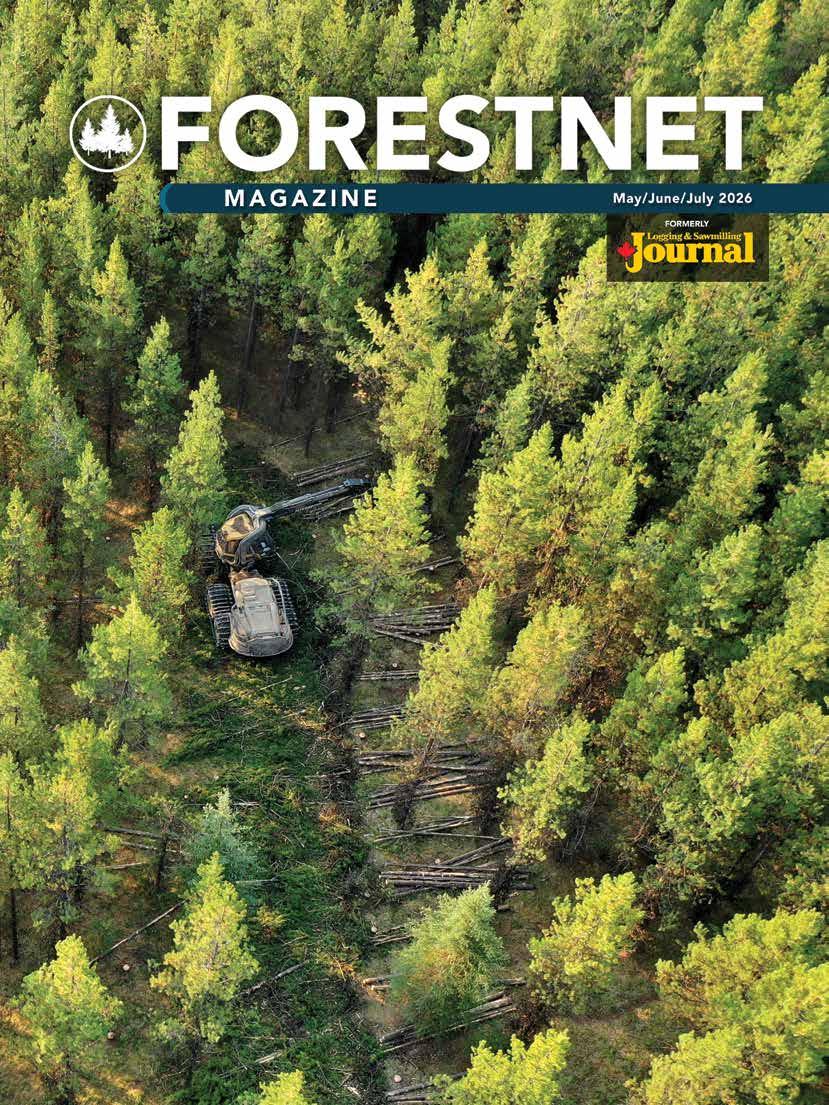
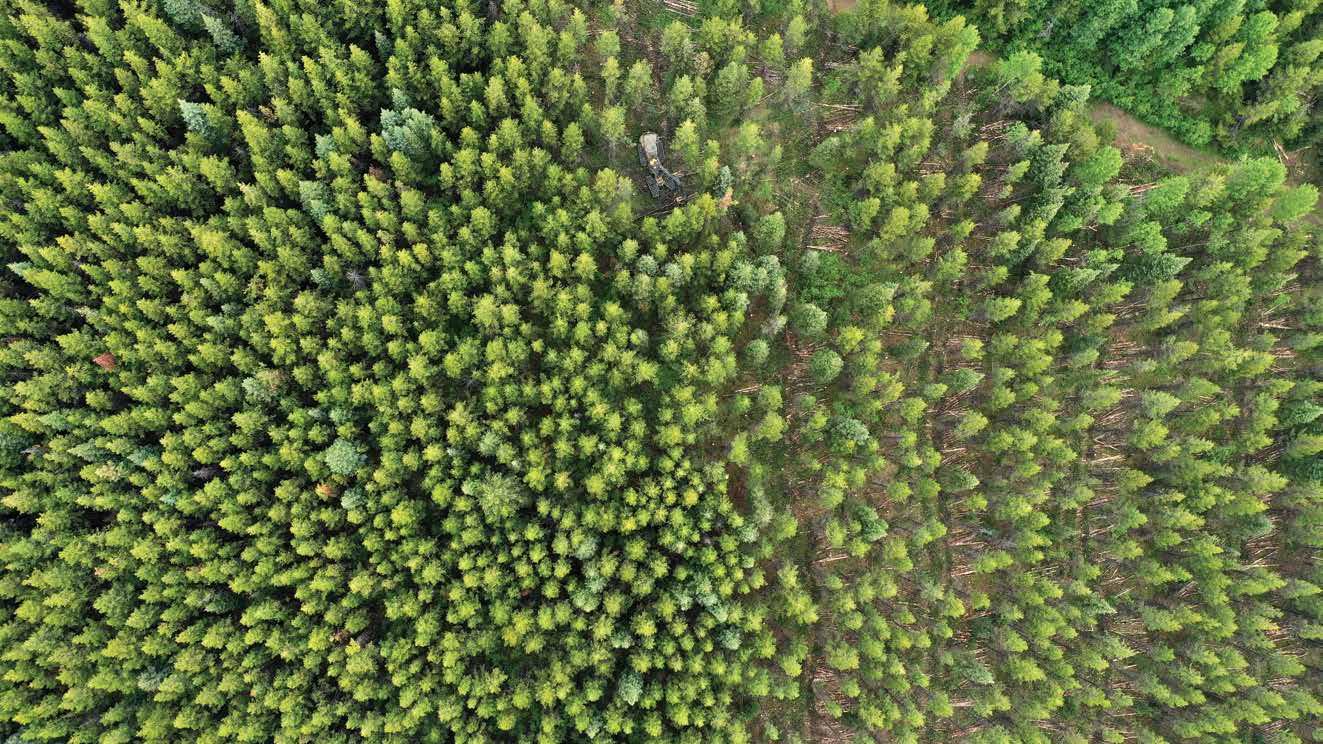
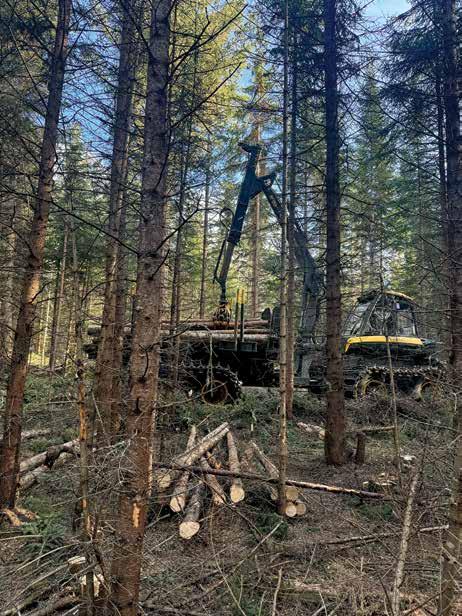
On the Cover: British Columbia may be known for clearcuts when it comes to harvesting operations, but Integrated Operations Group (IOG) is now proving that commercial thinning is do-able—and can be financially feasible with careful planning and selecting the right stand—in B.C. And the commercial thinning is delivering benefits, such as reduced wildfire risk and improved forest health, yield and wildlife habitat. IOG says it has a drive for innovation, and seeks out niche opportunities—and those harvesting activities now include commercial thinning, exclusively using Ponsse harvesting and forwarding equipment from Prince George, B.C. Ponsse dealer, Valhalla Equipment. Read all about IOG and their commercial thinning beginning on page 20 of this issue of Forestnet. (Cover photo, story photos courtesy of IOG).
Subscriptions: Canada $58 a year; two years $70; three years, $85. Group accounts, six or more subscriptions, $25 per subscription per year. Outside Canada, $95 per year. Airmail $165. Single copy, Canada $6; elsewhere $10.
Reproduction prohibited without permission of the publisher.
ISSN 0226-7572. Back copies from 1996 onward are available through our website www.forestnet.com
Publications Mail Agree ment No. 40064045 Return undeliverable Canadian addresses to CIRCULATION DEPT. PO Box 86670 Stn Main North Vancouver BC V7L 4L2 e-mail: SubscribeLSJ@forestnet.com
POSTMASTER: Send US address changes to LSJ Publishing Ltd., PO Box 9058, Fargo, ND 58106
Published May/June/July 2026
“We acknowledge the financial support of the Government of Canada”
“Supported by Creative BC and the Province of British Columbia”
Forestnet Magazine is a member/associate member of the following industry organizations:
4 Spotlight — Loggers’ sports champion is chopping records
Loggers’ sports champion Andrea Hand has not worked in the forest industry, but she comes from a forestry-related family in B.C.—and she was busy setting a new world record in the recent Stihl Timbersports championships held in Ontario.
10
Western adding value on Vancouver Island
B.C.’s Western Forest Products is taking another step to adding value to its forest products, with a significant investment in kilns at its Value Added operation in Chemainus, on Vancouver Island.
14 Rebuilt Zavisha Sawmills remains the heart and soul of Alberta community of Hines Creek
Zavisha Sawmills—the heart and soul of the community of Hines Creek, in northern Alberta—has risen from the ashes thanks to a $28 million investment which is delivering a fully-modern twoline sawmill.
20 Careful commercial thinning do-able in B.C.
Integrated Operations Group is proving that with careful planning, commercial thinning is do-able in B.C., supported by a strong stable of Ponsse harvesting equipment, leading to the question: can commercial thinning become a meaningful fibre supply strategy for B.C.?
26 Tech Update
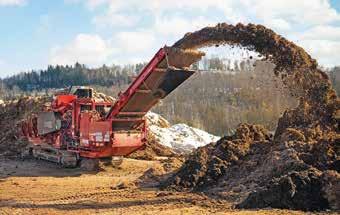
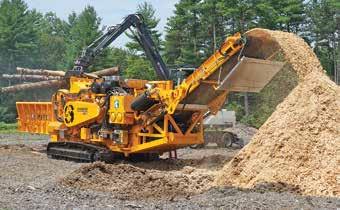
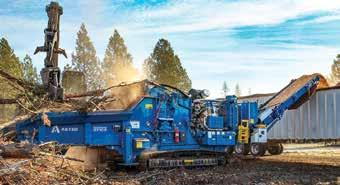
We look at what’s new in chippers, grinder and biomass equipment in this latest Tech Update.
30 The Last Word
This is the moment for forestry to step up as Canada’s leading environmental voice, says Tony Kryzanowski.
DEPARTMENTS
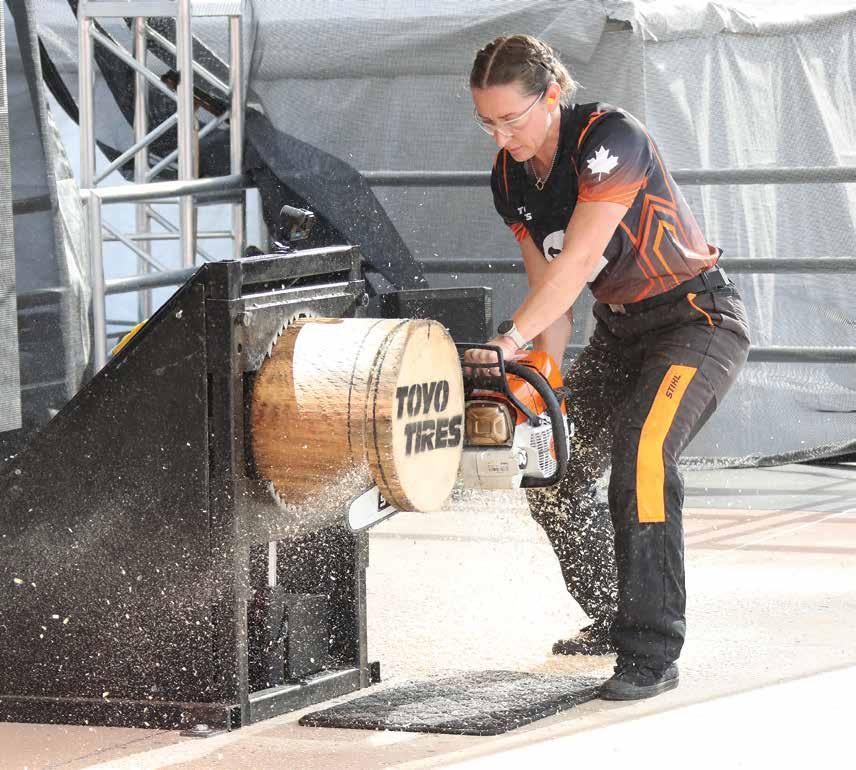
At the Stihl Timbersports women’s championships in London, Ontario, Kaslo, B.C.’s Andrea Hand was recognized at the sports meet as Canada’s women’s champion in the professional category.
LOGGERS’ SPORTS CHAMPION
is chopping records
Loggers’ sports champion Andrea Hand has not worked in the forest industry, but she comes from a forestry-related family in B.C.—and she was busy setting a new world record in the recent Stihl Timbersports championships held in Ontario.
By Jim Stirling
The first strike of the axe into the log is critical. “It’s 100 per cent important,” agrees Andrea Hand, of Kaslo, B.C. “It tells you everything about the log.”
And it’s also the point at which the athlete’s brain clicks into overdrive, she explains. It’s the brain which analyzes that initial blow, including the reaction of the
wood fibre to it, and instantly relays to the athlete where the next and subsequent axe blows should be directed.
The athlete’s co-ordination is tested further during the event by having to turn around on the log to complete the act of severing it.
It’s called the underhand chop event in the highly competitive world of top flight professional loggers’ sports. It’s one of Hand’s specialty disciplines. And she’s
become rather good at it.
Last September at the Stihl Timbersports women’s championships in London, Ontario, Hand established a new world record and standard for women in the underhand chop event of 21.65 seconds. That’s all the time it took her axe to complete the cut through an 11-inch diameter cottonwood log about 26 inches long.
to page 6
from page 4
Hand was also recognized at the London logger’s sports meet as Canada’s women’s champion for 2025 in the professional category. She also regularly competes at the professional level in other logger’s sports including the standing block chop, single buck and stock saw events (a 16-inch diameter white spruce log is typically used in competitive sawing events in Canada).
The 40-year-old athlete says she had no idea before the Stihl Timbersports event she was on the cusp of setting a world record. “No, I didn’t. I think that you approach every event with a positive attitude, but you can’t take anything for granted. A lot of things have to come together.”
Hand returned home after her triumph in Ontario. She needed to pick up on her busy life there as a working mother of two. Hand was born and raised in Kaslo, a small community scenically huddled on an alluvial fan jutting into Kootenay Lake, in southeastern British Columbia. She left Kaslo only to later return to her small town with its signature lake and mountains. Kaslo has a silver mining heritage but
Andrea Hand (centre) celebrating her win with fellow competitors at the Stihl Timbersports women’s championships
also has a logging industry culture.
“I was never directly employed in the forest industry,” recalls Hand. But she must have been influenced by osmosis. Her father was a professional faller and she has relatives involved in both the log harvesting and custom sawmilling sectors. “Forestry is a way of life in the area,” she explains.
Anyone doubting that ought to be around for Kaslo’s own logger’s sports show on the May long weekend. It’s been a fixture on the calendar for 52 years. The village with a normal population of around 1,000 squeezes in 2,000 for the logger’s sports weekend, says Hand.
Kaslo folk are quick to take a good idea to heart. That helps explain why the community rallied around a group of volunteers in town, including Hand, who saw the benefits from establishing a fitness centre in the community. The group selected a co-operative model for the fitness centre, although none of them had any practical experience in how to go about establishing and running one, recalls Hand. The group, undaunted, pressed ahead.
to page 8
Timbersports champ Andrea Hand (above) is one determined person. In 2022, she sustained serious injuries from a snowmobile accident. But she was quickly on the healing path. “I’m too stubborn a person to sit still,” she declares. The accident occurred in April 2022 and she was back riding in December and has been riding ever since.
from page 7
Now, about five years on, the Kaslo Community Fitness Co-op, is a reality and recently hired its first staff member. Hand says the co-op has evolved into more than a place to improve physical fitness: it benefits both brain and bicep. Townsfolk can go there to socialize while improving their fitness levels at their own speed in a comfortable setting. “It’s used by people from every walk of life,” she says. And all ages. The Kaslo area is home to a significant senior population which has become enthusiastic users of the community’s new health and social centre, adds Hand.
But her world was put on hold in 2022. Hand sustained horrific injuries from a snowmobile accident. They included a broken hip, femur and tail bone. As a trained paramedic, she understood the severity of her injuries. But the accident didn’t sever her sense of humour: “There were two major arteries I somehow managed to miss.” Or her determination. Hand used her brain to help heal her broken body. “I’m too stubborn a person to sit still, “ she declares. “I was determined to get back to where I had been before
the accident if not better. “ And she did.
“The accident occurred in April 2022 in Meadow Mountains (north of Kaslo) and I was back riding in December and have been ever since.” Her performance in the London loggers’ sports well illustrates her athletic improvement.
Life in Kaslo acts like a restorative bridge between Hand’s competitive one in loggers’ sports. “It’s a very expensive sport at the professional level,” she explains. Take axes, the tools of her trade. They are not the kind of implements found in the local hardware store. They are hand-forged and ground by highly skilled craftsmen to match the specific needs of each athlete for each competitive circumstance. “Every athlete has at least 10 axes, for example, and that ‘s at the low end,” says Hand. “Each axe costs between $700 and $900.”
Hand has her 2026 loggers’ sports schedule planned out. Rather than sitting on the laurels of the world’s best underhand chop time, Hand is out to better it. “I only started at this in in 2017 and there were two years off for Covid,” she recalls. She plans to compete in loggers’ sports events in Canada and the United States,
across the Atlantic in Paris, and across the world in Australia during 2026.
But whatever happens in those distant places, there’s always Kaslo back home.
September 4-6 BC Wood - Annual Buyers Mission, Whistler, BC 877-422-9663, www.bcwood.com
September 23-24
www.pellet.org
September 23-25 Timber Processing & Energy Expo, Portland, OR 334-834-1170
www.timberprocessingandenergyexpo.com
What if you could turn every dollar you spent into greater returns?
With the wood processing market’s current challenges, operational efficiency has never been more important to keep your business running profitably. You need a partner that provides full project services that generate immediate financial impact. And that’s where Comact comes in.
Empower
World-class solutions that reduce overall energy consumption and costs
Unmatched support responsiveness, 24/7, anywhere in the world
A network of experienced engineers, technicians, and energy system experts to optimize your operations
Real-time condition monitoring with the industry’s only purpose-built IoT platform, OPER8TM, to boost uptimes
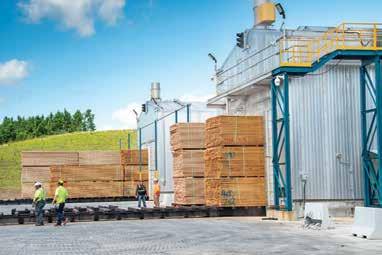
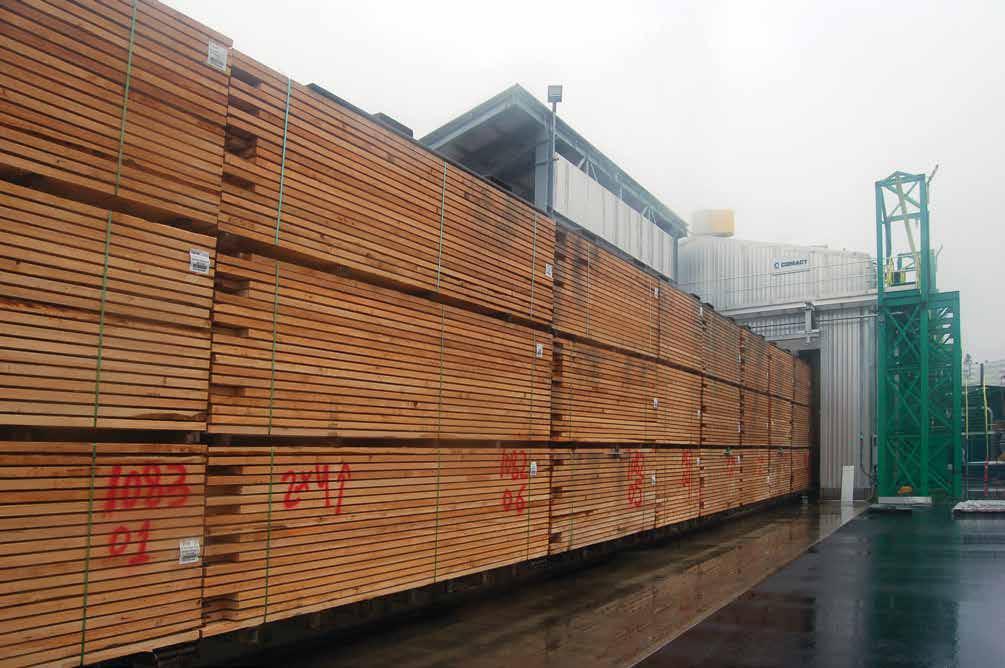
The Western Forest Products Value Added operation in Chemainus, B.C. is now installing two four-zone Deltech Dual-Path Continuous Dry Kilns (CDK), which are being supplied and installed by B.C.- based equipment supplier, Comact.
WESTERN ADDING VALUE on Vancouver Island
B.C.’s Western Forest Products is taking another step to adding value to its forest products, with a significant investment in kilns at its Value Added operation in Chemainus, on Vancouver Island.
By Paul MacDonald
The management of the Value Added Group division of Western Forest Products (Western) in Chemainus, B.C., are big fans of the team concept when tackling projects, most recently with new lumber drying equipment that will bring substantial improvements to the Vancouver Island operation.
Supported by funding from the B.C. government, the operation is now installing two four-zone Deltech Dual-Path Continuous Dry Kilns (CDK), which are being supplied and installed by B.C.based equipment supplier, Comact.
And an additional specialized kiln will be installed later this year from Finnish manufacturer, Jartek Partners (see sidebar story).
The Comact kilns, one of which is now built and fully operating, are being used for “precision” drying, which will
help Western expand its high-value applications for its wood products, such as materials for mass-timber projects.
The first batches of lumber are now being loaded into one of two Deltech DualPath Continuous Dry Kilns scheduled for installation at the Value-Added Division in Chemainus.
The additional capacity will support increased volumes of all Western’s kilndried products, produced at the company’s five sawmills on Vancouver Island.
Investment in this long-term project is part of the company’s ongoing focus on higher value products and reflects Western’s significant investments in its B.C. Coastal manufacturing operations—modernizing primary facilities, increasing kiln drying and planing capacity and expanding its engineered wood products and remanufacturing capabilities.
The company installed a kiln from B.C. equipment company Wellons at its Saltair operation two years ago, which has been
ticking along successfully, adding value at that operation.
Increased kiln drying capacity helps to ensure that Western’s products meet both internal value-added needs and customer expectations, and provides flexibility to respond to shifting market demands
The Chemainus Value Added Division is a remanufacturing operation that processes lumber from the sawmills owned and operated by Western. The facility includes a planer, a resaw and dry kilns to manufacture lumber into finished and unfinished products that are transported to customers or other facilities for further processing.
A. J. Gale, operations manager of the Value Added Division, noted that the operation has a great deal of experience to draw upon for the project, and a team approach worked well.
“We’ve got expertise within certain disciplines at Western and the operation, and that really fits well with the various
components of the kilns project, and what we are, and will be, producing,” he says.
“These are the first Continuous Dry Kilns of their kind with Western,” he added.
The team includes company people with experience in quality control, project engineering and management, and, of course, kiln drying. “It was really not that long ago that we did the kiln install at Western’s Saltair operation,” he added, which is basically down the road from the Chemainus operation.
It’s been great to draw upon the people at Western for this project, and the Comact people, for the team, he says. At the core of the team for Western was Gale himself, Chris Walling (Supervisor, Kilns), Jamie Viala (Superintendent, Quality Control) and Jarrad Astren (Project Engineer, Capital Projects), along with fellow site leaders and maintenance personnel. Added to this have been the Comact people.
“This is a design/build project, with Comact’s project services team acting as the prime contractor, and they have been excellent,” says Gale. “From our perspective, with the team model, the working relationship with Comact has been seamless.”
Gale noted that the company’s Saltair kiln project went well, and three of the Western Chemainus team worked on that project, so they used a similar approach at Chemainus.
“The process itself remained pretty much the same, though our kilns at Chemainus have different capabilities,” he explained. “With Saltair, they put together an action list and they reviewed it on a regular basis. We saw that as a Best Practice, so we approached it the same way.”
They made some tweaks to the process, but Gale reports there was nothing major.
“It’s a similar concept but a different drying process than Saltair—we dry a different lumber mix at Chemainus. The kiln operations are tailored to different drying recipes that Comact has created with us.”
Comact, which is based in Prince George, B.C., manufactured the Deltech kiln components in Prince George, and has extremely strong capabilities at developing drying software.
“The program will let us
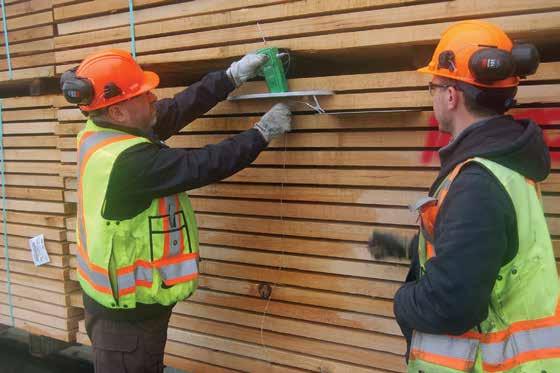
Measuring lumber moisture content (above) at the Western Forest Products operation in Chemainus. Western has been working closely with kiln provider Comact on the development of lumber moisture content and push rates, how quickly a wood pile proceeds through each kiln.
know how fast it is going to push a load through the kiln based on moisture content and what the end use of the wood is going to be,” explains Gale.
The monitors in the kiln control room display a dizzying amount of detail on each kiln load, including data from a series of KilnScout wireless moisture units throughout the kilns.
Gale noted that Comact was brought in early on the project. “Comact has been a leader in the kilns area and sawmilling equipment, and it was an easy option for us to go with them,” he says.
“The new four-zone system is unique to Comact, and it’s an opportunity for Western, and Comact, to do something different.”
Comact was there at the beginning, at the design phase. “They were coming to Chemainus when we only had bare land, before we had laid any foundations or had any early work done. They sized up everything, and did the design with our project team,” says Gale.
to page 12
BCvalueadded
from page 11
“The kilns are not commodity drying facilities,” Gale added. “The two kilns give us the added flexibility for the different products we are going to drive through them—we are going to have squares, boards, lam stock, a ton of different products going though the kilns, and the fourzone design enables that. The kilns are very capable of drying a very diverse range of products to a designed moisture content for us to take it for further processing.”
This, of course, fits extremely well with the overall Western corporate goal of adding value to its wood products, as did the Saltair kiln project. The company wants to get the absolute most value possible out of the production from its sawmills, and the high value wood products they are turning out. That is exactly what is
required for forest companies such as Western to make Capital Expenditure commitments: these investments have to deliver increased returns, in higher value products.
“The returns have to be there, with these kind of projects,” says Gale. “ And so far, so good—the overall product quality that is coming out of the kiln is yielding the company a much better return.”
Comact brings a lot of experience to the table, and projects. “They basically looked at everything we were trying to accomplish, and said, ‘we can do it’.”
Gale said that more than a year out, Comact set a commissioning date of Feb. 20, 2026 for the first kiln—and they delivered bang-on, on that date. As with any kind of construction project, it’s only too easy to see some slippage in the start-up date.
One of the main features of the Western team was what they termed “field fit”. They would have regular meetings in the office, but then they would frequently just walk the site, to “field fit” various parts of the project—where does the traffic flow, where should trucks be offloaded, where does the dry shed go?
They’d actually be getting tape measures out to double check measurements of the designs on the computer.
Gale, who started out at Western’s Duke Point sawmill operation 10 years ago, noted that sawmill technology continues to progress, kilns included. “The technology is evolving so quickly,” he says.
The company has been working closely with Comact on the development of lumber moisture content and push rates, how quickly a wood pile proceeds through each 300-foot kiln. Each of the two kilns
Products’ Chemainus Value Added Operation—and a second kiln under construction—the company will also be installing a third kiln later this year.
Western has signed an agreement with Finland’s Jartek Partners to supply a thermal modification kiln to the Value Added operation.
The kiln will support Western Forest Products’ plans to expand its thermally modified wood offering, with a strong focus on consistent product quality and efficient production. The solution delivered by Jartek is specifically designed to
Jartek’s established leadership in thermal modification and proven technology made it the clear choice, says Western.
Jeroen Hinnen, Sales Manager North America at Jartek, highlights the importance of the project for the company.
“This project is particularly exciting for us at Jartek, as it represents one of our first thermal modification projects in this region,” says Hinnen. “Partnering with Western Forest Products allows us to demonstrate how our customizable technology can support local market needs and longterm production goals.”
cess control, and long-term reliability. This project reflects Jartek’s continued focus on providing customized solutions that meet the evolving needs of companies looking to enter or expand within the wood thermal modification market, says the company.
The initiative is part of Western’s broader five-year vision. The thermally modified wood product is intended to add value to lower-grade wood fiber within the company’s existing operations, and directly support a strategic goal of growing domestic demand for these specialty wood products.
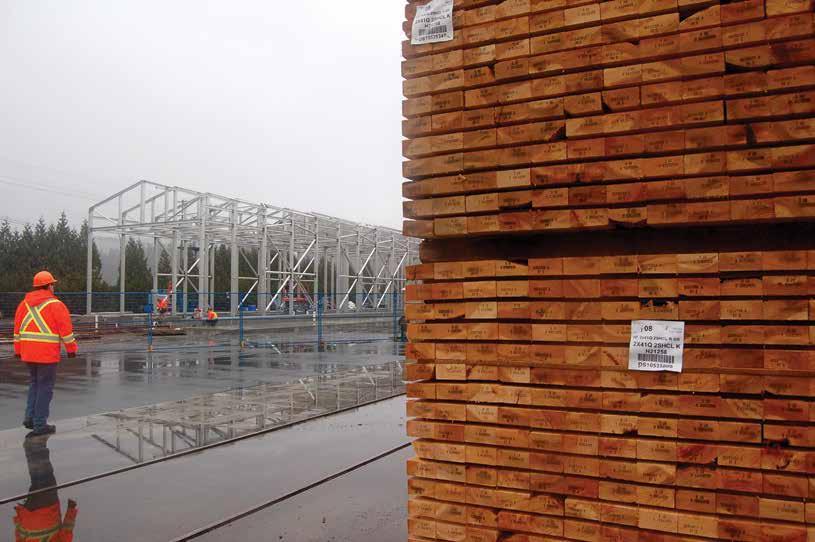
With construction of one Continuous Dry Kiln completed at Western Forest Products’ Chemainus Value Added Operation—and a second kiln under construction—the company will also be installing a third kiln later this year.
are actually 540 feet long, considering they have 120 feet of track on the infeed, and 120 feet of track on the outfeed.
“Some of these products have never gone through a Continuous Dry Kiln, and we are working with Comact to establish the push rates we want to set up for the different types and sizes of wood going through, what temperatures will get the desired results.”
Those push rates are evolving, he notes. They develop push rates based on experience and the characteristics of the wood, and trial them, and change them, as required.
“Similar products have gone through the Saltair kiln, too, so we started with a bit of a baseline based on some of their products.”
There has been a learning curve involved in developing the push rates, but it is a welcome one, because the end result will deliver the highest value products, with the lowest use of energy—truly a win-win, for Western, and its customers.
“We’re in the early phases of that, and we’re learning something valuable every day,” says Gale.
Like any forest industry operation,
Western Forest Products knows what it is working with—the coastal mix of wood species—extremely well. But each stick, as the saying goes, can be different.
“Logs that we break down in our primary sawmill facilities could come from a different setting—higher elevation, lower elevation, second growth, mature stands, and varying sizes. There is going to be lumber that is more saturated with moisture than other lumber , so the wood produced is going to have different push rates.
“The B.C. coastal forest industry has a good handle on the wood we work with—we have to,” says Gale. “But its ever-changing. It’s not a one-size fits all— we have to adjust on the fly, as needed.”
Coastal B.C. wood is a high value resource, and Western is looking to make the most of it.
“The diversification of wood products is enabling us to be able to attract other markets, and that is going to be key for us, especially with what we are seeing in the industry right now, with certain markets doing ok, and other markets not doing so well.”
Such initiatives are going to help the
coastal industry, which has been struggling in recent years, to remain sustainable.
While Comact designed and is building the kilns, they, and Western, see this as part of a longer-term partnership.
Comact, Gale notes, has a robust training and start-up plan that includes running various scenarios that Western staff might encounter, and how best to trouble-shoot them.
They are available on site now, and going forward, Comact will also be able to access the kiln system remotely, and help Western staff deal with any issues. “They want the kiln project to succeed and they want the customer, Western, to be happy,” he says.
And so far, so good, says Gale.
“We’re very encouraged by the initial performance, but we’re keeping the pedal to the metal—we’re not sitting back. We’re very focused on products going through the kiln and how they are reacting to the new process. We understand there is going to be a lot more for us to learn.
“We are not,” says Gale, “taking our foot off the gas.”
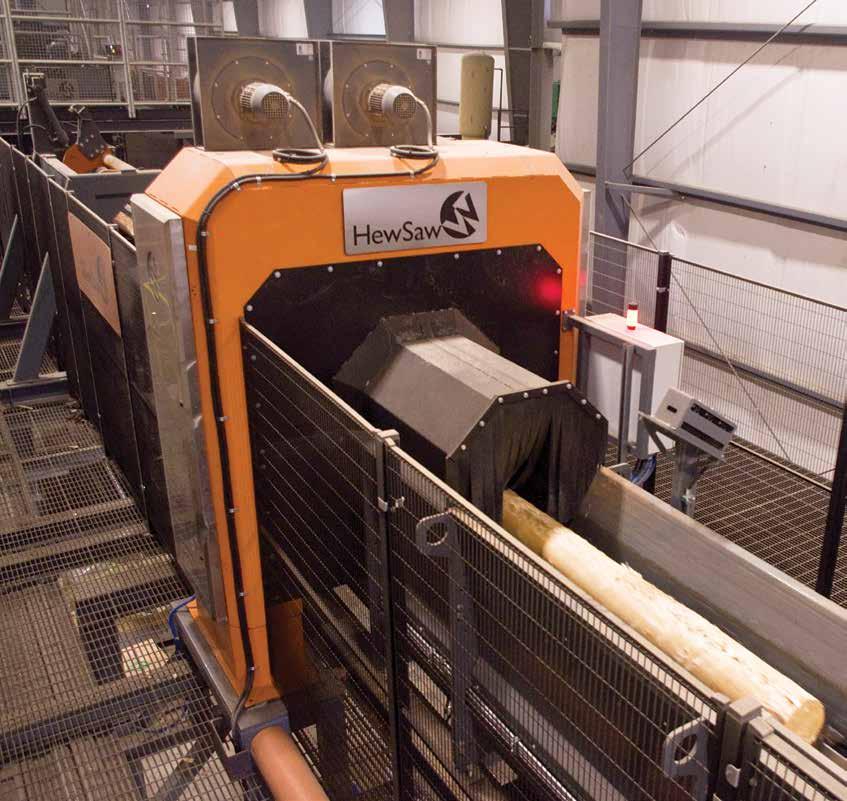
The $28 million investment at Zavisha Sawmills includes a new HewSaw R200 1.1 small log processing line. It processes about 80 per cent of the logs at the mill, producing lumber in dimensions from 1”x 3” to 2” x 8”.
Rebuilt Zavisha Sawmills remains the heart and soul of Hines Creek
Zavisha Sawmills—the heart and soul of the community of Hines Creek, in northern Alberta—has risen from the ashes thanks to a $28 million investment which is delivering a fully-modern two-line sawmill.
By Tony Kryzanowski
Zavisha Sawmills is spending $28 million to completely modernize this third generation family business located in the northern Alberta community of Hines Creek, as it bounces back from a devastating fire that occurred a year ago.
It nearly wiped them out while also creating a crisis for dozens of families whose jobs depended on the sawmill. The sawmill was established in 1943 by
Henry Zavisha, and originally used steam power. Over the years, it has modernized numerous times under the management of Henry’s son, Glen Zavisha, and has become the heart and soul of this community of about 350 residents, located between Grande Prairie and Peace River, near the B.C. border.
By making this significant investment, annual production at Zavisha Sawmills will increase from 40 million board feet to up to 60 million board feet with 53 direct employees.
It was 5 a.m. at the start of the Easter long weekend last year when an employee discovered smoke billowing from the mill building. In the aftermath, all that was left in the smoldering rubble were a few outdoor steel infeed bins and two debarkers. Fortunately, the planer mill was not damaged.
For co-owners Glen, Greg and Amber Zavisha—Greg being the grandson of Henry Zavisha—the decision to rebuild was made rather quickly, much to the relief of the entire community. Most
employees were able to continue receiving paycheques through this extremely challenging time by helping with the clean-up and reconstruction process, and working in the planer mill which was still operational. Zavisha was supported by other forest companies like West Fraser, Canfor and Weyerhaeuser who sold rough lumber to the mill to keep the planer mill busy while they purchased Zavisha’s surplus log inventory, and through government work share programs in anticipation of the mill reopening.
needed help with anything.”
Reconstruction of the new, fully modern two-line sawmill started almost immediately last April, and was led by long term employee and project manager, Rick Young. It began operating on a one-line basis, featuring the company’s new highly efficient HewSaw R200 1.1 small log line, exactly 10 months later in February 2026.
“We’re just relieved to be sawing lumber again,” Zavisha says. “It’s a huge weight off our shoulders.”
At the time of the fire, the HewSaw line was already ordered and was being built at the HewSaw factory in Finland. It was critical to commission the HewSaw line first and as quickly as possible because it processes 80 per cent of the primarily white spruce logs sent through the mill. The HewSaw had been chosen to process smaller diameter logs to supplement their existing double-length infeed mill, all of which was completely lost in the fire. So once the decision to rebuild was made, it was just a matter of continuing along the HewSaw installation path as quickly as possible.
through the mill is about 7.5”. Given the mill’s diet of smaller diameter logs, that was one of the main motivations for wanting to install the HewSaw small log line.
Making this investment is a dream come true for the Zavisha family, as Greg’s father Glen had it on his wish list for the sawmill since the 1980s when he toured Europe and saw the HewSaw production facility in Finland. The delivered HewSaw line has the company’s latest developments and features, resulting in top performance and efficiency.
“The HewSaw specializes in small log recovery,” says Zavisha. “It’s a simple, compact line with a lot of throughput speed, technology and recovery through the package offered to us by the company. It was very attractive.
“Also, my father was very impressed with the innovation of the HewSaw and the simplicity of the machine. It was always on his radar and we always thought that it would be a good fit for our small log diet. As profiles changed over time, it became more and more attractive.”
“We were concerned and the community was very concerned as well,” says Greg Zavisha. “The high school had internal meetings as to what would happen if Zavisha shut down—the town council was very concerned, and worked on contingency plans because we are a big taxpayer in town plus our employees pay taxes. I think the final straw for Hines Creek would be the fate of the sawmill. As far as the support from other companies, one thing about the sawmill industry is that everyone is very humble because everyone has been through situations. There were people from other companies here the morning of the fire to see if we to page 16
In addition to spruce, they also produce lumber from a small amount of pine and fir. The average log diameter processed
Zavisha Sawmills co-owner Greg Zavisha (above) says it took less than a year from a devastating fire for the sawmill to be back up and producing lumber, much to the relief of their 53 direct employees and the community of Hines Creek, which depends on the mill.
millupgrades
from page 15
The goal is to have the accompanying new large log line, featuring a Cooper Machine Company end-dogger breakdown unit and Ukiah-brand gang edger from McGehee Equipment Company, part of the USNR family of companies, operational later this year. It is currently under construction next to the HewSaw line.
“We took what I call the Chevy halfton approach when it came to purchasing equipment, and choosing suppliers and manufacturers to make sure that we didn’t have any heartaches or issues during start up,” says Zavisha. “You know, if you want a reliable vehicle, you get the Chevy half-ton. You don’t go out and try a new electric hybrid option. It went as planned and we met our targets relatively quickly. A lot of the equipment was new or lightly used, so most of it was proven.”
Consequently, they have already achieved their production targets, producing more volume than they were before the fire over fewer hours, even before integrating the large log line.
About 35 per cent of production at Zavisha Sawmills aims for treated wood
products such as 5/4” products, 4” x 4” fence posts, and rough-cut 4” x 4”, 4” x 6” and 6” x 6” squares sent for treating elsewhere. The remaining 65 per cent is standard dimension lumber from 2” x 3” to 2” x 10” as well as 1” x 4” and 1” x 6”. At present, all products are sold in the domestic market, and although the market is strong, American tariffs on softwood lumber exported to the U.S. are having an impact on domestic prices.
Zavisha Sawmills is beginning an early transition to its fourth generation, with Greg and his wife Amber’s son, Carter, having recently completed high school and his first year of millwright training. He works as a qualified HewSaw line operator at the sawmill.
Their logs are sourced primarily through a softwood allocation within the Mercer Forest Management Area in the vicinity of Hines Creek, with the longest log haul distance being about two hours from the bush to the millyard. They haul up to 180,000 cubic metres of both tree length and cut-to-length softwood logs to the mill annually. Mercer operates a large pulp mill using primarily hardwood in nearby Peace River.
The new sawmill building was sourced through Nisku, Alberta-based, Makloc Construction. Creston, B.C.-based, Piva Mechanical Industrial Ltd performed a substantial amount of mechanical construction, with building erection and foundation work done by B.C.-based Canadian West Construction.
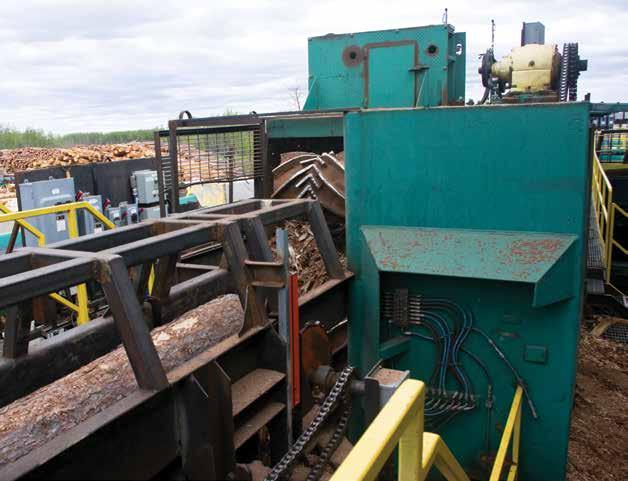
While the Nicholson-brand debarkers—one an A5 22” cut-to-length unit and one an A5 27” tree length unit—survived, the original controls supplied by RPM required replacement due to the fire. The larger debarker features cut-off saws and a step feeder supplied by Quebec-based, DO2 Industrial, which supplied many of the components on the infeed and HewSaw line.
Two bins at the infeed will supply the large log line and two will supply the HewSaw line. Logs 15” and over in diameter are directed toward the large log line.
“We are going to maximize throughput on the HewSaw and the large log line will be a secondary line,” says Zavisha.
Prince George, B.C.-based, Milltron Electric performed almost all of the equipment installation on the HewSaw line and they also provided nearly all of the switch-
gear, with additional switchgear provided by Nanaimo, B.C.-based, KJ Controls and Contracting.
HewSaw’s own dedicated install team performed the installation work for the R200 1.1 with their Quebec-based partner EBI Electric handling the HewSaw electrical work, including the automation. The HewSaw package also included HewSaw scanning and optimization. The Zavisha team were very happy with the process, which included working through periods of tough weather conditions during the northern Alberta winter.
“We purchased the complete HewSaw turnkey package, which included start-up, the HewSaw electrical and automation components, and scanning and optimization, which worked very well,” says Zavisha. “It was very seamless.”
He adds that this HewSaw model is capable of optimized edging on logs up to 15” in diameter, with lumber production ranging from 1” x 3” to 2” x 8”. The production of decking products versus dimension lumber occurs simultaneously with the
to page 18
“The staff at HewSaw were first class on our
-Greg Zavisha
Two Nicholson A5 debarkers were among the few components saved from the fire that occurred at Zavisha Sawmills a year ago.
millupgrades
HewSaw featuring value-based optimization built into the breakdown process.
“It’s virtually finished lumber coming out of the HewSaw. The log goes in and finished lumber comes out,” says Zavisha. “We are capable of producing re-edged products on the HewSaw, which will help improve our value and recovery… prior to the fire, we had an average trim loss of about 11 per cent and now because of improvements in cutting accuracy on the HewSaw, we’re down to 7 per cent trim loss.”
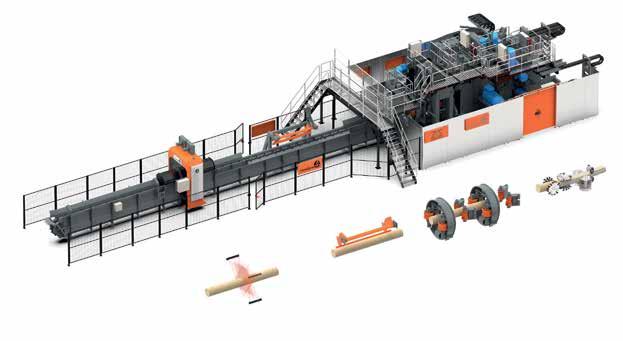
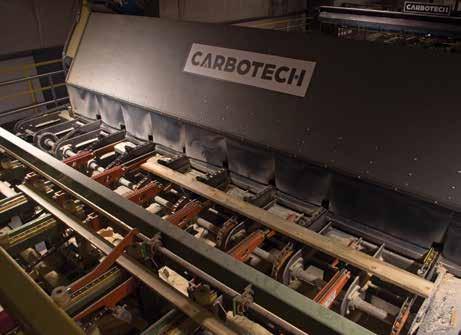
Heading downstream, the trimmer and optimization were provided by Quebecbased, Carbotech, while the 50-bin push lug, 100 per cent electric air sorter and stacker systems were provided by DO2 Industrial.
“DO2 added more lumber bins and they did the engineering and integration into our footprint as well as modifications to the stacker additions, such as transfer systems and transfer chains,” says Zavisha. “They provided all of that in a turnkey package, which also included controls from DO2 Controls.”
After the HewSaw and before the trimmer line, there is a drop-out conveyor that diverts identified lumber eligible for value uplift and recovery into a separate bin, for reprocessing through a standalone McDonough optimizing linear edger equipped with Carbotech scanner and optimization. It really is intended to work
primarily with the upcoming large log line, but it is also tied into the HewSaw line.
To dry the lumber, Zavisha Sawmills has three Muhlbock side-load kilns which were installed in 2018 and 2020, as well as one Wellons track kiln.
There was a substantial upgrade in the planer mill in 2023 with a new electric infeed transfer system and hoist supplied
by DO2 Industrial to support the Stetson Ross planer followed by a VAB/USNR linear optimization system installed in 2018. Carbotech provided a trimmer and DO2 Industrial provided an electric fence upgrade. The lumber wrapping system is manual with a Signode banding system installed in 2020.
Regarding the imminent commissioning of the large log line, Zavisha describes the main breakdown unit, the Cooper Machine Company end dogger, as a ‘fairly simple’ large log breakdown system with 56” circular saws. It is located right adjacent to the HewSaw line. The company is currently exploring installation of recovery and process optimization on this unit to improve flow.
“It will create a round-backed slab, which the McDonough edger is capable of milling with its top head,” he says.
After the Cooper Machine Company end dogger, the four-sided cant is transferred to the Ukiah-brand 12” gang edger with lumber converging with the lumber produced on the HewSaw line or diverted to the McDonough optimizing edger.
Having the large log line will open up opportunities to diversify their product line. Zavisha Sawmills had a history before the fire of creating planks that have in the past been shipped for use as scaffolding in places like New York City. Commissioning the new large log line will once again create this potential.
The new trimmer and optimization system at Zavisha Sawmills was supplied by Carbotech. They are also supplying the scanner and optimizer for their new McDonough optimizing linear edger.
DO2 Industrial provided many infeed components at Zavisha Sawmills including cut-off saws and a step feeder. Logs arrive at the sawmill in both cut-to-length and full length spans.
CAREFUL COMMERCIAL THINNING do-able in B.C.
Integrated Operations Group is proving that with careful planning, commercial thinning is do-able in B.C., supported by a strong stable of Ponsse harvesting equipment, leading to the question: can commercial thinning become a meaningful fibre supply strategy for B.C.?
By Anthony Robinson and Paul MacDonald
British Columbia may be known for clearcuts when it comes to harvesting operations, but Integrated Operations Group (IOG) is now proving that commercial thinning is do-able—and can be financially feasible with careful planning and selecting the right stand—in B.C.
And the commercial thinning is delivering benefits, such as reduced wildfire risk and improved forest health, yield and wildlife habitat.
IOG, based in Campbell River, has operations both on the Coast and Interior of B.C., and was initially formed to fill a need for specialized full-phase helilogging services in the forest industry. Since then, it has utilized the company’s combined production forestry skillsets to expand into a variety of services and sectors.
IOG says it has a drive for innovation, and seeks out niche opportunities—and
those harvesting activities now include commercial thinning, exclusively using Ponsse harvesting and forwarding equipment from Prince George, B.C. Ponsse dealer, Valhalla Equipment (please see Valhalla sidebar story). They are clearly demonstrating that commercial thinning can be a very viable option in B.C.
Quentin Stefani, a Managing Partner at IOG, and Operations Manager of Commercial Thinning, recently hosted Forestnet Magazine at a commercial thinning operation in B.C.’s Southern Interior, near Summerland, for Gorman Bros, a familyowned forest company based in Kelowna, with sawmill facilities in the region.
“We’re definitely trying to advocate commercial thinning,” says Stefani. “I think there’s a big need for it in B.C. We just want to show what we do, show that there is a different path to it, and show that commercial thinning is going to be part of our future in British Columbia.
“And we’re proud of what we do,” he added.
One of the things you first notice about the Summerland commercial thinning operation is the small landings.
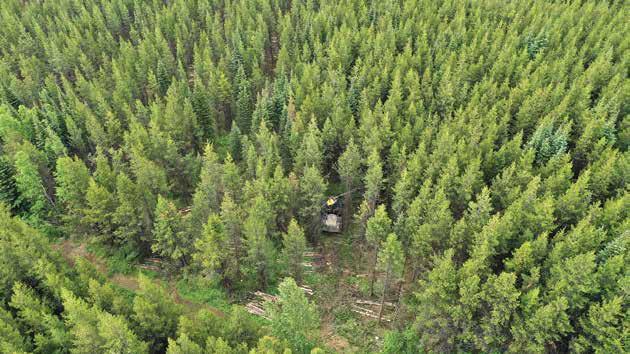
The main reason why the landings are so small is because IOG is not moving full length trees to the landing. The trees are felled, processed and bucked directly at the stump. “So, we’re moving short logs that are already processed, to the landing. We can utilize some very small spaces,” says Stefani.
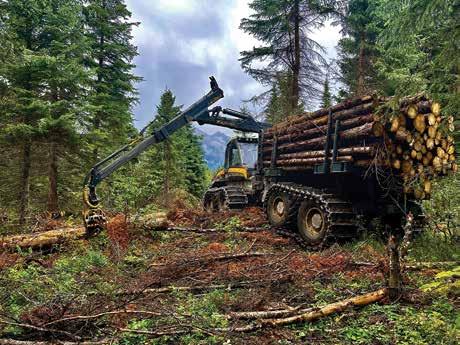
Trails are built every 20 metres. The reach of the Ponsse Scorpion Giant harvester is 10 metres, so they are able to reach all parts of a 20-metre-wide block. They then use the openings of the trails to stack up the wood high. Ponsse Elephant King forwarders pick up the logs, and then transport them to the landing where they are loaded onto trucks.
“We’re really utilizing every little space that we can to minimize the landings,” says Stefani.
IOG operations carry out a variety of harvesting activities including heli-logging and single stemming, but their cut-to-
length (CTL) equipment is strictly doing thinning. Ground-based operations (thinning division) are focused on commercial thinning. “We sent over 100,000 cubic metres of commercially thinned wood to mills, for four clients in the Okanagan and Cariboo regions of B.C., in 2025. That’s equal to around 2,000 truckloads of wood.
“Relative to other logging operations in B.C., that might not seem like a big number, but when you’re cutting trees that are very small, it is a lot of cutting and a lot of area that’s been treated. About 1,200 hectares was thinned in 2025.”
And following this prescription, they could go back in 10, 20, 30 years into most every stand that they thinned and harvest again.
Another advantage: with this harvesting method and the Ponsse harvester/ forwarder equipment set-up, they are not bringing any waste to the roadside. All the branches, all the tops, stay in the bush, scattered on the ground. “We’re bringing clean logs to the landing. So, our machines, whether it’s a harvester or forwarder, drive on the mat of branches, which considerably reduces the ground pressure of our equipment.”
It also breaks up all the branches, and helps mulch up the material, so it speeds
up its decomposition. Essentially, any branches are gone in three to five years.
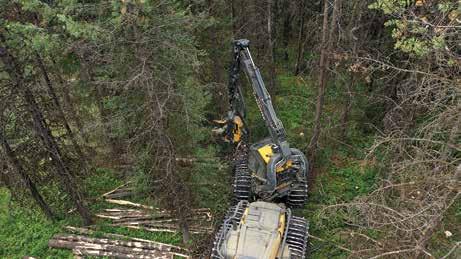
Stefani also notes the light touch of the Ponsse equipment on surrounding trees. The way the harvester is designed, it always swings inside its wheel tracks. So basically, the operator doesn’t have to worry about hitting any trees beside or behind them because as long as the front wheels go by, the rest will go by. Feller bunchers, on the other hand, can have big tail swings.
“It’s a completely different design,” explains Stefani. “You can see that the base, the frame of the harvester, stays on the trail. It’s not actually moving. The only piece of the machine that’s moving is the cab and the crane. So, this is one of the reasons why we’re able to work in pretty tight trails.”
The fact that IOG now has five Ponsse harvesters and four forwarders underlines the commitment—including financial— they have in commercial thinning.
In the Summerland-area operation, the stand is 37-years-old, and they are able to harvest a good number of sawlogs, with a percentage of pulp logs. Stefani explained that they do a “thin from below”, targeting small, defected, crooked or diseased
to page 22
FORESTNETMEDIA
This story on Commercial Thinning was filmed on location in the B.C. Interior as part of Forestnet's ongoing video documentary series highlighting modern forestry operations across North America. Readers can watch the full video and related content on the Forestnet YouTube channel or by scanning the QR code.
Scan to Watch
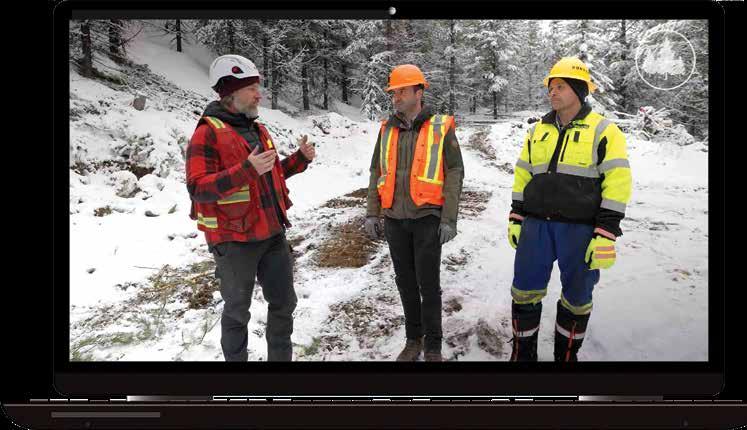
On a visit to a thinning operation in the B.C. Interior, Forestnet Publisher and CEO Anthony Robinson (left) talks with Quentin Stefani of Integrated Operations Group (IOG) (centre) and Dan Fuhrer of Ponnse dealer, Valhalla Equipment, about the benefits of commercial thinning.
BCharvesting
from page 21
trees—not prime sawlog material. The larger and nicer trees will stay standing for better growth in the future. The goal, he says, is to make the forest healthier when they’re finished, but still recovering small sawlogs and pulp logs.
Stefani explained, big picture, how commercial thinning works.
“Commercial thinning is a forest management practice,” he says. “So, we always talk about a treatment versus an actual just logging operation. Our objective is to enhance the health of the forest. But we’re leaving a fully stocked stand behind us. So, the majority of the good trees will stay standing and will have better chance to grow and make a better-quality log in the future.
“When we start a project like this, the trees we target are the trees that are dominated, trees that are crooked, trees that are damaged. These are the trees we’re going to be targeting to make the forest healthier, to bring more space, more access to the light and more nutrients for the trees that are remaining after we do our thinning operations.”
Stefani said that commercial thinning is financially viable, but emphasized it needs to be planned accordingly, and the right stands selected. It can cost a lot of money if it’s not well thought-out—that’s where the experience and expertise come in.
“There is no subsidy on what we do in most cases—the product that we bring to the mill pays for the operations. It’s obviously important to identify the ratio between sawlogs versus pulp. The more sawlogs you get, the easier it gets to pay for the operations, of course. But this is not what drives us to do a commercial thinning. We’re not here to high grade. We’re not here to actually target value. We’re
The fact that Integrated Operations Group (IOG) now has five Ponsse harvesters and four forwarders—Scorpion Giant harvesters and Elephant King forwarders— underlines the commitment, they have in commercial thinning.
here to actually leave the value standing.
“Our objective,” he says, “is to set up the stand for better growth and better yield. “ Essentially, accelerating the growth of the remaining forest, as it transitions, in this case from a younger 37-year-old forest, to a medium or mature forest.
On average, they are removing about 30 to 33 per cent of the stems on the site. Some 20 to 25 per cent come from the trails that they are building, and the rest is from the thinning on either side of the trails.
“We can remove anything from 50 cubic metres a hectare up to 100 cubic metres per hectare,” he added. “We can expect probably 8 to 10 cubic metres of growth on a yearly basis per hectare. So, if you remove 70 or 80 cubic metres per hectare—or even 100 cubic metres—you can expect to regain that volume in the next 8 to 10 years just by the gain of
growth of the trees you left behind.
“The volume you’re going to get per hectare after doing one or two entry thinnings will be significantly higher than you would otherwise get doing just a single clearcut harvest.”
A bonus in this location is that, because they are so close, they can quickly get the wood to the Gorman Bros mill in Kelowna. “We’re talking about a couple weeks. So, the mill gets a product that’s freshly cut. Green trees are a wood profile that they really like.”
Added to this, commercial thinning reduces the risk of wildfire, and the resulting visuals are much better than a clearcut area, a priority in B.C. these days, which has a focus on viewscapes.
There are a variety of different prescription guidelines, and Stefani says they, and their operators, are very familiar with all of them.
Compared to other thinning methods, which might involve a forester flagging each tree to be taken out, the IOG approach is far more efficient.
“A good example is this Summerland block. We have some pretty rolling hills, and it would take someone with very extensive knowledge about what a machine’s capabilities are when you’re marking trails or you’re marking trees.
“If the machine cannot follow the ribbon or cannot access one tree, you can end up with a very confusing layout, and where the machine can go safely—and you end up with ribbons everywhere, which makes it very confusing.
“If your operators are trained properly,
they know what to do, they’ve been doing a pre-work with all the objectives, there’s really no need for it. It should be up to the operator to know where the machine can go safely without being pushed to follow a ribbon.
“The operators are trained in what trees to take out.” And they, with the Ponsse harvesters, have great visibility. The operators can see both left and right and in front with zero hindrance on visibility because the boom is coming over the top of the cab. And when the operator has to make split-second decisions, cutting 100 plus trees an hour, visibility is key.
Besides the forwarders being the right equipment to move the wood, they are also more efficient, hauling more wood, and hauling it further.
Studies have shown that a skidder will be a bit more efficient with hauls of up to 150 metres to the landing—beyond that, forwarders are more efficient, both in volume, and delivering volume per hour roadside, making longer hauls more economically feasible.
And with thinning, they need less spur roads.
“For us hauling wood 350 up to 500 to
600 metres, we can do it pretty efficiently without having to build secondary roads, spur roads,” says Stefani. “And much of the road and trails system is made up of those matted branches.”
The Ponsse forwarders IOG employs offer versatility, among other features, says Stefani.
“Besides commercial thinning, we also have the ability to use the forwarders for various other applications whether it’s partial cut, or clearcut settings and using it in different parts of the province, like the coast that have bigger and heavier trees.
“It’s able to tackle a variety of different stands, not only strictly thinning. Luckily enough, though, we’ve been very busy in commercial thinning.
“I’ve been in this industry for 15 years,” he added. “To date, I haven’t done a single clearcut.”
And despite the very challenging times in the B.C. forest industry, that versatility and IOG’s willingness to tackle different harvesting work, has been key to its growth. It started with five employees, and they now have 70 people.
“To be honest, we’ve been kind of forced to innovate,” says Stefani. “As a
BCharvesting
small contractor starting from scratch, we’ve been the outsider. So, in order for us to survive we had to come up with some specialties. It was hard to give it a go at first and we slowly realized that if we wanted to make it in this industry we would have to specialize.”
Stefani’s IOG partners are taking on different aspects of harvesting on the coast.
“Commercial thinning is what I’m looking after, but it’s really when times are tough like this this that we realize that being a specialty contractor is finally paying off.”
And they have since established a solid reputation in the industry.
“You know, people hire us for who we are and for what we do. And there is a really good momentum about specialty harvesting right now. We all suffer from a difficult market in many different ways, but we at IOG see it as a good opportunity for exploring new avenues.
“Our industry is changing and adapting and we want to be part of it. With commercial thinning, it’s just a matter of getting the ball rolling. We’re fortunate enough that we work with amazing clients that really trust us and really see that long term vision.”
STRONGER, TOUGHER, SMARTER, FASTER
bar to date, the
and
downtime and increase productivity.
and
BCharvesting
Ponsse and dealer Valhalla Equipment the go-to equipment suppliers for IOG’s commercial thinning operations
Integrated Operations Group (IOG) partner Quentin Stefani said that choosing the right logging equipment is of course a major part of the decision when you are setting up a commercial thinning operation, but from there on, a large part of a company’s success can be all about service and parts support.
“You need to have someone picking up the phone when you have a breakdown in the middle of nowhere in B.C.,” he says.
Stefani says Dan Fuhrer and Valhalla Equipment has been their go-to supplier with their Ponsse equipment.
“Dan knows Ponsse equipment like nobody else.” Added to this is that Valhalla is a Ponsse-only dealer, and Ponsse only produces logging equipment. All of their machines are purpose-built.
With their significant investment in equipment, for IOG, logging equipment has to be operating—period. “You can’t afford to have it sitting for three days while you’re waiting for parts.
“This is a machine that costs more than the average forestry machine and you’re dealing with low value product at the end,” Stefani explained. “So, the simple math is that consistency is key to make it work in commercial thinning. High machine cost, versus low value product. The only way to make it work is continuity—reliability and keeping the uptime of our machines as high as we can.”
Dan Fuhrer has gone from working for Ponsse to having his own dealership which covers western Canada, and is based in Prince George. And Fuhrer does know the equipment, inside and out, having personally worked with it.
“I used to be a logging contractor myself in northwest Ontario where I grew up, and I’ve owned harvesters and forwarders,” explains Fuhrer.
“I started in 1997 with the Timbco harvester and forwarder machines. And the only reason I bought the machines was economics. We thought, my brother and I, that it was a cheaper way to log. Two machines and we do everything. We don’t need a lot of operators. And in our case, it turned out to be the case. And to this day, my brother still runs that company in Northwest Ontario.”
Fuhrer notes that they only have the dealership in Prince George, but what he believes sets Valhalla and Ponsse apart is they want to help their customers do fixes
Prince George to a customer might be a seven- hour drive, give or take. So, if we have to come for a 30-minute fix, he’s going to lose a shift.
“If we can talk with the operator on the phone, check this, chat that, and he fixes a wire, he’s back to work in an hour.”
Fuhrer notes that all logging equipment is getting more technically advanced, which can add to a logging contractor’s grey hair.
“Actually, in my opinion, it makes it easier, though,” he says. “It might make it harder for the operator to do some more intensive troubleshooting. But now with the Starlink satellite links, we now have direct access to the machine’s computer from the office.
“We can log right into the machine’s computer. We can see what the operator sees. So, we can troubleshoot right from the office. We can update the software.
“And that’s been a huge, for us—Starlink is a game changer.
“So now, if Quentin’s operator, Jamie, has even a very basic question, we can go right into his computer, talk to him through Starlink and show him what we’re doing, and he goes back to work. And
you don’t understand it. As long as we can
connect with the company’s data manage ment software system, Ponsse Manager.
With Ponsse and Valhalla, Fuhrer is working against some industry resistance to commercial thinning, the thinking that it won’t work in B.C.
“It works pretty much everywhere else in the world. With Ponsse I’ve traveled quite a few places, South America, Australia, all over North America, Europe. And basically, it works everywhere.
“Some places if it’s really steep, of course, it won’t work. But that’s getting less and less and Ponsse also offers winch assist machines that can tackle steep terrain up to 100 per cent slopes. I really believe in the system. It’s been proven everywhere in the world. I’m confident it will work here, in B.C.”
With his wife, Barbara, Fuhrer started Valhalla Equipment six years ago and though he says they are still small, they are slowly growing.
And he notes that it really helps with guys like Quentin Stefani of IOG among those leading the charge in adoption of new harvesting techniques.
Valhalla Equipment, based in Prince George, B.C., is a Ponsse-only dealer, and Ponsse only produces logging equipment. All of their machines are purpose-built.
By Tony Kryzanowski
Chippers, Grinders and Biomass Equipment
Bandit Industries
In 2024, Bandit Industries introduced its first hammermill grinder, the Bandit HM6420, marking a major advancement in high-capacity grinding technology.
Designed through extensive research and collaboration, the HM6420 was built to handle demanding grinding applications that may contain contaminants while delivering exceptional productivity and durability.
With a powerful Caterpillar C32 engine, the machine generates 1200 horsepower for maximum torque and reliable performance. At the core of the grinder is a massive 50” diameter by 66” wide hammermill featuring a heavy-duty drum with a 1.75” custom-formed steel skin and a 7” alloy steel main shaft for enhanced structural integrity.
The HM6420 includes 20 carbide-infused hammer inserts and a patented quick-change pocket system, making maintenance faster and more efficient. An advanced impact detection system further protects the machine by automatically reacting when contaminants are detected inside the grinding chamber, reducing potential damage and downtime.
www.banditindustries.com
Frontline Machinery
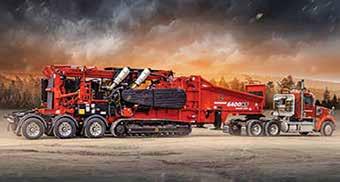
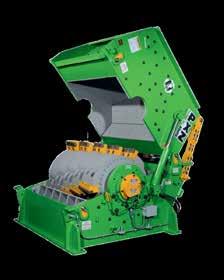
The CBI 6400CT is an extreme duty machine engineered for resilience, versatility, and the ability to process highly contaminated feeds such as C&D waste, railroad ties, whole trees, pallets, storm debris, shingles, logs, mulch, slash, and stumps.
Featuring four different swappable rotors to accommodate changing materials and processing demands, the solid steel rotor is designed for grinding contaminated demolition debris, railroad ties, and municipal solid waste. The forged drum rotor is designed for forestry debris, mulch and hog manufacturing, and the 2- and 4-pocket chipper rotors are used for producing fuel chips.
The new “cassette-style” clamshell design allows end users to completely swap out rotors faster than any other grinder in its class, says the company. Frontline Machinery says that users can transition from grinding to chipping in half the time as before, providing confidence in accepting jobs with various material demands.
From C&D to forestry, mulch, and chipping, the CBI 6400CT is said to deliver more processing possibilities with one machine.
www.frontline-machinery.com
Astec Industries
Astec Industries Inc says that its all new Peterson 3710E horizontal grinder is a versatile, high performance solution built to tackle more jobs with greater mobility and efficiency than ever before.
Designed with what is described as exceptional transportability, the 3710E moves easily between job sites without special permits or heavyhaul trucking—delivering true high output performance without sacrificing mobility.
Powered by a 755 horsepower Cat C18 engine, the 3710E provides increased processing capacity and an expanded screening area compared to previous models—all within a compact, efficient footprint engineered for maximum productivity.
www.astecindustries.com
Rawlings Manufacturing
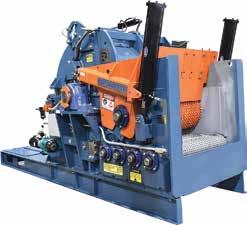
For 50 years, Rawlings Manufacturing has designed and manufactured heavy-duty wood waste processing equipment for demanding industrial applications.
All Rawlings Wood Hogs are equipped with the Super Hi Inertia Rotor, engineered to power through heavy feed surges while operating at lower RPMs. This advanced rotor design reduces shock loading, lowers maintenance requirements, and helps decrease electrical consumption, providing significant operational savings for customers.
Built using proven rock crusher technology, Rawlings Wood Hogs are capable of processing difficult, abrasive, and fibrous
materials including green waste, cypress, cedar, redwood, black spruce, poplar, bark, and other stringy wood products. The proprietary Safety Swing Away Anvil system protects the machine from tramp metal and excessive shock loads while the Rocwear striker system delivers superior wear life and simplified maintenance. Rawlings equipment is described as engineered for dependable 24/7 operation in some of the toughest wood processing environments in the industry.
www.wastewoodhogs.com
Brunette Machinery
Designed specifically for the North American market, the Brunette drum chipper family provides superior chips from trim blocks, lily pads and log ends.
The company says that its high performance drum chippers are built with a rigid structural frame and powerful high-inertia rotor to deliver optimal performance, lower maintenance costs, and the best quality chips at the highest capacity.
Brunette chippers are available in various sizes and model configurations with many features to suit any application, such as adjustable chip length and the Brunette Quick-Change knife system for one-person changeouts.
Featuring a wide infeed, Brunette chippers can accommodate large pieces such as logs, lily pads, cores, and spinouts. The company says they are renowned for producing quality pulp chips from short material that is difficult to control, including production of “micro-chips” at up to 50 units per hour—giving users access to more markets—and more flexibility.
www.BrunetteMachinery.com
Morbark
Morbark’s 6400XT Wood Hog horizontal grinder represents the next generation in grinding technology, not just processing wood waste, but eliminating inefficiencies. This machine delivers a substantial increase in productivity, handling large volumes of material quickly and efficiently, says the company, and the time saved translates directly into increased revenue.
As Morbark’s largest horizontal grinder, the 6400XT is built for operations requiring the utmost in durability and production. It comes equipped with cutting-edge grinding technology, ensuring precise and consistent results with every use. From variable speed controls to intelligent monitoring systems, this machine sets the standard for modern wood processing, says the company. www.morbark.com
SUPPLIER NEWSLINE
Comact launches new generation Miller planer
High performance OEM wood processing technologies manufacturer Comact now offers a new generation Miller planer.
Building on decades of proven performance, Comact says that this redesign introduces targeted improvements to support product quality, operational reliability, and maintenance.
Engineered for high-speed production, the new generation Miller planer transforms rough lumber into market-ready products with consistent dimensional accuracy and a uniform surface finish. The updated design preserves the core principles of the Miller concept while integrating enhancements aligned with current planer mill requirements.
The new generation Miller planer is available for new installations and as a retrofit solution for existing equipment, allowing mills to modernize critical systems and extend equipment life without full replacement.
www.comact.com
Martin Leduc announces acquisition of Select Sawmill Inc
Martin Leduc has acquired Select Sawmill Inc, a company recognized for its quality forestry equipment and dedication to customer service, headquartered in Plantagenet, Ontario.
“This is more than a business investment for me,” Leduc says. “It is an opportunity to continue a strong tradition in the forestry industry while helping shape its future. Select Sawmill Inc has earned the trust of forestry producers through reliable equipment and a customer-first approach, and I look forward to building on that legacy with the existing team.”
He adds that Select Sawmill will continue serving customers across Canada, the U.S., and international markets with the same commitment to quality, innovation, and dependable service the company is
known for. The company is recognized for its durable equipment, industry expertise, and personalized customer service.
www.selectsawmill.com
Trademarked dx Sawing stands out at HewSaw
Equipment manufacturer HewSaw says that the sawmilling business is constantly changing and adapting to new markets and product demands. For HewSaw, this means maintaining a skilled R & D and engineering team with the primary objective of keeping the company at the forefront of the industry.
Some of the latest developments at HewSaw include the company’s patented dx Sawing, split sawing of edged side boards, and the use of multiple cant saws. All of this technology can be offered in HewSaw’s latest multiple unit sawlines.
www.hewsaw.com
AI technology from Kodiak will haul timber for West Fraser in Alberta this year
Kodiak AI, a provider of physical AIpowered autonomous vehicle technology, says that it will conduct pilot operations and explore the deployment of trucks equipped with the Kodiak Driver, Ko diak’s AI-powered autonomous driving system, at West Fraser Timber’s log haul ing operations in Alberta.
In the initial phase of work, Kodiak will pilot the use of its self-driving technology to transport timber from forest sites to one of West Fraser’s Alberta processing facili ties later this year. Results of the pilot will be used to inform any future long-term deployment of Kodiak Driver-equipped trucks for commercial driverless operations.
By Tony Kryzanowski
The company says that this work marks a significant milestone for Kodiak, representing its expansion into the timber industry as well as its first international operations.
“Innovation that improves safety and sustainability has long been central to how West Fraser operates,” says Mark Cookson, Woods Operations Manager, West Fraser. “This pilot gives us the opportunity to test autonomous technology that can help address driver shortages and enhance safety by reducing human exposure to the risks of remote, rough terrain resource roads.”
This is the moment for forestry to step up as Canada’s leading environmental voice
By Tony Kryzanowski
Canadians faced with escalating fuel costs, crushing grocery bills and higher rent are understandably less concerned about the environment these days, according to the latest public opinion polls. And predictably, politicians eager for re-election are following the polls in terms of their own priorities.
But the numbers don’t lie. The world is becoming warmer and climate change is real. The consequences go far beyond the recent ferocity of repeated massive forest fires right across Canada.
Given what appears to be a more muted voice in environmental advocacy these days, this is the forestry sector’s moment to present itself as Canada’s strongest champion for the environment because we undeniably have a great story to tell.
Our management practices sustain the forest, there are innate environmental benefits to building with wood versus the less environmentally friendly alternatives, and today, although we have a Prime Minister with a pragmatic approach to governance, Mark Carney now has the power of a majority government and is still a strong advocate for the environment. Just consider the recent launch of the federal government’s new program called, ‘A Force of Nature: Canada’s Strategy To Protect Nature.’
So, this is our moment. The time is ripe for the forestry sector to speak with one, unified voice of how we are a big part of the solution to heal the harm that climate change has brought. That’s because now it is likely that the public will hear our message in the absence of all the nonsensical green washing noise polluting the issue over the past decade—particularly over social media from industries pretending to care.
It is time to forget about the ‘sunny ways’ approach of making the connection between environmental and forestry
policy. The previous federal government’s Two Billion Tree Program was a fine idea, but it was without any thought put into how it could actually be accomplished— and this was demonstrated by the fatal misstep at the time of its announcement that Canada had nowhere near the greenhouse capacity to produce the seedlings needed to reach the program’s planting goals. Now we see why it was doomed to fail from the start and has rightly been significantly scaled back. But it is still a good idea that simply needs a refresh, a plan and a stronger results-based focus.
A good starting point for industry to develop its environmental advocacy strategy is to take stock and remind both ourselves and the public of what benefits standing forests and building with wood offer to combat growth in greenhouse gas emissions that contribute to global warming—and how wood products are working and can work even more as biodegradable and sustainable alternatives.
We should revisit past important research and development initiatives as it relates to wood fibre as the feedstock. This includes further commercialization of bio-based nanotechnology from cellulose, expanding the market for mass timber products, exploring afforestation potentially with fast-growing wood species to grow the wood basket while also expanding the forest footprint to achieve greater carbon sequestration, substituting wood pellets for diesel to provide power to northern communities, and rehabilitating landscapes marred by industrial activity.
Probably the strongest argument industry has in support of promoting more wood construction as well as biodegradable, sustainable wood-product alternatives has its foundation in Canada’s sustainable forest management practices. Canada is maintaining its natural forest through aggressive reforestation programs
as well as having the highest percentage of certified sustainable forests in the world through third-party auditing.
Not only do Canada’s forests provide environmentally friendly building materials, but regenerating forests also represent natural carbon sinks.
It’s astounding to think of how many billions of dollars of investment are being considered for such unproven practices as carbon dioxide sequestration from Canada’s oil and gas industry, with billions in public funding in support, when trees represent the largest, single natural carbon sequestration tool on the planet—and Canada has the second largest landmass in the world.
Trees, considering both above and below ground biomass components, are about 50 per cent carbon, and as such, are significant natural carbon sinks, according to experts at the Canadian Forest Service (CFS). It seems ridiculous to promote simply storing carbon dioxide in the ground—sort of like putting clay caps on garbage dumps—when money could be spent on reforestation, afforestation, and forest resiliency programs to create more and stronger forests that absorb carbon dioxide and store it, while also creating forests with multiple commercial and environmental benefits. Our industry needs to encourage politicians to take off the blinders and follow the proven science.
Now that the noise has subsided, let’s remind the public and politicians about the environmental benefits of wellmanaged forests in general and bio-based products in particular. The field is now so much more wide open and desperately looking for a champion to remind us that climate change is here to stay—unless we take action and that forestry can and should be a much bigger part of the solution.
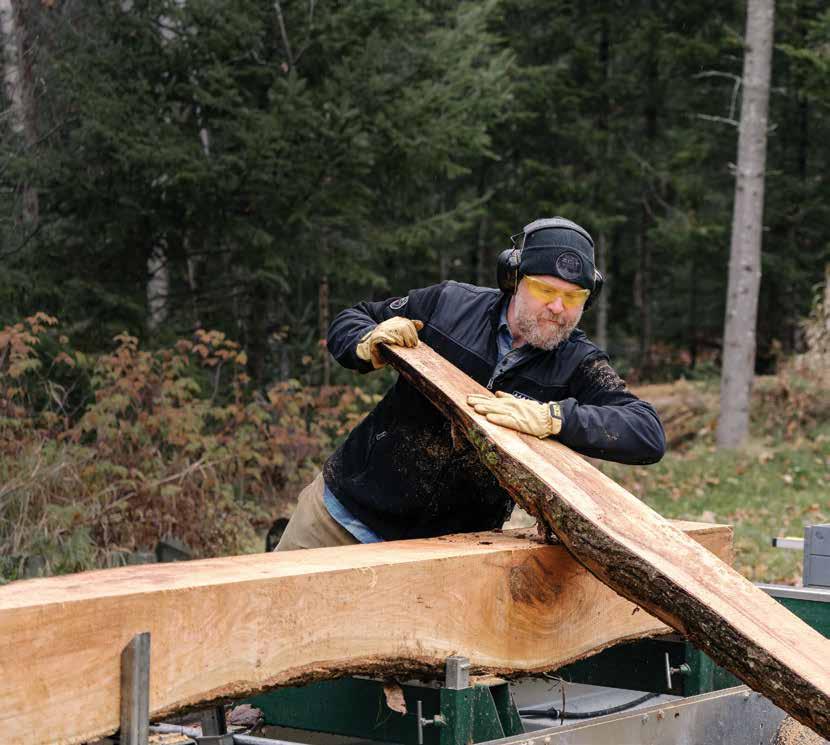
When you’re milling thousands of board feet, you need equipment you can trust and support you can count on. That’s why thousands of sawyers have relied on our machines for more than 15 years to get the job done.