Subscriptions: Canada $58 a year; two years $70; three years, $85. Group accounts, six or more subscriptions, $25 per subscription per year. Outside Canada, $95 per year. Airmail $165. Single copy, Canada $6; elsewhere $10.
Reproduction prohibited without permission of the publisher.
ISSN 0226-7572. Back copies from 1996 onward are available through our website www.forestnet.com
Publications Mail Agree ment No. 40064045 Return undeliverable Canadian addresses to CIRCULATION DEPT. PO Box 86670 Stn Main North Vancouver BC V7L 4L2 e-mail: SubscribeLSJ@forestnet.com
POSTMASTER: Send US address changes to LSJ Publishing Ltd., PO Box 9058, Fargo, ND 58106
Printed on FSC®certified paper.
Published March/April 2026
“We acknowledge the financial support of the Government of Canada”
“Supported by Creative BC and the Province of British Columbia”
Forestnet Magazine is a member/associate member of the following industry organizations:
FEATURES
On the Cover: In a feature story in this issue of Forestnet Magazine, Sanj Hothi, President of S&W Forest Products, talks about how it is helping with the task of rebuilding California’s fire-destroyed homes with its B.C.-manufactured shakes and shingles, and has broadened out its product line to include yellow cedar products. S&W Forest Products, along with the broader cedar shake and shingle sector, and the entire Canadian forest industry, has tried to pivot to other markets aside from the U.S. with the uncertain trading relationship, but Hothi notes that developing new markets takes time. Read all about developments with the company on page 24 of this issue. (Cover photo courtesy of S&W Forest Products).
6 Spotlight — B.C. forest industry in crisis
In this second in a series of stories, veteran Forestnet Magazine contributing editor Jim Stirling takes a hard look at the issues that have brought the B.C. forest industry to a crisis point, where many community-supporting sawmills have been forced to shut down, and thousands of well-paying jobs in towns and cities across B.C. have simply vanished. In this issue’s story, Jim looks at how the B.C. forest industry is now working to speak with one voice—a united, and loud voice—which it hopes that a B.C. government, which seems to be deaf to the forest industry for the most part, finally hears.
10 Canada’s Top Lumber Producers! Who’s on Top?
A look at what has changed, and the trends in the Canadian forest industry during a tumultuous time in lumber trade with the U.S., with Forestnet Magazine’s annual look at Canada’s Top Lumber Producers, with consulting firm, FEA.
12 Keeping it all moving forward
Despite the struggles the B.C. forest industry is facing these days, Ernie Piva works hard to successfully keep his logging operation moving forward, and is grateful for a great crew that makes it happen.
18 Home-grown prairie sawmill
Live edge slabs—some from Ontario and B.C. logs—are the backbone of a unique Alberta sawmilling venture, Pipestone Timber, with most of the mill equipment designed and built by company owner, Haley Cochrane.
24 S&W Forest Products helping California rebuild
S&W Forest Products is taking on the task of helping to rebuild California’s fire-destroyed homes with its B.C.-manufactured shakes and shingles, and has broadened out its product line to include yellow cedar products.
30 The Last Word
Tony Kryzanowski talks about how a stalwart in Canadian forest research—Derek Sidders, recently retired from the Canadian Forest Service—deserves an honorary PhD.
DEPARTMENTS
FROM THE PUBLISHER
Time for a name change: going from Logging & Sawmilling Journal to MAGAZINE
By Anthony Robinson, CEO & Owner, Forestnet Media
After more than 50 years as a trusted voice in the forest sector, Logging & Sawmilling Journal, like the industry it represents, is evolving.
Logging and Sawmilling Journal is transitioning to a new name: Forestnet Magazine.
This change reflects a fundamental reality—the business is no longer only logging and sawmilling.
Today, the forest sector is far broader and more advanced than it was even a decade ago. It includes biomass and energy, pellet production, mass timber and CLT, advanced robotics and automation in manufacturing, and increasingly sophisticated, technology-driven operations across the entire value chain.
It also extends beyond the industry itself. Architects, engineers, developers, policymakers, and even the general public are now part of the conversation. There is growing interest in where wood products come from—from the lumber in our homes to the paper products we use every day.
The name Logging & Sawmilling Journal no longer fully reflects that reality— Forestnet Magazine does.
“Forestnet” represents a connected, modern view of the sector—one that links the forest to manufacturing, innovation, construction, and everyday end-use products. It reflects a modern industry that is integrated, evolving, and increasingly relevant to a much broader audience.
This is a name change—but it is also a positioning shift.
We are aligning the magazine with how the sector actually operates today, and how it will continue to evolve in the future.
What is not changing is our foundation.
We remain committed to:
• High-quality, credible editorial coverage
• Telling the stories of the people, companies, and technology driving the sector forward
• Delivering value to our advertisers and partners
• Maintaining industry-leading distribution across Canada and the U.S.
At the same time, this transition strengthens our ability to connect print with the broader Forestnet Media platform—including digital, video, social media, and e-newsletter distribution. It allows us to tell a more complete story. A story that doesn’t stop at the log deck or the sawmill, but continues through advanced manufacturing, engineered wood products, sustainable building solutions, and the everyday products people interact with—often without realizing they originate in the forest.
Put simply, this is about relevance.
The industry has evolved. Our audience has evolved. The way we communicate has evolved.
Forestnet Magazine reflects that evolution—while carrying forward the legacy and credibility that Logging & Sawmilling Journal has built over more than five decades. Our readers and advertisers are a hugely important part of that proud history, and our future.
We’re now moving forward—and we look forward to serving our readers, advertisers and the industry, as Forestnet Magazine.
Proudly made here at home, our lubricants deliver proven, long-lasting protection for Canada’s forestry, logging and lumber industries. Engineered to stand up to the toughest workloads and harshest climates, our multi-functional products keep your equipment running reliably day after day. Get performance you can count on.
The B.C. forest industry looks to speak with a united voice
The B.C. forest industry is now working to speak with one voice—a united, and loud voice—which it hopes that a B.C. government, which seems to be deaf to the forest industry for the most part, finally hears.
tion was formed catering to skidder operators working in the Prince George area of central B.C. Its members believed having their own association was the best vehicle to gain the ears of the decision makers.
At the receiving end of the noise is the B.C. government, backed by an ample civil service. On the plus side, the civil service still contains people with a forest industry background. Some of them actually ventured out on the land back in the day and got their boots muddy seeing for themselves what was happening out there.
In this second in a series of stories, veteran Forestnet Magazine contributing editor Jim Stirling takes a hard look at the issues that have brought the B.C. forest industry to a crisis point, where many community-supporting sawmills have been forced to shut down, and thousands of well-paying jobs in towns and cities across B.C. have simply vanished.
In this issue’s story, Jim looks at how the province’s associations have recently banded together, to better communicate with a seemingly deaf-to-the-forest industry NDP government.
By Jim Stirling
Human beings are social creatures. They share a natural tendency to band together. The species was quick to learn that when there’s a common purpose or bond that’s motivating them, their collective voice and strength gathers more influence.
The result in the context of the British Columbia forest industry more recently has been the formation of industry-related associations. They represent those who work in many of the forest industry’s phases, particularly those in the wood harvesting sector. Each association’s members believe their specific points of view surrounding, say, repetitive government regulations impacting their daily work, deserve direct consideration. So, they speak out.
Today there are many of them speak-
ing out. They share a legitimate alarm with the combined factors impacting their industry, causing a dramatic shrinkage in its size and hardship—and dislocation for the thousands of people dependent upon it for their livelihoods. But their combined voice has so far gone unheeded by the provincial government.
The sad situation raises a pertinent discussion point. When is enough too much? Are there too many associations and groups out there, perhaps resulting in the most important points they are making becoming lost in the noise? Or is it all simply emphasising a point?
The numbers of forest industry associations in B.C. tend to go in waves across the years. They generally become more numerous as industry phases become more sophisticated and specialized. In the 1970s and 1980s, for example, an associa-
Not so with their political masters today. Too many of them reflect the people who elected them: they share an ignorance about today’s highly sophisticated forest sector and an unwillingness to grasp it. They don’t fully comprehend the varied contributions of the forest sector to the province’s vitality any more than they appreciate the depth of the problems impacting it by government inaction and collateral damage.
The government’s tendency today is to relegate forestry to an also-ran in the sprint to a new high tech tomorrow. Forestry doesn’t make the podium.
That is the only plausible reason to explain why NDP Premier David Eby has resolutely refused for years to help the industry and all the sectors reliant upon it. He makes all the appropriate noises for the TV cameras about the impacts of President Donald Trump’s latest ranting— something he cannot influence—while steadfastly refusing to even consider changes within his own government to help the industry survive.
But governments of all descriptions have perfected proven principles for dealing with issues they have no intention of resolving. They include delegating the issues to “stakeholders” for comment; discussing and disseminating the results before delegating them to a special government committee which will ultimately defer them. By that stage the government hopes the proposing party will have given up on the process.
The forest industry associations have been advising the government for years with quick, easy and cheap steps it can take to help reverse the sector’s problems. And it has offered help to implement them.
The forest industry’s advice is simply packaged. Get wood in B.C. moving again through more efficient cutting permits and road building approvals while fast tracking improvements to B.C. Timber Sales operations. Reduce the government-imposed administrative and regulatory burdens on both the wood harvesting and manufacturing sectors. Help First Nations expedite land use plans to advance industry partnerships to proceed “at the speed of opportunity.”
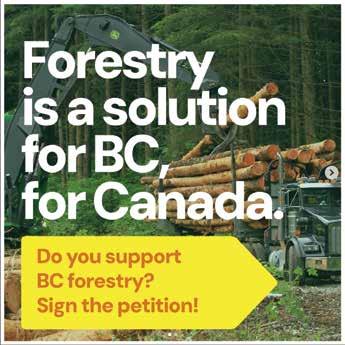
Now the forestry associations have adopted a different tactic. They’re returning to basics with many of them now speaking out as one. And when that happens, it sounds a different set of political alarm bells for elected representatives. They start paying attention. Especially these days with NDP premier David Eby tumbling in popularity in opinion polls both for his party and personally. A March 2026 Angus Reid poll on the popularity of Canada’s premiers for example showed Eby’s approval rating crashed by 16 points from the corresponding month in 2025. The timing is right for the launch of “Forestry is a Solution”.
The initiative provides an opportunity for members of the public to voice their opinion on the forest industry’s contributions to B.C. and the economy. “Forestry is a Solution” is a coalition of forest workers, community leaders and about a dozen industry associations. The campaign encourages the public to
to page 8
The “Forestry is a Solution” campaign (above) aims to galvanize public support for the forest sector and help it weather the headwinds it is now facing. Despite U.S. trade actions and the operating challenges in the B.C. forest industry, the coalition behind the campaign believes the industry can have a bright future, through making available B.C.’s harvest-ready and damaged timber to the industry.
from page 7
show their support for the forest sector by signing a petition to be forwarded to provincial decision makers.
“The sector is facing a challenging moment right now and people kept asking: How can I help?” explains Kim Haakstad, president and CEO of the B.C. Council of Forest Industries (COFI) and one of the forestry associations supporting “Forestry is a Solution”.
“This campaign was created to give people a clear and positive way to show their support for forestry,” says Haakstad. “The vast majority of British Columbians value the forest sector and the role it plays in our economy and communities. They just weren’t always the loudest voices in the conversation.”
“Forestry is a Solution” aims to change that. Galvanizing public support for the forest sector will help it weather the headwinds it faces just now, the coalition believes. Despite the global competition, U.S. trade actions and the operating challenges created by the provincial government, the coalition sees a much more positive future ahead. It can be ushered
Who belongs to “Forestry is a Solution”?
The “Forestry is a Solution” coalition members are: The Council of Forest Industries (COFI); Truck Loggers Association; Alliance of Resource Communities; ResourceWorks; Interior Logging Association; Interior Forest Labour Relations Association; BC Pulp and Paper Coalition; Private Forest Landowners Association; Woodlots BC; Council on Northen Interior Forest Employment Relations and the Northwest Loggers Association.
For the latest information on the coalition’s work and registering support see: www.forestryisasolution.com
in, suggests the coalition, by making available B.C.’s harvest-ready and damaged timber, and capitalizing on Canada’s global reputation for producing high quality wood products and the expertise of B.C.’s skilled workforce. “The Forestry is a Solution campaign highlights a simple message,” continues Haakstad. “When it can reach its full potential, forestry is not just part of B.C.’s history, it is a solution to building homes, supporting communities and strengthening our economy.”
Public reaction to the coalition’s petition was swift and positive after its introduction in Prince George in January of this year.
“The response so far has been gratifying
and the feedback from people across the province has been overwhelmingly positive,” reports Haakstad. The campaign has triggered responses beyond signing petitions and sending letters supporting the forest sector to provincial decision makers through the campaign’s platforms. “We’re also seeing communities such as Prince George, Kamloops, Quesnel and Powell River bring forward city council motions endorsing the campaign,” she says.
“What has been especially rewarding is hearing people repeat the message back to us: Forestry is a Solution.” Workers across the sector have also been sharing their stories with us, to be featured in
campaign posts to help raise awareness,” she continues.
“They want to see B.C.’s forest sector succeed.”
Haakstad further emphasized the campaign’s objective. “It exists to complement
the work of existing organizations not replace it. The goal is straightforward: give British Columbians an easy way to stand up for forestry and make sure decisionmakers hear from them.”
And they are hearing from them.
Obituary – Will Stanhope
It is with very heavy hearts that we at Forestnet/Logging and Sawmilling Journal report that Will Stanhope—the son of former LSJ Publisher, and our friend, Rob Stanhope—passed away in April. Those of us who were fortunate enough to meet/know Will saw in him a bright, joyful person who loved life, and loved to rock climb. He passed away as a result of a fall while climbing in Squamish, B.C.
Our deepest condolences go to Rob, his wife Shelley, and Will’s sister, Emily.
We’d like to share the online post about Will here, from his family.
“It is with shattered hearts that we share the news that our beloved Will passed away yesterday.
Will lived with a passion and courage that most of us only dream of. He had a prodigious memory and great stories. He was a kind and gentle man with a fantastic sense of humour.
The rock was his home, and the climbing community was his family. He faced every ascent with an inspiring spirit.
To all of you who climbed with him, followed his journey, and loved him: thank you for being part of his adventurous life.
Your memories of Will are hugely appreciated.
With love and profound grief,
His Dad, Mom and Sister”
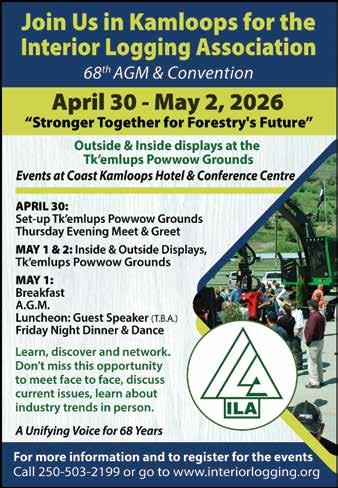
April 30-May 2
Interior Logging Association Conference and AGM, Kamloops, BC 250-503-2199
Western Red Cedar Lumber Assoc. Cedar Summit, Victoria, BC Canada 604-891-1262 www.realcedar.com
May 22-23
BC Sawfilers AGM and Trade Show, Kamloops, BC Canada 250-260-1231, www.bcsfa.ca
July 30-August 2
Squamish Days Logger Sports Festival, Squamish, BC www.squamishdays.ca
SHIPMENTS DOWN DURING A VERY TURBULENT 2025 CANADIAN LUMBER
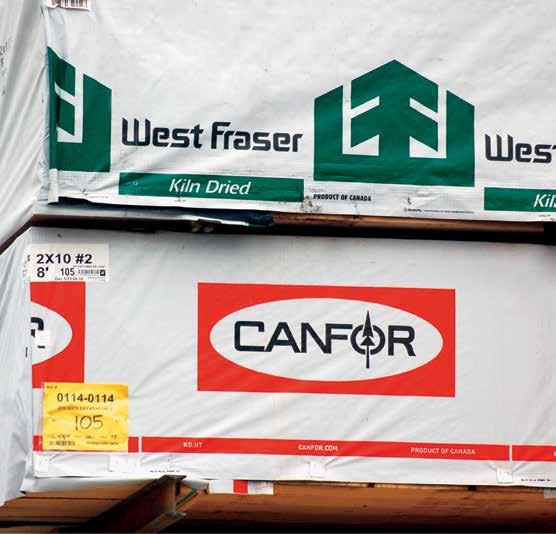
During a very turbulent year, Canadian lumber shipments fell by 5.1 per cent in 2025, and the year saw Canfor edged out of second place among the top lumber producers by Domtar.
By Mark Smith, Partner, FEA; Research by Chari Gimenez, FEA Canada
In 2024, total Canadian lumber shipments increased by 2.0 percent from 2023, having dropped by a combined 3.3 billion board feet in the preceding two years of 2022 and 2023. This provided some optimism that 2024 was the beginning of a turnaround for Canadian lumber production. Alas, that has not proven to be the case for 2025. Total Canadian shipments were down by 1.035 billion board feet (BBF) in 2025, representing a 5.1 percent drop over 2024 shipment volumes, according to leading forest industry research company, FEA (www.getfea.com).
Total North American lumber shipments: down 1.4 percent
In 2025, total North American lumber shipments were 56.217 BBF, a decrease of 1.4 percent over volumes in 2024 (56.998 BBF). The 2024 total shipments were similar to 2023, and this gave some optimism that we were at the bottom of
this falling cycle, effectively ending an ongoing decline since 2021. However, this has not proven to be the case given the further decreases in shipments seen across North America in 2025, that amounted to a total difference of 781 million board feet (MMBF).
Interestingly, this has played out differently in 2025 than in 2024, for Canada and the U.S. In 2024, Canadian shipments increased over 2023, whereas U.S. shipments decreased. In 2025, we see the opposite occurring. Canadian shipments are down significantly, by 5.1 percent for 2025, versus 2024. U.S. shipments, on the other hand, have shown a modest increase of 0.7 percent for 2025 compared to 2024. The extended uncertainty about where the Trump tariffs would ultimately end up having a significant impact on this turnaround.
Canadian Top 10 Lumber Producers: shipments down significantly by 9.0 percent from 2024 to 2025
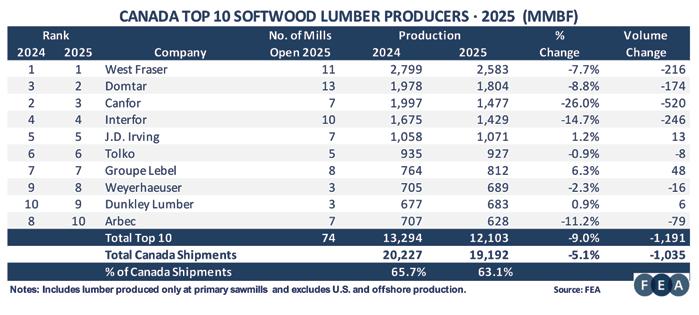
As we also saw last year, the Canadian Top 10 companies saw no new entrants in 2025 with the same 10 companies present as in the 2024 top 10. The second and third companies switched places and there were some minor changes of place in the #8 to #10 rankings. Essentially three companies moved up one place from 2024 to 2025, these being Domtar (now #2), Weyerhaeuser (now #8) and Dunkley Lumber (now #9). Canfor moved down by one place (now #3) and Arbec down by two places (now #10).
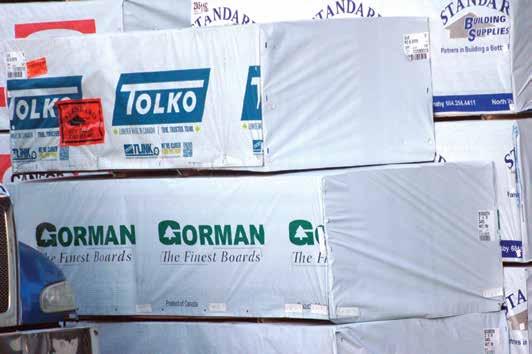
Although Canadian lumber production was down for 2025, there were still some moves in the industry, including family-owned, Kelowna, B.C.-based Gorman Group buying Weyerhaeuser’s Princeton, B.C. mill and timber licence assets for $120 million.
When we look at the production of these same Top 10 companies in 2025 versus 2024, production dropped by an incredible 9.0 percent from 13.294 BBF to 12.103 BBF. Given this was a larger decrease than total Canadian shipments, this means that the top 10 companies’ share of the total Canadian output declined from 65.7 percent in 2024 to 63.1 percent in 2025. This follows a similar drop in share of total shipments for the top 10 companies in 2024, given their share in 2023 was 68.0 percent.
The top three Canadian producers in 2024—West Fraser, Canfor, Domtar—–kept the same rankings through 2025 although Canfor and Domtar switched positions, as noted above. These top three producers accounted for 5.864 BBF in 2025 and almost 31 percent of all Cana-
dian shipments. This is slightly lower than previous years, where these top three companies supplied about one-third of all Canadian shipments.
West Fraser remains in top spot with its Canadian output being down by 216 MMBF (-7.7 percent) across its 11 mills. Domtar moved to second spot with output across its 13 mills decreasing by 174 MMBF (-8.8 percent). Canfor dropped to third place due to a significant production reduction of 520 MMBF (-26.0 percent) across 7 mills. Interfor, had a 2025 production of 1.429 BBF, a decrease of -14.7 percent over 2024, by 246 MMBF. J.D. Irving, at #5, saw its output increase by 13 MMBF (+1.2 percent) to 1.071 BBF. Finally, Tolko, remaining at #6, saw production volume decrease slightly (-0.9 percent) to 0.927 BBF in 2025.
Keeping it all moving
FORWARD
Despite
the struggles the B.C. forest industry is facing these days, Ernie Piva
works hard to successfully keep his
logging operation moving
forward, and is grateful for a great crew that makes it happen.
By Jim Stirling
As a B.C. logger, imagine relying on British Columbia Timber Sales exclusively to source all the wood your small log harvesting company requires and then selling the resulting lumber on the open market. Imagine doing that through a period when the independent Crown agency is under fire for inefficiencies from many quarters around the forest industry. And imagine continuing to do that successfully against a backdrop of what is arguably the most demanding operating conditions in the B.C. forest industry’s history.
B.C.’s E. Piva Contracting Ltd. has been more than imagining that—the tightly-knit logging company has been making the strategy work for about 10 years.
Ernie Piva, the company’s principal, based in Kamloops, British Columbia, credits a handful of key reasons for that. He says hard work, planning, good industry contacts and a great crew to do the essentials and pick up the pieces when necessary are all part of the survival package. And that is not to forget a healthy dash of good fortune along the way and the logger’s innate ability to pivot plans on a pinhead when needed.
“B.C. Timber Sales (BCTS) manages 20 per cent of the province’s Allowable Annual Cut (AAC) for Crown/public timber and generates economic prosperity for British Columbians through the safe, sustainable development and auction of public timber,” according to the B.C. government.
BCTS operates in 33 communities around the province and supports about
8,000 direct jobs. The government adds that the guiding principles of the BCTS are safety, reconciliation with indigenous peoples and sustainable forest management.
One of Piva’s guiding principles is trying to get enough sales lined up to provide a year’s worth of work. “I knew it wouldn’t be easy,” says Piva “and so far, it hasn’t been.”
Piva has learned there are way more losers than winners when it comes to bidding on timber auctions. “And I always have to try and remember when bidding on timber sales and actually winning them that I still have to utilize all the fibre to keep a year’s of work in front of us.” He aims to produce at least 150,000 cubic metres a year. “It can be very challenging to ensure that much volume solely by bidding on it.”
But Piva has received invaluable help along the way. “We had the pleasure to meet and work with George Harrison. He was a log broker with BCTS sales and we did a lot of logging for him,” explains Piva. Like a mentor, Harrison explained to Piva how BCTS actually functions. “George was very instrumental in how I do business now with BCTS,” he credits.
Piva is understandably cautious about discussing BCTS’ latest apparent internal issues. “Most of the people that I have to deal with in BCTS are excellent,” he says. “But it takes a long time to get anything done. There’s a lot of red tape to go through first.” He figures updating some of the old rules within the organization would provide efficiencies for contractors and BCTS staff. “But the system does work.”
Piva comes from a forest industry background, one that includes variety and adaptability. “Grandpa Gordon started working with Weyerhaeuser back in the early 1960s and he became one of their largest and longest serving log hauling contractors with an Evergreen Licence,” he relates.
“Through the years, he had a few different ventures, including running a sawmill. And it was Grandpa who began bidding on small business sales along with my dad, Joe.” And Joe took his turn working for Weyerhaeuser as a logger in the late 1970s. His work included laying and harvesting beetle trap trees. Until recently, Ernie Piva continued a three generationlong relationship with the company, who were buyers of BCTS wood from Piva. This past September, Weyerhaeuser completed the sale of its lumber mill in Princeton, B.C., and its associated timber licenses, to the Gorman Group, who are also buyers of wood sourced through Piva’s BCTS sales.
“My dad took a while out to sell tractors in Kamloops, recalls Ernie. “But that wasn’t quite for him.” He returned to logging and Ernie soon joined him. “I had worked for him ever since I remember doing whatever had to get done.” Eventually he acquired his dad’s business and merged it with is own. Now it’s Joe’s turn to help out his son. All that experience comes in handy. Give him a bulldozer and he’ll build a mean road for you, says Ernie.
Ernie had taken his own time out to work for Mac Lind in Princeton, B.C.
“It was a real learning curve on how to produce wood efficiently. It was a really good experience and it definitely helped me get where I am.”
He also made some good friends, he adds.
To do the job in the bush, Piva Contracting has a decent—and varied—lineup of equipment, including John Deere bunchers and processors. The principal dealers for the company include Brandt Tractor (John Deere), Inland Kenworth (Tigercat, Link-Belt), and Southstar heads.
Ernie Piva’s a fan of Link-Belt equipment, and the operation includes three Link-Belt log loaders. “They’re extraordinarily good on fuel and have minimal downtime,” he says.
Neither Gordon or Joe could have guessed how Ernie keeps up with the fastpaced pressures of bidding sales; he stays in his truck. His Starlink communication system provides global internet availability. “The work’s 100 per cent on line.”
The wood he bids on is still reassuringly familiar. “About 75 per cent of it is Douglas fir along with spruce, hemlock and some cedar.” But the equipment Piva uses today to produce accurate, customized wood for his sawmill customers has also undergone a sea change from Gordon’s time in the bush.
“To do our job we have a decent lineup of equipment and trucks,” says
Piva. The lineup includes: a 2024 John Deere 959 K tilting feller buncher; a 2024 Deere 2154 processor with a Southstar head; a 2018 Link-Belt 3240 log loader with a Southstar head; a 2020 Link-Belt 3240; a 2016 Link-Belt 340 log loader; a 2014 Komatsu 2710 road builder; a 2013 Tigercat 635 skidder; a 2022 Tigercat 632 H skidder; a 2011 Tigercat 870 hoe chucker; a 2013 Cat D7E bulldozer; a 2002 Deere 850 C bulldozer; a 2014 Cat 140 M grader and the company-owned low-bed to move the equipment around. E. Piva Contracting also operates three
to page 14
BClogging
Kenworth logging trucks and one Western Star unit.
“As a small contractor, we have to look at every efficiency we can when we buy a new piece of equipment,” he explains. Piva adds that he’s developed good working relationships with his local equipment dealers, resulting in fast response times when called upon. The principal dealers include Inland Kenworth, Brandt Tractor and Southstar heads, he says.
Piva’s a fan of Link-Belt equipment. “They’re extraordinarily good on fuel and have minimal downtime.” Kamloops is home base for Southstar processing heads. Piva specified the company’s QS500 4x4 heads for both the Deere buncher and the Link-Belt 3240.
“The heads are capable of cutting up to 26-inch diameter wood and we find their 4x4 wheels great, especially in bigger diameter stands. The feller buncher has also presented new possibilities with its tilting function. We’re finding we can cut far more wood than we could before with a flat bottom package. Using it along with the 870 hoe chucker, we are able to do
In the bush, Ernie Piva’s equipment line-up includes Tigercat equipment: a 635 skidder; a 632 H skidder and a 870 hoe chucker. Piva aims to produce at least 150,000 cubic metres a year, all of it purchased in BC Timber Sales auctions.
very challenging ground.”
The tariff impositions from the U.S. are making a tough situation worse for the forest industry. “The uncertainty around tariffs has everyone in a tailspin—it’s extremely tough,” says Piva. The dynamics created by his crew, however, helps weather the storm. They’re what make the company work.
“Jack Lewis, our operations manager, started with us in 2012. He’s been an integral part of keeping things together.
Jesse Nielsen, our foreman, is very similar. He’s hard working and gets the job done, no matter what,” says Piva. “All the people working here are extremely gifted, they know their jobs and do them well.”
And that can frequently involve working weekends and holidays. “It’s the atmosphere the crew creates that makes the struggles seem less like struggles. It’s more like being part of a family. That’s something you don’t get over.”
Built to work as hard as
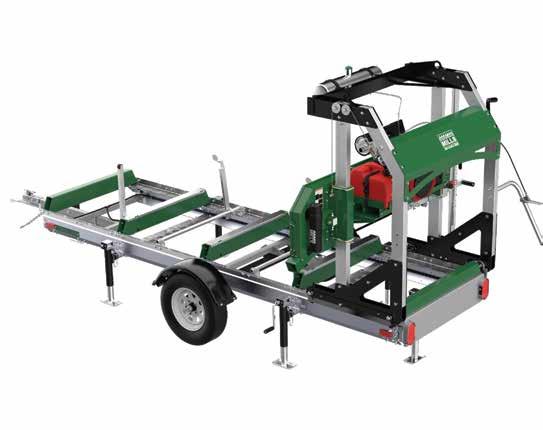
When you’re milling thousands of board feet, you need equipment you can trust and support you can count on. That’s why thousands of sawyers have relied on our machines for more than 15 years to get the job done.
SAWMILL MODELS FOR EVERY LANDOWNER, EVERY PROJECT.
• Sawmills From 18” to 36” Log Capacities
• Ground-Mount and Trailer-Mount Options
• Heavy-Duty 4-Post Head Design
• RapidChange® Blade Systems
• Powder-Coated Steel Blade Guards
• 20+ Upgrades & Accessories
Stephan Zeit Woodworks
Specializes In Forest Equipment Service And Repair Of Any
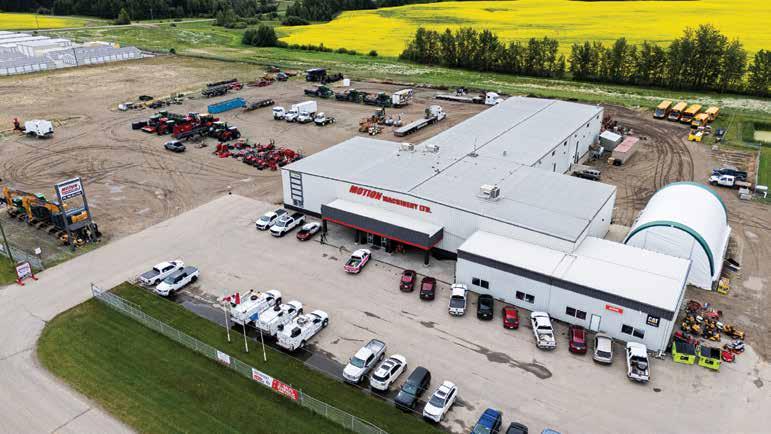
Motion Machinery: Keeping customers first— and in motion—through expansion
These are exciting times for Albertabased Motion Machinery, as the company has moved and expanded its facilities, and taken on a major heavy equipment line, XCMG—all with the goal of serving its customer base better, and growing its market in Alberta.
“There is a lot happening for us right now,” says JB Colbourne, owner of Motion Machinery, and company founder.
In the last year, Motion Machinery moved to Stony Plain, Alberta, just east of Edmonton, on the Yellowhead (Highway 16, at 28007 AB-16 in Stony Plain).
“This positions us in the heart of a growing industrial community, allowing us to better serve our customers in heavy equipment, truck and trailer repair, and forestry support services,” says Colbourne. “This new location provides improved accessibility, expanded space, and we have a growing dedicated team committed to keeping the equipment of our customers working hard.
‘We look forward to continuing to support our loyal clients and welcoming new customers.”
Colbourne explained that the company was looking to expand and grow, with the move to the 30,000 square foot facility. An agricultural dealership had previously oc-
cupied the building, so there was little in the way of alterations required.
“It worked out really well for us, and it is working out well for our customers, too, with this central location,” he said.
The new location is just 15 minutes west of Edmonton, and is right on the Yellowhead, offering excellent access.
“We now have more floor space, shop capacity, and yard room to accommodate the growing needs of our customers,” says Colbourne. This new space allows Motion Machinery to offer even more efficient, streamlined services to get customer equipment back up and running faster than ever.
All of this fits extremely well with another exciting development for Motion Machinery—the company taking on the XCMG line of construction and heavy equipment.
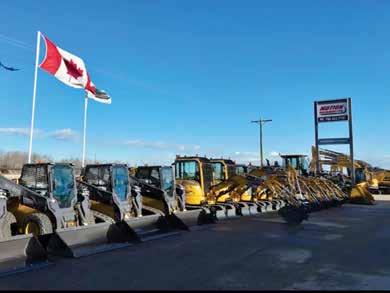
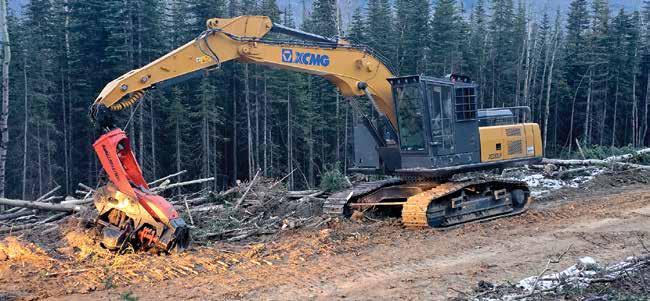
In the past year, Motion Machinery became the new authorized dealer for XCMG Canada forestry equipment in central and northern Alberta. This addition strengthens the company’s regional support and expands access to XCMG equipment in key forestry markets. And Motion Machinery has now taken on the construction side, as well.
“Originally, we had taken XCMG on to be the exclusive forestry dealer for Alberta, and now we are expanding that to be the con-
struction and forestry dealer for central and northern Alberta.
“It allows us to sell product into a customer base that we had previously just been servicing from on the service and repair side—that’s been our strong focus, from the start,” he explained.
Established in 2007, Motion Machinery has grown into a trusted leader in equipment repair, maintenance, and sales. Over the years, they’ve expanded to better serve their valued customers across various industries, including forestry, construction, and mining. Their have dealership partnerships with Quadco, Southstar and Husqvarna, and many other trusted names.
At Motion Machinery, they aim to provide customers with quality machines and services at affordable prices—and that fits well with offering XCMG construction and forestry equipment.
They were looking for a new product line that they could take on and represent in the new location. “Doing some market research and talking with customers who had owned the XCMG product, I was given good feedback and we decided to take the line on,” explained Colbourne.
“Since taking the line on, we have been very impressed with XCMG, their products,
“These are exciting times for Motion Machinery,” says owner and founder JB Colbourne, as the company expands its facilities and adds the XCMG heavy equipment line.
XCMG is China’s largest construction equipment manufacturer and was ranked the world’s third-largest heavy equipment producer. The company operates state-ofthe-art manufacturing facilities across China, the United States, Germany, the Netherlands, Poland, Austria, and Brazil.
XCMG continues to drive technological innovation across its product lines. These include purpose-built forestry equipment, earth-moving machinery, excavation machinery, road machinery, hoisting equipment, concrete machinery, and heavy-duty trucks.
The XCMG products Motion Machinery sells are competitive in a number of ways, including financing from XCMG Financial, a rock-solid warranty program and, impor tantly, the price point, says Colbourne.
“Loggers are able to get a purpose-built forestry machine with zero per cent financ ing, a great warranty, and compared to other brands, at a cost that is 20 to 30 per cent less,” he says.
Their customer McNeil Construc tion, of Grande Cache, Alberta, logs in the Alberta foothills and initial ly bought four XCMG machines from Motion Machinery—two XE250UF Processors with Southstar QS500 Heads
installed, a CV123PDU Roller Packer and an XC968U Wheel Loader—and came back for another machine, a XE300U Excavator/Road Builder, two months later.
“They have been very happy with the XCMG product—the availability for them has been great,” says Colbourne.
“I think this is an opportunity to provide a good quality machine at a fair price—and there is an opportunity for us to move into the market with the XCMG brand when logging contractors are looking at alternatives, because of the costly pricing of other brands of equipment,” says Colbourne.
“We are coming into the market with a product that is more affordable and helps loggers stay cost effective.”
Colbourne says he feels a special commitment to the Alberta forestry industry, having grown up around it with his Dad, a Grande Cache logging supervisor. He saw first-hand how important service is to keeping a logging operation going.
“That’s how Motion Machinery started— with service. That is our backbone. We stand behind what we sell—service is what we take a lot of pride in offering to our customers,” he says.
“That’s where our foundation is, and who we were first. We’re very committed to the service side of the business, and we’re reactive and pro-active to meeting the service needs of our customers.”
Serving industries from construction to forestry, its certified technicians and mobile service team work in-shop or on-site to reduce downtime, fix problems fast, and keep the operations of their customers moving.
Each brand and line Motion Machinery partners with has been carefully selected
for its unique qualities, ensuring that it matches the right solution to meet the specific needs of its customers. Through collaboration and dedication, it is able to provide tailored solutions that exceed expectations.
Motion Machinery specializes in fullservice repairs and maintenance for on- and off-road trucks, trailers, heavy equipment, forestry, and mining machinery. It is committed to keeping customers’ equipment running safely, efficiently, and with minimal downtime. “From routine maintenance to emergency repairs—you can count on us to get the job done right,” says Colbourne.
Taking on a new product line with XCMG is a good match with that foundation. “Taking on the new product line is a good fit because we know we can provide the service and support to back the XCMG product.”
Colbourne says the company is growing at an appropriate pace, so that it can do a good job of supporting and servicing the customers that already have XCMG machines—and new customers—and further build their confidence with service support.
“If we help our customers grow, they in turn, will buy more machines and, in turn, help us grow.”
Colbourne said they are very excited about the changes for Motion Machinery, and the opportunities the changes are bringing. “We’ve built a great team that can support us in this growth phase, that will be there for the long haul.
“We’re definitely excited about where things are headed—we see a bright future ahead, with lots of opportunities and possibilities.”
Albertaforestry HOME-GROWN PRAIRIE SAWMILL
Live edge slabs—some from Ontario and B.C. logs—are the backbone of a unique Alberta sawmilling venture, Pipestone Timber, with most of the mill equipment designed and built by company owner, Haley Cochrane.
By Tony Kryzanowski
Faced with life and death five years ago when diagnosed with a rare form of leukemia, 45-year-old Haley Cochrane spent a year in recovery, both in hospital and at home. He had plenty of time to think and what kept him occupied was a recurring desire to establish a sawmilling venture that took him back to his roots.
Medical science discovered a pill which he takes once a day to help him recover, and when he was able, he put his business plan into action: offering custom sawmilling services and marketing of live edge wood slabs drawn from a variety of species for a multitude of potential uses, from small pen cases to massive boardroom tabletops.
Cochrane’s company, Pipestone Timber, is located about an hour southwest of Edmonton near the town of Calmar. Cochrane is a one-man-show and he likes it that way, to minimize overhead costs so that he can pass the savings on to his customers.
Launching this business was a return to his youth working at the family sawmill in Listowel, Ontario, four hours northwest of Toronto, located in the Great Lakes-St. Lawrence Forest. The region is dominated by a wide variety of valuable hardwood species like hard and soft maple, black walnut, white oak, and cherry as well as the iconic white pine and hemlock.
Pipestone Timber produces various widths and lengths of 2” thick live edge slabs for bigger projects, as well as charcuterie live edge boards measuring 1.25” thick, 6” to 10” wide, and 8’ long for smaller projects. Both types of lumber feature a high degree of character in the internal grain structure, which creates their value. Typically, the logs Cochrane sources are either too large for standard sawmills to break down or too distressed to have any value as lumber. If he doesn’t rescue them, they often end up in landfills.
About 90 per cent of Cochrane’s business is supplying partially finished live
to page 20
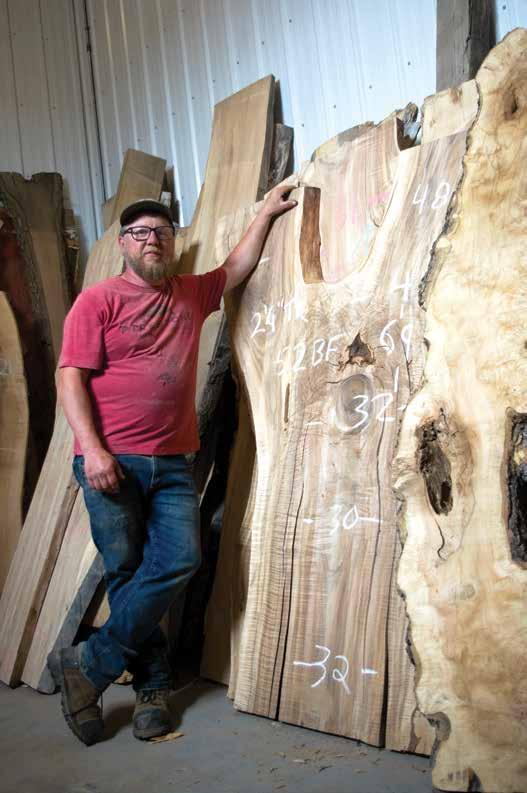
Pipestone Timber owner Haley Cochrane in the company’s showroom, a cabinetmaker's dream, featuring everything from Manitoba maple to Black walnut.
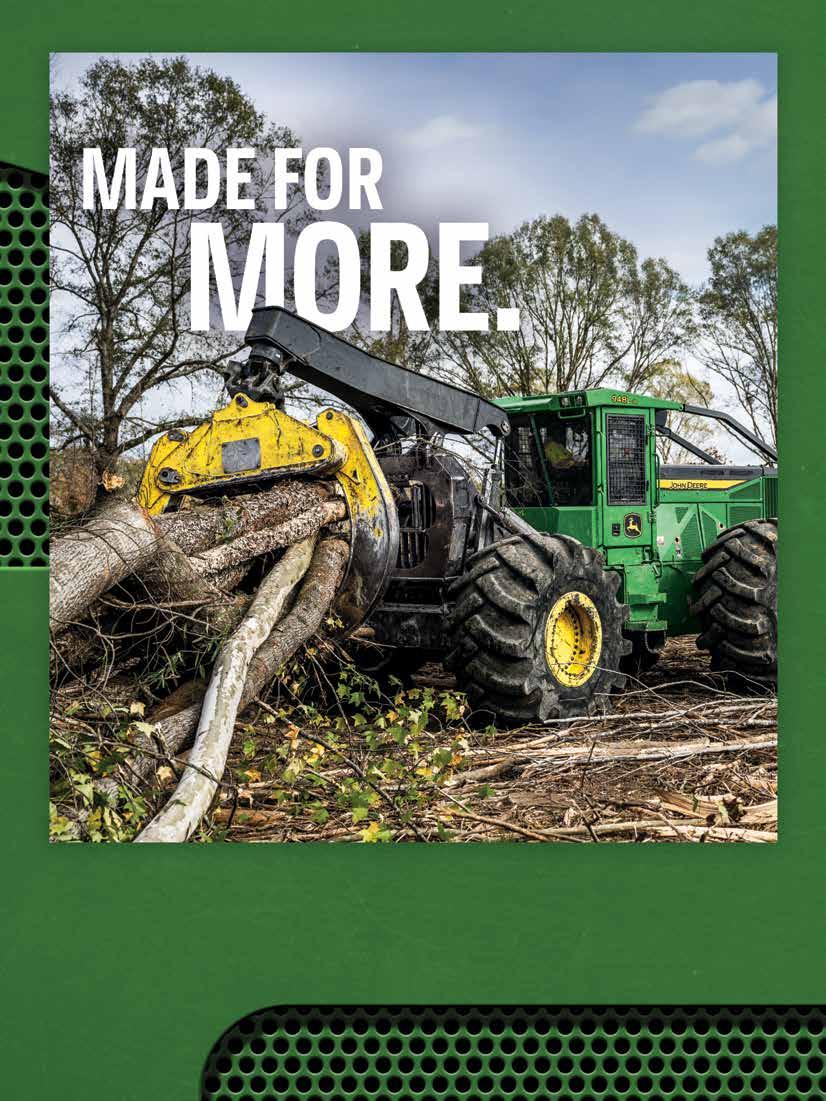
MEET THE NEW L-III SKIDDERS.
Building on the previous John Deere L-Series, the L-III skidders deliver comfort, visibility, simplified diagnostics, and connected support. Designed for those at the controls, these machines help operators stay confident and productive from first light to last load.
Albertaforestry
from page 18
edge slabs while 10 per cent is custom sawmilling.
As mentioned, one feature that his lumber pieces have in abundance is character and that translates into high potential value if you have the vision to capture it, and the ability to market it to the right customers. Cochrane has both.
It’s said that beauty is in the eye of the beholder and that is entirely true when it comes to the partially finished live edge slabs in the Pipestone Timber showroom that Cochrane markets through direct and repeat customer contact as well as social media.
“For example, with Manitoba maple, you want all the burl that you can find in it,” says Cochrane. “You picture what the boards are going to look like and you want them to be as close to a rectangle as you can because someone is going to try to make a table out of it. But the pieces with the wild shapes, they get milled and turned into all sorts of products. There’s a project for every piece, and the more unique, the better, because that’s what my customers want.”
Customers range from individual artists to furniture manufacturers with several employees—and what is standard in all cases is that everything they make is one-of-a-kind because the slabs provided by Pipestone Timber are one-of-a-kind, and find some interesting homes.
“Connor McDavid’s wife, Lauren, sits at a desk that I milled the lumber for,” says Cochrane.
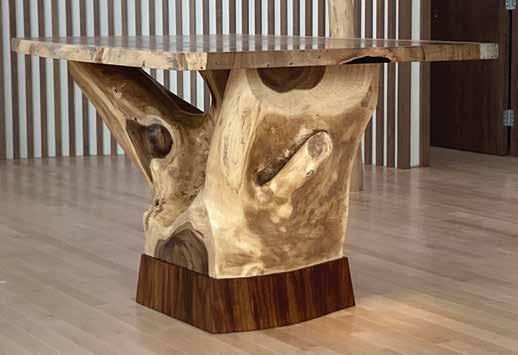
Among the most unique items Cochrane has supplied is the milled support and planed altar table used by the recently departed Pope Francis when he held mass at the Sacred Heart Church in Edmonton during his First Nations Reconciliation visit in 2022 (see sidebar story on page 22).
Training Opportunities
BC Forest Safety Council (BCFSC) delivers targeted supervisor training, along with practical worker training and assessment programs that strengthen safety and performance across your operation.
Train smarter, work safer with help from the BC Forest Safety Council
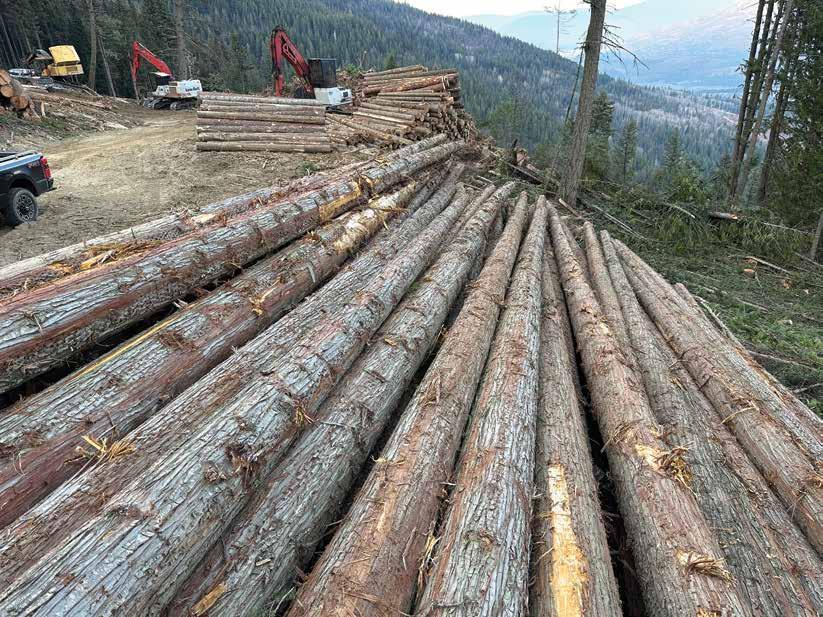
Pipestone Timber sources, mills, dries and CNC planes wood slabs primarily from locally grown Manitoba maple, ash, and even willow, as well as valuable species acquired from near his hometown in Ontario, those being primarily maple, oak, and walnut sourced within an hour’s drive from the family farm. He also mills a few other specialty hardwood species based on the specific needs of his customers. Recently, he has begun to dabble in softwood, having acquired a massive Western red cedar log from the Valemount, B.C. area.
Cochrane’s foray into marketing milled live edge wood slabs goes further than applying for a business license and opening a social media account.
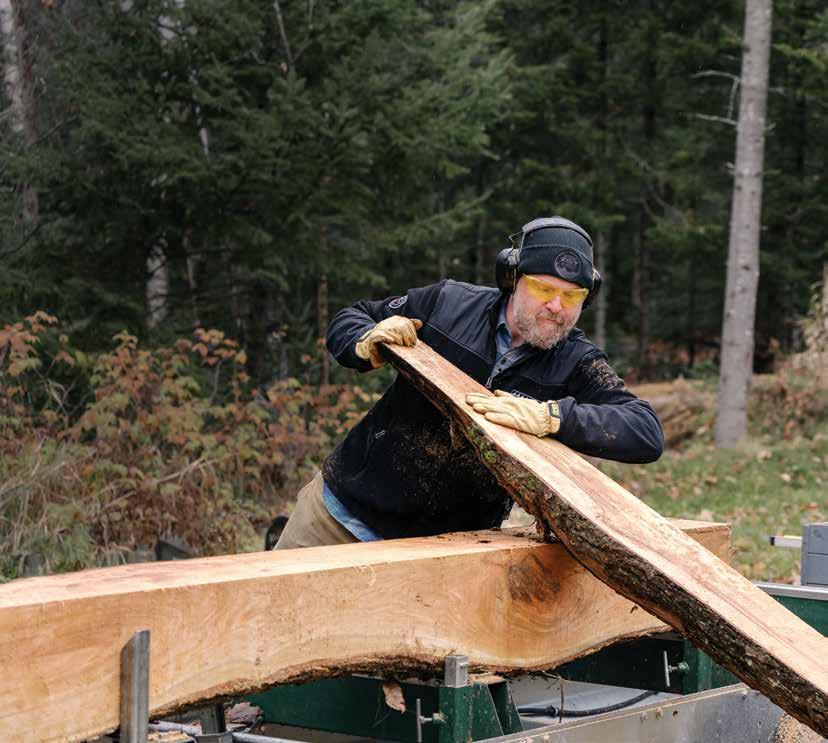
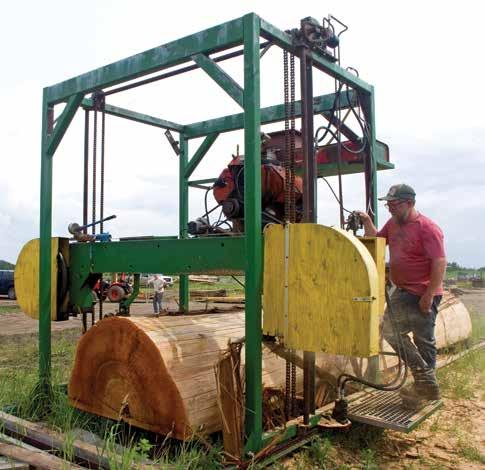
As an experienced millwright, he designed and built both his large bandsaw mill and medium-size bandsaw mill from scratch. His large bandsaw mill was designed during the year he spent in recovery, but other equipment like his medium-size bandsaw mill and a dry kiln were designed and built over several years and spread out over three locations.
The large bandsaw mill uses a 2” wide and 25’ long blade and can break down logs measuring up to 74” across, 80” high, and 23’ long. It is used to essentially create large slabs, while the medium-size mill is designed for higher production, having been equipped with many hydraulic features for log manipulation on the carriage.
“I’ve been around mills my whole life so I have a really good idea of what components are needed,” Cochrane says. “Each mill you build is built for a purpose. Most of the components on the sawmills, I’ve made myself. I have a lathe and a milling machine. I can weld and fabricate.”
Once Pipestone Timber was established, all his existing equipment was relocated and his new large bandsaw mill as
Haley Cochrane breaking down a Western Red Cedar log, acquired from Valemount, B.C., on his custom-built bandsaw.
well as a new, large, custom-built, dry kiln were situated in one place at the company’s current location south of Calmar. The only off-the-shelf equipment Cochrane owns is an Avid-brand CNC planer machine able to handle 6’ x 12’ dried slabs. Both of his custom-made dry kilns are equipped with all the necessary electronics needed through the efforts of a former partner who was an electrician. The goal is to dry his slabs through several cycles of both air and mechanical drying down to between 7.5 to 8 per cent moisture content for stability.
The actor Orson Welles once famously stated in a television commercial that, “we will sell no wine before its time.” Cochrane has adopted a similar mantra in that he will sell no slab before its time. Typically, it will take over three years for a log he or his father have sourced to be fully harvested, milled, dried and planed before the slabs are offered for sale.
His father, Steve Cochrane, started Haley’s journey into sourcing, milling, and marketing high value wood slabs when he built a custom bandsaw mill from scratch and began marketing lumber and offering custom sawmilling from the family farm near Listowel. He also designed and built custom-made sawmills. As a teenager, Haley learned the ropes from that operation and then followed his father into the millwright trade. Both he and his brother, also a millwright, relocated about 15 years ago to Alberta, having heard the call of the oilpatch like so many others across Canada.
But at that same time, they always kept their hands in building sawmills while sourcing, milling, drying and marketing various log species locally and from Ontario as a hobby between rotational work shifts.
Then came that pivotal diagnosis five years ago and the decision by Haley to return to his roots on a full time basis.
Pipestone Timber is uniquely well-connected given Cochrane’s location south of Edmonton while still maintaining close family ties with the farm back in Ontario. The vast majority of logs he sources are salvaged from professional arborists working in that area or local landowners wanting to dispose of a tree taken down on their property. They negotiate a price for the log and, in most cases, taking charge of the tree is doing the companies and landowners a service.
“Having this connection is super valuable,” says Cochrane. “Without having someone that I trust back east that knows the industry, it’s very, very hard to source material when you are not there looking at it directly. I don’t typically source my logs through conventional paths.”
Initially, when he opened the business, he shipped full-size logs to Alberta, but that proved cost prohibitive. So given that his father could still operate his bandsaw mill on the farm, has the equipment to retrieve available logs and the fact that he is
now retired, he is able to mill the logs into raw slabs and then Cochrane ships them to Alberta in one big load each winter, making the cost much more affordable. They are not shipped immediately after milling, but spend some time air drying on stickered stacks on the farm.
When the air-dried raw slabs arrive in Alberta, this is when the value-adding process begins in earnest, with Cochrane
page 22
Typically, Cochrane takes a trip to the family farm in Ontario once a year to inspect and select trees he and his father have sourced, with the intention of shipping partially finished slabs back home in Alberta for further value adding. insidesales@burtonmill.com
Albertaforestry
from page 21
evaluating each slab for characteristics and going through several air and mechanical drying steps to acclimatize the slabs to Alberta’s drier climate.
“Once the slabs arrive in Alberta, I mill them, stack them in the yard on sticks so they air dry, and then forget about them for between a year-and-a-half to two years,” says Cochrane. “I’ve got a cycle going.”
After long term air drying, the slabs are
placed in a dry kiln for a final drying cycle and then they are CNC planed for market. Cochrane says that having the ability to plane the slabs to about a 2” thickness makes them much more marketable, but even then, he holds onto them for about three weeks to absolutely ensure that they are stable.
At that point, he measures the dimensions of the slabs and posts the particulars to potential customers on his social media sites. Often, he already has a customer for
a slab based on his regular contact with customers.
It took a while to establish a proper cycle to deliver unique and top quality slabs to his growing customer base. But like a great wine, Cochrane knows that producing quality takes time.
Pipestone Timber helps rescue exotic hardwood for Pope’s altar
Leukemia survivor Haley Cochrane, of Pipestone Timber, landed the job of secretly milling the altar stand and tabletop for a fire-damaged church for use on the occasion of Pope Francis’s historic reconciliation visit to Alberta in 2022.
The purpose of the visit was to promote healing, starting by rebuilding the church altar after a fire at the prominent First Nations Sacred Heart Church in downtown Edmonton, and then providing the platform for the Pope to formally apologize to Canada’s First Nations for the church’s residential school policy that forcibly removed children from their families.
Was Cochrane’s survival through what he describes as a miracle drug developed by medical science and then his fundamental participation in the creation of that new altar for this historically significant event divine providence or just pure luck? You be the judge.
However, that is exactly what happened when the church acquired a wild piece of exotic Parota hardwood that it wanted to use to rebuild the altar for the Pope’s visit.
“The wood was so twisted that it was almost unworkable,” says Jim Playfair, cabinetmaker and co-owner of Edmonton-based, Harmony in Wood, which won the contract for the project. “The interesting thing was that when we got the contract, we thought that it was just another altar for a church. We only learned later that it was specifically for the Pope’s visit.”
Pipestone Timber, owned by Cochrane, was recommended to Playfair to mill the Parota stump so that its many branches would not only support the altar tabletop but keep it level. Cochrane was able to parlay his extensive industry experience and large, custom-made bandsaw
Among the most unique items Haley
has supplied is the milled support and planed
mill located near Calmar, Alberta, to do the job, and thus began a lasting business relationship between Cochrane and Playfair that continues to this day. Cochrane has become his go-to custom sawyer and CNC planer provider.
“The work we do is really a community of custom woodworkers helping each other,” says Playfair. “It’s become invaluable to us to have Haley as a resource. I know that I am not wasting my time coming out here. So much of our work is not what you know, but who you know.”
Playfair describes the raw tabletop as heavy and 3.25” thick. Cochrane was able to CNC plane the tabletop down to 2” in
addition to providing a level support.
Both Playfair and Cochrane are simpatico souls when it comes to the value of wood.
“We’re working with something that Nature made,” Playfair says. “So each piece is unique. It’s beautiful, and if you do it right, the wood products we make can last for centuries.”
And that is exactly what the parishioners of Sacred Heart Parish are hoping for—a symbol of Nature’s remarkable inward beauty which is so much a part of their cultural heritage as they continue their journey of healing.
Cochrane
altar table (above) used by Pope Francis when he held mass at the Sacred Heart Church in Edmonton in 2022.
Reliability that counts
MS 500i GAS CHAINSAW
79.2 cc • 5.0 kW • 13.7 lb ①
$1,94999
MSRP with 20" bar
The MS 500i is the first chainsaw in the world to feature electronically controlled fuel injection. Ideally suited for the professional forester, this high-torque machine cuts through big timber with ease. Rapid acceleration and optimized operator control means that the MS 500i is perfect for felling, bucking and limbing. Featuring electronically controlled fuel delivery, the MS 500i starts easily and delivers outstanding engine performance regardless of altitude & temperature. The revolutionary engine design provides the operator the best power to weight ratio on the market.
⬤ Optimum engine performance from the first pull under all conditions
⬤ Rapid acceleration in an unbelievable 0.25 seconds, enabling this high-torque machine to provide instant power
⬤ Electronic Fuel Injection technology guarantees optimum performance regardless of temperature or elevation
⬤ Captive guide bar nuts on the sprocket cover so they won’t get lost when changing the guide bar or chain
Note: Wrap handle version is also available.
① Weight with powerhead only.
S&W Forest Products helping California rebuild
S&W Forest Products is taking on the task of helping to rebuild California’s fire-destroyed homes with its B.C.-manufactured shakes and shingles, and has broadened out its product line to include yellow cedar products.
By Paul MacDonald
Slowly, but surely, the residents of the Palisades neighborhood in Los Angeles—the scene of one of the largest urban fires in California history— have started to rebuild. One of a series of wildfires in Southern California driven by powerful Santa Ana winds in 2025, the
Palisades Fire spread to 95 square kilometres, killed 12 people, and destroyed 6,837 structures—including thousands of homes.
And despite what U.S. President Donald Trump says, the U.S. does need Canadian forest products—which are now being used to help rebuild hundreds of homes in this scenic neighborhood, where the Santa Monica Mountains meet
the Pacific Ocean. Rebuilding efforts are also going on in Maui, after it was hit by a catastrophic fire in 2023.
And S&W Forest Products, one of the largest cedar shake and shingle producers in B.C.’s Fraser Valley, is helping that rebuilding effort by supplying their U.S. customers—in spite of the threat of punishing duties the Canadian industry is currently being hit with by the U.S. government.
S&W Forest Products is a fourth-generation family business, which has been producing and exporting high-quality cedar shakes and shingles since 1964. While it exports to a large number of countries, its main market, like a lot of B.C. cedar producers, is the U.S.
It’s located on a waterfront site close to the north shore of the Fraser River, in Maple Ridge, about an hour outside of Vancouver, and a 30-minute drive, for the trucks carrying S&W cedar products, to the U.S. border.
The company is owned by Michael Watkins, who is the great grandson of the founder of the company, Bill Watkins. A number of Watkins Family members are involved in the shake and shingle business in the Fraser Valley.
Watkins takes on the very challenging job of log procurement. S&W does not have tenure, so it is competing with a lot to page 26
Shake and shingle producer S&W Forest Products—located on a waterfront site close to the north shore of the Fraser River, in Maple Ridge, B.C.,—is fourthgeneration family-owned, and is now owned by Michael Watkins, the great grandson of the founder of the company, Bill Watkins.
BCvalueadded
from page 24
of companies for wood. Their expertise is on the mill side, rather than on harvesting—they are shingle manufacturers, not loggers. And Watkins takes great pride in being resourceful with the wood they work with, as they have for generations.
Essentially, companies like S&W can take the gnarliest looking cedar logs going, and produce the most beautiful Western Red Cedar, and increasingly yellow cedar, shakes and shingles you can imagine; a fantastic example of total resource utilization. But those logs are becoming harder to source—and they are getting tougher looking with each passing year.
The company takes pride in its quality, but the business of providing their customers with a premium quality product is becoming increasingly difficult.
The shake and shingle companies work with cedar that the major forest companies, who produce cedar lumber, cannot utilize in their own facilities.
S&W works a fair bit with cedar block salvagers, but because of the greater utilization of wood by sawmills, there can be less to salvage.
Thanks to improvements in sawmill technology, the mills of the major companies have become extremely resourceful
at getting lumber out of logs that they would have passed on in the past—so some logs that would have gone to the shake/shingle players are no longer available. So, advances in sawmill technology have actually affected the shake and shingle producers by reducing the number of logs the sawmills turn away.
A sawmill can take a log, and even if it’s not going to have a super high yield, it’s still worthwhile for them to process it if they can get some good cuts out of it.
Added to that are the disputes that flare up with tenure holders that can reduce the flow of wood, including cedar, out of B.C. coastal forests, challenging logging geography, governmental challenges, natural occurrences and changes in weather patterns—it all impacts the forest products industry landscape.
It is, and it’s an understatement, a huge challenge to source wood in B.C. these days, as Michael Watkins knows very well.
Add to this the very unpredictable trade situation with the industry’s largest market, the U.S.
Sanjna (Sanj) Hothi, president of S&W, says the company, along with the broader cedar shake and shingle sector, and the entire forest industry, has tried to pivot to other markets aside from the U.S., but developing new markets takes time.
Still opportunities in the forest industry
Despite the challenges the shake and shingle business faces, it’s clear that S&W Forest Products, company owner Michael Watkins and company president Sanjna Hothi are committed to meeting their customer needs, whether those customers are in Port Coquitlam—or the Pacific Palisades.
Sanjna (Sanj) Hothi, encourages others her age to check out a career in the forest industry, despite its sometimes roller coaster ride. Hothi says it’s been rewarding and interesting. Like shake and shingle production work, it’s not for everybody, but if you want a challenge, and want to grow your skillset quickly, there are opportunities, she says.
She originally joined S&W at 24 to work on the accounting side, and has since gained experience in marketing, health and safety, general mill operations, sales and the all-important job of logistics, getting their cedar products to customers.
Though she did not have any family link with the forest industry, Hothi has been quick to connect with the industry—the now 35-year-old has been the youngest member of the Cedar Shake and Shingle Bureau’s board of directors since 2018, and she is now the vice chair of the organization, which was established in 1915. The Cedar Shake and Shingle
There is also increasing pressure from competitive products. Electric car pioneer Elon Musk is even developing solar roofing products. Alternative roofing products are improving their appearance and lifespan with exceedingly attractive price points. All of these companies are able to take advantage of mass production in large scale plants.
For shake and shingle producers like S&W, however, the work remains very labour intensive. There have been some improvements, but a shingle machine hasn’t really changed much over the years, notes Hothi. There has been tweaking to improve the equipment, rather than any major changes.
The S&W mill iron line-up includes shingle equipment from Maple Ridge, B.C-based Streifel Industries, and Dia-Saw Mfg. Dia-Saw is conveniently located across the street from S&W, and its equipment is handled by Tsubaki. Shake manufacturing equipment is from M&H Industries. S&W wants to maximize fibre yield and optimize cutting, and uses Armstrong sawfiling equipment, from Simonds, part of Burton Mill Solutions.
They have two cut off saws, the main
to page 28
Bureau promotes B.C. cedar shakes and shingles around the world.
Hothi says her background is somewhat unique in this sector, as many of the people involved in B.C. shake and shingle manufacturing have a family background in the industry. “The industry is very family oriented, like the Watkins Family and many others in the industry.”
But she has fully embraced and welcomed the opportunity that S&W has presented to her over the last dozen years.
“There are so many areas to help out in a family business—operations, accounting, sales, administration, logistics,” she says. “I’m really a lifelong learner, and I’m always trying to learn new things.
“Every year there seems to be something else that is exciting or challenging— the industry is so dynamic, there is always something.” And she receives full support in tackling these roles and responsibilities from company owner, Michael Watkins.
Sanjna (Sanj) Hothi
High
Long-reaching boom
Fast,
from page 26
being a 7’ circular swing saw, and the second, for larger logs, a 10’ bar saw.
Equipment and parts costs have risen, and S&W deals with this by doing its own maintenance, for the most part, says Hothi.
S&W has some mobile iron to move wood around the mill. Their main machine is a Cat 568 LL with a forestry cab. The backup machine is a Hitachi EX 370, also with a forestry cab.
Since the manufacturing is so labour intensive, it’s really the people who make the business hum, says Hothi.
They have four millwrights. “We have a lot of people who are very knowledgeable about troubleshooting and dealing with equipment, to keep the mill up and running,” she says.
Like the industry as a whole, the shake and shingle sector is seeing its share of retirements, and they are working to bring new people in, and they need a particular type of person. “It’s not for everyone,” notes Hothi. “It’s very physically demanding. And the role of a sawyer is particularly special—not everyone wants to stand behind a saw, it’s daunting.”
Above all, they look for people who are extremely safety conscious. “There is a level of hustle that is involved in manufacturing. It’s very dynamic, and we want people who have a good work ethic—but it’s important to have safety as a core value. We know pretty quickly if someone is not taking the work or safety seriously.”
New employees normally start out handling cedar blocks, but there are opportunities to advance and take training, so they can move to grading and packing cedar bundles. But, really, everyone in the mill is involved in the quality control and grading process, starting with the person piling blocks, to the sawyer, right through to the packer building bundles. Cedar shake and shingle production is a craftsperson’s trade; many human hands touch each shake or shingle before it is packaged into a bundle and then onto a pallet.
Although the manufacturing process and equipment may not have changed as much as sawmilling, Hothi said they are always looking to be progressive and make small changes—like the Japanese approach of Kaizen.
“We can’t change everything in a day, but you can continuously make little improvements, and little improvements over time can have a big impact on a business.”
One market area that S&W moved into years ago is using yellow cedar. It takes a bit of a rethink to handle the species and it has taken a lot of expertise.
“Not a lot of mills know how to manufacture shakes and shingles from yellow cedar well,” says Hothi. “A lot of mills don’t know how to split yellow cedar. It’s very tough on your saws and equipment.” Yellow cedar is very fibrous, so saw blades have to be changed more often.
“Our guys did not like working with yellow cedar at first. Cutting through red cedar is like cutting through butter, compared with yellow cedar,” she says. “It’s very dense, but that’s also what makes it such a strong product.”
They have developed the market, and S&W is now the largest producers of yellow cedar shake and shingle products.
“Everything we do in red cedar, we also do in yellow cedar,” says Hothi.
Being on the marketing side, Hothi says it has taken a bit of convincing with their customers to try yellow cedar. It weathers differently, to a silver colour, vs. the sometimes-checkered browns that red cedar weathers to. A lower price helped to market the product, as did the fact that it is more durable.
The only thing hindering it was that people were not used to it—they have to get their heads around it, says Hothi. Historically, yellow cedar was used in a variety of marine lumber applications. But yellow cedar shakes and shingles are now becoming more widely specified and used in the market for sidewall and roof applications.
And the results speak for themselves. A beautiful oceanfront property located on one of the islands of Hawaii is featured on the S&W website. The product chosen was Alaskan Yellow Cedar 24” Tapersawn–CCA Preservative Treated. Yellow cedar is graded to the same quality control product standards written by the Cedar Shake and Shingle Bureau for Western Red Cedar. The wood itself is usually found at high elevations on the B.C. Coast
Even for customers new to red cedar, though, it can be a bit of an education process. “You can send people samples of a red cedar product, and they might want their entire order in that same colour,” says Hothi. “But it’s a natural product— each cedar block has its own personality, and that’s why people love it. Cedar pieces are like snowflakes—no two are the same.”
SUPPLIER NEWSLINE
Komatsu acquires Swedish forest equipment manufacturer Malwa Forest AB
Komatsu Forest AB has acquired the Swedish forest machine manufacturer Malwa Forest AB, which describes itself as a small segment forestry equipment manufacturer.
The company develops and manufactures small harvesters and forwarders designed for selective thinning and sensitive terrain. Komatsu says that growing environmental requirements, a sharper focus on soil protection and climate impact have contributed to a rising demand for small forestry machines. This acquisition reflects that increasing demand.
“This agreement is a natural extension of our ambition to find the best solution for the challenges we have in forestry today,” says Peter Hasselryd, Vice-President of Marketing and Sales, Komatsu Forest. “It aligns with everything we do—from engineering solutions that reduce ground impact to enhancing our offer across the full forestry cycle.”
He added that the addition of Malwa Forest further strengthens Komatsu’s forestry business, and as a strong supplier of forestry products and solutions across all key stages of forest management.
https://malwaforest.com
Tigercat’s TCi 568 harvesting head revamped
Designed for track carriers, Tigercat says that its TCi 568 harvesting head is a robust, high-capacity harvesting head optimized for roadside processing in the 6” to 22” diameter range.
It has the feed speed of a 22” head with the feed power of a 23” head, says the company. Recent design enhancements have boosted performance, increased the strength and durability, and elevated the overall harvesting and processing experience.
The TCi D7 control system comes in either Priority or Optimized bucking control, and both use wireless communication between
By Tony Kryzanowski
the head and the machine cab. Cab hardware and wiring have been simplified to use a single module that has constant power for quicker startups and faster processor speed to improve performance and consistency.
The 568 now uses a full-time fourwheel-drive system which reduces wheel spin, improves braking performance, and achieves greater feed power than other heads in its class, says Tigercat.
www.tigercat.com
Ponsse launches next generation Opti 5G information system for track-based machines
Ponsse has introduced a next generation of its Opti 5G information system for its tracked-based machines. The system is specifically designed to enhance productivity, ease of use, and data management in demanding conditions.
The company says that the new system improves logging optimization, machine control, and operator confidence. The customizable My View display allows quick setting adjustments without interruption, and the active map view enhances safety and situational awareness.
Opti 5G produces accurate, real-time data on machine performance, working time, production, and fuel consumption. Thanks to standardized StanForD 2010 data, the system is compatible with international harvesting systems and can be expanded with additional applications. Designed for global use, Opti 5G supports multiple languages and units of measure -
ment. The system also allows marking treespecific data, such as decay or insect damage observations, for reporting purposes.
Usability has been significantly improved with fast response time, clear menus, and three main logical views (work, planning, and machine) that support smooth operation. The experience is complemented by the new Opti 8X display, offering excellent visibility and high touch precision even in demanding conditions.
www.ponsse.com
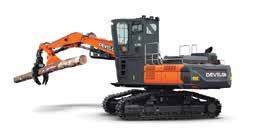
DEVELON fills market gap with new log loader
DEVELON’s DX340LL-7 log loader is designed to meet the demands of forestry applications, and the company says that this new model fills a strategic size-class gap (40–45 metric tons), offering the power and reach of a larger machine without the associated transport challenges and costs.
DEVELON is adding the DX340LL-7 to its existing forestry lineup, complementing both smaller and larger existing models. The DX340LL-7 provides forestry professionals with the reach, lift capacity and stability of a larger log loader while avoiding the high transport costs and logistical hurdles of moving to the next size class.
The DX340LL-7 log loader is designed
for demanding timber harvesting and log handling environments.
The fuel efficient DEVELON diesel engine meets Tier 4 emission standards without the need for a diesel particulate filter (DPF), reducing maintenance costs and increasing uptime.
The new model delivers high swing torque and tractive force, which are essential for uphill logging work and heavy load maneuvering.
Operators can engage a one-touch power boost on the right hand joystick for an instant hydraulic surge when handling maximum loads.
na.develon-ce.com/en
A stalwart in Canadian forest research deserves an honorary PhD
By Tony Kryzanowski
This issue of Forestnet Magazine marks the retirement of a stalwart in Canadian forestry, Derek Sidders, currently identified as Silviculture Operations Specialist, Technology Developer and Promoter with the Canadian Forest Service (CFS).
Readers of Forestnet Magazine will know him as the driving force behind our CFS The Edge articles that have appeared here for about a decade, covering various timely topics from mountain pine beetle stand rehabilitation and select harvesting to afforestation through the generation of fast-growing hybrid hardwood clone plantations and wild fire remediation through innovative forest management techniques.
Derek’s retirement this month brings to an end a much-storied career at CFS in the promotion and development of Canadian forest management technology, reforestation, afforestation and climate change adaptation.
Most recently headquartered at the Northern Forestry Centre in Edmonton, his career with the CFS spans nearly a half-century of deeply committed public service. It's notable that several current members of the CFS leadership team actually began their careers under his tutelage, and even now, it is common for several of them to say, “I wonder what Derek would have to say on this issue?” What followed would often be a phone call to benefit from his decades of extensive field experience of what is and is not possible or feasible.
Derek was like a prairie dust devil or hummingbird, with stacks and stacks of reports and past projects in his office. While it might have appeared to a visitor as rather chaotic, he reminded those present that he knew where everything was, which ultimately became somewhat of a regret on his part in that so much was still
on paper, with never enough time to digitize it all. We are all diminished because of it, because within these reports and findings are, in my opinion, some of the most important applied science programs, field trials and results that have been initiated and completed with a variety of partners over the past 50 years at CFS under his guidance.
I am pleased to say that I not only consider Derek as a fellow passenger on the express train that is advancement within the Canadian forest sector, but also someone who became a friend due to our consistent crossing of paths during my own 37 years of service to this publication.
I remember the first field tour I attended that Derek and his team organized, of various innovative and novel CFS forest research plantations throughout Western Canada. While it would be easy to tune out the commentary from the front of the bus between stops, I remember thinking that what Derek had to say was so compelling, that these tours almost became a Master Class in the art of what is possible in Canadian forestry.
While the tour was 25 years ago, I still have vivid memories of the healthy pine plantation that had been established on a CFS research site on the bald prairie near Alberta’s Cypress Hills Provincial Park or the massive poplar that had been regenerated through innovative reforestation techniques near Riding Mountain National Park in Manitoba. My interest since then has never waned because regardless of where Derek’s truck was headed, you always knew that today, you were going to learn something truly remarkable of what was possible in Canadian forest management from the active research site we were about to visit.
Some of the truly genius concepts that evolved stick with me today, like the
select harvesting patterns in mixed forests that he designed and implemented on field sites, where feller bunchers reach in on either side of a trail to retrieve mature hardwoods while leaving the immature white spruce in the understorey to grow and thrive in a less competitive environment.
Then there was his work in afforestation revolving around the study of fastgrowing hybrid hardwood clones to see which varieties would thrive in Canada’s various bio-geoclimatic zones, resulting in plantations from Guelph, Ontario to British Columbia—and everywhere in-between. Then the idea occurred to him of planting white spruce in the understorey of these hybrid poplar plantations and the result, I think, surprised even him. Here was the ability to generate a fast-growing hybrid poplar forest in a fraction of the time of a natural forest, with the generation of a secondary commercial species in a way that actually mimicked a natural forest.
Not only did this provide the opportunity for industry to replicate this cutting edge afforestation technology to rehabilitate industrial sites or for companies to grow the size of their wood baskets, but it was also a major win for the environment through the development of fast-growing carbon sinks and forests that attracted a variety of wildlife species including birds, moose, deer and much more.
It truly would be a justly deserved outcome if some forestry organization or company would nominate him for a much-deserved honorary PhD from a Canadian university because I know no one else who has demonstrated such an unequivocal deep academic understanding, commitment and contribution to his area of study.
LOG MORE HOURS.
When every hour in the woods counts, count on Brandt to deliver the equipment, service, parts, and support that keep your operation standing tall.
Expertise On-Demand Support Where You Need It
Get back to work quickly with 24/7/365 support and expert field techs who understand your operation.
Unmatched Parts Fill Rates
Count on support across B.C. with our network of strategically located branches and mobile service units. As Canada’s largest dealer network, Brandt delivers superior local inventory and faster parts turnaround.