Check out Forestnet Magazine online - www.forestnet.com
WESTERN ARCHRIB’S NEW $80 MILLION GLULAM OPERATION IS DRIVEN—BY DATA MANAGING VEGETATION IN B.C. PLANTATIONS—WITH SHEEP AXCOR RENEWABLE ENERGY ADDS CUSTOM-BUILT PONSSE BIOMASS FORWARDER
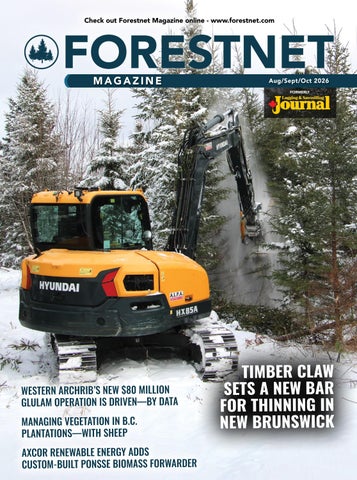
TIMBER CLAW SETS A NEW BAR FOR THINNING IN NEW BRUNSWICK
MEET THE NEW L-III SKIDDERS. Building on the previous John Deere L-Series, the L-III skidders deliver comfort, visibility, simplified diagnostics, and connected support. Designed for those at the controls, these machines help operators stay confident and productive from first light to last load.
MAGAZINE August/September/October 2026 Volume 57 • No. 4
Editor Paul MacDonald Contributing Editors Jim Stirling, Tony Kryzanowski George Fullerton Tech Update Editor Tony Kryzanowski Publisher/CEO/Advertising Mgr. Anthony Robinson • (778) 991-3500 E-Mail: arobinson@forestnet.com Associate Publisher & Digital Marketing Hannah Robinson • (778) 688-9127 E-mail: hannah@forestnet.com Social Media: Kaitlin Parker Subscription Enquiries (778) 991-3500 Fax: (705) 434-9052 E-mail: SubscribeLSJ@forestnet.com Design & Art Production Manager Sheila Ringdahl E-mail: artwork@forestnet.com Accounting Manager Shelina Jessa • (604) 731-1535 E-mail: accounting@forestnet.com Office P.O. Box 86670 North Vancouver, BC V7L 4L2 Phone: (778) 991-3500 Website: www.forestnet.com Subscriptions: Canada $58 a year; two years $70; three years, $85. Group accounts, six or more subscriptions, $25 per subscription per year. Outside Canada, $95 per year. Airmail $165. Single copy, Canada $6; elsewhere $10. Reproduction prohibited without permission of the publisher. ISSN 0226-7572. Back copies from 1996 onward are available through our website www.forestnet.com Publications Mail Agree ment No. 40064045 Return undeliverable Canadian addresses to CIRCULATION DEPT. PO Box 86670 Stn Main North Vancouver BC V7L 4L2 e-mail: SubscribeLSJ@forestnet.com
FEATURES On the Cover: New Brunswick logger Colin Maclean had an idea to develop a hot saw excavator attachment for mechanized pre-commercial thinning—and it became a family affair. Colin joined forces with his cousin, Rodney Maclean, and they formed Forged Timber and have developed a hot saw excavator attachment called the Timber Claw, which they believe will set a new bar for mechanized pre-commercial thinning, and is shown operating on a Hyundai excavator (Cover photo by George Fullerton).
4 Spotlight —
Managing vegetation in B.C. plantations—with sheep
Dennis Loxton built a career pioneering the use of sheep in vegetation management in the B.C. silviculture sector, and remains confident sheep farming has a future—including the use of sheep to graze plantations.
16 Setting a new bar for thinning
Two very inventive New Brunswick cousins have developed a new hot saw excavator attachment—the Timber Claw— which they believe will set a new bar for mechanized pre-commercial thinning
20 Having the right tools
8 Western Archrib’s
in the tool kit
“We acknowledge the financial support of the Government of Canada”
Alberta glulam producer Western Archrib is tripling its output with a new $80 million plant that has been designed from the ground up around data-driven, automated processes.
30 The Last Word
“Supported by Creative BC and the Province of British Columbia”
12 Junction Lumber takes
POSTMASTER: Send US address changes to LSJ Publishing Ltd., PO Box 9058, Fargo, ND 58106 Printed on FSC®certified paper. Published August/September/October 2026
Forestnet Magazine is a member/associate member of the following industry organizations:
new $80 million glulam operation is driven—by data
another turn for growth
Junction Lumber Products has a history of adding to its mill facilities—and now has plans to move its growing pallet manufacturing facilities off site, to increase its efficiency.
Forestnet Magazine - Aug/Sept/Oct 2026
Axcor Renewable Energy Inc. is all about having the right equipment in their tool kit to do biomass grinding, with a recent successful addition coming in the form of a custom-built Ponsse biomass forwarder.
Despite the very hot trade wars—including on softwood lumber—going on between Canada and the U.S., Jim Stirling talks about some surprising common sense coming from south of the border.
DEPARTMENTS
Calendar...........................................6 Suppliernewsline............................28 Ad Index/Subscriptions..................28 3
spotlight Dennis Loxton spent 50 years working in B.C.’s silviculture sector, the last 26 of them pioneering the use of sheep in vegetation management in the province—and his operation included both shepherds and shepherdesses.
MANAGING VEGETATION in B.C. plantations—with sheep
Dennis Loxton built a career pioneering the use of sheep in vegetation management in the B.C. silviculture sector, and remains confident sheep farming has a future—including the use of sheep to graze plantations. By Jim Stirling
B
Shepherd Dennis Loxton and Agnes Thomas show a photo of a sheep brushing operation, a chemical-free method of reducing herbaceous competition for crop conifer trees. 4
ritish Columbia’s spectrum of enticing landscapes has long drawn those with a pioneering spirit. Both the driven and the dreamers, those seeking something and those trying to escape something else, have discovered the province’s diversity and opportunity to be an irresistible attraction. Dennis Loxton probably slots most comfortably into a subset of the driven category. He’s spent 50 years working in B.C.’s silviculture sector, with the last 26 of them pioneering the use of sheep in vegetation management in the province. Now he’s completing the circle and is returning to his home in the state of South Australia. The introduction of sheep as a useful tool in protecting newly planted conifer seedlings from competition from faster growing invasive species has at times received a rough ride for acceptance in B.C. “I remember the time I was after a vegetation management contract at the forest ministry office in Williams Lake. The staff there just burst out laughing at me when Forestnet Magazine - Aug/Sept/Oct 2026
I told them I planned to use hundreds of sheep to control the weeds,” recalls Loxton with a smile. He was used to that type of reaction. But now the voracious woolly grazers are once again being treated with more understanding. Sheep grazing is now becoming acknowledged as an effective and much more environmentally friendly tool than spraying harmful and indiscriminate pesticides across the landscape. Sheep have always earned more respect in Loxton’s native Australia. They’ve become part of the country’s folklore. Sprawling isolated sheep stations have helped string together the dusty expanses of the Outback. A mystique has grown around the sheep stations and the people living on them. In Australia, Loxton landed a job as a wool classifier. It involved travelling across the Outback with sheep shearing crews. Loxton notes with a grin that the crew’s reputation for working and playing hard was well earned. A drought helped change Loxton’s
spotlight career path. There were dead sheep everywhere, he remembers. “I needed a change of scenery until the rains came back.” It turned out to be quite the interval. Europe was his original change-of-scene objective. But he ended up first in Vancouver and then north to the Queen Charlotte Islands, now known as Haida Gwaii. “Everything seemed huge; the mountains, the trees and even the loggers scrambling through the undergrowth to set the chokers.” He learned first hand just how tough that job was. But Loxton’s destiny lay further inland. And in 1974 he began his half-century long career first as a tree planting contractor before switching gears into sheep vegetation management work. During the former career path, he would hire up to 200 tree planters each year and during the latter activity shepherd up to 6,000 sheep during each summer long season. “We have always worked way out in the boonies and we have taken more sheep further out into the bush than anybody in Canadian history,” reckons Loxton. But wherever he worked in B.C., there were two essential planks supporting his management strategy: people and dogs. Loxton learned during his tree planting contractor days that B.C.’s university athletic programs were rich ground to recruit silvicultural workers. The young people studying there were healthy—essential for a productive tree planter—and “they proved to be very hard workers”. Trained dogs were essential members of the sheep vegetation management team. They fell into two categories, herders to keep the sheep in tight formation when on the move and contained as they demolished weeds. “Sheep don’t eat trees,” reminds Loxton. The second category, guardian dogs, are essential to keep the sheep and the shepherds safe. Loxton’s sheep herding operation spent time working in the Stewart area of northwestern B.C. The region is sparsely populated by people but supports healthy populations of grizzly bears, black bears and roaming packs of timber wolves. All of which are opportunistic feeders willing to sample mutton. The wildlife populations of the area prompted a re-think. “We increased the guardian dog pack to eight dogs per 1,500-sheep flock.” Guardian dog availability in Canada includes the Great Pyrenees—Loxton’s favourite—originating in France, the Kuvasz from Hungary and the Italian Maremma. Australian Kelpies and Border Collies are among the herd dog species commonly used. Loxton was pleasantly surprised to
discover he could source the working dogs he needed in Canada. The rural Hutterite communities in southern Alberta were a good source and had a long history of successful sheep husbandry. Loxton launched his “rent-a-dog” business taking the dogs out into the bush to work for the summer and returning them in the fall. He later bred his own dogs. The dogs instinctively knew what to do—and not do—around sheep. Not so true with all the would-be shepherds “We had a very rigid 30-day shepherd training regime,” he reports. “And it worked.”
The day-to-day summer work routine for shepherds, their flocks and dogs was long and repetitive. On occasion, Loxton would mix things up a little. Like asking the shepherdesses to don evening dresses for the day’s work. It was surprising enough for the occasional logging truck driver to encounter a flock of sheep by the road miles from anywhere. But smiling female shepherds in evening gowns in the middle of nowhere...? The driver’s radio to page 6
to page 5
insidesales@burtonmill.com
Forestnet Magazine - Aug/Sept/Oct 2026
burtonmill.com
5
spotlight from page 5 exchanges would have been interesting. But Loxton’s silliness helped brighten the routine and elevate the mood in camp. But much later, the familiar routine was destined to be altogether shattered rather than momentarily brightened. B.C.’s biggest forest companies had the ear of the government of the day. And they used their influence. “The big companies said no more,” said Loxton. Overnight, sheep grazing was effectively outlawed as a control for unwanted weeds. Spraying herbicides was the big forest companies’ most cost-effective way to help out the coniferous seedlings during a critical time in their development. But the big companies’ decision also wiped out Loxton’s business and holdings. “Right there we were bankrupt,” he says. There were other less dramatic side effects from the spraying of chemicals on the landscape. Most of them took longer to manifest themselves. First Nations communities blamed the spraying program for chasing moose away from their traditional territories. And they claimed spray was leaching from the ground into the streams
6
and rivers, affecting the salmon habitat and a traditional food source. Apart from killing unwanted weed species, spraying is indiscriminate. It can also take out hardwoods like birch, aspen and cottonwood. They have a commercial value in their own right to a growing sector of the wood product manufacturing industry. Hardwoods also play an essential role by contributing to the natural diversity of the forest environment, and have an additional and important function in inhibiting wildfire spread and behaviour. Loxton believes those factors will help turn the tide against spraying. “It will take time and it will be led by environmentalists and First Nations,” he predicts, but he is confident the pendulum will swing back. It already is to a degree. A “Stop the Spray” campaign is active in B.C. and gaining momentum. Loxton participated in a recent spraying protest demonstration in Prince George. “I believe sheep farming has a future all over B.C., including the use of sheep to graze plantations,” he declares. Loxton figures sheep will also become appreciated for other values they contribute. These include their valuable wool
Forestnet Magazine - Aug/Sept/Oct 2026
and their nutritious meat, especially during times when there’s a renewed interest in food self-sufficiency in B.C. and across Canada. Loxton offers an additional and longheld recommendation resulting from his experiences in the bush. “I believe that nobody should be asked to work in the forests of B.C. without a guardian dog and that livestock guardian dogs should be accepted as a standard silvicultural tool on all B.C. reforestation projects.”
CALENDAR November 1-4 Pacific Logging Congress Annual Meeting, Tucson, AZ 360-832-1745 www.pacificloggingcongress.org
November 4-6 NAWLA Traders Market, Anaheim, CA 800-527-8258, www.nawla.org January 13-15, 2027 Truck Loggers Association Annual Convention, Vancouver, BC 604-684-4291, www.tla.ca
Albertaaddedvalue
New $80 million glulam operation is driven—by data
Alberta glulam producer Western Archrib is tripling its output with a new $80 million plant that has been designed from the ground up around datadriven, automated processes. By Tony Kryzanowski
A
n Alberta company has completed the construction of an $80 million state-of-the-art glulam manufacturing plant north of Edmonton, using Canadian dimension lumber, lamstock, to create products that the company says will compete directly with European
manufacturers in terms of quality, precision and throughput. At present, the highly-automated facility is capable of producing straight glulam and glue-laminated timber (GLT) panels. Some plant production capabilities are still in progress. The site has room to grow and one planned next step involves expanding the east facade of their new
Western Archrib will triple its production of glulam products to 30 million board feet annually with the recent commissioning of a new $80 million high tech production facility north of Edmonton.
8
Forestnet Magazine - Aug/Sept/Oct 2026
facility to accommodate additional equipment, including the commissioning of a curved beam press. Western Archrib can already produce curved beam products at its existing Edmonton plant and this will supplement that production. Commissioning of the new plant is a significant expansion for Western Archrib, part of One Tree Development, whose Northland Forest Products near Fort McMurray produces 450,000 board feet of dimension lumber per day. Both its sawmill and glulam facilities are somewhat vertically integrated in that the sawmill has upgraded its computerized lumber grader to pull lamstock from its dimension lumber production line as one of the sources of raw material for its glulam operations. This is a reflection of company’s longstanding philosophy of pursuing value-adding opportunities wherever possible. Because the company is producing some of its own lamstock while sourcing more from other suppliers to meet its needs, it says that this allows it to maintain tight quality control over its input material, “in a way that few manufacturers in the world can claim”. With this plant coming online, Western Archrib will be capable of producing 30 million board feet of glulam annually, which in combination with its other glulam plants in Edmonton and Boissevain, Manitoba, will triple its production output. The new plant is located in an industrial area of Sturgeon County immediately north of Edmonton, and is intended to complement and not replace current facilities. This 13.7 hectare site was chosen for its close proximity to transportation infrastructure while also offering the scale needed to stage, move and store large
Albertaaddedvalue
In addition to structural performance, the glulam produced by Western Archrib must also meet high quality appearance specifications, thus requiring a keen eye to minimize any imperfections. format engineered wood products. Now fully operational, the new plant has created about 75 new positions, consisting of a mix of equipment and machine operators, engineers, technicians, project managers, skilled laborers and programmers. “At the glulam manufacturing level, each of our three facilities has its own strengths and product mix,” says company spokesperson, Barbara Murray. “The Sturgeon County plant, with its advanced automation and larger floor plate, is designed to handle high volume runs with greater efficiency, which is perfect for our kits of parts for warehouses and schools.” She adds that the jobs in the new facility are more technically demanding than traditional glulam manufacturing jobs. “The Enterprise Resource Planning (ERP)-driven, data-intensive nature of the operation requires comfort with digital systems and capacity to work alongside automated machinery,” she explained. “This is a transition in our industry broadly, and we are investing in the training and onboarding infrastructure to support our people through it.” Suffice to say that the company has come a long way since its acquisition five years ago in 2021 by One Tree Development, owned by Howie and Craig
Ewashko, from previous owners, Kent and Joan Fargey, who were the second generation to operate Western Archrib, after it was founded by Kent’s father, Cecil Fargey, in 1951. Western Archrib and its former owner, Kent Fargey, was a pioneer in working to establish building standards for glulam use, which also helped to expand application and markets over the past 75 years. “The scale of glulam production, combined with the level of automation and sophistication of the technology being deployed is not broadly available in North America today,” says Murray. “Western Archrib was already one of North America’s leading glulam manufacturers, but the Sturgeon facility represents a step-change in domestic production capability.” She adds that the distinction between glulam lamstock and standard dimension lumber is significant. Glulam is a precision engineered product, and the quality of the input material directly determines the quality of the output. Standard dimension lumber is manufactured to a general structural standard and tolerates a range of variation in moisture content, knot placement, wane and surface finish. Lamstock, by contrast, must meet tighter specifications. It requires controlled moisture content, precise planing tolerances, and Forestnet Magazine - Aug/Sept/Oct 2026
a carefully managed mix of higher and lower grade boards that are positioned within the beam to optimize structural performance. Glulam is used across a broad spectrum of building types that includes schools, recreation centres, arenas, pools, government and civic buildings, multiunit residential and industrial structures. It serves both structural and architectural functions, often together, which Murray says is one of its compelling attributes for owners and architects. One Tree Development has a strong grasp of the business potential for glulam going forward and this was a significant driver in their desire to pursue this production expansion. The company says that multiple independent studies, including research from RBC and Forest Economic Advisors (FEA), project that the mass timber market that glulam is part of will more than triple over the next decade. “Market demand is growing faster than our current combined capacity, and all three facilities will be needed to serve that demand,” says Murray. “The business case was straightforward: demand for our to page 10 9
Albertaaddedvalue from page 9 products was exceeding what our existing two facilities could supply. We were turning away work. At the same time, the forward indicators for the mass timber market were uniformly positive.” For the Sturgeon County facility, Western Archrib purchased an unfinished industrial building in November 2022 and proceeded to build a 30,000 square foot addition to it in 2023. This expansion was handled by Seko Construction. Now, the new plant occupies 160,000 square feet of floor space. Some funding for the new plant was provided through Natural Resources Canada’s Investments in Forest Industry Transformation (IFIT) program and the Alberta Value-Added Wood Products Program (AVAWPP). The project received $2.3 million in federal funding through the Forest Industry Transformation program. According to Craig Ewashko in an earlier interview with Forestnet, Gerhard Mueller of GME Machinery was hired to work on the overall design of the plant and also helped Northland Forest Products to design and install significant
10
Western Archrib has a reputation as one of the premium glulam product producers in the world, earned over decades of attention to detail in its finished products. upgrades at their sawmill in Fort McMurray, which allowed them to increase production at that facility by as much as 30 per cent. Since 2022, construction and commissioning of the new glulam plant has proceeded in stages. “The facility has been commissioned in defined phases, which allowed us to begin productive use of completed sections while other areas were still under installation,” says Murray. “This phased approach also allowed our production teams to
Forestnet Magazine - Aug/Sept/Oct 2026
begin learning and operating new equipment before the entire facility was fully commissioned.” She adds that each equipment supplier provided detailed technical drawings, and these were integrated into a comprehensive macro equipment plan to ensure that everything interfaced correctly before physical installation began. The Sturgeon County facility has been designed from the ground up around data-driven, automated processes. The centerpiece of the automation strategy,
Albertaaddedvalue says Murray, is the purpose-built ERP system designed specifically for the glulam industry. “The software acts as a central enterprise-wide database that digitally instructs the new machinery to perform its work—from lumber sorting and grading through pressing, planing, CNC machining, and finishing. This kind of integrated digital control of the production line is a significant advancement over manual scheduling and coordination.” In terms of project phasing, the Hundegger K2 CNC machine arrived in January 2024 and was operational within about three months. Lumber grading and sorting/stacking equipment were operational by mid-2025. Subsequent phases brought the beam planer and sander line, ERP system, finger joint press line, radio frequency setting process, and horizontal beam press online. According to Craig Ewashko, the main equipment and technology suppliers for the entire plant were B.C.’s Mill Tech Industries for material handling, Microtec for scanning and strength grading, Slovenia-based Ledinek for automated crosscut saw systems, and Iron Code Engineering
Company, also of B.C., for controls and electrical design. Testing, fine tuning and ramp-up brought the plant fully online by July 2026. The production process starts with the receipt and assessment of raw lamstock lumber. When it arrives at the Sturgeon plant, it enters a sorting and strength grading line. The grading equipment assesses each board’s structural properties and assigns it to the appropriate grade for placement within the finished beam. The sorting/stacking equipment then organizes boards accordingly. From sorting, lumber proceeds to the finger jointing line where shorter board lengths are precisely end-jointed to produce continuous laminations of the required length. The finger joint press uses radio frequency (RF) setting technology to cure the adhesive rapidly and with lower energy consumption than conventional heat-cure methods. The laminations then move to the glulam press, where they are face-glued under controlled pressure and temperature conditions using specially formulated structural adhesives. The pressing system
Forestnet Magazine - Aug/Sept/Oct 2026
is designed for high turnover, which Murray says is critical to production throughput. The German Hundegger K2 CNC machine performs precision cutting, drilling, notching, and connection detailing on each beam according to digital design files that are fed directly from the project engineering and ERP systems. After the CNC, the beams proceed to inline sanding and surface preparation. Finished products are then staged for quality inspection, labeling and outbound logistics. Western Archrib discovered that there are a limited number of companies that can supply this level of precision equipment for glulam production. While Hundegger supplied the CNC machines, the sander and grading system came from Italy, and the planer came from Slovenia, from suppliers identified earlier by Ewashko “Many pieces were state-of-the-art and custom-built in Canada while we ordered the other state-of-the-art pieces like the CNC machines, sander and planer from the best suppliers and integrated them into the system,” says Murray.
11
eastcoastsawmilling Junction Lumber began manufacturing pallets in 2023, with a single Pallet Chief pallet machine. In 2025, Junction added three more Pallet Chief machines.
Junction Lumber
takes another turn for growth
Junction Lumber Products has a history of adding to its mill facilities—and now has plans to move its growing pallet manufacturing facilities off site, to increase its efficiency. By George Fullerton
O
ver its 40-year history, Junction Lumber Products has continued to expand its mill facilities, including its lumber breakdown systems and its lumber product lines. Situated at Gloucester Junction, west of Bathurst, New Brunswick, Junction Lumber maintains year-round employment for 20 employees and boosts that number to more than 30 in the busy summer and autumn seasons. Its origins date back to 1986, when Dale Boucher and his brother, Blair, purchased an old turndown carriage mill and set it up on their grandfather’s property at Gloucester Junction. Dale worked as a millwright, and Blair worked as an operator in the northern New Brunswick mine camps. Initially, the brothers mixed their mining careers with operating the sawmill on a part-time basis. Together, they operated the sawmill with a few employees in the formative years, 12
and added workers as the business grew. In 1992, Dale quit mining to manage the sawmill full time. “We had young families and not a lot of money to invest in the sawmill,” he recalls. “My millwright skills were very important for rebuilding used mill equipment and keeping it operational. We purchased very little in the way of new
Kris Boucher, General Manager of Junction Lumber. Forestnet Magazine - Aug/Sept/Oct 2026
equipment—we mostly picked up used pieces and fixed them up and made it work.” Because there were established mills in their region sawing spruce and fir, the Bouchers decided to focus on sawing eastern white cedar. Their product focus was profiled 6 by 6 interlocking cabin logs, and marketing log cabin kits. Junction Lumber stopped making complete log cabin kits in 2018, but still has the capacity to produce cabin logs as custom orders. Dale explained that the 6 by 6 timbers were air dried for a year, and then profiled with a modified four-sided planer, which he had purchased for $2,500. Sawing timbers also generated other lumber, which was marketed locally as decking, cladding and other products. Initially, the cedar log supply was entirely from private woodlot operations. In 2010, Junction Lumber purchased a failing cedar mill, along with its Crown allocation. Currently, Junction Lumber holds
eastcoastsawmilling the largest Crown lands cedar allocation in New Brunswick. Eastern White Cedar (EWC) grows throughout the Acadian Forest, most often in single species stands, commonly in wet sites. EWC is less often identified in more dry upland sites, mixed with other tree species. A determining element for the establishment and growth of EWC is a supply of calcareous (limestone in solution) water supply. Eastern White Cedar is noted for its rot and degrading pest resistance. The lumber machines well, typically has tight knots, minimal splintering and it stains and paints effectively. Left without stain or paint, EWC naturally fades to a warm grey shade, and is noted to last for many decades as shingles and other exterior applications. In eastern Canada, Eastern White Cedar is a preferred species for decking and landscaping applications due to its rotresistance qualities. Cedar qualities also make it a preferred species for privacy fencing and outdoor furniture and decorative applications such as lattice work. In 1999, Junction Lumber acquired a newer used carriage and installed it in a new building with an expanded millyard on the same property, and continued to produce cabin logs. In 2010, Junction acquired and installed a used twin saw to replace the carriage breakdown equipment. Dale Boucher’s son, Kris Boucher, was born in 1988 and grew up involved in the production and management sides of Junction Lumber, and he currently serves as general manager. Kris provided a comprehensive tour of the milling and pallet manufacturing operation. The mill operation was clean and neat, with appropriate guarding around mechanical components. The pallet assembly areas were somewhat crowded. On delivery, cedar logs are stick-scaled by Kris, Monday through Friday, 8 a.m. to 5 p.m. Late arrivals with self loaders are invited to pile their loads down in the wood yard, and logs are scaled the following day. Junction’s log handling equipment includes a Cat M322C material handler, with a tandem trailer to recover logs from storage, and deliver to the mill infeed deck. A Prentice ATL625 supports the Cat to handle truck unloading in the wood yard. “The trailer with the Cat loader was constructed in-house from a pup of a
Junction Lumber’s log handling equipment includes a Cat M322C material handler (above), with a tandem trailer to recover logs from storage, and deliver to the mill infeed deck. Pallet manufacturing has grown to the point that Junction has made the decision to move the pallet manufacturing off the sawmill site to a separate operation, and repurpose its buildings.
to page 14 Forestnet Magazine - Aug/Sept/Oct 2026
13
eastcoastsawmilling from page 13 B-Train,” explains Kris. “We build and modify a lot of the equipment we use in the yard as well as in the mill. My father’s millwright talents are continually put to work on projects.” All cedar is delivered as eight-foot logs. The woodyard has capacity for around 3,000 cords. Since 2023, Junction Lumber has also been sawing poplar for components for pallet manufacturing. The winter of 2025-2026 saw strong deliveries of cedar logs. Kris surmised that softwood lumber tariffs and market instability for softwood lumber has resulted in less production from spruce plantations, and more operations in natural stands, which includes areas of cedar. From the infeed deck, logs deliver to a Morbark C16 debarker, and debarked logs travel into the upper floor of the sawmill building. The initial breakdown is by the twin saw, which Kris speculates was manufactured by Coté in Quebec. The saw has 36-inch main saws and 28-inch top saws. The sawyer evaluates individual logs and sets the saws for either three-inch, four-inch or five-inch cants, to recover the best quality lumber and the optimum volume recovery. Slabs for the twin saw are either directed to a drop chute to the basement if they are less than ten inches wide, with slabs greater than ten-inch directed to the bull edger to reduce to six-inch width, and then dropped to basement. A Wood-Mizer HR1000 saws out the
slabs to recover quality lumber, with the residue fed to the chipper. The cants from the twin saw are transferred to the fourteen-saw bull edger and the operator (with laser light guidance), sets the saw for highest recovery and highest quality. Lumber from the bull edger lands on a tilt table which feeds to the trim saw. Junction Lumber’s cedar and poplar bark and chips are supplied to Envirem Organics in Miramichi, New Brunswick, for mulch products. Sawdust is shipped to Shaw Resources in Belledune for incorporation in wood pellet manufacturing. The residue products are loaded into trailers, with a Case 621D wheel loader. The Case loader also dresses for snow plowing in season, and can also be fit with forks for handling products. Junction Lumber’s forklift chores are handled with a pair of Kubota R420S, articulated loaders. A Thomas skid steer with pallet forks fits in as a handy handler in the operation. The manual green chain is in the basement, and lumber is sorted according to size. All cedar lumber produced by Junction is contracted to Marwood Industries reman facilities in Tracy, in central New Brunswick. Marwood operates a comprehensive manufacturing facility, which includes cedar lumber components for lumber, residential privacy fencing and landscaping products. Marwood cedar lumber product lists include posts and post caps, boards, rails,
Junction Lumber’s Wood-Mizer HR1000 saws out the slabs to recover quality lumber, with the residue fed to the chipper. 14
Forestnet Magazine - Aug/Sept/Oct 2026
molded pickets, a variety of board (fence) panels and a variety of lattice panel products. Reciprocally, the Marwood operation remans softwood lumber products supplied from regional softwood sawmills, and supplies a number of softwood pallet components to Junction’s pallet manufacturing operation. Junction Lumber began manufacturing pallets in 2023, with a Pallet Chief pallet machine. Junction began (primarily) supplying the regional peat moss production industry. In 2023, they supplied 23,000 pallets to the peat moss industry, which ships globally. In 2025, Junction added two more Pallet Chief machines and added the fourth in 2025. The 2025 pallet production was 105,000 pallets. Pallet manufacturing has grown to the point that Junction has made the decision to move the pallet manufacturing off the sawmill site to a separate operation, and repurpose its buildings. “We can gain a lot of efficiencies in our pallet manufacturing in a facility which focuses exclusively on pallets,” explained Kris. “It will allow us to efficiently stage the components, streamline assembly and better organize product storage and shipping.” Junction’s equipment inventory includes a dual one-ton truck and fifthwheel trailer which is used to make pallet deliveries to peat moss producers. When Junction began pallet manufacturing, they also started sawing poplar logs for pallet components. In 2025, they sawed nearly one thousand cords of poplar, which was supplied from private woodlots and Crown land supply. “We can change our saw line in just a half-hour to switch from cedar to poplar,” says Kris. “This past autumn (2025) we also had the opportunity to get some fire-damaged softwood logs. The Old Field Road wildfire burned out of control several weeks in the past summer. We were able to process the logs for pallet stock, since we do not supply pulp chips to mills. Some soot and charcoal residue is allowable for mulch products, but definitely not for pulp. “Currently, we have pallet machines set up in separate buildings, and the manufacturing system is crowded, and not very efficient. But this year, we plan to move our entire pallet manufacturing and component storage to an off-site facility. The move will increase our production efficiency for pallets, and it will allow us to repurpose the space for sawmill and equipment uses.”
ONE PARTNER. One profiling line, run by a single operator, working Scan & Set, for all possible cutting patterns:
North American Sizes
European Sizes
Asian Sizes
LINC K Holzverarbeitu n gstec hn ik G mbH R e p re s e n t a t i ve C a n ada: D amien M eyer I +1 450 449 9 173 d. meyer@ linck . com I w w w. linck . com
Middle Eastern Sizes
loggingequipment
SETTING A NEW BAR FOR THINNING
The Timber Claw mounted on a Cat 307. Below, left, a production model of the Timber Claw.
Two very inventive New Brunswick cousins on the east coast have developed a new hot saw excavator attachment—the Timber Claw—which they believe will set a new bar for mechanized pre-commercial thinning. By George Fullerton
N
ew Brunswick logger Colin Maclean had an idea to develop a hot saw excavator attachment for mechanized pre-commercial thinning— and it became a family affair. Colin joined forces with his cousin, Rodney Maclean, and they formed Forged Timber and have developed a hot saw excavator attachment called the Timber Claw, which they believe will set a new bar for mechanized pre-commercial thinning. Colin and Rodney got their early start in forestry at around the age of seven, following their respective fathers, Peter and Bruce, on their harvest operations near their homes in Plaster Rock, in northwest New Brunswick.
16
Forestnet Magazine - Aug/Sept/Oct 2026
“Rodney and I are about the same age and we grew up very close, closer maybe than a lot of brothers,” says Colin. “Our fathers took us to the woods so we also have that experience in common. “When I went looking for someone to help me build and launch what has turned out to be the Timber Claw, Rodney was my first choice,” added Colin. “Rodney has businesses in construction and industrial cleaning, but he listened to my dream to develop this new tool and he believed in me and my concept, and we have brought it from concept to production in just a number of months.” Colin studied welding and fabrication at the New Brunswick Community College in Moncton, worked in the industry and achieved Red Seal certification. However, his forestry roots loomed large, and
loggingequipment he followed a dream to become a mechanized harvest contractor, with Timberjack and John Deere gear. That enterprise ended in 2024. “I’ve admired the versatility of my father’s compact excavator with an Arbo harvesting head, and I looked for an opportunity where I could build a business around owning and operating a compact excavator of my own,” he explained. “Initially, I tried to imagine configuring a mulch head to handle pre-commercial thinning. On my discovery journey, though, I checked out pre-commercial thinning using shear heads on compact excavators and quickly concluded they were not terribly efficient, and I soon envisioned a hot saw head for pre-commercial thinning.” Cousin Rodney bought into Colin’s dream for a hot saw head and they formed Forged Timber Inc early in 2025. “We took my idea and rough drawings to a local machine shop. However, their enthusiasm was lacking, and we soon moved on to another shop which expressed a good deal of enthusiasm for the project,” says Colin. The initial prototype was built based on a twelve-inch by twelve-inch square tube as the main frame. Brackets were fabricated to mount the head to an excavator, and to mount the hydraulic motor inside the tube. An arbour with bearings was fabricated to power the 23” diameter circular saw equipped with replaceable bits. A pair of simple grapple arms were mounted and function by hydraulic cylinders. “I shared my concept with many people experienced in mechanized equipment and fabrication, and frankly, they generally commented that it would not work. Basically, our concept is a miniaturized feller buncher head, and they have a long history of performing very effectively—so why wouldn’t a smaller version of the basic concept work for precommercial thinning? “Our first prototype was hung on a seven tonne Cat excavator in early 2025, and I admit I was very nervous to see it start up. But the unit has continued to operate effectively with no major mechanical issues. We have broken some hoses and bent the grapple arms, but it has worked effectively for more than a year.” In their testing, they were impressed with the performance of the Timber Claw. They were achieving about double the area that shear heads were achieving in a shift. “We went ahead with a second
The two very inventive and resourceful cousins behind the Timber Claw: Colin Maclean (right) and Rodney Maclean.
prototype which went to work in June 2025. It is the same basic design using a twelve-by-twelve tube as the structure, with slightly refined gusseting. One visual refinement was to create a 45-degree cut from the top of the tube to allow the head to tip back to the excavator without contacting the stick boom and tipping linkages. The second prototype also saw the collector arms widened and strengthened.” The Timber Claw operates with just four hydraulic supply hoses: supply and return to the motor and supply and return to the grapple arms. The saw motor is equipped with a check valve which allows the saw blade to spin freely when oil flow is paused. The freewheeling allows the power to the saw to be delivered more smoothly and efficiently. The check valve also avoids motor damage in case of a jamming event at the saw. In August 2025, the third prototype went to the woods. This unit was fabricated from half-inch, steel plate rather than the square tube. Colin says that using steel plate cut the weight and provided a pleasing atheistic Forestnet Magazine - Aug/Sept/Oct 2026
look and still provided the required strength. Using steel plate also allowed for easier mounting of internal framing. The third prototype is the model that Timber Claw production is based on. The production model weighs in at 730 pounds and requires oil flow capacity in the range of 12 to 20 to gallons per minute, supplied at 2,000 to 3,000 pounds per square inch. The Timber Claw saw blade is 23” in diameter. Four face bits are supplied from the Quadco Group based in Quebec. Timber Claw advertises that the cutting capacity is eight inches, but Colin explained that with a bit of operating finesse, larger diameter stems can be safely felled. He added that in certain stand types, effective thinning can be carried out without using the grapple arms, but noted that in most cases using the grappling on the stems and piling them aside allows the operator a clear view of their work. The first Timber Claw prototype continues to work on their Cat 307 excavator. to page 18 17
loggingequipment from page 17 The second and third protypes were installed on Hyundai HX8.5 and Hyundai HX 9 excavators. To test operability of the Timber Claw, Forged Timber contracted pre-commercial thinning natural regeneration and plantation cleaning for AV Cell, a Crown lands licensee with operations in north and central New Brunswick. Early in 2026, Forged Timber had all three Timber claw prototypes operating in a Crown land planation west of Fredericton, carrying out cleaning and thinning a spruce (fill plant) plantation. Crop tree heights ranged from two to about five metres, with a stem density in the range of 35,000 stems per hectare. The prescription was to cut volunteer species and thin the spruce density range to 1600 to 3000 stems per hectare (a tree spacing of two to three metres). AV Cell decided to evaluate the advantage of creating trails for the Timber Claw machines to carry out the thinning. A pair of Kubota skid steers equipped with FAE mulchers were contracted to create 2.5 metre wide trail at 10 metre intervals. “Pre clearing the trails has brought a significant increase in our thinning production and we figure the increase is in the range of 30 per cent,” suggested Colin. Mulching was contracted to Groupe SiMi, of Bathurst, NB, who used Kubota skid steer machines equipped with FAE mulch heads. The trails are mulched following GPS mapping on tablets installed in the skid steer cabs. “As we developed the first prototype
18
Colin Maclean (at left) in discussion with mulcher operator working with Kubota skid steers equipped with FAE mulchers, on making trails for excavator thinning for a Timber Claw-equipped machine. of the Timber Claw, we realized that we had to seek a patent to protect our investment,” explained Rodney. “As part of the patent process, our prototype was disassembled and a detailed CAD drawing of every component was created. Additionally, we had to prepare a lot of written documentation. We learned an awful lot about patent law in a short time, and at the end of the process, secured patent pending status for the Timber Claw. The patent process extended from February to October.” They really like the eight and nine tonne excavators for working the Timber Claw. The nine-tonne class offer a greater degree of stability and lots of power for travel, climbing and supplying power to the head. They have tested the Timber Claw on six tonne machines, and while it
Forestnet Magazine - Aug/Sept/Oct 2026
worked, they understood it was not meeting the performance they had on nine tonne excavators. “We shared the issue with our hydraulic supplier, and they offered us a different hydraulic motor which required less flow demand, but generated high motor speed so the effectiveness of the cutting was comparable,” says Colin. Rodney pointed out that they experienced no overheating problems through the summer of 2025, which came in as the hottest summer on record. Colin noted that when temperatures climbed above the 30-degree Celsius mark, they paused their day time operations, and opted for very early morning starts. The Timber Claw head works effectively without using the collector arms in certain stand types. In dense stands, the collector arms are a definite necessity, when they are required to move cut stems, in order to see stems and make the correct silviculture decisions. Timber Claw was the centrepiece of an In Woods Demo near Kedgewick, New Brunswick in late2025. The day attracted some 70 guests, including AV Cell staff, DNR staff and contractors. Timber Claw will participate in additional demo days and was in attendance at the 2026 Atlantic Heavy Equipment Show in Moncton. The Timber Claw thinning heads are currently marketed through Cavanaugh Forestry Equipment.
BACK CANADIAN FORESTRY WITH LUBRICANTS THAT LAST. Proudly made here at home, our lubricants deliver proven, long-lasting protection for Canada’s forestry, logging and lumber industries. Engineered to stand up to the toughest workloads and harshest climates, our multi-functional products keep your equipment running reliably day after day. Get performance you can count on.
Buy smart. Buy Canadian petrocanadalubricants.com EXPLORE THE LINE:
residualwood
HAVING THE
RIGHT TOOLS IN THE TOOL KIT
New Brunswick’s Axcor Renewable Energy Inc. is all about having the right equipment in their tool kit to do biomass grinding, with a recent successful addition coming in the form of a custom-built Ponsse biomass forwarder.
Axcor Renewable Energy needed a machine with a solid basket and the ability to pick up and carry any size of tree section, and the answer to that came in the form of a biomass forwarder, a Ponsse Buffalo King base machine with the wood hauling rack removed and a new basket fabricated with solid bottom and walls, and frames to position hydraulic cylinders and hinges to mount side panels.
20
Forestnet Magazine - Aug/Sept/Oct 2026
residualwood
Axcor made a major equipment investment with the purchase of two CBI machines. The 6400 model can be switched for either grinding biomass or chipping logs to supply pellet manufacturers. The 6800 CBI works only grinding biomass destined mainly to customers generating steam for electricity generation and manufacturing processes.
By George Fulleron
G
etting the tool kit right is a critical element to a successful contracting business. Axcor Renewable Energy Inc., based in Buctouche, New Brunswick, provides biomass grinding, as well as chipping, to supply wood pellet producers, delivering to customers in New Brunswick, Nova Scotia and Maine, and knows all about the right tool kit, with its carefully selected equipment line-up. Axcor was founded by Denis Cormier in 2013. The business was essentially a continuation of a biomass production business established in 2005 by his father Delphis Cormier, founder of the Delco Forest Products sawmill in West Branch, New Brunswick. Axcor grinds wood biomass on harvest sites and in mill yards, loading it into tractor trailers to deliver to biomass consumers, including the Twin River pulp mill in Edmundston, where the biomass is burned to generate electricity and process steam for operations. Axcor also chips hardwood harvest residue for delivery to the Shaw wood pellet plant in Belledune, New Brunswick. Since its incorporation in 2015, Axcor has developed efficient systems for processing and transporting mill yard residues and roadside forestry fibre, but still required a machine to efficiently move fibre on forestry operations to the grinders without spill, and which would adapt to
collecting harvest debris and slash from harvest trails. Gary Bastarache was one of the first employees of Axcor when it was established. He maintains a very busy work schedule, managing and supervising grinding, chipping, forwarding and trucking the biomass. Bastarache explained, “More and more we are finding ourselves in the woods grinding on harvest sites. We have also worked on a lot of land clearing projects for blueberry developments. We do a lot of grinding roadside, processing tops, limbs and debris from forestry operations.” Grinding biomass on forestry operations requires that they have a machine to carry diverse materials to where the grinder is situated, he says. “Logging debris ranges from short blocks of wood to full tree lengths. We have experimented with a variety of forwarder conversions, but there was always debris falling out and dropping on the road, which is unacceptable for traffic using the road.” “We needed a machine with a solid basket and the ability to pick up and carry any size of tree section,” he added. The answer to that specialized machine came about through conversations with the ALPA Equipment sales team and the engineering and the fabrication team at ALPA’s sister company, A. Landry Fabrication, in Eel River Crossing, New Brunswick. Forestnet Magazine - Aug/Sept/Oct 2026
Axcor had discussed with ALPA sales reps Jessy Roy and Marc Willet their requirements for a biomass forwarder. “ALPA and Axcor sat down with our team and we discussed their needs in some detail, and then we came up with a plan,” explained Sebastien Firth, Production Manager with A. Landry Fabrication. The base machine was a Ponsse Buffalo King, which has an eighteen-tonne capacity. “The idea was to build a cargo structure with hinged panels that would open to a total width of nineteen feet, then close to a vertical position for traveling,” says Firth. “To construct the biomass forwarder, the wood hauling rack was removed from the forwarder and a new basket fabricated with solid bottom and walls, and frames to position hydraulic cylinders and hinges to mount the panels.” Firth says that there were no modifications to the Buffalo King hydraulics, save for controls to open and close the panels. The Buffalo King’s log grapple was replaced with a material handling grapple manufactured by Rotobec. On site, the Ponsse Buffalo was handling roadside ‘rail delimber’ tops. The wall wings are opened to lay horizonal to ground for loading, then tip hydraulically to vertical, to enclose the material and then travel at “normal width”, to pile to page 22 21
residualwood from page 21
Gary Bastarache (top), Axcor Biomass Supervisor, with harvested biomass in the background. Axcor’s equipment inventory includes one Develon and four Liebherr excavators, all equipped with Rotobec material grapples to load logs, slash and debris into the grinders, and clam buckets to load biomass off the ground into tractor trailers.
down the material for the grinder. The panels are not designed to compress biomass, but rather form a box to load into, with the loader adding compression to pack the load. For in-woods harvest trail slash recovery, the wall wings would typically remain vertical, especially in partial cut stands. Maintaining wall wings up is also critical for machine stability in rough terrain. The forwarder’s log loader was continually packing the slash down as the load was built. Bastarache figures the average forwarder load of slash amounts to twelve to fourteen tonnes, but added that load volume varies depending on the type of slash or debris, and its moisture content (age since harvest). When unloading, the opened panels allow the operator to grapple the material quickly and effectively. In terms of its toolkit, or equipment history, immediately following its incorporation Axcor went to work with a Morbark tub grinder, grinding wood debris, primarily in millyards. The ground fibre was conveyed directly into trailers for delivery to a variety of businesses to energize steam plants. In 2023, Axcor made major investments with the purchase of two CBI machines. The 6400 model can be switched for either grinding biomass or chipping logs to supply pellet manufacturers. The 6800 CBI works only grinding biomass destined mainly to customers generating steam for electricity generation and manufacturing processes. In forestry operations, harvest residue is forwarded to either of the CBI units, and piled down roadside. In turn, the harvest residue is fed into the CBI machines by an excavator. The excavator operator controls the CBI functions by remote control. In some circumstances, the CBI’s will track themselves where residue is piled densely along a road. Bastarache shared that the CBI machines are highly productive and have an intuitive maintenance schedule. “We have had great dealer support and we are very happy with the performance of our CBI machines,” he said. Frontline Machinery is the New Brunswick dealer for CBI equipment. Axcor’s equipment inventory includes four Liebherr excavators and one Develon excavator, all in twenty and twentyfive tonne capacity. The excavators are to page 24
22
Forestnet Magazine - Aug/Sept/Oct 2026
residualwood from page 22 equipped with Rotobec material grapples to load logs, slash and debris into the grinders, and clam buckets to load biomass off the ground into tractor trailers. Axcor operates six tractor trailers and hires additional trucks as required. The fleet typically counts around 15 trucks in total. Axcor operates both live bottom and chip trailers. Hired trucks provide their own trailers. Several Axcor drivers are trained and qualified to operate excavators to load their own truck—they also stand in to load trucks operated by drivers not qualified to operate excavators. “We grind biomass on the roadside, around the clock sometimes, so often it makes sense to drop it on the ground and then reload it whenever trucks get to the site,” says Bastarache. “Sometimes, we will load trucks directly out of the grinders. It all depends on the site, the supply, the destination and truck availability.” In terms of sites a bit further away, in 2022-2023 they spent about half-a-year on Prince Edward Island grinding tree sections, stumps and debris that came
24
The wall wings on the custom biomass forwarder are opened to lay horizonal to the ground for loading, then tip hydraulically to vertical, to enclose the material and travel at “normal width”, to transport the material to the grinder. about as a result of Hurricane Fiona. That biomass was trucked to Port Hawkesbury Paper in Cape Breton, Nova Scotia. The Buffalo King biomass forwarder
Forestnet Magazine - Aug/Sept/Oct 2026
operator, Issac Davenport-Francis, came to Axcor with experience operating a Ponsse Wisent in commercial thinning operations. He pointed out that it was a smooth move to operating the Buffalo King, saying it is a similar machine, with similar layout of controls, and more power and load capacity. He allowed that the Rotobec bypass material handling grapple is a change from a log grapple, and slash and wood debris is a new challenge compared to piled logs. “This work has a bunch of different challenges from logs, and I learn different tricks as I go,” says Davenport-Francis. “There is a system to untangling piled tops, and handling those big, crooked, hardwood tops.” “We have had great production with the Buffalo King and we have witnessed virtually no mechanical issues,” summarized Bastarache. “We can move any kind of logging slash or debris effectively, and what we load makes it to the grinders. There is no need to patrol the route to pick up debris that has fallen onto the road.” Company owner Denis Cormier commented that he is very optimistic for growth and technical development in biomass production and markets in New Brunswick (please see sidebar story on page 25). “Axcor is well situated to grow with the biomass industries and we have a very strong team working to make Axcor a strong biomass services provider.”
residualwood
Biomass/wood pellet manufacturing in New Brunswick to see major growth and combustion attributes as coal in the tests. The conversion of Belledune from coal to wood pellets would make the generating station one of the largest consumers of black pellets in the world. NB Power has reported that they have signed a MOU with several potential pellet suppliers. New Brunswick currently exports about 500,000 metric tonnes of (white) wood pellets annually, but currently has no tor-
TOUGH PARTS.
NA
TIO
NAL ORGAN
IZA
T
CE
NT
RE GROUP OF
C
OM
CERTIFIED
N
PA N
TA N D A R D I Z AT
IO
DR
N
SE
QUALITY R S
OF
FO
IES
THE GE
IN
ER
IO
Visit the BCFSC Training webpage to find out more.
T
Training Opportunities
Workplace safety starts with the right training. BC Forest Safety Council (BCFSC) delivers targeted supervisor training, along with practical worker training and assessment programs that strengthen safety and performance across your operation. Train smarter, work safer with help from the BC Forest Safety Council
refaction capacity. Torrefaction is a process where wood pellets are heated to 200 to 230 degrees C. in an oxygen-starved environment. The process densifies the wood fibre, resulting in an more energy-rich product. With its large size, the Belledune power plant conversion will create New Brunswick and Canadian demand for wood pellets, and an increased demand for biomass to kick-start torrefaction processes.
AR
The biomass and wood pellet manufacturing sectors in New Brunswick are posed to see major growth. NB Power Corporation is moving forward with conversion of the 467 MW Belledune generating plant from coal to wood pellets. NB Power has conducted two test burns with (torrefied) black wood pellets at the Belledune generating plant, with positive results. Torrefied/black pellets were proven to have comparable energy
IVE
TRAIN EXPE
RT
I
SURREY 1-877-882-1529
CALGARY 1-888-252-3880
EDMONTON 1-877-450-4327
MISSISSAUGA 1-888-246-5077 GEARCENTRE-OFFHW Y.COM
Forestnet Magazine - Aug/Sept/Oct 2026
25
SUPPLIER NEWSLINE
By Tony Kryzanowski
Tigercat 6900 grinder good option for grinding variety of materials
The 6900 is a heavy duty upswing horizontal grinder designed by Tigercat for high production and maximum flexibility. Tigercat says that the versatility of the 6900 makes it the perfect solution for grinding a variety of materials such as forest biomass from logging operations, trees, stumps and root mass from land clearing operations, demolition debris and scrap sawmill material. The rotor is belt-driven and uses a tensioner system to engage the drive belt, eliminating the need for a clutch. The tensioner system is hydraulically controlled and can be lowered while in service mode, so that the rotor may be turned manually when changing tips or knives. Another unique feature of the Tigercat 6900 is the pivoting frame. The upper frame pivots on the undercarriage, allowing the operator to adjust the infeed angle and discharge height. The infeed pivots down four degrees for feeding long trees and allows the discharge to clear large piles. Pivot the infeed up seven degrees to act like a hopper, which helps in feeding branches and brush. With the infeed in the up position, it also brings the height of the machine to under 12’ for shipping, eliminating the need for a troublesome folding discharge conveyer.
Woodland Mills expands capacity of its original HM126 portable sawmill
Thick steel plate infeed walls are tapered to assist in directing the feedstock into the hog box. The discharge uses a 20” head pulley that is available as magnetic or non-magnetic. The large diameter allows the use of a more durable three-ply discharge belt. It also holds onto the tramp metal longer so that it drops away from the discharge pile. For increased metal removal, an optional over-band magnet is available. The entire underside of the discharge is open to prevent buildup of material. The split hog box design on the 6900 opens fully for easy servicing of the rotor and grates. The grate assembly consists of three separate liner sections that sit in the grate frame. The grate frame hydraulically retracts for easy removal and installation of the liners. Optional liners are available for a variety of grinding applications. The 6900 features an impact detection system that is designed to mitigate damage to the machine in the event that
tramp metal enters the hog box. When a foreign object enters the hog box, an accelerometer detects a change in rotor speed. When this occurs, the feed chain and feed wheel reverse direction, and the grate frame retracts. If the foreign object remains, shear pins will break, allowing the grate frame to open further. A large enclosed control panel located on the side of the 6900 houses the machine computer control display, start/stop switch, diagnostic ports and remote control with charging cradle. When operation is transferred from the computer control display to the remote, operation from the display is removed. A tethered control is stored in the toolbox and allows the machine to be moved forward and reverse, and pivot the discharge up and down. www.tigercat.com
That means more usable lumber from every log and the ability to mill wide liveedge slabs that simply weren’t possible be-
fore, all without moving to a larger sawmill platform. Whether producing dimensional lumber or creating one-of-a-kind slabs, customers can now get more from the logs they already have, says the company. www.woodlandmills.com
The new Woodland Mills HM126MAX portable sawmill has introduced a 26” FULLCUT capacity, giving sawyers more usable cutting width while building on the legacy of one of the company’s most popular and enduring products. The new HM126MAX comes with a redesigned FULLCUT sawhead that increases the sawmill’s maximum cut width to a true 26”. For the first time, the HM126MAX’s maximum cut width matches its 26” maximum log diameter capacity, allowing customers to fully utilize the mill’s entire cutting envelope, says the company. 26
Maskinen unveils new Eco Log 688G harvester
Maskinen held an open house at its facility in Saint-Nicolas, Quebec in August to mark the company’s 5th anniversary, but the event also served as an occasion to unveil the all-new 688G 8-wheeled harvester to page 28 Forestnet Magazine - Aug/Sept/Oct 2026
suppliernewsline AD INDEX
from page 26 from Swedish manufacturer Eco Log. More than a simple update of the previous generation model, the 688F, the new G-series harvester benefits from numerous improvements, including a completely redesigned hydraulic system and driveline with selective drive modes and boost function, a stronger and more powerful crane, a smarter dynamic tilt frame lock system, significantly increased tilt angles and an all-new, cutting-edge cabin offering superior comfort and visibility, says the company. The unveiling took place in the presence of the new owners of the very first Eco Log 688G imported to Canada. Specializing in high-end forestry equipment, Maskinen provides state-of-the-art
ADVERTISER
solutions for industry professionals. Headquartered in Saint-Nicolas, the company offers new and used forestry equipment selected for its performance, durability, and reliability in the field. https://maskinen.ca/nouvelles/ lancementecolog-688g.
Forestnet Media announces digital-first future as regular print publishing winds down Long-standing forestry publications Forestnet Magazine and TimberWest will continue in digital formats as Forestnet Media expands its investment in video, podcasts, events, partnerships and digital media. Forestnet Media has announced that it will transition away from regular print publishing beginning in January 2027, marking the next stage in the evolution of two of North America’s long-standing forestry publications. Forestnet Magazine, formerly Logging & Sawmilling Journal, will cease regular print publication at the end of 2026 and continue as a digital publication. TimberWest Magazine, which has served the western U.S. forest industry since 1975, will significantly reduce its print schedule while continuing digitally. Forestnet Media expects to retain a printed annual edition associated with the Oregon Logging Conference, where TimberWest has produced the official show guide for more than two decades. The decision reflects both the changing economics of print publishing and the significant growth of Forestnet Media’s other platforms. “When I bought these magazines, print was the business,” said Anthony
28
Robinson, CEO and Publisher of Forestnet Media. “Today, we’re a very different company. Print has gone from being the platform to being one of many platforms we use to tell the stories of the forest industry.” Forestnet Media now reaches forestry audiences through its publications, websites, newsletters, social media channels, podcasts, long- and short-form video, events, partnerships and media agency services. The company has increasingly invested in original video storytelling and podcasting, taking audiences inside sawmills, manufacturing facilities, forestry operations and businesses across Canada and the United States. “We’ve come a long way from being simply a magazine publisher,” Robinson said. “Our job hasn’t changed — we still want to tell great stories about the people, businesses, technology and products that make this industry what it is. What’s changed is how people consume those stories and the number of ways we can now reach them.” Rising printing, paper and postage costs, changing advertising budgets and evolving reader habits have made regular print publishing increasingly difficult to justify.
Forestnet Magazine - Aug/Sept/Oct 2026
PAGE
BC Forest Safety...........................................25 Burton Mill Solutions................................... 5 DR Systems / Phoenix Connect................ 6 John Deere....................................................... 2 KMC MAX........................................................10 Linck.................................................................15 Log Max..........................................................27 Lumberline Laser.........................................18 Maskinen........................................................11 Nicholson.......................................................23 Petro-Canada................................................19 Ponsse.............................................................31 Sennebogen.................................................... 7 The Gear Centre...........................................25 Tigercat...........................................................32 Westquip Diesel Sales................................11 Woodland Mills............................................29
The decision also comes at a notable time for the broader printing industry. When Forestnet Media informed its long-standing printer of the decision, the company learned that the printer itself was ceasing operations after 98 years in business and being acquired by a larger organization. While regular printing will wind down, Forestnet Media says the change represents a reallocation of resources rather than a reduction in its commitment to forestry media. The company is currently developing new events and strategic partnerships while expanding its podcast, video, digital publishing and media services. “Forestnet Magazine and TimberWest aren’t disappearing,” Robinson said. “We’re taking the history, credibility and relationships those publications have built over decades and carrying them forward into the next chapter of Forestnet Media.” Forestnet Media will continue publishing both Forestnet Magazine and TimberWest digitally in 2027.
SUBSICRIBE TODAY
EQUIPMENT YOU TRUST. SUPPORT YOU FEEL. Built to work as hard as you do. When you’re milling thousands of board feet, you need equipment you can trust and support you can count on. That’s why thousands of sawyers have relied on our machines for more than 15 years to get the job done.
Stephan Zeit Woodworks
7 SAWMILL MODELS
FOR EVERY LANDOWNER, EVERY PROJECT. • Sawmills From 18” to 36” Log Capacities • Ground-Mount and Trailer-Mount Options • Heavy-Duty 4-Post Head Design • RapidChange® Blade Systems • Powder-Coated Steel Blade Guards • 20+ Upgrades & Accessories
HM136MAX™ Trailer-Mount
3 YEAR
1-855-476-6455 woodlandmills.com
WARRANTY
BACKED BY A NORTH AMERICAN Magazine - Aug/Sept/Oct 2026 NETWORK 3-YEAR Forestnet WARRANTY WAREHOUSE
DELIVERED STRAIGHT 29 TO YOUR ADDRESS
thelastword
Some surprising common sense from south of the border? By Jim Stirling
T
he constantly changing forest and trade policies happening right now in the United States are causing much expense and frustration for the B.C. forest sector. Consequently, a sudden infusion of common sense from south of the border raises eyebrows. And possibilities for here at home. The U.S. Forest Service and the state of Montana have set the groundwork for a long term agreement between the two parties. The agreement will allow timber harvested within three sustained yield units in the central state to remain there and there alone, for processing into wood products. “We estimate that over the first 10 years, the three forest (units) will offer between 350 to 500 million board feet to local processing facilities in central Montana,” reckons Tom Schultz, U.S. Forest Service chief based in Washington, D.C. “This plan will help provide stability for the forest products industry in central Montana while contributing to meaningful, on the ground progress that reduces wildfire risk, improves forest conditions for wildlife and expands outdoor opportunity for outdoor recreation communities,” adds Troy Heithecker, regional forester. The Montana foresters are talking about is returning the magic word of “stability” to the B.C. forest industry’s lexicon. Stability and predictability tied to the anchor of a renewable, affordable timber supply— which they could be if the provincial government chose to act—would invite sorely needed investment potential into B.C.’s forest sector. Stability would also stimulate progress along the road to the forestry industry’s rebirth. The Montana strategy consequently, has appealing possibilities. For example, the requirement to process logs close to their harvest locations, as used to be the case in B.C. Little is more infuriating for local loggers and sawmill operators to witness than seeing fleets of logging trucks hauling locally harvested logs to distant mills for processing. In recent years, the practice has become normal operating procedure, particularly among large forest operations with multiple regional sawmills. The practice 30
is legal in B.C. but it wouldn’t be if such special units like those in Montana were created in B.C. One of the latest cries to close that legal loophole came in July from Vanderhoof, a community of about 4,300 people in central B.C. The District of Vanderhoof and the Saik’uz Band issued a joint statement urging the provincial government to keep locally harvested logs at home for processing. “The remaining fibre should create the greatest possible benefit for the communities where it was harvested,” declared Chief Priscilla Mueller, representing the Saik’uz Band. “There is still fibre available to support local mills and local jobs, but it must be managed responsibly,” added Kevin Mountray, mayor for the District of Vanderhoof. The community’s recent trials and tribulations mirror the experiences of other forestry-dependent communities in B.C. The community is near the epicentre of the mountain pine beetle epidemic and the extended period of salvage logging in its wake. When that wound down, so did the fortunes and viability of Vanderhoof’s major sawmill. Canfor, owner of the Plateau Sawmill west of Vanderhoof, pulled the plug on the mill in 2024. About 260 employees at the mill lost their jobs, not including logging contractors, truckers and all their varied suppliers in and around Vanderhoof (the Plateau site is now owned by four regional First Nations who operate it as an industrial park). A Montana-style model for regional forest management could fit well into the B.C. Interior. Two areas spring to mind. The Cariboo region from Clinton to Hixon is one. The area from Prince George to Smithers is the other. The areas each occupy similar biogeoclimatic zones, with some exceptions: the Chilcotin area in the Cariboo region for example. The management structure for the new units would require new legislation, not a bad thing given B.C.’s ancient Forest Act and the impediments to progressive forest policy it can present. A further requirement is a comprehensive inventory of each proposed region. Understanding Forestnet Magazine - Aug/Sept/Oct 2026
what’s on the forest landscape now is fundamental to resource management decisions. The forest resource map of the B.C. Interior has significantly changed. Provincial government exclusions and large, fast moving wildfires have changed the landscapes available for industrial forestry. But there is a real world out there. And in it stands a forest industry-averse provincial government. The NDP under Premier David Eby has been myopic in addressing forestry issues his government could influence positively. The industry has been unusually vocal and unified in explaining its requests and offering to collaborate with drafting solutions. The B.C. Council of Forest Industries (COFI), for example, has consistently offered assistance to the forest ministry. Access to fibre is the forest industry’s primary focus. The government isn’t offering a consistent enough flow of wood to keep prices affordable and sawmills across the province operating. It’s those primary production centres which trigger secondary wood product manufacture and help sustain rural and mid-sized communities across B.C. But despite industry’s pleas for action, the reaction from the provincial government has been one of silence. Interestingly, the premier discovers his tongue on matters over which he has no influence. Eby is vocal in his condemnation of U.S. President Donald Trump, especially when Trump lambasts Canadian softwood lumber imports, throwing tariffs and insults around like a Saturday night brawler. Premier Eby clearly has plenty on his plate. While the opposition Conservative Party appears to be imploding, Eby's personal approval ratings had also tumbled precipitously. But his NDP party is now seeing some recovery thanks to opposition rank chaos, and a snap election call was looking increasingly probable. Going by past elections, there will be no shortage of belated promises made to help solve some of the B.C. forest industry's problems. Will the promises be enough and more importantly, will they be kept? The forest industry has every right to be skeptical.