Visit LSJ’s website at www.forestnet.com!
November/December 2021
EAST COAST SAWMILLING
Newfoundland’s Sexton Lumber gets an upgrade
SASKATCHEWAN FOREST INDUSTRY
expanding with timber reallocation WITH THIS ISSUE...
CAT’S NEW 538 MACHINE scores points in B.C.
TECH UPDATE:
Mulcher systems ON THE CUTTING EDGE OF INDUSTRY INNOVATION
FEATURES November/December 2021 Volume 52 • No. 6 Editor Paul MacDonald Contributing Editors Jim Stirling, Tony Kryzanowski George Fullerton Tech Update Editor Tony Kryzanowski Publisher/CEO Anthony Robinson • (778) 991-3500 E-Mail: arobinson@forestnet.com Social Media: Kaitlin Davidson Digital Marketing: Diane Mettler Email: digitalmarketing@forestnet.com Sales Associate Perry Rosehill • (604) 613-3001 E-mail: rosehill@forestnet.com
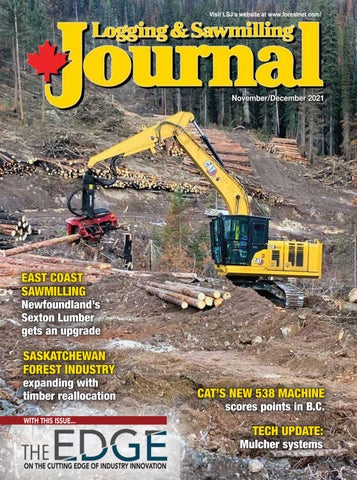
On the Cover: Logging company Tri Valley Construction Ltd., of Princeton, B.C., did not hesitate when they were approached by Cat and B.C. Cat dealer, Finning, about participating in a trial of the new Cat 538 machine—and the new machine has proven itself in B.C.’s Southern Interior. Tri Valley is also getting involved in more steep slope logging, with the purchase of Tractionline and Harvestline equipment from The Inland Group. (Cover photo courtesy of Tri Valley Construction).
4 Spotlight: Major
industry expansions in Saskatchewan
Subscription Enquiries (604) 990-9970 Fax: (705) 434-9052 E-mail: SubscribeLSJ@forestnet.com
Big things are happening in the forest industry in Saskatchewan, with a new timber allocation from the Saskatchewan government supporting growth of the industry, including a $100 million expansion of Dunkley Lumber’s Carrot River sawmill.
Design & Art Production Manager Sheila Ringdahl E-mail: artwork@forestnet.com Accounting Manager Shelina Jessa • (604) 731-1535 E-mail: accounting@forestnet.com Office P.O. Box 86670 North Vancouver, BC V7L 4L2 Phone: (604) 990-9970
8 Moving into steep
Website: www.forestnet.com Subscriptions: Canada $58 a year; two years $70; three years, $85. Group accounts, six or more subscriptions, $25 per subscription per year. Outside Canada, $95 per year. Airmail $165. Single copy, Canada $6; elsewhere $10. Reproduction prohibited without permission of the publisher. ISSN 0226-7572. Back copies from 1996 onward are available through our website www.forestnet.com Publications Mail Agreement No. 40064045 Return undeliverable Canadian addresses to CIRCULATION DEPT. PO Box 86670 Stn Main North Vancouver BC V7L 4L2 e-mail: SubscribeLSJ@forestnet.com POSTMASTER: Send US address changes to LSJ Publishing Ltd., PO Box 610, Edmonds, WA 98020-0610 Published November/December 2021 Printed in Canada on 20% recycled paper.
“We acknowledge the financial support of the Government of Canada” Logging & Sawmilling Journal is a member/associate member of the following industry organizations:
slope equipment
Tri Valley Construction has been working with some new logging equipment, having solid success with Cat’s new 538 machine, and the company is now springboarding into getting involved with steep slope logging equipment in B.C.’s Southern Interior.
14
Franklin Forest dives into different markets Franklin Forest Products turns out a variety of wood products—everything from wood for logging road bridges to diving boards—from its spectacular location on Vancouver Island’s Alberni Inlet, using an interesting combination of mill equipment.
18 Livestock—and
logging
Livestock still makes up a good portion of the business for B.C.’s Ootsa Lake Cattle Company, but it has also been doing more logging the last few years, including an interesting project for a community forest.
22 Turning out more lumber on The Rock
Newfoundland’s largest sawmill, Sexton Lumber, has seen some big increases in demand for lumber, and has incorporated a number of equipment changes to improve efficiencies.
28
Included in this edition of The Edge, Canada’s leading publication on research in the forest industry, are stories from the Canadian Wood Fibre Centre (CWFC) and FPInnovations.
30 Tech Update:
From power upgrades to safety improvements, read all about what’s new in mulcher systems in this issue’s Tech Update.
38 The Last Word
The partnership of Alberta sawmill Vanderwell Contractors—which will be supplying the raw material for a $35 million biofuel and hydrogen commercial demonstration project partnership—with a biofuel producer deserves praise, says Tony Kryzanowski.
DEPARTMENTS
Calendar...........................................6 Suppliernewsline............................34 Ad Index.........................................37 Classifieds......................................37 Subscriptions.................................37
Logging & Sawmilling Journal - November/December 2021
3
spotlight The pulp mill in Prince Albert, Saskatchewan (shown when it was operating in this photo)—formerly owned by Weyerhaeuser and now owned by Paper Excellence—has been sitting idle for 16 years. Paper Excellence will be spending $550 million to refurbish and upgrade the facility, which will restart in 2023.
Waking up
Saskatchewan’s forest industry Saskatchewan—the sleeping giant of the Canadian forest industry—has woken up big time, with over $1 billion in new capital investment sparked by a forest reallocation. By Tony Kryzanowski
S
askatchewan has always been a sleeping giant in terms of its contribution to the Canadian forest industry, despite its massive and mature—though seriously under-utilized—forest resource. But it seems that the giant has now finally awakened. In a flurry of press releases over the
4
span of a week recently, the province announced a reallocation of its forest resource primarily located north of Saskatoon that will result in significant forest industry investment. It includes a huge sawmill expansion by Dunkley Lumber in Carrot River, Carrier Forest Products ramping up production in Big River, a new oriented strandboard (OSB) plant for Prince Albert by new business venture, One Sky Forest Products, and the re-opening of the geographically iconic pulp mill located north of Prince Albert. The pulp mill—formerly owned by Weyerhaeuser and now owned by Paper Excellence—had been sitting idle for 16 years. All told, it will result in over $1 billion in new investment in Saskatchewan’s forest industry over the next two years. It’s worth noting that all of the investments being made in Saskatchewan are by companies headquartered in British Columbia. The devastation resulting from the mountain pine beetle infestation has severely reduced the merchantable wood basket in the B.C. Interior, forcing some companies to search elsewhere to survive and expand. Saskatchewan, with its under-utilized wood basket, is benefitting from that situation. Bronwyn Eyre, Saskatchewan Energy
and Resources Minister, says that these investments are part of the province’s ambitious Growth Plan to double the province’s forestry sector by 2030. Forestry is already a major contributor to the Saskatchewan economy as in 2020, forest companies working in the province generated $1.1 billion worth of products, which was an almost 30 per cent increase over the previous year. As a result of the re-allocation, Dunkley Lumber plans to spend $100 million to expand its Carrot River sawmill, which will increase lumber production capacity by 75 per cent from 130 million board feet to 230 million board feet of softwood lumber annually. To accomplish this expansion, the facility will require about 821,000 cubic metres of softwood per year. Strathnaver, B.C.-based Dunkley Lumber purchased the Carrot River sawmill, operating as Edgewood Forest Products, in 2019. The sawmill was originally constructed in 1976 and is the largest employer in this community located about two-hours northeast of Prince Albert. Rob Novak, Dunkley Lumber President, says that the sawmill is adding a second line and will increase production over five phases of development by the fall of 2023.
Logging & Sawmilling Journal - November/December 2021
spotlight Carrier Forest Products operates a sawmill in Big River, Saskatchewan, located between Meadow Lake and Prince Albert. The mill was constructed in 2002 and was purchased by Prince George, B.C.-based Carrier in 2011. “The increased allocation is the critical piece for us to reach full capacity,” says Bill Kordyban, Carrier Forest Products’ President. The date of January 3, 2006 will live in the memory of many Prince Albert and area residents as it was the day that Weyerhaeuser closed the pulp mill, leaving nearly 700 workers on the unemployment line. A tragedy for many, some viewed it as an opportunity to reallocate the massive Forest Management Area assigned to the pulp mill. Over the next 15 years, the province received considerable input from many northern Saskatchewan First Nations communities that they wanted direct involvement in any reallocation and expansion of the forestry sector since that huge forest resource exists right on their doorstep, on their traditional lands. They looked to the example set by the Meadow Lake Tribal Council with its ownership of two saw-
Carrier Forest Products operates a sawmill in Big River, Saskatchewan, located between Meadow Lake and Prince Albert, and it plans to up production with the additional timber allocation.
mills, a forest management enterprise and now a brand new, wood-based, bioenergy plant as a model to achieve the same level of steady employment and economic prosperity in their own communities. One Sky Forest Products Ltd has embraced that enthusiasm, stating that one objective of its $250 million investment
into a new OSB plant for Prince Albert is to have significant equity investment and ownership by indigenous communities. The company’s current partners are B.C.-based, Peak Renewables Ltd, local to page 6
New Opportunities in Saskatchewan’s Forestry Sector Discover Saskatchewan’s 12 million hectares of commercial forest, leading-edge technology and annual forest products sales of over $1 billion.
Logging & Sawmilling Journal - November/December 2021
5
spotlight from page 5 investors and 12 First Nations represented by Montreal Lake Business Ventures, Meadow Lake Tribal Council, Big River First Nation and Wahpeton Dakota Developments. At full capacity, the OSB plant will produce 600 million square feet of panel products on a 3/8ths inch basis, requiring about 845,000 cubic metres of wood fibre annually. Start up of the OSB plant is targeted for 2023 with construction beginning in fall 2022. Once operational, it is expected to provide about 700 jobs with many filled by First Nations individuals. “We are thrilled to be investing in a facility that will create added economic opportunities to Saskatchewan as it manufactures a durable product that is in demand locally, nationally and internationally,” says Cy Standing, Chair of Wahpeton Dakota Developments. Robert Fincati, CEO of Montreal Lake Business Ventures, added that the OSB facility will bring tremendous economic spinoffs to the community and will be a significant employer, not just for Montreal Lake, but for all indigenous communities in the area. They were very pleased with the allocation announcement, having been involved in the process for a number of years. When Peak Renewables purchased Canfor’s forest tenure and mill assets in northeastern B.C. in late 2020, it included the mothballed PolarBoard OSB plant in Fort Nelson, which has sat idle since
2008. The sale was approved by the province in August 2021. Peak Renewables plans to build a wood pellet plant at the Fort Nelson site instead, leaving the OSB production equipment surplus. David Nikolejsin, Vice President of Corporate Development at the Brian Fehr Group, which owns Peak Renewables, confirmed that the PolarBoard equipment is ‘penciled in’ for use in the Prince Albert OSB plant, adding that the presses are still modern and that all the equipment will undergo refurbishment as part of the Prince Albert construction project. However, that plan could change as the Group has plans for a number of OSB plants and should an opportunity arise where the PolarBoard equipment is better suited elsewhere, then the Prince Albert plant will be outfitted with new equipment. The final, and some might argue most important, piece of the forest reallocation puzzle was the much-anticipated announcement by Paper Excellence that it will indeed re-open the Prince Albert pulp mill. B.C.-based Paper Excellence is spending $550 million to refurbish and upgrade the facility. It will require 1.8 million cubic metres of softwood fibre annually to produce 350,000 tonnes of Northern Bleached Softwood Kraft (NBSK) pulp. The province anticipates that 1,650 direct and indirect jobs will be created by this one re-opening alone. The pulp mill is slated for restart in 2023. Paper Excellence owns 10 pulp mills in Canada, included two in Saskatchewan.
There is a lot of wisdom behind Saskatchewan’s forest reallocation. By approving a new OSB plant, encouraging the reopening of the pulp mill, and making expansion and greater efficiency possible at two of the province’s largest sawmills, softwood lumber producers will now have a local market for their wood chips. Also, both softwood and hardwood resources will be harvested, resulting in better forest management as well as greater logging efficiency. Suffice to say that not only will new jobs be created at these wood processing plants, but also in logging, trucking and all the services needed to support a vibrant forestry sector. A big economic boom is about to occur north of Saskatoon.
CALENDAR
*Please note changes/cancellations due to the COVID virus. Also, please check with the organization staging the event for up-to-date details. January 12-14, 2022 Truck Loggers Assoc. Convention and Trade Show, Vancouver, B.C., www.tla.ca/convention February 24-26, 2022 Oregon Logging Conference, Eugene, Oregon www.oregonloggingconference.com April 27-29, 2022 Council of Forest Industries of B.C. (COFI) Annual Conv., Vancouver, B.C., www.cofi.org
B.C.’s Truck Loggers show is back—and standing strong
T
he forest industry, like the roots of B.C.’s trees, is firmly planted in British Columbia’s economy and communities—and a big part of the coastal side of the forest industry will be back together in early-2022, with the return of the Truck Loggers Association (TLA) convention, from Jan. 12 to 14, at the Westin Bayshore in Vancouver. The TLA notes that its membership and supporters, like B.C.’s trees, are resilient and standing strong against its many challenges. A pillar of B.C.’s economy supporting small rural communities and its largest cities, forestry is here to stay. This year’s TLA convention, themed “Firmly Planted. Standing Strong”, brings the forestry sector together to delve into the issues and policies that will significantly impact its growth for generations to come. 6
Issue number one at the convention is likely to be the B.C. NDP government’s announcement that it plans to move forward with some 2.6 million hectares of logging deferrals, while developing a new forest management approach. Thousands of logging, sawmill and pulp and paper mill jobs may be lost in B.C., if the old growth being made off-limits to logging through temporary deferrals become permanent, warn forestry sector industry groups, including the TLA. In terms of the nuts and bolts of the convention, the Truck Loggers will feature a wide variety of presentations, from the latest logging equipment and technologies, to safety in the woods, and how the industry can attract and keep employees through recruitment and retention strategies, including training and wellness.
As with past Truck Logger shows, the industry, and the companies involved in supplying it, from processing heads to fuel companies, will all be represented at the trade show component of the show, with displays. Further information on the TLA convention is available at www.tla.ca.
Logging & Sawmilling Journal - November/December 2021
E H T D N O BEY
E N I H C MA te a r e l o t t o n n a c We r downtime, eve
erial, we volume of mat nnot d an rd ya r ou ca real time. We all footprint of Due to the sm but to process material in gave me confidence have no choice me, ever. [SENNEBOGEN] into the US market t ti tolerate down gnificant capital investmen e long run. th si r r fo ei d mitte because… th land CA s they’re com te ra st on ales, Inc., Oak m S de ap cr S y llo om A ter, CEO, Cust Edward Kange warehouse in .ft. ’s 100,000 sq within SENNEBOGEN ains a 98% order-fill rate nt tly in ai en m rr C hine cu Stanley, N rt for any mac pa y an r fo s 24 hour th America. service in Nor
orth Carolina ts • Stanley, N ar P N E G O B SENNE
SENNEBOGEN is committed to leading the industry in aftersale support throughout the life of our equipment. We’re thinking “beyond the machine” to deliver dependable uptime and lower Total Cost of Ownership (TCO) for every customer.
Parts • Service • Training • Application Specialists • Flexible Financing • Attachments Learn more about our commitment to our customers
sennebogen-na.com/beyond-the-machine
+1-704-347-4910
sennebogen-na.com
STEEP SLOPES contractorprofile
Moving into
Tri Valley Construction has been working with some new logging equipment, having solid success with Cat’s new 538 machine, and the company is now springboarding into getting involved with steep slope logging equipment in B.C.’s Southern Interior. By Paul MacDonald
T
One of the main features that contractor Logan McKenzie and his operators noticed right away on the Cat 538 was the increased visibility and space in the cab. Operators now have extra room in the cab, which makes a big difference over the course of a 12-hour work day. 8
he improvements on new logging equipment are certainly welcome by equipment operators and logging contractors, but sometimes they are not exactly revolutionary. The term tweaking might come to mind. But once in a while, equipment manufacturers are able to deliver big time on improvements—and Cat’s Next Generation 538 Forest Machine seems to be a case in point. Logging company Tri Valley Construction Ltd., of Princeton, B.C., did not hesitate when they were approached by Cat and B.C. Cat dealer, Finning, about participating in a trial of the new 538 machine. Tri Valley has been a long time customer of Cat and Finning, explained Logan McKenzie, who is now the third generation family member to run Tri Valley, which logs in the Similkameen Valley region of southern B.C. “We’ve always had a good working relationship with Finning and Cat,” says McKenzie. That relationship extends to his father, Kim, and even his grandfather, Leslie McKenzie, who established Tri Valley Construction in the 1960s, with two partners. The 538 machine was pretty much ready to plug-and-play for Tri Valley
Logging & Sawmilling Journal - November/December 2021
contractorprofile
Tri Valley started to get into steep slope tethered logging late this fall, and they are currently working on incorporating the new steep slope equipment into the operation. For their steep slope work, they have both Tractionline (pictured above in a stock photo supplied by Technical Forest Solutions) and Harvestline systems. when it was brought to the nearby Finning branch in Kamloops last August. At McKenzie’s request, it was equipped with a Waratah 622C head, a processing head Tri Valley is very familiar with. One of the main features that McKenzie and operators noticed right away on the 538 was the increased visibility and space in the cab. “It has lots of room in the cab—it’s a night and day difference from other forestry machines,” says McKenzie. “It is very operator friendly. One of our operators was saying he’s now excited to come in to work. “Operators have long days in the machines, so anything the equipment manufacturers can do make a difference,” added McKenzie. “The guys now have extra room in the cab and can stretch out—that all makes a difference over the course of a 12-hour day.” A larger, 1.25-in polycarbonate front window improves visibility and operating safety on the 538. Smaller cab pillars with the large panoramic windows and recessed on the right front of the machine contribute to a 50 per cent visibility improvement over the previous model. Two different cab risers—6.5-in. fixed or 48-in. hydraulic tilt—are also available to help operators better see the jobsite. Video feed from the standard rearview camera is easily visible on the highresolution monitor to enhance operating safety; an optional sideview camera improves visibility even more. The new configurations give operators much more visibility when they are processing timber, says McKenzie.
The all-new Certified Forestry cab design for the 538 dramatically improves operator comfort and safety, says Cat. The cab is 25 per cent larger with 50 per cent greater overall visibility than the previous 538 machine. Plus, it has a heated seat and a more ergonomically friendly layout, so the operator doesn’t have to exert much effort to be efficient and productive. Cab entry/exit is easier due to the cab’s wider and taller door and tilt-up console on the operator’s seat. The machine’s new dual HVAC system keeps operators comfortable regardless of working in the summer heat or during subfreezing ambient winter temperatures—a helpful feature in the extreme temperatures Tri Valley can see in the B.C. Interior. Its specially insulated roof and improved window and door seals keep in-cab noise levels low.
Their experience with the 538 has been big-time positive, says McKenzie. “We’ve had zero oil leaks, no maintenance issues, and it has given us huge fuel savings—the machine has been performing flawlessly.” While the new 538 has certainly received top marks from the Tri Valley folks, every new piece of equipment requires some tweaking. McKenzie said they are glad to be part of the evaluation process, and being able to pass on their comments to Cat and Finning. One of the minor changes done to the machine at the dealership branch in Kamloops was improving the grab handles in the cab, for easier operator access. “They were on that, right away,” McKenzie said. Available in Log Loader and General
Logging & Sawmilling Journal - November/December 2021
to page 10
9
contractorprofile from page 9 Forest configurations, the 538 has a new electrohydraulic control system with 10 per cent more swing torque that allows the machine to do work with more power and precision. Updates to the drive system result in a 12 per cent increase in travel speed, helping the 538 cover more ground and move up and down slopes faster, says Cat. A high wide undercarriage provides 15 per cent greater ground clearance to help the machine pass over stumps and other obstructions with ease. McKenzie said the longer track frame on the 538 also improves its stability. “It doesn’t bounce around, like some other machines.” The 538 features an efficient Cat 7.1 engine delivering 174 hp that meets U.S. EPA Tier 4 Final and EU Stage V emission standards and is flexible to run on biodiesel up to B20. Smart mode automatically matches engine and hydraulic power to working conditions to help reduce fuel consumption up to five per cent without sacrificing performance. The fuel tank on the rear of the machine adds to its stability, and that tank is much larger, at 990 litres. “We haven’t really run it out to see how long it can actually go,” says McKenzie. “In the fall, we can get condensation issues if the fuel tank runs too low, so we just top it up every day. But we figure it could easily go two days, maybe three days, if you pushed it.”
Compared to the previous model, the Next Generation 538 lowers maintenance costs by up to 15 per cent over the course of 12,000 hours of operation, says Cat. Cat improved the filters and service intervals, and ground-level access to service points to make daily maintenance quick and safe, including a new groundlevel dipstick for checking the engine oil. A new electrohydraulic control system
navigation through operating menus and includes a digital version of the operator’s manual for quick reference. Cat’s Product Link technology captures critical operating data, fault codes, and machine location information to boost fleet management efficiency. The Next Generation 538 has Remote Troubleshoot capability when within cell coverage. Remote Troubleshoot analyzes real-time machine data captured by Product Link for diagnostics of fault codes without impacting machine productivity, and it can potentially save a service trip to the jobsite. Also, owners can be sure the 538 is operating with the most current version of software with standard Remote Flash (dependent on cell service), which updates machine software around the production schedule. Including the work they do during fire season, McKenzie works to keep his employees, and equipment, busy, with shorter time off during break-up. Many of his employees started working with his Dad, Kim McKenzie. Logan purchased the company from his Dad in June 2017, just before the area got hit by the Knudsen wild fire. “I had just bought the company, and with the fire, it was, ‘Well, here we go’—we were down for two months. But my Dad helped us out through that.” Since then, Kim has been happily retired. This past summer saw the new 538 and a lot more of the Tri Valley gear pressed into service for fighting wildfires around the region. Things change pretty quickly for loggers like Tri Valley when wildfires flare up. “Everything kind of shifts,” explains McKenzie. “The fires can start small and we try to stay ahead of them so they don’t become monsters.” When a fire breaks, they can be out there pretty much around the clock, trying to get a fire surrounded and putting fire breaks in. “We can go from running five days a week logging, to seven days a week, for a straight 14 days, full on, fighting wildfires. “It was a busy season—there were a lot of interface fires.” Tri Valley does all its logging for the Weyerhaeuser sawmill in Princeton, so they are operating on Weyerhaeuser’s tenured lands. The Forest Service oversees the firefighting, passing on direction to
Tri Valley Construction’s experience with the Cat 538 has been big-time positive, says company owner Logan McKenzie. “The machine has been performing flawlessly.” eliminates the need for a pilot filter and pilot oil altogether. The improved filters and synchronized replacement intervals result in greater uptime and 50 fewer filters being consumed over 12,000 hours, says Cat. Fuel filters feature a synchronized 1,000-hour change interval, which doubles the service life of the previous model. A new hydraulic oil return filter improves filtration and delivers a 3,000-hour service life, which is 50 per cent longer than previous designs. Operators can start the 538’s engine with a simple push of a button. The new Operator ID allows each operator to quickly program and store their own machine settings and attachment function preferences. A larger 10-in. high-resolution touchscreen monitor delivers intuitive
to page 12 10
Logging & Sawmilling Journal - November/December 2021
A CUT ABOVE
The Next Generation Cat 538 ®
Move more timber, make more money with superior performance and unmatched operator comfort. Performance in forestry work is delivered by the Cat 538 Forest Machine. Offering increased swing torque, a powerful yet fuel efficient engine and high-performance hydraulics, the 538 excels at the needs of your forestry processing needs. Available models optimize the machines for general forestry work, or for log loading.
UP TO
UP TO
10%
50%
15%
MORE PRODUCTIVITY
LOWER MAINTENANCE COST
The Certified Forestry cab gives you 25% more
Do more work with increased swing torque,
Save money and time using less oil and better
room with 50% greater visibility.
higher ground clearance, and faster travel speed.
filters with extended service intervals.
GREATER VISIBILITY
1-888-Finning
Finning.com Logging & Sawmilling Journal - November/December 2021
11
contractorprofile from page 10 Weyerhaeuser, which in turns, passes on direction to Tri Valley. “Most of the time, we are logging for Weyerhaeuser—we don’t venture too far away—there is enough in the wood basket to keep us busy,” says McKenzie. If they are not working on fighting fires, they shift operations during fire season, to keep crews busy, operating from 9 at night to 9 a.m. “It keeps people busy, but it’s tough on the guys—it throws your whole schedule out of whack.” Now that fire season is behind them, further challenges lie ahead for Tri Valley, as they started to get into steep slope tethered logging this fall. McKenzie is currently working on incorporating the new steep slope equipment into the operation. Steep slope logging equipment is not entirely new to the company, as Logan’s Dad used to operate a high lead side at one point. For their steep slope work, they have a Tractionline they put on a Cat 336E which will be attached to a Tigercat LX830E. They also have a Harvestline that is on a Tigercat 875 log loader, with a Cat 325d back spar. The Inland Group is the exclusive dealer in B.C. for Tractionline and Harvestline, and sold the Tractionline and Harvestline equipment to Tri Valley. In addition to conventional logging equipment, The Inland Group is now a full service steep slope harvesting dealer in B.C., and provides the base machines, tether machines and the winch platforms (Tractionline and or Harvestline). In effect, the entire steep slope package can be purchased through Inland. “It’s a big step, but we’re excited about it,” says McKenzie, who is feeling confident about the Tractionline and Harvestline equipment, and that it will deliver for
them in the steep ground work. “We already do a lot of steep ground on Weyerhaeuser’s tenured land now, and if they get timber sales, and it’s got steeper ground, we usually end up doing that, too.” The steep ground work will be a particularly good fit for the Tigercat 635G skidder they purchased a few years’ back. “The 635 is a great machine, especially with our ground getting tougher and steeper—and we have to skid longer. The 635 has helped us in so many aspects of our operations—it’s hard to picture us working without it now.” Handling the Tigercat sales and support for Tri Valley, and for B.C., is the Inland Group. Like most areas of B.C., the wood basket is tight in the Similkameen Valley region, so going for steep slope equipment will help position Tri Valley for the steep ground that is here now—and what is to come. The company has come a long way since Leslie McKenzie set it up in the 1960s. Back then, he had around 44 guys working, mostly to harvest for Weyerhaeuser Princeton. These days, Logan does between 160,000 and 180,000 cubic metres a year. They also have three roadbuilding sides, building anywhere from 60 to 70 kilometres of road for Weyerhaeuser Princeton. This year, though, they had 97 kilometres of road. “We keep pretty busy—we’re doing more volume with less guys than my grandfather had thanks to all the equipment we have now,” he says. McKenzie says they have been hit a bit by supply chain issues due to COVID-19, but not in a major way. The delivery of the Tractionline was a bit later, but that worked out ok. “A lot of the steep ground we were going to start on was affected by
Updates to the drive system on the Cat 538 result in a 12 per cent increase in travel speed, helping the 538 cover more ground and move up and down slopes faster, says Cat. A high wide undercarriage provides 15 per cent greater ground clearance to help the machine pass over stumps and other obstructions with ease. 12
fires, so where we are going to be working needed to get re-laid out,” he explained. There are long lead times for ordering new equipment, and used equipment is in short supply. Anything that is in good shape disappears really quickly these days—at top dollar, he says. In terms of operations being affected by COVID, they are running a few more pick-up trucks (pickups are also tough to get these days). For the most part, though there have been the occasional flare-up, Princeton and this region of B.C., has not seen a lot of COVID cases, thankfully. “We are pretty isolated here—and our work is pretty isolated, working out in the bush.” McKenzie was working on bringing in some new people in the bush, to operate the new steep slope equipment. While there is very little turnover at Tri Valley, they still have a few operators that are nearing retirement age, and replacing them could be a challenge. A big advantage is the company’s location in Princeton, three hours west of Vancouver, along the Crowsnest Highway. The town is just east of the Cascade Mountains, and offers great outdoors adventures to anyone living there—the office/shop for Tri Valley, for example, is just steps from the Similkameen River. While Tri Valley’s mid-sized shop is on the outskirts of Princeton, most of their work is done by a local mechanic, on contract with Cat dealer, Finning. McKenzie is trying to get his Tigercat equipment on a service contract, too, especially since he is adding a couple of Tigercat machines. “We’ve got a lot going on, so it’s good to have a service contract—and that way, we don’t have the overhead, stocking all the parts, and having a service truck. It’s worked out pretty good.” With close to two dozen pieces of equipment, their shop and yard would be pretty crowded if a lot of it came in for maintenance during break-up. It’s certainly a lot different equipment set-up than when his grandfather started the business. Logan himself started getting involved in the business some 25 years ago, when he started running skidder and working in the shop. But he started coming into work with this Dad when he was eight-years-old. “I loved logging right from the start,” he says. And no doubt his grandfather, who retired in 1991, and passed away in 2018, would be proud that Logan is still carrying on the family logging business, and tradition.
Logging & Sawmilling Journal - November/December 2021
BCsawmilling
Franklin Forest dives into different markets
Franklin Forest Products has turned out a variety of wood products— everything from wood for logging road bridges to diving boards—from its spectacular location on Vancouver Island’s Alberni Inlet, using a combination of mill equipment. By Paul MacDonald
W
hen you call up Franklin Forest Products, a specialty sawmiller near Port Alberni, on B.C.’s Vancouver Island, you’re likely to get the on-site sales department—who also happens to be mill manager Mike McKay. The mid-sized sawmill at the end of 16 miles of gravel road, and fronting on the spectacular Alberni Inlet, has been turning out lumber for close to 30 years, meeting the needs of local and regional markets. Its founding dates back to when industry giant MacMillan Bloedel dominated the forest industry on Vancouver Island and the B.C. Coast. The company was set up by Mike’s dad, Pat McKay, who was running shingle mills and logging operations, and saw the opportunity to set up a sawmill near Port Alberni, using timber that was freed up from the closure of MacMillan Bloedel’s
14
Logging & Sawmilling Journal - November/December 2021
BCsawmilling
Somass “A” mill, back in the early 1990s. Pat set up the company with Gary Reed, a very talented sawmiller who was involved with Stag Timber. Mike joined the company in 1993, after graduating from UBC’s forestry school. The operations of Franklin Forest Products have evolved over the years, Mike notes. Initially, they purchased some basic mill operations on the site from sawmiller Chuck Green. “When we bought it from Chuck, there was no concrete or pavement on the site—it was just dirt and mud.” Mike and Pat blew some rock off the site, and put in a dryland sort. “We also originally had a shingle mill on site,” recalls Mike. “But the larger operations started cutting shingle logs, so we started to focus on cutting utility and pulp logs, with western red cedar being the main diet for the first 15 or so years.” Mostly they’ve cut four species: Douglas fir, red cedar, yellow cedar and hem/ bal. Six species if you include Sitka spruce and western white pine, which they’ve cut from time to time.
Mid-sized sawmill operation Franklin Forest Products, which sits at the end of 16 miles of gravel road and fronts on the spectacular Alberni Inlet on Vancouver Island, has been turning out lumber for close to 30 years, meeting the needs of local and regional markets.
to page 16 Logging & Sawmilling Journal - November/December 2021
15
BCsawmilling from page 15 Their dryland sort has been an advantage for Franklin Forest, both in terms of sorting for their own purposes, and doing contract sorting for some of the major forest companies operating on the coast. In terms of the sawmill itself, Mike says there is only one roll case left over from the original mill operation that Chuck Green built in the early-1980s. “We gutted the whole mill,” he says. “We basically reconfigured the old mill, putting in a different head rig, a different edger, through the 1990s and the early 2000s.” Their mill equipment is a combination of used equipment from various B.C. sawmill operations from the Coast and the Interior. The mill also has a boneyard that they have regularly accessed to add on to the existing mill set-up, as needed. And there is some new equipment, as well. ATS Automation is a go-to supplier of controls systems for Franklin Forest Products. This year, ATS have upgraded the headrig setworks controls and supplied the PLC controls on the mill’s new Wood-Mizer small log twin-band saw line. The mill is served by a 4.5 kw power line built to the site, from the Bamfield mainline. Franklin Forest Products has turned out wood products for oyster farms, railway bridges and, a few years’ back, manufactured some diving boards out of Douglas fir for local cottagers. Mike added that they very much appreciate the local support they receive, both in terms of buying the company’s wood products, and from local suppliers. Like all of the industry, Franklin Forest went through some lean times around 2008/2009, and the understanding and support they received from local companies were key to their survival. Relationships with major licencees, First Nations and Vancouver Island and Lower Mainland independent logging, sawmill and reman companies are crucial and invaluable to Franklin Forest Products, says Mike. Mike added that he is also fortunate in that he has a solid crew turning out all their products, and handling the dryland sort. “Overall, I’ve been able to keep a core group of people for almost two decades,” he says. “We’ve got a versatile bunch of guys, from the log yard right through to the lumber yard. And our maintenance guys are talented people who will do electrical and hydraulic work, right through 16
As a specialty sawmiller, Franklin Forest Products takes great pride in turning out a large variety of wood products. They’ve manufactured wood products for oyster farms, railway bridges and, a few years’ back, made some diving boards out of Douglas fir for local cottagers. to welding and millwrighting.” He says having those skills in-house is important, and helps them avoid the costs of calling in service people. They have two shops on the mill site that look after the mill and the dryland sort equipment needs. “There is very little work that we farm out,” Mike says. In terms of their mobile equipment, Komatsu wheel loaders have been used on the sort for quite a while. “We had some old Michigan’s back in the day, but they have gone to sawmill heaven,” jokes Mike. “We really like the Komatsu loaders. The log deck is long and narrow, so there is a lot of turning into piles when we are decking wood, so we want something that can get around easily.” They also use the loaders to pick up cants for re-entry into the mill. They have Cat forklifts, and two Bobcats equipped with log grapples for moving smaller wood around, and debris clean-up. Safety is a big focus for Franklin Forest. “I take pride in our operation being a safe workplace,” says Mike. He notes that the work around the mill is pretty physical. “There is not a lot of high tech equipment—it takes a lot of sweat to move wood out the door.” In addition to making sure his employ-
ees have good, safe working conditions, Mike says a focus for the company is plain and simple: “It’s finding wood.” He added that it’s become important for them to communicate with customers that the mill is now dealing with a changing log mix, and to manage expectations on what customers are going to get with the finished product. “The end product can change because the type of log we are working with has changed, and will continue to change,” he says. “Flexibility is key.” From wood supply to the sawmill, Mike says that having gone to UBC’s forestry school prepared him well for managing Franklin Forest. “I trained originally as an RPF, but went more into the marketing side, and have a resource management degree. I also got my lumber grading and log scaling tickets.” And, like his father, west coast wood seems to run through his veins. “I like the business and I like the people I work with—and everything about working with wood is good, no matter the age of the timber or its size.” And they have some spectacular west coast wood to work with. And a spectacular place to work at, on Vancouver Island’s Alberni Inlet.
Logging & Sawmilling Journal - November/December 2021
NE
W
High-speed log merchandiser Transverse and lineal orientations USNR now offers a fully integrated Merchandiser solution to maximize the value and volume recovery from each stem. Our experience with technology for integrating mechanical, PLC controls, and optimizing the bucking process is second to none. The Merchandiser system is offered in transverse and lineal configurations using our renowned LASAR2 and BioLuma scanning and optimization solutions. USNR provides everything you need to build an impressive and productive operation, including the infeed conveyor, timber kickers, timber pusher, inclined lug chain conveyor, traveling saw carriages, and outfeed belt conveyor. It all adds up to an unbeatable system for diverse applications. Contact us to learn more!
Millwide. Worldwide.
+1.360.225.8267
usnr.com
BClogging
LIVESTOCK
—and logging Livestock still makes up a good portion of the business for B.C.’s Ootsa Lake Cattle Company, but it has also been doing more logging the last few years, including an interesting project for a community forest. By Jim Stirling
T
Family-owned Ootsa Lake Cattle Company Ltd is the logging contractor for the Chinook Community Forest rehab project, in the B.C. Interior. Pictured above is Ken Nielsen of the Chinook Community Forest and Jen Hill, contract forester from Free Growing Forestry Ltd. 18
he Chicken Creek Hill Project is helping a forest begin to heal. The two-year rehabilitation exercise is the initial step in a co-operative venture designed to restore health to a small section of the Chinook Community Forest following a devastating 2018 wildfire. More than 10,000 hectares of the community forest land was damaged in the wild fire southwest of Burns Lake in central British Columbia. But the Forest Enhancement Society of B.C. (FESBC) came to the rescue. The organization provided $800,000 to help restore about 300 hectares of the worst fire damage and stimulate regeneration of a healthy new forest (see sidebar story). Log harvesting and salvage operations in an area after a wildfire has run its course is always a challenging assignment. “Probably the main challenge for us was the blowdown,” recalled Charles Priest. “Fifty to 70 per cent of the area was hit by blowdown.” Priest’s family-owned Ootsa Lake Cattle Company Ltd., is the logging contractor for the Chinook Community forest (see sidebar story on page 20). “It was a bit of a learning experience
Logging & Sawmilling Journal - November/December 2021
BClogging for us, too, in that we hadn’t logged an area hit by wildfire before,” added Priest. Routine chores like keeping air filters clean under normal conditions take on different dimensions in burned wood. “Another challenge is that burned wood is very abrasive.” It can affect the efficient functioning of everything from bunchers to processors. On the plus side, Ootsa Lake’s harvesting crews worked on its initial 106 hectares of site reclamation work under winter conditions. Priest said in summer months there’s more moisture in the air and the black dust and grit from the burned wood is more intrusive. Ootsa Lake’s crews have a further 175 hectares of treatment to go with the Chicken Creek Hill Project in 2021-22. The year was 1919 when Priest’s great grandfather, Loren, ventured into the Ootsa Lake country from Alberta. “I guess he thought there were too many people there and he was looking for another frontier,” explained Priest. He must have found what he was seeking. Ootsa Lake was well off the beaten track. It wasn’t until the late 1940s and 1950s that more outsiders arrived in the region to work on the massive Alcan smelter construction project on tidewater at Kitimat. The work involved building dams to create hydroelectric power. The resultant flooding forever changed the geography of the lands surrounding Ootsa Lake. As the name suggests, raising livestock was the core business for the Ootsa Lake Cattle Company. “But in the last few years, the logging side of the business has been steadily growing. It’s now about
Log harvesting and salvage operations in an area after a wildfire has run its course is always a challenging assignment. Preparation of the burned logs for loading and hauling of low value fibre at the Chinook Community Forest (above). 50/50,” reckons Priest. The work is being generated through regional forest companies like West Fraser and Babine Forest Products and by timber sales, community forests, woodlots and private wood holdings. The Ootsa Lake Cattle Company’s old line skidder and chain saws have long given way to a mechanical logging fleet that keeps its crews busy year around, continued Priest. Heading the line-up for the Chicken Creek project were two Tigercat feller bunchers, an 860 and 870 C. The older machine, the 860, had more than 23,000 hours on the clock and while the machine has had major components replaced, Priest says it speaks volumes
about Tigercat equipment’s reliability. Also working on the community forest reclamation job was a John Deere 748H skidder, a Madill 2800 butt ‘n top for decking and a Deere 2154 log loader. There was also a Deere 850G dozer for block road building. The logging machines were constantly working in challenging operating conditions as well as contending with burned wood and the abundant blowdown. “It’s fairly rugged country, hilly with rocky outcroppings,” described Priest. But rewards were available. “About 50 per cent of the to page 21
Forest fires in the Burns Lake area of B.C., and in the Chinook Community Forest, took their toll on the forests—and on heavy equipment (right). Logging & Sawmilling Journal - November/December 2021
19
BClogging
More than 10,000 hectares of Chinook Community Forest land was damaged in a wildfire southwest of Burns Lake in central British Columbia, in 2018. A two-year rehabilitation exercise is the initial step in a co-operative venture designed to restore health to a small section of the community forest.
RELIABLE HEAT. WHERE YOU NEED IT. GARAGE
GREENHOUSE
Outdoor Wood Furnace
T
Heat Your Entire Home And More
WORKSHOP
on qualified models & installation
BARN
There is no better way to heat with wood.
• Most efficient - Classic Edge HDX 360, 560 and 760 have the highest efficiency of EPA-certified stick wood burning appliances. • Easiest to operate - Industry-exclusive FireStar® controller takes all the worry and guesswork out of wood heating. Works with any heating system and any firewood. • Easiest to maintain - Fast, easy maintenance thanks to see-through full-access design and patented Easy View® Heat Exchanger with hinged door. Learn more and find a dealer at CentralBoiler.com *US Only. US Internal Revenue Code Sec. 25(D) effective Jan. 1, 2021, for heating a residence. For more details visit CentralBoiler.com. Information provided here as a convenience and may not be relied upon as substitute for professional tax advice. Consult a tax professional with any questions. ©2021 Central Boiler • ad7760
20
Chicken Creek Hill rehab project in B.C. helping to launch new forest he Chicken Creek Hill Project, designed to restore health to a small section of the Chinook Community Forest in B.C., was launched as part of a long term rehabilitation project in the wake of a 2018 forest fire. “The project was initially supported as it aligns with three of the five Forest Enhancement Society of B.C. (FESBC) purposes,” stated Gord Pratt, FESBC’s operations manager. These include improving damaged or low value forests through rehabilitation. FESBC funds are assisting in the harvest of uneconomic burned timber and supporting the enhanced use of wood waste from damaged and low value forests. FESBC also supports the utilization of non-sawlog material instead of burning it, reducing the carbon emissions that would have been created, and treating forests to improve the management of greenhouses gases and help fight climate change. The rehabilitation treatment allows Chinook to replant the area, contributing to an increase in carbon sequestration. “In addition, we feel this project will also meet one more of our purposes as the treatments will improve habitat for wildlife by accelerating the return of the new forest after the fire,” continued Pratt. “The project was also a priority for FESBC as it supports the rehabilitation of an area-based licence held primarily by First Nations.”
Logging & Sawmilling Journal - November/December 2021
BClogging from page 19 logs we harvested were of saw log quality.” Even logs lying on the ground hadn’t been there long enough in most cases to contribute to quality changes. The West Fraser sawmill in Fraser Lake was a major beneficiary of the Chinook Community Forests’ logs. One of the features of the community forest’s project was its goal of spreading the fibre utilization benefits around regional businesses. “We’re fortunate to have local markets,” explained Ken Nielsen, general manager for the Chinook Community Forest, based in Burns Lake. For instance, some of the burned wood salvaged by Ootsa Lake Cattle Company crews was diverted to Decker Lake Forest Products, a local specialty wood product manufacturer, and to Pinnacle Renewable Energy, which operates a wood pellet manufacturing plant near Burns Lake. Other burned wood volumes salvaged in the Chicken Creek Hill Project were delivered to a small local fence manufacturer. Other regional companies assisted with the project including pre-logging forestry work, local truckers transported the logs harvested to end users and regional First Nation silvicultural workers are scheduled to replant the treated areas. Interestingly, the Chinook Community Forest itself had a baptism by fire. After a tragic sawmill fire in 2012 destroyed sections of the original Babine Forest Products operation east of Burns Lake, its owners were concerned about sufficient fibre availability to support and sustain a rebuild, said Nielsen. The Chinook Community Forest was created to demonstrate a regional timber supply was available. The Chinook Community Forest has an ownership structure comprised of six First Nations and two municipal governments: The Burns Lake Band; Cheslatta Carrier Nation; Lake Babine Nation; Nee Tahi Buhn Indian Band; Skin Tyee Band and Wet’suwet’en First Nation are joined by the Village of Burns Lake and the regional District of Bulkley Nechako (areas B and E). The four charter areas represented by Chinook’s ownership surround Burns Lake, continued Nielsen. The Chicken Creek Hill Project was in an area influenced by three significant forest fires near the Keefes Landing road connecting Francois and Ootsa lakes. “The project allows us to utilize fibre and while it will take time put the forest back in place for people and animals,” concluded Nielsen.
FORESTRY MACHINERY FOR ALL NEEDS – FROM LIGHT THINNING TO HEAVY FINAL FELLING
+
SPACIOUS & LUXURY COMFORT CABS EXTENDED SERVICE INTERVALS SERVICE FRIENDLY – EASY ACCESS PERMEATS OUR MACHINES LOW GROUND PRESSURE FLEXIBLE MACHINES WITH MANY STANDARD OPTIONS
We offer Swedish-made products of the highest quality and the latest technology, and a competent and friendly atmosphere. We pay close attention to the operator’s working environment. Our spacious cabs offer extremely good visibility providing a fantastic work environment. Moreover, our cabs are really quiet – in fact quieter than in a new car. With the cab damping system Comfort Line we give you world class luxury comfort!
WWW.ROTTNE.COM
Logging & Sawmilling Journal - November/December 2021
296 Killam Drive, Moncton NB
506-382-0323
21
EMPLOYEES and EQUIPMENT: Key ingredients to a successful mill Newfoundlandsawmilling
Sexton Lumber owners Kevin and Susan Sexton have a successful business approach, making solid investments in equipment—but they also know their employees are key to the company’s success, and recently acknowledged that with special cash bonuses. By George Fullerton Sexton Lumber is very focused on production. Its annual lumber production currently stands at 85 to 90 million board feet, with the goal to produce 100 million board feet.
22
K
evin Sexton grew up in the lumber business, working in his father George’s sawmill in Bloomfield, Newfoundland. The Sexton mill sawed purchased logs as well as cants from smaller mills, and marketed lumber throughout Newfoundland and Labrador (NL). Kevin and his wife Susan established their own wood processing business in Bloomfield, debarking and chipping pulpwood, and trucking the chips to the Abitibi newsprint mill at Grand Falls, and Corner Brook Pulp and Paper (Kruger). When George announced his retirement in 1996, Kevin and Susan made the decision to take over the sawmill business and went looking for a more modern mill which would provide higher production and complement their pulp chip business. “I’m good at finding used equipment and making it work,” says Kevin. “We found a Kockums Cancar chipping saw in Montana, and brought it home and set it up. “It was a struggle,” he added. “It was designed for big logs and we only have small logs, so it was not really very productive.” The balsam fir and spruce they work with typically generate two eight- or ninefoot stud logs and an eight-foot pulpwood bolt. “I was looking around for equipment which would process our small logs efficiently, and I kept looking over the HewSaw, but it was out of our budget. But eventually we were convinced that was the direction we had to go if we were
Logging & Sawmilling Journal - November/December 2021
Newfoundlandsawmilling going to stay in the sawmilling business,” explained Kevin. “It was a real stretch for us, to invest in a million-dollar mill when you are walking around with just twenty bucks in your pocket, but we made an investment in the HewSaw in 2000, and built infeed and downstream with used equipment.” Regarding his propensity to gather up used milling equipment, Kevin made note that the current mill continues to operate with salvaged step feeders he bought for $1,200 each. Kevin shared that they have had great performance with the first HewSaw, and have since added two more HewSaws (2012 and 2019) to their operation. “We are focused on production, and you have to have the best and most upto-date technology in order to stay competitive,” stated Kevin. Sexton Lumber’s annual production currently stands at 85 to 90 million board feet, with the goal to produce 100 million board feet. “As we brought the third HewSaw on line, we developed bottlenecks downstream in the mill. We are working to smooth out those bottlenecks and work
toward that 100-million board feet goal.” In the yard, eight- and nine-foot logs are loaded to infeed decks by two Cat 325 and two Liebherr LH50 wheeled log loaders. Logs feed to three 18-inch VK debarkers, and are scanned with Prologic
and VAB technology and sorted to bins according to size. Kevin pointed out that they saw batches of similar sized logs, so the HewSaws to page 24
Kevin and Susan Sexton first established a wood processing business in Bloomfield, Newfoundland, debarking and chipping pulpwood, and trucking the chips. When Kevin’s Dad, George, retired, Kevin and Susan made the decision to take over the family sawmill business—and haven’t looked back since.
Choose the Original - HewSaw Grey HewSaw is proud to be a long-term partner with Sexton Lumber!
Primary breakdown equipment for log diameters ranging from 2.5 - 22 inches In today’s competitive sawmill business, HewSaw is recognized globally as a premier supplier of leading-edge, small and medium-sized log breakdown machines and sawlines. With nearly 60 years of experience in wood processing, we know how to help you utilize the valuable forest resource economically, ecologically and profitably.
®
Abbotsford, bC | st-romAuld, QC | sAvAnnAh, GA
www.hewsaw.com
Logging & Sawmilling Journal - November/December 2021
23
Newfoundlandsawmilling
Currently, about half of Sexton production is marketed throughout Atlantic Canada (Newfoundland and Labrador, Nova Scotia, New Brunswick, and PEI), and the other half is marketed in the United States. Lumber shipped off Newfoundland and Labrador goes half by road transport (mainly backhauls to the Mainland) and the balance through Oceanex marine service. from page 23 do not have to reset a lot between logs, compared to simply sawing mill run logs. Logs are positioned for sawing with a PHL positioner on the first HewSaw, with a HewSaw positioner on the second, and a Sawquip positioner on the third. The VAB optimizer identifies lumber with excessive wane and it flows to a Newnes edger, and then feeds into the stream to a Carbotech positioner and Carbotech trim saw. Trimmed lumber is sorted with a 42bin Carbotech system and then stacked with a Carbotech stacker. Lumber drying is handled by three Wellons kilns; two 130,000 board feet and one 80,000 board feet, for a total 340,000
24
board feet capacity. Drying energy is generated by a Wellons boiler burning sawdust and planer shavings. Sexton had recently upgraded their older kilns with new coils and fans which improve production, and provided a 15 per cent gain in efficiency. The spruce drying cycle currently stands at 28 to 30 hours, while the balsam fir cycle is 45 to 50 hours. Previously, dry cycles were 48 hours for spruce and 72 hours for fir. Lumber dressing is handled by StetsonRoss planer technology, with integrated tension controls by Wolftec, which provides a high degree of productivity. Daily production is around 400,000 board feet (50,000 board feet/hour). The planer infeed has a VAB wane-up
system. The trim saw is a TS Manufacturing system. The eighteen-bin sort system and stacker are Carbotech. Wheel loaders handling lumber in the yard include two Cat 930 machines, a 180 Hitachi and two Liebherr 550 units. Currently, about half of Sexton production is marketed throughout Atlantic Canada (Newfoundland and Labrador, Nova Scotia, New Brunswick, and PEI), and the other half is marketed in the United States. Lumber shipped off Newfoundland and Labrador goes half by road transport (mainly backhauls to the Mainland) and the balance through Oceanex marine service. Oceanex delivers to the ports of Halifax and Montreal, where lumber is reloaded on rail service for delivery to U.S. destinations. Lumber is brokered through Brunswick Valley Lumber, based in Fredericton, New Brunswick. “They are a great outfit to work with—they have found markets we could not have hoped to turn up by ourselves,” explained Kevin. “They also have a great logistics team which handles lumber transport.” In 2009, the AbitibiBowater pulp and paper mill at Grand Falls closed and the company’s wood supply area was re-allocated to sawmills which had previously purchased logs through Abitibi. As a result, Sexton Lumber became responsible for harvesting their wood supply and became loggers. As with equipping their sawmill, the Sexton’s assessed harvesting technologies, and leaned favorably to the Tigercat line. As with HewSaw, they thought Tigercat had the best technology and best support, but financially was out of their reach. Kevin took a close look at the Tigercat 1075 forwarder at the 2014 Atlantic
Logging & Sawmilling Journal - November/December 2021
In the yard, eight- and nine-foot logs are loaded to infeed decks by Liebherr equipment. Logs feed to three 18-inch VK debarkers, and are scanned with Prologic and VAB technology and sorted to bins according to size.
Heavy Equipment Show, and later made the deal with equipment dealer, Wajax, and took delivery later that same summer. Since then, the harvest team has grown to include three Tigercat 845 bunchers and five Tigercat processors, which work along with two Volvo and two Cat processors. The first 1075 forwarder was matched with a second 1075 and a 1085, along with a twenty-tonne Rottne, to complete the forwarding team. The harvesting crew work ten-hour single-shifts, five days per week. A Cat 320 log loader loads some 20
Newfoundlandsawmilling
owner operators, who deliver to the mill hauling B-train or quad trailers. The log haul, from the mill to woods and back, is about nine hours. Susan Sexton serves as Sexton Lumber’s chief scaler, as well as managing both the log trucking and lumber trucking operations. Sexton operates 20 highway tractors of their own, divided to chip and hog fuel, and lumber delivery. Sexton Lumber handles their own wood road construction and the team includes Cat and Liebherr excavators, a 40-tonne Cat rock truck, a John Deere
850 dozer, and a Cat grader. Logging supervisor Gary Freak is supported by Resource Innovations Inc., based in Corner Brook, which handles block layout and liaison with provincial government forestry officials. One of the most recent production projects in the Sexton mill has been the installation of a Doucet finger jointing line. “Our logs are short to start with, so
Logging & Sawmilling Journal - November/December 2021
to page 26
25
Newfoundlandsawmilling
from page 25 after they get processed through the mill, we end up with a lot of shorts, so finger jointing allows us to utilize those shorts and make long lumber, up to thirty-two feet long,” explains Kevin. “To date we have sold some twenty-four foot lumber to an open concept design project. All our finger joint product is marketed in NL. “We have had great support from the Maritime Lumber Bureau to help us certify our finger jointed lumber,” added Kevin. “However, we faced another challenge which was to convince our customers that our finger joint product met a high quality standard and was equal or better than a regular piece of sawn lumber.” Currently, finger joint lumber production is 8 to 9 million board feet annually. Another marketing initiative is pressure treated lumber. “We ship lumber throughout NL and we saw a demand for pressure treated, so we built a plant and now we can add pressure treated lumber to the load and serve that customer demand.” Yet another marketing initiative involved
Honored to have been chosen by Sexton Lumber to optimize through the primary and secondary transformation. VAB does… logs to dressed lumber
www.vab-solutions.com 1 866 834-0606 / sales@vab-solutions.com
26
building a drying system for hog fuel. “We were selling wet bark to Kruger, but it was not a very profitable operation,” says Kevin. “We were looking for an opportunity to get better value out of the hog fuel and Kruger indicated that dry hog fuel could command a better price. We built a drying system consisting of a hog and hammer mills and a three-pass dryer.” The hog fuel plant has generated a good deal of excitement for Sexton Lumber, but the business has also seen challenges. Back in 2015, a spark detector alarm on the conveyor system in the dry storage building alerted operators of a fire, and that was immediately followed by a dust explosion which lifted the roof off the storage building. “Thankfully there were no injuries, but it was a windy day and we had embers dropping all over the mill site. Thanks again to our local volunteer fire department, the fire was extinguished, with damage limited mainly to the conveyor system and the storage building,” said Kevin. Susan and Kevin are quick to praise
their employees for their successes and in particular point out some of their senior managers. “Neil Greening has been with us something like 20 years. We like to call him the Minister of Finance. He has learned the lumber business intimately, both on the production side in the mill and on the marketing side. Neil provides daily and weekly production reports, so we know exactly what is working well and what needs attention. We make no investment or purchase decision without the blessing of our Minister of Finance,” declared Kevin. Kevin also pointed out general manager Mike Butt as a key part of the management team. Some 25 years ago Mike retired as Captain of a Fisheries research vessel to work at Sexton Lumber. “Both Mike and Neil bring their perspectives to our management meetings and we discuss issues thoroughly, and together we make the right decisions for the business,” said Kevin. The Sexton team is on the receiving end of praise from their suppliers. “Newfoundlanders have had to develop the ability to ‘make things happen’ to create success,” says Neill Gibson, of VAB. “The team at Sexton Lumber are a perfect example of this can-do attitude and this philosophy definitely starts at the top. Kevin and Susan have found extraordinary individuals like Mike Butt and his right hand man in terms of the optimization and electronic integration of equipment, Danny Champion, to really make the primary and secondary transformation of logs to lumber hum.” Gibson says VAB can’t wait to help celebrate the first year the mill produces over 100 million board feet of product, and also establish the next target volume for the future. Kevin maintains that adopting new technologies is absolutely critical for remaining competitive in the lumber business. He also recognizes that their 120 employees, and the contractors working for the company are also critical to the success of Sexton Lumber. Lots of companies voice their appreciation for their employees’ contribution and commitment to their employer. In June 2021, the Sexton’s literally put their money where their mouth was, and shared some $2 million in bonuses with their employees, amounting to $10,000 for each employee. Literally, they decided to “walk the talk”. “The lumber business turned out to be really good in 2021, despite our concerns
Logging & Sawmilling Journal - November/December 2021
Newfoundlandsawmilling
Sexton Lumber had great performance with their first HewSaw, and have since added two more HewSaws (2012 and 2019) to their operation. Above, one of the three HewSaws with Sawquip positioner. that the COVID might have shut us down,” says Kevin. “We made the best profits we’ve seen in many years, and we decided it was time to share that good fortune with our employees. I left the details up to Susan and Neil, and they organized the employees to come by the office for a special announcement after their shift.” Susan added: “There was quite a bit of tension with some employees, because
their experience was that a special announcement from an employer was not always good news. But when they opened their letters and saw the cheques, the tension switched to a happy surprise.” “That bonus meant a lot to our employees. For some it meant the ability to complete some home renovations. For others, it was an opportunity to visit family living away, and for some it was the
ability to purchase a quad or some other toy they would otherwise not be able to afford,” explained Kevin. “We did not intend for the bonus to be publicized, but word got out and then the media got hold of it and we had them calling for details. “It felt good to share our success with our employees,” says Kevin.
Logging & Sawmilling Journal - November/December 2021
27
THE
ON THE CUTTING EDGE OF INDUSTRY INNOVATION
CWFC offers novel tools to enhance natural and afforested mixedwood stands, creating pathways to natural climate solutions BY TONY KRYZANOWSKI
T
he Canadian Wood Fibre Centre (CWFC) of Natural Resources Canada (NRCan) offers novel tools and systems to help industry, forest land-use managers, investors, private landowners and a variety of stakeholders to implement diverse stand management designs in natural mixedwood forests and afforested plantations that can deliver multiple benefits. These include more product value while creating more resilience to pests and wildfire, contributing to natural climate solutions through GHG emissions reductions, enhanced wildlife habitat, and improved recreational and traditional uses. These tools and systems were developed and refined over decades working with industry and partners across Canada to maximize values and benefits associated with the natural mixedwood forest, with a focus on aspen, balsam poplar and white spruce. This evolved to include the development of mixedwood afforestation systems featuring fast-growing hybrid poplar and selected clonal aspen with white spruce or white pine in the understorey. Derek Sidders, Program Manager, Technology Development and Transfer at CWFC, says that enhanced natural mixedwood management systems can start with a pure hardwood stand. Value is added by deploying selective site preparation and planting white spruce in the understorey. Other options include a selective/systematic partial or variable retention harvest removing 25 per cent to 50 per cent of the stems to recover value, followed by site preparing and planting white spruce. This management practice enhances growth response and maximizes value, while creating a more resilient, uneven age mixedwood stand. Another scenario in enhanced natural mixedwood management involves clearcutting of an even-aged, mixedwood site followed by allowing hardwoods to naturally sucker and creating a mixedwood-stand-bydesign through systematic or selective site preparation, controlling localized hardwood
28
regeneration, and planting white spruce in strips or evenly distributed, depending on the hardwood consistency and vigour and the long-term management objective. These natural mixedwood strategies have been successfully mimicked and applied by CWFC in afforestation plantings where the strategy is to plant a fast-growing hardwood species in a systematic pattern of 1100 to 1600 stems per hectare, and after a year or two of intensive vegetative management, planting either white spruce or white pine (Central/Eastern Canada) in the understorey within or between rows. This creates natural carbon sinks as well as enhanced and diverse habitat and fibre value. The hardwood can be removed once trees achieve 20 cm to 25 cm in diameter and 20 m to 24 m in
height for bioenergy or forest products. They can also be left intact or partially harvested for more long-term mix values such as habitat diversity, albedo benefits and fertility. The softwoods experience accelerated growth and health in either scenario. Adoption of these practices, either in the natural mixedwood forest or in particular afforestation, creates a doorway to potential participation in the Government of Canada’s Two Billion Tree Program operating from 2021 to 2030. For more information about implementing these systems in either natural mixedwood or afforested mixedwood stands, contact Derek Sidders at derek.sidders@nrcan-rncan.gc.ca or Tim Keddy at tim.keddy@nrcan-rncan.gc.ca.
Natural Mixedwood Forest
White spruce planted under 40 year old natural stand resulting in GHG reduction, improved habitat and enhanced recreational opportunities.
Clearcut natural aspen with 10 year old suckers with regeneration strip mixed, site prepped and planted with white spruce.
Afforested Mixedwood Forest
Eleven year old clonal aspen for GHG reduction, habitat enhancement and enhanced recreational opportunities.
Sixteen year old hybrid poplar afforestation being harvested, with 14 year old white spruce retained.
Logging & Sawmilling Journal - November/December 2021
Using teleoperation in forestry: improved safety and greater access to timber WHY TELEOPERATION OF HARVESTING MACHINES? A further stage in the evolution of harvesting is teleoperation, which would enable harvest machines to be operated remotely and out of the operator’s sight. This provides an opportunity to combine human attributes such as awareness, perception, and decision making, with the advantages of autonomous machine functions such as precision, accuracy, and task repetition. BENEFITS AND CHALLENGES Teleoperation may improve machine productivity and consequently reduce harvesting costs. This could be realized by having one operator operating two machines simultaneously, safely, and offsite. Increased machine utilization and reduced operator fatigue would result in this scenario and lead to productivity gains. This could enable more access to timber at a lower cost. Reducing working fatigue and enabling operators to work offsite in a safe and comfortable environment would also make operator positions more attractive to new workers and could extend the career of existing operators. It also increases the safety. For instance, operating harvesting machines on steep slopes is hazardous since the steep pitches cause machine instability. This increases the risk of the operator losing control of the machine and potentially causing serious injuries and costly machine damage. By removing the operator from the machine, these risks are mitigated. Teleoperation requires human-machine interaction using advanced autonomous navigation, machine sensors, and sophisticated communication protocols. Some of the challenges to implementing this technology include developing a robust communication system, improving productivity, reducing ownership and operating costs, integrating teleoperation with winch assist technology, as well as finding early adopters. DEVELOPMENT OF TELEOPERATION TECHNOLOGY IN FOREST OPERATIONS Applied Teleoperation Limited (ATL) (New Zealand) and Applied Research Associates (ARA) (U.S.) have developed tele-
operation systems for forest operations. These systems allow an operator to remotely control harvest machines from an onsite trailer. There are also several other teleoperation technology providers that are currently developing virtual reality-based technologies that may be applicable to harvesting machines. However, the technology still needs further refinement to meet the requirements of the Canadian forest sector. LEAD THE INITIATIVE AND PILOT TELEOPERATION IN THE CANADIAN FOREST INDUSTRY! FPInnovations has identified winch-assisted skidders as the most feasible entrypoint for the implementation of teleoperation technologies in Canadian forests due to the relative simplicity of operations compared to other harvesting phases (i.e., feller buncher, harvester, etc.). If this is proven successful, then teleoperation could be adopted by other machines, such as feller bunchers or loaders, and possibly in equipment used at mills. Early adopters of these technologies stand to gain from reduced operating expenses through better machine availability and being at the forefront of machine design improvements and modifications. A pilot study of teleoperated skidders operating on steep slopes in Canada is proposed to determine the feasibility of teleoperation technology. An incentive program could be developed to offset some of the financial and operational risks for the participating contractor. Key technology providers have been identified, and life cycle requirements such as training, parts availability, and technical support could all be examined within this pilot program. Logging contractors and forest companies in Canada interested in piloting the teleoperation in their operations are invited to contact Mithun Shetty, Senior Researcher, at mithun.shetty@fpinnovations.ca.
Virtual reality-based teleoperation of forwarder (Courtesy of Skogforsk’s Troëdsson Forestry Teleoperation Lab); reproduced with permission).
Video screen of teleoperated Caterpillar feller buncher (Courtesy of ARA); reproduced with permission.
Logging & Sawmilling Journal - November/December 2021
29
TECHUPDATE Tigercat
Mulchers and Attachments
The Tigercat 760B is a 550 hp class mulcher carrier that shares major components with the field-proven and similarlyclassed Tigercat 480B track driven mulcher as well as the popular M726G wheel driven mulcher. The 760B was designed primarily for silviculture applications. Forestry companies require the capability to efficiently clean up residual post-harvest forest debris and grind stumps to ground level. The 760B meets this requirement and the machine will also find application in large scale land clearing and right-of-way projects. Tigercat also designed a 118” wide mulching head to complement the newest carrier. The 4061-30 mulching head is based on the original Tigercat 98” 4061, with several updates and enhancements. The 4061 has been rebranded as the 4061-25 and includes the same enhancements as the larger head. Tigercat says that its mulcher carriers offer superior build quality, greater hydraulic efficiency, better operator ergonomics and easier access to components and daily service points than competing mulcher carriers. The result is greater uptime and higher productivity. www.tigercat.com
Quadco
Quadco competes in two mulcher classes: a 44” cutting swath model and a 56” model. Both are boommounted, drum-type attachments powered by an oversize Rexroth variable displacement piston motor, common to high speed saw heads and a heavy belt drive system. As with all Quadco attachments designed over the last 32 years, these two mulchers excel in severe duty applications from cutting heavy underbrush to chipping full size trees to pieces, and are especially well matched to boom feller bunchers and midsized-to-large excavators. Quadco says its wide selection of mulcher cutting tools is unmatched in the industry. The four-sided and eight-sided, rotatable, heat treated steel teeth are the preferred choice among 30
By Tony Kryzanowski
many loggers/contractors who are looking for high cutting efficiency and affordable replacement cost. Other applications, where repetitive ground contact is common, may require Quadco hammer-style teeth with carbide bits. It is the customer’s choice. www.quadco.com
Diamond Mowers
Diamond Mowers says it is a leading manufacturer of industrial mower, mulching, and brush cutting equipment for the skid steer market, offering a range of attachments for standard or high-flow skid steers and compact track loaders. Mulching options include the Forestry Disc Mulcher, which has the ability to cut through trees up to a 14” diameter and mulch trees up to a 6” diameter. For a finer mulch, Diamond’s Drum Mulcher effectively clears material up to a 9” diameter. For stump removal, Diamond Mowers offers two types of wheel-based grinders. Reflex is an easyto-operate, cost-effective attachment with premium components. This model uses just one style of tooth for simple care and maintenance. The Miller model offers the same power and productivity of a self-propelled commercial unit at a fraction of the cost. Six-way wheel positioning with swing, lift, and telescoping functions allows operators to effectively remove stumps without repositioning the loader. www.diamondmowers.com
Loftness
Loftness offers a full line of Battle Ax mulching attachments for skid steers, excavators and prime movers. The Battle Ax features a unique rotor with built-in depth gauges which function similarly to raker teeth on chainsaws to prevent the attachment from engaging too much material at one time. This design is a better solution for managing the amount of material being fed into the attachment than competitive ring-style rotors which many operators find overly limiting, says the company. Loftness adds that its
Logging & Sawmilling Journal - November/December 2021
techupdate Battle Ax models also feature a two-stage cutting chamber design which is capable of processing material more thoroughly than competitive units by cutting it twice. Depending on the model, the mulchers are offered with a choice of reversible planer knives, hard-surfaced planer knives or carbide teeth. The teeth are mounted to the rotor with a single bolt, allowing them to be easily reversed or replaced on the jobsite using a common hex socket. www.loftness.com
Bandit
Bandit offers a line of track forestry mulchers consisting of two models that can be equipped with a mulcher or stump grinder attachment. Each unit offers high productivity, ease of maintenance and optimal operator visibility and comfort, says the company. The BTC-150 comes equipped with a Caterpillar 148 hp engine and a 72” wide mulcher head or the BTC-300 can be ordered with a John Deere 300 or Caterpillar 321 hp engine and 90” wide mulcher head. Two mulcher attachments for skid steers are also available.
Since 1983, Bandit has manufactured equipment for a multitude of wood waste processing markets. The vision since the beginning is to build quality, highly productive, easy-to-maintain equipment providing years of dependable service, the company says. The commitment to quality, innovation and dedication is instilled in every employee and is one of the main reasons why Bandit says it became an employee-owned company in 2018. These core values ensure each Bandit machine will leave the factory ready to exceed customer expectations. www.banditchippers.com
Seppi M
The Seppi M Starsoil has been completely redesigned to better satisfy user needs. The transmission has been reinforced and can now be used on tractors up to 310 hp. Seppi M’s new technology, the 2-Speed Powershift transmission, is the first of its kind in the market. This transmission allows the operator to easily switch from one rotor speed to another without leaving the tractor cab and while the machine is still running, unlike the to page 32
FAE the benchmark in forestry mulchers also offers a complete new series of forestry brush cutters.
Contact us to know which series best suits your needs. For British Columbia and Alberta contact FAE Western Canada Ltd. Logging & Sawmilling Journal - November/December 2021
31
techupdate from page 31 past when it was necessary to stop the tractor and machine, shift a mechanical lever on the central box, and then re-start. The advantages are clear: fast adaptation to field conditions and the right operating mode for all work situations. In slow gear, approximately 500 rpm, the machine is suitable for all soil works and stone crushing. In fast gear, approximately 1500 rpm, it is suitable for surface mulching. Seppi M has been a leader and innovator in providing combined tillers in the agricultural and forestry industries for many years, says the company. Combined tillers have long been highly appreciated in these sectors and Seppi continues to innovate making a customer favorite even more versatile. www.seppi.com
Advanced Forest Equipment
Advanced Forest Equipment is a manufacturer of professional grade forestry disc mulcher attachments for excavators and skid steers. The company’s professional grade forestry disc mulcher attachments are used worldwide for land clearing, vegetation control, and forest
fire prevention to name a few uses. Unlike other attachment manufacturers, Advanced Forest Equipment says it has dedicated its years of experience in the forestry mulching business to develop a product line that continually outperforms other mulcher designs. Its product line includes the Original Disc Mulcher for skid steers and the SS Eco Disc Mulcher, as well as two other skid steer mulchers. It also offers multiple excavator mulchers known as the RDM Series. The RDM Series mulcher is the only mulching attachment for excavators in the world to feature the Digging Spade feature, allowing customers to get more done with less downtime, says the company. www.Advancedforest.com
FAE
FAE says that it is a world leader in the design and production of heads for tractors, excavators, skid steers, special vehicles and tracked vehicles for forestry, agricultural, and road operations. With a range of over 90 products and 400 models, FAE is able to satisfy the most diverse of customer needs. FAE’s range of heads includes forestry mulchers, cutters, stump cutters, stone crushers, stabilizers and multi-function heads. The tracked vehicles it offers include
STRONGER, TOUGHER, SMARTER, FASTER THE BLUE LINE SERIES - .404”
DEALER ENQUIRIES WELCOME
THE BLUE LINE SERIES - VYKING 3/4”
Along with the numerous benefits Blue Line has to offer, we are excited to introduce the Blue Line with an Open End mounting system. The Open End system will make changing bars even quicker and bar maintenance time will also be dramatically reduced. Our most powerful ¾ bar to date, the new Vyking series can handle any and all conditions. Featuring an advanced metal alloy, HD power tip for optimal performance and
www.iggesundforest.com (519) 754-2190 info@olofsfors.com
32
Logging & Sawmilling Journal - November/December 2021
techupdate tracked vehicles with cabs, as well as radio-controlled tracked vehicles. FAE focuses on technological innovation and construction quality to ensure maximum performance and reliability for its machines. The company’s headquarters are located in northern Italy, in Fondo (Trento), established in the area where FAE was founded in 1989. The production, sale, after-sales service and distribution of spare parts are guaranteed through its four production sites, the head office, six commercial branches and a network of authorized dealers all over the world. www.fae-group.com
INDECO
IMH mulching heads from INDECO are described as the perfect tool for vegetation management, especially effective in the applications of right-of-way maintenance, power transmission line maintenance, railroad vegetation maintenance, ski areas/hunting clubs, fire breaks, and development clearing. Made in the U.S. from high-quality steels, INDECO says its IMH mulching head attachments are the most robust and severe
duty on the market. Models are available to fit excavators weighing between 5 and 45 tonnes as well as high-flow track loaders. www.indeco-breakers.com
Fecon
Fecon is home to the Bull Hog brush cutting and forestry mulching attachment. The Bull Hog is engineered with severe-duty body construction. Heavy steel and quality welding provide strength and longevity in all types of mulching conditions, says the company. Variable motor speeds maximize rotor speed and torque. It is available in a wide variety of configurations —excavator, skid steer, and hydraulic carrier, to name a few. Customers can maximize uptime and productivity across different job site conditions with Fecon’s innovative and aggressive rotor systems, which are configured for their needs. The FGT (Fecon Grinding Technology) and DCR (Depth Control Rotor) rotors are available in all Bull Hog models and use the same proven bolt-on stub shafts and bearing systems for long-lasting durability. Fecon offers a variety of tool options to tailor both systems for maximum results in changing conditions. www.fecon.com
BOOK NOW!
BACK TO BUSINESS! Heavy Equipment, Road Building, Forestry, Aggregates & More
OVER 200,000 SQ.FT. OF EXHIBIT SPACE FOR MORE INFORMATION AND TO SECURE YOUR SPACE, PLEASE CONTACT: MARK CUSACK, National Show Manager mcusack@mpltd.ca • 506.333.1064
Logging & Sawmilling Journal - November/December 2021
33
SUPPLIERNEWSLINE Olofsfors appointed as Hultdins’ North American distributor
Effective January 1, 2022, Olofsfors Inc. will become the distributor for Hultdins products in the North American market. Indexator rotators will also be part of the distribution. Since 1995, Hultdins and Olofsfors have had a long history of working together in North America and in several other markets around the world. Both Hultdins Inc. and Olofsfors Inc. are in Brantford, Ontario, so this will be a smooth transition for all customers in North America, say the companies. www.hultdins.com www.olofsfors.com
Brandt/John Deere Foundation commit $120,000 to aid in B.C. recovery efforts
The Brandt Group of Companies has joined with the John Deere Foundation to support the immediate and emerging needs of communities impacted by the catastrophic flooding in British Columbia with a total of $120,000 in funding for the Canadian Red Cross.
“Stepping up when our employees, customers and the community needs us most is part of who we are at Brandt.” says Brandt CEO, Shaun Semple. “As a family-owned company, we are proud to support the many families in the communities that support us in this time of need.” Brandt employees and customers live in many of the flood-ravaged areas. Brandt has 13 branch locations in B.C., serving hundreds of local customers impacted by the floods. “It’s been a challenging year in British 34
Columbia. Financial support from Brandt and the John Deere Foundation helps the Canadian Red Cross respond to the impacts of the recent floods and extreme weather and provide much-needed assistance to those who need it most,” adds Pat Quealey, Vice-President, British Columbia and Yukon, Canadian Red Cross. “Money raised will enable the Red Cross to carry out relief, recovery, resiliency and risk reduction activities in British Columbia. We are grateful for this support.” More support is still needed, and additional storms are expected to hit the area. To contribute to the Red Cross British Columbia Floods & Extreme Weather Appeal, visit redcross.ca, call 1-800-4181111, or text BCFLOODS to 30333.
USNR and Wood Fiber Group announce merger
USNR and Wood Fiber Group are merging in a transaction they say will create the world’s most comprehensive supplier of the equipment, technology, and essential tooling used in modern wood processing facilities. USNR is an industry-leading global supplier of sawmill and plywood mill machinery, aftermarket parts, and technical and engineering services. Wood Fiber Group is the largest supplier of cutting tools, filing room equipment, and critical consumable products to the wood products industry, serving the North American market with well-known brands including Simonds International, Burton Saw & Supply, BGR Saws, Global Tooling, and U.S. Blades. This merger will create a single company with a wide product range, capable of delivering complete solutions from project conception, to building/installing processing lines, to supplying the spare parts, technical services, ancillary equipment, and custom-engineered cutting tools that its customers rely on to operate their mills at peak performance. www.usnr.com
Ponsse offers innovative solutions for slope work
Ponsse’s cut-to-length forest machines have proven to be excellent harvesting solutions, including on steep slopes, says the company. Environmentally friendly and safe harvesting solutions for slopes are in high demand, especially when harvesting takes
By Tony Kryzanowski
place in areas with varying terrain and steepness. Ponsse says its Synchrowinch product is one of the most important equipment options for cut-to-length (CTL) forest machines when working on steep slopes. It helps the forest machine remain highly productive in an environmentally friendly and safe way compared to alternative manual methods, also in demanding conditions. Ponsse Synchrowinch is available for Ponsse Cobra, Ergo 8W and Bear harvesters and Buffalo, Bison, Elephant and Elephant King forwarders. The winch is optional equipment installed in forest machines during the installation stage. www.ponsse.com
Kesla introduces third generation of RH harvester head series
Kesla has launched its all new 24RH-III and 26RH-III heads in the new RH-III harvester head series. The Kesla 26RH-III harvester head is suitable for both thinning and final felling due to its versatility and its ability to work well in large wood. Equipped with four moving delimbing knives, Kesla says that the 26RH-III can handle even large trees with ease and the delimbing quality is excellent on even the most branchy stems. The head weighs approximately one tonne and is suitable for mounting on medium size harvesters and in the 13 to 16 tonne excavator range. Its sister model, the 24RH-III equipped with one rear knife, is said to be an excellent choice for
Logging & Sawmilling Journal - November/December 2021
to page 36
suppliernewsline from page 34 handling crooked broad-leafed trees. Also part of the RH-III family, the 21RH-III equipped with two rear knives can handle bigger trees and is an excellent choice as an all-round head for thinning. It can also handle final felling of smaller trees. www.kesla.com
Komatsu launches new extreme duty 8 WD harvester
Engineered for the rugged terrain of forestry and logging work, Komatsu now offers the 931XC-3 8WD harvester. Designed for extreme conditions from smarter thinning to heavy duty final felling, Komatsu’s 931XC-3 8 WD harvester is described as exceptionally maneuverable
in most types of forests and terrain. With an effective mix of power, torque and fuel economy, the harvester’s system has been optimized for low working speeds, including a broad powerband and high torque backup for challenging operations. The 8 WD unique double Komatsu Comfort Bogie drive system follows the terrain more closely than other 8 WD machines for excellent handling with a fixed rear-axle design, greatly reducing rear ground pressure. It offers high ground clearance and enhanced traction; hydrostatic transmission matching power and traction; and, automatic cab/crane leveling. The unit also promotes enhanced production with a single control lever movement that extends the boom/arm on a parallel path. The three-pump hydraulic system enables simultaneous slewing, feeding and maneuvering, plus a ±180-degree cab/crane rotation with automatic 4-way cab/crane leveling. www.komatsu.com
New Nokian TR Forest 2 tire for forestry tractors
Nokian has introduced the new Nokian TR Forest 2 tractor tire. Forestry work puts tractor tires to the
EACOM Timber sold to Interfor
In a major deal for Canada’s forest industry, B.C.-based Interfor Corporation announced in late November that it has reached an agreement with an affiliate of Kelso & Company to acquire EACOM Timber Corporation. The acquisition is consistent with Interfor’s growth-focused strategy as a pure-play lumber producer, increasing Interfor’s total lumber production capacity by 25 per cent, says the company. In addition, the acquisition further builds upon Interfor’s already geographically diverse operations, adding significant scale in a new region. Eastern Canada is one of the major lumber producing regions in North America, the company notes, with highly competitive log costs, a desirable SPF product mix and a supportive investment environment. With this deal, Interfor’s total annual lumber production capacity will increase by 25 per cent, to 4.9 billion board feet, of which 46 per cent will be in the U.S.
36
South, 16 per cent in the U.S. Northwest, 20 per cent in eastern Canada and 18 per cent in British Columbia. The company will now have 28 sawmills, with multiple secondary manufacturing facilities and 4,600 employees. The addition of the EACOM business will also provide an expanded opportunity for potential future lumber-focused growth in eastern Canada, given its wellestablished systems, infrastructure and team, says Interfor. The business will operate under the Interfor banner, but Interfor will maintain all of EACOM’s key operating leadership and employees as well as its office in Montreal, to ensure continued regional support for the operations going forward. “This transaction makes Interfor a truly North American lumber producer, with operations in all the key fibre regions on the continent, further diversifying and de-risking our operating platform and enhancing our growth potential and opportunity set,” said Ian Fillinger, Interfor’s President and Chief Executive Officer. “This transformational growth secures a
test. The demanding terrain calls for good cut and crack resistance, working stability and puncture protection. The Nokian TR Forest 2 tractor tire combines decades of forestry experience with the latest tire technology, offering excellent value for light and medium-weight tractors in forestry, landscaping and light mulching work. “In many countries, forestry tractors have a significant role in forwarding and forest ground maintenance work,” says Teemu Vainionpää, Product Manager at Nokian Tyres. “The new Nokian TR Forest 2 tire is designed to work in challenging terrain, helping users to get the most out of their machinery.” One of the main focus areas in developing the new Nokian TR Forest 2 tractor tire has been its cut and crack resistance and puncture protection. www.nokiantyres.com
desirable SPF product mix to meet the growing demand of our customers, at a time when SPF fibre supply is under increasing pressure in other jurisdictions in North America and around the world. “These are productive and wellmanaged mills, and we see meaningful opportunities to further enhance their performance by integrating them with our portfolio and applying our proven operating expertise,” added Fillinger. “This transaction will allow our team to write its next chapter as part of one of North America’s best lumber companies,” said EACOM’s president and CEO Kevin Edgson. “Interfor’s operational excellence, financial strength, customer relationships and North American-wide portfolio will provide substantial opportunities to our people and our stakeholders.” EACOM owns seven sawmills, a remanufacturing facility, an engineered I-joist plant with capacity of 70 million linear feet, and has over 1,300 employees. It has rights to access approximately 3.6 million cubic meters per year of fibre.
Logging & Sawmilling Journal - November/December 2021
classified Waratah’s new H423 masters fast, precise felling and crosscutting
Waratah’s new H423 harvester head is designed to carry out a wide range of harvesting jobs from early to late thinnings, and even light regeneration harvesting. With outstanding multi-tree-handling qualities, a compact frame design and excellent power-to-weight ratio, the H423 masters fast and precise felling and crosscutting. Waratah says that the H423 is wellsuited for delimbing stems of all diameters.
Its outstanding multi-tree harvesting qualities and excellent power-to-weight ratio take productivity to the next level, says the company. Ideal for thinning and other felling where the tree diameter at breast height is 150-350 mm (6” to13 “), the 955 kg (2105 lb) H423 features strong, fast feeding in a nimble design. Additionally, the H423 head boasts a 420 mm (16.5”) tip-to-tip delimbing diameter providing ample range for superior delimbing. And when combined with its 580 mm (22.8”) cutting capacity and optional multi-tree-handling equipment, Waratah says it is unmatched for productivity in varied diameter stands. This new model features next generation hose routing from the boom to harvester head and well protected hoses to the feed motors, making interference from understory or limbs a thing of the past. Likewise, serviceability to the main valve is easier and possible thanks to a new hinged valve cover and improved access to greasing points. www.waratah.com
I N N O V AT I V E W O R K B O AT SOLUTI ON S
Rent Lease Purchase Available Now
Dozers Push Boats Sidewinders
1.877.806.9605 dropmarine.com sales@dropmarine.com
Engineered
#
Roller Chain
CLIP & FAX Subscription Card NOVEMBER/DECEMBER 2021
NAME: __________________________________________________ TITLE/POSITION: ________________________________
Drum Sprockets Made-To-Order Parts, In-Stock Delivery 1.877.277.2526 dropsprockets.com sales@dropsprockets.com
AD INDEX
COMPANY NAME: ________________________________________________________________________________________ ADDRESS: ______________________________________________________________________________________________ PHONE: __________________________________________________ FAX: _________________________________________ EMAIL: _________________________________________________________________________________________________ WEBSITE: ______________________________________________________________________________________________
My Company’s Main Business is:
I would like to receive/continue receiving LSJ
q Yes
q No
Change of Address & Renewal Subscriptions Please send BOTH old information and the NEW changes to: Logging & Sawmilling Journal c/o Circulation Department 8799 Highway 89, Alliston, ON L9R 1V1 Email: subscribelsj@forestnet.com • Fax: 705-434-9052
SUBSCRIBE ONLINE: www.forestnet.com ____________________________________________________ Signature
Date
QUESTIONS?
Phone: 604-990-9970 • Fax: 705-434-9052 or visit our website www.forestnet.com
q Logging Contractor q Woodlands Div. of Pulp & Paper Co. q Logging Div. Operations q Sawmilling Div. Operations q Sawmilling Co./Planing q Shingle & Shake Mill q Veneer, Plywood Mill q Board & OSB Mill q Wood Preservation Plant q Remanufacturing Plant q Log Hauling q Marine Towing & Sorting q Forestry Consulting q Silviculture, Reforestation q Equipment Mfg./Dealers q Nursery q Woodlot Owner q Other ______________________ How many employees at this location ___________________
#
Free subscriptions are available to qualified subscribers in Canada.
ADVERTISER PAGE Advanced Technology Systems................... 15 Atlantic Heavy Equipment Show................ 33 Carbotech............................................................ 27 Cardinal Sawquip............................................. 25 Central Boiler..................................................... 20 Council of Forest Industries of B.C. (COFI).... 13 Finning CAT........................................................ 11 Galardy Technical Services Ltd.......................9 GB Equipment................................................... 31 Heavy Equip. Repair/Tracbuster.................. 10 HewSaw............................................................... 23 Olofsfors............................................................... 32 Quadco................................................................. 39 Rottne Canada................................................... 21 Saskatchewan Govt............................................5 Sennebogen..........................................................7 Tigercat................................................................ 40 TimberMax.............................................................2 USNR..................................................................... 17 VAB Solutions..................................................... 26 Wolftek................................................................. 24 -------------------CALENDAR ––––––––––––– Jan/Feb............................................ Sennebogen March/April........................ SuperSaul Chemex May/June....................................Can-Am Chains July/August................................................ Linden Sept/Oct.................................................... Valutec Nov/Dec..........................................Allied Blower
Logging & Sawmilling Journal - November/December 2021
37
thelastword
Alberta sawmill’s partnership with biofuel producer deserves praise By Tony Kryzanowski
V
anderwell Contractors, a steady fixture of Alberta’s forest industry for 70 years, will be supplying the raw material for a $35 million biofuel and hydrogen commercial demonstration project owned and operated by Expander Energy Inc., to begin production late in 2022. This new plant will make better use of the waste material generated by the Vanderwell sawmill located near Slave Lake, Alberta. Vanderwell is also providing the plant site. With this project, the forest industry is showing once again that in addition to harvesting and planting trees on a sustainable basis—which sequester massive amounts of carbon—the industry can also play a significant role to address the challenges posed by greenhouse gas emissions, global warming, and climate change in how it manages its wood waste. And if things go well with the project, it could up production, and tap into a huge market. “This is about converting waste material into a high-quality renewable low-carbon intensity fuel and a valuable hydrogen product that can help both the environment and create a new industry in Alberta and Canada,” says Ken Vanderwell, President of Vanderwell Contractors, who is also a member of the board of the Alberta Forest Products Association (AFPA) and its former chair. Now that Expander Energy has received its critical environmental permit from the Alberta government, construction has started. Building the first phase of Canada’s first biomass-to-gas-to-liquids (BGTL) commercial demonstration project will provide over 100 much-needed construction jobs. Production at the plant will begin at the end of 2022, providing another 10 permanent jobs. This first phase will produce 6.5 million litres annually of biodiesel, also known as syndiesel, as well as 2.2 tonnes per day of
blue hydrogen, which is hydrogen derived from breaking down methane molecules. But if all goes well, this is expected to be just the beginning of the development of a huge production facility. The long term goal is for a total, phased-in investment of $600 million in the Slave Lake area, to achieve production of 160 million litres per year of zerocarbon syndiesel and 50 tonnes per day of blue hydrogen.
of the biggest knocks with the significant roll-out of biotech entering the green economy are the number of instances where technology, while scientifically possible, is later proven commercially non-viable at scale. The company has been slow and careful in the evaluation and trial of its technology. The Slave Lake facility will not be the guinea pig. Its patented enhanced GTL technology, developed through an affiliated company called Rocky Mountain GTL, has already been deployed at a small-scale plant east of Calgary in Carseland, producing biodiesel from raw natural gas. So this should provide greater assurance to the community and industry that they won’t be left with a huge white elephant sitting in the Vanderwell sawmill yard a few years down the road, although there is no guarantee that won’t happen. Certainly the Slave Lake project pleases the Alberta government, which recently announced its Natural Gas Vision and Strategy. That strategy includes the goal of achieving large-scale hydrogen production with carbon capture, utilization and storage and deployment in various commercial applications across the provincial economy by 2030. The province anticipates that global demand for hydrogen will increase tenfold in the coming decades, stating that the Hydrogen Council has estimated that by 2050, the global hydrogen sector could generate $2.5 trillion (U.S.) per year and create 30 million jobs. That is a bold claim. Time will tell. It seems that the challenge down the road will be the fight for market share between blue and green hydrogen, which is hydrogen produced with a non-fossil fuel feedstock. It will ultimately be up to end users how the market unfolds, but Vanderwell Contractors certainly deserves full credit for making an effort to capture more value from their sawmill waste.
The long term goal is for a total, phased-in investment of $600 million in the Slave Lake area, to achieve production of 160 million litres per year.
38
Expander Energy has stated that its goal is to produce biodiesel, jet fuel and blue hydrogen with a net zero carbon intensity. Net zero-carbon means that the production of both the biodiesel and blue hydrogen will not add carbon emissions on a net basis to the environment as part of the manufacturing process. With a diverse product mix, the plant certainly has a better chance for success, but it will be interesting to see if they can convince environmentalists that they actually can legitimately achieve net zero status. There will be a lot of scrutiny on this matter as according to experts in hydrogen production, the conventional method of producing hydrogen using natural gas as the primary feedstock gives off more than 10 tonnes of carbon dioxide for every tonne of hydrogen produced. How Expander Energy manages and verifies their net zero claim will be critical to the project’s success. Likely it is the technology that they are deploying that gives them confidence that they can address this issue. Expander Energy has spent considerable time, energy and effort implementing and validating the commercial viability of its technology, which is encouraging. One
Logging & Sawmilling Journal - November/December 2021
Efficient hydraulic circuits
RemoteLog® telematics system Safe, spacious rear entry cab
Key fob for exterior lights
Tigercat FPT N67 engine / 308 peak hp
Heated operator’s seat Power clam, butt-n-top, live heel, log grapple and processor options available
Controls integrated into armrest pods Large touchscreen display
Standard rearVIEW camera system
Robust F7-163 forest duty undercarriage
BUILT FOR THE JOB
The 880 logger just got a whole lot better with the new E-series. A completely redesigned cab keeps the operator comfortable and productive all day long, while various attachment configurations allow you to tailor the machine to your specific needs.
Contact your Tigercat dealer today to learn more.
www.tigercat.com