Visit LSJ’s website at www.forestnet.com!
June/July 2017
SENECA SAWMILL invests $130M in mill, co-gen plant SOLVING STEEP SLOPE CHALLENGES with the T-Winch
ON THE WAY: More computers in the cutblock
WITH THIS ISSUE… The Edge!
TIMBERPRO 840C: Tracked performance, without the tracks
June/July 2017 Volume 48 • No. 4 Editor Paul MacDonald Contributing Editors Jim Stirling Tony Kryzanowski George Fullerton Tech Update Editor Tony Kryzanowski
Publisher Rob Stanhope • (604) 990-9970 E-mail: stanhope@forestnet.com
Associate Publisher Anthony Robinson • (604) 990-9970 E-Mail: robinson@forestnet.com Sales Associates James Booth • (604) 990-9970 E-mail: jbooth@forestnet.com Perry Rosehill • (604) 613-3001 E-mail: rosehill@forestnet.com
Subscription Enquiries Maureen Cole, Circulation Manager (905) 201-0853 Fax: (905) 294-8645 E-mail: SubscribeLSJ@forestnet.com Design & Art Production Manager Sheila Ringdahl E-mail: artwork@forestnet.com Office Manager Betty Rosales E-mail: brosales@forestnet.com
Office PO Box 86670, 211 East 1st Street North Vancouver, BC V7L 4L2 Phone: (604) 990-9970 • Fax: (604) 990-9971 Website: www.forestnet.com Subscriptions: Canada $58 a year; two years $70; three years, $85. Group accounts, six or more subscriptions, $25 per subscription per year. Outside Canada, $95 per year. Airmail $165. Single copy, Canada $6; elsewhere $10. Reproduction prohibited without permission of the publisher. ISSN 0226-7572. Back copies from 1996 onward are available through our website www.forestnet.com Publications Mail Agreement No. 40064045 Return undeliverable Canadian addresses to CIRCULATION DEPT. PO Box 86670 Stn Main North Vancouver BC V7L 4L2 e-mail: SubscribeLSJ@forestnet.com POSTMASTER: Send US address changes to LSJ Publishing Ltd., PO Box 610, Edmonds, WA 98020-0610 Published June/July 2017 Printed in Canada on 20% recycled paper.
“We acknowledge the financial support of the Government of Canada” Logging & Sawmilling Journal is a member/associate member of the following industry organizations:
FEATURES On the Cover:
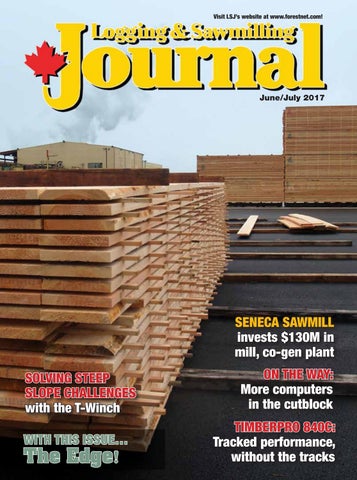
The Seneca Sawmill Company has been part of the Eugene, Oregon landscape for more than 60 years. It’s now nearing the completion of a second $65 million upgrade which included upgrading the dimensional mill with new equipment and technology, installing additional dry kilns and upgrading its dimension mill planer (Photo by Diane Mettler).
20 Seneca sees second mill upgrade
The Seneca Sawmill Company in Oregon is nearing the completion of a second $65 million upgrade which—on the heels of a similar size upgrade during the recession—means a total investment of $130 million, clearly reflecting the confidence the company’s owners have in the industry.
28 Bonus Christmas gift 4 Spotlight – More
computers in the cutblock
For the forest industry, the cutblock is expected to be the focus of advanced systems and technology for equipment over the short term—but don’t expect to see any logging equipment without operators quite yet.
10 Tracked performance —without the tracks
Moore’s Logging of Alberta says its new TimberPro 840C combo machine—an eight-wheeled forestry machine which can function as a harvester, processor, forwarder or clam bunk skidder—is able to deliver track machine power, without the track machine issues.
16 Solving steep slope challenges—to a T
The T-Winch, a new to Canada, European-developed tethered skidder assist system, is solving multiple steep slope issues for Alberta logger Kelly McGlynn.
The residents of Hornepayne, Ontario received a bonus Christmas gift late last year, with the shuttered sawmill/biomass power plant in the town coming back to life, thanks to industry veteran, Frank Dottori.
53 The Edge
Included in this edition of The Edge, Canada’s leading publication on research in the forest industry, are stories from the Canadian Wood Fibre Centre, Alberta Innovates, Alberta Agriculture, the Forest Products Association of Canada and FPInnovations.
62 The Last Word
It’s time for Canada to get our economic mojo back—with a new softwood lumber deal, says Tony Kryzanowski.
DEPARTMENTS
Calendar............................................ 8 Tech Update.................................... 42 Suppliernewsline............................. 48 Classifieds....................................... 60 Ad Index / Subscriptions.................. 60
Logging & Sawmilling Journal - June/July 2017
3
spotlight
MORE COMPUTERS in the cutblock
For the forest industry, the cutblock is expected to be the focus of advanced systems and technology for equipment over the short term—but don’t expect to see any logging equipment without operators quite yet. By Tony Kryzanowski
T
echnology is moving ahead quickly—but don’t expect satellite-guided feller bunchers without operators to appear in the Canadian forest any time soon. However, there is the potential to introduce more advanced systems like artificial intelligence, robotics, telematics and automation to address many day-today repetitive functions when operating logging equipment in the field. Over the next decade, it’s likely that new equipment innovations will lean more towards partial automation systems and advanced technology that assist the operator with decision making that improves overall productivity. That’s the view of FPInnovations Forest Harvesting Division managers Jean-Francois Gingras and Denis Cormier, who are investigating the opportunities for inclusion of more advanced technology in logging equipment as part of their work at Canada’s forest products research institute. They say that there is potential for greater integration of advanced systems for equipment engaged in repetitive functions in both the forest cutblock and in the millyard for activities like roadside processing, delimbing,
chipping, forwarding, skidding, and transporting logs and stacks of lumber. “There are a lot of repetitive tasks out there that can eventually be automated,” says Gingras, who is in charge of the fibre supply research program at FPInnovations. “I think we are going to see a step-by-step kind of progression.” He provided the example of John Deere’s recent introduction of its intelligent boom control system where it simplifies the operator’s tasks. “I think that is going to be the mantra: having the operator focus on more strategic decisions by removing some of the repetitive functions,” says Gingras. “And eventually we will achieve full automation and robotics with no operators whatsoever. We can certainly leverage some of the machine learning techniques to basically have the machine learn some of these repetitive tasks and keep adjusting their work through machine learning algorithms.” He adds that the step-by-step approach where loggers can expect an incremental introduction of more advanced technology is definitely the feedback being provided by Original Equipment Manufacturers (OEMs), the companies that manufacture logging equipment. However, there are certain factors that could accelerate implementation of advanced systems into logging
whose influence is largely unknown at this time. One is the difficulty of attracting more young, tech-savvy, workers to the industry. To these potential employees, current remote and environmentally harsh jobsites aren’t exactly great selling points. Also, both loggers and companies report that a lot of the ‘easy wood’ has been harvested, meaning that the best remaining wood tends to be located in riskier environments, like on steep slopes. Another factor is the need to improve the overall efficiency of the supply chain to reduce the cost of fibre. To some extent, the question of how quickly more advanced systems become part of OEM equipment offerings will come down to cost. In the large scheme of things, forestry is a fairly small piece of the heavy equipment sector and automation research is expensive. One way that the forest industry could witness fast tracking of advanced systems into forest machines is to take advantage of research and system deployment already occurring in other industries, and potentially adapting those systems to the forest environment. As part of its initiative to keep tabs on what’s happening with the development and deployment of advanced systems for heavy equipment, FPInnovations hosted a three-day workshop entitled, “Robotics in the Forest” in 2015. What the workshop revealed is that there are a number of other industries, like agriculture, mining, and oil and gas, that have been researching and in some cases, deploying equipment that Over the next decade, it’s likely that new equipment innovations will lean more towards partial automation systems and advanced technology that assist the operator with decision making that improves overall productivity.
4
Logging & Sawmilling Journal - June/July 2017
LONE WORKER SOLUTIONS KEEP YOUR WORKFORCE CONNECTED
HELP MEET YOUR REMOTE COMMUNICATION NEEDS Completely independent of terrestrial infrastructure, SPOT devices deliver affordable, reliable, location-based tracking, messaging and proven life-saving S.O.S. technology all via satellite. Combined with their small size, durability and scalability, SPOT devices are ready to help your business.
To learn more how SPOT Devices can help your business, visit FindMeSPOT.ca/LSJJuly
spotlight from page 4 have robotic, automation and advanced telematics features. A new collaborative initiative called HEAVI (see sidebar story on page eight), with funding from the federal government, is being spearheaded by the Delphi Group, an Ottawa consulting group, to investigate how each industry is engaged in researching and deploying these advanced systems—and where there may be opportunities to share information, transfer knowledge, and deploy advanced systems in new industrial applications. “The first step will be to organize a workshop to identify what the needs are of the various sectors around some of these advanced technologies,” says Gingras. “From that workshop, we hope to lead into other collaborations.” The forest industry faces some unique communications and environment challenges that will fundamentally influence the speed at which advanced systems are introduced into logging beyond the immediate cutblock. Denis Cormier works at FPInnovations in the areas of remote sensing, modeling, and decision support tools. He says that the ‘Robotics in the Forest’ workshop created the seed for an internal initiative at FPInnovations called Forest2User 4.0. Among the initiative’s goals is to find ways to establish and improve the exchange of huge amounts of operational data in real-time between home base and logging equipment as well as between pieces of logging equipment. This would result in the capability for real-time monitoring, analysis and adjustments in logging activities, with the goal of better overall decision making. The hope is to more accurately tie harvesting activities with mill processes, to ensure that the right log profile is being supplied to the mill based on customer orders. Forest2User 4.0 research is taking place in four specific areas.
There is the potential to introduce more advanced systems like artificial intelligence, robotics, telematics and automation to address many day-today repetitive functions when operating logging equipment in the field.
The first is called ‘the real environment,’ investigating such areas as satellite imagery, enhanced forest management, remote sensing and LIDAR. “To make robotics possible is to be able to describe the environment in which the machine is going to be working so that the machine operates efficiently in that particular environment,” says Cormier, “and that type of information is still not available, or not available at a level where the machine can use it on the spot.” A big part of this challenge is the complexity of the work environment where logging occurs. In most cases, it is virgin forest with a variety of hills, creeks, valleys, and changing topography. Also, tree sizes and species themselves are constantly changing—unlike a uniform wheat or corn field—with weather also playing a significant role in the logging environment. “Unlike agriculture where the working environment is generally very open and
level, in the forest environment for your machine to interact on a real-time basis, all your sensors have to be equipped in a way that your machine can make a quick decision based on an environment that is going to be changing every minute that you are progressing,” says Cormier. “It is going to be a lot more complicated challenge than in most other environments.” The second area of study is described as developing the ‘Internet for the Forests’, making it possible for forest machines to be able to communicate back and forth in real-time over longer distances with mills, base locations, or even other machines—and exchange large volumes of data in a ‘connected forest’ type environment. Cormier says the key to introducing advanced systems into logging beyond the operator’s interaction with the machine is development of cost-effective communication infrastructure. The challenge is that loggers often work in remote areas, where in some cases only very expensive satellite communication is possible. If data transmission is being filtered because of the cost of transmission, this defeats the whole purpose of introducing advanced systems beyond the cutblock. “If the machine is unable to communicate back and forth, you are not going to be able to do anything tangible,” says Cormier. “So the first step is to be able to
to page 8 6
Logging & Sawmilling Journal - June/July 2017
YOU’RE GONNA NEED MORE TRUCKS. Designed to increase productivity, the new Hitachi Foresters sport a reliable, Final Tier 4 engine that doesn’t require a DPF. Comfort comes in the form of a quieter and larger cab with stretch-out-your-legs room and an improved AC system. Top it all off with safety improvements like redesigned visibility and cab access. The enhancements go on and on – just like the line of trucks that will need to keep up. HitachiConstruction.com/Foresters
spotlight from page 6 interact with these machines on a realtime basis if possible, and if not, at least over a very short time period. That cannot be achieved unless we solve this Internet of forest issue first. This is the one that is the most urgent.” Because the communication infrastructure beyond satellite communication is non-existent in many areas where logging takes place, it becomes a question of whether there is a business case for communication companies to want to invest in the infrastructure, which will therefore influence how quickly more advanced systems become part of remote logging operations. It may become necessary for forest companies to install their own communication infrastructure, or cost-share with other industries using the same land base. The third area of study investigates ‘advanced procurement systems’ which will allow forest machines to react automatically to the environment in which they are working through the use of multiple sensors, automation, robotics, remote operation, and optimized log transport. This has
an obvious dependency on advancements in the first two areas of study. The fourth area of study is data analytics to connect the client’s needs with mill processing and log harvesting activities, starting with the right logs delivered to the right mills, and also investigating the potential for just-in-time production. For now, the focus seems to be on the implementation of advanced systems where it makes sense within the cutblock or in the mill yard. “You can probably assume that yard machinery working in a controlled environment or anything that is working in the forest at roadside will be automated a lot faster than any machinery working in the bush, like a roadside delimber or chippers, because these machines are stationary and you are just feeding it,” says Cormier, However, once the target becomes much more mobile equipment working in a lesser controlled environment, “you are looking at the longer term future for that.”
CALENDAR September 7-9
70th Annual Lake States Logging Congress, Escanaba, MI 715-282-5828, www.timberpa.com September 19-21
Wood Pellet Association of Canada AGM & Conference, Halifax, NS 250-837-8821, www.pellet.org September 22-24
109th Canadian Institute of Forestry AGM, Ottawa, ON 705-744-1715, www.cif-ifc.org September 27-29
Alberta Forest Products Association 75th AGM, Jasper, AB 780-452-2841 www.albertaforestproducts.ca October 4-5
Canada Woodworking West, Abbotsford, BC
888-454-7469, www.masterpromotions.ca October 25-27
National Hardwood Lumber Assoc. Annual Convention, Nashville, TN 901-377-1818, www.nhla.com
HEAVI to test industry desire to collaborate on technology in heavy equipment
W
hat have individual Canadian resource industries already done to integrate advanced systems like robotics, automation, and remote operation into their heavy equipment? And is there a desire to collaborate on research, development and deployment of these technologies across multiple resource sectors? Those are two key questions that the Delphi Group, an Ottawa-based consultancy working with the private sector in the sustainability, climate change and clean technology sphere, hopes to answer with an upcoming workshop that will include representatives from the forestry, mining, oil and gas, and agriculture sectors. It’s called the Heavy Equipment Autonomous Vehicle Initiative (HEAVI). Bruce Dudley, senior vice-president at Delphi, says he recognized an opportunity to organize a gathering of representatives from all these groups, based upon the work that Delphi has done with individual clients from each of these sectors, as well as industry associations. The factors driving greater integration of
advanced systems into heavy equipment are de-carbonization of industrial activity, health and safety, and human resource challenges, especially in remote areas. “If you look at forestry in particular, where you have increasingly steeper grades where you are harvesting, the combination of humans in and around equipment becomes increasingly dangerous,” says Dudley. The initiative will delve into three areas: electrification of equipment, autonomous and semi-autonomous operation, and robotics. “The concepts of electrification, autonomous operation and robotics aren’t new to any of these sectors,” says Dudley. “They are all making progress in different ways. But what is unique about this idea is that there are common, horizontal areas of opportunity across all four sectors.” He adds that the value of collaboration comes from the fact that no one sector is likely large enough to command the kind of research, development and deployment testing for these types of technology. “But together, across all four sectors, Canada has some unique attributes in
8
Logging & Sawmilling Journal - June/July 2017
that it is highly active from the aspect of oilsands, hard rock and soft rock mining, forestry and agriculture,” says Dudley. “So when you combine the four sectors together, the opportunity is much greater.” One of the key questions that this industry collaboration will seek to discover is just how available technologies related to electrification, autonomous and semi-autonomous operation and robotics already are, where and how are they being deployed across these resource sectors, and what are the technical challenges standing in the way of future development. Dudley says among the biggest challenges that forestry will face regarding greater integration of these advanced systems into logging are that these activities are generally quite remote and highly mobile, with a constantly changing landscape. “I think that the telecommunications aspect is more challenging for forestry than it is for other sectors,” he says. “Luckily, this is a strength for Canadian innovation.”
contractorprofile Moore’s Logging is currently using their TimberPro 840C primarily as a roadside processor, as they learn its full capabilities and best application.
Tracked performance— without the tracks
Moore’s Logging of Alberta says its new TimberPro 840C combo machine—an eight-wheeled forestry machine which can function as a harvester, processor, forwarder or clam bunk skidder—is able to deliver track machine power, without the track machine issues. By Tony Kryzanowski lberta-based Moore’s Logging believes that big changes could be coming to Alberta forestry, driven largely by the provincial government’s intention to impose a $50 per tonne carbon levy on industry. Loggers may face significant extra costs, such as in the cost of fuel. Established in 1989 and based in Edson, Alberta, Moore’s Logging is coowned by Randy and Tina Moore. The outfit believes that it can demonstrate to other loggers —and industry—how
to adjust logging practices, reduce fuel consumption, while also implementing a more environmentally-friendly logging method. This is achieved with rubbertired, purpose-built, forestry machines that they say run far longer, consume less fuel, and have fewer operational expenses than tracked machines. “We prefer the wheeled harvesters because we can get 40,000 hours out of them without doing seven or eight different engine rebuilds and pump replacements,” says Joe Moore, Randy and Tina’s son, who is operations manager at Moore’s Logging.
10
Logging & Sawmilling Journal - June/July 2017
A
Joe says they have taken many John Deere wheeled harvester models, from model A to the current model G, “and we’ve put 38,000 to 40,000 hours on those machines with the original pumps, original booms, and original engines. They operate at lower rpms, so your pumps and engines last longer and your fuel consumption is way down.” He adds that they have had no problems with undercarriages on those machines, “because, well, we don’t have undercarriages. We’re currently spending upwards of $100,000 to $150,000 a year just in undercarriages among all our
contractorprofile tracked machines. That’s a lot of money.” The most common logging practice in Alberta and in many other provinces is ‘conventional’ logging, which is to harvest trees with a tracked feller buncher, followed by a wheeled skidder that skids trees to decks at roadside. A processor then processes and sorts logs at roadside according to the needs of clients. The logs are then loaded and trucked to the mill. Moore’s Logging is a stump-to-dump contractor supplying about 400,000 cubic metres for West Fraser Timber. About 125,000 cubic metres is hardwood. The softwood is shipped primarily to West Fraser’s Hinton and Edson sawmills, and the aspen to Weyerhaeuser’s oriented strandboard plant in Edson. Moore’s Logging started out using wheeled harvesters, but it now operates primarily a conventional logging fleet, consisting of 23 pieces of tracked and wheeled equipment of various makes and models. It consists of three feller bunchers, four skidders, six tracked processors, and three log loaders. But they also operate a much smaller wheeled harvester and forwarder operation, where logs are harvested and
processed at the stump, and forwarded in cut-to-length (CTL) dimensions to roadside. Given the benefits they have witnessed from this logging method, they hope that other loggers will follow their example, and that forest companies take notice, particularly since this method allows the residuals to stay in the cutblock instead of being burned at roadside. While it is not known yet how much the carbon levy will cost industry, particularly with the current practice of slash pile burning, Moore’s Logging believes that their logging method gives industry another option, and potentially a way to avoid having to pay the carbon levy. A longtime believer in the environmental and financial benefits of at-the-stump harvesting and processing using wheeled harvesters and forwarders, the company is currently demonstrating its proposed method of logging to West Fraser. They are not advocating a complete switch to at-the-stump harvesting and forwarding— but they are advocating methods that result in processing at the stump “to get
Logging & Sawmilling Journal - June/July 2017
11
to page 12
contractorprofile from page 11 rid of the slash burning.” And to complement their existing fleet of rubber-tired harvesters, Moore’s Logging recently purchased a TimberPro 840C, eight-wheeled, combo forestry machine, which can function as a harvester, processor, forwarder or clam bunk skidder. Moore says the reason they purchased the TimberPro 840C was for its versatility
and ease of operation. The other wheeled harvesters in their fleet are strictly designed for harvesting and processing. Described by the company as “the most versatile wheeled machine in the world today”, TimberPro units come standard with 360 degree continuous cab rotation, allowing the operator to face in the direction in which he is working. This also allows the operator to harvest and place trees within 360 degrees of the machine. The cab has no tail swing and
can be configured with 22 degree leveling capability. Below the cab is a large continuous swing bearing, followed by a 20 to 22 ton bogie axle. The detachable bunk is connected with a heavy duty steel cast frame articulation joint with a caliper frame lock. The bunk comes with dual lock cylinders for oscillating the rear axle. The 20 to 22 ton bogie axle on the bunk as well as the machine bogie axle are designed to track perfectly, even on tight turns. Right now, Moore’s Logging is using their TimberPro 840C primarily as a roadside processor, as they learn its full capabilities and best application. Besides its versatility, one other cost saving feature of this wheeled, combo, purpose-built, forestry machine and all their wheeled harvesters is that unlike a tracked machine, a wheeled harvester can drive down the road at a reasonable speed from cutblock to cutblock, thus eliminating the cost and time of low-bedding a tracked unit. “We don’t hesitate to move our TimberPro 840C nine kilometres down the road, and it will be there in an hour,” says Joe Moore. Joe adds that there is no time lost shoveling mud from tracks. Their TimberPro 840C is equipped with Pedno tracks, manufactured in Quebec, for improved traction in the block. “Essentially with the TimberPro 840C, we found a machine with tracked machine power without the tracked machine problems,” says Moore. Available in either a six-wheel or eightwheel configurations, Moore describes the unit as extremely stable. “It feels more stable than a tracked machine because all the tires sit on the ground no matter what,” says Joe. “The bogies articulate and it articulates in the middle. So you are always sitting firm against the ground. You are never rocking.” A variety of feller buncher and squirt boom options, as well as tire and track options, are available with the unit. A Waratah 616C head with a 3/4” pitch auto tensioning saw unit has been mounted on it so that the machine can be used as both a harvester and a processor. Its hydraulics will operate any harvesting or processing attachment. Moore says that they selected the Waratah 616C head because of their familiarity with the brand; they have six additional Waratah 622 processing heads to page 14
12
Logging & Sawmilling Journal - June/July 2017
ALWAYS INNOVATING
AT PETERSON WE NEVER STOP DEVELOPING THE ULTIMATE INDUSTRY LEADING EQUIPMENT. For over 35 years, we’ve built our business around building the most productive mobile chipping and grinding machines in the industry. Day after day, we partner with our customers by giving them the best tools for the job and exceptional support when they need us. Visit us at www.petersoncorp.com today and see why Peterson is the industry leader for disc and drum chippers, horizontal grinders, blower trucks, screens and stacking conveyors. Get the right sized product, sort it out, and stack it higher with Peterson!
AUTHORIZED DEALERS
4710D
Horizontal Grinder
TS4280
Stacking Conveyor
Woodland Equipment Alberta & British Columbia woodlandequip.com
Wajax Centeral & Eastern Canada wajax.com
contractorprofile from page 12 in their fleet. They also like their performance, and the service support that they have received from Waratah. The smaller Waratah 616C head was the right weight and lift capacity match for the TimberPro carrier, and was also a good match for the smaller diameter wood where they have put the unit to work as a processor. The ideal log size is between 15” and 20” diameter, with the occasional oversized log. “We felt that the systems would be similar and that the performance would be, if not the same, then better, which the Waratah 616C head has been,” says Moore. “The head sails. It can rail out that wood extremely fast with accuracy. That’s what a person wants with a smaller diameter head.” Moore’s Logging is operating Waratah’s TimberRite high optimization system with this processing head. It essentially uses the automation’s learning capabilities to build a stem profile to optimize bucking decisions based upon the parameters that the logging company inputs into the computer, considering the client’s log priorities. Essentially, the computer predicts and optimizes bucking decisions based on the established stem profiles, without the operator having to make those decisions, while the operator keeps an eye out for obvious log defects that require a manual override. “We use it to maximize the sawlogs, but the operator has to pay attention for defects,” says Moore. “It does make processing easier.” Working with TimberPro sales rep Sam Cosgrove at True North Equipment Ltd. carried a lot of weight with Moore’s Logging, considering the company’s long association with Cosgrove, and his years of experience in the industry. “We also had a couple of senior operators who were originally trained on wheeled machines who were due for a new machine,” added Joe. “They are high production operators and they take very good care of their machines so we were not scared to invest more money into a machine for them.” Moore’s Logging was shopping for a wheeled harvester that was more versatile, and even though the TimberPro option was more expensive, they felt that
its ability to fulfill a variety of functions in their operation would deliver value for money. “We were looking for a machine that could still dig out of the pile as a processor, but if it came down the line where
Deere 1270G wheeled harvester, while Joe operates a John Deere 1270D sixwheeled harvester with a self-leveling cab purchased in 2005. It is equipped with a LogMax 6000 harvester/processor head. He puts this unit to work primarily falling trees as well as to log rights-of-way. “Working side by side with my dad for 10 hours, we burn 300 litres, or 15 litres per hour per machine, compared to a tracked machine, which burns 300 litres on its own,” says Moore. The TimberPro 840C burns a bit more fuel, but still only 180 to 200 litres per 10 hour shift. Moore’s Logging doesn’t dispute that a well managed conventional logging approach does deliver more volume when you are using a fleet of equipment where each machine is fulfilling a single purpose. “But when you are skidding, it just wipes out every adolescent tree out there, leaving a scarified landscape when you are done,” says Joe. “It is an easier way of logging, but easier is not always the right way.”
“We prefer the wheeled harvesters because we can get 40,000 hours out of them without doing seven or eight different engine rebuilds and pump replacements,” says Joe Moore, operations manager at Moore’s Logging.
14
changes like the elimination of slash burning came about, we were ready for it,” says Joe. “The TimberPro 840C is also essentially allowing us to forward with a harvester, if necessary.” Moore’s Logging is currently evaluating its usage as a forwarder. To complement its TimberPro, the company also operates two John Deere 1910E forwarders to retrieve logs at the stump. One of these units is operated by Joe’s mother, Tina. Joe’s father, Randy, works with a John Logging & Sawmilling Journal - June/July 2017
steepslopelogging
Solving steep slope challenges–to a T The T-Winch, a new to Canada, European-developed tethered skidder assist system, is solving multiple steep slope issues for Alberta logger Kelly McGlynn.
16
Logging & Sawmilling Journal - June/July 2017
steepslopelogging
The Austrian-designed T-Winch skidder assist provided by Ecoforst is helping forest companies reach higher quality timber located on steep ground.
By Tony Kryzanowski
M
any loggers say that most of the ‘easy wood’ located on flat ground in Canada’s forests has been harvested. So they are now being asked to harvest wood on much steeper ground where conventional logging is a lot less efficient, harder to plan, and more dangerous. Alberta logger and steep slope specialist Kelly McGlynn says that a tethered skidder assist system that he is using might solve many challenges and open up new opportunities for some loggers faced with steep slope logging and wet ground conditions. McGlynn owns Wembley, Albertabased, McGlynn Contracting with his two sons, Scott and Kyle. Kelly says by using his tethered skidder assist system on steep and muddy ground, he can drag as much wood on 35 per cent slope in one day as he can on flat ground. The challenge with cutblocks on steeper ground is where to put the road. Typically, McGlynn would locate a cutblock road at the bottom of the hill and place his drags and roadside processors in that location. However, with steep slopes,
there are often deep gullies and creeks at the bottom of the hill and no space to locate a road, so he must place the block road on a bench further up the hill. This means that logs need to be skidded uphill for at least part of the cutblock. What his winch skidder assist unit allows him to do is place the winch on the road and assist his skidders below the road to climb the hill with a fully loaded grapple. “Sometimes, we are looking at dragging up 60 per cent slope for 80 metres, and sometimes it is as long as 180 metres,” says McGlynn. “Nobody likes to drag up the hill, but sometimes you have no choice.” In addition to producing more volume per shift using his tethered skidder assist system, his skidders also burn less fuel, do less environmental damage because they aren’t digging into the ground trying to find traction, and they experience less wear and tear than if he tried to skid without the winch system. It has also extended his logging season, and provided him with the ability to work in wet ground conditions during periods of extended rain, when other contractors are parked. “We’ve been able to cut in some un-
believably soft ground,” says McGlynn, adding that the terrain where they log can transition from completely flat ground to hills up to 70 per cent slope. McGlynn is a forest industry veteran, with 35 years of logging experience in both B.C. and Alberta, and is able to operate every piece of equipment in a conventional logging fleet, as well as having experience in yarding and hoe chucking in a steep slope environment. His tethered skidder assist system is called a T-Winch. It is manufactured by an Austrian company called Ecoforst. The product line is carried in Canada by B.C.based, Woodland Equipment Inc. The TWinch was designed by loggers faced with similar steep slope logging challenges, as Austria is a very hilly and mountainous country. As to fuel savings, McGlynn says their Tigercat skidder would easily burn a tank of fuel working on its own on 35 per cent slopes in one day. When it is hooked up to their T-Winch, “we can go almost two full days on one tank of fuel. I can run that T-Winch for two-and-a-half days on 200 litres of fuel.” The winch system is controlled entirely by remote control in the skidder cab by the skidder operator. Hooking up the winch to the skidder takes about five minutes. Most importantly, this system has brought McGlynn Contracting more business. Right now, they harvest 250,000 cubic metres for Weyerhaeuser. But because of the company’s tethered skidder winch system, they have secured an additional 50,000 cubic metre logging contract with Canfor. They have demonstrated that they have a tool that allows them to tackle skidding in steep, wet ground conditions, thus giving forestry companies like Canfor access to better timber. to page 18
This pulley attached to a backhoe boom allows McGlynn Contracting to use their T-Winch skidder assist system more efficiently, so the winch unit can stay in place all day while the backhoe slides over with the skidder.
Logging & Sawmilling Journal - June/July 2017
17
steepslopelogging from page 17 The T-Winch has a Fiat diesel engine with a maximum output of 107 kWs. It holds 500 metres of high tensile cable measuring 18.5 mm in diameter, and is capable of winching eight tonnes. The unit requires no rear counterweight and pulls to a maximum speed of four kilometres per hour. The skidder engine works in tandem with the winch assist system, but at a comfortable rpm. What McGlynn likes about the T-Winch is that it pulls at the same traveling speed as the skidder. McGlynn was able to operate the T-Winch system last year at the DEMO 2016 logging show in Maple Ridge, B.C. “I took the machine up and down the hill once, and I said ‘sold’,” he says. He added that from a mechanical standpoint, even though it is European technology, there is nothing unfamiliar about the unit in the event he needs service support. After using the T-Winch system for a season, he says it works great. However, he has made a system modification that has resulted in significant efficiency gains. He uses a backhoe equipped with a custom designed pulley in tandem with the
McGlynn Contracting is able to achieve the same daily production skidding trees on 35 per cent slope as on flat ground by employing their T-Winch skidder assist to help the skidder up the hill.
T-Winch unit and skidder. The T-Winch cable is strung through the backhoe pulley and down to the skidder. The backhoe moves as the skidder moves across the block to minimize how often the stationary T-Winch has to move. This is a major improvement on the system’s efficiency. “It’s not like we are skidding 300 to 400 metres,” says McGlynn. “The way
we work, we’d have to detach the cable, move the T-Winch and attach the winch cable every 25 minutes.” So that is why he developed his backhoe pulley system, so that it moves as the skidder moves, and the T-Winch stays in place. With 500 metres of cable, that’s plenty for what they need. Typically, how the entire system is
YOUR LEADER IN THE CHIPPER INDUSTRY
The Kadant chipper offers outstanding durability, safety and efficiency. *Advantage Chipper
DISTRIBUTED BY
1.800.387.6317 carbotech.ca
18
Logging & Sawmilling Journal - June/July 2017
steepslopelogging system, instead of having to hoe chuck it, we are able to use our skidder now, so we are moving wood faster and being more productive. There’s nothing wrong with hoe chucking if you have to do it, but it is costly.” The broken terrain around Grande Prairie with many hills and valleys does not present an environment where yarding works well, he adds. The T-Winch cost McGlynn Contracting about $270,000, and while it adds
another piece of equipment to their fleet, Kelly says it delivers many benefits. “We are going to harvest our entire cut this winter in about four-and-a-half months,” says McGlynn. “Without this machine, we’d easily come up 30,000 to 40,000 cubic metres short because of how we would have had to struggle to get through the hills.”
Goldeneye 900 transverse lumber scanner with X-ray: All new transverse quality scanner for the sawmill and planer mill 4-sided multi-channel Visual and structural grading Optional high resolution transverse X-ray Trimming, sorting, edging and re-man optimization for both sawmill and planermill Integration of Microtec’s MSR module and Moisture measurement (above and below fiber saturation) Easy installation – standard chain height, no elevation changes Support – all sensors, cameras, LED lighting and x-ray components are produced in-house by Microtec New “occlusionless” scanning conveyor Total production flexibility – reduced trim-loss – increased throughput - improved on-grade accuracy
F w or w m w o .s re pr i in nfo ge r r- ma m ti ic on ro te go c. to co m
operated is that the winch cable is kept tight as the skidder backs down the hill. Once the skidder operator grabs a drag, he engages the winch along with the skidder. He is able to control the T-Winch’s draw power based on the size and weight of the loaded grapple, or the operator can simply set the in-cab controller dial for a heavy load all day to simplify matters. When a move by the T-Winch is required, it takes about 20 minutes, and it takes about two minutes each time the backhoe has to move another 30 metres to position itself above where the skidder is working. “If you do it right, you only have to set up the T-Winch once a day,” says McGlynn. “The skidder operator is still controlling everything, like how much cable is being let out from the T-Winch, and how quickly it’s pulled back.” In terms of the potential for entanglement, McGlynn says the skidder operator still comes up the hill and makes a typical turn to drop the grapple load, moves ahead slightly, and then backs down the hill. They have had no issues with cable entanglement. They use either a Tigercat 635E skidder or a John Deere 748H skidder. Along with the Ecoforst T-Winch unit and the skidders, McGlynn Contracting’s logging fleet consists of two Tigercat 870 leveling feller bunchers, with their newer, 2012 model carrying about 85 per cent of the workload. Their logs are processed 100 per cent cut-to-length (CTL). This is accomplished using a Hyundai 330 carrier equipped with a Southstar 630 processing head. This carrier is configured with a cab riser so that the operator has a good view of his working environment. “We’re in a lot of steep ground, so deck visibility is tough sometimes,” says McGlynn. Their second processor is a Hyundai 2036 carrier with a Southstar 600 processing head, while their third processing unit is a Barko 260W carrier with a Southstar 500 processing head. For log loading, they use a Caterpillar 568 log loader with a heel boom attachment and a Hyundai 2036 unit with a power clam attachment. Rounding out their fleet are a John Deere 350 backhoe, Komatsu 350 backhoe, and a Caterpillar D60 crawler dozer. McGlynn says because his backhoes sit idle much of the time, they are available to work as the pulley link on the tethered skidder assist system. “Normally, we don’t cut anything that we can’t skid or hoe chuck,” says McGlynn. “With the tethered skidder assist
Logging & Sawmilling Journal - June/July 2017
19
millupgrade
SENECA
sees second mill upgrade The Seneca Sawmill Company in Oregon is nearing the completion of a second $65 million upgrade which—on the heels of a similar size upgrade during the recession—means a total investment of $130 million, clearly reflecting the confidence the company’s owners have in the industry. By Diane Mettler he Seneca Sawmill Company has been part of the Eugene, Oregon landscape since 1954. That year, Aaron Jones operated one mill and produced 18 million board feet. Today, the company runs four sawmills and produces over 650 million board feet annually. Todd Payne, Seneca’s CEO, explains that today’s Seneca is comprised of four companies. “Seneca Sawmill Company is our flagship company in Eugene. It oversees three of the four sawmills. The fourth sawmill, purchased in 2011, is located in the small town of Noti, Oregon.” Other companies include the Seneca Jones Timber Company, with 167,000 acres of sustainably managed timberlands
(they just planted their 37 millionth tree), and Seneca Sustainable Energy, which produces 19.5 megawatts, enough to power 13,000 homes. Combined, the companies employ about 450 people. The company went through a successful ownership transition around 2012, from Aaron to his three daughters, Becky, Jody and Kathy Jones. All three, like their father, believe in the quality of their wood products and the future of their sawmills. Over the last seven years they have invested significant capital in the facilities—some $130 million (U.S.). The impetus behind the investments and upgrades was the fundamental shift in the domestic market toward dry lumber, which Seneca recognized taking place back in 2000. “We have always been a large green
20
Logging & Sawmilling Journal - June/July 2017
T
Douglas fir lumber producer, both for studs and dimension lumber, and we wanted to develop a long-term capital plan that provided the capability to dry a large portion of our production to match the growing market trend,” explains Payne. “We started off with the renewable energy facility, so we had a thermal power source, a steam supply. We built new stud dry kilns that moved our dry capabilities up to about 80 per cent at the stud mill. Now we’re focused on the dimension mill, aimed at the same dry capacity.” The first major investment was a co-gen plant. Planning got underway in 2007, with the groundbreaking in 2009. “I have a lot of respect for the owners,” to page 22
We see the whole picture. Not every application can be solved with plastic cable carriers!
Whatever the application, we have a solution.
Presenting plastic and steel cable and hose carriers populated with continuous bending high flex cables from Kabelschlepp. Cable and hose carriers are the lifeblood and backbone of countless modern machinery. Based on their importance, it only makes sense to trust the industry leader. One supplier, one quick lead time, guaranteed quality. It doesn’t get easier than that!
Just what you’d expect from KabelSchlepp. Plastic • Hybrid • Tube • 3D Line • Steel
To receive your no obligation quote visit
kabelschlepp.ca
millupgrade from page 20 says Payne. “They made a decision in the depth of one of the worst markets we have seen, to spend $65 million on a facility that we didn’t have a lot of experience with. But we did a lot of due diligence, and we built a facility that has so much automation and technology that it runs with just two people. We kind of take it for granted now, but others come through to see it, and are just amazed.” Approximately 75 per cent of what’s burned at the co-gen plant comes from sawmill residuals—mostly in the form of bark and a little sawdust and shavings. The balance is forest biomass, which comes from the company’s tree farm and other local tree farms. Of the $65 million spent on the cogen plant, 25 per cent was dedicated to air emission control equipment and technology. “We were held to very strict air permit standards—probably the most stringent in the United States,” says Payne. The plant’s permit does not allow the burning of anything painted, stained, treated or containing glues or resins. “It has to be 100 per cent organic coming in and the ash byproduct is now considered 100 per cent organic going out,” says Payne. “Today we have a partnership with a neighboring agricultural company, SureCrop. We stockpile our ash, and they apply it to their fields as a soil nutrient when they till their fields after harvest. It’s 100 per cent recycled. “The co-gen facility is a firm power source,” adds Payne. “We control both the input (wood biomass) and output (electrical production), giving us the ability to produce based on real-time market
Over the last seven years, significant capital has been invested in the Seneca Sawmill facilities—some $130 million (U.S.). The impetus behind the investments and upgrades was the fundamental shift in the domestic market toward dry lumber. needs. This is in contrast to the other renewables, such as wind and solar, that only produce when the wind is blowing or the sun is shining. Co-gen is a great compliment to the other sources of renewable energy.” Seneca started the second wave of improvements in 2014, which included upgrading the dimensional mill with new equipment and technology, installing additional dry kilns and upgrading its dimension mill planer, as well as expanding the log yard and shipping/loading areas. One of the first projects was installing three aluminum American Wood Dry-
ers kilns built to Seneca specs—two for dimensional lumber and one for the stud mill—with more to come. The steam from the co-gen plant is moved overhead to the dry kilns. There, it is condensed back into water after use, which is sent back to the co-gen plant to go to the boiler. Nothing is wasted. Payne says aluminum is more expensive, but the advantages, like less rusting, outweigh the cost. The log yard was expanded to give Seneca more decking and storage capabilities. And the shipping and loading area was expanded as well. “Originally, the rail spur came across the property and basically cut us in half, so we reoriented that rail spur to the south, doubling our car capacity. We also expanded a parallel line for chip cars, which allows us to ship our chips further distances,” says Payne. Payne says Seneca does have an advantage having reciprocal rights with two Class 1 railroads—Union Pacific and Burlington Northern. “We can bring in both suppliers and then ship to different destinations. It gives us a lot of flexibility, because there’s a lot of customers that are on one or the other rail line, but not both.” Because the dimension mill was going to take a lot more capital and time, Seneca first put the infrastructure in the stud to page 24
22
Logging & Sawmilling Journal - June/July 2017
TRUST THE PLANER EXPERTS • Speeds from 100 up to 2000 ft/min (30 up to 600 m/min) • Smaller model designed to run at lower speeds
• Speeds up to 3000 ft/min (900 m/min) • Compact design to fit well in an existing layout
>
GILBERT HIGH SPEED PLANER
>
GILBERT 6 ROLL PLANER
>
GILBERT S-SERIES PLANER
• Speeds up to 4000 ft/min (1200 m/min) • Fastest planer in the world
THANK YOU
Seneca Sawmill Company for your continued trust in our Gilbert planer technology.
>
GILBERT MOULDER PLANER
• For all speeds and speciality products • Versatile and heavy duty machine for high quality results
GILBERT’S LINE OF PLANERS : THE RIGHT MACHINE FOR YOUR MILL • From moulding applications to high speed planer mills, Gilbert has the solution for every operation • Achieve premium lumber with Gilbert’s state-of-the-art technology • 100 planer projects installed worldwide !
T 418.275.5041 | info@gilbert-tech.com www.gilbert-tech.com
millupgrade
Seneca started the second wave of improvements in 2014, which included upgrading the dimensional mill with new equipment and technology, installing additional dry kilns and upgrading its dimension mill planer, as well as expanding the log yard and shipping/loading areas. from page 22 mill facility. The focus then moved to the dimension mill and related facilities. Key to the sawmill upgrade was a new 60-bin USNR sorting line complimenting an existing tray sorter line, giving adequate sorting capacity ahead of the new dry kilns Automation, Payne says, is the key to this project. “We’ve employed a very unique edger outfeed system that coupled new automation with existing technology,
thus eliminating a very manual process under the previous product flow. Our engineer and mill management came to the table with an idea that hadn’t been tried before in this fashion, but sold its capabilities. And true to Seneca nature, it worked as planned. It was truly a team effort and something everyone is most proud of. Seneca’s been known for their internal designs and this is no different. It’s our competitive edge” The technology is bleeding edge, says
Payne. An example is the new USNR BioLuma 2900LVG+ grade scanner. “Instead of just looking at the physical dimensions of each board before we cut it to width, we’re now identifying all physical defects such as knot size and location, split, rot, etc. We then apply the finished grading rules as part of the optimization process, giving us much more accurate results prior to page 26
Seneca Sawmill Upgrade
Contractors • O&S Contractors - concrete and mechanical install • Olsson Industrial Electric - electrical install • B&R Sheet Metal - pneumatic install • Wildish Construction - site work Equipment Suppliers • USNR: Sawmill - scanners, bin sorter/stacker, Planer - infeed/ outfeed systems and stacker • Timber Machine Technologies - board edgers • American Wood Dryers - dry kilns • Pacific Building Systems (PBS) - buildings • Corvallis Tool Company (CTC) - conveyors/transfers • BRUKS - chipper • Gilbert - planer • B&R Sheet Metal - pneumatic equipment
Seneca Sawmill Co-gen Project
Contractors • Wellons, Inc - power plant install • O&S Contractors - concrete and fuel handling system install • Olsson Industrial Electric - electrical install • B&R Sheet Metal - pneumatic install • Eugene Sand & Gravel - site work Equipment Suppliers • Wellons, Inc - power plant • Phelps - truck dump • Basic Machine - fuel reclaimers and fuel building conveyors • Pacific Building Systems (PBS) - fuel building • Corvallis Tool Company (CTC) - fuel conveyors • B&R Sheet Metal - pneumatic equipment
24
Logging & Sawmilling Journal - June/July 2017
millupgrade from page 24 to manufacturing. This is one more element of the ever so important lumber and value recovery equation.” The dimensional mill planer upgrade will incorporate a top-of-the-line Lucidyne grade scanner and new Gilbert planer. But equipment is only as good as it’s maintained, he notes. “We have a lot of pride in our support staff,” says Payne. “Our programming and controls department are charged with maintaining all of our optimization, vision, scanning and controls technology, plus our fleet of millwrights and electricians take care of all the mechanical and electrical support, and they do that 24/7.” This group is secondto-none, he says. Right now the entire mill feels like it’s in training with all the new equipment. “Key aspects of our upgrades incorporate elements that haven’t been tried before. You can put it on paper and it looks like it’s going to run just fine, but until you get it up and in place and turn it on, you don’t know where the shortcomings are,” says Payne. Completion could have been earlier, but the mill was operational throughout the entire process. “We tried to minimize the downtime,” says Payne. “We scheduled the equipment changes around holidays when the mill was normally down. The last of the sawmill upgrades was around the second week of January, and within six to eight weeks we were almost back to full production. We’re pretty proud of that.”
Local mechanical and electrical contractors did the bulk of the work. Seneca also purchases equipment locally when possible. One of the challenges Seneca didn’t anticipate was longer lead times for some of the mill equipment. Some companies had pulled back during the recession, others had merged, or gone out of business. Now that the recession was over and mills were going after capital projects, Seneca found itself waiting much longer for equipment to be manufactured and delivered. But despite such challenges, their work crews performed safely. There were no safety issues associated with the project. “That’s nothing short of phenomenal because of the amount of extra traffic that was in the middle of our plant site that
People truly matter at Seneca Sawmill—there are many who have been at the company for 40 years, or more. 26
Logging & Sawmilling Journal - June/July 2017
had to co-exist with our existing rolling stock,” says Payne. “Part of that comes from the fact that we’re very safety conscious internally, as are the contractors that we employ. We set the expectations early and often.” It’s obvious just walking through Seneca Sawmill’s office lobby and seeing celebrations for employees’ 40th and 45th anniversary that the people here are dedicated to the company. During the recession, Seneca kept their entire crew, when other mills were letting people go. “We figured out how to keep everybody here. It was not easy,” says Payne. “We do things slightly different than most companies,” he adds. “We try to hire the right people with the right attitude, then focus on training and promoting within. I think that helps with the loyalty and longevity of our workforce.” Payne says that what he’s most proud of are the people he gets to work with every day. “They are the ones that came up with a very unique and automated design that allows us to maximize both volume and value. And that’s important, because raw materials (logs) are a huge cost in any manufacturing facility, particularly lumber mills, so our goal is to get as much lumber board footage (and value) out of every given board foot of log.” Because of the incredible workforce, the passion of the owners, and a continued investment in the future, Seneca now has the flexibility to go green or dry depending on market needs. Seneca is excited about the future. The move to dry has opened up new markets across the country for the Oregon company—and helped to secure its future.
Ontariosawmilling It was a shock to the northern Ontario community of Hornepayne when the sawmill and bioenergy plant closed in late 2015. But the operation plans to be back working on a twoshift basis by this fall.
Bonus Christmas gift The residents of Hornepayne, Ontario received a bonus Christmas gift late last year, with the shuttered sawmill/biomass power plant in the town coming back to life, thanks to industry veteran, Frank Dottori. By Tony Kryzanowski
T
his past Christmas won’t soon be forgotten by residents of Hornepayne, Ontario, as they received a very big present: the shuttered sawmill and biomass power plant in the town, formerly owned by the Olav Haavaldsrud Timber Company, was brought back to life by veteran Canadian forestry businessman, Frank Dottori. Founded in 1953 by Norwegian immigrants Olav and Elna Haavaldsrud, the family-owned company had fallen on hard times. Considerable money had been spent modernizing the sawmill just before the American housing crash in 2008. And there was a massive commitment to the adjacent $66 million
Becker Cogeneration Plant, constructed to consume the sawmill’s waste. The Ontario government helped to support its construction, with $30 million in grants and loan guarantees. Hornepayne is a small and remote northern community consisting of about 1,000 residents, and the sawmill and biomass power plant are the town’s biggest employers. But in November 2015, 146 workers suddenly found themselves unemployed. Mill management announced that unless they could negotiate a better power supply agreement with Ontario’s Independent Electrical System Operator (IESO), the power plant and sawmill would shut down. The power plant had a contract to supply eight megawatts of power to the IESO, but had the ability
to produce nearly twice that amount on a consistent basis. No agreement was reached, and both the sawmill and power plant wound up in receivership. Hornepayne Mayor Morley Forster said that the mill closure was a tough blow to the community, with some families forced to move away to find work. But Frank Dottori, who founded forest company Tembec in 1973 and most recently returned to the industry by purchasing the idled Domtar sawmill in White River, Ontario, about 100 kilometres south of Hornepayne, saw opportunity knocking. He and a Toronto equity fund formed Hornepayne Lumber LP, and purchased the sawmill and biomass plant. Initially, some 11 different parties expressed an interest in purchasing the sawmill from the receiver, with Dottori and Hornepayne Lumber LP ultimately prevailing. The company purchased the Hornepayne sawmill in August 2016 out of receivership, firing up operations on a one-shift basis in January 2017 with 50
to page 30 A new Autolog computerized lumber grading system is one of the investments that the new owners have made to the Hornepayne sawmill. 28 28
Logging Logging&&Sawmilling SawmillingJournal Journal--June/July June/July2017 2017
Ontariosawmilling from page 28 employees. It also later purchased and re-started the biomass power plant. Since the re-start of these facilities, Forster has noted a much more positive mood among the town’s residents. The re-start has contributed a lot to the local economy; the closure had resulted in about half of the town’s workforce suddenly being unemployed. Dottori says the facilities inject between $20 million and $30 million into the region annually, with positive spinoffs on many local businesses and on real estate values. The potential purchase of the Hornepayne sawmill was something that had been on Dottori’s radar for some time because of the efficiencies it offered in managing the local wood basket and operations integration with his White River sawmill. “We were sitting in the middle of a 500,000 cubic metre forest allocation and our north end was about 20 kilometres from that mill, with our eastern boundary being close as well,” he says. “So it’s a nice integration of our forest operations units, and gives us access to about one million cubic metres of wood fibre.”
The White River sawmill was one of many sawmills hit hard by the 2008 housing crash. It sat idle for several years before being purchased in 2013 by Dottori and a group of investors that includes the Pic Mobert First Nation and Township of White River. When asked why he feels confident that he will succeed in Hornepayne, Dottori says the sawmill has a history of always making money—but it was victimized by a combination of circumstances, including what he described as the “financial depression” that set the sawmill down a path of accumulating debt from which it could not recover. Dottori is counting on his extensive sawmilling experience and management style to return the Hornepayne sawmill to profitability, adding that prior to its closure, it was producing superior lumber grades aimed specifically at the domestic wood treatment market. So its fortunes are not tied to shipping softwood lumber to the United States. It’s a different story for the White River sawmill, with about half of its production shipped to the U.S., and it is now required to pay a softwood lumber tariff.
Also, the Hornepayne sawmill is a relatively modern mill, having recently been upgraded with a new Comact DDM12 log processing line. Dottori describes it as a “beautiful, streamlined, single-line sawmill” capable of producing about 120 million board feet of random length dimension lumber. Logs arrive in cut-to-length dimensions and encounter one of two Cambio 18” debarkers prior to being processed through the Comact DDM12 breakdown unit.
STRONGER, TOUGHER, SMARTER INTRODUCING BLUE LINE Unique metal alloy, increased lubrication holes and specially hardened nose sprocket.
NEW R9 3/4” SAWBAR High quality alloy technology for optimal performance.
Tel: (519) 754-2190 Fax: (519) 757-1100 Email: info@olofsfors.com
30
Logging & Sawmilling Journal - June/July 2017
www.olofsfors.com
Ontariosawmilling
“It’s actually been a fairly easy start up,” Dottori says. “The mill was rebuilt about 10 years ago, so it is in pretty good shape.” He says a bit more investment will be required, such as more lumber sorting bins and installation of an Autolog computerized lumber grading system in the planer mill, which they have already purchased. Now that the sawmill and biomass plant are back operating, Dottori says a new agreement has been signed with the
local union and they have managed to attract many of the sawmill’s experienced, hardworking employees back to the sawmill. Among his biggest challenges, though, is attracting logging and log haul contractors back to the community, and this is hampering how fast the sawmill can ramp up to two shifts. “The problem is getting logging contractors because they were devastated from the crash in 2008,” says Dottori. “Virtually all of the contractors in this area got wiped out.” In fact, he says about 80 per cent of the province’s forest industry was decimated. A big problem facing the industry is that even as it experiences a rebound, many of the people remaining with logging experience are now in their 50’s and 60’s. “Their interest in starting over again is not high,” says Dottori, “and there are very, very few young people interested in getting into the business, which puts us into sort of an awkward position where we are trying to import outside contractors. We are also experiencing a shortage of trucking contractors.” However, there is a plan to ramp up production at the sawmill to two shifts by
fall. Dottori expects to complete negotiations soon with logging contractors to provide Hornepayne’s required wood supply for the coming year. The Hornepayne sawmill, with its smaller diameter debarkers, is better suited to processing smaller diameter spruce that tends to grow primarily in the northern half of their Sustainable Forest License (SFL) area. The predominantly larger diameter jackpine in the SFL’s southern area will be diverted to the White River sawmill. The biomass power plant provides benefits to both the Hornepayne and White River sawmills, taking wood waste like bark from both these facilities as fuel. It will also consume some wood residuals from forest operations. The plant was originally designed to consume between 175,000 to 200,000 tonnes of wood waste annually, while also providing steam for lumber drying and heat for buildings. “The plant is competitive and it makes money, but it’s borderline,” says Dottori. “It could be a tremendous money maker and a sustainable force in the community. to page 32
Continuous wood drying greatness by Valutec
Valutec is one of the world’s largest suppliers of drying equipment for the sawmill industry, with more than 4 000 lumber dry kilns delivered during nearly a century. Valutec’s TC continuous kilns combine extremely high capacity with game changing flexibility. Still, the end products impress with exactly the quality that you and your customer expect. Read more at www.valutec.ca
Ingo Wallocha Managing Director Valutec Inc Mobile +1 416 640 7478 Phone +1 778 868 3695 ingo.wallocha@valutec.ca
Logging & Sawmilling Journal - June/July 2017
31
Ontariosawmilling from page 31 That’s where we want to go and I think we will get there.” Part of the challenge is they are seeing the same difficulties experienced by the previous owners: dealing with the IESO and the cumbersome manner generally in which Ontario manages its power purchase and distribution system. Because of power purchase agreements in place with the IESO, the power plant is only running at about 70 per cent capacity. Hornepayne Lumber LP is hoping to convince the IESO to allow the company to provide more power from this facility. “At 12 megawatts, it’s a really good project,” Dottori says. “At 15 megawatts, it’s a great project.” The Hornepayne sawmill’s wood basket consists of approximately 20 per cent poplar, and finding a home for this entire resource is one of Dottori’s priorities. There are agreements in place for veneer logs, but the rest still needs to find a market since an oriented strandboard plant in the area—which was using the remaining poplar—converted to a wood pellet plant. It’s important to find a market for this wood as
The Hornepayne sawmill processes primarily black spruce, while its counterpart in White River about 100 kilometres away processes jackpine from the area’s wood basket. The sawmills complement each other well. it will help to reduce logging costs. What’s helping the forest industry in Ontario as a whole is the current demand and prices for lumber shipped to the U.S. Dottori says he can’t remember lumber prices being this high, and according to industry publication, Wood Resources International LLC, eastern
sawmills operated at 10 per cent higher levels in 2016 than they did in 2015, and at 40 per cent higher levels compared to five years ago. However, that was before the recent implementation of the softwood lumber tariff on Canadian lumber shipped to the U.S.
BAR WORKS LTD.
“The Best Bar - Bar None!”
ch ” pit
.404
/ 80
e gaug
3/4”
pitc
22 h/1
e gaug
Offering a Full Line of .404” and 3/4” Pitch Harvester Bars in he t de ma for a est d a h can toug ions dit n co
We Also Repair All Brands of Bars
Dealerships Available
1-888-604-9990 | www.cannonbar.com | info@cannonbar.com
32
Logging & Sawmilling Journal - June/July 2017
GROUND UP
PURPOSE-BUILT FROM THE
GET THE DETAILS ON WHY YOUR NEXT LOG HANDLING MACHINE SHOULD BE A SENNEBOGEN
Only SENNEBOGEN
log loaders are purpose-built one machine at a time to meet your goals.
Stack higher • Move faster • Work safer Think of the possibilities! See how SENNEBOGEN can purpose-build the right machine for you at
www.sennebogen-na.com/forestry www.sennebogen-na.com | +1-704-347-4910
• Diesel and electric-drive machines from 44,000 to 750,000 lbs. • Full range of rubber tired, tracked and stationary models with customized boom & stick configurations.
the latest and greatest in forest industry technology
This year’s Elmia Wood show proved to be another success, despite some wet weather, featuring the latest and greatest in equipment and technology from 3D vision technology to dogs that can sniff out spruce bark beetles—and LSJ’s George Fullerton was there to see it all. By George Fullerton
T
he 2017 Elmia Wood show—held in June in Jönköping, Sweden—lived up to its billing as the world’s premier forestry show, with more than 500 exhibitors from 28 countries congregated to promote and sell their products and services. Elmia is the opportunity to see both the proven and the emerging cutting edge forestry technologies. Elmia 2017 witnessed some showers, but the weather did not hamper the enthusiasm of thousands of visitors. A good raincoat and sensible footwear were the order of the day, and the smart people brought an umbrella. There was a bit of mud in one of the parking lots which was a challenge for some cars, but in the spirit of loggers, there were always people willing to jump in to push the cars on their way. Elmia is indeed a world class show. In addition to visitors and manufacturer’s reps from all over Europe, it was not uncommon to bump into North Americans, South Americans, Australians, New Zealanders and Asians. Record-setting attendance included visitors from six continents. The show offers the chance to get up close to big and smaller forestry related equipment including equipment for harvesting and forwarding, biomass and cogen, firewood processing, chipping, grinding, loading and transport, as well as portable sawmills and accessories, boots and clothing, measurement and 34
data collection and analysis and much more. In addition to forestry technologies, there were also logging talent competitions, including forwarder competitions. Drones warranted their own separate display area and similarly wildlife/ hunting were featured in their own area. Elmia offered lots of food and refreshment kiosks. Facilities were well identified and the Show Guide provided good maps to guide visitors to specific manufacturers. The Elmia organization team is to be congratulated for excellent planning and carrying through to make a successful and memorable show. Below are a few of the highlights from Elmia:
Bracke Forest
At Elmia 2017, Bracke Forest released the new M24 hydraulic mounder. Mounding is the well proven superior site preparation method that
Logging & Sawmilling Journal - June/July 2017
to page 36
industryshows from page 34 increases the survival rate and future growth of seedlings. The M24 is an even lighter, faster and more versatile mounder than its predecessor, the M25. On the M24, the two arms can now be moved sideways, producing more mounds as it can adapt to slash and other obstacles on the site. The mounding wheels make compact mounds, minimizing ground disturbance (important to reduce exposed soil area to keep competition to a minimum). The two arms can individually be lifted to pass a rock or other obstacle. The M24 has been designed for high reliability and minimum repairs, and to work in tough site prep working conditions. www.brackeforest.ca
Tigercat
Tigercat commanded a good deal of real estate on the large scale ‘heavy’ equipment loop, and had it well populated with their venerable forestry gear. Elmia 2017 was the opportunity for Tigercat to introduce their new 1185 harvester. In the Tigercat tradition, the 1185 is a heavy duty, high production harvester, designed for steep terrain and demanding operating conditions. The eight wheel drive, 34-tonne machine is fitted for heavy duty harvesting applications on steep terrain. Power is delivered from a Tigercat FPT N67 Tier 4f engine, rated at 308 hp, delivered through Tigercat’s WideRange drive system, which increases working travel speed while delivering powerful tractive effort for steep terrain and quick travel on less demanding ground. The 1185 features dedicated pumps powering the drive, harvesting head, crane, fan and cooling circuit functions. The crane features Tigercat’s efficient and operator-friendly ER technology. The main boom is a hooked design providing operators with good right side visibility, and the 1185 stick boom comes either fixed or telescopic. www.tigercat.com
Usewood Forest Master Turbo 1500
At the other end of the scale from the large harvester that Tigercat introduced, Elmia provided an extensive venue for small scale equipment. The Usewood Forest Master Turbo 1500 is a prime example of innovative, small scale harvesting equipment. The eight wheel harvester is powered by a Kubota V1505T
36
turbo diesel engine (44 hp), with hydraulics delivered through a Bosch Rexroth variable displacement pump. The 0 to 130 litre/min. variable displacement pump features load sensing Bosch Rexroth LUDV valves. The advanced control system operates with seven individual controller modules connected by CAN-bus to control the hydraulic pump, valves, motor, power consumption, driver controls, and harvester head. The Usewood Forest Master Turbo 1500 weighs in at 2300 kgs and has an overall width of just 1.5 metres, providing a very light footprint for sensitive harvesting demands. www.usewood.fi
Komatsu
The Komatsu display was a busy spot with new introductions, test driving forwarders and a large tent with a theatre, 3D simulator and lots of warm hospitality. Elmia 2017 hosted the introduction of the new Komatsu 901XC eight wheel harvester. Promoted as a thinning specialist, the 901XC boasts excellent manoeuvrability and stability for extreme working conditions, both steep and wet. Eight wheels provide climbing abilities and low ground pressure on sensitive sites. The 901XC has a centrally mounted cab and crane, which provides a balanced and low centre of gravity. The rigid articulated joint and the swing axle combined with the cab's tilt cylinders augment stability. The 901XC also features Komatsu's unique three-pump hydraulics (3PS), delivering a flow of 548 litres per minute at 1,500 rpm. The 3PS allows crane and head functions to be used simultaneously with maximum hydraulic power. The large operator cab provides exceptional visibility, ergo-
nomic smart screen placement and a levelling function. Cab options include extra storage solutions, lighting, floor heating and three different joystick systems. Komatsu also featured the Komatsu Traction Aid Winch for the Komatsu 875 forwarder and the Komatsu 911/230H and 931 harvesters. The traction aid system benefits from many years of research and development in Europe. www.komatsuforest.com
Masslog 3D
Masser has a long history of development and production of data collection and measurement systems for foresters. At Elmia 2017, they featured their Masslog 3D portable scanner for specific log and tree measurements. The system uses industrial class cameras and LED lighting, combined with advanced mathematics to provide high precision log measurement. Masser claims the Masslog 3D establishes new prospects for log measurement analysis and tree analysis. The system collects and stores reliable and traceable data,
Logging & Sawmilling Journal - June/July 2017
to page 38
JohnDeere.ca/SwingMachines
OUTRUNª LIMITATIONS. S E E WH AT P URP OS E - B UI LT LO O K S L I K E . New G-Series Log Loaders and Processors feature an ISO 8082-2 ROPS-Certified cab for maximum protection — not a cab designed for construction work. With standard rear-entry and easy access, and a new cab-forward design featuring large, injection molded, polycarbonate windows, even in the floor, you’ll expand your view. And watch your business follow suit.
industryshows from page 36 and is compact with easy to learn technology. It features stereo cameras, and smart LED which allows it to work in the dark or in the daylight. The system analyzes knots, bark thickness or any other features that can be seen by the eye. The Masslog 3D can be used for harvester calibration and control, standing tree measurements or mill receiving systems. Eventually, the thinking is that companies such as Masser will be able to use data as a kind of fingerprint, with the sawmill able to use this information, completing the supply chain loop of information that would include species and GPS locations. Masser has produced over 300 custom specific measurement and data collection applications. Applications cover the whole value add chain in forestry, from nursery to end products. www.masser.fi
MeriTractors
The S500 MeriCrusher was featured at the Suokone Ltd display booth, with a live demo of its wet-site land clearing capacity. The S500 crawler tractor has 768 horsepower and features a front mounted three-point hitch and power take-off system to mount MeriCrusher milling and crushing implements. The S500 can be equipped with double crawler tracks for
operating on very wet peat soils; it is available with steel tracks and single or double rubber tracks. The operator cab is forward mounted, allowing the operator a clear vision of the work. The PTO gearbox features a pressure controlled POC disconnection/ overload mechanism, which switches the PTO off when the driveline clutch exceeds a defined value, or when the operating speed of the engine drops below a productive threshold. Suokone’s product list consists of MeriPeatEq machinery for peat production and bog clearing, MeriCrushers crushers for soil preparation, MeriTractors (crawler) tractors for land clearing, MeriRoadEq millers for stabilization and road milling and MeriCare service and parts. www.crushingmechanics.com
Loglift
At first glance, it appeared to be just another static log load/ unload demo, with the major exception that this loader had no operator station, but only a small dark box positioned above the typical operator station. The HiVision system uses 3D vision technology, and allows the operator to control the loader functions from inside the cab of the truck. HiVision uses high-quality cameras to capture the view of the loading operation, and the operator uses a Virtual Reality (VR) head-mounted display, and has a clear view of the loading area, and controls loader functions with a set of conventional joysticks mounted in the passenger side of the cab. The forward view is captured with two cameras providing high quality stereoscopic imagery. Side cameras capture the surrounding view, allowing the operator to look around the work site. The HiVision system uses image processing algorithms for enhanced contrast and image quality for poor lighting situations. The HiVision system provides safety and comfort features for the operator, and also saves weight on the loader and truck tare weight. www.hiab.com/en/loglift
Tajfun
Slovenian-based manufacturer Tajfun has developed an extensive line of small scale forestry equipment including 3 point hitch forestry winches for farm tractors, firewood processing equipment, loading cranes for tractors and forestry trailers and a variety of accessories. One featured piece at Elmia 2017 was the MOZ 300 mobile tower yarder. As far as tower yarders go, the MOZ 300 is on a small scale compared to industrial scale yarders. The MOZ 300 features a very compact construction with a fold down tower for transportation and storage. The unit is very mobile, being designed to be towed by farm tractors and requiring PTO power to operate the yarder’s hydraulic pump. The MOZ 300 offers two remote control options. The system allows for fast set-up and operates a large work area. www.tajfun.com
One of the most intriguing displays at Elmia 2017 was the HiVision log loader operating at the Hiab-Loglift-Jonsered booth. 38
Logging & Sawmilling Journal - June/July 2017
to page 40
GRIND COLOR SOLUTIONS
The ONLY Patented Grind & Color System Rotochopper is driven by customer focused innovation and continuous improvement, incorporating the latest technological advancements into our machines. The patented grind and color system remains the ONLY “Perfect in One Pass” ® solution. It was the first and the best. Now it’s better. Introducing Rotochopper’s 2nd generation patented grind and color system with superior one pass coverage and technical user-friendly improvements. Now the best is even better. Contact us today to learn how Rotochopper’s 2nd generation grind and color technology can maximize the margins of your mulch operation.
320-548-3586 www.rotochopper.com
industryshows Raup-Trac
from page 38
JPS Harvester Saw Bar
The JPS R5500 saw unit is said to have longer life and higher efficiency than conventional harvester saw bar designs. Rather than operating the saw motor at its maximum, which leads to reduced efficiency and high heat generation, JPS have lowered the RPM’s to half and increased the torque by using a larger sprocket. The redesign increases overall productivity through reduced fuel consumption, less heat generation and fewer split logs. Tests have shown that the R5500 saw unit can reduce fuel consumption by up to 15 per cent. The fuel savings alone make the investment payback time less than a year, says the company. Lower rotational speed and lower temperature operation translates into a longer service life and higher machine productivity. Chain speed is maintained with a larger (20-22 teeth) drive sprocket. The sprocket is reversible, having two rows of teeth. JPS offers an impressive 5,000 hour warranty against wear-out of the sprocket. In tests, the JPS R5500 sawing unit was shown to cut up to 40 per cent faster than its competitors. The unit features automatic chain tensioning and can also be fitted to apply pesticide stump treatments. www.jpsteknik.com
Herzog
The Herzog MW500 Synchrowinch mounts on re-lifed Ponsse carriers and uses an innovative 3-winch system to assist steep slope harvesting and forwarding. The Synchrowinch unit uses two dynamic anchor winches and one traction winch tethering the harvester or forwarder down the slope. The unit is constructed on a (re-lifed) Ponsse Ergo equipped with a dozer blade, to enhance anchoring and stability. In operation, all functions of the winch can be observed and controlled through a touch screen in the working harvester or forwarder. The complete electronics, including the camera for the remote driving, can be quickly set up in machines. Any function, including dozer blade, winch slewing and radio controlled driving, can be performed with the remote control, allowing the operator to control winch function from the comfort and safety of their seat. The main winch pulls 100kN (10t) and holds 500m of cable. Anchoring winches each have 50 metres of 14.5mm high-compacted cable with tensile strength of 2x 30kN (3t). www.herzog-forsttechnik.ch 40
The Raup-Trac RT55 Eco sort of looks like a box sitting on a skid steer chassis, but it is much more. In the yellow box sits a diesel engine and winch. Both winch and tractive functions are radio controlled. For forest workers who experienced yarding with a horse, the Raup trac will awaken some old memories. After the operator sets the chokers on the logs or trees and winches them in to the RT55, he uses the remote control to steer the tractor to the yard where logs are unhooked and the machine is remotely guided back to the falling operation for another load. The RT55 features a 50 hp Yanmar diesel engine powering two variable displacement pumps, one serving the hydrostatic drive and the other driving the winch. The RT55 is very compact and ideal for sensitive thinning in variable terrain. While the operation is radio controlled, the next development step might be to go to voice command, so loggers can revitalize the ‘gidup, whoa, gee and haw’ horse commands and rid themselves of the remote control box. www.martin-alther.ch
Ecoforst
At Elmia Wood 2017, Ecoforst introduced its new harvester/forwarder mounted winch package, the ABW 10.1. The ABW 10.1 provides 10 tons of constant tension, is remote controlled from the cab and weighs in at about 2,600 kg with 600 kg of rope. Winch speed is approximately 4 km per hour (depending on the amount of rope on the drum) and rope capacity is 400 metres. www.ecoforst.at
Snifferdogs
Dogs and their highly developed smelling talent have been used for tracking persons and animals, drugs, detecting arms and explosives and a multitude of other useful chores. Swedish forestry researchers have recognized the canine sniffing talent and trained several dogs to seek out trees infested with the spruce bark beetle. The trained dogs range through a stand and alert their handlers to trees hosting bark beetles. The handlers mark infected trees (flag or paint and GPS locate the infected trees). The infected tree data is passed on to foresters who undertake selective harvest of infected trees. www.snifferdogs.se
Logging & Sawmilling Journal - June/July 2017
TECHUPDATE
By Tony Kryzanowski
Processing and Directional Felling Heads
Waratah
Waratah provides industry leading solutions through 20 individual models, offering the most extensive line-up of two, three and four-wheel-drive harvesting/processors, along with two directional felling-heads.
carrier is best suited for oversize timber and steep terrain and excels at felling, pre-bunching, shovel logging, stacking and sorting. It can also fell and pre-bunch in conjunction with a skidder and/or yarding system. The head is equipped with a heavy-duty reinforced chassis and arms to maximize productivity in high duty-cycle applications. Dual cylinder arms maximize control and a continuous rotation, and a high capacity rotator provides superior positioning control when felling and shoveling. The head is easy to service, with quick bar and chain changes, and the custom in-cab head control settings can be optimized to suit the operator and application. www.tigercat.com
Keto
At the heart of Waratah’s program is the HTH 622B. Productive, reliable and trusted, the 622B has been an industry icon for 13 years, surpassing 2,500 units working globally. Waratah’s new HTH 624C 4X4 at 3530 kg/ 7782 lbs is said to be perfectly suited for any 27 tonne and over machine. Loaded with easy maintenance features, this four-wheel-drive head is specifically designed to dominate large timber while boosting productivity through its on-demand multi-stemming features, says the company. Whether tethered on steep slopes, or if contractors are just looking for a heavy duty directional felling head, the FL-95 delivers a productivity boost through a steep slopespecific tilt angle, a massive 62” grapple opening and an innovative, industry-first, fully retractable saw box. www.waratah.com
Tigercat
The Tigercat 5195 is a robust and versatile directional felling head for track carriers. The 5195 combined with the LS855D
The Keto 873 processor, weighing in at 3360 kg (7400 lb) was launched earlier this year, and can be installed on 30 tonne and over tracked base machines. It is designed for processing larger trees in the demanding conditions of North America. One of the most interesting new functions of the Keto 873 is the Rotobec rotator, which spins 360 degrees and beyond. Functions of the Parker valve system are proportional and operate only on demand, which are key factors in optimizing the fuel consumption of the base machine and running the system at the lowest possible temperature. The 500cc Danfoss track feed motors produce nearly 4kN of the true net pulling power, making sure that even the toughest trees can be pulled and delimbed quickly and efficiently. Like any Keto head, the length measuring is accomplished by the two feeding tracks. A larger front knife cylinder, together with the bottom arm cylinder, provide the needed holding power when pulling big trees from the deck. The geometries of the three moving and one fixed knives and arms have been optimized to handle a full range of diameters. www.quadco.com
to page 44 42
Logging & Sawmilling Journal - June/July 2017
REBATES! Brandt is offering customers special rebates on equipment throughout the year. Visit thanksabillion.ca for details.
BIGGER SIZE. BETTER VALUE. As the world’s largest privately held John Deere Construction and Forestry dealer, Brandt gives our customers the best value - like the John Deere 1910E Forwarder. It’s the biggest of the E-Series, featuring a gigantic 19-metric-ton load capacity and the best-in-class leveling system which keeps the operator parallel to the ground at all times. And with 27 locations nationwide, Brandt is just as big on service, offering our 24/7 Product Support Centre and a dedicated Forestry Team trained on John Deere forestry equipment. With our uncompromising commitment to superior product support, rest assured we’ll be there when you need us. That’s Powerful Value. Delivered. YOUR DEMO DEMO ATSCHEDULE BRANDTPROMO.CA
FLEXIBLE OPTIONS FIND OUT MORE 1-855-711-4545 FINANCING CUSTOMIZED,
brandt.ca 1-888-227-2638
techupdate from page 42
Ponsse
The Ponsse H8HD and H10 are heavy-duty harvester heads for felling and processing of hardwood and softwood in tough conditions. Strong grip, powerful feeding, and fast sawing are packed in a robust and reliable package that can be fitted into various carriers. Wide roller geometry supports large stems with
the Pierce GP include integral feed wheels that allow users to increase the distance of each shovel turn and thus reduce the number of turns to the landing. Plus, it offers a full scale measuring system that calculates log length and diameter, making it easy to process and merchandize logs with precise accuracy. The GP’s innovative design makes it possible to also reposition long logs, handle bundles of short wood and distribute brush. It can be used with both new and pre-existing log loaders, making it economical as well as efficient. www.piercepacific.com
Duxson
feed rollers instead of delimbing knives. This requires lower pressure on knives, improving fuel economy and feeding speed as well as measuring accuracy. Optimal tilt pivot geometry minimizes upwards torque of the head, giving smoother feeding and better grip of the tree. The Ponsse Opti control system is designed specifically for Ponsse harvester heads. All adjustments and settings work perfectly together with the head, offering easy but versatile functions to seamlessly fit the base machine and work requirements, says the company. Ponsse systems offer mobile follow-up of production with either manual or automatic data transfer. www.ponsse.com
Pierce Pacific
The Pierce grapple processor is a revolutionary work tool that offers loading utility and processing productivity in one tough machine, says the company. It’s the only one of its kind that shovels, sorts and loads like a grapple—and delimbs, measures and cuts like a processor.
Directional bar saw felling heads are part of a range of forestry attachments manufactured by Duxson. Well-proven in the tough New Zealand market, these heads bring new levels of performance and reliability to the market, says the company. With rugged design and constructed entirely from high tensile steel, these heads are for the high volume professional operator who demands a long and dependable service life with lower overall operating costs. Huge capacity, quick acting, powerful action and reliable long life are just a few features to improve throughput, whether the requirement is shoveling, felling or loading. While well-suited to oversize timber and steep terrain, the optimized jaw shape gives excellent multiple stem grip and massive holding power to reduce tree slip. Both of Duxson’s models are fully hydraulically-controlled for simplicity and long term reliability. Maintenance areas have easy access to all features, and it comes with a super strong and simple ¾” saw bar assembly. www.duxson. co.nz
JdeSouza
Built to handle big timber up to 52” in diameter, it is ideal for picking up individual stems as well as handling multiple logs without criss-crossing. Other ground-breaking features on 44
JdeSouza is a Brazilian forest attachments manufacturer with a presence in South America, Africa and it is now arriving in North America. They are initially offering two directional feller models to North American loggers, the MJ 800 and MJ 1000. The MJ 800 can cut trees up to 31”, and it is applicable for 18 tonne and up machines. It has a 45” saw bar and weighs 2977 lbs without rotator. The larger MJ 1000 head can cut trees up to 39” and is applicable to machines over 25 tonne. It uses a 52” saw bar and weighs 3859 lbs without the rotator.
Logging & Sawmilling Journal - June/July 2017
techupdate Both use a 60cc motor, ¾» pitch and to ensure robustness and durability, they are constructed in a combination of ASTM A-572 50 and USI AR 450 (hardness 450 HRB) steel. The JdeSouza agent in the U.S. Americas is located in Atlanta, Georgia. www.jdesouza.net
Konrad Foresttechnik
The new Konrad Forsttechnik GmbH Woody 61 head can handle stems up to 75 cm. Its four feeding rolls with spikes allow for fast and powerful feeding with less friction. Delimbing speed is 0 to 5 m/sec with a force of 30 to 40 kN. The Woody 61
features a clean hose through design with Taimi swivel or 360 degree rotation option to better protect hoses, and large diameter pins with taper lock collar design for decreased wear and increased life expectancy. Southstar also offers grapple processors—the QS505, QS605 and QS635—which are designed to sort, shovel and load like a grapple as well as process, measure and cut with all the advantages of a Southstar processor. They combine both loading and processing in one effective machine. www.southstarquipment.com
Axis Forestry
delimbs stems from 4 to 65 cm in diameter. The grapple, serving also as delimbing knives, can open 120 cm for manipulating logs. The main saw has an automatic chain tensioner and has a top saw option. Length measuring is done with a measuring wheel and a rotating sensor, and diameter is taken by the grapple with integrated linear sensors in the grapple ram cylinders. Konrad Forsttechnik GmbH woody harvesting heads are different from other heads on the market. All the Woody models have an integrated rotator and can rotate continuously. Therefore, there is no danger of damaging hydraulic hose pipes leading to the feed rollers. www.forsttechnik.at
Axis Forestry Inc manufactures the Rebel processor/harvesting head. Designed by loggers, the Rebel features the patented, nonhydraulic, self-tensioning API saw, full 360 rotation, four-wheel, to page 46
SouthStar Equipment
SouthStar offers the QS450, QS500, QS600 and QS630 processors. Of the four, the QS630 is designed for the toughest harvesting environments, says the company, and for the largest sized stems with an optimum operating size of 24-32” in diameter. This heavy-duty processor has not compromised speed and is packed full of design features such as the 4X4 extra wide feed rollers for increased surface contact with the log, and large diameter wheels for increased speed. The innovative parabolic spring drive arm timing link allows for variation in stem profile without loss of traction. And the wide chassis structure provides improved structural strength and increased single and multi-tree processing capacity. It Logging & Sawmilling Journal - June/July 2017
45
techupdate from page 45
AFM
multi-stem feeding, and direct drive measuring. The wellthought-out features of the Rebel head provide loggers with a robust, long term valued piece of equipment, says Axis Forestry. Powered by the Cypress Controls computer system, Axis provides the logger with a powerful suite of on-board diagnostics, self-teaching help guides, support connectivity, and easy to use, tablet-based functions that are simple to learn to make the newest of operators productive right away. Cypress also features wireless connections making this powerful control system one of the most technologically advanced products on the market. Axis has made the Cypress Controls system and the API saw available to other head manufactures for their own production lines. www.axisforestry.com
Komatsu
The Komatsu 398 processing head is built for high performance, big timber processing, and is designed for installation on track carriers weighing 27 tonnes or more. Its rugged and robust design allows the head to handle timber up to 31” in diameter. The powerful “carry style” feed system features four motors and three driven rollers, which provide a firm three-point grip while reducing friction for high feed power. The rugged delimbing knives have programmable proportional pressure control and deliver fast and effective delimbing results. Cutting is handled by a 31” capacity ¾” pitch bottom saw and an 18” capacity .404” pitch integral top saw. A patented measuring system with constant measuring wheel contact and a find-end photocell sensor system provide exceptional measuring accuracy, says the company. Komatsu’s advanced MaxiXplorer smart control system has easy-to-use features that include a large color screen to manage all aspects of head control and operating preferences. www.KomatsuForest.us 46
AFM-Forest Ltd is a Finnish company manufacturing highquality processors, harvesters, combi machines, energy wood machines and felling heads for demanding forest operations. The company says its years of experience in the forest machines market, combined with the high competence of its personnel, ensure the successful performance of AFM heads around the world. With a good reputation in the forest machines market,
AFM-Forest says it offers its customers high quality and versatile logging solutions. AFM harvesting heads have been developed in strong co-operation with both customers and base machine manufacturers and are installed on excavators, wheeled and tracked harvesters, forwarders, trucks, agriculture and other machines. www.afm-forest.com
Timbermax
Timbermax felling heads are professional tools designed and engineered to work in harsh environments. They can be used on a wide range of carriers from 15 to 30 tonnes. Timbermax offers two felling head sizes: the F65 weighing in at 1170 kg and the F70HD weighing in at 1450 kg, each with a cutting capacity of up to 28". The heads can work as a dedicated felling machine or they can be supplied with a quick connect attach, offering road builders an embedded solution. The saw is powered by a robust and powerful Hultdins SuperCUT 300 ¾” chain saw. The Rexroth hydraulic body valve is mounted in the head and the Rotobec continuous rotator offers endless rotation. Timbermax is a product designed and manufactured in Canada and offers local service and support. www.Inovforest.com
Logging & Sawmilling Journal - June/July 2017
www.nordictractiongroup.com
Traction Solutions for Harvesters, Forwarders and Skidders.
Track Shown Terra TL85
www.clarktracksusa.com Clark Tracks specialize in developing and man facturing forest machine tracks to suit both cut-to-length machines and skidders. We supply tracks in various sizes and designs to suit virtually any terrain, the harshest climates and all machine types. From tracks for climbing to tracks with extreme flotation, Clark Tracks has something to suit your needs.
www.nordchaintirechains.com NordChain is the new brand name for the same products that have been produced since 1930, formerly known as Gunnebo. Today, NordChain product lines offer proven quality and are characterized by outstanding traction and long service life, as well as excellent fit and overall performance.
Nordic Traction Group, the parent company of Clark Tracks, Scotland and Nordchain, Finland, offers a full line of traction products. Nordic Traction has partnered with Wallingford's Inc., North America’s largest manufacturer and distributor of logging supplies, to market these tested and proven products throughout all of USA and Canada. Clark Tracks and NordChain are marketed in North America exclusively by Wallingford's Inc.
Call or visit Wallingfords online to learn more.
800.323.3708 Like us on Tire Chain Shown: SuperStud
www.wallingfords.com
Logging & Sawmilling Journal - June/July 2017
47
SUPPLIERNEWSLINE
By Tony Kryzanowski
New clam grapple from Weldco-Beales
Anthony Robinson
Anthony Robinson joins LSJ Team
Logging and Sawmilling Journal Publisher Rob Stanhope is pleased to announce that Anthony Robinson has joined the LSJ Team as Associate Publisher. “Anthony’s experience in client relations, communications, consulting, forest operations and project management is truly an asset in taking on strategic planning, special projects and business development for both Logging and Sawmilling Journal, and our associated U.S. publication, TimberWest,” says Rob. “He is a welcome addition to the LSJ and TimberWest Team.” Anthony has taken a leadership role in the further development of the industry-leading website—www.forestnet.com—for the two magazines, as well as related social media activities. “I’m very excited to be joining the team,” says Anthony. “I think the Canadian forest industry has a bright future, in spite of some current challenges, and I think our magazines do a terrific job of serving readers and advertisers—and we can build on that further with the web site and social media.” Anthony’s 10 year career in forestry and natural resource management includes project management, consulting, operational planning, harvesting, mining and geographic information systems. Anthony began his journey in the forest industry like many, as both a tree planter and mill worker. Born in Australia, Anthony completed his undergraduate degree in 2008 at the University of Western Australia. He began his career working for a small agroforestry company in southwestern, Western Australia. Some years later, his passion for forestry operations and planning led him to the University of British Columbia, where in 2014 he completed an MSc in Forestry. Anthony later joined the UBC Malcolm Knapp Research Forest as the on-site coordinator for the Demo International 2016 trade show. Recently, the Canadian Institute of Forestry nominated Anthony for the James Kitz Award for outstanding young forester. The award recognizes individuals involved in forestry in Canada who make outstanding contributions early in their profession.
48
Weldco-Beales Manufacturing (WBM) has introduced its all new HCL (Horizontal Cylinder and Linkage) series clam grapples, designed to handle high volume cut-to-length wood in loading and unloading applications. The HCL represents an industry first, says the company, combining the performance and versatility of a basket style (bunching) grapple jaw arrangement with the proven efficiency of a power tilt/controlled head excavator grapple. Purpose-built, this attachment was designed using customer feedback, specifically for the forest industry. The HCL Grapple was successfully tested at a pulp mill in British Columbia, with extremely positive feedback, says WBM. What regularly took operators nine or ten passes can now be completed in four or five, unloading bunks and moving trucks along much quicker. Using a single 5,000 psi hydraulic cylinder and timing linkage rather than two cylinders, the engineered geometry was created to efficiently grab the wood, keeping the jaws synchronized and maintaining even power at all times. The grapple operates with WBM’s ‘flexdrive’ system, which allows drive components to be mixed and matched to generate the desired speed and torque. By changing the style of the grapple, the new HCL grapple not only sets Weldco-Beales Manufacturing apart from its competitors, it increases efficiency for customers, raising the bar for innovation in the forestry industry, according to the company. www.weldco-beales.com
Another successful Canada North Resources Expo!
Staff and management were thrilled to see an impressive array of heavy equipment professionals—and great attendance— at the Canada North Resources Expo (CNRE) in Prince George, B.C., May 26 and May 27, resulting in another successful CNRE show. One of the region’s most popular heavy equipment trade shows, CNRE featured leading companies and products that are part of Canada’s varied resources sectors—including forestry, heavy construction and major resources infrastructure. Covering a massive four acres of indoor and outdoor exhibits, beautiful spring weather attracted more than 8,000 visitors from the industry and their families. Aside from the strong attendance and interest from multiple media outlets, there were several other memorable highlights from this year’s edition. The third annual Interior Safety Conference (ISC) was a major success, attracting over 150 delegates. “This year the conference expanded to a two-day event with 85 people attending the manual tree falling and log hauling
Logging & Sawmilling Journal - June/July 2017
suppliernewsline presentations on day one,” says Gerard Messier, Manager of Program Development. “Ninety people attended the safety and leadership presentations on day two. Topics included how to improve communication between different generations of workers, how the brain works and how the flight or fight response can lead to incidents, workplace fatigue management programs and new steep slope logging technology. “A big thank you to Master Promotions, the organizers of the CNRE, who partnered up with the ISC again this year,” added Messier. Meanwhile, the show’s ‘Recruiting Here’ program connected potential job seekers with exhibiting companies that are currently hiring. There also were several prize winners and individual honors. The photo contest winner was Nick Winther, who won tickets to Rocking River Music Fest 2017. The Facebook Like and Share winner was Amanda Isadore, who won a Stihl grass trimmer from Western Equipment. Other highlights included Master Promotions and the Resources Expo Society presenting a $10,000 cheque to Brian Badge, director of college advancement at the Northwest Community College. In honor of Family Day, Master Promotions received remarkable support in collecting donations for the Prince George Salvation Army. Stay tuned to www.CNRE.ca for updates and information about the 2019 event.
Multi-function ‘XHAND’ attachment launched at CNRE
Canada North Resources Expo in Prince George, the XHAND was launched to the people and industry that prompted its development—forestry. Fifteen years ago in the Okanagan, operator Lea Sirr was growing weary of clearing path and building industrial roads with single-function buckets. It was expensive and hardly efficient. So, he designed the first multi-function attachment of its kind, the XHAND. Capable of digging, dozing, shovel loading, double handful grabbing, and screening, the XHAND was designed to give the operator the dexterity and functionality of a human hand via its live hydraulics. Its competitive advantage is this: operators can use all of its functionality in both the forward and back directions. Land clearing, brush piling, road building, and on-site screening can be done with one attachment, and in both directions. It’s said to increase an excavator’s efficiency by up to 40 per cent. Now many prototypes later, the XHAND is engineered and field-tested to handle all jobs in the bush. www.xhand.ca
Necessity is truly the mother of invention. At the recent
Logging & Sawmilling Journal - June/July 2017
to page 50
49
suppliernewsline Titan chain offers improved wear life
from page 49
FBC takes stress out of tax planning
Taxes aren’t just a once a year occurrence. At least that’s not the way that FBC approaches taxes. They look at taxes yearround. Different things happen at different times when you run your business. The same thing happens with your taxes. Wouldn’t you want to know exactly how much you owe before February? If you had that kind of foresight, FBC says that you can plan to save thousands in tax dollars. That’s where FBC comes in. Their local tax consultants work with clients year round to ensure that they pay the least amount of tax, year over year. They will work with clients in the fall so that they can save in the winter. They do all the work, giving clients time and energy to focus on running their business and making money. FBC specializes in tax planning, tax consultation, tax preparation, and audit protection. They have developed their own proprietary software to build a custom tax solution for every client. Together, they tailor a solution for a client’s business to ensure they get all the deductions that are owed to them. www.fbc.ca
Simonds International announces merger with Scies B.G.R. Inc
Simonds International and Scies B.G.R. Inc have merged companies in a transaction that will create a leading producer and marketer of cutting tools and related equipment for the primary wood fibre industry. The combined entity will continue to operate in the United States and Canada with nine facilities located in the major wood fibre regions of North America. All products and customer segments currently served by Simonds and B.G.R. Saws will continue uninterrupted during the integration process and thereafter. “This merger will combine the two leading companies in our industry, with a deep history of product innovation, quality products and customer focused organizations providing value added services to our customers,” says Ray Martino, President and Chief Executive Officer of Simonds. “The cultures of the two companies are similar and will strengthen our service to the industry. The Simonds and B.G.R. brands are prominent in the industry and will remain a core part of the combined company in the future.” “The merger brings together the strengths of two great companies with a common goal, efficient and innovative solutions to the industry we serve,” says Sylvain St-Hilaire, President of B.G.R. Saws. “The products and services offered by the merger will enable both companies to go beyond the product offering and bring a complete solution through products, services and equipment that reflect the changes in the industry requirements.” www.simondsint.com 50
Titan chain incorporates the latest improvement from Tsubaki’s R&D to increase the wear life of roller chains in harsh and high speed environments. The Titan chain embodies the best features of Tsubaki’s standard ASME/ANSI chain paired with the latest and unique features that the company says will outperform competitors’ chains. Titan provides a harder surface, lowering friction pin which limits the wear between the pin and bushing area. Tsubaki says that it has tested Titan chain against other manufacturer’s chain, and Titan chain extends wear life and outperforms the competition in similar environments. Special coated pins provide an extra hard, low friction surface, limiting the wear between the pin and bushing area, significantly extending wear life, and providing robust performance even in high debris environments. Zinc coated pin link plates and black oxide roller link plates provide an additional layer of protection for corrosion resistance. www.tsubaki.ca
Tigercat 1055C forwarder updated with low-wide bunk system and more
The 1055C forwarder now offers Tigercat’s innovative low-wide bunk system found on the larger 1075C and 1085C models. Low-wide provides superior line-of-sight to the load and reduces operator strain. The 1055C is also available with a choice of three wagon frame lengths and fixed bunks. The new Tigercat F135T85 hooked crane means more lift for the 1055C and less chance of the crane contacting the gate. Increased operator confidence and more lifting power translates to decreased loading and unloading times and increased productivity. The maximum reach of the new crane is 8.5 m (335”) and it has a gross lifting moment of 135 kNm (99,571 lbf). The 1055C is powered by the Tigercat FPT N67 in Tier 2 and Tier 4 configurations. Tigercat FPT engines are said to offer quick load response, low operating costs and high power density, combined with excellent fuel economy. All parts in the forwarder can be lifted out as opposed to dropped from underneath the machine. The engine hood flips forward for great access to both sides of the engine and the entire engine compartment. The strong steel engine house cover forms a comfortable, spacious work platform in the open position. www.tigercat.com
Logging & Sawmilling Journal - June/July 2017
Cat offers high rotation seat for wheel skidders
Caterpillar now offers the High Rotation Seat cab and an enhanced monitor display for Cat D Series wheel skidders. The High Rotation Seat cab offers 100 degrees of seat rotation and features the new Cat Advanced Ride Management (Cat ARM) seat suspension for unparalleled ergonomics and comfort for the operator, according to the company. The ability to rotate the seat 100 degrees when picking up bunches, working and backing the skidder around the deck, and backing down long skid trails improves operator ergonomics and efficiency, says Cat. Combined with the integrated Cat ARM seat suspension, a four-point seat belt, and joystick steering, the High Rotation Seat reduces operator fatigue and provides leading ride quality for the operator. A key safety advantage of the Cat High Rotation Seat is the utilization of the park brake to hold the machine in place when the operator is rotating the seat. The park brake will automatically apply when the seat is released. The machine is secured even in adverse terrain. Once the seat locks into position and an
suppliernewsline operator commands a direction, the park brake is released automatically, further improving safety. www.cat.com
Intelligent Boom Control now available for John Deere 1910E forwarders
John Deere now offers the popular Intelligent Boom Control (IBC) as an option on all 1910E forwarders. Now available on the biggest forwarder in the John Deere line-up, IBC technology significantly increases machine productivity and efficiency, while providing the best possible fuel economy and boom lifetime, says the company. With intuitive IBC technology, the powerful CF8 boom on the 1910E is accurate, fast, and easy to operate, as the operator now controls the boom tip directly instead of controlling each of the independent boom joint movements manually. Additionally, by eliminating unnecessary extra movements, the IBC system extends the boom component wear life and allows for faster cycle times. The 1910E machines also feature new configurable joystick controls. The integration of the new joystick controls allows dealers to quickly reconfigure the machine to meet the preference of the operator. One of three configuration options can be applied, providing the operator with an intuitive control system. The configurable joystick controls, when combined with the IBC technology, boost operator productivity, says the company. John Deere’s 1910E forwarder with the IBC option and configurable controls is now available in North America. IBC is also offered as an option on all of John Deere’s 1110E, 1201E, and 1510E forwarders. www.johndeere.com
Logging & Sawmilling Journal - June/July 2017
51
ADVERTORIAL
Tembec Cochrane Gains ‘Big Benefits’ From YGE PLP Guided Circular Saw Lube System
T
he first-ever installation of YGE Inc’s proportional lubrication panel (PLP) for guided circular saw lubrication was recently installed at Tembec’s sawmill in Cochrane, Ontario. The site says it has experienced many benefits from this system, including significant savings in water and biodegradable saw lubricant, reduced moisture content in their sawdust, better sawdust conveyance, and overall, a much cleaner working environment. Tembec installed two PLP systems in the sawmill -- one on their Comact quad saw and the other on their Comact bull edger. The PLP optimizes saw lubrication by using a computer-controlled system to deliver lubricants only as needed in a highly controlled manner to guided circular saws installed in various machine centres along the sawmill breakdown line. The modular, customizable, closed loop system is programmable and self-cleaning. It also monitors itself more than 500 times per minute on each flow line. “Our main motivation for wanting to install this system was that our sawdust was too wet,” says Wes LaRose, Maintenance Superintendent at Tembec Cochrane. “We were running our old saw lubrication system on continuous full flush, as it just wasn’t keeping up anymore. So we were using a lot of water and that water in turn was going into the sawdust, leading to complaints from our customers.” LaRose says that so far, there is no doubt that Tembec’s savings in water and saw lubricant are ‘ significant’. With the old system operating at continuous full flush, the basement floor below the quad saw and bull edger was constantly wet, making sawdust clean up difficult as it was water-laden and heavy. With the new system, the basement floor is dry and sawdust is easier for workers to clean up. Pierre Villemure, Tembec Process Engineer EIT, who oversaw installation of the PLP systems adds that one advantage with this system is that it uses a soap mixture with the water. It typically lasts three times longer than the mixture on their old system, partly because there is a lot less soap consumption. Installation of the new YGE PLP system, handled by Tembec’s own forces and supervised by YGE and Comact representatives, was conducted over one weekend per installation and went smoothly. Both LaRose and Villemure say that they have a very good working relationship with YGE and that the service support during and after the installation has been excellent. They understand that they are the first to install this new system and that there will be minor tweaks
required along the way, adding that YGE has been quick to respond to help staff learn how to maximize the potential of this system’s capabilities and to make any adjustments required to ensure that the system is working at optimum. “One aspect of this system is that it requires the saw filers to become more particular in how they do their job,” says LaRose. “What was acceptable when we ran our old system on full flush is no longer acceptable with the YGE PLP metered system. They have to be more careful with the quality of their guides and saws. They have to work within a tighter tolerance because there isn’t a continuous flow of lubricant.” There was a learning curve with employees as the PLP system involves more computerized analysis and inputs. However, YGE technical assistance has always just been a phone call away and return visits have been made by YGE staff to ensure that Tembec employees feel comfortable with the system. What Tembec appreciates is that YGE has installed a few fail-safe systems so that if certain ‘reset’ functions are forgotten during saw changes, the operator is reminding of this requirement before the system engages. One of the benefits of the YGE PLP system is the ability to change ‘recipes’ so that the lube system works well in combination with the guides and saws. This optimizes lube consumption and saw lubrication. Tembec says it takes a bit of time for operators to learn this aspect of the system because it is not something they do on a daily basis. But this feature is just one more system benefit. Both LaRose and Villemure say that based on their experience with the YGE PLP system, they would definitely recommend it to other sawmills. “We are looking to install another line in future, and the YGE PLP system will be part of that line,” says LaRose. “One of the main reasons we recommend this system is the service support behind it,” concludes Villemure. Since this installation at Tembec Cochrane, Jérôme Guillemette, engineer at YGE, says that they have installed another Fontaine Lumber in Woburn, QC. They are receiving many inquiries from potential customers who have heard about the system’s many benefits.
Circular Saw Proportional Lubrication Panel (PLP)
–––––––––––––––––––––––––––––––––––––––– For more information about the PLP system, contact Jérôme Guillemette at YGE Inc. at (418) 337-2077.
www.ygeonline.com • (418) 337-2077
June/July 2017
The Edge The Carbon Module: climate changes and changes in practices
F
aced with the challenge of climate changes, all areas of activity are being called upon to do their share to cut down on CO2 emissions. And the same applies to forest activities. The various forest operations research groups at FPInnovations have turned their attention to this matter and are proposing various mitigation options. This includes the adoption of more energy-efficient methods of operating machinery, the use of bio-fuels and the reduction of logging residues left in the forest. But since we can only have good control over what we can measure, they first developed tools to make it possible to calculate the carbon emissions from forest operations.
The starting point
Everything got under way in 2009 with the launch of FPInterface, a tool to simulate forest supply activities that includes various analysis, modelling and optimization tools. FPInterface includes a database containing input from over 35 years of productivity and cost studies for various types of machines under a number of different conditions. Lumber revenues can also be simulated with the aid of Optitek—software developed by FPInnovations that makes it possible to simulate the sawing process of softwood and to increase the economic profitability of the process—and the price list proFor more information, please contact Sylvain Volpé, Senior Scientist in FPInnovations’ Fibre Supply Group, at sylvain. volpe@fpinnovations.ca.
vided by product type, making it possible to simulate the net value of the cut blocks. The BiOS module, added to this software, enables a spatial evaluation of the available volumes of biomass.
A question of emissions and conversion
Carbon emissions are mainly produced through the consumption of fossil fuel by harvesting and transportation machinery. As for the wood delivered to the processing plants, it can represent either a carbon sink (if the carbon it contains is captured within finished products) or a source of renewable energy (if the biomass is converted). Calculation of the emissions is based on: 1) the harvested merchantable volume, 2) the biomass recovered, 3) the productivity of the machines, and 4) the consumption of fuel through harvesting and transportation activities. The productivity of equipment depends on several factors and varies from one machine to another. In general, it depends on the type of forest stands and the conditions at the site. Fuel consumption depends on the type of vehicle and also on the road class, transport speed and distance to be covered. All this data is collected in the FPInterface database and is updated on a regular basis.
The Carbon Module
To facilitate carbon emission and delivery calculations, the Carbon Module was added to FPInterface in 2010. This tool makes it possible to determine a carbon ratio by comparing the emissions Logging & Sawmilling Journal - June/July 2017
produced by various harvesting scenarios as opposed to the carbon delivered to the plants. With all the data contained in FPInterface, it can calculate the carbon emissions by surface area harvested (kg/ ha), by volume harvested (kg/m3) or by ton of roundwood and biomass (kg/tma) delivered.
Mobile app
FPInnovations plans on developing, in co-operation with British Columbia’s ministry responsible for forests, a mobile app that would make it possible to determine, in real time, the environmental benefits associated with the use of biomass in order to set up an incentive to convert biomass instead of burning it by the roadside. This application, based on the BiOS and Carbon modules, would provide a credible and inexpensive calculation of the advantages related to the recovery of piles of harvest residues, based on their destination and their use (wood pellets, forestry chips for boilers, pyrolytic oil, biochar or biodiesel). In short, knowing the carbon ratio of forest operations may be very useful for managing the carbon footprint, identifying the least polluting harvesting and recovery scenarios and providing figures within a carbon market context. However, the related calculations are complex and must take into account a lot of different factors. Fortunately, there are tools such as FPInterface, with its BiOS and Carbon modules, to make the task easier for those who are interested in this topic.
53
The Edge
Forestry 4.0: Strengthening the Canadian forest sector
S
upply chains have evolved significantly in recent decades, but they are now on the edge of even more transformative changes, driven by the digital revolution. The fourth industrial revolution, as it is called, is characterized by an interconnection of machines and systems within production sites—but also between them and the outside world. Information collection and transmission have progressed to the point where it is now common to exchange data in real time from anywhere in the world. This has made it possible to generate enormous digital information flows, and the emergence of connected devices will amplify this phenomenon. Currently, Canada’s resource sector is challenged to be part of the global supply chain revolution. To close the gap caused by inadequate communication networks and insufficient in-depth data collection along the fibre supply chain, it is necessary to continue the development of technologies that will enable the generation of and access to real-time process input/output data relevant to supply chain management and adapted to Canadian conditions. To help the Canadian industry position itself as a leader of this new technological revolution, FPInnovations is launching Forestry 4.0, an initiative aimed at enabling the upstream part of the forest value chain to fully leverage the agility and power of the fourth industrial revolution. The initiative is based on four major themes. The Real Environment theme aims at developing foundational data to permit monitoring, analysis and decision making along the supply chain. Real Environment is dedicated to the development of technologies and the science necessary to feed the value chain.The building block of the fourth industrial revolution is the generation of ubiquitous reliable data describing the constantly changing “real environment” of production. This information is needed to dynamically adjust the supply chain for processes based on market demand. The Internet of Forest is based on realtime communication, big data exchange and technology assembly. It aims to
develop and implement communication systems in resource operations that will enable the implementation of the Industry 4.0 standard. These systems will cover a wide range of communication needs: vehicle-to-vehicle and machine-to-machine (V2V/M2M), vehicle and machine-to-infrastructure (V2I/M2I), operations-to-cellular and internet networks, real time communications in remote operations, etc. Internet of Forest focuses on the critical missing communication link in many remote and large areas of Canadian forests. The activities carried out under this theme will represent the key enablers in our ability to exchange real-time data between forest operations and decision centers. The NextGen Fibre Supply Chain focuses on the development and implementation of next-generation equipment, hardware, software and models that will allow forest operations to run to an Industry 4.0 standard by being automated, connected and accessed in real-time. This is the theme under which efforts will be made to develop, test and implement new production systems based on some of the latest technological developments. This theme is seen as the accelerator of the value chain, leveraging data of the Real Environment to adapt actions based on specific user demands. Finally, the Data Analytics theme will focus on developing knowledge and methods to transform raw or semi-transformed data into intelligence capable of
54
Logging & Sawmilling Journal - June/July 2017
feeding management systems and supply chain processes based on powerful optimization and simulation models. In other words, this theme serves as an integrator of the complete upstream process in order to implement “smart harvesting” and artificial intelligence to the management of the Canadian forest sector value chain. By launching the Forestry 4.0 initiative, FPInnovations hopes to move the forest supply chain to Industry 4.0 standards of reactivity to market needs, agility and connectivity. The application of these standards will also make it easier and quicker to react to the supply fluctuations from climate change and increasing pressure from other users. The project will favour the introduction of new technology, making the sector more appealing to the next generation of workers and help address the current shortage of skilled labour in the sector. Finally, the Internet of Forests (IoF) connectivity could eventually be exported to other remote industries or communities or countries.
To learn more about the Forestry 4.0 initiative, please contact Francis Charette (francis.charette@fpinnovations.ca), Associate Research Leader in FPInnovations’ Modeling and Decision Support group. You may also view the Forestry 4.0 video at https://youtu.be/ r4vhLQ8OEP0.
The Edge
The direct seeding revival in Western Canada
C
urrently, most of the harvested area in Western Canada is reforested via natural regeneration or tree planting. There has been very little to no operational direct seeding in western Canada due to highly variable success in early direct seeding research. However, recent advances in seed application technology and knowledge have made it possible to achieve promising results, making direct seeding an alternative worth re-examining. This comes at a time when the current reforestation challenges posed by wildfire, mountain pine beetle and salvage logging warrant the need for alternative regeneration strategies, as lack of seed source often makes these large-scale disturbances unsuitable for natural regeneration and costly to plant. FPInnovations’ research has focused on seeding simultaneously with mechanical site preparation as it is particularly well suited to the large-scale disturbances resulting from mountain pine beetle, salvage logging and wildfire. This reforestation strategy is cost-effective and can cover large areas quickly, at productivities ranging from 0.6 to 1 ha and for one-third to one-half the cost of tree planting. Higher
stocking densities can be easily achieved with little added cost, making it ideal for stands susceptible to forest pests. The direct seeding season is also longer than for tree planting, and can thus help streamline silvicultural operations planning. Direct seeding does have disadvantages to consider. It can be a high-risk alternative, with germination success being highly dependent on uncontrollable external factors such as weather and seed predator populations during the seeding year. It requires larger amounts of seed and has longer stand establishment timelines than tree planting, making it unsuitable for sites with time constraints such as potential for brush or grass competition. Variations in microsites can result in irregular seedling distribution and density, similar to naturally regenerated stands, which may require fill-planting or spacing. Because of these limitations, direct seeding may be a viable reforestation option for only a limited fraction of the total reforestation area in Western Canada. FPInnovations’ direct seeding research started with seeding trials in 2011 and has evolved as better technology and better understanding of the treatment have become available. FPInnovations now moni-
tors a total of 22 trial sites, most of them in B.C., in order to assess how different factors, such as ecological zones, types of site preparation, tree species, seed treatments and seeding season, affect the end result. These trials have helped our members build the capacity necessary to incorporate direct seeding in silvicultural programs across Western Canada. While direct seeding will not replace tree planting or natural regeneration in the future, it can be a very valuable tool for the silvicultural regeneration toolbox. Preliminary results have shown that a successful direct seeding program is possible with careful site selection and seed application. FPInnovations’ research trials continue to add to the knowledge and experience required for achieving successful results in a Western Canadian context.
Logging & Sawmilling Journal - June/July 2017
55
For more information about FPInnovations’ direct seeding research, please contact Pamela Matute, Researcher in FPInnovations’ Fibre Supply group, at pamela.matute@ fpinnovations.ca.
The Edge
High yield afforestation can enhance fibre supply and mitigate climate change impact BY TONY KRYZANOWSKI
P
artnering with landowners to conduct afforestation, which is planting fastgrowing trees resilient to global warming on non-forested land, is one way for industry to enhance their fibre supply, reduce their risk of potential fibre supply disruption due to climate change, while creating the opportunity Poplar after year eight on a high yield to claim carbon credits to help afforestation plantation. offset establishment costs. The Canadian Wood Fibre over the past 15 years have identified Centre (CWFC) has developed several proper land locations with suitable growafforestation adaptation and mitigation ing conditions, taking into consideration opportunities, specifically high yield afforestation, mixed afforestation, and concen- soil classification, growing conditions, and moisture. It has also developed a site suittrated biomass afforestation. ability classification system for tree clones CWFC’s plantation scenarios involve and identified cost-effective plantation fast-growing hybrid poplar and selected management methods, including critical aspen and willow, and shade tolerant intensive mechanical vegetation managesoftwoods, depending on the plantation ment practices. This also contributes to pattern selected. In this first of a three part series, CWFC better fibre yields. “Our pre-requisite for considering a presents the potential to enhance and piece of land for a high yield afforestation supplement wood fibre supply by develplantation are lands that will accumulate oping high yield afforestation plantations. at least 13.6 cubic metres per hectare per Derek Sidders, Program Manager at year over the lifespan of the plantation, CWFC, says that there is huge afforestawhich is about eight times the average tion potential in Canada, with about 65 growth rate of the natural Canadian formillion hectares suitable for high-yield est,” says Sidders. growing conditions. Depending upon geographic location, High yield afforestation, the easiest patbetween 1100 and 1600 stems are planttern to establish and maintain among the three studied and validated by the CWFC, ed per hectare, with 3 metre by 3 metre spacing for 1100 stems, and 2.5 metre by involves fast-growing hybrid poplar and 2.5 metre spacing for 1600 stems. CWFC aspen clones in an orchard style pattern recommends at least 20 hectare sites or where stems are evenly distributed. These larger because it helps to manage risk due trees grow about five times faster than similar species in a natural forest and grow to fire, rodents and animal browse. To prepare a site, well-drained lands 1.5 to 2 metres per year on properly manpreviously used for agriculture are tilled aged sites. At maturity when growth rate and disked to break up surface soils to begins to decline, trees achieve about 25 about a 30 centimetre depth. This is folcentimetres (10”) in diameter and greater lowed by a finer passive disking to the than 20 metres (65‘) in height. surface after two to six weeks, which also “We are aiming to grow just under 250 helps to establish the rooting environment. cubic metres per hectare in a rotation of Then an orchard style marker establishes 12 to 17 years,” says Sidders. a systematic pattern of where to plant the CWFC’s proven systems developed tree cuttings or root cuttings. The clonal, by working with partners across Canada 56
Logging & Sawmilling Journal - June/July 2017
genetically identical, 25 to 30 centimetre long cuttings are planted where indicated when the soil temperature is at least 12 degrees Celsius, leaving about 5 centimetres exposed, with 3 to 5 centimetres of soil over the root system in the case of rooting cuttings. Passive cultivation for vegetation management takes place within three to five weeks, straddling the cuttings with disks or cultivating shoes, with multiple entries throughout the initial growing season to help the trees establish their root systems. An exposed soil strategy is the objective, with cultivation passes in opposite directions the most effective. “They will fully occupy that site within three years with their root systems,” says Sidders. “The more effective the vegetation management, the faster the root system establishes, and the faster the upper bole establishes and crowns close, thereby minimizing the amount of vegetation competition.” The plantation periphery also requires vegetation control with one or two passes annually to create about a two to three metre buffer without damaging the root system. Trees from high yield afforestation can be used for oriented strandboard (OSB), pulp, as well as bio-energy solids, liquids and gases, and depending on the efficiency, can be credited as a carbon offset against the use of fossil fuels. Landowners can also replant where the land is bare between the trees after harvest to establish a new plantation, and start the management process again. Alternatively, they can also diversify species on the site through mixed afforestation involving tolerant softwoods. This will be covered in the next article, in The Edge.
For more information about establishing a high yield afforestation plantation, contact Derek Sidders at Derek. sidders@canada.ca.
The Edge
Wood-based additive to cement significantly extends the life of concrete Their commercial-ready discovery has huge economic implications for the cement, conhe adage ‘we are stronger crete and building construction together’ is proving true industries, while also creating a when it comes to combinmassive new market for a wooding the chemistry of cement and based material for Alberta’s forest wood fibre to create a more industry. durable version of concrete— The formulation not only the second-most used material has the potential to significantly per capita on Earth, next only to extend the life of concrete strucpotable water. This image shows the long strands of cellulose tures, but also reduce concrete’s On average, between 1 to 1.5 nanofibrils, derived from wood pulp, at the nano scale environmental footprint by creattonnes of concrete are utilized (one nanometre equals one-billionth of a metre). ing longer lasting structures and per person per year. Although displacing a portion of concrete it is widely used as a structural cement with a sustainable, woodmaterial, concrete degrades over value to biomass available in the provtime through contact with common deince,” says Steve Price, AI executive direc- based building material. AI also provided space, technical exstructive agents in the environment, such tor of bioindustrial innovation. “They span pertise and a portion of the funding for as rainwater, soil, salt and sulphates. a wide range of the innovation spectrum, their pilot facility that produces CNF at a Alberta scientists have discovered an from the early applied research stage right rate of about 10 kilograms per day. The economical formulation that combines up to commercialization. raw wood fibre to produce CNF was procement—the glue that binds concrete “This is one of our many projects that vided by research partner, Millar Western together—with cellulose nanofibrils look for new uses for forestry residuals,” Forest Products, from its bleached chemi(CNF), an advanced biomaterial derived Price adds. “We want to create more revefrom wood fibre which makes concrete nue streams for the forestry sector and sup- thermomechanical pulp (BCTMP) plant in Whitecourt, Alberta. significantly more able to withstand enviport the development of environmentally “We are taking BCTMP and then ronmental stresses. friendly bioproducts that meet a need.” producing cellulose as a nanofibre, firstly, “The research and product developAbout 15 per cent cement is added to and then tweaking the chemistry of the ment I am leading is to investigate how bind concrete. The researchers are recnanofibre and tailoring it to achieve durawe can make use of a wood-sourced ommending the addition of between five bility for the construction industry,” says product, add value to the material coming to eight kilograms of CNF per cubic metre Bindiganavile. from the wood source, and at the same of concrete to achieve the desired duraThe research is now getting closer time address a very important durability bility benefit. There is no issue with the to the field demonstration stage. It is need in the construction industry using CNF mixing with the cement or concrete planned for the second half of 2018 with sustainable products,” says the project when using the mixing technique recomresearch partner and Calgary cement lead, Dr. Vivek Bindiganavile of the Unimended by the research team. producer, Lehigh Hanson Canada. It is versity of Alberta. Bindiganavile says the CNF additive the largest producer of concrete pipe and Alberta Innovates (AI) has provided provides a dual benefit, with its ability to manholes in Canada. Dr. Bindiganavile and his team at the U react positively at the sub-micron level “We will be using their facility to of A with a $150,000 grant through its with both the cement and also with the showcase a demonstration of everything Alberta Bio Future program to help prove destructive agents that impact the duwe have seen working in the lab on the the concept and refine their cement-CNF rability of cement, thus yielding a more concrete,” says Bindiganavile. formulation. Bindiganavile, an associate durable concrete building material. professor in the Department of Civil and “Instead of repair having to happen in Environmental Engineering, is working the first five years of the concrete, we can on the project with his colleague in the probably delay that to 10 years,” he says. department, Dr. Yaman Boluk, and his “Or if we knew beforehand that concrete For more information about this research assistants, Dr. Mounir El-Bakkari is going to come into contact with a project, contact Dr. Vivek Bindiganaand Jose R.A. Goncalves. destructive environment, then we could vile at vivek@ualberta.ca or AI Com“Alberta Innovates has funded eligible design that concrete differently and more munications Specialist Julia Necheff at projects under the Alberta Bio Future cheaply than current alternative concrete julia.necheff@albertainnovates.ca. program that have strong potential to add formulations.” BY TONY KRYZANOWSKI
T
Logging & Sawmilling Journal - June/July 2017
57
The Edge
Relationships and product knowledge key to success in wood shavings industry BY TONY KRYZANOWSKI
A
lberta sawmills generate abundant wood shavings from their planers and people raising livestock especially love the odour and health benefits of pine shavings for animal bedding. A few years ago, Strathcona Ventures, formerly Strathcona Animal Bedding, recognized an attractive business opportunity to play matchmaker, and it’s paying off. But they caution that this business is not for the faint of heart. Owned by Donna and Alex von Hauff, Strathcona Ventures is located across the street from Sherwood Park. Because they understand the danger of having too many eggs in one basket, the company has diversified into a variety of health, dust control, and non-wood-related products for both horses and humans. Animal and respiratory health has become an increasingly important issue as it relates to wood shavings. But their main focus is spruce-pine-fir (SPF) wood shavings for animal bedding, with multiple Alberta sawmills as regular suppliers. The size of their animal bedding can range from sawdust size material to the size of a toonie.
“It’s sort of like wine,” says Alex. “Some people like wine out of the box and some people won’t touch it unless it is $150 a bottle.” Each sawmill typically generates a certain wood shaving dimension, depending on their planer, the size of lumber they are manufacturing, and the species of wood that they are processing. Strathcona Ventures has become expert in knowing who can supply what and when. “The wood shavings that they generate don’t have to be great, just consistent,” says Alex, who says that they work through a shavings procurement broker who is very well acquainted with what Strathcona Ventures wants. The company has an excellent relationship with its broker to purchase shavings from many Alberta mills, and together they are working to grow their network of wood shavings suppliers. “Alberta’s forest industry generates high volumes of waste products like wood shavings,” says Toso Bozic, Bioenergy and Forestry Specialist with Alberta Agriculture and Forestry. “We can help interested Albertans investigate the potential of these waste materials, and develop business plans around finding customers for them, just like what Strathcona Ventures has done.” Alex says that Alberta is a good market to find wood shavings suppliers because they can provide the volume that Strathcona Ventures needs. Their biggest challenge is forming good relationships with those potential suppliers, and Alex says that really is the key to whether or not an animal bedding business will succeed or fail.
Coming from the equine world, Donna and Alex von Hauff, learned how forestry companies generate wood shavings and then parlayed that knowledge into a successful animal bedding business.
58
Their broker conducts detailed interviews with prospective sawmill suppliers to determine the quality, quantity and accessibility to the wood shavings that the mill produces from their lumber planer. Alex and Donna established the business in 2010, and coming from the equine world, they recognized a huge opportunity to channel a wide variety of wood shavings products into the animal husbandry market. Not only do they supply horse stables throughout North America and Asia, but also dairy, poultry and cattle businesses, as well as the greenhouse and resource industries. Their biggest challenge was educating themselves about the forest industry. Their effort has paid off, as they are now one of only a handful of professionally-run, wood shavings-based, animal bedding suppliers in Canada. Many have tried and failed. In reality, this business could easily become a logistical nightmare. Alex describes the procurement of wood shavings as ‘cutthroat’, and the logistics of organizing the transportation of bagged or bulk wood shavings from the sawmill supplier to the end user as highly stressful. With Alex and Donna sharing the workload, that helps. While Strathcona Ventures would love to have long term supply and purchase agreements, given the nature of how the industry functions, they know that these are difficult if not impossible to negotiate. Donna says they provide primarily a bagged product because it stores well and they have convinced many of their customers that it is a much more efficient way to purchase and consume animal bedding. There is much less waste with a bagged product versus a bulk product, although they will supply animal bedding in bulk form, if that’s what the customer wants.
For more information about how to become a wood shavings supplier to Strathcona Ventures, call 1-888-913-3150, and for more information about the potential for building a business around wood waste materials, contact Toso Bozic at toso.bozic@gov.ab.ca.
Logging & Sawmilling Journal - June/July 2017
The Edge
Forest sector future strong: Hinges on clean tech transformation, innovation BY DEREK NIGHBOR, CEO, Forest Products Association of Canada
N
ot everyone thinks of innovation when they think of Canada’s forest products companies. But the federal government has fully recognized that the future of the forestry industry and its 230,000 workers depends on the success of its ongoing commitment to innovation and sustainable development in every area of its business. The importance of this transformation was underscored by Natural Resources Minister Jim Carr in Ottawa’s response to the new round of U.S. tariffs against Canadian softwood lumber imports. On June 1, Carr announced the federal government would provide $867 million in funds to help the forestry industry in the wake of the unwarranted U.S. duties aimed at Canada. In addition to critical support for forestry employees, the government earmarked a large portion of the new funding to support the sector’s wide-ranging, transformative commitment to overhaul its operations for long-term, sustainable growth. While Carr’s support package was primarily intended to assist softwood lumber producers, funding for investments that will help all forestry products companies pursue modern, research-based operations and new markets will be available across the sector. The importance of this support cannot be overstated.
Canada steward to 10 per cent of the world’s forests By embracing strong environmental standards and committing to continuous improvement, Canada`s forestry sector is recognized around the world as an environmental leader. Innovation is part of the forest products industry`s DNA. The sector is investing in world-leading forest management practices, introducing new technologies in its mills and plants and focusing on growing global markets. In this transformation, a wide range of new uses are being discovered for
wood fibre— everything from clothing to car parts, from cosmetics to chemicals to advanced construction systems. For example, an 18-storey student residence built from wood recently went up at the University of British Columbia, making it one of the tallest wood buildings in the world. A sustainable and versatile building material, wood stores, rather than emits, carbon dioxide for the life of the structure and beyond. Canada’s pulp and paper mills have also reduced greenhouse gas emissions by 65 per cent in the past two decades. And forestry innovators are working to extract value from every part of the tree. This added value comes in the form of innovative bio-fuels, bio-chemicals and bio-materials.
Sector heeded clean tech call—in fact we led it
The forest sector has literally been innovating for decades. Like other industrial sectors, forestry understands that the leap into the future of innovation and clean technology is a make-or-break proposition for the ongoing success of the industry and, in a wider sense, the Canadian economy. And, as Canada’s third-largest industry and the lifeblood of some 200 rural and northern communities across the country, the forest products sector is fully aware of the stakes in its all-out strategy to forge a forward-looking, innovative production model. Adjusting to changing world economic conditions and environmental developments is not easy. So the latest investments by the federal government represent a welcome and much-needed vote of confidence from Ottawa in forestry producers’ ability to fulfill their sector-wide commitment to innovation and sustainable development. Building on investments in the 2017 budget, Carr’s funding announcement contained $63 million over three years to support Forest Innovation Programs, $55 million over three years to extend the Forestry Industry Transformation (IFIT) fund
Logging & Sawmilling Journal - June/July 2017
Derek Nighbor and $45 million to expand and diversify export markets and expand use of wood in non-residential and mid-rise building construction. In addition to pursuing innovative production and new technologies, forestry companies see themselves as partners with the federal government—and indeed all Canadians—in the effort to address global warming. That’s why the Forest Products Association of Canada launched its 30 by 30 challenge to reduce 30 megatonnes of greenhouse gas emissions per year by 2030. By implementing strong environmental standards and helping to build a green economy, forest products companies are committed to contributing to a sustainable commodities sector. The federal government’s latest funding commitment is an acknowledgment of the key role the forest products industry plays in advancing innovation and the use of clean technologies. The much-valued support will help the sector remain competitive and continue to bolster Canada’s economy along with many thousands of high-value jobs across the country.
By Derek Nighbor, CEO, Forest Products Association of Canada
59
classified AD INDEX
#
ADVERTISER PAGE Autolog...................................................27 Brandt Tractor.........................................43 Cannon Bar Works..................................32 Carbotech...............................................18 Crushing Mechanics (Mericrusher)...........29 Flexxaire .................................................11 Gilbert ...................................................23 Globalstar Spot.........................................5 Hitachi .....................................................7 Hyundai Dealers.....................................41 John Deere ............................................37 Keto Harvesters.......................................12 Log Max .................................................35 Mill Tech.................................................49 Olofsfors.................................................30 Peterson .................................................13 River Cable.............................................51 ROB - Remote Bulldozer...........................2 Rotochopper ..........................................39 Sennebogen ...........................................33 Springer Microtec....................................19 Tigercat...................................................64 TimberPro: GreatWest/True North/Tanguay.....9 Tsubaki...................................................21 USNR......................................................25 Valutec Wood Dryers...............................31 Wallingford's...........................................47 Waratah..................................................63 Weldco-Beales........................................45 Wood-Mizer ...........................................24 Woodland Equipment-Ecoforst................15 YGE........................................................52
JUNE/JULY 2017
NAME:________________________________ TITLE/POSITION:__________________ COMPANY NAME:_______________________________________________________ ADDRESS:____________________________________________________________ PHONE: ______________________________
FAX:___________________________
EMAIL:______________________________________________________________ WEBSITE:____________________________________________________________
Logging & Sawmilling Journal - June/July 2017
#
60
classified WWW.LOGGINGENCODERS.COM (707)722-7899
LOGGING DUTY SENSORS FOR CUT-TO-LENGTH HARVESTERS • WARATAH • VALMET • RISLEY • FABTEK ... AND MANY MORE, CONTACT FOR INFO. NEW - RISLEY INDEPENDANT WHEEL MEASURE PACKAGE REPLACE DUAL PROXY SWITCH
SYSTEM WITH A SINGLE SENSOR Made in the USA
(707)722-7899 LOGGINGENCODERS.COM
Logging & Sawmilling Journal - June/July 2017
61
thelastword
Getting our economic mojo back—with a new softwood lumber deal By Tony Kryzanowski
T
here are questions being raised globally about whether Canada has lost its economic mojo, as StatsCan recently reported that economic growth in this country is plodding along at its slowest pace in 60 years. Between 2014 and 2016, Gross Domestic Product (GDP) grew by only 1.2 percent, and while that may be a bit of an anomaly, GDP still seems stuck in the two percent per year range. Enter the federal government’s new five-year $950 million Innovation Superclusters Initiative (ISI), which will provide matching funds to five approved innovation superclusters in the areas of advanced manufacturing, agri-food, clean technology, digital technology, health and bio-sciences, clean resources, and infrastructure and transportation. It’s the federal government’s attempt to help industry reclaim our mojo with the development of new intellectual properties that demonstrate Canada’s leadership and ability to drive global innovation—but one is left wondering if the same couldn’t be accomplished with more effort instead on negotiating a new softwood lumber agreement and construction of a couple of pipelines. There are a growing number of new commercial products being developed from novel, wood-based, raw materials through investments made in research, development and innovation over the past decade. Fundamentally, as far as the forest industry is concerned, past research and development programs have worked, with development of new, more efficient ways to extract highly-refined lignin, cellulose nanocrystals and forest-based fuel alternatives from wood fibre. And some very important lessons have been learned along the way, the most important being the benefit of ‘drop-in’ technology, where companies can pursue production of these novel products without disrupting
their conventional production methods. So, perhaps there is the potential for a bid from the forest industry for funding from the ISI program through its forest research institute, FPInnovations, to at least prepare a Letter of Intent to file a formal application under the ISI program by the July deadline. With the program’s focus on promoting cross pollination across various industrial sectors and development of industrial superclusters, this could be an opportunity to step beyond the current focus on improving manufacturing processes—and begin to seriously investigate large-scale industrial and commercial applications of these novel raw materials into bio-based panel board resins; renewable jet fuel; iridescent and magnetic films; pigments, paints, and cosmetics; improved construction products; innovative coatings; paper fillers; and innovative bioplastics. But there is a time for greater investment in innovation, and from a forest industry perspective, the ISI program seems like a distraction, and the wrong prescription for what currently ails the Canadian economy. At a time when our biggest trading partner is talking trade protection and massive softwood lumber tariffs, now is not the time to distract our forest sector with new innovation programs. Innovation requires a significant investment in both time and money—neither of which are in great supply within the forestry industry at the present time as companies build reserves to survive a protracted softwood lumber trade dispute. The ISI program is complicated, built upon advanced economic concepts like industry clusters and superclusters, requiring the attention of human resources that should be working on the trade file instead of trying to decipher bureaucratic jargon to create a grant application that may or may not succeed. Also, the $950
62
Logging & Sawmilling Journal - June/July 2017
million will only match what industry and its partners contribute to its supercluster. Third, each supercluster must have at least one university partner and must have an industry sponsor. So, based on the fine print alone, it seems quite obvious that the federal government already has a fairly good idea where it is going to spend its money with this program, and suffice to say, it will be in locations where well-established industrial clusters already exist. Investment in innovation has its place, but the reality is that right now, the forest industry has to keep its eye on the bigger, more immediate prize, which is some sort of new agreement on softwood lumber exports to the United States. The only reason why the industry has managed to survive the tariff by the Americans on Canadian softwood lumber without a major collapse thus far is the current high price being paid for our lumber by the American building industry. But as one industry veteran recently pointed out, this market won’t last forever. Watch out if demand and prices drop. Thousands of forestry jobs—often in remote communities in one-resource towns—are at stake, representing the middle class that our Prime Minister assures us is among his biggest priorities. Or is it? Time will tell if softwood lumber will be forced to take a back seat for months or years as Canada attempts to negotiate a new North American Free Trade Agreement (NAFTA) with the U.S. and Mexico. The comment has already been heard several times from our federal leaders that the government is loathe to make waves over an industry that exports $2 billion per year to the U.S., when NAFTA allows for trade with our American counterparts to the tune of $2 billion per day.
CONFIDENCE BY DESIGN. A PURPOSE-BUILT LOGGER THAT CAN BE CONFIGURED AS A LOADER, PROCESSOR OR SHOVEL LOGGER. The new 880D logger is equipped with the powerful and efficient Tigercat FPT N67 engine. A larger slew bearing combined with a new forged pedestal provides increased durability and swing torque. The forestry undercarriage and expansive ergonomic cab provide the stability, comfort and confidence that operators expect and require for high productivity in demanding applications. Contact your nearest Tigercat dealer today to learn more.
PHONE
519. 753.2000
comments@tigercat.com
WEBSITE
www.tigercat.com
SOCIAL
www.facebook.com/tigercat