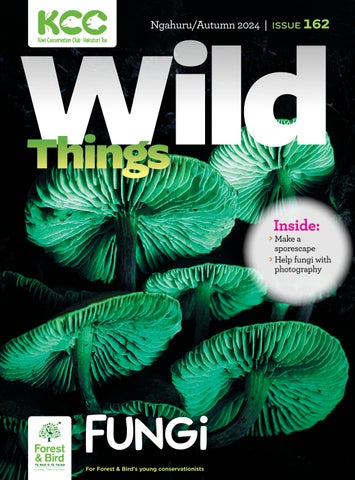
Wild Ngahuru/Autumn 2024 | ISSUE 162
Things
Inside:
> Make a
sporescape > Help fungi with photography
Fungi For Forest & Bird’s young conservationists
Hekaheka | Fungi are living all Harore | around us... Mushrooms
Fungus (singular) Fungi (plural)
but not always easily seen. Fungi can be very small, and are hidden from view much of the time in the soil, in logs, and on (and in) plants and animals. Did you know that there are fungi living in the foam bubbles of streams? That there are fungi living in you? Amazing, right?! Fungi are not plants. They belong to their own special kingdom (group). There are SO many different types of fungi. Here are just some of them.
Most mushrooms have gills on their underside, like this Armillaria novaezelandiae. Armillaria is only found on wood.
Bolete mushrooms, like this slippery jack, have a spongy underside. Instead of gills, they have soft tubes where spores are formed and released into wind currents. Most bolete mushrooms are attached below to living tree roots, the tree and mushroom helping each other to feed and grow.
There’s no need to be afraid of wild fungi; just be sensible – Wash your hands after touching fungi, especially before you eat. n Don’t eat anything until you’ve triple-checked it is safe to eat. n
EDITOR: Rebecca Hatch ART DIRECTOR/DESIGNER: Rob Di Leva, Dileva Design PRINTING: Webstar, Auckland • ISSN 2230-2565 COVER:
Luca Nikkel (age 8)
2 Wild Things
Heidi Meudt
Colin Domnauer
To join KCC and receive Wild Things, or to receive our free E-news, go to www.kcc.org.nz.
FACT: Toadstools are also mushrooms. Wild Things is published by Forest & Bird, Phone 0800 200 064 Email office@forestandbird.org.nz PO Box 631, Wellington 6140.
Copyright: All rights reserved. No part of this magazine may be reproduced without the written permission of Forest & Bird.
Why so many pua atua | spores? Fungi don’t have seeds, they have spores. Spores are teeny-tiny fungal cells – so small that 1000 would fit on a pin head! They get spread by the wind, by water droplets (from the rain or streams), and with the help of animals – like flies. By spreading spores, fungi find new food to eat. Fungi produce thousands or millions of spores because most spores don’t land somewhere where they can grow successfully.
Tūpuna Māori used puffballs as a rongoā | traditional medicine to stop bleeding from wounds, and as pain relief for burns.
Pukurau | Puffballs
Insect-killing fungi The āwheto | vegetable caterpillar fungus feeds on the insides of caterpillars of two species of native moth. The caterpillar bodies become mummified! Tūpuna Māori discovered that when you burn this fungus the charcoal can be ground into a black powder, forming a black pigment when mixed with bird fat, for use in tā moko | tattooing.
Greg Hadley
Earthstars
© Wild Things Issue 162, Feb 2024. Published by Forest & Bird.
Did you guess that earthstars are related to puffballs?
Mirca Fredrick
Brackets David Orlovich
Tūpuna Māori used dried pieces of this bracket fungus, called pūtawa | white punk, as a fire starter or to carry fire. This fungus is only found on one kind of native beech tree.
The largest living organism on Earth is probably a fungus! One colony of a honey mushroom called Armillaria solidipes from the USA was found to be growing through the soil across an area of 1000 rugby fields. That’s way bigger than the biggest blue whale!
Brad Cadwallader
3
Coral fungi
Tooth fungi
There are more than 100 known species of coral fungi in Aotearoa! Mostly they’re brightly coloured and growing on the forest floor, but some Jakob (age 10), IMAgEn8 workshop grow on wood.
Pihi-haunga | Stinkhorns
Cup fungi
© Wild Things Issue 162, Feb 2024. Published by Forest & Bird.
Pekepeke-kiore | NZ lion's mane is native to Aotearoa. Its spores are formed all over the teeth. There are now mushroom kits you can buy to grow this edible fungus yourself!
Petra
Mark Stirling
Stinkhorns, like this white basket fungus, have a really yuck-smelling slime on them. It’s all about attracting flies because they spread their Seymour Burgess spores.
Paint splash/ crust fungi Jane Gosden
4 Wild Things
This fungus goes by many names – beech strawberry is one of them. It is a favourite food of kererū. Its insides are jelly-like. Cup-shaped fruiting bodies are often tiny and separate, however, this fungus has many cups grouped together, which makes it look like a golf ball! Beech strawberries only occur on living native beech trees.
Steccherinum meridionale smells really nice – like vanilla! Typically found on the underside of the wood it is feeding on. Petra Gloyn
Autumn is the best time of the year to see fungi out in nature. This is when the ropihua | fruiting bodies grow because it’s wetter and cooler weather.
Puruhekaheka | Moulds
Wadia
Pukoko | Lichens
Grey fruit mould is a fungus you might find growing in your lunch box (if you leave it in your bag over the weekend), or on the ceiling of damp rooms with poor air flow. “Good moulds” get used in making some of our foods (like several cheeses), and mould is also the source of several life-saving antibiotics, such as penicillin.
This is ruffle lichen. Lichens are fungi that live with, and provide a home for, algal cells. The algae can make their own food using sunlight while the fungi on their own cannot. Lichen lives on footpaths, fence posts, even roads!
Wood ear
Stephen Thorpe
Mildews are parasitic fungi that feed on living plant leaves causing a disease that appears as thin white blotches on leaf surfaces.
FUNGI NO MORE
© Wild Things Issue 162, Feb 2024. Published by Forest & Bird.
Brendan Doogan
Hopurupuru | Mildews
All the better to hear you with
In the late 1800s, dried wood ear was a NZ export product to China.
What big ears you have...
rgpowlesland Robeanne
Slime moulds, like this dog vomit slime mould, used to be classified as fungi, but scientists have now discovered they’re something different again. That’s one of the cool things about science – we are always learning!
5
Panga | Puzzles
Check your whakautu | answers at kcc.org.nz/puzzle-answers.
What a name! The common names of many fungi can be as fantastic as the fungi themselves! Can you match these names with the right fungus?
➊ Witches’ butter ➋ Icing sugar
fungus
➌ Pagoda fungus ➍ Devil’s fingers
➏ Jellybaby ➐ Hotlips puffball
6 Wild Things
Based on blog by Lara Shepherd, Te Papa.
© Wild Things Issue 162, Feb 2024. Published by Forest & Bird.
➎ Pixie’s parasol
#YeastyBoy
Horace the Fungus Cake
To start Horace, you’ll need: • • • • •
125g self-raising flour 250ml milk 100g sugar 40ml warm water 1 tbsp active dry yeast
Start off a living yeast “bug”, grow him, and then share him with others!
Getting Horace started… ➊ Sprinkle 1 tbsp of sugar over the warm water in a measuring jug. ➋ Sprinkle the yeast over the sugar and water. Leave in a warm place for 10 mins to double in size. ➌ Put the mixture into a big bowl and add the milk, ➍ ➎
flour, and remaining sugar. Stir using a wooden spoon. Cover over the bowl loosely with a tea towel. Place in a warm place.
Caring for Horace… DAY
➊ Today Horace was given to you. You’ll need to
care for him over the next 10 days. Keep Horace in a large bowl, covered with a tea towel. Place him in a warm place. © Wild Things Issue 162, Feb 2024. Published by Forest & Bird.
DO NOT PUT HORACE IN THE FRIDGE. IF HORACE STOPS BUBBLING, SOMETHING IS WRONG.
DAY
➋–➌ Stir Horace 2–3 times a day with a
wooden spoon.
DAY
➍ Horace is hungry. Feed him with 100ml of milk,
100g sugar, and 125g of self-raising flour. Stir.
➎–➑ Stir Horace, as before. DAY ➒ Horace is hungry. Feed him like you did on day four. Then, split him into three parts. Give two baby DAYS
Horaces away to friends and whānau (or keep one and give one away), with these instructions. Save the third part to bake!
➓ Mix Horace with 75g of self-raising flour, 2 eggs, 75g of sugar, 50ml of cooking oil, 1 tsp of vanilla essence, DAY
1 cooking apple cut into small chunks, 1 heaped tsp of cinnamon, and 50g of raisins (or other dried fruit). Bake Horace at 180°C in a cake tin for about 30–40 mins, or use a muffin tray and bake for about 20–30 mins.
As the baker’s yeast fungus breaks down the sugars you’ve fed it (so it can feed and get energy) it lets out carbon dioxide (CO2). The carbon dioxide is what makes the mixture bubble and grow/rise. This process is called tukupūngao | respiration. Yeast fungus is a colony made of a huge number of tiny single cells – that makes yeast among the smallest of fungi!
7
Create a Fungal lunch
Patai | Challenge
There are heaps of everyday foods we eat that are fungus or made using fungi. Can you use (and better yet combine) fungal ingredients and make an epic lunch box?
Here are some fungirific ingredients to get you started: Marmite n Yeast n Yeast breads (sourdough, English muffins, rēwena bread, pizza base etc.) n Soy sauce n Chocolate n Salami n Miso n Mushrooms n Coffee n Mould cheeses (brie, camembert, blue vein, stilton etc.) n Ginger beer n Quorn n Tempeh n Kombucha n Horace (see page 7) n
© Wild Things Issue 162, Feb 2024. Published by Forest & Bird.
Send in a f your picture o s to kcc@ creation/ z bird.org.n forestand to rch 2024 by 29 Ma o in one f be in to w rizes. 10 fungi p many TIP: How gredients fungal in the is one of you use e riteria – th judging c better! more the
8 Wild Things
We've made this challenge with
Make a free account, and find out more about fungi and food at tenz.org.nz/resource-store
Studio C
More than meets the eye The ropihua | fruiting bodies of hekaheka are there for reproduction – a way to spread the fungus’ thousands upon thousands of spores. While these are the parts we see, the main body (part) of a fungus is hidden from view.
© Wild Things Issue 162, Feb 2024. Published by Forest & Bird.
Mycelium (singular) Mycelia (plural)
Torohihi | Hyphae are thread-like fungal cells. They are what the pua atua | spores that germinate (sprout) grow into. When hyphae meet and join together, that’s when the magic happens. They form a network called the mycelium. It looks a bit like roots or branches of a tree. Fungal mycelium grows far and wide, intertwining with the oneone | soil, rākau | wood, or other food that it lives on and in. It’s responsible for doing cool fungi stuff like breaking down leaf litter and dead wood (see page 15).
Torohihi/Pūhihi | Hyphae
Some fungal species aren’t decomposers, and their mycelia get intertwined with pakiaka | plant roots. They connect tipu | plants up – like the internet – and help them suck up water and get the nutrients they need to live and grow. In return, the fungus gets sugars made by the plants through photosynthesis. Sometimes fungi even live in plant roots (see page 12). Mushroom
Gill Basidia Primordia Spores
Hyphal knot
Finish e drawinguth myceli m
MUSHROOM LIFE CYCLE
Spore Germination
Hyphae Mycelium
Mycelium Hyphae meet
9
Photo: winterglow
© Wild Things Issue 162, Feb 2024. Published by Forest & Bird.
Riddle
According to a pūrākau | story from Tūhoe, there is a bird who got its colouring from this mushroom by rubbing its cheek against it. Who was it? This mushroom is called werewere-kōkako. It's the national mushroom of Aotearoa, and on the $50 bank note!
10 Wild Things
© Wild Things Issue 162, Feb 2024. Published by Forest & Bird.
Polly
Pekapeka Reports
All this talk about the mycelium has got me thinking... Our Forest & Bird Society has a network too – we are all threaded together, and our network has been growing for 100 years! Our “fruiting bodies” are our Forest & Bird and KCC Branches, Youth Hubs, National Projects and Reserves, and National Office, and all their activities.
Our first North Island branch was formed in Auckland in 1947.
Forest & Bird Branches Forest & Bird Youth Hubs Kiwi Conservation Club Branches National Projects and Reserves National Office
F&B Nelson was the first branch to be started in 1928.
National Office started in Wellington in 1923.
Kaikōura is our most recent F&B branch, starting in 1990 F&B Southland Branch and F&B Dunedin were also some of the first – they started in the 1930s.
Christchurch is the first of the modern branches, starting postwar in 1946.
Did you know that Forest & Bird has 140 active projects?
Irahuka/Long Point, Otago Coastal Seabirds Restoration
Sandymount/Harakeke Point, Otago Coastal Seabird Restoration
Tautuku Ecological Restoration
Lawyers Head, Otago Coastal Seabirds Restoration
St Clair Cliffs, Otago Coastal Seabirds Restoration
Science of conservation
Saving native orchids using fungi! The people
The problem Many of our native orchids are in trouble – a number are even near extinction – but helping their numbers to grow is not as simple as planting their seeds. Orchid seeds are miniscule (very, very small) so they can spread via the wind. They are very basic seeds too – they don’t have a food source within them to get the seed germinating (sprouting).
Karin van der Walt and Jennifer Alderton-Moss work at Ōtari-Wilton’s Bush in plant conservation. They are specialists in long-term storage through seedbanking and cryopreservation (freezing at -196°C), and growing threatened species.
So how do orchids grow? They rely on special fungi to be an umbilical cord. The fungus brings the orchid the nutrients and food they need to grow. Each orchid has its own fungal buddy or partner. "Mycorrhizae" is the scientific term for relationships between fungi and roots.
The solution Scientists are using DNA to identify the fungal partner of several threatened orchids and coming up with new methods to germinate orchid seeds in the wild. This project is funded by Te Tahua Taiao Ngā Taonga – Lottery Environment and Heritage Committee.
12 Wild Things
Carlos Lehnebach works at Te Papa as a Botany Curator. He is an expert in NZ native orchids. Of the 110 known species, he’s discovered and scientifically described seven of them! He loves that our native orchids are so unusual and teeny-tiny.
© Wild Things Issue 162, Feb 2024. Published by Forest & Bird.
The Native Orchid Conservation Project by Ōtari-Wilton’s Bush (our only botanical garden solely with native plants) and Te Papa have found a clever way to match rare, endangered NZ orchids up with their fungal buddy so they can grow more successfully in the wild.
The testing
“Matchmaking” © Wild Things Issue 162, Feb 2024. Published by Forest & Bird.
The fungus that buddies up with each orchid lives in their roots, so scientists take small bits of root from adult orchids species (and some closely related to them) living in the wild. Using a microscope, they tease out coils of fungi from the root cells. They put these coils into Petri dishes to grow.
So far, the team have found the fungal buddies of 4 of the 5 species they are studying – woohoo! It can take months, even years, to “matchmake” because things don’t always go to plan.
Then they use DNA methods to identify the fungus. A subsample (smaller sample) of the fungus is then put together with orchid seeds and moved into an incubator. An incubator is a special chamber for growing and developing living things where you can control the conditions. If the fungus triggers germination within the incubator, the scientists know it is a match.
Trialling in the wild All the “matchmaking” that has happened, so far, has been in the lab, so scientists are now figuring out how to do it in the wild. The epiphyte or perching orchid Drymoanthus is first up for trials. It starts the same as in the lab, but instead of putting the seeds and the fungus in the incubator, the scientists are putting the fungus and seeds together in a tea bag. They staple the tea bag to trees. The tea bags are covered over by pantyhose to keep everything nice and secure. After a few months, scientists will check if the seeds have germinated and their roots attached to the tree.
How can you help orchid conservation?
Why germinate them in the wild? The shock from moving from the lab to the wild has proven to be too much for sensitive orchids.
So much is still unknown about native orchids in Aotearoa. If you have native orchids growing where you live, get in touch with Carlos at carlos.lehnebach@ tepapa.govt.nz. It could lead to new information or a new discovery!
13
Rapunga PUKOKO Pukoko kōwhai
Pukoko kei runga toka
Yellow lichen
Lichen on a rock
Pukoko ngohengohe
Pukoko kei runga rākau
Soft lichen
Lichen on a tree
Pukoko porotaka
Pukoko kei runga peka rākau
Pukoko e rite ana ki te rimurimu
A stick with lichen on it
Lichen that looks like seaweed
Pukoko kāmata whero
Pukoko kei runga rori
Lichen that has red tips (they’re the fruiting bodies)
Lichen on the road or path
He pukoko rerekē e piri tahi nei
A round patch of lichen
14
LICHEN Hunt He pukoko e rite ana ki te pāhau Lichen like a beard
Pukoko e rite ana ki ngā kapu Lichen like little cups
Different types of lichen together
For more free activities visit: www.kidsgreeningtaupo.org.nz
FACT:
Most fungi are “saprotrophs”. They feed on dead wood, dead leaves, and dead animals. Why is this important?
Nature’s clean-up crew Without decomposers, all of the natural waste in the forest would just pile up! Decomposer fungi excrete (put out) special proteins called enzymes that cause, and help to speed up, chemical reactions. The chemical reactions are what make plant or animal matter break down or “soften”.
Fungi are the only decomposers that break down wood, and the cellulose in plant walls, so they are the main decomposers of the ngahere.
Who else is part of the crew? Scavengers:
They eat the big or bigger bits of dead or decaying plants and animals. Once they digest it, they poo it out as smaller bits. They disperse (spread out) the matter so it’s not all rotting in one place. Can you think of a native NZ scavenger?
Detritivores:
They chew up, digest, and poo out the animal and plant matter so it’s in really small and fine bits. They haul the matter down from the surface into the deeper layers of the soil, where it’s easier for saprotrophs to break it down. They also aerate (turn over) the soil. This makes small holes to allow air, water, and nutrients to move through it. Can you think of a native NZ detritivore?
The, whistlingfrog Southern cinnabar polypore fungus releases an enzyme called laccase, which is really good at breaking down wood. Scientists are looking at how these enzymes can be used in biotechnology.
15
© Wild Things Issue 162, Feb 2024. Published by Forest & Bird.
The great recyclers of Tāne-mahuta
Recovering the treasure There are a lot of useful things in dead wood, leaves, and animals that would be lost without saprotrophs. As the plant and animal matter breaks down, they release hard-to-get nutrients into the soil, air, and water around them. Nutrients are the good stuff essential for living and growing, like nitrogen. Decomposer fungi absorb (take in) some of the nutrients from the organisms they are decomposing. Those nutrients are their food.
Did you know that... 16 Wild Things
n
Some species of fungi could be used to break down petroleum, and soak up heavy metals in oil spills?
n
There is a fungus found in the Amazon that breaks down polyethylene plastic?
Don’t take away everything.
Making them reusuable
Leave some felled logs and branches as food for fungi.
The special enzymes of decomposing fungi make the nutrients change into forms that plants, and other soil dwelling organisms, like bacteria, can use too.
Amber Sisaričh
n
Spread mulch in your garden or planting area. It’s a good habitat for fungi. You'll also get to see lots of interesting fruiting bodies!
There are fungi that like radiation and might be used to clear up nuclear waste!?
17
© Wild Things Issue 162, Feb 2024. Published by Forest & Bird.
How can we help fungi feed?
Mushroom sporescape By Tobia Dale
Spore prints make awesome art – why not try it yourself?
N
IG
H T AC
OV E
Kakau | Stem
R
Pihapiha | Gills
You’ll need: Paper Jar/Plastic container (big plastic containers work well) n Fresh mushrooms n n
Step ➊ Collect your mushrooms. Be careful as mushrooms are very fragile.
Wash your hands after touching wild mushrooms. 18 Wild Things
Step ➋ Lay your mushrooms out to see what you have.
T
ITY
Spores are usually white, brown, or black. But sometimes the spores come in shades of pink, orange, yellow, or even green!
Pua atua | Spores
IV
Fungi live underground and grow mushrooms or other fruiting bodies so they can spread their spores, which then grow into new fungi. Spores are hidden in the gills of a mushroom, and the colour of the spores can be used to identify what species a mushroom may be.
Taupoki | Cap
Step ➎ Place a jar/container upside down over top of the mushroom caps to protect them. Now leave all your mushroom caps overnight.
Step ➏ Carefully take the mushrooms off the paper to reveal your sporescape.
© Wild Things Issue 162, Feb 2024. Published by Forest & Bird.
Step ➌ One by one, carefully remove the stem from your mushrooms. Pinching the stem off works well.
Step ➍ Arrange your mushroom caps on your piece of paper, making sure the gills are touching the paper.
EXTRA You might notice some of the spore prints turn out white on your paper, so are a bit hard to
see. If this happens, you can collect more mushrooms and repeat the same steps on black or coloured paper. Spore prints will even work on tinfoil!
19
Fungi enthusiast
Hi, I’m Luca. I’m 8 years old and I’m from KCC Dunedin. I love photographing fungi! I originally just liked invertebrates, but I took some fungi photos in the City Nature Challenge, and I realised that fungi are really cool! I took more and more fungi photos until fungi became one of my favourite things. I learned more about them and their names by uploading my photos to iNaturalist. You can look on iNaturalist to see what fungi live in your area, and what time of year they are most common (fungi are most common in autumn but you can also find them all year round). Forests are one of the best places to look. One of my favourite places to find mushrooms and other fungi is Orokonui Ecosanctuary. To photograph fungi well, you have to get down to the level of the fungus. That means sometimes getting a bit muddy or dirty. To get an ID on iNaturalist, you need to make sure you photograph the underside too, show the habitat, and take photos when the fungus is in good condition – not when it’s old or been damaged. Another thing you can do is use a UV torch, because some fungi fluoresce (light up) under UV light, which looks amazing! Here are some of my favourite fungi to photograph. The photo on the cover of this magazine is one of mine too.
20 Wild Things
© Wild Things Issue 162, Feb 2024. Published by Forest & Bird.
Bird’s nest fungus When they are young, the fruiting bodies have little lids covering them. When the lids come off, you can see the little “eggs” in the fungus. The “eggs” contain spores. When a raindrop hits them, the force of the splash makes the eggs fly out! They will land in a new place and grow new fungi.
Purple pouch fungus Only found in beech forests. The colour makes it easy to spot, and it is mostly found in autumn. We found this mushroom on the Catlins River Track. They look like berries so maybe birds will eat them and spread their spores around.
Orange pore fungus This fungus has no gills. They have holes or pores filled with spores on their underside. They are bright orange, and usually grow on twigs and dead trees. It’s a shame it is a bit of a pest because it’s really cool!
Trooping crumble caps or fairy bonnets This fungus grows in clusters, and it breaks down and eats dead wood. This photo won the Youth Botanical Category at the Tūhura Otago Museum Photography Competition.
21
Citizen science
Help fungi with photography
Take photos of fungus you see, and notes Use Luca’s tips (from page 20) to help you get great shots that can be used for identification. Note down details about the fungus, like where it’s living, whether it’s growing from the soil, on dead wood, or a living tree, what texture it has, and if it has a smell.
Make an account, and then upload your photos and notes onto iNaturalist NZ | Mātaki Taiao Upload
John Barkla
You can upload your photos via the app on your iPhone or Android device, the web (inaturalist.nz), or through Flickr. Here are some helpful instructions (pictures and video): bit.ly/gettingstartedinaturalist TIP: If your photo is Creative Commons, it’s more likely to be looked at by fungi experts.
Deconica baylisiana is a pouch mushroom only found in alpine grasslands in Otago and Rakiura | Stewart Island.
Did you know about these endangered fungi? Probably not.
tuisauce
22
Fischer’s egg (Claustula fischeri) is a truffle-like fungus. It’s only found in two places in New Zealand.
It’s important to look after all our special native species – not just our birds and plants.
© Wild Things Issue 162, Feb 2024. Published by Forest & Bird.
Mycologists (fungal scientists) think that only about one-third of the total number of fungi of Aotearoa have been recorded. There are still thousands of species to be found, named, and described. Some of these could be endangered. Help to build the records of our native species so we can protect them!
Adventures in
Conservation Did you know Aotearoa has at least ten different species of bioluminescent or “glow-in-the-dark” fungi? Here’s what Tobia Dale learnt from having a chat with journalist and fungi lover Anna Chinn. Anna Chinn tries to go out looking for New Zealand’s glowing fungi once or twice a year. She finds it both exciting, and strangely relaxing, to enter the calming dark, leaving behind a world of artificial lights. Anna loves the feeling of going back in time and getting to see one of the first kinds of light ever produced on Earth.
Tobia
FACT:
Bioluminsecent species make their own light through a chemical reaction
The glowing mushrooms are spectacular, but it’s often easier to find the glowing mycelium living in pieces of wood and leaves. In some species, the whole mushroom glows, but in others it might be just the stems, or just the gills. Other fungi may only have glowing mycelium and not glowing mushrooms.
Vanessa Gandar
24 Wild Things
This photo involves some crafty camera work. In real life, you wouldn’t be able to see your hands holding a piece of wood, you’d only see the glowing mycelium, hovering wherever you moved it, like a ghost in your hands.
Harore | Honey mushrooms can be unpredictable. The veils of tissue that cover the gills seem to glow consistently, but sometimes other parts of the mushroom glow as well! Here, the fungi are lighting up a dead tree branch. Can you make it out?
Anna To see glowing fungi, you need to be in a dark forest with accessible terrain and must turn off all torches and devices. Anna told us to hold our face just above the ground in areas with woody debris and crawl around for a while. Fungi do not glow as brightly as glow worms, so it takes at least 20 minutes for your eyes to adjust enough to spot the soft glow.
Taylor Lockwood
© Wild Things Issue 162, Feb 2024. Published by Forest & Bird.
In certain species, such as the tiny Mycena “Crystal Falls”, both the mushrooms and the mycelium glow. This species is often found on the dead branches of native kātote | tree ferns, so it makes the skirts hanging from the tree ferns glow softly. You can see these glowing skirts from several metres away if you have the patience to let your eyes fully adjust for night vision.
This picture shows tiny Mycena roseoflava mushrooms, which have glowing stems. Anna was able to detect this, and David Hera to photograph it, because the community in Rakiura protect their nights with a Dark Sky Sanctuary. The best spots to start looking for glowing fungi are in damp native bush far away from any cities, towns or streetlights.
David Hera
David Hera
25
Slow the spread
Myrtle rust Rusts are a type of fungus that attack living plants and makes them sick. These diseasecausing fungi produce large numbers of spores on the surface of infected leaves. Myrtle rust is bad news for pōhutukawa, rātā, and the other 35 native myrtle species we have in Aotearoa. Clean your clothing, gear, and equipment before you go for a walk, and after you go for a walk.
Look out for the fungus on the myrtle plants you visit.
Report it if you see it. Here’s the link to the Myrtle Rust Reporter: inaturalist.nz/projects/ myrtle-rust-reporter.
26
K Street
© Wild Things Issue 162, Feb 2024. Published by Forest & Bird.
Myrtle rust has likely come to Aotearoa carried by the wind. Follow NZ’s strict biosecurity rules to help reduce the chance of other disease-causing fungi harming our plants.
Panga | Puzzles Maze
Check your whakautu | answers at kcc.org.nz/puzzle-answers. Why couldn’t the fungus have many people over? How much She didn’t have room do fungi mushroom. need to grow? As mushroom as possible!
Amber Sisaričh
Hihi, hihi!
© Wild Things Issue 162, Feb 2024. Published by Forest & Bird.
Funnies
Ponderer Some fungi are harmful to endangered native plants but are themselves native and endangered too. Should the plant or the fungi be protected – or both?
Crossword
Look for the answers in the magazine! Across:
Down:
Amber Sisaričh
2 Some mushrooms can glow in the dark! This is because they are __________. 3 What do mushrooms love to grow on in the garden? 4 Pōhutukawa and rātā are part of the ___ family. 5 When hyphae meet and join together, they make ________. 11 To reproduce, mushrooms release ______. 12 Thread-like fungal cells.
27
© Wild Things Issue 162, Feb 2024. Published by Forest & Bird.
1 Large, round and white – can grow bigger than a soccer ball! 4 Name for fruiting body of most fungi. 6 Fungus commonly found in food, like bread. 7 The scientific name for the relationships between roots and fungi. 8 These release spores in most mushrooms. 9 What important role do fungi play in the ecosystem? 10 Māori word for fungi. 11 A type of mushroom that stinks of rotting meat! 13 The Māori word for lichen. 14 Name of bird associated with our famous blue mushroom. 15 You should always ____ your hands after touching any kind of mushroom.
Nature Walks Mount Ngongotahā Nature Loop Track | Rotorua
Let’s go for a forest adventure on a big volcano near Rotorua.
Need to know: Walking only. Allow 60 minutes for the loop. n Toilets available. n The car park is 200 metres past the Clayton/ Pukehangi Road intersection on Paradise Valley Road, Rotorua. n No dogs. n
Mount Ngongotahā Scenic Reserve is home to cheeky pīwakawaka | fantail doing cool tricks in the air and a super tall northern rātā nearly 40 metres high that the locals have named “Pat”. Walk under plants hanging from trees like decorations (epiphytes), and look closely at any old, rotting trees – you might see tiny spiders hanging from their webs. Sunlight comes through gaps in the forest canopy (created by fallen trees) and helps little plants grow on the ground. Many different fungi live in this forest: some smell funny, some look like icicles, and some are yellow. You might even find a brand-new mushroom that nobody has ever seen! Can you hear the birds singing? Take a picture of the bird sign and try to spot any birds flying above you. Maybe a hungry toutouwai | North Island robin will follow you, hoping to find critters in your footprints. Have fun exploring this cool place!
Ceana Priest is the author of kidfriendly Outdoor Kid adventure guidebooks outdoorkid.co.nz
Join Forest & Bird Youth We’re a nationwide network of young people who are protecting and restoring Aotearoa's wildlife and wild places. n For ages 14–25 years. Led by Youth, for Youth. n Help Papatūānuku by gaining skills and experience. n Connect with like-minded people from across Aotearoa.
Find out more about joining us:
bit.ly/FandBYouth
© Wild Things Issue 162, Feb 2024. Published by Forest & Bird.
1 Werewere-kōkako (Entoloma hochstetteri), 2 Wood blewit (Clitocybe nuda), 3 Purple coral (Ramariopsis pulchella), 4 Morel (Morchella importuna), 5 Verdigris waxgill (Gliophorus viridis), 6 Weraroa (Psilocybe weraroa), 7 Salmon eggs (Trichia decipiens), 8 Slippery jacks (Suillus granulatus/luteus), 9 Yellow waxgill (Hygrocybe cerinolutea), 10 Yellow chanterelle (Cantharellus wellingtonensis), 11 Earthstar (Geastrum triplex), 12 Goldclub coral (Clavaria amoena), 13 Brown oyster (Pleurotus australis), 14 Brick woodtuft (Hypholoma sublateritium) 15 Fly agaric (Amanita muscaria).
Colour me in!
Name: Age: Show us your mahi by emailing us at kccinbox@forestandbird.org.nz
29
In the
Mailbox FUN
Eva (age 7) drew our national fungus.
© Wild Things Issue 162, Feb 2024. Published by Forest & Bird.
GI
Hughie (age 6 and ¾) found this impressive stack of Trametes suaveolens on a recent adventure. Oliver (age 3) found a wood ear fungus in Raglan.
Alice (age 4) from Imagine Childcare got to look at the insides of this fungus she found with her kaiako, and stomp on lots of puffballs!
30 Wild Things
The Bushy Park Tarapuruhi team sent in this picture of cramp ball fungus!
KCC
ADVENTURES
Find more KCC Adventure stories on our blog!
Wetland wandering KCC Horowhenua got to “call” and feed tuna | eels as part of their adventure to Te Ripo o Hinemata wetland. Lindsay (our host) showed how the eels respond to the vibrations made when stomping on the jetty. He told us some of the eels have been given names, like White-Fin, Spotty and Blue-Nose. Helen Croskery (KCO)
Scavenger hunts rock! We went to Lake Tarawera and we did a scavenger hunt to find all sorts of volcanic rocks. There were lots of volcanic rocks because of the Tarawera eruption. We put the rocks together and wrote KCC Rotorua. After we collected the rocks, we went to the cafe to have a look at the rocks through microscopes and magnifying glasses. We saw different minerals and colours in the rocks.
Where is that adventure? Had a KCC adventure? Let us know at kcc@forestandbird.org.nz.
Jackson (age 7) from KCC Rotorua.
Shoutout
Ngā mihi nui Peter Buchanan from Manaaki Whenua | Landcare Research for all your help with this issue. Peter is a mycologist with a special passion for fungal conservation, awareness and education. He recently co-wrote an amazing free fungi resource for schools called Ngā Hekaheka o Aotearoa.
31
Snapshot
Great fungi hunting Max and Ellie!
Share your weird and wonderful photos of NZ native nature with us! Which KCCer will be next to be on the cover?
CONTACT US
32 Wild Things
kcc@forestandbird.org.nz Wild Things PO Box 631 Wellington 6140 www.kcc.org.nz
NEXT TIME
Wetlands