Wild Raumati/Summer 2023 | ISSUE 161
Things
Inside:
> Grow a leaf
litter garden > Get behind Predator Free 2050
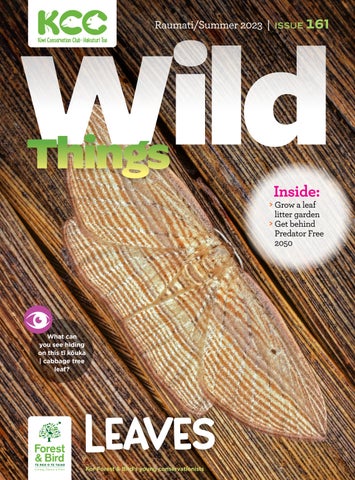
What can you see hiding on this tī kōuka | cabbage tree leaf?
Leaves For Forest & Bird’s young conservationists
There are more than 2500 native plants in Aotearoa New Zealand Each has its own unique rau | leaves. Ponga | Silver ferns have a special type of leaf called a frond. This rau has become pretty meaningful both here and around the world!
This is just one kōwhai leaf. It’s a compound leaf because it has lots of “leaflets” attached to the midrib.
This leaf comes from a makomako | wineberry tree. It's a simple leaf because the blade is all in one piece. It has a toothed margin (edge).
Let’s find out why leaves matter so much to plants and to nature, and how we can help care for them.
EDITOR: Rebecca Hatch ART DIRECTOR/DESIGNER: Rob Di Leva, Dileva Design PRINTING: Webstar, Auckland • ISSN 2230-2565 COVER: Te pūrēhua noho tī | Cabbage tree moth
To join KCC and receive Wild Things, or to receive our free E-news, go to www.kcc.org.nz.
Wild Things is published by Forest & Bird, Phone 0800 200 064 Email office@forestandbird.org.nz PO Box 631, Wellington 6140.
perfectly camouflaged on a dead tī kōuka leaf. Rod Morris
2 Wild Things
Copyright: All rights reserved. No part of this magazine may be reproduced without the written permission of Forest & Bird.
Blade
Midrib
© Wild Things Issue 161, Nov 2023. Published by Forest & Bird
Vein
Margin Ever wondered what the structure of a leaf looks like under the outer green layer?
Petiole/ Leaf stalk
Here’s a māhoe "leaf skeleton"! Gillian Candler
3
Different parts of leaves do amazing things! The main roles of rau | leaves are to make kai | food for plants, help plants use their food, keep water levels in balance, and cool plants down. What parts of leaves make this possible?
Chlorophyll and Chloroplasts Plants make food for themselves using wai | water, hauhā | carbon dioxide, and pūngao aho | the Sun’s energy. The process is called ahotakakame | photosynthesis. Too much or too little of one ingredient can make it hard for plants to do it properly – it’s that clever of a process. Photosynthesis happens in the leaves.
Light
Kanokāriki | Chlorophyll is the green pigment in leaves. It works like a solar panel, capturing the Sun’s energy. Chlorophyll is found in ngā pūkāriki | chloroplasts. They are a bit like kitchens. The ingredients get all mixed together, making glucose (a type of sugar). Oxygen is released as part of photosynthesis.
4 Wild Things
H2O
CO2
O2
Glucose
Photosynthesis in action
www.sciencelearn.co.nz | © 2007-2022 The University of Waikato Te Whare Wānanga o Waikato
CO2
O2
Hāora | Oxygen
/ 12
de
fu
fun
n/
de
123
RF L td
Hauhā | Carbon dioxide
3R F
L
td
Te mata raro o te rau | Underside of the leaf
He poare | Stomata
H2O
Wai | Water
He poare | Stomata are pores (openings) found on the underside of a leaf. They work a bit like a gate. When they are shut by their guard cells, they keep everything stored inside. When they are open, they let in and let out gases. Why is this amazing? n
Carbon dioxide is a greenhouse gas. When stomata let it in for kai making, and it becomes part of plants, it’s also being removed from our atmosphere. Choice!
n
The leftover oxygen from photosynthesis that stomata lets out is what we and other animals breathe!
n
Stomata can also switch it up to take in O2 and let out CO2. Doing this means plants can break down and use all the food they’ve made and stored. This process is called tukupūngao | respiration.
n
Plants don’t generally need very much of the water they absorb via their roots. Stomata let out water vapour (water gas) to keep the right amount of water inside plant cells, so plants don't get sick. This process is called tukuwai | transpiration. The water vapour in the air makes it cooler too.
© Wild Things Issue 161, Nov 2023. Published by Forest & Bird
Stomata FACT: Leaves mean trees can be climate heroes! FACT: Stomata are usually on the underside of leaves because they collect CO2 being released from decomposing leaf litter too.
5
Panga | Puzzles
Check your whakautu | answers at kcc.org.nz/puzzle-answers. FACT: Botanists (plant scientists) use the
Match-up Rau come in lots of different shapes. Can you match these shapes with these native species?
“growth form” of the plant as the first step in identifying it – that is, whether it’s a tree, shrub, fern, vine, etc. The next step is to look at the leaves.
Rimu
Kawakawa | Pepper tree Kopakopa/Raurenga | Kidney fern
Horoeka | Lancewood
Egg
Coprosma spathulata
Puahou | Five-finger
Spoon
Kidney
Heart
Needle
Houhere | Lacebark
Hand
Spear
Fill in the blanks There are two main ways that rau grow on the stems of plants – like buttons and buttonholes (where they line up opposite to each other) or like a zip (where they line up alternate to each other). Draw these leaf arrangements.
Wordfind These are all words that describe rau textures. Look up, down, across, diagonally, and backwards for the words.
Y
Y
D
N
F
S
D
M
C
L
L
C
J
P
X
S
K
R
S
M
F
E
D
O
E
V
U
T
X
T
F
A
C
O
I
G
T
W
R
A
R
S
D
T
F
D
I
O
I
V
O
T
J
R
T
N
W
V
Y
L
I
T
S
S
T
R
I
M
U
H
Y
X
A
W
W
H
R
E
A
C
S
P
D
G
E
F
Y
U
Q
M
WAXY
W
R
I
N
K
L
E
D
A
R
D
U
O
R
M
FUZZY
X
H
D
B
C
N
M
W
T
Y
P
S
Z
E
P
H
R
J
T
I
Z
E
H
E
K
P
A
B
Z
G
W
V
V
L
K
D
O
H
D
T
D
C
C
O
Y
D
F
Q
V
T
R
Z
T
M
R
X
Z
B
J
W
N
Q
G
K
B
X
U
F
A
S
W
Z
A
Q
Z
N
I
Y
N
K
N
D
M
N
P
I
E
Q
B
B
O
W
F
H
I
Z
X
X
L
U
I
B
T
U
B
U
Q
V
H
M
U
N
V
L
H
W
N
Q
U
U
Funnies
Learning about leaves started off simple, but then it compound[ed]!
CORRUGATED LINED STICKY SMOOTH
PITTED LEATHERY WRINKLED
Riddle What do ears and leaves have in common?
Some are lobed and some aren’t!
Hihi, hihi!
Why did the leaf go to the dentist? Because it was toothed!
© Wild Things Issue 161, Nov 2023. Published by Forest & Bird
●●●●●●●●●●●●●●● ●●●●●●●●●●●●●●● ●●●●●●●●●●●●●●● ●●●●●●●●●●●●●●● ●●●●●●●●●●●●●●● ●●●●●●●●●●●●●●● ●●●●●●●●●●●●●●● ●●●●●●●●●●●●●●● ●●●●●●●●●●●●●●● ●●●●●●●●●●●●●●● ●●●●●●●●●●●●●●● ●●●●●●●●●●●●●●● ●●●●●●●●●●●●●●● ●●●●●●●●●●●●●●● ●●●●●●●●●●●●●●●
Clematis cunninghamii Josh Wedlake
7
Leaf adaptation By Natasha Evans
What is it that drives the marvellous variation in the plant world? The answer is urutau | adaptation. Plants live all over the world and must adapt (change) to survive in different conditions. New Zealand botanist Eleanor Burton has drawn some of our unique NZ plants. Let's see how they've adapted to survive here.
Tātarāmoa | Bramble/ Bush Lawyer HOOK LEAVES SUN CHASING I arm myself with hooks along my stem and sometimes on the underside of my leaves. If I need to, I can climb 15m high to reach the light. You won’t find many New Zealand natives with hooks like me.
Ongaonga | Tree nettle STINGING LEAVES DEFENCE I am fierce! Tiny hairs that are like needles will give unsuspecting victims a painful sting, but that is why caterpillars like me. They nibble on me, and I provide them with protection from predators. I’m a particular favourite of the kahukura | red admiral butterfly.
8 Wild Things
FUZZY LEAVES TEMPERATURE REGULATION My thick white hairs are like wool or fur on the edges of my leaves. I can use my hairs in different ways. When it’s hot, they keep me cool and protect me from the sun. When it’s too windy and dry, they help me collect water from the air and trap it.
© Wild Things Issue 161, Nov 2023. Published by Forest & Bird
Woollyhead
Taramea/Karamea | Speargrass
Giant-flowered broom
SHARP LEAVES DEFENCE and WATER SAVING My sharp, spear-like leaves are narrow. Any water my roots send my way can’t escape quickly from my small surface area. This makes me well suited to habitats with very little water.
TINY LEAVES WATER SAVING My flowers might be considered giant, but my leaves are tiny! They stick out like scales from my flat green stems. My tiny leaves make it easy for me to live on the coast where the wind can be fierce. It does make it harder for my leaves to make enough food though, so that job has been passed on to my stems.
Mountain daisy WAXY LEAVES WATER SAVING and STRENGTH I live where it snows, but the cold doesn’t bother me. I stay close to the ground, and my tightly packed leaves are firm. I won’t get flattened when it snows. I can’t use ice to make my food, so I must hold onto any water that reaches my leaves. My waxy coat holds it in my leaves until I need it.
Horoeka | Lancewood SPIKY LEAVES/CHANGING LEAVES DEFENCE When I am a young plant, my skinny long leaves are all spiky. These leathery barbs encouraged moa to look elsewhere for a tasty treat (they couldn’t fit the leaves in their mouths). You’ll notice that, when I get taller, my leaves grow differently. They get shorter and wider to better catch the Sun’s energy.
Visit Wellington Gardens with your kura | school! Meet our educators to learn even more about our awesome plants. Plant adaptations is just one programme we offer. gardens.education@wcc.govt.nz wellingtongardens.nz/education
9
Biggest, smallest, weirdest, & rarest With more than 2500 native plants in Aotearoa, there are some amazing rau | leaves. These help the plants survive in a broad range of environments, but which ones are the biggest, smallest, weirdest, & rarest?
Smallest Water meal Wolffia Australiana
Only growing between 0.3 and 1mm, these tiny leaves are around 10 times smaller than a grain of rice! This tiny plant grows in wetlands and lake margins across Aotearoa. Its size makes it one of the smallest plants in the world! Some Wolffia species can double themselves in just 30 hours. They might be small, but they aren’t slow.
Weirdest
Mountain toatoa Phyllocladus alpinus
This leaf is weird because it’s not a leaf at all! This plant, and its whānau, have phylloclades – small flattened branch stems that look and act a bit like leaves. Phylloclades first evolved more than 250 million years ago! Even before dinosaurs. There are three species of Phyllocladus in Aotearoa. One called tānekaha is sometimes known as the celery tree for the way the phylloclades look.
10 Wild Things
© Wild Things Issue 161, Nov 2023. Published by Forest & Bird
Rarest
Ngutu kākā/Kākā beak Clianthus puniceus To goats, these leaves are delicious. So delicious that they have eaten all but a handful of individual plants. They are critically endangered, but, despite there only being a few wild plants left, the beautiful flowers of ngutu kākā make it popular in gardens. Look out for it’s red putiputi | flowers.
© Wild Things Issue 161, Nov 2023. Published by Forest & Bird
Biggest
Nīkau Rhopalostylis sapida With fronds growing to be more than three metres long, nīkau palms have huge leaves! What is amazing is some of their tropical cousins get even bigger! Nīkau are the southernmost palm in the world and are only found here in Aotearoa. You can find them mostly at the top of the South Island and throughout the North Island.
Article by plant enthusiast Taylor Davies-Colley. You can learn more about leaves and our native plants and wildlife by following him at @taytalkstrees on Instagram or TikTok.
11
For healing Harakeke is used as a rongoā rākau (traditional Māori plant remedy). The leaves are particularly good as a dressing to aid healing because their juice acts as a disinfectant.
Check out zines by the Kauae Raro Research Collective on pia and earth paint making (in te reo Māori and English). kauaeraro.com/akoranga-1/ downloads
Stephen Parker
For conservation Te Arawa Lakes Trust are using uwhi | harakeke mats to stop invasive (pest) weeds growing inside lakes Tarawera, Rotomā, and Rotoiti, and at Kaikaitāhuna | Hamurana Springs. The uwhi are placed on top of the weeds, keeping them stuck at the bottom of the lake/spring and stopping them from getting light.
For arts & crafts Tūpuna Māori used tree sap to bind natural paint made from the whenua | land. Harvesting harakeke leaves for weaving is a great way to collect the pia | sap/gum. Harakeke leaves and their fine fibres can be woven into all sorts of useful and beautiful things.
Mātauranga Māori
Making use of harakeke un Tū p
Te rito
a
a
māt ua
mātu
a
un
p Tū Tū pu na
a
un
p Tū
12
TIKANGA: The flax plant is like a family. The central shoot (rito) represents the baby. The leaves protecting the rito are the parents (awhi rito or mātua). Only the leaves on the outside of the plant, the grandparents/ancestors (tīpuna/ tūpuna), can be cut, or the plant is weakened. Show respect for te taiao | nature. Only take what is needed.
2
3
4
5
6
7
8
9
10
11
12
Make a putiputi | flower using one harakeke blade REMEMBER: Wash your hands after working with harakeke.
© Wild Things Issue 161, Nov 2023. Published by Forest & Bird
1
13
What’s my legacy?
Polly
Pekapeka Reports
Forest & Bird has spent 100 years telling (and showing) Aotearoa how amazing our native plants and animals are! With this in mind, Polly Pekapeka, our KCC pekapeka-touroa | long-tailed bat, went on an adventure with the team at Ark in the Park in the Waitākere Ranges. They have some special leaf mimics living there... Aotearoa has more than 30 species of native slugs, most of which are endemic (found nowhere else in the world). All of them are leaf-veined! That means their patterning makes them look like leaves. Introduced slugs (the ones that eat your garden) don’t have a leaf pattern on them. The leaf pattern helps them camouflage (blend in) to protect them from predators. Leaf-veined slugs come in lots of colours, but the ones at the Ark are mostly clear, so you can see their insides working!
Other cool facts I found out: Leaf-veined slugs are hermaphrodites (both male and female). This is because they can find it hard to find a mate. n Mates fight over who gets pregnant, but often they both do. n They breathe through a hole at the top of their body, like a whale! n
14 Wild Things
Chrisc (iNaturalistNZ). Chris is one of the superstar volunteers at Ark in the Park!
They don’t actually eat leaves They live on them, and they clean them! Leaf-veined slugs have a magnificent tongue-like organ called a radula. It has tiny sharp teeth on it – perfect for “licking” off organisms living on leaves. While the slugs do this because they have found it is the best way for them to survive, it actually helps the plants at the Ark a lot because it gets very wet there and it would be easy for leaf fungus to get out of control otherwise. © Wild Things Issue 161, Nov 2023. Published by Forest & Bird
Here I am with an uncovered tracking tunnel. Lucy Mills
Toropapa (Alseuosmia) shrubs have “extreme variation”. The shape of the leaves of the same species, even when they’re growing in the same place, can be completely different looking!
© Wild Things Issue 161, Nov 2023. Published by Forest & Bird
Here are some pictures from my adventure out pest monitoring with Eduardo, Sam, and the volunteers!
Being a leaf mimic is not just an animal thing...
Three species of toropapa are found in Northland, but Te Papa and DOC scientists found 15 different-looking leaf shapes during one field trip!
Leon Perrie/Te Papa
We found this fantastic fungus! Eduardo Colley
Up close with a leaf slug on a taupata | Coprosma repens leaf! Eduardo Colley
If this wasn’t confusing enough for botanists (plant scientists), the leaves of some toropapa look very much like those of other unrelated, unpalatable (yucky to eat) plants. Does toropapa hide to stop itself getting eaten? Certainly looks like it!
Horopito | Pepper tree
Toropapa (Alseuosmia pusilla)
Most of the Waitākere Ranges are closed now to stop the spread of kauri dieback, but the family-friendly Cutty Grass Track has been reopened. Find out more about the Ark in the Park Project at arkinthepark.org.nz.
Can you spot the difference? Lara Shepherd
15
What can you make out of leaves? Here’s some ephemeral (found object) art by kids from Southland to inspire you!
Bronwyn Graham
16 Wild Things
Show us your mahi! Email kcc@forestandbird.org.nz.
A lobster!
Flying folivores
It is extremely rare to find birds that are folivorous (leaf-eating), but in Aotearoa there are kererū and North Island kōkako!
It’s rare because animals need lots of bacteria in their gut to digest leaves, and that much bacteria needs space. Birds cannot afford to have big bellies because then they’d lose their ability to fly! Birds that eat leaves are either poor flyers (like kōkako) or appear heavy and clumsy (like kererū).
Kōkako like to mix it up. In Pureora Forest (in the central North Island), they were found to be eating leaves from 50 different plants. It’s all about what is available and when. Nearly half of their total diet is leaves. They eat them most often in winter and spring. Leaves from epiphyte orchids, mataī, rimu, and māhoe are just some of their favourites. FACT: Ark in the Park is Forest & Bird’s major kōkako project.
David Cook
© Wild Things Issue 161, Nov 2023. Published by Forest & Bird
Even though kererū have been observed eating leaves from 41 different native plants, they would only eat the leaves from kōwhai, NZ jasmine, and Coprosma if they could! They eat leaves in winter, spring, and summer. When they get their munch on, it can be intense. They focus in on an individual plant or two, often for several weeks. Those plants end up losing a lot of leaves! One kererū was found to have 260 leaves in their crop after a feeding session. Another had 14g of dry leaves in their crop (that’s the same weight as six 8-stud LEGO bricks stacked).
Rod Morris
17
Little people of the forest
One of the more unexpected animals you’ll find in the ngahere are pepeketua | NZ native frogs! There are three species of native frog in Aotearoa, and they’re the last of their kind. They’ve not changed very much in over 200 million years and look super like frogs from the Jurassic – back when dinosaurs were still alive.
By Tobia Dale
Hochstetter’s frog. Oscar Thomas
Hochstetter’s frog is semi-aquatic. This means they spend some of their time in the forest and some of their time in the streams within them. They lay their string of eggs in small pools of water at the edge of the stream and have a tadpole-like stage. Hochstetter’s frogs have a little bit of webbing on their feet, unlike the other native frog species.
Hamilton’s frog. Oscar Thomas Archey’s frog. Oscar Thomas Both Archey’s frog and Hamilton’s frog live terrestrially (on the land) in the native forest. The males guard the eggs once laid and look after froglets when they hatch. Male frogs will piggy-back their froglets until they undergo metamorphosis, where they turn into tiny adult frogs.
18 Wild Things
Auckland Zoo
Native frogs are found scattered throughout the North Island and on a few islands located in the Marlborough Sounds at the top of the South Island. Just remember, they are usually hiding during the day, so you’re unlikely to see them.
Hamilton Zoo
To protect our frogs, some have been housed at zoos and ecosanctuaries throughout the country. All species are endangered, so understanding where they like to live is super important to make sure conservation efforts help our frogs survive.
Zealandia ecosanctuary
Orana Wildlife Park
Map by Tobia Dale
Bryce McQuillan Bryce McQuillan
© Wild Things Issue 161, Nov 2023. Published by Forest & Bird
Deep in the native forest, Archey’s frog and Hamilton’s frog spend their days hiding in all sorts of places. The different colours and patterns on their skin help them blend in perfectly with trees, ferns, plant roots, and fallen leaves. Leiopelma frogs are nocturnal, so it is important that they can be camouflaged during the day. Each Archey’s frog is a different combination of brown and green. But being green doesn’t stop them from being experts at camouflage on the forest floor. Look how well these frogs blend in with the fallen leaves! FACT: Fallen leaves aren’t their favourite hidey-hole – even though they blend in so well. Pepeketua prefer to hide under tree roots and rocks or use the holes inside old ponga fern trunks.
P.A. Ramírez
19
What's in the leaf litter? Grow a leaf litter garden
T
he forest floor is covered in dead leaves, known as leaf litter, that rot down to help make soil. Leaves from the plants in the bush are always falling and making new layers of leaf litter. This leaf litter has seeds and fungi among it. The rotting leaves
help feed the seedlings that germinate within the leaf litter. You can grow a surprise garden by collecting leaf litter, keeping it warm and moist, and seeing what grows.
You will need:
What to do:
An ice cream container n Plastic lunch wrap n Plastic bags and rubber bands n Soil n Water
It is best to start this investigation during July or August.
1
Collect leaf litter from under a few different trees. Put it into a plastic bag and close it with a rubber band, so it doesn’t dry out.
2
Make 4 or 5 holes in the bottom of the ice cream container. Half fill the container with soil.
3
Fill the rest of the container with leaf litter, leaving a 2cm gap at the top. Pack the leaf litter down firmly and add about 2 cups of water or enough to make the leaf litter and soil damp.
4
5
Leave the container in a cool, shady spot. Your first seedling should appear in a bit.
6
When you have a lot of seedlings starting to grow, remove the plastic and give them more water.
7
When the seedlings are about 5cm high, you can put the strong, tall ones into yoghurt pots. Try to identify your plants – make sure they are not weeds!
n
Cover the container with plastic lunch wrap and tie it around the top of the container with string or rubber bands.
20 Wild Things
You should be able to plant your seedlings in the garden the following winter.
What’s in the leaf litter?
en a thin FACT: Ev af litter, layer of le n evergree like in an ry e v rest, is beech fo t to the importan m. ecosyste
Litter exploration Find out what animals are living in the rau kauamo | leaf litter in your neighbourhood. What you will need: Tray or plastic container White paper n Trowel n Pencil and paper n Bug viewer or magnifying glass n Camera if you want to record your discoveries digitally n n
What you do:
1
Cover the bottom of your tray or plastic container with white paper, then place it onto the ground near the pile of leaves.
2 3
Using your trowel, scoop a small amount of leaf litter into the tray.
4
You can record your findings by drawing, taking a picture, or writing down the animal’s name or a description of what it looks like.
5
Look at as many different samples of leaf litter as you can. The more results you get, the more likely you are to find something different.
Slater.
Saryu Mae
Stay still, and look out for anything moving among the leaves. If you see anything, catch it in your bug viewer or look at it with your magnifying glass.
Fallen leaves help animals like living leaves. They provide: Shelter – cool, moist, and temperature controlled. n Food – particularly for decomposers, like noke/toke | earthworms and pāpapa | slaters/ woodlice, which are detritivores (leaf-litter eating invertebrates). n
21
Create a compost brownie in your garden!
Activity by Kaitlyn and Jess Lamb Get in touch with them @kaitlyngrowz
Why you should compost: Reduces your carbon footprint Creates yummy food for your plants n Less waste is sent to the landfill n Improves the health of your plants and soil n Enjoy more food from your garden n Get to spend more time in nature! n Create more biodiversity n You become a worm and microbe farmer! n n
Step ➊ Put sticks/mulch at the bottom of your compost bin (about 3 buckets worth).
Step ➋ Add some ripped-up paper, cardboard,
and/or dead leaves on top of the sticks. This is the BROWNS. It makes up the base of the compost (like flour and cocoa powder does in a delicious edible brownie).
22 Wild Things
© Wild Things Issue 161, Nov 2023. Published by Forest & Bird
Step ➌ Add the wet ingredients of the recipe
next – food scraps, lawn clippings, or animal manure. This is the GREENS. You don’t want too much in a layer or else your compost brownie will be too sloppy.
Step ➎ Repeat steps 2 and 3. As you arrange the ingredients, make sure you always have BROWNS on top (step 2) to stop your brownie from smelling bad.
Step ➍ Coffee grounds are your compost
brownie’s chocolate chips (so make sure to add only in small amounts!). If you don’t have any, just skip this step. Your worms will still love it!
Tips and tricks: If you notice the compost brownie is too dry, add some water. It should be kept moist but not completely soaked. n If your compost isn’t cooking, give it a good turn every now and then with a garden fork or compost aerator. n If you want your brownie to look fancy, decorate it with flower petals and leaves when you’ve finished making it. The worms will rate your compost brownie 10/10 for that! n
Step ➏ Once the bin is full, leave the batter to
rest or “cook” for a few months. Once the mixture looks like brownie (look inside the pile), it is ready to serve to your plants!
Go to the KCC website to see what finished compost looks like! www.kcc.org.nz.
23
Support Predator Free 2050
Eradication (removal) of stoats, rats, and possums from Aotearoa.
Innovation alert! The predator-free kete is being built up with new tools, technologies, and methods: bit.ly/PF2050tools
Every night across the motu | country, possums eat about 21,000 tonnes of leaves, flowers, and fruit. That’s the same as eating 190 million hamburgers!
They LOVE to eat leaves (especially new leaves) from native plants – tall trees like tawa, rātā, tōtara, kohekohe, and kāmahi are their favourites. They return night after night to target the same tree/s and type of trees.
24 Wild Things
Trees can’t do photosynthesis or moisture exchange without leaves (see pages 4–5). The important top layer of the ngahere, the canopy, is destroyed.
Agapanthus If we want native plants and animals to be safe and thriving, everyone has a role to play. Give a trap, or get trapping in your community or backyard. Share the Predator Free message and what you’re doing to help.
Did you know it’s a leafy pest… Agapanthus, or lily of the Nile, is a very common garden plant, brought to Aotearoa from South Africa. It started growing wild, and like a weed, here by 1952.
It’s pretty, but it is invasive. That means that it takes over and pushes out native species. It is super hard to control and get rid of. It can survive almost anywhere. Extreme temperatures? Salt? Rain? Poor soil? No worries! It produces heaps of seeds each year. It can survive mowing, grazing, insects, and sprays too. Your best option is to dig it out, but check out the roots to get an idea of how hard that is!
Research carefully what you put in your garden.
Also, leafy pests like banana passionfruit get spread through possum poo!
Kererū and possums are both leaf gobblers – so what’s the difference? NZ plants haven’t evolved (developed over time) to cope with possums like they have with native kererū.
A clump of agapanthus roots.
Go to your Regional Council’s website and search “pests” for up-to-date information.
and you can still buy it for your garden?
25
Don’t overlook me!
Growing in mid-air By Ruben Lindroth-Trimble Look above you when you’re out in nature. Epiphytes are amazing plants that grow on other plants, like trees, without taking nutrients from them. Instead, they get their nutrients from the air, rain, and fallen leaves that collect around them.
Peka-a-waka | Bamboo orchid Ngārara wehi | Leather leaf fern © Wild Things Issue 161, Nov 2023. Published by Forest & Bird
Kahakaha | Perching lily
26 Wild Things
Juvenile kōwaowao | hound’s tooth fern
FACT: Epiphytes don’t cope well when the environment is changing rapidly, like now with climate change. We need to be looking out for them so we can care for them.
DOC
Ecosourcing seeds Are you doing a restoration project or wanting to start one? Get ecosourcing! What is ecosourcing?
Makawe | Hanging spleenwort
Ecosourcing is when you collect seeds from existing native habitats. You use them to propagate (grow) more of the plants living there, then you plant the new plants back within that habitat.
Why should we do it? I’ve taken pictures of five common NZ epiphyte species. Can you find them all? Search in our native forests, in parks, or even in your backyard! Not many people know about epiphytes, but they are essential for the environment. They: n are homes and food for native insects, birds, and bats n help regulate (control) humidity and temperature where they grow n are part of the biodiversity (variety of species) that keep ecosystems healthy.
success ➊ For Those plants you’re collecting seeds from can handle the local conditions (like how windy it is or how hot it gets or the plant diseases going round). The plants you grow from their seeds (their offspring) will likely grow better than new plants brought in from somewhere else.
biodiversity ➋ For When we don’t ecosource, unique plant species can end up getting mixed together genetically, becoming hybrids. Kānuka is a good example. There are eight different varieties, and they never grew together until humans planted them together. Now scientists are worried that the uniqueness of each type could be lost.
Find out how to get started at bit.ly/ecosourcing.
27
In the
Mailbox LEAV
ES
This leaf mimic was spotted by Sawyer (age 7) on his trampoline.
© Wild Things Issue 161, Nov 2023. Published by Forest & Bird
Ka mau te wehi! Evie (age 11) sculpted her true-tosize Hamilton’s frog from polymer clay.
Ella (age 7) drew pekapeka and a kōkako – species who rely on native leaves.
Bill (age 11) made a very leafy caterpillar. Ka wani kē | inspired idea!
Lucas (age 5) went hunting for leaves in his garden and found puahou | five finger, kāpuka | broad leaf, and a huruwhenua | fern. He made these observational drawings.
28 Wild Things
KCC ADVENTURES Bug adventures I had a great afternoon at the Travis Wetland Reserve with KCC North Canterbury, talking all things insects, spiders, and other invertebrates! We also had a bug hunt and found lots of amazing critters! Dr Morgane Merien (from Bug Hunter on TVNZ)
Working bee, fun and learning KCC Napier and KCC Hastings-Havelock North spent a special Sunday at Te Mata Park planting more than 100 trees, learning about moa and fossils, hunting for bugs, and painting penguin boxes. Sara Shaw (KCO)
Making discoveries I went on a KCC trip to Motueka Sandpit. The leaders suggested I send this photo of some of the treasures I collected. My sister Sylvie (age 6) also came, along with our mum, dad, and grandmother.
Where is that adventure?
Edward (age 9) from KCC NelsonTasman
Had a KCC adventure? Let us know at kcc@ forestandbird.org.nz.
29
Pureora Forest Camp
© Wild Things Issue 161, Nov 2023. Published by Forest & Bird
It was a long drive all the way from Auckland, three hours approximately, but it was totally worth it! When we finally got there, we were the second family at the lodge. The rooms were super cosy. There were no ladders on the top bunks, so me and my cousin Felix (who came too) were immediately on the top bunks, which didn’t bother me at all. The theme of our camp was pekapeka | NZ bats. After a good night’s sleep, we all met at about 10 o'clock in the main room, and we started the Amazing Race! We split up into a few groups and had to do a whole lot of activities. I was with my mum, dad, and Felix. We were called “The Wekas”. One activity was building a pekapeka house out of sticks and stuff. Pekapeka prefer dark places, so it had to be a pretty good one! Ours was amazing because we found a huge tree stump which had been hollowed out. Me and Felix put a whole lot of dead ferns on the tree stump. My favourite activity was when we had to make a bat out of stuff like fabric, toilet rolls, and so on. The Amazing Race is one of the many highlights of the camp.
The next day, we walked up Mt Pureora. It was one and a half hours going up and one going down! On the way up, Sarah (one of our KCOs) found the socalled “strawberry ice cream plant". All the kids were pleading for a taste, and when she handed it out the kids stuffed it in their mouths. After 20 seconds or so, some of the kids (including me) spluttered it out. Sarah chuckled, "Oh sorry, it's actually the NZ peppercorn plant!" It felt like a fire was burning in my mouth. It definitely didn’t taste like strawberry ice cream! At night, we played a really fun game called moths and pekapeka. The moths had to say... “Moth, moth, moth”, and the pekapeka had to make clicking sounds because we all had our eyes closed. The aim was for the pekapeka to find the moths and tag them, while the moths were trying to get to home base. We had a fire and toasted marshmallows! I lost count of how many marshmallows I had. It was really sad when we had to leave and say goodbye to everyone. When we finally got home, I couldn’t stop thinking about all that had happened in the last few days!
30 Wild Things
Tobin (age 10) from KCC Central Auckland
Patai Challenge
birdoftheyear.org.nz
Feel the egg-citement! In 2023, the stakes are even higher…
To celebrate Forest & Bird’s 100th birthday, we’re searching for the bird that has captured New Zealanders’ hearts over the last century! There are 75 brilliant manu in the running, including five species that became extinct since 1923.
NZ Post Collectables made a whēkau | laughing owl silver coin in 2017.
Make a piece of art to celebrate one of the 75 feathery contenders! Categories n General n LEGO n In habitat n Extinct NZ bird Send in a photo or scan of your mahi to kcc@forestandbird.org.nz by 1 December 2023 to be in to win one of 10 birdy prizes!
This kererū by David (age 7) would fit both the LEGO and in habitat categories – clever!
Voting opens 9am on Monday, 30 October and runs for two weeks, closing 5pm Sunday, 12 November. #BirdOfTheCentury
Elijah (age 12) sketched this kiwi.
31
YOUR QUESTIONS ANSWERED Can you tak me on a e advent n ure in 2024?
In 2024, we are going to have a whole Wild Things issue filled with your most burning questions about NZ native nature! Use this QR code to submit your questions.
Keep an eye out for our first e-newsletter of 2024!
CONTACT US
NEXT TIME 32 Wild Things
Anton Huggard, larrikins.co.nz
Fungi
© Wild Things Issue 161, Nov 2023. Published by Forest & Bird
kcc@forestandbird.org.nz Wild Things PO Box 631 Wellington 6140 www.kcc.org.nz