Raumati/Summer 2021 |
Wild
ISSUE 153
Things
Marine
> Explore our local
Mountains to the Sea series For Forest & Bird’s young conservationists
Inside:
shores, and travel the world with our super seabirds
Ngā tamariki o Tangaora | A otearoa is an island so oceans are very special to New Zealanders. We love it so much over 75% of us live near the coast. We aren’t the only ones who think oceans are special. The cool, and subtropical, waters around Aotearoa are home to many types of plants and animals found nowhere else in the world. Our marine animals are taonga (treasures), and alongside Tangaroa we can all help these extraordinary creatures to have a safe and healthy ocean to live in.
© Wild Things Issue 153, Nov 2021. Published by Forest & Bird
EDITOR:
Alina Huff
Rob Di Leva, Dileva Design Webstar, Auckland • ISSN 2230-2565
ART DIRECTOR/DESIGNER: PRINTING: R EVOC :
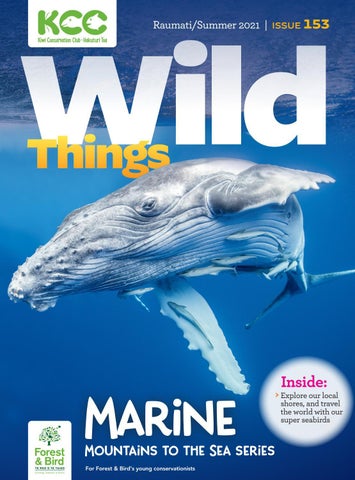
Humpback whale. Richard Robinson
2 Wild Things
To join KCC and receive Wild Things, or to receive our free E-news, go to www.kcc.org.nz.
Wild Things is published by Forest & Bird, Phone 04 385 7374, Email office@forestandbird.org.nz PO Box 631, Wellington 6140.
Copyright: All rights reserved. No part of this magazine may be reproduced without the written permission of Forest & Bird.
The children of Tangaroa Amazing sand dunes Did you know that wind and plants help to make the sand dunes a good place for many seabirds to live? The wind helps blow the tiny pieces of sand to form dunes, and the plants help to keep the sand in place. These places are very fragile. Even the smallest movement causes an avalanche of sand!
Our native shore birds have adapted to living surround by land. They are good at camouflaging their eggs to keep them hidden from predators. Do you think you can spot these hidden eggs? When you are out on your beachy adventures this summer, see if you can find their parents’ tracks along the wet sand, and watch your feet to make sure there isn’t a nest!
Can you spy the nest in the sand? If you can, you have great eyes! See page 32 to check.
I am Curley the Far Eastern Curlew. Since I travel 30,000 km all around the world throughout the year, I am pretty well qualified as a travel agent. I thought I would take you through all of the incredible coastal and marine areas around Aotearoa. Turn the page to start exploring.
© Wild Things Issue 153, Nov 2021. Published by Forest & Bird
Illustration by Sara Wolman
3
Aotearoa – Seabird ca Aotearoa has more species of seabirds found here than anywhere else in the world - aren’t we lucky? Some of them travel halfway around the world, others stay close to home. How many of the birds below do you know?
Keepin’ it local with the homebodies Variable oystercatchers | tōrea pango • Live on the coast all year round, and usually hang out in pairs • They are very protective of their nests and will even swoop down if a human gets too close
Stefan Marks
New Zealand storm petrel | fregetta maoriana • Live in burrows on Little Barrier Island | Hautura • They dance on the water • Come to land after dark to avoid pests • It was thought they were extinct, then in 2003 one was spotted in the Hauraki Gulf
Bettina Arrigoni CC
© Wild Things Issue 153, Nov 2021. Published by Forest & Bird
New Zealand fairy tern | tara iti • Found on sandy beaches between Auckland and Northland • Their nests are small scratches in the sand • Eggs are about 3.5cm long – that’s about the size of your finger! • Most endangered endemic bird species in Aotearoa Laurie Boyle CC
4 Wild Things
apital of the world Seasoned travellers, our frequent fliers Birds like shearwaters, petrels, and curlews are world travellers! They head to places like Siberia, South America, and Alaska up to 70,000 kilometres away! When these birds migrate, they become nomads in international waters. Sooty shearwaters | tītī • Size of kererū • Lay and raise eggs in burrows on the beach • Found on the islands of Snares, Chatham, Rakiura, and Tītī • Each year, they migrate from New Zealand to areas of ocean near America, Canada, Russia, and Japan Trish Gussler CC
Buller’s mollymawk | toroa • Some toroa breed on a rock just off Southland • Migrate to seas by South America • Use their long, narrow wings to soar • Their webbed feet help them to paddle in the water Eric de leeuw CC
Francesca Cunninghame
© Wild Things Issue 153, Nov 2021. Published by Forest & Bird
Fairy prion | tītīwainui • Live on the edge of a cliff in Dunedin to stay away from predators as well as on offshore islands • After they moult, they travel straight east towards Chile for a quick trip then come back Graeme Loh
What birds do you have around your coastlines? Find out more about seabirds on our website: kcc.org.nz.
5
, Briar s
Bug Corner With Dr Briar Taylor-Smith
Dune beetles! During the night, adult sand scarab beetles live very active lives looking for food and friends. The beetles leave busy tracks in the sand that look a bit like a giant millipede has passed through. But if you follow the track, you’ll notice that it will just suddenly end. Where’d the beetle go? It’s buried itself deep down under the sand to protect itself from the scorching daytime sun and from any predators lurking on the beach.
CC Shaun Lee
Sand scarabs (Pericoptus truncatus) | ngungutawa Scarab beetles are a family of beetles that include chafer beetles and dung beetles (yes, the ones that eat poo). Their carapaces (the top surface of a beetle) are often beautiful metallic colours, and they often have legs adapted for digging. One native species of scarab beetle is the sand scarab or ngungutawa, a critter that is found on sandy beaches around New Zealand. Sand scarabs are big, getting up to more than 6cm long (longer than your finger!), and they are common. But lots of people have never heard of them. Can you guess why? It’s because sand scarab beetles are nocturnal (active at night).
6 Wild Things
CC Arnim Littek
Sand scarabs spend their days in sand that is just right for their little bodies. If it’s too wet, they will struggle to breathe, and if it’s too dry, they might lose too much moisture from their bodies. For this reason, they tend to live from just above the high tide mark back into dunes close to the sea. You might find them in dunes further from the sea if there is another water source to keep the sand damp.
© Wild Things Issue 153, Nov 2021. Published by Forest & Bird
Hey! Whose tracks are those?
CC Arnim Littek
You might find a dead beetle on the beach that hasn’t managed to hide itself away in time. You’ll see that it’s dark and shiny and has big legs so that it can pull itself through the sand. If you are poking around on the beach, you might also come across their big, pale larvae or grubs. The grubs live under drift wood or buried under plants, where they feed on the roots of dune plants such as marram grass. The grubs have been seen going for swims in the ocean at night time, and it’s thought that it might be a washing themselves of parasites living on their bodies.
If you can’t find a grub or a dead beetle to look at, try going out into the dunes at night to look for them. The adult sand scarabs are beautiful and intriguing creatures, but, remember, all animals are adapted to their environments and it’s best to leave them where they are. Imagine how you’d feel if a sand scarab tried to take you home!
CC Arnim Littek
© Wild Things Issue 153, Nov 2021. Published by Forest & Bird
CC Arnim Littek
CC Arnim Littek
7
Match the mouth It’s hard to get a close look at some of our favourite marine animals. Here is your chance to take a closer look at each mouth. Match the mouth to the coastal creature you think it may belong to. What did the ocean say to the shore? …Nothing, it just waved.
My teeth are SHARP! I have a HUGE jaw and head. I swim in the sea and eat lots of different things
Stefan Marks
My mouth is great for poking in the wet sand and muddy shorelines. Don Laing
I dive deep into the sea to eat giant squid! It looks like I am missing teeth on one side, but I am not!
© Wild Things Issue 153, Nov 2021. Published by Forest & Bird
My mouth is long, black, and slender. I like to eat invertebrates and the occasional small fish. I am critically endangered.
Stefan Marks
Pierre Jaquet
My tounge has very few taste buds! The food I eat tastes terrible, so I am lucky I can’t taste very well!
8 Wild Things
Glenda Rees
Yellow-eyed penguin | hoiho My Māori name sounds like the noise that I make if you come too close to my nest. I will be a noisy shouter! Us hoiho are one of the most endangered penguins in the world. Craig McKenzie
Sperm whale | parāoa I am also a world traveller! I am the largest toothed predator on earth. Pierre Jaquet
Black billed gull | tatāpuka I am most active along the coastline in the winter, but mostly live near braided rivers and streams throughout the year. I am found only in Aotearoa. Stefan Marks
Leopard seal | popoiangore We are very smart! We like to live on our own, but, when looking for a mate, we are very vocal and it can sound like singing. © Wild Things Issue 153, Nov 2021. Published by Forest & Bird
Craig McKenzie
Bar-tailed godwit | karoro I may be small, but I hold the world record for marathon flying! In only eight days, a small bar-tailed godwit like me flies 11,000km from Alaska to New Zealand at an average speed of of 50km/h. I don’t even stop to sleep. Craig McKenzie
9
Recre te your f vourite be ch Mckenzie Bay, Waipu By Madeleine Luff Aged 7
Madeleine was inspired to create her beach scene after discovering McKenzie Bay in Waipu. Read more about her adventures at kcc.org.nz.
YOU WILL NEED: • Scissors. • Glue. • A sheet of white paper and coloured paper. We used blue, red, and yellow paper, but use any colour. • Tin foil. • Sand and pieces of broken shell or small pieces of seaweed to decorate. • Pen to write the title (optional).
Step ➊
Step ➌
Step ➋
Step ➍
Cut out shapes that look a bit like clouds, for the waves. Glue them onto the white background.
Glue down bits of tin foil for the rocks, so they glisten.
dl 10 iW Things
Use a strip of yellow for the sand. The sun was made of red and yellow in an alternating pattern and a strip of yellow for the beach. Put glue along the yellow strip.
Sprinkle real sand across it! We used lots of bits of crushed up shells to look like actual shells, but you could use anything to decorate it, like bits of seaweed.
© Wild Things Issue 153, Nov 2021. Published by Forest & Bird
© Wild Things Issue 153, Nov 2021. Published by Forest & Bird
I’m so sleepy! I may be cute, but please stay 20 metres away.
Stefan Marks
Spotting marine mammals While you are out exploring your favourite beaches or maybe somewhere new, keep an eye out for whales, dolphins, and seals! Sightings of whales, dolphins, and seals around New Zealand can help us learn more about these animals. The more we understand them, the better able we are to protect them.
Zealand’s waters. As a result, New Zealand is a global hotspot for whale watching. To prepare yourself for coming across marine mammals and how to help protect these creatures, have a look at Project Jonah’s website: www.projectjonah.org.nz.
From the tiny, endemic Hector’s and Māui dolphins, to the mighty blue whale, over half the world’s cetacean (whales, dolphins, porpoises) species are found in or migrate through New
WIN AN ID CHART
Stefan Marks
Wow dolphins! If they have young calves with them, please keep your distance.
To enter into the draw, send us your drawings of marine mammals!
11
Marine reserves – Nga What are marine reserves? They are government-protected marine areas. You can’t fish, leave litter or take anything from a marine reserve.
How many of these while exploring the
Another way our oceans can be protected is by a rāhui. This is put in place by local hapū or iwi. If there is a rāhui on a place, you are not allowed to go to it or take anything from it.
How do marine reserves and rāhui help our oceans? Protected areas of oceans are more able to cope with climate change. Plants and animals thrive in these places, which often means a healthier area outside the reserve too.
Blue cod
Rock lobster
Wandering anemone
12 Wild Things
taonga o Tangaroa animals can you see underwater world?
Join us on an adventure in the sea! Scan the QR code to hop in the water with us! Or hop on our website to find it online.
Yellow-foot pāua
What you can see on a snorkel at the Island Bay Snorkel Trail in Taputeranga Marine Reserve: https://vimeo.com/567431181
Dive under the waves and take a virtual tour of Taputeranga Marine Reserve https://adventure360.co.nz/360tmr/
Clown nudibranch Wouldn’t it be great if we had more marine reserves? Look for a postcard in this issue of Wild Things to send to our Prime Minister to tell her about why you want to protect more of our marine life.
Banded weedfish All photos: Nicole Miller
13
Seaweed | Rimurimu I love seaweed | rimurimu! Anytime you go for a walk along the shore after a storm, you’ll be almost guaranteed to see brightly coloured rimurimu washed up onto the tideline. I especially love when there are invertebrates attached to it when it gets washed up. Easy pickings! Did you know seaweed gives off 60% of the oxygen we breathe? Globally, it also absorbs nearly 200 million tonnes of carbon from the atmosphere every year! Seaweeds are vital for healthy oceans, and it’s also a heap of fun to go looking for all the different kinds along your local beach.
Have you been for a snorkel or swim recently and felt some slippery seaweeds wash past your ankles? With over 400 species, they’re hard to avoid, but many people find rimurimu a little creepy! Once you get to know them better though, we reckon you’ll start to love them as much as we do. The biggest seaweeds – parāone (brown) seaweeds – are like the tall trees in a forest. Growing up to 50cm a day – they take the power of the sun and turn it into oxygen, food, and shelter. Hundreds of animals can be found on a single seaweed plant! © Wild ThingsIssue 153, Nov 2021. Published by Forest & Bird
Along the coastline, kākāriki (green) seaweeds also flourish, and many whero (red) seaweeds love the deeper waters. https://vimeo.com/244166133 Seaweed producing oxygen! Scan the QR code or visit the website above
14 Wild Things
Crested weedfish
Flapjack seaweed
© Wild Things Issue 153, Nov 2021. Published by Forest & Bird
EXPLORING RIMURIMU Seaweeds form so many beautiful shapes and colours – and one of the things you can do is make your very own seaweed ID card. Be careful to follow our gathering guide.
Gathering guide…
sure it’s ok to take it – check any rāhui, ➊ Make mātaitai, marine reserves, or water pollution issues. Collecting seaweed from these areas is not allowed, including seaweed on the beach. It’s all part of the ecosystem and needs to stay there.
➋ Take just a little from each place and spread out your efforts. Seaweed feeds lots of animals once it washes up on the beach, so it’s important there’s plenty left behind.
➌ Always check for animals that may have
hitched a ride. They want to stay in their home, not come to yours. Give it a good rinse and check before you take it away.
➍ Always store your seaweed in fresh, clean seawater to preserve it before pressing.
Make a seaweed pressing!
small samples, and follow the gathering ➊ Take guide. it out on some firm white paper ➋ Spread (sometimes easier to do while it’s in the
water) and position it the way you’d like it to dry.
➌ Press between two pieces of paper, put
greaseproof paper over the top to stop it sticking, then replace newspaper around it regularly. Pile heaps of heavy stuff on top to squeeze out the water!
➍ When fully dried, make cards, or an ID guide
to help friends and your school to learn more about seaweed.
Big thanks to Mountains to Sea Wellington for their Love Rimurimu education resources and information.
Mountais To Sea & the Friends of Taputerang Marine resv.
15
24
25
26
28
31
Moana Out to sea 24 Pōhutukawa 25 Chesterfield skink | Kapitia skink 26 Fairy tern | Tara iti 27 Māui dolphin | Popoto 28 Yellow-eyed penguin | hoiho 29 Dotteral | tūturiwhatu 30 NZ fur seal | kekeno 31 Golden sand sedge | pīngao
27
29
30
Puzzles
Colour in the creatures you see on this page!
Find the answers on page 32.
Spot the difference
© Wild Things Issue 153, Nov 2021. Published by Forest & Bird
18 Wild Things
There are rima (five) differences between these two images. Can you find them?
Word Find Words can be found written across, up, down, diagonally, and backwards.
●●●●●●●● ●●●●●●●● ●●●●●●●● ●●●●●●●●●● ●●●●●●●●●● ●●●●●●●●●● ●●●●●●●●●● ●●●●●●●●●●●● ●●●●●●●●●●●● ●●●●●●●●●● ●●●●●●●● ●●●●●●●
MARINE MOANA WHALE MANGŌ ECOSYSTEM BIODIVERSITY TEMPERATURE CURRENT Tick them off as you go
C
E
B
B
E
C
D
I
S
A
R
I
I
E
V
M
F
R
E
O
M
C
T
A
Y
S
C
D
A
O
O
R
W
R
A
Y
U
I
N
S
A
Ā
H
I
N
I
R
V
G
Y
E
N
N
N
U
E
R
E
Ō
S
G
T
A
W
T
E
M
P
E
R
A
T
U
R
E
H
H
U
T
M
N
S
H
E
O
B
H
A
L
E
T
I
E
M
A
I
K
L
C
O
T
R
W
S
O
A
E
P
Y
W
D
F
How do you make an octopus laugh? With TENtickles!
Hihi, hihi!
Isn’t New Zealand sea life absolutely CRABtivating?
© Wild Things Issue 153, Nov 2021. Published by Forest & Bird
What does a dolphin say when he’s confused? Can you please be more Pacific?!
Ō
Which are the strongest creatures in the ocean? Mussels!
Funnies
These jokes are shore to make you giggle.
19
Right here in Aotearoa New Zealand, we are lucky to share our waters with some of the world’s smallest and rarest dolphins. They have Mickey Mouse shaped dorsal fins, are fun loving, curious, and small enough to fit in your bathtub. Can you guess who they are? Let’s dive in to find out!
Marine Mammal Mahi: A Day in the Life Hector’s and Māui dolphins are endemic to New Zealand, which means they are found nowhere else on Earth. Both species live in shallow coastal waters, where they mostly feed on fish and squid. Like all dolphins, they have big brains compared to their body size, so they’re pretty smart. They show this through their friendly personality: playing with sticks like dogs, balancing leaves on their snouts, playing catch with seaweed, and even surfing waves! They also recognise their friends and family, and live in tight-knit social groups just like us.
FACTFILES Hector’s dolphin (tutumairekurai, Cephalorhychus hectori) Range: Off coasts of the South Island Population size: 15,000 – nationally vulnerable Māui dolphin (popoto, Cephalorhychus hectori maui) Population size: 63 – critically endangered
Steve Dawson
20 Wild Things
Steve Dawson
© Wild Things Issue 153, Nov 2021. Published by Forest & Bird
Range: Off west coast of the North Island
Did you know Libby Christophers was a past KCCer?! She is now finishing her degree in Geography and Zoology, with a minor in Marine Science!
Libby Christophers Recently, I was lucky enough to have a kōrero with Professor Steve Dawson, who is a marine mammal scientist from the University of Otago. Steve has spent almost 40 years studying Hector’s dolphins. Here he shares a bit about his awesome mahi and what you can do to help.
What got you interested in the field?
What does your work involve? Since 1984, Steve and his partner Liz have been working on Hector’s dolphin conservation and later helped to set up a marine mammal sanctuary where fishing isn’t allowed. Steve’s work has involved tracking dolphin populations through surveys from boats and helicopters. They take photos of dolphins so that they can identify them later. Individuals can be recognised by their unique scars, markings, and other characteristics.
What can we do to help? To ensure Māui and Hector’s dolphins stick around for future generations, we need to protect more of their habitat and help fishing folk to be more sustainable in ways that only catch what they are meant to catch. This way, dolphins and their air breathing friends can stay safe out of nets. As kaitiaki of this place, there are lots of little things we can do to care for our moana and the creatures that live there. If you’re out in a boat and are lucky enough to see a Māui or Hector’s dolphin, make sure to give them space. It is also helpful if you report the sighting by calling 0800 DOC HOT. Ask questions, listen, and learn as much as you can, and share this with family and friends. Ask where your fish comes from and avoid those that are caught using trawl or gill netting. Even though they’re small, Hector’s and Māui dolphins can still make a big splash and so can you! Use your voice and get involved because even kids can do big things, especially when we work together.
21
© Wild Things Issue 153, Nov 2021. Published by Forest & Bird
Steve grew up on Tāmaki Makaurau Auckland’s North Shore and has had a keen interest in the ocean and animals from a young age. One day, when he was about 11 or 12, he was out sailing when, suddenly, he was joined by some killer whales whose dorsal fins were taller than his boat was long. As their name suggests, many people fear these creatures, and Steve had only read about them in books, where they were described to be almost as dangerous as great white sharks. Alone with the orca, he was unsure whether to be incredibly excited or frightened. But, as the whales moved on peacefully, he watched in amazement and realised that maybe there were more to these animals than people understood. From this unforgettable moment forward, he was captivated by marine mammals and went on to study them at university.
Sometimes, it’s hard to track them because there are so few dolphins over such a Steve Dawson big area. Through his work, Steve has not only learnt lots about Hector’s dolphin biology and how they live but also what we can do to help protect this beautiful taonga species.
ShOw you care © Wild Things Issue 153, Nov 2021. Published by Forest & Bird
My name is Lucia Hains and I am 9. I love all animals and plants, especially Mūui dolphins because they are special to our country and they need our help.
A
t the start of this year, I went on a trip with my family to Milford Sound. There I saw a beautiful pod of bottlenose dolphins. They were jumping out of the water and chasing our boat out to sea. I realised how amazing dolphins are. Māui dolphins are the world’s most endangered marine mammal. There are only 63 adult dolphins left, making them the rarest dolphin in the world. They are found on the west coast of the North Island and nowhere else in the world. Māui dolphins use echolocation to find their food, but echolocation can’t track fishing nets, so they
swim right into them. Māui dolphins can’t swim backwards, and they can only hold their breath for up to three minutes, so they drown. Māui dolphins have just as much of a right to live as we do, so we need to protect them. This year, I organised a fundraiser with my school. My class made Māui dolphin posters, the whole school learnt a song about Māui dolphins, and we asked the National Aquarium to come and talk to us about how we can help Māui dolphins. I talked to the whole school to persuade them to help the Māui dolphins. On the day of the fundraiser, I was allowed to count the money with my friend and we raised over one thousand dollars. Here is a quote from Dr Seuss, The Lorax.
22 Wild Things
Unless someone like you cares an awful whole lot, nothing is going to get better. It’s not.
In this magazine, there is a postcard that you could send to the Prime Minister, asking the government to look after the oceans and the whole environment in the climate change plan. You can colour in the front of the postcard and write on the back why the oceans are important to you. Postage is free, so you don’t even need a stamp.
Send a the postcard to er – t Prime Minis e to ic use your vo as. save our se
P.S.
leave your own comment here
© Wild Things Issue 153, Nov 2021. Published by Forest & Bird
Dear Jacinda Ardern, My name is and I’m years old. I’m writing to ask you to look after our climate. New Zealand’s environment is really special – especially our oceans! Did you know oceans help fight climate change? But our oceans need your help. Carbon pollution from cars, cows, and coal hurts our oceans! Because if we look after our environment, it’ll look after us. Please protect our oceans and our climate now – for the future.
FREEPOST (no stamp needed)
TO:
Prime Minister Jacinda Ardern The Beehive Wellington Aotearoa New Zealand
23
book
Here’s what a couple of the treasure hunters Nellie and Spencer thought of their adventure!
reviews CORNER Sophie Chandra reviews two great marine books.
TOHORĀ The southern right whale BY: Ned Barraud RATING: 4/5
This book is about the tohorā, also known as the southern right whale. These whales were extremely common in Aotearoa, and they loved to go to shore and put on a show, but things changed when people arrived from America to hunt the tohorā. They were hunted until they were nearly extinct. Conservation groups told the world what was happening, and people all across the world began protesting. This book has lots of information in it about the tohorā. It was a very sad book, but thankfully ends well as New Zealand now protects our amazing tohorā. I would recommend this book to ages 9+.
24 Wild Things
Under the ocean Explore & discover New Zealand’s sea life BY: Ned Barraud & Gillian
Candler
RATING: 5/5
This book is about the sea life of Aotearoa. As well as being a great story, you can also learn about your favourite New Zealand sea creatures in it. If there is a sea creature that you are interested in, they have a page number beside the picture of it, so you are able to go to that page and get more information about it. From the sea creatures on land to the deep ocean, you will find all you need to know about them in this book. I have learnt so much about sea creatures from this book and have found it a very helpful book to have. My favourite part of the book was that you can pick a path and find out more about your favourite creatures in the sea. I would recommend this book for ages 5+ as it is a lot of fun and I think everyone would enjoy it.
© Wild Things Issue 153, Nov 2021. Published by Forest & Bird
KCC Hibiscus Coast Adventures The newly regrouped KCC Hibiscus Coast branch in North Auckland kicked off the year with a fabulous Rockpool Explore and Seashore Scavenger Hunt at Big Manly Beach on the Whangaparāoa Peninsula, a beautiful spot 30 minutes north of the city. Big Manly Beach is a tranquil stretch of sand approximately 1km long, and at low tide an amazing expanse of seaweedcovered rocky shelves and platforms are exposed,
Spencer: “My favourite part was ūnding the crab with all the bright red eggs underneath it. I liked climbing over the rocks and looking at all the seaweed with my dad. I like these adventures because you get to see cool animals.”
ideal for exploring and discovering marine life. Using the Northern NZ Rocky Shore Guide, our group identified many marine creatures and plant species – way more than we actually thought we'd see! Over 25 species were spotted, including kina, several species of chiton, tubeworms, crabs, cushion stars, snails, shrimp, triplefins, and several varieties of seaweeds.
Nellie: “We found hairy crabs, hermit crabs, half crabs, big handed crabs, and a red rock crab. So many different types. It was amazing to see how many different creatures lived in those rock pools. The painted shrimp we found swam super fast and hid in the seaweeds. I liked making friends with the other kids.”
© Wild Things Issue 153, Nov 2021. Published by Forest & Bird
25
I have super powers that are pretty cool, but my fellow marine species also have some really cool powers! Colour in how many seastars you think each super marine creature should get!
MARINE SPECIES
super powers ZOOOOM
!
OCTOPUS Super power = camouflage Don’t blink! This octopus may become invisible right before your eyes. Octopus have the ability to change colour in the blink of an eye using thousands of colourchanging cells called chromatophores just below their skin.
W
Faster than a cricket ball pitch when plunge diving from great heights in pursuit of prey, they can reach speeds up to 145km an hour and dive to depths of more than 15 metres. Gannets are specially adapted for plunge diving, for example they have air sacs in their lower neck to help cushion the impact when they hit the water. Nicole Miler
© Wild Things Issue 153, Nov 2021. Published by Forest & Bird
d 26 Wil Things
GANNET Super power = speed and underwater eyes
Bonus super power: Gannets have special eyes so that they can see well in and out of the water. Key for diving at high speeds into 15 metres of water!
What’s YOUR super power?
Stefan Marks
!
sh o o h
Peter Batson
SPLAT! HAGFISH Super power = excessive snot New Zealand hagfish or “snot eel” is found in New Zealand’s deepest waters and has the power to shoot mucus-like slime through its skin at any predators that try to bite it, choking it with slime!
TOOTHED WHALE Super power = echolocation/ seeing sound
! Z Z Z Z B
Toothed whales like these pilot whales use echolocation to find their food. They send out clicking noises that bounce off the body of their prey before coming back to them. The whale can then work out where their prey is and how big it is. All toothed whales, including dolphins, have a fat-filled organ in the front part of the head called a melon. The melon acts like a lens for sound waves, focusing the sound waves into a narrow beam.
Simon Franicevic
MANTIS SHRIMP Super power = x-ray vision
Draw or write ABOUT... kcinbox@frestad.gz
.your superow and send it to us at hear about them and you may win a prize.
There are three types of special cells in human eyes called photoreceptors. These collect blue, green, and red light. Our minds can mix 10 million colours. Wow!
© Wild Things Issue 153, Nov 2021. Published by Forest & Bird
Montereydiver CC
DING!
The mantis shrimp has many super powers. But their ability to see things no human eye can understand is amazing. They have the most complex visual system ever known.
A mantis shrimp has between 12 and 16 types of photoreceptors, allowing them to mix over 40 million colours. Not to mention that each eye can move independently from the other. Imagine how THEY would see the world?
We’d love to
27
Hanging in the sh Sometimes we are afraid of things we can’t see, or don’t know about. Can you think of anything you are afraid of?
Our friend Ben tells us his story about how he was once afraid of rays, but they showed him how, when we leave nature to just be, there is nothing to be afraid of!
Stingray Nicole Miller
Ben was out free-diving with some friends when something swam next to him, giving him a huge fright! It was a ray! He leaped out of the water and onto a rock. But then he thought, “Why am I so afraid? It wasn’t TRYING to scare me!” When he got back into the water, he followed the ray around the rock, where it settled in the sand. He watched it in admiration and realised there was nothing to be afraid of!
BEAT YOUR FEARS BY:
© Wild Things Issue 153, Nov 2021. Published by Forest & Bird
ld 28 iW Things
Rays don’t attack people deliberately. If there is a shadow or quick movement near them, that’s when they may lash out, but as long as you make yourself known they won’t hurt you. The best way to avoid standing on a ray at the baech is to shuffle along in the shallow. Rays are really quite docile and can even be quite sociable around people, especially if they are regularly hand-fed. Rig, on the other hand, are more likely to swim away from you.
Eagle ray
Malcolm Francis
hallows RAY FACT FILE:
ir n Five pairs of gills on the underside. n Bones are made from cartilage. n Flat grinding teeth for crushing shellfish. a long life. n Manta rays can grow to 2 metres across. er. n Like to hunt in shallow wat
n Live
Alison Balance
RIG SHARK FACT FILE:
n Five
pairs of gills on their sides.
MATCH n Live in shallow water in THE FACTS! estuaries. What facts do rays and rig sharks have n Flat grinding teeth for in common? crushing shellfish. n Also known as spotted dogfish or “lemon fish”. n Visit Oriental Bay in Wellington in mid-summer.
' Widl Thsgni sI sue ,351 Nov .120 u P blished by o F rest & iB rd
Rig shark Malcolm rF ancis
29
Mystery of sharks These complex and magestic animals get a bad reputation, but they are completely misunderstood. What scientists found
Turns out, sharks move around HEAPS! Mako sharks and great white sharks from New Zealand even go on tropical holidays! Carol the mako shark travelled more than 13,000 kilometres in less than a year, from Northland to Fiji, back to Wellington and then up to Tonga! Mako sharks are the fastest shark species – no wonder Carol had so many kilometres under her fins! Even though they are fast, they are a threatened species.
© Wild Things Issue 153, Nov 2021. Published by Forest & Bird
Sharks have survived for 450 million years, so they have had some time to learn to be the ocean’s top predator. Sharks are great indicators as to how our oceans are doing. Healthy shark populations = healthy oceans! They keep the ocean clean and keep disease from spreading. As top predators, they maintain healthy fish populations by removing weak animals and keeping the strongest of a species to thrive.
PSAT tag
Tagged great white WikiCommons
Where do sharks go? It’s hard to know where our large sharky friends go when they dive deep into the ocean and head out to sea, so scientists have come up with different ways of harmlessly tagging and tracking the sharks! PSAT tags are designed to go with the flow of the shark’s body. The trackers pop off after a while and talk to a satellite, giving all the information about where the animal has been. ' Wild ThingsIssue 153, Nov 0 2 1 2 . Published by Forest & Bird
30 Wild Things
How do they find their way? Scientists just don’t know! We know they can swim directly to where they’re going. They can probably sense things about the water like temperature and taste that we can’t. Maybe they follow the magnetic field.
School shark Malcolm Francis
Sharks are friends!
Great white shark Malcolm Francis
FACT FILE: n A
great white shark tooth only lasts about 10 days.
n Great
whites can lose about 3600 teeth in a year!
n Shark
teeth are serrated like a
saw. n When
a baby great white shark is born, it’s 1.5 metres long.
n Some
sharks have been recorded diving over 1400 metres. That’s four Sky Towers stacked on top of each other!
Scott Tindale
Mako shark
Scott Tindale
©
Mako shark
Pierre Frolla, famous shark freediver
Wild Things Issue 351 , Nov 2021. Published by Forest & Bird
“ I am more afraid to live in a world without sharks, than I am to meet a shark in the water.”
31
© Wild Things Issue 153, Nov 2021. Published by Forest & Bird
EGG
Puzzle answers
A H
H
T
W
U
E C
L T
E M
M
E
E
U
N
P I
N
I
A
R
Y
A
F
M
S
I
C
Ō
Y S R A E
P O T N E R R U C E R B
Y T I S R E V I D O I B
W R E H A Ō G N A M I E
F
D
S
W
A
M
O
E
U
T
G
S
E
Y
A
S
O
O
T
C
V
E
D
C
O I B R T N Ā R
K H E A N H W
Splash! Jumping high in the sky, feeling like I could fly. Playing with my friends, The party never ends. My family are disappearing, as I watch the blue sky. But sometimes I have fun, soaring and leaping over the waves. PEW! And that was a sign of “Goodbye” Splash!
L
32 Wild Things
POPOTO
A
M
y name is Yokiko. I would like more people to know that Māui dolphins are endangered. Here is my poem about Māui dolphins.
Share your ideas and stories with us! Stay tuned for our next magazine in February 2022! Catch you on the flip side!
CONTACT US
Illustration by Sara Wolman
kcc@forestandbird.org.nz Wild Things, PO Box 631 Wellington 6140 www.kcc.org.nz