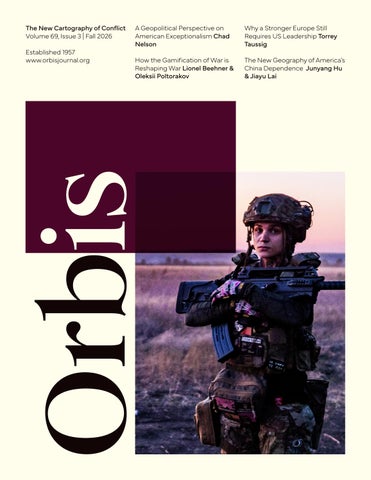
The New Cartography of Conflict Volume 69, Issue 3 | Fall 2026 Established 1957 www.orbisjournal.org
A Geopolitical Perspective on American Exceptionalism Chad Nelson
Why a Stronger Europe Still Requires US Leadership Torrey Taussig
How the Gamification of War is Reshaping War Lionel Beehner & Oleksii Poltorakov
The New Geography of America’s China Dependence Junyang Hu & Jiayu Lai
ii
Orbis Editor Lawrence Rubin
Assistant Editor Emma Salisbury
Editor Emily Holland
Managing Editor
Associate Editor Rachel Whitlark
Managing Editor Natalia Kopytnik
Eric Koob
Editorial Board Nicholas Anderson
Heather Gregg
Matthew Kroenig
Aaron Stein
The George Washington University
Arizona State University
Georgetown University
Foreign Policy Research Institute
Michael Horowitz
Austin Long
University of Pennsylvania
MIT Center for Nuclear Security Policy
Emmanuel Balogun Skidmore College
Audrey Kurth Cronin Carnegie Mellon Institute for Strategy and Technology
Mark R. Jacobson Salve Regina University
US Naval War College
Rosemary Kelanic Defense Priorities
Jessica Trisko Darden Virginia Commonwealth University
Theo Milonopoulos Mariya Omelicheva Foreign Policy Expert
Margaret E. Kosal Georgia Institute of Technology
Saadia M. Pekkanen
Adam N. Stulberg Georgia Institute of Technology
Jordan Tama American University
Dov S. Zakheim Foreign Policy Research Institute
University of Washington
The New Cartography of Conflict
Vol 69, Issue 3
Editor’s Corner
Lawrence Rubin & Emily Holland
2
American Power in a Changing World A Geopolitical Perspective on American Exceptionalism
Chad Nelson
9
The China We Want to See: The Persistent Danger of Strategic Misdiagnosis
Lawrence J. Kaiser
31
The New Geography of America’s China Dependence
Junyang Hu & Jiayu Lai
43
NATO and the Changing Nature of War How the Gamification of the Battlefield is Reshaping War
Lionel Beehner & Oleksii Poltorakov
58
NATO 3.0: Why a Stronger Europe Still Requires US Leadership
Torrey Taussig
72
How to Deliver on NATO 3.0
Miranda Priebe
82
Miranda Priebe
98
Post-script
Vol 69, Issue 3
The New Cartography of Conflict
1
Editor’s Corner Lawrence Rubin & Emily Holland Few debates in international security in recent years have been as persistent and consequential as the ones about technology. Drones, autonomous systems, and artificial intelligence are said to be compressing time, space, and distance, as well as rewriting the conventional rules of deterrence.
© 2026 Published by the Foreign Policy Research Institute and the Sam Nunn School
Vol 69, Issue 3
3
4
F
ew debates in international security in recent years have been as persistent and consequential as the ones about technology. Drones, autonomous systems, and artificial intelligence are said to be compressing time, space, and distance, as well as rewriting the conventional rules of deterrence. Much of this analysis is persuasive and it has shaped how we think about the offense-defense balance, national sovereignty, and the conduct of military operations.1 But it can also leave the impression that technology and capability alone can overcome the constraints of geography. This issue of Orbis, “The New Cartography of Conflict,” starts from a different premise: The territory stays relatively consistent even as technology redraws the map. Technology can change how states see, reach, and depend on one another, but it works through terrain chokepoints, infrastructure, and supply routes that remain stubbornly physical and immutable. Alliances may be able to do some of that work by bridging some geographic divides, but they also create new strategic boundaries and dependencies. The question of who and what draws the map is not a new one in the pages of this journal. When Robert Strausz-Hupé introduced Orbis in 1957 with “The Balance of Tomorrow,” he called for “the unification of the globe” under US leadership. His argument grew out of a moment of profound change in world
order, in the wake of World War II, and it rejected a return to what he regarded as an unstable multipolar balance of power. Instead, he proposed that the United States lead a broader political order. The world today looks very different, but his underlying question endures: How do states organize themselves and adjust to one another, across a global map that technology has reshaped but not overcome? The essays in this issue do not focus exclusively on geography but they do encourage us to consider how geography conditions the effects of technology, as well as political change. New technologies and relationships can alter how states use geographic advantages, understand vulnerabilities, and move people, goods, and military power across space and territory. A technological advancement may prove less effective in difficult terrain or depend on vulnerable supply chains and infrastructure that in turn create new dependencies. Climate and extreme weather can affect military operations and even the cadence of commercial and national-security space systems. Geography shapes when, where, how, and with what limits technology can be used. The essays that follow take up these questions in various contexts, moving from how states perceive geography to how they fight and ally across it. Articles by Chad Nelson and Lawrence Kaiser begin with the strategic pers-
1 Dennis Murphy and Lawrence Rubin, “The Fourth Industrial Revolution and International Security,” Survival 67:1 (2025), https://www.tandfonline. com/doi/full/10.1080/00396338.2025.2459023.
The New Cartography of Conflict
Vol 69, Issue 3
pective: how America’s own geography has shaped its foreign policy, and how misreading China can lead policymakers astray, respectively. Jungyang Hu and Jiayu Lai turn to material connections, tracing the supply chains that bind the United States and China. Lionel Beehner and Oleksii Poltokarov then move to the battlefield, where digital systems change how soldiers see and fight across terrain. Finally, Torrey Taussig
Geography also shapes how policymakers interpret other states. Kaiser’s “The China We Want to See: The Persistent Danger of Strategic Misdiagnosis” highlights the risk for the United States of viewing China through the wrong strategic lens. Treating China primarily as a maritime challenger, an economic competitor, or some combination of the two can lead policymakers to misjudge where competition is likely
New technologies and relationships can alter how states use geographic advantages, understand vulnerabilities, and move people, goods, and military power across space and territory.
and Miranda Priebe consider alliances, and how NATO might manage physical distance, access, and responsibility as the roles of the United States and Europe are rebalanced. Taken one at a time, the essays show these dynamics play out in practice. Nelson’s “A Geopolitical Perspective on American Exceptionalism” examines how America’s geography, its two oceans, neighbors, interior, and waterways, has shaped its political development and its foreign policy. His argument raises a germane question to contemporary US foreign policy: if America’s advantage comes from its own geography, what does an insular position mean for US commitments overseas? Vol 69, Issue 3
The New Cartography of Conflict
to occur and what forms it will take. This has wide-ranging implications for international politics. Hu and Lai’s “The New Geography of America’s China Dependence” explores the material connections between the United States and China. Supply chains link (geographic) places through routes and ownership, and efforts to reroute production or “friendshore” with allies and partners can change those connections without eliminating dependence. The result is a fast-changing economic geography that determines the extent to which strategic autonomy is possible. The physical geography of the battlefield, meanwhile, remains consequential even as technology changes the
5
6
nature of the fight. In “How the Gamification of the Battlefield is Reshaping War,” Beehner and Poltorakov examine how digital systems and remote operations affect the conduct of warfare. While the fighting takes place across terrain, where treelines and rivers shape movement and exposure, screens and remote operators put physical distance between soldiers and the battlefield. The technology changes how combatants see and engage with the battlefield, but it does not make the ground irrelevant. Geography is also central to the organization and efficacy of collective security organizations, such as NATO. Taussig’s “NATO 3.0: Why a Stronger Europe Still Requires US Leadership” outlines why greater European security capacity may still depend on American leadership from across the Atlantic. Priebe’s “How to Deliver on NATO 3.0” proposes how a stronger European leadership in the alliance might be delivered. While the two essays approach the future of the alliance from different angles, they both raise questions of distance, access, reinforcement, and responsibility. Contested spaces in the Baltic, Black Sea, and High North are geographically far from the United States and deterrence depends in large part on how quickly alliance forces can traverse difficult terrain. Here technology plays a major role.
change how states engage with them. One thread runs through this issue: distance. Technology collapses some distance and creates others. A remote operator can fight from behind the front yet supply chains that sustain the fight may stretch along contested routes or create dependency. Allies can now share information instantaneously, yet no system can bridge the transatlantic gap. Nelson’s question about what an insular America owes its allies is the one Taussig and Priebe take up for NATO 3.0: who bears responsibility for the periphery and how quickly can it be reached? Strausz-Hupé looked toward an international system unified under American leadership. Nearly seven decades later the picture is less of unification, than of a map being redrawn, contested, yet still anchored in physical space. The states and non-state actors best placed to succeed will be those who can employ geography and use its terrain, routes and partnerships to its advantage. The essays in this issue offer a starting point for that task.
Read together, these essays suggest that geography is not a feature that technology has yet overcome. Terrain and other physical features endure, while technology, infrastructure, supply chains, and alliances continually
The New Cartography of Conflict
Vol 69, Issue 3
Lawrence Rubin Dr. Lawrence Rubin is the co-Editor of Orbis Journal of World Affairs. He is a professor in the Sam Nunn School of International Affairs at the Georgia Institute of Technology and an associate fellow at the International Institute for Strategic Studies.
Emily Holland Dr. Emily Holland is the co-Editor of Orbis Journal of World Affairs. She is the Eurasia Director at the Foreign Policy Research Institute and the 2025 International Security Fellow at the Centre for International Security at the Hertie School.
Vol 69, Issue 3
The New Cartography of Conflict
7
American Power in a Changing World
Academic Research
A Geopolitical Perspective on American Exceptionalism Chad Nelson Geography is one dimension of American exceptionalism that has shaped US foreign policy in ways often overlooked. Historically, American leaders often sought to preserve democracy at home rather than spread it abroad, partly because they believed that a competitive security environment could erode democratic institutions.
© 2026 Published by the Foreign Policy Research Institute and the Sam Nunn School
orbisjournal.org
Vol 69, Issue 3
11
12
C
hanges in technology in the 20th century changed the perceived effects of geography. American involvement in the World Wars was not because their security was directly threatened, but because it threatened to place them in a competitive security environment. But Cold War pressures created the national security state, and although American geographical uniqueness remains, much of the traditional concern of a competitive security environment has attenuated. American exceptionalism in this sense diminished when talk of American exceptionalism became widespread. Geography still invites Americans to reassess the order they created. “American exceptionalism” is a phrase and concept increasingly used in American political discourse and discussed among scholars. One of the oddities of the discussion about American exceptionalism is the polarization between scholars and politicians on the topic. American politicians usually insist America is exceptional and can get into trouble when they suggest otherwise.1 Scholars, on the other hand, mostly dismiss the notion that America is exceptional. Another oddity of the discussion of American exceptionalism is the lack of clarity over what the concept means. Whole books are written on the topic
without defining the term. Alexis de Tocqueville and Ronald Reagan are lumped together as if they were talking about the same thing. A starting point in understanding American exceptionalism is that there are multiple meanings of the concept. An implication of this is that when scholars denounce the concept wholesale, they are getting ahead of themselves. In contemporary political discourse, American exceptionalism seems often to be used as a synonym for American greatness.2 Many scholars may not share this normative assessment, which is often, though not necessarily, associated with a politically conservative perspective.3 That is one reason why some scholars dismiss America as exceptional. But there is a positivist meaning to the term. To be an exception is to be an outlier, to be different from the standard set of cases. De Tocqueville said that America was in an “exceptional situation” that generated an interest in the practical rather than science, literature, or art that was not inherent in democratic societies.4 American communists used the phrase “American exceptionalism” in the interwar period in their debate with Joseph Stalin over whether the unique capitalist development of the United States would stave off a communist revolution. Both were not approving
1 Barack Obama was forced to walk back his comments in 2009 when he seemed to suggest that America was not exceptional and was pounced on by his conservative critics. An exception is Donald Trump. 2 See, e.g., Brendon O’Conner, Lloyd Cox, and Danny Cooper, “The Ideology of American Exceptionalism: American Nationalism’s Nom De Plume,” Journal of Political Ideologies, 2022. 3 For a discussion of “aspirational” and “accomplished” views of American exceptionalism, which often correspond with the political left and right, see Lucy Williams, “Blasting Reproach and All-Pervading Light: Frederick Douglass’s Aspirational American Exceptionalism,” American Political Thought 9:3, 2020. 4
Alexis de Tocqueville, Democracy in America, trans. George Lawrence (Doubleday, 1969), 455.
The New Cartography of Conflict
Vol 69, Issue 3
of American exceptionalism but were noting that it was different.
reason why points to one way it is truly exceptional.
There are a variety of ways in which the United States may or may not be an exception compared to its peers. Discussions of American exceptionalism have involved America’s domestic traits, such as the lack of a robust socialist party,5 but also its foreign policy. Some consider American exceptionalism in the context of foreign policy to mean that traditional constraints do not apply to Americans.6 A more popular meaning is that America is a unique force for good.7
My argument is that one difference the United States has had with its peers, an undeniable exception, has been its geography. By peers, I mean the European states and European state system that the United States descended from and was compared with. By geography, I mean that the United States was founded on a continent that was relatively underpopulated and for the most part had weak or disinterested neighbors. This geographical situation
Democracy promotion in fact has not been a hallmark of American foreign policy for much of its history, and the reason why points to one way it is truly exceptional. A more specific version of that is that the United States is unique in its attempt to export democracy abroad.8 But America’s supposed democracy promotion is not what made them exceptional. Democracy promotion in fact has not been a hallmark of American foreign policy for much of its history, and the 5
was not like other European states and is arguably the root for a variety of ways in which America has been exceptional.9 It certainly conditioned American foreign policy. Discussions of American exceptionalism usually involve America’s liberal democratic system. That is a part of the story of American exceptionalism
Seymour Martin Lipset, American Exceptionalism: A Double-Edged Sword (W. W. Norton, 1997), 77-109.
6
David Hughes, “Unmaking an exception: A critical genealogy of US exceptionalism,” Review of International Studies 41:3, 2015.
7
See, for example, Kori Schake, Contending with American Exceptionalism (Routledge, 2026), 13.
8
K. J. Holsti, “Exceptionalism in American Foreign Policy: Is It Exceptional?,” European Journal of International Relations 17:3, 2011.
9 For example, the traditional lack of rigid social hierarchies in the United States has been linked to the availability of land. De Tocqueville said the most “extraordinary” thing about the Americans is the land that supports them: “Among the lucky circumstances that favored the establishment and assured the maintenance of a democratic republic in the United States, the most important was the choice of land itself in which the Americans live. Their fathers gave them a love of equality and liberty, but it was God who, by handing a limitless continent over to them, gave them the means of long remaining free and equal.” Alexis de Tocqueville, Democracy in America, 279.
Vol 69, Issue 3
The New Cartography of Conflict
14
in their foreign policy, but it is how the needs of that democratic system met with America’s exceptional geography that conditioned its foreign policy. The United States has attempted to create a threat free environment, seen as necessary for its democracy, and possible given its exceptional geography.
Founding Themes of NonEntanglement, Unionism, and Expansionism: Building an Exceptional Geography The founders of the United States considered that one of the potential threats to their democratic system was the threat to personal liberties from a powerful state. Powerful states necessarily arose from competitive security environments. Long before Charles Tilly’s pithy phrase about state formation, that “war made the state and state made war,” the founders understood this basic notion and tried to create a state system that did not look like the competitive security environment they saw across the ocean. It was not just war, but the threat of war that threatened republican institutions, because even the threat of war would require large standing armies and a strong state that would curtail liberties. With it would come conscription, taxes, debt, and increasing power to the executive. Thus, the goal was not just protecting the homeland from in-
vasion; it was the elimination of threats. This is a common theme in the history of American foreign policy—not just managing threats, but eliminating them, which was what they saw as necessary to create an environment where their liberal republic could thrive. There were three basic policies enacted to prevent a competitive security environment from developing on the North American continent: non-entanglement, unionism, and expansionism. “Non-entanglement” is a more preferable term than “isolationism,” which has been used to characterize American foreign policy prior to its sustained global leadership from World War II onward.10 Isolationism has lost favor among many because it seems to suggest a turtle withdrawn in its shell, even though, from the American founding onward, there was a dense network of trade and other connections in the “Atlantic world” and other places, and America was aggressively expanding across the continent.11 The truth about isolationism is the non-entanglement part. What many have meant when they characterized American policy as isolationist is that the United States did not want to become embroiled in the game of European great power diplomacy, which involved alliances, war, and the threat of war. Of course, it was only their playing the game of European politics that had won their
10 The term “isolationism” dates to interwar collective security advocates, who considered themselves internationalists and dubbed their rivals “isolationists.” See Brooke L. Blower, “From Isolationism to Neutrality: A New Framework for Understanding American Political Culture, 1919-1941,” Diplomatic History 38:2, 2014, 351-52. The term “non-entanglement” comes from Albert K. Weinberg, “The Historical Meaning of the American Doctrine of Isolation,” American Political Science Review 34:3, 1940: 543. 11 For a critique of the “isolationism” term given this history, see Hilde Eliassen Restad, American Exceptionalism: An Idea that Made a Nation and Remade the World (Routledge, 2015), 63-73. A contemporary embrace of the term is Charles A. Kupchan, Isolationism: A History of America’s Efforts to Shield Itself from the World (Oxford University Press, 2020).
The New Cartography of Conflict
Vol 69, Issue 3
The Resignation of General Washington, December 23, 1783, by John Trumbull, 1824–1828. (Yale University Art Gallery/Wikimedia Commons)
independence in the first place, but with that secured, they wanted to get out of it. As George Washington famously proclaimed in his Farewell Address, “the great rule of conduct for us in regard to foreign nations is in extending our commercial relations, to have with them as little political connection as possible.” Washington was aware such a policy was only possible given their “peculiar” “detached and distant” situation.12
Their geographical remoteness allowed them to avoid what Jefferson and others called “entangling alliances” for well over a century. The United States was for the most part a negligible factor in European diplomatic calculations into the 20th century. America’s non-engagement approach is illustrated in their lack of democracy promotion. Oftentimes revolutionary
12 George Washington, Writings (The Library of America, 1997), 974-75. Robert Strausz-Hupé notes that American foreign policy “was conceived from the outset in terms of the vast scale of the American continents” and “was in fact applied political geography.” Robert StrauszHupé, Geopolitics: The Struggle for Space and Power (G.P Putnam’s Sons, 1942), 10.
Vol 69, Issue 3
The New Cartography of Conflict
16
states have not only the altruistic missionary desire to evangelize, but the interest of spreading their political system from the fear that if they do not make converts, they will be squashed. The United States, because of its isolated position, could afford to develop their own system without interfering in European politics, and indeed there was a notion that interfering in European politics would threaten democracy at home. Thus, as John Quincy Adams famously said, responding to requests that the
non-engagement policy.14 While Washington’s admonition to steer clear of permanent alliances in his Farewell Address is well known, a major topic of that address was unionism. This is the second policy of preventing a competitive security environment that would endanger liberty: keeping the states together in their federal compact. “What is of inestimable value! They must derive from Union an exemption from those broils and Wars between themselves, which so frequently afflict
Given America’s distance from Europe, it was obvious even at the outset of the Republic, when there were thirteen states clinging to the shores of the Atlantic, that their biggest obstacle to avoiding a competitive security environment was themselves. United States support liberal revolutions in Europe: “Wherever the standard of freedom and independence has been or shall be unfurled, there will her heart, her benedictions and her prayers be. But she goes not abroad in search of monsters to destroy. She is the well-wisher to the freedom and independence of all. She is the champion and vindicator only of her own.” 13 It was not democracy promotion, it was preserving democracy at home that motivated them, which favored a 13
neighboring countries … hence likewise they will avoid the necessity of those overgrown Military establishments, which under any form of Government are inauspicious to liberty, and which are to be regarded as particularly hostile to Republican Liberty.” 15 Given America’s distance from Europe, it was obvious even at the outset of the Republic, when there were thirteen states clinging to the shores of the Atlantic, that their biggest obstacle to avoiding a competitive security environment was themselves.
Walter LeFeber, eds, John Quincy Adams and American Continental Empire: Letters, Papers, and Speeches (Quadrangle Books, 1965), 45.
14 Given this history, a variety of works on American foreign policy have distinguished between “exemplar” and “messianic” stages, or, as Charles Kupchan puts it, exceptionalism 1.0 and exceptionalism 2.0. Charles A. Kupchan, “The Clash of Exceptionalisms: A New Fight over an Old Idea,” Foreign Affairs 97:2, 2018. 15
George Washington, Writings, 966.
The New Cartography of Conflict
Vol 69, Issue 3
That was one critical reason why there was a move from the Articles of Confederation to the federal system enacted by the Constitution—it was a more effective arms control treaty between states than the Articles of Confederation.16 As Alexander Hamilton laid out in Federalist #8, Europe was too far away to pose a threat and thus the need for “extensive military establishments.” But if the union broke up, “we should be, in a short course of time, in the predicament of the continental powers of Europe—our liberties would be a prey to the means of defending ourselves against the ambition and jealousy of each other.” 17 The fact that the Union would persevere was by no means clear at the time, and our hindsight bias sometimes writes this factor out of history. For example, it is not commonly known that what propelled Jefferson to acquire New Orleans and the Louisiana Territory was less that he feared France threatening the United States or that the United States would be restrained from growing beyond the Mississippi than it helped ensure the “durability of the union”—meaning that the territory to the west of the Appalachians, oriented toward the Mississippi, would not break from the
Atlantic states.18 Also relatively forgotten is when the Junto Federalist party in New England was considering breaking away from the Union, which prompted John Quincy Adams to warn that if that party was not put down, “Instead of a nation, coextensive with the North American continent, destined by God and nature to be the most populous and most powerful people ever combined under one social compact, we shall have an endless multitude of little insignificant clans and tribes at eternal war with one another for a rock, or a fish pond, the sport and fable of European masters and oppressors.” 19 The biggest threat to the Union was succession of the Confederate states, which precipitated the Civil War. Of all the literature on the origins of the conflict, most of it focuses on the causes of secession. While slavery was the reason the South seceded, that does not explain why there was war, because the North could have let them go. War was initiated by the North to force the South back into the Union.20 Why were they so committed to the Union? The logic in Federalist #8 was rarely spelled out. More often there was a general notion that succession would lead to anarchy and the dissolution of demo-
16 See, e.g., David C. Hendrickson, Peace Pact: The Lost World of the American Founding (University Press of Kansas, 2003); Robbie J. Totten, “Security, Two Diplomacies, and the Formation of the U.S. Constitution: Review, Interpretation, and New Directions for the Study of the Early American Period,” Diplomatic History 36:1, 2012. 17
Alexander Hamilton, John Jay, and James Madison Jr., The Federalist (Global Affairs Publishing Company, 1987), 39.
18 James E. Lewis Jr., The American Union and the Problem of Neighborhood: The United States and the Collapse of the Spanish Empire, 1783-1829 (University of North Carolina Press, 1998), 25. 19
Samuel Flagg Bemis, John Quincy Adams and the Foundations of American Foreign Policy (Alfred A. Knopf, 1949), 182.
20 The importance of union for the political leaders as well as the public in the North is stressed in Russell McClintock, Lincoln and the Decision for War: The Northern Response to Secession (The University of North Carolina Press, 2008); and Gary M. Gallagher, The Union War (Harvard University Press, 2011).
Vol 69, Issue 3
The New Cartography of Conflict
In the trenches before Petersburg, Va., 1865. (National Archives)
18
cratic government, as Abraham Lincoln expressed in his inaugural address. The geopolitical effects of the Union breaking up was present, but not on the top of most people’s minds. In fact, the Civil War exhibited American fears of a competitive security environment, in this case two rivalling great powers on the North American continent, increasing the power of the state, which would encroach liberty. Lincoln, among other things, suspended habeas corpus rights. The Confederates,
who regarded a decentralized federal system as essential to their conception of freedom, were forced through the war to build up a powerful centralized state.21 Outside observers, assuming the North would be unsuccessful in its aim to conquer the South, predicted a new era of strong states with powerful militaries.22 Instead, the North won and then rapidly demobilized the largest army in the world. America is referred to as having “free
21 For how war caused state building on both sides, see Richard Franklin Bensel, Yankee Leviathan: The Origins of Central State Authority in America, 1859-1877 (Cambridge University Press, 1990); and Richard Bensel, “Southern Leviathan: The Development of Central State Authority in the Confederate States of America,” Studies in American Political Development 2, 1987. 22
See, for example, Benjamin Disraeli’s speech in the House of Commons. Hansard’s Parliamentary Debates, vol. CLXIX, 3rd Ser., 1863, 82.
The New Cartography of Conflict
Vol 69, Issue 3
security” for much of its history on account of its geographic situation.23 It is true that their geographic position has uniquely protected them, but they still had to worry about themselves. There was nothing free about having to wage one of the largest wars in the world in the century between the Napoleonic Wars and World War I. The flip side of unionism was expansionism. If one did not want a competitive security environment developing in North America, then one not only needed to make sure that the federal union did not break up, but that it expanded to dominate the continent. The United States had an exceptional geographical setting. There was a vast land before it, resource rich and lightly populated. As de Tocqueville said, the Americans “have fallen on a new and unbound country in which they could spread out at will and which they could make fertile without difficulty. That is something without parallel elsewhere in the world.”24 Scholarship has shown that the pre-Columbian population of the Americas was substantial—much greater than previously thought.25 But there is no question that by the time of the American founding, the lands to the west of the Eastern seaboard were
by no means uninhabited, but lightly populated, especially because of the diseases that had decimated the native population.26 The indigenous inhabitants were thus easily overrun. Besides indigenous peoples, the United States either faced very weak neighbors (the Spanish Empire and Mexico, both of which ruled much of their northern reaches in name only) or neighbors (the British and the French) that were not particularly concerned with containing American expansion.27 What this meant is that the United States could expand and keep the state weak. Indeed, expansion was a substitute for state building, in contrast to the situation in Europe. For example, while the Prussians required what was described as a military with a state rather than a state with a military for its expansion, the United States in the nineteenth century has been described as being “stateless” in comparison to European states. Its most significant act of conquest (the Mexican-American War) was accomplished with a relatively small army, largely consisting of hastily mobilized volunteers. The single greatest expansion was accomplished by negotiation: Thomas Jefferson’s purchase of the Louisiana Territory. Some have considered Jefferson’s
23
C. Vann Woodward, “The Age of Reinterpretation,” The American Historical Review 66, no. 1 (1960): 2.
24
Alexis de Tocqueville, Democracy in America, 454.
25 See William M. Denevan, “The Pristine Myth: The Landscape of the Americas in 1492,” Annals of the Association of American Geographers 82:3: 1992; and subsequent scholarship. 26 By one estimate there were over five million Native Americans in what is now the contiguous United States prior to European contact and by 1800 that population was about 600,000 and declining, whereas the American population was over five million and rapidly increasing. Russell Thornton, American Indian Holocaust and Survival: A Population History since 1492 (University of Oklahoma Press, 1987), 43. 27 For an examination of the response (or lack thereof) of Britain and France to America’s rise, see Chad E. Nelson, “Why the Great Powers Permitted the Creation of an American Hegemon,” Political Science Quarterly 132:4, 2017-18. For the argument that the United States not only benefited from European distress but more so from European international order making, see Paul W. Schroeder, “Europe’s Progress and America’s Success,” in America’s Fatal Leap, 1991-2016 (Verso, 2025).
Vol 69, Issue 3
The New Cartography of Conflict
20
phrase, “empire of liberty,” to be contradictory—the demands of empire were in competition with the demands of liberty. But Jefferson used that phrase interchangeably with “empire for liberty.” The federal system needed to be expansive to prevent a competitive security environment to preserve liberty. One of the most innovative political philosophy ideas of Americans was to turn the thinking about republics—that they had to be small to succeed—on its
States to expand more than they did.29 Much of their limitations were because of their domestic political system and racism. The issue of the balance between states supportive and in opposition to slavery constrained expansion prior to the Civil War,30 as well as the fact that the United States had claimed most of the relatively underpopulated land they could overrun. They could not incorporate more of Mexico in the Mexican-American War, for example, wit-
While racism was a means for empire in Europe—it justified European domination over other societies—to some extent it was the opposite in the United States: racism hindered empire. head.28 This was not the only motive for expansion, and the federal government was not the only actor in at least setting the stage for expansion, but it was one of the motives, and one that was often in the background: more explicit at beginning and then often an unquestioned assumption. Why then did the United States not expand further? It was not because of the constraints of outside powers. In fact, outside powers expected the United
hout taking more populous areas, and because Americans believed Mexicans were not capable of self-government, they could not be admitted into the republican system.31 Thus, while racism was a means for empire in Europe— it justified European domination over other societies—to some extent it was the opposite in the United States: racism hindered empire. Still, the United States had as much
28 See Daniel H. Deudney, Bounding Power: Republican Security Theory from the Polis to the Global Village (Princeton University Press, 2007). 29 For example, Lord Palmerston complained in 1857 that he expected the Americans with time to take over all North and South America. Kenneth Bourne, The Foreign Policy of Victorian England: 1830-1902 (Clarendon Press, 1970), 335. 30
Robert E. May, The Southern Dream of a Caribbean Empire: 1854-1861 (Louisiana State University Press, 1973).
31 D. W. Meinig, The Shaping of America, vol. 2: Continental America, 1800-1867 (Yale University Press, 1993), 190-91; Reginald Horsman, Race and Manifest Destiny: The Origins of American Racial Anglo-Saxonism (Harvard University Press, 1986), 229-248; Eric T. L. Love, Race over Empire: Racism and U.S. Imperialism, 1865-1900 (University of North Carolina Press, 2004); Richard W. Maass, The Picky Eagle: How Democracy and Xenophobia Limited U.S. Territorial Expansion (Cornell University Press, 2020).
The New Cartography of Conflict
Vol 69, Issue 3
land as they needed to dominate North America and indeed had the capacity to figure large in the diplomatic calculations of the great powers, had they chosen to do so. But even given the American participation in imperialism particularly surrounding the Spanish American War, such as their rule over the Philippines, they for the most part chose not to involve themselves in European great power politics, following the old dictums of non-entanglement. An illustration of that non-entanglement is the fact that, in the run up to World War I, the United States did not register in diplomatic calculations of European powers, despite it being the largest industrial power in the world, and despite the Americans’ critical role in ending the conflict.
The World Wars and America’s Exceptional Geography World War I would bring to the fore American power on the world stage, as well as the debate over whether the American’s exceptional geographical position no longer sufficiently protected them from threats given technological changes. As America debated involving themselves in World War I, the largest camp were the “pacifists,” or what might now be called “isolationists.” Second biggest were the “liberal internationalists,” those that argued the United States could no longer keep itself from entangling with European powers, so it needed to transform the European
great power political system away from a competitive security environment just as had been done in North America so that America’s freedoms could be preserved. These camps, then, had similar motives, just different tactics. Woodrow Wilson, who shifted from the former to the latter camp, said he wanted to make the world safe for democracy, and he meant particularly American democracy. What type of international environment would preserve American democracy? A non-threatening one, and in Wilson’s perspective, a system governed by law and justice rather than competitive balance of power politics. Wilson stated at the outset of the war that if German militarism prevailed on the Continent, “We shall be forced to take such measures of defense here as would be fatal to our form of government and American ideals.”32 This would be the same sentiment of Franklin Roosevelt in the American entry into World War II. In the aftermath of World War I, the United States rapidly demobilized and refused to join the League of Nations. Scholars have pushed back on the characterization of American policy of this period as a return to isolationism,33 and it is true that this term (which was created in this period by internationalists to caricature their rivals) distorts more than it elucidates. The United States was engaged in affairs on the European continent like never before. But the truth in it is that the United States was still not
32 Ross A. Kennedy, The Will to Believe: Woodrow Wilson, World War I, and America’s Strategy for Peace and Security (Kent State University Press, 2009), 27. 33
Vol 69, Issue 3
See, e.g., Bear F. Braumoeller, “The Myth of American Isolationism,” Foreign Policy Analysis 6:4, 2010.
The New Cartography of Conflict
President Wilson before Congress, announcing the break in the official relations with Germany, February 1917. (National Archives)
22
willing to militarily commit themselves to the defense of the international order. The Dawes Plan, for example, which loaned money to Germany to diffuse the crisis brought on by Germany defaulting on reparations payments and the subsequent French and Belgian occupation of the Ruhr, was a significant act of American diplomatic involvement, but it signaled that the French were on
their own in terms of protection from Germany. What could have stabilized European order would have been an explicit American military alliance with France. But it is not surprising that the United States did not pursue such a policy. It would have been inconsistent with traditional American practices and contrary to why the United States had entered the war in the first place.34 They
34 Not only was the military rapidly demobilized, but the administrative apparatus was dismantled. As Barry Karl asserts, “The speed with which Congress dismantled the machine at war’s end, to the point of leaving Washington office workers to find money for their passage home when federal funds were abruptly cut off, suggests that national management was basically viewed as something temporary, even dangerous.” Barry B. Karl, The Uneasy State: The United States from 1915 to 1945 (University of Chicago Press, 1983), 46.
The New Cartography of Conflict
Vol 69, Issue 3
were still heading Washington’s call to extend commercial relations with as little political connection as possible. As the Nazi threat rose, there again emerged camps about American policy toward Europe that paralleled the positions in the debate over the First World War. The two most important camps—variously called the isolationists, pacifists or “Europhobic hemispherists” and the liberal internationalists or “Hullian liberals”35—again had the same goals of preserving a world in which the United States was not involved in a competitive security environment, but had different means: whether to transform the system or stay out of it. The so-called isolationists held considerable sway given that was the traditional policy of the United States, and the direct threat from Nazi Germany was not obvious. There is debate over whether Adolf Hitler was a continentalist who aimed to conquer just Europe or a globalist who aimed to conquer the world. His eventual ambitions towards the United States were not clear. But even if Hitler had globalist ambitions, he did not have the capabilities to act on them. Even if he was able to conquer and maintain control of Europe—a big if—there is good reason to be skeptical
that this would give him the capabilities to conquer the North American continent.36 But this was beside the point for policymakers in the Roosevelt administration. It was not so much the physical invasion of Germany that they feared, but the consequences of the peace they would have to live with. To defend the United States against the Nazi empire they would have to become a garrison state.37 They could successfully deter German invasion, but in the process would be forced to give up their liberties. Many thus turned from Europhobic hemispherists to liberal internationalists, who hoped to remake world order. At the same time as the Roosevelt administration was contemplating war, American scholars were inventing the phrase “national security” and were defining it in peculiarly American ways. At a seminar on the eve of American entry into World War II, the definitions included not just a defense of the territory or sovereignty of the United States, but its “core values.” Albert Weinberg, a scholar of manifest destiny and isolationism, provided the group’s working definition: “National security is the condition in which external attack, direct or indirect, by armed force or other means, upon the nation’s territorial domestic,
35 The terms “Europhobic hemispherism” and “Hullian liberals” come from John Lamberton Harper, American Visions of Europe: Franklin D. Roosevelt, George Kennan, and Dean Acheson (Cambridge University Press, 2008), 49. 36 See, for example, Robert J. Art, “The United States, the Balance of Power, and World War II: Was Spykman Right?,” Security Studies 14:3, 2005. 37 See, e.g., Frank A. Ninkovich, Modernity and Power: A History of the Domino Theory in the Twentieth Century (University of Chicago Press, 1994), 120-21; Melvyn P. Leffler, “American Grand Strategy from World War to Cold War, 1940-1950,” in Paul Kennedy and William I. Hitchcock, eds, From War to Peace: Altered Strategic Landscapes in the Twentieth Century (Yale University Press, 2000), 58.
Vol 69, Issue 3
The New Cartography of Conflict
24
rights, or vital interests is not likely to be made or, if made, to succeed.”38 This is not the definition Polish policymakers would arrive at. But it was consistent with traditional American thinking on security matters—their wanting to live in a threat free environment—and a function of their exceptional geography.
The Age of Permanent Threats and American Foreign Policy Although sometimes forgotten given subsequent developments, the United States after World War II wanted its military to largely demobilize and to have its international security commitments minimalized. While a recent work has argued that the United States settled on world empire in the early days of World War II,39 this was far from settled, and would drive a good part of the instability of the early Cold War. The United States emerged from the war in a position of unprecedented power—having half the manufacturing production of the planet, a nuclear monopoly, and a massive military machine. But that military machine was being rapidly dismantled in the aftermath of World War II, which aligned not only with traditional American postwar patterns, but the very aims of getting into the war in the first place.
They fought to prevent the necessity of a large military state. Having solved the Nazi problem in Europe, American policymakers now faced a potential Soviet hegemon, from what they felt was a position of weakness.40 Since it was assumed in the Truman and Eisenhower administrations that the United States would not have a large military presence in Europe because it was inconsistent with American values, the logical consequence was for Western Europe (and Germany in particular) to rearm, including nuclear weapons. This raised the ire of the Soviet Union.41 As was the case in the aftermath of World War I, the American tradition in foreign policy, forged in the context of America’s exceptional geography, had it pulling back from commitments to Europe, which had destabilizing results. Eventually, however, the United States departed from its tradition given the pressures of the Cold War. Beyond the creation of the North Atlantic Treaty Organization (NATO) and other alliances, there also would be a significant permanent military presence in Europe and in East Asia. In Europe, Dwight Eisenhower had pushed for a European Defense Community because he did not see a
38 Andrew Preston, “Monsters Everywhere: A Genealogy of National Security,” Diplomatic History 38:3, 2014: 494. While Preston argues that in the run up to World War II there was a revolutionary transition from concerns of territorial integrity to preserving an American way of life, I argue that had always been the aim of American policy. See also Michael Lind, The American Way of Strategy: U.S. Foreign Policy and the American Way of Life (Oxford University Press, 2006) 39
Stephen Wertheim, Tomorrow, the World: The Birth of U.S. Global Supremacy (Harvard University Press, 2020).
40 In October 1945, the Secretary of War and Navy Secretary warned the Truman cabinet that “the rapid pace of demobilization was threatening the American strategic position throughout the world” and Harry Truman agreed: “So far as I was concerned, the program we were following was no longer demobilization—it was disintegration of our armed forces.” John Lewis Gaddis, The United States and the Origins of the Cold War: 1941-1947 (Columbia University Press, 1973), 261. See also R. Alton Lee, “The Army ‘Mutiny’ of 1946,” The Journal of American History 53:3, 1966. 41 On these dynamics, see Marc Trachtenberg, A Constructed Peace: The Making of the European Settlement 1945-1963 (Princeton University Press, 1999).
The New Cartography of Conflict
Vol 69, Issue 3
permanent American military presence as viable. It was not viable in good measure because it was seen as dangerous for American democracy. There was extensive concern among American policymakers in the early Cold War of creating a garrison state.42 Eisenhower’s reliance on “massive retaliation” and nuclear sharing with allies was in part a product of trying to avoid such an outcome. But policymakers could not sort out a viable alternative to American power. They created the modern national security state, along with the imperial presidency, and settled into permanent
American military commitments. When the Cold War ended, there was an expectation that Americans would again largely retreat to their home. Debates on the future of Europe by international relations scholars were premised on the notion that the United States would be militarily withdrawing from that region.43 This did not happen. In fact, American global military commitments and presence expanded. The size and spending on the military were reduced, but what is surprising is why those cuts were not deeper, given that the reason the military machine had been built up
42 See, among others, Aaron L. Friedberg, In the Shadow of the Garrison State: America’s Anti-Statism and Its Cold War Grand Strategy (Princeton University Press, 2000); Michael J. Hogan, A Cross of Iron: Harry S. Truman and the Origins of the National Security State, 1945-1954 (Cambridge University Press, 1998); Melvyn P. Leffler, A Preponderance of Power: National Security, the Truman Administration, and the Cold War (Stanford University Press, 1992). 43 See John J. Mearsheimer, “Back to the Future: Instability in Europe after the Cold War,” International Security 15:1, 1990; Alexander Wendt, “Anarchy Is What States Make of It: The Social Construction of Power Politics,” International Organization 46:2, 1992.
The signing of the North Atlantic Treaty in what is now the Andrew W. Mellon Auditorium in Washington, DC, April 4, 1949. U.S. Secretary of State Dean Acheson signs the North Atlantic Treaty. Standing behind Mr. Acheson are President Harry S. Truman and Vice President Alben W. Barkley. (National Archives) Vol 69, Issue 3
The New Cartography of Conflict
President George W. Bush Addresses Police, Firemen and Rescue Workers by Bullhorn at the Site of the Collapsed World Trade Center in New York City, September 14, 2001. (National Archives) February 1917. (National Archives)
26
collapsed and given traditional American concerns. Why was this the case? Many factors can be cited. Patrick Porter argues that it was America’s dominant position and the habits of empire.44 American officials often pointed to the threat environment, arguing that an American presence prevented threats from emerging, or was needed to handle new threats. In the tradition of eliminating threats rather than managing them, after 9/11 the Bush administration declared a war on terror instead of a limited police action. And, more recently, threats from Russia and
China became more salient. Another reason there was not significant retrenchment after the Cold War is that Americans had learned to live with a national security state and their informal empire. The fears that had driven policymakers to avoid it had not materialized or at least were deemed to be manageable. Democracy managed to persist, and at any rate, the drains of the military had become less and more indirect. Military spending was no longer as large a part of the government’s budget in the era of the welfare state, and politicians had means to hide the
44 Patrick Porter, “Why America’s Grand Strategy Has Not Changed: Power, Habit, and the U.S. Foreign Policy Establishment,” International Security 42:4, 2018.
The New Cartography of Conflict
Vol 69, Issue 3
costs.45 Soldiers were no longer drafted and were a small percentage of the population. The United States found that it could maintain hegemony on the cheap, relatively, and its democratic institutions could persist. Americans still had unique (or exceptional) antistatist beliefs in some areas, such as gun control. But it no longer extended into military affairs. In fact, there was a role reversal. The distinction may not be as stark as one
geographic invulnerability and advocate a grand strategy of restraint, but from a position of realism rather than traditional democratic concerns.47 There have been persistent concerns by libertarians, leftists and others that sound like the traditional concerns of American policymakers: that the American empire has a blowback effect on civil liberties at home.48 The libertarian right and the anti-imperialist left, though, are not a
Even given the nuclear age, American geography is unique in the protection it affords it. This is a weapon for those arguing against the notion that threats require an active presence abroad. commentator wrote in the run up to the American invasion of Iraq: “Americans are from Mars and Europeans are from Venus.”46 But gone were the days when the United States contrasted with the Europeans in their fear of a powerful military establishment. If that part of exceptionalism was no longer salient, the geography of America still was and is. Even given the nuclear age, American geography is unique in the protection it affords it. This is a weapon for those arguing against the notion that threats require an active presence abroad. Some international relations scholars point to America’s 45
robust coalition. And the concerns to preserve American democracy at home can be marshalled for an argument to keep America engaged in the world, to keep the world safe for democracy. But the geographic exceptionalism of the United States that makes them relatively invulnerable is a counterweight to threat-based arguments, and if that argument is neutralized, an argument for an American-led order based on habit is a vulnerable one, one that could be toppled by someone who does not respect that tradition. The increasing calls for a pull back from the American led order do not derive
See Sarah Kreps, Taxing Wars: The American Way of War Finance and the Decline of Democracy (Oxford University Press, 2018).
46
Robert Kagan, Of Paradise and Power: America and Europe in the New World Order (Knopf, 2003).
47
See, e.g., Barry R. Posen, Restraint: A New foundation for U.S. Grand Strategy (Cornell University Press, 2014).
48 See, for example, Christopher J. Coyne and Abigal R. Hall, Tyranny Comes Home: The Domestic Fate of U.S. Militarism (Stanford University Press, 2018).
Vol 69, Issue 3
The New Cartography of Conflict
28
from the influence of academic realists or the traditional fears of a national security state. It is largely headquartered in the Republican party, where there are radical ideas about unravelling the administrative state. But this usually does not extend to the Department of Defense. The call to return to the views of the founders does not include their fears of standing armies. Instead, the recent calls by Republicans for America to reduce its overseas commitments seems largely driven by Donald Trump. One of his few longstanding foreign policy beliefs is that American allies have been ripping the United States off. Beyond Trump, though, the relative decline in American power combined with their invulnerability will make it more difficult to sustain American leadership at post-Cold War levels. Perhaps America’s persistent inclination toward threat inflation, or as John Thompson has put it, the “exaggeration of American vulnerability,”49 will sustain American engagement. Or perhaps it will be their desire to live in a threat free environment by dominating it. They may decide that an American engagement preserves their way of life. Or perhaps emerging threats especially from their biggest geopolitical rival, China, will sustain American engagement. But the threat from China will always be more abstract to the United States than Japan, let alone Taiwan. This makes their engagement more of a choice for Americans and leaves the possibility of a
significant pullback. And if there is, it will be more difficult to reengage, given its geography.50 While geography affords protection to the United States, by making Americans less willing to uphold world order because they seem to have less at stake, it can undermine the system that America (and the world) has benefitted from. Some argue that states do not uphold an international system but rather pursue their narrow self-interests. But it has been done, and it works best when there is a sharp sense of threat that reinforces how upholding a system is in one’s interest.51 This was hard for the United States given their tradition and their geography. It took not just two world wars, but the emergence of a Soviet geopolitical and ideological threat to rope the Americans into a larger project of upholding an American-led order. But now that commitment is unravelling, and one basic reason is because the threats to America are more abstract, given its geography. In this sense, geopolitics is the root cause of changes we are seeing in the American led order.
Persistent and Passé Exceptionalisms One scholar has claimed that a “geopolitical perspective on American empire represents an emphatic rejection of American exceptionalism. It is no longer possible to think of the Revolution as
49
John A. Thompson, “The Exaggeration of American Vulnerability: The Anatomy of a Tradition,” Diplomatic History 16:1, 1992.
50
Paul van Hooft, “All-in or All-Out: Why Insularity Pushes and Pulls American Grand Strategy to Extremes,” Security Studies 29:4, 2020.
51 For the related argument that great powers create orders to exclude threats, see Kyle M. Lascurettes, Orders of Exclusion: Great Powers and the Strategic Sources of Foundational Rules in International Relations (Oxford University Press, 2020).
The New Cartography of Conflict
Vol 69, Issue 3
a fork in the road when the founders wisely chose a unique path to the future that would set the United States apart from the rest of the world.”52 I disagree. A geopolitical perspective represents an emphatic confirmation of American exceptionalism. America’s geographic situation has not looked like any other great power. This has allowed the United States to become the world’s only regional hegemon not in spite of the fact that it is a democracy, but because it is a democracy. While the founders did not use the term “exceptionalism” and “exceptional,” when they discussed the uniqueness of the United States, it was not the moral superiority of its
people, but its unique institutions (at the time) and its unique geography. They thought there was a relationship between the two. The United States is no longer unique in terms of democracy, although a federal union that encompasses a continent is somewhat unique (depending on the future of the European project), and it is product of a vision, a vision that was possible because of peculiar geographical circumstances. At its founding, the United States had geographical advantages that were exceptional from the European great powers. It had weak or indifferent neighbors on an underpopulated continent. But to preserve a threat free environment,
52 Lawrence B. A. Hatter, “Taking Exception to Exceptionalism: Geopolitics and the Founding of an American Empire,” Journal of the Early Republic 34:4, 2014: 660.
President Donald J. Trump greets Ambassadors David Perdue and Xie Feng, Executive Vice Minister of Foreign Affairs Ma Zhaoxu and Minister of Foreign Affairs Wang Yi at Beijing Capital International Airport, China on Friday, May 15, 2025, before boarding Air Force One en route Washington, D.C. (Official White House Photo by Daniel Torok)
Vol 69, Issue 3
The New Cartography of Conflict
30
they had to dominate the continent (become a hegemon) and not split apart. They did this. That vision, carried into the 20th century, affected how the United States chose to enter into the World Wars, with decisive results. It also was driving the American desire to withdraw itself from the European Continent after those wars, which undermined the Versailles settlement and destabilized the Cold War until the United States accepted that they would provide a permanent military presence in Europe. Ironically, the talk about American exceptionalism has blossomed when the United States is not as exceptional as it was in terms of avoiding a powerful military establishment. Its geography is still unique, and although it does not protect America from threats as much as it used to given technological developments, the United States is relatively invulnerable. American fears of a competitive security environment eroding American democracy by the traditional
means—creating a powerful state that saps American freedoms—has largely attenuated. One thing that has persisted is the American penchant for eliminating threats rather than managing them. This was on display during the war on terror when that penchant, and American preponderance, prompted hubristic aims to transform the broader Middle East. Both the grand strategies of primacy and (neo)isolationism, or a variant, the sphere of influence model, reflect that disposition to dominate the world or be done with it, rather than uneasily living in a world it does not dominate. Despite our interconnected world, geography allows a reassessment of American commitments, and we are now at the beginning stage of this reassessment.
Chad Nelson Dr. Chad Nelson is an associate professor of political science at Brigham Young University. His book, Revolutionary Contagion and International Politics, received the American Political Science Association’s Robert Jervis Best International Security Book by a Non-tenured Faculty Member. He has published in outlets such as Security Studies, Political Science Quarterly, The Middle East Journal, and the Journal of Human Rights. He received a PhD from the University of California, Los Angeles.
The New Cartography of Conflict
Vol 69, Issue 3
Vol 69, Issue 3
The New Cartography of Conflict
Commentary
The China We Want to See: The Persisting Danger of Strategic Misdiagnosis Lawrence J. Kaiser President Franklin Roosevelt did not suffer from a shortage of information about China. By the final years of World War II, American officials were reporting, often bluntly, on the weaknesses of Chiang Kai-shek’s Nationalist government: corruption, factionalism, military deficiencies, and the unresolved struggle with the Chinese Communists. Although Roosevelt knew much of this, he also wanted China to become something it was not. He imagined a strong, unified, politically representative China capable of helping the United States stabilize postwar Asia and participating as one of the world’s great powers.
© 2026 Published by the Foreign Policy Research Institute and the Sam Nunn School
orbisjournal.org
Vol 69, Issue 3
33
34
J
udging from the benefit of hindsight, it was not simply that Roosevelt lacked facts. It was that the facts about China were interpreted through a prior conception of the role China ought to play in the order he hoped to build. Eight decades later, the United States may face a related danger. During Xi Jinping’s recent visit to Washington, the Chinese leader presented President Donald Trump with an appealing vision of the bilateral relationship. China and the United States, Xi observed, could build what he calls a “constructive relationship of strategic stability.” 1 Cooperation could become the mainstay of the relationship while competition could be kept within proper limits. Differences could be managed and conflict avoided. In his arrival remarks, Xi went further, noting that competition need not become a zero-sum struggle, respective military dialogues should continue and, strikingly, that the “Thucydides Trap can be overcome.”2 None of that is inherently implausible. Cooperation with China should not be undesirable simply because Beijing proposes it. But American strategy becomes vulnerable when the China that
Washington wants to deal with begins to displace the China that Washington is actually dealing with.
Roosevelt’s China Roosevelt’s wartime policy toward China was ambitious precisely because China was weak. At Cairo in November 1943, Roosevelt told Chiang that China should take its place as one of the “Big Four” and participate on an equal footing in their machinery.3 The proposal was not merely ceremonial: Roosevelt wanted China to play a major role in the postwar settlement and stability of Asia. The following year, Vice President Henry Wallace conveyed Roosevelt’s view that China should become a great power “in fact as well as in theory.”4 That aspiration was institutional as well as geopolitical. China’s elevation would ultimately be reflected in a permanent seat on the UN Security Council. A 1947 State Department assessment later acknowledged the unusual character of this arrangement with striking candor: China was considered one of the great powers “due principally to United States support and insistence.”5 Roosevelt was therefore not responding only to Chinese power as it existed; he was also helping to construct the position
1 Ministry of Foreign Affairs of the People’s Republic of China, “President Xi Jinping Holds Talks with U.S. President Donald J. Trump,” September 25, 2026, https://www.fmprc.gov.cn/eng/xw/zyxw/202609/t20260925_12031181.html. 2 Ministry of Foreign Affairs of the People’s Republic of China, “Remarks at Arrival Ceremony at the White House,” September 24, 2026, https:// www.fmprc.gov.cn/eng/xw/zyxw/202609/t20260924_12030982.html. 3 US Department of State, Office of the Historian, “Chinese Summary Record,” Cairo Conference, November 23, 1943, https://history.state.gov/ historicaldocuments/frus1943CairoTehran/d259. 4 US Department of State, Office of the Historian, “Summary Notes of Conversations Between Vice President Wallace and Generalissimo Chiang Kai-shek,” June 21-24, 1944, https://history.state.gov/historicaldocuments/frus1944v06/d216. 5 US Department of State, Office of the Historian, “United States Policy Towards China,” Joint Chiefs of Staff memorandum to the State-War-Navy Coordinating Committee, June 9, 1947, https://history.state.gov/historicaldocuments/frus1947v07/d661.
The New Cartography of Conflict
Vol 69, Issue 3
The Resignation of General Washington, December 23, 1783, by John Trumbull, 1824–1828. (Yale University Art Gallery/Wikimedia Commons)
he believed China should occupy.6 The logic behind that policy was understandable. American planners wanted a durable Asian balance after Japan’s defeat. A stable China could help prevent the re-emergence of Japanese militarism, complicate Soviet expansion, further weaken European colonial arrangements, and reduce the burden that the United States would otherwise bear in maintaining order across the re6
gion. By 1945, US policy documents were describing the long-range objective plainly: China was to become a “principal stabilizing factor in the Far East,” 7 strong, stable, united, and governed in a manner representative of the wishes of its people. The difficulty was that China itself was moving in another direction, a fact not hidden from Washington.8 Roosevelt was, according to one contemporary
John Pomfret, The Beautiful Country and the Middle Kingdom: America and China, 1776 to the Present (Henry Holt and Co, 2016), pp. 272-273.
7 US Department of State, Office of the Historian, “Memorandum Concerning United States Post-War Military Policies With Respect to China,” April 3, 1945, https://history.state.gov/historicaldocuments/frus1945v07/d48. 8 US Department of State, Office of the Historian, “American Policy With Respect to China,” March 2, 1945, https://history.state.gov/historicaldocuments/ frus1945v07/d177.
Vol 69, Issue 3
The New Cartography of Conflict
In the trenches before Petersburg, Va., 1865. (National Archives)
36
American account, “fully advised” of the Nationalist government’s imperfections and of the difficulties American officials encountered with Chiang.9 Wallace warned in 1944 that the Nationalist government might collapse because American military and diplomatic officials recognized the depth of internal division. A struggle that Washington hoped might
be reconciled into political unity instead became a civil war between Chiang’s Nationalist Kuomintang party and Mao Zedong’s Chinese Communist party. Roosevelt died before seeing the final result. In 1949 the Communist Party defeated Chiang’s government on the mainland, and Mao proclaimed the People’s Republic of China. The China
9 US Department of State, Office of the Historian, “The Ambassador in China (Hurley) to President Truman,” May 20, 1945, Foreign Relations of the United States, The Far East, China, Vol. 7, https://history.state.gov/historicaldocuments/frus1945v07/d73.
The New Cartography of Conflict
Vol 69, Issue 3
that emerged was not the democratic, unified partner Roosevelt had imagined within an American-designed postwar settlement. Rather, it was a revolutionary Communist state soon aligned with Moscow and at war with the United States in Korea. Calling this merely a failure of intelligence misses the point. Roosevelt possessed considerable intelligence. What failed was the conversion of information into sound judgment. The United States knew what China was. Nevertheless, American strategy placed enormous weight on what policymakers hoped China could become.
The Seduction of the Preferred China The historical lesson here is not that presidents should distrust China. It is that great-power strategy becomes dangerous when description and aspiration begin to merge. Every US administration possesses an implicit model of the other states with which it deals. Those models are unavoidable. Leaders have to assess what an adversary wants, what it fears, what it will trade, what it will defend, and what kind of relationship it ultimately seeks. How states perceive one another is significant because those perceptions shape the threats they recognize and the policies they pursue.10 Leaders do not interpret another state’s behavior in isolation. They bring expectations to the task, and those expectations 10
Vol 69, Issue 3
can color what they see, sometimes carrying more weight than the evidence before them. A military move intended as a precaution may be taken as preparation for aggression, inviting a response that increases the danger for both sides. Yet misperception need not always exaggerate a threat; it can just as readily obscure one. A government expecting cooperation may interpret a conciliatory gesture as evidence that the other state’s ambitions have changed, but it may have no such meaning. The danger is particularly acute when the relationship leaders hope to establish begins to influence their judgment of the country with which they are actually dealing. The problem begins when the model becomes resistant to contradictory evidence. Roosevelt’s preferred China was a future-oriented construction: a China becoming strong enough, unified enough, and representative enough to perform the stabilizing role he had assigned it. The geopolitical need was real and it was this need that created an interpretive temptation. Because the postwar order worked better if China became that kind of state, contrary evidence was repeatedly placed inside a framework that assumed such a transformation remained achievable. The question facing the Trump administration is not whether it will repeat Roosevelt’s policy. The two periods are too different for that. Rather, the question is whether the same cognitive mecha-
Robert Jervis, Perception and Misperception in International Politics (Princeton University Press, 1976).
The New Cartography of Conflict
38
nism can recur. Because, note well: Xi is offering Washington a preferred China of its own.
can be made, the underlying conflict of interests has in itself become more negotiable.
In Beijing’s current formulation, China is to Washington a competitive but responsible great power that seeks stability rather than confrontation. It is a China that accepts competition,
Trump has repeatedly emphasized the possibility of agreements between powerful leaders. His administration has already endorsed the language of a “constructive relationship of strategic
In Beijing’s current formulation, China is to Washington a competitive but responsible great power that seeks stability rather than confrontation. but only competition “within bounds.” It seeks trade, dialogue, military crisis management, and cooperation on shared problems. China’s rejuvenation and America’s prosperity, Xi specifically observed in Washington, can proceed together. There are reasons an American president might find this conception attractive. For Trump, however, there is likely an additional temptation. His political style places unusual confidence in the possibility that difficult relationships can be transformed through bargaining, personal diplomacy, and making deals. While that confidence can be an asset when inherited assumptions have hardened into stalemate, it can also create a particular form of strategic vulnerability: the belief that because an agreement
stability.” 11 Indeed, the two governments have reached economic understandings, extended a trade truce, and maintained direct leader-level diplomacy even while disputes over technology, Taiwan, trade, and strategic influence still remain unresolved.12 A more stable relationship could produce real benefits. Reducing the risk of military escalation is not appeasement. Prioritizing crisis communication is not capitulation. Concluding trade agreements does not require strategic naivete. Great powers routinely cooperate where their interests overlap while competing elsewhere. But the analytical danger here lies in mistaking China’s interest in stability as evidence that the underlying strategic contest has become less consequential than it is.
11 The White House, “President Donald J. Trump Secures Historic Deals with China,” May 17, 2026, https://www.whitehouse.gov/fact-sheets/2026/05/ fact-sheet-president-donald-j-trump-secures-historic-deals-with-china-delivering-for-american-workers-farmers-and-industry/. 12 Simon Lewis, Trevor Hunnicutt, and David Brunnstrom, “Five takeaways from Trump’s summit with Xi in Washington,” Reuters, September 24, 2026, https://www.reuters.com/world/china/four-takeaways-trumps-summit-with-xi-washington-2026-09-24/.
The New Cartography of Conflict
Vol 69, Issue 3
Competition Without Hostility or Competition on Beijing’s Terms? Xi’s language deserves to be taken seriously because it is carefully constructed. When Beijing says cooperation should become the “mainstay”, while competition remains within “proper limits,” it is not proposing an end to competition. It is proposing a framework for defining legitimate competition. This continues the arc of the relationship over the last several administrations. But who decides what the proper limits are? From Beijing’s perspective, American restrictions on advanced technology can be described as containment. US support for Taiwan can be characterized as interference in China’s
internal affairs. Alliance strengthening in the Indo-Pacific can be presented as bloc confrontation. Simultaneously, American officials may regard these same policies as ordinary measures of deterrence, resilience, and alliance management. So the dispute, then, is not merely about whether the two countries should compete. It is about the meaning of competition itself. This is why the Thucydides Trap metaphor can obscure as much as it reveals. The central danger now is not simply that a rising China and an established United States are structurally destined to collide. Nor is the solution simply to substitute cooperation for rivalry. The harder problem is interpretive: Each side is continually assigning meaning
Arleigh-burke class guided-missile destroyer USS Kidd (DDG 100) transits the Taiwan Strait during a routine transit, Aug. 27,2021. (US Navy)
Vol 69, Issue 3
The New Cartography of Conflict
40
to the other’s actions. Military modernization can be read as preparation for aggression or as insurance against coercion. Technology controls can be understood as defensive protection or as an attempt to prevent national development. Alliance consolidation can be understood as deterrence or encirclement. Economic interdependence can be interpreted as mutual restraint or as a source of leverage. States do act on these interpretations, so a misdiagnosis can change the strategic environment it is trying to explain. Here Roosevelt’s experience becomes newly relevant. The risk was not that he wanted a constructive relationship with China. It was that the role he needed China to perform influenced the Chi-
tive conceals aggression. That disposition merely substitutes one kind of preferred image for another. A China interpreted exclusively through the lens of inevitable hostility can be just as distorting as a China interpreted through the lens of inevitable accommodation. The diagnostic task is harder: to permit contradictory truths to coexist. China can prefer peace and still seek major changes in the regional balance, just as it can want extensive trade and still use economic dependence for strategic advantage. It can also support crisis-management mechanisms with the United States while simultaneously increasing military pressure around Taiwan. It would not be abnormal for China to seek cooperation with America
China can prefer peace and still seek major changes in the regional balance, just as it can want extensive trade and still use economic dependence for strategic advantage. na he believed could emerge. Today, Washington must avoid an equivalent inversion: deciding first what kind of relationship it wants with Beijing and then allowing that preference to define what China is.
Seeing China As It Is Seeing China as it is does not mean presuming that every Chinese initia-
The New Cartography of Conflict
in some domains while trying to reduce its influence in others. None of these combinations are unusual in international politics. They become difficult only when political rhetoric or our mental models demand that China be placed into a single category: partner or adversary, status quo power or revisionist power, cooperative stakeholder or existential threat. Strategic judgment
Vol 69, Issue 3
US President Donald Trump and first lady Melania Trump welcome Chinese President Xi Jinping during a state arrival ceremony on the South Lawn of the White House in Washington, D.C., US, September 24, 2026. REUTERS/Evan Vucci
begins by resisting that demand. The Roosevelt case suggests a useful diagnostic sequence. First, ask what policymakers know. Then ask how they interpret what they know. Finally, ask what political or strategic need is shaping that interpretation. That third question is often neglected. Roosevelt needed China to help populate his vision of a postwar order. That need did not invent every assumption he made about China, but it is hard to argue it did not create pressure toward a particular reading of Chinese possibilities.
Vol 69, Issue 3
The New Cartography of Conflict
What Does the United States Need From China Today? Above all, the United States needs a relationship that does not end in catastrophic war. This, too, is in the Chinese national interest. The United States also needs predictable economic interaction. It may need cooperation on global finance, artificial intelligence, climate risks, pandemics, maritime security, or conflicts involving third countries. It needs, in short, a China with which agreements remain possible. Those needs are real. But they can also become lenses.
42
If Washington requires China to be sufficiently transactional for durable bargains to work, it may begin overvaluing evidence of Chinese transactionalism. If it requires Xi to prioritize economic stability over geopolitical ambition, it may interpret Chinese economic pragmatism as evidence that strategic objectives are softening. For a president whose political identity is closely associated with deal-making, successful negotiation may present an additional interpretive hazard in that the deal itself can be viewed as evidence for a broader theory of the relationship. If personal diplomacy appears to produce agreements, it may encourage the belief that leader-to-leader relationships can definitively resolve conflicts rooted in deeper structures, interests, and political commitments. And it is here that Roosevelt’s experience becomes warning rather than analogy.
The China that Roosevelt wanted to see never fully existed. The danger for Trump is not that he will merely reproduce Roosevelt’s circumstances, policies, or outcome. It is that every president confronting China faces the same temptation: to confuse a desired relationship with a diagnosed reality. Avoiding that error requires a kind of strategic sobriety on the part of Washington. Xi may be right that the Thucydides Trap can be overcome. There is nothing inevitable about war between China and the United States. But avoiding one trap should not require walking willingly into another. A more subtle trap would be to believe that because cooperation is necessary, the other power must therefore be becoming the kind of power with which one hopes to cooperate. Roosevelt’s experience suggests otherwise. The first obligation of strategy is not to see the world as we fear it to be, or as we hope it will become. It is to see it as it is.
Lawrence J. Kaiser Dr. Lawrence J. Kaiser, is Managing Director of White Pebble LLC, an independent strategic analysis practice. His scholarly work focuses on strategic judgment, deterrence, and the role of perception in international affairs. He holds a doctorate in philosophy and a master’s degree in international relations from Harvard University.
The New Cartography of Conflict
Vol 69, Issue 3
Vol 69, Issue 3
The New Cartography of Conflict
Commentary
The New Geography of America’s China Dependence Junyang Hu & Jiayu Lai This article argues that the American de-risking approach has not eliminated dependence on China so much as rerouted and obscured it. While China’s direct share of US imports has fallen sharply, many supply chains now pass through connector economies such as Vietnam, Mexico, and India while continuing to rely on Chinese inputs, suppliers, machinery, and process know-how.
© 2026 Published by the Foreign Policy Research Institute and the Sam Nunn School
orbisjournal.org
Vol 69, Issue 3
45
46
W
e call this condition “triangulated interdependence”: a structure in which production or sourcing is geographically diversified across third countries while critical upstream capabilities remain concentrated in, or controlled by, a competing power. Trade statistics tell only part of the story. They can lead Washington to overstate how far diversification has gone, whereas enforcement agencies struggle to trace embedded Chinese content and connector economies take on more of the compliance burden. Beijing also retains influence over how production moves through its control of technology, rare earths, and outbound industrial capacity. Washington should start with better measures of exposure. Bilateral trade data should be paired with sector-specific estimates of Chinese content and control. When firms seek tariff preferences, procurement contracts, or strategic subsidies, they should provide auditable supply-chain disclosures. Washington should also develop compatible transparency and resilience tools with its allies. Three questions deserve further study. How much of the decline in direct imports from China reappears as China-linked content in connector-economy exports? How much of the new capacity remains Chinese-owned or technologically controlled? And do measures of
embedded exposure predict disruption better than bilateral trade shares? Derisking may continue, but a cleaner map is not necessarily safer terrain.
Introduction In a factory in northern Vietnam, Foxconn assembles electronics worth billions of dollars for export to the United States and Europe. On paper, the goods are Vietnamese. In reality, most of their components still come from China, South Korea, and Taiwan. Local Vietnamese value-added amounts to roughly 7.8 percent.1 A nearby BYD facility making iPads for Apple totals just 4.5 percent. Although the products have swapped passports, their production base has hardly moved an inch. This is what much of de-risking now looks like behind the scenes. Washington might not be ending its dependence on China so much as making that dependence harder to see. Where controls carry real penalties, as with chipmaking equipment, dual-use systems, and sensitive data networks, the situation is clear-cut and firms cannot simply engineer around them. Countries have blocked transactions and barred technology transfers in an effort to draw security lines meant to hold. As a result, China’s direct share of US imports fell from about 21 percent in 2017 to 9 percent by mid-2025, near levels last seen around China’s entry into the
1 Andy Lin et al., “China’s Pivot to Vietnam Blows Hole in Trump’s Made-in-USA Plan,” Bloomberg, March 30, 2026, https://www.bloomberg.com/ graphics/2026-vietnam-trump-tariffs-supply-chain/.
The New Cartography of Conflict
Vol 69, Issue 3
US President Donald Trump and Chinese President Xi Jinping speak next to Marine One at the White House in Washington, D.C., US, September 24, 2026. REUTERS/Evan Vucci TPX
World Trade Organization.2 In corporate boardrooms, efficiency is no longer the only watchword. Companies that once treated China as the unavoidable center of global manufacturing now speak of resilience, diversification, and China-
plus-one strategies. That said, across much of the economy the headline numbers belie a more complex reality. Beijing’s global trade surplus hit record highs at $1.19 trillion
2 Laura Alfaro and Davin Chor, “An Anatomy of the Great Reallocation in US Supply Chain Trade,” NBER Working Paper 34490 (2025), https://doi. org/10.3386/w34490.
Vol 69, Issue 3
The New Cartography of Conflict
48
even as direct trade with America fell.3 In the first quarter of 2026 alone, Vietnamese imports from China topped $50 billion, up around 32 percent from a year earlier, with the sharpest rises recorded in electronics components and production machinery.4 American officials have repeatedly accused Hanoi of serving as a transshipment point for relabeled Chinese goods that preserve exposure in a less visible form.5 Chinese firms, in the meantime, have continued to pour capital into Southeast Asian plants. A factory leaving China does not necessarily mean its supply chain has escaped China. And a product shipped through a connector economy may look different in trade statistics while important upstream dependencies remain tied to Chinese suppliers. In such cases, interdependence is being redirected instead of severed, a pattern we call “triangulated interdependence.”
Where the Walls Hold Separation and entanglement can coexist within the same supply chain. At the frontier of semiconductors, export controls and allied restrictions sever access to tools and chips that China cannot easily replace. Decoupling is genuine at these chokepoints. Such controls, however, govern a handful of
irreplaceable nodes, leaving the massive supply base beneath them intact. Decoupling can hold at the frontier without holding at the foundation. The picture is messier in autos and broader electronics. Final assembly often moves while Chinese inputs and supplier networks remain central. Electric-vehicle (EV) manufacturers expanding into Mexico’s northern production corridor still rely on drivetrain components and process technologies allied suppliers cannot yet match. Chinese suppliers and EV firms have meanwhile pursued footholds of their own in or around the same North American automotive clusters, most visibly through CATL’s battery-technology licensing arrangement with Ford for its battery plant in Michigan.6 Clean energy is the limit case. There is little yet to reroute because the underlying dependence remains direct. Industry estimates compiled in 2024 put Chinese-owned firms in control of the overwhelming majority of worldwide solar panel manufacturing capacity across polysilicon, wafers, cells, and panels, with more than 95 percent of solar wafers made in Chinese-owned factories.7 The US Energy Information Administration reports that Chinese firms account for
3 Hannah Miao, “China’s Record Trade Surplus Defies Expectations for Tariff-Driven Slowdown,” Wall Street Journal, January 13, 2026, https:// www.wsj.com/economy/trade/china-marks-record-1-2-trillion-trade-surplus-in-2025-despite-u-s-tariffs-2dddf4e3. 4 National Statistics Office of Vietnam, “Report Socio-Economic Performance Q1 2026,” April 4, 2026, https://www.nso.gov.vn/en/data-andstatistics/2026/04/report-on-socio-economic-situation-in-quarter-i-in-2026/. 5 Francesco Guarascio, “Vietnam Plans New Penalties for Illegal Transshipments after Trump Deal, Documents Show,” Reuters, July 10, 2025, https:// www.reuters.com/world/china/vietnam-plans-new-penalties-illegal-transshipments-after-trump-deal-documents-2025-07-10/. 6 Joseph White and David Shepardson, “Ford to Build Battery Plant in Michigan in Drive with Chinese Tech Partner,” Reuters, February 13, 2023, https://www.reuters.com/technology/ford-invest-35-billion-build-michigan-battery-plant-2023-02-13/. 7 American Alliance for Solar Manufacturing Trade Committee, “Solar Manufacturing: By the Numbers,” https://americansolartradecmte.org/ solar-manufacturing-by-the-numbers/.
The New Cartography of Conflict
Vol 69, Issue 3
roughly a quarter of global lithium-mining capacity and over two-thirds of cobalt and lithium processing.8 Allied producers cannot reproduce these positions any time soon.
The Rise of Triangulated Interdependenc Between genuine separation and persistent direct dependence lies triangulated interdependence. It is a structure in which production or sourcing is geographically diversified across third countries while critical upstream capabilities remain concentrated in, or controlled by, a competing power. Ordinary global value-chain fragmentation does not qualify. The resulting disconnect between the geography of trade and the geography of strategic
relocate the parts of production that are easiest to move. Final assembly may shift to Vietnam or Mexico, packaging and testing to another region, and alternative suppliers may be qualified elsewhere in Asia. For many industries, however, replicating China’s dense supplier ecosystems, specialized machinery, and accumulated production know-how is slower and more costly than moving final assembly. The result need not be cosmetic. New plants and suppliers can create genuine diversification. Even so, the customs identity of a product can change before the capabilities on which it depends do. Connector economies do not all play the same role. Some flows amount to little more than “passport swapping” with minimal local transformation. In
When tariffs, sanctions risk, customer pressure, or political scrutiny raise the cost of direct exposure to China, companies have incentives to relocate the parts of production that are easiest to move. dependence means that conventional trade measures can be a poor guide to actual exposure. The process begins with choices made inside firms. When tariffs, sanctions risk, customer pressure, or political scrutiny raise the cost of direct exposure to China, companies have incentives to
other cases, production genuinely relocates while specialized machinery, lower-tier inputs, supplier relationships, or process know-how remain tied to China. Elsewhere, local suppliers and productive capabilities develop alongside assembly. A 2025 IMF working paper draws a useful distinction between
8 Gavin Clark, “China Dominates Global Trade of Battery Minerals,” US Energy Information Administration, May 21, 2025, https://www.eia.gov/ todayinenergy/detail.php?id=65305.
Vol 69, Issue 3
The New Cartography of Conflict
Huyen Pham/Unsplash
50
trade reallocation and trade rerouting. Vietnam shows evidence of the former, with rising domestic value-added in strategic-sector exports to America.9 In aggregate, Vietnam, India, and Mexico saw an estimated $49 billion rise in US imports in 2025, nearly offsetting the $51 billion decline in direct shipments from China.10 The countries Washington counts on to lower its reliance on China may simultaneously become channels through which China-connected manufacturing adapts to American pressure.
Building productive capability outside China leaves the question of dependence wide open. Geography is only part of the answer. Where new overseas capacity is owned or technologically controlled by Chinese firms, as with battery and component investment from Hungary to Indonesia, geographic diversification may overstate the degree of strategic separation. Friendshoring tracks where capacity is located, but it also needs to track who controls the capabilities embedded within it.
9 Tatjana Schulze and Weining Xin, “Demystifying Trade Patterns in a Fragmenting World,” IMF Working Papers 2025, 129 (2025): https://doi. org/10.5089/9798229011679.001. 10
Lin et al., “China’s Pivot to Vietnam.”
The New Cartography of Conflict
Vol 69, Issue 3
This distinction has consequences for how governments regulate trade. Rules of origin translate these complex production networks into legal statements about where a product is “from.” The Brookings analysis found that USMCA compliance on Mexican products entering the United States rose from 49.5 percent in December 2024 to 76.1 percent by July 2025, and Canadian compliance from 35.5 to 78.7 percent.11 Firms adapt quickly when origin-based incentives change. A 2026 White House report describes US enforcement looking behind final-origin claims: It directs attention to factory capacity, input sourcing, local value added, and shipping patterns to distinguish genuine manufacturing from pass-through trade and origin shifting.12 Importantly, the report acknowledges that shifts away from direct Chinese imports can reflect legitimate changes in production and sourcing rather than illegal transshipment. Beijing is moving in a related direction. Its recent export controls reach Chinese-origin inputs and production technology in some foreign-made goods. The two systems differ sharply in purpose and institutional maturity. What they share is a growing recognition: where a product is finally made may reveal less than what it contains
and which capabilities its production still rests on.
Tactical Success, Strategc Fallout The problem with targeted de-risking runs deeper. US policy has focused on what it can readily observe—import reliance and bilateral trade concentration. Those measures show where direct exposure has fallen. They are less revealing about dependence that has moved into upstream processing and lower-tier suppliers. That creates a risk of miscalculation. A government may conclude that a supply chain has been diversified, only to discover in a crisis that critical tooling, minerals, or process knowledge still run through China-linked networks. US Customs and Border Protection (CBP) requires importers to trace component origins through transaction records and supply-chain documentation because exposure often sits behind the final export platform. RAND researchers note how quickly lower-tier connections multiply and how limited firms’ visibility often is.13 Even the Department of Desfense still lacks meaningful visibility into the raw materials and parts suppliers beneath major systems.14 Dependence can disappear from the bilateral data long before it disappears from the
11 Brendan Kelly, Jesus Cañas, and Luis Bernardo Torres Ruiz, “USMCA Has Strengthened Economic Integration in North America,” The Brookings Institution, March 4, 2026, https://www.brookings.edu/articles/usmca-has-strengthened-eaconomic-integration-in-north-america/. 12
The White House, “The Great Transshipment Scam,” August 2026.
13 Caolionn O’Connell et al., Managing Risk in Globalized Supply Chains (Santa Monica, CA: RAND Corporation, 2021), https://www.rand.org/ pubs/research_reports/RRA425-1.html. 14 See US Government Accountability Office, “Defense Industrial Base: Actions Needed to Address Risks Posed by Dependence on Foreign Suppliers,” GAO-25-107283, July 24, 2025, https://www.gao.gov/products/gao-25-107283.
Vol 69, Issue 3
The New Cartography of Conflict
52
supply chain. Enforcement is another source of strain. Under US origin rules, substantial transformation can change where a good legally counts as “from” even when large shares of its inputs come from elsewhere. Firms can adapt to that system faster than governments can map every input. CBP is already moving in that direction through the Enforce and Protect Act (EAPA). In July 2026, the agency reported more than $1 billion in additional duties owed, a first in the program’s 10-year history, and said investigators had inspected
shifting to goods whose risk lies behind the final export label instead of in the label itself. The politics are harder still. Partial decoupling pushes pressure onto the connector economies Washington needs most, while giving Beijing every incentive to manage how the rerouting unfolds. These economies do more than host factories: They also carry much of the compliance and enforcement burden. Vietnam committed last year to cooperate with the United States on duty evasion and export controls. Thailand has stood up a similar origin-certifi-
Partial decoupling pushes pressure onto the connector economies Washington needs most, while giving Beijing every incentive to manage how the rerouting unfolds. production facilities in Mexico, Thailand, India, New Zealand, and the United Kingdom to verify legitimate sourcing.15 EAPA also covers misclassification and undervaluation, so the figure captures the program’s overall reach. CBP enforcement records illustrate that the largest stopped solar shipments came from Malaysia, Vietnam, and Thailand rather than China, and that most of their value was later released.16 The focus is
cate task force under tighter US scrutiny. China is not a bystander. Xi Jinping’s April 2025 tour of Vietnam, Malaysia, and Cambodia produced agreements spanning trade, technology, health, and education, deepening Beijing’s institutional presence in the region’s emerging manufacturing hubs. At home, Beijing is tightening control over its supply chains, from rare-earth export controls to the reported delay of BYD’s proposed Mexi-
15 US Customs and Border Protection, “CBP Uncovers Record $1 Billion in Duty Evasion under EAPA,” July 29, 2026, https://www.cbp.gov/newsroom/ national-media-release/cbp-uncovers-record-1-billion-duty-evasion-under-eapa. 16 See US Customs and Border Protection, “Uyghur Forced Labor Prevention Act Enforcement Statistics,” updated June 23, 2026, https://www. cbp.gov/newsroom/stats/trade/uyghur-forced-labor-prevention-act-enforcement-statistics.
The New Cartography of Conflict
Vol 69, Issue 3
co plant over fears of technology leakage.17 Chinese authorities now shape which capabilities can leave the country and which remain subject to domestic control, a second boundary alongside Washington’s own. Tactical trade diversion opens strategic gaps—between data and reality, between enforcement demands and state capacity, and between Washington and the partners it needs most. The challenge is whether those gaps can be seen clearly enough to manage.
A Strategy for Opaque Interdependence A serious strategy should replace metrics of movement with metrics of exposure. Falling direct imports from China answer only part of the question. The rest is how much China-linked content, tooling, and process knowledge remains embedded in strategic goods after they pass through countries such as Mexico and Vietnam. Headline import figures should therefore be paired with estimates of embedded dependence in critical sectors. Those estimates would track where goods are packed and how much Chinese input and know-how they still contain. Market access and public support should be contingent on auditable disclosure of dependence. Washington already has precedents in this regard. The CHIPS and Science Act, for example, bars subsidy beneficiaries from materially expanding semiconductor production capacity in
countries of concern for 10 years after receiving funding. The Inflation Reduction Act incorporated a related approach to clean-vehicle credits, making eligibility turn in part on battery-component and critical-mineral rules, including restrictions on inputs from foreign entities of concern. Extending this logic to tariff preferences, procurement, and strategic subsidies would shift the burden of proof from regulators to firms by conditioning benefits on verified-origin disclosures. In practice, firms are generally better positioned than regulators to document their own supply chains and identify where dependencies remain. Neither move will be cost-free. Cheap imports, low-friction trade, low exposure to China, and high supply-chain transparency are unlikely to all be achieved at once. Building that resilience means more intrusive disclosure, higher compliance costs, and tougher negotiations with connector economies. Allies face the same triangulation problem. Washington should work with them to build interoperable supply-chain transparency and resilience tools, from the European Union’s battery passport and due-diligence requirements to Japan’s economic-security framework for specified critical products and stable supply plans. Washington need not map the path of every screw in the global economy. It should concentrate disclosure and monitoring on the chokepoints where hidden dependencies would matter
17 Gloria Li, Cheng Leng, Thomas Graham, and Kana Inagaki, “China Delays Approval of BYD’s Mexico Plant amid Fears Tech Could Leak to US,” Financial Times, March 18, 2025, https://www.ft.com/content/36ae6f78-aadb-47bb-a5cd-ec69b420cbe1?syn-25a6b1a6=1.
Vol 69, Issue 3
The New Cartography of Conflict
54
most in a crisis. Otherwise, superficial diversification may become a dangerous proxy for true resilience. Notwithstanding the fall in direct exposure shown in trade statistics, those statistics fail to capture every technical input or routing arrangement that continues to connect strategic markets. The harder question is whether states can identify these vulnerabilities before they are weaponized, and whether their institutions can adapt when the political climate turns hostile. A trade barrier that produces diversion but not resilience is a failure of statecraft. Interdependence is a structural reality that an executive order cannot dissolve. The danger today is a more opaque architecture of dependence, in which strategic exposure persists even as its statistical paper trail is obscured.
That leaves some questions worth exploring. How much of the fall in direct imports from China is offset by China-linked content in what connector economies ship to the United States? How much of the new strategic capacity in those countries is Chinese-owned or technologically controlled rather than merely located there? Moreover, do measures of embedded exposure predict disruption better than bilateral trade shares? Input-output data, customs records, and ownership databases can begin to answer those questions. If local value-added rises while Chinese input intensity and control fall, triangulation may prove more transitional than structural. If those trends do not materialize, the dependence is likely more durable than the bilateral data suggest. De-risking may continue, but it must stop mistaking a cleaner map for a safer terrain.
Junyang Hu Junyang Hu is a Research Associate in the US-China Program at the PAX sapiens Foundation, where he leads data-driven analysis on US-China conflict prevention and broader geopolitical risks. He also coordinates the foundation’s public opinion research on global affairs and serves as a forecasting expert for its Open Nuclear Network program.
Jiayu Lai Jiayu Lai is a PhD candidate in Political Science at the University of California, Berkeley, with field specializations in international political economy and Southeast Asia. Her research interests include trade politics and the political economy of regulation.
The New Cartography of Conflict
Vol 69, Issue 3
Vol 69, Issue 3
The New Cartography of Conflict
Shifting Ground
56
The Orbis Podcast Shifting Ground is the flagship podcast of the Orbis Journal of World Affairs, produced by the Foreign Policy Research Institute and the Sam Nunn School of International Affairs at the Georgia Institute of Technology (Georgia Tech). The podcast features bimonthly discussions with journal contributors on foreign policy, national security, and geopolitics, with a particular focus on how emerging technologies are reshaping these fields. Available on Spotify and Apple Podcasts.
The New Cartography of Conflict
Vol 69, Issue 3
Episode 10 Translating Scholarship Into Statecraft Tamara Wittes
Episode 11 Managing Uncertainty in the Second Nuclear Century Amy J. Nelson
Episode 12 The Debate over NATO 3.o Torrey Taussig & Miranda Preibe
Vol 69, Issue 13
The New Cartography of Conflict
57
NATO and the Changing Nature of War
Commentary
How Gamification on the Battlefield is Reshaping War Lionel Beehner & Oleksii Poltorakov Militaries have long applied the language and mechanics of video games to the modern battlefield. But the so-called “gamification of war” has accelerated as a result of the war in Ukraine, where soldiers earn points for verified kills and civilians crowdfund strikes and watch confirmation footage on Telegram
© 2026 Published by the Foreign Policy Research Institute and the Sam Nunn School
orbisjournal.org
Vol 69, Issue 3
61
62
M
to “wearing the uniform.” Gamifying war will not just mean soldiers surrendering to autonomous machines—it will reflect back on the societies engaged in the management of violence.
In June 2025, a milestone was reached in the annals of warfare: the first recorded case of a position captured entirely by drones and UGVs (unmanned ground vehicles).1 No Ukrainian infantry units were on the ground when Russian troops surrendered to the Ukrainian Army’s 3rd Assault Brigade.
We may be in uncharted territory but a few recent cases are illustrative of the range of possibilities: the United States, whose drone program has industrialized remote killing; Ukraine, whose Army of Drones initiative has harnessed civic energy in the service of national survival; and Russia, whose Rubicon system has coupled financial incentives to targeting in ways that corrode rather than reinforce military discipline. Each model represents a distinct type of gamification. Each carries distinct consequences for the states and societies that have adopted it. This shift will reshape popular notions of heroism and shared sacrifice, challenge norms around the treatment of noncombatants, and transform the very edifice of civil-military relations.
The observation that drone and robotic technologies have revolutionized modern warfare has by now become almost a cliché. But the gamification of war— that is, the use and integration of features commonly found in video games, such as reward structures and point systems—will have consequences that extend far beyond the battlefield. Entire societies are structured around shared notions of sacrifice, service, honor, and heroism. These values emblazon our military monuments and give meaning
War has always required its practitioners to overcome the most fundamental human inhibition: the reluctance to kill. Every military institution in history has devised techniques to lower that inhibition, from drill and dehumanization strategies, to the inculcation of ideology and even intoxicants. What’s new this time around is that the techniques of the commercial gaming industry, honed over decades to maximize engagement and produce a drumbeat of dopamine hits, have been conscripted into this an-
ilitaries have long applied the language and mechanics of video games to the modern battlefield. But the so-called “gamification of war” has accelerated as a result of the war in Ukraine, where soldiers earn points for verified kills and civilians crowdfund strikes and watch confirmation footage on Telegram. Whether this development is a moral catastrophe or a rational adaptation that enhances military performance will depend on how these tools are used. Three cases are instructional for understanding how gaming might shape the future of warfare.
1 Fratsyvir, Anna. “In Historic Feat, Ukraine’s 3rd Brigade Captures Russian Troops Using Only Drones and Robots, Military Says.” The Kyiv Independent, July 17, 2025. https://kyivindependent.com/ukrainian-assault-brigade-captures-russian-troops-using-only-drones-and-robotsin-historic-operation-military-says-06-2025/.
The New Cartography of Conflict
Vol 69, Issue 3
cient project. The most noted examples include tactical first-person shooter games like Arma 3 or the Call of Duty series. Gamification, broadly understood, is the application of game-design mechanics—think here of points, leaderboards, badges, rewards, or narrative progression—to activities that are not, in origin, games. In the corporate world it has been used to boost employee productivity and customer loyalty. In the military, it is employed to motivate soldiers, improve logistics, and reduce the psychological friction of lethal action at a distance. The trend is neither new nor, in itself, morally dispositive. The question that matters for policymakers and strategists is not whether or why
war has been gamified, but how it will shape outcomes and the deployment of violence.
The American Way of Gamified War The United States arrived at gamified warfare largely as a byproduct of its technological ambitions. The Predator and Reaper drone programs were originally designed to reduce risk to American servicemembers and to enable persistent surveillance over adversary territory, from the Balkans to Iraq. They succeeded on both counts. They also, over time, produced something their designers had not anticipated: a warrior class whose relationship to lethal activity was mediated almost entirely
Air Force Explores Commercial Tech to Cull Intelligence from Predator Drone Footage, May 2007. US Air Force photo by Staff Sgt. Brian Ferguson
Vol 69, Issue 3
The New Cartography of Conflict
64
by screens. Operators are almost never seriously at risk nor directly targeted by their opponents. What some critics call a “PlayStation mentality” captures something real about the phenomenology of remote warfare.2 Originating in the mid-2000s during the global war on terror and subsequent rise of autonomous drones, the phrase refers broadly to the desensitization toward violence and detachment some drone pilots reportedly felt conducting warfare over a screen and at a distance. From a climate-controlled command center in Nevada or New Mexico, the job of an operator was to manipulate a joystick, watch a grayscale image of a
That helps explain why researchers have consistently found drone pilots to have elevated levels of emotional burnout, driven less by operational tempo than by the psychological demands of monitoring your enemy round the clock for months on end. Adding to the stress is the disconnect between their role as a warfighter and the humdrum of daily life back home. As one researcher noted, “The surreal contrast between killing abroad and domestic normalcy intensifies the psychic toll.” The consequences for civil-military relations are also substantial. The drone program has arguably deepened the divide between the profession of arms and civilians. Remote warfare makes a
When gamified, war becomes something of a management problem, conducted by specialists, overseen by military lawyers, yet invisible to the average citizen.
moving vehicle or another target, and then press a button. The explosion almost instantly appears on screen. After their shift ends, the operator drives home. The psychological and moral effects of this kind of experience map onto those of a first-person shooter game more than the experiences of traditional warfighters engaged in armed combat.
draft—and therefore greater shared sacrifice—less likely, generates few battlefield casualties that make the nightly news, and produces no homecoming ceremonies or ticker-tape parades that connect the experience of war to local communities. Sacrifice—which has historically anchored public support for military action and provided the ethical
2 Chris Cole, Mary Dobbing, and Amy Hailwood, Convenient Killing: Armed Drones and the ‘Playstation’ Mentality (Oxford: Fellowship of Reconciliation, September 2010), https://dronewars.net/wp-content/uploads/2010/10/conv-killing-final.pdf.
The New Cartography of Conflict
Vol 69, Issue 3
Zaporizhzhia Region, Ukraine – March 08, 2024 – A soldier of the aerial reconnaissance platoon of the 116th separate mechanized brigade tests VR goggles to control an FPV drone, Zaporizhzhia, south-eastern Ukraine. Credit: Smoliyenko Dmytro/Ukrinform/ABACA via Reuters Connect
and moral foundation for the laws of war—is effectively removed from the equation. The same could be said for heroism. When gamified, war becomes something of a management problem, conducted by specialists, overseeen by military lawyers, yet invisible to the average citizen. Put otherwise, it turns warfighting into a kind of nine-to-five job where an employee clocks off after their shift. Perhaps more troubling, it also changes who and under what conditions someone is deemed a combatant. To be sure, there is tactical utility gamifying war in this way. The drone proVol 69, Issue 3
The New Cartography of Conflict
gram has degraded terrorist organizations, eliminated high-value targets, and done so at a fraction of the human and financial cost of traditional conventional operations. But the moral and institutional costs are real. Studies of drone operators have documented elevated rates of “moral injury”—a psychological wound distinct from post-traumatic stress disorder, arising less from fear than from the sense of having participated in wrongdoing. The dissociation that makes the killing easier also makes its ethical weight harder to process. Gamifying war can also be used for pro-
66
paganda purposes. A case in point was the White House’s March 2026 release of video of strikes on Iran edited with Call of Duty-style effects, blurring the line between fiction and nonfiction.3
Ukraine’s Version of “Virtual Heroism” Ukraine’s Army of Drones Bonus program, launched in August 2024 by the Ministry of Digital Transformation, represents a fundamentally different approach to the same basic technology. The system allows Ukraine’s Ministry of Defense to reward points to units that kill or incapacitate Russian enemies and their equipment, which are then “redeemed” on a government marketplace called Brave1 (the “Amazon of Weapons”) to purchase more weapons. For exa-
authorizes the war, the Ukrainian model consciously integrates them. Where the American model produces dissociation, the Ukrainian model has sought to produce what some observers call “virtual heroism”: morally engaged agency exercised through digital means. The mechanics of the system, which borrow heavily from the gaming industry, are instructive. Military drone operators earn “ePoints” (or yeBaly in Ukrainian, a colloquialism that roughly translates to “eBucks”) for verified drone strikes confirmed by video footage. Meanwhile, the military relies on civilians for crowdfunding strike packages, developing software, and assembling drones. Unit commanders assign targets based on real-time operational intelligence, surveillance, and reconnais-
A system that rewards kills with points, even with confirmation requirements, risks cultivating a competitive orientation toward lethal violence that could, under different circumstances or in different hands, become corrosive. mple, destroying a Russian tank earns 40 points, while capturing an enemy soldier yields 120 points—a deliberate incentive structure that prioritizes taking prisoners over taking lives. Where the American model separates the operator from the political community that
sance (ISR) priorities; they are awarded ePoints based on verified results, thus aligning the pursuit of points with broader tactical and operational objectives. The transparency and monitoring of the mechanism enhances accountability because operators must watch what
3 CNN, “White House Posts Video About Iran Strikes Using ‘Call of Duty’ Video Game Footage,” YouTube Short, March 5, 2026, https://youtube. com/shorts/4psgMbAEVxE.
The New Cartography of Conflict
Vol 69, Issue 3
they have done. The footage acts as documentation while preventing the complete dissociation that characterizes the American experience. Points accumulate, hitting targets and achieving various objectives get recognized, and there is a legible record for each operator’s contribution to the war effort. The Army of Drones Bonus program also helps pave over civil-military tensions. Ukraine is a society at war in a way that the United States has not been since World War II: the existential stakes are visible and immediate to every Ukrainian. The program has allowed ordinary civilians—software developers, students, retirees—to contribute directly to the war effort in ways that are militarily meaningful as well as reaffirm their value as citizen-soldiers. Gamification here provides a channel to sustain civic mobilization, much as our conceptualization of “total war” did back in the 1940s. Patriotism is more evenly distributed and not seen as the provenance of only those in uniform. The risks are real and should not be minimized. A system that rewards kills with points, even with confirmation requirements, risks cultivating a competitive orientation toward lethal violence that could, under different circumstances or in different hands, become corrosive. The footage that serves as accountability can also circulate as spectacle. The line between documented heroism and snuff content is not always clear on Telegram. As the Financial Times notes,
drone pilots “talk about their drones the way other soldiers once talked of their rifles. They name them, encourage them in battle, curse at them.”4 Ukraine’s wartime necessity has produced a model with genuine virtues; though whether those virtues would survive a conflict without the same existential clarity is an open question.
Crossing Russia’s Rubicon At the opposite end of the spectrum sits Russia’s Rubicon system. Where Ukraine has attempted to couple financial incentives to accountability, Russia has largely decoupled them. Formed in August 2024, the system distributes monetary rewards for verified targeting—but the verification mechanisms are virtually nonexistent, the institutional oversight limited, and the broader civic context that might give the killing moral weight absent. This hybrid and highly secret organization was reportedly established by Defense Minister Andrey Belousov and led by Col. Sergei Budnikov to initially take back Kursk oblast from advancing Ukrainian forces. The unit expanded to become an umbrella-like system to restructure Russia’s combat forces, boost their personnel size—the unit began with roughly a thousand specialists spread across seven detachments yet has since expanded to form the core of Russia’s rapidly growing unmanned forces, which now number over 5,000 personnel— and deploy more advanced drones increasingly impervious
4 Christopher Miller, “‘I’m Fighting Two Wars. One Against the Russians. And One Inside Myself,’” Financial Times, May 4, 2026, https://www.ft.com/ content/95f501d0-1493-47b0-8ada-dc7c942036c9.
Vol 69, Issue 3
The New Cartography of Conflict
Andrey Belousov inspecting a Rubicon unit. Credit: Ministry of Defense of the Russian Federation/ Wikimedia
68
to electronic jamming and capable of striking Ukrainian targets well behind the frontlines. Unlike Ukraine’s Army of Drones, which operates through a decentralized marketplace giving individual units considerable autonomy over procurement and targeting within a framework of accountability, Rubicon is managed in a more rigid, centralized chain of command and firmly subordinated to the GRU, Russia’s military intelligence directorate. All targets are selected and approved by senior military echelons rather than by individual operators or units, and the lack of any independent verification mechanisms means no external check on whether strikes are illegal or not. The system is, in effect, an instrument of the state’s
The New Cartography of Conflict
intelligence apparatus. The consequences have been predictable and well-documented. Without embedding those kills in a framework of military discipline, legal constraint, or civic accountability, the system tends to produce what sociologists of violence call “non-accountable gamified violence”: killing that is experienced as transactional rather than purposeful, and lacks the internal inhibitions that a more sophisticated military culture, at its best, is designed to maintain. The reported atrocities in Bucha and other Ukrainian battlegrounds are not reducible to the Rubicon system—the causes run much deeper—but the system is not irrelevant to them.
Vol 69, Issue 3
Russia’s model also reflects a broader pathology in its civil-military relations going back to Soviet times. The Kremlin has never sought to integrate civilian society into the war effort in the manner Ukraine has; it has sought, rather, to insulate the public from the war’s costs and realities (including making it a crime to refer to the war as a “war” publicly). Gamification in this context becomes a vehicle designed less for enhancing civil-military engagement rather than one of managing the motivation of the
To be sure, while evidence that Russian gamification system deliberately rewards indiscriminate violence is not available, the structural absence of verification mechanisms in Rubicon is itself the argument: The system possesses no built-in brakes to distinguish legitimate from illegitimate targets, nor to penalize indiscriminate violence when it occurs. Two examples illustrate this systemic gap. A Rubicon operator who surrendered through Ukraine’s “I Want to Live” project described commanders
While evidence that Russian gamification system deliberately rewards indiscriminate violence is not available, the structural absence of verification mechanisms in Rubicon is itself the argument: The system possesses no built-in brakes to distinguish legitimate from illegitimate targets, nor to penalize indiscriminate violence when it occurs.
Russian military’s band of mercenaries, prisoners, and conscripts, given their lack of ideological commitment (payments sent to the families of fallen soldiers serve a similar purpose). The result is a military culture that is instrumentally effective in some tactical contexts, yet morally hollow in its foundations.
approving strikes that injured civilians.5 Also, in October 2025, a Russian drone killed a Russian soldier who was attempting to surrender to Ukrainian forces.6 This latter incident is not directly tied to Rubicon, but it illustrates the broader structural void: A gamified system without independent verification has no built-in safeguards to prevent or even
5 Alisa Orlova, “‘They Destroyed My Life’: Elite Russian Drone Operator From Rubikon Defects to Ukraine,” Kyiv Post, February 16, 2026, https:// www.kyivpost.com/post/70128. 6 Dariia Mykhailenko, “‘A Real Hero Is a Dead Hero’: Russian Forces Shoot Own Soldiers Trying to Surrender to Ukraine,” UNITED24 Media, February 10, 2026, https://united24media.com/latest-news/a-real-hero-is-a-dead-hero-russian-forces-shoot-own-soldiers-trying-to-surrender-to-ukraine-15786.
Vol 69, Issue 3
The New Cartography of Conflict
70
detect fratricidal strikes. In Ukraine’s system, by contrast, such an incident would be difficult to conceal and, crucially, would likely be investigated. Specifically, Ukrainian military drone operators must upload digital proof of their strikes into software (like Delta System) to verify their accuracy, creating a permanent, unalterable audit trail—the same footage that earns points also makes misconduct more difficult to conceal, because every strike is centrally reviewed and permanently recorded.
at least some check on the casual use of force.
Heroism, Sacrifice, and the Popular Imagination
Heroism faces a related challenge. The cultural category of the hero—developed across millennia of myth, literature, and lived experience—is built around the idea of courage under conditions of physical danger. The drone operator who eliminates a target from 8000 miles away may be performing a task that requires specialized skill, judgment, and genuine moral seriousness, but it does not map onto the heroic template of the warfighter as traditionally conceptualized. The risk is that the gamification of war may lead to a cultural vacuum: because it creates a class of “warriors” who carry out the management of violenceb but that society cannot easily recognize or honor within its existing frameworks.
The gamification of war poses a distinct set of challenges to the profession of arms and may reshape how democratic societies understand and think about decisions to use force or go to war. Previous frameworks have historically been built around two interrelated concepts: sacrifice and heroism. Sacrifice—the willingness to risk life and limb for a larger political cause—has traditionally been the primary mechanism through which military service is rendered legible to civilian society. It is what has historically justified the special status of veterans, the solemnity of war memorials, and the political weight of military opinion. It is also, crucially, what has made war costly in a way that constrains its use – as the Democratic Peace Theory suggests. When political leaders know that authorizing war means sending citizens to die, and that those citizens’ deaths are both visible and politically consequential, there is
The New Cartography of Conflict
Gamified warfare threatens to erode that check. If operators face no physical danger, if their work is invisible to the public, and if the experience of killing is phenomenologically indistinguishable from an evening of playing video games, then the political and moral economy of war changes. Wars will become presumably easier to start and harder to end because the feedback mechanisms governing their costs are no longer present.
Ukraine’s response to this problem is helpful but incomplete. By building into the Army of Drones system greater accountable and confirmation mechanisms and by treating drone operators as contributors to a national effort rather than as remote technicians, Ukraine has formed a virtuous kind of civic heVol 69, Issue 3
roism that may become a new model of modern warfare. Perhaps it is not the heroism of Thermopylae or the Somme, but it is recognizably a form of courage: moreover, it enshrines the willingness to act, to see what one has done, and to bear the weight of it in the service of something larger than oneself.
What Gamified War Means for the Rest of Us The comparison of the three models suggests that the gamification of war is not intrinsically a net positive or negative for the profession of arms, much less for healthy civil-military relations. Rather, it depends on the institutional and social context in which it is deployed. Several criteria emerge from the analysis as
markers of healthy versus pathologically unhealthy gamification. First, accountability matters. A gamified system that requires operators to confirm and witness the consequences of their actions (as Ukraine’s model does) preserves a degree of moral seriousness that a system without such requirements cannot. Accountability is not a guarantee against atrocity, but its absence is a reliable predictor of it. Second, the relationship between the military instrument and civilian society matters enormously. Systems that worsen the civil-military divide, as the American drone program tends to do, erode the mechanisms for greater democratic oversight that constrain the
A mural in Lviv, Ukraine shows the reality of daily drone attacks. Natalia Kopytnik/Orbis
Vol 69, Issue 3
The New Cartography of Conflict
72
Comparative Framework: Three Models of Gamified Warfare United States
Ukraine
Primary Gamification System
MQ-1 Predator / MQ-9 Reaper drone pro-grams
Army of Drones Bonus “Rubicon” system (“ePoints”)
Institutional Logic
Bureaucratic– operational efficiency; force multiplication at distance
Overcoming bureaucratic friction; decentralized coordination; wartime innovation
Incentivized targeting; centralized reward distribution
Relationship to Society
Deepens civil–military divide; produces “post-patriotic” professionalism
Integrates civilian and military spheres; leverages civic mobilization
Disconnected from broader civic accountability
Psychological Effect on Operators
“PlayStation mentality”: dissociation from lethal acts; moral injury
Virtual heroism: morally engaged agency under existential threat
Non-accountable gamified violence
Accountability Mechanism
Limited; geographic Mandatory video and psychological confirmation of veridistance from conse- fied strikes quences
Absent or unverified
Outcome
Dissociative remote warfare
Gamified violence (non-accountable)
use of force. Systems that integrate civilian, political, and military spheres—in conditions of genuine existential necessity, as Ukraine demonstrates— can strengthen both military effectiveness and democratic legitimacy. The challenge is to design integration mechanisms that do not simply create new forms of civilian desensitization, or worse, make warfare more anodyne. Third, the political purpose of relying on virtual warfare matters. Russia’s gamification is hollow because it substitutes incentives for ideology in a war whose purpose large numbers of Russian sol-
The New Cartography of Conflict
Virtual heroism
Russia
diers neither endorse nor understand. Ukraine’s gamification is, at least for the time being, more morally acceptable and coherent because it is embedded in a clear and widely shared political purpose: national survival. The American system occupies an uncomfortable middle ground: It is embedded in a professional military culture with genuine ethical commitments, but those commitments are not always transmitted to a drone operator isolated from the society he or she serves. To be clear, the gamification of war is not likely to stop. The technological pres-
Vol 69, Issue 3
sures that have produced it—the proliferation of remotely piloted systems, the rise of artificial intelligence in targeting, and the integration of commercial game engines into military simulation and training—are only accelerating. The question for strategists, policymakers, and the public is not how to reverse the trend but how to govern it ethically. The evidence from the three cases above suggests that governance requires attention to at least three dimensions: the accountability structures built into gamified systems; the relationship between those systems and civilian society; and the political and moral purposes in which they are embedded. None of these is purely technical. All of them require political choice.
What the three models also collectively demonstrate is that the concepts of sacrifice and heroism are not obsolete— but they will have to be reimagined in the future. The societies that navigate this process most thoughtfully will be those that can honor the genuine courage and moral seriousness of a new kind of warrior while maintaining the democratic oversight required to constrain the use of force. It will require politicians and military leaders to recognize war for what it is: a battle of wills between two opposing societies. No amount of gamification or counting of points can replicate that reality.
Lionel Beehner Dr. Lionel Beehner is an Adjunct Faculty and Senior Editorial Director at the School of International and Public Affairs (SIPA) at Columbia University, where he leads the dean’s communications portfolio and is the managing editor of SIPA’s new flagship Policy Reports. Beehner holds a Ph.D. in political science from Yale University.
Oleksii Poltorakov Dr. Oleksii Poltorakov, is a Major in the Armed Forces of Ukraine and a Senior Research Lecturer at the Institute for Strategic Communications of the National Defence University of Ukraine. His research focuses on security and defense studies, hybrid warfare, strategic communications, and civil-military relations in Ukraine.
Vol 69, Issue 3
The New Cartography of Conflict
Commentary
NATO 3.0: Why A Stronger Europe Still Requires US Leadership Torrey Taussig US national security interests would benefit from a stronger Europe in a stronger NATO—but to develop a stronger NATO, the alliance needs steadfast American commitment and leadership.
© 2026 Published by the Foreign Policy Research Institute and the Sam Nunn School
orbisjournal.org
Vol 69, Issue 3
75
76
A
llied leaders breathed a sigh of relief upon returning to their capitals following the NATO Summit in Ankara, Türkiye this July. The summit got off to a rocky start when a visibly irritated President Donald Trump arrived consumed by the (still ongoing) war in Iran war and his perceived lack of support from European allies for US operations in the region. But after two days of pageantry and meetings, NATO Secretary-General Mark Rutte secured a solid summit communique1 that reaffirmed allied commitment to NATO’s Article 5 collective defense pact. Rutte was also able to show that Canada and European allies are spending more on defense—$139 billion in 2025 alone2—and he hosted the largest Defense Industry Forum in the alliance’s history, bringing together allied heads of state and government, ministers, and industry leaders to provide for NATO’s deterrence and defense. Trump’s closing press conference even highlighted the “tremendous love”3 and unity on display among allied leaders in Ankara. But the summit only served to paper over a significant shift occurring within the alliance, one in which European allies are attempting to assume more responsibility for the conventional defense of the continent while the United States
wrestles with how to provide more limited support. This process—dubbed “NATO 3.0” by Undersecretary of War for Policy Elbridge Colby—has become the main direction of travel across the alliance since Colby announced the policy at the February 2026 NATO Defense Ministerial. According to Colby, NATO 3.0 is meant to signify a return to “NATO 1.0”—the Cold War-era NATO in which allies knew how to fight together at scale, maintain strong national defenses, and manage deterrence, and which succeeded in staring down the Soviet Union because allies were expected to pull their weight.4 “NATO 2.0,” defined by Colby as the postCold War NATO model of European disarmament, out of area operations, and overdependence on US financial and military contributions, is no longer fit for purpose. The administration is right to argue that a return to this discipline and structure can only succeed with greater levels of finance, technology, and industrial planning across the alliance. In this sense, US policy under the NATO 3.0 vision represents a significant step forward in driving greater European defense spending and capability development to meet the alliance’s Hague Summit 5
1 North Atlantic Treaty Organization, “The Ankara Summit Declaration,” July 8, 2026, https://www.nato.int/en/about-us/official-texts-and-resources/ official-texts/2026/07/08/the-ankara-summit-declaration. 2 Mark Rutte, “Keynote Speech by NATO Secretary General Mark Rutte at the NATO Summit Defence Industry Forum,” North Atlantic Treaty Organization, July 7, 2026, https://www.nato.int/en/news-and-events/events/transcripts/2026/07/07/keynote-speech-by-nato-secretarygeneral-mark-rutte-at-the-nato-summit-defence. 3 Tyler Page and Shawn McCreesh, “After Insulting Allies at NATO Summit, Trump Says They Love Him,” The New York Times, July 8, 2026, https:// www.nytimes.com/2026/07/08/world/europe/nato-trump-europe.html. 4 Elbridge Colby, “Remarks by Under Secretary of War for Policy Elbridge Colby at the NATO Defense Ministerial (As Prepared),” Department of War, February 12, 2026, https://www.war.gov/News/Speeches/Speech/Article/4404801/remarks-by-under-secretary-of-war-for-policy-elbridgecolby-at-the-nato-defense/.
The New Cartography of Conflict
Vol 69, Issue 3
NATO Secretary General Mark Rutte and the US Under Secretary of War for Policy Elbridge A. Colby address the press, August 27, 2026. (NATO)
percent defense spending pledge and execute NATO’s defense plans. In practice, however, NATO 3.0 has emerged as only one of many agendas the administration is pursuing toward its European allies; the push to drive greater European spending and production has been accompanied by American calls to take ownership of Greenland (hopefully in the past now that the new US-Denmark-Greenland Defense Agreement is signed), uncoordinated force posture adjustments, and occasional threats from Trump to withdraw the United States from the alliance. These discordant policies emanating from Washington have admittedly driven a crisis in confidence in US leadership and predictability that is felt in many
Vol 69, Issue 3
The New Cartography of Conflict
corners of the alliance. Moving forward, the challenge for US policy in NATO will be striking the balance between driving forward greater European military and financial contributions without discrediting or weakening NATO’s political decision making, command and control, standards and interoperability, and operational planning structure. In turn, reinvigorating European confidence in American leadership, and in the eyes of America’s adversaries, will strengthen NATO conventional and nuclear deterrence, both of which serve America’s vital interests of defending the homeland and maintaining deterrence across the North Atlantic. What follows below are three critiques of the administration’s current approach toward
78
NATO that would, if reconciled, contribute to building a stronger Europe in a stronger NATO.
Lack of Clarity Around Strategic Objectives and Threats in Europe NATO’s enduring objective since its founding in 1949 has been to prevent war, protect the freedom and security of all member states, and ensure collective defense whereby an armed attack against one is considered an attack against all. Looking at present threats to NATO, potential Russian aggression remains the greatest long-term risk to allied security5 and must lie at the heart of NATO 3.0. Russia remains a revisionist, risk-taking, and nuclear-armed
in Ukraine, Russia has ramped up its sabotage attacks against NATO allies and has launched drone incursions in allied territory as a means of testing allied resolve. Despite the risks, current US policy leaves questions about the extent to which the United States views Russia as a real threat to trans-Atlantic security. Russia is seldom mentioned in key speeches by Trump administration officials on NATO 3.0, and the most recent speech6 by Colby at NATO Headquarters on Aug. 27, 2026, did not mention Russia once. Instead, the administration’s 2025 National Security Strategy7 adopts a more conciliatory tone toward Russia, framing the challenge as “managing Eu-
Despite the risks, current US policy leaves questions about the extent to which the United States views Russia as a real threat to trans-Atlantic security.
power that is dedicated to building a war economy, enabled by technological and economic support from China, Iran, and North Korea. Even as it remains bogged down by its war of attrition
ropean relations with Russia,” preventing “unintended escalation or expansion of the war,” and reestablishing “strategic stability with Russia.” The 2026 Natio-
5 North Atlantic Treaty Organization, “The Hague Summit Declaration,” June 25, 2025, https://www.nato.int/en/about-us/official-texts-andresources/official-texts/2025/06/25/the-hague-summit-declaration. 6 Elbridge Colby, “Remarks by Under Secretary of War for Policy Elbridge Colby to NATO’s North Atlantic Council (As Prepared),” Department of War, August 27, 2026, https://www.war.gov/News/Speeches/Speech/Article/4584638/remarks-by-under-secretary-of-war-for-policy-elbridgecolby-to-natos-north-atla/. 7 The White House, National Security Strategy of the United States of America, December 2025, https://www.whitehouse.gov/wp-content/ uploads/2025/12/2025-National-Security-Strategy.pdf#page=29.
The New Cartography of Conflict
Vol 69, Issue 3
nal Defense Strategy8 more concretely elaborates on the Russian threat to European security, though it predicates US engagement in Europe on the fact that the United States will “prioritize defending the US homeland and deterring China.” NATO allies are therefore “strongly positioned to take primary responsibility for Europe’s conventional defense,” while the United States will “calibrate US force posture and activities in the European theater” to prioritize other regions. The emphasis on reprioritization has led to an open question among allies: Is Washington looking for stronger security partners in NATO to meet shared security challenges, or is NATO 3.0 a cover for the United States to disengage from Europe and pursue priorities in other regions?
The Weaknesses of a “Division of Labor” Approach The second critique of the administration’s approach toward NATO, and toward Europe more broadly, is the intent to separate US allied strategy in Europe from US allied strategy in the Indo-Pacific. The administration has on multiple occasions called on Europeans to assume a “division of labor” approach, as Secretary of War Pete Hegseth indicated at his first NATO Defense Ministerial in February 2025, stating:
“Together, we can establish a division of labor that maximizes our comparative advantages in Europe and Pacific, respectively.” The administration has also called on at least one European ally to reconsider a planned naval deployment to the Indo-Pacific in order to prioritize resources and attention on the European theater.9 Security challenges posed by China in the Indo-Pacific have never been, nor should they be, the preeminent focus of US strategy in NATO. However, as former senior US officials10 have argued, it is in America’s interest to drive stronger convergence across Europe to address threats and challenges from China, not resist it. Both the first Trump administration and the Biden administration advanced tougher allied assessments of the threats China poses in NATO’s area of responsibility—from malicious hybrid and cyber operations and investments in key technological and industrial sectors, critical infrastructure, and supply chains to disinformation targeting allied cohesion and security.11 For the United States to walk away from that approach now would risk the progress that Washington and America’s strongest allies have made on addressing the major threats China poses to Western security and values.
8 Department of War, 2026 National Defense Strategy, January 23, 2026, https://media.defense.gov/2026/Jan/23/2003864773/-1/-1/0/2026NATIONAL-DEFENSE-STRATEGY.PDF. 9 Demetri Sevastopulo and Lucy Fisher, “US wants UK military to focus more on Europe and away from Asia,” Financial Times, May 7, 2025, https:// www.ft.com/content/21dffaa9-e73b-44f0-be3b-acb6d0d35ced?syn-25a6b1a6=1. 10 Julianne Smith and Lindsey Ford, “The New Eurasian Order: America Must Link Its Atlantic and Pacific Strategies,” I, October 28, 2025, https:// www.foreignaffairs.com/united-states/new-eurasian-order-smith-ford. 11 North Atlantic Treaty Organization, NATO 2022 Strategic Concept, June 29, 2022, https://www.nato.int/content/dam/nato/webready/documents/ publications-and-reports/strategic-concepts/2022/290622-strategic-concept.pdf.
Vol 69, Issue 3
The New Cartography of Conflict
Driving allied cohesion on China policy is even more important at a time of growing alignment between key American adversaries, including Russia, China, Iran, and North Korea. Adversarial convergence has played out in Ukraine, with Russia’s infusion of North Korean troops, Iranian Shahed drones, and Chinese military technology on the battlefield. It has also been reported that Iran is relying on Beijing and Moscow to provide indirect support12 for its war with Israel and the United States, including through satellite imagery of US forces in the region, missile propellant, and advanced drones. Meanwhile, Russia and China are deepening their 12
ties through what Vladimir Putin and Xi Jinping have deemed a “no limits” partnership between their countries. This multifaceted alignment, while not nested in formal treaty alliances, signals the increased potential for these nations to assist one another in the event of a conflict with the West and increases the likelihood of a multi-theater conflict. If that outcome were to come to pass, more transatlantic cooperation—from political alignment to shared intelligence assessments—would benefit both US and allied security.
Thomas Wright, “Worse Than an Axis,” Foreign Affairs, July 1, 2026, https://www.foreignaffairs.com/china/worse-axis.
NATO Deputy Secretary General Radmila Shekerinska visits the logistical hub in Poland of the NATO Security Assistance and Training for Ukraine (NSATU), November 2025. (NATO)
80
The New Cartography of Conflict
Vol 69, Issue 3
US Force Posture Adjustments that Could Lead to Greater Capability Gaps and Vulnerabilities across NATO Lastly, the Trump administration is currently undergoing a six-month force posture review in Europe that, while not uncommon for US administrations to execute as evolving security challenges and finite resources require, has been carried out following uncoordinated posture adjustments and through a politicized process at a time when Russia poses a heightened threat to NATO allies.
out 5000 US troops from the country (coincidentally timed following Chancellor Friedrich Merz’s critical comments on the US war in Iran) and the halt15 of a planned rotation of a US brigade to Poland. Adding to the confusion, Trump subsequently announced that the United States would send an additional 5000 troops to Poland and has indicated that America is working toward a permanent army base in the country, but has not stated where these troops would come from.16 The administration also informed allies that the United States would be
In recent months, without adequate internal or ally consultations, the Trump administration made a series of force posture decisions that included a reduction in the brigades earmarked for Europe. In recent months, without adequate internal or ally consultations, the Trump administration made a series of force posture decisions that included a reduction13 in the brigades earmarked for Europe, from four to three, the cancellation of a deployment of a long-range fires battalion to Germany, plans14 to pull
reducing its contributions17 to the NATO Force Model, the pool of allied forces available to NATO in a contingency or crisis. The reductions reportedly include fighter jets, reconnaissance aircraft, aerial refueling tanker jets, strategic bombers, an aircraft carrier strike group, and a missile-launching submarine that
13 Sean Parnell (@SeanParnellASW), “STATEMENT: The Department of War has reduced the total number of Brigade Combat Teams (BCTs) assigned to Europe from four to three,” X, May 19, 2026, https://x.com/seanparnellasw/status/2056861501172969833. 14 Jacek Tarociński, Andrzej Kohut, Lidia Gibadło, and Justyna Gotkowska, “United States: Planned Reduction of the US Military Presence in Germany,” OSW Centre for Eastern Studies, May 5, 2026, https://www.osw.waw.pl/en/publikacje/analyses/2026-05-05/united-states-plannedreduction-us-military-presence-germany. 15 Connor O’Brien, “‘Slap in the face’: Republicans skewer Pentagon over Poland move,” Politico, May 15, 2026, https://www.politico.com/ news/2026/05/15/poland-troops-congress-driscoll-00923303. 16 Alex Raufoglu, “US, Poland Making Progress On Permanent American Army Base, Trump Says,” Radio Free Europe Radio Liberty, September 18, 2026, https://www.rferl.org/a/us-poland-us-army-base-nato-russia/33858649.html. 17 US European Command, “U.S. Rightsizes NATO Force Model Contributions,” June 3, 2026, https://www.eucom.mil/pressrelease/44284/usrightsizes-nato-force-model-contributions.
Vol 69, Issue 3
The New Cartography of Conflict
155mm artillery ammunition in Rheinmetall’s new artillery plant, August 2025. (Julian Stratenschulte/ dpa via Reuters Connect)
82
were previously assigned for Europe’s defenses.18 Moreover, it has been reported19 that the ongoing posture review includes a political litmus test to determine whether European nations can be considered “model” allies by the administration. The review considers European nation support for US policies, including for its operations in Iran, as well as whether each nation supports regulations that constrain US business. One significant issue is that this prac-
tice denotes a politicized review that is not derived from military advice nor an evaluation of US resources and possible contingencies. Another concern is that the purported objective of this posture review is to reduce US posture in Europe at a time when the United States maintains between 60,000 to 80,000 personnel on the European continent (depending on exercises and rotational deployments), a mere 5 percent of its roughly 1.3 million active-duty servicemembers.20 For such a limited footprint, the United States amasses tremendous
18 Christopher Schuetze and Eric Schmitt, “«U.S. Plan Is Said to Pull a Third of Fighter Jets It Provides NATO for Europe,” The New York Times, June 12, 2026, https://www.nytimes.com/2026/06/12/world/europe/us-nato-cuts-drawdown-jets.html. 19 “US Presses Allies on Ideological Loyalty Ahead of Troop Cuts,” Bloomberg, August 14, 2026, https://www.bloomberg.com/news/articles/2026-08-14/ us-presses-allies-on-ideological-loyalty-ahead-of-troop-cuts. 20 Nicholas M. Munves, “FY2026 NDAA: Active Component End Strength,” Congressional Research Service, February 6, 2026, https://www. congress.gov/crs-product/IN12651.
The New Cartography of Conflict
Vol 69, Issue 3
benefits. US basing and logistics hubs across Europe allow the United States to project force globally and into other major theaters, a necessity of US global posture that would be far more difficult and costly if executed outside stable NATO structures. In light of the threats posed by Russia as well as the benefits of a robust European presence to US global power projection, the United States should instead look to maintain current levels of US personnel assigned to NATO command post billets, as well as US participation in NATO exercises, training, and planning, which is critical to maintaining interoperability and readiness. Drawing down US forces and capabilities on a timeline that does not match new European procurement and fielding of their replacements will reduce America’s ability to manage escalation and weakens NATO deterrence against possible Russian aggression.
Conclusion Overall, US policy toward NATO under the Trump administration has accurately diagnosed a key sustainability problem for the alliance and is driving allies to strengthen national spending and capability development. But to ensure a stronger NATO, there must be no question about US political or military commitment to the alliance. Otherwise, the United States risks creating a stronger Europe in a weaker NATO, which does not advance US security interests in the Euro-Atlantic or globally. A strong NATO will deter serious challenges the alliance faces from Russia, China, and other would-be aggressors. A weaker NATO diminished by the rapid withdrawal of American conventional forces and uncertain political commitment will only embolden Russia to test the boundaries of NATO deterrence. NATO 3.0 can work, but only if the United States remains committed—ensuring not only a stronger Europe, but also a stronger NATO anchored in American leadership.
Torrey Taussig Dr. Torrey Taussig is the director of and a senior fellow at the Transatlantic Security Initiative in the Atlantic Council’s Scowcroft Center for Strategy and Security. Previously, Taussig was a director for European affairs on the National Security Council (NSC). Taussig received a master’s and a doctorate from the Fletcher School of Law and Diplomacy at Tufts University, where her doctoral research assessed Russian and Chinese domestic politics and foreign policy. She holds a bachelor’s degree in political science and economics from Williams College.
Vol 69, Issue 3
The New Cartography of Conflict
Commentary
How to Deliver on NATO 3.0 Miranda Priebe Editor’s Note: As many of Orbis’ readers will recall, we published Dr. Priebe’s commentary on the Trump Administration’s NATO 3.0 strategy ahead of the NATO Summit this past July. We asked Dr. Priebe to reflect on her thinking and offer a postscript of events during the Ankara meetings and subsequently. What follows below is a republication of the original piece and the brief post-script thereafter capturing events through October 27, 2026.
© 2026 Published by the Foreign Policy Research Institute and the Sam Nunn School
orbisjournal.org
Vol 69, Issue 3
85
86
T
he Trump administration’s “NATO 3.0” concept calls for European allies to assume primary responsibility for their own conventional defense while the United States redirects resources to other priorities and pursues diplomacy with Russia. Unfortunately, the administration’s pursuit of other goals is undercutting this vision. Washington has sought territorial concessions from allies, imposed tariffs, weighed in on allies’ domestic politics, and engaged in operations against Iran that depend on a robust US military presence in Europe. Collectively, these policies have eroded the perception of shared interests needed for continued partnership, added friction to European rearmament, and delayed US posture changes. To promote NATO 3.0, Washington should abandon these competing objectives, continue to reduce the US military’s role in the region, and adjust force structure to redirect resources to higher priorities.
Introduction In February 2026, the Trump administration unveiled “NATO 3.0,” an ambitious concept for restructuring the trans-Atlantic alliance.1 Under the new vision, Europe would take the lead in its own conventional defense while the United States redirects military resources to
the Western Hemisphere and Pacific. Washington would also try to stabilize NATO-Russian relations, beginning with brokering an end to the war in Ukraine. As a tangible step toward this vision, the United States recently announced it would reduce the forces it makes available to NATO in a crisis.2 But other aspects of US policy are not yet aligned with this vision. Reductions in the US peacetime presence in Europe have been modest to date. Further, the administration has not articulated how posture changes will translate into more resources for higher priorities. Meanwhile, pursuit of other goals is undercutting NATO 3.0. The United States is pressuring allies to cede territory, weighing in on allies’ domestic politics, imposing tariffs on the European Union and the United Kingdom, and conducting military operations in the Middle East that depend on a robust US military presence in Europe. Collectively, these policies have eroded the allied trust needed for continued partnership, added friction to European rearmament, and delayed necessary posture and force structure changes. NATO 3.0 correctly aims to align resources with the limited US interests that are under threat in Europe. To realize this vision, the administration should
1 US Department of War, “Remarks by under Secretary of War for Policy Elbridge Colby at the Nato Defense Ministerial (as Prepared),” February 12, 2026, https://www.war.gov/News/Speeches/Speech/Article/4404801/remarks-by-under-secretary-of-war-for-policy-elbridge-colby-atthe-nato-defense/. 2 US European Command Public Affairs, “U.S. Rightsizes Nato Force Model Contributions,” June 3, 2026, https://www.eucom.mil/pressrelease/44284/ us-rightsizes-nato-force-model-contributions. Official announcements have not detailed the changes, but news reports have suggested a reduction in air and maritime contributions. “Allies Filling Gaps in Nato Crisis Forces Left by US, Rutte Says,” Reuters, June 17, 2026, https://www.reuters.com/ world/americas/allies-filling-gaps-nato-crisis-forces-left-by-us-rutte-says-2026-06-17/; Christopher F. Schuetze and Eric Schmitt, “U.S. Plan Is to Pull a Third of Fighter Jets It Provides to Nato for Europe,” The New York Times, June 12, 2026, https://www.nytimes.com/2026/06/12/world/ europe/us-nato-cuts-drawdown-jets.html.
The New Cartography of Conflict
Vol 69, Issue 3
set aside competing goals, take further steps to reduce the US military role in Europe, and adjust the size and composition of the US military to redirect resources for higher priorities.
NATO 3.0’s Goals Are Right The argument for NATO 3.0, made by Undersecretary of War for Policy Elbridge Colby, starts from a strong premise that previous administrations have also acknowledged: The United States can no longer afford to do everything, everywhere.3 China’s sustained economic and military rise is eroding US military advantages in the Pacific. Conflicts in the Middle East and Europe are consuming US attention and
resources. Meanwhile, the national debt has reached $38 trillion4 — roughly 120 percent of US gross domestic product. Washington needs to set priorities amid these mounting fiscal and strategic challenges. The threat environment in Europe makes limited US retrenchment feasible. The United States has a vital interest in preventing a hostile power from dominating the continent, but there is no near-term risk of that occurring. The war in Ukraine has shown that Russia is unable to control a single country on its border, let alone all of Europe. European allies have the economic resources to prevent Russian domination over the
3
US Department of War, “Remarks by under Secretary of War for Policy Elbridge Colby at the Nato Defense Ministerial (as Prepared).”
4
US Congress Joint Economic Committee, “Debt Dashboard,” May 20, 2026, https://www.jec.senate.gov/public/index.cfm/republicans/debt-dashboard.
NATO Secretary General Mark Rutte and the US Under Secretary of War for Policy Elbridge A. Colby address the press, August 27, 2026. (NATO)
Vol 69, Issue 3
The New Cartography of Conflict
88
long term. Allies have an eleven-to-one5 economic advantage over Russia and a four-to-one advantage in population.6 European defense spending is roughly three times that of Russia’s.7 As the 2026 National Defense Strategy states bluntly, Russia is “in no position to make a bid for European hegemony.”8 The United States has secondary interests in the region too. Washington has good reasons to prevent and end large-scale conflicts on the continent (like the war in Ukraine), which can draw the United States in, increase the risk of nuclear use, damage the US economy, and cause human suffering.9 Trade and investment with Europe support US economic growth. Security alignment with allies facilitates intelligence sharing, military access, and technology cooperation that help Washington protect its global interests. Russia does pose a threat to some of these interests. Moscow’s ongoing war in Ukraine has destabilized the region and hurt global trade. Russia has 5
the capability to launch a large-scale conventional attack on a NATO member. However, the risk of such an attack is low. Notably, Russia has been deterred from conventional attacks to stop NATO allies from arming Ukraine even as questions about US commitments to Europe have been growing.10 Allies can continue to deter Moscow as the United States retrenches too. Allies already have many of the capabilities to defend against a Russian attack in Eastern Europe, where allies are most worried Moscow would strike.11 An operational and budgetary analysis found that allies would need to spend around 3 percent GDP on defense to quickly replace most US contributions for an Eastern Europe contingency.12 Since then, allies have committed to 3.5 percent of GDP for core defense spending, putting them on the right trajectory.13 Allies have also been talking about deepening regional military cooperation to offset individual allies’ limitations and avoid redundancies as they rearm.14
World Bank Group, “Gdp (Current Us$),” last updated April 8, 2026, https://data.worldbank.org/indicator/NY.GDP.MKTP.CD.
6 Based on 2024 population data from World Bank Open Data, “Population, Total,” updated April 8, 2026, https://data.worldbank.org/indicator/ SP.POP.TOTL. 7 Agnia Grigas, “Europe Has the Resources to Defend Itself and Back Ukraine against Russia,” Atlantic Council, March 4, 2025, https://www. atlanticcouncil.org/blogs/ukrainealert/europe-has-the-resources-to-defend-itself-and-back-ukraine-against-russia/. 8 US Department of War, National Defense Strategy (2026), 10, https://media.defense.gov/2026/Jan/23/2003864773/-1/-1/0/2026-NATIONALDEFENSE-STRATEGY.PDF. 9 Samuel Charap and Miranda Priebe, Avoiding a Long War: U.S. Policy and the Trajectory of the Russia-Ukraine Conflict (RAND Corporation, 2023), https://www.rand.org/pubs/perspectives/PEA2510-1.html. 10 Samuel Charap and Miranda Priebe, “Will Putin Stop at Ukraine? That’s the Wrong Question,” The Washington Quarterly 47, no. 3 (2024), https:// doi.org/10.1080/0163660X.2024.2398319. 11 Barry R. Posen, “Europe Can Defend Itself,” Survival 62, no. 6 (2020), https://doi.org/10.1080/00396338.2020.1851080; Ben Barry et al., “Defending Europe without the United States: Costs and Consequences,” The International Institute for Strategic Studies, May 15, 2025, https://www.iiss.org/ research-paper/2025/05/defending-europe-without--the-united-states-costs-and-consequences/. 12
Ben Barry et al., “Defending Europe without the United States.”
13
NATO, “The Hague Summit Declaration” (2025), https://www.nato.int/cps/en/natohq/official_texts_236705.htm.
14 The European Commission and European leaders have emphasized this theme. See, for example, European Commission, “White Paper for European Defence–Readiness 2030,” March 28, 2025, https://commission.europa.eu/topics/defence/future-european-defence_en.
The New Cartography of Conflict
Vol 69, Issue 3
A Canadian Armed Forces drone pilot operating an FPV drone using goggles while hiding in nature. NATO’s Multinational Brigade in Latvia regularly runs training exercises where troops integrate all kinds of drones, making sure Allied forces keep up with innovations in modern warfare. (NATO)
Given this assessment of US interests, the scale of the threats to them, and allies’ capabilities, the United States should reduce the costs of its security involvement in Europe. In 2021, Political scientist Barry Posen identified $80 billion per year in potential savings if Europe took more responsibility for ground forces and tactical air capabilities.15 Forgoing savings on this scale might be justified if vital US interests were under threat and European allies lacked the capacity to do more. That was the case in the early Cold War, but not today. NATO 3.0 balances the competing demands of the present
environment: freeing up resources for higher priorities elsewhere by reducing the US role while still protecting secondary US interests like stability and economic ties by promoting European strength and trying to stabilize relations with Moscow. To be sure, NATO 3.0 comes with tradeoffs. First, the United States may lose influence as allies become more independent. In the past, military dependence sometimes led allies to support US priorities beyond Europe, such as through military deployments to support US interventions in distant theaters. As allies gain confidence in their own mi-
15 Barry R. Posen, “A New Transatlantic Division of Labor Could Save Billions Every Year!,” Bulletin of the Atomic Scientists, September 7, 2021, https://thebulletin.org/premium/2021-09/a-new-transatlantic-division-of-labor-could-save-billions-every-year/.
Vol 69, Issue 3
The New Cartography of Conflict
90
litary capabilities, they will be less fearful about losing US support if they do not accede to this type of request from Washington. This is an acceptable tradeoff. The United States should encourage allies to focus on European defense and reduce its own military involvement in the Middle East, as the 2025 National Security Strategy envisioned anyway.16 Moreover, retrenchment from Europe will not end US influence or transatlantic cooperation. US economic power still gives it leverage on many issues, while shared interests in other domains can sustain cooperation with self-sufficient partners. Second, there is some risk that European allies will not step up militarily despite having the capacity to do so. If deterrence failed as a result, any resulting war would hurt secondary US interests. The risk of this outcome is low, however. Allies’ capabilities are already substantial, as noted previously. And Europe’s motivation to strengthen its collective capabilities is higher than it has been in decades, driven by Russia’s aggression in Ukraine, Moscow’s grayzone activities against NATO members, and growing perceptions of US unreliability. Given the need to rebalance US resources and these acceptable tradeoffs, NATO 3.0 makes strategic sense.
Working Against Itself Unfortunately, the Trump administration has not focused narrowly on realizing this sound vision. Instead, the administration has been pursuing other objectives that undermine NATO 3.0 in several ways: exploiting allies’ dependence, eroding the foundations of transatlantic cooperation, creating impediments to European rearmament, delaying US posture changes, and complicating talks with Russia. First, some recent US policies have exploited European dependence rather than trying to end it. In early 2026, the administration threatened Denmark and other allies with tariffs and initially refused to rule out military force to secure Greenland. Recent US threats to withdraw from NATO if allies do not contribute more to the war in Iran17 also signaled that the administration prefers dependent, pliable allies rather than the equal partnership NATO 3.0 envisions. Second, the Trump administration’s focus on European domestic politics is undermining the sense of shared interests that should anchor continued partnership under NATO 3.0. At the 2025 Munich Security Conference, Vice President JD Vance argued that the greatest threat to Europe was “not Russia” but the “threat from within,” citing “out-of-control migration” and
16 The White House, National Security Strategy of the United States of America (2025), https://www.whitehouse.gov/wp-content/uploads/2025/12/2025National-Security-Strategy.pdf. 17 Connor Stringer, “Trump Interview: I Am Strongly Considering Pulling out of Nato,” The Telegraph, April 1, 2026, https://www.telegraph.co.uk/ world-news/2026/04/01/donald-trump-strongly-considering-pulling-us-out-of-nato/.
The New Cartography of Conflict
Vol 69, Issue 3
alleged political censorship.18 The State Department is reportedly developing plans to fund right-wing European think tanks19 to defend what the 2025 National Security Strategy called a “core” interest in restoring “Europe’s civilizational self-confidence and Western identity.”20 German Chancellor Friedrich Mertz described this policy as “unacceptable” and called for Europe to “become much more independent of the United States in security policy.”21 The perception of diverging interests in other areas has led to tangible reductions in security cooperation. For example, concerns about
plicating allies’ efforts to strengthen their military capabilities. While the administration convinced allies to adopt a target of 3.5 percent of GDP for core defense spending at the 2025 Hague Summit, economic and military policies—such as tariffs on the European Union and the conflict with Iran, which has driven up energy costs—are adding economic headwinds that make those targets harder to reach. Leveraging allies’ security dependence to secure commercial deals that privilege US firms, another US priority, could also undermine local support for defense
Leveraging allies’ security dependence to secure commercial deals that privilege US firms, another US priority, could also undermine local support for defense spending and regional cooperation. US operations in the Caribbean and policy toward Russia, reportedly led the United Kingdom and the Netherlands to modestly limit intelligence22 sharing with the United States. Third, US economic policies are com-
spending and regional cooperation. For example, an executive order in February 2026 called for using arms sales to support American reindustrialization and maintain market dominance.23 Colby acknowledged that NATO allies need
18 Benedikt Franke (ed.), Munich Security Conference 2025: Speech by JD Vance and Selected Reactions (2025), 16, 22, https://securityconference. org/en/publications/books/key-speeches-volume-ii-jd-vance-msc-2025/. 19 Anna Gross et al., “US Government to Fund MAGA-Aligned Think-Tanks and Charities in Europe,” Financial TimeS, February 5, 2026, https:// www.ft.com/content/f8696da1-5fe6-4218-be9c-5309bd9a6ae5?syn-25a6b1a6=1; Sam Skove, “Can the State Department Make Europe Great Again?,” Foreign Policy, June 1, 2026, https://foreignpolicy.com/2026/06/01/state-department-europe-trump-far-right-populist-hungary-orban/. 20
The White House, National Security Strategy of the United States of America, 5.
21 Richard Connor, “German Chancellor: Some of US Security Plan ‘Unacceptable’,” dw.com, December 9, 2025, https://www.dw.com/en/germanchancellor-some-of-us-security-plan-unacceptable/a-75074744. For related arguments about the European need for digital sovereignty, see Agence France Presse, “Merz, Macron Vow to Fight for European Digital Sovereignty,” Courthouse News (2025), https://www.courthousenews. com/merz-macron-vow-to-fight-for-european-digital-sovereignty/. 22 Julia E. Barnes, “Democrats Raise Concerns over Allied Curbs on Intelligence Sharing,” The New York Times, November 20, 2025, https://www. nytimes.com/2025/11/20/us/politics/democrats-allies-intelligence-sharing.html. 23 The White House, “Executive Order: Establishing an America First Arms Transfer Strategy,” February 6, 2026, https://www.whitehouse.gov/ presidential-actions/2026/02/establishing-an-america-first-arms-transfer-strategy/.
Vol 69, Issue 3
The New Cartography of Conflict
The Gereon RCS unmanned ground vehicle is assembled on the production line at ARX Robotics’ factory in Munich, where engineers and technicians build and test the modular autonomous platform before deployment.(NATO)
92
to buy domestically to sustain political support for higher defense spending,24 but Washington might still be tempted to condition US presence and commitments on arms purchases. Doing so could push some allies to buy American rather than spending at home and coordinating acquisitions with regional partners, as a European-led deterrent requires. A fourth set of policies is delaying US posture changes. The Trump administration’s request for a $1.5 trillion de-
fense budget—including a 44 percent increase for the Department of War25— also reduces pressure to make hard choices. Without budgetary constraints, Congress is unlikely to agree to reduce resources devoted to Europe. Moreover, US forces in Europe have been involved in operations against Iran.26 Until Washington scales back its ambitions in the Middle East, the United States will have an incentive to keep a robust presence in Europe to support its own operations and retain leverage to secure
24 Rudy Ruitenberg, “Pentagon Official Blesses Europe’s Push to Spend Defense Money at Home,” Defense News, February 16, 2026, https://www. defensenews.com/global/europe/2026/02/16/pentagon-official-blesses-europes-push-to-spend-defense-money-at-home/. 25 The White House, “Rebuilding Our Military,” April 2026, https://www.whitehouse.gov/wp-content/uploads/2026/04/rebuilding-our-militaryfact-sheet.pdf. 26 Department of War, “Secretary of War Pete Hegseth and Chairman of the Joint Chiefs of Staff Gen. Dan Caine Hold a Press Briefing,” March 2, 2026, https://www.war.gov/News/Transcripts/Transcript/Article/4418959/secretary-of-war-pete-hegseth-and-chairman-of-the-joint-chiefsof-staff-gen-dan/.
The New Cartography of Conflict
Vol 69, Issue 3
allied contributions. Fifth, the Iran war undercut NATO 3.0 in several other ways too. The conflict put the United States and Russia on opposing sides of yet another conflict, complicating talks with Moscow.27 Russia announced a pause in talks with Ukraine and the United States after the war began.28 And Russia benefited from rising energy costs29 and a temporary easing of sanctions,30 reducing pressure on Moscow to end the war in Ukraine. Threatening to withdraw US forces to punish allies that did not support the war also undercuts regional cooperation. The administration has reportedly considered shifting US forces from European countries like Germany that did not support the Iran war to those that did.31 Such a move would pit allies against each other when they need to work more closely together to build collective strength. Moreover, asking allies to contribute to operations in other regions distracts these states from focusing on Europe where their attention is needed. Overall, the administration has succeeded in sparking higher allied defense spending but does not seem to have fully bought into its own vision for NATO 3.0. US economic policies are creating
headwinds for European rearmament. Threats against Greenland and involvement in allies’ internal politics are incentivizing a very different version of European defense autonomy from the enduring partnership that NATO 3.0 envisions. And Washington has not accepted NATO 3.0’s fundamental tradeoff: less leverage over allies in exchange for European regional security leadership. The best way to resolve these tensions would be to prioritize NATO 3.0 over competing objectives. The upcoming NATO Summit in July would be a good opportunity to reset. For example, the president could emphasize allies’ development of capabilities for European contingencies, not demands for contributions to operations in the Middle East. He could also reassure allies that longterm plans will guide posture changes (to the extent international conditions allow) and that deployments will not suddenly change to reward or punish individual allies over policy differences.
Making it Work Even without greater strategic discipline, Washington should proceed with implementing NATO 3.0. The recent announcement that the United States will reduce the forces available for NATO
27 Clea Caulcutt, “Russia Sharing Intelligence with Iran to Help ‘Kill Americans,’ Says EU’s Top Diplomat,” Politico, March 26, 2026, https://www. politico.eu/article/russia-sharing-intelligence-with-iran-kill-americans-says-eus-top-diplomat-kaja-kallas/. 28 Guy Faulconbridge and Dmitry Antonov, “Moscow Says Ukraine Peace Talks on Pause, Kyiv Says New Meeting Planned,” Reuters, March 19, 2026, https://www.reuters.com/world/europe/ukraine-peace-talks-paused-amid-iran-war-russias-izvestia-says-2026-03-19/. 29 Darya Korsunskaya and Gleb Bryanski, “Russia Set to Buy Forex as Middle East War Oil Windfall Arrives,” Reuters, May 6, 2026, https://www. reuters.com/world/china/russia-start-buying-forex-middle-east-war-oil-windfall-arrives-2026-05-06/. 30 Ismail Shakil and Gleb Bryanski, “US Issues 30-Day Sanctions Waiver for Purchase of Russian Oil at Sea,” Reuters, March 12, 2026, https://www. reuters.com/business/energy/us-issues-new-russia-related-general-license-oil-treasury-website-2026-03-12/. 31 Annie Linskey and Robbie Gramer, “Trump Team Explores Punishment for Nato Countries That Didn’t Support Iran War,” The Wall Street Journal, April 8, 2026, https://www.wsj.com/world/europe/trump-weighs-punishing-certain-nato-countries-over-lack-of-iran-war-support-a2361995.
Vol 69, Issue 3
The New Cartography of Conflict
94
crisis operations is a step in the right direction.32 The next steps should include developing and initiating longterm plans for significant reductions in US peacetime presence, picking up the pace of withdrawals, building broader US domestic support, making plans to adjust force structure, coordinating with allies about US plans, assessing implications for extended nuclear deterrence, and continuing talks with Russia. Washington should develop and initiate long-term plans for significant reductions in US peacetime presence in Europe now. Secretary of War Pete Hegseth announced a review of US posture in Europe at the recent NATO defense ministerial.33 Any resulting plans should seize the window of opportunity that is currently open: Europe is more motivated to spend on defense than it has been in decades, and Russia is weakened and distracted by its war against Ukraine. Some critics oppose significant changes while the war in Ukraine continues.34 But, the timing for a transition will always be imperfect since a ceasefire will not end tensions
or the risk of future conflict. Meanwhile, European political momentum for defense spending may falter if fears of Russia recede and domestic resistance to higher spending grows—especially if allies later conclude Washington will once again pick up the slack. Waiting for the perfect time is how “not now” becomes “not ever.” The pace of reductions needs to pick up too, though cognizance about associated tradeoffs is warranted. Moving too fast risks stoking European fears of capability gaps and prompting panicked, inefficient investments. Going too slowly delays US resource shifts and risks a return to chronic European underinvestment. So far, the administration has moved too slowly rather than too quickly. The United States withdrew 800 personnel in Romania in 2025, roughly 1 percent of the 80,000 US military personnel in the region.35 After a series of announcements in May 2026 about potential US posture changes in Germany and Poland, it appears the United States only plans to reduce its presence in the region by about 5,000 US personnel
32 US European Command Public Affairs, “U.S. Rightsizes Nato Force Model Contributions,” June 3, 2026, https://www.eucom.mil/pressrelease/44284/ us-rightsizes-nato-force-model-contributions; Michael R. Gordon and Robbie Gramer, “Pentagon Cuts Forces Earmarked for Europe in Event of Crisis,” The Wall Street Journal, May 26, 2026, https://www.wsj.com/politics/national-security/pentagon-cuts-forces-earmarked-for-europe-inevent-of-crisis-30024891. 33 US Department of War, “Remarks by Secretary of War Pete Hegseth at the 2026 Nato Defense Ministerial in Brussels (as Delivered),” June 18, 2026, https://www.war.gov/News/Transcripts/Transcript/Article/4521023/remarks-by-secretary-of-war-pete-hegseth-at-the-2026-natodefense-ministerial-i/. 34
See, for example, Sen. Roger Wicker in Michael R. Gordon and Robbie Gramer, “Pentagon Cuts Forces Earmarked for Europe in Event of Crisis.”
35 Anne Flaherty and Chris Boccia, “Pentagon Cuts Troops in Eastern Europe, Prompting Rare Pushback by Gop Lawmakers,” ABC News, October 29, 2025, https://abcnews.com/Politics/pentagon-cuts-troops-eastern-europe-prompting-rare-pushback/story?id=126987334; Brendan McGarry and Paul Belkin, Defense Primer: U.S. European Command (Eucom) (Congressional Research Service, 2026), https://www.congress.gov/ crs_external_products/IF/PDF/IF11130/IF11130.6.pdf.
The New Cartography of Conflict
Vol 69, Issue 3
Mark Rutte, NATO Secretary General, visit to Münster, Germany. Visit of the 1st GE-NE Corps with Friedrich Merz, Chancellor of Germany and Rob Jetten, Prime Minister of the Netherlands. (NATO)
over the next year or so.36 To meet the NATO 3.0 vision, the United States needs a plan to change force structure—the size and composition of the military—not just where those forces are located. However, the Pentagon has not yet explained how retrenchment from Europe will enable force structure changes to either reduce defense
spending or shift resources toward other priorities like deterring China in the Pacific. One benchmark for NATO 3.0’s success is whether these changes put the United States on a path to free up billions—rather than millions—of dollars for these priorities. To make significant posture and force structure changes, the administration
36 In May 2026, the Department of War announced that 5,000 personnel would withdraw from Germany but has not said whether these forces are leaving Europe or shifting elsewhere in the region. The Department of War cancelled a rotational deployment to Poland of the 2nd Brigade Combat Team (BCT), 1st Cavalry Division. That move reduced the US presence when the unit it was supposed to replace (the 3rd BCT, 1st Cavalry Division) rotated home. But, that reduction is supposed to be temporary since Trump subsequently promised to increase the US presence in Poland by 5,000. It is not clear whether the president’s commitment will be met by shifting personnel from Germany to Poland, a deployment of the 2nd BCT as originally planned, or some other mechanism. Regardless, Polish leaders indicated they expected little net change in US force levels after these moves are complete. Alex Horton et al., “Pentagon Abruptly Cancels Troop Deployment to Europe Amid Frustrations with Nato,” The Washington Post, May 14, 2026, https://www.washingtonpost.com/national-security/2026/05/14/pentagon-abruptly-cancels-troop-deployment-europe-amidfrustrations-with-nato/; Filip Timotija, “Trump, Facing Gop Blowback, Sends 5,000 Troops to Poland,” The Hill, May 21, 2026, https://thehill.com/ policy/defense/5890226-trump-sends-troops-poland/; Patty Nieberg and Jeff Schogol, “Pentagon Cancels Army Unit’s Deployment to Europe with Soldiers Already in Poland,” Task & Purpose, May 13, 2026, https://taskandpurpose.com/news/army-cancels-deployment-soldiers-europe/. “Greywolf Brigade comes home, reunites with families after deployment to Europe,” Stars and Stripes, June 9, 2026, https://www.stripes.com/ branches/army/2026-06-09/greywolf-brigade-return-from-europe-deployment-21916138.html
Vol 69, Issue 3
The New Cartography of Conflict
96
will need to build more congressional support. Current law mandates aspects of US force structure and requires advance notice and allied consultation before making major posture changes in Europe.37 This law gives Congress time to oppose changes it considers precipitous. The administration therefore needs a plan to build support for NATO 3.0 within Congress. And because the transition to European defense leadership will not be complete by the next presidential
nouncements like those surrounding deployments in Poland in May. Instead, the administration should use opportunities like the upcoming NATO summit to commit to sharing long-term plans and giving allies opportunities for input (without giving them a veto). The administration should also answer unresolved questions about NATO 3.0. For example, there needs to be a plan for what US forces will remain in Europe after retrenchment is complete. NATO
The transition to European defense leadership will not be complete by the next presidential election, the administration needs to build a wider base of support for this multi-year project. election, the administration needs to build a wider base of support for this multi-year project.38 Coordinating transparently with allies will help build that support. Allies can make smarter investments with clear information about US plans, and the act of consultation indicates a US commitment to an orderly and responsible transition. That signal matters not only to allies but also to Congress, where it can ease concerns about reckless withdrawal and reduce domestic opposition to the new strategy. This means the United States should avoid surprise, last-minute an-
3.0 envisions extending the US nuclear umbrella over NATO while providing “more limited and focused”39 conventional contributions, but questions remain about how conventional retrenchment will affect the credibility of extended nuclear deterrence and allies’ roles in that mission. Finally, the administration should prioritize NATO 3.0’s diplomatic prong. A harmonious relationship with Moscow is unrealistic, but there are opportunities to reduce tensions and manage conflicts of interest. Pursuing an end to the war in Ukraine has been the right instinct,
37 Public Law 119-60, “National Defense Authorization Act for Fiscal Year 2026,” December 18, 2025, https://www.congress.gov/119/plaws/publ60/ PLAW-119publ60.pdf. 38 US Senate Armed Services Committee, “To Receive Testimony on the Posture of United States European Command and United States Transportation Command in Review of the Defense Authorization Request for Fiscal Year 2027 and the Future Years Defense Program,” March 12, 2026, https://www.armed-services.senate.gov/imo/media/doc/full-transcript_03-15-2026.pdf. 39
US Department of War, “Remarks by under Secretary of War for Policy Elbridge Colby at the Nato Defense Ministerial (as Prepared).”
The New Cartography of Conflict
Vol 69, Issue 3
but the administration should not settle for just any deal. Conflict is more likely to recur with a weak agreement. A deal that caters primarily to Moscow’s preferences could also convince European allies that US and European interests have fundamentally diverged, undermining cooperation. A durable settlement needs to reflect battlefield realities and include mechanisms that support a lasting peace such as third-party monitoring, dispute resolution procedures, and a demilitarized zone. Beyond Ukraine, the United States should pursue broader risk-reduction measures with Russia. Improving communication with Moscow through steps such as the recent restoration of military-to-military dialogue can reduce dangers of miscalculation now and in what will remain a tense post-war period.40
Following Through Past administrations tried but failed to rebalance the US military away from Europe and toward other priorities like the Pacific. The Trump administration has a chance to succeed where they did not. Conditions for the transition to European-led regional defense are unusually favorable now: allies are spending more, cooperating more deeply, and united in viewing Russia as a serious threat, while Moscow itself is bogged down in Ukraine. The administration has a sound vision for how to seize this opportunity to update the alliance. But making NATO 3.0 more than a slogan will require taking practical steps to retrench from Europe and rebalance US force structure as well as subordinating competing objectives—territorial gains, trade leverage, changing Europe’s domestic politics, and reshaping the Middle East—to rebooting the alliance on terms that best support long-term US interests.
40 Samuel Charap and Hiski Haukkala, “Europe’s Next War: The Rising Risk of Nato-Russia Conflict,” Foreign Affairs, March/April 2026, https:// www.foreignaffairs.com/russia/europes-next-war-charap-haukkala; Kamila Hrabchuk and Emma Burrows, “US and Russia Agree to Reestablish Military Dialogue after Ukraine Talks,” AP News, February 6, 2026, https://apnews.com/article/russia-ukraine-talks-peace-abu-dhabi-witkoff31ccc70ae7599507bc5a98a6cd87e2aa#:~:text=High%2Dlevel%20military%20communication%20was,and%20southern%20parts%20of%20Ukraine.
Miranda Priebe Dr. Miranda Priebe is director of the Center for Analysis of U.S. Grand Strategy, part of the RAND Global and Emerging Risks division. She is a senior political scientist at RAND.
Vol 69, Issue 3
The New Cartography of Conflict
98
Post-script
I
n July, I argued that the core elements of NATO 3.0 — continued trans-Atlantic partnership, a reduced US security role in Europe, allies taking the lead on regional security, and an attempt to stabilize NATO-Russia ties — serve US interests. I also argued that actual retrenchment had been modest and that several US policies were delaying or undercutting NATO 3.0’s goals. Pressuring allies to make territorial concessions, interfering in allies’ domestic politics, imposing tariffs on the European Union and United Kingdom, and launching another war in the Middle East were eroding perceptions of shared trans-Atlantic interests, complicating European rearmament, undermining European unity, and delaying US posture changes. Since July, there have been some positive developments, but tensions remain between the administration’s vision for NATO 3.0 and its other foreign policy priorities. There have been some steps in the right direction. Most notably, the US Department of War’s Europe posture review is
underway, with decisions expected by the end of the year.1 The department is reportedly considering options to cut 25,000 or 40,000 personnel from the region (out of roughly 80,000), the kind of significant reductions that NATO 3.0 envisions.2 The department also appears to be laying some groundwork with Congress for a significant reduction in US presence. The Fiscal Year 2026 National Defense Authorization Act required, among other things, that both the Secretary of War and the EUCOM commander separately certify that any proposed reduction is in the US national interest and followed consultation with allies.3 The Senate’s and House’s defense authorization bills for Fiscal Year 2027 include similar provisions, so future funding will likely carry similar requirements prior to substantial reductions in US presence in Europe.4 In a speech to the North Atlantic Council, Undersecretary of War for Policy Elbridge Colby highlighted parts of the posture review process that appear to facilitate such certifications, including
1 Phil Stewart, “Pentagon’s Nato Review Preparing Troop Options for Hegseth by November 6,” Reuters, August 27, 2026, https://www.reuters. com/world/pentagons-nato-review-preparing-troop-options-hegseth-by-november-6-2026-08-27/. 2 Andrew R.C. Marshall et al., “Trump’s Pressure on Nato Is Reshaping Europe’s Defenses. Will It Break the Alliance?,” Reuters, September 17, 2026, https://www.reuters.com/investigations/trumps-pressure-nato-is-reshaping-europes-defenses-will-it-break-alliance-2026-09-17/; Elizabeth Robinson and David Hickey, “Pentagon Rethinks Military Presence in Europe and ‘Godfather of AI’ Calls for Regulation: Morning Rundown,” NBCnews. com, September 18, 2026. 3 For details on the certification requirements, see “National Defense Authorization Act for Fiscal Year 2026,” December 18, 2025, https://www. congress.gov/119/plaws/publ60/PLAW-119publ60.pdf. Section 1249. 4
“National Defense Authorization Act for Fiscal Year 2027,” June 15, 2026, https://www.congress.gov/119/bills/s4784/BILLS-119s4784rs.pdf
The New Cartography of Conflict
Vol 69, Issue 3
EUCOM’s central role in the assessment and the department’s solicitation of information from allies.5 The United States has also dropped demands for control of Greenland. President Donald Trump was still making the demands in July at the Ankara summit.6 But the United States subsequently reached an agreement with Denmark and Greenland that expands US military access and excludes US rivals without transferring sovereignty.7 The agreement is unlikely to erase allies’ concerns about US use of coercion in an attempt to obtain an ally’s territory. But defusing an active dispute is a first step toward rebuilding a perception of shared interest in European stability that NATO 3.0 requires. Meanwhile, the United States has continued to prioritize foreign policy goals that undermine progress toward NATO 3.0 and sometimes run counter to it. For example, United States and Israel are reportedly preparing to resume large-
scale strikes on Iran that will likely involve US forces based in Europe, which runs counter to NATO 3.0’s goal of reducing US presence in the region.8 Moreover, the ongoing conflict continues to drag on European economies, making it harder for allies to meet the NATO defense spending targets.9 The administration has also continued to use threats of tariffs and posture changes to reward and punish individual allies in pursuit of other foreign policy objectives. At the July summit, Trump complained about allies who had not supported US operations against Iran and threatened to punish Spain by cutting off trade.10 The questionnaire sent to allies as part of the Department of War’s posture review reportedly asks whether they have supported US policies in the Middle East and the Western Hemisphere and whether they are buying American-made weapons. Some allies have interpreted this as a sign that the United States is settling into a tran-
5 U.S. Department of War, “Remarks by under Secretary of War for Policy Elbridge Colby to Nato’s North Atlantic Council (as Prepared),” August 27, 2026, https://www.war.gov/News/Speeches/Speech/Article/4584638/remarks-by-under-secretary-of-war-for-policy-elbridge-colby-tonatos-north-atla/. 6 Tyler Pager and Shawn McCreesh, “After Insulting Allies at Nato Summit, Trump Says They Love Him,” New York Times, July 8, 2026, https:// www.nytimes.com/2026/07/08/world/europe/nato-trump-europe.html. 7 Agreement between the Government of the United States of America and the Government of the Kingdom of Denmark Together with the Government of Greenland to Amend and Supplement the Agreement of 27 April 1951 Pursuant to the North Atlantic Treaty between the Government of the United States of America and the Government of the Kingdom of Denmark on the Defense of Greenland (1951 Defense Agreement), Including All Relevant Subsequent Agreements Related Thereto, September 2026, https://www.whitehouse.gov/briefings-statements/2026/09/agreementbetween-the-government-of-the-united-states-of-america-and-the-government-of-the-kingdom-of-denmark-together-with-the-governmentof-greenland-to-amend-and-supplement-the-agreement-of-27-apri/.Including All Relevant Subsequent Agreements Related Thereto</style> (2026 8 Julian E. Barnes et al., “U.S. And Israel Draw up Plans for Renewed Strikes on Iran after Elections,” New York Times, October 21, 2026, https:// www.nytimes.com/2026/10/21/us/politics/us-israel-renewed-iran-strikes.html. 9 Joint Research Centre, “War in the Middle East: The Economic Impact Hits Low-Income Households the Hardest,” July 10, 2026, https://jointresearch-centre.ec.europa.eu/jrc-news-and-updates/war-middle-east-economic-impact-hits-low-income-households-hardest-2026-07-10_en; Jana Randow and Barbara Sladkowska, “Euro-Area Outlook Cut by Economists as Iran War Weighs on Region,” Bloomberg, July 13, 2026, https:// www.bloomberg.com/news/articles/2026-07-13/euro-area-outlook-cut-by-economists-as-iran-war-weighs-on-region. 10
Vol 69, Issue 3
Tyler Pager and Shawn McCreesh, “After Insulting Allies at Nato Summit, Trump Says They Love Him.”
The New Cartography of Conflict
100
sactional approach.11 Consistent with this view, the administration appears poised to reward Poland — which the administration has called a “model ally” 12 — with a permanent base, even though NATO 3.0’s goal of shifting primary responsibility for defense to allies would be better served by moving US forces out of frontline states.13 Allies are likely to respond differently to Washington using US presence and commitments to reward and punish individual allies. Some, like Poland, may prioritize pleasing Washington over deepening European cooperation. Others, like France, are more likely to double down on seeking greater autonomy. Such divergence could, in turn, undermine the European cooperation needed to strengthen allies’ collective military capabilities.14 US policy toward Russia and Ukraine
also shows a tension between competing objectives. Consistent with NATO 3.0’s aim of stabilizing NATO-Russia ties, the United States launched an effort to restart ceasefire talks between Russia and Ukraine, with a meeting expected in November.15 But another priority, addressing voters’ concerns about energy prices before the US elections, has also shaped US policy toward the belligerents. For example, the administration concluded a deal to buy diesel from Moscow16 and Trump issued an executive order exempting Russia from new sanctions measures under the Lindsay O. Graham Sanctioning Russia and Iran Act of 2026.17 The administration has reportedly argued that such unilateral concessions will show Russia the economic benefits that peace could bring.18 But continuing down this path could have two negative effects for
11 Lili Bayer et al., “Pentagon Official to Brief Nato Allies as Review Fuels Questions “ Reuters, August 26, 2026, https://www.reuters.com/world/ europe/pentagon-official-brief-nato-allies-review-fuels-questions-2026-08-26/; Andrea Palasciano, “US Presses Allies on Ideological Loyalty Ahead of Troop Cuts,” Bloomberg, August 14, 2026, https://www.bloomberg.com/news/articles/2026-08-14/us-presses-allies-on-ideologicalloyalty-ahead-of-troop-cuts; Phil Stewart, “Pentagon’s Nato Review Preparing Troop Options for Hegseth by November 6.” 12 See, for example, Matthew Olay, “Hegseth Lauds U.S.-Poland Alliance, Reemphasizes Call for Nato Countries to Increase Defense Spending,” DOD News, February 14, 2025, https://www.war.gov/News/News-Stories/Article/Article/4068503/hegseth-lauds-us-poland-alliance-reemphasizescall-for-nato-countries-to-increa/. 13 John Vandiver, “Trump Touts Plan for New Poland Base as Pentagon Weighs Europe Troop Cuts,” Stars and Stripes, September 18, 2026, https://www.stripes.com/branches/army/2026-09-18/trump-poland-base-europe-troop-cuts-22887147.html; “Trump Says Progress Made toward Establishing Us Army Base in Poland,” Reuters, September 17, updated September 18, 2026, https://www.reuters.com/world/europe/trump-saysprogress-made-toward-establishing-us-army-base-poland-2026-09-17/. There have also been reports that the review may be considering options to shift forces to Eastern Europe. Elizabeth Robinson and David Hickey, “Pentagon Rethinks Military Presence in Europe and ‘Godfather of AI’ Calls for Regulation: Morning Rundown.” 14 Miranda Priebe et al., Anticipating Allies’ Responses to U.S. Retrenchment from Europe: How France, Germany, Poland, and the United Kingdom Might Adapt to Alternative U.S. Approaches (RAND Corporation, 2026), https://www.rand.org/pubs/research_reports/RRA5006-1.html. 15 Aurelien Breeden and Cassandra Vinograd, “Here Is Where Ukraine Peace Talks Stand, as a New Round Approaches,” New York Times, updated September 6, 2026, https://www.nytimes.com/2026/09/05/world/europe/ukraine-russia-talks-wtk.html; Steve Holland and Yuliia Dysa, “Russia, Ukraine Agree on Ceasefire in Embattled Town, to Hold Peace Talks Next Month,” Reuters, October 23, 2026, https://www.reuters.com/world/ europe/russia-ukraine-agree-ceasefire-embattled-town-hold-peace-talks-next-month-2026-10-23/; Associated Press, “Putin Agrees to Resume Trilateral Russia-Ukraine-U.S. Talks Next Month,” PBS NewsHour, October 21, 2026, https://www.pbs.org/newshour/world/putin-agrees-to-resumetrilateral-russia-ukraine-u-s-talks-next-month. 16 Chris Cameron et al., “Trump Says He Will Import Russian Diesel Fuel Amid High Prices,” New York Times, October 9, 2026, https://www.nytimes. com/2026/10/09/us/politics/trump-russia-diesel-putin.html. 17 Alan Rappeport, “Trump Signs Order Exempting Russia from Sanctions Law,” New York Times, October 16, 2026, https://www.nytimes. com/2026/10/16/us/politics/trump-order-russia-sanctions.html. 18 Erin Banco et al., “Us Hopes Diesel Deal Can ‘Soften’ Moscow on Peace Talks, Sources Say,” Reuters, October 12, 2026, updated October 13, 2026, https://www.reuters.com/business/energy/us-hopes-diesel-deal-can-soften-moscow-peace-talks-sources-say-2026-10-12/.
The New Cartography of Conflict
Vol 69, Issue 3
NATO 3.0 and for other US interests. First, the United States could lose leverage to pressure Russia into a ceasefire. Without that leverage, reaching a deal would take longer. And a ceasefire could do more than short-term measures to sustainably lower energy prices. Second, a sustained policy of unilateral concessions to Russia while the war continues would likely convince allies that their interests fundamentally differ from Washington’s. In turn, allies might then weaken their economic, technological, and security cooperation with the United States over time, as my original commentary described. In sum, there have been some promising developments since July, but there are still tensions in the US approach. Going forward, the administration should prioritize a serious and coordinated posture review and diplomacy on Ukraine. In
upcoming talks with Russia and Ukraine, US diplomacy should focus on provisions most likely to produce a durable ceasefire as outlined in the original commentary and use the offer of concessions (e.g., sanctions relief) in exchange for Russian acceptance of such terms. And Europe posture decisions this winter should be focused on rebalancing US resources to meet changing global threats, not on increasing leverage over individual allies to advance secondary US interests. The posture review, or follow-on initiatives, should include a long-term drawdown plan, associated force structure changes, and a process to coordinate implementation with allies. These steps would advance the administration’s vision for NATO 3.0 and put the United States on a path to rebalance its resources to reflect current threats.
Miranda Priebe Dr. Miranda Priebe is director of the Center for Analysis of U.S. Grand Strategy, part of the RAND Global and Emerging Risks division. She is a senior political scientist at RAND.
Vol 69, Issue 3
The New Cartography of Conflict
102
Submission Guidelines If you would like to submit to the Orbis Journal of World Affairs, please email your manuscript to: submissions@orbisjournal.org. Please address your email with the subject line of “Last_Name – Academic/Commentary Submission”. If you have any questions, please contact us at info@orbisjournal.org.
Academic Research Research pieces will be peer reviewed A length of 5,000 to 7,000 words is appropriate, the journal will consider longer manuscripts, but the above range is the preferred length. Delete your name or any references that might identify you from the manuscript, to ensure that the author’s name is not released to the reviewers. Reviewers’ names will likewise not be shared with the author. Include a cover letter. Please format your manuscript with the below guidelines: 12 pt. Aptos font; Double spaced; Page Numbers; Include a summary of 150 to 200 words.
The New Cartography of Conflict
Policy Commentary Commentary pieces will be editorially reviewed A length of 2,000 to 3,500 words is appropriate, the journal will consider longer manuscripts, but the above range is the preferred length. Include a cover letter. Please format your manuscript with the below guidelines: 12 pt. Aptos font; Double spaced; Page Numbers; Include a summary of 150 to 200 words.
What We Are Looking For The Orbis Journal of World Affairs is adopting an innovative new format, featuring both peer-reviewed scholarly research and contributions from policymakers and practitioners. The unique partnership between FPRI and the Nunn School, combining a blend of rigorous academic scholarship with timely policy insight, promises to explore the most pressing issues in international affairs from multiple perspectives. Orbis will continue to deliver informative and insightful scholarship about foreign policy, national security, and geopolitics, with a particular focus on how emerging technologies are reshaping these fields.
Vol 69, Issue 3
Submission, Originality, and AI Disclosure Statement By submitting this manuscript to Orbis, the author affirms that the work is original, has not been previously published in any form, and is not under consideration elsewhere. The manuscript will not be submitted to another publication while it is under review at Orbis. Authors are expected to be transparent about the use of artificial intelligence tools in the preparation of their work. Any use of AI, including for drafting, analysis, or editing, must be clearly disclosed at the time of submission. AI tools may assist with limited tasks such as language editing, but they may not substitute for the author’s own scholarly judgment or be listed as authors. Authors remain fully responsible for the accuracy, integrity, and originality of the manuscript, including any content produced with the assistance of AI tools.
Vol 69, Issue 3
The New Cartography of Conflict
104
The New Cartography of Conflict
Vol 69, Issue 3
Additional image credits Cover image: August 28, 2025, Malinovo, Donbas, Ukraine: RUNA and STOADIN patroling, searching for Russian drones. (Jana Cavojska/ZUMA Press Wire via Reuters Connect)
Lady Peng Liyuan, Thursday, September 24, 2026. (Official White House Photo by Emily J. Higgins) Page 44: Getty Images/Unsplash Page 57: Getty Images/Unsplash
Page 3: A Ukrainian serviceman of the 35th Separate Marines Brigade operates a FPV drone at a training ground, amid Russia’s attack on Ukraine, in Donetsk region, Ukraine July 24, 2023. REUTERS/ Sofiia Gatilova Page 8: USGS/Unsplash
Page 59: August 28, 2025, Malinovo, Donbas, Ukraine: RUNA drops ammunition to Russian position.( Jana Cavojska/ZUMA Press Wire via Reuters Connect) Page 61: August 28, 2025, Malinovo, Donbas, Ukraine: Drone operator from 56th brigade with drone control paneon front-
Page 10: The President’s wave aligns with
lines fighting Russian troops in Donbas.
a rainbow as he boards Air Force One
Jana Cavojska/ZUMA Press Wire/Reuters
at Norman Manley International Airport prior to departure from Kingston, Jamaica, April 9, 2015. Official White House Photo by Pete Souza.
Page 75: A Swedish Air Force JAS 39 Gripen fighter cruises over an Icelandic fjord while deployed as part of NATO’s Arctic Sentry activity. (NATO)
Page 31: President Donald J. Trump delivers remarks alongside the last piece of steel used in the construction of the White House Ballroom during an event with workers from Clark Construction, Wednesday, November 4, 2026. (Official White House Photo by Daniel Torok) Page 33: US President Donald Trump and Chinese President Xi Jinping stand together as they tour the Temple of Heaven in Beijing, China, May 14, 2026. REUTERS/ Evan Vucci Page 43: A military review and a performance by the Army Fife and Drum Corps take place in the White House Rose Garden during a State Arrival ceremony for
Vol 69, Issue 3
President Xi Jinping of China and First
The New Cartography of Conflict
Page 84: Latvian sailors aboard a RHIB boat sail toward the French minehunter FS Sagittaire during exercise Freezing Winds, November 2025. (NATO) Opposite: Daria Strategy/Unsplash
106
About the Publishers Foreign Policy Research Institute The Foreign Policy Research Institute (FPRI) is dedicated to producing the highest quality scholarship and nonpartisan policy analysis focused on crucial foreign policy and national security challenges facing the United States. We educate those who make and influence policy, as well as the public at large, through the lens of history, geography, and culture. Explore more on www.fpri.org
Sam Nunn School of International Affairs Founded in 1990, the Sam Nunn School of International Affairs at the Georgia Institute of Technology is dedicated to educating the next generation of scholars and practitioners on diverse approaches to tackling real-world problems to advance the global human condition. As one of the first professional schools of international affairs situated at major technological institute, we provide comprehensive, interdisciplinary, multi-method, and flexible undergraduate and graduate social science programming at the nexus of science and technology, with special attention to strategic, political economy, and comparative political perspectives on international security, global development, and governance.
The New Cartography of Conflict
Vol 69, Issue 3
Publication information : Orbis (ISSN 0030-4387) . For 2026, volume 69 (4 issues) is scheduled for publication. © 2026 Foreign Policy Research Institute. All rights reserved. The journal and the invidivual contributions in are protected under copyright, and the following terms and conditions apply to their use in addition to the terms of any Creative Commons or other user license that has been applied by the publisher to an individual article: Photocopying: Single photocopies of single articles may be used for personal use as allowed by national copyright laws. Permission is not required for photocopying of articles published under the CC BY license nor for photocopying for non-commercial purposes in accordance with any other user license applied by the publisher. Derivative works: Users may reproduce tables of contents or prepare lists of articles including abstracts for internal circulation within their institutions or companies. Permission publisher is required for all other derivative works, including compilations and translations. Requests may be sent to info@orbisjournal.org. Electronic storage or usage: No part of this publication may be reproduced, stored in a retrieval system or transmiitted in any form or by any means, electronic, mechanical, photocopying, recording or otherwise, without prior written permission of the publisher. Permissions: For information on how to seek permission please email info@orbisjournal.org. Notice : Practitioners and researchers must always rely on their own experience and knowledge in evaluating and using any information, methods, compounds, or experiments described herein. To the fullest extent of the law, no responsibility is assumed by the publisher for any injury/or damage to persons or property as a matter of products liablity, negligence, or otherwise, or from any use or operation of any methods, products, intstructions, or ideas contained in the material herein. Back issues Beginning with Volume 37, Orbis is available on orbisjournal.org. Volumes 1-36 of Orbis are available by request. Please submit specific article requests to info@orbisjournal.org. The opinions expressed in articles in this journal are those of the contributors alone and should not be construed as representing those of the Foreign Policy Research Institute, the Sam Nunn School of International Affairs at the Georgia Institute of Technology, or the editors of Orbis. Reproduction of contents without permission is forbidden. Orbis is a registered trademark of the Foreign Policy Research Institute. © 2026 Foreign Policy Research Institute. Published by the Foreign Policy Research Institute and the Sam Nunn School of International Affairs at the Georgia Institute of Technology. All rights reserved.
Vol 69, Issue 3
The New Cartography of Conflict
www.orbisjournal.org