VOLUME XLVII, ISSUE 6
November 20, 2026
ANNIVERSARY ISSUE
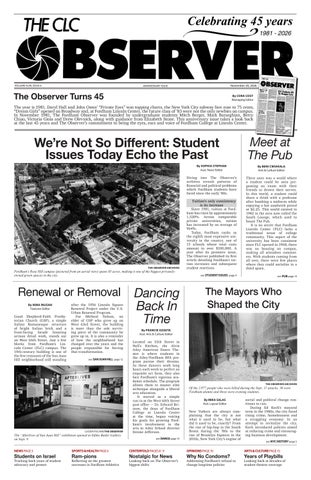
The Observer Turns 45
By CORA COST Managing Editor
The year is 1981. Daryl Hall and John Oates’ “Private Eyes” was topping charts, the New York City subway fare rose to 75 cents, “Dream Girls” opened on Broadway and, at Fordham Lincoln Center, the future class of ’83 were not the only newbies on campus. In November 1981, The Fordham Observer was founded by undergraduate students Mitch Berger, Mark Barseghian, Betty Chiao, Victoria Gioia and Drew Olevnick, along with guidance from Elizabeth Stone. This anniversary issue takes a look back at the last 45 years and The Observer’s commitment to being the eyes, ears and voice of Fordham College at Lincoln Center.
We’re Not So Different: Student Issues Today Echo the Past
By SOPHIA STEPHAN Asst. News Editor
Diving into The Observer’s archives reveals patterns of financial and political problems which Fordham students have faced since the early ’80s.
THE OBSERVER ARCHIVES
Fordham’s Rose Hill campus (pictured from an aerial view) spans 85 acres, making it one of the biggest privatelyowned green spaces in the city.
Renewal or Removal By IKMA INUSAH Features Editor
Good Shepherd-Faith Presbyterian Church (GSP), a simple Italian Romanesque structure of bright Italian brick and a front-facing facade boasting artisan detail work, stands out on West 66th Street. Just a few blocks from Fordham’s Lincoln Center (FLC) campus. The 19th-century building is one of the few remnants of the San Juan Hill neighborhood still standing
after the 1956 Lincoln Square Renewal Project under the U.S. Urban Renewal Program. For Micheal Nelson, an elder of GSP who grew up on West 63rd Street, the building is more than the sole surviving piece of the community he grew up in. It is also a reminder of how the neighborhood has changed over the years and the people responsible for forcing that transformation. see SAN JUAN HILL page 12
LUCIEN FISCHER/THE OBSERVER
The “Afterlives of San Juan Hill” exhibition opened in Ildiko Butler Gallery on Sept. 9.
NEWS PAGE 3
Students on Israel
Tracking back years of student advocacy and protest
SPORTS & HEALTH PAGE 6
Ram-pions
Reflecting on the greatest successes in Fordham Athletics
Dancing Back In Time
Meet at The Pub By BENI CWIAKALA Arts & Culture Editor
Tuition’s only consistency is its increase Since 1981, tuition at Fordham has risen by approximately 1,520%. Across comparable private universities, tuition has increased by an average of 964%. Today, Fordham ranks as the eighth most expensive university in the country, one of 15 schools whose total costs amount to over $100,000. A year after its premiere issue, The Observer published its first article detailing Fordham’s tuition increases and subsequent student reactions.
There once was a world where a student could be seen pregaming an exam with their friends to drown their nerves. In this world, a student could share a drink with a professor after bombing a midterm while enjoying a hot sandwich priced at $2.25. This world existed in 1982 in the area now called the South Lounge, which used to house The Pub. It is no secret that Fordham Lincoln Center (FLC) lacks a traditional sense of college community. This aspect of the university has been consistent since FLC opened in 1968; there was no housing on campus, making all attendees commuters. With students coming from all over, there were few places where they could socialize in a third space.
see STUDENT ISSUES page 4
see PUB page 13
The Mayors Who Shaped the City
By FRANCIE OZAETA Asst. Arts & Culture Editor
Located on 55th Street in Hell’s Kitchen, the Alvin Ailey American Dance Theater is where students in the Ailey/Fordham BFA program pursue their dreams. As these dancers work long hours each week to perfect an exquisite art form, they also face Fordham’s rigorous academic schedule. The program allows them to master elite technique alongside a liberal arts education. It started as a simple run-in at the West 60th Street post office — Dr. Edward Bristow, the dean of Fordham College at Lincoln Center at the time, began voicing his goals for growing Fordham’s involvement in the arts to Ailey School director Denise Jefferson. see DANCE page 15
CENTERFOLD PAGES 8 - 9
Nostalgic for News
Looking back on The Observer’s biggest shifts
THE OBSERVER ARCHIVES
Of the 2,977 people who were killed during the Sept. 11 attacks, 36 were Fordham alumni and three were evening students. By MIKA SALAS Asst. Layout Editor
New Yorkers are always complaining that the city is not what it used to be, but what did it used to be, exactly? From the rise of hip-hop in the South Bronx during the ’80s to the rise of Brooklyn hipsters in the 2010s, New York City’s engine of OPINIONS PAGE 10
Why No Condoms?
Addressing Fordham’s refusal to change longtime policies
social and political change continues to run. During Ed Koch’s mayoral term in the 1980s, the city faced rising crime, homelessness and a struggling economy. In an attempt to revitalize the city, Koch introduced policies aimed at reducing crime and encouraging business development. see NYC HISTORY page 5
ARTS & CULTURE PAGE 15
Years of Playbills
Looking back at decades of student theatre coverage
2
News
November 20, 2026 THE OBSERVER/ANNIVERSARY ISSUE
www.fordhamobserver.com
Read All About It: The Evolution of Student Journalism at The Observer
A decade-by-decade look at the student voice of Fordham Lincoln Center newspaper’s May 2012 coverage. The Observer featured a photograph of Occupy Wall Street protesters participating in a May Day march in Bryant Park. By then, Occupy Wall Street had emerged as a prominent national movement; its strong presence in New York City gave student journalists an opportunity to document the demonstrations taking place in their own city.
By MACKENZIE COOPER News Editor
In March 2020, as New York City entered a state of emergency, The Fordham Observer’s front page depicted a campus confronting an unfamiliar crisis. A masked ram appeared above the headline “New York State of Emergency.” The stories below detailed the university’s cancellations and contingency plans in response to the spreading coronavirus. For student journalists, the moment demanded more than just documenting campus life. It required providing information to a community navigating an unprecedented shock. That responsibility has taken different forms over the last 45 years. From reporting on university finances and administrative changes to documenting student protests and covering a global pandemic, student journalists at The Observer have adapted to the institutions they scrutinize and the community they serve. The ’80s: The Observer’s inaugural issue When The Observer was established in 1981, it filled a gap in student life at Fordham’s Lincoln Center campus. According to a 2006 retrospective published for the paper’s 25th anniversary, earlier student publications folded by the fall of 1981, leaving the community without a newspaper of their own. A group of students approached then-Dean George Shea, who reached out to Elizabeth Stone, then-associate professor of media studies, about starting one. That publication became the CLC Observer. The Observer’s early archives reveal a publication not only concerned with campus events, but also with the issues shaping students’ lives. A March 1992 issue featured coverage of campus security changes and Fordham’s budgetary constraints. Other stories addressed blood donations and campus event coverage surrounding the AIDS epidemic. Together, these stories demonstrated an early responsibility of student journalism: Documenting the experiences and concerns of a community that is not frequently covered by larger news organizations. And while the focus may have been on members of the Fordham community, the questions raised regarding campus
FATIMA SHABBIR/THE OBSERVER ARCHIVES
A demonstrator paints a banner during the Occupy Wall Street movement in Liberty Square, as participants prepare signs for a demonstration.
security, public health and university finances reflected the broader sociopolitical climate of the time. The ’90s: Facing institutional power As The Observer developed, its coverage increasingly examined the decisions made by university administrators and student government. In October of 1993, The Observer questioned university budget projections under the headline “No Deficit ???,” reporting on disagreements surrounding a proposed budget balance and a disputed $9 million deficit. That November, it was reported that the president of the United Student Government (USG) had resigned, citing workload and university restructuring. That issue’s front page also covered the start of a murder trial involving a defendant accused of killing a Fordham College at Lincoln Center (FCLC) graduate Robert Smith, CLC ’92. Smith, who was pursuing an acting career after graduation, was traveling to Dallas, Texas for a theater performance he was in. Smith was killed in a robbery outside his apartment in Dallas on Dec. 10, 1992. By November of 1999, The Observer was reporting on a proposed solution to student printing fees, the representation of first-years in USG and a dean battling cancer. Under the proposed
printing system, students would receive an unspecified number of free copies loaded onto their university ID cards before having to pay to replenish their balances — a system that bears a similar resemblance to Fordham’s current printing model. These articles illustrated the range of responsibilities student publications can assume: scrutinizing university policy, examining student representation and reporting on the lives of Fordham community members. That work also required adapting to a changing media environment. In February of 2000, The Observer announced that it was going online for the millennium. This transition not only reflected a shift at Fordham, but for journalism in general, as newspapers were beginning to expand beyond print to reach readers through the internet. For student publications like The Observer, digital publishing would eventually change not only how quickly stories would be distributed, but also how readers accessed campus reporting. The 2010s: Reporting beyond university grounds Student journalism has never been limited to administrative decisions or campus events. Universities exist within larger political, cultural and social environments, and the issues students encounter often extend beyond the boundaries of their campuses.
The Observer’s October 2011 issue featured a front-page story on Fordham Lincoln Center students joining protesters at New York City’s SlutWalk, a movement that challenged victim-blaming attitudes surrounding sexual violence. The Observer connected a national conversation about gender-based and sexual violence to the experiences and activism of the Fordham community. In the same issue, an article covered anti-residence life flyers posted in campus dormitories. On Sept. 16, 2011 a Resident Assistant on routine rounds discovered a series of three propaganda posters inside the dormitories at McMahon Hall. The flyers depicted FCLC’s Office of Residential Life as a totalitarian state. One read, “Res Life is watching you,” referencing Big Brother, while another featured Darth Vader with the text, “We’re Watching” above the Office of Residential Life name. After a residential assistant removed the flyers and alerted security, Res Life temporarily revoked overnight guest passes for the weekend of Sept. 17-18. Although closely tied to university living, the story reflected another dimension of student journalism, through reporting on the ways students express dissatisfaction with the policies and structures that govern their everyday lives. That relationship between city and campus appeared again in the
The 2020s: The expanding responsibilities of student journalists The demands on student journalists became particularly visible during the COVID-19 pandemic. The Observer’s March 2020 coverage addressed study abroad cancellations, university closures, contingency planning and public health guidelines as students faced uncertainty around every aspect of their lives. In moments of crisis, the role of student publications becomes even more important. They can provide timely information, explain institutional decisions and preserve a record of how a community responds to events as they unfold. In doing so, the newspaper’s front page not only documented the university’s response, but recorded a moment that would radically alter student life. The significance of that work extends well past Fordham. In an October 2023 article by The Associated Press, journalist David Bauder examined the crucial impact of student-run publications across the country. The Stanford Daily’s reporting on faulty scientific research contributed to an investigation that resulted in the resignation of Stanford University’s president, while The Daily Northwestern’s coverage of alleged football team hazing culminated in the firing of its head coach. Over 45 years, The Observer’s archives have preserved a changing media landscape. In each section and on every page, student journalists have covered university budget disputes, questions about student representation, social movements, administrative decisions and a global health emergency. The archives also reveal the continuity beneath those changes: the need for reporters willing to ask questions, challenge institutions and record the experiences of the people around them.
Fostering Diversity at Fordham is an Ongoing Process By MICHELLE WILSON News Editor
Since Fordham’s inception as a men’s university in 1841, the university’s population has become significantly more diverse. A 2025 university census data revealed an undergraduate student population from all 50 states and 121 countries. However, diversity remains a continued project, and students have played a significant role in keeping the push for greater inclusivity alive. Thomas More College opened at Fordham Rose Hill in 1964, ushering in the first full generation of Fordham women (though the Fordham Law School, the Fordham Graduate School of Social Service and the Fordham School of Education began accepting women as students as early as 1918). The university became fully co-ed with the dissolution of Thomas More College in 1974.
On the topic of gender parity, University President Tania Tetlow became Fordham’s first woman president in 2022. Today, of 10,800 undergraduate students, women outnumber men 59% to 40% (university statistics do not account for gender non-conforming students), and the gender distribution among faculty is relatively equal. Fordham’s website states that, as of 2025, 22% of its undergraduates are Hispanic/Latino, 13% are Asian, 7% are Black, 0.1% are American Indian/Alaskan, 0.1% are Hawaiian/Pacific Islander and 57% are white/other. Religion In recent years, Fordham expanded its interfaith initiatives, notably with the hiring of Rabbi Katja Vehlow and Imam Ammar Rahman to Campus Ministry’s staff in 2024. Still, students of other faiths have spoken out about what they feel to be a
relative lack of representation on campus and a prioritization of the Abrahamic faiths. Some have taken matters into their own hands, as was the case in founding the Sikh Student Association six years ago. As of 2025, the Fordham undergraduate population is 32% Catholic, 2% Jewish, 10% Protestant, 18% other and 38% unknown. Education The university’s diversity of education has expanded over time. The African & African American Studies department was launched in 1969, followed by the Women, Gender, & Sexuality Studies program in 1995. The Disability Studies and Asian American Studies programs were launched in 2019 and 2023, respectively. The Office of Multicultural Affairs opened in 2000 with the intention of organizing cultural
programming and fostering community among students. In 2020, the university adopted a test-optional admissions policy amid growing national concerns over racial inequalities in standardized testing. Four years later, Fordham brought on the inaugural vice president for equity & inclusion and chief diversity officer, James A. Felton III. How do these statistics compare to the student experience? In a 2021 Observer article — written after the university welcomed its most diverse class yet — Hiba Imad, Fordham College at Lincoln Center ’24, said she felt the change “doesn’t translate as well into the daily lives of students,” pointing to both student and faculty demographics and what she deemed Eurocentric curricula. Fordham’s philosophy and core courses have long been criticized by some student groups
for their focus on Western European thinkers. Similar concerns were raised in 2014, particularly over a lack of class diversity. According to Patricia Peek, then-director of undergraduate admissions, the 2013 racial composition of Fordham was: 13.8% Hispanic, 4.1% Black, 8.9% Asian, 3.3% mixed race and 61.4% white. In a 2014 Observer article, Mark Naison, a professor of history and African & African American Studies who has been at the university for more than 50 years, said that “Fordham has become an upper-middle class haven.” Fordham is now the eighth-most expensive university in the country. “Fordham is the Bronx college of gentrification,” Naison said. “This school leaves a lot of people behind, and you can see those people outside the gates at Rose Hill, and it seems that those gates are getting higher and higher.”
www.fordhamobserver.com
Fordham’s Reacts to the IsraelPalestine Conflict: 1981 to Today
THE OBSERVER/ANNIVERSARY ISSUE
November 20, 2026
News
3
Looking back on The Observer’s coverage of the long history of conflict in the region
Why Is Everyone Talking About Chuck Schumer? The battle for Senate majority leader exposes long-standing tensions in the Democratic Party, refueled by the midterms By MICHELLE WILSON News Editor AURELIEN CLAVAUD/THE OBSERVER ARCHIVES
In 2024, pro-Palestinian protests ignited at universities across the country, including at Fordham Lincoln Center. By MAURA DAGON & CADENCE OSAGE TESTA Contributing Writers
Since The Observer’s 1981 debut, students have been covering not only issues within the campus grounds of Fordham, but also those occurring globally. One of the most pressing has been the conflict between the Israeli and Palestinian states. The modern state of Israel was established in 1948, which sparked a decades-long struggle for land, sovereignty and power among Israeli and Palestinian leadership. Following Israel’s seizure of control in the West Bank and the Gaza Strip and the annexation of East Jerusalem, ongoing military occupation, settlement expansion and Palestinian resistance have fueled intense debates and recurring wars over who is entitled to the region. In the February 1985 issue, an opinions piece “Thanks, But No Thanks Mr. Schultz!” responded to a speech by then-Secretary of State George P. Shultz about U.S. counter-terrorism initiatives. Shultz pointed to Israel as “a model of how a nation should approach the dilemma of trying to balance law and justice with self-preservation.” The writer, Vladi Andrei, Fordham College at Lincoln Center (FCLC) ’88 and Fordham Law School ’92, objected to this, arguing that Israel is not the example America should look to and that most counter-terrorist attacks end up only harming civilians instead of perceived threats. That article was only the beginning of coverage on conflicts in the region. Nearly 20 years later, in an April 2002 issue, the debate had expanded to include a wider range of student and faculty perspectives. “Support for Israel Weakens as Conflict Escalates” by Susanna Hamner, FCLC ’03, quoted from various students, most of whom disagreed with Israel’s actions. In November of that same year, The Observer published an article titled “Nationwide Israel Divestment Campaign Sweeps College Campuses, Sparks Accusations of Anti-Semitism,” written by Rob D’Amato, FCLC ’04. The piece discussed a studentand faculty-led campaign for U.S. companies to withdraw financial holdings from corporations that conduct business with Israel. Some faculty members expressed concerns about how this campaign could disrupt student life on campus, claiming that support for Palestine had the potential to normalize antisemitic behavior. Students, however, asserted that Fordham had a duty to address the issue
in accordance with their Jesuit value of social responsibility in the face of human rights concerns surrounding Israel’s treatment of Palestinians. Despite generating considerable debate, the campaign ultimately gained little traction at Fordham. In 2014, concerns about antisemitism cited in opposition to pro-Palestinian advocacy were raised again, as reported in a November issue. An article “American Studies Professors Resign in Protest” by Tyler Martins, FCLC ’15, outlined an incident in which six faculty members resigned from Fordham’s American Studies program to protest the American Studies Association’s (ASA) boycott of Israeli academic institutions. The ASA’s resolution called for the boycott to “honor the call from Palestinian civil society.” The six professors felt Fordham should have severed official ties with the association until it rescinded the boycott. When Fordham remained neutral, they resigned. Following the November 2023 Hamas attack in Israel, and Israel’s ensuing attacks on the densely populated Gaza Strip, many New York City and Fordham University students alike began speaking out. Fordham’s chapter of Students for Justice in Palestine (SJP), which is not recognized as a student organization by the university, held an informational session that month to discuss the conflict, aiming to educate students and foster a productive environment for discussion. The article “SJP Hosts Discussion on Middle East and Palestine” covered the event, quoting various outlooks on the conflict. Some students spoke out in support of Israel and in opposition to the presence of Hamas as an organization. This incited responses from various pro-Palestinian participants who spoke about the violence in Gaza, all of which was mediated by an SJP spokesperson. That following winter in 2024, students and alumni gathered outside of the Leon Lowenstein Center to protest the Israel and Hamas war that had started the year prior. Alumnus Jamie Rodriguez, FCLC ’14, is quoted in the 2024 article “Students Protest for Palestine.” “It’s a full expression of solidarity with people, human beings, that are facing a system of oppression and white supremacy,” Rodriguez said. This protest was accompanied by various others localized in the city, specifically by Columbia University. These protests remained peaceful, aside
from minor destruction of property during the occupation of a campus building. The protest in front of Fordham Lincoln Center campus was entirely nonviolent and was monitored by public safety. As the conflict in Gaza continued into 2024, Fordham students set up a “Gaza Solidarity Encampment,” which consisted of tent structures within the Leon Lowenstein Center to protest the university’s financial ties with Israeli organizations. The New York Police Department (NYPD) arrived at the scene to shut down the “unlawful encampment,” according to NYPD Deputy Commissioner of Operations Kaz Daughtry; this was covered in the May 2024 article “NYPD Campus Presence to Persist Through Graduation.” The following week, Fordham faculty expressed their support for the protesters in the May 2024 article “Faculty to Pro-Palestine Students: ‘Keep Speaking Your Truth.’” A statement of support for “Justice in Palestine” was signed by 190 faculty members, encouraging student protests and university protection of free speech. This move was also supported by Fordham alumni and other student-organized groups, all of which continued to urge people to speak out. Throughout the years at Fordham, students engaging in protest through SJP have fought for recognition. In December of 2016, following a year-long club application process, Dean of Student Services Keith Eldredge vetoed the club’s status. Protests resulted, advocating for the club’s establishment and criticizing what was viewed as Fordham restricting free speech. In April of 2017, SJP members filed a lawsuit against the university, resulting in a five-year legal battle, covered in the May 2024 article “Students for Justice in Palestine at Fordham: An Interactive Timeline.” The suit escalated to the New York Supreme Court and was ultimately denied and deferred to Fordham’s autonomous discretion, continuing the university’s ban on the club. The almost 80-year conflict in Israel and Palestine continues, including what a United Nations commission ruled as a genocide happening at the hands of Israel in the Gaza Strip today. As the damage wrought by Israeli military actions in the region seemingly shows no clear sign of wavering, Fordham students, alumni and faculty alike continue to be active participants in protest and conversation regarding the Israel and Palestine conflict, as they have for decades.
The year The Fordham Observer was founded, Democratic Senator Chuck Schumer was elected for his first term in the U.S. House of Representatives. Now a political veteran, he is poised to lead the Senate through the second half of President Donald Trump’s tenure, which is likely to look very different than it has for the last two years. The selection of the next Senate majority leader will follow Hakeem Jeffries’ nomination as the first Black speaker of the House, with a 251-11 vote, on Nov. 18. The decision has sparked backlash from some progressive voters, who argue that Jeffries is too moderate, too much of an establishment Democrat — concerns that mirror those levied against Schumer. The midterms saw a monumental shift in power. Democrats won back the House and Senate, flipping seats in red states like Texas, Ohio, South Carolina and Kansas for the first time in decades. Voters across party lines united over concerns around corruption, inflation and the U.S.’s much-criticized war in Iran. Now that Democrats have destabilized Trump’s hold on Congress, the question on everyone’s mind is: What will Democrats do next? Will they focus on trying to impeach Trump or members of his inner circle, or will they concentrate on policy issues instead? (Their first post-election undertaking was a failure; the House was unsuccessful in impeaching Defense Secretary Pete Hegseth.) Many progressive voters are disillusioned with the Democratic Party and looking for leadership with an actionable vision beyond being anti-Trump — one that addresses their urgent material concerns like the price of gas and groceries. These tensions are crystallized in the fight for who will lead the Democrat-held Senate. Senator Chris Van Hollen announced his challenge for majority leader on Nov. 12. Elected to the Senate in 2016, Van Hollen is a progressive Democrat, notable for his strong opposition to Israel’s military campaign in Palestine, Trump’s immigration crackdown and federal corruption. He has also criticized decentralized finance and cryptocurrency, positions that are especially topical now amid debates over artificial intelligence
regulation and data center construction. Schumer, on the other hand, is a more moderate Democrat. He has long said that an imaginary middle-class Long Island couple, Joe and Eileen Bailey, guide his policy decisions and represent swing voters in his mind. Several Democrats have voiced concerns that the battle over Senate leadership will steal focus from conversations around how they will wield their new power. Who is going to win? The odds favor Schumer. He has been in Congress nearly twice as long as Van Hollen and has long been angling for the position, so he already has a lot of votes lined up. He has led the Senate Democratic Caucus since 2017 and was the Senate majority leader from 2021 to 2025. His and Van Hollen’s ideas are also not entirely in opposition; they both want to end the Iran War, for instance. Schumer was sharply criticized last year for not being aggressive enough at the start of Trump’s term by forcing an earlier government shutdown over federal spending. After the shutdown, Democrats came under fire again for conceding to conservative demands. Why does this matter? The Senate majority leader is more than just a face of the party. They set the schedule for each day and call bills to the floor. Alongside the minority leader, they create unanimous consent agreements — a fast-track process where a given proposal is approved if no one objects. The particulars of the position look different with each leader. Chiefly, there is a lot of administrative responsibility involved in the role beyond what someone might just pick up on the job as a senator, so Schumer’s experience gives him a real edge. Ultimately, while it is not in the formal job description, the majority leader is responsible for uniting Democrats under a common vision and corralling their colleagues into showing up to vote for that agenda. With a rising faction of voters hoping for a change from the party establishment — seen in the meteoric rise to power of the Democratic Socialists of America in the last year — the potential for a new leader has a huge draw. Senate Democrats will vote in December for who will lead them come January.
4
News
November 20, 2026 THE OBSERVER/ANNIVERSARY ISSUE
www.fordhamobserver.com
Too Old For This: Persistent Problems in University Life
Uncovered history reveals that today’s students face many of the same systemic obstacles they did in the 80s Jessica Lang recently marked her one-year anniversary serving as the inaugural “superdean” at Fordham. When the position was first announced, tenured faculty sent a 1991 letter to former University President Joseph O’Hare, S.J., to express their discontent that the university did not adhere to the importance of “faculty participation in decision making, with respect to both academic planning and university governance.”
STUDENT ISSUES from page 1
The nearly 16% hike for the 1982 academic year brought undergraduate tuition from $4,250 to $4,950. Students were mainly concerned that the funds were not directly benefiting student life and that decreased affordability would impact enrollment. Students had strong opinions on later tuition hikes, namely the 9% increase in 1988, 10.5% in 1990 — that is, for Fordham Lincoln Center (FLC) students; FRH students saw a 9.7% increase — and 9.7% in 1993. In 1988, The Observer reported that, “despite the fact tuition is rising, every department has been asked to cut back their budgets by two percent.” In the early ’90s, administrators said that the university had failed to secure large endowments in the past; faculty and administrative salaries, health care and financial aid costs put additional pressures on the budget, resulting in the sizable tuition hike. By 2003, undergraduate tuition rose to $24,000, compared to $4,250 in 1981. The Observer wrote that rising college tuition across the country combined with a struggling economy meant that attending university was becoming “more of a luxury.” Ten years ago, Fordham saw a 3.75% hike, bringing tuition to $47,000. Going into the current academic year, a 4.5% increase was announced, making average undergraduate tuition $68,886. Administrative responses to sexual violence on campus A Cornell student’s 2024 allegations of gang rape against seven men have renewed scrutiny of sexual violence on college campuses nationwide. A 1991 article mentioned an alleged date rape of a FRH student that took place a few years prior to publication, though The Observer did not cover the story in its entirety. In 1996, the alleged victim, Karen Schmidt, shared the impact that the rape and administrators’ handling of the situation had on her with The New York Times (NYT). Schmidt told the NYT that she had been in her dorm room talking and drinking beer with two male students she believed to be friends when one of them pinned her down and raped her as the other prepared to join. After the attack, another female student shared with Schmidt that she had been raped by one of the same students. They brought the matter to their residential assistant, who told the
GRAPHIC BY SOPHIA STEPHAN/THE OBSERVER
Data from 1980-2023 are courtesy of National Center for Education Statistics.
dean of students at the time, Henry Toutaine. Toutaine brought disciplinary charges against the two men Schmidt accused, but the other alleged victim withdrew her report, which Schmidt said was due to pressure from the attacker’s friends. Schmidt said she also endured harassment from the attacker’s football teammates and friends while her case was processed.
Most recently, Fordham was hit by a 2025 lawsuit alongside the Archdiocese of New York accusing the university of overlooking sexual abuse of minors committed by a priest living at Fordham in the ’70s. Toutaine ultimately decided that he could not prove whether or not the allegations were true, and dropped the charges. Schmidt left Fordham the same day she received his decision. No further investigation or statements by the university were made. In 2008, The Observer interviewed Richard Cerick, who alleged that he had been raped on Fordham’s campus in 1968 by Roy Drake, S.J., who was living in Jesuit housing at FRH at the time. Cerick told The Observer that the
night before he and his friends at Fordham Prep embarked on a ski trip organized by Drake, Drake raped him in his apartment. Cerick said that then-University President Joseph McShane, S.J.’s public statement was an inadequate expression of compassion, and that the university “still completely (refused) to (publicly) acknowledge the validity of (his) allegations, despite deeming them credible, or apologize for the monstrous crimes that one of their priests inflicted on (him).” Most recently, Fordham was hit by a 2025 lawsuit alongside the Archdiocese of New York accusing the university of overlooking sexual abuse of minors committed by a priest living at Fordham in the ’70s. The claims are still being reviewed. According to CBS, minors living in the Bronx said they were assaulted by John Joseph McCarthy, S.J., who lived at FRH until 1992 and is now deceased. McCarthy allegedly lured a group of young boys using Fordham’s facilities, took them into “a back room, and (forced) them to fondle each other, fondle him or pose with each other for nude photographs,” said Nicholas Wainwright, one of the alleged victims’ attorneys. The lawsuit was filed on the claim that “the university knew what was going on and turned a blind eye.” Fordham has attempted to take cross-institutional and international steps toward addressing clergy sexual abuse. Namely, the university’s 2020 Taking Responsibility initiative brought Fordham and other Jesuit institutions together to research systemic sexual abuse in the church.
THE OBSERVER ARCHIVES
Since its first issue, The Observer has brought to light key issues facing students, and the Fordham community as a whole.
Reaganomics in Trump’s Economy Cuts to federal funding for higher education and financial aid imposed by President Donald Trump’s One Big Beautiful Bill Act (OBBBA) are reminiscent of those made by former President Ronald Reagan, who served in the White House from 1981 to 1989. The Omnibus Budget Reconciliation Act, signed into law by Reagan in 1981, implemented many of Reagan’s budgetary plans. The act effectively phased out Social Security educational benefits, which provided one-fifth of federal student aid in the fiscal year 1981. It “also restricted eligibility for Guaranteed Student Loans and reduced spending ceilings for other student aid programs,” according to the Education Resources Information Center. Reagan’s proposed budget for 1983 increased defense spending and decreased spending for domestic programs, including education, according to a 1982 article by The Observer. Fordham students have been and will continue to be affected in a similar way by the ongoing implementation of the OBBBA. Some students have already felt the bill’s impact through its cuts to the Supplement Nutrition Assistance Program and Medicaid funding. Caps to Parent PLUS loans and the expiration of enhanced Affordable Care Act marketplace subsidies have also put a strain on Americans. Like Reagan’s proposals in the ’80s, the OBBBA increased defense funding — allocating an additional $152.4 billion to the Department of Defense’s $841.9 billion budget — while slashing spending on education and financial aid services. Funding cuts had long-term effects on tuition then, and they will now. Because states are being saddled with building the budgets for public benefit programs, other social services may be reduced or eliminated entirely. Higher education is deemed an easy target, as it is a large discretionary item (budget items that require reapproval each year). Administration and faculty, frenemies for life Issues of shared governance and faculty autonomy have been raised in recent years, but it seems that Fordham faculty and leadership have a history of friction. In 1991, Fordham almost saw the creation of the “superdean,” — that is, a dean who oversees Fordham College at Rose Hill, Fordham College at Lincoln Center and the Fordham Graduate School of Arts and Sciences. The position was officially established last year, and dean of Fordham Arts and Sciences
In 2017, the Faculty Senate almost unanimously voted no confidence in McShane, saying that the administration violated university statutes in salary negotiations. The Observer wrote at the time that “the heart of the issue (was) faculty’s feared loss of CLC autonomy as another layer of bureaucracy is added.” In 2017, the Faculty Senate almost unanimously voted no confidence in McShane, saying that the administration violated university statutes in salary negotiations. Tensions between faculty and administration did not end there. Last semester, faculty raised concerns when the university employed an outside law firm to review faculty websites and propose language changes in their content. This semester, the Faculty Senate said that the Board of Trustees violated statutes in deciding to impose a resolution on salary negotiations for tenured faculty. When speaking to student press, Tetlow said that the Board has the power to impose a resolution if negotiations with faculty leadership reach an impasse. Devolving reproductive rights The precedent set by Roe v. Wade on Jan. 22, 1973, protected abortion at the federal level. Three years prior, New York State passed the Reproductive Health Act to safeguard access to reproductive rights at the state level. After the 2022 decision on Dobbs v. Jackson overturned Roe v. Wade, New York kept its stance, ensuring that “all pregnant people (including minors, transgender men and nonbinary people) have the right to a safe and legal abortion.” While the Fordham community, as New York residents, has had legal access to reproductive healthcare since 1970, students and alumni were struck by the 2022 overturning of Roe v. Wade, and took to social media to gather donations, post information and compile resources to aid those affected. Fordham’s University Health Services conducts pregnancy testing, but the distribution of contraceptives on campus is banned. Prescription emergency contraception and other procedures for reproductive healthcare are covered under Aetna’s student health plan. Fordham students remain divided by the topic of abortion, especially as members of a Catholic institution. For example, the Respect For Life student group offers parenting and pregnancy resources with a “pro-life” perspective, while USG and other clubs continuously contest Fordham’s contraceptive policy.
www.fordhamobserver.com
THE OBSERVER/ANNIVERSARY ISSUE
November 20, 2026
News
5
How 45 Years Have Changed FLC’s Campus From a former bar to new residence halls, Fordham has transformed alongside generations of students By ALEENA SIDDIQUI Asst. News Editor
For students walking through the Fordham Lincoln Center (FLC) campus today, the collection of residence halls, classrooms, dining spaces and study areas may feel like permanent fixtures, but a student from the class of 1981 may struggle to recognize the campus as it looks today. The development of FLC is not simply a story of construction. It is the story of a university trying to accommodate a growing student population within Manhattan’s limited space. Before the campus took shape, the neighborhood surrounding it was known as San Juan Hill, a predominantly Black, Puerto Rican and working-class community with a rich cultural history. Throughout the early 20th century, the area was home to jazz clubs, theaters, dance halls and businesses that helped shape New York’s music and art scenes. That history changed dramatically when the area was targeted for the Lincoln Square Urban Renewal Project in the late 1950s. The plan cleared hundreds of buildings and displaced more than 7,000 families and 800 businesses to make way for projects including FLC and Lincoln Center for the Performing Arts. The land was sold to Fordham at an extremely low price. As the campus developed, questions about its facilities and the quality of student life persisted. In April 1990, The Observer reported on a United Student Government forum where students raised concerns about the facilities
THE OBSERVER ARCHIVES
Over the last four decades, Fordham Lincoln Center has seen numerous construction and restoration projects that have fundamentally shaped the student experience.
available at FLC. At the time, residential students were living at the Hotel Lucerne, an off-campus hotel, while Fordham awaited the construction of a permanent residence hall. Students described deteriorating conditions at the hotel, including maintenance issues and a lack of amenities. One resident, Colleen Quinn, Fordham College at Lincoln Center (FCLC) ’92, told The Observer, “We have no facilities. We have no dorm. Nothing’s here.” The lack of space extended beyond residential life. Some classes were being held at the Professional Children’s School on West 60th Street because of limited classroom availability in the Leon Lowenstein Center. Students also complained about problems with the Quinn Library, including water damage to books, missing volumes and limited operating hours.
The same article documented concerns about another important part of campus: the Outdoor Plaza. Students questioned why proposed repairs had not been completed. The Outdoor Plaza also played an important role in the social life of FLC students. The campus’s former pub had lost some of its prominence over the years, prompting efforts to revitalize the space. An article titled “The Plaza Cafe… Bringing In The New,” documented an effort to turn the pub into a more active gathering space. The cafe introduced a big-screen television for sporting events, a late-night food menu, board games, darts and live entertainment nights. The Outdoor Plaza was originally named Robert Moses Plaza after the city planner who played a central role in the development
of FLC’s campus. It also featured a monument to him. Moses is a controversial figure in New York City’s history; his urban planning displaced communities and was widely accused of racist, exclusionary design. Years of student activism led to the removal of the statue (though the university tried to re-install it in 2015). The university quietly dropped Moses’ name from the Outdoor Plaza in 2016. Dining has also been a recurring part of the conversation surrounding student life at FLC, though not always for good reasons. Fordham has long carried a reputation among students for its underwhelming campus food. Changes in dining providers have periodically brought promises of improvement, such as with the 2016 replacement of Sodexo with Aramark. Despite these changes,
students continue to raise concerns about meal timing and limited dietary options. The eventual construction of McMahon Hall marked an important development to the campus’s residential life. Over the years, McMahon evolved, notably with the 2023 grand opening of the RamFit Center, which introduced additional workout facilities and multipurpose studios. The next major transformation came with the construction of McKeon Hall and the new Fordham Law School. The 22-story building opened in 2014, with the Law School occupying its first nine floors and McKeon Hall housing more than 400 undergraduate students above. The opening of McKeon offered amenities designed to help firstyears develop a stronger sense of community. However, the addition of new buildings did not immediately resolve concerns about overcrowding. In January 2016, The Observer published a staff editorial titled “Growing Pains for FCLC’s Ramily,” which argued that the university was still struggling to accommodate its growing student population. Forty-five years of The Observer’s reporting capture decades of decisions on how to support a growing university nestled in the heart of New York City, and the frustrations of students that experienced it firsthand. But that growth also came at the expense of the San Juan Hill community, whose displacement made way for the campus and whose history Fordham has not always fully acknowledged.
A Look at NYC Through The Decades
The seven men whose unique visions helped create the city Fordham students know today NYC HISTORY from page 1
Measures like graffiti removal and the enforcement of a prohibition-era law that banned dancing in venues which served food and drink without a license sparked criticism from local artists, who believed they chipped away at the city’s artistic life. At the same time, the AIDS epidemic was claiming hundreds of thousands of lives across the country, with New York City among the hardest-hit areas. Koch faced criticism over his administration’s inadequate response to the crisis. Former President Ronald Reagan’s administration was also widely decried for the federal government’s refusal to develop treatments for or even publicly acknowledge AIDS during the early years of the crisis. In response to their federal and local governments’ inaction, activists like the AIDS Coalition to Unleash Power organized huge demonstrations and advocacy campaigns to demand greater government attention, medical research and access to treatment. David Dinkins took office in 1990 as the city continued to grapple with rising crime and an economic recession. His administration had a strong focus on expanding the police force, despite reports on police brutality. New York City continued to experience high levels of violent crimes during his administration and was deemed the “murder capital of the country.” Rudy Giuliani succeeded Dinkins in 1994, similarly making crime reduction and economic revitalization central priorities of his administration. During his two terms, crime rates decreased significantly, and the FBI ranked New
THE OBSERVER ARCHIVES
Today, Times Square is one of New York City’s biggest tourist attractions, a product of dramatic urban development in the 1990s.
York City as one of the safest U.S. cities with populations exceeding 100,000 people.
In New York City, the hurricane resulted in 44 deaths and an estimated $19 billion in damages. After World War II, New York City increasingly shifted from public-led housing towards private development. Rezoning, including those in Williamsburg and Greenpoint in 2005, replacing manufacturing and low-rise districts with luxury towers, driving up rents and displacing residents in parts of Brooklyn, Lower Manhattan and Harlem.
On Sept. 11, 2001, the World Trade Center was struck by terrorist attacks; 2,977 people were killed and thousands more were injured in the attack. Of the lives lost, 36 were Fordham alumni and three were evening students. Michael Bloomberg took office in 2002, overseeing the city’s recovery and redevelopment in the years following the attacks. His administration emphasized economic development, public health initiatives and fiscal policies aimed at managing the city’s budget. The 2008 financial crisis devastated New York City’s economy. With Wall Street at the center of the crisis, financial institutions faced major losses and thousands of New Yorkers lost their jobs. The recession also placed pressure on the city’s budget and financial sector.
During Bloomberg’s final term in office, the city saw the emergence of the Occupy Wall Street movement in 2011, which brought protests against economic inequality and corporate influence to Lower Manhattan. That same year, the National Sept. 11 Memorial opened at the World Trade Center site. One World Trade Center would not open until three years later in 2014. In October 2012, Hurricane Sandy hit the East Coast. In New York City, the hurricane resulted in 44 deaths and an estimated $19 billion in damages. Thousands of homes were destroyed or left uninhabitable. Bill de Blasio, who took office earlier that year, focused most of his administration on universal and free pre-K education
and affordable housing initiatives. His administration faced criticism during the Black Lives Matter movement from those who felt that, despite his public words of support, he failed to hold the NYPD accountable, nor reduce police funding. The COVID-19 pandemic brought a major disruption to the city in 2020. De Blasio and then-Governor Andrew Cuomo faced scrutiny over their responses to the pandemic, including the state’s handling and reporting of COVID-19 deaths in nursing homes. The shutdown ended and the state of emergency was lifted in 2021. Following pandemic tensions, Eric Adams took office in 2022. Adams’ time in office was marred with controversy. In September 2024, he was federally indicted on charges including bribery and corruption related to campaign contributions and favors from foreign nationals. In November 2025, Zohran Mamdani won the mayoral election in a huge upset. Backed by the Democratic Socialists of America, his campaign used grassroots and social media strategies to mobilize young voters to the polls. His administration has focused on practical fixes to city infrastructure (“pothole politics”) and addressing the affordability crisis. Mamdani expanded universal childcare, issued a rent freeze for rent-stabilized apartments and announced a “Block by Block” plan to build affordable housing. Mamdani’s first year marks the beginning of another chapter in New York City’s political history, as residents and city officials alike look toward how his administration will shape the city’s future.
Sports & Health
Sports & Health Editor Olivia Vasquez
bservations
November 20, 2026 THE OBSERVER/ANNIVERSARY ISSUE
A History of Fordham’s Greatest Athletes
The successful student-athletes of the past 45 years that have left a lasting mark in collegiate athletics By ONA SODAITIS Contributing Writer
Throughout Fordham University’s 100-plus years of its athletic program, it has seen many notable athletes walk through its doors. Famous alumni include: Frankie Frisch, FCRH ’20, who was a four-time World Series champion, an MLB National League (NL) Most Valuable Player (MVP) award winner in 1931 and was inducted into the National Baseball Hall of Fame in 1947; NFL Head Coach and Hall of Famer Vince Lombardi, Fordham College Rose Hill (FCRH) ’37; Anne Gregory-O’Connell, FCRH ’80, who holds the all-time school records for both career points, scoring a total of 2,548, and rebounds, with 1,999 overall. She led the nation in rebounding for women’s basketball during the 1978-79 season and later played professionally in the Women’s Basketball League (WBL); and Pete Harnisch, FCGB ’88, drafted in the first round by the Baltimore Orioles. Fordham’s talent continued to echo through the end of the 20th century into the 21st. Some of the more recent notable Fordham alumni athletes include Jeanine Radice, FCRH ’89; Denise Corrado, FCRH ’97; Bryant Dunston, FCRH ’08; Chase Edmonds, FCRH ’17; and Tim DeMorat, FCRH ’22. During her time at Fordham, Radice established herself as one
of the most accomplished players in the history of the university’s women’s basketball team. As a Ram, she earned three First Team All-Metro Atlantic Athletic Conference (MAAC) selections, was named MAAC Rookie of the Year in the 1984-85 season and MAAC Player of the Year in the 1988-89 season, and finished with a total of 2,417 career points.
Corrado graduated from Fordham after helping establish the university’s women’s soccer program as a competitive varsity sport. Following her playing career, Radice transitioned into collegiate coaching, with an impressive career spanning more than three decades. She spent 21 seasons at the University of Delaware, helping the program earn four NCAA Tournament appearances and reach the Sweet Sixteen in 2013. She also coached at Seton Hall University, Marist College, Bucknell University and the University of Richmond. At Richmond, she helped lead the team to consecutive Atlantic 10 (A10) regular-season championships in 2024 and 2025, an A10 Tournament
COURTESY OF FORDHAM NOW
Today, both Fordham men’s and women’s basketball compete in NCAA Division I as members of the Atlantic 10 Conference.
championship in 2024, and an NCAA Tournament victory in 2025. She was inducted into the Fordham Athletics Hall of Fame in 1995. Corrado graduated from Fordham after helping establish the university’s women’s soccer program as a competitive varsity sport. Playing from 1993 to 1996, she became the first Fordham women’s soccer player to earn First Team All-Atlantic 10 honors, receiving the recognition in both 1995 and 1996. She finished her collegiate career with 35 goals, 13 assists and 83 total points, making her the program’s all-time leading scorer. She also recorded multiple hat tricks during her career. Her contributions helped build the foundation for Fordham women’s soccer and earned her a place in the Fordham Athletics Hall of Fame in 2007, where she became the first women’s soccer player inducted. During his illustrious college basketball career, Dunston was named A10 Rookie of the Year in 2005 and earned All-Atlantic 10 honors three times, including First Team recognition in 2006. He finished his Fordham career with 1,832 points, 993 rebounds and a school-record 294 blocked shots.
Edmunds’ success at Fordham led to his selection by the Arizona Cardinals in the fourth round of the 2018 NFL Draft. Following graduation, Dunston began an international professional basketball career, playing in South Korea, Greece, Israel, Italy and Turkey. His accomplishments include winning two EuroLeague championships with Turkish team Anadolu Efes in 2021 and 2022, earning the EuroLeague Best Defender award twice, and being named to the All-EuroLeague Second Team in 2017. He also won national championships in South Korea, Greece and Turkey. Dunston was inducted into the Fordham Athletics Hall of Fame in 2014. Edmonds graduated from Fordham after an outstanding four-year football career that established him as one of the greatest running backs in program history. He finished his collegiate career with 5,862 rushing yards, 74 total touchdowns, 67 rushing
COURTESY OF FORDHAM ATHLETICS
Chase Edmonds, ended his career with the Rams as the Patriot League all-time leading rusher.
touchdowns and 7,374 all-purpose yards, setting Fordham and Patriot League career records. Edmonds was a consensus Division I Football Championship Subdivision (FCS) Athletic Directors Association (ADA) First Team All-American in 2015 and 2016, earned Patriot League and Eastern College Athletic Conference (ECAC) Offensive Player of the Year honors in 2015, and received the 2014 Jerry Rice Award as the top first-year in FCS football. Edmunds’ success at Fordham led to his selection by the Arizona Cardinals in the fourth round of the 2018 NFL Draft. He went on to play in the NFL for several teams, including the Cardinals, the Miami Dolphins, the Denver Broncos and the Tampa Bay Buccaneers. He was inducted into the Fordham Athletics Hall of Fame in 2023. DeMorat had an incredibly successful quarterback career. Throughout his time with the Rams, he earned three Patriot League Offensive Player of the Year awards and became a threetime First Team All-Patriot League selection. During his senior season, DeMorat completed 326 passes for 4,891 yards and 56 touchdowns, setting both Fordham and Patriot League single-season passing records for yards and touchdowns. His performance earned him consensus FCS ADA All-American recognition and runner-up honors for
COURTESY OF FORDHAM ATHLETICS
Anne Gregory O’Connell, is the alltime leading scorer in the history of Fordham Women’s Basketball.
COURTESY OF FORDHAM ATHLETICS
Denise Corrado helped to establish the Fordham women’s varsity soccer program in 1993.
the 2022 Walter Payton Award, which recognizes the top offensive player in Division I football. Following graduation, he participated in both the Hula Bowl and Senior Bowl games in 2023. Fordham University has a long athletics history punctuated by countless excellent athletes. As the program’s history continues to unfold, we are sure to see many more.
COURTESY OF THE OBSERVER ARCHIVES
Students, families, friends and fans fill the stands of Fordham athletics games, bringing the Ram community together to cheer on student talent.
COURTESY OF THE OBSERVER ARCHIVES
The women’s rowing program began as a club team in 1982 and was later elevated to its current varsity status in 1997.
THE OBSERVER/ANNIVERSARY ISSUE November 20, 2026
Titles, Droughts and Everything in Between
From 1981-2026: a look back on the last 45 years of New York professional sports
S
By OLIVIA VASQUEZ Sports & Health Editor
ince the first volume of The Observer went to print in 1981, New York City’s sports teams have experienced more drastic transformations than I expected — even for a 45-year span. If you told me that the New York Islanders were once a dominant and competitive team on the ice, I would have laughed. But that was actually the reality in 1981. Forty-five years ago, the Islanders were possibly the best New York sports team, with 1981 marking the year they brought home their second Stanley Cup win.
The Yankees have not won a World Series in 17 years, and the Mets still suck. Now, they are no longer the team they used to be. They have not won a Stanley Cup since their fantastic four-peat from 1980-83. They are currently standing on a 10-6-4 record and are on the brink of making the playoffs. For the hockey fans of the ’80s, the fandom that had it worst were supporters of the New York Rangers. They were seen as a mediocre team for the most part, though they made it to the 1981 playoffs. However, they ended up getting swept by the Islanders in the semifinals. Now, they are definitely the better team to support, with their impressive 13-8-1 record and their third-place spot in the Metropolitan Division. Another team that really surprised me with their 1980s wins was the New York Jets. Their 1981 season was one to remember; nicknamed “The New York Sack Exchange,” the Jets had one of the best defensive lines in the NFL. Their record was 10-5-1, and they made the playoffs, but ended up losing to the Buffalo Bills in the AFC Wild Card game. If you are a Jets fan in 2026, you know that those glory days are long past. The Jets are currently in a playoff drought; the last time they were in the postseason lineup was 2011. Currently sitting at 2-8, the Jets have been crowned with one of the worst starts in the AFC East. Now, the only t h i n g fans can look forward
to is having a top pick in the 2027 draft. The New York Giants were a tolerable team back then, making it to the playoffs for the first time since 1963 and, in the end, having a middle-of-the-pack record of 9-7. They beat their division rivals, the Philadelphia Eagles, in a Wild Card game, but then ended up losing to the San Francisco 49ers in the next round. A few years later, in 1986, the Giants would end up winning Super Bowl XXI. The Giants have really surprised me this season. They are currently leading the NFC East and have a 5-3-1 record, even with starting quarterback Jaxson Dart out with a season-ending knee injury. Granted, the NFC East has been a mess with almost all of the teams underperforming, but overall, the Giants are doing much better than previous seasons; they even ended up snapping their losing streak against the Eagles with a 19-11 win, after having not won in Philadelphia in 13 years. In the ’80s, the Yankees were not too bad. They won the American League Pennant and ended up making it to the World Series. Still, they ended up losing in six games to the Los Angeles Dodgers, who previously played in New York as the Brooklyn Dodgers. Conversely, the Mets could not compare to the Yankees at all; they finished last in the National League East with a record of 41-62. Now, the Yankees and Mets are generally considered to be on the same level. The Yankees have not won a World Series in 17 years, and the Mets still suck. The Yankees earned a postseason berth and lost to the Tampa Bay Rays in the American League Division Series. The Mets were eliminated from playoff contention in September and fired their manager, Carlos Mendoza, halfway through the season due to the team’s disappointing start. For basketball, the Knicks had a solid year in 1981 and won 50 games that season. They would end up going to the playoffs but getting knocked out by the Chicago Bulls in the first round. Later down the road, in 1985, they drafted center Patrick Ewing, who would go on to be one of the best players in Knicks franchise history. This year was one of the best to be a Knicks fan; they finally ended their
53-year championship drought. But as soon as the new season started, the Knicks went back to being the team everyone knows. They are currently sitting on an 8-6 record, and it does not look like they will be back-to-back NBA Cup champs this year, with the team struggling due to Mikal Bridges’ poor shooting and the loss of Mitchell Robinson in free agency to their division rival, the Boston Celtics. The last men’s team to mention is the Brooklyn Nets, yet they went by a different name back then. They were not even in Brooklyn in the ’80s; they were originally the New Jersey Nets. Surprisingly, during the ’80s, the Nets were killing it, going to back-to-back playoff games. In 1984, they ended up beating the defending champions Philadelphia 76ers, but they ultimately lost to the Milwaukee Bucks in the semifinals. Now, it is embarrassing to be a Nets fan. Their record is currently 3-10, and it does not seem like they will be making into the playoffs this season. But to be fair, the Nets are trying to rebuild with younger talent in the hopes of working toward becoming the best team in the league. For the longest time, New York did not have a professional women’s basketball team. But that changed in 1996 with the WNBA’s inaugural season. The New York Liberty trailblazed through their first season in 1997 and even made it to the WNBA Finals, though they eventually fell short and lost to the Houston Comets. The New York Liberty have now made a name for themselves in Brooklyn, winning their first WNBA title in 2024 knocking out the No. 1-seeded Minnesota Lynx in the first round of the playoffs during this past season. In the semifinals, however, they struggled heavily to get past the Atlanta Dream and ultimately ended up getting swept by the team. New York sports teams have had their ups and downs throughout the years, to say the least. Teams have been moved from venue to venue and dynasties have changed dramatically; some teams have become champions, and some today are left to wonder what that winning feeling is like. But the one thing I noticed unifies all New York sports fans is that they do not care if it takes 53 years to win; they never give up hope in their team.
Sports & Health
7
1. During what decade did the New York Islanders win the Stanley Cup consecutively? A. The 1990s
B. The 1980s
C. The 1960s
D. The 2000s
2. Who is Major League Baseball’s career all-time leader in earned run average (and a Fordham alumnus)? A. Addie Joss
B. John Ward
C. Ed Walsh
D. Mordecai Brown
3. Fordham’s baseball team has the most wins of all time of any Division I college with 4,655 victories. What school is in second place? A. University of Texas
B. Duke University
C. University of Notre Dame
D. Clemson University
4. What former Ram played in this past World Series between the Milwaukee Brewers and the Tampa Bay Rays? A. Ryan Pepiot
B. Shane Drohan
C. Logan Henderson
D. Nick Martinez
5. What famous president rang the victory bell outside of the Rose Hill Gym? A. Theodore Roosevelt
B. Harry Truman
C. Franklin Roosevelt
D. Dwight Eisenhower
“New York or Nowhere,” the athletes that have carried the New York sport scene through trails, tribulations and incredible success.
6. How long has it been since the New York Yankees won a World Series title? A. 15 years
B. 22 years
C. 6 years
D. 17 years
7. How many professional sports teams does New York have? A. 12 teams
B. 18 teams
C. 14 teams
D. 10 teams Answers: 1. B, 2. C, 3. A, 4. D, 5. B, 6. D, 7. A
www.fordhamobserver.com
GRAPHIC BY CORA COST/THE OBSERVER
8
45th Anniversary Novemeber 20, 2026
www.fordhamobserver.com
THE OBSERVER/ANNIVERSARY ISSUE
Celebrating 45 Years o By LEEYA AZEMOUN Editor-in-Chief
For 45 years, The Fordham Observer has brought to light the untold stories of Fordham Linco The Observer was not Fordham Lincoln Center’s (FLC) first publication, but it is the only one t around the same time The Observer’s predecessors The Review and The Evex folded, demand fo cation emerged: one by and for its undergraduates. Then-Dean George Shea was approached b requesting that this demand be addressed. At the same time, the university was attempting to establish a journalism program and had contribute to both the communications and media studies and English departments. She began tant professor of media studies. As undergraduates’ appetite for journalism grew, Shea asked Stone to found an undergradua experience in this regard, but took on the risk, ultimately serving as The Observer’s faculty advi volumes. About a decade into her advising tenure, once Stone had seen so many young journalists “fl Observer’s lasting potential. “The Observer was established — it wasn’t going to disappear,” she said.
1981-86
The Fordham Observer printed its first issue in November 1981, with first staff members including Mitch Berger, Mark Barseghian, Betty Chiao, Victoria Gioia and Drew Olevnick. The first issue’s masthead concluded with a unique dedication: “Our thanks to Elizabeth Stone for Spiritual Guidance.” Among other student journalists, members of The Observer audited a journalism workshop in reporting and writing led by Stone. As journalism evolved, additional classes in photographic reporting and video editing were offered. These classes could be audited by anyone, which fulfilled “a real need to kind of establish community” on a campus then bereft of student housing in Stone’s observation. Early editors spent their entire Saturdays doing layout together. “Back then, we had to do layout by hand on these big cardboard boards … just lay it out with Xacto knives a little bit at a time — very tedious, but kind of rewarding, too. … We had to physically then take these boards and carry them to the printer. And we used typewriters,” Donica O’Bradovich, Fordham College at Lincoln Center (FCLC) ’86 and arts editor of Volumes IV-VII, said.
2001
In their second issue of the sc covering the hool year, Th Sept in Face of Terr . 11, 2001 attacks. “Fordh e Obser ver wa orist Attack” am Commun w ity P issue. Subseq uent issues fo as the front page headline llowed the co ham students ntinuous colle of its , faculty and th ctive ef e surrounding included hous community to ing provid in blood drives people in dorms who coul d no , hosting vigils on how to grap and more. Add t make it home, ple with traged iti y and features onal coverage inc pieces on stud ent v 2000 - The Observer began publishing its issues online under the url fclcobserver.com.
1987 - The Observer saw the arrival of its first typesetting machine.
1990-92 The Observer conducted an independent survey of Fordham students’ varying reactions to the Gulf War. Discussions of the war punctuated everyday conversation. Around the same time, the AIDS crisis reached an all-time high. Ongoing coverage was given to on-campus reactions such as AIDS Awareness Day, student testimony and organizing on campus, and dissatisfaction at the administration’s response (including concerns that misinformation was spread at lectures which often implicated Campus Ministry).
Wh discou ulty en draftin escalat war. O dents a campu
2016
2009
The Communications and Media Studies Dep ment cut ties with The Observer. As a result, Elizab Stone was no longer the paper’s adviser and there w no longer complimentary courses offered to staff me bers and contributors. “All those courses were abolished; … The Obser lost all its advisors, and those advisers had been k Stone said. Anthony Hazell was appointed the new edito adviser following this split.
w he n r a g e d y n y at t g in t st a ma a de v a r nd to f fered itor a nd f r ie dr iver. A f te u s r e v d r d e e t e e n s c n s b a r ia T he O ma n, a new c k by a dist ma n a nd D ia l u r r ld ld o t e e s m F F y e l y n M fata ll s Jo e Ca se Feldma ing st udent p a r e nt m, wa s Fordha h, Feldma n’s t he Casey id v o r t d o p a n ima l her dea n establishe dedicated t cat ion a nd u o A nders ion, wh ic h is d dr iv ing ed t te Fou nda h ips, dist rac s r la o . h s c e s e ser v ic welfa r
2015 - The Observer began its website redesign, including the launch of its weekly newsletter.
2011 The Occupy Wall Street movement, sparked not only encampments in Lower Manhattan but a series of coverage for The Observer, on the series of protests against consumerism, corporate corruption and wealth inequality. Other prominent movements such as SlutWalk, which protested rape culture and called for an end to victim-blaming and slut-shaming of sexual assault survivers, were also a core part of The Observer’s coverage this year. “It really taught me how to straddle the line of being an engaged member of the community to document without infusing my own personal narrative that skewed the reporting And that’s such a core tenet — that’s such a core part of what being a journalist is all about,” Monique John, FCLC ’13 and managing editor for Volume XXXIII, said.
The COVID-1 publications to a also yielded exp information and Hazell was de production,” in t and business ma The Observer erage and other Roche, “Fordham of Volume XXX into The Observ reckon with.” Observer rep versity-wide ema each edition was
November 20, 2026
THE OBSERVER/ANNIVERSARY ISSUE
www.fordhamobserver.com
of Student Journalism
oln Center’s vibrant community. that stood the test of time. In 1980, or a new kind of on-campus publiby several undergraduate students
d just appointed Elizabeth Stone to n her work at Fordham as an assis-
ate newspaper for FLC. She had no iser from 1981 to 2016 — 35 total
flower,” she began to recognize The
45th Anniversary 9
“Stone would always encourage me to write more frequently and to even become an editor. Did I dare try? It was a scary decision to make, but I went for it. And I am grateful everyday that (T)he Observer was there for me. It became my little daily haven. … It was a fulfillment and happiness that honestly, I rarely rarely found in the corporate world. … All I can give back to her is my immense gratitude for believing in me, believing in our paper and hanging in there with us for so many years. She IS the Fordham Observer and I am thrilled that our paper is going so strong after 45 years!” - Donica O’Bradovich, FCLC ’87 and arts editor of Volumes IV-VII
2004 Editors recall mounting tensions between the administration and The Observer as it ushered in a new kind of candid coverage on sex and sexuality. These tensions reached their climax when The Observer decided to publish advertisements for a company through which people could sell their eggs. “I always thought it was irresponsible of the college. … They didn’t want people seeing advertisements for donating eggs,” Joanna Bonfiglio, FCLC ’04 and editor-in-chief of Volume XXIV, said. “They didn’t love the idea of us covering anything related to sexuality in our Observer coverage.”
as tasked with Pulls Together s Oct. 1, 2001 fforts by Ford de aid. Efforts , participating cluded advice volunteers.
2005 - The Observer switched its domain name to fordhamobserver.com.
2003
2005
hen the Iraq War began, Fordham erupted into fierce urse both in and out of classrooms. Students and facngaged in protests against involvement in the war and ng, some of which resulted in student arrests. Reactions ted after the College Council officially condemned the Observer coverage included wartime opinions from stuand faculty, debate between anti- and pro-war groups on us, obituaries, and protests.
2024
The destructive touchdown of Hurricane Katrina was met with rigorous relief efforts from Fordham students and faculty, including fundraising efforts headed by Joseph McShane, S.J. The Observer did not only provide coverage, but also participated in advocacy by publishing service pieces advising readers how to get involved in relief efforts. “This was such a big story that you sort of couldn’t not put it on the front page,” Joe DeLessio, FCLC ’06 and managing editor of Volume XXV, said. “Fordham took in some (displaced) students and allowed them to go to school for the year,” Anthony Hazell, FCLC ’07, editor-in-chief from 2005 to 2006 and editorial adviser from Volumes XXXII through XXXVI, said.
The Fordham Observer served as the primary source of information for Fordham’s Students for Justice in Palestine (SJP) protests. Stevie Fusco, FCLC ’24 and managing editor for Volume XLV, spoke to how The Observer tackled never-before-faced challenges. The Observer was commended by the student body and faculty. “We were working on things that even the biggest news organizations struggle to write about, especially two years ago (without) the vocabulary that we have now; … we were working on things that professionals still get wrong,” Fusco said. “We were writing about topics that are incredibly sensitive and incredibly important on the world stage, and we were trying to cover it as honestly as possible because most organizations at the time were not. … We were competing against huge media giants who were writing the same stories as us from a different angle and saying things that we discovered weren’t true. And it really emphasized to me the importance of student journalism.”
partbeth were em-
rver key,”
orial
2022 - Hazell stepped down as adviser and Richard Rosen was hired as editorial adviser.
2020
19 pandemic rendered everyone bound to their homes, bringing print a halt for almost a full year. The unique challenges The Observer faced pansion of its website, its distribution, its staff’s deftness in gathering d its unique ability to foster a digital community. eeply impressed with the staff’s urgency. They produced a “one-night the words of Owen Roche, FCLC ’21, editor-in-chief of Volume XXXIX anager of Volume XL. r was especially tasked with placing a Fordham spin on COVID covr national news — or, to use a term coined by Hazell according to mized.” Roche and Courtney Brogle, FCLC ’20 and managing editor IX, also spearheaded implementing a satire section, Rubberneck, ver to provide levity in a time Brogle said was “very devastating to
porters’ only means of obtaining Fordham updates was through uniails. The Observer was also published digitally on a weekly basis, and s distributed by email from former Dean Laura Auricchio.
2026
alunique editorial ch ntinues to usher in co diI) or (A AI e s nc res ige og ell l int on an in-pr The rise of ar tificia tiated ard began work ing bo tan l bs ria su ito un ed s, ’s ion er iss rv lenges. The Obse rated ar ticle subm industry. t suspected AI-gene r ts to the journalism nance to counterac rea th re tu fu d an ” stern about in orde r rch pe have to be su u AI-generated “resea yo for at ief th s ch ning r-i th ito e thos ’26 and ed “I think it’s one of Jane Roche, FCLC it’s out of control,” e us ca be at mb co to ing that’s time to do someth Volume XLVI, said. dy giv ing up their jectively bo ob me t so jus of is a — ide ity e “I think just th to their commun ice rv “A nd I se a id. sa is , d VI an em — for Volume XL not obligated of th eir ar t d managing editor th an ing ’26 tic ac LC pr FC d , an ton ng and creating iti good,” Ana Wins wr taken le op ing pe be is it’s ch r when so mu think it’s even bette od cause, especially in a time where go a independently for over by AI.” DESIGNED BY ROOP SOMAL PHOTOS COURTESY OF OBSERVER ALUMNI
Opinions
Opinions Editor Ruby Strait
bservations
November 20, 2026 THE OBSERVER/ANNIVERSARY ISSUE
Fordham: Let Students Distribute Contraceptives
If students can have interfaith and LGBTQ clubs, we should be allowed to pass out condoms and Plan B pills GEORGIA BERNHARD Copy Editor
The university should adhere to the standard it applies to its interfaith and LGBTQ+ student clubs in every circumstance instead of cherry-picking when to enforce Catholic law. Students have been dissatisfied with this reality for decades, and they haven’t been shy in voicing their frustration. In an October 2002 issue of The Observer, student Mitch Miletti, Fordham College at Lincoln Center (FCLC) ’03, talks about Fordham shutting down his attempts to distribute contraception. As president of Rainbow Alliance, then described as a “gay rights club” on campus, Miletti and fellow club members were stopped while trying to distribute condoms during AIDS Awareness Week. Unfortunately, this state of affairs continues today. Fordham’s chapter of Young Democratic Socialists of America, an unofficial organization of students, distributed contraceptives to students, but with an important distinction — they only did so just outside the campus gates. As was reported by The Observer in a December 2025 article, “The group brings 64 doses of Plan B and many condoms to each tabling event. After an hour, they are always out of Plan B, which Smith said demonstrates student need.” The reasoning for this policy on contraception is Fordham’s identity as a Jesuit, Catholic institution; contraceptives are not permitted under Catholic doctrine. But there’s a glaring issue with this rationale. Being openly and actively queer is also not championed under Catholic teaching. So why do we have Pride and Rainbow Alliance, two clubs that both promote living openly and proudly as a member of the LGBTQ community? Furthermore, Fordham rightly does not require attending students to be Catholic, and as such does not enforce Catholic doctrine on students in every aspect of their lives. Why is contraception distribution the exception? The answer is simple: Our university stands stubbornly with a policy on contraception that is based on comically contradictory logic. If Fordham stuck to its guns in enforcing the doctrine of the Catholic Church, it would follow that Fordham would ban student organizations such as those mentioned as soon as possible. Of course, this would be clearly, ludicrously unfair. The majority of Fordham’s student body is not Catholic, and Fordham is aware of this. Therefore, the university should adhere to the standard it applies to its interfaith and
Editor-in-Chief Leeya Azemoun
Managing Editor Cora Cost Online Editor Sofia Strelnikova Creative Director Durga Desai DEI Chair Paris Mathuku
T
here is a tried-and-true tradition that Fordham University refuses to let die on its campuses. Shockingly, it’s one that students have been asking to change for decades. Fordham does not allow its students to distribute contraceptives. Doing so is prohibited under any circumstances, whether they be condoms, Plan B or anything else that could be considered contraception, on campus grounds. According to the student handbook, “While personal possession of contraceptives, contraceptive devices and/or birth control, in any form, is not prohibited, distribution is prohibited on Fordham University property.”
Observer the
Layout Editor Roop Somal Asst. Layout Editors Isabella Snow Mika Salas Graphics Editors Frances Aguirre Toby Gui Photo Editor Lucien Fischer Asst. Photo Editors Elisa Luna Enriquez Adrianna Pizzuta
GRAPHIC BY GEORGIA BERNHARD/THE OBSERVER
Students have been writing about Fordham’s refusal to allow students to offer free contraception for decades, a policy that still continues in 2026.
LGBTQ+ student clubs in every circumstance instead of cherry-picking when to enforce Catholic law. The university can’t make its identity as a Jesuit institution prevent students from living outside of what the Catholic Church teaches. And, again, it doesn’t — except, nonsensically, when it comes to the issue of contraception distribution. It’s only reasonable for Fordham to allow the distribution of contraceptives on campus. Why can Fordham appropriately recognize that there needs to be space given to student activity that doesn’t accord with Catholic dogma in nearly every other scenario, but not when it comes to a matter of student health? With this archaic policy, our university seems to treat contraceptives as if they’re illicit substances. Actually, come to think of it, our university treats substances better than contraceptives; Fordham University is a “wet,” rather than a “dry” or alcohol-free, campus. Students over 21 can have, consume and distribute alcohol in their dorms without fearing repercussions. It’s truly laughable to think that, if that same student had a full box labeled “free condoms” on their stand at the club fair, they would face punishment. Another glaring flaw with the rule is the question: Really, what could possibly be the line when it comes to a policy like this? If a Fordham student has contraceptives in their dorm, according to school policy, that is permitted. But what if that student offers those contraceptives to a friend? What about if they offer them to two friends? Three? Not only is the policy transparently contradictory, given Fordham’s rightful allowance of non-Catholic religious clubs and openly queer organizations on campus, but it’s unbelievably unclear in its own right. Beyond advocating for the non-penalized distribution of contraceptives by students themselves, in a May 2004 issue of The Observer, students lament how the university neglects the responsibility to encourage student health by making contraception available in its health centers. The case now is what it was 20 years ago, as described in the 2004 article: Students cannot be prescribed birth control at university health centers, unless for non-contraceptive purposes. According to the student handbook, “limited exceptions” that university health centers may make when writing prescriptions for birth control can only be done for “the treatment of an existing medical condition accompanied by supporting documentation.” Some of the “exceptions” listed by the university include: “acne, irregular periods, heavy periods, cramps, and polycystic ovary syndrome.” No birth control prescribed for, well, controlling birth, is considered appropriate by our health centers. In the article, Claudia Weinstock, FCLC ’06, tells the story of being denied
a refill of her birth control prescription at a university health center. “I have been on birth control since I was 17 for purely medical reasons,” she said. “I ran out of pills because my dear mother forgot to order them on time. I went to McMahon’s health center … to hold me over until the prescription came in the mail.” Predictably, Weinstock was met with a less-than-helpful response from health center employees. “They told me that because Fordham did not endorse premarital sex, they didn’t have anything I could take for a couple days,” she said. It would be reasonable for the university to face reality and acknowledge that many college students, including Fordham students, have sex. And it would be a wonderful way to support students’ health to provide a means for them, of course, to prevent the spread of sexually transmitted diseases and pregnancy. But contraception being provided at Fordham’s health centers would be more than an improvement on what has been the situation for decades. The most minimal improvement possible would be to not ban students from simply passing out free contraception. Fordham’s policy has to progress from where it was almost a quarter-century ago, shutting down efforts from the Rainbow Alliance to distribute condoms during AIDS Awareness Week in 2002. In the same 2004 article in which Weinstock details getting denied a supplement to her medically prescribed birth control by the health center, another student, Stephanie Nolan, FCLC ’06, expresses her disagreement with the policy. I think she summarizes my and other students’ position well. “Doctors themselves do not have ‘preferences’ in regards to their patients,’” she said. “Neither should the health center. It is there to help students in any situation that arises.” It’s a crying shame that I’m writing on the same exact issue 22 years later. If our university can understand the necessity of preventing student harm by having its own emergency medical services to come to underage students’ aid when experiencing alcohol poisoning (while underage drinking is undoubtedly against both school policy and the law), why can’t Fordham extend this logic to the fact that many of its students will inevitably have sex? Fordham can do anything it wants to discourage sexual activity, as is its prerogative as a university with a Catholic tradition. But keeping with the tenets of Catholicism should not come before preventing the immense risk attached to leaving thousands of young people to their own devices to have safe sex. It is a laughably unrealistic, willfully ignorant — and above all, willfully irresponsible — position that our university must no longer take and that we should no longer have to stand for as its students.
Copy Editors Georgia Bernhard Lara Popovic Asst. Copy Editor Leo Gao News Editors Mackenzie Cooper Michelle Wilson Asst. News Editors Aleena Siddiqui Sophia Stephan Sports & Health Editor Olivia Vasquez Opinions Editor Ruby Strait Arts & Culture Editor Indira Bush Lainey Collier Beni Cwiakala Asst. Arts & Culture Editor Keva Elie Dove Ajmani Francie Ozaeta Features Editor Ikma Inusah Fun & Games Editor Damian Grove Asst. Fun & Games Editor Emaan Ehtasham Fact Checker Jack Brudecki Social Media Editor Sofia Schreiber Asst. Social Media Editor Emaan Ehtasham Gabriella Gonzalez Jenkins Multimedia Editor Arya Datta Podcast Host Shine Alagba Business Manager Katie Hariprashad Advertising Coordinator Gabriella Gonzalez Jenkins Editorial Adviser Richard Rosen
POLICIES AND PROCEDURES • No part of The Observer may be reprinted or reproduced without the expressed written consent of The Observer board. • Letters to the Editor should be typed and sent to The Observer, Fordham University, 140 West 62nd Street, Room G32, New York, NY 10023, or emailed to fordhamobserver@gmail.com. Length should not exceed 200 words. All letters must be signed and include contact information, official titles and year of graduation (if applicable) for verification. If submitters fail to include this information, the editorial board will do so at its own discretion. • The Observer has the right to withhold any submissions from publication and will not consider more than two letters from the same individual on one topic. The Observer reserves the right to edit all letters and submissions for content, clarity and length. • Opinions articles and commentaries represent the view of their authors. These articles are in no way the views held by the editorial board of The Observer or Fordham University. • The Editorial is the opinion held by a majority of The Observer’s editorial board. The Editorial does not necessarily reflect the views held by Fordham University. • To reach an editor by e-mail, visit www.fordhamobserver.com
The Observer is published on alternate Wednesdays during the academic year. Printed by Five Star Printing, Flushing, N.Y.
www.fordhamobserver.com
THE OBSERVER/ANNIVERSARY ISSUE
November 20, 2026
Opinions 11
The Individual Fight Against Throwing It All Away
Maybe our largest shortcoming in the fight against ecological destruction is not our inability to organize, but rather our tendency to forget RUBY STRAIT Opinions Editor
P
aul Hawken’s “The Ecology of Commerce” compares contemporary efforts of recycling to “trying to bail out the Titanic with teaspoons.” As time goes on and as efforts remain disproportionate to our rate of ecological destruction, small efforts such as recycling, domestic water conservation and reusable drinkware often feel trivial in the fight for a healthy planet. As The Observer surpasses its 45th year in print, it becomes increasingly important to look back on past issues written by students who had the same concerns surrounding sustainability as we do today. In her 1988 article “Throwing it All Away,” Lynne Nathan, Fordham College at Lincoln Center ’88, asks us to “Think about all the garbage you generate after a trip to the drugstore, or the supermarket, and see what you can do to reduce it. Otherwise our landfills are going to overflow and we’ll have to start shipping our garbage out to small towns in Iowa.” The question of garbage in New York City specifically has intensified, as its disposal and accumulation has only gotten worse over the years. Last year, New York City disposed of over 3.1 million tons of waste in total. The majority of the city’s waste, while not specifically shipped out to Timbuktu, Iowa, is burned or buried somewhere outside of the city in places such as Pennsylvania, New Jersey or upstate New York. This way of disposing waste gives way to a host of complex environmental and sociological consequences such as airborne health conditions, job instability and degradation of surrounding biodiversity. Nathan recognized the devastating, enduring aftermath of mismanaged waste on an individual scale. “I wonder if (NY Residents) see any connection between their own household trash and the garbage on that barge that wandered the East Coast all last summer,” she wrote. In seeing the consequences of waste firsthand, washing up on the coastal shores, Nathan asks: Isn’t the individual effort the least we can do to preserve what’s left of what we’ve been given?
“It’s not a big sacrifice. When you buy a container of take-out cappuccino, do you really need a bag and six napkins? Ever see those apples in the supermarket that are nestled on a plastic tray and covered with Saran Wrap?” she wrote. We often put much of the blame on corporations, large entities whose decisions impact our changing climate directly and with so little transparency. While we are right to push back against this corporate greed, are we not reflections of what we have been told? Author David Foster Wallace addressed Kenyon College in 2005 to explore the cliche idea that a liberal arts education “is not so much about filling you up with knowledge as it is about ‘teaching you how to think.’” In light of this notion, I believe both Wallace and Nathan offer a rebuttal to those gifted with a sort of holistic and diverse opportunity of education to bear the weight of personal responsibility. We must be willing to endure the hardship of knowledge, however inconvenient or insignificant. Responsibility is a balance, especially in light of our current socioeconomic diversity. We must be able to find a middle ground between holding those in power responsible and holding ourselves to a significant standard to prove our commitment to change.
It is not hope we have lost, but rather direction, the intentional placement of hope. Environmental journalist Tatiana Schlossberg confronts this dynamic head-on by saying, “I don’t think we should feel individually guilty for climate change, but I think we should all feel collectively responsible for building a better world,” to the Silent Spring Institute’s audience to inspire the power of the individual. In this, we are able to understand that although we must not fault the individual directly, we must work together to change the seemingly unchangeable. “We had a jump on things back then; we had it under control—we knew how to do what we needed to, had started doing
COURTESY OF FORDHAM NOW
Fordham University has increased its sustainable energy sources with the use of on- and off-campus solar arrays.
it, actually, but then, well, we forgot. We just forgot,” Nathan wrote. Nathan refers to the ’70s as “when Americans began to realize that they had to do something about all the trash they were producing” and when “growing concern about garbage, air and water pollution and other issues sparked the environmental awareness movement.” “On April 22, 1970, we held the first Earth Day, a nationwide celebration of our planet, aimed at saving it from our own carelessness, thoughtlessness and greed,” she wrote. “That was almost twenty years ago, and the recent panic over landfills overflowing with garbage makes me feel that what happened back then didn’t matter much.” She looked back with nostalgia, remembering a time when there was an energy of collective action and collective responsibility, noting Earth Day especially — a day significant to the American population, serving as a reminder that we are inhabitants of an environment greater than ourselves. As easy as it is to reminisce on a prior decade, to remember what we might’ve accomplished if efforts and energy had stayed kinetic, it is as important to recognize that these movements come in waves. Nathan expressed frustration with the nature of society to cease action once the fad
GRAPHIC BY LUCIEN FISCHER/THE OBSERVER
Learning to be conscious of our consumption habits is crucial to protecting our planet.
dissolves, however, I argue that the real work begins once the craze has died. We are innately passionate beings; however, we are easily persuaded by the movement of the group and the accessibility of the wave. Nathan ended her article evocatively: “We’ve come a long way since Earth Day. A long way in the wrong direction.” In this, she finds herself in a moment of failure and inclusivity. Throughout her piece, she finds meaning in individual acts of sustainable initiatives. Her response, however disappointed in the collective, offers hope to the individual mission. Nathan’s article reminds us that it begins with a simple reusable bag. However seemingly negligible an act is, its consequence has an effect nonetheless. To look back on the ’80s, it does seem we have again come a long way in the wrong direction. However, I argue movement is inevitable; although conglomerates destructively sway the ecological tide, the individual should not lose hope. Nathan recalled a flyer she remembered seeing from the township notably advertising the necessity of recycling in New Jersey: “RECYCLING: IT’S THE LAW IN NEW JERSEY.” “It’s sad to think the government has to force people to recycle,” she wrote in response to the sign. “It’s really the absolute least they can do. It’s no big deal.” The simplicity of such an action — the decision made by throwing a plastic bottle merely into the nearest trash can instead of holding onto it until an adequate recycling bin appears — could be a distinction of our society’s reliance on convenience. However small, we are accustomed more and more to abide by the means most accessible to us. New Jersey’s initiative to legally enforce recycling may seem like an end-of-the-road regulation. However, more often than not, this kind of legal enactment is what pushes individuals to at the very least think, as mentioned by Wallace. We can understand these government influences on environmental initiatives not as failures, but rather as a helping hand in our societal shift in understanding toward the importance of smaller tasks like recycling. It is not hope we have lost, but rather direction — the intentional placement of hope. Fordham itself has taken green initiatives towards a cleaner future. Notably, Fordham University has reduced
carbon emissions by 36.38% since 2005, as well as implemented a Climate Action Plan to reduce emissions by 50% by 2030. By installing over 2,500 solar panels on the Fordham Rose Hill (FRH) campus, recycling its water and adding a new boiler plant to FRH, Fordham is taking strides in the right direction. It is by these means we prove that as a student body, contrary to Nathan’s proposed pessimism, we can learn how to think in a more equitable, green, focused manner. Growth is not linear; we must make mistakes in order to grow and understand where our faults lie as a society as well as in ourselves. Climate efforts work similarly — we must not let ourselves be discouraged by the scale at which progress happens, but rather, work tirelessly to understand why it is that we work against nature and where we can and should pivot. Nathan offers a first critique of the ways in which we have collective amnesia, working within trends and forgetting once the fad dissipates, but she also offers a call to action — a call still not unworthy of our attention and care. To look forward is to recognize the past, hear the changemakers, and recognize style and its shortcomings. We have not yet thrown it all away.
Features
Features Editor Ikma Inusah
bservations
November 20, 2026 THE OBSERVER/ANNIVERSARY ISSUE
From San Juan Hill to Lincoln Center: Results of U.S. Eminent Domain Initiatives
A detailed look at a decades-long effort to expand on Fordham Lincoln Center’s published history SAN JUAN HILL from page 1
This October, he led Fordham students on a two-hour excursion as part of visual arts Professor Catalina Jordan Alvarez’s Art of the Interview course to explain what the area was like 50 years earlier. Joined by his cousin, Ronald Woods, the tour took on a more nostalgic tone as the pair retraced the street of their childhood, sharing memories of the businesses, gathering places and everyday routines that once defined San Juan Hill. Spanning about 17 blocks from Amsterdam Avenue to the Hudson River, and from West 57th Street through 65th Street, the neighborhood used to be home to a predominantly Black and Puerto Rican working-class population. San Juan Hill, known for being the birthplace of the Charleston and for its vibrant musical culture, was a haven for Caribbean and jazz musicians like Thelonious Monk and James P. Johnson. In 1956, under Title I of the federal Housing Act of 1949, city authorities seized the neighborhood with the hopes of “preventing the spread or recurrence … of slums and blighted areas” and in order to “encourage the operations of such local public agencies … to contribute effectively toward the solution community development or redevelopment problems on a State, or regional (within a State), or unified metropolitan basis.” In following those provisions, San Juan Hill’s landscape was forever altered to make room for the Metropolitan Opera House; David Geffen Hall, which hosts the New York Philharmonic; FLC; The Juilliard School’s current campus; the Vivian Beaumont Theater; and the New York Public Library for the Performing Arts. Woods, a child at the time of demolition, recalled how it felt to witness the leveling of San Juan Hill and the growing sense of loss he felt at the physical and cultural change in his neighborhood. The area consisted of many smaller communities, including the Phipps and Amsterdam houses, community centers and local schools. As buildings were torn down, families relocated throughout the boroughs. “Very honestly, the gentrification of this neighborhood has indeed taken down the flavor, the tone,” Woods said. “I’m serious. It’s tone deaf.” Throughout the tour, Nelson explained the history of the local
THE OBSERVER ARCHIVES
In the late ’50s and ’60s, New Yorkers witnessed the largest Slum Removal campaign in the country, displacing many.
buildings he grew up around. Woods often interjected with a smart quip or memories of local gossip.
FLC’s history is deeply intertwined with that of the performing arts center. Woods differs in almost every way from Nelson: less reserved and always wearing a ball cap of some kind. One would only ever identify their relationship when the two were regaling students with tales of childhood mischief or torrid teenage love affairs — their shared mannerisms and memories a product of growing up between Columbus and Amsterdam Avenues. Nelson, the older of the two cousins, has always used the tour as a moment to push FLC students to not only understand the neighborhood of his childhood, but to engage with the community still present just beyond Fordham’s Outdoor Plaza. As a liaison between GSP and the FLC campus, Nelson spoke candidly about his church’s relationship with Fordham University and the events they host together. “We have a bond with Fordham and Juilliard who rent church space,” Nelson said. “We’re here to help be a part of the community, whichever way we can reach out and help.”
Jeannine Hill Fletcher, professor of theology, and Aysha Ames, director of Legal Writing at Fordham School of Law, found their way into the community of Nelson and Wood’s childhood through primary sources from Fordham’s archives. In a September showing at Ildiko Butler Gallery in the lobby of the Leon Lowenstein Center, the “Afterlives of San Juan Hill” team brought together archival materials and anecdotal accounts of the neighborhood. The goal was a visual exhibit that would expand on the existing literature by addressing the impact of Fordham’s occupation of eight acres of the former neighborhood. Ames sifted through primary evidence from the university archives for Fordham-specific accounts. Ames noted that the curation effort was unique, as many documents were neither saved for posterity nor well preserved. Years before the land was officially transferred over to Fordham, University President from 1949 to 1963, Laurence J. McGinley, S.J., turned to Robert Moses, a prolific urban planner, to advise on a location for a new Manhattan campus. Moses, known for his liberal use of eminent domain, proposed the Lincoln Square Renewal Project in 1956. Fordham became the first private institution to sign on. McGinley recognized the significance of the land acquisition for a new Manhattan campus. He described Feb. 28, 1958, as a day that would “probably prove to be the most significant date
LUCIEN FISCHER/THE OBSERVER
The exhibit artfully displayed photos, memos and committee minutes, together depicting the demolition of San Juan Hill and construction of Fordham Lincoln Center.
in Fordham University’s modern history,” according to Fordham’s historical timeline. Moses’ discriminatory eminent domain acquisitions resulted in more than 7,000 households and 800 businesses being displaced within the neighborhood. In 1956, City of New York’s Committee on Slum Clearance categorized the area as a blighted commercial failure, ripe for an urban renewal project. City agencies declared it wrecked by poverty and drugs, in an early draft of the project obtained by The New York Times. The designation of a neighborhood as a “slum” gave municipal governments extraordinary powers over private property, particularly in the ’50s, when the term dominated local news. One such power is eminent domain, which Columbia Law School graduate Lias Borshan defined as:“the power of the government to take private property, even if the owner of that property doesn’t want to sell it, and convert it to public use,” in a Law and Culture podcast, CRT2. The episode featured a clip from American author James Baldwin, who emphasized how the term “urban renewal” — frequently used interchangeably with “Negro removal” — disproportionately harmed people of color. Moses defended his leading role in the Lincoln Square project in a 1977 interview with WNET, recalling San Juan Hill as “the worst slum in New York.” “And we cleared it out,” Moses said. A 1954 Tenant Relocation Report by the City Planning Commission estimated that over 170,000 people were displaced across New York City from January 1946 to March 1953 under federal urban renewal programs. Moses would go on to spearhead more than a third of U.S. removal projects containing eminent domain acquisitions. The VART 2222 course, focused on interviews current and former San Juan Hill residents, is formatted to prioritize chronicling anecdotal experiences. Alvarez coaches students to begin each question with the statement “tell me a time when.” In response to one question, Nelson recounted how, after the 1961 completion of the Fordham Law building, local feelings towards the school turned sour. The university became a closed campus, shut off to the public. Families experienced tall gates and security personnel with nightsticks. Guards regularly chased off
local kids and reported them to the police. “We always had a bad vibe about Fordham. They had a nice, beautiful tennis court, basketball court, handball court. We used to go up there and play. At some point, they told us, ‘Don’t come up here no more,’” Nelson said. Woods said he has observed a shift from the early efforts to exclude his community, to FLC’s current efforts to engage with the local community. Woods added: “This is the first time in my life that I can remember Fordham — and Lincoln Center — truly being interested in being a part of the neighborhood, and not being an organization in the neighborhood.” Alvarez’s course design, asks much of students and sources, requiring money for a research and archives assistant, interviewees, and off-campus trips. She noted that maintaining funding for an intentional course each year was incredibly difficult, and questioned where courses like hers fell on the administration’s list of academic priorities. “Funding is an obstacle to doing these kinds of projects,” Alvarez said. She explained that research and faculty-led initiative grants, and community-engaged learning and additional course funding, “made it possible for (her) to run the course.” FLC’s history is deeply intertwined with that of the performing arts center. In a 2014 article, “Fordham at Lincoln Center: A Shared Name, a Distinctive Identity,” FordhamNow explained that the university is the only private institution permitted official use of the Lincoln Center title. Lincoln Center associations have, at various points, publicly discussed the steps being taken to address their contentious history. For instance, Lincoln Center acknowledged that history in a 2020 Facebook post stating, “the displacement of Indigenous, Black, and Latinx families that took place prior to the construction of our campus is abhorrent.” The New York Philharmonic was recently praised for its initiative toward this mission. In conjunction with a $550 million renovation to David Geffen Hall, Lincoln Center commissioned Etienne Charles, a 2015 Guggenheim fellow and a professor at The Juilliard School, to create a piece celebrating the neighborhood’s culturally diverse background. Shanta Thake, chief artistic officer of Lincoln Center, spoke openly with Michigan Public NPR about the decision to make Charles’s composition the centerpiece of the event. “To open David Geffen Hall with this commission, with this story, and really confront our past head-on as we move into the future,” Thake said. “Not kind of blank slate everything, but really make things more complicated for ourselves — and I think in a way actually allow us to make space for what’s next.” Institutions involved in the construction of Lincoln Center and destruction of San Juan Hill have condemned past wrongs and pledged to rebuild a culture of community, but for many, nothing can undo the decades of deliberate cultural erasure. The community Duke Ellington wrote of in “San Juan Hill: Fox Trot” now exists in part through memories.
Arts & Culture
Arts & Culture Editors Indira Bush Lainey Collier Beni Cwiakala
bservations
November 20, 2026 THE OBSERVER/ANNIVERSARY ISSUE
Students Feel Literary Voices Are Missing From The Observer
Artistic voices flourish when there is room for them to share their prose with the student body By MONA MUCHA Staff Writer
Have you ever read a piece of writing that moved you or conveyed how you felt perfectly? “Resonance” is the term given to this phenomenon — when a reader develops a transcendent relationship with the artist through their work. The aesthetic association between a work of art and its viewer is a fundamental form of human connection, allowing people to develop their own voices through the inspiration they gain from others. Creative writing is a distinctive way to cultivate communication, especially in educational environments such as Fordham Lincoln Center (FLC).
“ So many things
these days are just AIgenerated, whether it’s just images or texts — it’s a little bit soulless.”
Lillian Hunter, FCRH ‘27
The Observer used to feature a prominent literary section which ran from the early 2000s until 2013, branching off and forming
its own publication within The Observer called The Comma. The Comma would eventually split off completely from The Observer in 2019 and now serves as FLC’s literary publication, which releases a compilation of student work from every calendar year in the fall. Several students emphasize the importance of providing spaces to publish creative pieces, as they allow room for meaningful discussion and bring about a synergy of diverse interpretations of a single piece. Lillian Hunter, Fordham College at Rose Hill ’27, said that it is “refreshing” to read students’ creative works after completing assignments. She expressed that she values the human emotion creative writing offers in contrast to today’s primarily digital age, where many can be “apathetic” or “guarded.” “So many things these days are just AI-generated, whether it’s just images or texts — it’s a little bit soulless,” she said. Like her, many Fordham students are in favor of creative writing having a larger presence on campus, even advocating for The Observer to bring back its literary section. Journalism majors Livia Regina, Fordham College at Lincoln Center (FCLC) ’27, and Christina Muttavanchery, FCLC ’27, spoke on the advantages featuring
prose in the newspaper can offer. Muttavanchery said that exposing students to a more creative approach in writing can help to improve literacy. She explained that students who engage with creative pieces are acquainted with intentional techniques which can sharpen their ability to recognize tone and perspective. “I feel like something that we’re conditioned to do is academic-style of writing, so I think it would be great to turn back to a more creative approach, especially by encouraging students to participate in it,” Muttavanchery said. Regina expressed that a literary section would be “a great addition” and could give students the opportunity to “take journalistic skills and apply them to creative writing.” “I think bringing back a literary section in The Observer would … allow for students to be a little bit more personal and a little bit more creative in what they share with their peers,” she said. Since prose publishing is no longer as widely available and circulated on the FLC campus, several students feel FLC overlooks a substantial portion of literary voices. For many, what makes creative writing remarkable is not only the skill behind it or its intricate detail, but the feeling of deep resonance it elicits.
The following is an original poem written by Mona Mucha.
I endure By Mona Mucha
my familiar blue like the serene sea and a pair of inviting eyes has transformed into a white light nothing exists there I endure as I follow it, believing there will be a reform but I’ve entered a vault where all I have is what I can recall I never know if I will see blue again I endure thinking about where blue could have gone or what I will do now I endure wondering if my absence has impacted blue I ask questions I endure has blue abandoned red? did violet lose its power? what of its importance? its beauty? where is blue? will I ever know? I endure the blinding light as all colors bleed out I endure all I know is to endure.
The following are some takeaways from Francesca Bolastig, Gabelli School of Business at Rose Hill ’27, in response to Mucha’s poem.
This poem is beautifully written. It’s about losing something you loved — whether it be a person, a part of yourself — and you have to keep going anyway. The shift from the color blue, where the atmosphere is “calm like the sea” and warm like “inviting eyes” to a white light where nothing exists is powerful. And I love how you had the colors carry the feeling throughout the poem, where you say that the speaker is red and the relationship is red plus blue and without blue violet loses its power. You keep repeating “I endure.” Your ending where you say “all I know is to endure” isn’t victory but says that getting through is sometimes all that we can do, which is brutally honest. I want to keep (The Observer’s literary section) because it gives people the space to share intimate writing like this — personal and honest. It gets people to talk about topics such as grief and the concept of enduring through poetry. It builds community because writers feel heard and readers don’t feel alone.
The Rise and Fall of The Pub
Despite its attempts to foster community, The Pub fell victim to drinking laws and a lack of support PUB from page 1
This disconnect was recognized, and Fordham took action. On Oct. 22, 1981, after three years of planning and a budget of $350,000 allocated, The Pub was opened. It was described as a traditional tavern, with “dark wood paneling and brick walls.” Along with the piano stage, arcade games and a jukebox, it was a significant cultural space where the FLC community grew. The Pub also obtained a liquor license, serving beer and wine in kitschy plastic cups. The Pub tried to adapt to the changing times of the 1980s, first changing The Pub’s entry rules as the drinking age increased from 18 to 19 in 1982. However, the tension over changing rules for this community space heightened following the 1985 decision to raise the drinking age from 19 to 21. The name was changed to “The Plaza Café,” the menu was expanded to offer a wider selection of food and to make up for the loss in alcohol sales, and stricter rules were enforced. A 1989 article in The Observer reported that The Plaza Café would no longer allow underage students into the space past 7 p.m. Writer Connie Aitcheson, Fordham College at Lincoln Center (FCLC) ’90, explained that this decision was made in an effort to discourage underage drinking, which The Pub had been trying to combat for years. The senior food service director at the time, Catherine Lang-Engelhardt, said that this decision came after Fordham “couldn’t get the undergraduates to conform.” A student review in 1989 called “The Pub and Justice”
GRAPHIC BY FRANCES AGUIRRE/THE OBSERVER
The Pub could serve as a blueprint to future social spaces at Fordham Lincoln Center.
criticized the new rules of The Pub. Writer Kayleen Walsh, FCLC ’92, expressed frustration over having nowhere to take a break and hang out on campus. Walsh threw out some alternatives to the new rule — distributing bracelets and stamps in order to distinguish underage students — and strongly suggested a student union be formed to take a stand against the lack of community spaces. The Pub was dismantled slowly but surely, and its demise revealed the disconnect that students felt Fordham was failing to address. The increasing exclusions, while based in law, generated discourse that made it clear the students felt unwelcome at
their own campus. Assistant Dean of Students Normand Parenteau, who served at Fordham in the late 1980s, expressed his disdain for the lack of campus third spaces, suggesting the administration was stuck between a rock and a hard place. “What students are saying is, ‘Where do we go?’ There is no place to go,” he said in a 1989 Observer article. “I’m very sensitive to that. I think it’s an awful situation here.” It is unclear when The Pub finally ceased to exist after its turbulent, almost 10-year existence. The Pub turned Plaza Café would eventually be renamed the Ram Café, and the space The Pub inhabited would dissolve into
the student lounges, sitting quietly at the back of the Ram Café with little company. Now, any Fordham student could say those lounges are usually quite barren, a stark contrast to the community they used to foster. While it is easy to joke about the lost camaraderie of drinking, there was something bigger that was washed away along with it. The Pub’s access to alcohol overshadowed what the real importance of the space was: a place for students to connect on a nontraditional campus. FLC did not get the luxury of student housing until 1993, almost 30 years after it was established. Students were fighting for scraps when it came to a space to call their own,
which unfortunately was lost amid the crackdown resulting from changes in drinking laws. Further skimming of archived articles surrounding The Pub reveals that the concern over a drinking space was something students did not take too seriously. A 1985 Observer satire piece written by Thomas Waite, FCLC ’87, comically pretends to expose the Ram Van department through an interview conducted with a “mole.” In the piece, Waite prods the source, jokingly accusing many Ram Van drivers of “drinking with their derelict friends until three in the morning,” to which the mole declines to answer in further detail. The piece even pokes fun at the differences between the campuses, accusing Rose Hill Ram Van drivers of intentionally braving traffic to make Lincoln Center students late. Looking at what The Pub became — the two quiet and barely used lounges, bursting at the seams with empty chairs — it lingers as the memory of a lost community. It begs the question: What can further be done to foster connection on a campus that is a mere two square blocks. The Pub could be a blueprint for a future space within FLC; something with a pool table, a jukebox and board games, somewhere students could wind down from the rush of classes and the surrounding cityscape. The legacy of The Pub is carried on through the thoughtful words of former manager Jim Kilday in 1982, when he reflected on the popularity of the establishment. “The Pub is a success by its patronage,” Kilday said. “It is there for students and has been a success because of students.”
14
Arts&Culture November 20, 2026
THE OBSERVER/ANNIVERSARY ISSUE
Twenty-Four Hours in Brooklyn Heights and DUMBO, Revisited
www.fordhamobserver.com
Following in the footsteps of a 20-year-old article, The Observer candidly explores Brooklyn By KEVA ELIE Asst. Arts & Culture Editor
Nearly 20 years ago, The Observer published a piece titled “24 Hours in Brooklyn Heights and DUMBO,” following reporter Joshua Cruz as he explored the two neighborhoods’ local attractions by visiting shops, bookstores and parks. Since then, these areas have changed significantly, with once-local destinations transforming into stops designed for tourism, shopping and dining. Now, 20 years later, what is there to do in downtown Brooklyn? Morning in Brooklyn Heights Rivaling its lower Manhattan neighbor in ambiance and charm, Brooklyn Heights is a perfect neighborhood to start the morning for those who enjoy walking, sightseeing and taking in a beautiful view of Manhattan’s skyline. Brooklyn Heights is known for its quiet residential atmosphere and its origins as arguably New York’s first suburb, designed for wealthy commuters who wanted a break from the bustle of the city. For a good breakfast, head over to Los Burritos Juarez for a quick and inexpensive bite. The local Mexican spot makes breakfast burritos with fresh, hand-rolled tortillas made completely in-house. For those seeking a different breakfast plate, check out Clark’s, a Greek-American diner with an amazing farmer’s omelet. Right after, head down to Pineapple, Orange or Cranberry Street if you want to pass time on picturesque blocks filled with old brownstones and other historic architecture. Make sure to stop at L’Appartement 4F after breakfast for a French-inspired coffee in a charming Parisian atmosphere. Do not forget to wear comfortable sneakers, as there will be a bit of a wait.
As DUMBO and Brooklyn Heights became more popular for tourists and shoppers to visit because of the waterfront views and trendy businesses, the neighborhood also experienced a shift towards upscale retail. L’Appartement 4F is hardly the only establishment drawing crowds in the area. Some residents complain that recent tourism often disrupts the neighborhood, potentially turning the once simple task of picking
up a baguette into an hour-long excursion due to lines wrapping around streets from influencer recommendations. Locals noted that over 20 years ago, Brooklyn Heights was a place where they had to leave the area for good food and stores; however, now, the neighborhood has become more destination-oriented. Afternoon in DUMBO and Brooklyn Heights If it is a weekend, make sure to head to the Brooklyn Flea — but know that shopping may take a while for those who enjoy taking their time. If you are feeling nostalgic, you can go to Jane’s Carousel in the Brooklyn Bridge Park for a $4 ride. Though attendees are advised not to take pictures on the ride, make sure to snap a quick photo anyway.
Twenty years later, Brooklyn Heights and DUMBO have more places to explore, shop and eat than ever before, though the neighborhoods’ popularity has changed their previously quiet energy.
Evening in DUMBO At night, stroll down the Promenade in Brooklyn Heights for a scenic view of the Brooklyn Bridge and the Statue of Liberty. Continue walking to the Empire Stores to eat at the Felice Pasta Bar or Cha Cha Matcha, for fans of specialty matcha. At Felice, try the fusilli con salsiccia. Walk over to Pebble Beach, a small rocky shoreline in Brooklyn Bridge Park where you can get a great view of the Brooklyn Bridge and find a great spot to eat and drink after leaving the Empire Stores. Also right outside of the Empire Stores sits the beautiful Empire Stores Arch, where you can walk outside the brick building and gaze at the Manhattan skyline. Though construction officially began in 2010, the Brooklyn Bridge Park was not fully completed until 2021, making it a relatively new visitor attraction. Next, you can take the ferry from the Brooklyn Bridge Park to Pier 11 in Manhattan for the best $5 skylineviewing ride. Twenty years later, Brooklyn Heights and DUMBO have more places to explore, shop and eat than ever before, though the neighborhoods’ popularity has changed their previously quiet energy. Nevertheless, there is no shortage of exciting ways to spend your 24 hours in these neighborhoods.
Front General Store and 2nd Street DUMBO have a good selection of vintage clothing and high-quality basics, though both are on the pricier side. Fishs Eddy, a New York City-based retailer selling eclectic kitchenware, is an amazing next stop for photobooth lovers with two three-photo strips for $8. For a quiet atmosphere to sit down after a long day of walking, go to Red Coffee Stand, a micro coffee shop covered with hundreds of customer loyalty cards from visitors all over, for an iced matcha latte. As DUMBO and Brooklyn Heights became more popular for tourists and shoppers to visit because of the waterfront views and trendy businesses, the neighborhood also experienced a shift towards upscale retail. A sign of this is a rise in housing prices in the area. According to an analysis of the New York City Department of Finance’s property sales records, the median sale price of a condominium in an elevator building in Brooklyn Heights increased by approximately 237% between 2007 and 2025, rising from $740,000 to nearly $2.5 million. This increase means more upscale businesses and restaurants in the area, contributing to a great shift in tourist culture.
PHOTOS BY KEVA ELIE/THE OBSERVER
Brooklyn Heights and DUMBO offer a blend of old and new, with both established local businesses and newer trendy establishments mixing to make the perfect stroll.
www.fordhamobserver.com
THE OBSERVER/ANNIVERSARY ISSUE
November 20, 2026
Observing the Drama
Arts&Culture
15
For 45 years, The Observer’s theatre coverage spanned from campus productions to Off-Broadway and beyond By GRACE PAK STAFF WRITER
Just when Broadway seems to be repeating itself with its constant use of reworking of old movies, an original experience in theater emerged.” Reading this line today amid a Broadway landscape rife with film titles such as “The Lost Boys,” “Paranormal Activity” and the upcoming “Purple Rain,” one might be surprised to learn that its penning preceded all of these shows. Rather, the sentiment opens a 1982 Observer review of the Off-Off-Broadway production of “Pump Boys and Dinettes.” Since Fordham Lincoln Center (FLC) welcomed its first students in 1968, part of the Manhattan campus’s appeal has been its proximity to the best of New York City’s theatre. Whether you pick up a copy of The Observer on stands this week or explore the archives of its very first issues from 1981 and 1982 through its online collection, the university’s appetite for the performing arts is reflected in enthusiastically reported pieces on Broadway shows, productions around the city and Fordham Theatre plays. Almost 45 years ago, student John Fox, Fordham College at Lincoln Center (FCLC) ’83, lamented Broadway’s relentless stream of screen-to-stage adaptations in his review for The Observer, instead praising the originality seen in less-popular productions. Fox wrote his piece the same month that the film and media company Paramount announced plans for “large” investments in its stage productions like the musical
In the booth of Whitebox Studio Theatre, past showrunners left their mark.
“Nine,” according to The New York Times. Fox praised “Pump Boys and Dinettes” as a novel show that refreshingly and impressively contrasted the mainstream commercial trends. “‘Pump Boys’ deserves to be successful at Broadway’s Princess Theatre,” he wrote. “And I can’t think of any reason that it won’t be.” Fox’s prediction was astute — the show turned a profit on Broadway, enjoyed a lengthy run and earned a nomination for Best Musical at the Tony Awards, though it ultimately lost the award to “Nine.” Today, one can still find similar sentiments about the film industry’s influence on theatre in The Observer’s pieces. In 2025, contributing writer Andrew Defrin, FCLC ’26, reviewed Broadway’s “Stranger Things:
The First Shadow.” Though he enjoyed the play, Defrin’s piece expressed concern about Netflix’s involvement. “It does make me reflect on what this means next for the industry to have a streaming service producing some of the largest-scale productions,” he wrote. Beyond reviews and reflections on New York City theatre more broadly, as a campus paper, The Observer has always spotlit the work of students in the Fordham Theatre program. Early contributors Fox, Julie Toth and E. A. English reported on both Mainstage and studio shows in the first archived editions of The Observer. In The Observer’s 1981 issue, Toth covered the first show of Fordham Theatre’s 1981 season, “Man of La Mancha.” Toth explained in her piece how the cast and crew worked
ADRIANNA PIZZUTA/THE OBSERVER
to record the performance to submit to the American College Theatre Festival. “Winning would mean further recognition and appreciation of the Fordham at Lincoln Center Arts Division, which it most surely deserves,” she said. Toth continued her coverage in February 1982, sharing that “Ron Marasco (who played Don Quixote) won the $750 Irene Ryan scholarship award for outstanding actor” at the regional portion of the festival held at Hofstra University. Marasco is the only Fordham student to ever win the award. English provided insight into the selection of the play succeeding “La Mancha” on the Mainstage in The Observer’s first issue as well. Profiling director Joseph Jezewski, English shared that he chose “Hedda Gabler” as Fordham Theatre’s second play in order to “balance the season out.”
Jezewski indicated that directors ultimately chose the Mainstage season plays in the ’80s, contrasting Fordham Theatre’s process today, which involves many more faculty members and students, ensuring more voices are heard during the season selection process. Additionally, English notes of “Hedda Gabler” that “this particular production is designed so tha(t) the audience is actually seated on the stage.” This unique seating arrangement has not been seen on the Mainstage for several years, with most directors opting for typical seating in the auditorium’s risers. Fordham Theatre coverage would of course not be complete without discussion of the studio shows as well, where directors have a legacy of experimenting in Whitebox Studio Theatre and Kehoe Theatre. In “Vanities: The Interview and Review” featured in a 1982 issue of The Observer, Fox explored how director Stephen Fontana staged Jack Heifner’s play. Fontana chose a smaller show to contrast the work happening on the Mainstage and used minimal scenic elements. “Several boxes were used to represent the various locations,” Fox wrote. Similar boxes are still used in Fordham Theatre’s studio work and can be seen lining the walls of Whitebox. Though 45 years have passed since The Observer began its theatre coverage, many threads have continued throughout the years, from Fordham Theatre plays’ deserved acclaim to trends of film adaptation on Broadway.
Making the Ailey/Fordham BFA
How a post office run-in led to the development of an elite dance program DANCE from page 1
Bristow believed that, with Fordham in the heart of an area that embraces the arts, the university should play a more active role in the many forms of creative expression displayed in New York City. According to Bristow, professional dancers had been attending Fordham classes since 1980, and the faculty deeply appreciated their presence in the classroom, which became a major impetus for the program’s founding. “The College already had positive experience with dancers in the classroom, whom faculty loved to teach,” Bristow said. “Dancers appeal because of their appealing early calling, and they know how to take instruction and learn.” The collaboration also carried historical weight, tracing back to a 17th-century Paris tradition of Jesuit ballet. “The then-President, the late Fr. Joseph O’Hare, was a fan of the late Judith Jamison, a famous Ailey dancer and then artistic director of the company,” Bristow said. “He gave his approval for our planning.” For Jefferson, the project held a personal meaning. Born in 1944, Jefferson began ballet at age eight and developed renowned skills. However, as she became “discouraged by the lack of ballerinas of color,” she decided to pursue a degree in French instead. Later in life, she rediscovered her love for dance and began to fully commit to her identity as a dancer. As she began pursuing dance again, she eventually entered the world of Ailey. Jefferson believed her academic career benefited her later life. She embraced this idea and sought to create an opportunity
LUCIEN FISCHER/THE OBSERVER
Today, the Ailey/Fordham BFA program provides dancers with the opportunity to still get a liberal arts education.
for Fordham students to earn a degree in dance while continuing their education. Through Jefferson and Bristow’s shared love for the arts and commitment to supporting young dancers, they began building the program. After two years of planning, they worked through the logistics of finances, curriculum and admissions criteria. Dedicated to giving dancers more opportunities, the Ailey/Fordham BFA program launched in the fall of 1998. In the early years of the program, the Ailey building was located in a smaller space at 211 West 61st Street, where the program occupied two floors. It relocated in 2005 when the Joan Weill Center for Dance opened, more than doubling their space. Kathryn MacLellan, Fordham College at Lincoln Center (FCLC) ’07, returned to Ailey in 2015 as a faculty member. Giving her deep
insight into the transformations the program has undergone over time, she recalled what it felt like during the transition. “Just having that space changed everything. Those beautiful studios are really an asset; especially in New York City, you just don’t usually have that many amazing full-size studios,” MacLellan said. The expansion of the studio space was just the beginning of the growth the program would experience. With a rigid dance schedule on top of academic commitments, the workload was often overwhelming for past Ailey students. “It was very demanding to fit in the academic homework with the dance,” MacLellan said. “I think they have added in more days off around midterms, finals (and) reading days so that it’s a little bit more reasonable to get all
that Fordham work done without totally losing sleep.” Through the school’s commitment to ensuring all students feel supported, adjustments to the dancers’ schedules accommodated for students’ mental health. Historically, dance culture has enforced rigid expectations of body image, gender expression and mental well-being. Over time, however, the Ailey/Fordham BFA program has actively worked to defy those harmful expectations and create an environment where students feel celebrated and supported in their identity. “(The cultural shift) has been hopefully empowering for everyone to feel respected in the studio,” MacLellan said. Noemi Santiago, FCLC ’28, and a current BFA student, highlighted the care she experiences despite the competitive culture of the dance industry.
“The teachers are pushing us, but they are also there for us as human beings,” Santiago said. “If something is going on physically or mentally, teachers in my experience have been very understanding.” In developing the Ailey/Fordham BFA program, their core value was to allow dancers to continue their love for the art without sacrificing educational advancement. This value has been prevalent since the early days and continues to flourish today. Santiago noted that, unlike many institutions, the program actively supports dual pursuits, such as her double major in dance alongside technology and design. Because Fordham places great value on its Jesuit tradition, the integration of the Ailey program has not only reflected those values, but also transformed the university’s message into something far greater through the shared core values of both institutions. MacLellan emphasized that this message is present in everyday life. “The quality of the education and the spirit of Ailey ... is a beautiful match for this sort of spirit and ethos of the Jesuit education ... these core values about faith, humanity, justice, community and art,” she said. The development and evolution of the Ailey/Fordham BFA program at Fordham have provided students with the opportunity to express themselves without sacrificing any part of their identities. The acclaimed program fulfills the founding vision of Bristow and Jefferson: to integrate high-level artistic expression with rigorous academic success.
Fun & Games
Fun & Games Editor Damian Grove
bservations Across
1. “Immediately!” 5. Yet 9. Like a jaw visibly in awe 14. Antler branch 15. Action listed before saw and conquered 16. Poked (around) 17. Wrath 18. Also referred to as rating, for trading cards 20. Narcissist’s question: “____ __ just the best?” (2 Wds.) 22. *Event host title + Hollander in “Heated Rivalry” 23. *“Mart” starter + quieting call 24. Where the heart is? 25. When Fordham Lincoln Center residents live in McKeon Hall (2 Wds.) 28. Blubber 32. “Like” alternative, for a simile (2 Wds.) 35. Rome or flying pig-related expression opener 36. Te Fiti heart restorer 37. *Forty-five-year-old publication that continues to cover the university each starred name served at (2 Wds.) 41. Houston baseballer 42. Woodwind necessity 43. Leave thunderstruck 44. Cheek descriptor 45. Tracing tool 48. Set up a golf ball
49. Things to weigh? 53. Valuable find, for a gold prospector 57. *Fish appendage + put (down) 58. Where Bikini Bottom is located (2 Wds.) 61. 24-Across, for a Nintendo Switch 62. *Expression of shock + “am” for you 63. Off-Broadway theatre honor 64. Ending for who? 65. Many office plants 66. 2026 stop-motion feature “____wood” 67. Brooklyn basketballers
Down 1. A metal one has the power to save turtles? 2. Pageant prize 3. Topper for some Christmas trees 4. Itty-bitty 5. Offering at Baya Bar (just next to Fordham’s Lincoln Center campus) 6. Napkin’s spot 7. Guitar hookup 8. Preacher’s speech 9. Licorice ingredient 10.“Gee whillikers!” 11. Georgia continent 12. Manhattan landing spot, for short 13. The glorious thing that Lady Gaga is on?
November 20, 2026 THE OBSERVER 19. 2026 flick “Coyote vs. ____” 21. “Tommy” musicians (2 Wds.) 24. Like Jesus Christ, during 8-Down 26. “____ — caught you!” 27. State entered after 70 to 100 minutes of sleep (Abbr.) 28. Even number homophone 29. Surfaced magma 30. One way to start 31. Nude 32. In the distance 33. “Meh” (Hyph.) 34. Crafts’ partner 36. Noble Florentine family 38. Lacking emotion 39. Alias for 59-Down 40. “Gimme a ____” 45. Peasant 46. *Vietnamese New Year + what shawty got, according to Flo Rida 47. Fordham’s campus here is in the Clerkenwell district 48. Fork tips 50. Slippery ____ 51. Understood or implied 52. Wanda who voices a skunk in “Over The Hedge” 53. Disappearance onomatopoeia 54. Pang 55. One is measured in love in “Rent” 56. ____ tootin’ 57. Flintstone with the head of Mario in an infamous video game bootleg 59. ____-Wan Kenobi 60. Often virgin?
Crossword:
Presidential Press 1
2
3
4
5
14
15
17
18
20
6
7
9
11
12
13
28
29
30
31
51
52
19
21
22 24
25 33
34
37
26
27
35
36
38
39
41
40
42
44
45
43
46
47
48 53
10
16
23
32
8
54
55
49
56
50
57
58
59
60
61
62
63
64
65
66
67 BY DAMIAN GROVE
@fordhamobserver
www.fordhamobser erver.com
Comic:
A Ram-arkable 45 Years
BY HONORAH BROZIO
Sudoku BY EMAAN EHTASHAM
Instructions: Each row, column and 3×3 box must contain the numbers 1-9 exactly once.
8 6 8 2
7 6 4 1
7 3
9 2 GRAPHICS BY DAMIAN GROVE
1 2
8
4 3 9 5 8 7
6 4