Observer the
@fordhamobserver
www.fordhamobser erver.com
The Student Voice of Fordham Lincoln Center
Rams’ Report: Tetlow Answers Student Press Questions By MICHELLE WILSON News Editor
University President Tania Tetlow discussed faculty salary negotiations and concerns over shared governance, the Cornell rape case filed in September and a coming tuition hike at a press conference with student journalists on Oct. 28. Title IX Tetlow gave the university’s first official statement on the recent media storm over a lawsuit by a Cornell student against the seven men who allegedly gang raped her over the course of seven hours at a fraternity house in Oct. 2024. The case has ignited nationwide backlash and scrutiny on the issue of sexual assault on college campuses. “The work we do in a university is to try our best to build a bubble
Faculty Senate Alleges Statutory Violations By MICHELLE WILSON News Editor
The Fordham Faculty Senate accused the university of statutory violation after Fordham announced changes to health care on Sept. 22, the most recent in a longer string of alleged violations from the university and its Board of Trustees. This summer, the Board implemented a 3% salary increase for tenured and tenure-track faculty. This move was intended as a resolution to ongoing salary negotiations with the Senate, which called the termination of discussions a violation of statutes. Lori Wolff, president of the Faculty Senate, said both instances raise deep concerns regarding shared governance at the university. Shared governance is the collaboration between the administration and faculty leadership groups (such as the Senate) in making decisions for the university. University President Tania Tetlow denied wrongdoing by the Board in an Oct. 28 press conference with student media. The disagreement centers around whether or not the Board’s plenary power (exclusive authority over certain matters) supersedes the Senate’s statutes (agreed-upon norms between the university and the Senate). Wolff said that the statutes are not simply guidelines; they “effectively are (the Senate’s) contract for the tenured and tenure-track faculty.” see FACULTY SENATE page 5
NEWS PAGE 2
Reimagining Awards
The Sperber Prize requests the public’s view on journalism
LUCIEN FISCHER/THE OBSERVER
November 4, 2026 VOLUME XLVII, ISSUE 5
against the evils of the world, knowing that we don’t have that power,” Tetlow said. “What we can do is obviously state our values, have reporting mechanisms and encourage students to trust us, to communicate those well, (and) to know that any student held responsible for sexual violence after abundant fair due process is held accountable.” Tetlow worked for 10 years as a prosecutor and, later, as the director of Tulane University’s domestic violence clinic, for which she raised $2.3 million in federal grant funding. In light of that experience, she shared that this work often feels like “two steps forward, two steps back.” Tetlow also expressed her frustration that there is has been so little academic research conducted on why people commit sexual violence and how to prevent it.
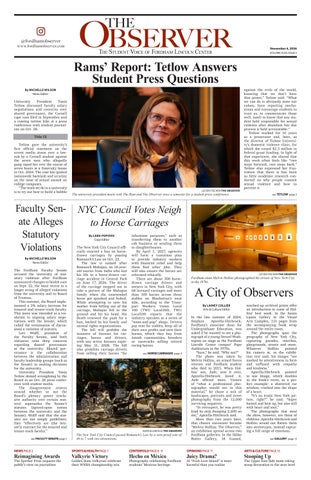
The university president meets with The Ram and The Observer once a semester for a student press conference.
see TETLOW page 3
NYC Council Votes Neigh to Horse Carriages By LARA POPOVIC Copy Editor
The New York City Council officially enacted a ban on horsedrawn carriages by passing Romanch’s Law on Oct. 22. The law is named after Romanch Mahajan, an 18-yearold tourist from India who lost his life in a horse-drawn carriage accident in Central Park on June 17, 2026. The driver of the carriage stepped out to take a picture of the Mahajan family when the unattended horse got spooked and bolted. While attempting to save his mother from falling out of the carriage, Mahajan fell to the ground and hit his head. His death renewed the push for a ban, backed by his family and animal rights organizations. The bill will prohibit the issuance of licenses for carriages, horses and drivers, with any active licenses expiring May 31, 2028. The bill also prohibits carriage drivers from selling their horses “for
inhumane purposes,” such as transferring them to another cab business or sending them to slaughterhouses. By April 1, 2027, agencies will form a transition plan to provide industry workers with financial relief and help them find other jobs. They will also ensure the horses are relocated ethically. There are about 300 horsedrawn carriage drivers and owners in New York City, with 68 licensed carriages and more than 100 horses across three stables on Manhattan’s west side, according to the Transport Workers Union Local 100 (TWU Local100). TWU Local100 reports that the industry operates as a series of “mom-and-pop” shops. Drivers pay rent for stables, keep all of their own profits and own their horses, which they buy from Amish communities, breeders or racetracks selling retired racing horses. see HORSE CARRIAGES page 4
EDEN KLEINFELD/THE OBSERVER
The New York City Council passed Romanch’s Law by a veto-proof vote of 40 to 7, with two abstentions.
SPORTS & HEALTH PAGE 7
Valkyrie Victory
Golden State Valkyries celebrate their WNBA championship win
CENTERFOLD PAGE 8 - 9
Hecho en México
Photography celebrating Fordham students’ Mexican heritage
LUCIEN FISCHER/THE OBSERVER
Fordham alum Melvin Hollins photographed the streets of New York City in the 1970s.
A City of Observers By LAINEY COLLIER Arts & Culture Editor
In the late summer of 2024, Stephan Apicella-Hitchcock, Fordham’s associate dean for Undergraduate Education, was asked if he wanted to see a photograph of a young Denzel Washington on stage at the Fordham Lincoln Center campus’ Pope Auditorium in the 1970s. “Sure,” he said. “Why not?” The photo was taken by Melvin Hollins, an armed forces veteran and Fordham student who died in 2015. When Hollins’ son, Jude, sent it over, Apicella-Hitchcock loved it. Jude offered more. Unsure of “what a professional photographer would see in this material,” he chose a mix of landscapes, portraits and street photography from the 12,000 surviving negatives. “In retrospect, he was pretty kind by only dumping 2,600 on me,” Apicella-Hitchcock said. More than two years later, that chance encounter became “Melvin Hollins: The Observer,” an exhibition spread across two Fordham galleries. In the Ildiko Butler Gallery, 18 framed, OPINIONS PAGE 11
Juicy Drama?
AI “Fruit Love Island” is more harmful than you realize
touched-up archival prints offer an introduction to some of Hollins’ best work. In the Susan Lipani Gallery in the Visual Arts Complex, 133 pages from the accompanying book wrap around the entire room. The photographs span the geography of New York City, capturing parades, marches, playgrounds, streets and more. Whatever Hollins pointed his camera at, as the exhibition text said, his images “are marked by attentiveness to form and suffused with empathy and kindness.” Apicella-Hitchcock pointed to one image, which doubles as the book’s cover, as a perfect example: a shattered car window, cracked into the shape of a heart. “It’s an iconic New York picture, right?” he said. “Super busted and beat up, but also still with heart and soul.” The photographs that steal the show, however, are those of children. Apicella-Hitchcock said Hollins would not flatten them into stereotypes, instead capturing a full range of emotions. see GALLERY page 13
ARTS & CULTURE PAGE 15
Stooping Up
The Upper East Side mom taking stoop decoration to the next level
2
News
November 4, 2026
www.fordhamobserver.com
THE OBSERVER
Sperber Prize Skips 2026 Winner, Asks What Journalism Should Show
Organizers invite members of the Fordham community to mark the 75th anniversary of Edward R. Murrow’s ‘See It Now’
Facebook’s $18b and $25b Settlements Understanding the growing pattern of accountability for media giants like Meta By MICHELLE WILSON News Editor
COURTESY OF FORDHAM NOW
The prize was established in 1999 to honor Ann M. Sperber, her life and work, after spending 30 years writing her book on Edward R. Murrow. By MACKENZIE COOPER News Editor
The Ann M. Sperber Prize, one of Fordham University’s top honors for journalism, will not be awarded this year. After weighing five finalists, the prize’s jury ended its deliberations without selecting a recipient. The prize will return in 2027. In the meantime, organizers are asking students, alumni and the public to help mark the 75th anniversary of Edward R. Murrow’s “See It Now.” The Sperber Prize is an annual award honoring outstanding works of nonfiction that illuminate the power of journalism and storytelling written in the previous year. The prize, which was established at Fordham, selects titles that were published a year prior to the ceremony. The winner receives a plaque and an honorarium of $1,000. The Sperber prize money is given directly to the recipient in accordance with the original funding agreement with the Sperber Family. Established in 1999, The Sperber Award was established in honor of Ann M. Sperber, the author of a biography on American broadcaster Murrow titled “Murrow: His Life and Times.” Sperber spent 30 years writing her book on Murrow, which covered his life and career. The book was one of four finalists for the Pulitzer Prize for Biography or Autobiography in 1987. Sperber passed away in 1994 at the age of 58, and the award honors her life and work. Previous winners of the award include Kathryn Olmsted in 2023, whose historical book “The Newspaper Axis: Six Press Barons Who Enabled Hitler” explains how six incredibly wealthy media tycoons used their newspapers to shape public opinion in favor of Adolf Hitler before World War II. Olmsted now serves on the award’s selection committee. In 2011, Alan Brinkley won for the biography “The Publisher: Henry Luce and His American Century,” which covers the life and career of Henry Luce, an influential American magazine publisher who founded Time, Life, Fortune and Sports Illustrated. Last year, the jury honored Ali Velshi’s “Small Acts of Courage,” and gave Connie Chung a special Career Achievement Award for her memoir “Connie: A Memoir” in honor of the prize’s 25th anniversary. Velshi, a Canadian-American broadcast journalist and economic analyst, built a prominent career as CNN’s chief business
correspondent, host of MSNBC’s “The 11th Hour with Ali Velshi,” and for his on-the-ground reporting of the 2020 Minneapolis protests following the killing of George Floyd, where Velshi was struck with a rubber bullet. Connie Chung, is also an American broadcast journalist who became the first Asian American and second woman in U.S. history to co-anchor a news broadcast. Chung’s career spans 37 years, from prominent newscasts on Watergate to conducting the first sit-down interview with Magic Johnson after his HIV diagnosis.
In July, Aronson said journalism “is about witnessing, interpreting, questioning authority, and helping the public understand the forces shaping civic life.” On July 22, Fordham Now announced the finalists for the 2026 Ann M. Sperber Prize: “Struck Down, Not Destroyed: Keeping the Faith as a Vatican Reporter” by Colleen Dulle; “Empire of the Elite: Inside Condé Nast, the Media Dynasty That Reshaped America” by Michael M. Grynbaum; “Murder the Truth: Fear, the First Amendment, and a Secret Campaign to Protect the Powerful” by David Enrich; “Queen of Bohemia Predicts Her Own Death: Gilded-Age Journalist Zoe Anderson Norris” by Eve M. Kahn; and “On Air: The Triumph and Tumult of NPR” by Steve Oney. Despite the strength of this year’s finalists, the jury declined to name a winner. In its announcement, the prize congratulated the finalists and recognized the contributions their books make to helping the public understand journalism, journalists and the role of the press. The announcement did not disclose why they did not end up choosing a recipient. Instead, organizers said they will use the year to review and further articulate the prize’s criteria and scope as it enters its next quarter-century, building on the tradition Sperber established and the works the prize has honored. To mark the anniversary of the show, the Sperber prize launched a project titled “What Should Journalism Help Us See Now?” Students, alumni, journalists, past Sperber recipients and members of
the public were invited to answer one question: “What is one story, person or reality you wish journalism would help the public see more clearly and why?” Responses were limited to one to three sentences. Organizers said answers could focus on topics overlooked, misunderstood or underreported. That could be anything from a story in one’s own neighborhood or halfway around the world, to a person, generation or community whose perspective is rarely heard. The question echoes themes raised at last year’s ceremony. After accepting the prize, Velshi said the stakes extend beyond the profession: “It’s this idea that if journalism fails, democracy fails.” “See It Now,” Murrow’s CBS program, debuted on Nov. 18, 1951, as television was changing how Americans encountered the news. The program raised lasting questions about what journalism should show audiences, whose experiences it should make visible and what responsibilities the press has to the public. Murrow, a pioneer of broadcast journalism, was best known for his fearless coverage of World War II. He also earned a place in history for his confrontation with Sen. Joseph McCarthy on the March 9, 1954, episode of “See It Now.” Rather than interview McCarthy, Murrow aired a program that used clips of McCarthy’s own speeches on communism in the United States. Murrow concluded the broadcast with a direct address to the camera: “We will not walk in fear, one of another. We will not be driven by fear into an age of unreason if we dig deep in our history and our doctrine, and remember that we are not descended from fearful men.” The broadcast is widely credited with turning public opinion against McCarthy and playing a role in his condemnation by the United States Senate. In July, Aronson said journalism “is about witnessing, interpreting, questioning authority, and helping the public understand the forces shaping civic life,” a description of the finalists’ books that provides an answer to the question the prize is now encouraging the public to answer. The anniversary of “See It Now” falls on Nov. 18, and selected responses will be published on the Sperber Prize home page within the Fordham website and shared on the Communication and Media Studies Department’s social media.
Meta settled with two teen plaintiffs in late October over claims that its platforms are addictive and cause mental health problems. TikTok, YouTube and Snap Inc. (Snapchat’s parent company) were also sued and all settled before the trial, which would have been held on Nov. 4. The exact terms of the resolutions have not been shared. The cases are just one part of a larger nationwide pattern of courts holding social media companies accountable for their actions. The domino effect began on Aug. 26 when Meta agreed to pay between $17.1 and $18 billion to settle a lawsuit by 47 states claiming that Facebook and Instagram are harming children by intentionally creating addictive algorithms. The settlement also requires Meta to implement new child safety regulations. The company will only have to pay the full fine if other major social media companies like TikTok and YouTube choose to adopt similar regulations. So far, neither has done so. Around two weeks ago, a judge in New Mexico ordered Meta to pay the state $25 billion for deceiving users about privacy and content moderation policies on Facebook. The case addressed Meta’s handling of a 2016 scandal where Cambridge Analytica, a British political consulting firm, took private data from about 87 million users’ profiles and used it to make targeted political ads for President Donald Trump’s first campaign. Prosecutors argued that Facebook lied about the data breach and allowed the spread of misinformation and violent content. The jury found 43 million violations of state law. Where is the money going? Meta’s recent individual lawsuits settled with the teens directly. The $25 billion will be used to fund education in New Mexico. Similarly, the $18 billion is not going to individual users, but will be paid out to the states. How big a deal are these settlements, really? Short answer: They are a pretty big deal, but not for the reasons people might expect. Take the $18 and $25 billion, for instance. For a lot of people, any amount of money starting with a “b” is hard to conceptualize. But
to put these enormous sums into perspective, Meta made $200.96 billion in 2025. The company itself is valued at over $1 trillion. Meta also does not have to fork over $18 billion up front; the amount will be paid in installments over 10 years. So, the company will not suffer much in paying the fine, despite its hefty size. The bigger hit is to their reputation, as this is the first time tech companies are seeing legal consequences of this scale. Journalist Julia Angwin called the Meta settlements “death by a thousand cuts.” What are some concerns? Meta decided the terms of the Aug. 26 lawsuit, not the prosecutors. Some more cynical readings view the settlement as a clever public relations move. Its terms allowed the company to deny wrongdoing. Additionally, critics have pointed out that Meta now gets to set the standard on child protection and there is no guarantee they have the best ideas. Some of the new protections implemented by Meta include two-hour time limits, age verification and overnight blocks. Another worry is that all the cases focus exclusively on minors, but older adults are also negatively impacted by social media platforms, with seniors being especially vulnerable to online scams and fraud. This pattern of accountability is new. Why is it happening now? Section 230, a federal law, used to nearly universally protect social media companies from major lawsuits over user-generated content on their platforms. Now, the law is being interpreted differently to allow for suits over addictive or harmful design features. What's going to happen next? Many young people know well that keeping minors off the internet is incredibly difficult. The regulations are expected to help only somewhat. For comparison, Australia banned social media for children under 16 in 2025. However, a study from this summer found that about 80% were still on it. Despite the challenges likely to come in enforcing new social media regulations, one thing is for sure: Meta and other social media companies can expect to see more lawsuits.
THE OBSERVER November 4, 2026
www.fordhamobserver.com
Student Press Questions Tetlow on Fordham Issues
News
3
The university president gave statements on Title IX, shared governance, tuition and other issues more we can do,” Tetlow said. Fordham’s Young Democratic Socialists of America (an unofficial student organization) organized an AI walkout on Oct. 20 to protest the university’s stance on AI. When asked about the walkout’s request that Fordham freeze AI usage by The Fordham Ram, Tetlow said it would be a violation of academic freedom to impose a ban on student and faculty AI use.
TETLOW from page 1
Tetlow emphasized that the sexual assault cases that are reported are “only the tip of the iceberg,” and the more important issue is prevention. This looks like not just “warning students of risk and persuading them that somehow it’s within their power to avoid being attacked,” but “trying to persuade students not to attack anyone.” At Fordham, this involves the work of building students’ character, in teaching about consent and in trying to “push back against the lies of misogyny, which is also part of the underlying issue.” Tetlow also said that Fordham publicly voices its Jesuit values more than other secular institutions. Tetlow also said she is “personally relieved” that Fordham does not have Greek life, “that our forms of building community are not about community that is rooted in division.”
“ We have a choice
every year between raising tuition to cover those increased costs or cutting what we provide to you in order to keep tuition flat.”
Tania Tetlow, University President
“I think that Fordham is a place that doesn’t have as much of a culture of entitlement as some other institutions have,” Tetlow said. During the last academic year, Fordham’s Title IX office released statistics on the 137 Title IX cases filed at the university for the first time. According to the office, these statistics represent violations that have occurred at both campuses, which include sexual harrassment, stalking, sexual assault, sexual exploitation, dating violence, domestic violence and previous sexual assault. Shared Governance This summer, Fordham’s Board of Trustees imposed a resolution to salary negotiations for tenured faculty, implementing a 3% increase. The Faculty Senate is calling this a violation of Statutes that state the Board and the Senate must negotiate an agreement together. Tetlow disagreed with this assessment, claiming that the Board has a fiduciary responsibility to break an impasse. She said that the university wanted to reach a resolution before the new fiscal year, and knew it was “not possible” to offer more than a 3% raise, given that Fordham’s revenue only went up by 1%. “The Statutes require a negotiation between the administration and the Faculty Senate about faculty compensation, but they don’t really lay out what happens if we can’t agree. And so we got to that point this summer of not being able to agree,” Tetlow said. Professor Lori Wolff, president of the Faculty Senate, offered a contradictory perspective in an interview with The Observer. She said that the two sides were “very close” to coming to an agreement (the Senate was pushing for a 4% increase) and expressed deep concern for what this means for shared governance at Fordham. The Senate claimed Statute violations again after a Sept. 22 announcement that Fordham changed coverage categories for faculty health insurance, without having received approval from or
Enrollment
The presser was held on the 12th floor of the Leon Lowenstein Center.
even consulted the Senate. Tetlow said the university is not obliged to do so. “We consulted with a healthcare advisory committee that has the voices of faculty and other employees, and then made the decision. The Senate didn’t vote against this change, but they’re arguing that, unless they decide to vote for it, it can’t go forward, and that they determine this on behalf of all the people who work here. And on that we just disagreed,” Tetlow said. “The worry is that, if a subset of employees decides what equity looks like on a topic like this for everybody, that that’s not fair to the other people who work here.” Tuition to Increase Again Tetlow confirmed that Fordham will raise tuition again for the 2027-28 academic year, citing rising costs due to inflation. How much tuition will go up remains to be seen. “We have a choice every year between raising tuition to cover those increased costs or cutting what we provide to you in order to keep tuition flat,” Tetlow said. Fordham has raised tuition annually for years, last year by 4.5% (meal plan and average room fees also went up by 3%). Tetlow reiterated that financial aid is the biggest priority in Fordham’s budget and said the university is expanding its fundraising efforts to offer more aid to students. However, this balance is not always perfectly met. At the beginning of the 2025-26 academic year, The Observer reported on students who left Fordham after the previous year’s 4.65% tuition hike. Tetlow said that Fordham is cutting costs wherever possible to minimize tuition increases, including by reducing departmental spending by 10% last year and working on sustainability initiatives to lower utility costs. She added that, whenever there is a staff opening, the university conducts an analysis to decide if the university can go without replacing that person. Fordham has reduced staff by about 5% so far, according to Tetlow.
and industry organizations. It will provide vocational training in green jobs (such as solar panel and electric car charger installation) and serve as a startup incubator. “I think everyone’s really excited about, ‘Could this magical pilot work? And then could it be scaled across the state?’” Tetlow said. “(The project) is a reminder to New York of what Fordham has always been famous for, that we are rooted in the Bronx and in New York like no other, that our relationship with this community is long.” AI Strategy Fordham’s artificial intelligence (AI) strategy has evolved in the last year, including the addition of a new Vice President of Enterprise AI position. This semester, the university released Remy AI, a chatbot for first-years and sophomores, designed to answer questions and support students. In response to a question on student and faculty concerns that Remy AI risks automating student emotional support, Tetlow said Remy is designed to connect students in distress with human beings faster, not replace them. She emphasized that Remy is a pilot program and said the administration is “eager” for feedback. “We look at the data to make sure no one’s talking to it very much because that would indicate a problem. There are a lot of safeguards built in to try to prevent that way that AI is supplanting human beings,” Tetlow said. Tetlow described Fordham’s overall AI strategy as being divided into four categories. One is operations: looking at where to implement AI at Fordham, how to ensure that its implementation aligns with university values and protecting university
PHOTOS BY LUCIEN FISCHER/THE OBSERVER
data. Tetlow emphasized later that AI is a “neutral tool” and should be used to support, not supplant, the roles of human beings. For instance, “AI will never decide who gets into Fordham,” Tetlow said. The second is AI in faculty research, and it is up to the discretion of faculty to decide where and how to use it.
“ We (faculty and
administrators) worry vaguely about the future of young people. We have 16,000 of them here in our care, and we need to focus on their needs and their hopes and dreams and their futures and see what more we can do.”
Tania Tetlow, University President
Third is AI in the classroom. Similarly, professors are at liberty to decide their personal policies. Last is how AI will affect the job market, which Tetlow said is something “universities need to think more about” so Fordham can teach skills that may become more valuable in an increasingly AI-integrated world. “We (faculty and administrators) worry vaguely about the future of young people. We have 16,000 of them here in our care, and we need to focus on their needs and their hopes and dreams and their futures and see what
Update on The Bronx Green Jobs Center Construction Fordham is currently working on building the Bronx Green Jobs Center, with the help of more than $10 million in grants and donations. The university is still raising funds for the renovation of a former industrial building on Fordham Road (some of the donations are for operating costs). The Center is expected to open in January at the earliest. The Center is a unique partnership with community, university
Tetlow became Fordham’s first woman and layperson president on Oct. 14, 2022.
This year’s incoming firstyear class is the second-largest in university history, coming from nearly all U.S. states and over 50 countries. Some first-years were placed in upperclassman housing. Looking forward, the university is balancing this solution with converting more rooms to triples in order to meet increased demand, according to Tetlow. Even with such a large class, Fordham’s admissions rate decreased from 58% to 47% this year, despite a 23% increase in applications. The percentage of admitted students who chose to attend Fordham went up by 10% this year, according to Tetlow. Fordham’s national ranking also went up from 97 to 85 in the most recent U.S. News report. Enrollment in graduate programs in the Gabelli School of Business is down due to a dip in international enrollment, a trend being seen at universities across the country because of uncertainty over student visas. The Graduate Schools of Education and Social Service have also seen small dips in enrollment due to the elimination of Grad PLUS loans and the implementation of stricter borrowing limits by the federal government on July 1. Students pursuing careers in social work and education may struggle to obtain private loans due to their limited earning potential. Grad PLUS loans used to fill that gap. Since Fordham’s offers summer starts before July 1, some students were still able to obtain Grad PLUS loans this year, so the full effects of the decision on the university have not yet been seen. “We’ve worked hard to see if we can persuade banks to lend to those students and to do everything we can to try to soften the blow. It’s a real shame because the world really needs social workers and middle school teachers,” Tetlow said. As midterm exams come to a close and students start to dream about winter break, Tetlow looks toward the end of the semester with excitement about the “growing momentum about Fordham’s reputation” and the university’s progress.
4
News
November 4, 2026
www.fordhamobserver.com
THE OBSERVER
New York City Bans Horse Carriages
Aimed at protecting both horses and humans, Romanch’s Law will go into effect starting June 1, 2028 HORSE CARRIAGES from page 1
By law, horses are allowed to work nine hours, seven days a week. The horse carriages weigh approximately between 1,000 and 1,900 pounds. At the end of their workday, horses are kept in stalls located in Hell’s Kitchen. The stalls are legally required to be 60 square feet, with a minimum width of seven feet. Carriage drivers expressed outrage at the ban, denying claims of animal mistreatment and voicing their frustration about the loss of their livelihoods. “For now, we are going to make an opposition to the law, that’s for sure … because they can’t take away my business, my horse and my property without giving me (anything),” Giovanni Vallone, a second-generation carriage driver of 37 years, said. Animal rights organizations like New Yorkers for Clean, Livable, and Safe Streets (NYCLASS) and People for the Ethical Treatment of Animals have long fought to ban horse-drawn carriages from the streets of New York City.
“ The horse-carriage
folks have been subject to harmful lies and allegations that they abuse their horses. One group in particular stands out: NYCLASS.”
TWU Local 100, Carriage driver union
Animal advocacy groups maintain that prey animals are not suited for dense urban traffic, demonstrated by the use of eye blinders to block out what can be an overwhelming environment. Such organizations also argue that the horses are subjected to extreme weather and traffic exhaust fumes, confinement in cramped stables, fatigue from standing for prolonged periods on hard asphalt, and discomfort from metal mouth bits. Christina Hansen, a carriage driver of 20 years and union shop steward for TWU Local 100, defended her work, arguing that the horses are well-cared for. “The City Council voting for this particular carriage ban bill is one of the most shameful things the City Council has ever done,” Hansen said. “It’s unconstitutional, they know it’s
unconstitutional and they are doing it anyway. They’ve passed a bill that is going to hurt people. It’s going to hurt horses. It does none of the things that they say they care about in terms of public safety, horse welfare (or) working people.” Vallone offered a similar view, saying that, “if (horses) go to the sanctuary, they won’t have vets and people (to) look after them every day, 24 hours a day.”
On Aug. 10, 2022, a video of a horse named Ryder went viral online after he collapsed on West 45th Street and 9th Avenue while pulling a carriage. “You know what’s going to happen to a horse in a sanctuary? In two weeks, all New York City horses will be dead because the horses in the city are like puppy dogs, we care for them in the stables,” Vallone said. Activists argue that the industry exploits horses that transitioned from demanding farming or racing backgrounds. Despite mandated veterinary checkups, independent city inspections exposed persistent medical oversight gaps and instances of neglect or untreated lameness. Furthermore, advocacy organizations point to high-profile enforcement failures where horses were found working outside the legally permitted window of age five to 26 years old. “The constant exposure to traffic, noise, and pollution; the long hours of standing and walking on hard surfaces; the hard labor under sometimes extreme weather conditions; and lack of pasture access are not consistent with the owner’s responsibility to provide high-quality, long-term care for the horses,” the Animal Welfare Institute said. TWU Local 100 repeatedly denied these claims, arguing that their horses receive excellent care and treatment. “The horse-carriage folks have been subject to harmful lies and allegations that they abuse their horses. One group in particular stands out: NYCLASS,” TWU Local 100 said. TWU Local 100 further claims that NYCLASS “was founded by the real-estate industry and is funded by the real-estate industry.” On the other hand, NYCLASS
The first official bill to ban New York City horse-drawn carriages was introduced in 2007.
asserts they were founded to protect horses and their sole focus is on animal welfare, claiming TWU Local 100 “represents wealthy carriage owners, not the drivers. Drivers have no union contract, no collective bargaining, and no benefits.” Both claims have been shown to be inconclusive. The Animal Legal Defense Fund, an animal rights nonprofit, reported that carriage drivers committed more than a dozen “hit and runs” over the past five years, along with instances of both drivers and passengers being physically injured in horse carriage accidents. Reviewing public records going back to 1982, the Manhattan Borough President reported “96 serious carriage horse incidents, including human injuries, and 40 horse deaths. Notably, the incident rate has more than quadrupled between 1982 and 2026, with around half of those incidents resulting in a horse death.” On Aug. 10, 2022, a video of a horse named Ryder went viral online after he collapsed on West 45th Street and 9th Avenue while pulling a carriage. According to the Manhattan District Attorney’s Office, the “frail and emaciated” horse was working in Central Park from 9:30 a.m. on an 84-degree summer day, collapsing on the ground at 5:10 p.m. Ryder’s handler, Ian McKeever, failed to provide the horse with water and ignored the animal’s signs of distress, repeatedly attempting to force the horse up by yelling and striking him with
ADRIANNA PIZZUTA/THE OBSERVER
Following the successful vote, PETA pledged a $50,000 donation specifically allocated toward the long-term care and retirement of the displaced horses.
a whip. Police were called to the scene, pouring water over Ryder for 45 minutes before the horse was able to stand up.
The original Ryder’s Law attempted to replace the horse-drawn carriage industry with a horseless electric carriage program, something that carriage drivers and animal rights activists both reflect on as the city’s next steps. McKeever was charged with “overdriving, torturing and injuring animals.” His attorney claimed the horse was well cared for and that it simply tripped and fell, along with having unrelated health issues. McKeever was acquitted of all charges. Ryder was retired to a farm in upstate New York after cancer was found in multiple of his organs, with an official diagnosis of T-cell leukemia. McKeever was called into question regarding falsifying documents about Ryder’s age and health, after a professional assessment by the Animal Wellness Action determined the horse was unhealthy and older than stated in his veterinary records. On Oct. 17, 2022, Ryder was euthanized. His story led to advocacy for Ryder’s Law, which would later be renamed Romanch’s Law. Fordham Law School’s Student Animal Legal Defense Fund (SALDF), a chapter of the broader national organization, organized a letter-writing campaign advocating for a horsedrawn carriage ban in support of Romanch’s Law. “When you learn the backstory and origins, I don’t think horses should be in Manhattan pulling carriages with the traffic and with all of the dangerous situations we have already seen documented and all the deaths that have happened. We just want to promote why this is a bad thing and what the alternative could be … and why we shouldn’t be promoting this industry because it’s animal abuse. So that’s essentially what the campaign was for, but it was also for students to go online … and sign the petition,” Aneesa Sheriff, Fordham Law ’28 and co-president of SALDF, said.
EDEN KLEINFELD/THE OBSERVER
Sheriff expressed her frustration with tourists supporting the industry, claiming that “(horses) are like a commodity to us, and (people) just see it as that.” Horses were first brought to North America with the arrival of European colonists. In 1832, horse-drawn cars were organized into an official transit system as part of the New York and Harlem Rail Road. The modern sightseeing function of horse-drawn carriages emerged in 1858 with the opening of Central Park, which was intentionally designed with paths for recreational horse carriages. Today, horse-drawn carriages are marketed to tourists visiting New York City, costing $72.22 for the first 20 minutes of the ride (regardless of capacity) and $28.89 for each additional 10 minutes, in accordance with New York City law. Although they are known for roaming Central Park, horse-drawn carriages can be seen traveling outside the bounds of the park, with routes extending to Fifth Avenue, Midtown and Hell’s Kitchen. The original Ryder’s Law attempted to replace the horsedrawn carriage industry with a horseless electric carriage program, something that carriage drivers and animal rights activists both reflect on as the city’s next steps. The transition plan currently in the works does not discuss a switch to electric carriages. “I can understand if we were to transition to electric (carriages). (It) can be a good idea,” Vallone said. On Sept. 6, 2022, Mount Dora, Florida, became the first U.S. city to transition to electric carriages. Philadelphia followed, banning horse-drawn c arriages and replacing them with electric ones on June 11, 2026. Both cities leaned into an artistic vintage look for their electric carriages, garnering vast success. “I just think there are alternatives to not (use) horses. … I just don’t think this industry needs to be here. … People are going to be losing their jobs, and that is unfortunate, but I think that the alternative is that animals are going to be continuously abused,” Sheriff said. “But for now, I think we just need to eliminate the problem and the solutions will come after that. … We have that now already (electric carriages), so why not just amplify that?” Moving forward, successful transitions can serve as a model for New York City as it considers policy solutions that address animals and humans alike.
THE OBSERVER November 4, 2026
www.fordhamobserver.com
Looking Back on Shared Governance Concerns
News
5
Fordham leadership imposed resolutions on salary negotiations and made changes to health care without consulting the Senate FACULTY SENATE from page 1
This is not the first time that questions over shared governance at Fordham have been raised. Last February, the university hired an outside law firm to conduct “risk assessment” reviews of faculty websites and suggest changes to language on research and teaching. The decision was made without consulting faculty leadership, and the Senate voiced concerns that these reviews threatened academic freedom and shared governance. They asked the university to publicly declare its commitment to protecting academic freedom and outline its plan for doing so, on top of several other demands.
The controversies arose after the university allegedly violated statutes by changing healthcare and benefits and imposing salary and benefit changes without the Senate’s approval. The administration did not directly address the demands, but said the goal of the reviews was to ensure “that (the website) includes the most up-to-date information and accurately reflects the values that we hold deeply,” and affirmed “its shared responsibility with the Faculty Senate to uphold academic freedom as an inviolable principle of our institution.” Wolff added that faculty are also “still dealing with the ramifications” of a series of conflicts that took place 10 years ago between the Faculty Senate and the Board of Trustees that resulted in a vote of no confidence in former Fordham President Rev. Joseph McShane, S.J. The controversies arose after the university allegedly violated statutes by changing healthcare and benefits and imposing salary and benefit changes without the Senate’s approval. Regarding this summer’s salary negotiations and the imposed resolution, Tetlow said that the Board has a fiduciary responsibility to break a standstill. She said that the university wanted to reach a resolution before the new fiscal year and knew it was “not possible” to offer more than a 3% raise, given that Fordham’s revenue only went up by 1%. “The statutes require a negotiation between the administration and the Faculty Senate about faculty compensation, but they don’t really lay out what happens if we can’t agree,” Tetlow said. “And so, we got to that point this summer of not being able to agree.” However, Wolff said that the two parties were “very close” to coming to an agreement. The university initially offered a 2% raise, while the Senate was pushing for 4% to ensure that salaries kept up with inflation, which was at 3.4% in August. Inflation is now at 3.7%. The Senate negotiated up to a flat 3% by June. They were still hoping for 4% when the Board of Trustees asked to meet with Wolff and members of the administration’s negotiating team to discuss how the talks were going. Wolff said that this was an early warning sign to her that the university was considering imposing a resolution. Cost-of-living adjustment is when compensation accommodates for inflation, allowing
GRAPHIC BY MICHELLE WILSON/THE OBSERVER
The above timeline covers the history of major moments in the relationship between the Faculty Senate and the administration from 2023 to now.
purchasing power to remain the same as things get more expensive. Under 3.7% inflation, a 3% salary increase means faculty purchasing power slightly decreased. The last salary contract covered 2023-26. While three-year contracts are the standard, this year, the university asked the Senate for a “one-time unprecedented one-year contract.” It has not been confirmed why the university wanted a one-year contract, but as a result, the Senate will re-enter negotiations in a few months.
“ The Senate condemns the violation of the Statutes and considers the Administration’s actions to be improper and extremely damaging to the relationship between the Administration and Faculty, and does not approve the unilateral changes to the coverage categories. ”
Fordham Faculty Senate resolution
Wolff said the Senate will proceed with trepidation regarding whether the Board will impose a resolution again and if they understand “how harmful it is to do that.” She also said the Senate requested budgetary data from the university during the negotiating process, but it was not provided. On Sept. 22, Fordham announced several changes to faculty health insurance, including the expansion of coverage category options from two (employee-only and family) to four (employee, employee and spouse, employee and children, and a two-parent family with children). This changed the premium rates of faculty who previously fell under one bigger category, increasing premiums for some. Another change was the introduction of step therapy (taking the lowest-cost prescription drug before being able to “step up”) and prior authorization to certain plans. Prior authorization is when an insurance company must
approve a medical procedure or drug before a patient can receive it. Prior authorization is generally considered worse for patients because it delays care. An April 21, 2023 Memorandum of Agreement between faculty and administration states: “No changes to eligibility, coverage, and/or benefits provided under the health insurance plans in effect as of the date this Memorandum of Agreement is fully executed and included in Appendix 4 of the University Statutes will be made unless approved in accordance with the University Statutes.” The Senate held a special meeting on Oct. 26 and unanimously approved a resolution condemning the university’s actions and calling for Fordham to either extend the health care open enrollment deadline to Nov. 30 or provide financial relief for faculty. The university did not respond to these demands. “The Senate condemns the violation of the Statutes and considers the Administration’s actions to be improper and extremely damaging to the relationship between the Administration and Faculty, and does not approve the unilateral changes to the coverage categories,” the Senate’s resolution said. Wolff emphasized that the Senate did not disapprove of the change itself, but of the fact that it was made without consulting them. Tetlow said the university is not obliged to get the Senate’s approval to make changes to health care. “We consulted with a healthcare advisory committee that has
the voices of faculty and other employees, and then made the decision. The Senate didn’t vote against this change, but they’re arguing that, unless they decide to vote for it, it can’t go forward, and that they determine this on behalf of all the people who work here. And on that, we just disagreed,” Tetlow said. “The worry is that, if a subset of employees decides what equity looks like on a topic like this for everybody, that that’s not fair to the other people who work here.”
“ We support the
Faculty Senate. We think it’s wrong that they were not given the salary increases that they deserve and that they’re being forced to accept these changes without input, and whatever support we can give them, we will.”
Diane George, Co-chair of FFU
Fordham Faculty United (FFU), the union for part- and full-time non-tenure track faculty, had its full-time members affected by the change in health care, though they only make up a minority of the union. Diane George, co-chair of FFU and
professor of anthropology, said FFU stands in solidarity with the Senate. “We support the Faculty Senate. We think it’s wrong that they were not given the salary increases that they deserve and that they’re being forced to accept these changes without input, and whatever support we can give them, we will,” George said. Speaking personally, George expressed her frustration at the large gap between top administrator and faculty salaries, and the separation she observes between the two groups. “I think this administration is particularly concerned with budget cutting, and I also think there’s a big disconnect between administrators and faculty in terms of understanding the position of faculty,” George said. “I just find (Tetlow) to be detached and removed from what it’s like on the ground. And I think she was brought in to cut the budget, and she’s doing that. I don’t know how an institution can work if it ignores its own statutes. I mean, that’s kind of shocking to me. It’s disrespectful to the Faculty Senate.” George also shared her feeling that Fordham is not transparent about their finances. “There is a total lack of transparency. We found that, in our negotiations, they will never say to us, ‘We can’t pay what you’re asking for.’ They will just say ‘We’re not going to’ because if they say they can’t then, under the (National Labor Regulation Board’s) laws, they have to disclose their finances. And they’re very careful to avoid saying that,” George said. Wolff also emphasized that the Senate hopes to continue to have a positive relationship with the administration, but “cannot stand for this continuing violation of statutes.” If the university would like one of the statutes to be changed, there is a process under which the two bodies could come together and discuss an amendment, according to Woolf; bypassing them entirely sparks deep concern for the Senate. “We’re looking to work together because what a university is meant to be about is collaboration and shared governance. I know, in my role as Senate president, I am looking to do that. But I also understand that if there is a fight we need to fight because of statutory violations, then we need to fight it,” Wolff said. The Senate has not said what action it will take next. With salary negotiations set to resume in the coming months, questions around how negotiations will be conducted are pressing for faculty leadership.
COURTESY OF FORDHAM GSE NEWS
As president of the Fordham Faculty Senate, Lori Wolff meets with the university’s president and provost at least once a month.
Manging Editor Cora Cost
Sports & Health
November 4, 2026 THE OBSERVER
The Best Day of the Year
Fordham Rams joined the tens of thousands of people who participated in the New York City Marathon By CORA COST Managing Editor
Affectionately referred to as the “Best Day of the Year,” the New York City Marathon is held on the first Sunday of November every year. Approximately 60,000 people set out to run the 26.2-mile course that snakes through all five boroughs of the city. Of those 60,000, several of the runners who ran on the course were members of the Fordham College at Lincoln Center (FCLC) community. The Tata Consultancy Services (TCS) New York City Marathon’s course starts in Staten Island, crossing into Brooklyn and Queens, then cutting through the East side of Manhattan up into the Bronx and finally returning through Manhattan to the finish line in Central Park. For Averi Schirmers, FCLC ’27, this year’s New York City Marathon was her second time running the race. This time around, her favorite part of the race was the 11-mile stretch through the second borough of the course, Brooklyn. “The first 12 miles of the race are just so electric, and there’s really nothing that compares to running through Brooklyn during the marathon,” Schirmers said. “There are so many people out cheering, playing music, and yelling your name. It’s such an amazing feeling, and I think it’s one of those things you really have to experience to understand.” An estimated two million people lined up on streets across the city to spectate the race.
Whether to watch people they know personally or to just be there to offer support as people pass by, the spectator experience is a vital part of the New York City Marathon. For Marisa DeAngelis, another Fordham Ram who ran the marathon, the spectator aspect helped her in the final stretch of the race. As she headed in Central Park, she was fueled by the encouragement from the people watching the race “A spectator yelled at me that she knew I was going to finish the race whether I had to walk or crawl across the finish line. She had a sign that said ‘you didn’t come this far to come this far.’ That was the type of resilience and support that encouraged me to sign up for the race in the first place,” Marisa DeAngelis, FCLC ’28, said. Running let alone running a marathon is not for everyone but for both Schirmers and DeAngelis, running has offered them an opportunity to push themselves beyond limits they initially believed possible. “I think what I love most about running is that it gives me an outlet, but it also constantly challenges what I think I’m capable of,” Schirmers said. The New York City Marathon is a beast to prepare for, but the effort is rewarded with smiles, cheers and the satisfaction of finishing. Of the approximately 60,000 medals given out on Sunday, several of them will find homes with members of the Fordham community, serving as a reminder of their hard work and perseverance.
The marathon’s course was flanked with crowds of people cheering the runners on.
2026 New York City Marthon finishers took the subways after the race.
ADRIANNA PIZZUTA/THE OBSERVER
A gold-finished medal was given to finishers of the marathon of the 2026 TCS New York City Marathon.
MARISA DEANGELIS/THE OBSERVER
Marisa DeAngelis, FCLC ’28, posed in front of Lincoln Center after her big finish.
EDEN KLEINFELD/THE OBSERVER
EDEN KLEINFELD/THE OBSERVER
AVERI SCHIRMERS/THE OBSERVER
Averi Schirmers, FCLC ’27 and president of Fordham Run LC, was met with a bouquet of flowers and congratulations at the end of the race.
EDEN KLEINFELD/THE OBSERVER
Marathon runners flooded the streets after they completed the race, adorned with thermal blankets and medals and surrounded by loved ones. .
www.fordhamobserver.com
The Championship Hangover?
The New York Knicks, the defending champions, had a pretty rocky start first win of the season thanks to Towns who had 27 points and 20 rebounds, and Brunson who The 2026-27 NBA season scored 23 points, finally starting started back up after a joyous to look like the captain we saw and exciting summer of celebra- this summer. The Knicks added tion for the New York Knicks, another victory with a 133-127 who took back the NBA cham- win against the Chicago Bulls, pionship title after 53 years. led by Brunson’s 38 points and With the Knicks being the seven assists. The Knicks and Sixers went defending champions, I was ecstatic for the season to start up against each other once and could not wait to see what again, but this time in Philathe team had to bring this year. delphia for an Emirates NBA What I did not expect was for Cup in-season tournament the Knicks to start the season group play matchup. Brunoff shakily, with their record son hit a 3-pointer to secure a sitting at 3-4 and eighth in the 90-89 lead with 1:32 left on the clock. But James and V.J. EdgeEastern Conference. When hearing that the combe secured the last-minute Knicks were opening up the win for the Sixers, 93-98. Josh season against the Philadel- Hart said the team’s commuphia 76ers, I was super excited, nication “hasn’t been great” because, although the Sixers and that they “could’ve played had acquired LeBron James and better defensively.” The Knicks then headed Jaylen Brown, I had faith in the Knicks to not let this team back home to play their crosstown rival, the Brooklyn Nets. get by. But I was wrong. The Knicks The Knicks secured the win, were edged out by the Sixers, 103-90. But it was not as easy losing 106-100. Despite it being as fans thought it would be. a close game, it was obvious At one point, it looked like the that the Knicks were tired and Knicks would lose to the Nets, disconnected from each other. breaking their almost fourMike Brown, head coach of year win streak. But during the the Knicks, in a postgame fourth quarter, they secured a interview said , “What an ugly 100-84 cushion to lock in the game,” and said that his team win. Landry Shamet had an outlooked like they were “running standing game, scoring a seain mud” with the team’s energy son-high 22 points. Although they had won the game, Hart and defense looking sloppy. still had some constructive criticism about how they played, We (got to) get those saying, “We (got to) get those habits back.” championship habits championship Looking back on these games and watching the interviews, it back. Josh Hart, really had me thinking about Foward for The New York Knicks different seasons from previous champions. Coming into a new season, it seems like the Knicks’ players are not really focusing Jalen Brunson, 2026 Finals on improving skills, perhaps MVP, had a slow game, appear- due to most of them having a ing quite fatigued, missing the busy schedule, partially taken 3-pointers he usually aces, up by celebrating their chamshooting 6 for 19 overall, and pionship win over the summer. only attempting three shots Hart even made a comment from beyond the arc. Brun- during his postgame interview son, after the game, said, “I after the Nets game, “Obvithink it’s good for us to kind ously (we) played into midof get knocked down off June, and then in the summer (we) are working out but also the mountain.” After losing a close game to enjoy(ng) the fruits of the labor the Boston Celtics, the Knicks of winning.” Although the Knicks’ season came back to Madison Square Garden to face the Orlando did not start out the best, it Magic. When I was getting is only the beginning of the ready to watch this game, I season after a tiring summer. thought it was going to be an Once the team gets back into easy win since, the Magic’s star the groove and communicates player, Paulo Banchero, was with each other, I personally sidelined with an injury. But think that they will come back once again, I was so wrong. stronger and better than ever The Magic won, 111-102, for the most important part of handing the Knicks their third the season: the playoffs. straight loss. The Knicks actually led most of the game, 86-76 at one point in the fourth quarter, but lost that lead in the end. Franz Wagner scored 21 out of 23 total points in the fourth quarter, with the Magic outscoring the Knicks 40-27. Brunson was later interviewed on the late-game turnovers and said, “Poor decision-making by me late in the game. The ball’s not falling in for us (but) I think we’ve gotten some good looks throughout the game.” The next two games brought some life back into Knicks fans, first with a 111-97 win against the Detroit Pistons. Though the Pistons were undefeated, the Knicks were able to secure their By OLIVIA VASQUEZ Contributing Writer
“
”
THE OBSERVER
November 4, 2026
Sports & Health
7
Golden State Valkyries WNBA Champions
Golden State Valkyries beat out the Altanta Dream in Game 7
By CORA COST Managing Editor
attracted me to this team: they just kept using the word ‘culture,’ and that goes way far,” Williams said. “I’ve been on the super teams, I’ve been on the team with the stars, and have fallen much shorter than we did this year. So, I think, just a good group of people can take you a long way.” Last off season, Williams hit unrestricted free agency and the Valkyries did not miss their opportunity to scoop the forward up. Williams left the Seattle Storm to join Golden State in their second year, after a successful playoff run. Williams has not had a linear journey in the league; she was drafted fourth overall in the 2018 WNBA by the Chicago Sky, where she was ultimately suspended by the team due to her commitment to playing for the French national team. Eventually she was traded to the Los Angeles Sparks in 2021, then to the Seattle Storm in 2022, where she was eventually named an All-Star in 2025.
In the second year of their existence as a franchise, the Golden State Valkyries have been crowned firsttime WNBA Champions. The Valkyries defeated the Atlanta Dream 68-63 at home on Halloween night in a historic first-ever Game 7. After the Dream forced a historic first ever Game 7 for a WNBA Finals series, both teams traveled back from Atlanta to face off once more at the Chase Center, more affectionately known to Golden State fans as Ballhala. The final matchup was an all or nothing game in a series that was evenly matched for both teams.
The WNBA Championship win was a five-year promise completed in just two. The Atlanta Dream had been ahead in the Finals series after securing two back to back wins in Games 2 and 3, but the Valkyries added to their series opener win by also securing back to back wins placing the Dream in a do or die Game 6. The Dream, led by star forward Angel Reese, forced a Game 7 with their Thursday afternoon win at home. The Atlanta Dream led at the half in Game 7, which statistically appeared promising for the Dream as in every other game of the series the team up going into the third quarter pulled out the win. However, the Valkyries came out of their locker room to the sold out crowd at home and sealed the deal.
“ Our staff did a great
job of picking great people to create a good culture here. That’s something that attracted me to this team: they just kept using the word ‘culture,’ and that goes way far. ” Gabby Williams, Forward for The Golden State Valkyries
The Valkyries were led to victory thanks to a historic performance from forward Gabby Williams, who scored 28 of her 30 points in the second half and ignited the team’s offense. Williams is only the second player in WNBA history to score at least 30 points in a win-or-go-home game, joining former Phoenix Mercury forward Penny Taylor, who did so in 2007. Golden State outscored the Dream in the second half 44-33, receiving contributions from 14 year league veteran Tiffany
Hayes and Kiah Stokes, who put up strong defense throughout the game. Veronica Burton, who was cut by the Dallas Wings after her first two seasons, hit two free three throws with 5.1 seconds left, securing the Valkyries win. The WNBA Championship win was a five-year promise completed in just two. When the Valkyries were announced in 2023 as part of the WNBA expansion becoming the league’s 13th franchise, owner Joe Lacob made a bold promise, “we will win a WNBA championship in the first five years of this franchise.” A promise that was kept by building a team on and off the court who bought into the potential of the franchise. The Valkyries brought on Ohemaa Nyanin, former director of basketball operations and manager of basketball operations at the New York Liberty, to be Golden States’ general manager. The next person brought on to head up the Valkyries administration was Natalie Nakase, former Las Vegas Aces assistant coach. Nakase signed on to her role as the head coach of the franchise, with no one on the roster. As a franchise team the Valkyries had the task of building a team from the ground up. Not only did they fill out a roster but they built a team that competed with the more cemented franchises in the league. In their first year the Valkyries made WNBA history by becoming the first expansion team to reach the playoffs in their inaugural season. It is not just a team that has been built by the Golden State franchise but a culture. Williams, who took home the 2026 WNBA Finals MVP, spoke of the culture fostered by Nasake in her Good Morning America interview post Championship win. “Our staff did a great job of picking great people to create a good culture here. That’s something that
The Valkyries have continued to make WNBA history since their inception, becoming the most valuable team in the WNBA and the world’s top women’s sports franchise. Williams was not welcomed to but more accurately put welcomed back to the Bay Area. Williams spent significant time in the Bay growing up, much of which was spent playing basketball. Her return to the Bay’s basketball scene proved a vital part in the Valkyries success this year, putting up 30 points alone in the final game against the Dream. Stokes, a fellow University of Connecticut Husky, also joined Golden State’s ranks during the 2026 offseason. Kiah Stokes is no stranger to being a WNBA champion, Stokes came to the Bay like Nakase from the Aces. Stokes won three WNBA championships with the Aces, making her win with Golden State her fourth championship win in the last five years. A seasoned veteran of the league, Stokes has become a cornerstone of the Valkyries defense, playing a massive part in Golden State’s first WNBA Championship. The Valkyries have continued to make WNBA history since their inception, becoming the most valuable team in the WNBA and the world’s top women’s sports franchise. With the addition to the 2026 WNBA Championship, the Valkyries continue to be a beacon for the potential of women’s professional sports.
Photo Novemeber 4, 2026 THE OBSERVER
www.fordhamobserver.com
VIV LO RAa M !
8
A woman dressed in traditional Mexican clothing sits surrounded by the flora of the New York Botanical Garden.
Ariana Dominguez, FCRH ’27, was the quinceañera at VIVA’s mock quinceañera event this past March, held up by chambelanes.
The colors of the Mexican flag are a clear marker of et for many with roots in the culture.
The newly formed club Mariachi Los Rams practices before playing at VIVA x El Grito’s Día de Muertos event.
A te
The Mexico national jersey was the standout of the 2026 FIFA World Cup, outselling every other Adidas national jersey — even those of the world champions, Argentina and Spain. For many, the jersey transcends the realm of sports and represents a larger cultural identity.
People don white face paint and customary outfits representing spirits during Día de Muertos celebrations.
www.fordhamobserver.com
VA OS MS!
THE OBSERVER
November 4, 2026
Papel Picado: Papel picado, rooted in Aztec culture, is a Mexican folk art of carefully cutting patterns into decorative tissue paper.
An outfit worn by Solange Eliana on the runway of New York Fashion Week commemorates Our Lady of Guadalupe.
thnic heritage and tradition
A flower sculpture of La Catrina crafted with marigolds was on display as part of the New York Botanical Garden’s Día de Muertos exhibit, which ran until this past Monday.
een enjoys the festivities of the Mexican Independence Day Parade.
An ofrenda, meant to commemorate and celebrate the lives of ancestors and relatives who have since passed, was set up in Fordham Rose Hill’s church.
Members of Fordham Rose Hill’s VIVA club celebrate Mexican culture and heritage at their Jaripeo event on Martyrs’ Lawn.
BY LUCIEN FISCHER PHOTO EDITOR
Photo 9
Editor-in-Chief Leeya Azemoun
Opinions
November 4, 2026 THE OBSERVER
A Show That Yearns Earns
The cultural impact of the death of the slow burn and why it must be revived
Online Editor Sofia Strelnikova Creative Director Durga Desai
This article contains spoilers for “Abbott Elementary” and “Adults.”
W
Layout Editor Roop Somal
ith eyes glued to the couple on the screen screaming at each other in the rain, the audience is three seasons deep. The air is thick with anticipation, and a million viewers lean in at once, waiting for the first kiss. This moment is the crown jewel of the slow-burn romance, a staple of TV that is going extinct. As modern streaming services the death of slow-burn romances, television loses the long-term investment that ensures cultural endurance and relevancy.
A slow-burn romance describes a romantic relationship between two characters who spend seasons orbiting each other with a “will-they-won’t-they” dynamic before anything physical or official happens. The foundational characteristics include romantic tension, yearning and gradual pacing. The result is audience investment so intense that a single hand graze will set off fandom-wide hysteria. The wait and anticipation are the point, it is why the payoff feels so earned. If there were a Hall of Fame for TV couples, 90% of the couples would have taken multiple seasons to get there. The idea that love on television should be delayed instead of at first sight goes back to the early romantic comedies and sitcoms of the 1950s through the 1970s. By the 1980s, shows like “Cheers” and “Moonlighting” proved that audiences would tune in every week just to see whether two people would stop bickering long enough to kiss. Then came “Friends,” a global phenomenon that spurred a generational debate still unresolved: Were they really on a break? Epitomizing the “will-they-won’t-they” boom of the 1990s, decades later, people who have never seen a single episode still have an opinion on Ross and Rachel. The 2000s and 2010s, considered the golden age of cable and network television, cemented the slow burn as a pillar of both sitcoms and dramas. Fan-favorite couples that are synonymous with slowburn relationships so aggravatingly gradual were made in this time: Fran Fine and Max Sheffield of “The Nanny”; Jessica Day and Nick Miller of “New Girl”; Dr. Temperance Brennan and Seeley Booth of “Bones”; and Lorelai Gilmore and Luke Danes of “Gilmore Girls.” They all followed the same recipe: years of development, a staggering number of near misses, a breakup and the inevitable getting-back-together sequence. The long-season format made it possible. Having between 22 and 25 episodes gave characters room to grow individually before they grew together and gave the tension room to breathe. Regardless of how much time has passed since the show first aired, audience investment is passed down to new viewers. Fan edits, memes and references flood the online communities. Particularly enduring shows’ intergenerational impact allows for new, engaging discourse like my own mother-daughter bonding experience over our now-favorite TV show, “Bones.” The culprit is a shift from 22 to 25 half-hour-long episodes to eight episodes of 45 minutes each. The old standard was syndication, where shows aimed for 100 or more episodes so they could be rerun, which required a healthy supply
Editor-in-Chief Leeya Azemoun
Managing Editor Cora Cost
ZOË HSU DOO Staff Writer
Epitomizing the “will-theywon’t-they” boom of the 1990s, decades later, people who have never seen a single episode still have an opinion on Ross and Rachel.
Observer the
Photo Editor Lucien Fischer Asst. Photo Editors Elisa Luna Adrianna Pizzuta Copy Editors Georgia Bernhard Lara Popovic News Editors Mackenzie Cooper Michelle Wilson Asst. News Editors Aleena Siddiqui Sophia Stephan GRAPHIC BY ADRIANNA PIZZUTA/THE OBSERVER
Fran Fine and Max Sheffield of “The Nanny” are a quintessential and beloved slow-burn pair.
of filler episodes. Streaming services, in contrast, prioritize releasing a high volume of multiple shows versus stretching a single show to fill a year-round schedule, preferring to tell one long continuous story over eight to ten episodes. The rising production and talent costs associated with an emphasis on movie-style television have increased the frequency of cancellation. With high budgets and unstable Hollywood finances, streaming services cannot afford to wait for a show to become a cult classic, so a series that doesn’t immediately hook viewers is cut and replaced by a new release. Just last year, the average renewal rate for streaming platforms dropped to 44%. Riskier original content gets sacrificed for shows that promise immediate returns. Even critically acclaimed fan favorites get canceled when viewer retention and completion rates fall short. All of these factors give showrunners a case of cancellation anxiety. With no guarantee of a season three, there is no guarantee of a kiss in the rain, so the romance is rushed. The industry is trading anticipation for gratification, giving fans a kiss earlier on to keep them watching for longer. Streaming-era binge culture created shows that are meant to be consumed in one weekend rather than over the course of a season. The problem is that finishing a show can cause robust, short spurts of discourse and frenzy, but by the next month, the public has already moved on. Slow burns made television a shared emotional experience each week, complete with fan theories, group chats and a fandom coming together for each new episode. Few shows illustrate this better than “Adults” — specifically, the romance between Anton and Paul Baker. Despite my enjoyment of season two, I took issue with the pacing of the romance between the pair. The season’s eight-episode run rushed their inevitable get-together in the season’s finale, lacking the emotional depth it had the potential for. With longer seasons, I would have loved to see more pining, considering their green card marriage and obvious denial of romantic feelings.
With no guarantee of a season three, there is no guarantee of a kiss in the rain, so the romance is rushed. The biggest casualty of the show’s pacing was the resolution of its near-miss relationships. The handling of the love triangle (if it can even be called one) between Issa, Paul Baker and Anton felt hectic and lacked the yearning and guilt that I wish we had gotten. The juxtaposition between Issa and Paul Baker’s relationship issues and how well-matched
Paul Baker and Anton were was one of my favorite parts of the season. But a kiss and confession in the finale a mere four episodes after Issa and Paul Baker broke up? No, thank you. In season two, episode two of “Adults,” titled “Fake ID,” we meet Eric, an incredibly confident guy who bonds with Anton over their shared mastery of lying in the club. When Eric asks Anton out, Anton acts as though his marriage to Paul Baker is more than the green card arrangement that it’s meant to be. In any other sitcom, or with a longer season, Anton may have pursued something with Eric, however brief. I know I would have loved to see Anton with someone other than Paul Baker (or, for that matter, Zack-Carlos). A brief romance would have made Paul Baker jealous enough to realize how much he actually likes Anton, and it would have pushed Anton to want something more substantial than a hookup, plus some character development from dating someone who is essentially his mirror in Eric. The obstacles that are fundamental to a slow burn would reveal to the characters what they really want. Amid the plethora of whirlwind romances, the slow burn is not completely dead. True to form, characters Janine Teagues and Gregory Eddie from “Abbott Elementary” did not share their first kiss until the end of season two, nor did they officially get together until season four, through several 13- and 22-episode seasons. Other relationships get thrown in their path, adding to their own denial and yearning. The fans are just as invested in their budding romances as Jacob, a fellow teacher and beloved friend, is. “Abbott Elementary” airs every Wednesday, with its Oct. 7 season six premiere bringing in 6.3 million viewers. Janine and Gregory prove that slow burn can still be achieved in the modern streaming-dominated era, by fulfilling the thrill of the wait in its audience. Shows with enduring standings in popular culture — ones that are constantly quoted, rewatched and discussed — are the shows that spent years building up the characters’ lores (most prominently, their love lives). The hallway kiss between Jess and Nick of “New Girl” will go down as one of the best first kisses in television history for a reason. Patience is a virtue that has been vilified by a TV industry that makes us wait years for a third season but hands us the payoff in episode four. Bring back slow burns, with silent pining and intimate glances across the room, while all the other characters make jokes about their romantic tension. When networks cut to the climax for the sake of safe, fast returns, television loses the long-term investment that made its greatest couples unforgettable. Giving writers the time to let a love story unfold is essential to keeping shows culturally relevant long after their finale. The slow burn endures because viewers want romance that is earned, not delivered.
Arts & Culture Editor Indira Bush Lainey Collier Features Editor Ikma Inusah Fun & Games Editor Damian Grove Asst. Fun & Games Editor Emaan Ehtasham Fact Checker Jack Brudecki Social Media Editor Sofia Schreiber Asst. Social Media Editor Emaan Ehtasham Podcast Producer Shine Alagba Business Manager Katie Hariprashad Editorial Adviser Richard Rosen
POLICIES AND PROCEDURES • No part of The Observer may be reprinted or reproduced without the expressed written consent of The Observer board. • Letters to the Editor should be typed and sent to The Observer, Fordham University, 140 West 62nd Street, Room G32, New York, NY 10023, or emailed to fordhamobserver@gmail.com. Length should not exceed 200 words. All letters must be signed and include contact information, official titles and year of graduation (if applicable) for verification. If submitters fail to include this information, the editorial board will do so at its own discretion. • The Observer has the right to withhold any submissions from publication and will not consider more than two letters from the same individual on one topic. The Observer reserves the right to edit all letters and submissions for content, clarity and length. • Opinions articles and commentaries represent the view of their authors. These articles are in no way the views held by the editorial board of The Observer or Fordham University. • The Editorial is the opinion held by a majority of The Observer’s editorial board. The Editorial does not necessarily reflect the views held by Fordham University. • To reach an editor by e-mail, visit www.fordhamobserver.com
The Observer is published on alternate Wednesdays during the academic year. Printed by Five Star Printing, Flushing, N.Y.
www.fordhamobserver.com
THE OBSERVER
November 4, 2026
Stop Watching AI Fruits Date Each Other
Opinions
11
The talking fruits you see on your feed are perpetuating stereotypes under the guise of juicy drama influence and control by the creator, and the content relies on surface-level input into the AI bot and the ingrained stereotypes that are prominent in its output. Whereas “Sausage Party” made an effort to be explicit about how the movie was meant for a mature audience, “Fruit Love Island” has free rein. The contagious nature of AI-generated content across media platforms allows it to be consumed by all types of audiences, regardless of whether it’s deemed appropriate or not.
BENI CWIAKALA Staff Writer
D
espite several attempts, I was never seduced by “Love Island.” I barely made it through three episodes of the TV phenomenon. I’ll admit, however, that the memes birthed by the show’s stars really stuck with me; my friend and I made a bit out of “This. Is. A. Smoothie.” But then, during one of my end-of-day TikTok scrolls, I realized the broader expanses of the show’s impact. I came across a minute-anda-half-long video of humanoid fruits fighting aggressively with monotone voices in a warped world of artificial intelligence (AI). I was perplexed. Out of curiosity, I checked the account. It had more than 3.2 million followers, with one video having a staggering 27 million views. The comments raved about Watermelina and Orangelo — and, of course, who could forget Pineapena? How would she ever be able to lock down Banito with Cherrita in the picture? I was stunned by how much traction these videos got, and something was nagging at the back of my mind about why these videos bothered me. Yes, the writing was horrendous and the voices were aggravating, but further research into this content revealed a more sinister problem. Harmful gender and racial stereotypes are being perpetuated through seemingly harmless AI-generated content like Fruit Love Island — not to mention the environmental effects of AI (I don’t even want to think about the amount of water used to make Grapenzo do a backflip).
The cartoonish appearance of the “show” hides the historical racial and gender stereotypes that it contains. “Fruit Love Island,” which doesn’t really roll off the tongue, is an AI-generated microdrama mini-series that circulated on TikTok back in March, gripping scrollers through minute-long videos depicting anthropomorphic fruit characters with six-pack abs and tight swimsuits arguing and lusting while completing
GRAPHIC BY LUCIEN FISCHER/THE OBSERVER
AI-generated “Fruit Love Island” is far from funny; it slips stereotypes under our noses and into our feeds.
challenges. The series takes direct inspiration from the actual show “Love Island,” which has become a huge cultural phenomenon in the past two years (ranking the most-watched show of the summer). Upon the creation of the show’s AI illegitimate child, the content already had an audience — considering the success of the recent seasons of “Love Island,” it’s not surprising that people would want to be exposed to similar content. But apparently, the human aspect of the show isn’t that important; fruit will do just fine. The pioneering episodes of “Fruit Love Island” came from the TikTok account @ai.cinema021. Before being banned the same month it was made, it accumulated about three million followers in under two weeks. While multiple videos were previously taken down on the account, its ban was followed by discussions of TikTok’s AI regulation practices and copyright issues regarding the actual “Love Island” series. But through the legal concerns and general disdain for “AI slop,” a great portion of us are thoroughly entertained by these seeded characters, for better or for worse (or maybe just for worse). Through this entertainment comes subtle messaging, as the physical characteristics of these fruits present a larger problem with the series. The cartoonish appearance of the “show” hides the historical racial and gender stereotypes that it contains. The formula of “Fruit Love Island” is fairly evident. “Male” fruits take the form of bananas, grapes and dragonfruit, all while
having defined abs and open tropical shirts. The watermelons, cherries and strawberries commonly embody the “female” fruits, accompanied by curvy figures and extremely tight clothing. The narratives of the women fruit involve themes of gold digging and superficiality, with many of the episodes having them fight over the standby male fruits as they say moving phrases such as “bananas do it best.” The script plays on the sexist idea of “catfights” and makes the women characters the ridiculous spectacle of the narrative. The characters of this series each share the same ear-numbing AI voice, which is a monotone, barely punctuated speech pattern. However, in moments where the characters are set up in conflict, the voices change. As characters, specifically the female fruits, engage in fights, their voice patterns change, and the dialogue often contains phrases from African American Vernacular English (AAVE). The use of AI to exploit AAVE in fabricated incidents for views isn’t new. Throughout 2025, countless racist AI-generated videos were uploaded to social media, frequently depicting Black women in situations wherein they act out racist stereotypes. The use of AAVE to represent anger in many of the “Fruit Love Island” videos is a part of this pattern. In a study done by researchers at the University of Southern California in 2025, data showed that AI had higher false positive rates for identifying anger and disgust over joy when presented with AAVEdense texts. AI content draws on racist stereotypes equating Black emotionality and anger.
GRAPHIC BY TOBY GUI/THE OBSERVER
The lack of a human artist in AI content leads to it having an indefinite target audience, potentially exposing younger viewers to inappropriate material.
Male characters also embody stereotypes of masculinity. Specifically, there’s tension between the different fruits because of different amounts of perceived masculinity and dominance attributed to each character. The women usually end up leaving the “less-masculine,” smaller fruits, like a kiwi or grape, and move on to a “more masculine,” larger fruit, such as a banana or orange. Employing fruit as a sexual metaphor was popularized during the Renaissance period when artists like Raphael and Caravaggio inserted figs, peaches, melons and squashes into their paintings to create a type of sexual tension enhanced by textures and light. What started off as cheeky experimentation — much of this fruit imagery was placed in religious paintings — carried on into the modern day, as we all know the connotations of the peach and eggplant emojis on our phones. Humans have many better ways of colliding the world of food with the world of, well, us. Foods have very commonly been subjected to anthropomorphization, as in shows like “VeggieTales” and “Bread Barbershop.” Food stars of film can also be meant for an adolescent audience; adults might’ve felt left out in 2016 when directors Conrad Vernon and Greg Tiernan released their debut feature animated film, “Sausage Party.” The film follows the shelf contents of a fictional grocery store, Shopwell’s, where, unbeknownst to humans, the foodstuffs walk and talk. While the film is based on the simple question of “What if food had feelings?”, it takes a dark turn as the products realize that the dreamlike fantasy they conjured up for themselves of what’s beyond the grocery store is more of a nightmare, consisting of boiling water, sharp knives and meat grinders. In a more overt way, this film was well received and is part of the long history of food being used as sexual innuendo. For example, the pairing of main character Frank, a sausage, and his lover Brenda Bunson, a hot dog bun, is a low-hanging fruit of a sexual analogy in itself. However, its overtness is what is able to help audiences distinguish it as an adult movie, hopefully protecting children from misinterpreting the animation as being intended for them. “Sausage Party” relies on more nuanced commentary and, of course, man-made creativity to allow the sexual jokes to not become barbaric. Though their respective productions are two different beasts, with “Fruit Love Island,” there’s a lack of creative
The content relies on surface-level input into the AI bot and the ingrained stereotypes that are prominent in its output. The animation style of “Fruit Love Island” gives the impression that it’s meant for kids; the bright colors and overall “easy-on-theeyes” style could be easily picked up by younger online users. And, because of the rise in technology use among children of Generation Alpha, these images and their harmful stereotypes in the AI “Love Island” can shape their world perception from an early age. As AI models like ChatGPT continue to develop, concern grows regarding the prejudices ingrained in the internet that the models draw their information from. Most AI outputs are a combination of already existing material from the internet, which allows much of the product to contain language and imagery that is inherently discriminatory with little or no preventative or corrective checks. In a study explored by Katharine Miller at Stanford University, the difference between covert racism and overt racism is key. Miller explains that as language models advance, the use of covert racism goes up, while overt racism decreases. Covert racism is arguably more harmful than overt racism, since the ideas are still being perpetuated while being less obvious and therefore harder to call out. With impressionable young minds online, the free rein of the internet poses an even bigger threat to come from the covert stereotypes that pop up in content like “Fruit Love Island.” The sinister nature of most AI content is bound to bring about hopelessness for the future of its impact on the creative world. “Fruit Love Island” is an amplification of the prejudices within the internet world humans have built, and, unfortunately, this is just the beginning of this type of AI animated content. The hope I can offer (since I am, by nature, an optimist) is that we do have control over what we can consume. The case of “Fruit Love Island” was remarkable because of the amount of interaction it got from users. We have the ability to control our participation, and the more we can show the algorithm that, no, fruit embodying toxic depictions of humans is not what we crave, then hopefully, the less it will be pushed onto our screens. Having an eye for the stereotypes AI content perpetuates helps us gain control of how AI affects our world, both online and offline. I hope we can all agree to keep our fruit humangrown and without tropical shirts and heels.
12
Opinions November 4, 2026
www.fordhamobserver.com
THE OBSERVER
Take That Phone Out
Contrary to popular belief, phone use at concerts does not stunt human connection, but enhances it LEEYA AZEMOUN Editor-in-Chief
I
’d wager nobody reading this is a stranger to those sarcastic “not a phone in sight” concert videos. But as much as our peers may like them, repost them or comment on them about “the good old days” they probably weren’t even alive for, I’m not convinced going phoneless at concerts is always better for us.
The most affectionate response one can get from saying they’re going to a concert is “Send me videos!” — or, better yet, “FaceTime me!” Capturing a concert on a phone takes on a different meaning for everyone. It’s a high form of reverence to the art. It’s a means of preserving a memory for fear of losing its details. It’s a way to share the experience. It’s a love language. And for others still, it’s just not their preference. But it’s important that everyone else has the choice. Watching a fan recognize the first few notes of their favorite
song, shriek and pull out their phone to take a video is not the zombie-like to me; it’s markedly human and heartwarming. If I saw that sequence play out as the artist, I’d know I made it; I’d know someone wants my art as a keepsake. I believe the things someone likes — and especially the things someone wants as a keepsake — are extensions of themselves, and I extend the same designation to concert videos (especially if they’re shriek-worthy). Perhaps even more heartwarming, that fan might share the video with a loved one who couldn’t join them or requested they take videos for them. Perhaps it was coupled with a “Just heard our song, I miss you” text. I love having concert videos sent to me as much as I love sending them, and being on either side of the exchange feels overwhelmingly endearing. The most affectionate response one can get from saying they’re going to a concert is “Send me videos!” — or, better yet, “FaceTime me!” Even while surfing the internet, I value fan videos much more than professional recordings. It’s easier to experience a concert vicariously through a fan’s perspective than an aerial or music video-style shoot. It’s also crucial to me that some (if not most) concert videos I see online were captured by fans for the sake of honest discussion and digital interaction. If
something goes wrong at a concert and an artist must be held accountable, only a fan could circulate the news. If an easter egg of sorts was placed on set, only a fan recording could zoom in and point it out.
Even posting, reposting and interacting with fan recordings are practices to be celebrated. There’s something beautiful about collectively dissecting the same clip over and over again. Yes, people had fun discussing concerts before we had fan recordings, but now that we do, I don’t ever want to lose the luxury. Cell phones make this luxury more accessible and far-reaching than ever before conceived. Even posting, reposting and interacting with fan recordings are practices to be celebrated. There’s something beautiful about collectively dissecting the same clip over and over again. Edits, filters, “stitches,” captions, reposts and comments demonstrate our impressive breadth of connectivity and provide material for digitally archiving our experiences and relationships with music.
Belonging to a generation problem simply requesting they doomed by powers beyond our move their arms. control, we owe it to ourselves Despite valid concerns about to maintain appreciation for technology’s ever-increasing what does unify us and remains presence, I am optimistic there in our control — especially that is still time for us to loosen which is unique to our generaits grasp on our lives. I think tion — as a reprieve. we can and should make careI also find it quite reducful choices about how we use tive to reference phone use at smartphones, and I respect concerts as evidence of phone people who don’t want a smartaddiction. Phone addiction at a phone at all. But smartphones concert would look like scrollthemselves are here to stay, and ing reels or playing games. In a at a users’ discretion, they can concert setting, however, phones allow for valuable connections are not distractions, but to and between musical enhancers used communities. In the as a conend, looking through duit for concert photos and enjoyment videos is just by some. plain fun. They are simply the most convenient and portable means of visual documentation we have at our disposal; if we all had camcorders, we’d pull out our camcorders instead. It’s only right that we use them as much or as little as we please, and if someone’s phone GRAPHIC BY TOBY GUI/ recording is in your way, THE OBSERVER if you really value social interaction, you’ll have no
Put That Phone Down
Phoebe Bridgers’ phone-free Lost Tour at Barclays Center was a reminder of the intimacy and connection that happens when concertgoers put down their phones MATTHEW FARWELL Staff Writer
P
hoebe Bridgers’ Lost Tour concert at Barclays Center brought euphoria, catharsis and togetherness into one space. Fans welled with tears as she bid us adieu during “Scott Street,” and I left raving about the light show that engulfed the audience during “Lost Weekend” and the surprise cameo from her Boygenius bandmates. But when I try to explain the concert to friends, I reach for my phone, only to remember I don’t have any photos or videos of the show. In fact, none of the concert attendees do. The Lost Tour became known for its ban on recording devices. Fans are required to lock them in a magnetic Yondr pouch that reopens after the show. We kept the pouches on us, but there was no way to take a photo or video inside the arena. During the show, Bridgers said she insisted on this policy due to the vulnerability of her latest album, which concerns deeply intimate topics surrounding the death of her father, with whom she had a complex relationship. A concert without a phone sounds foreign in 2026. But after leaving the show, I realized how much more enjoyable and stressfree the experience was. I believe we should be more conscious
about our phone usage during live music, because putting the phone away brings fans closer to each other and to the artist. While waiting in line for merchandise, I found myself reaching for my phone, which I couldn’t access. While that is more likely a testament to a personal addiction, I realized that it forced me to engage fully, not halfheartedly, with the people surrounding me. This shift carried into my experience in the crowd.
During the opener, the guy I was next to struck up a conversation with my friend and I, simply talking about the music we liked and where we were from. Where I habitually would’ve gone back on my phone to refresh empty notifications during a lull in conversation, we kept the conversation going. While there were a few awkward moments, I was happy to have heard and shared experiences with music we both found deeply meaningful and personal.
Actually seeing the faces of everyone in an arena felt surreal. I could see people crying, and it reminded me of how our individual experiences with this music are also, in many ways, shared. I thought about the time I played “Waiting Room” on repeat at age 15 and how many other people in the arena had done the same. The concert also relieved the anxiety of taking “the” photo or video for the classic post-concert
MATTHEW FARWELL/THE OBSERVER
This is a sketch of my view at Phoebe Bridgers’ Lost Tour at Barclays Center I drew from memory after the performance.
Instagram story. I was able to dance, comfortably moving my body the whole time without ever second-guessing or thinking about the right time to pull out my phone for concert videos I’ll likely never watch again. This also raises the question: Can we live a meaningful experience without having to prove it? Can tens of thousands of people walk out of the arena bonded by their love of music without having a single photo of one of their favorite artists? I believe the answer is yes. The phone restriction led fans to create artwork from memory of the stage setup and performance. The works, posted on social media, try to encapsulate the feeling of the surreal lights through paintings, digital illustrations or even video compilations containing similar lighting. Some fans even brought sketchbooks to the concert itself to encapsulate the memory in real time, showing that an artistic community can be built at each phone-free concert. After The Lost Tour, I don’t think a no-phone policy would be favorable at all concerts, but artists can still find successful ways to make their intimate, vulnerable art feel less like content. Next time I’m at a concert, I think I’ll reach for my phone a little less and appreciate the magic, collectivity and intimacy of live music even more.
Arts & Culture Editors Indira Bush Lainey Collier
Arts & Culture
November 4, 2026 THE OBSERVER
Lost Photos of New York Go On Display
A Fordham alum’s archive of 1970s New York street photography now fills two campus galleries GALLERY from page 1
“It’s not just a cute kid,” he said. “There’s a sense of pride in some; there’s a sense of uncertainty in others.” His personal favorite is an image of a young boy smoking a cigarette. Jude said his father likely stopped to talk to the boy afterward, and for good reason: The family regularly took in at-risk kids, and Hollins worked in addiction rehabilitation. The child “would have definitely triggered all of his red flags,” Jude said. The exhibition’s look was designed with that same care. The bright orange on the walls and blue wall text are based on 1970s New York license plates, and the lettering is Akzidenz-Grotesk, the typeface of the decade’s subway signage before Helvetica emerged in the 1980s. When the title went up, Apicella-Hitchcock said it almost looked like a stop on the line, which was appropriate as Hollins was “very much a New York photographer.” Behind all of these images is a life that Jude describes in the book’s afterword with tenderness and honesty. Hollins was born in 1938, one of nine children, in Brownsville, Brooklyn. His military service took him around the world, including to Korea and Vietnam, and left him haunted. “Melvin slept with the light on,” Jude wrote. After the death of his father, Hollins picked up a camera and “came alive in the
Fordham alum Melvin Hollins photographed the streets of New York City in the 1970s.
darkroom.” Jude then grew up in that darkroom. “I just thought it was normal to put my hands in a little black bag and literally make my own rolls of film and develop it,” he said. “There was a lot of joy in his production.” Hollins graduated from Fordham magna cum laude in the late 1970s, and later became a New York state prison reformer. After a chemical spill destroyed much of his work in the 1980s, he never set up another darkroom. For Apicella-Hitchcock, who has taught at Fordham since 1997, the project became a conversation of his own.
“Every time you point the camera at the world, you’re describing the world in all its glorious detail, but you’re also learning (at) the same time. It’s a self-portrait to a certain degree,” he said. “I learned a lot about the way Melvin saw the world.” The most fascinating part of it all is getting to have a dialogue with someone who is no longer in the world, and “communicate across that divide,” as Apicella-Hitchcock said. Jude has been having that conversation for 11 years now. “I think part of (the exhibit) is a continuation of conversations,” he said.
LUCIEN FISCHER/THE OBSERVER
While going through his father’s things shortly after his death, he found a typed memoir of nearly 20 pages that Hollins wrote for Professor Barry Goldberg’s Intro to American Issues class in fall 1975. What was meant as a short introduction essay became a “super heavy” examination of his past, handtyped and covered in edits. Jude had never seen it. “I think that’s also part of the conversation, seeing how these things are all connected,” he said, calling it a way of “getting to understand him and see him maybe better than I did before.” Apicella-Hitchcock believes
students should care about this story as well. Hollins, who attended Fordham around his 30s on the GI Bill, “drank the same water, ate the same food, had the same wacky teachers,” he said, and “made something really special.” Students, he said, have that same potential. The title, while not a direct reference, is also a nod to our student newspaper, The Observer. Hollins never took photos for the paper, but Apicella-Hitchcock thought it was a fitting tribute after years of working with its photographers, writers and editors. It also describes photography’s first basic skill. “He was somebody who made pictures for the purest of reasons, because he wanted to learn about the world through a rectangle,” Apicella-Hitchcock said. The exhibition is only the first step. Both curators hope it will travel to other venues, especially outside of New York City. They also hope Fordham University Press can formally publish the book. Jude’s biggest plans involve the rest of the archive: family images, behind-the-scenes shots of activist gatherings, Harlem Day Parade photographs and, as he joked, photographic proof for everyone who has claimed they took a class with Washington. “Such is the creative life,” Jude wrote. “Unfinished conversations and potential everywhere.” “Melvin Hollins: The Observer” will be on display until Nov. 20.
The Eyes Above 66th Street
Nathan Fielder’s disorienting new documentary strives to unwrap the enigma of Elizabeth Holmes By LUCAS GONZÁLEZ Contributing Writer
Leaving the theater in a daze, vision blurred, the first thing to come into focus is a pair of piercing blue eyes: an urban panel for Nathan Fielder and Lance Oppenheim’s “You Can See Everything,” looming above the 66th Street– Lincoln Center station in the still of the night. “You Can See Everything” is a documentary unlike anything ever seen before, where objectivity is futile and truth is an inscrutable enigma.
After all, according to Holmes, she has never told a lie in her life. She poignantly asks Fielder, “Why would I deceive you?” That is never more pervasive than the uncertainty of whether Holmes said, “They’re not playing me. They’re playing a character I created.” This one small excerpt from a profile by The New York Times written before her arrest vexed both Holmes and her partner, Billy Evans. The pair claims throughout the film that the true quote was rather “a character they created,” and that they have an audio recording proving it. This supposed recording was never released, while the reporter, Amy Chozick, remains insistent that Holmes stated “I created” and denies any recording taking place.
LUCIEN FISCHER/THE OBSERVER
Holmes’ piercing eyes haunt passerby who happen upon the film’s promotional material, beckoning potential viewers to come and see everything
That dispute over a single word is precisely what the film concerns itself with: whether Holmes is playing “Elizabeth Holmes.” Her glacial blue eyes never quite match her awkward smile as she denies culpability in defrauding investors with her unreliable blood-testing machine, the Edison, which Holmes maintains still works. Then one way or another, especially when considering her nearing time in prison, her tears fall. As she gets misty-eyed at one point in the film, she expresses her previous difficulty with allowing anyone to see her cry. After all, according to Holmes, she has never told a lie in her life. She poignantly asks Fielder, “Why would I deceive you?,” as the wide eyes bore into a perplexed Fielder. She poses the question as if the
capacity to lie itself were completely foreign to her, because she sees no need to do so. Instead, it seems she believes her own rhetoric so completely that deceit never occurs to her. That belief seems genuine, yet it does not equate with truth. Fielder had no knowledge of the science behind her company, yet he was clearly skeptical about her claims of truth. He then asks her to explain how the Edison — her proprietary blood-testing machine that Theranos claimed to be able to run hundreds of comprehensive medical tests, using just a single drop of blood — works. Yet when she begins to explain the apparent functionality of the Edison, Fielder notices how her explanation inadvertently obfuscates the shortcomings of
the device. Holmes does not seem to grasp the problem with the clearly misleading phrasing she uses at all, conflating the device’s possible future capacity and its actual, present capabilities. Before Fielder inquires further, Evans, Holmes’ partner, swoops in and changes the subject, through one of the many sins he commits throughout this film: guileful corporate speak. Evans eventually corners Fielder and claims he has not “known (Holmes) to lie” and that she’s even “weird” and “not normal” because of her inability to bend the truth. Evans then deflects to attend to a suddenly crying Holmes — after she became aware of her future prison conditions on a phone call — when pressed by Fielder, the latter arguing the improbability
of Evans’ claim, given that Holmes is known to the world for being a liar. Later, to experiment on Holmes’ communication skills, or lack thereof, Fielder presents her with the famous “Who’s On First” sketch from comedy duo Abbott and Costello. In a confounding twist, Holmes does not get the joke, despite its comedy being based on two men having a simple miscommunication. Afterwards, there is a haunting image: Holmes sits there in a daze holding her child, realizing with scathing clarity that the way she operates is strange. She is silent throughout the whole ordeal, looking between Evans and Fielder as they attempt to explain the joke to her, before she stands and caresses her child. Her decision to hold her child at this moment comes across as calculated, full of sentimentality deployed for the purpose of deflection, and undercuts everything. It is hard to believe that a woman approaching 40 at the time of filming had never once considered whether her orientation to the world differed from everyone else’s. That is what makes the whole documentary such a headache to navigate, as truth and fiction converge so seamlessly into an opaque reality where the hope for any transparency, and ever knowing a single person or how they operate, is futile. Whether she is duplicitous, whether she is happy in her marriage to the controlling Evans, those measured, wintry eyes never give the impression that she is not exactly where she wants to be. That is the sole fact about Holmes you can bank on — and the only answer I can leave with.
14
Arts & Culture November 4, 2026
www.fordhamobserver.com
THE OBSERVER
A Room With a View
Fordham Lincoln Center first-year students share a glimpse into their rooms and lifestyles By KEVA ELIE Staff Writer
At Fordham College at Lincoln Center (FCLC), nearly half of the student population lives on campus in student housing. The Observer recently spoke to students living on campus to understand what makes their dorm feel like home and how their decor showcases pieces of their personality. Logan Patterson Midland, Texas How does your room showcase your personality? “My room has a lot of different posters and stuff on the wall, including posters from one of my favorite shows, ‘Twin Peaks,’ which is from my favorite director, David Lynch. I also have a poster of the ‘CTRL’ album cover, which is one of my favorite albums. I have a Lana Del Rey poster because she’s one of my favorite singers and a Nicole Kidman poster, who’s one of my favorite actresses, et cetera — so, that old Hollywood vibe. I also have a Blythe doll (and) a Barbie doll … and my room is just really cozy, kind of like my room at home. It just has that nice feel.” How do you want people to feel when they walk into your room? “I want them to know that I know ball. I want the people to walk into my room and see how, ‘Wow, he has really good taste. He knows good actors, good models, good singers, good movies,’ and I also want them to come up to everyone and be like, ‘Wow, it’s so cozy and cute in here.’” Now that the semester is halfway over and you’ve begun to get acclimated to your room and the environment, do you have any fun stories so far? “One night, my friends and I gathered together to watch this kind of crazy movie, and we got CAVA, and it was really fun. It was kind of (at) the beginning of the year, so it was fun to already be hosting movie nights because our room does have a TV. So any opportunity I get, I love to invite everyone over to have a movie night and stuff like that. … (My friends) make it feel more like home, because back at my home in Midland, Texas, I used to have my friends over all the time, watching movies, playing in my room, just doing a bunch of different stuff. I like that people want to come to my room and hang out, and they feel free to make themselves comfortable because it’s very homey.” Is your room somewhere where you mostly sleep and study, or is it more a place to relax, socialize and recharge? “I would definitely say I lean more towards recharging, relaxing stuff in my room and hanging out with people. I do some of my studies in there, but I do a lot of my work sometimes in the library or my other friends’ rooms. But (in) my own room, I try to keep it to just a relaxation space, because I want to be able to separate school and my bedroom since we live at the school.” Are there any posters, photographs, decorations, etc. that have a personal story behind them, aside from your hobbies or interests? “On commitment day in high school, I bought a disposable camera and I went around taking pictures with my family, my friends, stuff like that. So I brought all of those photos to college with me and I put them on the wall. I also did this photo
booth with my sister in Dallas; I brought that. I brought some Polaroids I took during homecoming season in high school, some photo booth photos from prom … just a lot of friendship and family photos.” Nabila Ibraheem Lagos, Nigeria How does your room or your side of the room showcase your personality, and how would you describe your personality? “I would say I’m funny (and) I would say I’m very bright. So, there’s a lot of bright colors around the room, and a lot of pink. … This whole side is paintings that I made or my friends made. … I actually dormed in high school, so these are all from my high school.” Since you dormed in high school, what has the experience and transition been like? “Honestly, I would say it’s pretty similar. When I was in high school, I really didn’t like living in the dorm. But here, we have our bathroom, we share it. It’s clean. It’s cute. We had to do daily room checks in high school, so everything had to be clean; but our room was always clean anyway.” Where did you get your inspiration for your room decor? “My brain.” What do you want people to say or think when they walk into your room? “‘Wow, this is so cute.’ It’s a communication strategy, the decorations, because people see their favorite artists and say, ‘Oh my gosh, I love Tyler (the Creator),’ or, ‘I love SZA,’ or, ‘I love those books.’ They can get to know me from my decoration, and I can get to know them from what they see and if they like the same things.” Now that the semester is halfway over and you’ve begun to get acclimated, do you have any fun stories so far? “I want to say that this room has a lot of laughter. We’re always laughing. And it’s those laughs where you actually can’t even breathe. We are always, always, always laughing.” What’s one item in your room that you couldn’t imagine living without? “Probably the fridge. I’m in the fridge every other second. Or, the mirror. That mirror right there is my everything; it really lights up the room at night, because we don’t do hospital lights.” Max Mittler Saratoga Springs, New York How does your room showcase your personality? “I have a lot of posters that are really nice and I really like them; … they just have my vibe, and it just feels like home because I decorated it.” Where did you get your inspiration for your room decor? “Pinterest. I’m an avid Pinterest user.” What do you want people to say or think when they walk into your room? “‘Oh my god, it’s so clean. Oh my god, it’s so cute in here.’” Does your room at home look similar or different? “Honestly, different, because I haven’t redone my room at home for a while. But this one, I was like, ‘Fresh start, we’re lucky.’” What specific parts of your room show your personality? “I love Harry Styles and I have
(my) poster. I have a poster from my hometown jazz fest that’s hanging (and one of) the Beatles, who I love. I have family pictures on my walls..” Now that this semester’s halfway over and you begin to get acclimated, do you have any fun stories so far? “The floors are really slippery, so I’ve slipped multiple times. That’s always been fun. No other fun stories that I can tell.” Is your room somewhere where you mostly sleep and study or does it serve as a place to relax, socialize and recharge? “It’s a hangout spot and a recharge spot. I like to have people in and out; it’s just chill. I can rot in there.”
KEVA ELIE/THE OBSERVER
Patterson is a journalism and film major at FCLC. He loves surreal and dramatic film, fashion and music. In his free time, he loves to log movies on his Letterboxd, where his top four movies are “Showgirls” (1995), “Priscilla” (2024), “Twin Peaks: Fire Walk With Me” (1992) and “Uptown Girls” (2003).
How has your room changed, if at all, since you first moved in? “Whenever I go somewhere, like a restaurant, I’ll take a coaster or business card, I’ll hang it up; or shows — I hang up the Playbills. And I’ve bought a lot of plants.” How is it having plants in your room? “I love it, because it makes me feel like I have responsibility, even though I kill them a lot. One of them is living really well.” What’s one item in your room that you couldn’t imagine living without? “My Brita.” Kaelyn Stinson Houston, Texas How does your room showcase your personality? “I just went for whatever seemed like my vibe. I went for some blue (and) purple vibes, and then I have some black and white, just like my interests.”
KEVA ELIE/THE OBSERVER
Ibraheem, a marketing major at the Gabelli School of Business (GSBLC), loves fashion, music and the arts. In her free time, she models, paints and loves doing some retail therapy.
Where did you get inspiration for your room decor? “Pinterest! … I just buy stuff that I think is cool.” What do you want people to say or think when they walk into your room? “She has cool interests.” I see some more personal pictures of you and friends on your wall. Does that make you feel more at home? “Just so I remember them, you know. I like having my people there.”
KEVA ELIE/THE OBSERVER
Mittler is a finance major at GSBLC. He loves to sing, dance, thrift, watch movies and hang out with friends. In his free time, he loves watching “Survivor” and he sings in FCLC’s acapella group, the F Sharps.
Do you have any fun stories so far that have happened in your room? How has your room facilitated fun experiences? “We just have fun hangouts in here. Everyone thinks the vibe is nice in here, so I like that, and everyone feels kind of at home here.” What’s one item in your room that you couldn’t imagine living without? “Our air fryer.” KEVA ELIE/THE OBSERVER
Stinson, who grew up in New Jersey but attended school in Houston, is a firstyear psychology major who enjoys sports, cinema and art.
www.fordhamobserver.com
THE OBSERVER
November 4, 2026
Arts & Culture
15
The Stoop Taking Over New York City
The artistic designs of an upper eat side stoop has fans from all over the world flocking to the Big Apple By FRANCIE OZAETA Contributing Writer
When walking in New York City, many forms of art often catch one’s eye. In recent years, a very notable stoop in the upper east side, known on social media as @stoopandthecity, has become an admirable form of art in New York City. This celebrated stoop has become a place for New Yorkers and tourists to come and admire the extravagant pieces created. With a total of over 1.1 million followers across Instagram and TikTok, this stoop has become a major contributor to New York City’s beauty, using a unique art form to emotionally move passersby. It all began in 2023, when unwanted scaffolding from a construction project next door extended over onto “Stoop and the City” creator Kristi Hemric’s home. She turned an unfortunate situation into a positive outcome, prompting her to use her creativity to build something meaningful. Hemric grew up in Dallas, Texas, and some of her fondest childhood memories are of her mom’s extravagant methods of celebrating holidays, something Hemric wanted to carry on with her kids. She started decorating her house with more common decorations, such as a pumpkin arch for Halloween, followed by winter greenery. “When January rolled around, we decided there was no reason to stop. Since then, the stoop has taken on a life of its own,” Hemric said.
“Stoop and The City” celebrates Halloween with its latest design.
The process of these creative pieces involves many steps to shape them into what they become. Hemric explains that her work starts with a vision or feeling, and from there she figures out how to bring that vision to life. She collaborates with her husband, David, to create these largescale models. Hemric notes that on installation day, these highly visual designs take about five hours to complete, but surprisingly, most of that time is spent making adjustments. “I’m a very visual person, so once I see everything coming together, I almost always change something. Sometimes a lot of things,” Hemric said. “David has learned that the original plan is really more of a suggestion.”
As Hemric continually creates new, elaborate designs, she noted that she has become more confident and creative in her reuse of materials, aimed at reusing as much as possible. Her commitment to bringing these designs to life while remaining sustainable is reflected in this. She even noted her love of finding new ways to incorporate elements from past designs, turning them into something completely different. “One of my favorite challenges is figuring out how to take the same flowers and decorative elements and make them look completely different from one installation to the next,” Hemric said. While her designs started as a way to find personal joy, the internet has since spread them
LUCIEN FISCHER/THE OBSERVER
globally. The once-standard stoop has become an iconic landmark, making it a meaningful destination for people around the world. International visitors from countries like Australia and Brazil travel directly to the Upper East Side brownstone straight from the airport. The artistic work and care Hemric puts out into the world touches many people across the globe, even leading some to get engaged on it.. “I never imagined that decorating our front steps could become part of someone else’s special memories,” Hemric said. “That’s probably been the most surprising and rewarding part of all of this.” New York City is filled with people from all walks of life, and
that diversity adds to the city’s beauty and creativity. This stoop has become a place for people from all backgrounds to come together and bond over their admiration for the art it carries. Hemric has turned a fast-paced urban sidewalk into a place for appreciation and bonding, helping to break down social barriers. She highlights that the community and happiness her artwork brings to the world are the biggest motivations for her to continue. “The stoop has introduced us to so many wonderful people, from neighbors we didn’t know to visitors from around the world,” Hemric said. “Seeing people stop, smile, and connect with one another is all the motivation I need.” Hemric said she never could have predicted where she is today and cannot predict what the future holds. For the upcoming holidays, she has many exciting designs in the works, and noted that this deeply admired landmark has opened new doors of opportunity that scale past the stoop. Hemric reveals that not only does she have an exciting upcoming creation for the stoop, but she also has a special installation at an iconic New York City landmark that takes what they do beyond her front steps. As “Stoop and the City” has become an inspiring form of art, Hemric highlighted that despite the growth of her work, she is always able to connect it back to what matters the most: “creating a little magic for my kids and sharing that joy with the people around us.”
Likes, Dislikes and ‘The Social Reckoning’
Why ‘The Social Reckoning’ received harsh criticism upon release and why you should watch it anyway By MAGGIE REEF Contributing Writer
After writing the award-winning 2010 film “The Social Network,” Aaron Sorkin returns with “The Social Reckoning,” as both writer and director this time around. On Oct. 9, the biographical drama titled “The Social Reckoning” was released in theaters. It tells the story behind the infamous “Facebook Files,” an investigative series published by The Wall Street Journal based on internal documents retrieved by whistleblower Frances Haugen, played by Mikey Madison. It also features Jeremy Allen White as investigative journalist Jeff Horwitz and Jeremy Strong as Mark Zuckerberg. Unfortunately for Sorkin, the film has faced harsh criticism in the aftermath of its release for three major reasons: poor direction, lack of new information and comparison to its companion, “The Social Network.”
While the direction might be weak, and though it does not compete with its companion, “The Social Reckoning” remains an engaging and informative film. Sorkin is known as a screenwriter for sharp, witty and fastpaced dialogue, and “The Social Reckoning” fulfilled these expectations. However, he seems to
GRAPHIC BY LUCIEN FISCHER/THE OBSERVER
Aaron Sorkin’s “The Social Reckoning” chronicles the investigation and release of the “Facebook Files.”
have shot himself in the foot by choosing to direct the film himself. While he has some directorial experience, it is not nearly comparable to his seasoned screenwriting expertise. The movie lacks exciting visuals and has a rather dull aesthetic. Additionally, the choice to jump within the timeline makes the film drag and dissipates a lot of potential suspense. There is no doubt that the dialogue is what carries audience members’ engagement throughout the film. Another criticism of the film is that the content is thematically redundant. A major aspect of the movie is the role of social media in the political climate. It discusses Section 230 of the Communications Decency Act, which essentially alleviates online platforms from any civil liability for the posts of their users. Hence,
Facebook is not legally liable for any of the extremist content or misinformation users may post. Another major component of Section 230 is that it grants these online platforms the ability to remove content as they deem necessary. As Facebook and other social media platforms rose to greater prominence and became many people’s main news sources, there has been intense debate over whether these platforms should be held to a higher standard. “The Social Reckoning” attempted to join this debate, but was rather a regurgitation of already existing thoughts and opinions. Finally, the largest weakness of “The Social Reckoning” is simply the fact that “The Social Network” came first. It was a major mistake of Sorkin to market this film as a companion to his
2010 film, not because it is false advertising, but because it creates incredibly high expectations in audience members’ minds. “The Social Network” is an Academy Award-winning film that is intense, witty and intelligent. Although the newer film might match some of these descriptors, it is a more grim political commentary and reflection on today’s society, and would simply not be as big of a hit for those reasons. By presenting “The Social Reckoning” as practically a sequel to the earlier film, Sorkin drastically misled his audience. Although it is the same writer writing another movie about Facebook, the storyline, aesthetic and actors are entirely different. The messaging is heavily political, and the film is overall not very comparable to its predecessor.
All that being said, most regular theatergoers actually quite enjoyed the movie. On the Rotten Tomatoes website, there is a rating given by movie critics — the “Tomatometer” — and a rating given by general viewers — the “Popcornmeter”. In the case of this movie, the critics’ rating sits at 54%, while the general rating is at 71%. I will have to group myself with the general viewers in this case. While the direction might be weak, and though it does not compete with its companion, “The Social Reckoning” remains an engaging and informative film. Most members of the general public were likely not particularly distracted by the directorial choices. Was it noticeably different from “The Social Network”? Yes, but it was not painful to sit through. It was just different. As for the social commentary in “The Social Reckoning,” the themes presented are extremely relevant. While it might not have presented any fresh takes, there are many people who have heard of the “Facebook Files” but are unaware of any of their details. The film can act as a very important source of reflection for the general public, regarding habits on social media, particularly the widespread use of social platforms as news sources. After all, not every piece of media needs to be revolutionary. Although it may not live up to its predecessor, it does not really have to. “The Social Reckoning” is a powerful film featuring strong acting performances, interesting dialogue and a push for internal reflections that leaves the audience thinking. Even if the critics are not pleased, the movie is definitely worth watching.
Fun & Games Editor Damian Grove
un & ames
November 4, 2026 THE OBSERVER
Crossword: The Manliest Puzzle Ever 1
2
3
4
5
6
7
14
15
17
18
20 24
34
10
25
39
40
41
42
43
45
55
48
30
31
52
53
54
46
49
50
56
51 57
59
29 37
38
47
13
26
36
44
12
19
28
35
11
22
27 33
9
16
21 23
32
8
60
61
58 62
63
64
65
66
67
68 BY DAMIAN GROVE
1. *Thing with a web site? 7. *Place to be up at? 10. *Fire fighter? 14. To draw in 15. Ten-year-old who became a Pokémon master after 25 years 16. “The Newsroom” actress Olivia
17. Get it right (2 Wds.) 18. “From my perspective…” (4 Wds.) 20. Phone callers 22. Sprinted toward (2 Wds.) 23. Some green banks 24. Tie-breaking periods (Abbr.) 26. Fixes up, as a lawn 27. “Land ho!” (3 Wds.) 29. Suffix meaning “kinda” 32. Acted as part of a movie (2 Wds.)
36. Comes after so or too 37. Of South Asian descent 38. Motionless 39. Devoured 40. “She ____ a clue!” 41. Christmas, in carols 42. Japanese tech giant (Abbr.) 43. Matt Murdock and Saul Goodman, for two (Abbr.) 44. National economic figure (Abbr.) 45. Bag Trisha Paytas listed for sale for $1 million 47. Unlike the Joker 50. Greaser’s rival (Abbr.) 51. Endings for organ and capital 55. Weighs in 57. “I can’t be ____ ____ acting like this!” (2 Wds.) 59. “Watch out boy, she’ll chew you up … she’s a ____” 62. Like Frankenstein’s body (2 Wds.) 63. Thirty-two-country military alliance (Abbr.) 64. WSW’s opposite 65. Songlike 66. *De-creaser? 67. *Rain substance? 68. *Bread slicer?
Logic Puzzle: Fighting Crime and Cravings
1. *Dollar that looks like a coin? 2. Braid of hair 3. Prequel Christopher Nolan may be interested in adapting 4. Takes the edge off? 5. Southernmost Great Lake 6. Polaroids and Game Boys, for two 7. Sheep’s sound 8. Donkey 9. Audrey Hobert’s “____ Trap” 10. Fix 11. Most nauseous 12. Foot or tesla, for two 13. *Social worker? 19. ____ Paolo 21. “Hollaback Girl” singer Gwen 25. Broadway ushers, say 27. Negative statistic for a quarterback (Abbr.) 28. Likely sentence starter when a British person 55-Across (2 Wds.) 30. What HR departments have secret stashes of? (Abbr.)
31. *“Gimme more”? 32. *Make up? 33. Silent sign of approval (2 Wds.) 34. “Cigarette Smoke” lyric: “It clings to my clothes and ____ ____ my bones” (2 Wds.) 35. Non-virtual quality (Abbr.) 37. “Who ____? Who ____? I-G-G-Y!” 40. Chewie’s bestie 45. Trumped 46. What creates a percussive melody in the opening of “Frozen” (2 Wds.) 48. (What feels like) forever (2 Wds.) 49. “Read Across America” organization (Abbr.) 51. Outback adventurer Steve 52. Church assembly 53. Marvel owner, slangily 54. *Bowl descriptor? 55. *Type of present that is God-like? 56. “The Tonight Show” host before Carson 58. ____ dynamics 60. One in a mirror? 61. Medium (Abbr.)
“That’s America’s Maze!”
BY DAMIAN GROVE
BY EMAAN EHTASHAM
The city is under attack, and Earth’s mightiest heroes are assembling for the ultimate showdown! Thor, Supergirl, Hulk, Green Lantern and Black Widow are ready to save the day, but first, they need to figure out who’s taking on which role in the fight. Of course, a brainstorming meeting isn’t complete without snacks! With egos clashing and the fate of the world on the line, things are already getting a little chaotic.
Pretzel
Popcorn
Chocolate
Chips
Moral Support
Comic Relief
The Brains
Cookies
Cookies
The Brains
Thor
Role
Name
Chips Popcorn Snack
GRAPHICS BY DAMIAN GROVE
The Muscle
Cookies
The Moral Support
Pretzels
Hulk
Popcorn
Supergirl
Chocolate
1. Thor is known for his brains. 2. Hulk hates chips. 3. The comic relief has pretzels as their snack. 4. Green Lantern loves chocolate. 5. The moral support is allergic to chocolate. 6. Predictably, Hulk’s role is the muscle. 7. The moral support does not have popcorn as their snack. 8. Supergirl has a terrible sense of humor. 9. Hulk’s snack is not popcorn.
Pretzels
Chips
Chocolate
Black Widow
The Leader
Green Latern
The Comic Relief
Hulk
Black Widow
Supergirl
× × o × × × × × ×
Green Lantern
Thor
The Muscle
The Leader
Use the clues below to help the superheroes get organized before the battle begins! The first clue has been provided as an example — use an “×” to cross out what’s incorrect and an “o” to mark the correct matches. Remember, no two heroes have the same battle role or are bringing the same snack. Once you’ve completed the puzzle, check your answers with the table in the bottom right corner!