19
A Roadmap to
Dream
Welcome to your roadmap to Dreamscapes!
Through Dreamscapes, explore what it means to dream. Allow yourself to open your mind and fully dream. Through an examination of dreamscapes, we explore what our dreams mean to us and what it means to dream in today’s world. Including reflections of the cultural moment, trends, today’s society, and personal memories. While finding inspiration for this semester’s theme, here are some of the points of inspiration that led me to the theme of Dreamscapes. These elements and pieces of media encapsulate many aspects that I think are relevant in showcasing the structure and various elements of Dreamscapes. Thematically, visually, and all-around aesthetically, Dreamscaps is allencompassing and can be shaped to mean whatever you want it to be. Wrapped up all into one, through Dreamscapes, I lead you to fairy tale dreams, a look at one’s own past and present, and what that means in the now. Societally, how much are we allowed to dream?
32
mscapes Dreamscapes encapsulate dream lands and cosmic spaces. Hopes and aspirations, the future and the present – and the mystical nature of it all. When you dream, what do you see? Do you dream of the past? Feeling nostalgia pumping through your veins. Gazing upon a distant memory, and a feeling that you wish you could return to again. Do you dream in the present? Drifting off into new lands. Fantasizing about something so special. Do you dream into the future? What could come next? The new lives you could live and places you could go. Every experience that could fall so perfectly into your lap. Exploring expressions of the fantastical can help us work through this at times– how have others processed their dreams and wishes, for better or worse, and how can this lead us to reflect on our own imaginations and realities? Through scrapbooking, memory keeping, and other methods of preserving moments for future reference, we create something. What is worth remembering and keeping, to look back upon and be able to see how far you’ve come, even achieving some of your dreams?
33
Once upon a time…
“Have fairytale princeſses all disappeared?”
“Fairies are always right.”
“Now he’ s asking
for the moon.”
34
Donkey Skin Donkey Skin (1970), directed and written for the screen by Jacques Demy, is a surreal and visually stunning French film that adapts the fairy tale originally written by Charles Perrault, starring Catherine Deneuve. The film is spectacular to watch, with nonsensical elements that come together to be accepted as part of this world’s reality. Elaborate and beautiful set and costume design, including people painted in solid primary colors, can be seen in the backgrounds. The film oozes magic and what makes fairytales so fantastical and breathtaking. Even for the gowns alone, Donkey Skin is a film that deserves more appreciation. In the perfect depiction of a fairytale, past, present, and future all merge within this film. A new time and space is created that bends what we view as any sense of reality. What does it mean to dream? In this world, Princess ‘Donkey Skin’ dreams of a better life for herself. Fairytales – seen as dreamlands – can encapsulate so much and act as a place of reflection. Donkey Skin and the dreamy nature of the film explore imagination, fairytales, and destiny. How does our worldview and capacity to dream reflect in fairytales and an outlandish sphere? To imagine something fantastical and enchanting, to see how we can change our lives, and look back on how society once was.
35
LYNCHIAN
To be reminiscent or imitative of the work of David Lynch, which is often regarded as using surrealism and juxtaposing sinister elements with the mundane. Including everyday environments and using compelling visuals to emphasize a dreamlike quality of mystery or menace. His works also often include expressionistic elements. In surrealism and dreams, Lynchian is a fun phrase that comes to mind. In Mulholland Drive and Lost Highway, to dream is to feel and to experience. Most notably, the term “Lynchian” is brought up while keeping in mind Lynch’s works Twin Peaks, Mulholland Drive, Blue Velvet, and Lost Highway. Many striking visual elements and surreal themes and imagery occur in these works.
Mulholland Drive (2001) in particular, depicts dreams in many different ways– considering what it means to have a dream, aspirations, and to go somewhere else in every sense. There is no better example of a film depicting dreams than in this film. This film considers dreaming to escape, and dreaming to exist. Some common themes in Lynch’s work include the often blurred line between dream and reality, the American Dream, repressed desires, and the deterioration of idealism. Some common motifs include doubles, uncanniness, ominous sound design, and unsettling and heightened performances.
36
“You should be inside a film when you go into a theater. It should surround you, envelope you, so you can live inside a dream.”
“We only dream of images we already have inside of us.”
37
“Life Could be a Dream, or Could it?”
C
an the world be perfect?
Philosophers question if a flawless life could even be possible, but it seems difficult to classify the meaning of perfection. Some say utopia involves constant gratification in all its forms, others say it ensures protection from violence and pain for everyone. Regardless of how you define it, the harsh truth seems to be that both the pursuit of perfection, as well as the conceptual reality of it, might actually be the furthest thing from it. Striving for perfection is fruitless, according to famous Russian writer Leo Tolstoy, “If you look for perfection, you’ll never be content”. Spending
too much time trying to reach an unattainable goal can prevent enjoying the beauty of the world. That doesn’t mean we shouldn't try, but we should aim to improve, not perfect. The American historian Shelby Foote writes “I abhor the idea of a perfect
world, it would bore me to tears”. The inherent concept of a utopian world is void of emotion and intrigue. As soon as human emotions are involved, both good and bad, it taints the possibility of perfection. So emotion cannot exist in a perfect utopia, but then the good goes with the bad, the
happiness as well as the sadness. The true meaning of living lies in the contrast of our experiences. Ultimately, at the end of our lives, we’ll look back on the things we've done and the people we've loved, and we will focus on the beauty and the seeming limitlessness that our lives held. However, while we won’t fully realize it in these final moments, it will have been the hardship, the heartbreak, and the pain that made all of those wonderful moments that much sweeter. Maybe utopia is possible, but it might be closer to reality than we might think.
Author: Layout: Griffin Bilello Sarah Davidsen 38
Chase Your Dreams! … No, Literally.
We’ve all heard it The phrase that is included in every cliche graduation speech or motivational text from your parents: “Chase your dreams!”. An eyeroll or sarcastic answer is usually the most popular response, but taking this adage to heart could quite literally change your life.
While it sounds foolish, several breakthroughs and masterpieces were born from the nightly dreams of the inventors. One of the most popular songs from the Beatles’ discography is the legendary ballad of “Yesterday”. The brilliant melody brings about feelings of nostalgia and lost love, and it was sparked by a dream of one of the lead singers. Paul McCartney “fell out of bed, found what key [he] had dreamed it in… and played it”. The dreamlike melody was named the best pop song of the 20th century by both MTV and the Rolling Stone who knew McCartney’s dreams were Grammy Hall of Fame worthy!? In addition to musical masterpieces, breakthroughs in the fashion world have also been inspired by the dreams of the geniuses behind them. The notorious sewing machine was created by Elias Howe in a nightmare where he was being repeatedly stabbed (gruesome, I know) with spears that contained holes in the tip, which sparked his technique of “eye in the needle” sewing. This technique enabled him to finalize his handy invention of the lockstitch sewing machine. There has always been a great deal of speculation that dreams contain underlying messages that can hold tremendous significance within the human psyche. Of course, there are also critics who believe the dreams are senseless, irrelevant fantasies. However, choosing to ignore the critics and believe in your dreams could lead to hit songs or genius inventions. So in that case chase your dreams! (literally)
Written By Megan McCann Layout By Nina Skelly
39
Celestial Consumption By: Mia Barth
Eclipses do not just cause mysterious phenomena in the skies they also cause them in our shopping carts. According to NASA, eclipse seasons last for about 35 days when the Earth, Moon, and Sun align. So what do eclipses, specifically this year’s eclipses, mean for our shopping habits and our wallets? A solar eclipse occurred on March 26, 2025, in Aries, which started a new cycle, but also brought about fears of change. Astrologist Jamie Partridge states that there were alignments of Mercury, Venus, and Neptune, which means confusion, intuition, and sensitivity. This may cause a person to be more anxious about purchases and what they see. Simultaneously, Uranus and Saturn were 60 degrees apart, causing people to be more disciplined. People may spend more on items to better themselves as a result of this, such as healthrelated items, but it may also cause them to be smarter about what they buy, where they buy from, and how much they are spending. Now let’s take a look at the total Lunar eclipse that occurred on September 7th. The eclipse and full moon brought intense emotions with it, which can lead to more impulsive spending habits because tensions between what you want or what you need in various areas are high. The moon and Venus were 150 degrees apart, meaning that people’s needs for love and emotional support will be higher, which causes tension. To combat this, people may spend more impulsively on comfort items, like food or luxury items, to satisfy their needs for stability. These patterns offer an interesting perspective on how our moods can be impacted by these planetary alignments and changes and how we can reflect on our financial decisions. Psychology explains that humans naturally look for patterns to make predictions, as a way to establish control, and to make sense of complex things, such as emotions and experiences, leading some people to believe these movements have meaning. The stars may not directly cause us to empty our wallets, but believing in their unique movements may provide an explanation for the feelings that cause our habits.
40
Photographed by Anna Brown Modeled by Mia Barth, Elspeth Fraser, and Mia Garcia Styled by Emily McRae Layout by Anna Brown
41
T H E Wh i m s y A D re a m s c a p e
42
O F Autumn : of Nostalgia
WRITTEN BY NOELLE WILKES L AYO U T BY K A M A L A N I S O R I A N O
A utumn has a special way of pulling us backward and forward all at once. Each year feels like slipping into a dream we’ve already lived. The season arrives quietly with a slight
chill in the morning air, then bursts into a sudden blaze of color in the trees. It transports us instantly to every autumn we’ve known before. For many in our generation, fall has become less about what we do and more about what it makes us feel. In many ways, it is the time of year we always wish we could return to once it leaves us behind. Psychologists note that nostalgia peaks during transitions, which may explain autumn’s hold on us. It is fleeting, suspended between summer freedom and winter stillness, and that impermanence makes us romanticize it more. In this transitional space, even little things start to matter, as if they’re our way of keeping fall from passing too quickly. We cling tightly to this season because it feels like it never truly lasts long enough. That nostalgia also creates a sense of continuity in our lives. Arriving just after summer, often seen as a break in the year, fall symbolizes change and return all at once. A simple ritual becomes a thread back to every autumn you’ve ever known. We feel connected to past versions of ourselves who lived through these moments before. In that way, fall becomes dreamlike because it is tinted with memory. Perhaps autumn is whimsical because it is caught between worlds. In that in-between space, time itself feels strange. We are both who we were and who we are becoming, all within the same amber glow. M O D E L S:
M I A
ST Y L I ST:
GA RC I A
&
K I M B E R LY
M A K E U P :
C H LO E
P H OTO G R A P H E R :
TA R A
C O STA N O
F E R NA N D E Z H E R B E RT
L A I N E Y
N G U Y E N
43
Written By Alexa Reid Underneath the influx of 15-second videos designed to present picture-perfect lives to the world, a question emerges: Is everything romantic? Art has always been a conduit for humans to find solace in spaces beyond their current realities. During the Renaissance, art communicated a connection to nature and realism, but today’s era of social media aims to reclaim a sense of control in a way that lacks substance and relies on stimulation rather than soul. Social media’s easily digestible and curated content works to redefine what it truly means to escape. COVID-19 spurred a major collective shift toward escapism that continues to erode a collective Gen-Z identity. Alarmingly, this need to create alternative realities ends up replacing authenticity for aesthetics. From shifting realities in 2020, to 2025’s aesthetic “Day In My Life” vlogs, the intent to create more appealing realities persists, even if these desires are ultimately unattainable. It’s no secret that attention spans among younger generations have drastically dropped, especially since 73% of adults ages 18-24 use TikTok. The constant desire to achieve a curated, romanticized version of life as a result of almost unlimited access to videos worldwide is an unfortunate byproduct of physical and emotional isolation. Ironically, older generations often wax nostalgic about “the good old days,” painting narratives of childhoods free from technology and rich with possibilities as high as the swingsets would take them. Today, kids have the pleasure of connecting with others worldwide through curated videos depicting the best moments of their day–but is this connection truly fulfilling the human spirit? Amidst the chaos of a world where meaning is fleeting, the performance of beauty may be the last thing that feels real. Now, young adults drown themselves in oversaturated fantasies, hoping that one day everything will be romantic.
Models: Warda Hassan, Haniyyah Usmani Photographer: Kennedy Klein Layout: Isabella Arno Stylist: Elene Gorgadze
44
) t o N ( Freak The Freak-Out Written by Stephania Lopez
In today’s hyperconnected world, art becomes both refuge and battlefield. As we doom scroll through chaos and drift into the aesthetics, the line between genuine escapism and capitalistic distraction blurs. And that sociopolitical landscape? It feels like a feed we can’t refresh away. The rich get richer, greedier, and hungry, while the rest of us build digital daydreams just to breathe. Every scroll is a spin of the capitalism machine: ads dressed as authenticity, rebellion turned into a trend. The algorithm, then, doesn’t hold our hand and care about meaning, but rather momentum. Sometimes, I’ll find myself doomscrolling through the disaster headlines that turn into week long migraines and downward spirals. The next, I’m lost in hopecore reels with glittery quotes, recycled optimism, and pastel hope packaged in the promise of “okayness”. It makes me wonder: Is dreaming all we can do? Art online offers both comfort and control, providing us a space to imagine better worlds (occasionally to the tune of Sparks by Coldplay). But, it also packages that desire, monetizes it, and resells it back to us as “content” where every act of escape becomes another engagement. I can’t dismiss the dream even then. Because in a world that feeds on exhaustion, rest becomes rebellion. Maybe, then, the digital daydream, however fleeting, reminds us that something else is possible…even if it’s just pixels deep. Not all can float in this dreamscape: unplug, detox, and disappear. Escapism, all too easily, becomes a privilege; for many, it is not a fantasy, but labor, surveillance, and necessity. So what I’m not going to do is freak the freak-out. I’ll scroll, I’ll dream, I’ll question the systems beneath the surface. Because if all we can do is dream (for now) then perhaps that’s where the revolution starts.
Layout by Emily McRae
45
FROM PRINT TO HOW TAROT HAS
THE E.MP S R E V RESS THE LO 46
.
WITCHTOK: BECOME POP CULTURE WRITTEN BY HANNAH SULLIVAN Back in the days when print newspapers were still prevalent, one could flip through to find the daily horoscopes. They were short snippets of advice based on your astrological sign. As print newspapers begin to die out and short form content like TikTok has begun to rise, daily horoscopes have also evolved. There is a whole side of TikTok dedicated to tarot readings, declaring that it is a sign if the video is on your “For You Page” . Horoscopes and tarot cards have existed and offered guidance for ages, but what are the effects of the TikTok-ification of them? By bringing tarot to TikTok, it has made the practice mainstream and accessible. Beginning the practice yourself can be difficult, as it involves picking a deck,making the hefty investment of buying one, as well as learning to read and interpret the cards. However, TikTok has made it easier to learn and allows one to leave the interpretations up to the internet. Instead of picking the cards that call the most to you, your FYP decides what reading feels like it applies to you. Instead of being stigmatized, tarot is becoming romanticized. Other creators also offer daily horoscopes for each of the zodiacs, filling the spot of newspaper columns. Why are people flocking to these
practices though? Enough people are interested in this content that it has led to a whole side of TikTok called “WitchTok”. While the way that they are presented is changing, the essence of what they offer has not. Horoscopes and tarot offer audiences a way to feel in control of their lives and offer insight and advice in their futures. The credibility of these practices can be argued, but what can not be denied is the way that they offer a guide to turbulent times and guidance in the face of adversity.
le
y Gi c u L :
her p a r line tog Pho ls: Caro ah e n Mod n, Han bell p so Stet n, Cam va Sulli n ssan a H a Brow t: Ward : Kim t is Styl up Artis e Mak ra Liu a y z z d a n L t: Ci u o y La
47
Junk Journaling The Magic of Physical Memories
&
Written by Ella Keddy
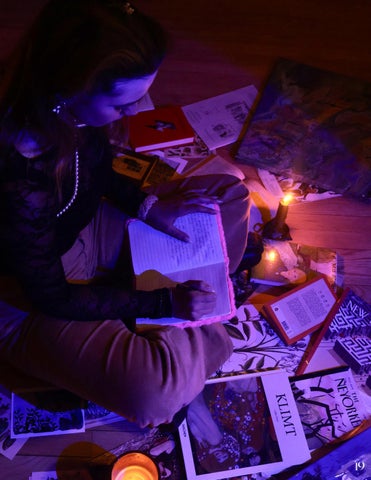
A receipt, an old wristband, and a bag from a fast food restaurant. To some, they may see a pile of trash but to me, I see the potential for a beautiful page in my junk journal. Well, what is junk journaling? It can differ from person to person, but for me it is taking items from my day to day life that I would otherwise discard, and using them as components to a scrapbooktype journal. It is my favorite hobby that combines traditional collaging with pictures and other traditional art supplies with repurposing ‘trash’ in a sustainable way. When people hear the word ‘scrapbook’ or ‘journaling’ they often think of an old hobby that their grandma would do. However, keeping physical memories is something that cannot be replicated in the online world. There is a tangible connection between someone and their scrapbook. Being able to physically feel and see the different textures between media in a scrapbook, and taking time to carefully curate a piece of art that encompasses moments that mean the most to you creates something that is rare in an online focused world. I take immense pride in my journal and love to be able to look back on memories from my life that a simple picture can’t capture. My journal is far from perfect, but the imperfections are what make it special. There is a sense of whimsy in a crooked photo or a rip in a saved map from a museum that a carefully curated Instagram post does not portray. In a time when there is such a pressure to have the perfect feed on social media, my junk journal is a space for me to capture memories in a way that is real: raw, unfiltered, messy, and imperfectly me.
48
Layo u
t by H
annah
Sulliv
an
s na Romanet li o P : r e h p a Photogr tt Arthur Model: Bre e Gorgadze Stylist: Elen
49
CHILDHO OD TRINKETS I l l u s t r a t e d by Elaine Linehan
D e s i g n e d by Zuri JupiterJones
Why do we love collecting trinkets and plushies? Cuteness or aesthetics is a val id reason, but the prominent one seems to hit closer to home. It’s also deeper root ed than just wanting what everyone else has. We likely gravitate towards these objects because they remind us of a simpler time. A time when we were smaller and only worried about which story we would be read at bedtime. Sim ilarly, these purchases are a form of wish fulfill ment for anyone who wanted toys like these as a child, but never got them. Their current popularity and nor malization also grants us a sense of free dom from the judg ment of having “toys.” Back when this wasn’t our concern, we were surround ed by infomercials that lit up our TVs and imprinted in our minds. This is why these specific trinkets and plushies call out to us. We want Jellycats and Squishmallows because they remind us of Beanie Beanies and Pillowpets. We grab Labubus because they resemble Furbies. We search for Smi skis and Sonny Angels because they remind us of squishies, Polly Pocket dress up dolls and tiny Lalaloospies. Written by Zuri JupiterJones
50
Now as adults, we cling to our pasts as a form of comfort in the present. The toys channel our younger selves and promise that we can be mature without sacfricing our inner child. They also allow us to create a new identity. We’re not trapped in the past, being ruled by only our whims and juvenile impulses, but we’re not prisoners of adulthood who have lost their wonder. We’re a fusion, which is why we incorporate aspects of our past with a modern twist that reflect our per sonal views of ourselves as everevolving people.
51